WO2017185093A1 - Dairy product analogs and processes for making same - Google Patents
Dairy product analogs and processes for making same Download PDFInfo
- Publication number
- WO2017185093A1 WO2017185093A1 PCT/US2017/029167 US2017029167W WO2017185093A1 WO 2017185093 A1 WO2017185093 A1 WO 2017185093A1 US 2017029167 W US2017029167 W US 2017029167W WO 2017185093 A1 WO2017185093 A1 WO 2017185093A1
- Authority
- WO
- WIPO (PCT)
- Prior art keywords
- plant
- yogurt
- weight
- based yogurt
- analog
- Prior art date
- Legal status (The legal status is an assumption and is not a legal conclusion. Google has not performed a legal analysis and makes no representation as to the accuracy of the status listed.)
- Ceased
Links
Classifications
-
- A—HUMAN NECESSITIES
- A23—FOODS OR FOODSTUFFS; TREATMENT THEREOF, NOT COVERED BY OTHER CLASSES
- A23C—DAIRY PRODUCTS, e.g. MILK, BUTTER OR CHEESE; MILK OR CHEESE SUBSTITUTES; PREPARATION THEREOF
- A23C11/00—Milk substitutes, e.g. coffee whitener compositions
- A23C11/02—Milk substitutes, e.g. coffee whitener compositions containing at least one non-milk component as source of fats or proteins
- A23C11/10—Milk substitutes, e.g. coffee whitener compositions containing at least one non-milk component as source of fats or proteins containing or not lactose but no other milk components as source of fats, carbohydrates or proteins
- A23C11/103—Milk substitutes, e.g. coffee whitener compositions containing at least one non-milk component as source of fats or proteins containing or not lactose but no other milk components as source of fats, carbohydrates or proteins containing only proteins from pulses, oilseeds or nuts, e.g. nut milk
- A23C11/106—Addition of, or treatment with, microorganisms
-
- A—HUMAN NECESSITIES
- A23—FOODS OR FOODSTUFFS; TREATMENT THEREOF, NOT COVERED BY OTHER CLASSES
- A23J—PROTEIN COMPOSITIONS FOR FOODSTUFFS; WORKING-UP PROTEINS FOR FOODSTUFFS; PHOSPHATIDE COMPOSITIONS FOR FOODSTUFFS
- A23J1/00—Obtaining protein compositions for foodstuffs; Bulk opening of eggs and separation of yolks from whites
- A23J1/14—Obtaining protein compositions for foodstuffs; Bulk opening of eggs and separation of yolks from whites from leguminous or other vegetable seeds; from press-cake or oil-bearing seeds
-
- A—HUMAN NECESSITIES
- A23—FOODS OR FOODSTUFFS; TREATMENT THEREOF, NOT COVERED BY OTHER CLASSES
- A23J—PROTEIN COMPOSITIONS FOR FOODSTUFFS; WORKING-UP PROTEINS FOR FOODSTUFFS; PHOSPHATIDE COMPOSITIONS FOR FOODSTUFFS
- A23J3/00—Working-up of proteins for foodstuffs
- A23J3/14—Vegetable proteins
-
- A—HUMAN NECESSITIES
- A23—FOODS OR FOODSTUFFS; TREATMENT THEREOF, NOT COVERED BY OTHER CLASSES
- A23J—PROTEIN COMPOSITIONS FOR FOODSTUFFS; WORKING-UP PROTEINS FOR FOODSTUFFS; PHOSPHATIDE COMPOSITIONS FOR FOODSTUFFS
- A23J3/00—Working-up of proteins for foodstuffs
- A23J3/30—Working-up of proteins for foodstuffs by hydrolysis
- A23J3/32—Working-up of proteins for foodstuffs by hydrolysis using chemical agents
- A23J3/34—Working-up of proteins for foodstuffs by hydrolysis using chemical agents using enzymes
-
- A—HUMAN NECESSITIES
- A23—FOODS OR FOODSTUFFS; TREATMENT THEREOF, NOT COVERED BY OTHER CLASSES
- A23J—PROTEIN COMPOSITIONS FOR FOODSTUFFS; WORKING-UP PROTEINS FOR FOODSTUFFS; PHOSPHATIDE COMPOSITIONS FOR FOODSTUFFS
- A23J3/00—Working-up of proteins for foodstuffs
- A23J3/30—Working-up of proteins for foodstuffs by hydrolysis
- A23J3/32—Working-up of proteins for foodstuffs by hydrolysis using chemical agents
- A23J3/34—Working-up of proteins for foodstuffs by hydrolysis using chemical agents using enzymes
- A23J3/346—Working-up of proteins for foodstuffs by hydrolysis using chemical agents using enzymes of vegetable proteins
-
- A—HUMAN NECESSITIES
- A23—FOODS OR FOODSTUFFS; TREATMENT THEREOF, NOT COVERED BY OTHER CLASSES
- A23L—FOODS, FOODSTUFFS OR NON-ALCOHOLIC BEVERAGES, NOT OTHERWISE PROVIDED FOR; PREPARATION OR TREATMENT THEREOF
- A23L11/00—Pulses, i.e. fruits of leguminous plants, for production of food; Products from legumes; Preparation or treatment thereof
- A23L11/05—Mashed or comminuted pulses or legumes; Products made therefrom
-
- A—HUMAN NECESSITIES
- A23—FOODS OR FOODSTUFFS; TREATMENT THEREOF, NOT COVERED BY OTHER CLASSES
- A23L—FOODS, FOODSTUFFS OR NON-ALCOHOLIC BEVERAGES, NOT OTHERWISE PROVIDED FOR; PREPARATION OR TREATMENT THEREOF
- A23L11/00—Pulses, i.e. fruits of leguminous plants, for production of food; Products from legumes; Preparation or treatment thereof
- A23L11/50—Fermented pulses or legumes; Fermentation of pulses or legumes based on the addition of microorganisms
-
- A—HUMAN NECESSITIES
- A23—FOODS OR FOODSTUFFS; TREATMENT THEREOF, NOT COVERED BY OTHER CLASSES
- A23L—FOODS, FOODSTUFFS OR NON-ALCOHOLIC BEVERAGES, NOT OTHERWISE PROVIDED FOR; PREPARATION OR TREATMENT THEREOF
- A23L11/00—Pulses, i.e. fruits of leguminous plants, for production of food; Products from legumes; Preparation or treatment thereof
- A23L11/60—Drinks from legumes, e.g. lupine drinks
- A23L11/65—Soy drinks
-
- A—HUMAN NECESSITIES
- A23—FOODS OR FOODSTUFFS; TREATMENT THEREOF, NOT COVERED BY OTHER CLASSES
- A23L—FOODS, FOODSTUFFS OR NON-ALCOHOLIC BEVERAGES, NOT OTHERWISE PROVIDED FOR; PREPARATION OR TREATMENT THEREOF
- A23L29/00—Foods or foodstuffs containing additives; Preparation or treatment thereof
- A23L29/20—Foods or foodstuffs containing additives; Preparation or treatment thereof containing gelling or thickening agents
- A23L29/206—Foods or foodstuffs containing additives; Preparation or treatment thereof containing gelling or thickening agents of vegetable origin
-
- A—HUMAN NECESSITIES
- A23—FOODS OR FOODSTUFFS; TREATMENT THEREOF, NOT COVERED BY OTHER CLASSES
- A23L—FOODS, FOODSTUFFS OR NON-ALCOHOLIC BEVERAGES, NOT OTHERWISE PROVIDED FOR; PREPARATION OR TREATMENT THEREOF
- A23L7/00—Cereal-derived products; Malt products; Preparation or treatment thereof
- A23L7/10—Cereal-derived products
- A23L7/104—Fermentation of farinaceous cereal or cereal material; Addition of enzymes or microorganisms
-
- A—HUMAN NECESSITIES
- A23—FOODS OR FOODSTUFFS; TREATMENT THEREOF, NOT COVERED BY OTHER CLASSES
- A23V—INDEXING SCHEME RELATING TO FOODS, FOODSTUFFS OR NON-ALCOHOLIC BEVERAGES AND LACTIC OR PROPIONIC ACID BACTERIA USED IN FOODSTUFFS OR FOOD PREPARATION
- A23V2002/00—Food compositions, function of food ingredients or processes for food or foodstuffs
-
- A—HUMAN NECESSITIES
- A23—FOODS OR FOODSTUFFS; TREATMENT THEREOF, NOT COVERED BY OTHER CLASSES
- A23V—INDEXING SCHEME RELATING TO FOODS, FOODSTUFFS OR NON-ALCOHOLIC BEVERAGES AND LACTIC OR PROPIONIC ACID BACTERIA USED IN FOODSTUFFS OR FOOD PREPARATION
- A23V2250/00—Food ingredients
Definitions
- the present disclosure relates to yogurt analogs that are derived substantially from or wholly from non-animal sources, but that have color, flavor, nutritional content, mouth-feel, texture and/or other qualities that are similar to those of dairy products. Also provided are processes for production of such yogurt analogs.
- Vegetarian and vegan diets provide many benefits to consumers. Such benefits include healthy nutrition (e.g., lower saturated fats, no cholesterol), absence of ethical or religious dietary conflicts, less negative environmental impacts (e.g., less green house gases produced in production), more efficient use of resources (e.g., less water used in production), and for consumers who have developed intolerances to certain dairy milk constituents, avoidance of such intolerance.
- healthy nutrition e.g., lower saturated fats, no cholesterol
- absence of ethical or religious dietary conflicts e.g., less negative environmental impacts (e.g., less green house gases produced in production), more efficient use of resources (e.g., less water used in production)
- more efficient use of resources e.g., less water used in production
- Dairy-like food products derived from soybean, coconut, and almond are available to consumers. Demand for these vegetarian/vegan alternatives to dairy products is fueled, inter alia, by the factors described above. However, acceptance of the dairy substitutes has been relatively low. In addition, the appearance, flavor and/or mouth feel of the currently available dairy substitutes has not appealed to consumers. Moreover, many of the currently available dairy substitutes have lower nutritional value than their dairy analogs.
- dairy-free or substantially dairy-free yogurt formulations and/or plant-based yogurt that have the color, taste, nutritional content, and/or other qualities of dairy products, that do not challenge common nutritional sensitivities, and/or that provide consumption experiences consumers are accustomed to from dairy products.
- the present disclosure describes exemplary embodiments of formulations and/or plant-based yogurt that may meet various combinations of one or more of these features, as well as processes for their production.
- the present disclosure is directed to solving these and other problems disclosed herein.
- the present disclosure is also directed to overcoming and/or ameliorating at least one of the disadvantages of the prior art as will become apparent from the discussion herein.
- the present disclosure is also directed to pointing out one or more advantages to using yogurt analogs that are derived substantially from or wholly from non- animal sources, but that have color, flavor, nutritional content, texture and/or other qualities that are similar, or substantially similar, to those of dairy-based yogurts.
- the yogurt cultures stall (do not grow as well) and end up producing lower levels of organic acids.
- addition of various combinations of one or more acids, vitamins, complex amino acid mixtures e.g.
- Some embodiments are directed to non-dairy yogurt analogs that have qualities similar to those of dairy-based yogurts. Also provided are processes for production of such non-dairy yogurt analogs.
- Certain embodiments are directed to a plant-based yogurt analog comprising: a) at least one of between 1% to 10% by weight of a plant protein, and between 1% to 90% by weight of a plant protein isolate. Certain embodiments are directed to a plant-based yogurt analog, wherein the plant protein isolate is a fermented plant protein isolate. Certain embodiments are directed to a plant-based yogurt analog, wherein the plant protein isolate is a gelled plant protein isolate. Certain embodiments are directed to a plant-based yogurt analog, wherein the plant protein isolate is a gelled plant protein isolate and/or a fermented plant protein isolate.
- Certain embodiments are directed to a plant-based yogurt analog, wherein the percentage of protein in the plant-based yogurt analog is between 1% and 10% by weight and the percentage of lactic acid in the plant-based yogurt is at least between 0.25% and 1.15% by weight. Certain embodiments are directed to a plant-based yogurt analog, wherein the percentage of protein in the plant-based yogurt analog is between 3.9% and 4.1%) by weight and the percentage of lactic acid in the plant-based yogurt is greater than or equal to 0.55% by weight. Certain embodiments are directed to a plant-based yogurt analog, wherein the percentage of protein in the plant-based yogurt analog is between 7.9% and 8.1%) by weight and the percentage of lactic acid in the plant-based yogurt is greater than or equal to 0.95% by weight. Certain embodiments are directed to a cultured plant-base analog.
- Certain embodiments are directed to methods of producing a non-dairy yogurt formulation comprising the steps of: a) forming a mixture of plant-based milk; and b) one or more of the following emulsifier, complex amino acids mixture, buffer, niacin, riboflavin, yeast extract, 1-methionine, 1-serine, 1-threonine, in a sufficient quantity such that the pH of the resulting mixture is below 4.5 or 5 once the mixture is (1) heated at about 185°F; (2) the resultant mixture is covered and allowed to cool at about 105°F; (3) yogurt cultures are added to the mixture; and (4) the resultant mixture is incubated at about 108°F.
- Some embodiments are directed to methods for producing a plant-based yogurt mixture capable of being used to make a plant-based yogurt analog comprising the steps of: a) obtaining an essentially dairy-free base for a yogurt formulation that includes a plant-based derivative, such as a paste and/or protein isolate; and b) adding an acid to said formulation. Thereafter, the plant-based yogurt formulation may be used to manufacture a plant-based yogurt analog comprising the method steps of: a) heating a plant-based yogurt mixture for a first pre-determined amount of time; b) allowing the mixture to cool; c) adding yogurt cultures to the resultant mixture; and d) incubating the resultant mixture for a second pre-determined amount of time to produce a plant-based yogurt analog.
- a plant-based yogurt mixture capable of being used to make a plant-based yogurt analog
- the plant-based yogurt formulation may be used to manufacture a plant-based yogurt analog comprising the method steps of: a) heating a plant-based yogurt mixture for a first pre-determined amount
- the acid may be one or more amino acids.
- the base is dairy-free. Some embodiments are directed to methods for producing a plant-based yogurt mixture capable of being used to make a plant-based yogurt analog wherein the base may contain dairy-derived ingredients by weight of no more than about 15%, in some
- it may be no more than about 10%>, in some embodiments it may be no more than about 5% and in some embodiments it may be no more than about 1%> of the total weight of the base.
- Some embodiments provide for a method for producing a plant-based yogurt formulation capable of being used to make a plant-based yogurt analog comprising the steps of: a) obtaining an essentially dairy-free base for a yogurt formulation that includes a plant- based derivative, such as a paste and/or protein isolate; and b) adding an acid to said formulation.
- the base is dairy-free.
- the plant- based yogurt formulation may contain no more than about 1%, 5% or 10%> by weight of dairy-derived ingredients.
- the acid may be one or more amino acids.
- the acid may be an amino acid.
- the amino acid may be selected from the group of 1-methionine, 1-serine, 1-threonine, and mixtures thereof.
- the amount of acid added may be at least about 0.001%) by weight of the amount of plant-based derivative. In some embodiments the amount of acid added may be between about 0.001 and 0.1%> by weight of the plant-based derivative.
- the total amount of acid added may be about 0.003%>, 0.004%>, 0.005%>, 0.006%, 0.007%, 0.008%, 0.009%, 0.01%, 0.02%, 0.03%, 0.04%, 0.05%, 0.06%, 0.07%, 0.08%, 0.09%, or 0.1% by weight of the plant-based derivative.
- the amount of acid added may be sufficient to obtain about 0.5mM concentration of the acid in the plant-based yogurt formulation. In some embodiments, the amount of acid added may be sufficient to obtain between 0.2mM to 0.8mM, 0.3mM to 0.65mM, 0.4mM to 0.6mM, 0.45mM to 0.55mM or 0.48mM to 0.52mM concentration of the acid in the plant-based yogurt formulation. In some embodiments, the amount of acid added may be sufficient to obtain about 0.2mM, 0.3mM, 0.4mM, 0.42mM, 0.46mM, 0.48mM, 0.52mM, 0.54mM, 0.56mM, or 0.58mM concentration of the acid in the plant-based yogurt formulation.
- Some embodiments provide for a method of producing a non-dairy yogurt formulation comprising the steps of: a) blending one or more plants to form a mixture; b) adding an oil to the mixture; c) adding a sugar to the mixture; and d) adding an additive to the mixture selected from the group of: lecithin; amino acids; potassium phosphate; niacin;
- the method of culturing the mixture into a yogurt-like product may comprise the steps of: a) heating the mixture at 185°F for about 30 seconds while stirring; b) covering the resultant mixture and allowing it to cool at 105°F; c) adding yogurt cultures to the resultant mixture; and d) incubating the resultant mixture at about 108°F for about 24 hours.
- the stirring may be constant or substantially constant.
- the non-dairy yogurt formulation is
- the method of culturing the mixture into a yogurt-like product may comprise the steps of: a) heating the mixture for a first pre-determined amount of time while stirring; b) allowing the mixture to cool; c) adding yogurt cultures to the resultant mixture; and d) incubating the resultant mixture for a second pre-determined amount of time.
- the stirring may be constant or substantially constant.
- the amount time that the mixture is heated during the first pre-determined is based at least in part on the kill kinetics for spore forming microbes and the temperature and time used may be varied.
- the heat treatment may be extended to further denature the protein and achieve a thicker texture.
- the mixture may be heated for the first pre-determined amount of time of between 4 minutes and 6 minutes, between 4.5 minutes and 5.5 minutes, between 5 minutes and 15 minutes or 5 minutes at a temperature of about 165°F, between 160°F and 170°F, between 162°F and 168°F, between 165°F and 170°F or between 164°F and 166°F. In some embodiments, the mixture may be heated for the first pre-determined amount of time of about 5 minutes at a temperature of about 165°F.
- the mixture may be heated for a first pre-determined amount of time of between 0.3 minutes and 1 minute, between 0.4 minutes and 0.8 minutes, between 0.5 minutes and 2 minutes or 0.5 minutes at a temperature of about 185°F, between 175°F and 190°F, between 182°F and 187°F, between 185°F and 190°F or between 180°F and 185°F. In some embodiments, the mixture may be heated for the first pre-determined amount of time of about 0.5 minutes at a temperature of about 185°F.
- the mixture may be heated for the first pre-determined amount of time of between 0.03 minutes and 1 minute, between 0.04 minutes and 0.08 minutes, between 0.05 minutes and 0.2 minutes or 0.05 minutes at a temperature of about 210°F, between 195°F and 220°F, between 200°F and 215°F, between 205°F and 215°F or between 208°F and 212°F. In some embodiments, the mixture may be heated for the first pre-determined amount of time of about 0.05 minutes at a temperature of about 210°F. Other variations or combinations in the temperature and time period for the first pre-determined amount of time are contemplated.
- incubation of the resultant mixture for a second pre-determined amount of time of between 5 hours and 35 hours, between 6 hours and 8 hours, between 20 hours and 26 hours, between 6 hours and 10 hours may be carried out at a temperature of about 108°F, between 90°F and 120°F, between 95°F and 115°F, between 100°F and 110°F, between 105°F and 115°F or between 95°F and 105°F.
- incubation of the resultant mixture for a second pre-determined amount of time of between 22 hours and 26 hours may be carried out at a temperature of between 105°F and 110°F.
- incubation of the resultant mixture for a second pre-determined amount of time of between 6 hours and 8 hours may be carried out at a temperature of between 110°F and 115°F.
- the amount of acid added may be sufficient to obtain about 0.5mM concentration of the acid in the plant-based yogurt formulation.
- the amount of acid added may be sufficient to obtain between 0.2mM to 0.8mM, 0.3mM to 0.65mM, 0.4mM to 0.6mM, 0.45mM to 0.55mM or 0.48mM to 0.52mM concentration of the acid in the plant-based yogurt formulation.
- the amount of acid added may be sufficient to obtain about 0.2mM, 0.3mM, 0.4mM, 0.42mM, 0.46mM, 0.48mM, 0.52mM, 0.54mM, 0.56mM, or 0.58mM concentration of the acid in the plant-based yogurt formulation.
- the desired pH of the yogurt-like product is below 4.5.
- the plant, from which the plant-based derivative is obtained is a high- starch plant.
- the high-starch plant is pea.
- the oil is sunflower oil.
- the additive is lecithin.
- the additive is selected from the group consisting of 1-methionine, 1-serine, 1-threonine, or mixtures thereof.
- Some embodiments provide an essentially dairy-free formulation comprising: a) between about 20-50% of a plant-based derivative; and b) an additive selected from the group consisting of: lecithin; amino acids; potassium phosphate; niacin; riboflavin; yeast extract; yeast; or some combination thereof in a sufficient quantity such that the pH of the resulting mixture is below 5 once the mixture is cultured using a yogurt culturing procedure.
- the formulation and/or plant-based yogurt is dairy-free.
- the amount of dairy-derived ingredients by weight may be no more than about 30%, in some embodiments it may be no more than about 25%, in some embodiments it may be no more than about 20%, in some embodiments it may be no more than about 15%, in some embodiments it may be no more than about 10%, in some embodiments it may be no more than about 5% and in some embodiments it may be no more than about 1% of the total weight of the plant-based formulation and/or plant-based yogurt.
- the method of culturing the mixture into a yogurt-like product may comprise the steps of: a) heating the mixture at 185°F for 30 seconds while stirring; b) covering the resultant mixture and allowing it to cool at 105°F; c) adding yogurt cultures to the resultant mixture; and d) incubating the resultant mixture at 108°F for 24 hours.
- the ultimate pH of the yogurt-like product may be below 4.5.
- sugar may be added.
- the weight of the added sugar may be at least about 10% of the weight of the plant-based derivative.
- the additive may comprise an amino acid.
- the additive may be a combination of multiple amino acids.
- the additive may comprise at least one of 1-methionine, 1-serine, or 1-threonine.
- the amount of amino acid added may be at least about 0.5% of the weight of the plant-based derivative, and, in some embodiments, riboflavin and/or niacin may be further added to the amino acids.
- the additive may comprise potassium phosphate.
- Some embodiments provide a formulation comprising, by weight, about: a) 30%) purified pea protein paste; b) 6.6% cane sugar; c) 1% sunflower oil; d) 0.1% sunflower lecithin; e) 0.00007% riboflavin; f) 0.0007% niacin; g) 0.11% potassium phosphate monobasic; h) 0.0076% 1-methionine; i) 0.0053% 1-serine; j) 0.006% 1-threonine; and k) 0.51%) yogurt cultures.
- Some embodiments provide a formulation comprising, by weight, about: a) protein paste; b) cane sugar; c) sunflower oil; d) sunflower lecithin; e) riboflavin; f) niacin; g) potassium phosphate monobasic; h) 1-methionine; i) 1-serine; j) 1-threonine; and k) yogurt cultures.
- Some embodiments provide a formulation comprising, by weight one or more of the following: a) protein paste; b) cane sugar; c) sunflower oil; d) sunflower lecithin; e) riboflavin; f) niacin; g) potassium phosphate monobasic; h) 1-methionine; i) 1-serine; j) 1- threonine; and k) yogurt cultures.
- the protein paste is made from a purified pea paste.
- other plant proteins pastes or sources are contemplated. Exemplary pastes are disclosed in US provisional patent application Serial No. 62/276,030.
- the purified pea protein paste may contain at least water, pea protein of between 15 to 20% by weight of the total weight of the paste and pea fat of between 1 to 2.5%) by weight of the total weight of the paste.
- Some embodiments provide a formulation comprising, by weight of the total formulation one or more of the following: a) pea protein paste (between 25% to 35%); b) cane sugar (between 3% to 8%); c) sunflower oil (between 0.5% to 6%); d) sunflower lecithin (between 0.0% to 0.3%); e) riboflavin (0% to 0.001%); f) niacin (between 0% to 0.001%); g) potassium phosphate monobasic (between 0.1% to 1%); h) 1-methionine (between 0% to 0.1%); i) 1-serine (between 0% to 0.1%); j) 1-threonine (between 0% to 0.1%)); and k) yogurt cultures (between 0.5% to 2%). It is to be understood that the plant
- FIGURE 1 shows the ingredients and amounts of one embodiment described herein.
- FIGURE 2 depicts pH as a function of time of three different yogurt formulations incubated for 20 hours.
- the squares show the pH of a formulation containing purified pea protein, cane sugar, sunflower lecithin, and sunflower oil.
- the circles show the pH of the formulation described in FIGURE 1.
- the triangles show the pH of a typical dairy formulation.
- FIGURE 3 depicts the lactic acid and acetic acid produced in 24 hours by the formulation described in FIGURE 1 as compared with two commercial dairy yogurt formulations.
- FIGURE 4 shows the effect of increasing buffer capacity in plant-based yogurt formulations has on lactic acid production, according to certain embodiments.
- FIGURE 5 shows the increase in lactic acid concentration across a range of protein concentrations, according to certain embodiment.
- FIGURE 6 shows the increase in lactic acid concentration using a range of plant protein isolates, according to certain embodiments.
- FIGURE 7 shows the increase in lactic acid concentration upon
- protein isolate refers to the protein material that is obtained from a natural source and/or modified natural source upon removal of at least a portion of (or a substantial portion of) one or more of the following: insoluble polysaccharide, soluble carbohydrate, ash, and other minor constituents. It typically has at least about 5%, 10%, 20%, 30%, 40%, 50%, 60%, 70%, 80%, or 90% by weight of protein.
- complex amino acid mixture refers to a material that is obtained from a natural source and/or modified natural source that contains one or more free amino acids, amino acid containing peptides, amino acid
- actual protein refers to the total amount of protein in a material or a composition.
- the term "fermented protein” as used herein refers to the protein material that has been cultured and/or fermented by one or more microorganisms.
- the protein material may or may not be partially and/or fully denatured, partially and/or fully degraded, partially and/or fully hydrolyzed, partially and/or fully truncated, partially and/or fully aggregated, partially and/or fully modified, and/or unchanged or combinations thereof.
- the term "gelled protein” as used herein refers to the protein material that has formed or been fully and/or partially incorporated into a gel or a gel-like structure.
- the gel may be a hydrogel.
- the gel by be a covalent network.
- the gel may be crosslinked.
- the gel may be a non-covalent network.
- the gel may be one or more of the following: a hydrogel, a covalent network, a crosslinked network, and a non-covalent network.
- the gel may contain other materials including, but not limited to, oils, fats, proteins, emulsifiers, soluble materials (e.g. sugar, salts, flavorings), gums, and/or hydrocolloids.
- Dairy yogurt may be made by fermenting milk, using bacteria cultures to convert milk sugars (lactose) into organic acids such as lactic and acetic acid.
- lactose milk sugars
- the milk is heated to about 85-100°C to denature the milk proteins, which allows them to set into gel-like structures during the fermentation.
- the culture is cooled to about 37-45°C and the microbial cultures are added.
- the yogurt cultures may consist of a mixed population of Lactobacillus and Streptococcus strains, which work synergistically to acidify the culture, creating the characteristic yogurt tang.
- substantially dairy-free or “essentially dairy-free” as used in the present disclosure means that the yogurt product or formulation has less than 5% by weight of milk-based ingredients.
- dairy-free as used in the present disclosure means that the yogurt product or formulation has no or less then 0.5% by weight of milk-based ingredients. It was believed that the problem in the taste of yogurt that is substantially dairy-free is the inability of yogurt cultures to grow and produce sufficient levels of organic acids. Regardless of the particular reason that such yogurts taste odd, the inventors have identified that adding one or more ingredients—which, when added to base formulations, allow the fermentation to proceed to more typical terminal pH's and organic levels— improves the taste of yogurt that is substantially dairy-free or dairy-free. Beneficial additives include complex amino acid mixtures, vitamins, minerals, and acids to the base formulation. Specific embodiments are described herein.
- the formulations and/or plant-based yogurt may use a single-plant or they may come from combining multiple plants to form the base.
- the formulations may also contain yogurt cultures.
- the formulations and/or plant-based yogurt may also contain fragrances, natural thickening agents, fats, water, and/or oils.
- the formulation and/or plant-based yogurt may contain acids, yeasts and/or yeast extracts, sweetening agents, emulsifiers, standard commercial natural and/or artificial flavors, certified colors and/or vitamins.
- the formulation contains a pea-based paste, water, sugar, sunflower oil, riboflavin, niacin, potassium phosphate monobasic, 1-methionine, 1-serine, 1- threonine, and yogurt cultures.
- the formulation contains a pea protein isolate, water, sugar, sunflower oil, riboflavin, niacin, potassium phosphate monobasic, 1- methionine, 1-serine, 1-threonine, and yogurt cultures.
- the present disclosure is not limited to a particular embodiment.
- Various plants and/or protein isolates may be used, including melon, barley, coconut, rice, pear, emmer, carrot, lupin seeds, pea, fennel, lettuce, oat, cabbage, celery, soybeans, almond, rice, flax, potato, sunflower, mushroom, or combinations thereof. Of course, other suitable plants and/or protein isolates are also acceptable.
- the amount of plant-based derivative may comprise at least about 10% by weight of the ultimate formulation; in some embodiments the amount of plant-based derivative may comprise at least about 15% by weight of the ultimate formulation and/or plant-based yogurt; in some embodiments the amount of plant-based derivative may comprise at least about 20% by weight of the ultimate formulation and/or plant-based yogurt; in some embodiments it may comprise at least about 25% by weight of the ultimate formulation; and in some embodiments it may comprise at least about 30% by weight of the ultimate formulation and/or plant-based yogurt.
- the amount of plant-based derivative may be, about, 20, 21, 22, 23, 24, 25, 26, 27, 28, 29, 30, 31, 32, 33, 34, 35, 36, 37, 38, 39, or 40% of the weight of the total formulation and/or plant-based yogurt. In some embodiments, the amount of plant-based derivative may be, between 15-20%, 20-25%, 25-30%, 30-35%, or 35-40% of the weight of the total formulation and/or plant-based yogurt.
- the amount of plants and/or protein isolate may comprise at least about 1% by weight of the plant-based yogurt formulation and/or yogurt; in some embodiments the amount of plant-based derivative and/or protein isolate may comprise at least about 5% by weight of the plant-based yogurt formulation and/or yogurt; in some embodiments the amount of plant-based derivative and/or protein isolate may comprise at least about 10% by weight of the plant-based yogurt formulation and/or yogurt; in some embodiments it may comprise at least about 20% by weight of the plant-based yogurt formulation and/or yogurt; in some embodiments it may comprise at least about 40% by weight of the plant-based yogurt formulation and/or yogurt; in some embodiments it may comprise at least about 60% by weight of the plant-based yogurt formulation and/or yogurt; in some embodiments it may comprise at least about 80% by weight of the plant-based yogurt formulation and/or yogurt; and in some embodiments it may comprise at least about 90% by weight of the plant-based yogurt formulation and/or yogurt.
- the amount of plant-based derivative may be, between 1-5%, 5-10%, 10-15%, 15-20%, 20-30%, 30-40%, 40-50%, 50-60%,60-70%, 70-80%, or 80-90% of the weight of the total formulation and/or plant-based yogurt.
- the percentage of protein in the plant-based derivative and/or protein isolate may also vary.
- the protein percentage by weight of the plant-based derivative and/or protein isolate may be between about 5 and 30%, in other embodiments it may be between about 10 and 25%, in other embodiments it may be between about 15 and 20%), in other embodiments it may be between about 12 and 20%, and in other embodiments it may be, about, 10, 11, 12, 13, 14, 15, 16, 17, 18, 19, 20, 21, 22, 23, 24, or 25%.
- a smaller quantity of a more concentrated plant-based derivative and/or protein isolate may perform substantially the same function in substantially the same way to obtain the same result in the final formulation.
- a formulation using 10% by weight of the formulation of a plant-based paste and/or protein isolate that has a 20% protein content, by weight of the plant-based derivative and/or protein isolate may be interchanged with a formulation using 20% by weight of a plant-based paste and/or protein isolate that has a 10% protein content.
- the protein percentage by weight of the plant-based derivative and/or protein isolate may be between about 30 and 98%, in other embodiments it may be between about 50 and 95%, in other embodiments it may be between about 70 and 90%, in other embodiments it may be between about 75 and 85%, and in other embodiments it may be, about, 75, 76, 77, 78, 79, 80, 81, 82, 83, 84, or 85%.
- the percentage of protein may comprise at least about 1%) by weight of the plant-based yogurt formulation and/or yogurt; in some embodiments the percentage of protein may comprise at least about 2% by weight of the plant-based yogurt formulation and/or yogurt; in some embodiments it may comprise at least about 4% by weight of the plant-based yogurt formulation and/or yogurt; in some embodiments it may comprise at least about 6% by weight of the plant-based yogurt formulation and/or yogurt; in some embodiments it may comprise at least about 8% by weight of the plant-based yogurt formulation and/or yogurt; and in some embodiments it may comprise at least about 10% by weight of the plant-based yogurt formulation and/or yogurt.
- percentage of protein may be, about, 1, 2, 3, 4, 5, 6, 7, 8, 9, or 10% of the weight of the total formulation and/or plant-based yogurt.
- the percentage of protein in the plant-based derivative may also vary.
- the protein percentage by weight of the plant-based derivative may be between about 5 and 30%, in other embodiments it may be between about 10 and 25%, in other embodiments it may be between about 15 and 20%, in other embodiments it may be between about 12 and 20%, and in other embodiments it may be, about, 10, 11, 12, 13, 14, 15, 16, 17, 18, 19, 20, 21, 22, 23, 24, or 25%.
- a smaller quantity of a more concentrated plant-based derivative may perform substantially the same function in substantially the same way to obtain the same result in the final formulation.
- a formulation using 10% by weight of the formulation of a plant-based paste that has a 20%) protein content, by weight of the plant-based derivative may be interchanged with a formulation using 20% by weight of a plant-based paste that has a 10% protein content.
- yogurt cultures may be used, including commercially available ones. For instance, Vivolac, Chr. Hansen, Bella and Bella, and GI ProStart make dairy-free yogurt cultures.
- flavors may be used. Some exemplary ones include: honey; vanilla; fruit prep (blueberry, strawberry, raspberry, etc); mango, citrus (lemon, orange, etc); coconut; passion fruit; peach, combinations of flavors and so forth.
- Different thickening agents may be used, including gelatin, pectin, agar, gums, starches, and ultra-gel.
- acceptable gums include sodium alginate, xanthan gum, guar gum or combinations thereof.
- acceptable starches include tapioca starch, arrowroot starch or combinations thereof.
- fatty materials may be used. Some exemplary fatty materials include coconut oil, coconut cream, palm oil, canola oil, soybean oil or combinations thereof. Other plant based fatty materials are also contemplated.
- oils may be used, including corn oil, sunflower oil, cotton seed oil, peanut oil, coconut oil, soy bean oil, other similar oils or combinations thereof.
- the percentage of oil added may be between about 0.1 and 5% by weight. In other embodiments the percentage may be between about 0.3 and 4% by weight. In other embodiments the percentage may be between about 0.5 and 3% by weight. In other embodiments, the percentage of oil added may be between about 2.5 and 3%. In other embodiments, the percentage of oil added may be between about 2.3 and 3.4%. In other embodiments the percentage may be between about 0.8 and 2% by weight.
- the percentage may be, about, 0.5, 0.6, 0.7, 0.8, 0.9, 1, 1.1, 1.2, 1.3, 1.4, 1.5, 2, 2, 3, 2.5, 2.7, 3, 3.2, 3.4, 3.6, 3.8 or 4% by weight.
- Different sweetening materials may be used, including honey, sugar, glucose, invert sugar, dextrose, or combinations thereof. In some embodiments, cane sugar is used. In some embodiments, the amount of sweetening materials may be about 1, 1.5, 2, 2.5, 3, 3.5, 4, 4.5, 5, 5.5, 6, 6.5, 7, 7.5, 8, 8.5, or 9% by weight of the ultimate formulation and/or plant- based yogurt.
- emulsifiers may be used, including various lecithins, such as egg yolk emulsifying lecithin, sunflower lecithin, and soy lecithin, honey, CSL calcium stearoyl di-laciate, polyglycerol ester, sorbitan ester, PG ester, sugar ester, monoglyceride, acetylated monoglyceride, lactylated monoglyceride or combinations thereof.
- the amount of emulsifier may be about between about 0.01 and 1% of the weight of the formulation and/or plant-based yogurt.
- the amount of emulsifier may be about 0.01, 0.02, 0.03, 0.04, 0.05, 0.06, 0.07, 0.08, 0.09, 0.1, 0.11, 0.12, 0.13, 0.14, 0.15, 0.16, 0.17, 0.18, 0.19, or 0.2% of the weight of the formulation and/or plant-based yogurt.
- probiotic bacteria may also be added.
- complex amino acid mixtures may be used, including yeast, yeast extract, hydrolyzed soy protein, hydrolyzed pea protein, corn steep liquor, meat extract, peptone, casein hydrolysate, lactalbumin hydrolysate, soytone, tryptone or combinations thereof.
- the amount of complex amino acid mixture may be about between about 0.01 and 1% of the weight of the formulation and/or plant-based yogurt.
- the amount of complex amino acid mixture may be about 0.01, 0.02, 0.03, 0.04, 0.05, 0.06, 0.07, 0.08, 0.09, 0.1, 0.15, 0.2, 0.25, 0.3, 0.4, 0.5, 0.6, 0.7, 0.8, 0.9, or 1.0%) of the weight of the formulation and/or plant-based yogurt.
- riboflavin, niacin, potassium phosphate monobasic, phosphate salts sodium phosphate monobasic, sodium phosphate dibasic, potassium phosphate monobasic, potassium phosphate dibasic, ammonium phosphate, magnesium phosphate
- citrate salts sodium citrate, potassium citrate, ammonium citrate, magnesium citrate
- other buffer salts ammonium chloride, thiamine, B12, pantothenic acid, myo-Inositol, biotin or combinations thereof.
- these ingredients may be added in solid, paste, and/or liquid form.
- these ingredients may be added dissolved in an aqueous solution.
- the weight concentration of riboflavin solution to add, as a percentage of the weight of the total base formulation and/or plant-based yogurt may be, in some embodiments, between about 0.02 and 0.2%>.
- the weight concentration of the stock solution as a percentage of the weight of the base formulation and/or plant-based yogurt may be between about 0.05 and 0.15%.
- the weight concentration of the stock solution as a percentage of the weight of the base formulation and/or plant-based yogurt may be between about 0.08 and 0.12%.
- the weight concentration of the stock solution as a percentage of the weight of the base formulation and/or plant-based yogurt may be between about 0.09 and 0.1 1%. In other embodiments, the weight concentration of the stock solution as a percentage of the weight of the base formulation and/or plant-based yogurt may be about 0.05, 0.06, 0.07, 0.08, 0.09, 0.1, 0.1 1, 0.12, 0.13, 0.14, 0.15, 0.16, 0.17, 0.18, 0.19 or 0.2%.
- the amount of riboflavin added may be between about 0.05 and 0.5% of the weight of the plant-based derivative. In other embodiments, the amount may be about 0.1, 0.1 1, 0.12, 0.13, 0.14, 0.15, 0.16, 0.17, 0.18, 0.19, 0.2, 0.21, 0.22, 0.23, 0.24, 0.25, 0.26, 0.27, 0.28, 0.29, or 0.3% of the weight of the plant-based derivative. In some embodiments, the amount of riboflavin added may be between about 0.05 and 10 parts per million (ppm) of the weight of the ultimate formulation and/or plant-based yogurt.
- ppm parts per million
- the amount may be about 0.1, 0.2, 0.3, 0.4, 0.5, 0.6, 0.7, 0.8, 0.9, 1, 2, 3, 4, 5, 6, 7, 8, 9, or 10 ppm of the weight of the ultimate formulation and/or plant-based yogurt.
- the weight concentration of niacin solution to add, as a percentage of the weight of the total base formulation and/or plant-based yogurt may be, between about 0.02 and 0.2%. In other embodiments, the weight concentration of the stock solution as a percentage of the weight of the base formulation and/or plant-based yogurt may be between about 0.05 and 0.15%. In other embodiments, the weight concentration of the stock solution as a percentage of the weight of the base formulation and/or plant-based yogurt may be between about 0.08 and 0.12%).
- the weight concentration of the stock solution as a percentage of the weight of the base formulation and/or plant-based yogurt may be between about 0.09 and 0.1 1%>. In other embodiments, the weight concentration of the stock solution as a percentage of the weight of the base formulation and/or plant-based yogurt may be about 0.05, 0.06, 0.07, 0.08, 0.09, 0.1, 0.1 1, 0.12, 0.13, 0.14, 0.15, 0.16, 0.17, 0.18, 0.19 or 0.2%.
- the amount of niacin added may be between about 0.5 and 5%) of the weight of the plant-based derivative. In other embodiments, the amount may be about 1, 1.1, 1.2, 1.3, 1.4, 1.5, 1.6, 1.7, 1.8, 1.9, 2, 2.1, 2.2, 2.3, 2.4, 2.5, 2.6, 2.7, 2.8, 2.9, or 3%) of the weight of the plant-based derivative. In some embodiments, the amount of niacin added may be between about 1 and 20 parts per million (ppm) of the weight of the ultimate formulation and/or plant-based yogurt. In other embodiments, the amount may be about 1, 2, 3, 4, 5, 6, 7, 8, 9, 10, 15, or 20 parts per million (ppm) of the weight of the ultimate formulation and/or plant-based yogurt.
- the weight concentration of potassium phosphate monobasic solution to add, as a percentage of the weight of the total base formulation and/or plant-based yogurt may be between about 0.1 and 4%. In other embodiments, the weight concentration of the stock solution as a percentage of the weight of the base formulation and/or plant-based yogurt may be between about 0.5 and 3%. In other embodiments, the weight concentration of the stock solution as a percentage of the weight of the base formulation and/or plant-based yogurt may be between about 0.6 and 2%. In other embodiments, the weight concentration of the stock solution as a percentage of the weight of the base formulation and/or plant-based yogurt may be between about 0.7 and 1%. In other embodiments, the weight concentration of the stock solution as a percentage of the weight of the base formulation and/or plant-based yogurt may be about 0.5, 0.6, 0.7, 0.8, 0.9, and 1%.
- the amount of potassium phosphate monobasic added may be between about 0.05 and 0.5% of the weight of the plant-based derivative. In other embodiments, the amount may be about 0.2, 0.21, 0.22, 0.23, 0.24, 0.25, 0.26, 0.27, 0.28, 0.29, 0.3, 0.31, 0.32, 0.33, 0.34, 0.35, 0.36, 0.37, 0.38, 0.39, or 4% of the weight of the plant- based derivative.
- the amount of phosphate salts may be between about 0.05 and 5% of the weight of the ultimate formulation and/or plant- based yogurt. In other embodiments, the amount may be about 0.1, 0.2, 0.3, 0.4, 0.5, 0.6, 0.7, 0.8, 0.9 or 1% of the weight of the ultimate formulation and/or plant-based yogurt.
- the amount of citrate salts may be between about 0.05 and 5% of the weight of the ultimate formulation and/or plant-based yogurt. In other embodiments, the amount may be about 0.1, 0.2, 0.3, 0.4, 0.5, 0.6, 0.7, 0.8, 0.9 or 1% of the weight of the ultimate formulation and/or plant-based yogurt.
- the acids are amino- acids. Some embodiments utilize 1-methionine, 1-serine, 1-threonine, combinations thereof, and/or casamino acids. In some embodiments, these ingredients are added dissolved in an aqueous solution. When using a 0.2 molar stock concentration of an amino acid, the weight concentration of the amino acid solution to add, as a percentage of the weight of the total base formulation and/or plant-based yogurt, may be between about 0.1 and 4%. In other
- the weight concentration of the stock solution as a percentage of the weight of the base formulation and/or plant-based yogurt may be between about 0.3 and 3%. In other embodiments, the weight concentration of the stock solution as a percentage of the weight of the base formulation and/or plant-based yogurt may be between about 0.5 and 2%. In other embodiments, the weight concentration of the stock solution as a percentage of the weight of the base formulation and/or plant-based yogurt may be between about 0.6 and 1%.
- the weight concentration of the stock solution as a percentage of the weight of the base formulation and/or plant-based yogurt may be about 0.25, 0.3, 0.35, 0.4, 0.45, 0.5, 0.55, 0.6, 0.65, 0.7, 0.75, 0.8, 0.85, 0.9, 0.95, or 1%.
- the amount of amino acids added may be between about 0.01 and 1% of the weight of the plant-based derivative. In other embodiments, the amount may be about 0.01, 0.02, 0.03, 0.04, 0.05, 0.06, 0.07, 0.08, 0.09, or 1% of the weight of the plant-based derivative. In some embodiments, the amount of each amino acid added may be between about 1 and 500 parts per million (ppm) of the weight of the ultimate formulation and/or plant-based yogurt. In other embodiments, the amount of each amino acid added may be about 50, 60, 70, 80, 90, 100, 120, 140, 160, 180, or 200 parts per million (ppm) of the weight of the ultimate formulation and/or plant-based yogurt.
- the combination of amino acid may be a combination of 1-methionine, 1-serine, and 1- threonine.
- concentrations of the three amino acids may be equal or they may not be.
- the ratio of 1-methionine to 1-serine to 1-threonine may be 1 : 1 : 1, 2: 1 : 1, 1 :2: 1, 1 : 1 :2, 2:2: 1, 2: 1 :2, or 1 :2:2, respectively.
- a combination of threonine, methionine, serine, phosphate, citrate, niacin, and riboflavin may be added.
- a smaller quantity of a more concentrated solution of an additive may perform substantially the same function in substantially the same way to obtain the same result.
- 0.1% by weight of the final base formulation of a 7 mg/mL stock concentration of niacin may be equivalent to 0.05% by weight of the final base formulation of a 14 mg/mL stock concentration.
- phosphate may be added.
- a combination of yeast extract, potassium phosphate, and sodium citrate may be added.
- a combination of threonine, methionine, serine and potassium phosphate may be added.
- hydrolyzed soy protein and potassium phosphate may be added.
- hydrolyzed pea protein and potassium phosphate may be added. Other combinations of these ingredients are also contemplated.
- the plant-based yogurt analog contains about 1.5% (w/w) actual protein and greater than or equal to 0.3% (w/w) lactic acid, about 2% (w/w) actual protein and greater than or equal to 0.35% (w/w) lactic acid, about 2.5% (w/w) actual protein and greater than or equal to 0.4% (w/w) lactic acid, about 3% (w/w) actual protein and greater than or equal to 0.45%) (w/w) lactic acid, about 3.5% (w/w) actual protein and greater than or equal to 0.5% (w/w) lactic acid, about 4% (w/w) actual protein and greater than or equal to 0.55% (w/w) lactic acid, about 4.5% (w/w) actual protein and greater than or equal to 0.6% (w/w) lactic acid, about 5% (w/w) actual protein and greater than or equal to 0.65% (w/w) lactic acid, about 5.5% (w/w) actual protein and greater than or equal to 0.7% (w/w) lactic
- the protein may be gelled. In other embodiments, the protein may be fermented. In some embodiments, the protein may be gelled and/or fermented. In some embodiments, a gelled and/or fermented protein results from culturing a formulation.
- the yogurt analog may be a liquid.
- the yogurt analog may be a drinkable liquid, in other embodiments it may be a thick liquid, in other embodiments it may be a thin liquid, in other embodiments it may be a semi-solid, in other embodiments it may be a solid, in other embodiments it may be a gel, in other embodiments it may be a paste.
- the yogurt analog may be Greek style.
- plant-based milks may be added. The plant base of these milks may include soy, rice, almond, flax, coconut, sunflower, pea, cashew, peanut, and/or combinations thereof. In some embodiments, the amount of plant-based milks may be between 1-20% (w/w) of the plant-based yogurt formulation.
- the amount may be between 20-40%, 40-60%, 60-80%, or 80-99% (w/w). In some embodiments, the amount may be 85, 86, 87, 88, 89, 90, 91, 92, 93, 94, 95, 96, 97, 98, or 99% (w/w).
- FIGURE 1 provides an exemplary embodiment of a formulation.
- FIGURE 2 shows an example of how this embodiment improves culture acidification during
- FIGURE 3 shows that the embodiment is also able to achieve lactic acid levels similar to that found in two commercial dairy yogurts (i.e., yogurt 1 is Dannon OIKOS Greek Nonfat and yogurt 2 is Brown Cow Plain Nonfat). Under each of the three samples there are two bars the one of the left is the lactic acid level and the one on the right is the acetic acid level.
- the plant-based yogurt shown on the left hand side of FIGURE 3 is the formulation provided in FIGURE 1 and was prepared by: a) heating the mixture at 185°F for 30 seconds while stirring; b) covering the resultant mixture and allowing it to cool at 105°F; c) adding yogurt cultures to the resultant mixture; and d) incubating the resultant mixture at 108°F for 24 hours.
- a base yogurt formulation was prepared that contained pea protein, cane sugar, sunflower lecithin and sunflower oil. This formula was cultured using a typical small-scale yogurt procedure:
- This type of formulation would typically only reach a terminal pH of about 5.4 (vs -3.8-4.3 in a dairy culture) and produce about 50% (w/w) of the lactic acid found in dairy yogurts.
- Dairy milk contains a complement of free amino acids, vitamins, and other nutrients which yogurt bacteria utilize for growth. This was confirmed by adding to the above plant- based formula a small amount of dairy milk and the modified plant-based formula achieved typical lactic acid concentrations and low pH.
- Vitamins e.g. niacin and/or riboflavin
- Dairy milk is able to buffer the drop in pH deriving from lactic acid production by the fermenting bacteria.
- Traditional, unpurified plant milks like soy milk are also able to provide buffering, though to a lesser degree than dairy.
- the purification of plant proteins reduces their ability of these solutions to buffer pH drop.
- this causes the culture media to acidify rapidly, limiting the growth of the bacterial culture and negatively affecting the development of lactic acid and/or flavor compounds.
- Addition of buffering agents caused the pH to drop more slowly and allow for better bacterial growth, leading to higher lactic acid concentrations.
- Combining the buffer agents (potassium phosphate, 0.15% w/w) with the nutrients identified above further aided the fermentation of the plant-based formulation.
- Figure 1 shows the formulation for the example yogurt analog.
- Figure 2 shows the improvement in culture acidification that is achieved with nutrient and buffer supplementation of an exemplary embodiment.
- the pH change in the basic plant-based formula is shown in the line with solid circles. The pH starts at about 6.8 and is just under 5.5 after 20 hours of fermentation.
- the pH change in the planted-based formula with supplements added, according to certain embodiments, is shown in the line with squares. The pH starts at about 6.7 and after 20 hours the pH is 4.3.
- the pH change in a typically dairy formula (2% dairy milk) is shown in the line with triangles and starts at about 6.5 and after 20 hours the pH is 4.3.
- the supplemented fermentation of the plant-based formulation resulted in a lower terminal pH as compared to the plant-base formulation without supplements.
- Figure 3 shows that the lactic acid level in nutrient and buffer supplemented plant-based yogurt formulation is similar to what is found in commercial dairy yogurts.
- Three yogurts are shown, a plant-based yogurt produced according to certain embodiments and two commercial diary-based yogurts.
- Commercial yogurt 1 is Dannon OIKOS Greek Nonfat
- commercial yogurt 2 is Brown Cow Plain Nonfat.
- the larger bars on the left of each of the three bar groupings show the amount of lactic acid present and the small bars on the right of each of the three bar groupings show the amount of acetic acid present.
- Figure 4 shows the effect of increasing buffer capacity on the percentage (w/w) of lactic acid production in an exemplary embodiment.
- the amount of potassium phosphate was in increased from 0% (w/w) (step 1), to 0.1% (w/w) (step 2), to 0.2% (w/w) (step 3) to 0.9% (w/w) (step 4) and to 1.8% (w/w) (step 5).
- the increase in buffer capacity resulted in an increase in lactic acid production.
- Table 1 below provides some exemplary embodiment formulations for certain of the plant-based yogurt formulations and/or plant-based yogurts disclosed herein. The percentages given in Table 1 are weight/weight.
- FIG. 1 shows production of lactic acid after fermentation in a fat-free yogurt formulation (Table 2) at protein isolate levels from 1%, 2%, 4%, 6%, 8%, and 10% (w/w as actual protein).
- Table 2 shows production of lactic acid after fermentation in a fat-free yogurt formulation at protein isolate levels from 1%, 2%, 4%, 6%, 8%, and 10% (w/w as actual protein).
- Two commercial pea protein isolates were used, World Food Pea Protein Isolate (diamonds) and Now Sports Pea Protein Isolate (squares).
- the open symbols indicate formulations with added supplements.
- the filled symbols indicate formulations without supplementation.
- Supplementation increased the lactic acid concentration at each protein concentration by about 0.35% (w/w).
- Example 3 Lactic acid production with varying plant protein sources
- This example shows an increase in the production of lactic acid across a range of plant protein isolates by supplementing the fermentation.
- Figure 6 shows the increase in lactic acid concentration by supplementing fat-free yogurt formulations that contain one of a variety of plant protein isolates including mushroom, pea, potato, rice, and soy.
- the change in lactic acid % (w/w) is calculated by subtracting the unsupplemented lactic acid amount from the supplemented lactic acid amount.
- Each symbol represents a unique protein isolate.
- Plant Protein Isolate (as % actual Protein) 4% 4%
- Non-dairy starter culture 0.02% 0.02%
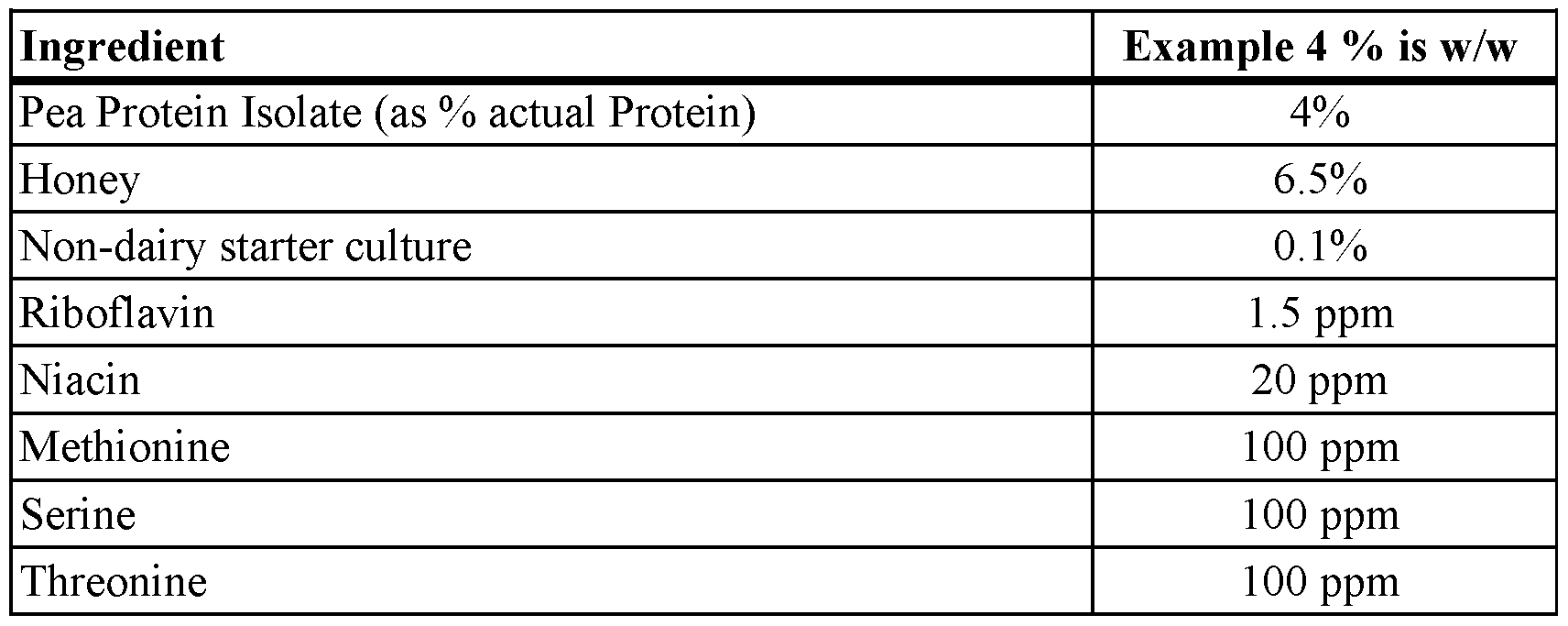
- a fat-free yogurt formulation was prepared that contained pea protein, honey, riboflavin, niacin, methionine, serine, threonine (Table 4).
- Fat-free diary yogurts deliver a product with protein (about 4-8% w/w actual protein) but without the negative health associations of fat.
- This example shows a plant-based fat-free yogurt analog that eliminates added fat while maintaining protein content (about 4% w/w actual protein). This formula was cultured using a typical fat-free yogurt procedure:
- yogurt formulation was prepared that contained pea protein, cane sugar, sunflower lecithin, sunflower oil, yeast extract, and sodium phosphate (Table 5). This formula was cultured using a typical large-scale yogurt procedure:
- a drinkable style yogurt formulation was prepared that contained soy protein, glucose, soy lecithin, soybean oil, soy protein hydrolysate, and sodium citrate (Table 6).
- Drinkable dairy yogurts may have less protein (about 2 to 3% w/w actual protein) and added water compared to standard yogurts.
- the protein content of the yogurt mixture was adjusted, yielding a product with lower viscosity and greater pourability. This formula was cultured using the procedure described in Example 5.
- Soy Protein Isolate (as % actual Protein) 2%
- a Greek style yogurt formulation was prepared that contained pea protein, invert sugar, sunflower lecithin, sunflower oil, coconut oil, sodium citrate, and sodium phosphate (Table 7).
- Greek Style dairy yogurts are typically thicker than standard yogurt and often contain more protein (about 8% w/w).
- This example shows a plant-based Greek style yogurt analog that matches the thickness and protein content of Greek style dairy yogurts. This formula was cultured using procedure described in Example 5.
- This example demonstrates fermentation of high protein (about 8% w/w actual protein) containing yogurts and yogurt derivatives that contain gelled and fermented protein.
- soy and almond plant-based beverages were fermented into yogurts or yogurt type analogs.
- Figure 6 shows the increase in lactic acid concentration with supplementation.
- Silk Original soy milk or Almond Breeze original almond milk were inoculated with non-dairy starter culture (0.02%) and incubated at 40 °C.
- the formulas were either unsupplemented (closed circles) or supplemented with 0.2% yeast extract and 0.4% potassium phosphate (open circles).
- the supplemented fermentations were able to produce higher amounts of lactic acid compared to the unsupplemented fermentations.
- Table 8 provides exemplary ranges of some of the ingredients.
- Example 1 A A method for producing a plant-based yogurt formulation capable of being used to make a plant-based yogurt analog comprising the steps of:
- an additive selected from the group of: lecithin; amino acids; potassium phosphate; niacin; riboflavin; yeast extract; yeast; or some combination thereof in a sufficient quantity such that the pH of the resulting mixture is below 4.5 or 5 once the mixture is cultured using a yogurt culturing procedure.
- [00128] 11 A The method of one or more of examples 6A-10A, wherein the mixture is stirred while being heated.
- [00130] 13A The method of one or more of examples 6A-12A, wherein the mixture is cooled to about 125°F or 120°F or 115°F or 110°F or 105°F or 100°F or 95°F or 90°F.
- 14A The method of one or more of examples 6A-13A, wherein the second pre-determined amount of time is greater than 6 hours or greater than 12 hours or greater than 18 hours or greater than 24 hours.
- 15A The method of one or more of examples 6A-14A, wherein the second pre-determined amount of time is about 12 hours or about 14 hours or about 16 hours or about 18 hours or about 20 hours or about 22 hours or about 24 hours.
- 17A The method of one or more of examples 6A-16A, wherein the mixture is incubated at about 95°F or about 100°F or about 105°F or about 106°F or about 107°F or about 108°F or about 109°F or about 110°F or about 115°F or about 120°F.
- an additive selected from the group of: lecithin; amino acids; potassium phosphate; niacin; riboflavin; yeast extract; yeast; or some combination thereof in a sufficient quantity such that the pH of the resulting mixture is below 4.5 or 5 once the mixture is (1) heated at about 185°F for 20 to 60 seconds while stirring; (2) the resultant mixture is covered and allowed to cool at about 105°F; (3) yogurt cultures are added to the mixture; and (4) the resultant mixture is incubated at about 108°F for about 24 hours.
- an additive selected from the group of: lecithin; amino acids; potassium phosphate; niacin; riboflavin; yeast extract; yeast; or some combination thereof in a sufficient quantity such that the pH of the resulting mixture is below 4.5 or 5 once the mixture is (1) heated at about 185°F for 20 to 60 seconds while stirring; (2) the resultant mixture is covered and allowed to cool at about 105°F; (3) yogurt cultures are added to the mixture; and (4) the resultant mixture is incubated at
- [00140] 23 A The method of one or more of examples 5A-21 A, wherein the additive is selected from the group of 1-methionine, l-serine, 1-threonine, or combinations thereof.
- an additive selected from the group of: lecithin; amino acids; potassium phosphate; niacin; riboflavin; yeast extract; or yeast; or some combination thereof in a sufficient quantity such that the pH of the resulting mixture is below 4.5 or 5 once the mixture is cultured using a yogurt culturing procedure.
- yogurt culturing procedure comprises: (1) mixing the plant-based derivative and the additive to form a mixture; (2) heating the mixture for a first pre-determined amount of time; (3) allowing the mixture to cool; (4) adding yogurt cultures to the mixture; and (5) incubating the mixture for a second pre-determined amount of time.
- 26A The formulation of example 25A, wherein the mixture is heated at a temperature of greater than 150°F.
- 29A The formulation of one or more of examples 25A-28A, wherein the first pre-determined amount of time is about 20 seconds or about 25 seconds or about 30 seconds or about 35 seconds.
- 31 A The formulation of one or more of examples 25A-30A, wherein the mixture is cooled below 130°F or 120°F or 110°F or 100°F.
- 33A The formulation of one or more of examples 25A-32A, wherein the second pre-determined amount of time is greater than 6 hours or greater than 12 hours or greater than 18 hours or greater than 24 hours.
- 34A The formulation of one or more of examples 25A-33A, wherein the second pre-determined amount of time is about 12 hours or about 14 hours or about 16 hours or about 18 hours or about 20 hours or about 22 hours or about 24 hours.
- 35 A The formulation of one or more of examples 25A-34A, wherein the mixture is incubated at greater than 80°F or greater than 90°F or greater than 100°F or greater than 105°F or greater than 110°F or greater than 1 15°F.
- 36A The formulation of one or more of examples 25A-35A, wherein the mixture is incubated at about 95°F or about 100°F or about 105°F or about 106°F or about 107°F or about 108°F or about 109°F or about 110°F or about 115°F or about 120°F.
- an additive selected from the group of: lecithin; amino acids; potassium phosphate; niacin; riboflavin; yeast extract; or yeast; or some combination thereof in a sufficient quantity such that if the formulation was (1) mixed; (2) heated at about 185°F for between 20 to 60 seconds while stirring; (3) the resultant mixture were then covered and allowed to cool at about 105°F; (4) yogurt cultures were added to the mixture; and (5) the resultant mixture were incubated at about 108°F for about 24 hours, then the pH of the resultant mixture would be below 4.5 or 5.
- [00161] 44A The formulation of one or more of examples 25A-38A, wherein the additive comprises niacin.
- [00162] 45A The formulation of one of more of examples 25A-43A, further comprising niacin.
- [00163] 46A A formulation comprising, by weight:
- a plant-based yogurt analog comprising:
- [00170] 53 A The plant-based yogurt analog of example 52A, wherein the plant protein isolate is a fermented plant protein isolate.
- [00171] 54A The plant-based yogurt analog of example 52A, wherein the plant protein isolate is a substantially fermented plant protein isolate.
- [00175] 58A The plant-based yogurt analog of example 52A, wherein the plant protein isolate is a substantially gelled plant protein isolate.
- 60A The plant-based yogurt analog of example 52A, wherein at least 60%>, 70%, 80%, 90%, or 95% by weight of the plant protein isolate is gelled.
- [00181] 64A The plant-based yogurt analog of example 52A, wherein at least 60%>, 70%), 80%), 90%), or 95% by weight of the plant protein isolate is fermented.
- [00182] 65A The plant-based yogurt analog of example 52A, wherein the plant protein isolate is a fermented and gelled plant protein isolate.
- 67A The plant-based yogurt analog of one or more of examples 51 A to 66A, wherein the percentage of protein in the plant-based yogurt analog is between 1%> and 10%> by weight and the percentage of lactic acid in the plant-based yogurt is at least between 0.25% and 1.15% by weight.
- 69A The plant-based yogurt analog of one or more of examples 51 A to 66A, wherein the percentage of protein in the plant-based yogurt analog is between 1.4% and 1.6% by weight and the percentage of lactic acid in the plant-based yogurt is greater than or equal to 0.3% by weight.
- 70A The plant-based yogurt analog of one or more of examples 51 A to 66 A, wherein the percentage of protein in the plant-based yogurt analog is between 1.9% and 2.1% by weight and the percentage of lactic acid in the plant-based yogurt is greater than or equal to 0.35% by weight.
- 71 A The plant-based yogurt analog of one or more of examples 51 A to 66A, wherein the percentage of protein in the plant-based yogurt analog is between 2.4% and 2.6% by weight and the percentage of lactic acid in the plant-based yogurt is greater than or equal to 0.4% by weight.
- [00191] 74A The plant-based yogurt analog of one or more of examples 51 A to 66A, wherein the percentage of protein in the plant-based yogurt analog is between 3.9% and 4.1% by weight and the percentage of lactic acid in the plant-based yogurt is greater than or equal to 0.55% by weight.
- 80A The plant-based yogurt analog of one or more of examples 51 A to 66A, wherein the percentage of protein in the plant-based yogurt analog is between 6.9% and 7.1% by weight and the percentage of lactic acid in the plant-based yogurt is greater than or equal to 0.85% by weight.
- 86 A The plant-based yogurt analog of one or more of examples 51 A to 66 A, wherein the percentage of protein in the plant-based yogurt analog is between 9.9% and 10.1%) by weight and the percentage of lactic acid in the plant-based yogurt is greater than or equal to 1.15% by weight.
- 87A A plant-based yogurt analog comprising:
- 101 A The plant-based yogurt analog of example 88A, wherein the plant protein isolate is a fermented and gelled plant protein isolate.
- 102A The plant-based yogurt analog of example 88 A, wherein the plant protein isolate is a substantially fermented and substantially gelled plant protein isolate.
- 105 A The plant-based yogurt analog of one or more of examples 87 A to 102A, wherein the percentage of protein in the plant-based yogurt analog is between 5.9% and 6.1%) by weight and the percentage of lactic acid in the plant-based yogurt is greater than or equal to 0.75% by weight.
- 112A The plant-based yogurt analog of one or more of examples 51 A to 86A, wherein the plant-based yogurt analog is a cultured plant-based yogurt analog.
- 113A The plant-based yogurt analog of one or more of examples 87A tol06A, wherein the plant-based yogurt analog further comprises between 0.0% to 1% by weight of a complex amino acid mixture.
Landscapes
- Life Sciences & Earth Sciences (AREA)
- Chemical & Material Sciences (AREA)
- Engineering & Computer Science (AREA)
- Polymers & Plastics (AREA)
- Food Science & Technology (AREA)
- Health & Medical Sciences (AREA)
- Nutrition Science (AREA)
- Biochemistry (AREA)
- Agronomy & Crop Science (AREA)
- Botany (AREA)
- Microbiology (AREA)
- Chemical Kinetics & Catalysis (AREA)
- General Chemical & Material Sciences (AREA)
- Oil, Petroleum & Natural Gas (AREA)
- Dispersion Chemistry (AREA)
- Biotechnology (AREA)
- Dairy Products (AREA)
Abstract
Description




Claims
Priority Applications (8)
| Application Number | Priority Date | Filing Date | Title |
|---|---|---|---|
| CN201780038117.0A CN109310103B (en) | 2016-04-22 | 2017-04-24 | Dairy analogs and methods of making the same |
| EP17786803.1A EP3445175A4 (en) | 2016-04-22 | 2017-04-24 | ANALOGS OF DAIRY PRODUCTS AND METHODS OF PRODUCTION |
| AU2017252132A AU2017252132B2 (en) | 2016-04-22 | 2017-04-24 | Dairy product analogs and processes for making same |
| MX2018012893A MX2018012893A (en) | 2016-04-22 | 2017-04-24 | ANALOGS OF DAIRY PRODUCTS AND PROCESSES TO PRODUCE THEM. |
| CA3021695A CA3021695C (en) | 2016-04-22 | 2017-04-24 | DAIRY PRODUCT ANALOGUES AND PRODUCTION PROCESSES |
| US16/095,117 US11571002B2 (en) | 2016-04-22 | 2017-04-24 | Dairy product analogs and processes for making same |
| AU2021273561A AU2021273561B2 (en) | 2016-04-22 | 2021-11-24 | Dairy product analogs and processes for making same |
| US18/087,243 US11785960B2 (en) | 2016-04-22 | 2022-12-22 | Dairy product analogs and processes for making same |
Applications Claiming Priority (2)
| Application Number | Priority Date | Filing Date | Title |
|---|---|---|---|
| US201662326403P | 2016-04-22 | 2016-04-22 | |
| US62/326,403 | 2016-04-22 |
Related Child Applications (2)
| Application Number | Title | Priority Date | Filing Date |
|---|---|---|---|
| US16/095,117 A-371-Of-International US11571002B2 (en) | 2016-04-22 | 2017-04-24 | Dairy product analogs and processes for making same |
| US18/087,243 Continuation US11785960B2 (en) | 2016-04-22 | 2022-12-22 | Dairy product analogs and processes for making same |
Publications (1)
| Publication Number | Publication Date |
|---|---|
| WO2017185093A1 true WO2017185093A1 (en) | 2017-10-26 |
Family
ID=60116500
Family Applications (1)
| Application Number | Title | Priority Date | Filing Date |
|---|---|---|---|
| PCT/US2017/029167 Ceased WO2017185093A1 (en) | 2016-04-22 | 2017-04-24 | Dairy product analogs and processes for making same |
Country Status (7)
| Country | Link |
|---|---|
| US (2) | US11571002B2 (en) |
| EP (1) | EP3445175A4 (en) |
| CN (1) | CN109310103B (en) |
| AU (2) | AU2017252132B2 (en) |
| CA (1) | CA3021695C (en) |
| MX (1) | MX2018012893A (en) |
| WO (1) | WO2017185093A1 (en) |
Cited By (10)
| Publication number | Priority date | Publication date | Assignee | Title |
|---|---|---|---|---|
| WO2022063901A1 (en) | 2020-09-25 | 2022-03-31 | Société des Produits Nestlé S.A. | Process for preparing shelf-stable plant-based fermented dairy drink analogues and shelf-stable plant-based fermented dairy drink analogues thereof |
| US20220151254A1 (en) * | 2019-02-21 | 2022-05-19 | Amano Enzyme Inc. | Prevention of aggregation in plant milk |
| US11419343B2 (en) | 2017-10-03 | 2022-08-23 | Sodima | Non-dairy fermented food product |
| US20220322689A1 (en) * | 2019-08-09 | 2022-10-13 | Compagnie Gervais Danone | Fermented plant-based probiotic compositions and processes of preparing the same |
| WO2022248601A1 (en) | 2021-05-25 | 2022-12-01 | Roquette Freres | Leguminous protein compositions having improved acid-gelling properties |
| US11540545B2 (en) | 2018-08-01 | 2023-01-03 | Mill It, Inc. | Method for enhancing a food item |
| CN117500381A (en) * | 2021-05-25 | 2024-02-02 | 罗盖特公司 | Pulse protein compositions with improved acid gelling properties |
| WO2024115521A1 (en) | 2022-11-28 | 2024-06-06 | Roquette Freres | Leguminous protein extract having improved acid-gelling properties |
| WO2024134646A1 (en) * | 2022-12-18 | 2024-06-27 | Re-Milk Ltd. | Alternative dairy food products comprising recombinant dairy ingredient(s) |
| WO2024251930A1 (en) * | 2023-06-09 | 2024-12-12 | Compagnie Gervais Danone | Fermented plant-based compositions and processes of preparing the same |
Families Citing this family (7)
| Publication number | Priority date | Publication date | Assignee | Title |
|---|---|---|---|---|
| AU2020366568B2 (en) * | 2019-10-17 | 2026-02-12 | Arla Foods Amba | Dairy-based product, food product, method of producing and use of thereof |
| WO2021148887A1 (en) * | 2020-01-23 | 2021-07-29 | Compagnie Gervais Danone | Fermented plant-based probiotic compositions and processes of preparing the same |
| EP4000423A1 (en) * | 2020-11-13 | 2022-05-25 | VF Nutrition GmbH | Vegetable milk product with peas and process for producing a vegetable milk product |
| WO2023159053A1 (en) * | 2022-02-18 | 2023-08-24 | Mccain Foods Limited | Food products from root vegetables |
| CN115251170A (en) * | 2022-05-13 | 2022-11-01 | 汕头市华乐福食品有限公司 | A kind of plant-based cheese and preparation method thereof |
| US12459971B2 (en) | 2024-04-19 | 2025-11-04 | Louis Dreyfus Company Plant Proteins LLP | Albumin rich pea protein isolate and process for production thereof |
| US12514263B2 (en) | 2024-04-19 | 2026-01-06 | Louis Dreyfus Company Plant Proteins LLC | Pea albumin isolate from pea solubles and process for production thereof |
Citations (7)
| Publication number | Priority date | Publication date | Assignee | Title |
|---|---|---|---|---|
| US20010024666A1 (en) * | 1999-04-23 | 2001-09-27 | Protein Technologies International, Inc. | Composition for and method of reducing low density lipoprotein cholesterol concentration |
| US20040170744A1 (en) * | 2000-11-30 | 2004-09-02 | Kraft Foods Holdings, Inc. | Method of preparation of high quality soy cultured products |
| US20070207255A1 (en) * | 2006-03-03 | 2007-09-06 | Specialty Protein Producers, Inc. | Plant-derived protein compositions |
| US20080050497A1 (en) * | 2006-08-02 | 2008-02-28 | Solae, Llc | Food Composition Containing a Coagulated Protein and a Process for Making the Same |
| US20100062108A1 (en) * | 2006-12-01 | 2010-03-11 | Meiji Dairies Corporation | Process for production of fermented milk, and fermented milk |
| US20110250313A1 (en) * | 2008-12-31 | 2011-10-13 | Solae, Llc | Protein Hydrolysate Compositions |
| WO2014170716A1 (en) * | 2013-04-16 | 2014-10-23 | Nestec S.A. | Shelf-stable fermented dairy products and methods of making same |
Family Cites Families (16)
| Publication number | Priority date | Publication date | Assignee | Title |
|---|---|---|---|---|
| IL41570A (en) * | 1973-02-19 | 1976-02-29 | For Ind Res Ltd Centre | A method for manufacture of non-dairy yoghurt product |
| CN1076588A (en) | 1992-03-23 | 1993-09-29 | 长春市动力元件厂 | The manufacture method of vegetable protein sour milk |
| US5855892A (en) * | 1997-09-19 | 1999-01-05 | Potter; Susan M. | Method for decreasing LDL-cholesterol concentration and increasing HDL-cholesterol concentration in the blood to reduce the risk of atherosclerosis and vascular disease |
| EP1281322A1 (en) | 2001-07-31 | 2003-02-05 | Wageningen Centre for Food Sciences | Preparation of a gelled aqueous composition by means of microbial acidification |
| EP1410719A1 (en) * | 2002-10-16 | 2004-04-21 | Fraunhofer-Gesellschaft zur Förderung der angewandten Forschung e.V. | Biotechnologically obtained proteinaceous composition, method of its preparation and its use as food additive |
| WO2006043478A1 (en) * | 2004-10-20 | 2006-04-27 | Fuji Oil Company, Limited | Lactic acid-fermented soymilk and method of producing the same |
| PT1893033E (en) * | 2006-07-07 | 2008-12-02 | Alpro Nv | Method for preparing a dairy analogue |
| CN101861895B (en) * | 2010-04-06 | 2012-05-30 | 扬州大学 | Method for preparing novel fermented soybean milk products |
| CN102550669B (en) * | 2010-12-28 | 2013-11-13 | 内蒙古伊利实业集团股份有限公司 | High-protein low-fat yogurt and preparation method thereof |
| CN103749705A (en) * | 2011-10-20 | 2014-04-30 | 朱琴 | Lactobacillus planetarium product and production technology |
| SG11201503729QA (en) * | 2012-11-29 | 2015-06-29 | Meiji Co Ltd | Yogurt and production method thereof, production method of lactic acid bacteria extracellular functional product and agent for enhancing yield of lactic acid bacteria extracellular functional product |
| JP2016502868A (en) * | 2013-01-11 | 2016-02-01 | インポッシブル フーズ インコーポレイテッド | Non-dairy cheese replacement, including coacervate |
| CN104542996A (en) * | 2013-10-14 | 2015-04-29 | 内蒙古伊利实业集团股份有限公司 | Lactobacillus-fermented soy protein drink and preparation method thereof |
| CN104982522A (en) | 2015-06-14 | 2015-10-21 | 吉林大学 | Method for preparing rice yogurt |
| US20200352202A1 (en) * | 2019-05-08 | 2020-11-12 | The Quaker Oats Company | Plant-based non-dairy fermented base composition and methods of making and using the same |
| US11950604B2 (en) * | 2019-05-24 | 2024-04-09 | The Icelandic Milk & Skyr Corporation | Plant-based yogurt |
-
2017
- 2017-04-24 CA CA3021695A patent/CA3021695C/en active Active
- 2017-04-24 EP EP17786803.1A patent/EP3445175A4/en not_active Withdrawn
- 2017-04-24 US US16/095,117 patent/US11571002B2/en active Active
- 2017-04-24 AU AU2017252132A patent/AU2017252132B2/en active Active
- 2017-04-24 MX MX2018012893A patent/MX2018012893A/en unknown
- 2017-04-24 CN CN201780038117.0A patent/CN109310103B/en active Active
- 2017-04-24 WO PCT/US2017/029167 patent/WO2017185093A1/en not_active Ceased
-
2021
- 2021-11-24 AU AU2021273561A patent/AU2021273561B2/en active Active
-
2022
- 2022-12-22 US US18/087,243 patent/US11785960B2/en active Active
Patent Citations (7)
| Publication number | Priority date | Publication date | Assignee | Title |
|---|---|---|---|---|
| US20010024666A1 (en) * | 1999-04-23 | 2001-09-27 | Protein Technologies International, Inc. | Composition for and method of reducing low density lipoprotein cholesterol concentration |
| US20040170744A1 (en) * | 2000-11-30 | 2004-09-02 | Kraft Foods Holdings, Inc. | Method of preparation of high quality soy cultured products |
| US20070207255A1 (en) * | 2006-03-03 | 2007-09-06 | Specialty Protein Producers, Inc. | Plant-derived protein compositions |
| US20080050497A1 (en) * | 2006-08-02 | 2008-02-28 | Solae, Llc | Food Composition Containing a Coagulated Protein and a Process for Making the Same |
| US20100062108A1 (en) * | 2006-12-01 | 2010-03-11 | Meiji Dairies Corporation | Process for production of fermented milk, and fermented milk |
| US20110250313A1 (en) * | 2008-12-31 | 2011-10-13 | Solae, Llc | Protein Hydrolysate Compositions |
| WO2014170716A1 (en) * | 2013-04-16 | 2014-10-23 | Nestec S.A. | Shelf-stable fermented dairy products and methods of making same |
Cited By (10)
| Publication number | Priority date | Publication date | Assignee | Title |
|---|---|---|---|---|
| US11419343B2 (en) | 2017-10-03 | 2022-08-23 | Sodima | Non-dairy fermented food product |
| US11540545B2 (en) | 2018-08-01 | 2023-01-03 | Mill It, Inc. | Method for enhancing a food item |
| US20220151254A1 (en) * | 2019-02-21 | 2022-05-19 | Amano Enzyme Inc. | Prevention of aggregation in plant milk |
| US20220322689A1 (en) * | 2019-08-09 | 2022-10-13 | Compagnie Gervais Danone | Fermented plant-based probiotic compositions and processes of preparing the same |
| WO2022063901A1 (en) | 2020-09-25 | 2022-03-31 | Société des Produits Nestlé S.A. | Process for preparing shelf-stable plant-based fermented dairy drink analogues and shelf-stable plant-based fermented dairy drink analogues thereof |
| WO2022248601A1 (en) | 2021-05-25 | 2022-12-01 | Roquette Freres | Leguminous protein compositions having improved acid-gelling properties |
| CN117500381A (en) * | 2021-05-25 | 2024-02-02 | 罗盖特公司 | Pulse protein compositions with improved acid gelling properties |
| WO2024115521A1 (en) | 2022-11-28 | 2024-06-06 | Roquette Freres | Leguminous protein extract having improved acid-gelling properties |
| WO2024134646A1 (en) * | 2022-12-18 | 2024-06-27 | Re-Milk Ltd. | Alternative dairy food products comprising recombinant dairy ingredient(s) |
| WO2024251930A1 (en) * | 2023-06-09 | 2024-12-12 | Compagnie Gervais Danone | Fermented plant-based compositions and processes of preparing the same |
Also Published As
| Publication number | Publication date |
|---|---|
| US20230125846A1 (en) | 2023-04-27 |
| EP3445175A4 (en) | 2019-12-25 |
| CA3021695C (en) | 2024-09-24 |
| US11785960B2 (en) | 2023-10-17 |
| CN109310103B (en) | 2023-04-25 |
| US20190142024A1 (en) | 2019-05-16 |
| MX2018012893A (en) | 2019-06-10 |
| AU2017252132A1 (en) | 2018-11-15 |
| US11571002B2 (en) | 2023-02-07 |
| CA3021695A1 (en) | 2017-10-26 |
| EP3445175A1 (en) | 2019-02-27 |
| AU2017252132B2 (en) | 2021-09-30 |
| CN109310103A (en) | 2019-02-05 |
| AU2021273561A1 (en) | 2021-12-23 |
| AU2021273561B2 (en) | 2023-06-01 |
Similar Documents
| Publication | Publication Date | Title |
|---|---|---|
| US11785960B2 (en) | Dairy product analogs and processes for making same | |
| JP4628482B2 (en) | Meat analog production method using mushroom mycelium, meat analog produced thereby, low calorie substitute meat containing meat analog, meat flavoring agent, and meat flavor enhancer | |
| US20240108022A1 (en) | Edible non-animal dairy substitute product comprising fibrous mycelium as protein and insoluble fiber component and methods of producing such | |
| CN109452367A (en) | A kind of albumen coconut palm slurry Yoghourt and preparation method thereof | |
| KR100449008B1 (en) | A method for manufacturing textural properties improved Chundubu | |
| US20240156138A1 (en) | Egg replacement food product and method of producing thereof comprising microbial protein biomass | |
| GB2621554A (en) | Vegan cheese analogue | |
| WO2008148895A1 (en) | A natural low fat cheese and process for preparation thereof | |
| CN108064947A (en) | A kind of cicada fungus Yoghourt and preparation method thereof | |
| US20050175735A1 (en) | Soy sour cream compositions and methods of preparation | |
| Yongsmith et al. | Bioenrichment of vitamin B12 in fermented foods | |
| CN104814131A (en) | Preparation method of live-bacteria yogurt containing blueberries and honey | |
| More et al. | Studies on Sensory Properties of Dahi Blended with Biofortified Bajra Flour | |
| RU2609238C1 (en) | Composition for protein-plant product manufacturing | |
| CN120036396A (en) | Pure microalgae cheese and preparation method thereof | |
| BR202020018815U2 (en) | Method for acidophilus yogurt plus pine nuts (araucaria angustifolia) | |
| EP4138573A1 (en) | Fermented egg product | |
| TR201921583A1 (en) | A labneh cheese with reduced fat enriched with protein and dietary fiber and its production method | |
| CN115444034A (en) | Low-fat low-sugar walnut milk double-protein flavored fermented milk and preparation method thereof | |
| TR201921596A1 (en) | A fermented milk beverage with reduced fat content with vegetable protein and its production method | |
| Amin et al. | Fabricated foods: consumer demands for convenience. | |
| IE20080473A1 (en) | A natural low fat cheese and process for preparation thereof |
Legal Events
| Date | Code | Title | Description |
|---|---|---|---|
| ENP | Entry into the national phase |
Ref document number: 3021695 Country of ref document: CA |
|
| NENP | Non-entry into the national phase |
Ref country code: DE |
|
| ENP | Entry into the national phase |
Ref document number: 2017252132 Country of ref document: AU Date of ref document: 20170424 Kind code of ref document: A |
|
| WWE | Wipo information: entry into national phase |
Ref document number: 2017786803 Country of ref document: EP |
|
| ENP | Entry into the national phase |
Ref document number: 2017786803 Country of ref document: EP Effective date: 20181122 |
|
| 121 | Ep: the epo has been informed by wipo that ep was designated in this application |
Ref document number: 17786803 Country of ref document: EP Kind code of ref document: A1 |
|
| WWW | Wipo information: withdrawn in national office |
Ref document number: 2017786803 Country of ref document: EP |