WO2017187762A1 - 末端シラノール基含有ポリオキシアルキレン系化合物及びその製造方法、室温硬化性組成物、シーリング材並びに物品 - Google Patents
末端シラノール基含有ポリオキシアルキレン系化合物及びその製造方法、室温硬化性組成物、シーリング材並びに物品 Download PDFInfo
- Publication number
- WO2017187762A1 WO2017187762A1 PCT/JP2017/007648 JP2017007648W WO2017187762A1 WO 2017187762 A1 WO2017187762 A1 WO 2017187762A1 JP 2017007648 W JP2017007648 W JP 2017007648W WO 2017187762 A1 WO2017187762 A1 WO 2017187762A1
- Authority
- WO
- WIPO (PCT)
- Prior art keywords
- group
- formula
- carbon atoms
- curable composition
- represented
- Prior art date
- Legal status (The legal status is an assumption and is not a legal conclusion. Google has not performed a legal analysis and makes no representation as to the accuracy of the status listed.)
- Ceased
Links
Classifications
-
- C—CHEMISTRY; METALLURGY
- C08—ORGANIC MACROMOLECULAR COMPOUNDS; THEIR PREPARATION OR CHEMICAL WORKING-UP; COMPOSITIONS BASED THEREON
- C08K—Use of inorganic or non-macromolecular organic substances as compounding ingredients
- C08K5/00—Use of organic ingredients
- C08K5/54—Silicon-containing compounds
- C08K5/541—Silicon-containing compounds containing oxygen
- C08K5/5425—Silicon-containing compounds containing oxygen containing at least one C=C bond
-
- C—CHEMISTRY; METALLURGY
- C08—ORGANIC MACROMOLECULAR COMPOUNDS; THEIR PREPARATION OR CHEMICAL WORKING-UP; COMPOSITIONS BASED THEREON
- C08G—MACROMOLECULAR COMPOUNDS OBTAINED OTHERWISE THAN BY REACTIONS ONLY INVOLVING UNSATURATED CARBON-TO-CARBON BONDS
- C08G65/00—Macromolecular compounds obtained by reactions forming an ether link in the main chain of the macromolecule
- C08G65/02—Macromolecular compounds obtained by reactions forming an ether link in the main chain of the macromolecule from cyclic ethers by opening of the heterocyclic ring
- C08G65/32—Polymers modified by chemical after-treatment
- C08G65/329—Polymers modified by chemical after-treatment with organic compounds
- C08G65/336—Polymers modified by chemical after-treatment with organic compounds containing silicon
-
- C—CHEMISTRY; METALLURGY
- C08—ORGANIC MACROMOLECULAR COMPOUNDS; THEIR PREPARATION OR CHEMICAL WORKING-UP; COMPOSITIONS BASED THEREON
- C08G—MACROMOLECULAR COMPOUNDS OBTAINED OTHERWISE THAN BY REACTIONS ONLY INVOLVING UNSATURATED CARBON-TO-CARBON BONDS
- C08G77/00—Macromolecular compounds obtained by reactions forming a linkage containing silicon with or without sulfur, nitrogen, oxygen or carbon in the main chain of the macromolecule
- C08G77/42—Block-or graft-polymers containing polysiloxane sequences
- C08G77/46—Block-or graft-polymers containing polysiloxane sequences containing polyether sequences
-
- C—CHEMISTRY; METALLURGY
- C08—ORGANIC MACROMOLECULAR COMPOUNDS; THEIR PREPARATION OR CHEMICAL WORKING-UP; COMPOSITIONS BASED THEREON
- C08L—COMPOSITIONS OF MACROMOLECULAR COMPOUNDS
- C08L71/00—Compositions of polyethers obtained by reactions forming an ether link in the main chain; Compositions of derivatives of such polymers
- C08L71/02—Polyalkylene oxides
-
- C—CHEMISTRY; METALLURGY
- C08—ORGANIC MACROMOLECULAR COMPOUNDS; THEIR PREPARATION OR CHEMICAL WORKING-UP; COMPOSITIONS BASED THEREON
- C08L—COMPOSITIONS OF MACROMOLECULAR COMPOUNDS
- C08L83/00—Compositions of macromolecular compounds obtained by reactions forming in the main chain of the macromolecule a linkage containing silicon with or without sulfur, nitrogen, oxygen or carbon only; Compositions of derivatives of such polymers
- C08L83/10—Block- or graft-copolymers containing polysiloxane sequences
- C08L83/12—Block- or graft-copolymers containing polysiloxane sequences containing polyether sequences
-
- C—CHEMISTRY; METALLURGY
- C09—DYES; PAINTS; POLISHES; NATURAL RESINS; ADHESIVES; COMPOSITIONS NOT OTHERWISE PROVIDED FOR; APPLICATIONS OF MATERIALS NOT OTHERWISE PROVIDED FOR
- C09J—ADHESIVES; NON-MECHANICAL ASPECTS OF ADHESIVE PROCESSES IN GENERAL; ADHESIVE PROCESSES NOT PROVIDED FOR ELSEWHERE; USE OF MATERIALS AS ADHESIVES
- C09J11/00—Features of adhesives not provided for in group C09J9/00, e.g. additives
- C09J11/02—Non-macromolecular additives
- C09J11/06—Non-macromolecular additives organic
-
- C—CHEMISTRY; METALLURGY
- C09—DYES; PAINTS; POLISHES; NATURAL RESINS; ADHESIVES; COMPOSITIONS NOT OTHERWISE PROVIDED FOR; APPLICATIONS OF MATERIALS NOT OTHERWISE PROVIDED FOR
- C09J—ADHESIVES; NON-MECHANICAL ASPECTS OF ADHESIVE PROCESSES IN GENERAL; ADHESIVE PROCESSES NOT PROVIDED FOR ELSEWHERE; USE OF MATERIALS AS ADHESIVES
- C09J171/00—Adhesives based on polyethers obtained by reactions forming an ether link in the main chain; Adhesives based on derivatives of such polymers
- C09J171/02—Polyalkylene oxides
-
- C—CHEMISTRY; METALLURGY
- C09—DYES; PAINTS; POLISHES; NATURAL RESINS; ADHESIVES; COMPOSITIONS NOT OTHERWISE PROVIDED FOR; APPLICATIONS OF MATERIALS NOT OTHERWISE PROVIDED FOR
- C09J—ADHESIVES; NON-MECHANICAL ASPECTS OF ADHESIVE PROCESSES IN GENERAL; ADHESIVE PROCESSES NOT PROVIDED FOR ELSEWHERE; USE OF MATERIALS AS ADHESIVES
- C09J183/00—Adhesives based on macromolecular compounds obtained by reactions forming in the main chain of the macromolecule a linkage containing silicon, with or without sulfur, nitrogen, oxygen, or carbon only; Adhesives based on derivatives of such polymers
- C09J183/10—Block or graft copolymers containing polysiloxane sequences
- C09J183/12—Block or graft copolymers containing polysiloxane sequences containing polyether sequences
-
- C—CHEMISTRY; METALLURGY
- C09—DYES; PAINTS; POLISHES; NATURAL RESINS; ADHESIVES; COMPOSITIONS NOT OTHERWISE PROVIDED FOR; APPLICATIONS OF MATERIALS NOT OTHERWISE PROVIDED FOR
- C09K—MATERIALS FOR MISCELLANEOUS APPLICATIONS, NOT PROVIDED FOR ELSEWHERE
- C09K3/00—Materials not provided for elsewhere
- C09K3/10—Materials in mouldable or extrudable form for sealing or packing joints or covers
-
- C—CHEMISTRY; METALLURGY
- C09—DYES; PAINTS; POLISHES; NATURAL RESINS; ADHESIVES; COMPOSITIONS NOT OTHERWISE PROVIDED FOR; APPLICATIONS OF MATERIALS NOT OTHERWISE PROVIDED FOR
- C09K—MATERIALS FOR MISCELLANEOUS APPLICATIONS, NOT PROVIDED FOR ELSEWHERE
- C09K3/00—Materials not provided for elsewhere
- C09K3/10—Materials in mouldable or extrudable form for sealing or packing joints or covers
- C09K3/1006—Materials in mouldable or extrudable form for sealing or packing joints or covers characterised by the chemical nature of one of its constituents
- C09K3/1018—Macromolecular compounds having one or more carbon-to-silicon linkages
Definitions
- a reactive silicon group having a hydroxyl group bonded to a silicon atom that is, a silanol group
- a silicon group that can be crosslinked by forming a siloxane bond hereinafter also referred to as “reactive silicon group”.
- the present invention relates to a sealing material comprising a room temperature curable composition, and an article bonded and / or sealed with a cured product of the room temperature curable composition.
- Reactive silicon groups are hydrolyzed and condensed in the presence of moisture.
- the polymer having a reactive silicon group is crosslinked and cured in the presence of moisture and can be used as a curable composition.
- these polymers those whose main skeleton is polyoxyalkylene are generally known as modified silicones.
- the curable composition using this is liquid at room temperature (23 ° C. ⁇ 10 ° C.), has a characteristic of becoming a rubber elastic body upon curing, and is widely used for architectural sealants and the like.
- the rubber-like cured product preferably has a large stretch property as a non-stick property and tensile property of the surface and a rubber elasticity rich in flexibility.
- organic polymer having a reactive silicon group in the molecule, and some have already been industrially produced.
- it is an organic polymer (trade name: MS polymer) manufactured and sold by Kaneka Co., Ltd., having a main chain of polyoxypropylene and a dimethoxysilyl group bonded to the terminal.
- this organic polymer has an appropriate curing rate at the time of curing, it is industrially limited to a polymer having a dimethoxysilyl group at the end, and an organic polymer having a silanol group at the end is used. Absent. Therefore, the type of composition that cures by condensation crosslinking is limited to the reactive group (dimethoxysilyl group) at the polymer end. Therefore, other than alkoxy type curing agents, for example, condensation curable compositions using oxime, amide, aminoxy, and acetic acid types may not be cured sufficiently, limiting the development of compositions that take advantage of various properties. There was a need for improvement. In addition, the following literature is mentioned as a prior art relevant to this invention.
- the present invention has been made in view of the above circumstances, and an organic compound having at least one hydroxyl group or hydrolyzable group bonded to a silicon atom at a molecular chain terminal as a reactive silicon group that can be crosslinked by forming a siloxane bond.
- a room temperature curable composition (so-called silicon-containing RTV composition, particularly a modified silicone) in which various crosslinking components such as oxime, amide, aminoxy, and acetic acid types can be used in a curable composition containing a polymer as a main component.
- a reactive silicon group having a hydroxyl group bonded to a silicon atom (that is, a silanol group), which can be suitably applied as a main agent (base polymer) for producing an RTV composition) (in particular, a molecular chain)
- a main agent for producing an RTV composition
- RTV composition in particular, a molecular chain
- a room temperature curable composition containing the polyoxyalkylene compound, a sealing material comprising the room temperature curable composition, and an article bonded or sealed with a cured product of the room temperature curable composition It is intended.
- the present inventors have made molecular chain terminals having a reactive silicon group containing at least one, preferably two or more silanol groups in one molecule as a partial structure.
- a novel polyoxyalkylene compound having a main chain of a polyoxyalkylene polymer is a room temperature curable composition (so-called silicon-containing RTV composition, particularly Has been found to be suitably applicable as the main component (base polymer) of the modified silicone RTV composition.
- the polyoxyalkylene compound as a main agent (base polymer) of a room temperature curable composition
- an organic polymer whose terminal is an alkoxysilyl group has been conventionally used as a main agent (base polymer).
- the functional group (hydrolyzable group) of the crosslinking agent is limited to only an alkoxy group capable of condensation reaction with the alkoxy group of the base polymer, not only the alkoxy group but also various curing agents (oxime, amide,
- an organic silicon compound containing a hydrolyzable group such as aminoxy, acetic acid (acetoxy group), alcohol (alkoxy group), etc., which makes it possible to use various curing reaction (condensation reaction) types. It is found that a room temperature curable composition (particularly, a modified silicone RTV composition) can be obtained. Led was.
- the present invention provides the following novel polyoxyalkylene compounds and methods for producing the same, and room temperature curable compositions, sealing materials and articles containing the compounds.
- a polyoxyalkylene characterized in that it contains at least one reactive silicon group represented by the following structural formula (1) in one molecule at the molecular chain terminal, and the main chain is a polyoxyalkylene polymer.
- R 1 and R 2 may be the same or different, and are each an unsubstituted or substituted monovalent hydrocarbon group having 1 to 20 carbon atoms, a hydrogen atom, or (R 3 ) 3 Si—O— (formula R 3 represents a monovalent hydrocarbon group having 1 to 20 carbon atoms, and three R 3 may be the same or different.) Represents a triorganosiloxy group. n represents an integer of 2 or more. m represents an integer of 1 or more. A broken line represents a bond. ] [2] The polyoxyalkylene compound according to [1], which is represented by the following structural formula (2). (In the formula, R 1 , n and m are the same as above.
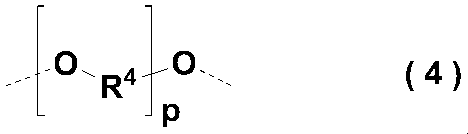
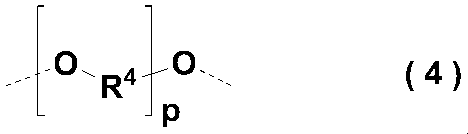
- Z represents a polyoxyalkylene polymer of the main chain.
- R 4 represents a divalent hydrocarbon group
- p is an integer of 2 or more
- a broken line represents a bond.
- An organosilane or organopolysiloxane compound having a hydrogen atom (Si-H group) bonded to a silicon atom at one end of the molecular chain and a hydroxyl group (silanol group) bonded to a silicon atom at the other end;
- Si-H group hydrogen atom
- sil group hydroxyl group
- An organosilane or organopolysiloxane compound having a hydrogen atom (Si—H group) bonded to a silicon atom at one end of a molecular chain and a hydroxyl group (silanol group) bonded to a silicon atom at the other end is represented by the following formula:
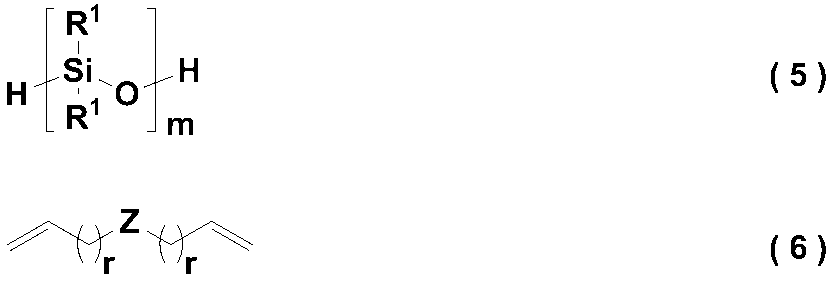
- the method for producing a polyoxyalkylene compound according to [6], wherein the polyoxyalkylene polymer represented by (5) and having both molecular chain ends blocked with alkenyl groups is represented by the following formula (6): .
- R 1 may be the same or different and is an unsubstituted or substituted monovalent hydrocarbon group having 1 to 20 carbon atoms, a hydrogen atom, or (R 3 ) 3 Si—O— (wherein R 3 Represents a monovalent hydrocarbon group having 1 to 20 carbon atoms, and three R 3 groups may be the same or different.) Represents a triorganosiloxy group.
- Z represents a main chain polyoxyalkylene polymer.
- m represents an integer of 1 or more.
- r represents an integer of 0 or more.
- R 4 represents a divalent hydrocarbon group
- p is an integer of 2 or more
- a broken line represents a bond.
- R 1 and R 2 may be the same or different, and are each an unsubstituted or substituted monovalent hydrocarbon group having 1 to 20 carbon atoms, a hydrogen atom, or (R 3 ) 3 Si—O— (formula R 3 represents a monovalent hydrocarbon group having 1 to 20 carbon atoms, and three R 3 may be the same or different.)
- R 3 represents a monovalent hydrocarbon group having 1 to 20 carbon atoms, and three R 3 may be the same or different.
- n represents an integer of 2 or more.
- m represents an integer of 1 or more.
- a broken line represents a bond.
- (B) the following component (b-1) and / or component (b-2): 0.1 to 30 parts by mass, (B-1) Hydrolyzable organosilicon compound having two alkoxysilyl-vinylene groups (alkoxysilyl-ethenylene group) on the same silicon atom represented by the following general formula (7) and / or a partial hydrolysis condensate thereof
- R 5 is each independently an unsubstituted or substituted monovalent hydrocarbon group having 1 to 20 carbon atoms
- R 6 is an unsubstituted or substituted alkyl group having 1 to 20 carbon atoms, or carbon.
- a is an integer of 1 to 3.
- (B-2) having one methyl group, vinyl group or phenyl group in one molecule, having at least two hydrolyzable groups, and having no amino group,
- (b-1) Hydrolyzable organosilane and / or partially hydrolyzed condensate thereof excluding components
- R 1 and R 2 in the above formula (1) may be the same or different, and an alkyl group having 1 to 20 carbon atoms, and those alkyl groups having 3 or more carbon atoms are cyclic cycloalkyl groups.
- the room temperature curable composition according to [9] which is an organosiloxy group.
- R 1 , n and m are the same as above.
- Z represents a polyoxyalkylene polymer of the main chain.
- R 4 represents a divalent hydrocarbon group, p is an integer of 2 or more, and a broken line represents a bond.
- R 4 represents a divalent hydrocarbon group, p is an integer of 2 or more, and a broken line represents a bond.
- [13] (A) The room temperature curable composition according to any one of [9] to [12], wherein the polyoxyalkylene compound has a linear structure. [14] (A) The room temperature curable composition according to any one of [9] to [13], wherein the polyoxyalkylene compound has a number average molecular weight of 200 to 50,000. [15] Furthermore, with respect to 100 parts by mass of component (a), (D) Filler: 3 to 1,000 parts by mass, and / or (e) Adhesion promoter: 0.1 to 30 parts by mass [9] to [14] Room temperature curable composition.
- a novel polyoxyalkylene compound (hereinafter also referred to as “terminal silanol group-containing polyoxyalkylene compound”) containing such a terminal silanol group and having a main chain of a polyoxyalkylene polymer is used as a main agent (base).
- a room temperature curable composition modified silicone RTV composition in which an oxime, amide, aminoxy, acetic acid, alcohol type crosslinker component can be used can be provided.
- the novel terminal silanol group-containing polyoxyalkylene compound of the present invention can be used as a main agent (base polymer) of a room temperature curable composition, and various curing agents (oxime, amide, aminoxy, acetic acid (acetoxy group), alcohol
- various curing agents oxime, amide, aminoxy, acetic acid (acetoxy group), alcohol
- An organosilicon compound containing a hydrolyzable group such as (alkoxy group) can be used as a crosslinking component, and a room temperature curable composition (especially a modified silicone RTV composition) utilizing various characteristics can be used. It becomes possible to provide. Thereby, the room temperature curable composition excellent in sclerosis
- the terminal silanol group-containing polyoxyalkylene compound of the present invention has a partial structure of a reactive silicon group containing a silanol group represented by the following structural formula (1) having at least 1, preferably 2 or more in one molecule.
- a novel polyoxyalkylene compound characterized in that it is contained at the molecular chain terminals (particularly at both molecular chain terminals) and the main chain is a polyoxyalkylene polymer.
- R 1 and R 2 may be the same or different, and are each an unsubstituted or substituted monovalent hydrocarbon group having 1 to 20 carbon atoms, a hydrogen atom, or (R 3 ) 3 Si—O— (formula R 3 represents a monovalent hydrocarbon group having 1 to 20 carbon atoms, and three R 3 may be the same or different.)
- n represents an integer of 2 or more.
- m represents an integer of 1 or more.
- a broken line represents a bond.
- the number of silanol group-containing reactive silicon groups represented by the structural formula (1) contained in one molecule is 1 or more, preferably 1.1 to 5, more preferably 2 to 4, and still more preferably 2 (for example, One at each end of the molecular chain).
- R 1 and R 2 may be the same or different and each is an unsubstituted or substituted monovalent hydrocarbon group having 1 to 20 carbon atoms, a hydrogen atom, or (R 3 ) 3 Si—O.
- the unsubstituted or substituted monovalent hydrocarbon group for R 1 and R 2 has 1 to 20, preferably 1 to 10, more preferably about 1 to 8 carbon atoms, which may be the same or different.
- An alkyl group having 1 to 20 carbon atoms, a cycloalkyl group having 3 to 20 carbon atoms, an alkenyl group having 2 to 20 carbon atoms, an aryl group having 6 to 20 carbon atoms, and an aralkyl group having 7 to 20 carbon atoms are preferable. These groups preferably have 1 to 10 carbon atoms, particularly 1 to 8 carbon atoms.
- the monovalent hydrocarbon group for R 3 has 1 to 20 carbon atoms, preferably 1 to 10 carbon atoms, more preferably about 1 to 8 carbon atoms, which may be the same or different, and has 1 to 20 carbon atoms.
- R 1 and R 2 include methyl group, ethyl group, n-propyl group, isopropyl group, n-butyl group, isobutyl group, tert-butyl group, pentyl group, neopentyl group, hexyl group and heptyl group.
- Alkyl groups such as octyl group, nonyl group, decyl group, undecyl group, dodecyl group, tridecyl group, tetradecyl group, pentadecyl group, hexadecyl group, heptadecyl group, octadecyl group, nonadecyl group, eicosyl group; cyclopentyl group, cyclohexyl group, etc.
- Cycloalkyl groups vinyl groups, allyl groups, propenyl groups, isopropenyl groups, butenyl groups, pentenyl groups, hexenyl groups and other alkenyl groups; phenyl groups, tolyl groups, xylyl groups, ⁇ -, ⁇ -naphthyl groups and the like Group: benzyl group, 2-phenylethyl group, 3-phenylpropyl group, etc.
- Aralkyl groups groups in which some or all of the hydrogen atoms in these groups are substituted with halogen atoms such as F, Cl, Br or cyano groups, such as 3-chloropropyl groups, 3, 3, 3 Examples thereof include -trifluoropropyl group, 2-cyanoethyl group and the like; hydrogen atom; triorganosiloxy group such as trimethylsiloxy group, triethylsiloxy group and triphenylsiloxy group.
- R 1 a methyl group, an ethyl group, and a phenyl group are preferable, and a methyl group and a phenyl group are particularly preferable from the viewpoint of availability, productivity, and cost.
- R 2 is preferably a hydrogen atom.
- R 3 is preferably a methyl group, an ethyl group, or a phenyl group.
- n is an integer of 2 or more
- m is an integer of 1 or more
- n is an integer of 2 to 8
- m is an integer of 1 to 8
- more preferably n is an integer of 2 to 4
- m is an integer of 2 to 4.
- the main chain skeleton of the terminal silanol group-containing polyoxyalkylene compound preferably has a repeating unit represented by the following formula (3) (for example, an oxyalkylene group). -R 4 -O- (3) (In the formula, R 4 represents a divalent hydrocarbon group.)
- R 4 is not particularly limited as long as it is a divalent hydrocarbon group (particularly an aliphatic divalent hydrocarbon group), but a linear or branched alkylene group having 1 to 14 carbon atoms is preferable. More preferably, it is a linear or branched alkylene group having 2 to 4 carbon atoms.
- the repeating unit represented by the above formula (3) is not particularly limited.
- Oxyalkylene groups such as O—, —CH 2 CH (CH 2 CH 3 ) O—, —CH 2 C (CH 3 ) 2 O—, —CH 2 CH 2 CH 2 CH 2 O—, etc. Can do.
- the main chain skeleton of the polyoxyalkylene compound may be composed of one type of repeating units represented by the above formula (3), or may be composed of two or more types of repeating units.
- a polymer containing propylene oxide (—CH 2 CH (CH 3 ) O—) as a main component is preferable.
- the terminal silanol group-containing polyoxyalkylene compound of the present invention preferably has a viscosity at 25 ° C. of 10 to 100,000 mPa ⁇ s, more preferably 50 to 50,000 mPa ⁇ s, and particularly preferably 100 to 10 m. , 000 mPa ⁇ s. If the viscosity of the terminal silanol group-containing polyoxyalkylene compound is 10 mPa ⁇ s or more, it is easy to obtain a coating film having excellent physical and mechanical strength, and if it is 100,000 mPa ⁇ s or less. It is preferable because the viscosity of the composition does not become too high and the workability during use is good.
- the viscosity is a numerical value obtained by a rotational viscometer (for example, BL type, BH type, BS type, cone plate type, rheometer, etc.).
- the terminal silanol group-containing polyoxyalkylene compound may be linear or branched, but is preferably linear, and its molecular weight is usually 200 to 50, 000, preferably 800 to 40,000, more preferably 1,000 to 30,000, still more preferably 2,000 to 20,000, particularly preferably 3,000 to 15,000, most preferably 4,000 to It is about 10,000.
- the molecular weight or the degree of polymerization is, for example, a number average molecular weight (or number average degree of polymerization) in terms of polystyrene in gel permeation chromatography (GPC) analysis using tetrahydrofuran (THF) or the like as a developing solvent. And so on.
- the terminal silanol group-containing polyoxyalkylene compound is “linear”, and the divalent oxyalkylene groups that are repeating units constituting the polyoxyalkylene structure are linked in a linear manner.
- Each oxyalkylene group itself may be linear or branched (for example, a propyleneoxy group such as —CH 2 CH (CH 3 ) O—). Good.
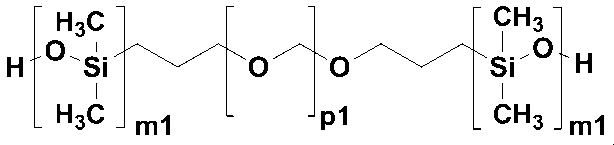
- terminal silanol group-containing polyoxyalkylene compounds include those represented by the following structural formula (2). (In the formula, R 1 , n and m are the same as above. Z represents a polyoxyalkylene polymer of the main chain.)
- Examples of the terminal silanol group-containing polyoxyalkylene compound represented by the formula (2) include those shown below. (In the formula, p1 is the same as p, and m1 is the same as m.)
- terminal silanol group-containing polyoxyalkylene compounds may be used alone or in combination of two or more.
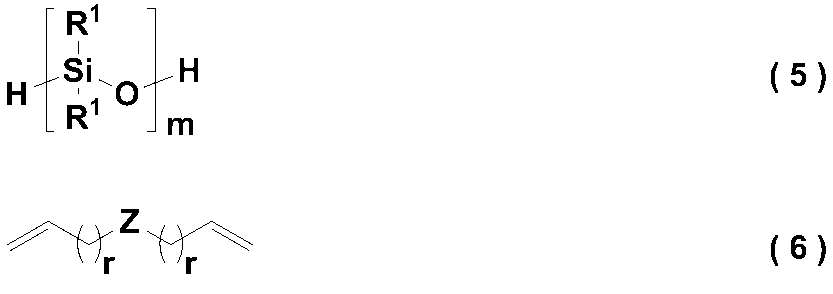
- the novel terminal silanol group-containing polyoxyalkylene compound that is one embodiment of the present invention has, for example, a hydrogen atom (Si—H group) bonded to a silicon atom at one end of a molecular chain represented by the following formula (5). And an organosilane or organopolysiloxane compound (silicon compound) having a hydroxyl group (silanol group) bonded to the silicon atom at the other end, and both ends of the molecular chain represented by the following formula (6) are blocked with alkenyl groups The resulting polyoxyalkylene polymer can be easily produced by a hydrosilylation addition reaction. (Wherein R 1 , Z and m are the same as above, and r represents an integer of 0 or more, preferably 0 to 8, more preferably 0 to 2)
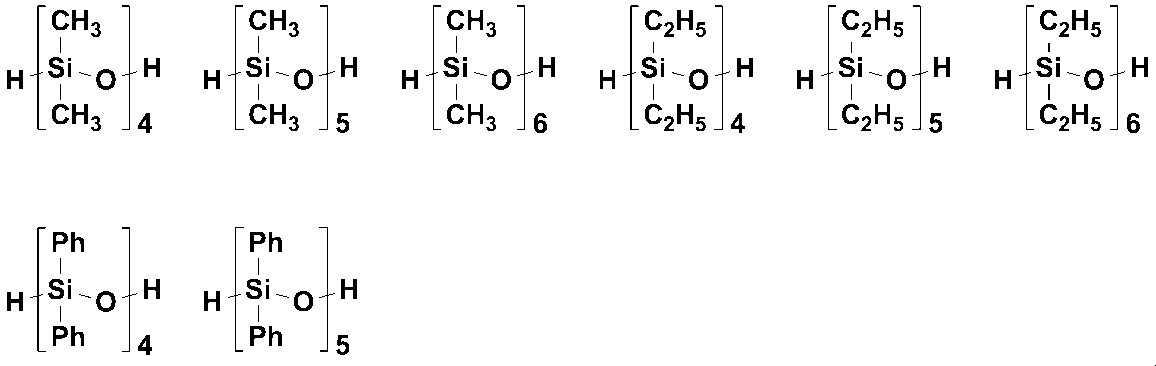
- silicon compound represented by the above formula (5) include, but are not limited to, those represented by the following structural formula (where Ph represents a phenyl group).
- any silicon compound containing a Si—H group at one end of the molecular chain and a Si—OH group at the other end can be used.
- polyoxyalkylene polymer in which both ends of the molecular chain represented by the above formula (6) are blocked with an alkenyl group include, for example, the following structural formula (where p is the same as above): Examples thereof include, but are not limited to, polyoxyalkylene polymers having both ends blocked with alkenyl groups.
- the molecular weight (particularly the number average molecular weight) of the polyoxyalkylene polymer represented by the above formula (6) is usually 150 to 49,000, preferably 700 to 39,000, more preferably 900 to 29, 000, more preferably 1,500 to 19,000, particularly preferably 2,500 to 14,000, and most preferably about 3,500 to 9,500.
- the molecular weight of the polyoxyalkylene polymer represented by the formula (6) is too small, the physical properties of the cured product after curing are not sufficient, and when it is too large, the viscosity is remarkably increased and workability is deteriorated. The curability of the product may be reduced.
- the reaction ratio between the silicon compound represented by the above formula (5) and the polyoxyalkylene polymer represented by the above formula (6) is based on the alkenyl group in the polyoxyalkylene polymer represented by the formula (6).
- the molar ratio of Si—H groups in the silicon compound represented by the formula (5) should be about 0.8 to 1.5 (mol / mol), particularly about 0.9 to 1.1 (mol / mol). Is preferred. If this molar ratio is too small, the cured product after curing may not be completely cured and the rubber properties may not be sufficiently obtained. May be disadvantageous.
- Examples of the addition reaction catalyst used for adding the silicon compound include platinum group metal catalysts such as platinum, palladium, rhodium, and ruthenium, with platinum being particularly preferred.
- Examples of the platinum-based material include platinum black, alumina, silica, or the like supported on solid platinum, chloroplatinic acid, alcohol-modified chloroplatinic acid, a complex of chloroplatinic acid and olefin, or platinum and vinyl. Examples include complexes with siloxane.
- the amount of the platinum group metal catalyst used may be a so-called catalyst amount, for example, relative to the total mass of the silicon compound represented by the above formula (5) and the polyoxyalkylene polymer represented by the above formula (6).
- the platinum group metal is preferably used in a mass of 0.1 to 1,000 ppm, particularly 0.5 to 100 ppm.
- This reaction is preferably carried out at a temperature of 50 to 120 ° C., particularly 60 to 100 ° C., for 0.5 to 12 hours, particularly 1 to 6 hours, and can be carried out without using a solvent.
- an appropriate solvent such as toluene or xylene may be used if necessary.
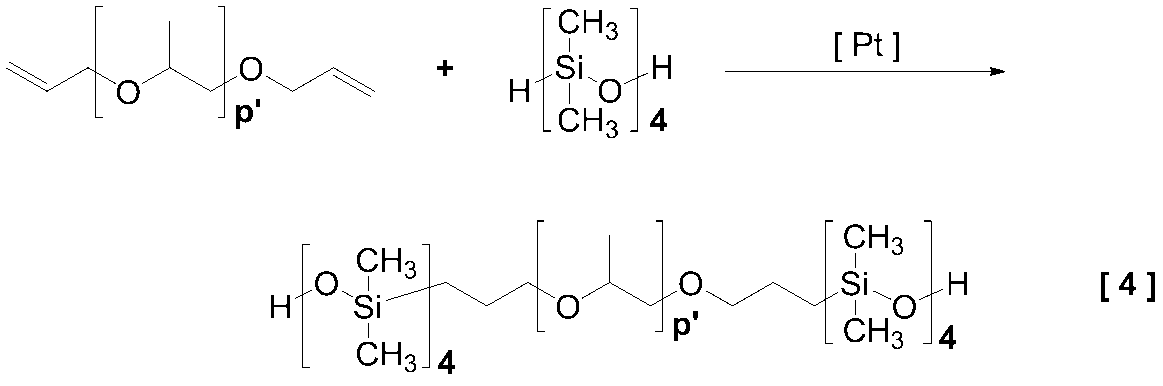
- This reaction is represented by the following formula [1] when, for example, an alkenyl group-capped polyoxyalkylene-based polymer uses an allyl group-capped polypropylene at both ends of the molecular chain.
- R 1 is as described above, and p2 and m2 represent an integer of 1 or more.
- the polyoxyalkylene-based compound of the present invention can be used as a main component (base polymer) of a room temperature curable composition using a crosslinking agent component such as oxime, amide, aminoxy, acetic acid, alcohol type, etc. It is excellent in curability and can be suitably used as a sealing material, a one-component adhesive, a pressure-sensitive adhesive, a paint, a coating material, a sealing material, a casting material, a coating material, and the like.
- a crosslinking agent component such as oxime, amide, aminoxy, acetic acid, alcohol type, etc.
- the room temperature curable composition of this invention contains the said polyoxyalkylene type compound as a main ingredient, and it is preferable that the component shown below is included.
- R 5 is each independently an unsubstituted or substituted monovalent hydrocarbon group having 1 to 20 carbon atoms
- R 6 is an unsubstituted or substituted alkyl group having 1 to 20 carbon atoms, or carbon.
- a is an integer of 1 to 3.
- B-2 having one methyl group, vinyl group or phenyl group in one molecule, having at least two hydrolyzable groups, and having no amino group,
- B-1 Hydrolyzable organosilane excluding components and / or its partial hydrolysis condensate
- Curing catalyst
- the component is the main component (base polymer) of the room temperature curable composition of the present invention, and the above-described polyoxyalkylene compound is used.
- a terminal silanol group-containing polyoxyalkylene compound having no aliphatic unsaturated bond is preferable. That is, in the above formula (1), R 1 and R 2 may be the same or different, and an alkyl group having 1 to 20 carbon atoms, and those alkyl groups having 3 or more carbon atoms are cyclic.
- R 1 is preferably a methyl group, an ethyl group, or a phenyl group, and a methyl group or a phenyl group is preferable from the viewpoint of availability, productivity, and cost.
- R 2 is preferably a hydrogen atom
- R 3 is preferably one having no aliphatic unsaturated bond, and more preferably a methyl group, an ethyl group, or a phenyl group.
- Examples of such terminal silanol group-containing polyoxyalkylene compounds include those having no aliphatic unsaturated bonds in the above-described polyoxyalkylene compounds.
- the component (b) according to the present invention acts as a curing agent (crosslinking agent) component in the room temperature curable composition of the present invention. And consists of the component (b-1) and / or the component (b-2) described below. If the room temperature curable composition of the present invention does not have at least one of the component (b-1) or the component (b-2), an excellent cured product cannot be obtained.
- Component (b-1) is a hydrolyzable organosilicon compound (hydrolyzable organosilane) having two alkoxysilyl-vinylene groups (alkoxysilyl-ethenylene groups) on the same silicon atom represented by the following general formula (7) And / or a partial hydrolysis condensate thereof.
- the partially hydrolyzed condensate is a product obtained by partially hydrolyzing and condensing the hydrolyzable organosilane, and has at least 2, preferably 3 or more residual hydrolyzable groups in the molecule. Meaning an organosiloxane oligomer.
- R 5 is each independently an unsubstituted or substituted monovalent hydrocarbon group having 1 to 20 carbon atoms
- R 6 is an unsubstituted or substituted alkyl group having 1 to 20 carbon atoms, or carbon.
- a is an integer of 1 to 3.
- the unsubstituted or substituted monovalent hydrocarbon group for R 5 has 1 to 20 carbon atoms, preferably 1 to 10 carbon atoms, more preferably about 1 to 8 carbon atoms. Or may be different, methyl group, ethyl group, n-propyl group, isopropyl group, n-butyl group, isobutyl group, tert-butyl group, pentyl group, neopentyl group, hexyl group, heptyl group, octyl group, nonyl Group, decyl group, undecyl group, dodecyl group, tridecyl group, tetradecyl group, pentadecyl group, hexadecyl group, heptadecyl group, octadecyl group, nonadecyl group, eicosyl group and other alkyl groups; cyclopent
- the unsubstituted alkyl group for R 6 has 1 to 20 carbon atoms, preferably 1 to 6 carbon atoms, more preferably about 1 to 4 carbon atoms, and is a methyl group, an ethyl group, an n-propyl group, an isopropyl group, or an n-butyl group.
- the unsubstituted cycloalkyl group has 3 to 20, preferably 4 to 8, more preferably about 5 to 6 carbon atoms, and examples thereof include a cyclopentyl group and a cyclohexyl group.
- some or all of the hydrogen atoms of these alkyl groups and cycloalkyl groups may be substituted with halogen atoms such as F, Cl, Br, cyano groups, etc., for example, 3-chloropropyl Group, 3,3,3-trifluoropropyl group, 2-cyanoethyl group and the like.
- R 6 is preferably a methyl group or an ethyl group, and particularly preferably a methyl group, from the viewpoint of hydrolyzability.
- the hydrolyzable organosilicon compound represented by the general formula (7) of the component (b-1) is mainly used as a curing agent.
- a is an integer of 1 to 3 independently for each silicon atom, but 2 or 3 is preferable from the viewpoint of curability.
- those having an alkoxy group such as three methoxy groups as the two alkoxysilyl-vinylene groups on the same silicon atom in the molecule that is, those having a total of six alkoxy groups in the molecule
- it is useful as a curing agent (crosslinking agent) for dealcohol-modified silicone (room temperature curable composition).
- An example of synthesis of component (b-1) is shown below.
- hydrolyzable organosilicon compound having two alkoxysilyl-vinylene groups on the same silicon atom is, for example, an organo having two ethynyl groups on the same silicon atom.
- Silane and two alkoxyhydrosilanes can be easily produced by addition reaction by hydrosilylation reaction. This reaction formula is represented, for example, by the following formula [2].
- the addition reaction catalyst used when adding alkoxyhydrosilane includes platinum group metal catalysts such as platinum, palladium, rhodium, and ruthenium, with platinum being particularly preferred.
- platinum group metal catalysts such as platinum, palladium, rhodium, and ruthenium
- platinum-based material include platinum black, alumina, silica, or the like supported on solid platinum, chloroplatinic acid, alcohol-modified chloroplatinic acid, a complex of chloroplatinic acid and olefin, or platinum and vinylsiloxane. And the like can be exemplified.
- the amount of platinum used may be a so-called catalytic amount, for example, the total mass of silanes (total mass of organosilane having two ethynyl groups on the same silicon atom and alkoxyhydrosilane) of the platinum group metal. It can be used in an amount of 0.1 to 1,000 ppm, particularly 0.5 to 100 ppm in terms of mass.
- This reaction is generally preferably carried out at a temperature of 50 to 120 ° C., particularly 60 to 100 ° C., for 0.5 to 12 hours, particularly 1 to 6 hours, and can be carried out without using a solvent.
- an appropriate solvent such as toluene or xylene can be used if necessary.
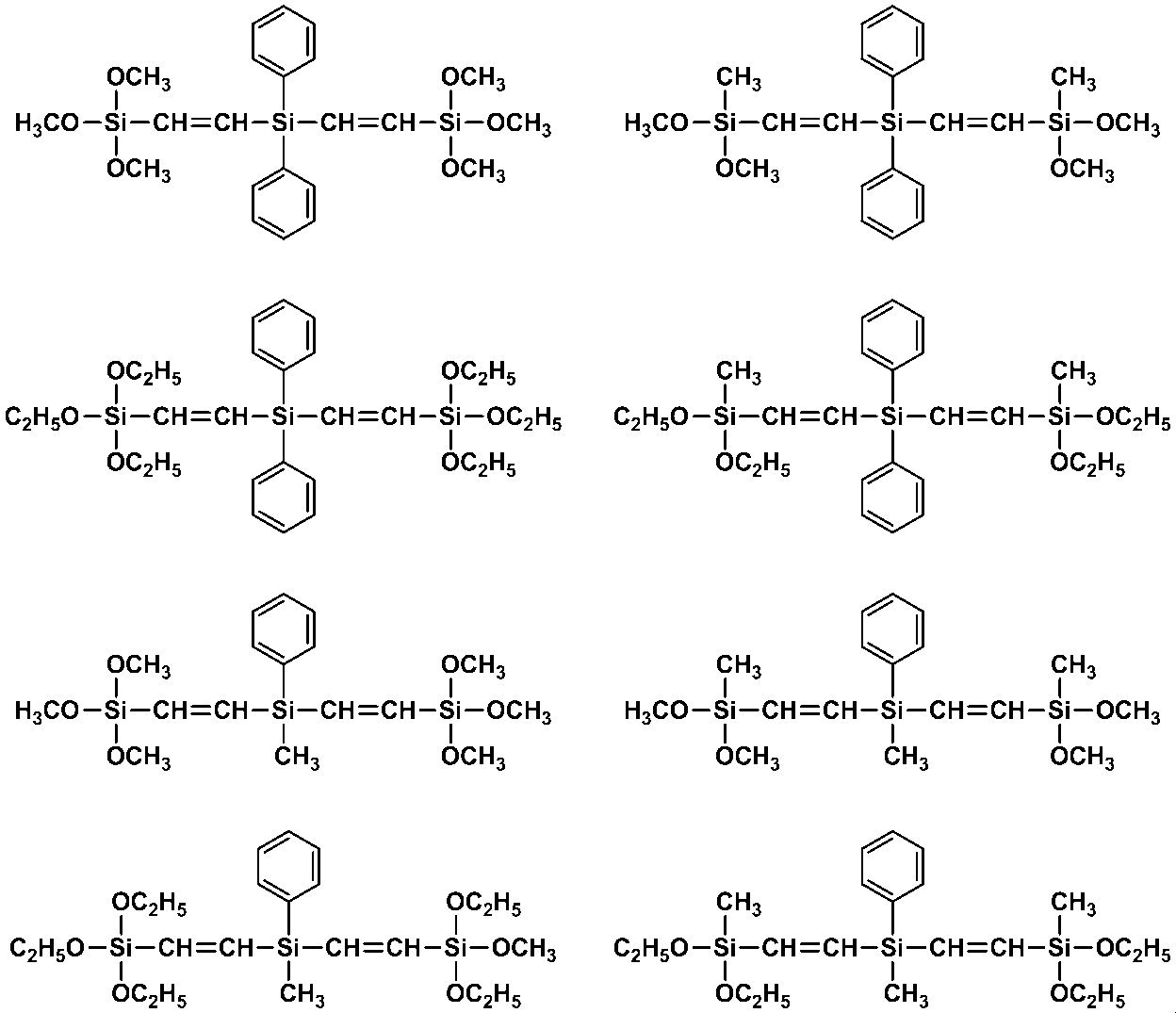
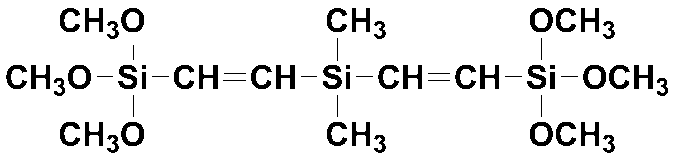
- hydrolyzable organosilicon compound having two alkoxysilyl-vinylene groups on the same silicon atom represented by the formula (7) include those represented by the following structural formula.
- component (b-1) one type can be used alone, or two or more types can be used in combination.
- the component (b-2) has one of a methyl group, a vinyl group and a phenyl group in one molecule, and has at least 2, preferably 3 hydrolyzable groups, and an amino group.
- examples of the hydrolyzable group include a methoxy group, an ethoxy group, a propoxy group, an isopropoxy group, a butoxy group, an isobutoxy group, a tert-butoxy group and the like, preferably 1 to 20 carbon atoms, more preferably 1 to 10 carbon atoms.
- the alkoxy group having 1 to 4 carbon atoms such as an alkoxy group having 1 to 4 carbon atoms, a methoxymethoxy group, a methoxyethoxy group, etc., preferably 2 to 10 carbon atoms, more preferably an alkoxyalkoxy group having 2 to 4 carbon atoms, a vinyloxy group,
- An alkenyloxy group, a dimethyl ketoxime group, a diethyl ketoxime group, a methyl ethyl ketoxime group such as an allyloxy group, a propenoxy group, an isopropenoxy group, etc. having 2 to 20 carbon atoms, preferably 2 to 10 carbon atoms, more preferably 2 to 5 carbon atoms And the like having 3 to 20 carbon atoms, preferably 3 to 10 carbon atoms, more preferably 3 to 6 carbon atoms.
- Oxime group, having 2 to 20 carbon atoms such as acetoxy group, preferably 2 to 10 carbon atoms, more preferably
- component (b-2) examples include methyltrimethoxysilane, methyltriethoxysilane, vinyltrimethoxysilane, vinyltriethoxysilane, vinyltriisopropoxysilane, methyltris (methoxyethoxy) silane, and vinyltris (methoxyethoxy).
- the component is not limited to these. These can be used singly or in combination of two or more.
- the hydrolyzable organosilicon compound of component (b) and / or its partial hydrolysis condensate (that is, the total amount of component (b-1) and component (b-2)) is the polyoxyalkylene of component (a)
- the polymer is used in an amount of 0.1 to 30 parts by weight, preferably 0.5 to 20 parts by weight, more preferably 3 to 15 parts by weight, based on 100 parts by weight of the polymer. If the amount is less than parts, sufficient crosslinking cannot be obtained, and it is difficult to obtain a composition having the desired rubber elasticity. If the amount exceeds 30 parts by weight, the mechanical properties of the obtained rubber properties are lowered, which is further disadvantageous economically. Will occur.
- the component (b) that is the curing agent (crosslinking agent) in the room temperature curable composition of the present invention the component (b-1) or the component (b-2) may be used alone, Further, the component (b-1) and the component (b-2) may be used in combination.
- the mass ratio of the component (b-1) to the component (b-2) is 99: 1 to 1:99, The ratio is preferably 90:10 to 10:90, more preferably 70:30 to 30:70, and still more preferably about 60:40 to 40:60.
- Component (c) curing catalyst (non-metallic organic catalyst and / or metallic catalyst)
- Component (c) is a curing catalyst (non-metallic organic catalyst and / or metallic catalyst), and acts to accelerate the curing of the room temperature curable composition of the present invention.
- a known curing accelerator for the condensation curable organopolysiloxane composition can be used and is not particularly limited.
- phosphazene-containing compounds such as N, N, N ′, N ′, N ′′, N ′′ -hexamethyl-N ′ ′′-(trimethylsilylmethyl) -phosphorimidic triamide, 3-aminopropyltriethoxysilane Aminoalkyl group-substituted alkoxysilanes such as N- ⁇ (aminoethyl) ⁇ -aminopropyltrimethoxysilane, amine compounds such as hexylamine and dodecylamine phosphate or salts thereof, and quaternary ammonium salts such as benzyltriethylammonium acetate Dialkylhydroxylamine such as dimethylhydroxylamine, diethylhydroxylamine, tetramethylguani
- a known one can be used as a curing accelerator for condensation-curing organopolysiloxane, and is not particularly limited.
- curing catalysts may be used in small amounts, and the amount of component (c) is 0.01 to 20 parts by weight, particularly 0.05 to 20 parts by weight per 100 parts by weight of component (a). 10 parts by mass is preferable, and 0.05 to 5 parts by mass is more preferable. If the amount is less than 0.01 parts by mass, good curability cannot be obtained, so that a problem that the curing rate is delayed occurs. On the contrary, if the amount exceeds 20 parts by mass, the curability of the composition is too fast, so that the allowable range of working time after application of the composition may be shortened or the mechanical properties of the resulting rubber may be reduced. is there.
- component (D) Component: Filler
- the component (d) is a filler (inorganic filler and / or organic resin filler), and is an optional component that can be blended as needed in the room temperature curable composition of the present invention. Used to give sufficient mechanical strength to the cured product formed from the composition.
- fillers can be used, for example, finely divided silica, fumed silica, precipitated silica, silica whose surface is hydrophobized with an organosilicon compound, glass beads, glass balloons, transparent Resin beads, silica airgel, diatomaceous earth, iron oxide, zinc oxide, titanium oxide, metal oxides such as fumed metal oxide, wet silica or those whose surfaces are treated with silane, quartz powder, carbon black, talc, zeolite and Reinforcing agents such as bentonite, metal carbonates such as asbestos, glass fiber, carbon fiber, calcium carbonate, magnesium carbonate, zinc carbonate, glass wool, fine mica, fused silica powder, synthetic resin powder such as polystyrene, polyvinyl chloride, polypropylene Etc. are used.
- inorganic fillers such as silica, calcium carbonate, and zeolite are preferable, and fumed silica and calcium carbonate whose surfaces are hydrophobized are particularly preferable.
- the blending amount of the component (d) is preferably 0 to 1,000 parts by mass, particularly preferably 0 to 300 parts by mass per 100 parts by mass of the component (a). If it is used in an amount larger than 1,000 parts by mass, not only the viscosity of the composition increases and the workability deteriorates, but also the rubber strength after curing decreases and it becomes difficult to obtain rubber elasticity. In addition, when mix
- Adhesion Promoter (e) The component is an adhesion promoter and is an optional component that can be blended as needed into the room temperature curable composition of the present invention, and is sufficient for a cured product formed from this composition Used to give good adhesion.
- adhesion promoter a silane coupling agent such as a functional group-containing hydrolyzable silane
- known ones are preferably used, such as a vinyl silane coupling agent, a (meth) acryl silane coupling agent, an epoxy silane coupling agent
- examples include aminosilane coupling agents, mercaptosilane coupling agents, and the like, specifically, vinyltris ( ⁇ -methoxyethoxy) silane, ⁇ -methacryloxypropyltrimethoxysilane, ⁇ - (3,4-epoxycyclohexyl) ethyltri Methoxysilane, ⁇ -glycidoxypropyltrimethoxysilane, ⁇ -glycidoxypropylmethyldiethoxysilane, N- ⁇ - (aminoethyl) - ⁇ -aminopropyltrimethoxysilane, ⁇ -aminopropyltriethoxysilane, 3 -2- (Aminoeth
- vinyl silane coupling agents such as vinyl tris ( ⁇ -methoxyethoxy) silane can also function as the component (b-2).
- aminosilanes such as ⁇ -aminopropyltriethoxysilane, 3-2- (aminoethylamino) propyltrimethoxysilane, ⁇ -glycidoxypropyltrimethoxysilane, ⁇ - (3,4-epoxycyclohexyl), among others.
- Epoxy silanes such as ethyltrimethoxysilane and isocyanate silane are preferred.
- the component (e) is preferably blended in an amount of 0 to 30 parts by mass, particularly 0.1 to 20 parts by mass with respect to 100 parts by mass of the component (a).
- the adhesion promoter is not used with the filler or the adherend, it is not necessary to use it.
- the room temperature curable composition of the present invention further comprises (f) a linear diester represented by the following general formula (8).
- Organopolysiloxane (so-called non-functional silicone oil) may be contained.
- R 7 independently of each other, is an unsubstituted or substituted monovalent hydrocarbon group containing no aliphatic unsaturated bond having 1 to 20 carbon atoms, and q is the temperature of the organopolysiloxane at 23 ° C. (The viscosity is 1.5 to 1,000,000 mPa ⁇ s.)
- the monovalent hydrocarbon group not containing an unsubstituted or substituted aliphatic unsaturated bond of R 7 has 1 to 20 carbon atoms, preferably 1 to 10 carbon atoms, more preferably 1 to 8 carbon atoms.
- Alkyl groups such as octyl group, nonyl group, decyl group, undecyl group, dodecyl group, tridecyl group, tetradecyl group, pentadecyl group, hexadecyl group, heptadecyl group, octadecyl group, nonadecyl group, eicosyl group; cyclopentyl group, cyclohexyl group, etc.
- a cycloalkyl group such as a phenyl group, a tolyl group, a xylyl group, an ⁇ -, ⁇ -naphthyl group; Aralkyl groups such as benzyl, 2-phenylethyl and 3-phenylpropyl; and some or all of the hydrogen atoms of these groups are substituted with halogen atoms such as F, Cl and Br, cyano groups, etc. Examples thereof include a 3-chloropropyl group, a 3,3,3-trifluoropropyl group, a 2-cyanoethyl group, and the like.
- R 7 is preferably a methyl group, and is preferably dimethylpolysiloxane in which both ends of the molecular chain are blocked with a trimethylsiloxy group.
- q is a number at which the viscosity of the diorganopolysiloxane at 23 ° C. is 1.5 to 1,000,000 mPa ⁇ s, preferably 30 to 100,000 mPa ⁇ s.
- r is an integer of 2 or more. Further, it is preferably an integer of 20 to 2,000.
- the blending amount is preferably 0.1 to 100 parts by weight, more preferably 10 to 80 parts by weight with respect to 100 parts by weight of the component (a).
- the amount of the component (f) is within the above range, it is preferable because the viscosity can be easily handled in construction without impairing the mechanical properties and flame retardancy of the room temperature curable composition of the present invention.
- additives for example, pigments such as carbon black, iron oxide, titanium oxide, dyes, aging
- blend well-known additives such as an inhibitor, antioxidant, an antistatic agent, an adhesion imparting agent, antiseptic
- the room temperature curable composition of the present invention may use an organic solvent as necessary.
- organic solvents include aliphatic hydrocarbon compounds such as n-hexane, n-heptane, isooctane and isododecane, aromatic hydrocarbon compounds such as toluene and xylene, hexamethyldisiloxane, octamethyltrisiloxane, decamethyltetra Chain siloxanes such as siloxane, dodecamethylpentasiloxane, 2- (trimethylsiloxy) -1,1,1,2,3,3,3-heptamethyltrisiloxane, octamethylcyclopentasiloxane, decamethylcyclopentasiloxane, etc.
- cyclic siloxane What is necessary is just to prepare the quantity of the organic solvent suitably in the range which does not prevent the effect of this invention.
- the room temperature curable composition of the present invention can be obtained by uniformly mixing the above-mentioned components and further predetermined amounts of the above-mentioned various additives in a dry atmosphere.
- the above components (a) to (c), and if necessary, the components (d) to (f) and other various additives are used to form bubbles in a state where moisture is blocked or under reduced pressure. It is preferable to prepare by mixing uniformly while removing.
- a mixing apparatus It is preferable to use the universal mixing stirrer (made by Dalton) connected to a vacuum pump, a planetary mixer (made by Inoue Seisakusho Co., Ltd.), etc.
- the room temperature curable composition is cured by leaving it at room temperature (23 ° C. ⁇ 10 ° C.), and the molding method, curing conditions, and the like are known methods and conditions according to the type of the composition. can do.
- the room temperature curable composition of the present invention is easily cured at room temperature (23 ° C. ⁇ 10 ° C.) by storing it in an airtight container in the absence of moisture, that is, blocking moisture and exposing it to moisture in the air during use. To do.
- the room temperature curable composition of the present invention is a cured product having excellent flame retardancy, good adhesion to glass and painted aluminum without a primer, and excellent deformation followability.
- curing material obtained has favorable rubber elasticity. Therefore, it is useful as a sealing material used for a building sealing material.
- the method of using the room temperature curable composition of the present invention as a sealant is not particularly limited as long as it uses a conventionally known method of using a sealant.
- Examples of the article bonded and / or sealed with the cured product of the room temperature curable composition of the present invention include, for example, articles composed of glass, various metals, and the like.
- the room temperature curable composition of the present invention thus obtained is a rubber elastic body that is rapidly cured at room temperature (23 ° C. ⁇ 10 ° C.) by moisture in the air and has excellent heat resistance, weather resistance, and adhesion to various substrates. Form a cured product.
- the room temperature curable composition of the present invention is particularly excellent in storage stability and curability, for example, after storage for 6 months, it quickly cures when exposed to the air, and has excellent physical properties as described above. Give a cured product with. Furthermore, no toxic or corrosive gases are released during curing, and no rust is produced on the surface to which this composition is applied. Also, the composition can be cured and molded to obtain various molded products.
- parts means “parts by mass”
- the room temperature is 23 ° C. ⁇ 10 ° C.
- the viscosity is a value measured by a rotational viscometer at 25 ° C.
- the molecular weight and the degree of polymerization are the number average molecular weight and number average degree of polymerization in terms of polystyrene in GPC analysis using THF as a developing solvent.
- Example 2 Into a 500 mL four-necked separable flask equipped with a stirrer, a reflux condenser, a thermometer, and a dropping funnel, 500 g of terminal allyl group-containing polypropylene glycol having a molecular weight of 8,400 (in terms of functional group equivalent of terminal allyl group 0.112) Mol) and a platinum catalyst (vinyl siloxane complex solution of chloroplatinic acid, platinum concentration; 1% by mass) were added, and the temperature was raised to 90 ° C. with heating and stirring.
- a platinum catalyst vinyl siloxane complex solution of chloroplatinic acid, platinum concentration; 1% by mass
- Example 3 To a 500 mL four-necked separable flask equipped with a stirrer, a reflux condenser, a thermometer and a dropping funnel, 250 g of terminal allyl group-containing polypropylene glycol having a molecular weight of 4,300 (in terms of functional group of terminal allyl group, 0.107) Mol) and a platinum catalyst (vinyl siloxane complex solution of chloroplatinic acid, platinum concentration; 1% by mass) were added, and the temperature was raised to 90 ° C. with heating and stirring.
- a platinum catalyst vinyl siloxane complex solution of chloroplatinic acid, platinum concentration; 1% by mass
- Example 4 In a 500 mL four-necked separable flask equipped with a stirrer, a reflux condenser, a thermometer, and a dropping funnel, 250 g of terminal allyl group-containing polypropylene glycol having a molecular weight of 7,190 (converted to a functional group of the terminal allyl group 0.063). Mol) and a platinum catalyst (vinyl siloxane complex solution of chloroplatinic acid, platinum concentration; 1% by mass) were added, and the temperature was raised to 90 ° C. with heating and stirring.
- a platinum catalyst vinyl siloxane complex solution of chloroplatinic acid, platinum concentration; 1% by mass
- Example 5 In a 500 mL four-necked separable flask equipped with a stirrer, a reflux condenser, a thermometer, and a dropping funnel, 250 g of terminal allyl group-containing polypropylene glycol having a molecular weight equivalent to 7,500 (functional group equivalent of terminal allyl group: 0.048) Mol) and a platinum catalyst (vinyl siloxane complex solution of chloroplatinic acid, platinum concentration; 1% by mass) were added, and the temperature was raised to 90 ° C. with heating and stirring.
- a platinum catalyst vinyl siloxane complex solution of chloroplatinic acid, platinum concentration; 1% by mass
- Example 6 100 parts of polypropylene glycol (polymer A) having a terminal silanol group having a viscosity of 4.0 Pa ⁇ s, synthesized according to the method of Example 1, and 13.2 parts of bis (trimethoxysilyl-ethylene) dimethylsilane (the following structural formula) A composition was prepared by mixing 0.5 parts of dioctyltin dineodecanoate under moisture blocking until uniform.
- Example 7 In Example 6, a composition was prepared in the same manner except that the same amount of tetramethylguanidylpropyltrimethoxysilane was used instead of dioctyltin dineodecanoate.
- Example 8 A composition was prepared in the same manner as in Example 7, except that the same amount of di-n-butyl-dimethoxytin was used instead of tetramethylguanidylpropyltrimethoxysilane.
- Example 9 In Example 8, instead of the terminal silanol group-containing polypropylene glycol (polymer A) having a viscosity of 4.0 Pa ⁇ s synthesized according to the method of Example 1, a terminal having a viscosity of 10.0 Pa ⁇ s synthesized according to the method of Example 2 was used. A composition was prepared in the same manner except that 100 parts of silanol group-containing polypropylene glycol (polymer B) was used.
- Example 10 A composition was prepared in the same manner as in Example 9 except that 6.6 parts of vinyltrimethoxysilane was used instead of bis (trimethoxysilyl-ethylene) dimethylsilane.
- Example 11 In Example 9, 13.9 parts of vinyltriisopropoxysilane was used instead of bis (trimethoxysilyl-ethylene) dimethylsilane, and dioctyltin dineodecanoate was used instead of di-n-butyl-dimethoxytin. A composition was prepared in the same manner except that the amount was used.
- Examples 12 to 14 In Examples 9 to 11, a viscosity of 1.3 Pa ⁇ s synthesized according to the method of Example 3 was used instead of the polypropylene glycol (polymer B) having a terminal silanol group with a viscosity of 10.0 Pa ⁇ s synthesized according to the method of Example 2.
- a composition was prepared in the same manner except that 100 parts of the terminal silanol group-containing polypropylene glycol (Polymer C) was used.
- Examples 15 to 17 In Examples 9 to 11, a viscosity of 9.2 Pa ⁇ s synthesized according to the method of Example 4 was used instead of the polypropylene glycol (polymer B) having a terminal silanol group with a viscosity of 10.0 Pa ⁇ s synthesized according to the method of Example 2.
- a composition was prepared in the same manner except that 100 parts of the terminal silanol group-containing polypropylene glycol (Polymer D) was used.
- Examples 18 to 20 In Examples 9 to 11, a viscosity of 26.5 Pa ⁇ s synthesized according to the method of Example 5 was used instead of the polypropylene glycol (polymer B) having a terminal silanol group with a viscosity of 10.0 Pa ⁇ s synthesized according to the method of Example 2.
- a composition was prepared in the same manner except that 100 parts of the terminal silanol group-containing polypropylene glycol (Polymer E) was used.
- Example 6 instead of polymer A, a composition was prepared in the same manner except that the same amount of MS polymer S303H manufactured by Kaneka Corporation (dioxysilyl group-blocked polyoxypropylene polymer at both molecular chains) was used.
- each composition immediately after preparation prepared in Examples 6 to 20 and Comparative Example 1 was extruded into a sheet having a thickness of 2 mm, exposed to air at 23 ° C. and 50% RH, and then the sheet was subjected to the same atmosphere.
- the physical properties (initial physical properties) of the cured product obtained by allowing to stand for 7 days were measured according to JIS K-6249.
- the hardness was measured using a durometer A hardness meter of JIS K-6249. Tables 1 and 2 show the results.
- Each cured product obtained in Examples 6 to 20 was compared with a conventional modified silicone rubber cured product based on MS polymer S303H manufactured by Kaneka Co., Ltd. whose terminal was blocked with a dialkoxysilyl group as shown in Comparative Example 1. Even so, it was confirmed that the same rubber physical properties (elongation, tensile strength) were satisfied. Moreover, about the hardness, it has confirmed that the hardened
- the novel polyoxyalkylene compound having a reactive silicon group having a silanol group at the molecular chain terminal of the present invention as a base polymer of a room temperature curable composition (modified silicone RTV composition), Crosslink not only alkoxy type as decomposable group but also various curing agents (organosilicon compounds containing various hydrolyzable groups such as oxime, amide, aminoxy, acetic acid (acetoxy group), alcohol (alkoxy group), etc. It is theoretically possible to use it as a component, whereby various curing reaction (condensation reaction) type room temperature curable compositions (modified silicone RTV compositions) can be obtained.
Landscapes
- Chemical & Material Sciences (AREA)
- Organic Chemistry (AREA)
- Chemical Kinetics & Catalysis (AREA)
- Health & Medical Sciences (AREA)
- Medicinal Chemistry (AREA)
- Polymers & Plastics (AREA)
- Engineering & Computer Science (AREA)
- Materials Engineering (AREA)
- General Chemical & Material Sciences (AREA)
- Compositions Of Macromolecular Compounds (AREA)
- Polyethers (AREA)
- Sealing Material Composition (AREA)
Abstract
Description
なお、本発明に関連する従来技術として、下記文献が挙げられる。
また、該ポリオキシアルキレン系化合物を室温硬化性組成物の主剤(ベースポリマー)として用いることで、従来は末端がアルコキシシリル基であった有機重合体を主剤(ベースポリマー)として用いていたために、架橋剤の官能性基(加水分解性基)としてはベースポリマーのアルコキシ基と縮合反応し得るアルコキシ基だけに制約されていた場合と比べ、アルコキシ基だけではなく種々の硬化剤(オキシム、アミド、アミノキシ、酢酸(アセトキシ基)、アルコール(アルコキシ基)等の加水分解性基を含有する有機ケイ素化合物など)を架橋成分として用いることが理論上可能となり、これにより種々の硬化反応(縮合反応)タイプの室温硬化性組成物(特には、変成シリコーンRTV組成物)が得られることを見出し、本発明をなすに至った。
[1]
1分子中に少なくとも1個の下記構造式(1)で示される反応性ケイ素基を分子鎖末端に含有し、かつ、主鎖がポリオキシアルキレン系重合体であることを特徴とするポリオキシアルキレン系化合物。

[2]
下記構造式(2)で表されるものである[1]に記載のポリオキシアルキレン系化合物。

[3]
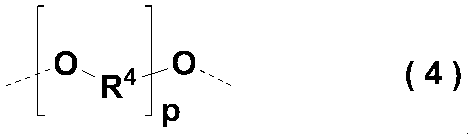
上記式(2)中のZが下記式(4)で示されるものである[2]に記載のポリオキシアルキレン系化合物。

[4]
主鎖のポリオキシアルキレン系重合体が直鎖構造であることを特徴とする[1]~[3]のいずれかに記載のポリオキシアルキレン系化合物。
[5]
数平均分子量が200~50,000である[1]~[4]のいずれかに記載のポリオキシアルキレン系化合物。
[6]
分子鎖片末端のケイ素原子に結合した水素原子(Si-H基)を有し、かつ、他方の末端のケイ素原子に結合した水酸基(シラノール基)を有するオルガノシラン又はオルガノポリシロキサン化合物と、分子鎖両末端がアルケニル基で封鎖されたポリオキシアルキレン系重合体とをヒドロシリル化付加反応させる工程を含んでなる請求項[1]~[5]のいずれかに記載のポリオキシアルキレン系化合物の製造方法。
[7]
分子鎖片末端のケイ素原子に結合した水素原子(Si-H基)を有し、かつ、他方の末端のケイ素原子に結合した水酸基(シラノール基)を有するオルガノシラン又はオルガノポリシロキサン化合物が下記式(5)で示され、分子鎖両末端がアルケニル基で封鎖されたポリオキシアルキレン系重合体が下記式(6)で示されるものである[6]に記載のポリオキシアルキレン系化合物の製造方法。
[8]
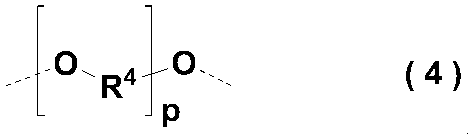
上記式(6)中のZが下記式(4)で示されるものである[7]に記載のポリオキシアルキレン系化合物の製造方法。
[9]
(a)1分子中に少なくとも1個の下記構造式(1)で示される反応性ケイ素基を分子鎖末端に含有し、かつ、主鎖がポリオキシアルキレン系重合体であるポリオキシアルキレン系化合物: 100質量部、

(b)下記(b-1)成分及び/又は(b-2)成分: 0.1~30質量部、
(b-1)下記一般式(7)で示される同一ケイ素原子上に2つのアルコキシシリル-ビニレン基(アルコキシシリル-エテニレン基)を有する加水分解性有機ケイ素化合物及び/又はその部分加水分解縮合物

(b-2)1分子中に1個のメチル基、ビニル基又はフェニル基を有し、かつ少なくとも2個の加水分解性基を有し、かつアミノ基を有さない、(b-1)成分を除く加水分解性オルガノシラン及び/又はその部分加水分解縮合物
(c)硬化触媒: 0.01~20質量部
を含有する室温硬化性組成物。
[10]
上記式(1)中のR1、R2がそれぞれ同一若しくは異なってもよく、炭素数1~20のアルキル基、該アルキル基のうち炭素数が3以上のものは環状であるシクロアルキル基であってもよく、炭素数6~20のアリール基、炭素数7~20のアラルキル基、水素原子、又は(R3)3Si-O-(R3は上記と同じ。)で表されるトリオルガノシロキシ基である[9]に記載の室温硬化性組成物。
[11]
(a)ポリオキシアルキレン系化合物が下記構造式(2)で表されるものである[9]又は[10]に記載の室温硬化性組成物。

[12]
上記式(2)中のZが下記式(4)で示されるものである[11]に記載の室温硬化性組成物。

[13]
(a)ポリオキシアルキレン系化合物が直鎖状構造である[9]~[12]のいずれかに記載の室温硬化性組成物。
[14]
(a)ポリオキシアルキレン系化合物の数平均分子量が200~50,000である[9]~[13]のいずれかに記載の室温硬化性組成物。
[15]
更に、(a)成分100質量部に対して、
(d)充填剤: 3~1,000質量部、及び/又は
(e)接着促進剤: 0.1~30質量部
を含有するものである[9]~[14]のいずれかに記載の室温硬化性組成物。
[16]
更に、(a)成分100質量部に対して、
(f)下記一般式(8)で表されるオルガノポリシロキサン: 0.1~100質量部

を含有するものである[9]~[15]のいずれかに記載の室温硬化性組成物。
[17]
[9]~[16]のいずれかに記載の室温硬化性組成物からなるシーリング材。
[18]
[9]~[16]のいずれかに記載の室温硬化性組成物の硬化物で接着及び/又はシールした物品。
<末端シラノール基含有ポリオキシアルキレン系化合物>
本発明の末端シラノール基含有ポリオキシアルキレン系化合物は、1分子中に少なくとも1個、好ましくは2個以上の、下記構造式(1)で示されるシラノール基を含有する反応性ケイ素基を部分構造として分子鎖末端に(特には、分子鎖両末端に)含有し、かつ、主鎖がポリオキシアルキレン系重合体であることを特徴とする、新規なポリオキシアルキレン系化合物である。

R1、R2として、具体的には、メチル基、エチル基、n-プロピル基、イソプロピル基、n-ブチル基、イソブチル基、tert-ブチル基、ペンチル基、ネオペンチル基、ヘキシル基、ヘプチル基、オクチル基、ノニル基、デシル基、ウンデシル基、ドデシル基、トリデシル基、テトラデシル基、ペンタデシル基、ヘキサデシル基、ヘプタデシル基、オクタデシル基、ノナデシル基、エイコシル基等のアルキル基;シクロペンチル基、シクロヘキシル基等のシクロアルキル基;ビニル基、アリル基、プロペニル基、イソプロペニル基、ブテニル基、ペンテニル基、ヘキセニル基等のアルケニル基;フェニル基、トリル基、キシリル基、α-,β-ナフチル基等のアリール基;ベンジル基、2-フェニルエチル基、3-フェニルプロピル基等のアラルキル基;また、これらの基の水素原子の一部又は全部が、F、Cl、Br等のハロゲン原子やシアノ基等で置換された基、例えば、3-クロロプロピル基、3,3,3-トリフルオロプロピル基、2-シアノエチル基等;水素原子;トリメチルシロキシ基、トリエチルシロキシ基、トリフェニルシロキシ基等のトリオルガノシロキシ基などを例示することができる。
これらの中でも、R1としては、メチル基、エチル基、フェニル基が好ましく、入手の容易さ、生産性、コストの面からメチル基、フェニル基が特に好ましい。R2としては、水素原子が好ましい。
R3としては、上記R1、R2の1価炭化水素基で例示したものと同様のものを例示することができる。R3としては、メチル基、エチル基、フェニル基が好ましい。
また、上記式(1)中、nは2以上の整数、mは1以上の整数であり、好ましくは、nは2~8の整数、mは1~8の整数であり、より好ましくは、nは2~4の整数、mは2~4の整数である。
-R4-O- (3)
(式中、R4は2価炭化水素基を表す。)
ここで、分子量又は重合度(オキシアルキレン単位の繰り返し数)は、例えば、テトラヒドロフラン(THF)等を展開溶媒としてゲルパーミエーションクロマトグラフィ(GPC)分析におけるポリスチレン換算の数平均分子量(又は数平均重合度)等として求めることができる。


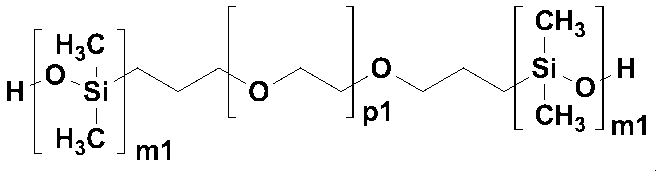


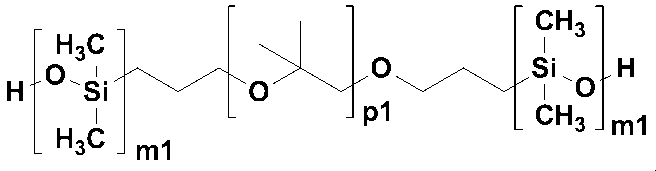
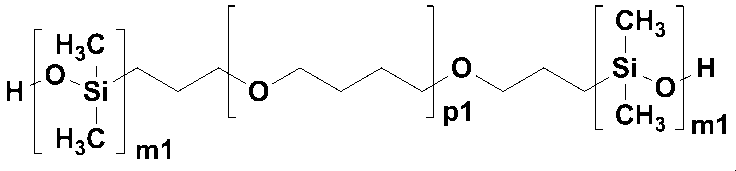
本発明の一態様である新規な末端シラノール基含有ポリオキシアルキレン系化合物は、例えば、下記式(5)で示される分子鎖片末端のケイ素原子に結合した水素原子(Si-H基)を有し、かつ、他方の末端のケイ素原子に結合した水酸基(シラノール基)を有するオルガノシラン又はオルガノポリシロキサン化合物(ケイ素化合物)と、下記式(6)で示される分子鎖両末端がアルケニル基で封鎖されたポリオキシアルキレン系重合体とをヒドロシリル化付加反応させることによって容易に製造することができる。

これらの白金族金属系触媒の使用量は、所謂触媒量でよく、例えば上記式(5)で示されるケイ素化合物と上記式(6)で示されるポリオキシアルキレン系重合体との合計質量に対して、白金族金属の質量換算で0.1~1,000ppm、特に0.5~100ppmの質量で使用することが好ましい。
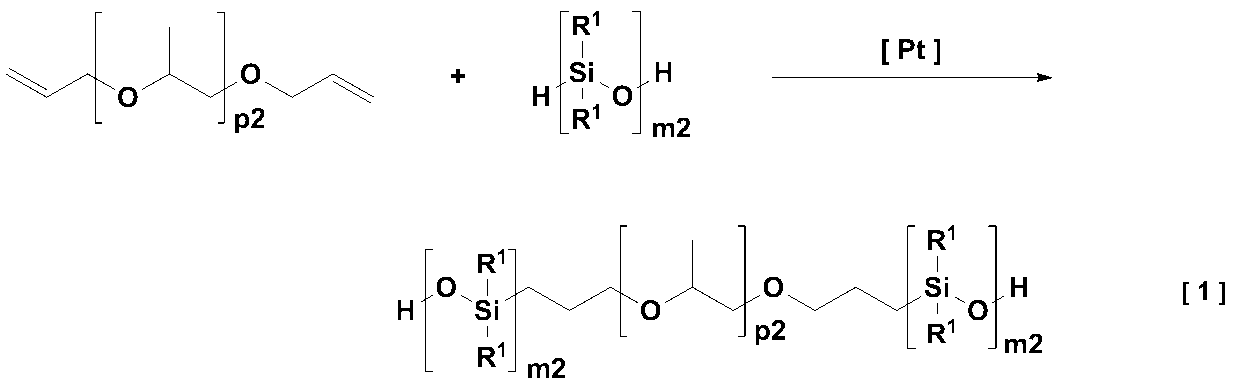
本発明の室温硬化性組成物は、主剤として上記ポリオキシアルキレン系化合物を含むものであり、下記に示す成分を含むものであることが好ましい。
(a)上記ポリオキシアルキレン系化合物、
(b)下記(b-1)成分及び/又は(b-2)成分、
(b-1)下記一般式(7)で示される同一ケイ素原子上に2つのアルコキシシリル-ビニレン基を有する加水分解性有機ケイ素化合物及び/又はその部分加水分解縮合物

(b-2)1分子中に1個のメチル基、ビニル基又はフェニル基を有し、かつ少なくとも2個の加水分解性基を有し、かつアミノ基を有さない、(b-1)成分を除く加水分解性オルガノシラン及び/又はその部分加水分解縮合物
(c)硬化触媒。
(a)成分は、本発明の室温硬化性組成物の主剤(ベースポリマー)となるもので、上述したポリオキシアルキレン系化合物を用いることができ、中でも脂肪族不飽和結合を有さない末端シラノール基含有ポリオキシアルキレン系化合物であることが好ましい。
即ち、上記式(1)において、R1、R2がそれぞれ同一若しくは異なってもよく、炭素数1~20のアルキル基、該アルキル基のうち炭素数が3以上のものは環状であるシクロアルキル基であってもよく、炭素数6~20のアリール基、炭素数7~20のアラルキル基、水素原子、又は(R3)3Si-O-(R3は上記と同じである。)で表されるトリオルガノシロキシ基のものであり、これらの中でも、R1としては、メチル基、エチル基、フェニル基が好ましく、入手の容易さ、生産性、コストの面からメチル基、フェニル基が特に好ましく、R2としては、水素原子が好ましく、R3としては、脂肪族不飽和結合を有さないものが好ましく、メチル基、エチル基、フェニル基がより好ましい。
このような末端シラノール基含有ポリオキシアルキレン系化合物としては、上述したポリオキシアルキレン系化合物において、脂肪族不飽和結合を有さないものを例示することができる。
本発明に係る(b)成分は、本発明の室温硬化性組成物において硬化剤(架橋剤)成分として作用するものであり、下記に記載する(b-1)成分及び/又は(b-2)成分からなるものである。本発明の室温硬化性組成物は、(b-1)成分又は(b-2)成分の少なくとも一方を有さないと、優れた硬化物は得られない。

以下に、(b-1)成分の合成例を示す。
(b-1)成分のアルコキシシリル-ビニレン基(アルコキシシリル-エテニレン基)を同一ケイ素原子上に2つ有する加水分解性有機ケイ素化合物は、例えば、同一ケイ素原子上にエチニル基を2つ有するオルガノシランと、2つのアルコキシヒドロシランをヒドロシリル化反応による付加反応で容易に製造することができる。この反応式は、例えば下記式[2]で表される。
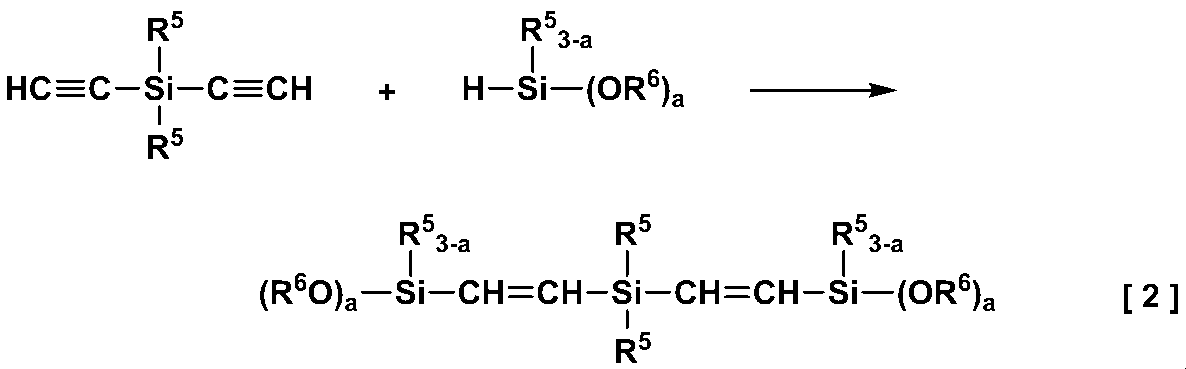


なお、本発明の室温硬化性組成物における硬化剤(架橋剤)である(b)成分としては、上記(b-1)成分あるいは(b-2)成分をそれぞれ単独で使用してもよく、また、(b-1)成分と(b-2)成分を併用してもよい。(b-1)成分と(b-2)成分を併用する場合の使用割合は、例えば、(b-1)成分:(b-2)成分の質量比で、99:1~1:99、好ましくは90:10~10:90、より好ましくは70:30~30:70、更に好ましくは60:40~40:60程度とすることができる。
(c)成分は硬化触媒(非金属系有機触媒及び/又は金属系触媒)であり、本発明の室温硬化性組成物の硬化を促進するために作用する。
(d)成分は充填剤(無機質充填剤及び/又は有機樹脂充填剤)であり、本発明の室温硬化性組成物に必要に応じて配合できる任意成分であり、この組成物から形成される硬化物に十分な機械的強度を与えるために使用される。この充填剤としては公知のものを使用することができ、例えば微粉末シリカ、煙霧質シリカ、沈降性シリカ、これらのシリカ表面を有機ケイ素化合物で疎水化処理したシリカ、ガラスビーズ、ガラスバルーン、透明樹脂ビーズ、シリカエアロゲル、珪藻土、酸化鉄、酸化亜鉛、酸化チタン、煙霧状金属酸化物などの金属酸化物、湿式シリカあるいはこれらの表面をシラン処理したもの、石英粉末、カーボンブラック、タルク、ゼオライト及びベントナイト等の補強剤、アスベスト、ガラス繊維、炭素繊維、炭酸カルシウム、炭酸マグネシウム、炭酸亜鉛などの金属炭酸塩、ガラスウール、微粉マイカ、溶融シリカ粉末、ポリスチレン、ポリ塩化ビニル、ポリプロピレンなどの合成樹脂粉末等が使用される。これらの充填剤のうち、シリカ、炭酸カルシウム、ゼオライトなどの無機質充填剤が好ましく、特に表面を疎水化処理した煙霧質シリカ、炭酸カルシウムが好ましい。
(e)成分は接着促進剤であり、本発明の室温硬化性組成物に必要に応じて配合できる任意成分であり、この組成物から形成される硬化物に十分な接着性を与えるために使用される。接着促進剤(官能性基含有加水分解性シラン等のシランカップリング剤)としては公知のものが好適に使用され、ビニルシランカップリング剤、(メタ)アクリルシランカップリング剤、エポキシシランカップリング剤、アミノシランカップリング剤、メルカプトシランカップリング剤などが例示され、具体的には、ビニルトリス(β-メトキシエトキシ)シラン、γ-メタクリロキシプロピルトリメトキシシラン、β-(3,4-エポキシシクロヘキシル)エチルトリメトキシシラン、γ-グリシドキシプロピルトリメトキシシラン、γ-グリシドキシプロピルメチルジエトキシシラン、N-β-(アミノエチル)-γ-アミノプロピルトリメトキシシラン、γ-アミノプロピルトリエトキシシラン、3-2-(アミノエチルアミノ)プロピルトリメトキシシラン、γ-メルカプトプロピルトリメトキシシラン、イソシアネートシラン等、並びにこれらが部分的に加水分解され縮合した化合物が例示される。なお、上記接着促進剤のうち、ビニルトリス(β-メトキシエトキシ)シラン等のビニルシランカップリング剤は、上記した(b-2)成分としても機能し得るものである。
これらの内、特にγ-アミノプロピルトリエトキシシラン、3-2-(アミノエチルアミノ)プロピルトリメトキシシラン等のアミノシラン類、γ-グリシドキシプロピルトリメトキシシラン、β-(3,4-エポキシシクロヘキシル)エチルトリメトキシシラン等のエポキシシラン類、イソシアネートシランが好ましい。
本発明の室温硬化性組成物には、上記(a)~(e)成分に加えて、更に(f)下記一般式(8)で表される直鎖状ジオルガノポリシロキサン(いわゆる無官能性シリコーンオイル)を含有してもよい。

本発明の室温硬化性組成物には、上記(a)~(f)成分以外に、必要に応じてその他各種の添加剤、例えば、カーボンブラックや酸化鉄、酸化チタンなどの顔料、染料、老化防止剤、酸化防止剤、帯電防止剤、接着付与剤、防腐剤、炭酸亜鉛等のその他の難燃性付与剤、防カビ剤、抗菌剤など、公知の添加剤を配合してもよい。これらその他の添加剤は、本発明の効果を妨げない範囲の量で添加すればよい。
具体的には、上記(a)~(c)成分、及び必要に応じて(d)~(f)成分並びにその他各種の添加剤を、湿気を遮断した状態下で、あるいは減圧下で気泡を取り除きながら均一に混合することにより調製することが好ましい。混合の装置としては、特に限定されるものではないが、真空ポンプに接続された万能混合撹拌機(ダルトン社製)、プラネタリーミキサー((株)井上製作所製)等を用いることが好ましい。
[実施例1]
撹拌機、還流冷却管、温度計及び滴下ロートを備えた500mLの四つ口セパラブルフラスコに、分子量7,400相当の末端アリル基含有ポリプロピレングリコール500g(末端のアリル基の官能基換算0.160モル)、白金触媒(塩化白金酸のビニルシロキサン錯体溶液、白金濃度;1質量%)1.0gを入れ、加熱撹拌しながら温度を90℃まで上げた。
次いで、撹拌下で、1-ヒドロキシ-オクタメチルテトラシロキサン(即ち、1-ヒドロキシ-7-ハイドロジェン-1,1,3,3,5,5,7,7-オクタメチルテトラシロキサン)50g(末端Si-Hの官能基量0.167モル)を滴下していくと、発熱が認められ、反応温度は90~95℃となり、6時間、この反応系を保持した。反応終了後、減圧下にて、小過剰の1-ヒドロキシ-オクタメチルテトラシロキサンを取り除いた。室温まで冷却した後、ろ過し、末端シラノール基含有ポリプロピレングリコール(ポリマーA)520g(粘度4.0Pa・s、分子量8,000、収率95%)を得た。この反応式は、下記式[4]で表される。
撹拌機、還流冷却管、温度計及び滴下ロートを備えた500mLの四つ口セパラブルフラスコに、分子量8,400相当の末端アリル基含有ポリプロピレングリコール500g(末端のアリル基の官能基換算0.112モル)、白金触媒(塩化白金酸のビニルシロキサン錯体溶液、白金濃度;1質量%)1.0gを入れ、加熱撹拌しながら温度を90℃まで上げた。
次いで、撹拌下で、1-ヒドロキシ-オクタメチルテトラシロキサン35g(末端Si-Hの官能基量0.117モル)を滴下していくと、発熱が認められ、反応温度は90~95℃となり、6時間、この反応系を保持した。反応終了後、減圧下にて、小過剰の1-ヒドロキシ-オクタメチルテトラシロキサンを取り除いた。室温まで冷却した後、ろ過し、末端シラノール基含有ポリプロピレングリコール(ポリマーB)505g(粘度10.0Pa・s、分子量9,000、収率95%)を得た。
撹拌機、還流冷却管、温度計及び滴下ロートを備えた500mLの四つ口セパラブルフラスコに、分子量4,300相当の末端アリル基含有ポリプロピレングリコール250g(末端のアリル基の官能基換算0.107モル)、白金触媒(塩化白金酸のビニルシロキサン錯体溶液、白金濃度;1質量%)1.0gを入れ、加熱撹拌しながら温度を90℃まで上げた。
次いで、撹拌下で、1-ヒドロキシ-オクタメチルテトラシロキサン33g(末端Si-Hの官能基量0.110モル)を滴下していくと、発熱が認められ、反応温度は90~95℃となり、6時間、この反応系を保持した。反応終了後、減圧下にて、小過剰の1-ヒドロキシ-オクタメチルテトラシロキサンを取り除いた。室温まで冷却した後、ろ過し、末端シラノール基含有ポリプロピレングリコール(ポリマーC)268g(粘度1.3Pa・s、分子量4,900、収率95%)を得た。
撹拌機、還流冷却管、温度計及び滴下ロートを備えた500mLの四つ口セパラブルフラスコに、分子量7,190相当の末端アリル基含有ポリプロピレングリコール250g(末端のアリル基の官能基換算0.063モル)、白金触媒(塩化白金酸のビニルシロキサン錯体溶液、白金濃度;1質量%)1.0gを入れ、加熱撹拌しながら温度を90℃まで上げた。
次いで、撹拌下で、1-ヒドロキシ-オクタメチルテトラシロキサン19g(末端Si-Hの官能基量0.066モル)を滴下していくと、発熱が認められ、反応温度は90~95℃となり、6時間、この反応系を保持した。反応終了後、減圧下にて、小過剰の1-ヒドロキシ-オクタメチルテトラシロキサンを取り除いた。室温まで冷却した後、ろ過し、末端シラノール基含有ポリプロピレングリコール(ポリマーD)255g(粘度9.2Pa・s、分子量7,800、収率95%)を得た。
撹拌機、還流冷却管、温度計及び滴下ロートを備えた500mLの四つ口セパラブルフラスコに、分子量7,500相当の末端アリル基含有ポリプロピレングリコール250g(末端のアリル基の官能基換算0.048モル)、白金触媒(塩化白金酸のビニルシロキサン錯体溶液、白金濃度;1質量%)1.0gを入れ、加熱撹拌しながら温度を90℃まで上げた。
次いで、撹拌下で、1-ヒドロキシ-オクタメチルテトラシロキサン15g(末端Si-Hの官能基量0.050モル)を滴下していくと、発熱が認められ、反応温度は90~95℃となり、6時間、この反応系を保持した。反応終了後、減圧下にて、小過剰の1-ヒドロキシ-オクタメチルテトラシロキサンを取り除いた。室温まで冷却した後、ろ過し、末端シラノール基含有ポリプロピレングリコール(ポリマーE)251g(粘度26.5Pa・s、分子量8,100、収率95%)を得た。
実施例1の方法に従い合成した、粘度4.0Pa・sの末端シラノール基含有ポリプロピレングリコール(ポリマーA)100部と、ビス(トリメトキシシリル-エチレン)ジメチルシラン(下記構造式)13.2部と、ジオクチル錫ジネオデカノエート0.5部を湿気遮断下で、均一になるまで混合して組成物を調製した。
実施例6において、ジオクチル錫ジネオデカノエートの代わりに、テトラメチルグアニジルプロピルトリメトキシシランを同量用いた以外は同様に組成物を調製した。
実施例7において、テトラメチルグアニジルプロピルトリメトキシシランの代わりに、ジ-n-ブチル-ジメトキシスズを同量用いた以外は同様に組成物を調製した。
実施例8において、実施例1の方法に従い合成した粘度4.0Pa・sの末端シラノール基含有ポリプロピレングリコール(ポリマーA)の代わりに、実施例2の方法に従い合成した粘度10.0Pa・sの末端シラノール基含有ポリプロピレングリコール(ポリマーB)100部を用いた以外は同様に組成物を調製した。
実施例9において、ビス(トリメトキシシリル-エチレン)ジメチルシランの代わりに、ビニルトリメトキシシラン6.6部を用いた以外は同様に組成物を調製した。
実施例9において、ビス(トリメトキシシリル-エチレン)ジメチルシランの代わりに、ビニルトリイソプロポキシシラン13.9部、ジ-n-ブチル-ジメトキシスズの代わりに、ジオクチル錫ジネオデカノエートを同量用いた以外は同様に組成物を調製した。
実施例9~11において、実施例2の方法に従い合成した粘度10.0Pa・sの末端シラノール基含有ポリプロピレングリコール(ポリマーB)の代わりに、実施例3の方法に従い合成した粘度1.3Pa・sの末端シラノール基含有ポリプロピレングリコール(ポリマーC)100部を用いた以外は同様に組成物を調製した。
実施例9~11において、実施例2の方法に従い合成した粘度10.0Pa・sの末端シラノール基含有ポリプロピレングリコール(ポリマーB)の代わりに、実施例4の方法に従い合成した粘度9.2Pa・sの末端シラノール基含有ポリプロピレングリコール(ポリマーD)100部を用いた以外は同様に組成物を調製した。
実施例9~11において、実施例2の方法に従い合成した粘度10.0Pa・sの末端シラノール基含有ポリプロピレングリコール(ポリマーB)の代わりに、実施例5の方法に従い合成した粘度26.5Pa・sの末端シラノール基含有ポリプロピレングリコール(ポリマーE)100部を用いた以外は同様に組成物を調製した。
実施例6において、ポリマーAの代わりに、(株)カネカ製MSポリマーS303H(分子鎖両末端ジメトキシシリル基封鎖ポリオキシプロピレン重合体)を同量用いた以外は同様に組成物を調製した。


従って、本発明のシラノール基を有する反応性ケイ素基を分子鎖末端に有する新規ポリオキシアルキレン系化合物を室温硬化性組成物(変成シリコーンRTV組成物)のベースポリマーとして用いることで、架橋剤の加水分解性基としてアルコキシタイプだけでなく、種々の硬化剤(オキシム、アミド、アミノキシ、酢酸(アセトキシ基)、アルコール(アルコキシ基)等の種々の加水分解性基を含有する有機ケイ素化合物など)を架橋成分として用いることが理論上可能であり、これにより種々の硬化反応(縮合反応)タイプの室温硬化性組成物(変成シリコーンRTV組成物)を得ることができる。
Claims (18)
- 1分子中に少なくとも1個の下記構造式(1)で示される反応性ケイ素基を分子鎖末端に含有し、かつ、主鎖がポリオキシアルキレン系重合体であることを特徴とするポリオキシアルキレン系化合物。

- 下記構造式(2)で表されるものである請求項1に記載のポリオキシアルキレン系化合物。

- 上記式(2)中のZが下記式(4)で示されるものである請求項2に記載のポリオキシアルキレン系化合物。
- 主鎖のポリオキシアルキレン系重合体が直鎖構造であることを特徴とする請求項1~3のいずれか1項に記載のポリオキシアルキレン系化合物。
- 数平均分子量が200~50,000である請求項1~4のいずれか1項に記載のポリオキシアルキレン系化合物。
- 分子鎖片末端のケイ素原子に結合した水素原子(Si-H基)を有し、かつ、他方の末端のケイ素原子に結合した水酸基(シラノール基)を有するオルガノシラン又はオルガノポリシロキサン化合物と、分子鎖両末端がアルケニル基で封鎖されたポリオキシアルキレン系重合体とをヒドロシリル化付加反応させる工程を含んでなる請求項1~5のいずれか1項に記載のポリオキシアルキレン系化合物の製造方法。
- 分子鎖片末端のケイ素原子に結合した水素原子(Si-H基)を有し、かつ、他方の末端のケイ素原子に結合した水酸基(シラノール基)を有するオルガノシラン又はオルガノポリシロキサン化合物が下記式(5)で示され、分子鎖両末端がアルケニル基で封鎖されたポリオキシアルキレン系重合体が下記式(6)で示されるものである請求項6に記載のポリオキシアルキレン系化合物の製造方法。
- 上記式(6)中のZが下記式(4)で示されるものである請求項7に記載のポリオキシアルキレン系化合物の製造方法。
- (a)1分子中に少なくとも1個の下記構造式(1)で示される反応性ケイ素基を分子鎖末端に含有し、かつ、主鎖がポリオキシアルキレン系重合体であるポリオキシアルキレン系化合物: 100質量部、

(b)下記(b-1)成分及び/又は(b-2)成分: 0.1~30質量部、
(b-1)下記一般式(7)で示される同一ケイ素原子上に2つのアルコキシシリル-ビニレン基を有する加水分解性有機ケイ素化合物及び/又はその部分加水分解縮合物

(b-2)1分子中に1個のメチル基、ビニル基又はフェニル基を有し、かつ少なくとも2個の加水分解性基を有し、かつアミノ基を有さない、(b-1)成分を除く加水分解性オルガノシラン及び/又はその部分加水分解縮合物
(c)硬化触媒: 0.01~20質量部
を含有する室温硬化性組成物。 - 上記式(1)中のR1、R2がそれぞれ同一若しくは異なってもよく、炭素数1~20のアルキル基、該アルキル基のうち炭素数が3以上のものは環状であるシクロアルキル基であってもよく、炭素数6~20のアリール基、炭素数7~20のアラルキル基、水素原子、又は(R3)3Si-O-(R3は上記と同じ。)で表されるトリオルガノシロキシ基である請求項9に記載の室温硬化性組成物。
- (a)ポリオキシアルキレン系化合物が下記構造式(2)で表されるものである請求項9又は10に記載の室温硬化性組成物。

- 上記式(2)中のZが下記式(4)で示されるものである請求項11に記載の室温硬化性組成物。
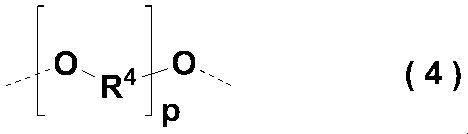
- (a)ポリオキシアルキレン系化合物が直鎖状構造である請求項9~12のいずれか1項に記載の室温硬化性組成物。
- (a)ポリオキシアルキレン系化合物の数平均分子量が200~50,000である請求項9~13のいずれか1項に記載の室温硬化性組成物。
- 更に、(a)成分100質量部に対して、
(d)充填剤: 3~1,000質量部、及び/又は
(e)接着促進剤: 0.1~30質量部
を含有するものである請求項9~14のいずれか1項に記載の室温硬化性組成物。 - 更に、(a)成分100質量部に対して、
(f)下記一般式(8)で表されるオルガノポリシロキサン: 0.1~100質量部

を含有するものである請求項9~15のいずれか1項に記載の室温硬化性組成物。 - 請求項9~16のいずれか1項に記載の室温硬化性組成物からなるシーリング材。
- 請求項9~16のいずれか1項に記載の室温硬化性組成物の硬化物で接着及び/又はシールした物品。
Priority Applications (6)
| Application Number | Priority Date | Filing Date | Title |
|---|---|---|---|
| US16/091,043 US11859050B2 (en) | 2016-04-26 | 2017-02-28 | Silanol-group-terminated polyoxyalkylene compound and production process therefor, room-temperature-curable composition, sealing material, and article |
| CN202410799696.2A CN118813028A (zh) | 2016-04-26 | 2017-02-28 | 含有末端硅烷醇基的聚氧化烯系化合物及其制造方法、室温固化性组合物、密封材料以及物品 |
| CN201780025966.2A CN109071798A (zh) | 2016-04-26 | 2017-02-28 | 含有末端硅烷醇基的聚氧化烯系化合物及其制造方法、室温固化性组合物、密封材料以及物品 |
| JP2018514152A JP6747507B2 (ja) | 2016-04-26 | 2017-02-28 | 室温硬化性組成物、シーリング材並びに物品 |
| KR1020187033294A KR102619534B1 (ko) | 2016-04-26 | 2017-02-28 | 실온 경화성 조성물, 실링재, 및 물품 |
| EP17789051.4A EP3450480B1 (en) | 2016-04-26 | 2017-02-28 | Room-temperature-curable composition comprising silanol-group-terminated polyoxyalkylene compound, sealing material, and article |
Applications Claiming Priority (4)
| Application Number | Priority Date | Filing Date | Title |
|---|---|---|---|
| JP2016088137 | 2016-04-26 | ||
| JP2016-088137 | 2016-04-26 | ||
| JP2016153413 | 2016-08-04 | ||
| JP2016-153413 | 2016-08-04 |
Publications (1)
| Publication Number | Publication Date |
|---|---|
| WO2017187762A1 true WO2017187762A1 (ja) | 2017-11-02 |
Family
ID=60161409
Family Applications (1)
| Application Number | Title | Priority Date | Filing Date |
|---|---|---|---|
| PCT/JP2017/007648 Ceased WO2017187762A1 (ja) | 2016-04-26 | 2017-02-28 | 末端シラノール基含有ポリオキシアルキレン系化合物及びその製造方法、室温硬化性組成物、シーリング材並びに物品 |
Country Status (6)
| Country | Link |
|---|---|
| US (1) | US11859050B2 (ja) |
| EP (1) | EP3450480B1 (ja) |
| JP (1) | JP6747507B2 (ja) |
| KR (1) | KR102619534B1 (ja) |
| CN (2) | CN118813028A (ja) |
| WO (1) | WO2017187762A1 (ja) |
Cited By (3)
| Publication number | Priority date | Publication date | Assignee | Title |
|---|---|---|---|---|
| JPWO2022009759A1 (ja) * | 2020-07-07 | 2022-01-13 | ||
| US20220106514A1 (en) * | 2019-02-08 | 2022-04-07 | Shin-Etsu Chemical Co., Ltd. | Room temperature-curable composition having excellent silicone oil resistance, and coolant sealing material for motor vehicle |
| WO2025173648A1 (ja) * | 2024-02-15 | 2025-08-21 | 信越化学工業株式会社 | 硬化性樹脂組成物及び接着材 |
Families Citing this family (5)
| Publication number | Priority date | Publication date | Assignee | Title |
|---|---|---|---|---|
| KR102319263B1 (ko) * | 2017-11-30 | 2021-10-29 | 주식회사 엘지화학 | 방열 유체 조성물, 이의 제조방법, 이를 포함하는 전지 모듈 및 배터리 팩 |
| JP7265630B2 (ja) * | 2018-12-27 | 2023-04-26 | 万華化学集団股▲フン▼有限公司 | 反応型シーラント樹脂の調製方法 |
| JP7286324B2 (ja) * | 2019-01-17 | 2023-06-05 | リンテック株式会社 | 粘着性組成物、粘着剤、粘着シートおよび表示体 |
| CN110117357B (zh) * | 2019-04-12 | 2020-04-03 | 浙江新安化工集团股份有限公司 | 一种硅烷改性聚醚及其制备方法 |
| CN115521645B (zh) * | 2022-11-10 | 2023-09-12 | 贵州云天科贸有限公司 | 单组份无机富锌防锈抗滑移涂料 |
Citations (8)
| Publication number | Priority date | Publication date | Assignee | Title |
|---|---|---|---|---|
| JPS63125524A (ja) * | 1986-11-17 | 1988-05-28 | Toshiba Silicone Co Ltd | 加水分解性シリル基で分子鎖末端が閉塞されたポリエ−テル |
| JPH05125176A (ja) * | 1991-11-01 | 1993-05-21 | Asahi Glass Co Ltd | ポリエーテル重合体及びその製造方法 |
| JP2000136312A (ja) * | 1998-11-04 | 2000-05-16 | Asahi Glass Co Ltd | 硬化性組成物 |
| JP2000327771A (ja) * | 1999-05-19 | 2000-11-28 | Kanegafuchi Chem Ind Co Ltd | 硬化性組成物 |
| JP2006267401A (ja) * | 2005-03-23 | 2006-10-05 | Shin Etsu Chem Co Ltd | 感光性樹脂組成物 |
| JP2006335936A (ja) * | 2005-06-03 | 2006-12-14 | Shin Etsu Chem Co Ltd | シラノール基含有重合体およびその製造方法 |
| JP2009013430A (ja) * | 1999-03-18 | 2009-01-22 | Kaneka Corp | 硬化性組成物 |
| JP2013213229A (ja) * | 2006-11-01 | 2013-10-17 | Kaneka Corp | 硬化性有機重合体を含有する硬化性組成物 |
Family Cites Families (6)
| Publication number | Priority date | Publication date | Assignee | Title |
|---|---|---|---|---|
| JPS55123648A (en) * | 1979-03-16 | 1980-09-24 | Shin Etsu Chem Co Ltd | Cold-setting composition |
| JP4034716B2 (ja) | 2003-10-20 | 2008-01-16 | 株式会社カネカ | 硬化性組成物 |
| EP1930376B2 (en) * | 2005-09-30 | 2016-09-07 | Kaneka Corporation | Curable composition |
| JP5420933B2 (ja) | 2009-03-10 | 2014-02-19 | 株式会社カネカ | 硬化性組成物 |
| JP6187681B2 (ja) * | 2014-04-25 | 2017-08-30 | 信越化学工業株式会社 | 新規ビス(アルコキシシリル−ビニレン)基含有ケイ素化合物及びその製造方法 |
| WO2015194340A1 (ja) * | 2014-06-16 | 2015-12-23 | 信越化学工業株式会社 | 室温硬化性オルガノポリシロキサン組成物及び該室温硬化性オルガノポリシロキサン組成物の硬化物である成形物 |
-
2017
- 2017-02-28 CN CN202410799696.2A patent/CN118813028A/zh active Pending
- 2017-02-28 US US16/091,043 patent/US11859050B2/en active Active
- 2017-02-28 KR KR1020187033294A patent/KR102619534B1/ko active Active
- 2017-02-28 EP EP17789051.4A patent/EP3450480B1/en active Active
- 2017-02-28 WO PCT/JP2017/007648 patent/WO2017187762A1/ja not_active Ceased
- 2017-02-28 JP JP2018514152A patent/JP6747507B2/ja active Active
- 2017-02-28 CN CN201780025966.2A patent/CN109071798A/zh active Pending
Patent Citations (8)
| Publication number | Priority date | Publication date | Assignee | Title |
|---|---|---|---|---|
| JPS63125524A (ja) * | 1986-11-17 | 1988-05-28 | Toshiba Silicone Co Ltd | 加水分解性シリル基で分子鎖末端が閉塞されたポリエ−テル |
| JPH05125176A (ja) * | 1991-11-01 | 1993-05-21 | Asahi Glass Co Ltd | ポリエーテル重合体及びその製造方法 |
| JP2000136312A (ja) * | 1998-11-04 | 2000-05-16 | Asahi Glass Co Ltd | 硬化性組成物 |
| JP2009013430A (ja) * | 1999-03-18 | 2009-01-22 | Kaneka Corp | 硬化性組成物 |
| JP2000327771A (ja) * | 1999-05-19 | 2000-11-28 | Kanegafuchi Chem Ind Co Ltd | 硬化性組成物 |
| JP2006267401A (ja) * | 2005-03-23 | 2006-10-05 | Shin Etsu Chem Co Ltd | 感光性樹脂組成物 |
| JP2006335936A (ja) * | 2005-06-03 | 2006-12-14 | Shin Etsu Chem Co Ltd | シラノール基含有重合体およびその製造方法 |
| JP2013213229A (ja) * | 2006-11-01 | 2013-10-17 | Kaneka Corp | 硬化性有機重合体を含有する硬化性組成物 |
Non-Patent Citations (1)
| Title |
|---|
| See also references of EP3450480A4 * |
Cited By (4)
| Publication number | Priority date | Publication date | Assignee | Title |
|---|---|---|---|---|
| US20220106514A1 (en) * | 2019-02-08 | 2022-04-07 | Shin-Etsu Chemical Co., Ltd. | Room temperature-curable composition having excellent silicone oil resistance, and coolant sealing material for motor vehicle |
| JPWO2022009759A1 (ja) * | 2020-07-07 | 2022-01-13 | ||
| WO2022009759A1 (ja) * | 2020-07-07 | 2022-01-13 | 信越化学工業株式会社 | 二成分型室温速硬化性オルガノポリシロキサン組成物、該組成物の硬化物及び物品 |
| WO2025173648A1 (ja) * | 2024-02-15 | 2025-08-21 | 信越化学工業株式会社 | 硬化性樹脂組成物及び接着材 |
Also Published As
| Publication number | Publication date |
|---|---|
| EP3450480A1 (en) | 2019-03-06 |
| JP6747507B2 (ja) | 2020-08-26 |
| KR102619534B1 (ko) | 2023-12-29 |
| JPWO2017187762A1 (ja) | 2018-11-22 |
| CN109071798A (zh) | 2018-12-21 |
| US11859050B2 (en) | 2024-01-02 |
| US20190135978A1 (en) | 2019-05-09 |
| EP3450480B1 (en) | 2025-03-26 |
| KR20180135943A (ko) | 2018-12-21 |
| EP3450480A4 (en) | 2019-12-04 |
| CN118813028A (zh) | 2024-10-22 |
Similar Documents
| Publication | Publication Date | Title |
|---|---|---|
| US9644124B2 (en) | Silicon-containing compound having alkoxysilyl-ethylene group at its terminal, room temperature-curable organopolysiloxane composition, and molded product obtained by curing the composition | |
| JP6747507B2 (ja) | 室温硬化性組成物、シーリング材並びに物品 | |
| KR102207422B1 (ko) | 다성분계 실온 경화성 오르가노폴리실록산 조성물, 해당 조성물의 경화물 및 해당 경화물을 포함하는 성형물 | |
| JP6497390B2 (ja) | 室温硬化性オルガノポリシロキサン組成物及び該室温硬化性オルガノポリシロキサン組成物の硬化物である成形物 | |
| JP2018087348A (ja) | 室温硬化性組成物、シーリング材及び物品 | |
| JP6627862B2 (ja) | 室温硬化性オルガノポリシロキサン組成物及び該組成物の硬化物である成形物 | |
| JP6760223B2 (ja) | 室温硬化性オルガノポリシロキサン組成物、およびこれを含有するシール剤、コーティング剤、接着剤、成形物 | |
| JP2006131824A (ja) | 室温硬化性オルガノポリシロキサン組成物 | |
| WO2023068094A1 (ja) | 室温硬化性オルガノポリシロキサン組成物、接着剤、シール剤及びコーティング剤 | |
| WO2022009759A1 (ja) | 二成分型室温速硬化性オルガノポリシロキサン組成物、該組成物の硬化物及び物品 | |
| CN111278924B (zh) | 有机聚硅氧烷组合物以及有机硅化合物及其制造方法 | |
| JP7852672B2 (ja) | 二成分型室温速硬化性オルガノポリシロキサン組成物及び物品、並びに二成分型室温硬化性オルガノポリシロキサン組成物の深部硬化性の改善方法 | |
| JP7687232B2 (ja) | 室温硬化性オルガノポリシロキサン組成物の製造中のゲル化を防止する方法 | |
| JP7809058B2 (ja) | 鎖長延長剤とそれを用いた室温硬化性樹脂組成物、コーティング剤、接着剤及びシーリング剤、並びに物品 | |
| JP5915599B2 (ja) | 室温硬化性樹脂組成物 |
Legal Events
| Date | Code | Title | Description |
|---|---|---|---|
| WWE | Wipo information: entry into national phase |
Ref document number: 2018514152 Country of ref document: JP |
|
| NENP | Non-entry into the national phase |
Ref country code: DE |
|
| ENP | Entry into the national phase |
Ref document number: 20187033294 Country of ref document: KR Kind code of ref document: A |
|
| WWE | Wipo information: entry into national phase |
Ref document number: 2017789051 Country of ref document: EP |
|
| 121 | Ep: the epo has been informed by wipo that ep was designated in this application |
Ref document number: 17789051 Country of ref document: EP Kind code of ref document: A1 |
|
| ENP | Entry into the national phase |
Ref document number: 2017789051 Country of ref document: EP Effective date: 20181126 |