WO2017187868A1 - 変性ポリマーの製造方法、変性ポリマー、ゴム組成物及びタイヤ - Google Patents
変性ポリマーの製造方法、変性ポリマー、ゴム組成物及びタイヤ Download PDFInfo
- Publication number
- WO2017187868A1 WO2017187868A1 PCT/JP2017/012734 JP2017012734W WO2017187868A1 WO 2017187868 A1 WO2017187868 A1 WO 2017187868A1 JP 2017012734 W JP2017012734 W JP 2017012734W WO 2017187868 A1 WO2017187868 A1 WO 2017187868A1
- Authority
- WO
- WIPO (PCT)
- Prior art keywords
- modified polymer
- polymer
- lithium
- rubber composition
- group
- Prior art date
- Legal status (The legal status is an assumption and is not a legal conclusion. Google has not performed a legal analysis and makes no representation as to the accuracy of the status listed.)
- Ceased
Links
Classifications
-
- C—CHEMISTRY; METALLURGY
- C08—ORGANIC MACROMOLECULAR COMPOUNDS; THEIR PREPARATION OR CHEMICAL WORKING-UP; COMPOSITIONS BASED THEREON
- C08F—MACROMOLECULAR COMPOUNDS OBTAINED BY REACTIONS ONLY INVOLVING CARBON-TO-CARBON UNSATURATED BONDS
- C08F36/00—Homopolymers and copolymers of compounds having one or more unsaturated aliphatic radicals, at least one having two or more carbon-to-carbon double bonds
- C08F36/02—Homopolymers and copolymers of compounds having one or more unsaturated aliphatic radicals, at least one having two or more carbon-to-carbon double bonds the radical having only two carbon-to-carbon double bonds
- C08F36/04—Homopolymers and copolymers of compounds having one or more unsaturated aliphatic radicals, at least one having two or more carbon-to-carbon double bonds the radical having only two carbon-to-carbon double bonds conjugated
- C08F36/06—Butadiene
-
- C—CHEMISTRY; METALLURGY
- C08—ORGANIC MACROMOLECULAR COMPOUNDS; THEIR PREPARATION OR CHEMICAL WORKING-UP; COMPOSITIONS BASED THEREON
- C08F—MACROMOLECULAR COMPOUNDS OBTAINED BY REACTIONS ONLY INVOLVING CARBON-TO-CARBON UNSATURATED BONDS
- C08F36/00—Homopolymers and copolymers of compounds having one or more unsaturated aliphatic radicals, at least one having two or more carbon-to-carbon double bonds
- C08F36/02—Homopolymers and copolymers of compounds having one or more unsaturated aliphatic radicals, at least one having two or more carbon-to-carbon double bonds the radical having only two carbon-to-carbon double bonds
- C08F36/04—Homopolymers and copolymers of compounds having one or more unsaturated aliphatic radicals, at least one having two or more carbon-to-carbon double bonds the radical having only two carbon-to-carbon double bonds conjugated
-
- B—PERFORMING OPERATIONS; TRANSPORTING
- B60—VEHICLES IN GENERAL
- B60C—VEHICLE TYRES; TYRE INFLATION; TYRE CHANGING; CONNECTING VALVES TO INFLATABLE ELASTIC BODIES IN GENERAL; DEVICES OR ARRANGEMENTS RELATED TO TYRES
- B60C1/00—Tyres characterised by the chemical composition or the physical arrangement or mixture of the composition
-
- B—PERFORMING OPERATIONS; TRANSPORTING
- B60—VEHICLES IN GENERAL
- B60C—VEHICLE TYRES; TYRE INFLATION; TYRE CHANGING; CONNECTING VALVES TO INFLATABLE ELASTIC BODIES IN GENERAL; DEVICES OR ARRANGEMENTS RELATED TO TYRES
- B60C1/00—Tyres characterised by the chemical composition or the physical arrangement or mixture of the composition
- B60C1/0016—Compositions of the tread
-
- C—CHEMISTRY; METALLURGY
- C08—ORGANIC MACROMOLECULAR COMPOUNDS; THEIR PREPARATION OR CHEMICAL WORKING-UP; COMPOSITIONS BASED THEREON
- C08C—TREATMENT OR CHEMICAL MODIFICATION OF RUBBERS
- C08C19/00—Chemical modification of rubber
- C08C19/22—Incorporating nitrogen atoms into the molecule
-
- C—CHEMISTRY; METALLURGY
- C08—ORGANIC MACROMOLECULAR COMPOUNDS; THEIR PREPARATION OR CHEMICAL WORKING-UP; COMPOSITIONS BASED THEREON
- C08C—TREATMENT OR CHEMICAL MODIFICATION OF RUBBERS
- C08C19/00—Chemical modification of rubber
- C08C19/25—Incorporating silicon atoms into the molecule
-
- C—CHEMISTRY; METALLURGY
- C08—ORGANIC MACROMOLECULAR COMPOUNDS; THEIR PREPARATION OR CHEMICAL WORKING-UP; COMPOSITIONS BASED THEREON
- C08C—TREATMENT OR CHEMICAL MODIFICATION OF RUBBERS
- C08C19/00—Chemical modification of rubber
- C08C19/30—Addition of a reagent which reacts with a hetero atom or a group containing hetero atoms of the macromolecule
- C08C19/42—Addition of a reagent which reacts with a hetero atom or a group containing hetero atoms of the macromolecule reacting with metals or metal-containing groups
- C08C19/44—Addition of a reagent which reacts with a hetero atom or a group containing hetero atoms of the macromolecule reacting with metals or metal-containing groups of polymers containing metal atoms exclusively at one or both ends of the skeleton
-
- C—CHEMISTRY; METALLURGY
- C08—ORGANIC MACROMOLECULAR COMPOUNDS; THEIR PREPARATION OR CHEMICAL WORKING-UP; COMPOSITIONS BASED THEREON
- C08F—MACROMOLECULAR COMPOUNDS OBTAINED BY REACTIONS ONLY INVOLVING CARBON-TO-CARBON UNSATURATED BONDS
- C08F12/00—Homopolymers and copolymers of compounds having one or more unsaturated aliphatic radicals, each having only one carbon-to-carbon double bond, and at least one being terminated by an aromatic carbocyclic ring
- C08F12/02—Monomers containing only one unsaturated aliphatic radical
- C08F12/04—Monomers containing only one unsaturated aliphatic radical containing one ring
-
- C—CHEMISTRY; METALLURGY
- C08—ORGANIC MACROMOLECULAR COMPOUNDS; THEIR PREPARATION OR CHEMICAL WORKING-UP; COMPOSITIONS BASED THEREON
- C08F—MACROMOLECULAR COMPOUNDS OBTAINED BY REACTIONS ONLY INVOLVING CARBON-TO-CARBON UNSATURATED BONDS
- C08F2/00—Processes of polymerisation
- C08F2/01—Processes of polymerisation characterised by special features of the polymerisation apparatus used
-
- C—CHEMISTRY; METALLURGY
- C08—ORGANIC MACROMOLECULAR COMPOUNDS; THEIR PREPARATION OR CHEMICAL WORKING-UP; COMPOSITIONS BASED THEREON
- C08F—MACROMOLECULAR COMPOUNDS OBTAINED BY REACTIONS ONLY INVOLVING CARBON-TO-CARBON UNSATURATED BONDS
- C08F2/00—Processes of polymerisation
- C08F2/38—Polymerisation using regulators, e.g. chain terminating agents, e.g. telomerisation
-
- C—CHEMISTRY; METALLURGY
- C08—ORGANIC MACROMOLECULAR COMPOUNDS; THEIR PREPARATION OR CHEMICAL WORKING-UP; COMPOSITIONS BASED THEREON
- C08F—MACROMOLECULAR COMPOUNDS OBTAINED BY REACTIONS ONLY INVOLVING CARBON-TO-CARBON UNSATURATED BONDS
- C08F236/00—Copolymers of compounds having one or more unsaturated aliphatic radicals, at least one having two or more carbon-to-carbon double bonds
- C08F236/02—Copolymers of compounds having one or more unsaturated aliphatic radicals, at least one having two or more carbon-to-carbon double bonds the radical having only two carbon-to-carbon double bonds
- C08F236/04—Copolymers of compounds having one or more unsaturated aliphatic radicals, at least one having two or more carbon-to-carbon double bonds the radical having only two carbon-to-carbon double bonds conjugated
- C08F236/06—Butadiene
-
- C—CHEMISTRY; METALLURGY
- C08—ORGANIC MACROMOLECULAR COMPOUNDS; THEIR PREPARATION OR CHEMICAL WORKING-UP; COMPOSITIONS BASED THEREON
- C08F—MACROMOLECULAR COMPOUNDS OBTAINED BY REACTIONS ONLY INVOLVING CARBON-TO-CARBON UNSATURATED BONDS
- C08F236/00—Copolymers of compounds having one or more unsaturated aliphatic radicals, at least one having two or more carbon-to-carbon double bonds
- C08F236/02—Copolymers of compounds having one or more unsaturated aliphatic radicals, at least one having two or more carbon-to-carbon double bonds the radical having only two carbon-to-carbon double bonds
- C08F236/04—Copolymers of compounds having one or more unsaturated aliphatic radicals, at least one having two or more carbon-to-carbon double bonds the radical having only two carbon-to-carbon double bonds conjugated
- C08F236/10—Copolymers of compounds having one or more unsaturated aliphatic radicals, at least one having two or more carbon-to-carbon double bonds the radical having only two carbon-to-carbon double bonds conjugated with vinyl-aromatic monomers
-
- C—CHEMISTRY; METALLURGY
- C08—ORGANIC MACROMOLECULAR COMPOUNDS; THEIR PREPARATION OR CHEMICAL WORKING-UP; COMPOSITIONS BASED THEREON
- C08F—MACROMOLECULAR COMPOUNDS OBTAINED BY REACTIONS ONLY INVOLVING CARBON-TO-CARBON UNSATURATED BONDS
- C08F4/00—Polymerisation catalysts
- C08F4/42—Metals; Metal hydrides; Metallo-organic compounds; Use thereof as catalyst precursors
- C08F4/44—Metals; Metal hydrides; Metallo-organic compounds; Use thereof as catalyst precursors selected from light metals, zinc, cadmium, mercury, copper, silver, gold, boron, gallium, indium, thallium, rare earths or actinides
- C08F4/46—Metals; Metal hydrides; Metallo-organic compounds; Use thereof as catalyst precursors selected from light metals, zinc, cadmium, mercury, copper, silver, gold, boron, gallium, indium, thallium, rare earths or actinides selected from alkali metals
- C08F4/48—Metals; Metal hydrides; Metallo-organic compounds; Use thereof as catalyst precursors selected from light metals, zinc, cadmium, mercury, copper, silver, gold, boron, gallium, indium, thallium, rare earths or actinides selected from alkali metals selected from lithium, rubidium, caesium or francium
-
- C—CHEMISTRY; METALLURGY
- C08—ORGANIC MACROMOLECULAR COMPOUNDS; THEIR PREPARATION OR CHEMICAL WORKING-UP; COMPOSITIONS BASED THEREON
- C08F—MACROMOLECULAR COMPOUNDS OBTAINED BY REACTIONS ONLY INVOLVING CARBON-TO-CARBON UNSATURATED BONDS
- C08F8/00—Chemical modification by after-treatment
- C08F8/30—Introducing nitrogen atoms or nitrogen-containing groups
-
- C—CHEMISTRY; METALLURGY
- C08—ORGANIC MACROMOLECULAR COMPOUNDS; THEIR PREPARATION OR CHEMICAL WORKING-UP; COMPOSITIONS BASED THEREON
- C08K—Use of inorganic or non-macromolecular organic substances as compounding ingredients
- C08K3/00—Use of inorganic substances as compounding ingredients
- C08K3/02—Elements
- C08K3/08—Metals
-
- C—CHEMISTRY; METALLURGY
- C08—ORGANIC MACROMOLECULAR COMPOUNDS; THEIR PREPARATION OR CHEMICAL WORKING-UP; COMPOSITIONS BASED THEREON
- C08L—COMPOSITIONS OF MACROMOLECULAR COMPOUNDS
- C08L15/00—Compositions of rubber derivatives
-
- C—CHEMISTRY; METALLURGY
- C08—ORGANIC MACROMOLECULAR COMPOUNDS; THEIR PREPARATION OR CHEMICAL WORKING-UP; COMPOSITIONS BASED THEREON
- C08L—COMPOSITIONS OF MACROMOLECULAR COMPOUNDS
- C08L21/00—Compositions of unspecified rubbers
-
- C—CHEMISTRY; METALLURGY
- C08—ORGANIC MACROMOLECULAR COMPOUNDS; THEIR PREPARATION OR CHEMICAL WORKING-UP; COMPOSITIONS BASED THEREON
- C08K—Use of inorganic or non-macromolecular organic substances as compounding ingredients
- C08K3/00—Use of inorganic substances as compounding ingredients
- C08K3/02—Elements
- C08K3/08—Metals
- C08K2003/0818—Alkali metal
-
- C—CHEMISTRY; METALLURGY
- C08—ORGANIC MACROMOLECULAR COMPOUNDS; THEIR PREPARATION OR CHEMICAL WORKING-UP; COMPOSITIONS BASED THEREON
- C08K—Use of inorganic or non-macromolecular organic substances as compounding ingredients
- C08K3/00—Use of inorganic substances as compounding ingredients
- C08K3/02—Elements
- C08K3/04—Carbon
-
- C—CHEMISTRY; METALLURGY
- C08—ORGANIC MACROMOLECULAR COMPOUNDS; THEIR PREPARATION OR CHEMICAL WORKING-UP; COMPOSITIONS BASED THEREON
- C08K—Use of inorganic or non-macromolecular organic substances as compounding ingredients
- C08K3/00—Use of inorganic substances as compounding ingredients
- C08K3/34—Silicon-containing compounds
- C08K3/36—Silica
Definitions
- the present invention relates to a method for producing a modified polymer, a modified polymer, a rubber composition, and a tire.
- an oil-extended rubber obtained by extending a raw rubber with an extender oil is used in a rubber composition.
- the extension oil in the oil-extended rubber is not involved in crosslinking, and thus does not entangle with the raw rubber, and due to the presence of the extended oil part, There was a problem that hysteresis loss increased and heat generation increased.
- an extended rubber is developed in which a raw rubber is extended with a low molecular weight diene polymer (hereinafter abbreviated as “low molecular weight polymer”) instead of an extended oil.
- modified diene polymer for the matrix of the rubber composition (hereinafter abbreviated as “modified polymer for matrix”) has a high affinity with the filler usually blended in the rubber composition. Therefore, since the dispersibility of the filler is improved by using the modified polymer for matrix in the rubber composition, the hysteresis loss of the rubber composition can be further reduced.
- the modified polymer for matrix and the low molecular weight polymer are used in the rubber composition, the modified polymer for matrix and the low molecular weight polymer are separately synthesized and then blended. Therefore, there is a problem that the production speed of the polymer synthesis factory is slow.
- the matrix-modified polymer and the low-molecular weight polymer when a copolymer of a conjugated diene compound and an aromatic vinyl compound is used as the matrix-modified polymer and the low-molecular weight polymer, the matrix can be stably secured to ensure compatibility between the matrix-modified polymer and the low-molecular weight polymer. It is necessary to approximate the microstructure (particularly the content of the aromatic vinyl compound) of the modified polymer for use with the low molecular weight polymer.
- the modified polymer for the matrix and the low molecular weight polymer are synthesized separately, the conversion rate of the aromatic vinyl compound in each synthesis may be different, and the microstructure of the modified polymer for the matrix and the low molecular weight polymer is different. There is a risk that the compatibility of.
- the present invention solves the above-mentioned problems of the prior art, and can produce a modified polymer corresponding to a blend of a modified polymer for a matrix of a rubber composition and a low molecular weight polymer with high productivity. It is an object to provide a method.
- the present invention also includes a modified polymer that can be produced by such a production method and can be used in a rubber composition to improve the low heat buildup and wear resistance of the rubber composition.
- Another object is to provide a rubber composition excellent in heat generation and wear resistance, and a tire excellent in low fuel consumption and wear resistance using the rubber composition.
- the gist configuration of the present invention for solving the above-described problems is as follows.
- a raw material monomer containing at least a conjugated diene compound, a lithium-containing polymerization initiator, 1,2-butadiene, and a modifier are continuously supplied to a flow reactor.
- the raw material monomer is continuously polymerized to produce a polymer, and a part of the produced polymer is modified with the modifier.
- a molar ratio (1,2-Bd / Li) between the 1,2-butadiene (1,2-Bd) and lithium (Li) in the lithium-containing polymerization initiator is 0.37 or less.
- the modified polymer produced by the method of the present invention has a large molecular weight distribution, a high molecular weight component has a high modification rate, and a low molecular weight component has a low modification rate. It corresponds to a blend, and the method for producing a modified polymer of the present invention has a high productivity because such a blend equivalent can be produced at a time.
- the modifying agent contains at least one of a nitrogen atom and a silicon atom.
- a modified polymer having high affinity with a filler such as carbon black and silica can be produced.
- the raw material monomer further contains an aromatic vinyl compound.
- the method for producing the modified polymer of the present invention since the low molecular weight component and the high molecular weight component are produced simultaneously, even if the raw material monomer contains an aromatic vinyl compound, the content of the aromatic vinyl compound of the low molecular weight component and the high molecular weight component The difference between the low molecular weight component and the high molecular weight component is high. Further, when the raw material monomer contains an aromatic vinyl compound, a modified polymer suitable for, for example, a tire tread can be produced.
- the modified polymer of the present invention is characterized by being manufactured by the above-described modified polymer manufacturing method. Since the modified polymer of the present invention corresponds to the above-mentioned blend of the modified polymer for matrix and the low molecular weight polymer, the step of extending the modified polymer for matrix of the rubber composition with the low molecular weight polymer and / or the matrix. The step of synthesizing and blending the modified polymer and the low molecular weight polymer separately can be omitted.
- the modified polymer of the present invention preferably has an average modification rate of 60% or more, a modification rate at a molecular weight of 600,000 is 90% or more, and a modification rate at a molecular weight of 80,000 is 40% or less.
- a modification rate at a molecular weight of 600,000 is 90% or more
- a modification rate at a molecular weight of 80,000 is 40% or less.
- the rubber composition of the present invention is characterized by containing the above-mentioned modified polymer.
- the rubber composition of the present invention contains the above-mentioned modified polymer and has a small hysteresis loss (tan ⁇ ), and therefore has a low exothermic property and a high wear resistance.
- the tire of the present invention is characterized by using the above rubber composition.
- the rubber composition having a small hysteresis loss (tan ⁇ ) is used. Therefore, the tire is excellent in fuel efficiency and wear resistance.
- the present invention corresponds to a blend of a modified polymer for a matrix of a rubber composition and a low molecular weight polymer, and when used in a rubber composition, improves the low heat buildup and wear resistance of the rubber composition. It is possible to provide a modified polymer capable of producing a modified polymer and a method for producing the modified polymer, which can obtain the modified polymer with high productivity. Further, according to the present invention, a rubber composition containing such a modified polymer and having excellent low heat buildup and wear resistance, and further a tire using the rubber composition with excellent fuel economy and wear resistance. Can provide.
- a raw material monomer containing at least a conjugated diene compound, a lithium-containing polymerization initiator, 1,2-butadiene, and a modifier are continuously supplied to a flow reactor. While continuously polymerizing the raw material monomers to produce a polymer, a part of the produced polymer is modified with the modifier to produce a modified polymer, and the polymerization and modification are performed at 110 ° C. or higher, The molar ratio (1,2-Bd / Li) of 1,2-butadiene (1,2-Bd) to lithium (Li) in the lithium-containing polymerization initiator is 0.37 or less. .
- a living polymer is produced by living anion polymerization (batch polymerization) and a living polymer is modified with a modifying agent using a batch type (batch type) reactor
- the terminal carbanion of the living polymer is obtained. Since the (active site) and the modifier react uniformly, the modification rate is high and a homogeneous terminal-modified polymer can be synthesized.
- the polymerization temperature in the reactor is high and a stirring state such as backmixing occurs in the reactor, so that the terminal carbanion (active site) moves. Side reactions such as reaction and termination reaction tend to occur.
- the side reaction is suppressed under a low temperature polymerization condition of less than 100 ° C., and control is performed so as to produce a modified polymer having a high modification rate as much as possible.
- a flow reactor is used, and the molar ratio of 1,2-butadiene as a chain transfer agent to lithium in the lithium-containing polymerization initiator is 0.37 or less.
- a modified polymer having a non-uniform modification rate distribution can be produced while keeping the modification rate high.
- the modified polymer produced by the method of the present invention has a modification rate distribution biased toward the high molecular weight side, and the high molecular weight component has a high modification rate, while the low molecular weight component has a very low modification rate.
- the composition is similar to that of a blend of a modified polymer for matrix and an unmodified low molecular weight polymer. Therefore, by using the modified polymer produced by the method of the present invention in the rubber composition instead of the extended rubber obtained by extending the above-mentioned matrix modified polymer with a low molecular weight polymer, the low exothermic property of the rubber composition can be obtained. It is possible to achieve a high balance between wear resistance and the ability to produce a modified polymer equivalent component for a matrix and a low molecular weight polymer equivalent component in the rubber composition at the same time. Can be improved.
- the flow reactor used in the method for producing the modified polymer of the present invention is not particularly limited as long as each raw material can be continuously supplied and the product can be discharged continuously.
- a known flow reactor is used. Can be used.
- a flow reactor since a flow reactor is used, a raw material monomer can be continuously polymerized to continuously produce a polymer.
- a modifying agent is also supplied to the flow reactor, a modification reaction of the produced polymer can be continuously performed.
- the raw material monomer used in the method for producing a modified polymer of the present invention contains at least a conjugated diene compound and may further contain an aromatic vinyl compound.
- the conjugated diene compound include 1,3-butadiene, isoprene, 1,3-pentadiene, 2,3-dimethylbutadiene, 2-phenyl-1,3-butadiene, 1,3-hexadiene, and the like.
- aromatic vinyl compound examples include styrene, ⁇ -methylstyrene, 1-vinylnaphthalene, 3-vinyltoluene, ethylvinylbenzene, divinylbenzene, 4-cyclohexylstyrene, 2,4,6-trimethylstyrene, and the like.
- the ratio of the aromatic vinyl compound in the raw material monomer is appropriately selected depending on the content of the aromatic vinyl compound in the target modified polymer. be able to.
- the polymerization initiator used in the method for producing the modified polymer of the present invention is a lithium-containing polymerization initiator, and the lithium-containing polymerization initiator can start anionic polymerization of the raw material monomer described above.
- the amount of the lithium-containing polymerization initiator used is preferably in the range of 0.2 to 20 mmol per 100 g of raw material monomer.
- Examples of the lithium-containing polymerization initiator include hydrocarbyl lithium and lithium amide compounds, and among these, hydrocarbyl lithium is preferable.
- a lithium amide compound is used as the lithium-containing polymerization initiator, a nitrogen-containing functional group is added to the polymerization initiation site, so that the low molecular weight component is also a modified polymer.
- hydrocarbyl lithium examples include ethyl lithium, n-propyl lithium, isopropyl lithium, n-butyl lithium, sec-butyl lithium, tert-octyl lithium, n-decyl lithium, phenyl lithium, 2-naphthyl lithium and 2-butyl-phenyl.
- examples include lithium, 4-phenyl-butyllithium, cyclohexyllithium, cyclopentyllithium, a reaction product of diisopropenylbenzene and butyllithium, and the like.
- the lithium amide compounds include lithium hexamethylene imide, lithium pyrrolidide, lithium piperidide, lithium heptamethylene imide, lithium dodecamethylene imide, lithium dimethylamide, lithium diethylamide, lithium dipropylamide, lithium dibutylamide, lithium Dihexylamide, lithium diheptylamide, lithium dioctylamide, lytimidi-2-ethylhexylamide, lithium didecylamide, lithium-N-methylpiperazide, lithium ethylpropylamide, lithium ethylbutyramide, lithium methylbutyramide, lithium ethylbenzylamide, Examples include lithium methylphenethylamide.
- the lithium amide compound the formula: Li-AM [wherein AM is the following formula (I): (In the formula, R 1, each independently having 1 to 12 carbon atoms, the alkyl group, a is a cycloalkyl group or an aralkyl group) substituted amino group represented by or, by the following formula (II): (Wherein R 2 represents a cyclic amino group represented by an alkylene group, a substituted alkylene group, an oxyalkylene group or an N-alkylamino-alkylene group having 3 to 16 methylene groups)]
- R 2 represents a cyclic amino group represented by an alkylene group, a substituted alkylene group, an oxyalkylene group or an N-alkylamino-alkylene group having 3 to 16 methylene groups
- R 1 is an alkyl group, cycloalkyl group or aralkyl group having 1 to 12 carbon atoms, specifically, a methyl group, an ethyl group, a butyl group, an octyl group, a cyclohexyl group, Preferable examples include 3-phenyl-1-propyl group and isobutyl group.
- R 1 may be the same or different.
- R 2 is an alkylene group, a substituted alkylene group, an oxyalkylene group or an N-alkylamino-alkylene group having 3 to 16 methylene groups.
- the substituted alkylene group includes a mono- to octa-substituted alkylene group, and examples of the substituent include a chain or branched alkyl group having 1 to 12 carbon atoms, a cycloalkyl group, a bicycloalkyl group, An aryl group and an aralkyl group are mentioned.
- R 2 is specifically preferably a trimethylene group, a tetramethylene group, a hexamethylene group, an oxydiethylene group, an N-alkylazadiethylene group, a dodecamethylene group, a hexadecamethylene group, or the like.
- the lithium amide compound may be preliminarily prepared from a secondary amine and a lithium compound and used for the polymerization reaction, but may be generated in a polymerization system.
- the secondary amine include dimethylamine, diethylamine, dibutylamine, dioctylamine, dicyclohexylamine, diisobutylamine and the like, azacycloheptane (ie, hexamethyleneimine), 2- (2-ethylhexyl) pyrrolidine, 3 -(2-propyl) pyrrolidine, 3,5-bis (2-ethylhexyl) piperidine, 4-phenylpiperidine, 7-decyl-1-azacyclotridecane, 3,3-dimethyl-1-azacyclotetradecane, 4- Dodecyl-1-azacyclooctane, 4- (2-phenylbutyl) -1-azacyclooctane, 3-ethyl-5-cycl
- 1,2-butadiene is used as a chain transfer agent, and the 1,2-butadiene has an action of moving an active site (such as a terminal carbanion) of the living polymer.
- the amount of 1,2-butadiene used is the molar ratio of 1,2-butadiene (1,2-Bd) to lithium (Li) in the lithium-containing polymerization initiator (1,2-Bd / Li) is selected to be 0.37 or less, preferably 0.10 to 0.35.
- lithium-containing polymerization initiator If the molar ratio (1,2-Bd / Li) of 1,2-butadiene (1,2-Bd) to lithium (Li) in the lithium-containing polymerization initiator is 0.37 or less, lithium-containing polymerization The number of 1,2-butadiene molecules relative to the lithium in the initiator is small, the deactivation due to the movement of the active site can be reduced, and the modification rate can be improved.
- the modifying agent used in the method for producing a modified polymer of the present invention reacts with the active site of the generated living polymer, adds a functional group to the polymer, and generates a modified polymer.
- a modifier containing at least one of a nitrogen atom and a silicon atom is preferable.
- modifier containing nitrogen atom examples include nitrogen-containing compounds having a substituted or unsubstituted amino group, amide group, imino group, imidazole group, nitrile group, pyridyl group, and the like.
- N, N′-dimethylimidazolidinone (1,3-dimethyl-2-imidazolidinone), N-methylpyrrolidone, 4-dimethylaminobenzylideneaniline, 4,4′-bis (N, N -Dimethylamino) benzophenone, 4,4'-bis (N, N-diethylamino) benzophenone, 4- (N, N-dimethylamino) benzophenone, 4- (N, N-diethylamino) benzophenone, [4- (N, N-dimethylamino) phenyl] methyl ethyl ketone, 4,4′-bis (1-hexamethyleneiminomethyl) benzophenone, , 4'-bis (1-pyrrolidinomethyl) benzophenone, 4- (1-hexamethyleneiminomethyl) benzophenone, 4- (1-pyrrolidinomethyl) benzophenone, [4- (1-hexamethyleneimino) benzo
- a hydrocarbyloxysilane compound is preferable, and the following formula (III): [Wherein A 1 is (thio) epoxy, (thio) inocyanate, (thio) ketone, (thio) aldehyde, imine, amide, isocyanuric acid triester, (thio) carboxylic acid hydrocarbyl ester, (thio) carboxylic acid A monovalent group having at least one functional group selected from metal salts, carboxylic acid anhydrides, carboxylic acid halides, and dihydrocarbyl carbonate esters of R; and R 3 and R 4 are each independently a group having 1 to 20 monovalent aliphatic hydrocarbon groups or monovalent aromatic hydrocarbon groups having 6 to 18 carbon atoms; R 5 is a single bond or a divalent inert hydrocarbon group having 1 to 20 carbon atoms; If there are multiple R 3 O is a plurality of R 3 O may be the
- (thio) epoxy refers to epoxy and thioepoxy
- (thio) inocyanate refers to isocyanate and thioinocyanate
- (thio) ketone refers to ketone and thioketone.
- (Thio) aldehyde refers to aldehyde and thioaldehyde
- (thio) carboxylic acid hydrocarbyl ester refers to carboxylic acid hydrocarbyl ester and thiocarboxylic acid hydrocarbyl ester
- metal of (thio) carboxylic acid” “Salt” refers to a metal salt of a carboxylic acid and a metal salt of a thiocarboxylic acid.
- imine includes ketimine, aldimine, and amidine
- (thio) carboxylic acid hydrocarbyl ester includes unsaturated carboxylic acid ester such as acrylate and methacrylate.
- the metal of the metal salt of (thio) carboxylic acid include alkali metals, alkaline earth metals, Al, Sn, and Zn.
- N is an integer of 1 to 3, but 3 is preferred.
- R 3 and R 4 include an alkyl group having 1 to 20 carbon atoms, an alkenyl group having 2 to 18 carbon atoms, an aryl group having 6 to 18 carbon atoms, and an aralkyl group having 7 to 18 carbon atoms.
- the alkyl group and alkenyl group may be linear, branched or cyclic, for example, methyl group, ethyl group, n-propyl group, isopropyl group, n-butyl group, isobutyl group.
- the aryl group may have a substituent such as a lower alkyl group on the aromatic ring, and examples thereof include a phenyl group, a tolyl group, a xylyl group, and a naphthyl group.
- the aralkyl group may have a substituent such as a lower alkyl group on the aromatic ring, and examples thereof include a benzyl group, a phenethyl group, and a naphthylmethyl group.
- the divalent inert hydrocarbon group having 1 to 20 carbon atoms in R 5 is preferably an alkylene group having 1 to 20 carbon atoms.
- the alkylene group may be linear, branched, or cyclic, but a linear one is particularly preferable.
- Examples of the linear alkylene group include a methylene group, an ethylene group, a trimethylene group, a tetramethylene group, a pentamethylene group, a hexamethylene group, an octamethylene group, a decamethylene group, and a dodecamethylene group.
- hydrocarbyloxysilane compound represented by the formula (III) examples include 2-glycidoxyethyltrimethoxysilane, 2-glycidoxyethyltriethoxysilane, (thio) epoxy group-containing hydrocarbyloxysilane compounds, 2-glycidoxyethyl) methyldimethoxysilane, 3-glycidoxypropyltrimethoxysilane, 3-glycidoxypropyltriethoxysilane, (3-glycidoxypropyl) methyldimethoxysilane, 2- (3,4- Epoxycyclohexyl) ethyltrimethoxysilane, 2- (3,4-epoxycyclohexyl) ethyltriethoxysilane, 2- (3,4-epoxycyclohexyl) ethyl (methyl) dimethoxysilane and the epoxy groups in these compounds as thioepoxy groups Replaced It can be exemplified for
- N- (1-methylpropylidene) -3- (triethoxysilyl) -1-propanamine and N- (1,3 -Dimethylbutylidene) -3- (triethoxysilyl) -1-propanamine is particularly preferred.
- the imine (amidine) group-containing compound include 1- [3- (triethoxysilyl) propyl] -4,5-dihydroimidazole, 1- [3- (trimethoxysilyl) propyl] -4,5-dihydro.
- N- (3-triethoxysilylpropyl) -4,5-dihydroimidazole, N- (3-isopropoxysilylpropyl) -4,5-dihydroimidazole, N- (3-methyldiethoxysilylpropyl)- 4,5-dihydroimidazole and the like can be mentioned, and among these, N- (3-triethoxysilylpropyl) -4,5-dihydroimidazole is preferable. Furthermore, the following can be mentioned as another hydrocarbyl oxysilane compound.
- the carboxylic acid ester group-containing compound includes 3-methacryloyloxypropyltriethoxysilane, 3-methacryloyloxypropyltrimethoxysilane, 3-methacryloyloxypropylmethyldiethoxysilane, 3-methacryloyloxypropyltriisosilane.
- Examples thereof include propoxysilane, among which 3-methacryloyloxypropyltrimethoxysilane is preferable.
- Examples of the isocyanate group-containing compound include 3-isocyanatopropyltrimethoxysilane, 3-isocyanatopropyltriethoxysilane, 3-isocyanatopropylmethyldiethoxysilane, and 3-isocyanatopropyltriisopropoxysilane. Of these, 3-isocyanatopropyltriethoxysilane is preferred.
- examples of the carboxylic acid anhydride-containing compound include 3-triethoxysilylpropyl succinic anhydride, 3-trimethoxysilylpropyl succinic anhydride, 3-methyldiethoxysilylpropyl succinic anhydride, and the like. Of these, 3-triethoxysilylpropyl succinic anhydride is preferable.
- R 6 and R 7 are as described for R 3 and R 4 in formula (III), respectively.
- the hydrocarbyloxysilane compound represented by the formula (IV) include tetramethoxysilane, tetraethoxysilane, tetra-n-propoxysilane, tetraisopropoxysilane, tetra-n-butoxysilane, tetraisobutoxysilane, tetra -Sec-butoxysilane, tetra-tert-butoxysilane, methyltrimethoxysilane, methyltriethoxysilane, methyltripropoxysilane, methyltriisopropoxysilane, ethyltrimethoxysilane, ethyltriethoxysilane, propyltriethoxysilane, butyl Trimethoxysilane, phenyltrimethoxysilane, phenyltrimethoxysilane
- the amount of the modifier used is preferably in the range of 0.25 to 3.0 mol, more preferably in the range of 0.5 to 1.5 mol, with respect to 1 mol of the lithium-containing polymerization initiator used.
- the method for producing the modified polymer of the present invention is preferably carried out by solution polymerization.
- the solvent used for the solution polymerization is preferably a hydrocarbon solvent inert to the polymerization reaction, and the hydrocarbon solvent inert to the polymerization reaction is propane, n-butane, isobutane, n-pentane, isopentane.
- the concentration of the raw material monomer in the solution is preferably in the range of 5 to 50% by mass, and more preferably in the range of 10 to 30% by mass.
- the randomizer can control the microstructure of the conjugated diene compound. For example, it controls the vinyl bond (1,2-bond) content of butadiene units in polymers produced using 1,3-butadiene as a raw material monomer. Or randomizing the conjugated diene compound unit and the aromatic vinyl compound unit of the copolymer using the conjugated diene compound and the aromatic vinyl compound as monomers.
- randomizer examples include dimethoxybenzene, tetrahydrofuran, dimethoxyethane, diethylene glycol dibutyl ether, diethylene glycol dimethyl ether, 2,2-di (tetrahydrofuranyl) propane, triethylamine, pyridine, N-methylmorpholine, N, N, N ′, Examples thereof include N′-tetramethylethylenediamine, 1,2-dipiperidinoethane, potassium t-amylate, potassium t-butoxide, sodium t-amylate and the like.
- the amount of these randomizers used is preferably in the range of 0.01 to 100 mol with respect to 1 mol of the lithium-containing polymerization initiator.
- a raw material monomer, a lithium-containing polymerization initiator, 1,2-butadiene, and a modifier are continuously supplied to the above-described flow reactor.
- the polymerization of the raw material monomer is started by the lithium-containing polymerization initiator, and the active site is moved between the generated living polymers by 1,2-butadiene.
- the low molecular weight living polymer has a tendency to extract and stabilize protons (H + ) from the living polymer having a higher molecular weight.
- the stabilized low molecular weight polymer does not grow further and does not react with the modifying agent, and therefore has a high ratio of remaining low molecular weight and unmodified.
- a high molecular weight living polymer from which protons (H + ) are extracted has a plurality of active sites, and further grows to further increase the molecular weight.
- a high molecular weight living polymer and a modifier react, a modified polymer is produced, and therefore, a modified polymer having a functional group derived from the modifier tends to have a high molecular weight. Therefore, according to the method for producing a modified polymer of the present invention, a blended product equivalent of an unmodified low molecular weight polymer and a modified high molecular weight polymer having a functional group derived from a modifier can be produced simultaneously.
- the polymerization and modification are performed at 110 ° C. or higher, preferably 115 to 130 ° C.
- the modification can be carried out while promoting the chain transfer of the active sites of the produced polymer.
- high molecular weight components that have multiple active sites due to chain transfer have a high probability of undergoing a denaturation reaction. It is possible to synthesize a modified polymer having a uniform modification rate distribution.
- the modified polymer of the present invention is characterized by being manufactured by the above-described modified polymer manufacturing method. Since the modified polymer of the present invention corresponds to the above-mentioned blend of the modified polymer for matrix and the low molecular weight polymer, the step of extending the modified polymer for matrix of the rubber composition with the low molecular weight polymer and / or the matrix. The step of synthesizing and blending the modified polymer and the low molecular weight polymer separately can be omitted.
- the modified polymer of the present invention has an average modification rate of preferably 60% or more, more preferably 70 to 95%, a modification rate at a molecular weight of 600,000 is preferably 90% or more, and a modification at a molecular weight of 80,000.
- the rate is preferably 40% or less. If the average modification rate of the modified polymer is 60% or more, when the modified polymer is used in a rubber composition, the affinity between the modified polymer and the filler is increased. Abrasion can be improved.
- the modification rate at a molecular weight of 600,000 of the modified polymer is 90% or more and the modification rate at a molecular weight of 80,000 is 40% or less
- the unmodified low molecular weight polymer disclosed in Patent Document 1 and a matrix It becomes the same as a blended product with a modified polymer, and by using the modified polymer in a rubber composition, the same low heat build-up and high wear resistance as in the rubber composition disclosed in Patent Document 1 can be achieved. Can do.
- the modified polymer of the present invention is not particularly limited, but the polystyrene-equivalent number average molecular weight (Mn) is 70,000 to 210,000, and the weight average molecular weight (Mw) is 140,000 to 500,000.
- the peak molecular weight (Mp) is preferably in the range of 150,000 to 400,000. Modified polymers satisfying these molecular weights have the advantage of being excellent in the balance between low loss and wear resistance.
- the rubber composition of the present invention is characterized by containing the above-mentioned modified polymer. Since the rubber composition of the present invention contains the modified polymer, it is excellent in low heat buildup and wear resistance. In the rubber composition of the present invention, the modified polymer serves as both a matrix rubber component and a softener. The rubber composition of the present invention may further contain a rubber component other than the modified polymer.
- the rubber composition of the present invention includes a filler such as carbon black and silica, an anti-aging agent, a silane coupling agent, a vulcanization accelerator, a vulcanization accelerator, a vulcanizer, and the like. They can be appropriately selected and blended within a range that does not impair the object of the present invention. As these compounding agents, commercially available products can be suitably used.
- the rubber composition of the present invention can be produced by blending the modified polymer with various compounding agents appropriately selected as necessary, kneading, heating, extruding and the like.
- the tire of the present invention is characterized by using the above-described rubber composition. Since the rubber composition is used for the tire of the present invention, the rolling resistance is small and the wear resistance is excellent.
- examples of the part of the tire using the rubber composition include a tread, a sidewall, a case member, and the like, and a tread is preferable.
- the tire of the present invention may be obtained by vulcanization after molding using an unvulcanized rubber composition depending on the type of tire to be applied, or a semi-crosslinked rubber composition (semi-half It may be obtained by molding using a vulcanized rubber and then further vulcanizing.
- the tire of the present invention is preferably a pneumatic tire, and as a gas filled in the pneumatic tire, an inert gas such as nitrogen, argon, helium, or the like other than normal or oxygen partial pressure adjusted air is used. Can be used.
- the obtained sample modified with DEAB was measured by GPC for molecular weight measurement, and the absorption intensity at 280 nm was analyzed by a UV detector.
- the denaturation rate at a specific molecular weight was calculated by comparing the strength of the sample with the same molecular weight produced by batch polymerization and modified with DEAB having a known denaturation rate.
- the average modification rate was calculated by averaging the modification rates from 80,000 to 600,000.
- Abrasion resistance index [(Abrasion amount of rubber composition of Comparative Example 16 or 21) / (Abrasion amount of test rubber composition)] ⁇ 100
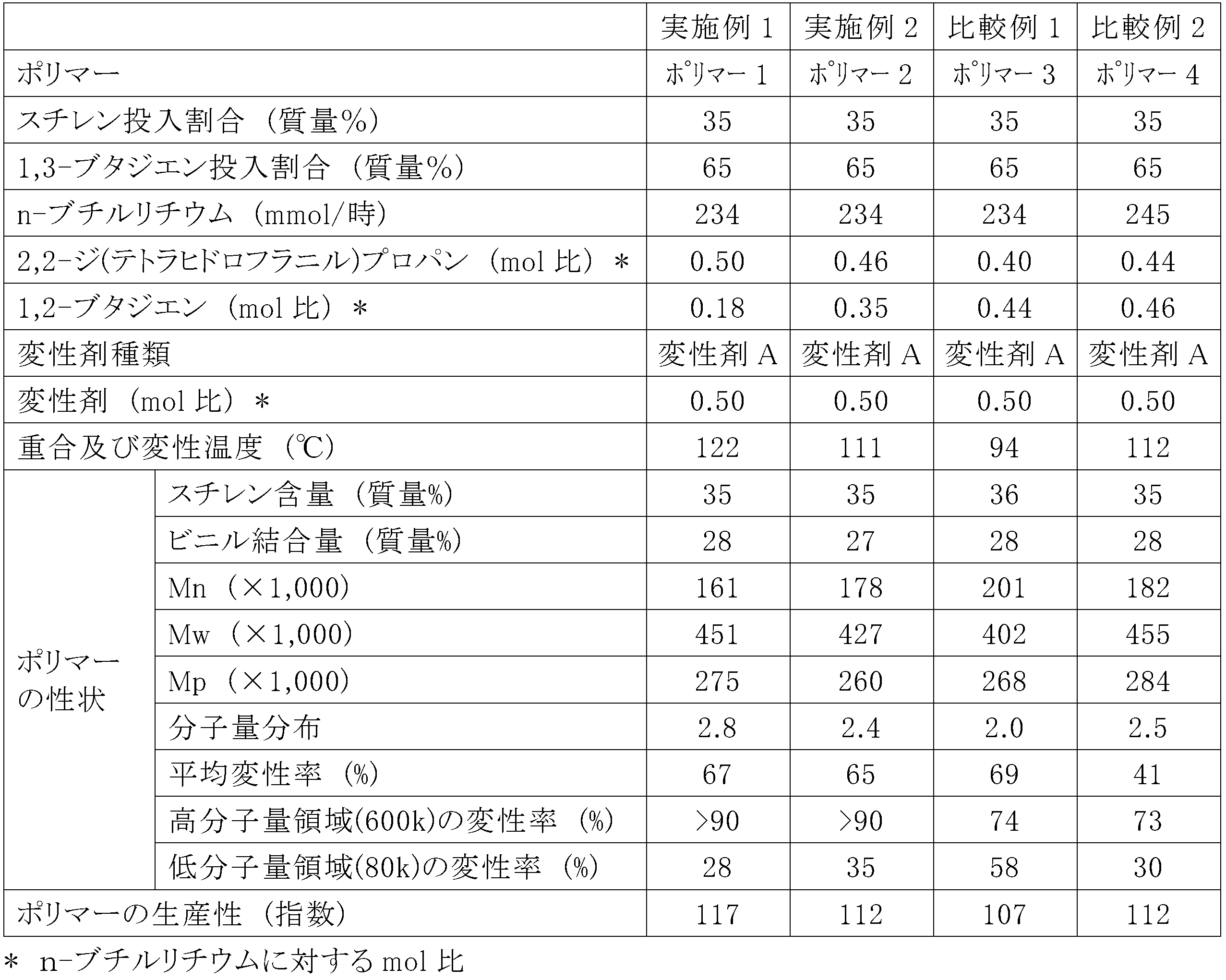
- Example 1 A hexane solution (concentration of 20% by mass) containing 35% by mass of styrene monomer and 65% by mass of 1,3-butadiene monomer is supplied at a rate of 138.47 kg / hour to a flow-type reactor having an internal volume of 76 L based on the total mass of monomers. did. Further, 3% by mass of n-butyllithium as a polymerization initiator was fed at a rate of 503.00 g / hr, 0.18 equivalents of 1,2-butadiene, 0.50 equivalents of 2,2-diethyl, compared to n-butyllithium.
- the resulting polymer 1 had a styrene content of 35% by mass, a butadiene content of 65% by mass relative to the total amount of the polymer, and a vinyl bond content of the butadiene portion of 28% by mass.
- Example 2 Comparative Examples 1 and 2> As shown in Table 1, the same procedure as in Example 1 was performed except that the supply ratio of n-butyllithium, 2,2-di (tetrahydrofuranyl) propane, and 1,2-butadiene was changed to change the polymerization temperature. Polymers 2 to 4 were produced.
- Example 3 Instead of N- (1,3-dimethylbutylidene) -3- (triethoxysilyl) -1-propanamine (modifier A), N- (3-triethoxysilylpropyl) -4,5-dihydroimidazole A polymer 9 was produced in the same manner as in Example 1 except that (Modifier B represented by the following chemical formula) was used.
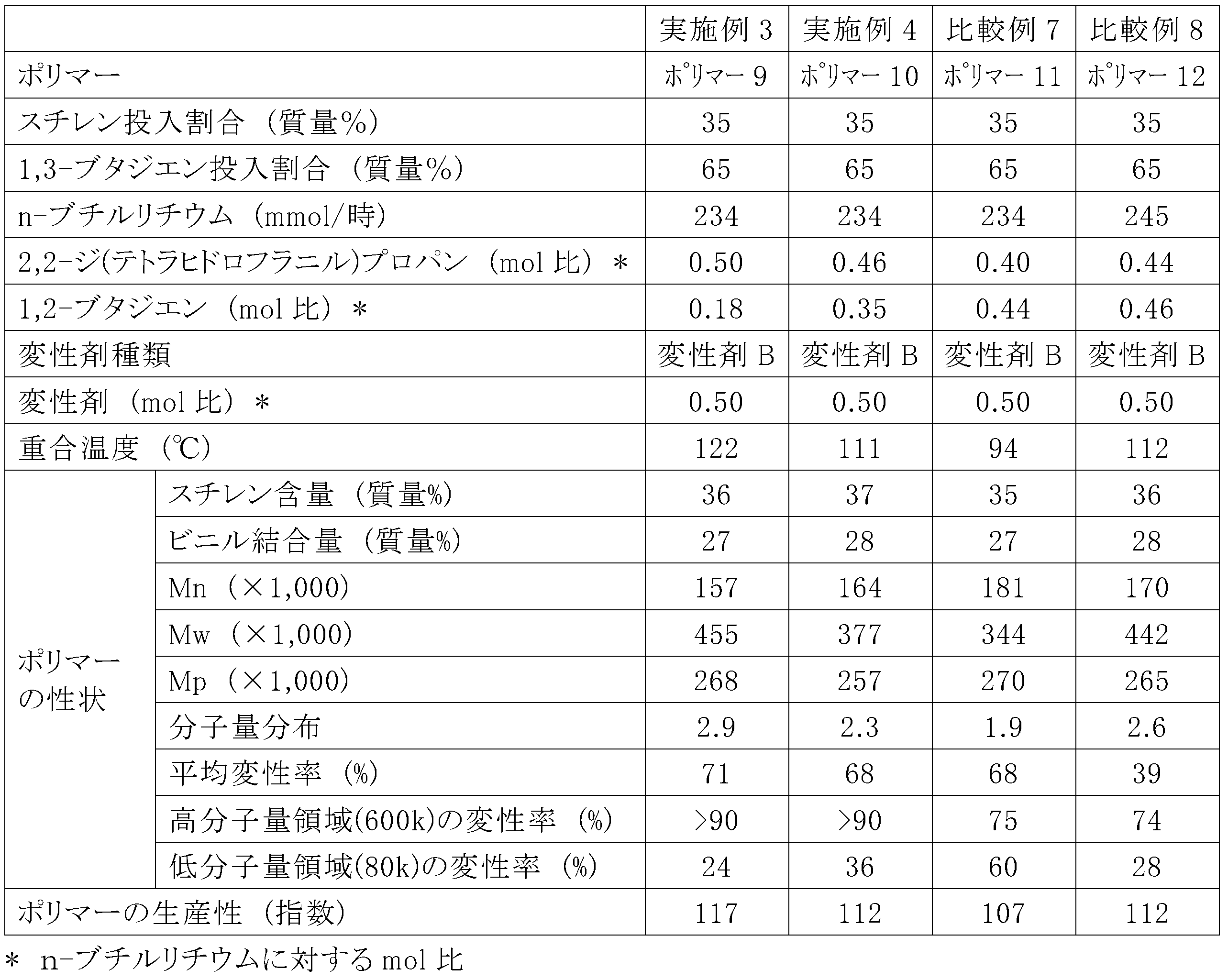
- Example 4 Comparative Examples 7 to 8> As shown in Table 3, in the same manner as in Example 3 except that the supply ratio of n-butyllithium, 2,2-di (tetrahydrofuranyl) propane and 1,2-butadiene was changed and the polymerization temperature was changed. Polymers 10-12 were produced.
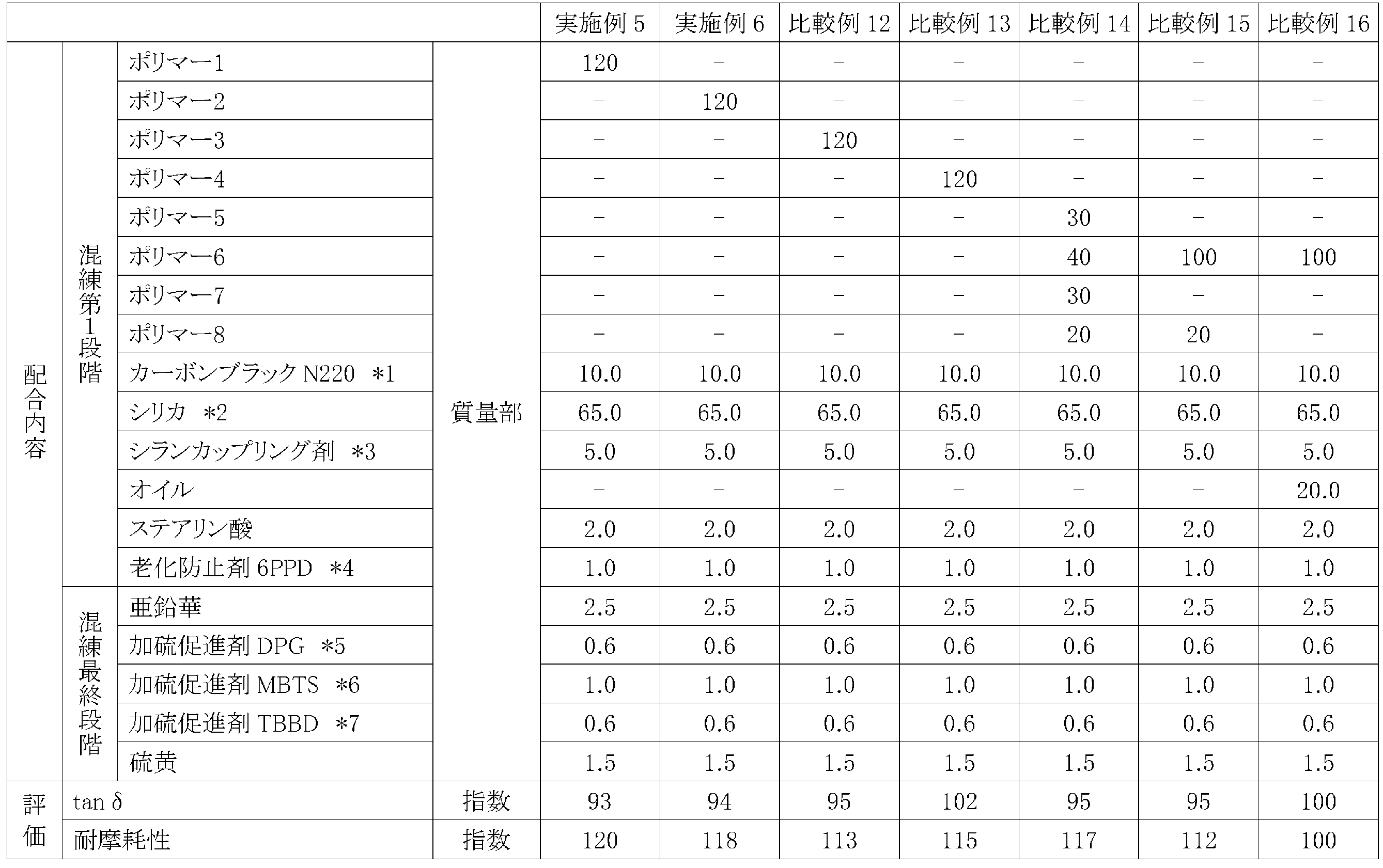
- a rubber composition was manufactured by mixing in the order of the first stage of kneading and the final stage of kneading by using an ordinary Banbury mixer with the formulation shown in Tables 5 and 6.
- the maximum temperature of the rubber composition in the first stage of kneading was 160 ° C.
- the maximum temperature of the rubber composition in the final stage of kneading was 105 ° C.
- the rubber composition obtained was evaluated for exothermic properties (tan ⁇ index) and wear resistance by the above methods. The results are shown in Tables 5 and 6.
- the rubber composition using the modified polymer produced by the method of the present invention has a low heat generation equivalent to that of the rubber composition obtained by separately synthesizing and compounding the modified polymer for matrix and the low molecular weight polymer. It can be seen that the material has wear resistance and wear resistance.
- the modified polymer produced by the method of the present invention can be used, for example, in a rubber composition used for tires and the like.
- the rubber composition of the present invention can be used for tires and other rubber products.
- the tire of the present invention can be used as a tire for various vehicles.
Landscapes
- Chemical & Material Sciences (AREA)
- Chemical Kinetics & Catalysis (AREA)
- Medicinal Chemistry (AREA)
- Polymers & Plastics (AREA)
- Organic Chemistry (AREA)
- Health & Medical Sciences (AREA)
- General Chemical & Material Sciences (AREA)
- Engineering & Computer Science (AREA)
- Mechanical Engineering (AREA)
- Materials Engineering (AREA)
- Addition Polymer Or Copolymer, Post-Treatments, Or Chemical Modifications (AREA)
- Compositions Of Macromolecular Compounds (AREA)
- Tires In General (AREA)
- Polymerisation Methods In General (AREA)
Abstract
Description
これに対して、伸展油の代わりに、低分子量のジエン系ポリマー(以下、「低分子量ポリマー」と略記する)で原料ゴムを伸展した伸展ゴムが開発されている。ここで、該低分子量ポリマーは架橋に関わり、原料ゴムと絡み合うため、かかる伸展ゴムをゴム組成物に使用することで、ゴム組成物のヒステリシスロスを低減でき、ゴム組成物の低発熱性と耐摩耗性とを高度に両立できる。
また、更なるゴム組成物の低ヒステリシスロス化、即ち、損失正接(tanδ)の低減を目的として、低分子量ポリマーを使用しつつ、ゴム組成物のマトリクスとして、変性ジエン系ポリマーを使用する技術が開発されている(下記特許文献1)。ここで、ゴム組成物のマトリクス用の変性ジエン系ポリマー(以下、「マトリクス用変性ポリマー」と略記する)は、ゴム組成物に通常配合される充填剤との親和性が高い。そのため、マトリクス用変性ポリマーをゴム組成物に使用することで、充填剤の分散性が向上するため、ゴム組成物のヒステリシスロスを更に低減できる。
また、マトリクス用変性ポリマー及び低分子量ポリマーとして、共役ジエン化合物と芳香族ビニル化合物とのコポリマーを使用する場合、マトリクス用変性ポリマーと低分子量ポリマーとの相溶性を安定的に確保するには、マトリクス用変性ポリマーと低分子量ポリマーとのミクロ構造(特には、芳香族ビニル化合物の含有量)を近似させる必要がある。しかしながら、マトリクス用変性ポリマーと低分子量ポリマーとを別々に合成すると、各合成における芳香族ビニル化合物の転化率が異なる可能性があり、マトリクス用変性ポリマーと低分子量ポリマーとのミクロ構造が異なり、両者の相溶性が悪化する恐れがある。
また、本発明は、かかる製造方法で製造され、ゴム組成物に使用することで、ゴム組成物の低発熱性、耐摩耗性を向上させることが可能な変性ポリマー、該変性ポリマーを含み、低発熱性、耐摩耗性に優れたゴム組成物、及び該ゴム組成物を用いた、低燃費性、耐摩耗性に優れたタイヤを提供することを更なる課題とする。
前記重合及び変性を110℃以上で行い、
前記1,2-ブタジエン(1,2-Bd)と、前記リチウム含有重合開始剤中のリチウム(Li)とのモル比(1,2-Bd/Li)を0.37以下とすることを特徴とする。
そして、本発明の方法で製造される変性ポリマーは、分子量分布が大きく、高分子量成分は変性率が高く、低分子量成分は変性率が低いため、上述したマトリクス用変性ポリマーと低分子量ポリマーとのブレンド物に相当し、また、本発明の変性ポリマーの製造方法は、かかるブレンド物相当物を一度に製造できるため、生産性が高い。
また、本発明によれば、かかる変性ポリマーを含み、低発熱性、耐摩耗性に優れたゴム組成物、更には、該ゴム組成物を用いた、低燃費性、耐摩耗性に優れたタイヤを提供できる。
以下に、本発明の変性ポリマーの製造方法を、その実施形態に基づき、詳細に説明する。
本発明の変性ポリマーの製造方法は、流通式反応器に、少なくとも共役ジエン化合物を含む原料モノマーと、リチウム含有重合開始剤と、1,2-ブタジエンと、変性剤とを連続的に供給し、前記原料モノマーを連続的に重合させてポリマーを生成させつつ、該生成したポリマーの一部を前記変性剤で変性して、変性ポリマーを製造し、前記重合及び変性を110℃以上で行い、前記1,2-ブタジエン(1,2-Bd)と前記リチウム含有重合開始剤中のリチウム(Li)とのモル比(1,2-Bd/Li)を0.37以下とすることを特徴とする。
一方、流通式反応器を用いたモノマーの連続重合においては、反応器内の重合温度が高いことや、反応器内でバックミキシングのような撹拌状態が起こるため、末端カルバニオン(活性部位)の移動反応や停止反応等の副反応が起こり易くなる。その結果、該連続重合においては、均質な変性ポリマーが得られず、変性率が低く且つ分子量や変性率の分布が不均一な変性ポリマーが得られる。そのため、連続重合においては、通常は、100℃未満の低温重合条件下で副反応を抑制しつつ、可能な限り変性率が高く且つ均質な変性ポリマーが生成するように制御する。
本発明の方法で製造される変性ポリマーは、高分子量側に変性率分布が偏っており、高分子量成分の変性率が高い一方、低分子量成分は変性率が非常に低いため、ゴム組成物のマトリクス用変性ポリマーと、無変性の低分子量ポリマーとのブレンド物と同様の組成になる。
そのため、本発明の方法で製造される変性ポリマーを、前述のマトリクス用変性ポリマーを低分子量ポリマーで伸展した伸展ゴムの代わりに、ゴム組成物に使用することで、ゴム組成物の低発熱性と耐摩耗性とを高度にバランスさせることができ、また、ゴム組成物のマトリクス用変性ポリマー相当成分と低分子量ポリマー相当成分とを同時に製造できるため、ポリマー合成工場での生産速度が高くなり、経済性を向上させることができる。
ここで、共役ジエン化合物としては、1,3-ブタジエン、イソプレン、1,3-ペンタジエン、2,3-ジメチルブタジエン、2-フェニル-1,3-ブタジエン、1,3-ヘキサジエン等が挙げられる。また、芳香族ビニル化合物としては、スチレン、α-メチルスチレン、1-ビニルナフタレン、3-ビニルトルエン、エチルビニルベンゼン、ジビニルベンゼン、4-シクロヘキシルスチレン、2,4,6-トリメチルスチレン等が挙げられる。
なお、原料モノマーとして、共役ジエン化合物と芳香族ビニル化合物とを併用する場合、原料モノマー中の芳香族ビニル化合物の割合は、目的とする変性ポリマーの芳香族ビニル化合物含有量に応じて適宜選択することができる。
前記リチウム含有重合開始剤としては、ヒドロカルビルリチウム及びリチウムアミド化合物が挙げられ、これらの中でも、ヒドロカルビルリチウムが好ましい。なお、リチウム含有重合開始剤として、リチウムアミド化合物を使用した場合、重合開始部位に窒素含有官能基が付加するため、低分子量成分も、変性ポリマーとなる。


また、上記式(II)において、R2は、3~16個のメチレン基を有する、アルキレン基、置換アルキレン基、オキシアルキレン基又はN-アルキルアミノ-アルキレン基である。ここで、置換アルキレン基には、一置換から八置換のアルキレン基が含まれ、置換基としては、炭素数1~12の、鎖状若しくは分枝状アルキル基、シクロアルキル基、ビシクロアルキル基、アリール基及びアラルキル基が挙げられる。また、R2として、具体的には、トリメチレン基、テトラメチレン基、ヘキサメチレン基、オキシジエチレン基、N-アルキルアザジエチレン基、ドデカメチレン基及びヘキサデカメチレン基等が好ましい。
ここで、二級アミンとしては、ジメチルアミン、ジエチルアミン、ジブチルアミン、ジオクチルアミン、ジシクロヘキシルアミン、ジイソブチルアミン等の他、アザシクロヘプタン(即ち、ヘキサメチレンイミン)、2-(2-エチルヘキシル)ピロリジン、3-(2-プロピル)ピロリジン、3,5-ビス(2-エチルヘキシル)ピペリジン、4-フェニルピペリジン、7-デシル-1-アザシクロトリデカン、3,3-ジメチル-1-アザシクロテトラデカン、4-ドデシル-1-アザシクロオクタン、4-(2-フェニルブチル)-1-アザシクロオクタン、3-エチル-5-シクロヘキシル-1-アザシクロヘプタン、4-ヘキシル-1-アザシクロヘプタン、9-イソアミル-1-アザシクロヘプタデカン、2-メチル-1-アザシクロヘプタデセ-9-エン、3-イソブチル-1-アザシクロドデカン、2-メチル-7-tert-ブチル-1-アザシクロドデカン、5-ノニル-1-アザシクロドデカン、8-(4’-メチルフェニル)-5-ペンチル-3-アザビシクロ[5.4.0]ウンデカン、1-ブチル-6-アザビシクロ[3.2.1]オクタン、8-エチル-3-アザビシクロ[3.2.1]オクタン、1-プロピル-3-アザビシクロ[3.2.2]ノナン、3-(tert-ブチル)-7-アザビシクロ[4.3.0]ノナン、1,5,5-トリメチル-3-アザビシクロ[4.4.0]デカン等の環状アミンが挙げられる。また、リチウム化合物としては、上記ヒドロカルビルリチウムを用いることができる。
ここで、1,2-ブタジエンの使用量は、該1,2-ブタジエン(1,2-Bd)と前記リチウム含有重合開始剤中のリチウム(Li)とのモル比(1,2-Bd/Li)が0.37以下、好ましくは0.10~0.35となるように選択される。1,2-ブタジエン(1,2-Bd)と前記リチウム含有重合開始剤中のリチウム(Li)とのモル比(1,2-Bd/Li)が0.37以下であれば、リチウム含有重合開始剤中のリチウムに対して1,2-ブタジエンの分子数が少なく、活性部位の移動による失活を低減でき、変性率を向上させることができる。

R6 p-Si-(OR7)4-p ・・・ (IV)
[式中、R6及びR7は、それぞれ独立して炭素数1~20の一価の脂肪族炭化水素基又は炭素数6~18の一価の芳香族炭化水素基であり;pは0~2の整数であり;R6が複数ある場合、複数のR6は互いに同一でも異なっていてもよく;OR7が複数ある場合、複数のOR7は互いに同一でも異なっていてもよく;また分子中には活性プロトン及びオニウム塩は含まれない]で表されるヒドロカルビルオキシシラン化合物が更に好ましい。
ここで、「(チオ)エポキシ」とは、エポキシ及びチオエポキシを指し、「(チオ)インシアネート」とは、インシアネート及びチオインシアネートを指し、「(チオ)ケトン」とは、ケトン及びチオケトンを指し、「(チオ)アルデヒド」とは、アルデヒド及びチオアルデヒドを指し、「(チオ)カルボン酸ヒドロカルビルエステル」とは、カルボン酸ヒドロカルビルエステル及びチオカルボン酸ヒドロカルビルエステルを指し、「(チオ)カルボン酸の金属塩」とは、カルボン酸の金属塩及びチオカルボン酸の金属塩を指す。
また、イミン基含有ヒドロカルビルオキシシラン化合物として、N-(1,3-ジメチルブチリデン)-3-(トリエトキシシリル)-1-プロパンアミン、N-(1-メチルエチリデン)-3-(トリエトキシシリル)-1-プロパンアミン、N-エチリデン-3-(トリエトキシシリル)-1-プロパンアミン、N-(1-メチルプロピリデン)-3-(トリエトキシシリル)-1-プロパンアミン、N-(4-N,N-ジメチルアミノベンジリデン)-3-(トリエトキシシリル)-1-プロパンアミン、N-(シクロヘキシリデン)-3-(トリエトキシシリル)-1-プロパンアミン、及びこれらのトリエトキシシリル化合物に対応するトリメトキシシリル化合物、メチルジエトキシシリル化合物、エチルジエトキシシリル化合物、メチルジメトキシシリル化合物、エチルジメトキシシリル化合物等を挙げることができるが、これらの中でも、N-(1-メチルプロピリデン)-3-(トリエトキシシリル)-1-プロパンアミン及びN-(1,3-ジメチルブチリデン)-3-(トリエトキシシリル)-1-プロパンアミンが特に好ましい。
また、イミン(アミジン)基含有化合物としては、1-[3-(トリエトキシシリル)プロピル]-4,5-ジヒドロイミダゾール、1-[3-(トリメトキシシリル)プロピル]-4,5-ジヒドロイミダゾール、N-(3-トリエトキシシリルプロピル)-4,5-ジヒドロイミダゾール、N-(3-イソプロポキシシリルプロピル)-4,5-ジヒドロイミダゾール、N-(3-メチルジエトキシシリルプロピル)-4,5-ジヒドロイミダゾール等が挙げられ、これらの中でも、N-(3-トリエトキシシリルプロピル)-4,5-ジヒドロイミダゾールが好ましい。
更に、その他のヒドロカルビルオキシシラン化合物として、以下のものを挙げることができる。即ち、カルボン酸エステル基含有化合物としては、3-メタクリロイロキシプロピルトリエトキシシラン、3-メタクリロイロキシプロピルトリメトキシシラン、3-メタクリロイロキシプロピルメチルジエトキシシラン、3-メタクリロイロキシプロピルトリイソプロポキシシラン等が挙げられ、これらの中でも、3-メタクリロイロキシプロピルトリメトキシシランが好ましい。
また、イソシアネート基含有化合物としては、3-イソシアナトプロピルトリメトキシシラン、3-イソシアナトプロピルトリエトキシシラン、3-イソシアナトプロピルメチルジエトキシシラン、3-イソシアナトプロピルトリイソプロポキシシラン等が挙げられ、これらの中でも、3-イソシアナトプロピルトリエトキシシランが好ましい。
更に、カルボン酸無水物含有化合物としては、3-トリエトキシシリルプロピルコハク酸無水物、3-トリメトキシシリルプロピルコハク酸無水物、3-メチルジエトキシシリルプロピルコハク酸無水物等が挙げられ、これらの中でも、3-トリエトキシシリルプロピルコハク酸無水物が好ましい。
また、溶液重合の場合、溶液中の上記原料モノマーの濃度は、5~50質量%の範囲が好ましく、10~30質量%の範囲が更に好ましい。
上記ランダマイザーとしては、例えば、ジメトキシベンゼン、テトラヒドロフラン、ジメトキシエタン、ジエチレングリコールジブチルエーテル、ジエチレングリコールジメチルエーテル、2,2-ジ(テトラヒドロフラニル)プロパン、トリエチルアミン、ピリジン、N-メチルモルホリン、N,N,N’,N’-テトラメチルエチレンジアミン、1,2-ジピペリジノエタン、カリウム-t-アミレート、カリウム-t-ブトキシド、ナトリウム-t-アミレート等が挙げられる。これらランダマイザーの使用量は、リチウム含有重合開始剤1molに対して、0.01~100molの範囲が好ましい。
ここで、低分子量のリビングポリマーは、より分子量の高いリビングポリマーからプロトン(H+)を引き抜き、安定化する傾向がある。安定化した低分子量ポリマーは、更に成長せず、また、変性剤とも反応しないため、低分子量のまま且つ未変性のままとなる割合が高い。一方、プロトン(H+)を引き抜かれた高分子量のリビングポリマーは、活性部位を複数有することとなり、更に成長して、更に高分子量化する。そして、高分子量のリビングポリマーと、変性剤とが反応することで、変性ポリマーが生成するため、変性剤由来の官能基を有する変性ポリマーは、分子量が高い傾向がある。従って、本発明の変性ポリマーの製造方法によれば、未変性の低分子量ポリマーと、変性剤由来の官能基を有する変性高分子量ポリマーとのブレンンド物相当物を同時に製造することができる。
本発明の変性ポリマーは、上記の変性ポリマーの製造方法で製造されたことを特徴とする。本発明の変性ポリマーは、上述したマトリクス用変性ポリマーと低分子量ポリマーとのブレンド物に相当するため、ゴム組成物のマトリクス用変性ポリマーを、低分子量ポリマーで伸展する工程、及び/又は、マトリクス用変性ポリマーと低分子量ポリマーとを別々に合成して、ブレンドする工程を省略できる。
前記変性ポリマーの平均変性率が60%以上であれば、該変性ポリマーをゴム組成物に使用した場合、変性ポリマーと充填剤との親和性が高くなるため、ゴム組成物の低発熱性、耐摩耗性を向上させることができる。
また、変性ポリマーの分子量600,000における変性率が90%以上で且つ分子量80,000における変性率が40%以下であれば、上記特許文献1に開示の無変性の低分子量ポリマーと、マトリクス用変性ポリマーとのブレンド物と同様となり、該変性ポリマーをゴム組成物に使用することで、上記特許文献1に開示のゴム組成物と同様の、低発熱性と、高い耐摩耗性を発現させることができる。
本発明のゴム組成物は、上記の変性ポリマーを含むことを特徴とする。本発明のゴム組成物は、前記変性ポリマーを含むため、低発熱性、耐摩耗性に優れる。本発明のゴム組成物において、前記変性ポリマーは、マトリクスのゴム成分としての作用と、軟化剤としての作用を兼ねる。なお、本発明のゴム組成物は、更に、前記変性ポリマー以外のゴム成分を含んでもよい。
本発明のゴム組成物は、前記変性ポリマーに、必要に応じて適宜選択した各種配合剤とを配合して、混練り、熱入れ、押出等することにより製造することができる。
本発明のタイヤは、上述したゴム組成物を用いたことを特徴とする。本発明のタイヤは、前記ゴム組成物が用いられているため、転がり抵抗が小さく、耐摩耗性に優れる。ここで、前記ゴム組成物を用いるタイヤの部位としては、トレッド、サイドウォール、ケース部材等が挙げられるが、トレッドが好ましい。
また、タイヤ用途以外にも、防振ゴム、免震ゴム、ベルト(コンベアベルト)、ゴムクローラ、各種ホース、モランなどの、その他のゴム製品に、本発明のゴム組成物、又は、それを架橋してなる架橋ゴム組成物を使用することができる。
ゲルパーミエーションクロマトグラフィー[GPC:東ソー製HLC-8020、カラム:東ソー製GMH-XL(2本直列)、検出器:示差屈折率計(RI)]で単分散ポリスチレンを基準として、各ポリマーのポリスチレン換算の数平均分子量(Mn)、重量平均分子量(Mw)、ピーク分子量(Mp)を求めた。
生成したポリマーのブタジエン含量(質量%)と、ブタジエン部分のビニル結合量(質量%)と、スチレン含量(質量%)を1H-NMRスペクトルの積分比より求めた。
(i)バッチ重合品の変性率の測定法
ガスクロマトグラフィー(GC)を用いて、未反応物の変性剤量を測定することにより、変性剤の消費率を算出し、その値を変性率とした。
(ii)連続重合品の変性率の測定法
変性剤を入れる直前の反応器からポリマーセメントを耐圧ボトルに取り出し、4,4’-ビス(ジエチルアミノ)ベンゾフェノン(DEAB)を多量に添加し、50℃に保たれた恒温槽にて30分間撹拌した。
得られた反応物に、2,6-ジ-tert-ブチル-p-クレゾール(BHT)を添加し、110℃に調温された熱ロールで乾燥した。
得られたDEABで変性されたサンプルを、分子量測定用のGPCにて測定し、UV検出器により280nmにおける吸収強度を分析した。
バッチ重合にて作製した同一分子量で且つ変性率が既知のDEABで変性されたサンプル対比の強度を比較することにより、特定の分子量における変性率を算出した。平均変性率は、80,000~600,000までの変性率の平均により算出した。
原料モノマーの転化率が100%に達するまでの時間を測定した。
ここで、流通式反応器を用いた連続重合においては、反応器内の滞留時間とした。
表1及び表2においては、比較例3を基準として、100%に達するまでの時間(又は滞留時間)の逆数にて指数表示を行い、表3及び表4においては、比較例9を基準として、100%に達するまでの時間(又は滞留時間)の逆数にて指数表示を行った。指数値が大きい程、原料モノマーの転化率が100%に達するまでの時間が短く、生産性が高いことを示す。
得られたゴム組成物を160℃で20分加硫後、動的せん断粘弾性測定装置(レオメトリックス社製)を使用し、温度60℃、動歪5%、周波数15Hzでtanδを測定した。表5においては、比較例16のtanδを100とし、表6においては、比較例21のtanδを100として下記式にて指数表示した。指数値が小さい程、発熱性が低く、ヒステリシスロスが小さいことを示す。
発熱性指数=[(供試ゴム組成物のtanδ)/(比較例16又は21のゴム組成物のtanδ)]×100
得られたゴム組成物を160℃で20分加硫後、JIS K 6264-2:2005に準拠し、ランボーン摩耗試験機を使用して、スリップ率25%、23℃で摩耗量を測定し、表5においては、比較例16の摩耗量の逆数を100とし、表6においては、比較例21の摩耗量の逆数を100として下記式にて指数表示した。指数値が大きい程、摩耗量が少なく、耐摩耗性が良好であることを示す。
耐摩耗性指数=[(比較例16又は21のゴム組成物の摩耗量)/(供試ゴム組成物の摩耗量)]×100
内容積76Lの流通式反応器に、モノマー全質量基準で、スチレンモノマーを35質量%、1,3-ブタジエンモノマーを65質量%含むヘキサン溶液(20質量%濃度)を138.47kg/時で供給した。さらに、重合開始剤として3質量%のn-ブチルリチウムを503.00g/時で供給し、n-ブチルリチウム対比0.18当量の1,2-ブタジエン、0.50当量の2,2-ジ(テトラヒドロフラニル)プロパン、0.50当量のN-(1,3-ジメチルブチリデン)-3-(トリエトキシシリル)-1-プロパンアミン(下記化学式で表される変性剤A)を、反応器の底部より連続的に供給した。

上記反応で得られたポリマーセメントに、イソプロパノールを加えて重合反応を停止させ、老化防止剤として2,6-ジ-tert-ブチル-p-クレゾール(BHT)を添加した後、ブレンドタンクで約2時間保持した。その後、ポリマーセメントを、脱溶媒し、乾燥することにより、ポリマー1を得た。
得られたポリマー1のスチレン含量は35質量%、ポリマー全量に対するブタジエン含量は65質量%、ブタジエン部分のビニル結合量は28質量%であった。
表1に示すように、n-ブチルリチウム、2,2-ジ(テトラヒドロフラニル)プロパン、1,2-ブタジエンの供給割合を変化させ、重合温度を変化させる以外は、実施例1と同様にして、ポリマー2~4を製造した。
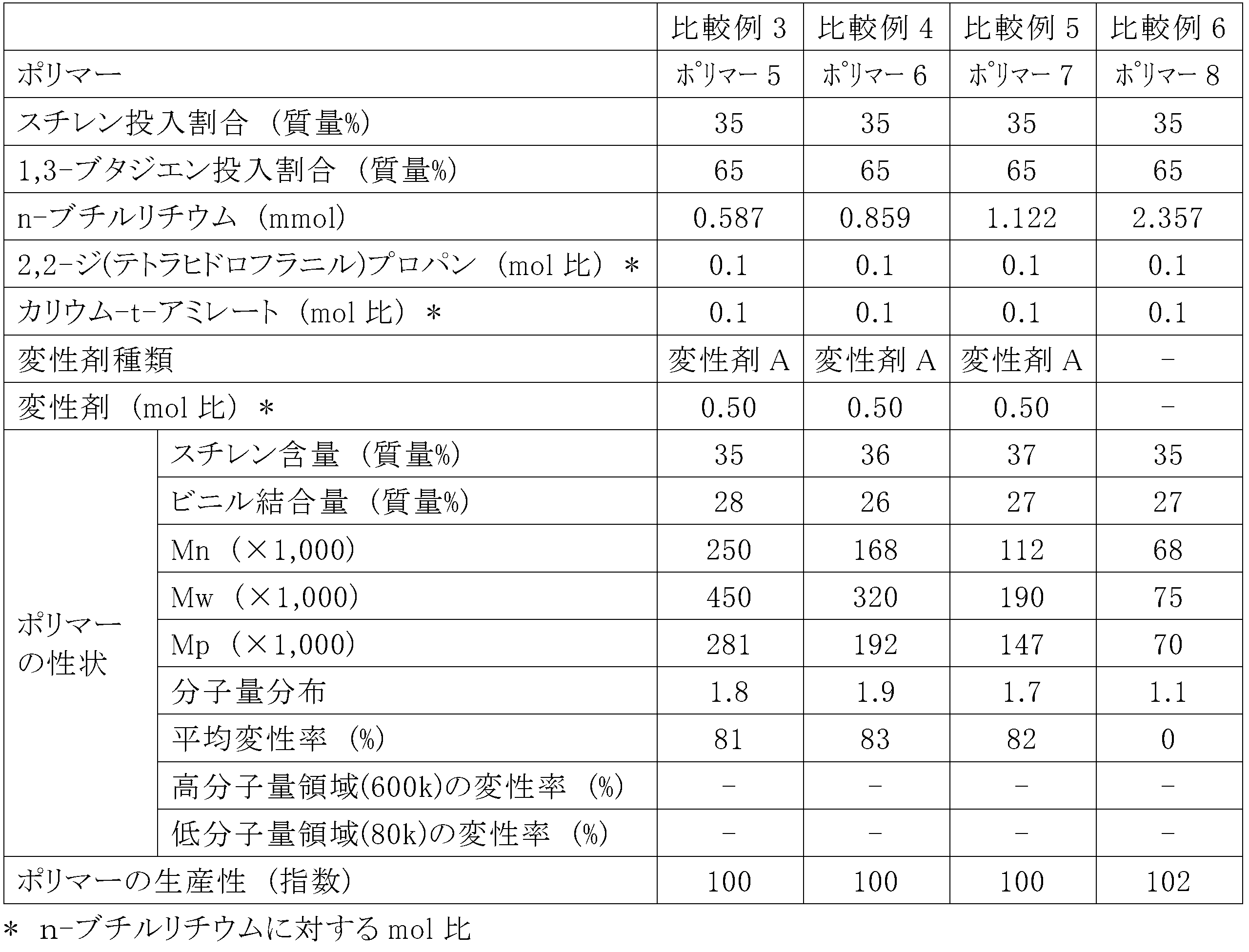
窒素置換された内容積5リットルのオートクレーブ反応器(バッチ式反応器)に、ヘキサン2486g、2,2-ジ(テトラヒドロフラニル)プロパン0.10mol/Li、カリウム-t-アミレート(KTA)0.10mol/Li、スチレン154g、1,3-ブタジエン285gを仕込んだ。反応器内容物の温度を10℃に調整した後、n-ブチルリチウム0.587mmolを添加して重合を開始した。重合は断熱条件で実施し、最高温度は85℃に達した。
重合転化率が99%に達した時点で、1,3-ブタジエン10gを追加し、更に5分重合させた。反応器からポリマー溶液を、メタノール1gを添加したシクロヘキサン溶液30g中に少量サンプリングした後、N-(1,3-ジメチルブチリデン)-3-(トリエトキシシリル)-1-プロパンアミン(変性剤A)0.50mol/Liを加えて、変性反応を15分間行った。その後、反応混合物に、2,6-ジ-tert-ブチル-p-クレゾール(BHT)を添加した。次いで、スチームストリッピングにより脱溶媒を行い、110℃に調温された熱ロールによりゴムを乾燥し、ポリマー5を得た。
表2に示すように、n-ブチルリチウム、2,2-ジ(テトラヒドロフラニル)プロパン、カリウム-t-アミレート(KTA)の仕込み量を変化させる以外は、比較例3と同様にして、ポリマー6~8を製造した。なお、比較例6においては、変性剤を使用しなかった。
N-(1,3-ジメチルブチリデン)-3-(トリエトキシシリル)-1-プロパンアミン(変性剤A)に代えて、N-(3-トリエトキシシリルプロピル)-4,5-ジヒドロイミダゾール(下記化学式で表される変性剤B)を使用する以外は、実施例1と同様にして、ポリマー9を製造した。

表3に示すように、n-ブチルリチウム、2,2-ジ(テトラヒドロフラニル)プロパン、1,2-ブタジエンの供給割合を変化させ、重合温度を変化させる以外は、実施例3と同様にして、ポリマー10~12を製造した。
N-(1,3-ジメチルブチリデン)-3-(トリエトキシシリル)-1-プロパンアミン(変性剤A)に代えて、N-(3-トリエトキシシリルプロピル)-4,5-ジヒドロイミダゾール(変性剤B)を使用する以外は、比較例3と同様にして、ポリマー13を製造した。
表4に示すように、n-ブチルリチウム、2,2-ジ(テトラヒドロフラニル)プロパン、カリウム-t-アミレート(KTA)の仕込み量を変化させる以外は、比較例9と同様にして、ポリマー14~15を製造した。

表5及び表6に示す配合処方で、通常のバンバリーミキサーを用いて、混練の第1段階、混練の最終段階の順に混練を行って、ゴム組成物を製造した。なお、混練の第1段階におけるゴム組成物の最高温度は160℃とし、混練の最終段階におけるゴム組成物の最高温度は105℃とした。
得られたゴム組成物の発熱性(tanδ指数)及び耐摩耗性を上記の方法により評価した。結果を表5及び表6に示す。

*2: 東ソー・シリカ株式会社製、商品名「ニップシールAQ」、BET表面積205m2/g
*3: ビス(3-トリエトシキシリルプロピル)ジスルフィド(平均硫黄鎖長:2.35)、Evonik社製シランカップリング剤、商品名「Si75」(登録商標)
*4: N-(1,3-ジメチルブチル)-N’-フェニル-p-フェニレンジアミン、大内新興化学工業株式会社製、商品名「ノクラック6C」
*5: 1,3-ジフェニルグアニジン、三新化学工業株式会社製、商品名「サンセラーD」
*6: ジ-2-ベンゾチアゾリルジスルフィド、三新化学工業株式会社製、商品名「サンセラーDM」
*7: N-tert-ブチル-2-ベンゾチアゾリルスルフェンアミド、三新化学工業株式会社製、商品名「サンセラーNS」
Claims (7)
- 流通式反応器に、少なくとも共役ジエン化合物を含む原料モノマーと、リチウム含有重合開始剤と、1,2-ブタジエンと、変性剤とを連続的に供給し、前記原料モノマーを連続的に重合させてポリマーを生成させつつ、該生成したポリマーの一部を前記変性剤で変性する、変性ポリマーの製造方法において、
前記重合及び変性を110℃以上で行い、
前記1,2-ブタジエン(1,2-Bd)と、前記リチウム含有重合開始剤中のリチウム(Li)とのモル比(1,2-Bd/Li)を0.37以下とすることを特徴とする、
変性ポリマーの製造方法。 - 前記変性剤が、窒素原子及びケイ素原子の少なくとも一方を含む、請求項1に記載の変性ポリマーの製造方法。
- 前記原料モノマーが、更に芳香族ビニル化合物を含む、請求項1又は2に記載の変性ポリマーの製造方法。
- 請求項1~3のいずれか一項に記載の変性ポリマーの製造方法で製造されたことを特徴とする、変性ポリマー。
- 平均変性率が60%以上で、分子量600,000における変性率が90%以上で、且つ分子量80,000における変性率が40%以下である、請求項4に記載の変性ポリマー。
- 請求項4又は5に記載の変性ポリマーを含むことを特徴とする、ゴム組成物。
- 請求項6に記載のゴム組成物を用いたことを特徴とする、タイヤ。
Priority Applications (5)
| Application Number | Priority Date | Filing Date | Title |
|---|---|---|---|
| US16/093,848 US20190077891A1 (en) | 2016-04-25 | 2017-03-28 | Method for manufacturing modified polymer, modified polymer, rubber composition and tire |
| KR1020187028629A KR20180118764A (ko) | 2016-04-25 | 2017-03-28 | 변성 폴리머의 제조 방법, 변성 폴리머, 고무 조성물 및 타이어 |
| CN201780025813.8A CN109071708A (zh) | 2016-04-25 | 2017-03-28 | 改性聚合物的制造方法、改性聚合物、橡胶组合物和轮胎 |
| EP17789157.9A EP3450468A4 (en) | 2016-04-25 | 2017-03-28 | PROCESS FOR PREPARING MODIFIED POLYMER, MODIFIED POLYMER, RUBBER COMPOSITION AND TIRES |
| SG11201808574WA SG11201808574WA (en) | 2016-04-25 | 2017-03-28 | Method for manufacturing modified polymer, modified polymer, rubber composition and tire |
Applications Claiming Priority (2)
| Application Number | Priority Date | Filing Date | Title |
|---|---|---|---|
| JP2016086948A JP6679398B2 (ja) | 2016-04-25 | 2016-04-25 | 変性ポリマーの製造方法、変性ポリマー、ゴム組成物及びタイヤ |
| JP2016-086948 | 2016-04-25 |
Publications (1)
| Publication Number | Publication Date |
|---|---|
| WO2017187868A1 true WO2017187868A1 (ja) | 2017-11-02 |
Family
ID=60161514
Family Applications (1)
| Application Number | Title | Priority Date | Filing Date |
|---|---|---|---|
| PCT/JP2017/012734 Ceased WO2017187868A1 (ja) | 2016-04-25 | 2017-03-28 | 変性ポリマーの製造方法、変性ポリマー、ゴム組成物及びタイヤ |
Country Status (7)
| Country | Link |
|---|---|
| US (1) | US20190077891A1 (ja) |
| EP (1) | EP3450468A4 (ja) |
| JP (1) | JP6679398B2 (ja) |
| KR (1) | KR20180118764A (ja) |
| CN (1) | CN109071708A (ja) |
| SG (1) | SG11201808574WA (ja) |
| WO (1) | WO2017187868A1 (ja) |
Cited By (1)
| Publication number | Priority date | Publication date | Assignee | Title |
|---|---|---|---|---|
| CN111630098A (zh) * | 2018-01-23 | 2020-09-04 | 株式会社普利司通 | 橡胶组合物、轮胎、输送带、橡胶履带、防振装置、隔震装置以及软管 |
Families Citing this family (9)
| Publication number | Priority date | Publication date | Assignee | Title |
|---|---|---|---|---|
| TW201936753A (zh) * | 2018-01-31 | 2019-09-16 | 日商Jsr股份有限公司 | 組成物、交聯成形體及輪胎 |
| KR102678859B1 (ko) * | 2018-10-12 | 2024-06-28 | 브리지스톤 어메리카스 타이어 오퍼레이션스, 엘엘씨 | 안정화된 목표 점도를 갖는 개질된 다이엔 공중합체 |
| TW202022035A (zh) * | 2018-10-25 | 2020-06-16 | 日商Jsr股份有限公司 | 聚合物組成物、交聯聚合物及輪胎 |
| US11520310B2 (en) | 2019-06-18 | 2022-12-06 | International Business Machines Corporation | Generating control settings for a chemical reactor |
| US11675334B2 (en) | 2019-06-18 | 2023-06-13 | International Business Machines Corporation | Controlling a chemical reactor for the production of polymer compounds |
| KR102629479B1 (ko) | 2019-10-11 | 2024-01-25 | 주식회사 엘지화학 | 변성 개시제 제조방법 및 제조장치 |
| KR102509517B1 (ko) | 2019-11-29 | 2023-03-16 | 주식회사 엘지화학 | 변성 공액디엔계 중합체 |
| KR102727042B1 (ko) * | 2020-07-22 | 2024-11-07 | 주식회사 엘지화학 | 이민기 함유 신규 화합물, 이를 포함하는 변성 공액디엔계 중합체, 상기 중합체의 제조방법 및 상기 중합체를 포함하는 고무 조성물 |
| KR102424972B1 (ko) * | 2020-08-26 | 2022-07-26 | 넥센타이어 주식회사 | 고무 조성물 및 이의 제조방법 |
Citations (10)
| Publication number | Priority date | Publication date | Assignee | Title |
|---|---|---|---|---|
| JPH06179730A (ja) * | 1992-09-14 | 1994-06-28 | Goodyear Tire & Rubber Co:The | スチレン−イソプレン−ブタジエンゴム |
| JPH06279620A (ja) * | 1993-03-26 | 1994-10-04 | Bridgestone Corp | 共役ジエン系ゴム組成物 |
| JPH07149841A (ja) * | 1993-09-22 | 1995-06-13 | Goodyear Tire & Rubber Co:The | イソプレン−ブタジエンゴム |
| JP2002284814A (ja) * | 2001-03-26 | 2002-10-03 | Asahi Kasei Corp | 変性共役ジエン系重合体の製造方法 |
| JP2003528176A (ja) * | 2000-03-23 | 2003-09-24 | フアイヤーストーン・ポリマース・エルエルシー | 連成重合体の製造方法 |
| JP2007119739A (ja) * | 2005-09-22 | 2007-05-17 | Goodyear Tire & Rubber Co:The | 非ランダムスチレン−ブタジエンゴム |
| JP2014108977A (ja) * | 2012-11-30 | 2014-06-12 | Asahi Kasei Chemicals Corp | 分岐状ブタジエン系重合体の製造方法 |
| JP2014108978A (ja) * | 2012-11-30 | 2014-06-12 | Japan Elastomer Co Ltd | スチレン系樹脂補強用ゴム組成物 |
| JP2015520272A (ja) * | 2012-06-06 | 2015-07-16 | ファイヤーストーン ポリマーズ エルエルシー | ポリマーの製造方法、該ポリマーを含有するポリマー組成物及び物品 |
| JP2015218284A (ja) * | 2014-05-19 | 2015-12-07 | 旭化成ケミカルズ株式会社 | 重合体の製造方法 |
Family Cites Families (7)
| Publication number | Priority date | Publication date | Assignee | Title |
|---|---|---|---|---|
| US6566478B1 (en) * | 2002-04-30 | 2003-05-20 | The Goodyear Tire & Rubber Company | Synthesis of high vinyl rubber |
| JP4911904B2 (ja) * | 2005-03-04 | 2012-04-04 | 株式会社ブリヂストン | ゴム組成物及びそれを用いたタイヤ |
| JP5350577B2 (ja) * | 2005-09-15 | 2013-11-27 | 株式会社ブリヂストン | ゴム組成物およびそれを用いたタイヤ |
| JP5547058B2 (ja) * | 2008-03-10 | 2014-07-09 | 株式会社ブリヂストン | 変性共役ジエン(共)重合体の製造方法、変性共役ジエン(共)重合体、並びにそれを用いたゴム組成物及びタイヤ |
| CN102177185A (zh) * | 2008-10-14 | 2011-09-07 | 旭化成化学株式会社 | 改性共轭二烯系聚合物、其制造方法、改性共轭二烯系聚合物组合物及轮胎 |
| MY160673A (en) * | 2010-04-16 | 2017-03-15 | Asahi Kasei Chemicals Corp | Method for producing modified conjugated diene polymer, modified conjugated diene polymer, and composition of modified conjugated diene polymer |
| EP2828301B1 (en) * | 2012-03-20 | 2016-10-05 | Trinseo Europe GmbH | Modified polymer compositions |
-
2016
- 2016-04-25 JP JP2016086948A patent/JP6679398B2/ja active Active
-
2017
- 2017-03-28 KR KR1020187028629A patent/KR20180118764A/ko not_active Ceased
- 2017-03-28 SG SG11201808574WA patent/SG11201808574WA/en unknown
- 2017-03-28 CN CN201780025813.8A patent/CN109071708A/zh active Pending
- 2017-03-28 WO PCT/JP2017/012734 patent/WO2017187868A1/ja not_active Ceased
- 2017-03-28 EP EP17789157.9A patent/EP3450468A4/en not_active Withdrawn
- 2017-03-28 US US16/093,848 patent/US20190077891A1/en not_active Abandoned
Patent Citations (10)
| Publication number | Priority date | Publication date | Assignee | Title |
|---|---|---|---|---|
| JPH06179730A (ja) * | 1992-09-14 | 1994-06-28 | Goodyear Tire & Rubber Co:The | スチレン−イソプレン−ブタジエンゴム |
| JPH06279620A (ja) * | 1993-03-26 | 1994-10-04 | Bridgestone Corp | 共役ジエン系ゴム組成物 |
| JPH07149841A (ja) * | 1993-09-22 | 1995-06-13 | Goodyear Tire & Rubber Co:The | イソプレン−ブタジエンゴム |
| JP2003528176A (ja) * | 2000-03-23 | 2003-09-24 | フアイヤーストーン・ポリマース・エルエルシー | 連成重合体の製造方法 |
| JP2002284814A (ja) * | 2001-03-26 | 2002-10-03 | Asahi Kasei Corp | 変性共役ジエン系重合体の製造方法 |
| JP2007119739A (ja) * | 2005-09-22 | 2007-05-17 | Goodyear Tire & Rubber Co:The | 非ランダムスチレン−ブタジエンゴム |
| JP2015520272A (ja) * | 2012-06-06 | 2015-07-16 | ファイヤーストーン ポリマーズ エルエルシー | ポリマーの製造方法、該ポリマーを含有するポリマー組成物及び物品 |
| JP2014108977A (ja) * | 2012-11-30 | 2014-06-12 | Asahi Kasei Chemicals Corp | 分岐状ブタジエン系重合体の製造方法 |
| JP2014108978A (ja) * | 2012-11-30 | 2014-06-12 | Japan Elastomer Co Ltd | スチレン系樹脂補強用ゴム組成物 |
| JP2015218284A (ja) * | 2014-05-19 | 2015-12-07 | 旭化成ケミカルズ株式会社 | 重合体の製造方法 |
Non-Patent Citations (1)
| Title |
|---|
| See also references of EP3450468A4 * |
Cited By (2)
| Publication number | Priority date | Publication date | Assignee | Title |
|---|---|---|---|---|
| CN111630098A (zh) * | 2018-01-23 | 2020-09-04 | 株式会社普利司通 | 橡胶组合物、轮胎、输送带、橡胶履带、防振装置、隔震装置以及软管 |
| EP3744779A4 (en) * | 2018-01-23 | 2021-11-10 | Bridgestone Corporation | RUBBER COMPOSITION, TIRES, CONVEYOR BELT, RUBBER TRACK, VIBRATION ISOLATOR, SEISMIC ISOLATOR AND HOSE |
Also Published As
| Publication number | Publication date |
|---|---|
| SG11201808574WA (en) | 2018-11-29 |
| KR20180118764A (ko) | 2018-10-31 |
| JP2017197598A (ja) | 2017-11-02 |
| EP3450468A4 (en) | 2019-04-24 |
| US20190077891A1 (en) | 2019-03-14 |
| JP6679398B2 (ja) | 2020-04-15 |
| EP3450468A1 (en) | 2019-03-06 |
| CN109071708A (zh) | 2018-12-21 |
Similar Documents
| Publication | Publication Date | Title |
|---|---|---|
| JP4159993B2 (ja) | 変性重合体の製造方法、その方法で得られた変性重合体及びゴム組成物 | |
| US10472505B2 (en) | Pneumatic tire | |
| JP6679398B2 (ja) | 変性ポリマーの製造方法、変性ポリマー、ゴム組成物及びタイヤ | |
| JP5313530B2 (ja) | 変性重合体の製造方法、その方法で得られた変性重合体及びゴム組成物 | |
| US10526472B2 (en) | Pneumatic tire and method for producing pneumatic tire | |
| KR101497718B1 (ko) | 변성 중합체의 제조 방법, 그 방법에 의해 얻어진 변성 중합체와 그의 고무 조성물 | |
| KR101227313B1 (ko) | 변성 중합체를 함유하는 고무 조성물을 사용한 타이어 | |
| US20190010313A1 (en) | Pneumatic tire | |
| JP6627293B2 (ja) | 空気入りタイヤ | |
| EP2658877B1 (en) | Stabilization of polymers that contain a hydrolyzable functionality | |
| US20170233562A1 (en) | Pneumatic tire | |
| US20170240731A1 (en) | Pneumatic tire | |
| KR20090122472A (ko) | 변성 공액 디엔계 중합체의 제조 방법, 변성 공액 디엔계 중합체 및 고무 조성물 | |
| KR20150122142A (ko) | 변성 공액 디엔계 중합체 및 그의 제조 방법, 중합체 조성물, 가교 중합체, 그리고 타이어 | |
| KR20150060697A (ko) | 변성 공액 디엔계 중합체의 제조 방법, 중합체 조성물, 가교 중합체 및 타이어 | |
| JP5424540B2 (ja) | ゴム組成物及びタイヤ | |
| KR102301066B1 (ko) | 작용화된 중합체를 포함하는 중합체 조성물의 제조 방법 | |
| JP4801827B2 (ja) | 重合体、その製造方法、及びそれを用いたゴム組成物 | |
| CN108026205B (zh) | 二氧化硅混合用改性溶液聚合二烯类橡胶的制造方法及其橡胶组合物 | |
| JP6330578B2 (ja) | 共役ジエン系重合体及びその製造方法、重合体組成物、架橋重合体並びにタイヤ | |
| US20240132706A1 (en) | Rubber composition for tires and tire |
Legal Events
| Date | Code | Title | Description |
|---|---|---|---|
| ENP | Entry into the national phase |
Ref document number: 20187028629 Country of ref document: KR Kind code of ref document: A |
|
| NENP | Non-entry into the national phase |
Ref country code: DE |
|
| WWE | Wipo information: entry into national phase |
Ref document number: 2017789157 Country of ref document: EP |
|
| 121 | Ep: the epo has been informed by wipo that ep was designated in this application |
Ref document number: 17789157 Country of ref document: EP Kind code of ref document: A1 |
|
| ENP | Entry into the national phase |
Ref document number: 2017789157 Country of ref document: EP Effective date: 20181126 |