WO2017187973A1 - 鉄鋼ダストの処理方法、亜鉛の生産方法、鉄鋼原料の生産方法、及び鉄鋼原料 - Google Patents
鉄鋼ダストの処理方法、亜鉛の生産方法、鉄鋼原料の生産方法、及び鉄鋼原料 Download PDFInfo
- Publication number
- WO2017187973A1 WO2017187973A1 PCT/JP2017/014868 JP2017014868W WO2017187973A1 WO 2017187973 A1 WO2017187973 A1 WO 2017187973A1 JP 2017014868 W JP2017014868 W JP 2017014868W WO 2017187973 A1 WO2017187973 A1 WO 2017187973A1
- Authority
- WO
- WIPO (PCT)
- Prior art keywords
- steel
- zinc
- steel dust
- dust
- calcium compound
- Prior art date
- Legal status (The legal status is an assumption and is not a legal conclusion. Google has not performed a legal analysis and makes no representation as to the accuracy of the status listed.)
- Ceased
Links
Images




Classifications
-
- C—CHEMISTRY; METALLURGY
- C22—METALLURGY; FERROUS OR NON-FERROUS ALLOYS; TREATMENT OF ALLOYS OR NON-FERROUS METALS
- C22B—PRODUCTION AND REFINING OF METALS; PRETREATMENT OF RAW MATERIALS
- C22B7/00—Working up raw materials other than ores, e.g. scrap, to produce non-ferrous metals and compounds thereof; Methods of a general interest or applied to the winning of more than two metals
- C22B7/02—Working-up flue dust
-
- C—CHEMISTRY; METALLURGY
- C21—METALLURGY OF IRON
- C21B—MANUFACTURE OF IRON OR STEEL
- C21B13/00—Making spongy iron or liquid steel, by direct processes
- C21B13/08—Making spongy iron or liquid steel, by direct processes in rotary furnaces
-
- C—CHEMISTRY; METALLURGY
- C21—METALLURGY OF IRON
- C21B—MANUFACTURE OF IRON OR STEEL
- C21B13/00—Making spongy iron or liquid steel, by direct processes
- C21B13/12—Making spongy iron or liquid steel, by direct processes in electric furnaces
-
- C—CHEMISTRY; METALLURGY
- C22—METALLURGY; FERROUS OR NON-FERROUS ALLOYS; TREATMENT OF ALLOYS OR NON-FERROUS METALS
- C22B—PRODUCTION AND REFINING OF METALS; PRETREATMENT OF RAW MATERIALS
- C22B1/00—Preliminary treatment of ores or scrap
- C22B1/14—Agglomerating; Briquetting; Binding; Granulating
- C22B1/24—Binding; Briquetting ; Granulating
-
- C—CHEMISTRY; METALLURGY
- C22—METALLURGY; FERROUS OR NON-FERROUS ALLOYS; TREATMENT OF ALLOYS OR NON-FERROUS METALS
- C22B—PRODUCTION AND REFINING OF METALS; PRETREATMENT OF RAW MATERIALS
- C22B1/00—Preliminary treatment of ores or scrap
- C22B1/14—Agglomerating; Briquetting; Binding; Granulating
- C22B1/24—Binding; Briquetting ; Granulating
- C22B1/242—Binding; Briquetting ; Granulating with binders
- C22B1/244—Binding; Briquetting ; Granulating with binders organic
- C22B1/245—Binding; Briquetting ; Granulating with binders organic with carbonaceous material for the production of coked agglomerates
-
- C—CHEMISTRY; METALLURGY
- C22—METALLURGY; FERROUS OR NON-FERROUS ALLOYS; TREATMENT OF ALLOYS OR NON-FERROUS METALS
- C22B—PRODUCTION AND REFINING OF METALS; PRETREATMENT OF RAW MATERIALS
- C22B19/00—Obtaining zinc or zinc oxide
- C22B19/02—Preliminary treatment of ores; Preliminary refining of zinc oxide
-
- C—CHEMISTRY; METALLURGY
- C22—METALLURGY; FERROUS OR NON-FERROUS ALLOYS; TREATMENT OF ALLOYS OR NON-FERROUS METALS
- C22B—PRODUCTION AND REFINING OF METALS; PRETREATMENT OF RAW MATERIALS
- C22B19/00—Obtaining zinc or zinc oxide
- C22B19/30—Obtaining zinc or zinc oxide from metallic residues or scraps
-
- C—CHEMISTRY; METALLURGY
- C22—METALLURGY; FERROUS OR NON-FERROUS ALLOYS; TREATMENT OF ALLOYS OR NON-FERROUS METALS
- C22B—PRODUCTION AND REFINING OF METALS; PRETREATMENT OF RAW MATERIALS
- C22B19/00—Obtaining zinc or zinc oxide
- C22B19/34—Obtaining zinc oxide
- C22B19/38—Obtaining zinc oxide in rotary furnaces
-
- C—CHEMISTRY; METALLURGY
- C22—METALLURGY; FERROUS OR NON-FERROUS ALLOYS; TREATMENT OF ALLOYS OR NON-FERROUS METALS
- C22B—PRODUCTION AND REFINING OF METALS; PRETREATMENT OF RAW MATERIALS
- C22B5/00—General methods of reducing to metals
- C22B5/02—Dry methods smelting of sulfides or formation of mattes
- C22B5/10—Dry methods smelting of sulfides or formation of mattes by solid carbonaceous reducing agents
-
- C—CHEMISTRY; METALLURGY
- C22—METALLURGY; FERROUS OR NON-FERROUS ALLOYS; TREATMENT OF ALLOYS OR NON-FERROUS METALS
- C22B—PRODUCTION AND REFINING OF METALS; PRETREATMENT OF RAW MATERIALS
- C22B5/00—General methods of reducing to metals
- C22B5/02—Dry methods smelting of sulfides or formation of mattes
- C22B5/12—Dry methods smelting of sulfides or formation of mattes by gases
-
- C—CHEMISTRY; METALLURGY
- C22—METALLURGY; FERROUS OR NON-FERROUS ALLOYS; TREATMENT OF ALLOYS OR NON-FERROUS METALS
- C22B—PRODUCTION AND REFINING OF METALS; PRETREATMENT OF RAW MATERIALS
- C22B7/00—Working up raw materials other than ores, e.g. scrap, to produce non-ferrous metals and compounds thereof; Methods of a general interest or applied to the winning of more than two metals
- C22B7/001—Dry processes
-
- C—CHEMISTRY; METALLURGY
- C21—METALLURGY OF IRON
- C21B—MANUFACTURE OF IRON OR STEEL
- C21B2200/00—Recycling of non-gaseous waste material
-
- C—CHEMISTRY; METALLURGY
- C21—METALLURGY OF IRON
- C21C—PROCESSING OF PIG-IRON, e.g. REFINING, MANUFACTURE OF WROUGHT-IRON OR STEEL; TREATMENT IN MOLTEN STATE OF FERROUS ALLOYS
- C21C2200/00—Recycling of waste material
-
- Y—GENERAL TAGGING OF NEW TECHNOLOGICAL DEVELOPMENTS; GENERAL TAGGING OF CROSS-SECTIONAL TECHNOLOGIES SPANNING OVER SEVERAL SECTIONS OF THE IPC; TECHNICAL SUBJECTS COVERED BY FORMER USPC CROSS-REFERENCE ART COLLECTIONS [XRACs] AND DIGESTS
- Y02—TECHNOLOGIES OR APPLICATIONS FOR MITIGATION OR ADAPTATION AGAINST CLIMATE CHANGE
- Y02P—CLIMATE CHANGE MITIGATION TECHNOLOGIES IN THE PRODUCTION OR PROCESSING OF GOODS
- Y02P10/00—Technologies related to metal processing
- Y02P10/20—Recycling
Definitions
- the present invention relates to a method for treating, for example, electric furnace steelmaking dust generated in the steel industry, and a method for producing zinc and a method for producing steel raw materials using this method.
- the mainstream method adopted both in Japan and abroad as an electric furnace steelmaking dust treatment is the Waelz method (see, for example, Patent Document 1 and Non-Patent Document 1).
- a rotary kiln is used, carbonaceous material is added to steelmaking dust in an electric furnace, and heated to about 1300 ° C. with a heavy oil burner or the like to reduce zinc oxide and once volatilize as zinc vapor. Since the generated zinc vapor is reoxidized by CO 2 and O 2 in the atmosphere, zinc is finally recovered in the form of crude zinc oxide and supplied to a zinc smelting manufacturer.
- the residue after the zinc content is extracted is discharged outside the furnace, and part of it is recycled as a raw material for electric furnaces as a clinker, but most of the others are processed as roadbed materials, cement raw materials, or landfill materials. Yes. Recently, it is often stored in electric furnace steel makers and Waelz kiln operators.
- the main reason why the utilization of the residue after the zinc content is extracted by the Waelz method is not promoted is that the amount of zinc contained in the residue is large.
- the zinc content in the residue ranges from 0.24 to 6.0% by weight with respect to the zinc content in the electric furnace steelmaking dust from 15.9 to 37.4% by weight (see, for example, Non-Patent Document 1).
- the use as a cement raw material is limited because of the large amount of Fe in the residue.
- the sulfur content derived from the carbonaceous material and the SiO 2 content that leads to an increase in the amount of slag also lead to the use restriction.
- the upper limit of the zinc content allowed as a steel raw material is set to about 0.1% by weight. For this reason, in the Waelz method, in order to promote the reduction of zinc, the temperature in the furnace is increased and the reduction time is increased, which is a problem in terms of energy and economy.
- the present inventors added CaO content of the number of moles of Fe more than twice the number of moles of Fe in electric furnace steelmaking dust to the dust, and 900 ° C. or more and 1000 ° C. in air. hereinafter, 60 hours or more, by keeping below 120 hours, the ZnO ⁇ Fe 2 O 3 is zinc the main component in the dust, is changed to ZnO and 2CaO ⁇ Fe 2 O 3, and the generated ZnO A method has been proposed in which 2CaO ⁇ Fe 2 O 3 is magnetically separated by a high magnetic field gradient using the difference in magnetic properties between the two (see Patent Document 2). However, this method has difficulty in the magnetic separation process and has not been put into practical use.
- the present inventors mixed an electric furnace steelmaking dust and a calcium compound containing Ca having a mole number equal to or greater than the number of moles of Fe in the electric furnace steelmaking dust, and then 960 ° C. or higher in a non-reducing atmosphere.
- an object of the present invention is to provide a method for treating steel dust, a method for producing zinc, and a method for producing a steel raw material that can recover a zinc component more efficiently than the Waelz method. .
- a method for treating steel dust according to one aspect of the present invention includes a calcium compound containing zinc in steel dust containing Ca in a number of moles equal to or greater than the number of moles of Fe in the steel dust. And the steel dust to which the calcium compound is added is heated and reduced without generating a melt in the furnace. Thus, by suppressing the generation of FeO in the reduction process of ZnO ⁇ Fe 2 O 3, can be removed efficiently zinc from steel dust.
- the calcium compound may be at least one of quick lime (CaO), slaked lime (Ca (OH) 2 ), and calcium carbonate (CaCO 3 ).
- the ratio of the number of moles of Ca in the calcium compound to the number of moles of Fe in the steel dust may be adjusted to 1.3 or more and 1.5 or less.
- the temperature in the furnace may be adjusted to less than 1200 ° C.
- a carbon material may be further added to the steel dust.
- a reducing gas may be added to the furnace.
- the furnace may be a rotary kiln, a rotary hearth or a shaft furnace.
- a calcium compound containing Ca having a mole number equal to or greater than the number of moles of Fe in the steel dust is added to the steel dust containing zinc,
- a zinc component is collect
- zinc can be efficiently recovered and produced from steel dust.
- a method for producing reduced iron according to an aspect of the present invention is a method for producing reduced iron in which zinc is separated from steel dust and recovered as reduced iron, and the iron dust containing zinc contains Fe in the steel dust.
- Zinc is removed from the steel dust by adding a calcium compound containing Ca in an amount equal to or greater than the number of moles of Ca and heating and reducing the steel dust to which the calcium compound has been added in a furnace. Thereby, reduced iron with little zinc content can be produced.
- zinc can be recovered more efficiently than the Waelz method, or a steel raw material can be produced.
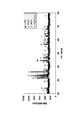
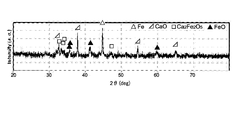
- FIG. 7 is an X-ray diffraction pattern of a sample according to an example after a reaction experiment using the experimental apparatus shown in FIG. 7 is an X-ray diffraction pattern of a sample according to a comparative example after a reaction experiment using the experimental apparatus shown in FIG.
- a method for treating steel dust (electric furnace steelmaking dust), a method for producing zinc, and a method for producing steel raw materials according to an embodiment of the present invention are as follows: Adding to the steel dust containing zinc a calcium compound containing Ca in a number of moles equal to or greater than the number of moles of Fe in the steel dust; Heating and reducing the steel dust to which the calcium compound is added in a furnace. In the heat reduction step, the steel dust is heated and reduced without dissolving the steel dust, that is, without generating a melt.
- zinc ferrite which is the main component of zinc in the dust
- ZnO zinc oxide
- dicalcium ferrite (2CaO ⁇ Fe 2 ) zinc oxide
- ZnO zinc oxide
- the reaction from ZnO.Fe 2 O 3 to 2CaO.Fe 2 O 3 oxidizes compared to the case of directly reducing ZnO.Fe 2 O 3 as in the conventional mainstream Waelz method.
- the production of iron (II) (FeO) is prevented or the production of FeO is suppressed.
- the amount of ZnO dissolved in FeO is reduced as much as possible, and the amount of recovered zinc is also improved. Therefore, according to the present embodiment, it is possible to recover zinc more efficiently than the Waelz method, and it is possible to recover a residue having a small zinc content.
- Steel dust functions as the sole recycling route for zinc from used steel products.
- more zinc can be recovered from the steel dust, so that the steel dust can be more effectively utilized as a zinc recycling source.
- the zinc content of the residue can be set to 0.1% by weight or less of the upper limit of the zinc content allowed as a steel raw material. Therefore, the residue can be used as a steel raw material. Therefore, steel dust can be utilized not only as zinc but also as a recycling source of iron.
- the residue obtained by subjecting the electric furnace steelmaking dust generated in the blast furnace to the treatment of the present invention can be fed into the blast furnace as a steel raw material. Therefore, by using the processing method of the present invention, it is possible to circulate and use the steel material, and it is possible to construct a circulation type material flow in the steel material.
- Table 1 shows an example of the composition of the steel material of the present invention and the composition of the conventional Waelz method clinker.
- the unit of numerical values in Table 1 is “% by weight”.
- the zinc content is small, FeO is not substantially contained, and 2CaO ⁇ Fe 2 O 3 is contained. Further, CaO is present in a state of being combined with SiO 2 and Al 2 O 3, or the like.
- the conventional Waelz method clinker has a high content of zinc and FeO and does not substantially contain 2CaO ⁇ Fe 2 O 3 .
- the experimental apparatus 1 is composed of an electric tubular furnace.
- reference numeral 2 is a quartz tube for forming a flow of reducing gas (mixed gas of hydrogen and argon) in the furnace
- reference numeral 4 is an alumina boat for setting the sample 3 in the furnace
- reference numeral 5 is A thermocouple for detecting the temperature in the furnace. The heating element is not shown.
- a briquette having a diameter of 10 mm and a height of 10 to 15 mm was prepared by pressurizing a sample prepared by mixing 2CaO ⁇ Fe 2 O 3 synthesized with a reagent and ZnO as a reagent in a molar ratio of 1: 1. Subsequently, this sample was set in a furnace and reduced at 600 ° C. for 1 hour in a hydrogen gas stream.
- the X-ray diffraction result of the sample after reduction is shown in FIG. It can be seen that Fe is generated directly from 2CaO.Fe 2 O 3 and does not pass through FeO. That is, it is expected that ZnO, which was a problem in the Waelz method, does not form and stabilizes, and that zinc in the residue is greatly reduced. At the same time, it is expected that the recovery efficiency of zinc can be improved.
- the calcium compound needs to contain a sufficient amount of Ca to convert the total amount of ZnO.Fe 2 O 3 and Fe 2 O 3 present in the dust into 2CaO ⁇ Fe 2 O 3 .
- the mixed Ca component is not only used for the production of 2CaO ⁇ Fe 2 O 3 but also consumed for the production of compounds such as SiO 2 and Al 2 O 3 contained in the dust. .
- Table 2 shows examples of chemical compositions of typical electric furnace steelmaking dust. From the dust types A to E, when calculating the Ca content necessary for the formation of CaO ⁇ SiO 2 and CaO ⁇ Al 2 O 3 compounds, the ratio of Ca content required to convert to 2CaO ⁇ Fe 2 O 3 is 1 0.05 to 0.10 extra Ca is required for 0.0. Furthermore, the excess Ca component necessary for producing the compounds of 2CaO.SiO 2 and 3CaO.Al 2 O 3 is 0.11 to 0.23. Therefore, the ratio of Ca necessary for conversion to 2CaO ⁇ Fe 2 O 3 is 1.23 by adding the above-described extra maximum value.
- the value of the ratio of Ca necessary for conversion to 2CaO ⁇ Fe 2 O 3 of 1.0 (1.23 when adding Ca consumed by SiO 2 and Al 2 O 3 ) is only the chemical equivalent. In view of the Ca content mixed in the dust and the contact opportunity of ZnO.Fe 2 O 3 and Fe 2 O 3 in the dust, it is expected that the value will be larger than this value.
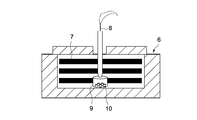
- the experimental apparatus 6 is composed of an electric furnace.
- reference numeral 7 denotes a heating element that heats the inside of the furnace
- reference numeral 8 denotes a thermocouple that detects the temperature in the furnace
- reference numeral 9 denotes an alumina crucible that accommodates the sample 10.
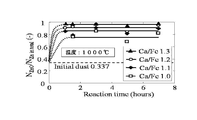
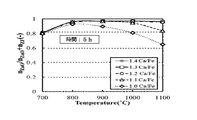
- a briquette having a diameter of 10 mm and a height of about 10 mm was prepared by adding and pressing. Subsequently, this sample was set in a furnace, heated at 700 to 1100 ° C. for 1 to 7 hours in an open atmosphere, and the change in the ratio of ZnO to total zinc in the dust was measured. Further, the number of moles of Ca added to the number of moles of Fe in the dust was changed from 1.0 to 1.4.
- FIG. 4 shows the relationship between the reaction time and the ratio of ZnO to the total zinc in the dust at a heating temperature of 1000 ° C.
- FIG. 5 shows the relationship between the heating temperature and the ratio of ZnO to the total zinc in the dust at a reaction time of 5 hours. Showing the relationship.
- the ratio of ZnO to total zinc in the sample before heating was 0.337.
- the dissolution method is leaching with ion-exchanged water, leaching with a solution in which 10 ml of ammonium acetate, 5 g of ammonium chloride and 25 ml of water are mixed, and an alkali melting method.
- the ion exchange water dissolves only ZnCl 2 and the above solution dissolves ZnO and ZnCl 2 .
- ZnO.Fe 2 O 3 in the electric furnace steelmaking dust is converted into 2CaO ⁇ Fe 2 O 3 and ZnO by adding CaO.
- the ratio of ZnO to the total zinc in the dust is constant at a value close to about 1.0 for a predetermined time or more or a predetermined temperature or more. This indicates that the ZnO ⁇ Fe 2 O 3 is converted into the total amount 2CaO ⁇ Fe 2 O 3.
- the reason why the vertical axis does not become 1.0 is presumed to be because other forms of zinc (for example, ZnCl 2 ) are contained in the dust.
- the ratio of the number of moles of Ca to the number of moles of Fe (Ca / Fe in the figure) is 1.3 or more, dicalcium ferrite (2CaO ⁇ Fe 2 O 3 ) is generated more efficiently. be able to.
- the upper limit of the molar ratio of Ca to Fe is not particularly limited, but if a large amount of Ca is added, the amount of charge in the furnace increases and the energy required for heating increases. From such a viewpoint, the molar ratio of Ca to Fe is preferably 1.5 or less, and more preferably 1.4 or less. Of course, the molar ratio of Ca to Fe is not limited to this value, and can be appropriately changed according to the amount of SiO 2 or Al 2 O 3 contained in the dust.
- calcium compound for example, quick lime (CaO), slaked lime (Ca (OH) 2 ), calcium carbonate (CaCO 3 ) and the like can be used alone or in combination. Since these calcium compounds are relatively excellent in availability, they are advantageous in terms of cost.
- the method for heating and reducing the dust to which the calcium compound has been added is not particularly limited, and a carbon material may be further mixed into the dust, or a reducing gas may be added to the furnace.
- the carbonaceous material includes carbonaceous materials such as coal, graphite, coke and the like.
- the reducing gas typically includes hydrocarbons such as methane, ethane, and propane in addition to hydrogen.
- the heating reduction furnace is not particularly limited, and typically, a rotary kiln and a rotary hearth are used, but a shaft furnace may be used.
- the pressure in the furnace may be atmospheric pressure or a reduced pressure atmosphere.
- the furnace temperature in the reduction heating step is preferably less than 1200 ° C. As shown in FIG. 5, a considerable amount of 2CaO ⁇ Fe 2 O 3 is already generated at 700 ° C., and is almost completed at 900 ° C. (when Ca / Fe is 1.3 or more). Accordingly, the higher the temperature, the faster the production rate, and thus a higher temperature is preferable. On the other hand, between the CaO and Fe 2 O 3, there is a composition to produce a melt at 1205 ° C., as a starting point the melt deposits in the furnace are generated. Therefore, in the present embodiment, the temperature in the furnace is adjusted to less than 1200 ° C., preferably about 1100 ° C. in consideration of the temperature distribution in the furnace.
- slaked lime Ca (OH) 2
- the molded sample was charged.
- black solid deposits were generated on the brick surface in the kiln after cooling after the operation was finished.
- the temperature of the brick surface in the kiln was adjusted to a maximum of 1096 ° C. under operating conditions of a furnace temperature of 1195 ° C., no deposit was generated.
- the recovered zinc component is typically metallic zinc, but may be a zinc compound such as zinc oxide.
- the recovery method is not particularly limited, and examples thereof include a method of contacting and condensing zinc vapor volatilized from dust with a low-temperature body (cooling pipe, cooling panel, etc.) installed inside or outside the furnace.
- the dust is heated in a reducing atmosphere as described above, or heated in the presence of carbonaceous material, thereby reducing zinc oxide in the dust and volatilizing zinc from the dust. Let As a result, a high-quality residue with little zinc component can be obtained. Moreover, according to this embodiment, a zinc component can be efficiently recovered from dust.
- zinc in the residue which has been a problem in the Waelz method
- the residue of the electric furnace steelmaking dust can be reused as a steel raw material without mixing with scrap.
- a method for recovering zinc from zinc-containing dust such as electric furnace steelmaking dust can be provided.
- the temperature rise in the furnace which was a problem in the Waelz method
- the reduction time can be significantly shortened
- an efficient and economically efficient zinc recovery method can be provided.
- the experimental apparatus 11 includes a quartz tube 12 that forms a furnace chamber therein, a heating element 13 around the quartz tube 12, an alumina boat 15 that supports a sample 14, and a quartz tube 12. And a strain gauge 16 for detecting a change in the weight of the sample 13 while suspending and supporting an alumina boat 15 set in the furnace at a position directly above the wire.
- Reference numeral 17 is a heat shielding plate, 18 is a thermocouple, and 19 is a refractory brick.
- Fig. 7 shows the change over time in weight loss during heating of the sample in the experimental apparatus.
- the solid line indicates the change in the weight of the sample according to the example
- the broken line indicates the change in the weight of the sample according to the comparative example
- the alternate long and short dash line indicates the in-furnace temperature measured by the thermocouple 18.
- the sample according to the example (with CaO) has a faster weight reduction rate than the comparative example (without CaO). This is because ZnO separated by the production of 2CaO ⁇ Fe 2 O 3 has a faster reduction rate than ZnO ⁇ Fe 2 O 3 in the comparative example. This confirms that the present invention is advantageous in terms of energy and economy because ZnO can be reduced at a lower temperature and in a shorter time than the Waelz method.
- Table 4 shows the results of analyzing the zinc content of the residue after the experiment. In this example, it was 0.07 wt% (dezincification rate 99.7%), and when compared with the comparative example 4.61 wt% (dezincification rate 87.8%), there was a significant decrease in zinc residue. It is recognized that the superior effect of the present invention is demonstrated. Furthermore, according to the analysis result of chlorine in the residue after the end of the experiment, it is 0.05% by weight (dechlorination rate 98.8%) in the examples according to the present invention, and 1.65% by weight (dechlorination rate) of the comparative example. 74.1%), a significant decrease in chlorine content was observed. That is, according to the present invention, it was confirmed that not only zinc but also chlorine removal rate was high.
- Table 5 was obtained when the ratio of the number of moles of Ca and the number of moles of Fe in the electric furnace steelmaking dust (Ca / Fe) was calculated from the analytical values of Fe and Ca in the residue.
- the unit of numerical values of Fe and CaO in Table 5 is “wt%”. From Table 5, it can be seen that the value of (Ca / Fe) according to this example (with CaO) is higher than that of the comparative example (without CaO).
- FIG. 8 is an X-ray diffraction pattern of the sample after reduction in the example
- FIG. 9 is an X-ray diffraction pattern of the sample after reduction in the comparative example.
- the reason why the amount of FeO generated in the example (FIG. 8) is smaller than that in the comparative example (FIG. 9) is that the generation of FeO is suppressed by the progress of the reaction between CaO and ZnO.Fe 2 O 3. (See the experimental example described with reference to FIG. 2).
- the reason why FeO is formed in the examples is that reduction of FeO by part of Fe 2 O 3 proceeds before the reaction between CaO and ZnO ⁇ Fe 2 O 3 is completed. .
- the reason why ZnO hardly dissolves in the produced FeO in a small amount is that the ZnO and 2CaO ⁇ Fe 2 O 3 in the example are faster than the rate at which ZnO is produced from the ZnO ⁇ Fe 2 O 3 in the comparative example. This is probably because the generated speed is faster.
- the upper limit value of the zinc content allowed as a steel raw material is 0.1% by weight or less, it is expected to be widely used as a steel raw material. Moreover, it leads to a decrease in operating temperature and a significant reduction in reduction time, and can be expected to expand as an efficient and economical zinc recovery method.
- JP 2013-159797 A discloses a CaO / SiO 2 weight ratio of 1.5 or more and a CaO source in order to suppress deposit formation.
- An example is disclosed in which the particle size is adjusted so that the -0.2 mm ratio is 80% by mass or more.
- the added amount of Ca proposed in these techniques is considerably smaller than that of the present invention.
- Table 7 shows.
- the data of “Weltz” is the data described in Non-Patent Document 1 above, and the data of “Shisaka” is “steel smoke ash treatment at the Shisaka Factory” (Journal of MMIJ, Vol. 123 (2007) No. .12, 726-729).
- the unit of numerical values other than Ca / Fe in Table 7 is “wt%”.
- the amount of Ca added in the Waelz method is 0.19 to 0.63 in terms of the Ca / Fe ratio, which is clearly lower than that of the present invention.
Landscapes
- Chemical & Material Sciences (AREA)
- Engineering & Computer Science (AREA)
- Organic Chemistry (AREA)
- Materials Engineering (AREA)
- Metallurgy (AREA)
- Manufacturing & Machinery (AREA)
- Mechanical Engineering (AREA)
- Life Sciences & Earth Sciences (AREA)
- Environmental & Geological Engineering (AREA)
- General Life Sciences & Earth Sciences (AREA)
- Geology (AREA)
- Geochemistry & Mineralogy (AREA)
- Manufacture And Refinement Of Metals (AREA)
- Manufacture Of Iron (AREA)
Abstract
Description
これにより、ZnO・Fe2O3の還元過程におけるFeOの生成を抑制して、鉄鋼ダストから効率よく亜鉛を除去することができる。
これにより、鉄鋼ダストから効率よく亜鉛を回収し生産することができる。
これにより、亜鉛含有量の少ない還元鉄を生産することができる。
亜鉛を含有する鉄鋼ダストに、上記鉄鋼ダスト中のFeのモル数と当量以上のモル数のCaを含むカルシウム化合物を添加する工程と、
上記カルシウム化合物が添加された上記鉄鋼ダストを炉内で加熱還元する工程と、を有する。
加熱還元する工程では、上記鉄鋼ダストを溶解させることなく、つまり融液を生成させることなく、鉄鋼ダストを加熱還元する。
したがって本実施形態によれば、Waelz法よりも効率よく亜鉛を回収することができるとともに、亜鉛含有量が少ない残渣を回収することができる。

ZnO・Fe2O3+4C=Zn(g)+2Fe+4CO(g)
ZnO+C=Zn(g)+CO(g)
Fe2O3+3C=2Fe+3CO(g)
ZnO+Fe=Zn(g)+FeO
本実施形態では、ダストに上記所定量のCaを含むカルシウム化合物を添加することにより、加熱還元工程においてZnO・Fe2O3をZnOと2CaO・Fe2O3とに変化させる。すなわち本実施形態の基本的な考え方は、Fe2O3の還元反応によるFeOの生成を抑制するために、ダスト中に存在するZnO・Fe2O3とFe2O3を、全量2CaO・Fe2O3に変換させるために十分な量のCaを含むカルシウム化合物を添加することにある。

ダスト中のZnO・Fe2O3がZnOと2CaO・Fe2O3とに分離された後、炉内で加熱還元される。これによりダスト中の亜鉛成分が蒸発する。したがって別途の還元工程を必要とすることなく、亜鉛を回収することができるとともに、亜鉛成分が減少した残渣(鉄鋼原料)を得ることができる。

さらに、実験終了後の残渣の塩素の分析結果によると、本発明による実施例では0.05重量%(脱塩素率98.8%)であり、比較例の1.65重量%(脱塩素率74.1%)と対比すると、顕著な塩素含有量の減少が認められた。つまり本発明によれば、亜鉛だけでなく塩素の除去率も高いことが確認された。


また、実施例においてFeOが生成する理由は、CaOとZnO・Fe2O3との反応の完了前に、一部のFe2O3によるFeOへの還元が進行するためであると推定される。
さらに、微量ながらも生成されたFeOにZnOが固溶しにくい理由は、比較例におけるZnO・Fe2O3からZnOが生成される速度よりも、実施例におけるZnOと2CaO・Fe2O3が生成される速度の方が、速いからであると考えられる。
株式会社豊栄商会製のロータリーキルンに、電気炉製鋼ダストに対してCa/Fe=1.4となるように消石灰(Ca(OH)2)を混合し、ブリケット(約10mm×30mm)状に成形したサンプルを装入した。キルン内レンガ面の温度が最大1120℃に達した状態から6時間後に運転を停止し、冷却後の各物質の分析を行ったところ、表6に示すように、ブリケットは揮発凝縮物とキルン内残渣に分離され、揮発凝縮物に亜鉛が、キルン内残渣にFeが濃縮し、亜鉛とFeが極めて良好に分離された結果を得た。なお、表6中の数値の単位は「重量%」である。

なおWaelz法においては、ロータリーキルン内の付着物生成の抑制等を目的として、電気炉製鋼ダストにCa分を添加する技術が提案されている。例えば、特公平2-47529号公報には、付着物生成抑制、電気炉製鋼ダスト中のフッ素等のハロゲン分の除去率向上を目的として、CaO/SiO2が重量比で2.5以上とする例(以下、技術1)が開示されており、特開2003-342649号公報には、ZnOの還元促進を目的として、CaO/炭材を質量比で0.03以上、好ましくは0.13以上とする例(以下、技術2)が開示されており、さらに特開2013-159797号公報には、付着物生成抑制のため、CaO/SiO2を重量比で1.5以上とし、かつCaO源の粒度を、-0.2mm比率が80質量%以上となるように調整する例が開示されている。

Claims (14)
- 亜鉛を含有する鉄鋼ダストに、前記鉄鋼ダスト中のFeのモル数と当量以上のモル数のCaを含むカルシウム化合物を添加し、
前記カルシウム化合物が添加された前記鉄鋼ダストを炉内で融液を生成させずに加熱還元する
鉄鋼ダストの処理方法。 - 請求項1に記載の鉄鋼ダストの処理方法であって、
前記カルシウム化合物は、生石灰(CaO)、消石灰(Ca(OH)2)及び炭酸カルシウム(CaCO3)の少なくとも1つを含む
鉄鋼ダストの処理方法。 - 請求項1又は2に記載の鉄鋼ダストの処理方法であって、
前記鉄鋼ダストに前記カルシウム化合物を添加する工程では、前記鉄鋼ダスト中のFeのモル数に対する前記カルシウム化合物中のCaのモル数の比率が1.3以上1.5以下に調整される
鉄鋼ダストの処理方法。 - 請求項1~3のいずれか1つに記載の鉄鋼ダストの処理方法であって、
前記カルシウム化合物が添加された前記鉄鋼ダストを加熱還元する工程では、前記炉内の温度が1200℃未満に調整される
鉄鋼ダストの処理方法。 - 請求項1~4のいずれか1つに記載の鉄鋼ダストの処理方法であって、
前記鉄鋼ダストに前記カルシウム化合物を添加する工程では、前記鉄鋼ダストに炭材がさらに添加される
鉄鋼ダストの処理方法。 - 請求項1~4のいずれか1つに記載の鉄鋼ダストの処理方法であって、
前記カルシウム化合物が添加された前記鉄鋼ダストを加熱還元する工程では、前記炉内に還元ガスが添加される
鉄鋼ダストの処理方法。 - 請求項1~6のいずれか1つに記載の鉄鋼ダストの処理方法であって、
前記炉は、ロータリーキルン、ロータリーハース又はシャフト炉である
鉄鋼ダストの処理方法。 - 亜鉛を含有する鉄鋼ダストに、前記鉄鋼ダスト中のFeのモル数と当量以上のモル数のCaを含むカルシウム化合物を添加し、
前記カルシウム化合物が添加された前記鉄鋼ダストを炉内で融液を生成させずに加熱還元することで、亜鉛成分を回収する
亜鉛の生産方法。 - 請求項8に記載の亜鉛の生産方法であって、
前記鉄鋼ダストに前記カルシウム化合物を添加する工程では、前記鉄鋼ダスト中のFeのモル数に対する前記カルシウム化合物中のCaのモル数の比率が1.3以上1.5以下に調整される
亜鉛の生産方法。 - 請求項8又は9に記載の亜鉛の生産方法であって、
前記カルシウム化合物が添加された前記鉄鋼ダストを加熱還元する工程では、前記炉内の温度が1200℃未満に調整される
亜鉛の生産方法。 - 鉄鋼ダストから亜鉛を分離して鉄鋼原料として回収する鉄鋼原料の生産方法であって、
亜鉛を含有する鉄鋼ダストに、前記鉄鋼ダスト中のFeのモル数と当量以上のモル数のCaを含むカルシウム化合物を添加し、
前記カルシウム化合物が添加された前記鉄鋼ダストを炉内で融液を生成させずに加熱還元することで、前記鉄鋼ダストから亜鉛を除去する
鉄鋼原料の生産方法。 - 請求項11に記載の鉄鋼原料の生産方法であって、
前記鉄鋼ダストに前記カルシウム化合物を添加する工程では、前記鉄鋼ダスト中のFeのモル数に対する前記カルシウム化合物中のCaのモル数の比率が1.3以上1.5以下に調整される
鉄鋼原料の生産方法。 - 請求項11又は12に記載の鉄鋼原料の生産方法であって、
前記カルシウム化合物が添加された前記鉄鋼ダストを加熱還元する工程では、前記炉内の温度が1200℃未満に調整される
鉄鋼原料の生産方法。 - 亜鉛の含有量が0.1重量%以下であり、
ダイカルシウムフェライト(2CaO・Fe2O3)の含有量(重量%)が多く、酸化鉄(II)(FeO)の含有量(重量%)が少ない
鉄鋼原料。
Priority Applications (5)
| Application Number | Priority Date | Filing Date | Title |
|---|---|---|---|
| KR1020187033318A KR102380361B1 (ko) | 2016-04-28 | 2017-04-11 | 철강 더스트의 처리 방법, 아연의 생산 방법, 철강 원료의 생산 방법, 및 철강 원료 |
| EP17789260.1A EP3450580A4 (en) | 2016-04-28 | 2017-04-11 | METHOD FOR PROCESSING IRON AND STEEL DUST, ZINC MANUFACTURING METHOD, METHOD FOR PRODUCING AN INITIAL MATERIAL FOR IRON AND STEEL, AND EXTRACT MATERIAL FOR IRON AND STEEL |
| US16/097,075 US20190106767A1 (en) | 2016-04-28 | 2017-04-11 | Method for processing steelmaking dust, method for producing zinc, method for producing iron- and steelmaking raw material, and raw material of iron and steel |
| CA3022352A CA3022352A1 (en) | 2016-04-28 | 2017-04-11 | Method for processing steelmaking dust, method for producing zinc, method for producing iron- and steelmaking raw material, and raw material of iron and steel |
| TW106114299A TWI647315B (zh) | 2016-04-28 | 2017-04-28 | 鋼鐵粉塵的處理方法、鋅的生產方法以及鋼鐵原料的生產方法 |
Applications Claiming Priority (4)
| Application Number | Priority Date | Filing Date | Title |
|---|---|---|---|
| JP2016-090336 | 2016-04-28 | ||
| JP2016090336 | 2016-04-28 | ||
| JP2016176517A JP6113344B1 (ja) | 2016-04-28 | 2016-09-09 | 鉄鋼ダストの処理方法、亜鉛の生産方法及び還元鉄の生産方法 |
| JP2016-176517 | 2016-09-09 |
Publications (1)
| Publication Number | Publication Date |
|---|---|
| WO2017187973A1 true WO2017187973A1 (ja) | 2017-11-02 |
Family
ID=58666656
Family Applications (1)
| Application Number | Title | Priority Date | Filing Date |
|---|---|---|---|
| PCT/JP2017/014868 Ceased WO2017187973A1 (ja) | 2016-04-28 | 2017-04-11 | 鉄鋼ダストの処理方法、亜鉛の生産方法、鉄鋼原料の生産方法、及び鉄鋼原料 |
Country Status (7)
| Country | Link |
|---|---|
| US (1) | US20190106767A1 (ja) |
| EP (1) | EP3450580A4 (ja) |
| JP (1) | JP6113344B1 (ja) |
| KR (1) | KR102380361B1 (ja) |
| CA (1) | CA3022352A1 (ja) |
| TW (1) | TWI647315B (ja) |
| WO (1) | WO2017187973A1 (ja) |
Cited By (2)
| Publication number | Priority date | Publication date | Assignee | Title |
|---|---|---|---|---|
| WO2023157826A1 (ja) * | 2022-02-15 | 2023-08-24 | 株式会社キノテック | 亜鉛回収方法 |
| EP4516934A1 (en) * | 2023-09-01 | 2025-03-05 | S.A. Lhoist Recherche et Développement | Composition for use in a steel making process |
Families Citing this family (2)
| Publication number | Priority date | Publication date | Assignee | Title |
|---|---|---|---|---|
| JP7261042B2 (ja) * | 2019-03-05 | 2023-04-19 | 花王株式会社 | ペット用排泄物処理材 |
| TWI879197B (zh) * | 2023-10-31 | 2025-04-01 | 中國鋼鐵股份有限公司 | 垂直式冶煉系統 |
Citations (2)
| Publication number | Priority date | Publication date | Assignee | Title |
|---|---|---|---|---|
| JP2003027155A (ja) * | 2001-07-09 | 2003-01-29 | Topy Ind Ltd | 亜鉛濃縮用成形体及び該成形体を使用する製鋼ダスト中の亜鉛の濃縮方法 |
| WO2015016086A1 (ja) * | 2013-07-30 | 2015-02-05 | 国立大学法人東北大学 | 電気炉製鋼ダストからの亜鉛回収方法および電気炉製鋼ダストからの亜鉛回収装置 |
Family Cites Families (3)
| Publication number | Priority date | Publication date | Assignee | Title |
|---|---|---|---|---|
| JP3317137B2 (ja) | 1996-04-01 | 2002-08-26 | 日本鋼管株式会社 | 製鉄ダストからの酸化亜鉛の回収装置 |
| JP2003342649A (ja) * | 2002-05-30 | 2003-12-03 | Sumitomo Metal Mining Co Ltd | 鉄鋼ダスト還元ロータリーキルンの操業方法 |
| JP5137110B2 (ja) | 2007-07-27 | 2013-02-06 | 国立大学法人東北大学 | 電気炉ダストからの酸化亜鉛の回収方法 |
-
2016
- 2016-09-09 JP JP2016176517A patent/JP6113344B1/ja active Active
-
2017
- 2017-04-11 WO PCT/JP2017/014868 patent/WO2017187973A1/ja not_active Ceased
- 2017-04-11 EP EP17789260.1A patent/EP3450580A4/en not_active Withdrawn
- 2017-04-11 KR KR1020187033318A patent/KR102380361B1/ko active Active
- 2017-04-11 US US16/097,075 patent/US20190106767A1/en not_active Abandoned
- 2017-04-11 CA CA3022352A patent/CA3022352A1/en active Pending
- 2017-04-28 TW TW106114299A patent/TWI647315B/zh active
Patent Citations (2)
| Publication number | Priority date | Publication date | Assignee | Title |
|---|---|---|---|---|
| JP2003027155A (ja) * | 2001-07-09 | 2003-01-29 | Topy Ind Ltd | 亜鉛濃縮用成形体及び該成形体を使用する製鋼ダスト中の亜鉛の濃縮方法 |
| WO2015016086A1 (ja) * | 2013-07-30 | 2015-02-05 | 国立大学法人東北大学 | 電気炉製鋼ダストからの亜鉛回収方法および電気炉製鋼ダストからの亜鉛回収装置 |
Non-Patent Citations (2)
| Title |
|---|
| CHAIRAKSA ROMCHAT ET AL.: "New Zinc Recovery Process from EAF Dust by Lime Addition", IRON & STEEL TECHNOLOGY CONFERENCE PROCEEDINGS, vol. 1, 3 May 2010 (2010-05-03), pages 271 - 281, XP008179514 * |
| See also references of EP3450580A4 * |
Cited By (5)
| Publication number | Priority date | Publication date | Assignee | Title |
|---|---|---|---|---|
| WO2023157826A1 (ja) * | 2022-02-15 | 2023-08-24 | 株式会社キノテック | 亜鉛回収方法 |
| JPWO2023157826A1 (ja) * | 2022-02-15 | 2023-08-24 | ||
| JP7756379B2 (ja) | 2022-02-15 | 2025-10-20 | 株式会社キノテック | 亜鉛回収方法 |
| EP4516934A1 (en) * | 2023-09-01 | 2025-03-05 | S.A. Lhoist Recherche et Développement | Composition for use in a steel making process |
| WO2025046104A1 (en) * | 2023-09-01 | 2025-03-06 | S.A. Lhoist Recherche Et Developpement | Composition for use in a steel making process |
Also Published As
| Publication number | Publication date |
|---|---|
| EP3450580A1 (en) | 2019-03-06 |
| EP3450580A4 (en) | 2019-10-30 |
| TW201802251A (zh) | 2018-01-16 |
| US20190106767A1 (en) | 2019-04-11 |
| CA3022352A1 (en) | 2017-11-02 |
| KR102380361B1 (ko) | 2022-03-30 |
| KR20190003577A (ko) | 2019-01-09 |
| JP2017201054A (ja) | 2017-11-09 |
| JP6113344B1 (ja) | 2017-04-12 |
| TWI647315B (zh) | 2019-01-11 |
Similar Documents
| Publication | Publication Date | Title |
|---|---|---|
| JP6406675B2 (ja) | 電気炉製鋼ダストからの亜鉛回収方法および電気炉製鋼ダストからの亜鉛回収装置 | |
| CN100469907C (zh) | 含锌电炉粉尘的处理方法 | |
| EA011796B1 (ru) | Способ и установка для извлечения цветных металлов из отходов производства цинка | |
| JP6113344B1 (ja) | 鉄鋼ダストの処理方法、亜鉛の生産方法及び還元鉄の生産方法 | |
| US10982300B2 (en) | Carbothermic direct reduction of chromite using a catalyst for the production of ferrochrome alloy | |
| Doronin et al. | Commercial methods of recycling dust from steelmaking | |
| JP5742360B2 (ja) | 鉄鋼ダスト還元焙焼用ロータリーキルンの操業方法 | |
| WO2004053173A1 (ja) | V、Mo、及びNi含有廃棄物からの有価金属の回収方法 | |
| JP2010007180A (ja) | 高亜鉛含有鉄鉱石を用いた銑鉄製造方法 | |
| JP2007521393A (ja) | 高温における揮発性金属の機械的分離 | |
| JP2004285473A (ja) | V、Mo、及びNi含有廃棄物からの有価金属の回収方法 | |
| Biswal et al. | Reduction Behavior of Hematite‐Biowaste Composite Pellets at Melting Temperature | |
| JP2017133045A (ja) | マグネシウムの回収方法 | |
| JP2009167469A (ja) | 含銅ドロスの処理方法 | |
| JP5092615B2 (ja) | スラグフューミング方法 | |
| KR101189183B1 (ko) | 석유탈황 폐촉매 중 유가금속 회수방법 | |
| JP2006307268A (ja) | スラグフューミングにおけるダスト回収方法 | |
| JP7476872B2 (ja) | 金属の製造方法 | |
| Wang et al. | Recovery of zinc and iron from basic oxygen steelmaking filter cake: A pathway to cleaner and circular steelmaking | |
| JP5678470B2 (ja) | 脱銅スラグの処理方法 | |
| Wang | A Study on the Recovery of Zinc and Pig Iron from Byproducts after Steelmaking Dust Treatment | |
| JPH05202436A (ja) | 製鋼ダストから高品位金属亜鉛を回収する方法 | |
| Leuchtenmüller et al. | Towards Circular Steelmaking: Hydrogen-Based Valorization of Electric Arc Furnace Dust | |
| JP2025112254A (ja) | アルミドロスの処理方法、低ハロゲン化アルミドロスの製造方法、ハロゲン化物の製造方法、アルミニウム溶湯の精錬方法、アルミニウム材料の製造方法、高炉出銑口用マッド材の製造方法および耐火物成型体の製造方法 | |
| RU2182184C1 (ru) | Способы переработки железосодержащих материалов |
Legal Events
| Date | Code | Title | Description |
|---|---|---|---|
| ENP | Entry into the national phase |
Ref document number: 3022352 Country of ref document: CA |
|
| NENP | Non-entry into the national phase |
Ref country code: DE |
|
| ENP | Entry into the national phase |
Ref document number: 20187033318 Country of ref document: KR Kind code of ref document: A |
|
| 121 | Ep: the epo has been informed by wipo that ep was designated in this application |
Ref document number: 17789260 Country of ref document: EP Kind code of ref document: A1 |
|
| ENP | Entry into the national phase |
Ref document number: 2017789260 Country of ref document: EP Effective date: 20181128 |
|
| NENP | Non-entry into the national phase |
Ref country code: JP |