WO2017191798A1 - シリコーン粒子、これを配合した化粧料及び塗料及び樹脂 - Google Patents
シリコーン粒子、これを配合した化粧料及び塗料及び樹脂 Download PDFInfo
- Publication number
- WO2017191798A1 WO2017191798A1 PCT/JP2017/016648 JP2017016648W WO2017191798A1 WO 2017191798 A1 WO2017191798 A1 WO 2017191798A1 JP 2017016648 W JP2017016648 W JP 2017016648W WO 2017191798 A1 WO2017191798 A1 WO 2017191798A1
- Authority
- WO
- WIPO (PCT)
- Prior art keywords
- silicone
- silicone particles
- silicon
- acid
- note
- Prior art date
- Legal status (The legal status is an assumption and is not a legal conclusion. Google has not performed a legal analysis and makes no representation as to the accuracy of the status listed.)
- Ceased
Links
Classifications
-
- C—CHEMISTRY; METALLURGY
- C08—ORGANIC MACROMOLECULAR COMPOUNDS; THEIR PREPARATION OR CHEMICAL WORKING-UP; COMPOSITIONS BASED THEREON
- C08G—MACROMOLECULAR COMPOUNDS OBTAINED OTHERWISE THAN BY REACTIONS ONLY INVOLVING UNSATURATED CARBON-TO-CARBON BONDS
- C08G77/00—Macromolecular compounds obtained by reactions forming a linkage containing silicon with or without sulfur, nitrogen, oxygen or carbon in the main chain of the macromolecule
- C08G77/48—Macromolecular compounds obtained by reactions forming a linkage containing silicon with or without sulfur, nitrogen, oxygen or carbon in the main chain of the macromolecule in which at least two but not all the silicon atoms are connected by linkages other than oxygen atoms
- C08G77/50—Macromolecular compounds obtained by reactions forming a linkage containing silicon with or without sulfur, nitrogen, oxygen or carbon in the main chain of the macromolecule in which at least two but not all the silicon atoms are connected by linkages other than oxygen atoms by carbon linkages
-
- A—HUMAN NECESSITIES
- A61—MEDICAL OR VETERINARY SCIENCE; HYGIENE
- A61K—PREPARATIONS FOR MEDICAL, DENTAL OR TOILETRY PURPOSES
- A61K8/00—Cosmetics or similar toiletry preparations
- A61K8/02—Cosmetics or similar toiletry preparations characterised by special physical form
- A61K8/0241—Containing particulates characterized by their shape and/or structure
-
- A—HUMAN NECESSITIES
- A61—MEDICAL OR VETERINARY SCIENCE; HYGIENE
- A61K—PREPARATIONS FOR MEDICAL, DENTAL OR TOILETRY PURPOSES
- A61K8/00—Cosmetics or similar toiletry preparations
- A61K8/18—Cosmetics or similar toiletry preparations characterised by the composition
- A61K8/72—Cosmetics or similar toiletry preparations characterised by the composition containing organic macromolecular compounds
- A61K8/84—Cosmetics or similar toiletry preparations characterised by the composition containing organic macromolecular compounds obtained by reactions otherwise than those involving only carbon-carbon unsaturated bonds
- A61K8/89—Polysiloxanes
- A61K8/891—Polysiloxanes saturated, e.g. dimethicone, phenyl trimethicone, C24-C28 methicone or stearyl dimethicone
-
- A—HUMAN NECESSITIES
- A61—MEDICAL OR VETERINARY SCIENCE; HYGIENE
- A61K—PREPARATIONS FOR MEDICAL, DENTAL OR TOILETRY PURPOSES
- A61K8/00—Cosmetics or similar toiletry preparations
- A61K8/18—Cosmetics or similar toiletry preparations characterised by the composition
- A61K8/72—Cosmetics or similar toiletry preparations characterised by the composition containing organic macromolecular compounds
- A61K8/84—Cosmetics or similar toiletry preparations characterised by the composition containing organic macromolecular compounds obtained by reactions otherwise than those involving only carbon-carbon unsaturated bonds
- A61K8/89—Polysiloxanes
- A61K8/895—Polysiloxanes containing silicon bound to unsaturated aliphatic groups, e.g. vinyl dimethicone
-
- A—HUMAN NECESSITIES
- A61—MEDICAL OR VETERINARY SCIENCE; HYGIENE
- A61Q—SPECIFIC USE OF COSMETICS OR SIMILAR TOILETRY PREPARATIONS
- A61Q1/00—Make-up preparations; Body powders; Preparations for removing make-up
- A61Q1/02—Preparations containing skin colorants, e.g. pigments
-
- A—HUMAN NECESSITIES
- A61—MEDICAL OR VETERINARY SCIENCE; HYGIENE
- A61Q—SPECIFIC USE OF COSMETICS OR SIMILAR TOILETRY PREPARATIONS
- A61Q1/00—Make-up preparations; Body powders; Preparations for removing make-up
- A61Q1/12—Face or body powders for grooming, adorning or absorbing
-
- A—HUMAN NECESSITIES
- A61—MEDICAL OR VETERINARY SCIENCE; HYGIENE
- A61Q—SPECIFIC USE OF COSMETICS OR SIMILAR TOILETRY PREPARATIONS
- A61Q17/00—Barrier preparations; Preparations brought into direct contact with the skin for affording protection against external influences, e.g. sunlight, X-rays or other harmful rays, corrosive materials, bacteria or insect stings
- A61Q17/04—Topical preparations for affording protection against sunlight or other radiation; Topical sun tanning preparations
-
- A—HUMAN NECESSITIES
- A61—MEDICAL OR VETERINARY SCIENCE; HYGIENE
- A61Q—SPECIFIC USE OF COSMETICS OR SIMILAR TOILETRY PREPARATIONS
- A61Q19/00—Preparations for care of the skin
-
- C—CHEMISTRY; METALLURGY
- C08—ORGANIC MACROMOLECULAR COMPOUNDS; THEIR PREPARATION OR CHEMICAL WORKING-UP; COMPOSITIONS BASED THEREON
- C08G—MACROMOLECULAR COMPOUNDS OBTAINED OTHERWISE THAN BY REACTIONS ONLY INVOLVING UNSATURATED CARBON-TO-CARBON BONDS
- C08G77/00—Macromolecular compounds obtained by reactions forming a linkage containing silicon with or without sulfur, nitrogen, oxygen or carbon in the main chain of the macromolecule
- C08G77/04—Polysiloxanes
- C08G77/06—Preparatory processes
- C08G77/08—Preparatory processes characterised by the catalysts used
-
- C—CHEMISTRY; METALLURGY
- C08—ORGANIC MACROMOLECULAR COMPOUNDS; THEIR PREPARATION OR CHEMICAL WORKING-UP; COMPOSITIONS BASED THEREON
- C08G—MACROMOLECULAR COMPOUNDS OBTAINED OTHERWISE THAN BY REACTIONS ONLY INVOLVING UNSATURATED CARBON-TO-CARBON BONDS
- C08G77/00—Macromolecular compounds obtained by reactions forming a linkage containing silicon with or without sulfur, nitrogen, oxygen or carbon in the main chain of the macromolecule
- C08G77/04—Polysiloxanes
- C08G77/12—Polysiloxanes containing silicon bound to hydrogen
-
- C—CHEMISTRY; METALLURGY
- C08—ORGANIC MACROMOLECULAR COMPOUNDS; THEIR PREPARATION OR CHEMICAL WORKING-UP; COMPOSITIONS BASED THEREON
- C08G—MACROMOLECULAR COMPOUNDS OBTAINED OTHERWISE THAN BY REACTIONS ONLY INVOLVING UNSATURATED CARBON-TO-CARBON BONDS
- C08G77/00—Macromolecular compounds obtained by reactions forming a linkage containing silicon with or without sulfur, nitrogen, oxygen or carbon in the main chain of the macromolecule
- C08G77/04—Polysiloxanes
- C08G77/38—Polysiloxanes modified by chemical after-treatment
-
- C—CHEMISTRY; METALLURGY
- C08—ORGANIC MACROMOLECULAR COMPOUNDS; THEIR PREPARATION OR CHEMICAL WORKING-UP; COMPOSITIONS BASED THEREON
- C08L—COMPOSITIONS OF MACROMOLECULAR COMPOUNDS
- C08L83/00—Compositions of macromolecular compounds obtained by reactions forming in the main chain of the macromolecule a linkage containing silicon with or without sulfur, nitrogen, oxygen or carbon only; Compositions of derivatives of such polymers
- C08L83/14—Compositions of macromolecular compounds obtained by reactions forming in the main chain of the macromolecule a linkage containing silicon with or without sulfur, nitrogen, oxygen or carbon only; Compositions of derivatives of such polymers in which at least two but not all the silicon atoms are connected by linkages other than oxygen atoms
-
- A—HUMAN NECESSITIES
- A61—MEDICAL OR VETERINARY SCIENCE; HYGIENE
- A61K—PREPARATIONS FOR MEDICAL, DENTAL OR TOILETRY PURPOSES
- A61K2800/00—Properties of cosmetic compositions or active ingredients thereof or formulation aids used therein and process related aspects
- A61K2800/40—Chemical, physico-chemical or functional or structural properties of particular ingredients
- A61K2800/41—Particular ingredients further characterized by their size
- A61K2800/412—Microsized, i.e. having sizes between 0.1 and 100 microns
-
- A—HUMAN NECESSITIES
- A61—MEDICAL OR VETERINARY SCIENCE; HYGIENE
- A61K—PREPARATIONS FOR MEDICAL, DENTAL OR TOILETRY PURPOSES
- A61K2800/00—Properties of cosmetic compositions or active ingredients thereof or formulation aids used therein and process related aspects
- A61K2800/40—Chemical, physico-chemical or functional or structural properties of particular ingredients
- A61K2800/60—Particulates further characterized by their structure or composition
- A61K2800/65—Characterized by the composition of the particulate/core
- A61K2800/654—The particulate/core comprising macromolecular material
-
- C—CHEMISTRY; METALLURGY
- C08—ORGANIC MACROMOLECULAR COMPOUNDS; THEIR PREPARATION OR CHEMICAL WORKING-UP; COMPOSITIONS BASED THEREON
- C08L—COMPOSITIONS OF MACROMOLECULAR COMPOUNDS
- C08L2312/00—Crosslinking
- C08L2312/08—Crosslinking by silane
-
- C—CHEMISTRY; METALLURGY
- C09—DYES; PAINTS; POLISHES; NATURAL RESINS; ADHESIVES; COMPOSITIONS NOT OTHERWISE PROVIDED FOR; APPLICATIONS OF MATERIALS NOT OTHERWISE PROVIDED FOR
- C09D—COATING COMPOSITIONS, e.g. PAINTS, VARNISHES OR LACQUERS; FILLING PASTES; CHEMICAL PAINT OR INK REMOVERS; INKS; CORRECTING FLUIDS; WOODSTAINS; PASTES OR SOLIDS FOR COLOURING OR PRINTING; USE OF MATERIALS THEREFOR
- C09D7/00—Features of coating compositions, not provided for in group C09D5/00; Processes for incorporating ingredients in coating compositions
- C09D7/40—Additives
- C09D7/65—Additives macromolecular
-
- C—CHEMISTRY; METALLURGY
- C09—DYES; PAINTS; POLISHES; NATURAL RESINS; ADHESIVES; COMPOSITIONS NOT OTHERWISE PROVIDED FOR; APPLICATIONS OF MATERIALS NOT OTHERWISE PROVIDED FOR
- C09D—COATING COMPOSITIONS, e.g. PAINTS, VARNISHES OR LACQUERS; FILLING PASTES; CHEMICAL PAINT OR INK REMOVERS; INKS; CORRECTING FLUIDS; WOODSTAINS; PASTES OR SOLIDS FOR COLOURING OR PRINTING; USE OF MATERIALS THEREFOR
- C09D7/00—Features of coating compositions, not provided for in group C09D5/00; Processes for incorporating ingredients in coating compositions
- C09D7/40—Additives
- C09D7/66—Additives characterised by particle size
- C09D7/69—Particle size larger than 1000 nm
Definitions
- the present invention relates to a silicone particle having a low aggregation property with time and a high lipophilicity without blending a third component such as inorganic fine particles or silsesquioxane particles.
- the present invention relates to a cosmetic containing the silicone particles having excellent usability, a cosmetic raw material, a paint, and a resin compounding agent.
- Silicone particles are used as additives for cosmetics, paints, inks, thermosetting organic resins, thermoplastic organic resins, etc., especially internal stress relaxation agents for thermosetting organic resins and surface lubrication of organic resin films. It is preferably used as an agent.
- the silicone particles are those obtained by curing an addition reaction curable silicone composition or a condensation reaction curable silicone composition, and the particle diameter and oil absorbency vary depending on the production method. Generally, since there is a limit to miniaturization in order to pulverize a cured product into a granular product, a production method for obtaining silicone particles having a small particle diameter by curing reaction of the particulate product of the crosslinkable silicone composition Is preferred.
- the primary particles are fine, they tend to aggregate into secondary particles over time, and the aggregated particles are not easily redispersed into primary particles. This is due to the phenomenon that once the primary particles are bonded as aggregated particles, the bond is not easily split (dissociated).
- the silicone particles When highly cohesive silicone particles are blended in a solvent or the like, the silicone particles do not disperse in the primary particle size, but become secondary agglomerated particles or aggregates thereof, and the dispersion is insufficient and a uniform mixture cannot be prepared. There is. Therefore, the composition containing silicone particles has a problem that the characteristics of silicone particles cannot be fully exhibited. In general, it has been found that particles having a low hardness, such as silicone rubber granules, tend to aggregate over time.
- One of the objects of the present invention is to provide silicone particles having excellent dispersibility, high lipophilicity and high storage stability, and a suitable production method thereof.
- one of the objects of the present invention is to provide cosmetics with excellent usability, resins having high functionality, and raw materials thereof.
- the silicone particles according to one embodiment of the present invention have a silicon atom-bonded hydrogen atom content per unit mass of 300 ppm or less, and the silicon atoms in the siloxane constituting the silicone particles are composed of alkylene groups having 4 to 20 carbon atoms. It is characterized by cross-linking to other silicon atoms.
- a cosmetic raw material and a resin compounding agent which are one form of the present invention are characterized by comprising the above-mentioned silicone particles.
- Cosmetics, paints and electronic materials which are one of the present invention are characterized by containing the silicone particles.
- the crosslinkable composition for forming silicone particles includes the following components (A) to (C): (A): an organopolysiloxane having two or more alkenyl groups having 4 to 20 carbon atoms in one molecule, and (B): a silicon organic compound having 2 or more silicon-bonded hydrogen atoms present in one molecule and 40% or less of the number of silicon atoms in one molecule, and / or A silicon organic compound having two or more silicon-bonded hydrogen atoms present in one molecule and containing a trifunctional siloxane unit or a tetrafunctional siloxane unit;
- the method for producing silicone particles according to one aspect of the present invention is characterized in that the above-mentioned crosslinkable composition for forming silicone particles is emulsified and cured in the presence of a catalyst.
- the silicone particles of one form of the present invention have low aggregation over time and high storage stability. Further, the silicone particles themselves have a pleasant tactile sensation and are characterized in that the feeling of use of cosmetics and the functions of paints, resins and electronic materials can be improved. Moreover, the composition of one form of this invention can provide this silicone particle. Moreover, the silicone particle manufacturing method which is one form of this invention has the characteristics that such a silicone particle can be manufactured efficiently.
- silicone particles of the present invention the production method thereof, and cosmetics, paints and resins using the same will be described in detail.
- the silicone particles according to one embodiment of the present invention have a silicon atom-bonded hydrogen atom content per unit mass of 300 ppm or less, and the silicon atoms in the siloxane constituting the silicone particles are composed of alkylene groups having 4 to 20 carbon atoms. It is characterized by cross-linking to other silicon atoms.
- the content of silicon-bonded hydrogen in the silicone particles of one embodiment of the present invention is preferably 300 ppm or less, more preferably 250 ppm or less, and further preferably 200 ppm or less. Furthermore, it is desirably 150 ppm or less, desirably 100 ppm or less, desirably 50 ppm or less, and further desirably 20 ppm or less.
- this silicon atom-bonded hydrogen increases, it crosslinks with other silicone particles and causes aggregation over time.
- the silicon atom-bonded hydrogen remaining in the silicone particles results in the generation of hydrogen gas during storage. By reducing or eliminating the generation of hydrogen gas, there is an advantage that silicone particles can be produced more safely.
- a typical method for measuring silicon-bonded hydrogen in the silicone particles is to use gas chromatography (headspace method) by contacting with alkali.
- gas chromatography headspace method
- an ethanol solution of 40% strength potassium hydroxide equivalent to the unit mass is added to the silicone particles and allowed to stand for 1 hour to collect the hydrogen gas generated until the end of the reaction. It can be identified by quantification by gas chromatography.
- the alkylene group that crosslinks to the silicon atom and other silicon atoms in the siloxane constituting the silicone particle of the present invention preferably has 4 to 20 carbon atoms.
- the number of carbon atoms is more preferably 5 or more and 6 or more, while it is 16 or less, 12 or less, and 8 or less.
- the silicone particles according to one aspect of the present invention include the following components (A) and (B): (A): an organopolysiloxane having two or more alkenyl groups having 4 to 20 carbon atoms in one molecule; (B): a silicon organic compound having 2 or more silicon-bonded hydrogen atoms present in one molecule and 40% or less of the number of silicon atoms in one molecule, and / or A silicon organic compound having two or more silicon-bonded hydrogen atoms present in one molecule and containing a trifunctional siloxane unit or a tetrafunctional siloxane unit;
- the alkenyl group having 4 to 20 carbon atoms in the component (A) includes a butenyl group, a pentenyl group, a hexenyl group, a heptenyl group, an octenyl group, a nonenyl group, a decenyl group, an undecenyl group, a dodecenyl group, a tridecenyl group, Examples include a tetradecenyl group, a pentadecenyl group, a hexadecenyl group, a heptadecenyl group, an octadecenyl group, a nonadecenyl group, and an icocenyl group.
- the alkenyl group preferably has 5 or more carbon atoms, and more preferably 6 or more carbon atoms. Similarly, from the viewpoints of reactivity and cohesion, the alkenyl group preferably has 16 or less carbon atoms, more preferably 12 or less, and even more preferably 8 or less. In particular, a hexenyl group is preferable.
- the alkenyl group is preferably at the end of the molecular chain of the organopolysiloxane, but may be in the side chain or in both of them.
- Examples of groups bonded to silicon atoms other than alkenyl groups include methyl groups, ethyl groups, propyl groups, butyl groups and other alkyl groups; cyclopentyl groups, cyclohexyl groups and other cycloalkyl groups; phenyl groups, tolyl groups, An aryl group such as a xylyl group; an aralkyl group such as a benzyl group, a phenethyl group, or a 3-phenylpropyl group; an unsubstituted halogen group such as a 3-chloropropyl group, a 3,3,3-trifluoropropyl group, or the like; Substituted monovalent hydrocarbon groups are exemplified.
- this viscosity is preferably a viscosity capable of dispersing the hydrosilylation reaction crosslinkable silicone composition in water. Specifically, at 25 ° C., it is preferably in the range of 20 to 100,000 mPa ⁇ s, and particularly preferably in the range of 20 to 10,000 mPa ⁇ s.
- the organopolysiloxane of component (A) has a content of dimethylsiloxane units represented by the formula:-(CH3) 2SiO- other than siloxane units at the molecular terminals. 90 mol% or more of siloxane units are preferred.
- the cyclic or chain organopolysiloxane having a low polymerization degree is removed in advance by stripping or the like. It is also preferable to keep it.
- the content of the alkenyl group in the component (A) is preferably 0.50% by weight or more, more preferably 0.60% by weight or more, further 0.70% by weight or more, further 0.80% by weight or more in one molecule of organopolysiloxane. This is preferably 0.90% by weight or more.
- the upper limit is more preferably 5% by weight or less, and further preferably 4% by weight or less.
- Component (B) includes (i) a silicon organic compound having 2 or more silicon-bonded hydrogen atoms present in one molecule and 40% or less of the number of silicon atoms in one molecule, and / or (ii) A silicon organic compound having two or more silicon-bonded hydrogen atoms present in one molecule and containing a trifunctional siloxane unit or a tetrafunctional siloxane unit.
- the silicon organic compound (i) preferably has two or more silicon-bonded hydrogen atoms in one molecule.
- the silicon-bonded hydrogen atom in one molecule is preferably 40% or less of the number of silicon atoms in one molecule, more preferably 30% or less, 25% or less, 20% or less, 15% or less, More preferably, it is 10% or less.
- the silicon organic compound (ii) has a trifunctional siloxane unit or a tetrafunctional siloxane unit, so that even if an unreacted portion of SiH remains on the three-dimensional structure, it hardly affects the aggregation of silicone particles over time. Because. From the viewpoint of reactivity, trifunctional siloxane units are preferred.
- the molecular structure of the component (B) include linear, cyclic, network, and partially branched linear structures.
- the viscosity is a viscosity which can disperse
- the silicone particles of the present invention can be produced.
- the preferred range of the upper limit of the silicone particle powder is 1.15 or less, more preferably 1.10 or less, 1.05 or less, and 1.
- the particle size of the powder is a measurement of the silicone particles that are powdered after drying, and the median diameter (cumulative distribution of the silicone particles) of the silicone particles identified by a laser diffraction particle size distribution analyzer using ethanol or the like as a dispersion medium.
- the particle diameter corresponding to 50%, D50).
- the silicone particles according to the present invention are in the form of secondary particles obtained by agglomerating primary particles of a plurality of silicones, and the powder particle size is obtained by directly measuring the secondary particle size of the silicone particles.
- the powder particle size of the silicone particles according to the present invention depends on the size of the primary particles constituting the powder particles, but the preferred range is 0.5 to 50 ⁇ m.
- the lower limit of this preferred range is preferably 1 ⁇ m, more preferably 2 ⁇ m and 3 ⁇ m.
- the upper limit of the suitable range is preferably 45 ⁇ m, more preferably 40 ⁇ m, 35 ⁇ m, 30 ⁇ m, 25 ⁇ m and 20 ⁇ m. If it is smaller than this, the cross-linking reaction does not proceed easily, and other particles tend to adhere, and only an aggregated cross-linked product can be obtained. If it is larger than this range, the compoundability as particles in cosmetics and paints is impaired, and the feeling of use is also inferior.
- the silicone particles according to the present invention are primary particles before aggregation in a water-dispersed form at the time of production, and the particle diameter is preferably 1 to 10 ⁇ m. If the lower limit of the primary particle diameter is less than the above, crosslinking reactivity is poor, and if the upper limit of the primary particle diameter exceeds the above, the feeling in use and the blending stability are impaired.
- the hardness of the silicone particles is preferably in the range of 5 to 70 as measured with a JISJA hardness meter specified in JIS K6301. A more preferable example is 60 or less, and a more preferable example is 50 or less.
- the rubber hardness is within the above range, the resulting silicone particles are sufficiently suppressed in agglomeration, and tend to be rich in fluidity, dispersibility, smooth feeling, smoothness and soft feel.
- the content of silicon-bonded hydrogen atoms per unit mass is 300 ppm or less, and the silicon atoms in the siloxane constituting the silicone particles are changed to other silicon atoms by alkylene groups having 4 to 20 carbon atoms.
- Cross-linked one (the above first form) or (A) an organopolysiloxane having two or more alkenyl groups having 4 to 20 carbon atoms in one molecule, and (B) a specific organohydrogen A polysiloxane obtained by a cross-linking reaction at a specific ratio (the second form described above), but from the viewpoint of suppressing aggregation of the silicone particles, the JIS-A hardness (V ⁇ ) and powder of the silicone particles described above Regarding the particle diameter (V ⁇ ) ⁇ m, the following relational expression is preferably satisfied.
- the particle size of the silicone particles can be easily adjusted by emulsifying and curing the crosslinkable composition for forming the silicone particles.
- This emulsification includes a method using a surfactant, an emulsification method using a mechanical shearing method using a mixing device such as a stirrer and an ultrasonic vibrator, and the like.
- a surfactant examples include nonionic, anionic, cationic, and betaine types.
- the particle size of the silicone particles obtained varies depending on the type and content of the surfactant.
- the amount of the surfactant added is in the range of 0.5 to 50 parts by mass with respect to 100 parts by mass of the crosslinkable composition for forming silicone particles. preferable.
- the amount of the surfactant added is in the range of 0.1 to 10 parts by mass with respect to 100 parts by mass of the crosslinkable composition for forming silicone particles. It is preferable.
- the amount of water added as a dispersion medium is preferably in the range of 20 to 1,500 parts by mass and 50 to 1,000 parts by mass with respect to 100 parts by mass of the crosslinkable composition for forming silicone particles.
- these surfactant is mix
- an emulsifier in order to disperse
- the emulsifier include a homomixer, paddle mixer, Henschel mixer, homodisper, colloid mill, propeller stirrer, homogenizer, in-line continuous emulsifier, ultrasonic emulsifier, and vacuum kneader.
- the aqueous dispersion containing the crosslinkable composition for forming silicone particles prepared by the above method is heated or allowed to stand at room temperature to cure the crosslinkable composition for forming silicone particles in the aqueous dispersion.
- an aqueous dispersion of silicone particles can be prepared.
- the heating temperature is preferably 100 ° C. or less, and particularly preferably 10 to 95 ° C.
- Examples of the method of heating the aqueous dispersion of the crosslinkable composition for forming silicone particles include a method of directly heating the aqueous dispersion and a method of adding the aqueous dispersion to hot water.
- silicone particles can be prepared by removing water from the aqueous dispersion of silicone particles.
- the removing method include a drying method using a vacuum dryer, a hot air circulation oven, and a spray dryer.
- Such a crosslinkable composition for forming silicone particles is converted into silicone particles by allowing a curing reaction to proceed by standing at room temperature or by heating.
- an aqueous solution of a surfactant is preferably used in order to stabilize the crosslinkable composition for forming silicone particles as particles in an aqueous dispersion.
- the addition amount of the surfactant is preferably 0.1 to 20 parts by mass, more preferably 0.2 to 10 parts by mass, based on 100 parts by mass of the crosslinkable composition for forming silicone particles. 2 to 5 parts by mass is particularly preferable.
- the amount of water added is preferably 40 to 2000 parts by weight, particularly 40 to 1000 parts by weight, based on 100 parts by weight of the crosslinkable composition for forming silicone particles.
- a grinder such as a grinder
- a sprayer such as a vacuum dryer, a hot air circulation oven, or a spray dryer.
- the content of silicon atom-bonded hydrogen groups in the silicone particles is not reduced.
- the water used is preferably an aqueous dispersion of the crosslinkable composition for forming silicone particles, so that it has less metal ions and halogen ions and preferably has an electric conductivity of 1 ⁇ S / cm or less. It is preferable that the degree of ion exchange water is 0.5 ⁇ S / cm or less.
- a hydrosilylation reaction catalyst as the component (C) is blended with the fine particle dispersion to form a crosslinking property for forming silicone particles.
- a hydrosilylation reaction catalyst as the component (C) is blended with the fine particle dispersion to form a crosslinking property for forming silicone particles.
- the aqueous dispersion of the crosslinkable composition for forming silicone particles prepared by the above method is heated or allowed to stand at room temperature to cure the crosslinkable composition for forming silicone particles in the aqueous dispersion.
- An aqueous dispersion of silicone particles can be prepared.
- the heating temperature is preferably 100 ° C. or less, and particularly preferably 10 to 95 ° C.
- Examples of the method of heating the aqueous dispersion of the crosslinkable composition for forming silicone particles include a method of directly heating the aqueous dispersion and a method of adding the aqueous dispersion to hot water.
- a hydrosilylation catalyst (C) component can be used as a curing reaction for producing silicone particles.
- This is a catalyst for promoting the curing of the crosslinkable composition for forming silicone particles, and is preferably a platinum group metal (Group VIII of the periodic table) or a compound thereof.
- Platinum and / or platinum compounds such as finely divided platinum; chloroplatinic acid or alcohol solutions of chloroplatinic acid; chloroplatinic acid and alkenylsiloxane compounds; platinum-diketone compounds; platinum-alkenylsiloxane complexes; platinum-olefins Preferred are complexes; platinum metals of silica, alumina, carvone or similar carriers; or thermoplastics containing platinum compounds.
- platinum group metal catalysts examples include rhodium, ruthenium, iridium or palladium compounds.
- hydrogen peroxide water it is also possible to use hydrogen peroxide water as a catalyst.
- non-platinum hydrosilylation catalysts such as iron and iron / cobalt may be used.
- the silicone particles are not particularly limited in shape and properties, and may be elastomer (rubber) particles, resin (resin) particles, or the same or different composite silicone particles.
- the silicone particles of the present invention are more preferably silicone elastomer particles having elasticity. Silicone elastomer particles are used in cosmetics, coating agents, and the like as a touch improver. Silicone resin particles and silicone elastomer particles coated with silicone resin or silica fine particles are less agglomerated but have a hard feel and may not have a soft feel like silicone elastomer particles.
- the silicone particles of the present invention may be subjected to a surface treatment as necessary. Typically, it is a silica coating, which may further improve the aggregation suppressing effect of the silicone particles of the present invention. Furthermore, surface treatment with other known hydrophilic treatment agents or hydrophobic treatment agents may be performed.
- the silicone particles of the present invention may be in the form of dry powder particles, or in the form of an aqueous suspension dispersed in a hydrophilic dispersion medium such as water, alcohol or polyhydric alcohol. It may be in the form of an oily silicone particle composition dispersed or swollen in an oil agent.
- This cosmetic is characterized by containing the above silicone particles.
- These cosmetics include soaps, body shampoos, face-washing cosmetics, etc .; basic cosmetics such as lotions, creams / milky lotions, packs, etc .; base makeup cosmetics, such as funny and foundations; lipsticks, cheeks, eye Eyebrow cosmetics such as shadow, eyeliner, mascara; Makeup cosmetics such as nail polish; Hair cosmetics such as shampoos, hair rinses, hair conditioners, hair restorers, hair nourishing agents, hair dyes, etc .; perfumes, au de colon Aromatic cosmetics; toothpaste; bath preparations; hair removal agents, shaving lotions, antiperspirants / deodorants, sunscreen agents, and other special cosmetics.
- Examples of the dosage form of the cosmetic include aqueous liquid, oily liquid, emulsion, cream, foam, semi-solid, solid, and powder. The cosmetic can also be used by spraying.
- the content of the silicone particles is preferably in the range of 0.5 to 99.0% by mass in the cosmetic, and particularly in the range of 1.0 to 95% by mass. It is preferable. This is because when the content of the silicone particles exceeds the upper limit of the above range, the effect as a cosmetic is lost, and when the content is less than the lower limit of the above range, the feeling of use of the cosmetic. It is because it becomes difficult to improve.
- silicone particles can be dispersed in an aqueous phase or an oil phase using the cosmetic ingredients described in the following paragraphs as a medium (aqueous medium or oily medium).
- aqueous medium include pure water, ion exchange water, alkali ion water, deep layer water, wave water, natural water, and the like; lower alcohols such as ethyl alcohol, propyl alcohol, and isopropyl alcohol; glycerin, 1,3 butylene glycol, and isoprene.
- An aqueous solvent that can be mixed with water such as a polyhydric alcohol such as glycol or dipropylene glycol can be used.
- oily medium examples include silicone oil, hydrocarbon oil, higher fatty acid, higher alcohol, ester oil (including fats and oils), ether oil, mineral oil, fluorine oil and the like.
- silicone oil, hydrocarbon oil, and ester oil are more preferable from the viewpoint of usability.
- oil agents can be used alone or in combination of two or more.
- content of the oil agent in the entire water-in-oil emulsified cosmetic used in the present invention is preferably 10 to 50% by mass, and more preferably 20 to 40% by mass from the viewpoints of use feeling and storage stability.
- the cosmetics of the present invention are components used in ordinary cosmetics within a range not impeding the effects of the present invention, water, colorants, alcohols, water-soluble polymers, film-forming agents, oils, oil-soluble gelling agents. , Organic modified clay minerals, surfactants, resins, salts, moisturizers, antiseptics, antibacterial agents, antioxidants, pH adjusters, chelating agents, refreshing agents, anti-inflammatory agents, skin cleansing ingredients (whitening agents, cell activation Agents, rough skin improving agents, blood circulation promoters, skin astringents, antiseborrheic agents, etc.), vitamins, amino acids, nucleic acids, hormones, clathrate compounds, physiologically active substances, active pharmaceutical ingredients, and fragrances are added. These are not particularly limited.
- Each of these cosmetic ingredients is preferably in the range of 0.5 to 99.0% by mass in the cosmetic, excluding water, and particularly in the range of 1.0 to 95% by mass. It is preferable that When the content of one component of the cosmetic component exceeds the upper limit of the above range, the feeling of use as a cosmetic is not preferable. Moreover, it is because it will become difficult to acquire effects, such as an improvement of the usability
- the cosmetic ingredients and the blending amounts thereof are incorporated in Japanese Patent Laid-Open No. 2015-113303 for reference.
- Water does not contain components harmful to the human body and may be clean, and examples thereof include tap water, purified water, mineral water, and deep ocean water.
- a water-soluble additive component can be arbitrarily added to the aqueous phase as long as the effects of the present invention are not impaired.
- a known pH adjuster, preservative, antibacterial agent or antioxidant can be appropriately blended for the purpose of improving the storage stability of cosmetics.
- the colorant examples include inorganic red pigments such as bengara, iron oxide, iron hydroxide, and iron titanate, inorganic brown pigments such as ⁇ -iron oxide, inorganic yellow pigments such as yellow iron oxide and loess, and black iron oxide.
- inorganic black pigments such as carbon black, inorganic purple pigments such as manganese violet and cobalt violet, inorganic green pigments such as chromium hydroxide, chromium oxide, cobalt oxide and cobalt titanate, inorganic blue pigments such as bitumen and ultramarine blue, Red No. 3, Red No. 104, Red No. 106, Red No. 201, Red No. 202, Red No. 204, Red No. 205, Red No.
- Colored pigments such as lacquered natural pigments such as carminic acid, lacaic acid, calsamine, bradylin, crocin; titanium oxide coated mica, mica titanium, iron oxide treated mica titanium, titanium oxide coated mica, bismuth oxychloride, titanium oxide
- lacquered natural pigments such as carminic acid, lacaic acid, calsamine, bradylin, crocin
- titanium oxide coated mica mica titanium, iron oxide treated mica titanium, titanium oxide coated mica, bismuth oxychloride, titanium oxide
- pearl pigments such as coated bismuth oxychloride, titanium oxide coated talc, fish scale foil, and titanium oxide coated colored mica
- metal powders such as aluminum, gold, silver, copper, platinum, and stainless steel.
- colorants are preferably water-repellent.
- a composite of these colorants, or a surface treated with a general oil, a silicone compound, a fluorine compound, or a surfactant can be used, and one or two as required. More than one species can be used.
- water repellency treatment examples include those obtained by treating a colorant with various water repellency surface treatment agents, such as methyl hydrogen polysiloxane treatment, silicone resin treatment, silicone gum treatment, acrylic silicone treatment.
- Silane treatment such as organosiloxane treatment such as fluorinated silicone treatment, metal soap treatment such as zinc stearate treatment, silane coupling agent treatment, and alkyl silane treatment, perfluoroalkyl silane, perfluoroalkyl phosphate ester salt, and Fluorine compound treatment such as perfluoropolyether treatment, amino acid treatment such as N-lauroyl-L-lysine treatment, oil agent treatment such as squalane treatment, and acrylic treatment such as alkyl acrylate treatment, etc., one or more of these Can be used in combination
- the alcohols one or more selected from lower alcohols, sugar alcohols and higher alcohols can be used.
- lower alcohols such as ethanol and isopropanol
- sugar alcohols such as sorbitol and maltose
- lauryl alcohol myristyl alcohol, palmityl alcohol, stearyl alcohol, behenyl alcohol, hexadecyl alcohol, oleyl alcohol, isostearyl alcohol, hexyl deca Nord, octyldodecanol, cetostearyl alcohol, 2-decyltetradecinol, cholesterol, sitosterol, phytosterol, lanosterol, POE cholesterol ether, monostearyl glycerin ether (batyl alcohol), monooleyl glyceryl ether (ceracyl alcohol), etc.
- Examples include higher alcohols.
- Water-soluble polymers are formulated for the purpose of improving the feeling of use of cosmetics, and are amphoteric, cationic, anionic, nonionic, or water-swellable clay minerals as long as they are used in ordinary cosmetics. Any one of them can be used, and one or more water-soluble polymers can be used in combination. Since these water-soluble polymers have a thickening effect on water-containing components, they are particularly useful for obtaining gel-like water-containing cosmetics, water-in-oil emulsion cosmetics, and oil-in-water emulsion cosmetics.
- Amphoteric water-soluble polymers include amphoteric starch, dimethyldiallylammonium chloride derivatives (for example, acrylamide / acrylic acid / dimethyldiallylammonium chloride copolymer, acrylic acid / dimethyldiallylammonium chloride copolymer), and methacrylic acid derivatives ( Examples thereof include polymethacryloylethyldimethylbetaine, N-methacryloyloxyethyl N, N-dimethylammonium- ⁇ -methylcarboxybetaine / alkyl methacrylate copolymer, and the like.
- dimethyldiallylammonium chloride derivatives for example, acrylamide / acrylic acid / dimethyldiallylammonium chloride copolymer, acrylic acid / dimethyldiallylammonium chloride copolymer
- methacrylic acid derivatives examples thereof include polymethacryloylethyldimethylbetaine, N-methacryloyloxyethyl
- cationic water-soluble polymer examples include quaternary nitrogen-modified polysaccharides (for example, cation-modified cellulose, cation-modified hydroxyethyl cellulose, cation-modified guar gum, cation-modified locust bean gum, cation-modified starch), dimethyldiallylammonium chloride derivatives ( For example, dimethyldiallylammonium chloride / acrylamide copolymer, polydimethylmethylenepiperidinium chloride), vinylpyrrolidone derivatives (eg, vinylpyrrolidone / dimethylaminoethylmethacrylic acid copolymer salt, vinylpyrrolidone / methacrylamidepropyltrimethylammonium chloride) Copolymers, vinylpyrrolidone / methylvinylimidazolium chloride copolymers, etc.) and methacrylic acid derivatives (eg methacryloylethyl Chirubeta
- anionic water-soluble polymer examples include polyacrylic acid or an alkali metal salt thereof, polymethacrylic acid or an alkali metal salt thereof, hyaluronic acid or an alkali metal salt thereof, acetylated hyaluronic acid or an alkali metal salt thereof, and methyl vinyl ether
- Water-soluble polymer of aliphatic carboxylic acid or its metal salt such as hydrolyzate of maleic anhydride copolymer, carboxymethyl cellulose or its alkali metal salt, methyl vinyl ether-maleic acid half ester copolymer, acrylic resin alkanolamine liquid As well as carboxyvinyl polymers.
- Nonionic water-soluble polymers include polyvinyl pyrrolidone, highly polymerized polyethylene glycol, vinyl pyrrolidone / vinyl acetate copolymer, vinyl pyrrolidone / dimethylaminoethyl methacrylate copolymer, vinyl caprolactam / vinyl pyrrolidone / dimethylaminoethyl methacrylate copolymer Coalesce, cellulose or derivatives thereof (eg methyl cellulose, ethyl cellulose, hydroxyethyl cellulose, hydroxypropyl cellulose, carboxymethyl cellulose), keratin and collagen or derivatives thereof, calcium alginate, pullulan, agar, gelatin, tamarind seed polysaccharide, xanthan gum, carrageenan, high Methoxyl pectin, low methoxyl pectin, guar gum, pectin, gum arabic, crystalline cellulose, Rabinogalactan, karaya
- a water-swellable clay mineral is an inorganic water-soluble polymer and is a kind of colloid-containing aluminum silicate having a three-layer structure.
- (X, Y) 2-3 (Si, Al) 4 O 10 (OH) 2 Z 1/3 ⁇ nH 2 O (However, X is Al, Fe (III), Mn (III), or Cr (III), Y is Mg, Fe (II), Ni, Zn, or Li, and Z is K , Na, or Ca.) What is represented by this is illustrated.
- inorganic water-soluble polymers include bentonite, montmorillonite, piderite, nontronite, saponite, hectorite, magnesium aluminum silicate, and silicic anhydride, which are natural products and synthetics. Any of the objects may be used.
- any of solid, semi-solid, and liquid can be used. Specifically, one or more types selected from silicone oil, hydrocarbon oil, ester oil, vegetable oils and fats, animal fats and oils, fatty acids, higher alcohols, triglycerides, artificial sebum, and fluorine-based oils are included. It can be illustrated.
- Silicone oils include hexamethylcyclotrisiloxane (D3), octamethylcyclotetrasiloxane (D4), decamethylcyclopentasiloxane (D5), dodecamethylcyclohexasiloxane (D6), 1,1-diethyl as cyclic organopolysiloxanes.
- linear organopolysiloxane examples include trimethylsiloxy group-blocked dimethylpolysiloxane having a molecular chain at both ends (dimethylsilicone having a low viscosity such as 2 cst and 6 cst to a high viscosity such as 1 million cst), organohydrogenpolysiloxane, trimethyl at both ends of the molecular chain.
- Hydrocarbon oils include liquid paraffin, light liquid isoparaffin, heavy liquid isoparaffin, petrolatum, n-paraffin, isoparaffin, isododecane, isohexadecane, polyisobutylene, hydrogenated polyisobutylene, polybutene, ozokerite, ceresin, microcrystalline wax, paraffin Examples include wax, polyethylene wax, polyethylene / polypropylene wax, squalane, squalene, pristane, and polyisoprene.
- Ester oils include hexyldecyl octoate, cetyl octanoate, isopropyl myristate, isopropyl palmitate, butyl stearate, hexyl laurate, myristyl myristate, oleyl oleate, decyl oleate, octyldodecyl myristate, dimethyloctanoic acid Hexyldecyl, cetyl lactate, myristyl lactate, diethyl phthalate, dibutyl phthalate, lanolin acetate, ethylene glycol monostearate, propylene glycol monostearate, propylene glycol dioleate, glyceryl monostearate, glyceryl monooleate, tri-2- Glyceryl ethylhexanoate, trimethylolpropane tri-2-ethylhexanoate, ditri
- Natural animal and vegetable oils and semi-synthetic oils include avocado oil, linseed oil, almond oil, ibotarou, eno oil, olive oil, cacao butter, kapok wax, kayak oil, carnauba wax, liver oil, candelilla wax, beef tallow, beef leg fat, beef bone Fat, hydrogenated beef tallow, Kyonin oil, whale wax, hydrogenated oil, wheat germ oil, sesame oil, rice germ oil, rice bran oil, sugarcane wax, sasanqua oil, saflower oil, shea butter, cinnamon oil, cinnamon oil, jojoballow, olive Squalane, shellac wax, turtle oil, soybean oil, tea seed oil, camellia oil, evening primrose oil, corn oil, lard, rapeseed oil, Japanese kiri oil, nukarou, germ oil, horse fat, persic oil, palm oil, palm kernel oil , Castor oil, hydrogenated castor oil, castor oil fatty acid methyl ester, sunflower oil, grape oil, bayberry wax
- higher fatty acids examples include lauric acid, myristic acid, palmitic acid, stearic acid, behenic acid, undecylenic acid, oleic acid, linoleic acid, linolenic acid, arachidonic acid, eicosapentaenoic acid (EPA), docosahexaenoic acid (DHA), Examples include isostearic acid and 12-hydroxystearic acid.
- Examples of the higher alcohol include lauryl alcohol, myristyl alcohol, palmityl alcohol, stearyl alcohol, behenyl alcohol, hexadecyl alcohol, oleyl alcohol, isostearyl alcohol, hexyl decanol, octyldodecanol, cetostearyl alcohol, 2-decyltetradecyl Examples thereof include diol, cholesterol, sitosterol, phytosterol, lanosterol, POE cholesterol ether, monostearyl glycerin ether (batyl alcohol), and monooleyl glyceryl ether (ceralkyl alcohol).
- fluorinated oil examples include perfluoropolyether, perfluorodecalin, and perfluorooctane. These oils can be used singly or in combination of two or more.
- oil-soluble gelling agents include metal soaps such as aluminum stearate, magnesium stearate, zinc myristate, amino acid derivatives such as N-lauroyl-L-glutamic acid, ⁇ , ⁇ -di-n-butylamine, and dextrin palmitic acid Esters, dextrin stearates, dextrin fatty acid esters such as dextrin 2-ethylhexanoic acid palmitate, sucrose fatty acid esters such as sucrose palmitate, and sucrose stearate, inulin stearate and fructooligosaccharide 2- Fructooligosaccharide fatty acid esters such as ethylhexanoate, benzylidene derivatives of sorbitol such as monobenzylidene sorbitol, dibenzylidene sorbitol, and dimethylbenzyl dode Examples thereof include organically modified clay minerals such as silammonium montmorillonite clay and
- the surfactant is one selected from the group consisting of silicone surfactants, anionic surfactants, cationic surfactants, nonionic surfactants, amphoteric surfactants, and semipolar surfactants. Two or more kinds of surfactants can be used in combination.
- Silicone surfactants are often used as components for emulsification and washing of oil agents, dispersion of powders and surface treatments.
- polyglyceryl-modified silicones emulsification and washing of oil agents, dispersion of powders and surface treatments.
- polyglyceryl-modified silicones emulsification and washing of oil agents, dispersion of powders and surface treatments.
- polyglyceryl-modified silicones emulsification and washing of oil agents, dispersion of powders and surface treatments.
- glyceryl-modified silicones glyceryl-modified silicones
- sugar-modified silicones glyceryl-modified silicones
- fluorine polyethers examples include modified silicones, polyether-modified silicones, carboxylic acid-modified silicones, sugar-modified silicones, linear silicone / polyether block copolymers (polysilicone-13, etc.), and long-chain alkyl / polyether co-modified silicones.
- anionic surfactant examples include saturated or unsaturated fatty acid salts (for example, sodium laurate, sodium stearate, sodium oleate, and sodium linolenate), alkyl sulfates, alkyl benzene sulfonic acids (for example, hexyl benzene sulfonic acid).
- saturated or unsaturated fatty acid salts for example, sodium laurate, sodium stearate, sodium oleate, and sodium linolenate
- alkyl sulfates for example, alkyl benzene sulfonic acids (for example, hexyl benzene sulfonic acid).
- Cationic surfactants include alkyl trimethyl ammonium chloride, stearyl trimethyl ammonium chloride, lauryl trimethyl ammonium chloride, cetyl trimethyl ammonium chloride, tallow alkyl trimethyl ammonium chloride, behenyl trimethyl ammonium chloride, stearyl trimethyl ammonium bromide, behenyl trimethyl ammonium bromide.
- Distearyldimethylammonium chloride Dicocoyldimethylammonium chloride, dioctyldimethylammonium chloride, di (POE) oleylmethylammonium chloride (2EO), benzalkonium chloride, alkylbenzalkonium chloride, alkyldimethylbenzalkonium chloride, benzethonium chloride , Stearyldimethylbenzylammonium chloride, lanolin-derived quaternary ammonia Um salt, diethylaminoethylamide stearate, dimethylaminopropylamide stearate, amidopropyldimethylhydroxypropylammonium chloride, stearoylcholaminoformylmethylpyridinium chloride, cetylpyridinium chloride, tall oil alkylbenzylhydroxyethylimidazolinium chloride, and Examples include benzylammonium salts.
- Nonionic surfactants include polyglyceryl diisostearate, diglyceryl polyhydroxystearate, isostearyl glyceryl ether, polyoxyalkylene ethers, polyoxyalkylene alkyl ethers, polyoxyalkylene fatty acid esters, polyoxyalkylene fatty acid diesters, Polyoxyalkylene resin acid esters, polyoxyalkylene (cured) castor oils, polyoxyalkylene alkylphenols, polyoxyalkylene alkylphenyl ethers, polyoxyalkylene phenylphenyl ethers, polyoxyalkylene alkyl esters, polyoxyalkylene Alkyl esters, sorbitan fatty acid esters, polyoxyalkylene sorbitan alkyl esters, polio Sialkylene sorbitan fatty acid esters, polyoxyalkylene sorbite fatty acid esters, polyoxyalkylene glycerin fatty acid esters, polyglycerin alkyl ether
- Amphoteric surfactants include imidazoline type, amide betaine type, alkyl betaine type, alkyl amide betaine type, alkyl sulfobetaine type, amide sulfobetaine type, hydroxysulfobetaine type, carbobetaine type, phosphobetaine type, aminocarboxylic acid type And amide amino acid type amphoteric surfactants.
- 2-undecyl-N, N, N- (hydroxyethylcarboxymethyl) -2-imidazoline sodium and 2-cocoyl-2-imidazolinium hydroxide-1-carboxyethyloxy-2-sodium Imidazoline-type amphoteric surfactants such as salts; alkylbetaine-type amphoteric surfactants such as lauryldimethylaminoacetic acid betaine and myristylbetaine; coconut oil fatty acid amidopropyldimethylaminoacetic acid betaine, palm kernel oil fatty acid amidopropyldimethylaminoacetic acid betaine, beef tallow Fatty acid amidopropyldimethylaminoacetic acid betaine, hardened tallow fatty acid amidopropyldimethylaminoacetic acid betaine, lauric acid amidopropyldimethylaminoacetic acid betaine, myristic acid amidopropyldimethylaminoacetic acid be
- the semipolar surfactant examples include alkylamine oxide type surfactants, alkylamine oxides, alkylamidoamine oxides, alkylhydroxyamine oxides, and the like.
- Alkyldimethylamine oxide having 10 to 18 carbon atoms and 8 to 18 carbon atoms are exemplified. Of these, alkoxyethyldihydroxyethylamine oxide and the like are preferably used.
- salts include inorganic salts, organic acid salts, amine salts, and amino acid salts.
- inorganic salts include sodium salts, potassium salts, magnesium salts, calcium salts, aluminum salts, zirconium salts, and zinc salts of inorganic acids such as hydrochloric acid, sulfuric acid, carbonic acid, and nitric acid; Salts of organic acids such as acetic acid, dehydroacetic acid, citric acid, malic acid, succinic acid, ascorbic acid and stearic acid; and amine salts and amino acid salts include, for example, salts of amines such as triethanolamine, and glutamic acid And salts of amino acids such as In addition, salts such as hyaluronic acid and chondroitin sulfate, aluminum zirconium glycine complex, and the like, and acid-alkali neutralized salts used in cosmetic formulations can also be used.
- humectants include polyhydric alcohols such as glycerin, sorbitol, propylene glycol, dipropylene glycol, 1,3-butylene glycol, glucose, xylitol, maltitol, and polyethylene glycol; hyaluronic acid, chondroitin sulfate, pyrrolidone carboxylate , Polyoxyethylene methyl glucoside, polyoxypropylene methyl glucoside, PEG / PPG dimethyl ether and the like.
- polyhydric alcohols such as glycerin, sorbitol, propylene glycol, dipropylene glycol, 1,3-butylene glycol, glucose, xylitol, maltitol, and polyethylene glycol
- hyaluronic acid chondroitin sulfate
- pyrrolidone carboxylate Polyoxyethylene methyl glucoside
- polyoxypropylene methyl glucoside polyoxypropylene
- preservatives include paraoxybenzoic acid alkyl esters, benzoic acid, sodium benzoate, sorbic acid, potassium sorbate, and phenoxyethanol
- antibacterial agents include benzoic acid, salicylic acid, carboxylic acid, sorbic acid, paraoxybenzoic acid.
- Alkyl esters, parachlorometacresol, hexachlorophene, benzalkonium chloride, chlorhexidine chloride, trichlorocarbanilide, triclosan, photosensitizer, phenoxyethanol, and the like can be mentioned.
- antioxidants examples include tocopherol, butylhydroxyanisole, dibutylhydroxytoluene, and phytic acid.
- pH adjuster examples include lactic acid, citric acid, glycolic acid, succinic acid, tartaric acid, dl-malic acid, potassium carbonate, sodium hydrogen carbonate, and ammonium hydrogen carbonate.
- Examples of the chelating agent include alanine, sodium edetate, sodium polyphosphate, sodium metaphosphate, and phosphoric acid.
- Examples of the refreshing agent include L-menthol and camphor, and examples of the anti-inflammatory agent include allantoin, glycyrrhetinic acid, glycyrrhizic acid, tranexamic acid, and azulene.
- skin beautifying ingredients placenta extract, whitening agent such as arbutin, glutathione, and yukinoshita extract
- cell activator such as royal jelly, skin roughening agent, nonyl acid valenylamide, nicotinic acid benzyl ester, nicotinic acid ⁇ -butoxyethyl Esters, capsaicin, gingerone, cantalis tincture, ictamol, caffeine, tannic acid, ⁇ -borneol, tocopherol nicotinate, inositol hexanicotinate, cyclandrate, cinnarizine, torazoline, acetylcholine, verapamil, cephalanthin, and ⁇ -oryzanol Blood circulation promoters, skin astringents such as zinc oxide and tannic acid, antiseborrheic agents such as sulfur and thianthol, etc., and vitamins include vitamin A oil, retinol,
- amino acids examples include glycine, valine, leucine, isoleucine, serine, threonine, phenylalanine, arginine, lysine, aspartic acid, glutamic acid, cystine, cysteine, methionine, and tryptophan, and / or salts thereof.
- nucleic acid examples include deoxyribonucleic acid
- hormone examples include estradiol and etenyl estradiol.
- the physiologically active ingredient is a substance that imparts some physiological activity to the skin or hair when applied to the skin or hair, and is exemplified by those that are lipophilic.
- anti-inflammatory agent anti-aging agent, squeeze agent, hair growth agent, hair restorer, moisturizer, blood circulation promoter, desiccant agent, warming agent, vitamins, wound healing promoter, stimulation relieving agent, analgesic agent, cell An activator, an enzyme component, etc.
- natural plant extract components, seaweed extract components, and / or herbal medicine components can be preferably blended.
- the pharmaceutical active ingredient is a substance having a disease treatment effect, and examples thereof include proteins, peptides, and low molecular compounds.
- the fragrance is not particularly limited as long as it is a lipophilic fragrance.
- the fragrance is extracted from flowers, seeds, leaves, or roots of various plants, the fragrance is extracted from seaweed, and each part or secretion of the animal. Fragrances extracted from (e.g., pepper, sperm) and artificially synthesized fragrances (e.g., menthol, musk, acetate, vanilla).
- flavor is mix
- the pigment include oil-soluble dyes, extender pigments, inorganic pigments, organic pigments, and lipophilic fluorescent whitening agents.
- the cosmetic of the present invention can be easily manufactured by simply uniformly mixing the cosmetic raw material of the present invention as described above with another cosmetic raw material.
- the mixing means various mixing devices and kneading devices that are usually used in the production of cosmetics can be used. Examples of such apparatuses include a homomixer, paddle mixer, Henschel mixer, homodisper, colloid mixer, propeller stirrer, homogenizer, in-line continuous emulsifier, ultrasonic emulsifier, and vacuum kneader.
- the coating material which is one form of this invention contains said silicone particle, It is characterized by the above-mentioned.
- the paint include room temperature curing type, room temperature drying type, and heat curing type, and examples of the paint include water-based, oil-based, and powder-like, and further, polyurethane resin paint and butyral resin paint depending on vehicle resin.
- the silicone particles preferably have affinity or reactivity with the resin in the coating material.
- the silicone particles in a coating material using an epoxy resin as a vehicle, the silicone particles have an epoxy group or an amino group.
- silicone particles having an amino group are preferable.
- the content of the above silicone particles is not limited. However, in order to impart uniform and soft matteness to the obtained coating film, the content is 0.1 to 100 parts by weight based on 100 parts by weight of the solid content of the paint. It is preferably in the range of 150 parts by mass, more preferably in the range of 0.1 to 100 parts by mass, and particularly preferably in the range of 0.1 to 50 parts by mass.
- the paint includes alcohols such as methanol and ethanol; ketones such as methyl ethyl ketone and methyl isobutyl ketone; esters such as ethyl acetate, butyl acetate and cellosolve acetate; amides such as N, N-dimethylformamide; Olefin such as hexane, heptane and octane; Organic solvent such as aromatic hydrocarbon such as toluene and xylene; Thickener, flame retardant and weather resistance imparting agent composed of pigment and polymer compound may be contained.
- alcohols such as methanol and ethanol
- ketones such as methyl ethyl ketone and methyl isobutyl ketone
- esters such as ethyl acetate, butyl acetate and cellosolve acetate
- amides such as N, N-dimethylformamide
- Olefin such as hexane, heptan
- Crosslinkable composition for forming silicone particles prepared by adding component (C) to an aqueous dispersion of the above crosslinkable composition for forming silicone particles, or an aqueous dispersion of a silicone composition excluding component (C) By heating the aqueous dispersion of the product to room temperature or 100 ° C. or lower, preferably 70 ° C. or lower, curing of the crosslinkable composition for forming silicone particles dispersed in water can be promoted.
- the silicone particles can be recovered by removing water from the aqueous dispersion of silicone particles obtained by curing the crosslinkable composition for forming silicone particles dispersed in water.
- the method for recovering the silicone particles include a method of heating or depressurizing the aqueous dispersion of the silicone particles, or hot air drying or air drying. If the aqueous dispersion is filtered or separated by centrifugation or salting out before drying, the water can be easily removed.
- Such an additive for a resin of the present invention can impart flexibility and thermal shock resistance to the resin, so an additive for a thermosetting resin such as an epoxy resin or a phenol resin, or a polyethylene resin or polypropylene It is suitable as an additive for thermoplastic resins such as resins, nylon resins and polyester resins.
- a thermosetting resin such as an epoxy resin or a phenol resin, or a polyethylene resin or polypropylene
- thermoplastic resins such as resins, nylon resins and polyester resins.
- An electronic material according to an embodiment of the present invention is characterized by containing the above-described crosslinkable composition for forming silicone particles.
- the content of the crosslinkable composition for forming silicone particles is not limited, but is within the range of 0.1 to 100 parts by weight with respect to 100 parts by weight of the curable resin. Is preferred. This is because the content of the resin additive is less than the lower limit of the above range, and the flexibility and thermal shock resistance of the resulting cured resin are reduced, and in particular, the thermal shock resistance after moisture absorption tends to be reduced. On the other hand, if the upper limit of the above range is exceeded, the mechanical properties of the resulting cured resin tend to deteriorate.
- the curable resin which is the main component thereof is phenol resin, formaldehyde resin, xylene resin, xylene-formaldehyde resin, ketone-formaldehyde resin, furan resin, urea resin, imide resin, melamine Resins, alkyd resins, unsaturated polyester resins, aniline resins, sulfone-amide resins, silicone resins, epoxy resins, and copolymer resins of these resins are exemplified, and two or more of these curable resins may be combined.
- the curable resin is preferably at least one selected from the group consisting of epoxy resins, phenol resins, imide resins, and silicone resins.
- the epoxy resin may be a compound containing a glycidyl group or an alicyclic epoxy group, such as o-cresol novolac type epoxy resin, biphenyl type epoxy resin, bisphenol A type epoxy resin, bisphenol F type epoxy resin, dicyclohexane.
- Pentadiene type epoxy resin naphthalene type epoxy resin, anthracene type epoxy resin, naphthol aralkyl type epoxy resin, polyvinylphenol type epoxy resin, diphenylmethane type epoxy resin, diphenylsulfone type epoxy resin, triphenolalkane type epoxy resin, cresol / naphthol Condensation type epoxy resin, bisphenylethylene type epoxy resin, fluorene type epoxy resin, stilbene type epoxy resin, spirocoumarone type epoxy resin, norbornene type epoxy Fat, terpene epoxy resins, phenol cyclohexane type epoxy resin, halogenated epoxy resins, imide group-containing epoxy resin, a maleimide group-containing epoxy resin, allyl group-modified epoxy resin, silicone-modified epoxy resins.
- the phenolic resins include polyvinylphenol type, phenol novolak type, naphthol type, terpene type, phenol dicyclopentadiene type, phenol aralkyl type, naphthol aralkyl type, triphenolalkane type, dicyclopentadiene type, cresol / naphthol type.
- a condensed type and a xylene / naphthol co-condensed type are exemplified.
- the silicone resin include an epoxy-modified silicone resin obtained by reacting an epoxy resin with a silanol group or a silicon atom-bonded alkoxy group in the silicone resin.
- Examples of the curing mechanism of such a curable resin include a thermosetting type, a high energy ray curable type such as ultraviolet rays or radiation, a moisture curable type, a condensation reaction curable type, and an addition reaction curable type.
- the property in 25 degreeC of such curable resin is not limited, Any of liquid state or the solid state softened by heating may be sufficient.
- the electronic material which is an embodiment of the present invention contains a curing agent, a curing accelerator, a filler, a photosensitizer, a higher fatty acid metal salt, an ester wax, a plasticizer, and the like as other optional components.
- a curing agent include organic acids such as carboxylic acid and sulfonic acid, and anhydrides thereof; organic hydroxy compounds; organosilicon compounds having silanol groups, alkoxy groups, or halogeno groups; primary or secondary amino compounds, Two or more of these can be combined.
- tertiary amine compounds organometallic compounds such as aluminum and zirconium; organophosphorus compounds such as phosphine; other heterocyclic amine compounds, boron complex compounds, organic ammonium salts, organic sulfonium salts, Examples are organic peroxides and hydrosilylation catalysts.
- the filler includes glass fiber, asbestos, alumina fiber, ceramic fiber containing alumina and silica, boron fiber, zirconia fiber, silicon carbide fiber, metal fiber, polyester fiber, aramid fiber, nylon fiber, phenol fiber.
- Fibrous fillers such as natural animal and plant fibers; fused silica, precipitated silica, fumed silica, calcined silica, zinc oxide, calcined clay, carbon black, glass beads, alumina, talc, calcium carbonate, clay, aluminum hydroxide,
- Illustrative examples include particulate fillers such as barium sulfate, titanium dioxide, aluminum nitride, silicon carbide, magnesium oxide, beryllium oxide, kaolin, mica, and zirconia, and two or more of these may be combined.
- the silicone particles of the present invention are excellent in stress relieving action when blended with a resin, they may be blended with an epoxy resin for printed wiring boards to form a prepreg, and further on one side of a copper foil.
- the copper foil with a filler particle containing resin layer for printed wiring boards provided with the resin layer containing the silicone particles of the invention can be formed and used for copper clad laminate (CCL) applications.
- the silicone particles of the present invention and the production method thereof will be described in detail with reference to examples and comparative examples. However, this invention is not limited only to those Examples.
- the viscosity in the examples is the value at 25 ° C.
- the characteristics of the silicone particles were measured as follows.
- JIS A hardness of cured silicone particles The curable silicone composition that is a raw material of the cured silicone particles was heated in a heating oven at 150 ° C. for 1 hour to be cured into a sheet. This hardness was measured with a JIS A hardness meter specified in JIS K 6253.
- the viscosity is 360 mPa ⁇ s.
- the alkenyl group content is 1.08 wt%.
- the viscosity is 370 mPa ⁇ s.
- [Chemical 4-4] 1,5-hexadiene (molecular weight 82.15) manufactured by Tokyo Chemical Industry Co., Ltd.
- the silicon atom-bonded hydrogen atom content is 0.44 wt%.
- Viscosity is 50 mPa ⁇ s.
- the silicon atom-bonded hydrogen atom content is 0.825 wt%.
- the viscosity is 15 mPa ⁇ s.
- the silicon atom-bonded hydrogen atom content is 0.043 wt%.
- the viscosity is 64 mPa ⁇ s.
- Example 1 The polyorganosiloxane represented by the average formula of [Chemical 1-1] and the polyorganosiloxane represented by the average formula of [Chemical 2-1] were mixed uniformly at room temperature in the blending amounts listed in Table 1. Next, this composition was dispersed in an aqueous solution at 25 ° C. composed of 0.4 parts by mass of polyoxyethylene alkyl (C12-14) ether and 50 parts by mass of pure water, and further uniformly emulsified with a colloid mill. An emulsion was prepared by adding 350 parts by weight of water and diluting.
- an isopropyl alcohol solution of chloroplatinic acid (in which the amount of platinum metal in this composition is 10 ppm by mass) is added to the emulsion as a pure water dispersion with polyoxyethylene alkyl (C12-14) ether. After stirring, the emulsion was allowed to stand at 50 ° C. for 3 hours to prepare a uniform aqueous suspension of silicone rubber particles. Next, this aqueous suspension was dried with a small spray dryer (manufactured by Ashizawairo Co., Ltd.) to obtain silicone particles. The characteristics are shown in Table 1.
- Formulation Example 1 W / O cream foundation (component) Phase A Cetyl diglyceryl tris (trimethylsiloxy) silylethyl dimethicone (Note 1) 5.0 parts by mass 2) Dimethicone (Note 2) 4.2 parts by mass 3) Ethylhexyl methoxycinnamate (Note 3) 3.3 parts by mass 4) Capri Rilmethicone (Note 4) 3.3 parts by mass 5) Isododecane, (Dimethicone / bis-isobutyl PPG-20) Crosspolymer (Note 5) 1.5 parts by mass 6) Example silicone crosslinked 2.0 parts by mass Phase B 7) Titanium oxide, talc, methicone (Note 6) 4.71 parts by mass 8) Mica, aluminum hydroxide (Note 7) 2.46 parts by mass 9) Iron oxide yellow (Note 8) 0.66 parts by mass 10) Oxidation Iron red (Note 9) 0.16 parts by mass 11) Black iron oxide (Note
- the W / O cream foundation of Formulation Example 1 is adjusted according to the following procedure. 1. Mix ingredients 1-6 until uniform. 2. 3 rolls of ingredients 7-13 are mixed. 3. Ingredients 14-16 are mixed. 4). Mix 1 and 2 above. 5). Add 3 above with vigorous stirring of 4 above and emulsify.
- Formulation Example 2 O / W foundation (component) Phase A 1) Cross-linked silicone of Examples 18 parts by mass 2) Talc (Note 1) 18 parts by mass Phase B 3) Purified water 20 parts by mass 4) Glycerin 10 parts by mass Phase C 5) Sodium polyacrylate, dimethicone (Note 2) 1 part by mass 6) DMDM hydantoin, propynyl butylcarbamate iodide (Note 3) appropriate amount 7) Ethyl hexyl salicylate (Note 4) 3 parts by mass 8) Ethyl hexyl methoxycinnamate (Note) 5) 3 parts by mass phase D 9) Purified water 21 parts by mass Phase E 10) Caprylyl methicone (Note 6) 2 parts by mass 11) Iron oxide black, dimethicone (Note 7) 0.05 part by mass 12) Iron oxide red, Dimethicone (Note 8) 0.1 part by mass 13) Iron oxide yellow, Dimethicone (Not
- the O / W cream foundation of Formulation Example 2 is adjusted according to the following procedure. 1. Ingredients 1 and 2 are mixed. 2. Ingredients 3 and 4 are mixed. 3. Mix 1 and 2 above. 4). Ingredients 5-8 are mixed. 5). Add ingredient 9 to 4 above and mix. 6). Ingredients 10-14 are mixed until uniform. 7). Mix all ingredients.
- Formulation Example 3 W / O BB cream (component) Phase A 1) Lauryl PEG-10 Tris (trimethylsiloxy) silylethyl dimethicone (Note 1) 3 parts by mass 2) Caprylyl methicone (Note 2) 14 parts by mass 3) Ethylhexyl methoxycinnamate (Note 3) 7.5 parts by mass 4) Diethylaminohydroxybenzoyl hexyl benzoate (Note 4) 1.5 parts by mass 5) Ethylhexyl salicylate 2.5 parts by mass 6) Trimethylsiloxysilicic acid, polypropylsilsesquioxane (Note 5) 2 parts by mass 7) Silicone cross-linking of Examples Body 4 parts by mass 8) Phenyl trimethicone (Note 6) 4 parts by mass Phase B 9) Glycerol 8 parts by mass 10) Na chloride 0.7 part by mass 11) Purified water 40.8 parts by mass Phase C 12) Titanium oxide 5.6 parts by mass 13
- the W / O BB cream of Formulation Example 3 is prepared according to the following procedure. 1. Ingredients 1-8 are mixed. (First UV absorber is dissolved, MQ-1640 is dissolved in FZ-3196) 2. Ingredients 9-11 are mixed. 3. Ingredients 12-18 are mixed. 4). Mix 1 and 3 above. 5). While vigorously stirring 1 above, the above 2 is slowly added to emulsify.
- Non-aqueous foundation Phase A 1) 49.23 parts by mass of titanium oxide, dimethicone (note 1) 2) 9.86 parts by mass of iron oxide yellow, dimethicone (note 2) 3. 3 parts of red iron oxide, dimethicone (note 3) 1.97 parts by mass 4) oxidation Iron black, dimethicone (Note 4) 0.55 parts by mass 5) cetyl diglyceryl tris (trimethylsiloxy) silylethyl dimethicone (Note 5) 1.58 parts by mass 6) caprylyl methicone (Note 6) 15.8 parts by mass B 7) Crosslinked silicone of Example 2 parts by mass 8) Cyclopentasiloxane (Note 7) 13 parts by mass 9) Isododecane, (Acrylates / polytrimethylsiloxy methacrylate) copolymer (Note 8) 5 parts by mass 10) Disteardimonium Hectorite (Note 9) 1 part by mass
- the non-aqueous foundation of Formulation Example 4 is adjusted according to the following procedure. 1. Ingredients 1-6 are mixed. 2. Ingredients 7-10 are mixed. 3. Mix 1 and 2 above.
- SI Talc Note 2 SI-SERICITE FSE manufactured by Miyoshi Kasei Co., Ltd.
- Note 3 SI-Titan CR-50 manufactured by Miyoshi Kasei Co., Ltd.
- Note 4 SA Red manufactured by Miyoshi Kasei Co., Ltd.
- Note 5 SA Yellow UXLO manufactured by Miyoshi Kasei Co., Ltd.
- Note 6 SA Black manufactured by Miyoshi Kasei
- Note 7 SA-Excel Mica JP-2 manufactured by Miyoshi Kasei Co., Ltd.
- Note 8 Fine pair 3000SPQ manufactured by Sumitomo Chemical Co., Ltd.
- Note 9 EXCEPARL OD-M manufactured by Kao Note 10: SH200-5000cs manufactured by Toray Dow Corning
- Formulation Example 6 W / O skin cream (component) Phase A 1) Lauryl PEG / PPG-18 / 18 Dimethicone (Note 1) 2 parts by mass 2) Bis (hydroxyethoxypropyl) dimethicone (Note 2) 2 parts by mass 3) Isopropyl palmitate (Note 3) 1 part by mass 4) Cyclopenta Siloxane (Note 4) 6.5 parts by mass 5) Mineral oil (Note 5) 10 parts by mass 6) Vaseline 1.5 parts by mass 7) Example crosslinked silicone 5 parts by mass Phase B 8) Glycerin 5 parts by mass 9) Na chloride 1 part by mass 10) Purified water 66 parts by mass Note 1: 5200 Formulation Aid manufactured by Toray Dow Corning Note 2: 5562 Carbinol Fluid manufactured by Toray Dow Corning Note 3: Exopearl IPM manufactured by Kao Note 4: SH245 manufactured by Toray Dow Corning Note 5: Kaneda High Call K-230
- the W / O skin cream of Formulation Example 6 is prepared according to the following procedure. 1. Ingredients 1-7 are mixed. 2. Ingredients 8-10 are mixed. 3. While the above 1 is vigorously stirred, the above 2 is slowly added to emulsify.
- the sunscreen non-water lotion of Formulation Example 7 is adjusted according to the following procedure. 1. Ingredients 1 to 3 are mixed (bead mill, etc.). 2. Add ingredients 4-7 to the above ingredients and stir until uniform.
- Formulation Example 8 O / W wrinkle care cream (ingredient) Phase A 1) Cyclopentasiloxane (Note 1) 11 parts by mass 2) Cross-linked silicone 10 parts by mass 3) Lauryl PEG / PPG-18 / 18 dimethicone (Note 2) 0.5 part by mass 4) PEG-12 dimethicone (Note 3) 4 parts by mass phase B 5) Purified water 72.5 parts by mass Phase C 6) Polyacrylamide, water, (C13,14) isoparaffin, Laureth-7 (Note 4) 2 parts by mass Note 1: SH245 manufactured by Toray Dow Corning Note 2: Toray Dow Corning 5200 Formulation Aid Note 3: OFX-5329 manufactured by Toray Dow Corning Note 4: SEPPIC S. A. Simulgel 305
- the O / W wrinkle care cream of Formulation Example 8 is prepared according to the following procedure. 1. Ingredients 1-4 are mixed until uniform. 2. Ingredients 4 and 5 are mixed until uniform. 3. Add 1 to 2 above and mix until uniform.
- the silicone particles of the present invention are excellent in dispersibility in ethanol and silicone oil, they can be easily blended as additives, and when blended in cosmetics as cosmetic raw materials, the touch can be improved. It can be used for cosmetics and makeup cosmetics. In addition, taking advantage of its physical properties, the silicone particles of the present invention can be applied to electronic materials as additives for thermosetting resin compositions, thermoplastic resin compositions, and plastic film surface lubricants. .
Landscapes
- Health & Medical Sciences (AREA)
- Chemical & Material Sciences (AREA)
- Life Sciences & Earth Sciences (AREA)
- Animal Behavior & Ethology (AREA)
- General Health & Medical Sciences (AREA)
- Public Health (AREA)
- Veterinary Medicine (AREA)
- Organic Chemistry (AREA)
- Medicinal Chemistry (AREA)
- Polymers & Plastics (AREA)
- Chemical Kinetics & Catalysis (AREA)
- Dermatology (AREA)
- Epidemiology (AREA)
- Birds (AREA)
- Engineering & Computer Science (AREA)
- Wood Science & Technology (AREA)
- Materials Engineering (AREA)
- General Chemical & Material Sciences (AREA)
- Nanotechnology (AREA)
- Cosmetics (AREA)
- Compositions Of Macromolecular Compounds (AREA)
- Silicon Polymers (AREA)
Abstract
Description
(A): 一分子中に炭素数が4以上かつ20以下のアルケニル基を2つ以上有するオルガノポリシロキサン、及び
(B): 一分子中に存在するケイ素原子結合水素原子が2個以上で且つ一分子中のケイ素原子数の40%以下であるケイ素有機化合物、及び/又は、
一分子中に存在するケイ素原子結合水素原子が2個以上あり、三官能性シロキサン単位又は四官能性シロキサン単位を含むケイ素有機化合物、
を、(A)成分中のアルケニル基含有量(Alk)と(B)成分中のケイ素原子結合水素原子含有量(H)のモル比がH/Alk = 0.7 ~ 1.2となるように含むことを特徴とする。
(A): 一分子中に炭素数が4以上かつ20以下のアルケニル基を2つ以上有するオルガノポリシロキサン、
(B): 一分子中に存在するケイ素原子結合水素原子が2個以上で且つ一分子中のケイ素原子数の40%以下であるケイ素有機化合物、及び/又は、
一分子中に存在するケイ素原子結合水素原子が2個以上あり、三官能性シロキサン単位又は四官能性シロキサン単位を含むケイ素有機化合物、
を、(A)成分のアルケニル基含有量(Alk)と(B)成分のケイ素原子結合水素原子含有量(H)のモル比が
H/Alk=0.7 ~ 1.2
となるように含む組成物を反応して作ることができる。
H/Alk= 0.7~1.2
となるようにして反応することで、本発明シリコーン粒子を作ることができる。H:Alkのモル比については、下限の好適な範囲は、H/Alk= 0.8以上であり、更に好ましくは、 0.85以上、0.90以上、0.95以上、そして1.0以上である。また、この下限を超えると、アルケニル基が残り、シリコーン粒子のパウダーをこの上限の好適な範囲は1.15以下であり、更に好ましくは、 1.10以下、1.05以下、そして、1.00以下である。この上限を超える場合、反応後に未反応のケイ素原子結合水素原子が残りやすい。また、一方で、下限を超える場合、反応後に未反応アルケニル基が残りやすい。これらの未反応物質が残ることで、シリコーン粒子の凝集や吸油したオイルが残ることになり、そのシリコーン粒子を原料として用いた物の物性へ悪影響を及ぼすことがある。上記のアルケニル基がヘキセニル基であり、H/Alkが0.9~1.1、特に1.0に近い場合、シリコーン粒子の経時凝集が最も効果的に抑制される。
Vα ×Vβ ≦ 1,200
本発明の上記の形態にかかるシリコーン粒子について、硬度と粒子径が上記の関係を充足する場合、シリコーン粒子の凝集は効果的に抑制される。なお、上記の発明の形態を満たさない場合、硬度と粒子径が上記関係を満たしていても、シリコーン粒子の凝集は必ずしも抑制されない。
(X,Y)2-3(Si,Al)4O10(OH)2Z1/3・nH2O
(但し、Xは、Al、Fe(III)、Mn(III)、又は、Cr(III)であり、Yは、Mg、Fe(II)、Ni、Zn、又はLiであり、Zは、K、Na、又はCaである。)
で表されるものが例示される。このような無機系水溶性高分子として、具体的には、ベントナイト、モンモリロナイト、パイデライト、ノントロナイト、サポナイト、ヘクトライト、ケイ酸アルミニウムマグネシウム、及び無水ケイ酸が例示され、これらは天然物及び合成物のいずれであってもよい。
本発明の一形態である塗料は、上記のシリコーン粒子を含有することを特徴とする。この塗料としては、常温硬化型、常温乾燥型、加熱硬化型が例示され、また、その性状により、水性、油性、粉状が例示され、さらに、ビヒクルの樹脂により、ポリウレタン樹脂塗料、ブチラール樹脂塗料、長油性フタル酸樹脂塗料、アルキッド樹脂塗料、アミノ樹脂とアルキッド樹脂からなるアミノアルキッド樹脂塗料、エポキシ樹脂塗料、アクリル樹脂塗料、フェノール樹脂塗料、シリコーン変性エポキシ樹脂塗料、シリコーン変性ポリエステル樹脂塗料、シリコーン樹脂塗料が例示される。
本発明の一形態である電子材料は上記のようなシリコーン粒子形成用架橋性組成物を含有することを特徴とする。本発明の一形態である電子材料は、このシリコーン粒子形成用架橋性組成物の含有量は限定されないが、硬化性樹脂100重量部に対して0.1~100重量部の範囲内であることが好ましい。これは、樹脂用添加剤の含有量が上記範囲の下限未満である、得られる硬化樹脂の可撓性および耐熱衝撃性が低下し、特に、吸湿後の耐熱衝撃性が低下する傾向があるからであり、一方、上記範囲の上限をこえると、得られる硬化樹脂の機械的特性が低下する傾向があるからである。
硬化シリコーン粒子の原料である、硬化性シリコーン組成物を加熱オーブンにて150℃で1時間加熱して、シート状に硬化させた。この硬さをJIS K 6253に規定されるJIS A 硬度計により測定した。
硬化シリコーン粒子に対し、単位質量に対して等量の40%濃度の水酸化カリウムのエタノール溶液を添加して1時間静置し、反応終点までに発生した水素ガスを捕集し、ヘッドスペースガスクロマトグラフィーにより、捕集した水素の発生量を測定し、単位質量あたりのケイ素原子結合水素原子の残存量(ppm)を測定した。
白金触媒を添加する前のエマルジョンを、レーザー回折式粒度分布測定器(ベックマン・コールター社のLS-230)により測定し、そのメジアン径(累積分布の50%に相当する粒径、50%粒径)を平均粒子径とした。
エタノールを分散媒として、レーザー回折式粒度分布測定器(堀場製作所のLA-500)で硬化シリコーン粒子の粒径を測定し、エタノール中での硬化シリコーン粒子のメジアン径(累積分布の50%に相当する粒径、D90、μm)や算術分散度(粒径分布の分散度合いを示す、SD、μm2)の値を得た。測定試料は、300mLのカップに硬化シリコーン粒子(1g)とエタノール(100mL)を攪拌羽および超音波振動機を用いて分散した。
300mLカップに硬化シリコーン粒子(6g)とデカメチルシクロペンタシロキサン(58g)を計量し、ディスパーにて4000rpmで2分間攪拌した。その後、のBM型回転粘度計(東機産業社製)で、ローターNo.2で60rpmの条件で、1分後の値を粘度とした。
硬化シリコーン粒子5gを100mlのビーカーに入れ、ガラス棒で硬化シリコーン粒子をゆっくり攪拌しながら、スクワラン、エチルヘキサン酸セチル(注1)、ミネラルオイル(注2)あるいはデカメチルシクロペンタシロキサン(注3)を1滴ずつ滴下していき、硬化シリコーン粒子とオイルとが均一なペースト状物となるまでに要したオイルの滴下量を求めた。硬化シリコーン粒子に対するオイルの滴下量の割合を、有機架橋粒子の吸油量(重量%)とした。
注1:高級アルコール工業社製CEH
注2:カネダ株式会社製ハイコールK-230
注3:東レ・ダウコーニング社製SH245
以下の式において、ViはCH2=CH-、MeはCH3-、HeはCH2=CH-C4H8-を示す。
[化1-1]
Me2HeSiO-(Me2SiO)135-(MeHeSiO)0.25-SiHeMe2、
アルケニル基含有率は、0.97wt%。粘度は420mPa・s。
[化2-2]
ViMe2SiO-(Me2SiO)150-Me2Si-Vi、
アルケニル基含有率は、0.47wt%。粘度は360mPa・s。
[化3-3]
ViMe2SiO-(Me2SiO)130-(ViMeSiO)2-Me2Si-Vi
アルケニル基含有率は、1.08wt%。粘度は370mPa・s。
[化4-4]
1,5-ヘキサジエン(分子量=82.15)東京化成工業社製
[化2-1]
Me3SiO-(Me2SiO)33.7-(HMeSiO)11.5-SiMe3、
ケイ素原子結合水素原子含有量は、0.44wt%。粘度は50mPa・s。
[化2-2]
(Me3SiO1/2)2(Me2SiO2/2)7(HMeSiO2/2)11(MeSiO3/2)1、
ケイ素原子結合水素原子含有量は、0.825wt%。粘度は15mPa・s。
[化2-3]
HMe2SiO-(Me2SiO)60-Me2SiH。
ケイ素原子結合水素原子含有量は、0.043wt%。粘度は64mPa・s。
[化1-1]の平均式で示されるポリオルガノシロキサンと、[化2-1]の平均式で示されるポリオルガノシロキサンを表1に列挙した配合量で、室温で均一に混合した。次に、この組成物をポリオキシエチレンアルキル(C12―14)エーテル0.4質量部と純水50質量部からなる25℃の水溶液中に分散し、さらにコロイドミルにより均一に乳化した後、純水350質量部を加えて希釈してエマルジョンを調製した。次に、塩化白金酸のイソプロピルアルコール溶液(本組成物中、白金金属が質量単位で10ppmとなる量)をポリオキシエチレンアルキル(C12―14)エーテルと純粋で水分散液として、エマルジョンに加えて攪拌した後、このエマルジョンを50℃で3時間静置して、シリコーンゴム粒子の均一な水系サスペンジョンを調製した。次に、この水系サスペンジョンを小型スプレードライヤー(アシザワニロ社製)で乾燥し、シリコーン粒子を得た。その特性を表1に示した。
表1に列挙した原料を、表1記載の配合組成にて、室温で均一に混合してシリコーン粒子形成用架橋性組成物を調製した。次に、この組成物を実施例1と同様にして、シリコーン粒子を得た。その特性を表1に示した。
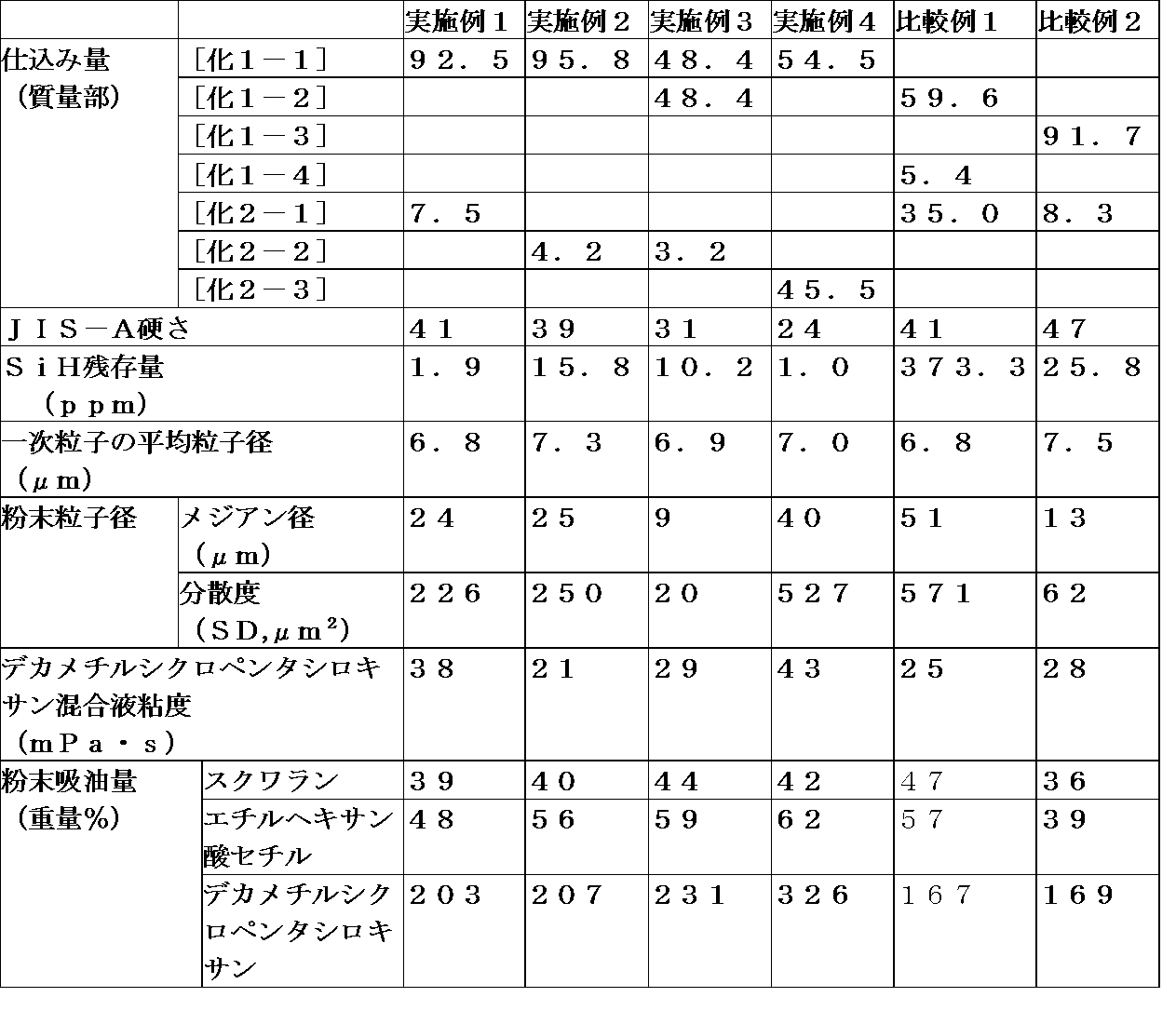
(成分)
相A
セチルジグリセリルトリス(トリメチルシロキシ)シリルエチルジメチコン
(注1) 5.0質量部
2) ジメチコン(注2)4.2質量部
3) メトキシケイヒ酸エチルヘキシル(注3)3.3質量部
4) カプリリルメチコン(注4)3.3質量部
5) イソドデカン、(ジメチコン/ビスーイソブチルPPG-20)クロスポリマー(注5)1.5質量部
6) 実施例のシリコーン架橋体 2.0質量部
相B
7)酸化チタン、タルク、メチコン(注6)4.71質量部
8)マイカ、水酸化アルミニウム (注7)2.46質量部
9)酸化鉄黄 (注8)0.66質量部
10)酸化鉄赤 (注9)0.16質量部
11)酸化鉄黒(注10)0.006質量部
12)セチルジグリセリルトリス(トリメチルシロキシ)シリルエチルジメチコン(注11)0.5質量部
13)カプリリルメチコン(注12)3.7質量部
相C
14)精製水 61.5質量部
15)BG 8.0質量部
16)塩化Na 1.0質量部
注1:東レ・ダウコーニング社製ES-5600 Silicone Glycerol Emulsfier
注2:東レ・ダウコーニング社製PMX-200 SILICONE FLUID 2CS
注3:Symrise 社製Neo Heliopan AV
注4:東レ・ダウコーニング社製FZ-3196
注5:東レ・ダウコーニング社製EL-8050 ID Silicone Organic Elastomer Blend
注6:三好化成社製SA Titan CR-50
注7:三好化成社製SA Exel Mica JP-2
注8:三好化成社製SA Yellow UXLO
注9:三好化成社製SA Red
注10:三好化成社製SA Black
注11:東レ・ダウコーニング社製ES-5600 Silicone Glycerol Emulsifier
注12:東レ・ダウコーニング社製FZ-3196
1. 成分1~6を均一になるまで混合する。
2. 成分7~13を3本ロール混合する。
3. 成分14~16を混合する。
4. 上記1と2を混合する。
5. 上記4を激しく攪拌しながら上記3を加え、乳化する。
(成分)
相A
1)実施例のシリコーン架橋体 18質量部
2)タルク(注1)18質量部
相B
3)精製水 20質量部
4)グリセリン 10質量部
相C
5)ポリアクリル酸ナトリウム、ジメチコン(注2)1質量部
6)DMDMヒダントイン、 ブチルカルバミン酸ヨウ化プロピニル(注3)適量
7)サリチル酸エチルヘキシル(注4)3質量部
8)メトキシケイヒ酸エチルヘキシル(注5)3質量部
相D
9)精製水 21質量部
相E
10)カプリリルメチコン(注6)2質量部
11)酸化鉄黒、ジメチコン(注7)0.05質量部
12)酸化鉄赤、ジメチコン(注8)0.1質量部
13)酸化鉄黄、ジメチコン(注9)0.25質量部
14)酸化チタン、タルク、ジメチコン(注10)3.6質量部
注1:三好化成社製Siタルク
注2:東レ・ダウコーニング社製RM 2051 Rheology Modifier
注3:Lonza社製Glydant Plus
注4:Symrise 社製Neo Heliopan OS
注5:ISP 社製Escalol 557
注6:東レ・ダウコーニング社製FZ-3196
注7:三好化成製SA-ブラック BL-100
注8:三好化成製SA-ベンガラ七宝
注9:三好化成製SI-YELLOW-LLXLO
注10:三好化成製SI-チタン CR-50
1.成分1と2を混合する。
2.成分3と4を混合する。
3.上記1と2を混合する。
4.成分5~8を混合する。
5.上記4に成分9を加えて混合する。
6.成分10~14を均一になるまで混合する。
7.全ての成分を混合する。
(成分)
相A
1) ラウリルPEG-10トリス(トリメチルシロキシ)シリルエチルジメチコン (注1)3質量部
2) カプリリルメチコン(注2)14質量部
3) メトキシケイヒ酸エチルヘキシル(注3)7.5質量部
4) ジエチルアミノヒドロキシベンゾイル安息香酸ヘキシル(注4)1.5質量部
5) サリチル酸エチルヘキシル 2.5質量部
6) トリメチルシロキシケイ酸、ポリプロピルシルセスキオキサン(注5)2質量部
7) 実施例のシリコーン架橋体 4質量部
8) フェニルトリメチコン(注6)4質量部
相B
9)グリセリン 8質量部
10)塩化Na 0.7質量部
11)精製水 40.8質量部
相C
12)酸化チタン 5.6質量部
13)酸化鉄黄(注7)0.25質量部
14)酸化鉄赤(注8)0.1質量部
15)酸化鉄黒(注9)0.05質量部
16)フェニルトリメチコン(注10)5.2質量部
17)酸化亜鉛(注11)0.8質量部
18)ラウリルPEG-10トリス(トリメチルシロキシ)シリルエチルジメチコン1質量部
注1:東レ・ダウコーニング社製ES-5300 Formulation Aid
注2:東レ・ダウコーニング社製FZ-3196
注3:BASF社製ユビナールMC80N
注4:BASF社製ユビナールA Plus Glanular
注5:東レ・ダウコーニング社製MQ-1640 Flake Resin
注6:東レ・ダウコーニング社製SH556
注7:三次化成社製SA-IOY-8
注8:三次化成社製SA-IOR-8
注9:三次化成社製SA-IOB-8
注10:東レ・ダウコーニング社製SH556
注11:堺化学工業社製FINEX-30S-LPT
注12:東レ・ダウコーニング社製ES-5300 Formulation Aid
1.成分1~8を混合する。(先にUV吸収剤を溶解し、MQ-1640はFZ-3196に溶解させる)
2.成分9~11を混合する。
3.成分12~18を混合する。
4.上記1と上記3を混合する。
5.上記1を激しく攪拌しながら、上記2をゆっくり加えて乳化する。
(成分)
相A
1)酸化チタン、ジメチコン(注1)49.23質量部
2)酸化鉄黄、ジメチコン(注2)9.86質量部
3)酸化鉄赤、ジメチコン(注3)1.97質量部
4)酸化鉄黒、ジメチコン(注4)0.55質量部
5)セチルジグリセリルトリス(トリメチルシロキシ)シリルエチルジメチコン(注5)1.58質量部
6)カプリリルメチコン(注6)15.8質量部
相B
7)実施例のシリコーン架橋体 2質量部
8)シクロペンタシロキサン(注7)13質量部
9)イソドデカン、(アクリレーツ/メタクリル酸ポリトリメチルシロキシ)コポリマー(注8)5質量部
10)ジステアルジモニウムヘクトライト (注9)1質量部
注1:三好化成社製SI-チタン CR-50
注2:三好化成社製SI-YELLOW-LLXLO
注3:三好化成社製SA-ベンガラ七宝
注4:三好化成社製SA-ブラック BL-100
注5:東レ・ダウコーニング社製 ES-5600 Silicone Glycerol Emulsifier
注6:東レ・ダウコーニング社製FZ-3196
注7:東レ・ダウコーニング社製SH245
注8:東レ・ダウコーニング社製FA 4002 ID Silicone Acrylate
注9:Elementis 社製Bentone(R) 38 V CG
1.成分1~6を混合する。
2.成分7~10を混合する。
3.上記1と2を混合する。
(成分)
1)タルク(注1)20質量部
2)マイカ(注2)34.6質量部
3)酸化チタン(注3)10質量部
4)酸化鉄赤(注4)1質量部
5)酸化鉄黄色(注5)4質量部
6)酸化鉄黒(注6)0.4質量部
7)マイカ(注7)15質量部
8)ポリスチレン(注8)5質量部
9)スクワラン 3質量部
10)ミリスチン酸オクチルドデシル(注9)1.2質量部
11)ワセリン2.5質量部
12)ジメチコン(注10)3.3質量部
13)実施例のシリコーン架橋体 5質量部
注1:三好化成社製SI Talc
注2:三好化成社製SI-SERICITE FSE
注3:三好化成社製SI-Titan CR-50
注4:三好化成社製SA Red
注5:三好化成社製SA Yellow UXLO
注6:三好化成社製SA Black
注7:三好化成社製SA-Excel Mica JP-2
注8:住友化学社製Fine pearl 3000SPQ
注9:花王社製EXCEPARL OD-M
注10:東レ・ダウコーニング社製SH200-5000cs
1.上記全てを混合する。
(成分)
相A
1)ラウリルPEG/PPG-18/18ジメチコン(注1)2質量部
2)ビス(ヒドロキシエトキシプロピル)ジメチコン(注2)2質量部
3)パルミチン酸イソプロピル(注3)1質量部
4)シクロペンタシロキサン(注4)6.5質量部
5)ミネラルオイル(注5)10質量部
6)ワセリン1.5質量部
7)実施例のシリコーン架橋体 5質量部
相B
8)グリセリン 5質量部
9)塩化Na 1質量部
10)精製水 66質量部
注1:東レ・ダウコーニング社製5200 Formulation Aid
注2:東レ・ダウコーニング社製5562 Carbinol Fluid
注3:花王社製エキセパールIPM
注4:東レ・ダウコーニング社製SH245
注5:カネダ社製ハイコールK-230
1.成分1~7を混合する。
2.成分8~10を混合する。
3.上記1を激しく攪拌しながら上記2をゆっくり加えて乳化する。
(成分)
1)酸化亜鉛(注1)6質量部
2)ラウリルPEG-10トリス(トリメチルシロキシ)シリルエチルジメチコン(注2)0.5質量部
3)ヘキサデカン 3.5質量部
4)メトキシケイヒ酸エチルヘキシル(注3)7.5質量部
5)ジメチコン、ジメチコンクロスポリマー(注4)24質量部
6)シクロペンタシロキサン(注5)60.5質量部
7)実施例のシリコーン架橋体 2質量部
注1:堺化学製FINEX-30S-LPT
注2:東レ・ダウコーニング社製ES-5300 Formulation Aid
注3:BASF社製ユビナールMC80N
注4:東レ・ダウコーニング社製9041 Silicone Elastomer Blend
注5:東レ・ダウコーニング社製SH245
1.成分1~3を混合する(ビーズミル等)。
2.上記成分に成分4~7を加えて均一になるまで攪拌する。
(成分)
相A
1)シクロペンタシロキサン(注1)11質量部
2)シリコーン架橋体 10質量部
3)ラウリルPEG/PPG-18/18ジメチコン(注2)0.5質量部
4)PEG-12ジメチコン(注3)4質量部
相B
5)精製水 72.5質量部
相C
6)ポリアクリルアミド、水、(C13,14)イソパラフィン 、ラウレス-7(注4)2質量部
注1:東レ・ダウコーニング社製SH245
注2:東レ・ダウコーニング社製5200 Formulation Aid
注3:東レ・ダウコーニング社製OFX-5329
注4:SEPPIC S.A. 社製Simulgel 305
1.成分1~4を均一になるまで混合する。
2.成分4と5を均一になるまで混合する。
3.上記2に1を加えて均一になるまで混合する。
Claims (14)
- 単位質量あたりのケイ素原子結合水素の含有量が300ppm以下であり、シリコーン粒子を構成するシロキサン中のケイ素原子が炭素数4~20のアルキレン基により他のケイ素原子に架橋してなるシリコーン粒子。
- 前記ケイ素原子に結合するアルキレン基の炭素数が4以上であり12以下である請求項1記載のシリコーン粒子。
- 次の(A)成分及び(B)成分を、
(A): 一分子中に炭素数が4以上かつ20以下のアルケニル基を2つ以上有するオルガノポリシロキサン、
(B): 一分子中に存在するケイ素原子結合水素原子が2個以上で且つ一分子中のケイ素原子数の40%以下であるケイ素有機化合物、及び/又は、
一分子中に存在するケイ素原子結合水素原子が2個以上あり、三官能性シロキサン単位又は四官能性シロキサン単位を含むケイ素有機化合物、
(A)成分のアルケニル基含有量(Alk)と(B)成分のケイ素原子結合水素原子含有量(H)のモル比が
H/Alk= 0.7 ~ 1.2
となるように含む組成物を反応してなるシリコーン粒子。 - (A)成分における前記アルケニル基の炭素数が4以上であり12以下である、請求項3記載のシリコーン粒子。
- 単位質量あたりのケイ素原子結合水素の含有量が300ppm以下である、請求項3記載のシリコーン粒子。
- レーザー回折散乱法により測定される粉末粒子径が1~50μmである、請求項1乃至5の何れか1項記載のシリコーン粒子。
- 硬化前のシリコーン粒子形成用架橋性組成物をシート状に硬化して測定されるJIS-A硬度が70以下である、請求項1乃至6の何れか1項記載のシリコーン粒子。
- 硬化前のシリコーン粒子形成用架橋性組成物をシート状に硬化して測定されるJIS-A硬度(Vα)、およびレーザー回折散乱法により測定されるシリコーン粒子の粉末粒子径(Vβ)μmについて、以下の関係を満たすことを特徴とする、請求項1乃至7の何れか1項記載のシリコーン粒子。
Vα × Vβ ≦ 1,200
- 化粧品原料である請求項1乃至8の何れか1項に記載のシリコーン粒子。
- 請求項9に記載のシリコーン粒子を含有する化粧品。
- 樹脂配合剤である請求項1乃至8の何れか1項に記載のシリコーン粒子。
- 請求項11に記載のシリコーン粒子を含有する塗料。
- 次の(A)成分及び(B)成分を、
(A): 一分子中に炭素数が4以上かつ20以下のアルケニル基を2つ以上有するオルガノポリシロキサン、及び
(B): 一分子中に存在するケイ素原子結合水素原子が2個以上で且つ一分子中のケイ素原子数の40%以下であるケイ素有機化合物、又は、
一分子中に存在するケイ素原子結合水素原子が2個以上あり、三官能性シロキサン単位又は四官能性シロキサン単位を含むケイ素有機化合物、
を、(A)成分中のアルケニル基含有量(Alk)と(B)成分のケイ素原子結合水素原子含有量(H)のモル比がH/Alk= 0.7 ~ 1.2となるように含むシリコーン粒子形成用架橋性組成物。 - 請求項13に記載の組成物を乳化し、触媒の存在下で硬化させるシリコーン粒子の製造方法。
Priority Applications (7)
| Application Number | Priority Date | Filing Date | Title |
|---|---|---|---|
| EP17792731.6A EP3453736A4 (en) | 2016-05-02 | 2017-04-27 | SILICONE PARTICLE AND COSMETICS, COATING AND RESIN FORMULATED THEREOF |
| US16/097,911 US10988580B2 (en) | 2016-05-02 | 2017-04-27 | Silicone particles, and cosmetic, coating, and resin formulated using same |
| KR1020187033109A KR102365802B1 (ko) | 2016-05-02 | 2017-04-27 | 실리콘 입자, 이것을 배합한 화장료 및 도료 및 수지 |
| CN201780026067.4A CN109153790B (zh) | 2016-05-02 | 2017-04-27 | 有机硅颗粒、配伍有其的化妆品、涂料及树脂 |
| JP2018515710A JP6949831B2 (ja) | 2016-05-02 | 2017-04-27 | シリコーン粒子、これを配合した化粧料及び塗料及び樹脂 |
| CN202210037689.XA CN114349987B (zh) | 2016-05-02 | 2017-04-27 | 有机硅颗粒、配伍有其的化妆品、涂料及树脂 |
| US17/203,341 US11643505B2 (en) | 2016-05-02 | 2021-03-16 | Silicone particles, and cosmetic, coating, and resin formulated using same |
Applications Claiming Priority (2)
| Application Number | Priority Date | Filing Date | Title |
|---|---|---|---|
| JP2016092759 | 2016-05-02 | ||
| JP2016-092759 | 2016-05-02 |
Related Child Applications (2)
| Application Number | Title | Priority Date | Filing Date |
|---|---|---|---|
| US16/097,911 A-371-Of-International US10988580B2 (en) | 2016-05-02 | 2017-04-27 | Silicone particles, and cosmetic, coating, and resin formulated using same |
| US17/203,341 Division US11643505B2 (en) | 2016-05-02 | 2021-03-16 | Silicone particles, and cosmetic, coating, and resin formulated using same |
Publications (1)
| Publication Number | Publication Date |
|---|---|
| WO2017191798A1 true WO2017191798A1 (ja) | 2017-11-09 |
Family
ID=60203530
Family Applications (1)
| Application Number | Title | Priority Date | Filing Date |
|---|---|---|---|
| PCT/JP2017/016648 Ceased WO2017191798A1 (ja) | 2016-05-02 | 2017-04-27 | シリコーン粒子、これを配合した化粧料及び塗料及び樹脂 |
Country Status (6)
| Country | Link |
|---|---|
| US (2) | US10988580B2 (ja) |
| EP (1) | EP3453736A4 (ja) |
| JP (1) | JP6949831B2 (ja) |
| KR (1) | KR102365802B1 (ja) |
| CN (2) | CN109153790B (ja) |
| WO (1) | WO2017191798A1 (ja) |
Cited By (15)
| Publication number | Priority date | Publication date | Assignee | Title |
|---|---|---|---|---|
| WO2019124418A1 (ja) | 2017-12-20 | 2019-06-27 | ダウ・東レ株式会社 | シリコーン樹脂被覆シリコーンエラストマー粒子および有機樹脂添加剤その他の用途 |
| WO2019189394A1 (ja) | 2018-03-27 | 2019-10-03 | ダウ・東レ株式会社 | 油剤含有シリコーンエラストマー粒子および化粧料組成物その他の用途 |
| WO2020036063A1 (ja) * | 2018-08-15 | 2020-02-20 | ダウ・東レ株式会社 | 化粧料 |
| WO2020137913A1 (ja) | 2018-12-27 | 2020-07-02 | ダウ・東レ株式会社 | シリコーン樹脂被覆シリコーンエラストマー粒子および有機樹脂添加剤その他の用途 |
| CN111393863A (zh) * | 2020-04-14 | 2020-07-10 | 四川路友交通物资发展有限公司 | 一种橡胶粉改性沥青及其制备方法 |
| JP2022030780A (ja) * | 2020-08-07 | 2022-02-18 | ポーラ化成工業株式会社 | 油中水乳化組成物 |
| WO2022138346A1 (ja) | 2020-12-25 | 2022-06-30 | ダウ・東レ株式会社 | 新規シリコーンエラストマー粒子および化粧料組成物その他の用途 |
| WO2023276648A1 (ja) * | 2021-07-01 | 2023-01-05 | 信越化学工業株式会社 | シリコーンゴム球状粒子用液状組成物、シリコーンゴム球状粒子およびその製造方法、およびシリコーン複合粒子およびその製造方法 |
| WO2023120690A1 (ja) | 2021-12-24 | 2023-06-29 | ダウ・東レ株式会社 | 反応性基含有ポリカプロラクトン化合物、それを用いる新規シリコーンエラストマー粒子および化粧料組成物その他の用途 |
| WO2024135816A1 (ja) | 2022-12-23 | 2024-06-27 | ダウ・東レ株式会社 | 反応性基含有ポリカーボネート化合物、それを用いる新規シリコーンエラストマー粒子および化粧料組成物その他の用途 |
| WO2024135815A1 (ja) | 2022-12-23 | 2024-06-27 | ダウ・東レ株式会社 | ラジカル重合性ポリカーボネート変性シリコーン化合物、それを用いる新規シリコーン-ポリカーボネート共重合体粒子および化粧料組成物その他の用途 |
| WO2024135814A1 (ja) | 2022-12-23 | 2024-06-27 | ダウ・東レ株式会社 | ラジカル重合性ポリカプロラクトン変性シリコーン化合物、それを用いる新規シリコーン-ポリカプロラクトン共重合体粒子および化粧料組成物その他の用途 |
| US12023403B2 (en) | 2018-08-15 | 2024-07-02 | Dow Toray Co., Ltd. | Oil-in-water type emulsion cosmetics |
| US12453694B2 (en) | 2019-04-24 | 2025-10-28 | Dow Toray Co., Ltd. | Cosmetic composition |
| US12569428B2 (en) | 2019-04-10 | 2026-03-10 | Dow Toray Co., Ltd. | Oil-in-water cleansing cosmetic composition |
Families Citing this family (5)
| Publication number | Priority date | Publication date | Assignee | Title |
|---|---|---|---|---|
| JP7081784B2 (ja) * | 2018-01-09 | 2022-06-07 | 株式会社トキワ | 固形粉末化粧料及び固形粉末化粧料の製造方法 |
| KR102644636B1 (ko) * | 2021-08-09 | 2024-03-06 | 계명대학교 산학협력단 | 불소실리콘 코팅용액 제조방법 및 이에 의해 제조된 코팅용액 |
| US20230144849A1 (en) * | 2021-10-29 | 2023-05-11 | L'oreal | Water-in-oil emulsions including surfactant, water-soluble vinyl polymer and organosiloxane |
| KR102525448B1 (ko) * | 2022-11-25 | 2023-04-25 | 주식회사 노투스팜 | 주사기 탈착의 편의성을 강화한 의료용 인젝터 |
| CN116445126B (zh) * | 2022-12-31 | 2025-09-19 | 江苏诚睿达光电有限公司 | 一种低挥发吸附性led用热固性有机硅树脂 |
Citations (9)
| Publication number | Priority date | Publication date | Assignee | Title |
|---|---|---|---|---|
| JP2000034205A (ja) * | 1998-07-21 | 2000-02-02 | Dow Corning Toray Silicone Co Ltd | 化粧品原料、化粧品、および化粧品の製造方法 |
| JP2001040214A (ja) * | 1999-08-03 | 2001-02-13 | Dow Corning Toray Silicone Co Ltd | 有機架橋粒子、そのサスペンジョン、およびそれらの製造方法 |
| JP2001040097A (ja) * | 1999-08-03 | 2001-02-13 | Dow Corning Toray Silicone Co Ltd | 有機架橋粒子、そのサスペンジョン、およびそれらの製造方法 |
| JP2009530477A (ja) * | 2006-03-21 | 2009-08-27 | ダウ・コーニング・コーポレイション | シリコーンエラストマーゲル |
| JP2011219547A (ja) * | 2010-04-06 | 2011-11-04 | Shin-Etsu Chemical Co Ltd | エラストマー球状微粒子をポリオルガノシルセスキオキサンで被覆した複合微粒子およびその製造方法 |
| JP5185111B2 (ja) | 2005-11-17 | 2013-04-17 | 東レ・ダウコーニング株式会社 | シリコーンゴムパウダーの吸油性のコントロール方法 |
| JP2014122316A (ja) | 2012-12-22 | 2014-07-03 | Dow Corning Toray Co Ltd | 低白金量のヒドロシリル化反応架橋性シリコーンゴムパウダー、化粧料およびシリコーンゴムパウダーの製造方法 |
| JP2015113303A (ja) | 2013-12-11 | 2015-06-22 | 東レ・ダウコーニング株式会社 | 表面処理粉体、それを含むスラリー組成物、化粧料用原料及び化粧料 |
| WO2017018358A1 (ja) * | 2015-07-24 | 2017-02-02 | 東レ・ダウコーニング株式会社 | 硬化シリコーン粒子、これを配合した化粧料 |
Family Cites Families (9)
| Publication number | Priority date | Publication date | Assignee | Title |
|---|---|---|---|---|
| US5665804A (en) | 1996-02-05 | 1997-09-09 | Dow Corning Corporation | Silicone latex solvent thickening |
| JP5337333B2 (ja) * | 2001-06-29 | 2013-11-06 | 東レ・ダウコーニング株式会社 | 架橋シリコーン粒子の水系サスペンジョンおよび架橋シリコーン粒子を含有するオイルの水系エマルジョン |
| WO2007109282A2 (en) | 2006-03-21 | 2007-09-27 | Dow Corning Corporation | Silicone-organic elastomer gels |
| CN101432341B (zh) * | 2006-03-21 | 2013-03-27 | 陶氏康宁公司 | 硅氧烷有机弹性体凝胶 |
| KR101387294B1 (ko) | 2006-03-21 | 2014-04-18 | 다우 코닝 코포레이션 | 실리콘 폴리에터 엘라스토머 겔 |
| JP5539689B2 (ja) * | 2009-09-14 | 2014-07-02 | 東レ・ダウコーニング株式会社 | エマルジョン、その製造方法、および架橋性シリコーン組成物 |
| US8776292B2 (en) * | 2010-03-15 | 2014-07-15 | Richard T. Ryan | Sound enhancing pillow |
| JP6369888B2 (ja) * | 2011-12-27 | 2018-08-08 | 東レ・ダウコーニング株式会社 | 新規液状オルガノポリシロキサン及びその利用 |
| JP5931832B2 (ja) * | 2013-10-29 | 2016-06-08 | 信越化学工業株式会社 | シリコーンゴム粒子の水分散液、シリコーンゴム粒子、及び化粧料 |
-
2017
- 2017-04-27 EP EP17792731.6A patent/EP3453736A4/en active Pending
- 2017-04-27 WO PCT/JP2017/016648 patent/WO2017191798A1/ja not_active Ceased
- 2017-04-27 KR KR1020187033109A patent/KR102365802B1/ko active Active
- 2017-04-27 CN CN201780026067.4A patent/CN109153790B/zh active Active
- 2017-04-27 US US16/097,911 patent/US10988580B2/en active Active
- 2017-04-27 CN CN202210037689.XA patent/CN114349987B/zh active Active
- 2017-04-27 JP JP2018515710A patent/JP6949831B2/ja active Active
-
2021
- 2021-03-16 US US17/203,341 patent/US11643505B2/en active Active
Patent Citations (10)
| Publication number | Priority date | Publication date | Assignee | Title |
|---|---|---|---|---|
| JP2000034205A (ja) * | 1998-07-21 | 2000-02-02 | Dow Corning Toray Silicone Co Ltd | 化粧品原料、化粧品、および化粧品の製造方法 |
| JP2001040214A (ja) * | 1999-08-03 | 2001-02-13 | Dow Corning Toray Silicone Co Ltd | 有機架橋粒子、そのサスペンジョン、およびそれらの製造方法 |
| JP2001040097A (ja) * | 1999-08-03 | 2001-02-13 | Dow Corning Toray Silicone Co Ltd | 有機架橋粒子、そのサスペンジョン、およびそれらの製造方法 |
| JP4371480B2 (ja) | 1999-08-03 | 2009-11-25 | 東レ・ダウコーニング株式会社 | 有機架橋粒子、そのサスペンジョン、およびそれらの製造方法 |
| JP5185111B2 (ja) | 2005-11-17 | 2013-04-17 | 東レ・ダウコーニング株式会社 | シリコーンゴムパウダーの吸油性のコントロール方法 |
| JP2009530477A (ja) * | 2006-03-21 | 2009-08-27 | ダウ・コーニング・コーポレイション | シリコーンエラストマーゲル |
| JP2011219547A (ja) * | 2010-04-06 | 2011-11-04 | Shin-Etsu Chemical Co Ltd | エラストマー球状微粒子をポリオルガノシルセスキオキサンで被覆した複合微粒子およびその製造方法 |
| JP2014122316A (ja) | 2012-12-22 | 2014-07-03 | Dow Corning Toray Co Ltd | 低白金量のヒドロシリル化反応架橋性シリコーンゴムパウダー、化粧料およびシリコーンゴムパウダーの製造方法 |
| JP2015113303A (ja) | 2013-12-11 | 2015-06-22 | 東レ・ダウコーニング株式会社 | 表面処理粉体、それを含むスラリー組成物、化粧料用原料及び化粧料 |
| WO2017018358A1 (ja) * | 2015-07-24 | 2017-02-02 | 東レ・ダウコーニング株式会社 | 硬化シリコーン粒子、これを配合した化粧料 |
Cited By (44)
| Publication number | Priority date | Publication date | Assignee | Title |
|---|---|---|---|---|
| KR102698588B1 (ko) * | 2017-12-20 | 2024-08-28 | 다우 도레이 캄파니 리미티드 | 실리콘 수지 피복 실리콘 엘라스토머 입자 및 유기수지 첨가제 기타 용도 |
| JPWO2019124418A1 (ja) * | 2017-12-20 | 2020-12-10 | ダウ・東レ株式会社 | シリコーン樹脂被覆シリコーンエラストマー粒子および有機樹脂添加剤その他の用途 |
| WO2019124418A1 (ja) | 2017-12-20 | 2019-06-27 | ダウ・東レ株式会社 | シリコーン樹脂被覆シリコーンエラストマー粒子および有機樹脂添加剤その他の用途 |
| JP7218993B2 (ja) | 2017-12-20 | 2023-02-07 | ダウ・東レ株式会社 | シリコーン樹脂被覆シリコーンエラストマー粒子および有機樹脂添加剤その他の用途 |
| US20200332124A1 (en) * | 2017-12-20 | 2020-10-22 | Dow Toray Co., Ltd. | Silicone resin-covered silicone elastomer particles, organic resin additive, and other uses |
| CN111372974A (zh) * | 2017-12-20 | 2020-07-03 | 陶氏东丽株式会社 | 硅酮树脂包覆硅酮弹性体粒子及有机树脂添加剂等用途 |
| US12215204B2 (en) * | 2017-12-20 | 2025-02-04 | Dow Toray Co., Ltd. | Silicone resin-covered silicone elastomer particles, organic resin additive, and other uses |
| KR20200101362A (ko) * | 2017-12-20 | 2020-08-27 | 다우 도레이 캄파니 리미티드 | 실리콘 수지 피복 실리콘 엘라스토머 입자 및 유기수지 첨가제 기타 용도 |
| WO2019189394A1 (ja) | 2018-03-27 | 2019-10-03 | ダウ・東レ株式会社 | 油剤含有シリコーンエラストマー粒子および化粧料組成物その他の用途 |
| JPWO2019189394A1 (ja) * | 2018-03-27 | 2021-04-08 | ダウ・東レ株式会社 | 油剤含有シリコーンエラストマー粒子および化粧料組成物その他の用途 |
| US12133910B2 (en) | 2018-03-27 | 2024-11-05 | Dow Toray Co., Ltd. | Oil agent-containing silicone elastomer particle and use thereof in cosmetic composition, etc |
| JP7401425B2 (ja) | 2018-03-27 | 2023-12-19 | ダウ・東レ株式会社 | 油剤含有シリコーンエラストマー粒子および化粧料組成物その他の用途 |
| US12502345B2 (en) | 2018-08-15 | 2025-12-23 | Dow Toray Co., Ltd. | Cosmetic |
| JP2020029454A (ja) * | 2018-08-15 | 2020-02-27 | ジェイオーコスメティックス株式会社 | 化粧料 |
| US12023403B2 (en) | 2018-08-15 | 2024-07-02 | Dow Toray Co., Ltd. | Oil-in-water type emulsion cosmetics |
| JP7422354B2 (ja) | 2018-08-15 | 2024-01-26 | ジェイオーコスメティックス株式会社 | 化粧料 |
| WO2020036063A1 (ja) * | 2018-08-15 | 2020-02-20 | ダウ・東レ株式会社 | 化粧料 |
| JP7406504B2 (ja) | 2018-12-27 | 2023-12-27 | ダウ・東レ株式会社 | シリコーン樹脂被覆シリコーンエラストマー粒子および有機樹脂添加剤その他の用途 |
| JPWO2020137913A1 (ja) * | 2018-12-27 | 2021-11-11 | ダウ・東レ株式会社 | シリコーン樹脂被覆シリコーンエラストマー粒子および有機樹脂添加剤その他の用途 |
| KR20210108991A (ko) | 2018-12-27 | 2021-09-03 | 다우 도레이 캄파니 리미티드 | 실리콘 수지 피복 실리콘 엘라스토머 입자 및 유기 수지 첨가제 그 외의 용도 |
| US12060464B2 (en) | 2018-12-27 | 2024-08-13 | Dow Toray Co., Ltd. | Silicone resin-coated silicone elastomer particles, and applications thereof including organic resin additives |
| WO2020137913A1 (ja) | 2018-12-27 | 2020-07-02 | ダウ・東レ株式会社 | シリコーン樹脂被覆シリコーンエラストマー粒子および有機樹脂添加剤その他の用途 |
| US20220073684A1 (en) * | 2018-12-27 | 2022-03-10 | Dow Toray Co., Ltd. | Silicone resin-coated silicone elastomer particles, and applications thereof including organic resin additives |
| US12569428B2 (en) | 2019-04-10 | 2026-03-10 | Dow Toray Co., Ltd. | Oil-in-water cleansing cosmetic composition |
| US12453694B2 (en) | 2019-04-24 | 2025-10-28 | Dow Toray Co., Ltd. | Cosmetic composition |
| CN111393863A (zh) * | 2020-04-14 | 2020-07-10 | 四川路友交通物资发展有限公司 | 一种橡胶粉改性沥青及其制备方法 |
| JP2022030780A (ja) * | 2020-08-07 | 2022-02-18 | ポーラ化成工業株式会社 | 油中水乳化組成物 |
| JP7713294B2 (ja) | 2020-08-07 | 2025-07-25 | ポーラ化成工業株式会社 | 油中水乳化組成物 |
| WO2022138346A1 (ja) | 2020-12-25 | 2022-06-30 | ダウ・東レ株式会社 | 新規シリコーンエラストマー粒子および化粧料組成物その他の用途 |
| KR20230125001A (ko) | 2020-12-25 | 2023-08-28 | 다우 도레이 캄파니 리미티드 | 신규 실리콘 엘라스토머 입자 및 화장료 조성물 그 외의 용도 |
| JP2023007034A (ja) * | 2021-07-01 | 2023-01-18 | 信越化学工業株式会社 | シリコーンゴム球状粒子用液状組成物、シリコーンゴム球状粒子およびその製造方法、およびシリコーン複合粒子およびその製造方法 |
| WO2023276648A1 (ja) * | 2021-07-01 | 2023-01-05 | 信越化学工業株式会社 | シリコーンゴム球状粒子用液状組成物、シリコーンゴム球状粒子およびその製造方法、およびシリコーン複合粒子およびその製造方法 |
| JP7706959B2 (ja) | 2021-07-01 | 2025-07-14 | 信越化学工業株式会社 | シリコーンゴム球状粒子用液状組成物、シリコーンゴム球状粒子およびその製造方法、およびシリコーン複合粒子およびその製造方法 |
| KR20240130102A (ko) | 2021-12-24 | 2024-08-28 | 다우 도레이 캄파니 리미티드 | 반응성기 함유 폴리카프로락톤 화합물, 이를 사용하는 신규 실리콘 엘라스토머 입자 및 화장료 조성물 그 외 용도 |
| WO2023120690A1 (ja) | 2021-12-24 | 2023-06-29 | ダウ・東レ株式会社 | 反応性基含有ポリカプロラクトン化合物、それを用いる新規シリコーンエラストマー粒子および化粧料組成物その他の用途 |
| WO2024135816A1 (ja) | 2022-12-23 | 2024-06-27 | ダウ・東レ株式会社 | 反応性基含有ポリカーボネート化合物、それを用いる新規シリコーンエラストマー粒子および化粧料組成物その他の用途 |
| KR20250126009A (ko) | 2022-12-23 | 2025-08-22 | 다우 도레이 캄파니 리미티드 | 라디칼 중합성 폴리카보네이트 변성 실리콘 화합물, 이를 사용하는 신규 실리콘-폴리카보네이트 공중합체 입자 및 화장료 조성물 그 외의 용도 |
| KR20250127074A (ko) | 2022-12-23 | 2025-08-26 | 다우 도레이 캄파니 리미티드 | 반응성기 함유 폴리카보네이트 화합물, 이를 사용하는 신규 실리콘 엘라스토머 입자 및 화장료 조성물 그 외의 용도 |
| KR20250126008A (ko) | 2022-12-23 | 2025-08-22 | 다우 도레이 캄파니 리미티드 | 라디칼 중합성 폴리카프로락톤 변성 실리콘 화합물, 이를 사용하는 신규 실리콘-폴리카프로락톤 공중합체 입자 및 화장료 조성물 그 외의 용도 |
| EP4640748A1 (en) | 2022-12-23 | 2025-10-29 | Dow Toray Co., Ltd. | Radical-polymerizable polycarbonate-modified silicone compound, novel silicone/polycarbonate copolymer particles obtained therefrom, and cosmetic composition and other uses |
| EP4640739A1 (en) | 2022-12-23 | 2025-10-29 | Dow Toray Co., Ltd. | Reactive group-containing polycarbonate compound, new silicone elastomer particles using same, cosmetic material composition, and other use application |
| EP4640747A1 (en) | 2022-12-23 | 2025-10-29 | Dow Toray Co., Ltd. | Radically polymerizable polycaprolactone-modified silicone compound, novel silicone-polycaprolactone copolymer particles and cosmetic composition using same, and other uses |
| WO2024135814A1 (ja) | 2022-12-23 | 2024-06-27 | ダウ・東レ株式会社 | ラジカル重合性ポリカプロラクトン変性シリコーン化合物、それを用いる新規シリコーン-ポリカプロラクトン共重合体粒子および化粧料組成物その他の用途 |
| WO2024135815A1 (ja) | 2022-12-23 | 2024-06-27 | ダウ・東レ株式会社 | ラジカル重合性ポリカーボネート変性シリコーン化合物、それを用いる新規シリコーン-ポリカーボネート共重合体粒子および化粧料組成物その他の用途 |
Also Published As
| Publication number | Publication date |
|---|---|
| EP3453736A4 (en) | 2019-11-20 |
| KR20190004720A (ko) | 2019-01-14 |
| CN114349987A (zh) | 2022-04-15 |
| CN114349987B (zh) | 2023-11-03 |
| US20210198432A1 (en) | 2021-07-01 |
| JP6949831B2 (ja) | 2021-10-13 |
| EP3453736A1 (en) | 2019-03-13 |
| CN109153790B (zh) | 2024-02-20 |
| US20190144612A1 (en) | 2019-05-16 |
| US10988580B2 (en) | 2021-04-27 |
| US11643505B2 (en) | 2023-05-09 |
| JPWO2017191798A1 (ja) | 2019-03-07 |
| CN109153790A (zh) | 2019-01-04 |
| KR102365802B1 (ko) | 2022-02-24 |
Similar Documents
| Publication | Publication Date | Title |
|---|---|---|
| US11643505B2 (en) | Silicone particles, and cosmetic, coating, and resin formulated using same | |
| CN102946852B (zh) | 包含糖醇改性的有机聚硅氧烷的粉末处理剂 | |
| JP6688801B2 (ja) | 硬化シリコーン粒子、これを配合した化粧料 | |
| CN102906161B (zh) | 有机聚硅氧烷、包含有机聚硅氧烷的表面活性剂、乳液组合物、粉末处理剂、油基原料的增稠剂、胶凝剂、凝胶组合物和化妆品原料、以及包含它们的外用配制品和化妆品 | |
| CN104136498B (zh) | 新型液体有机聚硅氧烷及其用途 | |
| JP6043091B2 (ja) | 新規オルガノポリシロキサンエラストマー及びその利用 | |
| CN103209679B (zh) | 包含高级醇改性的硅酮的化妆品和局部用皮肤制剂 | |
| CN102712759B (zh) | 用于油类材料的增稠剂或胶凝剂、包含该增稠剂或胶凝剂的凝胶组合物及制备化妆品材料或局部剂的方法 | |
| JP5491152B2 (ja) | 無臭化したポリオキシアルキレン変性ポリシロキサン組成物の製造方法、それを含有してなる化粧料原料および化粧料 | |
| CN102666663A (zh) | 新的有机聚硅氧烷共聚物 | |
| CN102947369A (zh) | 有机聚硅氧烷及其作为表面活性剂、粉末处理剂、油基原料的增稠剂或胶凝剂的用途,包含所述有机聚硅氧烷的凝胶组合物和乳液组合物以及外用配制品和化妆品 | |
| CN109071822B (zh) | 有机聚硅氧烷、化妆品及有机聚硅氧烷的制备方法 | |
| JP6859015B2 (ja) | 化粧料組成物および化粧料及び皮膚外用剤 | |
| JP6307259B2 (ja) | 表面処理粉体、それを含むスラリー組成物、化粧料用原料及び化粧料 |
Legal Events
| Date | Code | Title | Description |
|---|---|---|---|
| WWE | Wipo information: entry into national phase |
Ref document number: 2018515710 Country of ref document: JP |
|
| NENP | Non-entry into the national phase |
Ref country code: DE |
|
| ENP | Entry into the national phase |
Ref document number: 20187033109 Country of ref document: KR Kind code of ref document: A |
|
| 121 | Ep: the epo has been informed by wipo that ep was designated in this application |
Ref document number: 17792731 Country of ref document: EP Kind code of ref document: A1 |
|
| ENP | Entry into the national phase |
Ref document number: 2017792731 Country of ref document: EP Effective date: 20181203 |