WO2017195574A1 - ポリイミド樹脂及びポリイミド樹脂組成物 - Google Patents
ポリイミド樹脂及びポリイミド樹脂組成物 Download PDFInfo
- Publication number
- WO2017195574A1 WO2017195574A1 PCT/JP2017/016076 JP2017016076W WO2017195574A1 WO 2017195574 A1 WO2017195574 A1 WO 2017195574A1 JP 2017016076 W JP2017016076 W JP 2017016076W WO 2017195574 A1 WO2017195574 A1 WO 2017195574A1
- Authority
- WO
- WIPO (PCT)
- Prior art keywords
- structural unit
- polyimide resin
- derived
- mol
- compound represented
- Prior art date
- Legal status (The legal status is an assumption and is not a legal conclusion. Google has not performed a legal analysis and makes no representation as to the accuracy of the status listed.)
- Ceased
Links
Classifications
-
- C—CHEMISTRY; METALLURGY
- C08—ORGANIC MACROMOLECULAR COMPOUNDS; THEIR PREPARATION OR CHEMICAL WORKING-UP; COMPOSITIONS BASED THEREON
- C08G—MACROMOLECULAR COMPOUNDS OBTAINED OTHERWISE THAN BY REACTIONS ONLY INVOLVING UNSATURATED CARBON-TO-CARBON BONDS
- C08G73/00—Macromolecular compounds obtained by reactions forming a linkage containing nitrogen with or without oxygen or carbon in the main chain of the macromolecule, not provided for in groups C08G12/00 - C08G71/00
- C08G73/06—Polycondensates having nitrogen-containing heterocyclic rings in the main chain of the macromolecule
- C08G73/10—Polyimides; Polyester-imides; Polyamide-imides; Polyamide acids or similar polyimide precursors
- C08G73/1046—Polyimides containing oxygen in the form of ether bonds in the main chain
-
- C—CHEMISTRY; METALLURGY
- C08—ORGANIC MACROMOLECULAR COMPOUNDS; THEIR PREPARATION OR CHEMICAL WORKING-UP; COMPOSITIONS BASED THEREON
- C08G—MACROMOLECULAR COMPOUNDS OBTAINED OTHERWISE THAN BY REACTIONS ONLY INVOLVING UNSATURATED CARBON-TO-CARBON BONDS
- C08G73/00—Macromolecular compounds obtained by reactions forming a linkage containing nitrogen with or without oxygen or carbon in the main chain of the macromolecule, not provided for in groups C08G12/00 - C08G71/00
- C08G73/06—Polycondensates having nitrogen-containing heterocyclic rings in the main chain of the macromolecule
- C08G73/10—Polyimides; Polyester-imides; Polyamide-imides; Polyamide acids or similar polyimide precursors
- C08G73/1075—Partially aromatic polyimides
- C08G73/1082—Partially aromatic polyimides wholly aromatic in the tetracarboxylic moiety
-
- C—CHEMISTRY; METALLURGY
- C08—ORGANIC MACROMOLECULAR COMPOUNDS; THEIR PREPARATION OR CHEMICAL WORKING-UP; COMPOSITIONS BASED THEREON
- C08G—MACROMOLECULAR COMPOUNDS OBTAINED OTHERWISE THAN BY REACTIONS ONLY INVOLVING UNSATURATED CARBON-TO-CARBON BONDS
- C08G73/00—Macromolecular compounds obtained by reactions forming a linkage containing nitrogen with or without oxygen or carbon in the main chain of the macromolecule, not provided for in groups C08G12/00 - C08G71/00
- C08G73/06—Polycondensates having nitrogen-containing heterocyclic rings in the main chain of the macromolecule
- C08G73/10—Polyimides; Polyester-imides; Polyamide-imides; Polyamide acids or similar polyimide precursors
- C08G73/1003—Preparatory processes
- C08G73/1007—Preparatory processes from tetracarboxylic acids or derivatives and diamines
-
- C—CHEMISTRY; METALLURGY
- C08—ORGANIC MACROMOLECULAR COMPOUNDS; THEIR PREPARATION OR CHEMICAL WORKING-UP; COMPOSITIONS BASED THEREON
- C08G—MACROMOLECULAR COMPOUNDS OBTAINED OTHERWISE THAN BY REACTIONS ONLY INVOLVING UNSATURATED CARBON-TO-CARBON BONDS
- C08G73/00—Macromolecular compounds obtained by reactions forming a linkage containing nitrogen with or without oxygen or carbon in the main chain of the macromolecule, not provided for in groups C08G12/00 - C08G71/00
- C08G73/06—Polycondensates having nitrogen-containing heterocyclic rings in the main chain of the macromolecule
- C08G73/10—Polyimides; Polyester-imides; Polyamide-imides; Polyamide acids or similar polyimide precursors
- C08G73/1042—Copolyimides derived from at least two different tetracarboxylic compounds or two different diamino compounds
-
- C—CHEMISTRY; METALLURGY
- C08—ORGANIC MACROMOLECULAR COMPOUNDS; THEIR PREPARATION OR CHEMICAL WORKING-UP; COMPOSITIONS BASED THEREON
- C08G—MACROMOLECULAR COMPOUNDS OBTAINED OTHERWISE THAN BY REACTIONS ONLY INVOLVING UNSATURATED CARBON-TO-CARBON BONDS
- C08G73/00—Macromolecular compounds obtained by reactions forming a linkage containing nitrogen with or without oxygen or carbon in the main chain of the macromolecule, not provided for in groups C08G12/00 - C08G71/00
- C08G73/06—Polycondensates having nitrogen-containing heterocyclic rings in the main chain of the macromolecule
- C08G73/10—Polyimides; Polyester-imides; Polyamide-imides; Polyamide acids or similar polyimide precursors
- C08G73/1057—Polyimides containing other atoms than carbon, hydrogen, nitrogen or oxygen in the main chain
- C08G73/1064—Polyimides containing other atoms than carbon, hydrogen, nitrogen or oxygen in the main chain containing sulfur
-
- C—CHEMISTRY; METALLURGY
- C08—ORGANIC MACROMOLECULAR COMPOUNDS; THEIR PREPARATION OR CHEMICAL WORKING-UP; COMPOSITIONS BASED THEREON
- C08G—MACROMOLECULAR COMPOUNDS OBTAINED OTHERWISE THAN BY REACTIONS ONLY INVOLVING UNSATURATED CARBON-TO-CARBON BONDS
- C08G73/00—Macromolecular compounds obtained by reactions forming a linkage containing nitrogen with or without oxygen or carbon in the main chain of the macromolecule, not provided for in groups C08G12/00 - C08G71/00
- C08G73/06—Polycondensates having nitrogen-containing heterocyclic rings in the main chain of the macromolecule
- C08G73/10—Polyimides; Polyester-imides; Polyamide-imides; Polyamide acids or similar polyimide precursors
- C08G73/1067—Wholly aromatic polyimides, i.e. having both tetracarboxylic and diamino moieties aromatically bound
- C08G73/1071—Wholly aromatic polyimides containing oxygen in the form of ether bonds in the main chain
-
- C—CHEMISTRY; METALLURGY
- C08—ORGANIC MACROMOLECULAR COMPOUNDS; THEIR PREPARATION OR CHEMICAL WORKING-UP; COMPOSITIONS BASED THEREON
- C08G—MACROMOLECULAR COMPOUNDS OBTAINED OTHERWISE THAN BY REACTIONS ONLY INVOLVING UNSATURATED CARBON-TO-CARBON BONDS
- C08G73/00—Macromolecular compounds obtained by reactions forming a linkage containing nitrogen with or without oxygen or carbon in the main chain of the macromolecule, not provided for in groups C08G12/00 - C08G71/00
- C08G73/06—Polycondensates having nitrogen-containing heterocyclic rings in the main chain of the macromolecule
- C08G73/10—Polyimides; Polyester-imides; Polyamide-imides; Polyamide acids or similar polyimide precursors
- C08G73/1075—Partially aromatic polyimides
- C08G73/1078—Partially aromatic polyimides wholly aromatic in the diamino moiety
-
- C—CHEMISTRY; METALLURGY
- C08—ORGANIC MACROMOLECULAR COMPOUNDS; THEIR PREPARATION OR CHEMICAL WORKING-UP; COMPOSITIONS BASED THEREON
- C08J—WORKING-UP; GENERAL PROCESSES OF COMPOUNDING; AFTER-TREATMENT NOT COVERED BY SUBCLASSES C08B, C08C, C08F, C08G or C08H
- C08J5/00—Manufacture of articles or shaped materials containing macromolecular substances
- C08J5/18—Manufacture of films or sheets
-
- C—CHEMISTRY; METALLURGY
- C08—ORGANIC MACROMOLECULAR COMPOUNDS; THEIR PREPARATION OR CHEMICAL WORKING-UP; COMPOSITIONS BASED THEREON
- C08K—Use of inorganic or non-macromolecular organic substances as compounding ingredients
- C08K3/00—Use of inorganic substances as compounding ingredients
- C08K3/18—Oxygen-containing compounds, e.g. metal carbonyls
- C08K3/20—Oxides; Hydroxides
- C08K3/22—Oxides; Hydroxides of metals
-
- C—CHEMISTRY; METALLURGY
- C08—ORGANIC MACROMOLECULAR COMPOUNDS; THEIR PREPARATION OR CHEMICAL WORKING-UP; COMPOSITIONS BASED THEREON
- C08L—COMPOSITIONS OF MACROMOLECULAR COMPOUNDS
- C08L79/00—Compositions of macromolecular compounds obtained by reactions forming in the main chain of the macromolecule a linkage containing nitrogen with or without oxygen or carbon only, not provided for in groups C08L61/00 - C08L77/00
- C08L79/04—Polycondensates having nitrogen-containing heterocyclic rings in the main chain; Polyhydrazides; Polyamide acids or similar polyimide precursors
- C08L79/08—Polyimides; Polyester-imides; Polyamide-imides; Polyamide acids or similar polyimide precursors
-
- C—CHEMISTRY; METALLURGY
- C08—ORGANIC MACROMOLECULAR COMPOUNDS; THEIR PREPARATION OR CHEMICAL WORKING-UP; COMPOSITIONS BASED THEREON
- C08J—WORKING-UP; GENERAL PROCESSES OF COMPOUNDING; AFTER-TREATMENT NOT COVERED BY SUBCLASSES C08B, C08C, C08F, C08G or C08H
- C08J2333/00—Characterised by the use of homopolymers or copolymers of compounds having one or more unsaturated aliphatic radicals, each having only one carbon-to-carbon double bond, and only one being terminated by only one carboxyl radical, or of salts, anhydrides, esters, amides, imides, or nitriles thereof; Derivatives of such polymers
- C08J2333/24—Homopolymers or copolymers of amides or imides
-
- C—CHEMISTRY; METALLURGY
- C08—ORGANIC MACROMOLECULAR COMPOUNDS; THEIR PREPARATION OR CHEMICAL WORKING-UP; COMPOSITIONS BASED THEREON
- C08J—WORKING-UP; GENERAL PROCESSES OF COMPOUNDING; AFTER-TREATMENT NOT COVERED BY SUBCLASSES C08B, C08C, C08F, C08G or C08H
- C08J2379/00—Characterised by the use of macromolecular compounds obtained by reactions forming in the main chain of the macromolecule a linkage containing nitrogen with or without oxygen, or carbon only, not provided for in groups C08J2361/00 - C08J2377/00
- C08J2379/04—Polycondensates having nitrogen-containing heterocyclic rings in the main chain; Polyhydrazides; Polyamide acids or similar polyimide precursors
- C08J2379/08—Polyimides; Polyester-imides; Polyamide-imides; Polyamide acids or similar polyimide precursors
-
- C—CHEMISTRY; METALLURGY
- C08—ORGANIC MACROMOLECULAR COMPOUNDS; THEIR PREPARATION OR CHEMICAL WORKING-UP; COMPOSITIONS BASED THEREON
- C08K—Use of inorganic or non-macromolecular organic substances as compounding ingredients
- C08K3/00—Use of inorganic substances as compounding ingredients
- C08K3/18—Oxygen-containing compounds, e.g. metal carbonyls
- C08K3/20—Oxides; Hydroxides
- C08K3/22—Oxides; Hydroxides of metals
- C08K2003/2237—Oxides; Hydroxides of metals of titanium
- C08K2003/2241—Titanium dioxide
-
- C—CHEMISTRY; METALLURGY
- C08—ORGANIC MACROMOLECULAR COMPOUNDS; THEIR PREPARATION OR CHEMICAL WORKING-UP; COMPOSITIONS BASED THEREON
- C08K—Use of inorganic or non-macromolecular organic substances as compounding ingredients
- C08K3/00—Use of inorganic substances as compounding ingredients
- C08K3/18—Oxygen-containing compounds, e.g. metal carbonyls
- C08K3/20—Oxides; Hydroxides
- C08K3/22—Oxides; Hydroxides of metals
- C08K2003/2244—Oxides; Hydroxides of metals of zirconium
-
- C—CHEMISTRY; METALLURGY
- C08—ORGANIC MACROMOLECULAR COMPOUNDS; THEIR PREPARATION OR CHEMICAL WORKING-UP; COMPOSITIONS BASED THEREON
- C08K—Use of inorganic or non-macromolecular organic substances as compounding ingredients
- C08K2201/00—Specific properties of additives
- C08K2201/002—Physical properties
- C08K2201/003—Additives being defined by their diameter
-
- C—CHEMISTRY; METALLURGY
- C08—ORGANIC MACROMOLECULAR COMPOUNDS; THEIR PREPARATION OR CHEMICAL WORKING-UP; COMPOSITIONS BASED THEREON
- C08K—Use of inorganic or non-macromolecular organic substances as compounding ingredients
- C08K3/00—Use of inorganic substances as compounding ingredients
- C08K3/01—Use of inorganic substances as compounding ingredients characterized by their specific function
- C08K3/013—Fillers, pigments or reinforcing additives
Definitions
- the present invention is a polyimide resin containing a structural unit A derived from tetracarboxylic dianhydride and a structural unit B derived from a diamine compound, wherein the structural unit A is represented by the following formula (a-1).
- m and n are each independently an integer of 0 or 1.
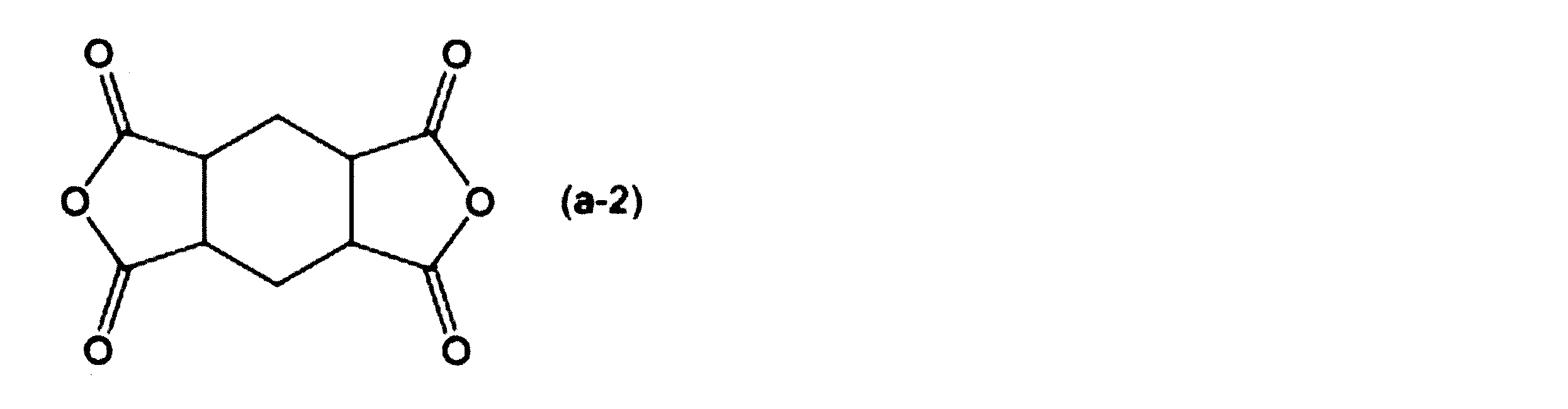
- the structural unit A preferably further includes a structural unit (A-2) derived from a compound represented by the following formula (a-2).
- a-2 By including the structural unit (A-2), transparency, solution processability, and heat resistance can be improved.
- the structural unit (A-2) is preferably 60 mol% or less, more preferably 50 mol% or less, and more preferably 40 mol% or less in the structural unit A derived from tetracarboxylic dianhydride. Is more preferable.
- the total content of the structural units (A-1) and (A-2) with respect to the structural unit A is preferably 40 mol% or more, more preferably 70 mol% or more, and 85 mol% or more. More preferably, it is 99 mol% or more, and most preferably 100 mol%.
- the structural unit B derived from the diamine compound includes the structural unit (B-1) derived from the compound represented by the following formula (b-1).
- the proportion of the structural unit (B-1) in the structural unit B is preferably 50 mol% or more, more preferably 70 mol% or more, further preferably 85 mol% or more, 99 It is particularly preferably at least mol%, and most preferably at 100 mol%.
- n are each independently an integer of 0 or 1.
- the structural unit B includes, as the structural unit (B-1), a structural unit (B-1-1) derived from a compound represented by the following formula (b-1-1) and / or the following formula (b-1-) It is preferable that the structural unit (B-1-2) derived from the compound represented by 2) is included.
- the structural unit B includes the structural unit (B-1-1) as the structural unit (B-1) from the viewpoint of low colorability, that is, from the viewpoint of obtaining a polyimide film having a small yellow index (YI). preferable.
- the proportion of the structural unit (B-1-1) in the structural unit (B-1) is preferably 50 mol% or more, more preferably 75 mol% or more, and 100 mol%. More preferably it is.
- the structural unit B preferably includes both the structural unit (B-1-1) and the structural unit (B-1-2) as the structural unit (B-1).
- the total ratio of the structural unit (B-1-1) and the structural unit (B-1-2) in the structural unit (B-1) is preferably 50 mol% or more, and is 75 mol%. More preferably, it is more preferably 100 mol%.
- the molar ratio of structural unit (B-1-1) / structural unit (B-1-2) is preferably 50/50 to 90/10, and preferably 70/30 to 90/10. More preferably, it is more preferably 75/25 to 85/15.
- the structural unit B may further include a structural unit (B-2) derived from a compound represented by the following formula (b-2).
- the ratio of the structural unit (B-2) in the structural unit B is preferably 50 mol% or less, and more preferably 40 mol% or less.
- solution processability can be improved while maintaining transparency.
- the total content of the structural units (B-1) and (B-2) with respect to the structural unit B is preferably 50 mol% or more, more preferably 70 mol% or more, and 85 mol% or more. More preferably, it is 99 mol% or more, and most preferably 100 mol%.
- the number average molecular weight of the polyimide resin according to the present invention is preferably 5,000 to 100,000 from the viewpoint of the mechanical strength of the resulting polyimide film.
- the number average molecular weight of the polyimide resin can be measured by gel filtration chromatography or the like.
- the total light transmittance is preferably 85% or more, and more preferably 87% or more.
- the yellow index (YI) is preferably 10.0 or less, more preferably 7.0 or less, and further preferably 5.0 or less.
- High colorless transparency can be shown when it is set as the polyimide film because it is the range of the said total light transmittance, and YI exists in the said range.
- the refractive index is preferably 1.65 or more, and more preferably 1.70 or more.
- the polyimide resin according to the present invention can be produced by reacting the specific tetracarboxylic dianhydride component described above with a specific diamine component.
- the tetracarboxylic dianhydride component essentially includes the compound represented by the formula (a-1) described above, and includes a compound represented by the formula (a-2) as necessary.
- the diamine component essentially includes a compound represented by the formula (b-1), and optionally includes a compound represented by the formula (b-2). These compounds may be derivatives thereof as long as they can form corresponding structural units.
- terminal blocker other than the tetracarboxylic dianhydride component and the diamine component.
- end-capping agents monoamines or dicarboxylic acids are preferred.
- the amount of the terminal blocking agent to be introduced is preferably 0.0001 to 0.1 mol, particularly preferably 0.001 to 0.06 mol, per 1 mol of the tetracarboxylic dianhydride component.
- Examples of monoamine end-capping agents include methylamine, ethylamine, propylamine, butylamine, benzylamine, 4-methylbenzylamine, 4-ethylbenzylamine, 4-dodecylbenzylamine, 3-methylbenzylamine, 3- Ethylbenzylamine, aniline, 3-methylaniline, 4-methylaniline and the like are recommended. Of these, benzylamine and aniline can be preferably used.
- dicarboxylic acid end-capping agent dicarboxylic acids are preferable, and a part of them may be closed.
- phthalic acid, phthalic anhydride, 4-chlorophthalic acid, tetrafluorophthalic acid, 2,3-benzophenone dicarboxylic acid, 3,4-benzophenone dicarboxylic acid, cyclohexane-1,2-dicarboxylic acid, cyclopentane-1,2 -Dicarboxylic acid, 4-cyclohexene-1,2-dicarboxylic acid and the like are recommended.
- phthalic acid and phthalic anhydride can be suitably used.
- the acid catalyst examples include crotonic acid, acrylic acid, trans-3-hexenoic acid, cinnamic acid, benzoic acid, methylbenzoic acid, oxybenzoic acid, terephthalic acid, benzenesulfonic acid, p-toluenesulfonic acid, naphthalenesulfonic acid, etc. Is mentioned.
- the above imidation catalysts may be used alone or in combination of two or more.
- a base catalyst more preferably an organic base catalyst, and still more preferably triethylamine.
- the temperature of the imidization reaction is preferably 120 to 250 ° C., more preferably 160 to 200 ° C. from the viewpoint of suppressing the reaction rate and gelation.
- the reaction time is preferably 0.5 to 10 hours after the start of distillation of the produced water.
- the temperature of the imidization reaction when no catalyst is used is preferably 200 to 350 ° C.
- the measuring apparatus for example, a reflective spectral film thickness meter “FE-3000” manufactured by Otsuka Electronics Co., Ltd. can be used. Further, the average particle diameter D50 of the inorganic particles is calculated by, for example, measuring the inorganic particles dispersed in a dispersion medium. As the measuring device, for example, a DLS particle size distribution meter “Nanotrack UPA-UT151” manufactured by Microtrack Bell Co., Ltd. can be used. In addition, a catalog value can also be employ
- the inorganic particles are preferably at least one of zirconium oxide particles, titanium oxide particles, zinc oxide particles, zinc sulfide particles, chromium oxide particles, barium titanate particles, and silicon particles. Zirconium oxide particles and / or titanium oxide Particles are preferred.
- the inorganic particles are preferably contained in an amount of 10 to 60% by mass, more preferably 20 to 50% by mass in the solid content of the polyimide resin composition.
- the solid content concentration of the resin composition can be appropriately selected according to the workability when forming the polyimide film, and the solid content concentration and viscosity of the composition can be adjusted by adding an organic solvent. Also good.
- the organic solvent is not particularly limited as long as it can dissolve the polyimide resin.
- the polyimide film of the present invention comprises the aforementioned polyimide resin or a cured product of the aforementioned polyimide resin composition. That is, a polyimide film formed by imidizing (curing) the above-described polyimide resin or polyimide resin composition has a high refractive index, and is excellent in colorless transparency depending on the structural unit.
- a well-known method can be used. For example, a method of removing the organic solvent after applying or molding the polyimide resin solution according to the present invention containing an organic solvent or a polyimide resin composition containing the polyimide resin and the various additives described above into a film shape Etc.
- the thickness of the polyimide film obtained as described above is preferably 1 to 250 ⁇ m, and can be set as appropriate according to the application. When the thickness is 1 to 250 ⁇ m, practical use as a self-supporting film becomes possible. The thickness is more preferably 1 to 50 ⁇ m.
- the polyimide resin (composition) of the present invention includes optical lenses such as CCD and CMOS sensors, sealing materials such as LEDs and organic EL, light extraction layers, antireflection films, multilayer optical films, microlens arrays, color filters, and flexible. Suitable for displays and the like.
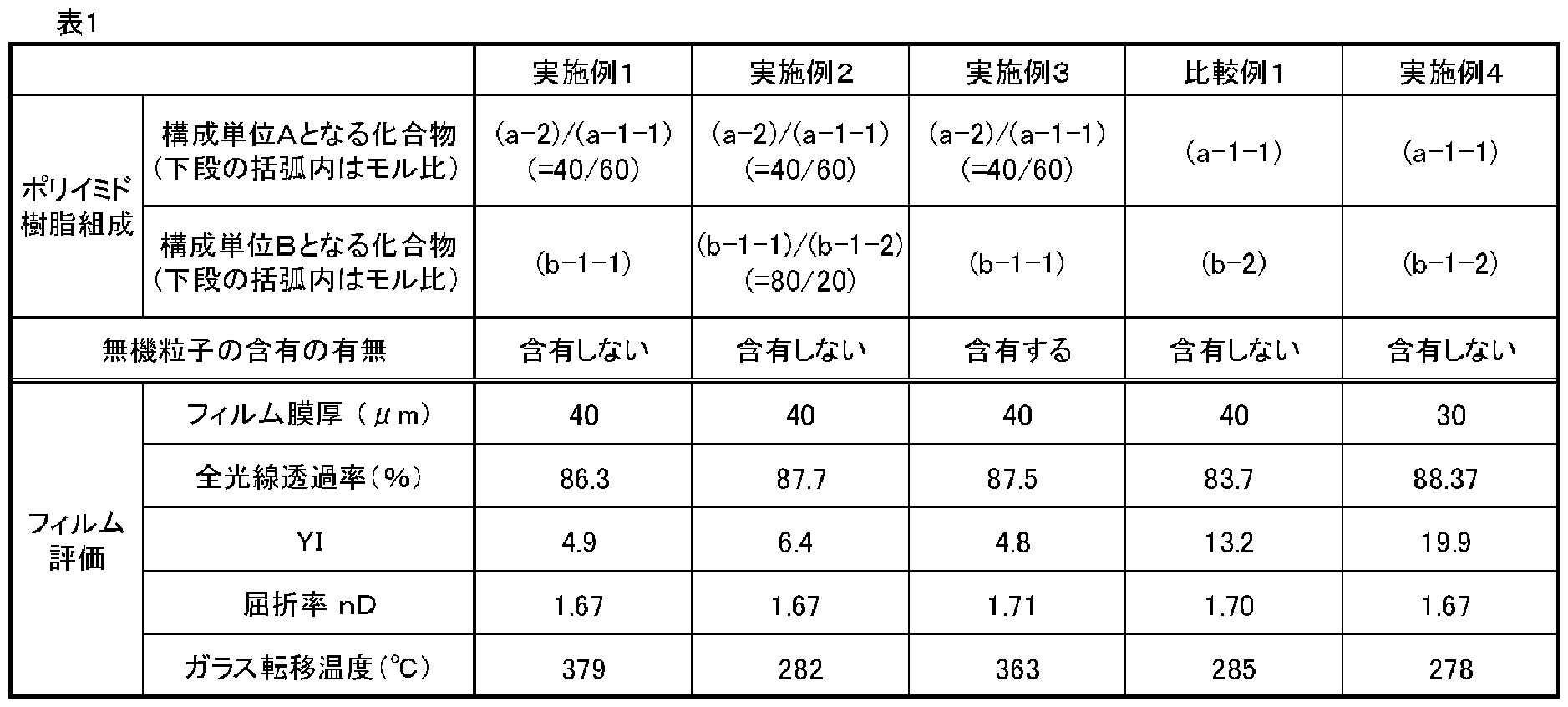
- Example 1 In a 300 mL glass five-necked round bottom flask, 22.01 g (0.089 mol) of bis (4-aminophenyl) sulfone (manufactured by Wakayama Seika Kogyo Co., Ltd.) as the diamine component and ⁇ -butyrolactone (Mitsubishi) as the organic solvent (Chemical Co., Ltd.) 54.90 g and triethylamine (Kanto Chemical Co., Ltd.) 0.449 g as an imidization catalyst were added and stirred at a rotation speed of 200 rpm in a system atmosphere at 70 ° C. to obtain a solution.
- bis (4-aminophenyl) sulfone manufactured by Wakayama Seika Kogyo Co., Ltd.
- ⁇ -butyrolactone Mitsubishi
- triethylamine Karlo Chemical Co., Ltd.
- the polyimide component was obtained by collecting the components to be distilled off and maintaining the temperature in the reaction system at 190 ° C. while refluxing for 5 hours while adjusting the rotational speed to match the increase in viscosity. Thereafter, when the reaction system temperature is cooled to 120 ° C., 101.59 g of N, N-dimethylacetamide (Mitsubishi Gas Chemical Co., Ltd.) is added, and the mixture is further stirred and homogenized for about 3 hours to obtain a solid concentration of 20% by mass.
- the polyimide resin solution (A) was obtained.
- a polyimide resin solution (A) is applied onto a glass substrate, and kept at 60 ° C. for 30 minutes, 100 ° C. for 1 hour, and a solvent is volatilized to obtain a colorless and transparent primary dry film having self-supporting property.
- the film was fixed to a stainless frame, and the solvent was removed by drying in a nitrogen atmosphere at 280 ° C. for 2 hours to obtain a polyimide film having a thickness of 40 ⁇ m.
- the disappearance of the raw material peak and the appearance of a peak derived from the imide skeleton were confirmed by FT-IR analysis of the obtained polyimide film.
- This polyimide film has a total light transmittance of 86.3%, a transmittance at a wavelength of 400 nm of 37.9%, a transmittance at a wavelength of 420 nm of 76.8%, a transmittance at a wavelength of 450 nm of 84.0%, and a YI value of 4.9, Tg was 379 ° C., and the refractive index nD was 1.67.
- Example 2 7.025 g of bis [4- (4-aminophenoxy) phenyl] sulfone (manufactured by Wakayama Seika Kogyo Co., Ltd.) as a diamine component was added to a 300 mL glass 5-neck round bottom flask similar to that used in Example 1. (0.016 mol), 16.133 g (0.065 mol) of bis (4-aminophenyl) sulfone (manufactured by Wakayama Seika Kogyo Co., Ltd.), 53.86 g of ⁇ -butyrolactone (manufactured by Mitsubishi Chemical Corporation) as an organic solvent.
- the polyimide component was obtained by collecting the components to be distilled off and maintaining the temperature in the reaction system at 190 ° C. while refluxing for 5 hours while adjusting the rotational speed to match the increase in viscosity. Thereafter, when the reaction system temperature is cooled to 120 ° C., 100.51 g of N, N-dimethylacetamide (manufactured by Mitsubishi Gas Chemical Co., Ltd.) is added, and the mixture is further stirred and homogenized for about 3 hours to obtain a solid concentration of 20% by mass. A polyimide resin solution (B) was obtained. Subsequently, the polyimide resin solution (B) obtained is applied onto a glass substrate, kept on a hot plate at 100 ° C.
- the total light transmittance of this polyimide film is 87.7%, the transmittance at a wavelength of 400 nm is 82.7%, the transmittance at a wavelength of 420 nm is 53.1%, the transmittance at a wavelength of 450 nm is 84.4%, and the YI value is 6.4, Tg was 282 ° C., and the refractive index nD was 1.67.
- Example 3 To a 300 mL four-necked round bottom flask equipped with a stainless steel half-moon stirring blade, nitrogen inlet tube, thermometer, and glass end cap, a zirconia particle dispersion (SZR-DMAc, manufactured by Sakai Chemical Industry Co., Ltd. (solid content concentration) 310.00%)) and 32.00 g of DMAc (Mitsubishi Gas Chemical Co., Ltd.) were added and stirred at room temperature under a nitrogen atmosphere at a rotation speed of 200 rpm (zirconia particle diluted dispersion (solid content concentration 15% by mass)).
- SZR-DMAc zirconia particle dispersion
- solid content concentration 310.00%
- DMAc Mitsubishi Gas Chemical Co., Ltd.
- the kneaded material was applied onto a glass substrate, kept at 60 ° C. for 30 minutes and 100 ° C. for 1 hour, and the solvent was evaporated to obtain a colorless and transparent primary dry film having self-supporting properties.
- the solvent was removed by fixing to a frame and drying in a nitrogen atmosphere at 280 ° C. for 2 hours to obtain a polyimide film having a thickness of 40 ⁇ m.
- the disappearance of the raw material peak and the appearance of a peak derived from the imide skeleton were confirmed by FT-IR analysis of the obtained polyimide film.
- This polyimide film has a total light transmittance of 87.5%, a transmittance at a wavelength of 400 nm of 44.3%, a transmittance at 420 nm of 78.0%, a transmittance at a wavelength of 420 nm of 53.1%, and a transmittance at a wavelength of 450 nm.
- the rate was 82.7%
- the YI value was 4.8
- the Tg was 363 ° C.
- the refractive index nD was 1.71.
- a polyamic acid solution was applied onto a glass substrate, and the solvent was removed by drying at 60 ° C. for 30 minutes, 100 ° C. for 1 hour, and further at 300 ° C. in a nitrogen atmosphere for 2 hours.
- a polyimide film was obtained. The disappearance of the raw material peak and the appearance of a peak derived from the imide skeleton were confirmed by FT-IR analysis of the obtained polyimide film.
- This polyimide film has a total light transmittance of 83.7%, a transmittance at a wavelength of 400 nm of 22.0%, a transmittance at 420 nm of 64.0%, a transmittance at a wavelength of 450 nm of 74.3%, and a YI value of 13. .2, Tg was 285 ° C., and the refractive index nD was 1.70.
- a polyamic acid solution is applied on a glass substrate, and the solvent is removed by drying in a nitrogen atmosphere at 60 ° C. for 30 minutes, 100 ° C. for 1 hour and further at 300 ° C. for 2 hours, and imidized to obtain a thickness of 30 ⁇ m.
- the polyimide film was obtained. The disappearance of the raw material peak and the appearance of a peak derived from the imide skeleton were confirmed by FT-IR analysis of the obtained polyimide film.
- This polyimide film had a total light transmittance of 88.37%, a transmittance at a wavelength of 400 nm of 1.9%, a transmittance at 420 nm of 27.7%, a transmittance at a wavelength of 450 nm of 75.2%, and a YI value of 19 .9, Tg was 278 ° C., and the refractive index nD was 1.67.
Landscapes
- Chemical & Material Sciences (AREA)
- Health & Medical Sciences (AREA)
- Chemical Kinetics & Catalysis (AREA)
- Medicinal Chemistry (AREA)
- Polymers & Plastics (AREA)
- Organic Chemistry (AREA)
- Engineering & Computer Science (AREA)
- Manufacturing & Machinery (AREA)
- Materials Engineering (AREA)
- Macromolecular Compounds Obtained By Forming Nitrogen-Containing Linkages In General (AREA)
- Compositions Of Macromolecular Compounds (AREA)
Abstract
Description
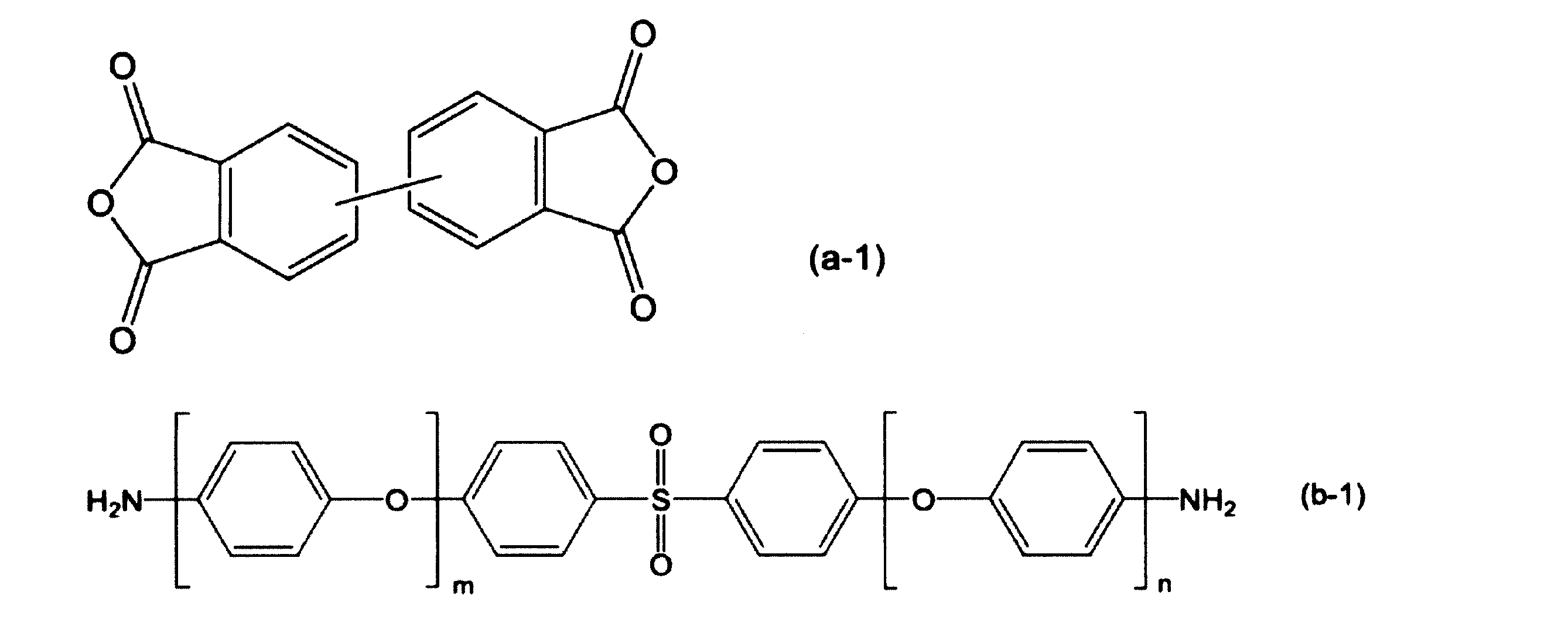
構成単位Aは下記式(a-1)で表される化合物(ビフェニルテトラカルボン酸二無水物(BPDA))に由来する構成単位(A-1)を含む。構成単位(A-1)はテトラカルボン酸二無水物に由来する構成単位A中、40モル%以上であることが好ましく、50モル%以上であることがより好ましく、60モル%以上であることがさらに好ましい。
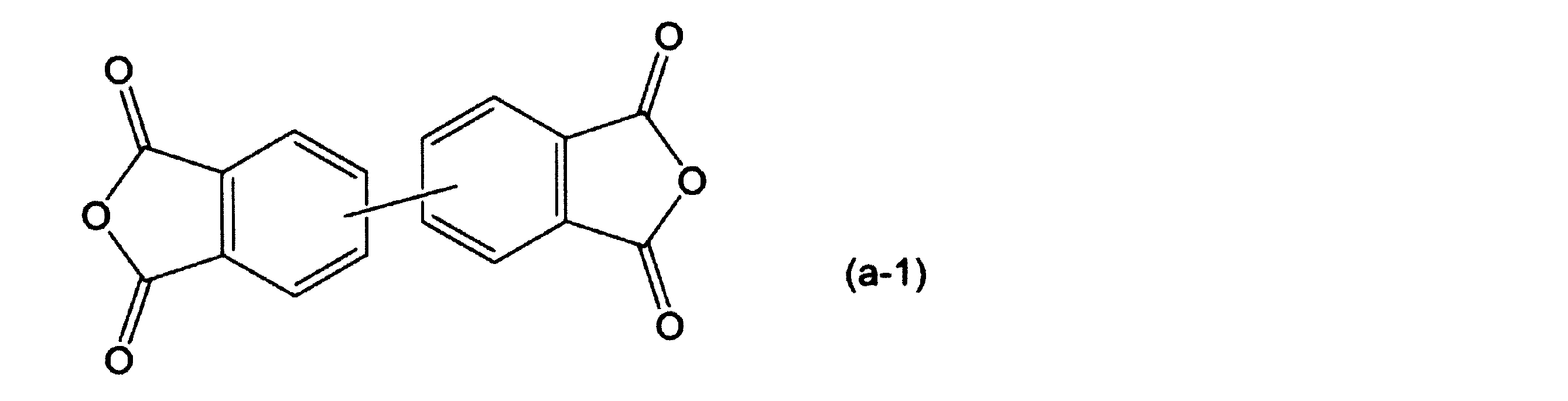
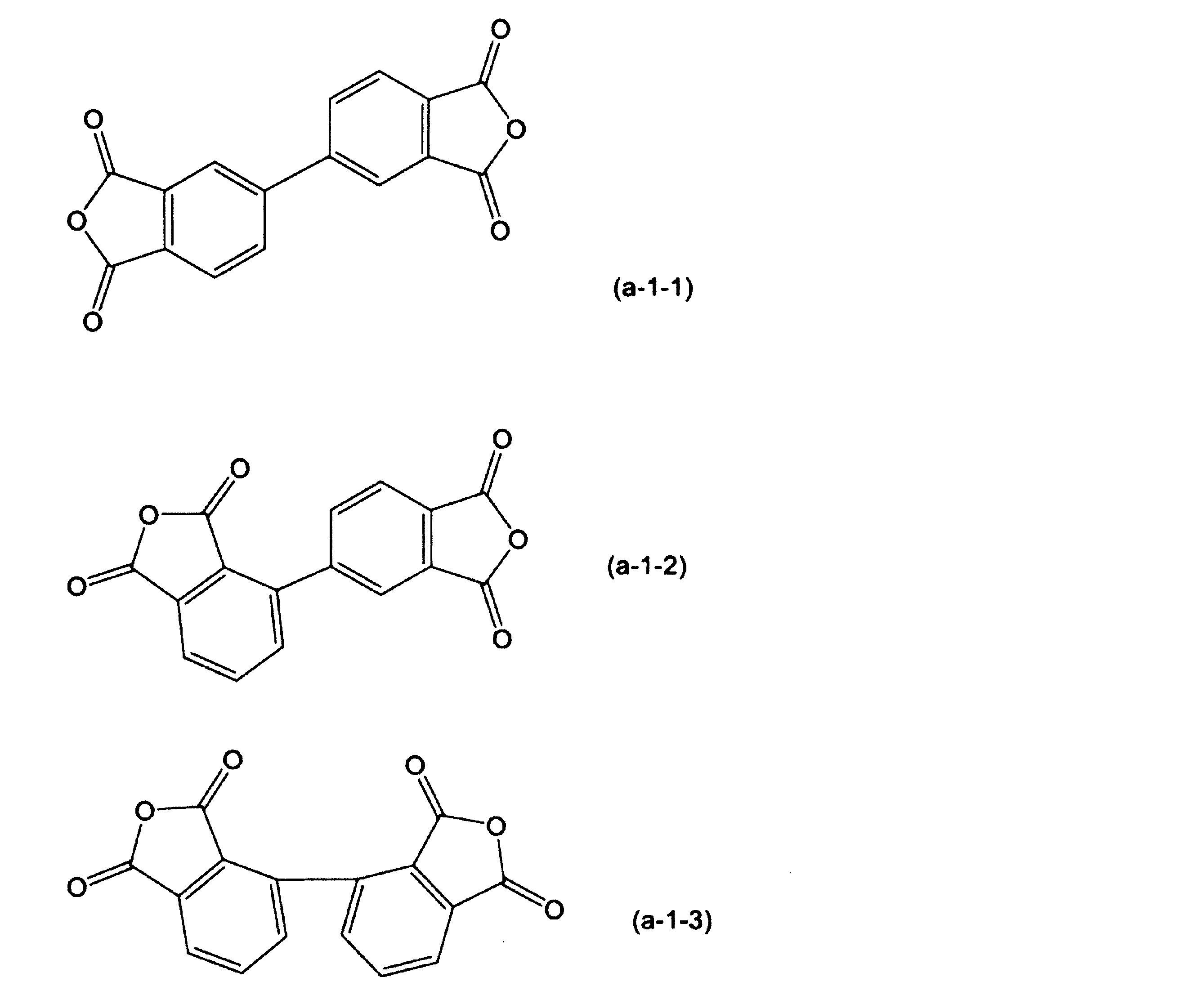
s-BPDAは屈折率、耐有機溶剤性の点で好ましく、a-BPDAは耐熱性、溶液加工性の点で好ましく、i-BPDAは耐熱性、溶液加工性の点で好ましい。
構成単位(A-2)はテトラカルボン酸二無水物に由来する構成単位A中、60モル%以下であることが好ましく、50モル%以下であることがより好ましく、40モル%以下であることがさらに好ましい。

また、構成単位B中の構成単位(B-1)の比率は50モル%以上であることが好ましく、70モル%以上であることがより好ましく、85モル%以上であることがさらに好ましく、99モル%以上であることが特に好ましく、100モル%であることが最も好ましい。

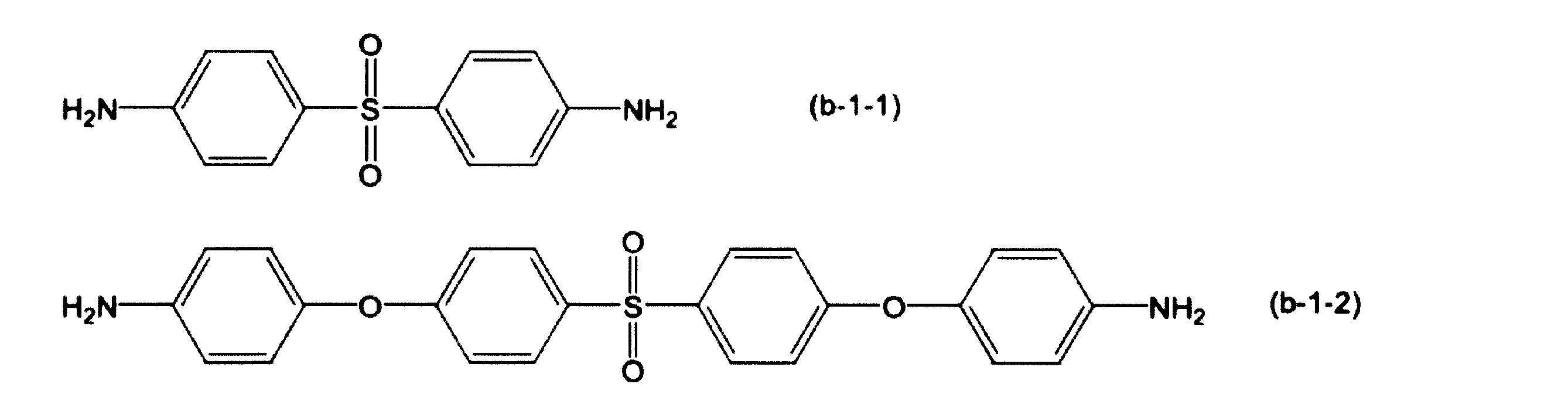
また、構成単位Bは、構成単位(B-1)として、構成単位(B-1-1)と構成単位(B-1-2)の両方を含むことも好ましい。その場合、構成単位(B-1)中の構成単位(B-1-1)及び構成単位(B-1-2)の合計の比率は、50モル%以上であることが好ましく、75モル%以上であることがより好ましく、100モル%であることがさらに好ましい。また、構成単位(B-1-1)/構成単位(B-1-2)のモル比は、50/50~90/10であることが好ましく、70/30~90/10であることがより好ましく、75/25~85/15であることがさらに好ましい。

また、厚さが40μmのポリイミドフィルムとした際にイエローインデックス(YI)は10.0以下であることが好ましく、7.0以下であることがより好ましく、5.0以下であることがさらに好ましい。上記全光線透過率の範囲で、かつYIが上記範囲にあることで、ポリイミドフィルムとした際に高い無色透明性を示すことができる。
さらに、ポリイミドフィルムとした際に屈折率が1.65以上であることが好ましく、1.70以上であることがより好ましい。
なお、これらの化合物はそれぞれに対応する構成単位を形成できる範囲でそれらの誘導体とされていてもよい。
具体的な反応方法としては、(1)テトラカルボン酸二無水物成分、ジアミン成分、及び反応溶媒を反応器に仕込み、室温~80℃で0.5~30時間撹拌し、その後に昇温してイミド化反応を行う方法、(2)ジアミン成分及び反応溶媒を反応器に仕込んで溶解させた後、テトラカルボン酸二無水物成分を仕込み、必要に応じて室温~80℃で0.5~30時間撹拌し、その後に昇温してイミド化反応を行う方法、(3)テトラカルボン酸二無水物成分、ジアミン成分、及び反応溶媒を反応器に仕込み、直ちに昇温してイミド化反応を行う方法等が挙げられる。
エーテル系溶媒の具体例としては、1,2-ジメトキシエタン、ビス(2-メトキシエチル)エーテル、1,2-ビス(2-メトキシエトキシ)エタン、ビス〔2-(2-メトキシエトキシ)エチル〕エーテル、テトラヒドロフラン、1,4-ジオキサン等が挙げられる。
また、カーボネート系溶媒の具体的な例としては、ジエチルカーボネート、メチルエチルカーボネート、エチレンカーボネート、プロピレンカーボネート等が挙げられる。
上記反応溶媒の中でも、アミド系溶媒又はラクトン系溶媒が好ましい。また、上記の反応溶媒は単独で又は2種以上混合して用いてもよい。
塩基触媒としては、ピリジン、キノリン、イソキノリン、α-ピコリン、β-ピコリン、2,4-ルチジン、2,6-ルチジン、トリメチルアミン、トリエチルアミン、トリプロピルアミン、トリブチルアミン、イミダゾール、N,N-ジメチルアニリン、N,N-ジエチルアニリン等の有機塩基触媒、水酸化カリウムや水酸化ナトリウム、炭酸カリウム、炭酸ナトリウム、炭酸水素カリウム、炭酸水素ナトリウム等の無機塩基触媒が挙げられる。
また、酸触媒としては、クロトン酸、アクリル酸、トランス-3-ヘキセノイック酸、桂皮酸、安息香酸、メチル安息香酸、オキシ安息香酸、テレフタル酸、ベンゼンスルホン酸、パラトルエンスルホン酸、ナフタレンスルホン酸等が挙げられる。上記のイミド化触媒は単独で又は2種以上を組み合わせて用いてもよい。
上記のうち、取り扱い性の観点から、塩基触媒を用いることが好ましく、有機塩基触媒を用いることがより好ましく、トリエチルアミンを用いることが更に好ましい。
なお、触媒を用いない場合のイミド化反応の温度は、好ましくは200~350℃である。
無機粒子の屈折率は、例えば、下記のようにして測定し求めることができる。すなわち、アクリル樹脂に配合した無機粒子含有塗工液をPETフィルムに塗布し、形成された塗工膜の屈折率を測定する。このとき、無機粒子の配合部数を複数振った塗工膜を測定しプロット外挿し、無機粒子の屈折率を算出する。測定装置としては、例えば、大塚電子株式会社製の反射分光膜厚計「FE-3000」を使用することができる。
また、無機粒子の平均粒子径D50は、例えば、分散媒中に無機粒子を分散させて測定し、算出する。測定装置としては、例えば、マイクロトラックベル株式会社製のDLS粒度分布計「ナノトラックUPA-UT151」を使用することができる。
なお、無機粒子の屈折率及び平均粒子径D50は、カタログ値を採用することもできる。
このようなポリイミドフィルムの作製方法には特に制限はなく、公知の方法を用いることができる。例えば、有機溶媒を含有する本発明に係るポリイミド樹脂溶液、又はポリイミド樹脂と既述の種々の添加剤とを含むポリイミド樹脂組成物をフィルム状に塗布又は成形した後、該有機溶媒を除去する方法等が挙げられる。
300mLのガラス製5つ口丸底フラスコに、ジアミン成分としてビス(4-アミノフェニル)スルホン(和歌山精化工業株式会社製)22.017g(0.089モル)、有機溶媒としてγ-ブチロラクトン(三菱化学株式会社製)54.90g、イミド化触媒としてトリエチルアミン(関東化学株式会社製)0.449gを投入し、系内温度70℃、窒素雰囲気下、回転数200rpmで撹拌して溶液を得た。これに脂環式テトラカルボン酸二無水物成分として1,2,4,5-シクロヘキサンテトラカルボン酸二無水物(三菱ガス化学株式会社製)7.951g(0.035モル)、芳香族テトラカルボン酸二無水物成分として3,3’,4,4’-ビフェニルテトラカルボン酸二無水物(三菱化学株式会社製)15.652g(0.053モル)と有機溶媒であるγ-ブチロラクトン(三菱化学株式会社製)13.73gを一括で添加した後、マントルヒーターで加熱し、約20分かけて反応系内温度を190℃まで上げた。留去される成分を捕集し、回転数を粘度上昇に合わせて調整しつつ、反応系内温度を190℃に保持して5時間還流することでポリイミド溶液を得た。その後、反応系内温度が120℃まで冷却したらN,N-ジメチルアセトアミド(三菱ガス化学株式会社製)101.59gを添加して、さらに約3時間撹拌して均一化し、固形分濃度20質量%のポリイミド樹脂溶液(A)を得た。
このポリイミドフィルムの全光線透過率は86.3%、波長400nmにおける透過率は37.9%、波長420nmにおける透過率は76.8%、波長450nmにおける透過率は84.0%、YI値は4.9、Tgは379℃、屈折率nDは1.67であった。
実施例1で使用したものと同様の300mLのガラス製5つ口丸底フラスコに、ジアミン成分としてビス[4-(4-アミノフェノキシ)フェニル]スルホン(和歌山精化工業株式会社製)7.025g(0.016モル)、ビス(4-アミノフェニル)スルホン(和歌山精化工業株式会社製)16.133g(0.065モル)、有機溶媒としてγ-ブチロラクトン(三菱化学株式会社製)53.86g、イミド化触媒としてトリエチルアミン(関東化学株式会社製)0.411gを投入し、系内温度70℃、窒素雰囲気下、回転数200rpmで撹拌して溶液を得た。これに脂環式テトラカルボン酸二無水物成分として1,2,4,5-シクロヘキサンテトラカルボン酸二無水物(三菱ガス化学株式会社製)7.282g(0.032モル)、芳香族テトラカルボン酸二無水物成分として3,3’,4,4’-ビフェニルテトラカルボン酸二無水物(三菱化学株式会社製)14.336g(0.049モル)と有機溶媒であるγ-ブチロラクトン(三菱化学株式会社製)13.47gを一括で添加した後、マントルヒーターで加熱し、約20分かけて反応系内温度を190℃まで上げた。留去される成分を捕集し、回転数を粘度上昇に合わせて調整しつつ、反応系内温度を190℃に保持して5時間還流することでポリイミド溶液を得た。その後、反応系内温度が120℃まで冷却したらN,N-ジメチルアセトアミド(三菱ガス化学株式会社製)100.51gを添加して、さらに約3時間撹拌して均一化し、固形分濃度20質量%のポリイミド樹脂溶液(B)を得た。
続いて、ガラス基板上に得られたポリイミド樹脂溶液(B)を塗布し、ホットプレートで100℃、60分間保持し、溶媒を揮発させることで自己支持性を有する無色透明な一次乾燥フィルムを得、さらに該フィルムをステンレス枠に固定し、熱風乾燥機中250℃で2時間加熱し溶媒を蒸発させ、厚み40μmのポリイミドフィルムを得た。得られたポリイミドフィルムのFT-IR分析により原料ピークの消失およびイミド骨格に由来するピークの出現を確認した。
このポリイミドフィルムの全光線透過率は87.7%、波長400nmにおける透過率は82.7%、波長420nmにおける透過率は53.1%、波長450nmにおける透過率は84.4%、YI値は6.4、Tgは282℃、屈折率nDは1.67であった。
ステンレス製半月型撹拌翼、窒素導入管、温度計、ガラス製エンドキャップを備えた300mLの4つ口丸底フラスコに、ジルコニア粒子分散液(SZR-DMAc、堺化学工業株式会社製(固形分濃度31質量%))を30.00g、DMAc(三菱ガス化学株式会社製)を32.00g投入し、室温、窒素雰囲気下、回転数200rpmで撹拌しジルコニア粒子希釈分散液(固形分濃度15質量%)を得た。次に、この希釈分散液を60.00g、ポリイミド樹脂溶液(A)45g(固形分濃度20質量%)を、T.K.HOMODISPER Model 2.5(プライミクス株式会社製)を用いて、回転数2000rpmで5分間混練し、混練物を得た。
使用したジルコニア粒子分散液の分散媒はDMAcであり、D50は10nm以下であり、ジルコニア粒子の屈折率は2.11である。
このポリイミドフィルムの全光線透過率は87.5%、波長400nmにおける透過率は44.3%、420nmにおける透過率は78.0%、波長420nmにおける透過率は53.1%、波長450nmにおける透過率は82.7%、YI値は4.8、Tgは363℃、屈折率nDは1.71であった。
500mLのガラス製5つ口丸底フラスコに、ジアミン成分としてビス(3-アミノフェニル)スルホン(和歌山精化工業株式会社製)24.83g(0.10モル)、芳香族テトラカルボン酸二無水物成分として3,3’,4,4’-ビフェニルテトラカルボン酸二無水物(三菱化学株式会社製)29.11g(0.099モル)、末端封止剤として無水フタル酸0.296g(0.002モル)、有機溶媒としてN,N-ジメチルアセトアミド(三菱ガス化学株式会社製)280gを投入し、室温、窒素雰囲気下、回転数200rpmで約12時間撹拌してポリアミド酸溶液を得た。
このポリイミドフィルムの全光線透過率は83.7%、波長400nmにおける透過率は22.0%、420nmにおける透過率は64.0%、波長450nmにおける透過率は74.3%、YI値は13.2、Tgは285℃、屈折率nDは1.70であった。
500mLのガラス製5つ口丸底フラスコに、ジアミン成分としてビス[4-(4-アミノフェノキシ)フェニル]スルホン(和歌山精化工業株式会社製)22.192g(0.051モル)、芳香族テトラカルボン酸二無水物成分として3,3’,4,4’-ビフェニルテトラカルボン酸二無水物(三菱化学株式会社製)15.004g(0.049モル)、末端封止剤として無水フタル酸0.296g(0.002モル)、有機溶媒としてN,N-ジメチルアセトアミド(三菱ガス化学株式会社製)137.798gを投入し、室温、窒素雰囲気下、回転数200rpmで約12時間攪拌してポリアミド酸溶液を得た。
このポリイミドフィルムの全光線透過率は88.37%、波長400nmにおける透過率は1.9%、420nmにおける透過率は27.7%、波長450nmにおける透過率は75.2%、YI値は19.9、Tgは278℃、屈折率nDは1.67であった。
(1)固形分濃度:
脂環式ポリイミド樹脂及び二酸化チタン分散液の固形分濃度の測定は、アズワン株式会社製の小型電気炉「MMF-1」で試料を300℃×30minで加熱し、加熱前後の試料重量差から算出した。
(2)フィルム厚さ:
フィルム厚さの測定は、株式会社ミツトヨ製のマイクロメーターを用いて測定した。
(1)全光線透過率、YI(Yellow Index):
測定はJIS K7105に準拠し、日本電色工業株式会社製の色彩・濁度同時測定器「COH400」を用いて測定した。
エスアイアイ・ナノテクノロジー株式会社製の示差走査熱量計装置「DSC6200」を用い、昇温速度10℃/minの条件でDSC測定を行い、ガラス転移温度を求めた。
(3)屈折率:
フィルムの屈折率及びアッベ数の測定は、株式会社アタゴ製のアッベ屈折計「DR-M4/1550」を用いて、D線(589nm)、温度:23℃で測定した。なお、D線で測定した屈折率をnDと記載する。
(4)400nm、420nm及び450nmにおける透過率
測定は、株式会社島津製作所製の紫外可視近赤外分光光度計「UV-3100PC」を用いて行った。
Claims (7)
- テトラカルボン酸二無水物に由来する構成単位Aと、ジアミン化合物に由来する構成単位Bとを含むポリイミド樹脂であって、
構成単位Aが下記式(a-1)で表される化合物に由来する構成単位(A-1)を含み、
構成単位Bが下記式(b-1)で表される化合物に由来する構成単位(B-1)を含む、ポリイミド樹脂。

(式(b-1)中のm及びnは、それぞれ独立に、0又は1の整数である。) - 構成単位Aが、さらに下記式(a-2)で表される化合物に由来する構成単位(A-2)を含む請求項1に記載のポリイミド樹脂。
- 構成単位Bが、構成単位(B-1)として、下記式(b-1-1)で表される化合物に由来する構成単位(B-1-1)を含む請求項1又は2に記載のポリイミド樹脂。

- 構成単位Bが、さらに下記式(b-2)で表される化合物に由来する構成単位(B-2)を含む請求項1~3のいずれか1項に記載のポリイミド樹脂。

- 請求項1~4のいずれか1項に記載のポリイミド樹脂と、屈折率が2.0以上で平均粒子径D50が20nm以下の無機粒子とを含有するポリイミド樹脂組成物。
- 前記無機粒子が酸化ジルコニウム粒子及び/又は酸化チタン粒子である請求項5に記載のポリイミド樹脂組成物。
- 請求項1~4のいずれか1項に記載のポリイミド樹脂、又は請求項5若しくは6に記載のポリイミド樹脂組成物の硬化物からなるポリイミドフィルム。
Priority Applications (5)
| Application Number | Priority Date | Filing Date | Title |
|---|---|---|---|
| JP2018516927A JP6954276B2 (ja) | 2016-05-09 | 2017-04-21 | ポリイミド樹脂及びポリイミド樹脂組成物 |
| US16/098,644 US10920018B2 (en) | 2016-05-09 | 2017-04-21 | Polyimide resin and polyimide resin composition |
| EP17795935.0A EP3456757B1 (en) | 2016-05-09 | 2017-04-21 | Polyimide resin and polyimide resin composition |
| CN201780027899.8A CN109071813A (zh) | 2016-05-09 | 2017-04-21 | 聚酰亚胺树脂和聚酰亚胺树脂组合物 |
| KR1020187032001A KR102342636B1 (ko) | 2016-05-09 | 2017-04-21 | 폴리이미드 수지 및 폴리이미드 수지 조성물 |
Applications Claiming Priority (2)
| Application Number | Priority Date | Filing Date | Title |
|---|---|---|---|
| JP2016-094118 | 2016-05-09 | ||
| JP2016094118 | 2016-05-09 |
Publications (1)
| Publication Number | Publication Date |
|---|---|
| WO2017195574A1 true WO2017195574A1 (ja) | 2017-11-16 |
Family
ID=60267682
Family Applications (1)
| Application Number | Title | Priority Date | Filing Date |
|---|---|---|---|
| PCT/JP2017/016076 Ceased WO2017195574A1 (ja) | 2016-05-09 | 2017-04-21 | ポリイミド樹脂及びポリイミド樹脂組成物 |
Country Status (7)
| Country | Link |
|---|---|
| US (1) | US10920018B2 (ja) |
| EP (1) | EP3456757B1 (ja) |
| JP (1) | JP6954276B2 (ja) |
| KR (1) | KR102342636B1 (ja) |
| CN (1) | CN109071813A (ja) |
| TW (1) | TWI731067B (ja) |
| WO (1) | WO2017195574A1 (ja) |
Cited By (3)
| Publication number | Priority date | Publication date | Assignee | Title |
|---|---|---|---|---|
| WO2019211972A1 (ja) * | 2018-05-01 | 2019-11-07 | 三菱瓦斯化学株式会社 | ポリイミド樹脂、ポリイミドワニス及びポリイミドフィルム |
| JP2022500540A (ja) * | 2018-09-18 | 2022-01-04 | ガーマー インク.Garmor, Inc. | 共有結合モノマー及びグラフェンオキシド構造を形成する工業規模の方法 |
| KR20220034059A (ko) | 2019-07-10 | 2022-03-17 | 미쯔비시 가스 케미칼 컴파니, 인코포레이티드 | 폴리이미드 수지, 폴리이미드 바니시 및 폴리이미드 필름 |
Families Citing this family (4)
| Publication number | Priority date | Publication date | Assignee | Title |
|---|---|---|---|---|
| CN110476123B (zh) * | 2019-01-23 | 2022-02-08 | 律胜科技股份有限公司 | 感光性聚酰亚胺树脂组合物及其聚酰亚胺膜 |
| CN113557260A (zh) * | 2019-03-29 | 2021-10-26 | 三菱瓦斯化学株式会社 | 聚酰亚胺树脂、聚酰亚胺清漆及聚酰亚胺薄膜 |
| KR102946579B1 (ko) * | 2019-12-27 | 2026-04-01 | 미쯔비시 가스 케미칼 컴파니, 인코포레이티드 | 폴리이미드 수지, 폴리이미드 바니시 및 폴리이미드 필름 |
| CN113637198A (zh) * | 2021-08-18 | 2021-11-12 | 中国科学院光电技术研究所 | 一种高折射率近红外高透聚酰亚胺薄膜材料及制备方法 |
Citations (3)
| Publication number | Priority date | Publication date | Assignee | Title |
|---|---|---|---|---|
| JPH01138787A (ja) * | 1987-11-25 | 1989-05-31 | Sumitomo Electric Ind Ltd | フレキシブル配線基板 |
| JP2001348477A (ja) * | 2000-06-08 | 2001-12-18 | Mitsui Chemicals Inc | 高屈折率材料組成物 |
| JP2003155342A (ja) * | 2001-11-19 | 2003-05-27 | Nippon Steel Chem Co Ltd | 脂環構造を有するポリイミド共重合体 |
Family Cites Families (9)
| Publication number | Priority date | Publication date | Assignee | Title |
|---|---|---|---|---|
| US6232428B1 (en) * | 1999-01-19 | 2001-05-15 | I.S.T. Corporation | Essentially colorless, transparent polyimide coatings and films |
| JP2006152257A (ja) * | 2004-11-04 | 2006-06-15 | Ist:Kk | 透明ポリイミド管状物及びその製造方法 |
| JP2008169237A (ja) * | 2007-01-09 | 2008-07-24 | Toyobo Co Ltd | 白色ポリイミドフィルム |
| TWI342323B (en) * | 2007-01-22 | 2011-05-21 | Chang Chun Plastics Co Ltd | Thermoset resin modified polyimide resin composition |
| CN102277648B (zh) * | 2011-05-30 | 2013-08-28 | 中国科学院青岛生物能源与过程研究所 | 无机/有机复合聚酰亚胺基纳米纤维膜及制法和应用 |
| JP5660249B1 (ja) * | 2013-06-26 | 2015-01-28 | 東レ株式会社 | ポリイミド前駆体、ポリイミド、それを用いたフレキシブル基板、カラーフィルタおよびその製造方法、ならびにフレキシブル表示デバイス |
| CN105916910B (zh) * | 2014-02-14 | 2019-02-19 | 旭化成株式会社 | 聚酰亚胺前体和含有其的树脂组合物 |
| CN106029743B (zh) * | 2014-02-21 | 2019-03-29 | 三菱化学株式会社 | 含聚酰亚胺前驱体和/或聚酰亚胺的组合物,以及聚酰亚胺膜 |
| KR102181466B1 (ko) * | 2015-03-31 | 2020-11-23 | 아사히 가세이 가부시키가이샤 | 폴리이미드 필름, 폴리이미드 바니시, 폴리이미드 필름을 이용한 제품 및 적층체 |
-
2017
- 2017-04-21 CN CN201780027899.8A patent/CN109071813A/zh active Pending
- 2017-04-21 US US16/098,644 patent/US10920018B2/en not_active Expired - Fee Related
- 2017-04-21 KR KR1020187032001A patent/KR102342636B1/ko active Active
- 2017-04-21 JP JP2018516927A patent/JP6954276B2/ja active Active
- 2017-04-21 EP EP17795935.0A patent/EP3456757B1/en active Active
- 2017-04-21 WO PCT/JP2017/016076 patent/WO2017195574A1/ja not_active Ceased
- 2017-04-25 TW TW106113683A patent/TWI731067B/zh active
Patent Citations (3)
| Publication number | Priority date | Publication date | Assignee | Title |
|---|---|---|---|---|
| JPH01138787A (ja) * | 1987-11-25 | 1989-05-31 | Sumitomo Electric Ind Ltd | フレキシブル配線基板 |
| JP2001348477A (ja) * | 2000-06-08 | 2001-12-18 | Mitsui Chemicals Inc | 高屈折率材料組成物 |
| JP2003155342A (ja) * | 2001-11-19 | 2003-05-27 | Nippon Steel Chem Co Ltd | 脂環構造を有するポリイミド共重合体 |
Non-Patent Citations (1)
| Title |
|---|
| See also references of EP3456757A4 * |
Cited By (9)
| Publication number | Priority date | Publication date | Assignee | Title |
|---|---|---|---|---|
| WO2019211972A1 (ja) * | 2018-05-01 | 2019-11-07 | 三菱瓦斯化学株式会社 | ポリイミド樹脂、ポリイミドワニス及びポリイミドフィルム |
| CN112041371A (zh) * | 2018-05-01 | 2020-12-04 | 三菱瓦斯化学株式会社 | 聚酰亚胺树脂、聚酰亚胺清漆及聚酰亚胺薄膜 |
| JPWO2019211972A1 (ja) * | 2018-05-01 | 2021-05-13 | 三菱瓦斯化学株式会社 | ポリイミド樹脂、ポリイミドワニス及びポリイミドフィルム |
| CN112041371B (zh) * | 2018-05-01 | 2023-05-02 | 三菱瓦斯化学株式会社 | 聚酰亚胺树脂、聚酰亚胺清漆及聚酰亚胺薄膜 |
| JP7302595B2 (ja) | 2018-05-01 | 2023-07-04 | 三菱瓦斯化学株式会社 | ポリイミド樹脂、ポリイミドワニス及びポリイミドフィルム |
| JP2022500540A (ja) * | 2018-09-18 | 2022-01-04 | ガーマー インク.Garmor, Inc. | 共有結合モノマー及びグラフェンオキシド構造を形成する工業規模の方法 |
| JP2023116639A (ja) * | 2018-09-18 | 2023-08-22 | アズベリー グラファイト オブ ノース カロライナ, インク. | 共有結合モノマー及びグラフェンオキシド構造を形成する工業規模の方法 |
| JP7715628B2 (ja) | 2018-09-18 | 2025-07-30 | アズベリー グラファイト オブ ノース カロライナ, インク. | 共有結合モノマー及びグラフェンオキシド構造を形成する工業規模の方法 |
| KR20220034059A (ko) | 2019-07-10 | 2022-03-17 | 미쯔비시 가스 케미칼 컴파니, 인코포레이티드 | 폴리이미드 수지, 폴리이미드 바니시 및 폴리이미드 필름 |
Also Published As
| Publication number | Publication date |
|---|---|
| JP6954276B2 (ja) | 2021-10-27 |
| JPWO2017195574A1 (ja) | 2019-03-07 |
| EP3456757A4 (en) | 2019-04-17 |
| TWI731067B (zh) | 2021-06-21 |
| KR102342636B1 (ko) | 2021-12-23 |
| KR20190006488A (ko) | 2019-01-18 |
| EP3456757B1 (en) | 2023-06-07 |
| US20200055987A1 (en) | 2020-02-20 |
| CN109071813A (zh) | 2018-12-21 |
| EP3456757C0 (en) | 2023-06-07 |
| US10920018B2 (en) | 2021-02-16 |
| EP3456757A1 (en) | 2019-03-20 |
| TW201811865A (zh) | 2018-04-01 |
Similar Documents
| Publication | Publication Date | Title |
|---|---|---|
| TWI814701B (zh) | 聚醯亞胺聚合物組成物、其製備方法和使用其製備聚醯亞胺膜的方法 | |
| JP6954276B2 (ja) | ポリイミド樹脂及びポリイミド樹脂組成物 | |
| JP6477469B2 (ja) | ポリイミド樹脂 | |
| JP7003914B2 (ja) | ポリイミド樹脂、ポリイミド樹脂組成物、及びポリイミドフィルム | |
| JP6919564B2 (ja) | ポリイミド前駆体組成物、及びポリイミド組成物 | |
| JP6950684B2 (ja) | ポリイミド樹脂 | |
| TWI776960B (zh) | 聚醯亞胺樹脂、聚醯亞胺清漆及聚醯亞胺薄膜 | |
| WO2019151336A1 (ja) | ポリイミド樹脂組成物及びポリイミドフィルム | |
| WO2019188306A1 (ja) | ポリイミド樹脂、ポリイミドワニス及びポリイミドフィルム | |
| CN112601777B (zh) | 聚酰亚胺树脂、聚酰亚胺清漆及聚酰亚胺薄膜 | |
| WO2022054766A1 (ja) | 重合体組成物、ワニス、及びポリイミドフィルム | |
| TWI920060B (zh) | 聚醯亞胺薄膜之製造方法 | |
| WO2022025144A1 (ja) | ポリイミド樹脂、ポリアミド酸、ワニス及びポリイミドフィルム | |
| WO2022054765A1 (ja) | 重合体組成物、ワニス、及びポリイミドフィルム | |
| JP7835161B2 (ja) | ポリイミド樹脂、ポリイミドワニス及びポリイミドフィルム | |
| JP7775836B2 (ja) | ポリイミド樹脂、ポリイミドワニス及びポリイミドフィルム | |
| TWI858133B (zh) | 聚醯亞胺樹脂組成物、聚醯亞胺清漆、以及聚醯亞胺薄膜 | |
| WO2018181037A1 (ja) | ポリイミド、ポリイミド溶液及びポリイミドフィルム |
Legal Events
| Date | Code | Title | Description |
|---|---|---|---|
| ENP | Entry into the national phase |
Ref document number: 2018516927 Country of ref document: JP Kind code of ref document: A |
|
| ENP | Entry into the national phase |
Ref document number: 20187032001 Country of ref document: KR Kind code of ref document: A |
|
| NENP | Non-entry into the national phase |
Ref country code: DE |
|
| 121 | Ep: the epo has been informed by wipo that ep was designated in this application |
Ref document number: 17795935 Country of ref document: EP Kind code of ref document: A1 |
|
| ENP | Entry into the national phase |
Ref document number: 2017795935 Country of ref document: EP Effective date: 20181210 |