WO2017197884A1 - 一种纸币管理方法及其系统 - Google Patents
一种纸币管理方法及其系统 Download PDFInfo
- Publication number
- WO2017197884A1 WO2017197884A1 PCT/CN2016/112111 CN2016112111W WO2017197884A1 WO 2017197884 A1 WO2017197884 A1 WO 2017197884A1 CN 2016112111 W CN2016112111 W CN 2016112111W WO 2017197884 A1 WO2017197884 A1 WO 2017197884A1
- Authority
- WO
- WIPO (PCT)
- Prior art keywords
- banknote
- image
- information
- module
- management method
- Prior art date
- Legal status (The legal status is an assumption and is not a legal conclusion. Google has not performed a legal analysis and makes no representation as to the accuracy of the status listed.)
- Ceased
Links
Images



Classifications
-
- G—PHYSICS
- G07—CHECKING-DEVICES
- G07D—HANDLING OF COINS OR VALUABLE PAPERS, e.g. TESTING, SORTING BY DENOMINATIONS, COUNTING, DISPENSING, CHANGING OR DEPOSITING
- G07D7/00—Testing specially adapted to determine the identity or genuineness of valuable papers or for segregating those which are unacceptable, e.g. banknotes that are alien to a currency
- G07D7/20—Testing patterns thereon
- G07D7/2016—Testing patterns thereon using feature extraction, e.g. segmentation, edge detection or Hough-transformation
-
- G—PHYSICS
- G07—CHECKING-DEVICES
- G07D—HANDLING OF COINS OR VALUABLE PAPERS, e.g. TESTING, SORTING BY DENOMINATIONS, COUNTING, DISPENSING, CHANGING OR DEPOSITING
- G07D7/00—Testing specially adapted to determine the identity or genuineness of valuable papers or for segregating those which are unacceptable, e.g. banknotes that are alien to a currency
-
- G—PHYSICS
- G07—CHECKING-DEVICES
- G07D—HANDLING OF COINS OR VALUABLE PAPERS, e.g. TESTING, SORTING BY DENOMINATIONS, COUNTING, DISPENSING, CHANGING OR DEPOSITING
- G07D11/00—Devices accepting coins; Devices accepting, dispensing, sorting or counting valuable papers
- G07D11/20—Controlling or monitoring the operation of devices; Data handling
- G07D11/28—Setting of parameters; Software updates
-
- G—PHYSICS
- G07—CHECKING-DEVICES
- G07D—HANDLING OF COINS OR VALUABLE PAPERS, e.g. TESTING, SORTING BY DENOMINATIONS, COUNTING, DISPENSING, CHANGING OR DEPOSITING
- G07D7/00—Testing specially adapted to determine the identity or genuineness of valuable papers or for segregating those which are unacceptable, e.g. banknotes that are alien to a currency
- G07D7/004—Testing specially adapted to determine the identity or genuineness of valuable papers or for segregating those which are unacceptable, e.g. banknotes that are alien to a currency using digital security elements, e.g. information coded on a magnetic thread or strip
-
- G—PHYSICS
- G07—CHECKING-DEVICES
- G07D—HANDLING OF COINS OR VALUABLE PAPERS, e.g. TESTING, SORTING BY DENOMINATIONS, COUNTING, DISPENSING, CHANGING OR DEPOSITING
- G07D7/00—Testing specially adapted to determine the identity or genuineness of valuable papers or for segregating those which are unacceptable, e.g. banknotes that are alien to a currency
- G07D7/20—Testing patterns thereon
- G07D7/2008—Testing patterns thereon using pre-processing, e.g. de-blurring, averaging, normalisation or rotation
-
- G—PHYSICS
- G07—CHECKING-DEVICES
- G07D—HANDLING OF COINS OR VALUABLE PAPERS, e.g. TESTING, SORTING BY DENOMINATIONS, COUNTING, DISPENSING, CHANGING OR DEPOSITING
- G07D7/00—Testing specially adapted to determine the identity or genuineness of valuable papers or for segregating those which are unacceptable, e.g. banknotes that are alien to a currency
- G07D7/20—Testing patterns thereon
- G07D7/202—Testing patterns thereon using pattern matching
-
- G—PHYSICS
- G07—CHECKING-DEVICES
- G07D—HANDLING OF COINS OR VALUABLE PAPERS, e.g. TESTING, SORTING BY DENOMINATIONS, COUNTING, DISPENSING, CHANGING OR DEPOSITING
- G07D7/00—Testing specially adapted to determine the identity or genuineness of valuable papers or for segregating those which are unacceptable, e.g. banknotes that are alien to a currency
- G07D7/20—Testing patterns thereon
- G07D7/202—Testing patterns thereon using pattern matching
- G07D7/206—Matching template patterns
Definitions
- the invention belongs to the financial field, and particularly relates to a banknote management system and a method thereof.
- bank system With the continuous improvement of the level of financial information application, the bank system's currency anti-counterfeiting, business process management and financial security are gradually becoming more intelligent.
- Banknote management can maintain the security and stability of the national financial sector, realize the circulation of RMB circulation, counterfeit currency management, ATM.
- Banknote management, asset management and cash in and out of the warehouse are of great significance.
- Banknote management mainly deals with the comprehensive processing of information such as banknote information and business information.
- the number of the banknotes in the banknote information plays an increasingly important role in the management of banknotes.
- the DSP identification mode it is often limited to the network transmission efficiency and the influence of the position and orientation of the banknote in the DSP identification.
- the recognition efficiency and the robustness of the recognition algorithm are relatively poor.
- the patent with the application number CN201510702688.2 In the application, the edge is fitted by the gray threshold and direction search, and the edge line is filtered by the threshold to obtain the slope of the region.
- the recognition face is backward, and the progressive neural network recognizes Crown number.
- the prior art has the following problems: the orientation of the banknotes and the effective positioning of the characters cannot be solved efficiently, and the range of characters after recognition is large, which is easy to cause incorrect division of characters, and the amount of data for post-image processing and recognition is large. , the recognition efficiency is reduced; the rapid tilt change of the banknote image caused by the banknote cannot be well adapted, the tilt of the banknote cannot be corrected and recognized in time; the robustness of the identification of the damaged banknote is low, and the corresponding banknote damage is not provided. Identify the processing method.
- the first technical problem to be solved by the present invention is that the banknote management system in the prior art cannot achieve high-efficiency accurate collection and identification of banknote information, thereby providing a banknote capable of efficiently and accurately collecting and identifying banknote information. Management methods and their systems.
- the second technical problem to be solved by the present invention is to propose a method for identifying a crown number, which effectively solves the problem that the object to be identified is damaged, dirty, quickly folded, etc., while ensuring the efficiency of the crown number recognition.
- the banknote management method of the present invention comprises the following steps:
- step 2) transmitting the banknote characteristic information, the business information, and the information of the banknote information processing device described in step 1) to the main control server;
- the main control server performs integration processing on the received banknote characteristic information, the business information, and the information of the banknote information processing device, and classifies the banknotes.
- step 1) one or more of image, infrared, fluorescent, magnetic, and thickness measurement are used.
- the banknote features are collected.
- the sorting process of the banknotes in the step 3) is specifically: classifying the banknotes into the different coin bins according to the classified categories.
- the barn is a container or space that houses the banknotes.
- the banknote information includes one or more of a currency, a face value, a face, an authenticity, a newness, a stain, and a crown number; wherein the face refers to the forward and reverse orientation of the banknote.
- the service information includes record information of payment, payment, deposit or withdrawal, business time period information, operator information, transaction card number information, identity information of the person and/or agent, two-dimensional code information, and a package number. One or more of them.
- the identifying of the banknote feature specifically comprises the following steps:
- Step a extracting the gray image of the region where the banknote feature is located, and performing edge detection on the gray image; the edge detection can be realized by a conventional canny detection, sobel detection, etc., and then combined with a straight line to obtain an edge line equation.
- Step b rotating the image; correcting and mapping the image of the banknote after the edge detection to correct the image, thereby facilitating segmentation and recognition of the number image.
- the rotation method may adopt a coordinate point conversion method, or Correction is performed according to the detected edge equation, and the transformation equation is obtained, which can also be implemented by polar coordinate rotation or the like;
- Step c Locating a single number in the image, specifically: performing binarization processing on the image by adaptive binarization to obtain a binarized image; and then projecting the binarized image, the conventional image
- the projection is completed by only one vertical projection and one horizontal projection.
- the specific projection direction and number of times can be adjusted according to the specific environment and accuracy requirements of the recognition. For example, it is also possible to use a projection with a tilt angle direction, or multiple times. Projection combination; Finally, by setting the moving window, using the moving window registration method, the number is segmented, and the image of each number is obtained. Due to common problems such as damage and dirt of the banknote, there is dirt on the image of the crown number.
- the present invention adds a moving window registration method after image projection. Precisely determine the position of the character; the way the moving window is registered, that is, by setting a fixed window, for example Similar to the window template mode, etc., the number area can be narrowed to achieve more accurate area positioning, and all the ways of sliding matching by setting a fixed window can be applied to the present application;
- Step d tightening characters included in the image of each number, and returning each number image
- the normalization includes size normalization and shading normalization; the tightening operation of the character is based on the step c, and the detailed positioning is performed on the character that divides the approximate position. To further reduce the amount of data to be processed by subsequent image recognition, which greatly ensures the overall operating speed of the system;
- Step e using a neural network to identify the normalized number image to obtain a banknote feature; preferably, the banknote feature is a crown number.
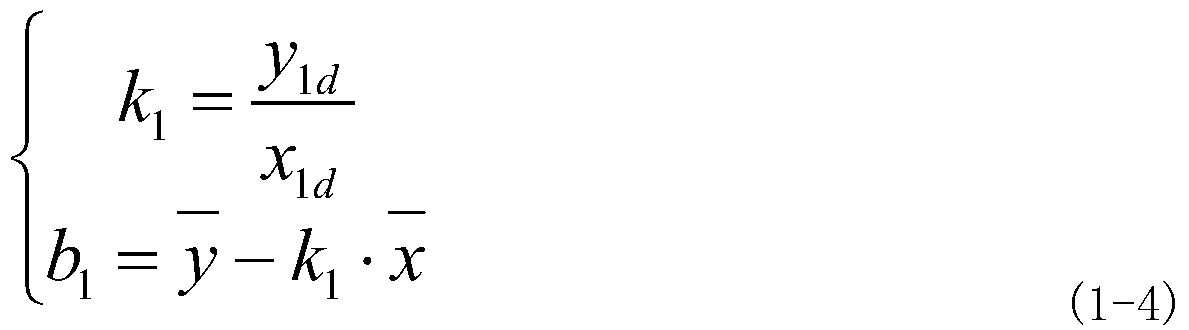
- the edge detection in the step a further comprises: setting a grayscale threshold value, performing a line search from the upper and lower directions according to the threshold value, acquiring an edge, and detecting the edge, using a straight line scanning method to obtain The pixel coordinates of the edge line; then the least squares method is used to obtain the edge line equation of the image, and at the same time obtain the horizontal length, vertical length and slope of the banknote image.
- the rotating in the step b further comprises: obtaining a rotation matrix based on the horizontal length, the vertical length and the slope, and determining the rotated pixel point coordinates according to the rotation matrix.
- the rotation matrix can be obtained by means of polar coordinate conversion, that is, a polar coordinate transformation matrix.
- polar coordinate conversion that is, a polar coordinate transformation matrix.
- the inclination angle of the banknote can be obtained by the obtained linear equation of the edge, and the pixel points are calculated according to the angle and the length of the edge.
- Polar coordinate transformation matrix can also be calculated by ordinary coordinate transformation method, for example, according to the inclination angle and the edge length, the center point of the banknote is set as the coordinate origin, and the conversion matrix of each coordinate point in the new coordinate system is calculated.
- other matrix transformation methods can also be used to correct the rotation of the banknote image.
- the performing binarization processing on the image by adaptive binarization specifically includes: obtaining a histogram of the image, and setting a threshold Th, when the gray value in the histogram is from 0 to When the number of points of Th is greater than or equal to a predetermined value, Th is used as an adaptive binarization threshold at this time, and the image is binarized to obtain a binarized image.
- the projecting of the binarized image is performed in three different directions.
- the moving window registration in the step c specifically includes: designing a moving window for registration, the window is horizontally moved on the vertical projection view, and the position corresponding to the minimum value of the total number of black points in the window is a crown The best position for dividing the word number in the left and right direction.
- the window is a pulse sequence with a fixed interval, and the width between the pulses is preset by an interval between the image of the crown number.
- each of said pulses has a width of 2-10 pixels.
- the tightening in the step d includes: separately performing binarization on the image of each number, performing regional growth on the binarized image of each acquired number, and finally, re-orienting the region.
- the area obtained after the growth One or two areas whose area is larger than a certain preset area threshold are selected, and the rectangle in which the selected area is located is a rectangle that is tightly packed by each number image.
- the growth of the region may employ, for example, an eight-neighbor region growth algorithm.
- the image of each number is separately binarized, specifically comprising: extracting a histogram of the image of each number, obtaining a binarization threshold by a histogram bimodal method, and then performing binarization according to the binarization
- the threshold binarizes the image of each of the numbers.
- the size normalization in the step d is size normalization using a bilinear interpolation algorithm.
- the normalized size is one of the following: 12*12, 14*14, 18*18, 28*28, and the unit is a pixel.
- the shading normalization in the step d comprises: acquiring a histogram of the image of each number, calculating a number foreground gray average value and a background gray average value, and normalizing the brightness and darkness
- the pixel gray value is compared with the foreground gray average and the background gray average, respectively, and the pixel gray value before normalization is set to the corresponding specific gray value according to the comparison result.
- step b and step c further comprising a face-facing determining step of: determining a banknote size by the rotated image, determining a face value according to the size; dividing the target banknote image into n blocks, and calculating The average value of the brightness in each block is compared with the template stored in advance, and when the difference is the smallest, it is determined as the face of the template.
- the template can be pre-set in a variety of ways, as long as it can be contrasted by banknote images, such as different denominations, different brightness values, color differences, or other features that can be converted to brightness values. Used as a comparison template.
- the pre-stored template divides images of different faces of different denominations into n blocks, and calculates a brightness average value in each block as a template.
- the step of judging the newness degree is further included: first extracting an image of a preset number of dpi, using the entire area of the image as a feature area of the histogram, and scanning the pixel points in the area, In the array, the histogram of each pixel is recorded, and a certain proportion of the brightest pixel is counted according to the histogram, and the average gray value of the brightest pixel is obtained as the basis for judging the newness and the oldness.
- the preset number of dpi images may be, for example, a 25 dpi image, etc., and the certain ratio may be adjusted according to specific needs, and may be, for example, 40%, 50%, or the like.
- a damage identification step of: obtaining a transmitted image by separately arranging a light source and a sensor on both sides of the banknote; and detecting the transmitted image after the rotation point by point, when the point is of When two adjacent pixels are simultaneously less than a predetermined threshold, the point is determined to be a damage point.
- the detection of the damage point can be divided into broken corner damage, hole breakage and the like in more detail.
- the step of recognizing the handwriting further comprises: in the fixed area, scanning the pixels in the area, placing them in an array, recording a histogram of each pixel point, and counting according to the histogram A preset number of the brightest pixels is obtained, and an average gray value is obtained, and a threshold is obtained according to the average gray value, and a pixel whose gray value is smaller than the threshold is determined as a character point.
- the preset number may be, for example, 20, 30, etc., and is not understood here as a limitation of the protection range; the threshold value may be derived according to the average gray scale value, and various methods may be adopted, and the average gray value may be directly used as the threshold value. It is also possible to use the function of the average gray value as a variable to solve the threshold.
- the neural network in the step e adopts a secondary classification convolutional neural network; the first level classification classifies all the numbers and letters involved in the crown number, and the second level classification respectively in the first level classification Some categories are reclassified.
- the number of categories of the first-level classification may be set according to classification needs and setting habits, and may be, for example, 10 categories, 23 categories, 38 categories, etc., and is not limited thereto.
- the second-level classification is also based on the first-level classification. For the classifications that are easy to misjudge, feature approximation or low accuracy, the second-level classification is performed again, so that the crown number is further advanced with a higher recognition rate. Differentiate and identify, and the number of specific input categories and the number of output categories of the second-level classification can be set according to the category setting of the first-level classification, classification needs and setting habits, etc., and is not limited thereto. .
- the network model structure of the convolutional neural network is set as follows:
- Input layer only one image as a visual input, the image being a grayscale image of a single crown number to be identified;
- C1 layer is a convolution layer, which consists of 6 feature maps
- S2 layer is a downsampling layer, and uses image local correlation principle to subsample the image
- C3 layer is a convolution layer, using a preset convolution kernel to deconvolution layer S2, each feature map in the C3 layer is connected to S2 by means of incomplete connection;
- S4 layer for the downsampling layer, sub-sampling the image by using the principle of image local correlation
- the C5 layer is a simple stretch of the S4 layer and becomes a one-dimensional vector
- the number of outputs of the network is the number of classifications, and the C5 layer constitutes a fully connected structure.
- the C1 layer and the C3 layer are each convoluted by a 3x3 convolution kernel.
- the banknote information processing device is one or more of a banknote sorting machine, a money counter, and a money detector;
- the information of the banknote information processing device is one or more of a manufacturer, a device number, and a financial institution in which it is located.
- the banknote information processing device is a self-service financial device; the information of the banknote information processing device is one or more of a banknote record, a banknote number, a manufacturer, a device number, and a financial institution in which it is located.
- the banknote management method is characterized in that a plurality of the banknote processing information devices respectively collect, identify and process banknote information in their respective businesses, and transmit the banknote information to a site host or a cash center host, and then The branch host or cash center host transmits the banknote information to the master server.
- the present invention also provides a banknote management system, the banknote management system including a banknote information processing terminal and a main control server;
- the banknote information processing terminal comprises a banknote sending module, a detecting module and an information processing module;
- the banknote sending module is configured to transport the banknotes to the detecting module
- the detecting module collects and recognizes the characteristics of the banknote
- the information processing module processes and processes the banknote features collected and recognized by the detecting module, outputs the banknote characteristic information, and transmits the same;
- the main control server is configured to receive the banknote characteristic information, the business information, and the information of the banknote information processing terminal, process the received three types of information, and classify the banknotes.
- the main control server processes the received information, and specifically includes processing such as aggregation, storage, sorting, querying, tracking, and exporting.
- the detection module can also be applied to the identification system of the crown number of the DSP platform, and can be embedded or coupled to a conventional money detector, a money counter, an ATM, etc., and the like.
- the detection module includes Image preprocessing module, processor module, CIS image sensor module;
- the image preprocessing module further includes an edge detection module and a rotation module;
- the processor module further includes a number positioning module, a tightening module, a normalization module, and an identification module;
- the number positioning module performs binarization processing on the image by adaptive binarization to obtain a binarized image; then, the binary image is projected; finally, by setting a moving window, using a moving window to register By dividing the number, obtaining an image of each number, and transmitting the image of each number to the tightening module; the manner of registering the moving window, that is, by setting a fixed window, for example, a window template manner Etc., narrow the number area to achieve more accurate area positioning, and all the way to set the fixed window sliding match can be applied to this application.
- a fixed window for example, a window template manner Etc.
- the normalization module is configured to normalize the image processed by the tightening module; preferably, the normalization includes size normalization and light and dark normalization.
- the number positioning module further comprises a window module, and the window module designs a registration moving window according to the crown number spacing, horizontally moves the window on the vertical projection view, and calculates black in the window.
- the window module designs a registration moving window according to the crown number spacing, horizontally moves the window on the vertical projection view, and calculates black in the window. The sum of points;
- the window module can also compare the sum of the black points in different windows.
- the tightening module separately binarizes the image of each number, performs regional growth on the binarized image of each obtained number, and finally selects one of the regions obtained after the region is grown. Or two areas whose area is larger than a certain preset area threshold, and the rectangle in which the selected area is located is a rectangle that is tightly packed by each number image.
- the growth of the region may employ, for example, an eight-neighbor region growth algorithm.
- the image of each number is separately binarized, specifically comprising: extracting a histogram of the image of each number, obtaining a binarization threshold by a histogram bimodal method, and then performing binarization according to the binarization
- the threshold binarizes the image of each of the numbers.
- the detecting module further includes a compensation module for compensating an image obtained by the CIS image sensor module, and the compensation module pre-stores pure white and pure black collected luminance data, and combines the settable pixel points. Gray reference value, to obtain a compensation coefficient;
- the compensation coefficients are stored to the processor module and a lookup table is created.
- the identification module uses the trained neural network to implement the identification of the crown number.
- the neural network adopts a two-class classified convolutional neural network; the first-level classification classifies all the numbers and letters involved in the crown number, and the second-level classification separately performs the partial categories in the first-level classification. classification.
- the number of categories of the first-level classification may be set according to classification needs and setting habits, and may be, for example, 10 categories, 23 categories, 38 categories, etc., and is not limited thereto.
- the second-level classification is also based on the first-level classification. For the classifications that are easy to misjudge, feature approximation or low accuracy, the second-level classification is performed again, so that the crown number is further advanced with a higher recognition rate. Differentiate and identify, and the number of specific input categories and the number of output categories of the second-level classification can be set according to the category setting of the first-level classification, classification needs and setting habits, etc., and is not limited thereto. .
- the network model structure of the convolutional neural network is set as follows:
- Input layer only one image as a visual input, the image is a grayscale image of a single crown number to be identified image;
- C1 layer is a convolution layer, which consists of 6 feature maps
- S2 layer is a downsampling layer, and uses image local correlation principle to subsample the image
- C3 layer is a convolution layer, using a preset convolution kernel to deconvolution layer S2, each feature map in the C3 layer is connected to S2 by means of incomplete connection;
- S4 layer for the downsampling layer, sub-sampling the image by using the principle of image local correlation
- the C5 layer is a simple stretch of the S4 layer and becomes a one-dimensional vector
- the number of outputs of the network is the number of classifications, and the C5 layer constitutes a fully connected structure.
- the C1 layer and the C3 layer are each convoluted by a 3x3 convolution kernel.
- the identification module further comprises a neural network training module for training the neural network.
- the processor module can employ a chip system such as an FPGA.
- the processor module further comprises: a face-oriented judging module, configured to determine the orientation of the banknote.
- the processor module further includes a new and old degree judging module for judging the degree of oldness of the banknote.
- the processor module further includes a damage identification module for identifying a broken location in the banknote.
- the breakage includes corners, holes, and the like.
- the processor module further includes a handwriting recognition module for identifying a handwriting on the banknote.
- the main control server end classifies the banknotes by specifically classifying the banknotes into the different coin bins according to the classified categories.
- the banknote characteristic information includes one or more of a currency, a face value, a face, an authenticity, a newness, a stain, and a crown number;
- the service information includes record information of payment, payment, deposit or withdrawal, business time period information, operator information, transaction card number information, identity information of the person and/or agent, two-dimensional code information, and a package number.
- record information of payment, payment, deposit or withdrawal business time period information, operator information, transaction card number information, identity information of the person and/or agent, two-dimensional code information, and a package number.
- the banknote information processing terminal is one of a banknote sorting machine, a money counter, a money detector, and a self-service financial device; further preferably, the self-service financial device is an automatic teller machine (ATM) or an automatic deposit machine.
- ATM automatic teller machine
- the present invention also provides a banknote information processing terminal which is the banknote information processing terminal included in the banknote management system.
- the banknote management method of the present invention can realize intelligent management of the crown number.
- the banknote information of the bank clearing device can be traced, the counterfeit currency management, the unified management of the crown number, the business electronic log, and the data.
- the management and operation cost of the extension equipment can also promote the good operation of equipment such as the sorting machine and the money counter;
- the banknote management method of the invention realizes the high efficiency of collecting and identifying the banknote information while ensuring the accuracy of the identification information, especially in the identification of the crown number, ensuring the overall method and the speed of the system operation. In this case, the robustness of the method is improved, and it is well able to cope with the difficulty in identifying the crown number recognition due to banknote fouling, incompleteness, and rapid folding;
- the method provided by the invention occupies less system resources and is faster than conventional algorithms in the prior art, and can be well combined with devices such as ATMs and money detectors.
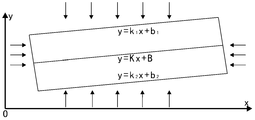
- FIG. 1 is a schematic diagram of a method for identifying an embodiment of the present invention
- FIG. 2 is a schematic diagram of an edge detection method according to an embodiment of the present invention.
- FIG. 3 is a schematic view showing a banknote image and an actual banknote in a banknote handling process according to an embodiment of the present invention
- FIG. 4 is a schematic view showing an arbitrary point rotation of a banknote according to an embodiment of the present invention.
- FIG. 5 is a schematic diagram of setting a mobile window according to an embodiment of the present invention.
- FIG. 6 is a schematic structural diagram of a neural network according to an embodiment of the present invention.
- This embodiment provides a banknote management method, which specifically includes the following steps:
- the banknotes are The information processing device collects the characteristics of the banknote by means of image, infrared, fluorescent, magnetic, and thickness measurement.
- the banknote characteristic information includes currency type, face value, face, authenticity, newness, degree of stain, and crown number; as a specific implementation manner of the embodiment, the banknote information processing device is a banknote sorting machine;
- the information of the processing device is the manufacturer, the device number, and the financial institution where it is located;
- banknote information processing devices is not unique, including but not limited to six, at least one;
- the banknote information processing device may also be one or more of a money counter or a money detector; the information of the banknote information processing device may also be omitted from the manufacturer and the device. Number or one or more of the financial institutions in which it is located;
- the banknote information processing device may also be a self-service financial device; specifically, the banknote information processing device may be an automatic teller machine, an automatic deposit machine, or a circulating automatic teller machine. , self-service inquiry machine, self-service payment machine.
- the information of the banknote information processing device may be one or more of a banknote record, a banknote number, a manufacturer, a device number, and a financial institution;
- the service information includes record information of payment, payment, deposit or withdrawal, business time period information, operator information, transaction card number information, identity information of the agent and the agent, QR code information, packet number;
- the manner in which the banknote feature information is transmitted to the main control server is not unique, and those skilled in the art may change the banknote feature information, the service information, and the banknote information processing device according to actual conditions.
- the transmission path of the information for example, directly transmitting the banknote characteristic information, the information of the banknote information processing device, and the business information described in step 1) to the main control server;
- a person skilled in the art may also omit or replace part of the service information in this embodiment according to actual needs, that is, omit or replace the record information of payment, payment, deposit or withdrawal, business time period information, operator information, Transaction card number information, one or more of the identity information of the agent and the agent, the QR code information, and the package number;
- the main control server performs integration processing on the received banknote characteristic information, the business information, and the information of the banknote information processing device, and classifies the banknotes.
- the sorting process of the banknotes is specifically: after sorting the banknotes, the banknotes are sorted into different coin bins according to the classified categories.
- the method for identifying the feature of the banknote is described below as an example. As shown in FIG. 1 , the method includes the following steps:
- Step a extracting the grayscale image of the region where the crown number is located, and performing edge detection on the grayscale image; the edge detection can be implemented by conventional canny detection, sobel detection, etc., and then combined with straight line fitting to obtain an edge straight line equation. However, it is necessary to test the empirical threshold for edge detection to ensure the speed of the method.
- the edge detection in the step a further includes: setting a grayscale threshold, performing a line search from the upper and lower directions according to the threshold, acquiring an edge, and detecting the edge, using a straight line sweep In the face mode, the pixel coordinates of the edge line are obtained; then the edge line equation of the image is obtained by the least square method, and the horizontal length, vertical length and slope of the banknote image are obtained at the same time.
- a threshold linear regression segmentation technique can be adopted, and the calculation speed is fast, and is not limited by the image size, and is detected at other edges.
- the threshold linear regression segmentation technique only a small number of pixel points need to be found on the upper and lower edges, and the straight line equation of the edge can be quickly determined by the straight line fitting method. No matter how big or small the image is, you can find a small number of points to calculate.
- the straight line search method is used here to detect the edge of the banknote from the upper and lower directions.
- Step b Rotating the image; correcting and mapping the image of the banknote after the edge detection to correct the image, thereby facilitating segmentation and recognition of the number image.
- the rotation method may adopt a coordinate point transformation method.
- the method, or correction according to the detected edge equation obtains the transformation equation, and can also be implemented by polar coordinate rotation or the like;
- the rotating in step b further comprises: obtaining a rotation matrix based on the horizontal length, the vertical length, and the slope, and determining the rotated pixel point coordinates according to the rotation matrix.
- the rotation matrix can be obtained by means of polar coordinate conversion, that is, a polar coordinate transformation matrix.
- polar coordinate conversion that is, a polar coordinate transformation matrix.
- the inclination angle of the banknote can be obtained by the obtained linear equation of the edge, and the pixel points are calculated according to the angle and the length of the edge.
- Polar coordinate transformation matrix can also be calculated by ordinary coordinate transformation method, for example, according to the inclination angle and the edge length, the center point of the banknote is set as the coordinate origin, and the conversion matrix of each coordinate point in the new coordinate system is calculated.
- other matrix transformation methods can also be used to correct the rotation of the banknote image.
- the image can be rotated and corrected by a rectangular coordinate transformation. Since p points are collected per millimeter in the horizontal direction during image acquisition, q is collected per millimeter in the vertical direction. a point.
- the rotation of the banknote image at any point, the whole process of rotation is a point A(x s , y s ) on the image of the banknote given arbitrarily, and the point A' corresponding to the actual banknote is found (x' s , y ' s ), the point B' is rotated by the angle ⁇ to obtain the point B'(x' d , y' d ), and finally the point B' is found to correspond to the point B (x d , y d ) on the image of the rotated banknote.
- Step c Locating a single number in the image, specifically: performing binarization processing on the image by adaptive binarization to obtain a binarized image; and then projecting the binarized image, the conventional image
- the projection is completed by only one vertical projection and one horizontal projection.
- the specific projection direction and number of times can be adjusted according to the specific environment and accuracy requirements of the recognition. For example, it is also possible to use a projection with a tilt angle direction, or multiple times. Projection combination; Finally, by setting the moving window, using the moving window registration method, the number is segmented, and the image of each number is obtained. Due to common problems such as damage and dirt of the banknote, there is dirt on the image of the crown number.
- the present invention adds a moving window registration method after image projection. Precisely determine the position of the character;
- the performing binarization processing on the image by adaptive binarization specifically includes: obtaining a histogram of the image, setting a threshold Th, when the gray in the histogram When the number of points from 0 to Th is greater than or equal to a preset value, and Th is used as an adaptive binarization threshold at this time, the image is binarized to obtain a binarized image; The image is projected and a total of three different directions are projected.
- the setting the moving window specifically includes: the window horizontally moving on the vertical projection view, and the sum of the black dots in the window The position corresponding to the minimum value is the optimal position for dividing the left and right direction of the crown number.
- an overall adaptive binarization method may be employed for the binarization of the image.
- the blacker color is the crown number area
- the brighter white is the background area.
- the number of points whose gradation value is 0 to Th and N are obtained on the histogram.
- N> 2200 (empirical value)
- the corresponding threshold Th is the threshold of adaptive binarization.
- the binarized image is projected, and the three projections can be combined to determine the up, down, left, and right positions of each number.
- the first horizontal projection determine the row where the number is located
- the second projection in the vertical direction determine the position of each digit in the left and right direction
- the third time is to horizontal projection of each small image, determine each The position of the number in the up and down direction.
- the above-mentioned three projection method can achieve good results for single number segmentation of most banknotes, but is dirty for the image of the crown number, and the effect of sticking between characters and characters is poor. Especially for the adhesion of three or more characters, it can hardly be separated.
- a window movement registration method can be employed. Because the resolution of the crown number and size of the clearing machine is fixed, the size of each character is fixed, and the spacing between each character is also fixed. The design of the window can be designed according to the spacing of the crown numbers on the banknotes, as shown in Figure 5.
- the window moves horizontally on the vertical projection map, and the position corresponding to the minimum value of the total number of black points in the window is the optimal position for dividing the left and right direction of the crown number. Since the recognition algorithm is used on the banknote sorter, the accuracy and speed are satisfied, and the resolution of the original image is 200 dpi.
- the design of the window has a pulse width of 4 pixels, and the width between the pulses is designed according to the interval between the number images. After testing, the method can fully meet the real-time and accuracy requirements of the banknote sorting machine.
- Step d tightening characters included in the image of each number, and normalizing each number image, the normalization including size normalization and light and dark normalization;
- the characters which are divided into the approximate positions are repositioned in detail to further reduce the amount of data to be processed by the subsequent image recognition, which greatly ensures the overall running speed of the system.
- the cubic projection method is only a preliminary positioning of a single number, and for a lot of dirty single numbers, it cannot be really tightened.
- the binarization method mentioned above is to binarize the entire image, and the calculated threshold does not apply to the binarization of a single character.
- the 2005 version of RMB 100 the first four characters are red, the last six characters are black, which will result in uneven brightness of each character of the acquired grayscale image.
- Each small image can be binarized separately.
- the binarization uses a histogram bimodal adaptive binarization method.
- the histogram bimodal method is an iterative method for thresholding.
- an initialization threshold T 0 is set , and then the threshold of binarization is obtained after K iterations.
- K is a positive integer greater than 0, where the background gray average of the kth iteration And foreground grayscale mean They are:
- the condition for exiting the iteration when the number of iterations is sufficient (for example, 50 times), or the threshold results of the two iterations are the same, that is, the thresholds of the kth and k-1th times are the same, the iteration is exited.
- the normalization may be as follows: the normalization here is for the next neural network identification. Considering the requirements of calculation speed and accuracy, the image size when the size is normalized cannot be too large or too small. Too big, causing too many subsequent neural network nodes, the calculation speed is too slow, too small, and the information loss is too much. Tested several normalized sizes Small, 28*28, 18*18, 14*14, 12*12, and finally selected 14*14.
- the normalized scaling algorithm uses a bilinear interpolation algorithm.
- the normalizing process in the step d specifically includes: performing size normalization by using a bilinear interpolation algorithm; and the shading normalization comprises: acquiring a histogram of the image of each number Figure, calculating the foreground grayscale average value and the background grayscale average value, and comparing the pixel grayscale values before the normalization of the brightness and darkness with the foreground grayscale average value and the background grayscale average value, according to the comparison result, The pixel gray value before normalization is set to the corresponding specific gray value.
- normalization of the degree of shading must also be performed.
- Step e using a neural network to identify the normalized number image to obtain a crown number.
- the neural network described above can be implemented using a Convolutional Neural Network (CNN) algorithm.
- CNN Convolutional Neural Network
- CNN Convolutional Neural Network
- a small portion of the image (locally perceived region) is used as the input to the lowest layer of the hierarchical structure, and the information is sequentially transmitted to different layers, each layer passing through a digital filter to obtain the most significant features of the observed data.
- This method is capable of obtaining salient features of the invariant observation data for translation, scaling, and rotation, because the local perceptual region of the image allows the neuron or processing unit to access the most basic features.
- the main feature on the image of the crown number is the edge and Corner points are therefore very suitable for identification using CNN methods.
- the neural network employs a secondary classification convolutional neural network; the first fraction The class classifies all the numbers and letters involved in the prefix number, and the second level classifies the partial categories in the first level classification separately.
- the number of categories of the first-level classification may be set according to classification needs and setting habits, and may be, for example, 10 categories, 23 categories, 38 categories, etc., and the second-level classification is the same.
- the second-level classification is performed again, so that the crown number is further distinguished and identified by the higher recognition rate, and the second level
- the number of specific input categories and the number of output categories of the classification can be set in detail according to the category setting of the first level classification, the classification needs and setting habits, and the like.
- CNN convolutional neural network
- the RMB has no letter V, and the letter O and the number 0 are printed exactly the same. Therefore, we use the secondary classification method to identify the number of the crown number. .
- the first level classification classifies all numbers and letters into 23 categories:
- the first category A 4
- T J J is the 2005 version and all versions of the RMB
- the second level classification is the classification of A 4, B 8, C 6G, O D Q, E L F, S 5, T J, Z 2 respectively.
- the above two-level CNN classification method involves nine neural network models, which are respectively recorded as: CNN_23, CNN_A4, CNN_B8, CNN_CG6, CNN_ODQ, CNN_ELF, CNN_S5, CNN_JT, CNN_Z2.
- FIG. 6 is a schematic structural diagram thereof.
- the input layer of the network there is only one picture, which is equivalent to the visual input of the network, which is the gray image of the single number to be identified.
- the grayscale image is chosen here for the information not to be lost, because if the binarized image is identified, some image edge and detail information will be lost in the process of binarization.
- the brightness of each grayscale image is normalized, that is, the brightness and darkness normalization.
- the C1 layer is a convolutional layer.
- the convolutional layer has the advantage of convolution operation, which can enhance the original signal characteristics and reduce noise. It consists of six feature maps. Each neuron in the feature map is connected to a 3*3 neighborhood in the input. The size of the feature map is 14*14.
- Both the S2 and S4 layers are downsampling layers. Sub-sampling the image using the principle of image local correlation can reduce the amount of data processing while retaining useful information.
- the C3 layer is also a convolutional layer. It also deconvers the layer S2 through the 3x3 convolution kernel. The resulting feature map has only 4x4 neurons. For the sake of simplicity, only six different convolution kernels are designed. There are 6 feature maps. One thing to note here is that each feature map in C3 is connected to S2 and not fully connected. Why not connect each feature map in S2 to the feature map of each C3? There are two reasons. First, An incomplete connection mechanism keeps the number of connections within a reasonable range. Second, and most importantly, it undermines the symmetry of the network. Since different feature maps have different inputs, they are forced to extract different features. The composition of this non-full join result is not unique.
- the first two feature maps of C3 are input with three adjacent feature map subsets in S2, and the next two feature maps are input with four adjacent feature map subsets in S2, and then one is not
- the adjacent three feature map subsets are inputs, and the last one takes all feature maps in S2 as inputs.
- the last set of S to C layers is not downsampled, but a simple stretch of the S layer, which becomes a one-dimensional vector.
- the number of outputs of the network is the number of classifications of the neural network, and the last layer constitutes a fully connected structure.
- the training of the neural network can be carried out in the following ways:
- the calculation formula of the jth feature map of the first layer is as follows:
- the * sign indicates convolution
- the convolution kernel k performs a convolution operation on all associated feature maps of the l-1th layer, and then sums, plus an offset parameter b, taking the sigmoid function Get the ultimate incentive.
- the residual of the jth feature map of the first layer is calculated as follows:
- the first layer is a convolution layer
- the l+1th layer is a downsampling layer
- the downsampling layer and the convolution layer are in one-to-one correspondence.
- up(x) is to expand the size of the l+1th layer to be the same as the size of the first layer.
- Randomly select the renminbi crown number as a training sample about 100,000, the number of training is more than 1000 times, approaching The accuracy is less than 0.004.
- step b and step c further comprising a face-facing determining step of determining a banknote size by the rotated image, determining a face value according to the size, and dividing the target banknote image into n Blocks, calculating the average value of the brightness in each block, compared with the pre-stored template, when the difference is the smallest, it is judged as the corresponding face of the template; the pre-stored template is to divide the image of different facets of different denominations It is n blocks, and the average value of the brightness in each block is calculated as a template.
- the face value of the banknote can be determined by the banknote size detection + template matching method. First determine the face value of the banknote by the size of the banknote. Then, after determining the face of the banknote, 16*8 identical rectangular blocks are divided inside the banknote image, and the brightness average value in each rectangular block is calculated, and the 16*8 brightness average data is placed in the memory as template data. . In the same way, the average value of the brightness of the target banknote is obtained, and compared with the template data, the difference is found to be the smallest. The face of the banknote can be confirmed.
- step b and the step c further comprising a damage identification step: obtaining a transmitted image by separately arranging a light source and a sensor on both sides of the banknote; and respectively, after the rotated transmitted image It is detected that when two adjacent pixels of the point are simultaneously less than a predetermined threshold, the point is determined to be a damage point.
- the light source and the sensor are distributed on both sides of the banknote, that is, the transmission mode.
- the light source encounters the banknote, only a small part of the light can penetrate the banknote and hit the sensor component, and the light that does not encounter the banknote is completely hit on the sensor component. Therefore the background is white and the banknotes are also grayscale. Damage includes notches and holes. The detection of notch and hole is applied by the damage identification technology. The difference is that the detection area is different. The corner detection detects the four corners of the banknote, and the hole is the middle area for detecting the banknote.
- the banknotes may be divided into upper left, lower left, upper right, and lower right, respectively, four regions on the rotated transmissive banknote image. Then, the four regions are respectively detected point by point, and the adjacent two pixels are simultaneously smaller than the threshold, then the point is judged to be a damage point. If the two adjacent points do not satisfy the condition less than the threshold, it indicates that the angle corresponding to the intersection does not have Damage feature.
- the position of the missing corner has been black Filled, if the banknote has a corner and hole feature, then the pixel is white.
- the pixel value of the point determined to be the corner is changed to the black pixel value, thus achieving the filling. . Therefore, the entire banknote is searched for on the four sides of the banknote. If the banknote is found to have a broken feature, it indicates that the banknote has a hole, otherwise the banknote has no holes.
- the hole area is incremented by one each time a pixel point smaller than the threshold is searched. The area of the hole will eventually be obtained after the search is completed.
- the following manner may be adopted: in the fixed area, the pixels in the scanning area are placed in an array, and the histogram of each pixel point is recorded, and the histogram is calculated according to the histogram. The brightest pixel points, the average gray value is obtained, and the threshold is calculated. A pixel point smaller than the threshold is determined to be a handwriting +1.
- the embodiment provides a banknote management system, and the banknote management system includes a banknote information processing terminal and a main control server end;
- the banknote information processing terminal comprises a banknote sending module, a detecting module and an information processing module;
- the banknote sending module is configured to transport the banknotes to the detecting module
- the detecting module collects and recognizes the characteristics of the banknote
- the information processing module processes and processes the characteristics of the banknotes collected and recognized by the detecting module, and outputs the characteristics of the banknotes and transmits them.
- the banknote characteristic information specifically includes a currency, Denomination, orientation, authenticity, old and new, defacement, crown number;
- the main control server is configured to receive the banknote characteristic information, the service information, and the information of the banknote information processing terminal, process the received three types of information, and classify the banknote; in this embodiment, As a preferred implementation manner, the main control server end sorts the banknotes by specifically classifying the banknotes into the different coin bins according to the classified categories.
- the service information includes record information of collection, payment, deposit or withdrawal, business time period information, operator information, transaction card number information, identity information of the agent and the agent, and Dimension code information, packet number;
- the main control server processes the received information, and specifically includes collecting, storing, sorting, querying, tracking, and exporting the received information.
- the banknote information processing terminal described in this embodiment can be used alone.
- the banknote information processing terminal is a banknote sorting machine; as an alternative technical solution of the embodiment, the banknote information processing terminal can also be replaced with one of a money counter, a money detector, and a self-service financial device;
- the self-service financial device may be any one of an automatic teller machine, an automatic deposit machine, a circulation automatic teller machine, a self-service inquiry machine, and a self-service payment machine.
- the design of the detection module is not unique. In this embodiment, a specific implementation manner is provided.
- the detection module can also be applied to the identification system of the crown number of the DSP platform, and can be embedded or connected.
- the utility model is used in combination with a conventional money detector, a money counter, an ATM, and the like.
- the detection module includes: an image preprocessing module, a processor module, and a CIS image sensor module;
- the image preprocessing module further includes an edge detection module and a rotation module;
- the processor module further includes a number positioning module, a tightening module, a normalization module, and an identification module;
- the number positioning module performs binarization processing on the image by adaptive binarization to obtain a binarized image; then, the binary image is projected; finally, by setting a moving window, using a moving window to register Means, dividing the number, obtaining an image of each number, and transmitting the image of each number to the tightening module;
- the normalization module is used to normalize the image processed by the tightening module.
- the normalization is size normalization and light and dark normalization.
- the number positioning module further includes a window module, and the window module designs a registration moving window according to the crown number spacing, and moves the window horizontally on the vertical projection image, and calculates the The sum of the number of black points in the window; the window module can also compare the sum of the black points in different windows.
- the specific manner of the positioning can be carried out by the method in Embodiment 1.
- the tightening module extracts a histogram for an image of each number, obtains a binarization threshold by using a histogram bimodal method, and then, according to the binarization threshold, each number of the number The image is binarized, and the binarized image of each number obtained is subjected to regional growth. Finally, in the region obtained after the region is grown, one or two regions having an area larger than a predetermined area threshold are selected. The rectangle in which these selected regions are located is the rectangle in which each number image is nested.
- the growth of the region may employ, for example, an eight-neighbor region growth algorithm.
- the banknote image needs to be compensated, and the compensation module may be disposed in the detection module for the CIS.
- the image obtained by the image sensor module is compensated, and the compensation module pre-stores pure white and pure black collection light.
- the degree data is combined with the gray reference value of the settable pixel point to obtain a compensation coefficient; the compensation coefficient is stored in the processor module, and a lookup table is established.
- the white paper is pressed on the CIS image sensor, the collected bright level data is stored in the CISVL[i] array, and the collected dark level data is stored in CISDK[i], and the formula is passed.
- CVLMAX is a configurable pixel point gray reference value. According to experience, the gray value of white paper is set to 200.
- the compensation coefficient calculated by the DSP chip is transmitted to the random memory of the FPGA (processing module) to form a lookup table. After that, the FPGA chip multiplies the collected pixel point data by the compensation coefficient of the corresponding pixel in the lookup table, and directly obtains the compensated data, and then transmits the compensated data to the DSP.
- the identification module uses the trained neural network to implement the identification of the crown number.
- the neural network adopts a secondary classification convolutional neural network; the first level classification classifies all the numbers and letters involved in the crown number, and the second level classification is respectively in the first level classification. Some of the categories are reclassified. It should be noted that the number of categories of the first-level classification may be set according to classification needs and setting habits, and may be, for example, 10 categories, 23 categories, 38 categories, etc., and the second-level classification is the same.
- the second-level classification is performed again, so that the crown number is further distinguished and identified by the higher recognition rate, and the second level
- the number of specific input categories and the number of output categories of the classification can be set in detail according to the category setting of the first level classification, the classification needs and setting habits, and the like.
- the structure of the convolutional neural network described above can be implemented by using the neural network structure in Embodiment 1 above.
- the processor module may further include at least one of the following: a face-to-face determination module for determining the orientation of the banknote; a new and old degree determination module for determining the oldness and the oldness of the banknote; and the damage identification a module for identifying a damaged location in the banknote; a handwriting recognition module for identifying a handwriting on the banknote.
- a face-to-face determination module for determining the orientation of the banknote
- a new and old degree determination module for determining the oldness and the oldness of the banknote
- the damage identification a module for identifying a damaged location in the banknote
- a handwriting recognition module for identifying a handwriting on the banknote.
- the processor module can use, for example, an FPGA (Kyoto Yage M7 chipset) Chip type system such as M7A12N5L144C7).
- the chip's main frequency is (FPGA main frequency 125M, ARM main frequency 333M), the occupied resources are (Logic 85%, EMB 98%), the recognition time is 7ms.
- the accuracy is 99.6% or more.
Landscapes
- Physics & Mathematics (AREA)
- General Physics & Mathematics (AREA)
- Engineering & Computer Science (AREA)
- Computer Vision & Pattern Recognition (AREA)
- Computer Security & Cryptography (AREA)
- Inspection Of Paper Currency And Valuable Securities (AREA)
- Character Discrimination (AREA)
- Image Analysis (AREA)
Abstract
Description




Claims (25)
- 一种纸币管理方法,其特征在于,包括以下步骤:(1)采用纸币信息处理装置对纸币特征进行采集、识别和处理,得到纸币特征信息;(2)将步骤1)中所述的纸币特征信息、业务信息、所述纸币信息处理装置的信息一起传输至主控服务器;(3)所述主控服务器对接收的所述纸币特征信息、所述业务信息、所述纸币信息处理装置的信息进行整合加工处理,并对纸币进行分类处理。
- 根据权利要求1中所述的纸币管理方法,其特征在于,所述纸币特征的识别具体包括如下步骤:步骤a、提取纸币特征所在区域的灰度图像,并对灰度图像进行边缘检测;步骤b、对图像进行旋转;步骤c、对图像中的单个号码进行定位,具体包含:通过自适应二值化,对图像进行二值化处理,获得二值化图像;然后对所述二值化图像进行投影;最后通过设置移动窗口,采用移动窗口配准的方式,对号码进行分割,得到每个号码的图像;步骤d、对所述每个号码的图像中包含的字符进行套紧,并对每个号码图像进行归一化处理;优选地,所述归一化包含尺寸归一化和明暗归一化;步骤e、采用神经网络对归一化后的号码图像进行识别,获得纸币特征;优选的,所述纸币特征为冠字号码。
- 根据权利要求2中所述的纸币管理方法,其特征在于,所述步骤a中的边缘检测进一步包括:设定一灰度阈值,依据该阈值从上、下两方向进行直线搜索,获取边缘;再通过最小二乘法,获得图像的边缘直线方程,并同时获得纸币图像的水平长度、垂直长度和斜率。
- 根据权利要求2或3中所述的纸币管理方法,其特征在于,所述步骤b中的旋转,进一步包括:基于所述水平长度、垂直长度和斜率,获得旋转矩阵,依据所述旋转矩阵,求取旋转后的像素点坐标。
- 根据权利要求2中所述的纸币管理方法,其特征在于,所述步骤c中,所述通过 自适应二值化对图像进行二值化处理,具体包括:求取图像的直方图,设置一阈值Th,当直方图中灰度值由0到Th的点数和大于等于一预设值时,以此时的Th作为自适应二值化阈值,对图像进行二值化,获得二值化图像。
- 根据权利要求2中所述的纸币管理方法,其特征在于,所述步骤c中的移动窗口配准具体包括:设计配准用移动窗口,所述窗口在垂直投影图上水平移动,窗口内的黑点数总和最小值所对应的位置,即为冠字号码左右方向分割的最佳位置。
- 根据权利要求2所述的纸币管理方法,其特征在于,所述步骤d中的套紧,具体包括:对所述每个号码的图像单独进行二值化,对获取到的每个号码的二值化图像进行区域增长,再对区域增长后得到的区域里,选取一个或两个面积大于某一预设面积阈值的区域,选取后的区域所在的矩形即为每个号码图像套紧后的矩形。
- 根据权利要求7所述的纸币管理方法,其特征在于,对所述每个号码的图像单独进行二值化,具体包含:对所述每个号码的图像提取直方图,采用直方图双峰法获取二值化阈值,再依据该二值化阈值将所述每个号码的图像进行二值化。
- 根据权利要求2所述的纸币管理方法,其特征在于,所述步骤d中的明暗归一化包括:获取所述每个号码的图像的直方图,计算号码前景灰度平均值和背景灰度平均值,并将明暗归一化之前的像素灰度值分别与前景灰度平均值和背景灰度平均值进行比较,依据该比较结果,将归一化之前的像素灰度值设置为对应的特定灰度值。
- 根据权利要求2所述的纸币管理方法,其特征在于,在所述步骤b、步骤c之间,进一步包括面向判断步骤:通过所述旋转后的图像确定纸币尺寸,依据所述尺寸确定面值;将目标纸币图像分割为n个区块,计算各区块中的亮度均值,与预先存储的模板比较,差值最小时,判断为模板对应的面向;和/或,在所述步骤b、步骤c之间,进一步包括新旧程度判断步骤:首先提取预设数量dpi的图像,将该图像全部区域作为直方图的特征区域,扫描区域内的像素点,放在数组里,记录各个像素点的直方图,根据直方图统计出一定比例的最亮像素点,求取所述最亮像素点的平均灰度值,作为新旧程度判断依据;和/或,在所述步骤b、步骤c之间,进一步包括破损识别步骤:通过在纸币两侧分别设置光源和传感器,获取透射后图像;对旋转后的透射后图像逐点检测,当该点的相邻两像素点同时小于一预设阈值时,则判断该点为破损点;和/或,在所述步骤b、步骤c之间,进一步包括字迹识别步骤:在固定区域内,扫描区域内的像素点,放在数组里,记录各个像素点的直方图,根据直方图统计出预设数量个最亮像素点,求取平均灰度值,依据该平均灰度值得出阈值,灰度值小于阈值的像素点判定为字迹点。
- 根据权利要求2所述的纸币管理方法,其特征在于,所述步骤e中的神经网络采用二级分类的卷积神经网络;第一级分类将冠字号码涉及的所有数字和字母进行分类,第二级分类分别对第一级分类中的部分类别进行再次分类。
- 根据权利要求1中所述的纸币管理方法,其特征在于,所述步骤1)中通过图像、红外、荧光、磁、测厚中的一种或多种方式对所述纸币特征进行采集。
- 根据权利要求1中所述的纸币管理方法,其特征在于,所述步骤3)中对纸币进行分类处理具体为:将纸币分类后,使其按分类后类别进入到不同的币仓中。
- 根据权利要求1-13中任意一项所述的纸币管理方法,其特征在于,所述纸币特征信息包括币种、面值、面向、真伪、新旧程度、污损、冠字号码中的一种或多种;和/或,所述业务信息包括收款、付款、存款或取款的记录信息,业务时间段信息,操作员信息,交易卡号信息,办理人和/或代办人身份信息,二维码信息,封包号中的一种或多种。
- 根据权利要求1-14中任意一项所述的纸币管理方法,其特征在于,所述纸币信息处理装置为纸币清分机、点钞机、验钞机中的一种或多种;所述纸币信息处理装置的信息为制造厂商、设备编号、所在金融机构中的一种或多种。
- 根据权利要求1-14中任意一项所述的纸币管理方法,其特征在于,所述纸币信息处理装置为自助金融设备;所述纸币信息处理装置的信息为配钞记录、钞箱号、制造厂商、设备编号、所在金融机构中的一种或多种。
- 根据权利要求15或16所述纸币管理方法,其特征在于,所述纸币管理方法是由若干个所述纸币处理信息装置分别对其相应的业务中的纸币信息进行采集、识别和处理,并将所述纸币信息传输至网点主机或现金中心主机,再由所述网点主机或现金中心主机将所述纸币信息传输至主控服务器。
- 一种纸币管理系统,其特征在于,所述纸币管理系统包括纸币信息处理终端和 主控服务器端;所述纸币信息处理终端包括送钞模块、检测模块、信息处理模块;所述送钞模块用于将纸币输送至所述检测模块;所述检测模块对纸币特征进行采集和识别;所述信息处理模块加工处理所述检测模块采集和识别的纸币特征,输出为纸币特征信息,并将其传输;所述主控服务器端,用于接收所述纸币特征信息、业务信息、所述纸币信息处理终端的信息,对接收的上述三类信息进行加工,并对纸币进行分类处理。
- 根据权利要求18中所述的纸币管理系统,其特征在于,所述检测模块包括图像预处理模块、处理器模块、CIS图像传感器模块;所述图像预处理模块进一步包括边缘检测模块、旋转模块;所述处理器模块进一步包括号码定位模块、套紧模块、归一化模块、识别模块;所述号码定位模块,通过自适应二值化,对图像进行二值化处理,获得二值化图像;然后对所述二值化图像进行投影;最后通过设置移动窗口,采用移动窗口配准的方式,对号码进行分割,得到每个号码的图像,并将所述每个号码的图像传输给套紧模块;所述归一化模块用于对套紧模块处理后的图像进行归一化;优选地,所述归一化包括尺寸归一化及明暗归一化。
- 根据权利要求19所述的纸币管理系统,其特征在于,所述号码定位模块进一步包括窗口模块,所述窗口模块依据冠字号码间距,设计配准用移动窗口,将所述窗口在垂直投影图上水平移动,并计算所述窗口内的黑点数总和;所述窗口模块还可以将不同窗口内的所述黑点数总和进行比较。
- 根据权利要求19所述的纸币管理系统,其特征在于,所述套紧模块对每个号码的图像单独进行二值化,对获取到的每个号码的二值化图像进行区域增长,再对区域增长后得到的区域里,选取一个或两个面积大于某一预设面积阈值的区域,所述选取后的区域所在的矩形即为每个号码图像套紧后的矩形。
- 根据权利要求19所述的纸币管理系统,其特征在于,所述检测模块还包括补偿模块,用于对CIS图像传感器模块获得的图像进行补偿,所述补偿模块预先存储纯白及纯黑的采集亮度数据,并结合可设定的像素点的灰度参考值,得到补偿系数;所述补 偿系数存储至处理器模块,并建立查找表。
- 根据权利要求18中所述的纸币管理系统,其特征在于,所述主控服务器端对纸币进行分类处理具体为:将纸币分类后,使其按分类后类别进入到不同的币仓中。
- 根据权利要求18-23中任意一项所述的纸币管理系统,其特征在于,所述纸币特征信息包括币种、面值、面向、真伪、新旧程度、污损、冠字号码中的一种或多种;和/或,所述业务信息包括收款、付款、存款或取款的记录信息,业务时间段信息,操作员信息,交易卡号信息,办理人和/或代办人身份信息,二维码信息,封包号中的一种或多种;和/或,所述纸币信息处理终端为纸币清分机、点钞机、验钞机、自助金融设备中的一种;优选地,所述自助金融设备为自动取款机、自动存款机、循环自动柜员机、自助查询机、自助缴费机中的一种。
- 一种纸币信息处理终端,其特征在于,所述纸币信息处理终端为权利要求18-24中任意一项所述的纸币管理系统中包含的所述纸币信息处理终端。
Priority Applications (6)
| Application Number | Priority Date | Filing Date | Title |
|---|---|---|---|
| KR1020187037126A KR102207533B1 (ko) | 2016-05-20 | 2016-12-26 | 지폐 관리 방법 및 시스템 |
| JP2019513099A JP6878575B2 (ja) | 2016-05-20 | 2016-12-26 | 紙幣管理方法、システム、プログラム及び記録媒体 |
| RU2018145018A RU2708422C1 (ru) | 2016-05-20 | 2016-12-26 | Способ и система управления банкоматами |
| EP16902263.9A EP3460765B1 (en) | 2016-05-20 | 2016-12-26 | Banknote management method and system |
| US16/303,355 US10930105B2 (en) | 2016-05-20 | 2016-12-26 | Banknote management method and system |
| SA518400454A SA518400454B1 (ar) | 2016-05-20 | 2018-11-18 | طريقة إدارة أوراق مالية ونظامها |
Applications Claiming Priority (2)
| Application Number | Priority Date | Filing Date | Title |
|---|---|---|---|
| CN201610341020.4A CN105957238B (zh) | 2016-05-20 | 2016-05-20 | 一种纸币管理方法及其系统 |
| CN2016103410204 | 2016-05-20 |
Publications (1)
| Publication Number | Publication Date |
|---|---|
| WO2017197884A1 true WO2017197884A1 (zh) | 2017-11-23 |
Family
ID=56910314
Family Applications (1)
| Application Number | Title | Priority Date | Filing Date |
|---|---|---|---|
| PCT/CN2016/112111 Ceased WO2017197884A1 (zh) | 2016-05-20 | 2016-12-26 | 一种纸币管理方法及其系统 |
Country Status (8)
| Country | Link |
|---|---|
| US (1) | US10930105B2 (zh) |
| EP (1) | EP3460765B1 (zh) |
| JP (1) | JP6878575B2 (zh) |
| KR (1) | KR102207533B1 (zh) |
| CN (1) | CN105957238B (zh) |
| RU (1) | RU2708422C1 (zh) |
| SA (1) | SA518400454B1 (zh) |
| WO (1) | WO2017197884A1 (zh) |
Cited By (2)
| Publication number | Priority date | Publication date | Assignee | Title |
|---|---|---|---|---|
| CN111967690A (zh) * | 2020-09-07 | 2020-11-20 | 中国银行股份有限公司 | 一种外币配送方法及系统 |
| CN114120518A (zh) * | 2021-11-26 | 2022-03-01 | 深圳怡化电脑股份有限公司 | 纸币连张检测方法、装置、电子设备及存储介质 |
Families Citing this family (40)
| Publication number | Priority date | Publication date | Assignee | Title |
|---|---|---|---|---|
| CN105957238B (zh) | 2016-05-20 | 2019-02-19 | 聚龙股份有限公司 | 一种纸币管理方法及其系统 |
| CN106548558B (zh) * | 2016-11-07 | 2019-07-23 | 广州广电运通金融电子股份有限公司 | 一种票据一维信号的检测方法及装置 |
| CN108074321B (zh) * | 2016-11-14 | 2020-06-09 | 深圳怡化电脑股份有限公司 | 一种纸币的图像边界提取方法及装置 |
| CN106683257A (zh) * | 2016-12-30 | 2017-05-17 | 深圳怡化电脑股份有限公司 | 冠字号定位方法及装置 |
| CN106933948B (zh) * | 2017-01-19 | 2021-03-09 | 浙江维融电子科技股份有限公司 | 一种金融数据的统一入库方法 |
| CN106910276B (zh) * | 2017-02-24 | 2019-04-26 | 深圳怡化电脑股份有限公司 | 检测纸币新旧的方法及装置 |
| CN106952391B (zh) * | 2017-02-27 | 2019-06-07 | 深圳怡化电脑股份有限公司 | 一种污损纸币识别方法及装置 |
| CN107484429B (zh) * | 2017-04-18 | 2020-04-07 | 深圳怡化电脑股份有限公司 | 一种金融终端的出钞控制方法、系统及金融终端 |
| CN107085882A (zh) * | 2017-06-02 | 2017-08-22 | 深圳怡化电脑股份有限公司 | 一种确定假钞的方法及装置 |
| CN107481394B (zh) * | 2017-07-03 | 2019-10-11 | 深圳怡化电脑股份有限公司 | 纸币的识别方法、识别装置及终端设备 |
| CN108022243A (zh) * | 2017-11-23 | 2018-05-11 | 浙江清华长三角研究院 | 一种基于深度学习的图像中纸张检测方法 |
| CN108492445A (zh) * | 2018-02-06 | 2018-09-04 | 深圳怡化电脑股份有限公司 | 纸币分类的方法及装置 |
| CN108492446B (zh) * | 2018-02-07 | 2020-09-15 | 深圳怡化电脑股份有限公司 | 一种纸币边缘查找方法以及系统 |
| KR102095511B1 (ko) * | 2018-02-23 | 2020-04-01 | 동국대학교 산학협력단 | 딥 러닝 기반의 지폐 적합 판단 장치 및 방법 |
| CN108717708B (zh) * | 2018-03-30 | 2021-04-13 | 深圳怡化电脑股份有限公司 | 规则图像的边沿斜率的计算方法及装置 |
| JP6842177B2 (ja) * | 2018-04-06 | 2021-03-17 | 旭精工株式会社 | 硬貨識別方法、硬貨識別システム及び硬貨識別プログラム |
| CN109448219A (zh) * | 2018-10-25 | 2019-03-08 | 深圳怡化电脑股份有限公司 | 图像匹配方法、装置、票据鉴别仪及计算机可读存储介质 |
| CN109685968A (zh) * | 2018-12-15 | 2019-04-26 | 西安建筑科技大学 | 一种基于卷积神经网络的纸币图像缺陷的识别模型构建以及识别方法 |
| GB2581803B (en) * | 2019-02-26 | 2021-10-06 | Glory Global Solutions International Ltd | Cash-handling machine |
| CN111724335A (zh) * | 2019-03-21 | 2020-09-29 | 深圳中科飞测科技有限公司 | 检测方法及检测系统 |
| CN110415425B (zh) * | 2019-07-16 | 2021-09-10 | 广州广电运通金融电子股份有限公司 | 基于图像的硬币检测及识别方法、系统及存储介质 |
| KR102331078B1 (ko) * | 2019-12-30 | 2021-11-25 | 주식회사 포스코아이씨티 | 딥러닝 기반의 철강제품 이미지 인식 시스템 및 인식 방법 |
| CN111292463A (zh) * | 2020-01-17 | 2020-06-16 | 深圳怡化电脑股份有限公司 | 一种纸币识别方法、装置、服务器及存储介质 |
| US11367254B2 (en) * | 2020-04-21 | 2022-06-21 | Electronic Arts Inc. | Systems and methods for generating a model of a character from one or more images |
| CN111583502B (zh) * | 2020-05-08 | 2022-06-03 | 辽宁科技大学 | 基于深度卷积神经网络的人民币冠字号多标签识别方法 |
| CN111627145B (zh) * | 2020-05-19 | 2022-06-21 | 武汉卓目科技有限公司 | 一种图像精细镂空图文的识别方法及装置 |
| CN112651289B (zh) * | 2020-10-19 | 2023-10-13 | 广东工业大学 | 一种增值税普通发票智能识别与校验系统及其方法 |
| CN113298812B (zh) * | 2021-04-22 | 2023-11-03 | 中国电子产品可靠性与环境试验研究所((工业和信息化部电子第五研究所)(中国赛宝实验室)) | 图像分割方法、装置、系统、电子设备及可读存储介质 |
| CN112990150A (zh) * | 2021-05-10 | 2021-06-18 | 恒银金融科技股份有限公司 | 一种基于投影双向累和测定冠字号上下边界的方法 |
| CN113129143B (zh) * | 2021-05-20 | 2024-12-06 | 中国银行股份有限公司 | 数据处理方法、装置、设备及可读存储介质 |
| CN114140928B (zh) * | 2021-11-19 | 2023-08-22 | 苏州益多多信息科技有限公司 | 一种高精准度的数字彩统一化查票方法、系统及介质 |
| CN114677599B (zh) * | 2021-12-15 | 2024-08-02 | 南京数维测绘有限公司 | 一种基于无人机摄影测量的黄土梯田损毁部位识别方法 |
| CN114626999A (zh) * | 2022-01-26 | 2022-06-14 | 上海昊博影像科技有限公司 | 一种平板探测器坏点快速校正方法及装置 |
| CN115131910B (zh) * | 2022-05-30 | 2024-02-13 | 华中科技大学同济医学院附属协和医院 | 一种基于大数据的票据检验系统 |
| CN115100786B (zh) * | 2022-06-16 | 2024-06-04 | 中国银行股份有限公司 | 一种现钞管控方法、系统、设备及存储介质 |
| TWI826155B (zh) * | 2022-11-30 | 2023-12-11 | 元赫數位雲股份有限公司 | 識別隨機多合一帳務憑證影像以自動獲取多組帳務關聯資訊之帳務管理系統 |
| CN117291209B (zh) * | 2023-02-02 | 2024-05-17 | 深圳牛图科技有限公司 | 一种基于多核异构架构的条码识别智能终端 |
| CN117237966B (zh) * | 2023-11-13 | 2024-01-30 | 恒银金融科技股份有限公司 | 基于面额数字字符内轮廓的纸币识别方法和装置 |
| CN117746107B (zh) * | 2023-12-05 | 2024-07-09 | 青岛希尔信息科技有限公司 | 一种基于数据分析的财务实体报表综合管理系统 |
| CN119091534B (zh) * | 2024-08-01 | 2025-11-28 | 天津大学 | 非接触式快速点钞方法、系统、设备、储存介质及程序 |
Citations (5)
| Publication number | Priority date | Publication date | Assignee | Title |
|---|---|---|---|---|
| CN101536047A (zh) * | 2006-11-06 | 2009-09-16 | 光荣株式会社 | 纸张识别装置以及纸张识别方法 |
| CN102136167A (zh) * | 2010-11-29 | 2011-07-27 | 东北大学 | 一种纸币清分鉴伪装置及方法 |
| WO2012127741A1 (ja) * | 2011-03-18 | 2012-09-27 | 日立オムロンターミナルソリューションズ株式会社 | 紙葉類処理装置、紙葉類仕分け装置及び紙葉類仕分けシステム |
| CN105303676A (zh) * | 2015-10-27 | 2016-02-03 | 深圳怡化电脑股份有限公司 | 一种纸币的版本识别方法和系统 |
| CN105957238A (zh) * | 2016-05-20 | 2016-09-21 | 聚龙股份有限公司 | 一种纸币管理方法及其系统 |
Family Cites Families (22)
| Publication number | Priority date | Publication date | Assignee | Title |
|---|---|---|---|---|
| JP2894375B2 (ja) * | 1991-03-20 | 1999-05-24 | 富士電機株式会社 | パターン判別方法 |
| JP2002015317A (ja) * | 2000-06-29 | 2002-01-18 | Toyo Commun Equip Co Ltd | 紙片の画像データ変換方法 |
| CN1213592C (zh) * | 2001-07-31 | 2005-08-03 | 佳能株式会社 | 采用自适应二值化的图象处理方法和设备 |
| US6970236B1 (en) | 2002-08-19 | 2005-11-29 | Jds Uniphase Corporation | Methods and systems for verification of interference devices |
| DE102004013903A1 (de) | 2004-03-22 | 2005-10-20 | Giesecke & Devrient Gmbh | System zur Bearbeitung von Wertdokumenten |
| JP2006280499A (ja) | 2005-03-31 | 2006-10-19 | Omron Corp | 真券判定システムおよびその動作方法、価値媒体処理装置およびその動作方法、動線管理サーバおよび動線管理方法、監視管理サーバおよび監視管理方法、ホール管理サーバおよびホール管理方法、データセンタサーバおよびその動作方法、並びにプログラム |
| US7724957B2 (en) * | 2006-07-31 | 2010-05-25 | Microsoft Corporation | Two tiered text recognition |
| JP5184824B2 (ja) * | 2007-06-15 | 2013-04-17 | キヤノン株式会社 | 演算処理装置及び方法 |
| CN101359373B (zh) * | 2007-08-03 | 2011-01-12 | 富士通株式会社 | 退化字符的识别方法和装置 |
| JP5229874B2 (ja) | 2008-02-13 | 2013-07-03 | 株式会社ユニバーサルエンターテインメント | 紙幣管理システム |
| US20100125515A1 (en) * | 2008-11-14 | 2010-05-20 | Glory Ltd., A Corporation Of Japan | Fund management system |
| CN102142168A (zh) * | 2011-01-14 | 2011-08-03 | 哈尔滨工业大学 | 纸币清分机高速高分辨率号码采集装置及其识别方法 |
| CN102509091B (zh) * | 2011-11-29 | 2013-12-25 | 北京航空航天大学 | 一种飞机尾号识别方法 |
| JP5900195B2 (ja) | 2012-07-03 | 2016-04-06 | 沖電気工業株式会社 | 自動取引装置 |
| CN102800148B (zh) * | 2012-07-10 | 2014-03-26 | 中山大学 | 一种人民币序列号识别方法 |
| JP5954038B2 (ja) | 2012-08-09 | 2016-07-20 | 沖電気工業株式会社 | 紙幣処理装置、及び紙幣処理方法 |
| JP5914687B2 (ja) | 2012-10-24 | 2016-05-11 | 日立オムロンターミナルソリューションズ株式会社 | 紙葉類処理装置、紙葉類仕分け装置及び紙葉類仕分けシステム |
| JP6342739B2 (ja) * | 2014-07-28 | 2018-06-13 | 日立オムロンターミナルソリューションズ株式会社 | 紙葉類識別装置、紙葉類処理装置、および紙葉類識別方法 |
| CN104866867B (zh) * | 2015-05-15 | 2017-12-05 | 浙江大学 | 一种基于清分机的多国纸币序列号字符识别方法 |
| CN105354568A (zh) * | 2015-08-24 | 2016-02-24 | 西安电子科技大学 | 基于卷积神经网络的车标识别方法 |
| CN105335710A (zh) * | 2015-10-22 | 2016-02-17 | 合肥工业大学 | 一种基于多级分类器的精细车辆型号识别方法 |
| CN105261110B (zh) * | 2015-10-26 | 2018-04-06 | 江苏国光信息产业股份有限公司 | 一种高效dsp纸币冠字号识别方法 |
-
2016
- 2016-05-20 CN CN201610341020.4A patent/CN105957238B/zh active Active
- 2016-12-26 US US16/303,355 patent/US10930105B2/en not_active Expired - Fee Related
- 2016-12-26 RU RU2018145018A patent/RU2708422C1/ru active
- 2016-12-26 JP JP2019513099A patent/JP6878575B2/ja not_active Expired - Fee Related
- 2016-12-26 KR KR1020187037126A patent/KR102207533B1/ko not_active Expired - Fee Related
- 2016-12-26 EP EP16902263.9A patent/EP3460765B1/en active Active
- 2016-12-26 WO PCT/CN2016/112111 patent/WO2017197884A1/zh not_active Ceased
-
2018
- 2018-11-18 SA SA518400454A patent/SA518400454B1/ar unknown
Patent Citations (5)
| Publication number | Priority date | Publication date | Assignee | Title |
|---|---|---|---|---|
| CN101536047A (zh) * | 2006-11-06 | 2009-09-16 | 光荣株式会社 | 纸张识别装置以及纸张识别方法 |
| CN102136167A (zh) * | 2010-11-29 | 2011-07-27 | 东北大学 | 一种纸币清分鉴伪装置及方法 |
| WO2012127741A1 (ja) * | 2011-03-18 | 2012-09-27 | 日立オムロンターミナルソリューションズ株式会社 | 紙葉類処理装置、紙葉類仕分け装置及び紙葉類仕分けシステム |
| CN105303676A (zh) * | 2015-10-27 | 2016-02-03 | 深圳怡化电脑股份有限公司 | 一种纸币的版本识别方法和系统 |
| CN105957238A (zh) * | 2016-05-20 | 2016-09-21 | 聚龙股份有限公司 | 一种纸币管理方法及其系统 |
Non-Patent Citations (1)
| Title |
|---|
| See also references of EP3460765A4 * |
Cited By (4)
| Publication number | Priority date | Publication date | Assignee | Title |
|---|---|---|---|---|
| CN111967690A (zh) * | 2020-09-07 | 2020-11-20 | 中国银行股份有限公司 | 一种外币配送方法及系统 |
| CN111967690B (zh) * | 2020-09-07 | 2023-09-08 | 中国银行股份有限公司 | 一种外币配送方法及系统 |
| CN114120518A (zh) * | 2021-11-26 | 2022-03-01 | 深圳怡化电脑股份有限公司 | 纸币连张检测方法、装置、电子设备及存储介质 |
| CN114120518B (zh) * | 2021-11-26 | 2024-02-02 | 深圳怡化电脑股份有限公司 | 纸币连张检测方法、装置、电子设备及存储介质 |
Also Published As
| Publication number | Publication date |
|---|---|
| EP3460765A1 (en) | 2019-03-27 |
| JP6878575B2 (ja) | 2021-05-26 |
| EP3460765A4 (en) | 2020-01-15 |
| CN105957238A (zh) | 2016-09-21 |
| EP3460765B1 (en) | 2023-02-01 |
| US20200320817A1 (en) | 2020-10-08 |
| KR102207533B1 (ko) | 2021-01-26 |
| SA518400454B1 (ar) | 2021-09-27 |
| JP2019523954A (ja) | 2019-08-29 |
| CN105957238B (zh) | 2019-02-19 |
| RU2708422C1 (ru) | 2019-12-06 |
| US10930105B2 (en) | 2021-02-23 |
| KR20190004807A (ko) | 2019-01-14 |
Similar Documents
| Publication | Publication Date | Title |
|---|---|---|
| WO2017197884A1 (zh) | 一种纸币管理方法及其系统 | |
| CN106056751B (zh) | 冠字号码的识别方法及系统 | |
| CN110598699B (zh) | 一种基于多光谱图像的防伪票据鉴伪系统和方法 | |
| CN102034108B (zh) | 基于多分辨网格特征配准的清分机纸币面值面向分类方法 | |
| US9396404B2 (en) | Robust industrial optical character recognition | |
| CN103279735B (zh) | 一种金融票据识别模块中积灰检测方法及系统 | |
| WO2017190574A1 (zh) | 一种基于聚合通道特征的快速行人检测方法 | |
| CN105894656A (zh) | 一种纸币图像识别方法 | |
| CN111583502B (zh) | 基于深度卷积神经网络的人民币冠字号多标签识别方法 | |
| CN106203237A (zh) | 集装箱拖车编号的识别方法和装置 | |
| CN107103683B (zh) | 纸币识别方法和装置、电子设备和存储介质 | |
| CN104537364A (zh) | 一种基于纹理分析的美元纸币面额及版本识别方法 | |
| Forczmański et al. | Stamps detection and classification using simple features ensemble | |
| CN112308141A (zh) | 一种扫描票据分类方法、系统及可读存储介质 | |
| CN109543554B (zh) | 票据检测方法、装置、终端及计算机可读存储介质 | |
| Devi et al. | Fake currency detection using Inception V3 | |
| Hmood et al. | Statistical edge-based feature selection for counterfeit coin detection | |
| CN116051864A (zh) | 一种基于包装图像的智能识别系统 | |
| CN108320372A (zh) | 一种折叠纸币识别方法 | |
| Vishnu et al. | Currency detection using similarity indices method | |
| Das et al. | Deep Learning Approach for fake currency recognition | |
| Sooruth et al. | Automatic South African Coin Recognition through Visual Template Matching | |
| Yan et al. | Research on the counting algorithm of bundled steel bars based on the features matching of connected regions | |
| Kanojia et al. | Recognition and verification of Indian currency notes using digital image processing | |
| Heikkonen et al. | A computer vision approach to digit recognition on pulp bales |
Legal Events
| Date | Code | Title | Description |
|---|---|---|---|
| ENP | Entry into the national phase |
Ref document number: 2019513099 Country of ref document: JP Kind code of ref document: A |
|
| NENP | Non-entry into the national phase |
Ref country code: DE |
|
| 121 | Ep: the epo has been informed by wipo that ep was designated in this application |
Ref document number: 16902263 Country of ref document: EP Kind code of ref document: A1 |
|
| ENP | Entry into the national phase |
Ref document number: 20187037126 Country of ref document: KR Kind code of ref document: A |
|
| ENP | Entry into the national phase |
Ref document number: 2016902263 Country of ref document: EP Effective date: 20181220 |