WO2017202692A1 - Beschichtungsmittel und daraus hergestellte beschichtungen mit verbesserten anschmutzungsresistenzen und (selbst)reinigungseigenschaften sowie deren verwendung - Google Patents
Beschichtungsmittel und daraus hergestellte beschichtungen mit verbesserten anschmutzungsresistenzen und (selbst)reinigungseigenschaften sowie deren verwendung Download PDFInfo
- Publication number
- WO2017202692A1 WO2017202692A1 PCT/EP2017/062014 EP2017062014W WO2017202692A1 WO 2017202692 A1 WO2017202692 A1 WO 2017202692A1 EP 2017062014 W EP2017062014 W EP 2017062014W WO 2017202692 A1 WO2017202692 A1 WO 2017202692A1
- Authority
- WO
- WIPO (PCT)
- Prior art keywords
- coating
- coating composition
- group
- composition according
- sir
- Prior art date
- Legal status (The legal status is an assumption and is not a legal conclusion. Google has not performed a legal analysis and makes no representation as to the accuracy of the status listed.)
- Ceased
Links
Classifications
-
- B—PERFORMING OPERATIONS; TRANSPORTING
- B05—SPRAYING OR ATOMISING IN GENERAL; APPLYING FLUENT MATERIALS TO SURFACES, IN GENERAL
- B05D—PROCESSES FOR APPLYING FLUENT MATERIALS TO SURFACES, IN GENERAL
- B05D5/00—Processes for applying liquids or other fluent materials to surfaces to obtain special surface effects, finishes or structures
- B05D5/005—Repairing damaged coatings
-
- C—CHEMISTRY; METALLURGY
- C08—ORGANIC MACROMOLECULAR COMPOUNDS; THEIR PREPARATION OR CHEMICAL WORKING-UP; COMPOSITIONS BASED THEREON
- C08G—MACROMOLECULAR COMPOUNDS OBTAINED OTHERWISE THAN BY REACTIONS ONLY INVOLVING UNSATURATED CARBON-TO-CARBON BONDS
- C08G18/00—Polymeric products of isocyanates or isothiocyanates
- C08G18/06—Polymeric products of isocyanates or isothiocyanates with compounds having active hydrogen
- C08G18/28—Polymeric products of isocyanates or isothiocyanates with compounds having active hydrogen characterised by the compounds used containing active hydrogen
- C08G18/67—Unsaturated compounds having active hydrogen
- C08G18/671—Unsaturated compounds having only one group containing active hydrogen
- C08G18/672—Esters of acrylic or alkyl acrylic acid having only one group containing active hydrogen
-
- B—PERFORMING OPERATIONS; TRANSPORTING
- B05—SPRAYING OR ATOMISING IN GENERAL; APPLYING FLUENT MATERIALS TO SURFACES, IN GENERAL
- B05D—PROCESSES FOR APPLYING FLUENT MATERIALS TO SURFACES, IN GENERAL
- B05D5/00—Processes for applying liquids or other fluent materials to surfaces to obtain special surface effects, finishes or structures
- B05D5/06—Processes for applying liquids or other fluent materials to surfaces to obtain special surface effects, finishes or structures to obtain multicolour or other optical effects
- B05D5/061—Special surface effect
-
- B—PERFORMING OPERATIONS; TRANSPORTING
- B05—SPRAYING OR ATOMISING IN GENERAL; APPLYING FLUENT MATERIALS TO SURFACES, IN GENERAL
- B05D—PROCESSES FOR APPLYING FLUENT MATERIALS TO SURFACES, IN GENERAL
- B05D7/00—Processes, other than flocking, specially adapted for applying liquids or other fluent materials to particular surfaces or for applying particular liquids or other fluent materials
- B05D7/50—Multilayers
- B05D7/52—Two layers
- B05D7/53—Base coat plus clear coat type
-
- C—CHEMISTRY; METALLURGY
- C08—ORGANIC MACROMOLECULAR COMPOUNDS; THEIR PREPARATION OR CHEMICAL WORKING-UP; COMPOSITIONS BASED THEREON
- C08F—MACROMOLECULAR COMPOUNDS OBTAINED BY REACTIONS ONLY INVOLVING CARBON-TO-CARBON UNSATURATED BONDS
- C08F212/00—Copolymers of compounds having one or more unsaturated aliphatic radicals, each having only one carbon-to-carbon double bond, and at least one being terminated by an aromatic carbocyclic ring
- C08F212/02—Monomers containing only one unsaturated aliphatic radical
- C08F212/04—Monomers containing only one unsaturated aliphatic radical containing one ring
- C08F212/06—Hydrocarbons
- C08F212/08—Styrene
-
- C—CHEMISTRY; METALLURGY
- C08—ORGANIC MACROMOLECULAR COMPOUNDS; THEIR PREPARATION OR CHEMICAL WORKING-UP; COMPOSITIONS BASED THEREON
- C08F—MACROMOLECULAR COMPOUNDS OBTAINED BY REACTIONS ONLY INVOLVING CARBON-TO-CARBON UNSATURATED BONDS
- C08F220/00—Copolymers of compounds having one or more unsaturated aliphatic radicals, each having only one carbon-to-carbon double bond, and only one being terminated by only one carboxyl radical or a salt, anhydride ester, amide, imide or nitrile thereof
- C08F220/02—Monocarboxylic acids having less than ten carbon atoms; Derivatives thereof
- C08F220/04—Acids; Metal salts or ammonium salts thereof
- C08F220/06—Acrylic acid; Methacrylic acid; Metal salts or ammonium salts thereof
-
- C—CHEMISTRY; METALLURGY
- C08—ORGANIC MACROMOLECULAR COMPOUNDS; THEIR PREPARATION OR CHEMICAL WORKING-UP; COMPOSITIONS BASED THEREON
- C08F—MACROMOLECULAR COMPOUNDS OBTAINED BY REACTIONS ONLY INVOLVING CARBON-TO-CARBON UNSATURATED BONDS
- C08F220/00—Copolymers of compounds having one or more unsaturated aliphatic radicals, each having only one carbon-to-carbon double bond, and only one being terminated by only one carboxyl radical or a salt, anhydride ester, amide, imide or nitrile thereof
- C08F220/02—Monocarboxylic acids having less than ten carbon atoms; Derivatives thereof
- C08F220/10—Esters
- C08F220/12—Esters of monohydric alcohols or phenols
- C08F220/16—Esters of monohydric alcohols or phenols of phenols or of alcohols containing two or more carbon atoms
- C08F220/18—Esters of monohydric alcohols or phenols of phenols or of alcohols containing two or more carbon atoms with acrylic or methacrylic acids
- C08F220/1804—C4-(meth)acrylate, e.g. butyl (meth)acrylate, isobutyl (meth)acrylate or tert-butyl (meth)acrylate
-
- C—CHEMISTRY; METALLURGY
- C08—ORGANIC MACROMOLECULAR COMPOUNDS; THEIR PREPARATION OR CHEMICAL WORKING-UP; COMPOSITIONS BASED THEREON
- C08F—MACROMOLECULAR COMPOUNDS OBTAINED BY REACTIONS ONLY INVOLVING CARBON-TO-CARBON UNSATURATED BONDS
- C08F220/00—Copolymers of compounds having one or more unsaturated aliphatic radicals, each having only one carbon-to-carbon double bond, and only one being terminated by only one carboxyl radical or a salt, anhydride ester, amide, imide or nitrile thereof
- C08F220/02—Monocarboxylic acids having less than ten carbon atoms; Derivatives thereof
- C08F220/10—Esters
- C08F220/12—Esters of monohydric alcohols or phenols
- C08F220/16—Esters of monohydric alcohols or phenols of phenols or of alcohols containing two or more carbon atoms
- C08F220/18—Esters of monohydric alcohols or phenols of phenols or of alcohols containing two or more carbon atoms with acrylic or methacrylic acids
- C08F220/1806—C6-(meth)acrylate, e.g. (cyclo)hexyl (meth)acrylate or phenyl (meth)acrylate
-
- C—CHEMISTRY; METALLURGY
- C08—ORGANIC MACROMOLECULAR COMPOUNDS; THEIR PREPARATION OR CHEMICAL WORKING-UP; COMPOSITIONS BASED THEREON
- C08F—MACROMOLECULAR COMPOUNDS OBTAINED BY REACTIONS ONLY INVOLVING CARBON-TO-CARBON UNSATURATED BONDS
- C08F220/00—Copolymers of compounds having one or more unsaturated aliphatic radicals, each having only one carbon-to-carbon double bond, and only one being terminated by only one carboxyl radical or a salt, anhydride ester, amide, imide or nitrile thereof
- C08F220/02—Monocarboxylic acids having less than ten carbon atoms; Derivatives thereof
- C08F220/10—Esters
- C08F220/20—Esters of polyhydric alcohols or phenols, e.g. 2-hydroxyethyl (meth)acrylate or glycerol mono-(meth)acrylate
-
- C—CHEMISTRY; METALLURGY
- C08—ORGANIC MACROMOLECULAR COMPOUNDS; THEIR PREPARATION OR CHEMICAL WORKING-UP; COMPOSITIONS BASED THEREON
- C08G—MACROMOLECULAR COMPOUNDS OBTAINED OTHERWISE THAN BY REACTIONS ONLY INVOLVING UNSATURATED CARBON-TO-CARBON BONDS
- C08G18/00—Polymeric products of isocyanates or isothiocyanates
- C08G18/06—Polymeric products of isocyanates or isothiocyanates with compounds having active hydrogen
- C08G18/08—Processes
- C08G18/10—Prepolymer processes involving reaction of isocyanates or isothiocyanates with compounds having active hydrogen in a first reaction step
-
- C—CHEMISTRY; METALLURGY
- C08—ORGANIC MACROMOLECULAR COMPOUNDS; THEIR PREPARATION OR CHEMICAL WORKING-UP; COMPOSITIONS BASED THEREON
- C08G—MACROMOLECULAR COMPOUNDS OBTAINED OTHERWISE THAN BY REACTIONS ONLY INVOLVING UNSATURATED CARBON-TO-CARBON BONDS
- C08G18/00—Polymeric products of isocyanates or isothiocyanates
- C08G18/06—Polymeric products of isocyanates or isothiocyanates with compounds having active hydrogen
- C08G18/70—Polymeric products of isocyanates or isothiocyanates with compounds having active hydrogen characterised by the isocyanates or isothiocyanates used
- C08G18/72—Polyisocyanates or polyisothiocyanates
- C08G18/73—Polyisocyanates or polyisothiocyanates acyclic
-
- C—CHEMISTRY; METALLURGY
- C08—ORGANIC MACROMOLECULAR COMPOUNDS; THEIR PREPARATION OR CHEMICAL WORKING-UP; COMPOSITIONS BASED THEREON
- C08G—MACROMOLECULAR COMPOUNDS OBTAINED OTHERWISE THAN BY REACTIONS ONLY INVOLVING UNSATURATED CARBON-TO-CARBON BONDS
- C08G18/00—Polymeric products of isocyanates or isothiocyanates
- C08G18/06—Polymeric products of isocyanates or isothiocyanates with compounds having active hydrogen
- C08G18/70—Polymeric products of isocyanates or isothiocyanates with compounds having active hydrogen characterised by the isocyanates or isothiocyanates used
- C08G18/72—Polyisocyanates or polyisothiocyanates
- C08G18/74—Polyisocyanates or polyisothiocyanates cyclic
- C08G18/75—Polyisocyanates or polyisothiocyanates cyclic cycloaliphatic
- C08G18/751—Polyisocyanates or polyisothiocyanates cyclic cycloaliphatic containing only one cycloaliphatic ring
- C08G18/752—Polyisocyanates or polyisothiocyanates cyclic cycloaliphatic containing only one cycloaliphatic ring containing at least one isocyanate or isothiocyanate group linked to the cycloaliphatic ring by means of an aliphatic group
- C08G18/753—Polyisocyanates or polyisothiocyanates cyclic cycloaliphatic containing only one cycloaliphatic ring containing at least one isocyanate or isothiocyanate group linked to the cycloaliphatic ring by means of an aliphatic group containing one isocyanate or isothiocyanate group linked to the cycloaliphatic ring by means of an aliphatic group having a primary carbon atom next to the isocyanate or isothiocyanate group
- C08G18/755—Polyisocyanates or polyisothiocyanates cyclic cycloaliphatic containing only one cycloaliphatic ring containing at least one isocyanate or isothiocyanate group linked to the cycloaliphatic ring by means of an aliphatic group containing one isocyanate or isothiocyanate group linked to the cycloaliphatic ring by means of an aliphatic group having a primary carbon atom next to the isocyanate or isothiocyanate group and at least one isocyanate or isothiocyanate group linked to a secondary carbon atom of the cycloaliphatic ring, e.g. isophorone diisocyanate
-
- C—CHEMISTRY; METALLURGY
- C08—ORGANIC MACROMOLECULAR COMPOUNDS; THEIR PREPARATION OR CHEMICAL WORKING-UP; COMPOSITIONS BASED THEREON
- C08G—MACROMOLECULAR COMPOUNDS OBTAINED OTHERWISE THAN BY REACTIONS ONLY INVOLVING UNSATURATED CARBON-TO-CARBON BONDS
- C08G18/00—Polymeric products of isocyanates or isothiocyanates
- C08G18/06—Polymeric products of isocyanates or isothiocyanates with compounds having active hydrogen
- C08G18/70—Polymeric products of isocyanates or isothiocyanates with compounds having active hydrogen characterised by the isocyanates or isothiocyanates used
- C08G18/72—Polyisocyanates or polyisothiocyanates
- C08G18/77—Polyisocyanates or polyisothiocyanates having heteroatoms in addition to the isocyanate or isothiocyanate nitrogen and oxygen or sulfur
- C08G18/778—Polyisocyanates or polyisothiocyanates having heteroatoms in addition to the isocyanate or isothiocyanate nitrogen and oxygen or sulfur silicon
-
- C—CHEMISTRY; METALLURGY
- C08—ORGANIC MACROMOLECULAR COMPOUNDS; THEIR PREPARATION OR CHEMICAL WORKING-UP; COMPOSITIONS BASED THEREON
- C08G—MACROMOLECULAR COMPOUNDS OBTAINED OTHERWISE THAN BY REACTIONS ONLY INVOLVING UNSATURATED CARBON-TO-CARBON BONDS
- C08G18/00—Polymeric products of isocyanates or isothiocyanates
- C08G18/06—Polymeric products of isocyanates or isothiocyanates with compounds having active hydrogen
- C08G18/70—Polymeric products of isocyanates or isothiocyanates with compounds having active hydrogen characterised by the isocyanates or isothiocyanates used
- C08G18/72—Polyisocyanates or polyisothiocyanates
- C08G18/77—Polyisocyanates or polyisothiocyanates having heteroatoms in addition to the isocyanate or isothiocyanate nitrogen and oxygen or sulfur
- C08G18/78—Nitrogen
- C08G18/79—Nitrogen characterised by the polyisocyanates used, these having groups formed by oligomerisation of isocyanates or isothiocyanates
- C08G18/791—Nitrogen characterised by the polyisocyanates used, these having groups formed by oligomerisation of isocyanates or isothiocyanates containing isocyanurate groups
- C08G18/792—Nitrogen characterised by the polyisocyanates used, these having groups formed by oligomerisation of isocyanates or isothiocyanates containing isocyanurate groups formed by oligomerisation of aliphatic and/or cycloaliphatic isocyanates or isothiocyanates
-
- C—CHEMISTRY; METALLURGY
- C08—ORGANIC MACROMOLECULAR COMPOUNDS; THEIR PREPARATION OR CHEMICAL WORKING-UP; COMPOSITIONS BASED THEREON
- C08G—MACROMOLECULAR COMPOUNDS OBTAINED OTHERWISE THAN BY REACTIONS ONLY INVOLVING UNSATURATED CARBON-TO-CARBON BONDS
- C08G18/00—Polymeric products of isocyanates or isothiocyanates
- C08G18/06—Polymeric products of isocyanates or isothiocyanates with compounds having active hydrogen
- C08G18/70—Polymeric products of isocyanates or isothiocyanates with compounds having active hydrogen characterised by the isocyanates or isothiocyanates used
- C08G18/72—Polyisocyanates or polyisothiocyanates
- C08G18/80—Masked polyisocyanates
- C08G18/8061—Masked polyisocyanates masked with compounds having only one group containing active hydrogen
- C08G18/8083—Masked polyisocyanates masked with compounds having only one group containing active hydrogen with compounds containing at least one heteroatom other than oxygen or nitrogen
- C08G18/809—Masked polyisocyanates masked with compounds having only one group containing active hydrogen with compounds containing at least one heteroatom other than oxygen or nitrogen containing silicon
-
- C—CHEMISTRY; METALLURGY
- C08—ORGANIC MACROMOLECULAR COMPOUNDS; THEIR PREPARATION OR CHEMICAL WORKING-UP; COMPOSITIONS BASED THEREON
- C08K—Use of inorganic or non-macromolecular organic substances as compounding ingredients
- C08K5/00—Use of organic ingredients
- C08K5/0008—Organic ingredients according to more than one of the "one dot" groups of C08K5/01 - C08K5/59
- C08K5/0025—Crosslinking or vulcanising agents; including accelerators
-
- C—CHEMISTRY; METALLURGY
- C08—ORGANIC MACROMOLECULAR COMPOUNDS; THEIR PREPARATION OR CHEMICAL WORKING-UP; COMPOSITIONS BASED THEREON
- C08L—COMPOSITIONS OF MACROMOLECULAR COMPOUNDS
- C08L33/00—Compositions of homopolymers or copolymers of compounds having one or more unsaturated aliphatic radicals, each having only one carbon-to-carbon double bond, and only one being terminated by only one carboxyl radical, or of salts, anhydrides, esters, amides, imides or nitriles thereof; Compositions of derivatives of such polymers
- C08L33/04—Homopolymers or copolymers of esters
- C08L33/06—Homopolymers or copolymers of esters of esters containing only carbon, hydrogen and oxygen, which oxygen atoms are present only as part of the carboxyl radical
- C08L33/062—Copolymers with monomers not covered by C08L33/06
- C08L33/066—Copolymers with monomers not covered by C08L33/06 containing -OH groups
-
- C—CHEMISTRY; METALLURGY
- C08—ORGANIC MACROMOLECULAR COMPOUNDS; THEIR PREPARATION OR CHEMICAL WORKING-UP; COMPOSITIONS BASED THEREON
- C08L—COMPOSITIONS OF MACROMOLECULAR COMPOUNDS
- C08L83/00—Compositions of macromolecular compounds obtained by reactions forming in the main chain of the macromolecule a linkage containing silicon with or without sulfur, nitrogen, oxygen or carbon only; Compositions of derivatives of such polymers
- C08L83/04—Polysiloxanes
-
- C—CHEMISTRY; METALLURGY
- C09—DYES; PAINTS; POLISHES; NATURAL RESINS; ADHESIVES; COMPOSITIONS NOT OTHERWISE PROVIDED FOR; APPLICATIONS OF MATERIALS NOT OTHERWISE PROVIDED FOR
- C09D—COATING COMPOSITIONS, e.g. PAINTS, VARNISHES OR LACQUERS; FILLING PASTES; CHEMICAL PAINT OR INK REMOVERS; INKS; CORRECTING FLUIDS; WOODSTAINS; PASTES OR SOLIDS FOR COLOURING OR PRINTING; USE OF MATERIALS THEREFOR
- C09D133/00—Coating compositions based on homopolymers or copolymers of compounds having one or more unsaturated aliphatic radicals, each having only one carbon-to-carbon double bond, and at least one being terminated by only one carboxyl radical, or of salts, anhydrides, esters, amides, imides, or nitriles thereof; Coating compositions based on derivatives of such polymers
- C09D133/04—Homopolymers or copolymers of esters
- C09D133/06—Homopolymers or copolymers of esters of esters containing only carbon, hydrogen and oxygen, the oxygen atom being present only as part of the carboxyl radical
- C09D133/062—Copolymers with monomers not covered by C09D133/06
- C09D133/066—Copolymers with monomers not covered by C09D133/06 containing -OH groups
-
- C—CHEMISTRY; METALLURGY
- C09—DYES; PAINTS; POLISHES; NATURAL RESINS; ADHESIVES; COMPOSITIONS NOT OTHERWISE PROVIDED FOR; APPLICATIONS OF MATERIALS NOT OTHERWISE PROVIDED FOR
- C09D—COATING COMPOSITIONS, e.g. PAINTS, VARNISHES OR LACQUERS; FILLING PASTES; CHEMICAL PAINT OR INK REMOVERS; INKS; CORRECTING FLUIDS; WOODSTAINS; PASTES OR SOLIDS FOR COLOURING OR PRINTING; USE OF MATERIALS THEREFOR
- C09D143/00—Coating compositions based on homopolymers or copolymers of compounds having one or more unsaturated aliphatic radicals, each having only one carbon-to-carbon double bond, and containing boron, silicon, phosphorus, selenium, tellurium, or a metal; Coating compositions based on derivatives of such polymers
- C09D143/04—Homopolymers or copolymers of monomers containing silicon
-
- C—CHEMISTRY; METALLURGY
- C09—DYES; PAINTS; POLISHES; NATURAL RESINS; ADHESIVES; COMPOSITIONS NOT OTHERWISE PROVIDED FOR; APPLICATIONS OF MATERIALS NOT OTHERWISE PROVIDED FOR
- C09D—COATING COMPOSITIONS, e.g. PAINTS, VARNISHES OR LACQUERS; FILLING PASTES; CHEMICAL PAINT OR INK REMOVERS; INKS; CORRECTING FLUIDS; WOODSTAINS; PASTES OR SOLIDS FOR COLOURING OR PRINTING; USE OF MATERIALS THEREFOR
- C09D175/00—Coating compositions based on polyureas or polyurethanes; Coating compositions based on derivatives of such polymers
- C09D175/04—Polyurethanes
- C09D175/06—Polyurethanes from polyesters
-
- C—CHEMISTRY; METALLURGY
- C09—DYES; PAINTS; POLISHES; NATURAL RESINS; ADHESIVES; COMPOSITIONS NOT OTHERWISE PROVIDED FOR; APPLICATIONS OF MATERIALS NOT OTHERWISE PROVIDED FOR
- C09D—COATING COMPOSITIONS, e.g. PAINTS, VARNISHES OR LACQUERS; FILLING PASTES; CHEMICAL PAINT OR INK REMOVERS; INKS; CORRECTING FLUIDS; WOODSTAINS; PASTES OR SOLIDS FOR COLOURING OR PRINTING; USE OF MATERIALS THEREFOR
- C09D183/00—Coating compositions based on macromolecular compounds obtained by reactions forming in the main chain of the macromolecule a linkage containing silicon, with or without sulfur, nitrogen, oxygen, or carbon only; Coating compositions based on derivatives of such polymers
- C09D183/04—Polysiloxanes
-
- C—CHEMISTRY; METALLURGY
- C09—DYES; PAINTS; POLISHES; NATURAL RESINS; ADHESIVES; COMPOSITIONS NOT OTHERWISE PROVIDED FOR; APPLICATIONS OF MATERIALS NOT OTHERWISE PROVIDED FOR
- C09D—COATING COMPOSITIONS, e.g. PAINTS, VARNISHES OR LACQUERS; FILLING PASTES; CHEMICAL PAINT OR INK REMOVERS; INKS; CORRECTING FLUIDS; WOODSTAINS; PASTES OR SOLIDS FOR COLOURING OR PRINTING; USE OF MATERIALS THEREFOR
- C09D183/00—Coating compositions based on macromolecular compounds obtained by reactions forming in the main chain of the macromolecule a linkage containing silicon, with or without sulfur, nitrogen, oxygen, or carbon only; Coating compositions based on derivatives of such polymers
- C09D183/10—Block or graft copolymers containing polysiloxane sequences
-
- C—CHEMISTRY; METALLURGY
- C08—ORGANIC MACROMOLECULAR COMPOUNDS; THEIR PREPARATION OR CHEMICAL WORKING-UP; COMPOSITIONS BASED THEREON
- C08G—MACROMOLECULAR COMPOUNDS OBTAINED OTHERWISE THAN BY REACTIONS ONLY INVOLVING UNSATURATED CARBON-TO-CARBON BONDS
- C08G77/00—Macromolecular compounds obtained by reactions forming a linkage containing silicon with or without sulfur, nitrogen, oxygen or carbon in the main chain of the macromolecule
- C08G77/42—Block-or graft-polymers containing polysiloxane sequences
- C08G77/458—Block-or graft-polymers containing polysiloxane sequences containing polyurethane sequences
-
- C—CHEMISTRY; METALLURGY
- C08—ORGANIC MACROMOLECULAR COMPOUNDS; THEIR PREPARATION OR CHEMICAL WORKING-UP; COMPOSITIONS BASED THEREON
- C08L—COMPOSITIONS OF MACROMOLECULAR COMPOUNDS
- C08L2312/00—Crosslinking
- C08L2312/08—Crosslinking by silane
Definitions
- the present invention relates to non-aqueous coating compositions comprising at least one hydroxyl-containing compound, at least one isocyanate-containing compound having free or blocked isocyanate and silane groups, at least one catalyst for the crosslinking of the silane groups and at least one alkoxysilyl-functional siloxane.
- WO 08/74491, WO 08/74490, WO 08/74489, WO09 / 077181 and WO 10/149236 disclose coating compositions comprising hydroxyl-containing compounds (A) and compounds (B) containing isocyanate and silane groups where (B) are based on known isocyanates, preferably on the biuret dimers and isocyanurate trimers of diisocyanates, in particular of hexamethylene diisocyanate.
- These coating compositions have the advantage over conventional polyurethane coating compositions of a significantly improved scratch resistance with good weather resistance.
- the sandability and polishability of the coatings resulting from these coating compositions has been optimized in WO 2012/168014 and WO 2012/05961 1. However, there are no details and tasks with regard to contamination resistance and / or (self) cleaning properties of the coatings resulting from the coatings, in particular after exposure to weathering.
- WO 07/033786 discloses coating compositions which, in addition to phosphonic diesters and diphosphonic diesters as catalyst (A), mixtures containing silane groups (B), for example the mixture of the isocyanate-free reaction product (B1) of hexamethylene diisocyanate isocyanurate with N, N-bis (3) trimethoxysilylpropan-1-yl) amine and the isocyanate group-free reaction product (B2) of isophorone diisocyanate isocyanurate with N- (3-trimethoxysilylpropan-1-yl) -Nn-butylamine, and optionally as further Additives (C) Polyacrylate resins or other binders and crosslinking agents.
- the coatings prepared from these coating materials after curing again have a good scratch resistance with good resistance to chemicals and environmental influences, however, the weather resistance is in need of improvement and the resulting coatings are quite brittle. Information and tasks regarding soiling resistance and (self) cleaning properties of the resulting coatings are not made.
- WO 2001/98393 describes 2K coating compositions comprising a polyol as binder component and as crosslinking component a mixture of a polyisocyanate (A) and a silane oligomer (B) which contains at least two isocyanate groups and additionally alkoxysilane groups, preferably bisalkoxysilane groups and which is prepared by reacting a polyisocyanate (PI) with alkoxysilylamines, preferably with bisalkoxysilylamines, in particular with bis (3-propyltrimethoxysilyl) amine.
- PI polyisocyanate
- polyisocyanate (A) and as polyisocyanate (PI) for the preparation of component (B) preferably hexamethylene diisocyanate and isophorone diisocyanate and their biurets and isocyanurates are used.
- These coating compositions are used in particular as primers and optimized in terms of adhesion to metallic substrates, preferably on aluminum substrates. Again, there is no reference to soiling resistance and (self) cleaning properties of the resulting coatings.
- water-repellent coating compositions based on (meth) acrylates are known, for example, from EP 0348946 A1, WO 99/26994, and US 2012/0302693.
- fluorine-containing additives or fluorine-containing functional groups are introduced into a polymer backbone leading to water-repellent properties and improved soil attachment and / or cleaning properties.
- no coatings with improved (self-cleaning) properties are disclosed to give a good appearance, especially not after weathering.
- Siloxanes are used, if at all, only in the form of a dimethylpolysiloxane as a leveling additive. From EP 1295914 clearcoats are known whose coating have improved water and oil repellency properties while maintaining an acid resistance.
- clearcoats which contain hydroxyl and epoxy group-containing acrylates, polyester resins having a high acid number of 120-200 mg KOH / g, an acrylate containing alkoxysilyl groups and an acrylate resin containing alkoxysilyl groups and dimethylpolysiloxane side chains, the resulting coating having a Tg between 100 and 120 ° C has.
- weather resistant coatings that have reduced soil and improved (self) cleaning properties are not disclosed.
- No. 912091 6 B1 describes coating compositions which lead to an improved soiling resistance on substrates, in which a 2K coating agent containing acrylates having hydroxyl and polydialkylsiloxane groups and chemically bound Si particles functionalized with ethylenically unsaturated compounds is applied.
- functional polydialkylsiloxane groups are contained in the hardener component in US Pat. No. 9,187,770 B1.
- coatings which have improved soiling resistance and improved (self) cleaning properties even after outdoor weathering are not disclosed.
- WO 201 1/056555 A1 discloses scratch-resistant coating compositions comprising components having alkoxysilane groups (A), polysiloxanes containing functional groups (B) and components (C) which are reactive with the functional groups of (B). However, no soiling resistance or (self) cleaning properties of the resulting coatings are disclosed.
- the object of the present invention was therefore to provide coating compositions, in particular for automotive OEM finishing and automotive refinishing, which lead to coatings which have improved soiling resistance and (self) cleaning properties, in particular also after weathering stress.
- the coating compositions should meet the requirements usually imposed on the clearcoat film in automotive OEM finishes and automotive refinish.
- nonaqueous coating compositions comprising:
- component (B) at least one isocyanate group-containing compound (B) having free or blocked isocyanate groups, wherein component (B) comprises at least one structural unit of the formula (I)
- X, X ' linear and / or branched alkylene or cycloalkylene radical having 1 to 20 carbon atoms,
- R " alkyl, cycloalkyl, aryl or aralkyl, wherein the carbon chain may be interrupted by non-adjacent oxygen, sulfur or NRa groups,
- n 0 to 2
- m 0 to 2
- A is a group - [0-SiR 5 2 ] - and B is a group - [0-SiR 6 R 7 ] -
- R 2 , R 3 , R 5 , and R 6 are independently linear or branched alkyl groups of 1 to 4 carbon atoms,
- R 1 , R 4 , and R 7 are independently a group -LR 8 ,
- L a linear or branched 2-membered alkyl group
- y is independently an integer from 0-10
- x + y ⁇ 20 is included.
- the novel nonaqueous coating composition is also referred to below as the nonaqueous coating composition according to the invention.
- Preferred embodiments of the non-aqueous coating composition according to the invention will become apparent from the following description and the appended claims.
- the present invention also provides a process for the production of coatings and multilayer coatings using the coating composition according to the invention and a coating or multilayer coating produced by means of said process.
- the present invention relates to the use of the coating composition according to the invention for improving the soiling resistance and the (self) cleaning properties of coatings, in particular of clearcoat coatings.
- the coating produced by means of the coating composition according to the invention has in particular an excellent soiling resistance and good (self) cleaning properties while maintaining a good appearance, in particular a good fog and crater resistance, even after exposure to weathering on.
- the coating composition according to the invention is non-aqueous.
- the coating compositions contain organic solvents or are formulated as anhydrous systems.
- the coating contains water only in minor amounts, preferably no water (anhydrous). More preferably, less than 5% by weight of water, preferably less than 2.5% by weight of water, based on the total weight of the coating composition, is contained. Thus, water is preferably used, if at all, by the use of, for example, typical paint additives in the coating composition.
- the nonaqueous coating agent contains at least one hydroxyl group-containing compound (A) having a hydroxyl value of 100 to 400 mg KOH / g and a Tg> -35 ° C, which contain at least 25 wt .-%, based on the binder content of the coating composition is.
- A hydroxyl group-containing compound having a hydroxyl value of 100 to 400 mg KOH / g and a Tg> -35 ° C, which contain at least 25 wt .-%, based on the binder content of the coating composition is.
- hydroxyl-containing compound (A) it is possible to use all compounds known to the person skilled in the art in this sense. Preference is given to those compounds (A) which have on average at least 2 hydroxyl groups per molecule and are oligomeric and / or polymeric. It is also possible to use as compounds (A) mixtures of various oligomeric and / or polymeric hydroxyl-containing compounds.
- the preferred oligomeric and / or polymeric hydroxyl group-containing compounds (A) have mass-average molecular weights Mw> 500 daltons, measured by gel permeation chromatography (GPC) against a polystyrene standard, preferably between 800 and 100,000 daltons, in particular between 1, 000 and 50,000 daltons.
- polyester polyols particularly preference is given to polyester polyols, polyurethane polyols, polysiloxane polyols, polyacrylate polyols and / or polymethacrylate polyols and their copolymers, referred to hereinafter as poly (meth) acrylate polyols.
- the hydroxyl group-containing compounds (A) have a hydroxyl number (OH number) of 100 to 400 mg KOH / g, preferably from 150 to 250 KOH / g.
- the OH number indicates how much mg of potassium hydroxide is equivalent to the amount of acetic acid bound by 1 g of substance in the acetylation.
- the sample is boiled in the determination with acetic anhydride-pyridine and the resulting acid is titrated with potassium hydroxide solution (DIN 53240-2).
- the glass transition temperature Tg of the hydroxyl-containing compounds (A) is above -35 ° C, preferably from -35 to 100 ° C, particularly preferably from -30 ° C to 80 ° C (measured by DSC measurements according to DIN-EN-ISO 1 1357-2, see also example part).
- the hydroxyl-containing compounds (A) preferably have an acid number of 0 to 30 mg KOH / g.
- the acid number here indicates the number of mg of potassium hydroxide which is consumed to neutralize 1 g of the respective compound (DIN EN ISO 21 14).
- Suitable polyester polyols are described, for example, in EP 0 994 1 17 A1 and EP 1 273 640 A1.
- Polyurethane polyols are preferably prepared by reacting polyesterpolyol prepolymers with suitable di- or polyisocyanates and are described, for example, in EP 273 640 A1.
- Suitable polysiloxane polyols are described, for example, in WO 01/09266, where the polysiloxane polyols cited therein can preferably be used in combination with other polyols, in particular those having higher glass transition temperatures.
- component (A) contains one or more poly (meth) acrylate polyols.
- poly (meth) acrylate polyols include polyester polyols, polyurethane polyols and polysiloxane polyols, in particular polyester polyols, can be used together with the poly (meth) acrylate polyols or polyols.
- the poly (meth) acrylate polyols very particularly preferred according to the invention are generally copolymers and preferably have mass-average molecular weights M w between 1 .000 and 20,000 daltons, in particular between 1,500 and 10,000 daltons, in each case measured by gel permeation chromatography (GPC) against a polystyrene standard ,
- the glass transition temperature Tg of the very particularly preferred poly (meth) acrylate polyols is preferably from -35 to 100 ° C., in particular from -35 to 20 ° C. (measured by means of DSC measurements according to DIN-EN-ISO 1 1357-2, see also example part) ).
- the most preferred poly (meth) acrylate polyols have an OH number of 100 to 300 mg KOH / g, in particular from 150 to 200 mg KOH / g, and an acid number of 0 to 30 mg KOH / g.
- hydroxyl number (OH number) and acid number are determined as described above (DIN 53240-2 and DIN EN ISO 21 14).
- Preferred hydroxyl-containing monomer building blocks are hydroxyalkyl (meth) acrylates, in particular 2-hydroxyethyl acrylate, 2-hydroxyethyl methacrylate, 2-hydroxypropyl acrylate, 2-hydroxypropyl methacrylate, 3-hydroxypropyl acrylate, 3-hydroxypropyl methacrylate, 3-hydroxybutyl acrylate, 3-hydroxybutyl methacrylate and in particular 4-hydroxybutyl acrylate and / or 4-hydroxybutyl methacrylate used.
- hydroxyalkyl (meth) acrylates in particular 2-hydroxyethyl acrylate, 2-hydroxyethyl methacrylate, 2-hydroxypropyl acrylate, 2-hydroxypropyl methacrylate, 3-hydroxypropyl acrylate, 3-hydroxybutyl acrylate, 3-hydroxybutyl methacrylate and in particular 4-hydroxybutyl acrylate and / or 4-hydroxybutyl methacrylate used.
- Other monomer building blocks used for the poly (meth) acrylate polyols are preferably alkyl acrylates and / or alkyl methacrylates, such as preferably ethyl acrylate, ethyl methacrylate, propyl acrylate, propyl methacrylate, isopropyl acrylate, isopropyl methacrylate, butyl acrylate, butyl methacrylate, isobutyl acrylate, isobutyl methacrylate, tert-butyl acrylate, tert-butyl methacrylate, amyl acrylate , Amyl methacrylate, hexyl acrylate, hexyl methacrylate, ethylhexyl acrylate, ethylhexyl methacrylate, 3,3,5-trimethylhexyl acrylate, 3,3,5-trimethylhexyl methacrylate, stearyl acrylate,
- Other monomer building blocks for the poly (meth) acrylate polyols may be vinylaromatic hydrocarbons, such as vinyltoluene, alpha-methylstyrene or, in particular, styrene, amides or nitriles of acrylic or methacrylic acid, vinyl esters or vinyl ethers, and in minor amounts, in particular, acrylic and / or methacrylic acid be used.
- vinylaromatic hydrocarbons such as vinyltoluene, alpha-methylstyrene or, in particular, styrene, amides or nitriles of acrylic or methacrylic acid, vinyl esters or vinyl ethers, and in minor amounts, in particular, acrylic and / or methacrylic acid be used.
- Coating compositions according to the invention contain at least 25% by weight, preferably from 25 to 70% by weight, based in each case on the binder fraction of the coating composition, of at least one hydroxyl group-containing compound (A) a hydroxyl number of 100 to 400 mg KOH / g and a Tg> -35 ° C, in particular at least one hydroxyl group-containing compound (A) having a hydroxyl number of 100 to 250 mg KOH / g and a Tg of -35 ° C to 100 ° C.
- coating compositions according to the invention which contain at least 25% by weight, preferably from 25 to 70% by weight, based in each case on the binder content of the coating composition, of at least one poly (meth) acrylate polyol (A) having a hydroxyl number of from 100 to 300 mg KOH / g and a Tg of -35 ° C to 100 ° C, in particular at least one poly (meth) acrylate polyol (A) having a hydroxyl number of 150 to 200 mg KOH / g and a Tg of -35 ° C to 20 ° C, included.
- the proportion of binder is to be understood as meaning in each case the proportion of the coating agent which is soluble in tetrahydrofuran (THF) before crosslinking.
- THF tetrahydrofuran
- a small sample (P) is weighed, dissolved in the 50 to 100 times the amount of THF, insoluble constituents are filtered off, the THF evaporated and then the mass of the previously dissolved in THF components determined by 60 minutes at 130 ° C. is dried, cooled in a desiccator and then weighed again. The residue corresponds to the binder content of the sample (P) and is given in% by weight.
- binders organic binders in coating compositions which are responsible for film formation are referred to as binders. They represent the nonvolatile fraction of the coating composition without pigments and fillers in accordance with the relevant DIN EN ISO 4618.
- a polymer film is formed from the coating composition so that the paint coating or coating formed is based on an organic polymer matrix.
- the isocyanate group-containing compound (B) isocyanate group-containing compound (B)
- the non-aqueous coating agent contains at least one specific isocyanate group-containing compound (B) having free or blocked isocyanate groups.
- the dicarboxylic and / or polyisocyanates serving as the base body for the isocyanate group-containing compounds (B) preferably used according to the invention are preferably per se known substituted or unsubstituted aromatic, aliphatic, cycloaliphatic and / or heterocyclic polyisocyanates.
- polyisocyanates examples include: 2,4-toluene diisocyanate, 2,6-toluene diisocyanate, diphenylmethane-4,4'-diisocyanate, diphenylmethane-2,4'-diisocyanate, p-phenylene diisocyanate, biphenyl diisocyanates, 3,3'-dimethyl 4,4'-diphenylene diisocyanate, tetramethylene-1,4-diisocyanate, hexamethylene-1,6-diisocyanate, 2,2,4-trimethylhexane-1,6-diisocyanate, isophorone diisocyanate, ethylene diisocyanate, 1,12-dodecane diisocyanate, cyclobutane-1,3-diisocyanate, cyclohexane-1,3-diisocyanate, cyclohexane-1,4-diiso
- the polyisocyanates are polyisocyanate prepolymers having urethane structural units which are obtained by reacting polyols with a stoichiometric excess of the aforementioned polyisocyanates.
- Such polyisocyanate prepolymers are described, for example, in US Pat. No. 4,598,131.
- Particularly preferred polyisocyanate bases for component (B) are hexamethylene diisocyanate, isophorone diisocyanate and 4,4'-methylenedicyclohexyl diisocyanate and / or their isocyanurate trimers and / or their allophanate dimers and / or their biuret dimers and / or their uretdione dimers ,
- the polyisocyanates used as component (B) or their isocyanurate trimers and / or their allophanate dimers and / or their biuret dimers and / or their uretdione dimers additionally contain at least one structural unit of the formula (I) -NR- (X-SiR "x (OR ') 3 -x) and / or at least one structural unit of the formula (II)
- n 0 to 2
- m 0 to 2
- m + n 2
- x, y 0 to 2.
- the respective preferred alkoxy radicals may be identical or different, but it is crucial for the structure of the radicals how they influence the reactivity of the hydrolyzable silane groups.
- R ' is preferably an alkyl radical, in particular having 1 to 6 C atoms. Particularly preferred are R 'radicals which increase the reactivity of the silane groups, i. represent good leaving groups.
- a methoxy radical is preferred over an ethoxy radical and this in turn over a propoxy radical. Therefore, R 'is preferably ethyl and / or methyl, in particular methyl.
- organofunctional silanes can also be significantly affected by the length of the spacers X, X ' between silane functionality and organic functional group which serves to react with the constituent to be modified to be influenced.
- Examples include the "alpha" - called silanes, which are available from the company Wacker, and in which a methylene group instead of the present in "gamma” silanes propylene group between Si atom and functional group.
- the components (B) which are preferably used according to the invention and are functionalized with the structural units (I) and / or (II) are prepared in particular by reacting polyisocyanates or their isocyanurate trimers and / or their allophanate dimers and / or their biuret dimers and or their uretdione dimers with at least one compound of the formula (Ia)
- the compounds (B) which are particularly preferably used according to the invention and are functionalized with the structural units (I) and (II) are particularly preferably prepared by reacting polyisocyanates or their isocyanurate trimers and / or their allophanate dimers and / or their biuret dimers and or their uretdione dimers with at least one compound of the formula (Ia) and with at least one compound of the formula (IIa), where the substituents have the abovementioned meaning.
- Preferred compounds (IIa) according to the invention are bis (2-ethyltrimethoxysilyl) amine, bis (3-propyltrimethoxysilyl) amine, bis (4-butyltrimethoxysilyl) amine, bis (2-ethyltriethoxysilyl) amine, bis (3-propyltriethoxysilyl) amine and / or bis (4-Butyltriethoxysilyl) amine.
- Such aminosilanes are available, for example, under the brand name DYNASYLAN® from Evonik or Silquest® from Momentive.
- N- (2- (trimethoxysilyl) ethyl) alkylamines N- (3- (trimethoxysilyl) propyl) alkylamines, N- (4- (trimethoxysilyl) butyl) alkylamines, N- (2 - (triethoxysilyl) ethyl) alkylamines, N- (3- (triethoxysilyl) propyl) alkylamines and / or N- (4- (triethoxysilyl) butyl) alkylamines.
- Very particularly preferred is N- (3- (trimethoxysilyl) propyl) butylamine.
- Such aminosilanes are available, for example, under the brand name DYNASYLAN® from Evonik or Silquest® from Momentive.
- component (B) Between 10 and 90 mol%, preferably between 20 and 80 mol%, more preferably more than 30 and less than 70 mol%, and very particularly preferably between 31 and 50 mol%, of component (B) are preferred originally present isocyanate groups to structural units (I) and / or (II) has been implemented.
- the content of structural units (I) in the compound (B) is preferably between 5 and 70 mol%, particularly preferably between 8 and 50 mol%, very particularly preferably between 9 and 40 mol%, in each case based on the totality of the structural units (I) plus (II), and the total content of structural units (II) in the component (B) is preferably 95 to 30 mol%, more preferably 92 to 50 mol%, and most preferably 91 to 60 mol -%, in each case based on the totality of the structural units (I) plus (II).
- isocyanate group-containing compound (B) more than 25 mol% and less than 36 mol%, preferably between 26 and 35 mol% of the originally present isocyanate groups have been converted to Bissilan Modelltechniken (II) are.
- Very particularly preferred coating compositions are obtained when, in compound (B), the total content of structural units (I) is between 9 and 40 mol% and the total content of structural units (II) is between 91 and 60 mol%, based in each case on the entirety of Structural units (I) plus (II)
- the reaction of the isocyanate-containing compounds (B) with the compounds (Ia) and / or (IIa) is preferably carried out in an inert gas atmosphere at temperatures of not more than 100 ° C., preferably of not more than 60 ° C.
- the free isocyanate groups of the isocyanate group-containing compounds B can also be used in blocked form. This is preferably the case when the coating compositions according to the invention are used as one-component systems.
- blocking it is possible in principle to use any blocking agent which can be used for blocking polyisocyanates with a sufficiently low deblocking temperature.
- blocking agents are well known to those skilled in the art. Preference is given to using blocking agents as described in EP 0 626 888 A1 and EP 0 692 007 A1.
- coating compositions according to the invention which contain from 15 to 60% by weight, preferably from 20 to 50% by weight, based in each case on the binder fraction (definition see above) of the coating composition of the isocyanate group-containing compound (B).
- the coating composition according to the invention contains at least one catalyst (C) for the crosslinking of the silane groups.
- catalysts for the crosslinking of the silane groups.
- Examples are metal complexes with chelating ligands based on zinc or aluminum, such as e.g. in titanates or Lewis acids described in WO 05/03340, but care should be taken in the selection of the catalysts that the catalysts do not lead to yellowing of the coating agent.
- some commonly used catalysts e.g., organotin compounds are less desirable for toxicological reasons.
- catalyst (C) phosphorus-containing, in particular phosphorus-containing and nitrogen-containing catalysts are used. It can also mixtures of two or more different catalysts (C) can be used.
- Suitable phosphorus-containing catalysts (C) are substituted phosphonic diesters and diphosphonic diesters, preferably from the group consisting of acyclic phosphonic diesters, cyclic phosphonic diesters, acyclic diphosphonic diesters and cyclic diphosphonic diesters. Such catalysts are described, for example, in German patent application DE 102005045228 A1.
- substituted phosphoric acid monoesters and phosphoric diesters preferably from the group consisting of acyclic phosphoric diesters and cyclic phosphoric diesters, more preferably amine adducts of the phosphoric acid mono- and di-esters, are used.
- catalysts (C) the corresponding amine-blocked phosphoric acid esters, in particular amine-blocked phosphoric acid ethylhexyl esters and amine-blocked phosphoric acid phenyl esters, very particularly preferably amine-blocked phosphoric acid bis (2-ethylhexyl) esters.
- amines with which the phosphoric acid esters are blocked especially tertiary amines, such as bicyclic amines, such as.
- tertiary amines such as bicyclic amines, such as.
- DABCO diazabicyclootan
- DBN diazabicyclononene
- DBU diazabicycloundecene
- dimethyldodecylamine or triethylamine to call particularly preferred for blocking the phosphoric acid esters tertiary amines are used, which ensure good activity of the catalyst under the curing conditions of 140 ° C.
- Certain amine-blocked phosphoric acid catalysts are also commercially available (eg, Nacure grades from King Industries).
- Nacure 41 67 from King Industries as a particularly suitable catalyst based on an amine-blocked phosphoric acid partial ester.
- the catalysts are preferably used in proportions of from 0.01 to 10% by weight, more preferably in proportions of from 0.1 to 5% by weight, based on the binder fraction (definition see above) of the coating composition according to the invention.
- a lower efficiency of the catalyst can be partially compensated by correspondingly higher amounts.
- the coating compositions of the invention may contain a further Armin catalyst based on a bicyclic amine, in particular an unsaturated bicyclic amine.
- a further Armin catalyst based on a bicyclic amine in particular an unsaturated bicyclic amine.
- suitable amine catalysts are 1, 5-diazabicyclo [4.3.0] non-5-ene or 1, 8-diazabicyclo [5.4.0] undec-7-ene.
- these amine catalysts are preferably used in amounts of from 0.01 to 10% by weight, more preferably in proportions of from 0.1 to 5% by weight, based on the binder content of the coating composition of the invention.
- the non-aqueous coating composition also contains at least one alkoxysilyl-functional siloxane (D).
- Siloxanes are known to the person skilled in the art. These are components derived from pure silanes (that is to say binary compounds consisting of Si and H) (derivatives of pure silanes) of the general formula Fi3Si- [0-SiR2] n-0-SiR3, where R can be hydrogen atoms or alkyl groups.
- the silicon atoms are linked via exactly one oxygen atom to their neighboring silicon atom, they contain at least one Si-O-Si bond.
- organosiloxanes Oligomeric or polymeric organosiloxanes (siloxanes with R H) have long Si-O backbones and are again referred to as silicones.
- the above-described organic radical of the organosiloxane additionally contains at least one alkoxysilyl group
- at least one hydrogen radical in the organic radical is substituted by an alkoxysilyl group, which means that at least a proportion of a hydrogen of the derivative derived from the pure siloxane is substituted by an organic radical which in turn itself alkoxysilyl
- this is referred to as alkoxysilyl-functional siloxane.
- An alkoxysilyl functional group is a functional group derived from an alkoxysilane, a pure silane derived component containing a group Si-OR.
- at least one hydrogen atom of a pure silane is substituted by an alkoxy group -OR, that is to say an alkyl group bonded via oxygen to the silicon. Examples which may be mentioned are mono-, di- or tri-methoxy- or -ethoxy-silane.
- the alkoxysilyl-functional siloxanes to be used according to the invention are derivatives of siloxane in which at least one hydrogen atom has been substituted by an organic radical in which in turn at least one hydrogen radical has been replaced by an alkoxysilyl group.
- the alkoxysilyl group is always to be understood as a functional group of an alkyl group which itself is attached to the siloxane skeleton.
- the alkoxysilyl group is therefore always connected via a divalent organic radical R, for example an alkylene, to the Si-O-Si skeleton and never binds directly to the siloxane skeleton of Si-O-Si units.
- the at least one alkoxysilyl-functional siloxane (D) may be linear, branched, or cyclic. It is preferably linear.
- Preferred alkoxysilyl-functional siloxanes (D) can be described by the following general formula (III):
- A is a group - [O-SiR 5 2 ] - and B is a group - [O-SiR 6 R 7 ] -
- R 2 , R 3 , R 5 , and R 6 are independently linear or branched alkyl groups of 1 to 4 carbon atoms,
- R 1 , R 4 , and R 7 are independently a group -LR 8 wherein
- y is independently an integer from 0-10
- the siloxane (D) thus contains at least one group -Si (R 9 ) z (OR 10 ) 3-z.
- the alkoxysilyl-functional siloxanes (D) may have a linear or branched form, depending on which radicals R 1 , R 4 and / or R 7 contain an alkoxysilyl group.
- the siloxane is branched.
- the siloxane is linear.
- the radicals R 1 , R 4 and R 7 are identical or different radicals, with at least one of the radicals always representing a group -LR 8 , in which R 8 corresponds to an alkoxysilyl group. Most preferably, at least one of these radicals R 1 , R 4 and R 7 has a group -LR 8 in which L is an ethylene group and R 8 is a trialkoxysilane group. Most preferably, L is an ethylene group and R 8 is a trimethoxy or triethoxysilane group.
- y 0 and both terminal groups R 1 and R 4 represent a group -LR 8 in which L is an ethylene group and R 8 is a trimethoxy or triethoxysilane group.
- R 7 corresponds to one Group -LR 8 , in which L is an ethylene group and R 8 is a trialkoxysilane group and R 1 and R 4 are a group -LR 8 in which R 8 corresponds to a hydrogen atom.
- radicals R 2 , R 3 , R 5 , R 6 , R 9 and R 10 are particularly preferably identical or different alkyl radicals, very particularly preferably these radicals R 2 , R 3 , R 5 , R 6 , R 9 and R 10 linear alkyl groups having one to four carbon atoms, and again very particularly preferably the radicals R 2 , R 3 , R 5 , R 6 , R 9 and R 10 are methyl and / or ethyl radicals, in particular methyl radicals.
- the coating composition according to the invention contains at least one alkoxysilyl-functional siloxane (D). Accordingly, alkoxysilyl-functional siloxanes having the alkoxysilyl function in the side chain can be present in addition to those in which the alkoxysilyl function (s) are present terminally on the siloxane chain.
- Such alkoxysilyl-functional siloxanes (D) are preferably added to the coating composition according to the invention which bring about a reduction in the surface energy of the coating resulting from the application and curing of the coating composition of the invention.
- Such particularly preferred alkoxysilyl-functional siloxanes (D) are commercially available from Shin Etsu.
- the coating compositions according to the invention preferably contain from 0.05 to 15.0% by weight, preferably from 0.1 to 8.0% by weight and more preferably from 0.2 to 5.0% by weight, of at least one alkoxysilyl-functional one Siloxane (D), wherein the wt .-% - are in each case based on the binder content (definition see above) of the coating composition.
- D alkoxysilyl-functional one Siloxane
- compounds containing isocyanate groups (B) are selected whose free isocyanate groups are blocked with blocking agents.
- the isocyanate groups can be substituted with substituted pyrazoles, in particular with alkyl-substituted pyrazoles, such as Methylpyrazole, 3,5-dimethylpyrazole, 4-nitro-3,5-dimethypyrazole, 4-bromo-3,5-dimethylpyrazole, and the like.
- the isocyanate groups of component (B) are blocked with 3,5-dimethylpyrazole.
- a coating agent component comprising the hydroxyl group-containing compound (A) and further components described below, with a further coating agent component containing the isocyanate group-containing compound ( B) and optionally further of the components described below mixed in a conventional manner, wherein usually the coating agent component containing the compound (A) also contains the catalyst (C), the alkoxysilyl-functional siloxane (D) and a part of the solvent.
- the alkoxysilyl-functional siloxane (D) is contained only in the coating agent component containing the compound (A).
- hydroxyl-containing compounds (A) which, in combination with the further constituents, in particular the isocyanate-containing compounds (B), lead to coatings which have a glass transition temperature (Tg) of preferably above 70.degree. C., more preferably above 75 ° C and a crosslinking density of preferably over 3.0x10 7 Pa, in particular over 4.0x10 7 Pa (measuring methods see examples).
- Tg glass transition temperature
- the proportions by weight of the hydroxyl group-containing compound (A) and the isocyanate group-containing compound (B) are preferably selected such that the molar equivalent ratio of the hydroxyl groups of the compound (A) to the isocyanate groups of the compound (B) is between 1: 0.5 and 1: 1, 5, preferably between 1: 0.8 and 1: 1, 2 is more preferably between 1: 0.9 and 1: 1, 1.
- the hydroxyl group-containing compound (A) and the isocyanate group-containing compound (B) may be in a suitable organic solvent.
- Particularly suitable organic solvents (L) for the coating compositions of the invention are those which are chemically inert in the coating composition Compounds (A) and (B) and which also do not react with (A) and / or (B) during the curing of the coating composition.
- solvents examples include aliphatic and / or aromatic hydrocarbons such as toluene, xylene, solvent naphtha, Solvesso 100 or Hydrosol® (ARAL), ketones such as acetone, methyl ethyl ketone or methyl amyl ketone, esters such as ethyl acetate, butyl acetate, pentyl acetate or ethyl ethoxypropionate, ethers or mixtures of the aforementioned organic solvents.
- the aprotic solvents or solvent mixtures preferably have a water content of not more than 1% by weight, more preferably not more than 0.5% by weight, based on the organic solvent.
- the coating compositions of the invention are non-aqueous coating agents and may contain organic solvents or be formulated as solvent-free systems.
- suitable solvents are the organic solvents (L) already mentioned above.
- the organic solvent or solvents are preferably used in the coating compositions of the invention in an amount such that the solids content of the coating composition is at least 45% by weight, particularly preferably at least 55% by weight.
- binders (E) may also be used which preferably have the hydroxyl groups of the hydroxyl-containing compound (A) and / or the free isocyanate groups of the compound (B) and / or react with the alkoxysilyl groups of the compound (B) and / or the compound (D) and form network points. Further binders (E) are preferably present in organic solvents.
- aminoplast resins and / or epoxy resins can be used as component (E).
- Suitable are the customary and known amino resins whose methylol and / or methoxymethyl groups may be partially functionalized by means of carbamate or allophanate groups.
- Crosslinking agents of this type are described in patents EP 0245700 B1 and US 2005/0182189 A1, page 1, paragraph [0014], to page 4, paragraph [0028], and in the article by B. Singh and coworkers "Carbamylmethylated Melamines, Novel Crosslinkers for the Coatings Industry "in Advanced Organic Coatings Science and Technology Series, 1991, Volume 13, pages 193 to 207.
- suitable aminoplast resins (E) are all amino resins conventionally used in the paint industry, it being possible to control the properties of the resulting coating compositions via the reactivity of the aminoplast resin. These are condensation products of aldehydes, in particular formaldehyde, and for example urea, melamine, guanamine and benzoguanamine.
- the aminoplast resins contain alcohol, preferably methylol, groups which are usually partially or preferably fully etherified with alcohols.
- etherified amino resins are used with lower alcohols. Preference is given to using aminoplast resins etherified with methanol and / or ethanol and / or butanol, for example products available commercially under the names Cymel®, Resimene®, Maprenal® and Luwipal®.
- the coating compositions according to the invention preferably contain from 0 to 15% by weight, based on the binder fraction of the coating composition of the invention, of one or more aminoplast resins and / or one or more tris (alkoxycarbonylamino) triazines (E).
- the coating composition of the invention may comprise at least one conventional and known, from the above components, paint additive (F) in effective amounts, that is, in amounts preferably up to 30 wt .-%, particularly preferably up to 25 wt .-% and in particular up to 20 wt .-%, each based on the binder content of the coating composition.
- paint additive (F) in effective amounts, that is, in amounts preferably up to 30 wt .-%, particularly preferably up to 25 wt .-% and in particular up to 20 wt .-%, each based on the binder content of the coating composition.
- Suitable paint additives (F) are:
- light stabilizers such as HALS compounds, benzotriazoles or oxalanilides
- Reactive diluents in particular reactive diluents, which become reactive only by reaction with further constituents or water, for example Incozol® or aspartic acid esters
- Wetting agents such as fluorine-containing compounds, carboxylic acid half esters, phosphoric acid esters, polyacrylic acids and their copolymers or polyurethanes;
- - film-forming aids such as cellulose derivatives
- Rheology controlling additives such as the additives known from the patents WO 94/22968, EP 0276501 A1, EP 0249201 A1 or WO 97/12945; crosslinked polymeric microparticles, as disclosed, for example, in EP 0008127 A1; inorganic phyllosilicates such as aluminum-magnesium silicates, sodium magnesium and sodium magnesium fluorine lithium phyllosilicates of the montmorillonite type; Silicas such as Aerosile®; or synthetic polymers having ionic and / or associative groups such as poly (meth) acrylamide, poly (meth) acrylic acid, polyvinylpyrrolidone, styrene-maleic anhydride or ethylene-maleic anhydride copolymers and their derivatives or hydrophobically modified ethoxylated urethanes or polyacrylates;
- the coating compositions used according to the invention contain not only the alkoxysilyl-functional siloxane (D) as additive (F) less than 1% by weight, in particular less than 0.2% by weight, more preferably less than 0.05% by weight additional (in addition to compound (D)) hydrophobicizing agent, each based on the binder content of the coating composition, and most preferably no additional hydrophobing agent, in particular no additional water-repellent fluorophore.
- Water repellents are known to be such additives that significantly decrease the surface energy of the resulting coating, ie significantly increase the contact angle with water of the resulting cured coating.
- coating compositions which are from 25 to 70 wt .-%, based on the binder content of the coating composition of the invention, at least one poly (meth) acrylate polyol (A) having a hydroxyl number of 100 to 300 mg KOH / g and a Tg of -35 ° C to 100 ° C,
- At least one catalyst (C) 0.1 to 5 wt .-%, based on the binder content of the coating composition of the invention, at least one catalyst (C),
- At least one alkoxysilyl-functional siloxane (D) based on the binder content of the coating composition of the invention, at least one alkoxysilyl-functional siloxane (D),
- the solids content of the coating composition is at least 45 wt .-%, particularly preferably at least 55 wt .-%.
- the coating composition of the invention may contain further pigments and / or fillers and serve for the production of pigmented topcoats.
- the pigments and / or fillers used for this purpose are known to the person skilled in the art.
- the pigments are usually used in an amount such that the pigment-to-binder ratio is between 0.05 1 and 1, 5 1, in each case based on the binder content of the coating composition.
- the present invention also provides a process for the production of coatings and multilayer coatings using the coating composition according to the invention and a coating or multilayer coating produced by means of said process.
- the application of the coating compositions according to the invention can be carried out by all customary application methods, e.g. Spraying, knife coating, brushing, pouring, dipping, watering, trickling or rolling done.
- the substrate to be coated can rest as such, wherein the application device or -anläge is moved.
- the substrate to be coated can also be moved, wherein the application system rests relative to the substrate or is suitably moved.
- spray application methods such as compressed air spraying, airless spraying, high rotation, electrostatic spray application (ESTA), optionally combined with hot spray application such as hot air hot spraying.
- ESA electrostatic spray application
- the curing of the applied coating compositions according to the invention can take place after a certain rest period.
- the rest period serves, for example, for the course and degassing of the paint layers or for the evaporation of volatile components such as solvents.
- the rest period can be supported and / or shortened by the application of elevated temperatures and / or by a reduced air humidity, provided that no damage or changes in the paint layers occur, such as premature complete crosslinking.
- the thermal curing of the coating compositions has no special features, but is carried out by the usual and known methods such as heating in a convection oven or irradiation with IR lamps. Here, the thermal curing also be done gradually.
- Another preferred curing method is near infrared (NIR) curing.
- the thermal curing is carried out at a temperature of 20 to 200 ° C, preferably at a temperature of 60 to 150 ° C, for a time of 1 min to 10 h, with longer curing times can be used at low temperatures.
- temperatures are usually applied, which are preferably between 60 and 150 ° C.
- automotive refinishing lower temperatures are usually used, which are preferably between 20 and 80 ° C, in particular between 20 and 60 ° C.
- the coatings according to the invention prepared from the coating compositions according to the invention also adhere well to already cured electrodeposition coatings, surfacer finishes, basecoats or customary and known clearcoats, they are excellently suitable for automotive refinish and / or for the coating of automotive paint in addition to use in automotive OEM (OEM) Automobile attachment parts and / or the coating of commercial vehicles.
- OEM OEM
- the coating compositions according to the invention are outstandingly suitable for the formation of decorative, protective, effecting and / or functional, in particular soiling-resistant, coatings and coatings of bodies of vehicles (in particular motor vehicles, such as bicycles, motorcycles, buses, trucks or cars) or of parts thereof; of buildings in the interior and exterior; of furniture, windows and doors; of plastic moldings, in particular CDs and windows; of industrial small parts, containers and packaging; of white goods; of films; of optical, electrotechnical and mechanical components as well as glass hollow bodies and everyday objects.
- bodies of vehicles in particular motor vehicles, such as bicycles, motorcycles, buses, trucks or cars
- parts thereof of buildings in the interior and exterior
- furniture, windows and doors of plastic moldings, in particular CDs and windows
- of industrial small parts, containers and packaging of white goods
- of films of optical, electrotechnical and mechanical components as well as glass hollow bodies and everyday objects.
- the coating compositions according to the invention can therefore be applied, for example, to an optionally precoated, filled metal or plastic substrate, wherein the coating compositions of the invention may be both pigmented and unpigmented, preferably they are unpigmented and form a clearcoat after application and curing.
- the coating compositions and coatings according to the invention in particular as clearcoat coatings, in the technologically and aesthetically particularly demanding field of automotive OEM (OEM) and for coating plastic attachments for car bodies, especially for bodies of cars of the upper class, such as for Manufacture of roofs, tailgates, hoods, fenders, bumpers, spoilers, sills, protective strips, side panels and the like, as well as automotive refinishing and painting of commercial vehicles, such as lorries, chain-driven construction vehicles, such as crane trucks, wheel loaders and concrete mixers, buses and coaches, Rail vehicles, watercraft, aircraft and agricultural equipment such as tractors and combines, and parts thereof.
- OEM automotive OEM
- commercial vehicles such as lorries, chain-driven construction vehicles, such as crane trucks, wheel loaders and concrete mixers, buses and coaches, Rail vehicles, watercraft, aircraft and agricultural equipment such as tractors and combines, and parts thereof.
- a metal substrate is to be coated, it is preferably coated with an electrodeposition coating before the filler is applied.
- a plastic substrate is coated, it is preferably pretreated before the application of the filler.
- the most commonly used methods are flaming, plasma treatment and corona discharge.
- the plastic parts usually consist of ASA, polycarbonates, blends of ASA and polycarbonates, polypropylene, polymethyl methacrylates or impact-modified polymethyl methacrylates, in particular blends of ASA and polycarbonates, preferably having a polycarbonate content> 40%, in particular> 50%.
- ASA is generally understood to mean impact-modified styrene / acrylonitrile polymers in which graft copolymers of vinylaromatic compounds, in particular styrene, and of vinyl cyanides, in particular acrylonitrile, are present on polyalkyl acrylate rubbers in a copolymer matrix of, in particular, styrene and acrylonitrile.
- the coating compositions of the invention are particularly preferably used in multistage coating processes, in particular in processes in which one or more pigmented basecoat film (s) is applied to an optionally precoated, optionally filled substrate and then a coating of the coating composition of the invention, preferably a clearcoat film.
- the invention therefore also relates to effect and / or coloring multicoat paint systems comprising at least one pigmented basecoat film and at least one clearcoat film disposed thereon, which are characterized in that the clearcoat film has been prepared from the coating composition according to the invention.
- the novel coating compositions are preferably used for the production of clearcoat films in a multistage coating process in the field of automotive OEM finishing.
- basecoat and clearcoat can be cured together in a wet-on-wet process or separately.
- the clearcoat is applied to a basecoat layer or to the topmost basecoat layer that is not cured.
- the curing then takes place together with the clearcoat.
- the curing can also be done separately for each basecoat or clearcoat, ie after each application of a basecoat and clearcoat.
- both waterborne basecoats and basecoats based on organic solvents can be used. Suitable basecoats are described, for example, in EP 0 692 007 A1 and in those in column 3, lines 50ff. described documents.
- the applied basecoat is first dried, that is, the basecoat film is removed in an evaporation phase, at least a portion of the organic solvent or of the water. The drying is preferably carried out at temperatures from room temperature (20 ° C) to 80 ° C. After drying, the coating composition according to the invention is applied.
- the two-coat finish is then preferably baked under conditions used in automotive OEM finishing at temperatures of from 20 to 200 ° C., preferably from 60 to 150 ° C., for a period of from 1 minute to 10 hours, with the temperatures used for the automotive refinish, the generally between 20 and 80 ° C, in particular between 20 and 60 ° C, even longer curing times can be used.
- the coating composition of the invention is used as a transparent clearcoat for the coating of plastic sub-strates, in particular of plastic attachment parts.
- the plastic attachments are preferably also coated in a multi-stage coating process, in which an optionally precoated or pretreated for better adhesion of the subsequent coatings substrate (eg flaming, corona or plasma treatment of the substrate), first a pigmented basecoat and then a layer with the coating agent according to the invention are applied.
- the present invention relates to the use of the coating composition according to the invention for improving the soiling resistance and the (self) cleaning properties of coatings, in particular of clearcoat coatings.
- soiling resistance refers to the property of a coating to repel dirt.
- these dirt-repellent coatings are understood as meaning coatings, dirt, dust and impurities, such as graffiti, industrial dirt, traffic dirt and even natural deposits , little or no adhesion and therefore easy to clean.
- self-cleaning property is to be understood as meaning both the self-cleaning property and the cleaning property of a surface, especially the surface of a coating.
- Self-cleaning is a simple cleaning of a dirty surface by irrigation, as it will inevitably occur under real conditions from time to time. In actual cleaning, tools such as brushes, sponges, (High) pressure cleaner or other common cleaning utensils used to reduce soiling.
- the surface of a coating is designed such that it has inter alia water-repellent properties. In other words, this means that there is little wetting due to the lowest possible interaction between the coating surface and the water acting in, thereby forming the largest possible contact angle between a water droplet lying on the surface of the coating and the coating surface. A state of minimal surface and surface energy is sought.
- the surface energy ( ⁇ ) (abbreviated to surface energy density, surface tension) is a surface tension, which tends to minimize the surface area. Therefore, the surface energy is a surface related work and its unit is N / m and J / m 2, respectively.
- the respective contact angle can be determined.
- the wetting angle or edge angle ( ⁇ ) arises between the edge of the drop and the surface when a drop of liquid remains on a flat solid or liquid surface in a slightly deformed spherical shape due to gravity. This is a state of minimal surface and surface energy.
- the contact angle is given in °. From the contact angle the surface energy can be calculated according to the Young's equation known to the person skilled in the art (measurement method see examples).
- the coating produced from the coating composition according to the invention preferably has a surface energy of ⁇ 25 mJ / m 2 , very particularly preferably ⁇ 22.5 mJ / m 2 and even more preferably ⁇ 22 mJ / m 2 .
- the formulation of coating agents with the addition of surface energy lowering compounds often results in a poor quality appearance of the resultant coating.
- the appearance or the visual impression of a surface includes, among other things Color, luster, sharpness, veil, surface texture, structure, orange peel, pinholes and / or craters.
- veils - a milky haze (opalescence) - and craters - small, round depressions in a coating which remain after drying / curing are undesirable in coatings, especially in clearcoat coatings.
- Craters can penetrate into deeper layers of a coating or down to the substrate and are caused by localized irregularities in the surface tension of the coating.
- the most common causes of fog and craters are the incompatibility of components of the coating (binders, additives) with substances such as small drops of oil, particles or impurities. Particularly in the case of coating compositions which lead to a water-repellent coating, at least a proportionate incompatibility with hydrophobic building blocks is observed.
- the appearance of a coating is often clouded by an at least proportionate incompatibility of the added components, such as, for example, hydrophobic fluorine-containing components on the one hand and the binder of the coating agent used on the other hand.
- the soiling resistance and the (self) cleaning properties of the coatings produced from the coating compositions according to the invention were checked by a soiling test by specifying the colorimetric brightness value L * known to the person skilled in the art (measurement method see example).
- the soiling resistance as well as the (self) cleaning property of the coating is to determine.
- the ⁇ _ * would therefore be "zero", according to which dirt would not adhere at all or the cleaning of the coating would reach the original value again.
- the soiling resistance of coatings which can be prepared from the coating composition according to the invention is preferred, expressed via the change in the brightness value L * before and after soiling, ⁇ _ * ⁇ -2 ⁇ 30, more preferably ⁇ _ * ⁇ -2 ⁇ 25.
- the (self) cleaning properties of coatings which can be prepared from the coating composition according to the invention are preferably, expressed in terms of the change in the brightness value L * before and after soiling and cleaning, ⁇ _ * ⁇ -3 ⁇ 20, more preferably ⁇ _ * ⁇ -3 ⁇ 10 and most preferably ⁇ _ * ⁇ -3 ⁇ 5.
- Binder content (also referred to as binder content) is to be understood as meaning in each case the proportion of the coating agent which is soluble in tetrahydrofuran (THF) before crosslinking.
- THF tetrahydrofuran
- P a small sample (P) is weighed, dissolved in the 50 to 100 times the amount of THF, insoluble constituents are filtered off, the THF evaporated and then the mass of the previously dissolved in THF components determined by 60 minutes at 130 ° C. is dried, cooled in a desiccator and then weighed again. The residue corresponds to the binder content of the sample (P) and is given in% by weight.
- the glass transition temperature Tg of individual binder constituents, in particular of the hydroxyl group-containing compound (A), is determined experimentally in the context of the invention in accordance with DIN 51005 "Thermal Analysis (TA) - Terms” and DIN EN ISO 1 1357-2 “Thermal Analysis - Differential Scanning Calorimetry (DDK) ".
- TA Thermal Analysis
- DDK Thermal Analysis - Differential Scanning Calorimetry
- the measurement is usually carried out in the temperature range of about 50 ° C lower than the expected glass transition temperature to about 50 ° C higher than the glass transition temperature.
- the glass transition temperature referred to in DIN EN ISO 1 1357-2, Item 10.1 .2 is that temperature in the second measurement run at which half of the change in the specific heat capacity (0.5 delta cp) is reached , It is derived from the DDK (Heat Flow versus Temperature) plot and is the temperature of the midline intersection between the extrapolated baselines before and after the glass transition with the trace.
- the glass transition temperature and the crosslinking density of a coating can, as is known to those skilled in the art, be determined by means of a dynamic mechanical thermal analysis (DMTA) (corresponding to DIN EN ISO 6721-1).
- DMTA dynamic mechanical thermal analysis
- the physical properties of the coating are in relation to the structure of the crosslinked network of the coating agent.
- a free film is needed. This is obtained by application of the coating composition on a polypropylene substrate, from which after baking a rectangular sample piece of known thickness, length and width is obtained. This free film is clamped in a DMTA V from Rheometrics and measured with a sinusoidal oscillation with a frequency of 1 Hz and an amplitude of 0.2% at a heating rate of 2 ° C / minute.
- the glass transition temperature (Tg) is given in the context of this measurement method as the maximum of the loss factor tan ⁇ from loss modulus E "and storage modulus E ', the crosslink density as the minimum of the storage modulus E' at a temperature above the Tg.
- the surface energy or surface tension of cured coatings is determined by determining the wetting angle. Liquids with known surface energies in defined volumes are dropped onto the coating and the angle between the liquid and the solid surface with a Contact angle measuring device DAS 10 from Krüss. From this, the surface energy is calculated taking into account the Kaelble approximation. The respective approach to be used depends on the material of the sample to be examined (the coating).
- the soiling resistance and the (self) cleaning properties of the coating were investigated using a specially developed soiling test with a test suspension.
- the colorimetric brightness value L * of a sample panel was measured before soiling (L * i), after soiling (L * 2) and after soiling and cleaning (L * 3).
- the difference of the brightness values ⁇ _ * gives information about the soiling resistance as well as the effectiveness of the (self) cleaning properties of the coating.
- the brightness value L * (L * i) of a test panel coated with a white basecoat and the clearcoat to be examined was measured. All brightness measurements were measured using a commercially available Byk- mac i (measuring orifice 23 mm) from BYK i using the L * value of the 45 ° angle for data acquisition.
- a test suspension consisting of 0.5% by weight carbon black (from Holbein Works), 0.2% by weight Yellow Ocher (from Holbein Works), 1.3% by weight JIS Z 8901 dust (grade 8 ) and 98.0% by weight of water was mixed with an air spray gun (nozzle opening 1, 3 mm, compressed air 9.8 ⁇ 10 4 Pa, outflow rate 70 ⁇ 3 cm 3 / min, distance to the sample 300 mm) in a tour ( 1 tour / s) applied to the sample. Subsequently, the sample was dried in a climatic chamber at 90 ° C for 10 min. The process of spraying the test suspension followed by a drying step was carried out 8 more times, with 5 round trips (1 rounds / s) per repetition.
- the brightness value L * of the dirty test panel was detected (L * 2 ).
- the test panel was cleaned in 10 rounds (1 tour / s) and dried with compressed air.
- the brightness value L * was measured again (L * 3).
- the difference of the brightness values ⁇ _ * which can be formed from the individual colorimetric brightness values L * i, L * 2, and L * 3, permits a comparison of the soiling resistances ( ⁇ _ * ⁇ -2) and the effectiveness of the (self) cleaning properties ( ⁇ _ * ⁇ -3) of the coatings studied.
- a suitable organic solvent for polymerization is presented.
- the monomer mixture according to the information in Table 1
- the Intiatorates containing a suitable initiator (i.d.R., a peroxide), presented.
- the original is heated to a polymerization temperature of 140 ° C.
- the initiator feed is started first. 15 minutes after the start of the initiator feed, the monomer feed (duration 240 minutes) is started.
- the initiator feed is adjusted so that it continues to run for another 30 minutes after the end of the monomer feed.
- the Initiatorzulaufes the mixture is stirred for a further 2h at 140 ° C and then cooled to room temperature.
- the reaction mixture is then adjusted to the solids content indicated in Table 1 using organic solvent.
- Table 1 Composition and characteristics of the polyacrylate (A1) and polyacrylate (A2)
- the glass transition temperature Tg was measured by means of the above-described DSC measurements according to DIN EN ISO 1 1357-2.
- Table 2 Composition of masterbatches (S1) and (S2)
- Tinuvin® 384 commercial light stabilizer based on a benzotriazole, BASF SE
- Tinuvin® 292 commercial light stabilizer based on a sterically hindered amine, BASF SE
- Nacure® 41 67 commercial catalyst based on an amine-blocked phosphoric acid partial ester, King Industries, non-volatile content 25% Production Example of Hardeners (H1) to (H4)
- trimerized hexamethyl-1,6-diisocyanate (Desmodur® N3300, Covestro) and 36 parts by weight of butyl acetate are placed in a reaction vessel. With refluxing, nitrogen blanketing and stirring, a mixture of 2.0 parts by weight of N- [3- (trimethoxysilyl) propyl] butylamine (Dynasylan® 1 189, Evonik) and 20 parts by weight of bis [3- (trimethoxysilyl) propyl] amine ( Dynasylan® 1 124, Evonik) so that a temperature of 50-60 ° C is not exceeded.
- N- [3- (trimethoxysilyl) propyl] butylamine (Dynasylan® 1 189, Evonik)
- bis [3- (trimethoxysilyl) propyl] amine Dynasylan® 1 124, Evonik
- the reaction mixture is stirred until the NCO value determined by means of titration has reached the NCO value of 5.9% by weight theoretically calculated for a complete reaction of the silane-containing amines. Subsequently, 3.0 parts by weight of trimerized isophorone diisocyanate (Desmodur® Z4470, 70% strength in Solventnaphta, Covestro) is added. The mixture thus obtained has an NCO value of 6.1% by weight and a theoretical solids content of 63% by weight.
- parent lacquer (S1) or (S2) with or without addition of alkoxysilyl-functional siloxane (D) to be used according to the invention or a comparative siloxane (hydroxy-functional siloxane) with one of the hardeners (H1) to (H4) 1: 1 (m: m) intimately stirred in a suitable vessel.
- coatings having a high or low crosslinking density and high or low Tg are obtained from the corresponding coating compositions EB1 and VB1 to VB1.
- the coating composition according to the invention, EB1 prepared from masterbatch (S1) and hardener (H1) with addition of an alkoxysilyl-functional siloxane to the masterbatch (S1), has a high crosslinking density and a high Tg.
- the compositions of the coating compositions are shown in Table 4.
- Table 4 Composition of the coating materials EB1 and VB1 to VB11 and information on the glass transition temperature (Tg) and crosslink density of the coatings E1 and V1 to V11 prepared from the coating compositions.
- KR-410 linear alkoxysilyl-functional siloxane, Shin-Etsu
- KF-6000 linear hydroxy-functional siloxane, Shin-Etsu company
- Tg glass transition temperature, measured by means of DSC measurements according to DIN-EN-ISO 1 1357-2
- the coatings of Examples E1 and V1 to V1 1 are from the coating compositions EB1 and VB1 to VB1 1 by application with a flow cup gun on Bonder sheets of 40 x 40 cm, which are precoated with a black hardened water-based paint, after firing for 20 minutes at 140 ° C in a dry target layer thickness of 35-45 ⁇ obtained.
- the surface of the coatings was evaluated by measuring the gloss at an angle of 20 ° with a commercial glosser and by visually inspecting for defects (eg craters) and appearance.
- the scratch resistance of the dry surfaces of the resulting coatings was determined by the Crockmeter test, based on EN ISO 105-X12 with 10 double strokes and 9N bearing force using 9 ⁇ sandpaper (3M TM Wetordry TM 281 Q), followed by determination of the residual gloss 20 ° with a commercial gloss, without reflow, determined.
- the resistance of a coating against cracking and / or detachment from a metallic substrate is determined by a depth test according to DIN EN ISO 1520, it also represents a measure of the flexibility of the coating.
- the penetration depth is given in mm and should be in the OEM range above 6 mm.
- Table 5 Results of scratch resistance, sag, soiling and (self) cleaning properties and surface energy of coatings E1 and V1 to V11.
- the (self) cleaning properties of the coating E1 are also excellent, and very good results have also been obtained with coatings having a high Tg and low crosslink density or a low Tg with high crosslink density (See Tables 5, V7 and V10).
- these coatings show significantly improved soiling resistance.
- the difference in brightness before and after cleaning ( ⁇ _ * ⁇ -3) even negative, which would indicate a higher brightness of the sample panel after cleaning than before soiling. This difference may indicate a slight contamination of the sample board, for example by dust or fingerprints, before the deliberately carried out soiling of the sample panel.
Landscapes
- Chemical & Material Sciences (AREA)
- Organic Chemistry (AREA)
- Chemical Kinetics & Catalysis (AREA)
- Health & Medical Sciences (AREA)
- Medicinal Chemistry (AREA)
- Polymers & Plastics (AREA)
- Life Sciences & Earth Sciences (AREA)
- Engineering & Computer Science (AREA)
- Wood Science & Technology (AREA)
- Materials Engineering (AREA)
- Paints Or Removers (AREA)
- Application Of Or Painting With Fluid Materials (AREA)
Abstract
Description


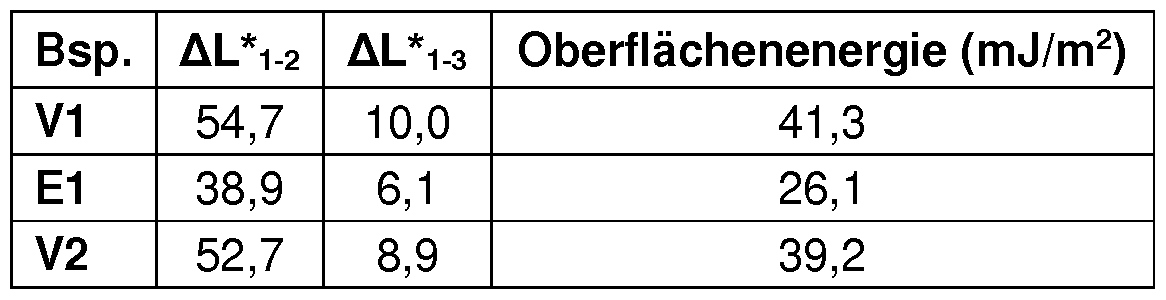
Claims
Priority Applications (9)
| Application Number | Priority Date | Filing Date | Title |
|---|---|---|---|
| MX2018014444A MX2018014444A (es) | 2016-05-24 | 2017-05-18 | Composiciones de revestimiento y revestimientos producidos a partir de los mismos con resistencia mejorada a la suciedad y propiedades de (auto)limpieza y uso de los mismos. |
| JP2018562066A JP2019519642A (ja) | 2016-05-24 | 2017-05-18 | 汚染耐性および(自己)浄化特性が改善されたコーティング組成物ならびにそれから製造されるコーティング、ならびにそれを使用する方法 |
| US16/303,857 US11597794B2 (en) | 2016-05-24 | 2017-05-18 | Coating compositions and coatings produced therefrom with improved soiling resistance and (self-)cleaning properties and use thereof |
| CN201780031631.1A CN109153767B (zh) | 2016-05-24 | 2017-05-18 | 涂覆剂和由其制备的具有改进抗污性和清洁性的涂层及其用途 |
| RU2018144370A RU2742774C2 (ru) | 2016-05-24 | 2017-05-18 | Покровное средство и полученные из него покрытия с улучшенной устойчивостью к загрязнению и самоочищающимися свойствами и их применение |
| ES17723434T ES2785680T3 (es) | 2016-05-24 | 2017-05-18 | Agentes de recubrimiento y recubrimientos producidos a partir de ello con resistencias a la suciedad y propiedades de (auto)limpieza mejoradas así como su uso |
| KR1020187036822A KR20190010876A (ko) | 2016-05-24 | 2017-05-18 | 개선된 내오염성 및 (자기)세정 특성을 갖는 코팅제 및 그로부터 제조된 코팅 및 그의 용도 |
| BR112018074221-0A BR112018074221A2 (pt) | 2016-05-24 | 2017-05-18 | composição de revestimento não aquosa, método para produzir revestimentos, uso de uma composição de revestimento, e, revestimento. |
| EP17723434.1A EP3464409B1 (de) | 2016-05-24 | 2017-05-18 | Beschichtungsmittel und daraus hergestellte beschichtungen mit verbesserten anschmutzungsresistenzen und (selbst)reinigungseigenschaften sowie deren verwendung |
Applications Claiming Priority (2)
| Application Number | Priority Date | Filing Date | Title |
|---|---|---|---|
| EP16171080.1 | 2016-05-24 | ||
| EP16171080 | 2016-05-24 |
Publications (1)
| Publication Number | Publication Date |
|---|---|
| WO2017202692A1 true WO2017202692A1 (de) | 2017-11-30 |
Family
ID=56080296
Family Applications (1)
| Application Number | Title | Priority Date | Filing Date |
|---|---|---|---|
| PCT/EP2017/062014 Ceased WO2017202692A1 (de) | 2016-05-24 | 2017-05-18 | Beschichtungsmittel und daraus hergestellte beschichtungen mit verbesserten anschmutzungsresistenzen und (selbst)reinigungseigenschaften sowie deren verwendung |
Country Status (10)
| Country | Link |
|---|---|
| US (1) | US11597794B2 (de) |
| EP (1) | EP3464409B1 (de) |
| JP (1) | JP2019519642A (de) |
| KR (1) | KR20190010876A (de) |
| CN (1) | CN109153767B (de) |
| BR (1) | BR112018074221A2 (de) |
| ES (1) | ES2785680T3 (de) |
| MX (1) | MX2018014444A (de) |
| RU (1) | RU2742774C2 (de) |
| WO (1) | WO2017202692A1 (de) |
Cited By (10)
| Publication number | Priority date | Publication date | Assignee | Title |
|---|---|---|---|---|
| JP2020034416A (ja) * | 2018-08-30 | 2020-03-05 | リンテック株式会社 | 耐指紋性の評価方法、光学部材の生産方法および光学部材 |
| CN111655793A (zh) * | 2018-01-31 | 2020-09-11 | 陶氏环球技术有限责任公司 | 聚硅氧烷树脂组合物 |
| US10840953B2 (en) | 2018-07-18 | 2020-11-17 | Ppg Industries Ohio, Inc. | Coated articles demonstrating electromagnetic radiation transparency and method of mitigating contaminant build-up on a substrate |
| JPWO2019168041A1 (ja) * | 2018-03-02 | 2021-02-25 | 関西ペイント株式会社 | 塗装方法及び塗料組成物 |
| US10954408B2 (en) | 2018-07-18 | 2021-03-23 | Ppg Industries Ohio, Inc. | Curable film-forming compositions prepared from multiple hydrophobic polymers and method of mitigating dirt build-up on a substrate |
| EP3815898A1 (de) | 2019-10-28 | 2021-05-05 | Covestro Deutschland AG | Schichtenverbund aus polycarbonat und polycarbonatblend zur verbesserten lackierbarkeit |
| US11427729B2 (en) | 2017-04-11 | 2022-08-30 | Basf Coatings Gmbh | Coating materials generating structured surfaces |
| EP4108695A1 (de) | 2021-06-21 | 2022-12-28 | Covestro Deutschland AG | Beschichtungsmittel und daraus erhältliche beschichtungen mit verbesserten anschmutzungsresistenzen und (selbst-)reinigungseigenschaften |
| EP4108694A1 (de) | 2021-06-21 | 2022-12-28 | Covestro Deutschland AG | Beschichtungsmittel und daraus erhältliche beschichtungen mit verbesserten anschmutzungsresistenzen und (selbst-)reinigungseigenschaften |
| EP4108697A1 (de) | 2021-06-21 | 2022-12-28 | Covestro Deutschland AG | Beschichtungsmittel und daraus erhältliche beschichtungen mit verbesserten anschmutzungsresistenzen und (selbst-)reinigungseigenschaften |
Families Citing this family (3)
| Publication number | Priority date | Publication date | Assignee | Title |
|---|---|---|---|---|
| WO2019040922A1 (en) * | 2017-08-24 | 2019-02-28 | Nbd Nanotechnologies, Inc. | ADHESION PROMOTERS AND THEIR USE |
| JP7254839B2 (ja) * | 2018-06-25 | 2023-04-10 | ビーエーエスエフ コーティングス ゲゼルシャフト ミット ベシュレンクテル ハフツング | 噴霧化時の液滴粒度分布を決定する方法および塗料開発におけるそれに基づく選別方法 |
| WO2021148261A1 (en) * | 2020-01-24 | 2021-07-29 | Basf Coatings Gmbh | Aqueous electrocoating materials comprising a silane-containing crosslinker |
Citations (30)
| Publication number | Priority date | Publication date | Assignee | Title |
|---|---|---|---|---|
| EP0008127A1 (de) | 1978-08-12 | 1980-02-20 | Saarbergwerke Aktiengesellschaft | Verfahren zum Verfestigen von Kohle und/oder Gestein im Bergbau |
| US4598131A (en) | 1984-12-19 | 1986-07-01 | Ppg Industries, Inc. | Catalysts for curable coating vehicle based upon aminoalkyloxy silanes and organic isocyanates |
| EP0249201A2 (de) | 1986-06-10 | 1987-12-16 | Union Carbide Corporation | Ablaufbeständige und hohen Feststoff enthaltende cycloalifatische Epoxydharzbeschichtungsmasse, die Polymere mit niedrigem Molekulargewicht und hohem Tg als ablaufwiderstandsfähiges Additiv enthalten |
| EP0273640A2 (de) | 1986-12-27 | 1988-07-06 | Sony Corporation | Zusammengesetzte Kameraeinrichtung |
| EP0276501A2 (de) | 1987-01-24 | 1988-08-03 | Akzo Nobel N.V. | Verdickende Zusammensetzungen und verdickte, saure, wässrige Lösungen |
| EP0348946A1 (de) | 1988-06-28 | 1990-01-03 | Kansai Paint Co., Ltd. | Wasserabweisende filmbildende Zusammensetzung |
| EP0245700B1 (de) | 1986-05-16 | 1994-08-24 | Cytec Technology Corp. | Vernetzer aus alkylcarbamylmethylierten Aminotriazinen und diese enthaltende härtbare Zusammensetzungen |
| WO1994022968A1 (de) | 1993-03-31 | 1994-10-13 | Basf Lacke + Farben Ag | Nichtwässriger thixotropierter lack und verfahren zur herstellung mehrschichtiger überzüge damit |
| EP0626888A1 (de) | 1992-02-15 | 1994-12-07 | Basf Lacke & Farben | Verfahren zur herstellung einer zweischichtigen lackierung und für dieses verfahren geeignete nicht-wässrige lacke. |
| EP0692007A1 (de) | 1993-03-31 | 1996-01-17 | BASF Lacke + Farben AG | Verfahren zur herstellung einer zweischichtigen decklackierung auf einer substratoberfläche |
| WO1997012945A1 (en) | 1995-10-06 | 1997-04-10 | Cabot Corporation | Aqueous thixotropes for waterborne systems |
| WO1999026994A1 (en) | 1997-11-21 | 1999-06-03 | E.I. Du Pont De Nemours And Company | Coating compositions containing a highly fluorinated hydroxyl containing additive |
| EP0994117A1 (de) | 1998-10-14 | 2000-04-19 | Bayer Aktiengesellschaft | Silanmodifizierte Polyurethanharze, Verfahren zu deren Herstellung und ihre Verwendung als feuchtigkeitshärtbare Harze |
| WO2001009260A1 (en) | 1999-07-30 | 2001-02-08 | Ppg Industries Ohio, Inc. | Coating compositions having improved scratch resistance, coated substrates and methods related thereto |
| WO2001098393A1 (en) | 2000-06-22 | 2001-12-27 | Basf Corporation | Coating compositions having improved adhesion to aluminum substrates |
| EP1273640A2 (de) | 2001-07-06 | 2003-01-08 | Degussa AG | Nichtwässriges, wärmehärtendes Zweikomponenten-Beschichtungsmittel |
| EP1295914A2 (de) | 2001-09-19 | 2003-03-26 | Nissan Motor Co., Ltd. | Klarlackzusammensetzung zur Bildung von Mehrschichtaufbauten auf Karosserien |
| WO2005003340A2 (de) | 2003-07-07 | 2005-01-13 | Stefan Margraf | Verfahren zur inaktivierung von mikroorganismen |
| US20050182189A1 (en) | 2004-02-12 | 2005-08-18 | Ohrbom Walter H. | Use of carbamate-modified aminoplast resins to improve the appearance and performance of powder coatings |
| WO2007033786A1 (de) | 2005-09-22 | 2007-03-29 | Basf Coatings Ag | Verwendung von phosphonsäurediestern und diphosphonsäurediestern sowie silangruppenhaltige, härtbare gemische, enthaltend phosphonsäurediester und diphosphonsäurediester |
| WO2008074490A1 (de) | 2006-12-19 | 2008-06-26 | Basf Coatings Ag | Beschichtungsmittel mit hoher kratzbeständigkeit und witterungsstabilität |
| WO2009077181A1 (de) | 2007-12-19 | 2009-06-25 | Basf Coatings Ag | Beschichtungsmittel mit hoher kratzbeständigkeit und witterungsstabilität |
| WO2010149236A1 (de) | 2009-06-24 | 2010-12-29 | Basf Coatings Gmbh | Beschichtungsmittel und daraus hergestellte beschichtungen mit hoher kratzfestigkeit bei gleichzeitig guten ergebnissen in der prüfung der erichsentiefung und guten steinschlagschutzeigenschaften |
| WO2011056555A1 (en) | 2009-10-28 | 2011-05-12 | Ppg Industries Ohio, Inc. | Coating composition comprising an alkoxysilane, and polysiloxane, and a plurality of particles |
| WO2012059611A1 (es) | 2010-10-22 | 2012-05-10 | Asier De Huerta Almansa | Dispositivo de fijación giratorio para tabla de nieve |
| US20120302693A1 (en) | 2011-05-23 | 2012-11-29 | E I Du Pont De Nemours And Company | Fluorine containing graft copolymer coating composition |
| WO2012168014A1 (de) | 2011-06-09 | 2012-12-13 | Basf Coatings Gmbh | Beschichtungsmittelzusammensetzungen und daraus hergestellte beschichtungen mit hoher kratzfestigkeit bei gleichzeitig guter polierbarkeit sowie deren verwendung |
| WO2014187972A1 (de) | 2013-05-24 | 2014-11-27 | Byk-Chemie Gmbh | Hochverzweigte polyalkoxysiloxanadditive für schmutzabweisende oberflächenbeschichtungen |
| US9120916B1 (en) | 2014-06-12 | 2015-09-01 | Ppg Industries Ohio, Inc. | Acrylic polymers, curable film-forming compositions prepared therefrom, and method of mitigating dirt build-up on a substrate |
| US9187670B1 (en) | 2014-06-12 | 2015-11-17 | Ppg Industries Ohio, Inc. | Curable film-forming compositions and method of mitigating dirt build-up on a substrate |
Family Cites Families (39)
| Publication number | Priority date | Publication date | Assignee | Title |
|---|---|---|---|---|
| US5017221A (en) | 1989-12-05 | 1991-05-21 | Dow Corning Corporation | Polymethylalkylsiloxane emulsions and methods |
| JP3218252B2 (ja) | 1992-04-07 | 2001-10-15 | 関西ペイント株式会社 | 熱硬化性塗料組成物 |
| JPH06312909A (ja) | 1993-04-28 | 1994-11-08 | Three Bond Co Ltd | 撥水性を有する浸透性防汚・防かび剤組成物 |
| JPH11279408A (ja) | 1997-06-02 | 1999-10-12 | Dainippon Ink & Chem Inc | 水性樹脂の製造法、水性硬化性樹脂組成物および水性塗料 |
| CN1240810A (zh) | 1998-06-25 | 2000-01-12 | 拜尔公司 | 防污剂,其制法及应用以及由其制备的防污涂层 |
| JP2000080169A (ja) | 1998-06-26 | 2000-03-21 | Mitsubishi Chemicals Corp | 活性エネルギ―線硬化性被覆組成物 |
| JP2000239601A (ja) * | 1999-02-22 | 2000-09-05 | Kansai Paint Co Ltd | 滑水性表面を形成し得るポリマー組成物 |
| TW584689B (en) | 1999-03-29 | 2004-04-21 | Uni Charm Corp | Sheet coated with silicone compounds highly effective in preventing adhesion of stains and process for preparing the same |
| JP2001262013A (ja) | 2000-03-23 | 2001-09-26 | Kansai Paint Co Ltd | 塗装仕上げ方法 |
| DE10048259A1 (de) * | 2000-09-29 | 2002-04-18 | Byk Chemie Gmbh | Beschichtungsmittel und polymere Formmassen mit anti-adhäsiven, schmutzabweisenden Eigenschaften |
| US6894124B2 (en) * | 2000-11-01 | 2005-05-17 | Kansai Paint Co., Ltd. | High solid paint compositions |
| US6716908B2 (en) * | 2002-01-30 | 2004-04-06 | Dow Corning Corporation | Alkoxysilyl functional silicone based materials |
| US6784248B2 (en) | 2002-02-15 | 2004-08-31 | Ppg Industries Ohio, Inc. | Thermosetting compositions containing alternating copolymers of isobutylene type monomers |
| CN100537688C (zh) | 2003-01-27 | 2009-09-09 | 大金工业株式会社 | 涂料组合物 |
| DE102004044418A1 (de) | 2004-09-14 | 2006-03-30 | Wacker Chemie Ag | Silicondecklack mit verbesserter Schmutzabweisung und verbesserter Verklebbarkeit mit Kernhülle-Partikel |
| MX2009011840A (es) | 2007-05-01 | 2009-11-18 | Akzo Nobel Coatings Int Bv | Composiciones de recubrimiento de anti-obstruccion que contienen un organosilicon carboxil-funcional. |
| CN101302384A (zh) * | 2007-05-09 | 2008-11-12 | 胡月祖 | 一种抗污珠光内墙涂料 |
| JP2007284698A (ja) * | 2007-08-08 | 2007-11-01 | Sk Kaken Co Ltd | 塗料組成物 |
| DE102008000584A1 (de) | 2008-03-10 | 2009-09-17 | Wacker Chemie Ag | Verfahren zur Herstellung von Kompositpartikeln |
| US8163850B2 (en) | 2009-02-06 | 2012-04-24 | Eastman Chemical Company | Thermosetting polyester coating compositions containing tetramethyl cyclobutanediol |
| KR20110128933A (ko) | 2009-03-18 | 2011-11-30 | 바스프 에스이 | 개질된 실리카 입자 및 이를 포함하는 방오성 중합체 조성물 |
| KR101024899B1 (ko) | 2009-04-29 | 2011-03-31 | 그린닉스주식회사 | 고경도를 갖는 실리콘 이형 코팅용 도료 조성물 |
| DE102009048945A1 (de) | 2009-10-10 | 2011-04-14 | Jansen, Bernhard, Dr. | Wäßrige Dispersion einer hitzehärtenden Polyurethankomposition |
| DE102009054071A1 (de) * | 2009-11-20 | 2011-05-26 | Basf Coatings Gmbh | Beschichtungsmittel mit guter Lagerbeständigkeit und daraus hergestellte Beschichtungen mit hoher Kratzfestigkeit bei gleichzeitig guter Witterungsbeständigkeit |
| US9399722B2 (en) | 2011-03-31 | 2016-07-26 | The Armor All/Stp Products Company | Compositions and methods for treating automotive surfaces |
| KR101775620B1 (ko) * | 2011-04-06 | 2017-09-07 | 에스케이케미칼주식회사 | 코팅용 폴리에스테르 바인더 수지 및 이를 함유하는 코팅 조성물 |
| US9371469B2 (en) * | 2011-06-09 | 2016-06-21 | Basf Coatings Gmbh | Coating agent compositions, coatings made therefrom and exhibiting high scratch resistance and good polishability, and use thereof |
| JP6033289B2 (ja) | 2011-06-09 | 2016-11-30 | ビーエーエスエフ コーティングス ゲゼルシャフト ミット ベシュレンクテル ハフツングBASF Coatings GmbH | 被覆剤組成物および該組成物から製造された高い耐引掻性と同時に良好な研磨性を有する被覆ならびにその使用 |
| CN104487472B (zh) * | 2012-07-25 | 2017-07-14 | 巴斯夫涂料有限公司 | 聚氨酯涂料组合物及其用途、多阶段涂覆方法 |
| CN102850536B (zh) * | 2012-09-18 | 2014-04-02 | 江苏柏鹤涂料有限公司 | 含硅丙烯酸酯-聚酯树脂及其面漆和应用 |
| WO2014077204A1 (ja) | 2012-11-13 | 2014-05-22 | 中国塗料株式会社 | 硬化性オルガノポリシロキサン系防汚性複合塗膜、および該複合塗膜で被覆された防汚基材 |
| CN104903374B (zh) * | 2012-12-03 | 2017-08-29 | 巴斯夫涂料有限公司 | 涂料组合物和由其制备的具有高耐刮擦性与良好抛光性和良好光学性能的涂层、及其用途 |
| CN103910853B (zh) | 2012-12-31 | 2016-05-18 | 陶氏环球技术有限公司 | 硅氧烷-氨基甲酸酯基污损脱附涂料 |
| US10150889B2 (en) | 2013-09-16 | 2018-12-11 | Honeywell International Inc. | Poly fluorine-containing siloxane coatings |
| JP6351035B2 (ja) * | 2014-08-12 | 2018-07-04 | 関西ペイント株式会社 | 耐汚染性艶消し水性塗料組成物及び耐汚染性艶消し塗膜形成方法 |
| MX375884B (es) | 2014-12-08 | 2025-03-06 | Basf Coatings Gmbh | Composiciones no acuosas de materiales de recubrimiento, recubrimientos producidos a partir de ellas y que tienen mejoradas adhesion y resistencia a los arañazos y tambien el uso de las mismas. |
| KR102071433B1 (ko) | 2015-06-15 | 2020-01-30 | 바스프 코팅스 게엠베하 | 폴리우레탄 코팅제 조성물 및 다층 페인트 시스템의 제조를 위한 그의 용도 |
| CN105273594B (zh) | 2015-10-30 | 2017-10-20 | 华南理工大学 | 一种键合防污因子的有机硅聚氨酯/脲防污材料及制备与应用 |
| CN105585924A (zh) * | 2015-12-22 | 2016-05-18 | 青岛博泰美联化工技术有限公司 | 一种弹性复合型建筑外墙涂料 |
-
2017
- 2017-05-18 JP JP2018562066A patent/JP2019519642A/ja not_active Ceased
- 2017-05-18 ES ES17723434T patent/ES2785680T3/es active Active
- 2017-05-18 MX MX2018014444A patent/MX2018014444A/es unknown
- 2017-05-18 RU RU2018144370A patent/RU2742774C2/ru active
- 2017-05-18 KR KR1020187036822A patent/KR20190010876A/ko not_active Abandoned
- 2017-05-18 CN CN201780031631.1A patent/CN109153767B/zh not_active Expired - Fee Related
- 2017-05-18 BR BR112018074221-0A patent/BR112018074221A2/pt not_active Application Discontinuation
- 2017-05-18 EP EP17723434.1A patent/EP3464409B1/de active Active
- 2017-05-18 US US16/303,857 patent/US11597794B2/en active Active
- 2017-05-18 WO PCT/EP2017/062014 patent/WO2017202692A1/de not_active Ceased
Patent Citations (34)
| Publication number | Priority date | Publication date | Assignee | Title |
|---|---|---|---|---|
| EP0008127A1 (de) | 1978-08-12 | 1980-02-20 | Saarbergwerke Aktiengesellschaft | Verfahren zum Verfestigen von Kohle und/oder Gestein im Bergbau |
| US4598131A (en) | 1984-12-19 | 1986-07-01 | Ppg Industries, Inc. | Catalysts for curable coating vehicle based upon aminoalkyloxy silanes and organic isocyanates |
| EP0245700B1 (de) | 1986-05-16 | 1994-08-24 | Cytec Technology Corp. | Vernetzer aus alkylcarbamylmethylierten Aminotriazinen und diese enthaltende härtbare Zusammensetzungen |
| EP0249201A2 (de) | 1986-06-10 | 1987-12-16 | Union Carbide Corporation | Ablaufbeständige und hohen Feststoff enthaltende cycloalifatische Epoxydharzbeschichtungsmasse, die Polymere mit niedrigem Molekulargewicht und hohem Tg als ablaufwiderstandsfähiges Additiv enthalten |
| EP0273640A2 (de) | 1986-12-27 | 1988-07-06 | Sony Corporation | Zusammengesetzte Kameraeinrichtung |
| EP0276501A2 (de) | 1987-01-24 | 1988-08-03 | Akzo Nobel N.V. | Verdickende Zusammensetzungen und verdickte, saure, wässrige Lösungen |
| EP0348946A1 (de) | 1988-06-28 | 1990-01-03 | Kansai Paint Co., Ltd. | Wasserabweisende filmbildende Zusammensetzung |
| EP0626888A1 (de) | 1992-02-15 | 1994-12-07 | Basf Lacke & Farben | Verfahren zur herstellung einer zweischichtigen lackierung und für dieses verfahren geeignete nicht-wässrige lacke. |
| WO1994022968A1 (de) | 1993-03-31 | 1994-10-13 | Basf Lacke + Farben Ag | Nichtwässriger thixotropierter lack und verfahren zur herstellung mehrschichtiger überzüge damit |
| EP0692007A1 (de) | 1993-03-31 | 1996-01-17 | BASF Lacke + Farben AG | Verfahren zur herstellung einer zweischichtigen decklackierung auf einer substratoberfläche |
| WO1997012945A1 (en) | 1995-10-06 | 1997-04-10 | Cabot Corporation | Aqueous thixotropes for waterborne systems |
| WO1999026994A1 (en) | 1997-11-21 | 1999-06-03 | E.I. Du Pont De Nemours And Company | Coating compositions containing a highly fluorinated hydroxyl containing additive |
| EP0994117A1 (de) | 1998-10-14 | 2000-04-19 | Bayer Aktiengesellschaft | Silanmodifizierte Polyurethanharze, Verfahren zu deren Herstellung und ihre Verwendung als feuchtigkeitshärtbare Harze |
| WO2001009260A1 (en) | 1999-07-30 | 2001-02-08 | Ppg Industries Ohio, Inc. | Coating compositions having improved scratch resistance, coated substrates and methods related thereto |
| WO2001098393A1 (en) | 2000-06-22 | 2001-12-27 | Basf Corporation | Coating compositions having improved adhesion to aluminum substrates |
| EP1273640A2 (de) | 2001-07-06 | 2003-01-08 | Degussa AG | Nichtwässriges, wärmehärtendes Zweikomponenten-Beschichtungsmittel |
| EP1295914A2 (de) | 2001-09-19 | 2003-03-26 | Nissan Motor Co., Ltd. | Klarlackzusammensetzung zur Bildung von Mehrschichtaufbauten auf Karosserien |
| WO2005003340A2 (de) | 2003-07-07 | 2005-01-13 | Stefan Margraf | Verfahren zur inaktivierung von mikroorganismen |
| US20050182189A1 (en) | 2004-02-12 | 2005-08-18 | Ohrbom Walter H. | Use of carbamate-modified aminoplast resins to improve the appearance and performance of powder coatings |
| WO2007033786A1 (de) | 2005-09-22 | 2007-03-29 | Basf Coatings Ag | Verwendung von phosphonsäurediestern und diphosphonsäurediestern sowie silangruppenhaltige, härtbare gemische, enthaltend phosphonsäurediester und diphosphonsäurediester |
| DE102005045228A1 (de) | 2005-09-22 | 2007-04-05 | Basf Coatings Ag | Verwendung von Phosphonsäurediestern und Diphosphonsäurediestern sowie silangruppenhaltige, härtbare Gemische, enthaltend Phosphonsäurediester und Diphosphonsäurediester |
| WO2008074490A1 (de) | 2006-12-19 | 2008-06-26 | Basf Coatings Ag | Beschichtungsmittel mit hoher kratzbeständigkeit und witterungsstabilität |
| WO2008074489A1 (de) | 2006-12-19 | 2008-06-26 | Basf Coatings Ag | Beschichtungsmittel mit hoher kratzbeständigkeit und witterungsstabilität |
| WO2008074491A1 (de) | 2006-12-19 | 2008-06-26 | Basf Coatings Ag | Beschichtungsmittel mit hoher kratzbeständigkeit und witterungsstabilität |
| WO2009077181A1 (de) | 2007-12-19 | 2009-06-25 | Basf Coatings Ag | Beschichtungsmittel mit hoher kratzbeständigkeit und witterungsstabilität |
| WO2010149236A1 (de) | 2009-06-24 | 2010-12-29 | Basf Coatings Gmbh | Beschichtungsmittel und daraus hergestellte beschichtungen mit hoher kratzfestigkeit bei gleichzeitig guten ergebnissen in der prüfung der erichsentiefung und guten steinschlagschutzeigenschaften |
| WO2011056555A1 (en) | 2009-10-28 | 2011-05-12 | Ppg Industries Ohio, Inc. | Coating composition comprising an alkoxysilane, and polysiloxane, and a plurality of particles |
| WO2012059611A1 (es) | 2010-10-22 | 2012-05-10 | Asier De Huerta Almansa | Dispositivo de fijación giratorio para tabla de nieve |
| US20120302693A1 (en) | 2011-05-23 | 2012-11-29 | E I Du Pont De Nemours And Company | Fluorine containing graft copolymer coating composition |
| WO2012168014A1 (de) | 2011-06-09 | 2012-12-13 | Basf Coatings Gmbh | Beschichtungsmittelzusammensetzungen und daraus hergestellte beschichtungen mit hoher kratzfestigkeit bei gleichzeitig guter polierbarkeit sowie deren verwendung |
| US20140329098A1 (en) * | 2011-06-09 | 2014-11-06 | Basf Coatings Gmbh | Coating Agent Compositions, Coatings Made Therefrom And Exhibiting High Scratch Resistance And Good Polishability, And Use Thereof |
| WO2014187972A1 (de) | 2013-05-24 | 2014-11-27 | Byk-Chemie Gmbh | Hochverzweigte polyalkoxysiloxanadditive für schmutzabweisende oberflächenbeschichtungen |
| US9120916B1 (en) | 2014-06-12 | 2015-09-01 | Ppg Industries Ohio, Inc. | Acrylic polymers, curable film-forming compositions prepared therefrom, and method of mitigating dirt build-up on a substrate |
| US9187670B1 (en) | 2014-06-12 | 2015-11-17 | Ppg Industries Ohio, Inc. | Curable film-forming compositions and method of mitigating dirt build-up on a substrate |
Non-Patent Citations (2)
| Title |
|---|
| "Römpp Lexikon »Lacke und Druckfarben", 1998, GEORG THIEME VERLAG, pages: 250 - 252 |
| SINGH; MITARBEITER: "Carbamylmethylated Melamines, Novel Crosslinkers for the Coatings Industry", ADVANCED ORGANIC COATINGS SCIENCE AND TECHNOLOGY SERIES, vol. 13, 1991, pages 193 - 207 |
Cited By (20)
| Publication number | Priority date | Publication date | Assignee | Title |
|---|---|---|---|---|
| US11427729B2 (en) | 2017-04-11 | 2022-08-30 | Basf Coatings Gmbh | Coating materials generating structured surfaces |
| CN111655793A (zh) * | 2018-01-31 | 2020-09-11 | 陶氏环球技术有限责任公司 | 聚硅氧烷树脂组合物 |
| CN111655793B (zh) * | 2018-01-31 | 2022-05-03 | 陶氏环球技术有限责任公司 | 聚硅氧烷树脂组合物 |
| EP3760320A4 (de) * | 2018-03-02 | 2022-03-16 | Kansai Paint Co., Ltd | Beschichtungsverfahren und beschichtungsmaterialzusammensetzung |
| JP7225200B2 (ja) | 2018-03-02 | 2023-02-20 | 関西ペイント株式会社 | 塗装方法及び塗料組成物 |
| JPWO2019168041A1 (ja) * | 2018-03-02 | 2021-02-25 | 関西ペイント株式会社 | 塗装方法及び塗料組成物 |
| US10954408B2 (en) | 2018-07-18 | 2021-03-23 | Ppg Industries Ohio, Inc. | Curable film-forming compositions prepared from multiple hydrophobic polymers and method of mitigating dirt build-up on a substrate |
| US11566139B2 (en) | 2018-07-18 | 2023-01-31 | Ppg Industries Ohio, Inc. | Coated articles demonstrating electromagnetic radiation transparency and method of mitigating contaminant build-up on a substrate |
| US10840953B2 (en) | 2018-07-18 | 2020-11-17 | Ppg Industries Ohio, Inc. | Coated articles demonstrating electromagnetic radiation transparency and method of mitigating contaminant build-up on a substrate |
| JP2020034416A (ja) * | 2018-08-30 | 2020-03-05 | リンテック株式会社 | 耐指紋性の評価方法、光学部材の生産方法および光学部材 |
| CN110873702A (zh) * | 2018-08-30 | 2020-03-10 | 琳得科株式会社 | 耐指纹性的评价方法、光学构件的生产方法及光学构件 |
| JP7347922B2 (ja) | 2018-08-30 | 2023-09-20 | リンテック株式会社 | 耐指紋性の評価方法、光学部材の生産方法および光学部材 |
| CN110873702B (zh) * | 2018-08-30 | 2024-07-26 | 琳得科株式会社 | 耐指纹性的评价方法、光学构件的生产方法及光学构件 |
| EP3815898A1 (de) | 2019-10-28 | 2021-05-05 | Covestro Deutschland AG | Schichtenverbund aus polycarbonat und polycarbonatblend zur verbesserten lackierbarkeit |
| WO2021083925A1 (de) | 2019-10-28 | 2021-05-06 | Covestro Intellectual Property Gmbh & Co. Kg | Schichtenverbund aus polycarbonat und polycarbonatblend zur verbesserten lackierbarkeit |
| EP4108695A1 (de) | 2021-06-21 | 2022-12-28 | Covestro Deutschland AG | Beschichtungsmittel und daraus erhältliche beschichtungen mit verbesserten anschmutzungsresistenzen und (selbst-)reinigungseigenschaften |
| EP4108694A1 (de) | 2021-06-21 | 2022-12-28 | Covestro Deutschland AG | Beschichtungsmittel und daraus erhältliche beschichtungen mit verbesserten anschmutzungsresistenzen und (selbst-)reinigungseigenschaften |
| EP4108697A1 (de) | 2021-06-21 | 2022-12-28 | Covestro Deutschland AG | Beschichtungsmittel und daraus erhältliche beschichtungen mit verbesserten anschmutzungsresistenzen und (selbst-)reinigungseigenschaften |
| WO2022268744A1 (de) | 2021-06-21 | 2022-12-29 | Covestro Deutschland Ag | Beschichtungsmittel und daraus erhältliche beschichtungen mit verbesserten anschmutzungsresistenzen und (selbst-)reinigungseigenschaften |
| WO2022268707A1 (de) | 2021-06-21 | 2022-12-29 | Covestro Deutschland Ag | Beschichtungsmittel und daraus erhältliche beschichtungen mit verbesserten anschmutzungsresistenzen und (selbst-)reinigungseigenschaften |
Also Published As
| Publication number | Publication date |
|---|---|
| RU2018144370A3 (de) | 2020-08-28 |
| ES2785680T3 (es) | 2020-10-07 |
| BR112018074221A2 (pt) | 2019-03-06 |
| RU2018144370A (ru) | 2020-06-25 |
| CN109153767B (zh) | 2021-09-24 |
| CN109153767A (zh) | 2019-01-04 |
| KR20190010876A (ko) | 2019-01-31 |
| US11597794B2 (en) | 2023-03-07 |
| RU2742774C2 (ru) | 2021-02-10 |
| EP3464409A1 (de) | 2019-04-10 |
| EP3464409B1 (de) | 2020-02-19 |
| US20200317949A1 (en) | 2020-10-08 |
| MX2018014444A (es) | 2019-03-28 |
| JP2019519642A (ja) | 2019-07-11 |
Similar Documents
| Publication | Publication Date | Title |
|---|---|---|
| EP3464409B1 (de) | Beschichtungsmittel und daraus hergestellte beschichtungen mit verbesserten anschmutzungsresistenzen und (selbst)reinigungseigenschaften sowie deren verwendung | |
| EP2091987B1 (de) | Beschichtungsmittel mit hoher kratzbeständigkeit und witterungsstabilität | |
| EP2294151B2 (de) | Verwendung teilsilanisierter verbindungen auf polyisocyanatbasis als vernetzungsmittel in beschichtungszusammensetzungen und beschichtungszusammensetzung enthaltend die verbindungen | |
| EP2445948B1 (de) | Beschichtungsmittel und daraus hergestellte beschichtungen mit hoher kratzfestigkeit bei gleichzeitig guten ergebnissen in der prüfung der erichsentiefung und guten steinschlagschutzeigenschaften | |
| EP2225300B1 (de) | Beschichtungsmittel mit hoher kratzbeständigkeit und witterungsstabilität | |
| EP2718343B1 (de) | Beschichtungsmittelzusammensetzungen und daraus hergestellte beschichtungen mit hoher kratzfestigkeit bei gleichzeitig guter polierbarkeit sowie deren verwendung | |
| EP2640759B1 (de) | Beschichtungsmittel mit hohem festkörpergehalt und gutem verlauf sowie daraus hergestellte mehrschichtlackierungen und deren verwendung | |
| EP2501496B1 (de) | Beschichtungsmittel mit guter lagerbeständigkeit und daraus hergestellte beschichtungen mit hoher kratzfestigkeit bei gleichzeitig guter witterungsbeständigkeit | |
| WO2011131463A1 (de) | Beschichtungsmittel mit hohem festkörpergehalt und gutem verlauf sowie daraus hergestellte mehrschichtlackierungen und deren verwendung | |
| EP3230335B1 (de) | Beschichtungsmittelzusammensetzungen und daraus hergestellte beschichtungen und sowie deren verwendung | |
| WO2014086530A1 (de) | Beschichtungsmittelzusammensetzungen und daraus hergestellte beschichtungen mit hoher kratzfestigkeit bei gleichzeitig guter polierbarkeit und guten optischen eigenschaften sowie deren verwendung | |
| EP2665758B1 (de) | Wässriges polyurethanbeschichtungsmittel und daraus hergestellte beschichtungen mit hoher kratzbeständigkeit und guter chemikalienbeständigkeit | |
| WO2011131461A1 (de) | Beschichtungsmittel mit verbesserter ablaufneigung | |
| EP3230334A1 (de) | Nichtwässrige beschichtungsmittelzusammensetzungen, daraus hergestellte beschichtungen mit verbesserter haftung und kratzfestigkeit sowie deren verwendung | |
| EP2718342B1 (de) | Beschichtungsmittelzusammensetzungen und daraus hergestellte beschichtungen mit hoher kratzfestigkeit bei gleichzeitig guter polierbarkeit sowie deren verwendung | |
| EP3307833A1 (de) | Verfahren zur beschichtung von radfelgen sowie die hierbei erhaltenen schmutzabweisenden und bremsstraubresistenten beschichtungen | |
| EP3307834A1 (de) | Verfahren zur beschichtung von radfelgen sowie die hierbei erhaltenen schmutz abweisenden und bremsstaubresistenten beschichtungen |
Legal Events
| Date | Code | Title | Description |
|---|---|---|---|
| ENP | Entry into the national phase |
Ref document number: 2018562066 Country of ref document: JP Kind code of ref document: A |
|
| NENP | Non-entry into the national phase |
Ref country code: DE |
|
| 121 | Ep: the epo has been informed by wipo that ep was designated in this application |
Ref document number: 17723434 Country of ref document: EP Kind code of ref document: A1 |
|
| REG | Reference to national code |
Ref country code: BR Ref legal event code: B01A Ref document number: 112018074221 Country of ref document: BR |
|
| ENP | Entry into the national phase |
Ref document number: 20187036822 Country of ref document: KR Kind code of ref document: A |
|
| ENP | Entry into the national phase |
Ref document number: 2017723434 Country of ref document: EP Effective date: 20190102 |
|
| ENP | Entry into the national phase |
Ref document number: 112018074221 Country of ref document: BR Kind code of ref document: A2 Effective date: 20181123 |