WO2017204104A1 - 印刷物の製造方法 - Google Patents
印刷物の製造方法 Download PDFInfo
- Publication number
- WO2017204104A1 WO2017204104A1 PCT/JP2017/018830 JP2017018830W WO2017204104A1 WO 2017204104 A1 WO2017204104 A1 WO 2017204104A1 JP 2017018830 W JP2017018830 W JP 2017018830W WO 2017204104 A1 WO2017204104 A1 WO 2017204104A1
- Authority
- WO
- WIPO (PCT)
- Prior art keywords
- ink
- producing
- printed matter
- group
- resin
- Prior art date
- Legal status (The legal status is an assumption and is not a legal conclusion. Google has not performed a legal analysis and makes no representation as to the accuracy of the status listed.)
- Ceased
Links
Classifications
-
- B—PERFORMING OPERATIONS; TRANSPORTING
- B41—PRINTING; LINING MACHINES; TYPEWRITERS; STAMPS
- B41F—PRINTING MACHINES OR PRESSES
- B41F35/00—Cleaning arrangements or devices
- B41F35/002—Cleaning arrangements or devices for dampening rollers
-
- B—PERFORMING OPERATIONS; TRANSPORTING
- B41—PRINTING; LINING MACHINES; TYPEWRITERS; STAMPS
- B41M—PRINTING, DUPLICATING, MARKING, OR COPYING PROCESSES; COLOUR PRINTING
- B41M5/00—Duplicating or marking methods; Sheet materials for use therein
- B41M5/50—Recording sheets characterised by the coating used to improve ink, dye or pigment receptivity, e.g. for ink-jet or thermal dye transfer recording
-
- B—PERFORMING OPERATIONS; TRANSPORTING
- B41—PRINTING; LINING MACHINES; TYPEWRITERS; STAMPS
- B41F—PRINTING MACHINES OR PRESSES
- B41F35/00—Cleaning arrangements or devices
- B41F35/001—Devices for cleaning parts removed from the printing machines
-
- B—PERFORMING OPERATIONS; TRANSPORTING
- B41—PRINTING; LINING MACHINES; TYPEWRITERS; STAMPS
- B41F—PRINTING MACHINES OR PRESSES
- B41F35/00—Cleaning arrangements or devices
- B41F35/02—Cleaning arrangements or devices for forme cylinders
-
- B—PERFORMING OPERATIONS; TRANSPORTING
- B41—PRINTING; LINING MACHINES; TYPEWRITERS; STAMPS
- B41F—PRINTING MACHINES OR PRESSES
- B41F35/00—Cleaning arrangements or devices
- B41F35/06—Cleaning arrangements or devices for offset cylinders
-
- B—PERFORMING OPERATIONS; TRANSPORTING
- B41—PRINTING; LINING MACHINES; TYPEWRITERS; STAMPS
- B41M—PRINTING, DUPLICATING, MARKING, OR COPYING PROCESSES; COLOUR PRINTING
- B41M1/00—Inking and printing with a printer's forme
- B41M1/06—Lithographic printing
-
- B—PERFORMING OPERATIONS; TRANSPORTING
- B41—PRINTING; LINING MACHINES; TYPEWRITERS; STAMPS
- B41M—PRINTING, DUPLICATING, MARKING, OR COPYING PROCESSES; COLOUR PRINTING
- B41M5/00—Duplicating or marking methods; Sheet materials for use therein
- B41M5/26—Thermography ; Marking by high energetic means, e.g. laser otherwise than by burning, and characterised by the material used
-
- B—PERFORMING OPERATIONS; TRANSPORTING
- B41—PRINTING; LINING MACHINES; TYPEWRITERS; STAMPS
- B41M—PRINTING, DUPLICATING, MARKING, OR COPYING PROCESSES; COLOUR PRINTING
- B41M7/00—After-treatment of prints, e.g. heating, irradiating, setting of the ink, protection of the printed stock
- B41M7/0081—After-treatment of prints, e.g. heating, irradiating, setting of the ink, protection of the printed stock using electromagnetic radiation or waves, e.g. ultraviolet radiation, electron beams
-
- B—PERFORMING OPERATIONS; TRANSPORTING
- B41—PRINTING; LINING MACHINES; TYPEWRITERS; STAMPS
- B41N—PRINTING PLATES OR FOILS; MATERIALS FOR SURFACES USED IN PRINTING MACHINES FOR PRINTING, INKING, DAMPING, OR THE LIKE; PREPARING SUCH SURFACES FOR USE AND CONSERVING THEM
- B41N10/00—Blankets or like coverings; Coverings for wipers for intaglio printing
-
- B—PERFORMING OPERATIONS; TRANSPORTING
- B41—PRINTING; LINING MACHINES; TYPEWRITERS; STAMPS
- B41N—PRINTING PLATES OR FOILS; MATERIALS FOR SURFACES USED IN PRINTING MACHINES FOR PRINTING, INKING, DAMPING, OR THE LIKE; PREPARING SUCH SURFACES FOR USE AND CONSERVING THEM
- B41N3/00—Preparing for use and conserving printing surfaces
- B41N3/08—Damping; Neutralising or similar differentiation treatments for lithographic printing formes; Gumming or finishing solutions, fountain solutions, correction or deletion fluids, or on-press development
-
- C—CHEMISTRY; METALLURGY
- C09—DYES; PAINTS; POLISHES; NATURAL RESINS; ADHESIVES; COMPOSITIONS NOT OTHERWISE PROVIDED FOR; APPLICATIONS OF MATERIALS NOT OTHERWISE PROVIDED FOR
- C09D—COATING COMPOSITIONS, e.g. PAINTS, VARNISHES OR LACQUERS; FILLING PASTES; CHEMICAL PAINT OR INK REMOVERS; INKS; CORRECTING FLUIDS; WOODSTAINS; PASTES OR SOLIDS FOR COLOURING OR PRINTING; USE OF MATERIALS THEREFOR
- C09D11/00—Inks
- C09D11/02—Printing inks
- C09D11/03—Printing inks characterised by features other than the chemical nature of the binder
-
- C—CHEMISTRY; METALLURGY
- C09—DYES; PAINTS; POLISHES; NATURAL RESINS; ADHESIVES; COMPOSITIONS NOT OTHERWISE PROVIDED FOR; APPLICATIONS OF MATERIALS NOT OTHERWISE PROVIDED FOR
- C09D—COATING COMPOSITIONS, e.g. PAINTS, VARNISHES OR LACQUERS; FILLING PASTES; CHEMICAL PAINT OR INK REMOVERS; INKS; CORRECTING FLUIDS; WOODSTAINS; PASTES OR SOLIDS FOR COLOURING OR PRINTING; USE OF MATERIALS THEREFOR
- C09D11/00—Inks
- C09D11/02—Printing inks
- C09D11/03—Printing inks characterised by features other than the chemical nature of the binder
- C09D11/037—Printing inks characterised by features other than the chemical nature of the binder characterised by the pigment
-
- C—CHEMISTRY; METALLURGY
- C09—DYES; PAINTS; POLISHES; NATURAL RESINS; ADHESIVES; COMPOSITIONS NOT OTHERWISE PROVIDED FOR; APPLICATIONS OF MATERIALS NOT OTHERWISE PROVIDED FOR
- C09D—COATING COMPOSITIONS, e.g. PAINTS, VARNISHES OR LACQUERS; FILLING PASTES; CHEMICAL PAINT OR INK REMOVERS; INKS; CORRECTING FLUIDS; WOODSTAINS; PASTES OR SOLIDS FOR COLOURING OR PRINTING; USE OF MATERIALS THEREFOR
- C09D11/00—Inks
- C09D11/02—Printing inks
- C09D11/10—Printing inks based on artificial resins
- C09D11/101—Inks specially adapted for printing processes involving curing by wave energy or particle radiation, e.g. with UV-curing following the printing
-
- H—ELECTRICITY
- H01—ELECTRIC ELEMENTS
- H01M—PROCESSES OR MEANS, e.g. BATTERIES, FOR THE DIRECT CONVERSION OF CHEMICAL ENERGY INTO ELECTRICAL ENERGY
- H01M4/00—Electrodes
- H01M4/02—Electrodes composed of, or comprising, active material
- H01M4/36—Selection of substances as active materials, active masses, active liquids
- H01M4/362—Composites
- H01M4/366—Composites as layered products
-
- Y—GENERAL TAGGING OF NEW TECHNOLOGICAL DEVELOPMENTS; GENERAL TAGGING OF CROSS-SECTIONAL TECHNOLOGIES SPANNING OVER SEVERAL SECTIONS OF THE IPC; TECHNICAL SUBJECTS COVERED BY FORMER USPC CROSS-REFERENCE ART COLLECTIONS [XRACs] AND DIGESTS
- Y02—TECHNOLOGIES OR APPLICATIONS FOR MITIGATION OR ADAPTATION AGAINST CLIMATE CHANGE
- Y02E—REDUCTION OF GREENHOUSE GAS [GHG] EMISSIONS, RELATED TO ENERGY GENERATION, TRANSMISSION OR DISTRIBUTION
- Y02E60/00—Enabling technologies; Technologies with a potential or indirect contribution to GHG emissions mitigation
- Y02E60/10—Energy storage using batteries
Definitions
- the present invention relates to a method for producing a printed matter.
- Lithographic printing is a printing method that is widely used as a system that supplies printed matter at high speed, in large quantities, and at low cost.
- lithographic printing ink that does not contain volatile components and instantaneously cures upon irradiation with active energy rays (hereinafter referred to as active energy ray curable lithographic printing ink) has been promoted.
- active energy ray curable lithographic printing using the active energy ray curable lithographic printing ink further shortens the drying process and further increases the productivity of lithographic printing.
- a material repelling ink is patterned as a non-image area to form an image.
- Water-containing lithographic printing using fountain solution as a material repelling ink and water-free lithographic printing using silicone rubber can be mentioned.
- dampening water and ink in the non-image area are in contact with each other on the plate surface, and printing is performed with dampening water emulsified in the ink.
- this emulsification is insufficient, the ink does not get on the image area, and printing defects such as a decrease in density of printed matter and a decrease in halftone dot reproducibility occur.
- the amount of emulsification is excessive and partially dissolved, the cohesive force of the ink is reduced, the viscosity is rapidly reduced, and the repulsion to the dampening water is reduced. For this reason, ink adheres to the non-image area where ink is not originally attached, and a printing defect called background smear printed on a white background of the printed matter occurs.
- the ink for active energy ray-curable lithographic printing has a narrow supply amount of dampening water suitable for emulsification and tends to have an excessive amount of emulsification as compared with the oil-based lithographic printing ink.
- active energy ray-curable lithographic printing inks have a smaller molecular weight of the resin used, and the (meth) acrylate compound has a higher polarity (hydrophilicity), resulting in agglomeration of the ink. This is due to insufficient power.
- the main components of the ink are the resin and the (meth) acrylate compound, there is no change in the essential cohesive strength of the ink.
- the present invention provides a method for producing a printed matter that overcomes the problems of the prior art and suppresses an excessive amount of emulsification during printing because the ink has sufficient cohesive strength.
- a printed matter having excellent print quality can be obtained.
- a method for producing a printed matter comprising a step, wherein the pH (A) of the ink and the pH (B) of the fountain solution are both 1 to 6.5.
- a lithographic printing plate having at least a hydrophilic layer and a heat-sensitive layer, a step of adhering dampening water to the hydrophilic layer, a step of adhering ink to the heat-sensitive layer, and the adhering ink to the printing medium
- the method for producing a printed matter including a transfer step, since the pH (A) of the ink and the pH (B) of the dampening water are both 6.5 or less, an excessive emulsification amount of the ink is suppressed, Excellent stain resistance.
- the method for producing a printed matter a printed matter having excellent print quality can be obtained. Further, the ink after printing can be washed using a basic aqueous washing solution.
- the method for producing a printed matter of the present invention comprises a step of adhering dampening water to a hydrophilic layer, a step of adhering ink to a heat-sensitive layer, and a step of adhering the adhering ink to a lithographic printing plate having at least a hydrophilic layer and a heat-sensitive layer.
- a step of transferring to a printed body Usually, the above steps are performed in order.
- dampening water is supplied to the entire surface of the lithographic printing plate having a hydrophilic layer and a heat-sensitive layer on the surface, and the dampening water is retained on the surface of the hydrophilic layer.
- ink is supplied to the entire surface of the printing plate, and the ink is selectively adhered to the surface of the heat sensitive layer that is the image area.
- the attached ink is transferred to the substrate to print an image.
- a lithographic printing plate having a hydrophilic layer and a heat-sensitive layer on its surface can be prepared from a lithographic printing plate precursor in which a hydrophilic layer and a heat-sensitive layer are sequentially laminated on a printing plate substrate.
- a hydrophilic layer aluminum or the like is used in order to keep the dampening water supplied continuously on the printing plate. Further, aluminum subjected to surface treatment such as roughening treatment or anodizing treatment is preferable. The treatment improves hydrophilicity and water retention.
- the heat-sensitive layer those containing a pigment are preferable. Those containing a polymerizable compound in addition to the dye are preferred. Further, it may contain a polymerization initiator.
- the dye a dye that absorbs infrared light and converts it into heat is preferable because a printed image is directly drawn by infrared laser light. Examples of infrared light-absorbing dyes include azo dyes, metal complex azo dyes, pyrazolone azo dyes, naphthoquinone dyes, quinone imine dyes, methine dyes, cyanine dyes, carbonium dyes, squarylium doses, and metal thiolate complexes.
- the polymerizable compound is a compound having one or more ethylenically unsaturated bonds, and various (meth) acrylates and styrenes are exemplified.
- the polymerization initiator is a compound that initiates and accelerates the polymerization of a polymerizable compound by generating radicals by light, heat, or both, and is a known thermal polymerization initiator or a compound having a bond with small bond dissociation energy
- a photopolymerization initiator or the like can be used. Specific examples include organic halides, carbonyl compounds, azo polymerization initiators, organic peroxides, metallocene compounds, azide compounds, hexaarylbiimidazole compounds, organic borate compounds, disulfone compounds, oxime ester compounds, onium salts. Compounds and the like.
- the method for producing the lithographic printing plate is not particularly limited, but a method including a step of exposing the lithographic printing plate precursor with a laser is preferably used.
- a lithographic printing plate can be produced by the above-described steps alone, it is preferable to include a step in which an unexposed portion is removed and developed by applying a chemical treatment or physical stimulation to the exposed lithographic printing plate precursor.
- the laser light source used in the exposure step one having a transmission wavelength region in the range of 300 nm to 1500 nm is preferably used.
- various lasers such as argon ion, krypton ion, helium-neon, helium-cadmium, ruby, glass, YAG, titanium sapphire, dye, nitrogen, metal vapor, excimer, free electron, and semiconductor are used.
- a semiconductor laser having an emission wavelength region near the near infrared region is preferably used.
- the method for producing a printed material according to the present invention is characterized in that the pH (A) of the ink and the pH (B) of the dampening water are both 6.5 or less.
- the pH (A) of the ink here is a pH value obtained by measuring a 1% by weight aqueous solution of the ink at 25 ° C., and the pH (B) of the fountain solution is measured at 25 ° C. of the fountain solution. pH value.
- This aqueous solution may have a form in which the pigment is dispersed in water.
- the resins and polyfunctional (meth) acrylates used are neutral and hydrophilic, so that dampening water is continuously taken into the ink.
- the amount of emulsified becomes excessive.
- the pH (A) of the ink and the pH (B) of the fountain solution are both 6.5 or less, the affinity of the ink for the fountain solution is low, and the emulsification amount is low. It is suppressed that it becomes excessive.
- the pH can be measured by the test method described in JIS Z 8802: 1984.
- the pH (A) of the ink and the pH (B) of the dampening water satisfy (A)> (B). Since the pH (B) of the fountain solution used in the method for producing a printed matter of the present invention is lower than the pH (A) of the ink, the ink has a low affinity for the fountain solution. It is difficult to take in water and excessive emulsification is suppressed.
- the dampening water preferably has a pH of 3-6.
- the ink used in the method for producing a printed matter of the present invention is preferably pH 3 or higher, more preferably pH 4 or higher, which can emulsify dampening water and does not damage printing equipment such as rust. preferable.
- the fountain solution suppresses the sensitization of the heat sensitive layer of the printing plate, does not dissolve the ink, and suppresses over-emulsification.
- the pH is preferably 6 or less, and more preferably 5 or less.
- the term “sensitizing oil” as used herein means that the hydrophilicity of the heat-sensitive layer in the non-image area of the printing plate is lowered due to ink adhesion.
- the dampening water is preferably 90% to 99% by weight of water.
- the fountain solution can contain an acid in order to make the pH acidic by the pH adjusting agent.
- acids include acetic acid, citric acid, succinic acid, malic acid, tartaric acid, lactic acid, ascorbic acid, gluconic acid, hydroxyacetic acid, malonic acid, sulfanilic acid, p-toluenesulfonic acid, organic phosphonic acid, phosphoric acid, nitric acid , Sulfuric acid, and polyphosphoric acid.
- alkali metal salts, alkaline earth metal salts, ammonium salts and organic amine salts of these acids can be mentioned.
- the fountain solution can contain alcohols and glycols in order to reduce the dynamic surface tension and make the printing plate surface wet easily.
- alcohols and glycols include 3-methyl-1-butyn-3-ol, 2-butyne-1,4-diol, 3-methyl-1-pentyn-3-ol, and 2,5-dimethyl-3-hexyne-2.
- the ink used in the present invention preferably has a pH of 3-6.
- the ink used in the method for producing a printed material of the present invention preferably has a pH of 3 or more, and more preferably has a pH of 4 or more, which does not damage the printing equipment such as rust.
- the fountain solution is not compatible with the ink and excessive emulsification is suppressed, and the pH is preferably 6 or less, and more preferably 5 or less.
- the difference between the pH (A) of the ink and the pH (B) of the dampening water (pH (A) -pH (B)) is preferably 1 to 2. If the difference in pH is smaller than 1, the ink is easily dampened and water is easily taken in, and the amount of emulsification tends to be excessive. When the difference in pH is greater than 2, the ink is less likely to take up dampening water, and the amount of emulsification tends to be insufficient.
- the step of transferring the attached ink to the printing medium is a step of transferring the attached ink directly or via a blanket.
- the direct transfer step the ink exhibits good dislocation properties.
- the step of transferring through the blanket is such that the printing plate is less damaged and the printing durability is increased as a result of the flexible blanket being used.
- the ink is applied with active energy rays after being applied on the substrate by lithographic printing.
- the ink coating on the substrate can be instantly cured by irradiation with active energy rays.
- Any active energy ray can be used as long as it has excitation energy necessary for the curing reaction.
- ultraviolet rays or electron beams are preferably used.
- an electron beam apparatus having an active energy beam of 100 to 500 eV is preferably used.
- an ultraviolet irradiation device such as a high-pressure mercury lamp, a xenon lamp, a metal halide lamp, or a light emitting diode (LED) is preferably used, and is particularly preferable because the light emitting diode has low heat generation and energy saving.
- the wavelength of light emitted from the light emitting diode is preferably 350 to 420 nm.
- the substrate on which the ink is applied has a conveying speed of 50 to 150 m / min by a conveyor and is irradiated with an active energy ray to cure the ink.
- the ink includes a step of removing excess ink on a printing machine with washing water after the ink is applied onto a substrate by lithographic printing.
- the volatile organic compound (VOC) at the time of work is reduced, it is friendly to the health and safety of the worker, and the discharge of organic waste liquid is also suppressed.
- the pH of the washing water is preferably 8-13.
- the ink is acidic, the affinity for dampening water is low, while the solubility in a basic aqueous solution is good. Therefore, when the pH of the washing water is 8 or more, the ink can be dissolved and washed. More preferably, the pH of the washing water is 9 or more.
- the pH of the washing water is 13 or less because damage to printing equipment such as a printing press and a printing plate is reduced. More preferably, the pH of the washing water is 11 or less.
- the washing water preferably contains 90 to 99% by mass of water based on the total mass. By containing 90% by mass or more of water, the influence on the health and safety aspects of the user can be reduced. By containing 99% by mass or less of water, ink solubility is improved and workability such as inter-roller transfer and doctor blade scraping is improved.
- the washing water can contain a compound that exhibits basicity when in water, such as an amino group-containing compound or an inorganic salt, in order to adjust the pH to basic.
- a compound that exhibits basicity when in water such as an amino group-containing compound or an inorganic salt, in order to adjust the pH to basic.
- amino group-containing compound examples include alkylamines, hydroxyl group-containing alkylamines, and polyalkylene oxide-modified amines, and those having a monofunctional amino group are particularly preferable.
- alkylamines examples include ethanolamine and polyalkylene oxide-modified amines, and polyalkylene oxide-modified amines are preferable from the viewpoint of toxicity to living bodies, and polyalkylene oxide-modified amines are particularly preferable because they are non-volatile and can reduce VOC.
- Washing water contains 0.1% by mass to 10% by mass of the above compound, so that the pH can be maintained in an appropriate range, and safety and workability can be maintained.
- the washing water can contain compounds such as alcohols, glycols, and surfactants in order to reduce dynamic surface tension and improve workability such as inter-roller transfer and doctor blade scraping.
- compounds such as alcohols, glycols, and surfactants in order to reduce dynamic surface tension and improve workability such as inter-roller transfer and doctor blade scraping.
- these compounds those having a nonvolatile boiling point and capable of reducing VOC are preferable.
- the workability can be improved when the washing water contains 0.1% by mass to 10% by mass of the compound.
- base material examples include, but are not limited to, art paper, coated paper, cast paper, synthetic paper, newspaper, aluminum vapor-deposited paper, metal, polypropylene, and polyethylene terephthalate.
- the thickness of the ink coating on the substrate is preferably 0.1 to 50 ⁇ m.
- the ink cost can be reduced while maintaining good print quality.
- the ink used in the method for producing a printed material of the present invention contains a pigment.
- the pigment either or both of inorganic pigments and organic pigments generally used in ink can be used.
- inorganic pigments include titanium dioxide, calcium carbonate, barium sulfate, bengara, cadmium red, yellow lead, zinc yellow, bitumen, ultramarine, organic bentonite, alumina white, iron oxide, carbon black, graphite, aluminum, brass pieces, etc. Is mentioned. These may be subjected to a surface treatment for imparting easy dispersibility, or may be subjected to a surface treatment for a metallic tone or a pearl tone.
- organic pigments examples include phthalocyanine pigments, soluble azo pigments, insoluble azo pigments, lake pigments, quinacridone pigments, isoindoline pigments, selenium pigments, metal complex pigments, and specific examples thereof include phthalocyanine.
- examples include blue, phthalocyanine green, azo red, monoazo red, monoazo yellow, disazo red, disazo yellow, quinacridone red, quinacridone magenta, and isoindoline yellow.
- the pigment concentration contained in the ink used in the method for producing a printed material of the present invention is preferably 5% by mass or more, more preferably 10% by mass or more, and even more preferably 15% by mass or more in order to obtain the printing paper surface density. Moreover, in order to improve the fluidity
- the ink used in the method for producing a printed material of the present invention includes a resin having an acidic group.
- Acidic groups enhance the cohesive strength of ink under high shear during printing due to interactions such as hydrogen bonding.
- the cohesive strength of the ink is increased, the change in viscoelasticity when emulsifying the fountain solution is reduced, and the resilience to the fountain solution that is a non-image area is improved, resulting in improved soil resistance.
- the acidic group stabilizes the dispersion of the pigment in the ink, the fluidity of the ink is improved.
- the acidic group of the resin having an acidic group a carboxyl group, a sulfo group, a phosphoric acid group and the like are preferable.
- a carboxyl group is particularly preferable because of good dispersibility of the pigment.
- the acid value of the resin having an acidic group is preferably 70 mgKOH / g or more because the cohesive strength of the ink is improved and the pigment dispersibility is good. More preferably, it is 80 mgKOH / g or more, More preferably, it is 90 mgKOH / g or more.
- the acid value is preferably 250 mgKOH / g or less because the fluidity of the ink is maintained and the transferability is improved. More preferably, it is 200 mgKOH / g or less, More preferably, it is 150 mgKOH / g or less.
- the acid value of resin can be calculated
- the weight average molecular weight of the resin having an acidic group is preferably 5,000 or more because the cohesive strength of the ink is improved. More preferably, it is 15,000 or more, More preferably, it is 20,000 or more. Moreover, since the fluidity
- GPC gel permeation chromatography
- the resin having an acidic group examples include acrylic resins, styrene acrylic resins, styrene maleic resins, rosin modified maleic resins, rosin modified acrylic resins, epoxy resins, polyester resins, polyurethane resins, phenol resins, etc. Is not to be done.
- acrylic resin, styrene acrylic resin, styrene maleic acid resin from the viewpoints of availability of monomers, low cost, ease of synthesis, compatibility with other ink components, dispersibility of pigments, etc. Is preferably used as a resin having an acidic group.
- acrylic resin, styrene acrylic resin, and styrene maleic acid resin can be prepared by the following method. That is, carboxyl group-containing monomers such as acrylic acid, methacrylic acid, itaconic acid, crotonic acid, maleic acid, fumaric acid, vinyl acetate or their acid anhydrides, hydroxyl group-containing monomers such as 2-hydroxyethyl acrylate, dimethylaminoethyl methacrylate Such as amino group-containing monomers such as 2- (mercaptoacetoxy) ethyl acrylate, mercapto group-containing monomers such as acrylamide t-butylsulfonic acid, phosphoric acid such as 2-methacryloxyethyl acid phosphate, etc.
- carboxyl group-containing monomers such as acrylic acid, methacrylic acid, itaconic acid, crotonic acid, maleic acid, fumaric acid, vinyl acetate or their acid anhydrides
- the resin having an acidic group examples include (meth) acrylic acid copolymer, (meth) acrylic acid- (meth) acrylic acid ester copolymer, styrene- (meth) acrylic acid copolymer, styrene- ( (Meth) acrylic acid- (meth) acrylic acid ester copolymer, styrene-maleic acid copolymer, styrene-maleic acid- (meth) acrylic acid copolymer, styrene-maleic acid- (meth) acrylic acid ester copolymer Examples include coalescence.
- the resin having an acidic group further has an ethylenically unsaturated group since the curing sensitivity to active energy rays is good.
- the iodine value of the ethylenically unsaturated group in the resin having an acidic group is preferably 0.5 mol / kg to 3.0 mol / kg. It is preferable for the iodine value to be in the above range since sensitivity to active energy rays is increased and good storage stability is obtained.
- the iodine value of an ethylenically unsaturated group can be calculated
- Resins having acidic groups and ethylenically unsaturated groups can be prepared by the following method. That is, by reacting a carboxyl group which is an active hydrogen-containing group in a resin having an acidic group with an ethylenically unsaturated compound having a glycidyl group or an isocyanate group, acrylic acid chloride, methacrylic acid chloride or allyl chloride. A resin having an acidic group and an ethylenically unsaturated group is obtained. However, it is not limited to these methods.
- ethylenically unsaturated compound having a glycidyl group examples include glycidyl acrylate, glycidyl methacrylate, allyl glycidyl ether, glycidyl crotonic acid, and glycidyl isocrotonic acid.
- ethylenically unsaturated compound having an isocyanate group examples include acryloyl isocyanate, methacryloyl isocyanate, acryloylethyl isocyanate, and methacryloylethyl isocyanate.
- the ink used in the method for producing a printed material of the present invention preferably contains 5% by mass to 50% by mass of a resin having an acidic group.
- the resin content is within the above range, the cohesive strength of the ink and the pigment dispersibility can be kept good.
- the ink used in the method for producing a printed material of the present invention preferably contains a polyfunctional (meth) acrylate having a hydroxyl group.
- the active energy ray curable ink of the present invention has active energy ray curable properties.
- Hydroxyl groups interact with resins having acidic groups, such as hydrogen bonding. Thereby, the cohesive force of the ink under high shear during printing is increased, and as a result, the ink stain resistance is improved. In addition, since the hydroxyl group stabilizes the dispersion of the pigment, the fluidity of the ink is improved.
- the hydroxyl value of the polyfunctional (meth) acrylate having a hydroxyl group is preferably 50 mgKOH / g or more because the cohesive strength of the ink is improved and the pigment dispersibility is improved. More preferably, it is 75 mgKOH / g or more, More preferably, it is 100 mgKOH / g or more.
- the hydroxyl value is preferably 200 mgKOH / g or less because the fluidity of the ink can be kept good. More preferably, it is 180 mgKOH / g or less, More preferably, it is 160 mgKOH / g or less.
- the molecular weight of the polyfunctional (meth) acrylate having a hydroxyl group is preferably 100 or more because the cohesive strength of the ink is improved. More preferably, it is 200 or more, More preferably, it is 250 or more.
- the molecular weight is preferably 1,000 or less because the fluidity of the ink can be kept good. More preferably, it is 700 or less, more preferably 500 or less.
- polyfunctional (meth) acrylate having a hydroxyl group examples include poly (meth) acrylates of polyhydric alcohols such as trimethylolpropane, glycerin, pentaerythritol, diglycerin, ditrimethylolpropane, isocyanuric acid, and dipentaerythritol. And alkylene oxide adducts thereof.
- trimethylolpropane di (meth) acrylate trimethylolpropane di (meth) acrylate, glycerin di (meth) acrylate, pentaerythritol di or tri (meth) acrylate, diglycerin di or tri (meth) acrylate, ditrimethylolpropane
- di- or tri (meth) acrylate dipentaerythritol di-, tri-, tetra- or penta (meth) acrylate, and ethylene oxide adducts, propylene oxide adducts, tetraethylene oxide adducts, and the like.
- pentaerythritol tri (meth) acrylate, diglycerin tri (meth) acrylate, and ditrimethylolpropane have improved cohesion of the ink used in the method for producing a printed matter of the present invention and excellent pigment dispersibility.
- Tri (meth) acrylate is particularly preferred.
- the ink used in the method for producing a printed material of the present invention contains 20% by mass or more of a polyfunctional (meth) acrylate having a hydroxyl group, the cohesive force of the ink is improved and the pigment dispersibility is preferably improved. More preferably, it is 30 mass% or more, More preferably, it is 40 mass% or more. Moreover, 70 mass% or less which can maintain the fluidity
- the ink used in the method for producing a printed material of the present invention preferably contains a photopolymerization initiator and has ultraviolet curability.
- the ink preferably contains a sensitizer in addition to the photopolymerization initiator.
- the photopolymerization initiator used in the present invention is preferably one that generates active radical species, and specific examples thereof include benzophenone, methyl o-benzoylbenzoate, 4,4-bis (dimethylamino) benzophenone (also known as: Michlerketone), 4,4-bis (diethylamino) benzophenone, 4,4'-dichlorobenzophenone, 4-benzoyl-4-methyldiphenylketone, 1-hydroxycyclohexyl-phenylketone, 4-phenylbenzophenone, hydroxybenzophenone, dibenzylketone Fluorenone, 2,2-diethoxyacetophenone, 2,2-dimethoxy-2-phenyl-2-phenylacetophenone, 2-hydroxy-2-methyl-1-phenylpropan-1-one, 1- [4- (2 -Hydroxyethoxy)- Phenyl] -2-hydroxy-2-methyl-1-propan-1-one, pt-butyldichloro
- the sensitizer examples include 2-methylthioxanthone, 2-chlorothioxanthone, 2-isopropylthioxanthone, 2,4-diethylthioxanthone, 2,4-dichlorothioxanthone, 2,3-bis (4-diethylaminobenzal) Cyclopentanone, 2,6-bis (4-dimethylaminobenzal) cyclohexanone, 2,6-bis (4-dimethylaminobenzal) -4-methylcyclohexanone, 4,4-bis (dimethylamino) -benzophenone ( Alias: Michler's ketone), 4,4-bis (diethylamino) -benzophenone, 4,4-bis (dimethylamino) chalcone, 4,4-bis (diethylamino) chalcone, p-dimethylaminocinnamylidene indanone, p-dimethyl Aminobenzyliden
- the ink used in the present invention can contain one or more of these photopolymerization initiators and sensitizers.
- the ink used in the present invention preferably contains 0.1% by mass or more of the photopolymerization initiator.
- the content is more preferably 1% by mass or more, and further preferably 3% by mass or more.
- the ink preferably contains a photopolymerization initiator at 20% by mass or less because the storage stability of the ink is improved. 15 mass% or less is more preferable, and 10 mass% or less is further more preferable.
- the content when adding a sensitizer, is preferably 0.1% by mass or more, more preferably 1% by mass or more, and more preferably 3% by mass or more of the ink because the ink can obtain good sensitivity. Further preferred. From the viewpoint of improving the storage stability of the ink, the ink content is preferably 20% by mass or less, more preferably 15% by mass or less, and still more preferably 10% by mass or less.
- the ink used in the present invention preferably contains a surfactant.
- a surfactant By including the surfactant, dampening water is taken up in the ink to form a W / O emulsion, and the dampening water uptake ability of the ink is improved without reducing the ink cohesive force.
- permissible_range of the supply amount of the dampening water suitable for emulsification expands, and printability improves.
- the ratio between the hydrophilic group and the hydrophobic group of the surfactant is represented by the HLB value.
- the HLB value mentioned here is a value representing the degree of affinity of the surfactant with water and oil.
- the HLB value takes a value from 0 to 20, and the closer to 0, the higher the lipophilicity and the closer to 20, Means high hydrophilicity.
- the HLB value of the surfactant is preferably 8 or more because water is dissolved. More preferably, it is 10 or more. Moreover, since it melt
- the surfactant include polyoxyethylene alkyl ether, polyoxyethylene lauryl ether, polyoxyethylene oleyl ether, polyoxyethylene stearyl ether, polyoxyethylene cetyl ether, polyoxyethylene palmitic ether, polyoxypropylene alkyl ether , Polyoxypropylene lauryl ether, polyoxypropylene oleyl ether, polyoxypropylene stearyl ether, polyoxypropylene cetyl ether, polyoxypropylene palmitic ether, polyoxyalkylene alkyl ether, polyoxyalkylene lauryl ether, polyoxyalkylene oleyl ether, poly Oxyalkylene stearyl ether, polyoxyalkylene cetyl ether Polyoxyalkylene palmitic ether, sorbitan acid mono, di, trialkyl ether, sorbitan acid mono, di, trilauryl ether, sorbitan acid mono, di, trioleyl ether, sorbitan acid mono, di, di
- the ink used in the present invention preferably contains 1.0% by mass or more of a surfactant because dampening water is taken in during printing and the emulsified state is stabilized. More preferably, it is 1.5 mass% or more, More preferably, it is 2.0 mass% or more. Further, the ink is preferably 10% by mass or less in which dampening water is excessively taken in during printing and is not compatible with dampening water. More preferably, it is 7 mass% or less, More preferably, it is 5 mass% or less.
- the ink used in the method for producing a printed material of the present invention can contain a polyfunctional (meth) acrylate that does not contain a hydroxyl group.
- a polyfunctional (meth) acrylate that does not contain a hydroxyl group. The following are mentioned as an example of the polyfunctional (meth) acrylate which does not contain the said hydroxyl group.
- trifunctional examples include trimethylolpropane tri (meth) acrylate, glycerin tri (meth) acrylate, isocyanuric acid tri (meth) acrylate, ethylene oxide adducts, propylene oxide adducts, and the like.
- dipentaerythritol hexa (meth) acrylate these ethylene oxide adducts, and propylene oxide adducts.
- the ink used in the present invention preferably contains a polymerization inhibitor in order to improve stability during storage.
- a polymerization inhibitor include hydroquinone, monoetherified hydroquinone, N-nitrosodiphenylamine, phenothiazine, pt-butylcatechol, N-phenylnaphthylamine, 2,6-di-tert-butyl-p- Examples include methylphenol, chloranil, and pyrogallol.
- the addition amount of the polymerization inhibitor is preferably 0.01% by mass to 5% by mass with respect to the ink because good storage stability can be obtained.
- the ink of the present invention preferably contains a pigment dispersant in order to enhance the dispersibility of the pigment.
- a pigment dispersant acts on the surface of the pigment and suppresses aggregation of the pigment. Thereby, the pigment dispersibility is enhanced and the fluidity of the ink is improved.
- the content of the pigment dispersant is preferably 5% by mass to 50% by mass with respect to the precursor because the fluidity of the ink is improved.
- the ink used in the method for producing a printed matter of the present invention can use additives such as a wax, an antifoaming agent, and a transferability improving agent as necessary.
- the ink manufacturing method used in the method for manufacturing a printed material of the present invention will be described.
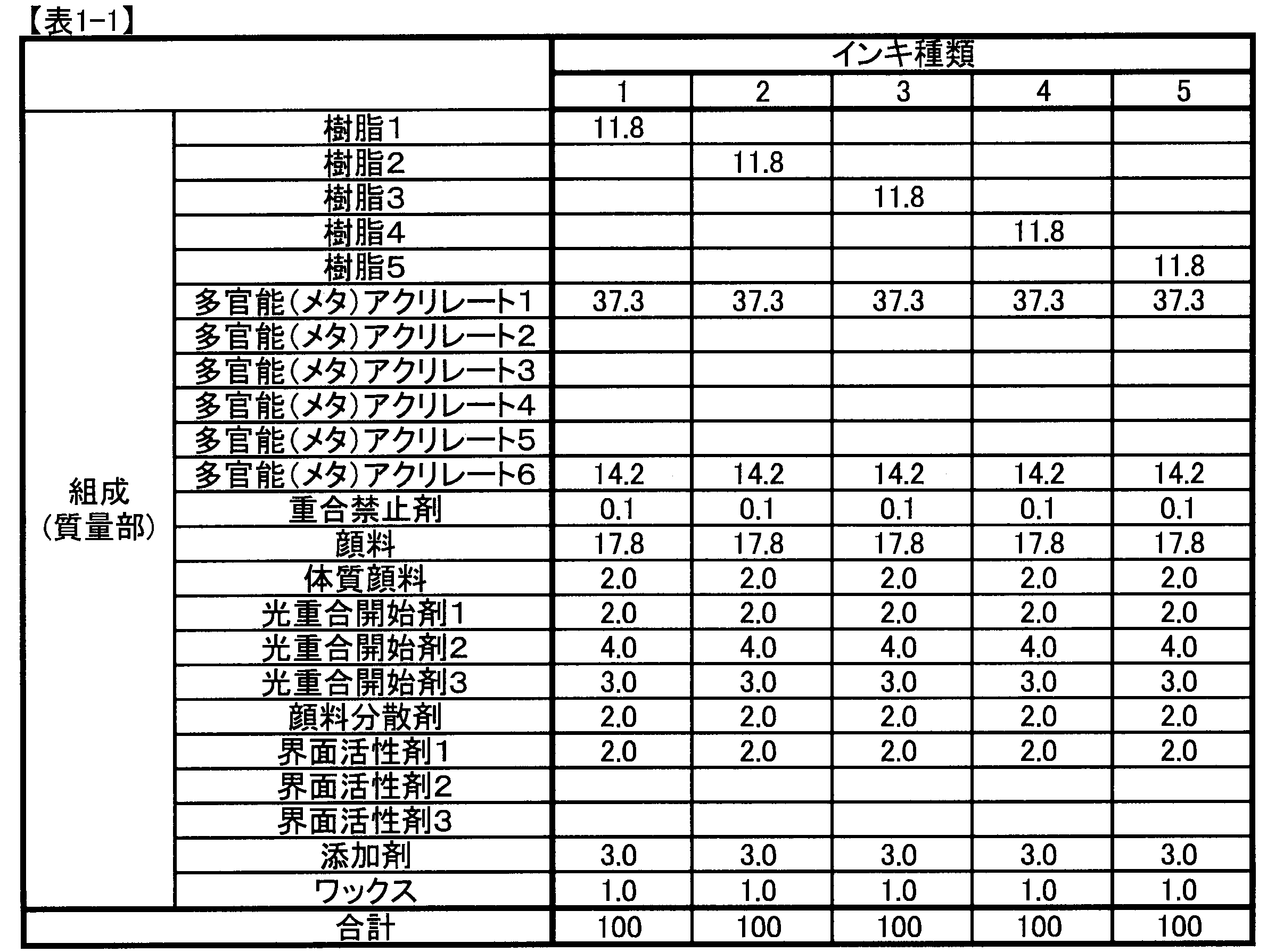
- the ink used in the printing test has the composition shown in Table 1-1 to Table 1-3, and weighed the resin, polyfunctional (meth) acrylate, pigment, photopolymerization initiator, and additive, and the three-roll mill “EXAKT” Using “(registered trademark) M-80S (manufactured by EXAKT), the roller gap was set to 1 and the film was passed 5 times at a speed of 500 rpm.
- Each ink raw material is as follows.
- Resin 1 A copolymer composed of 25% by mass of methyl methacrylate, 25% by mass of styrene and 50% by mass of methacrylic acid was prepared. Addition reaction of 0.55 equivalents of glycidyl methacrylate to the carboxyl group of the copolymer gave Resin 1 having an ethylenically unsaturated group and a hydrophilic group. The obtained resin 1 had a weight average molecular weight of 34,000, an acid value of 105 mgKOH / g, and an iodine value of 2.0 mol / kg.
- Resin 2 A resin 2 having a hydrophilic group made of a copolymer of 30% by mass of methyl methacrylate, 30% by mass of styrene and 40% by mass of methacrylic acid was obtained. The obtained resin 2 had a weight average molecular weight of 33,000 and an acid value of 268 mgKOH / g.
- Resin 3 A resin 3 having a hydrophilic group made of a copolymer of 45% by mass of methyl methacrylate, 20% by mass of styrene and 35% by mass of methacrylic acid was obtained. The obtained resin 3 had a weight average molecular weight of 21,000 and an acid value of 220 mgKOH / g.
- Resin 4 A resin 4 having a hydrophilic group made of a copolymer of 67% by mass of methyl methacrylate, 25% by mass of styrene and 8% by mass of methacrylic acid was obtained. The obtained resin 4 had a weight average molecular weight of 66,000 and an acid value of 45 mgKOH / g.
- Resin 5 Isodap (manufactured by Daiso Chemical Co., Ltd., diallyl phthalate resin, no hydrophilic group, weight average molecular weight 30,000, acid value 0 mgKOH / g).
- Multifunctional (meth) acrylate 1 Mixture “Miramer” (registered trademark) M340 (manufactured by MIWON) of pentaerythritol triacrylate and pentaerythritol tetraacrylate. Has hydroxyl group, hydroxyl value 115mgKOH / g Multifunctional (meth) acrylate 2: A mixture of pentaerythritol triacrylate and pentaerythritol tetraacrylate “Aronix” (registered trademark) M-306 (manufactured by Toagosei Co., Ltd.).
- Surfactant 1 “Leodol” (registered trademark) TW-L120 (manufactured by Kao Corporation). HLB value 16.7
- Surfactant 2 “Leodol” (registered trademark) TW-S106V (manufactured by Kao Corporation). HLB value 9.6
- Surfactant 3 “Leodol” (registered trademark) SP-P10 (manufactured by Kao Corporation). HLB value 6.7.
- Polymerization inhibitor p-methoxyphenol (manufactured by Wako Pure Chemical Industries, Ltd.) Pigment: Seika cyanine blue 4920 (manufactured by Dainichi Seika Co., Ltd.)
- Photopolymerization initiator “Irgacure” (registered trademark) 907 (manufactured by BASF)
- Sensitizer Diethylaminobenzophenone (manufactured by Tokyo Chemical Industry Co., Ltd.)
- Wax KTL-4N (Kitamura Co., Ltd.) ⁇ Measurement of weight average molecular weight>
- the weight average molecular weight of the resin is a value measured by gel permeation chromatography (GPC) using tetrahydrofuran as a mobile phase.
- the column was Shodex KF-803, and the weight average molecular weight was calculated in terms of polystyrene.
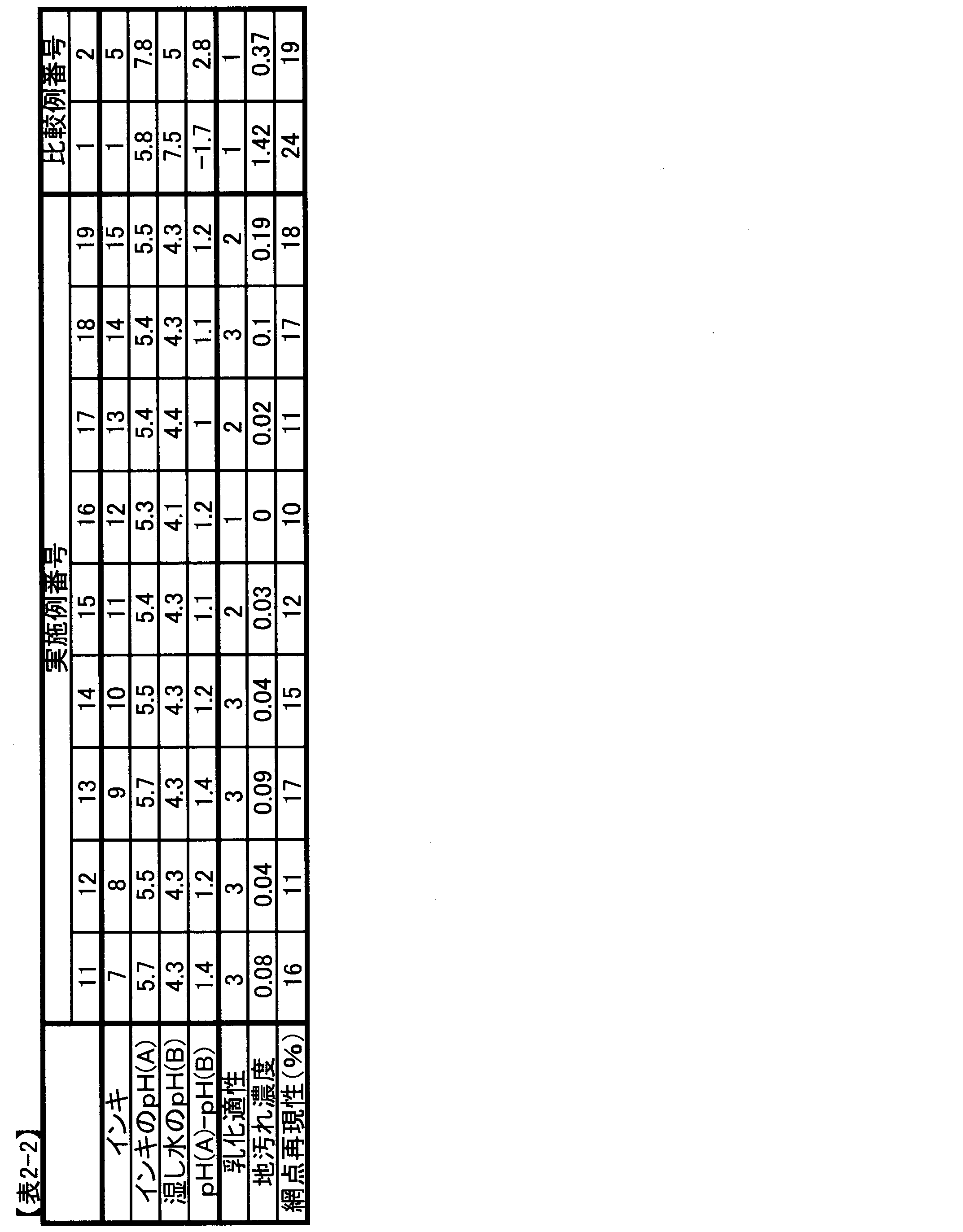
- ⁇ Printing test> A lithographic printing plate with water (XP-F, manufactured by Fuji Film Co., Ltd.) is mounted on an offset printing machine (Oliver 266EPZ, manufactured by Sakurai Graphic System Co., Ltd.). ) Using tap water mixed with each ink, printing on 5000 coated papers, using a UV irradiation device (120W / cm, one ultra-high pressure meta-hara lamp) manufactured by USHIO Co., Ltd., belt conveyor speed was irradiated with ultraviolet rays at 80 m / min to cure the ink and obtain a printed matter. The results are shown in Table 2-1 and Table 2-2.
- Examples 7 to 9 and Comparative Example 2 Printing was performed from ink 1 of Example 1 using inks 2 to 5 whose pH values were changed by changing the resin composition. As the acid value of the resin increased, the pH of the ink tended to decrease slightly. When the resin has no acid value, the pH of the ink tends to be basic, the background stain density is high, and the dot gain value tends to increase.
- Examples 10 to 13 ⁇ Modification of polyfunctional (meth) acrylate having a hydroxyl group> Printing was performed from ink 1 of Example 1 using inks 6 to 9 by changing the composition of the polyfunctional (meth) acrylate having a hydroxyl group. As the hydroxyl value increased, the cohesive strength of the ink increased and the background stain density tended to decrease, but the dot gain value also tended to decrease.
- Examples 14 to 19 ⁇ Change of type and content of surfactant> Printing was performed from ink 1 of Example 1 using inks 10 to 15 by changing the type and content of the surfactant.
- the higher the HLB value of the surfactant the easier it was to take up the fountain solution, while the background soil concentration also tended to increase. Even when the content of the surfactant was increased, the fountain solution was also easily taken in, and the background soil concentration also tended to increase.
Landscapes
- Chemical & Material Sciences (AREA)
- Life Sciences & Earth Sciences (AREA)
- Engineering & Computer Science (AREA)
- Materials Engineering (AREA)
- Wood Science & Technology (AREA)
- Organic Chemistry (AREA)
- Chemical Kinetics & Catalysis (AREA)
- General Chemical & Material Sciences (AREA)
- Physics & Mathematics (AREA)
- Composite Materials (AREA)
- Electromagnetism (AREA)
- General Health & Medical Sciences (AREA)
- Toxicology (AREA)
- Optics & Photonics (AREA)
- Health & Medical Sciences (AREA)
- Electrochemistry (AREA)
- Inks, Pencil-Leads, Or Crayons (AREA)
- Printing Methods (AREA)
- Printing Plates And Materials Therefor (AREA)
- Paper (AREA)
Abstract
Description
印刷試験で使用したインキは、表1-1~表1-3に示す組成で、樹脂、多官能(メタ)アクリレート、顔料、光重合開始剤、および添加剤を秤量し、三本ロールミル“EXAKT”(登録商標)M-80S(EXAKT社製)を用いて、ローラーギャップを1として5回500rpmの速度で通すことで得た。各インキ原料は以下のとおりである。
樹脂1:25質量%のメタクリル酸メチル、25質量%のスチレンおよび50質量%のメタクリル酸からなる共重合体を準備した。その共重合体のカルボキシル基に対して0.55当量のグリシジルメタクリレートを付加反応させて、エチレン性不飽和基と親水性基を有する樹脂1を得た。得られた樹脂1は重量平均分子量34,000、酸価105mgKOH/g、ヨウ素価2.0mol/kgであった。
樹脂2:30質量%のメタクリル酸メチル、30質量%のスチレンおよび40質量%のメタクリル酸の共重合体からなる親水性基を有する樹脂2を得た。得られた樹脂2は重量平均分子量33,000、酸価268mgKOH/gであった。
樹脂3:45質量%のメタクリル酸メチル、20質量%のスチレンおよび35質量%のメタクリル酸の共重合体からなる親水性基を有する樹脂3を得た。得られた樹脂3は重量平均分子量21,000、酸価220mgKOH/gであった。
樹脂4:67質量%のメタクリル酸メチル、25質量%のスチレンおよび8質量%のメタクリル酸の共重合体からなる親水性基を有する樹脂4を得た。得られた樹脂4は重量平均分子量66,000、酸価45mgKOH/gであった。
樹脂5:イソダップ(ダイソー化学社製、ジアリルフタレート樹脂、親水性基なし、重量平均分子量30,000、酸価0mgKOH/g)。
多官能(メタ)アクリレート2:ペンタエリスリトールトリアクリレートとペンタエリスリトールテトラアクリレートの混合物“アロニックス”(登録商標)M-306(東亜合成社製)。ヒドロキシル基あり、水酸基価171mgKOH/g
多官能(メタ)アクリレート3:ジトリメチロールプロパントリアクリレートとジトリメチロールプロパンテトラアクリレートの混合物。ヒドロキシル基あり、水酸基価72mgKOH/g
多官能(メタ)アクリレート4: グリセリンジメタクリレート“NKエステル”(登録商標)701(新中村化学社製)。ヒドロキシル基あり、水酸基価240mgKOH/g
多官能(メタ)アクリレート5: ジペンタエリスリトールペンタアクリレートとジペンタエリスリトールヘキサアクリレートの混合物“アロニックス”(登録商標)M-402(東亜合成社製)。ヒドロキシル基あり、水酸基価28mgKOH/g
多官能(メタ)アクリレート6: エチレンオキシド変性ペンタエリスリトールテトラアクリレート“Miramer”(登録商標)M4004(MIWON社製)、ヒドロキシル基なし。
界面活性剤2:“レオドール”(登録商標)TW-S106V(花王(株)社製)。HLB値9.6
界面活性剤3:“レオドール”(登録商標)SP-P10(花王(株)社製)。HLB値6.7。
顔料:セイカシアニンブルー4920(大日精化(株)製)
光重合開始剤:“イルガキュア”(登録商標)907(BASF社製)
増感剤:ジエチルアミノベンゾフェノン(東京化成(株)社製)
ワックス:KTL-4N(喜多村(株)社製)
<重量平均分子量の測定>
樹脂の重量平均分子量はテトラヒドロフランを移動相としたゲル浸透クロマトグラフィー(GPC)により測定した値である。カラムはShodex KF-803を用い、重量平均分子量はポリスチレン換算により計算した。


水あり平版印刷版(XP-F、富士フィルム(株)社製)をオフセット印刷機(オリバー266EPZ、桜井グラフィックシステム社製)に装着し、湿し水にエッチ液(SOLAIA-505、T&K TOKA社製)を混合した水道水を用い、各インキを用いて、コート紙5000枚に印刷、USHIO(株)製紫外線照射装置(120W/cm、超高圧メタハラランプ1灯)を用いて、ベルトコンベアースピードを80m/minにて紫外線を照射し、インキを硬化させ、印刷物を得た。結果を表2-1および表2-2に示す。
pH測定器(F-52、堀場製作所製)を用いて、印刷試験で使用したインキおよび湿し水のpHを測定した。ここでいうインキのpHとは、インキの1質量%水溶液を調製して25℃において測定したpHであり、湿し水のpHは25℃において測定したpHである。
印刷試験の結果は下記のように評価した。
(1)乳化適性
印刷機の湿し水供給ダイアルを3段階(1⇒2⇒3)に調節し、湿し水供給量を増加させて印刷を行い、下記の3段階で評価した。湿し水供給量が増えても、地汚れの発生や網点再現性の低下が見られない場合、湿し水を取り込む能力が高く、最適な乳化状態を広い水幅で維持可能であることを意味する。
3:いずれの湿し水供給量でも印刷品質の低下は見られなかった。
2:ダイアル3の湿し水供給量で印刷品質の低下が見られた。
1:ダイアル2の湿し水供給量で印刷品質の低下が見られた。
湿し水供給ダイアルを1として印刷した、印刷物のベタ部藍色濃度が2.0であるときの、印刷物の非画線部における藍色濃度を反射濃度計(GretagMacbeth製、SpectroEye)を用いて評価した。反射濃度が0.20を超えると耐地汚れ性が不良であり、反射濃度が0.10以下であると耐地汚れ性が良好であり、0.05以下であると耐地汚れ性が極めて良好であると評価した。
湿し水供給ダイアルが1で印刷した、印刷物の50%網点部分を反射濃度計(GretagMacbeth製、SpectroEye)を用いてドットゲイン値を測定した。ドットゲイン値が14±3%の範囲にあれば、網点再現性は良好であり、それ以外の範囲では網が太りや細りにより印刷品質が低下する。
作製したインキ1を用いて、湿し水のpHを表2のように変化させたところ、湿し水のpHが大きくなるにつれ、インキの湿し水に対する乳化量が過剰となることでインキが湿し水と反発しにくくなり、地汚れ濃度が高まり、ドットゲイン値が大きくなる傾向にあった。また実施例2のようにインキのpHが湿し水のpHより小さい場合も、pHが大きくした場合と同様の傾向を示した。湿し水のpHが小さくなるにつれ、乳化適正が低下し、ドットゲイン値が小さくなる傾向にあった。
実施例1のインキ1から、樹脂組成を変えることによりpHの値を変化させたインキ2~5を用いて印刷を行った。樹脂の酸価が高まるにつれインキのpHは僅かに小さくなる傾向にあった。樹脂に酸価が無い場合、インキのpHが塩基性寄りになり、地汚れ濃度が高く、ドットゲイン値が大きくなる傾向にあった。
実施例1のインキ1から、ヒドロキシル基を有する多官能(メタ)アクリレートの組成を変えることによりインキ6~9を用いて印刷を行った。水酸基価が高まるにつれインキの凝集力が上がり、地汚れ濃度が小さくなる傾向にあったが、ドットゲイン値も小さくなる傾向にあった。
実施例1のインキ1から、界面活性剤の種類、および含有量を変えることによりインキ10~15を用いて印刷を行った。界面活性剤のHLB値が高いほど、湿し水を取り込みやすくなる一方で、地汚れ濃度も大きくなる傾向にあった。界面活性剤の含有量を増やした場合も、同様に湿し水を取り込みやすくなる一方で、地汚れ濃度も大きくなる傾向にあった。
実施例1~19、および比較例1、および2の印刷試験後に、市販の塩基性洗剤(マジックリン、花王(株)社製)1質量%水溶液を用いて洗浄を行った。全ての実施例、および比較例1において、インキは洗い残り無く洗浄された。一方で、比較例2では、洗浄液に不溶なインキが残存した。

Claims (20)
- 少なくとも親水性層および感熱層を有する平版印刷版に、湿し水を親水性層に付着する工程、インキを感熱層に付着させる工程、および前記感熱層に付着したインキを被印刷体に転写する工程を含む印刷物の製造方法であって、前記インキのpH(A)と前記湿し水のpH(B)の値がともに1~6.5である印刷物の製造方法。
- 前記インキのpH(A)と前記湿し水のpH(B)が、(A)>(B)である請求項1に記載の印刷物の製造方法。
- 前記湿し水のpH(B)が3~6である、請求項1または2に記載の印刷物の製造方法。
- 前記インキのpH(A)が3以上6以下である請求項1~3のいずれかに記載の印刷物の製造方法。
- 前記インキのpH(A)と前記湿し水のpH(B)の差(pH(A)―pH(B))が1以上2以下である請求項1~4のいずれかに記載の印刷物の製造方法。
- 前記付着したインキを被印刷体に転写する工程が、付着したインキを被印刷体に直接またはブランケットを介して転写する工程である請求項1~5のいずれかに記載の印刷物の製造方法。
- 被印刷体に転写されたインキに、活性エネルギー線を照射する工程を含む、請求項1~6のいずれかに記載の印刷物の製造方法。
- 前記活性エネルギー線が、発光ダイオードから発せられた波長350~420nmの輝線である、請求項7に記載の印刷物の製造方法。
- 印刷後、印刷版および/またはブランケットを洗浄水で洗浄する工程を含む、請求項1~8のいずれかに記載の印刷物の製造方法。
- 前記洗浄水のpHが8以上13以下である請求項9に記載の印刷物の製造方法。
- 前記インキが、顔料、酸性基を有する樹脂、およびヒドロキシル基を有する多官能(メタ)アクリレートを含む、請求項1~10のいずれかに記載の印刷物の製造方法。
- 前記酸性基を有する樹脂の酸性基が、カルボキシル基、スルホ基、リン酸基から選ばれる少なくとも1種を有する、請求項11に記載の印刷物の製造方法。
- 前記酸性基を有する樹脂の酸価が、30mgKOH/g~250mgKOH/gである、請求項11または12に記載の印刷物の製造方法。
- 前記酸性基を有する樹脂が、エチレン性不飽和基を有する、請求項11~13のいずれかに記載の印刷物の製造方法。
- 前記酸性基を有する樹脂のヨウ素価が0.5mol/kg~3.0mol/kgである、請求項14に記載の印刷物の製造方法。
- 前記ヒドロキシル基を有する多官能(メタ)アクリレートの水酸基価が50mgKOH/g~200mgKOH/gである請求項11~15のいずれかに記載の印刷物の製造方法。
- 前記インキが、光重合開始剤を含む、請求項11~16のいずれかに記載の印刷物の製造方法。
- 前記インキが、界面活性剤を含む、請求項1~17のいずれかに記載の印刷物の製造方法。
- 前記界面活性剤のHLB値が、8~18である、請求項18に記載の印刷物の製造方法。
- 前記界面活性剤のインキ中の含有量が1質量%~10質量%である、請求項18または19に記載の印刷物の製造方法。
Priority Applications (7)
| Application Number | Priority Date | Filing Date | Title |
|---|---|---|---|
| KR1020187034622A KR102200851B1 (ko) | 2016-05-27 | 2017-05-19 | 인쇄물의 제조 방법 |
| EP17802696.9A EP3466704B1 (en) | 2016-05-27 | 2017-05-19 | Method for producing printed matter |
| JP2017534748A JP6834959B2 (ja) | 2016-05-27 | 2017-05-19 | 印刷物の製造方法 |
| CN201780031204.3A CN109153274A (zh) | 2016-05-27 | 2017-05-19 | 印刷物的制造方法 |
| ES17802696T ES2942886T3 (es) | 2016-05-27 | 2017-05-19 | Método para producir material impreso |
| SG11201808985RA SG11201808985RA (en) | 2016-05-27 | 2017-05-19 | Method for producing printed matter |
| US16/094,639 US10906294B2 (en) | 2016-05-27 | 2017-05-19 | Method for producing printed matter |
Applications Claiming Priority (2)
| Application Number | Priority Date | Filing Date | Title |
|---|---|---|---|
| JP2016-105993 | 2016-05-27 | ||
| JP2016105993 | 2016-05-27 |
Publications (1)
| Publication Number | Publication Date |
|---|---|
| WO2017204104A1 true WO2017204104A1 (ja) | 2017-11-30 |
Family
ID=60412329
Family Applications (1)
| Application Number | Title | Priority Date | Filing Date |
|---|---|---|---|
| PCT/JP2017/018830 Ceased WO2017204104A1 (ja) | 2016-05-27 | 2017-05-19 | 印刷物の製造方法 |
Country Status (9)
| Country | Link |
|---|---|
| US (1) | US10906294B2 (ja) |
| EP (1) | EP3466704B1 (ja) |
| JP (1) | JP6834959B2 (ja) |
| KR (1) | KR102200851B1 (ja) |
| CN (1) | CN109153274A (ja) |
| ES (1) | ES2942886T3 (ja) |
| SG (1) | SG11201808985RA (ja) |
| TW (1) | TW201809163A (ja) |
| WO (1) | WO2017204104A1 (ja) |
Cited By (4)
| Publication number | Priority date | Publication date | Assignee | Title |
|---|---|---|---|---|
| EP3351602A4 (en) * | 2015-09-17 | 2019-05-22 | Toray Industries, Inc. | LITHOGRAPHIC PRINTING INK, LACK FOR LITHOGRAPHIC PRINTING INKS, AND METHOD FOR PRODUCING PRINTED SIZES USING THIS INK |
| EP3381988A4 (en) * | 2015-11-25 | 2019-06-26 | Toray Industries, Inc. | LITHOGRAPHIC INK |
| EP3950368A4 (en) * | 2019-03-29 | 2023-07-05 | Toray Industries, Inc. | PRINT PRODUCTION PROCESS |
| WO2024161863A1 (ja) * | 2023-01-30 | 2024-08-08 | 東レ株式会社 | 活性エネルギー線硬化型平版印刷用インキおよびそれを用いた印刷物の製造方法 |
Families Citing this family (1)
| Publication number | Priority date | Publication date | Assignee | Title |
|---|---|---|---|---|
| CN115464971B (zh) * | 2022-09-19 | 2023-05-26 | 浙江中特机械科技股份有限公司 | 一种卷筒纸全轮转印刷机 |
Citations (4)
| Publication number | Priority date | Publication date | Assignee | Title |
|---|---|---|---|---|
| US5228906A (en) * | 1992-05-01 | 1993-07-20 | Fidler Kenneth L | Moistening agent for offset printing plates |
| JPH08108662A (ja) * | 1994-10-07 | 1996-04-30 | Fuji Photo Film Co Ltd | 平版印刷版用現像インキ |
| JP2008119921A (ja) * | 2006-11-10 | 2008-05-29 | Dainippon Ink & Chem Inc | 平版印刷用湿し水補充液組成物および湿し水の補充管理方法 |
| JP2011225754A (ja) | 2010-04-21 | 2011-11-10 | Toyo Ink Sc Holdings Co Ltd | 活性エネルギー線硬化型オフセットインキ組成物及びその印刷物 |
Family Cites Families (14)
| Publication number | Priority date | Publication date | Assignee | Title |
|---|---|---|---|---|
| JPH08501493A (ja) * | 1992-09-17 | 1996-02-20 | デラックス・コーポレーション | 廃水を浄化する方法及びそれから汚染物を回収する方法 |
| US6039965A (en) * | 1996-09-27 | 2000-03-21 | Calgon Corporation | Surfanctants for reducing bacterial adhesion onto surfaces |
| JP4764892B2 (ja) | 2000-01-14 | 2011-09-07 | 富士フイルム株式会社 | 平版印刷版の製版方法 |
| US7323288B2 (en) * | 2003-04-14 | 2008-01-29 | Kodak Graphic Communications Canada Company | Layers in printing plates, printing plates and method of use of printing plates |
| US7342055B2 (en) * | 2003-09-09 | 2008-03-11 | Flint Group | Lithographic ink obviating fountain additives |
| JP2005305689A (ja) * | 2004-04-19 | 2005-11-04 | Konica Minolta Medical & Graphic Inc | 印刷版材料および印刷方法 |
| CN101218109A (zh) * | 2005-07-12 | 2008-07-09 | 柯尼卡美能达医疗印刷器材株式会社 | 平版印刷版材料以及可视图像的形成方法 |
| EP1767349B1 (en) | 2005-09-27 | 2008-07-23 | Agfa Graphics N.V. | Method for making a lithographic printing plate |
| JP2008143993A (ja) | 2006-12-08 | 2008-06-26 | Toyo Ink Mfg Co Ltd | 活性エネルギー線硬化性水洗浄性平版オフセット印刷インキならびに印刷物 |
| WO2009030279A1 (en) * | 2007-09-07 | 2009-03-12 | Agfa Graphics Nv | A heat-sensitive lithographic printing plate precursor |
| CN101310993B (zh) * | 2008-03-21 | 2010-06-09 | 宋东强 | 已配好水的胶印机直接使用的润版液及其生产方法 |
| JP5554290B2 (ja) | 2011-06-17 | 2014-07-23 | 富士フイルム株式会社 | インクセット及び画像形成方法 |
| EP2565037B1 (en) * | 2011-08-31 | 2014-10-01 | Fujifilm Corporation | Process for producing flexographic printing plate precursor for laser engraving, and process for making flexographic printing plate |
| CN102815838A (zh) * | 2012-08-13 | 2012-12-12 | 上海川鼎国际贸易有限公司 | 印刷润版液过滤循环使用、零排放系统及工艺流程 |
-
2017
- 2017-05-19 JP JP2017534748A patent/JP6834959B2/ja active Active
- 2017-05-19 ES ES17802696T patent/ES2942886T3/es active Active
- 2017-05-19 WO PCT/JP2017/018830 patent/WO2017204104A1/ja not_active Ceased
- 2017-05-19 EP EP17802696.9A patent/EP3466704B1/en active Active
- 2017-05-19 US US16/094,639 patent/US10906294B2/en active Active
- 2017-05-19 KR KR1020187034622A patent/KR102200851B1/ko active Active
- 2017-05-19 CN CN201780031204.3A patent/CN109153274A/zh active Pending
- 2017-05-19 SG SG11201808985RA patent/SG11201808985RA/en unknown
- 2017-05-23 TW TW106116960A patent/TW201809163A/zh unknown
Patent Citations (4)
| Publication number | Priority date | Publication date | Assignee | Title |
|---|---|---|---|---|
| US5228906A (en) * | 1992-05-01 | 1993-07-20 | Fidler Kenneth L | Moistening agent for offset printing plates |
| JPH08108662A (ja) * | 1994-10-07 | 1996-04-30 | Fuji Photo Film Co Ltd | 平版印刷版用現像インキ |
| JP2008119921A (ja) * | 2006-11-10 | 2008-05-29 | Dainippon Ink & Chem Inc | 平版印刷用湿し水補充液組成物および湿し水の補充管理方法 |
| JP2011225754A (ja) | 2010-04-21 | 2011-11-10 | Toyo Ink Sc Holdings Co Ltd | 活性エネルギー線硬化型オフセットインキ組成物及びその印刷物 |
Non-Patent Citations (1)
| Title |
|---|
| See also references of EP3466704A4 |
Cited By (5)
| Publication number | Priority date | Publication date | Assignee | Title |
|---|---|---|---|---|
| EP3351602A4 (en) * | 2015-09-17 | 2019-05-22 | Toray Industries, Inc. | LITHOGRAPHIC PRINTING INK, LACK FOR LITHOGRAPHIC PRINTING INKS, AND METHOD FOR PRODUCING PRINTED SIZES USING THIS INK |
| EP3381988A4 (en) * | 2015-11-25 | 2019-06-26 | Toray Industries, Inc. | LITHOGRAPHIC INK |
| US11161991B2 (en) | 2015-11-25 | 2021-11-02 | Toray Industries, Inc. | Lithographic ink |
| EP3950368A4 (en) * | 2019-03-29 | 2023-07-05 | Toray Industries, Inc. | PRINT PRODUCTION PROCESS |
| WO2024161863A1 (ja) * | 2023-01-30 | 2024-08-08 | 東レ株式会社 | 活性エネルギー線硬化型平版印刷用インキおよびそれを用いた印刷物の製造方法 |
Also Published As
| Publication number | Publication date |
|---|---|
| EP3466704B1 (en) | 2023-03-15 |
| TW201809163A (zh) | 2018-03-16 |
| US10906294B2 (en) | 2021-02-02 |
| JPWO2017204104A1 (ja) | 2019-03-22 |
| US20190105894A1 (en) | 2019-04-11 |
| JP6834959B2 (ja) | 2021-02-24 |
| CN109153274A (zh) | 2019-01-04 |
| EP3466704A1 (en) | 2019-04-10 |
| KR102200851B1 (ko) | 2021-01-11 |
| SG11201808985RA (en) | 2018-11-29 |
| ES2942886T3 (es) | 2023-06-07 |
| EP3466704A4 (en) | 2020-01-15 |
| KR20190012176A (ko) | 2019-02-08 |
Similar Documents
| Publication | Publication Date | Title |
|---|---|---|
| JP6870668B2 (ja) | 活性エネルギー線硬化型水なし平版インキ用ワニス、平版印刷用インキおよびそれを用いた印刷物の製造方法 | |
| JP6834959B2 (ja) | 印刷物の製造方法 | |
| JP6888619B2 (ja) | 印刷物の製造方法および印刷機 | |
| JP6299886B2 (ja) | 平版印刷用インキ | |
| CN110891797B (zh) | 平版印刷版的制作方法 | |
| US20090186201A1 (en) | Plate making method and planographic printing plate | |
| JPWO2018062108A1 (ja) | 平版印刷用インキを用いた印刷物の製造方法、および平版印刷用インキセット | |
| CN110691701A (zh) | 平版印刷版原版、平版印刷版原版制作用树脂组合物及平版印刷版的制作方法 | |
| JP7013708B2 (ja) | 印刷物の製造方法 | |
| WO2003066759A1 (en) | Relief printing-use ink composition and application thereof | |
| JP6946619B2 (ja) | 感光性樹脂組成物、および感光性樹脂印刷版原版 | |
| JP4758755B2 (ja) | 印刷物の製造方法およびその方法で得られる印刷物 | |
| JP2023049236A (ja) | 感光性フレキソ印刷版原版 | |
| JP2011102021A (ja) | 印刷版の表面処理方法 | |
| JP2006334875A (ja) | 平版印刷版、平版印刷版の製版方法、平版印刷版の製版装置、平版印刷版を用いる印刷方法、平版印刷版を用いる印刷機 | |
| JP2002240453A (ja) | 単一流体インキで印刷版材料を処理する方法 |
Legal Events
| Date | Code | Title | Description |
|---|---|---|---|
| ENP | Entry into the national phase |
Ref document number: 2017534748 Country of ref document: JP Kind code of ref document: A |
|
| 121 | Ep: the epo has been informed by wipo that ep was designated in this application |
Ref document number: 17802696 Country of ref document: EP Kind code of ref document: A1 |
|
| NENP | Non-entry into the national phase |
Ref country code: DE |
|
| ENP | Entry into the national phase |
Ref document number: 20187034622 Country of ref document: KR Kind code of ref document: A |
|
| ENP | Entry into the national phase |
Ref document number: 2017802696 Country of ref document: EP Effective date: 20190102 |