WO2017209116A1 - 繊維製品用洗浄剤組成物 - Google Patents
繊維製品用洗浄剤組成物 Download PDFInfo
- Publication number
- WO2017209116A1 WO2017209116A1 PCT/JP2017/020059 JP2017020059W WO2017209116A1 WO 2017209116 A1 WO2017209116 A1 WO 2017209116A1 JP 2017020059 W JP2017020059 W JP 2017020059W WO 2017209116 A1 WO2017209116 A1 WO 2017209116A1
- Authority
- WO
- WIPO (PCT)
- Prior art keywords
- component
- less
- mass
- internal olefin
- carbon atoms
- Prior art date
- Legal status (The legal status is an assumption and is not a legal conclusion. Google has not performed a legal analysis and makes no representation as to the accuracy of the status listed.)
- Ceased
Links
Classifications
-
- C—CHEMISTRY; METALLURGY
- C11—ANIMAL OR VEGETABLE OILS, FATS, FATTY SUBSTANCES OR WAXES; FATTY ACIDS THEREFROM; DETERGENTS; CANDLES
- C11D—DETERGENT COMPOSITIONS; USE OF SINGLE SUBSTANCES AS DETERGENTS; SOAP OR SOAP-MAKING; RESIN SOAPS; RECOVERY OF GLYCEROL
- C11D1/00—Detergent compositions based essentially on surface-active compounds; Use of these compounds as a detergent
- C11D1/66—Non-ionic compounds
- C11D1/83—Mixtures of non-ionic with anionic compounds
- C11D1/831—Mixtures of non-ionic with anionic compounds of sulfonates with ethers of polyoxyalkylenes without phosphates
-
- C—CHEMISTRY; METALLURGY
- C11—ANIMAL OR VEGETABLE OILS, FATS, FATTY SUBSTANCES OR WAXES; FATTY ACIDS THEREFROM; DETERGENTS; CANDLES
- C11D—DETERGENT COMPOSITIONS; USE OF SINGLE SUBSTANCES AS DETERGENTS; SOAP OR SOAP-MAKING; RESIN SOAPS; RECOVERY OF GLYCEROL
- C11D1/00—Detergent compositions based essentially on surface-active compounds; Use of these compounds as a detergent
- C11D1/02—Anionic compounds
- C11D1/12—Sulfonic acids or sulfuric acid esters; Salts thereof
- C11D1/14—Sulfonic acids or sulfuric acid esters; Salts thereof derived from aliphatic hydrocarbons or mono-alcohols
-
- C—CHEMISTRY; METALLURGY
- C11—ANIMAL OR VEGETABLE OILS, FATS, FATTY SUBSTANCES OR WAXES; FATTY ACIDS THEREFROM; DETERGENTS; CANDLES
- C11D—DETERGENT COMPOSITIONS; USE OF SINGLE SUBSTANCES AS DETERGENTS; SOAP OR SOAP-MAKING; RESIN SOAPS; RECOVERY OF GLYCEROL
- C11D1/00—Detergent compositions based essentially on surface-active compounds; Use of these compounds as a detergent
- C11D1/02—Anionic compounds
- C11D1/12—Sulfonic acids or sulfuric acid esters; Salts thereof
- C11D1/14—Sulfonic acids or sulfuric acid esters; Salts thereof derived from aliphatic hydrocarbons or mono-alcohols
- C11D1/143—Sulfonic acid esters
-
- C—CHEMISTRY; METALLURGY
- C11—ANIMAL OR VEGETABLE OILS, FATS, FATTY SUBSTANCES OR WAXES; FATTY ACIDS THEREFROM; DETERGENTS; CANDLES
- C11D—DETERGENT COMPOSITIONS; USE OF SINGLE SUBSTANCES AS DETERGENTS; SOAP OR SOAP-MAKING; RESIN SOAPS; RECOVERY OF GLYCEROL
- C11D1/00—Detergent compositions based essentially on surface-active compounds; Use of these compounds as a detergent
- C11D1/66—Non-ionic compounds
- C11D1/83—Mixtures of non-ionic with anionic compounds
-
- C—CHEMISTRY; METALLURGY
- C11—ANIMAL OR VEGETABLE OILS, FATS, FATTY SUBSTANCES OR WAXES; FATTY ACIDS THEREFROM; DETERGENTS; CANDLES
- C11D—DETERGENT COMPOSITIONS; USE OF SINGLE SUBSTANCES AS DETERGENTS; SOAP OR SOAP-MAKING; RESIN SOAPS; RECOVERY OF GLYCEROL
- C11D17/00—Detergent materials or soaps characterised by their shape or physical properties
- C11D17/0008—Detergent materials or soaps characterised by their shape or physical properties aqueous liquid non soap compositions
-
- D—TEXTILES; PAPER
- D06—TREATMENT OF TEXTILES OR THE LIKE; LAUNDERING; FLEXIBLE MATERIALS NOT OTHERWISE PROVIDED FOR
- D06L—DRY-CLEANING, WASHING OR BLEACHING FIBRES, FILAMENTS, THREADS, YARNS, FABRICS, FEATHERS OR MADE-UP FIBROUS GOODS; BLEACHING LEATHER OR FURS
- D06L1/00—Dry-cleaning or washing fibres, filaments, threads, yarns, fabrics, feathers or made-up fibrous goods
-
- D—TEXTILES; PAPER
- D06—TREATMENT OF TEXTILES OR THE LIKE; LAUNDERING; FLEXIBLE MATERIALS NOT OTHERWISE PROVIDED FOR
- D06L—DRY-CLEANING, WASHING OR BLEACHING FIBRES, FILAMENTS, THREADS, YARNS, FABRICS, FEATHERS OR MADE-UP FIBROUS GOODS; BLEACHING LEATHER OR FURS
- D06L1/00—Dry-cleaning or washing fibres, filaments, threads, yarns, fabrics, feathers or made-up fibrous goods
- D06L1/12—Dry-cleaning or washing fibres, filaments, threads, yarns, fabrics, feathers or made-up fibrous goods using aqueous solvents
-
- C—CHEMISTRY; METALLURGY
- C11—ANIMAL OR VEGETABLE OILS, FATS, FATTY SUBSTANCES OR WAXES; FATTY ACIDS THEREFROM; DETERGENTS; CANDLES
- C11D—DETERGENT COMPOSITIONS; USE OF SINGLE SUBSTANCES AS DETERGENTS; SOAP OR SOAP-MAKING; RESIN SOAPS; RECOVERY OF GLYCEROL
- C11D1/00—Detergent compositions based essentially on surface-active compounds; Use of these compounds as a detergent
- C11D1/66—Non-ionic compounds
- C11D1/72—Ethers of polyoxyalkylene glycols
-
- C—CHEMISTRY; METALLURGY
- C11—ANIMAL OR VEGETABLE OILS, FATS, FATTY SUBSTANCES OR WAXES; FATTY ACIDS THEREFROM; DETERGENTS; CANDLES
- C11D—DETERGENT COMPOSITIONS; USE OF SINGLE SUBSTANCES AS DETERGENTS; SOAP OR SOAP-MAKING; RESIN SOAPS; RECOVERY OF GLYCEROL
- C11D1/00—Detergent compositions based essentially on surface-active compounds; Use of these compounds as a detergent
- C11D1/66—Non-ionic compounds
- C11D1/74—Carboxylates or sulfonates esters of polyoxyalkylene glycols
-
- C—CHEMISTRY; METALLURGY
- C11—ANIMAL OR VEGETABLE OILS, FATS, FATTY SUBSTANCES OR WAXES; FATTY ACIDS THEREFROM; DETERGENTS; CANDLES
- C11D—DETERGENT COMPOSITIONS; USE OF SINGLE SUBSTANCES AS DETERGENTS; SOAP OR SOAP-MAKING; RESIN SOAPS; RECOVERY OF GLYCEROL
- C11D2111/00—Cleaning compositions characterised by the objects to be cleaned; Cleaning compositions characterised by non-standard cleaning or washing processes
- C11D2111/10—Objects to be cleaned
- C11D2111/12—Soft surfaces, e.g. textile
Definitions
- the present invention relates to a textile product cleaning composition, a textile cleaning method, and a textile manufacturing method.
- anionic surfactants especially alkylbenzene sulfonates, nonionic surfactants containing an oxyalkylene group having 2 to 3 carbon atoms, olefin sulfonates, especially internals having double bonds inside the olefin chain rather than at the ends Internal olefin sulfonates obtained from olefins as raw materials are widely used as household and industrial cleaning components.
- JP 2011-32456 A discloses a detergent composition comprising a surfactant system having a low fiber adsorptivity comprising a nonionic surfactant such as a specific polyoxyethylene polyoxyalkylene alkyl ether and an anionic surfactant. Things are listed. As anionic surfactants, alkylbenzene sulfonates are specifically disclosed.
- Japanese Patent Application Laid-Open No. 2015-28123 discloses a foaming property containing an internal olefin sulfonate having 16 carbon atoms and an internal olefin sulfonate having 18 carbon atoms in a specific ratio, and a hydroxy / olefin body having a specific ratio.
- an internal olefin sulfonate composition excellent in the above is disclosed.
- European Patent Publication No. 377261 discloses a detergent composition having an excellent detergency containing an internal olefin sulfonate containing 25% or more of a ⁇ -hydroxy compound.
- a detergent composition comprising an internal olefin sulfonate and a nonionic surfactant is described.
- Japanese Patent Application Laid-Open No. 2003-81935 discloses a carbon number of 8 in which the total ratio of double bonds in the 2-position is 20 to 95% and the cis / trans ratio is 1/9 to 6/4.
- Detergent compositions containing internal olefin sulfonates are described which are obtained by sulfonating, neutralizing and hydrolyzing up to 30 internal olefins.
- Formulation Example 1 describes a granular detergent composition for clothing containing an internal olefin sulfonate and a nonionic surfactant having a polyoxyethylene group.
- JP-A-3-126793 discloses a detergent composition containing an internal olefin sulfonate derived from an internal olefin having 12 to 18 carbon atoms and a nonionic surfactant having an HLB value of 10.5 or less in a specific ratio. Things are listed. Summary of the Invention
- An object of the present invention relates to a textile product cleaning composition, a textile cleaning method, and a manufacturing method of a textile cleaning composition, in which a surfactant is less likely to adsorb to fibers after washing.
- the subject of this invention is the use of an internal olefin sulfonate obtained from an internal olefin as a raw material.
- the present invention relates to a cleaning method and a method for producing a cleaning composition for textiles.
- this invention relates to the cleaning composition for textiles containing the following (A) component and (B) component.
- the present invention relates to a detergent composition for textiles, which contains the following components (A1) and (B).
- the present invention relates to a textile composition cleaning composition containing the following components (A) and (B).
- the present invention also relates to a method for washing a textile product with a washing liquid containing the following components (A), (B) and water, wherein the washing liquid has a hardness exceeding 0 ° dH.
- the present invention is a method for washing a textile product with a washing solution containing the following component (A1), component (B) and water, wherein the hardness of water in the washing solution exceeds 0 ° dH.
- the present invention relates to a method for cleaning textile products.
- this invention is the method of wash
- the present invention relates to a cleaning method.
- this invention relates to the manufacturing method of the cleaning composition for textiles which mixes the following (A) component and the following (B) component.
- this invention relates to the manufacturing method of the cleaning composition for textiles which mixes the following (A1) component and the following (B) component in another side.
- this invention relates to the manufacturing method of the cleaning composition for textiles which mixes the following (A) component and the following (B) component in another side.
- a textile product cleaning composition a textile cleaning method, and a manufacturing method of a textile cleaning composition, in which a surfactant is less likely to be adsorbed to fibers after washing.
- a detergency composition for a textile product which provides a certain detergency to the textile product
- a cleaning method or a method for producing a cleaning composition for textiles can be provided.
- the present inventors include an internal olefin having 15 to 24 carbon atoms, including an internal olefin sulfonate having 15 to 24 carbon atoms in which a sulfonic acid group is present at the 5-position or more, among many anionic surfactants. It has been found that sulfonates are more difficult to adsorb on fibers. Moreover, it discovered that the adsorptivity to the fiber of a surfactant fell more by using together the nonionic surfactant which has specific HLB with respect to the said internal olefin sulfonate. It is assumed that the rinsing after washing the fiber product becomes easier by reducing the adsorptivity of the surfactant to the fiber.
- the component (A) of the present invention is an internal olefin sulfonate having 15 to 24 carbon atoms, including an internal olefin sulfonate having 15 to 24 carbon atoms in which a sulfonic acid group is present at the 5-position or more, and fiber. It has the effect of cleaning dirt adhering to the surface. Moreover, it is a compound with lower adsorptivity to the textiles at the time of washing
- the carbon number of the internal olefin sulfonate in the component (A) represents the carbon number of the internal olefin to which the sulfonate is covalently bonded.
- the number of carbon atoms of the internal olefin sulfonate is 15 or more, preferably 16 or more, and the surfactant to the fiber product can be further improved from the viewpoint of improving the detergency of dirt attached to the fiber product. From the viewpoint of further reducing the amount of adsorption, it is 24 or less, preferably 22 or less, more preferably 20 or less, and still more preferably 18 or less.
- the component (A) of the present invention is an internal olefin sulfonate having 15 to 24 carbon atoms, and the component (A) is an internal olefin sulfone having 15 to 24 carbon atoms in which a sulfonic acid group is present at the 5-position or more. Contains acid salts.
- the component (A) is at least one selected from the following components (a1) and (a2) from the viewpoint of reducing the amount of the surfactant adsorbed on the textile product, and the components (a2) and (a1)
- the component mass ratio (a2) / (a1) is preferably 0 or more and 1 or less.
- Component (a1) an internal olefin sulfonate having 15 to 16 carbon atoms, including an internal olefin sulfonate having 15 to 16 carbon atoms in which a sulfonic acid group is present at the 5-position or higher
- the mass ratio (a2) / (a1) between the component (a2) and the component (a1) is 0 or more and 1 or less, preferably 0 or less, from the viewpoint of further reducing the amount of surfactant adsorbed to the fiber during washing. 95 or less, more preferably 0.9 or less, still more preferably 0.8 or less, still more preferably 0.7 or less, still more preferably 0.6 or less, still more preferably 0.5 or less, and still more preferably 0.4 or less, more preferably 0.3 or less, even more preferably 0.2 or less, even more preferably 0.1 or less, still more preferably 0.05 or less, and even more preferably 0. .
- the mass ratio (a2) / (a1) of the component (a2) to the component (a1) is 1 or less, and 0 or more, preferably 0.05, from the viewpoint of further improving the detergency of dirt attached to the fiber. Or more, more preferably 0.1 or more, still more preferably 0.2 or more, still more preferably 0.3 or more, still more preferably 0.4 or more, still more preferably 0.5 or more, and even more preferably 0. .6 or more, more preferably 0.7 or more, still more preferably 0.8 or more, still more preferably 0.9 or more, and even more preferably 1.
- the mass ratio (a2) / (a1) of the component (a2) and the component (a1) can further reduce the amount of the surfactant adsorbed to the fiber at the time of washing, and can further improve the detergency of dirt attached to the fiber.
- 0 or more preferably 0.05 or more, more preferably 0.1 or more, and 1 or less, preferably 0.95 or less, more preferably 0.9 or less, still more preferably 0.8 or less, more More More preferably, it is 0.7 or less, More preferably, it is 0.6 or less, More preferably, it is 0.5 or less.
- (A) component is 1 or more types chosen from the following (a11) component and (a21) component from a viewpoint that the adsorption amount of surfactant to textiles can be reduced more, (a21) component and ( The mass ratio (a21) / (a11) of the component a11) is preferably 0 or more and 1 or less.
- Internal olefin sulfonate (a21) component an internal olefin sulfonate having a sulfonic acid group at the 5-position or more, and an internal olefin having 17 to 24 carbon atoms having a double bond at the 5-position or more.
- the preferred range can be applied by substituting the component (a11) with the component (a1) and the component (a21) with the component (a2).
- the internal olefin sulfonate of the present invention preferably has, as a raw material, an internal olefin containing an internal olefin having 15 to 24 carbon atoms in which a double bond is present at the 5-position or more (having a double bond inside the olefin chain).
- Olefin is a sulfonate obtained by sulfonation, neutralization and hydrolysis.
- Such internal olefins include those containing trace amounts of so-called alpha olefins (hereinafter also referred to as ⁇ -olefins) in which the position of the double bond is located at the 1st position of the carbon chain.
- the product obtained is mainly a mixture of these, part of which is a hydroxyalkane sulfonate having a hydroxy group at the end of the carbon chain, or an olefin having a double bond at the end of the carbon chain.
- a sulfonate may be contained in a trace amount.
- each of these products and a mixture thereof are collectively referred to as an internal olefin sulfonate (component (A)).
- the hydroxyalkane sulfonate is referred to as a hydroxy form of internal olefin sulfonate (hereinafter also referred to as HAS), and the olefin sulfonate is referred to as an olefin form of internal olefin sulfonate (hereinafter also referred to as IOS).
- HAS internal olefin sulfonate
- IOS internal olefin sulfonate
- the mass ratio of the compounds in component (A) can be measured by a high performance liquid chromatography mass spectrometer (hereinafter abbreviated as HPLC-MS). Specifically, the mass ratio can be determined from the HPLC-MS peak area of the component (A).
- Internal olefin sulfonates are known as cleaning bases.
- the internal olefin used as a raw material for the internal olefin sulfonate is obtained by, for example, isomerizing a 1-olefin obtained by dehydrating 1-alcohol, but it is not easy to control the position of the double bond. Due to fluctuations in production conditions, internal olefins having different distributions of double bond positions are produced, and the detergent composition containing an internal olefin sulfonate salt obtained by sulfonating the same may have different qualities such as detergency, This is a problem for manufacturers who are required to provide a user with a cleaning composition having a certain quality.
- the inventors of the present invention have disclosed a cleaning composition containing an internal olefin sulfonate obtained by changing the internal olefin content in which the position of the double bond in the internal olefin as a raw material is located at the 5-position or higher. I found out that gender changes.
- Examples of the salt of the internal olefin sulfonate include alkali metal salts, alkaline earth metal (1/2 atom) salts, ammonium salts, and organic ammonium salts.
- Examples of the alkali metal salt include sodium salt and potassium salt.
- Examples of the organic ammonium include alkanol ammonium salts having 2 to 6 carbon atoms.
- the salt of the internal olefin sulfonate is preferably an alkali metal salt, and more preferably a sodium salt or a potassium salt.
- the sulfonic acid group of the internal olefin sulfonate of component (A) is present in the carbon chain of the internal olefin sulfonate, that is, the olefin chain or alkane chain, as is apparent from the above-mentioned production method, There may be a trace amount of a sulfonic acid group present at the end of the carbon chain.
- the content of the internal olefin sulfonate having 15 to 24 carbon atoms in which the sulfonic acid group is present at the 2-position improves the cleaning performance of dirt attached to the fiber product.
- the component (A) is preferably 10% by mass or more, more preferably 15% by mass or more, still more preferably 20% by mass or more, still more preferably 25% by mass or more, and still more preferably 30% by mass or more. More preferably, it is 35% by mass or more, still more preferably 40% by mass or more, and preferably 60% by mass or less.
- the content of the internal olefin sulfonate having 15 or more and 24 or less carbon atoms in which the sulfonic acid group is present at the 5-position or more is preferably 60 from the viewpoint of more easily cleaning the dirt attached to the fiber product.
- % By mass or less more preferably 57% by mass or less, still more preferably 54% by mass or less, still more preferably 50% by mass or less, still more preferably 46% by mass or less, still more preferably 42% by mass or less, and even more preferably. Is 35% by mass or less, and preferably 5% by mass or more, more preferably 10% by mass or more.
- the content of each compound having a different sulfonic acid group position in component (A) can be measured by HPLC-MS.
- the content of each compound having a different sulfonic acid group position in the present specification is determined as a mass ratio based on the HPLC-MS peak area of the compound having the sulfonic acid group at each position in all HAS isomers of component (A).
- HAS is a hydroxyalkane sulfonate, that is, a hydroxy form of an internal olefin sulfonate, among compounds produced by sulfonation of an internal olefin sulfonic acid.
- the content of the olefin sulfonate having 15 to 24 carbon atoms in which the sulfonic acid group is present at the 1-position is such that the temperature of water used for washing is 0 to 15 ° C.
- it is preferably 10% by mass or less, more preferably 7% by mass or less, still more preferably 5% by mass or less, and still more from the viewpoint of further improving the detergency of dirt adhered to the textile product.
- the amount is preferably 3% by mass or less, and preferably 0.01% by mass or more from the viewpoint of reducing production costs and improving productivity.
- the position of the sulfonic acid group of these compounds is the position in the olefin chain or alkane chain.
- the internal olefin sulfonate having 15 or more and 24 or less carbon atoms in which the sulfonic acid group is present at the 5th position or more means that the sulfonic acid group is present at the 5th or more position in the HAS body having 15 or more and 24 or less carbon atoms.
- a sulfonate having 15 to 24 carbon atoms is meant. The same applies to olefin sulfonates having 15 to 24 carbon atoms in which a sulfonic acid group is present at the 1- or 2-position.
- the internal olefin sulfonate can be a mixture of hydroxy and olefin.
- the mass ratio (olefin body / hydroxy body) of the content of the olefin body of the internal olefin sulfonate and the content of the hydroxy body of the internal olefin sulfonate in the component (A) is 0/100 or more, and further 5 / It can be 95 or more and 50/50 or less, further 40/60 or less, further 30/70 or less, and further 25/75 or less.
- the mass ratio of the content of the hydroxy form of the internal olefin sulfonate and the content of the olefin form of the internal olefin sulfonate in the component (A) is high speed from the component (A) or the surfactant composition obtained.
- a hydroxy body and an olefin body are separated by liquid chromatography (HPLC), each is identified by applying to a mass spectrometer (MS), and each ratio can be calculated from the HPLC-MS peak area.
- a component can be manufactured by sulfonating, neutralizing, and hydrolyzing the C15-C24 internal olefin which is a raw material.
- An example of the sulfonation reaction can be carried out by reacting 1.0 to 1.2 mol of sulfur trioxide gas with respect to 1 mol of the internal olefin.
- the reaction temperature can be 20 to 40 ° C.
- Neutralization is carried out, for example, by reacting an alkaline aqueous solution such as sodium hydroxide, ammonia, 2-aminoethanol, etc. in an amount of 1.0 to 1.5 mole times the theoretical value of the sulfonic acid group.
- the hydrolysis reaction may be performed, for example, in the presence of water at 90 to 200 ° C.
- the raw material internal olefin having a carbon number distribution of 15 to 24 carbon atoms may be used for sulfonation, neutralization, and hydrolysis.
- a raw material internal olefin having a single carbon number may be used for sulfonation, neutralization and hydrolysis treatments, and a plurality of types of internal olefin sulfonates having different carbon numbers produced in advance as required. May be mixed.
- the internal olefin refers to an olefin having a double bond inside the olefin chain as described above.
- Carbon number of the internal olefin of a component is 15-24.
- the internal olefin used for a component may be used individually by 1 type, and may be used in combination of 2 or more type.
- the total content of olefins in which the double bond in the raw material internal olefin is located at the 1-position, so-called alpha olefin, is preferably 10% by mass or less, more preferably from the viewpoint that the amount of surfactant adsorbed on the fiber can be further reduced. Is 7% by mass or less, more preferably 5% by mass or less, still more preferably 3% by mass or less, and preferably 0.01% by mass or more from the viewpoint of reducing production costs and improving productivity.
- the content of the olefin in which the double bond in the raw material internal olefin is present at the 5-position or more is preferably 60% by mass or less, more preferably 57% by mass or less, from the viewpoint of further improving the cleaning property of the dirt adhered to the fiber. More preferably 54% by mass or less, still more preferably 50% by mass or less, still more preferably 46% by mass or less, still more preferably 42% by mass or less, still more preferably 35% by mass or less, and after washing. From the viewpoint of further reducing the amount of the surfactant adsorbed on the fiber, it is preferably 10% by mass or more, more preferably 12% by mass or more, further preferably 15% by mass or more, still more preferably 20% by mass or more, and still more. Preferably it is 25 mass% or more.
- the maximum value of the position of the double bond in the raw material internal olefin varies depending on the number of carbon atoms.
- the distribution of double bonds in the raw material internal olefin can be measured by, for example, a gas chromatograph mass spectrometer (hereinafter abbreviated as GC-MS). Specifically, each component having a different carbon chain length and double bond position is accurately separated by a gas chromatograph analyzer (hereinafter abbreviated as GC), and each is subjected to a mass spectrometer (hereinafter abbreviated as MS). Thus, the position of the double bond can be identified, and each ratio can be obtained from the GC peak area.
- GC-MS gas chromatograph mass spectrometer
- the component (B) is a nonionic surfactant having an HLB exceeding 10.5 and 19 or less.
- a preferred component (B) is a nonionic surfactant having a polyoxyethylene group and an HLB of more than 10.5 and 19 or less.
- the HLB of the component (B) blended in the present invention is preferably 11 or more, more preferably 12 or more, and still more preferably 12. from the viewpoint of further reducing the amount of the surfactant adsorbed on the fiber product after washing. It is 5 or more, more preferably 13 or more, still more preferably 14 or more, still more preferably 15 or more, still more preferably 16 or more, and 19 or less.
- the HLB value of the nonionic surfactant in the present invention refers to the HLB calculated by the following formula as the HLB of the nonionic surfactant in which the nonionic surfactant contains a polyoxyethylene group.
- the average molecular weight of the polyoxyethylene group represents an average molecular weight calculated from the average number of added moles when the number of added moles of oxyethylene group has a distribution.
- the average molecular weight of the component (B) is a molecular weight calculated as an average value when a hydrophobic group such as a hydrocarbon group has a distribution or when the number of added moles of a polyoxyethylene group has a distribution.
- HLB [(average molecular weight of polyoxyethylene group) / [average molecular weight of component (B)]] ⁇ 20
- the said oxyethylene group may be called an ethyleneoxy group.
- the HLB of the nonionic surfactant is described in "Journal of Colloid and Interface Science, Vol. 107. No. 1, September 1985". This is measured according to Kunieda's method. This document describes an HLB measurement method based on the finding that a specific temperature ( THLB ) and the number of HLB by Griffin have a linear relationship.
- the component (B) is preferably a nonionic surfactant having an HLB exceeding 10.5 and 19 or less and represented by the following general formula (b1).
- R 1 (CO) m O— (A 1 O) n —R 2 (b1) [Wherein R 1 is an aliphatic hydrocarbon group having 9 to 18 carbon atoms, R 2 is a hydrogen atom or a methyl group, CO is a carbonyl group, m is a number of 0 or 1,
- the A 1 O group is one or more groups selected from an ethyleneoxy group and a propyleneoxy group, and n is an average added mole number, which is a number of 6 or more and 50 or less. ]
- R 1 is an aliphatic hydrocarbon group having 9 to 16 carbon atoms. HLB values as the number of carbon atoms in R 1 is longer becomes lower, also shorter the value of HLB is high.
- the number of carbons of R 1 is preferably 12 or more, more preferably 12.5 or more, still more preferably 13.0 or more, from the viewpoint that the amount of the surfactant adsorbed on the fiber after washing can be further reduced. From the viewpoint of facilitating removal of dirt adhered to the surface, it is 16 or less, preferably 15 or less.
- the aliphatic hydrocarbon group for R 1 is preferably a group selected from an aliphatic alkyl group and an aliphatic alkenyl group.
- the carbon number of R 1 may be an average carbon number.
- the A 1 O group is one or more groups selected from an ethyleneoxy group and a propyleneoxy group.
- the ethyleneoxy group and the propyleneoxy group may be a block type bond or a random type bond.
- the A 1 O group is preferably a group containing an ethyleneoxy group from the viewpoint of further reducing the amount of the surfactant adsorbed on the washed fiber product. As the proportion of the ethyleneoxy group in the A 1 O group increases, the value of HLB increases.
- n is the average number of added moles and is a number of 6 or more and 50 or less.
- the value of HLB increases as the number of n increases, and the value of HLB decreases as it decreases.
- n is 6 or more, preferably 6.5 or more, more preferably 7 or more, still more preferably 8 or more, and still more preferably 9 from the viewpoint that the amount of the surfactant adsorbed on the textile after washing can be further reduced. More preferably, 10 or more, still more preferably 12 or more, and 50 or less, preferably 45 or less, more preferably 40 or less, and still more preferably 35, from the viewpoint of detergency of dirt attached to the fibers. Hereinafter, it is more preferably 26 or less, and still more preferably 24 or less.
- the total content of the component (A) and the component (B) in the fiber cleaning composition of the present invention is determined by the cleaning per mass of the fiber product cleaning composition. From the viewpoint of further improving the properties, preferably 4% by mass or more, more preferably 5% by mass or more, further preferably 6% by mass or more, still more preferably 7% by mass or more, still more preferably 8% by mass or more, more More preferably, it is 9% by mass or more, and from the viewpoint of blending cost, it is preferably 70% by mass or less, more preferably 60% by mass or less, and still more preferably 50% by mass or less.
- content of (A) component contained in the cleaning composition for textiles shall be based on the value computed on the assumption that the counter ion was a sodium ion. That is, the content in terms of sodium salt.
- the cleaning property of dirt attached to the fibers per mass of the fiber product cleaning composition is further improved, and the amount of the surfactant adsorbed on the fiber product can be further reduced. Even if the content of the internal olefin in which the position of the double bond in the internal olefin used as the raw material of the component (A) is 5th or higher is changed in the method for producing a detergent composition for textile products, the textile product
- the mass ratio (B) / (A) of the content of the component (B) to the content of the component (A) is more than 0, preferably 0.
- the total of the content of the component (A) and the content of the component (B) is preferably 60% by mass or more and 100% by mass or less in the total surfactant in the detergent composition for textiles of the present invention.
- the surfactant other than the component (A) and the component (B) for example, the component (C) described as an optional component described later can be used.
- the component (C) is an anionic surfactant
- the mass represents a mass obtained by replacing the counter ion with a sodium ion.
- (C) component is a cationic surfactant
- the mass which substituted the counter ion for the chloro ion is represented.
- the total content of component (A) and component (B) in the total surfactant in the detergent composition for textile products is a smaller amount of surfactant adsorbed on the textile product after washing. From the viewpoint of being able to be performed, it is preferably 60% by mass or more, more preferably 70% by mass or more, still more preferably 80% by mass or more, still more preferably 90% by mass or more, still more preferably 95% by mass or more, and 100% by mass. %.
- the fiber constituting the fiber product to be cleaned with the textile product cleaning composition of the present invention may be either a hydrophobic fiber or a hydrophilic fiber.
- hydrophobic fibers include protein fibers (milk protein casein fiber, promix, etc.), polyamide fibers (nylon, etc.), polyester fibers (polyester, etc.), polyacrylonitrile fibers (acrylic, etc.), and polyvinyl alcohols.
- Fiber such as vinylon
- polyvinyl chloride fiber such as polyvinyl chloride
- polyvinylidene chloride fiber such as vinylidene
- polyolefin fiber polyethylene, polypropylene, etc.
- polyurethane fiber polyurethane, etc.
- polyvinyl chloride / Polyvinyl alcohol copolymer fiber such as polycleral
- polyalkylene paraoxybenzoate fiber such as benzoate
- polyfluoroethylene fiber such as polytetrafluoroethylene
- glass fiber carbon fiber
- carbon fiber aluminum Fibers, silicone carbide fibers, rock fibers (rock fur Iba), slag fibers (slug fibers), metal fibers (gold, silver thread, steel fibers) and the like.
- hydrophilic fibers examples include seed hair fibers (cotton, noodles, kapok, etc.), bast fibers (hemp, flax, hemp, cannabis, jute, etc.), leaf vein fibers (manila hemp, sisal hemp, etc.), palm fibers, Igusa, straw, animal hair fibers (wool, mohair, cashmere, camel hair, alpaca, bicu ⁇ a, Angola, etc.), silk fibers (rabbit silk, wild silk), feathers, cellulosic fibers (rayon, polynosic, cupra, acetate, etc.) Etc. are exemplified.
- the fiber is preferably a fiber product containing cotton fiber.
- the textile product refers to fabrics such as woven fabrics, knitted fabrics, and nonwoven fabrics using the above-mentioned hydrophobic fibers and hydrophilic fibers, and undershirts, T-shirts, Y-shirts, blouses, slacks, and hats obtained using the fabrics. , Handkerchiefs, towels, knitwear, socks, underwear, tights, etc.
- the fiber product is preferably a fiber product containing cotton fibers from the viewpoint that the softness of the fibers after being washed with the detergent composition for textile products of the present invention is more easily felt.
- the content of the cotton fiber in the fiber product is preferably 5% by mass or more, more preferably 10% by mass or more, still more preferably 15% by mass or more, and still more preferably 20% from the viewpoint of improving the softness of the fiber. It is at least mass%, more preferably 100 mass%.
- the detergent composition for textiles of this invention can use surfactant other than (A) component as (C) component in the range which does not prevent the effect of this invention.
- the component (C) include one or more anionic surfactants selected from the following components (c1), (c2), (c3), and (c4).
- the nonionic surfactant which has a hydroxyl group or a polyoxyalkylene group as (c5) component is mentioned.
- C1 Component: alkyl or alkenyl sulfate ester salt
- c2 Component: polyoxyalkylene alkyl ether sulfate ester salt or polyoxyalkylene alkenyl ether sulfate salt
- c3 Component: anionic surfactant having a sulfonate group (provided that (Excluding component (A))
- C4 Component: Fatty acid or salt thereof
- the component (c1) is one or more selected from alkyl sulfates having 10 to 18 carbon atoms in the alkyl group and alkenyl sulfates having 10 to 18 carbon atoms in the alkenyl group.
- anionic surfactants are preferably one or more anionic surfactants selected from alkyl sulfates having an alkyl group having 12 to 14 carbon atoms, and the alkyl group has 12 or more carbon atoms.
- One or more anionic surfactants selected from 14 or less sodium alkyl sulfates are more preferred.
- the polyoxyalkylene alkyl sulfate ester salt having an alkyl group having 10 to 18 carbon atoms and an average alkylene oxide addition mole number of 1 to 3 and an alkenyl group having a carbon number of
- anionic surfactants selected from polyoxyalkylene alkenyl ether sulfate esters having 10 to 18 and an alkylene oxide average addition mole number of 1 to 3 are exemplified.
- the component (c2) is preferably a polyoxyethylene alkyl sulfate having an average added mole number of ethylene oxide of 1 to 2.2, and the alkyl group has 12 to 14 carbon atoms and Polyoxyethylene alkyl sulfates having an average added mole number of ethylene oxide of 1 or more and 2.2 or less are more preferred, and these sodium salts are more preferred.
- the anionic surfactant having a sulfonate group as the component (c3) represents an anionic surfactant having a sulfonate as a hydrophilic group (excluding the component (A)). More specifically, as the component (c3), an alkylbenzene sulfonate having an alkyl group having 10 to 18 carbon atoms, an alkenylbenzene sulfonate having an alkenyl group having 10 to 18 carbon atoms, and an alkyl group having a carbon number.
- species is mentioned.
- the component (c3) is preferably an alkylbenzene sulfonate having an alkyl group having 11 to 14 carbon atoms, and more preferably sodium alkylbenzene sulfonate having an alkyl group having 11 to 14 carbon atoms.
- the fatty acid or salt thereof which is a component includes a fatty acid having 10 to 20 carbon atoms or a salt thereof.
- the carbon number of the component (c4) is 10 or more, preferably 12 or more, more preferably 14 or more, and 20 or less, preferably 18 or less. .
- the salt of the anionic surfactant that is the components (c1) to (c4) is preferably an alkali metal salt, more preferably a sodium salt or potassium salt, and even more preferably a sodium salt.
- the detergent composition for textiles of the present invention can contain an alkali agent as the component (D) from the viewpoint of further improving the detergency of dirt attached to the fibers.
- the alkali agent include one or more inorganic alkali agents selected from sodium carbonate, potassium carbonate, sodium sesquicarbonate, and sodium hydrogen carbonate.
- the inorganic alkali agent is preferably at least one alkali agent selected from sodium carbonate and potassium carbonate, and more preferably sodium carbonate.
- alkanol group having 2 to 4 carbon atoms
- the remaining is an alkyl group or hydrogen atom having 1 to 4 carbon atoms.
- the alkanolamine which is can be mentioned.
- the alkanol group is preferably a hydroxyalkyl group, more preferably a hydroxyethyl group.
- a hydrogen atom or a methyl group is preferable, and a hydrogen atom is particularly preferable.
- alkanolamines examples include alkanolamines such as 2-aminoethanol, N-methylethanolamine, N, N-dimethylethanolamine, N, N-diethylethanolamine, diethanolamine, N-methyldiethanolamine, and triethanolamine.
- alkanolamines such as 2-aminoethanol, N-methylethanolamine, N, N-dimethylethanolamine, N, N-diethylethanolamine, diethanolamine, N-methyldiethanolamine, and triethanolamine.
- component (D) an alkanolamine selected from monoethanolamine and triethanolamine is preferable, and monoethanolamine is more preferable.
- the cleaning composition for textiles of the present invention can further contain an organic solvent having one or more hydroxyl groups as the component (E).
- the organic solvent having one or more hydroxyl groups include monovalent to hexavalent alcohols having an aliphatic hydrocarbon group having 2 to 6 carbon atoms, such as ethanol, 1-propanol, 2-propanol, ethylene glycol, propylene glycol.
- One or more organic solvents selected from butylene glycol, 2-methyl-2,4-pentanediol, 1,5-pentanediol, 1,6-hexanediol, glycerin, and 2-methyl-2,4-pentanediol Is mentioned.
- water can be contained.
- deionized water sometimes referred to as ion-exchanged water
- sodium hypochlorite added in an amount of 1 mg / kg to 5 mg / kg with respect to the ion-exchanged water
- Tap water can also be used.
- the water content is preferably 4% by mass or more, more preferably 5% by mass or more, and preferably 85% by mass or less, more preferably 80% by mass or less. .
- the following components (f1) to (f7) may be blended in the liquid detergent composition for textiles of the present invention.
- F1 0.01% by mass or more and 10% by mass or less of a recontamination preventive agent and dispersant such as polyacrylic acid, polymaleic acid and carboxymethyl cellulose
- Bleaching agent such as hydrogen peroxide, sodium percarbonate or sodium perborate (F3) tetraacetylethylenediamine
- bleach activators such as bleach activators represented by general formulas (I-2) to (I-7) in JP-A-6-316700 0.01% by mass or more and 10% by mass or less of the agent
- One or more enzymes selected from cellulase, amylase, pectinase, protease and lipase preferably one or more enzymes selected from amylase and protease.
- Fluorescent dyes such as Chino Pearl CBS (trade name, manufactured by Ciba Specialty Chemicals) and Whitetex SA (trade name, manufactured by Sumitomo Chemical Co., Ltd.) 0.001% to 1% by weight of the fluorescent dye (f6) 0.01% to 2% by weight of an antioxidant such as butylhydroxytoluene, distyrenated cresol, sodium sulfite and sodium hydrogensulfite (f7)
- an antioxidant such as butylhydroxytoluene, distyrenated cresol, sodium sulfite and sodium hydrogensulfite
- antifoaming agents such as dyes, fragrances, antibacterial preservatives, and silicones.
- the pH of the detergent composition for fibers of the present invention at 20 ° C. is preferably 3 or more, more preferably 3.5 or more, and preferably 9 or less from the viewpoint of further improving the cleaning performance of dirt attached to the fibers. More preferably, it is 8 or less.
- the fiber cleaning method of the present invention is a method for cleaning a textile product with a cleaning liquid containing the component (A), the component (B) and water, wherein the hardness of the cleaning liquid exceeds 0 ° dH. It is.
- the cleaning liquid is obtained using the fiber product cleaning composition of the present invention.
- the hardness of the cleaning liquid when the hardness of the cleaning liquid exceeds 0 ° dH, dirt attached to the textile product can be further cleaned.
- the hardness of the cleaning liquid is German hardness, preferably 0.5 ° dH or higher, more preferably 1 ° dH or higher, further preferably 2 ° dH or higher, from the viewpoint of further improving the cleaning performance of dirt adhered to the textile product. Still more preferably, it is 3 ° dH or more, and preferably 20 ° dH or less, more preferably 10 ° dH or less, still more preferably 8 ° dH or less, and even more preferably 6 ° dH or less.
- the concentration of calcium and magnesium for the German hardness is determined by chelate titration using ethylenediaminetetraacetic acid disodium salt. The specific measuring method of the German hardness of water in this specification is shown below.
- a cleaning liquid is usually used.
- the hardness exceeds 0 ° dH. Accordingly, the cleaning liquid used in the present invention is obtained by mixing water having a hardness exceeding 0 ° dH with the component (A) and the component (B) without using a component supplementing the hardness component. Good.
- the content of the component (A) in the cleaning liquid is preferably 0.005% by mass or more, more preferably 0.01% by mass or more, and preferably 1.0% by mass or less, more preferably 0.8% by mass. It is as follows. Further, the content of the component (B) in the cleaning liquid is preferably 0.001% by mass or more, more preferably 0.002% by mass or more, and preferably 5.0% by mass or less, more preferably 1.0%. It is below mass%. Further, the mass ratio (B) / (A) of the component (B) and the component (A) in the cleaning liquid can be preferably selected from the range described in the textile composition cleaning composition of the present invention.
- the total of the content of the component (A) and the content of the component (B) in all the surfactants in the cleaning liquid is 60 mass from the viewpoint of reducing the amount of the surfactant adsorbed on the fiber product after cleaning.
- % Or more preferably 70% by mass or more, more preferably 80% by mass or more, still more preferably 90% by mass or more, still more preferably 95% by mass or more, and may be 100% by mass.
- the temperature of the cleaning liquid is preferably 0 ° C. or higher, more preferably 3 ° C. or higher, further preferably 5 ° C. or higher, and preferably 40 ° C. or lower, more preferably, from the viewpoint of further improving the cleaning performance of dirt adhered to the fibers. Is 35 ° C. or lower.
- the pH of the cleaning solution at 20 ° C. is preferably 3 or more, more preferably 4 or more, and preferably 10 or less, more preferably 9 or less, from the viewpoint of further improving the cleaning properties of dirt attached to the fibers.
- the pH can be measured by the following measurement method. ⁇ Measurement method of pH> Connect the pH meter (HORIBA pH / ion meter F-23) to the pH measurement composite electrode (HORIBA glass sliding sleeve type) and turn on the power. A saturated potassium chloride aqueous solution (3.33 mol / L) is used as the pH electrode internal solution.
- a pH 4.01 standard solution phthalate standard solution
- a pH 6.86 neutral phosphate standard solution
- a pH 9.18 standard solution borate standard solution
- the pH measurement electrode is immersed in a standard solution adjusted to a constant temperature for 3 minutes, and calibration is performed in the order of pH 6.86 ⁇ pH 9.18 ⁇ pH 4.01.
- the sample to be measured is adjusted to 25 ° C., the electrode of the pH meter is immersed in the sample, and the pH after 1 minute is measured.
- the ratio may be the bath ratio). If the bath ratio is small when a household washing machine is used, the amount of surfactant adsorbed on the textile product during washing may increase.
- cleaning method of the clothing of this invention can reduce the quantity of surfactant which adsorb
- the bath ratio is preferably 2 or more, more preferably 3 or more, from the viewpoint of reducing the amount of surfactant adsorbed on the fiber product during washing while maintaining the cleaning power of dirt adhered to the fiber product. More preferably, it is 4 or more, more preferably 5 or more, and preferably 45 or less, more preferably 40 or less, still more preferably 30 or less, and still more preferably 20 or less.
- the fiber product cleaning method of the present invention can finish the fibers more softly even if the cleaning time is short.
- the washing time is preferably 1 minute or more, more preferably 2 minutes or more, and even more preferably 3 minutes or more, from the viewpoint of facilitating removal of dirt adhered to the fiber or finishing the fiber softer. From the viewpoint of finishing, it is preferably 1 hour or less, more preferably 30 minutes or less, still more preferably 20 minutes or less, and even more preferably 15 minutes or less.
- the cleaning method for textile products of the present invention is suitable for a rotary cleaning method.
- the rotary cleaning method means a cleaning method in which fibers not fixed to a rotating device rotate around a rotation axis together with a cleaning liquid.
- the rotary cleaning method can be performed by a rotary washing machine. Therefore, in the present invention, it is preferable that the fibers are washed using a rotary washing machine in terms of finishing the fibers softer.
- Specific examples of the rotary washing machine include a drum washing machine, a pulsator washing machine, and an agitator washing machine. As these rotary washing machines, those commercially available for home use can be used. In recent years, drum-type washing machines have been rapidly popularized in that the amount of water used for one washing can be further reduced. In particular, drum-type washing machines can reduce the amount of water during washing.
- the textile product washing method of the present invention is preferably a textile product washing method using a drum-type washing machine in that the effect of the present invention can be further enjoyed.
- the manufacturing method of the cleaning composition for textiles of this invention is a manufacturing method of the cleaning composition for textiles which mixes the following (A) component and the following (B) component.
- the method for producing a cleaning composition for textiles of the present invention it is possible to obtain a cleaning composition for textiles in which the surfactant is less likely to be adsorbed to the fibers after cleaning.
- the manufacturing method of the textile composition cleaning composition of the present invention for example, in the internal olefin having 15 to 24 carbon atoms as a raw material, the internal olefin content in which a double bond is present at the 5th or higher position Even if it changes, the detergent composition for textiles which can obtain fixed detergency with respect to the dirt adhering to textiles can be obtained.
- cleaning can be obtained.
- the component (A) is an internal olefin sulfonate having 15 to 24 carbon atoms, including an internal olefin sulfonate having 15 to 24 carbon atoms in which a sulfonic acid group is present at the 5-position or higher.
- the component (A) may be an internal olefin sulfonate obtained by using an internal olefin containing an internal olefin having a carbon number of 15 to 24 and having a double bond at the 5-position or higher as a raw material.
- the content of the olefin in which the double bond in the raw material internal olefin is present at the 5-position or more is preferably 60% by mass or less, more preferably 57% by mass or less, from the viewpoint of further improving the cleaning property of the dirt adhered to the fiber. More preferably 54% by mass or less, still more preferably 50% by mass or less, still more preferably 46% by mass or less, still more preferably 42% by mass or less, still more preferably 35% by mass or less, and after washing. From the viewpoint of further reducing the amount of the surfactant adsorbed on the fiber, it is preferably 10% by mass or more, more preferably 12% by mass or more, further preferably 15% by mass or more, still more preferably 20% by mass or more, and still more. Preferably it is 25 mass% or more.
- the component (A), the component (B), and “water”, which is an optional component of the textile product cleaning composition may be mixed.
- the component (A) is a component of the component (A) in the obtained detergent composition for textiles and the component (B) from the viewpoint of improving the cleaning performance per mass of the detergent composition for textiles.
- the total content is preferably 4% by mass or more, more preferably 5% by mass or more, still more preferably 6% by mass or more, still more preferably 7% by mass or more, still more preferably 8% by mass or more, More preferably, it is 9% by mass or more, and from the viewpoint of blending cost, it is preferably 70% by mass or less, more preferably 60% by mass or less, and still more preferably 50% by mass or less. is there.
- content of (A) component contained in the cleaning composition for textiles shall be based on the value computed on the assumption that the counter ion was a sodium ion.
- the (A) component and the (B) component can further reduce the amount of the surfactant adsorbed on the fiber product in terms of improving the detergency of dirt attached to the fiber per mass of the fiber product cleaning composition. Even if the content of the internal olefin where the position of the double bond in the internal olefin used as the raw material of the component (A) is 5 or more in the manufacturing method of the point or the cleaning composition for textile products is changed, the textile product Mass ratio of the content of the component (B) and the content of the component (A) in the obtained detergent composition for textiles (B) / (A ) Exceeds 0, preferably 0.05 or more, more preferably 0.08 or more, still more preferably 0.1 or more, still more preferably 0.15 or more, still more preferably 0.2 or more, and even more.
- (A) component and (B) component are the sum total of content of (A) component, and (B) component in all the surfactants in the detergent composition for textiles obtained, Preferably 60 It is suitable to mix so that it may become mass% or more and 100 mass% or less.
- the surfactant other than the component (A) and the component (B) for example, the component (C) described in the optional components described above can be used.
- the component (C) is an anionic surfactant
- the mass represents a mass obtained by replacing the counter ion with a sodium ion.
- (C) component is a cationic surfactant
- the mass which substituted the counter ion for the chloro ion is represented.
- Component (A) and component (B) are all surfactants in the resulting detergent composition for textiles from the viewpoint that the amount of surfactant adsorbed on the textiles after washing can be further reduced.
- the total content of component (B) and component (B) is preferably 60% by mass or more, more preferably 70% by mass or more, still more preferably 80% by mass or more, still more preferably 90% by mass or more, and more. More preferably, it is 95 mass% or more, and it is suitable to mix so that it may become 100 mass% still more preferably.
- the component (A), the component (B), and water may be separately introduced into the stirring vessel and mixed, or the component (A) and the component (B) )
- a mixture (1) in which two components selected from the component and water are mixed in advance and the remaining components may be put into a stirring vessel and mixed.
- component (A), component (B), and water When component (A), component (B), and water are separately charged and mixed in a stirring vessel, component (A), component (B), and water may be sequentially charged into the stirring vessel or simultaneously. You may do it. Each component may be added in the whole amount or dividedly.
- the mixture (1) in which two components selected from the component (A), the component (B) and water are mixed in advance and the remaining components are put into a stirring vessel and mixed the mixture (1) and the remaining components are They may be introduced sequentially into the stirring vessel or at the same time. Each component may be added in the whole amount or dividedly.
- the temperature of the mixture during mixing can be 5 to 70 ° C. because it is easier to mix.
- a cleaning composition for textiles comprising the following component (A) and component (B).
- the HLB of the component (B) is 11 or more, preferably 12 or more, more preferably 12.5 or more, still more preferably 13 or more, still more preferably 14 or more, and 19 or less, ⁇ 1> or ⁇ 2
- the cleaning composition for textiles described in> is 11 or more, preferably 12 or more, more preferably 12.5 or more, still more preferably 13 or more, still more preferably 14 or more, and 19 or less, ⁇ 1> or ⁇ 2
- the cleaning composition for textiles described in> is 11 or more, preferably 12 or more, more preferably 12.5 or more, still more preferably 13 or more, still more preferably 14 or more, and 19 or less, ⁇ 1> or ⁇ 2
- the cleaning composition for textiles described in> is 11 or more, preferably 12 or more, more preferably 12.5 or more, still more preferably 13 or more, still more preferably 14 or more, and 19 or less, ⁇ 1> or ⁇ 2
- the cleaning composition for textiles described in> is 11 or more, preferably 12 or
- the carbon number of R 1 is preferably 12 or more, more preferably 12.5 or more, still more preferably 13.0 or more, and preferably 16 or less, more preferably 15 or less.
- n is preferably 6.5 or more, more preferably 7 or more, still more preferably 8 or more, still more preferably 9 or more, still more preferably 10 or more, still more preferably 12 or more, Further, it is 50 or less, preferably 45 or less, more preferably 40 or less, still more preferably 35 or less, still more preferably 26 or less, and still more preferably 24 or less, according to any one of ⁇ 4> to ⁇ 7> A detergent composition for textile products.
- the component (A) contains an internal olefin sulfonate having 15 to 24 carbon atoms and having a sulfonic acid group at the 5-position or higher, and having 5 to 60 mass% of the internal olefin sulfone having 15 to 24 carbon atoms.
- the cleaning composition for textiles according to any one of ⁇ 1> to ⁇ 8>, which is an acid salt.
- the content of the internal olefin sulfonate having 15 to 24 carbon atoms in which the sulfonic acid group is present at the 5-position or more is more preferably 57% by mass or less, further preferably 54% by mass or less, More preferably 50% by mass or less, still more preferably 46% by mass or less, still more preferably 42% by mass or less, still more preferably 35% by mass or less, and preferably 10% by mass or more, ⁇ 9>
- the mass ratio (B) / (A) of the content of the component (B) and the content of the component (A) is preferably 0.08 or more, more preferably 0.1 or more, still more preferably 0.15 or more, Still more preferably 0.2 or more, still more preferably 0.25 or more, still more preferably 0.3 or more, still more preferably 0.35 or more, still more preferably 0.40 or more, and preferably 8
- the cleaning composition for textiles according to ⁇ 11> further preferably 7 or less, more preferably 6 or less, and still more preferably 5 or less.
- (A) component is 1 or more types chosen from the following (a1) component and (a2) component, and mass ratio (a2) / (a1) of (a2) component and (a1) component is 0 or more and 1 or less.
- the cleaning composition for textiles according to any one of ⁇ 1> to ⁇ 12>.
- Component (a1) an internal olefin sulfonate having 15 to 16 carbon atoms, including an internal olefin sulfonate having 15 to 16 carbon atoms in which a sulfonic acid group is present at the 5-position or higher
- the mass ratio (a2) / (a1) of the component (a2) to the component (a1) is 1 or less, preferably 0.95 or less, more preferably 0.9 or less, still more preferably 0.8 or less, and still more preferably Is 0.7 or less, more preferably 0.6 or less, still more preferably 0.5 or less, still more preferably 0.4 or less, still more preferably 0.3 or less, and still more preferably 0.2 or less.
- the total of the content of the component (A) and the content of the component (B) is preferably 70% by mass or more, more preferably 80% by mass or more, in all surfactants in the detergent composition for textile products. More preferably, it is 90 mass% or more, More preferably, it is 95 mass% or more, and is 100 mass% or less, or is 100 mass%, The cleaning composition for textiles as described in ⁇ 15>.
- the hardness of the cleaning liquid is German hardness, preferably 0.5 ° dH or higher, more preferably 1 ° dH or higher, still more preferably 2 ° dH or higher, still more preferably 3 ° dH or higher, and preferably 20 ° dH.
- the method for cleaning a textile product according to ⁇ 18> more preferably 10 ° dH or less, further preferably 8 ° dH or less, and still more preferably 6 ° dH or less.
- the obtained crude internal olefin was transferred to a distillation flask and distilled at 136-160 ° C./4.0 mmHg to obtain 16-carbon internal olefins A to C having an olefin purity of 100%.
- Table 1 shows the distribution of double bonds of the obtained internal olefin.
- the distribution of double bonds of internal olefins was measured by gas chromatography (hereinafter abbreviated as GC). Specifically, dimethyl disulfide was reacted with an internal olefin to obtain a dithiolated derivative, and then each component was separated by GC. As a result, the double bond distribution of the internal olefin was determined from each peak area. In the case of olefins having 16 carbon atoms, the internal olefin having a double bond at the 7th position and the internal olefin having a double bond at the 8th position cannot be distinguished structurally, but are distinguished when sulfonated.
- GC device “HP6890” manufactured by HEWLETT PACKARD
- column “Ultra-Alloy-1HT capillary column” (30 m ⁇ 250 ⁇ m ⁇ 0.15 ⁇ m, manufactured by Frontier Laboratories)
- detector hydrogen flame ion detector (FID)
- Injection temperature 300 ° C detector temperature 350 ° C
- the sulfonation reaction was carried out by passing cooling water at 20 ° C. through the outer jacket of the reactor.
- the molar ratio of SO 3 / internal olefin during the sulfonation reaction was set to 1.09.
- the obtained sulfonated product was added to an alkaline aqueous solution prepared with 1.5 mol times the amount of sodium hydroxide with respect to the theoretical acid value, and neutralized at 30 ° C. for 1 hour with stirring.
- the neutralized product was hydrolyzed by heating at 160 ° C. for 1 hour in an autoclave to obtain a crude product of 16-carbon sodium olefin sulfonate.
- 300 g of the crude product was transferred to a separatory funnel, 300 mL of ethanol was added, and 300 mL of petroleum ether was added at one time to extract and remove oil-soluble impurities.
- the inorganic compound (main component was sodium sulfate) precipitated at the oil / water interface by addition of ethanol was also separated and removed from the water phase by the oil / water separation operation. This extraction and removal operation was performed three times.
- the (a-1) component, the (a-4) component and the (a-10) component which are sodium olefin sulfonate having 16 carbon atoms were obtained.
- the internal olefin sulfonate obtained from the internal olefin A as the raw material is the component (a-1)
- the internal olefin sulfonate obtained from the internal olefin B as the raw material is the component (a-4)
- the internal olefin C The internal olefin sulfonate obtained from the starting material was used as component (a-10).
- Table 2 shows the position distribution of carbons to which the sulfonic acid groups of the obtained components (a-1), (a-4) and (a-10) are bonded.
- the content ratio of the internal olefin sulfonate to which the sulfonic acid group was bonded was measured by a high performance liquid chromatography / mass spectrometer (HPLC-MS). Specifically, the hydroxy form which the sulfonic acid group couple
- the apparatus and conditions used for the measurement are as follows.
- the component (a-1) and the component (a-4) were mixed to prepare the component (a-2) and the component (a-3).
- components (a-4) and (a-10) were mixed to prepare components (a-5) to (a-9).
- Table 3 shows the distribution of double bonds of the internal olefins used as raw materials for the obtained components (a-1) to (a-10).
- Table 4 shows the position distribution of carbons to which the sulfonic acid groups of the obtained components (a-1) to (a-10) are bonded.
- (B-3): polyoxyethylene alkyl ether (average addition mole number of oxyethylene group is 6 mol, HLB 12.1, in general formula (b1), R 1 is a mixed alkyl group of lau
- the beaker containing the contents was placed in a 60 ° C. water bath installed in a magnetic stirrer, and the water in the water bath was stirred at 100 r / min for 30 minutes within a temperature range of 60 ⁇ 2 ° C.
- the water in the water bath was changed to tap water at 5 ° C., and cooled until the temperature of the composition in the beaker reached 20 ° C.
- Saran Wrap registered trademark
- ion-exchanged water is added so that the weight of the content becomes 100 g, and the mixture is stirred again at 100 r / min for 30 seconds, and washed for textiles as shown in Tables 5-6.
- An agent composition was obtained.
- the total of the content of the component (A) and the content of the component (B) in the detergent composition for textiles is 10% by mass, It is prepared by changing the mass ratio of the content of the component (A) and the content of the component (B).
- each formulation example was prepared by changing the component (A) to (a-1) to (a-10).
- Component (B) is (b-1) in Formulation Examples 1 to 3, (b-2) in Formulation Example 4, (b-3) in Formulation Example 5, and (b-4) in Formulation Example 6. Were used respectively.
- model sebum artificially contaminated cloth of the following composition is attached to a cloth (cotton 2003 (manufactured by Tanigami Shoten)) to prepare a model sebum artificially contaminated cloth.
- the model sebum artificial contamination liquid was attached to the cloth by printing the artificial contamination liquid on the cloth using a gravure roll coater.
- the process of making the model sebum artificial contamination liquid by attaching the model sebum artificial contamination liquid to the cloth is performed at a gravure roll cell capacity of 58 cm 3 / m 2 , a coating speed of 1.0 m / min, a drying temperature of 100 ° C., and a drying time of 1 min. It was.
- model sebum artificial contamination liquid 0.4% by mass of lauric acid, 3.1% by mass of myristic acid, 2.3% by mass of pentadecanoic acid, 6.2% by mass of palmitic acid, 0.4% by mass of heptadecanoic acid, stearin 1.6% by mass of acid, 7.8% by mass of oleic acid, 13.0% by mass of triolein, 2.2% by mass of n-hexadecyl palmitate, 6.5% by mass of squalene, 1.9% by mass of egg white lecithin liquid crystal , Kanuma red soil 8.1% by mass, carbon black 0.01% by mass, water balance (total 100% by mass)
- a calibration curve solution of 1 mL / mL, 5 ⁇ g / mL was prepared.
- the amount of the surfactant in the measurement solution was quantified with a liquid chromatograph mass spectrometer (hereinafter abbreviated as LCMS device), and the amount of the surfactant adsorbed from the calibration curve solution to the fiber product was determined.
- LCMS device liquid chromatograph mass spectrometer
- Adsorption rate of total surfactant 100 ⁇ ⁇ (total weight of surfactant adsorbed on two fiber products used for measuring the amount of adsorption) ⁇ (total weight of fiber product used in cleaning test 1) / ( Weight of two fiber products used to measure adsorption amount) ⁇ / (total weight of surfactant used to prepare cleaning solution)
Landscapes
- Chemical & Material Sciences (AREA)
- Engineering & Computer Science (AREA)
- Life Sciences & Earth Sciences (AREA)
- Chemical Kinetics & Catalysis (AREA)
- Oil, Petroleum & Natural Gas (AREA)
- Wood Science & Technology (AREA)
- Organic Chemistry (AREA)
- Textile Engineering (AREA)
- Detergent Compositions (AREA)
Abstract
Description
背景技術
発明の概要
(A)成分:スルホン酸基が5位以上に存在する炭素数15以上24以下の内部オレフィンスルホン酸塩を含む、炭素数15以上24以下の内部オレフィンスルホン酸塩
(B)成分:HLBが10.5を超え19以下のノニオン界面活性剤
(A1)成分:二重結合が5位以上に存在する炭素数15以上24以下の内部オレフィンを含む内部オレフィンを原料として得られた、内部オレフィンスルホン酸塩
(B)成分:HLBが10.5を超え19以下のノニオン界面活性剤
(A)成分:スルホン酸基が5位以上に存在する炭素数15以上24以下の内部オレフィンスルホン酸塩を含む、炭素数15以上24以下の内部オレフィンスルホン酸塩であって、二重結合が5位以上に存在する炭素数15以上24以下の内部オレフィンを含む内部オレフィンを原料として得られた、内部オレフィンスルホン酸塩
(B)成分:HLBが10.5を超え19以下のノニオン界面活性剤
(A)成分:スルホン酸基が5位以上に存在する炭素数15以上24以下の内部オレフィンスルホン酸塩を含む、炭素数15以上24以下の内部オレフィンスルホン酸塩
(B)成分:HLBが10.5を超え19以下のノニオン界面活性剤
(A1)成分:二重結合が5位以上に存在する炭素数15以上24以下の内部オレフィンを含む内部オレフィンを原料として得られた、内部オレフィンスルホン酸塩
(B)成分:HLBが10.5を超え19以下のノニオン界面活性剤
(A)成分:スルホン酸基が5位以上に存在する炭素数15以上24以下の内部オレフィンスルホン酸塩を含む、炭素数15以上24以下の内部オレフィンスルホン酸塩であって、二重結合が5位以上に存在する炭素数15以上24以下の内部オレフィンを含む内部オレフィンを原料として得られた、内部オレフィンスルホン酸塩
(B)成分:HLBが10.5を超え19以下のノニオン界面活性剤
(A)成分:スルホン酸基が5位以上に存在する炭素数15以上24以下の内部オレフィンスルホン酸塩を含む、炭素数15以上24以下の内部オレフィンスルホン酸塩
(B)成分:HLBが10.5を超え19以下のノニオン界面活性剤
(A1)成分:二重結合が5位以上に存在する炭素数15以上24以下の内部オレフィンを含む内部オレフィンを原料として得られた、内部オレフィンスルホン酸塩
(B)成分:HLBが10.5を超え19以下のノニオン界面活性剤
(A)成分:スルホン酸基が5位以上に存在する炭素数15以上24以下の内部オレフィンスルホン酸塩を含む、炭素数15以上24以下の内部オレフィンスルホン酸塩であって、二重結合が5位以上に存在する炭素数15以上24以下の内部オレフィンを含む内部オレフィンを原料として得られた、内部オレフィンスルホン酸塩
(B)成分:HLBが10.5を超え19以下のノニオン界面活性剤
また本発明によれば、内部オレフィンを原料として得られた内部オレフィンスルホン酸塩を用いる場合に、繊維製品に対して、一定の洗浄力が得られる、繊維製品用洗浄剤組成物、繊維製品の洗浄方法又は繊維製品用洗浄剤組成物の製造方法を提供することができる。
発明を実施するための形態
本発明者らは、数多く存在するアニオン界面活性剤の中でも、スルホン酸基が5位以上に存在する炭素数15以上24以下の内部オレフィンスルホン酸塩を含む、炭素数15以上24以下の内部オレフィンスルホン酸塩が、より繊維に吸着しにくいことを見出した。また、前記の内部オレフィンスルホン酸塩に対して、特定のHLBを有するノニオン界面活性剤を併用することで、界面活性剤の繊維への吸着性がより低下することが見出した。界面活性剤の繊維への吸着性がより低下することで、繊維製品を洗浄した後のすすぎがより簡便になることが想定される。
本発明の(A)成分は、スルホン酸基が5位以上に存在する炭素数15以上24以下の内部オレフィンスルホン酸塩を含む、炭素数15以上24以下の内部オレフィンスルホン酸塩であり、繊維に付着した汚れを洗浄する作用を有する。また、洗浄時の繊維製品への吸着性がより低い化合物である。
(A)成分における、内部オレフィンスルホン酸塩の炭素数は、スルホン酸塩が共有結合した内部オレフィンの炭素数を表す。(A)成分における、内部オレフィンスルホン酸塩の炭素数は、繊維製品に付着した汚れの洗浄性がより向上できる観点から、15以上、好ましくは16以上、そして、繊維製品への界面活性剤の吸着量がより低減できる観点から、24以下、好ましくは22以下、より好ましくは20以下、更に好ましくは18以下である。本発明の(A)成分は、炭素数15以上24以下の内部オレフィンスルホン酸塩であり、(A)成分は、スルホン酸基が5位以上に存在する炭素数15以上24以下の内部オレフィンスルホン酸塩を含む。
(a1)成分:スルホン酸基が5位以上に存在する炭素数15以上16以下の内部オレフィンスルホン酸塩を含む、炭素数15以上16以下の内部オレフィンスルホン酸塩
(a2)成分:スルホン酸基が5位以上に存在する炭素数17以上24以下の内部オレフィンスルホン酸塩を含む、炭素数17以上24以下の内部オレフィンスルホン酸塩
(a11)成分:スルホン酸基が5位以上に存在する内部オレフィンスルホン酸塩であって、二重結合が5位以上に存在する炭素数15以上16以下の内部オレフィンを含む内部オレフィンから得られた内部オレフィンスルホン酸塩
(a21)成分:スルホン酸基が5位以上に存在する内部オレフィンスルホン酸塩であって、二重結合が5位以上に存在する炭素数17以上24以下の内部オレフィンを含む内部オレフィンから得られた内部オレフィンスルホン酸塩
この場合、(a11)成分を(a1)成分に、また、(a21)成分を(a2)成分に置き換えて前記の好ましい範囲を適用できる。
かかる内部オレフィンには、二重結合の位置が炭素鎖の1位に存在する、いわゆるアルファオレフィン(以下、α-オレフィンともいう。)を微量に含有するものも含まれる。
また、内部オレフィンをスルホン化すると、定量的にβ-サルトンが生成し、β-サルトンの一部は、γ-サルトン、オレフィンスルホン酸へと変化し、更にこれらは中和・加水分解工程においてヒドロキシアルカンスルホン酸塩と、オレフィンスルホン酸塩へと転換する(例えば、J. Am. Oil Chem. Soc. 69, 39(1992)) 。ここで、得られるヒドロキシアルカンスルホン酸塩のヒドロキシ基は、アルカン鎖の内部にあり、オレフィンスルホン酸塩の二重結合はオレフィン鎖の内部にある。また、得られる生成物は、主にこれらの混合物であり、またその一部には、炭素鎖の末端にヒドロキシ基を有するヒドロキシアルカンスルホン酸塩、又は炭素鎖の末端に二重結合を有するオレフィンスルホン酸塩が微量に含まれる場合もある。
本明細書では、これらの各生成物及びそれらの混合物を総称して内部オレフィンスルホン酸塩((A)成分)という。また、ヒドロキシアルカンスルホン酸塩を内部オレフィンスルホン酸塩のヒドロキシ体(以下、HASともいう。)、オレフィンスルホン酸塩を内部オレフィンスルホン酸塩のオレフィン体(以下、IOSともいう。)という。
なお、(A)成分中の化合物の質量比は、高速液体クロマトグラフィー質量分析計(以下、HPLC-MSと省略)により測定できる。具体的には、(A)成分のHPLC-MSピーク面積から質量比を求めることができる。
本発明者らは、原料となる内部オレフィン中の二重結合の位置が5位以上に存在する内部オレフィン含有量が変わることにより、得られる内部オレフィンスルホン酸塩を含有する洗浄剤組成物の洗浄性が変わることを見出した。
尚、(A)成分中における、スルホン酸基の位置の異なる各化合物の含有量は、HPLC-MSにより測定できる。本明細書におけるスルホン酸基の位置の異なる各化合物の含有量は、(A)成分の全HAS体における、スルホン酸基が各位置にある化合物のHPLC-MSピーク面積に基づく質量比として求めるものとする。ここで、HASは、内部オレフィンスルホン酸のスルホン化により生成する化合物のうち、ヒドロキシアルカンスルホン酸塩、すなわち、内部オレフィンスルホン酸塩のヒドロキシ体である。
これらの化合物のスルホン酸基の位置は、オレフィン鎖又はアルカン鎖における位置である。
中和は、例えばスルホン酸基の理論値に対し1.0~1.5モル倍量の水酸化ナトリウム、アンモニア、2-アミノエタノール等のアルカリ水溶液を反応させることにより行なわれる。加水分解反応は、例えば水の存在下90~200℃で30分~3時間反応を行えばよい。これらの反応は、連続して行うことができる。また反応終了後は、抽出、洗浄等により精製することができる。
なお、内部オレフィンスルホン酸塩(A)を製造するにあたり、炭素数15以上24以下に炭素数の分布を有する原料内部オレフィンを用いてスルホン化、中和、加水分解の処理を行ってもよく、単一の炭素数を有する原料内部オレフィンを用いてスルホン化、中和、加水分解の処理を行ってもよく、また必要に応じて予め製造した異なる炭素数を有する複数種の内部オレフィンスルホン酸塩を混合してもよい。
(B)成分は、HLBが10.5を超え19以下のノニオン界面活性剤である。好ましい(B)成分はポリオキシエチレン基を含みHLBが10.5を超え19以下のノニオン界面活性剤である。本発明に配合される(B)成分のHLBは、洗浄後の界面活性剤の繊維製品への吸着量をより低減できる観点から、好ましくは11以上、より好ましくは12以上、更に好ましくは12.5以上、より更に好ましくは13以上、より更に好ましくは14以上、より更に好ましくは15以上、より更に好ましくは16以上、そして、19以下である。
本発明におけるノニオン界面活性剤のHLBの値は、ノニオン界面活性剤がポリオキシエチレン基を含むノニオン界面活性剤のHLBは、下記式で算出されるHLBを言う。ポリオキシエチレン基の平均分子量とは、オキシエチレン基の付加モル数が分布を有する場合は、平均付加モル数から算出された平均分子量を表す。また(B)成分の平均分子量とは、炭化水素基などの疎水基が分布を有する場合やポリオキシエチレン基の付加モル数が分布を有する場合は、平均値で算出される分子量である。
HLB=〔(ポリオキシエチレン基の平均分子量)/〔(B)成分の平均分子量〕〕×20
尚、以下に具体的なノニオン界面活性剤を例示するが、前記のオキシエチレン基をエチレンオキシ基と称する場合がある。
また、本発明において、ノニオン界面活性剤がポリオキシエチレン基を含まない場合、ノニオン界面活性剤のHLBは、“Journal of Colloid and Interface Science,Vol.107.No.1,September1985”に記載された国枝らの方法に従って測定されたものを言う。この文献には、特定の温度(THLB)とグリフィン(Griffin)によるHLB数とが線形関係にあるという知見に基づくHLBの測定法である。
R1(CO)mO-(A1O)n-R2 (b1)
〔式中、R1は炭素数9以上18以下の脂肪族炭化水素基であり、R2は水素原子又はメチル基であり、COはカルボニル基であり、mは0又は1の数であり、A1O基はエチレンオキシ基及びプロピレンオキシ基から選ばれる1種以上の基であり、nは平均付加モル数であって、6以上50以下の数である。〕
本発明の繊維用洗浄剤組成物中の(A)成分の含有量と(B)成分の含有量の合計の含有量は、繊維の洗浄に際し、繊維製品用洗浄剤組成物の質量あたりの洗浄性がより向上する観点から、好ましくは4質量%以上、より好ましくは5質量%以上、更に好ましくは6質量%以上、より更に好ましくは7質量%以上、より更に好ましくは8質量%以上、より更に好ましくは9質量%以上、そして、配合コストの観点から、好ましくは70質量%以下、より好ましくは60質量%以下、更に好ましくは50質量%以下である。
なお繊維用洗浄剤組成物に含まれる(A)成分の含有量は、対イオンをナトリウムイオンと仮定して算出した値に基づくものとする。すなわちナトリウム塩換算の含有量である。
(A)成分及び(B)成分以外の界面活性剤の例としては、例えば後述する任意成分で記載の(C)成分を使用することができる。(C)成分がアニオン界面活性剤の場合の質量は、対イオンをナトリウムイオンに置き換えた質量を表す。また、(C)成分がカチオン界面活性剤の場合は、対イオンをクロルイオンに置き換えた質量を表す。
繊維製品用洗浄剤組成物中の全界面活性剤中、(A)成分の含有量及び(B)成分の含有量の合計は、洗浄後の繊維製品に吸着する界面活性剤の量がより低減できる観点から、好ましくは60質量%以上、より好ましくは70質量%以上、更に好ましくは80質量%以上、より更に好ましくは90質量%以上、より更に好ましくは95質量%以上であり、また100質量%であってもよい。
本発明の繊維製品用洗浄剤組成物で洗浄する繊維製品を構成する繊維は、疎水性繊維、親水性繊維のいずれでも良い。疎水性繊維としては、例えば、タンパク質系繊維(牛乳タンパクガゼイン繊維、プロミックスなど)、ポリアミド系繊維(ナイロンなど)、ポリエステル系繊維(ポリエステルなど)、ポリアクリロニトリル系繊維(アクリルなど)、ポリビニルアルコール系繊維(ビニロンなど)、ポリ塩化ビニル系繊維(ポリ塩化ビニルなど)、ポリ塩化ビニリデン系繊維(ビニリデンなど)、ポリオレフィン系繊維(ポリエチレン、ポリプロピレンなど)、ポリウレタン系繊維(ポリウレタンなど)、ポリ塩化ビニル/ポリビニルアルコール共重合系繊維(ポリクレラールなど)、ポリアルキレンパラオキシベンゾエート系繊維(ベンゾエートなど)、ポリフルオロエチレン系繊維(ポリテトラフルオロエチレンなど)、ガラス繊維、炭素繊維、アルミナ繊維、シリコーンカーバイト繊維、岩石繊維(ロックファーイバー)、鉱滓繊維(スラッグファイバー)、金属繊維(金糸、銀糸、スチール繊維)等が例示される。親水性繊維としては、例えば、種子毛繊維(綿、もめん、カポックなど)、靭皮繊維(麻、亜麻、苧麻、大麻、黄麻など)、葉脈繊維(マニラ麻、サイザル麻など)、やし繊維、いぐさ、わら、獣毛繊維(羊毛、モヘア、カシミヤ、らくだ毛、アルパカ、ビキュナ、アンゴラなど)、絹繊維(家蚕絹、野蚕絹)、羽毛、セルロース系繊維(レーヨン、ポリノジック、キュプラ、アセテートなど)等が例示される。
従来知られた洗浄剤組成物よりも、本発明の繊維製品用洗浄剤組成物の方が、洗浄した後の繊維に吸着している界面活性剤の量が低減できる効果をより実感しやすい観点から、繊維は木綿繊維を含む繊維製品であることが好ましい。
本発明において繊維製品とは、前記の疎水性繊維や親水性繊維を用いた織物、編物、不織布等の布帛及びそれを用いて得られたアンダーシャツ、Tシャツ、Yシャツ、ブラウス、スラックス、帽子、ハンカチ、タオル、ニット、靴下、下着、タイツ等の製品を意味する。本発明の繊維製品用洗浄剤組成物で洗浄した後の繊維の柔らかさが、より実感しやすい観点から、繊維製品は木綿繊維を含む繊維製品であることが好ましい。繊維製品中の木綿繊維の含有量は、より繊維の柔らかさが向上する観点から、好ましくは5質量%以上、より好ましくは10質量%以上、更に好ましくは15質量%以上、より更に好ましくは20質量%以上、より更に好ましくは100質量%である。
本発明の繊維製品用洗浄剤組成物は、本発明の効果を妨げない範囲で、(C)成分として(A)成分以外の界面活性剤を使用することが出来る。(C)成分として、下記(c1)成分、(c2)成分、(c3)成分及び(c4)成分から選ばれる1種以上のアニオン界面活性剤が挙げられる。また、他の(C)成分としては、(c5)成分として水酸基又はポリオキシアルキレン基を有するノニオン界面活性剤が挙げられる。
(c1)成分:アルキル又はアルケニル硫酸エステル塩
(c2)成分:ポリオキシアルキレンアルキルエーテル硫酸エステル塩又はポリオキシアルキレンアルケニルエーテル硫酸エステル塩
(c3)成分:スルホン酸塩基を有するアニオン界面活性剤(但し、(A)成分を除く)
(c4)成分:脂肪酸又はその塩
(c3)成分として、より具体的には、アルキル基の炭素数が10以上18以下のアルキルベンゼンスルホン酸塩、アルケニル基の炭素数が10以上18以下のアルケニルベンゼンスルホン酸塩、アルキル基の炭素数が10以上18以下のアルカンスルホン酸塩、α-オレフィン部分の炭素数が10以上18以下のα-オレフィンスルホン酸塩、脂肪酸部分の炭素数が10以上18以下のα-スルホ脂肪酸塩、及び脂肪酸部分の炭素数が10以上18以下であり、エステル部分の炭素数が1以上5以下であるα-スルホ脂肪酸低級アルキルエステル塩、炭素数が12以上14以下の内部オレフィンスルホン酸塩から選ばれる1種以上のアニオン界面活性剤が挙げられる。洗浄性の向上の観点から、(c3)成分は、アルキル基の炭素数が11以上14以下のアルキルベンゼンスルホン酸塩が好ましく、アルキル基の炭素数が11以上14以下のアルキルベンゼンスルホン酸ナトリウムがより好ましい。
本発明の繊維製品用洗浄剤組成物には、繊維に付着した汚れの洗浄性がより向上させる観点から、(D)成分としてアルカリ剤を含有することが出来る。アルカリ剤の具体例として、炭酸ナトリウム、炭酸カリウム、セスキ炭酸ナトリウム及び炭酸水素ナトリウムから選ばれる1種以上の無機のアルカリ剤を挙げることが出来る。無機のアルカリ剤は、炭酸ナトリウム及び炭酸カリウムから選ばれる1種以上のアルカリ剤が好ましく、炭酸ナトリウムがより好ましい。また、他のアルカリ剤として、窒素原子に結合する基のうち、1つ以上3つ以下が炭素数2以上4以下のアルカノール基であり、残りが炭素数1以上4以下のアルキル基又は水素原子であるアルカノールアミンを挙げることができる。このうちアルカノール基はヒドロキシアルキル基、更にヒドロキシエチル基であるものが好ましい。アルカノール基以外は水素原子、又はメチル基が好ましく、特に水素原子が好ましい。アルカノールアミンとしては、2-アミノエタノール、N-メチルエタノールアミン、N,N-ジメチルエタノールアミン、N,N-ジエチルエタノールアミン、ジエタノールアミン、N-メチルジエタノールアミン、トリエタノールアミン等のアルカノールアミン類が挙げられる。本発明では、(D)成分として、モノエタノールアミン及びトリエタノールアミンから選ばれるアルカノールアミンが好ましく、モノエタノールアミンがより好ましい。
本発明の繊維製品用洗浄剤組成物は(E)成分として、水酸基を1つ以上有する有機溶剤を更に含有することが出来る。水酸基を1つ以上有する有機溶剤としては、炭素数2以上6以下の脂肪族炭化水素基を有する1価以上6価以下のアルコール、例えばエタノール、1-プロパノール、2-プロパノール、エチレングリコール、プロピレングリコール、ブチレングリコール、2-メチル-2,4-ペンタンジオール、1,5-ペンタンジオール、1,6-ヘキサンジオール、グリセリン、2-メチル-2,4-ペンタンジオールから選ばれる1種以上の有機溶剤が挙げられる。
本発明の繊維製品用洗浄剤組成物の4℃以上40℃以下における性状を液体状態とする為に、水を含有することが出来る。水は脱イオン水(イオン交換水とも言う場合もある)や次亜塩素酸ソーダをイオン交換水に対して1mg/kg以上5mg/kg以下、添加した水を使用することが出来る。また、水道水も使用できる。
本発明の繊維用洗浄剤組成物中、水の含有量は、好ましくは4質量%以上、より好ましくは5質量%以上、そして、好ましくは85質量%以下、より好ましくは80質量%以下である。
(f1)ポリアクリル酸、ポリマレイン酸、カルボキシメチルセルロースなどの再汚染防止剤及び分散剤を0.01質量%以上10質量%以下
(f2)過酸化水素、過炭酸ナトリウム又は過硼酸ナトリウム等の漂白剤を0.01質量%以上10質量%以下
(f3)テトラアセチルエチレンジアミン、特開平6-316700号の一般式(I-2)~(I-7)で表される漂白活性化剤等の漂白活性化剤を0.01質量%以上10質量%以下
(f4)セルラーゼ、アミラーゼ、ペクチナーゼ、プロテアーゼ及びリパーゼから選ばれる1種以上の酵素、好ましくはアミラーゼ及びプロテアーゼから選ばれる1種以上の酵素を0.001質量%以上、好ましくは0.01質量%以上、より好ましくは0.1質量%以上、更に好ましくは0.3質量%以上、そして、2質量%以下、好ましくは1質量%以下
(f5)蛍光染料、例えばチノパールCBS(商品名、チバスペシャリティケミカルズ製)やホワイテックスSA(商品名、住友化学社製)として市販されている蛍光染料を0.001質量%以上1質量%以下
(f6)ブチルヒドロキシトルエン、ジスチレン化クレゾール、亜硫酸ナトリウム及び亜硫酸水素ナトリウム等の酸化防止剤を0.01質量%以上2質量%以下
(f7)色素、香料、抗菌防腐剤、シリコーン等の消泡剤を適量。
本発明の繊維の洗浄方法は、(A)成分、(B)成分及び水を含有する洗浄液で繊維製品を洗浄する方法であって、洗浄液の硬度が0°dHを超える、繊維製品の洗浄方法である。
ここで、本明細書におけるドイツ硬度(°dH)とは、水中におけるカルシウム及びマグネシウムの濃度を、CaCO3換算濃度で1mg/L(ppm)=約0.056°dH(1°dH=17.8ppm)で表したものを指す。
このドイツ硬度のためのカルシウム及びマグネシウムの濃度は、エチレンジアミン四酢酸二ナトリウム塩を使用したキレート滴定法で求められる。
本明細書における水のドイツ硬度の具体的な測定方法を下記に示す。
〔試薬〕
・0.01mol/l EDTA・2Na溶液:エチレンジアミン四酢酸二ナトリウムの0.01mol/l水溶液(滴定用溶液、0.01 M EDTA-Na2、シグマアルドリッチ社(SIGMA-ALDRICH)製)
・Universal BT指示薬(製品名:Universal BT、(株)同仁化学研究所製)
・硬度測定用アンモニア緩衝液(塩化アンモニウム67.5gを28w/v%アンモニア水570mlに溶解し、イオン交換水で全量を1000mlとした溶液)
〔硬度の測定〕
(1)試料となる水20mlをホールピペットでコニカルビーカーに採取する。
(2)硬度測定用アンモニア緩衝液2ml添加する。
(3)Universal BT指示薬を0.5ml添加する。添加後の溶液が赤紫色であることを確認する。
(4)コニカルビーカーをよく振り混ぜながら、ビュレットから0.01mol/l EDTA・2Na溶液を滴下し、試料となる水が青色に変色した時点を滴定の終点とする。
(5)全硬度は下記の算出式で求める。
硬度(°dH)=T×0.01×F×56.0774×100/A
T:0.01mol/l EDTA・2Na溶液の滴定量(mL)
A:サンプル容量(20mL、試料となる水の容量)
F:0.01mol/l EDTA・2Na溶液のファクター
また、洗浄液中の(B)成分の含有量は、好ましくは0.001質量%以上、より好ましくは0.002質量%以上、そして、好ましくは5.0質量%以下、より好ましくは1.0質量%以下である。
また、洗浄液における(B)成分と(A)成分の質量比(B)/(A)は、好ましくは本発明の繊維製品用洗浄剤組成物で述べた範囲から選択できる。
<pHの測定法>
pHメーター(HORIBA製 pH/イオンメーター F-23)にpH測定用複合電極(HORIBA製 ガラス摺り合わせスリーブ型)を接続し、電源を投入する。pH電極内部液としては、飽和塩化カリウム水溶液(3.33モル/L)を使用する。次に、pH4.01標準液(フタル酸塩標準液)、pH6.86(中性リン酸塩標準液)、pH9.18標準液(ホウ酸塩標準液)をそれぞれ100mLビーカーに充填し、25℃の恒温槽に30分間浸漬する。恒温に調整された標準液にpH測定用電極を3分間浸し、pH6.86→pH9.18→pH4.01の順に校正操作を行う。測定対象となるサンプルを25℃に調整し、前記のpHメーターの電極をサンプルに浸漬し、1分後のpHを測定する。
本発明の繊維製品用洗浄剤組成物の製造方法は、下記(A)成分と下記(B)成分を混合する、繊維製品用洗浄剤組成物の製造方法である。
(A)成分:スルホン酸基が5位以上に存在する炭素数15以上24以下の内部オレフィンスルホン酸塩を含む、炭素数15以上24以下の内部オレフィンスルホン酸塩
(B)成分:HLBが10.5を超え19以下のノニオン界面活性剤
また、本発明の繊維製品用洗浄剤組成物の製造方法によれば、例えば、原料とする炭素数15以上24以下の内部オレフィンにおいて、二重結合が5位以上に存在する該内部オレフィン含有量が変わっても、繊維製品に付着した汚れに対して一定の洗浄力が得られる繊維製品用洗浄剤組成物を得ることが出来る。
また(A)成分と(B)成分を併用することで、洗浄後に界面活性剤がより繊維に吸着しにくい繊維製品用洗浄剤組成物を得ることが出来る。
原料内部オレフィン中における二重結合が5位以上に存在するオレフィンの含有量は、繊維に付着した汚れの洗浄性をより向上できる観点から、好ましくは60質量%以下、より好ましくは57質量%以下、更に好ましくは54質量%以下、より更に好ましくは50質量%以下、より更に好ましくは46質量%以下、より更に好ましくは42質量%以下、より更に好ましくは35質量%以下、そして、洗浄後の繊維に吸着した界面活性剤の量をより低減できる観点から、好ましくは10質量%以上、より好ましくは12質量%以上、更に好ましくは15質量%以上、より更に好ましくは20質量%以上、より更に好ましくは25質量%以上である。
なお繊維用洗浄剤組成物に含まれる(A)成分の含有量は、対イオンをナトリウムイオンと仮定して算出した値に基づくものとする。
(A)成分及び(B)成分以外の界面活性剤の例としては、例えば前記した任意成分で記載の(C)成分を使用することができる。(C)成分がアニオン界面活性剤の場合の質量は、対イオンをナトリウムイオンに置き換えた質量を表す。また、(C)成分がカチオン界面活性剤の場合は、対イオンをクロルイオンに置き換えた質量を表す。
(A)成分と(B)成分は、洗浄後の繊維製品に吸着する界面活性剤の量がより低減できる観点から、得られる繊維製品用洗浄剤組成物中の全界面活性剤中、(A)成分の含有量及び(B)成分の含有量の合計が、好ましくは60質量%以上、より好ましくは70質量%以上、更に好ましくは80質量%以上、より更に好ましくは90質量%以上、より更に好ましくは95質量%以上であり、より更に好ましくは100質量%となるように混合することが好適である。
(A)成分と(B)成分と水から選ばれる2つを予め混合した混合物(1)と残りの成分とを撹拌容器内に投入して混合する場合、混合物(1)と残りの成分は撹拌容器内に逐次投入しても良く、同時に投入しても良い。また各成分は一度に全量投入しても良く、分割して投入しても良い。
以下に、本発明の態様を例示する。これらの態様には、本発明の繊維製品用液体洗浄剤組成物、及び繊維製品用液体洗浄剤組成物の製造方法で述べた事項を適宜適用することができる。
下記(A)成分及び(B)成分を含有する、繊維製品用洗浄剤組成物。
(A)成分:スルホン酸基が5位以上に存在する炭素数15以上24以下の内部オレフィンスルホン酸塩を含む、炭素数15以上24以下の内部オレフィンスルホン酸塩
(B)成分:HLBが10.5を超え19以下のノニオン界面活性剤
(B)成分が、ポリオキシエチレン基を含みHLBが10.5を超え19以下のノニオン界面活性剤である、<1>に記載の繊維製品用洗浄剤組成物。
(B)成分のHLBが、11以上、好ましくは12以上、より好ましくは12.5以上、更に好ましくは13以上、より更に好ましくは14以上、そして、19以下である、<1>又は<2>に記載の繊維製品用洗浄剤組成物。
(B)成分が、下記一般式(b1)で表されるノニオン界面活性剤である、<1>~<3>の何れかに記載の繊維製品用洗浄剤組成物。
R1(CO)mO-(A1O)n-R2 (b1)
〔式中、R1は炭素数9以上18以下の脂肪族炭化水素基であり、R2は水素原子又はメチル基であり、COはカルボニル基であり、mは0又は1の数であり、A1O基はエチレンオキシ基及びプロピレンオキシ基から選ばれる1種以上の基であり、nは平均付加モル数であって、6以上50以下の数である。〕
一般式(b1)中、R1の炭素数が、好ましくは12以上、より好ましくは12.5以上、更に好ましくは13.0以上、そして、好ましくは16以下、より好ましくは15以下である、<4>に記載の繊維製品用洗浄剤組成物。
一般式(b1)中、R1の脂肪族炭化水素基が、脂肪族アルキル基及び脂肪族アルケニル基から選ばれる基である、<5>又は<6>に記載の繊維製品用洗浄剤組成物。
一般式(b1)中、A1O基が、エチレンオキシ基を含む基である、<4>~<6>の何れかに記載の繊維製品用洗浄剤組成物。
一般式(b1)中、nが、好ましくは6.5以上、より好ましくは7以上、更に好ましくは8以上、より更に好ましくは9以上、より更に好ましくは10以上、より更に好ましくは12以上、そして、50以下、好ましくは45以下、より好ましくは40以下、更に好ましくは35以下、より更に好ましくは26以下、より更に好ましくは24以下である、<4>~<7>の何れかに記載の繊維製品用洗浄剤組成物。
(A)成分が、スルホン酸基が5位以上に存在する炭素数15以上24以下の内部オレフィンスルホン酸塩を5質量%以上60質量%以下含有する、炭素数15以上24以下の内部オレフィンスルホン酸塩である、<1>~<8>の何れかに記載の繊維製品用洗浄剤組成物。
(A)成分中における、スルホン酸基が5位以上に存在する炭素数15以上24以下の内部オレフィンスルホン酸塩の含有量が、より好ましくは57質量%以下、更に好ましくは54質量%以下、より更に好ましくは50質量%以下、より更に好ましくは46質量%以下、より更に好ましくは42質量%以下、より更に好ましくは35質量%以下、そして、好ましくは10質量%以上である、<9>に記載の繊維製品用洗浄剤組成物。
(B)成分と(A)成分の質量比(B)/(A)が0.05以上9以下である、<1>~<10>の何れかに記載の繊維製品用洗浄剤組成物。
(B)成分の含有量と(A)成分の含有量の質量比(B)/(A)が、好ましくは0.08以上、より好ましくは0.1以上、更に好ましくは0.15以上、より更に好ましくは0.2以上、より更に好ましくは0.25以上、より更に好ましくは0.3以上、より更に好ましくは0.35以上、より更に好ましくは0.40以上、そして、好ましくは8以下、更に好ましくは7以下、より更に好ましくは6以下、より更に好ましくは5以下である、<11>に記載の繊維製品用洗浄剤組成物。
(A)成分が、下記(a1)成分及び(a2)成分から選ばれる1種以上であり、(a2)成分と(a1)成分の質量比(a2)/(a1)が0以上1以下である、<1>~<12>の何れかに記載の繊維製品用洗浄剤組成物。
(a1)成分:スルホン酸基が5位以上に存在する炭素数15以上16以下の内部オレフィンスルホン酸塩を含む、炭素数15以上16以下の内部オレフィンスルホン酸塩
(a2)成分:スルホン酸基が5位以上に存在する炭素数17以上24以下の内部オレフィンスルホン酸塩を含む、炭素数17以上24以下の内部オレフィンスルホン酸塩
(a2)成分と(a1)成分の質量比(a2)/(a1)が、1以下、好ましくは0.95以下、より好ましくは0.9以下、更に好ましくは0.8以下、より更に好ましくは0.7以下、より更に好ましくは0.6以下、より更に好ましくは0.5以下、より更に好ましくは0.4以下、より更に好ましくは0.3以下、より更に好ましくは0.2以下、より更に好ましくは0.1以下、より更に好ましくは0.05以下、より更に好ましくは0である、<13>に記載の繊維製品用洗浄剤組成物。
繊維製品用洗浄剤組成物中の全界面活性剤中、(A)成分の含有量及び(B)成分の含有量の合計が、60質量%以上100質量%以下である、<1>~<14>の何れかに記載の繊維製品用洗浄剤組成物。
繊維製品用洗浄剤組成物中の全界面活性剤中、(A)成分の含有量及び(B)成分の含有量の合計が、好ましくは70質量%以上、更に好ましくは80質量%以上、より更に好ましくは90質量%以上、より更に好ましくは95質量%以上、そして、100質量%以下である、又は100質量%である、<15>に記載の繊維製品用洗浄剤組成物。
更に、水を含有する、<1>~<16>の何れかに記載の繊維製品用洗浄剤組成物。
下記(A)成分、(B)成分及び水を含有する洗浄液で繊維製品を洗浄する方法であって、洗浄液の硬度が0°dHを超える、繊維製品の洗浄方法。
(A)成分:スルホン酸基が5位以上に存在する炭素数15以上24以下の内部オレフィンスルホン酸塩を含む、炭素数15以上24以下の内部オレフィンスルホン酸塩
(B)成分:HLBが10.5を超え19以下のノニオン界面活性剤
洗浄液の硬度が、ドイツ硬度で、好ましくは0.5°dH以上、より好ましくは1°dH以上、更に好ましくは2°dH以上、より更に好ましくは3°dH以上、そして、好ましくは20°dH以下、より好ましくは10°dH以下、更に好ましくは8°dH以下、より更に好ましくは6°dH以下である、<18>に記載の繊維製品の洗浄方法。
下記(A)成分と下記(B)成分を混合する、繊維製品用洗浄剤組成物の製造方法。
(A)成分:スルホン酸基が5位以上に存在する炭素数15以上24以下の内部オレフィンスルホン酸塩を含む、炭素数15以上24以下の内部オレフィンスルホン酸塩
(B)成分:HLBが10.5を超え19以下のノニオン界面活性剤
実施例
実施例及び比較例、並びに配合例及び比較配合例では、以下の成分を用いた。
(A)成分の原料となる内部オレフィンA~Cを下記の通り合成した。
攪拌装置付きフラスコに1-ヘキサデカノール(製品名:カルコール6098、花王株式会社製)7000g(28.9モル)、固体酸触媒としてγ―アルミナ(STREM Chemicals,Inc社)700g(原料アルコールに対して10質量%)を仕込み、攪拌下、280℃にて系内に窒素(7000mL/min.)を流通させながら反応時間を製造例A~Cごとにそれぞれ変化させて反応を行った。得られた粗内部オレフィンを蒸留用フラスコに移し、136-160℃/4.0mmHgで蒸留することでオレフィン純度100%の炭素数16の内部オレフィンA~Cを得た。得られた内部オレフィンの二重結合分布を表1に示す。
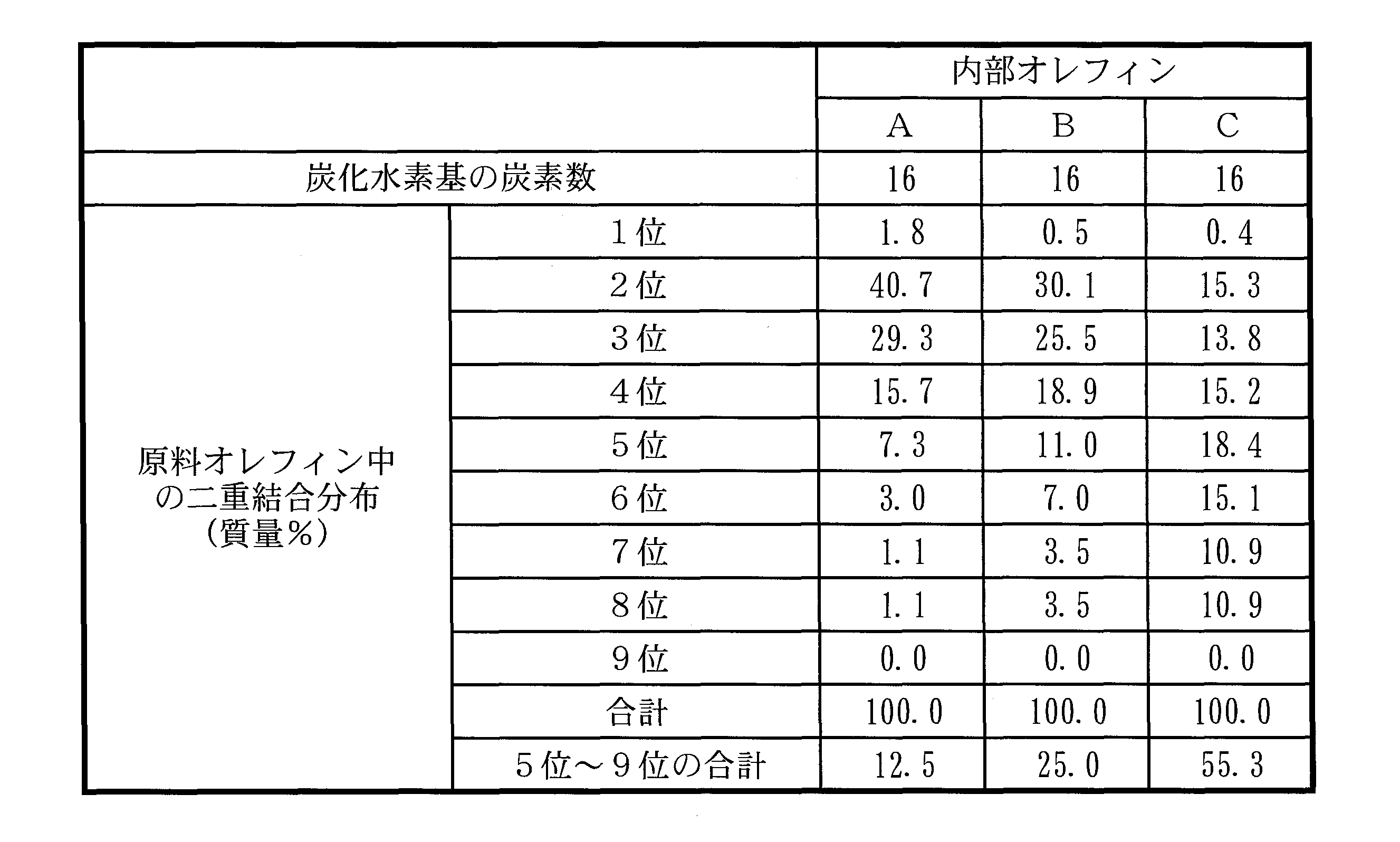
尚、測定に使用した装置及び分析条件は次の通りである。GC装置「HP6890」(HEWLETT PACKARD社製)、カラム「Ultra-Alloy-1HTキャピラリーカラム」(30m×250μm×0.15μm、フロンティア・ラボ株式会社製)、検出器(水素炎イオン検出器(FID))、インジェクション温度300℃、ディテクター温度350℃、He流量4.6mL/分
製造例A~Cにより得られた内部オレフィンA~Cを、外部にジャケットを有する薄膜式スルホン化反応器を使用して三酸化硫黄ガス、反応器外部ジャケットに20℃の冷却水を通液することでスルホン化反応を行った。スルホン化反応の際のSO3/内部オレフィンのモル比は1.09に設定した。得られたスルホン化物を、理論酸価に対し1.5モル倍量の水酸化ナトリウムで調製したアルカリ水溶液へ添加し、攪拌しながら30℃、1時間中和した。中和物をオートクレーブ中で160℃、1時間加熱することで加水分解を行い、炭素数16内部オレフィンスルホン酸ナトリウム粗生成物を得た。該粗生成物300gを分液漏斗に移し、エタノール300mLを加えた後、1回あたり石油エーテル300mLを加えて油溶性の不純物を抽出除去した。この際、エタノールの添加により油水界面に析出した無機化合物(主成分は芒硝)も、油水分離操作により水相から分離除去した。この抽出除去操作を3回おこなった。水相側を蒸発乾固することで、炭素数16内部オレフィンスルホン酸ナトリウムである(a-1)成分、(a-4)成分、(a-10)成分をそれぞれ得た。ここで、内部オレフィンAを原料として得られた内部オレフィンスルホン酸塩を(a-1)成分、内部オレフィンBを原料として得られた内部オレフィンスルホン酸塩を(a-4)成分、内部オレフィンCを原料として得られた内部オレフィンスルホン酸塩を(a-10)成分とした。
得られた(a-1)成分、(a-4)成分、(a-10)成分のスルホン酸基が結合した炭素の位置分布を表2に示す。
尚、測定に使用した装置及び条件は次の通りである。HPLC装置「LC-20ASXR」((株)島津製作所製)、カラム「ODS Hypersil(登録商標)」(4.6×250mm、粒子サイズ:3μm、サーモフィッシャーサイエンティフィック社製)、サンプル調製(メタノールで1000倍希釈)、溶離液A(10mM酢酸アンモニウム添加水)、溶離液B(10mM酢酸アンモニウム添加 メタクリロニトリル/水=95/5(v/v)溶液)、グラジェント(0分(A/B=60/40)→15.1~20分(30/70)→20.1~30分(60/40)、MS装置「LCMS-2020」((株)島津製作所製)、ESI検出(陰イオン検出m/z:321.10(炭素数16の(A)成分)、カラム温度(40℃)、流速(0.5mL/min)、インジェクション容量(5μL)
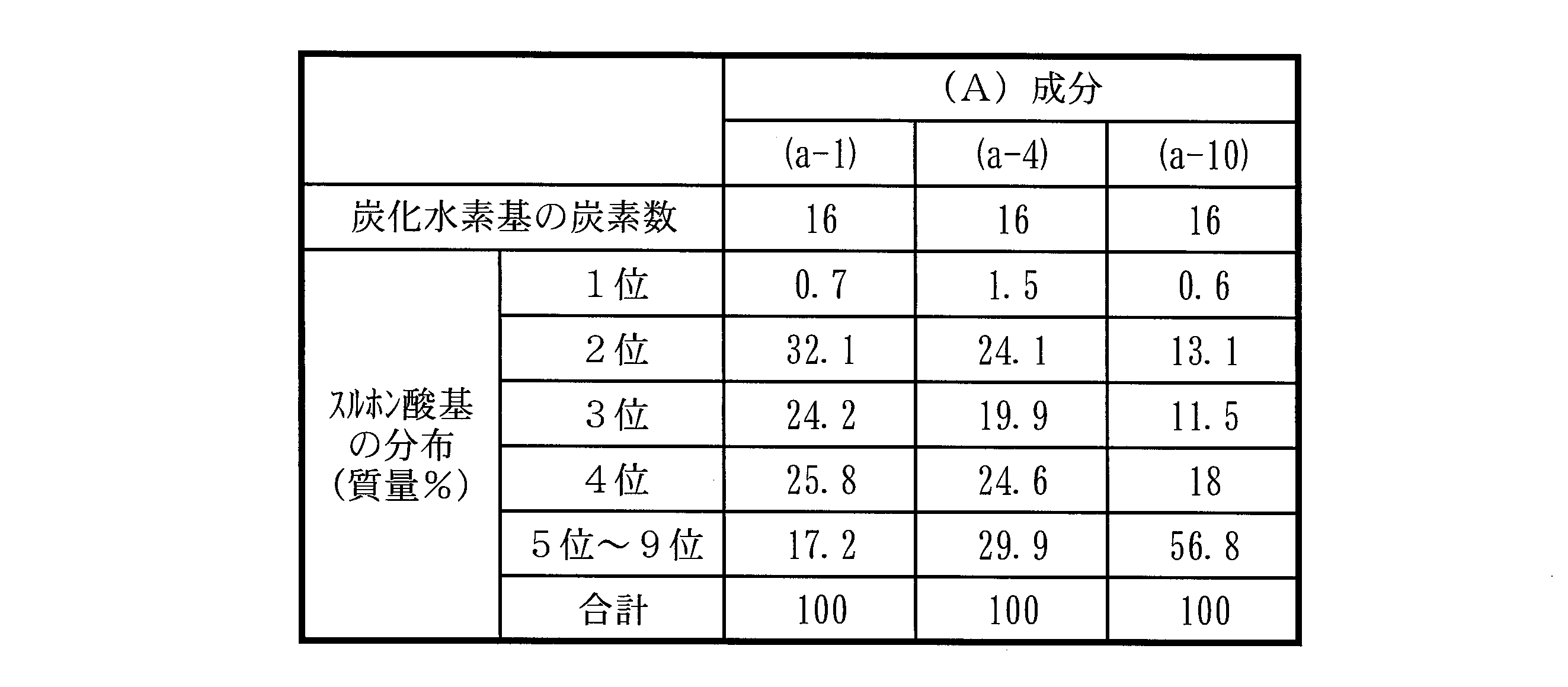
得られた(a-1)成分~(a-10)成分の原料となる内部オレフィンの二重結合分布を表3に示す。
また、得られた(a-1)成分~(a-10)成分のスルホン酸基が結合した炭素の位置分布を表4に示す。

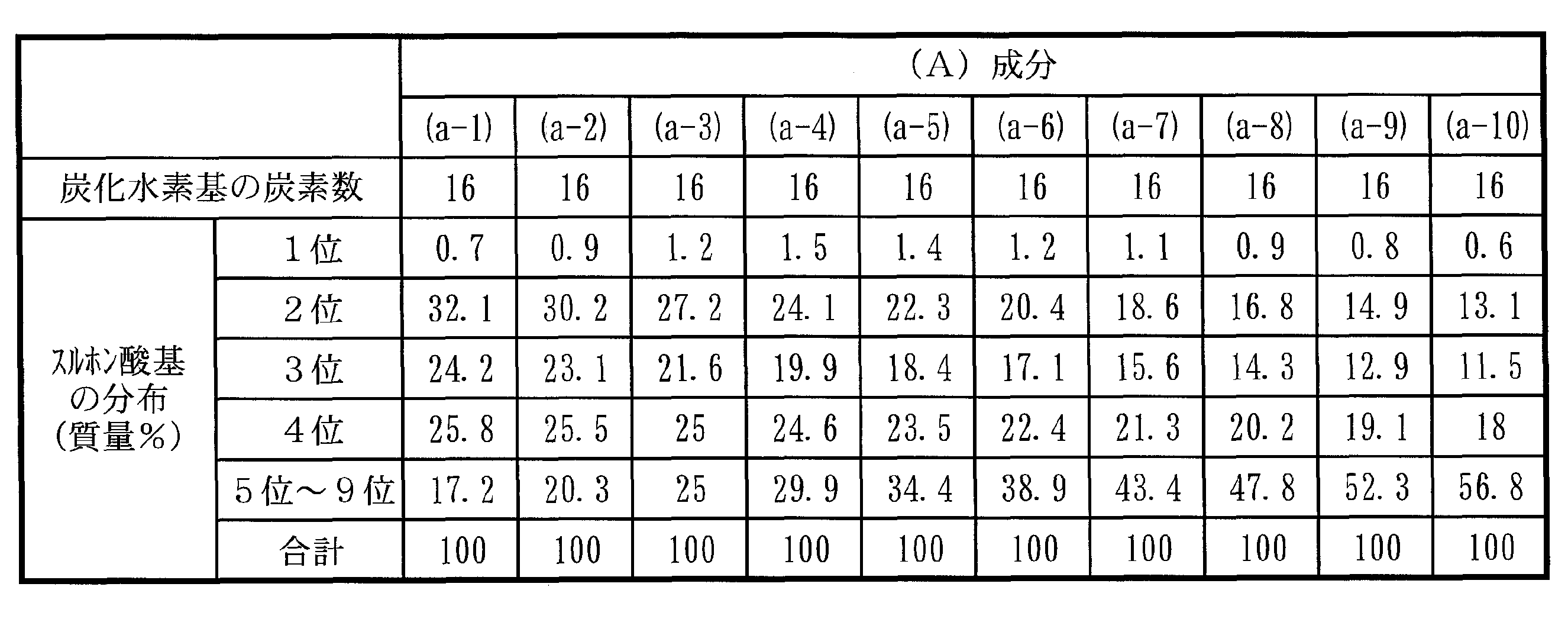
(b-1):ポリオキシアルキレンラウリルエーテル(ラウリルアルコール1モルに対し、エチレンオキシ基を平均で9モル付加した後、プロピレンオキシ基を平均で2モル付加した後、エチレンオキシ基を平均で9モル付加した化合物、HLB=14.5、一般式(b1)において、R1:ラウリル基、m:0、A1O:エチレンオキシ基及びプロピレンオキシ基、n:20、R2:水素原子の化合物)
(b-2):ポリオキシアルキレンラウリルエーテル(オキシエチレン基の平均付加モル数は10モル、HLB=14.0、一般式(b1)において、R1:ラウリル基、m:0、A1O:エチレンオキシ基、n:10、R2:水素原子の化合物)
(b-3):ポリオキシエチレンアルキルエーテル(オキシエチレン基の平均付加モル数は6モル、HLB=12.1、一般式(b1)において、R1:ラウリル基とミリスチル基の混合アルキル基であり、ラウリル基の質量とミリスチル基の質量との比である、ラウリル基/ミリスチル基=9/1、m:0、A1O:エチレンオキシ基、n:6、R2:水素原子の化合物)
(b-4):ポリオキシエチレンアルキルエーテル(オキシエチレン基の平均付加モル数は5モル、HLB=10.7、一般式(b1)において、R1:ラウリル基とミリスチル基の混合アルキル基であり、ラウリル基の質量とミリスチル基の質量との比である、ラウリル基/ミリスチル基=9/1、m:0、A1O:エチレンオキシ基、n:5、R2:水素原子の化合物)
(b’-1):ポリオキシエチレンラウリルエーテル(オキシエチレン基の平均付加モル数は3モル、HLB=8.3、一般式(b1)において、R1:ラウリル基、m:0、A1O:エチレンオキシ基、n:3、R2:水素原子の化合物)
〔(C)成分〕
(c-1):アルキルベンゼンスルホン酸ナトリウム(アルキル組成:C10/C11/C12/C13=11/29/34/26(質量比)、質量平均炭素数=17.75)
イオン交換水
上記の配合成分を用いて、表5~6に示す繊維製品用洗浄剤組成物を調製し、以下の項目について評価を行った。結果を表5~6に示す。
表5~6に示す繊維用洗浄剤組成物の調製方法は、具体的には下記の通り調製した。200mL容量のガラス製ビーカーに長さ5cmのテフロン(登録商標)製スターラーピースを投入し重量を測定した。次に20℃のイオン交換水80g、(A)成分、(C)成分のいずれかと、(B)成分、(B’)成分のいずれかを投入し、ビーカーの上面をサランラップ(登録商標)で封をした。内容物が入ったビーカーをマグネチックスターラーに設置した60℃のウォーターバスに入れ、ウォーターバス内の水の温度が60±2℃の温度範囲内で、100r/minで30分間撹拌した。次に、ウォーターバス内の水を、5℃の水道水に替え、ビーカー内の該組成物の温度が20℃になるまで冷却した。次に、サランラップ(登録商標)を外し、内容物の重量が100gになるように、イオン交換水を入れ、再度、100r/minで30秒間撹拌し、表5~6に記載の繊維製品用洗浄剤組成物を得た。
なお、表6中の配合例1~6、比較配合例1は、繊維製品用洗浄剤組成物中の(A)成分の含有量と(B)成分の含有量の合計を10質量%とし、(A)成分の含有量と(B)成分の含有量の質量比を変えて調製したものである。また、各配合例は、(A)成分をそれぞれ(a-1)~(a-10)に変えて調製したものである。(B)成分は、配合例1~3では(b-1)を、配合例4では(b-2)を、配合例5では(b-3)を、配合例6では(b-4)を、それぞれ用いた。
〔評価用繊維製品の調製〕
(1)界面活性剤の吸着率評価用繊維製品の調製
木綿メリヤス1.7kg((株)色染社製、綿ニット未シル(シルケット加工されていないもの)、木綿100%)を、全自動洗濯機(National製NA-F702P)の標準コースで2回累積洗濯(洗浄時にエマルゲン108(花王(株)製)4.7g、水量47L、洗い9分・すすぎ2回・脱水3分)後、水のみで3回累積洗濯(水量47L、洗い9分・すすぎ2回・脱水3分)を行い、23℃、45%RHの環境下で24時間乾燥させた。その後、6cm×6cmの大きさに裁断した。
・モデル皮脂人工汚染布の調製
下記組成のモデル皮脂人工汚染液を布(木綿2003(谷頭商店製))に付着してモデル皮脂人工汚染布を調製した。モデル皮脂人工汚染液の布への付着は、グラビアロールコーターを用いて人工汚染液を布に印刷することで行った。モデル皮脂人工汚染液を布に付着させモデル皮脂人工汚染液を作製する工程は、グラビアロールのセル容量58cm3/m2、塗布速度1.0m/min、乾燥温度100℃、乾燥時間1minで行った。その後、6cm×6cmの大きさに裁断した。
*モデル皮脂人工汚染液の組成:ラウリン酸0.4質量%、ミリスチン酸3.1質量%、ペンタデカン酸2.3質量%、パルミチン酸6.2質量%、ヘプタデカン酸0.4質量%、ステアリン酸1.6質量%、オレイン酸7.8質量%、トリオレイン13.0質量%、パルミチン酸n-ヘキサデシル2.2質量%、スクアレン6.5質量%、卵白レシチン液晶物1.9質量%、鹿沼赤土8.1質量%、カーボンブラック0.01質量%、水残部(合計100質量%)
(1)洗浄試験1
ターゴトメーター(上島製作所製)を用いて洗浄操作を行った。洗浄に使用する水はイオン交換水に塩化カルシウムと塩化マグネシウムを質量比で8:2の割合で投入し、硬度を4°dHに調製した洗浄用の水を得た。表5又は表6に記載の繊維製品用洗浄剤組成物中の(A)成分、(B)成分、(C)成分及び(B’)成分の合計量が、洗浄液中の濃度において167mg/kgとなるように洗浄用の水と混合し、洗浄液を得た。洗浄試験用の1リットルのステンレスビーカーに、洗浄液0.6Lと前記の界面活性剤の吸着率評価用繊維製品5枚を投入した。浴比を前記の吸着率評価用繊維製品で15に調整した。洗浄液の温度は20℃であった。ターゴトメーターで85rpm、10分間、評価用の繊維を洗浄した。洗浄後脱水し23℃、45%RHの環境下で24時間乾燥させた。
ターゴトメーター(上島製作所製)を用いて洗浄操作を行った。洗浄に使用する水はイオン交換水に塩化カルシウムと塩化マグネシウムを質量比で8:2の割合で投入し、硬度を4°dHに調製した洗浄用の水を得た。表5又は表6に記載の繊維製品用洗浄剤組成物中の(A)成分、(B)成分、(C)成分及び(B’)成分の合計量が、洗浄液中の濃度において167mg/kgとなるように洗浄用の水と混合し、洗浄液を得た。洗浄試験用の1リットルのステンレスビーカーに、洗浄液0.6Lと前記の洗浄率評価用の繊維製品5枚を投入した。界面活性剤の吸着率評価用繊維製品で浴比を15に調整し、洗浄液の温度は20℃であった。ターゴトメーターで85rpm、10分間、評価用の繊維を洗浄した。洗浄後脱水し、アイロンプレス機で乾燥させた。
洗浄試験1を行った後の界面活性剤吸着率評価用繊維製品の中から2枚を取り出し、No.7のスクリュー管に封入しながら布の重量を測定した。そこに40mLのメタノール/クロロホルム溶液(メタノール:クロロホルム=1:1(容積比))を加え、超音波洗浄機で50分間、超音波処理を行った。抽出液を20倍希釈し測定用溶液を得た。次に、(A)成分、(B)成分、(C)成分のそれぞれをメタノール/クロロホルム溶液(メタノール:クロロホルム=1:1(容積比))で希釈し0.1μg/mL、0.5μg/mL、1μg/mL、5μg/mLの検量線用溶液を調製した。測定用溶液中の界面活性剤量を液体クロマトグラフ質量分析装置(以下、LCMS装置と省略)で定量し、検量線用溶液から繊維製品への活性剤吸着量を求めた。
・LCMS装置:(株)島津製作所製 LCMS2020
・溶離液A:10mmol/L 酢酸アンモニウムの蒸留水を用いた水溶液
溶離液B:10mmol/L 酢酸アンモニウムのメタノール溶液
・グラジエント条件: 溶離液A/B=1:1(0分)→溶離液B(2-5分)→溶離液A/溶離液B=1/1(5.1分-8分)、流量:0.6mL/min、サンプル注入量5μl、カラム温度40℃
繊維製品への界面活性剤の吸着率を下記の式より求めた。結果を表5に示す。
総界面活性剤の吸着率=100×{(吸着量の測定に使用した2枚の繊維製品に吸着した界面活性剤の総重量)×(洗浄試験1に使用した繊維製品の総重量)/(吸着量の測定に使用した2枚の繊維製品の重量)}/(洗浄液の調製に使用した界面活性剤の総重量量)
前記の洗浄試験2で得られた評価繊維製品の洗浄率を下記の方法にて測定し、5枚の平均値を求めた。結果を表6に示す。
汚染前の原布、及び洗浄前後の550nmにおける反射率を測色色差計(日本電色株式会社製 Z-300A)にて測定し、次式によって洗浄率(%)を求めた。なお表6中の値は5枚の洗浄率の平均値である。
洗浄率(%)=100×[(洗浄後の反射率-洗浄前の反射率)/(原布の反射率-洗浄前の反射率)]

表5において、比較例4と実施例を比較すると一般的な洗浄成分であるアルキルベンゼンスルホン酸塩よりも、アニオン界面活性剤として本発明の(A)成分を使用することで、洗浄後の繊維製品に吸着している界面活性剤量が低減していることが分かる。また、(A)成分と(B)成分を併用することで、洗浄後の繊維製品に吸着している界面活性剤量が低減していることが分かる。また、本発明の(A)成分を使用しても、本発明の(B)成分以外の界面活性剤を用いた場合は吸着率が低減していないことが分かる。
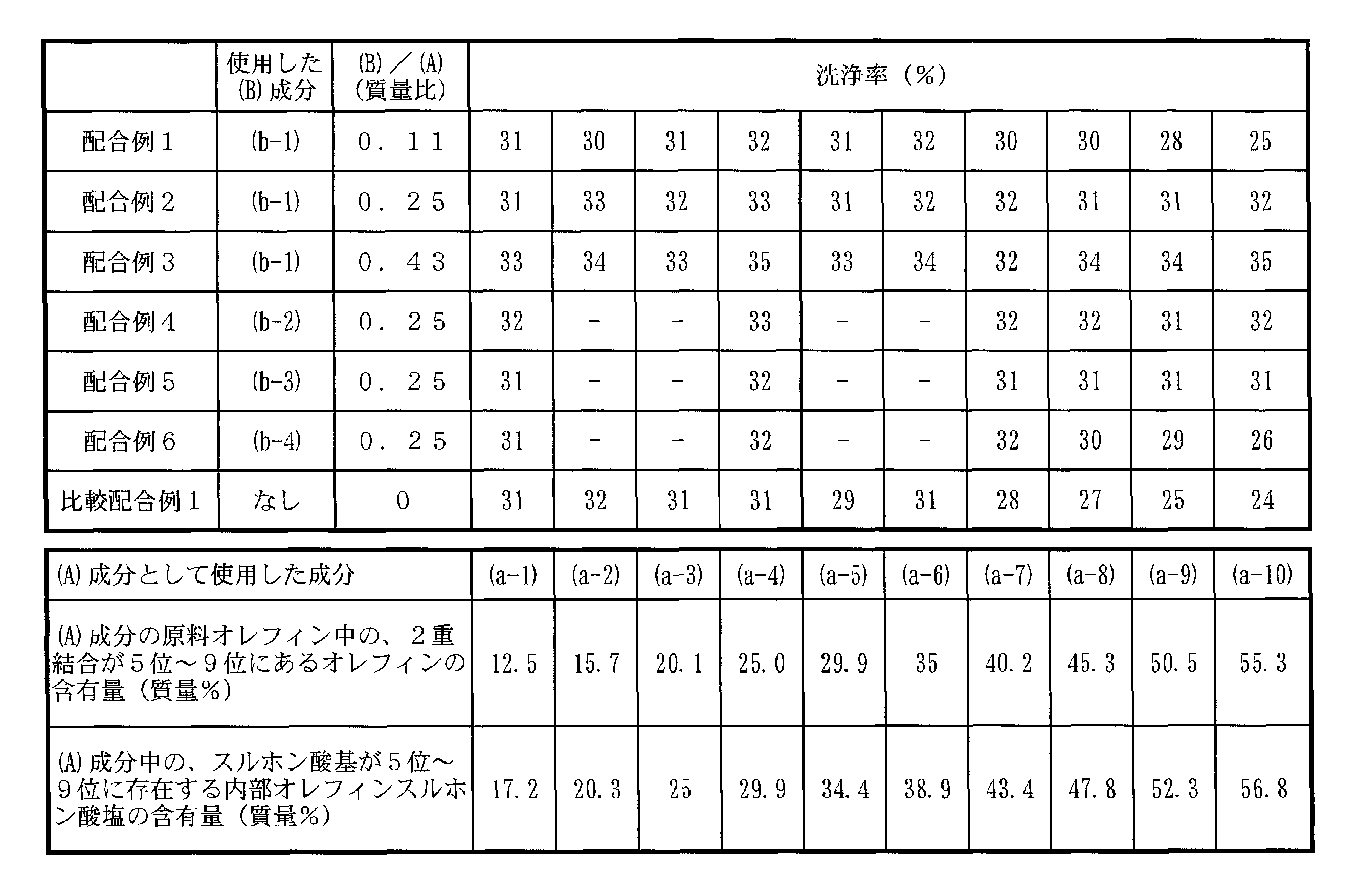
表6において、比較配合例1のように(A)成分のみでは、(A)成分の原料オレフィン中の2重結合の位置が5位以上に存在するオレフィンの含有量が変わると洗浄性が変化している。しかしながら、(A)成分と(B)成分を併用した配合例1~6は、(A)成分の原料オレフィン中の2重結合の位置が5位以上に存在するオレフィンの含有量において、洗浄率が変わらない前記含有量の範囲が広くなることが分かる。また、(B)成分の含有比率が高くなることで、(A)成分の原料オレフィン中の2重結合の位置が5位以上に存在するオレフィンの含有量において、洗浄率が変わらない前記含有量の範囲がより広くなることが分かる。
Claims (9)
- 下記(A)成分及び(B)成分を含有する、繊維製品用洗浄剤組成物。
(A)成分:スルホン酸基が5位以上に存在する炭素数15以上24以下の内部オレフィンスルホン酸塩を含む、炭素数15以上24以下の内部オレフィンスルホン酸塩
(B)成分:HLBが10.5を超え19以下のノニオン界面活性剤 - (B)成分が、下記一般式(b1)で表されるノニオン界面活性剤である、請求項1に記載の繊維製品用洗浄剤組成物。
R1(CO)mO-(A1O)n-R2 (b1)
〔式中、R1は炭素数9以上18以下の脂肪族炭化水素基であり、R2は水素原子又はメチル基であり、COはカルボニル基であり、mは0又は1の数であり、A1O基はエチレンオキシ基及びプロピレンオキシ基から選ばれる1種以上の基であり、nは平均付加モル数であって、6以上50以下の数である。〕 - (A)成分が、スルホン酸基が5位以上に存在する炭素数15以上24以下の内部オレフィンスルホン酸塩を5質量%以上60質量%以下含有する炭素数15以上24以下の内部オレフィンスルホン酸塩である、請求項1又は2に記載の繊維製品用洗浄剤組成物。
- (B)成分と(A)成分の質量比(B)/(A)が0.05以上9以下である、請求項1~3の何れか1項記載の繊維製品用洗浄剤組成物。
- (A)成分が、下記(a1)成分及び(a2)成分から選ばれる1種以上であり、(a2)成分と(a1)成分の質量比(a2)/(a1)が0以上1以下である、請求項1~4の何れか1項記載の繊維製品用洗浄剤組成物。
(a1)成分:スルホン酸基が5位以上に存在する炭素数15以上16以下の内部オレフィンスルホン酸塩を含む、炭素数15以上16以下の内部オレフィンスルホン酸塩
(a2)成分:スルホン酸基が5位以上に存在する炭素数17以上24以下の内部オレフィンスルホン酸塩を含む、炭素数17以上24以下の内部オレフィンスルホン酸塩 - 組成物中の全界面活性剤中、(A)成分の含有量及び(B)成分の含有量の合計が、60質量%以上100質量%以下である、請求項1~5の何れか1項記載の繊維製品用洗浄剤組成物。
- 更に、水を含有する、請求項1~6の何れか1項記載の繊維用洗浄剤組成物。
- 下記(A)成分、(B)成分及び水を含有する洗浄液で繊維製品を洗浄する方法であって、洗浄液の硬度が0°dHを超える、繊維製品の洗浄方法。
(A)成分:スルホン酸基が5位以上に存在する炭素数15以上24以下の内部オレフィンスルホン酸塩を含む、炭素数15以上24以下の内部オレフィンスルホン酸塩
(B)成分:HLBが10.5を超え19以下のノニオン界面活性剤 - 下記(A)成分と下記(B)成分を混合する、繊維製品用洗浄剤組成物の製造方法。
(A)成分:スルホン酸基が5位以上に存在する炭素数15以上24以下の内部オレフィンスルホン酸塩を含む、炭素数15以上24以下の内部オレフィンスルホン酸塩
(B)成分:HLBが10.5を超え19以下のノニオン界面活性剤
Priority Applications (6)
| Application Number | Priority Date | Filing Date | Title |
|---|---|---|---|
| RU2018145760A RU2747642C2 (ru) | 2016-05-31 | 2017-05-30 | Детергентная композиция для текстильных продуктов |
| SG11201809134PA SG11201809134PA (en) | 2016-05-31 | 2017-05-30 | Detergent composition for textile products |
| CN201780033120.3A CN109196081B (zh) | 2016-05-31 | 2017-05-30 | 纤维制品用清洁剂组合物 |
| US16/303,478 US11053456B2 (en) | 2016-05-31 | 2017-05-30 | Detergent composition for textile products |
| AU2017275180A AU2017275180B2 (en) | 2016-05-31 | 2017-05-30 | Detergent composition for textile product |
| EP17806669.2A EP3467080B1 (en) | 2016-05-31 | 2017-05-30 | Detergent composition for textile product |
Applications Claiming Priority (2)
| Application Number | Priority Date | Filing Date | Title |
|---|---|---|---|
| JP2016-108441 | 2016-05-31 | ||
| JP2016108441 | 2016-05-31 |
Publications (1)
| Publication Number | Publication Date |
|---|---|
| WO2017209116A1 true WO2017209116A1 (ja) | 2017-12-07 |
Family
ID=60477608
Family Applications (1)
| Application Number | Title | Priority Date | Filing Date |
|---|---|---|---|
| PCT/JP2017/020059 Ceased WO2017209116A1 (ja) | 2016-05-31 | 2017-05-30 | 繊維製品用洗浄剤組成物 |
Country Status (9)
| Country | Link |
|---|---|
| US (1) | US11053456B2 (ja) |
| EP (1) | EP3467080B1 (ja) |
| JP (1) | JP6944814B2 (ja) |
| CN (1) | CN109196081B (ja) |
| AU (1) | AU2017275180B2 (ja) |
| RU (1) | RU2747642C2 (ja) |
| SG (1) | SG11201809134PA (ja) |
| TW (1) | TWI757297B (ja) |
| WO (1) | WO2017209116A1 (ja) |
Families Citing this family (7)
| Publication number | Priority date | Publication date | Assignee | Title |
|---|---|---|---|---|
| US10920173B2 (en) | 2016-05-31 | 2021-02-16 | Kao Corporation | Liquid detergent composition |
| CN111433338B (zh) * | 2017-12-06 | 2022-09-16 | 花王株式会社 | 纤维制品用清洁剂组合物 |
| JP7186608B2 (ja) * | 2018-12-28 | 2022-12-09 | 花王株式会社 | 繊維製品用洗浄剤組成物 |
| US20220389349A1 (en) * | 2019-11-25 | 2022-12-08 | Kao Corporation | Liquid detergent composition for textile products |
| EP4223275A4 (en) * | 2020-09-30 | 2024-12-25 | Kao Corporation | HAIR WASH COMPOSITION |
| JP7840867B2 (ja) | 2020-11-30 | 2026-04-06 | 花王株式会社 | 化合物、その前駆体化合物、界面活性剤組成物、及び洗浄剤組成物 |
| JP7840868B2 (ja) | 2020-11-30 | 2026-04-06 | 花王株式会社 | 化合物、その前駆体化合物、界面活性剤組成物、及び洗浄剤組成物 |
Citations (8)
| Publication number | Priority date | Publication date | Assignee | Title |
|---|---|---|---|---|
| JPS6096693A (ja) * | 1983-10-31 | 1985-05-30 | ライオン株式会社 | 粒状洗剤組成物 |
| US5078916A (en) * | 1989-01-03 | 1992-01-07 | Shell Oil Company | Detergent composition containing an internal olefin sulfonate component having an enhanced content of beta-hydroxy alkane sulfonate compounds |
| JP2003081935A (ja) * | 2001-09-10 | 2003-03-19 | Lion Corp | 内部オレフィンスルホン酸塩及びそれを含む洗浄剤組成物 |
| JP2014077126A (ja) * | 2012-09-20 | 2014-05-01 | Kao Corp | 内部オレフィンスルホン酸塩組成物及びこれを含有する洗浄剤組成物 |
| JP2014076988A (ja) * | 2012-09-20 | 2014-05-01 | Kao Corp | 内部オレフィンスルホン酸塩組成物及びこれを含有する洗浄剤組成物 |
| JP2014177620A (ja) * | 2013-02-13 | 2014-09-25 | Kao Corp | 内部オレフィンスルホン酸塩組成物 |
| JP2015028123A (ja) * | 2012-09-20 | 2015-02-12 | 花王株式会社 | 内部オレフィンスルホン酸塩組成物及びこれを含有する洗浄剤組成物 |
| JP2015143203A (ja) * | 2013-12-27 | 2015-08-06 | 花王株式会社 | 内部オレフィンスルホン酸塩の製造方法 |
Family Cites Families (28)
| Publication number | Priority date | Publication date | Assignee | Title |
|---|---|---|---|---|
| US4107095A (en) * | 1973-04-11 | 1978-08-15 | Colgate-Palmolive Company | Liquid olefin sulfonate detergent compositions containing anti-gelling agents |
| JPS5241612A (en) * | 1975-09-30 | 1977-03-31 | Kao Corp | Granular or powdered detergent compositions |
| JPS5915185A (ja) | 1982-07-19 | 1984-01-26 | ライオン株式会社 | 石油回収用ミセル溶液 |
| JPS5927995A (ja) | 1982-08-10 | 1984-02-14 | ライオン株式会社 | 高濃度界面活性剤スラリ− |
| JPS62297400A (ja) | 1986-06-18 | 1987-12-24 | ライオン株式会社 | 自動食器洗い機用洗浄剤組成物 |
| GB2236538A (en) | 1989-10-06 | 1991-04-10 | Unilever Plc | Detergent compositions |
| GB9023366D0 (en) | 1990-10-26 | 1990-12-05 | Shell Int Research | Concentrated,liquid,pourable composition |
| JPH0539212A (ja) | 1991-02-14 | 1993-02-19 | Lion Corp | 洗浄剤組成物 |
| JP2635288B2 (ja) | 1993-03-11 | 1997-07-30 | 花王株式会社 | 漂白剤組成物及び漂白洗浄剤組成物 |
| JPH10298597A (ja) | 1997-04-28 | 1998-11-10 | Lion Corp | 液体洗浄剤組成物 |
| JP2001247534A (ja) | 1999-12-27 | 2001-09-11 | Lion Corp | インナーオレフィンスルホネートの製造方法 |
| WO2005014921A1 (ja) | 2003-08-08 | 2005-02-17 | Kao Corporation | 繊維製品処理剤組成物 |
| WO2006054526A1 (ja) | 2004-11-19 | 2006-05-26 | Kao Corporation | 液体洗浄剤組成物 |
| US7674757B2 (en) | 2006-01-23 | 2010-03-09 | Milliken & Company | Laundry care compositions with thiazolium dye |
| JP5638227B2 (ja) | 2008-11-21 | 2014-12-10 | 花王株式会社 | 洗浄剤組成物 |
| WO2012158645A1 (en) | 2011-05-16 | 2012-11-22 | Stepan Company | Surfactants for enhanced oil recovery |
| CN104053644A (zh) | 2011-12-23 | 2014-09-17 | 国际壳牌研究有限公司 | 用于制备内烯烃磺酸盐的方法 |
| US20140076345A1 (en) | 2012-09-20 | 2014-03-20 | Kao Corporation | Cleansing composition for skin or hair |
| JP6235844B2 (ja) | 2012-09-20 | 2017-11-22 | 花王株式会社 | 皮膚又は毛髪用洗浄剤組成物 |
| US20140079660A1 (en) * | 2012-09-20 | 2014-03-20 | Kao Corporation | Cleansing composition for skin or hair |
| US20140080746A1 (en) | 2012-09-20 | 2014-03-20 | Kao Corporation | Cleansing composition for skin or hair |
| US20140079658A1 (en) | 2012-09-20 | 2014-03-20 | Kao Corporation | Aqueous hair cleansing agent |
| EP2952568B1 (en) | 2013-02-01 | 2019-05-15 | Kao Corporation | Internal olefin sulfonate composition |
| CN104560283B (zh) | 2013-10-25 | 2017-04-26 | 中国石油化工股份有限公司 | 磺酸盐、其制备方法及包含该磺酸盐的润滑脂及其制备方法 |
| JP6324781B2 (ja) | 2014-03-19 | 2018-05-16 | 花王株式会社 | 殺菌洗浄剤組成物 |
| JP2015178466A (ja) | 2014-03-19 | 2015-10-08 | ロレアル | 内部オレフィンスルホン酸塩及び1種のポリマー懸濁剤を含有する起泡性組成物 |
| CN105238573A (zh) | 2015-11-14 | 2016-01-13 | 华玉叶 | 一种去油污洗衣液 |
| CN105255602A (zh) | 2015-11-14 | 2016-01-20 | 华玉叶 | 一种去油污洗衣液 |
-
2017
- 2017-05-30 CN CN201780033120.3A patent/CN109196081B/zh active Active
- 2017-05-30 RU RU2018145760A patent/RU2747642C2/ru active
- 2017-05-30 EP EP17806669.2A patent/EP3467080B1/en active Active
- 2017-05-30 JP JP2017106502A patent/JP6944814B2/ja active Active
- 2017-05-30 WO PCT/JP2017/020059 patent/WO2017209116A1/ja not_active Ceased
- 2017-05-30 US US16/303,478 patent/US11053456B2/en active Active
- 2017-05-30 AU AU2017275180A patent/AU2017275180B2/en active Active
- 2017-05-30 SG SG11201809134PA patent/SG11201809134PA/en unknown
- 2017-05-31 TW TW106117935A patent/TWI757297B/zh active
Patent Citations (8)
| Publication number | Priority date | Publication date | Assignee | Title |
|---|---|---|---|---|
| JPS6096693A (ja) * | 1983-10-31 | 1985-05-30 | ライオン株式会社 | 粒状洗剤組成物 |
| US5078916A (en) * | 1989-01-03 | 1992-01-07 | Shell Oil Company | Detergent composition containing an internal olefin sulfonate component having an enhanced content of beta-hydroxy alkane sulfonate compounds |
| JP2003081935A (ja) * | 2001-09-10 | 2003-03-19 | Lion Corp | 内部オレフィンスルホン酸塩及びそれを含む洗浄剤組成物 |
| JP2014077126A (ja) * | 2012-09-20 | 2014-05-01 | Kao Corp | 内部オレフィンスルホン酸塩組成物及びこれを含有する洗浄剤組成物 |
| JP2014076988A (ja) * | 2012-09-20 | 2014-05-01 | Kao Corp | 内部オレフィンスルホン酸塩組成物及びこれを含有する洗浄剤組成物 |
| JP2015028123A (ja) * | 2012-09-20 | 2015-02-12 | 花王株式会社 | 内部オレフィンスルホン酸塩組成物及びこれを含有する洗浄剤組成物 |
| JP2014177620A (ja) * | 2013-02-13 | 2014-09-25 | Kao Corp | 内部オレフィンスルホン酸塩組成物 |
| JP2015143203A (ja) * | 2013-12-27 | 2015-08-06 | 花王株式会社 | 内部オレフィンスルホン酸塩の製造方法 |
Non-Patent Citations (1)
| Title |
|---|
| See also references of EP3467080A4 * |
Also Published As
| Publication number | Publication date |
|---|---|
| AU2017275180A1 (en) | 2018-11-08 |
| SG11201809134PA (en) | 2018-12-28 |
| RU2018145760A (ru) | 2020-07-10 |
| US20200318034A1 (en) | 2020-10-08 |
| AU2017275180B2 (en) | 2021-09-30 |
| RU2747642C2 (ru) | 2021-05-11 |
| TW201800566A (zh) | 2018-01-01 |
| CN109196081A (zh) | 2019-01-11 |
| RU2018145760A3 (ja) | 2020-07-10 |
| JP6944814B2 (ja) | 2021-10-06 |
| TWI757297B (zh) | 2022-03-11 |
| US11053456B2 (en) | 2021-07-06 |
| CN109196081B (zh) | 2021-05-11 |
| EP3467080A1 (en) | 2019-04-10 |
| EP3467080A4 (en) | 2019-12-18 |
| JP2017214570A (ja) | 2017-12-07 |
| EP3467080B1 (en) | 2023-03-22 |
Similar Documents
| Publication | Publication Date | Title |
|---|---|---|
| JP7060925B2 (ja) | 繊維用洗浄剤組成物 | |
| JP6944814B2 (ja) | 繊維製品用洗浄剤組成物 | |
| JP6963416B2 (ja) | 繊維製品用液体洗浄剤組成物 | |
| JP6944815B2 (ja) | 繊維製品用液体洗浄剤組成物 | |
| WO2017209119A1 (ja) | 衣料の洗浄方法 | |
| WO2019049895A1 (ja) | 繊維製品用洗浄剤組成物 | |
| WO2021106851A1 (ja) | 繊維製品用液体洗浄剤組成物 | |
| JP7186608B2 (ja) | 繊維製品用洗浄剤組成物 | |
| HK1261521B (zh) | 纤维制品用清洁剂组合物 | |
| WO2023199913A1 (ja) | 液体洗浄剤組成物 | |
| JP2023065998A (ja) | 液体洗浄剤組成物 | |
| HK1261523B (zh) | 纤维制品用液体清洁剂组合物 | |
| HK1261521A1 (en) | Detergent composition for textile product | |
| HK40000835B (zh) | 纤维制品用液体清洁剂组合物 |
Legal Events
| Date | Code | Title | Description |
|---|---|---|---|
| ENP | Entry into the national phase |
Ref document number: 2017275180 Country of ref document: AU Date of ref document: 20170530 Kind code of ref document: A |
|
| 121 | Ep: the epo has been informed by wipo that ep was designated in this application |
Ref document number: 17806669 Country of ref document: EP Kind code of ref document: A1 |
|
| NENP | Non-entry into the national phase |
Ref country code: DE |
|
| ENP | Entry into the national phase |
Ref document number: 2017806669 Country of ref document: EP Effective date: 20190102 |