WO2017209236A1 - 置換または非置換アリル基含有マレイミド化合物およびその製造方法、並びに前記化合物を用いた組成物および硬化物 - Google Patents
置換または非置換アリル基含有マレイミド化合物およびその製造方法、並びに前記化合物を用いた組成物および硬化物 Download PDFInfo
- Publication number
- WO2017209236A1 WO2017209236A1 PCT/JP2017/020418 JP2017020418W WO2017209236A1 WO 2017209236 A1 WO2017209236 A1 WO 2017209236A1 JP 2017020418 W JP2017020418 W JP 2017020418W WO 2017209236 A1 WO2017209236 A1 WO 2017209236A1
- Authority
- WO
- WIPO (PCT)
- Prior art keywords
- group
- compound
- substituted
- resin
- composition
- Prior art date
- Legal status (The legal status is an assumption and is not a legal conclusion. Google has not performed a legal analysis and makes no representation as to the accuracy of the status listed.)
- Ceased
Links
- 0 CN(C(C(*)=C1*)=O)C1=O Chemical compound CN(C(C(*)=C1*)=O)C1=O 0.000 description 2
- JUGKOCJMADNDSF-UHFFFAOYSA-N Nc1c(Cc(cc2)ccc2O)cc(Cc(cc2)cc(Cc(cc3)ccc3O)c2N)cc1 Chemical compound Nc1c(Cc(cc2)ccc2O)cc(Cc(cc2)cc(Cc(cc3)ccc3O)c2N)cc1 JUGKOCJMADNDSF-UHFFFAOYSA-N 0.000 description 1
Classifications
-
- B—PERFORMING OPERATIONS; TRANSPORTING
- B32—LAYERED PRODUCTS
- B32B—LAYERED PRODUCTS, i.e. PRODUCTS BUILT-UP OF STRATA OF FLAT OR NON-FLAT, e.g. CELLULAR OR HONEYCOMB, FORM
- B32B15/00—Layered products comprising a layer of metal
- B32B15/04—Layered products comprising a layer of metal comprising metal as the main or only constituent of a layer, which is next to another layer of the same or of a different material
- B32B15/08—Layered products comprising a layer of metal comprising metal as the main or only constituent of a layer, which is next to another layer of the same or of a different material of synthetic resin
-
- B—PERFORMING OPERATIONS; TRANSPORTING
- B32—LAYERED PRODUCTS
- B32B—LAYERED PRODUCTS, i.e. PRODUCTS BUILT-UP OF STRATA OF FLAT OR NON-FLAT, e.g. CELLULAR OR HONEYCOMB, FORM
- B32B15/00—Layered products comprising a layer of metal
- B32B15/14—Layered products comprising a layer of metal next to a fibrous or filamentary layer
-
- B—PERFORMING OPERATIONS; TRANSPORTING
- B32—LAYERED PRODUCTS
- B32B—LAYERED PRODUCTS, i.e. PRODUCTS BUILT-UP OF STRATA OF FLAT OR NON-FLAT, e.g. CELLULAR OR HONEYCOMB, FORM
- B32B15/00—Layered products comprising a layer of metal
- B32B15/20—Layered products comprising a layer of metal comprising aluminium or copper
-
- B—PERFORMING OPERATIONS; TRANSPORTING
- B32—LAYERED PRODUCTS
- B32B—LAYERED PRODUCTS, i.e. PRODUCTS BUILT-UP OF STRATA OF FLAT OR NON-FLAT, e.g. CELLULAR OR HONEYCOMB, FORM
- B32B27/00—Layered products comprising a layer of synthetic resin
- B32B27/12—Layered products comprising a layer of synthetic resin next to a fibrous or filamentary layer
-
- B—PERFORMING OPERATIONS; TRANSPORTING
- B32—LAYERED PRODUCTS
- B32B—LAYERED PRODUCTS, i.e. PRODUCTS BUILT-UP OF STRATA OF FLAT OR NON-FLAT, e.g. CELLULAR OR HONEYCOMB, FORM
- B32B27/00—Layered products comprising a layer of synthetic resin
- B32B27/18—Layered products comprising a layer of synthetic resin characterised by the use of special additives
- B32B27/20—Layered products comprising a layer of synthetic resin characterised by the use of special additives using fillers, pigments, thixotroping agents
-
- B—PERFORMING OPERATIONS; TRANSPORTING
- B32—LAYERED PRODUCTS
- B32B—LAYERED PRODUCTS, i.e. PRODUCTS BUILT-UP OF STRATA OF FLAT OR NON-FLAT, e.g. CELLULAR OR HONEYCOMB, FORM
- B32B27/00—Layered products comprising a layer of synthetic resin
- B32B27/28—Layered products comprising a layer of synthetic resin comprising synthetic resins not wholly covered by any one of the sub-groups B32B27/30 - B32B27/42
- B32B27/281—Layered products comprising a layer of synthetic resin comprising synthetic resins not wholly covered by any one of the sub-groups B32B27/30 - B32B27/42 comprising polyimides
-
- B—PERFORMING OPERATIONS; TRANSPORTING
- B32—LAYERED PRODUCTS
- B32B—LAYERED PRODUCTS, i.e. PRODUCTS BUILT-UP OF STRATA OF FLAT OR NON-FLAT, e.g. CELLULAR OR HONEYCOMB, FORM
- B32B27/00—Layered products comprising a layer of synthetic resin
- B32B27/34—Layered products comprising a layer of synthetic resin comprising polyamides
-
- B—PERFORMING OPERATIONS; TRANSPORTING
- B32—LAYERED PRODUCTS
- B32B—LAYERED PRODUCTS, i.e. PRODUCTS BUILT-UP OF STRATA OF FLAT OR NON-FLAT, e.g. CELLULAR OR HONEYCOMB, FORM
- B32B5/00—Layered products characterised by the non- homogeneity or physical structure, i.e. comprising a fibrous, filamentary, particulate or foam layer; Layered products characterised by having a layer differing constitutionally or physically in different parts
- B32B5/02—Layered products characterised by the non- homogeneity or physical structure, i.e. comprising a fibrous, filamentary, particulate or foam layer; Layered products characterised by having a layer differing constitutionally or physically in different parts characterised by structural features of a fibrous or filamentary layer
-
- B—PERFORMING OPERATIONS; TRANSPORTING
- B32—LAYERED PRODUCTS
- B32B—LAYERED PRODUCTS, i.e. PRODUCTS BUILT-UP OF STRATA OF FLAT OR NON-FLAT, e.g. CELLULAR OR HONEYCOMB, FORM
- B32B5/00—Layered products characterised by the non- homogeneity or physical structure, i.e. comprising a fibrous, filamentary, particulate or foam layer; Layered products characterised by having a layer differing constitutionally or physically in different parts
- B32B5/22—Layered products characterised by the non- homogeneity or physical structure, i.e. comprising a fibrous, filamentary, particulate or foam layer; Layered products characterised by having a layer differing constitutionally or physically in different parts characterised by the presence of two or more layers which are next to each other and are fibrous, filamentary, formed of particles or foamed
- B32B5/24—Layered products characterised by the non- homogeneity or physical structure, i.e. comprising a fibrous, filamentary, particulate or foam layer; Layered products characterised by having a layer differing constitutionally or physically in different parts characterised by the presence of two or more layers which are next to each other and are fibrous, filamentary, formed of particles or foamed one layer being a fibrous or filamentary layer
- B32B5/26—Layered products characterised by the non- homogeneity or physical structure, i.e. comprising a fibrous, filamentary, particulate or foam layer; Layered products characterised by having a layer differing constitutionally or physically in different parts characterised by the presence of two or more layers which are next to each other and are fibrous, filamentary, formed of particles or foamed one layer being a fibrous or filamentary layer another layer next to it also being fibrous or filamentary
-
- C—CHEMISTRY; METALLURGY
- C07—ORGANIC CHEMISTRY
- C07D—HETEROCYCLIC COMPOUNDS
- C07D207/00—Heterocyclic compounds containing five-membered rings not condensed with other rings, with one nitrogen atom as the only ring hetero atom
- C07D207/02—Heterocyclic compounds containing five-membered rings not condensed with other rings, with one nitrogen atom as the only ring hetero atom with only hydrogen or carbon atoms directly attached to the ring nitrogen atom
- C07D207/44—Heterocyclic compounds containing five-membered rings not condensed with other rings, with one nitrogen atom as the only ring hetero atom with only hydrogen or carbon atoms directly attached to the ring nitrogen atom having three double bonds between ring members or between ring members and non-ring members
- C07D207/444—Heterocyclic compounds containing five-membered rings not condensed with other rings, with one nitrogen atom as the only ring hetero atom with only hydrogen or carbon atoms directly attached to the ring nitrogen atom having three double bonds between ring members or between ring members and non-ring members having two doubly-bound oxygen atoms directly attached in positions 2 and 5
- C07D207/448—Heterocyclic compounds containing five-membered rings not condensed with other rings, with one nitrogen atom as the only ring hetero atom with only hydrogen or carbon atoms directly attached to the ring nitrogen atom having three double bonds between ring members or between ring members and non-ring members having two doubly-bound oxygen atoms directly attached in positions 2 and 5 with only hydrogen atoms or radicals containing only hydrogen and carbon atoms directly attached to other ring carbon atoms, e.g. maleimide
- C07D207/452—Heterocyclic compounds containing five-membered rings not condensed with other rings, with one nitrogen atom as the only ring hetero atom with only hydrogen or carbon atoms directly attached to the ring nitrogen atom having three double bonds between ring members or between ring members and non-ring members having two doubly-bound oxygen atoms directly attached in positions 2 and 5 with only hydrogen atoms or radicals containing only hydrogen and carbon atoms directly attached to other ring carbon atoms, e.g. maleimide with hydrocarbon radicals, substituted by hetero atoms, directly attached to the ring nitrogen atom
-
- C—CHEMISTRY; METALLURGY
- C08—ORGANIC MACROMOLECULAR COMPOUNDS; THEIR PREPARATION OR CHEMICAL WORKING-UP; COMPOSITIONS BASED THEREON
- C08F—MACROMOLECULAR COMPOUNDS OBTAINED BY REACTIONS ONLY INVOLVING CARBON-TO-CARBON UNSATURATED BONDS
- C08F22/00—Homopolymers and copolymers of compounds having one or more unsaturated aliphatic radicals each having only one carbon-to-carbon double bond, and at least one being terminated by a carboxyl radical and containing at least one other carboxyl radical in the molecule; Salts, anhydrides, esters, amides, imides or nitriles thereof
- C08F22/36—Amides or imides
- C08F22/40—Imides, e.g. cyclic imides
-
- C—CHEMISTRY; METALLURGY
- C08—ORGANIC MACROMOLECULAR COMPOUNDS; THEIR PREPARATION OR CHEMICAL WORKING-UP; COMPOSITIONS BASED THEREON
- C08G—MACROMOLECULAR COMPOUNDS OBTAINED OTHERWISE THAN BY REACTIONS ONLY INVOLVING UNSATURATED CARBON-TO-CARBON BONDS
- C08G59/00—Polycondensates containing more than one epoxy group per molecule; Macromolecules obtained by polymerising compounds containing more than one epoxy group per molecule using curing agents or catalysts which react with the epoxy groups
- C08G59/18—Macromolecules obtained by polymerising compounds containing more than one epoxy group per molecule using curing agents or catalysts which react with the epoxy groups ; e.g. general methods of curing
- C08G59/40—Macromolecules obtained by polymerising compounds containing more than one epoxy group per molecule using curing agents or catalysts which react with the epoxy groups ; e.g. general methods of curing characterised by the curing agents used
- C08G59/50—Amines
- C08G59/5046—Amines heterocyclic
- C08G59/5053—Amines heterocyclic containing only nitrogen as a heteroatom
-
- C—CHEMISTRY; METALLURGY
- C08—ORGANIC MACROMOLECULAR COMPOUNDS; THEIR PREPARATION OR CHEMICAL WORKING-UP; COMPOSITIONS BASED THEREON
- C08J—WORKING-UP; GENERAL PROCESSES OF COMPOUNDING; AFTER-TREATMENT NOT COVERED BY SUBCLASSES C08B, C08C, C08F, C08G or C08H
- C08J5/00—Manufacture of articles or shaped materials containing macromolecular substances
- C08J5/24—Impregnating materials with prepolymers which can be polymerised in situ, e.g. manufacture of prepregs
- C08J5/241—Impregnating materials with prepolymers which can be polymerised in situ, e.g. manufacture of prepregs using inorganic fibres
- C08J5/244—Impregnating materials with prepolymers which can be polymerised in situ, e.g. manufacture of prepregs using inorganic fibres using glass fibres
-
- H—ELECTRICITY
- H10—SEMICONDUCTOR DEVICES; ELECTRIC SOLID-STATE DEVICES NOT OTHERWISE PROVIDED FOR
- H10W—GENERIC PACKAGES, INTERCONNECTIONS, CONNECTORS OR OTHER CONSTRUCTIONAL DETAILS OF DEVICES COVERED BY CLASS H10
- H10W74/00—Encapsulations, e.g. protective coatings
- H10W74/10—Encapsulations, e.g. protective coatings characterised by their shape or disposition
-
- H—ELECTRICITY
- H10—SEMICONDUCTOR DEVICES; ELECTRIC SOLID-STATE DEVICES NOT OTHERWISE PROVIDED FOR
- H10W—GENERIC PACKAGES, INTERCONNECTIONS, CONNECTORS OR OTHER CONSTRUCTIONAL DETAILS OF DEVICES COVERED BY CLASS H10
- H10W74/00—Encapsulations, e.g. protective coatings
- H10W74/40—Encapsulations, e.g. protective coatings characterised by their materials
- H10W74/47—Encapsulations, e.g. protective coatings characterised by their materials comprising organic materials, e.g. plastics or resins
-
- H—ELECTRICITY
- H10—SEMICONDUCTOR DEVICES; ELECTRIC SOLID-STATE DEVICES NOT OTHERWISE PROVIDED FOR
- H10W—GENERIC PACKAGES, INTERCONNECTIONS, CONNECTORS OR OTHER CONSTRUCTIONAL DETAILS OF DEVICES COVERED BY CLASS H10
- H10W74/00—Encapsulations, e.g. protective coatings
- H10W74/40—Encapsulations, e.g. protective coatings characterised by their materials
- H10W74/47—Encapsulations, e.g. protective coatings characterised by their materials comprising organic materials, e.g. plastics or resins
- H10W74/473—Encapsulations, e.g. protective coatings characterised by their materials comprising organic materials, e.g. plastics or resins containing a filler
-
- B—PERFORMING OPERATIONS; TRANSPORTING
- B32—LAYERED PRODUCTS
- B32B—LAYERED PRODUCTS, i.e. PRODUCTS BUILT-UP OF STRATA OF FLAT OR NON-FLAT, e.g. CELLULAR OR HONEYCOMB, FORM
- B32B2260/00—Layered product comprising an impregnated, embedded, or bonded layer wherein the layer comprises an impregnation, embedding, or binder material
- B32B2260/02—Composition of the impregnated, bonded or embedded layer
- B32B2260/021—Fibrous or filamentary layer
- B32B2260/023—Two or more layers
-
- B—PERFORMING OPERATIONS; TRANSPORTING
- B32—LAYERED PRODUCTS
- B32B—LAYERED PRODUCTS, i.e. PRODUCTS BUILT-UP OF STRATA OF FLAT OR NON-FLAT, e.g. CELLULAR OR HONEYCOMB, FORM
- B32B2260/00—Layered product comprising an impregnated, embedded, or bonded layer wherein the layer comprises an impregnation, embedding, or binder material
- B32B2260/04—Impregnation, embedding, or binder material
- B32B2260/046—Synthetic resin
-
- B—PERFORMING OPERATIONS; TRANSPORTING
- B32—LAYERED PRODUCTS
- B32B—LAYERED PRODUCTS, i.e. PRODUCTS BUILT-UP OF STRATA OF FLAT OR NON-FLAT, e.g. CELLULAR OR HONEYCOMB, FORM
- B32B2262/00—Composition or structural features of fibres which form a fibrous or filamentary layer or are present as additives
- B32B2262/10—Inorganic fibres
- B32B2262/101—Glass fibres
-
- B—PERFORMING OPERATIONS; TRANSPORTING
- B32—LAYERED PRODUCTS
- B32B—LAYERED PRODUCTS, i.e. PRODUCTS BUILT-UP OF STRATA OF FLAT OR NON-FLAT, e.g. CELLULAR OR HONEYCOMB, FORM
- B32B2264/00—Composition or properties of particles which form a particulate layer or are present as additives
- B32B2264/10—Inorganic particles
- B32B2264/102—Oxide or hydroxide
- B32B2264/1021—Silica
-
- B—PERFORMING OPERATIONS; TRANSPORTING
- B32—LAYERED PRODUCTS
- B32B—LAYERED PRODUCTS, i.e. PRODUCTS BUILT-UP OF STRATA OF FLAT OR NON-FLAT, e.g. CELLULAR OR HONEYCOMB, FORM
- B32B2264/00—Composition or properties of particles which form a particulate layer or are present as additives
- B32B2264/20—Particles characterised by shape
- B32B2264/202—Solid spheres
-
- B—PERFORMING OPERATIONS; TRANSPORTING
- B32—LAYERED PRODUCTS
- B32B—LAYERED PRODUCTS, i.e. PRODUCTS BUILT-UP OF STRATA OF FLAT OR NON-FLAT, e.g. CELLULAR OR HONEYCOMB, FORM
- B32B2307/00—Properties of the layers or laminate
- B32B2307/20—Properties of the layers or laminate having particular electrical or magnetic properties, e.g. piezoelectric
- B32B2307/204—Di-electric
-
- B—PERFORMING OPERATIONS; TRANSPORTING
- B32—LAYERED PRODUCTS
- B32B—LAYERED PRODUCTS, i.e. PRODUCTS BUILT-UP OF STRATA OF FLAT OR NON-FLAT, e.g. CELLULAR OR HONEYCOMB, FORM
- B32B2307/00—Properties of the layers or laminate
- B32B2307/30—Properties of the layers or laminate having particular thermal properties
- B32B2307/306—Resistant to heat
-
- B—PERFORMING OPERATIONS; TRANSPORTING
- B32—LAYERED PRODUCTS
- B32B—LAYERED PRODUCTS, i.e. PRODUCTS BUILT-UP OF STRATA OF FLAT OR NON-FLAT, e.g. CELLULAR OR HONEYCOMB, FORM
- B32B2307/00—Properties of the layers or laminate
- B32B2307/30—Properties of the layers or laminate having particular thermal properties
- B32B2307/308—Heat stability
-
- B—PERFORMING OPERATIONS; TRANSPORTING
- B32—LAYERED PRODUCTS
- B32B—LAYERED PRODUCTS, i.e. PRODUCTS BUILT-UP OF STRATA OF FLAT OR NON-FLAT, e.g. CELLULAR OR HONEYCOMB, FORM
- B32B2307/00—Properties of the layers or laminate
- B32B2307/50—Properties of the layers or laminate having particular mechanical properties
- B32B2307/546—Flexural strength; Flexion stiffness
-
- B—PERFORMING OPERATIONS; TRANSPORTING
- B32—LAYERED PRODUCTS
- B32B—LAYERED PRODUCTS, i.e. PRODUCTS BUILT-UP OF STRATA OF FLAT OR NON-FLAT, e.g. CELLULAR OR HONEYCOMB, FORM
- B32B2457/00—Electrical equipment
- B32B2457/08—PCBs, i.e. printed circuit boards
-
- C—CHEMISTRY; METALLURGY
- C08—ORGANIC MACROMOLECULAR COMPOUNDS; THEIR PREPARATION OR CHEMICAL WORKING-UP; COMPOSITIONS BASED THEREON
- C08J—WORKING-UP; GENERAL PROCESSES OF COMPOUNDING; AFTER-TREATMENT NOT COVERED BY SUBCLASSES C08B, C08C, C08F, C08G or C08H
- C08J2379/00—Characterised by the use of macromolecular compounds obtained by reactions forming in the main chain of the macromolecule a linkage containing nitrogen with or without oxygen, or carbon only, not provided for in groups C08J2361/00 - C08J2377/00
- C08J2379/04—Polycondensates having nitrogen-containing heterocyclic rings in the main chain; Polyhydrazides; Polyamide acids or similar polyimide precursors
- C08J2379/08—Polyimides; Polyester-imides; Polyamide-imides; Polyamide acids or similar polyimide precursors
-
- H—ELECTRICITY
- H10—SEMICONDUCTOR DEVICES; ELECTRIC SOLID-STATE DEVICES NOT OTHERWISE PROVIDED FOR
- H10W—GENERIC PACKAGES, INTERCONNECTIONS, CONNECTORS OR OTHER CONSTRUCTIONAL DETAILS OF DEVICES COVERED BY CLASS H10
- H10W70/00—Package substrates; Interposers; Redistribution layers [RDL]
- H10W70/60—Insulating or insulated package substrates; Interposers; Redistribution layers
- H10W70/67—Insulating or insulated package substrates; Interposers; Redistribution layers characterised by their insulating layers or insulating parts
- H10W70/69—Insulating materials thereof
- H10W70/695—Organic materials
Definitions
- the present invention relates to a substituted or unsubstituted allyl group-containing maleimide compound and a production method thereof, and a composition and a cured product using the compound.
- thermosetting resin such as epoxy resin, benzoxazine resin, or BT (bismaleimide-triazine) resin, heat-dried, and a prepreg obtained by heat drying.
- a laminated board obtained by combining the laminated board and the laminated board and the prepreg and heat-cured is widely used.
- BMI bismaleimide
- BMI is conventionally known as a high heat-resistant resin
- a resin having higher heat resistance in applications such as advanced materials.
- an object of the present invention is to provide a novel maleimide compound having better heat resistance.
- the present inventors have a structure having three or more benzene rings, and each has one or more substituted or unsubstituted allyl groups and maleimide groups. It has been found that the above problems can be solved by a maleimide compound.
- the present invention is a compound having a structure having three or more benzene rings, one or more groups having a substituted or unsubstituted allyl group, and further having one or more maleimide groups. And a substituted or unsubstituted allyl group-containing maleimide compound.
- the substituted or unsubstituted allyl group-containing maleimide compound having better heat resistance is provided.
- the substituted or unsubstituted allyl group-containing maleimide compound is a heat-resistant member or electronic member, particularly a semiconductor encapsulant, a circuit board, a build-up film, a build-up board, an adhesive, a resist material, a fiber reinforced resin matrix resin. It can be suitably used for applications such as a highly heat-resistant prepreg and a resin for heat-resistant paints.
- the substituted or unsubstituted allyl group-containing maleimide compound of the present invention has a structure having three or more benzene rings, has one or more groups having a substituted or unsubstituted allyl group, and further has one or more maleimide groups. .
- the substituted or unsubstituted allyl group-containing maleimide compound has the above-described configuration, it is possible to realize superior heat resistance as compared with the conventional maleimide compound. Particularly, when the substituted or unsubstituted allyl group-containing maleimide compound has three or more benzene rings, the heat-resistant decomposition temperature can be improved.
- the substituted or unsubstituted allyl group-containing maleimide compound may have a low melting point.
- maleimide compounds have a high melting point and do not melt at low temperatures, resulting in poor handling. For example, even if they are contained in a curable resin, the compatibility is extremely poor, so that each component reacts and cures locally. Therefore, a uniform cured product could not be produced. Such matters have become one of the factors that limit the use of maleimide compounds.
- a substituted or unsubstituted allyl group-containing maleimide compound has a low melting point, and therefore has high handling properties.
- it is excellent in compatibility with a curable resin in a curable resin and has a uniform composition. It can be prepared, and it may be possible to produce a cured product suitably.
- the substituted or unsubstituted allyl group-containing maleimide compound is excellent in solvent solubility.
- maleimide compounds have low solvent solubility and cannot be used in a form in which a solvent such as a coating solution is used in combination, which has been one of the factors that limit the use of maleimide compounds.
- the substituted or unsubstituted allyl group-containing maleimide compound is excellent in solvent solubility and can be used in the form of a coating solution. Thereby, it can apply suitably also for uses, such as resin for heat resistant paints which was not applicable with the conventional maleimide compound.
- the substituted or unsubstituted allyl group-containing maleimide compound of the present invention is characterized by having a structure having three or more benzene rings.
- the benzene ring may or may not have a substituent, and the bonding method is not particularly limited.
- the benzene rings may be directly bonded to each other or may be bonded via a linking group, or the benzene rings may be condensed to form a condensed ring.
- Preferred examples of the structure having three or more benzene rings include structures of the following formulas (1-1) to (1-11).
- the benzene ring may have a substituent.
- the substituent of the benzene ring is not particularly limited, but is an alkyl group having 1 to 10 carbon atoms, an alkenyl group having 2 to 10 carbon atoms, an alkynyl group having 2 to 10 carbon atoms, or a 6 to 10 carbon atom.
- Aryl group alkoxy group having 1 to 10 carbon atoms, alkylcarbonyl group having 2 to 10 carbon atoms, alkyloxycarbonyl group having 2 to 10 carbon atoms, alkylcarbonyloxy group having 2 to 10 carbon atoms, halogen atom, hydroxyl group, amino Group, amide group, ureido group, urethane group, carboxy group, thioether group, cyano group, nitro group and the like.
- the alkyl group having 1 to 10 carbon atoms is not particularly limited, but is methyl group, ethyl group, propyl group, isopropyl group, cyclopropyl group, butyl group, isobutyl group, sec-butyl group, tert-butyl group, cyclobutyl. Group, pentyl group, 2-methylbutyl group, 3-methylbutyl group, hexyl group, cyclohexyl group, nonyl group, decyl group and the like.
- the alkenyl group having 2 to 10 carbon atoms is not particularly limited, but vinyl group, allyl group, propenyl group, isopropenyl group, 1-butenyl group, 2-butenyl group, 3-butenyl group, 1-hexenyl group, Examples include 2-hexenyl group, 3-hexenyl group, 4-hexenyl group, 5-hexenyl group and the like.
- the alkynyl group having 2 to 10 carbon atoms is not particularly limited, but ethynyl group, propynyl group, 1-butynyl group, 2-butynyl group, 3-butynyl group, 1-hexynyl group, 2-hexynyl group, 3- Examples include a hexynyl group, a 4-hexynyl group, and a 5-hexynyl group.
- the aryl group having 6 to 10 carbon atoms is not particularly limited, and examples thereof include a phenyl group and a naphthyl group.
- the alkoxy group having 1 to 10 carbon atoms is not particularly limited, and examples thereof include a methoxy group, an ethoxy group, a propyloxy group, an isopropyloxy group, a butoxy group, a pentyloxy group, a hexyloxy group, and a cyclohexyloxy group.
- the alkylcarbonyl group having 2 to 10 carbon atoms is not particularly limited, but a methylcarbonyl group, an ethylcarbonyl group, a propylcarbonyl group, an isopropylcarbonyl group, a butylcarbonyl group, a pentylcarbonyl group, a hexylcarbonyl group, a cyclohexylcarbonyl group, Nonylcarbonyl group etc. are mentioned.
- the alkyloxycarbonyl group having 2 to 10 carbon atoms is not particularly limited, but includes methyloxycarbonyl group, ethyloxycarbonyl group, propyloxycarbonyl group, butyloxycarbonyl group, hexyloxycarbonyl group, cyclohexyloxycarbonyl group and the like. Can be mentioned.
- the alkylcarbonyloxy group having 2 to 10 carbon atoms is not particularly limited, but includes methylcarbonyloxy group, ethylcarbonyloxy group, propylcarbonyloxy group, butylcarbonyloxy group, hexylcarbonyloxy group, cyclohexylcarbonyloxy group and the like. Can be mentioned.
- halogen atom examples include a fluorine atom, a chlorine atom, a bromine atom, and an iodine atom.
- substituent of the above-mentioned benzene ring may have independently, or may have 2 or more combined.
- X 1 to X 10 each independently represents a direct bond or a hydrocarbon group having 1 to 3 carbon atoms which may have a substituent, an oxygen atom, a sulfur atom or a sulfonyl group.
- X 1 to X 10 are divalent linking groups.
- hydrocarbon group having 1 to 3 carbon atoms examples include methylene, ethylene, propylene and the like.
- examples of the substituent of the hydrocarbon group include an alkyl group having 1 to 5 carbon atoms such as a methyl group, an ethyl group, a propyl group, and a butyl group; a fluoromethyl group, a difluoromethyl group, a trifluoromethyl group, and a chloromethyl group.
- an alkyl group having 1 to 5 carbon atoms such as a methyl group, an ethyl group, a propyl group, and a butyl group
- a fluoromethyl group a difluoromethyl group, a trifluoromethyl group, and a chloromethyl group.
- a dichloromethyl group, a trichloromethyl group a bromomethyl group, a dibromomethyl group, a tribromomethyl group, a chlorofluoromethyl group, a pentafluoroethyl group and the like, and a halogenated alkyl group having 1
- X 1 to X 10 are preferably a direct bond, a hydrocarbon group having 1 carbon atom, an oxygen atom, or a sulfur atom.
- Y represents a carbon atom or a nitrogen atom which may have a substituent.
- the substituent that the carbon atom may have is the same as the above-described substituent of the hydrocarbon group.
- Y is a trivalent or tetravalent linking group, preferably a trivalent linking group.
- Formulas (1-5), (1-8), and (1-10) are more preferable.
- Formulas (1-5-1), (1-5-2), (1 -8-1) and (1-8-2) are more preferable, and the following formulas (1-8-1) and (1-8-2) are particularly preferable.
- the benzene ring may have a substituent.
- the substituent is the same as the above-described substituent of the benzene ring.
- the substituted or unsubstituted allyl group-containing maleimide compound of the present invention may have only one structure represented by (1-1) to (1-11), or may have two or more structures. It doesn't matter.
- the substituted or unsubstituted allyl group-containing maleimide compound preferably has 3 to 5 benzene rings in the structure, and more preferably 3 to 4 benzene rings. It is preferable that the number of benzene rings in the structure is 3 or more because of excellent heat resistance. On the other hand, when the number of benzene rings in the structure is 5 or less, the molecular structure becomes compact, so that the melting point does not become too high and the handling property is excellent.
- a preferable structure having three or more benzene rings is exemplified by a structure represented by the following formula.
- the structure having three or more benzene rings may have a substituent as long as the effect of the present invention is not impaired.
- the substituent of the above-mentioned benzene ring is mentioned.
- the substituents of the benzene ring may be present alone or in combination of two or more.
- a more preferable structure as a structure having three or more benzene rings is exemplified by a structure represented by the following formula.
- a more preferable structure as a structure having three or more benzene rings is exemplified by a structure represented by the following formula.
- a particularly preferable structure as a structure having three or more benzene rings is exemplified by a structure represented by the following formula.
- the substituted or unsubstituted allyl group-containing maleimide compound of the present invention has one or more groups having a substituted or unsubstituted allyl group, and further has one or more maleimide groups.
- the “substituted or unsubstituted allyl group” means a group in which at least one hydrogen atom bonded to a carbon atom constituting a double bond of an allyl group or an allyl group is substituted with a methyl group.
- the substituted or unsubstituted allyl group includes a group represented by the following structural formula.
- substituted or unsubstituted allyl group preferably includes a group represented by a structural formula.
- the group having a substituted or unsubstituted allyl group and the maleimide group are usually directly bonded to a benzene ring in a structure having three or more benzene rings.
- the bonding position of a group containing a substituted or unsubstituted allyl group and a maleimide group is not particularly limited, but when a group containing a maleimide group and a substituted or unsubstituted allyl group is present on the same benzene ring, , Because the heat resistance is further improved.
- the number of the group containing a substituted or unsubstituted allyl group and the number of maleimide groups includes two groups containing a substituted or unsubstituted allyl group and one maleimide group, a substituted or unsubstituted allyl group.
- 1 group containing 1 and 2 maleimide groups 2 groups containing a substituted or unsubstituted allyl group and 2 maleimide groups, and a group containing a substituted or unsubstituted allyl group is More preferably, two and one maleimide group, two groups containing a substituted or unsubstituted allyl group and two maleimide groups, and two groups containing a substituted or unsubstituted allyl group and maleimide More preferably, there are two groups.
- the substituted or unsubstituted allyl group-containing maleimide compound is preferably represented by the following formula (2).
- n and m are each independently an integer of 1 to 5, more preferably 1 to 4, still more preferably 1 to 2, and particularly preferably 2. preferable.
- m: n is in the above range since both heat resistance and a low melting point can be achieved.
- Aly is a group containing a substituted or unsubstituted allyl group represented by the following formula (3).
- Z is a hydrocarbon group having 1 to 10 carbon atoms which may have a direct bond or a substituent, and R 1 , R 2 and R 3 are each independently a hydrogen atom Or represents a methyl group.
- hydrocarbon group having 1 to 10 carbon atoms examples include an alkylene group, an alkenylene group, an alkynylene group, a cycloalkylene group, an arylene group, and a group obtained by combining a plurality of them.
- alkylene group examples include a methylene group, a methine group, an ethylene group, a propylene group, a butylene group, a pentylene group, and a hexylene group.
- alkenylene group examples include vinylene group, 1-methylvinylene group, propenylene group, butenylene group, pentenylene group and the like.
- alkynylene group examples include an ethynylene group, a propynylene group, a butynylene group, a pentynylene group, and a hexynylene group.
- cycloalkylene group examples include a cyclopropylene group, a cyclobutylene group, a cyclopentylene group, and a cyclohexylene group.
- arylene group examples include a phenylene group, a tolylene group, a xylylene group, and a naphthylene group.
- Z is preferably a direct bond or methylene, and more preferably a direct bond.
- Aly is preferably represented by the following structural formula.
- MI is a maleimide group represented by the following formula (4).
- R 4 and R 5 each independently represents a hydrogen atom or a methyl group.
- the bonding position of a group containing a substituted or unsubstituted allyl group and a maleimide group is not particularly limited, but when a group containing a maleimide group and a substituted or unsubstituted allyl group is present on the same benzene ring, This is preferable because the heat resistance is further improved.
- A is a structure having three or more benzene rings.
- the structure having three or more benzene rings is the same as described above.
- allyl group-containing maleimide compound of the present invention preferred structures are those exemplified by the following formulas (5-1) to (5-33).
- the structures represented by (5-1) to (5-22) and (5-30) to (5-33) are preferred, (5-1) to (5-7), More preferred are structures represented by (5-12) to (5-18) and (5-30) to (5-33), and (5-1), (5-3) to (5- 5), (5-12), (5-13), (5-15), (5-16), and a structure represented by (5-30) to (5-33) is more preferable.
- Particularly preferred are structures represented by (5-1), (5-3), (5-12), (5-14), (5-30) to (5-33), It is most preferable that the structure is 1), (5-3), (5-12), or (5-14).
- the substituted or unsubstituted allyl group-containing maleimide compound according to the present invention can be efficiently produced by the production method including the above steps.
- a substituted or unsubstituted allyl group-containing maleimide compound can be produced, which is a compound having at least one group having at least one group and further having at least one maleimide group.
- Preferred examples of the hydroxyl group-containing aromatic amino compound having three or more benzene rings include compounds having a structure represented by formula (1-1) and formula (1-2), a hydroxyl group and an amino group. . Specifically, 9,9-bis (3-amino-4-hydroxyphenyl) fluorene, 1,3-bis (4-amino-3-hydroxyphenoxy) benzene, 4,4′-diamino-4 ′′ -hydroxy Although conventionally well-known compounds, such as a triphenylamine, are mentioned, it is not limited to these.
- the method for producing a hydroxyl group-containing aromatic amino compound having three or more benzene rings includes a method in which the hydroxyl group-containing aromatic compound is nitrated and then reduced, or a nitro group-containing aromatic compound with respect to the hydroxyl group-containing aromatic compound. Examples include a method of reducing an aromatic aldehyde after reacting, or a method of reacting a hydroxyl group-containing aromatic aldehyde with an amino group-containing aromatic compound.
- the amino group can be protected by a known and commonly used method.
- the amino group can be protected by acetylation.
- a known and commonly used acetylating agent may be used for acetylation, and examples thereof include acetic anhydride and acetyl chloride.
- step 1-2 for example, a hydroxyl group of a hydroxyl group-containing aromatic amino compound having a protected amino group is reacted with a halide of a substituted or unsubstituted allyl group-containing compound in the presence of a base.
- An unsubstituted allyl group can be introduced.
- halides of substituted or unsubstituted allyl group-containing compounds include allyl bromide, methallyl bromide (3-bromo-2-methyl-1-propene), allyl chloride, methallyl chloride (3-chloro-2-methyl-1).
- step 1-3) and step 1-4 the protected amino group is deprotected and the amino group is converted to maleimide.
- the maleimidation of the amino group can be carried out, for example, by reacting a compound represented by the following formula (6).
- R 4 and R 5 each independently represents a hydrogen atom or a methyl group.
- Examples of the compound represented by the formula (6) include maleic anhydride, citraconic anhydride, 2,3-dimethylmaleic anhydride, and the like.
- the compound has a structure having three or more benzene rings of the present invention, one or more groups having a substituted or unsubstituted allyl group, and further having one or more maleimide groups.
- a substituted or unsubstituted allyl group-containing maleimide compound can be produced.
- substituted or unsubstituted allyl group-containing maleimide compound of the present invention When the substituted or unsubstituted allyl group-containing maleimide compound of the present invention is synthesized, an unreacted monomer remains in the reaction product, or another compound different from the substituted or unsubstituted allyl group-containing maleimide compound is formed as a product. Sometimes. Examples of other compounds include unclosed amic acid, isoimide, monomers, and product oligomers. Substances other than these substituted or unsubstituted allyl group-containing maleimide compounds may be removed through a purification step, or may be used as contained depending on the application.
- composition of the present invention contains the substituted or unsubstituted allyl group-containing maleimide compound of the present invention.
- the substituted or unsubstituted allyl group-containing maleimide compound according to the present invention is excellent in heat resistance
- a cured product obtained by curing a composition containing the compound is excellent in heat decomposition resistance, high glass transition temperature, low line Since it is expansion, it can be suitably used for a heat-resistant member and an electronic member.
- the substituted or unsubstituted allyl group-containing maleimide compound has a low melting point and a low melt viscosity. Therefore, in one preferred embodiment, a composition comprising a substituted or unsubstituted allyl group-containing maleimide compound and a resin is provided. The said composition can be applied suitably especially for a semiconductor sealing material use etc.
- the substituted or unsubstituted allyl group-containing maleimide compound is excellent in solvent solubility. Therefore, in a preferred embodiment, a composition comprising a substituted or unsubstituted allyl group-containing maleimide compound and a dispersion medium is provided. The said composition can be applied suitably for a heat-resistant coating use etc.
- the composition of the present invention may contain a reactive compound other than the substituted or unsubstituted allyl group-containing maleimide compound of the present invention.
- a reactive compound other than the substituted or unsubstituted allyl group-containing maleimide compound of the present invention.
- the reactive compound referred to here is a compound having a reactive group, and may be a monomer, an oligomer, or a polymer.
- the reactive group may be a functional group that does not react with the substituted or unsubstituted allyl group-containing maleimide compound of the present invention, or a functional group that reacts. However, in order to further improve the heat resistance, the substituted or unsubstituted group of the present invention.
- a functional group that reacts with an allyl group-containing maleimide compound is preferred.
- Examples of the functional group that reacts with the allyl group-containing maleimide compound of the present invention include an epoxy group, a cyanato group, a maleimide group, a phenolic hydroxyl group, an oxazine ring, an amino group, and a group having a carbon-carbon double bond.
- Examples of the compound having an epoxy group include an epoxy resin and a phenoxy resin.
- Examples of the compound having a cyanate group include cyanate ester resins.
- Examples of the compound having a maleimide group include a maleimide resin and a bismaleimide resin.
- Examples of the compound having a phenolic hydroxyl group include phenol novolak resins, cresol novolac resins, dicyclopentadiene-modified phenol resins, phenol aralkyl resins, naphthol aralkyl resins, and biphenyl aralkyl resins.
- Examples of the compound having an oxazine ring include benzoxazine obtained by reacting a phenol compound or an aromatic amino compound with formaldehyde. These phenol compounds and aromatic amino compounds may have a reactive functional group in the structure.
- Examples of the compound having an amino group include DDM (4,4′-diaminodiphenylmethane), DDE (4,4′-diaminodiphenyl ether), 3,4′-diaminodiphenyl ether, 2,2- ⁇ bis-4- (4-aminophenoxy). And aromatic amino compounds such as phenyl ⁇ propane and 4,4′-bis (4-aminophenoxy) biphenyl.
- Examples of the compound having a group having a carbon-carbon double bond include maleimide compounds, vinyl compounds, (meth) allyl compounds, and the like.
- maleimide compound when simply described as “maleimide compound”, it means a maleimide compound other than the substituted or unsubstituted allyl group-containing maleimide compound according to the present invention.
- (meth) allyl compound” when simply described, it is a (meth) allyl compound other than the substituted or unsubstituted allyl group-containing maleimide compound according to the present invention. Means.
- the above-mentioned reactive compound may have only one type of reactive group or a plurality of types, and the number of functional groups may be one or plural. A plurality of types may be used simultaneously.
- Preferred reactive compounds include epoxy resins, phenoxy resins, cyanate ester resins, maleimide compounds, vinyl compounds, aromatic amino compounds, and the like.
- maleimide compounds cyanate ester resins, epoxy resins, and aromatic amino compounds are particularly preferable.
- the maleimide compound improves the crosslinking density by the self-addition reaction between the substituted or unsubstituted allyl group-containing maleimide compound of the present invention and the maleimide group or the ene reaction between the allyl group and the maleimide group.
- the transition temperature is improved.
- a peroxide-based catalyst is used in combination for promoting the reaction.
- the substituted or unsubstituted allyl group-containing maleimide compound of the present invention does not use a catalyst, the curing reaction proceeds and a uniform cured product can be obtained.
- a peroxide-based catalyst there are problems such as an increase in viscosity of the composition, a decrease in pot life, and a decrease in physical properties due to a small amount of peroxide remaining in the cured product. Since the substituted or unsubstituted allyl group-containing maleimide compound does not require the use of a peroxide-based curing agent, these problems can be solved.
- a cured product of the cyanate ester resin and the substituted or unsubstituted allyl group-containing maleimide compound of the present invention exhibits excellent dielectric properties.
- the epoxy resin can impart toughness and metal adhesion to the cured product when used in combination with the substituted or unsubstituted allyl group-containing maleimide compound of the present invention.
- An aromatic amino compound has a crosslink density improved by a Michael addition reaction between an amino group and a maleimide group, thereby improving a heat decomposition temperature and a glass transition temperature.
- the epoxy resin is not particularly limited as long as it has an epoxy group.
- bisphenol A type epoxy resin bisphenol F type epoxy resin, bisphenol E type epoxy resin, bisphenol S type epoxy resin, bisphenol sulfide type epoxy resin, Phenylene ether type epoxy resin, naphthylene ether type epoxy resin, biphenyl type epoxy resin, tetramethylbiphenyl type epoxy resin, polyhydroxynaphthalene type epoxy resin, phenol novolac type epoxy resin, cresol novolac type epoxy resin, triphenylmethane type epoxy resin , Tetraphenylethane type epoxy resin, dicyclopentadiene-phenol addition reaction type epoxy resin, phenol aralkyl type epoxy resin, naphthol novolak Epoxy resin, naphthol aralkyl type epoxy resin, naphthol-phenol co-condensed novolac type epoxy resin, naphthol-cresol co-condensed novolac type epoxy resin, naphthylene ether type epoxy resin, aromatic hydrocarbon formal
- the phenoxy resin is a high molecular weight thermoplastic polyether resin based on diphenol and epihalohydrin such as epichlorohydrin, and preferably has a weight average molecular weight of 20,000 to 100,000.
- Examples of the structure of the phenoxy resin include bisphenol A skeleton, bisphenol F skeleton, bisphenol S skeleton, bisphenolacetophenone skeleton, novolac skeleton, biphenyl skeleton, fluorene skeleton, dicyclopentadiene skeleton, norbornene skeleton, naphthalene skeleton, anthracene skeleton, adamantane skeleton, Examples thereof include those having one or more skeletons selected from a terpene skeleton and a trimethylcyclohexane skeleton.
- cyanate ester resin examples include bisphenol A type cyanate ester resin, bisphenol F type cyanate ester resin, bisphenol E type cyanate ester resin, bisphenol S type cyanate ester resin, bisphenol sulfide type cyanate ester resin, phenylene ether type cyanate ester resin, Naphthylene ether type cyanate ester resin, biphenyl type cyanate ester resin, tetramethylbiphenyl type cyanate ester resin, polyhydroxynaphthalene type cyanate ester resin, phenol novolac type cyanate ester resin, cresol novolac type cyanate ester resin, triphenylmethane type cyanate ester Resin, tetraphenylethane type cyanate ester resin, di Clopentadiene-phenol addition reaction type cyanate ester resin, phenol aralkyl type cyanate ester resin, naphthol novolak type cyanate ester resin, napht
- cyanate ester resins bisphenol A-type cyanate ester resins, bisphenol F-type cyanate ester resins, bisphenol E-type cyanate ester resins, and polyhydroxynaphthalene-type cyanate ester resins are particularly preferred in that a cured product having excellent heat resistance can be obtained.
- a naphthylene ether type cyanate ester resin or a novolak type cyanate ester resin is preferably used, and a dicyclopentadiene-phenol addition reaction type cyanate ester resin is preferred in that a cured product having excellent dielectric properties can be obtained.
- maleimide compounds include various compounds represented by any of the following structural formulas (i) to (iii).
- R is an s-valent organic group
- ⁇ and ⁇ are each a hydrogen atom, a halogen atom, an alkyl group, or an aryl group
- s is an integer of 1 or more.
- R is any one of a hydrogen atom, an alkyl group, an aryl group, an aralkyl group, a halogen atom, a hydroxyl group, and an alkoxy group, s is an integer of 1 to 3, and t is an average of 0 to 10 repeating units. It is.
- R is any one of a hydrogen atom, an alkyl group, an aryl group, an aralkyl group, a halogen atom, a hydroxyl group, and an alkoxy group, s is an integer of 1 to 3, and t is an average of 0 to 10.
- maleimide compounds may be used alone or in combination of two or more.
- the oxazine compound is not particularly limited.
- a reaction product of bisphenol F, formalin and aniline Fa type benzoxazine resin
- a reaction product of 4,4′-diaminodiphenylmethane, formalin and phenol P -D-type benzoxazine resin
- reaction product of bisphenol A, formalin and aniline reaction product of dihydroxydiphenyl ether, formalin and aniline
- reaction product of diaminodiphenyl ether, formalin and phenol dicyclopentadiene-phenol addition type resin
- Examples include a reaction product of formalin and aniline, a reaction product of phenolphthalein, formalin and aniline, a reaction product of dihydroxydiphenyl sulfide, formalin and aniline. These may be used alone or in combination of two or more.
- vinyl compound examples include methyl (meth) acrylate, ethyl (meth) acrylate, n-propyl (meth) acrylate, n-butyl (meth) acrylate, isobutyl (meth) acrylate, tert-butyl (meth) acrylate, 2 -Alkyl (meth) acrylates having an alkyl group having 1 to 22 carbon atoms such as ethylhexyl (meth) acrylate and lauryl (meth) acrylate; aralkyl such as benzyl (meth) acrylate and 2-phenylethyl (meth) acrylate (Meth) acrylates; cycloalkyl (meth) acrylates such as cyclohexyl (meth) acrylate and isobornyl (meth) acrylate; 2-methoxyethyl (meth) acrylate, 4-methoxybutyl (meth) acryl
- allylic compounds include allyl esters such as allyl acetate, allyl chloride, allyl caproate, allyl caprylate, allyl laurate, allyl palmitate, allyl stearate, allyl benzoate, allyl acetoacetate, allyl lactate, etc.
- Allyloxy alcohols such as allyloxymethanol and allyloxyethanol; diallyl phthalate, diallyl isophthalate, diallyl cyanurate, diallyl isocyanurate, pentaerythritol diallyl ether, trimethylolpropane diallyl ether, glyceryl diallyl ether, bisphenol A diallyl ether, Bisphenol F diallyl ether, ethylene glycol diallyl ether, diethylene glycol diallyl ether, triethylene glycol diallyl ether Compounds containing two allyl groups such as ter, propylene glycol diallyl ether, dipropylene glycol diallyl ether, tripropylene glycol diallyl ether; triallyl isocyanurate, pentaerythritol triallyl ether, pentaerythritol tetraallyl ether, trimethylolpropane tri A compound containing three or more allyl groups such as ally
- both a maleimide group and a substituted or unsubstituted allyl group are present.
- composition contains a maleimide compound having a maleimide group, a (meth) allyl-based compound having a (meth) allyl group, or the like together with the substituted or unsubstituted allyl group-containing maleimide compound according to the present invention
- group mole number and the “substituted or unsubstituted allyl group mole number” are calculated including those other than the substituted or unsubstituted allyl group-containing maleimide compound.
- the composition of the present invention may further contain a filler in addition to the substituted or unsubstituted allyl group-containing maleimide compound.
- a filler in addition to the substituted or unsubstituted allyl group-containing maleimide compound.
- the filler include inorganic fillers and organic fillers.
- the inorganic filler include inorganic fine particles.
- those having excellent heat resistance include alumina, magnesia, titania, zirconia, silica (quartz, fumed silica, precipitated silica, silicic anhydride, fused silica, crystalline silica, amorphous fine powder amorphous Silica, etc.), etc .; those that are excellent in heat conduction, such as boron nitride, aluminum nitride, alumina oxide, titanium oxide, magnesium oxide, zinc oxide, silicon oxide, diamond, etc .; For example, a metal filler and / or a metal-coated filler using iron, copper, magnesium, aluminum, gold, silver, platinum, zinc, manganese, stainless steel, etc .; Minerals such as talc, zeolite, wollastonite, smectite, and potassium titanate , Magnesium sulfate, sepiolite, zonolite, aluminum borate, calcium carbonate, titanium oxide
- Metal composites, oxides thereof, etc .; those having excellent wear resistance include metals such as silica, alumina, zirconia, magnesium oxide, and their composites and oxides; Silver, copper and other metals, tin oxide, indium oxide, etc .; excellent insulation The the, silica or the like; as excellent ultraviolet shielding, titanium oxide, zinc oxide and the like.
- inorganic fine particles may be appropriately selected depending on the application, and may be used alone or in combination of two or more.
- the inorganic fine particles have various characteristics in addition to the characteristics described in the examples, and therefore may be selected according to the timely use.
- silica when silica is used as the inorganic fine particles, there is no particular limitation, and known silica fine particles such as powdered silica and colloidal silica can be used.
- known silica fine particles such as powdered silica and colloidal silica can be used.
- commercially available powdered silica fine particles include Aerosil 50 and 200 manufactured by Nippon Aerosil Co., Ltd., Sildex H31, H32, H51, H52, H121, and H122 manufactured by Asahi Glass Co., Ltd., and E220A manufactured by Nippon Silica Industry Co., Ltd. , E220, SYLYSIA470 manufactured by Fuji Silysia Co., Ltd., SG flake manufactured by Nippon Sheet Glass Co., Ltd., and the like.
- colloidal silica examples include methanol silica sol, IPA-ST, MEK-ST, NBA-ST, XBA-ST, DMAC-ST, ST-UP, ST-OUP, manufactured by Nissan Chemical Industries, Ltd. ST-20, ST-40, ST-C, ST-N, ST-O, ST-50, ST-OL and the like can be mentioned.
- silica fine particles may be used.
- the silica fine particles may be surface-treated with a reactive silane coupling agent having a hydrophobic group or those modified with a compound having a (meth) acryloyl group.
- a reactive silane coupling agent having a hydrophobic group or those modified with a compound having a (meth) acryloyl group.
- a commercially available powdery silica modified with a compound having a (meth) acryloyl group as a commercially available colloidal silica modified with a compound having a (meth) acryloyl group, such as Aerosil RM50, R711 manufactured by Nippon Aerosil Co., Ltd. Examples include MIBK-SD manufactured by Nissan Chemical Industries, Ltd.
- the shape of the silica fine particles is not particularly limited, and those having a spherical shape, a hollow shape, a porous shape, a rod shape, a plate shape, a fiber shape, or an indefinite shape can be used.
- the primary particle size is preferably in the range of 5 to 200 nm. When it is 5 nm or more, the inorganic fine particles are suitably dispersed in the dispersion, and when it is 200 nm or less, the strength of the cured product can be prevented from being lowered.
- titanium oxide fine particles not only extender pigments but also ultraviolet light responsive photocatalysts can be used.
- anatase type titanium oxide, rutile type titanium oxide, brookite type titanium oxide and the like can be used.
- particles designed to respond to visible light by doping a different element in the crystal structure of titanium oxide can also be used.
- an element to be doped in titanium oxide anionic elements such as nitrogen, sulfur, carbon, fluorine and phosphorus, and cationic elements such as chromium, iron, cobalt and manganese are preferably used.
- a sol or slurry dispersed in powder an organic solvent or water can be used.
- Examples of commercially available powdered titanium oxide fine particles include Aerosil P-25 manufactured by Nippon Aerosil Co., Ltd., ATM-100 manufactured by Teika Co., Ltd., and the like. Moreover, examples of commercially available slurry-like titanium oxide fine particles include Teika Co., Ltd. TKD-701.
- the composition of the present invention may further contain a fibrous substrate in addition to the substituted or unsubstituted allyl group-containing maleimide compound.
- the fibrous substrate of the present invention is not particularly limited, but those used for fiber reinforced resins are preferable, and examples thereof include inorganic fibers and organic fibers.
- Inorganic fibers include carbon fibers, glass fibers, boron fibers, alumina fibers, silicon carbide fibers, etc., as well as carbon fibers, activated carbon fibers, graphite fibers, glass fibers, tungsten carbide fibers, silicon carbide fibers (silicon carbide fibers). ), Ceramic fibers, alumina fibers, natural fibers, basalt and other mineral fibers, boron fibers, boron nitride fibers, boron carbide fibers, and metal fibers.
- the metal fiber include aluminum fiber, copper fiber, brass fiber, stainless steel fiber, and steel fiber.
- Organic fibers include polybenzazole, aramid, PBO (polyparaphenylene benzoxazole), polyphenylene sulfide, polyester, acrylic, polyamide, polyolefin, polyvinyl alcohol, polyarylate and other synthetic fibers, cellulose, pulp, Mention may be made of natural fibers such as cotton, wool and silk, regenerated fibers such as proteins, polypeptides and alginic acid.
- carbon fiber and glass fiber are preferable because they have a wide industrial application range. Of these, only one type may be used, or a plurality of types may be used simultaneously.
- the fibrous substrate of the present invention may be an aggregate of fibers, or may be continuous, discontinuous, woven or non-woven. Moreover, the fiber bundle which arranged the fiber in one direction may be sufficient, and the sheet form which arranged the fiber bundle may be sufficient. Further, it may be a three-dimensional shape in which the aggregate of fibers has a thickness.
- the composition of the present invention may use a dispersion medium for the purpose of adjusting the solid content and viscosity of the composition.
- the dispersion medium may be a liquid medium that does not impair the effects of the present invention, and examples thereof include various organic solvents and liquid organic polymers.
- organic solvent examples include ketones such as acetone, methyl ethyl ketone (MEK), and methyl isobutyl ketone (MIBK), cyclic ethers such as tetrahydrofuran (THF) and dioxolane, and esters such as methyl acetate, ethyl acetate, and butyl acetate.
- ketones such as acetone, methyl ethyl ketone (MEK), and methyl isobutyl ketone (MIBK)
- cyclic ethers such as tetrahydrofuran (THF) and dioxolane
- esters such as methyl acetate, ethyl acetate, and butyl acetate.
- Aromatics such as toluene and xylene
- alcohols such as carbitol, cellosolve, methanol, isopropanol, butanol, and propylene glycol monomethyl ether.
- the liquid organic polymer is a liquid organic polymer that does not directly contribute to the curing reaction.
- modified carboxyl group-containing polymer Floren G-900, NC-500: Kyoeisha
- acrylic polymer Floren WK-20: Kyoeisha
- amine salts of specially modified phosphate esters HIPLAAD ED-251: Enomoto Kasei
- modified acrylic block copolymers DISPERBYK2000; Big Chemie
- the composition of this invention may have resin other than the substituted or unsubstituted allyl group containing maleimide compound of this invention.
- resin a known and commonly used resin may be blended as long as the effects of the present invention are not impaired.
- a thermosetting resin or a thermoplastic resin can be used.
- thermosetting resin is a resin having characteristics that can be substantially insoluble and infusible when cured by heating or means such as radiation or a catalyst. Specific examples include phenol resin, urea resin, melamine resin, benzoguanamine resin, alkyd resin, unsaturated polyester resin, vinyl ester resin, diallyl terephthalate resin, epoxy resin, silicone resin, urethane resin, furan resin, ketone resin, xylene.
- thermosetting polyimide resins thermosetting polyimide resins, benzoxazine resins, active ester resins, aniline resins, cyanate ester resins, styrene / maleic anhydride (SMA) resins, maleimide resins other than allyl group-containing maleimide compounds obtained by the present invention, etc. It is done.
- thermosetting resins can be used alone or in combination of two or more.
- Thermoplastic resin refers to a resin that can be melt-molded by heating. Specific examples thereof include polyethylene resin, polypropylene resin, polystyrene resin, rubber-modified polystyrene resin, acrylonitrile-butadiene-styrene (ABS) resin, acrylonitrile-styrene (AS) resin, polymethyl methacrylate resin, acrylic resin, polyvinyl chloride resin, Polyvinylidene chloride resin, polyethylene terephthalate resin, ethylene vinyl alcohol resin, cellulose acetate resin, ionomer resin, polyacrylonitrile resin, polyamide resin, polyacetal resin, polybutylene terephthalate resin, polylactic acid resin, polyphenylene ether resin, modified polyphenylene ether resin, polycarbonate Resin, polysulfone resin, polyphenylene sulfide resin, polyetherimide resin, polyethersulfone Fat, polyarylate resins, thermoplastic polyimide resins, polyamide
- the composition of the present invention may use a curing agent depending on the formulation.
- a curing agent depending on the formulation.
- examples thereof include various curing agents such as amine curing agents, amide curing agents, acid anhydride curing agents, phenol curing agents, active ester curing agents, carboxyl group-containing curing agents, and thiol curing agents.
- amine curing agents include diaminodiphenylmethane, diaminodiphenylethane, diaminodiphenyl ether, diaminodiphenylsulfone, orthophenylenediamine, metaphenylenediamine, paraphenylenediamine, metaxylenediamine, paraxylenediamine, diethyltoluenediamine, diethylenetriamine, triethylenetetramine, Examples include isophorone diamine, imidazole, BF3-amine complex, guanidine derivative, and guanamine derivative.
- amide-based curing agent examples include polyamide resins synthesized from dimer of dicyandiamide and linolenic acid and ethylenediamine.
- acid anhydride curing agents examples include phthalic anhydride, trimellitic anhydride, pyromellitic anhydride, maleic anhydride, tetrahydrophthalic anhydride, methyltetrahydrophthalic anhydride, methyl nadic anhydride, hexahydrophthalic anhydride, methylhexa And hydrophthalic anhydride.
- phenolic curing agents include bisphenol A, bisphenol F, bisphenol S, resorcin, catechol, hydroquinone, fluorene bisphenol, 4,4'-biphenol, 4,4 ', 4 "-trihydroxytriphenylmethane, naphthalenediol, 1 , 1,2,2-tetrakis (4-hydroxyphenyl) ethane, calixarene, phenol novolac resin, cresol novolac resin, aromatic hydrocarbon formaldehyde resin-modified phenol resin, dicyclopentadiene phenol addition type resin, phenol aralkyl resin (Xylok) Resin), polyhydric phenol novolac resin synthesized from formaldehyde and polyhydric hydroxy compound represented by resorcinol novolak resin, naphthol aralkyl resin, trime Roll methane resin, tetraphenylol ethane resin, naphthol novolak resin, naphthol-phenol co
- These curing agents may be used alone or in combination of two or more.
- the curing accelerator can be used alone or in combination with the above-described curing agent.
- Various compounds that promote the curing reaction of the curable resin can be used as the curing accelerator, and examples thereof include phosphorus compounds, tertiary amine compounds, imidazole compounds, organic acid metal salts, Lewis acids, and amine complex salts.
- the use of an imidazole compound, a phosphorus compound, and a tertiary amine compound is preferable, and particularly when used as a semiconductor sealing material, it is excellent in curability, heat resistance, electrical characteristics, moisture resistance reliability, and the like.
- Triphenylphosphine and tetraphenylphosphonium tetra-p-tolylborate are preferable for phosphorus compounds, and 1,8-diazabicyclo- [5.4.0] -undecene (DBU) is preferable for tertiary amines.
- DBU 1,8-diazabicyclo- [5.4.0] -undecene
- composition of the present invention may have other blends.
- catalyst, polymerization initiator, inorganic pigment, organic pigment, extender pigment, clay mineral, wax, surfactant, stabilizer, flow regulator, coupling agent, dye, leveling agent, rheology control agent, UV absorber, An antioxidant, a flame retardant, a plasticizer, etc. are mentioned.
- the cured product obtained by curing the composition of the present invention has a low linear expansion and is excellent in a high glass transition temperature and a heat decomposition resistance, and therefore can be suitably used for a heat resistant member and an electronic member.
- the composition may be molded alone, or may be laminated with a substrate to form a laminate.
- composition of the present invention When the composition of the present invention is cured, heat curing may be performed.
- thermosetting a known and commonly used curing catalyst may be used, but the composition of the present invention can be cured without using a curing catalyst due to a reaction between a maleimide group and an allyl group.
- the heat curing When performing heat curing, it may be cured by one heating, or may be cured through a multi-step heating process.
- a curing catalyst for example, inorganic acids such as hydrochloric acid, sulfuric acid and phosphoric acid; organic acids such as p-toluenesulfonic acid, monoisopropyl phosphate and acetic acid; inorganic bases such as sodium hydroxide and potassium hydroxide; tetra Titanates such as isopropyl titanate and tetrabutyl titanate; 1,8-diazabicyclo [5.4.0] undecene-7 (DBU), 1,5-diazabicyclo [4.3.0] nonene-5 (DBN) , 1,4-diazabicyclo [2.2.2] octane (DABCO), tri-n-butylamine, dimethylbenzylamine, monoethanolamine, imidazole, 1-methylimidazole, and other compounds containing various basic nitrogen atoms : Tetramethylammonium salt, tetrabutylammonium salt, dilauryldimethylammo Various organic acids such
- the allyl group-containing maleimide compound of the present invention has a carbon-carbon double bond, it can be used in combination with active energy ray curing. What is necessary is just to mix
- Known photopolymerization initiators may be used, and for example, one or more selected from the group consisting of acetophenones, benzyl ketals, and benzophenones can be preferably used.
- Examples of the acetophenones include diethoxyacetophenone, 2-hydroxy-2-methyl-1-phenylpropan-1-one, 1- (4-isopropylphenyl) -2-hydroxy-2-methylpropan-1-one, 4 -(2-hydroxyethoxy) phenyl- (2-hydroxy-2-propyl) ketone and the like.
- Examples of the benzyl ketals include 1-hydroxycyclohexyl-phenyl ketone and benzyl dimethyl ketal.
- Examples of the benzophenones include benzophenone and methyl o-benzoylbenzoate.
- Examples of the benzoins include benzoin, benzoin methyl ether, and benzoin isopropyl ether.
- a photoinitiator may be used independently and may use 2 or more types together.
- heating and active energy ray irradiation may be performed simultaneously or separately.
- thermal curing may be performed after active energy ray irradiation, or active energy ray curing may be performed after thermal curing.
- you may carry out combining each hardening method 2 times or more, and should just select a hardening method suitably according to a use.
- cured material of this invention can be made into a laminated body by laminating
- the base material of the laminate may be used as appropriate depending on the application, such as inorganic materials such as metal and glass, or organic materials such as plastic and wood, and the shape of the laminate may be flat, sheet, or three-dimensional. It may have a three-dimensional shape.
- the shape may be any shape according to the purpose, such as one having curvature on the entire surface or part thereof. Moreover, there is no restriction
- the cured product of the present invention may be used as a base material, and the cured product of the present invention may be further laminated.
- metal foils For applications such as circuit boards and semiconductor package substrates, it is preferable to laminate metal foils, and examples of metal foils include copper foils, aluminum foils, gold foils, and silver foils. Is preferred.
- the cured product layer may be formed directly on the base material by coating or molding, or an already molded product may be laminated.
- the coating method is not particularly limited, spray method, spin coating method, dip method, roll coating method, blade coating method, doctor roll method, doctor blade method, curtain coating method, slit coating method, A screen printing method, an inkjet method, etc. are mentioned.
- direct molding in-mold molding, insert molding, vacuum molding, extrusion lamination molding, press molding and the like can be mentioned.
- an uncured or semi-cured composition layer may be laminated and then cured, or a cured product layer obtained by completely curing the composition may be laminated on a substrate. Good.
- the cured product of the present invention may be laminated by applying and curing a precursor that can be a substrate, and the precursor that can be a substrate or the composition of the present invention is uncured or semi-cured. You may make it harden
- a precursor which can become a base material Various curable resin compositions etc. are mentioned.
- composition of the present invention has a fibrous substrate and the fibrous substrate is a reinforced fiber
- the composition containing the fibrous substrate can be used as a fiber reinforced resin.
- the method for incorporating the fibrous substrate into the composition is not particularly limited as long as it does not impair the effects of the present invention, and the fibrous substrate and the composition are kneaded, coated, impregnated, poured, crimped, etc.
- the method of compounding by a method is mentioned, It can select suitably according to the form of a fiber, and the use of a fiber reinforced resin.
- the method for molding the fiber reinforced resin of the present invention is not particularly limited. If a plate-shaped product is to be manufactured, an extrusion molding method is generally used, but a flat press is also possible. In addition, an extrusion molding method, a blow molding method, a compression molding method, a vacuum molding method, an injection molding method, or the like can be used. If a film-like product is manufactured, the solution casting method can be used in addition to the melt extrusion method. When the melt molding method is used, inflation film molding, cast molding, extrusion lamination molding, calendar molding, sheet molding are used. , Fiber molding, blow molding, injection molding, rotational molding, coating molding, and the like.
- cured material can be manufactured using the various hardening method using an active energy ray.
- a thermosetting resin is used as the main component of the matrix resin
- a molding method in which a molding material is made into a prepreg and pressurized and heated by a press or an autoclave can be cited.
- RTM (Resin Transfer Molding) molding examples thereof include VaRTM (Vaccum Assist Resin Transfer Molding) molding, laminate molding, hand layup molding, and the like.
- the fiber reinforced resin of the present invention can form a state called an uncured or semi-cured prepreg. After the product is distributed in a prepreg state, final curing may be performed to form a cured product. In the case of forming a laminate, it is preferable to form a prepreg and then laminate other layers and then perform final curing to form a laminate in which the layers are in close contact with each other.
- the mass ratio of the composition to be used at this time and the fibrous substrate is not particularly limited, but it is usually preferable to adjust so that the resin content in the prepreg is 20 to 60% by mass.
- the substituted or unsubstituted allyl group-containing maleimide compound of the present invention can be suitably used for a heat-resistant member or an electronic member because its cured product has low linear expansion and excellent thermal decomposition resistance.
- it can be suitably used for semiconductor encapsulants, circuit boards, build-up films, build-up boards, etc., adhesives and resist materials.
- it can be used suitably also for the matrix resin of a fiber reinforced resin, and is especially suitable as a highly heat resistant prepreg.
- the heat-resistant member and electronic member thus obtained can be suitably used for various applications, such as industrial machine parts, general machine parts, automobile / railway / vehicle parts, space / aviation-related parts, electronic / electric parts, Examples include, but are not limited to, building materials, containers / packaging members, daily necessities, sports / leisure products, wind power generation casing members, and the like.
- Semiconductor encapsulating material As a method for obtaining a semiconductor encapsulating material from the composition of the present invention, the composition, and a compounding agent such as a curing accelerator and an inorganic filler, if necessary, an extruder, a kneader, A method of sufficiently melting and mixing until uniform using a roll or the like can be mentioned. At that time, fused silica is usually used as the inorganic filler, but when used as a high thermal conductive semiconductor encapsulant for power transistors and power ICs, crystalline silica, alumina, nitridation having higher thermal conductivity than fused silica.
- a compounding agent such as a curing accelerator and an inorganic filler, if necessary, an extruder, a kneader, A method of sufficiently melting and mixing until uniform using a roll or the like can be mentioned.
- fused silica is usually used as the inorganic filler, but when used as a high thermal conductive
- High filling such as silicon, or fused silica, crystalline silica, alumina, silicon nitride, or the like may be used.
- the filling rate is preferably in the range of 30 to 95% by mass of inorganic filler per 100 parts by mass of the curable resin composition. Among them, flame retardancy, moisture resistance and solder crack resistance are improved, linear expansion coefficient In order to achieve a lowering of 70 parts by mass, 70 parts by mass or more is more preferable, and 80 parts by mass or more is more preferable.
- semiconductor device As semiconductor package molding for obtaining a semiconductor device from the curable resin composition of the present invention, the above-mentioned semiconductor sealing material is molded using a casting, transfer molding machine, injection molding machine or the like, and further 50 to 250 ° C. And heating for 2 to 10 hours.
- Printed Circuit Board As a method for obtaining a printed circuit board from the composition of the present invention, the above-mentioned prepreg is laminated by a conventional method, and a copper foil is appropriately stacked, and the pressure is applied at 1 to 10 MPa at 170 to 300 ° C. for 10 minutes to The method of carrying out thermocompression bonding for 3 hours is mentioned.
- the method for obtaining a build-up substrate from the composition of the present invention includes, for example, the following steps. First, the above-mentioned composition containing rubber, filler, etc. as appropriate is applied to a circuit board on which a circuit is formed using a spray coating method, a curtain coating method or the like and then cured (step 1). Then, after drilling a predetermined through-hole part, etc., if necessary, the surface is treated with a roughening agent, the surface is washed with hot water to form irregularities, and a metal such as copper is plated (process) 2).
- a step of repeating such an operation sequentially as desired, and alternately building up and forming a resin insulating layer and a conductor layer having a predetermined circuit pattern (step 3).
- the through-hole portion is formed after the outermost resin insulating layer is formed.
- the build-up board of the present invention is obtained by subjecting a copper foil with a resin obtained by semi-curing the resin composition on a copper foil to thermocompression bonding at 170 to 300 ° C. on a wiring board on which a circuit is formed. It is also possible to produce a build-up substrate by forming the chemical surface and omitting the plating process.
- the above composition is applied to the surface of a support film (Y) as a substrate, and an organic solvent is further applied by heating or hot air blowing. It can be produced by drying to form a layer (X) of the composition.
- organic solvent used herein examples include ketones such as acetone, methyl ethyl ketone, and cyclohexanone, acetates such as ethyl acetate, butyl acetate, cellosolve acetate, propylene glycol monomethyl ether acetate, and carbitol acetate, cellosolve, butyl carbitol, and the like.
- ketones such as acetone, methyl ethyl ketone, and cyclohexanone
- acetates such as ethyl acetate, butyl acetate, cellosolve acetate, propylene glycol monomethyl ether acetate, and carbitol acetate, cellosolve, butyl carbitol, and the like.
- Carbitols, aromatic hydrocarbons such as toluene and xylene, dimethylformamide, dimethylacetamide, N-methylpyrrolidone, etc. are preferably
- the thickness of the layer (X) to be formed is usually not less than the thickness of the conductor layer. Since the thickness of the conductor layer of the circuit board is usually in the range of 5 to 70 ⁇ m, the thickness of the resin composition layer is preferably 10 to 100 ⁇ m.
- the layer (X) of the said composition in this invention may be protected with the protective film mentioned later. By protecting with a protective film, it is possible to prevent dust and the like from being attached to the surface of the resin composition layer and scratches.
- the above-mentioned support film and protective film are polyolefins such as polyethylene, polypropylene, and polyvinyl chloride, polyethylene terephthalate (hereinafter sometimes abbreviated as “PET”), polyesters such as polyethylene naphthalate, polycarbonate, polyimide, and further. Examples thereof include metal foil such as pattern paper, copper foil, and aluminum foil.
- PET polyethylene terephthalate
- the support film and the protective film may be subjected to a release treatment in addition to the mud treatment and the corona treatment.
- the thickness of the support film is not particularly limited, but is usually 10 to 150 ⁇ m, and preferably 25 to 50 ⁇ m.
- the thickness of the protective film is preferably 1 to 40 ⁇ m.
- the support film (Y) described above is peeled off after being laminated on a circuit board or after forming an insulating layer by heat curing. If the support film (Y) is peeled after the curable resin composition layer constituting the build-up film is heat-cured, adhesion of dust and the like in the curing step can be prevented. In the case of peeling after curing, the support film is usually subjected to a release treatment in advance.
- a multilayer printed circuit board can be produced using the build-up film obtained as described above.
- the layer (X) is protected with a protective film
- the layer (X) is peeled and then laminated on one or both sides of the circuit board so as to be in direct contact with the circuit board, for example, by a vacuum laminating method.
- the laminating method may be a batch method or a continuous method using a roll. If necessary, the buildup film and the circuit board may be heated (preheated) as necessary before lamination.
- the laminating conditions are preferably a pressure bonding temperature (lamination temperature) of 70 to 140 ° C.
- Conductive paste Examples of a method for obtaining a conductive paste from the composition of the present invention include a method of dispersing conductive particles in the composition.
- the conductive paste can be a paste resin composition for circuit connection or an anisotropic conductive adhesive depending on the type of conductive particles used.
- HPLC high performance liquid chromatograph
- MS spectrum MS spectrum
- DSC differential scanning calorimetry
- HPLC Equipment “LC1260” manufactured by Agilent Technologies Developing solvent: shown in Table 1 below Detector: Photodiode array detector Flow rate: 1.0 mL / min Column used: Poroshell 120 EC-C18
- DSC Equipment “X-DSC7000” manufactured by Hitachi High-Tech Science Co., Ltd. Atmosphere: Nitrogen Heating program: 30 ° C for 5 minutes ⁇ Temperature rising rate 10 ° C / min ⁇ 350 ° C for 2 minutes
- Example 1 Synthesis of allyl group-containing maleimide compound A (1-1) Protection of amino group 9,9-bis (3-amino-4-hydroxyphenyl) in a 1 L flask equipped with a thermometer, a condenser, and a stirrer Fluorene (BAHF, manufactured by JFE Chemical Co., Ltd.) 50.10 g (0.132 mol), N, N-dimethylformamide (DMF) 580 mL, ion-exchanged water 170 mL, acetic anhydride 33.72 g (0.330 mol) were charged at 60 ° C. For 2 hours, and then air-cooled to room temperature. The precipitate was filtered, washed with ion-exchanged water, and the obtained powder was vacuum-dried at 80 ° C. for 8 hours to obtain 42.30 g (yield 68.9%) of the reaction product (a-1).
- BAHF N, N-dimethylformamide
- An allyl group-containing maleimide compound B is obtained in the same manner as in Example 1 except that the hydroxyl group-containing diamine represented by the above formula (b) is used in place of BAHF and the molar ratio is appropriately adjusted. It was. In addition, 1 H-NMR, 13 C-NMR, MS spectrum and DSC of the obtained allyl group-containing maleimide compound B were measured, and HPLC was measured to obtain purity. The following results were obtained.
- An allyl group-containing maleimide compound E was prepared in the same manner as in Example 1 except that the dihydroxy group-containing diamino compound represented by the above formula (e) was used instead of BAHF, and the molar ratio was appropriately adjusted. Obtained.
- composition and cured product thereof A composition containing a maleimide compound was produced, and the composition was cured to produce a cured product.
- compositions 1 to 8 were prepared by blending according to Table 2 below. Further, the obtained compositions 1 to 8 were cured under the following conditions to produce cured products 1 to 8.
- compositions 4 to 6 and 8 some or all of the compositions did not melt when producing the cured product. As a result, the cured products 4 to 6 and 8 could not be produced, so that the glass transition temperature, the linear expansion coefficient, and the thermal decomposition resistance could not be evaluated.
- thermogravimetric analyzer (“TG / DTA6200” manufactured by SII Nanotechnology Co., Ltd.) at a temperature rising rate of 5 ° C./min. Measurement was performed under an atmosphere to determine a temperature (Td5) at which the weight decreased by 5%. The obtained results are shown in Table 3 below.
- ⁇ Fibrous substrate-containing composition and cured product thereof> A composition containing a maleimide compound and glass fiber as a fibrous substrate was produced, and the composition was cured to produce a cured product.
- the obtained cured product was evaluated for bending elastic modulus, bending strength, and bending strain.
- compositions 9 to 16 were prepared according to the following Table 4. At this time, T-725H (glass fiber for molding material, manufactured by Nippon Electric Glass Co., Ltd.) was used as the glass fiber.
- compositions 9 to 16 were cured under the following conditions to produce cured products 9 to 16.
- compositions 12 to 14 and 16 since some or all of the composition did not melt when the cured product was produced, and the cured products 12 to 14 and 16 could not be produced, the flexural modulus, Bending strain and bending strength could not be evaluated.
- ⁇ Filler-containing composition> A composition containing a maleimide compound and spherical silica as a filler was produced.
- the fluidity of the obtained cured product was evaluated.
- compositions 17 to 24 were produced by blending according to the following Table 6 and melt-kneading for 5 minutes at a temperature of 150 ° C. using two rolls.
- FB-560 manufactured by Electrochemical Co., Ltd.
- KBM-403 ⁇ -glycidoxytriethoxysilane, manufactured by Shin-Etsu Chemical Co., Ltd.
- PEARL WAX No. 1-P manufactured by Celalica Noda was used.
- the obtained laminate was evaluated for dielectric constant, dielectric loss tangent, and moisture and solder resistance.
- compositions 25 to 32 were prepared by blending according to Table 8 below. Under the present circumstances, the non volatile matter (NV) of the composition obtained is 58 mass%.
- compositions 25 to 32 were cured under the following conditions to produce laminates 25 to 32 having a layer containing a substrate and a cured product.
- compositions 28 to 32 were poorly soluble in methyl ethyl ketone and a cured product could not be produced, the dielectric constant, dielectric loss tangent, and resistance to moisture and solder resistance could not be evaluated.
- Base material Glass cloth for printed wiring board “2116” (thickness: 100 ⁇ m, manufactured by Nitto Boseki Co., Ltd.) Number of plies: 6 Copper foil: TCR foil (thickness: 18 ⁇ m, manufactured by Nikko Metal Co., Ltd.) Pre-pregation conditions: 160 ° C./2 minutes Curing conditions: 200 ° C., 2.9 MPa, 2 hours Plate thickness after molding: 0.8 mm, resin amount 40%
- the curability of the obtained composition was evaluated.
- compositions 33 to 40 were produced.
- Irgacure 907 (2-methyl-1- [4- (methylthio) phenyl] -2-morpholino-1-propanone, manufactured by BASF) was used as a photopolymerization initiator.
- compositions 36 to 40 were poorly compatible with the photopolymerization initiator M-309 (trimethylolprohantriacrylate (TMPTA), manufactured by Toagosei Co., Ltd.), the composition could not be produced. The curability could not be evaluated.
- TMPTA trimethylolprohantriacrylate
- Dispossion medium-containing composition A composition containing a maleimide compound and methyl ethyl ketone as an organic solvent was prepared.
- the film forming property of the obtained composition was evaluated.
- compositions 41 to 48 were prepared according to the following Table 12. Under the present circumstances, the non volatile matter (NV) of the composition obtained is 40 mass%.
- compositions 44 to 48 were poorly soluble in methyl ethyl ketone and the composition could not be produced, the film forming property could not be evaluated.
- the composition was applied to a substrate so as to have a thickness of 20 ⁇ m after curing, cured at 250 ° C. for 2 hours, visually observed for appearance, and evaluated according to the following criteria. The obtained results are shown in Table 13 below.
- a standard stainless steel plate SUS-304 was used as the substrate.
- a coating film is formed on the substrate surface ⁇ ... No film formation
- the substituted or unsubstituted allyl group-containing maleimide compound of the present invention can be suitably used for a heat-resistant member or an electronic member because its cured product has low linear expansion and excellent heat-resistant decomposability.
- it can be suitably used for semiconductor encapsulants, circuit boards, build-up films, build-up boards, etc., adhesives and resist materials.
- it can be used suitably also for the matrix resin of a fiber reinforced resin, and is especially suitable as a highly heat resistant prepreg.
- since it exhibits photocurability it can be suitably used as various photocuring molding materials, and since it exhibits film-forming properties, it can be suitably used as a resin for heat-resistant paints.
Landscapes
- Chemical & Material Sciences (AREA)
- Organic Chemistry (AREA)
- Health & Medical Sciences (AREA)
- Chemical Kinetics & Catalysis (AREA)
- Medicinal Chemistry (AREA)
- Polymers & Plastics (AREA)
- Materials Engineering (AREA)
- Engineering & Computer Science (AREA)
- Manufacturing & Machinery (AREA)
- Inorganic Chemistry (AREA)
- Addition Polymer Or Copolymer, Post-Treatments, Or Chemical Modifications (AREA)
- Reinforced Plastic Materials (AREA)
- Pyrrole Compounds (AREA)
Abstract
Description
本発明の置換または非置換アリル基含有マレイミド化合物は、ベンゼン環を3個以上有する構造を有し、置換または非置換アリル基を有する基を1個以上有し、さらにマレイミド基を1個以上有する。

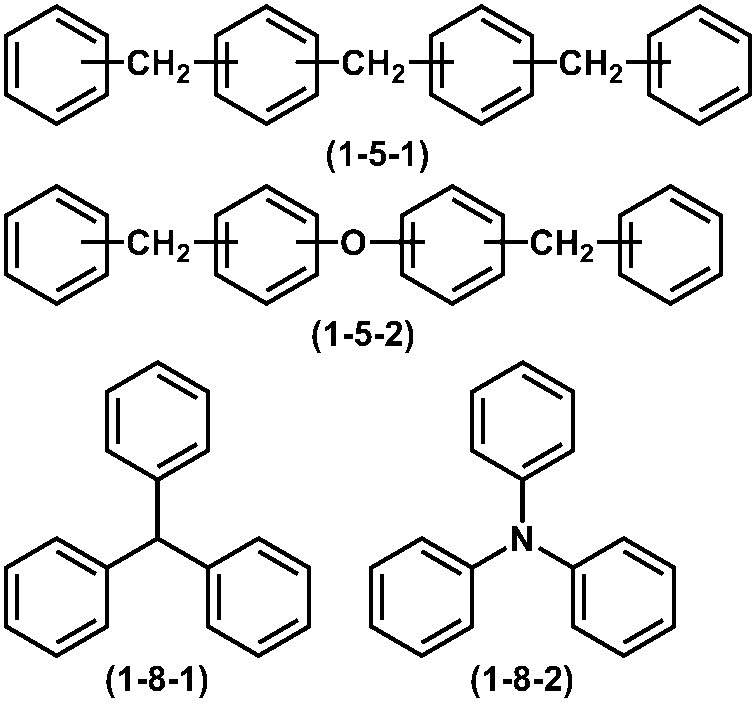
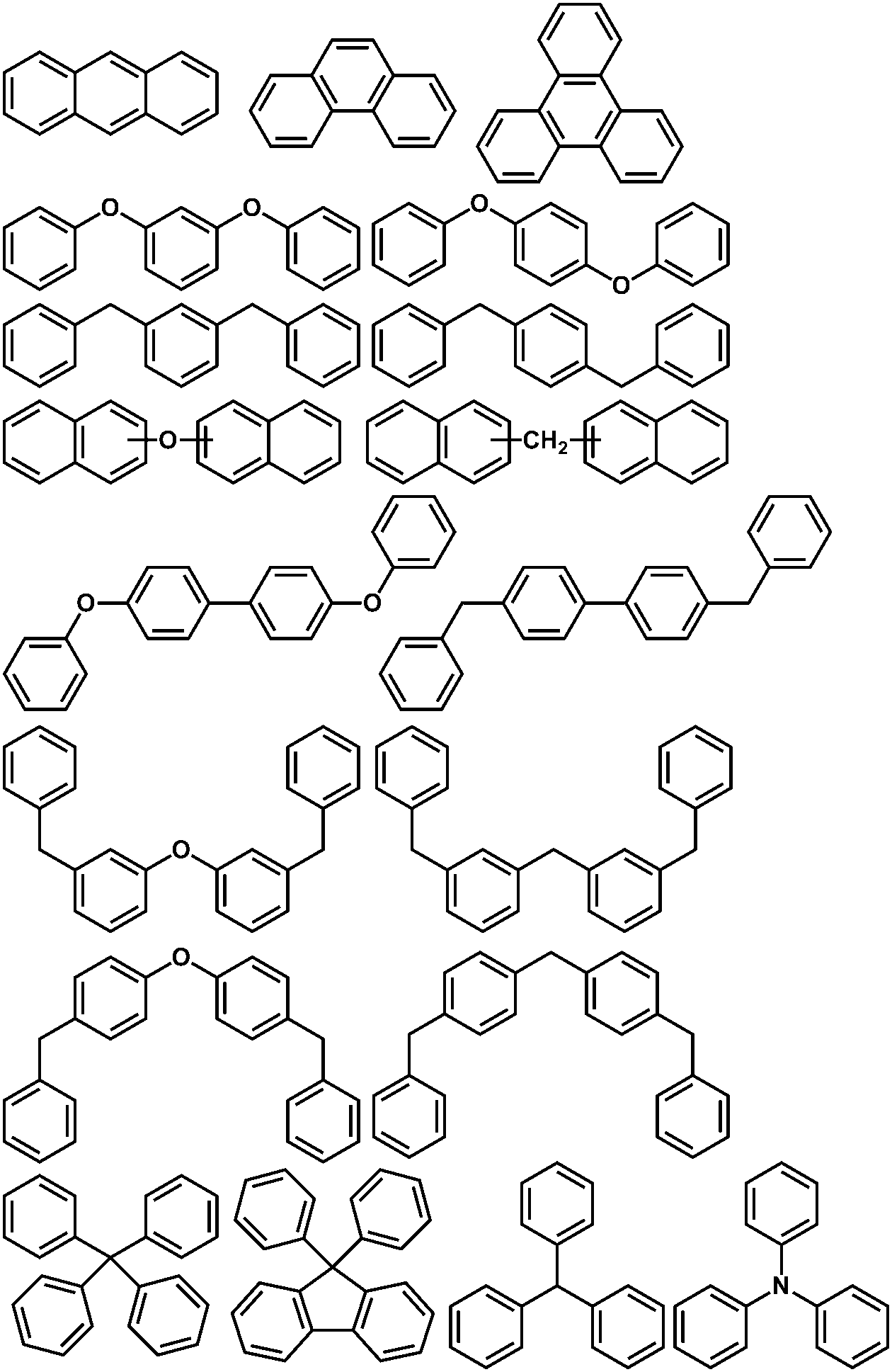

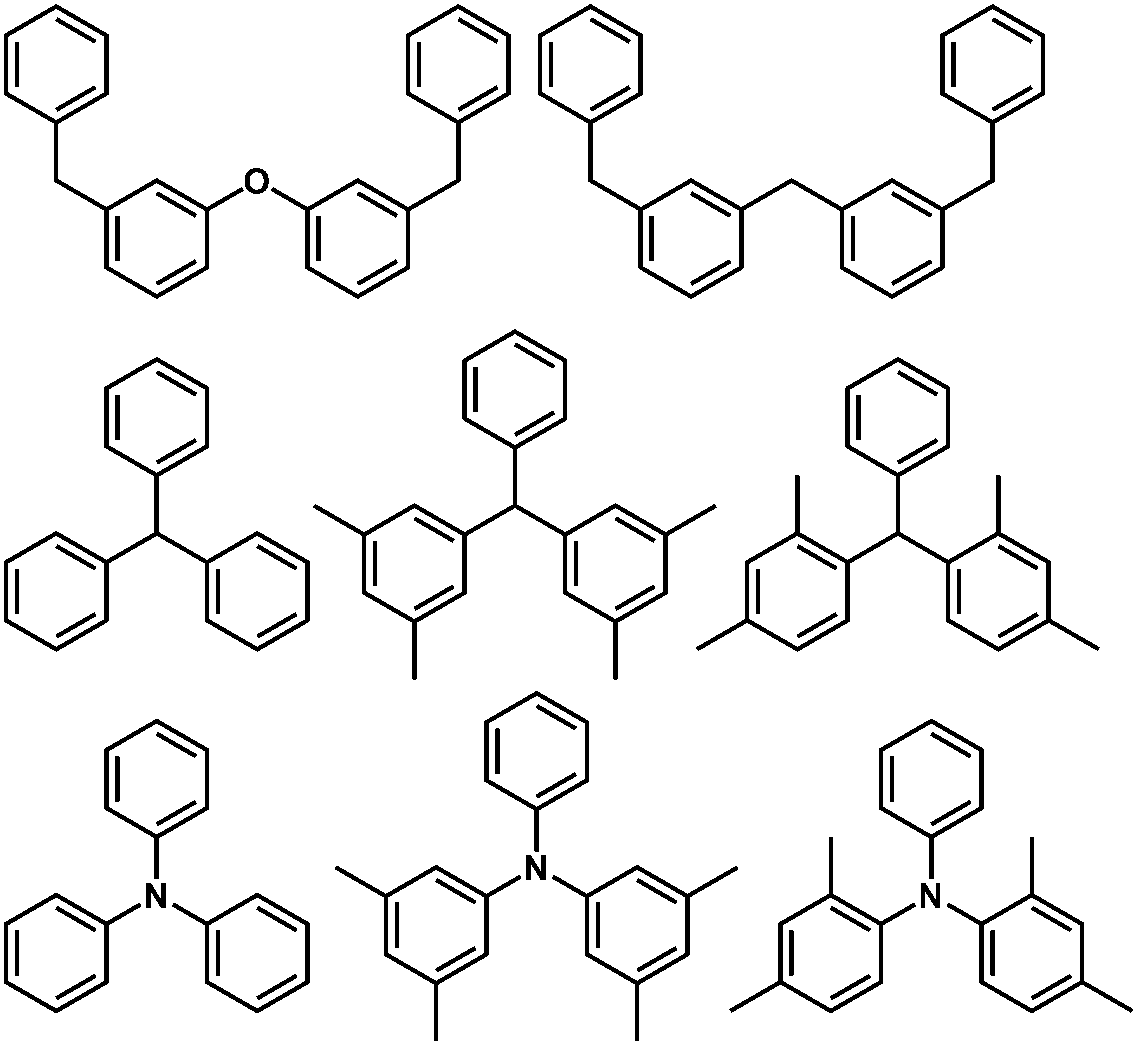
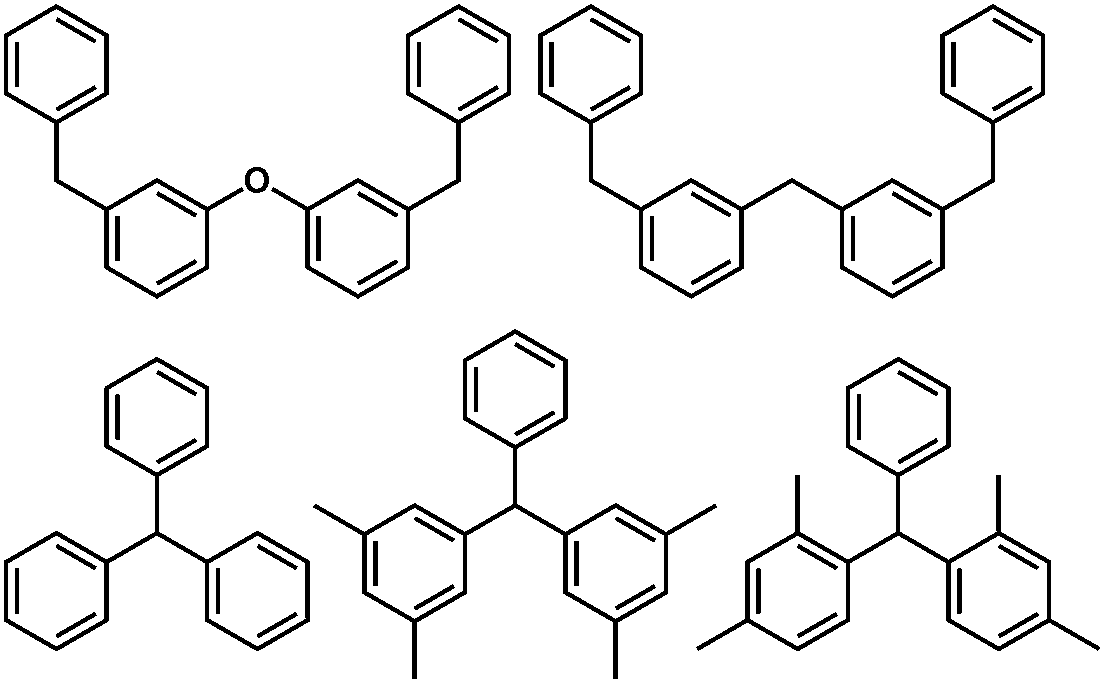
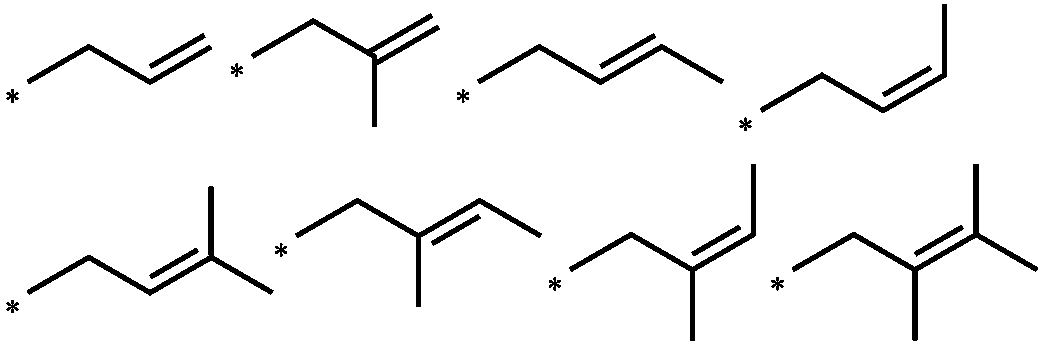

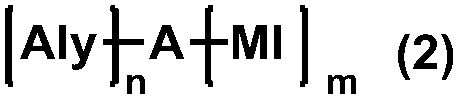

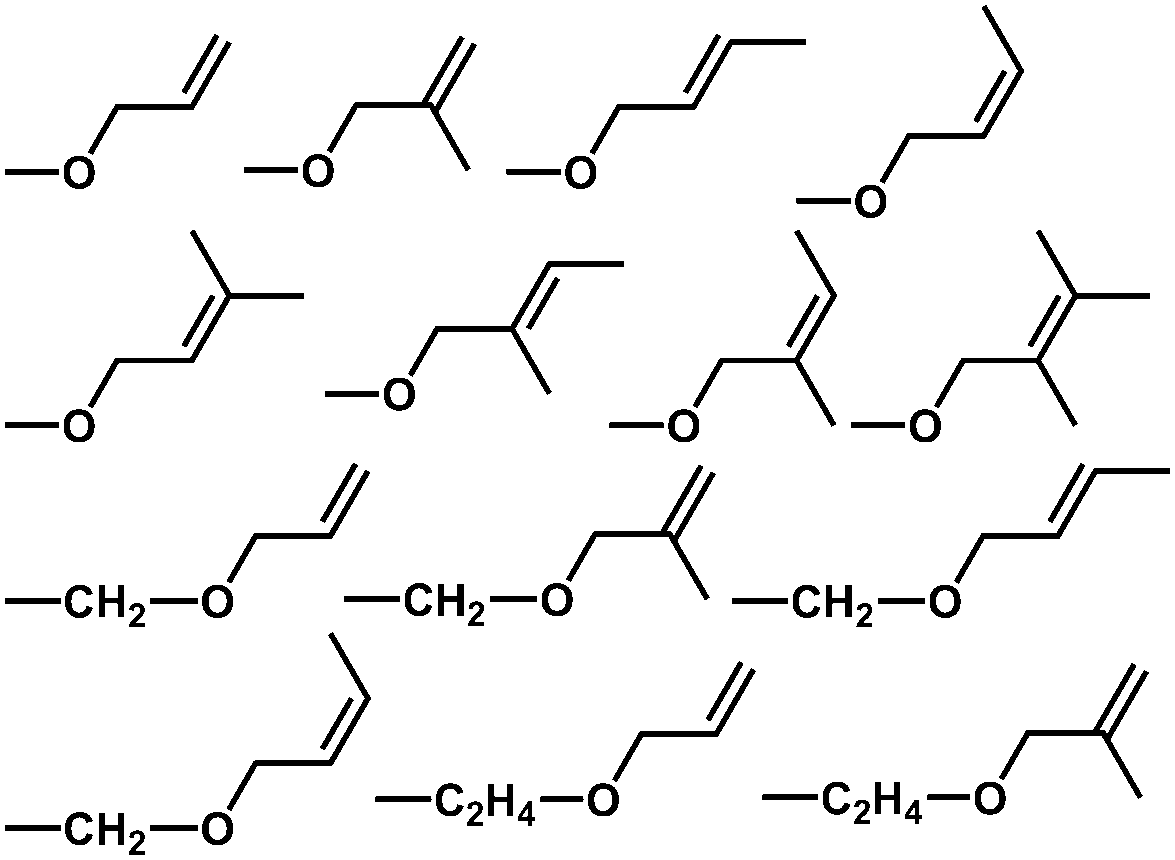


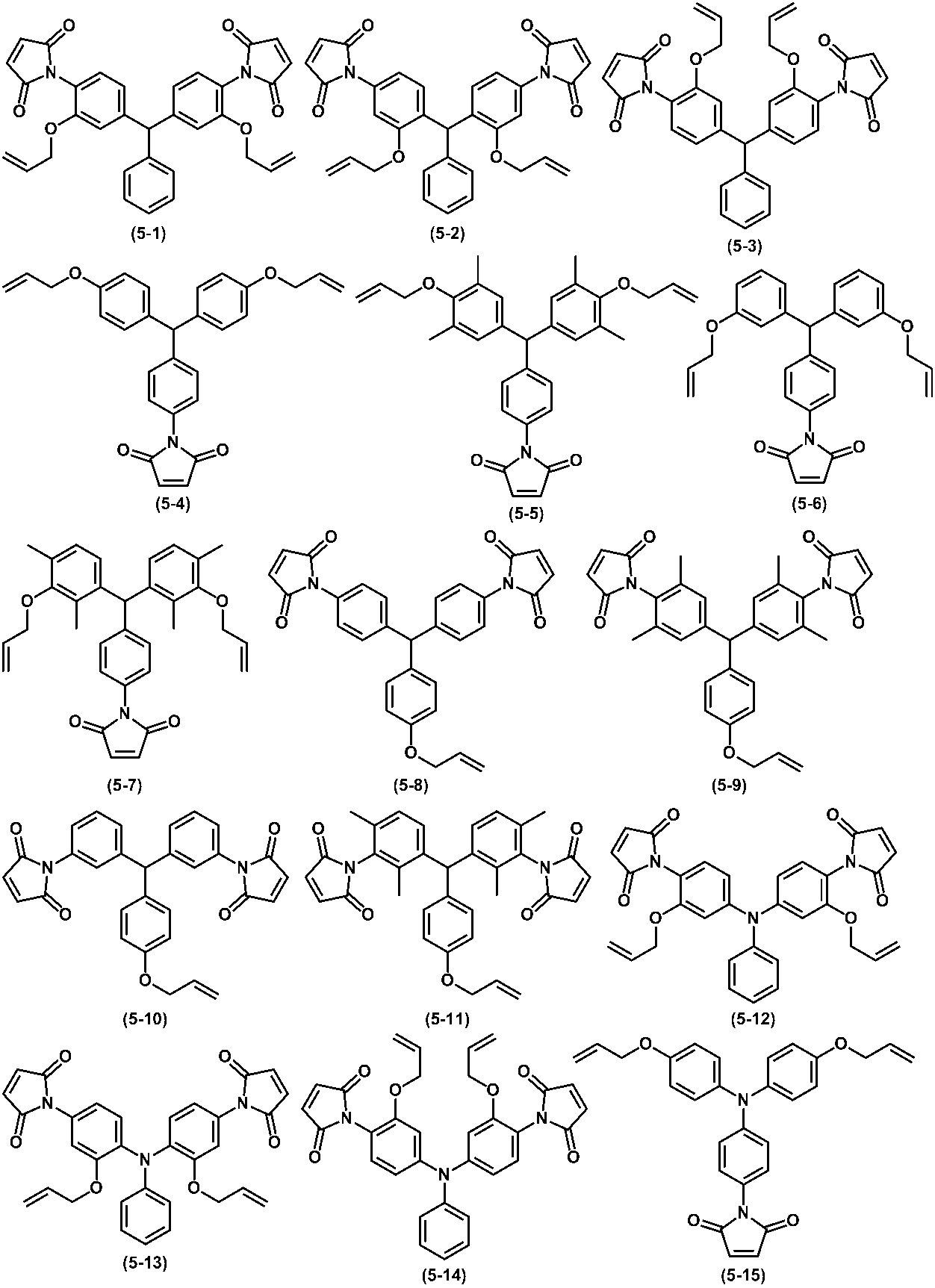
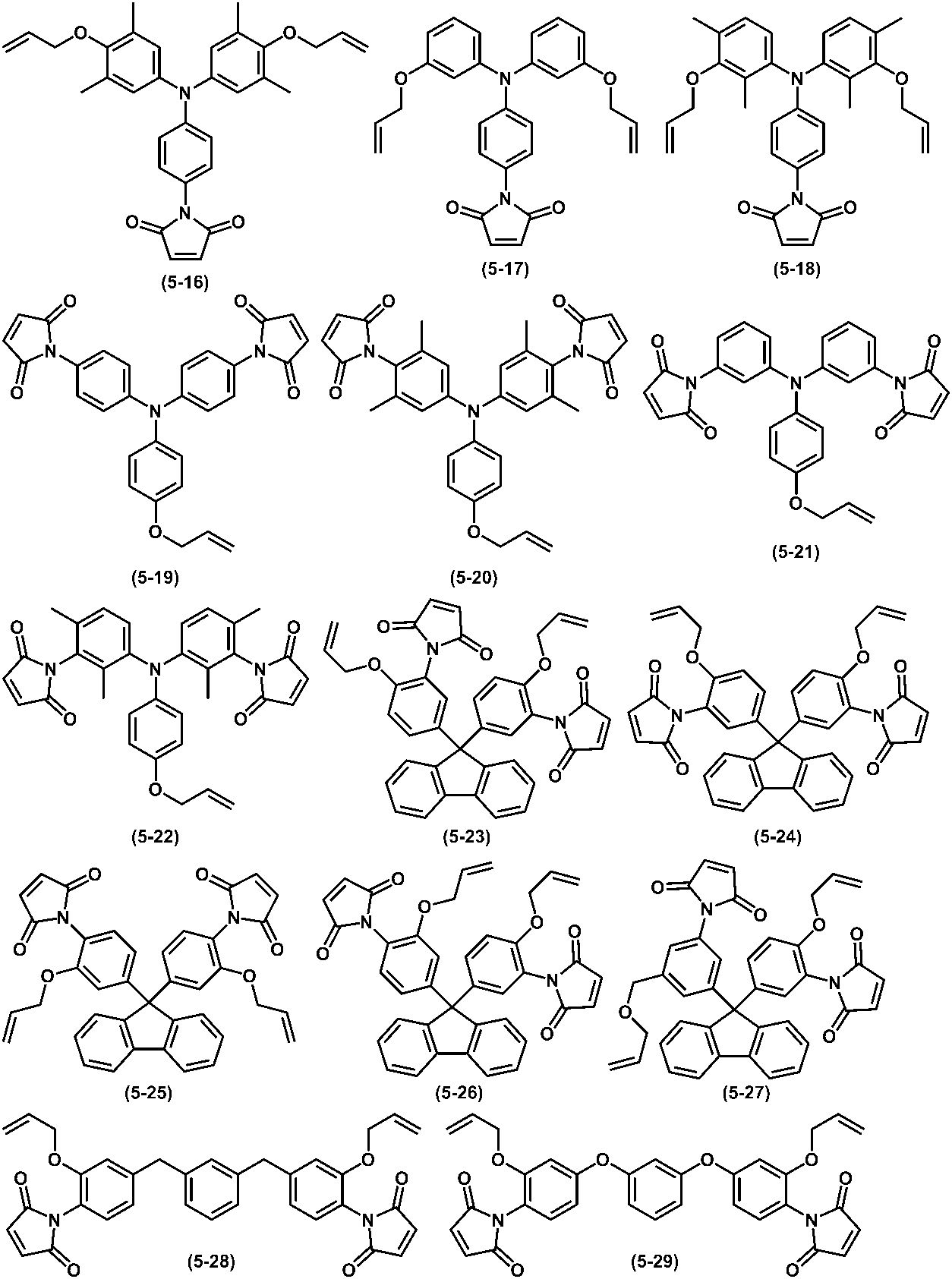

本発明の置換または非置換アリル基含有マレイミド化合物の製造方法は、特に限定は無いが、以下の工程を経ることで、効率的に製造を行うことが出来る。
1-2)1-1)で得られた化合物の水酸基に置換または非置換アリル基を導入する工程
1-3)1-2)で得られた化合物の保護アミノ基から脱保護する工程
1-4)1-3)で得られた化合物のアミノ基をマレイミド化する工程
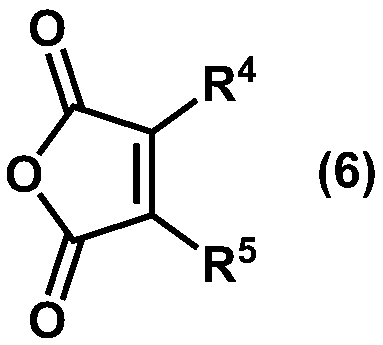
本発明の組成物は、本発明の置換または非置換アリル基含有マレイミド化合物を含有する。
本発明の組成物は、本発明の置換または非置換アリル基含有マレイミド化合物以外の配合物を反応性化合物を含んでいてもよい。当該反応性化合物を含むことで、反応性や耐熱性、ハンドリング性など様々な特徴を樹脂に付与することが可能である。
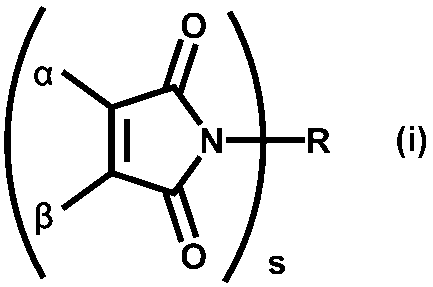
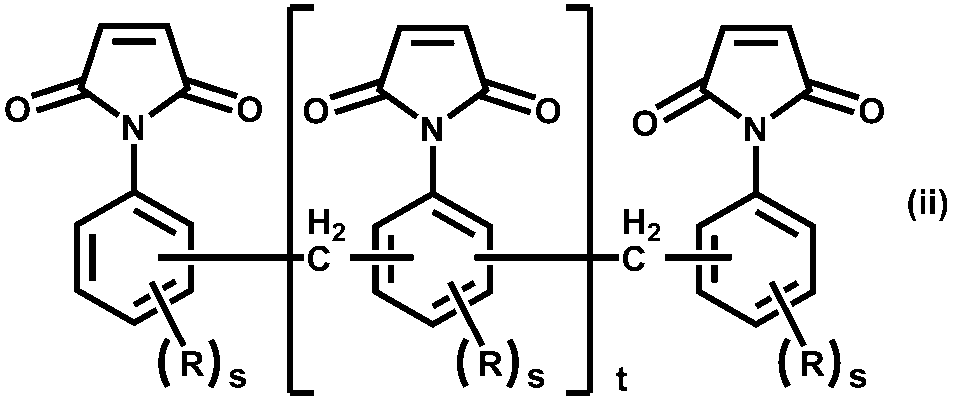
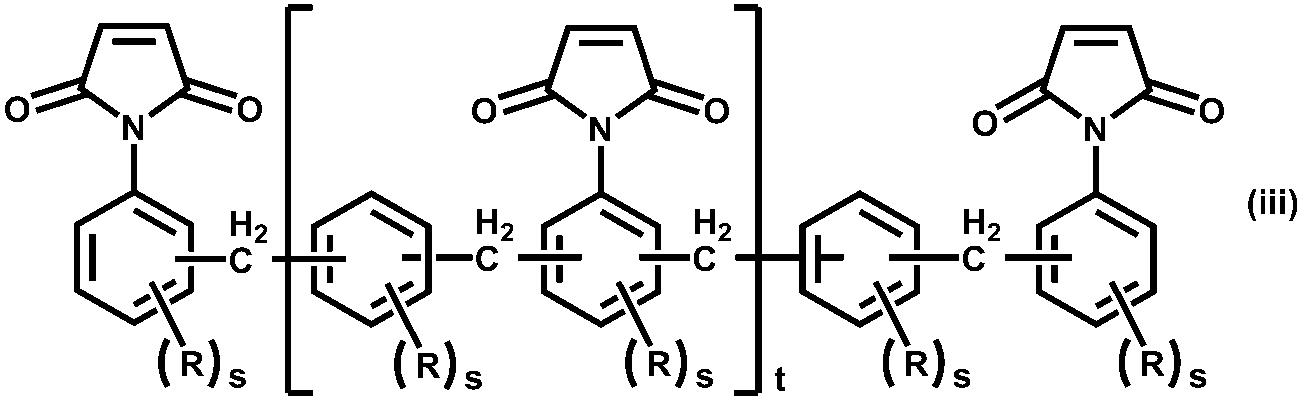
本発明の組成物は、置換または非置換アリル基含有マレイミド化合物の他に、更にフィラーを含有してもよい。フィラーとしては、無機フィラーと有機フィラーが挙げられる。無機フィラーとしては、例えば無機微粒子が挙げられる。
本発明の組成物は、置換または非置換アリル基含有マレイミド化合物の他に、更に繊維質基質を含有してもよい。本発明の繊維質基質は、特に限定はないが、繊維強化樹脂に用いられるものが好ましく、無機繊維や有機繊維が挙げられる。
本発明の組成物は、組成物の固形分量や粘度を調整する目的として、分散媒を使用してもよい。分散媒としては、本発明の効果を損ねることのない液状媒体であればよく、各種有機溶剤、液状有機ポリマー等が挙げられる。
また、本発明の組成物は、本発明の置換または非置換アリル基含有マレイミド化合物以外の樹脂を有していてもよい。樹脂としては、本発明の効果を損なわない範囲であれば公知慣用の樹脂を配合すればよく、例えば熱硬化性樹脂や熱可塑性樹脂を用いることができる。
本発明の組成物は、配合物に応じて硬化剤を用いてもよい。例えば、アミン系硬化剤、アミド系硬化剤、酸無水物系硬化剤、フェノール系硬化剤、活性エステル系硬化剤、カルボキシル基含有硬化剤、チオール系硬化剤などの各種の硬化剤が挙げられる。
本発明の組成物は、その他の配合物を有していてもかまわない。例えば、触媒、重合開始剤、無機顔料、有機顔料、体質顔料、粘土鉱物、ワックス、界面活性剤、安定剤、流動調整剤、カップリング剤、染料、レベリング剤、レオロジーコントロール剤、紫外線吸収剤、酸化防止剤、難燃剤、可塑剤等が挙げられる。
本発明の組成物を硬化して得られる硬化物は、低線膨張で、高ガラス転移温度、耐熱分解性に優れることから、耐熱部材や電子部材に好適に使用可能である。硬化物の成形方法は特に限定は無く、組成物単独で成形してもよいし、基材と積層することで積層体としてもかまわない。
本発明の硬化物は基材と積層することで積層体とすることができる。
本発明の組成物が繊維質基質を有し、該繊維質基質が強化繊維の場合、繊維質基質を含有する組成物は繊維強化樹脂として用いることができる。
本発明の繊維強化樹脂は、未硬化あるいは半硬化のプリプレグと呼ばれる状態を形成することができる。プリプレグの状態で製品を流通させた後、最終硬化をおこなって硬化物を形成してもよい。積層体を形成する場合は、プリプレグを形成した後、その他の層を積層してから最終硬化を行うことで、各層が密着した積層体を形成できるため、好ましい。
本発明の置換または非置換アリル基含有マレイミド化合物は、その硬化物が低線膨張であって耐熱分解性に優れることから、耐熱部材や電子部材に好適に使用可能である。特に、半導体封止材、回路基板、ビルドアップフィルム、ビルドアップ基板等や、接着剤やレジスト材料に好適に使用可能である。また、繊維強化樹脂のマトリクス樹脂にも好適に使用可能であり、高耐熱性のプリプレグとして特に適している。また、各種溶剤への溶解性を示すことから塗料化が可能であり、従来型の300℃以上の高温焼き付けを要する耐熱塗料と比較し、低温での硬化が可能であることから、耐熱塗料用樹脂としても好適に使用可能である。こうして得られる耐熱部材や電子部材は、各種用途に好適に使用可能であり、例えば、産業用機械部品、一般機械部品、自動車・鉄道・車両等部品、宇宙・航空関連部品、電子・電気部品、建築材料、容器・包装部材、生活用品、スポーツ・レジャー用品、風力発電用筐体部材等が挙げられるが、これらに限定される物ではない。
本発明の組成物から半導体封止材料を得る方法としては、前記組成物、および硬化促進剤、および無機充填剤等の配合剤とを必要に応じて押出機、ニ-ダ、ロ-ル等を用いて均一になるまで充分に溶融混合する方法が挙げられる。その際、無機充填剤としては、通常、溶融シリカが用いられるが、パワートランジスタ、パワーIC用高熱伝導半導体封止材として用いる場合は、溶融シリカよりも熱伝導率の高い結晶シリカ,アルミナ,窒化ケイ素などの高充填化、または溶融シリカ、結晶性シリカ、アルミナ、窒化ケイ素などを用いるとよい。その充填率は硬化性樹脂組成物100質量部当たり、無機充填剤を30~95質量%の範囲で用いることが好ましく、中でも、難燃性や耐湿性や耐ハンダクラック性の向上、線膨張係数の低下を図るためには、70質量部以上がより好ましく、80質量部以上であることがさらに好ましい。
本発明の硬化性樹脂組成物から半導体装置を得る半導体パッケージ成形としては、上記半導体封止材料を注型、或いはトランスファー成形機、射出成形機などを用いて成形し、さらに50~250℃で2~10時間の間、加熱する方法が挙げられる。
本発明の組成物からプリント回路基板を得る方法としては、上記プリプレグを、常法により積層し、適宜銅箔を重ねて、1~10MPaの加圧下に170~300℃で10分~3時間、加熱圧着させる方法が挙げられる。
本発明の組成物からビルドアップ基板を得る方法は、例えば以下の工程が挙げられる。まず、ゴム、フィラーなどを適宜配合した上記組成物を、回路を形成した回路基板にスプレーコーティング法、カーテンコーティング法等を用いて塗布した後、硬化させる工程(工程1)。その後、必要に応じて所定のスルーホール部等の穴あけを行った後、粗化剤により処理し、その表面を湯洗することによって凹凸を形成させ、銅などの金属をめっき処理する工程(工程2)。このような操作を所望に応じて順次繰り返し、樹脂絶縁層および所定の回路パターンの導体層を交互にビルドアップして形成する工程(工程3)。なお、スルーホール部の穴あけは、最外層の樹脂絶縁層の形成後に行う。また、本発明のビルドアップ基板は、銅箔上で当該樹脂組成物を半硬化させた樹脂付き銅箔を、回路を形成した配線基板上に、170~300℃で加熱圧着することで、粗化面を形成、メッキ処理の工程を省き、ビルドアップ基板を作製することも可能である。
本発明の組成物からビルドアップフィルムを得る方法としては、基材である支持フィルム(Y)の表面に、上記組成物を塗布し、更に加熱、あるいは熱風吹きつけ等により有機溶剤を乾燥させて組成物の層(X)を形成させることにより製造することができる。
本発明の組成物から導電ペーストを得る方法としては、例えば、導電性粒子を該組成物中に分散させる方法が挙げられる。上記導電ペーストは、用いる導電性粒子の種類によって、回路接続用ペースト樹脂組成物や異方性導電接着剤とすることができる。
装置:アジレントテクノロジー製「LC1260」
展開溶媒:下記表1に示す
検出器:フォトダイオードアレイ検出器
流量:1.0mL/分
使用カラム:Poroshell 120 EC-C18

装置:JEOL RESONANCE製「JNM-ECA600」
磁場強度:600MHz
積算回数:32回
溶媒:DMSO-d6
試料濃度:30質量%
装置:JEOL RESONANCE製「JNM-ECA600」
磁場強度:150MHz
積算回数:320回
溶媒:DMSO-d6
試料濃度:30質量%
装置:日本電子株式会社製「JMS-T100GC AccuTOF」
測定範囲:m/z=50.00~2000.00
変化率:25.6mA/min
最終電流値:40mA
カソード電圧:-10kV
装置:日立ハイテクサイエンス社製「X-DSC7000」
雰囲気:窒素
昇温プログラム:30℃5分保持→昇温速度10℃/分→350℃2分保持
(1-1)アミノ基の保護
温度計、冷却管、攪拌機を取り付けた1Lフラスコに9,9-ビス(3-アミノ-4-ヒドロキシフェニル)フルオレン(BAHF、JFEケミカル株式会社製)50.10g(0.132mol)、N,N-ジメチルホルムアミド(DMF)580mL、イオン交換水170mL、無水酢酸33.72g(0.330mol)を仕込み、60℃で2時間反応させた後、室温まで空冷した。析出物をろ過し、イオン交換水で洗浄後、得られた粉末を80℃で8時間真空乾燥させることで反応物(a-1)を42.30g(収率68.9%)得た。
温度計、冷却管、攪拌機を取り付けた1Lフラスコに(a-1)41.91g(0.090mmol)、DMF500mLを仕込み攪拌した。次に炭酸カリウム27.97g(0.202mol)を加え、反応液を60℃まで加熱した後、臭化アリル24.66g(0.204mol)をゆっくりと滴下した。滴下終了後、60℃で8.5時間反応させた後、室温まで空冷した。ろ過後、反応液をイオン交換水で再沈殿を行った。ウェットケーキをろ別し、イオン交換水で洗浄後、80℃で12時間真空乾燥を行い粉末として(a-2)を46.12g(収率94.0%)得た。
温度計、冷却管、攪拌機を取り付けた500mLフラスコに(a-2)44.83g(0.082mol)、エタノール120mLを仕込み攪拌した。濃塩酸52.91gを加え60℃に加熱した。60℃で9時間反応後、室温まで空冷した。反応液を20%水酸化ナトリウム水溶液で中和後、酢酸エチルで抽出した。イオン交換水で洗浄し、硫酸ナトリウムを加え乾燥後、減圧濃縮した。さらに80℃で12時間真空乾燥を行い固体として(a-3)を28.51g(収率75.2%)得た。
温度計、冷却管、ディーンスタークトラップ、攪拌機を取り付けた1Lフラスコに無水マレイン酸13.51g(0.138mol)、トルエン400mLを仕込み室温で攪拌した。次に(a-3)28.51(0.062mmol)gとDMF40mLの混合溶液を30分かけて滴下した。滴下終了後、室温でさらに2時間反応させた。p-トルエンスルホン酸一水和物2.18gを加え、反応液を加熱し還流下で共沸してくる水とトルエンを冷却・分離した後、トルエンだけを系内に戻して脱水反応を12時間行った。室温まで空冷後、析出物をろ別し、80℃で12時間真空乾燥を行いアリル基含有マレイミド化合物Aを16.95g(収率44.1%)得た。
13C-NMR:δ169.73ppm、152.86ppm、150.26ppm、139.34ppm、137.52ppm、134.89ppm、133.01ppm、129.30ppm、128.08ppm、127.87ppm、125.83ppm、120.67ppm、119.90ppm、116.78ppm、113.22ppm、68.32ppm、63.23ppm;
MSスペクトル:M+=620;
純度:95.8%(HPLC面積%、検出波長275nm)
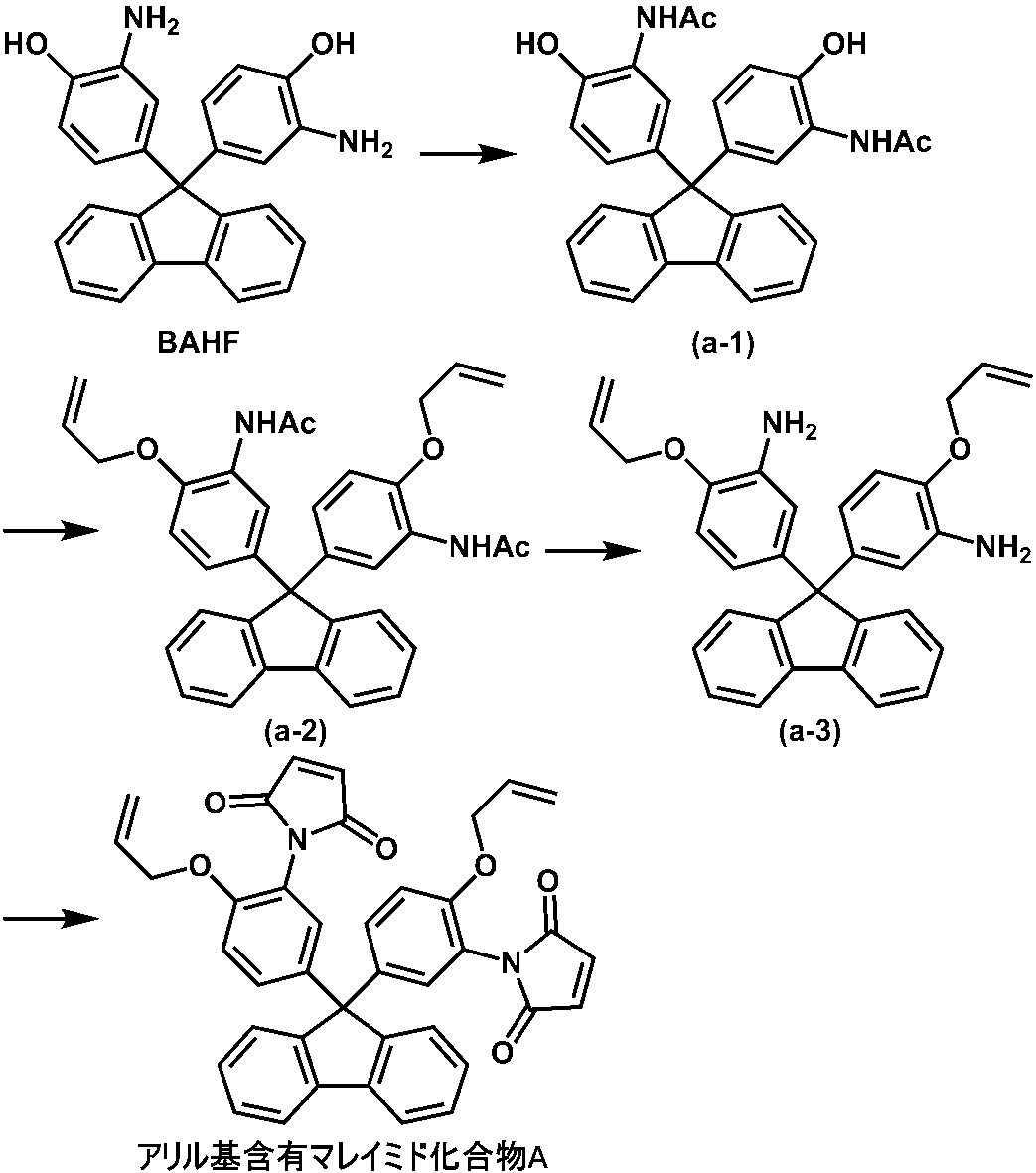
温度計、冷却管、攪拌機を取り付けた500mLフラスコに2,6-ジメチルアニリン193.04g(1.59mol)、6mol/L塩酸58.82gを仕込み攪拌した。反応液を加熱し還流状態とした後、4-ヒドロキシベンズアルデヒド48.61g(0.40mol)とDMF50mLの混合溶液をゆっくりと滴下した。滴下終了後、20時間還流下で反応させた後、60℃まで空冷した。20%水酸化ナトリウム水溶液で中和し、デカンテーションにより上澄み液を取り除いた。メタノールを加え均一溶液とした後、イオン交換水で再沈殿を行った。析出物をろ別し、イオン交換水で洗浄後、80℃で12時間真空乾燥を行い粉末として、下記式(b)で表されるヒドロキシ基含有ジアミンを116.81g(収率84.7%)得た。
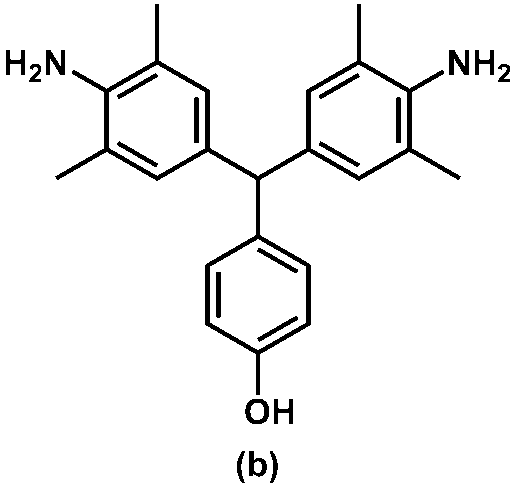
13C-NMR:δ169.86ppm、156.71ppm、144.70ppm、136.73ppm、135.00ppm、134.90ppm、133.77ppm、129.99ppm、128.71ppm、127.75ppm、117.47ppm、114.62ppm、68.15ppm、54.40ppm、17.60ppm;
MSスペクトル:M+=546;
融点(DSCピークトップ):246℃;
純度:99.9%(HPLC面積%、検出波長275nm)
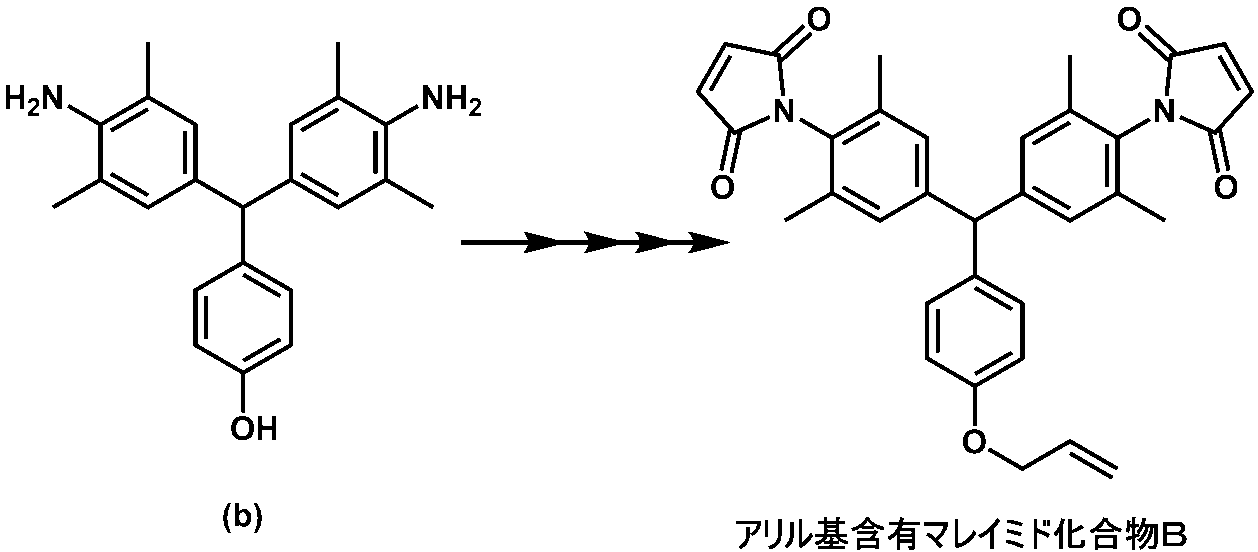
温度計、冷却管、ディーンスタークトラップ、攪拌機を取り付けた500mLフラスコにp-ニトロベンズアルデヒド45.12g(0.299mol)、2,6-ジメチルフェノール76.46g(0.626mol)、トルエン140mLを仕込み室温で攪拌した。p-トルエンスルホン酸一水和物5.78gを加え、反応液を加熱し還流下で共沸してくる水とトルエンを冷却・分離した後、トルエンだけを系内に戻して脱水反応を2.5時間行った。80℃まで空冷後、反応液を10%水酸化ナトリウム水溶液で中和し、トルエンで抽出した。イオン交換水で洗浄し、硫酸ナトリウムを加え乾燥後、減圧濃縮し深赤色液体を得た。80℃で12時間真空乾燥を行い橙色固体として下記式(c-0)で表されるジヒドロキシ基含有ニトロ化合物を105.41g(収率93.3%)得た。
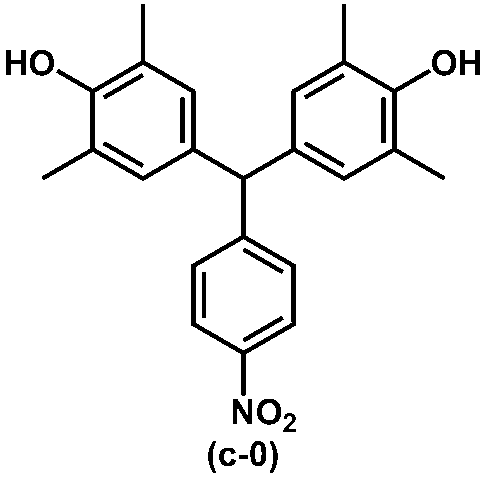

13C-NMR:δ169.97ppm、153.91ppm、143.81ppm、138.73ppm、134.65ppm、134.55ppm、130.22ppm、129.43ppm、129.32ppm、129.13ppm、126.57ppm、116.78ppm、72.46ppm、54.48ppm、16.20ppm;
MSスペクトル:M+=507;
融点(DSCピークトップ):147℃;
純度:92.4%(HPLC面積%、検出波長254nm)
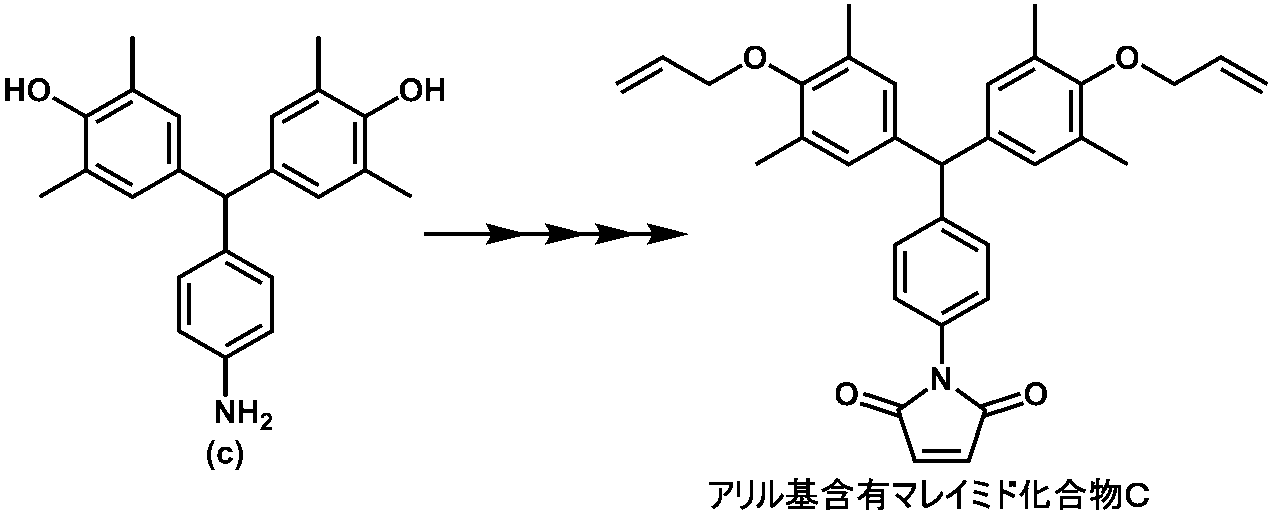
温度計、冷却管、攪拌機を取り付けた200mLフラスコに2-メトキシアニリン55.33g(0.449mol)を仕込み攪拌しながら100℃まで加熱した。ベンズアルデヒド23.86g(0.225mol)と濃塩酸11.89gの混合溶液をゆっくりと滴下した。滴下終了後、100℃で5時間反応させた後、70℃まで空冷した。反応液を20%水酸化ナトリウム水溶液で中和後、酢酸エチルで抽出した。イオン交換水で洗浄し、硫酸ナトリウムを加え乾燥後、減圧濃縮し下記式(d-0)で表されるジメトキシ基含有ジアミノ化合物を66.97g(収率88.9%)得た。
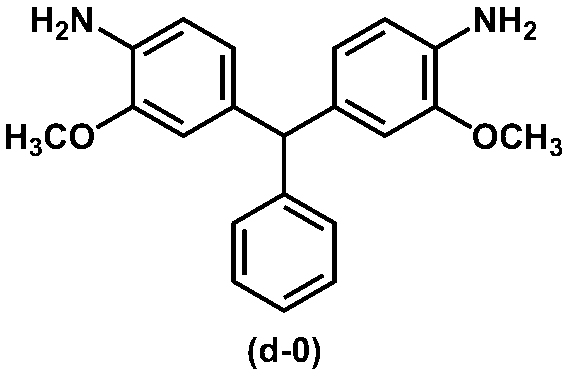
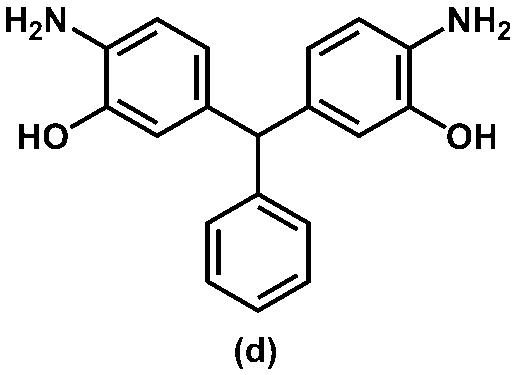
13C-NMR:δ169.92ppm、153.85ppm、145.86ppm、142.86ppm、134.99ppm、132.87ppm、130.24ppm、128.99ppm、128.50ppm、126.59ppm、121.29ppm、118.45ppm、117.06ppm、114.33ppm、68.33ppm、55.70ppm;
MSスペクトル:M+=546;
融点(DSCピークトップ):60℃;
純度:95.8%(HPLC面積%、検出波長275nm)

温度計、冷却管、ディーンスタークトラップ、攪拌機を取り付けた1Lフラスコに4,4’-ジアミノジフェニルメタン198.27g(1.00mol)、4-ヒドロキシベンジルアルコール248.28g(2.00mol)を仕込み、140℃まで加熱し、溶融状態で脱水しながら撹拌した。同温度で7時間反応後、室温まで空冷し、下記式(e)で表されるジヒドロキシ基含有ジアミノ化合物を主成分として含む固体を385.89g得た。なお、得られた式(e)で表されるジヒドロキシ基含有ジアミノ化合物のMSスペクトルおよびDSCを測定したところ、以下の結果となった。
純度:26.0%(HPLC面積%、検出波長254nm)
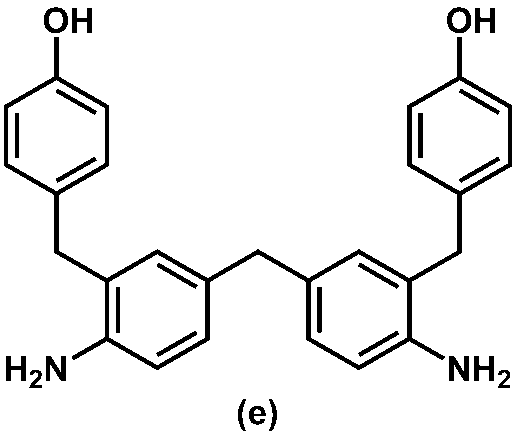
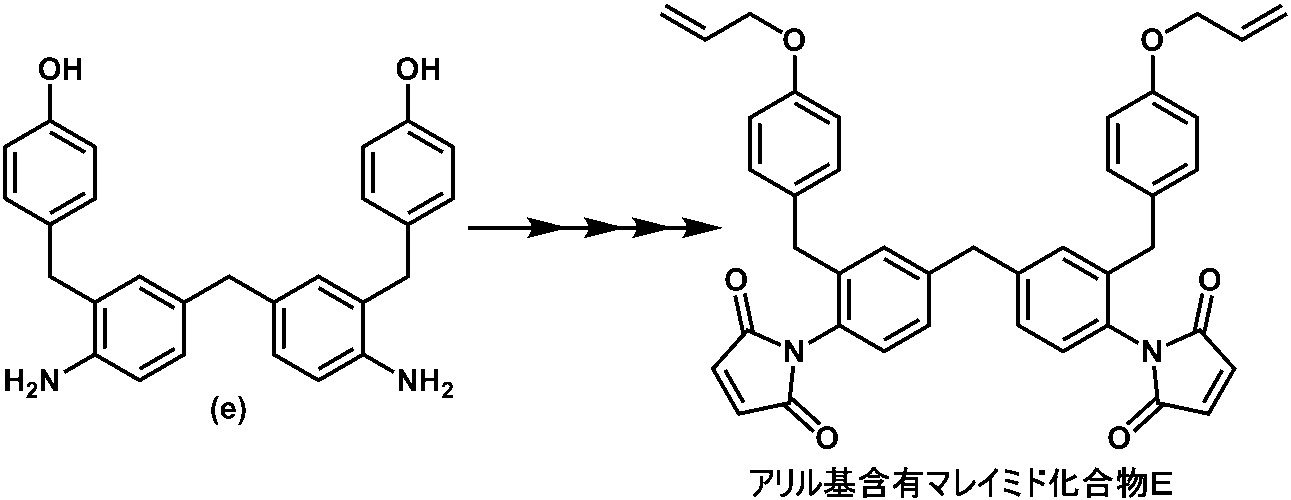
温度計、冷却管、ディーンスタークトラップ、攪拌機を取り付けた2Lフラスコに無水マレイン酸50.85g(0.519mol)、トルエン930mLを仕込み室温で攪拌した。次に4,4’-ジアミノ-2,2’-ジメチルビフェニル(m-TB、和歌山精化工業株式会社製)50.09g(0.236mol)とDMF110mLの混合溶液を1時間かけて滴下した。滴下終了後、室温でさらに2時間反応させた。p-トルエンスルホン酸一水和物7.08gを加え、反応液を加熱し還流下で共沸してくる水とトルエンを冷却・分離した後、トルエンだけを系内に戻して脱水反応を22時間行った。室温まで空冷後、減圧濃縮し黄色のウェットケーキ151.40gを得た。DMFに溶解させ、イオン交換水で再沈殿を行った。析出物をろ別しイオン交換水で洗浄後、80℃で12時間真空乾燥を行い黄色粉末としてビスマレイミドAを84.07g(収率95.8%)得た。なお、得られたビスマレイミドAの1H-NMR、13C-NMR、MSスペクトル、DSCを測定し、また、HPLCを測定して純度を求めたところ、以下の結果となった。
13C-NMR:δ170.01ppm、139.67ppm、136.10ppm、134.72ppm、130.74ppm、129.57ppm、127.97ppm、124.15ppm、19.58ppm;
MSスペクトル:M+=372;
融点(DSCピークトップ):194℃;
純度:91.6%(HPLC面積%、検出波長254nm)
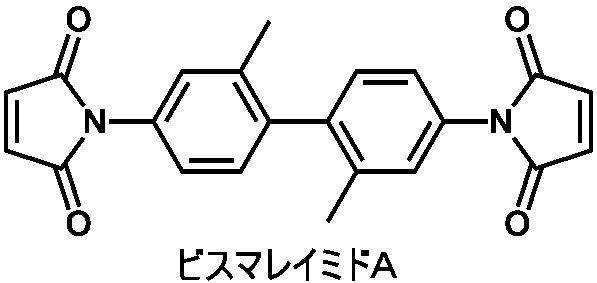
温度計、冷却管、ディーンスタークトラップ、攪拌機を取り付けた500mLフラスコに無水マレイン酸11.09g(0.113mol)、トルエン190mLを仕込み室温で攪拌した。次に1,3-ビス(4-アミノフェノキシ)ベンゼン(TPE-R、和歌山精化工業株式会社製)15.02g(0.051mol)とDMF30mLの混合溶液を1時間かけて滴下した。滴下終了後、室温でさらに2時間反応させた。p-トルエンスルホン酸一水和物1.07gを加え、反応液を加熱し還流下で共沸してくる水とトルエンを冷却・分離した後、トルエンだけを系内に戻して脱水反応を9時間行った。室温まで空冷後、減圧濃縮し得られた反応液を、イオン交換水で再沈殿を行った。析出物をろ別し、イオン交換水で洗浄後、80℃で12時間真空乾燥を行い黄色粉末としてビスマレイミドBを21.90g(収率94.2%)得た。なお、得られたビスマレイミドAの1H-NMR、13C-NMR、MSスペクトル、DSCを測定し、また、HPLCを測定して純度を求めたところ、以下の結果となった。
13C-NMR:δ169.94ppm、157.78ppm、155.45ppm、134.65ppm、131.33ppm、128.60ppm、127.03ppm、119.03ppm、113.79ppm、109.47ppm;
MSスペクトル:M+=452;
融点(DSCピークトップ):160℃;
純度:96.3%(HPLC面積%、検出波長254nm)
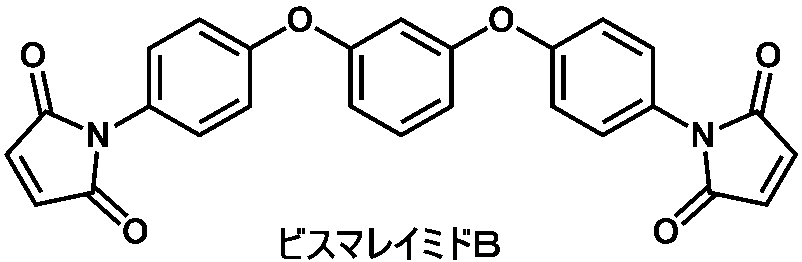
比較例3として、下記式で表されるBMI-1000(4,4’-ジフェニルメタンビスマレイミド、大和化成工業株式会社製)を用いた。

実施例3~5のアリル基含有マレイミド化合物、並びに比較例1~3のマレイミド化合物を用いて各種評価を行った。なお、以下の評価では、実施例3~5のアリル基含有マレイミド化合物および比較例1~3のマレイミド化合物を総称して単に「マレイミド化合物」と称する。
マレイミド化合物を含む組成物を製造し、前記組成物を硬化して硬化物を製造した。
下記表2に従って配合し、組成物1~8を製造した。また、得られる組成物1~8について、以下の条件により硬化して硬化物1~8を製造した。
硬化物板厚:2.4mm
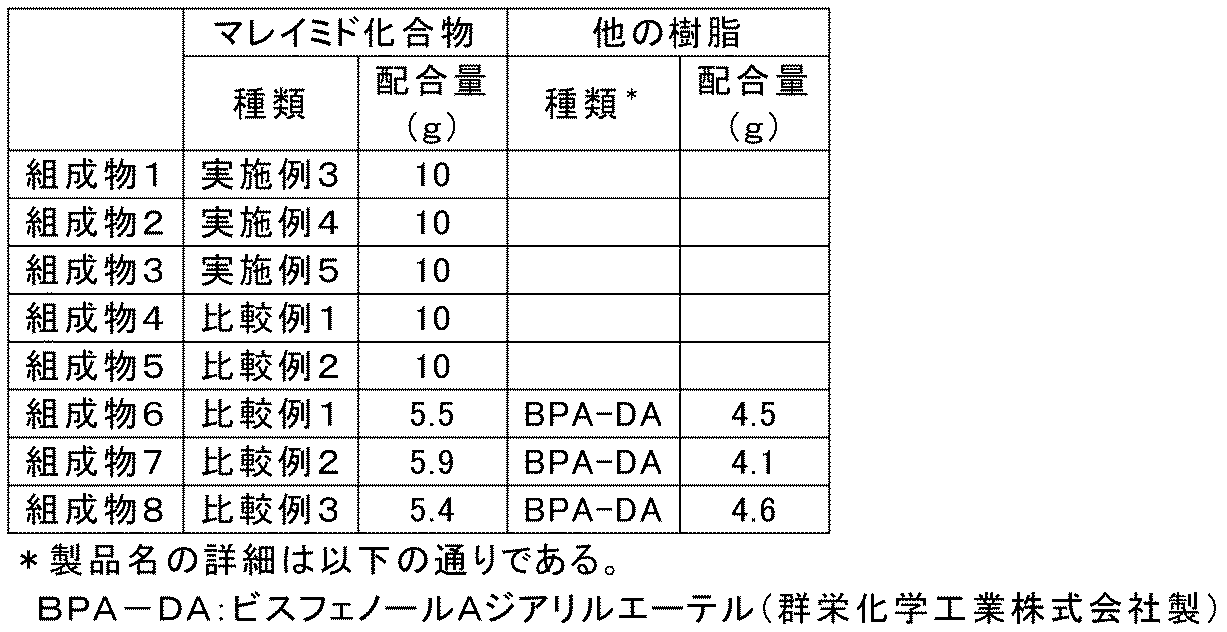
製造した硬化物1~8(厚さ:2.4mm)を、幅5mm、長さ54mmのサイズに切り出し、これを試験片とした。この試験片を粘弾性測定装置(DMA:日立ハイテクサイエンス社製固体粘弾性測定装置「DMS7100」、変形モード:両持ち曲げ、測定モード:正弦波振動、周波数1Hz、昇温速度3℃/分)を用いて、弾性率変化が最大となる(tanδ変化率が最も大きい)温度をガラス転移温度として評価した。得られた結果を下記表3に示す。
製造した硬化物1~8(厚さ:2.4mm)を、幅5mm、長さ5mmのサイズに切り出し、これを試験片とした。この試験片を熱機械分析装置(日立ハイテクサイエンス社製「TMA/SS7100」、昇温速度:3℃/分)を用いて40~60℃の範囲の膨張率を測定した。得られた結果を下記表3に示す。
製造した硬化物1~8(厚さ:2.4mm)を細かく裁断し、熱重量分析装置(SIIナノテクノロジー社製「TG/DTA6200」)を用いて、昇温速度を5℃/分として窒素雰囲気下で測定を行い、5%重量減少する温度(Td5)を求めた。得られた結果を下記表3に示す。
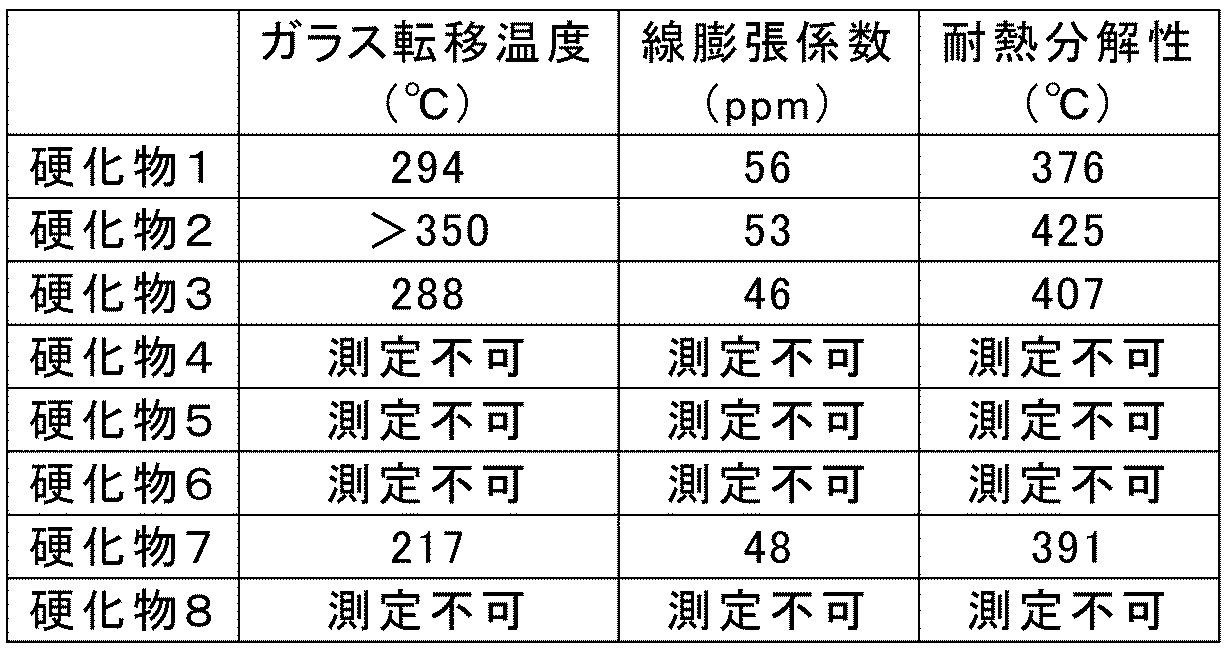
マレイミド化合物および繊維質基質であるガラス繊維を含む組成物を製造し、前記組成物を硬化して硬化物を製造した。
下記表4に従って配合し、組成物9~16を製造した。この際、ガラス繊維としてT-725H(成形材向けガラス繊維、日本電気硝子株式会社製)を用いた。
硬化物板厚:2.4mm
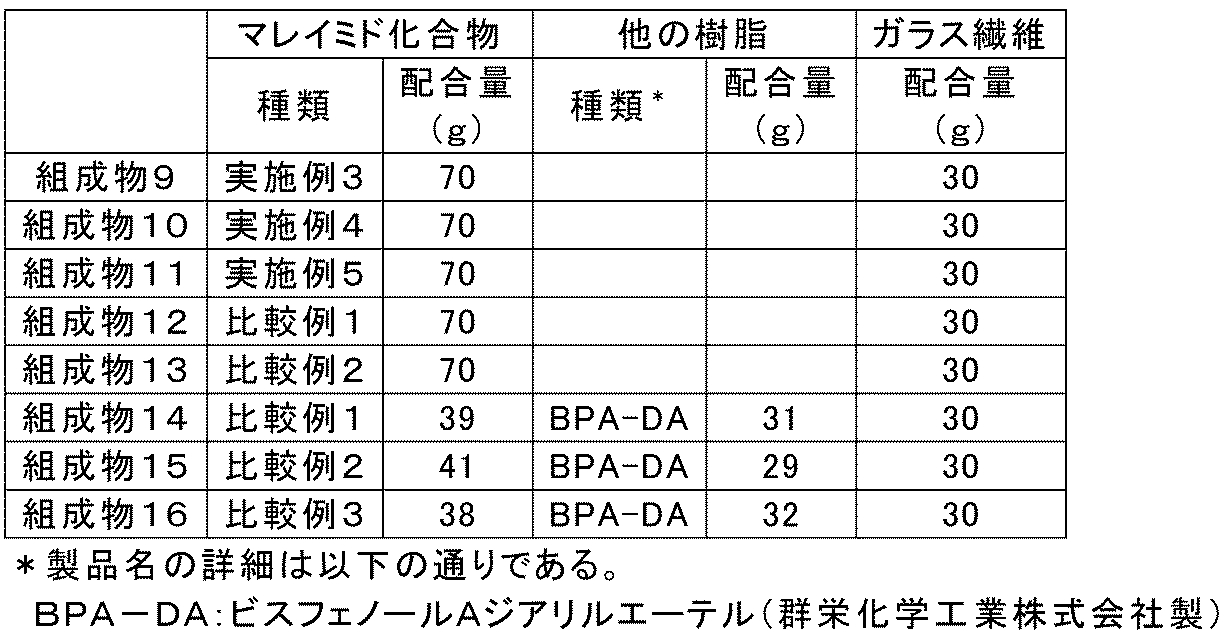
硬化物9~16について、JIS-K6911:2006に準拠して曲げ試験を行い、曲げ弾性率、曲げ歪、曲げ強度を測定した。得られた結果を下記表5に示す。
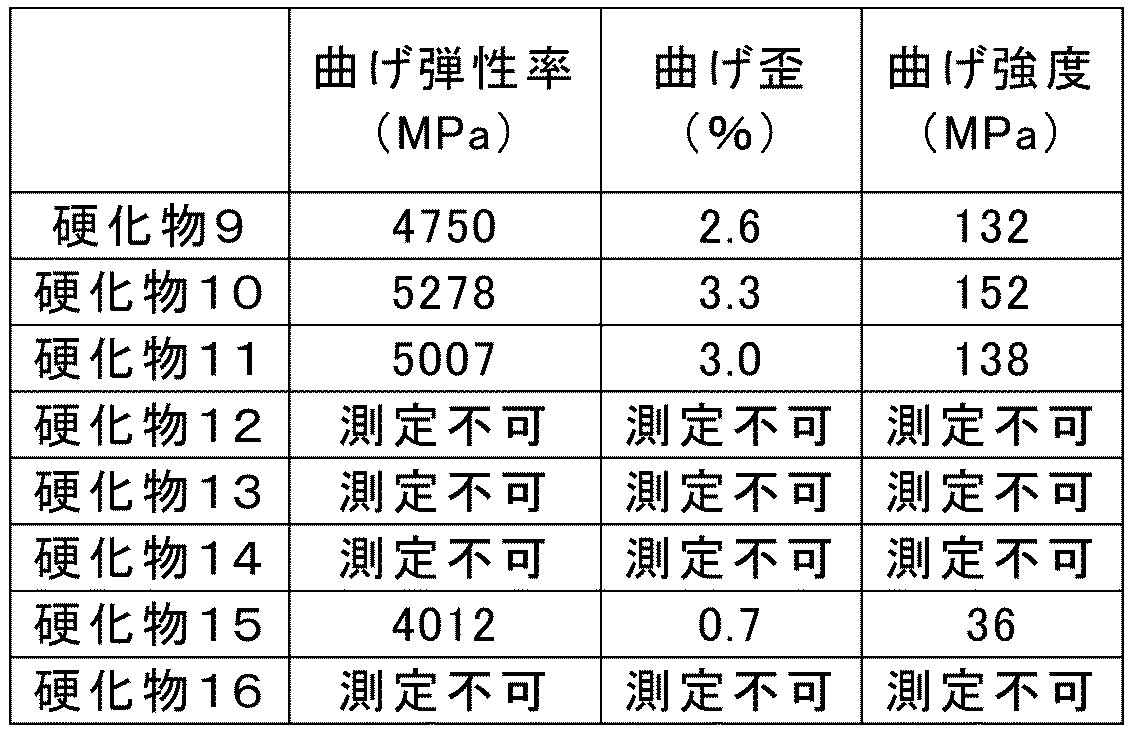
マレイミド化合物およびフィラーである球状シリカを含む組成物を製造した。
下記表6に従って配合し、2本ロールを用いて150℃の温度で5分間溶融混練して組成物17~24を製造した。この際、球状シリカとしてFB-560(電気化学株式会社製)、シランカップリング剤としてKBM-403(γ-グリシドキシトリエトキシシラン、信越化学工業株式会社製)、カルナバワックスとしてPEARL WAX No.1-P(株式会社セラリカ野田製)を用いた。
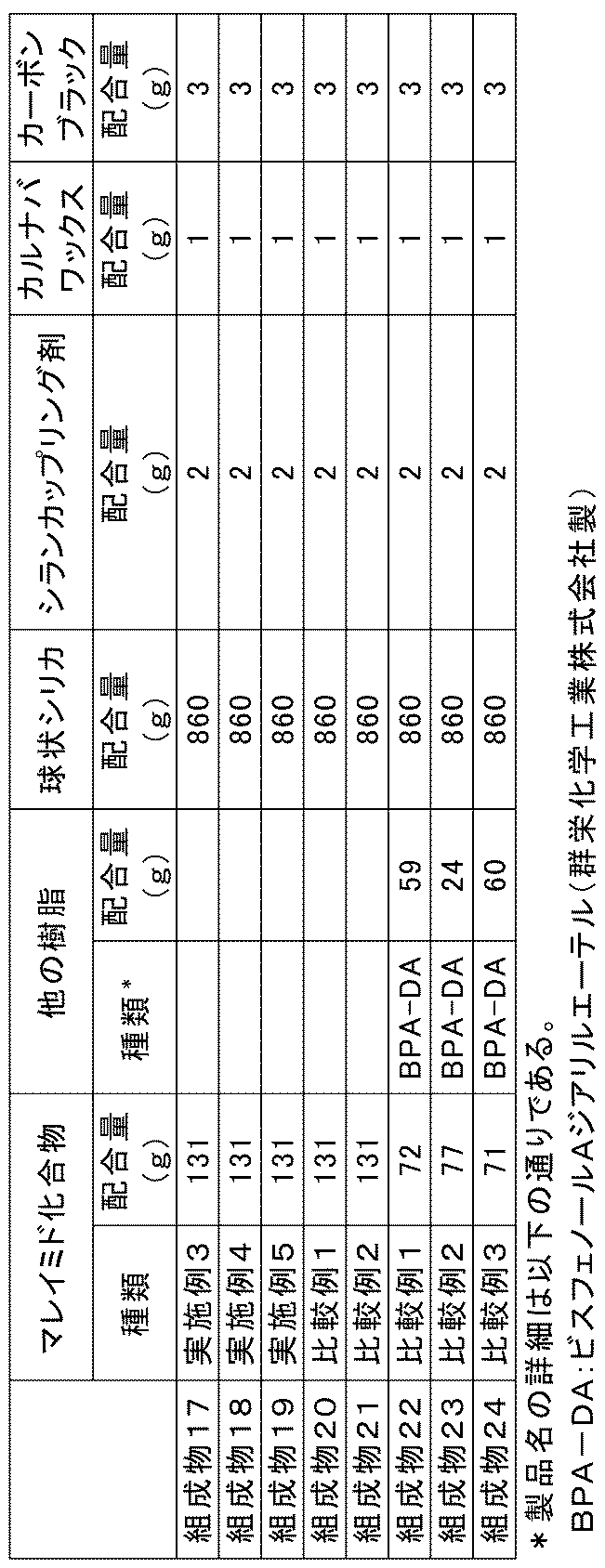
組成物を試験用金型に注入し、175℃、70kg/cm2、120秒の条件でスパイラルフロー値を測定した。この際、組成物20~22、24は、175℃では組成物が溶融せず、スパイラルフロー値の測定ができなかった。得られた結果を下記表7に示す。
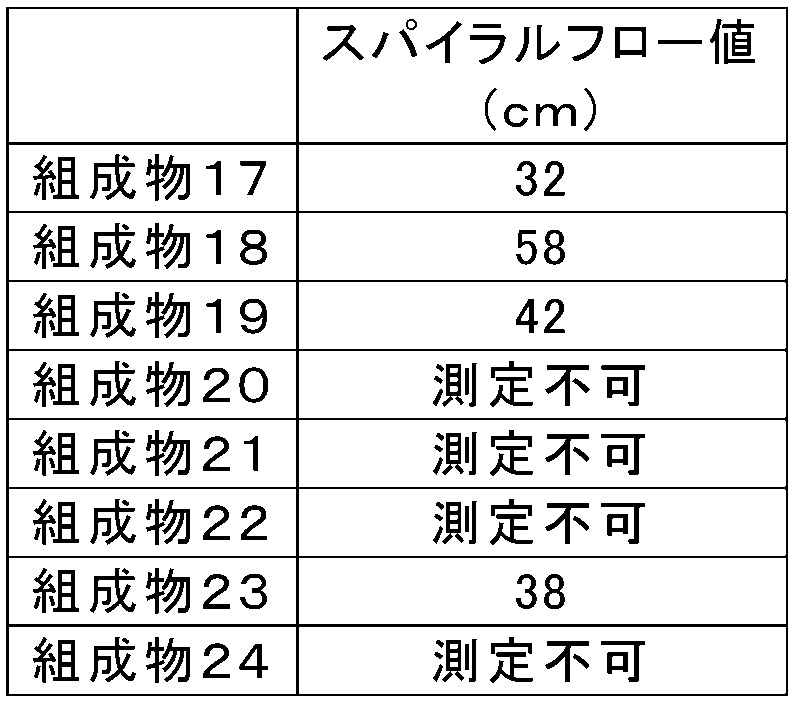
マレイミド化合物および有機溶媒であるメチルエチルケトンを含む組成物を製造した。
下記表8に従って配合し、組成物25~32を製造した。この際、得られる組成物の不揮発分(N.V.)は58質量%である。
プライ数:6
銅箔:TCR箔(厚さ:18μm、日鉱金属株式会社製)
プリプレグ化条件:160℃/2分
硬化条件:200℃、2.9MPa、2時間
成形後板厚:0.8mm、樹脂量40%
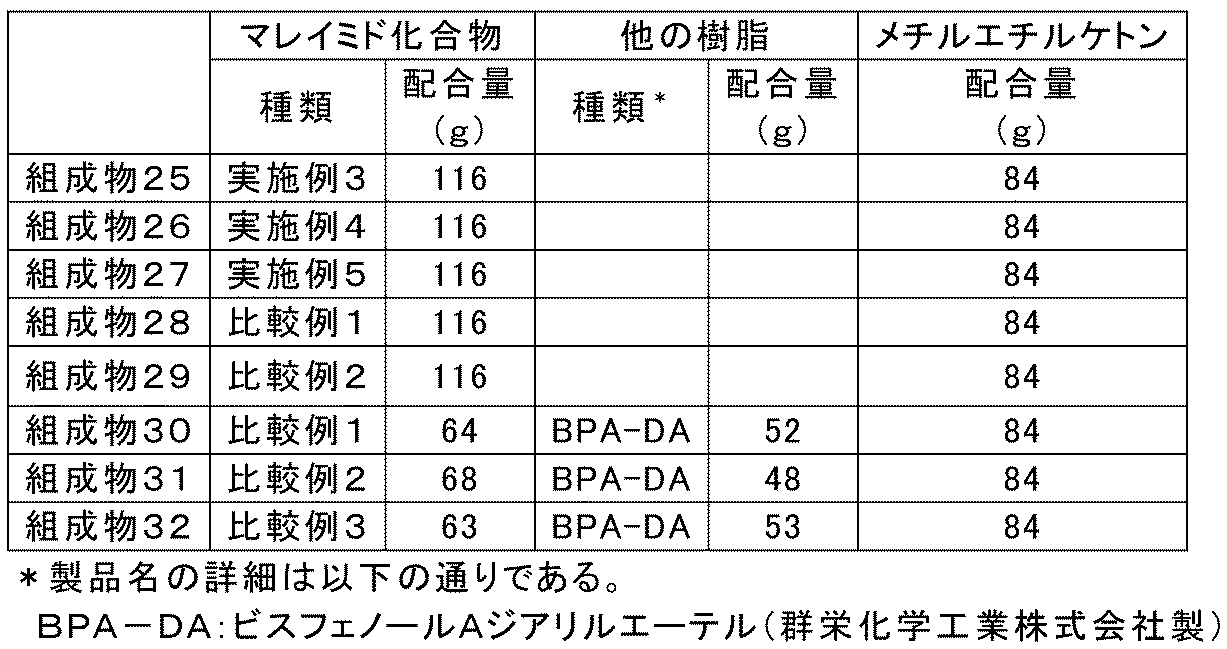
JIS C 6481:1999に準拠し、インピーダンス・マテリアル・アナライザ「HP4291B」(アジレント・テクノロジー株式会社製)により、絶乾後23℃、湿度50%の室内に24時間保管した後の積層体の1GHzでの誘電率および誘電正接を測定した。得られた結果を下記表9に示す。
積層体を85℃、85%RHの雰囲気下で168時間放置し、吸湿処理を行った。次いで、吸湿処理を行った積層体を、260℃のハンダ浴に10秒間浸漬させ、クラックの発生の有無を目視で確認した。なお、評価は以下の基準に従い行った。得られた結果を下記表9に示す。
×:クラック発生
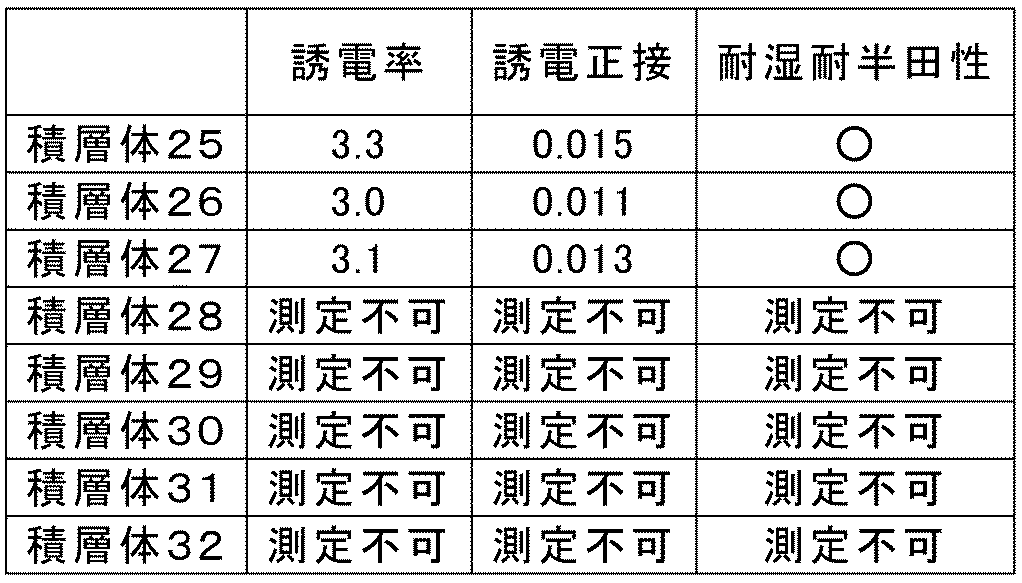
マレイミド化合物および光重合開始剤を含む組成物を製造した。
下記表10に従って配合し、組成物33~40を製造した。この際、光重合開始剤としてイルガキュア907(2-メチル-1-[4-(メチルチオ)フェニル]-2-モルホリノ-1-プロパノン、BASF社製)を用いた。

組成物をガラス基板上に厚さ50μmとなるように塗布した。次いで、50mJ/cm2から10mJ/cm2刻みで紫外線を照射し、塗膜表面がタックフリーになるまでの積算光量を測定した。得られた結果を表11に示す。

マレイミド化合物および有機溶媒であるメチルエチルケトンを含む組成物を製造した。
下記表12に従って配合し、組成物41~48を製造した。この際、得られる組成物の不揮発分(N.V.)は40質量%である。
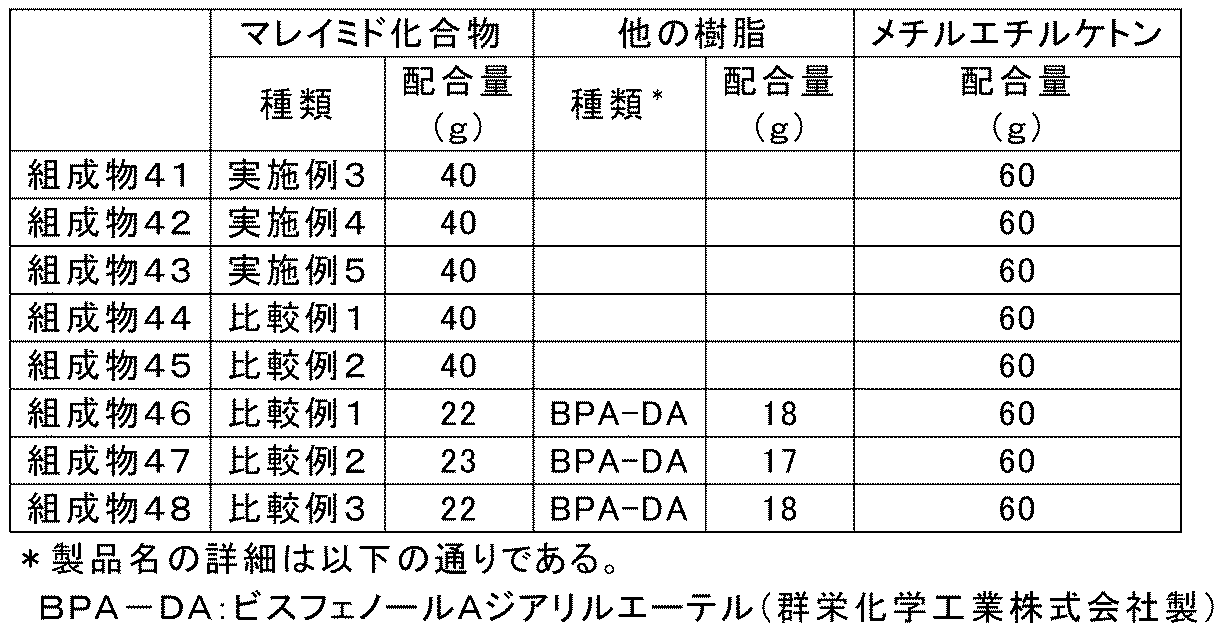
組成物を硬化後の厚さ20μmになるように基材に塗布し、250℃で2時間硬化させ、外観を目視で観察し、以下の基準に従って評価した。得られた結果を下記表13に示す。なお、基材は標準的なステンレス板(SUS-304)を用いた。
×…造膜しない
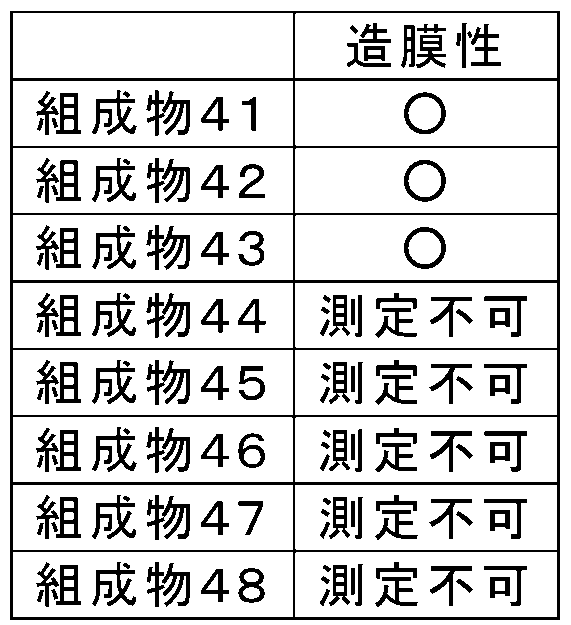
Claims (20)
- ベンゼン環を3個以上有する構造を有し、置換または非置換アリル基を有する基を1個以上有し、さらにマレイミド基を1個以上有する化合物であることを特徴とする、置換または非置換アリル基含有マレイミド化合物。
- 前記ベンゼン環を3個以上有する構造が、下記式(1-1)~(1-11)の構造のうち少なくとも1個を有する、請求項1に記載の置換または非置換アリル基含有マレイミド化合物。

ベンゼン環は置換基を有していてもよく、
X1~X10は、それぞれ独立して、直接結合、置換基を有していてもよい炭素数1~3の炭化水素基、酸素原子、硫黄原子、スルホニル基を表し、
Yは、置換基を有していてもよい炭素原子または窒素原子を表す。) - 下記式(2):
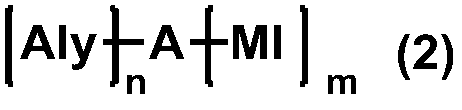
nおよびmは、それぞれ独立して、1~5の整数であり、
Alyは、下記式(3):
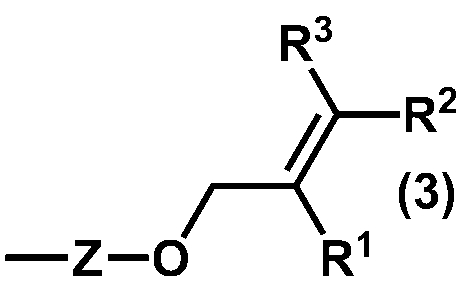
MIは下記式(4):
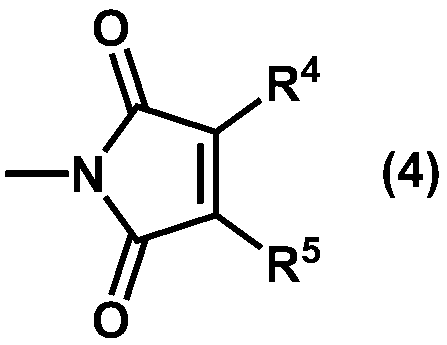
Aはベンゼン環を3個以上有する構造である。)
で表されることを特徴とする、請求項1に記載の置換または非置換アリル基含有マレイミド化合物。 - 請求項1~3のいずれか1項に記載の置換または非置換アリル基含有マレイミド化合物を含有することを特徴とする、組成物。
- さらに反応性化合物を含有する、請求項4に記載の組成物。
- 前記反応性化合物が、エポキシ基、シアナト基、マレイミド基、フェノール性水酸基、オキサジン環、アミノ基、炭素―炭素間二重結合を有する基の中から選ばれる少なくとも1つを有する化合物である、請求項5に記載の組成物。
- さらにフィラーを含有する、請求項4~6のいずれか1項に記載の組成物。
- さらに繊維質基質を含有する、請求項4~7のいずれか1項に記載の組成物。
- 請求項4~8のいずれか1項に記載の組成物を硬化してなる、硬化物。
- 基材と、請求項9に記載の硬化物の層と、を有することを特徴とする、積層体。
- 請求項4~8のいずれか1項に記載の組成物を含有することを特徴とする、耐熱材料用組成物。
- 請求項9に記載の硬化物を含有することを特徴とする、耐熱部材。
- 請求項4~8のいずれか1項に記載の組成物を含有することを特徴とする、電子材料用組成物。
- 請求項9に記載の硬化物を含有することを特徴とする、電子部材。
- 請求項4~8のいずれか1項に記載の組成物を含有することを特徴とする、半導体封止材。
- 請求項8に記載の組成物を含有することを特徴とする、プリプレグ。
- 請求項16に記載のプリプレグと、銅箔層と、を有することを特徴とする、回路基板。
- ビルドアップフィルムである、請求項10に記載の積層体。
- 請求項18に記載のビルドアップフィルムを有することを特徴とする、ビルドアップ基板。
- ベンゼン環を3個以上有する構造を有し、置換または非置換アリル基を有する基を1個以上有し、さらにマレイミド基を1個以上有する化合物であることを特徴とする、置換または非置換アリル基含有マレイミド化合物の製造方法であって、
1-1)ベンゼン環を3個以上有する水酸基含有芳香族アミノ化合物のアミノ基を保護する工程と、
1-2)1-1)で得られた化合物の水酸基に置換または非置換アリル基を導入する工程と、
1-3)1-2)で得られた化合物の保護アミノ基から脱保護する工程と、
1-4)1-3)で得られた化合物のアミノ基をマレイミド化する工程と、
を有することを特徴とする、製造方法。
Priority Applications (5)
| Application Number | Priority Date | Filing Date | Title |
|---|---|---|---|
| US16/304,875 US10981865B2 (en) | 2016-06-03 | 2017-06-01 | Substituted or unsubstituted allyl group-containing maleimide compound, production method therefor, and composition and cured product using said compound |
| CN201780034469.9A CN109219593B (zh) | 2016-06-03 | 2017-06-01 | 含有取代或未取代烯丙基的马来酰亚胺化合物及其制造方法、以及使用前述化合物的组合物及固化物 |
| KR1020187034640A KR102320490B1 (ko) | 2016-06-03 | 2017-06-01 | 치환 또는 비치환 알릴기 함유 말레이미드 화합물 및 그 제조 방법, 그리고 상기 화합물을 사용한 조성물 및 경화물 |
| JP2018520991A JP6939780B2 (ja) | 2016-06-03 | 2017-06-01 | アリル基含有マレイミド化合物およびその製造方法、並びに前記化合物を用いた組成物および硬化物 |
| EP17806786.4A EP3466925A4 (en) | 2016-06-03 | 2017-06-01 | SUBSTITUTED OR UNSUBSTITUTED ALLYL GROUP CONTAINING MALEIMIDE COMPOUND, MANUFACTURING METHOD, AND COMPOSITION AND CURED PRODUCT USING THE SAID COMPOUND |
Applications Claiming Priority (2)
| Application Number | Priority Date | Filing Date | Title |
|---|---|---|---|
| JP2016111865 | 2016-06-03 | ||
| JP2016-111865 | 2016-06-03 |
Publications (1)
| Publication Number | Publication Date |
|---|---|
| WO2017209236A1 true WO2017209236A1 (ja) | 2017-12-07 |
Family
ID=60478806
Family Applications (1)
| Application Number | Title | Priority Date | Filing Date |
|---|---|---|---|
| PCT/JP2017/020418 Ceased WO2017209236A1 (ja) | 2016-06-03 | 2017-06-01 | 置換または非置換アリル基含有マレイミド化合物およびその製造方法、並びに前記化合物を用いた組成物および硬化物 |
Country Status (7)
| Country | Link |
|---|---|
| US (1) | US10981865B2 (ja) |
| EP (1) | EP3466925A4 (ja) |
| JP (1) | JP6939780B2 (ja) |
| KR (1) | KR102320490B1 (ja) |
| CN (1) | CN109219593B (ja) |
| TW (1) | TWI737743B (ja) |
| WO (1) | WO2017209236A1 (ja) |
Cited By (7)
| Publication number | Priority date | Publication date | Assignee | Title |
|---|---|---|---|---|
| WO2018116948A1 (ja) * | 2016-12-20 | 2018-06-28 | Dic株式会社 | 組成物、硬化物および積層体 |
| WO2019167359A1 (ja) * | 2018-02-28 | 2019-09-06 | 三菱瓦斯化学株式会社 | 化合物、樹脂、組成物及びそれを用いたリソグラフィー用膜形成材料 |
| JP2021102714A (ja) * | 2019-12-25 | 2021-07-15 | Dic株式会社 | (メタ)アクリレート樹脂組成物、硬化性樹脂組成物、硬化物及び物品 |
| JP2022108927A (ja) * | 2021-01-14 | 2022-07-27 | 味の素株式会社 | 樹脂組成物 |
| JP2022108928A (ja) * | 2021-01-14 | 2022-07-27 | 味の素株式会社 | 樹脂組成物 |
| CN116218158A (zh) * | 2023-01-03 | 2023-06-06 | 万华化学(宁波)有限公司 | 一种玻璃纤维增强的可降解材料及其制备方法 |
| WO2024166319A1 (ja) * | 2023-02-09 | 2024-08-15 | 株式会社レゾナック | 半導体装置を製造する方法、半導体装置、及び硬化性樹脂組成物 |
Families Citing this family (4)
| Publication number | Priority date | Publication date | Assignee | Title |
|---|---|---|---|---|
| US20200325100A1 (en) * | 2016-06-03 | 2020-10-15 | Dic Corporation | Substituted or unsubstituted allyl group-containing maleimide compound, production method therefor, and composition and cured product using said compound |
| CN114621559B (zh) * | 2020-12-09 | 2023-07-11 | 广东生益科技股份有限公司 | 一种热固性树脂组合物及包含其的预浸料、层压板和高频电路基板 |
| CN115248983B (zh) * | 2021-04-25 | 2025-10-31 | 中国石油化工股份有限公司 | 多尺度复合材料油管的设计方法及装置 |
| CN118085153A (zh) * | 2023-08-09 | 2024-05-28 | 中山大学 | 一种丙烯酸酯化苯乙烯-马来酰亚胺共聚物及其制备方法 |
Citations (6)
| Publication number | Priority date | Publication date | Assignee | Title |
|---|---|---|---|---|
| JPS625953A (ja) * | 1985-07-01 | 1987-01-12 | ロ−ヌ−プ−ラン・スペシアリテ・シミ−ク | 新規のマレインイミド及びそれらを含有する新規の熱硬化性組成物 |
| JPS62124126A (ja) * | 1985-11-13 | 1987-06-05 | ロ−ヌ−プ−ラン・スペシアリテ・シミ−ク | イミド基を含有する重合体の製造法 |
| JPS63264566A (ja) * | 1987-04-20 | 1988-11-01 | Hitachi Ltd | 付加反応型エーテルイミド系化合物を含む組成物 |
| JPS6461457A (en) * | 1987-09-02 | 1989-03-08 | Hitachi Ltd | End ethynyl group-containing unsaturated imide compound and production thereof |
| JPH0459759A (ja) * | 1990-06-28 | 1992-02-26 | Hitachi Chem Co Ltd | 可撓性ビスイミド化合物 |
| WO2016052290A1 (ja) * | 2014-10-01 | 2016-04-07 | Dic株式会社 | エポキシ樹脂組成物及びその硬化物 |
Family Cites Families (43)
| Publication number | Priority date | Publication date | Assignee | Title |
|---|---|---|---|---|
| US3931224A (en) | 1972-09-07 | 1976-01-06 | Teijin Limited | Aromatic imidodicarboxylic acid diallyl esters, prepolymers thereof, cured resins thereof, and processes for producing these |
| US4168366A (en) | 1978-07-25 | 1979-09-18 | Plastics Engineering Company | Polyimide derivatives |
| US5364700A (en) * | 1985-12-27 | 1994-11-15 | Amoco Corporation | Prepregable resin composition and composite |
| US4924005A (en) * | 1986-12-18 | 1990-05-08 | Monsanto Company | Bismaleimide resins |
| US4861650A (en) * | 1986-12-18 | 1989-08-29 | Monsanto Company | Polyimide laminates |
| US4808646A (en) * | 1986-12-18 | 1989-02-28 | Monsanto Company | Maleimide-maleamic acid resin solution |
| US5159030A (en) | 1991-03-25 | 1992-10-27 | The Dow Chemical Company | Mesogenic alkenyl functional malemides and thermosets thereof |
| AUPM910994A0 (en) | 1994-10-28 | 1994-11-24 | Commonwealth Scientific And Industrial Research Organisation | Bisallyloxyimides |
| US7259260B2 (en) | 2001-10-22 | 2007-08-21 | Mitsui Chemicals, Inc. | Imide compound and optical recording media made by using the same |
| JP3975263B2 (ja) | 2002-02-01 | 2007-09-12 | 独立行政法人産業技術総合研究所 | ビスベンゾオキサゾール及びその製造方法 |
| GB0205256D0 (en) * | 2002-03-06 | 2002-04-17 | Oxford Glycosciences Uk Ltd | Novel compounds |
| KR100995942B1 (ko) * | 2003-04-30 | 2010-11-22 | 디아이씨 가부시끼가이샤 | 경화성 수지 조성물 |
| US7704624B2 (en) * | 2006-01-25 | 2010-04-27 | Dic Corporation | Fuel cell bipolar plate, process for producing the same, and fuel cell including the bipolar plate |
| CN101796437B (zh) * | 2007-08-28 | 2014-03-19 | Dic株式会社 | 棱镜片、采用该棱镜片的背光单元及液晶显示装置 |
| JP2011173827A (ja) | 2010-02-24 | 2011-09-08 | Mitsubishi Chemicals Corp | ビスイミドフェノール誘導体及びその製造方法並びに高分子化合物 |
| CN103619803B (zh) * | 2011-05-31 | 2016-01-20 | Dic株式会社 | 肉桂酸衍生物及其聚合物、以及由其固化物构成的液晶取向层 |
| KR101866756B1 (ko) * | 2011-06-02 | 2018-06-18 | 디아이씨 가부시끼가이샤 | 이해체성 점착제 조성물 및 이해체성 점착 테이프 |
| US20130081801A1 (en) * | 2011-10-04 | 2013-04-04 | Feng Liang | Methods for Improving Coatings on Downhole Tools |
| US9217053B2 (en) * | 2012-03-21 | 2015-12-22 | Dic Corporation | Active ester resin, thermosetting resin composition, cured product of same, semiconductor encapsulation material, prepreg, circuit board, and build-up film |
| TWI572665B (zh) * | 2012-10-17 | 2017-03-01 | Dainippon Ink & Chemicals | 活性酯樹脂、環氧樹脂組成物、其硬化物、預浸體、 電路基板以及積層膜 |
| DE112014000530T5 (de) * | 2013-01-23 | 2015-10-22 | Dic Corporation | Laminat, Leiterbild, Stromkreis und Verfahren zur Herstellung des Laminats |
| TWI634105B (zh) * | 2013-05-29 | 2018-09-01 | 迪愛生股份有限公司 | 聚合性組成物溶液、及使用其之光學異向體 |
| JP5637418B1 (ja) * | 2013-06-10 | 2014-12-10 | Dic株式会社 | リン原子含有活性エステル樹脂、エポキシ樹脂組成物、その硬化物、プリプレグ、回路基板、及びビルドアップフィルム |
| US20160202560A1 (en) * | 2013-08-14 | 2016-07-14 | Tokyo Institute Of Technology | Photo-alignment material and photo-alignment method |
| JP5850290B2 (ja) * | 2013-09-27 | 2016-02-03 | Dic株式会社 | 光学材料用樹脂組成物、光学フィルム及び液晶表示装置 |
| JP5975182B2 (ja) * | 2013-10-24 | 2016-08-23 | Dic株式会社 | 樹脂組成物、樹脂成形体、放熱材料及び放熱部材、並びにこれらの製造方法 |
| JP6333857B2 (ja) * | 2013-12-25 | 2018-05-30 | Dic株式会社 | メソゲン基を含有する化合物、それを用いた混合物、組成物、及び、光学異方体 |
| JP6509009B2 (ja) | 2014-03-28 | 2019-05-08 | 日鉄ケミカル&マテリアル株式会社 | ビスマレイミド化合物、それを含む組成物、及び硬化物 |
| US9957402B2 (en) * | 2014-05-15 | 2018-05-01 | Dic Corporation | Compound, active energy ray curable composition, cured article thereof, printing ink, and inkjet recording ink |
| KR101802218B1 (ko) * | 2014-06-02 | 2017-11-28 | 디아이씨 가부시끼가이샤 | 액정 배향막 |
| WO2016002241A1 (ja) * | 2014-06-30 | 2016-01-07 | Dic株式会社 | エポキシ樹脂、硬化性樹脂組成物、硬化物、半導体封止材料、半導体装置、プレプリグ、回路基板、ビルドアップフィルム、ビルドアップ基板、繊維強化複合材料、及び繊維強化成形品 |
| CN105992970A (zh) * | 2014-07-15 | 2016-10-05 | Dic株式会社 | 液晶显示装置 |
| KR20170105042A (ko) * | 2015-01-16 | 2017-09-18 | 디아이씨 가부시끼가이샤 | 위상차판 및 원편광판 |
| US10202470B2 (en) * | 2015-01-16 | 2019-02-12 | Dic Corporation | Polymerizable composition and optically anisotropic body using same |
| CN105153009B (zh) | 2015-06-23 | 2018-11-13 | 复旦大学 | 具有不对称分子结构的双马来酰亚胺、其制备方法及在制备复合树脂中的应用 |
| EP3321325B1 (en) * | 2015-07-06 | 2021-11-24 | Mitsubishi Gas Chemical Company, Inc. | Resin composition, prepreg, metal foil-clad laminate, and printed circuit board |
| TWI711655B (zh) * | 2015-12-02 | 2020-12-01 | 日商迪愛生股份有限公司 | 含酚性羥基之樹脂及抗蝕劑膜 |
| JP6268565B2 (ja) * | 2015-12-08 | 2018-01-31 | Dic株式会社 | オキサジン化合物、組成物及び硬化物 |
| KR102644665B1 (ko) * | 2015-12-16 | 2024-03-07 | 디아이씨 가부시끼가이샤 | 옥사진 화합물, 조성물 및 경화물 |
| JP6687445B2 (ja) * | 2016-03-30 | 2020-04-22 | 株式会社ダイセル | 熱硬化性化合物 |
| US20200325100A1 (en) * | 2016-06-03 | 2020-10-15 | Dic Corporation | Substituted or unsubstituted allyl group-containing maleimide compound, production method therefor, and composition and cured product using said compound |
| JP6950686B2 (ja) * | 2016-06-03 | 2021-10-13 | Dic株式会社 | 多環芳香族アミノフェノール化合物および樹脂組成物の製造方法、並びに前記多環芳香族アミノフェノール化合物、樹脂組成物、および硬化物 |
| EP3560968A4 (en) * | 2016-12-20 | 2020-05-27 | DIC Corporation | RESIN COMPOSITION, HARDENED PRODUCT AND LAMINATE |
-
2017
- 2017-06-01 KR KR1020187034640A patent/KR102320490B1/ko active Active
- 2017-06-01 CN CN201780034469.9A patent/CN109219593B/zh active Active
- 2017-06-01 JP JP2018520991A patent/JP6939780B2/ja active Active
- 2017-06-01 WO PCT/JP2017/020418 patent/WO2017209236A1/ja not_active Ceased
- 2017-06-01 US US16/304,875 patent/US10981865B2/en active Active
- 2017-06-01 EP EP17806786.4A patent/EP3466925A4/en not_active Withdrawn
- 2017-06-03 TW TW106118378A patent/TWI737743B/zh active
Patent Citations (6)
| Publication number | Priority date | Publication date | Assignee | Title |
|---|---|---|---|---|
| JPS625953A (ja) * | 1985-07-01 | 1987-01-12 | ロ−ヌ−プ−ラン・スペシアリテ・シミ−ク | 新規のマレインイミド及びそれらを含有する新規の熱硬化性組成物 |
| JPS62124126A (ja) * | 1985-11-13 | 1987-06-05 | ロ−ヌ−プ−ラン・スペシアリテ・シミ−ク | イミド基を含有する重合体の製造法 |
| JPS63264566A (ja) * | 1987-04-20 | 1988-11-01 | Hitachi Ltd | 付加反応型エーテルイミド系化合物を含む組成物 |
| JPS6461457A (en) * | 1987-09-02 | 1989-03-08 | Hitachi Ltd | End ethynyl group-containing unsaturated imide compound and production thereof |
| JPH0459759A (ja) * | 1990-06-28 | 1992-02-26 | Hitachi Chem Co Ltd | 可撓性ビスイミド化合物 |
| WO2016052290A1 (ja) * | 2014-10-01 | 2016-04-07 | Dic株式会社 | エポキシ樹脂組成物及びその硬化物 |
Non-Patent Citations (5)
| Title |
|---|
| CHIA-FU CHENG ET AL.: "Total synthesis of (+-)- camphorataimides and (+-)-himanimides by NaBH4/Ni(OAC)2 or Zn/AcOH stereoselective reduction", TETRAHEDRON, vol. 64, no. 19, May 2008 (2008-05-01), pages 4347 - 4353, XP022589420 * |
| ELANGO KUMARASAMY ET AL.: "Tailoring Atropisomeric Maleimides for Stereospecific [2+2] Photocycloaddition-Photochemical and Photophysical Investigations Leading to Visible-Light Photocatalysis", JOURNAL OF THE AMERICAN CHEMICAL SOCIETY, vol. 136, no. 24, 2014, pages 8729 - 8737, XP055444988 * |
| HAOYU TANG ET AL.: "Synthesis, preparation and properties of novel high-performance allyl- maleimide resins", POLYMER, vol. 50, no. 6, March 2009 (2009-03-01), pages 1414 - 1422, XP025992732 * |
| JIN WEN BIN ET AL.: "Structure-Activity Relationship Study of Permethyl Ningalin B Analogues as P-Glycoprotein Chemosensitizers", JOURNAL OF MEDICINAL CHEMISTRY, vol. 56, no. 22, November 2013 (2013-11-01), pages 9057 - 9070, XP055444990 * |
| See also references of EP3466925A4 * |
Cited By (13)
| Publication number | Priority date | Publication date | Assignee | Title |
|---|---|---|---|---|
| WO2018116948A1 (ja) * | 2016-12-20 | 2018-06-28 | Dic株式会社 | 組成物、硬化物および積層体 |
| JP7360630B2 (ja) | 2018-02-28 | 2023-10-13 | 三菱瓦斯化学株式会社 | 化合物、樹脂、組成物及びそれを用いたリソグラフィー用膜形成材料 |
| WO2019167359A1 (ja) * | 2018-02-28 | 2019-09-06 | 三菱瓦斯化学株式会社 | 化合物、樹脂、組成物及びそれを用いたリソグラフィー用膜形成材料 |
| US20210003921A1 (en) * | 2018-02-28 | 2021-01-07 | Mitsubishi Gas Chemical Company, Inc. | Compound, resin, composition, and film forming material for lithography using the same |
| JPWO2019167359A1 (ja) * | 2018-02-28 | 2021-02-18 | 三菱瓦斯化学株式会社 | 化合物、樹脂、組成物及びそれを用いたリソグラフィー用膜形成材料 |
| JP7434886B2 (ja) | 2019-12-25 | 2024-02-21 | Dic株式会社 | (メタ)アクリレート樹脂組成物、硬化性樹脂組成物、硬化物及び物品 |
| JP2021102714A (ja) * | 2019-12-25 | 2021-07-15 | Dic株式会社 | (メタ)アクリレート樹脂組成物、硬化性樹脂組成物、硬化物及び物品 |
| JP2022108928A (ja) * | 2021-01-14 | 2022-07-27 | 味の素株式会社 | 樹脂組成物 |
| JP2022108927A (ja) * | 2021-01-14 | 2022-07-27 | 味の素株式会社 | 樹脂組成物 |
| JP7770771B2 (ja) | 2021-01-14 | 2025-11-17 | 味の素株式会社 | 樹脂組成物 |
| JP7774963B2 (ja) | 2021-01-14 | 2025-11-25 | 味の素株式会社 | 樹脂組成物 |
| CN116218158A (zh) * | 2023-01-03 | 2023-06-06 | 万华化学(宁波)有限公司 | 一种玻璃纤维增强的可降解材料及其制备方法 |
| WO2024166319A1 (ja) * | 2023-02-09 | 2024-08-15 | 株式会社レゾナック | 半導体装置を製造する方法、半導体装置、及び硬化性樹脂組成物 |
Also Published As
| Publication number | Publication date |
|---|---|
| CN109219593B (zh) | 2022-04-22 |
| KR102320490B1 (ko) | 2021-11-02 |
| EP3466925A1 (en) | 2019-04-10 |
| CN109219593A (zh) | 2019-01-15 |
| US20200325101A1 (en) | 2020-10-15 |
| US10981865B2 (en) | 2021-04-20 |
| JP6939780B2 (ja) | 2021-09-22 |
| TWI737743B (zh) | 2021-09-01 |
| JPWO2017209236A1 (ja) | 2019-03-28 |
| EP3466925A4 (en) | 2019-11-13 |
| KR20190015258A (ko) | 2019-02-13 |
| TW201819359A (zh) | 2018-06-01 |
Similar Documents
| Publication | Publication Date | Title |
|---|---|---|
| US10981865B2 (en) | Substituted or unsubstituted allyl group-containing maleimide compound, production method therefor, and composition and cured product using said compound | |
| JP6547913B2 (ja) | 組成物、硬化物および積層体 | |
| KR102365456B1 (ko) | 치환 또는 비치환 알릴기 함유 말레이미드 화합물 및 그 제조 방법, 그리고 상기 화합물을 사용한 조성물 및 경화물 | |
| JP7003540B2 (ja) | 組成物および硬化物 | |
| JP6350890B2 (ja) | オキサジン化合物、組成物及び硬化物 | |
| JP6268566B2 (ja) | オキサジン化合物、組成物及び硬化物 | |
| JP6697183B2 (ja) | オキサジン化合物、組成物及び硬化物 | |
| JP6350889B2 (ja) | オキサジン化合物、組成物及び硬化物 | |
| JP6977257B2 (ja) | 水酸基含有マレイミド化合物 | |
| JP6268565B2 (ja) | オキサジン化合物、組成物及び硬化物 | |
| JP6886593B2 (ja) | 水酸基含有マレイミド化合物 |
Legal Events
| Date | Code | Title | Description |
|---|---|---|---|
| ENP | Entry into the national phase |
Ref document number: 2018520991 Country of ref document: JP Kind code of ref document: A |
|
| 121 | Ep: the epo has been informed by wipo that ep was designated in this application |
Ref document number: 17806786 Country of ref document: EP Kind code of ref document: A1 |
|
| ENP | Entry into the national phase |
Ref document number: 20187034640 Country of ref document: KR Kind code of ref document: A |
|
| NENP | Non-entry into the national phase |
Ref country code: DE |
|
| ENP | Entry into the national phase |
Ref document number: 2017806786 Country of ref document: EP Effective date: 20190103 |