WO2017210165A1 - Methods for producing solvents derived from 1-chloro-3, 3, 3-trifluoro-propene (1233zd) - Google Patents
Methods for producing solvents derived from 1-chloro-3, 3, 3-trifluoro-propene (1233zd) Download PDFInfo
- Publication number
- WO2017210165A1 WO2017210165A1 PCT/US2017/034953 US2017034953W WO2017210165A1 WO 2017210165 A1 WO2017210165 A1 WO 2017210165A1 US 2017034953 W US2017034953 W US 2017034953W WO 2017210165 A1 WO2017210165 A1 WO 2017210165A1
- Authority
- WO
- WIPO (PCT)
- Prior art keywords
- alcohol
- chloro
- propene
- catalyst
- trifluoro
- Prior art date
- Legal status (The legal status is an assumption and is not a legal conclusion. Google has not performed a legal analysis and makes no representation as to the accuracy of the status listed.)
- Ceased
Links
Classifications
-
- C—CHEMISTRY; METALLURGY
- C07—ORGANIC CHEMISTRY
- C07C—ACYCLIC OR CARBOCYCLIC COMPOUNDS
- C07C41/00—Preparation of ethers; Preparation of compounds having groups, groups or groups
- C07C41/01—Preparation of ethers
-
- A—HUMAN NECESSITIES
- A62—LIFE-SAVING; FIRE-FIGHTING
- A62D—CHEMICAL MEANS FOR EXTINGUISHING FIRES OR FOR COMBATING OR PROTECTING AGAINST HARMFUL CHEMICAL AGENTS; CHEMICAL MATERIALS FOR USE IN BREATHING APPARATUS
- A62D1/00—Fire-extinguishing compositions; Use of chemical substances in extinguishing fires
- A62D1/0028—Liquid extinguishing substances
-
- A—HUMAN NECESSITIES
- A62—LIFE-SAVING; FIRE-FIGHTING
- A62D—CHEMICAL MEANS FOR EXTINGUISHING FIRES OR FOR COMBATING OR PROTECTING AGAINST HARMFUL CHEMICAL AGENTS; CHEMICAL MATERIALS FOR USE IN BREATHING APPARATUS
- A62D1/00—Fire-extinguishing compositions; Use of chemical substances in extinguishing fires
- A62D1/0028—Liquid extinguishing substances
- A62D1/0057—Polyhaloalkanes
-
- C—CHEMISTRY; METALLURGY
- C07—ORGANIC CHEMISTRY
- C07C—ACYCLIC OR CARBOCYCLIC COMPOUNDS
- C07C41/00—Preparation of ethers; Preparation of compounds having groups, groups or groups
- C07C41/01—Preparation of ethers
- C07C41/05—Preparation of ethers by addition of compounds to unsaturated compounds
- C07C41/06—Preparation of ethers by addition of compounds to unsaturated compounds by addition of organic compounds only
-
- C—CHEMISTRY; METALLURGY
- C07—ORGANIC CHEMISTRY
- C07C—ACYCLIC OR CARBOCYCLIC COMPOUNDS
- C07C41/00—Preparation of ethers; Preparation of compounds having groups, groups or groups
- C07C41/01—Preparation of ethers
- C07C41/18—Preparation of ethers by reactions not forming ether-oxygen bonds
- C07C41/24—Preparation of ethers by reactions not forming ether-oxygen bonds by elimination of halogens, e.g. elimination of HCl
-
- C—CHEMISTRY; METALLURGY
- C09—DYES; PAINTS; POLISHES; NATURAL RESINS; ADHESIVES; COMPOSITIONS NOT OTHERWISE PROVIDED FOR; APPLICATIONS OF MATERIALS NOT OTHERWISE PROVIDED FOR
- C09K—MATERIALS FOR MISCELLANEOUS APPLICATIONS, NOT PROVIDED FOR ELSEWHERE
- C09K13/00—Etching, surface-brightening or pickling compositions
-
- C—CHEMISTRY; METALLURGY
- C09—DYES; PAINTS; POLISHES; NATURAL RESINS; ADHESIVES; COMPOSITIONS NOT OTHERWISE PROVIDED FOR; APPLICATIONS OF MATERIALS NOT OTHERWISE PROVIDED FOR
- C09K—MATERIALS FOR MISCELLANEOUS APPLICATIONS, NOT PROVIDED FOR ELSEWHERE
- C09K21/00—Fireproofing materials
- C09K21/06—Organic materials
-
- C—CHEMISTRY; METALLURGY
- C09—DYES; PAINTS; POLISHES; NATURAL RESINS; ADHESIVES; COMPOSITIONS NOT OTHERWISE PROVIDED FOR; APPLICATIONS OF MATERIALS NOT OTHERWISE PROVIDED FOR
- C09K—MATERIALS FOR MISCELLANEOUS APPLICATIONS, NOT PROVIDED FOR ELSEWHERE
- C09K3/00—Materials not provided for elsewhere
-
- C—CHEMISTRY; METALLURGY
- C09—DYES; PAINTS; POLISHES; NATURAL RESINS; ADHESIVES; COMPOSITIONS NOT OTHERWISE PROVIDED FOR; APPLICATIONS OF MATERIALS NOT OTHERWISE PROVIDED FOR
- C09K—MATERIALS FOR MISCELLANEOUS APPLICATIONS, NOT PROVIDED FOR ELSEWHERE
- C09K3/00—Materials not provided for elsewhere
- C09K3/30—Materials not provided for elsewhere for aerosols
-
- C—CHEMISTRY; METALLURGY
- C09—DYES; PAINTS; POLISHES; NATURAL RESINS; ADHESIVES; COMPOSITIONS NOT OTHERWISE PROVIDED FOR; APPLICATIONS OF MATERIALS NOT OTHERWISE PROVIDED FOR
- C09K—MATERIALS FOR MISCELLANEOUS APPLICATIONS, NOT PROVIDED FOR ELSEWHERE
- C09K5/00—Heat-transfer, heat-exchange or heat-storage materials, e.g. refrigerants; Materials for the production of heat or cold by chemical reactions other than by combustion
- C09K5/02—Materials undergoing a change of physical state when used
- C09K5/04—Materials undergoing a change of physical state when used the change of state being from liquid to vapour or vice versa
- C09K5/041—Materials undergoing a change of physical state when used the change of state being from liquid to vapour or vice versa for compression-type refrigeration systems
- C09K5/044—Materials undergoing a change of physical state when used the change of state being from liquid to vapour or vice versa for compression-type refrigeration systems comprising halogenated compounds
-
- C—CHEMISTRY; METALLURGY
- C09—DYES; PAINTS; POLISHES; NATURAL RESINS; ADHESIVES; COMPOSITIONS NOT OTHERWISE PROVIDED FOR; APPLICATIONS OF MATERIALS NOT OTHERWISE PROVIDED FOR
- C09K—MATERIALS FOR MISCELLANEOUS APPLICATIONS, NOT PROVIDED FOR ELSEWHERE
- C09K5/00—Heat-transfer, heat-exchange or heat-storage materials, e.g. refrigerants; Materials for the production of heat or cold by chemical reactions other than by combustion
- C09K5/02—Materials undergoing a change of physical state when used
- C09K5/04—Materials undergoing a change of physical state when used the change of state being from liquid to vapour or vice versa
- C09K5/041—Materials undergoing a change of physical state when used the change of state being from liquid to vapour or vice versa for compression-type refrigeration systems
- C09K5/044—Materials undergoing a change of physical state when used the change of state being from liquid to vapour or vice versa for compression-type refrigeration systems comprising halogenated compounds
- C09K5/045—Materials undergoing a change of physical state when used the change of state being from liquid to vapour or vice versa for compression-type refrigeration systems comprising halogenated compounds containing only fluorine as halogen
-
- C—CHEMISTRY; METALLURGY
- C10—PETROLEUM, GAS OR COKE INDUSTRIES; TECHNICAL GASES CONTAINING CARBON MONOXIDE; FUELS; LUBRICANTS; PEAT
- C10M—LUBRICATING COMPOSITIONS; USE OF CHEMICAL SUBSTANCES EITHER ALONE OR AS LUBRICATING INGREDIENTS IN A LUBRICATING COMPOSITION
- C10M131/00—Lubricating compositions characterised by the additive being an organic non-macromolecular compound containing halogen
- C10M131/08—Lubricating compositions characterised by the additive being an organic non-macromolecular compound containing halogen containing carbon, hydrogen, halogen and oxygen
- C10M131/10—Alcohols; Ethers; Aldehydes; Ketones
-
- C—CHEMISTRY; METALLURGY
- C11—ANIMAL OR VEGETABLE OILS, FATS, FATTY SUBSTANCES OR WAXES; FATTY ACIDS THEREFROM; DETERGENTS; CANDLES
- C11D—DETERGENT COMPOSITIONS; USE OF SINGLE SUBSTANCES AS DETERGENTS; SOAP OR SOAP-MAKING; RESIN SOAPS; RECOVERY OF GLYCEROL
- C11D3/00—Other compounding ingredients of detergent compositions covered in group C11D1/00
- C11D3/43—Solvents
-
- C—CHEMISTRY; METALLURGY
- C11—ANIMAL OR VEGETABLE OILS, FATS, FATTY SUBSTANCES OR WAXES; FATTY ACIDS THEREFROM; DETERGENTS; CANDLES
- C11D—DETERGENT COMPOSITIONS; USE OF SINGLE SUBSTANCES AS DETERGENTS; SOAP OR SOAP-MAKING; RESIN SOAPS; RECOVERY OF GLYCEROL
- C11D7/00—Compositions of detergents based essentially on non-surface-active compounds
- C11D7/50—Solvents
- C11D7/5004—Organic solvents
- C11D7/5018—Halogenated solvents
-
- C—CHEMISTRY; METALLURGY
- C09—DYES; PAINTS; POLISHES; NATURAL RESINS; ADHESIVES; COMPOSITIONS NOT OTHERWISE PROVIDED FOR; APPLICATIONS OF MATERIALS NOT OTHERWISE PROVIDED FOR
- C09K—MATERIALS FOR MISCELLANEOUS APPLICATIONS, NOT PROVIDED FOR ELSEWHERE
- C09K2205/00—Aspects relating to compounds used in compression type refrigeration systems
- C09K2205/10—Components
- C09K2205/11—Ethers
- C09K2205/112—Halogenated ethers
-
- C—CHEMISTRY; METALLURGY
- C09—DYES; PAINTS; POLISHES; NATURAL RESINS; ADHESIVES; COMPOSITIONS NOT OTHERWISE PROVIDED FOR; APPLICATIONS OF MATERIALS NOT OTHERWISE PROVIDED FOR
- C09K—MATERIALS FOR MISCELLANEOUS APPLICATIONS, NOT PROVIDED FOR ELSEWHERE
- C09K2205/00—Aspects relating to compounds used in compression type refrigeration systems
- C09K2205/24—Only one single fluoro component present
Definitions
- the present disclosure relates to the production of solvents for use in applications such as heat transfer, cleaning and degreasing, for example and, in particular, the present disclosure relates to the production of solvents that are derived from 1 -chioro-3,3,3-trifluoro-propene.
- 1233zd is non-flammable, has a low global warming potential (GWP), and low toxicity. 1233zd is also an effective solvent for a number of organic substances, such as different kinds of oils and greases, making 1233zd useful as a cleaning and degreasing solvent
- 1233zd has a low boiling point (19°C for the trans isomer)
- 1233zd is typically transported and dispensed from a high pressure cylinder package, which may be costly and may require complex process integration steps with existing machinery and tooling, as well as training of personnel.
- the low boiling point of 1233zd may also result in higher vapor loss, potentially leading to a higher rate of consumption, in addition to potential challenges relating to the low boiling point of 1233zd, there is some concern in certain use applications regarding the chlorine atom in the molecule, for example, in the electronics manufacturing industry where halogen-free reagents and solvents may be desired.
- Solvents based on 1233zd which exhibit one or more of the properties of non-chlorine containing, low GWP, low toxicity, and non-flammability are desired.
- the present disclosure relates to the production of solvents for applications such as heat transfer, cleaning, and degreasing, for example.
- the present disclosure relates the production of solvents derived from 1 - chloro-3, 3, 3-trifluoro-propene, such as chloro and/or fluoro substituted alkanes and chloro and/or fluoro substituted trif!uoropropenyi ethers.
- the present disclosure provides a method for producing a product according to one of formulas:
- n 1 to 5;
- x, y, and z are each 0 to 1 1 and y+z > 1 ;
- x+y+z 2(n-m)+1 , wherein m is an integer of 0 to 2, the method comprising the step of reacting a reaction mixture including an alcohol, a catalyst, and 1 -chloro- 3, 3, 3-trifluoro-propene (1233zd).
- the alcohol may be an alcohol according to the following formula:
- n 1 to 5;
- x, y, and z are each 0 to 1 1 and y+z > 1 ;
- the alcohol may be selected from the group consisting of
- fluoromethanol 2,2,2-trifiuoroethanoi, 3,3,3-trifluoro-l -propanol, 2,2,3, 3-tetrafluoro-1 - propanol, 2,2,3,3,4,4,5,5-octafiuoropentanoi, and 1 , 1 , 1 ,3,3,3-hexafluoro-propan-2-oi.
- the catalyst may be an alkaline catalyst and, in particular, may include at least one alkali hydroxide selected from the group consisting of sodium hydroxide and potassium hydroxide and a combination thereof.
- the method may further include, after the reacting step, the additional step of separating the product of from the reaction mixture.
- the reacting step may further include heating the reaction mixture.
- the reacting step may further include the additional steps of: mixing the alcohol and the catalyst in a reaction vessel; and after the mixing step, adding 1 -chloro-3,3,3-trifluoro-propene (1233zd) to the reaction vessel.
- the 1 -chloro-3,3,3-trifluoro-propene (1233zd) may be either the trans isomer of 1 -chloro-3,3,3-trifluoro-propene (1233zd) or the cis isomer of 1 -chioro- 3,3,3-trifluoro-propene (1233zd).
- the product of the method may have the following formula: wherein:
- n 1 to 5;
- x, y, and z are each 0 to 1 1 and y+z > 1 ;
- x+y+z 2(n-m)+1 , wherein m is an integer of 0 to 2, said method comprising the step of reacting a reaction mixture including an alcohol, a catalyst, and 1 -chioro- 3,3,3-trifluoro-propene (1233zd).
- the alcohol may be an alcohol according to the following formula: wherein:
- n 1 to 5;
- x, y, and z are each 0 to 1 1 and y+z > 1 ;
- the alcohol may be selected from the group consisting of
- the product of the method may have the following formula:
- n 1 to 5;
- the alcohol may be an alcohol according to the following formula: wherein:
- n 1 to 5;
- x, y, and z are each 0 to 1 1 and y+z > 1 ;
- the alcohol may be selected from the group consisting of
- the present disclosure provides a liquid composition including at least one solvent selected from formulas (I) and (II):
- n 1 to 5;
- x, y, and z are each 0 to 1 1 and y+z ⁇ 1 ;
- x+y+z 2(n-m)+1 , wherein m is an integer of 0 to 2, said method comprising the step of reacting a reaction mixture including an alcohol, a catalyst, and 1 -chloro- 3,3,3-trifluoro-propene (1233zd); and at least one solvent having a boiling point between 2Q-25Q°C.
- the solvent may have a boiling pint between 20-100°C or between 25- 70°C, and at least one solvent may have an ozone depletion potential (ODP) of not greater than about 0.5.
- ODP ozone depletion potential
- the present disclosure relates to the production of solvents for applications such as heat transfer, cleaning, and degreasing, for example.
- the present disclosure relates the production of solvents derived from 1 - chiorQ-3,3,3-trifluoro-propene, such as chloro and/or fluoro substituted alkanes and chloro and/or fluoro substituted trifluoropropenyl ethers.
- 1 -chloro-3,3,3-trifluoro-propene is a non-flammable, low GWP, low toxicity solvent.
- the chemical structure of 1233zd is set forth in formula (I) below:
- 1233zd exists as a trans isomer, as shown in formula (I) above, in which the CF3 and Ci groups are on opposite sides of the double bond with respect to the longest chain of carbon atoms, and as a cis isomer, shown formula (II) below, in which the CF3 and CI groups are on the same side of the double bond with respect to the longest chain of carbon atoms:
- the trans isomer has a boiling point of 19°C, while the cis isomer has a boiling point of 40°C.
- the 1233zd starting material is reacted with an alcohol and a catalyst according to the overall reaction (1 ) below, in which the alcohol is exemplified as fluoromethanoi (CH2FOH) and the catalyst is exemplified as potassium hydroxide:
- Suitable alcohols for use with the present methods may be generally described by the following chemical formula:
- n 1 to 5;
- the alcohol may be a chloro-alcohol, a fluoro-alcohol, or a chloro/fluoro-alcohol, having constituent carbons are at least partially substituted with chlorine, fluorine, or both chlorine and fluorine atoms.
- Exemplary fluoro-aicohois include, e.g., fluoromethanol (CH2FOH), 2,2,2- trifluoroethanol (CF3CH2OH), 3,3,3-trifluoro-l -propanol (CF3CH2CH2OH), 2,2,3,3- tetrafluoro-1 -propanoi (CHF2CF2CH2OH), 2,2,3,3,4,4,5,5-octafluoropentanol (CHF2CF2CF2CF2CH2OH), and 1 , 1 , 1 ,3,3,3-hexafluoro-propan-2-ol ((CF 3 ) 2 CHOH).
- fluoromethanol CH2FOH
- CF3CH2OH 2,2,2- trifluoroethanol
- CF3CH2OH 3,3,3-trifluoro-l -propanol
- CHF2CF2CH2OH 2,2,3,3- tetrafluoro-1 -propanoi
- the alcohol functions as a solvent for the reaction, and as a chlorine substituent to replace the chlorine atom of 1233zd to form an alkoxy group.
- the catalyst may be an alkaline catalyst, such as an alkali hydroxide including, for example, sodium hydroxide (NaOH) and/or potassium hydroxide (KOH), and functions in part to absorb the chlorine atom which is removed from 1233zd.
- an alkali hydroxide including, for example, sodium hydroxide (NaOH) and/or potassium hydroxide (KOH)
- KOH potassium hydroxide
- the molar ratio of 1233zd to alcohol may be 10: 1 to 1 :20 and the molar ratio of 1233zd to catalyst may be 100:1 to 1 :5. In one particular embodiment, the molar ratio of 1233zd to alcohol to catalyst is about 1 :4: 1 .2.
- the reaction may be initiated by first combining the catalyst and the alcohol in a reaction vessel, such as an autoclave, with stirring, followed by adding the 1233zd to the reaction vessel with continued stirring.
- a reaction vessel such as an autoclave
- reaction (2) in a first stage addition reaction, set forth as reaction (2) below and again exemplified in connection with fluoromethanol as the alcohol, the alcohol adds across the double bond of 1233zd, typically with high selectivity for the addition of the alcohol to the number 3 carbon opposite the double bond from the CF3 group, to form an intermediate aikane:
- the carbon(s) of the intermediate aikane may be substituted with chlorine, fluorine, or both chlorine and fluorine.
- Reaction (2) is exothermic and typically spontaneous, and a cooling medium may be employed during the reaction, such as a cold water bath, for example, or the reaction may be conducted in a cooled environment.
- alkane intermediate products of the first stage addition reaction may be described by the following chemical formula:
- n 1 to 5;
- x, y, and z are each 0 to 1 1 and y+z > 1 ;
- x+y+z 2(n-m)+1 , wherein m is an integer of 0 to 2,
- reaction (3) in a second stage elimination (or dehydrohalogenation) reaction following reaction (2), set forth as reaction (3) below and again exemplified in connection with fiuoromethanoi as the alcohol and potassium hydroxide as the catalyst, a trifluoropropene ether is produced when the alkane intermediate loses the chlorine atom and a hydrogen atom to re-form the double bond between the number 2 and 3 carbons:
- reaction (3) above is endothermic and, in one embodiment, the reaction vessel may be heated as needed to initiate and/or perpetuate the reaction.
- the number of carbon(s) of the trifluoropropene ether may vary, and may be substituted with chlorine, fluorine, or both chlorine and fluorine.
- the trifluoropropene ether products of the second stage elimination reaction may be described by the following chemical formula:
- n 1 to 5;
- x, y, and z are each 0 to 1 1 and y+z > 1 ;
- x+y+z 2(n-m)+1 , wherein m is an integer of 0 to 2.
- the products of the first and second stage reactions may be separated from the reaction mixture and/or other products by suitable means depending on their chemical structure and/or boiling point, such as filtration, extraction with water or other solvent and/or distillation, such as atmospheric distillation and/or reduced pressure distillation, for example,
- the products of the first and second stage reactions will have a higher molecular weight, and therefore a higher boiling point, than 1233zd and, in many cases, such products will have a boiling point higher than room temperature (between 15 °C and 25 °C), thereby facilitating use of the products as solvents in many potential applications.
- the products of the first and second stage reactions i.e., the disclosed compounds, exhibit one or more, and may exhibit ail, of the following properties: chemical stability; no substantial ozone depleting potential (ODP); relatively high degree of miscibiiity with common contaminants, particularly mineral oil and/or silicone oil; low or no fiammabiSity; low or no toxicity: and low or no global warming potential (GWP).
- ODP ozone depleting potential
- GWP global warming potential
- the disclosed compounds may have: no substantial ozone depletion potential, preferably an ODP of not greater than about 0.5, not greater than about 0.25, or not greater than about 0.1 ; a GWP of not greater than about 150, or not greater than about 50.
- the disclosed compounds have a normal boiling point as low as 20°C, 25°C, 45°C or 50°C or as high as 60°C, 70°C, 100°C or 250°C, or within any range defined between any two of the foregoing values, such as from 20°C to 70°C, from 45°C to 60°C, or from 50°C to 80°C, for example.
- the disclosed compounds may also have no flash point as measured by one of the standard flash point methods, for example ASTM-1310-86 "Flash point of liquids by tag Open-cup apparatus" and an atmospheric lifetime of not greater than about 100 days, such as not greater than about 50 days.
- the disclosed compound are miscible with greater than 20% by weight of mineral oil and/or silicone oil, such as in a weight ratio in the range of at least about 80:20 to about 20:80, or in substantially all proportions,
- the disclosed compounds may exhibit a relatively low toxicity value.
- ODP is defined in the "Scientific Assessment of Ozone Depletion, 2002", a report of the World Meteorological association, incorporated herein by reference.
- GWP is defined relative to that of carbon dioxide and over a 100 year time horizon, and defined in the same reference as for the ODP mentioned above.
- miscibiiity is measured in accordance with visuai evaluation of phase formation or separation when two liquids are mixed together, as is known to those skilled in the art.
- the disclosed compounds thus generally possess properties and characteristics that are highly desirable for use in connection with many different applications, including many different types of cleaning and contaminant removal applications.
- the disclosed compounds may be used in liquid compositions, either alone or with one or more co-solvents, as cleaning solvents for greases, oils, waxes and the like, for use in mechanical part cleaning, precision cleaning and/or electronics cleaning, such as cleaning electric motors, compressors, heavy metal parts, delicate precision metal parts, printed circuit boards, gyroscopes, guidance systems, aerospace and missile hardware, aluminum parts and the like.
- Other applications include degreasing, dry-cleaning, solvent etching, and as a solvent for aerosols or other sprayable compositions, as carrier solvents for lubricants, or other surface treatment applications,
- the disclosed compounds may be used as solvents in vapor degreasing methods, in which an article to be cleaned is exposed to a solvent vapor, preferably at or above room temperature, to remove grease or other contaminants from the surface of the article or alternatively, in liquid degreasing operations, in which an article to be cleaned is exposed to the solvent in liquid form by immersing the article in the liquid solvent, typically at an elevated temperature approaching the boiling point of the solvent.
- the solvents disclosed herein may be formulated with other components, such as a C1-C3 alcohol and/or a C4-C6 hydrocarbon, to form a composition useful for removing ink or ink-based markings from the surfaces of articles of manufacture, such as optical lenses, electromechanical or electrical parts, before the parts are packaged and commercially sold without damaging the underlying surfaces of the articles themselves.
- the articles and their surfaces may be metal or metal-based, cellulose-based, silica-based, or made from a plastic polymeric material, and the solvents may be in the form of a liquid, aerosol and/or sprayable composition.
- the disclosed compounds may also be used as a heat transfer medium, flame suppressing agent, or foam blowing agent, for example.
- the disclosed compounds may be used as heat transfer fluids in methods and systems for transferring heat, such as refrigerants used in refrigeration, air conditioning and heat pump systems, and well as fire suppressants, such as additives to reduce the flammability of fluids, and as components involved in the formation of foam, foam premixes, foam products and blowing agents for foams.
- heat such as refrigerants used in refrigeration, air conditioning and heat pump systems
- fire suppressants such as additives to reduce the flammability of fluids, and as components involved in the formation of foam, foam premixes, foam products and blowing agents for foams.
Landscapes
- Chemical & Material Sciences (AREA)
- Organic Chemistry (AREA)
- Engineering & Computer Science (AREA)
- Chemical Kinetics & Catalysis (AREA)
- Materials Engineering (AREA)
- Oil, Petroleum & Natural Gas (AREA)
- Thermal Sciences (AREA)
- Physics & Mathematics (AREA)
- Combustion & Propulsion (AREA)
- General Chemical & Material Sciences (AREA)
- Life Sciences & Earth Sciences (AREA)
- Wood Science & Technology (AREA)
- Emergency Management (AREA)
- Business, Economics & Management (AREA)
- Dispersion Chemistry (AREA)
- Organic Low-Molecular-Weight Compounds And Preparation Thereof (AREA)
- Catalysts (AREA)
- Low-Molecular Organic Synthesis Reactions Using Catalysts (AREA)
Abstract
The production of solvents for applications such as heat transfer, cleaning, and degreasing, for example. In particular, the production of solvents derived from 1-chloro-3,3,3-trifluoro-propene, such as chloro and/or fluoro substituted alkanes and chloro and/or fluoro substituted trifluoropropenyl ethers.
Description
METHODS FOR PRODUCING SOLVENTS DERIVED FROM
1 -CHLORO-3,3,3-TRIFLUORO-PROPENE (1233zd)
Cross reference to related applications
[0001] This application claims the benefit under Title 35, U.S.C. §1 19(e) of U.S. Provisional Patent Application Serial No. 62/345, 1 17, entitled METHODS FOR PRODUCING SOLVENTS DERIVED FROM 1 -CHLORQ-3,3,3-TRIFLUORO- PROPENE (1233zd), filed on June 3, 2018, the entire disclosure of which is expressly incorporated by reference herein.
BACKGROUND
[0002] The present disclosure relates to the production of solvents for use in applications such as heat transfer, cleaning and degreasing, for example and, in particular, the present disclosure relates to the production of solvents that are derived from 1 -chioro-3,3,3-trifluoro-propene.
[0003] 1 -chloro-3,3,3-trifluoro-propene (CF3CH=CHCI, also known as 1233zd) may be used as heat transfer fluid, as well as a cleaning solvent or a carrier solvent. Advantageously, 1233zd is non-flammable, has a low global warming potential (GWP), and low toxicity. 1233zd is also an effective solvent for a number of organic substances, such as different kinds of oils and greases, making 1233zd useful as a cleaning and degreasing solvent
[0004] However, because 1233zd has a low boiling point (19°C for the trans isomer), when 1233zd is used as a solvent, challenges are presented in connection with handling and operation. For example, 1233zd is typically transported and dispensed from a high pressure cylinder package, which may be costly and may require complex process integration steps with existing machinery and tooling, as well as training of personnel. The low boiling point of 1233zd may also result in higher vapor loss, potentially leading to a higher rate of consumption, in addition to potential challenges relating to the low boiling point of 1233zd, there is some concern in certain use applications regarding the chlorine atom in the molecule, for example, in the electronics manufacturing industry where halogen-free reagents and solvents may be desired.
[0005] Solvents based on 1233zd which exhibit one or more of the properties of non-chlorine containing, low GWP, low toxicity, and non-flammability are desired.
SUMMARY
[0006] The present disclosure relates to the production of solvents for applications such as heat transfer, cleaning, and degreasing, for example. In particular, the present disclosure relates the production of solvents derived from 1 - chloro-3, 3, 3-trifluoro-propene, such as chloro and/or fluoro substituted alkanes and chloro and/or fluoro substituted trif!uoropropenyi ethers.
[0007] in one form thereof, the present disclosure provides a method for producing a product according to one of formulas:

wherein:
n is 1 to 5;
x, y, and z are each 0 to 1 1 and y+z > 1 ; and
x+y+z = 2(n-m)+1 , wherein m is an integer of 0 to 2, the method comprising the step of reacting a reaction mixture including an alcohol, a catalyst, and 1 -chloro- 3, 3, 3-trifluoro-propene (1233zd).
[0008] The alcohol may be an alcohol according to the following formula:

wherein:
n is 1 to 5;
x, y, and z are each 0 to 1 1 and y+z > 1 ; and
x+y+z = 2n+1 for a saturated alcohol; or
x+y+z = 2n-1 for an unsaturated alcohol.
[0009] The alcohol may be selected from the group consisting of
fluoromethanol, 2,2,2-trifiuoroethanoi, 3,3,3-trifluoro-l -propanol, 2,2,3, 3-tetrafluoro-1 - propanol, 2,2,3,3,4,4,5,5-octafiuoropentanoi, and 1 , 1 , 1 ,3,3,3-hexafluoro-propan-2-oi.
[0010] The catalyst may be an alkaline catalyst and, in particular, may include at least one alkali hydroxide selected from the group consisting of sodium hydroxide and potassium hydroxide and a combination thereof.
[0011] The method may further include, after the reacting step, the additional step of separating the product of from the reaction mixture. The reacting step may further include heating the reaction mixture. The reacting step may further include the additional steps of: mixing the alcohol and the catalyst in a reaction vessel; and after the mixing step, adding 1 -chloro-3,3,3-trifluoro-propene (1233zd) to the reaction vessel.
[0012] The 1 -chloro-3,3,3-trifluoro-propene (1233zd) may be either the trans isomer of 1 -chloro-3,3,3-trifluoro-propene (1233zd) or the cis isomer of 1 -chioro- 3,3,3-trifluoro-propene (1233zd).
[0013] The product of the method may have the following formula: wherein:

n is 1 to 5;
x, y, and z are each 0 to 1 1 and y+z > 1 ; and
x+y+z = 2(n-m)+1 , wherein m is an integer of 0 to 2, said method comprising the step of reacting a reaction mixture including an alcohol, a catalyst, and 1 -chioro- 3,3,3-trifluoro-propene (1233zd).
[0014] The alcohol may be an alcohol according to the following formula: wherein:

n is 1 to 5;
x, y, and z are each 0 to 1 1 and y+z > 1 ; and
x+y+z = 2n+1 for a saturated alcohol; or
x+y+z = 2n-1 for an unsaturated alcohol.
[0015] The alcohol may be selected from the group consisting of
fluoromethanol, 2,2,2-trifiuoroethanoi, 3,3,3-trifluoro-l -propanoi, 2,2,3,3-tefrafiuoro-1 - propanol, 2,2,3,3,4,4, 5, 5-octafiuoropentanoi, and 1 , 1 , 1 ,3,3,3-hexafluoro-propan-2-ol.
[0016] The product of the method may have the following formula:

wherein:
n is 1 to 5;
x, y, and z are each 0 to 1 1 and y+z > 1 ; and
x+y+z = 2(n-m)+1 , wherein m is an integer of 0 to 2, said method comprising the step of reacting a reaction mixture including an alcohol, a catalyst, and 1 -chloro- 3,3,3-trifluoro-propene (1233zd).
[0017] The alcohol may be an alcohol according to the following formula: wherein:

n is 1 to 5;
x, y, and z are each 0 to 1 1 and y+z > 1 ; and
x+y+z = 2n+1 for a saturated alcohol; or
x+y+z = 2n-1 for an unsaturated alcohol.
[0018] The alcohol may be selected from the group consisting of
fluoromethanol, 2,2,2-trifiuoroethanol, 3,3,3-trifluoro-l -propanol, 2,2,3, 3-tefrafiuoro-1 - propanol, 2,2,3,3,4,4,5,5-octafluoropentanoi, and 1 , 1 , 1 ,3,3,3-hexafluoro-propan-2-oi.
[0019] In another form thereof, the present disclosure provides a liquid composition including at least one solvent selected from formulas (I) and (II):
CF3-CH2-CHCI-0-CnHxFyClz (I)
CF3-CH=CH-0-CnHxFyClz (II)
and combinations thereof, wherein:
n is 1 to 5;
x, y, and z are each 0 to 1 1 and y+z≥ 1 ; and
x+y+z = 2(n-m)+1 , wherein m is an integer of 0 to 2, said method comprising the step of reacting a reaction mixture including an alcohol, a catalyst, and 1 -chloro- 3,3,3-trifluoro-propene (1233zd); and at least one solvent having a boiling point between 2Q-25Q°C.
[0020] The solvent may have a boiling pint between 20-100°C or between 25- 70°C, and at least one solvent may have an ozone depletion potential (ODP) of not greater than about 0.5.
DETAILED DESCRIPTION
[0021] The present disclosure relates to the production of solvents for applications such as heat transfer, cleaning, and degreasing, for example. In particular, the present disclosure relates the production of solvents derived from 1 -
chiorQ-3,3,3-trifluoro-propene, such as chloro and/or fluoro substituted alkanes and chloro and/or fluoro substituted trifluoropropenyl ethers.
[0022] 1 -chloro-3,3,3-trifluoro-propene,
 also known as 1233zd, is a non-flammable, low GWP, low toxicity solvent. The chemical structure of 1233zd is set forth in formula (I) below:

[0023] 1233zd exists as a trans isomer, as shown in formula (I) above, in which the CF3 and Ci groups are on opposite sides of the double bond with respect to the longest chain of carbon atoms, and as a cis isomer, shown formula (II) below, in which the CF3 and CI groups are on the same side of the double bond with respect to the longest chain of carbon atoms:

[0024] The trans isomer has a boiling point of 19°C, while the cis isomer has a boiling point of 40°C.
[0025] In order to form useful solvents derived from 1233zd, the 1233zd starting material is reacted with an alcohol and a catalyst according to the overall reaction (1 ) below, in which the alcohol is exemplified as fluoromethanoi (CH2FOH) and the catalyst is exemplified as potassium hydroxide:

[0026] Suitable alcohols for use with the present methods may be generally described by the following chemical formula:

wherein:
n is 1 to 5;
x, y, and z are each 0 to 1 1 , and y+z > 1 ; and
x+y+z = 2n+1 for a saturated alcohol; or
x+y+z = 2n-1 for an unsaturated alcohol.
[0027] In exemplary embodiments, the alcohol may be a chloro-alcohol, a fluoro-alcohol, or a chloro/fluoro-alcohol, having constituent carbons are at least partially substituted with chlorine, fluorine, or both chlorine and fluorine atoms. Exemplary fluoro-aicohois include, e.g., fluoromethanol (CH2FOH), 2,2,2- trifluoroethanol (CF3CH2OH), 3,3,3-trifluoro-l -propanol (CF3CH2CH2OH), 2,2,3,3- tetrafluoro-1 -propanoi (CHF2CF2CH2OH), 2,2,3,3,4,4,5,5-octafluoropentanol (CHF2CF2CF2CF2CH2OH), and 1 , 1 , 1 ,3,3,3-hexafluoro-propan-2-ol ((CF3)2CHOH).
[0028] The alcohol functions as a solvent for the reaction, and as a chlorine substituent to replace the chlorine atom of 1233zd to form an alkoxy group.
[0029] The catalyst may be an alkaline catalyst, such as an alkali hydroxide including, for example, sodium hydroxide (NaOH) and/or potassium hydroxide (KOH), and functions in part to absorb the chlorine atom which is removed from 1233zd.
[0030] in one exemplary embodiment, the molar ratio of 1233zd to alcohol may be 10: 1 to 1 :20 and the molar ratio of 1233zd to catalyst may be 100:1 to 1 :5. In one particular embodiment, the molar ratio of 1233zd to alcohol to catalyst is about 1 :4: 1 .2.
[0031] The reaction may be initiated by first combining the catalyst and the alcohol in a reaction vessel, such as an autoclave, with stirring, followed by adding the 1233zd to the reaction vessel with continued stirring.
[0032] in a first stage addition reaction, set forth as reaction (2) below and again exemplified in connection with fluoromethanol as the alcohol, the alcohol adds across the double bond of 1233zd, typically with high selectivity for the addition of the alcohol to the number 3 carbon opposite the double bond from the CF3 group, to form an intermediate aikane:

[0033] Depending on the alcohol used, the carbon(s) of the intermediate aikane may be substituted with chlorine, fluorine, or both chlorine and fluorine. Reaction (2) is exothermic and typically spontaneous, and a cooling medium may be
employed during the reaction, such as a cold water bath, for example, or the reaction may be conducted in a cooled environment.
[0034] The products of the first stage addition reaction themselves could be final products used as solvents for various applications according to the present disclosure, wherein such products will have molecular weights and boiling points higher than that of 1233zd, the boiling points typically higher than 40° C.
[0035] The alkane intermediate products of the first stage addition reaction may be described by the following chemical formula:

wherein:
n is 1 to 5;
x, y, and z are each 0 to 1 1 and y+z > 1 ; and
x+y+z = 2(n-m)+1 , wherein m is an integer of 0 to 2,
[0036] in a second stage elimination (or dehydrohalogenation) reaction following reaction (2), set forth as reaction (3) below and again exemplified in connection with fiuoromethanoi as the alcohol and potassium hydroxide as the catalyst, a trifluoropropene ether is produced when the alkane intermediate loses the chlorine atom and a hydrogen atom to re-form the double bond between the number 2 and 3 carbons:

[0037] Thus, in the exemplary reaction (3) above, 3,3,3- trifluioropropenyi fluoromethyi ether is formed which, along with other products disclosed herein, will have molecular weights and boiling points higher than that of 1233zd, the boiling points typically higher than 40° C.
[0038] Reaction (3) above is endothermic and, in one embodiment, the reaction vessel may be heated as needed to initiate and/or perpetuate the reaction.
[0039] Again, depending on the alcohol used, the number of carbon(s) of the trifluoropropene ether may vary, and may be substituted with chlorine, fluorine, or both chlorine and fluorine.
[0040] The trifluoropropene ether products of the second stage elimination reaction may be described by the following chemical formula:
wherein:

n is 1 to 5;
x, y, and z are each 0 to 1 1 and y+z > 1 ; and
x+y+z = 2(n-m)+1 , wherein m is an integer of 0 to 2.
[0041] The products of the first and second stage reactions may be separated from the reaction mixture and/or other products by suitable means depending on their chemical structure and/or boiling point, such as filtration, extraction with water or other solvent and/or distillation, such as atmospheric distillation and/or reduced pressure distillation, for example,
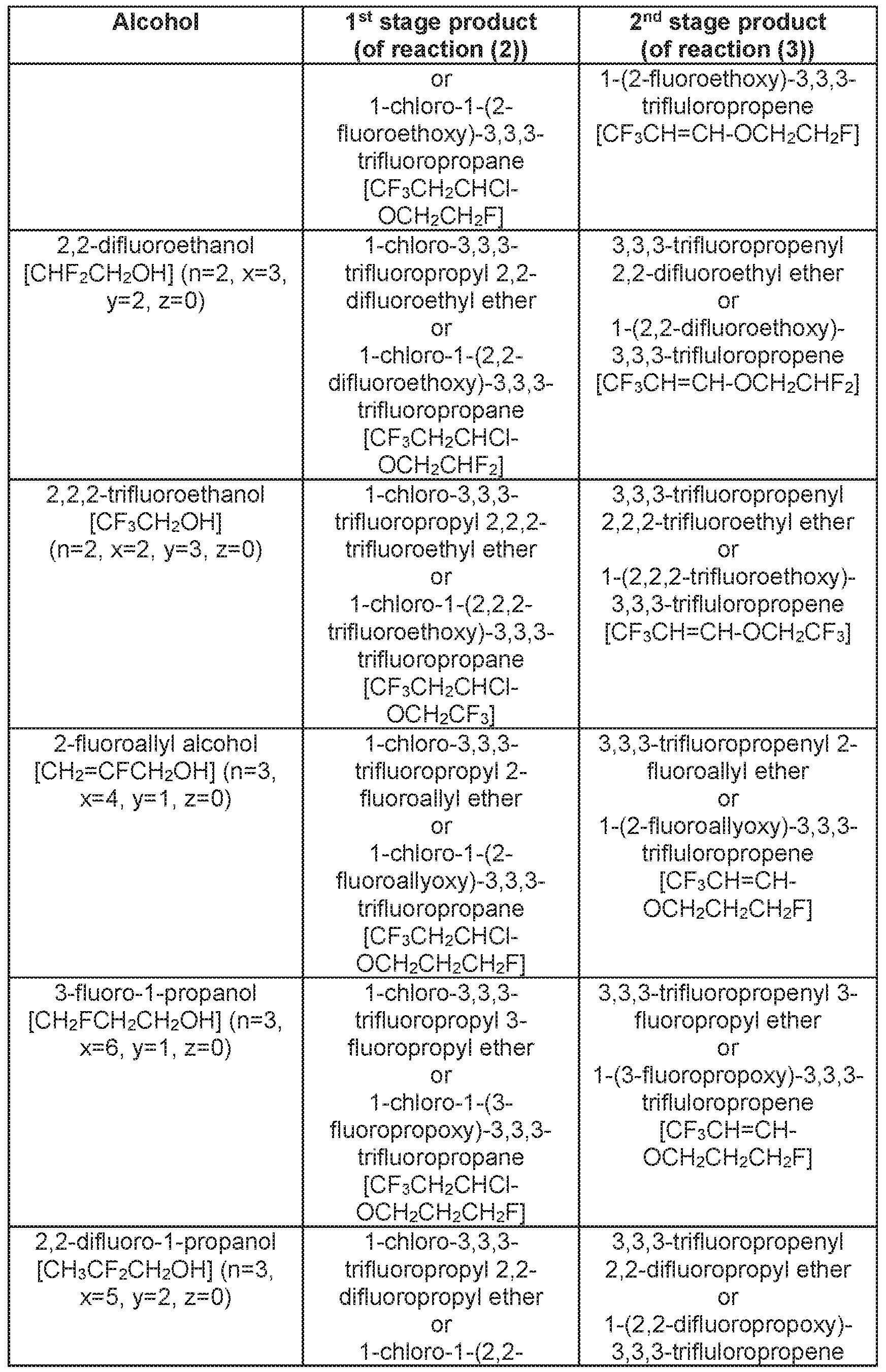
[0042] Several exemplary alcohols, together with their resulting first and second stage reaction products that may be obtained in accordance with the present disclosure, are set forth in the Table 1 below:



[0043] Advantageously, the products of the first and second stage reactions will have a higher molecular weight, and therefore a higher boiling point, than 1233zd and, in many cases, such products will have a boiling point higher than room temperature (between 15 °C and 25 °C), thereby facilitating use of the products as solvents in many potential applications.
[0044] The products of the first and second stage reactions, i.e., the disclosed compounds, exhibit one or more, and may exhibit ail, of the following properties: chemical stability; no substantial ozone depleting potential (ODP); relatively high degree of miscibiiity with common contaminants, particularly mineral oil and/or silicone oil; low or no fiammabiSity; low or no toxicity: and low or no global warming potential (GWP).
[0045] More specifically, the disclosed compounds may have: no substantial ozone depletion potential, preferably an ODP of not greater than about 0.5, not greater than about 0.25, or not greater than about 0.1 ; a GWP of not greater than about 150, or not greater than about 50.
[0046] in many of the embodiments, the disclosed compounds have a normal boiling point as low as 20°C, 25°C, 45°C or 50°C or as high as 60°C, 70°C, 100°C or 250°C, or within any range defined between any two of the foregoing values, such as from 20°C to 70°C, from 45°C to 60°C, or from 50°C to 80°C, for example.
[0047] The disclosed compounds may also have no flash point as measured by one of the standard flash point methods, for example ASTM-1310-86 "Flash point of liquids by tag Open-cup apparatus" and an atmospheric lifetime of not greater than about 100 days, such as not greater than about 50 days. Further, the disclosed compound are miscible with greater than 20% by weight of mineral oil and/or silicone oil, such as in a weight ratio in the range of at least about 80:20 to about 20:80, or in substantially all proportions,
[0048] The disclosed compounds may exhibit a relatively low toxicity value.
[0049] As used herein, ODP is defined in the "Scientific Assessment of Ozone Depletion, 2002", a report of the World Meteorological association, incorporated herein by reference. As used herein, GWP is defined relative to that of carbon
dioxide and over a 100 year time horizon, and defined in the same reference as for the ODP mentioned above. As used herein, miscibiiity is measured in accordance with visuai evaluation of phase formation or separation when two liquids are mixed together, as is known to those skilled in the art.
[0050] The disclosed compounds thus generally possess properties and characteristics that are highly desirable for use in connection with many different applications, including many different types of cleaning and contaminant removal applications.
[0051 ] For example, in cleaning applications, the disclosed compounds may be used in liquid compositions, either alone or with one or more co-solvents, as cleaning solvents for greases, oils, waxes and the like, for use in mechanical part cleaning, precision cleaning and/or electronics cleaning, such as cleaning electric motors, compressors, heavy metal parts, delicate precision metal parts, printed circuit boards, gyroscopes, guidance systems, aerospace and missile hardware, aluminum parts and the like. Other applications include degreasing, dry-cleaning, solvent etching, and as a solvent for aerosols or other sprayable compositions, as carrier solvents for lubricants, or other surface treatment applications,
[0052] For example, in degreasing operations, the disclosed compounds may be used as solvents in vapor degreasing methods, in which an article to be cleaned is exposed to a solvent vapor, preferably at or above room temperature, to remove grease or other contaminants from the surface of the article or alternatively, in liquid degreasing operations, in which an article to be cleaned is exposed to the solvent in liquid form by immersing the article in the liquid solvent, typically at an elevated temperature approaching the boiling point of the solvent.
[0053] in one particular application, the solvents disclosed herein may be formulated with other components, such as a C1-C3 alcohol and/or a C4-C6 hydrocarbon, to form a composition useful for removing ink or ink-based markings from the surfaces of articles of manufacture, such as optical lenses, electromechanical or electrical parts, before the parts are packaged and commercially sold without damaging the underlying surfaces of the articles themselves. The articles and their surfaces may be metal or metal-based, cellulose-based, silica-based, or made from a plastic polymeric material, and the solvents may be in the form of a liquid, aerosol and/or sprayable composition.
[0054] The disclosed compounds may also be used as a heat transfer medium, flame suppressing agent, or foam blowing agent, for example. In particular, the disclosed compounds may be used as heat transfer fluids in methods and systems for transferring heat, such as refrigerants used in refrigeration, air conditioning and heat pump systems, and well as fire suppressants, such as additives to reduce the flammability of fluids, and as components involved in the formation of foam, foam premixes, foam products and blowing agents for foams.
[0055] Further details regarding exemplary applications of the disclosed compounds are disclosed in U.S. Patent No. 7,985,299, assigned to the assignee of the present invention, the entire disclosure of which is incorporated by reference herein.
[0056] While this invention has been described as having exemplary designs, the present invention can be further modified within the spirit and scope of this disclosure. This application is therefore intended to cover any variations, uses, or adaptations of the invention using its general principles. Further, this application is intended to cover such departures from the present disclosure as come within known or customary practice in the art to which this invention pertains and which fall within the limits of the appended claims.
Claims
1 . A method for producing a product according to one of formuias:

[0057] wherein:
[0058] n is 1 to 5;
[0059] x, y, and z are each 0 to 1 1 and y+z > 1 ; and
[0060] x+y÷z ~ 2(n-m)+1 , wherein m is an integer of 0 to 2, said method comprising the step of reacting a reaction mixture including an alcohol, a catalyst, and 1 -chioro-3,3,3-trif!uoro-propene (1233zd).
[0061]
2. The method of claim 1 , wherein the alcohol is an alcohol according to the following formula:
[0062] CnHxFyCizOH
[0063] wherein:
[0064] n is 1 to 5;
[0065] x, y, and z are each 0 to 1 1 and y+z > 1 ; and
[0066] x+y÷z ~ 2n+1 for a saturated alcohol; or
[0067] x+y÷z = 2n-1 for an unsaturated alcohol,
3. The method of claim 2, wherein the alcohol is selected from the group consisting of fluoromethanol, 2,2,2-trifluoroethanol, 3,3,3-trifluoro-1 -propanol,
2,2,3,3-tetrafiuoro-1 -propanoi, 2,2,3,3,4,4,5,5-octafluoropentanoi, and 1 , 1 , 1 ,3,3,3- hexaf!uoro-propan-2-oi.
4. The method of claim 1 , wherein the catalyst is an alkaline catalyst.
5. The method of claim 4, wherein the catalyst is at least one alkali hydroxide selected from the group consisting of sodium hydroxide and potassium hydroxide and a combination thereof.
6. The method of claim 1 , further comprising, after said reacting step, the additional step of separating the product of from the reaction mixture.
7. The method of claim 1 , wherein said reacting step further comprises heating the reaction mixture.
8. The method of claim 1 , wherein the product has the following formula:

[0068] wherein:
[0069] n is 1 to 5;
[0070] x, y, and z are each 0 to 1 1 and y+z > 1 ; and
[0071] x+y+z = 2(n-m)+1 , wherein m is an integer of 0 to 2, said method comprising the step of reacting a reaction mixture including an alcohol, a catalyst, and 1 -chloro-3,3,3-trifluoro-propene (1233zd).
9. The method of claim 1 , wherein the product has the following formula:

[0072] wherein:
[0073] n is 1 to 5;
[0074] x, y, and z are each 0 to 1 1 and y÷z > 1 ; and
[0075] x+y+z = 2(n-m)+1 , wherein m is an integer of 0 to 2, said method comprising the step of reacting a reaction mixture including an alcohol, a catalyst, and 1 -chloro-3,3,3-trifluoro-propene (1233zd),
10. A liquid composition comprising at least one solvent selected from formulas (I) and (I I):

[0076] and combinations thereof, wherein:
[0077] n is 1 to 5;
[0078] x, y, and z are each 0 to 1 1 and y+z > 1 ; and
[0079] x+y+z = 2(n-m)+1 , wherein m is an integer of 0 to 2, said method comprising the step of reacting a reaction mixture including an alcohol, a catalyst, and 1 -chloro-3,3,3-trifiuoro-propene (1233zd); and
[0080] at least one solvent having a boiling point between 20-250°C.
Priority Applications (3)
| Application Number | Priority Date | Filing Date | Title |
|---|---|---|---|
| JP2018562572A JP2019519535A (en) | 2016-06-03 | 2017-05-30 | Process for the production of solvents derived from 1-chloro-3,3,3-trifluoro-propene (1233zd) |
| CN201780042258.XA CN109476573A (en) | 2016-06-03 | 2017-05-30 | Process for the preparation of solvents derived from 1-chloro-3,3,3-trifluoropropene (1233zd) |
| EP17807319.3A EP3464227A4 (en) | 2016-06-03 | 2017-05-30 | Methods for producing solvents derived from 1-chloro-3, 3, 3-trifluoro-propene (1233zd) |
Applications Claiming Priority (4)
| Application Number | Priority Date | Filing Date | Title |
|---|---|---|---|
| US201662345117P | 2016-06-03 | 2016-06-03 | |
| US62/345,117 | 2016-06-03 | ||
| US15/606,400 US10351499B2 (en) | 2016-06-03 | 2017-05-26 | Methods for producing solvents derived from 1-chloro-3, 3, 3-trifluoro-propene (1233zd) |
| US15/606,400 | 2017-05-26 |
Publications (1)
| Publication Number | Publication Date |
|---|---|
| WO2017210165A1 true WO2017210165A1 (en) | 2017-12-07 |
Family
ID=60478948
Family Applications (1)
| Application Number | Title | Priority Date | Filing Date |
|---|---|---|---|
| PCT/US2017/034953 Ceased WO2017210165A1 (en) | 2016-06-03 | 2017-05-30 | Methods for producing solvents derived from 1-chloro-3, 3, 3-trifluoro-propene (1233zd) |
Country Status (5)
| Country | Link |
|---|---|
| US (2) | US10351499B2 (en) |
| EP (1) | EP3464227A4 (en) |
| JP (1) | JP2019519535A (en) |
| CN (1) | CN109476573A (en) |
| WO (1) | WO2017210165A1 (en) |
Families Citing this family (4)
| Publication number | Priority date | Publication date | Assignee | Title |
|---|---|---|---|---|
| US10351499B2 (en) * | 2016-06-03 | 2019-07-16 | Honeywell International Inc. | Methods for producing solvents derived from 1-chloro-3, 3, 3-trifluoro-propene (1233zd) |
| JP7833891B2 (en) * | 2019-03-18 | 2026-03-23 | サイエンスコ スペシャルティ ポリマーズ イタリー エス.ピー.エー. | Heat exchange method using fluorinated compounds with low GWP |
| US20210013545A1 (en) * | 2019-07-12 | 2021-01-14 | Honeywell International Inc. | Electrolyte solution for a lithium ion cell |
| GB201916217D0 (en) * | 2019-10-03 | 2019-12-25 | Mexichem Fluor Sa De Cv | Composition |
Citations (5)
| Publication number | Priority date | Publication date | Assignee | Title |
|---|---|---|---|---|
| US20090105506A1 (en) * | 2005-09-29 | 2009-04-23 | Central Glass Company, Limited | Process for Producing 3,3,3-Trifluoropropionaldehyde |
| US20090305876A1 (en) * | 2006-06-26 | 2009-12-10 | Honeywell International, Inc. | Compositions and Methods Containing Fluorine Substituted Olefins |
| US7736537B1 (en) * | 2008-01-24 | 2010-06-15 | Mainstream Engineering Corp. | Replacement solvents having improved properties for refrigeration flushes |
| US20110041529A1 (en) * | 2008-05-12 | 2011-02-24 | Arkema Inc. | Compositions of hydrochlorofluoroolefins |
| US20140315774A1 (en) * | 2011-12-22 | 2014-10-23 | Honeywell International Inc. | Solvent compositions including 1-chloro-3,3,3-trifluoropropene and uses thereof |
Family Cites Families (15)
| Publication number | Priority date | Publication date | Assignee | Title |
|---|---|---|---|---|
| US2739987A (en) | 1956-03-27 | Production of fluorine-substituted | ||
| US5777184A (en) | 1997-06-25 | 1998-07-07 | Alliedsignal Inc. | Preparation of fluoroalkyl compounds and their derivatives |
| US6111139A (en) | 1999-11-04 | 2000-08-29 | Van Der Puy; Michael | Process for the preparation of trifluoropropanal |
| US20050096246A1 (en) | 2003-11-04 | 2005-05-05 | Johnson Robert C. | Solvent compositions containing chlorofluoroolefins |
| US9796848B2 (en) | 2002-10-25 | 2017-10-24 | Honeywell International Inc. | Foaming agents and compositions containing fluorine substituted olefins and methods of foaming |
| WO2005102975A1 (en) * | 2004-04-23 | 2005-11-03 | Central Glass Company, Limited | Method for producing fluorinated ether |
| WO2005110957A2 (en) * | 2004-05-11 | 2005-11-24 | Honeywell International Inc. | Fluorinated ethers |
| JP2006298855A (en) | 2005-04-22 | 2006-11-02 | Central Glass Co Ltd | Method for producing 3,3,3-trifluoropropionic acid |
| WO2007052492A1 (en) * | 2005-11-01 | 2007-05-10 | Central Glass Company, Limited | Process for producing 3,3,3-trifluoropropionic acid |
| JP5055743B2 (en) * | 2005-11-04 | 2012-10-24 | セントラル硝子株式会社 | A fluorine-containing polymer coating composition, a method for forming a fluorine-containing polymer film using the coating composition, and a method for forming a photoresist or a lithography pattern. |
| JP5380882B2 (en) * | 2007-04-17 | 2014-01-08 | セントラル硝子株式会社 | Method for producing 3,3,3-trifluoropropyne |
| CN102320938B (en) | 2011-08-25 | 2014-04-16 | 西安近代化学研究所 | Preparation method for 3,3,3-trifluoropropenyl methyl ether |
| US8791309B2 (en) * | 2012-12-21 | 2014-07-29 | Honeywell International Inc. | Synthesis of 3,3,3-trifluoropropyne |
| US9216932B2 (en) * | 2013-05-20 | 2015-12-22 | Honeywell International Inc. | Dehalogenation of trans-1-chloro-3,3,3-trifluoropropene |
| US10351499B2 (en) * | 2016-06-03 | 2019-07-16 | Honeywell International Inc. | Methods for producing solvents derived from 1-chloro-3, 3, 3-trifluoro-propene (1233zd) |
-
2017
- 2017-05-26 US US15/606,400 patent/US10351499B2/en active Active
- 2017-05-30 CN CN201780042258.XA patent/CN109476573A/en active Pending
- 2017-05-30 WO PCT/US2017/034953 patent/WO2017210165A1/en not_active Ceased
- 2017-05-30 JP JP2018562572A patent/JP2019519535A/en active Pending
- 2017-05-30 EP EP17807319.3A patent/EP3464227A4/en not_active Withdrawn
-
2019
- 2019-06-10 US US16/435,877 patent/US10597346B2/en active Active
Patent Citations (5)
| Publication number | Priority date | Publication date | Assignee | Title |
|---|---|---|---|---|
| US20090105506A1 (en) * | 2005-09-29 | 2009-04-23 | Central Glass Company, Limited | Process for Producing 3,3,3-Trifluoropropionaldehyde |
| US20090305876A1 (en) * | 2006-06-26 | 2009-12-10 | Honeywell International, Inc. | Compositions and Methods Containing Fluorine Substituted Olefins |
| US7736537B1 (en) * | 2008-01-24 | 2010-06-15 | Mainstream Engineering Corp. | Replacement solvents having improved properties for refrigeration flushes |
| US20110041529A1 (en) * | 2008-05-12 | 2011-02-24 | Arkema Inc. | Compositions of hydrochlorofluoroolefins |
| US20140315774A1 (en) * | 2011-12-22 | 2014-10-23 | Honeywell International Inc. | Solvent compositions including 1-chloro-3,3,3-trifluoropropene and uses thereof |
Non-Patent Citations (1)
| Title |
|---|
| See also references of EP3464227A4 * |
Also Published As
| Publication number | Publication date |
|---|---|
| JP2019519535A (en) | 2019-07-11 |
| US10351499B2 (en) | 2019-07-16 |
| EP3464227A4 (en) | 2020-02-19 |
| EP3464227A1 (en) | 2019-04-10 |
| US20170349519A1 (en) | 2017-12-07 |
| US10597346B2 (en) | 2020-03-24 |
| US20190292120A1 (en) | 2019-09-26 |
| CN109476573A (en) | 2019-03-15 |
Similar Documents
| Publication | Publication Date | Title |
|---|---|---|
| JP5313674B2 (en) | Hydrofluoroether compounds and methods for their preparation and uses | |
| EP2258819B1 (en) | Use as a cleaning composition of a composition comprising 1,3,3,3-tetrafluoropropene (HFO-1234ze) | |
| JP7079817B2 (en) | Heat transfer composition | |
| US10597346B2 (en) | Methods for producing solvents derived from 1-chloro-3, 3, 3-trifluoro-propene (1233zd) | |
| CN101517031B (en) | Substantially nonflammable, low global warming composition | |
| KR101335360B1 (en) | Fluorinated Alkenes Refrigerant Composition | |
| RU2469016C2 (en) | Nonflammable compositions containing fluorinated compounds and use of said compositions | |
| CN109608312B (en) | Hydrofluoroether compounds, process for their preparation and their use | |
| JP7620418B2 (en) | Fluorine-containing solvent composition | |
| EP3386941B1 (en) | Composition comprising fluorinated esters as lubricants for heat transfer fluids | |
| CN113511961A (en) | Hydrofluoroether and preparation method and application thereof | |
| JP6432306B2 (en) | Azeotropic-like composition comprising fluorine-containing olefin as a constituent | |
| WO2016125550A1 (en) | Azeotrope-like composition containing fluorinated olefin as component | |
| JP2021059501A (en) | Hydrofluoroether, composition comprising hydrofluoroether, and coating film forming method and article cleaning method using hydrofluoroether | |
| TW202104178A (en) | Hydrofluorothioethers and methods of using same | |
| US8153018B2 (en) | Methods for making 3-chloro-1,1,1,6,6,6-hexafluoro-2,4-hexadiene | |
| WO2016129319A1 (en) | Azeotrope-like composition having fluorine-containing olefin as constituent | |
| CN116635164A (en) | Compositions comprising monochlorotrifluoropropene and stabilizers and uses thereof | |
| JP2022514911A (en) | Compound | |
| CN115702235B (en) | Composition and use thereof | |
| CA2826545C (en) | Compositions containing fluorine substituted olefins | |
| JP7733493B2 (en) | Fluorine-based solvent composition | |
| JP7624921B2 (en) | Hydrofluoroolefins and methods for using same | |
| WO2026079465A1 (en) | Hexafluoropropene dimer-containing composition | |
| CN121693556A (en) | Azeotropic compositions, aerosol compositions, cleaning agents, lubricant solutions, heat transfer media, preparation methods of compositions, compositions, cleaning methods and recovery methods |
Legal Events
| Date | Code | Title | Description |
|---|---|---|---|
| 121 | Ep: the epo has been informed by wipo that ep was designated in this application |
Ref document number: 17807319 Country of ref document: EP Kind code of ref document: A1 |
|
| ENP | Entry into the national phase |
Ref document number: 2018562572 Country of ref document: JP Kind code of ref document: A |
|
| NENP | Non-entry into the national phase |
Ref country code: DE |
|
| ENP | Entry into the national phase |
Ref document number: 2017807319 Country of ref document: EP Effective date: 20190103 |