WO2017221454A1 - Procédé de préhension de câble à fibre optique, et outil de préhension à câble à fibre optique - Google Patents
Procédé de préhension de câble à fibre optique, et outil de préhension à câble à fibre optique Download PDFInfo
- Publication number
- WO2017221454A1 WO2017221454A1 PCT/JP2017/005505 JP2017005505W WO2017221454A1 WO 2017221454 A1 WO2017221454 A1 WO 2017221454A1 JP 2017005505 W JP2017005505 W JP 2017005505W WO 2017221454 A1 WO2017221454 A1 WO 2017221454A1
- Authority
- WO
- WIPO (PCT)
- Prior art keywords
- optical fiber
- gripping
- support wire
- fiber cable
- support
- Prior art date
- Legal status (The legal status is an assumption and is not a legal conclusion. Google has not performed a legal analysis and makes no representation as to the accuracy of the status listed.)
- Ceased
Links
Images




Classifications
-
- G—PHYSICS
- G02—OPTICS
- G02B—OPTICAL ELEMENTS, SYSTEMS OR APPARATUS
- G02B6/00—Light guides; Structural details of arrangements comprising light guides and other optical elements, e.g. couplings
- G02B6/44—Mechanical structures for providing tensile strength and external protection for fibres, e.g. optical transmission cables
- G02B6/4401—Optical cables
- G02B6/4429—Means specially adapted for strengthening or protecting the cables
-
- G—PHYSICS
- G02—OPTICS
- G02B—OPTICAL ELEMENTS, SYSTEMS OR APPARATUS
- G02B6/00—Light guides; Structural details of arrangements comprising light guides and other optical elements, e.g. couplings
- G02B6/44—Mechanical structures for providing tensile strength and external protection for fibres, e.g. optical transmission cables
- G02B6/4401—Optical cables
- G02B6/4403—Optical cables with ribbon structure
- G02B6/4404—Multi-podded
-
- G—PHYSICS
- G02—OPTICS
- G02B—OPTICAL ELEMENTS, SYSTEMS OR APPARATUS
- G02B6/00—Light guides; Structural details of arrangements comprising light guides and other optical elements, e.g. couplings
- G02B6/46—Processes or apparatus adapted for installing or repairing optical fibres or optical cables
- G02B6/48—Overhead installation
- G02B6/483—Installation of aerial type
Definitions
- the present invention relates to a method for gripping an optical fiber cable and an optical fiber cable gripper.
- FTTH Fiber-to-the-Home
- FTTH Fiber-to-the-Home
- an aerial optical fiber cable that is laid by holding a support wire on a utility pole or the like is known.
- Patent Document 1 discloses a self-supporting optical fiber cable in which a support wire is formed of a steel wire and is further covered with a jacket. Further, Patent Document 2 discloses a technique for hooking an end portion of a support wire separated from an optical fiber cable around an anchor of the S hardware with respect to an S hardware having a function of holding an aerial optical fiber cable. It is disclosed.
- the object of the present invention is to hold a support line of a non-metallic material while suppressing breakage.
- a main invention for achieving the above object is a method of gripping an optical fiber cable including a main body portion including an optical fiber and a support wire portion using a gripping member, and the support wire portion is made of a metal. Including a support wire made of a material other than the above and a jacket covering the support wire, and holding and gripping the gripping member with respect to the support wire portion while the jacket covers the support wire. This is a method for gripping an optical fiber cable.
- FIG. 1 is a cross-sectional view of the optical fiber cable 1.
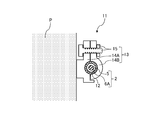
- FIG. 2 is a schematic view showing a gripping structure of the optical fiber cable 1 according to the first embodiment of the present invention.
- FIG. 3 is a cross-sectional view of the grip portion 11 as viewed from the longitudinal direction of the support line portion 2.
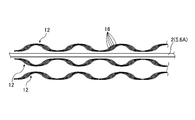
- FIG. 4 is a view for explaining the detailed structure of the grip 12 for gripping.
- 5A to 5C are diagrams illustrating a method of winding the grip 12 shown in FIG. 4 around the support wire portion 2.
- FIG. 6A and 6B are schematic views showing a holding structure of the optical fiber cable 1 according to the second embodiment of the present invention.
- FIG. 7A is a view showing a structure of an end gripping grip 19 according to the second embodiment of the present invention.
- FIG. 7B is a diagram showing a detailed structure of the end gripping grip 19 when gripping the retracting support line 18.
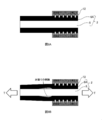
- FIG. 8A is a longitudinal sectional view when no tension is applied when the support line portion is gripped using the grip for gripping.
- FIG. 8B shows a longitudinal cross-sectional view when tension is applied and delamination occurs at the interface.
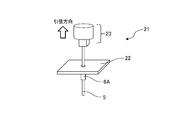
- FIG. 9 is a diagram for explaining the test mechanism 21 that measures the adhesion between the outer jacket and the support wire.
- a method for gripping an optical fiber cable including a main body including an optical fiber and a support wire portion using a gripping member, wherein the support wire portion is made of a material other than metal, and the support wire.
- An optical fiber cable gripping method is characterized in that the gripping member is clamped and gripped with respect to the support line portion while the cover covers the support wire while the jacket covers the support wire. Become. According to such a method of gripping an optical fiber cable, it is possible to hold the support line of the nonmetallic material while suppressing breakage.
- the gripping member is tightened so as to be spirally wound around the support line portion. As a result, the gripping member can be gripped more closely to the support line portion.
- the support wire is preferably made of glass fiber reinforced plastic. In such a case, it is particularly advantageous.
- an anti-slip material is included between the gripping member and the jacket. Thereby, in a state where the support line portion is gripped by the gripping member, the gripping member is difficult to come off.
- the gripping member is clamped and gripped with respect to the support line portion to such an extent that the outer cover is not crushed. Thereby, it is possible to suppress the breakage of the support line due to the crushing of the jacket.
- the outer cover integrally covers the main body portion and the support wire to intermittently form a neck portion that connects the main body portion and the support wire. Thereby, it is possible to suppress breakage of the support wire due to wind pressure load even in a long span aerial environment.
- the support wire portion is gripped by a fixed structure in a separation portion where the main body portion and the support wire portion are not connected. Thereby, only a support line is grasped and it is possible to suppress breakage of the optical fiber in the main body.
- the main body portion is loose with respect to the support line portion. Therefore, even if a tensile force is applied to the support wire, it is possible to suppress the breakage of the optical fiber.
- the adhesion force F between the jacket and the support wire is 1.77 ⁇ D [N / mm] or more.
- FIG. 1 is a cross-sectional view of the optical fiber cable 1.
- the optical fiber cable 1 is an aerial optical fiber cable having a self-supporting structure that is used when laying so as to bridge between utility poles in FTTH. Further, the optical fiber cable 1 may be an optical fiber drop cable for branching from an aerial optical fiber cable and drawing the optical fiber into a subscriber's house.
- the optical fiber cable 1 includes a support line portion 2, a main body portion 3, and a neck portion 4.
- the optical fiber cable 1 has a structure in which a support line portion 2 and a main body portion 3 are connected via a neck portion 4.
- the support line part 2 is a suspension line for aerial use.
- the support line portion 2 includes a support line 5 and a jacket 6A.
- the support wire 5 is formed of a so-called non-metallic material made of a material other than metal.
- Non-metallic materials include, for example, fiber reinforced plastic (FRP) such as glass fiber reinforced plastic (GFRP), aramid fiber reinforced plastic (KFRP) reinforced by Kevlar (registered trademark), polyethylene fiber reinforced plastic reinforced by polyethylene fiber, and the like. used.
- FRP fiber reinforced plastic
- GFRP glass fiber reinforced plastic
- KFRP aramid fiber reinforced plastic
- Kevlar registered trademark
- polyethylene fiber reinforced plastic reinforced by polyethylene fiber and the like.
- a fibrous tensile body such as glass fiber, aramid fiber, or polyethylene fiber may be used in combination with any one of the above-mentioned fiber reinforced plastics (FRP).
- the outer cover 6A is a covering material that covers the support wire 5.
- the jacket 6A is made of a thermoplastic resin.
- thermoplastic resin materials generally used for optical fiber cables such as polyethylene, polypropylene, polystyrene, polyvinyl chloride, and the like are used.
- the main body 3 includes an optical fiber 9, a pair of strength members 7, a pair of separators 8, and a jacket 6B.
- the optical fiber 9, the pair of strength members 7, and the pair of separators 8 are arranged in a positional relationship as illustrated.
- the optical fiber 9 and the pair of strength members 7 are arranged in parallel to each other in the longitudinal direction. However, if the structure of the main-body part 3 is provided with the optical fiber 9, it will not be restricted to this.
- the optical fiber 9 is an optical signal transmission line and is a generic name including an optical fiber core, an optical fiber, an optical fiber cord, and the like. Further, the optical fiber 9 may be constituted by an intermittently fixed type optical fiber ribbon. As a result, the intermittently fixed type optical fiber tape core wire can be rounded into a cylindrical shape (bundle shape) or folded, and a large number of optical fibers 9 can be bundled at a high density. Furthermore, it is easy to take out one or a plurality of optical fibers at the time of intermediate post-branching by being constituted by an intermittently fixed type optical fiber ribbon.
- the pair of strength members 7 have a function of resisting tension in the longitudinal direction of the optical fiber 9 so that the optical fiber 9 is not stretched more than necessary.
- the pair of strength members 7 are disposed outside the left and right ends of the pair of separators 8.
- the pair of strength members 7 may be formed of the same non-metallic material as the support wire 5 or may be formed of a steel wire.
- the pair of separators 8 have a function capable of separating the optical fiber 9 and the jacket 6B.
- the pair of separators 8 surrounds the optical fiber 9, thereby preventing the material of the jacket 6 ⁇ / b> B from adhering to the optical fiber in the manufacturing process of the optical fiber cable 1.
- the pair of separators 8 is formed of a material having a melting point higher than that of the material of the outer cover 6B.
- a nylon flat yarn is used as a material of the pair of separators 8.
- the jacket 6B may be formed of the same material as that of the jacket 6A, or may be formed of a different material.
- the cross-sectional shape of the main body portion 3 covering the outer cover 6 ⁇ / b> B is substantially rectangular.
- a notch 10 having a V-shaped cross section is formed on the long side. Two notches 10 are formed on each side.
- the notch 10 is provided in order to divide and cut the main body 3 and to easily take out the optical fiber 9. Although it is not essential to provide the notch 10 in the main body 3, it is preferable to provide it.
- the neck portion 4 can separate the support wire portion 2 and the main body portion 3 by being cut.
- the neck 4 can be formed of the same material as the outer cover 6A and the outer cover 6B. Furthermore, the neck 4, the outer cover 6A, and the outer cover 6B may be integrally formed of the same material.
- the configuration of the optical fiber cable 1 is not limited to the above-described configuration, and can be various configurations.
- the optical fiber 9 may be composed of 8 to 48 cores, or may be composed of 48 or more cores.
- FIG. 2 is a schematic view showing a gripping structure of the optical fiber cable 1 according to the first embodiment of the present invention.
- a structure in which the optical fiber cable 1 is gripped by each power pole P in order to lay and lay the optical fiber cable 1 between the long-span power poles will be described.
- the support wire portion 2 and the main body portion 3 are connected by a plurality of neck portions 4 that are intermittently arranged in the longitudinal direction. As described above, the connection by the neck 4 connects the support wire portion 2 and the main body portion 3 by integrally forming the neck portion 4, the outer cover 6A, and the outer cover 6B from the same material. Good.
- the support line portion 2 and the main body portion 3 are separated between a pair of adjacent neck portions 4 and 4. At a position where the support wire portion 2 and the main body portion 3 are separated, a grip portion 11 is provided in which only the support wire portion 2 is gripped by the utility pole P.
- the main body portion 3 is provided so as to meander with respect to the support wire portion 2. Thereby, a space is provided between the support wire portion 2 and the main body portion 3, and the wind pressure load applied to the entire optical fiber cable 1 can be reduced.
- the length of the neck 4 in the longitudinal direction of the support line portion is 40 mm
- the length of the separation portion (pitch of the neck 4) is 250 mm or 550 mm
- the distance between the utility poles is several m to It is about 50m.
- these values may be appropriately changed.
- the gripping part 11 has a gripping grip 12 and a fixing member 13.
- the gripping portion 11 has a structure in which the gripping grip 12 grips the support wire portion 2 and the fixing member 13 fixes the support wire portion 2 gripped by the gripping grip 12 to the utility pole P.
- FIG. 3 is a cross-sectional view of the grip portion 11 as viewed from the longitudinal direction of the support wire portion 2.
- the fixing member 13 constituting the grip portion 11 includes a pair of covers 14A and 14B and a fixing tool 15 (bolts and nuts).
- the cover 14A is fixed to the utility pole P.
- the cover 14 ⁇ / b> A and the cover 14 ⁇ / b> B are provided so as to cover the support line portion 2 and the gripping grip 12, and are fastened by the fixture 15. As a result, the support wire portion 2 and the gripping grip 12 are fixed to the utility pole P.
- the grip grip 12 is provided to grip the support line portion 2 so as to wrap around the outer periphery of the support line portion 2.
- the detailed structure of the grip 12 for gripping will be described later.
- the grip 12 for gripping is attached to the outer periphery of the support line portion 2 while the outer cover 6 ⁇ / b> A covers the support line 5.
- the pressing force of the gripping grip 12 be adjusted to such an extent that the outer cover 6 ⁇ / b> A is not crushed (including breakage).
- FIG. 4 is a diagram for explaining the detailed structure of the grip 12 for gripping.
- a structure is shown in which three gripping grips 12 are gripped so as to be spirally wound around the support line portion 2.
- the number of gripping grips 12 that grip one support line portion 2 is not intended to be limited to three, and may be another number.
- the gripping grip 12 is composed of a plurality of strands 16.
- a galvanized steel wire, a zinc aluminum alloy plated steel wire or the like is used as the strand 16.
- the plurality of strands 16 are arranged so as to be adjacent to each other, bonded to each other, and further spirally wound.
- a friction material for increasing the frictional force may be applied to the surface of the plurality of strands 16 wound in a spiral shape in contact with the support wire portion 2.
- the friction material for example, fine sand or glass particles can be used.
- the gripping grip 12 shown in FIG. 4 is composed of five strands, but there is no intention to limit the number of strands constituting the gripping grip to five, and from one flat strand It may be configured.
- FIGS. 5A to 5C are diagrams showing a method of winding the gripping grip 12 shown in FIG.
- subscripts (A to C) may be added to the gripping grip 12, and the gripping grips 12 will be described separately.
- a gripping grip 12 ⁇ / b> A is wound around the support wire portion 2 separated from the main body portion 3.
- the gripping grip 12B and the gripping grip 12C are wound while adjusting the winding pitch of the gripping grip 12A so as to leave room for winding.
- FIG. 5B shows a state in which the gripping grip 12B is wound halfway.
- the gripping grip 12C is wound so as to be adjacent to the gripping grip 12B.
- the support wire portion 2 is clamped and held by pulling the holding grip 12A to the holding grip 12C to both sides so as to extend. Finally, it fixes to the support line part 2 with fixing members, such as a tape not shown.
- the above-described gripping portion 11 has described the method of tightening the gripping grip 12 around the support wire portion 2 in a spiral manner, but the tightening method is not limited to this, tightening by vertical attachment, It may be tightened by winding other than spiral.
- FIGS. 6A and 6B are schematic views showing a gripping structure of the optical fiber cable 1 according to the second embodiment of the present invention.
- FIG. 6A is a diagram for explaining a case where an optical fiber is branched by a utility pole-mounted branch closure 17A and pulled into a subscriber's home Q.
- FIG. 6B is a diagram for explaining a case where an optical fiber is branched by a support line suspension type branch closure 17B and pulled into a subscriber's home Q.
- the utility pole R is provided with a branch closure 17A.
- the branch closure 17A is a box that holds an optical fiber cable and accommodates a connection point when the optical fiber cable is connected, branched, or pulled down.
- a part of the optical fiber 9 of the main body 3 is branched in the branch closure 17A and drawn into the customer's home Q as a new main body 3A.
- the main body 3A is drawn into the subscriber's home Q through the lead-in hole 20 provided in the subscriber's home Q while being supported by the support wire 18 for pull-in after branching.
- the support line 18 for drawing is formed of a non-metallic material and is further covered with a jacket (not shown).
- the retracting support line 18 is fastened by an end gripping grip 19, and one is fixed to the telephone pole R and the other is fixed to the wall of the subscriber's home Q.
- FIG. 6B a branch closure 17 ⁇ / b> B is provided in the support line portion 2.
- Other configurations are the same as those described in FIG. 6A.
- FIG. 7A is a diagram showing a structure of an end grip 19 according to the second embodiment of the present invention.
- the end grip 19 includes a folded portion 21 and two grip portions 22.
- the two grip portions 22 are configured to be connected by the folded portion 21.
- FIG. 7B is a view showing a detailed structure of the end gripping grip 19 when gripping the retracting support line 18.
- the two grip portions 19 of the grip 12 for gripping are gripped so as to be wound around the pull-in support line 18 in a spiral manner.
- the winding method is the same as the method described in FIGS. 5A to 5C (first embodiment).
- the pull-in support wire 18 is locked to the utility pole R by hooking the ring surrounded by the turn-up portion 21 on a catching fixture fixed to the utility pole R or the subscriber's home Q. (See Figures 6A and 6B)
- FIG. 8A shows a longitudinal cross-sectional view when tension is not applied in the case where the support line portion is gripped using the grip for gripping.
- FIG. 8B shows a longitudinal cross-sectional view when tension is applied and delamination occurs at the interface.
- a tension T is applied in the tension direction of the support wire portion 2 under an aerial environment.
- the outer cover 6A with which the gripping grip 12 comes into contact is pulled in the direction of the tension T and extends in the longitudinal direction.
- the thickness of the outer cover 6 ⁇ / b> A decreases with the elongation, and the outer cover 6 ⁇ / b> A acts as a force for peeling from the support wire 5.
- the support line portion 2 between the utility poles does not draw an ideal straight line, but draws a slack line in the direction of gravity. If it does so, the force which is going to peel will appear locally in the vicinity of the area where the pressing force by grip grip 12 on support line part 2 is applied, and it will become easier to cause peeling.
- FIG. 8B shows a phenomenon in which separation at the interface occurs in the vicinity of the region where the pressing force by the gripping grip 12 is applied.
- the pressing force works in a direction to cancel the force to be peeled off, so that peeling at the interface does not occur. Further, the portion where the separation at the interface occurs does not always occur in the vicinity of the region where the pressing force by the gripping grip 12 is applied. In any part of the region where the pressing force by the gripping grip 12 is not applied, peeling at the interface may occur.
- the gripping grip 12 comes into direct contact with the support wire 5. Since the support wire 5 is formed of a non-metallic material, for example, glass fiber reinforced plastic (GFRP) or the like, the support wire 5 is easily broken by the contact of the gripping grip 12 as compared with the case of being formed of a steel wire or the like. End up.
- GFRP glass fiber reinforced plastic
- FIG. 9 is a diagram for explaining the test mechanism 21 that measures the adhesion between the outer jacket and the support wire.
- the test mechanism 21 covers a part of the support wire 5 with an outer cover 6A, and pulls only the support wire 5 with a tension T in the pulling direction in FIG. It is a mechanism that measures the load at the time of drawing.
- adhesion the load at the time of drawing is referred to as adhesion.
- the gripping grips 12 were attached to both ends of the same cables as the prototype cables 1 to 5, and a tensile test was performed.
- the tensile test was performed by measuring the load when the outer cover 6A was broken and the exposure of the support wire 5 was confirmed.
- the load at the time of the break is referred to as a break load.
- the prototype cable 3 had a significantly smaller breaking load after 500 hours than the other prototype cables. Furthermore, the diameter of the prototype cable when the outer cover 6A is covered is designed on the assumption that the maximum wind pressure load (including the time of icing) is applied to about 3200 N, but it is also less than that. Therefore, this prototype cable 3 was rejected, and the remaining prototype cables 1, 2, 4, and 5 were evaluated as acceptable.
Landscapes
- Physics & Mathematics (AREA)
- General Physics & Mathematics (AREA)
- Optics & Photonics (AREA)
- Light Guides In General And Applications Therefor (AREA)
Abstract
[Problème] lorsqu'un fil de support de matériau dit non métallique comprenant un matériau autre que le métal est maintenu en arrière sur un poteau de service public ou similaire, il y a un risque de rupture du fil de support lorsqu'une gaine destinée à recouvrir le fil de support est enlevée et saisie, ou est enroulée autour d'un ancrage de matériel et verrouillée sur celui-ci. [Solution] la présente invention est un procédé de préhension d'un câble à fibre optique à l'aide d'un élément de préhension, le câble à fibre optique comprenant une partie de fil de support et une partie de corps principal comprenant une fibre optique. La partie de fil de support comprend un fil de support comprenant un matériau autre que le métal, et une gaine pour recouvrir le fil de support, l'élément de préhension étant fixé à la partie de fil de support et saisissant alors que le fil de support reste recouvert par la gaine.
Priority Applications (2)
| Application Number | Priority Date | Filing Date | Title |
|---|---|---|---|
| EP17814926.6A EP3451037A4 (fr) | 2016-06-23 | 2017-02-15 | Procédé de préhension de câble à fibre optique, et outil de préhension à câble à fibre optique |
| CN201780031207.7A CN109154707A (zh) | 2016-06-23 | 2017-02-15 | 光纤缆线的把持方法以及光纤缆线的把持工具 |
Applications Claiming Priority (2)
| Application Number | Priority Date | Filing Date | Title |
|---|---|---|---|
| JP2016124561A JP2017227791A (ja) | 2016-06-23 | 2016-06-23 | 光ファイバケーブルの把持方法、光ファイバケーブル及び把持用部材付き光ファイバケーブル |
| JP2016-124561 | 2016-06-23 |
Publications (1)
| Publication Number | Publication Date |
|---|---|
| WO2017221454A1 true WO2017221454A1 (fr) | 2017-12-28 |
Family
ID=60783971
Family Applications (1)
| Application Number | Title | Priority Date | Filing Date |
|---|---|---|---|
| PCT/JP2017/005505 Ceased WO2017221454A1 (fr) | 2016-06-23 | 2017-02-15 | Procédé de préhension de câble à fibre optique, et outil de préhension à câble à fibre optique |
Country Status (5)
| Country | Link |
|---|---|
| EP (1) | EP3451037A4 (fr) |
| JP (1) | JP2017227791A (fr) |
| CN (1) | CN109154707A (fr) |
| TW (1) | TWI641886B (fr) |
| WO (1) | WO2017221454A1 (fr) |
Families Citing this family (2)
| Publication number | Priority date | Publication date | Assignee | Title |
|---|---|---|---|---|
| JP7279520B2 (ja) | 2019-05-30 | 2023-05-23 | 株式会社オートネットワーク技術研究所 | 配線部材 |
| US11886029B2 (en) | 2021-03-10 | 2024-01-30 | Afl Telecommunications Llc | Systems and methods of managing cables in telecommunication systems |
Citations (8)
| Publication number | Priority date | Publication date | Assignee | Title |
|---|---|---|---|---|
| JPS5995304U (ja) * | 1982-12-18 | 1984-06-28 | 東北電力株式会社 | ノンメタリツク自己支持型架空光ケ−ブル |
| US5043037A (en) * | 1989-11-22 | 1991-08-27 | Sumitomo Electric Fiber Optics Corporation | Method for making high strain aerial fiber optic cable |
| JPH04132720U (ja) * | 1991-02-08 | 1992-12-09 | 日本大洋海底電線株式会社 | 自己支持型開放同軸ケーブル |
| JPH08265941A (ja) * | 1995-03-20 | 1996-10-11 | P L P:Kk | Sz撚り巻付けグリップおよびその製造方法 |
| JP2001328189A (ja) * | 2000-05-23 | 2001-11-27 | Ube Nitto Kasei Co Ltd | 繊維強化合成樹脂製線状物 |
| JP2003029110A (ja) * | 2001-07-19 | 2003-01-29 | Fujikura Ltd | 自己支持型架空光ケーブルおよびその端末引留め構造 |
| JP2003090943A (ja) * | 2001-09-19 | 2003-03-28 | Fujikura Ltd | 光ファイバケーブル及び光ファイバケーブルの引き留め方法 |
| JP2007148121A (ja) * | 2005-11-29 | 2007-06-14 | Sumitomo Denko Steel Wire Kk | 光ファイバケーブル保持具、光ファイバケーブル引き留め構造及び光ファイバケーブル引き留め方法 |
Family Cites Families (7)
| Publication number | Priority date | Publication date | Assignee | Title |
|---|---|---|---|---|
| US4852965A (en) * | 1987-02-27 | 1989-08-01 | American Telephone And Telegraph Company At&T Bell Laboratories | Composite service and distribution communications media |
| US6356690B1 (en) * | 1999-10-20 | 2002-03-12 | Corning Cable Systems Llc | Self-supporting fiber optic cable |
| US6728455B2 (en) * | 2001-09-04 | 2004-04-27 | Fujikura Ltd. | Optical fiber drop cable and manufacturing method thereof |
| JP2004309648A (ja) * | 2003-04-03 | 2004-11-04 | Sumitomo Electric Ind Ltd | 光ファイバケーブルの製造方法 |
| TWI252939B (en) * | 2004-05-31 | 2006-04-11 | Kaiphone Comm Co Ltd | Optical fiber patch cord |
| US7218821B2 (en) * | 2004-08-20 | 2007-05-15 | Furukawa Electric North America Inc. | Optical fiber cables |
| US8203074B2 (en) * | 2006-10-25 | 2012-06-19 | Advanced Technology Holdings Ltd. | Messenger supported overhead cable for electrical transmission |
-
2016
- 2016-06-23 JP JP2016124561A patent/JP2017227791A/ja active Pending
-
2017
- 2017-02-15 WO PCT/JP2017/005505 patent/WO2017221454A1/fr not_active Ceased
- 2017-02-15 CN CN201780031207.7A patent/CN109154707A/zh active Pending
- 2017-02-15 EP EP17814926.6A patent/EP3451037A4/fr not_active Withdrawn
- 2017-03-01 TW TW106106678A patent/TWI641886B/zh not_active IP Right Cessation
Patent Citations (8)
| Publication number | Priority date | Publication date | Assignee | Title |
|---|---|---|---|---|
| JPS5995304U (ja) * | 1982-12-18 | 1984-06-28 | 東北電力株式会社 | ノンメタリツク自己支持型架空光ケ−ブル |
| US5043037A (en) * | 1989-11-22 | 1991-08-27 | Sumitomo Electric Fiber Optics Corporation | Method for making high strain aerial fiber optic cable |
| JPH04132720U (ja) * | 1991-02-08 | 1992-12-09 | 日本大洋海底電線株式会社 | 自己支持型開放同軸ケーブル |
| JPH08265941A (ja) * | 1995-03-20 | 1996-10-11 | P L P:Kk | Sz撚り巻付けグリップおよびその製造方法 |
| JP2001328189A (ja) * | 2000-05-23 | 2001-11-27 | Ube Nitto Kasei Co Ltd | 繊維強化合成樹脂製線状物 |
| JP2003029110A (ja) * | 2001-07-19 | 2003-01-29 | Fujikura Ltd | 自己支持型架空光ケーブルおよびその端末引留め構造 |
| JP2003090943A (ja) * | 2001-09-19 | 2003-03-28 | Fujikura Ltd | 光ファイバケーブル及び光ファイバケーブルの引き留め方法 |
| JP2007148121A (ja) * | 2005-11-29 | 2007-06-14 | Sumitomo Denko Steel Wire Kk | 光ファイバケーブル保持具、光ファイバケーブル引き留め構造及び光ファイバケーブル引き留め方法 |
Non-Patent Citations (1)
| Title |
|---|
| See also references of EP3451037A4 * |
Also Published As
| Publication number | Publication date |
|---|---|
| TWI641886B (zh) | 2018-11-21 |
| EP3451037A1 (fr) | 2019-03-06 |
| CN109154707A (zh) | 2019-01-04 |
| EP3451037A4 (fr) | 2019-12-18 |
| TW201800792A (zh) | 2018-01-01 |
| JP2017227791A (ja) | 2017-12-28 |
Similar Documents
| Publication | Publication Date | Title |
|---|---|---|
| TWI537624B (zh) | Fiber optic cable | |
| EP3605174B1 (fr) | Câble à fibre optique | |
| TW205598B (fr) | ||
| RU166005U1 (ru) | Пленочный связующий материал для волоконно-оптического кабеля | |
| US8798418B2 (en) | Optical cable with improved strippability | |
| CN101706604A (zh) | 一种易分支的光缆 | |
| WO2017221454A1 (fr) | Procédé de préhension de câble à fibre optique, et outil de préhension à câble à fibre optique | |
| US6775445B2 (en) | Optical fiber drop cable | |
| CN113678045A (zh) | 一种架空光缆敷设金具及可使用该金具敷设的架空光缆 | |
| JP5546412B2 (ja) | 光ケーブル | |
| CN211208018U (zh) | 一种布线用柔软光电混合缆 | |
| CN211554402U (zh) | 一种三单元层绞式轻型光缆 | |
| JP6298479B2 (ja) | 光ファイバケーブル | |
| JP4665048B1 (ja) | 光ドロップケーブル | |
| JPH10148737A (ja) | 架空屋外用光ケーブル | |
| CN211905794U (zh) | 一种高密度易剥离防鼠型微束多芯光缆 | |
| CN209784617U (zh) | 一种拉远光缆 | |
| CN211263889U (zh) | 一种架空光缆及该光缆敷设金具 | |
| CN211578458U (zh) | 一种超轻型光电复合电缆 | |
| CN210572932U (zh) | 一种自承式复合光缆 | |
| JPH10148738A (ja) | 架空集合屋外用光ケーブルおよびその製造方法 | |
| JP5638895B2 (ja) | 光ファイバケーブル | |
| CN220820329U (zh) | 耐弯曲的光纤结构 | |
| CN203287582U (zh) | 纤维补强合成树脂制抗张力线状物及使用了其的引入线光缆 | |
| JP2004252003A (ja) | 光ファイバケーブル |
Legal Events
| Date | Code | Title | Description |
|---|---|---|---|
| 121 | Ep: the epo has been informed by wipo that ep was designated in this application |
Ref document number: 17814926 Country of ref document: EP Kind code of ref document: A1 |
|
| ENP | Entry into the national phase |
Ref document number: 2017814926 Country of ref document: EP Effective date: 20181129 |
|
| NENP | Non-entry into the national phase |
Ref country code: DE |