WO2018012412A1 - Système de sortie d'informations, procédé de sortie d'informations et support d'enregistrement - Google Patents
Système de sortie d'informations, procédé de sortie d'informations et support d'enregistrement Download PDFInfo
- Publication number
- WO2018012412A1 WO2018012412A1 PCT/JP2017/024883 JP2017024883W WO2018012412A1 WO 2018012412 A1 WO2018012412 A1 WO 2018012412A1 JP 2017024883 W JP2017024883 W JP 2017024883W WO 2018012412 A1 WO2018012412 A1 WO 2018012412A1
- Authority
- WO
- WIPO (PCT)
- Prior art keywords
- state
- information
- observation
- knowledge
- rule
- Prior art date
- Legal status (The legal status is an assumption and is not a legal conclusion. Google has not performed a legal analysis and makes no representation as to the accuracy of the status listed.)
- Ceased
Links
Images






Classifications
-
- G—PHYSICS
- G06—COMPUTING OR CALCULATING; COUNTING
- G06N—COMPUTING ARRANGEMENTS BASED ON SPECIFIC COMPUTATIONAL MODELS
- G06N5/00—Computing arrangements using knowledge-based models
- G06N5/04—Inference or reasoning models
- G06N5/046—Forward inferencing; Production systems
-
- G—PHYSICS
- G06—COMPUTING OR CALCULATING; COUNTING
- G06N—COMPUTING ARRANGEMENTS BASED ON SPECIFIC COMPUTATIONAL MODELS
- G06N5/00—Computing arrangements using knowledge-based models
- G06N5/04—Inference or reasoning models
-
- G—PHYSICS
- G06—COMPUTING OR CALCULATING; COUNTING
- G06N—COMPUTING ARRANGEMENTS BASED ON SPECIFIC COMPUTATIONAL MODELS
- G06N5/00—Computing arrangements using knowledge-based models
- G06N5/02—Knowledge representation; Symbolic representation
- G06N5/022—Knowledge engineering; Knowledge acquisition
-
- G—PHYSICS
- G06—COMPUTING OR CALCULATING; COUNTING
- G06Q—INFORMATION AND COMMUNICATION TECHNOLOGY [ICT] SPECIALLY ADAPTED FOR ADMINISTRATIVE, COMMERCIAL, FINANCIAL, MANAGERIAL OR SUPERVISORY PURPOSES; SYSTEMS OR METHODS SPECIALLY ADAPTED FOR ADMINISTRATIVE, COMMERCIAL, FINANCIAL, MANAGERIAL OR SUPERVISORY PURPOSES, NOT OTHERWISE PROVIDED FOR
- G06Q50/00—Information and communication technology [ICT] specially adapted for implementation of business processes of specific business sectors, e.g. utilities or tourism
- G06Q50/10—Services
- G06Q50/26—Government or public services
-
- G—PHYSICS
- G06—COMPUTING OR CALCULATING; COUNTING
- G06Q—INFORMATION AND COMMUNICATION TECHNOLOGY [ICT] SPECIALLY ADAPTED FOR ADMINISTRATIVE, COMMERCIAL, FINANCIAL, MANAGERIAL OR SUPERVISORY PURPOSES; SYSTEMS OR METHODS SPECIALLY ADAPTED FOR ADMINISTRATIVE, COMMERCIAL, FINANCIAL, MANAGERIAL OR SUPERVISORY PURPOSES, NOT OTHERWISE PROVIDED FOR
- G06Q50/00—Information and communication technology [ICT] specially adapted for implementation of business processes of specific business sectors, e.g. utilities or tourism
- G06Q50/10—Services
- G06Q50/26—Government or public services
- G06Q50/265—Personal security, identity or safety
-
- G—PHYSICS
- G06—COMPUTING OR CALCULATING; COUNTING
- G06F—ELECTRIC DIGITAL DATA PROCESSING
- G06F40/00—Handling natural language data
- G06F40/30—Semantic analysis
Definitions
- the present invention relates to an information output system, an information output method, and a recording medium.
- Patent Document 1 discloses a technique for detecting the occurrence of fraud due to a call based on the appearance frequency of words registered in a database.
- Non-Patent Document 1 discloses text entailment recognition that determines whether two sentences have the same meaning.
- Non-Patent Document 2 discloses an example of a system that presents an answer to a question using the result of machine learning.
- Non-Patent Document 3 discloses a technique for learning a model for determining semantic identity between documents.
- the purpose of the present invention is to solve the above-mentioned problems and to quickly achieve a predetermined state for the investigation, such as a state in which information necessary for the investigation can be acquired for a crime via the communication means, To provide an information output system, an information output method, and a recording medium capable of guiding a human.
- An information output system stores identification means for specifying an observation state based on information representing human speech and knowledge information necessary for inferring a target state that is a predetermined state for an investigation. Storage means, and output means for inferring based on the observation information indicating the observation state and the knowledge information, and outputting information representing a statement to be made by the human.
- An information output method is necessary to identify an observation state based on information representing human speech, and to infer observation information indicating the observation state and a target state that is a predetermined state for investigation. Inference is performed based on the knowledge information, and information representing the speech to be made by the human is output.
- the computer-readable recording medium is a computer-readable recording medium that identifies an observation state based on information representing human speech, and is observation information indicating the observation state and a predetermined state for investigation.
- a program for executing a process for inferring based on knowledge information necessary for inference of a target state and outputting information indicating a speech to be performed by the human is stored.
- the effect of the present invention is that it is possible to guide a human to quickly achieve a predetermined state for investigation against a crime through a communication means.
- step S104 It is a flowchart which shows the detail of an inference process (step S104) in the 2nd Embodiment of this invention. It is a figure which shows the example of the domain knowledge information in the 2nd Embodiment of this invention. It is a figure which shows the example of a production
- Knowledge information is a set of known rules (hereinafter also referred to as knowledge) between states.
- the state is a predicate (in this case, “listening”) and an argument (argument) in which the state is described (in this case, “x” or “y” ]).
- the rule has a format such as “state b (result) if state a (premise)”, and represents an implication relationship between states, a causal relationship, a context, an If-Then relationship, and the like.
- the rule “state b if state a” is also referred to as rule “a ⁇ b”.
- states a and b are also referred to as “state relating to rule“ a ⁇ b ””. Further, the rule “a ⁇ b” is also referred to as “rule regarding state a” or “rule regarding state b”.
- a rule series (hereinafter referred to as a rule series, a knowledge series, or a directed graph) that can reach a target state (hereinafter also referred to as a target state or a query) from a certain state is also described. ) Can be obtained.
- a rule sequence that can reach the target state from a state actually observed (hereinafter also referred to as an observation state) is referred to as “inference”.
- domain knowledge information regarding a specific area.
- FIG. 5 is a diagram showing an example of domain knowledge information in the first exemplary embodiment of the present invention.
- a circle indicates a state
- a solid arrow between the circles indicates a rule that assumes the original state of the arrow and results in the state at the end of the arrow.
- a symbol in a circle indicates a state identifier.
- a state where information necessary for the investigation is obtained (a state where the investigation can be started)” is set as the target state.
- the state relating to each rule includes a state relating to a speech of a user who is a human or a call partner of the user (hereinafter also simply referred to as a partner).
- the state may include a state regarding the action of the user or the other party obtained from the user or the other party.
- the target state information necessary for the investigation can be obtained in a natural conversation (so that the other party does not notice it). May be set so that it can be reached.
- the state f “acquire time / place and appearance” is set as the target state.
- a rule sequence “a ⁇ b ⁇ c ⁇ d ⁇ e ⁇ f” that can reach the target state f and passes through the state c “the other person answers the time and place” and the state e “the other person answers the dress” is obtained. Rules are set so that.
- an essential rule series a series of essential rules that must be passed in order to reach the target state (hereinafter referred to as an essential rule series) may be set.
- a rule series indicated by a thick solid arrow indicates an essential rule series.
- a rule series “c ⁇ d ⁇ e ⁇ f” is set as an indispensable rule series for reaching the target state f.
- the inference is performed using such domain knowledge information, and the user's remark can be guided so that the information necessary for the investigation can be obtained by outputting the remark to be performed by the user according to the rule sequence obtained by the inference.
- link information associated with other rule series may be set.
- the link information indicates another rule series to be used after the state when the user or the other party's utterance is different from the state on the rule series.
- dotted arrows between circles indicate association by link information.
- a state j “obtain time / place and discrimination method” is further set as the target state.
- the rules are set so that the rule series “g ⁇ h ⁇ i ⁇ j” that can reach the target state j is obtained.
- the discriminating method is a method for specifying a partner to whom money is to be handed out other than dressed, for example, a telephone number for contacting the partner when arriving at a location acquired from the partner.
- the user's utterance can be obtained so that the information necessary for the investigation can be obtained by outputting the utterance that the user should make according to the other rule series indicated by the link information. Can be guided.
- states and rules in the domain knowledge information are described in, for example, first-order predicate logic. If the relationship such as “state b if state a” can be handled as the relationship between states, the state and rules may be described in propositional logic, higher-order predicate logic, or other forms. .
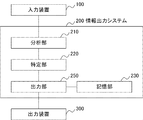
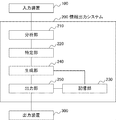
- FIG. 2 is a block diagram showing the configuration of the first exemplary embodiment of the present invention.
- the configuration of the first exemplary embodiment of the present invention includes an input device 100, an information output system 200, and an output device 300.
- the information output system 200 is connected to the input device 100 and the output device 300 via a network or the like.
- the input device 100 is, for example, a telephone such as a fixed phone, a mobile phone, or a smartphone, and inputs voice data during a call between the user of the phone and a call partner using the phone to the information output system 200.
- the user corresponds to the victim and the other party corresponds to the suspect.
- the input device 100 may be a network device such as an exchange, a voice server, a router, or a switch as long as voice data during a call between the user and the other party can be acquired.
- the information output system 200 infers based on the observation state obtained from the input voice data and the domain knowledge information, and outputs information representing the speech to be performed by the user to the output device 300.
- the information output system 200 includes an analysis unit 210, a specification unit 220, a storage unit 230, and an output unit 250.
- the storage unit 230 stores domain knowledge information.
- the domain knowledge information is input in advance by an administrator or the like and stored in the storage unit 230, for example.
- the analysis unit 210 converts voice data input from the input device 100 into text using a voice recognition technique, and represents a natural sentence (hereinafter also referred to as a utterance) of a user or a communication partner. In the following, it is also simply described as a sentence. Further, the analysis unit 210 identifies a speaker (user or call partner) of each extracted sentence and assigns it to the sentence.
- the identifying unit 220 identifies an observation state that is a state represented by the sentence extracted by the analysis unit 210 in the domain knowledge information, and generates observation information indicating the observation state.
- the specifying unit 220 may specify the observation state corresponding to the sentence, or each time the speaker is switched, the observation state corresponding to the speaker's utterance is specified. May be.
- the output unit 250 performs inference using observation information and domain knowledge information, and acquires a rule series that can reach the target state. Each time the observation state is specified, the output unit 250 determines whether or not the observation state is the same as the state obtained in order toward the target state on the rule series. When the next state after the observation state is a state related to the user's speech on the rule series, the output unit 250 determines information representing the speech to be performed by the user based on the state, and outputs the information to the output device 300 To do.
- the output unit 250 includes an inference unit (not shown) that performs inference and acquires a rule series, and an information output unit (not shown) that determines and outputs information representing a statement to be performed by the user. You may go out.
- the output device 300 is, for example, a display device such as a display installed around the input device 100, and displays information representing a message to be made by the user that is output by the information output system 200 to the user. Note that the output device 300 may output information representing a statement to be made by the user by a method other than display, such as outputting the sound with a volume that is so small that the user cannot hear it.
- the information output system 200 may include a CPU (Central Processing Unit) and a storage medium storing a program, and may be a computer that operates by control based on the program.
- a CPU Central Processing Unit
- storage medium storing a program
- FIG. 3 is a block diagram showing a configuration of an information output system 200 realized by a computer according to the first embodiment of the present invention.
- the information output system 200 includes a CPU 201, a storage device 202 (storage medium) such as a hard disk and a memory, an input / output device 203 such as a keyboard and a display, and a communication device 204 that communicates with other devices.
- the CPU 201 executes a program for realizing the analysis unit 210, the specification unit 220, and the output unit 250.
- the storage device 202 stores data (domain knowledge information) stored in the storage unit 230.
- the input / output device 203 receives input of domain knowledge information and a target state from an administrator or the like.
- the communication device 204 receives audio data from the input device 100. In addition, the communication device 204 transmits information representing a statement to be made by the user to the output device 300.
- some or all of the components of the information output system 200 may be realized by general-purpose or dedicated circuits, processors, or combinations thereof. These circuits and processors may be constituted by a single chip or may be constituted by a plurality of chips connected via a bus. In addition, some or all of the components of the information output system 200 may be realized by a combination of the above-described circuit and the like and a program.
- the plurality of information processing devices and circuits may be centrally arranged or distributed. It may be arranged.
- the information processing apparatus, the circuit, and the like may be realized as a form in which each is connected via a communication network, such as a client and server system and a cloud computing system.
- the input device 100, the information output system 200, and the output device 300 may be configured by one device.
- the information output system 200 may be included in the telephone.
- the input device 100, the information output system 200, and the output device 300 may be included in the telephone.
- the input device 100 and the output device 300 may be included in a telephone, and the information output system 200 may be realized by a server (computer) connected to the telephone via a network.
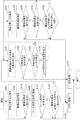
- FIG. 4 is a flowchart showing the operation of the first exemplary embodiment of the present invention.
- the analysis unit 210 of the information output system 200 converts the voice data input from the input device 100 into text, and extracts a sentence representing the speech of the user or the other party (step S101).
- the identifying unit 220 identifies the observation state in the domain knowledge information based on the sentence extracted by the analyzing unit 210 (step S102).
- step S101 If the observation state cannot be specified in step S102 (step S103 / N), the processing from step S101 is repeated.
- the output unit 250 acquires a rule sequence that can reach the target state from the observation state based on the domain knowledge information (performs inference) (step S104). ).
- the output unit 250 also sets the rule series associated with the link information as a rule series that can reach the target state from the observation state. get.
- step S104 when the rule series cannot be acquired (step S105 / N), the output unit 250 executes, for example, a predetermined error process (step S116) and ends.
- the output unit 250 outputs, for example, information indicating “not achieved target state” to the administrator or the like as predetermined error processing. Further, the output unit 250 may block a call between the user and the other party by the input device 100 as the predetermined error process.
- step S104 determines whether the observation state is the start point of the essential rule series on the acquired rule series or a state before the start point. (Step S106).
- the output unit 250 executes, for example, the predetermined error processing described above.
- the output unit 250 sets the acquired rule series as the target rule series.
- the output unit 250 sets the next state of the observation state on the target rule series as the target state (step S107).
- the output unit 250 determines whether the target state is the target state (step S108).
- step S108 when the target state is the target state (step S108 / Y), the output unit 250 executes a predetermined success process (step S117).
- the output unit 250 outputs, for example, information indicating “arrival of the target state” to the administrator or the like as the predetermined success process.
- step S108 when the target state is not the target state (step S108 / N), the output unit 250 determines whether the target state is a state related to the user's speech (step S109).
- step S109 If the target state is a state related to the user's speech in step S109 (step S109 / Y), the output unit 250 determines information representing the speech to be performed by the user based on the target state, and outputs the information to the output device 300. (Step S110).
- the analysis unit 210 extracts a sentence representing the speech of the user or the other party (step S111), as in step S101.
- the specifying unit 220 specifies the observation state in the domain knowledge information, similarly to step S102 (step S112).
- step S112 when the observation state cannot be specified (step S113 / N), the output unit 250 executes, for example, the predetermined error processing described above (step S116).
- step S114 determines whether the observation state is the same as the target state (step S114).
- step S113 when the observation state is the same as the target state (step S114 / Y), the processing from step S107 is repeated.
- step S113 when the observation state is different from the target state (step S114 / N), the output unit 250 determines whether the observation state is a state associated with the link information from the target state (step S115).
- step S115 if the link information is associated (step S115 / Y), the processing from step S107 is repeated.
- step S115 when the state is not associated with the link information (step S115 / N), the output unit 250 executes, for example, the predetermined error processing described above (step S116).
- domain knowledge information as shown in FIG. 5 is stored in the storage unit 230. Further, it is assumed that the specifying unit 220 specifies the state a “the user meets an unknown person with money” as the observation state based on the remarks of the user or the other party.
- the output unit 250 can reach the target state (state j) and the rule series “a ⁇ b ⁇ c ⁇ d ⁇ e ⁇ f” that can reach the target state (state f) from the observation state (state a).
- the rule series “g ⁇ h ⁇ i ⁇ j” is acquired. Since the observation state (state a) is before the start point (state c) of the essential rule series, the output unit 250 displays the rule series “a ⁇ b ⁇ c ⁇ d ⁇ e ⁇ f”, “g ⁇ h ⁇ i”. ⁇ j ”is set as the target rule series, and the next state b of the observation state“ the user listens to time and place ”is set as the target state. Since the target state (state b) is a state related to the user's utterance, the output unit 250 outputs, for example, information “Please listen to the time and place” indicating the utterance that the user should make to the output device 300.
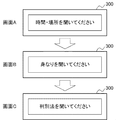
- FIG. 6 is a diagram illustrating an example of a display screen of the output device 300 according to the first embodiment of the present invention.
- the output device 300 displays the information “Please ask the time and place” output by the information output system 200 to the user, as shown in screen A of FIG. As a result, the user is guided to ask the other party about the time and place.
- the specifying unit 220 specifies the state b as an observation state because the user asks the other party about the time and place.
- the output unit 250 sets the next state c of the observation state “the other party answers the time and place” as the target state.
- the identifying unit 220 identifies the state c as an observation state because the other party has answered the time and place.
- the output unit 250 sets the next state d of the observation state “the user hears the dress” as the target state. Since the target state (state d) is a state related to the user's utterance, the output unit 250 outputs, for example, information “Please listen to yourself” indicating the utterance that the user should make to the output device 300.
- the output device 300 displays to the user the information “Please listen” as output from the information output system 200, as shown in screen B of FIG. As a result, the user is guided to listen to the other party.
- the specifying unit 220 specifies the state d as an observation state because the user has heard the other person's appearance.
- the output unit 250 sets the next state e of the observation state “the other party answers the dress” as the target state.
- the identifying unit 220 identifies the state e as an observation state because the other party has answered the dress.
- the output unit 250 sets the next state f after the observation state as the target state. Since the state f is a target state (acquisition of time / place and dressing), the output unit 250 outputs “arrival of target state” to the administrator or the like and ends the process.
- the target state is state e
- the identifying unit 220 has identified the state g “the partner does not answer the dressed” as the observation state because the partner has answered other than dressed.
- the observation state (state g) is not the target state but a state associated with the link information from the target state (state e).
- the output unit 250 sets the state h “the user hears the discrimination method” next to the observation state as the target state. Since the target state (state h) is a state related to the user's speech, the output unit 250 outputs, for example, information “Please listen to the discrimination method” indicating the speech to be performed by the user to the output device 300.
- the output device 300 displays the information “Please listen to the discrimination method” output by the information output system 200 to the user, as shown in screen C of FIG. As a result, the user is guided to hear the discrimination method from the other party.
- the specifying unit 220 specifies the state h as an observation state because the user has asked the other party about the discrimination method.
- the output unit 250 sets the next state i of the observation state “the other party answers the discrimination method” as the target state.
- the identifying unit 220 identifies the state i as an observation state because the opponent answers the discrimination method.
- the output unit 250 sets the next state j after the observation state as the target state. Since the state j is the target state (time / place and discrimination method are acquired), the output unit 250 outputs “target state reached” to the administrator or the like, and ends the process.
- the crime to be investigated is a fraud by phone (special fraud) has been described as an example.
- the present invention is not limited to this, and if the crime is to be communicated with the suspect through communication means, the crime to be investigated may be a crime other than fraud, such as unauthorized solicitation or intimidation through communication means. Good.
- the state where information necessary for the investigation (a state where the investigation can be started) is set as the target state in the domain knowledge information.
- the state is not limited to this, and if the state is necessary for the investigation, the target state may be other states such as “the state where the user has contacted the other party” or “the other party is in a specific place”. It may be set.
- the communication means may be other than a call.
- the communication means may be communication using text such as mail, chat, bulletin board, and SNS.
- the input device 100 and the output device 300 may be included in a user terminal such as a smartphone or a personal computer, for example.
- the input device 100 may input text data at the time of communication between the user and the communication partner to the information output system 200.
- the output device 300 may display information representing an utterance to be made by the user on the display screen during communication using the text.
- information representing the user's remarks is determined based on the next state of the observation state on the rule series.
- the present invention is not limited to this, and if the target state can be reached, information indicating the user's remarks is determined based on other states on the rule sequence such as an arbitrary state related to the user's remarks between the observation state and the target state. Also good.
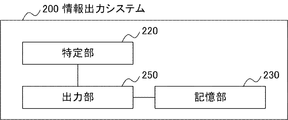
- FIG. 1 is a block diagram showing a characteristic configuration of the first embodiment of the present invention.
- the information output system 200 includes a specifying unit 220, a storage unit 230, and an output unit 250.
- the identifying unit 220 identifies an observation state based on information representing human speech.
- the storage unit 230 stores knowledge information necessary for inference of a target state that is a predetermined state for the investigation.
- the output unit 250 infers based on the observation information indicating the observation state and the knowledge information, and outputs information representing a statement to be made by a human.
- the information output system 200 infers based on the observation information and knowledge information necessary for inference of the target state, which is a predetermined state for the investigation, and outputs information representing a speech to be made by a human being. It is.
- the information output system 200 should acquire a rule series (knowledge series) that can reach the target state by inference, and a human should perform it based on the state regarding the rules (knowledge) obtained sequentially from the rule series. This is to determine the remark.
- a human By setting a state corresponding to a statement in an order that makes a natural conversation in the rule series, a human can be guided through the natural conversation.
- the second embodiment of the present invention is different from the first embodiment of the present invention in that an insufficient rule (knowledge) is generated and inferred.
- FIG. 7 is a block diagram showing the configuration of the second exemplary embodiment of the present invention.
- the information output system 200 according to the second exemplary embodiment of the present invention includes a generation unit 240 in addition to the components of the information output system 200 according to the first exemplary embodiment of the present invention.
- the generation unit 240 generates rule candidates based on the observation information and domain knowledge information.
- a rule candidate is a rule that does not exist in the domain knowledge information, and is a rule candidate that is necessary to reach the target state from the observed state.
- the generation unit 240 further calculates a score of the feasibility of each generated rule candidate using a model representing the feasibility of the relationship between the states, and selects a new rule based on the calculated score To do.
- the model may be learned based on known rules included in the domain knowledge information, or may be learned based on known rules widely collected from other than the domain knowledge information.
- the storage unit 230 further stores a model in addition to the domain knowledge information.
- the model is input in advance by an administrator or the like and stored in the storage unit 230, for example.
- the output unit 250 performs inference by adding a new rule to the domain knowledge information.
- FIG. 8 is a flowchart showing details of the inference process (step S104) in the second embodiment of the present invention.
- the generation unit 240 generates rule candidates based on the observation state and domain knowledge information (step S104_11).
- the generation unit 240 traces the rule in the reverse direction (direction from the result to the premise) from the target state, thereby identifying a state that can reach the target state from that state. .
- the generation unit 240 generates rule candidates for which the observation state is a premise and the specified state is a consequence for the combination of the observation state and each specified state.
- the generation unit 240 calculates a score representing the feasibility for each rule candidate generated in step S104_11 using the model, and selects a new rule based on the calculated score (step S104_12). Here, the generation unit 240 selects a rule candidate having a score equal to or higher than a predetermined threshold as a new rule.
- a score calculation method for example, a technique described in Non-Patent Document 3 or a technique for comparing similarities between states between a rule candidate and a known rule is used.
- the generation unit 240 calculates a rule candidate score using a vector representing a state related to the rule candidate and a weighting matrix represented by the model.
- the score between states a and b is calculated by Va T ⁇ W ⁇ Vb ( T represents transposition) using vectors Va and Vb representing states a and b and a weight matrix W.
- the vectors Va and Vb are, for example, D-dimensional vectors in which each element corresponds to each word in the word dictionary having the number of words D. Each element represents the presence or absence of a corresponding word in the description representing the states a and b.
- the weight matrix W is a D ⁇ D dimensional matrix. The weight matrix W is learned so that a high score is calculated with respect to known rules included in domain knowledge information and known rules widely collected from other than domain knowledge information.
- the output unit 250 acquires a rule sequence that can reach the target state from the observed state (inference is performed) (step S104_13). .
- step S105 is performed using the acquired rule series.
- FIG. 9 is a diagram showing an example of domain knowledge information in the second exemplary embodiment of the present invention.
- domain knowledge information of FIG. 9 unlike the domain knowledge information of FIG.
- it is assumed that domain knowledge information as shown in FIG. 9 is stored in the storage unit 230.
- the score is high in the order of the rules “Meet the unknown person ⁇ Listen to time and place”, “Meet the unknown person ⁇ Listen to the dress”, “Meet the unknown person ⁇ Listen to the discrimination method” It is assumed that such a model is stored in the storage unit 230.
- the specifying unit 220 specifies the state a “user meets an unknown person with money” as the observation state based on the remarks of the user or the other party.
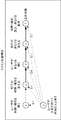
- FIG. 10 is a diagram showing an example of generating rule candidates related to domain knowledge information in the second exemplary embodiment of the present invention.
- an alternate long and short dash line arrow indicates a generated rule candidate.
- the numerical value given to the alternate long and short dash line indicates the score of each rule candidate.
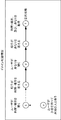
- FIG. 11 is a diagram illustrating a selection example of a new rule related to domain knowledge information in the second exemplary embodiment of the present invention.
- the generation unit 240 determines a combination between the observation state (state a) and each state obtained by tracing the rules in the reverse direction (tracing back) from the target state (state f). Extract as rule candidates.
- the generation unit 240 calculates a score for each rule candidate using a model as shown in FIG.
- the threshold value of the score for determining that the rule candidate is satisfied is “0.5”
- the generation unit 240 is selected as a new rule.
- the output unit 250 uses the domain knowledge information and the new rule as shown in FIG. 11 to create a rule sequence “a ⁇ b ⁇ c ⁇ d ⁇ e” that can reach the target state (state f) from the observation state (state a). ⁇ f ”is acquired.
- the output unit 250 uses the rule sequence “a ⁇ b ⁇ c ⁇ d ⁇ e ⁇ f” so that the user can achieve the target state f as in the first embodiment of the present invention. Outputs information that represents a statement to be made.
- rule candidates are generated between the observed state and each state specified by tracing the rule in the reverse direction from the target state in the domain knowledge information.
- the present invention is not limited to this.
- each state specified by tracing the rule from the observation state in the forward direction (direction from the premise to the consequence) and the rule from the target state are identified by tracing the rule in the reverse direction.
- a rule candidate may be generated between each of the states.
- the generation unit 240 generates new knowledge based on the knowledge information, and the output unit 250 adds the new knowledge to the knowledge of the knowledge information and infers.
- general-purpose knowledge information in order to detect the occurrence of a crime to be investigated, for example, general-purpose knowledge information (hereinafter referred to as general-purpose knowledge information) that is knowledge information related to a wider area than domain knowledge information. Description).
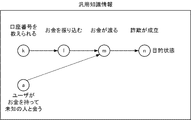
- FIG. 13 is a diagram illustrating an example of general-purpose knowledge information according to the third embodiment of the present invention.
- the general-purpose knowledge information includes a state in which a crime targeted for investigation has occurred (“fraud is established”) as a target state. Further, the rule series “k ⁇ l ⁇ m ⁇ n” is set as the rule series that can reach the target state n.
- FIG. 7 The block diagram showing the configuration of the third exemplary embodiment of the present invention is the same as the second exemplary embodiment (FIG. 7) of the present invention.
- the storage unit 230 further stores general-purpose knowledge information in addition to the domain knowledge information and the model.
- the general knowledge information is input in advance by an administrator or the like and stored in the storage unit 230, for example.
- the generation unit 240 further generates a new rule regarding the general knowledge information based on the observation state and the general knowledge information.
- the output unit 250 performs inference using the general-purpose knowledge information, and detects the occurrence of a crime to be investigated (“fraud is established”) from the observation state.
- FIG. 12 is a flowchart showing details of the inference process (step S104) in the third embodiment of the present invention.
- the generation unit 240 generates rule candidates based on the observation state and the general knowledge information as in step S104_11 described above (step S104_01).
- the generation unit 240 identifies a state in which the target state can be reached from the target state by tracing (tracing back) the rule from the target state in the reverse direction (direction from the outcome to the premise). .
- the generation unit 240 generates rule candidates for which the observation state is a premise and the specified state is a consequence for the combination of the observation state and each specified state.
- the generation unit 240 calculates a score representing the feasibility for each rule candidate generated in step S104_01 using a model, and selects a new rule based on the calculated score. (Step S104_02). Here, the generation unit 240 selects a rule candidate having a score equal to or higher than a predetermined threshold as a new rule.
- the output unit 250 acquires a rule sequence that can reach the target state from the observed state based on the rules included in the general-purpose knowledge information and the new rule selected in step S104_02 (step S104_03). .
- step S104_03 when the rule series can be acquired (step S104_04 / Y), the output unit 250 determines that a crime to be investigated has occurred ("fraud has been established") (step S104_05).
- the output unit 250 sets domain knowledge information related to a crime to be investigated (“special fraud”) as domain knowledge information used in the subsequent processing (step S104 — 06).
- the generation unit 240 generates a new rule related to domain knowledge information (steps S104_11 and S104_12). Further, the output unit 250 acquires a rule series that can reach the target state from the observed state based on the rule included in the domain knowledge information and the new rule (inference is performed) (step S104_13).
- step S105 is performed using the acquired rule series.
- the specifying unit 220 specifies the state a “user meets an unknown person with money” as the observation state based on the remarks of the user or the other party.
- FIG. 14 is a diagram illustrating a generation example of rule candidates related to general knowledge information in the third exemplary embodiment of the present invention.
- an alternate long and short dash line arrow indicates a generated rule candidate.
- the numerical value given to the dashed-dotted line shows the score of each rule candidate.
- FIG. 15 is a diagram showing a selection example of a new rule related to general knowledge information in the third exemplary embodiment of the present invention.
- the generation unit 240 determines a combination between the observation state (state a) and each state obtained by tracing the rule in the reverse direction (tracing back) from the target state (state n). Extract as rule candidates.
- the generation unit 240 calculates a score for each rule candidate using a model as shown in FIG.
- the threshold value of the score for determining that the rule candidate is established is “0.5”
- the generation unit 240 as shown in FIG. a ⁇ m ”is selected as a new rule for general knowledge information.
- the output unit 250 acquires a rule sequence “a ⁇ m ⁇ n” that can reach the target state (state n) from the observation state (state a) using the general knowledge information and the new rule as shown in FIG. It is determined that “a fraud has been established (occurred)”.
- the output unit 250 sets domain knowledge information related to “special fraud investigation” as domain knowledge information to be used.
- the generation unit 240 generates a new rule “a ⁇ b” regarding domain knowledge information
- the output unit 250 generates a rule sequence “a ⁇ b ⁇ c ⁇ d ⁇ e ⁇ f”. Is used to output information representing a statement to be made by the user so that the target state f can be achieved.
- the generation unit 240 generates a new rule related to domain knowledge information and general knowledge information.
- the present invention is not limited to this, and as in the first embodiment of the present invention, generation of a new rule by the generation unit 240 is possible if the target state can be reached from the observation state by the rules included in the domain knowledge information and the general knowledge information. May be omitted.
- the output unit 250 performs inference using the general knowledge information including the objective state for each of the plurality of crime types, and identifies the crime type that has occurred. And the output part 250 outputs the information showing the speech which a user should make using the domain knowledge information corresponding to the identified crime classification.
- the third embodiment of the present invention even when the occurrence of a crime to be investigated is unknown, the occurrence of a crime to be investigated can be detected and a human can be guided to obtain information necessary for the investigation. .
- the reason is that when the information output system 200 infers “the state where the crime targeted for investigation is occurring” and “the state where the crime targeted for investigation occurs” is detected as a result of the inference, This is in order to infer that “the information necessary to start the investigation has been obtained”.
- the present invention can be widely applied to telephones and user terminals, servers connected to these telephones and user terminals, and the like that may be used in crimes via communication means.
- Input Device 200 Information Output System 201 CPU 202 Storage Device 203 Input / Output Device 204 Communication Device 210 Analysis Unit 220 Identification Unit 230 Storage Unit 240 Generation Unit 250 Output Unit 300 Output Device
Landscapes
- Engineering & Computer Science (AREA)
- Business, Economics & Management (AREA)
- Theoretical Computer Science (AREA)
- Physics & Mathematics (AREA)
- General Physics & Mathematics (AREA)
- General Engineering & Computer Science (AREA)
- Tourism & Hospitality (AREA)
- Artificial Intelligence (AREA)
- Computational Linguistics (AREA)
- Software Systems (AREA)
- Mathematical Physics (AREA)
- Computing Systems (AREA)
- Evolutionary Computation (AREA)
- Data Mining & Analysis (AREA)
- General Health & Medical Sciences (AREA)
- Health & Medical Sciences (AREA)
- Economics (AREA)
- Educational Administration (AREA)
- General Business, Economics & Management (AREA)
- Strategic Management (AREA)
- Primary Health Care (AREA)
- Development Economics (AREA)
- Marketing (AREA)
- Human Resources & Organizations (AREA)
- Computer Security & Cryptography (AREA)
- Telephonic Communication Services (AREA)
- Alarm Systems (AREA)
- Information Retrieval, Db Structures And Fs Structures Therefor (AREA)
- Audiology, Speech & Language Pathology (AREA)
Abstract
L'objectif de l'invention est de diriger une personne de façon à atteindre rapidement un état prédéterminé permettant de mener une enquête sur un crime commis à l'aide d'un moyen de communication. Le système de sortie d'informations (200) comprend une unité d'identification (220), une unité de stockage (230) et une unité de sortie (250). L'unité d'identification (220) identifie un état observé d'après les informations représentant des propos tenus par une personne. L'unité de stockage (230) stocke les informations de connaissance nécessaires pour déduire un état cible, c'est-à-dire un état prédéterminé pour mener une enquête. Lors de la déduction effectuée d'après les informations d'observation représentant l'état observé et les informations de connaissances, l'unité de sortie (250) génère des informations représentant les propos tenus par la personne.
Priority Applications (3)
| Application Number | Priority Date | Filing Date | Title |
|---|---|---|---|
| JP2018527567A JPWO2018012412A1 (ja) | 2016-07-11 | 2017-07-07 | 情報出力システム、情報出力方法、及び、プログラム |
| US16/315,223 US20200184352A1 (en) | 2016-07-11 | 2017-07-07 | Information output system, information output method, and recording medium |
| US16/601,880 US20200042886A1 (en) | 2016-07-11 | 2019-10-15 | Information output system, information output method, and recording medium |
Applications Claiming Priority (2)
| Application Number | Priority Date | Filing Date | Title |
|---|---|---|---|
| JP2016-136828 | 2016-07-11 | ||
| JP2016136828 | 2016-07-11 |
Related Child Applications (2)
| Application Number | Title | Priority Date | Filing Date |
|---|---|---|---|
| US16/315,223 A-371-Of-International US20200184352A1 (en) | 2016-07-11 | 2017-07-07 | Information output system, information output method, and recording medium |
| US16/601,880 Continuation US20200042886A1 (en) | 2016-07-11 | 2019-10-15 | Information output system, information output method, and recording medium |
Publications (1)
| Publication Number | Publication Date |
|---|---|
| WO2018012412A1 true WO2018012412A1 (fr) | 2018-01-18 |
Family
ID=60952387
Family Applications (1)
| Application Number | Title | Priority Date | Filing Date |
|---|---|---|---|
| PCT/JP2017/024883 Ceased WO2018012412A1 (fr) | 2016-07-11 | 2017-07-07 | Système de sortie d'informations, procédé de sortie d'informations et support d'enregistrement |
Country Status (3)
| Country | Link |
|---|---|
| US (2) | US20200184352A1 (fr) |
| JP (1) | JPWO2018012412A1 (fr) |
| WO (1) | WO2018012412A1 (fr) |
Cited By (1)
| Publication number | Priority date | Publication date | Assignee | Title |
|---|---|---|---|---|
| WO2021199101A1 (fr) * | 2020-03-30 | 2021-10-07 | 日本電気株式会社 | Système d'aide à l'enquête criminelle, dispositif d'aide à l'enquête criminelle, procédé d'aide à l'enquête criminelle et support d'enregistrement dans lequel un programme d'aide à l'enquête criminelle est stocké |
Citations (3)
| Publication number | Priority date | Publication date | Assignee | Title |
|---|---|---|---|---|
| JP2003067535A (ja) * | 2001-08-28 | 2003-03-07 | Matsushita Electric Works Ltd | 聞き取り調査支援システム |
| JP2007323107A (ja) * | 2006-05-30 | 2007-12-13 | Hitachi Software Eng Co Ltd | 振込み詐欺防止システム |
| JP2015233241A (ja) * | 2014-06-10 | 2015-12-24 | 平三郎 中原 | 迷惑電話判定支援システム |
Family Cites Families (2)
| Publication number | Priority date | Publication date | Assignee | Title |
|---|---|---|---|---|
| US7886359B2 (en) * | 2002-09-18 | 2011-02-08 | Symantec Corporation | Method and apparatus to report policy violations in messages |
| CA3077585A1 (fr) * | 2015-02-24 | 2016-09-01 | 10353744 Canada Ltd. | Systeme de verification de carte |
-
2017
- 2017-07-07 WO PCT/JP2017/024883 patent/WO2018012412A1/fr not_active Ceased
- 2017-07-07 US US16/315,223 patent/US20200184352A1/en not_active Abandoned
- 2017-07-07 JP JP2018527567A patent/JPWO2018012412A1/ja active Pending
-
2019
- 2019-10-15 US US16/601,880 patent/US20200042886A1/en not_active Abandoned
Patent Citations (3)
| Publication number | Priority date | Publication date | Assignee | Title |
|---|---|---|---|---|
| JP2003067535A (ja) * | 2001-08-28 | 2003-03-07 | Matsushita Electric Works Ltd | 聞き取り調査支援システム |
| JP2007323107A (ja) * | 2006-05-30 | 2007-12-13 | Hitachi Software Eng Co Ltd | 振込み詐欺防止システム |
| JP2015233241A (ja) * | 2014-06-10 | 2015-12-24 | 平三郎 中原 | 迷惑電話判定支援システム |
Cited By (3)
| Publication number | Priority date | Publication date | Assignee | Title |
|---|---|---|---|---|
| WO2021199101A1 (fr) * | 2020-03-30 | 2021-10-07 | 日本電気株式会社 | Système d'aide à l'enquête criminelle, dispositif d'aide à l'enquête criminelle, procédé d'aide à l'enquête criminelle et support d'enregistrement dans lequel un programme d'aide à l'enquête criminelle est stocké |
| JPWO2021199101A1 (fr) * | 2020-03-30 | 2021-10-07 | ||
| JP7567904B2 (ja) | 2020-03-30 | 2024-10-16 | 日本電気株式会社 | 犯罪捜査支援システム、犯罪捜査支援方法、及び、犯罪捜査支援プログラム |
Also Published As
| Publication number | Publication date |
|---|---|
| US20200042886A1 (en) | 2020-02-06 |
| JPWO2018012412A1 (ja) | 2019-05-09 |
| US20200184352A1 (en) | 2020-06-11 |
Similar Documents
| Publication | Publication Date | Title |
|---|---|---|
| CN112988991B (zh) | 一种通过人机对话进行反欺诈干预的方法和系统 | |
| JP6341092B2 (ja) | 表現分類装置、表現分類方法、不満検出装置及び不満検出方法 | |
| US12033163B2 (en) | Systems and methods for detecting complaint interactions | |
| WO2020253128A1 (fr) | Procédé, appareil, dispositif informatique et support d'informations associés à un service de communication basé sur la reconnaissance vocale | |
| US10659605B1 (en) | Automatically unsubscribing from automated calls based on call audio patterns | |
| CN107818798A (zh) | 客服服务质量评价方法、装置、设备及存储介质 | |
| CN108763548A (zh) | 收集训练数据的方法、装置、设备和计算机可读存储介质 | |
| US12217752B2 (en) | System method and apparatus for combining words and behaviors | |
| US20220182485A1 (en) | Method for training a spoofing detection model using biometric clustering | |
| JPWO2014069075A1 (ja) | 不満会話判定装置及び不満会話判定方法 | |
| US9875236B2 (en) | Analysis object determination device and analysis object determination method | |
| JP6733901B2 (ja) | 心理分析装置、心理分析方法、およびプログラム | |
| CN115101053A (zh) | 基于情绪识别的对话处理方法、装置、终端及存储介质 | |
| WO2024259486A1 (fr) | Système pour appel frauduleux | |
| CN118708688A (zh) | 基于大模型的对话处理方法、对话方法、装置及电子设备 | |
| CN107846493B (zh) | 通话联系人控制方法、装置及存储介质和移动终端 | |
| WO2018012412A1 (fr) | Système de sortie d'informations, procédé de sortie d'informations et support d'enregistrement | |
| CN112969000A (zh) | 网络会议的控制方法、装置、电子设备和存储介质 | |
| CN116436715B (zh) | 视频会议控制方法、装置、设备及计算机可读存储介质 | |
| JP7801175B2 (ja) | 対話情報抽出装置及び対話情報抽出方法 | |
| JP2017053997A (ja) | 音声認識装置、音声認識方法およびプログラム | |
| CN115063154A (zh) | 基于兴趣度的业务推荐方法、装置、终端及存储介质 | |
| CN111464687A (zh) | 一种陌生呼叫请求的处理方法及装置 | |
| US9116980B1 (en) | System, method, and computer program for determining a set of categories based on textual input | |
| CN116489274B (zh) | 骚扰电话识别方法、装置、电子设备及存储介质 |
Legal Events
| Date | Code | Title | Description |
|---|---|---|---|
| 121 | Ep: the epo has been informed by wipo that ep was designated in this application |
Ref document number: 17827540 Country of ref document: EP Kind code of ref document: A1 |
|
| ENP | Entry into the national phase |
Ref document number: 2018527567 Country of ref document: JP Kind code of ref document: A |
|
| NENP | Non-entry into the national phase |
Ref country code: DE |
|
| 122 | Ep: pct application non-entry in european phase |
Ref document number: 17827540 Country of ref document: EP Kind code of ref document: A1 |