WO2018020959A1 - ユーザ装置、基地局及び通信方法 - Google Patents
ユーザ装置、基地局及び通信方法 Download PDFInfo
- Publication number
- WO2018020959A1 WO2018020959A1 PCT/JP2017/024318 JP2017024318W WO2018020959A1 WO 2018020959 A1 WO2018020959 A1 WO 2018020959A1 JP 2017024318 W JP2017024318 W JP 2017024318W WO 2018020959 A1 WO2018020959 A1 WO 2018020959A1
- Authority
- WO
- WIPO (PCT)
- Prior art keywords
- category
- base station
- layers
- soft buffer
- user apparatus
- Prior art date
- Legal status (The legal status is an assumption and is not a legal conclusion. Google has not performed a legal analysis and makes no representation as to the accuracy of the status listed.)
- Ceased
Links
Images





Classifications
-
- H—ELECTRICITY
- H04—ELECTRIC COMMUNICATION TECHNIQUE
- H04L—TRANSMISSION OF DIGITAL INFORMATION, e.g. TELEGRAPHIC COMMUNICATION
- H04L27/00—Modulated-carrier systems
- H04L27/32—Carrier systems characterised by combinations of two or more of the types covered by groups H04L27/02, H04L27/10, H04L27/18 or H04L27/26
- H04L27/34—Amplitude- and phase-modulated carrier systems, e.g. quadrature-amplitude modulated carrier systems
-
- H—ELECTRICITY
- H04—ELECTRIC COMMUNICATION TECHNIQUE
- H04L—TRANSMISSION OF DIGITAL INFORMATION, e.g. TELEGRAPHIC COMMUNICATION
- H04L1/00—Arrangements for detecting or preventing errors in the information received
- H04L1/12—Arrangements for detecting or preventing errors in the information received by using return channel
- H04L1/16—Arrangements for detecting or preventing errors in the information received by using return channel in which the return channel carries supervisory signals, e.g. repetition request signals
- H04L1/18—Automatic repetition systems, e.g. Van Duuren systems
- H04L1/1829—Arrangements specially adapted for the receiver end
- H04L1/1835—Buffer management
Definitions
- the present invention relates to a user apparatus, a base station, and a communication method.
- LTE Long Term Evolution
- LTE-A LTE-Advanced
- FRA Full Radio Access
- 4G 5G, etc.
- UE category User devices in LTE are classified into a plurality of categories according to UE (User Equipment) capabilities. This category is called “UE category”. For example, a user equipment of category 6 defined in 3GPP Release 10 has a maximum bit rate (peak rate) of DL (Downlink) and a maximum bit rate of UL (Downlink) of 300 Mbps, respectively. And 51 Mbps. Also, from 3GPP Release 12 onwards, the UE category is defined separately for DL and UL. The DL UE category is referred to as “UE DL category”, and the UL UE category is referred to as “UE UL category” (Non-Patent Document 1). For example, when the user apparatus UE accesses the network, it is specified that the UE category supported by the user apparatus UE is notified to the base station by a predetermined signaling message (UE-EUTRA-Capability).
- UE-EUTRA-Capability UE-EUTRA-Capability
- HARQ HybridbrARQ, RQHybrid Automatic Repeat Request
- the user apparatus when data including an error is received, the user apparatus accumulates the data in a memory and combines the data with retransmission data to be retransmitted later.
- the memory used for the HARQ process is called a soft buffer.
- the base station also performs data transmission processing according to the size of the soft buffer of the user apparatus. Specifically, the base station performs rate matching processing based on the size of the soft buffer of the user apparatus when performing DL (Downlink) data transmission.
- 3GPP proposes to define a new UE category that supports 1.2 Gbps and 1.6 Gbps as the maximum DL bit rate.
- the new UE category it is desirable that the user apparatus supports up to 8 layers of MIMO and supports up to 256 QAM as a modulation scheme.
- Non-Patent Document 2 stipulates that the size of the soft buffer is determined according to the UE category, the number of MIMO layers set for each cell, and the modulation scheme set for each cell. .
- a method for determining the size of a soft buffer corresponding to 8-layer MIMO is used. Not specified.
- the user equipment corresponding to the new UE category cannot secure a soft buffer of a size necessary for performing HARQ processing when 8-layer MIMO is applied,
- the base station cannot appropriately perform the rate matching process, the base station and the user apparatus cannot appropriately perform communication.
- the disclosed technique has been made in view of the above, and an object of the present invention is to provide a technique that enables a user apparatus to appropriately communicate when a new UE category is added.
- a user apparatus is a user apparatus in a radio communication system having a base station and a user apparatus, and is configured to be a downlink by the base station and a total soft buffer size corresponding to a UE category of the user apparatus.
- a determining unit that determines a size of a soft buffer to be secured in the user apparatus, based on a modulation scheme to be set in the downlink by the base station, and determined by the determining unit
- a UE that stores data received from the base station in a soft buffer having a size, and the UE category includes 2 layers, 4 layers, and 8 layers as the maximum number of MIMO layers to be supported; and , UE categories including 64QAM and 256QAM as the modulation schemes to be supported.
- a technology that allows a user apparatus to appropriately communicate when a new UE category is added.
- FIG. 10 is a diagram for describing a specification change example (No. 2) of UE-EUTRA-Capability. It is a figure which shows the function structural example of the base station which concerns on embodiment. It is a figure which shows the function structural example of the user apparatus which concerns on embodiment. It is a figure which shows the hardware structural example of the base station which concerns on embodiment, and a user apparatus.
- LTE corresponds to not only a communication method corresponding to Release 8 or 9 of 3GPP but also Release 10, 11, 12, 13, or Release 14 or later of 3GPP. It is used in a broad sense including the fifth generation communication system.
- DL data transmission processing and soft buffer size determination method in LTE will be described.
- the base station eNB adds a 24-bit CRC (Cyclic Redundancy Check) to a transport block (TB).
- the base station eNB divides the transport block including the CRC into a plurality of code blocks (Code block segmentation).
- a bit CRC is attached (Code block CRC attachment).
- the base station eNB performs channel coding for each code block to which the CRC is added.
- Channel coding is performed by turbo coding at a coding rate of 1/3, and coded bits having a bit length of KW are output.
- the encoded bits include systematic bits, first parity bits, and second parity bits, which are information bits for each code block.
- the base station eNB performs interleaving processing individually on the systematic bit, the first parity bit, and the second parity bit. Subsequently, the base station eNB first stores systematic bits in a virtual circular buffer (virtual circular buffer), and then alternately stores first parity bits and second parity bits (Bit collection).
- the size of the virtual circular buffer is the same as the above-mentioned KW.
- the base station eNB performs rate matching processing for each code block. Specifically, first, the base station eNB determines the head position (k0) for each retransmission version (RV: Redundancy version) in the virtual circular buffer based on the soft buffer size for each code block. Next, the base station eNB sets, from the virtual circular buffer, the bit corresponding to the output length (E) for each code block calculated based on the number of bits that can be actually transmitted in 1 TB from the determined head position. Take out.
- the base station eNB concatenates each bit string output in the rate matching processing for each code block, performs scrambling, modulation processing, mapping to a resource block, and the like, and transmits to the user apparatus UE.
- the user apparatus UE decodes the received data by performing HARQ processing. Specifically, when an error is included in the data for each received code block, decoding of the received data is performed by storing the first data and the retransmission data in the soft buffer for each code block and combining them. Try.
- the total soft buffer size (Total number of soft channel bits) that the user apparatus UE should have is fixedly defined for each UE category as shown in FIG.
- FIG. 1 is an excerpt of some UE categories from the DL physical layer parameter set for each UE category defined in Chapter 4.1 of Non-Patent Document 1.
- the user apparatus UE reserves a soft buffer for each cell. That is, the soft buffer of the total soft buffer size is divided into sizes determined by using the following Expression 2 for each cell, so that a soft buffer for each transport block is secured in the user apparatus UE. Further, the soft buffer for each transport block is divided into sizes determined using the following Equation 1, so that the soft buffer for each code block is secured in the user apparatus UE.
- the soft buffer size (Ncb) for each code block is determined based on Equation 1 below.
- NIR is the soft buffer size (bit) for each transport block in one cell
- C is the number of code blocks
- KW is generated by turbo coding as described above. This is the bit length of the encoded bit. “NIR” is determined based on Equation 2 below.
- NSOFT is the total soft buffer size (Total number of soft channel bits) described above.
- KC is defined in Chapter 5.1.4.1.2 of Non-Patent Document 2, and the modulation method with the largest value of “NSOFT”, the maximum number of MIMO layers, and the number of modulation multilevels Is determined according to the following procedure.
- the modulation scheme having the largest modulation multi-level number is referred to as “maximum modulation scheme”, “maximum modulation scheme” or the like for convenience.
- UE category 11 or 12 can be set in “ue-Category-v11a0”.
- the transmission mode 9 or 10 is set, or when the user apparatus UE notifies “ue-Category-v1020”, the transmission mode
- 3 or 4 is set and 4 layers are set in “maxLayersMIMO-r10” as the DL cell radio setting, the value of “NSOFT” is set to the UE category notified by “ue-Category-v1020”. The corresponding total soft buffer size. If not applicable, the process proceeds to (4). If applicable, the process proceeds to (A).
- the above (1) to (4) indicate that the total soft buffer size corresponding to the UE category corresponding to the user apparatus UE is not used as it is as the value of “NSOFT”.
- the user apparatus UE in order to ensure backward compatibility, also has a lower UE category in addition to the UE category that it supports. It stipulates that notification should be made As an example, it is defined that the user apparatus UE corresponding to the UE category 6 or 7 should also notify the UE category 4 in addition to the UE category 6 or 7.
- the user equipment UE corresponding to the combination of the UE DL category 16 and the UE UL category 13 may include the UE categories 12, 10, 7, 4 in addition to the combination of the UE DL category 16 and the UE UL category 13. , And a combination of UE DL category 12 and UE UL category 13 should be notified. That is, the above (1) to (4) are defined so as to correspond to at least one UE category among the UE category to which the user apparatus UE corresponds and the lower UE category.
- UE category 8 is a special UE category that realizes 3 Gbps as the maximum DL bit rate by requiring support of 64QAM and 8-layer MIMO.
- UE DL categories 14 and 17 are special UE categories that realize 256 Gbps and 8 Gbps as the maximum bit rate of DL by requiring support of 256QAM and 8-layer MIMO, respectively.
- the DL cell in the current LTE regulations, especially for new UE categories in which the maximum DL bit rate is greater than 1 Gbps (DL UE category 16) and less than 3 Gbps (UE category 8), the DL cell
- a method for determining a value of “NIR” applied when communication using a maximum of 8 layers and a maximum of 64 QAM, and a communication using a maximum of 8 layers and a maximum of 256 QAM is performed is not defined.
- the “NIR” determination method corresponding to the UE category 8 and the UE DL categories 14 and 17 may be used as the “NIR” determination method for the new UE category.
- the user apparatus UE that supports a new UE category notifies the UE category 8 and the UE DL categories 14 and 17 as lower UE categories.
- these UE categories are categories that achieve 3 Gbps or more as the maximum DL bit rate, and can be said to be subordinate to the new UE categories that support 1.2 Gbps and 1.6 Gbps as the maximum DL bit rate. Absent. Therefore, it is not appropriate to apply the “NIR” determination method corresponding to these UE categories to the user apparatus UE of the new UE category.
- the new UE category that supports 1.2 Gbps and 1.6 Gbps as the maximum bit rate of DL, in particular, communication using a maximum of 8 layers and a maximum of 64 QAM in the DL cell, and
- the user apparatus UE of a new UE category can appropriately communicate Enable.
- FIG. 3 is a diagram illustrating a configuration example of a wireless communication system according to the embodiment.
- the radio communication system according to the embodiment includes a base station eNB and a user apparatus UE.
- the user apparatus UE and the base station eNB can perform CA (Carrier Aggregation).
- CA includes DC (Dual Connectivity).
- FIG. 3 one user apparatus UE and one base station eNB are shown, but this is an example, and there may be a plurality of each.
- the user apparatus UE is a user apparatus UE that supports the new UE category described above.
- a UE DL category having a maximum DL bit rate of 1.2 Gbps may be referred to as a UE DL category 18.
- the UE DL category whose DL maximum bit rate is 1.6 Gbps may be referred to as a UE DL category 19.
- the names of the UE DL category 18 and the UE DL category 19 are used for convenience, but the present invention is not limited to this.
- UECapabilityEnquiry when receiving a UE capability inquiry (UECapabilityEnquiry) from the base station eNB, the user apparatus UE notifies the base station eNB of a UE capability notification (UECapabilityInformation) (S11).
- the UE capability notification (UECapabilityInformation) includes a UE DL category (UE DL category 18 or 19) supported by the user apparatus UE.
- the base station eNB calculates the size (Ncb) of the soft buffer for each code block of the user apparatus UE, and performs DL data transmission while performing rate matching based on the calculated size (S12).
- the base station eNB is notified of the UE DL category 18 or 19 from the user apparatus UE, and “NSOFT” The value of is the total soft buffer size corresponding to UE DL category 18 or 19.
- the base station eNB determines the value of “KC” based on the total soft buffer size corresponding to the UE DL category 18 or 19, and uses the above-described Equation 1 and Equation 2 to determine the size of the soft buffer (NIR, Ncb) is calculated. A method for determining the value of “KC” will be described later.
- the user apparatus UE recognizes communication parameters (the maximum number of MIMO layers and the maximum modulation scheme) in the DL cell based on RRC messages (RRCConnectionSetup, RRCConnectionReconfiguration, etc.) notified from the base station eNB.
- the size (NIR, Ncb) of the soft buffer is calculated using the value of “NSOFT” corresponding to the UE DL category 18 or 19 to be supported and the above-described Equations 1 and 2. That is, the user apparatus UE determines the value of “KC” using the same determination method as that of the base station eNB, and calculates the size (NIR, Ncb) of the soft buffer.
- the user apparatus UE sets a soft buffer of the calculated size in the memory, and decodes the received data by performing HARQ processing. Specifically, when an error is included in the data for each received code block, the received data is decoded by combining the initial data stored in the soft buffer for each code block and the retransmission data. Try.
- the information element (IE: Information element) of the RRC layer for notifying UE DL categories 18 and 19 is newly prescribed
- the parameters shown in FIG. 5 are defined as the DL physical layer parameters of the UE DL categories 18 and 19.
- the user equipment UEs of the UE DL categories 18 and 19 support any one of the 2 layers, the 4 layers, and the 8 layers as the maximum number of MIMO layers, and the modulation scheme has a maximum of 64QAM (that is, , QPSK, 16QAM and 64QAM) or up to 256QAM (ie, QPSK, 16QAM, 64QAM and 256QAM).
- the UE DL categories 18 and 19 are defined as UE categories including 2 layers, 4 layers, and 8 layers as the maximum number of MIMO layers to be supported, and 64 QAM and 256 QAM as modulation schemes to be supported. it can.
- one of the following two methods is used as a method of determining the value of “KC”.
- FIG. 6 shows a specification change example corresponding to the “KC” value determination method (part 1) described above.
- the underlined part (Otherwise, “if” the “UE” signals “ue-Category DL-v1330... The UE” category “indicated” by “ue-CategoryDL-v1330.” Corresponds to the above (1a).
- FIG. 6 shows a specification change example corresponding to the “KC” value determination method (part 1) described above.
- the underlined part (Otherwise, “if” the “UE” signals “ue-Category DL-v1330... The UE” category “indicated” by “ue-CategoryDL-v1330
- FIG. 7 shows a specification change example of the UE capability notification “UE-EUTRA-Capability-v1330” corresponding to the method of determining the value of “KC” (part 1).
- UE-EUTRA-Capability-v1330 corresponding to the method of determining the value of “KC” (part 1).
- UE-CategoryDL-v1330 either UE DL category 18 or 19 is set.
- FIG. 8 shows a specification change example corresponding to the method of determining the value of “KC” described above (part 2).
- the underlined part (Otherwise, “if” the “UE” signals “dl-Category18-r13... UE” category “indicated” by “dl-Category18-r13.” Corresponds to the above (1a).
- FIG. 9 shows a specification change example of the UE capability notification “UE-EUTRA-Capability-v1330” corresponding to the method of determining the value of “KC” (part 2).
- “Dl-Category18-r13” indicates the UE DL category 18, and “dl-Category19-r13” indicates the UE DL category 19.
- the user apparatus UE that supports the UE DL category 18 or 19 may also include UE categories 6 (or 7), 9 (or 10), and / or 11 (or 12) as lower UE categories. Thereby, when the user apparatus UE that supports the UE DL category 18 or 19 does not perform DL communication of a maximum of 8 layers, the base station eNB and the user apparatus UE are described in the above-described (determination method of “KC” value).
- the value of “KC” can be determined using the procedures (1) to (4) and (A) to (D).
- 1200 Mbps can be achieved by bundling two carriers by carrier aggregation.
- the wireless communication system can achieve a maximum bit rate of 800 Mbps with one carrier. That is, 1600 Mbps can be achieved by bundling two carriers by carrier aggregation. Since the UE category in the conventional LTE supports only two-layer or four-layer MIMO, when realizing the same maximum bit rate, it is necessary to bundle more carriers because the maximum bit rate per carrier is low. It was.
- the base station eNB when applying 8-layer MIMO to user equipment UE of a new UE category capable of realizing a maximum bit rate such as 1.2 Gbps and 1.6 Gbps, the base station eNB is appropriate. In addition, it is possible to perform rate matching processing, and also the user apparatus UE can appropriately communicate. Further, a communication carrier using the wireless communication system according to the present embodiment can achieve the same maximum bit rate with a small number of frequency assignments (with a small number of carriers).
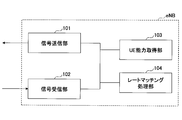
- FIG. 10 is a diagram illustrating a functional configuration example of the base station according to the embodiment.
- the base station eNB includes a signal transmission unit 101, a signal reception unit 102, a UE capability acquisition unit 103, and a rate matching processing unit.
- FIG. 10 shows only main functional units in the base station eNB, and also has a function (not shown) for performing an operation based on at least LTE.
- the functional configuration shown in FIG. 10 is merely an example. As long as the operation according to the present embodiment can be executed, the function classification and the name of the function unit may be anything.
- the signal transmission unit 101 includes a function of generating various physical layer signals from a higher layer signal to be transmitted from the base station eNB and wirelessly transmitting the signals.
- the signal receiving unit 102 includes a function of wirelessly receiving various signals from each user apparatus UE and acquiring a higher layer signal from the received physical layer signal.
- the signal transmission unit 101 includes a function of transmitting information bits after rate matching by the rate matching processing unit 104 to the user apparatus UE.
- each of the signal transmission unit 101 and the signal reception unit 102 may include a function of executing CA that performs communication by bundling a plurality of CCs (Component Carrier).
- the UE capability acquisition unit 103 includes a function of acquiring the UE category of the user apparatus UE from the UE capability (UE-EUTRA-Capability) notified from the user apparatus UE and storing it in a memory or the like.
- UE-EUTRA-Capability UE-EUTRA-Capability
- the rate matching processing unit 104 includes the UE category of the user apparatus UE, the modulation scheme set for the downlink (the modulation scheme having the largest modulation multi-level number), and the number of MIMO layers set for the downlink (maximum number of MIMO layers). ) And the function of performing rate matching processing based on the size of the soft buffer of the user apparatus UE determined based on the above. Note that the rate matching processing unit 104 may be included in the signal transmission unit 101.
- FIG. 11 is a diagram illustrating a functional configuration example of the user apparatus according to the embodiment.
- the user apparatus UE includes a signal transmission unit 201, a signal reception unit 202, a UE capability notification unit 203, and a buffer size determination unit 204.
- FIG. 11 shows only functional units that are particularly related to the embodiment of the present invention in the user apparatus UE, and also has a function (not shown) for performing an operation based on at least LTE. Further, the functional configuration shown in FIG. 11 is merely an example. As long as the operation according to the present embodiment can be executed, the function classification and the name of the function unit may be anything.
- the signal transmission unit 201 includes a function of generating various types of physical layer signals from a higher layer signal to be transmitted from the user apparatus UE and wirelessly transmitting the signals.
- the signal receiving unit 202 includes a function of wirelessly receiving various signals from the base station eNB and acquiring higher layer signals from the received physical layer signals.
- Each of the signal transmission unit 201 and the signal reception unit 202 may include a function of executing CA that performs communication by bundling a plurality of CCs.
- the signal receiving unit 202 includes a function of storing data received from the base station eNB in a soft buffer having a size determined by the buffer size determining unit 204 and performing HARQ processing with soft combining.
- the UE capability notification unit 203 includes a function of notifying the base station eNB of UE capability (UE-EUTRA-Capability) including its own UE category.
- the buffer size determination unit 204 includes a total soft buffer size (“NSOFT”) corresponding to the UE category of the user apparatus UE, and a modulation scheme set by the base station eNB as a downlink (a modulation scheme having the largest number of modulation multivalues). And the function of determining the size of the soft buffer to be secured in the user apparatus UE based on the maximum number of MIMO layers (maximum number of MIMO layers) set in the downlink by the base station eNB.
- NSOFT total soft buffer size
- MIMO layers maximum number of MIMO layers
- the buffer size determination unit 204 is based on the total soft buffer size corresponding to the UE category 19, and the size of the soft buffer memory to be secured in the user apparatus UE
- the size of the soft buffer to be secured in the user apparatus UE is determined based on the total soft buffer size corresponding to the UE category 18. Also good.
- the buffer size determination unit 204 is a soft buffer to be secured in the user apparatus UE based on the total soft buffer size corresponding to the UE category 18. May be calculated.
- each functional block may be realized by one device physically and / or logically coupled, and two or more devices physically and / or logically separated may be directly and / or indirectly. (For example, wired and / or wireless) and may be realized by these plural devices.
- the base station eNB and the user apparatus UE in the embodiment may function as a computer that performs processing of the wireless communication method of the present invention.
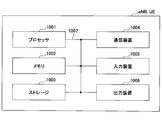
- FIG. 12 is a diagram illustrating an example of a hardware configuration of the base station and the user apparatus according to the embodiment.
- the base station eNB and the user apparatus UE described above may be physically configured as a computer apparatus including a processor 1001, a memory 1002, a storage 1003, a communication apparatus 1004, an input apparatus 1005, an output apparatus 1006, a bus 1007, and the like. .
- the term “apparatus” can be read as a circuit, a device, a unit, or the like.
- the hardware configuration of the base station eNB and the user apparatus UE may be configured to include one or a plurality of apparatuses illustrated in the figure, or may be configured not to include some apparatuses.
- Each function in the base station eNB and the user apparatus UE reads predetermined software (program) on hardware such as the processor 1001 and the memory 1002, so that the processor 1001 performs computation, communication by the communication apparatus 1004, memory 1002 This is realized by controlling reading and / or writing of data in the storage 1003.
- the processor 1001 controls the entire computer by operating an operating system, for example.
- the processor 1001 may be configured by a central processing unit (CPU) including an interface with peripheral devices, a control device, an arithmetic device, a register, and the like.
- CPU central processing unit
- the size determination unit 204 may be realized by the processor 1001.
- the processor 1001 reads a program (program code), software module, or data from the storage 1003 and / or the communication device 1004 to the memory 1002, and executes various processes according to these.
- a program program that causes a computer to execute at least a part of the operations described in the above embodiments is used.
- the size determination unit 204 may be realized by a control program stored in the memory 1002 and operated by the processor 1001, and may be realized similarly for other functional blocks.
- processor 1001 may be executed simultaneously or sequentially by two or more processors 1001.
- the processor 1001 may be implemented by one or more chips. Note that the program may be transmitted from a network via a telecommunication line.
- the memory 1002 is a computer-readable recording medium, and includes, for example, at least one of ROM (Read Only Memory), EPROM (Erasable Programmable ROM), EEPROM (Electrically Erasable Programmable ROM), RAM (Random Access Memory), and the like. May be.
- the memory 1002 may be called a register, a cache, a main memory (main storage device), or the like.
- the memory 1002 can store a program (program code), a software module, and the like that can be executed to implement the wireless communication method according to the embodiment of the present invention.
- the storage 1003 is a computer-readable recording medium such as an optical disk such as a CD-ROM (Compact Disc ROM), a hard disk drive, a flexible disk, a magneto-optical disk (for example, a compact disk, a digital versatile disk, a Blu-ray). (Registered trademark) disk, smart card, flash memory (for example, card, stick, key drive), floppy (registered trademark) disk, magnetic strip, and the like.
- the storage 1003 may be referred to as an auxiliary storage device.
- the storage medium described above may be, for example, a database, server, or other suitable medium including the memory 1002 and / or the storage 1003.
- the communication device 1004 is hardware (transmission / reception device) for performing communication between computers via a wired and / or wireless network, and is also referred to as a network device, a network controller, a network card, a communication module, or the like.
- a network device for example, the signal transmission unit 101 and the signal reception unit 102 of the base station eNB, the signal transmission unit 201 and the signal reception unit 202 of the user apparatus UE may be realized by the communication device 1004.
- the input device 1005 is an input device (for example, a keyboard, a mouse, a microphone, a switch, a button, a sensor, etc.) that accepts an input from the outside.
- the output device 1006 is an output device (for example, a display, a speaker, an LED lamp, etc.) that performs output to the outside.
- the input device 1005 and the output device 1006 may have an integrated configuration (for example, a touch panel).
- each device such as the processor 1001 and the memory 1002 is connected by a bus 1007 for communicating information.
- the bus 1007 may be configured with a single bus or may be configured with different buses between apparatuses.
- the base station eNB and the user equipment UE include hardware such as a microprocessor, a digital signal processor (DSP), an application specific integrated circuit (ASIC), a programmable logic device (PLD), and a field programmable gate array (FPGA). Hardware may be configured, and a part or all of each functional block may be realized by the hardware.
- the processor 1001 may be implemented by at least one of these hardware.
- a user apparatus in a wireless communication system having a base station and a user apparatus, the total soft buffer size corresponding to the UE category of the user apparatus, and the downlink set by the base station
- a determining unit that determines a size of a soft buffer to be secured in the user apparatus based on a modulation scheme to be performed and a number of MIMO layers set in the downlink by the base station, and determined by the determining unit
- a reception unit that stores data received from the base station in a soft buffer of a predetermined size, and the UE category includes 2 layers, 4 layers, and 8 layers as the maximum number of MIMO layers to be supported,
- user equipment that is a UE category including 64QAM and 256QAM as the modulation schemes to be supported is provided. That. When a new UE category is added by this user apparatus UE, a technology that enables the user apparatus to appropriately communicate is provided.
- the determining unit determines a size of a soft buffer memory based on the total soft buffer size corresponding to the UE category 19, and the UE category of the user apparatus is UE In the case of category 18, the size of the soft buffer may be determined based on the total soft buffer size corresponding to UE category 18. Thereby, the user apparatus UE can determine the soft buffer size based on the total soft buffer size corresponding to each of the new UE categories.
- the determining unit may calculate the size of the soft buffer based on the total soft buffer size corresponding to the UE category 18 when the UE category of the user apparatus is the UE category 19 or the UE category 18. Good. Thereby, the user apparatus UE can make the calculation method at the time of calculating the size of a soft buffer in the case where UE category is 18 and the case where it is 19.
- a base station in a radio communication system having a base station and a user apparatus, the UE category of the user apparatus, the modulation scheme set in the downlink, and the downlink set
- a processing unit that performs a rate matching process based on the size of the soft buffer memory of the user apparatus determined based on the maximum number of layers, and a transmission unit that transmits information bits after rate matching to the user apparatus.
- the UE category is a UE category that includes 2 layers, 4 layers, and 8 layers as the maximum number of MIMO layers to be supported, and includes 64 QAM and 256 QAM as the modulation schemes to be supported; Provided.
- the base station eNB provides a technique that allows the user apparatus to appropriately communicate when a new UE category is added.
- a radio communication method executed by a user apparatus in a radio communication system having a base station and a user apparatus, the total soft buffer size corresponding to the UE category of the user apparatus, and the base Determining a size of a soft buffer to be secured in the user apparatus based on a modulation scheme set in the downlink by the station and a number of MIMO layers set in the downlink by the base station; Storing the data received from the base station in a soft buffer of a specified size, and the UE category includes 2 layers, 4 layers, and 8 layers as the maximum number of MIMO layers to be supported, And UE categories including 64QAM and 256QAM as the modulation schemes to be supported.
- Communication method is provided. This wireless communication method provides a technique that allows a user apparatus to appropriately communicate when a new UE category is added.
- a radio communication method executed by a base station in a radio communication system having a base station and a user apparatus, the UE category of the user apparatus, and a modulation scheme set in a downlink, Performing a rate matching process based on the size of the soft buffer memory of the user apparatus determined based on the maximum number of layers set for downlink, and transmitting information bits after rate matching to the user apparatus
- the UE category is a UE category that includes 2 layers, 4 layers, and 8 layers as the maximum number of MIMO layers to be supported, and includes 64 QAM and 256 QAM as the modulation schemes to be supported.
- a wireless communication method is provided. This wireless communication method provides a technique that allows a user apparatus to appropriately communicate when a new UE category is added.
- Each aspect / embodiment described herein includes LTE (Long Term Evolution), LTE-A (LTE-Advanced), SUPER 3G, IMT-Advanced, 4G, 5G, FRA (Future Radio Access), W-CDMA.
- LTE Long Term Evolution
- LTE-A Long Term Evolution-Advanced
- SUPER 3G IMT-Advanced
- 4G 5G
- FRA Full Radio Access
- W-CDMA Wideband
- GSM registered trademark
- CDMA2000 Code Division Multiple Access 2000
- UMB User Mobile Broadband
- IEEE 802.11 Wi-Fi
- IEEE 802.16 WiMAX
- IEEE 802.20 UWB (Ultra-WideBand
- the present invention may be applied to a Bluetooth (registered trademark), a system using another appropriate system, and / or a next generation system extended based on the system.
- the base station can accommodate one or a plurality of (for example, three) cells (also called sectors). When the base station accommodates a plurality of cells, the entire coverage area of the base station can be divided into a plurality of smaller areas, and each smaller area can be divided into a base station subsystem (for example, an indoor small base station RRH: Remote).
- a communication service can also be provided by Radio Head).
- the term “cell” or “sector” refers to part or all of the coverage area of a base station and / or base station subsystem that provides communication services in this coverage. Further, the terms “base station”, “eNB”, “cell”, and “sector” may be used interchangeably herein.
- a base station may also be called in terms such as a fixed station (fixed station), a NodeB, an eNodeB (eNB), an access point (access point), a femto cell, and a small cell.
- the user equipment UE is defined by those skilled in the art as a subscriber station, mobile unit, subscriber unit, wireless unit, remote unit, mobile device, wireless device, wireless communication device, remote device, mobile subscriber station, access terminal, mobile terminal, It may also be referred to as a wireless terminal, remote terminal, handset, user agent, mobile client, client, or some other appropriate terminology.
- the input / output information or the like may be stored in a specific location (for example, a memory) or may be managed by a management table. Input / output information and the like can be overwritten, updated, or additionally written. The output information or the like may be deleted. The input information or the like may be transmitted to another device.
- notification of predetermined information is not limited to explicitly performed, but is performed implicitly (for example, notification of the predetermined information is not performed). Also good.
- the component carrier may be referred to as a carrier frequency, a cell, or the like.
- information, parameters, and the like described in this specification may be represented by absolute values, may be represented by relative values from a predetermined value, or may be represented by other corresponding information.
- the radio resource may be indicated by an index.
- determining may encompass a wide variety of actions. “Judgment” and “decision” are, for example, judgment, calculation, calculation, processing, derivation, investigating, searching (looking up) (for example, table , Searching in a database or another data structure), considering ascertaining as “determining”, “deciding”, and the like.
- determination and “determination” include receiving (for example, receiving information), transmitting (for example, transmitting information), input (input), output (output), and access. (accessing) (e.g., accessing data in a memory) may be considered as "determined” or "determined”.
- determination and “decision” means that “resolving”, “selecting”, “choosing”, “establishing”, and “comparing” are regarded as “determining” and “deciding”. May be included. In other words, “determination” and “determination” may include considering some operation as “determination” and “determination”.
- the phrase “based on” does not mean “based only on”, unless expressly specified otherwise. In other words, the phrase “based on” means both “based only on” and “based at least on.”
- UE user apparatus eNB base station 101 signal transmission unit 102 signal reception unit 103 UE capability acquisition unit 104 rate matching processing unit 201 signal transmission unit 202 signal reception unit 203 UE capability notification unit 204 buffer size determination unit 1001 processor 1002 memory 1003 storage 1004 communication Device 1005 Input device 1006 Output device
Landscapes
- Engineering & Computer Science (AREA)
- Computer Networks & Wireless Communication (AREA)
- Signal Processing (AREA)
- Mobile Radio Communication Systems (AREA)
- Detection And Prevention Of Errors In Transmission (AREA)
- Communication Control (AREA)
Abstract
基地局とユーザ装置とを有する無線通信システムにおけるユーザ装置であって、当該ユーザ装置のUEカテゴリに対応する合計ソフトバッファサイズと、前記基地局により下りリンクに設定される変調方式と、前記基地局により下りリンクに設定されるMIMOレイヤ数と、に基づいて、当該ユーザ装置内に確保すべきソフトバッファのサイズを決定する決定部と、前記決定部で決定されたサイズのソフトバッファに、前記基地局から受信したデータを格納する受信部と、を有し、前記UEカテゴリは、サポートすべき最大のMIMOレイヤ数として2レイヤ、4レイヤ及び8レイヤを含み、かつ、サポートすべき前記変調方式として64QAM及び256QAMを含むUEカテゴリである、ユーザ装置を提供する。
Description
本発明は、ユーザ装置、基地局及び通信方法に関する。
UMTS(Universal Mobile Telecommunications System)ネットワークにおいて、さらなる高速データレート、低遅延などを目的としてロングタームエボリューション(LTE:Long Term Evolution)が仕様化された。また、LTEからの更なる広帯域化及び高速化を目的として、LTEの後継システム(例えば、LTE-A(LTE-Advanced)、FRA(Future Radio Access)、4G、5Gなどともいう)も検討されている。
LTEにおけるユーザ装置は、UE(User Equipment)能力に応じて複数のカテゴリに分類される。当該カテゴリは「UEカテゴリ」と呼ばれ、例えば、3GPP リリース10で規定されたカテゴリ6のユーザ装置は、DL(Downlink)の最大ビットレート(ピークレート)及びUL(Downlink)最大ビットレートとしてそれぞれ300Mbps及び51Mbpsをサポートする。また、3GPP リリース12以降から、UEカテゴリは、DLとULに分けて規定されている。DLのUEカテゴリは、「UE DLカテゴリ」と呼ばれ、ULのUEカテゴリは、「UE ULカテゴリ」と呼ばれる(非特許文献1)。ユーザ装置UEは、例えばネットワークにアクセスする際に、自身がサポートするUEカテゴリを所定のシグナリングメッセージ(UE-EUTRA-Capability)で基地局に通知することが規定されている。
また、LTEでは、ソフトコンバイニングを伴うHARQ(Hybrid ARQ, Hybrid Automatic Repeat Request)が適用されている。HARQ処理では、ユーザ装置は、誤りを含むデータを受信した場合、当該データをメモリに蓄積し、後に再送される再送データと合成する。なお、上記HARQ処理に用いるメモリは、ソフトバッファ(soft buffer)と呼ばれる。また、基地局も、ユーザ装置のソフトバッファのサイズに応じたデータ送信処理を行っている。具体的には、基地局は、DL(Downlink)のデータ送信を行う際に、ユーザ装置のソフトバッファのサイズに基づいてレートマッチング処理を行っている。
3GPP TS36.306 V13.2.0(2016-06)
3GPP TS36.212 V13.2.0(2016-06)
3GPP TS36.331 V13.2.0(2016-06)
現在、3GPPでは、DLの最大ビットレートとして1.2Gbps及び1.6Gbpsをサポートする新たなUEカテゴリを規定することが提案されている。当該新たなUEカテゴリでは、ユーザ装置は8レイヤのMIMOまでをサポートし、変調方式として256QAMまでをサポートすることが望ましい。
ここで、前述のソフトバッファのサイズは、UEカテゴリと、セル毎に設定されるMIMOレイヤ数と、セル毎に設定される変調方式とに従って決定されることが非特許文献2に規定されている。しかしながら、現在の3GPPの仕様では、1Gbps(DLカテゴリ16)より大きく、3Gbps(カテゴリ8)より小さい範囲で新しいUEカテゴリを規定する場合、8レイヤのMIMOに対応するソフトバッファのサイズの決定方法が規定されていない。つまり、現在の3GPP仕様では、当該新たなUEカテゴリに対応するユーザ装置は、8レイヤのMIMOが適用された場合、HARQ処理を行う際に必要なサイズのソフトバッファを確保することができず、また、基地局は、適切にレートマッチング処理を行うことができないことから、基地局及びユーザ装置は適切に通信を行うことができない。
開示の技術は上記に鑑みてなされたものであって、新たなUEカテゴリが追加される場合に、ユーザ装置が適切に通信を行うことを可能にする技術を提供することを目的とする。
開示の技術のユーザ装置は、基地局とユーザ装置とを有する無線通信システムにおけるユーザ装置であって、当該ユーザ装置のUEカテゴリに対応する合計ソフトバッファサイズと、前記基地局により下りリンクに設定される変調方式と、前記基地局により下りリンクに設定されるMIMOレイヤ数と、に基づいて、当該ユーザ装置内に確保すべきソフトバッファのサイズを決定する決定部と、前記決定部で決定されたサイズのソフトバッファに、前記基地局から受信したデータを格納する受信部と、を有し、前記UEカテゴリは、サポートすべき最大のMIMOレイヤ数として2レイヤ、4レイヤ及び8レイヤを含み、かつ、サポートすべき前記変調方式として64QAM及び256QAMを含むUEカテゴリである。
開示の技術によれば、新たなUEカテゴリが追加される場合に、ユーザ装置が適切に通信を行うことを可能にする技術が提供される。
以下、図面を参照して本発明の実施の形態を説明する。なお、以下で説明する実施の形態は一例に過ぎず、本発明が適用される実施の形態は、以下の実施の形態に限られるわけではない。例えば、本実施の形態に係る無線通信システムはLTEに準拠した方式のシステムを想定しているが、本発明はLTEに限定されるわけではなく、他の方式にも適用可能である。なお、本明細書及び特許請求の範囲において、「LTE」は、3GPPのリリース8、又は9に対応する通信方式のみならず、3GPPのリリース10、11、12、13、又はリリース14以降に対応する第5世代の通信方式も含む広い意味で使用する。
<DLデータの送信処理及びソフトバッファの決定方法について>
まず、LTEにおけるDLデータの送信処理及びソフトバッファサイズの決定方法について説明する。DLデータを送信する際、基地局eNBは、トランスポートブロック(TB:Transport Block)に24ビットのCRC(Cyclic Redundancy Check)を付加する。続いて、基地局eNBは、CRCを含むトランスポートブロックのサイズが6144ビットを超える場合に、CRCを含むトランスポートブロックを複数のコードブロックに分割し(Code block segmentation)、各コードブロックに24にビットのCRCを付加する(Code block CRC attachment)。続いて、基地局eNBは、CRCが付加されたコードブロック毎にチャネル符号化(Channel coding)を行う。チャネル符号化は、符号化率1/3のターボ符号化により行われ、ビット長KWの符号化ビットが出力される。符号化ビットには、コードブロック毎の情報ビットであるシステマティックビット、第1パリティビット、及び第2パリティビットが含まれる。
まず、LTEにおけるDLデータの送信処理及びソフトバッファサイズの決定方法について説明する。DLデータを送信する際、基地局eNBは、トランスポートブロック(TB:Transport Block)に24ビットのCRC(Cyclic Redundancy Check)を付加する。続いて、基地局eNBは、CRCを含むトランスポートブロックのサイズが6144ビットを超える場合に、CRCを含むトランスポートブロックを複数のコードブロックに分割し(Code block segmentation)、各コードブロックに24にビットのCRCを付加する(Code block CRC attachment)。続いて、基地局eNBは、CRCが付加されたコードブロック毎にチャネル符号化(Channel coding)を行う。チャネル符号化は、符号化率1/3のターボ符号化により行われ、ビット長KWの符号化ビットが出力される。符号化ビットには、コードブロック毎の情報ビットであるシステマティックビット、第1パリティビット、及び第2パリティビットが含まれる。
続いて、基地局eNBは、システマティックビット、第1パリティビット、及び、第2パリティビットに対して個別にインタリーブ処理を行う。続いて、基地局eNBは、仮想円形バッファ(virtual circular buffer)に、システマティックビットを最初に格納し、その後、第1パリティビット、及び、第2パリティビットを交互に格納する(Bit collection)。仮想円形バッファのサイズは上述のKWと同一である。
続いて、基地局eNBは、コードブロック毎にレートマッチング処理を行う。具体的には、まず、基地局eNBは、コードブロック毎のソフトバッファサイズに基づいて、仮想円形バッファ内における再送バージョン(RV:Redundancy version)ごとの先頭位置(k0)を決定する。次に、基地局eNBは、決定された先頭位置を基点として、1TBで実際に送信可能なビット数に基づいて算出されるコードブロック毎の出力長(E)に該当するビットを仮想円形バッファから取り出す。
続いて、基地局eNBは、コードブロック毎のレートマッチング処理で出力された各々のビット列を連結し、スクランブリング、変調処理、及び、リソースブロックへのマッピング等を行い、ユーザ装置UEに送信する。
続いて、ユーザ装置UEは、HARQ処理を行うことで受信したデータを復号する。具体的には、受信したコードブロック毎のデータにエラーが含まれている場合に、コードブロック毎のソフトバッファに初回のデータと再送データとを格納して合成することで、受信したデータの復号を試みる。
ユーザ装置UEが備えるべき合計ソフトバッファサイズ(Total number of soft channel bits)は、図1に示すようにUEカテゴリ毎に固定的に規定されている。図1は、非特許文献1の4.1章に規定されているUEカテゴリ毎のDL物理レイヤパラメータセットのうち、一部のUEカテゴリを抜粋したものである。
ユーザ装置UEは、セル毎にソフトバッファを確保する。つまり、合計ソフトバッファサイズのソフトバッファが、セル毎に以下の式2を用いて決定されるサイズに分割されることで、トランスポートブロック毎のソフトバッファがユーザ装置UE内に確保される。更に、トランスポートブロック毎のソフトバッファが以下の式1を用いて決定されるサイズに分割されることで、コードブロック毎のソフトバッファがユーザ装置UE内に確保される。
コードブロック毎のソフトバッファサイズ(Ncb)は、以下の式1に基づいて決定される。

「NIR」は、1つのセルにおけるトランスポートブロック毎のソフトバッファサイズ(ビット)であり、「C」はコードブロックの数であり、「KW」は、前述したように、ターボ符号化により生成された符号化ビットのビット長である。「NIR」は、以下の式2に基づいて決定される。
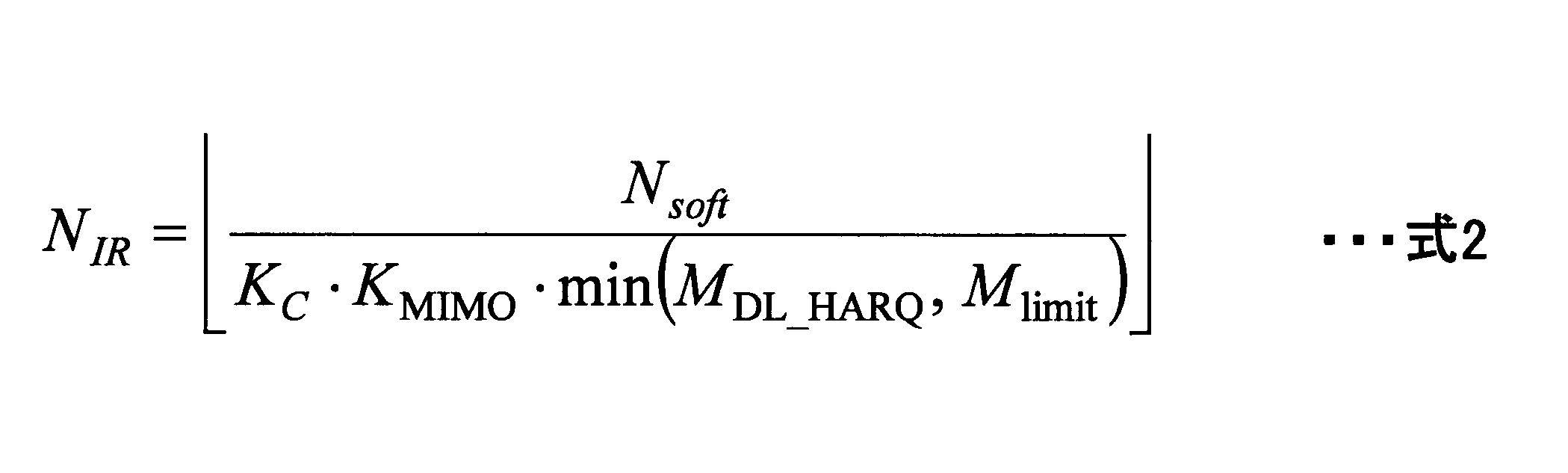
「NSOFT」は、上述した合計ソフトバッファサイズ(Total number of soft channel bits)である。「KMIMO」は、1TTIで同時に送信され得る最大トランスポートブロック数を意図しており、PDSCH(Physical Downlink Shared Channel)が送信モード(TM:Transmission mode)3、4、8、9、又は10で送信される場合は「KMIMO=2」であり、その他の場合は「KMIMO=1」である。「MDL_HARQ」はHARQプロセス数であり、具体的にはTS36.213の7章に規定されている。FDDの場合は基本的に「MDL_HARQ=8」である。
「KC」の値は、非特許文献2の5.1.4.1.2章に規定されており、「NSOFT」の値、最大MIMOレイヤ数、及び、変調多値数が最も大きい変調方式に基づいて、以下の手順に従って決定される。なお、以下の説明で、変調多値数が最も大きい変調方式を、便宜上「最大の変調方式」、「最大変調方式」などと呼ぶ。
(「KC」の値の決定方法)
(1)ユーザ装置UEがUE能力(UE Capability)として、UEカテゴリ0を示す「ue-CategoryDL-r12」を通知する場合、又は、UEカテゴリ14を示す「ue-CategoryDL-r12」を通知し、かつ、DLセルの無線設定として「altCQI-Table-r12」が設定される場合、「NSOFT」の値は、「ue-CategoryDL-r12」で通知されるUEカテゴリに対応する合計ソフトバッファサイズとする。該当しない場合は(2)に進み、該当する場合は(A)に進む。ここで、DLセルの無線設定として「altCQI-Table-r12」が設定される場合とは、DLセルで最大256QAMの通信が行われる場合と同義である(以下の説明でも同様)。
(2)ユーザ装置UEが「ue-Category-v11a0」を通知し、かつ、DLセルの無線設定として「altCQI-Table-r12」が設定される場合、「NSOFT」の値は、「ue-Category-v11a0」で通知されるUEカテゴリに対応する合計ソフトバッファサイズとする。該当しない場合は(3)に進み、該当する場合は(A)に進む。非特許文献3によれば「ue-Category-v11a0」には、UEカテゴリ11又は12を設定可能である。
(3)ユーザ装置UEが「ue-Category-v1020」を通知し、かつ、送信モード9又は10が設定される場合、又は、ユーザ装置UEが「ue-Category-v1020」を通知し、送信モード3又は4が設定され、かつ、DLセルの無線設定として「maxLayersMIMO-r10」に4レイヤが設定される場合、「NSOFT」の値は、「ue-Category-v1020」で通知されるUEカテゴリに対応する合計ソフトバッファサイズとする。該当しない場合は(4)に進み、該当する場合は(A)に進む。非特許文献3によれば「ue-Category-v1020」には、UEカテゴリ6~8を設定可能である。
(4)上記いずれにも該当しない場合、「NSOFT」の値は、「ue-Category」で通知されるUEカテゴリに対応する合計ソフトバッファサイズとする。続いて(A)に進む。非特許文献3によれば「ue-Category」には、UEカテゴリ1~5を設定可能である。
(A)「NSOFT」の値が35982720又は47431680の場合、「KC」=5とする。該当しない場合は(B)に進む。
(B)「NSOFT」の値が7308288であり、かつ、DLセルの無線設定として「altCQI-Table-r12」が設定される場合、「KC」=3又は3/2とする。より詳細には、ユーザ装置UEが、ユーザ装置UEに設定される送信モードにおいて、DLセルで最大レイヤ2をサポートする場合、若しくは、DLセルの無線設定として「maxLayersMIMO-r10」に2レイヤが設定される場合は「KC」=3とし、それ以外の場合は「KC」=3/2とする。該当しない場合は(C)に進む。
(C)「NSOFT」の値が3654144であり、ユーザ装置UEが、DLセルで最大レイヤ2をサポートする場合、若しくは、DLセルの無線設定として「maxLayersMIMO-r10」に2レイヤが設定される場合は「KC」=2とする。該当しない場合は(C)に進む。
(D)上記(A)~(C)を満たさない場合、「KC」=1とする。
(1)ユーザ装置UEがUE能力(UE Capability)として、UEカテゴリ0を示す「ue-CategoryDL-r12」を通知する場合、又は、UEカテゴリ14を示す「ue-CategoryDL-r12」を通知し、かつ、DLセルの無線設定として「altCQI-Table-r12」が設定される場合、「NSOFT」の値は、「ue-CategoryDL-r12」で通知されるUEカテゴリに対応する合計ソフトバッファサイズとする。該当しない場合は(2)に進み、該当する場合は(A)に進む。ここで、DLセルの無線設定として「altCQI-Table-r12」が設定される場合とは、DLセルで最大256QAMの通信が行われる場合と同義である(以下の説明でも同様)。
(2)ユーザ装置UEが「ue-Category-v11a0」を通知し、かつ、DLセルの無線設定として「altCQI-Table-r12」が設定される場合、「NSOFT」の値は、「ue-Category-v11a0」で通知されるUEカテゴリに対応する合計ソフトバッファサイズとする。該当しない場合は(3)に進み、該当する場合は(A)に進む。非特許文献3によれば「ue-Category-v11a0」には、UEカテゴリ11又は12を設定可能である。
(3)ユーザ装置UEが「ue-Category-v1020」を通知し、かつ、送信モード9又は10が設定される場合、又は、ユーザ装置UEが「ue-Category-v1020」を通知し、送信モード3又は4が設定され、かつ、DLセルの無線設定として「maxLayersMIMO-r10」に4レイヤが設定される場合、「NSOFT」の値は、「ue-Category-v1020」で通知されるUEカテゴリに対応する合計ソフトバッファサイズとする。該当しない場合は(4)に進み、該当する場合は(A)に進む。非特許文献3によれば「ue-Category-v1020」には、UEカテゴリ6~8を設定可能である。
(4)上記いずれにも該当しない場合、「NSOFT」の値は、「ue-Category」で通知されるUEカテゴリに対応する合計ソフトバッファサイズとする。続いて(A)に進む。非特許文献3によれば「ue-Category」には、UEカテゴリ1~5を設定可能である。
(A)「NSOFT」の値が35982720又は47431680の場合、「KC」=5とする。該当しない場合は(B)に進む。
(B)「NSOFT」の値が7308288であり、かつ、DLセルの無線設定として「altCQI-Table-r12」が設定される場合、「KC」=3又は3/2とする。より詳細には、ユーザ装置UEが、ユーザ装置UEに設定される送信モードにおいて、DLセルで最大レイヤ2をサポートする場合、若しくは、DLセルの無線設定として「maxLayersMIMO-r10」に2レイヤが設定される場合は「KC」=3とし、それ以外の場合は「KC」=3/2とする。該当しない場合は(C)に進む。
(C)「NSOFT」の値が3654144であり、ユーザ装置UEが、DLセルで最大レイヤ2をサポートする場合、若しくは、DLセルの無線設定として「maxLayersMIMO-r10」に2レイヤが設定される場合は「KC」=2とする。該当しない場合は(C)に進む。
(D)上記(A)~(C)を満たさない場合、「KC」=1とする。
上記の(1)~(4)は、ユーザ装置UEが対応するUEカテゴリに対応する合計ソフトバッファサイズがそのまま「NSOFT」の値として用いられるのではないことを示している。ここで、非特許文献3の4.1章及びTable4.1A-6によれば、ユーザ装置UEは、後方互換性確保のため、自身が対応しているUEカテゴリに加えて下位のUEカテゴリも通知すべきことが規定されている。一例として、UEカテゴリ6又は7に対応しているユーザ装置UEは、UEカテゴリ6又は7に加えてUEカテゴリ4も通知すべきことが規定されている。また、一例として、UE DLカテゴリ16及びUE ULカテゴリ13の組み合わせに対応しているユーザ装置UEは、UE DLカテゴリ16及びUE ULカテゴリ13の組み合わせに加えて、UEカテゴリ12、10、7、4、並びに、UE DLカテゴリ12及びUE ULカテゴリ13の組み合わせも通知すべきことが規定されている。すなわち、上記の(1)~(4)は、ユーザ装置UEが対応するUEカテゴリ及びその下位のUEカテゴリのうち、少なくともいずれか1つのUEカテゴリに該当するように規定されている。
ここで、簡略化のために、「KMIMO=1」及び「MDL_HARQ=1」と仮定した場合に、UEカテゴリ4以上のUEカテゴリについて上記の(1)~(4)及び(A)~(D)に従って「NIR」を算出すると、UEカテゴリ8、UE DLカテゴリ14及び17の場合を除き、図2に示す値のうちいずれかの値に収束する。例えば図2において「NIR=1827072」は、DLセルで最大2レイヤMIMO(つまり、1レイヤ又は2レイヤのいずれか)及び最大64QAM(つまり、QPSK、16QAM、64QAMのいずれか)を用いた通信が行われる場合に適用される「NIR」の値を意味する。
なお、UEカテゴリ8は、64QAM及び8レイヤMIMOのサポートを必須とすることで、DLの最大ビットレートとして3Gbpsを実現する特殊なUEカテゴリである。同様に、UE DLカテゴリ14及び17は、256QAM及び8レイヤMIMOのサポートを必須とすることで、DLの最大ビットレートとして、それぞれ4Gbps及び25Gbpsを実現する特殊なUEカテゴリである。
以上、LTEにおけるDLデータの送信処理及びソフトバッファサイズの決定方法について説明したが、図2に示すように、現在のLTEでは、UEカテゴリ8、14及び17を除き、DLセルで最大8レイヤ及び最大64QAMを用いた通信、並びに、最大8レイヤ及び最大256QAMを用いた通信が行われる場合に適用される「NIR」の値を決定する方法が存在しない。つまり、現在のLTEの規定では、DLの最大ビットレートが1Gbps(DL UEカテゴリ16)より大きく、3Gbps(UEカテゴリ8)より小さい範囲で規定される新たなUEカテゴリに対して、特に、DLセルで最大8レイヤ及び最大64QAMを用いた通信、並びに、最大8レイヤ及び最大256QAMを用いた通信が行われる場合に適用される「NIR」の値を決定する方法が規定されていない。
なお、新たなUEカテゴリに対する「NIR」の決定方法として、UEカテゴリ8、UE DLカテゴリ14及び17に対応する「NIR」の決定方法を流用することも考えられる。具体的には、新たなUEカテゴリをサポートするユーザ装置UEは、下位のUEカテゴリとして、UEカテゴリ8、UE DLカテゴリ14及び17を通知することが考えられる。しかしながら、これらのUEカテゴリは、DLの最大ビットレートとして3Gbps以上を実現するカテゴリであり、DLの最大ビットレートとして1.2Gbps及び1.6Gbpsをサポートする新たなUEカテゴリの下位のカテゴリとは言えない。従って、これらのUEカテゴリに対応する「NIR」の決定方法を、新たなUEカテゴリのユーザ装置UEに適用することは適切ではない。
そこで、本実施の形態では、DLの最大ビットレートとして1.2Gbps及び1.6Gbpsをサポートする新たなUEカテゴリに対して、特に、DLセルで最大8レイヤ及び最大64QAMを用いた通信、並びに、最大8レイヤ及び最大256QAMを用いた通信が行われる場合に適用される「NIR」の値を決定する方法を新たに規定することで、新たなUEカテゴリのユーザ装置UEが適切に通信を行うことを可能にする。
<システム構成>
図3は、実施の形態に係る無線通信システムの構成例を示す図である。図3に示すように、実施の形態に係る無線通信システムは、基地局eNBとユーザ装置UEとを有する。ユーザ装置UE及び基地局eNBは、CA(Carrier Aggregation、キャリアアグリゲーション)を行うことが可能である。また、CAにはDC(Dual Connectivity)を含む。図3には、ユーザ装置UE、及び基地局eNBが1つずつ示されているが、これは例であり、それぞれ複数であってもよい。
図3は、実施の形態に係る無線通信システムの構成例を示す図である。図3に示すように、実施の形態に係る無線通信システムは、基地局eNBとユーザ装置UEとを有する。ユーザ装置UE及び基地局eNBは、CA(Carrier Aggregation、キャリアアグリゲーション)を行うことが可能である。また、CAにはDC(Dual Connectivity)を含む。図3には、ユーザ装置UE、及び基地局eNBが1つずつ示されているが、これは例であり、それぞれ複数であってもよい。
ユーザ装置UEは、上述の新たなUEカテゴリをサポートするユーザ装置UEである。なお、当該新たなUEカテゴリのうち、DLの最大ビットレートが1.2GbpsであるUE DLカテゴリはUE DLカテゴリ18と呼ばれてもよい。また、なお、DLの最大ビットレートが1.6GbpsであるUE DLカテゴリはUE DLカテゴリ19と呼ばれてもよい。以下の説明では、便宜上、UE DLカテゴリ18及びUE DLカテゴリ19の名称を用いて説明するが、これに限定されるものではない。
<処理手順>
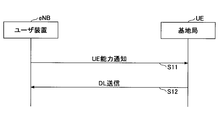
図4を用いて、実施の形態に係る無線通信システムが行う処理手順を説明する。まず、ユーザ装置UEは、基地局eNBからUE能力問い合わせ(UECapabilityEnquiry)を受信した場合、UE能力通知(UECapabilityInformation)を基地局eNBに通知する(S11)。UE能力通知(UECapabilityInformation)には、ユーザ装置UEがサポートするUE DLカテゴリ(UE DLカテゴリ18又は19)が含まれる。
図4を用いて、実施の形態に係る無線通信システムが行う処理手順を説明する。まず、ユーザ装置UEは、基地局eNBからUE能力問い合わせ(UECapabilityEnquiry)を受信した場合、UE能力通知(UECapabilityInformation)を基地局eNBに通知する(S11)。UE能力通知(UECapabilityInformation)には、ユーザ装置UEがサポートするUE DLカテゴリ(UE DLカテゴリ18又は19)が含まれる。
続いて、基地局eNBは、ユーザ装置UEのコードブロック毎のソフトバッファのサイズ(Ncb)を算出し、算出したサイズに基づいてレートマッチングを行いながらDLのデータ送信を行う(S12)。ソフトバッファのサイズ(Ncb)を算出する際において、基地局eNBは、ユーザ装置UEからUE DLカテゴリ18又は19が通知され、かつ、DLセルにおいて最大8レイヤの通信が行われる場合、「NSOFT」の値は、UE DLカテゴリ18又は19に対応する合計ソフトバッファサイズとする。また、基地局eNBは、UE DLカテゴリ18又は19に対応する合計ソフトバッファサイズに基づいて「KC」の値を決定し、前述の式1及び式2を用いて、ソフトバッファのサイズ(NIR、Ncb)を算出する。「KC」の値の決定方法については後述する。
続いて、ユーザ装置UEは、基地局eNBから通知されるRRCメッセージ(RRCConnectionSetup、RRCConnectionReconfiguration等)により、DLセルにおける通信パラメータ(最大のMIMOレイヤ数、及び、最大の変調方式)を認識し、自身がサポートするUE DLカテゴリ18又は19に対応する「NSOFT」の値と、前述の式1及び式2を用いて、ソフトバッファのサイズ(NIR、Ncb)を算出する。つまり、ユーザ装置UEは、基地局eNBと同一の決定方法を用いて「KC」の値を決定し、ソフトバッファのサイズ(NIR、Ncb)を算出する。続いて、ユーザ装置UEは、算出されたサイズのソフトバッファをメモリ内に設定し、HARQ処理を行うことで受信したデータを復号する。具体的には、受信したコードブロック毎のデータにエラーが含まれている場合に、コードブロック毎のソフトバッファに格納された初回のデータと再送データと合成することで、受信したデータの復号を試みる。
(本実施の形態に係る「KC」の値の決定方法)
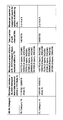
続いて、本実施の形態における「KC」の値の決定方法についてより具体的に説明する。本実施の形態では、UE DLカテゴリ18及び19を通知するためのRRCレイヤの情報要素(IE:Information element)を新たに規定する。また、本実施の形態では、UE DLカテゴリ18及び19のDL物理レイヤパラメータとして、図5に示すパラメータを規定する。UE DLカテゴリ18に対応する合計ソフトバッファサイズは14616576であるが、この値は、DLの最大ビットレートが150MbpsであるUEカテゴリ4に対応する合計ソフトバッファサイズ(1827072)の8倍(1.2Gbps/150Mbps=8)に相当する。また、UE DLカテゴリ19に対応する合計ソフトバッファサイズは19488768であるが、この値は、DLの最大ビットレートが600MbpsであるUEカテゴリ11に対応する合計ソフトバッファサイズ(7308288)の8/3倍(1.6Gbps/600Mbps=8/3)に相当する。
続いて、本実施の形態における「KC」の値の決定方法についてより具体的に説明する。本実施の形態では、UE DLカテゴリ18及び19を通知するためのRRCレイヤの情報要素(IE:Information element)を新たに規定する。また、本実施の形態では、UE DLカテゴリ18及び19のDL物理レイヤパラメータとして、図5に示すパラメータを規定する。UE DLカテゴリ18に対応する合計ソフトバッファサイズは14616576であるが、この値は、DLの最大ビットレートが150MbpsであるUEカテゴリ4に対応する合計ソフトバッファサイズ(1827072)の8倍(1.2Gbps/150Mbps=8)に相当する。また、UE DLカテゴリ19に対応する合計ソフトバッファサイズは19488768であるが、この値は、DLの最大ビットレートが600MbpsであるUEカテゴリ11に対応する合計ソフトバッファサイズ(7308288)の8/3倍(1.6Gbps/600Mbps=8/3)に相当する。
また図5に示すように、UE DLカテゴリ18及び19のユーザ装置UEは、最大のMIMOレイヤ数として、2レイヤ、4レイヤ又は8レイヤのいずれかをサポートし、変調方式として、最大64QAM(つまり、QPSK、16QAM及び64QAM)又は最大256QAM(つまり、QPSK、16QAM、64QAM及び256QAM)のいずれかをサポートする。言い換えると、UE DLカテゴリ18及び19は、サポートすべき最大のMIMOレイヤ数として2レイヤ、4レイヤ及び8レイヤを含み、かつ、サポートすべき変調方式として64QAM及び256QAMを含むUEカテゴリであると定義できる。
ここで、本実施の形態では、「KC」の値の決定方法として、以下の2通りのうちいずれか一方を用いる。
[「KC」の値の決定方法(その1)]
「KC」の値の決定方法(その1)では、UE DLカテゴリ19に対応するユーザ装置UEはUE DLカテゴリ19を通知し、UE DLカテゴリ18に対応するユーザ装置UEはUE DLカテゴリ18を通知する。
「KC」の値の決定方法(その1)では、UE DLカテゴリ19に対応するユーザ装置UEはUE DLカテゴリ19を通知し、UE DLカテゴリ18に対応するユーザ装置UEはUE DLカテゴリ18を通知する。
「KC」の値の決定方法(その1)では、前述した(「KC」の値の決定方法)で説明した手順(1)~(4)のうち、(1)及び(2)の間に、以下の追加手順(1a)を追加し、手順(1)に該当しない場合は(1a)に進むようにする。また、手順(A)~(D)のうち、(A)及び(B)の間に、以下の手順(A1)及び(A2)を追加し、手順(A)に該当しない場合は(A1)に進むようにする。
(1a)ユーザ装置UEがUE DLカテゴリ18及び19を通知し、かつ、ユーザ装置UEに送信モード9又は10が設定されるDLセルにおいてユーザ装置UEが最大8レイヤのMIMOをサポートする場合、又は、ユーザ装置UEがUE DLカテゴリ18及び19を通知し、かつ、DLセルの無線設定として「maxLayersMIMO-r10」に8レイヤが設定される場合、「NSOFT」の値は、ユーザ装置UEから通知されるUEカテゴリに対応する合計ソフトバッファサイズとする。該当しない場合は(2)に進み、該当する場合は(A)に進む。なお、送信モード9又は10は、最大8レイヤのMIMOを使用可能な送信モードである。
(A1)「NSOFT」の値が14616576であり(つまり、UE DLカテゴリ18である場合)、かつ、DLセルの無線設定として「altCQI-Table-r12」が設定される場合(つまり、DLセルで最大256QAMの通信が行われる場合)、「KC」=3/2とする。「NSOFT」の値が14616576であるが、DLセルの無線設定として「altCQI-Table-r12」が設定されない場合(つまり、DLセルで最大64QAMまでの通信が行われる場合)、「KC」=2とする。該当しない場合は(A2)に進む。
(A2)「NSOFT」の値が19488768であり(つまり、UE DLカテゴリ19である場合)、かつ、DLセルの無線設定として「altCQI-Table-r12」が設定される場合(つまり、DLセルで最大256QAMの通信が行われる場合)、「KC」=2とする。「NSOFT」の値が19488768であるが、DLセルの無線設定として「altCQI-Table-r12」が設定されない場合(つまり、DLセルで最大64QAMまでの通信が行われる場合)、「KC」=8/3とする。該当しない場合は(B)に進む。
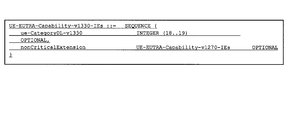
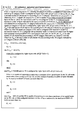
以上説明した「KC」の値の決定方法(その1)に対応する仕様変更例を図6に示す。図6のうち下線部(Otherwise, if the UE signals ue-CategoryDL-v1330・・・the UE category indicated by ue-CategoryDL-v1330.)は、上記(1a)に該当する。また、図のうち下線部(elseif Nsoft = 14616576,・・KC = 2・・enf if.)は上記(A1)に該当し、下線部(elseif Nsoft = 19488768,・・KC = 8/3・・enf if.)は上記(A2)に該当する。また、「KC」の値の決定方法(その1)に対応するUE能力通知「UE-EUTRA-Capability-v1330」の仕様変更例を図7に示す。「ue-CategoryDL-v1330」には、UE DLカテゴリ18又は19のいずれか一方が設定される。
[「KC」の値の決定方法(その2)]
「KC」の値の決定方法(その2)では、「KC」の値の決定方法(その1)と異なり、UE DLカテゴリ19に対応するユーザ装置UEは、下位のUEカテゴリとしてUE DLカテゴリ18も通知する。
「KC」の値の決定方法(その2)では、「KC」の値の決定方法(その1)と異なり、UE DLカテゴリ19に対応するユーザ装置UEは、下位のUEカテゴリとしてUE DLカテゴリ18も通知する。
「KC」の値の決定方法(その2)では、前述した(「KC」の値の決定方法)で説明した手順(1)~(4)のうち、(1)及び(2)の間に、以下の追加手順(1a)を追加し、手順(1)に該当しない場合は(1a)に進むようにする。また、手順(A)~(D)のうち、(A)及び(B)の間に、以下の手順(A1)を追加し、手順(A)に該当しない場合は(A1)に進むようにする。
(1a)ユーザ装置UEがUE DLカテゴリ18を通知し、かつ、ユーザ装置UEに送信モード9又は10が設定されるDLセルにおいてユーザ装置UEが最大8レイヤのMIMOをサポートする場合、又は、ユーザ装置UEがUE DLカテゴリ18を通知し、かつ、DLセルの無線設定として「maxLayersMIMO-r10」に8レイヤが設定される場合、「NSOFT」の値は、UE DLカテゴリ18に対応する合計ソフトバッファサイズとする。該当しない場合は(2)に進み、該当する場合は(A)に進む。
(A1)「NSOFT」の値が14616576であり、かつ、DLセルの無線設定として「altCQI-Table-r12」が設定される場合(つまり、DLセルで最大256QAMの通信が行われる場合)、「KC」=3/2とする。「NSOFT」の値が14616576であるが、DLセルの無線設定として「altCQI-Table-r12」が設定されない場合(つまり、DLセルで最大64QAMまでの通信が行われる場合)、「KC」=2とする。該当しない場合は(B)に進む。
以上説明した「KC」の値の決定方法(その2)に対応する仕様変更例を図8に示す。図8のうち下線部(Otherwise, if the UE signals dl-Category18-r13・・・the UE category indicated by dl-Category18-r13.)は、上記(1a)に該当する。また、図のうち下線部(elseif Nsoft = 14616576,・・KC = 2・・enf if.)は上記(A1)に該当する。また、「KC」の値の決定方法(その2)に対応するUE能力通知「UE-EUTRA-Capability-v1330」の仕様変更例を図9に示す。「dl-Category18-r13」は、UE DLカテゴリ18を示し、「dl-Category19-r13」は、UE DLカテゴリ19を示す。
以上、「KC」の値の決定方法(その2)では、「KC」の値の決定方法(その1)の手順(A2)を省略することができるため、「KC」の値の決定方法(その1)と比較して、「KC」の値の計算方法が簡略化される。
[決定方法(その1)及び(その1)に関する補足事項]
UE DLカテゴリ18又は19をサポートするユーザ装置UEは、下位のUEカテゴリとして、UEカテゴリ6(若しくは7)、9(若しくは10)、及び/又は11(若しくは12)も含めるようにしてもよい。これにより、UE DLカテゴリ18又は19をサポートするユーザ装置UEが最大8レイヤのDL通信を行わない場合、基地局eNB及びユーザ装置UEは、前述した(「KC」の値の決定方法)で説明した手順(1)~(4)及び(A)~(D)を用いて「KC」の値を決定することができる。
UE DLカテゴリ18又は19をサポートするユーザ装置UEは、下位のUEカテゴリとして、UEカテゴリ6(若しくは7)、9(若しくは10)、及び/又は11(若しくは12)も含めるようにしてもよい。これにより、UE DLカテゴリ18又は19をサポートするユーザ装置UEが最大8レイヤのDL通信を行わない場合、基地局eNB及びユーザ装置UEは、前述した(「KC」の値の決定方法)で説明した手順(1)~(4)及び(A)~(D)を用いて「KC」の値を決定することができる。
以上、実施の形態に係る無線通信システムが行う処理手順について説明した。3GPPの仕様で対応可能な最大ビットレートを想定したUEカテゴリ8及びUE DLカテゴリ14、17を除き、現在市場で普及しているUEカテゴリ(DLカテゴリ16まで)では、2レイヤ若しくは4レイヤのMIMOまでしかサポートしていなかった。一方、本実施の形態に係る無線通信システムを用いることで、新たなUEカテゴリにおいて1.2Gbps及び1.6Gbpsといった最大ビットレートを実現する場合に8レイヤのMIMOを用いることが可能になる。8レイヤのMIMOと64QAMの変調方式を用いることで、本無線通信システムは、1キャリアで最大ビットレート600Mbpsを達成することができる。つまり、キャリアアグリゲーションで2キャリアを束ねることで1200Mbpsを達成することができる。同様に、8レイヤのMIMOと256QAMの変調方式を用いることで、本無線通信システムは、1キャリアで最大ビットレート800Mbpsを達成することができる。つまり、キャリアアグリゲーションで2キャリアを束ねることで1600Mbpsを達成できる。従来のLTEにおけるUEカテゴリでは2レイヤ若しくは4レイヤのMIMOしかサポートしていないため、同じ最大ビットレートを実現する場合、1キャリアでの最大ビットレートが低いために更に多くのキャリアを束ねる必要があった。
本実施の形態が適用されることで、1.2Gbps及び1.6Gbpsといった最大ビットレートを実現可能な新たなUEカテゴリのユーザ装置UEに8レイヤのMIMOを適用する場合に、基地局eNBは適切にレートマッチング処理を行うことが可能になると共にユーザ装置UEも適切に通信を行うことが可能になる。また、本実施の形態に係る無線通信システムを利用する通信事業者は、少ない周波数割り当てで(少ないキャリア数で)同じ最大ビットレートを達成することが可能になる。
<機能構成>
図10は、実施の形態に係る基地局の機能構成例を示す図である。図10に示すように、基地局eNBは、信号送信部101、信号受信部102、UE能力取得部103、及びレートマッチング処理部を含む。図10は、基地局eNBにおける主要な機能部のみを示すものであり、少なくともLTEに準拠した動作を行うための図示しない機能も有するものである。また、図10に示す機能構成は一例に過ぎない。本実施の形態に係る動作を実行できるのであれば、機能区分及び機能部の名称はどのようなものでもよい。
図10は、実施の形態に係る基地局の機能構成例を示す図である。図10に示すように、基地局eNBは、信号送信部101、信号受信部102、UE能力取得部103、及びレートマッチング処理部を含む。図10は、基地局eNBにおける主要な機能部のみを示すものであり、少なくともLTEに準拠した動作を行うための図示しない機能も有するものである。また、図10に示す機能構成は一例に過ぎない。本実施の形態に係る動作を実行できるのであれば、機能区分及び機能部の名称はどのようなものでもよい。
信号送信部101は、基地局eNBから送信されるべき上位のレイヤの信号から、物理レイヤの各種信号を生成し、無線送信する機能を含む。信号受信部102は、各ユーザ装置UEから各種の信号を無線受信し、受信した物理レイヤの信号からより上位のレイヤの信号を取得する機能を含む。また、信号送信部101は、レートマッチング処理部104によりレートマッチングされた後の情報ビットをユーザ装置UEに送信する機能を含む。また、信号送信部101及び信号受信部102はそれぞれ、複数のCC(Component Carrier)を束ねて通信を行うCAを実行する機能を含んでいてもよい。
UE能力取得部103は、ユーザ装置UEから通知されたUE能力(UE-EUTRA-Capability)からユーザ装置UEのUEカテゴリを取得し、メモリ等に記憶する機能を含む。
レートマッチング処理部104は、ユーザ装置UEのUEカテゴリと、下りリンクに設定される変調方式(最も変調多値数が大きい変調方式)と、下りリンクに設定されるMIMOレイヤ数(最大MIMOレイヤ数)と、に基づいて決定されるユーザ装置UEのソフトバッファのサイズに基づきレートマッチング処理を行う機能を含む。なお、レートマッチング処理部104は、信号送信部101に含まれていてもよい。
(ユーザ装置)
図11は、実施の形態に係るユーザ装置の機能構成例を示す図である。図11に示すように、ユーザ装置UEは、信号送信部201、信号受信部202、UE能力通知部203、及びバッファサイズ決定部204を含む。図11は、ユーザ装置UEにおいて本発明の実施の形態に特に関連する機能部のみを示すものであり、少なくともLTEに準拠した動作を行うための図示しない機能も有するものである。また、図11に示す機能構成は一例に過ぎない。本実施の形態に係る動作を実行できるのであれば、機能区分及び機能部の名称はどのようなものでもよい。
図11は、実施の形態に係るユーザ装置の機能構成例を示す図である。図11に示すように、ユーザ装置UEは、信号送信部201、信号受信部202、UE能力通知部203、及びバッファサイズ決定部204を含む。図11は、ユーザ装置UEにおいて本発明の実施の形態に特に関連する機能部のみを示すものであり、少なくともLTEに準拠した動作を行うための図示しない機能も有するものである。また、図11に示す機能構成は一例に過ぎない。本実施の形態に係る動作を実行できるのであれば、機能区分及び機能部の名称はどのようなものでもよい。
信号送信部201は、ユーザ装置UEから送信されるべき上位のレイヤの信号から、物理レイヤの各種信号を生成し、無線送信する機能を含む。信号受信部202は、基地局eNBから各種の信号を無線受信し、受信した物理レイヤの信号からより上位のレイヤの信号を取得する機能を含む。信号送信部201及び信号受信部202はそれぞれ、複数のCCを束ねて通信を行うCAを実行する機能を含んでいてもよい。また、信号受信部202は、バッファサイズ決定部204で決定されたサイズのソフトバッファに、基地局eNBから受信したデータを格納し、ソフトコンバイニングを伴うHARQ処理を行う機能を含む。
UE能力通知部203は、基地局eNBに、自身のUEカテゴリを含むUE能力(UE-EUTRA-Capability)を通知する機能を含む。
バッファサイズ決定部204は、ユーザ装置UEのUEカテゴリに対応する合計ソフトバッファサイズ(「NSOFT」)と、基地局eNBにより下りリンクに設定される変調方式(最も変調多値数が大きい変調方式)と、基地局eNBにより下りリンクに設定される最大MIMOレイヤ数(最大MIMOレイヤ数)と、に基づいて、ユーザ装置UE内に確保すべきソフトバッファのサイズを決定する機能を含む。
なお、バッファサイズ決定部204は、ユーザ装置UEのUEカテゴリがUEカテゴリ19である場合、UEカテゴリ19に対応する合計ソフトバッファサイズに基づいて、ユーザ装置UE内に確保すべきソフトバッファメモリのサイズを決定し、当該ユーザ装置のUEカテゴリがUEカテゴリ18である場合、UEカテゴリ18に対応する合計ソフトバッファサイズに基づいて、ユーザ装置UE内に確保すべきソフトバッファのサイズを決定するようにしてもよい。
また、バッファサイズ決定部204は、ユーザ装置UEのUEカテゴリがUEカテゴリ19又はUEカテゴリ18である場合、UEカテゴリ18に対応する合計ソフトバッファサイズに基づいてユーザ装置UE内に確保すべきソフトバッファのサイズを算出するようにしてもよい。
<ハードウェア構成>
上記実施の形態の説明に用いたブロック図(図10及び図11)は、機能単位のブロックを示している。これらの機能ブロック(構成部)は、ハードウェア及び/又はソフトウェアの任意の組み合わせによって実現される。また、各機能ブロックの実現手段は特に限定されない。すなわち、各機能ブロックは、物理的及び/又は論理的に結合した1つの装置により実現されてもよいし、物理的及び/又は論理的に分離した2つ以上の装置を直接的及び/又は間接的に(例えば、有線及び/又は無線)で接続し、これら複数の装置により実現されてもよい。
上記実施の形態の説明に用いたブロック図(図10及び図11)は、機能単位のブロックを示している。これらの機能ブロック(構成部)は、ハードウェア及び/又はソフトウェアの任意の組み合わせによって実現される。また、各機能ブロックの実現手段は特に限定されない。すなわち、各機能ブロックは、物理的及び/又は論理的に結合した1つの装置により実現されてもよいし、物理的及び/又は論理的に分離した2つ以上の装置を直接的及び/又は間接的に(例えば、有線及び/又は無線)で接続し、これら複数の装置により実現されてもよい。
例えば、実施の形態における基地局eNB、ユーザ装置UEは、本発明の無線通信方法の処理を行うコンピュータとして機能してもよい。図12は、実施の形態に係る基地局及びユーザ装置のハードウェア構成の一例を示す図である。上述の基地局eNB及びユーザ装置UEは、物理的には、プロセッサ1001、メモリ1002、ストレージ1003、通信装置1004、入力装置1005、出力装置1006、バス1007などを含むコンピュータ装置として構成されてもよい。
なお、以下の説明では、「装置」という文言は、回路、デバイス、ユニットなどに読み替えることができる。基地局eNB及びユーザ装置UEのハードウェア構成は、図に示した各装置を1つ又は複数含むように構成されてもよいし、一部の装置を含まずに構成されてもよい。
基地局eNB及びユーザ装置UEにおける各機能は、プロセッサ1001、メモリ1002などのハードウェア上に所定のソフトウェア(プログラム)を読み込ませることで、プロセッサ1001が演算を行い、通信装置1004による通信、メモリ1002及びストレージ1003におけるデータの読み出し及び/又は書き込みを制御することで実現される。
プロセッサ1001は、例えば、オペレーティングシステムを動作させてコンピュータ全体を制御する。プロセッサ1001は、周辺装置とのインターフェース、制御装置、演算装置、レジスタなどを含む中央処理装置(CPU:Central Processing Unit)で構成されてもよい。例えば、基地局eNBの信号送信部101、信号受信部102、UE能力取得部103、及びレートマッチング処理部、ユーザ装置UEの信号送信部201、信号受信部202、UE能力通知部203、及びバッファサイズ決定部204は、プロセッサ1001で実現されてもよい。
また、プロセッサ1001は、プログラム(プログラムコード)、ソフトウェアモジュール又はデータを、ストレージ1003及び/又は通信装置1004からメモリ1002に読み出し、これらに従って各種の処理を実行する。プログラムとしては、上述の実施の形態で説明した動作の少なくとも一部をコンピュータに実行させるプログラムが用いられる。例えば、基地局eNBの信号送信部101、信号受信部102、UE能力取得部103、及びレートマッチング処理部、ユーザ装置UEの信号送信部201、信号受信部202、UE能力通知部203、及びバッファサイズ決定部204は、メモリ1002に格納され、プロセッサ1001で動作する制御プログラムによって実現されてもよく、他の機能ブロックについても同様に実現されてもよい。上述の各種処理は、1つのプロセッサ1001で実行される旨を説明してきたが、2以上のプロセッサ1001により同時又は逐次に実行されてもよい。プロセッサ1001は、1以上のチップで実装されてもよい。なお、プログラムは、電気通信回線を介してネットワークから送信されても良い。
メモリ1002は、コンピュータ読み取り可能な記録媒体であり、例えば、ROM(Read Only Memory)、EPROM(Erasable Programmable ROM)、EEPROM(Electrically Erasable Programmable ROM)、RAM(Random Access Memory)などの少なくとも1つで構成されてもよい。メモリ1002は、レジスタ、キャッシュ、メインメモリ(主記憶装置)などと呼ばれてもよい。メモリ1002は、本発明の一実施の形態に係る無線通信方法を実施するために実行可能なプログラム(プログラムコード)、ソフトウェアモジュールなどを保存することができる。
ストレージ1003は、コンピュータ読み取り可能な記録媒体であり、例えば、CD-ROM(Compact Disc ROM)などの光ディスク、ハードディスクドライブ、フレキシブルディスク、光磁気ディスク(例えば、コンパクトディスク、デジタル多用途ディスク、Blu-ray(登録商標)ディスク)、スマートカード、フラッシュメモリ(例えば、カード、スティック、キードライブ)、フロッピー(登録商標)ディスク、磁気ストリップなどの少なくとも1つで構成されてもよい。ストレージ1003は、補助記憶装置と呼ばれてもよい。上述の記憶媒体は、例えば、メモリ1002及び/又はストレージ1003を含むデータベース、サーバその他の適切な媒体であってもよい。
通信装置1004は、有線及び/又は無線ネットワークを介してコンピュータ間の通信を行うためのハードウェア(送受信デバイス)であり、例えばネットワークデバイス、ネットワークコントローラ、ネットワークカード、通信モジュールなどともいう。例えば、基地局eNBの信号送信部101、信号受信部102、ユーザ装置UEの信号送信部201、及び、信号受信部202は通信装置1004で実現されてもよい。
入力装置1005は、外部からの入力を受け付ける入力デバイス(例えば、キーボード、マウス、マイクロフォン、スイッチ、ボタン、センサなど)である。出力装置1006は、外部への出力を実施する出力デバイス(例えば、ディスプレイ、スピーカー、LEDランプなど)である。なお、入力装置1005及び出力装置1006は、一体となった構成(例えば、タッチパネル)であってもよい。
また、プロセッサ1001及びメモリ1002などの各装置は、情報を通信するためのバス1007で接続される。バス1007は、単一のバスで構成されてもよいし、装置間で異なるバスで構成されてもよい。
また、基地局eNB及びユーザ装置UEは、マイクロプロセッサ、デジタル信号プロセッサ(DSP:Digital Signal Processor)、ASIC(Application Specific Integrated Circuit)、PLD(Programmable Logic Device)、FPGA(Field Programmable Gate Array)などのハードウェアを含んで構成されてもよく、当該ハードウェアにより、各機能ブロックの一部又は全てが実現されてもよい。例えば、プロセッサ1001は、これらのハードウェアの少なくとも1つで実装されてもよい。
<まとめ>
以上、実施の形態によれば、基地局とユーザ装置とを有する無線通信システムにおけるユーザ装置であって、当該ユーザ装置のUEカテゴリに対応する合計ソフトバッファサイズと、前記基地局により下りリンクに設定される変調方式と、前記基地局により下りリンクに設定されるMIMOレイヤ数と、に基づいて、当該ユーザ装置内に確保すべきソフトバッファのサイズを決定する決定部と、前記決定部で決定されたサイズのソフトバッファに、前記基地局から受信したデータを格納する受信部と、を有し、前記UEカテゴリは、サポートすべき最大のMIMOレイヤ数として2レイヤ、4レイヤ及び8レイヤを含み、かつ、サポートすべき前記変調方式として64QAM及び256QAMを含むUEカテゴリである、ユーザ装置が提供される。このユーザ装置UEにより、新たなUEカテゴリが追加される場合に、ユーザ装置が適切に通信を行うことを可能にする技術が提供される。
以上、実施の形態によれば、基地局とユーザ装置とを有する無線通信システムにおけるユーザ装置であって、当該ユーザ装置のUEカテゴリに対応する合計ソフトバッファサイズと、前記基地局により下りリンクに設定される変調方式と、前記基地局により下りリンクに設定されるMIMOレイヤ数と、に基づいて、当該ユーザ装置内に確保すべきソフトバッファのサイズを決定する決定部と、前記決定部で決定されたサイズのソフトバッファに、前記基地局から受信したデータを格納する受信部と、を有し、前記UEカテゴリは、サポートすべき最大のMIMOレイヤ数として2レイヤ、4レイヤ及び8レイヤを含み、かつ、サポートすべき前記変調方式として64QAM及び256QAMを含むUEカテゴリである、ユーザ装置が提供される。このユーザ装置UEにより、新たなUEカテゴリが追加される場合に、ユーザ装置が適切に通信を行うことを可能にする技術が提供される。
前記決定部は、当該ユーザ装置のUEカテゴリがUEカテゴリ19である場合、UEカテゴリ19に対応する前記合計ソフトバッファサイズに基づいてソフトバッファメモリのサイズを決定し、当該ユーザ装置のUEカテゴリがUEカテゴリ18である場合、UEカテゴリ18に対応する前記合計ソフトバッファサイズに基づいてソフトバッファのサイズを決定するようにしてもよい。これにより、ユーザ装置UEは、新たなUEカテゴリの各々に対応する合計ソフトバッファサイズに基づき、ソフトバッファサイズを決定することが可能になる。
また、前記決定部は、当該ユーザ装置のUEカテゴリがUEカテゴリ19又はUEカテゴリ18である場合、UEカテゴリ18に対応する前記合計ソフトバッファサイズに基づいてソフトバッファのサイズを算出するようにしてもよい。これにより、ユーザ装置UEは、UEカテゴリが18である場合と19である場合とでソフトバッファのサイズを算出する際の計算方法を共通化することができる。
また、実施の形態によれば、基地局とユーザ装置とを有する無線通信システムにおける基地局であって、前記ユーザ装置のUEカテゴリと、下りリンクに設定される変調方式と、下りリンクに設定される最大レイヤ数と、に基づいて決定される前記ユーザ装置のソフトバッファメモリのサイズに基づくレートマッチング処理を行う処理部と、レートマッチング後の情報ビットを前記ユーザ装置に送信する送信部と、を有し、前記UEカテゴリは、サポートすべき最大のMIMOレイヤ数として2レイヤ、4レイヤ及び8レイヤを含み、かつ、サポートすべき前記変調方式として64QAM及び256QAMを含むUEカテゴリである、基地局が提供される。この基地局eNBにより、新たなUEカテゴリが追加される場合に、ユーザ装置が適切に通信を行うことを可能にする技術が提供される。
また、実施の形態によれば、基地局とユーザ装置とを有する無線通信システムにおけるユーザ装置が実行する無線通信方法であって、当該ユーザ装置のUEカテゴリに対応する合計ソフトバッファサイズと、前記基地局により下りリンクに設定される変調方式と、前記基地局により下りリンクに設定されるMIMOレイヤ数と、に基づいて、当該ユーザ装置内に確保すべきソフトバッファのサイズを決定するステップと、決定されたサイズのソフトバッファに、前記基地局から受信したデータを格納するステップと、を有し、前記UEカテゴリは、サポートすべき最大のMIMOレイヤ数として2レイヤ、4レイヤ及び8レイヤを含み、かつ、サポートすべき前記変調方式として64QAM及び256QAMを含むUEカテゴリである、無線通信方法が提供される。この無線通信方法により、新たなUEカテゴリが追加される場合に、ユーザ装置が適切に通信を行うことを可能にする技術が提供される。
また、実施の形態によれば、基地局とユーザ装置とを有する無線通信システムにおける基地局が実行する無線通信方法であって、前記ユーザ装置のUEカテゴリと、下りリンクに設定される変調方式と、下りリンクに設定される最大レイヤ数と、に基づいて決定される前記ユーザ装置のソフトバッファメモリのサイズに基づくレートマッチング処理を行うステップと、レートマッチング後の情報ビットを前記ユーザ装置に送信するステップと、を有し、前記UEカテゴリは、サポートすべき最大のMIMOレイヤ数として2レイヤ、4レイヤ及び8レイヤを含み、かつ、サポートすべき前記変調方式として64QAM及び256QAMを含むUEカテゴリである、無線通信方法が提供される。この無線通信方法により、新たなUEカテゴリが追加される場合に、ユーザ装置が適切に通信を行うことを可能にする技術が提供される。
<実施形態の補足>
本明細書で説明した各態様/実施形態は、LTE(Long Term Evolution)、LTE-A(LTE-Advanced)、SUPER 3G、IMT-Advanced、4G、5G、FRA(Future Radio Access)、W-CDMA(登録商標)、GSM(登録商標)、CDMA2000、UMB(Ultra Mobile Broadband)、IEEE 802.11(Wi-Fi)、IEEE 802.16(WiMAX)、IEEE 802.20、UWB(Ultra-WideBand)、Bluetooth(登録商標)、その他の適切なシステムを利用するシステム及び/又はこれらに基づいて拡張された次世代システムに適用されてもよい。
本明細書で説明した各態様/実施形態は、LTE(Long Term Evolution)、LTE-A(LTE-Advanced)、SUPER 3G、IMT-Advanced、4G、5G、FRA(Future Radio Access)、W-CDMA(登録商標)、GSM(登録商標)、CDMA2000、UMB(Ultra Mobile Broadband)、IEEE 802.11(Wi-Fi)、IEEE 802.16(WiMAX)、IEEE 802.20、UWB(Ultra-WideBand)、Bluetooth(登録商標)、その他の適切なシステムを利用するシステム及び/又はこれらに基づいて拡張された次世代システムに適用されてもよい。
基地局は、1つまたは複数(例えば、3つ)の(セクタとも呼ばれる)セルを収容することができる。基地局が複数のセルを収容する場合、基地局のカバレッジエリア全体は複数のより小さいエリアに区分でき、各々のより小さいエリアは、基地局サブシステム(例えば、屋内用の小型基地局RRH:Remote Radio Head)によって通信サービスを提供することもできる。「セル」または「セクタ」という用語は、このカバレッジにおいて通信サービスを行う基地局、および/または基地局サブシステムのカバレッジエリアの一部または全体を指す。さらに、「基地局」「eNB」、「セル」、および「セクタ」という用語は、本明細書では互換的に使用され得る。基地局は、固定局(fixed station)、NodeB、eNodeB(eNB)、アクセスポイント(access point)、フェムトセル、スモールセルなどの用語で呼ばれる場合もある。
ユーザ装置UEは、当業者によって、加入者局、モバイルユニット、加入者ユニット、ワイヤレスユニット、リモートユニット、モバイルデバイス、ワイヤレスデバイス、ワイヤレス通信デバイス、リモートデバイス、モバイル加入者局、アクセス端末、モバイル端末、ワイヤレス端末、リモート端末、ハンドセット、ユーザエージェント、モバイルクライアント、クライアント、またはいくつかの他の適切な用語で呼ばれる場合もある。
入出力された情報等は特定の場所(例えば、メモリ)に保存されてもよいし、管理テーブルで管理してもよい。入出力される情報等は、上書き、更新、または追記され得る。出力された情報等は削除されてもよい。入力された情報等は他の装置へ送信されてもよい。
本明細書で説明した各態様/実施形態は単独で用いてもよいし、組み合わせて用いてもよいし、実行に伴って切り替えて用いてもよい。また、所定の情報の通知(例えば、「Xであること」の通知)は、明示的に行うものに限られず、暗黙的(例えば、当該所定の情報の通知を行わない)ことによって行われてもよい。
なお、本明細書で説明した用語及び/又は本明細書の理解に必要な用語については、同一の又は類似する意味を有する用語と置き換えてもよい。例えば、コンポーネントキャリア(CC)は、キャリア周波数、セルなどと呼ばれてもよい。
また、本明細書で説明した情報、パラメータなどは、絶対値で表されてもよいし、所定の値からの相対値で表されてもよいし、対応する別の情報で表されてもよい。例えば、無線リソースはインデックスで指示されるものであってもよい。
上述したパラメータに使用する名称はいかなる点においても限定的なものではない。さらに、これらのパラメータを使用する数式等は、本明細書で明示的に開示したものと異なる場合もある。様々なチャネル(例えば、PUCCH、PDCCHなど)及び情報要素(例えば、TPCなど)は、あらゆる好適な名称によって識別できるので、これらの様々なチャネル及び情報要素に割り当てている様々な名称は、いかなる点においても限定的なものではない。
本明細書で使用する「判断(determining)」、「決定(determining)」という用語は、多種多様な動作を包含する場合がある。「判断」、「決定」は、例えば、判定(judging)、計算(calculating)、算出(computing)、処理(processing)、導出(deriving)、調査(investigating)、探索(looking up)(例えば、テーブル、データベースまたは別のデータ構造での探索)、確認(ascertaining)した事を「判断」「決定」したとみなす事などを含み得る。また、「判断」、「決定」は、受信(receiving)(例えば、情報を受信すること)、送信(transmitting)(例えば、情報を送信すること)、入力(input)、出力(output)、アクセス(accessing)(例えば、メモリ中のデータにアクセスすること)した事を「判断」「決定」したとみなす事などを含み得る。また、「判断」、「決定」は、解決(resolving)、選択(selecting)、選定(choosing)、確立(establishing)、比較(comparing)などした事を「判断」「決定」したとみなす事を含み得る。つまり、「判断」「決定」は、何らかの動作を「判断」「決定」したとみなす事を含み得る。
本明細書で使用する「に基づいて」という記載は、別段に明記されていない限り、「のみに基づいて」を意味しない。言い換えれば、「に基づいて」という記載は、「のみに基づいて」と「に少なくとも基づいて」の両方を意味する。
「含む(including)」、「含んでいる(comprising)」、およびそれらの変形が、本明細書あるいは特許請求の範囲で使用されている限り、これら用語は、用語「備える」と同様に、包括的であることが意図される。さらに、本明細書あるいは特許請求の範囲において使用されている用語「または(or)」は、排他的論理和ではないことが意図される。
本開示の全体において、例えば、英語でのa, an, 及びtheのように、翻訳により冠詞が追加された場合、これらの冠詞は、文脈から明らかにそうではないことが示されていなければ、複数のものを含むものとする。
以上、本発明について詳細に説明したが、当業者にとっては、本発明が本明細書中に説明した実施形態に限定されるものではないということは明らかである。本発明は、特許請求の範囲の記載により定まる本発明の趣旨及び範囲を逸脱することなく修正及び変更態様として実施することができる。したがって、本明細書の記載は、例示説明を目的とするものであり、本発明に対して何ら制限的な意味を有するものではない。
本国際特許出願は2016年7月29日に出願した日本国特許出願第2016-150686号に基づきその優先権を主張するものであり、日本国特許出願第2016-150686号の全内容を本願に援用する。
UE ユーザ装置
eNB 基地局
101 信号送信部
102 信号受信部
103 UE能力取得部
104 レートマッチング処理部
201 信号送信部
202 信号受信部
203 UE能力通知部
204 バッファサイズ決定部
1001 プロセッサ
1002 メモリ
1003 ストレージ
1004 通信装置
1005 入力装置
1006 出力装置
eNB 基地局
101 信号送信部
102 信号受信部
103 UE能力取得部
104 レートマッチング処理部
201 信号送信部
202 信号受信部
203 UE能力通知部
204 バッファサイズ決定部
1001 プロセッサ
1002 メモリ
1003 ストレージ
1004 通信装置
1005 入力装置
1006 出力装置
Claims (6)
- 基地局とユーザ装置とを有する無線通信システムにおけるユーザ装置であって、
当該ユーザ装置のUEカテゴリに対応する合計ソフトバッファサイズと、前記基地局により下りリンクに設定される変調方式と、前記基地局により下りリンクに設定されるMIMOレイヤ数と、に基づいて、当該ユーザ装置内に確保すべきソフトバッファのサイズを決定する決定部と、
前記決定部で決定されたサイズのソフトバッファに、前記基地局から受信したデータを格納する受信部と、を有し、
前記UEカテゴリは、サポートすべき最大のMIMOレイヤ数として2レイヤ、4レイヤ及び8レイヤを含み、かつ、サポートすべき前記変調方式として64QAM及び256QAMを含むUEカテゴリである、
ユーザ装置。 - 前記決定部は、当該ユーザ装置のUEカテゴリがUEカテゴリ19である場合、UEカテゴリ19に対応する前記合計ソフトバッファサイズに基づいてソフトバッファメモリのサイズを決定し、当該ユーザ装置のUEカテゴリがUEカテゴリ18である場合、UEカテゴリ18に対応する前記合計ソフトバッファサイズに基づいてソフトバッファのサイズを決定する、
請求項1に記載のユーザ装置。 - 前記決定部は、当該ユーザ装置のUEカテゴリがUEカテゴリ19又はUEカテゴリ18である場合、UEカテゴリ18に対応する前記合計ソフトバッファサイズに基づいてソフトバッファのサイズを算出する、
請求項1に記載のユーザ装置。 - 基地局とユーザ装置とを有する無線通信システムにおける基地局であって、
前記ユーザ装置のUEカテゴリと、下りリンクに設定される変調方式と、下りリンクに設定される最大レイヤ数と、に基づいて決定される前記ユーザ装置のソフトバッファメモリのサイズに基づくレートマッチング処理を行う処理部と、
レートマッチング後の情報ビットを前記ユーザ装置に送信する送信部と、を有し、
前記UEカテゴリは、サポートすべき最大のMIMOレイヤ数として2レイヤ、4レイヤ及び8レイヤを含み、かつ、サポートすべき前記変調方式として64QAM及び256QAMを含むUEカテゴリである、
基地局。 - 基地局とユーザ装置とを有する無線通信システムにおけるユーザ装置が実行する無線通信方法であって、
当該ユーザ装置のUEカテゴリに対応する合計ソフトバッファサイズと、前記基地局により下りリンクに設定される変調方式と、前記基地局により下りリンクに設定されるMIMOレイヤ数と、に基づいて、当該ユーザ装置内に確保すべきソフトバッファのサイズを決定するステップと、
決定されたサイズのソフトバッファに、前記基地局から受信したデータを格納するステップと、を有し、
前記UEカテゴリは、サポートすべき最大のMIMOレイヤ数として2レイヤ、4レイヤ及び8レイヤを含み、かつ、サポートすべき前記変調方式として64QAM及び256QAMを含むUEカテゴリである、
無線通信方法。 - 基地局とユーザ装置とを有する無線通信システムにおける基地局が実行する無線通信方法であって、
前記ユーザ装置のUEカテゴリと、下りリンクに設定される変調方式と、下りリンクに設定される最大レイヤ数と、に基づいて決定される前記ユーザ装置のソフトバッファメモリのサイズに基づくレートマッチング処理を行うステップと、
レートマッチング後の情報ビットを前記ユーザ装置に送信するステップと、を有し、
前記UEカテゴリは、サポートすべき最大のMIMOレイヤ数として2レイヤ、4レイヤ及び8レイヤを含み、かつ、サポートすべき前記変調方式として64QAM及び256QAMを含むUEカテゴリである、
無線通信方法。
Priority Applications (4)
| Application Number | Priority Date | Filing Date | Title |
|---|---|---|---|
| CN201780003474.3A CN108141789B (zh) | 2016-07-29 | 2017-07-03 | 用户装置、基站以及通信方法 |
| AU2017302896A AU2017302896A1 (en) | 2016-07-29 | 2017-07-03 | User device, base station, and communication method |
| US15/757,464 US10637617B2 (en) | 2016-07-29 | 2017-07-03 | User apparatus, base station, and communication method |
| EP17833968.5A EP3493585B1 (en) | 2016-07-29 | 2017-07-03 | User device, base station, and communication method |
Applications Claiming Priority (2)
| Application Number | Priority Date | Filing Date | Title |
|---|---|---|---|
| JP2016-150686 | 2016-07-29 | ||
| JP2016150686A JP6381590B2 (ja) | 2016-07-29 | 2016-07-29 | ユーザ装置、基地局及び通信方法 |
Publications (1)
| Publication Number | Publication Date |
|---|---|
| WO2018020959A1 true WO2018020959A1 (ja) | 2018-02-01 |
Family
ID=61015988
Family Applications (1)
| Application Number | Title | Priority Date | Filing Date |
|---|---|---|---|
| PCT/JP2017/024318 Ceased WO2018020959A1 (ja) | 2016-07-29 | 2017-07-03 | ユーザ装置、基地局及び通信方法 |
Country Status (6)
| Country | Link |
|---|---|
| US (1) | US10637617B2 (ja) |
| EP (1) | EP3493585B1 (ja) |
| JP (1) | JP6381590B2 (ja) |
| CN (1) | CN108141789B (ja) |
| AU (1) | AU2017302896A1 (ja) |
| WO (1) | WO2018020959A1 (ja) |
Families Citing this family (8)
| Publication number | Priority date | Publication date | Assignee | Title |
|---|---|---|---|---|
| US20160227540A1 (en) * | 2015-01-30 | 2016-08-04 | Qualcomm Incorporated | Soft buffer management for enhanced carrier aggregation |
| CN110959296B (zh) * | 2017-07-28 | 2022-08-23 | Lg电子株式会社 | 在无线通信系统中处理具有双连接的软缓冲区大小的方法和设备 |
| WO2019066356A1 (ko) * | 2017-09-29 | 2019-04-04 | 삼성전자 주식회사 | 무선 셀룰라 통신 시스템에서 데이터 전송 방법 및 장치 |
| US12010616B2 (en) | 2018-09-25 | 2024-06-11 | Apple Inc. | Controlling MIMO layers for UE power saving |
| CN112805929B (zh) * | 2018-10-05 | 2024-05-17 | 株式会社Ntt都科摩 | 用户终端、无线基站以及无线通信方法 |
| US20200154267A1 (en) * | 2018-11-12 | 2020-05-14 | Qualcomm Incorporated | Configuring a maximum number of layers |
| CN112997520B (zh) * | 2018-11-15 | 2024-02-13 | 株式会社Ntt都科摩 | 用户装置以及基站装置 |
| EP3952389A1 (en) * | 2019-03-28 | 2022-02-09 | Ntt Docomo, Inc. | User device and base station device |
Citations (1)
| Publication number | Priority date | Publication date | Assignee | Title |
|---|---|---|---|---|
| WO2015114541A1 (en) * | 2014-01-30 | 2015-08-06 | Telefonaktiebolaget L M Ericsson (Publ) | 256 quadrature amplitude modulation user equipment category handling |
Family Cites Families (5)
| Publication number | Priority date | Publication date | Assignee | Title |
|---|---|---|---|---|
| EP2469731B1 (en) * | 2010-10-04 | 2017-12-27 | Vodafone España, S.A.U. | Method and system for enhanced transmission in mobile communication networks |
| US8724742B2 (en) * | 2010-10-06 | 2014-05-13 | Motorola Mobility Llc | Method and apparatus for soft buffer management for carrier aggregation |
| US8958461B2 (en) * | 2011-08-29 | 2015-02-17 | Qualcomm Incorporated | System and method for improving channel efficiency in a wireless linkl |
| US9839039B2 (en) * | 2014-04-15 | 2017-12-05 | Telefonaktiebolaget Lm Ericsson (Publ) | 256 quadrature amplitude modulation user equipment category handling |
| WO2015178671A1 (en) * | 2014-05-19 | 2015-11-26 | Lg Electronics Inc. | Method and apparatus for indicating user equipment capability in wireless communication system |
-
2016
- 2016-07-29 JP JP2016150686A patent/JP6381590B2/ja active Active
-
2017
- 2017-07-03 CN CN201780003474.3A patent/CN108141789B/zh active Active
- 2017-07-03 US US15/757,464 patent/US10637617B2/en active Active
- 2017-07-03 EP EP17833968.5A patent/EP3493585B1/en active Active
- 2017-07-03 WO PCT/JP2017/024318 patent/WO2018020959A1/ja not_active Ceased
- 2017-07-03 AU AU2017302896A patent/AU2017302896A1/en not_active Abandoned
Patent Citations (1)
| Publication number | Priority date | Publication date | Assignee | Title |
|---|---|---|---|---|
| WO2015114541A1 (en) * | 2014-01-30 | 2015-08-06 | Telefonaktiebolaget L M Ericsson (Publ) | 256 quadrature amplitude modulation user equipment category handling |
Non-Patent Citations (6)
| Title |
|---|
| ERICSSON: "Remaining issues on UE category design", 3GPP TSG-RAN WG1#78B RL-144270, October 2014 (2014-10-01), XP050872848, Retrieved from the Internet <URL:http://www.3gpp.org/ftp/tsg-ran/WG1-RL1/TSGR1_78b/Docs/Rl-144270.zip> * |
| ERICSSON: "UE category solution for 256QAM suppor t", 3GPP TSG-RAN WG1#78 RL-143314, August 2014 (2014-08-01), XP050788786, Retrieved from the Internet <URL:http://www.3gpp.org/ftp/tsg_ran/WG1-RL1/TSGR1-78/Docs/Rl-143314.zip> * |
| HUAWEI, HISILICON: "CR to 36.306 on new DL UE categories", 3GPP TSG-RAN#67 RP-150458, March 2015 (2015-03-01), XP050933137, Retrieved from the Internet <URL:http://www.3gpp.org/ftp/tsg-ran/TSG-RAN/TSGR-67/Docs/RP-150458.zip> * |
| HUAWEI, HISILICON: "Discussion on UE category with introduction of 256QAM", 3GPP TSG- RAN WG1#76 RL-140036, February 2014 (2014-02-01), XP050751761, Retrieved from the Internet <URL:http://www.3gpp.org/ftp/tsg_ran/WG1_RL1/TSGR1_76/Docs/R1-140036.zip> * |
| HUAWEI: "Sprint, Orange, China Unicom, HTC, HiSilicon, Huawei Device, New UE DL categories for 1.2 Gbps and 1.6 Gbps for Rel-13", 3GPP RAN #72 RP-161007, June 2016 (2016-06-01), XP055470467, Retrieved from the Internet <URL:http://www.3gpp.org/ftp/tsg_ran/TSG_RAN/TSGR_72/Docs/RP-161007.zip> * |
| See also references of EP3493585A4 * |
Also Published As
| Publication number | Publication date |
|---|---|
| EP3493585B1 (en) | 2021-06-30 |
| US10637617B2 (en) | 2020-04-28 |
| AU2017302896A1 (en) | 2018-03-08 |
| JP2018019372A (ja) | 2018-02-01 |
| US20180249366A1 (en) | 2018-08-30 |
| CN108141789A (zh) | 2018-06-08 |
| EP3493585A1 (en) | 2019-06-05 |
| CN108141789B (zh) | 2021-03-30 |
| JP6381590B2 (ja) | 2018-08-29 |
| EP3493585A4 (en) | 2019-09-04 |
Similar Documents
| Publication | Publication Date | Title |
|---|---|---|
| JP6381590B2 (ja) | ユーザ装置、基地局及び通信方法 | |
| JP7082059B2 (ja) | 端末、無線通信方法、基地局及びシステム | |
| CN109076565B (zh) | 无线通信装置以及无线通信方法 | |
| EP3678429B1 (en) | Communication method and device | |
| US20190268107A1 (en) | Communication apparatus and data reception method | |
| WO2016133107A1 (ja) | ユーザ装置、及びバッファ制御方法 | |
| US20200022112A1 (en) | User equipment, base station, and signal transmission method | |
| US20230025192A1 (en) | Tbs determination with multiple base graphs | |
| JP6949941B2 (ja) | 端末、無線通信方法、基地局及びシステム | |
| JPWO2018123956A1 (ja) | ユーザ装置、基地局、及び信号受信方法 | |
| WO2019062677A1 (zh) | 用于信道传输的方法、终端设备及网络设备 | |
| JP2017208792A (ja) | ユーザ装置、及び能力決定方法 | |
| JP2018064253A (ja) | ユーザ装置及び信号受信方法 | |
| CN102447529B (zh) | 一种控制信道的传输方法及装置 | |
| JP7046816B2 (ja) | 端末、無線通信方法、無線基地局及び無線通信システム | |
| US20190335359A1 (en) | User equipment | |
| WO2011153700A1 (zh) | 消息发送和接收方法、基站和移动台 | |
| WO2018070095A1 (ja) | ユーザ端末及び無線通信方法 | |
| EP3500017B1 (en) | User equipment and communication method | |
| JP7145861B2 (ja) | 端末、無線通信方法及び基地局 | |
| CN106571900B (zh) | 一种低延时的无线通信方法和装置 | |
| WO2018117033A1 (ja) | ユーザ端末 | |
| JPWO2019064550A1 (ja) | ユーザ端末及び無線通信方法 | |
| JP2018064252A (ja) | ユーザ装置及び信号受信方法 | |
| CN116325583B (zh) | 执行harq-ack码本选择程序的方法和装置 |
Legal Events
| Date | Code | Title | Description |
|---|---|---|---|
| WWE | Wipo information: entry into national phase |
Ref document number: 15757464 Country of ref document: US |
|
| ENP | Entry into the national phase |
Ref document number: 2017302896 Country of ref document: AU Date of ref document: 20170703 Kind code of ref document: A |
|
| 121 | Ep: the epo has been informed by wipo that ep was designated in this application |
Ref document number: 17833968 Country of ref document: EP Kind code of ref document: A1 |
|
| NENP | Non-entry into the national phase |
Ref country code: DE |