WO2018043648A1 - 心のバランスを整えるためのコンピュータプログラム - Google Patents
心のバランスを整えるためのコンピュータプログラム Download PDFInfo
- Publication number
- WO2018043648A1 WO2018043648A1 PCT/JP2017/031384 JP2017031384W WO2018043648A1 WO 2018043648 A1 WO2018043648 A1 WO 2018043648A1 JP 2017031384 W JP2017031384 W JP 2017031384W WO 2018043648 A1 WO2018043648 A1 WO 2018043648A1
- Authority
- WO
- WIPO (PCT)
- Prior art keywords
- graphic
- subject
- shape
- mind
- displayed
- Prior art date
- Legal status (The legal status is an assumption and is not a legal conclusion. Google has not performed a legal analysis and makes no representation as to the accuracy of the status listed.)
- Ceased
Links
Images





































Classifications
-
- A—HUMAN NECESSITIES
- A61—MEDICAL OR VETERINARY SCIENCE; HYGIENE
- A61B—DIAGNOSIS; SURGERY; IDENTIFICATION
- A61B5/00—Measuring for diagnostic purposes; Identification of persons
- A61B5/16—Devices for psychotechnics; Testing reaction times ; Devices for evaluating the psychological state
- A61B5/165—Evaluating the state of mind, e.g. depression, anxiety
-
- A—HUMAN NECESSITIES
- A61—MEDICAL OR VETERINARY SCIENCE; HYGIENE
- A61B—DIAGNOSIS; SURGERY; IDENTIFICATION
- A61B5/00—Measuring for diagnostic purposes; Identification of persons
- A61B5/48—Other medical applications
- A61B5/486—Biofeedback
-
- A—HUMAN NECESSITIES
- A61—MEDICAL OR VETERINARY SCIENCE; HYGIENE
- A61B—DIAGNOSIS; SURGERY; IDENTIFICATION
- A61B5/00—Measuring for diagnostic purposes; Identification of persons
- A61B5/74—Details of notification to user or communication with user or patient; User input means
- A61B5/7475—User input or interface means, e.g. keyboard, pointing device, joystick
- A61B5/748—Selection of a region of interest, e.g. using a graphics tablet
-
- A—HUMAN NECESSITIES
- A61—MEDICAL OR VETERINARY SCIENCE; HYGIENE
- A61B—DIAGNOSIS; SURGERY; IDENTIFICATION
- A61B5/00—Measuring for diagnostic purposes; Identification of persons
- A61B5/74—Details of notification to user or communication with user or patient; User input means
- A61B5/7475—User input or interface means, e.g. keyboard, pointing device, joystick
- A61B5/749—Voice-controlled interfaces
-
- A—HUMAN NECESSITIES
- A61—MEDICAL OR VETERINARY SCIENCE; HYGIENE
- A61M—DEVICES FOR INTRODUCING MEDIA INTO, OR ONTO, THE BODY; DEVICES FOR TRANSDUCING BODY MEDIA OR FOR TAKING MEDIA FROM THE BODY; DEVICES FOR PRODUCING OR ENDING SLEEP OR STUPOR
- A61M21/00—Other devices or methods to cause a change in the state of consciousness; Devices for producing or ending sleep by mechanical, optical, or acoustical means, e.g. for hypnosis
-
- A—HUMAN NECESSITIES
- A61—MEDICAL OR VETERINARY SCIENCE; HYGIENE
- A61M—DEVICES FOR INTRODUCING MEDIA INTO, OR ONTO, THE BODY; DEVICES FOR TRANSDUCING BODY MEDIA OR FOR TAKING MEDIA FROM THE BODY; DEVICES FOR PRODUCING OR ENDING SLEEP OR STUPOR
- A61M21/00—Other devices or methods to cause a change in the state of consciousness; Devices for producing or ending sleep by mechanical, optical, or acoustical means, e.g. for hypnosis
- A61M21/02—Other devices or methods to cause a change in the state of consciousness; Devices for producing or ending sleep by mechanical, optical, or acoustical means, e.g. for hypnosis for inducing sleep or relaxation, e.g. by direct nerve stimulation, hypnosis, analgesia
-
- G—PHYSICS
- G09—EDUCATION; CRYPTOGRAPHY; DISPLAY; ADVERTISING; SEALS
- G09B—EDUCATIONAL OR DEMONSTRATION APPLIANCES; APPLIANCES FOR TEACHING, OR COMMUNICATING WITH, THE BLIND, DEAF OR MUTE; MODELS; PLANETARIA; GLOBES; MAPS; DIAGRAMS
- G09B19/00—Teaching not covered by other main groups of this subclass
-
- G—PHYSICS
- G09—EDUCATION; CRYPTOGRAPHY; DISPLAY; ADVERTISING; SEALS
- G09B—EDUCATIONAL OR DEMONSTRATION APPLIANCES; APPLIANCES FOR TEACHING, OR COMMUNICATING WITH, THE BLIND, DEAF OR MUTE; MODELS; PLANETARIA; GLOBES; MAPS; DIAGRAMS
- G09B5/00—Electrically-operated educational appliances
- G09B5/02—Electrically-operated educational appliances with visual presentation of the material to be studied, e.g. using film strip
-
- G—PHYSICS
- G09—EDUCATION; CRYPTOGRAPHY; DISPLAY; ADVERTISING; SEALS
- G09B—EDUCATIONAL OR DEMONSTRATION APPLIANCES; APPLIANCES FOR TEACHING, OR COMMUNICATING WITH, THE BLIND, DEAF OR MUTE; MODELS; PLANETARIA; GLOBES; MAPS; DIAGRAMS
- G09B5/00—Electrically-operated educational appliances
- G09B5/06—Electrically-operated educational appliances with both visual and audible presentation of the material to be studied
- G09B5/067—Combinations of audio and projected visual presentation, e.g. film, slides
-
- G—PHYSICS
- G09—EDUCATION; CRYPTOGRAPHY; DISPLAY; ADVERTISING; SEALS
- G09B—EDUCATIONAL OR DEMONSTRATION APPLIANCES; APPLIANCES FOR TEACHING, OR COMMUNICATING WITH, THE BLIND, DEAF OR MUTE; MODELS; PLANETARIA; GLOBES; MAPS; DIAGRAMS
- G09B7/00—Electrically-operated teaching apparatus or devices working with questions and answers
- G09B7/02—Electrically-operated teaching apparatus or devices working with questions and answers of the type wherein the student is expected to construct an answer to the question which is presented or wherein the machine gives an answer to the question presented by a student
-
- A—HUMAN NECESSITIES
- A61—MEDICAL OR VETERINARY SCIENCE; HYGIENE
- A61B—DIAGNOSIS; SURGERY; IDENTIFICATION
- A61B5/00—Measuring for diagnostic purposes; Identification of persons
- A61B5/74—Details of notification to user or communication with user or patient; User input means
- A61B5/7405—Details of notification to user or communication with user or patient; User input means using sound
-
- A—HUMAN NECESSITIES
- A61—MEDICAL OR VETERINARY SCIENCE; HYGIENE
- A61B—DIAGNOSIS; SURGERY; IDENTIFICATION
- A61B5/00—Measuring for diagnostic purposes; Identification of persons
- A61B5/74—Details of notification to user or communication with user or patient; User input means
- A61B5/742—Details of notification to user or communication with user or patient; User input means using visual displays
- A61B5/7435—Displaying user selection data, e.g. icons in a graphical user interface
-
- A—HUMAN NECESSITIES
- A61—MEDICAL OR VETERINARY SCIENCE; HYGIENE
- A61M—DEVICES FOR INTRODUCING MEDIA INTO, OR ONTO, THE BODY; DEVICES FOR TRANSDUCING BODY MEDIA OR FOR TAKING MEDIA FROM THE BODY; DEVICES FOR PRODUCING OR ENDING SLEEP OR STUPOR
- A61M21/00—Other devices or methods to cause a change in the state of consciousness; Devices for producing or ending sleep by mechanical, optical, or acoustical means, e.g. for hypnosis
- A61M2021/0005—Other devices or methods to cause a change in the state of consciousness; Devices for producing or ending sleep by mechanical, optical, or acoustical means, e.g. for hypnosis by the use of a particular sense, or stimulus
- A61M2021/0044—Other devices or methods to cause a change in the state of consciousness; Devices for producing or ending sleep by mechanical, optical, or acoustical means, e.g. for hypnosis by the use of a particular sense, or stimulus by the sight sense
- A61M2021/005—Other devices or methods to cause a change in the state of consciousness; Devices for producing or ending sleep by mechanical, optical, or acoustical means, e.g. for hypnosis by the use of a particular sense, or stimulus by the sight sense images, e.g. video
-
- A—HUMAN NECESSITIES
- A61—MEDICAL OR VETERINARY SCIENCE; HYGIENE
- A61M—DEVICES FOR INTRODUCING MEDIA INTO, OR ONTO, THE BODY; DEVICES FOR TRANSDUCING BODY MEDIA OR FOR TAKING MEDIA FROM THE BODY; DEVICES FOR PRODUCING OR ENDING SLEEP OR STUPOR
- A61M2205/00—General characteristics of the apparatus
- A61M2205/35—Communication
- A61M2205/3546—Range
- A61M2205/3553—Range remote, e.g. between patient's home and doctor's office
-
- A—HUMAN NECESSITIES
- A61—MEDICAL OR VETERINARY SCIENCE; HYGIENE
- A61M—DEVICES FOR INTRODUCING MEDIA INTO, OR ONTO, THE BODY; DEVICES FOR TRANSDUCING BODY MEDIA OR FOR TAKING MEDIA FROM THE BODY; DEVICES FOR PRODUCING OR ENDING SLEEP OR STUPOR
- A61M2205/00—General characteristics of the apparatus
- A61M2205/50—General characteristics of the apparatus with microprocessors or computers
- A61M2205/502—User interfaces, e.g. screens or keyboards
-
- A—HUMAN NECESSITIES
- A61—MEDICAL OR VETERINARY SCIENCE; HYGIENE
- A61M—DEVICES FOR INTRODUCING MEDIA INTO, OR ONTO, THE BODY; DEVICES FOR TRANSDUCING BODY MEDIA OR FOR TAKING MEDIA FROM THE BODY; DEVICES FOR PRODUCING OR ENDING SLEEP OR STUPOR
- A61M2205/00—General characteristics of the apparatus
- A61M2205/58—Means for facilitating use, e.g. by people with impaired vision
- A61M2205/583—Means for facilitating use, e.g. by people with impaired vision by visual feedback
Definitions
- the present invention relates to a computer program for adjusting the balance of the subject's heart, and more particularly to a computer program for adjusting the balance of the subject's heart using a collection of figures.
- Patent Document 1 modulates a binaural beat signal in consideration of an electroencephalogram having a specific function to synchronize with a unique waveform that characterizes a specific state of consciousness, and various states of consciousness.
- a method for solving psychological factors by a method for inducing the problem is disclosed.
- an object of the present invention is to provide a computer program for adjusting the mind balance of a subject by using a collection of figures.
- the present invention provides a computer program shown in the following section.
- Item 1 A computer program for causing a computer having an arithmetic device and a storage device to execute a process of adjusting the mind balance of a subject, A first step of reminding the subject of a collection of figures; A second step of applying the subject's emotion and state of mind to the figure; A third step for allowing the subject to understand the recognition system represented in the aggregate; A computer program for causing the computer to execute.
- Item 2. Item 2. The computer program according to Item 1, wherein the computer is a robot having artificial intelligence.
- the aggregate is A first graphic; A second graphic arranged obliquely below the first graphic; It has a shape showing a concept contrasting with the second graphic, and is arranged at a position symmetrical to the second graphic across a virtual vertical line passing through the first graphic.
- a third figure A fourth graphic having a shape common to the third graphic and disposed obliquely below the second graphic; A fifth graphic having a shape common to the second graphic, and arranged symmetrically with the fourth graphic across a virtual vertical line passing through the second graphic; Including In the second step, Associating the second graphic with the subject's thoughts; Associating the third graphic with the subject of thought of the subject, Associating the fourth figure with the subject's unconsciousness; Associating the fifth graphic with a blind spot in the subject's heart; In the third step, Based on the contrast between the second graphic and the third graphic, and the fourth graphic and the fifth graphic, The blind spot of the subject's heart associated with the fifth graphic represents an assimilation of the subject's thoughts associated with the second graphic and the subject's mind associated with the fourth graphic.
- Item 3 The computer program according to Item 1 or 2, wherein Item 4.
- the second, fifth and seventh figures have a “+” shape;
- the third, fourth and sixth figures have a “ ⁇ ” shape, Item 4.
- the computer program according to Item 3. Item 5.
- the aggregate is A sixth graphic having a shape common to the third graphic and disposed obliquely below the third graphic; A seventh graphic having a shape common to the second graphic, and arranged symmetrically with the sixth graphic across a virtual vertical line passing through the third graphic; Further including In the second step, Associating the sixth figure with a blind spot in the subject's heart; Associating the seventh figure with the subject's unconsciousness; In the third step, The blind spot of the subject's mind associated with the sixth graphic represents an assimilation of the subject's thoughts associated with the third graphic and the object's associated with the seventh graphic. That the subject is unconscious, and that the subject associated with the second graphic is the unconscious projection of the object associated with the seventh graphic.
- the present invention it is possible to provide a computer program for adjusting the mind balance of a subject.
- the present invention can be implemented using a computer without intervention of a counselor or the like, the subject can easily adjust his / her balance in a game sense.
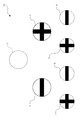
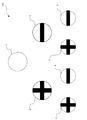
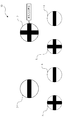
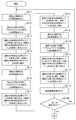
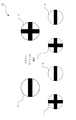
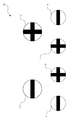
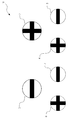
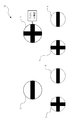
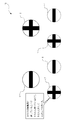
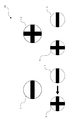
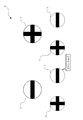
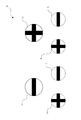
- step S3 It is a flowchart which shows a part of concrete process procedure of step S3 shown in FIG. It is an example of the screen display in step S3. It is an example of the screen display in step S3. It is an example of the screen display in step S3. It is an example of the screen display in step S3. It is an example of the screen display in step S3. It is an example of the screen display in step S3. It is an example of the screen display in step S3. It is an example of the screen display in step S3. It is an example of the screen display in step S3. It is an example of the screen display in step S3. It is a flowchart which shows a part of concrete process procedure of step S3 shown in FIG. It is an example of the screen display in step S3. It is an example of the screen display in step S3.
- step S3. It is an example of the screen display in step S3. It is an example of the screen display in step S3. It is an example of the screen display in step S3. It is an example of the screen display in step S3. It is a flowchart which shows a part of concrete process procedure of step S3 shown in FIG. It is an example of the screen display in step S3. It is an example of the screen display in step S3. It is an example of the screen display in step S3. It is an example of the screen display in step S3. It is an example of the screen display in step S3. It is an example of the screen display in step S3. It is an example of the screen display in step S3. It is an example of the screen display in step S3. It is an example of the screen display in step S3. It is an example of the screen display in step S3. It is an example of the screen display in step S3. It is an example of the screen display in step S3. It is an example of the screen display in step S3. It is an example of the screen display in step S3. It is an example of the screen display in step S
- step S3. It is an example of the screen display in step S3. It is a flowchart which shows a part of concrete process procedure of step S3 shown in FIG. It is an example of the screen display in step S3. It is an example of the screen display in step S3. It is an example of the screen display in step S3. It is a flowchart which shows a part of concrete process procedure of step S3 shown in FIG. It is an example of the screen display in step S3. It is an example of the screen display in step S3. It is an example of the screen display in step S3. It is an example of the screen display in step S3. It is an example of the screen display in step S3. It is an example of the screen display in step S3. It is an example of the screen display in step S3. It is an example of the screen display in step S3. It is an example of the screen display in step S3. It is an example of the screen display in step S3. It is an example of the screen display in step S3. It is an example of the screen display in step S3. It is an example of the screen display in step S
- step S3. It is an example of the screen display in step S3. It is an example of the screen display in step S3. It is an example of the screen display in step S3. It is an example of the screen display in step S3. It is an example of the screen display in step S3. It is a flowchart which shows a part of concrete process procedure of step S3 shown in FIG. It is an example of the screen display in step S3. It is an example of the screen display in step S3. It is an example of the screen display in step S3. It is an example of the screen display in step S3. It is an example of the screen display in step S3. It is an example of the screen display in step S3. It is an example of the screen display in step S3. It is an example of the screen display in step S3. It is an example of the screen display in step S3. It is an example of the screen display in step S3. It is an example of the screen display in step S3. It is an example of the screen display in step S3. It is an example of the screen display in step S3. It is an example of the screen display in step S
- step S3 It is a flowchart which shows a part of concrete process procedure of step S3 shown in FIG. It is an example of the screen display in step S3. It is an example of the screen display in step S3. It is an example of the screen display in step S3. It is an example of the screen display in step S3. It is an example of the screen display in step S3. It is an example of the screen display in step S3. It is an example of the screen display in step S3. It is an example of the screen display in step S3. It is an example of the screen display in step S3. It is a modification of the 1st figure. It is a graph which shows the result of the Example of this invention.
- FIG. 1 is a block diagram of a computer 100 used in one embodiment of the present invention.
- the computer 100 is preferably composed of a robot type computer having an artificial intelligence whose appearance is similar to that of a human being. May be.
- the computer 100 may be provided on the cloud.
- a computer 100 includes a CPU (arithmetic unit) 101, a memory (storage unit) 102, an auxiliary storage unit 103, an audio output unit 104, a sound collection unit 105, and the like, which are connected to each other by a bus. Has been.
- the computer 100 is connected to the display device 106 and the input device 107 by wire or wirelessly.
- the CPU 101 reads the computer program 110 stored in the auxiliary storage device 103 from the memory 102 and executes it. Thereby, the computer 100 performs each step for adjusting the balance of the mind of the subject as will be described later.
- the memory 102 is a storage device capable of high-speed writing and reading such as DRAM and SRAM
- the auxiliary storage device 103 is a large-capacity storage device such as SSD and HDD.
- the auxiliary storage device 103 also stores graphic data 111 including a graphic aggregate 10 to be described later, screen data 112 for displaying a question screen and the like, and dictionary data 113 in which various terms are recorded.
- the audio output device 104 is constituted by a speaker
- the sound collecting device 105 is constituted by a microphone.
- the computer program 110 is stored in the auxiliary storage device 103 as a part of data by being installed in the computer 100.
- the computer program 110 may be downloaded via a communication network such as the Internet connected to the computer 100 or installed in the computer 100 via a computer-readable recording medium such as a CD-ROM. May be.
- the display device 106 is composed of, for example, a liquid crystal display, and displays a collection of figures to be described later.
- the input device 107 includes a touch panel or a keyboard, and the subject can give instructions and responses to the computer 100 by operating the input device 107.
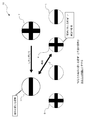
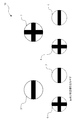
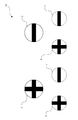
- FIG. 2 shows an aggregate of figures (hereinafter referred to as “aggregate”) 10 used in an embodiment of the present invention.
- the assembly 10 includes first to seventh graphics 1 to 7.
- the first to seventh figures 1 to 7 are arranged symmetrically as a whole.
- the aggregate 10 is presented to the subject by being displayed on the display device 106 shown in FIG. 1, but is not limited to this.
- a white board, Google Glass (registered trademark), a paper medium, a monitor screen And may be displayed on a display medium such as a VR screen.
- the first graphic 1 (hereinafter also simply referred to as “graphic 1”) is located at the center of the uppermost portion of the assembly 10.
- the shape and pattern of the first graphic 1 are not particularly limited, but are not at least a shape and pattern that mean one of two contrasting concepts such as “+” and “ ⁇ ”.
- the second graphic 2 (hereinafter also simply referred to as “graphic 2”) is arranged obliquely below the first graphic 1.
- the second graphic 2 is arranged to be spaced diagonally to the lower right of the first graphic 1 and has a “+” shape.
- the third graphic 3 (hereinafter may be simply referred to as “graphic 3”) has a shape showing a concept in contrast to the second graphic 2 and passes through the first graphic 1. It is arranged at a position that is symmetrical with the second graphic 2 across a virtual vertical line. In the present embodiment, the third graphic 3 has a shape of “ ⁇ ”, and is arranged to be spaced diagonally to the lower left of the first graphic 1.
- the fourth figure 4 (hereinafter also simply referred to as “figure 4”) has the same shape as the third figure 3 and is arranged obliquely below the second figure 2.
- the fourth graphic 4 has a shape of “ ⁇ ”, and is arranged to be spaced diagonally to the lower right of the second graphic 2.
- the fifth figure 5 (hereinafter, also simply referred to as “figure 5”) has the same shape as the second figure 2, and the fifth figure 5 sandwiches a virtual vertical line passing through the second figure 2. 4 is arranged at a position symmetrical to the figure 4.
- the fifth graphic 5 has a “+” shape, and is arranged at an angle to the lower left of the second graphic 2.
- the sixth figure 6 (hereinafter also simply referred to as “figure 6”) has the same shape as the third figure 3, and is arranged obliquely below the third figure 3.
- the sixth graphic 6 has a shape of “ ⁇ ”, and is spaced apart and diagonally to the right of the third graphic 3.
- the seventh figure 7 (hereinafter also referred to simply as “figure 7”) has the same shape as the second figure 2, and the second figure 2 sandwiches a virtual vertical line passing through the third figure 3. 6 is arranged at a position symmetrical to the figure 6.
- the seventh graphic 7 has a “+” shape, and is arranged to be spaced diagonally to the lower left of the third graphic 3.
- the shapes of the second, fifth, and seventh figures 2, 5, and 7 and the shapes of the third, fourth, and sixth figures 3, 4, and 6 are in contrast to each other. Show.
- the second, fifth, and seventh graphics 2, 5, and 7 have a “+” shape
- the third, fourth, and sixth graphics 3, 4, and 6 are It has a “-” shape.
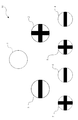
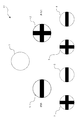
- the aggregate used in the present invention is not limited to the aggregate 10 shown in FIG. Modified examples of the aggregate 10 are shown in FIGS.
- the second graphic 2 and the third graphic 3 may be interchanged as in the aggregate 10a shown in FIG. Furthermore, in the aggregate 10a, the fourth and fifth graphics 4, 5 and the sixth and seventh graphics 6, 7 are replaced with the replacement of the second graphic 2 and the third graphic 3. It has been.
- the aggregate 10c shown in FIG. 5 is obtained by changing the shape of each of the second to seventh graphics 2 to 7 into a shape showing the opposite concept in the aggregate 10 shown in FIG. That is, in the aggregate 10c, the second, fifth, and seventh graphics 2, 5, and 7 have a shape of “ ⁇ ”, and the third, fourth, and sixth graphics 3, 4, 6 Has a “+” shape.
- the character “+” or “ ⁇ ” is surrounded by a solid circle
- the fourth to seventh graphics 4 to 7, “+” or “+” is surrounded by a dashed circle
- the solid line surrounding the 2nd figure 2 and the 3rd figure 3 means that the 2nd figure 2 and the 3rd figure 3 correspond to a test subject's thought and its object.
- the broken lines surrounding the fourth to seventh figures 4 to 7 mean that these figures correspond to the state of the mind of the subject who has not been revealed. The state of the mind is specifically the unconsciousness of the subject and the blind spot of the mind, and the unconsciousness of the subject of thinking and the blind spot of the mind, which will be described later.
- the first to seventh figures 1 to 7 are arranged symmetrically as a whole.
- the shapes of the second, fifth, and seventh graphics 2, 5, and 7 and the shapes of the third, fourth, and sixth graphics 3, 4, and 6 show contrasting concepts. .
- the shapes of “+” and “ ⁇ ” are used as the shapes of the second to seventh graphics 2 to 7. If so, the present invention is not limited to this.
- shapes such as “ ⁇ ” and “ ⁇ ”, “ ⁇ ” and “ ⁇ ”, “ ⁇ ” and “ ⁇ ”, “ ⁇ ” and “ ⁇ ” can be used.
- a recognition system may be implemented by applying a pair of concepts to the contrasting shapes.
- the shape and pattern of the first graphic 1 is not particularly limited as long as it does not mean one that is biased to one of the two contrasting concepts, unlike the second to seventh graphic 2-7.
- the first graphic 1 is a broken-line circular frame.
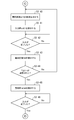
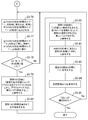
- FIG. 6 is a flowchart showing an overall process for balancing the mind of a subject, which is performed by the computer 100 shown in FIG. 1 executing the computer program 110.
- the process includes a step S1 for causing the subject to recall a collection of figures, a step S2 for applying the subject's emotion and state of mind to the figure, and a recognition system represented by the collection to the subject.
- Step S3 to be understood. Below, the case where the said method is performed using the aggregate
- step S1 the computer 100 causes the subject to recall the assembly 10.
- the CPU 101 reads the graphic data 111 into the memory 102 according to the algorithm of the computer program 110 (step S1-1), and displays the aggregate 10 on the display device 106 (step S1- 2).
- This causes the subject to recall the assembly 10.
- the method of presenting the aggregate 10 is not particularly limited, and the robot-type computer 100 having artificial intelligence may present, for example, a paper medium on which the aggregate 10 is depicted to the subject, a whiteboard,
- the aggregate 10 may be presented to the subject by displaying the aggregate 10 on a display medium such as Google Glass (registered trademark), a projector, a monitor screen, a tablet screen, or a VR screen. Further, the subject may be reminded of the aggregate 10 by explaining the size, shape, pattern, arrangement, and the like of each figure in the aggregate 10 to the subject.
- step S ⁇ b> 2 the computer 100 applies the subject's emotion and heart state to the figure of the aggregate 10.
- the second figure 2 is associated with the subject's thoughts
- the third figure 3 is associated with the subject's thoughts
- the fourth figure 4 is associated with the subject's unconsciousness
- the fifth figure 5 is associated with the blind spot of the subject's heart
- the sixth graphic 6 is associated with the blind spot of the subject's heart
- the seventh graphic 7 is associated with the subject's unconsciousness.
- “subject's thought” does not mean all the subject's thoughts, but means the thought that causes the subject's mind conflict.
- FIG. 8 is a flowchart showing a specific process of step S2 shown in FIG. First, in a state where the aggregate 10 is displayed on the display device 106, the second graphic 2 is blinked for 5 seconds (step S2-1). Thereafter, as shown in FIG. 9, “Your thoughts” are displayed in a balloon near the second graphic 2.
- step S2-3 of FIG. 8 the third graphic 3 blinks for 5 seconds, and then displays “your thought target” in a balloon near the third graphic 3 (step S2-4). .
- step S2-5) the fourth figure 4 blinks for 5 seconds (step S2-5), and then “your unconscious” is displayed in a balloon near the fourth figure 4 (step S2-6).
- step S2-7) the fifth graphic 5 is blinked for 5 seconds (step S2-7), and then “your blind spot” is displayed in a balloon near the fifth graphic 5 (step S2-8).
- step S2-9 the blind spot of your thinking target” is displayed in a balloon near the sixth figure 6 (step S2-10).
- the seventh graphic 7 is blinked for 5 seconds (step S2-11), and then “unconscious of your thought target” is displayed in a balloon near the seventh graphic 7 (step S2-12).
- step S2-11 “unconscious of your thought target” is displayed in a balloon near the seventh graphic 7 (step S2-12).
- a question screen Q1 for confirming whether or not the subject understands the association of each figure is displayed (step S2-13).
- the question screen Q1 includes “Yes” and “No” buttons, and when “Yes” is selected by the subject (Yes in Step S2-14), FIG. Step S2 shown ends. If “No” is selected by the subject (No in step S2-14), steps S2-1 to S2-13 are repeated.
- the computer 100 may be configured to emit sound from the sound output device 104 together with a balloon display.
- the computer 100 may explain the contents of the speech balloon display to the subject by using only the voice from the voice output device 104 instead of the speech balloon display.
- the robot-type computer 100 may hand-write a concept associated with each figure.
- the 6th and 7th figures 6 and 7 are not contained in the aggregate
- step S3 shown in FIG. 6 the computer 100 performs the second graphic 2 and the third graphic 3, the fourth graphic 4 and the fifth graphic 5, and the sixth graphic 6 and the seventh graphic. Based on the contrast of the graphic 7, the subject is made to understand the recognition system represented by the aggregate 10.
- the second graphic 2 and the third graphic 3 have a shape showing a contrasting concept. For example, as shown in FIGS. 2 to 4, when the second graphic 2 has a shape of “+”, the third graphic 3 has a shape of “ ⁇ ”, and as shown in FIG. When the graphic 2 has a “ ⁇ ” shape, the third graphic 3 has a “+” shape.
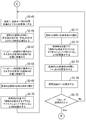
- FIG. 11 is a flowchart showing a part of a specific processing procedure of step S3 shown in FIG.
- step S3-1 in a state where the aggregate 10 is displayed, the second graphic 2 and the third graphic 3 are blinked for 2 seconds (step S3-1).
- step S3-2 “plus and minus are relative” is displayed for 2 seconds between the second graphic 2 and the third graphic 3 (step S3-2).
- step S3-2 the shape of the second graphic 2 is changed to a “ ⁇ ” shape over 2 seconds, and at the same time, the shape of the third graphic 3 is changed to a “+” shape over 2 seconds.
- step S3-3 After that, as shown in FIG. 14, the shape of the second graphic 2 is returned to the “+” shape over 2 seconds, and at the same time, the shape of the third graphic 3 is returned to the “ ⁇ ” shape over 2 seconds.
- Step S3-4 the shape of the second graphic 2 is returned to the “+” shape over 2 seconds, and at the same time, the shape of the third graphic 3 is returned to the “ ⁇ ”
- step S3-5 in FIG. 11 the fourth graphic 4 and the fifth graphic 5 are blinked for 2 seconds, and then between the fourth graphic 4 and the fifth graphic 5 as shown in FIG. “Plus and minus are relative” is displayed for 2 seconds (step S3-6).
- step S3-6 the shape of the fourth graphic 4 is changed to a “+” shape over 2 seconds, and at the same time, the shape of the fifth graphic 5 is changed to a “ ⁇ ” shape over 2 seconds.
- step S3-7 After that, as shown in FIG. 17, the shape of the fourth graphic 4 is returned to the “ ⁇ ” shape over 2 seconds, and at the same time, the shape of the fifth graphic 5 is returned to the “+” shape over 2 seconds.
- Step S3-8 the shape of the fourth graphic 4 and the fifth graphic 5 are blinked for 2 seconds, and then between the fourth graphic 4 and the fifth graphic 5 as shown in FIG. “Plus and minus are relative” is displayed for 2 seconds (step S3-6).
- step S3-7 the shape of the fourth graphic 4 is changed to a “+” shape over 2
- step S3-9 in FIG. 11 the sixth graphic 6 and the seventh graphic 7 are blinked for 2 seconds, and then between the sixth graphic 6 and the seventh graphic 7 as shown in FIG. “Plus and minus are relative” is displayed for 2 seconds (step S3-10). Then, as shown in FIG. 19, the shape of the sixth graphic 6 is changed to a “+” shape over 2 seconds, and at the same time, the shape of the seventh graphic 7 is changed to a “ ⁇ ” shape over 2 seconds. It is changed (step S3-11). After that, as shown in FIG.
- Step S3-12 the shape of the sixth graphic 6 is returned to the “ ⁇ ” shape over 2 seconds, and at the same time, the shape of the seventh graphic 7 is returned to the “+” shape over 2 seconds.
- a question screen Q2 for confirming whether or not the subject understands the contrast of each figure is displayed (step S3-13).
- the question screen Q2 includes a message “Did you understand that figure 2 and figure 3, figure 4 and figure 5, and figure 6 and figure 7 are contrasts?” , “Yes” and “No” buttons are included, and if “Yes” is selected by the subject (Yes in Step S3-14), the process proceeds to Step S3-15 shown in FIG. If “No” is selected by the subject (No in step S3-14), steps S3-1 to S3-13 are repeated.
- step S3-15 shown in FIG. 22 the question screen Q3 shown in FIG. 23 is displayed for 5 seconds.
- the question screen Q3 includes a message “Please imagine a person who feels stress due to human relationships”.
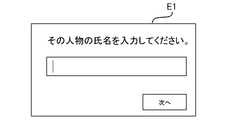
- the input screen E1 shown in FIG. 24 is displayed (step S3-16).
- the input screen E1 includes a message “Please enter the name of the person.”, A character input field, and a “Next” button.
- the name of the corresponding person is “A”.
- the question screen Q4 includes a message “Are you feeling stress in the human relationship with Mr. A?” And buttons “Yes” and “No”.
- the question screen Q5 shown in FIG. 26 is displayed (Step S3-20).
- the question screen Q5 includes a message “What do you feel about Mr. A?”, A character input field, and a “Next” button.
- the test subject inputs an answer in the character input field and selects the “Next” button, the input is completed. In this embodiment, it is assumed that an answer “cold” is input.
- the text is freely input in the character input field.
- the question screen Q5 may be selected from a plurality of options.
- an arrow is displayed from the fourth graphic 4 to the third graphic 3 (step S3-28). Further, the third graphic 3 is caused to blink for 2 seconds (step S3-29), and then, as shown in FIG. 33, a balloon near the third graphic 3 “Your unconsciousness is reflected in Mr. A” Is displayed (step S3-30). Subsequently, as shown in FIG. 34, a message “I feel stress to Mr. A because Mr. A reflects that you are unconsciously hiding” is displayed in the vicinity of the fourth figure 4. (Step S3-31). Thereafter, as shown in FIG. 35, an arrow is displayed from the fifth graphic 5 to the fourth graphic 4 (step S3-32).
- the fifth figure 5 is blinked for 2 seconds (step S3-33), and then “your blind spot” is displayed in a balloon near the fifth figure 5 as shown in FIG. 36 (step S3-33). 34). Subsequently, as shown in FIG. 37, “the blind spot creates unconsciousness” is displayed below the fourth graphic 4 and the fifth graphic 5 (step S3-35). Further, as shown in FIG.
- an arrow is displayed from the second graphic 2 to the third graphic 3, and at the same time, “feel to the other party” is displayed on the arrow, and then the third graphic 3 “Emotions felt by the other party” are displayed in a balloon on the upper left, and then an arrow indicating that they are opposite to each other is displayed between the third graphic 3 and the fourth graphic 4, and at the same time, “true “Inverse” is displayed, and in the lower right corner of the fourth figure 4, "Emotions felt by the other party” and “opposite feelings” are displayed in a balloon. Finally, “You “Emotions that are felt opposite to the emotions that are the opposite of the emotions that exist in you” are displayed (step S3-36).
- the color of the arrow from the second graphic 2 to the third graphic 3 is preferably green.
- the dictionary data 113 shown in FIG. 1 is read out, and words (warm) that mean the opposite feeling of “cold” are selected from the dictionary data 113, and as shown in FIG. "Cold” is displayed on the screen, and "Warm” is displayed in a balloon near the fifth figure 5 (step S3-37).
- Table 1 shows an example of the dictionary data 113.
- the computer 100 accesses any dictionary data on the cloud and authenticates the entered word and truth. You may get the opposite word. Further, the dictionary data 113 may be updated by machine learning each time a word not included in the dictionary data 113 is input.
- step S3-38 the question screen Q4 shown in FIG. 40 is displayed (step S3-38).
- the question screen Q4 includes a message “Are you able to understand the mechanism that makes Mr. A feel stressed?” And “Yes” and “No” buttons, and “Yes” was selected by the subject.
- Step S3-40 the process proceeds to Step S3-40 shown in FIG.
- steps S3-22 to S3-38 are repeated.
- steps S3-15 to S3-21 shown in FIG. 22 and steps S3-22 to S3-39 shown in FIG. 28 may be omitted. That is, in the case of Yes in step S3-14 shown in FIG. 11, the process may move to step S3-40 shown in FIG.
- step S3-40 shown in FIG. 41 the question screen Q7 shown in FIG. 42 is displayed for 5 seconds.
- the question screen Q7 includes a message “Please imagine a person who feels comfortable in your relationships”.
- the input screen E1 shown in FIG. 24 is displayed (step S3-41).
- the input screen E1 includes a message “Please enter the name of the person.”, A character input field, and a “Next” button.
- the subject inputs the name of the person in the character input field and selects the “Next” button, the input is completed.
- the name of the corresponding person is “B”.
- the question screen Q8 includes a message “Do you feel comfortable in the human relationship with Mr. B?” And buttons “Yes” and “No”.
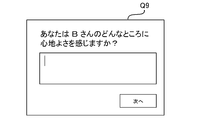
- the question screen Q9 shown in FIG. 44 is displayed (step S3-45).
- the question screen Q9 includes a message “What do you feel comfortable about Mr. B?”, A character input field, and a “Next” button.
- the test subject inputs an answer in the character input field and selects the “Next” button, the input is completed. In this embodiment, it is assumed that an answer “humility” is input.
- the process proceeds to step S3-47 shown in FIG.
- step S3-47 the screen is switched to the screen of the aggregate 10 and the third figure 3 blinks for 2 seconds.
- “you” is displayed in a balloon near the third graphic 3 (step S3-48).
- an arrow is displayed from the seventh graphic 7 to the second graphic 2 (step S3-53).
- the second graphic 2 is blinked for 2 seconds (step S3-54), and then, as shown in FIG. 50, a balloon “is your unconsciousness reflected in Mr. B” in the vicinity of the second graphic 2. Is displayed (step S3-55).
- a balloon displays in the vicinity of the seventh figure 7 that "I feel comfortable to Mr. B because Mr. B reflects that you are unconsciously hiding".
- Step S3-56 Thereafter, as shown in FIG. 52, an arrow is displayed from the sixth graphic 6 to the seventh graphic 7 (step S3-57).
- the sixth figure 6 blinks for 2 seconds (step S3-58), and then “your blind spot” is displayed in a balloon near the sixth figure 6 as shown in FIG. 53 (step S3-58). 59). Subsequently, as shown in FIG. 54, “the blind spot creates unconsciousness” is displayed below the sixth graphic 6 and the seventh graphic 7 (step S3-60). Further, as shown in FIG. 55, a green arrow is displayed from the third graphic 3 to the second graphic 2, and at the same time, “feeling to the other party” is displayed thereon, and then the second graphic is displayed.
- a word meaning an emotion that is the opposite of “humility” is selected from the dictionary data 113, and as shown in FIG. "Humility” is displayed on the screen, and “arrogance” is displayed in a balloon near the sixth figure 6 (step S3-62).
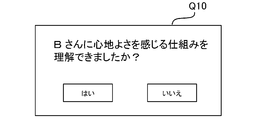
- step S3-63 The question screen Q10 includes a message “Did you understand the mechanism that makes Mr. B feel comfortable?” And buttons “Yes” and “No”, and “Yes” was selected by the subject. If YES in step S3-64, the flow shifts to step S3-65 shown in FIG. If “No” is selected by the subject (No in step S3-64), steps S3-47 to S3-62 are repeated.
- steps S3-41 to S3-66 shown in FIG. 41 and steps S3-47 to S3-64 shown in FIG. 45 may be omitted. That is, in the case of Yes in step S3-39 shown in FIG. 28, the process may move to step S3-65 shown in FIG.
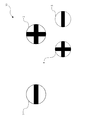
- step S3-65 shown in FIG. 58 in the state where the aggregate 10 is displayed, the first graphic 1, and the fourth to seventh graphics 4 to 7 are blinked for 2 seconds and then hidden. .
- the state shown in FIG. 59 is obtained.
- a bidirectional arrow is blinked for 3 seconds between the second graphic 2 and the third graphic 3 together with the characters “relative” (step S3-66).
- “+” and “ ⁇ ” figures are displayed from behind figure 2 and move to the positions of fifth figure 4 and fourth figure 4, respectively (step S3-67). ).
- FIG. 61 “+” and “ ⁇ ” figures are displayed from behind figure 2 and move to the positions of fifth figure 4 and fourth figure 4, respectively (step S3-67). ).
- the figures “+” and “ ⁇ ” are displayed from behind the figure 3 and move to the positions of the seventh figure 7 and the sixth figure 6, respectively (step S3- 68).
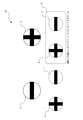
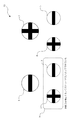
- the fourth graphic 4 and the fifth graphic 5 are surrounded by a dashed square frame 8 (step S3-69).
- “Figure 2 is made up of opposite plus and minus” is displayed immediately below the square frame 8 for 3 seconds (step S3-70).
- the sixth graphic 6 and the seventh graphic 7 are surrounded by a broken-line square frame 9 (step S3-71). Further, as shown in FIG.
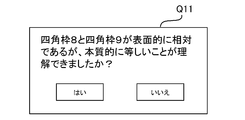
- the question screen Q11 includes a message “Did you understand that the square frame 8 and the square frame 9 are superficially relative but are essentially equal?” And buttons for “Yes” and “No” If “Yes” is selected by the subject (Yes in step S3-75), the process proceeds to step S3-76 shown in FIG. When “No” is selected by the subject (No in step S3-75), steps S3-65 to S3-74 are repeated.
- step S3-76 shown in FIG. 69 in a state where the second to seventh figures 2 to 7 are displayed, as shown in FIG.
- the shape of the third graphic 3 is changed to the shape of “+” over 2 seconds (step S3-76).
- the shape of the second graphic 2 is returned to the “+” shape over 2 seconds, and at the same time, the shape of the third graphic 3 is returned to the “ ⁇ ” shape over 2 seconds.
- Step S3-77 After repeating these Steps S3-76 and S3-77 five times (Yes in Step S3-78), in the vicinity of the figure 2, “becomes positive or negative depending on the emotion and state of mind.
- a question screen Q12 shown in FIG. 77 is displayed (step S3-84).
- the question screen Q12 includes a message “Did you understand that what you are feeling is the same as what is inside you?” And buttons “Yes” and “No” If “yes” is selected by the subject (Yes in step S3-85), step S3 shown in FIG. 6 ends. When “No” is selected by the subject (No in step S3-85), steps S3-76 to S3-84 are repeated.
- the auxiliary storage device 103 of the computer 100 stores information on a specific cause of the subject's mental conflict and life background that was previously obtained from the subject through a questionnaire or the like, and the computer 100 indicates the shape of each figure.
- the meaning may be specifically explained to the subject using expressions such as “warmth (+)” and “coldness ( ⁇ )”.
- the two emotions that are paired, or the state of the mind include “independence” and “dependence”, “optimism” and “pessimism” in addition to “warmth” and “coldness”. It is done.
- the unconsciousness of the subject and the blind spot of the heart associated with the fourth figure 4 and the fifth figure 5, respectively, are concepts having two polarities that create a conflict in the subject's mind.
- everyone has these concepts in mind, and like the fourth figure 4 and the fifth figure 5, the unconsciousness and the blind spots of the heart are always in conflict in the mind.
- the subject's mind has two polarities: “warmth (+)” and “coldness ( ⁇ )”
- the phenomenon that the thought (+) assimilated by the subject who is the subject is inverted and projected to the other person in front of the eye is defined as the phenomenon of "anabolic and inversion".
- the “warmth (+)” assimilated by the subject (subjective) is reversed to the boss (objective) that is the subject of thought in front of the eyes and projected as cold ( ⁇ ).
- the blind spot of the subject's heart associated with the fifth graphic 5 represents the assimilation of the subject's thought associated with the second graphic 2, and the fourth graphic 4 And that the subject of thought associated with the third graphic 3 is an unconscious projection of the subject associated with the fourth graphic 4.
- the third graphic 3 and the fourth graphic 4 have a common shape, and the fifth graphic 5 is contrasted with the third and fourth graphic 3 and 4. Therefore, it is easy to understand the recognition system represented by the aggregate 10 by grasping the relationship between figures easily from the shape of the figure.
- the computer 100 explains a case where the subject's thought (subjectivity) and the subject of the thought (objective) are reversed.
- the blind spot of the subject's heart associated with the sixth graphic 6 is assimilated with the subject's thought associated with the third graphic 3 and associated with the seventh graphic 7.
- the computer 100 informs the subject that the subject's thought associated with the second graphic 2 is an unconscious projection of the object associated with the seventh graphic 7 due to the phenomenon of “anabolic and inversion”.
- explain that is, although the polarities are different, it is explained that the unconsciousness and the blind spot of the heart exist in the mind of the subject of the subject as in the above-described mind of the subject. If the aggregate 10 does not include the sixth and seventh figures 6 and 7, the description in this paragraph can be omitted.
- the second and third steps S2 and S3 are preferably performed while the computer 100, which is a robot having artificial intelligence, interacts with the subject and confirms the degree of understanding of the subject.
- the computer 100 which is a robot having artificial intelligence
- a test subject's speech is received via the sound collection device 105, and a speech recognition process is performed, and a test subject's comprehension degree is determined.
- the degree of understanding of the subject may be determined by presenting a question indicating whether or not he / she can understand on the display device 106 and causing the subject to answer via the input device 107.
- step S3 The time required for this third step S3 varies depending on the individual, but if there is a subject who can understand the recognition system by performing step S3 only once, it is necessary to repeat step S3 many times. Some subjects do.
- the subject can understand the recognition system, thereby resolving the subject's heart conflict and adjusting the balance of the heart. Specifically, the unconsciousness of the subject and the blind spot of the subject's heart are manifested in the subject's thoughts. The unconsciousness and the blind spot of the heart are those that the subject did not feel, but in the third step S3, the unconsciousness in the subject due to the phenomenon of “anabolic and inversion” becomes the object of thinking in front of the eyes. By understanding that the image is projected, the subject can be aware of the unconsciousness inherent in his / her heart and manifest it.
- the direction of thinking directed from the subject toward the subject of thinking is reversed and directed toward his / her unconsciousness (fourth figure 4).
- the boss's coldness is something that the subject of thought feels
- the boss's coldness is a projection of the subject's unconscious coldness on the boss.
- the unconsciousness (coldness) of the subject becomes apparent in the thought.
- the subject can also notice “warmth” which is a blind spot of the heart assimilated with him. In other words, this is also a state in which the blind spot of the subject's heart has become apparent in thinking.
- the thought that caused the conflict in the subject's mind associated with the second graphic 2 also disappears.
- the first graphic 1 is located at the apex of the assembly 10 including the first to seventh graphic 1 to 7 arranged symmetrically, and any of “+” and “ ⁇ ” The shape and pattern are not biased. That is, in the first graphic 1, the subject's thinking (second graphic 2) biased to “+” disappears, and the subject's viewpoint from the second graphic 2 is the entire recognition system shown in the aggregate 10.
- the subject understands that the fourth figure 4 ( ⁇ ) and the fifth figure 5 (+) disappear and the viewpoint of the subject shifts from the second figure 2 to the first figure 1.
- the first graphic 1 shows a state in which the balance of the mind is in place without judging whether it is warm or cold. That is, the first figure 1 obtains a new viewpoint by looking down on the second figure 2 and the third figure 3 at the same time, and also looking down on the second figure 2 to the seventh figure 7. This indicates that the subject is in a relaxed state in which both “positive (+)” and “negative ( ⁇ )”, that is, (+) and ( ⁇ ) poles do not exist.
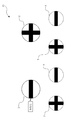
- the first graphic 1 is a broken-line circular frame.
- a white circle as shown in FIG. 78A a black circle as shown in FIG. 78B, and FIG.
- the shape may be a combination of four pairs of Mobius strips as shown in FIG.
- the subject of the subject's thought is the subject's superior has been described as an example, but the subject of the subject's thought is not limited to this.
- the subject of thought may be the subject's parent, and is not particularly limited as long as it causes a conflict of the subject's mind, such as the subject's spouse, friend, and son.
- Modification 1 Furthermore, the subject of the subject's thought may not be a person. For example, if there is a subject who feels “unreasonable” to the community to which the subject belongs, the subject of thought of this subject is “the community”. An example in which the method according to the present invention is applied to the subject will be described with reference to FIG.
- step S1 the computer 100 causes the subject to recall the assembly 10. Subsequently, in step S ⁇ b> 2, the computer 100 applies the subject's emotion and the state of mind to the figure of the aggregate 10.
- step S ⁇ b> 2 the computer 100 applies the subject's emotion and the state of mind to the figure of the aggregate 10. The contents of these steps S1 and 2 are the same as those in the above-described embodiment.
- step S3 the computer 100 is represented in the aggregate 10 on the basis of the contrast between the second graphic 2 and the third graphic 3, and the fourth graphic 4 and the fifth graphic 5.
- the computer 100 explains the following event to the subject.
- the subject's unconsciousness and the blind point of the subject's heart become apparent in the subject's thoughts. That is, by reversing the direction of the thought that the subject felt “unreasonable” in the community and directing it toward the subject himself / herself, the subject becomes aware of his / her unconsciousness (unreasonable), and the unconsciousness becomes manifest in his / her thoughts.
- the test subject can also notice a “sense of justice”, which is a blind spot of the heart that has been assimilated with him, and the blind spot of the test subject's heart is also manifested in his thoughts.
- the unconsciousness of the subject (fourth graphic 4) and the blind spot of the heart (fifth graphic 5) disappear, and as a result, the subject's mental conflict associated with the second graphic 2
- the thought that was supposed to disappear also disappears, and at the same time, what the subject feels to the subject of the thought on which the subject's unconsciousness is projected (third figure 3) also disappears.
- the subject can balance the mind.
- the subject does not feel unreasonable toward the community.
- step S1 the computer 100 recalls the aggregate 10 by presenting the aggregate 10 to the subject, and in step S2, the computer 100 applies the subject's emotion and state of mind to the figure of the aggregate 10. .
- the contents of these steps S1 and 2 are the same as those in the above-described embodiment.
- step S3 the computer 100 is represented in the aggregate 10 on the basis of the contrast between the second graphic 2 and the third graphic 3, and the fourth graphic 4 and the fifth graphic 5.
- the computer 100 explains the following event to the subject.
- the subject's unconsciousness and the blind point of the subject's heart become apparent in the subject's thoughts.
- the subject notices his / her unconsciousness, and the unconsciousness becomes apparent.
- the subject can also notice a “superior feeling” that is the blind spot of the heart assimilated with the subject, and the blind spot of the subject's heart is also manifested.
- the unconsciousness of the subject (fourth graphic 4) and the blind spot of the heart (fifth graphic 5) disappear, and as a result, the subject's mental conflict associated with the second graphic 2
- the thought that was supposed to disappear also disappears, and at the same time, what was felt by the subject's thoughts projected by the subject's unconsciousness (third figure 3) also disappears.
- the subject can balance the mind. Therefore, the subject does not feel the complex with respect to others.
- the present invention was implemented using the computer 100 for 265 subjects.
- a general-purpose personal computer in which the computer program according to the present invention is installed is used as the computer 100.
- a questionnaire was conducted on the subjects, and 10% (26 persons) were randomly extracted and tabulated. In the questionnaire, questions were asked about the changes felt by the subjects before and after the implementation of the present invention. The answer results are shown in FIGS. 79 (a) and 79 (b).
- B) Has there been any change for those who answered that they were able to understand in “(a)”? There was a change: 100%
- the present invention is suitable for the field of solving problems related to human relationships (for example, communication, love, marriage, child care, etc.), but can also be applied to the field of psychiatry and epigenome.
- the present invention is not limited to this, and can be applied to solving all human problems, thereby contributing to the improvement of intellectual production activities.
Landscapes
- Health & Medical Sciences (AREA)
- Engineering & Computer Science (AREA)
- Life Sciences & Earth Sciences (AREA)
- Physics & Mathematics (AREA)
- Animal Behavior & Ethology (AREA)
- Biomedical Technology (AREA)
- Heart & Thoracic Surgery (AREA)
- Veterinary Medicine (AREA)
- Public Health (AREA)
- General Health & Medical Sciences (AREA)
- Educational Technology (AREA)
- Theoretical Computer Science (AREA)
- Business, Economics & Management (AREA)
- Surgery (AREA)
- Molecular Biology (AREA)
- Medical Informatics (AREA)
- Pathology (AREA)
- Biophysics (AREA)
- General Physics & Mathematics (AREA)
- Educational Administration (AREA)
- Psychiatry (AREA)
- Psychology (AREA)
- Anesthesiology (AREA)
- Child & Adolescent Psychology (AREA)
- Developmental Disabilities (AREA)
- Hospice & Palliative Care (AREA)
- Social Psychology (AREA)
- Hematology (AREA)
- Acoustics & Sound (AREA)
- Entrepreneurship & Innovation (AREA)
- Biodiversity & Conservation Biology (AREA)
- Multimedia (AREA)
- Pain & Pain Management (AREA)
- User Interface Of Digital Computer (AREA)
- Electrically Operated Instructional Devices (AREA)
- Medical Treatment And Welfare Office Work (AREA)
- Measurement Of The Respiration, Hearing Ability, Form, And Blood Characteristics Of Living Organisms (AREA)
- Human Computer Interaction (AREA)
Abstract
被験者の心のバランスを整えるためのコンピュータプログラムを提供する。 CPU(101)およびメモリ(102)を有するコンピュータ(100)に、被験者の心のバランスを整える処理を実行させるコンピュータプログラム(110)であって、図形の集合体を前記被験者に想起させる第1のステップと、前記図形に前記被験者の感情、および心の状態を当てはめる第2のステップと、前記集合体に表わされた認識システムを前記被験者に理解させる第3のステップと、を前記コンピュータ(100)に実行させる、コンピュータプログラム(110)。
Description
本発明は、被験者の心のバランスを整えるためのコンピュータプログラムに関し、特に、図形の集合体を用いて、被験者の心のバランスを整えるためのコンピュータプログラムに関する。
近年、精神疾患者が増加しており、社会生活において、心のバランスを保つことが難しくなっている。これに対し、特許文献1は、特定の働きを有する脳波を考慮して両耳ビート信号を変調させることにより、意識の特定の状態を特徴づける独特な波形に同調させて、意識の様々な状態を誘発させる方法により、心理的な要因を解決する方策が開示されている。
特許文献1に記載の方策では、被験者の聴覚に働きかけることにより、種々の意識状態を誘発している。一方、本発明では、図形の集合体を用いることにより、被験者の心のバランスを整えるためのコンピュータプログラムの提供を目的とする。
上記の目的を達成するため、本発明は、以下の項に示すコンピュータプログラムを提供する。
項1.
演算装置および記憶装置を有するコンピュータに、被験者の心のバランスを整える処理を実行させるコンピュータプログラムであって、
図形の集合体を前記被験者に想起させる第1のステップと、
前記図形に前記被験者の感情、および心の状態を当てはめる第2のステップと、
前記集合体に表わされた認識システムを前記被験者に理解させる第3のステップと、
を前記コンピュータに実行させる、コンピュータプログラム。
項2.
前記コンピュータは人工知能を有するロボットであることを特徴とする、項1に記載のコンピュータプログラム。
項3.
前記集合体は、
第1の図形と、
前記第1の図形の斜め下方に配置された第2の図形と、
前記第2の図形とは対照的な概念を示す形状を有し、かつ、前記第1の図形を通る仮想的な縦線を挟んで前記第2の図形と左右対称となる位置に配置された第3の図形と、
前記第3の図形と共通の形状を有し、前記第2の図形の斜め下方に配置された第4の図形と、
前記第2の図形と共通の形状を有し、前記第2の図形を通る仮想的な縦線を挟んで前記第4の図形と左右対称となる位置に配置された第5の図形と、
を含み、
前記第2のステップでは、
前記第2の図形を、前記被験者の思考と関連付け、
前記第3の図形を、前記被験者の思考の対象と関連付け、
前記第4の図形を、前記被験者の無意識と関連付け、
前記第5の図形を、前記被験者の心の盲点と関連付け、
前記第3のステップでは、
第2の図形と第3の図形、および、第4の図形と第5の図形との対照性に基づき、
前記第5の図形と関連付けられた前記被験者の心の盲点は、前記第2の図形と関連付けられた前記被験者の思考が同化したものを表すとともに、前記第4の図形と関連付けられた前記被験者の無意識を生み出しているものであること、そして、前記第3の図形と関連付けられた前記対象に感じるものが、前記第4の図形と関連付けられた前記被験者の無意識の投影であることを、前記被験者に説明することにより、前記認識システムを前記被験者に理解させる、
ことを特徴とする、項1または2に記載のコンピュータプログラム。
項4.
前記第2、第5および第7の図形は「+」の形状を有し、
前記第3、第4および第6の図形は「-」の形状を有する、
ことを特徴とする、項3に記載のコンピュータプログラム。
項5.
前記集合体は、
前記第3の図形と共通の形状を有し、前記第3の図形の斜め下方に配置された第6の図形と、
前記第2の図形と共通の形状を有し、前記第3の図形を通る仮想的な縦線を挟んで前記第6の図形と左右対称となる位置に配置された第7の図形と、
をさらに含み、
前記第2のステップでは、
前記第6の図形を、前記対象の心の盲点と関連付け、
前記第7の図形を、前記対象の無意識と関連付け、
前記第3のステップでは、
前記第6の図形と関連付けられた前記対象の心の盲点は、前記第3の図形と関連付けられた前記対象の思考が同化したものを表すとともに、前記第7の図形と関連付けられた前記対象の無意識を生み出しているものであること、そして、前記第2の図形と関連付けられた前記被験者に感じるものが、前記第7の図形と関連付けられた前記対象の無意識の投影であることを、前記被験者に説明する、
ことを特徴とする、項3または4に記載のコンピュータプログラム。
項1.
演算装置および記憶装置を有するコンピュータに、被験者の心のバランスを整える処理を実行させるコンピュータプログラムであって、
図形の集合体を前記被験者に想起させる第1のステップと、
前記図形に前記被験者の感情、および心の状態を当てはめる第2のステップと、
前記集合体に表わされた認識システムを前記被験者に理解させる第3のステップと、
を前記コンピュータに実行させる、コンピュータプログラム。
項2.
前記コンピュータは人工知能を有するロボットであることを特徴とする、項1に記載のコンピュータプログラム。
項3.
前記集合体は、
第1の図形と、
前記第1の図形の斜め下方に配置された第2の図形と、
前記第2の図形とは対照的な概念を示す形状を有し、かつ、前記第1の図形を通る仮想的な縦線を挟んで前記第2の図形と左右対称となる位置に配置された第3の図形と、
前記第3の図形と共通の形状を有し、前記第2の図形の斜め下方に配置された第4の図形と、
前記第2の図形と共通の形状を有し、前記第2の図形を通る仮想的な縦線を挟んで前記第4の図形と左右対称となる位置に配置された第5の図形と、
を含み、
前記第2のステップでは、
前記第2の図形を、前記被験者の思考と関連付け、
前記第3の図形を、前記被験者の思考の対象と関連付け、
前記第4の図形を、前記被験者の無意識と関連付け、
前記第5の図形を、前記被験者の心の盲点と関連付け、
前記第3のステップでは、
第2の図形と第3の図形、および、第4の図形と第5の図形との対照性に基づき、
前記第5の図形と関連付けられた前記被験者の心の盲点は、前記第2の図形と関連付けられた前記被験者の思考が同化したものを表すとともに、前記第4の図形と関連付けられた前記被験者の無意識を生み出しているものであること、そして、前記第3の図形と関連付けられた前記対象に感じるものが、前記第4の図形と関連付けられた前記被験者の無意識の投影であることを、前記被験者に説明することにより、前記認識システムを前記被験者に理解させる、
ことを特徴とする、項1または2に記載のコンピュータプログラム。
項4.
前記第2、第5および第7の図形は「+」の形状を有し、
前記第3、第4および第6の図形は「-」の形状を有する、
ことを特徴とする、項3に記載のコンピュータプログラム。
項5.
前記集合体は、
前記第3の図形と共通の形状を有し、前記第3の図形の斜め下方に配置された第6の図形と、
前記第2の図形と共通の形状を有し、前記第3の図形を通る仮想的な縦線を挟んで前記第6の図形と左右対称となる位置に配置された第7の図形と、
をさらに含み、
前記第2のステップでは、
前記第6の図形を、前記対象の心の盲点と関連付け、
前記第7の図形を、前記対象の無意識と関連付け、
前記第3のステップでは、
前記第6の図形と関連付けられた前記対象の心の盲点は、前記第3の図形と関連付けられた前記対象の思考が同化したものを表すとともに、前記第7の図形と関連付けられた前記対象の無意識を生み出しているものであること、そして、前記第2の図形と関連付けられた前記被験者に感じるものが、前記第7の図形と関連付けられた前記対象の無意識の投影であることを、前記被験者に説明する、
ことを特徴とする、項3または4に記載のコンピュータプログラム。
本発明によれば、被験者の心のバランスを整えるためのコンピュータプログラムを提供することができる。また、本発明は、カウンセラー等の人手を介さずにコンピュータを用いて実施できるため、被験者は、手軽にゲーム感覚で心のバランスを整えることができる。
以下、本発明の実施形態について添付図面を参照して説明する。なお、本発明は、下記の実施形態に限定されるものではない。
1.コンピュータ
図1は、本発明の一実施形態において用いられるコンピュータ100のブロック図である。コンピュータ100は、本実施形態では、外見が人間に近似した人工知能を有するロボット型のコンピュータで構成されることが好ましいが、例えば、汎用のパーソナルコンピュータ、タブレット型端末、スマートフォン、VR端末などで構成してもよい。また、コンピュータ100は、クラウド上に設けられてもよい。
図1は、本発明の一実施形態において用いられるコンピュータ100のブロック図である。コンピュータ100は、本実施形態では、外見が人間に近似した人工知能を有するロボット型のコンピュータで構成されることが好ましいが、例えば、汎用のパーソナルコンピュータ、タブレット型端末、スマートフォン、VR端末などで構成してもよい。また、コンピュータ100は、クラウド上に設けられてもよい。
図1に示すように、コンピュータ100は、CPU(演算装置)101、メモリ(記憶装置)102、補助記憶装置103、音声出力装置104および集音装置105等を備え、それらはバスにより相互に接続されている。また、コンピュータ100は、表示装置106および入力装置107と有線または無線で接続されている。
CPU101は、補助記憶装置103に記憶されているコンピュータプログラム110をメモリ102にて読み出して実行する。これにより、コンピュータ100は、後述するような、被験者の心のバランスを整えるための各ステップを実行する。
メモリ102は、例えばDRAMやSRAMのような高速の書込み及び読み込みが可能な記憶装置であり、補助記憶装置103は、例えばSSDやHDDのような大容量記憶装置である。補助記憶装置103には、各種プログラムの他、後述する図形の集合体10を含む図形データ111、質問画面等を表示するための画面データ112、各種用語を記録した辞書データ113も格納されている。また、音声出力装置104はスピーカにより構成され、集音装置105はマイクにより構成される。
本発明に係るコンピュータプログラム110は、コンピュータ100にインストールされることにより、補助記憶装置103のデータの一部として格納される。コンピュータプログラム110は、コンピュータ100をインターネット等の通信ネットワークに接続して、当該通信ネットワークを介してダウンロードしてもよいし、CD-ROM等のコンピュータ読み取り可能な記録媒体を介してコンピュータ100にインストールしてもよい。
表示装置106は、例えば液晶ディスプレイで構成され、後述する図形の集合体などを表示する。入力装置107は、タッチパネルまたはキーボードなどで構成され、被験者は入力装置107を操作することにより、コンピュータ100に対して指示及び応答を行うことができる。
2.図形の集合体
本発明は、被験者の心のバランスを整えるために、図形の集合体を用いることを特徴とする。図2に、本発明の一実施形態において用いられる図形の集合体(以下、「集合体」とする)10を示す。
本発明は、被験者の心のバランスを整えるために、図形の集合体を用いることを特徴とする。図2に、本発明の一実施形態において用いられる図形の集合体(以下、「集合体」とする)10を示す。
集合体10は、第1~第7の図形1~7を含んでいる。第1~第7の図形1~7は、全体的に、左右対称に配置されている。後述するように、集合体10は、図1に示す表示装置106に表示することにより被験者に提示されるが、これに限定されず、ホワイトボード、Google Glass(登録商標)、紙媒体、モニター画面、VR画面などの表示媒体に表示されてもよい。
第1の図形1(以下、単に「図形1」とも称することもある)は、集合体10の最上部の中央に位置している。第1の図形1の形状および模様は特に限定されないが、少なくとも、「+」や「-」のように、ある対照的な2つの概念の一方に偏ったものを意味する形状および模様ではない。
第2の図形2(以下、単に「図形2」とも称することもある)は、第1の図形1の斜め下方に配置されている。本実施形態では、第2の図形2は、第1の図形1の右斜め下に離間して配置されており、「+」の形状を有している。
第3の図形3(以下、単に「図形3」とも称することもある)は、第2の図形2とは対照的な概念を示す形状を有しており、かつ、第1の図形1を通る仮想的な縦線を挟んで第2の図形2と左右対称となる位置に配置されている。本実施形態では、第3の図形3は、「-」の形状を有しており、第1の図形1の左斜め下に離間して配置されている。
第4の図形4(以下、単に「図形4」とも称することもある)は、第3の図形3と共通の形状を有し、第2の図形2の斜め下方に配置されている。本実施形態では、第4の図形4は、「-」の形状を有しており、第2の図形2の右斜め下に離間して配置されている。
第5の図形5(以下、単に「図形5」とも称することもある)は、第2の図形2と共通の形状を有し、第2の図形2を通る仮想的な縦線を挟んで第4の図形4と左右対称となる位置に配置されている。本実施形態では、第5の図形5は、「+」の形状を有しており、第2の図形2の左斜め下に離間して配置されている。
第6の図形6(以下、単に「図形6」とも称することもある)は、第3の図形3と共通の形状を有し、第3の図形3の斜め下方に配置されている。本実施形態では、第6の図形6は、「-」の形状を有しており、第3の図形3の右斜め下に離間して配置されている。
第7の図形7(以下、単に「図形7」とも称することもある)は、第2の図形2と共通の形状を有し、第3の図形3を通る仮想的な縦線を挟んで第6の図形6と左右対称となる位置に配置されている。本実施形態では、第7の図形7は、「+」の形状を有しており、第3の図形3の左斜め下に離間して配置されている。
以上のように、第2、第5および第7の図形2,5,7の形状と、第3、第4および第6の図形3,4,6の形状とは、互いに対照的な概念を示している。本実施形態では、第2、第5および第7の図形2,5,7は、「+」の形状を有しており、第3、第4および第6の図形3,4,6は、「-」の形状を有している。
なお、本発明において用いられる集合体は、図2に示す集合体10に限定されない。集合体10の変形例を図3~図5に示す。
例えば、図3に示す集合体10aのように、第2の図形2と第3の図形3とを置き替えてもよい。さらに、集合体10aでは、第2の図形2と第3の図形3との置き替えに伴い、第4および第5の図形4、5と、第6および第7の図形6、7とが置き換えられている。
また、図4に示す集合体10bは、図2に示す集合体10において、第4の図形4と第5の図形5、および、第6の図形6と第7の図形7が置き換えられたものである。
さらに、図5に示す集合体10cは、図2に示す集合体10において、第2~第7の図形2~7の各々の形状を、反対の概念を示す形状としたものである。すなわち、集合体10cでは、第2、第5および第7の図形2,5,7が、「-」の形状を有しており、第3、第4および第6の図形3,4,6が、「+」の形状を有している。
なお、第2の図形2および第3の図形3では、「+」または「-」の文字が実線の円によって囲まれており、第4~第7の図形4~7では、「+」または「-」の文字が破線の円によって囲まれている。なお、第2の図形2および第3の図形3を囲む実線は、第2の図形2および第3の図形3が、それらの図形が被験者の思考とその対象に対応することを意味する。また、第4~第7の図形4~7を囲む破線は、それらの図形が顕在化していない被験者の心の状態に対応することを意味する。なお、心の状態とは、具体的には、後述する被験者の無意識並びに心の盲点、および、思考の対象の無意識並びに心の盲点である。
このように、本発明における集合体10,10a,10b,10cでは、第1~第7の図形1~7が、全体として左右対称に配置される。また、第2、第5および第7の図形2,5,7の形状と、第3、第4および第6の図形3,4,6の形状とが、互いに対照的な概念を示している。
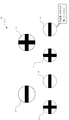
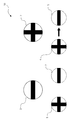
なお、図2~図5に示す例では、第2~第7の図形2~7の形状として、「+」および「-」の形状が用いられているが、互いに対照的な概念を示す形状であれば、本発明はこれに限定されない。例えば、「♂」および「♀」、「○」および「×」、「↑」および「↓」、「←」および「→」といった形状を用いることができる。ここで、この対照的な形状には、それぞれ対となる概念を当てはめて、認識システムを実施してもよい。
また、第1の図形1の形状および模様は、第2~第7の図形2~7と異なり、対照的な2つの概念の一方に偏ったものを意味するものでなければ、特に限定されない。本実施形態では、第1の図形1は破線の円形枠である。
3.方法の手順
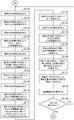
図6は、図1に示すコンピュータ100がコンピュータプログラム110を実行することによって実施される、被験者の心のバランスを整えるための処理の全体を示すフローチャートである。当該処理は、図形の集合体を前記被験者に想起させるステップS1と、前記図形に前記被験者の感情、および心の状態を当てはめるステップS2と、前記集合体に表わされた認識システムを前記被験者に理解させるステップS3と、を有する。以下では、上記方法が、図2に示す集合体10を用いて実行される場合を例に説明する。
図6は、図1に示すコンピュータ100がコンピュータプログラム110を実行することによって実施される、被験者の心のバランスを整えるための処理の全体を示すフローチャートである。当該処理は、図形の集合体を前記被験者に想起させるステップS1と、前記図形に前記被験者の感情、および心の状態を当てはめるステップS2と、前記集合体に表わされた認識システムを前記被験者に理解させるステップS3と、を有する。以下では、上記方法が、図2に示す集合体10を用いて実行される場合を例に説明する。
ステップS1では、コンピュータ100が被験者に集合体10を想起させる。本実施形態では、図7に示すように、CPU101がコンピュータプログラム110のアルゴリズムに従い、図形データ111をメモリ102に読み出し(ステップS1-1)、表示装置106に集合体10を表示させる(ステップS1-2)。これにより、被験者に集合体10を想起させる。なお、集合体10の提示方法は、特に限定されず、人工知能を有するロボット型のコンピュータ100が、例えば、集合体10が描写された紙媒体を被験者に提示してもよいし、ホワイトボード、Google Glass(登録商標)、プロジェクター、モニター画面、タブレット画面、VR画面などの表示媒体に集合体10を表示することにより、被験者に集合体10を提示してもよい。また、集合体10における各図形の大きさ、形状、模様、配置等を、被験者に音声で説明することにより、被験者に集合体10を想起させてもよい。
続いて、ステップS2では、コンピュータ100が集合体10の図形に、被験者の感情、および心の状態を当てはめる。具体的には、第2の図形2を、被験者の思考と関連付け、第3の図形3を、被験者の思考の対象と関連付け、第4の図形4を、被験者の無意識と関連付け、第5の図形5を、被験者の心の盲点と関連付け、第6の図形6を、対象の心の盲点と関連付け、第7の図形7を、対象の無意識と関連付ける。ここで、「被験者の思考」は、被験者の全ての思考を意味するものではなく、被験者の心の葛藤の原因となっている思考を意味する。
以下、本実施形態のステップS2における処理の具体例を説明する。図8は、図6に示すステップS2の具体的な処理を示すフローチャートである。まず、表示装置106に集合体10が表示された状態において、第2の図形2を5秒間点滅させる(ステップS2-1)。その後、図9に示すように、第2の図形2の近傍に吹き出しで「あなたの思考」と表示する。
同様の処理を、第3~第7の図形3~7についても行う。すなわち、図8のステップS2-3において、第3の図形3を5秒間点滅させ、その後、第3の図形3の近傍に吹き出しで「あなたの思考の対象」と表示する(ステップS2-4)。さらに、第4の図形4を5秒間点滅させ(ステップS2-5)、その後、第4の図形4の近傍に吹き出しで「あなたの無意識」と表示する(ステップS2-6)。さらに、第5の図形5を5秒間点滅させ(ステップS2-7)、その後、第5の図形5の近傍に吹き出しで「あなたの盲点」と表示する(ステップS2-8)。さらに、第6の図形6を5秒間点滅させ(ステップS2-9)、その後、第6の図形6の近傍に吹き出しで「あなたの思考の対象の盲点」と表示する(ステップS2-10)。さらに、第7の図形7を5秒間点滅させ(ステップS2-11)、その後、第7の図形7の近傍に吹き出しで「あなたの思考の対象の無意識」と表示する(ステップS2-12)。このような画面表示を行うことにより、各図形に被験者の感情、および心の状態を当てはめる。
その後、被験者が各図形の関連付けを理解したか否かを確認するための質問画面Q1を表示する(ステップS2-13)。図10に示すように、質問画面Q1には、「はい」および「いいえ」のボタンが含まれており、被験者によって「はい」が選択された場合(ステップS2-14においてYes)、図6に示すステップS2が終了する。なお、被験者によって「いいえ」が選択された場合(ステップS2-14においてNo)、ステップS2-1~S2-13が繰り返される。
以上、本実施形態のステップS2における処理の具体例を説明した。なお、ステップS2-2、S2-4、S2-6、S2-8、S2-10およびS2-12においては、吹き出し表示とともに、コンピュータ100は、音声出力装置104から音声を発する構成としてもよい。または、コンピュータ100は、吹き出し表示の代わりに、音声出力装置104からの音声のみによって吹き出し表示の内容を被験者に説明してもよい。あるいは、集合体10がホワイトボード、紙媒体等に描かれたものである場合は、各図形に関連付けた概念をロボット型のコンピュータ100が手書きしてもよい。なお、第6および第7の図形6,7が集合体10に含まれていない場合は、第6の図形6および第7の図形7に関する関連付けは行わない。
続いて、図6に示すステップS3では、コンピュータ100が、第2の図形2と第3の図形3、第4の図形4と第5の図形5、および、第6の図形6と第7の図形7の対照性に基づき、集合体10に表わされた認識システムを被験者に理解させる。
第2の図形2と第3の図形3とは、互いに対照的な概念を示す形状を有している。例えば、図2~図4に示すように、第2の図形2が「+」の形状の場合、第3の図形3は「-」の形状であり、図5に示すように、第2の図形2が「-」の形状の場合、第3の図形3は「+」の形状である。
「+」と「-」の形状は、両者が相対する関係であることを意味する。これと同様に、被験者自身の思考と、被験者の心の葛藤を生み出している対象に感じるものとは、相対する関係にある。例えば、被験者の思考の対象(以下、対象)に感じるものが、「職場の上司の冷たさ」であるとする。上司に「冷たさ」を感じる原因は、被験者の思考が、上司に比べて相対的に「温かい」ためであるが、通常、被験者はこのことに気付いていない。ここで、集合体10に表わされた認識システムから観れば、被験者の思考が捉えている被験者自身の感情(温かさ)、および、思考の対象に感じるもの(冷たさ)を、互いに対照的な概念を示す形状を有する第2の図形2および第3の図形3とそれぞれ関連付けることにより、被験者の思考と思考の対象に感じるものとが相対的な概念であることを被験者に容易に認識させ、心の葛藤の原因となっている無意識と盲点を思考に顕在化させることができる。
以下、本実施形態のステップS3における処理の具体例を説明する。図11は、図6に示すステップS3の具体的な処理手順の一部を示すフローチャートである。まず、集合体10が表示された状態において、第2の図形2と第3の図形3を2秒間点滅させる(ステップS3-1)。その後、図12に示すように、第2の図形2と第3の図形3の間に「プラスとマイナスは相対」と2秒間表示する(ステップS3-2)。その後、図13に示すように、第2の図形2の形状を2秒間かけて「-」の形状に変化させ、同時に、第3の図形3の形状を2秒間かけて「+」の形状に変化させる(ステップS3-3)。その後、図14に示すように、第2の図形2の形状を2秒間かけて「+」の形状に戻し、同時に、第3の図形3の形状を2秒間かけて「-」の形状に戻す(ステップS3-4)。
同様の処理を、第4の図形4と第5の図形5についても行う。すなわち、図11のステップS3-5において、第4の図形4と第5の図形5を2秒間点滅させ、その後、図15に示すように、第4の図形4と第5の図形5の間に「プラスとマイナスは相対」と2秒間表示する(ステップS3-6)。その後、図16に示すように、第4の図形4の形状を2秒間かけて「+」の形状に変化させ、同時に、第5の図形5の形状を2秒間かけて「-」の形状に変化させる(ステップS3-7)。その後、図17に示すように、第4の図形4の形状を2秒間かけて「-」の形状に戻し、同時に、第5の図形5の形状を2秒間かけて「+」の形状に戻す(ステップS3-8)。
同様の処理を、第6の図形6と第7の図形7についても行う。すなわち、図11のステップS3-9において、第6の図形6と第7の図形7を2秒間点滅させ、その後、図18に示すように、第6の図形6と第7の図形7の間に「プラスとマイナスは相対」と2秒間表示する(ステップS3-10)。その後、図19に示すように、第6の図形6の形状を2秒間かけて「+」の形状に変化させ、同時に、第7の図形7の形状を2秒間かけて「-」の形状に変化させる(ステップS3-11)。その後、図20に示すように、第6の図形6の形状を2秒間かけて「-」の形状に戻し、同時に、第7の図形7の形状を2秒間かけて「+」の形状に戻す(ステップS3-12)。なお、ステップS3-10~S3-12は省略してもよい。
その後、被験者が各図形の対照性を理解したか否かを確認するための質問画面Q2を表示する(ステップS3-13)。図21に示すように、質問画面Q2には、「図形2と図形3、図形4と図形5、および、図形6と図形7がそれぞれ対照であることが理解できましたか?」というメッセージ、並びに、「はい」および「いいえ」のボタンが含まれており、被験者によって「はい」が選択された場合(ステップS3-14においてYes)、図22に示すステップS3-15に移行する。なお、被験者によって「いいえ」が選択された場合(ステップS3-14においてNo)、ステップS3-1~S3-13が繰り返される。
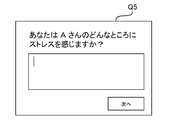
続いて、図22に示すステップS3-15では、図23に示す質問画面Q3を5秒間表示する。質問画面Q3には、「あなたが人間関係でストレスを感じる人物を思い浮かべてください。」というメッセージが含まれる。その後、図24に示す入力画面E1を表示する(ステップS3-16)。入力画面E1には、「その人物の氏名を入力してください。」というメッセージ、文字入力欄、および「次へ」のボタンが含まれる。被験者が文字入力欄に該当する人物の氏名を入力し、「次へ」のボタンを選択することにより、入力が完了する。本実施形態では、該当する人物の氏名を「A」とする。入力画面E1において、被験者による入力が完了すると(ステップS3-17においてYes)、図25に示す質問画面Q4を表示する(ステップS3-18)。質問画面Q4には、「あなたはAさんとの人間関係でストレスを感じていますか?」というメッセージ、並びに、「はい」および「いいえ」のボタンが含まれる。質問画面Q4において、被験者が「はい」を選択すると(ステップS3-19においてYes)、図26に示す質問画面Q5を表示する(ステップS3-20)。質問画面Q5には、「あなたはAさんのどんなところにストレスを感じますか?」というメッセージ、文字入力欄、および「次へ」のボタンが含まれる。被験者が文字入力欄に回答を入力し、「次へ」のボタンを選択することにより、入力が完了する。本実施形態では、「冷たい」という回答が入力されたものとする。
なお、図26に示す質問画面Q5では、文字入力欄に自由に文章を入力させる形式であるが、図27に示す変形例のように、複数の選択肢から選択させる形式であってもよい。質問画面Q5において、被験者による入力が完了すると(ステップS3-21においてYes)、図28に示すステップS3-22に移行する。
ステップS3-22では、集合体10の画面に切り替え、第2の図形2を2秒間点滅させる。その後、図29に示すように、第2の図形2の近傍に吹き出しで「あなた」と表示する(ステップS3-23)。さらに、第3の図形3を2秒間点滅させ(ステップS3-24)、その後、図30に示すように、第3の図形3の近傍に吹き出しで「Aさん=冷たい」と3秒間表示する(ステップS3-25)。さらに、第4の図形4を2秒間点滅させ(ステップS3-26)、その後、図31に示すように、第4の図形4の近傍に吹き出しで「無意識=あなたが隠しているもの」と3秒間表示する(ステップS3-27)。その後、図32に示すように、第4の図形4から第3の図形3に向かって矢印を表示する(ステップS3-28)。さらに、第3の図形3を2秒間点滅させ(ステップS3-29)、その後、図33に示すように、第3の図形3の近傍に吹き出しで「あなたの無意識がAさんに映っている」と表示する(ステップS3-30)。続いて、図34に示すように、第4の図形4の近傍に吹き出しで「あなたが無意識に隠していることがAさんに映っているので、Aさんに対してストレスを感じる」と表示する(ステップS3-31)。その後、図35に示すように、第5の図形5から第4の図形4に向かって矢印を表示する(ステップS3-32)。さらに、第5の図形5を2秒間点滅させ(ステップS3-33)、その後、図36に示すように、第5の図形5の近傍に吹き出しで「あなたの盲点」と表示する(ステップS3-34)。続いて、図37に示すように、第4の図形4と第5の図形5の下側に「盲点が無意識を生み出す」と表示する(ステップS3-35)。さらに、図38に示すように、第2の図形2から第3の図形3に向けて矢印を表示し、同時にその上に「相手に感じる」と表示し、次に、第3の図形3の左上に「相手に感じる感情」と吹き出しで表示し、次に、第3の図形3と第4の図形4の間に互いが反対であることを示す矢印を表示し、同時にその上に「真逆」と表示し、さらに、第4の図形4の右下に「“相手に感じる感情“と真逆の感情」と吹き出しで表示し、最後に、集合体10の下に「“あなたが相手に感じる感情”と真逆の感情が、あなたの内面に存在する」と表示する(ステップS3-36)。なお、第2の図形2から第3の図形3に向かう矢印の色は緑色が好ましい。続いて、図1に示す辞書データ113を読み出し、辞書データ113から「冷たい」と真逆の感情を意味する言葉(温かい)を選択し、図39に示すように、第3の図形3の近傍に「冷たい」を表示するとともに、第5の図形5の近傍に吹き出しで「温かい」を表示する(ステップS3-37)。表1に辞書データ113の一例を示す。

なお、ユーザが質問画面Q5(図26または図27)に入力した言葉が辞書データ113に含まれていない場合、コンピュータ100は、クラウド上の任意の辞書データにアクセスし、入力された言葉と真逆の言葉を取得してもよい。さらに、辞書データ113に含まれていない言葉が入力されるたびに、機械学習によって、辞書データ113を更新してもよい。
ステップS3-37の後、図40に示す質問画面Q4を表示する(ステップS3-38)。質問画面Q4には、「Aさんにストレスを感じる仕組みを理解できましたか?」というメッセージ、並びに、「はい」および「いいえ」のボタンが含まれており、被験者によって「はい」が選択された場合(ステップS3-39においてYes)、図41に示すステップS3-40に移行する。なお、被験者によって「いいえ」が選択された場合(ステップS3-39においてNo)、ステップS3-22~S3-38が繰り返される。
なお、図22に示すステップS3-15~S3-21、および、図28に示すステップS3-22~S3-39を省略してもよい。すなわち、図11に示すステップS3-14においてYesの場合、図41に示すステップS3-40に移行してもよい。
続いて、図41に示すステップS3-40では、図42に示す質問画面Q7を5秒間表示する。質問画面Q7には、「あなたが人間関係で心地よさを感じる人物を思い浮かべてください。」というメッセージが含まれる。その後、図24に示す入力画面E1を表示する(ステップS3-41)。入力画面E1には、「その人物の氏名を入力してください。」というメッセージ、文字入力欄、および「次へ」のボタンが含まれる。被験者が文字入力欄に該当する人物の氏名を入力し、「次へ」のボタンを選択することにより、入力が完了する。本実施形態では、該当する人物の氏名を「B」とする。入力画面E1において、被験者による入力が完了すると(ステップS3-42においてYes)、図43に示す質問画面Q8を表示する(ステップS3-43)。質問画面Q8には、「あなたはBさんとの人間関係で心地よさを感じていますか?」というメッセージ、並びに、「はい」および「いいえ」のボタンが含まれる。質問画面Q8において、被験者が「はい」を選択すると(ステップS3-44においてYes)、図44に示す質問画面Q9を表示する(ステップS3-45)。質問画面Q9には、「あなたはBさんのどんなところに心地よさを感じますか?」というメッセージ、文字入力欄、および「次へ」のボタンが含まれる。被験者が文字入力欄に回答を入力し、「次へ」のボタンを選択することにより、入力が完了する。本実施形態では、「謙虚」という回答が入力されたものとする。質問画面Q9において、被験者による入力が完了すると(ステップS3-46においてYes)、図45に示すステップS3-47に移行する。
ステップS3-47では、集合体10の画面に切り替え、第3の図形3を2秒間点滅させる。その後、図46に示すように、第3の図形3の近傍に吹き出しで「あなた」と表示する(ステップS3-48)。さらに、第2の図形2を2秒間点滅させ(ステップS3-49)、その後、図47に示すように、第3の図形3の近傍に吹き出しで「Bさん=謙虚」と3秒間表示する(ステップS3-50)。さらに、第7の図形7を2秒間点滅させ(ステップS3-51)、その後、図48に示すように、第7の図形7の近傍に吹き出しで「無意識=あなたが隠しているもの」と3秒間表示する(ステップS3-52)。その後、図49に示すように、第7の図形7から第2の図形2に向かって矢印を表示する(ステップS3-53)。さらに、第2の図形2を2秒間点滅させ(ステップS3-54)、その後、図50に示すように、第2の図形2の近傍に吹き出しで「あなたの無意識がBさんに映っている」と表示する(ステップS3-55)。続いて、図51に示すように、第7の図形7の近傍に吹き出しで「あなたが無意識に隠していることがBさんに映っているので、Bさんに対して心地よさを感じる」と表示する(ステップS3-56)。その後、図52に示すように、第6の図形6から第7の図形7に向かって矢印を表示する(ステップS3-57)。さらに、第6の図形6を2秒間点滅させ(ステップS3-58)、その後、図53に示すように、第6の図形6の近傍に吹き出しで「あなたの盲点」と表示する(ステップS3-59)。続いて、図54に示すように、第6の図形6と第7の図形7の下側に「盲点が無意識を生み出す」と表示する(ステップS3-60)。さらに、図55に示すように、第3の図形3から第2の図形2に向けて緑色の矢印を表示し、同時にその上に「相手に感じる」と表示し、次に、第2の図形2の右上に「相手に感じる感情」と吹き出しで表示し、次に、第2の図形2と第7の図形7の間に互いが反対であることを示す矢印を表示し、同時にその上に「真逆」と表示し、さらに、第7の図形7の左下に「“相手に感じる感情“と真逆の感情」と吹き出しで表示し、最後に、集合体10の下に「“あなたが相手に感じる感情”と真逆の感情が、あなたの内面に存在する」と表示する(ステップS3-61)。なお、第3の図形3から第2の図形2に向かう矢印の色は緑色が好ましい。続いて、図1に示す辞書データ113を読み出し、辞書データ113から「謙虚」と真逆の感情を意味する言葉(傲慢)を選択し、図56に示すように、第2の図形2の近傍に「謙虚」を表示するとともに、第6の図形6の近傍に吹き出しで「傲慢」を表示する(ステップS3-62)。
その後、図57に示す質問画面Q10を表示する(ステップS3-63)。質問画面Q10には、「Bさんに心地よさを感じる仕組みを理解できましたか?」というメッセージ、並びに、「はい」および「いいえ」のボタンが含まれており、被験者によって「はい」が選択された場合(ステップS3-64においてYes)、図58に示すステップS3-65に移行する。なお、被験者によって「いいえ」が選択された場合(ステップS3-64においてNo)、ステップS3-47~S3-62が繰り返される。
なお、図41に示すステップS3-41~S3-66、および、図45に示すステップS3-47~S3-64を省略してもよい。すなわち、図28に示すステップS3-39においてYesの場合、図58に示すステップS3-65に移行してもよい。
続いて、図58に示すステップS3-65では、集合体10が表示された状態において、第1の図形1、第4~第7の図形4~7を2秒間点滅させてから非表示にする。これにより、図59に示す状態となる。さらに、図60に示すように、第2の図形2と第3の図形3の間に双方向の矢印を「相対」の文字とともに3秒間点滅させる(ステップS3-66)。その後、図61に示すように、「+」と「-」の図形が図形2の背後から表示され、それぞれが第5の図形5と第4の図形4の位置に移動する(ステップS3-67)。同様に、図62に示すように、「+」と「-」の図形が図形3の背後から表示され、それぞれが第7の図形7と第6の図形6の位置に移動する(ステップS3-68)。続いて、図63に示すように、第4の図形4と第5の図形5を破線の四角枠8で囲む(ステップS3-69)。さらに、図64に示すように、四角枠8の直下に「図形2は相反するプラスとマイナスによってできている」と3秒間表示する(ステップS3-70)。同様に、図65に示すように、第6の図形6と第7の図形7を破線の四角枠9で囲み(ステップS3-71)。さらに、図66に示すように、四角枠9の直下に「図形3は相反するプラスとマイナスによってできている」と3秒間表示する(ステップS3-72)。その後、図67に示すように、四角枠8と四角枠9の間に「=」を3秒間表示する(ステップS-73)。続いて、図68に示す質問画面Q11を表示する(ステップS3-74)。質問画面Q11には、「四角枠8と四角枠9が表面的に相対であるが、本質的に等しいことが理解できましたか?」というメッセージ、並びに、「はい」および「いいえ」のボタンが含まれており、被験者によって「はい」が選択された場合(ステップS3-75においてYes)、図69に示すステップS3-76に移行する。なお、被験者によって「いいえ」が選択された場合(ステップS3-75においてNo)、ステップS3-65~S3-74が繰り返される。
続いて、図69に示すステップS3-76では、第2~第7の図形2~7が表示された状態において、図70に示すように、第2の図形2の形状を2秒間かけて「-」の形状に変化させ、同時に、第3の図形3の形状を2秒間かけて「+」の形状に変化させる(ステップS3-76)。さらに、図71に示すように、第2の図形2の形状を2秒間かけて「+」の形状に戻し、同時に、第3の図形3の形状を2秒間かけて「-」の形状に戻す(ステップS3-77)。これらのステップS3-76およびS3-77を5回繰り返した後(ステップS3-78においてYes)、図形2の近傍に「感情や心の状態によってプラスにもなりマイナスにもなる。しかし、プラスとマイナスは、実はペアで存在する。」と表示する(ステップS3-79)。続いて、図73に示すように、第1の図形1を3秒間点滅させて、その後表示する(ステップS3-80)。その後、図74に示すように、第1の図形1の近傍に「この新しい視点が生まれる。図形2~7を俯瞰することで、図形2と図形3がもともと等しいことが分かる」と表示する(ステップS3-81)。続いて、図75に示すように、図形2の右横に「あなた」、図形3の左横に「相手」と表示する(ステップS3-82)。さらに、図76に示すように、図形2と図形3の間に「=」を表示する(ステップS3-83)。続いて、図77に示す質問画面Q12を表示する(ステップS3-84)。質問画面Q12には、「相手に感じていることが実はあなたの内面にあるものと同じということが理解できましたか?」というメッセージ、並びに、「はい」および「いいえ」のボタンが含まれており、被験者によって「はい」が選択された場合(ステップS3-85においてYes)、図6に示すステップS3が終了する。なお、被験者によって「いいえ」が選択された場合(ステップS3-85においてNo)、ステップS3-76~S3-84が繰り返される。
以上、本実施形態のステップS3における処理の具体例を説明した。なお、コンピュータ100の補助記憶装置103に、事前に被験者からアンケート等で聞き出した被験者の心の葛藤の具体的原因や生活背景に関する情報を格納しておき、コンピュータ100が、各図形の形状が示す意味を「温かさ(+)」や「冷たさ(-)」といった表現を用いて、具体的に被験者に説明してもよい。このように、対となる二つの感情、又は心の状態として、「温かさ」と「冷たさ」の他に、「自立」と「依存」、「楽観」と「悲観」、などの概念が挙げられる。
第4の図形4および第5の図形5にそれぞれ関連付けられた被験者の無意識および心の盲点は、被験者の心の中で葛藤を生み出す二つの極性を持つ概念である。これらの概念は、誰もが心に有しており、第4の図形4および第5の図形5と同様に、無意識および心の盲点は常に心の中で葛藤している。上記の例で、被験者が職場の上司に冷たさを感じているとすると、このとき、被験者の心の中には「温かさ(+)」と「冷たさ(-)」という二つの極性を持つ概念が存在しており、心の中の葛藤で、「温かさ(+)」が勝って、被験者の思考(第2の図形2)が「温かさ(+)」に同化する。その結果、被験者の思考の対象に「冷たさ(-)」を感じる現象が現れる。この「温かさ(+)」は、被験者が同化したものであるので、通常は、被験者は自身の「温かさ」に気付くことはない(盲点=第5の図形5)。同時に、被験者の「冷たさ(-)」は意識下に落ちているため、被験者自身の状態であることを認識できず、無意識の状態になっている(第4の図形4)。そして、被験者が上司に対して感じる「冷たさ」(第3の図形3)は、無意識の状態となった被験者の「冷たさ(-)」が目の前の思考の対象に投影されたものである。つまり、被験者の見ている思考の対象(冷たい上司)に感じているものは、被験者自身の無意識が思考上に顕在化したものである。
このように、主観となる被験者が同化した思考(+)が、目の前の他者(客観:(-))に反転して投影される現象を「同化と反転」の現象と定義する。上記の例では、被験者(主観)が同化した「温かさ(+)」が目の前の思考の対象である上司(客観)に反転し、冷たさ(-)として投影されたことになる。
コンピュータ100は、以上のように、第5の図形5と関連付けられた被験者の心の盲点は、第2の図形2と関連付けられた被験者の思考が同化したものを表すとともに、第4の図形4と関連付けられた被験者の無意識を生み出しているものであること、そして、第3の図形3と関連付けられた思考の対象が、第4の図形4と関連付けられた被験者の無意識の投影であることを被験者に説明する。ここで、集合体10では、第3の図形3と第4の図形4とが共通の形状を有しており、第5の図形5は、第3および第4の図形3,4とは対照的な概念を示す形状を有しているので、図形の形状から容易に、図形同士の関係性を把握して、集合体10が表わす認識システムを理解しやすくなっている。
また、コンピュータ100は、被験者の思考(主観)とその思考の対象(客観)が逆転したケースも説明する。その場合、第6の図形6と関連付けられた前記対象の心の盲点は、第3の図形3と関連付けられた前記対象の思考と同化したものであるとともに、第7の図形7と関連付けられた前記対象の無意識を生み出しているものであることを被験者に説明する。また、コンピュータ100は、「同化と反転」の現象によって、第2の図形2と関連付けられた被験者の思考は、第7の図形7と関連付けられた前記対象の無意識の投影であることを被験者に説明する。つまり、極性は異なるが、被験者の思考の対象の心の中でも、上述の被験者の心の中と同様に、無意識および心の盲点が存在していることを説明する。なお、集合体10に第6および第7の図形6,7が含まれていない場合、本段落の説明は省略可能である。
本実施形態では、第2および第3ステップS2,S3は、人工知能を有するロボットであるコンピュータ100が被験者と対話して被験者の理解度を確認しながら実施することが好ましい。具体的には、音声出力装置104を介して被験者に説明を行うと共に、被験者の発言を集音装置105を介して受信し、音声認識処理を行うことによって、被験者の理解度を判定する。また、表示装置106に、理解できたか否かを示す質問を提示し、入力装置107を介して被験者に回答させることにより、被験者の理解度を判定してもよい。また、音声認識処理を行わずに、所定の対話パターンに沿って第2および第3ステップS2,S3を実施してもよい。
なお、この第3のステップS3に要する時間には個人差があるが、ステップS3を一度実施するだけで認識システムを理解できる被験者もいれば、ステップS3を何度も繰り返し実施することを必要とする被験者もいる。
被験者は、第3のステップS3において、認識システムを理解することにより、被験者の心の葛藤を解消させて、心のバランスを整えることができる。具体的には、被験者の無意識と被験者の心の盲点とが被験者の思考上に顕在化する。無意識および心の盲点は、いずれも被験者が感じていなかったものであるが、第3のステップS3において、「同化と反転」の現象によって被験者の中にある無意識が目の前の思考の対象に投影されていることを理解することにより、被験者は、自身の心に内在する無意識を自覚し、顕在化させることができる。
言い換えると、被験者から思考の対象(第3の図形3)に向けられていた思考の方向性を反転させ、自分の無意識(第4の図形4)に向ける。例えば、「上司の冷たさ」が思考の対象に感じるものである場合、「上司の冷たさ」は被験者の無意識の冷たさが上司に投影されているものである。その冷たさを感じている思考の方向性を被験者自身に反転させて向けることにより、被験者の無意識(冷たさ)が思考上に顕在化する。これに伴い、被験者は、自身と同化した心の盲点である「温かさ」にも気付くことができる。これはすなわち、被験者の心の盲点が思考上において顕在化した状態でもある。
被験者の無意識(第4の図形4)および心の盲点(第5の図形5)が被験者の思考上に顕在化すると、両者は電気的エネルギーのプラスとマイナスのように融合して対消滅する。その結果、第2の図形2に関連付けられた被験者の心の葛藤の原因となっていた思考も消滅する。ここで、第1の図形1は、左右対称に配置された第1~第7の図形1~7を含む集合体10の頂点に位置しており、かつ、「+」および「-」のどちらにも偏っていない形状および模様を有している。すなわち、第1の図形1は、「+」に偏った被験者の思考(第2の図形2)が消滅し、被験者の視点が第2の図形2から、集合体10に示された認識システム全体を俯瞰する位置(第1の図形1)に移行したものを象徴しているといえる。これにより、第4の図形4(-)および第5の図形5(+)が対消滅して、被験者の視点が第2の図形2から第1の図形1に移行することを被験者が理解することで、容易に被験者の無意識および心の盲点が対消滅する。すなわち、第1の図形1は、温かいか否か、冷たいか否か、といったジャッジを行わない、心のバランスが整った状態を示している。つまり、第1の図形1は、第2の図形2および第3の図形3を同時に俯瞰し、また、さらに第2の図形2から第7の図形7をも俯瞰して、新たな視点を獲得することで、被験者が心に「肯定(+)」も「否定(-)」、すなわち(+)(-)の両極がいずれも存在しない寛いだ状態となったことを示している。
被験者の無意識(第4の図形4)が消滅することで、同時に、被験者の無意識が投影されたもの、つまり被験者が思考の対象に感じるもの(第3の図形3)も消滅する。その結果、被験者は心のバランスを整えることができる。
例えば、「上司の冷たさ」が思考の対象に感じるものである場合、心の葛藤が解消することで、被験者は上司に冷たさを感じることはなくなり、上司を原因とするストレスも生じることはなくなる。
なお、主観と客観が逆転した場合においても同様である。すなわち、第2の図形2に関連付けられた被験者の心の葛藤の原因となっていた思考が消滅し、同時に、思考の対象である第3の図形3も消滅する。このとき、その心の中にある第7の図形7と関連付けられた無意識も消滅し、これに伴い、第6の図形6と関連付けられた盲点も消滅することとなる。
第6および第7の図形6,7を、思考の対象の心の盲点および無意識とそれぞれ関連付けることにより、被験者は、集合体10に示された認識システムをさらに容易に理解することができる。
4.その他
以上、本発明の実施形態について説明したが、本発明は上記実施形態に限定されるものではなく、その趣旨を逸脱しない限りにおいて、種々の変更が可能である。
以上、本発明の実施形態について説明したが、本発明は上記実施形態に限定されるものではなく、その趣旨を逸脱しない限りにおいて、種々の変更が可能である。
上記実施形態では、第1の図形1は破線の円形枠であったが、例えば、図78(a)に示すような白い円、図78(b)に示すような黒い円、図78(c)に示すような、メビウスの帯を4対組み合わせた形状であってもよい。
上記実施形態では、被験者の思考の対象が被験者の上司である場合を例に説明したが、被験者の思考の対象はこれに限定されない。思考の対象は、被験者の親であってもよいし、被験者の配偶者、友人、子息など、被験者の心の葛藤の原因となっているものであれば、特に限定されない。
4-1.変形例1
さらに、被験者の思考の対象は、人物でなくてもよい。例えば、被験者が属するコミュニティーに対して「理不尽」を感じている被験者がいたとすると、この被験者の思考の対象は「そのコミュニティー」である。この被験者に対して、本発明に係る方法を適用した例を、図6に基づいて説明すると、以下のようになる。
さらに、被験者の思考の対象は、人物でなくてもよい。例えば、被験者が属するコミュニティーに対して「理不尽」を感じている被験者がいたとすると、この被験者の思考の対象は「そのコミュニティー」である。この被験者に対して、本発明に係る方法を適用した例を、図6に基づいて説明すると、以下のようになる。
まず、ステップS1において、コンピュータ100が被験者に集合体10を想起させる。続いて、ステップS2において、コンピュータ100が集合体10の図形に、被験者の感情、および心の状態を当てはめる。これらのステップS1及び2の内容は、上述の実施形態におけるものと同様である。
続いて、ステップS3において、コンピュータ100は、第2の図形2と第3の図形3、および、第4の図形4と第5の図形5との対照性に基づき、集合体10に表わされた認識システムを被験者に理解させる。具体的には、コンピュータ100は、以下の事象を被験者に説明する。
被験者の心には「正義感(+)」と「理不尽(-)」という二つの極性を持つ概念が存在しており、その二つの概念が生み出している心の葛藤において、「正義感」が「理不尽」に勝って、被験者の思考(第2の図形2)が「正義感」に同化している。そのため、通常は、被験者は自身の「正義感」に気付くことはなく、「正義感」は、第5の図形5に対応付けられた盲点となっている。同時に、被験者の「理不尽」は、意識下に落ちているため、被験者自身の状態であることを認識できず、第4の図形4に対応付けられた無意識となっている。被験者がコミュニティー(第3の図形3)に感じている「理不尽」は、無意識の状態となった被験者の「理不尽」が思考の対象に投影されたものである。すなわち、被験者の同化した「正義感」が、「同化と反転」の現象によって、思考の対象に「理不尽」となって投影されている。
以上の説明により、被験者が、集合体10が表わす認識システムを理解すると、被験者の無意識と被験者の心の盲点とが被験者の思考上に顕在化する。すなわち、被験者がコミュニティーに「理不尽」を感じていた思考の方向性を反転させて被験者自身に向けることにより、被験者は自身の無意識(理不尽)に気付き、その無意識が思考上に顕在化する。これに伴い、被験者は、自身と同化していた心の盲点である「正義感」にも気付くことができ、被験者の心の盲点も思考上に顕在化する。
これにより、被験者の無意識(第4の図形4)と心の盲点(第5の図形5)とが対消滅し、その結果、第2の図形2に関連付けられた被験者の心の葛藤の原因となっていた思考も消滅し、同時に、被験者の無意識が投影された被験者の思考の対象に感じるもの(第3の図形3)も消滅する。その結果、被験者は心のバランスを整えることができる。よって、被験者は、コミュニティーに対して理不尽を感じることはなくなる。
4-2.変形例2
他の例として、他人にコンプレックスを感じている被験者に対して、本発明に係る方法を適用すると、以下のようになる。
他の例として、他人にコンプレックスを感じている被験者に対して、本発明に係る方法を適用すると、以下のようになる。
まず、ステップS1において、コンピュータ100が被験者に集合体10を提示することにより集合体10を想起させ、ステップS2において、コンピュータ100が集合体10の図形に、被験者の感情、および心の状態を当てはめる。これらのステップS1及び2の内容は、上述の実施形態におけるものと同様である。
続いて、ステップS3において、コンピュータ100は、第2の図形2と第3の図形3、および、第4の図形4と第5の図形5との対照性に基づき、集合体10に表わされた認識システムを被験者に理解させる。具体的には、コンピュータ100は、以下の事象を被験者に説明する。
被験者の心には「優越感(+)」と「コンプレックス(-)」という二つの極性を持つ概念が存在しており、心の葛藤で、「優越感」が勝って、被験者の思考(第2の図形2)が「優越感」に同化している。そのため、通常は、被験者は自身の「優越感」に気付くことはなく、「優越感」は、第5の図形5に対応付けられた盲点となっている。同時に、被験者の「コンプレックス」は、意識下に落ちているため被験者自身の状態であることを認識することはできず、第4の図形4に対応付けられた無意識となっている。被験者が思考の対象(第3の図形3)に感じている「コンプレックス」は、被験者の無意識の「コンプレックス」が、思考の対象に投影されたものである。
以上の説明により、被験者が、集合体10が表わす認識システムを理解すると、被験者の無意識と被験者の心の盲点とが被験者の思考上に顕在化する。すなわち、被験者が思考の対象に「コンプレックス」を感じていた思考の方向性を反転させて被験者自身に向けることにより、被験者は自身の無意識に気付いて、その無意識が顕在化する。これに伴い、被験者は、自身と同化した心の盲点である「優越感」にも気付くことができ、被験者の心の盲点も顕在化する。
これにより、被験者の無意識(第4の図形4)と心の盲点(第5の図形5)とが対消滅し、その結果、第2の図形2に関連付けられた被験者の心の葛藤の原因となっていた思考も消滅し、同時に、被験者の無意識が投影された被験者の思考の対象に感じていたもの(第3の図形3)も消滅する。その結果、被験者は心のバランスを整えることができる。よって、被験者は、他人に対してコンプレックスを感じることはなくなる。
以下、本発明の実施例について説明するが、本発明はこれに限定されない。
実施例では、被験者265名に対し、コンピュータ100を用いて本発明を実施した。コンピュータ100として、本発明に係るコンピュータプログラムがインストールされた汎用のパーソナルコンピュータを用いた。本発明の実施後、被験者に対してアンケートを行い、10%(26名)を無作為に抽出して集計した。アンケートでは、本発明の実施前後の被験者が感じた変化について質問した。その回答結果を、図79(a)~(b)に示す。
(a):この集合体10に表された認識システムを理解できましたか?
理解できた:90%、理解できなかった:10%
(b):「(a)」で理解できたと答えた方を対象に、何か変化はありましたか?
変化があった:100%
(a):この集合体10に表された認識システムを理解できましたか?
理解できた:90%、理解できなかった:10%
(b):「(a)」で理解できたと答えた方を対象に、何か変化はありましたか?
変化があった:100%
図79(b)に示すように、集合体10に表された認識システムを「理解できた」と回答した全員が、本発明の実施前後に「変化があった」と回答した。このことは、被験者が集合体10に表された認識システムを理解した後は、少なくとも第4および第5の図形4,5に対応する心の二つの極性を持つ概念に気付かされ、それぞれが思考上に顕在化し、その無意識と盲点が消滅したことによって心のバランスが整ったことを示している。
本発明は、人間関係(例えば、コミュニケーション、恋愛、結婚、子育て等)の悩みを解決する分野に好適であるが、精神医療の分野やエピゲノムの分野にも適用することができる。これに限らず、本発明は、人間のあらゆる悩みを解決することに適用することができ、これにより、知的生産活動の向上に寄与することができる。
1 第1の図形
2 第2の図形
3 第3の図形
4 第4の図形
5 第5の図形
6 第6の図形
7 第7の図形
8 四角枠
9 四角枠
10 図形の集合体
10a 図形の集合体
10b 図形の集合体
10c 図形の集合体
100 コンピュータ
101 CPU(演算装置)
102 メモリ(記憶装置)
103 補助記憶装置
104 音声出力装置
105 集音装置
106 表示装置
107 入力装置
110 コンピュータプログラム
111 図形データ
112 画面データ
113 辞書データ
2 第2の図形
3 第3の図形
4 第4の図形
5 第5の図形
6 第6の図形
7 第7の図形
8 四角枠
9 四角枠
10 図形の集合体
10a 図形の集合体
10b 図形の集合体
10c 図形の集合体
100 コンピュータ
101 CPU(演算装置)
102 メモリ(記憶装置)
103 補助記憶装置
104 音声出力装置
105 集音装置
106 表示装置
107 入力装置
110 コンピュータプログラム
111 図形データ
112 画面データ
113 辞書データ
Claims (5)
- 演算装置および記憶装置を有するコンピュータに、被験者の心のバランスを整える処理を実行させるコンピュータプログラムであって、
図形の集合体を前記被験者に想起させる第1のステップと、
前記図形に前記被験者の感情、および心の状態を当てはめる第2のステップと、
前記集合体に表わされた認識システムを前記被験者に理解させる第3のステップと、
を前記コンピュータに実行させる、コンピュータプログラム。 - 前記コンピュータは人工知能を有するロボットであることを特徴とする、請求項1に記載のコンピュータプログラム。
- 前記集合体は、
第1の図形と、
前記第1の図形の斜め下方に配置された第2の図形と、
前記第2の図形とは対照的な概念を示す形状を有し、かつ、前記第1の図形を通る仮想的な縦線を挟んで前記第2の図形と左右対称となる位置に配置された第3の図形と、
前記第3の図形と共通の形状を有し、前記第2の図形の斜め下方に配置された第4の図形と、
前記第2の図形と共通の形状を有し、前記第2の図形を通る仮想的な縦線を挟んで前記第4の図形と左右対称となる位置に配置された第5の図形と、
を含み、
前記第2のステップでは、
前記第2の図形を、前記被験者の思考と関連付け、
前記第3の図形を、前記被験者の思考の対象と関連付け、
前記第4の図形を、前記被験者の無意識と関連付け、
前記第5の図形を、前記被験者の心の盲点と関連付け、
前記第3のステップでは、
第2の図形と第3の図形、および、第4の図形と第5の図形との対照性に基づき、
前記第5の図形と関連付けられた前記被験者の心の盲点は、前記第2の図形と関連付けられた前記被験者の思考が同化したものを表すとともに、前記第4の図形と関連付けられた前記被験者の無意識を生み出しているものであること、そして、前記第3の図形と関連付けられた前記対象に感じるものが、前記第4の図形と関連付けられた前記被験者の無意識の投影であることを、前記被験者に説明することにより、前記認識システムを前記被験者に理解させる、
ことを特徴とする、請求項1または2に記載のコンピュータプログラム。 - 前記第2、第5および第7の図形は「+」の形状を有し、
前記第3、第4および第6の図形は「-」の形状を有する、
ことを特徴とする、請求項3に記載のコンピュータプログラム。 - 前記集合体は、
前記第3の図形と共通の形状を有し、前記第3の図形の斜め下方に配置された第6の図形と、
前記第2の図形と共通の形状を有し、前記第3の図形を通る仮想的な縦線を挟んで前記第6の図形と左右対称となる位置に配置された第7の図形と、
をさらに含み、
前記第2のステップでは、
前記第6の図形を、前記対象の心の盲点と関連付け、
前記第7の図形を、前記対象の無意識と関連付け、
前記第3のステップでは、
前記第6の図形と関連付けられた前記対象の心の盲点は、前記第3の図形と関連付けられた前記対象の思考が同化したものを表すとともに、前記第7の図形と関連付けられた前記対象の無意識を生み出しているものであること、そして、前記第2の図形と関連付けられた前記被験者に感じるものが、前記第7の図形と関連付けられた前記対象の無意識の投影であることを、前記被験者に説明する、
ことを特徴とする、請求項3または4に記載のコンピュータプログラム。
Priority Applications (3)
| Application Number | Priority Date | Filing Date | Title |
|---|---|---|---|
| US16/324,225 US20190167174A1 (en) | 2016-08-31 | 2017-08-31 | Computer Program for Balancing Mind |
| CN201780053422.7A CN109641118B (zh) | 2016-08-31 | 2017-08-31 | 记录平衡心理程序的介质、实现平衡心理的方法及计算机 |
| JP2017561014A JPWO2018043648A1 (ja) | 2016-08-31 | 2017-08-31 | 心のバランスを整えるためのコンピュータプログラム |
Applications Claiming Priority (2)
| Application Number | Priority Date | Filing Date | Title |
|---|---|---|---|
| JP2016169334 | 2016-08-31 | ||
| JP2016-169334 | 2016-08-31 |
Publications (1)
| Publication Number | Publication Date |
|---|---|
| WO2018043648A1 true WO2018043648A1 (ja) | 2018-03-08 |
Family
ID=61301035
Family Applications (1)
| Application Number | Title | Priority Date | Filing Date |
|---|---|---|---|
| PCT/JP2017/031384 Ceased WO2018043648A1 (ja) | 2016-08-31 | 2017-08-31 | 心のバランスを整えるためのコンピュータプログラム |
Country Status (4)
| Country | Link |
|---|---|
| US (1) | US20190167174A1 (ja) |
| JP (5) | JPWO2018043648A1 (ja) |
| CN (1) | CN109641118B (ja) |
| WO (1) | WO2018043648A1 (ja) |
Cited By (2)
| Publication number | Priority date | Publication date | Assignee | Title |
|---|---|---|---|---|
| JP2023026159A (ja) * | 2021-08-13 | 2023-02-24 | リフ株式会社 | 情報処理装置、プログラム及び情報処理方法 |
| JP2023154426A (ja) * | 2016-08-31 | 2023-10-19 | 株式会社ミロス・インスティチュート | 心のバランスを整えるためのコンピュータプログラム |
Citations (3)
| Publication number | Priority date | Publication date | Assignee | Title |
|---|---|---|---|---|
| JP2002306459A (ja) * | 2001-04-18 | 2002-10-22 | Furakkusu:Kk | 心理検査用具 |
| JP2002360547A (ja) * | 2001-06-05 | 2002-12-17 | Keiko Nakajima | 精神状態分析方法およびそれに用いる被着色用具 |
| JP2007175439A (ja) * | 2005-12-28 | 2007-07-12 | Festa:Kk | 色彩診断システム及びそのプログラム |
Family Cites Families (3)
| Publication number | Priority date | Publication date | Assignee | Title |
|---|---|---|---|---|
| JP4096376B2 (ja) * | 1996-07-09 | 2008-06-04 | セイコーエプソン株式会社 | リラックス指導装置 |
| CN105194787A (zh) * | 2015-10-20 | 2015-12-30 | 刘学俊 | 一种用于心理减压的减压系统 |
| CN109641118B (zh) * | 2016-08-31 | 2021-05-28 | 米罗斯研究有限公司 | 记录平衡心理程序的介质、实现平衡心理的方法及计算机 |
-
2017
- 2017-08-31 CN CN201780053422.7A patent/CN109641118B/zh active Active
- 2017-08-31 US US16/324,225 patent/US20190167174A1/en not_active Abandoned
- 2017-08-31 JP JP2017561014A patent/JPWO2018043648A1/ja active Pending
- 2017-08-31 WO PCT/JP2017/031384 patent/WO2018043648A1/ja not_active Ceased
-
2018
- 2018-08-27 JP JP2018158751A patent/JP2018187460A/ja active Pending
-
2022
- 2022-04-27 JP JP2022073085A patent/JP2022093461A/ja active Pending
-
2023
- 2023-06-27 JP JP2023104631A patent/JP2023154426A/ja active Pending
-
2024
- 2024-10-01 JP JP2024171924A patent/JP2024177265A/ja active Pending
Patent Citations (3)
| Publication number | Priority date | Publication date | Assignee | Title |
|---|---|---|---|---|
| JP2002306459A (ja) * | 2001-04-18 | 2002-10-22 | Furakkusu:Kk | 心理検査用具 |
| JP2002360547A (ja) * | 2001-06-05 | 2002-12-17 | Keiko Nakajima | 精神状態分析方法およびそれに用いる被着色用具 |
| JP2007175439A (ja) * | 2005-12-28 | 2007-07-12 | Festa:Kk | 色彩診断システム及びそのプログラム |
Cited By (3)
| Publication number | Priority date | Publication date | Assignee | Title |
|---|---|---|---|---|
| JP2023154426A (ja) * | 2016-08-31 | 2023-10-19 | 株式会社ミロス・インスティチュート | 心のバランスを整えるためのコンピュータプログラム |
| JP2024177265A (ja) * | 2016-08-31 | 2024-12-19 | 株式会社ミロス・インスティチュート | 心のバランスを整えるためのコンピュータプログラム |
| JP2023026159A (ja) * | 2021-08-13 | 2023-02-24 | リフ株式会社 | 情報処理装置、プログラム及び情報処理方法 |
Also Published As
| Publication number | Publication date |
|---|---|
| US20190167174A1 (en) | 2019-06-06 |
| JPWO2018043648A1 (ja) | 2018-09-06 |
| CN109641118B (zh) | 2021-05-28 |
| JP2023154426A (ja) | 2023-10-19 |
| JP2024177265A (ja) | 2024-12-19 |
| CN109641118A (zh) | 2019-04-16 |
| JP2022093461A (ja) | 2022-06-23 |
| JP2018187460A (ja) | 2018-11-29 |
Similar Documents
| Publication | Publication Date | Title |
|---|---|---|
| Ravindran et al. | Virtual reality support for joint attention using the floreo joint attention module: Usability and feasibility pilot study | |
| Lee et al. | Augmented reality plus concept map technique to teach children with ASD to use social cues when meeting and greeting | |
| Moore et al. | Collaborative virtual environment technology for people with autism | |
| JP2024177265A (ja) | 心のバランスを整えるためのコンピュータプログラム | |
| Lee et al. | How to Create Suitable Augmented Reality Application | |
| Moodley | Challenges and transformations: Counselling in a multicultural context | |
| Cucinella et al. | Towards personalized immersive virtual reality neurorehabilitation: a human-centered design | |
| Lee | Augmented reality coloring book: An interactive strategy for teaching children with autism to focus on specific nonverbal social cues to promote their social skills | |
| Burt et al. | Integrating leadership skills into anger management groups to reduce aggressive behaviors: The LIT model | |
| Liu et al. | Self-guided DMT: exploring a novel paradigm of dance movement therapy in mixed reality for children with ASD | |
| Cain et al. | Opening eyes to vision impairment: Inclusion is just another way of seeing | |
| Fridhi et al. | Geospatial virtual/augmented environment: applications for children with pervasive developmental disorders | |
| Trice-Black et al. | Sexuality of women with young children: A feminist model of mental health counseling | |
| RU2497440C1 (ru) | Способ оценки психоэмоционального уровня и уровня социализации дезадаптированных детей и подростков в процессе коррекции психоэмоциональных нарушений | |
| Elor | Development and evaluation of intelligent immersive virtual reality games to assist physical rehabilitation | |
| Smelser et al. | Exploring gender and sexuality using play therapy | |
| Kean | Relationship structure, relationship texture: Case studies in non/monogamies research | |
| Delachambre et al. | AMD Journee: A Patient Co-designed VR Experience to Raise Awareness Towards the Impact of AMD on Social Interactions | |
| Gasteiger et al. | Benefits, Challenges, and Opportunities for Empathetic Social Assistance Robots in Hospitals: An Acceptability Study | |
| Swingle | Beyond the self in self-regulation—Reaching beyond technologies: The importance of others and relationships to individual well-being | |
| Christofi | Virtual Reality as a Medium for Attitude Change | |
| Xu et al. | The new fear of missing out (FoMO): Reflecting on the human impact of overly positive social media through interactive installation | |
| Vasilyeva et al. | Psychoanalysis in Russia: The past, the present, and the future | |
| Amir et al. | Robot-assisted Social Narratives for Children with Diverse Developmental Conditions: A Pilot Study | |
| Bahiss | A serious game to provide social skills training for people with Asperger's Syndrome/High-Functioning Autism |
Legal Events
| Date | Code | Title | Description |
|---|---|---|---|
| WWE | Wipo information: entry into national phase |
Ref document number: 2017561014 Country of ref document: JP |
|
| 121 | Ep: the epo has been informed by wipo that ep was designated in this application |
Ref document number: 17846652 Country of ref document: EP Kind code of ref document: A1 |
|
| NENP | Non-entry into the national phase |
Ref country code: DE |
|
| 122 | Ep: pct application non-entry in european phase |
Ref document number: 17846652 Country of ref document: EP Kind code of ref document: A1 |