WO2018047930A1 - 眼疲労の抑制又は改善用組成物 - Google Patents
眼疲労の抑制又は改善用組成物 Download PDFInfo
- Publication number
- WO2018047930A1 WO2018047930A1 PCT/JP2017/032398 JP2017032398W WO2018047930A1 WO 2018047930 A1 WO2018047930 A1 WO 2018047930A1 JP 2017032398 W JP2017032398 W JP 2017032398W WO 2018047930 A1 WO2018047930 A1 WO 2018047930A1
- Authority
- WO
- WIPO (PCT)
- Prior art keywords
- light
- retinal
- lactic acid
- eye
- caused
- Prior art date
- Legal status (The legal status is an assumption and is not a legal conclusion. Google has not performed a legal analysis and makes no representation as to the accuracy of the status listed.)
- Ceased
Links
Images



Classifications
-
- A—HUMAN NECESSITIES
- A61—MEDICAL OR VETERINARY SCIENCE; HYGIENE
- A61K—PREPARATIONS FOR MEDICAL, DENTAL OR TOILETRY PURPOSES
- A61K35/00—Medicinal preparations containing materials or reaction products thereof with undetermined constitution
- A61K35/66—Microorganisms or materials therefrom
- A61K35/74—Bacteria
- A61K35/741—Probiotics
- A61K35/744—Lactic acid bacteria, e.g. enterococci, pediococci, lactococci, streptococci or leuconostocs
- A61K35/747—Lactobacilli, e.g. L. acidophilus or L. brevis
-
- A—HUMAN NECESSITIES
- A23—FOODS OR FOODSTUFFS; TREATMENT THEREOF, NOT COVERED BY OTHER CLASSES
- A23L—FOODS, FOODSTUFFS OR NON-ALCOHOLIC BEVERAGES, NOT OTHERWISE PROVIDED FOR; PREPARATION OR TREATMENT THEREOF
- A23L33/00—Modifying nutritive qualities of foods; Dietetic products; Preparation or treatment thereof
- A23L33/10—Modifying nutritive qualities of foods; Dietetic products; Preparation or treatment thereof using additives
- A23L33/135—Bacteria or derivatives thereof, e.g. probiotics
-
- A—HUMAN NECESSITIES
- A61—MEDICAL OR VETERINARY SCIENCE; HYGIENE
- A61K—PREPARATIONS FOR MEDICAL, DENTAL OR TOILETRY PURPOSES
- A61K35/00—Medicinal preparations containing materials or reaction products thereof with undetermined constitution
- A61K35/66—Microorganisms or materials therefrom
- A61K35/74—Bacteria
- A61K35/741—Probiotics
- A61K35/744—Lactic acid bacteria, e.g. enterococci, pediococci, lactococci, streptococci or leuconostocs
-
- A—HUMAN NECESSITIES
- A61—MEDICAL OR VETERINARY SCIENCE; HYGIENE
- A61P—SPECIFIC THERAPEUTIC ACTIVITY OF CHEMICAL COMPOUNDS OR MEDICINAL PREPARATIONS
- A61P27/00—Drugs for disorders of the senses
- A61P27/02—Ophthalmic agents
-
- A—HUMAN NECESSITIES
- A61—MEDICAL OR VETERINARY SCIENCE; HYGIENE
- A61P—SPECIFIC THERAPEUTIC ACTIVITY OF CHEMICAL COMPOUNDS OR MEDICINAL PREPARATIONS
- A61P29/00—Non-central analgesic, antipyretic or antiinflammatory agents, e.g. antirheumatic agents; Non-steroidal antiinflammatory drugs [NSAID]
-
- C—CHEMISTRY; METALLURGY
- C12—BIOCHEMISTRY; BEER; SPIRITS; WINE; VINEGAR; MICROBIOLOGY; ENZYMOLOGY; MUTATION OR GENETIC ENGINEERING
- C12N—MICROORGANISMS OR ENZYMES; COMPOSITIONS THEREOF; PROPAGATING, PRESERVING, OR MAINTAINING MICROORGANISMS; MUTATION OR GENETIC ENGINEERING; CULTURE MEDIA
- C12N1/00—Microorganisms; Compositions thereof; Processes of propagating, maintaining or preserving microorganisms or compositions thereof; Processes of preparing or isolating a composition containing a microorganism; Culture media therefor
- C12N1/20—Bacteria; Culture media therefor
-
- A—HUMAN NECESSITIES
- A61—MEDICAL OR VETERINARY SCIENCE; HYGIENE
- A61K—PREPARATIONS FOR MEDICAL, DENTAL OR TOILETRY PURPOSES
- A61K35/00—Medicinal preparations containing materials or reaction products thereof with undetermined constitution
- A61K2035/11—Medicinal preparations comprising living procariotic cells
- A61K2035/115—Probiotics
-
- C—CHEMISTRY; METALLURGY
- C12—BIOCHEMISTRY; BEER; SPIRITS; WINE; VINEGAR; MICROBIOLOGY; ENZYMOLOGY; MUTATION OR GENETIC ENGINEERING
- C12R—INDEXING SCHEME ASSOCIATED WITH SUBCLASSES C12C - C12Q, RELATING TO MICROORGANISMS
- C12R2001/00—Microorganisms ; Processes using microorganisms
- C12R2001/01—Bacteria or Actinomycetales ; using bacteria or Actinomycetales
- C12R2001/225—Lactobacillus
Definitions
- components that maintain and improve visual function can be identified in foods that can be taken on a daily basis, they will be useful in a wide range of generations. If you can identify bacteria that maintain and improve visual function among lactic acid bacteria that are widely ingested, products that can be used in a wide range from young people to elderly people by using the lactic acid bacteria as food and drink Can be developed.
- An object of the present invention is to provide a composition that prevents a visual function disorder caused by exposure to light such as so-called blue light.
- the present inventors examined the effect of lactic acid bacteria on the visual function.
- human myeloid dendritic cells mDC
- mDC human myeloid dendritic cells
- the culture supernatant of mDC suppresses cell death of retinal pigment epithelial cells after blue light irradiation.
- the thickness of the extraretinal granule layer decreased due to light damage, but when the mice were ingested with the lactic acid bacteria Lactobacillus paracasei KW3110 strain, It has been found that the thickness of the granule layer is maintained. From these results, it was found that visual deterioration can be suppressed by orally ingesting a composition containing lactic acid bacteria, and the present invention has been completed.
- an agent for suppressing or improving eye fatigue as an agent for suppressing or improving a condition caused by retinal inflammation due to light damage, or an agent for suppressing cell death or retinal thickness reduction of retinal pigment epithelial cells or visible light
- lactic acid bacteria as a protective agent of visual function
- compositions [1], [4] and [9] may be referred to as “the composition of the present invention”. Further, in the present specification, the agents [1], [4] and [9] may be referred to as “the agent of the present invention”.
- the “state caused by retinal inflammation due to light damage” includes a state suffering from various diseases, or an unpleasant state of the eye (eyes) although it cannot be said to be a disease.
- eye and “eye” are synonyms, and in the present invention, the word “eye” can be used instead of the word “eye”.
- an unpleasant state of the eye includes a state where the eyes are objectively or subjectively tired and a state where the eyes are dry. More specifically, these states sometimes objectively appear as numerical values such as refractive power, visual acuity, flicker value (fatigue), adjustment power (focus), tear amount, and contrast sensitivity. Also, subjectively, when the eyes are tired, they may be accompanied by sensations not only about the eyes but also about parts other than the eyes.
- compositions and a preparation for use in suppressing or improving eye fatigue comprising lactic acid bacteria as an active ingredient.
- eye fatigue means eye fatigue induced by an external stimulus.
- the state of eye fatigue for example, the state exemplified as the unpleasant state of the eye as described above (particularly eye fatigue, blurred vision, shoulder or waist stiffness, head feeling) can be mentioned.
- a typical example of “eye fatigue” is eye fatigue due to VDT work.
- Eye fatigue includes physiological eye fatigue, which is simple eye fatigue, and morbid eye fatigue, which is perceived as unpleasant fatigue and cannot be sufficiently recovered even after resting.
- pathological eye fatigue may be clinically referred to as eye strain, but in general, eye fatigue is used synonymously with eye strain (see Nanzan Hall Medical Dictionary (Nanzan Hall)). ). Therefore, in the present invention, “eye fatigue” is used to mean “eye strain”.
- Lactobacillus genus (Lactobacillus): L.delbrueckii (Lactobacillus Deruburuekki), L.acidophilus (Lactobacillus acidophilus), L.casei (Lactobacillus casei), L.fructivorans (Lactobacillus full-Kuti Voyage lance), L.hilgardii ( Lactobacillus Hirugarudi), L.paracasei (Lactobacillus paracasei), L.rhamnosus (Lactobacillus rhamnosus), L.plantarum (Lactobacillus plantarum) ⁇ Bifidobacterium : B.bifidum (Bifidobacterium bifidum), B.adolescentis (Bifidobacterium addresscentis ) - Enterococcus (Enterococcus): E.faecalis (Enterococcus faecalis
- Lactobacillus paracasei is particularly preferable.
- Lactobacillus paracasei strains include Lactobacillus paracasei KW3110.
- a strain equivalent to the above strain can be used.
- the equivalent strain refers to a strain derived (derived) from the above strain, a strain from which the above strain is derived, or a progeny strain of the strain.
- the lactic acid bacteria are collected by centrifugation or filtration.
- dead bacteria it may be used after being sterilized and inactivated by an autoclave or the like.
- Lactic acid bacteria used as active ingredients in the present invention can be screened by the following method. That is, the candidate strain is cultured, the immune cells are cultured in the presence of the culture, and the culture supernatant of the immune cells is collected. Retinal pigment epithelial cells are cultured in the presence of the culture supernatant of the collected immune cells. At this time, the culture is performed under light (preferably blue light) irradiation or non-irradiation. When retinal pigment epithelial cells are cultured under light (preferably blue light) irradiation, cell death is induced.
- compositions and the agent of the present invention can exert their effects by being administered or ingested to animals such as humans (preferably mammals including humans).
- animals such as humans (preferably mammals including humans).
- cell death of retinal pigment epithelial cells due to light injury can be suppressed by administration or ingestion of a composition and a preparation for use in suppression or improvement of a condition caused by retinal inflammation due to light injury of the present invention.
- the administration or ingestion of the composition and the agent for use in the suppression or improvement of the condition caused by retinal inflammation due to light damage of the present invention suppresses the decrease in the thickness of the extraretinal granule layer due to light damage, The thickness of the outer granule layer can be maintained.
- the composition and the preparation of the present invention include a food composition, that is, a food or drink.
- the food composition can be used for prevention, suppression or improvement of an unpleasant state of the eyes (eyes).
- the types of foods and drinks to be targeted are not particularly limited as long as the effects of the active ingredients of the composition and the preparation of the present invention (especially, the suppression or improvement effect of the state caused by retinal inflammation due to light damage) are not inhibited.
- dairy products such as yogurt, processed milk, cheese, milk desserts; soft drinks, non-alcoholic drinks, sports drinks, energy drinks and other drinks; chocolates, biscuits and other confectionery; breads, dressings, pasta Examples include food sources such as sauces.
- the food composition includes supplements (dietary supplements), the dosage form of the supplement is not limited, and it goes without saying that a drug delivery system-like dosage form may be adopted. These food compositions may also contain other functional ingredients.
- lactic acid bacteria for use in the suppression or improvement of eye fatigue lactic acid bacteria for use in the suppression or improvement of conditions caused by retinal inflammation caused by light damage, and retinal pigment epithelial cells Lactic acid bacteria for use in suppressing cell death or retinal thickness reduction and lactic acid bacteria for use in protecting visual function in visible light are provided.
- the said lactic acid bacteria can be implemented according to the description regarding the composition and agent of this invention.
- human myeloid dendritic cells mDC
- mDC human myeloid dendritic cells
- Irradiation of blue light induces cell death of human retinal pigment epithelial cells, and in the presence of human mDC culture supernatant stimulated with KW3110 strain, cell viability decreases even under blue light irradiation conditions I was not able to admit.
- FIG. 2A The results of evaluating cell viability (cell viability due to metabolic activity) are shown in FIG. 2A, and the measurement results of evaluating cell viability (evaluation method using dead cell staining) are shown in FIG. 2B.
- Irradiation of blue light induces cell death of human retinal pigment epithelial cells, and in the presence of human M2 macrophage culture supernatant stimulated with KW3110 strain, cell viability decreases even under blue light irradiation conditions It was found that was not allowed. From the above, it was revealed that human M2 macrophage culture supernatant stimulated with KW3110 strain has the effect of suppressing cell death of retinal pigment epithelial cells by blue light irradiation.
- mice 5 weeks old, male, purchased from Nippon Charles River Co., Ltd.), 4 animals per group, standard diet group (AIN93G: manufactured by Oriental Yeast Co., Ltd.) (CTL), KW3110 strain mixed diet (standard diet feed) Divided into 2 groups of intake group (KW) containing 250 mg of KW3110 strain (prepared in Example 1) as dry weight in 1 kg, and free of prescribed feed under normal light including visible light Feeded.
- CTL standard diet group
- KW3110 strain mixed diet standard diet feed
- Measurement A) Measurement item (i) Eye strain (flicker test) (Ii) Eye strain questionnaire (iii) Questionnaire about eye symptoms and daily life (B) Measurement period (i) (ii) is VDT stress test before the start of test food intake, at 4 weeks and 8 weeks after the start of intake, and once each before and after that (measured twice in total) (Table 2). Further, (iii) was measured once before starting the test food intake, at 4 weeks after the start of intake, and before the VDT load test at 8 weeks.
- the VDT workload was implemented as follows.
- the VDT work is a game using the game app (go to Wally Hollywood) on iPad mini (registered trademark, Apple Inc.), and this work can fix the screen to a position within 45cm from the eyes.
- a strap was attached to the iPad mini, and the strap was placed on the subject's neck.
- (A) Numerical evaluation method (i) Flicker test, Eye strain questionnaire Measurement value before VDT workload at each measurement point, measurement value after VDT workload, and difference between measured values before and after VDT workload (after workload) Obtained by subtracting the measured value after the work load from the measured value) as “actual value before the VDT work load”, “actual value after the VDT work load”, and “actual value before and after the VDT work load”.
- the value obtained by subtracting the corresponding actual measured value before the start of intake from the actual measured value after the start of intake is “change amount before VDT work load” and “change amount after VDT work load” at each time point after start of intake. And “change amount of difference before and after VDT work load”.
- the measured values before and after the VDT work load tended to be lower than the measured values before the start of test food intake, and the tendency was larger in group A Before and after the VDT workload, the tendency of group A to decline was significant (4 weeks after the start of the test and 8 weeks after the start of the intake of the test food).
Landscapes
- Health & Medical Sciences (AREA)
- Life Sciences & Earth Sciences (AREA)
- Chemical & Material Sciences (AREA)
- Mycology (AREA)
- Engineering & Computer Science (AREA)
- General Health & Medical Sciences (AREA)
- Microbiology (AREA)
- Medicinal Chemistry (AREA)
- Animal Behavior & Ethology (AREA)
- Pharmacology & Pharmacy (AREA)
- Public Health (AREA)
- Veterinary Medicine (AREA)
- Organic Chemistry (AREA)
- Bioinformatics & Cheminformatics (AREA)
- Nuclear Medicine, Radiotherapy & Molecular Imaging (AREA)
- General Chemical & Material Sciences (AREA)
- Chemical Kinetics & Catalysis (AREA)
- Molecular Biology (AREA)
- Epidemiology (AREA)
- Food Science & Technology (AREA)
- Nutrition Science (AREA)
- Ophthalmology & Optometry (AREA)
- Polymers & Plastics (AREA)
- Genetics & Genomics (AREA)
- Biotechnology (AREA)
- Zoology (AREA)
- Wood Science & Technology (AREA)
- Tropical Medicine & Parasitology (AREA)
- Biomedical Technology (AREA)
- Virology (AREA)
- Biochemistry (AREA)
- General Engineering & Computer Science (AREA)
- Pain & Pain Management (AREA)
- Rheumatology (AREA)
- Medicines Containing Material From Animals Or Micro-Organisms (AREA)
- Coloring Foods And Improving Nutritive Qualities (AREA)
- Micro-Organisms Or Cultivation Processes Thereof (AREA)
Abstract
Description
[1]乳酸菌を有効成分として含んでなる、眼疲労の抑制又は改善に用いるための組成物及び眼疲労の抑制又は改善剤。
[2]前記眼疲労が、眼精疲労である、上記[1]に記載の組成物及び用剤。
[3]前記眼疲労が、光刺激により誘発されるものである、上記[1]又は[2]に記載の組成物及び用剤。
[4]乳酸菌を有効成分として含んでなる、光障害による網膜炎症に起因する状態の抑制又は改善に用いるための組成物及び光障害による網膜炎症に起因する状態の抑制又は改善剤。
[5]前記光障害による網膜炎症に起因する状態が、網膜厚の減少である、上記[4]に記載の組成物及び用剤。
[6]前記光障害による網膜炎症に起因する状態が、眼の不快な状態である、上記[4]に記載の組成物及び用剤。
[7]前記眼の不快な状態が、客観的若しくは自覚的に目が疲れた状態、又は目が乾くという状態である、上記[6]に記載の組成物及び用剤。
[8]前記光障害による網膜炎症に起因する状態が、肩又は腰のこり、或いは頭重感である、上記[6]に記載の組成物及び用剤。
[9]乳酸菌を有効成分として含んでなる、網膜色素上皮細胞の細胞死若しくは網膜厚の減少の抑制又は可視光における視機能の保護に用いるための組成物並びに網膜色素上皮細胞の細胞死若しくは網膜厚の減少の抑制剤及び可視光における視機能の保護剤。
[10]前記網膜色素上皮細胞の細胞死又は網膜厚の減少が光刺激により誘発されるものである、上記[9]に記載の組成物及び用剤。
[11]前記光刺激及び光障害の光が、波長380nm~530nmの光である、上記[3]~[8]及び10のいずれかに記載の組成物及び用剤。
[12]前記乳酸菌が、ラクトバチラス属に属するものである、上記[1]~[11]のいずれかに記載の組成物及び用剤。
[13]前記乳酸菌が、ラクトバチラス・パラカゼイである、上記[1]~[12]のいずれかに記載の組成物及び用剤。
[14]前記乳酸菌が、ラクトバチラス・パラカゼイKW3110株である、上記[1]~[13]のいずれかに記載の組成物及び用剤。
[15]食品の形態である、上記[1]~[14]のいずれかに記載の組成物及び用剤。
[16]サプリメントの形態である、上記[1]~[15]のいずれかに記載の組成物及び用剤。
[17]有効量の乳酸菌を、ヒトを含む哺乳動物に摂取させるか、或いは投与することを含んでなる、眼疲労の抑制又は改善方法、光障害による網膜炎症に起因する状態の抑制又は改善方法、網膜色素上皮細胞の細胞死又は網膜厚の減少の抑制方法、及び可視光における視機能の保護方法。
[18]眼疲労の抑制又は改善剤の製造のための、光障害による網膜炎症に起因する状態の抑制又は改善剤の製造のための、或いは、網膜色素上皮細胞の細胞死又は網膜厚の減少の抑制剤或いは可視光における視機能の保護剤の製造のための、乳酸菌の使用。
[19]眼疲労の抑制又は改善剤としての、光障害による網膜炎症に起因する状態の抑制又は改善剤としての、或いは、網膜色素上皮細胞の細胞死又は網膜厚の減少の抑制剤或いは可視光における視機能の保護剤としての、乳酸菌の使用。
[20]眼疲労の抑制又は改善に用いるための、光障害による網膜炎症に起因する状態の抑制又は改善に用いるための、網膜色素上皮細胞の細胞死又は網膜厚の減少の抑制に用いるための、或いは、可視光における視機能の保護に用いるための乳酸菌。
本発明の第一の面によれば、乳酸菌を有効成分として含んでなる、光障害による網膜炎症に起因する状態の抑制又は改善に用いるための組成物及び用剤が提供される。
・ビフィドバクテリウム属(Bifidobacterium):B.bifidum(ビフィドバクテリウム・ビフィドゥム)、B.adolescentis(ビフィドバクテリウム・アドレスセンティス)
・エンテロコッカス属(Enterococcus):E.faecalis(エンテロコッカス・フェカリス)、E.faecium(エンテロコッカス・フェシウム)
・ラクトコッカス属(Lactococcus):L.lactis(ラクトコッカス・ラクティス)、L.cremoris(ラクトコッカス・クレモリス)
・ペディオコッカス属(Pediococcus):P.damnosus(ペディオコッカス・ダムノサス)
・ストレプトコッカス属(Streptococcus):S.salivarius(ストレプトコッカス・ザリバリウス)
・リューコノストック属(Leuconostoc):L.mesenteroides(リューコノストック・メセンテロイデス)
本発明の飲食品は本発明の組成物及び用剤の一態様であることから、本発明の組成物及び用剤の使用目的に関する表示を付すことができる。この場合、消費者に理解しやすい表示とするため本発明の飲食品には以下の一部又は全部の表示が付されてもよい。
・「パソコンなどによる眼の疲労感を軽減する」
・「眼の疲労感を軽減する」
・「ブルーライトなど光の刺激から眼を保護する」
・「光の刺激を受けた目を保護し、目の調子を整える」
・「ブルーライトなどの光刺激から視機能を維持する、改善させる、サポートする、正常に保つ、視機能の維持に役立つ、眼の機能低下を低減させる」
・「ブルーライトなどの光刺激から眼の疲労感を和らげる、低減させる、防ぐ」
・「ブルーライトなどの光刺激による疲れ目を和らげる、緩和する、眼をつかれにくくさせる、眼をかすみにくくさせる」
・「ブルーライトなどの光刺激による眼の疲れからくる肩・腰のこりや痛みを和らげる、低減させる、防ぐ」
・「ブルーライトなどの光刺激から眼の潤いを維持する、改善させる、サポートする、維持する、正常に保つ」
・「ブルーライトなどの光刺激から眼の乾燥を和らげる、低減させる、防ぐ」
・「ブルーライトなどの光刺激から目の渇きを和らげる、眼の機能を維持する、改善させる、サポートする、正常に保つ」
・「ブルーライトなどの光刺激により低下するピント調節能を維持する、改善させる、サポートする、正常に保つ」
・「ブルーライトなどの光刺激により低下するコントラスト感度を維持する、改善させる、サポートする、正常に保つ」
・「スマホ老眼を防ぐ」
・「スマホ老眼と戦う」
・「ブルーライトなどによる光刺激により低下する眼の調子を整える」
[101]乳酸菌を含有する、光障害による網膜炎症に起因する状態を防止又は改善するための食品組成物。
[102]前記光が、波長380nm~530nmの光である、上記[101]の食品組成物。
[103]前記乳酸菌が、ラクトバチラス属に属するものである、上記[101]又は[102]の食品組成物。
[104]前記乳酸菌が、ラクトバチラス・パラカゼイである、上記[101]~[103]のいずれかの食品組成物。
[105]前記乳酸菌が、ラクトバチラス・パラカゼイKW3110株である、上記[101]~[104]のいずれかの組成物。
[106]前記光障害による網膜炎症に起因する状態が、眼の不快な状態である、上記[101]~[105]のいずれかの食品組成物。
[107]前記目の不快な状態が、客観的若しくは自覚的に目が疲れた状態、又は目が乾くという状態である、上記[106]の食品組成物。
[108]前記食品組成物が、サプリメントである、上記[101]~[107]のいずれかの食品組成物。
<実験方法>
本発明の実施例で用いた乳酸菌(ラクトバチラス・パラカゼイ(Lactobacillus paracasei)KW3110)は日本乳業技術協会から入手した。乳酸菌をM.R.S.(de Man, Rogosa, Sharpe) 培地(OXOID)を用いて37℃で48時間培養した。集菌後、滅菌水で3回洗浄し、100℃、30分オートクレーブすることにより殺菌した。その後、菌体を凍結乾燥し、1mg/mLになるようにPBS(TAKARA BIO社製)で濃度を調整した。
ラクトバチラス・パラカゼイKW3110株で刺激したヒトmDCの培養上清がブルーライト照射によるヒト網膜色素上皮細胞の細胞死を抑制出来るか検証した。
(1)mDC培養上清の調製
ヒト末梢血単核細胞(PromoCell社製)からMonocyte isolation kit(Milteny社製)を用いてCD14+細胞を分離し、10%FBS(Moregatebiotech社製)+1%P/S(Invitrogen社製)+ 50μM 2-mercaptoethanol (Invitrogen社製)含有RPMI1640(SIGMA社製)にrecombinant human-GM-CSF(R&D systems社製)を50ng/mL、recombinant human-IL-4(R&D systems社製)を100ng/mLの濃度で添加し、1.0×106細胞/mLで6ウェル平底プレート(Iwaki社製)に2mLずつ蒔き、6日間37℃、5%CO2条件下で培養し、ヒトミエロイド樹状細胞(mDC)を誘導した。その後、その細胞を回収し、0.6×105細胞/mLで48ウェルプレートに500μLずつ蒔いた。その際、KW3110株を10μg/mL、でmDC培養系に添加し、24時間培養し、培養上清を回収した。
ヒト網膜色素上皮細胞(ARPE19:ATCCより購入)を、3.0×10³細胞/ウェルで96ウェルプレートに蒔いて10%FBS(Moregatebiotech社製)+1%P/S(Invitrogen社製)含有DMEM/F12(thermofisher社製)培地条件下で37℃、5%CO2条件下で72時間培養した。培養後、培地を1%FBS(Moregatebiotech社製)+1%P/S(Invitrogen社製)含有DMEM/F12(thermofisher社製)に交換しさらに24時間培養した。
上記(1)で回収したKW3110株で刺激したヒトmDC培養上清を1/100濃度になるように添加後、6時間培養した。培養物に照射される照度が2000luxとしたブルーライト(波長470 nm、オプトコード社製)を30分間照射した。コントロールとして、ブルーライトを照射せずにかつKW3110刺激をしないヒトmDC培養上清を用いる条件及びブルーライトを照射するがKW3110刺激をしないヒトmDC培養上清を用いる条件を設けた。いずれも3連で行い、照射24時間後、Cell counting kit-8(同仁化学研究所社製)を用いて細胞生存度(代謝活性による細胞生存率)を測定した。
上記(1)~(3)の系におけるKW3110株そのものによって網膜上皮細胞の細胞死が抑制された可能性について検討した。すなわち、(2)で調製したヒト網膜上皮細胞にPBSに懸濁したKW3110株を添加し、(3)と同じ条件でブルーライトを照射したもの(light KW)、(2)で調製したヒト網膜上皮細胞にそのままブルーライトを照射したもの(light)について細胞生存度(代謝活性による細胞生存率)を測定した。
細胞生存度(細胞生存率)を評価した測定結果を図1Aに示す。「no light」はブルーライトを照射せずにかつKW3110株で刺激をしないヒトmDC培養上清を用いた条件の結果を、「light_mDC」はブルーライトを照射したがKW3110株で刺激をしなかった条件の結果を、「light_KW_mDC」はブルーライトを照射しかつKW3110株での刺激をしたヒトmDC培養上清を用いる条件の結果を示す。ブルーライトを照射することによってヒト網膜色素上皮細胞の細胞死が誘導されること、及びKW3110株での刺激をしたヒトmDC培養上清存在下においてはブルーライト照射条件においても細胞生存率の低下が認められなかった。
<実験方法>
(1)ヒトM2マクロファージ培養上清の調製
ヒト末梢血単核細胞(PromoCell社製)からMonocyte isolation kit(Milteny社製)を用いてCD14+細胞を分離した。分離した細胞をHuman M2 macrophage Differentiation Kit(R&D社製)を用いて2×10⁵細胞/mLで48ウェルプレート(Iwaki社製)に500μLずつ播き、37℃5%CO2条件下で培養3日に1回培地交換を行い、6日間培養し、ヒトM2マクロファージを誘導した。その後、KW3110株を10μg/mLでM2マクロファージ培養系に添加し、24時間培養し、培養上清を回収した。
代謝活性による評価
実施例2と同様に、ブルーライト照射後30分後において、Cell counting kit-8(同仁化学研究所社製)を用いて細胞生存度(代謝活性による細胞生存率)を算出して評価した。
ブルーライト照射時間を50分とし、ブルーライト照射試験における細胞生存度(細胞生存率)の評価方法を死細胞染色による方法(Cellstrain-Hoechst 33342 solution(同仁化学社製)により全細胞を染色し、Cellstrain-PI solution(同仁化学研究所社製)により死細胞を染色し、それぞれの細胞数から細胞生存率を算出した。)とした以外は、実施例2に記載した方法と同じ方法を用いた。
細胞生存度(代謝活性による細胞生存率)を評価した結果を図2Aに、細胞生存度(死細胞染色による評価方法)を評価した測定結果を図2Bに示した。ブルーライトを照射することによってヒト網膜色素上皮細胞の細胞死が誘導されること、及びKW3110株での刺激をしたヒトM2マクロファージ培養上清存在下においてはブルーライト照射条件においても細胞生存率の低下が認められないことがわかった。以上から、KW3110株で刺激したヒトM2マクロファージ培養上清にはブルーライト照射による網膜色素上皮細胞の細胞死を抑制する効果があることが明らかになった。
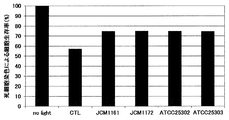
ラクトバチラス・パラカゼイに属する4株(JCM1161, JCM1172, ATCC25302, ATCC25303)で刺激したヒトmDCの培養上清がブルーライト照射によるヒト網膜色素上皮細胞の細胞死を抑制出来るか検証した。
代謝活性による評価方法(ブルーライト照射時間30分、Cell counting kit-8(上記に同じ)、及び死細胞染色による評価方法(ブルーライト照射時間50分、Cellstain- Hoechst 33342 solution、Cellstain- PI solution:上記に同じ)により細胞生存度(細胞生存率)を測定した。
細胞生存度を評価した測定結果を図3A(代謝活性による細胞生存率)及び図3B(死細胞染色による細胞生存率評価方法)に示す。ラクトバチラス・パラカゼイに属する4株の培養上清においても細胞死抑制効果が確認された。
実施例2、3及び4より、ラクトバチラス・パラカゼイに属する5株で刺激したヒト免疫細胞(mDC、もしくはマクロファージ細胞)の培養上清にはブルーライト照射による網膜色素上皮細胞の細胞死を抑制する効果があることが明らかになった。このことから、ラクトバチラス・パラカゼイに属する株はいずれも当該効果を有する可能性が示された。
本発明で規定される乳酸菌は健常人はもとより、特にパソコンやスマートフォンなどのモニター作業を長時間行う人での摂取が想定されるため、ブルーライト照射動物モデルでのKW3110株の摂取効果を検討した。
BALB/cマウス(5週齢・雄、日本チャールスリバー株式会社から購入)を、1群6匹で、ブルーライト非照射の標準食群(AIN93G:オリエンタル酵母工業社製)(no light CTL)、ブルーライト非照射のKW3110株混餌(標準食飼料1 kg中に乾燥重量として250 mgのKW3110株(実施例1で調製したもの)を含む)摂取群(no light KW)、ブルーライト照射の標準食群(AIN93G:オリエンタル酵母工業社製)(light CTL)、ブルーライト照射のKW3110株混餌摂取群(light KW)の4群に分け、所定の飼料を自由摂食させた。各群の処置は表1に示すとおりである。表1中の矢印はその日に処置を行ったことを示す。
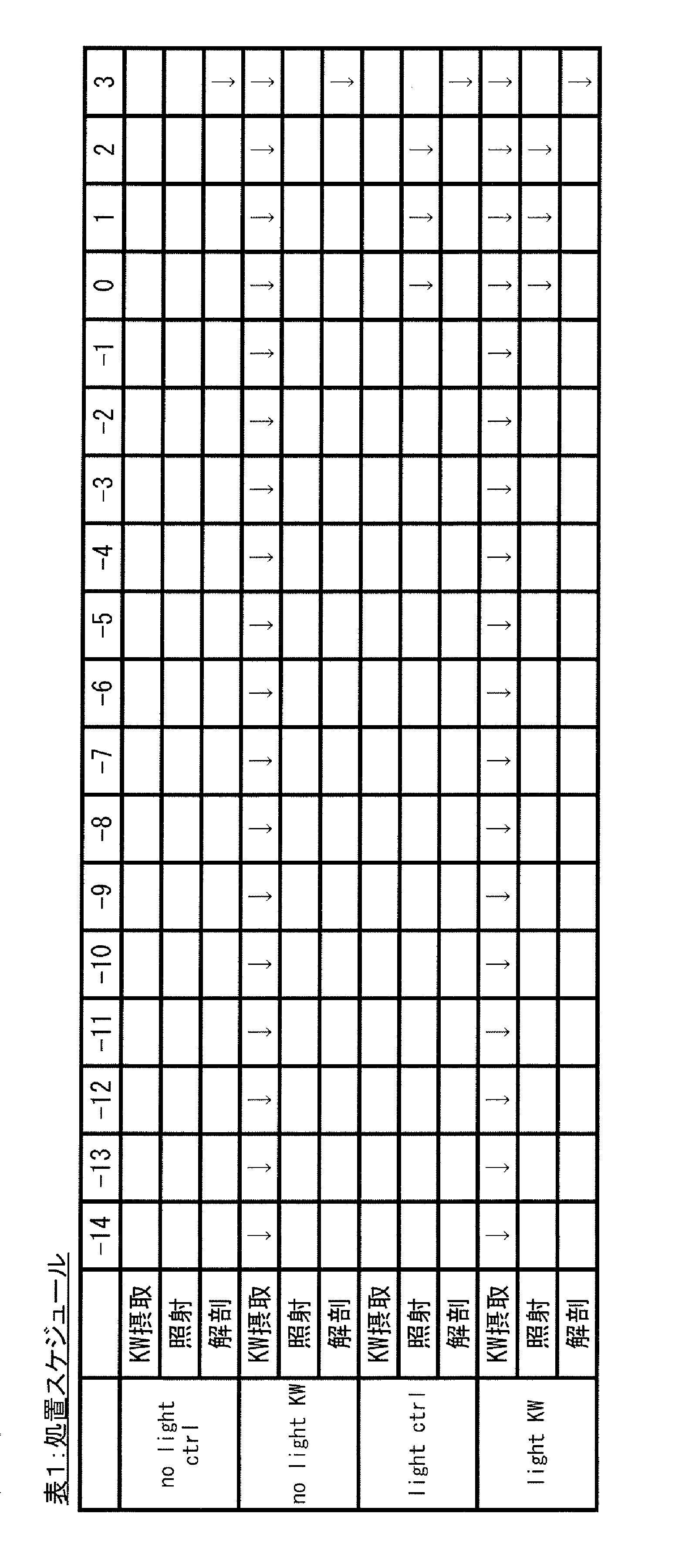
図4にブルーライト照射モデルを用いて測定した網膜外顆粒層の厚さ(網膜厚)を示す。ブルーライト非照射条件においては、標準食群(no light CTL)とKW3110株摂取群(no light KW)間で網膜厚に差は認められなかった。ブルーライト照射の標準食群(light CTL)においては、ブルーライト非照射の標準食群(no light CTL)と比較して有意な網膜厚の減少が認められた。ブルーライト照射によって網膜の細胞死が引き起こされた結果と考えられた。一方興味深いことに、ブルーライト照射のKW3110株摂取群(light KW)においては、ブルーライト照射の標準食群(light CTL)と比較して有意に網膜厚が厚く維持された。この結果から、KW3110株は摂取することにより、パソコンやスマートフォンから発せられるブルーライトによる網膜細胞死に対して拮抗的に働き、過度のパソコンなどVDT(Visual Display Terminal)作業に伴って起こる網膜損傷予防に大きく寄与することが示唆された。
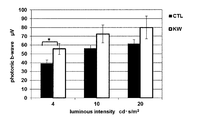
本発明で規定される乳酸菌は通常可視光下での視機能保護効果も期待できるため検討した。
BALB/cマウス(5週齢・雄、日本チャールスリバー株式会社から購入)を、1群4匹で、標準食群(AIN93G:オリエンタル酵母工業社製)(CTL)、KW3110株混餌(標準食飼料1 kg中に乾燥重量として250 mgのKW3110株(実施例1で調製したもの)を含む)摂取群(KW)の2群に分け、可視光を含む通常光の下で、所定の飼料を自由摂食させた。
図5にphotonic b-waveの測定結果を示す。興味深いことに、標準食群(CTL)と比較して、KW3110株摂取群(KW)においては、photonic b-waveの測定値が有意に高値であった。この結果から、KW3110株は摂取することにより、日常の光刺激による視機能低下の予防に寄与することが示唆された。
<試験方法>
本試験は社外倫理委員会で検討承認のうえ、第三者機関において実施した。試験は、プラセボを対照とした無作為化二重盲検並行群間比較試験とした。具体的には、VDT作業を1日6時間以上、かつ1年以上実施しており、眼精疲労を自覚している35歳以上45歳未満の健康で慢性疾患のない男女に被験食品(KW3110含有カプセル)又は対照食品(KW3110非含有カプセル)を摂取させ、KW3110の視機能改善効果及び眼精疲労改善についての効果を確認した。
事前検査において医師から健常と判断された者を、両群の男女の人数が同じになるように被験食品群(A群)と対照食品群(P群)に無作為に割付けた。
被験者には試験期間前と同様の生活を継続させた。すなわち、基本的には1日6時間以上のVDT作業を継続的に実施させた。
摂取期間中、被験者には割付けられた試験食品(カプセル)を1日1回水又はぬるま湯とともに毎日摂取させた。試験食品の摂取期間は8週間とした。
試験食品は以下のとおりである。
(A) 被験食品:KW3110含有カプセル(カプセル1個にKW3110加熱死菌体50 mg、約5×10¹⁰個を含む)。なお、KW3110加熱死菌体は常法に従い製造した。
(B) 対照食品:KW3110非含有カプセル(KW3110加熱死菌体50 mgに代えてコーンスターチ50mgを含む)
(A) 測定項目
(i) 眼精疲労度(フリッカーテスト)
(ii) 眼精疲労アンケート
(iii) 目の症状と日常生活についての質問票
(B) 測定時期
(i)(ii)は、試験食品摂取開始前、摂取開始後4週時、8週時の来院時にVDT負荷試験を行い、その前後に各1回(合計2回)測定した(表2)。また、(iii)は、試験食品摂取開始前、摂取開始後4週時、8週時のVDT負荷試験前に各1回測定した。

(i)フリッカーテスト
ハンディフリッカーHFII(登録商標、株式会社ナイツ)を用い両眼・上昇法で3回ずつ測定しその平均値を測定値とした。
眼精疲労アンケートはVAS法により測定した。すなわち、被験者の眼等の状態についての質問に対しの回答時点での状態の程度を、左端を「全く感じない」、右端を「今まで経験したか、又は想像しうる最悪の状態」とした100 mmスケール直線のどのあたりに当たるか、被験者自身にマークさせた。マーク位置について100mmスケール直線左端からの距離を測定し、測定値とした(VAS法)。質問は以下のとおりである。
「眼がかすむ」、「肩・腰がこる」、「眼が疲れる」「頭が重い」
各質問に対し回答時までの過去1週間の目の症状、日常生活への影響に関する16問の質問への回答点数を被験者自身に選択・記入させ、スコアから目の症状スコア(問1~6)、日常生活への影響スコア(問7~15)、総合的なQOLスコア(問1~15)を算出し、また、サマリースコアとして問16を求めた。質問は以下のとおりである。
「1)目がゴロゴロする(異物感)」、「2)目が乾く」、「3)目が痛い」、「4)目が疲れる」、「5)まぶたが重たい」、「6)目が赤くなる」、「7)目を開けているのがつらい」、「8)目を使っていると物がかすんで見える」、「9)光をまぶしく感じる」、「10)新聞、雑誌、本などを読んでいる時、目の症状が悪くなる」、「11)テレビを見ている時、パソコン・ケータイを使っている時に目の症状が悪くなる」、「12)目の症状のため集中力が低下する」、「13)目の症状のため仕事・家事・勉強に差し障りがある」、「14)目の症状のため外出を控えがち」、「15)目の症状のため気分が晴れない」「16)目の症状やそれに伴う日常生活の困りごとを含めた全般的な状態」
解析対象者全員を対象とした解析(全体解析)と、眼の疲労度の比較的大きい者のみを対象とした解析(層別解析)を行った。
(i)フリッカーテスト、眼精疲労アンケート
各測定時点におけるVDT作業負荷前の測定値、VDT作業負荷後の測定値及びVDT作業負荷前後の測定値の差(作業負荷後の測定値から作業負荷後の測定値を減じた値)をそれぞれ「VDT作業負荷前の実測値」、「VDT作業負荷後の実測値」及び「VDT作業負荷前後の差の実測値」として得、摂取開始後各時点の実測値から、対応する摂取開始前の実測値を減じた値をそれぞれ摂取開始後各時点における「VDT作業負荷前の変化量」、「VDT作業負荷後の変化量」及び「VDT作業負荷前後の差の変化量」とした。両群の実測値及び変化量についてはHolmの方法で時点の多重性を考慮したうえで2標本t検定を用いて評価した。また、各群について、摂取開始後各時点の「VDT作業負荷前の実測値」、「VDT作業負荷後の実測値」及び「VDT作業負荷前後の差の実測値」を摂取開始前の値に対する1標本t検定を用いて評価した。
目の症状と日常生活についての質問票(DEQS)から得たスコアについて、摂取開始後各測定時点におけるVDT作業負荷前測定値である「実測値」を求め、その値から摂取開始前のVDT作業負荷前測定値である「実測値」を減じた「変化量」を求めた。「実測値」と「変化量」はそれぞれHolmの方法で測定時点の多重性を考慮したうえでMann-WhitneyのU検定を用いて両群を比較した。また、各群について、摂取開始後各時点の実測値を1標本Wilcoxon検定を用いて評価した。
(i)眼精疲労アンケート「眼が疲れる」のVDT作業前実測値が被験者平均以上であった者(試験食品摂取開始前のVDT作業負荷前の実測値が被験者平均30.5 mm以上であった者25名)の層別解析
フリッカー値は眼の疲労や視機能の評価に用いられ数値の低下が疲労や視機能低下を反映するとされ、VDT作業により低下することが知られている(岩崎常人,眼科(2009)51(4),387-395)。VDT作業負荷による即時疲労軽減効果(疲労防止効果)として、フリッカー値についてVDT作業負荷前後の差の実測値及び試験食品摂取開始前からの変化量を検討した。
肩や腰のこりはVDT作業による眼精疲労の主な症状として知られていることから(産業医学 (1986) 28, 87-95)、試験期間中の肩・腰症状の軽減効果(VDT作業による影響の軽減又は防止効果)を見るために、眼精疲労アンケート「肩・腰がこる」についてVDT作業負荷前の実測値及び試験食品摂取開始前からの変化量を検討した。
VDT作業後の眼の疲れを比較的強く自覚している被験者として眼精疲労アンケート「眼が疲れる」において試験食品摂取開始前におけるVDT作業負荷後の実測値が解析対象者59名の平均以上であった者32名を抽出して層別解析を行った。
被験者の中で比較的眼の疲れを強く自覚している被験者として眼精疲労アンケート「肩・腰がこる」において試験食品摂取開始前におけるVDT作業負荷前の実測値が解析対象者59名の平均以上であった者29名を抽出して層別解析を行った。
(1)被験者
A群、P群とも31名が割付けられ、そのうち解析対象者はA群が28名、P群が31名であり、解析対象者の年齢はそれぞれ40.3±2.7歳、40.6±2.8歳(平均値±標準偏差)であった。被験者内訳を表3に示す。

(A) 全体解析
(i)フリッカーテスト
結果を表4に示す。A群とP群でフリッカー値に有意差は認められなかった。しかし、A群において試験食品摂取開始前におけるVDT作業負荷前後の差の実測値(VDT作業負荷後の測定値から作業負荷前の測定値を減じた値)よりも、試験食品摂取開始後のそれの方が大きく、試験食品摂取開始4週後時点においてその差は有意であった(p=0.013vs試験食品摂取開始前)。このことから被験食品の摂取によりVDT作業による眼の疲労が軽減される可能性が示された。

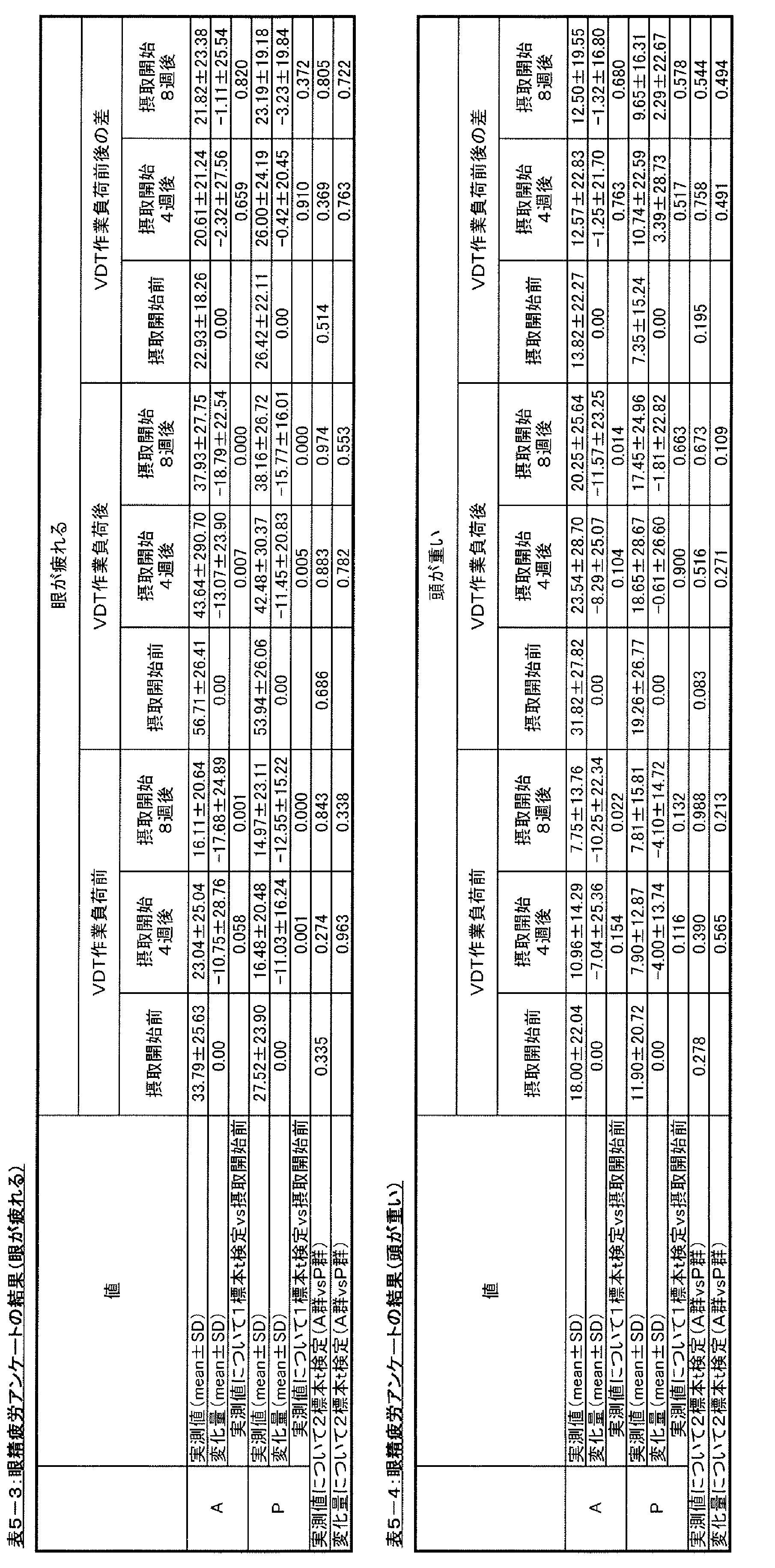
眼精疲労アンケートの結果を表5に示す。A群とP群で有意差は認められなかった。しかし、「眼がかすむ」について、両群においてVDT作業負荷前、後、前後の差の実測値は、試験食品摂取開始前の実測値に比して低下する傾向が認められ、その傾向はA群の方が大きく、VDT作業負荷前においてA群の低下傾向は有意なものであった(試験開始8週後、p=0.044vs試験食品摂取開始前)。
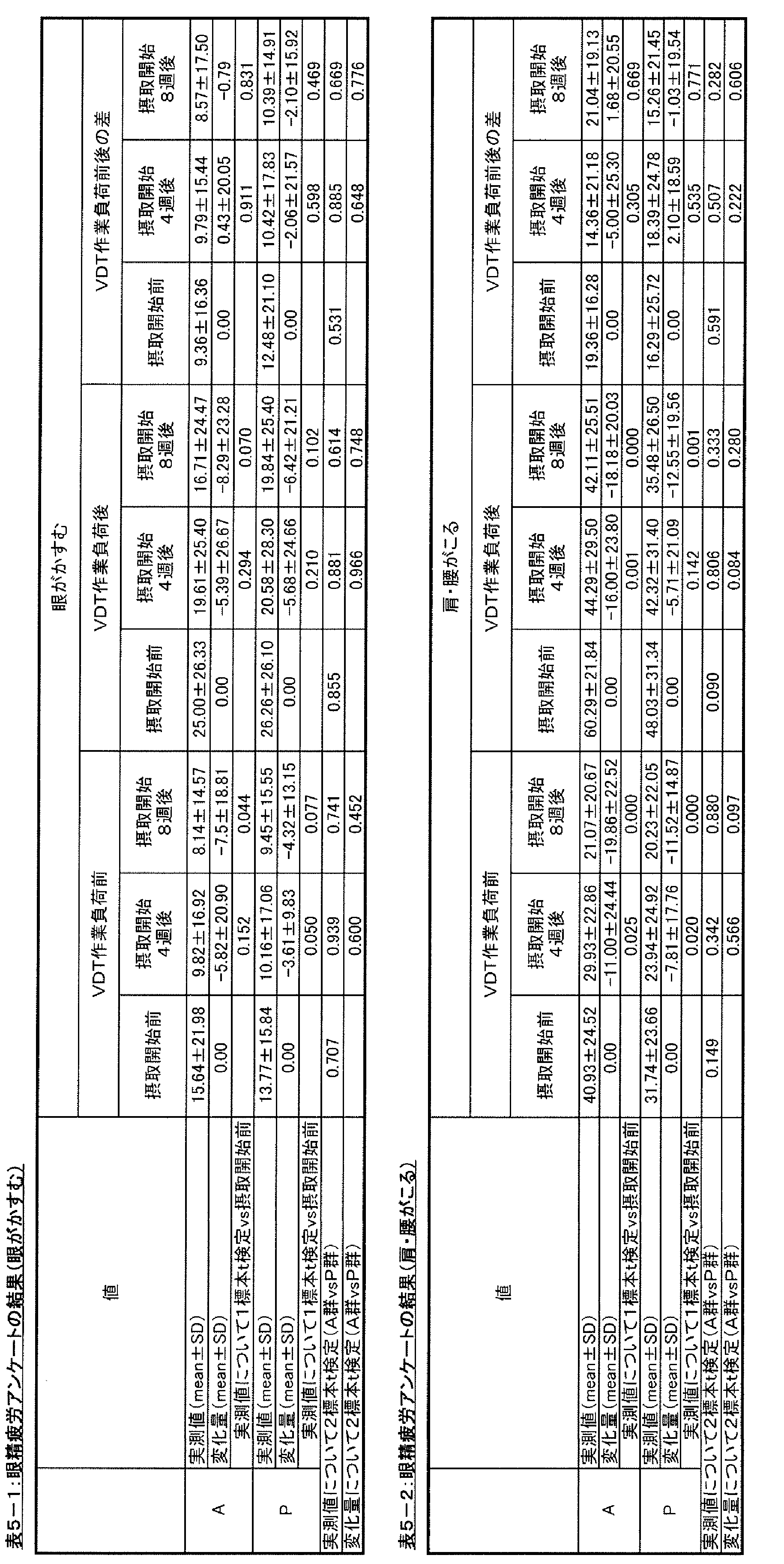
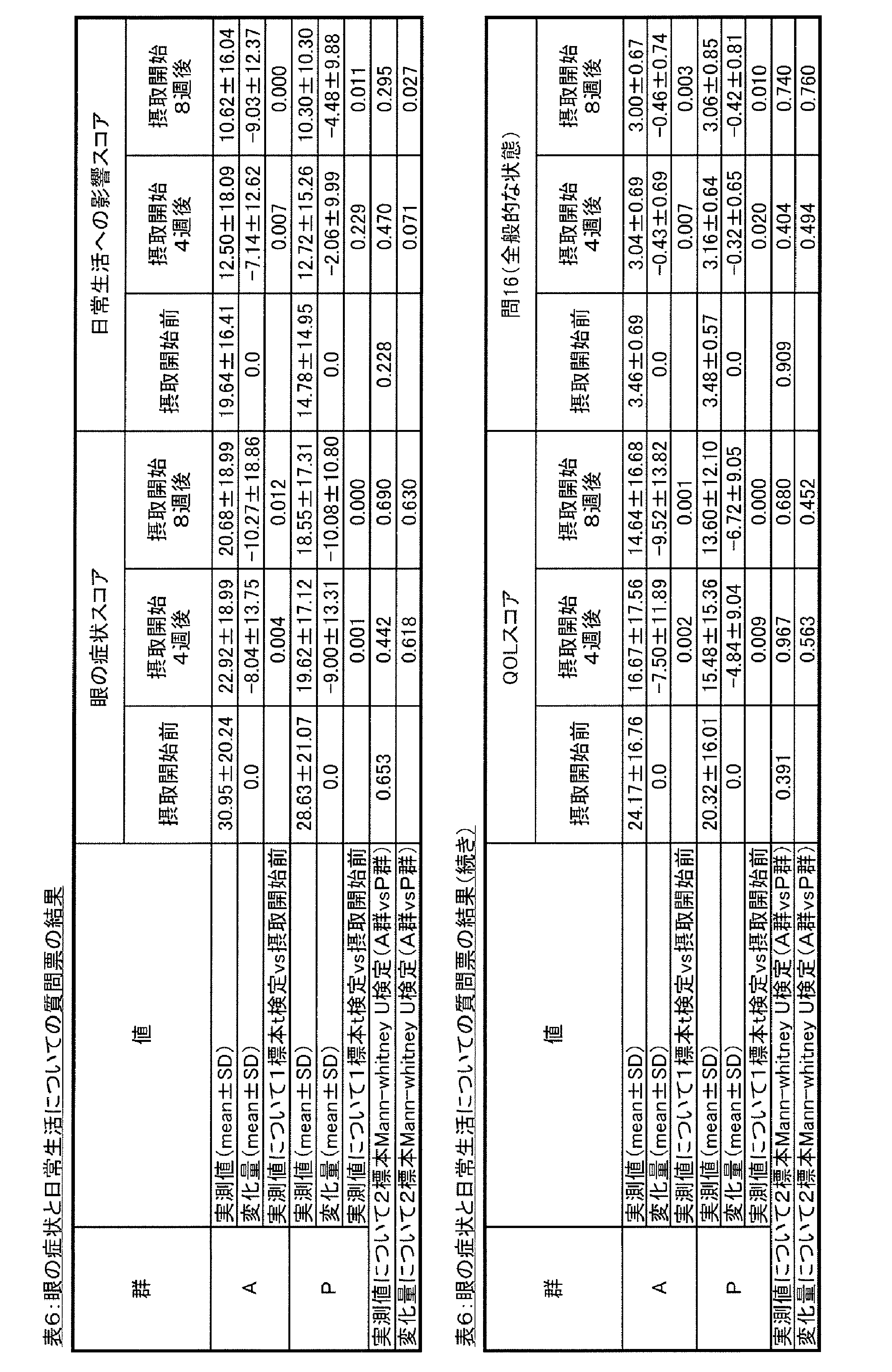
目の症状と日常生活についての質問票の結果を表6に示す。実測値は、両群において試験食品摂取開始前の実測値に比して低下する傾向が認められ、その傾向はA群の方が大きかった。日常生活への影響スコアは、試験食品摂取開始後8週時の変化量(8週後時点の実測値から試験食品摂取開始前の実測値を減じたもの)について両群で差が見られた(p=0.027;但し、多重性検定により有意な差とは評価されず)。したがって、被験食品の摂取は、VDT作業負荷による日常生活への影響を緩和する可能性が示された。
(i)眼精疲労アンケート「眼が疲れる」のVDT作業前実測値が被験者平均以上であった者(試験食品摂取開始前のVDT作業負荷前の実測値が被験者平均30.5 mm以上であった者25名。A群13名、P群12名)の層別解析
VDT作業負荷による即時疲労軽減効果(疲労防止効果)の結果と試験期間中の肩・腰症状の結果を表7に示す。試験食品の摂取期間中、A群において、フリッカー値の作業負荷前後の差の実測値(VDT作業負荷後の測定値から作業負荷前の測定値を減じた値)は、摂取開始前のそれよりも大きく、同時点のP群のそれよりも大きかった。そして、変化量について摂取開始4週後時点での両群の差は有意であった。このことから、被験食品の摂取期間においてはVDT作業負荷による即時的な眼の疲労が軽減される(防止される)可能性が示された。

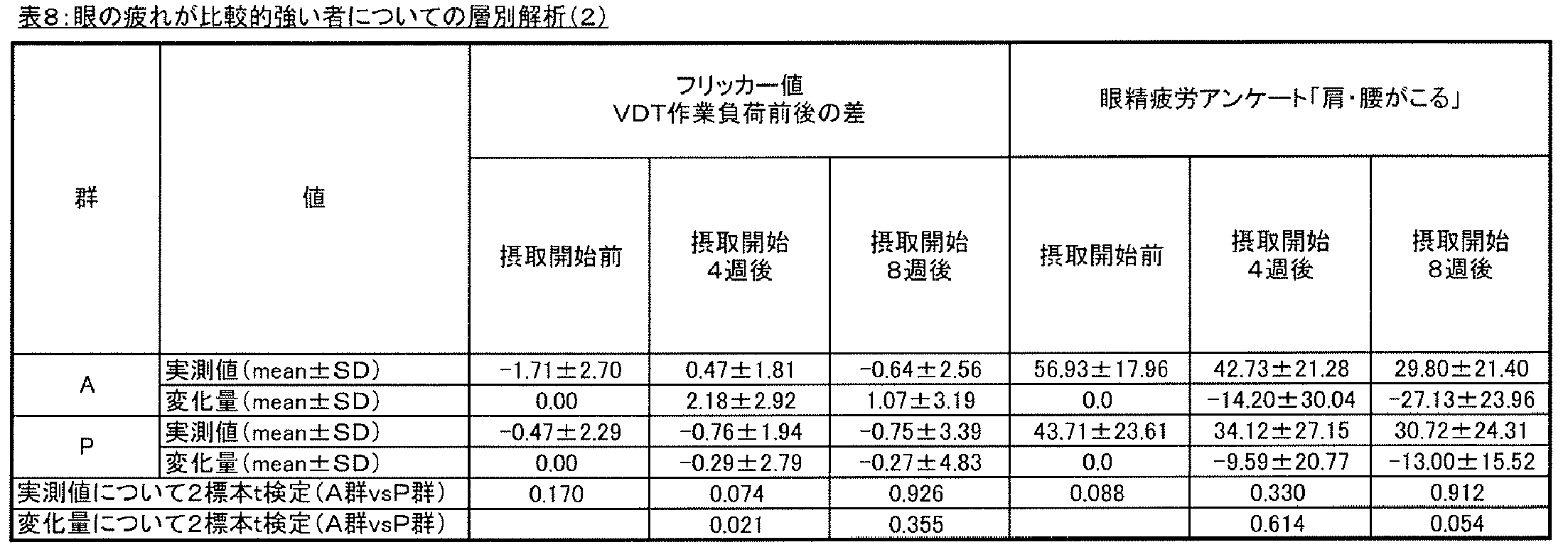
VDT作業負荷による即時疲労軽減効果(疲労防止効果)の結果と試験期間中の肩・腰症状の結果を表8に示す。試験食品の摂取期間中、A群において、フリッカー値の作業負荷前後の差の実測値(VDT作業負荷後の測定値から作業負荷前の測定値を減じた値)は、摂取開始前のそれよりも大きく、同時点のP群のそれよりも大きかった。そして、変化量について摂取開始4週後時点での両群の差は有意であった。このことから、被験食品の摂取期間においてはVDT作業負荷による即時的な眼の疲労が軽減される(防止される)可能性が示された。
試験期間中のフリッカー値の結果を表9に示す。試験食品の摂取期間中、A群において、フリッカー値の作業負荷前後の差の実測値(VDT作業負荷後の測定値から作業負荷前の測定値を減じた値)は、摂取開始前のそれよりも大きく、同時点のP群のそれよりも大きかった。そして、変化量について摂取開始4週後時点での両群の差は有意であった。このことから、被験食品の摂取期間においてはVDT作業負荷による即時的な眼の疲労が軽減される(防止される)可能性が示された。
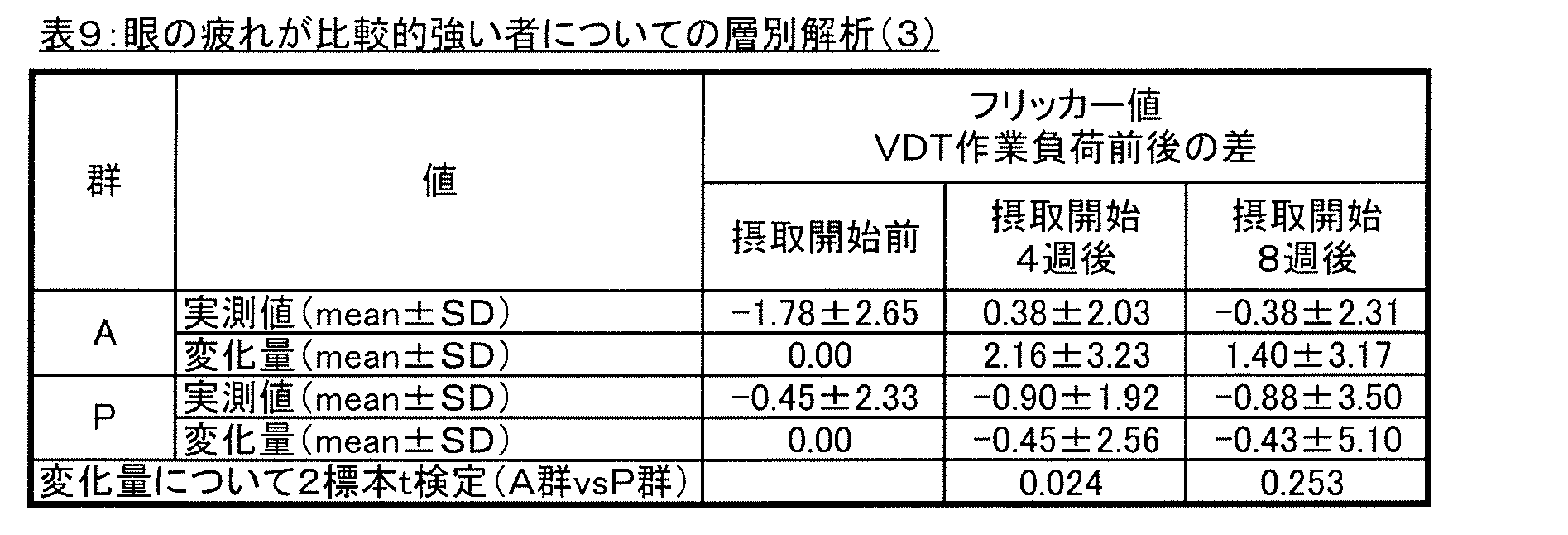
被験食品を摂取することにより、被験者の中で比較的眼の疲れを強く自覚している者(特に、VDT作業に伴う眼の疲れを比較的強く自覚している者)で、負荷前後のフリッカー値の低下抑制、負荷前の肩・腰のこりの自覚症状が改善したことから、被験食品摂取は眼精疲労に対する効果を有することが示された。
Claims (20)
- 乳酸菌を有効成分として含んでなる、眼疲労の抑制又は改善に用いるための組成物。
- 前記眼疲労が、眼精疲労である、請求項1に記載の組成物。
- 前記眼疲労が、光刺激により誘発されるものである、請求項1又は2に記載の組成物。
- 乳酸菌を有効成分として含んでなる、光障害による網膜炎症に起因する状態の抑制又は改善に用いるための組成物。
- 前記光障害による網膜炎症に起因する状態が、網膜厚の減少である、請求項4に記載の組成物。
- 前記光障害による網膜炎症に起因する状態が、眼の不快な状態である、請求項4に記載の組成物。
- 前記眼の不快な状態が、客観的若しくは自覚的に目が疲れた状態、又は目が乾くという状態である、請求項6に記載の組成物。
- 前記光障害による網膜炎症に起因する状態が、肩又は腰のこり、或いは頭重感である、請求項6に記載の組成物。
- 乳酸菌を有効成分として含んでなる、網膜色素上皮細胞の細胞死若しくは網膜厚の減少の抑制又は可視光における視機能の保護に用いるための組成物。
- 前記網膜色素上皮細胞の細胞死又は網膜厚の減少が光刺激により誘発されるものである、請求項9に記載の組成物。
- 前記光刺激及び光障害の光が、波長380nm~530nmの光である、請求項3~8及び10のいずれか一項に記載の組成物。
- 前記乳酸菌が、ラクトバチラス属に属するものである、請求項1~11のいずれか一項に記載の組成物。
- 前記乳酸菌が、ラクトバチラス・パラカゼイである、請求項1~12のいずれか一項に記載の組成物。
- 前記乳酸菌が、ラクトバチラス・パラカゼイKW3110株である、請求項1~13のいずれか一項に記載の組成物。
- 食品の形態である、請求項1~14のいずれか一項に記載の組成物。
- サプリメントの形態である、請求項1~15のいずれか一項に記載の組成物。
- 有効量の乳酸菌を、ヒトを含む哺乳動物に摂取させるか、或いは投与することを含んでなる、眼疲労の抑制又は改善方法、光障害による網膜炎症に起因する状態の抑制又は改善方法、網膜色素上皮細胞の細胞死又は網膜厚の減少の抑制方法、及び可視光における視機能の保護方法。
- 眼疲労の抑制又は改善剤の製造のための、光障害による網膜炎症に起因する状態の抑制又は改善剤の製造のための、或いは、網膜色素上皮細胞の細胞死又は網膜厚の減少の抑制剤或いは可視光における視機能の保護剤の製造のための、乳酸菌の使用。
- 眼疲労の抑制又は改善剤としての、光障害による網膜炎症に起因する状態の抑制又は改善剤としての、或いは、網膜色素上皮細胞の細胞死又は網膜厚の減少の抑制剤或いは可視光における視機能の保護剤としての、乳酸菌の使用。
- 眼疲労の抑制又は改善に用いるための、光障害による網膜炎症に起因する状態の抑制又は改善に用いるための、網膜色素上皮細胞の細胞死又は網膜厚の減少の抑制に用いるための、或いは、可視光における視機能の保護に用いるための乳酸菌。
Priority Applications (6)
| Application Number | Priority Date | Filing Date | Title |
|---|---|---|---|
| MYPI2019001272A MY198195A (en) | 2016-09-09 | 2017-09-08 | Composition For Suppressing Or Improving Eye Fatigue |
| EP17848868.0A EP3511011B1 (en) | 2016-09-09 | 2017-09-08 | Composition for preventing or improving eye fatigue |
| US16/331,849 US11389494B2 (en) | 2016-09-09 | 2017-09-08 | Composition for suppressing or improving eye fatigue |
| CA3036197A CA3036197C (en) | 2016-09-09 | 2017-09-08 | Composition comprising lactobacillus paracasei for suppressing or improving eye fatigue |
| US17/838,698 US11890309B2 (en) | 2016-09-09 | 2022-06-13 | Composition for suppressing or improving eye fatigue |
| US18/392,708 US12453748B2 (en) | 2016-09-09 | 2023-12-21 | Composition for suppressing or improving eye fatigue |
Applications Claiming Priority (2)
| Application Number | Priority Date | Filing Date | Title |
|---|---|---|---|
| JP2016177039 | 2016-09-09 | ||
| JP2016-177039 | 2016-09-09 |
Related Child Applications (2)
| Application Number | Title | Priority Date | Filing Date |
|---|---|---|---|
| US16/331,849 A-371-Of-International US11389494B2 (en) | 2016-09-09 | 2017-09-08 | Composition for suppressing or improving eye fatigue |
| US17/838,698 Division US11890309B2 (en) | 2016-09-09 | 2022-06-13 | Composition for suppressing or improving eye fatigue |
Publications (1)
| Publication Number | Publication Date |
|---|---|
| WO2018047930A1 true WO2018047930A1 (ja) | 2018-03-15 |
Family
ID=61562181
Family Applications (1)
| Application Number | Title | Priority Date | Filing Date |
|---|---|---|---|
| PCT/JP2017/032398 Ceased WO2018047930A1 (ja) | 2016-09-09 | 2017-09-08 | 眼疲労の抑制又は改善用組成物 |
Country Status (7)
| Country | Link |
|---|---|
| US (3) | US11389494B2 (ja) |
| EP (1) | EP3511011B1 (ja) |
| JP (2) | JP6640803B2 (ja) |
| CA (1) | CA3036197C (ja) |
| MY (1) | MY198195A (ja) |
| SG (1) | SG10202102365XA (ja) |
| WO (1) | WO2018047930A1 (ja) |
Families Citing this family (5)
| Publication number | Priority date | Publication date | Assignee | Title |
|---|---|---|---|---|
| JP7049397B2 (ja) * | 2020-06-10 | 2022-04-06 | キリンホールディングス株式会社 | 抑うつの抑制または改善用組成物 |
| EP4119151A4 (en) * | 2021-06-03 | 2023-10-25 | MD Healthcare Inc. | Composition for preventing or treating eye diseases comprising extracellular vesicles derived from lactobacillus paracasei |
| AU2023258808A1 (en) * | 2022-04-26 | 2024-11-07 | Tsubota Laboratory, Inc. | Method and composition for preventing or treating myopia |
| CN118303620B (zh) * | 2024-04-03 | 2025-11-04 | 君乐宝乳业集团股份有限公司 | 一种改善视疲劳的组合物及应用 |
| CN119174785B (zh) * | 2024-11-20 | 2025-02-25 | 天津创源生物技术有限公司 | 提升视网膜细胞在蓝光下的保护机制的植物乳植杆菌iob602及其应用 |
Citations (5)
| Publication number | Priority date | Publication date | Assignee | Title |
|---|---|---|---|---|
| WO2004096246A1 (ja) * | 2003-03-13 | 2004-11-11 | Kirin Beer Kabushiki Kaisha | 抗アレルギー用組成物 |
| JP2013501706A (ja) | 2008-06-13 | 2013-01-17 | ユニバーシティ・オブ・ユタ | 網膜色素上皮におけるa2eの形成を軽減するための組成物および方法 |
| WO2014132982A1 (ja) * | 2013-02-27 | 2014-09-04 | 株式会社明治 | ストレス軽減剤 |
| JP2016073314A (ja) * | 2010-12-28 | 2016-05-12 | キリンホールディングス株式会社 | 乳酸菌を含むインターフェロン産生誘導剤 |
| WO2017010520A1 (ja) * | 2015-07-13 | 2017-01-19 | 国立大学法人東北大学 | 視神経保護用組成物 |
Family Cites Families (1)
| Publication number | Priority date | Publication date | Assignee | Title |
|---|---|---|---|---|
| IT201600081929A1 (it) | 2016-08-03 | 2018-02-03 | St Europeo Di Oncologia S R L | Uso del surnatante di lactobacillus paracasei nel trattamento della congiuntivite, in particolare della vernal cheratocongiuntivite |
-
2017
- 2017-09-08 US US16/331,849 patent/US11389494B2/en active Active
- 2017-09-08 MY MYPI2019001272A patent/MY198195A/en unknown
- 2017-09-08 JP JP2017172620A patent/JP6640803B2/ja active Active
- 2017-09-08 SG SG10202102365XA patent/SG10202102365XA/en unknown
- 2017-09-08 WO PCT/JP2017/032398 patent/WO2018047930A1/ja not_active Ceased
- 2017-09-08 EP EP17848868.0A patent/EP3511011B1/en active Active
- 2017-09-08 CA CA3036197A patent/CA3036197C/en active Active
-
2019
- 2019-12-26 JP JP2019236692A patent/JP6975769B2/ja active Active
-
2022
- 2022-06-13 US US17/838,698 patent/US11890309B2/en active Active
-
2023
- 2023-12-21 US US18/392,708 patent/US12453748B2/en active Active
Patent Citations (6)
| Publication number | Priority date | Publication date | Assignee | Title |
|---|---|---|---|---|
| WO2004096246A1 (ja) * | 2003-03-13 | 2004-11-11 | Kirin Beer Kabushiki Kaisha | 抗アレルギー用組成物 |
| JP2005137357A (ja) | 2003-03-13 | 2005-06-02 | Kirin Brewery Co Ltd | 抗アレルギー用組成物 |
| JP2013501706A (ja) | 2008-06-13 | 2013-01-17 | ユニバーシティ・オブ・ユタ | 網膜色素上皮におけるa2eの形成を軽減するための組成物および方法 |
| JP2016073314A (ja) * | 2010-12-28 | 2016-05-12 | キリンホールディングス株式会社 | 乳酸菌を含むインターフェロン産生誘導剤 |
| WO2014132982A1 (ja) * | 2013-02-27 | 2014-09-04 | 株式会社明治 | ストレス軽減剤 |
| WO2017010520A1 (ja) * | 2015-07-13 | 2017-01-19 | 国立大学法人東北大学 | 視神経保護用組成物 |
Non-Patent Citations (11)
| Title |
|---|
| "Me no Tsukare -Me ga Tsukarete Imasenka?-, Suzuran Shoku Tsushin", HORON- SUZURAN.CO, 28 September 2017 (2017-09-28), XP055586648, Retrieved from the Internet <URL:http://horon-suzuran.co.jp/wp-content/themes/horon-suzuran/old/docs/N0.189.pdf> * |
| "Science and Technology of Lactic Acid Bacteria" |
| JPN. J. IND. HEALTH, vol. 28, 1986, pages 87 - 95 |
| KAZUO TSUBOTA, OPHTHALMOLOGY, vol. 55, no. 7, 2013, pages 761 - 762 |
| KAZUO TSUBOTA, OPHTHALMOLOGY, vol. 55, no. 7, 2013, pages 763 - 767 |
| KOBE KANAGAWA : "Naoranai Me no Tsukare·· 'Gansei Hiro' towa, Gansei Hiro no Shojo to Gen'in [Eye fatigue that doesn't heal ... with "eye strain"]", 1 July 2014 (2014-07-01), XP009518747, Retrieved from the Internet <URL:https://web.archive.org/web/20150506064315/https://www.skincare-univ.com/article/004789/> [retrieved on 20170928] * |
| MIHOKO SUZUKI, OPHTHALMOLOGY, vol. 55, no. 7, 2013, pages 769 - 772 |
| See also references of EP3511011A4 |
| TSUNETO IWASAKI, GANKA, vol. 51, no. 4, 2009, pages 387 - 395 |
| Y. SAKANE ET AL., JAMA, OPHTHALMOL., vol. 131, no. 10, 2013, pages 1331 - 1338 |
| YAN, F., CURR. OPIN. GASTROENTEROL, vol. 27, 2011, pages 496 - 501 |
Also Published As
| Publication number | Publication date |
|---|---|
| EP3511011C0 (en) | 2025-04-02 |
| EP3511011A4 (en) | 2020-03-04 |
| CA3036197C (en) | 2023-02-28 |
| JP2020063297A (ja) | 2020-04-23 |
| US11389494B2 (en) | 2022-07-19 |
| JP6975769B2 (ja) | 2021-12-01 |
| US11890309B2 (en) | 2024-02-06 |
| US12453748B2 (en) | 2025-10-28 |
| EP3511011A1 (en) | 2019-07-17 |
| JP6640803B2 (ja) | 2020-02-05 |
| US20240180979A1 (en) | 2024-06-06 |
| EP3511011B1 (en) | 2025-04-02 |
| US20220323516A1 (en) | 2022-10-13 |
| US20190374587A1 (en) | 2019-12-12 |
| MY198195A (en) | 2023-08-09 |
| JP2018043986A (ja) | 2018-03-22 |
| CA3036197A1 (en) | 2018-03-15 |
| SG10202102365XA (en) | 2021-04-29 |
Similar Documents
| Publication | Publication Date | Title |
|---|---|---|
| JP6975769B2 (ja) | 眼疲労の抑制又は改善用組成物 | |
| JP5419455B2 (ja) | 自己免疫疾患治療のための乳酸菌の使用 | |
| EP3501527B1 (en) | Composition for preventing or treating mental disorder, containinglactobacillus | |
| KR100908254B1 (ko) | 항알레르기용 조성물 | |
| JP7523493B2 (ja) | 情動的反応を制御するため、並びに潜在的な気分変調の治療及び予防のための、ビフィドバクテリウム・ロンガムを用いる、方法及び組成物 | |
| CN102597214B (zh) | 新型植物乳杆菌及含该植物乳杆菌的组合物 | |
| JP7594635B2 (ja) | 睡眠促進用組成物並びに該睡眠促進用組成物を用いた医薬品組成物及び飲食品組成物 | |
| JP5031249B2 (ja) | 炎症抑制作用のある菌体含有組成物 | |
| CN102791849A (zh) | 含乳酸菌制剂 | |
| AU2016315266A1 (en) | Methods and compositions using Bifidobacterium longum to treat or prevent depressive symptoms | |
| JP2009057346A (ja) | 免疫バランス調節用組成物 | |
| CN112654358A (zh) | 用于缓解肠易激综合征和用于缓解其它胃肠道疾病的乳酸杆菌组合 | |
| EP2612673B1 (en) | Intestine immunomodulator | |
| JP6815139B2 (ja) | 乳酸菌を有効成分とする加齢による網膜細胞死を抑制するための組成物 | |
| US11771723B2 (en) | Bifidobacterium longum NCIMB 41676 | |
| JP7057039B2 (ja) | 認知症の予防又は改善用剤及びそれを含む組成物 | |
| JP5172104B2 (ja) | ハンセン病発症予防作用のある菌体含有組成物 | |
| KR100854816B1 (ko) | 항알레르기용 조성물 | |
| Feleszko et al. | Prebiotics and probiotics for the prevention or treatment of allergic asthma |
Legal Events
| Date | Code | Title | Description |
|---|---|---|---|
| 121 | Ep: the epo has been informed by wipo that ep was designated in this application |
Ref document number: 17848868 Country of ref document: EP Kind code of ref document: A1 |
|
| ENP | Entry into the national phase |
Ref document number: 3036197 Country of ref document: CA |
|
| NENP | Non-entry into the national phase |
Ref country code: DE |
|
| ENP | Entry into the national phase |
Ref document number: 2017848868 Country of ref document: EP Effective date: 20190409 |
|
| WWG | Wipo information: grant in national office |
Ref document number: 2017848868 Country of ref document: EP |