WO2018056330A1 - ジルコニア組成物、仮焼体及び焼結体、並びにそれらの製造方法 - Google Patents
ジルコニア組成物、仮焼体及び焼結体、並びにそれらの製造方法 Download PDFInfo
- Publication number
- WO2018056330A1 WO2018056330A1 PCT/JP2017/033980 JP2017033980W WO2018056330A1 WO 2018056330 A1 WO2018056330 A1 WO 2018056330A1 JP 2017033980 W JP2017033980 W JP 2017033980W WO 2018056330 A1 WO2018056330 A1 WO 2018056330A1
- Authority
- WO
- WIPO (PCT)
- Prior art keywords
- zirconia
- composition
- calcined body
- yttria
- mol
- Prior art date
- Legal status (The legal status is an assumption and is not a legal conclusion. Google has not performed a legal analysis and makes no representation as to the accuracy of the status listed.)
- Ceased
Links
Images



Classifications
-
- C—CHEMISTRY; METALLURGY
- C04—CEMENTS; CONCRETE; ARTIFICIAL STONE; CERAMICS; REFRACTORIES
- C04B—LIME, MAGNESIA; SLAG; CEMENTS; COMPOSITIONS THEREOF, e.g. MORTARS, CONCRETE OR LIKE BUILDING MATERIALS; ARTIFICIAL STONE; CERAMICS; REFRACTORIES; TREATMENT OF NATURAL STONE
- C04B35/00—Shaped ceramic products characterised by their composition; Ceramics compositions; Processing powders of inorganic compounds preparatory to the manufacturing of ceramic products
- C04B35/01—Shaped ceramic products characterised by their composition; Ceramics compositions; Processing powders of inorganic compounds preparatory to the manufacturing of ceramic products based on oxide ceramics
- C04B35/48—Shaped ceramic products characterised by their composition; Ceramics compositions; Processing powders of inorganic compounds preparatory to the manufacturing of ceramic products based on oxide ceramics based on zirconium or hafnium oxides, zirconates, zircon or hafnates
-
- A—HUMAN NECESSITIES
- A61—MEDICAL OR VETERINARY SCIENCE; HYGIENE
- A61C—DENTISTRY; APPARATUS OR METHODS FOR ORAL OR DENTAL HYGIENE
- A61C13/00—Dental prostheses; Making same
- A61C13/08—Artificial teeth; Making same
- A61C13/083—Porcelain or ceramic teeth
-
- A—HUMAN NECESSITIES
- A61—MEDICAL OR VETERINARY SCIENCE; HYGIENE
- A61C—DENTISTRY; APPARATUS OR METHODS FOR ORAL OR DENTAL HYGIENE
- A61C5/00—Filling or capping teeth
- A61C5/70—Tooth crowns; Making thereof
- A61C5/73—Composite crowns
-
- C—CHEMISTRY; METALLURGY
- C01—INORGANIC CHEMISTRY
- C01G—COMPOUNDS CONTAINING METALS NOT COVERED BY SUBCLASSES C01D OR C01F
- C01G25/00—Compounds of zirconium
- C01G25/02—Oxides
-
- C—CHEMISTRY; METALLURGY
- C04—CEMENTS; CONCRETE; ARTIFICIAL STONE; CERAMICS; REFRACTORIES
- C04B—LIME, MAGNESIA; SLAG; CEMENTS; COMPOSITIONS THEREOF, e.g. MORTARS, CONCRETE OR LIKE BUILDING MATERIALS; ARTIFICIAL STONE; CERAMICS; REFRACTORIES; TREATMENT OF NATURAL STONE
- C04B35/00—Shaped ceramic products characterised by their composition; Ceramics compositions; Processing powders of inorganic compounds preparatory to the manufacturing of ceramic products
- C04B35/01—Shaped ceramic products characterised by their composition; Ceramics compositions; Processing powders of inorganic compounds preparatory to the manufacturing of ceramic products based on oxide ceramics
- C04B35/48—Shaped ceramic products characterised by their composition; Ceramics compositions; Processing powders of inorganic compounds preparatory to the manufacturing of ceramic products based on oxide ceramics based on zirconium or hafnium oxides, zirconates, zircon or hafnates
- C04B35/486—Fine ceramics
-
- C—CHEMISTRY; METALLURGY
- C04—CEMENTS; CONCRETE; ARTIFICIAL STONE; CERAMICS; REFRACTORIES
- C04B—LIME, MAGNESIA; SLAG; CEMENTS; COMPOSITIONS THEREOF, e.g. MORTARS, CONCRETE OR LIKE BUILDING MATERIALS; ARTIFICIAL STONE; CERAMICS; REFRACTORIES; TREATMENT OF NATURAL STONE
- C04B35/00—Shaped ceramic products characterised by their composition; Ceramics compositions; Processing powders of inorganic compounds preparatory to the manufacturing of ceramic products
- C04B35/01—Shaped ceramic products characterised by their composition; Ceramics compositions; Processing powders of inorganic compounds preparatory to the manufacturing of ceramic products based on oxide ceramics
- C04B35/48—Shaped ceramic products characterised by their composition; Ceramics compositions; Processing powders of inorganic compounds preparatory to the manufacturing of ceramic products based on oxide ceramics based on zirconium or hafnium oxides, zirconates, zircon or hafnates
- C04B35/486—Fine ceramics
- C04B35/488—Composites
-
- C—CHEMISTRY; METALLURGY
- C04—CEMENTS; CONCRETE; ARTIFICIAL STONE; CERAMICS; REFRACTORIES
- C04B—LIME, MAGNESIA; SLAG; CEMENTS; COMPOSITIONS THEREOF, e.g. MORTARS, CONCRETE OR LIKE BUILDING MATERIALS; ARTIFICIAL STONE; CERAMICS; REFRACTORIES; TREATMENT OF NATURAL STONE
- C04B35/00—Shaped ceramic products characterised by their composition; Ceramics compositions; Processing powders of inorganic compounds preparatory to the manufacturing of ceramic products
- C04B35/622—Forming processes; Processing powders of inorganic compounds preparatory to the manufacturing of ceramic products
-
- C—CHEMISTRY; METALLURGY
- C04—CEMENTS; CONCRETE; ARTIFICIAL STONE; CERAMICS; REFRACTORIES
- C04B—LIME, MAGNESIA; SLAG; CEMENTS; COMPOSITIONS THEREOF, e.g. MORTARS, CONCRETE OR LIKE BUILDING MATERIALS; ARTIFICIAL STONE; CERAMICS; REFRACTORIES; TREATMENT OF NATURAL STONE
- C04B35/00—Shaped ceramic products characterised by their composition; Ceramics compositions; Processing powders of inorganic compounds preparatory to the manufacturing of ceramic products
- C04B35/622—Forming processes; Processing powders of inorganic compounds preparatory to the manufacturing of ceramic products
- C04B35/626—Preparing or treating the powders individually or as batches ; preparing or treating macroscopic reinforcing agents for ceramic products, e.g. fibres; mechanical aspects section B
- C04B35/62605—Treating the starting powders individually or as mixtures
- C04B35/6261—Milling
-
- C—CHEMISTRY; METALLURGY
- C04—CEMENTS; CONCRETE; ARTIFICIAL STONE; CERAMICS; REFRACTORIES
- C04B—LIME, MAGNESIA; SLAG; CEMENTS; COMPOSITIONS THEREOF, e.g. MORTARS, CONCRETE OR LIKE BUILDING MATERIALS; ARTIFICIAL STONE; CERAMICS; REFRACTORIES; TREATMENT OF NATURAL STONE
- C04B35/00—Shaped ceramic products characterised by their composition; Ceramics compositions; Processing powders of inorganic compounds preparatory to the manufacturing of ceramic products
- C04B35/622—Forming processes; Processing powders of inorganic compounds preparatory to the manufacturing of ceramic products
- C04B35/626—Preparing or treating the powders individually or as batches ; preparing or treating macroscopic reinforcing agents for ceramic products, e.g. fibres; mechanical aspects section B
- C04B35/62605—Treating the starting powders individually or as mixtures
- C04B35/62645—Thermal treatment of powders or mixtures thereof other than sintering
- C04B35/62655—Drying, e.g. freeze-drying, spray-drying, microwave or supercritical drying
-
- C—CHEMISTRY; METALLURGY
- C04—CEMENTS; CONCRETE; ARTIFICIAL STONE; CERAMICS; REFRACTORIES
- C04B—LIME, MAGNESIA; SLAG; CEMENTS; COMPOSITIONS THEREOF, e.g. MORTARS, CONCRETE OR LIKE BUILDING MATERIALS; ARTIFICIAL STONE; CERAMICS; REFRACTORIES; TREATMENT OF NATURAL STONE
- C04B35/00—Shaped ceramic products characterised by their composition; Ceramics compositions; Processing powders of inorganic compounds preparatory to the manufacturing of ceramic products
- C04B35/622—Forming processes; Processing powders of inorganic compounds preparatory to the manufacturing of ceramic products
- C04B35/626—Preparing or treating the powders individually or as batches ; preparing or treating macroscopic reinforcing agents for ceramic products, e.g. fibres; mechanical aspects section B
- C04B35/62605—Treating the starting powders individually or as mixtures
- C04B35/62695—Granulation or pelletising
-
- C—CHEMISTRY; METALLURGY
- C04—CEMENTS; CONCRETE; ARTIFICIAL STONE; CERAMICS; REFRACTORIES
- C04B—LIME, MAGNESIA; SLAG; CEMENTS; COMPOSITIONS THEREOF, e.g. MORTARS, CONCRETE OR LIKE BUILDING MATERIALS; ARTIFICIAL STONE; CERAMICS; REFRACTORIES; TREATMENT OF NATURAL STONE
- C04B35/00—Shaped ceramic products characterised by their composition; Ceramics compositions; Processing powders of inorganic compounds preparatory to the manufacturing of ceramic products
- C04B35/622—Forming processes; Processing powders of inorganic compounds preparatory to the manufacturing of ceramic products
- C04B35/64—Burning or sintering processes
-
- C—CHEMISTRY; METALLURGY
- C04—CEMENTS; CONCRETE; ARTIFICIAL STONE; CERAMICS; REFRACTORIES
- C04B—LIME, MAGNESIA; SLAG; CEMENTS; COMPOSITIONS THEREOF, e.g. MORTARS, CONCRETE OR LIKE BUILDING MATERIALS; ARTIFICIAL STONE; CERAMICS; REFRACTORIES; TREATMENT OF NATURAL STONE
- C04B2235/00—Aspects relating to ceramic starting mixtures or sintered ceramic products
- C04B2235/02—Composition of constituents of the starting material or of secondary phases of the final product
- C04B2235/30—Constituents and secondary phases not being of a fibrous nature
- C04B2235/32—Metal oxides, mixed metal oxides, or oxide-forming salts thereof, e.g. carbonates, nitrates, (oxy)hydroxides, chlorides
- C04B2235/3224—Rare earth oxide or oxide forming salts thereof, e.g. scandium oxide
- C04B2235/3225—Yttrium oxide or oxide-forming salts thereof
-
- C—CHEMISTRY; METALLURGY
- C04—CEMENTS; CONCRETE; ARTIFICIAL STONE; CERAMICS; REFRACTORIES
- C04B—LIME, MAGNESIA; SLAG; CEMENTS; COMPOSITIONS THEREOF, e.g. MORTARS, CONCRETE OR LIKE BUILDING MATERIALS; ARTIFICIAL STONE; CERAMICS; REFRACTORIES; TREATMENT OF NATURAL STONE
- C04B2235/00—Aspects relating to ceramic starting mixtures or sintered ceramic products
- C04B2235/02—Composition of constituents of the starting material or of secondary phases of the final product
- C04B2235/30—Constituents and secondary phases not being of a fibrous nature
- C04B2235/32—Metal oxides, mixed metal oxides, or oxide-forming salts thereof, e.g. carbonates, nitrates, (oxy)hydroxides, chlorides
- C04B2235/3231—Refractory metal oxides, their mixed metal oxides, or oxide-forming salts thereof
- C04B2235/3244—Zirconium oxides, zirconates, hafnium oxides, hafnates, or oxide-forming salts thereof
- C04B2235/3246—Stabilised zirconias, e.g. YSZ or cerium stabilised zirconia
-
- C—CHEMISTRY; METALLURGY
- C04—CEMENTS; CONCRETE; ARTIFICIAL STONE; CERAMICS; REFRACTORIES
- C04B—LIME, MAGNESIA; SLAG; CEMENTS; COMPOSITIONS THEREOF, e.g. MORTARS, CONCRETE OR LIKE BUILDING MATERIALS; ARTIFICIAL STONE; CERAMICS; REFRACTORIES; TREATMENT OF NATURAL STONE
- C04B2235/00—Aspects relating to ceramic starting mixtures or sintered ceramic products
- C04B2235/02—Composition of constituents of the starting material or of secondary phases of the final product
- C04B2235/50—Constituents or additives of the starting mixture chosen for their shape or used because of their shape or their physical appearance
- C04B2235/54—Particle size related information
- C04B2235/5418—Particle size related information expressed by the size of the particles or aggregates thereof
- C04B2235/5436—Particle size related information expressed by the size of the particles or aggregates thereof micrometer sized, i.e. from 1 to 100 micron
-
- C—CHEMISTRY; METALLURGY
- C04—CEMENTS; CONCRETE; ARTIFICIAL STONE; CERAMICS; REFRACTORIES
- C04B—LIME, MAGNESIA; SLAG; CEMENTS; COMPOSITIONS THEREOF, e.g. MORTARS, CONCRETE OR LIKE BUILDING MATERIALS; ARTIFICIAL STONE; CERAMICS; REFRACTORIES; TREATMENT OF NATURAL STONE
- C04B2235/00—Aspects relating to ceramic starting mixtures or sintered ceramic products
- C04B2235/02—Composition of constituents of the starting material or of secondary phases of the final product
- C04B2235/50—Constituents or additives of the starting mixture chosen for their shape or used because of their shape or their physical appearance
- C04B2235/54—Particle size related information
- C04B2235/5418—Particle size related information expressed by the size of the particles or aggregates thereof
- C04B2235/5445—Particle size related information expressed by the size of the particles or aggregates thereof submicron sized, i.e. from 0,1 to 1 micron
-
- C—CHEMISTRY; METALLURGY
- C04—CEMENTS; CONCRETE; ARTIFICIAL STONE; CERAMICS; REFRACTORIES
- C04B—LIME, MAGNESIA; SLAG; CEMENTS; COMPOSITIONS THEREOF, e.g. MORTARS, CONCRETE OR LIKE BUILDING MATERIALS; ARTIFICIAL STONE; CERAMICS; REFRACTORIES; TREATMENT OF NATURAL STONE
- C04B2235/00—Aspects relating to ceramic starting mixtures or sintered ceramic products
- C04B2235/02—Composition of constituents of the starting material or of secondary phases of the final product
- C04B2235/50—Constituents or additives of the starting mixture chosen for their shape or used because of their shape or their physical appearance
- C04B2235/54—Particle size related information
- C04B2235/5418—Particle size related information expressed by the size of the particles or aggregates thereof
- C04B2235/5454—Particle size related information expressed by the size of the particles or aggregates thereof nanometer sized, i.e. below 100 nm
-
- C—CHEMISTRY; METALLURGY
- C04—CEMENTS; CONCRETE; ARTIFICIAL STONE; CERAMICS; REFRACTORIES
- C04B—LIME, MAGNESIA; SLAG; CEMENTS; COMPOSITIONS THEREOF, e.g. MORTARS, CONCRETE OR LIKE BUILDING MATERIALS; ARTIFICIAL STONE; CERAMICS; REFRACTORIES; TREATMENT OF NATURAL STONE
- C04B2235/00—Aspects relating to ceramic starting mixtures or sintered ceramic products
- C04B2235/60—Aspects relating to the preparation, properties or mechanical treatment of green bodies or pre-forms
- C04B2235/608—Green bodies or pre-forms with well-defined density
-
- C—CHEMISTRY; METALLURGY
- C04—CEMENTS; CONCRETE; ARTIFICIAL STONE; CERAMICS; REFRACTORIES
- C04B—LIME, MAGNESIA; SLAG; CEMENTS; COMPOSITIONS THEREOF, e.g. MORTARS, CONCRETE OR LIKE BUILDING MATERIALS; ARTIFICIAL STONE; CERAMICS; REFRACTORIES; TREATMENT OF NATURAL STONE
- C04B2235/00—Aspects relating to ceramic starting mixtures or sintered ceramic products
- C04B2235/60—Aspects relating to the preparation, properties or mechanical treatment of green bodies or pre-forms
- C04B2235/612—Machining
-
- C—CHEMISTRY; METALLURGY
- C04—CEMENTS; CONCRETE; ARTIFICIAL STONE; CERAMICS; REFRACTORIES
- C04B—LIME, MAGNESIA; SLAG; CEMENTS; COMPOSITIONS THEREOF, e.g. MORTARS, CONCRETE OR LIKE BUILDING MATERIALS; ARTIFICIAL STONE; CERAMICS; REFRACTORIES; TREATMENT OF NATURAL STONE
- C04B2235/00—Aspects relating to ceramic starting mixtures or sintered ceramic products
- C04B2235/65—Aspects relating to heat treatments of ceramic bodies such as green ceramics or pre-sintered ceramics, e.g. burning, sintering or melting processes
- C04B2235/656—Aspects relating to heat treatments of ceramic bodies such as green ceramics or pre-sintered ceramics, e.g. burning, sintering or melting processes characterised by specific heating conditions during heat treatment
-
- C—CHEMISTRY; METALLURGY
- C04—CEMENTS; CONCRETE; ARTIFICIAL STONE; CERAMICS; REFRACTORIES
- C04B—LIME, MAGNESIA; SLAG; CEMENTS; COMPOSITIONS THEREOF, e.g. MORTARS, CONCRETE OR LIKE BUILDING MATERIALS; ARTIFICIAL STONE; CERAMICS; REFRACTORIES; TREATMENT OF NATURAL STONE
- C04B2235/00—Aspects relating to ceramic starting mixtures or sintered ceramic products
- C04B2235/65—Aspects relating to heat treatments of ceramic bodies such as green ceramics or pre-sintered ceramics, e.g. burning, sintering or melting processes
- C04B2235/656—Aspects relating to heat treatments of ceramic bodies such as green ceramics or pre-sintered ceramics, e.g. burning, sintering or melting processes characterised by specific heating conditions during heat treatment
- C04B2235/6562—Heating rate
-
- C—CHEMISTRY; METALLURGY
- C04—CEMENTS; CONCRETE; ARTIFICIAL STONE; CERAMICS; REFRACTORIES
- C04B—LIME, MAGNESIA; SLAG; CEMENTS; COMPOSITIONS THEREOF, e.g. MORTARS, CONCRETE OR LIKE BUILDING MATERIALS; ARTIFICIAL STONE; CERAMICS; REFRACTORIES; TREATMENT OF NATURAL STONE
- C04B2235/00—Aspects relating to ceramic starting mixtures or sintered ceramic products
- C04B2235/65—Aspects relating to heat treatments of ceramic bodies such as green ceramics or pre-sintered ceramics, e.g. burning, sintering or melting processes
- C04B2235/656—Aspects relating to heat treatments of ceramic bodies such as green ceramics or pre-sintered ceramics, e.g. burning, sintering or melting processes characterised by specific heating conditions during heat treatment
- C04B2235/6565—Cooling rate
-
- C—CHEMISTRY; METALLURGY
- C04—CEMENTS; CONCRETE; ARTIFICIAL STONE; CERAMICS; REFRACTORIES
- C04B—LIME, MAGNESIA; SLAG; CEMENTS; COMPOSITIONS THEREOF, e.g. MORTARS, CONCRETE OR LIKE BUILDING MATERIALS; ARTIFICIAL STONE; CERAMICS; REFRACTORIES; TREATMENT OF NATURAL STONE
- C04B2235/00—Aspects relating to ceramic starting mixtures or sintered ceramic products
- C04B2235/70—Aspects relating to sintered or melt-casted ceramic products
- C04B2235/74—Physical characteristics
- C04B2235/76—Crystal structural characteristics, e.g. symmetry
-
- C—CHEMISTRY; METALLURGY
- C04—CEMENTS; CONCRETE; ARTIFICIAL STONE; CERAMICS; REFRACTORIES
- C04B—LIME, MAGNESIA; SLAG; CEMENTS; COMPOSITIONS THEREOF, e.g. MORTARS, CONCRETE OR LIKE BUILDING MATERIALS; ARTIFICIAL STONE; CERAMICS; REFRACTORIES; TREATMENT OF NATURAL STONE
- C04B2235/00—Aspects relating to ceramic starting mixtures or sintered ceramic products
- C04B2235/70—Aspects relating to sintered or melt-casted ceramic products
- C04B2235/74—Physical characteristics
- C04B2235/76—Crystal structural characteristics, e.g. symmetry
- C04B2235/762—Cubic symmetry, e.g. beta-SiC
-
- C—CHEMISTRY; METALLURGY
- C04—CEMENTS; CONCRETE; ARTIFICIAL STONE; CERAMICS; REFRACTORIES
- C04B—LIME, MAGNESIA; SLAG; CEMENTS; COMPOSITIONS THEREOF, e.g. MORTARS, CONCRETE OR LIKE BUILDING MATERIALS; ARTIFICIAL STONE; CERAMICS; REFRACTORIES; TREATMENT OF NATURAL STONE
- C04B2235/00—Aspects relating to ceramic starting mixtures or sintered ceramic products
- C04B2235/70—Aspects relating to sintered or melt-casted ceramic products
- C04B2235/74—Physical characteristics
- C04B2235/76—Crystal structural characteristics, e.g. symmetry
- C04B2235/765—Tetragonal symmetry
-
- C—CHEMISTRY; METALLURGY
- C04—CEMENTS; CONCRETE; ARTIFICIAL STONE; CERAMICS; REFRACTORIES
- C04B—LIME, MAGNESIA; SLAG; CEMENTS; COMPOSITIONS THEREOF, e.g. MORTARS, CONCRETE OR LIKE BUILDING MATERIALS; ARTIFICIAL STONE; CERAMICS; REFRACTORIES; TREATMENT OF NATURAL STONE
- C04B2235/00—Aspects relating to ceramic starting mixtures or sintered ceramic products
- C04B2235/70—Aspects relating to sintered or melt-casted ceramic products
- C04B2235/74—Physical characteristics
- C04B2235/77—Density
-
- C—CHEMISTRY; METALLURGY
- C04—CEMENTS; CONCRETE; ARTIFICIAL STONE; CERAMICS; REFRACTORIES
- C04B—LIME, MAGNESIA; SLAG; CEMENTS; COMPOSITIONS THEREOF, e.g. MORTARS, CONCRETE OR LIKE BUILDING MATERIALS; ARTIFICIAL STONE; CERAMICS; REFRACTORIES; TREATMENT OF NATURAL STONE
- C04B2235/00—Aspects relating to ceramic starting mixtures or sintered ceramic products
- C04B2235/70—Aspects relating to sintered or melt-casted ceramic products
- C04B2235/74—Physical characteristics
- C04B2235/78—Grain sizes and shapes, product microstructures, e.g. acicular grains, equiaxed grains, platelet-structures
- C04B2235/785—Submicron sized grains, i.e. from 0,1 to 1 micron
-
- C—CHEMISTRY; METALLURGY
- C04—CEMENTS; CONCRETE; ARTIFICIAL STONE; CERAMICS; REFRACTORIES
- C04B—LIME, MAGNESIA; SLAG; CEMENTS; COMPOSITIONS THEREOF, e.g. MORTARS, CONCRETE OR LIKE BUILDING MATERIALS; ARTIFICIAL STONE; CERAMICS; REFRACTORIES; TREATMENT OF NATURAL STONE
- C04B2235/00—Aspects relating to ceramic starting mixtures or sintered ceramic products
- C04B2235/70—Aspects relating to sintered or melt-casted ceramic products
- C04B2235/80—Phases present in the sintered or melt-cast ceramic products other than the main phase
-
- C—CHEMISTRY; METALLURGY
- C04—CEMENTS; CONCRETE; ARTIFICIAL STONE; CERAMICS; REFRACTORIES
- C04B—LIME, MAGNESIA; SLAG; CEMENTS; COMPOSITIONS THEREOF, e.g. MORTARS, CONCRETE OR LIKE BUILDING MATERIALS; ARTIFICIAL STONE; CERAMICS; REFRACTORIES; TREATMENT OF NATURAL STONE
- C04B2235/00—Aspects relating to ceramic starting mixtures or sintered ceramic products
- C04B2235/70—Aspects relating to sintered or melt-casted ceramic products
- C04B2235/96—Properties of ceramic products, e.g. mechanical properties such as strength, toughness, wear resistance
- C04B2235/9646—Optical properties
-
- C—CHEMISTRY; METALLURGY
- C04—CEMENTS; CONCRETE; ARTIFICIAL STONE; CERAMICS; REFRACTORIES
- C04B—LIME, MAGNESIA; SLAG; CEMENTS; COMPOSITIONS THEREOF, e.g. MORTARS, CONCRETE OR LIKE BUILDING MATERIALS; ARTIFICIAL STONE; CERAMICS; REFRACTORIES; TREATMENT OF NATURAL STONE
- C04B2235/00—Aspects relating to ceramic starting mixtures or sintered ceramic products
- C04B2235/70—Aspects relating to sintered or melt-casted ceramic products
- C04B2235/96—Properties of ceramic products, e.g. mechanical properties such as strength, toughness, wear resistance
- C04B2235/9646—Optical properties
- C04B2235/9653—Translucent or transparent ceramics other than alumina
Definitions
- the present disclosure relates to a composition mainly containing zirconia (zirconium oxide (IV); ZrO 2 ).
- the present disclosure also relates to a calcined body and a sintered body of zirconia. Furthermore, this indication is related with the manufacturing method of a zirconia composition, a calcined body, and a sintered compact.
- Zirconia is a compound that causes a phase transition between a plurality of crystal systems.
- PSD partially stabilized zirconia
- Y 2 O 3 yttria
- Patent Document 1 discloses a partially stabilized zirconia sintered body for use in dental materials.
- the translucent zirconia sintered body described in Patent Document 1 is produced by sintering a press-formed body of zirconia powder under conditions of 1450 ° C., a temperature rising rate of 600 ° C./hr, and a holding time of 2 hours.
- the zirconia powder contains yttria exceeding 4.0 mol% and not more than 6.5 mol% and alumina less than 0.1 wt%, has a BET specific surface area of 8 to 15 m 2 / g, and an average particle diameter of 0.001.
- the total proportion of tetragonal crystals and cubic crystals contained in the crystal is 80% or more.
- the zirconia sintered body is formed by firing a zirconia powder press-molded body (including a molded body subjected to CIP (Cold Isostatic Pressing) processing) at a temperature that does not lead to sintering (Hereinafter referred to as “calcination”) and may be performed on a calcined body that has been blocked.
- a zirconia powder press-molded body including a molded body subjected to CIP (Cold Isostatic Pressing) processing
- CIP Cold Isostatic Pressing
- a block body of the zirconia calcined body is formed into a desired shape by cutting or the like, and the formed calcinated body is fired at a sintering temperature or higher to produce a zirconia sintered body having a desired shape.
- the press-formed body shrinks by about 1% by the calcined body and shrinks by about 20% by the sintered body. Therefore, the calcined body is molded to be larger than the size of the sintered body that is the final target in consideration of these shrinkage rates.
- the size of the formed calcined body was calculated by subtracting the shrinkage ratio from the press-molded body to the calcined body from the shrinkage ratio from the powder press-molded body to the sintered body. It is determined based on the coefficient.
- the holding time at the maximum temperature is 2 hours. Such long firing reduces the production efficiency and increases the energy cost.
- the patient cannot receive treatment with the prosthesis on the day of the examination, but on another day to receive treatment with the prosthesis. I have to go to the hospital again.
- the zirconia powder as described in Patent Document 1 if the holding time at the maximum temperature is shortened, it becomes cloudy and the translucency of the sintered body is lowered.
- a composition containing zirconia powder in which 55% or more is monoclinic and a stabilizer capable of suppressing the phase transition of zirconia in which 55% or more is monoclinic and a stabilizer capable of suppressing the phase transition of zirconia.
- the average particle diameter of the zirconia particles and the stabilizer particles is 0.06 ⁇ m to 0.17 ⁇ m. At least a part of the stabilizer is not dissolved in zirconia.
- a calcined body containing zirconia in which 55% or more is monoclinic and a stabilizer capable of suppressing the phase transition of zirconia is provided. At least a part of the stabilizer is not dissolved in zirconia.
- a calcined body produced by firing a press-molded body of the composition according to the first aspect at 800 ° C. to 1200 ° C. is provided.
- a zirconia calcined body in which the zirconia powder is consolidated to an extent that does not cause sintering.
- the zirconia calcined body contains a stabilizer capable of suppressing the phase transition of zirconia.
- First translucency of the first sintered body produced by firing the calcined body at 1550 ° C. for 30 minutes and second sintering produced by firing the calcined body at 1550 ° C. for 120 minutes
- the first translucency is 85% or more of the second translucency.
- the method for producing a composition produces a mixture in which 55% or more of zirconia powder that is monoclinic and a stabilizer that can suppress the phase transition of zirconia are mixed. Including a mixing step.
- the method for producing the composition does not include a step of firing the mixture at 700 ° C. or higher.
- a calcining step of producing a calcined body by firing at a temperature that does not lead to a zirconia calcined body
- the first molding step of molding the composition according to the first viewpoint and / or the fifth viewpoint to produce the first molded body, and the first molded body can be sintered.
- a method for producing a zirconia sintered body comprising a sintering step of producing a sintered body by firing at a temperature or higher.
- the zirconia calcined body according to at least one of the third viewpoint, the fourth viewpoint, and the sixth viewpoint is fired at a sintering temperature or higher to produce a sintered body.
- a method for producing a zirconia sintered body is provided, which includes a sintering step.
- a sintered compact can be shape
- the present disclosure it is possible to produce a highly transparent zirconia sintered body while shortening the manufacturing time of the sintered body. Thereby, while being able to raise the production efficiency of a product, energy cost can be reduced.
- the time burden with respect to a patient can be reduced.
- composition of the present disclosure may have at least one advantage among the above-described suppression of variation in shrinkage rate and reduction in manufacturing time.
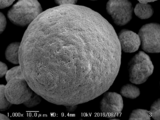
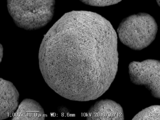
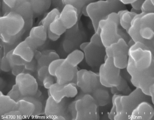
- the electron micrograph of the granule of Example 3-2. 4 is an electron micrograph of the constituent particles of Example 3-2.
- the electron micrograph of the granule of the comparative example 1. 4 is an electron micrograph of constituent particles of Comparative Example 1.
- the BET specific surface area is 7.5 m 2 / g to 25 m 2 / g.
- 80% or more of zirconia is monoclinic.
- the average particle size is 0.10 ⁇ m to 0.14 ⁇ m.
- the average particle size is less than 0.13 ⁇ m.
- the stabilizer is yttria.
- the composition contains 3 mol% to 7.5 mol% of yttria with respect to the total mol of zirconia and yttria.
- fy calculated based on the following Equation 1 is 1% or more.
- fy is 15% or less.
- the yttria content in the composition is 3 mol% or more and less than 4.5 mol%.
- fy is 2% or more.
- the yttria content in the composition is 4.5 mol% or more and less than 5.8 mol%.
- fy is 3% or more.
- the yttria content in the composition is 5.8 mol% or more and 7.5 mol% or less.
- fy is 4% or more.
- the calcined body has a density of 2.7 g / cm 3 to 3.6 g / cm 3 .
- the calcined body has a bending strength of 15 MPa to 70 MPa.
- 80% or more of zirconia is monoclinic.
- the stabilizer is yttria.
- yttria is contained in an amount of 3 mol% to 7.5 mol% with respect to the total mol of zirconia and yttria.
- fy calculated based on the following Equation 1 is 1% or more.
- fy is 15% or less.
- the yttria content in the composition is 3 mol% or more and less than 4.5 mol%.
- fy is 2% or more.
- the yttria content in the composition is 4.5 mol% or more and less than 5.8 mol%.
- fy is 3% or more.
- the yttria content in the composition is 5.8 mol% or more and 7.5 mol% or less.
- fy is 4% or more.
- the first translucency is 85% or more of the second translucent property.
- 95% or more of the zirconia powder in the mixture is monoclinic.
- the zirconia powder and the stabilizer prepared separately are mixed in the mixing step.
- the method for producing a composition further includes a pulverizing step of pulverizing the mixture so that the average particle size is 0.06 ⁇ m to 0.17 ⁇ m.
- the average particle size is set to less than 0.13 ⁇ m in the pulverization step.
- the method for producing a composition further includes a drying step in which the mixture is granulated by spray drying.
- the method for producing a composition does not include a step of baking the mixture at 700 ° C. or higher.
- the first molded body is fired at 800 ° C. to 1200 ° C. in the calcination step.
- the method for producing a calcined body does not include a step of firing the composition at 700 ° C. or higher before the calcining step.
- the method for manufacturing a sintered body does not include a step of firing the composition at 700 ° C. or higher before the sintering step.
- the method for producing a sintered body includes a calcining step in which a calcined body is produced by firing the first molded body at a temperature that does not lead to sintering before the sintering step. Further included. In the sintering step, the calcined body is fired as the first molded body.
- the method for manufacturing a sintered body further includes a second forming step of forming a calcined body and producing a second formed body before the sintering step.
- the second molded body is fired as a calcined body.
- the holding time at the maximum firing temperature is 1 hour or less in the sintering step.
- the stabilizer element is dissolved in zirconia in the sintering step.
- the composition of the present disclosure will be described as the first embodiment.
- the composition can be a precursor (intermediate product) of a zirconia sintered body and a calcined body.
- the composition contains zirconia powder and a stabilizer capable of suppressing the phase transition of zirconia.
- the stabilizer is preferably one that can form partially stabilized zirconia.
- the stabilizer include oxides such as calcium oxide (CaO), magnesium oxide (MgO), yttria, cerium oxide (CeO 2 ), and scandium oxide (Sc 2 O 3 ).
- the content of the stabilizer in the composition, calcined body, and sintered body can be measured by, for example, inductively coupled plasma (ICP) emission spectroscopic analysis, fluorescent X-ray analysis, or the like.
- ICP inductively coupled plasma
- the stabilizer is preferably present so that at least a part of the zirconia crystals is monoclinic. It is preferable that at least a part of the stabilizer is not dissolved in zirconia. That part of the stabilizer is not dissolved in zirconia can be confirmed by, for example, an X-ray diffraction (XRD) pattern.
- XRD X-ray diffraction
- the stabilizer may not be dissolved in zirconia even if the stabilizer peak does not exist in the XRD pattern.
- the main crystal system of zirconia is tetragonal and / or cubic and there is no stabilizer peak in the XRD pattern, most, basically all of the stabilizer is dissolved in zirconia. It is thought that.
- all of the stabilizer may not be dissolved in zirconia.
- that the stabilizer is in solid solution means that, for example, an element (atom) contained in the stabilizer is dissolved in zirconia.
- the stabilizer is preferably yttria.
- the content of yttria is preferably 3 mol% or more, more preferably 3.5 mol% or more, and further preferably 4 mol% or more with respect to the total mol of zirconia and yttria.
- the translucency of a sintered compact can be improved as the yttria content rate is 3 mol% or more.
- the content of yttria is preferably 7.5 mol% or less, more preferably 7 mol% or less, more preferably 6.5 mol% or less, and more preferably 6 mol%, based on the total mol of zirconia and yttria. More preferably, it is as follows. If the yttria content is 7.5 mol% or less, a decrease in strength of the sintered body can be suppressed.
- the abundance f y of yttria not dissolved in zirconia in the composition (hereinafter referred to as “unsolved yttria”) can be calculated based on the following Equation 1.
- the abundance y of undissolved yttria is preferably greater than 0%, more preferably 1% or more, even more preferably 2% or more, and even more preferably 3% or more.
- the upper limit of the existence ratio f y undissolved yttria is dependent on the content of yttria in the composition. When the content of yttria is less than 7.5 mol% relative to the total mol of zirconia and yttria, f y can be 15% or less.
- f y when the content of yttria is 3.5mol% ⁇ 4.5mol%, f y may be 7% or less. When the yttria content is 5 mol% to 6 mol%, fy can be 10% or less. When the content of yttria is 5.5mol% ⁇ 6.5mol%, f y may be a 11% or less.
- the f y when the content of yttria is less than 3 mol% or more 4.5 mol%, preferably the f y is 2% or more, more preferably 3% or more, more preferably 4% or more, More preferably, it is 5% or more.
- the content of yttria is less than 4.5 mol% or more 5.8 mol%, preferably the f y is 3% or more, more preferably 4% or more, more preferably 5% or more, 6% More preferably, it is more preferably 7% or more.
- the f y is 4% or more, more preferably 5% or more, more preferably 6% or more, 7% More preferably, it is more preferably 8% or more.
- I m (111) and I m (11-1) indicate the peak intensities of the monoclinic (111) plane and (11-1) plane of zirconia.
- I t (111) represents the peak intensity of the tetragonal (111) plane of zirconia.
- I c (111) represents the peak intensity of the cubic (111) plane of zirconia.
- the main crystal system of zirconia in the composition is preferably a monoclinic system.
- the ratio f m of monoclinic in zirconia, monoclinic preferable to be 20% or more, based on the total amount of tetragonal and cubic and is 30% or more preferably, It is preferably 40% or more, preferably 50% or more, preferably 55% or more, preferably 60% or more, more preferably 70% or more, and more preferably 80% or more, It is more preferably 85% or more, more preferably 90% or more, and further preferably 95% or more.
- Ratio f m monoclinic can be calculated from the number 2 below based on the XRD peaks due to CuK ⁇ line. The meaning of each symbol in Equation 2 is the same as that in Equation 1.
- the main crystal system in the composition may contribute to a high shrinkage temperature and a short sintering time.
- composition of the present disclosure tetragonal and cubic peaks may not be substantially detected. That is, the monoclinic system ratio f m can be set to 100%.
- the shrinkage ratio from the press-molded body to the calcined body is 1 with respect to the dimension in one direction of the press-molded body. % Or less is preferable.
- the shrinkage ratio from the press-molded body to the calcined body is a dimension in one direction of the press-molded body. On the other hand, it is preferably 5% or less.
- the press-molded body here is a product obtained by further subjecting a molded body obtained by press-molding zirconia powder at a pressure of 300 kg / cm 2 to 1700 kg / cm 2 .
- Composition can have a powder form.
- the powder may be an aggregate of granules.
- the granule is obtained by agglomerating primary particles and / or secondary particles obtained by aggregating primary particles.
- Granules are aggregates (aggregates) of particles.
- the expressions “particle” and “particle constituting the granule” are used in the following in order to distinguish the particle from the granule.
- the composition of the present disclosure may not have a granular form. If the composition does not take the form of granules, “particles making up the granules” refer to the particles in the powder. “Particles constituting the granules” include zirconia particles and stabilizer particles.
- Primary particle in the present disclosure refers to a spherical particle of the smallest unit.
- primary particles are spherical bodies that are not bonded to each other and appear to be separable in an electron microscope.
- the “secondary particles” in the present disclosure refers to particles in a state where particles that look like primary particles in an electron microscope are aggregated. Secondary particles also include aggregates in which primary particles adhere so that they can be crushed, and aggregates in which primary particles are fused together so that they cannot be separated from each other and appear as one particle. In many cases, the secondary particles are not spherical and have an irregular shape in the electron microscope image.
- the particles constituting the granules are mainly primary particles.
- the number of primary particles is preferably larger than the number of secondary particles.
- primary particles are 50% or more, preferably 70% or more, more preferably 80% or more of primary particles. Particles that do not constitute particles are preferred. Since secondary particles usually have an irregular shape, when the number of secondary particles increases, the circularity of the granules described later decreases.
- the average particle size of the particles constituting the granules is preferably 0.06 ⁇ m or more, more preferably 0.08 ⁇ m or more, and more preferably 0.10 ⁇ m or more when measured by a laser diffraction / scattering particle size distribution measurement method. And more preferably 0.11 ⁇ m or more. If it is less than 0.06 ⁇ m, it is difficult to sinter or the sintered body becomes cloudy even if it can be sintered.
- the average particle size is preferably 0.17 ⁇ m or less, more preferably 0.15 ⁇ m or less, more preferably 0.14 ⁇ m or less, and further preferably 0.13 ⁇ m or less.
- the average particle diameter is a particle diameter measured without distinguishing between primary particles and secondary particles.
- the average particle size of the particles constituting the granules is set to 0. 0 in order to further improve the translucency of the sintered body prepared from the particles or granules. It is more preferably less than 13 ⁇ m, more preferably 0.125 ⁇ m or less, more preferably 0.12 ⁇ m or less, and further preferably 0.115 ⁇ m or less.
- BET specific surface area of the particles constituting the granules when measured according to JISZ8830 (2013), preferable to be 7.0 m 2 / g or more, more preferably 7.5 m 2 / g or more, 8m 2 / G or more is more preferable. If it is less than 7.0 m 2 / g, sintering will be difficult, or even if it can be sintered, the sintered body will become cloudy.
- the BET specific surface area is preferably 30 m 2 / g or less, more preferably 25 m 2 / g or less, and further preferably 20 m 2 / g or less.
- the BET specific surface area is a specific surface area measured without distinguishing between primary particles and secondary particles.
- zirconia in the zirconia composition 50% or more, preferably 70% or more, more preferably 80% or more, and even more preferably 90% or more zirconia can take the form of granules.
- the zirconia particles constituting the powder may have the above-described average particle diameter and BET specific surface area.
- the average particle size of the granules in the zirconia composition is preferably 10 ⁇ m or more, more preferably 12 ⁇ m or more, and even more preferably 14 ⁇ m or more. If the average particle size of the granules is less than 10 ⁇ m, air is entrained when the granules are put in a mold, and deaeration is insufficient at the time of molding, which may make it impossible to produce a uniform and dense compact. Moreover, there is a risk that granules are ejected from the gap during molding, and a molded body that does not satisfy a predetermined required amount is produced.
- the average particle size of the granules is preferably 200 ⁇ m or less, more preferably 190 ⁇ m or less, more preferably 180 ⁇ m or less, more preferably 150 ⁇ m or less, and even more preferably 100 ⁇ m or less.
- the average particle diameter of the granules exceeds 200 ⁇ m, cavities are likely to be formed inside the granules. Also, gaps are likely to occur when the granules are placed in a mold. Due to these phenomena, deaeration becomes insufficient during molding, and there is a possibility that a dense molded body cannot be produced. Moreover, shrinkage
- the zirconia in the zirconia composition constitutes a granule.
- the average particle size of the granule is preferably measured by a method that does not break the granule.
- the average particle diameter of the granules can be measured by a vibration type / low tap type particle size distribution measuring method or a sonic vibration sieving type particle size distribution measuring method (for example, using a robot shifter manufactured by Seishin Enterprise Co., Ltd.). .
- the sphericity of the granules is high. Increasing the sphericity of the granules can cause mixing at the interface between the layers when zirconia powders of different compositions are laminated. Further, when a molded body is produced by filling a mold with zirconia powder, the packing density can be increased with higher sphericity even if the average particle diameter is the same. By increasing the packing density, the strength and translucency of the sintered body can be increased. Moreover, even when the mold has corners, the filling of the granules into the corners can be improved.
- the sphericity of the granules can be represented by, for example, a circularity based on a projected image, a repose angle, a light bulk density, a heavy bulk density, and the like.
- the average circularity based on the projected image of the granule in the zirconia composition is preferably 0.81 or more, more preferably 0.85 or more, more preferably 0.90 or more, and 0.95 or more. And more preferred. Circularity can be calculated as the ratio of the circumference of a circle equal to the area of the granules to the circumference of the granules in the projected image. That is, the circularity can be calculated from the following equation.
- the angle of repose of the zirconia composition is preferably 35 ° or less, more preferably 32 ° or less, more preferably 28 ° or less, more preferably 26 ° or less, and further preferably 24 ° or less. preferable.
- the angle of repose can be measured in accordance with JIS R9301-2-2.
- the light bulk density of the zirconia composition is preferably 1.0 g / cm 3 or more, more preferably 1.1 g / cm 3 or more, more preferably 1.2 g / cm 3 or more, and 1.3 g / Cm 3 or more is more preferable.
- the light bulk density can be measured according to JIS R9301-2-3.
- the heavy bulk density of the zirconia composition is preferably 1.3 g / cm 3 or more, more preferably 1.4 g / cm 3 or more, and further preferably 1.5 g / cm 3 or more.
- the heavy bulk density can be measured according to JIS R9301-2-3.
- the composition may contain additives other than zirconia and yttria.
- additives include pigments (including colorants and fluorescent agents), binders, dispersants, antifoaming agents, alumina (Al 2 O 3 ), titanium oxide (TiO 2 ), silica (SiO 2 ), and the like. .
- additives such as coloring agents include Ti, V, Cr, Mn, Fe, Co, Ni, Zn, Y, Zr, Sn, Sb, Bi, Ce, Pr, Sm, Eu, Gd, Tb, and Er.
- An oxide of at least one element selected from the group can be given.
- the fluorescent agent include Y 2 SiO 5 : Ce, Y 2 SiO 5 : Tb, (Y, Gd, Eu) BO 3 , Y 2 O 3 : Eu, YAG: Ce, ZnGa 2 O 4 : Zn, BaMgAl 10 O 17 : Eu and the like can be mentioned.
- An organic binder can be used as the binder.
- acrylic, acrylic acid, paraffin, fatty acid, polyvinyl alcohol can be used.
- the composition of the present disclosure may be in a dry state, in a state containing a liquid, or in a state included in a liquid.
- the composition can take a powder form, a paste form, a slurry form, or the like.
- the composition may be a molded body having a predetermined shape (hereinafter referred to as “first molded body”).
- Density of the first molded body is preferable to be 2.75 g / cm 3 or more, more preferably 2.80 g / cm 3 or more, more preferably 2.85 g / cm 3 or more, 2.90 g / Cm 3 or more is more preferable, and 3.00 g / cm 3 or more is further preferable.
- the density can be calculated, for example, as (mass of first molded body) / (volume of first molded body).
- the shrinkage rate from the press-molded body to the sintered body is not constant with respect to the firing temperature, and the shrinkage rate is low up to a certain temperature, but the shrinkage rate increases at that temperature.
- This temperature at which the contraction speed changes is referred to as “shifting temperature” in this document.
- the shift temperature can be set to 1050 ° C. or higher, preferably 1100 ° C. or higher.
- the shift temperature can be determined by creating a plot of the shrinkage rate against the maximum firing temperature, as in the examples described below.
- the shrinkage rate to the calcined bodies between the plurality of press-formed bodies is small. If the variation in shrinkage rate is large, when molding the calcined body, the same coefficient is applied to the lot, and the dimensions of the molded body are determined. It is because it will be obtained. This is particularly a problem for products that require a high degree of dimensional accuracy, such as dental prostheses. Therefore, a block body whose shrinkage rate is out of the allowable range in one lot cannot be used as a product, and the yield decreases.
- variation in shrinkage rate in one lot can be reduced with respect to a firing temperature (for example, about 1000 ° C.) for producing a calcined body block.
- a firing temperature for example, about 1000 ° C.
- the maximum firing temperature for producing a calcined body (hereinafter referred to as “calcining temperature”) is close to the transmission temperature.
- calcining temperature Normally, a temperature difference (temperature unevenness) of about 20 ° C. to 50 ° C. occurs in the firing furnace at the calcination temperature. For this reason, if the shift temperature is near the calcining temperature, the lot of the composition is strongly affected by this temperature unevenness.
- the shrinkage rate is greatly different between the calcined body at a low temperature and the calcined body at a high temperature. Since the calcined body whose shrinkage rate is out of the allowable range cannot be made into a product, the yield is lowered.
- the composition of the present disclosure since the shift temperature is high, the difference between the shift temperature and the calcining temperature can be reduced. For this reason, in one lot, the difference of the shrinkage
- the calcined body whose shrinkage rate is outside the allowable range can be reduced, and the yield can be increased.
- the number of products that can be fired at one time can be increased, and the production efficiency can be increased.
- a final product sintered body
- the composition and calcined body of the present disclosure are particularly useful for producing a product (for example, a dental product) that requires a high degree of dimensional accuracy.
- the composition and calcined body of the present disclosure have further advantages.
- the firing time for producing the sintered body can be shortened without reducing the translucency and strength of the produced zirconia sintered body.
- the holding time at the maximum firing temperature (hereinafter referred to as “sintering temperature”) for producing a sintered body can be shortened (short-time sintering).
- the production efficiency can be increased and the manufacturing cost can be reduced.
- the time from determining the size of the dental product used for treatment to enabling treatment with the dental product is shortened. This can reduce the time burden on the patient.
- the composition according to the first embodiment may have at least one of the advantages related to the above-described speed change temperature and short-time sintering.
- the composition according to the first embodiment preferably has both advantages relating to variable speed temperature and short-time sintering.
- a method for producing the composition of the present disclosure will be described as a second embodiment.
- zirconia and a stabilizer are mixed at a predetermined ratio to prepare a mixture (mixing step).
- the mixing ratio can be the same as the content of yttria.
- Mixing may be performed dry or wet.
- the composition can be pulverized until the above average particle diameter and / or BET specific surface area are reached (first pulverization step).
- the mixing step and the first pulverization step can be performed in the same step.
- the pulverization can be performed, for example, using a ball mill after dispersing the composition in a solvent such as water (dispersing step).
- the average particle size of the composition is, for example, 0.10 ⁇ m to 0.14 ⁇ m in order to increase the shift temperature and / or to sinter for a short time. Crush the composition.
- the average particle diameter can be measured by a laser diffraction / scattering particle size distribution measuring method.
- the mixture can be dried by spray drying with a spray dryer or the like, and the composition can be formed into the granular form as described above (first drying step). Thereby, the composition of this indication is producible.
- the average particle size of the composition is preferably less than 0.13 ⁇ m, more preferably 0.125 ⁇ m or less, and 0.12 ⁇ m or less. More preferably, it is more preferably 0.115 ⁇ m or less. By setting the average particle size of the composition to less than 0.13 ⁇ m, the translucency of the sintered body can be enhanced.
- the steps after the firing step described later are not performed, it is preferable not to include a step of firing the composition at 700 ° C. or higher before a step of producing a calcined body and a sintered body described later.
- a step of firing the composition at 700 ° C. or higher before a step of producing a calcined body and a sintered body described later.
- zirconia and a stabilizer are not precipitated at the same time (in the same process), but the zirconia preparation process (for example, the production process) and the stabilizer preparation process (for example, the production process) are independent and separate. It is preferable that this step. Thereby, it can suppress that a stabilizer dissolves in a zirconia in the manufacturing process of the calcined body mentioned later.
- the firing conditions are preferably such that the main crystal system of zirconia when cooled after firing is not tetragonal or cubic.
- the firing conditions are preferably such that at least a part of the stabilizer does not dissolve in zirconia.
- the firing temperature is preferably 700 ° C. or higher, and more preferably 800 ° C. or higher.
- the firing temperature is preferably 1100 ° C. or lower, more preferably 1000 ° C. or lower, more preferably 980 ° C. or lower, and further preferably 950 ° C.
- Firing can be performed in the air.
- the firing step it is possible to dissolve a part of the stabilizer in zirconia, to facilitate the solid solution of the stabilizer in the sintering step, or to improve the properties of the sintered body Conceivable.
- the composition can be dispersed in a solvent such as water to prepare a slurry, and additives such as a binder and a pigment can be added to the composition (addition step).
- the composition can be pulverized until the above average particle size and / or BET specific surface area is reached (second pulverization step).
- the adding step and the second pulverizing step can be performed in the same step.
- the second pulverization step can be performed in the same manner as the first pulverization step.
- the mixture can be dried by spray drying with a spray dryer or the like to form the composition into the granular form as described above (second drying step).
- the composition can be molded into a first molded body (first molding step).
- molding method is not limited to a specific method, A suitable method can be selected suitably according to the objective.
- the composition can be formed by press molding, injection molding, stereolithography, or the like.
- the composition may be subjected to CIP treatment after press molding.
- the above-mentioned additives can be appropriately added in each step.
- the composition according to the first embodiment can be produced. That is, according to the method for producing a composition according to the second embodiment, it is possible to produce a composition that has a high shifting temperature and / or can shorten the firing time for sintering.
- the zirconia powder in which yttria is dissolved is generally produced by a coprecipitation method and a hydrolysis method.
- a coprecipitation method and the hydrolysis method a mixture of hydrated zirconia and yttria is prepared from zirconium oxychloride and yttrium chloride in the same step, and this mixture is fired at 800 ° C. to 900 ° C. to solidify yttria (yttrium).
- a melted stabilized zirconia powder has been made.
- This yttria solid solution zirconia is mainly tetragonal and / or cubic.
- the particle size of the zirconia powder obtained in this way is on the order of several tens of nm.
- the fired product is pulverized to a predetermined particle size and then granulated to produce a composition.
- the temperature dependence of the shrinkage rate in the calcined body production temperature region becomes high. Moreover, sufficient translucency of the sintered body cannot be obtained with a short firing time.
- a stabilizer (yttria) is separately mixed, and basically the stabilizer is dissolved in zirconia in the sintering step.
- the temperature dependence of the shrinkage rate in the calcined body production temperature region can be lowered.
- a sintered body with high translucency can be obtained even by short-time sintering.
- the production cost of the composition can be reduced by drastically reducing the time.
- the production amount per hour can be doubled by diverting the equipment and the time in which the second pulverization process and the second drying process have been performed to the first pulverization process and the first drying process.
- the opportunity for impurities such as dust to be mixed into the composition can be reduced by omitting the second pulverization step and the second drying step.
- a zirconia calcined body of the present disclosure will be described.
- the calcined body can be a precursor (intermediate product) of a zirconia sintered body.
- the calcined body can be, for example, a zirconia particle (powder) that has been blocked in a state where it is not completely sintered.
- the calcined body of the present disclosure refers to a product made from the composition of the present disclosure.
- the density of the calcined body is preferably 2.7 g / cm 3 or more.
- the density of the calcined body is a 4.0 g / cm 3 or less, more preferable to be 3.8 g / cm 3 or less and further preferably 3.6 g / cm 3 or less. If it is in this density range, molding can be easily performed.
- the content ratio of the zirconia and the stabilizer in the calcined body is the same as the content ratio in the composition before the calcined body is manufactured.
- the stabilizer is preferably yttria.
- the undissolved ratio of the stabilizer in the calcined body depends on the firing temperature at the time of preparing the calcined body, it is considered to be equal to or less than the insoluble ratio in the composition before the calcined body is manufactured.
- the abundance ratio y of insoluble yttria can be calculated based on the above formula 1.
- Prevalence f y undissolved yttria in the calcined body may be the same as f y of the above composition.
- the abundance ratio y of insoluble yttria is preferably greater than 0%, more preferably 1% or more, more preferably 2% or more, and even more preferably 3% or more.
- the upper limit of the existence ratio f y undissolved yttria is dependent on the content of yttria in the calcined body.
- f y can be 15% or less.
- f y may be 7% or less.
- fy can be 10% or less.
- the content of yttria is 5.5mol% ⁇ 6.5mol%
- f y may be a 11% or less.
- the f y is 2% or more, more preferably 3% or more, more preferably 4% or more More preferably, it is 5% or more.
- the f y is 3% or more, more preferably 4% or more, more preferably 5% or more, 6% More preferably, it is more preferably 7% or more.
- the f y is 4% or more, more preferably 5% or more, more preferably 6% or more, 7% More preferably, it is more preferably 8% or more.
- the crystal system of zirconia in the calcined body depends on the firing temperature at the time of calcining, but the monoclinic content is less than or equal to the monoclinic content in the composition before calcining Conceivable.
- Ratio f m of monoclinic in zirconia, monoclinic preferable to be 60% or more, based on the total amount of the tetragonal and cubic, and more preferable to be 70%, 80% or more Is more preferable, 90% or more is more preferable, and 95% or more is further preferable.
- the bending strength of the calcined body measured according to JIS R1601 is preferably 15 MPa or more in order to ensure the strength that enables mechanical processing.
- the bending strength of the calcined body is preferably 70 MPa or less and more preferably 60 MPa or less in order to facilitate mechanical processing.
- Bending strength can also be measured according to ISO6872.
- the size of the test piece is changed from that of JISR1601 or ISO6872, and the size of the test piece is set to 5 mm ⁇ 10 mm ⁇ 50 mm.
- the surface of the test piece and the C surface are finished in the longitudinal direction with No. 600 sandpaper.
- the test piece is arranged so that the widest surface faces the vertical direction (load direction). In the bending test measurement, the span is 30 mm and the crosshead speed is 0.5 mm / min.
- the calcined body can contain the above-mentioned additives.
- the calcined body may be a molded body having a predetermined shape (hereinafter referred to as “second molded body”).
- the calcined body can have a disk (disk) shape, a rectangular parallelepiped shape, and a dental product shape (for example, a crown shape).
- a calcined body includes a dental product (for example, a crown-shaped prosthesis) obtained by processing a calcined zirconia disk using a CAD / CAM (Computer-Aided Design / Computer-Aided Manufacturing) system.
- the calcined body according to the third embodiment is manufactured with a small shrinkage rate variation from the composition.
- the shrinkage rate from a calcined body to a sintered compact can be made equivalent, and a sintered compact with high dimensional accuracy can be manufactured.
- the calcined body according to the third embodiment has the advantages relating to the short-time sintering described above.
- a sintered body produced by firing the calcined body of the present disclosure at 1550 ° C. for 30 minutes is referred to as a first sintered body.
- a sintered body produced by firing the calcined body of the present disclosure at 1550 ° C. for 120 minutes is referred to as a second sintered body.
- the translucency of the first sintered body is the translucent 85 of the second sintered body. % Or more, preferably 90% or more, more preferably 95% or more, and even more preferably substantially the same.
- the calcined body according to the third embodiment has at least one of the advantages related to dimensional accuracy and short-time sintering, and preferably has both advantages.
- the calcined body of the present disclosure can be manufactured by calcining (that is, calcining) the first molded body produced in the first molding step at a temperature at which the zirconia particles do not sinter (ie, calcined). Process).
- the firing temperature is, for example, preferably 800 ° C. or higher, more preferably 900 ° C. or higher, and further preferably 950 ° C. or higher in order to ensure blocking.
- the firing temperature is preferably 1200 ° C. or lower, more preferably 1150 ° C. or lower, and further preferably 1100 ° C. or lower.
- the calcined body can be molded to produce a second molded body (second molding step).
- molding method is not limited to a specific method, A suitable method can be selected suitably according to the objective.
- a zirconia disk that is also a calcined body can be cut into a shape of a dental product (for example, a prosthesis having a crown shape) by a CAD / CAM system to produce a second molded body.
- the calcined body according to the third embodiment can be produced.
- a calcined body having a small shrinkage rate variation can be produced, and / or a calcined body that can be sintered for a short time can be produced.
- the sintered body can be, for example, a zirconia particle (powder) in a sintered state.
- the sintered body of the present disclosure refers to one produced from the composition and / or calcined body of the present disclosure.
- the relative density of the sintered body is preferably 99.5% or more. The relative density can be calculated as a ratio of the actually measured density measured by the Archimedes method to the theoretical density.
- the zirconia sintered body of the present disclosure includes not only a sintered body obtained by sintering molded zirconia particles under normal pressure or non-pressurization, but also HIP (Hot Isostatic Pressing) processing, etc. A sintered body densified by high-temperature pressure treatment is also included.
- the content ratio of the zirconia and the stabilizer in the sintered body is the same as the content ratio in the composition and / or the calcined body before the sintered body is produced.
- the monoclinic system ratio f m is preferably 10% or less, more preferably 5% or less, and substantially not contained (0%). And more preferred. Crystal systems other than the monoclinic system are tetragonal and / or cubic.
- the solid solution ratio of the stabilizer in the sintered body it is preferable that 95% or more of the contained stabilizer is dissolved in zirconia, and substantially all the stabilizer is in solid solution. And more preferred.
- Prevalence f y undissolved yttria preferable to be 5% or less, more preferable to be 1% or less, more preferably as being all substantially the solute (0%).
- the translucency of the sintered body is preferably 12 or more, more preferably 14 or more, more preferably 15 or more, and further preferably 16 or more.
- the translucency here means L * measured by making the background of a 1.2 mm thick sample white with respect to the L * value of lightness (color space) in the L * a * b * color system (JISZ8781) . value as a first L * value, the same samples were measured first in the L * value, the L * value of the background of the sample was measured in the black and second L * value, the first L * The value obtained by subtracting the second L * value from the value.
- a granule (composition) is press-molded so that the thickness of the sintered body is 1.2 mm, followed by CIP molding, for example, a disk-shaped molded body having a diameter of 19 mm. Can be produced.
- the molded body can be fired under predetermined firing conditions to produce a sintered body having a thickness of 1.2 mm as a sample.
- the color difference meter for example, CE100, analysis soft crystal eye (manufactured by Olympus)
- the contact liquid for example, a liquid having a refractive index nD of 1.60 measured at a measurement wavelength of 589 nm (sodium D line) can be used.
- the sintered body can contain the above-mentioned additives.
- the sintered body may be a molded body having a predetermined shape (hereinafter referred to as “third molded body”).
- the sintered body can have a disk (disk) shape, a rectangular parallelepiped shape, or a dental product shape (for example, a crown shape).
- the sintered body of the present disclosure is produced by firing the composition (including the first molded body) and / or the calcined body (including the second molded body) of the present disclosure at a temperature at which the zirconia particles reach sintering. (Sintering process).
- the firing temperature is preferably 1400 ° C. or higher, and more preferably 1450 ° C. or higher.
- the firing temperature is preferably 1650 ° C. or lower, for example, and more preferably 1600 ° C. or lower.
- the rate of temperature increase and the rate of temperature decrease are preferably 300 ° C./min or less.
- the holding time at the sinterable temperature is preferably less than 120 minutes, more preferably 90 minutes or less, more preferably 75 minutes or less, and 60 minutes or less. More preferably, it is more preferably 45 minutes or less, and even more preferably 30 minutes or less.
- the holding time is preferably 1 minute or longer, more preferably 5 minutes or longer, and more preferably 10 minutes or longer. According to the manufacturing method of the present disclosure, it is possible to suppress a decrease in translucency of the manufactured sintered body even with such a firing time. Further, by shortening the firing time, it is possible to increase production efficiency and reduce energy costs.
- the holding time at the sinterable temperature (for example, the maximum firing temperature) can be, for example, 25 minutes or less, 20 minutes or less, or 15 minutes or less.
- the heating rate can be set so as to reach the maximum firing temperature in the shortest time according to the performance of the firing furnace.
- the rate of temperature increase up to the maximum temperature is, for example, 10 ° C / min or higher, 50 ° C / min or higher, 100 ° C / min or higher, 120 ° C / min or higher, 150 ° C / min or higher, or 200 ° C / min or higher.
- the temperature lowering rate is preferably set to a rate that does not cause defects such as cracks in the sintered body. For example, after completion of heating, the sintered body can be allowed to cool at room temperature.
- the stabilizer for example, yttria
- zirconia in the production method of the present disclosure, the stabilizer (for example, yttria) is considered to be dissolved in zirconia in the sintering process.
- the sintered body can be molded to produce a third molded body (third molding step).
- molding method is not limited to a specific method, A suitable method can be selected suitably according to the objective.
- a zirconia block that is also a sintered body can be cut into a shape of a dental product (for example, a crown-shaped prosthesis) with a CAD / CAM system to produce a third molded body.
- the dental product of the present disclosure includes the zirconia sintered body according to the fifth embodiment.
- the zirconia sintered body can have, for example, a crown shape.
- the dental product may further include porcelain laminated on the zirconia sintered body.
- the porcelain can be a ceramic such as a glass material.
- Examples of the dental product include a prosthesis (for example, a ceramic frame and a full cantour crown), an orthodontic product (for example, an orthodontic bracket), and a dental implant product (for example, an abutment for a dental implant). Can be mentioned.
- the dental product can be produced by sintering the composition of the present disclosure (including the first molded body) and / or the calcined body (including the second molded body) having a predetermined shape.
- the dental product can be manufactured by cutting the sintered body of the present disclosure (including the third molded body).
- Dental products having porcelain include, for example, a step of applying a slurry containing porcelain on a sintered body, and firing the sintered body coated with porcelain to dispose the porcelain on the sintered body. It can be produced by a baking process.
- a sintered body and a dental product with high dimensional accuracy can be obtained, and / or a sintered body and a dental product with high translucency can be produced in a short time. it can.
- composition and properties of the composition, calcined body, sintered body, and laminate other than those described in this document cannot be directly identified by analysis at the time of filing this application, or are not practical. Conceivable. For this reason, when specifying about a structure or characteristic other than what is described in this book, it is thought that specification by a manufacturing method is useful.
- Example 1 to 4 and Comparative Examples 1 to 3 [Preparation of composition and XRD measurement] A zirconia composition of the present disclosure was prepared, and the degree to which the zirconia crystal system and the stabilizer were not dissolved in zirconia was confirmed. The results are shown in Table 1.
- Yttria was used as a stabilizer. In Examples 1 to 3, the addition ratio of yttria was changed. In Example 4, the ratio of monoclinic crystals was changed.
- the yttria addition rate shown in Table 1 is the ratio of yttria to the total mol of zirconia and yttria. The process shown in Table 1 shows that it is the composition obtained by each process demonstrated below. F y indicating the existence ratio of undissolved yttria was calculated based on Equation 1 above. F m which indicates the proportion of monoclinic in zirconia was calculated based on the number 2.
- a method for producing the compositions according to Examples 1 to 3 shown in Table 1 will be described.
- a monoclinic zirconium oxide and yttria were combined to produce a mixture (mixing step).
- Zirconium oxide and yttria are produced by independent processes.
- this mixture was added to water to prepare a slurry, and wet pulverized and mixed with a ball mill to a mean particle size of 0.13 ⁇ m (primary pulverization step).
- This mixture after pulverization is used as the composition of the “primary pulverization” step shown in Table 1.
- the powder obtained by drying the pulverized slurry with a spray dryer was baked at 950 ° C. for 2 hours (baking step).
- the fired powder was added to water to prepare a slurry, and wet pulverized with a ball mill until the average particle size became 0.13 ⁇ m or less (secondary pulverization step).
- secondary pulverization step After adding a binder to the pulverized slurry, it was dried with a spray dryer to prepare a composition. Let this composition after drying be the composition of the “secondary grinding” step shown in Table 1.
- f y and f m be the commercially available partially stabilized zirconia powder.
- the zirconia of Comparative Example 1 is TZ-3YSB-E manufactured by Tosoh Corporation.
- the zirconia of Comparative Example 2 is Zpex manufactured by Tosoh Corporation.
- the zirconia of Comparative Example 3 is Zpex Smile manufactured by Tosoh Corporation.
- Example 4 the composition according to Comparative Example 1 was added in addition to the monoclinic zirconium oxide and yttria in the mixing step, and the ratio of the monoclinic crystal in the composition was as in Example 1. It was made to fall below ⁇ 3.
- Example 1 On the other hand, in Examples 1 to 3, some tetragonal crystals and cubic crystallization progressed by the firing process, but 90% or more, more than 95% were monoclinic. In Example 4, since tetragonal partially stabilized zirconia was added, about 80% was monoclinic. In Examples 1 to 4, yttria XRD peaks were observed. In Example 1 with a low yttria addition rate, fy was 2.5 or more and 6 or less. In Examples 2 to 4 having a high yttria addition rate, f y was 4 or more and 10 or less. Although fy is decreasing from the primary pulverization step to the secondary pulverization step, it is compared with fy immediately after the mixing step and immediately after the firing step. The relative peak is considered to have decreased. However, the possibility of a decrease in fy due to solid solution is not denied.
- Examples 5 to 7 and Comparative Example 4 [Preparation of calcined body, measurement of shrinkage, and measurement of XRD pattern]
- a calcined body block was prepared using the compositions of Examples 1-2, 3-2 and 4 and Comparative Example 2, and the variation in dimensional change of each calcined body was measured.
- each composition was press-molded at a pressure of 300 kg / cm 2 .
- the press molded body was further subjected to CIP treatment at 1700 kg / cm 2 to produce the first molded body described above.
- the first molded body was fired to prepare a calcined body.
- the first molded body was fired at three set temperatures of 1000 ° C., 1050 ° C., and 1100 ° C., respectively.
- Table 2 shows the results when the electric furnace set temperature is 1000 ° C.
- the minimum temperature in the furnace when the set temperature reached 1000 ° C. was 975 ° C., and the maximum temperature was 1025 ° C.
- the difference between the maximum dimension and the minimum dimension could be made smaller than that in Comparative Example 4-1. That is, even if there was temperature unevenness in the firing furnace, it was possible to reduce the variation in the shrinkage rate of the calcined body fired on the same occasion. Further, in Examples 5-1 to 7-1, the shrinkage ratio of all the calcined bodies could be kept within an allowable range, but in Comparative Example 4-1, 1/3 of the calcined bodies were included. I have fallen out of tolerance.
- Table 3 shows the results when the electric furnace set temperature is 1050 ° C.
- the minimum temperature in the furnace when the set temperature reached 1050 ° C. was 1040 ° C., and the maximum temperature was 1060 ° C.
- the shrinkage ratio of all the calcined bodies could be kept within an allowable range, but in Comparative Example 4-2, 1/3 of the calcined bodies were included. I have fallen out of tolerance.
- Example 7-2 one calcined body was out of the allowable range, but a better result than Comparative Example 4-2 could be obtained.
- Table 4 shows the results when the electric furnace set temperature is 1100 ° C.
- the minimum temperature in the furnace when the set temperature reached 1100 ° C. was 1090 ° C., and the maximum temperature was 1100 ° C.
- Examples 5-3 and 7-3 some of the results were out of the allowable range, but the pass rate was higher than that in Comparative Example 4-3.
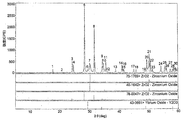
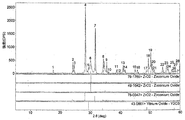
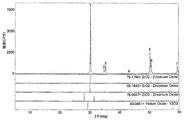
- Example 5-2 For the calcined bodies produced in Example 5-2, Example 6-2 and Comparative Example 4-2, the XRD pattern was measured using CuK ⁇ rays.
- FIG. 1 shows an XRD pattern of the calcined body produced in Example 5-2.
- FIG. 2 shows the XRD pattern of the calcined body produced in Example 6-2.
- FIG. 3 shows an XRD pattern of the calcined body manufactured in Comparative Example 4-2.
- FIG. 3 shows that no monoclinic zirconia peak was observed in the calcined body of Comparative Example 4-2. In addition, no yttria peak was observed.
- FIGS. 1 and 2 in the calcined bodies in Examples 5-2 and 6-2, monoclinic, tetragonal, and cubic zirconia peaks were confirmed, and the monoclinic peaks were observed. Was stronger.
- a yttria peak peak number 6 in FIG. 1 and peak number 5 in FIG. 2 was also observed at 2 ⁇ of around 29.4 °, and some yttria in the calcined body. Is considered not to be dissolved in zirconia.
- Example 8 [Examples 8 to 11 and Comparative Examples 5 to 8] [Measurement of shrinkage ratio change with firing temperature] A calcined body was produced under different firing temperatures, and the shrinkage rate of each calcined body was measured.
- the composition of Example 1-1 was used as a raw material as it was.
- Example 9 a material obtained by adding yttria to the composition of Example 1-1 and mixing so that the total content of yttria was 6 mol% was used as a raw material. That is, the undissolved yttria in the composition of Example 1-1 was increased.
- Example 10 the composition of Example 3-1 was used as a raw material as it was.
- Example 11 a composition obtained by adding and mixing zirconia containing no yttria to the composition of Example 3-1 so that the yttria content was 4 mol% was used as a raw material.
- Comparative Example 5 the composition of Comparative Example 1 was used as it was as a raw material.
- Comparative Example 6 the composition of Comparative Example 2 was used as a raw material as it was.
- Comparative Example 7 a composition obtained by adding and mixing yttria to the composition of Comparative Example 1 so that the total content of yttria was 6 mol% and performing a primary pulverization step was used as a raw material.
- Comparative Example 8 yttria was added to the composition of Comparative Example 1 so that the total content of yttria was 6 mol%, and the powder obtained from the mixing step to the secondary pulverization step was used as a raw material. .
- a first molded body was produced in the same manner as in Examples 1 to 3.
- a calcined body was produced by changing the maximum firing temperature of the first molded body in the range of 950 ° C. to 1200 ° C. every 50 ° C., and the shrinkage rate of each calcined body was measured.
- three samples were prepared and placed at the same position in the firing furnace so as not to be affected by temperature unevenness in the firing furnace.
- the dimensions of the first molded body were the same as those in Examples 5 to 7 described above.
- the shrinkage rate was calculated from the following formula, and obtained as an average value of three samples. The results are shown in Table 5.
- Shrinkage rate (%) ⁇ (diameter of first molded body) ⁇ (diameter of calcined body) ⁇ / (diameter of first molded body) ⁇ 100
- the shrinkage rate increases from around the firing temperature of 1000 ° C. That is, the shift temperature can be regarded as about 1000 ° C.
- the shrinkage rate increased from around the firing temperature of 1100 ° C. That is, the shift temperature can be regarded as about 1100 ° C.
- the composition according to the Comparative Example has a shrinkage rate that varies greatly depending on the firing temperature in the range of 1000 ° C. to 1100 ° C. (the shrinkage rate is high). A calcined body having different shrinkage due to temperature unevenness is produced.
- the shrinkage rate is almost the same (the shrinkage rate is low) in the range of 1000 ° C. to 1100 ° C. For this reason, even if temperature unevenness occurs in the firing furnace, a calcined body with a uniform shrinkage can be produced.
- the zirconia crystal system is tetragonal and cubic, and no monoclinic crystal can be detected.
- Comparative Examples 5 and 6 there is no unsolved yttria in the composition.
- Comparative Examples 7 and 8 yttria was added so that undissolved yttria was present in the composition.
- the crystal system of zirconia is mainly monoclinic and there is undissolved yttria. From this, it is considered that when the calcined body is made from a composition mainly composed of monoclinic crystals, the transmission temperature can be increased.
- Example 12 and Comparative Example 9 [Measurement of translucency for firing time] A sintered body was produced using the composition (calcined body) of the present disclosure, and the relationship between the holding time at the maximum temperature and the light transmitting property was examined.
- the composition of Example 3-2 was used. First, a molded body was prepared so that a sintered body having a thickness of 1.2 mm was obtained, and the molded body was fired at 1000 ° C. for 2 hours to prepare a calcined body. Next, the maximum temperature was set to 1550 ° C., and the sample (calcined body) was fired for 120 minutes to produce a sintered body. And the translucency of the sintered compact was measured.
- Translucency calculated using the color difference meter CE 100, was measured using the analysis software Crystal Eye (manufactured by Olympus Corporation), the L * value of lightness (color space) in the L * a * b * color system (JISZ8781) did.
- a contact liquid having a refractive index nD of 1.60 was applied to the measurement surface of the sample.
- the translucency of the sintered body can be increased by increasing the firing temperature.
- Comparative Example 9 in the baking at the maximum temperature holding time of 30 minutes, the transparency could not be increased even if the baking temperature was raised, and it was about 80% of the translucency in 120 minutes baking. .
- Example 12 the translucency equivalent to 120 minutes baking was able to be ensured also in 30 minutes baking. Even at the maximum firing temperature of 1450 ° C., it could be 85% or more of 120 minutes firing, and at the maximum firing temperature of 1500 ° C. or more, it could be 95% or more of firing at 120 ° C., almost 100%. From this, according to the composition of this indication, baking time can be shortened. Thereby, while being able to raise the production efficiency of a sintered compact, energy cost can be reduced. Moreover, when producing a dental prosthesis using the composition and calcined body of the present disclosure, the time burden on the patient can be reduced.
- the crystal system of the composition used in Comparative Example 9 is tetragonal and cubic, and no monoclinic crystal can be detected substantially. All yttria are considered to be dissolved in zirconia.
- the composition of Comparative Example 3 used in Comparative Example 9 was in a granular state, and the average particle diameter could not be measured. However, when estimated from Comparative Example 10, it was considered to be 0.7 ⁇ m or more.
- the crystal system of zirconia is mainly monoclinic and there is undissolved yttria. The average particle size was 0.13 ⁇ m. It is considered that at least one of these differences affects whether or not short-time sintering is possible.
- Example 12 In the XRD pattern of the sintered body produced in Example 12, a monoclinic peak of zirconia was not detected. Also, no yttria peak was detected. From this, it is considered that yttria is dissolved in zirconia by sintering for sintering, and zirconia has undergone a phase transition from monoclinic to cubic.
- Example 13 to 14 and Comparative Examples 10 to 12 [Influence of insoluble yttria and particle size]
- the composition of Comparative Example 1 was tested for the behavior when undissolved yttria was present and the particle size was reduced.
- the compositions of Examples 13 and 14 are the same as Examples 3-1 and 3-2.
- the composition of Comparative Example 10 was the same as Comparative Example 1, but the primary pulverization step was performed to such an extent that the granules were crushed.
- the composition of Comparative Example 11 was added to the composition of Comparative Example 1 until yttria was added so that the yttria content was 6 mol%, and then until the particle size was about the same as that of Example 3 and the above composition. No. 1 primary pulverization step.
- the composition of Comparative Example 12 was obtained by subjecting the composition of Comparative Example 11 to the above-described firing step and secondary pulverization step. Tables 7 and 8 show the results.
- the BET specific surface area was measured according to JISZ8830 (2013).
- the average particle size was measured using a laser diffraction / scattering particle size distribution measuring method for the powder in a state before being granulated.
- “1100 ° C. shrinkage” and “1150 ° C. shrinkage” were measured in the same manner as in Examples 8 to 11 described above.
- “translucency” indicates whether or not a sintered body is produced from a calcined body by holding at a maximum firing temperature of 1550 ° C.
- the average particle diameter of the composition of Comparative Example 10, that is, Comparative Example 1 is 0.67 ⁇ m, which is larger than that of the composition of the present disclosure. Further, the shrinkage rate during calcination has become high as shown in Comparative Example 5.
- Comparative Example 11 undissolved yttria is present in the composition of Comparative Example 1.
- the average particle diameter of the composition of Comparative Example 11 was almost the same as in Examples 13 and 14.
- the shrinkage rate is high and the composition is easily affected by temperature unevenness in the firing furnace.
- sufficient translucency was not able to be obtained by sintering by baking for a short time.
- Comparative Example 12 it is considered that yttria added separately was dissolved in zirconia by the firing process. Also, the phase transition from monoclinic to tetragonal and cubic progressed during the firing process.
- Comparative Example 11 had the same result as Comparative Example 12.
- the BET specific surface areas of the compositions of Examples 13 and 14 were 9 m 2 / g to 10 m 2 / g.
- the average particle size was 0.11 ⁇ m to 0.13 ⁇ m.
- the shrinkage rates of Examples 13 and 14 are low values as shown in Examples 8 to 11. Moreover, sufficient translucency was able to be obtained even by sintering by baking for a short time. From this, it is considered that the main crystal system of zirconia in the composition needs to be monoclinic. Further, it may be preferable that fy is also high to some extent.
- Examples 15 to 21 and Comparative Examples 13 to 16 [Effects of particle size and BET specific surface area] Compositions having different average particle diameters were prepared, and the above-described tests were performed on each composition. The yttria content of the composition was 6 mol%.
- the compositions of Examples 15 to 21 and Comparative Examples 15 to 16 were prepared by a hydrolysis method.
- the composition of Comparative Example 13 was produced by a hydrothermal synthesis method.
- the composition of Comparative Example 14 was produced by a plasma melting method.
- the average particle sizes of the compositions of Examples 15 to 21 and Comparative Examples 15 to 16 were measured using a laser diffraction / scattering particle size distribution measuring method.
- the average particle size of the compositions of Comparative Examples 13 and 14 was calculated from the BET specific surface area on the assumption that each particle was a true sphere.
- the BET specific surface areas of the compositions of Examples 15 to 21 and Comparative Examples 13 to 16 were measured according to JISZ8830 (2013). Table 8 shows the results.
- “Sinterability” is a result of testing whether or not sintering is possible by firing at 1550 ° C. A determination indicates that sintering is possible, B determination indicates that the product is clouded, and C determination indicates that the product could not be sintered.
- the “shrinkage test pass rate” is the same as the pass rate shown in Examples 5 to 7, and is a pass rate when a calcined body is produced at 1100 ° C.
- the “translucency change rate” is the same as the change rate shown in Example 12, and is the change rate when a sintered body is produced at the maximum firing temperature of 1550 ° C.
- Examples 15 to 21 having an average particle size of 0.08 ⁇ m to 0.15 ⁇ m and a BET specific surface area of 7 m 2 / g to 28 m 2 / g, good results were obtained. In particular, good results were obtained in Examples 16 to 20.
- Comparative Examples 13 and 14 since the average particle size was too small, it was considered that sintering could not be performed sufficiently. From this, it is considered that the average particle diameter is preferably larger than 0.05 ⁇ m, more preferably 0.08 ⁇ m or more, and further preferably 0.10 ⁇ m or more.
- BET specific surface area is preferable to be 30 m 2 / g or less, is considered more preferred is not more than 20 m 2 / g.
- Comparative Examples 15 and 16 both the shrinkage test pass rate and the translucency change rate were low.
- the shrinkage test pass rate and the translucency change rate decreased as the average particle size increased (as the BET specific surface area decreased).
- the average particle size is preferably less than 0.18 ⁇ m, more preferably 0.15 ⁇ m or less, and even more preferably 0.14 ⁇ m or less.
- the BET specific surface area is preferably 6.5 m 2 / g or more, more preferably 7 m 2 / g or more, and further preferably 8 m 2 / g or more.
- Example 22 [Observation with electron microscope] The shapes of the granules of Example 3-2 and Comparative Example 1 were observed using a field emission scanning electron microscope (FE-SEM). Moreover, the shape of the particles constituting the granules was also observed.
- FIG. 6 shows an electron micrograph of the granule of Example 3-2.
- FIG. 7 shows an electron micrograph of the constituent particles of Example 3-2.
- FIG. 8 the electron micrograph of the granule of the comparative example 1 is shown.
- FIG. 9 shows an electron micrograph of the constituent particles of Comparative Example 1.
- the shape of the granule looks spherical (true sphere) and the sphericity (circularity) is high.
- many particles are primary particles that can be separated, and there are few secondary particles in which the primary particles are aggregated. That is, the granules shown in FIG. 6 are mainly composed of primary particles.
- the shape of the granule is non-spherical (indefinite), and the sphericity (circularity) is low.
- the granule shown in FIG. 8 is mainly composed of irregular secondary particles. For this reason, it is thought that the average particle diameter of the comparative example 1 is large.
- the granules of Comparative Example 1 are formed from constituent particles of at least about 0.7 ⁇ m (although there is a possibility that the particles constituting the granules have been finely pulverized at the time of granulation). It is thought that.
- Comparative Example 1 since the granules are composed of irregular secondary particles, it is considered that a difference in the sphericity of the granules has occurred.
- Example 23 [Measurement of bending strength of calcined body]
- the composition of Example 3-2 was baked at 1100 ° C. to prepare a calcined body, and the bending strength was measured under the conditions in accordance with the above-mentioned JIS R1601.
- Examples 24 to 25 [Influence of Yttria addition rate]
- Example 13 the test was performed using the composition of Example 3-1, but in Examples 24 to 25, the compositions of Examples 1-1 and 2-1 having different yttria addition ratios were also tested. The same test as in Example 13 was performed. Table 10 shows the results. The measurement method and evaluation criteria for each measurement value are the same as in Example 13.
- Examples 26 to 35 [Effects of particle size on translucency] Based on the compositions of Example 2-1 and Example 2-2, the primary pulverization time was adjusted to produce a composition having an average particle size different from that of Example 2-1 and Example 2-2. did.
- the compositions of Examples 26 to 30 are the same as the composition of Example 2-1 except for the average particle size.
- the compositions of Examples 31 to 35 are the same as the composition of Example 2-2 except for the average particle size.
- the composition of each example was fired at 1000 ° C. to prepare a calcined body, the calcined body was sintered at a maximum firing temperature of 1550 ° C. for 15 minutes, and the sintered body prepared by firing for 30 minutes.
- a bonded body was prepared, and the translucency of each sintered body was measured in the same manner as in Example 12.
- the heating rate was set to a maximum rate of 150 ° C./min of the firing furnace. Cooling was allowed to cool at room temperature.
- Table 11 shows the results.
- the measured values shown in Table 11 are average values of three measured values.
- the rate of change shown in Table 11 is the rate of change from the measured value of translucency in Example 26 for Examples 27 to 30, and the measured value of translucency in Example 31 for Examples 31 to 35.
- the translucency was hardly changed in any of Examples 26 to 35. Moreover, the obtained translucency was a value which is not different from the translucency of the sintered body obtained in the holding time of 2 hours. From this, it was found that the composition and calcined body of the present disclosure can be sintered in a very short time of 15 minutes.
- Example 31 to 35 based on the composition of Example 2-2, the translucency of the sintered body of Example 35 was slightly reduced, but no significant change was observed in the translucency. That is, in the sintered compact produced from the composition which passed through the said baking process and secondary crushing process in a composition manufacturing process, the dependence on the translucency by the average particle diameter of a composition was not confirmed. However, in Examples 26 to 30 based on the composition of Example 2-1, a sintered body made from a composition having an average particle size of 0.13 ⁇ m or more had an average particle size of less than 0.13 ⁇ m. A tendency for the translucency to be lower than that of the sintered body produced from the composition was observed.
- the sintered bodies produced in Examples 29 and 30 also have sufficient translucency to be applied to, for example, a dental prosthetic material, but have undergone the above firing step and secondary pulverization step.
- the average particle size of the composition is less than 0.13 ⁇ m, preferably 0.125 ⁇ m or less, more preferably It is considered to be preferably 0.120 ⁇ m or less, more preferably 0.115 ⁇ m or less.
- Example 36 [About direct sintering of composition]
- the first molded bodies produced from the compositions of Examples 2-1 and 2-2 were fired at a maximum temperature of 1550 ° C. for 30 minutes, respectively, without passing through the calcined body, thereby producing sintered bodies. All the sintered bodies had the same translucency as the sintered bodies produced through the calcined bodies. From this, it was confirmed that a sintered body could be produced directly from the composition of the present disclosure without going through the calcined body.
- composition, calcined body and sintered body of the present invention, and the production methods thereof have been described based on the above embodiments and examples, but the present invention is not limited to the above embodiments and examples.
- various disclosed elements including elements described in the claims, the description, and the drawings) can include various modifications, changes, and improvements. .
- various combinations, substitutions, or selections of the disclosed elements are possible within the scope of the claims of the present invention.
- the composition, calcined body and sintered body of the present disclosure, and the production methods thereof include dental materials such as prosthesis, optical fiber connection parts such as ferrules and sleeves, various tools (for example, pulverized balls, grinding tools) It can be used for various applications such as various parts (for example, screws, bolts and nuts), various sensors, parts for electronics, ornaments (for example, watch bands).
- dental materials such as prosthesis, optical fiber connection parts such as ferrules and sleeves, various tools (for example, pulverized balls, grinding tools) It can be used for various applications such as various parts (for example, screws, bolts and nuts), various sensors, parts for electronics, ornaments (for example, watch bands).
- dental materials for example, coping, framework, crown, crown bridge, abutment, implant, implant screw, implant fixture, implant bridge, implant bar, bracket It can be used for denture bases, inlays, onlays, onlays, orthodontic wires, laminate veneers and the like.
Landscapes
- Chemical & Material Sciences (AREA)
- Engineering & Computer Science (AREA)
- Ceramic Engineering (AREA)
- Manufacturing & Machinery (AREA)
- Organic Chemistry (AREA)
- Health & Medical Sciences (AREA)
- Structural Engineering (AREA)
- Materials Engineering (AREA)
- Composite Materials (AREA)
- Inorganic Chemistry (AREA)
- Dentistry (AREA)
- Public Health (AREA)
- General Health & Medical Sciences (AREA)
- Animal Behavior & Ethology (AREA)
- Life Sciences & Earth Sciences (AREA)
- Epidemiology (AREA)
- Veterinary Medicine (AREA)
- Oral & Maxillofacial Surgery (AREA)
- Physics & Mathematics (AREA)
- Thermal Sciences (AREA)
- Compositions Of Oxide Ceramics (AREA)
- Inorganic Compounds Of Heavy Metals (AREA)
- Dental Prosthetics (AREA)
Abstract
Description


円形度=(顆粒の面積と等しい円の周囲長(円周))/顆粒の周囲長
[組成物の作製及びXRD測定]
本開示のジルコニア組成物を作製し、ジルコニアの結晶系及び安定化剤がジルコニアに固溶されていない程度を確認した。結果を表1に示す。
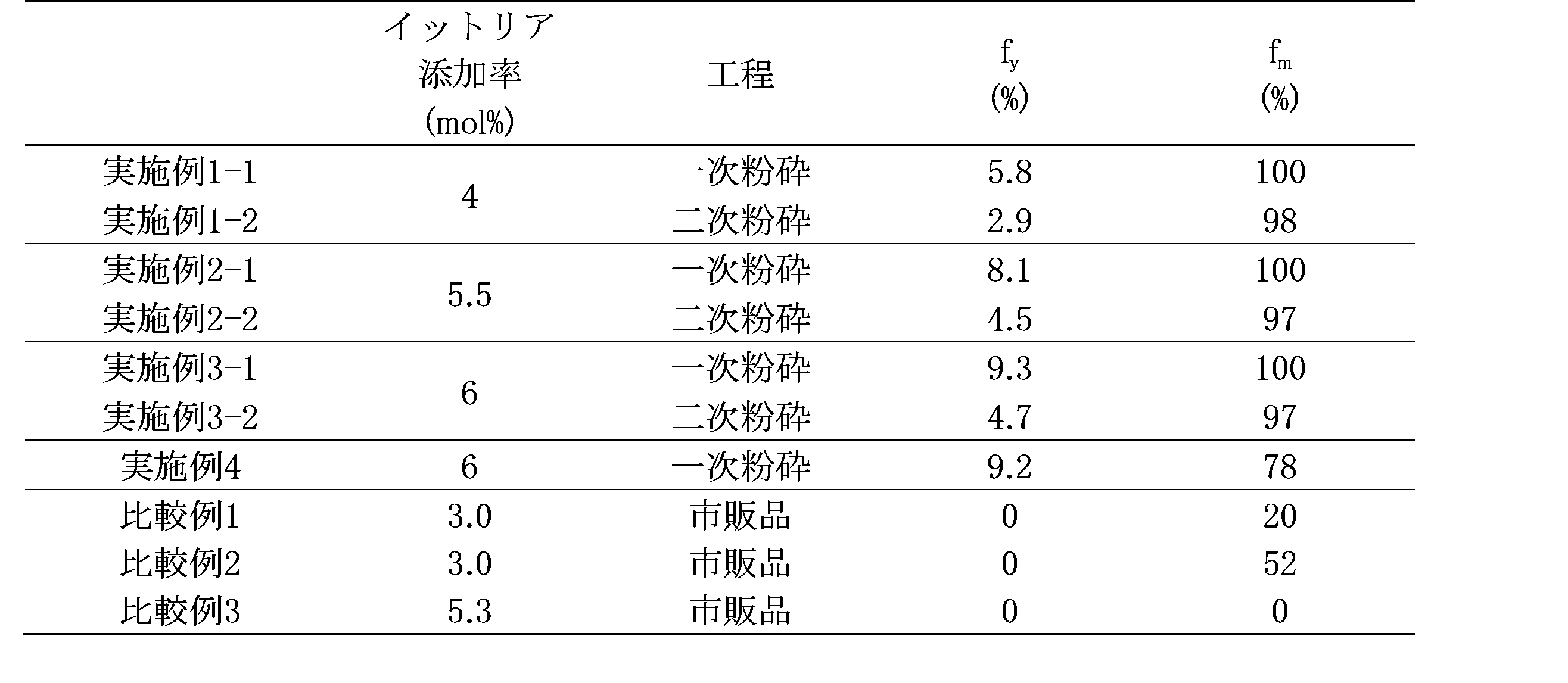
[仮焼体の作製、収縮率の測定、及びXRDパターンの測定]
実施例1-2、3-2及び4並びに比較例2の各組成物を用いて仮焼体ブロックを作製し、各仮焼体の寸法変化のばらつきを測定した。まず、各組成物を300kg/cm2の圧力でプレス成形した。次に、プレス成形体に対して1700kg/cm2でさらにCIP処理を施して、上述にいう第1の成形体を作製した。第1の成形体を焼成して仮焼体を作製した。第1の成形体の焼成は、1000℃、1050℃、及び1100℃の3つの設定温度でそれぞれ行った。各焼成においては、同一寸法を有する第1の成形体を9つ作製し、電気炉内を上下3段に分け、各段に第1の成形体を3つずつ配置した。作製した各仮焼体について円板の直径を測定した。1回の焼成で作製した9つの仮焼体のうち、最も直径の大きい仮焼体と最も直径の小さい仮焼体の測定直径(最大直径及び最小直径)、及び最大直径と最小直径の差を表2~4に示す。また、9つの仮焼体のうちで、目標直径±0.15mmにあるものを合格と判定した。目標直径は、組成物及び焼成温度に応じて各実施例及び比較例毎に個別に設定した。例えば、実施例5-2においては目標直径を98.20mmに設定した。実施例5~7及び比較例4における合格品の数(合格率)も表2~4に示す。
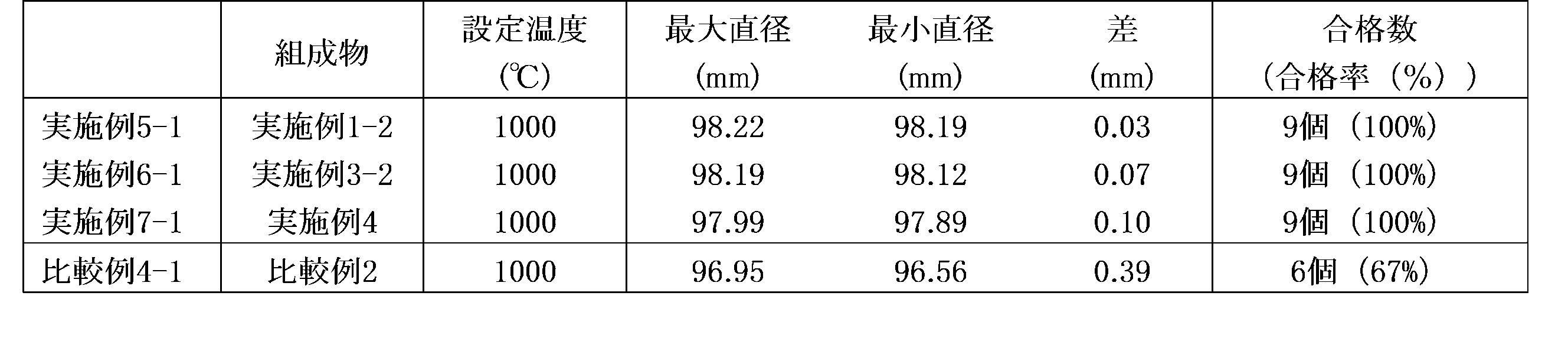
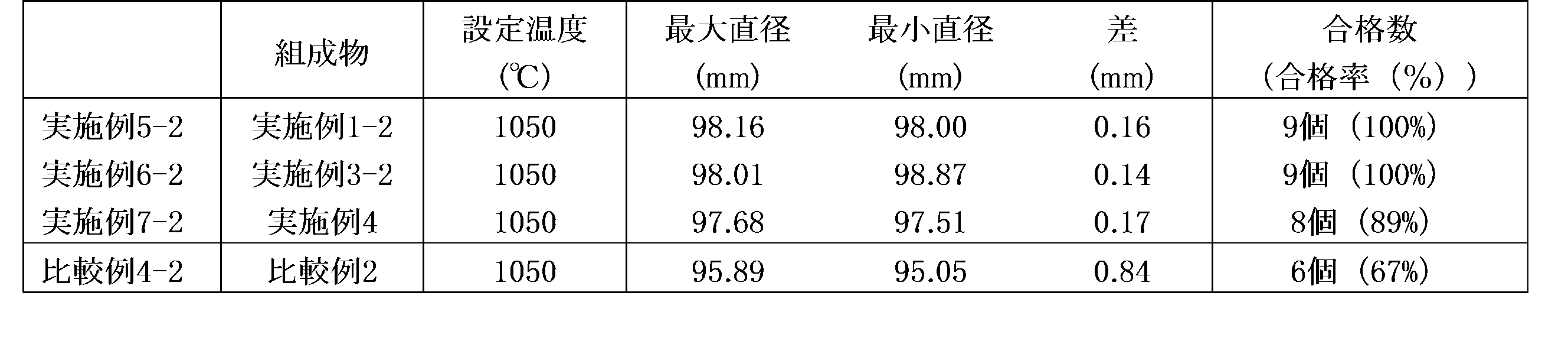
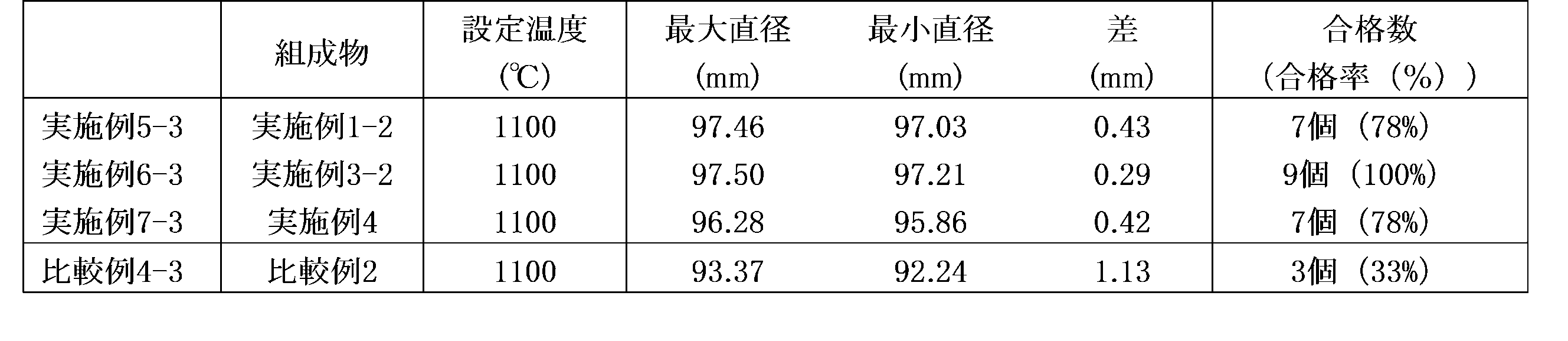
[焼成温度に対する収縮率変化の測定]
焼成温度が異なる条件で仮焼体を作製し、各仮焼体における収縮率を測定した。実施例8においては、実施例1-1の組成物をそのまま原料として用いた。実施例9においては、実施例1-1の組成物に、イットリアの総含有率が6mol%となるように、イットリアを添加して混合したものを原料として用いた。すなわち、実施例1-1の組成物における未固溶のイットリアを増加させた。実施例10においては、実施例3-1の組成物をそのまま原料として用いた。実施例11においては、実施例3-1の組成物に、イットリアの含有率が4mol%となるように、イットリアを含有しないジルコニアを添加して混合したものを原料として用いた。比較例5においては、比較例1の組成物をそのまま原料として用いた。比較例6においては、比較例2の組成物をそのまま原料として用いた。比較例7においては、比較例1の組成物に、イットリアの総含有率が6mol%となるように、イットリアを添加して混合し、一次粉砕工程を施したものを原料として用いた。比較例8においては、比較例1の組成物に、イットリアの総含有率が6mol%となるように、イットリアを添加し、上述の混合工程から二次粉砕工程まで行った粉末を原料として用いた。
収縮率(%)={(第1の成形体の直径)-(仮焼体の直径)}/(第1の成形体の直径)×100
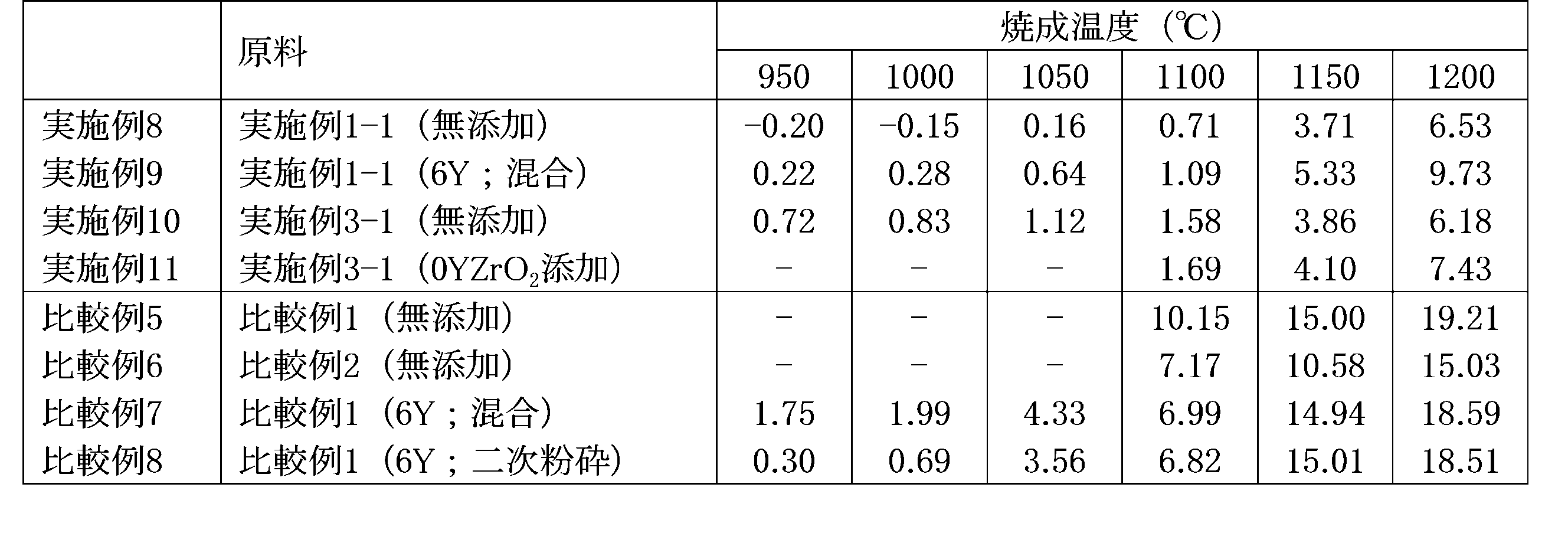
[焼成時間に対する透光性の測定]
本開示の組成物(仮焼体)を用いて焼結体を作製し、最高温度における保持時間と透光性との関係を調べた。実施例12においては実施例3-2の組成物を用いた。まず、厚さ1.2mmの焼結体が得られるように成形体を作製し、成形体を1000℃で2時間焼成して仮焼体を作製した。次に、最高温度を1550℃に設定して、120分間試料(仮焼体)を焼成して焼結体を作製した。そして、その焼結体の透光性を測定した。次に、同じ方法で作製した試料について、最高焼成温度1450℃、1500℃、1550℃及び1600℃で最高温度での保持時間を30分として焼結体を作製し、各焼結体について透光性を測定した。昇温速度も降温速度も30分焼成と120分焼成で同じである。最高温度で120分間焼成した焼結体の透光性に対する、最高温度で30分間焼成した焼結体の透光性の変化を変化率として算出した。比較例として、比較例3の組成物を用いて同じ試験を実施した。表6に、結果を示す。表6に示す変化率を基に作成したグラフを図5に示す。

[未固溶イットリア及び粒径による影響について]
比較例1の組成物に未固溶のイットリアが存在すると共に、粒径を小さくした場合の挙動について試験した。実施例13及び14の組成物は、実施例3-1及び3-2と同じである。比較例10の組成物は、比較例1と同じであるが、顆粒を解砕する程度に一次粉砕工程を行った。比較例11の組成物は、比較例1の組成物に、イットリアの含有率が6mol%となるようにイットリアを添加したのち、実施例3と組成物と同程度の粒径になるまで、上述の一次粉砕工程を行ったものである。比較例12の組成物は、比較例11の組成物に、さらに、上述の焼成工程及び二次粉砕工程を行ったものである。表7及び表8に、結果を示す。BET比表面積はJISZ8830(2013)に準拠して測定した。平均粒径は、顆粒にする前の状態の粉末について、レーザー回折/散乱式粒度分布測定方法を用いて測定した。「1100℃収縮率」及び「1150℃収縮率」は、上述の実施例8~11と同様にして測定した。「透光性可否」は、実施例12と同様にして、最高焼成温度1550℃で30分間保持して仮焼体から焼結体を作製し、その焼結体の透光性が高いか否かを目視で判定した。A判定は、最高温度保持時間2時間の焼結体と同等の透光性を有していることを示し、B判定は、最高温度保持時間2時間の焼結体よりも低い透光性を有していることを示す。


[粒径及びBET比表面積による影響について]
平均粒径が異なる組成物を作製し、各組成物について上述の各試験を行った。組成物のイットリア含有率は6mol%とした。実施例15~21及び比較例15~16の組成物は加水分解法により作製した。比較例13の組成物は水熱合成法により作製した。比較例14の組成物はプラズマ溶融法により作製した。実施例15~21及び比較例15~16の組成物の平均粒径はレーザー回折/散乱式粒度分布測定方法を用いて測定した。比較例13及び14の組成物の平均粒径は、各粒子が真球であると仮定してBET比表面積から算出した。実施例15~21及び比較例13~16の組成物のBET比表面積はJISZ8830(2013)に準拠して測定した。表8に結果を示す。「焼結可否」とは、1550℃の焼成で焼結可能か否かを試験した結果である。A判定は焼結可能であることを示し、B判定は、生成物が白濁していることを示し、C判定は、焼結できなかったことを示す。「収縮試験合格率」は、実施例5~7で示した合格率と同じであり、1100℃で仮焼体を作製したときの合格率である。「透光性変化率」は、実施例12で示した変化率を同じであり、最高焼成温度1550℃で焼結体を作製したときの変化率である。
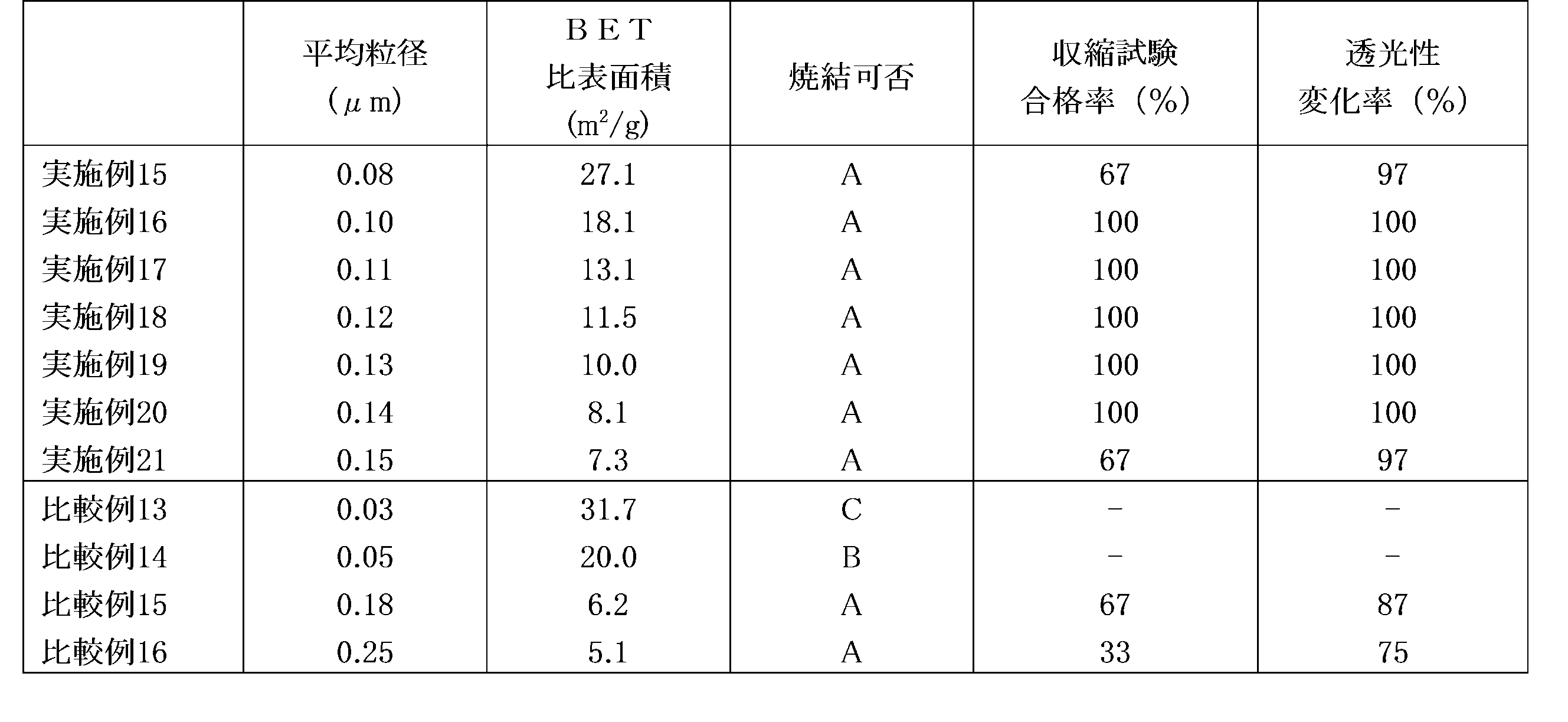
[電子顕微鏡による観察]
実施例3-2及び比較例1の顆粒について電界放出形走査型電子顕微鏡(FE-SEM)を用いて、その形状を観察した。また、顆粒を構成する粒子の形状についても観察した。図6に、実施例3-2の顆粒の電子顕微鏡写真を示す。図7に、実施例3-2の構成粒子の電子顕微鏡写真を示す。図8に、比較例1の顆粒の電子顕微鏡写真を示す。図9に、比較例1の構成粒子の電子顕微鏡写真を示す。
[仮焼体の曲げ強度の測定]
実施例3-2の組成物を1100℃で焼成して仮焼体を作製し、上述のJISR1601に準拠した条件で曲げ強度を測定したところ、35MPaであった。
[イットリア添加率による影響について]
実施例13においては実施例3-1の組成物を用いて試験を行ったが、実施例24~25においては、イットリア添加率が異なる実施例1-1及び2-1の組成物についても実施例13と同様の試験を行った。表10に結果を示す。各測定値の測定方法及び評価基準は実施例13と同じである。

[粒径による透光性への影響について]
実施例2-1及び実施例2-2の組成物を基礎として、一次粉砕の時間を調整して、実施例2-1及び実施例2-2とは異なる平均粒径を有する組成物を作製した。実施例26~30の組成物は、平均粒径以外は実施例2-1の組成物と同様である。実施例31~35の組成物は、平均粒径以外は実施例2-2の組成物と同様である。各実施例の組成物を1000℃で焼成して仮焼体を作製し、当該仮焼体を最高焼成温度1550℃で15分間焼成して作製した焼結体及び30分間焼成して作製した焼結体を作製し、各焼結体について実施例12と同様の方法で透光性を測定した。昇温速度は、焼成炉の最高速度150℃/分とした。冷却は、室温における放冷とした。表11に結果を示す。表11に示す測定値は、3回の測定値の平均値である。表11に示す変化率とは、実施例27~30については実施例26における透光性の測定値からの変化率であり、実施例31~35については実施例31における透光性の測定値からの変化率である。
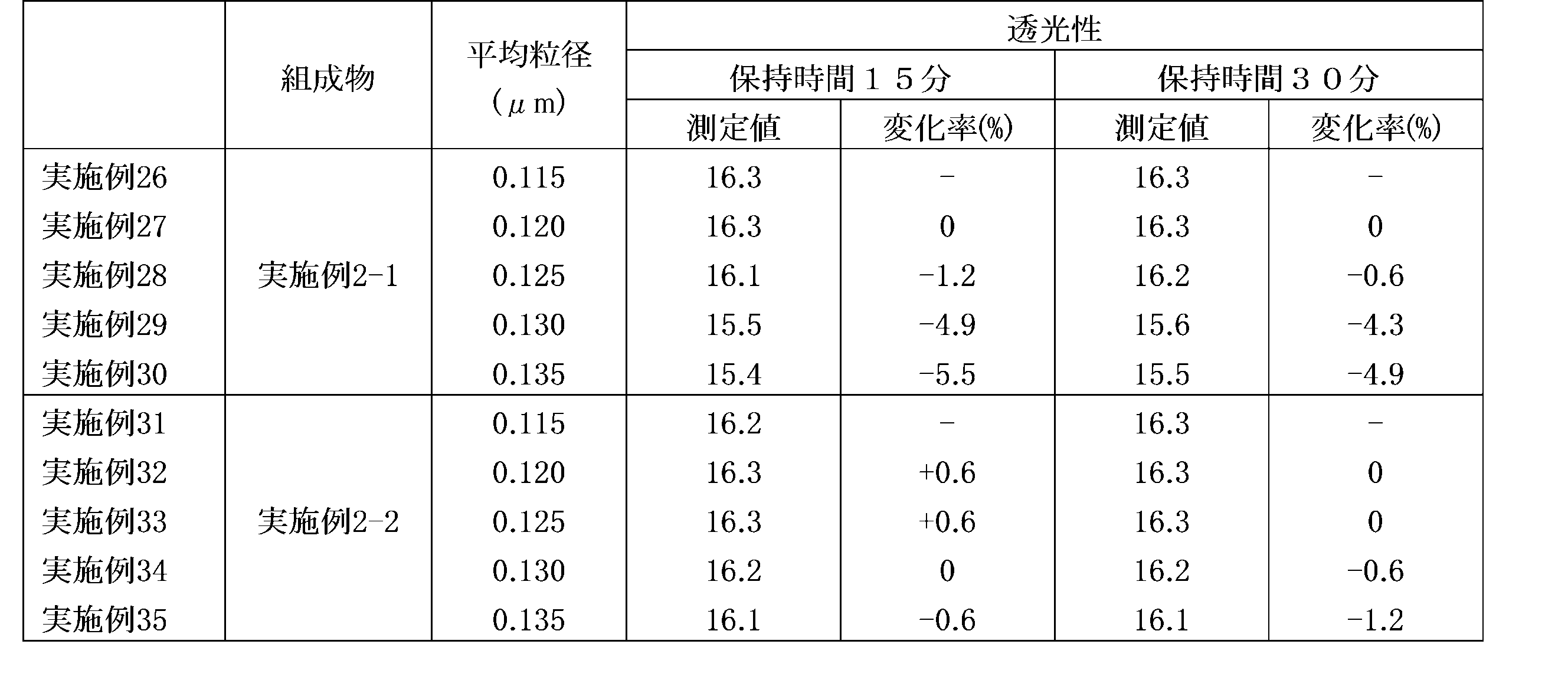
[組成物の直接焼結について]
実施例2-1及び2-2の組成物から作製した第1の成形体を、仮焼体を経由せずに、最高温度1550℃でそれぞれ30分焼成して焼結体を作製した。いずれの焼結体も仮焼体を経由して作製した焼結体と同等の透光性を有していた。これより、仮焼体を経由しなくとも、本開示の組成物から直接焼結体を作製可能であることが確認できた。
Claims (45)
- 55%以上が単斜晶であるジルコニア粉末と、
ジルコニアの相転移を抑制可能な安定化剤と、を含有し、
ジルコニア粒子及び前記安定化剤の粒子の平均粒径が0.06μm~0.17μmであり、
前記安定化剤の少なくとも一部はジルコニアに固溶されていない、組成物。 - BET比表面積が7.5m2/g~25m2/gである、請求項1に記載の組成物。
- ジルコニアの80%以上が単斜晶である、請求項1又は2に記載の組成物。
- 前記平均粒径が0.10μm~0.14μmである、請求項1~3のいずれか一項に記載の組成物。
- 前記平均粒径が0.13μm未満である、請求項1~4のいずれか一項に記載の組成物。
- 前記安定化剤はイットリアである、請求項1~5のいずれか一項に記載の組成物。
- ジルコニアとイットリアの合計molに対して、イットリアを3mol%~7.5mol%含有する、請求項6に記載の組成物。
- X線回折パターンにおいてイットリアのピークが存在する、請求項6又は7に記載の組成物。
- 以下の数1に基づいて算出したfyが1%以上である、請求項6~8のいずれか一項に記載の組成物:
ただし、Iy(111)は、CuKα線によるX線回折パターンにおけるイットリアの(111)面のピーク強度を示し、
Im(111)及びIm(11-1)は、前記X線回折パターンにおけるジルコニアの単斜晶系の(111)面及び(11-1)面のピーク強度を示し、
It(111)は、前記X線回折パターンにおけるジルコニアの正方晶系の(111)面のピーク強度を示し、
Ic(111)は、前記X線回折パターンにおけるジルコニアの立方晶系の(111)面のピーク強度を示す。

- 前記fyが15%以下である、請求項9に記載の組成物。
- 前記組成物におけるイットリアの含有率が3mol%以上4.5mol%未満であり、
前記fyが2%以上である、請求項9又は10に記載の組成物。 - 前記組成物におけるイットリアの含有率が4.5mol%以上5.8mol%未満であり、
前記fyが3%以上である、請求項9又は10に記載の組成物。 - 前記組成物におけるイットリアの含有率が5.8mol%以上7.5mol%以下であり、
前記fyが4%以上である、請求項9又は10に記載の組成物。 - 55%以上が単斜晶であるジルコニアと、
ジルコニアの相転移を抑制可能な安定化剤と、を含有し、
前記安定化剤の少なくとも一部はジルコニアに固溶されていない、仮焼体。 - 密度が2.7g/cm3~4.0g/cm3である、請求項14に記載の仮焼体。
- 曲げ強度が15MPa~70MPaである、請求項14又は15に記載の仮焼体。
- ジルコニアの80%以上が単斜晶である、請求項14~16のいずれか一項に記載の仮焼体。
- 前記安定化剤はイットリアである、請求項14~17のいずれか一項に記載の仮焼体。
- ジルコニアとイットリアの合計molに対して、イットリアを3mol%~7.5mol%含有する、請求項18に記載の仮焼体。
- X線回折パターンにおいてイットリアのピークが存在する、請求項18又は19に記載の仮焼体。
- 以下の数2に基づいて算出したfyが1%以上である、請求項18~20のいずれか一項に記載の仮焼体:
ただし、Iy(111)は、CuKα線によるX線回折パターンにおけるイットリアの(111)面のピーク強度を示し、
Im(111)及びIm(11-1)は、前記X線回折パターンにおけるジルコニアの単斜晶系の(111)面及び(11-1)面のピーク強度を示し、
It(111)は、前記X線回折パターンにおけるジルコニアの正方晶系の(111)面のピーク強度を示し、
Ic(111)は、前記X線回折パターンにおけるジルコニアの立方晶系の(111)面のピーク強度を示す。

- 前記fyが15%以下である、請求項21に記載の仮焼体。
- 前記組成物におけるイットリアの含有率が3mol%以上4.5mol%未満であり、
前記fyが2%以上である、請求項21又は22に記載の仮焼体。 - 前記組成物におけるイットリアの含有率が4.5mol%以上5.8mol%未満であり、
前記fyが3%以上である、請求項21又は22に記載の仮焼体。 - 前記組成物におけるイットリアの含有率が5.8mol%以上7.5mol%以下であり、
前記fyが4%以上である、請求項21又は22に記載の仮焼体。 - 請求項1~13のいずれか一項に記載の組成物のプレス成形体を800℃~1200℃で焼成して作製された仮焼体。
- 前記仮焼体を1550℃で30分間焼成して作製された第1の焼結体の第1の透光性と、
前記仮焼体を1550℃で120分間焼成して作製された第2の焼結体の第2の透光性と、を比較したとき、
前記第1の透光性は前記第2の透光性の85%以上である、請求項14~26のいずれか一項に記載の仮焼体。 - ジルコニア粉末が焼結に至らない程度に固結したジルコニア仮焼体であって、
ジルコニアの相転移を抑制可能な安定化剤を含有し、
前記仮焼体を1550℃で30分間焼成して作製された第1の焼結体の第1の透光性と、前記仮焼体を1550℃で120分間焼成して作製された第2の焼結体の第2の透光性と、を比較したとき、前記第1の透光性は前記第2の透光性の85%以上である、仮焼体。 - 55%以上が単斜晶であるジルコニア粉末と、ジルコニアの相転移を抑制可能な安定化剤と、を混合する混合物を作製する混合工程を含み、
前記混合物を700℃以上で焼成する工程を含まない、組成物の製造方法。 - 前記混合物における前記ジルコニア粉末の95%以上が単斜晶である、請求項29に記載の組成物の製造方法。
- 前記混合工程において、別個に準備した前記ジルコニア粉末と前記安定化剤とを混合する、請求項30に記載の組成物の製造方法。
- 平均粒径が0.06μm~0.17μmとなるように前記混合物を粉砕する粉砕工程をさらに含む、請求項29~31のいずれか一項に記載の組成物の製造方法。
- 前記粉砕工程において前記平均粒径を0.13μm未満とする、請求項32に記載の組成物の製造方法。
- 前記混合物を噴霧乾燥により顆粒状態にする乾燥工程をさらに含む、請求項29~33のいずれか一項に記載の組成物の製造方法。
- 前記混合物を700℃以上で焼成する工程を含まない、請求項29~34のいずれか一項に記載の組成物の製造方法。
- 請求項1~8及び請求項29~35のいずれか一項に記載の組成物を成形して第1の成形体を作製する第1成形工程と、
前記第1の成形体を焼結に至らない温度で焼成して仮焼体を作製する仮焼工程と、
を含むジルコニア仮焼体の製造方法。 - 前記仮焼工程において、前記第1の成形体を800℃~1200℃で焼成する、請求項36に記載のジルコニア仮焼体の製造方法。
- 前記仮焼工程前に、前記組成物を700℃以上で焼成する工程を含まない、請求項36又は37に記載のジルコニア仮焼体の製造方法。
- 請求項1~8及び請求項29~35のいずれか一項に記載の組成物を成形して第1の成形体を作製する第1成形工程と、
前記第1の成形体を焼結可能温度以上で焼成して焼結体を作製する焼結工程と、
を含む、ジルコニア焼結体の製造方法。 - 前記焼結工程前に、前記組成物を700℃以上で焼成する工程を含まない、請求項39に記載のジルコニア焼結体の製造方法。
- 前記焼結工程前に、前記第1の成形体を焼結に至らない温度で焼成して仮焼体を作製する仮焼工程をさらに含み、
前記焼結工程において前記第1の成形体として前記仮焼体を焼成する、請求項40に記載のジルコニア焼結体の製造方法。 - 請求項14~28及び36~38のいずれか一項に記載の仮焼体を焼結可能温度以上で焼成して焼結体を作製する焼結工程を含む、ジルコニア焼結体の製造方法。
- 前記焼結工程前に、前記仮焼体を成形して、第2の成形体を作製する第2成形工程をさらに含み、
前記焼結工程において、前記仮焼体として前記第2の成形体を焼成する、請求項41又は42に記載のジルコニア焼結体の製造方法。 - 前記焼結工程において、最高焼成温度での保持時間が1時間以下である、請求項39~43のいずれか一項に記載のジルコニア焼結体の製造方法。
- 前記焼結工程において前記安定化剤の元素をジルコニアに固溶させる、請求項39~44のいずれか一項に記載のジルコニア焼結体の製造方法。
Priority Applications (14)
| Application Number | Priority Date | Filing Date | Title |
|---|---|---|---|
| KR1020227037962A KR102719150B1 (ko) | 2016-09-20 | 2017-09-20 | 지르코니아 조성물, 가소체 및 소결체, 그리고 그들의 제조 방법 |
| JP2018540275A JP7198667B2 (ja) | 2016-09-20 | 2017-09-20 | ジルコニア組成物、仮焼体及び焼結体、並びにそれらの製造方法 |
| KR1020197008070A KR102462031B1 (ko) | 2016-09-20 | 2017-09-20 | 지르코니아 조성물, 가소체 및 소결체, 그리고 그들의 제조 방법 |
| CN202512008059.6A CN121537207A (zh) | 2016-09-20 | 2017-09-20 | 氧化锆组合物、预煅烧体和烧结体、以及其制造方法 |
| CN202211498036.8A CN115594499A (zh) | 2016-09-20 | 2017-09-20 | 氧化锆组合物、预煅烧体和烧结体、以及其制造方法 |
| CN201780057928.5A CN109689593A (zh) | 2016-09-20 | 2017-09-20 | 氧化锆组合物、预煅烧体和烧结体、以及其制造方法 |
| US16/334,499 US11535564B2 (en) | 2016-09-20 | 2017-09-20 | Zirconia composition, pre-sintered body and sintered body, and method of producing the same |
| EP17853100.0A EP3517518A4 (en) | 2016-09-20 | 2017-09-20 | ZIRCONIUM OXIDE COMPOSITION, CALCINED BODY AND SINTERED PRESSLING, AND METHOD FOR PRODUCING THE SAME |
| JP2022132226A JP7792315B2 (ja) | 2016-09-20 | 2022-08-23 | ジルコニア組成物及び仮焼体 |
| US17/932,439 US11873254B2 (en) | 2016-09-20 | 2022-09-15 | Zirconia composition, pre-sintered body and sintered body, and method of producing the same |
| US17/932,459 US11884595B2 (en) | 2016-09-20 | 2022-09-15 | Zirconia composition, pre-sintered body and sintered body, and method of producing the same |
| US18/498,389 US12559427B2 (en) | 2016-09-20 | 2023-10-31 | Zirconia composition, pre-sintered body and sintered body, and method of producing the same |
| US18/526,523 US20240101481A1 (en) | 2016-09-20 | 2023-12-01 | Zirconia composition, pre-sintered body and sintered body, and method of producing the same |
| JP2024069968A JP2024096200A (ja) | 2016-09-20 | 2024-04-23 | ジルコニア組成物及び仮焼体 |
Applications Claiming Priority (2)
| Application Number | Priority Date | Filing Date | Title |
|---|---|---|---|
| JP2016-183129 | 2016-09-20 | ||
| JP2016183129 | 2016-09-20 |
Related Child Applications (3)
| Application Number | Title | Priority Date | Filing Date |
|---|---|---|---|
| US16/334,499 A-371-Of-International US11535564B2 (en) | 2016-09-20 | 2017-09-20 | Zirconia composition, pre-sintered body and sintered body, and method of producing the same |
| US17/932,439 Division US11873254B2 (en) | 2016-09-20 | 2022-09-15 | Zirconia composition, pre-sintered body and sintered body, and method of producing the same |
| US17/932,459 Division US11884595B2 (en) | 2016-09-20 | 2022-09-15 | Zirconia composition, pre-sintered body and sintered body, and method of producing the same |
Publications (1)
| Publication Number | Publication Date |
|---|---|
| WO2018056330A1 true WO2018056330A1 (ja) | 2018-03-29 |
Family
ID=61690511
Family Applications (1)
| Application Number | Title | Priority Date | Filing Date |
|---|---|---|---|
| PCT/JP2017/033980 Ceased WO2018056330A1 (ja) | 2016-09-20 | 2017-09-20 | ジルコニア組成物、仮焼体及び焼結体、並びにそれらの製造方法 |
Country Status (6)
| Country | Link |
|---|---|
| US (5) | US11535564B2 (ja) |
| EP (1) | EP3517518A4 (ja) |
| JP (3) | JP7198667B2 (ja) |
| KR (2) | KR102462031B1 (ja) |
| CN (3) | CN115594499A (ja) |
| WO (1) | WO2018056330A1 (ja) |
Cited By (24)
| Publication number | Priority date | Publication date | Assignee | Title |
|---|---|---|---|---|
| CN110269705A (zh) * | 2019-05-06 | 2019-09-24 | 上海海信牙科技术发展有限公司 | 一种义齿制造方法 |
| JP2019181210A (ja) * | 2018-04-13 | 2019-10-24 | クラレノリタケデンタル株式会社 | ジルコニア強化剤、強化方法及び歯冠修復物 |
| KR20200022348A (ko) | 2018-08-22 | 2020-03-03 | 소후 인코포레이티드 | 치과 절삭 가공용 지르코니아 피절삭체 및 그 제조 방법 |
| WO2020138316A1 (ja) | 2018-12-27 | 2020-07-02 | クラレノリタケデンタル株式会社 | 歯科用に好適なジルコニア仮焼体 |
| JP2020105050A (ja) * | 2018-12-27 | 2020-07-09 | クラレノリタケデンタル株式会社 | 歯科用に好適な水和ジルコニア粒子とイットリウム成分とを含む混合物及びその製造方法 |
| KR20200090640A (ko) | 2019-01-21 | 2020-07-29 | 소후 인코포레이티드 | 고속 소결 대응 고투과 지르코니아 블랭크 |
| WO2020179877A1 (ja) | 2019-03-06 | 2020-09-10 | クラレノリタケデンタル株式会社 | 短時間で焼成可能なジルコニア成形体および仮焼体 |
| JPWO2020218541A1 (ja) * | 2019-04-25 | 2020-10-29 | ||
| WO2021020582A1 (ja) * | 2019-08-01 | 2021-02-04 | クラレノリタケデンタル株式会社 | ジルコニア焼結体の製造方法 |
| WO2021070502A1 (ja) * | 2019-10-08 | 2021-04-15 | 株式会社アライドマテリアル | 高延性モリブデン合金材 |
| WO2021075564A1 (ja) * | 2019-10-17 | 2021-04-22 | クラレノリタケデンタル株式会社 | 歯科用に好適なジルコニア成形体 |
| WO2021100876A1 (ja) * | 2019-11-22 | 2021-05-27 | クラレノリタケデンタル株式会社 | ジルコニア組成物、ジルコニア仮焼体及びジルコニア焼結体、並びにそれらの製造方法 |
| WO2021132644A1 (ja) * | 2019-12-26 | 2021-07-01 | クラレノリタケデンタル株式会社 | 加工性ジルコニア複合焼結体の製造方法、加工性ジルコニア複合焼結体の原料組成物及び加工性ジルコニア複合仮焼体 |
| WO2022004862A1 (ja) | 2020-07-01 | 2022-01-06 | クラレノリタケデンタル株式会社 | 歯科用に好適なジルコニア仮焼体 |
| WO2022071348A1 (ja) | 2020-09-29 | 2022-04-07 | クラレノリタケデンタル株式会社 | 良切削性のジルコニア仮焼体 |
| WO2022138881A1 (ja) * | 2020-12-24 | 2022-06-30 | クラレノリタケデンタル株式会社 | ジルコニア仮焼体 |
| WO2023042893A1 (ja) | 2021-09-16 | 2023-03-23 | 東ソー株式会社 | 粉末組成物、仮焼体、焼結体及びその製造方法 |
| JP2023051409A (ja) * | 2021-09-30 | 2023-04-11 | クラレノリタケデンタル株式会社 | ジルコニア仮焼体の焼成による変形の評価方法 |
| JPWO2023120674A1 (ja) * | 2021-12-22 | 2023-06-29 | ||
| JPWO2023127793A1 (ja) * | 2021-12-27 | 2023-07-06 | ||
| JPWO2023127792A1 (ja) * | 2021-12-27 | 2023-07-06 | ||
| WO2024096102A1 (ja) | 2022-11-02 | 2024-05-10 | クラレノリタケデンタル株式会社 | ジルコニア仮焼体及び組成物並びにこれらの製造方法 |
| WO2025063304A1 (ja) | 2023-09-22 | 2025-03-27 | クラレノリタケデンタル株式会社 | ジルコニア仮焼体及びその製造方法 |
| US12391621B2 (en) | 2019-04-25 | 2025-08-19 | Tosoh Corporation | Sintered body, powder and method for producing the same |
Families Citing this family (5)
| Publication number | Priority date | Publication date | Assignee | Title |
|---|---|---|---|---|
| JP7198667B2 (ja) * | 2016-09-20 | 2023-01-04 | クラレノリタケデンタル株式会社 | ジルコニア組成物、仮焼体及び焼結体、並びにそれらの製造方法 |
| CN116234519A (zh) * | 2020-09-25 | 2023-06-06 | 可乐丽则武齿科株式会社 | 齿科用被加工体 |
| WO2022075346A1 (ja) * | 2020-10-09 | 2022-04-14 | 第一稀元素化学工業株式会社 | ジルコニア粉末、ジルコニア焼結体、及び、ジルコニア焼結体の製造方法 |
| US12239500B2 (en) | 2023-02-15 | 2025-03-04 | Ivoclar Vivadent Ag | Pre-sintered multi-layered dental mill blank, process for preparing the same, and uses thereof, and a sintering process |
| CN116854466B (zh) * | 2023-06-28 | 2024-03-15 | 成都三环科技有限公司 | 一种陶瓷插芯及其制备方法和应用 |
Citations (7)
| Publication number | Priority date | Publication date | Assignee | Title |
|---|---|---|---|---|
| JPH0288423A (ja) * | 1988-08-10 | 1990-03-28 | W R Grace & Co | 安定化ジルコニア |
| JP2010500957A (ja) * | 2006-08-17 | 2010-01-14 | ハー.ツェー.スタルク ゲゼルシャフト ミット ベシュレンクテル ハフツング | 酸化ジルコニウム及びその製造方法 |
| JP2010209472A (ja) * | 2003-10-09 | 2010-09-24 | Snecma | 電子ビームを受けて蒸発するターゲット、その製造方法、ターゲットから得られる遮熱材およびコーティング、ならびにこのコーティングを含む機械部品 |
| JP2013100222A (ja) * | 2012-12-25 | 2013-05-23 | Sumitomo Osaka Cement Co Ltd | ジルコニア複合微粒子の製造方法 |
| JP2013230981A (ja) * | 2008-03-24 | 2013-11-14 | Kyocera Corp | 装飾部品用セラミックス |
| JP2014218418A (ja) * | 2013-05-10 | 2014-11-20 | クラレノリタケデンタル株式会社 | ジルコニア焼結体、ジルコニア組成物及びジルコニア仮焼体、並びに歯科用補綴物 |
| WO2016104724A1 (ja) * | 2014-12-26 | 2016-06-30 | クラレノリタケデンタル株式会社 | ジルコニア組成物、ジルコニア仮焼体及びジルコニア焼結体、並びに歯科用製品 |
Family Cites Families (13)
| Publication number | Priority date | Publication date | Assignee | Title |
|---|---|---|---|---|
| JP2000327417A (ja) | 1999-05-25 | 2000-11-28 | Tosoh Corp | 蒸着材 |
| JP2002088423A (ja) * | 2000-09-14 | 2002-03-27 | Nippon Denko Kk | 高純度ニッケルボロン及びその製造方法 |
| JP4470378B2 (ja) | 2003-02-28 | 2010-06-02 | 住友化学株式会社 | ジルコニア焼結体およびその製造方法 |
| EP2674408B1 (en) * | 2008-04-09 | 2017-06-07 | Tosoh Corporation | Translucent zirconia sintered body and use of the same |
| KR101056540B1 (ko) * | 2009-08-18 | 2011-08-11 | 주식회사 쿠보텍 | 치과용 지르코니아 예비소결체의 제조방법 및 지르코니아 예비소결체 그리고 이를 이용한 지르코니아 세라믹의 제조방법 |
| EP2692311B1 (en) | 2012-08-03 | 2016-06-22 | 3M Innovative Properties Company | Dental blank comprising a pre-sintered porous zirconia material , process of its production and dental article formed from said dental blank |
| US9427381B2 (en) * | 2012-09-28 | 2016-08-30 | Kuraray Noritake Dental Inc. | Dental curable composition, and method for producing same |
| CN105026337B (zh) * | 2013-03-11 | 2019-04-05 | 可乐丽则武齿科株式会社 | 氧化锆烧结体、以及氧化锆的组合物和预烧体 |
| JP6340879B2 (ja) * | 2013-04-10 | 2018-06-13 | 東ソー株式会社 | ジルコニア焼結体及びその製造方法 |
| CN105164084B (zh) * | 2013-05-10 | 2017-05-03 | 可乐丽则武齿科株式会社 | 氧化锆烧结体、氧化锆组合物和氧化锆煅烧体、以及牙科用修复物 |
| US10231807B2 (en) * | 2013-05-10 | 2019-03-19 | Kuraray Noritake Dental Inc. | Zirconia sintered body, zirconia composition, zirconia pre-sintered body and preparing method thereof, and dental prosthesis |
| CN105829264B (zh) | 2013-12-24 | 2021-04-23 | 东曹株式会社 | 透光性氧化锆烧结体和氧化锆粉末、及其用途 |
| JP7198667B2 (ja) * | 2016-09-20 | 2023-01-04 | クラレノリタケデンタル株式会社 | ジルコニア組成物、仮焼体及び焼結体、並びにそれらの製造方法 |
-
2017
- 2017-09-20 JP JP2018540275A patent/JP7198667B2/ja active Active
- 2017-09-20 WO PCT/JP2017/033980 patent/WO2018056330A1/ja not_active Ceased
- 2017-09-20 CN CN202211498036.8A patent/CN115594499A/zh active Pending
- 2017-09-20 KR KR1020197008070A patent/KR102462031B1/ko active Active
- 2017-09-20 US US16/334,499 patent/US11535564B2/en active Active
- 2017-09-20 CN CN201780057928.5A patent/CN109689593A/zh active Pending
- 2017-09-20 EP EP17853100.0A patent/EP3517518A4/en active Pending
- 2017-09-20 CN CN202512008059.6A patent/CN121537207A/zh active Pending
- 2017-09-20 KR KR1020227037962A patent/KR102719150B1/ko active Active
-
2022
- 2022-08-23 JP JP2022132226A patent/JP7792315B2/ja active Active
- 2022-09-15 US US17/932,439 patent/US11873254B2/en active Active
- 2022-09-15 US US17/932,459 patent/US11884595B2/en active Active
-
2023
- 2023-10-31 US US18/498,389 patent/US12559427B2/en active Active
- 2023-12-01 US US18/526,523 patent/US20240101481A1/en active Pending
-
2024
- 2024-04-23 JP JP2024069968A patent/JP2024096200A/ja not_active Withdrawn
Patent Citations (7)
| Publication number | Priority date | Publication date | Assignee | Title |
|---|---|---|---|---|
| JPH0288423A (ja) * | 1988-08-10 | 1990-03-28 | W R Grace & Co | 安定化ジルコニア |
| JP2010209472A (ja) * | 2003-10-09 | 2010-09-24 | Snecma | 電子ビームを受けて蒸発するターゲット、その製造方法、ターゲットから得られる遮熱材およびコーティング、ならびにこのコーティングを含む機械部品 |
| JP2010500957A (ja) * | 2006-08-17 | 2010-01-14 | ハー.ツェー.スタルク ゲゼルシャフト ミット ベシュレンクテル ハフツング | 酸化ジルコニウム及びその製造方法 |
| JP2013230981A (ja) * | 2008-03-24 | 2013-11-14 | Kyocera Corp | 装飾部品用セラミックス |
| JP2013100222A (ja) * | 2012-12-25 | 2013-05-23 | Sumitomo Osaka Cement Co Ltd | ジルコニア複合微粒子の製造方法 |
| JP2014218418A (ja) * | 2013-05-10 | 2014-11-20 | クラレノリタケデンタル株式会社 | ジルコニア焼結体、ジルコニア組成物及びジルコニア仮焼体、並びに歯科用補綴物 |
| WO2016104724A1 (ja) * | 2014-12-26 | 2016-06-30 | クラレノリタケデンタル株式会社 | ジルコニア組成物、ジルコニア仮焼体及びジルコニア焼結体、並びに歯科用製品 |
Cited By (74)
| Publication number | Priority date | Publication date | Assignee | Title |
|---|---|---|---|---|
| JP7316827B2 (ja) | 2018-04-13 | 2023-07-28 | クラレノリタケデンタル株式会社 | ジルコニア強化剤、強化方法及び歯冠修復物 |
| JP2019181210A (ja) * | 2018-04-13 | 2019-10-24 | クラレノリタケデンタル株式会社 | ジルコニア強化剤、強化方法及び歯冠修復物 |
| KR20200022348A (ko) | 2018-08-22 | 2020-03-03 | 소후 인코포레이티드 | 치과 절삭 가공용 지르코니아 피절삭체 및 그 제조 방법 |
| EP3636621A2 (en) | 2018-08-22 | 2020-04-15 | Shofu Inc. | Zirconia mill blank for dental cutting and machining and preparing method thereof |
| EP4473939A2 (en) | 2018-08-22 | 2024-12-11 | Shofu Inc. | Zirconia mill blank for dental cutting and machining and preparing method thereof |
| KR20240116433A (ko) | 2018-08-22 | 2024-07-29 | 소후 인코포레이티드 | 치과 절삭 가공용 지르코니아 피절삭체 및 그 제조 방법 |
| US11986362B2 (en) | 2018-08-22 | 2024-05-21 | Shofu Inc. | Zirconia mill blank for dental cutting and machining and preparing method thereof |
| WO2020138316A1 (ja) | 2018-12-27 | 2020-07-02 | クラレノリタケデンタル株式会社 | 歯科用に好適なジルコニア仮焼体 |
| JP7213268B2 (ja) | 2018-12-27 | 2023-01-26 | クラレノリタケデンタル株式会社 | 歯科用に好適なジルコニア仮焼体 |
| KR102591180B1 (ko) * | 2018-12-27 | 2023-10-19 | 쿠라레 노리타케 덴탈 가부시키가이샤 | 치과용으로 바람직한 지르코니아 가소체 |
| US12583794B2 (en) | 2018-12-27 | 2026-03-24 | Kuraray Noritake Dental Inc. | Zirconia pre-sintered body suitable for dental use |
| JPWO2020138316A1 (ja) * | 2018-12-27 | 2021-10-14 | クラレノリタケデンタル株式会社 | 歯科用に好適なジルコニア仮焼体 |
| JP2020105050A (ja) * | 2018-12-27 | 2020-07-09 | クラレノリタケデンタル株式会社 | 歯科用に好適な水和ジルコニア粒子とイットリウム成分とを含む混合物及びその製造方法 |
| KR20210099119A (ko) | 2018-12-27 | 2021-08-11 | 쿠라레 노리타케 덴탈 가부시키가이샤 | 치과용으로 바람직한 지르코니아 가소체 |
| JP7138558B2 (ja) | 2018-12-27 | 2022-09-16 | クラレノリタケデンタル株式会社 | 歯科用に好適な水和ジルコニア粒子とイットリウム成分とを含む混合物及びその製造方法 |
| EP3712121A1 (en) | 2019-01-21 | 2020-09-23 | Shofu Inc. | High permeable zirconia blank capable of sintering at high speed |
| KR20200090640A (ko) | 2019-01-21 | 2020-07-29 | 소후 인코포레이티드 | 고속 소결 대응 고투과 지르코니아 블랭크 |
| US12145888B2 (en) | 2019-03-06 | 2024-11-19 | Kuraray Noritake Dental Inc. | Zirconia molded body and pre-sintered body capable of being sintered in short time |
| JP7336507B2 (ja) | 2019-03-06 | 2023-08-31 | クラレノリタケデンタル株式会社 | 短時間で焼成可能なジルコニア成形体および仮焼体 |
| WO2020179877A1 (ja) | 2019-03-06 | 2020-09-10 | クラレノリタケデンタル株式会社 | 短時間で焼成可能なジルコニア成形体および仮焼体 |
| CN113490468A (zh) * | 2019-03-06 | 2021-10-08 | 可乐丽则武齿科株式会社 | 能够在短时间内进行烧成的氧化锆成形体和预烧体 |
| CN113490468B (zh) * | 2019-03-06 | 2023-09-05 | 可乐丽则武齿科株式会社 | 能够在短时间内进行烧成的氧化锆成形体和预烧体 |
| KR20210133275A (ko) | 2019-03-06 | 2021-11-05 | 쿠라레 노리타케 덴탈 가부시키가이샤 | 단시간에 소성 가능한 지르코니아 성형체 및 가소체 |
| JPWO2020179877A1 (ja) * | 2019-03-06 | 2021-12-23 | クラレノリタケデンタル株式会社 | 短時間で焼成可能なジルコニア成形体および仮焼体 |
| CN113710627A (zh) * | 2019-04-25 | 2021-11-26 | 可乐丽则武齿科株式会社 | 适合于齿科用途的氧化锆预烧体及其制造方法 |
| KR20220002353A (ko) * | 2019-04-25 | 2022-01-06 | 쿠라레 노리타케 덴탈 가부시키가이샤 | 치과용으로 바람직한 지르코니아 가소체 및 그 제조 방법 |
| KR102929967B1 (ko) * | 2019-04-25 | 2026-02-24 | 도소 가부시키가이샤 | 소결체, 분말 및 그의 제조 방법 |
| WO2020218541A1 (ja) * | 2019-04-25 | 2020-10-29 | クラレノリタケデンタル株式会社 | 歯科用に好適なジルコニア仮焼体及びその製造方法 |
| KR102865560B1 (ko) * | 2019-04-25 | 2025-09-26 | 쿠라레 노리타케 덴탈 가부시키가이샤 | 치과용으로 바람직한 지르코니아 가소체 및 그 제조 방법 |
| JP7558932B2 (ja) | 2019-04-25 | 2024-10-01 | クラレノリタケデンタル株式会社 | 歯科用に好適なジルコニア仮焼体及びその製造方法 |
| JPWO2020218541A1 (ja) * | 2019-04-25 | 2020-10-29 | ||
| US12391621B2 (en) | 2019-04-25 | 2025-08-19 | Tosoh Corporation | Sintered body, powder and method for producing the same |
| EP3960720A4 (en) * | 2019-04-25 | 2023-01-25 | Kuraray Noritake Dental Inc. | FIRED ZIRCONIA BODY SUITABLE FOR DENTAL USE AND METHOD OF MAKING SUCH BODY |
| CN110269705A (zh) * | 2019-05-06 | 2019-09-24 | 上海海信牙科技术发展有限公司 | 一种义齿制造方法 |
| JP7491956B2 (ja) | 2019-08-01 | 2024-05-28 | クラレノリタケデンタル株式会社 | ジルコニア焼結体の製造方法 |
| KR20220042345A (ko) * | 2019-08-01 | 2022-04-05 | 쿠라레 노리타케 덴탈 가부시키가이샤 | 지르코니아 소결체의 제조 방법 |
| JPWO2021020582A1 (ja) * | 2019-08-01 | 2021-12-02 | クラレノリタケデンタル株式会社 | ジルコニア焼結体の製造方法 |
| JP7005819B2 (ja) | 2019-08-01 | 2022-01-24 | クラレノリタケデンタル株式会社 | ジルコニア焼結体の製造方法 |
| JP2022059605A (ja) * | 2019-08-01 | 2022-04-13 | クラレノリタケデンタル株式会社 | ジルコニア焼結体の製造方法 |
| JP2024105614A (ja) * | 2019-08-01 | 2024-08-06 | クラレノリタケデンタル株式会社 | ジルコニア焼結体の製造方法 |
| KR102923969B1 (ko) | 2019-08-01 | 2026-02-06 | 쿠라레 노리타케 덴탈 가부시키가이샤 | 지르코니아 소결체의 제조 방법 |
| WO2021020582A1 (ja) * | 2019-08-01 | 2021-02-04 | クラレノリタケデンタル株式会社 | ジルコニア焼結体の製造方法 |
| WO2021070502A1 (ja) * | 2019-10-08 | 2021-04-15 | 株式会社アライドマテリアル | 高延性モリブデン合金材 |
| JP7566764B2 (ja) | 2019-10-17 | 2024-10-15 | クラレノリタケデンタル株式会社 | 歯科用に好適なジルコニア成形体 |
| WO2021075564A1 (ja) * | 2019-10-17 | 2021-04-22 | クラレノリタケデンタル株式会社 | 歯科用に好適なジルコニア成形体 |
| JPWO2021075564A1 (ja) * | 2019-10-17 | 2021-04-22 | ||
| CN114514211A (zh) * | 2019-10-17 | 2022-05-17 | 可乐丽则武齿科株式会社 | 适合于牙科用途的氧化锆成形体 |
| WO2021100876A1 (ja) * | 2019-11-22 | 2021-05-27 | クラレノリタケデンタル株式会社 | ジルコニア組成物、ジルコニア仮焼体及びジルコニア焼結体、並びにそれらの製造方法 |
| JP6920573B1 (ja) * | 2019-11-22 | 2021-08-18 | クラレノリタケデンタル株式会社 | ジルコニア組成物、ジルコニア仮焼体及びジルコニア焼結体、並びにそれらの製造方法 |
| JP6912689B1 (ja) * | 2019-12-26 | 2021-08-04 | クラレノリタケデンタル株式会社 | 加工性ジルコニア複合焼結体の製造方法、加工性ジルコニア複合焼結体の原料組成物及び加工性ジルコニア複合仮焼体 |
| WO2021132644A1 (ja) * | 2019-12-26 | 2021-07-01 | クラレノリタケデンタル株式会社 | 加工性ジルコニア複合焼結体の製造方法、加工性ジルコニア複合焼結体の原料組成物及び加工性ジルコニア複合仮焼体 |
| KR102935873B1 (ko) | 2019-12-26 | 2026-03-05 | 쿠라레 노리타케 덴탈 가부시키가이샤 | 가공성 지르코니아 복합 소결체의 제조 방법, 가공성 지르코니아 복합 소결체의 원료 조성물 및 가공성 지르코니아 복합 가소체 |
| WO2022004862A1 (ja) | 2020-07-01 | 2022-01-06 | クラレノリタケデンタル株式会社 | 歯科用に好適なジルコニア仮焼体 |
| JP7001310B1 (ja) * | 2020-07-01 | 2022-01-19 | クラレノリタケデンタル株式会社 | 歯科用に好適なジルコニア仮焼体 |
| KR20230031823A (ko) | 2020-07-01 | 2023-03-07 | 쿠라레 노리타케 덴탈 가부시키가이샤 | 치과용으로 바람직한 지르코니아 가소체 |
| US12590036B2 (en) | 2020-07-01 | 2026-03-31 | Kuraray Noritake Dental Inc. | Zirconia pre-sintered body suitable for dental use |
| WO2022071348A1 (ja) | 2020-09-29 | 2022-04-07 | クラレノリタケデンタル株式会社 | 良切削性のジルコニア仮焼体 |
| JPWO2022138881A1 (ja) * | 2020-12-24 | 2022-06-30 | ||
| WO2022138881A1 (ja) * | 2020-12-24 | 2022-06-30 | クラレノリタケデンタル株式会社 | ジルコニア仮焼体 |
| CN116635332A (zh) * | 2020-12-24 | 2023-08-22 | 可乐丽则武齿科株式会社 | 氧化锆预烧体 |
| WO2023042893A1 (ja) | 2021-09-16 | 2023-03-23 | 東ソー株式会社 | 粉末組成物、仮焼体、焼結体及びその製造方法 |
| JP7658874B2 (ja) | 2021-09-30 | 2025-04-08 | クラレノリタケデンタル株式会社 | ジルコニア仮焼体の焼成による変形の評価方法 |
| JP2023051409A (ja) * | 2021-09-30 | 2023-04-11 | クラレノリタケデンタル株式会社 | ジルコニア仮焼体の焼成による変形の評価方法 |
| JP7763859B2 (ja) | 2021-12-22 | 2025-11-04 | クラレノリタケデンタル株式会社 | ジルコニア組成物、ジルコニア仮焼体及びジルコニア焼結体並びにこれらの製造方法 |
| WO2023120674A1 (ja) * | 2021-12-22 | 2023-06-29 | クラレノリタケデンタル株式会社 | ジルコニア組成物、ジルコニア仮焼体及びジルコニア焼結体並びにこれらの製造方法 |
| JPWO2023120674A1 (ja) * | 2021-12-22 | 2023-06-29 | ||
| JPWO2023127793A1 (ja) * | 2021-12-27 | 2023-07-06 | ||
| JPWO2023127792A1 (ja) * | 2021-12-27 | 2023-07-06 | ||
| JP7767462B2 (ja) | 2021-12-27 | 2025-11-11 | クラレノリタケデンタル株式会社 | ジルコニア焼結体及びその製造方法 |
| WO2023127793A1 (ja) * | 2021-12-27 | 2023-07-06 | クラレノリタケデンタル株式会社 | ジルコニア焼結体及びその製造方法 |
| WO2023127792A1 (ja) * | 2021-12-27 | 2023-07-06 | クラレノリタケデンタル株式会社 | ジルコニア焼結体及びその製造方法 |
| WO2024096102A1 (ja) | 2022-11-02 | 2024-05-10 | クラレノリタケデンタル株式会社 | ジルコニア仮焼体及び組成物並びにこれらの製造方法 |
| KR20250097859A (ko) | 2022-11-02 | 2025-06-30 | 쿠라레 노리타케 덴탈 가부시키가이샤 | 지르코니아 가소체 및 조성물 그리고 이것들의 제조 방법 |
| WO2025063304A1 (ja) | 2023-09-22 | 2025-03-27 | クラレノリタケデンタル株式会社 | ジルコニア仮焼体及びその製造方法 |
Also Published As
| Publication number | Publication date |
|---|---|
| US20230019835A1 (en) | 2023-01-19 |
| US11873254B2 (en) | 2024-01-16 |
| KR102462031B1 (ko) | 2022-11-02 |
| JP2024096200A (ja) | 2024-07-12 |
| US20240067569A1 (en) | 2024-02-29 |
| US11535564B2 (en) | 2022-12-27 |
| KR102719150B1 (ko) | 2024-10-21 |
| CN115594499A (zh) | 2023-01-13 |
| JP7198667B2 (ja) | 2023-01-04 |
| JP2022162005A (ja) | 2022-10-21 |
| US12559427B2 (en) | 2026-02-24 |
| EP3517518A4 (en) | 2020-05-13 |
| EP3517518A1 (en) | 2019-07-31 |
| KR20220150438A (ko) | 2022-11-10 |
| CN121537207A (zh) | 2026-02-17 |
| US20230028118A1 (en) | 2023-01-26 |
| KR20190047701A (ko) | 2019-05-08 |
| CN109689593A (zh) | 2019-04-26 |
| JPWO2018056330A1 (ja) | 2019-08-15 |
| US20200317581A1 (en) | 2020-10-08 |
| JP7792315B2 (ja) | 2025-12-25 |
| US11884595B2 (en) | 2024-01-30 |
| US20240101481A1 (en) | 2024-03-28 |
Similar Documents
| Publication | Publication Date | Title |
|---|---|---|
| KR102719150B1 (ko) | 지르코니아 조성물, 가소체 및 소결체, 그리고 그들의 제조 방법 | |
| KR102411223B1 (ko) | 지르코니아 조성물, 가소체 및 소결체 그리고 이들의 제조 방법, 그리고 적층체 | |
| JP6688838B2 (ja) | ジルコニア焼結体、並びにジルコニアの組成物及び仮焼体 | |
| JP6920573B1 (ja) | ジルコニア組成物、ジルコニア仮焼体及びジルコニア焼結体、並びにそれらの製造方法 | |
| WO2019131782A1 (ja) | 歯科用に好適なジルコニア仮焼体 | |
| JP7776431B2 (ja) | 良切削性のジルコニア仮焼体 | |
| KR20230122001A (ko) | 지르코니아 소결체 |
Legal Events
| Date | Code | Title | Description |
|---|---|---|---|
| 121 | Ep: the epo has been informed by wipo that ep was designated in this application |
Ref document number: 17853100 Country of ref document: EP Kind code of ref document: A1 |
|
| ENP | Entry into the national phase |
Ref document number: 2018540275 Country of ref document: JP Kind code of ref document: A |
|
| ENP | Entry into the national phase |
Ref document number: 20197008070 Country of ref document: KR Kind code of ref document: A |
|
| NENP | Non-entry into the national phase |
Ref country code: DE |
|
| ENP | Entry into the national phase |
Ref document number: 2017853100 Country of ref document: EP Effective date: 20190423 |