WO2018061708A1 - ポジ型平版印刷版原版及びその製造方法、並びに、平版印刷版の作製方法 - Google Patents
ポジ型平版印刷版原版及びその製造方法、並びに、平版印刷版の作製方法 Download PDFInfo
- Publication number
- WO2018061708A1 WO2018061708A1 PCT/JP2017/032371 JP2017032371W WO2018061708A1 WO 2018061708 A1 WO2018061708 A1 WO 2018061708A1 JP 2017032371 W JP2017032371 W JP 2017032371W WO 2018061708 A1 WO2018061708 A1 WO 2018061708A1
- Authority
- WO
- WIPO (PCT)
- Prior art keywords
- group
- polymer compound
- printing plate
- layer
- mass
- Prior art date
- Legal status (The legal status is an assumption and is not a legal conclusion. Google has not performed a legal analysis and makes no representation as to the accuracy of the status listed.)
- Ceased
Links
Classifications
-
- B—PERFORMING OPERATIONS; TRANSPORTING
- B41—PRINTING; LINING MACHINES; TYPEWRITERS; STAMPS
- B41C—PROCESSES FOR THE MANUFACTURE OR REPRODUCTION OF PRINTING SURFACES
- B41C1/00—Forme preparation
- B41C1/10—Forme preparation for lithographic printing; Master sheets for transferring a lithographic image to the forme
- B41C1/1008—Forme preparation for lithographic printing; Master sheets for transferring a lithographic image to the forme by removal or destruction of lithographic material on the lithographic support, e.g. by laser or spark ablation; by the use of materials rendered soluble or insoluble by heat exposure, e.g. by heat produced from a light to heat transforming system; by on-the-press exposure or on-the-press development, e.g. by the fountain of photolithographic materials
- B41C1/1016—Forme preparation for lithographic printing; Master sheets for transferring a lithographic image to the forme by removal or destruction of lithographic material on the lithographic support, e.g. by laser or spark ablation; by the use of materials rendered soluble or insoluble by heat exposure, e.g. by heat produced from a light to heat transforming system; by on-the-press exposure or on-the-press development, e.g. by the fountain of photolithographic materials characterised by structural details, e.g. protective layers, backcoat layers or several imaging layers
-
- G—PHYSICS
- G03—PHOTOGRAPHY; CINEMATOGRAPHY; ANALOGOUS TECHNIQUES USING WAVES OTHER THAN OPTICAL WAVES; ELECTROGRAPHY; HOLOGRAPHY
- G03F—PHOTOMECHANICAL PRODUCTION OF TEXTURED OR PATTERNED SURFACES, e.g. FOR PRINTING, FOR PROCESSING OF SEMICONDUCTOR DEVICES; MATERIALS THEREFOR; ORIGINALS THEREFOR; APPARATUS SPECIALLY ADAPTED THEREFOR
- G03F7/00—Photomechanical, e.g. photolithographic, production of textured or patterned surfaces, e.g. printing surfaces; Materials therefor, e.g. comprising photoresists; Apparatus specially adapted therefor
- G03F7/26—Processing photosensitive materials; Apparatus therefor
- G03F7/30—Imagewise removal using liquid means
- G03F7/3042—Imagewise removal using liquid means from printing plates transported horizontally through the processing stations
- G03F7/3078—Processing different kinds of plates, e.g. negative and positive plates, in the same machine
-
- G—PHYSICS
- G03—PHOTOGRAPHY; CINEMATOGRAPHY; ANALOGOUS TECHNIQUES USING WAVES OTHER THAN OPTICAL WAVES; ELECTROGRAPHY; HOLOGRAPHY
- G03F—PHOTOMECHANICAL PRODUCTION OF TEXTURED OR PATTERNED SURFACES, e.g. FOR PRINTING, FOR PROCESSING OF SEMICONDUCTOR DEVICES; MATERIALS THEREFOR; ORIGINALS THEREFOR; APPARATUS SPECIALLY ADAPTED THEREFOR
- G03F7/00—Photomechanical, e.g. photolithographic, production of textured or patterned surfaces, e.g. printing surfaces; Materials therefor, e.g. comprising photoresists; Apparatus specially adapted therefor
-
- G—PHYSICS
- G03—PHOTOGRAPHY; CINEMATOGRAPHY; ANALOGOUS TECHNIQUES USING WAVES OTHER THAN OPTICAL WAVES; ELECTROGRAPHY; HOLOGRAPHY
- G03F—PHOTOMECHANICAL PRODUCTION OF TEXTURED OR PATTERNED SURFACES, e.g. FOR PRINTING, FOR PROCESSING OF SEMICONDUCTOR DEVICES; MATERIALS THEREFOR; ORIGINALS THEREFOR; APPARATUS SPECIALLY ADAPTED THEREFOR
- G03F7/00—Photomechanical, e.g. photolithographic, production of textured or patterned surfaces, e.g. printing surfaces; Materials therefor, e.g. comprising photoresists; Apparatus specially adapted therefor
- G03F7/004—Photosensitive materials
-
- G—PHYSICS
- G03—PHOTOGRAPHY; CINEMATOGRAPHY; ANALOGOUS TECHNIQUES USING WAVES OTHER THAN OPTICAL WAVES; ELECTROGRAPHY; HOLOGRAPHY
- G03F—PHOTOMECHANICAL PRODUCTION OF TEXTURED OR PATTERNED SURFACES, e.g. FOR PRINTING, FOR PROCESSING OF SEMICONDUCTOR DEVICES; MATERIALS THEREFOR; ORIGINALS THEREFOR; APPARATUS SPECIALLY ADAPTED THEREFOR
- G03F7/00—Photomechanical, e.g. photolithographic, production of textured or patterned surfaces, e.g. printing surfaces; Materials therefor, e.g. comprising photoresists; Apparatus specially adapted therefor
- G03F7/004—Photosensitive materials
- G03F7/027—Non-macromolecular photopolymerisable compounds having carbon-to-carbon double bonds, e.g. ethylenic compounds
- G03F7/032—Non-macromolecular photopolymerisable compounds having carbon-to-carbon double bonds, e.g. ethylenic compounds with binders
-
- G—PHYSICS
- G03—PHOTOGRAPHY; CINEMATOGRAPHY; ANALOGOUS TECHNIQUES USING WAVES OTHER THAN OPTICAL WAVES; ELECTROGRAPHY; HOLOGRAPHY
- G03F—PHOTOMECHANICAL PRODUCTION OF TEXTURED OR PATTERNED SURFACES, e.g. FOR PRINTING, FOR PROCESSING OF SEMICONDUCTOR DEVICES; MATERIALS THEREFOR; ORIGINALS THEREFOR; APPARATUS SPECIALLY ADAPTED THEREFOR
- G03F7/00—Photomechanical, e.g. photolithographic, production of textured or patterned surfaces, e.g. printing surfaces; Materials therefor, e.g. comprising photoresists; Apparatus specially adapted therefor
- G03F7/004—Photosensitive materials
- G03F7/027—Non-macromolecular photopolymerisable compounds having carbon-to-carbon double bonds, e.g. ethylenic compounds
- G03F7/032—Non-macromolecular photopolymerisable compounds having carbon-to-carbon double bonds, e.g. ethylenic compounds with binders
- G03F7/033—Non-macromolecular photopolymerisable compounds having carbon-to-carbon double bonds, e.g. ethylenic compounds with binders the binders being polymers obtained by reactions only involving carbon-to-carbon unsaturated bonds, e.g. vinyl polymers
-
- G—PHYSICS
- G03—PHOTOGRAPHY; CINEMATOGRAPHY; ANALOGOUS TECHNIQUES USING WAVES OTHER THAN OPTICAL WAVES; ELECTROGRAPHY; HOLOGRAPHY
- G03F—PHOTOMECHANICAL PRODUCTION OF TEXTURED OR PATTERNED SURFACES, e.g. FOR PRINTING, FOR PROCESSING OF SEMICONDUCTOR DEVICES; MATERIALS THEREFOR; ORIGINALS THEREFOR; APPARATUS SPECIALLY ADAPTED THEREFOR
- G03F7/00—Photomechanical, e.g. photolithographic, production of textured or patterned surfaces, e.g. printing surfaces; Materials therefor, e.g. comprising photoresists; Apparatus specially adapted therefor
- G03F7/004—Photosensitive materials
- G03F7/027—Non-macromolecular photopolymerisable compounds having carbon-to-carbon double bonds, e.g. ethylenic compounds
- G03F7/032—Non-macromolecular photopolymerisable compounds having carbon-to-carbon double bonds, e.g. ethylenic compounds with binders
- G03F7/035—Non-macromolecular photopolymerisable compounds having carbon-to-carbon double bonds, e.g. ethylenic compounds with binders the binders being polyurethanes
-
- G—PHYSICS
- G03—PHOTOGRAPHY; CINEMATOGRAPHY; ANALOGOUS TECHNIQUES USING WAVES OTHER THAN OPTICAL WAVES; ELECTROGRAPHY; HOLOGRAPHY
- G03F—PHOTOMECHANICAL PRODUCTION OF TEXTURED OR PATTERNED SURFACES, e.g. FOR PRINTING, FOR PROCESSING OF SEMICONDUCTOR DEVICES; MATERIALS THEREFOR; ORIGINALS THEREFOR; APPARATUS SPECIALLY ADAPTED THEREFOR
- G03F7/00—Photomechanical, e.g. photolithographic, production of textured or patterned surfaces, e.g. printing surfaces; Materials therefor, e.g. comprising photoresists; Apparatus specially adapted therefor
- G03F7/004—Photosensitive materials
- G03F7/09—Photosensitive materials characterised by structural details, e.g. supports, auxiliary layers
- G03F7/095—Photosensitive materials characterised by structural details, e.g. supports, auxiliary layers having more than one photosensitive layer
-
- G—PHYSICS
- G03—PHOTOGRAPHY; CINEMATOGRAPHY; ANALOGOUS TECHNIQUES USING WAVES OTHER THAN OPTICAL WAVES; ELECTROGRAPHY; HOLOGRAPHY
- G03F—PHOTOMECHANICAL PRODUCTION OF TEXTURED OR PATTERNED SURFACES, e.g. FOR PRINTING, FOR PROCESSING OF SEMICONDUCTOR DEVICES; MATERIALS THEREFOR; ORIGINALS THEREFOR; APPARATUS SPECIALLY ADAPTED THEREFOR
- G03F7/00—Photomechanical, e.g. photolithographic, production of textured or patterned surfaces, e.g. printing surfaces; Materials therefor, e.g. comprising photoresists; Apparatus specially adapted therefor
- G03F7/004—Photosensitive materials
- G03F7/09—Photosensitive materials characterised by structural details, e.g. supports, auxiliary layers
- G03F7/11—Photosensitive materials characterised by structural details, e.g. supports, auxiliary layers having cover layers or intermediate layers, e.g. subbing layers
-
- B—PERFORMING OPERATIONS; TRANSPORTING
- B41—PRINTING; LINING MACHINES; TYPEWRITERS; STAMPS
- B41C—PROCESSES FOR THE MANUFACTURE OR REPRODUCTION OF PRINTING SURFACES
- B41C2201/00—Location, type or constituents of the non-imaging layers in lithographic printing formes
- B41C2201/04—Intermediate layers
-
- B—PERFORMING OPERATIONS; TRANSPORTING
- B41—PRINTING; LINING MACHINES; TYPEWRITERS; STAMPS
- B41C—PROCESSES FOR THE MANUFACTURE OR REPRODUCTION OF PRINTING SURFACES
- B41C2201/00—Location, type or constituents of the non-imaging layers in lithographic printing formes
- B41C2201/14—Location, type or constituents of the non-imaging layers in lithographic printing formes characterised by macromolecular organic compounds, e.g. binder, adhesives
-
- B—PERFORMING OPERATIONS; TRANSPORTING
- B41—PRINTING; LINING MACHINES; TYPEWRITERS; STAMPS
- B41C—PROCESSES FOR THE MANUFACTURE OR REPRODUCTION OF PRINTING SURFACES
- B41C2210/00—Preparation or type or constituents of the imaging layers, in relation to lithographic printing forme preparation
- B41C2210/02—Positive working, i.e. the exposed (imaged) areas are removed
-
- B—PERFORMING OPERATIONS; TRANSPORTING
- B41—PRINTING; LINING MACHINES; TYPEWRITERS; STAMPS
- B41C—PROCESSES FOR THE MANUFACTURE OR REPRODUCTION OF PRINTING SURFACES
- B41C2210/00—Preparation or type or constituents of the imaging layers, in relation to lithographic printing forme preparation
- B41C2210/06—Developable by an alkaline solution
-
- B—PERFORMING OPERATIONS; TRANSPORTING
- B41—PRINTING; LINING MACHINES; TYPEWRITERS; STAMPS
- B41C—PROCESSES FOR THE MANUFACTURE OR REPRODUCTION OF PRINTING SURFACES
- B41C2210/00—Preparation or type or constituents of the imaging layers, in relation to lithographic printing forme preparation
- B41C2210/26—Preparation or type or constituents of the imaging layers, in relation to lithographic printing forme preparation characterised by a macromolecular compound or binder obtained by reactions not involving carbon-to-carbon unsaturated bonds
- B41C2210/262—Phenolic condensation polymers, e.g. novolacs, resols
Definitions
- the present disclosure relates to a positive planographic printing plate precursor, a method for producing the same, and a method for producing a planographic printing plate.
- the positive type lithographic printing plate precursor for infrared laser contains an alkali-soluble binder resin and an infrared absorber that absorbs light and generates heat (for example, an infrared absorbing dye (IR dye)) as an essential component.
- IR dye infrared absorbing dye
- image area acts as a development inhibitor that substantially reduces the solubility of the binder resin in the developer by the interaction with the binder resin, and occurred in the exposed area (non-image area).
- the interaction between the IR dye and the binder resin is weakened by heat and dissolves in an alkaline developer to form a lithographic printing plate.
- the performance required for the positive type lithographic printing plate precursor includes, for example, developability of the exposed portion, printing durability of the obtained lithographic printing plate, chemical resistance to a plate cleaner used during printing, etc. is there.
- some positive lithographic printing plate precursors can obtain high printing durability by performing high-temperature heat treatment (so-called burning treatment) after exposure and development.
- high-temperature heat treatment so-called burning treatment
- UV ink ultraviolet curable ink
- lithographic printing plates require high levels of oil-based ink printing durability, stain resistance, and developability, as well as high levels of UV ink printing. Since a balance between printing durability and stain resistance is required, a method for simultaneously improving the printing durability of UV ink and normal ink printing durability has been demanded. It is also known that a printing plate having excellent printing durability can be obtained by using a urea polymer, urethane polymer, or acetal resin as one of binder resins (see, for example, Patent Documents 1 and 2).
- the problem to be solved by one embodiment of the present invention is that a lithographic plate excellent in chemical resistance and printing durability without burning treatment even when a binder resin having low chemical resistance (for example, urea resin or urethane resin) is used for the lower layer. It is to provide a positive planographic printing plate precursor from which a printing plate can be obtained. Further, another problem to be solved by other embodiments of the present invention is to provide a method for producing the above positive type lithographic printing plate precursor and a method for producing a lithographic printing plate using the above positive type lithographic printing plate precursor. It is.
- Means for solving the above problems include the following aspects. ⁇ 1> On a support having a hydrophilic surface or a hydrophilic layer, at least a lower layer, an intermediate layer, and an upper layer in this order, and the lower layer is insoluble in water and soluble in an alkaline aqueous solution, urethane bond, acetal structure And a polymer compound 1 having at least one structure selected from the group consisting of urea bonds in the main chain, wherein the intermediate layer is insoluble in water and soluble in an alkaline aqueous solution, a sulfonamide group, an active imide group And a polymer having a phenolic hydroxy group, the polymer having a side chain having at least one structure selected from the group consisting of urea bonds, wherein the upper layer is insoluble in water and soluble in an alkaline aqueous solution.
- a positive lithographic printing plate precursor comprising Compound 3 and containing an infrared absorber in one or more of the lower layer, intermediate layer and upper layer.
- ⁇ 4> The positive planographic printing plate precursor as described in any one of ⁇ 1> to ⁇ 3>, wherein the intermediate layer has a thickness of 5 nm or more.
- ⁇ 5> The positive planographic printing plate precursor as described in any one of ⁇ 1> to ⁇ 4>, wherein the intermediate layer has a thickness of 10 nm or more.
- the polymer compound 3 is at least one polymer compound selected from the group consisting of a phenol resin and an acetal resin having a phenolic hydroxy group in a side chain.
- the positive planographic printing plate precursor as described in any one of the above.
- ⁇ 7> The positive lithographic printing plate precursor as described in any one of ⁇ 1> to ⁇ 6>, wherein the polymer compound 3 is a novolak resin having a phenolic hydroxy group.
- ⁇ 8> The positive planographic printing plate precursor as described in any one of ⁇ 1> to ⁇ 7>, wherein the upper layer contains an infrared absorber.
- ⁇ 9> The positive lithographic printing plate precursor as described in any one of ⁇ 1> to ⁇ 8> above, wherein the onium salt compound is contained in at least one of the lower layer, the intermediate layer, and the upper layer.
- ⁇ 10> a step of preparing a coating liquid containing the polymer compound 1 and the polymer compound 2, On the support having a hydrophilic surface or hydrophilic layer, a step of applying and drying the coating solution to form a lower layer and an intermediate layer by phase separation, and The method for producing a positive planographic printing plate precursor as described in any one of the above items ⁇ 1> to ⁇ 9>, comprising a step of forming an upper layer on the intermediate layer.
- ⁇ 12> The positive according to ⁇ 10> or ⁇ 11>, wherein the abundance ratio between the polymer compound 1 and the polymer compound 2 contained in the coating solution is 90:10 to 60:40 on a mass basis.
- a method for producing a lithographic printing plate precursor ⁇ 13> An exposure step of imagewise exposing the lithographic printing plate precursor as described in any one of ⁇ 1> to ⁇ 9> above, and an alkali having a pH of 8.5 to 13.5 after exposing the exposed lithographic printing plate precursor A method for producing a lithographic printing plate comprising a development step of developing using an aqueous solution in this order.
- a lithographic printing plate excellent in chemical resistance and printing durability can be obtained without burning treatment even when a binder resin having low chemical resistance (such as urea resin or urethane resin) is used for the lower layer.
- a binder resin having low chemical resistance such as urea resin or urethane resin
- a method for producing the positive lithographic printing plate precursor and a method for producing a lithographic printing plate using the positive lithographic printing plate precursor can be provided.
- the “alkyl group” includes not only an alkyl group having no substituent (unsubstituted alkyl group) but also an alkyl group having a substituent (substituted alkyl group).
- “mass%” and “wt%” are synonymous, and “part by mass” and “part by weight” are synonymous.
- a combination of two or more preferred embodiments is a more preferred embodiment.
- “main chain” represents a relatively long bond chain in the molecule of the polymer compound constituting the resin
- “side chain” represents a molecular chain branched from the main chain.
- water-insoluble means that it is not soluble in water at 25 ° C.
- weight average molecular weight (Mw) and number average molecular weight (Mn) in the present disclosure use columns of TSKgel GMHxL, TSKgel G4000HxL, and TSKgel G2000HxL (both trade names manufactured by Tosoh Corporation) unless otherwise specified.
- the molecular weight was detected by a gel permeation chromatography (GPC) analyzer using a solvent THF (tetrahydrofuran) and a differential refractometer and converted using polystyrene as a standard substance.
- GPC gel permeation chromatography
- the positive-type planographic printing plate precursor of the present disclosure (hereinafter also simply referred to as “lithographic printing plate precursor”) has at least a lower layer, an intermediate layer and an upper layer in this order on a support having a hydrophilic surface or hydrophilic layer.
- the lower layer contains a polymer compound 1 having at least one structure selected from the group consisting of a urethane bond, an acetal structure, and a urea bond insoluble in water and soluble in an alkaline aqueous solution in the main chain
- the intermediate layer contains the polymer compound 2 having at least one structure selected from the group consisting of a sulfonamide group, an active imide group, and a urea bond in a side chain, which is insoluble in water and soluble in an aqueous alkali solution
- the upper layer contains a polymer compound 3 having a phenolic hydroxy group that is insoluble in water and soluble in an alkaline aqueous solution, and one or more of the lower layer, intermediate layer, and upper layer absorb infrared rays. Containing.
- the lower layer, the intermediate layer, and the upper layer are layers that function as an image recording layer (photosensitive layer) as a whole.
- UV ink has a higher monomer and initiator content and less solvent than oil-based ink.
- the means for improving the printing durability of UV ink is different from the means for improving the printing durability of normal ink, and it is a low-molecular component having a higher polarity than the solvent in oil-based inks such as monomers and initiators.
- high chemical resistance By forming an intermediate layer containing the polymer compound 2 having excellent chemical resistance on the lower layer containing the polymer compound 1 having excellent oil-based ink printing durability but low chemical resistance, high chemical resistance is low. It is presumed that the lower layer is less likely to be damaged by the UV ink because a film that hardly penetrates the lower layer is formed by a chemical that dissolves the molecular compound 1.
- the intermediate layer image formability can be improved.
- the lower layer containing the polymer compound 1 having low chemical resistance may be partially dissolved by the solvent in the upper layer coating solution when the upper layer is coated and dried, resulting in interlayer mixing.
- an intermediate layer containing a high polymer compound 2 it is possible to prevent the upper layer solvent from penetrating into the lower layer, and the upper layer responsible for the image forming function by exposure can fully exhibit its function. Estimated to be.
- the positive-type planographic printing plate precursor according to the present disclosure is a polymer having at least one structure selected from the group consisting of a urethane bond, an acetal structure, and a urea bond in the main chain, insoluble in water and soluble in an alkaline aqueous solution. It has a lower layer containing Compound 1.
- Preferred examples of the polymer compound 1 include a polymer compound having at least one structure selected from the group consisting of a urea bond and a urethane bond in the main chain, or a polymer compound having an acetal structure in the main chain.
- High molecular compound having at least one structure selected from the group consisting of urea bond and urethane bond in the main chain is not particularly limited as long as it is a conventionally known polymer compound. Urethane resin is preferably used.
- urea resin a polymer having a main chain formed by a urea bond
- the “urea bond” is represented by the formula: —NR 1 CONR 2 —.
- R 1 and R 2 are each independently a hydrogen atom or an alkyl group having 1 to 10 carbon atoms (methyl group, ethyl group, propyl group, isopropyl group, tert-butyl group, pentyl group, hexyl group, A cyclohexyl group or the like, and more preferably a hydrogen atom or an alkyl group having 5 or less carbon atoms.
- the urea bond may be formed by any means, but can be obtained by a reaction between an isocyanate compound and an amine compound.
- a terminal hydroxyl group or a hydroxyl group such as 1,3-bis (2-aminoethyl) urea, 1,3-bis (2-hydroxyethyl) urea, 1,3-bis (2-hydroxypropyl) urea, etc.
- a urea compound substituted with an alkyl group having an amino group may be synthesized as a raw material.
- the isocyanate compound used as a raw material can be used without particular limitation as long as it is a polyisocyanate compound having two or more isocyanate groups in the molecule, but a diisocyanate compound is preferred.
- the polyisocyanate compound include 1,3-bis (isocyanatomethyl) cyclohexane, isophorone diisocyanate, trimethylene diisocyanate, tetramethylene diisocyanate, pentamethylene diisocyanate, hexamethylene diisocyanate, 1,3-cyclopentane diisocyanate, 9H-fluorene.
- the amine compound used as a raw material can be used without particular limitation as long as it is a polyamine compound having two or more amino groups in the molecule, but a diamine compound is preferred.
- polyamine compounds include 2,7-diamino-9H-fluorene, 3,6-diaminoacridine, acriflavine, acridine yellow, 2,2-bis (4-aminophenyl) hexafluoropropane, 4,4′-diamino Benzophenone, bis (4-aminophenyl) sulfone, 4,4′-diaminodiphenyl ether, bis (4-aminophenyl) sulfide, 1,1-bis (4-aminophenyl) cyclohexane, 4,4′-diaminodiphenylmethane, 3 , 3'-diaminodiphenylmethane, 3,3'-diaminobenzophenone, 4,4
- urethane resin a polymer whose main chain is formed by a urethane bond is referred to as a urethane resin.
- the “urethane bond” is represented by the formula: —OC ( ⁇ O) NR 3 —.
- R 3 is a hydrogen atom or an alkyl group having 1 to 10 carbon atoms (methyl group, ethyl group, propyl group, isopropyl group, tert-butyl group, pentyl group, hexyl group, cyclohexyl group, etc.). It is preferably a hydrogen atom or an alkyl group having 5 or less carbon atoms, more preferably a hydrogen atom or a methyl group.
- the urethane bond may be formed by any means, but can be obtained by a reaction between an isocyanate compound and a compound having a hydroxy group.
- the isocyanate compound used as a raw material is preferably a polyisocyanate compound having two or more isocyanate groups in the molecule, and more preferably a diisocyanate compound.
- a polyisocyanate compound the polyisocyanate compound mentioned as a raw material which forms the said urea bond can be mentioned.
- the compound having a hydroxy group used as a raw material include a polyol compound, an aminoalcohol compound, an aminophenol compound, and an alkylaminophenol compound, and a polyol compound or an aminoalcohol compound is preferable.
- the polyol compound is a compound having at least two or more hydroxy groups in the molecule, and preferably a diol compound. Moreover, you may have an ester bond or an ether bond in a molecule
- the polyol compound include ethylene glycol, propylene glycol, 1,4-butanediol, 1,5-pentanediol, 1,6-hexanediol, neopentyl glycol, polyethylene glycol, polytetramethylene glycol, 1,4-cyclohexane.
- the amino alcohol compound is a compound having an amino group and a hydroxy group in the molecule, and may further have an ether bond in the molecule.
- amino alcohols examples include aminoethanol, 3-amino-1-propanol, 2- (2-aminoethoxy) ethanol, 2-amino-1,3-propanediol, 2-amino-2-methyl-1,3- Examples thereof include propanediol and 1,3-diamino-2-propanol.
- the polymer compound having in the main chain at least one structure selected from the group consisting of a urea bond and a urethane bond used in the present disclosure preferably further has an acid group.
- the acid group is preferably at least one group selected from the group consisting of a phenolic hydroxy group, a sulfonamide group, an active imide group and a carboxy group, and is preferably a phenolic hydroxy group or a sulfonamide group. More preferred.
- the acid group may be in either the main chain or the side chain of the polymer, but is preferably in the main chain.
- the content of the polymer compound having at least one structure selected from the group consisting of a urea bond and a urethane bond in the lower layer in the main chain is preferably 10% by mass to 95% by mass with respect to the total mass of the lower layer. 20 mass% to 90 mass% is more preferable, and 30 mass% to 85 mass% is still more preferable.
- the weight average molecular weight of the polymer compound having at least one structure selected from the group consisting of a urea bond and a urethane bond used in the present disclosure in the main chain is preferably 10,000 to 300,000, and 15,000. It is more preferably from ⁇ 200,000, and even more preferably from 20,000 to 150,000.
- the polymer compound having at least one structure selected from the group consisting of a urea bond and a urethane bond used in the present disclosure in the main chain are shown below, but the present disclosure is not limited thereto.
- the numerical value at the lower right of the parenthesis represents the molar ratio of the constituent units.
- the following formulas PU-1 to PU-5 are described in a form in which carbon atoms and hydrogen atoms of hydrocarbons are omitted.
- polyvinyl acetal can also be used as a polymer compound having an acetal structure in the main chain.
- Polyvinyl acetal is a non-acetal containing repeating unit as long as at least 50 mol% (about 50 mol% to about 75 mol%, more typically at least 60 mol%) of the repeating structural units are acetal containing repeating units. Contain repeating units.
- the non-acetal-containing constituent repeating units may have the same or different pendant phenol groups, or they may be constituent repeating units having no pendant phenol groups. Alternatively, they may contain both types of structural repeat units.
- poly (vinyl acetal) can also contain constituent repeating units containing itaconic acid or crotonic acid groups.
- these constitutional repeating units can also have different phenolic groups (eg, polyvinyl acetal has different pendant phenol groups from acetal-containing constitutional repeating units. 2 or 3 or more different types of constitutional repeating units may be included.
- a minor molar amount (less than 20 mol%) of the acetal group in the polyvinyl acetal can be reacted with a cyclic anhydride or an isocyanate compound such as toluenesulfonyl isocyanate.
- the polyvinyl acetal includes a phenol resin (for example, a novolac resin) or a polyvinyl acetal having about 40 to about 80 mol% of acetal-containing structural repeating units.
- a phenol resin for example, a novolac resin
- polyvinyl acetal has the following structure (PVAc):
- Preferred examples include polyvinyl acetals containing at least 40 mol% and up to 80 mol% of structural repeating units represented by
- R and R ′ are each independently a hydrogen atom or a substituted or unsubstituted linear or branched alkyl group having 1 to 6 carbon atoms (for example, methyl group, ethyl group, n-propyl group).
- R and R ′ are each independently a hydrogen atom, a substituted or unsubstituted methyl group or a chloro group, and more preferably a hydrogen atom or a methyl group.
- the R and R ′ groups of different constitutional repeating units in the polyvinyl acetal may be the same or different.
- R 2 is a substituted or unsubstituted phenol group, a substituted or unsubstituted naphthol group, or a substituted or unsubstituted anthracenol group.
- These phenol groups, naphthol groups and anthracenol groups can have up to three additional substituents as required, including additional hydroxy groups, methoxy groups, alkoxy groups, aryloxy groups, Thioaryloxy group, halomethyl group, trihalomethyl group, halogeno group, nitro group, azo group, thiohydroxy group, thioalkoxy group, cyano group, amino group, carboxy group, ethenyl group, carboxyalkyl group, phenyl group, alkyl group Alkenyl group, alkynyl group, cycloalkyl group, aryl group, heteroaryl group and heteroalicyclic group.
- R 2 is preferably an unsubstituted phenol group or a naphthol
- a preferred polyvinyl acetal has the following structure (I) including the above-mentioned structural repeating unit:
- A is the following structure (Ia):
- Represents a constituent repeating unit represented by m is 5 to 40 mol% (more preferably 15 to 35 mol%), n is 10 to 60 mol% (more preferably 20 to 40 mol%), and p is 0 to 20 mol% (more preferably). Is 0 to 10 mol%), q is 1 to 20 mol% (more preferably 1 to 15 mol%), and r is 5 to 49 mol% (more preferably 15 to 49 mol%). It is preferable.
- R, R ′, R 1 and R 2 are as defined above for the structure (PVAc) except as noted below.
- Each R 1 is preferably independently a substituted or unsubstituted alkyl group having 1 to 6 carbon atoms, and more preferably an n-propyl group.
- R 3 represents a substituted or unsubstituted alkynyl group having 2 to 4 carbon atoms (for example, ethynyl group), or a substituted or unsubstituted phenyl group (for example, phenyl group, 4-carboxyphenyl, carboxyalkyleneoxyphenyl group, and A carboxyalkylphenyl group, a 4-carboxyphenyl group, or a carboxyalkyleneoxyphenyl group.
- R 4 represents a —O—C ( ⁇ O) —R 5 group
- R 5 represents a substituted or unsubstituted alkyl group having 1 to 12 carbon atoms, or a substituted group having 6 or 10 carbon atoms in the aromatic ring.
- R 6 represents a hydroxy group.
- the polyvinyl acetal can be at least a tetramer depending on the number of different constituent repeating units present, as indicated by the ratio of the constituent repeating units in structure (I).
- the polyvinyl acetal having the structure (I) may have a constitutional repeating unit represented by the structure (Ia) having a different R 1 .
- Such various structural repeating units also apply to the structural repeating units represented by any one of the structures (Ib) to (Ie).
- the polyvinyl acetal represented by structure (I) may contain constituent repeating units other than those defined by structures (Ia), (Ib), (Ic), (Id) and (Ie), such as Such constitutional repeating units will be apparent to those skilled in the art. Accordingly, structure (I) is not limited to the defined structural repeat units in the broadest sense, but in some embodiments, only the structural repeat units within structure (I) are present. .
- polyvinyl acetals described herein are described in US Pat. No. 6,541,181. It can be prepared using known starting materials and reaction conditions including those described in the specification. For example, U.S. Pat. Nos. 4,665,124 (Dhillon et al.), 4,940,646 (Pawlowski), 5,169,898 (Walls et al.), 5,700,619 (Dwars). Et al., And the specifications of 5,792,823 (Kim et al.) And JP-A-9-328519 (Yoshinaga). Acetalization takes place.
- polyvinyl acetal a polyvinyl acetal represented by the following formula VA is preferable.
- each R 1A independently represents an alkyl group, an aryl group, a carboxy group, or an aryl group having a hydroxy group
- each R 2A independently represents an alkyl group
- a, b, c, and d Represents the molar ratio of each structural unit.
- R 1A in formula VA is preferably each independently an alkyl group, a carboxy group, or an aryl group having a hydroxy group, more preferably an aryl group having a hydroxy group, a 2-hydroxyphenyl group, 3 -Hydroxyphenyl group, 4-hydroxyphenyl group, 2,3-dihydroxyphenyl group, 2,4-dihydroxyphenyl group, 2-hydroxy-3-methoxyphenyl group, 2,6-dihydroxyphenyl group, 2,4,6 It is more preferably a trihydroxyphenyl group, a 1- (2-hydroxy) naphthyl group, a 2- (3-hydroxy) naphthyl group, or a 3-hydroxy-4-methoxyphenyl group.
- R 2A in formula VA is preferably each independently an alkyl group having 1 to 8 carbon atoms, more preferably an alkyl group having 1 to 4 carbon atoms, and particularly preferably a methyl group.
- a in Formula VA is preferably 10 mol% to 50 mol%, more preferably 15 mol% to 45 mol%, and still more preferably 20 mol% to 35 mol%.
- B in the formula VA is preferably 15 mol% to 60 mol%, more preferably 20 mol% to 50 mol%, still more preferably 25 mol% to 45 mol%.
- C in the formula VA is preferably 10 mol% to 60 mol%, more preferably 15 mol% to 50 mol%, still more preferably 20 mol% to 30 mol%.
- D in the formula VA is preferably 0 mol% to 10 mol%, more preferably 0 mol% to 3 mol%, and still more preferably 0 mol% to 1 mol%.
- the weight average molecular weight (Mw) of the polyvinyl acetal used in the present disclosure is preferably 1,500 or more, more preferably 3,000 or more and 300,000 or less, and 10,000 or more and 150,000 or less. More preferably it is.
- the polymer compound 1 has at least one structure selected from the group consisting of a urea bond and a urethane bond in the main chain from the viewpoint of exhibiting higher printing durability even with a thin film thickness.
- a polymer compound is preferable, and a polymer compound having a urethane bond in the main chain is more preferable from the viewpoint of alkali solubility.
- the lower layer may contain components such as an infrared absorber, an acid generator, and a surfactant described later.
- the lower layer preferably further includes a polymer compound 2 described later from the viewpoint of printing durability and chemical resistance in the resulting lithographic printing plate, and is a sea island formed at least by the polymer compound 1 and the polymer compound 2 More preferably, it has a structure. Moreover, in the said sea island structure, it is preferable that the high molecular compound 2 forms the island (a discontinuous phase, a dispersed phase). Disposing the polymer compound 2 having high chemical resistance in the lower layer in the form of islands greatly impairs the printing durability expressed by the high-printing polymer compound 1 serving as the continuous phase (sea side). And chemical resistance can be improved. This is probably because the polymer compound 2 is distributed in islands, so that the penetration of the chemical can be suppressed without reducing the original film strength of the continuous phase by the polymer compound 1.
- the polymer compound 1 may be contained singly or in combination of two or more.
- the polymer compound 2 may be contained singly or in combination of two or more.
- the content of the polymer compound 1 in the lower layer is preferably 10% by mass to 95% by mass, more preferably 20% by mass to 90% by mass, and more preferably 30% by mass to 85% by mass with respect to the total mass of the lower layer. More preferably, it is mass%.
- the total content of the polymer compound 1 and the polymer compound 2 in the lower layer is preferably 20% by mass to 95% by mass, and preferably 50% by mass to 95% by mass with respect to the total mass of the lower layer. More preferably, it is 65 to 90% by mass.
- the positive lithographic printing plate precursor according to the present disclosure has at least one structure selected from the group consisting of a sulfonamide group, an active imide group, and a urea bond in a side chain that is insoluble in water and soluble in an alkaline aqueous solution. It has an intermediate layer containing the polymer compound 2. Unlike the polymer compound 1, the polymer compound 2 is preferably incompatible with the polymer compound. By using the incompatible polymer compound 2, a lower layer having higher printing durability and an intermediate layer having higher chemical resistance can be obtained.
- the polymer compound 2 is a polymer compound different from the polymer compound 1 and the polymer compound 3 from the viewpoints of formability of the image recording layer and printing durability and chemical resistance in the obtained lithographic printing plate. It is preferable.
- the side chain sulfonamide group in the polymer compound 2 includes not only —SO 2 NH 2 but also a group in which a hydrogen atom on the nitrogen atom of the sulfonamide group is substituted with an alkyl group, an aryl group, a heteroaryl group, or the like. It is.
- High molecular compound having at least one structure selected from the group consisting of a sulfonamide group and an active imide group in the side chain examples include polymer compounds obtained by homopolymerizing a polymerizable monomer having a sulfonamide group or copolymerizing another polymerizable monomer with the above monomer.
- the polymerizable monomer having a sulfonamide group includes one or more sulfonamide groups —NH—SO 2 — in which at least one hydrogen atom is bonded on a nitrogen atom and one or more polymerizable unsaturated bonds in one molecule.
- a polymerizable monomer comprising a low molecular weight compound.
- a low molecular compound having an acryloyl group, an aryl group, or a vinyloxy group, and a substituted or monosubstituted aminosulfonyl group or a substituted sulfonylimino group is preferable.
- the alkali-soluble resin having an active imide group in the side chain is preferably one having an active imide group in the molecule, and the polymer compound has one unsaturated bond polymerizable with the active imide group in each molecule.
- examples thereof include a polymer compound obtained by homopolymerizing a polymerizable monomer comprising the above-described low molecular weight compound or copolymerizing the monomer with another polymerizable monomer.
- a polymer compound obtained by homopolymerizing a polymerizable monomer comprising the above-described low molecular weight compound or copolymerizing the monomer with another polymerizable monomer.
- N- (p-toluenesulfonyl) methacrylamide, N- (p-toluenesulfonyl) acrylamide and the like can be preferably used.
- the polymer compound 2 is a polymer obtained by copolymerizing two or more of the polymerizable monomer having a phenolic hydroxyl group, the polymerizable monomer having a sulfonamide group, and the polymerizable monomer having an active imide group. It is preferable to use a molecular compound or a polymer compound obtained by copolymerizing other polymerizable monomers with these two or more kinds of polymerizable monomers.
- the blending mass ratio of these components is 50:50 to 5: It is preferably in the range of 95, particularly preferably in the range of 40:60 to 10:90.
- the alkali-soluble resin is a polymerizable monomer having a phenolic hydroxyl group, a polymerizable monomer having a sulfonamide group, or a copolymer of a polymerizable monomer having an active imide group and another polymerizable monomer.
- the monomer that imparts alkali solubility is preferably contained in an amount of 10 mol% or more, based on the total molar amount of monomers used for copolymerization, and is 20 mol%. What contains the above is more preferable.
- Examples of the monomer component to be copolymerized with the polymerizable monomer having a phenolic hydroxyl group, the polymerizable monomer having a sulfonamide group, or the polymerizable monomer having an active imide group include the compounds listed in the following (m1) to (m12). However, the present invention is not limited to these.
- (M1) Acrylic acid esters and methacrylic acid esters having an aliphatic hydroxyl group such as 2-hydroxyethyl acrylate or 2-hydroxyethyl methacrylate.
- Alkyl acrylates such as methyl acrylate, ethyl acrylate, propyl acrylate, butyl acrylate, amyl acrylate, hexyl acrylate, octyl acrylate, benzyl acrylate, 2-chloroethyl acrylate, and glycidyl acrylate.
- Alkyl methacrylates such as methyl methacrylate, ethyl methacrylate, propyl methacrylate, butyl methacrylate, amyl methacrylate, hexyl methacrylate, cyclohexyl methacrylate, benzyl methacrylate, 2-chloroethyl methacrylate and glycidyl methacrylate.
- (M4) Acrylamide, methacrylamide, N-methylolacrylamide, N-ethylacrylamide, N-hexylmethacrylamide, N-cyclohexylacrylamide, N-hydroxyethylacrylamide, N-phenylacrylamide, N-nitrophenylacrylamide, N-ethyl- Acrylamide or methacrylamide such as N-phenylacrylamide.
- (M5) Vinyl ethers such as ethyl vinyl ether, 2-chloroethyl vinyl ether, hydroxyethyl vinyl ether, propyl vinyl ether, butyl vinyl ether, octyl vinyl ether, and phenyl vinyl ether.
- (M6) Vinyl esters such as vinyl acetate, vinyl chloroacetate, vinyl butyrate and vinyl benzoate.
- (M7) Styrenes such as styrene, ⁇ -methylstyrene, methylstyrene, chloromethylstyrene.
- (M8) Vinyl ketones such as methyl vinyl ketone, ethyl vinyl ketone, propyl vinyl ketone, and phenyl vinyl ketone.
- (M9) Olefins such as ethylene, propylene, isobutylene, butadiene and isoprene.
- (M11) Unsaturated imides such as maleimide, N-acryloylacrylamide, N-acetylmethacrylamide, N-propionylmethacrylamide, N- (p-chlorobenzoyl) methacrylamide.
- (M12) Unsaturated carboxylic acids such as acrylic acid, methacrylic acid, maleic anhydride and itaconic acid.
- polymer compound 2 a polymer having at least one of a structural unit represented by the following formula S-1 and a structural unit represented by the following formula S-2 is preferably exemplified.
- R s1 represents a hydrogen atom or an alkyl group.
- Z represents —O— or —NR s2 , where R s2 represents a hydrogen atom, an alkyl group, an alkenyl group, or an alkynyl group.
- Ar 1 and Ar 2 each independently represent an aromatic group, and at least one of them is a heteroaromatic group.
- sa and sb each independently represents 0 or 1;
- R s1 represents a hydrogen atom or an alkyl group, and the alkyl group is a substituted or unsubstituted alkyl group, and preferably has no substituent.
- the alkyl group represented by R s1 include lower alkyl groups such as a methyl group, an ethyl group, a propyl group, and a butyl group.
- R s1 is preferably a hydrogen atom or a methyl group.
- Z represents —O— or —NR s2 —, preferably —NR s2 —.
- R s2 represents a hydrogen atom, a substituted or unsubstituted alkyl group, a substituted or unsubstituted alkenyl group, or a substituted or unsubstituted alkynyl group, preferably a hydrogen atom or an unsubstituted alkyl group, and more Preferably it is a hydrogen atom.
- sa and sb each independently represent 0 or 1, and a preferred embodiment is when sa is 0 and sb is 1, more preferably when sa and sb are both 0, most preferably sa. And sb are both 1. More specifically, in the above structural unit, when a is 0 and b is 1, Z is preferably O. When both sa and sb are 1, Z is preferably NR s2 , where R s2 is preferably a hydrogen atom.
- Ar 1 and Ar 2 each independently represent an aromatic group, and at least one of them is a heteroaromatic group.
- Ar 1 is a divalent aromatic group
- Ar 2 is a monovalent aromatic group.
- These aromatic groups are substituents formed by replacing one or two hydrogen atoms constituting an aromatic ring with a linking group.
- the aromatic ring and heteroaromatic ring in such an aromatic group may be selected from hydrocarbon aromatic rings such as benzene, naphthalene and anthracene, and furan, thiophene, pyrrole, imidazole, 1, 2, 3-triazole, 1,2,4-triazole, tetrazole, oxazole, isoxazole, thiazole, isothiazole, thiadiazole, oxadiazole, pyridine, pyridazine, pyrimidine, pyrazine, 1,3,5-triazine, 1,2, It may be selected from heteroaromatic rings such as 4-triazine and 1,2,3-triazine.
- hydrocarbon aromatic rings such as benzene, naphthalene and anthracene, and furan, thiophene, pyrrole, imidazole, 1, 2, 3-triazole, 1,2,4-triazole, tetrazole, ox
- these plural rings may be condensed to form a condensed ring such as benzofuran, benzothiophene, indole, indazole, benzoxazole, quinoline, quinazoline, benzimidazole, or benzotriazole. Good.
- aromatic groups and heteroaromatic groups may further have a substituent.
- substituents that can be introduced include alkyl groups, cycloalkyl groups, alkenyl groups, cycloalkenyl groups, aryl groups, hetero groups.
- Ar 2 is preferably an optionally substituted heteroaromatic group, more preferably pyridine, pyridazine, pyrimidine, pyrazine, 1,3,5-triazine, 1,2,4-triazine, Examples include heteroaromatic rings containing a nitrogen atom selected from the group consisting of 1,2,3-triazine, tetrazole, oxazole, isoxazole, thiazole, isothiazole, thiadiazole, and oxadiazole.
- the content of the structural unit represented by Formula S-1 or Formula S-2 (however, converted as a monomer unit) is 10 mol% to 100 mol% with respect to the total amount of monomer units in the polymer compound. It is preferably 20 mol% to 90 mol%, more preferably 30 mol% to 80 mol%, and particularly preferably 30 mol% to 70 mol%.
- the polymer compound containing such a structural unit may be a copolymer containing other structural units in addition to the structural unit represented by the formula S-1 or S-2.
- Other structural units include a hydrophobic monomer having a substituent such as an alkyl group or an aryl group in the side chain structure of the monomer, an acidic group, an amide group, a hydroxy group or an ethylene oxide group in the side chain structure of the monomer. From these, the monomer species to be copolymerized must be selected within a range that does not impair the alkali solubility of the specific polymer.
- copolymer components include (meth) acrylamide, N-substituted (meth) acrylamide, N-substituted maleimide, (meth) acrylic acid ester, (meth) acrylic acid ester having a polyoxyethylene chain, 2-hydroxyethyl (Meth) acrylate, styrene, styrene sulfonic acid, o-, p-, or m-vinyl benzene acid, vinyl pyridine, N-vinyl caprolactam, N-vinyl pyrrolidine, (meth) acrylic acid, itaconic acid, maleic acid, glycidyl (Meth) acrylate, hydrolyzed vinyl acetate, vinylphosphonic acid and the like.
- preferable copolymerization components include N-benzyl (meth) acrylamide, (meth) acrylic acid and the like.
- the number average molecular weight (Mn) of the polymer having at least one of the structural unit represented by the formula S-1 and the structural unit represented by the formula S-2 is in the range of 10,000 to 500,000. It is preferably in the range of 10,000 to 200,000, more preferably in the range of 10,000 to 100,000.
- the weight average molecular weight (Mw) is preferably in the range of 10,000 to 1,000,000, more preferably in the range of 20,000 to 500,000, and 20,000 to 200,000. It is particularly preferable that the range is
- QHB-modified novolak resins are structural features capable of forming 4 or more, typically 4 hydrogen bonds with similar or complementary units of other molecules or parts of molecules, ie QHB (quadruplex). Hydrogen bonding unit).
- a QHB unit is a unit that can be bonded to another QHB unit via at least four hydrogen bonds.
- a polymeric material that forms at least four hydrogen bonds in pairs with each other is disclosed in US Pat. No. 6,320,018 to Sijbesma.
- the QHB unit preferably has a substantially flat and rigid structure.
- the unit preferably comprises one or more flat 6-membered rings.
- the QHB unit has two consecutive donor sites followed by two acceptor sites.
- the QHB unit is an isocytosine unit (isocytosine moiety) and the QHB modified polymer molecule comprises at least two isocytosine units.
- QHB modified polymers react, for example, an isocytosine such as 6-alkylisocytosine, typically 6-methylisocytosine, with an isocyanate to produce an isocytosine / isocyanate adduct, ie, a deuterium bond former (QHBE).
- an isocytosine such as 6-alkylisocytosine, typically 6-methylisocytosine
- an isocyanate to produce an isocytosine / isocyanate adduct
- QHBE deuterium bond former
- R Q1 represents a hydrogen atom
- R Q2 represents a methyl group
- Y represents a hydrocarbylene group derived from a diisocyanate represented by the formula: Y (NCO) 2 .
- diisocyanate there are no particular restrictions on the diisocyanate, and preferred diisocyanates are isophorone diisocyanate, methylene bisphenyl diisocyanate, toluene diisocyanate, hexamethylene diisocyanate, tetramethylene diisocyanate, their dimers, their adducts with diols, and Of the mixture. Of these, isophorone diisocyanate is particularly preferable.
- Unreacted diisocyanate in QHBE can crosslink the polymer by reaction with two molecules of polymer.
- an excess of isocyanate ie about a 10-20% molar excess, is preferably used.
- excess isocytosine further reacts with QHBE to give an adduct having two isocytosine units.
- isocytosine is slowly added to the diisocyanate so that excess diisocyanate is present in the early stages of the QHBE formation reaction.
- a compound or a novolak resin having a urea bond in the side chain is particularly preferred.
- the side chain has a functional group that contributes to solubility in an alkaline aqueous solution in addition to the urea bond.
- R x1 and R x2 each independently represent a hydrogen atom, a halogen atom, an alkyl group, an aryl group, a carboxy group, or a salt thereof.
- R x3 represents a hydrogen atom, a halogen atom, an alkyl group or an aryl group.
- X represents a divalent linking group, and an alkylene group or a phenylene group which may have a substituent, for example, is preferable.
- Y represents a divalent aromatic group which may have a substituent, and examples thereof include a phenylene group or a naphthylene group which may have a substituent.
- the content of the structural unit represented by any one of the above formulas (1-a) to (1-c) in the polymer compound is a copolymer containing 10 to 80 mol% in the charge ratio of the corresponding monomer It is preferably 15 to 70 mol%, more preferably 20 to 60 mol%.
- the production method of the polymer compound having the structural unit represented by any one of the above formulas (1-a) to (1-c) is not particularly limited, and can be produced by various known methods. For example, a method of polymerizing a polymerizable monomer in a solvent using a polymerization initiator can be mentioned.
- the polymerizable monomer includes one or more urea bonds and one or more polymerizable unsaturated groups in one molecule.
- Preferred examples include a compound having a bond, such as a compound represented by the following formula (1-d).
- R x4 represents a hydrogen atom or an alkyl group.
- X represents a divalent linking group, and examples thereof include an alkylene group or a phenylene group which may have a substituent.
- Y represents a divalent aromatic group that may have a substituent, and examples thereof include a phenylene group or a naphthylene group that may have a substituent.
- Examples of the compound represented by the formula (1-d) include 1- (N ′-(4-hydroxyphenyl) ureido) methyl acrylate and 1- (N ′-(3-hydroxyphenyl) ureido) methyl acrylate.
- the polymerizable monomer because of its characteristic absorption in 1,600cm -1 ⁇ 1,700cm -1 in the infrared absorption spectrum based on urea bond, by measuring the infrared absorption spectrum can be identified. Identification by melting point, proton NMR, etc. is also possible.
- 2- (N ′-(4-hydroxyphenyl) ureido) ethyl methacrylate has a melting point of 131 ° C. to 133 ° C., and can be identified from the absorption of IR spectrum based on the hydroxyl group and the urea bond. It is.
- Methacrylates 2- (N′-methylureido) ethyl acrylate, 2- (N′-propylureido) ethyl acrylate, 2- (N′-phenylureido) ethyl acrylate, 2- (N ′-(4-methyl) Phenyl) ureido) ethyl acrylate, 2- (N '-(2-methylphenyl) ureido) ethyl acrylate, 2- (N'-naphthylureido) ethyl acrylate, 2- (N'-(2-phenylphenyl) ureido) Acrylates having no acidic group such as ethyl acrylate: 2- (N′-methylureido) ethyl methacrylate, 2- (N′-propylureido) ethyl methacrylate, 2- (N′-phenylureido) ethyl
- 2- (N ′-(4-carboxyphenyl) ureido) ethyl methacrylate has a decomposition temperature of 220 ° C. and can be identified from the absorption of IR spectrum based on the carboxy group and the urea bond.
- the method for producing the polymerizable monomer is not particularly limited, and for example, a reaction between an isocyanate compound represented by the following formula (1-e) and an amine compound represented by the following formula (1-f) A known production method and the like to be used are preferably mentioned.
- R x5 represents a hydrogen atom or an alkyl group.
- X is the same as in the above formula (1-d).
- R x6 represents a hydrogen atom or an alkyl group which may have a substituent.
- Y is the same as in the above formula (1-d).
- Z represents a hydroxy group, a carboxy group, or a sulfonamide group.
- the amino group in the formula (1-f) has a higher activity with respect to the isocyanate group than the hydroxyl group, carboxy group, or —NH—CO— group, etc. It is possible to obtain a polysynthetic monomer represented by Further, if desired, the amine compound represented by the above formula (1-f) is made excessive, and the isocyanate compound represented by the above formula (1-e) is gradually added thereto, whereby the reaction can be carried out more effectively. Can proceed.
- the solvent is not particularly limited as long as it is a known organic solvent, but preferably includes those having no active hydrogen atom, such as ethylene dichloride, cyclohexanone, methyl ethyl ketone, acetone, methanol, ethanol, ethylene glycol monomethyl ether.
- Ethylene glycol monoethyl ether 2-methoxyethyl acetate, 1-methoxy-2-propanol, 1-ethoxy-2-propanol, 1-methoxy-2-propanol acetate, 1-methoxy-2-propyl acetate, 1-ethoxy -2-Propyl acetate, dimethyl sulfoxide, toluene, ethyl acetate, methyl lactate, ethyl lactate, dioxane and the like. These may be used individually by 1 type and may use 2 or more types together.
- the reaction time may be carried out until the isocyanate compound represented by the above formula (1-e) disappears or until the amount of urea bond becomes a constant amount, and is usually 15 minutes to 24 hours. .
- the temperature for the above reaction is preferably 0 ° C. to 40 ° C.
- the polymerizable monomer is optionally diluted hydrochloric acid or the like.
- the amine compound represented by the formula (1-f) is converted to a salt by neutralization with an acidic compound, and then washed with water, filtered, and vacuum dried to obtain a high purity.
- the vinyl polymerization-type or polycondensation-type polymer compound having a structural unit represented by any one of the above formulas (1-a) to (1-c) is a polymerizable monomer containing a urea bond (
- it may be a homopolymer of monomers represented by the above formulas (1-a) to (1-c)) or two or more copolymers, but one or more polymerizable non-polymerizable polymers.
- a copolymer with a compound having a saturated bond and not containing a urea bond is preferred.
- the copolymer may have any structure such as a block body, a random body, or a graft body.
- the thicker the intermediate layer the greater the effect.
- the thickness of the intermediate layer is preferably equal to or less than that of the lower layer, more preferably 1/4 or less, and even more preferably 1/10 or less.
- the polymer compound 2 may be present as an island-like dispersed phase in the lower layer. It is considered that the presence of the highly chemical-resistant dispersed phase can suppress the penetration of the chemical into the lower layer without significantly impairing the printing durability of the continuous phase having high printing durability.
- the intermediate layer may contain an infrared absorber, an acid generator, a surfactant and the like which will be described later.
- the intermediate layer can be obtained, for example, by the following method.
- the first method is a method in which after forming a lower layer containing the polymer compound 1, an intermediate layer containing the polymer compound 2 is coated on the lower layer.
- the second method is a method in which a lower layer and an intermediate layer forming coating liquid composition containing the polymer compound 1 and the polymer compound 2 are coated, and the lower layer and the intermediate layer are formed by phase separation. Details of the formation of the intermediate layer will be described in detail in the method for producing a lithographic printing plate precursor.
- the polymer compound 2 may be contained singly or in combination of two or more.
- the content of the polymer compound 2 in the intermediate layer is preferably 20% by mass to 100% by mass, more preferably 50% by mass to 100% by mass with respect to the total mass of the lower layer, and 75% by mass to More preferably, it is 100 mass%.
- the intermediate layer preferably does not contain other polymer compounds such as polymer compounds 1 and 3.
- the positive-type planographic printing plate precursor of the present disclosure has an upper layer containing a polymer compound 3 having a phenolic hydroxy group that is insoluble in water and soluble in an aqueous alkali solution.
- the upper layer in the lithographic printing plate precursor according to the present disclosure is a layer whose solubility in an alkaline aqueous solution is improved by heat.
- the polymer compound 3 used in the upper layer is water-insoluble and alkali-soluble, and the solubility in an aqueous alkali solution is improved by heat.
- hydrogen such as a novolak-type phenol resin, a phenolic hydroxy group-containing acetal resin, and urethane.
- an alkali-soluble resin having binding ability can be used.
- the polymer compound 3 may be the same polymer compound as the polymer compound 1, but is preferably different.
- the upper layer preferably further contains a compound having a dissolution inhibiting action. Further, by further adding an infrared absorber to the upper layer, the heat generated in the upper layer can also be used for image formation.
- the constitution of the upper layer containing the infrared absorber for example, a layer containing an infrared absorber, a water-insoluble and alkali-soluble resin and a compound having a dissolution inhibiting action, an infrared absorber, a water-insoluble and alkali-soluble resin, and an acid generator A layer containing is preferred.
- Phenolic resin As the polymer compound 3, a phenol resin containing a structural unit derived from phenol or substituted phenols is preferably exemplified, and a novolak resin is more preferably exemplified.
- the novolak resin is an alkali-soluble resin that is preferably used for the image recording layer in the present disclosure because it causes strong hydrogen bonding in the unexposed area and some hydrogen bonds are easily released in the exposed area.
- the novolak resin is not particularly limited as long as it contains a structural unit derived from phenols as a structural unit in the molecule.
- the novolak resin in the present disclosure is a resin obtained by a condensation reaction of phenol, a substituted phenol shown below and an aldehyde.
- phenols include phenol, isopropylphenol, t-butylphenol, t-amylphenol, hexylphenol, cyclohexylphenol, 3-methyl-4-chloro-6-t-butylphenol, isopropylcresol, and t-butyl.
- examples include cresol and t-amyl milk resole. Of these, t-butylphenol and t-butylcresol are preferred.
- aldehydes include aliphatic and aromatic aldehydes such as formaldehyde, acetaldehyde, acrolein, and crotonaldehyde. Of these, formaldehyde and acetaldehyde are preferable.
- the novolak resin in the present disclosure includes, for example, a condensation polymer of phenol and formaldehyde (phenol formaldehyde resin), a condensation polymer of m-cresol and formaldehyde (m-cresol formaldehyde resin), p.
- an alkyl group having 3 to 8 carbon atoms such as t-butylphenol formaldehyde resin and octylphenol formaldehyde resin is used.
- examples thereof include a condensation polymer of phenol and formaldehyde as a substituent.
- phenol formaldehyde resins and phenol / cresol mixed formaldehyde resins are particularly preferable.
- the weight average molecular weight of the novolak resin is preferably 500 to 50,000, more preferably 700 to 20,000, and particularly preferably 1,000 to 10,000.
- the degree of dispersion (weight average molecular weight / number average molecular weight) is preferably 1.1 to 10.
- the addition amount of the novolak resin in the upper layer is preferably 1% by mass to 90% by mass, and preferably 5% by mass to 50% by mass with respect to the total mass of the upper layer, from the viewpoints of burning suitability and image formability. Is more preferably 10% by mass to 30% by mass.
- the phenolic hydroxy group-containing acetal resin a polymer compound having an acetal structure described in Polymer Compound 1 in the main chain can also be used.
- the upper layer in the present disclosure other resins having no phenolic hydroxy group can be used in combination as long as the effects of the present disclosure are not impaired. Since the upper layer itself needs to express alkali solubility particularly in the non-image area, it is necessary to select a resin that does not impair this property. From this viewpoint, examples of resins that can be used in combination include water-insoluble and alkali-soluble resins having no phenolic hydroxy group. General water-insoluble and alkali-soluble resins are described in detail below. Among them, for example, polyamide resins, epoxy resins, polyacetal resins, acrylic resins, polystyrene resins and the like can be preferably exemplified. The amount to be mixed is preferably 50% by mass or less based on the water-insoluble and alkali-soluble resin.
- the water-insoluble and alkali-soluble resin having no phenolic hydroxy group preferably has a weight average molecular weight of 2,000 or more and a number average molecular weight of 500 or more, and a weight average molecular weight of 5,000 to 300,000.
- the number average molecular weight is more preferably 800 to 250,000.
- the dispersity (weight average molecular weight / number average molecular weight) of the alkali-soluble resin is preferably 1.1 to 10.
- the said alkali-soluble resin may be used individually by 1 type, or may use 2 or more types together.
- the content of the polymer compound 3 in the upper layer is preferably 2.0% by mass to 99.5% by mass and preferably 10.0% by mass to 99.0% by mass with respect to the total mass of the upper layer. More preferably, it is 20.0% by mass to 90.0% by mass.
- the content of the polymer compound 3 is 2.0% by mass or more, the durability of the upper layer is excellent, and when it is 99.5% by mass or less, both sensitivity and durability are excellent.
- the positive planographic printing plate precursor of the present disclosure contains an infrared absorber in one or more of the lower layer, the intermediate layer, and the upper layer.
- the infrared absorber is not particularly limited as long as it is a dye that absorbs infrared light and generates heat, and various dyes known as infrared absorbers can be used.
- the infrared absorber is preferably an infrared absorber having a maximum absorption wavelength in the wavelength range of 750 nm to 1,400 nm.
- commercially available dyes and known ones described in literature for example, “Dye Handbook” edited by Organic Synthetic Chemical Society, published in 1970) can be used.
- azo dyes include azo dyes, metal complex azo dyes, pyrazolone azo dyes, anthraquinone dyes, phthalocyanine dyes, carbonium dyes, quinoneimine dyes, methine dyes, and cyanine dyes.
- these dyes those that absorb at least infrared light or near infrared light are preferable in terms of being suitable for use in lasers that emit infrared light or near infrared light, and cyanine dyes are particularly preferred. preferable.
- Examples of the dye that absorbs at least infrared light or near infrared light include, for example, JP-A-58-125246, JP-A-59-84356, JP-A-59-202829, JP-A-60-. Cyanine dyes described in each publication such as 78787, methine dyes described in each publication such as JP-A-58-173696, JP-A-58-181690, JP-A-58-194595, Japanese Laid-Open Patent Publication Nos. 58-112793, 58-224793, 59-48187, 59-73996, 60-52940, 60-63744, etc.
- cyanine dyes particularly preferred are cyanine dyes, phthalocyanine dyes, oxonol dyes, squarylium dyes, pyrylium salts, thiopyrylium dyes, and nickel thiolate complexes.
- the cyanine dye represented by the following formula (a) is most preferable because it gives high polymerization activity and is excellent in stability and economy when used in the upper layer in the present disclosure.
- X 1 represents a hydrogen atom, a halogen atom, a diarylamino group (—NPh 2 ), X 2 -L 2 or a group shown below.
- X 2 represents an oxygen atom or a sulfur atom.
- L 2 represents a hydrocarbon group having 1 to 12 carbon atoms, an aromatic ring having a hetero atom, or a hydrocarbon group having 1 to 12 carbon atoms containing a hetero atom.
- the hetero atom represents N, S, O, a halogen atom or Se.
- Xa ⁇ is defined in the same manner as Za ⁇ described later, and R a represents a substituent selected from a hydrogen atom, an alkyl group, an aryl group, a substituted or unsubstituted amino group, and a halogen atom.
- R 21 and R 22 each independently represents a hydrocarbon group having 1 to 12 carbon atoms.
- R 21 and R 22 are preferably hydrocarbon groups having 2 to 12 carbon atoms, and R 21 and R 22 are bonded to each other to form a 5-membered or 6-membered ring. It is particularly preferable to form
- Ar 1 and Ar 2 may be the same or different and each represents an aromatic hydrocarbon group which may have a substituent.
- Preferred aromatic hydrocarbon groups include a benzene ring and a naphthalene ring.
- Preferred examples of the substituent include a hydrocarbon group having 1 to 12 carbon atoms, a halogen atom, and an alkoxy group having 1 to 12 carbon atoms.
- Y 11 and Y 12 may be the same or different and each represents a sulfur atom or a dialkylmethylene group having 3 to 12 carbon atoms.
- R 23 and R 24 may be the same or different and each represents a hydrocarbon group having 1 to 20 carbon atoms which may have a substituent.
- Preferred substituents include an alkoxy group having 1 to 12 carbon atoms, a carboxyl group, and a sulfo group.
- R 25 , R 26 , R 27 and R 28 may be the same or different and each represents a hydrogen atom or a hydrocarbon group having 1 to 12 carbon atoms, and is preferably a hydrogen atom from the viewpoint of availability of raw materials.
- Za ⁇ represents a counter anion. However, Za ⁇ is not necessary when the cyanine dye represented by the formula (a) has an anionic substituent in its structure and charge neutralization is not necessary.
- Preferred Za ⁇ is a halide ion, a perchlorate ion, a tetrafluoroborate ion, a hexafluorophosphate ion, and a sulfonate ion, particularly preferably a perchlorate ion, from the storage stability of the photosensitive resin composition.
- cyanine dye represented by the formula a that can be suitably used include paragraphs 0017 to 0019 of JP-A No. 2001-133969, paragraphs 0012 to 0038 of JP-A No. 2002-40638, or JP-A No. 2002. No. 23360, paragraphs 0012 to 0023 can be mentioned.
- the cyanine dye A shown below is particularly preferable as the infrared absorber contained in the upper layer.
- the content of the infrared absorber is preferably 0.01 to 50% by mass, more preferably 0.1 to 30% by mass, based on the total mass of the lower layer, intermediate layer and upper layer. It is particularly preferably 0 to 30% by mass.
- the content is 0.01% by mass or more, high sensitivity is obtained, and when it is 50% by mass or less, the uniformity of the layer is good and the durability of the layer is excellent.
- the lithographic printing plate precursor according to the present disclosure contains an infrared absorber in the upper layer. By containing an infrared absorber in the upper layer, high feeling becomes good.
- the addition amount of the infrared absorber in the upper layer is preferably 0.01% by mass to 50% by mass, more preferably 0.1% by mass to 30% by mass with respect to the total mass of the upper layer. It is particularly preferable that the content be 0.0 mass% to 10 mass%. When the addition amount is 0.01% by mass or more, the sensitivity is improved, and when it is 50% by mass or less, the uniformity of the layer is good and the durability of the layer is excellent.
- the lower layer, the intermediate layer, and the upper layer in the present disclosure may contain other components as desired as long as the effects of the present disclosure are not impaired.
- other alkali-soluble resins, acid generators, acid multipliers, and other additives, which are the other components, will be described.
- the acid generator is a compound that generates an acid by light or heat, and refers to a compound that decomposes by irradiation with infrared rays or heating at 100 ° C. or more to generate an acid.
- the acid generated is preferably a strong acid having a pKa of 2 or less, such as sulfonic acid and hydrochloric acid.
- the acid generated from the acid generator functions as a catalyst, the chemical bond in the acid-decomposable group is cleaved to become an acid group, and the solubility of the image recording layer in an alkaline aqueous solution is further improved.
- Examples of the acid generator suitably used in the present disclosure include onium salts such as iodonium salts, sulfonium salts, phosphonium salts, and diazonium salts. Specific examples include compounds described in US Pat. No. 4,708,925 and JP-A-7-20629. In particular, iodonium salts, sulfonium salts, and diazonium salts having a sulfonate ion as a counter ion are preferable. Examples of the diazonium salt include a diazonium compound described in US Pat. No. 3,867,147, a diazonium compound described in US Pat. No.
- JP-A-1-102456 and JP-A-1-102457 are also preferred.
- the diazo resin described in each of the above publications is also preferred.
- active sulfonic acid esters and disulfonyl compounds described in JP-A-2-100054, JP-A-2-100055 and JP-A-9-197671 are also preferred.
- haloalkyl-substituted S-triazines described in JP-A-7-271029 are also preferred.
- the compound described as “acid precursor” in the above-mentioned JP-A-8-220552 or “(a) compound capable of generating an acid upon irradiation with actinic rays” in JP-A-9-171254. And the like can be applied as the acid generator of the present disclosure.
- an onium salt compound as the acid generator.
- the onium salt compound will be described.
- Examples of onium salt compounds that can be suitably used in the present disclosure include compounds that are known as compounds that generate an acid by being decomposed by infrared energy and thermal energy generated from an infrared absorber upon exposure.
- Examples of the onium salt compound suitable for the present disclosure include known thermal polymerization initiators and compounds having an onium salt structure described below having a bond with small bond dissociation energy from the viewpoint of sensitivity.
- Examples of the onium salt suitably used in the present disclosure include known diazonium salts, iodonium salts, sulfonium salts, ammonium salts, pyridinium salts, azinium salts, and the like. Among them, triarylsulfonium or diaryliodonium sulfonate , Carboxylate, BF 4 ⁇ , PF 6 ⁇ , ClO 4 ⁇ and the like are preferable.
- Examples of onium salts that can be used as an acid generator in the present disclosure include onium salts represented by the following formulas III to V.
- Ar 11 and Ar 12 each independently represents an aryl group having 6 to 20 carbon atoms which may have a substituent.
- Preferred substituents when this aryl group has a substituent include a halogen atom, a nitro group, an alkyl group having 1 to 12 carbon atoms, an alkoxy group having 1 to 12 carbon atoms, or an aryloxy group having 1 to 12 carbon atoms. Groups.
- Z 11- is a counter ion selected from the group consisting of halogen ions, perchlorate ions, tetrafluoroborate ions, hexafluorophosphate ions, sulfonate ions, and sulfonate ions having fluorine atoms such as perfluoroalkylsulfonate ions. And are preferably perchlorate ion, hexafluorophosphate ion, aryl sulfonate ion, and perfluoroalkyl sulfonic acid.
- Ar 21 represents an aryl group having 6 to 20 carbon atoms which may have a substituent.
- Preferred substituents include a halogen atom, a nitro group, an alkyl group having 1 to 12 carbon atoms, an alkoxy group having 1 to 12 carbon atoms, an aryloxy group having 6 to 12 carbon atoms, an alkylamino group having 1 to 12 carbon atoms, Examples thereof include a dialkylamino group having 2 to 12 carbon atoms, an arylamino group having 6 to 12 carbon atoms, and a diarylamino group having 12 to 20 carbon atoms.
- Z 21- represents a counter ion having the same meaning as Z 11- .
- R 31 , R 32 and R 33 may be the same or different and each represents a hydrocarbon group having 1 to 20 carbon atoms which may have a substituent.
- substituents include a halogen atom, a nitro group, an alkyl group having 1 to 12 carbon atoms, an alkoxy group having 1 to 12 carbon atoms, or an aryloxy group having 6 to 12 carbon atoms.
- Z 31- represents a counter ion having the same meaning as Z 11- .
- onium salts represented by formula III OI-1 to OI-10
- onium salts represented by formula IV ON-1 to ON-5
- formula V Specific examples of the onium salts (OS-1 to OS-6) are given below.
- the compound described as an example of the radical polymerization initiator in paragraphs 0036 to 0045 of JP-A-2008-195018 can be used as the acid in the present disclosure. It can be suitably used as a generator.
- an onium salt that is preferable as an acid generator used in the present disclosure includes an azinium salt compound represented by the following formula VI.
- R 41 , R 42 , R 43 , R 44 , R 45 , and R 46 may be the same or different and each represents a hydrogen atom, a halogen atom, or a monovalent substituent.
- Monovalent substituents include, for example, halogen atoms, amino groups, substituted amino groups, substituted carbonyl tombs, hydroxyl groups, substituted oxy groups, thiol groups, thioether groups, silyl groups, nitro groups, cyano groups, alkyl groups, alkenyl groups.
- Aryl group heterocyclic group, sulfo group, substituted sulfonyl group, sulfonate group, substituted sulfinyl group, phosphono group, substituted phosphono group, phosphonato group, substituted phosphonato group, etc. You may have.
- a compound having a specific structure in the compound represented by Formula VI (cation part) bonded via R 41 and having two or more cation parts in the molecule (a large amount Body type), and such compounds are also preferably used.
- Z 41- represents a counter ion having the same meaning as Z 11- .
- Specific examples of the azinium salt compound represented by the above formula VI include compounds described in paragraphs 0047 to 0056 of JP-A-2008-195018.
- N—O bonds described in JP-A-63-138345, JP-A-63-142345, JP-A-63-142346, JP-A-63-143537, and JP-B-46-42363 are disclosed.
- a group of compounds having the above is also suitably used as an acid generator in the present disclosure.
- More preferable examples of the acid generator that can be used in the present disclosure include the following compounds (PAG-1) to (PAG-5). Me represents a methyl group.
- An acid generator may be used individually by 1 type, and may be used in combination of 2 or more type.
- a preferable addition amount of the acid generator is preferably 0.01% by mass to 50% by mass, more preferably 0.1% by mass to 40% by mass with respect to the total mass of the layer to be added. More preferably, the content is 5% by mass to 30% by mass.
- an acid proliferating agent may be added to at least one of the lower layer, the intermediate layer, and the upper layer, preferably the upper layer.
- the acid proliferating agent in the present disclosure is a compound substituted with a relatively strong acid residue, and is a compound that is easily eliminated in the presence of an acid catalyst to newly generate an acid. That is, it is decomposed by an acid catalyst reaction, and an acid (hereinafter referred to as ZOH) is generated again.
- ZOH an acid
- One or more acids are increased in one reaction, and the sensitivity is dramatically improved by increasing the acid concentration at an accelerated rate as the reaction proceeds.
- the strength of the generated acid is 3 or less, preferably 2 or less, as an acid dissociation constant (pKa).
- the acid is weaker than this, an acid-catalyzed elimination reaction cannot be caused.
- the acid used for such an acid catalyst include dichloroacetic acid, trichloroacetic acid, methanesulfonic acid, ethanesulfonic acid, benzenesulfonic acid, p-toluenesulfonic acid, naphthalenesulfonic acid, and phenylsulfonic acid.
- Examples of the acid proliferating agent include International Publication No. 95/29968, International Publication No. 98/24000, JP-A-8-305262, JP-A-9-34106, JP-A-8-248561, JP-A-8-503082, US Pat. No. 5,445,917, JP-A-8-503081, US Pat. No. 5,534,393, US Pat. No. 5,395,736, US Pat. No. 5,741,630, US Pat. No. 5,334,489, US Pat. No. 5,582,956, US Pat. No. 5,578,424, US Pat. No. 5,453,345, US Pat. No. 5,445,917, European patent No. 665,960, European Patent No. 757,628, European Patent No. 665,961, US Pat. No. 5,667,943, Japanese Patent Application Laid-Open No. 10-1598, etc. Species, there is It can be used in combination of two or more kinds.
- the acid proliferating agent in the present disclosure include compounds described in paragraphs 0056 to 0067 of JP-A No. 2001-66765.
- the following compounds described as exemplary compounds (ADD-1), (ADD-2), and (ADD-3) can be preferably used.
- the addition amount is 0.01% by mass to 20% by mass with respect to the total mass of the added layer.
- the content is 0.01% by mass to 10% by mass, and more preferably 0.1% by mass to 5% by mass.
- At least one of the lower layer, the intermediate layer, and the upper layer in the present disclosure may include a development accelerator, a surfactant, a bake-out agent / colorant, a plasticizer, a wax agent, and the like as other additives.
- -Development accelerator- A compound selected from the group consisting of acid anhydrides, phenols, and organic acids may be added to at least one of the lower layer, intermediate layer, and upper layer in the present disclosure for the purpose of improving sensitivity.
- acid anhydrides cyclic acid anhydrides are preferable, and specific examples of the cyclic acid anhydrides include phthalic anhydride, tetrahydrophthalic anhydride, and hexahydro described in US Pat. No. 4,115,128.
- Phthalic anhydride, 3,6-endooxytetrahydrophthalic anhydride, tetrachlorophthalic anhydride, maleic anhydride, chloromaleic anhydride, ⁇ -phenylmaleic anhydride, succinic anhydride, pyromellitic anhydride and the like can be used.
- Examples of acyclic acid anhydrides include acetic anhydride.
- phenols include bisphenol A, 2,2′-bishydroxysulfone, p-nitrophenol, p-ethoxyphenol, 2,4,4′-trihydroxybenzophenone, 2,3,4-trihydroxybenzophenone, 4- Hydroxybenzophenone, 4,4 ′, 4 ′′ -trihydroxytriphenylmethane, 4,4 ′, 3 ′′, 4 ′′ -tetrahydroxy-3,5,3 ′, 5′-tetramethyltriphenylmethane, etc. .
- organic acids are described in JP-A-60-88942 and JP-A-2-96755.
- p-toluenesulfonic acid dodecylbenzenesulfonic acid, p-toluenesulfinic acid, Ethyl sulfuric acid, phenylphosphonic acid, phenylphosphinic acid, phenyl phosphate, diphenyl phosphate, benzoic acid, isophthalic acid, adipic acid, p-toluic acid, 3,4-dimethoxybenzoic acid, phthalic acid, terephthalic acid, 4-cyclohexene Examples include -1,2-dicarboxylic acid, erucic acid, lauric acid, n-undecanoic acid, ascorbic acid and the like.
- the content ratio in the layer to which the acid anhydride, phenols and organic acids are added is preferably 0.05% by mass to 20% by mass, and preferably 0.1% by mass to 15% by mass with respect to the total mass of the added layer. % By mass is more preferable, and 0.1% by mass to 10% by mass is particularly preferable.
- JP-A Nos. 62-251740 and 3 At least one of the lower layer, the intermediate layer, and the upper layer in the present disclosure is disclosed in JP-A Nos. 62-251740 and 3 to improve the coating property and to increase the stability of processing with respect to development conditions.
- Nonionic surfactants as described in JP-A-208514, amphoteric surfactants as described in JP-A-59-121044 and JP-A-4-13149, JP-A-62-2 A fluorine-containing monomer copolymer as described in JP-A No. 170950, JP-A No. 11-288093 and JP-A No. 2003-57820 can be added.
- nonionic surfactant examples include sorbitan tristearate, sorbitan monopalmitate, sorbitan trioleate, stearic acid monoglyceride, polyoxyethylene nonylphenyl ether and the like.
- amphoteric activators include alkyldi (aminoethyl) glycine, alkylpolyaminoethylglycine hydrochloride, 2-alkyl-N-carboxyethyl-N-hydroxyethylimidazolinium betaine and N-tetradecyl-N, N-betaine.
- Type for example, trade name “Amorgen K” manufactured by Daiichi Kogyo Seiyaku Co., Ltd.).
- the content ratio of the surfactant in the layer to which the surfactant is added is preferably 0.01% by mass to 15% by mass, more preferably 0.01% by mass to 5% by mass with respect to the total mass of the added layer. 0.05 mass% to 2.0 mass% is more preferable.
- a print-out agent for obtaining a visible image immediately after heating by exposure or a dye or pigment as an image colorant can be added.
- a dye or pigment as an image colorant examples of the printing-out agent and the colorant are described in detail in paragraphs 0122 to 0123 of JP-A-2009-229917, and the compounds described therein can be applied to the present disclosure.
- These dyes are preferably added in a proportion of 0.01% by mass to 10% by mass and more preferably in a proportion of 0.1% by mass to 3% by mass with respect to the total mass of the added layer. .
- plasticizer may be added to at least one of the lower layer, the intermediate layer, and the upper layer in the present disclosure in order to impart flexibility of the coating film.
- plasticizers are preferably added in a proportion of 0.5 to 10% by mass, more preferably in a proportion of 1.0 to 5% by mass with respect to the total mass of the added layer. preferable.
- a compound that reduces the static friction coefficient of the surface can be added for the purpose of imparting resistance to scratches.
- a compound having an ester of a long-chain alkyl carboxylic acid can be exemplified.
- the addition amount of the wax agent is preferably 0.1% by mass to 10% by mass, and more preferably 0.5% by mass to 5% by mass with respect to the total mass of the added layer.
- the total content of the polymer compounds 1, 2, and 3 is preferably 10% by mass to 90% by mass with respect to the total mass of the lower layer, the intermediate layer, and the upper layer in the lithographic printing plate precursor according to the present disclosure.
- the content of the agent is preferably 0.01% by mass to 50% by mass
- the content of the acid generator is preferably 0% by mass to 30% by mass
- the content of the acid proliferating agent is 0% by mass.
- the content of the development accelerator is preferably 0% by mass to 20% by mass
- the content of the surfactant is preferably 0% by mass to 5% by mass.
- the content of the baking-out agent / colorant is preferably 0% by mass to 10% by mass
- the content of the plasticizer is preferably 0% by mass to 10% by mass
- the content of the wax agent is 0% by mass. % To 10% by mass is preferable.
- the lower layer, the intermediate layer, and the upper layer in the lithographic printing plate precursor according to the present disclosure can be formed by dissolving each of the above components in a solvent and coating the solution on a suitable support.
- Solvents used here include ethylene dichloride, cyclohexanone, methyl ethyl ketone, methanol, ethanol, propanol, ethylene glycol monomethyl ether, 1-methoxy-2-propanol, 2-methoxyethyl acetate, 1-methoxy-2-propyl acetate, dimethoxy Ethane, methyl lactate, ethyl lactate, N, N-dimethylacetamide, N, N-dimethylformamide, tetramethylurea, N-methylpyrrolidone, dimethyl sulfoxide, sulfolane, ⁇ -butyrolactone, toluene, 1,3-dimethyl-2- Although imidazolidinone etc. can be mentioned,
- the content of the polymer compound 1, 2 or 3 in the lower layer, intermediate layer and upper layer is preferably 10% by mass to 100% by mass, and 50% by mass to 98% by mass with respect to the total mass of the contained layer. More preferably, it is 60% by mass to 95% by mass. When the content is within this range, the pattern formability upon development is good.
- the total coating amount after drying of the lower layer component and the intermediate layer component coated on the support of the planographic printing plate precursor according to the present disclosure is in the range of 0.5 g / m 2 to 4.0 g / m 2. Is preferable, and more preferably in the range of 0.6 g / m 2 to 2.5 g / m 2 . When it is 0.5 g / m 2 or more, printing durability is excellent, and when it is 4.0 g / m 2 or less, image reproducibility and sensitivity are excellent.
- the coating amount after drying of the upper layer component is preferably in the range of 0.05g / m 2 ⁇ 1.0g / m 2, in the range of 0.08g / m 2 ⁇ 0.7g / m 2 It is more preferable. If it is 0.05 g / m 2 or more, development latitude, and excellent scratch resistance, if it is 1.0 g / m 2 or less, excellent sensitivity.
- the coating amount after drying of the lower layer, intermediate layer and upper layer is preferably in the range of 0.6 g / m 2 to 4.0 g / m 2 , and 0.7 g / m 2 to 2.5 g / m 2. A range of 2 is more preferable. When it is 0.6 g / m 2 or more, printing durability is excellent, and when it is 4.0 g / m 2 or less, image reproducibility and sensitivity are excellent.
- the support used in the present disclosure is not particularly limited as long as it is a dimensionally stable plate having necessary strength and durability.
- paper plastic (for example, polyethylene, polypropylene, polystyrene, etc.) ) Laminated paper, metal plates (eg, aluminum, zinc, copper, etc.), plastic films (eg, cellulose diacetate, cellulose triacetate, cellulose propionate, cellulose butyrate, cellulose acetate butyrate, cellulose nitrate, polyethylene terephthalate, Polyethylene, polystyrene, polypropylene, polycarbonate, polyvinyl acetal, etc.), paper on which a metal as described above is laminated or vapor-deposited, or a plastic film.
- a polyester film or an aluminum plate is preferable, and among them, an aluminum plate that has good dimensional stability and is relatively inexpensive is particularly preferable.
- a suitable aluminum plate is a pure aluminum plate or an alloy plate containing aluminum as a main component and containing a trace amount of foreign elements, and may be a plastic film on which aluminum is laminated or vapor-deposited. Examples of foreign elements contained in the aluminum alloy include silicon, iron, manganese, copper, magnesium, chromium, zinc, bismuth, nickel, and titanium. The content of foreign elements in the alloy is preferably 10% by mass or less.
- Particularly suitable aluminum in the present disclosure is pure aluminum. However, since completely pure aluminum is difficult to manufacture by refining technology, it may contain slightly different elements. Thus, the composition of the aluminum plate used in the present disclosure is not specified, and an aluminum plate made of a publicly known material can be appropriately used.
- the thickness of the aluminum plate used in the present disclosure is preferably 0.1 mm to 0.6 mm, more preferably 0.15 mm to 0.4 mm, and particularly preferably 0.2 mm to 0.3 mm. preferable.
- Such an aluminum plate may be subjected to a surface treatment such as a roughening treatment or an anodizing treatment as necessary.
- a surface treatment such as a roughening treatment or an anodizing treatment as necessary.
- the surface treatment of the aluminum support for example, degreasing treatment with a surfactant, an organic solvent, an alkaline aqueous solution, or the like, as described in detail in paragraphs 0167 to 0169 of JP-A-2009-175195, Anodizing treatment, anodizing treatment or the like is appropriately performed.
- the anodized aluminum surface is subjected to a hydrophilic treatment as necessary.
- Hydrophilic treatment includes alkali metal silicate (for example, sodium silicate aqueous solution) method, potassium zirconate fluoride or polyvinylphosphonic acid as disclosed in paragraph 0169 of JP-A-2009-175195. Etc. are used.
- a support described in JP 2011-245844 A is also preferably used.
- an undercoat layer can be provided between the support and the lower layer, if necessary.
- the undercoat layer shown below functions as a hydrophilic layer.
- an undercoat layer component various organic compounds are used. For example, phosphonic acids having amino groups such as carboxymethylcellulose and dextrin, organic phosphonic acids, organic phosphoric acids, organic phosphinic acids, amino acids, and hydroxy groups. Preferred examples thereof include hydrochlorides of amines and the like. These undercoat layer components may be used singly or in combination of two or more.
- the coverage of the undercoat layer is preferably 2 mg / m 2 to 200 mg / m 2 , and more preferably 5 mg / m 2 to 100 mg / m 2 .
- the coating amount is in the above range, sufficient printing durability can be obtained.
- a back coat layer is provided on the back side of the support of the planographic printing plate precursor according to the present disclosure as necessary.
- a coating layer made of is preferably used.
- silicon alkoxy compounds such as Si (OCH 3 ) 4 , Si (OC 2 H 5 ) 4 , Si (OC 3 H 7 ) 4 , and Si (OC 4 H 9 ) 4 are available at a low price.
- the coating layer of the metal oxide obtained therefrom is particularly preferable because of its excellent developer resistance.
- a method for producing a positive planographic printing plate precursor according to the present disclosure includes a step of preparing a coating solution containing the polymer compound 1 and the polymer compound 2, and the coating solution on a support having a hydrophilic surface or a hydrophilic layer. It is preferable that it is a manufacturing method including the process of apply
- the layers (lower layer and intermediate layer) can be formed from one coating solution.
- the polymer compound 1 and the polymer compound 2 are not substantially compatible.
- the polymer compound 1 and the polymer compound 2 are not compatible with each other because the polymer compound 2 becomes highly polar by introducing a polar group into the side chain and the polarities of the two polymer compounds are separated. It is done.
- the polymer compound 1 contains a highly polar functional group, if the main chain skeleton is greatly different from the polymer compound 2, for example, a polyurethane or polyurea having a sulfonamide group in the main chain, It is substantially incompatible and phase separation can be formed.
- the polymer compound 1 in the coating solution When the content of the polymer compound 1 in the coating solution is larger than the content of the polymer compound 2, the polymer compound 1 becomes a lower layer and the polymer compound 2 forms an intermediate layer because of the polarity. Therefore, the presence of the polymer compound 1 and the polymer compound 2 in the coating solution for forming the lower layer and the intermediate layer is provided because the polymer compound 1 with high printing durability is disposed in the lower layer and the polymer compound 2 is disposed in the intermediate layer.
- the ratio is preferably 95: 5 to 50:50, more preferably 90:10 to 60:40, and still more preferably 85:15 to 70:30 on a mass basis.
- the coating solution containing the polymer compound 1 and the polymer compound 2 preferably further contains a solvent.
- a solvent There is no restriction
- the component included in the lower layer and the component included in the intermediate layer Or a method of rapidly drying and removing the solvent after applying the intermediate layer.
- Use of the latter method in combination is preferable because separation between layers can be performed more satisfactorily.
- the intermediate layer can also be formed by rapidly drying the coating liquid for forming the intermediate layer after spraying or supplying droplets by an ink jet method.
- the time from the contact of the coating solution for forming an intermediate layer to the lower layer surface to the end of drying is preferably shorter from the viewpoint of good separation between the layers. On the other hand, if the time is too short, the solvent is not sufficiently dried.
- the time from the contact of the coating solution to the lower layer surface to the end of drying is preferably 10 seconds or longer and 90 seconds or shorter, more preferably 20 seconds or longer and 80 seconds or shorter, and further preferably 30 seconds or longer and 60 seconds or shorter.
- the formation of the upper layer is not particularly limited, but it is preferably formed by a coating solution using a solvent that does not dissolve the intermediate layer.
- Preferred aspects such as preferred components of each layer in the method for producing a positive planographic printing plate precursor according to the present disclosure are the same as the preferred aspects described above.
- the method for producing a lithographic printing plate according to the present disclosure includes an exposure step of exposing the lithographic printing plate precursor imagewise (desired images and shapes such as characters), a development step of developing using a developer, and a necessity
- the heat treatment (burning treatment) step is included in this order. Note that the heat treatment step is preferably not included.
- a lithographic printing plate having excellent chemical resistance and printing durability can be obtained without burning treatment.
- the method for producing a lithographic printing plate according to the present disclosure includes an exposure step of exposing the positive lithographic printing plate precursor according to the present disclosure imagewise.
- a light source having an emission wavelength in the near infrared to infrared region is preferable, and a solid laser or a semiconductor laser is more preferable.
- the laser output is preferably 100 mW or more, and a multi-beam laser device is preferably used in order to shorten the exposure time.
- the exposure time per pixel is preferably within 20 ⁇ sec.
- the energy applied to the lithographic printing plate precursor is preferably 10 mJ / cm 2 to 300 mJ / cm 2 . Within the above range, laser ablation can be suppressed and the image can be prevented from being damaged.
- the exposure in the present disclosure can be performed by overlapping the light beams of the light sources.
- Overlap means that the sub-scanning pitch width is smaller than the beam diameter.
- the overlap can be expressed quantitatively by FWHM / sub-scanning pitch width (overlap coefficient), for example, when the beam diameter is expressed by the full width at half maximum (FWHM) of the beam intensity.
- the overlap coefficient is preferably 0.1 or more.
- the light source scanning method of the exposure apparatus that can be used in the present disclosure is not particularly limited, and a cylindrical outer surface scanning method, a cylindrical inner surface scanning method, a planar scanning method, and the like can be used.
- the channel of the light source may be a single channel or a multi-channel, but in the case of a cylindrical outer surface system, a multi-channel is preferably used.
- the method for preparing a lithographic printing plate according to the present disclosure includes a developing step of developing using an alkaline aqueous solution (hereinafter also referred to as “developer”) having a pH of 8.5 to 13.5.
- the developer used in the development step is preferably pH 12.5 to 13.5.
- the developer preferably contains a surfactant, and more preferably contains at least an anionic surfactant or a nonionic surfactant. Surfactant contributes to the improvement of processability.
- any of anionic, nonionic, cationic and amphoteric surfactants can be used. As described above, anionic and nonionic surfactants are used. Agents are preferred.
- the anionic, nonionic, cationic, and amphoteric surfactants used in the developer in the present disclosure those described in paragraphs 0128 to 0131 of JP2013-134341A can be used.
- the HLB value is preferably 6 or more, and more preferably 8 or more.
- the surfactant used in the developer is preferably an anionic surfactant or a nonionic surfactant, and has an anionic surfactant containing a sulfonic acid or a sulfonate, an aromatic ring, and an ethylene oxide chain. Nonionic surfactants are particularly preferred. Surfactants can be used alone or in combination.
- the content of the surfactant in the developer is preferably 0.01% by mass to 10% by mass, and more preferably 0.01% by mass to 5% by mass.
- carbonate and hydrogen carbonate may be added to the developer, or by adjusting the pH after adding carbonate or bicarbonate, Ions and bicarbonate ions may be generated.
- the carbonate and bicarbonate are not particularly limited, but are preferably alkali metal salts. Examples of the alkali metal include lithium, sodium, and potassium, and sodium is particularly preferable. These may be used alone or in combination of two or more.
- the total amount of carbonate and bicarbonate is preferably 0.3% by mass to 20% by mass, more preferably 0.5% by mass to 10% by mass with respect to the total mass of the developer, and 1% by mass to 5% by mass. % Is particularly preferred.
- the total amount is 0.3% by mass or more, developability and processing capacity do not deteriorate, and when it is 20% by mass or less, it becomes difficult to form precipitates and crystals. It becomes difficult to gel and does not interfere with waste liquid treatment.
- another alkali agent such as an organic alkali agent may be supplementarily used together.
- the organic alkaline agent include monomethylamine, dimethylamine, trimethylamine, monoethylamine, diethylamine, triethylamine, monoisopropylamine, diisopropylamine, triisopropylamine, n-butylamine, monoethanolamine, diethanolamine, triethanolamine, monoisopropanolamine, Examples thereof include diisopropanolamine, ethyleneimine, ethylenediamine, pyridine, tetramethylammonium hydroxide and the like.
- the developer may contain a wetting agent, preservative, chelate compound, antifoaming agent, organic acid, organic solvent, inorganic acid, inorganic salt, and the like.
- a wetting agent preservative, chelate compound, antifoaming agent, organic acid, organic solvent, inorganic acid, inorganic salt, and the like.
- the wetting agent described in paragraph 0141 of JP2013-134341A can be suitably used.
- the wetting agent may be used alone or in combination of two or more.
- the wetting agent is preferably used in an amount of 0.1% by mass to 5% by mass with respect to the total mass of the developer.
- the preservative described in paragraph 0142 of JP2013-134341A can be suitably used. It is preferable to use two or more kinds of preservatives in combination so as to be effective against various molds and sterilization.
- the addition amount of the preservative is an amount that exhibits a stable effect on bacteria, fungi, yeast, etc., and varies depending on the type of bacteria, fungi, yeast, etc., but is 0 with respect to the total mass of the developer. A range of 0.01% to 4% by mass is preferable.
- a chelate compound described in paragraph 0143 of JP2013-134341A can be suitably used.
- a chelating agent is selected that is stably present in the developer composition and does not impair the printability.
- the addition amount is preferably 0.001% by mass to 1.0% by mass with respect to the total mass of the developer.
- the antifoaming agent described in paragraph 0144 of JP2013-134341A can be suitably used.
- the content of the antifoaming agent is preferably in the range of 0.001% by mass to 1.0% by mass with respect to the total weight of the developer.
- an antifoaming agent described in paragraph 0145 of JP2013-134341A can be suitably used.
- the content of the organic acid is preferably 0.01% by mass to 0.5% by mass with respect to the total mass of the developer.
- organic solvent examples include aliphatic hydrocarbons (hexane, heptane, “Isopar E, H, G” (Esso Chemical Co., Ltd.), gasoline, kerosene, etc.), aromatic hydrocarbons (toluene, Xylene, etc.), halogenated hydrocarbons (methylene dichloride, ethylene dichloride, trichlene, monochlorobenzene, etc.) and polar solvents.
- aliphatic hydrocarbons hexane, heptane, “Isopar E, H, G” (Esso Chemical Co., Ltd.)
- gasoline kerosene, etc.
- aromatic hydrocarbons toluene, Xylene, etc.
- halogenated hydrocarbons methylene dichloride, ethylene dichloride, trichlene, monochlorobenzene, etc.
- polar solvents examples include polar solvents.
- Polar solvents include alcohols (methanol, ethanol, propanol, isopropanol, benzyl alcohol, ethylene glycol monomethyl ether, 2-ethoxyethanol, etc.), ketones (methyl ethyl ketone, cyclohexanone, etc.), esters (ethyl acetate, methyl lactate, propylene) Glycol monomethyl ether acetate, etc.) and others (triethyl phosphate, tricresyl phosphate, N-phenylethanolamine, N-phenyldiethanolamine, etc.).
- the organic solvent when it is insoluble in water, it can be used after being solubilized in water using a surfactant or the like.
- the concentration of the solvent is preferably less than 40% by mass from the viewpoint of safety and flammability.
- inorganic acids and inorganic salts include phosphoric acid, metaphosphoric acid, primary ammonium phosphate, secondary ammonium phosphate, primary sodium phosphate, secondary sodium phosphate, primary potassium phosphate, secondary potassium phosphate, Examples thereof include sodium tripolyphosphate, potassium pyrophosphate, sodium hexametaphosphate, magnesium nitrate, sodium nitrate, potassium nitrate, ammonium nitrate, sodium sulfate, potassium sulfate, ammonium sulfate, sodium sulfite, ammonium sulfite, sodium hydrogen sulfate, nickel sulfate and the like.
- the content of the inorganic salt is preferably 0.01% by mass to 0.5% by mass with respect to the total mass of the developer.
- the development temperature is not particularly limited as long as development is possible, but it is preferably 60 ° C. or less, more preferably 15 to 40 ° C.
- the developing solution may be fatigued depending on the processing amount. Therefore, the processing capability may be restored using a replenishing solution or a fresh developing solution.
- the reference conductivity for determining the timing for replenishing the developer replenisher is set in consideration of the ratio between processing fatigue and carbon dioxide fatigue. By automatically setting an appropriate value, the activity of the developer may be maintained in a good state for a long time.
- An example of development and post-development processing is a method in which alkali development is performed, alkali is removed in a post-water washing step, gumming is performed in a gumming step, and drying is performed in a drying step.
- a method in which pre-water washing, development and gumming are simultaneously performed by using an aqueous solution containing carbonate ions, hydrogen carbonate ions and a surfactant can be preferably exemplified. Therefore, the pre-water washing step is not particularly required, and it is preferable to perform the drying step after performing pre-water washing, development and gumming in one bath only by using one liquid. After development, it is preferable to dry after removing excess developer using a squeeze roller or the like.
- the unnecessary image portion is erased.
- Such erasing is preferably performed by applying an erasing solution to an unnecessary image portion as described in, for example, Japanese Patent Publication No. 2-13293, leaving it for a predetermined time, and washing with water.
- a method of developing after irradiating an unnecessary image portion with an actinic ray guided by an optical fiber as described in JP-A-5-174842 can also be used.
- the developing process can be preferably carried out by an automatic processor equipped with a rubbing member.
- an automatic processor for example, an automatic processor described in JP-A-2-220061 and JP-A-60-59351, which performs rubbing while conveying a lithographic printing plate precursor after image exposure, An automatic processing machine described in the specifications of US Pat. Nos. 5,148,746, 5,568,768 and British Patent 2,297,719, which rubs the lithographic printing plate precursor after image exposure set thereon while rotating the cylinder Etc.
- an automatic processor using a rotating brush roll as the rubbing member is particularly preferable.
- the rotating brush roll used in the present disclosure can be appropriately selected in consideration of the difficulty of scratching the image area and the strength of the waist of the lithographic printing plate precursor.
- a known one formed by planting a brush material on a plastic or metal roll can be used.
- metal or plastic in which brush materials are implanted in rows can be used.
- a brush roll in which the groove mold material is radially wound around a plastic or metal roll as a core without any gap can be used.
- brush materials include plastic fibers (for example, polyesters such as polyethylene terephthalate and polybutylene terephthalate, polyamides such as nylon 6.6 and nylon 6.10, polyacrylics such as polyacrylonitrile and poly (meth) acrylate).
- plastic fibers for example, polyesters such as polyethylene terephthalate and polybutylene terephthalate, polyamides such as nylon 6.6 and nylon 6.10, polyacrylics such as polyacrylonitrile and poly (meth) acrylate.
- Polyolefin-based synthetic fibers such as polypropylene and polystyrene
- the outer diameter of the rotating brush roll is preferably 30 mm to 200 mm, and the peripheral speed at the tip of the brush rubbing the plate surface is preferably 0.1 m / sec to 5 m / sec. It is preferable to use a plurality of rotating brush rolls.
- the rotating direction of the rotating brush roll may be the same or opposite to the conveying direction of the lithographic printing plate precursor. However, when two or more rotating brush rolls are used, at least one rotating brush roll is used. It is preferred that the rotating brush rolls rotate in the same direction and at least one rotating brush roll rotates in the opposite direction. This further ensures the removal of the photosensitive layer in the non-image area. It is also effective to swing the rotating brush roll in the direction of the rotation axis of the brush roll.
- a drying step continuously or discontinuously after the development step. Drying is performed by hot air, infrared rays, far infrared rays, or the like.
- an automatic processor that performs development and gumming on a lithographic printing plate precursor in a developing tank and then drying in a drying unit to obtain a lithographic printing plate May be used.
- the lithographic printing plate obtained as described above may be subjected to a heat treatment (burning treatment) after applying a desensitized gum if necessary, but it is preferably not performed.
- the burning process is performed by heating in a range of 150 ° C. or higher and 350 ° C. or lower with a burning processor (for example, a burning processor sold by FUJIFILM Corporation: “BP-1300”).
- the heating temperature is preferably 150 ° C. or higher and 350 ° C. or lower, more preferably 160 ° C. or higher and 300 ° C. or lower, and still more preferably 180 ° C. or higher and 270 ° C. or lower.
- the heating time is preferably from 1 minute to 20 minutes, more preferably from 1 minute to 15 minutes, and still more preferably from 1 minute to 10 minutes.
- optimum conditions are selected in consideration of the types of components forming the image.
- a surface conditioning solution as described in JP-B-61-2518, JP-A-55-28062, JP-A-62-31859, and JP-A-61-159655 is used before the burning process. It is preferable to process.
- a method of applying the surface-adjusting liquid onto the lithographic printing plate with a sponge or absorbent cotton soaked with the surface-adjusting liquid, or immersing and applying the printing plate in a vat filled with the surface-adjusting liquid The method, the method of apply
- the coating amount of the surface conditioning liquid is preferably 0.03 g / m 2 to 0.8 g / m 2 (dry mass).
- the lithographic printing plate subjected to the burning treatment can be subjected to conventional treatments such as washing and gumming as needed, but a surface-conditioning solution containing a water-soluble polymer compound is used. If so, so-called desensitizing treatment such as gumming can be omitted.
- the lithographic printing plate obtained by such processing is applied to an offset printing machine or the like and used for printing a large number of sheets.
- part means “part by mass” unless otherwise specified.
- Polymer Compound 1 ⁇ Polyurethane P-1> A diisocyanate compound represented by the following formula and a diol compound were polymerized at a molar ratio of 1: 1 to obtain polyurethane P-1 (weight average molecular weight 36,000).
- ⁇ Polyurethane P-2 and P-3> In the solvent of N, N-dimethylacetamide (manufactured by Kanto Chemical Co., Inc.), Neostan U-600 (manufactured by Nitto Kasei Co., Ltd .: bismuth catalyst) was used as a catalyst, and the corresponding diol compound and diisocyanate compound were brought to 70 ° C. To obtain the following polyurethanes P-2 and P-3. In addition, the numerical value of the lower right of a parenthesis represents the content ratio (molar ratio) of each structural unit.
- the ethyl acetate solution was transferred to a separatory funnel, and separated and washed twice with pure water, and then separated and washed with saturated saline.
- the organic layer was transferred to an Erlenmeyer flask, 30 parts of magnesium sulfate was added and stirred, and the solid matter was removed by filtration. Then, ethyl acetate was distilled off using an evaporator, followed by vacuum drying at 40 ° C. for 24 hours. 28 parts of the precursor S-1 (disulfonic acid chloride) was obtained.
- the precursor (S-1) was confirmed by NMR (nuclear magnetic resonance) spectrum.
- Precursor S-1 was analyzed by 1 H-NMR. The results are shown below.
- the solid component in the flask was dissolved in 150 parts of N, N-dimethylacetamide (manufactured by Kanto Chemical Co., Inc.) and 20 parts of pure water, and crystallized into 2,000 parts of an aqueous solution in which 20 parts of sodium bicarbonate was dissolved. This was filtered. The filtrate was washed with 500 parts of pure water and then 445 parts of tetrahydrofuran, and then filtered to obtain crystals. The crystals were vacuum dried at 60 ° C. for 24 hours to obtain 10.1 parts of the desired product (SA-18). The desired product was confirmed from the NMR spectrum. SA-18 was analyzed by 1 H-NMR. The results are shown below.
- a three-necked flask equipped with a condenser and a stirrer was charged with 35.24 parts of SA-18, 0.078 parts of n-butylamine (manufactured by Wako Pure Chemical Industries, Ltd.), N, N-dimethylacetamide (Kanto Chemical ( 200.0 parts by weight) were weighed and the reaction solution was brought to room temperature to obtain a uniform solution.
- 15.54 parts of 1.3-bis (isocyanatomethyl) cyclohexane (manufactured by Tokyo Chemical Industry Co., Ltd.) and 80.0 parts of N, N-dimethylacetamide (manufactured by Kanto Chemical Co., Inc.) were weighed and measured at room temperature.
- the solution was added dropwise using a dropping funnel over 30 minutes, and then stirred at room temperature for 30 minutes for reaction.
- 1.00 parts of n-butylamine (manufactured by Wako Pure Chemical Industries, Ltd.) and 39.6 parts of methanol were added to the reaction solution, and reacted at room temperature for 30 minutes.
- the reaction solution was poured into a mixed solution of 2,000 parts of pure water and 1,580 parts of methanol to precipitate a polymer. This was collected by filtration, washed and dried to obtain 46.7 parts of a binder polymer (polyurea P-6) having a weight average molecular weight of 53,000.
- polyurethane P-5 The structure of polyurethane P-5 is as follows. The numerical value at the lower right of the parenthesis represents the content ratio (molar ratio) of each structural unit.
- Trigonox DC50 (manufactured by AKZO NOBEL) 0.37 ml and trigonox 141 (manufactured by AKZO NOBEL) 1.48 ml dissolved in 3.66 ml of butyrolactone were sequentially added. After the reaction started, the reaction vessel temperature was 143 ° C., and 1.87 ml of Trigonox DC50 was added over 2 hours. The reaction mixture was reacted at 140 ° C. for 2 hours while stirring at 400 rpm. The reaction mixture was cooled to 120 ° C., and the stirring condition was increased to 500 rpm. 16.8 ml of 1-methyl-2-propanol was added and the temperature was lowered to room temperature.
- the structure of the polymer was confirmed by 1 H-NMR spectroscopy and size exclusion chromatography using dimethylacetamide / 0.21% LiCl as a mark and converted to polystyrene using a mixed column.
- Mw of the sulfonamide group-containing acrylic resin P-8 shown below was 66,000.
- the numerical value of the lower right of a parenthesis represents the content ratio (molar ratio) of each structural unit.
- the brush was planted so as to be dense by making a hole in a stainless steel tube having a diameter of 300 mm.
- the distance between the two support rollers ( ⁇ 200 mm) at the bottom of the bundle-planting brush was 300 mm.
- the bundle brush was pressed until the load of the drive motor for rotating the brush became 10 kW plus with respect to the load before the bundle brush was pressed against the aluminum plate.
- the rotating direction of the brush was the same as the moving direction of the aluminum plate.
- desmutting treatment was performed in an aqueous nitric acid solution.
- the nitric acid aqueous solution used for the desmut treatment was a nitric acid waste solution used for electrochemical roughening in the next step.
- the liquid temperature was 35 ° C.
- the desmutting liquid was sprayed and sprayed for 3 seconds.
- Electrochemical roughening treatment An electrochemical roughening treatment was carried out continuously using an alternating voltage of nitric acid electrolysis 60 Hz. As the electrolytic solution at this time, an electrolytic solution in which aluminum nitrate was adjusted to 4.5 g / L by adding aluminum nitrate to an aqueous solution having a temperature of 35 ° C. and nitric acid of 10.4 g / L was used. As the AC power supply waveform, the time tp until the current value reaches a peak from zero is 0.8 msec, the duty ratio is 1: 1, and a trapezoidal rectangular wave AC is used to electrochemically roughen the surface using a carbon electrode as a counter electrode. Processed. Ferrite was used for the auxiliary anode.
- the current density was 30 A / dm 2 at the peak current value, and 5% of the current flowing from the power source was shunted to the auxiliary anode.
- Amount of electricity (C / dm 2) the aluminum plate was 185C / dm 2 as the total quantity of electricity when the anode. Then, water washing by spraying was performed.
- desmutting treatment was performed in an aqueous sulfuric acid solution.
- the sulfuric acid aqueous solution used for the desmut treatment was a solution having a sulfuric acid concentration of 170 g / L and an aluminum ion concentration of 5 g / L.
- the liquid temperature was 30 ° C.
- the desmutting liquid was sprayed and sprayed for 3 seconds.
- Electrochemical roughening treatment An electrochemical roughening treatment was carried out continuously using an alternating voltage of hydrochloric acid electrolysis 60 Hz.
- As the electrolytic solution an electrolytic solution in which aluminum chloride was adjusted to 4.5 g / L by adding aluminum chloride to an aqueous solution having a liquid temperature of 35 ° C. and hydrochloric acid of 6.2 g / L was used.
- An electrochemical surface roughening treatment was performed using a trapezoidal rectangular wave alternating current with a time tp of 0.8 msec until the current value reached a peak from zero, a duty ratio of 1: 1, and a trapezoidal rectangular wave alternating current. Ferrite was used for the auxiliary anode.
- the current density was 25A / dm 2 at the peak of electric current amount of hydrochloric acid electrolysis (C / dm 2) the aluminum plate was 63C / dm 2 as the total quantity of electricity when the anode. Then, water washing by spraying was performed.
- (H) Alkaline etching treatment The aluminum plate obtained above was etched by spraying a caustic soda aqueous solution having a caustic soda concentration of 5 mass% and an aluminum ion concentration of 0.5 mass% with a spray tube at a temperature of 50C. Then, water washing by spraying was performed. The amount of aluminum dissolved was 0.1 g / m 2 .
- (K) Silicate treatment In order to ensure the hydrophilicity of the non-image area, a silicate treatment was performed by dipping at 50 ° C. for 7 seconds using a 2.5 mass% No. 3 sodium silicate aqueous solution. The adhesion amount of Si was 10 mg / m 2 . Then, water washing by spraying was performed.
- undercoat layer coating solution 1 shown below was applied onto the support prepared as described above, and then dried at 80 ° C. for 15 seconds to prepare a support A provided with an undercoat layer.
- the coating amount after drying was 15 mg / m 2 .
- Et represents an ethyl group
- the numerical value on the lower right of the parenthesis represents a molar ratio
- the coating composition (III) for forming the upper layer of the following composition was further applied by a bar coater so that the coating amount after drying was 0.26 g / m 2 , and then dried at 140 ° C. for 30 seconds.
- Positive type lithographic printing plate precursors of comparative examples were prepared respectively.
- composition for forming an intermediate layer (II) -Polymer compound 2 listed in table: 1 part- ⁇ -butyrolactone: 15 parts-Methyl ethyl ketone: 30 parts-1-methoxy-2-propanol: 15 parts
- Example 40 Positive lithographic printing of Example 40 in the same manner as in Example 3 except that 3-methoxy-4-diazodiphenylamine hexafluorophosphate in the lower layer coating solution (I) was changed to the onium salt compound ON-3. An original plate was prepared.
- the lower layer coating liquid composition (V) having the following composition was applied with a bar coater so that the coating amount after drying was 1.1 g / m 2. The film was dried for 60 seconds to form a coating film. Thereafter, the intermediate layer-forming coating liquid composition (VI) having the following composition was applied with a bar coater so that the coating amount after drying was the intermediate layer thickness described in the following table, and then dried at 160 ° C. for 40 seconds. Then, a coating film was formed.
- Example 41 When an intermediate layer is formed by phase separation from the lower layer (Example 41)]
- the positive polarity of Example 41 was the same as Example 22 except that 3-methoxy-4-diazodiphenylamine hexafluorophosphate in the lower layer and intermediate layer forming coating solution (IV) was changed to the onium salt compound ON-3.
- a lithographic printing plate precursor was prepared.
- the entire surface was exposed at a beam intensity of 15 W and a drum rotation speed of 150 rpm with a Trend setter manufactured by Creo, and the cyan density of the recording layer in the exposed area was measured in the same manner as described above.
- the density of the unexposed area is 3% or more with respect to the density of the immersion time of 0 seconds is a, and the time until the cyan density of the exposed area becomes the density of the support is b.
- the value of -b was obtained and used as a reference for image forming property evaluation. It is evaluated that the larger the obtained value, the greater the effect of promoting dissolution during exposure, the better dissolution discrimination, and the better the image formability.
- the lithographic printing plate precursor on which an upper layer containing the polymer compound 3 is further formed exhibits good UV ink printing durability, good chemical resistance, and image formability.
- Examples 26 to 29 in which the ratio of the polymer compound 1 in the lower layer and intermediate layer forming coating solution was 50% by mass or more based on the total mass of the polymer compound, good printing durability was exhibited.
Landscapes
- Physics & Mathematics (AREA)
- General Physics & Mathematics (AREA)
- Engineering & Computer Science (AREA)
- Spectroscopy & Molecular Physics (AREA)
- Architecture (AREA)
- Structural Engineering (AREA)
- Thermal Sciences (AREA)
- Optics & Photonics (AREA)
- Manufacturing & Machinery (AREA)
- Chemical Kinetics & Catalysis (AREA)
- Chemical & Material Sciences (AREA)
- Materials For Photolithography (AREA)
- Printing Plates And Materials Therefor (AREA)
- Photosensitive Polymer And Photoresist Processing (AREA)
Abstract
ポジ型平版印刷版原版は、親水性表面又は親水性層を有する支持体上に、下層、中間層及び上層をこの順に少なくとも有し、下層が、ウレタン結合、アセタール構造、及び、ウレア結合よりなる群から選ばれる少なくとも一つの構造を主鎖に有する高分子化合物1を含み、中間層が、スルホンアミド基、活性イミド基、及び、ウレア結合よりなる群から選ばれる少なくとも一つの構造を側鎖に有する高分子化合物2を含み、上層が、フェノール性ヒドロキシ基を有する高分子化合物3を含み、上記3層のうち1つ以上の層に赤外線吸収剤を含有する。また、上記ポジ型平版印刷版原版の製造方法、及び、上記ポジ型平版印刷版原版を用いた平版印刷版の作製方法が提供される。
Description
本開示は、ポジ型平版印刷版原版及びその製造方法、並びに、平版印刷版の作製方法に関する。
従来、種々の感光性組成物が可視画像形成材料や平版印刷版材料として使用されている。特に、平版印刷分野における近年におけるレーザーの発展は目ざましく、特に近赤外から赤外に発光領域を持つ固体レーザー及び半導体レーザーは、高出力、かつ、小型の物が容易に入手できるようになっている。平版印刷の分野においては、コンピュータ等のディジタルデータから直接製版する際の露光光源として、これらのレーザーは非常に有用である。
赤外線レーザー用ポジ型平版印刷版原版は、アルカリ可溶性のバインダー樹脂と、光を吸収し熱を発生する赤外線吸収剤(例えば、赤外線吸収染料(IR染料)等とを必須成分とする。このIR染料等が、未露光部(画像部)では、バインダー樹脂との相互作用によりバインダー樹脂の現像液に対する溶解性を実質的に低下させる現像抑制剤として働き、露光部(非画像部)では、発生した熱によりIR染料等とバインダー樹脂との相互作用が弱まり、アルカリ現像液に溶解して平版印刷版を形成する。
赤外線レーザー用ポジ型平版印刷版原版は、アルカリ可溶性のバインダー樹脂と、光を吸収し熱を発生する赤外線吸収剤(例えば、赤外線吸収染料(IR染料)等とを必須成分とする。このIR染料等が、未露光部(画像部)では、バインダー樹脂との相互作用によりバインダー樹脂の現像液に対する溶解性を実質的に低下させる現像抑制剤として働き、露光部(非画像部)では、発生した熱によりIR染料等とバインダー樹脂との相互作用が弱まり、アルカリ現像液に溶解して平版印刷版を形成する。
ポジ型平版印刷版原版に要求される性能としては、例えば、露光部の現像性の他、得られた平版印刷版の耐刷性、印刷中に使用されるプレートクリーナー等に対する耐薬品性などがある。このような要求に対して、ポジ型平版印刷版原版では、露光及び現像後に高温加熱処理(いわゆる、バーニング処理)を行うことにより、高い耐刷性が得られるものがある。
また、近年では、紫外線(UV)光照射によって乾燥(硬化)させるUVインキ(紫外線硬化型インキ)は、瞬間乾燥可能なため生産性が高く、一般に溶剤の含有量が少ない、又は、無溶剤のため環境にやさしく、熱をかけなくてもよいため応用範囲が広がることから、注目されて来ている。
このため、平版印刷版としては、油性インキ耐刷性、耐汚れ性、及び、現像性の高いレベルでのバランスを平版印刷版原版に求められていることに加え、UVインキ印刷においても高いレベルで耐刷性と耐汚れ性のバランスが求められるため、UVインキの耐刷性と通常インキ耐刷性を同時に改善する方法が求められていた。
また、バインダー樹脂の一つとして、ウレアポリマーやウレタンポリマー、アセタール樹脂を使うことにより、耐刷性に優れた印刷版が得られることも知られている(例えば、特許文献1及び2参照)。しかし、ウレアポリマーやウレタンポリマーを用いた印刷版の耐薬品性及び耐刷性を更に高めるために、バーニング処理を行うと、加熱によりポリマーが分解し、かえって耐刷性及び耐薬品性が低下してしまう場合があった。
また、近年では、紫外線(UV)光照射によって乾燥(硬化)させるUVインキ(紫外線硬化型インキ)は、瞬間乾燥可能なため生産性が高く、一般に溶剤の含有量が少ない、又は、無溶剤のため環境にやさしく、熱をかけなくてもよいため応用範囲が広がることから、注目されて来ている。
このため、平版印刷版としては、油性インキ耐刷性、耐汚れ性、及び、現像性の高いレベルでのバランスを平版印刷版原版に求められていることに加え、UVインキ印刷においても高いレベルで耐刷性と耐汚れ性のバランスが求められるため、UVインキの耐刷性と通常インキ耐刷性を同時に改善する方法が求められていた。
また、バインダー樹脂の一つとして、ウレアポリマーやウレタンポリマー、アセタール樹脂を使うことにより、耐刷性に優れた印刷版が得られることも知られている(例えば、特許文献1及び2参照)。しかし、ウレアポリマーやウレタンポリマーを用いた印刷版の耐薬品性及び耐刷性を更に高めるために、バーニング処理を行うと、加熱によりポリマーが分解し、かえって耐刷性及び耐薬品性が低下してしまう場合があった。
また、バインダー樹脂の一つとして、耐薬品性の高いユニットを導入した高分子化合物を用いることで、高い耐薬品性が得られることが知られている(例えば、特許文献3及び4参照)。しかし、このようなポリマーは、上記のポリマーに対して耐刷性に劣る。
そこで、耐刷性が高い一方で耐薬品性に劣るバインダー樹脂を用いた印刷版を、バーニング処理しなくても、耐薬品性が向上する技術が望まれていた。
また、赤外線レーザー用ポジ型平版印刷版原版は、画像形成のために、光熱変換剤として赤外線吸収剤を含み、画像記録層が単層、又は、上層及び下層の2層からなる場合が多い。いずれの場合も、画像形成感度を上げるために赤外線吸収剤の添加量を増やすと、露光時に発熱によって低分子成分が揮発あるいは飛散し、露光機内を汚染する、アブレーションという現象が生じる。これに対して、上層と下層の間に中間層(バリア層)を設けて、下層のみに赤外線吸収剤を配して、アブレーションを抑えることが提案されている(特許文献5参照)。しかし、このような中間層は耐薬品性の観点では不十分であり、かつ提案されている下層の高分子化合物では耐刷性が不十分な場合があった。
そこで、耐刷性が高い一方で耐薬品性に劣るバインダー樹脂を用いた印刷版を、バーニング処理しなくても、耐薬品性が向上する技術が望まれていた。
また、赤外線レーザー用ポジ型平版印刷版原版は、画像形成のために、光熱変換剤として赤外線吸収剤を含み、画像記録層が単層、又は、上層及び下層の2層からなる場合が多い。いずれの場合も、画像形成感度を上げるために赤外線吸収剤の添加量を増やすと、露光時に発熱によって低分子成分が揮発あるいは飛散し、露光機内を汚染する、アブレーションという現象が生じる。これに対して、上層と下層の間に中間層(バリア層)を設けて、下層のみに赤外線吸収剤を配して、アブレーションを抑えることが提案されている(特許文献5参照)。しかし、このような中間層は耐薬品性の観点では不十分であり、かつ提案されている下層の高分子化合物では耐刷性が不十分な場合があった。
本発明の一実施形態が解決しようとする課題は、下層に耐薬品性の低いバインダー樹脂(例えばウレア樹脂やウレタン樹脂)を用いても、バーニング処理なしで耐薬品性及び耐刷性に優れる平版印刷版が得られるポジ型平版印刷版原版を提供することである。
また、本発明の他の実施形態が解決しようとする課題は、上記ポジ型平版印刷版原版の製造方法、及び、上記ポジ型平版印刷版原版を用いた平版印刷版の作製方法を提供することである。
また、本発明の他の実施形態が解決しようとする課題は、上記ポジ型平版印刷版原版の製造方法、及び、上記ポジ型平版印刷版原版を用いた平版印刷版の作製方法を提供することである。
上記課題を解決するための手段には、以下の態様が含まれる。
<1> 親水性表面又は親水性層を有する支持体上に、下層、中間層及び上層をこの順に少なくとも有し、上記下層が、水に不溶かつアルカリ水溶液に可溶な、ウレタン結合、アセタール構造、及び、ウレア結合よりなる群から選ばれる少なくとも一つの構造を主鎖に有する高分子化合物1を含み、上記中間層が、水に不溶かつアルカリ水溶液に可溶な、スルホンアミド基、活性イミド基、及び、ウレア結合よりなる群から選ばれる少なくとも一つの構造を側鎖に有する高分子化合物2を含み、上記上層が、水に不溶かつアルカリ水溶液に可溶な、フェノール性ヒドロキシ基を有する高分子化合物3を含み、上記下層、中間層及び上層のうち1つ以上の層に赤外線吸収剤を含有するポジ型平版印刷版原版。
<2> 上記下層が、高分子化合物2を更に含む上記<1>に記載のポジ型平版印刷版原版。
<3> 上記下層において、高分子化合物1と高分子化合物2とが海島構造を形成している上記<2>に記載のポジ型平版印刷版原版。
<4> 上記中間層の厚さが、5nm以上である上記<1>~<3>のいずれか1つに記載のポジ型平版印刷版原版。
<5> 上記中間層の厚さが、10nm以上である上記<1>~<4>のいずれか1つに記載のポジ型平版印刷版原版。
<6> 上記高分子化合物3が、フェノール樹脂、及び、側鎖にフェノール性ヒドロキシ基を有するアセタール樹脂よりなる群から選ばれる少なくとも1種の高分子化合物である上記<1>~<5>のいずれか1つに記載のポジ型平版印刷版原版。
<7> 上記高分子化合物3が、フェノール性ヒドロキシ基を有するノボラック樹脂である上記<1>~<6>のいずれか1つに記載のポジ型平版印刷版原版。
<8> 上記上層が、赤外線吸収剤を含有する上記<1>~<7>のいずれか1つに記載のポジ型平版印刷版原版。
<9> 上記下層、中間層及び上層のうち少なくとも1つの層に、オニウム塩化合物を含有する上記<1>~<8>のいずれか1つに記載のポジ型平版印刷版原版。
<10> 高分子化合物1及び高分子化合物2を含む塗布液を準備する工程、
親水性表面又は親水性層を有する支持体上に、上記塗布液を塗布及び乾燥して相分離により下層及び中間層を形成する工程、並びに、
上記中間層上に上層を形成する工程を含む
上記<1>~<9>のいずれか1つに記載のポジ型平版印刷版原版の製造方法。
<11> 上記塗布液に含まれる上記高分子化合物1と上記高分子化合物2との存在比が、質量基準で95:5~50:50である上記<10>に記載のポジ型平版印刷版原版の製造方法。
<12> 上記塗布液に含まれる上記高分子化合物1と上記高分子化合物2との存在比が、質量基準で90:10~60:40である上記<10>又は<11>に記載のポジ型平版印刷版原版の製造方法。
<13> 上記<1>~<9>のいずれか1つに記載の平版印刷版原版を画像様に露光する露光工程、及び、露光した平版印刷版原版をpH8.5~13.5のアルカリ水溶液を用いて現像する現像工程、をこの順で含む平版印刷版の作製方法。
<1> 親水性表面又は親水性層を有する支持体上に、下層、中間層及び上層をこの順に少なくとも有し、上記下層が、水に不溶かつアルカリ水溶液に可溶な、ウレタン結合、アセタール構造、及び、ウレア結合よりなる群から選ばれる少なくとも一つの構造を主鎖に有する高分子化合物1を含み、上記中間層が、水に不溶かつアルカリ水溶液に可溶な、スルホンアミド基、活性イミド基、及び、ウレア結合よりなる群から選ばれる少なくとも一つの構造を側鎖に有する高分子化合物2を含み、上記上層が、水に不溶かつアルカリ水溶液に可溶な、フェノール性ヒドロキシ基を有する高分子化合物3を含み、上記下層、中間層及び上層のうち1つ以上の層に赤外線吸収剤を含有するポジ型平版印刷版原版。
<2> 上記下層が、高分子化合物2を更に含む上記<1>に記載のポジ型平版印刷版原版。
<3> 上記下層において、高分子化合物1と高分子化合物2とが海島構造を形成している上記<2>に記載のポジ型平版印刷版原版。
<4> 上記中間層の厚さが、5nm以上である上記<1>~<3>のいずれか1つに記載のポジ型平版印刷版原版。
<5> 上記中間層の厚さが、10nm以上である上記<1>~<4>のいずれか1つに記載のポジ型平版印刷版原版。
<6> 上記高分子化合物3が、フェノール樹脂、及び、側鎖にフェノール性ヒドロキシ基を有するアセタール樹脂よりなる群から選ばれる少なくとも1種の高分子化合物である上記<1>~<5>のいずれか1つに記載のポジ型平版印刷版原版。
<7> 上記高分子化合物3が、フェノール性ヒドロキシ基を有するノボラック樹脂である上記<1>~<6>のいずれか1つに記載のポジ型平版印刷版原版。
<8> 上記上層が、赤外線吸収剤を含有する上記<1>~<7>のいずれか1つに記載のポジ型平版印刷版原版。
<9> 上記下層、中間層及び上層のうち少なくとも1つの層に、オニウム塩化合物を含有する上記<1>~<8>のいずれか1つに記載のポジ型平版印刷版原版。
<10> 高分子化合物1及び高分子化合物2を含む塗布液を準備する工程、
親水性表面又は親水性層を有する支持体上に、上記塗布液を塗布及び乾燥して相分離により下層及び中間層を形成する工程、並びに、
上記中間層上に上層を形成する工程を含む
上記<1>~<9>のいずれか1つに記載のポジ型平版印刷版原版の製造方法。
<11> 上記塗布液に含まれる上記高分子化合物1と上記高分子化合物2との存在比が、質量基準で95:5~50:50である上記<10>に記載のポジ型平版印刷版原版の製造方法。
<12> 上記塗布液に含まれる上記高分子化合物1と上記高分子化合物2との存在比が、質量基準で90:10~60:40である上記<10>又は<11>に記載のポジ型平版印刷版原版の製造方法。
<13> 上記<1>~<9>のいずれか1つに記載の平版印刷版原版を画像様に露光する露光工程、及び、露光した平版印刷版原版をpH8.5~13.5のアルカリ水溶液を用いて現像する現像工程、をこの順で含む平版印刷版の作製方法。
本発明の一実施形態によれば、下層に耐薬品性の低いバインダー樹脂(例えばウレア樹脂やウレタン樹脂)を用いても、バーニング処理なしで耐薬品性及び耐刷性に優れる平版印刷版が得られるポジ型平版印刷版原版を提供することができる。
また、本発明の他の実施形態によれば、上記ポジ型平版印刷版原版の製造方法、及び、上記ポジ型平版印刷版原版を用いた平版印刷版の作製方法を提供することができる。
また、本発明の他の実施形態によれば、上記ポジ型平版印刷版原版の製造方法、及び、上記ポジ型平版印刷版原版を用いた平版印刷版の作製方法を提供することができる。
以下において、本開示の内容について詳細に説明する。以下に記載する構成要件の説明は、本開示の代表的な実施態様に基づいてなされることがあるが、本開示はそのような実施態様に限定されるものではない。
なお、本願明細書において、数値範囲を示す「~」とはその前後に記載される数値を下限値及び上限値として含む意味で使用される。
また、本願明細書における基(原子団)の表記において、置換および無置換を記していない表記は、置換基を有さないものと共に置換基を有するものをも包含するものである。例えば「アルキル基」とは、置換基を有さないアルキル基(無置換アルキル基)のみならず、置換基を有するアルキル基(置換アルキル基)をも包含するものである。
また、本開示において、「質量%」と「重量%」とは同義であり、「質量部」と「重量部」とは同義である。
更に、本開示において、2以上の好ましい態様の組み合わせは、より好ましい態様である。
本開示において、「主鎖」とは樹脂を構成する高分子化合物の分子中で相対的に最も長い結合鎖を表し、「側鎖」とは主鎖から枝分かれしている分子鎖を表す。
本開示において、「水不溶性」とは、25℃の水に溶解しないか、又は、溶解しても0.1質量%未満であることを示し、また、「アルカリ水溶液に可溶な」とは、化合物が、25℃のアルカリ水溶液(pH:10)に0.1質量%以上溶解することを示す。
また、本開示における重量平均分子量(Mw)及び数平均分子量(Mn)は、特に断りのない限り、TSKgel GMHxL、TSKgel G4000HxL、TSKgel G2000HxL(何れも東ソー(株)製の商品名)のカラムを使用したゲルパーミエーションクロマトグラフィ(GPC)分析装置により、溶媒THF(テトラヒドロフラン)、示差屈折計により検出し、標準物質としてポリスチレンを用いて換算した分子量である。
以下、本開示を詳細に説明する。
なお、本願明細書において、数値範囲を示す「~」とはその前後に記載される数値を下限値及び上限値として含む意味で使用される。
また、本願明細書における基(原子団)の表記において、置換および無置換を記していない表記は、置換基を有さないものと共に置換基を有するものをも包含するものである。例えば「アルキル基」とは、置換基を有さないアルキル基(無置換アルキル基)のみならず、置換基を有するアルキル基(置換アルキル基)をも包含するものである。
また、本開示において、「質量%」と「重量%」とは同義であり、「質量部」と「重量部」とは同義である。
更に、本開示において、2以上の好ましい態様の組み合わせは、より好ましい態様である。
本開示において、「主鎖」とは樹脂を構成する高分子化合物の分子中で相対的に最も長い結合鎖を表し、「側鎖」とは主鎖から枝分かれしている分子鎖を表す。
本開示において、「水不溶性」とは、25℃の水に溶解しないか、又は、溶解しても0.1質量%未満であることを示し、また、「アルカリ水溶液に可溶な」とは、化合物が、25℃のアルカリ水溶液(pH:10)に0.1質量%以上溶解することを示す。
また、本開示における重量平均分子量(Mw)及び数平均分子量(Mn)は、特に断りのない限り、TSKgel GMHxL、TSKgel G4000HxL、TSKgel G2000HxL(何れも東ソー(株)製の商品名)のカラムを使用したゲルパーミエーションクロマトグラフィ(GPC)分析装置により、溶媒THF(テトラヒドロフラン)、示差屈折計により検出し、標準物質としてポリスチレンを用いて換算した分子量である。
以下、本開示を詳細に説明する。
(ポジ型平版印刷版原版)
本開示のポジ型平版印刷版原版(以下、単に「平版印刷版原版」ともいう。)は、親水性表面又は親水性層を有する支持体上に、下層、中間層及び上層をこの順に少なくとも有し、上記下層が、水に不溶かつアルカリ水溶液に可溶な、ウレタン結合、アセタール構造、及び、ウレア結合よりなる群から選ばれる少なくとも一つの構造を主鎖に有する高分子化合物1を含み、上記中間層が、水に不溶かつアルカリ水溶液に可溶な、スルホンアミド基、活性イミド基、及び、ウレア結合よりなる群から選ばれる少なくとも一つの構造を側鎖に有する高分子化合物2を含み、上記上層が、水に不溶かつアルカリ水溶液に可溶な、フェノール性ヒドロキシ基を有する高分子化合物3を含み、上記下層、中間層及び上層のうち1つ以上の層に赤外線吸収剤を含有する。
なお、上記下層、中間層及び上層は、全体として、画像記録層(感光層)として機能する層である。
本開示のポジ型平版印刷版原版(以下、単に「平版印刷版原版」ともいう。)は、親水性表面又は親水性層を有する支持体上に、下層、中間層及び上層をこの順に少なくとも有し、上記下層が、水に不溶かつアルカリ水溶液に可溶な、ウレタン結合、アセタール構造、及び、ウレア結合よりなる群から選ばれる少なくとも一つの構造を主鎖に有する高分子化合物1を含み、上記中間層が、水に不溶かつアルカリ水溶液に可溶な、スルホンアミド基、活性イミド基、及び、ウレア結合よりなる群から選ばれる少なくとも一つの構造を側鎖に有する高分子化合物2を含み、上記上層が、水に不溶かつアルカリ水溶液に可溶な、フェノール性ヒドロキシ基を有する高分子化合物3を含み、上記下層、中間層及び上層のうち1つ以上の層に赤外線吸収剤を含有する。
なお、上記下層、中間層及び上層は、全体として、画像記録層(感光層)として機能する層である。
本発明者らが鋭意検討した結果、上記構成をとることにより、耐薬品性の低いバインダー樹脂(例えばウレア樹脂やウレタン樹脂)を用いても、バーニング処理なしで耐薬品性及び耐刷性に優れる平版印刷版が得られるポジ型平版印刷版原版を提供することができることを見出した。
これによる優れた効果の作用機構は明確ではないが、以下のように推定している。
UV照射による光硬化効率を重視するため、UVインキは油性インキに対して、モノマーや開始剤の含有量が高く、溶剤が少ない。このことから、UVインキの耐刷性を改善する手段は、通常インキ耐刷性を改善する手段とは異なり、モノマーや開始剤のような油性インキ中の溶剤よりも高極性の低分子成分に対してダメージを受けにくい(耐薬品性が高い)ことが求められると考えられる。
油性インキ耐刷性には優れるが耐薬品性の低い高分子化合物1を含む下層の上に、耐薬品性に優れる高分子化合物2を含む中間層を形成することにより、耐薬品性の低い高分子化合物1を溶解するような薬品が下層まで浸透しにくい膜が形成されるため、下層がUVインキによるダメージを受けにくくなったと推定している。
更に、上記中間層を設けることにより、画像形成性も向上できる。これは中間層がない場合、上層塗布乾燥時に上層塗布液中の溶剤によって、耐薬品性の低い高分子化合物1を含む下層が一部溶解し、層間混合が生じることがあるが、耐薬品性の高い高分子化合物2を含む中間層を設けることで、上層の溶剤が下層に浸透することも抑止でき、露光による画像形成の機能を担う上層が、その機能を十分に発揮することが可能になると推定している。
これによる優れた効果の作用機構は明確ではないが、以下のように推定している。
UV照射による光硬化効率を重視するため、UVインキは油性インキに対して、モノマーや開始剤の含有量が高く、溶剤が少ない。このことから、UVインキの耐刷性を改善する手段は、通常インキ耐刷性を改善する手段とは異なり、モノマーや開始剤のような油性インキ中の溶剤よりも高極性の低分子成分に対してダメージを受けにくい(耐薬品性が高い)ことが求められると考えられる。
油性インキ耐刷性には優れるが耐薬品性の低い高分子化合物1を含む下層の上に、耐薬品性に優れる高分子化合物2を含む中間層を形成することにより、耐薬品性の低い高分子化合物1を溶解するような薬品が下層まで浸透しにくい膜が形成されるため、下層がUVインキによるダメージを受けにくくなったと推定している。
更に、上記中間層を設けることにより、画像形成性も向上できる。これは中間層がない場合、上層塗布乾燥時に上層塗布液中の溶剤によって、耐薬品性の低い高分子化合物1を含む下層が一部溶解し、層間混合が生じることがあるが、耐薬品性の高い高分子化合物2を含む中間層を設けることで、上層の溶剤が下層に浸透することも抑止でき、露光による画像形成の機能を担う上層が、その機能を十分に発揮することが可能になると推定している。
<下層>
本開示に係るポジ型平版印刷版原版は、水に不溶かつアルカリ水溶液に可溶な、ウレタン結合、アセタール構造、及び、ウレア結合よりなる群から選ばれる少なくとも一つの構造を主鎖に有する高分子化合物1を含む下層を有する。
高分子化合物1としては、ウレア結合及びウレタン結合よりなる群から選ばれる少なくとも一つの構造を主鎖に有する高分子化合物、又は、アセタール構造を主鎖に有する高分子化合物が好ましく挙げられる。
本開示に係るポジ型平版印刷版原版は、水に不溶かつアルカリ水溶液に可溶な、ウレタン結合、アセタール構造、及び、ウレア結合よりなる群から選ばれる少なくとも一つの構造を主鎖に有する高分子化合物1を含む下層を有する。
高分子化合物1としては、ウレア結合及びウレタン結合よりなる群から選ばれる少なくとも一つの構造を主鎖に有する高分子化合物、又は、アセタール構造を主鎖に有する高分子化合物が好ましく挙げられる。
<<ウレア結合及びウレタン結合よりなる群から選ばれる少なくとも一つの構造を主鎖に有する高分子化合物>>
本開示に用いられるウレア結合及びウレタン結合よりなる群から選ばれる少なくとも一つの構造を主鎖に有する高分子化合物は、従来公知のものであれば特に制限はないが、例えば、以下のウレア樹脂や、ウレタン樹脂が好ましく使用される。
本開示に用いられるウレア結合及びウレタン結合よりなる群から選ばれる少なくとも一つの構造を主鎖に有する高分子化合物は、従来公知のものであれば特に制限はないが、例えば、以下のウレア樹脂や、ウレタン樹脂が好ましく使用される。
〔ウレア樹脂〕
本開示において、主鎖がウレア結合により形成されているポリマーをウレア樹脂とする。
本開示において、「ウレア結合」は、式:-NR1CONR2-で表される。本開示においては、R1及びR2はそれぞれ独立に、水素原子又は炭素数1~10のアルキル基(メチル基、エチル基、プロピル基、イソプロピル基、tert-ブチル基、ペンチル基、ヘキシル基、シクロヘキシル基等)であることが好ましく、水素原子又は炭素数5以下のアルキル基であることがより好ましい。
本開示において、主鎖がウレア結合により形成されているポリマーをウレア樹脂とする。
本開示において、「ウレア結合」は、式:-NR1CONR2-で表される。本開示においては、R1及びR2はそれぞれ独立に、水素原子又は炭素数1~10のアルキル基(メチル基、エチル基、プロピル基、イソプロピル基、tert-ブチル基、ペンチル基、ヘキシル基、シクロヘキシル基等)であることが好ましく、水素原子又は炭素数5以下のアルキル基であることがより好ましい。
ウレア結合は、如何なる手段を用いて形成されてもよいが、イソシアネート化合物とアミン化合物との反応で得ることができる。また、1,3-ビス(2-アミノエチル)ウレア、1,3-ビス(2-ヒドロキシエチル)ウレア、1,3-ビス(2-ヒドロキシプロピル)ウレア等のように、末端にヒドロキシ基又はアミノ基を有するアルキル基で置換されたウレア化合物を原料として合成してもよい。
原料として使用する上記イソシアネート化合物は、分子内にイソシアネート基を2つ以上有するポリイソシアネート化合物であれば特に制限なく使用可能であるが、ジイソシアネート化合物が好ましい。
ポリイソシアネート化合物として、例えば、1,3-ビス(イソシアナトメチル)シクロヘキサン、ジイソシアン酸イソホロン、トリメチレンジイソシアネート、テトラメチレンジイソシアネート、ペンタメチレンジイソシアネート、ヘキサメチレンジイソシアネート、1,3-シクロペンタンジイソシアネート、9H-フルオレン-2,7-ジイソシアネート、9H-フルオレン-9-オン-2,7-ジイソシアネート、4,4’-ジフェニルメタンジイソシアナート、1,3-フェニレンジイソシアナート、トリレン-2,4-ジイソシアナート、トリレン-2,6-ジイソシアナート、1,3-ビス(イソシアナトメチル)シクロヘキサン、2,2-ビス(4-イソシアナトフェニル)ヘキサフルオロプロパン、1,5-ジイソシアナトナフタレン等が挙げられる。
ポリイソシアネート化合物として、例えば、1,3-ビス(イソシアナトメチル)シクロヘキサン、ジイソシアン酸イソホロン、トリメチレンジイソシアネート、テトラメチレンジイソシアネート、ペンタメチレンジイソシアネート、ヘキサメチレンジイソシアネート、1,3-シクロペンタンジイソシアネート、9H-フルオレン-2,7-ジイソシアネート、9H-フルオレン-9-オン-2,7-ジイソシアネート、4,4’-ジフェニルメタンジイソシアナート、1,3-フェニレンジイソシアナート、トリレン-2,4-ジイソシアナート、トリレン-2,6-ジイソシアナート、1,3-ビス(イソシアナトメチル)シクロヘキサン、2,2-ビス(4-イソシアナトフェニル)ヘキサフルオロプロパン、1,5-ジイソシアナトナフタレン等が挙げられる。
原料として使用する上記アミン化合物としては、分子内にアミノ基を2つ以上有するポリアミン化合物であれば特に制限なく使用可能であるが、ジアミン化合物が好ましい。
ポリアミン化合物として、例えば、2,7-ジアミノ-9H-フルオレン、3,6-ジアミノアクリジン、アクリフラビン、アクリジンイエロー、2,2-ビス(4-アミノフェニル)ヘキサフルオロプロパン、4,4’-ジアミノベンゾフェノン、ビス(4-アミノフェニル)スルホン、4,4’-ジアミノジフェニルエーテル、ビス(4-アミノフェニル)スルフィド、1,1-ビス(4-アミノフェニル)シクロヘキサン、4,4’-ジアミノジフェニルメタン、3,3’-ジアミノジフェニルメタン、3,3’-ジアミノベンゾフェノン、4,4’-ジアミノ-3,3’-ジメチルジフェニルメタン、4-(フェニルジアゼニル)ベンゼン-1,3-ジアミン、1,5-ジアミノナフタレン、1,3-フェニレンジアミン、2,4-ジアミノトルエン、2,6-ジアミノトルエン、1,8-ジアミノナフタレン、1,3-ジアミノプロパン、1,3-ジアミノペンタン、2,2-ジメチル-1,3-プロパンジアミン、1,5-ジアミノペンタン、2-メチル-1,5-ジアミノペンタン、1,7-ジアミノヘプタン、N,N-ビス(3-アミノプロピル)メチルアミン、1,3-ジアミノ-2-プロパノール、ジエチレングリコールビス(3-アミノプロピル)エーテル、m-キシリレンジアミン、テトラエチレンペンタミン、1,3-ビス(アミノメチル)シクロヘキサン、ベンゾグアナミン、2,4-ジアミノ-1,3,5-トリアジン、2,4-ジアミノ-6-メチル-1,3,5-トリアジン、6-クロロ-2,4-ジアミノピリミジン、2-クロロ-4,6-ジアミノ-1,3,5-トリアジン等が挙げられる。
これらのポリアミン化合物にホスゲン又はトリホスゲンを反応させて、ポリイソシアネートを合成し、原料として用いてもよい。
ポリアミン化合物として、例えば、2,7-ジアミノ-9H-フルオレン、3,6-ジアミノアクリジン、アクリフラビン、アクリジンイエロー、2,2-ビス(4-アミノフェニル)ヘキサフルオロプロパン、4,4’-ジアミノベンゾフェノン、ビス(4-アミノフェニル)スルホン、4,4’-ジアミノジフェニルエーテル、ビス(4-アミノフェニル)スルフィド、1,1-ビス(4-アミノフェニル)シクロヘキサン、4,4’-ジアミノジフェニルメタン、3,3’-ジアミノジフェニルメタン、3,3’-ジアミノベンゾフェノン、4,4’-ジアミノ-3,3’-ジメチルジフェニルメタン、4-(フェニルジアゼニル)ベンゼン-1,3-ジアミン、1,5-ジアミノナフタレン、1,3-フェニレンジアミン、2,4-ジアミノトルエン、2,6-ジアミノトルエン、1,8-ジアミノナフタレン、1,3-ジアミノプロパン、1,3-ジアミノペンタン、2,2-ジメチル-1,3-プロパンジアミン、1,5-ジアミノペンタン、2-メチル-1,5-ジアミノペンタン、1,7-ジアミノヘプタン、N,N-ビス(3-アミノプロピル)メチルアミン、1,3-ジアミノ-2-プロパノール、ジエチレングリコールビス(3-アミノプロピル)エーテル、m-キシリレンジアミン、テトラエチレンペンタミン、1,3-ビス(アミノメチル)シクロヘキサン、ベンゾグアナミン、2,4-ジアミノ-1,3,5-トリアジン、2,4-ジアミノ-6-メチル-1,3,5-トリアジン、6-クロロ-2,4-ジアミノピリミジン、2-クロロ-4,6-ジアミノ-1,3,5-トリアジン等が挙げられる。
これらのポリアミン化合物にホスゲン又はトリホスゲンを反応させて、ポリイソシアネートを合成し、原料として用いてもよい。
〔ウレタン樹脂〕
本開示では、主鎖がウレタン結合により形成されているポリマーをウレタン樹脂という。本開示において、「ウレタン結合」は、式:-OC(=O)NR3-で表される。ここで、R3は、水素原子又は炭素数1~10のアルキル基(メチル基、エチル基、プロピル基、イソプロピル基、tert-ブチル基、ペンチル基、ヘキシル基、シクロヘキシル基等)であることが好ましく、水素原子又は炭素数5以下のアルキル基であることがより好ましく、水素原子又はメチル基であることが更に好ましい。
本開示では、主鎖がウレタン結合により形成されているポリマーをウレタン樹脂という。本開示において、「ウレタン結合」は、式:-OC(=O)NR3-で表される。ここで、R3は、水素原子又は炭素数1~10のアルキル基(メチル基、エチル基、プロピル基、イソプロピル基、tert-ブチル基、ペンチル基、ヘキシル基、シクロヘキシル基等)であることが好ましく、水素原子又は炭素数5以下のアルキル基であることがより好ましく、水素原子又はメチル基であることが更に好ましい。
ウレタン結合は、如何なる手段を用いて形成されてもよいが、イソシアネート化合物とヒドロキシ基を有する化合物との反応により得ることができる。
原料として用いるイソシアネート化合物は、分子内にイソシアネート基を2つ以上有するポリイソシアネート化合物が好ましく、ジイソシアネート化合物が更に好ましい。ポリイソシアネート化合物としては、上記ウレア結合を形成する原料として挙げたポリイソシアネート化合物を挙げることができる。
原料として用いるヒドロキシ基を有する化合物としては、ポリオール化合物、アミノアルコール化合物、アミノフェノール化合物、アルキルアミノフェノール化合物等を挙げることができるが、好ましくはポリオール化合物又はアミノアルコール化合物である。
ポリオール化合物は、分子内に少なくとも2つ以上のヒドロキシ基を有する化合物であり、好ましくはジオール化合物である。又、分子内にエステル結合又はエーテル結合を有していてもよい。ポリオール化合物として、例えば、エチレングリコール、プロピレングリコール、1,4-ブタンジオール、1,5-ペンタンジオール、1,6-ヘキサンジオール、ネオペンチルグリコール、ポリエチレングリコール、ポリテトラメチレングリコール、1,4-シクロヘキサンジメタノール、ペンタエリスリトール、3-メチル-1,5-ペンタンジオール、ポリ(エチレンアジペート)、ポリ(ジエチレンアジペート)、ポリ(プロピレンアジペート)、ポリ(テトラメチレンアジペート)、ポリ(ヘキサメチレンアジペート)、ポリ(ネオペンチレンアジペート)等を挙げることができる。
アミノアルコール化合物は、分子内にアミノ基とヒドロキシ基とを有する化合物であり、更に分子内にエーテル結合を有していてもよい。アミノアルコールとして、例えば、アミノエタノール、3-アミノ-1-プロパノール、2-(2-アミノエトキシ)エタノール、2-アミノ-1,3-プロパンジオール、2-アミノ-2-メチル-1,3-プロパンジオール、1,3-ジアミノ-2-プロパノール等を挙げることができる。
原料として用いるイソシアネート化合物は、分子内にイソシアネート基を2つ以上有するポリイソシアネート化合物が好ましく、ジイソシアネート化合物が更に好ましい。ポリイソシアネート化合物としては、上記ウレア結合を形成する原料として挙げたポリイソシアネート化合物を挙げることができる。
原料として用いるヒドロキシ基を有する化合物としては、ポリオール化合物、アミノアルコール化合物、アミノフェノール化合物、アルキルアミノフェノール化合物等を挙げることができるが、好ましくはポリオール化合物又はアミノアルコール化合物である。
ポリオール化合物は、分子内に少なくとも2つ以上のヒドロキシ基を有する化合物であり、好ましくはジオール化合物である。又、分子内にエステル結合又はエーテル結合を有していてもよい。ポリオール化合物として、例えば、エチレングリコール、プロピレングリコール、1,4-ブタンジオール、1,5-ペンタンジオール、1,6-ヘキサンジオール、ネオペンチルグリコール、ポリエチレングリコール、ポリテトラメチレングリコール、1,4-シクロヘキサンジメタノール、ペンタエリスリトール、3-メチル-1,5-ペンタンジオール、ポリ(エチレンアジペート)、ポリ(ジエチレンアジペート)、ポリ(プロピレンアジペート)、ポリ(テトラメチレンアジペート)、ポリ(ヘキサメチレンアジペート)、ポリ(ネオペンチレンアジペート)等を挙げることができる。
アミノアルコール化合物は、分子内にアミノ基とヒドロキシ基とを有する化合物であり、更に分子内にエーテル結合を有していてもよい。アミノアルコールとして、例えば、アミノエタノール、3-アミノ-1-プロパノール、2-(2-アミノエトキシ)エタノール、2-アミノ-1,3-プロパンジオール、2-アミノ-2-メチル-1,3-プロパンジオール、1,3-ジアミノ-2-プロパノール等を挙げることができる。
本開示に用いられるウレア結合及びウレタン結合よりなる群から選ばれる少なくとも一つの構造を主鎖に有する高分子化合物は、酸基を更に有することが好ましい。
上記酸基としては、フェノール性ヒドロキシ基、スルホンアミド基、活性イミド基及びカルボキシ基よりなる群から選ばれた少なくとも1つの基であることが好ましく、フェノール性ヒドロキシ基又はスルホンアミド基であることがより好ましい。
上記酸基は、ポリマーの主鎖、側鎖のどちらに有してもよいが、主鎖に有することが好ましい。
上記酸基としては、フェノール性ヒドロキシ基、スルホンアミド基、活性イミド基及びカルボキシ基よりなる群から選ばれた少なくとも1つの基であることが好ましく、フェノール性ヒドロキシ基又はスルホンアミド基であることがより好ましい。
上記酸基は、ポリマーの主鎖、側鎖のどちらに有してもよいが、主鎖に有することが好ましい。
上記下層におけるウレア結合及びウレタン結合よりなる群から選ばれる少なくとも一つの構造を主鎖に有する高分子化合物の含有量は、下層の全質量に対し、10質量%~95質量%であることが好ましく、20質量%~90質量%であることがより好ましく、30質量%~85質量%であることが更に好ましい。
本開示に用いられるウレア結合及びウレタン結合よりなる群から選ばれる少なくとも一つの構造を主鎖に有する高分子化合物の重量平均分子量は、10,000~300,000であることが好ましく、15,000~200,000であることがより好ましく、20,000~150,000であることが更に好ましい。
本開示に用いられるウレア結合及びウレタン結合よりなる群から選ばれる少なくとも一つの構造を主鎖に有する高分子化合物の重量平均分子量は、10,000~300,000であることが好ましく、15,000~200,000であることがより好ましく、20,000~150,000であることが更に好ましい。
以下に本開示に用いられるウレア結合及びウレタン結合よりなる群から選ばれる少なくとも一つの構造を主鎖に有する高分子化合物の具体例を示すが、本開示は、これらに限定されるものではない。なお、下記式PU-5中、括弧の右下の数値は構成単位の含有モル比を表す。また、下記式PU-1~式PU-5は、炭化水素の炭素原子及び水素原子を省略した形での記載としている。

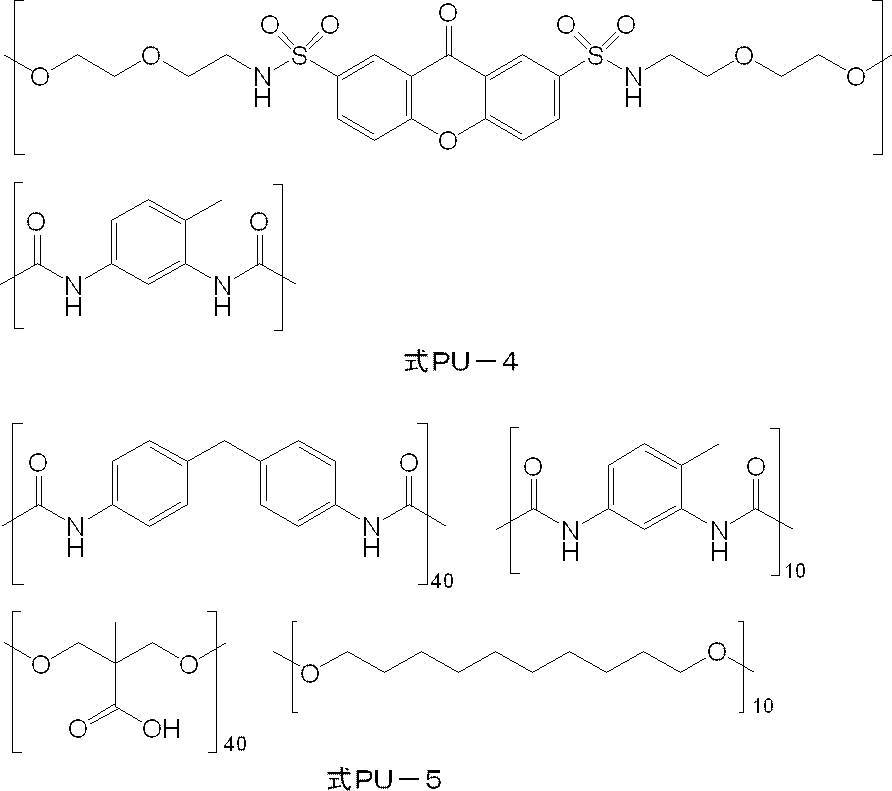
<<アセタール構造を主鎖に有する高分子化合物>>
本開示では、アセタール構造を主鎖に有する高分子化合物として、ポリビニルアセタールを用いることもできる。
ポリビニルアセタールは、構成繰り返し単位の少なくとも50モル%(約50モル%~約75モル%、より典型的には少なくとも60モル%)がアセタール含有構成繰り返し単位である限り、アセタール含有構成繰り返し単位以外の構成繰り返し単位を含む。このような高分子の場合、非アセタール含有構成繰り返し単位は、同じか又は異なるペンダントフェノール基を有していてもよく、あるいは、これらはペンダントフェノール基を有さない構成繰り返し単位であってもよく、あるいは、これらは両タイプの構成繰り返し単位を含んでもよい。例えば、ポリ(ビニルアセタール)は、イタコン酸又はクロトン酸基を含む構成繰り返し単位を含むこともできる。加えて、ペンダントフェノール基を含む構成繰り返し単位がある場合、これらの構成繰り返し単位は、種々異なるフェノール基を有することもできる(例えば、ポリビニルアセタールは、アセタール含有構成繰り返し単位と、異なるペンダントフェノール基を含む2種又は3種以上の異なるタイプの構成繰り返し単位とを有することもできる。)。さらに他の態様において、ポリビニルアセタール中のわずかなモル量(20モル%未満)のアセタール基を、環状無水物又はイソシアネート化合物、例えばトルエンスルホニルイソシアネートと反応させることができる。
本開示では、アセタール構造を主鎖に有する高分子化合物として、ポリビニルアセタールを用いることもできる。
ポリビニルアセタールは、構成繰り返し単位の少なくとも50モル%(約50モル%~約75モル%、より典型的には少なくとも60モル%)がアセタール含有構成繰り返し単位である限り、アセタール含有構成繰り返し単位以外の構成繰り返し単位を含む。このような高分子の場合、非アセタール含有構成繰り返し単位は、同じか又は異なるペンダントフェノール基を有していてもよく、あるいは、これらはペンダントフェノール基を有さない構成繰り返し単位であってもよく、あるいは、これらは両タイプの構成繰り返し単位を含んでもよい。例えば、ポリ(ビニルアセタール)は、イタコン酸又はクロトン酸基を含む構成繰り返し単位を含むこともできる。加えて、ペンダントフェノール基を含む構成繰り返し単位がある場合、これらの構成繰り返し単位は、種々異なるフェノール基を有することもできる(例えば、ポリビニルアセタールは、アセタール含有構成繰り返し単位と、異なるペンダントフェノール基を含む2種又は3種以上の異なるタイプの構成繰り返し単位とを有することもできる。)。さらに他の態様において、ポリビニルアセタール中のわずかなモル量(20モル%未満)のアセタール基を、環状無水物又はイソシアネート化合物、例えばトルエンスルホニルイソシアネートと反応させることができる。
また、ポリビニルアセタールとしては、フェノール樹脂(例えばノボラック樹脂)、又は約40~約80モル%のアセタール含有構成繰り返し単位を有するポリビニルアセタールを含むものが挙げられる。例えば、ポリビニルアセタールは、下記構造(PVAc):

によって表される、総構成繰り返し単位を基準として少なくとも40モル%且つ最大80モル%までの構成繰り返し単位を含むポリビニルアセタールが好適に挙げられる。
構造(PVAc)において、R及びR’はそれぞれ独立に、水素原子又は炭素数1~6の置換型若しくは無置換型の線状若しくは分枝状アルキル基(例えばメチル基、エチル基、n-プロピル基、n-ブチル基、n-ペンチル基、n-ヘキシル基、クロロメチル基、トリクロロメチル基、イソプロピル基、イソブチル基、t-ブチル基、イソペンチル基、neo-ペンチル基、1-メチルブチル基及びイソ-ヘキシル基)、環内炭素数3~6の置換型又は無置換型シクロアルキル環(例えばシクロプロピル基、シクロブチル基、シクロペンチル基、メチルシクロヘキシル基及びシクロヘキシル基)、又は、ハロゲノ基(例えばフルオロ基、クロロ基、ブロモ基及びヨード基)である。好ましくは、R及びR’はそれぞれ独立に、水素原子、置換型若しくは無置換型メチル基又はクロロ基であり、より好ましくは、水素原子又はメチル基である。
また、ポリビニルアセタール内の異なる構成繰り返し単位のR及びR’基は、同じであっても、異なっていてもよい。
また、ポリビニルアセタール内の異なる構成繰り返し単位のR及びR’基は、同じであっても、異なっていてもよい。
R2は置換型若しくは無置換型フェノール基、置換型若しくは無置換型ナフトール基、又は置換型若しくは無置換型アントラセノール基である。これらのフェノール基、ナフトール基及びアントラセノール基は、必要に応じて最大3つの追加の置換基を有することができ、これらには、追加のヒドロキシ基、メトキシ基、アルコキシ基、アリールオキシ基、チオアリールオキシ基、ハロメチル基、トリハロメチル基、ハロゲノ基、ニトロ基、アゾ基、チオヒドロキシ基、チオアルコキシ基、シアノ基、アミノ基、カルボキシ基、エテニル基、カルボキシアルキル基、フェニル基、アルキル基、アルケニル基、アルキニル基、シクロアルキル基、アリール基、ヘテロアリール基及び複素脂環式基が挙げられる。中でも、R2は、無置換型フェノール基又はナフトール基、例えば2-ヒドロキシフェニル基又はヒドロキシナフチル基が好ましく挙げられる。
また、好ましいポリビニルアセタールは、上記構成繰り返し単位を含む下記構造(I):
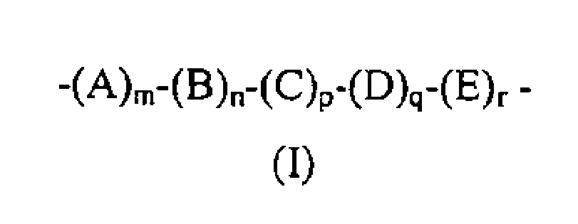
によって表され、
上記式中:
Aは、下記構造(Ia):
上記式中:
Aは、下記構造(Ia):
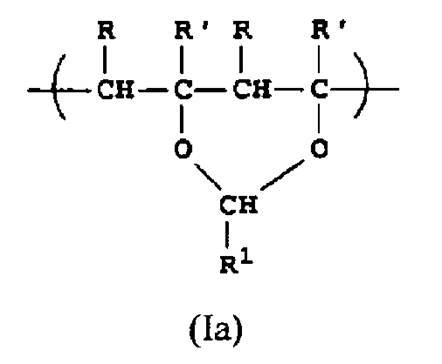
によって表される構成繰り返し単位を表し、
Bは、下記構造(Ib):
Bは、下記構造(Ib):
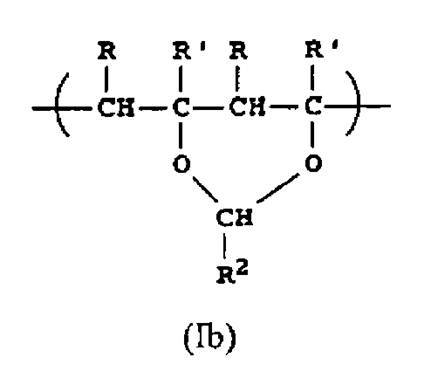
によって表される構成繰り返し単位を表し、
Cは、下記構造(Ic):
Cは、下記構造(Ic):

によって表される構成繰り返し単位を表し、
Dは、下記構造(Id):
Dは、下記構造(Id):
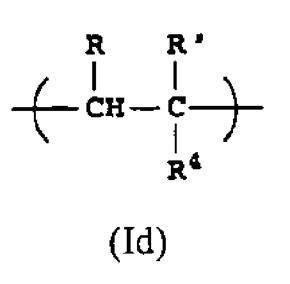
によって表される構成繰り返し単位を表し、
Eは、下記構造(Ie):
Eは、下記構造(Ie):
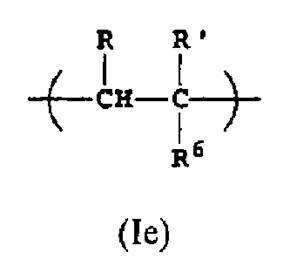
によって表される構成繰り返し単位を表し、
mは5~40モル%(より好ましくは15~35モル%)であり、nは10~60モル%(より好ましくは20~40モル%)であり、pは0~20モル%(より好ましくは0~10モル%)であり、qは1~20モル%(より好ましくは1~15モル%)であり、そしてrは5~49モル%(より好ましくは15~49モル%)であることが好ましい。
mは5~40モル%(より好ましくは15~35モル%)であり、nは10~60モル%(より好ましくは20~40モル%)であり、pは0~20モル%(より好ましくは0~10モル%)であり、qは1~20モル%(より好ましくは1~15モル%)であり、そしてrは5~49モル%(より好ましくは15~49モル%)であることが好ましい。
R、R’、R1及びR2は、下記以外は、構造(PVAc)に関して上で規定された通りである。
R1はそれぞれ独立に、炭素数1~6の置換型又は無置換型アルキル基であることが好ましく、n-プロピル基であることがより好ましい。
R1はそれぞれ独立に、炭素数1~6の置換型又は無置換型アルキル基であることが好ましく、n-プロピル基であることがより好ましい。
R3は、炭素数2~4の置換型若しくは無置換型アルキニル基(例えばエチニル基)、又は、置換型若しくは無置換型フェニル基(例えばフェニル基、4-カルボキシフェニル、カルボキシアルキレンオキシフェニル基及びカルボキシアルキルフェニル基)を表し、カルボキシアルキルフェニル基、4-カルボキシフェニル基、又は、カルボキシアルキレンオキシフェニル基であることが好ましい。
R4は、-O-C(=O)-R5基を表し、R5は、炭素数1~12の置換型若しくは無置換型アルキル基、又は、芳香環内炭素数6若しくは10の置換型若しくは無置換型アリール基を表し、炭素数1~6の置換型又は無置換型アルキル基がより好ましく、メチル基が特に好ましい。
R6は、ヒドロキシ基を表す。
R4は、-O-C(=O)-R5基を表し、R5は、炭素数1~12の置換型若しくは無置換型アルキル基、又は、芳香環内炭素数6若しくは10の置換型若しくは無置換型アリール基を表し、炭素数1~6の置換型又は無置換型アルキル基がより好ましく、メチル基が特に好ましい。
R6は、ヒドロキシ基を表す。
構造(I)内の構成繰り返し単位の比によって示されるように、ポリビニルアセタールは、存在する異なる構成繰り返し単位の数に応じて少なくとも四量体となることができる。例えば、構造(Ia)から(Ie)までの規定された構成繰り返し単位のうちのいずれかから形成された複数のタイプの構成繰り返し単位があってよい。例えば構造(I)のポリビニルアセタールは、異なるR1を有する構造(Ia)で表される構成繰り返し単位を有していてよい。このような多様な構成繰り返し単位は、構造(Ib)~(Ie)のいずれかによって表される構成繰り返し単位にも当てはまる。
構造(I)によって表されるポリビニルアセタールは、構造(Ia)、(Ib)、(Ic)、(Id)及び(Ie)によって規定されたもの以外の構成繰り返し単位を含有してよく、このような構成繰り返し単位は当業者には明らかである。従って、構造(I)は最も広い意味において、規定された構成繰り返し単位に限定されることはないが、しかしいくつかの態様の場合には、構造(I)内の構成繰り返し単位だけが存在する。
本明細書中に記載されたポリビニルアセタールは、米国特許第6,541,181
号明細書に記載されたものを含む公知の出発材料及び反応条件を用いて調製することができる。
例えば米国特許第4,665,124号(Dhillon他)、同第4,940,646号(Pawlowski)、同第5,169,898号(Walls他)、同第5,700,619号(Dwars他)、及び同第5,792,823号(Kim他)の各明細書、及び特開平9-328519号公報(Yoshinaga)に記載されているような公知の標準的な方法に従って、ポリビニルアルコールのアセタール化が行われる。
号明細書に記載されたものを含む公知の出発材料及び反応条件を用いて調製することができる。
例えば米国特許第4,665,124号(Dhillon他)、同第4,940,646号(Pawlowski)、同第5,169,898号(Walls他)、同第5,700,619号(Dwars他)、及び同第5,792,823号(Kim他)の各明細書、及び特開平9-328519号公報(Yoshinaga)に記載されているような公知の標準的な方法に従って、ポリビニルアルコールのアセタール化が行われる。
また、ポリビニルアセタールとしては、下記式VAで表されるポリビニルアセタールが好ましい。

式VA中、R1Aはそれぞれ独立に、アルキル基、アリール基、カルボキシ基、又は、ヒドロキシ基を有するアリール基を表し、R2Aはそれぞれ独立に、アルキル基を表し、a、b、c及びdは各構成単位のモル比を表す。
式VAにおけるR1Aはそれぞれ独立に、アルキル基、カルボキシ基、又は、ヒドロキシ基を有するアリール基であることが好ましく、ヒドロキシ基を有するアリール基であることがより好ましく、2-ヒドロキシフェニル基、3-ヒドロキシフェニル基、4-ヒドロキシフェニル基、2,3-ジヒドロキシフェニル基、2,4-ジヒドロキシフェニル基、2-ヒドロキシ-3-メトキシフェニル基、2,6-ジヒドロキシフェニル基、2,4,6-トリヒドロキシフェニル基、1-(2-ヒドロキシ)ナフチル基、2-(3-ヒドロキシ)ナフチル基、又は、3-ヒドロキシ-4-メトキシフェニル基であることが更に好ましい。
式VAにおけるR2Aはそれぞれ独立に、炭素数1~8のアルキル基であることが好ましく、炭素数1~4のアルキル基であることがより好ましく、メチル基であることが特に好ましい。
式VAにおけるR2Aはそれぞれ独立に、炭素数1~8のアルキル基であることが好ましく、炭素数1~4のアルキル基であることがより好ましく、メチル基であることが特に好ましい。
式VAにおけるaは、10モル%~50モル%であることが好ましく、15モル%~45モル%であることがより好ましく、20モル%~35モル%であることが更に好ましい。式VAにおけるbは、15モル%~60モル%であることが好ましく、20モル%~50モル%であることがより好ましく、25モル%~45モル%であることが更に好ましい。式VAにおけるcは、10モル%~60モル%であることが好ましく、15モル%~50モル%であることがより好ましく、20モル%~30モル%であることが更に好ましい。式VAにおけるdは、0モル%~10モル%であることが好ましく、モル%0~3モル%であることがより好ましく、0モル%~1モル%であることが更に好ましい。
本開示に用いられるポリビニルアセタールの重量平均分子量(Mw)は、1,500以上であることが好ましく、3,000以上300,000以下であることがより好ましく、10,000以上150,000以下であることが更に好ましい。
高分子化合物1は、薄い膜厚であっても、より高い耐刷性を発揮する観点からは、ウレア結合、及び、ウレタン結合よりなる群から選ばれた少なくとも1種の構造を主鎖に有する高分子化合物であることが好ましく、アルカリ可溶性の観点から、ウレタン結合を主鎖に有する高分子化合物がより好ましい。
また、下層には、後述する赤外線吸収剤、酸発生剤、界面活性剤などの成分が含まれていてもよい。
また、下層には、後述する赤外線吸収剤、酸発生剤、界面活性剤などの成分が含まれていてもよい。
更に、下層は、得られる平版印刷版における耐刷性及び耐薬品性の観点から、後述する高分子化合物2を更に含むことが好ましく、高分子化合物1及び高分子化合物2により少なくとも形成された海島構造を有していることがより好ましい。
また、上記海島構造において、高分子化合物2が島(不連続相、分散相)を形成していることが好ましい。下層中にも高耐薬品性である高分子化合物2を島状に配することで、連続相(海側)となる高耐刷性の高分子化合物1により発現する耐刷性を大きく損なうことなく、耐薬品性を向上することができる。これは高分子化合物2が島状に分布することで、高分子化合物1による連続相の本来の膜強度を低減することなく、薬品の浸透を抑制することができるためと考えられる。
また、上記海島構造において、高分子化合物2が島(不連続相、分散相)を形成していることが好ましい。下層中にも高耐薬品性である高分子化合物2を島状に配することで、連続相(海側)となる高耐刷性の高分子化合物1により発現する耐刷性を大きく損なうことなく、耐薬品性を向上することができる。これは高分子化合物2が島状に分布することで、高分子化合物1による連続相の本来の膜強度を低減することなく、薬品の浸透を抑制することができるためと考えられる。
下層において、高分子化合物1を、1種単独で含有していても、2種以上含有していてもよい。
また、下層において、高分子化合物2を、1種単独で含有していても、2種以上含有していてもよい。
下層における高分子化合物1の含有量は、下層の全質量に対し、10質量%~95質量%であることが好ましく、20質量%~90質量%であることがより好ましく、30質量%~85質量%であることが更に好ましい。
また、下層における高分子化合物1及び高分子化合物2の総含有量は、下層の全質量に対し、20質量%~95質量%であることが好ましく、50質量%~95質量%であることがより好ましく、65質量%~90質量%であることが更に好ましい。
また、下層において、高分子化合物2を、1種単独で含有していても、2種以上含有していてもよい。
下層における高分子化合物1の含有量は、下層の全質量に対し、10質量%~95質量%であることが好ましく、20質量%~90質量%であることがより好ましく、30質量%~85質量%であることが更に好ましい。
また、下層における高分子化合物1及び高分子化合物2の総含有量は、下層の全質量に対し、20質量%~95質量%であることが好ましく、50質量%~95質量%であることがより好ましく、65質量%~90質量%であることが更に好ましい。
<中間層>
本開示に係るポジ型平版印刷版原版は、水に不溶かつアルカリ水溶液に可溶な、スルホンアミド基、活性イミド基、及び、ウレア結合よりなる群から選ばれる少なくとも一つの構造を側鎖に有する高分子化合物2を含む中間層を有する。
高分子化合物2は、上記高分子化合物1とは異なり、高分子化合物とは相溶しないことが好ましい。相溶しない高分子化合物2を用いることで、耐刷性の高い下層と、より耐薬品性の高い中間層が得られる。
また、高分子化合物2は、画像記録層の形成性、並びに、得られる平版印刷版における耐刷性及び耐薬品性の観点から、高分子化合物1及び高分子化合物3と異なる高分子化合物であることが好ましい。
高分子化合物2における側鎖のスルホンアミド基は、-SO2NH2だけでなく、スルホンアミド基の窒素原子上の水素原子がアルキル基、アリール基、ヘテロアリール基等で置換された基も含まれる。
本開示に係るポジ型平版印刷版原版は、水に不溶かつアルカリ水溶液に可溶な、スルホンアミド基、活性イミド基、及び、ウレア結合よりなる群から選ばれる少なくとも一つの構造を側鎖に有する高分子化合物2を含む中間層を有する。
高分子化合物2は、上記高分子化合物1とは異なり、高分子化合物とは相溶しないことが好ましい。相溶しない高分子化合物2を用いることで、耐刷性の高い下層と、より耐薬品性の高い中間層が得られる。
また、高分子化合物2は、画像記録層の形成性、並びに、得られる平版印刷版における耐刷性及び耐薬品性の観点から、高分子化合物1及び高分子化合物3と異なる高分子化合物であることが好ましい。
高分子化合物2における側鎖のスルホンアミド基は、-SO2NH2だけでなく、スルホンアミド基の窒素原子上の水素原子がアルキル基、アリール基、ヘテロアリール基等で置換された基も含まれる。
<<スルホンアミド基及び活性イミド基よりなる群から選ばれる少なくとも一つの構造を側鎖に有する高分子化合物>>
スルホンアミド基を側鎖に有する高分子化合物としては、スルホンアミド基を有する重合性モノマーを単独重合、あるいは上記モノマーに他の重合性モノマーを共重合させて得られる高分子化合物が挙げられる。スルホンアミド基を有する重合性モノマーとしては、1分子中に、窒素原子上に少なくとも1つの水素原子が結合したスルホンアミド基-NH-SO2-と、重合可能な不飽和結合をそれぞれ1つ以上有する低分子化合物からなる重合性モノマーが挙げられる。その中でも、アクリロイル基、アリール基、又は、ビニロキシ基と、置換若しくはモノ置換アミノスルホニル基又は置換スルホニルイミノ基とを有する低分子化合物が好ましい。
スルホンアミド基を側鎖に有する高分子化合物としては、スルホンアミド基を有する重合性モノマーを単独重合、あるいは上記モノマーに他の重合性モノマーを共重合させて得られる高分子化合物が挙げられる。スルホンアミド基を有する重合性モノマーとしては、1分子中に、窒素原子上に少なくとも1つの水素原子が結合したスルホンアミド基-NH-SO2-と、重合可能な不飽和結合をそれぞれ1つ以上有する低分子化合物からなる重合性モノマーが挙げられる。その中でも、アクリロイル基、アリール基、又は、ビニロキシ基と、置換若しくはモノ置換アミノスルホニル基又は置換スルホニルイミノ基とを有する低分子化合物が好ましい。
活性イミド基を側鎖に有するアルカリ可溶性樹脂は、活性イミド基を分子内に有するものが好ましく、この高分子化合物としては、1分子中に活性イミド基と重合可能な不飽和結合をそれぞれ一つ以上有する低分子化合物からなる重合性モノマーを単独重合、又は、該モノマーに他の重合性モノマーを共重合させて得られる高分子化合物が挙げられる。
このような化合物としては、具体的には、N-(p-トルエンスルホニル)メタクリルアミド、N-(p-トルエンスルホニル)アクリルアミド等を好適に使用することができる。
このような化合物としては、具体的には、N-(p-トルエンスルホニル)メタクリルアミド、N-(p-トルエンスルホニル)アクリルアミド等を好適に使用することができる。
更に、高分子化合物2としては、上記フェノール性水酸基を有する重合性モノマー、スルホンアミド基を有する重合性モノマー、及び、活性イミド基を有する重合性モノマーのうちの2種以上を共重合させた高分子化合物、あるいはこれら2種以上の重合性モノマーに他の重合性モノマーを共重合させて得られる高分子化合物を使用することが好ましい。フェノール性水酸基を有する重合性モノマーに、スルホンアミド基を有する重合性モノマー及び/又は活性イミド基を有する重合性モノマーを共重合させる場合には、これら成分の配合質量比は50:50から5:95の範囲にあることが好ましく、40:60から10:90の範囲にあることが特に好ましい。
本開示において、アルカリ可溶性樹脂が上記フェノール性水酸基を有する重合性モノマー、スルホンアミド基を有する重合性モノマー、又は、活性イミド基を有する重合性モノマーと、他の重合性モノマーとの共重合体である場合には、アルカリ可溶性及び現像ラチチュードの向上効果の観点から、アルカリ可溶性を付与するモノマーは、共重合に使用するモノマーの全モル量に対し、10モル%以上含むことが好ましく、20モル%以上含むものがより好ましい。
上記フェノール性水酸基を有する重合性モノマー、スルホンアミド基を有する重合性モノマー、又は活性イミド基を有する重合性モノマーと共重合させるモノマー成分としては、下記(m1)~(m12)に挙げる化合物を例示することができるが、これらに限定されるものではない。
(m1)2-ヒドロキシエチルアクリレート又は2-ヒドロキシエチルメタクリレート等の脂肪族水酸基を有するアクリル酸エステル類、及び、メタクリル酸エステル類。
(m2)アクリル酸メチル、アクリル酸エチル、アクリル酸プロピル、アクリル酸ブチル、アクリル酸アミル、アクリル酸ヘキシル、アクリル酸オクチル、アクリル酸ベンジル、アクリル酸-2-クロロエチル、グリシジルアクリレート等のアルキルアクリレート。
(m3)メタクリル酸メチル、メタクリル酸エチル、メタクリル酸プロピル、メタクリル酸ブチル、メタクリル酸アミル、メタクリル酸ヘキシル、メタクリル酸シクロヘキシル、メタクリル酸ベンジル、メタクリル酸-2-クロロエチル、グリシジルメタクリレート等のアルキルメタクリレート。
(m4)アクリルアミド、メタクリルアミド、N-メチロールアクリルアミド、N-エチルアクリルアミド、N-ヘキシルメタクリルアミド、N-シクロヘキシルアクリルアミド、N-ヒドロキシエチルアクリルアミド、N-フェニルアクリルアミド、N-ニトロフェニルアクリルアミド、N-エチル-N-フェニルアクリルアミド等のアクリルアミド又はメタクリルアミド。
(m1)2-ヒドロキシエチルアクリレート又は2-ヒドロキシエチルメタクリレート等の脂肪族水酸基を有するアクリル酸エステル類、及び、メタクリル酸エステル類。
(m2)アクリル酸メチル、アクリル酸エチル、アクリル酸プロピル、アクリル酸ブチル、アクリル酸アミル、アクリル酸ヘキシル、アクリル酸オクチル、アクリル酸ベンジル、アクリル酸-2-クロロエチル、グリシジルアクリレート等のアルキルアクリレート。
(m3)メタクリル酸メチル、メタクリル酸エチル、メタクリル酸プロピル、メタクリル酸ブチル、メタクリル酸アミル、メタクリル酸ヘキシル、メタクリル酸シクロヘキシル、メタクリル酸ベンジル、メタクリル酸-2-クロロエチル、グリシジルメタクリレート等のアルキルメタクリレート。
(m4)アクリルアミド、メタクリルアミド、N-メチロールアクリルアミド、N-エチルアクリルアミド、N-ヘキシルメタクリルアミド、N-シクロヘキシルアクリルアミド、N-ヒドロキシエチルアクリルアミド、N-フェニルアクリルアミド、N-ニトロフェニルアクリルアミド、N-エチル-N-フェニルアクリルアミド等のアクリルアミド又はメタクリルアミド。
(m5)エチルビニルエーテル、2-クロロエチルビニルエーテル、ヒドロキシエチルビニルエーテル、プロピルビニルエーテル、ブチルビニルエーテル、オクチルビニルエーテル、フェニルビニルエーテル等のビニルエーテル類。
(m6)ビニルアセテート、ビニルクロロアセテート、ビニルブチレート、安息香酸ビニル等のビニルエステル類。
(m7)スチレン、α-メチルスチレン、メチルスチレン、クロロメチルスチレン等のスチレン類。
(m8)メチルビニルケトン、エチルビニルケトン、プロピルビニルケトン、フェニルビニルケトン等のビニルケトン類。
(m9)エチレン、プロピレン、イソブチレン、ブタジエン、イソプレン等のオレフィン類。
(m10)N-ビニルピロリドン、アクリロニトリル、メタクリロニトリル等。
(m11)マレイミド、N-アクリロイルアクリルアミド、N-アセチルメタクリルアミド、N-プロピオニルメタクリルアミド、N-(p-クロロベンゾイル)メタクリルアミド等の不飽和イミド。
(m12)アクリル酸、メタクリル酸、無水マレイン酸、イタコン酸等の不飽和カルボン酸。
(m6)ビニルアセテート、ビニルクロロアセテート、ビニルブチレート、安息香酸ビニル等のビニルエステル類。
(m7)スチレン、α-メチルスチレン、メチルスチレン、クロロメチルスチレン等のスチレン類。
(m8)メチルビニルケトン、エチルビニルケトン、プロピルビニルケトン、フェニルビニルケトン等のビニルケトン類。
(m9)エチレン、プロピレン、イソブチレン、ブタジエン、イソプレン等のオレフィン類。
(m10)N-ビニルピロリドン、アクリロニトリル、メタクリロニトリル等。
(m11)マレイミド、N-アクリロイルアクリルアミド、N-アセチルメタクリルアミド、N-プロピオニルメタクリルアミド、N-(p-クロロベンゾイル)メタクリルアミド等の不飽和イミド。
(m12)アクリル酸、メタクリル酸、無水マレイン酸、イタコン酸等の不飽和カルボン酸。
また、高分子化合物2としては、下記式S-1で表される構成単位及び下記式S-2で表される構成単位のうち少なくとも1種を有するポリマーが好ましく挙げられる。
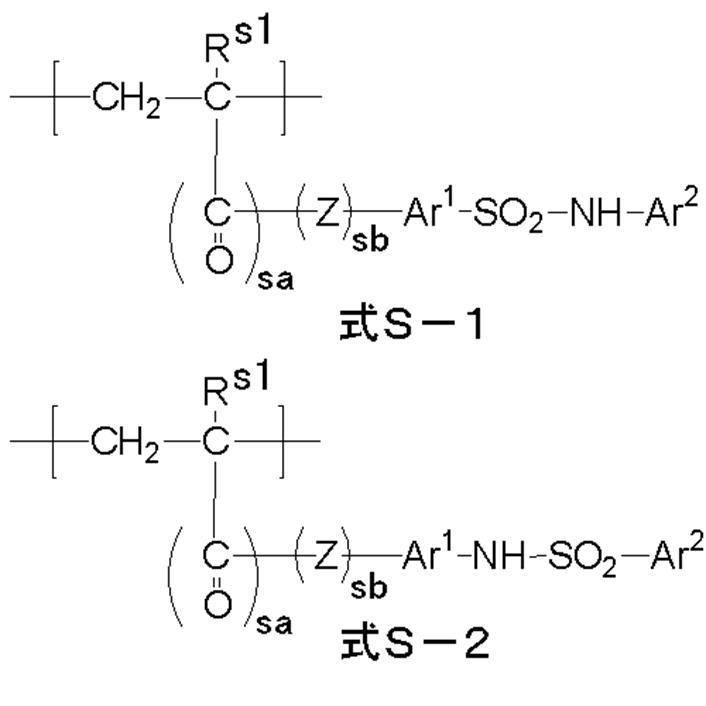
式S-1及び式S-2中、Rs1は水素原子又はアルキル基を表す。Zは-O-又は-NRs2を表し、ここでRs2は、水素原子、アルキル基、アルケニル基、又はアルキニル基を表す。Ar1及びAr2はそれぞれ独立に、芳香族基を表し、少なくとも1方はヘテロ芳香族基である。sa及びsbはそれぞれ独立に、0又は1を表す。
式S-1中、Rs1は水素原子又はアルキル基を表すが、アルキル基は、置換若しくは非置換のアルキル基であり、置換基を有しないものが好ましい。Rs1で表されるアルキル基としては、メチル基、エチル基、プロピル基、ブチル基などの低級アルキル基が挙げられる。Rs1は好ましくは水素原子又はメチル基である。
Zは-O-又は-NRs2-を表し、好ましくは、-NRs2-を表す。ここでRs2は、水素原子、置換若しくは非置換のアルキル基、置換若しくは非置換のアルケニル基、又は置換若しくは非置換のアルキニル基を表し、好ましくは水素原子又は非置換のアルキル基であり、より好ましくは水素原子である。
sa及びsbはそれぞれ独立に、0又は1を表し、好ましい態様は、saが0で且つsbが1である場合であり、更に好ましくはsa及びsbがともに0の場合であり、最も好ましくはsa及びsbがともに1の場合である。
更に詳細には、上記構成単位において、aが0で且つbが1である場合、Zは好ましくはOである。また、sa及びsbがいずれも1である場合、Zは好ましくはNRs2であり、ここでRs2は、水素原子であることが好ましい。
Zは-O-又は-NRs2-を表し、好ましくは、-NRs2-を表す。ここでRs2は、水素原子、置換若しくは非置換のアルキル基、置換若しくは非置換のアルケニル基、又は置換若しくは非置換のアルキニル基を表し、好ましくは水素原子又は非置換のアルキル基であり、より好ましくは水素原子である。
sa及びsbはそれぞれ独立に、0又は1を表し、好ましい態様は、saが0で且つsbが1である場合であり、更に好ましくはsa及びsbがともに0の場合であり、最も好ましくはsa及びsbがともに1の場合である。
更に詳細には、上記構成単位において、aが0で且つbが1である場合、Zは好ましくはOである。また、sa及びsbがいずれも1である場合、Zは好ましくはNRs2であり、ここでRs2は、水素原子であることが好ましい。
Ar1及びAr2はそれぞれ独立に、芳香族基を表し、少なくとも1方はヘテロ芳香族基である。Ar1は2価の芳香族基であり、Ar2は1価の芳香族基である。これら芳香族基は、芳香環を構成する水素原子の1つ又は2つが連結基と置き換わって形成された置換基である。
このような芳香族基における芳香環及び複素芳香環としては、ベンゼン、ナフタレン、アントラセンなどの炭化水素芳香環から選択されるものであってもよく、フラン、チオフェン、ピロール、イミダゾール、1,2,3-トリアゾール、1,2,4-トリアゾール、テトラゾール、オキサゾール、イソオキサゾール、チアゾール、イソチアゾール、チアジアゾール、オキサジアゾール、ピリジン、ピリダジン、ピリミジン、ピラジン、1,3,5-トリアジン、1,2,4-トリアジン、1,2,3-トリアジンなどの複素芳香環から選択されるものであってもよい。
また、これら複数の環が縮合して、例えば、ベンゾフラン、ベンゾチオフェン、インドール、インダゾール、ベンゾオキサゾール、キノリン、キナゾリン、ベンゾイミダゾール、又は、ベンゾトリアゾールのような縮合環の態様をとるものであってもよい。
このような芳香族基における芳香環及び複素芳香環としては、ベンゼン、ナフタレン、アントラセンなどの炭化水素芳香環から選択されるものであってもよく、フラン、チオフェン、ピロール、イミダゾール、1,2,3-トリアゾール、1,2,4-トリアゾール、テトラゾール、オキサゾール、イソオキサゾール、チアゾール、イソチアゾール、チアジアゾール、オキサジアゾール、ピリジン、ピリダジン、ピリミジン、ピラジン、1,3,5-トリアジン、1,2,4-トリアジン、1,2,3-トリアジンなどの複素芳香環から選択されるものであってもよい。
また、これら複数の環が縮合して、例えば、ベンゾフラン、ベンゾチオフェン、インドール、インダゾール、ベンゾオキサゾール、キノリン、キナゾリン、ベンゾイミダゾール、又は、ベンゾトリアゾールのような縮合環の態様をとるものであってもよい。
これらの芳香族基、ヘテロ芳香族基は、更に置換基を有するものであってもよく、導入可能な置換基としては、アルキル基、シクロアルキル基、アルケニル基、シクロアルケニル基、アリール基、ヘテロアリール基、ヒドロキシ基、メルカプト基、カルボキシ基又はそのアルキルエステル、スルホン酸基又はそのアルキルエステル、ホスフィン酸基又はそのアルキルエステル、アミノ基、スルホンアミド基、アミド基、ニトロ基、ハロゲン原子、あるいは、これらが複数結合してなる置換基などが挙げられ、これらの置換基が、更にここに挙げた置換基を有するものであってもよい。
Ar2は好ましくは、置換基を有していてもよい複素芳香族基であり、より好ましくは、ピリジン、ピリダジン、ピリミジン、ピラジン、1,3,5-トリアジン、1,2、4-トリアジン、1,2,3-トリアジン、テトラゾール、オキサゾール、イソオキサゾール、チアゾール、イソチアゾール、チアジアゾール、及び、オキサジアゾールよりなる群から選択される窒素原子を含む複素芳香環が挙げられる。
式S-1又は式S-2で表される構成単位(ただし、モノマー単位として換算する。)の含有量は、高分子化合物におけるモノマー単位の全量に対し、10モル%~100モル%であることが好ましく、20モル%~90モル%がより好ましく、30モル%~80モル%が更に好ましく、30モル%~70モル%が特に好ましい。
このような構成単位を含む高分子化合物は、上記式S-1又は式S-2で表される構成単位以外に、他の構成単位を含む共重合体であってもよい。
他の構成単位としては、モノマーの側鎖構造に、アルキル基、アリール基などの置換基を有する疎水性のモノマーや、モノマーの側鎖構造に、酸性基、アミド基、ヒドロキシ基又はエチレンオキシド基などを有する親水性のモノマーなどが挙げられ、これらより目的に応じて適宜選択することができるが、共重合させるモノマー種の選択は、特定ポリマーのアルカリ可溶性を損なわない範囲でなされることを要する。
他の構成単位としては、モノマーの側鎖構造に、アルキル基、アリール基などの置換基を有する疎水性のモノマーや、モノマーの側鎖構造に、酸性基、アミド基、ヒドロキシ基又はエチレンオキシド基などを有する親水性のモノマーなどが挙げられ、これらより目的に応じて適宜選択することができるが、共重合させるモノマー種の選択は、特定ポリマーのアルカリ可溶性を損なわない範囲でなされることを要する。
他の共重合成分としては、(メタ)アクリルアミド、N-置換(メタ)アクリルアミド、N-置換マレイミド、(メタ)アクリル酸エステル、ポリオキシエチレン鎖を有する(メタ)アクリル酸エステル、2-ヒドロキシエチル(メタ)アクリレート、スチレン、スチレンスルホン酸、o-、p-、又はm-ビニルベンゼン酸、ビニルピリジン、N-ビニルカプロラクタム、N-ビニルピロリジン、(メタ)アクリル酸、イタコン酸、マレイン酸、グリシジル(メタ)アクリレート、加水分解ビニルアセテート、ビニルホスホン酸などが挙げられる。これらの中でも、好ましい共重合成分としては、N-ベンジル(メタ)アクリルアミド、(メタ)アクリル酸などが挙げられる。
上記式S-1で表される構成単位及び上記式S-2で表される構成単位のうち少なくとも1種を有するポリマーの数平均分子量(Mn)は、10,000~500,000の範囲であることが好ましく、10,000~200,000の範囲であることがより好ましく、10,000~100,000の範囲であることが特に好ましい。また、重量平均分子量(Mw)は、10,000~1,000,000の範囲であることが好ましく、20,000~500,000の範囲であることがより好ましく、20,000~200,000の範囲であることが特に好ましい。
<<ウレア結合を側鎖に有する高分子化合物>>
ウレア結合を側鎖に有する高分子化合物としては、後述するQHB-変性ノボラック樹脂が挙げられる。
QHB-変性ノボラック樹脂は、その他の分子または分子の部分の類似の又は補足の単位と4個又はそれ以上、典型的には4個の水素結合を形成できる構造的な特徴、すなわちQHB(4重水素結合形成)単位を含む。QHB単位は、もう1つのQHB単位に対し少なくとも4個の水素結合を経て結合され得る単位である。お互いに少なくとも4個の水素結合を対で形成するポリマー材料は、Sijbesmaの米国特許第6,320,018号明細書に開示されている。QHB単位は、好ましくは実質的に平で、硬直した構造を有する。特に、その単位は、好ましくは1又はそれ以上の平らな6員環を含む。好ましくは、QHB単位は、2個の連続した供与部位、それに続く2個の受容部位を有する。1つの好ましい実施態様は、QHB単位はイソシトシン単位(イソシトシン部分)であり、QHB変性ポリマー分子は、少なくとも2個のイソシトシン単位を含む。
ウレア結合を側鎖に有する高分子化合物としては、後述するQHB-変性ノボラック樹脂が挙げられる。
QHB-変性ノボラック樹脂は、その他の分子または分子の部分の類似の又は補足の単位と4個又はそれ以上、典型的には4個の水素結合を形成できる構造的な特徴、すなわちQHB(4重水素結合形成)単位を含む。QHB単位は、もう1つのQHB単位に対し少なくとも4個の水素結合を経て結合され得る単位である。お互いに少なくとも4個の水素結合を対で形成するポリマー材料は、Sijbesmaの米国特許第6,320,018号明細書に開示されている。QHB単位は、好ましくは実質的に平で、硬直した構造を有する。特に、その単位は、好ましくは1又はそれ以上の平らな6員環を含む。好ましくは、QHB単位は、2個の連続した供与部位、それに続く2個の受容部位を有する。1つの好ましい実施態様は、QHB単位はイソシトシン単位(イソシトシン部分)であり、QHB変性ポリマー分子は、少なくとも2個のイソシトシン単位を含む。
QHB変性ポリマーは、例えば6-アルキルイソシトシン、典型的には6-メチルイソシトシンのようなイソシトシンをイソシアネートと反応させて、イソシトシン/イソシアネート付加物、すなわち4重水素結合形成体(QHBE)を作り出すことにより製造され得る。4重水素結合形成体は、QHB-変性ポリマーを製造するために適当なポリマーと反応させられる。6-メチルイソシトシン/イソシアネートモノ付加物、すなわちQHBEは下記の式で表される。

式中、RQ1は、水素原子を表し、RQ2はメチル基を表し、Yは、式:Y(NCO)2によって表されるジイソシアネートから誘導されたヒドロカルビレン基を表す。
ジイソシアネートしては、特に制限はなく、好ましいジイソシアネートは、イソホロンジイソシアネート、メチレンビスフェニルジイソシアネート、トルエンジイソシアネート、ヘキサメチレンジイソシアネート、テトラメチレンジイソシアネート、それらの2量体、それらのジオールとの付加体、及び、それらの混合物が挙げられる。中でも、イソホロンジイソシアネートが特に好ましい。
1モルのイソシトシンと1モルのジイソシアネートとの反応は、QHBEを製造し、それは自然に2量化して、4個の熱可逆性水素結合によって結合された2量体化されたモノ付加体を形成するだろう。生成した2量化されたQHBEは、それぞれの末端に遊離のイソシアネート基を有し、そのイソシアネート基は、ノボラック樹脂と反応して、QHB-変性ノボラック樹脂を製造することができる。
QHBE中の未反応のジイソシアネートは、2分子のポリマーとの反応によってポリマーを架橋することができる。未反応のジイソシアネートによる未変性のポリマーの架橋を避けるために、過剰のイソシアネート、すなわち約10~20%モル過剰で好ましくは使用される。しかしながら、過剰のイソシトシンは、更にQHBEと反応して2個のイソシトシン単位を有する付加体を与える。より低いオーダーの付加体の形成を最大化するために、過剰のジイソシアネートがQHBE形成反応の初期の段階で存在するように、イソシトシンはジイソシアネートにゆっくりと加えられる。
また、ウレア結合を側鎖に有する高分子化合物としては、下記式(1-a)~式(1-c)のいずれかで表される構成単位を有するビニル重合系又は縮重合系の高分子化合物、又は側鎖にウレア結合を有するノボラック樹脂が、特に好適に挙げられる。更に、側鎖に、ウレア結合に加え、アルカリ水溶液可溶性に寄与するような官能基が存在することが、感度の向上という観点から好ましい。
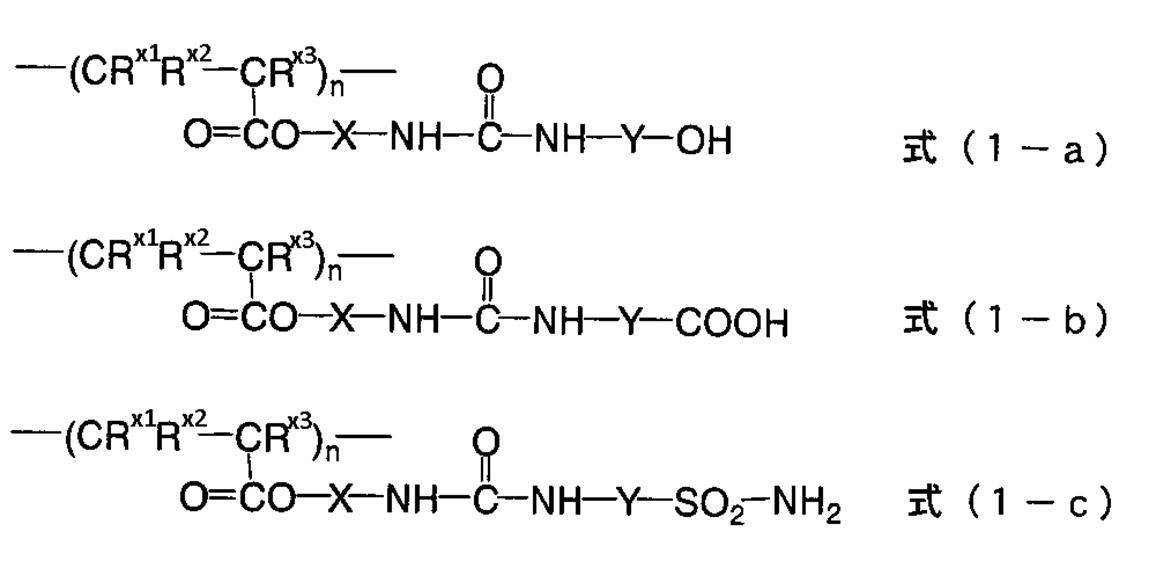
上記式(1-a)~(1-c)において、Rx1及びRx2はそれぞれ独立に、水素原子、ハロゲン原子、アルキル基、アリール基、カルボキシ基、又はそれらの塩を表す。Rx3は、水素原子、ハロゲン原子、アルキル基又はアリール基を表す。Xは、2価の連結基を表し、例えば置換基を有してもよいアルキレン基又はフェニレン基等が好適に挙げられる。Yは置換基を有してもよい2価の芳香族基を表し、例えば、置換基を有してもよいフェニレン基又はナフチレン基が好適に挙げられる。
上記式(1-a)~(1-c)のいずれかで表される構成単位の、高分子化合物における含有量としては、対応するモノマーの仕込み比で10~80モル%含まれる共重合体であることが好ましく、15~70モル%がより好ましく、20~60モル%が特に好ましい。
上記式(1-a)~(1-c)のいずれかで表される構成単位を有する高分子化合物の製造方法としては、特に制限はなく、公知の種々の方法で製造することが可能であり、例えば、重合性単量体を、重合開始剤を用いて溶媒中で重合する方法等が挙げられる。
上記重合性単量体を、重合開始剤を用いて溶媒中で重合する方法において、上記重合性単量体としては、1分子中に1以上のウレア結合と、1以上の重合可能な不飽和結合とを有する単量体であり、例えば、下記式(1-d)で表される化合物等が好適に挙げられる。
式(1-d)において、Rx4は、水素原子又はアルキル基を表す。Xは2価の連結基を表し、例えば、置換基を有してもよいアルキレン基又はフェニレン基が挙げられる。Yは、置換基を有してもよい2価の芳香族基を表し、例えば、置換基を有してもよいフェニレン基又はナフチレン基が挙げられる。
上記式(1-d)で表される化合物としては、例えば、1-(N’-(4-ヒドロキシフェニル)ウレイド)メチルアクリレート、1-(N’-(3-ヒドロキシフェニル)ウレイド)メチルアクリレート、1-(N’-(2-ヒドロキシフェニル)ウレイド)メチルアクリレート、1-(N’-(3-ヒドロキシ-4-メチルフェニル)ウレイド)メチルアクリレート、1-(N’-(2-ヒドロキシ-5-メチルフェニル)ウレイド)メチルアクリレート、1-(N’-(5-ヒドロキシナフチル)ウレイド)メチルアクリレート、1-(N’-(2-ヒドロキシ-5-フェニルフェニル)ウレイド)メチルアクリレート、2-(N’-(4-ヒドロキシフェニル)ウレイド)エチルアクリレート、2-(N’-(3-ヒドロキシフェニル)ウレイド)エチルアクリレート、2-(N’-(2-ヒドロキシフェニル)ウレイド)エチルアクリレート、2-(N’-(3-ヒドロキシ-4-メチルフェニル)ウレイド)エチルアクリレート、2-(N’-(2-ヒドロキシ-5-メチルフェニル)ウレイド)エチルアクリレート、2-(N’-(5-ヒドロキシナフチル)ウレイド)エチルアクリレート、2-(N’-(2-ヒドロキシ-5-フェニルフェニル)ウレイド)エチルアクリレート、4-(N’-(4-ヒドロキシフェニル)ウレイド)ブチルアクリレート、4-(N’-(3-ヒドロキシフェニル)ウレイド)ブチルアクリレート、4-(N’-(2-ヒドロキシフェニル)ウレイド)ブチルアクリレート、4-(N’-(3-ヒドロキシ-4-メチルフェニル)ウレイド)ブチルアクリレート、4-(N’-(2-ヒドロキシ-5-メチルフェニル)ウレイド)ブチルアクリレート、4-(N’-(5-ヒドロキシナフチル)ウレイド)ブチルアクリレート、4-(N’-(2-ヒドロキシ-5-フェニルフェニル)ウレイド)ブチルアクリレートの如きアクリレート誘導体:1-(N’-(4-ヒドロキシフェニル)ウレイド)メチルメタクリレート、1-(N’-(3-ヒドロキシフェニル)ウレイド)メチルメタクリレート、1-(N’-(2-ヒドロキシフェニル)ウレイド)メチルメタクリレート、1-(N’-(3-ヒドロキシ-4-メチルフェニル)ウレイド)メチルメタクリレート、1-(N’-(2-ヒドロキシ-5-メチルフェニル)ウレイド)メチルメタクリレート、1-(N’-(5-ヒドロキシナフチル)ウレイド)メチルメタクリレート、1-(N’-(2-ヒドロキシ-5-フェニルフェニル)ウレイド)メチルメタクリレート、2-(N’-(4-ヒドロキシフェニル)ウレイド)エチルメタクリレート、2-(N’-(3-ヒドロキシフェニル)ウレイド)エチルメタクリレート、2-(N’-(2-ヒドロキシフェニル)ウレイド)エチルメタクリレート、2-(N’-(3-ヒドロキシ-4-メチルフェニル)ウレイド)エチルメタクリレート、2-(N’-(2-ヒドロキシ-5-メチルフェニル)ウレイド)エチルメタクリレート、2-(N’-(5-ヒドロキシナフチル)ウレイド)エチルメタクリレート、2-(N’-(2-ヒドロキシ-5-フェニルフェニル)ウレイド)エチルメタクリレート、4-(N’-(4-ヒドロキシフェニル)ウレイド)ブチルメタクリレート、4-(N’-(3-ヒドロキシフェニル)ウレイド)ブチルメタクリレート、4-(N’-(2-ヒドロキシフェニル)ウレイド)ブチルメタクリレート、4-(N’-(3-ヒドロキシ-4-メチルフェニル)ウレイド)ブチルメタクリレート、4-(N’-(2-ヒドロキシ-5-メチルフェニル)ウレイド)ブチルメタクリレート、4-(N’-(5-ヒドロキシナフチル)ウレイド)ブチルメタクリレート、4-(N’-(2-ヒドロキシ-5-フェニルフェニル)ウレイド)ブチルメタクリレートのようなメタクリレート誘導体等が挙げられる。これらは、1種単独で使用してもよいし、2種以上を併用してもよい。
上記重合性単量体は、ウレア結合に基づく赤外線吸収スペクトルの1,600cm-1~1,700cm-1に特性吸収を持つため、赤外線吸収スペクトルの測定により、同定することができる。また、融点、プロトンNMR等での同定も可能である。
例えば、上述の具体例中、2-(N’-(4-ヒドロキシフェニル)ウレイド)エチルメタクリレートは、融点が131℃~133℃であり、水酸基及び上記ウレア結合に基づくIRスペクトルの吸収から同定可能である。
例えば、上述の具体例中、2-(N’-(4-ヒドロキシフェニル)ウレイド)エチルメタクリレートは、融点が131℃~133℃であり、水酸基及び上記ウレア結合に基づくIRスペクトルの吸収から同定可能である。
また、上記式(1-d)で表される化合物以外にも、例えば、2-(N’-(4-カルボキシルフェニル)ウレイド)エチルアクリレート、2-(N’-(4-スルファモイルフェニル)ウレイド)エチルアクリレート、2-(N’-(4-スルホフェニル)ウレイド)エチルアクリレート、2-(N’-(4-ホスホノフェニル)ウレイド)エチルアクリレート等のような酸性基を有するアクリレート類:2-(N’-(4-カルボキシルフェニル)ウレイド)エチルメタクリレート、2-(N’-(4-スルファモイルフェニル)ウレイド)エチルメタクリレート、2-(N’-(4-スルホフェニル)ウレイド)エチルメタクリレート、2-(N’-(4-ホスホノフェニル)ウレイド)エチルメタクリレート等のような酸性基を有するメタクリレート類:2-(N’-メチルウレイド)エチルアクリレート、2-(N’-プロピルウレイド)エチルアクリレート、2-(N’-フェニルウレイド)エチルアクリレート、2-(N’-(4-メチルフェニル)ウレイド)エチルアクリレート、2-(N’-(2-メチルフェニル)ウレイド)エチルアクリレート、2-(N’-ナフチルウレイド)エチルアクリレート、2-(N’-(2-フェニルフェニル)ウレイド)エチルアクリレート等のような酸性基を有していないアクリレート類:2-(N’-メチルウレイド)エチルメタクリレート、2-(N’-プロピルウレイド)エチルメタクリレート、2-(N’-フェニルウレイド)エチルメタクリレート、2-(N’-(4-メチルフェニル)ウレイド)エチルメタクリレート、2-(N’-(2-メチルフェニル)ウレイド)エチルメタクリレート、2-(N’-ナフチルウレイド)エチルメタクリレート、2-(N’-(2-フェニルフェニル)ウレイド)エチルメタクリレート等のような酸性基を有していないメタクリレート類等の重合性単量体が好ましく挙げられる。
上述の具体例中、2-(N’-(4-カルボキシフェニル)ウレイド)エチルメタクリレートは、分解温度が220℃であり、カルボキシ基及び上記ウレア結合に基づくIRスペクトルの吸収から同定可能である。
上記重合性単量体の製造方法については、特に制限はなく、例えば、下記式(1-e)で表されるイソシアネート化合物と、下記式(1-f)で表されるアミン化合物とを反応させる公知の製造方法等が好適に挙げられる。

式(1-e)において、Rx5は、水素原子又はアルキル基を表す。Xは上記式(1-d)と同様である。式(1-f)において、Rx6は、水素原子、又は置換基を有してもよいアルキル基を表す。Yは、上記式(1-d)と同様である。Zは、ヒドロキシ基、カルボキシ基、又はスルホンアミド基を表す。
上記製造方法において、上記式(1-e)の化合物と、上記式(1-f)で、Zが水酸基、R6が、水素原子である化合物とを用いることにより、上記式(1-d)で表される重合性単量体を好適に得ることができる。
上記製造方法においては、式(1-f)におけるアミノ基は、水酸基、カルボキシ基、又は-NH-CO-基等に比べ、イソシアネート基に対する活性が高いため、容易に上記式(1-d)で表されるような重合成単量体を得ることができる。
また、所望により、上記式(1-f)で表されるアミン化合物を過剰にし、これに、徐々に上記式(1-e)で表されるイソシアネート化合物を加えることにより、より有効に反応を進めることができる。
また、所望により、上記式(1-f)で表されるアミン化合物を過剰にし、これに、徐々に上記式(1-e)で表されるイソシアネート化合物を加えることにより、より有効に反応を進めることができる。
上記溶媒としては、公知の有機溶媒であれば特に制限はないが、活性水素原子を有しないものが好適に挙げられ、例えば、エチレンジクロリド、シクロヘキサノン、メチルエチルケトン、アセトン、メタノール、エタノール、エチレングリコールモノメチルエーテル、エチレングリコールモノエチルエーテル、2-メトキシエチルアセテート、1-メトキシ-2-プロパノール、1-エトキシ-2-プロパノール、1-メトキシ-2-プロパノールアセテート、1-メトキシ-2-プロピルアセテート、1-エトキシ-2-プロピルアセテート、ジメチルスルホキシド、トルエン、酢酸エチル、乳酸メチル、乳酸エチル、ジオキサン等が挙げられる。これらは、1種単独で使用してもよいし、2種以上を併用してもよい。
上記反応の時間としては、上記式(1-e)で表されるイソシアネート化合物が無くなるまで、又は、ウレア結合の量が一定量となるまで行えばよく、通常は、15分~24時間である。
また、上記反応の温度としては、0℃~40℃が好ましい。
また、上記反応の温度としては、0℃~40℃が好ましい。
上記重合性単量体は、上記式(1-f)で表されるアミン化合物の過剰系で反応させた場合の未反応の原料成分や副生成物を除去する目的で、所望により、希塩酸等の酸性化合物で中和して、式(1-f)で表されるアミン化合物を塩とした後、水洗、濾過、真空乾燥することにより、高純度とすることができる。
上記式(1-a)~式(1-c)のいずれかで表される構成単位を有するビニル重合系又は縮重合系の高分子化合物は、上記ウレア結合を含む各重合性単量体(例えば、上記式(1-a)~(1-c)で表される単量体など)の単独重合体又は2種以上の共重合体であってもよいが、1以上の重合可能な不飽和結合を有し、かつウレア結合を含まない化合物との共重合体であることが、耐刷性の観点から好ましい。上記共重合体としては、ブロック体、ランダム体、又はグラフト体等のいずれの構造であってもよい。
また、耐薬品性を発現する観点から、中間層の厚さは厚い方がより効果が大きいため、5nm以上が好ましく、10nm以上がより好ましい。一方で、膜厚が大きいほど現像性が劣化することから、中間層の厚さは、下層の厚さと同等以下が好ましく、4分の1以下がより好ましく、10分の1以下が更に好ましい。
また、上述したように、高分子化合物2は、下層中に島状の分散相となって存在してもよい。高耐薬品性の分散相が存在することによって、高耐刷性の連続相の耐刷性を大きく損なうことなく、下層への薬品の浸透を抑制することができると考えられる。
また、中間層には、後述する赤外線吸収剤、酸発生剤、界面活性剤などが含まれていてもよい。
また、上述したように、高分子化合物2は、下層中に島状の分散相となって存在してもよい。高耐薬品性の分散相が存在することによって、高耐刷性の連続相の耐刷性を大きく損なうことなく、下層への薬品の浸透を抑制することができると考えられる。
また、中間層には、後述する赤外線吸収剤、酸発生剤、界面活性剤などが含まれていてもよい。
中間層は、例えば下記の方法によって得ることができる。
第1の方法は、高分子化合物1を含む下層を形成した後に、高分子化合物2を含む中間層を下層上に塗設する方法である。
第2の方法は、高分子化合物1と高分子化合物2とを含んでなる下層及び中間層形成用塗布液組成物を塗設し、相分離によって下層及び中間層を形成する方法である。
中間層の形成の詳細については、平版印刷版原版の製造方法において詳述する。
第1の方法は、高分子化合物1を含む下層を形成した後に、高分子化合物2を含む中間層を下層上に塗設する方法である。
第2の方法は、高分子化合物1と高分子化合物2とを含んでなる下層及び中間層形成用塗布液組成物を塗設し、相分離によって下層及び中間層を形成する方法である。
中間層の形成の詳細については、平版印刷版原版の製造方法において詳述する。
中間層において、高分子化合物2を、1種単独で含有していても、2種以上含有していてもよい。
中間層における高分子化合物2の含有量は、下層の全質量に対し、20質量%~100質量%であることが好ましく、50質量%~100質量%であることがより好ましく、75質量%~100質量%であることが更に好ましい。
また、中間層は、高分子化合物1及び3などの他の高分子化合物を含有しないことが好ましい。
中間層における高分子化合物2の含有量は、下層の全質量に対し、20質量%~100質量%であることが好ましく、50質量%~100質量%であることがより好ましく、75質量%~100質量%であることが更に好ましい。
また、中間層は、高分子化合物1及び3などの他の高分子化合物を含有しないことが好ましい。
<上層>
本開示のポジ型平版印刷版原版は、水に不溶かつアルカリ水溶液に可溶な、フェノール性ヒドロキシ基を有する高分子化合物3を含む上層を有する。
また、本開示に係る平版印刷版原版における上層は、熱によりアルカリ水溶液への溶解性が向上する層であることが好ましい。
また、上層に用いる高分子化合物3としては、水不溶性かつアルカリ可溶性で、熱によりアルカリ水溶液への溶解性が向上する、例えば、ノボラック型フェノール樹脂、フェノール性ヒドロキシ基含有アセタール樹脂、ウレタン等の水素結合能を有するアルカリ可溶性樹脂を用いることができる。
更に、高分子化合物3は、高分子化合物1と同じ高分子化合物であってもよいが、異なることが好ましい。
更に、上層は、溶解抑制作用のある化合物を更に含むことが好ましい。
また、上層に、赤外線吸収剤を更に添加することにより、上層で発生する熱も画像形成に利用することができる。赤外線吸収剤を含む上層の構成としては、例えば、赤外線吸収剤と水不溶性かつアルカリ可溶性樹脂と溶解抑制作用のある化合物とを含む層、赤外線吸収剤と水不溶性かつアルカリ可溶性樹脂と酸発生剤とを含む層などが好ましく挙げられる。
本開示のポジ型平版印刷版原版は、水に不溶かつアルカリ水溶液に可溶な、フェノール性ヒドロキシ基を有する高分子化合物3を含む上層を有する。
また、本開示に係る平版印刷版原版における上層は、熱によりアルカリ水溶液への溶解性が向上する層であることが好ましい。
また、上層に用いる高分子化合物3としては、水不溶性かつアルカリ可溶性で、熱によりアルカリ水溶液への溶解性が向上する、例えば、ノボラック型フェノール樹脂、フェノール性ヒドロキシ基含有アセタール樹脂、ウレタン等の水素結合能を有するアルカリ可溶性樹脂を用いることができる。
更に、高分子化合物3は、高分子化合物1と同じ高分子化合物であってもよいが、異なることが好ましい。
更に、上層は、溶解抑制作用のある化合物を更に含むことが好ましい。
また、上層に、赤外線吸収剤を更に添加することにより、上層で発生する熱も画像形成に利用することができる。赤外線吸収剤を含む上層の構成としては、例えば、赤外線吸収剤と水不溶性かつアルカリ可溶性樹脂と溶解抑制作用のある化合物とを含む層、赤外線吸収剤と水不溶性かつアルカリ可溶性樹脂と酸発生剤とを含む層などが好ましく挙げられる。
<<フェノール樹脂>>
高分子化合物3としては、フェノール又は置換フェノール類由来の構成単位を含むフェノール樹脂が好ましく挙げられ、ノボラック樹脂がより好ましく挙げられる。
ノボラック樹脂は、未露光部において強い水素結合性を生起し、露光部において一部の水素結合が容易に解除されるといった点から、本開示における画像記録層に好ましく用いられるアルカリ可溶性樹脂である。
このノボラック樹脂は、分子内に構成単位としてフェノール類由来の構成単位を含むものであれば特に制限はない。
本開示におけるノボラック樹脂は、フェノール、以下に示される置換フェノール類と、アルデヒド類との縮合反応により得られる樹脂である。
フェノール類としては、具体的には、フェノール、イソプロピルフェノール、t-ブチルフェノール、t-アミルフェノール、ヘキシルフェノール、シクロヘキシルフェノール、3-メチル-4-クロロ-6-t-ブチルフェノール、イソプロピルクレゾール、t-ブチルクレゾール、及び、t-アミルクレゾールが挙げられる。中でも、t-ブチルフェノール、及び、t-ブチルクレゾールが好ましく挙げられる。
また、アルデヒド類の例としては、ホルムアルデヒド、アセトアルデヒド、アクロレイン、クロトンアルデヒド等の脂肪族及び芳香族アルデヒドが挙げられる。中でも、ホルムアルデヒド、及び、アセトアルデヒドが好ましく挙げられる。
より具体的には、本開示におけるノボラック樹脂しては、例えば、フェノールとホルムアルデヒドとの縮重合体(フェノールホルムアルデヒド樹脂)、m-クレゾールとホルムアルデヒドとの縮重合体(m-クレゾールホルムアルデヒド樹脂)、p-クレゾールとホルムアルデヒドとの縮重合体(p-クレゾールホルムアルデヒド樹脂)、m-/p-混合クレゾールとホルムアルデヒドとの縮重合体(m-/p-混合クレゾールホルムアルデヒド樹脂)、フェノールとクレゾール(m-、p-、又はm-/p-混合のいずれでもよい)とホルムアルデヒドとの縮重合体(フェノール/クレゾール(m-、p-、又はm-/p-混合のいずれでもよい)混合ホルムアルデヒド樹脂)等が挙げられる。
また、ノボラック樹脂としては、更に、米国特許第4,123,279号明細書に記載されているように、t-ブチルフェノールホルムアルデヒド樹脂、オクチルフェノールホルムアルデヒド樹脂のような、炭素数3~8のアルキル基を置換基として有するフェノールとホルムアルデヒドとの縮重合体が挙げられる。
これらノボラック樹脂の中でも、特に好ましいものとして、フェノールホルムアルデヒド樹脂、フェノール/クレゾール混合ホルムアルデヒド樹脂が挙げられる。
ノボラック樹脂の重量平均分子量は、500~50,000であることが好ましく、700~20,000であることがより好ましく、1,000~10,000であることが特に好ましい。また、分散度(重量平均分子量/数平均分子量)は、1.1~10であることが好ましい。
このようなノボラック樹脂は1種のみを用いてもよく、2種以上を混合して用いてもよい。
本開示における上層中のノボラック樹脂の添加量は、バーニング適性、画像形成性の観点から、上層の全質量に対し、1質量%~90質量%が好ましく、5質量%~50質量%であることがより好ましく、10質量%~30質量%であることが特に好ましい。
また、フェノール性ヒドロキシ基含有アセタール樹脂としては、高分子化合物1で記載のアセタール構造を主鎖に有する高分子化合物を用いることもできる。
高分子化合物3としては、フェノール又は置換フェノール類由来の構成単位を含むフェノール樹脂が好ましく挙げられ、ノボラック樹脂がより好ましく挙げられる。
ノボラック樹脂は、未露光部において強い水素結合性を生起し、露光部において一部の水素結合が容易に解除されるといった点から、本開示における画像記録層に好ましく用いられるアルカリ可溶性樹脂である。
このノボラック樹脂は、分子内に構成単位としてフェノール類由来の構成単位を含むものであれば特に制限はない。
本開示におけるノボラック樹脂は、フェノール、以下に示される置換フェノール類と、アルデヒド類との縮合反応により得られる樹脂である。
フェノール類としては、具体的には、フェノール、イソプロピルフェノール、t-ブチルフェノール、t-アミルフェノール、ヘキシルフェノール、シクロヘキシルフェノール、3-メチル-4-クロロ-6-t-ブチルフェノール、イソプロピルクレゾール、t-ブチルクレゾール、及び、t-アミルクレゾールが挙げられる。中でも、t-ブチルフェノール、及び、t-ブチルクレゾールが好ましく挙げられる。
また、アルデヒド類の例としては、ホルムアルデヒド、アセトアルデヒド、アクロレイン、クロトンアルデヒド等の脂肪族及び芳香族アルデヒドが挙げられる。中でも、ホルムアルデヒド、及び、アセトアルデヒドが好ましく挙げられる。
より具体的には、本開示におけるノボラック樹脂しては、例えば、フェノールとホルムアルデヒドとの縮重合体(フェノールホルムアルデヒド樹脂)、m-クレゾールとホルムアルデヒドとの縮重合体(m-クレゾールホルムアルデヒド樹脂)、p-クレゾールとホルムアルデヒドとの縮重合体(p-クレゾールホルムアルデヒド樹脂)、m-/p-混合クレゾールとホルムアルデヒドとの縮重合体(m-/p-混合クレゾールホルムアルデヒド樹脂)、フェノールとクレゾール(m-、p-、又はm-/p-混合のいずれでもよい)とホルムアルデヒドとの縮重合体(フェノール/クレゾール(m-、p-、又はm-/p-混合のいずれでもよい)混合ホルムアルデヒド樹脂)等が挙げられる。
また、ノボラック樹脂としては、更に、米国特許第4,123,279号明細書に記載されているように、t-ブチルフェノールホルムアルデヒド樹脂、オクチルフェノールホルムアルデヒド樹脂のような、炭素数3~8のアルキル基を置換基として有するフェノールとホルムアルデヒドとの縮重合体が挙げられる。
これらノボラック樹脂の中でも、特に好ましいものとして、フェノールホルムアルデヒド樹脂、フェノール/クレゾール混合ホルムアルデヒド樹脂が挙げられる。
ノボラック樹脂の重量平均分子量は、500~50,000であることが好ましく、700~20,000であることがより好ましく、1,000~10,000であることが特に好ましい。また、分散度(重量平均分子量/数平均分子量)は、1.1~10であることが好ましい。
このようなノボラック樹脂は1種のみを用いてもよく、2種以上を混合して用いてもよい。
本開示における上層中のノボラック樹脂の添加量は、バーニング適性、画像形成性の観点から、上層の全質量に対し、1質量%~90質量%が好ましく、5質量%~50質量%であることがより好ましく、10質量%~30質量%であることが特に好ましい。
また、フェノール性ヒドロキシ基含有アセタール樹脂としては、高分子化合物1で記載のアセタール構造を主鎖に有する高分子化合物を用いることもできる。
更に、本開示における上層中には、本開示の効果を損なわない範囲でフェノール性ヒドロキシ基を有しない他の樹脂を併用することができる。上層自体は、特に非画像部領域において、アルカリ可溶性を発現することを要するため、この特性を損なわない樹脂を選択する必要がある。この観点から、併用可能な樹脂としては、フェノール性ヒドロキシ基を有しない水不溶性かつアルカリ可溶性樹脂が挙げられる。一般的な水不溶性かつアルカリ可溶性樹脂については以下に詳述するが、中でも、例えば、ポリアミド樹脂、エポキシ樹脂、ポリアセタール樹脂、アクリル樹脂、ポリスチレン系樹脂等を好ましく挙げることができる。
また、混合する量としては、上記水不溶性かつアルカリ可溶性樹脂に対して50質量%以下であることが好ましい。
また、混合する量としては、上記水不溶性かつアルカリ可溶性樹脂に対して50質量%以下であることが好ましい。
上記フェノール性ヒドロキシ基を有しない水不溶性かつアルカリ可溶性樹脂は、重量平均分子量が2,000以上、かつ数平均分子量が500以上のものが好ましく、重量平均分子量が5,000~300,000で、かつ数平均分子量が800~250,000であることがより好ましい。また、上記アルカリ可溶性樹脂の分散度(重量平均分子量/数平均分子量)は、1.1~10であることが好ましい。
上記アルカリ可溶性樹脂は、1種単独で使用しても、2種以上を併用してもよい。
上記アルカリ可溶性樹脂は、1種単独で使用しても、2種以上を併用してもよい。
上層における高分子化合物3の含有量は、上層の全質量に対し、2.0質量%~99.5質量%であることが好ましく、10.0質量%~99.0質量%であることがより好ましく、20.0質量%~90.0質量%であることが更に好ましい。高分子化合物3の含有量が2.0質量%以上であると上層の耐久性に優れ、また、99.5質量%以下であると、感度、及び、耐久性の両方に優れる。
<赤外線吸収剤>
本開示のポジ型平版印刷版原版は、上記下層、中間層及び上層のうち1つ以上の層に赤外線吸収剤を含有する。
赤外線吸収剤としては、赤外光を吸収し熱を発生する染料であれば特に制限はなく、赤外線吸収剤として知られる種々の染料を用いることができる。
また、赤外線吸収剤としては、波長750nm~1,400nmの範囲に極大吸収波長を有する赤外線吸収剤であることが好ましい。
本開示に用いることができる赤外線吸収剤としては、市販の染料及び文献(例えば「染料便覧」有機合成化学協会編集、昭和45年刊)に記載されている公知のものが利用できる。具体的には、アゾ染料、金属錯塩アゾ染料、ピラゾロンアゾ染料、アントラキノン染料、フタロシアニン染料、カルボニウム染料、キノンイミン染料、メチン染料、シアニン染料などの染料が挙げられる。本開示において、これらの染料のうち、赤外光又は近赤外光を少なくとも吸収するものが、赤外光又は近赤外光を発光するレーザーでの利用に適する点で好ましく、シアニン染料が特に好ましい。
本開示のポジ型平版印刷版原版は、上記下層、中間層及び上層のうち1つ以上の層に赤外線吸収剤を含有する。
赤外線吸収剤としては、赤外光を吸収し熱を発生する染料であれば特に制限はなく、赤外線吸収剤として知られる種々の染料を用いることができる。
また、赤外線吸収剤としては、波長750nm~1,400nmの範囲に極大吸収波長を有する赤外線吸収剤であることが好ましい。
本開示に用いることができる赤外線吸収剤としては、市販の染料及び文献(例えば「染料便覧」有機合成化学協会編集、昭和45年刊)に記載されている公知のものが利用できる。具体的には、アゾ染料、金属錯塩アゾ染料、ピラゾロンアゾ染料、アントラキノン染料、フタロシアニン染料、カルボニウム染料、キノンイミン染料、メチン染料、シアニン染料などの染料が挙げられる。本開示において、これらの染料のうち、赤外光又は近赤外光を少なくとも吸収するものが、赤外光又は近赤外光を発光するレーザーでの利用に適する点で好ましく、シアニン染料が特に好ましい。
そのような赤外光又は近赤外光を少なくとも吸収する染料としては、例えば、特開昭58-125246号、特開昭59-84356号、特開昭59-202829号、特開昭60-78787号等の各公報に記載されているシアニン染料、特開昭58-173696号、特開昭58-181690号、特開昭58-194595号等の各公報に記載されているメチン染料、特開昭58-112793号、特開昭58-224793号、特開昭59-48187号、特開昭59-73996号、特開昭60-52940号、特開昭60-63744号等の各公報に記載されているナフトキノン染料、特開昭58-112792号公報等に記載されているスクワリリウム色素、英国特許434,875号明細書記載のシアニン染料等を挙げることができる。
また、染料として米国特許第5,156,938号明細書記載の近赤外吸収増感剤も好適に用いられ、また、米国特許第3,881,924号明細書記載の置換されたアリールベンゾ(チオ)ピリリウム塩、特開昭57-142645号公報(米国特許第4,327,169号明細書)記載のトリメチンチアピリリウム塩、特開昭58-181051号、同58-220143号、同59-41363号、同59-84248号、同59-84249号、同59-146063号、同59-146061号の各公報に記載されているピリリウム系化合物、特開昭59-216146号公報記載のシアニン色素、米国特許第4,283,475号明細書に記載のペンタメチンチオピリリウム塩等や特公平5-13514号、同5-19702号公報に開示されているピリリウム化合物等が、市販品としては、エポリン社製のEpolight III-178、Epolight III-130、Epolight III-125等が特に好ましく用いられる。
また、染料として特に好ましい別の例として米国特許第4,756,993号明細書中に式I、IIとして記載されている近赤外吸収染料を挙げることができる。
また、染料として米国特許第5,156,938号明細書記載の近赤外吸収増感剤も好適に用いられ、また、米国特許第3,881,924号明細書記載の置換されたアリールベンゾ(チオ)ピリリウム塩、特開昭57-142645号公報(米国特許第4,327,169号明細書)記載のトリメチンチアピリリウム塩、特開昭58-181051号、同58-220143号、同59-41363号、同59-84248号、同59-84249号、同59-146063号、同59-146061号の各公報に記載されているピリリウム系化合物、特開昭59-216146号公報記載のシアニン色素、米国特許第4,283,475号明細書に記載のペンタメチンチオピリリウム塩等や特公平5-13514号、同5-19702号公報に開示されているピリリウム化合物等が、市販品としては、エポリン社製のEpolight III-178、Epolight III-130、Epolight III-125等が特に好ましく用いられる。
また、染料として特に好ましい別の例として米国特許第4,756,993号明細書中に式I、IIとして記載されている近赤外吸収染料を挙げることができる。
これらの染料のうち特に好ましいものとしては、シアニン色素、フタロシアニン染料、オキソノール染料、スクアリリウム色素、ピリリウム塩、チオピリリウム染料、ニッケルチオレート錯体が挙げられる。更に、下記式(a)で表されるシアニン色素は、本開示における上層に使用した場合に、高い重合活性を与え、かつ、安定性、経済性に優れるため最も好ましい。
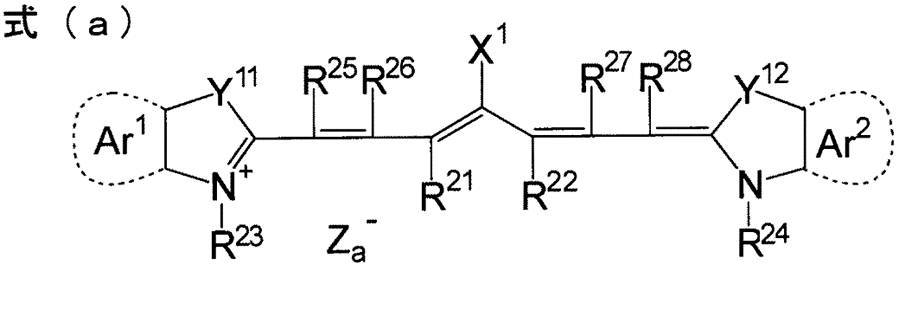
式(a)中、X1は、水素原子、ハロゲン原子、ジアリールアミノ基(-NPh2)、X2-L2又は以下に示す基を表す。X2は、酸素原子又は硫黄原子を表す。L2は、炭素数1~12の炭化水素基、ヘテロ原子を有する芳香族環、又はヘテロ原子を含む炭素数1~12の炭化水素基を表す。なお、ここでヘテロ原子とは、N、S、O、ハロゲン原子又はSeを表す。
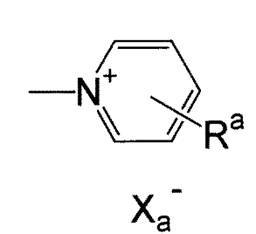
上記式中、Xa-は後述するZa-と同様に定義され、Raは、水素原子、アルキル基、アリール基、置換又は無置換のアミノ基、及び、ハロゲン原子より選択される置換基を表す。R21及びR22はそれぞれ独立に、炭素数1~12の炭化水素基を表す。塗布液の保存安定性から、R21及びR22は、炭素数2~12の炭化水素基であることが好ましく、更に、R21とR22とは互いに結合し、5員環又は6員環を形成していることが特に好ましい。
Ar1及びAr2は、それぞれ同じでも異なっていてもよく、置換基を有していてもよい芳香族炭化水素基を表す。好ましい芳香族炭化水素基としては、ベンゼン環及びナフタレン環が挙げられる。また、好ましい置換基としては、炭素数1~12の炭化水素基、ハロゲン原子、及び、炭素数1~12のアルコキシ基が挙げられる。
Y11及びY12は、それぞれ同じでも異なっていてもよく、硫黄原子又は炭素数3~12のジアルキルメチレン基を表す。R23及びR24は、それぞれ同じでも異なっていてもよく、置換基を有していてもよい炭素数1~20の炭化水素基を表す。好ましい置換基としては、炭素数1~12のアルコキシ基、カルボキシル基、及び、スルホ基が挙げられる。
R25、R26、R27及びR28は、それぞれ同じでも異なっていてもよく、水素原子又は炭素数1~12の炭化水素基を表し、原料の入手性から、好ましくは水素原子である。また、Za-は、対アニオンを表す。ただし、式(a)で表されるシアニン色素がその構造内にアニオン性の置換基を有し、電荷の中和が必要ない場合は、Za-は必要ない。好ましいZa-は、感光性樹脂組成物の保存安定性から、ハロゲン化物イオン、過塩素酸イオン、テトラフルオロボレートイオン、ヘキサフルオロホスフェートイオン及びスルホン酸イオンであり、特に好ましくは、過塩素酸イオン、ヘキサフルオロホスフェートイオン及びアレーンスルホン酸イオンである。
Y11及びY12は、それぞれ同じでも異なっていてもよく、硫黄原子又は炭素数3~12のジアルキルメチレン基を表す。R23及びR24は、それぞれ同じでも異なっていてもよく、置換基を有していてもよい炭素数1~20の炭化水素基を表す。好ましい置換基としては、炭素数1~12のアルコキシ基、カルボキシル基、及び、スルホ基が挙げられる。
R25、R26、R27及びR28は、それぞれ同じでも異なっていてもよく、水素原子又は炭素数1~12の炭化水素基を表し、原料の入手性から、好ましくは水素原子である。また、Za-は、対アニオンを表す。ただし、式(a)で表されるシアニン色素がその構造内にアニオン性の置換基を有し、電荷の中和が必要ない場合は、Za-は必要ない。好ましいZa-は、感光性樹脂組成物の保存安定性から、ハロゲン化物イオン、過塩素酸イオン、テトラフルオロボレートイオン、ヘキサフルオロホスフェートイオン及びスルホン酸イオンであり、特に好ましくは、過塩素酸イオン、ヘキサフルオロホスフェートイオン及びアレーンスルホン酸イオンである。
好適に用いることのできる式aで示されるシアニン色素の具体例としては、特開2001-133969号公報の段落0017~0019、特開2002-40638号公報の段落0012~0038、又は、特開2002-23360号公報の段落0012~0023に記載されたものを挙げることができる。
上層が含有する赤外線吸収剤として特に好ましくは、以下に示すシアニン染料Aである。
上層が含有する赤外線吸収剤として特に好ましくは、以下に示すシアニン染料Aである。

赤外線吸収剤の含有量としては、下層、中間層及び上層の全質量に対し、0.01~50質量%であることが好ましく、0.1~30質量%であることがより好ましく、1.0~30質量%であることが特に好ましい。含有量が0.01質量%以上であると、高感度となり、また、50質量%以下であると、層の均一性が良好であり、層の耐久性に優れる。
また、本開示に係る平版印刷版原版は、上層に赤外線吸収剤を含むことが好ましい。上層に赤外線吸収剤を含有することで、高感が良好となる。
上層における赤外線吸収剤の添加量としては、上層の全質量に対し、0.01質量%~50質量%であることが好ましく、0.1質量%~30質量%であることがより好ましく、1.0質量%~10質量%であることが特に好ましい。添加量が0.01質量%以上であることで感度が改良され、また、50質量%以下であると、層の均一性が良好であり、層の耐久性に優れる。
また、本開示に係る平版印刷版原版は、上層に赤外線吸収剤を含むことが好ましい。上層に赤外線吸収剤を含有することで、高感が良好となる。
上層における赤外線吸収剤の添加量としては、上層の全質量に対し、0.01質量%~50質量%であることが好ましく、0.1質量%~30質量%であることがより好ましく、1.0質量%~10質量%であることが特に好ましい。添加量が0.01質量%以上であることで感度が改良され、また、50質量%以下であると、層の均一性が良好であり、層の耐久性に優れる。
本開示における下層、中間層及び上層には、本開示の効果を損なわない限りにおいて、所望により他の成分を含有してもよい。
以下、上記他の成分である、他のアルカリ可溶性樹脂、酸発生剤、酸増殖剤、及び、その他の添加剤について説明する。
以下、上記他の成分である、他のアルカリ可溶性樹脂、酸発生剤、酸増殖剤、及び、その他の添加剤について説明する。
<酸発生剤>
本開示における下層、中間層及び上層のうち少なくとも1層には、感度向上の観点から、酸発生剤を含有することが好ましい。
本開示において酸発生剤とは、光又は熱により酸を発生する化合物であり、赤外線の照射や、100℃以上の加熱によって分解し酸を発生する化合物を指す。発生する酸としては、スルホン酸、塩酸等のpKaが2以下の強酸であることが好ましい。この酸発生剤から発生した酸が触媒として機能し、上記酸分解性基における化学結合が開裂して酸基となり、画像記録層のアルカリ水溶液に対する溶解性がより向上するものである。
本開示における下層、中間層及び上層のうち少なくとも1層には、感度向上の観点から、酸発生剤を含有することが好ましい。
本開示において酸発生剤とは、光又は熱により酸を発生する化合物であり、赤外線の照射や、100℃以上の加熱によって分解し酸を発生する化合物を指す。発生する酸としては、スルホン酸、塩酸等のpKaが2以下の強酸であることが好ましい。この酸発生剤から発生した酸が触媒として機能し、上記酸分解性基における化学結合が開裂して酸基となり、画像記録層のアルカリ水溶液に対する溶解性がより向上するものである。
本開示において好適に用いられる酸発生剤としては、ヨードニウム塩、スルホニウム塩、ホスホニウム塩、ジアゾニウム塩等のオニウム塩が挙げられる。具体的には、米国特許第4,708,925号明細書や特開平7-20629号公報に記載されている化合物を挙げることができる。特に、スルホン酸イオンを対イオンとするヨードニウム塩、スルホニウム塩、ジアゾニウム塩が好ましい。ジアゾニウム塩としては、米国特許第3,867,147号明細書記載のジアゾニウム化合物、米国特許第2,632,703号明細書記載のジアゾニウム化合物や特開平1-102456号及び特開平1-102457号の各公報に記載されているジアゾ樹脂も好ましい。また、米国特許第5,135,838号や米国特許第5,200,544号の各明細書に記載されているベンジルスルホナート類も好ましい。更に、特開平2-100054号、特開平2-100055号及び特開平9-197671号の各公報に記載されている活性スルホン酸エステルやジスルホニル化合物類も好ましい。他にも、特開平7-271029号公報に記載されている、ハロアルキル置換されたS-トリアジン類も好ましい。
更に、上記特開平8-220752号公報において、「酸前駆体」として記載されている化合物、あるいは、特開平9-171254号公報において「(a)活性光線の照射により酸を発生し得る化合物」として記載されている化合物なども本開示の酸発生剤として適用しうる。
更に、上記特開平8-220752号公報において、「酸前駆体」として記載されている化合物、あるいは、特開平9-171254号公報において「(a)活性光線の照射により酸を発生し得る化合物」として記載されている化合物なども本開示の酸発生剤として適用しうる。
中でも、感度と安定性の観点から、酸発生剤としてオニウム塩化合物を用いることが好ましい。以下、オニウム塩化合物について説明する。
本開示において好適に用い得るオニウム塩化合物としては、赤外線露光、及び、露光により赤外線吸収剤から発生する熱エネルギーにより分解して酸を発生する化合物として知られる化合物を挙げることができる。本開示に好適なオニウム塩化合物としては、感度の観点から、公知の熱重合開始剤や結合解離エネルギーの小さな結合を有する、以下に述べるオニウム塩構造を有するものを挙げることができる。
本開示において好適に用いられるオニウム塩としては、公知のジアゾニウム塩、ヨードニウム塩、スルホニウム塩、アンモニウム塩、ピリジニウム塩、アジニウム塩等が挙げられ、中でも、トリアリールスルホニウム、又は、ジアリールヨードニウムのスルホン酸塩、カルボン酸塩、BF4 -、PF6 -、ClO4 -などが好ましい。
本開示において酸発生剤として用いうるオニウム塩としては、下記式III~式Vで表されるオニウム塩が挙げられる。
本開示において好適に用い得るオニウム塩化合物としては、赤外線露光、及び、露光により赤外線吸収剤から発生する熱エネルギーにより分解して酸を発生する化合物として知られる化合物を挙げることができる。本開示に好適なオニウム塩化合物としては、感度の観点から、公知の熱重合開始剤や結合解離エネルギーの小さな結合を有する、以下に述べるオニウム塩構造を有するものを挙げることができる。
本開示において好適に用いられるオニウム塩としては、公知のジアゾニウム塩、ヨードニウム塩、スルホニウム塩、アンモニウム塩、ピリジニウム塩、アジニウム塩等が挙げられ、中でも、トリアリールスルホニウム、又は、ジアリールヨードニウムのスルホン酸塩、カルボン酸塩、BF4 -、PF6 -、ClO4 -などが好ましい。
本開示において酸発生剤として用いうるオニウム塩としては、下記式III~式Vで表されるオニウム塩が挙げられる。
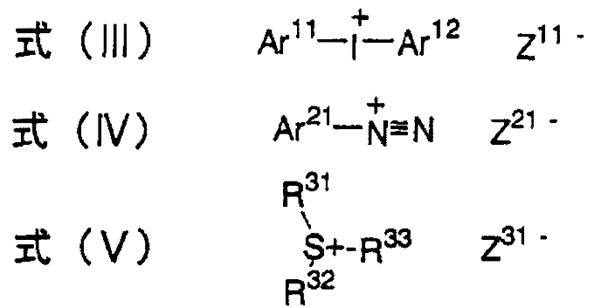
上記式III中、Ar11とAr12は、それぞれ独立に、置換基を有していてもよい炭素原子数6~20のアリール基を表す。このアリール基が置換基を有する場合の好ましい置換基としては、ハロゲン原子、ニトロ基、炭素数1~12のアルキル基、炭素数1~12のアルコキシ基、又は、炭素数1~12のアリールオキシ基が挙げられる。Z11-はハロゲンイオン、過塩素酸イオン、テトラフルオロボレートイオン、ヘキサフルオロホスフェートイオン、スルホン酸イオン、及び、ペルフルオロアルキルスルホン酸イオン等フッ素原子を有するスルホン酸イオンからなる群より選択される対イオンを表し、好ましくは、過塩素酸イオン、ヘキサフルオロホスフェートイオン、アリールスルホン酸イオン、及びペルフルオロアルキルスルホン酸である。
上記式IV中、Ar21は、置換基を有していてもよい炭素数6~20個のアリール基を示す。好ましい置換基としては、ハロゲン原子、ニトロ基、炭素数1~12のアルキル基、炭素数1~12のアルコキシ基、炭素数6~12のアリールオキシ基、炭素数1~12のアルキルアミノ基、炭素数2~12のジアルキルアミノ基、炭素数6~12のアリールアミノ基、又は、炭素数12~20のジアリールアミノ基が挙げられる。Z21-はZ11-と同義の対イオンを表す。
上記式V中、R31、R32及びR33は、それぞれ同じでも異なっていてもよく、置換基を有していてもよい炭素数1~20の炭化水素基を示す。好ましい置換基としては、ハロゲン原子、ニトロ基、炭素数1~12のアルキル基、炭素数1~12のアルコキシ基、又は炭素数6~12のアリールオキシ基が挙げられる。Z31-はZ11-と同義の対イオンを表す。
上記式IV中、Ar21は、置換基を有していてもよい炭素数6~20個のアリール基を示す。好ましい置換基としては、ハロゲン原子、ニトロ基、炭素数1~12のアルキル基、炭素数1~12のアルコキシ基、炭素数6~12のアリールオキシ基、炭素数1~12のアルキルアミノ基、炭素数2~12のジアルキルアミノ基、炭素数6~12のアリールアミノ基、又は、炭素数12~20のジアリールアミノ基が挙げられる。Z21-はZ11-と同義の対イオンを表す。
上記式V中、R31、R32及びR33は、それぞれ同じでも異なっていてもよく、置換基を有していてもよい炭素数1~20の炭化水素基を示す。好ましい置換基としては、ハロゲン原子、ニトロ基、炭素数1~12のアルキル基、炭素数1~12のアルコキシ基、又は炭素数6~12のアリールオキシ基が挙げられる。Z31-はZ11-と同義の対イオンを表す。
本開示において、好適に用いることのできる式IIIで示されるオニウム塩(OI-1~OI-10)、式IVで示されるオニウム塩(ON-1~ON-5)、及び、式Vで示されるオニウム塩(OS-1~OS-6)の具体例を以下に挙げる。


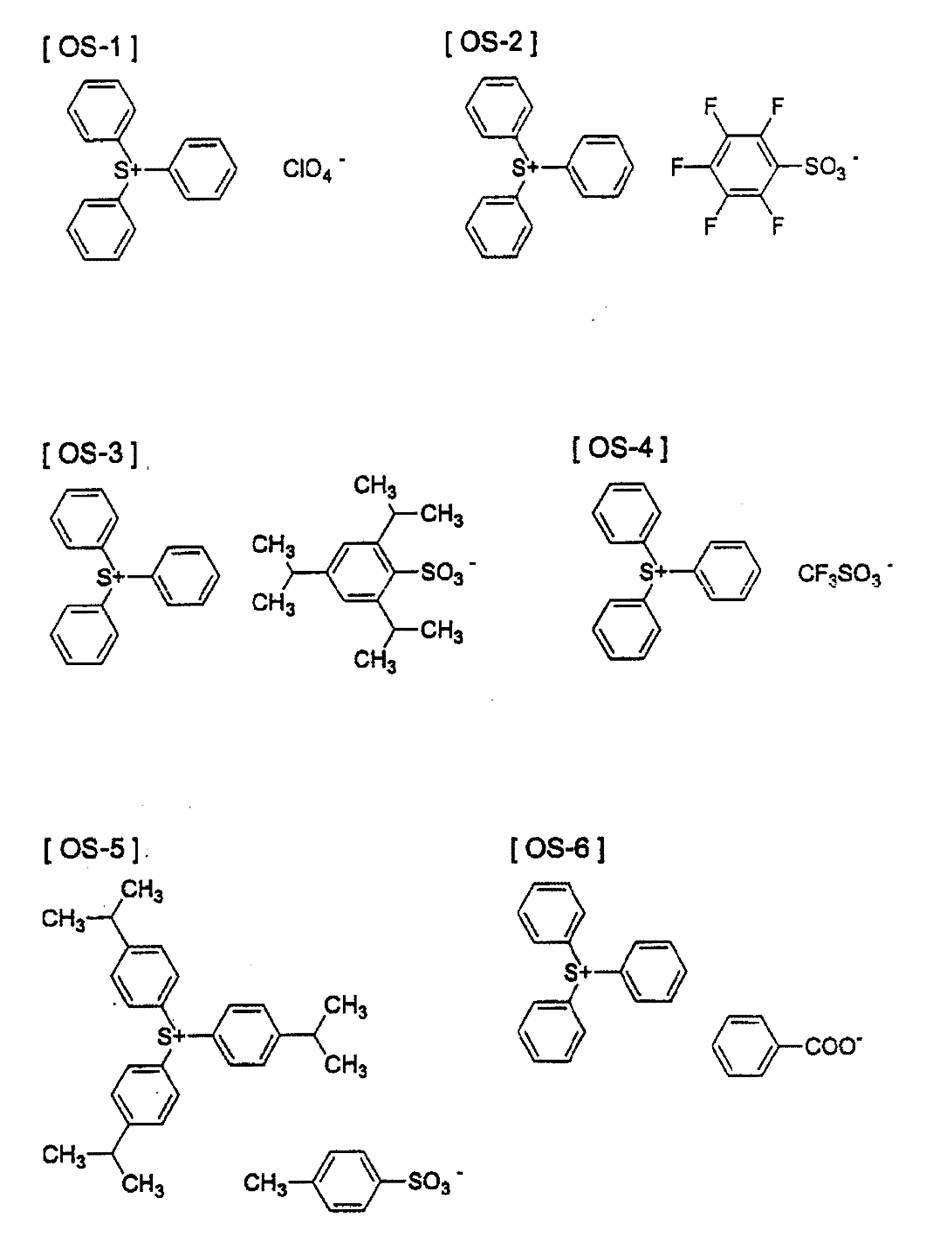
また、上記式III~式Vで表される化合物の別の例としては、特開2008-195018号公報の段落0036~0045において、ラジカル重合開始剤の例として記載の化合物を、本開示における酸発生剤として好適に用いることができる。
本開示に用いられる酸発生剤として好ましいオニウム塩の別の例として、下記式VIで表されるアジニウム塩化合物が挙げられる。
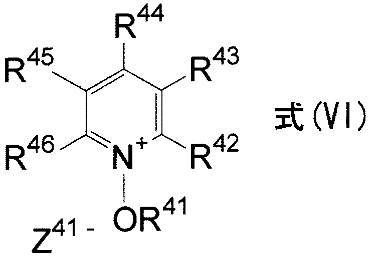
式VI中、R41、R42、R43、R44、R45、及びR46は、それぞれ同じでも異なっていてもよく、水素原子、ハロゲン原子、又は一価の置換基を表す。
一価の置換基としては、例えば、ハロゲン原子、アミノ基、置換アミノ基、置換カルボニル墓、水酸基、置換オキシ基、チオール基、チオエーテル基、シリル基、ニトロ基、シアノ基、アルキル基、アルケニル基、アリール基、ヘテロ環基、スルホ基、置換スルホニル基、スルホナト基、置換スルフィニル基、ホスホノ基、置換ホスホノ基、ホスホナト基、置換ホスホナト基、等が挙げられ、導入可能な場合には更に置換基を有していてもよい。
一価の置換基としては、例えば、ハロゲン原子、アミノ基、置換アミノ基、置換カルボニル墓、水酸基、置換オキシ基、チオール基、チオエーテル基、シリル基、ニトロ基、シアノ基、アルキル基、アルケニル基、アリール基、ヘテロ環基、スルホ基、置換スルホニル基、スルホナト基、置換スルフィニル基、ホスホノ基、置換ホスホノ基、ホスホナト基、置換ホスホナト基、等が挙げられ、導入可能な場合には更に置換基を有していてもよい。
式VIで表される化合物としては、式VIで表される化合物における特定構造の骨格(カチオン部)が、R41を介して結合し、カチオン部が分子中に2個以上含まれる化合物(多量体型)も包含され、このような化合物も好適に用いられる。
Z41-はZ11-と同義の対イオンを表す。
上記式VIで示されるアジニウム塩化合物の具体例としては、特開2008-195018号公報の段落0047~0056に記載の化合物を挙げることができる。
また、特開昭63-138345号、特開昭63-142345号、特開昭63-142346号、特開昭63-143537号並びに特公昭46-42363号の各公報に記載のN-O結合を有する化合物群もまた、本開示における酸発生剤として好適に用いられる。
Z41-はZ11-と同義の対イオンを表す。
上記式VIで示されるアジニウム塩化合物の具体例としては、特開2008-195018号公報の段落0047~0056に記載の化合物を挙げることができる。
また、特開昭63-138345号、特開昭63-142345号、特開昭63-142346号、特開昭63-143537号並びに特公昭46-42363号の各公報に記載のN-O結合を有する化合物群もまた、本開示における酸発生剤として好適に用いられる。
本開示に用いうる酸発生剤のより好ましい例として、下記化合物(PAG-1)~(PAG-5)が挙げられる。Meはメチル基を表す。
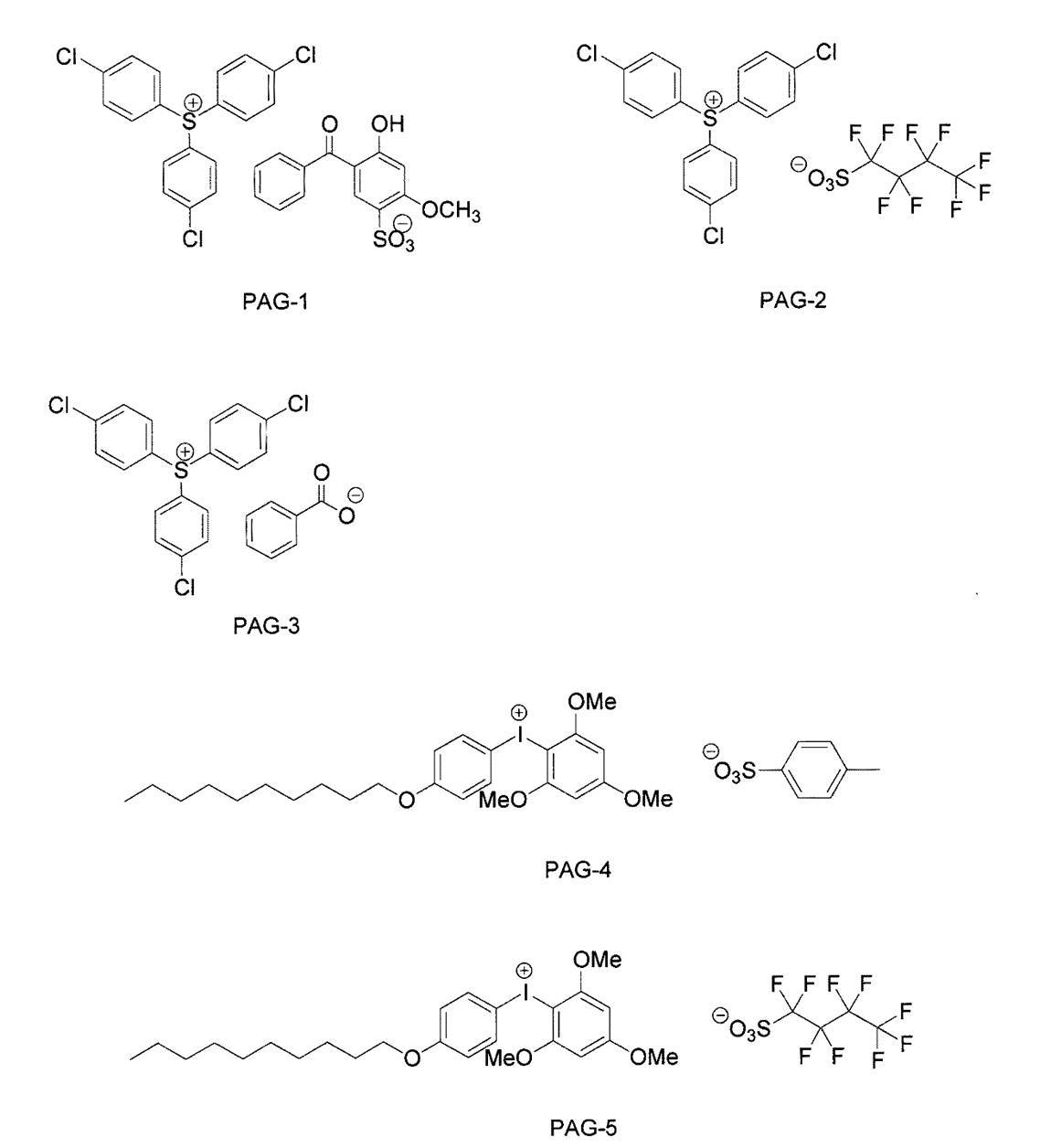
酸発生剤は、1種単独で使用してもよく、また、2種以上を組み合わせて使用してもよい。
酸発生剤の好ましい添加量は、添加する層の全質量に対し、0.01質量%~50質量%であることが好ましく、0.1質量%~40質量%であることがより好ましく、0.5質量%~30質量%であることが更に好ましい。添加量が上記範囲において、酸発生剤添加の効果である感度の向上が見られるとともに、非画像部における残膜の発生が抑制される。
酸発生剤の好ましい添加量は、添加する層の全質量に対し、0.01質量%~50質量%であることが好ましく、0.1質量%~40質量%であることがより好ましく、0.5質量%~30質量%であることが更に好ましい。添加量が上記範囲において、酸発生剤添加の効果である感度の向上が見られるとともに、非画像部における残膜の発生が抑制される。
<酸増殖剤>
本開示における下層、中間層及び上層のうち少なくとも1層、好ましくは上層には、酸増殖剤を添加してもよい。
本開示における酸増殖剤とは、比較的に強い酸の残基で置換された化合物であって、酸触媒の存在下で容易に脱離して新たに酸を発生する化合物である。即ち、酸触媒反応によって分解し、再び酸(以下、式でZOHと記す。)を発生する。1反応で1つ以上の酸が増えており、反応の進行に伴って加速的に酸濃度が増加することにより、飛躍的に感度が向上する。この発生する酸の強度は,酸解離定数(pKa)として3以下であり、更に2以下であることが好ましい。これよりも弱い酸であると,酸触媒による脱離反応を引き起こすことができない。
このような酸触媒に使用される酸としては、ジクロロ酢酸、トリクロロ酢酸、メタンスルホン酸、エタンスルホン酸、ベンゼンスルホン酸、p-トルエンスルホン酸、ナフタレンスルホン酸、フェニルスルホン酸等が挙げられる。
本開示における下層、中間層及び上層のうち少なくとも1層、好ましくは上層には、酸増殖剤を添加してもよい。
本開示における酸増殖剤とは、比較的に強い酸の残基で置換された化合物であって、酸触媒の存在下で容易に脱離して新たに酸を発生する化合物である。即ち、酸触媒反応によって分解し、再び酸(以下、式でZOHと記す。)を発生する。1反応で1つ以上の酸が増えており、反応の進行に伴って加速的に酸濃度が増加することにより、飛躍的に感度が向上する。この発生する酸の強度は,酸解離定数(pKa)として3以下であり、更に2以下であることが好ましい。これよりも弱い酸であると,酸触媒による脱離反応を引き起こすことができない。
このような酸触媒に使用される酸としては、ジクロロ酢酸、トリクロロ酢酸、メタンスルホン酸、エタンスルホン酸、ベンゼンスルホン酸、p-トルエンスルホン酸、ナフタレンスルホン酸、フェニルスルホン酸等が挙げられる。
酸増殖剤は、国際公開第95/29968号、国際公開第98/24000号、特開平8-305262号、特開平9-34106号、特開平8-248561号、特表平8-503082号、米国特許第5,445,917号、特表平8-503081号、米国特許第5,534,393号、米国特許第5,395,736号、米国特許第5,741,630号、米国特許第5,334,489号、米国特許第5,582,956号、米国特許第5,578,424号、米国特許第5,453,345号、米国特許第5,445,917号、欧州特許第665,960号、欧州特許第757,628号、欧州特許第665,961号、米国特許第5,667,943号、特開平10-1598号等の各公報に記載の酸増殖剤を1種、あるいは2種以上組み合わせて用いることができる。
本開示における酸増殖剤の好ましい具体例としては、例えば、特開2001-66765号公報の段落0056~0067に記載される化合物を挙げることができる。中でも、例示化合物(ADD-1)、(ADD-2)、(ADD-3)として記載された下記化合物を好適に用いることができる。
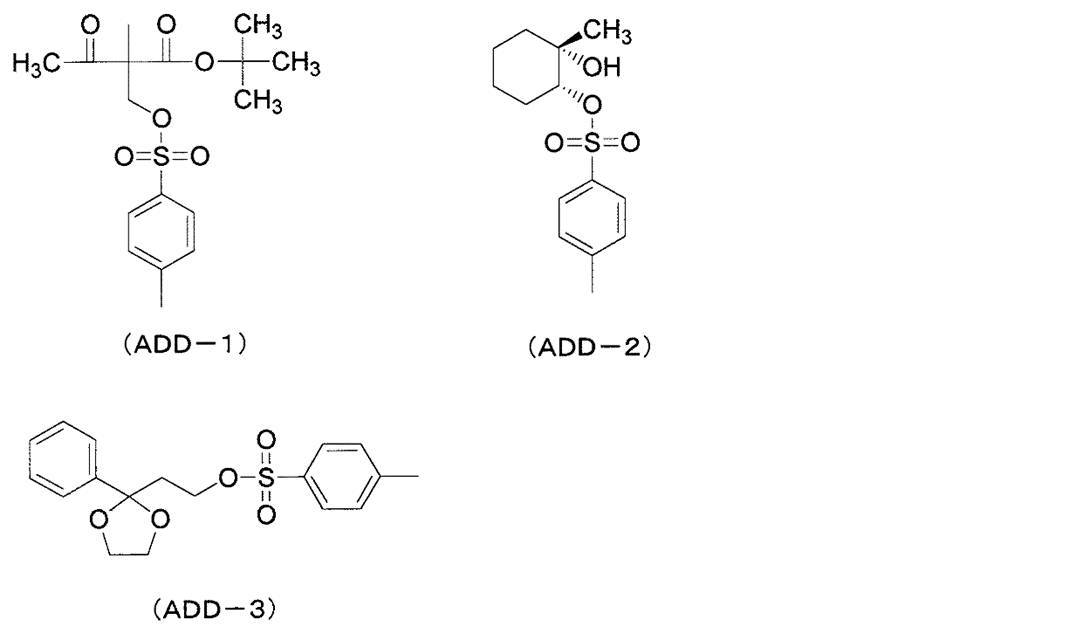
これらの酸増殖剤を下層、中間層及び上層のうち少なくとも1層、好ましくは上層中に添加する場合の添加量としては、添加した層の全質量に対し、0.01質量%~20質量%であることが好ましく、0.01質量%~10質量%であることがより好ましく、0.1質量%~5質量%であることが更に好ましい。酸増殖剤の添加量が上記範囲において、酸増殖剤を添加する効果が充分に得られ、感度向上が達成されるとともに、画像部の膜強度低下が抑制される。
<その他の添加剤>
本開示における下層、中間層及び上層のうち少なくとも1層は、その他の添加剤として、現像促進剤、界面活性剤、焼き出し剤/着色剤、可塑剤、ワックス剤等を含んでもよい。
本開示における下層、中間層及び上層のうち少なくとも1層は、その他の添加剤として、現像促進剤、界面活性剤、焼き出し剤/着色剤、可塑剤、ワックス剤等を含んでもよい。
-現像促進剤-
本開示における下層、中間層及び上層のうち少なくとも1層には、感度を向上させる目的で、酸無水物類、フェノール類、及び、有機酸類よりなる群から選ばれた化合物を添加してもよい。
酸無水物類としては、環状酸無水物が好ましく、具体的に環状酸無水物としては、米国特許第4,115,128号明細書に記載されている無水フタル酸、テトラヒドロ無水フタル酸、ヘキサヒドロ無水フタル酸、3,6-エンドオキシテトラヒドロ無水フタル酸、テトラクロロ無水フタル酸、無水マレイン酸、クロロ無水マレイン酸、α-フェニル無水マレイン酸、無水コハク酸、無水ピロメリット酸などが使用できる。非環状の酸無水物としては、無水酢酸などが挙げられる。
フェノール類としては、ビスフェノールA、2,2’-ビスヒドロキシスルホン、p-ニトロフェノール、p-エトキシフェノール、2,4,4’-トリヒドロキシベンゾフェノン、2,3,4-トリヒドロキシベンゾフェノン、4-ヒドロキシベンゾフェノン、4,4’,4”-トリヒドロキシトリフェニルメタン、4,4’,3”,4”-テトラヒドロキシ-3,5,3’,5’-テトラメチルトリフェニルメタンなどが挙げられる。
有機酸類としては、特開昭60-88942号公報、特開平2-96755号公報などに記載されており、具体的には、p-トルエンスルホン酸、ドデシルベンゼンスルホン酸、p-トルエンスルフィン酸、エチル硫酸、フェニルホスホン酸、フェニルホスフィン酸、リン酸フェニル、リン酸ジフェニル、安息香酸、イソフタル酸、アジピン酸、p-トルイル酸、3,4-ジメトキシ安息香酸、フタル酸、テレフタル酸、4-シクロヘキセン-1,2-ジカルボン酸、エルカ酸、ラウリン酸、n-ウンデカン酸、アスコルビン酸などが挙げられる。
上記の酸無水物、フェノール類及び有機酸類を添加した層におけるこれらの含有割合は、添加した層の全質量に対し、0.05質量%~20質量%が好ましく、0.1質量%~15質量%がより好ましく、0.1質量%~10質量%が特に好ましい。
本開示における下層、中間層及び上層のうち少なくとも1層には、感度を向上させる目的で、酸無水物類、フェノール類、及び、有機酸類よりなる群から選ばれた化合物を添加してもよい。
酸無水物類としては、環状酸無水物が好ましく、具体的に環状酸無水物としては、米国特許第4,115,128号明細書に記載されている無水フタル酸、テトラヒドロ無水フタル酸、ヘキサヒドロ無水フタル酸、3,6-エンドオキシテトラヒドロ無水フタル酸、テトラクロロ無水フタル酸、無水マレイン酸、クロロ無水マレイン酸、α-フェニル無水マレイン酸、無水コハク酸、無水ピロメリット酸などが使用できる。非環状の酸無水物としては、無水酢酸などが挙げられる。
フェノール類としては、ビスフェノールA、2,2’-ビスヒドロキシスルホン、p-ニトロフェノール、p-エトキシフェノール、2,4,4’-トリヒドロキシベンゾフェノン、2,3,4-トリヒドロキシベンゾフェノン、4-ヒドロキシベンゾフェノン、4,4’,4”-トリヒドロキシトリフェニルメタン、4,4’,3”,4”-テトラヒドロキシ-3,5,3’,5’-テトラメチルトリフェニルメタンなどが挙げられる。
有機酸類としては、特開昭60-88942号公報、特開平2-96755号公報などに記載されており、具体的には、p-トルエンスルホン酸、ドデシルベンゼンスルホン酸、p-トルエンスルフィン酸、エチル硫酸、フェニルホスホン酸、フェニルホスフィン酸、リン酸フェニル、リン酸ジフェニル、安息香酸、イソフタル酸、アジピン酸、p-トルイル酸、3,4-ジメトキシ安息香酸、フタル酸、テレフタル酸、4-シクロヘキセン-1,2-ジカルボン酸、エルカ酸、ラウリン酸、n-ウンデカン酸、アスコルビン酸などが挙げられる。
上記の酸無水物、フェノール類及び有機酸類を添加した層におけるこれらの含有割合は、添加した層の全質量に対し、0.05質量%~20質量%が好ましく、0.1質量%~15質量%がより好ましく、0.1質量%~10質量%が特に好ましい。
-界面活性剤-
本開示における下層、中間層及び上層のうち少なくとも1層には、塗布性を良化するため、また、現像条件に対する処理の安定性を広げるため、特開昭62-251740号公報や特開平3-208514号公報に記載されているような非イオン界面活性剤、特開昭59-121044号公報、特開平4-13149号公報に記載されているような両性界面活性剤、特開昭62-170950号公報、特開平11-288093号公報、特開2003-57820号公報に記載されているようなフッ素含有のモノマー共重合体を添加することができる。
非イオン界面活性剤の具体例としては、ソルビタントリステアレート、ソルビタンモノパルミテート、ソルビタントリオレート、ステアリン酸モノグリセリド、ポリオキシエチレンノニルフェニルエーテル等が挙げられる。
両性活性剤の具体例としては、アルキルジ(アミノエチル)グリシン、アルキルポリアミノエチルグリシン塩酸塩、2-アルキル-N-カルボキシエチル-N-ヒドロキシエチルイミダゾリニウムベタインやN-テトラデシル-N,N-ベタイン型(例えば、商品名「アモーゲンK」:第一工業製薬(株)製)等が挙げられる。
界面活性剤を添加した層における界面活性剤の含有割合は、添加した層の全質量に対し、0.01質量%~15質量%が好ましく、0.01質量%~5質量%がより好ましく、0.05質量%~2.0質量%が更に好ましい。
本開示における下層、中間層及び上層のうち少なくとも1層には、塗布性を良化するため、また、現像条件に対する処理の安定性を広げるため、特開昭62-251740号公報や特開平3-208514号公報に記載されているような非イオン界面活性剤、特開昭59-121044号公報、特開平4-13149号公報に記載されているような両性界面活性剤、特開昭62-170950号公報、特開平11-288093号公報、特開2003-57820号公報に記載されているようなフッ素含有のモノマー共重合体を添加することができる。
非イオン界面活性剤の具体例としては、ソルビタントリステアレート、ソルビタンモノパルミテート、ソルビタントリオレート、ステアリン酸モノグリセリド、ポリオキシエチレンノニルフェニルエーテル等が挙げられる。
両性活性剤の具体例としては、アルキルジ(アミノエチル)グリシン、アルキルポリアミノエチルグリシン塩酸塩、2-アルキル-N-カルボキシエチル-N-ヒドロキシエチルイミダゾリニウムベタインやN-テトラデシル-N,N-ベタイン型(例えば、商品名「アモーゲンK」:第一工業製薬(株)製)等が挙げられる。
界面活性剤を添加した層における界面活性剤の含有割合は、添加した層の全質量に対し、0.01質量%~15質量%が好ましく、0.01質量%~5質量%がより好ましく、0.05質量%~2.0質量%が更に好ましい。
-焼出し剤/着色剤-
本開示における下層、中間層及び上層のうち少なくとも1層には、露光による加熱後直ちに可視像を得るための焼き出し剤や、画像着色剤としての染料や顔料を加えることができる。
焼出し剤及び着色剤としては、例えば、特開2009-229917号公報の段落0122~0123に詳細に記載され、ここに記載の化合物を本開示にも適用しうる。
これらの染料は、添加した層の全質量に対し、0.01質量%~10質量%の割合で添加することが好ましく、0.1質量%~3質量%の割合で添加することがより好ましい。
本開示における下層、中間層及び上層のうち少なくとも1層には、露光による加熱後直ちに可視像を得るための焼き出し剤や、画像着色剤としての染料や顔料を加えることができる。
焼出し剤及び着色剤としては、例えば、特開2009-229917号公報の段落0122~0123に詳細に記載され、ここに記載の化合物を本開示にも適用しうる。
これらの染料は、添加した層の全質量に対し、0.01質量%~10質量%の割合で添加することが好ましく、0.1質量%~3質量%の割合で添加することがより好ましい。
-可塑剤-
本開示における下層、中間層及び上層のうち少なくとも1層には、塗膜の柔軟性等を付与するために可塑剤を添加してもよい。例えば、ブチルフタリル、ポリエチレングリコール、クエン酸トリブチル、フタル酸ジエチル、フタル酸ジブチル、フタル酸ジヘキシル、フタル酸ジオクチル、リン酸トリクレジル、リン酸トリブチル、リン酸トリオクチル、オレイン酸テトラヒドロフルフリル、アクリル酸又はメタクリル酸のオリゴマー及びポリマー等が用いられる。
これらの可塑剤は、添加した層の全質量に対し、0.5質量%~10質量%の割合で添加することが好ましく、1.0質量%~5質量%の割合で添加することがより好ましい。
本開示における下層、中間層及び上層のうち少なくとも1層には、塗膜の柔軟性等を付与するために可塑剤を添加してもよい。例えば、ブチルフタリル、ポリエチレングリコール、クエン酸トリブチル、フタル酸ジエチル、フタル酸ジブチル、フタル酸ジヘキシル、フタル酸ジオクチル、リン酸トリクレジル、リン酸トリブチル、リン酸トリオクチル、オレイン酸テトラヒドロフルフリル、アクリル酸又はメタクリル酸のオリゴマー及びポリマー等が用いられる。
これらの可塑剤は、添加した層の全質量に対し、0.5質量%~10質量%の割合で添加することが好ましく、1.0質量%~5質量%の割合で添加することがより好ましい。
-ワックス剤-
本開示における下層、中間層及び上層のうち少なくとも1層には、傷に対する抵抗性を付与する目的で、表面の静摩擦係数を低下させる化合物を添加することもできる。具体的には、米国特許第6,117,913号明細書、特開2003-149799号公報、特開2003-302750号公報、又は、特開2004-12770号公報に記載されているような、長鎖アルキルカルボン酸のエステルを有する化合物などを挙げることができる。
ワックス剤の添加量としては、添加した層の全質量に対し、0.1質量%~10質量%であることが好ましく、0.5質量%~5質量%であることがより好ましい。
本開示における下層、中間層及び上層のうち少なくとも1層には、傷に対する抵抗性を付与する目的で、表面の静摩擦係数を低下させる化合物を添加することもできる。具体的には、米国特許第6,117,913号明細書、特開2003-149799号公報、特開2003-302750号公報、又は、特開2004-12770号公報に記載されているような、長鎖アルキルカルボン酸のエステルを有する化合物などを挙げることができる。
ワックス剤の添加量としては、添加した層の全質量に対し、0.1質量%~10質量%であることが好ましく、0.5質量%~5質量%であることがより好ましい。
<各成分の組成比>
本開示に係る平版印刷版原版における下層、中間層及び上層の全質量に対して、高分子化合物1、2及び3の総含有量は10質量%~90質量%であることが好ましく、赤外線吸収剤の含有量は0.01質量%~50質量%であることが好ましく、酸発生剤の含有量は0質量%~30質量%であることが好ましく、酸増殖剤の含有量は0質量%~20質量%であることが好ましく、現像促進剤の含有量は0質量%~20質量%であることが好ましく、界面活性剤の含有量は0質量%~5質量%であることが好ましく、焼き出し剤/着色剤の含有量は0質量%~10質量%であることが好ましく、可塑剤の含有量は0質量%~10質量%であることが好ましく、ワックス剤の含有量は0質量%~10質量%であることが好ましい。
本開示に係る平版印刷版原版における下層、中間層及び上層の全質量に対して、高分子化合物1、2及び3の総含有量は10質量%~90質量%であることが好ましく、赤外線吸収剤の含有量は0.01質量%~50質量%であることが好ましく、酸発生剤の含有量は0質量%~30質量%であることが好ましく、酸増殖剤の含有量は0質量%~20質量%であることが好ましく、現像促進剤の含有量は0質量%~20質量%であることが好ましく、界面活性剤の含有量は0質量%~5質量%であることが好ましく、焼き出し剤/着色剤の含有量は0質量%~10質量%であることが好ましく、可塑剤の含有量は0質量%~10質量%であることが好ましく、ワックス剤の含有量は0質量%~10質量%であることが好ましい。
<溶剤>
本開示に係る平版印刷版原版における下層、中間層及び上層は、上記各成分を溶剤に溶かして、適当な支持体上に塗布することにより形成することができる。
ここで使用する溶剤としては、エチレンジクロライド、シクロヘキサノン、メチルエチルケトン、メタノール、エタノール、プロパノール、エチレングリコールモノメチルエーテル、1-メトキシ-2-プロパノール、2-メトキシエチルアセテート、1-メトキシ-2-プロピルアセテート、ジメトキシエタン、乳酸メチル、乳酸エチル、N,N-ジメチルアセトアミド、N,N-ジメチルホルムアミド、テトラメチルウレア、N-メチルピロリドン、ジメチルスルホキシド、スルホラン、γ-ブチロラクトン、トルエン、1,3-ジメチル-2-イミダゾリジノン等を挙げることができるが、これに限定されるものではない。これらの溶剤は、単独又は混合して使用される。
本開示に係る平版印刷版原版における下層、中間層及び上層は、上記各成分を溶剤に溶かして、適当な支持体上に塗布することにより形成することができる。
ここで使用する溶剤としては、エチレンジクロライド、シクロヘキサノン、メチルエチルケトン、メタノール、エタノール、プロパノール、エチレングリコールモノメチルエーテル、1-メトキシ-2-プロパノール、2-メトキシエチルアセテート、1-メトキシ-2-プロピルアセテート、ジメトキシエタン、乳酸メチル、乳酸エチル、N,N-ジメチルアセトアミド、N,N-ジメチルホルムアミド、テトラメチルウレア、N-メチルピロリドン、ジメチルスルホキシド、スルホラン、γ-ブチロラクトン、トルエン、1,3-ジメチル-2-イミダゾリジノン等を挙げることができるが、これに限定されるものではない。これらの溶剤は、単独又は混合して使用される。
上記下層、中間層及び上層における高分子化合物1、2又は3の含有量は、含有される層の全質量に対して、10質量%~100質量%であることが好ましく、50質量%~98質量%であることがより好ましく、60質量%~95質量%であることが更に好ましい。含有量がこの範囲であると、現像した際のパターン形成性が良好となる。
本開示に係る平版印刷版原版の支持体上に塗布される下層成分及び中間層成分の乾燥後の塗布量の合計は、0.5g/m2~4.0g/m2の範囲にあることが好ましく、0.6g/m2~2.5g/m2の範囲にあることがより好ましい。0.5g/m2以上であると、耐刷性に優れ、4.0g/m2以下であると、画像再現性及び感度に優れる。
また、上層成分の乾燥後の塗布量は、0.05g/m2~1.0g/m2の範囲にあることが好ましく、0.08g/m2~0.7g/m2の範囲であることがより好ましい。0.05g/m2以上であると、現像ラチチュード、及び、耐傷性に優れ、1.0g/m2以下であると、感度に優れる。
下層、中間層及び上層を合わせた乾燥後の塗布量としては、0.6g/m2~4.0g/m2の範囲にあることが好ましく、0.7g/m2~2.5g/m2の範囲にあることがより好ましい。0.6g/m2以上であると、耐刷性に優れ、4.0g/m2以下であると、画像再現性及び感度に優れる。
また、上層成分の乾燥後の塗布量は、0.05g/m2~1.0g/m2の範囲にあることが好ましく、0.08g/m2~0.7g/m2の範囲であることがより好ましい。0.05g/m2以上であると、現像ラチチュード、及び、耐傷性に優れ、1.0g/m2以下であると、感度に優れる。
下層、中間層及び上層を合わせた乾燥後の塗布量としては、0.6g/m2~4.0g/m2の範囲にあることが好ましく、0.7g/m2~2.5g/m2の範囲にあることがより好ましい。0.6g/m2以上であると、耐刷性に優れ、4.0g/m2以下であると、画像再現性及び感度に優れる。
<支持体>
本開示に用いられる支持体としては、必要な強度と耐久性を備えた寸度的に安定な板状物であれば特に制限はなく、例えば、紙、プラスチック(例えば、ポリエチレン、ポリプロピレン、ポリスチレン等)がラミネートされた紙、金属板(例えば、アルミニウム、亜鉛、銅等)、プラスチックフィルム(例えば、二酢酸セルロース、三酢酸セルロース、プロピオン酸セルロース、酪酸セルロース、酢酸酪酸セルロース、硝酸セルロース、ポリエチレンテレフタレート、ポリエチレン、ポリスチレン、ポリプロピレン、ポリカーボネート、ポリビニルアセタール等)、上記の如き金属がラミネート若しくは蒸着された紙、又は、プラスチックフィルム等が挙げられる。
本開示に用いられる支持体としては、必要な強度と耐久性を備えた寸度的に安定な板状物であれば特に制限はなく、例えば、紙、プラスチック(例えば、ポリエチレン、ポリプロピレン、ポリスチレン等)がラミネートされた紙、金属板(例えば、アルミニウム、亜鉛、銅等)、プラスチックフィルム(例えば、二酢酸セルロース、三酢酸セルロース、プロピオン酸セルロース、酪酸セルロース、酢酸酪酸セルロース、硝酸セルロース、ポリエチレンテレフタレート、ポリエチレン、ポリスチレン、ポリプロピレン、ポリカーボネート、ポリビニルアセタール等)、上記の如き金属がラミネート若しくは蒸着された紙、又は、プラスチックフィルム等が挙げられる。
なお、本開示に係る平版印刷版原版における支持体としては、ポリエステルフィルム又はアルミニウム板が好ましく、その中でも寸度安定性がよく、比較的安価であるアルミニウム板は特に好ましい。好適なアルミニウム板は、純アルミニウム板及びアルミニウムを主成分とし、微量の異元素を含む合金板であり、更にアルミニウムがラミネート又は蒸着されたプラスチックフィルムでもよい。アルミニウム合金に含まれる異元素には、ケイ素、鉄、マンガン、銅、マグネシウム、クロム、亜鉛、ビスマス、ニッケル、チタンなどがある。合金中の異元素の含有量は10質量%以下であることが好ましい。
本開示において特に好適なアルミニウムは、純アルミニウムであるが、完全に純粋なアルミニウムは精錬技術上製造が困難であるので、僅かに異元素を含有するものでもよい。
このように本開示に用いられるアルミニウム板は、その組成が特定されるものではなく、従来より公知公用の素材のアルミニウム板を適宜に利用することができる。本開示で用いられるアルミニウム板の厚みは、0.1mm~0.6mmであることが好ましく、0.15mm~0.4mmであることがより好ましく、0.2mm~0.3mmであることが特に好ましい。
このように本開示に用いられるアルミニウム板は、その組成が特定されるものではなく、従来より公知公用の素材のアルミニウム板を適宜に利用することができる。本開示で用いられるアルミニウム板の厚みは、0.1mm~0.6mmであることが好ましく、0.15mm~0.4mmであることがより好ましく、0.2mm~0.3mmであることが特に好ましい。
このようなアルミニウム板には、必要に応じて粗面化処理、陽極酸化処理などの表面処理を行ってもよい。アルミニウム支持体の表面処理については、例えば、特開2009-175195号公報の段落0167~0169に詳細に記載されるような、界面活性剤、有機溶剤又はアルカリ性水溶液などによる脱脂処理、表面の粗面化処理、陽極酸化処理などが適宜、施される。
陽極酸化処理を施されたアルミニウム表面は、必要により親水化処理が施される。
親水化処理としては、特開2009-175195号公報の段落0169に開示されているような、アルカリ金属シリケート(例えばケイ酸ナトリウム水溶液)法、フッ化ジルコン酸カリウムあるいは、ポリビニルホスホン酸で処理する方法などが用いられる。
また、特開2011-245844号公報に記載された支持体も好ましく用いられる。
陽極酸化処理を施されたアルミニウム表面は、必要により親水化処理が施される。
親水化処理としては、特開2009-175195号公報の段落0169に開示されているような、アルカリ金属シリケート(例えばケイ酸ナトリウム水溶液)法、フッ化ジルコン酸カリウムあるいは、ポリビニルホスホン酸で処理する方法などが用いられる。
また、特開2011-245844号公報に記載された支持体も好ましく用いられる。
<下塗層>
本開示に係る平版印刷版原版は、必要に応じて支持体と下層との間に下塗層を設けることができる。なお、下記に示す下塗層は、親水性層として機能する。
下塗層成分としては、種々の有機化合物が用いられ、例えば、カルボキシメチルセルロース、デキストリン等のアミノ基を有するホスホン酸類、有機ホスホン酸、有機リン酸、有機ホスフィン酸、アミノ酸類、並びに、ヒドロキシ基を有するアミンの塩酸塩等が好ましく挙げられる。また、これら下塗層成分は、1種単独で用いても、2種以上混合して用いてもよい。下塗層に使用される化合物の詳細、下塗層の形成方法は、特開2009-175195号公報の段落0171~0172に記載され、これらの記載は本開示にも適用される。
下塗層の被覆量は、2mg/m2~200mg/m2であることが好ましく、5mg/m2~100mg/m2であることがより好ましい。被覆量が上記範囲であると、十分な耐刷性能が得られる。
本開示に係る平版印刷版原版は、必要に応じて支持体と下層との間に下塗層を設けることができる。なお、下記に示す下塗層は、親水性層として機能する。
下塗層成分としては、種々の有機化合物が用いられ、例えば、カルボキシメチルセルロース、デキストリン等のアミノ基を有するホスホン酸類、有機ホスホン酸、有機リン酸、有機ホスフィン酸、アミノ酸類、並びに、ヒドロキシ基を有するアミンの塩酸塩等が好ましく挙げられる。また、これら下塗層成分は、1種単独で用いても、2種以上混合して用いてもよい。下塗層に使用される化合物の詳細、下塗層の形成方法は、特開2009-175195号公報の段落0171~0172に記載され、これらの記載は本開示にも適用される。
下塗層の被覆量は、2mg/m2~200mg/m2であることが好ましく、5mg/m2~100mg/m2であることがより好ましい。被覆量が上記範囲であると、十分な耐刷性能が得られる。
<バックコート層>
本開示に係る平版印刷版原版の支持体裏面には、必要に応じてバックコート層が設けられる。かかるバックコート層としては、特開平5-45885号公報に記載の有機高分子化合物及び特開平6-35174号公報に記載の有機又は無機金属化合物を加水分解及び重縮合させて得られる金属酸化物からなる被覆層が好ましく用いられる。これらの被覆層のうち、Si(OCH3)4、Si(OC2H5)4、Si(OC3H7)4、Si(OC4H9)4などのケイ素のアルコキシ化合物が安価で入手し易く、それから得られる金属酸化物の被覆層が耐現像液に優れており特に好ましい。
本開示に係る平版印刷版原版の支持体裏面には、必要に応じてバックコート層が設けられる。かかるバックコート層としては、特開平5-45885号公報に記載の有機高分子化合物及び特開平6-35174号公報に記載の有機又は無機金属化合物を加水分解及び重縮合させて得られる金属酸化物からなる被覆層が好ましく用いられる。これらの被覆層のうち、Si(OCH3)4、Si(OC2H5)4、Si(OC3H7)4、Si(OC4H9)4などのケイ素のアルコキシ化合物が安価で入手し易く、それから得られる金属酸化物の被覆層が耐現像液に優れており特に好ましい。
(ポジ型平版印刷版原版の製造方法)
本開示に係るポジ型平版印刷版原版の製造方法は、特に制限はなく、例えば、下層、中間層及び上層を逐次形成してもよいし、下記製造方法であってもよいが、下記製造方法であることが好ましい。
本開示に係るポジ型平版印刷版原版の製造方法は、高分子化合物1及び高分子化合物2を含む塗布液を準備する工程、親水性表面又は親水性層を有する支持体上に、上記塗布液を塗布及び乾燥して相分離により下層及び中間層を形成する工程、並びに、上記中間層上に上層を形成する工程を含む製造方法であることが好ましい。
高分子化合物1と高分子化合物2とは、極性が異なり、互いに相溶しない場合が多いため、高分子化合物1及び高分子化合物2を含む塗布液を塗布乾燥すると、相分離が生じ、2つの層(下層及び中間層)を1つの塗布液から形成することができることを本発明者らは見出した。
本開示に係るポジ型平版印刷版原版の製造方法は、特に制限はなく、例えば、下層、中間層及び上層を逐次形成してもよいし、下記製造方法であってもよいが、下記製造方法であることが好ましい。
本開示に係るポジ型平版印刷版原版の製造方法は、高分子化合物1及び高分子化合物2を含む塗布液を準備する工程、親水性表面又は親水性層を有する支持体上に、上記塗布液を塗布及び乾燥して相分離により下層及び中間層を形成する工程、並びに、上記中間層上に上層を形成する工程を含む製造方法であることが好ましい。
高分子化合物1と高分子化合物2とは、極性が異なり、互いに相溶しない場合が多いため、高分子化合物1及び高分子化合物2を含む塗布液を塗布乾燥すると、相分離が生じ、2つの層(下層及び中間層)を1つの塗布液から形成することができることを本発明者らは見出した。
下層中の相分離によって中間層を形成するためには、高分子化合物1と高分子化合物2とが実質的に相溶しないことが必要となる。高分子化合物1と高分子化合物2とが相溶しないのは、高分子化合物2が側鎖に極性基を導入することにより高極性となり、2つの高分子化合物の極性が離れているためと考えられる。
また、高分子化合物1に高極性の官能基が含まれていても、高分子化合物2との主鎖骨格が大きく異なれば、例えば、主鎖にスルホンアミド基を有する、ポリウレタン又はポリウレアなどは、実質的に相溶せず相分離を形成することができる。
塗布液における高分子化合物1の含有量が高分子化合物2の含有量より多いとき、極性の関係から、高分子化合物1が下層となり、高分子化合物2が中間層を形成する。
したがって、下層に高耐刷性の高分子化合物1を配し、中間層に高分子化合物2を配するため、下層及び中間層形成用塗布液中の高分子化合物1及び高分子化合物2の存在比は、質量基準で、95:5~50:50が好ましく、90:10~60:40がより好ましく、85:15~70:30が更に好ましい。
また、高分子化合物1に高極性の官能基が含まれていても、高分子化合物2との主鎖骨格が大きく異なれば、例えば、主鎖にスルホンアミド基を有する、ポリウレタン又はポリウレアなどは、実質的に相溶せず相分離を形成することができる。
塗布液における高分子化合物1の含有量が高分子化合物2の含有量より多いとき、極性の関係から、高分子化合物1が下層となり、高分子化合物2が中間層を形成する。
したがって、下層に高耐刷性の高分子化合物1を配し、中間層に高分子化合物2を配するため、下層及び中間層形成用塗布液中の高分子化合物1及び高分子化合物2の存在比は、質量基準で、95:5~50:50が好ましく、90:10~60:40がより好ましく、85:15~70:30が更に好ましい。
上記高分子化合物1及び高分子化合物2を含む塗布液は、溶剤を更に含むことが好ましい。
溶剤の量としては、特に制限はなく、各成分を溶解可能な量を用いればよく、また、塗布性を考慮し、所望の粘度となる量とすることができる。
高分子化合物1及び高分子化合物2をすべて溶解可能かつ、乾燥されやすく、塗布性の観点から所望の塗布液粘度とするため、上述した溶剤を好適に組合せて用いることが好ましい。
溶剤の量としては、特に制限はなく、各成分を溶解可能な量を用いればよく、また、塗布性を考慮し、所望の粘度となる量とすることができる。
高分子化合物1及び高分子化合物2をすべて溶解可能かつ、乾燥されやすく、塗布性の観点から所望の塗布液粘度とするため、上述した溶剤を好適に組合せて用いることが好ましい。
また、下層と中間層とを逐次形成する方法としては、例えば、特開2011-209343号公報の段落0068~0069に記載されているように、下層に含まれる成分と、中間層に含まれる成分との溶剤溶解性の差を利用する方法、又は、中間層を塗布した後、急速に溶剤を乾燥、除去さる方法等が挙げられる。後者の方法を併用することにより、層間の分離が一層良好に行われることになるため好ましい。
また、中間層形成用塗布液を、スプレー噴霧やインクジェット式による液滴の供給後、急速に乾燥することで、中間層を形成することもできる。
中間層形成用塗布液を下層表面に接触させてから乾燥終了までの時間は、層間の分離が良好になる観点から、より短いことが好ましいが、一方で、短すぎると溶剤の乾燥が不十分となり、残留溶剤による影響から面状不良や塗布後経時での画像形成不良の原因となる場合がある。よって、塗布液を下層表面に接触させてから乾燥終了までの時間は、10秒以上90秒以下が好ましく、20秒以上80秒以下がより好ましく、30秒以上60秒以下が更に好ましい。
また、中間層形成用塗布液を、スプレー噴霧やインクジェット式による液滴の供給後、急速に乾燥することで、中間層を形成することもできる。
中間層形成用塗布液を下層表面に接触させてから乾燥終了までの時間は、層間の分離が良好になる観点から、より短いことが好ましいが、一方で、短すぎると溶剤の乾燥が不十分となり、残留溶剤による影響から面状不良や塗布後経時での画像形成不良の原因となる場合がある。よって、塗布液を下層表面に接触させてから乾燥終了までの時間は、10秒以上90秒以下が好ましく、20秒以上80秒以下がより好ましく、30秒以上60秒以下が更に好ましい。
上記上層の形成は、特に制限はないが、中間層を溶解しない溶剤を用いた塗布液により形成することが好ましい。
本開示に係るポジ型平版印刷版原版の製造方法における各層の好ましい成分等の好ましい態様は、上述した好ましい態様と同様である。
また、支持体及び必要に応じた親水性層(下塗層)の形成についても、特に制限はなく、これらの好ましい態様は、上述した好ましい態様と同様である。
本開示に係るポジ型平版印刷版原版の製造方法における各層の好ましい成分等の好ましい態様は、上述した好ましい態様と同様である。
また、支持体及び必要に応じた親水性層(下塗層)の形成についても、特に制限はなく、これらの好ましい態様は、上述した好ましい態様と同様である。
(平版印刷版の作製方法)
本開示に係る平版印刷版の作製方法は、上記平版印刷版原版を画像様(所望の画像及び文字等の形状)に露光する露光工程、及び、現像液を用いて現像する現像工程、及び必要に応じて加熱処理(バーニング処理)工程、をこの順で含む。なお、上記加熱処理工程は含まないことが好ましい。
本開示に係る平版印刷版の作製方法によれば、バーニング処理なしで耐薬品性及び耐刷性に優れる平版印刷版が得られる。
以下、本開示に係る作製方法の各工程について詳細に説明する。
本開示に係る平版印刷版の作製方法は、上記平版印刷版原版を画像様(所望の画像及び文字等の形状)に露光する露光工程、及び、現像液を用いて現像する現像工程、及び必要に応じて加熱処理(バーニング処理)工程、をこの順で含む。なお、上記加熱処理工程は含まないことが好ましい。
本開示に係る平版印刷版の作製方法によれば、バーニング処理なしで耐薬品性及び耐刷性に優れる平版印刷版が得られる。
以下、本開示に係る作製方法の各工程について詳細に説明する。
<露光工程>
本開示に係る平版印刷版の作製方法は、本開示に係るポジ型平版印刷版原版を画像様に露光する露光工程を含む。
本開示に係る平版印刷版原版の画像露光に用いられる活性光線の光源としては、近赤外から赤外領域に発光波長を持つ光源が好ましく、固体レーザー、半導体レーザーがより好ましい。中でも、本開示においては、波長750nm~1,400nmの赤外線を放射する固体レーザー又は半導体レーザーにより画像露光されることが特に好ましい。
レーザーの出力は、100mW以上が好ましく、露光時間を短縮するため、マルチビームレーザデバイスを用いることが好ましい。また、1画素あたりの露光時間は20μ秒以内であることが好ましい。
平版印刷版原版に照射されるエネルギーは、10mJ/cm2~300mJ/cm2であることが好ましい。上記範囲であると、レーザーアブレーションを抑制し、画像が損傷を防ぐことができる。
本開示に係る平版印刷版の作製方法は、本開示に係るポジ型平版印刷版原版を画像様に露光する露光工程を含む。
本開示に係る平版印刷版原版の画像露光に用いられる活性光線の光源としては、近赤外から赤外領域に発光波長を持つ光源が好ましく、固体レーザー、半導体レーザーがより好ましい。中でも、本開示においては、波長750nm~1,400nmの赤外線を放射する固体レーザー又は半導体レーザーにより画像露光されることが特に好ましい。
レーザーの出力は、100mW以上が好ましく、露光時間を短縮するため、マルチビームレーザデバイスを用いることが好ましい。また、1画素あたりの露光時間は20μ秒以内であることが好ましい。
平版印刷版原版に照射されるエネルギーは、10mJ/cm2~300mJ/cm2であることが好ましい。上記範囲であると、レーザーアブレーションを抑制し、画像が損傷を防ぐことができる。
本開示における露光は、光源の光ビームをオーバーラップさせて露光することができる。オーバーラップとは、副走査ピッチ幅がビーム径より小さいことをいう。オーバーラップは、例えば、ビーム径をビーム強度の半値幅(FWHM)で表したとき、FWHM/副走査ピッチ幅(オーバーラップ係数)で定量的に表現することができる。本開示ではこのオーバーラップ係数が、0.1以上であることが好ましい。
本開示に使用することができる露光装置の光源の走査方式は、特に限定はなく、円筒外面走査方式、円筒内面走査方式、平面走査方式などを用いることができる。また、光源のチャンネルは単チャンネルでもマルチチャンネルでもよいが、円筒外面方式の場合にはマルチチャンネルが好ましく用いられる。
<現像工程>
本開示に係る平版印刷版の作製方法は、pH8.5~13.5のアルカリ水溶液(以下、「現像液」ともいう。)を用いて現像する現像工程を含む。
現像工程に使用される現像液は、pH12.5~13.5であることが好ましい。
また、上記現像液は、界面活性剤を含むことが好ましく、アニオン性界面活性剤又はノニオン性界面活性剤を少なくとも含むことがより好ましい。界面活性剤は処理性の向上に寄与する。
上記現像液に用いられる界面活性剤は、アニオン性、ノニオン性、カチオン性、及び、両性の界面活性剤のいずれも用いることができるが、既述のように、アニオン性、ノニオン性の界面活性剤が好ましい。
本開示における現像液に用いられるアニオン性、ノニオン性、カチオン性、及び、両性界面活性剤としては、特開2013-134341号公報の段落0128~0131に記載の物を使用することができる。
本開示に係る平版印刷版の作製方法は、pH8.5~13.5のアルカリ水溶液(以下、「現像液」ともいう。)を用いて現像する現像工程を含む。
現像工程に使用される現像液は、pH12.5~13.5であることが好ましい。
また、上記現像液は、界面活性剤を含むことが好ましく、アニオン性界面活性剤又はノニオン性界面活性剤を少なくとも含むことがより好ましい。界面活性剤は処理性の向上に寄与する。
上記現像液に用いられる界面活性剤は、アニオン性、ノニオン性、カチオン性、及び、両性の界面活性剤のいずれも用いることができるが、既述のように、アニオン性、ノニオン性の界面活性剤が好ましい。
本開示における現像液に用いられるアニオン性、ノニオン性、カチオン性、及び、両性界面活性剤としては、特開2013-134341号公報の段落0128~0131に記載の物を使用することができる。
また、水に対する安定な溶解性あるいは混濁性の観点から、HLB値が、6以上であることが好ましく、8以上であることがより好ましい。
上記現像液に用いられる界面活性剤としては、アニオン性界面活性剤及びノニオン性界面活性剤が好ましく、スルホン酸又はスルホン酸塩を含有するアニオン性界面活性剤及び、芳香環とエチレンオキサイド鎖を有するノニオン性界面活性剤が特に好ましい。
界面活性剤は、単独又は組み合わせて使用することができる。
界面活性剤の現像液中における含有量は、0.01質量%~10質量%が好ましく、0.01質量%~5質量%がより好ましい。
上記現像液に用いられる界面活性剤としては、アニオン性界面活性剤及びノニオン性界面活性剤が好ましく、スルホン酸又はスルホン酸塩を含有するアニオン性界面活性剤及び、芳香環とエチレンオキサイド鎖を有するノニオン性界面活性剤が特に好ましい。
界面活性剤は、単独又は組み合わせて使用することができる。
界面活性剤の現像液中における含有量は、0.01質量%~10質量%が好ましく、0.01質量%~5質量%がより好ましい。
上記現像液をpH8.5~13.5に保つためには、緩衝剤として炭酸イオン、炭酸水素イオンが存在することで、現像液を長期間使用してもpHの変動を抑制でき、pHの変動による現像性低下、現像カス発生等を抑制できる。炭酸イオン、炭酸水素イオンを現像液中に存在させるには、炭酸塩と炭酸水素塩を現像液に加えてもよいし、炭酸塩又は炭酸水素塩を加えた後にpHを調整することで、炭酸イオンと炭酸水素イオンを発生させてもよい。炭酸塩及び炭酸水素塩は、特に限定されないが、アルカリ金属塩であることが好ましい。アルカリ金属としては、リチウム、ナトリウム、カリウムが挙げられ、ナトリウムが特に好ましい。これらは単独でも、二種以上を組み合わせて用いてもよい。
炭酸塩及び炭酸水素塩の総量は、現像液の全質量に対して、0.3質量%~20質量%が好ましく、0.5質量%~10質量%がより好ましく、1質量%~5質量%が特に好ましい。総量が0.3質量%以上であると現像性、処理能力が低下せず、20質量%以下であると沈殿や結晶を生成し難くなり、更に現像液の廃液処理時、中和の際にゲル化し難くなり、廃液処理に支障をきたさない。
また、アルカリ濃度の微少な調整、非画像部感光層の溶解を補助する目的で、補足的に他のアルカリ剤、例えば有機アルカリ剤を併用してもよい。有機アルカリ剤としては、モノメチルアミン、ジメチルアミン、トリメチルアミン、モノエチルアミン、ジエチルアミン、トリエチルアミン、モノイソプロピルアミン、ジイソプロピルアミン、トリイソプロピルアミン、n-ブチルアミン、モノエタノールアミン、ジエタノールアミン、トリエタノールアミン、モノイソプロパノールアミン、ジイソプロパノールアミン、エチレンイミン、エチレンジアミン、ピリジン、テトラメチルアンモニウムヒドロキシド等を挙げることができる。これらの他のアルカリ剤は、単独又は2種以上を組み合わせて用いられる。
上記現像液には上記の他に、湿潤剤、防腐剤、キレート化合物、消泡剤、有機酸、有機溶剤、無機酸、無機塩などを含有することができる。ただし、水溶性高分子化合物を添加すると、特に現像液が疲労した際に版面がベトツキやすくなるため、添加しないことが好ましい。
上記現像液には上記の他に、湿潤剤、防腐剤、キレート化合物、消泡剤、有機酸、有機溶剤、無機酸、無機塩などを含有することができる。ただし、水溶性高分子化合物を添加すると、特に現像液が疲労した際に版面がベトツキやすくなるため、添加しないことが好ましい。
湿潤剤としては、特開2013-134341号公報の段落0141に記載の湿潤剤を好適に用いることができる。湿潤剤は単独で用いてもよいが、2種以上併用してもよい。湿潤剤は、現像剤の全質量に対し、0.1質量%~5質量%の量で使用されることが好ましい。
防腐剤としては、特開2013-134341号公報の段落0142に記載の防腐剤を好適に用いることができる。種々のカビ、殺菌に対して効力のあるように2種以上の防腐剤を併用することが好ましい。防腐剤の添加量は、細菌、カビ、酵母等に対して、安定に効力を発揮する量であって、細菌、カビ、酵母の種類によっても異なるが、現像液の全質量に対して、0.01質量%~4質量%の範囲が好ましい。
キレート化合物としては、特開2013-134341号公報の段落0143に記載のキレート化合物を好適に用いることができる。キレート剤は現像液組成中に安定に存在し、印刷性を阻害しないものが選ばれる。添加量は、現像液の全質量に対して、0.001質量%~1.0質量%が好適である。
消泡剤としては、特開2013-134341号公報の段落0144に記載の消泡剤を好適に用いることができる。消泡剤の含有量は、現像液の全重量に対して、0.001質量%~1.0質量%の範囲が好適である。
有機酸としては、特開2013-134341号公報の段落0145に記載の消泡剤を好適に用いることができる。有機酸の含有量は、現像液の全質量に対して、0.01質量%~0.5質量%が好ましい。
有機溶剤としては、例えば、脂肪族炭化水素類(ヘキサン、ヘプタン、“アイソパーE、H、G”(エッソ化学(株)製)、ガソリン、若しくは、灯油等)、芳香族炭化水素類(トルエン、キシレン等)、又は、ハロゲン化炭化水素(メチレンジクロライド、エチレンジクロライド、トリクレン、モノクロルベンゼン等)や、極性溶剤が挙げられる。
極性溶剤としては、アルコール類(メタノール、エタノール、プロパノール、イソプロパノール、ベンジルアルコール、エチレングリコールモノメチルエーテル、2-エトキシエタノール等)、ケトン類(メチルエチルケトン、シクロヘキサノン等)、エステル類(酢酸エチル、乳酸メチル、プロピレングリコールモノメチルエーテルアセテート等)、その他(トリエチルホスフェート、トリクレジルホスフェート、N-フェニルエタノールアミン、N-フェニルジエタノールアミン等)等が挙げられる。
また、上記有機溶剤が水に不溶な場合は、界面活性剤等を用いて水に可溶化して使用することも可能である。現像液が有機溶剤を含有する場合は、安全性、引火性の観点から、溶剤の濃度は40質量%未満が好ましい。
無機酸及び無機塩としては、リン酸、メタリン酸、第一リン酸アンモニウム、第二リン酸アンモニウム、第一リン酸ナトリウム、第二リン酸ナトリウム、第一リン酸カリウム、第二リン酸カリウム、トリポリリン酸ナトリウム、ピロリン酸カリウム、ヘキサメタリン酸ナトリウム、硝酸マグネシウム、硝酸ナトリウム、硝酸カリウム、硝酸アンモニウム、硫酸ナトリウム、硫酸カリウム、硫酸アンモニウム、亜硫酸ナトリウム、亜硫酸アンモニウム、硫酸水素ナトリウム、硫酸ニッケルなどが挙げられる。無機塩の含有量は、現像液の全質量に対し、0.01質量%~0.5質量%が好ましい。
現像の温度は、現像可能であれば特に制限はないが、60℃以下であることが好ましく、15~40℃であることがより好ましい。自動現像機を用いる現像処理においては、処理量に応じて現像液が疲労してくることがあるので、補充液又は新鮮な現像液を用いて処理能力を回復させてもよい。また、特開平9-96910号公報に記載されているような自動現像装置を用いて、現像補充液を補充するタイミングを決定する基準電導度を処理疲労と炭酸ガス疲労との比を配慮して適性な値に、自動的に設定することにより、現像液の活性度を長期に渡って良好な状態に維持してもよい。
現像及び現像後の処理の一例としては、アルカリ現像を行い、後水洗工程でアルカリを除去し、ガム引き工程でガム処理を行い、乾燥工程で乾燥する方法が例示できる。また、他の例としては、炭酸イオン、炭酸水素イオン及び界面活性剤を含有する水溶液を用いることにより、前水洗、現像及びガム引きを同時に行う方法が好ましく例示できる。よって、前水洗工程は特に行わなくともよく、一液を用いるだけで、更には一浴で前水洗、現像及びガム引きを行ったのち、乾燥工程を行うことが好ましい。現像の後は、スクイズローラ等を用いて余剰の現像液を除去してから乾燥を行うことが好ましい。得られた平版印刷版に不必要な画像部がある場合には、その不必要な画像部の消去が行なわれる。このような消去は、例えば特公平2-13293号公報に記載されているような消去液を不必要画像部に塗布し、そのまま所定の時間放置したのちに水洗することにより行なう方法が好ましいが、特開平5-174842号公報に記載されているようなオプティカルファイバーで導かれた活性光線を不必要画像部に照射したのち現像する方法も利用できる。
現像及び現像後の処理の一例としては、アルカリ現像を行い、後水洗工程でアルカリを除去し、ガム引き工程でガム処理を行い、乾燥工程で乾燥する方法が例示できる。また、他の例としては、炭酸イオン、炭酸水素イオン及び界面活性剤を含有する水溶液を用いることにより、前水洗、現像及びガム引きを同時に行う方法が好ましく例示できる。よって、前水洗工程は特に行わなくともよく、一液を用いるだけで、更には一浴で前水洗、現像及びガム引きを行ったのち、乾燥工程を行うことが好ましい。現像の後は、スクイズローラ等を用いて余剰の現像液を除去してから乾燥を行うことが好ましい。得られた平版印刷版に不必要な画像部がある場合には、その不必要な画像部の消去が行なわれる。このような消去は、例えば特公平2-13293号公報に記載されているような消去液を不必要画像部に塗布し、そのまま所定の時間放置したのちに水洗することにより行なう方法が好ましいが、特開平5-174842号公報に記載されているようなオプティカルファイバーで導かれた活性光線を不必要画像部に照射したのち現像する方法も利用できる。
現像工程は、擦り部材を備えた自動処理機により好適に実施することができる。自動処理機としては、例えば、画像露光後の平版印刷版原版を搬送しながら擦り処理を行う、特開平2-220061号公報、特開昭60-59351号公報に記載の自動処理機や、シリンダー上にセットされた画像露光後の平版印刷版原版を、シリンダーを回転させながら擦り処理を行う、米国特許第5148746号、同5568768号、英国特許第2297719号の各明細書に記載の自動処理機等が挙げられる。中でも、擦り部材として、回転ブラシロールを用いる自動処理機が特に好ましい。
本開示に使用する回転ブラシロールは、画像部の傷つき難さ、更には、平版印刷版原版の支持体における腰の強さ等を考慮して適宜選択することができる。回転ブラシロールとしては、ブラシ素材をプラスチック又は金属のロールに植え付けて形成された公知のものが使用できる。例えば、特開昭58-159533号公報、特開平3-100554号公報に記載のものや、実公昭62-167253号公報に記載されているような、ブラシ素材を列状に植え込んだ金属又はプラスチックの溝型材を芯となるプラスチック又は金属のロールに隙間なく放射状に巻き付けたブラシロールが使用できる。
ブラシ素材としては、プラスチック繊維(例えば、ポリエチレンテレフタレート、ポリブチレンテレフタレート等のポリエステル系、ナイロン6.6、ナイロン6.10等のポリアミド系、ポリアクリロニトリル、ポリ(メタ)アクリル酸アルキル等のポリアクリル系、ポリプロピレン、ポリスチレン等のポリオレフィン系の合成繊維)を使用することができ、例えば、繊維の毛の直径は20μm~400μm、毛の長さは5mm~30mmのものが好適に使用できる。
回転ブラシロールの外径は30mm~200mmが好ましく、版面を擦るブラシの先端の周速は0.1m/sec~5m/secが好ましい。回転ブラシロールは、複数本用いることが好ましい。
ブラシ素材としては、プラスチック繊維(例えば、ポリエチレンテレフタレート、ポリブチレンテレフタレート等のポリエステル系、ナイロン6.6、ナイロン6.10等のポリアミド系、ポリアクリロニトリル、ポリ(メタ)アクリル酸アルキル等のポリアクリル系、ポリプロピレン、ポリスチレン等のポリオレフィン系の合成繊維)を使用することができ、例えば、繊維の毛の直径は20μm~400μm、毛の長さは5mm~30mmのものが好適に使用できる。
回転ブラシロールの外径は30mm~200mmが好ましく、版面を擦るブラシの先端の周速は0.1m/sec~5m/secが好ましい。回転ブラシロールは、複数本用いることが好ましい。
回転ブラシロールの回転方向は、平版印刷版原版の搬送方向に対し、同一方向であっても、逆方向であってもよいが、2本以上の回転ブラシロールを使用する場合は、少なくとも1本の回転ブラシロールが同一方向に回転し、少なくとも1本の回転ブラシロールが逆方向に回転することが好ましい。これにより、非画像部の感光層の除去が更に確実となる。更に、回転ブラシロールをブラシロールの回転軸方向に揺動させることも効果的である。
現像工程の後、連続的又は不連続的に乾燥工程を設けることが好ましい。乾燥は熱風、赤外線、遠赤外線等によって行う。
本開示の平版印刷版の作製方法においては、平版印刷版原版に対して、現像槽で、現像とガム引きとが行なわれ、その後、乾燥部で乾燥されて平版印刷版が得られる自動処理機を用いてもよい。
本開示の平版印刷版の作製方法においては、平版印刷版原版に対して、現像槽で、現像とガム引きとが行なわれ、その後、乾燥部で乾燥されて平版印刷版が得られる自動処理機を用いてもよい。
<加熱処理(バーニング処理)工程>
本開示においては、以上のようにして得られた平版印刷版に、必要により不感脂化ガムを塗布したのち、加熱処理(バーニング処理)を行ってもよいが、行わないことが好ましい。
本開示においては、以上のようにして得られた平版印刷版に、必要により不感脂化ガムを塗布したのち、加熱処理(バーニング処理)を行ってもよいが、行わないことが好ましい。
バーニング処理は、バーニングプロセッサー(例えば、富士フイルム(株)より販売されているバーニングプロセッサー:「BP-1300」)などで、150℃以上350℃ 以下の範囲に加熱することにより行われる。
加熱温度は、150℃以上350℃以下が好ましく、160℃以上300℃以下がより好ましく、180℃以上270℃以下が更に好ましい。また、加熱時間は、1分以上20分以下が好ましく、1分以上15分以下がより好ましく、1分以上10分以下が更に好ましい。
加熱温度及び加熱時間については、画像を形成している成分の種類を考慮して、最適な条件が選択される。
加熱温度は、150℃以上350℃以下が好ましく、160℃以上300℃以下がより好ましく、180℃以上270℃以下が更に好ましい。また、加熱時間は、1分以上20分以下が好ましく、1分以上15分以下がより好ましく、1分以上10分以下が更に好ましい。
加熱温度及び加熱時間については、画像を形成している成分の種類を考慮して、最適な条件が選択される。
バーニング処理に際しては、バーニング処理前に、特公昭61-2518号、同55-28062号、特開昭62-31859号、同61-159655号の各公報に記載されているような整面液で処理することが好ましい。その方法としては、整面液を浸み込ませたスポンジや脱脂綿にて、整面液を平版印刷版上に塗布する方法、整面液を満たしたバット中に印刷版を浸漬して塗布する方法、自動コーターにより塗布する方法などが適用される。また、塗布した後でスキージ、あるいは、スキージローラーで、その塗布量を均一にすることは、より好ましい結果を与える。
整面液の塗布量は、0.03g/m2~0.8g/m2(乾燥質量)であることが好ましい。
整面液の塗布量は、0.03g/m2~0.8g/m2(乾燥質量)であることが好ましい。
バーニング処理された平版印刷版は、必要に応じて適宜、水洗、ガム引きなどの従来より行なわれている処理を施こすことができるが、水溶性高分子化合物等を含有する整面液が使用された場合には、ガム引きなどのいわゆる不感脂化処理を省略することができる。
この様な処理によって得られた平版印刷版は、オフセット印刷機等にかけられ、多数枚の印刷に用いられる。
この様な処理によって得られた平版印刷版は、オフセット印刷機等にかけられ、多数枚の印刷に用いられる。
以下、実施例により本開示を詳細に説明するが、本開示はこれらに限定されるものではない。なお、本実施例において、「部」とは、特に断りのない限り、「質量部」を意味する。
以下に実施例及び比較例で使用した各種成分の詳細を示す。
〔高分子化合物1〕
<ポリウレタンP-1>
下記式で表されるジイソシアネート化合物とジオール化合物とを1:1のモル比となるように重合させ、ポリウレタンP-1を得た(重量平均分子量36,000)。
<ポリウレタンP-1>
下記式で表されるジイソシアネート化合物とジオール化合物とを1:1のモル比となるように重合させ、ポリウレタンP-1を得た(重量平均分子量36,000)。

<ポリウレタンP-2及びP-3>
N,N-ジメチルアセトアミド(関東化学(株)製)溶媒中、触媒として、ネオスタンU-600(日東化成(株)製:ビスマス触媒)を使用し、対応するジオール化合物及びジイソシアネート化合物を70℃にて反応させ、下記ポリウレタンP-2及びP-3を得た。なお、括弧の右下の数値は各構成単位の含有比(モル比)を表す。
N,N-ジメチルアセトアミド(関東化学(株)製)溶媒中、触媒として、ネオスタンU-600(日東化成(株)製:ビスマス触媒)を使用し、対応するジオール化合物及びジイソシアネート化合物を70℃にて反応させ、下記ポリウレタンP-2及びP-3を得た。なお、括弧の右下の数値は各構成単位の含有比(モル比)を表す。

<ポリビニルアセタールP-4>
ポリビニルアセタールP-4を下記のように調製した:
BF-03(Chang Chun Petrochemical社製ポリビニルアセタール、加水分解率98%、Mw=15,000)(50部)を、水冷凝縮器、滴下漏斗及び温度計を備えた、ジメチルスルホキシド(200部)を含有する反応容器に添加した。連続的に撹拌しながら、混合物をこれが透明な溶液になるまで、80℃で30分間にわたって加熱した。次いで温度を60℃に調節し、そしてジメチルスルホキシド(50部)中のメタンスルホン酸(99%)(2.7部)を添加した。15分間にわたって、反応混合物にブチルアルデヒド(10.4部)の溶液を添加し、そしてこれを1時間にわたって55℃~60℃で維持した。ジメチルスルホキシド(100部)中の2-ヒドロキシベンズアルデヒド(サリチル酸アルデヒド、39部)を、反応混合物を添加した。次いで、反応混合物をアニソール(350部)で希釈し、そして真空蒸留を開始した。アニソール:水共沸混合物を反応混合物から蒸留した(0.1%未満の水が溶液中に残った)。反応混合物を室温(25℃、以下同様)まで冷却し、そしてジメチルスルホキシド(30部)中に溶解されたトリエタノールアミン(8部)で中和し、次いで6,000部の水とブレンドした。結果として生じた沈殿ポリマーを水で洗浄し、濾過し、そして50℃で24時間にわたって真空中で乾燥させることにより、86部の乾燥ポリビニルアセタールP-4を得た。P-4のMwは、5.2万であった。
ポリビニルアセタールP-4を下記のように調製した:
BF-03(Chang Chun Petrochemical社製ポリビニルアセタール、加水分解率98%、Mw=15,000)(50部)を、水冷凝縮器、滴下漏斗及び温度計を備えた、ジメチルスルホキシド(200部)を含有する反応容器に添加した。連続的に撹拌しながら、混合物をこれが透明な溶液になるまで、80℃で30分間にわたって加熱した。次いで温度を60℃に調節し、そしてジメチルスルホキシド(50部)中のメタンスルホン酸(99%)(2.7部)を添加した。15分間にわたって、反応混合物にブチルアルデヒド(10.4部)の溶液を添加し、そしてこれを1時間にわたって55℃~60℃で維持した。ジメチルスルホキシド(100部)中の2-ヒドロキシベンズアルデヒド(サリチル酸アルデヒド、39部)を、反応混合物を添加した。次いで、反応混合物をアニソール(350部)で希釈し、そして真空蒸留を開始した。アニソール:水共沸混合物を反応混合物から蒸留した(0.1%未満の水が溶液中に残った)。反応混合物を室温(25℃、以下同様)まで冷却し、そしてジメチルスルホキシド(30部)中に溶解されたトリエタノールアミン(8部)で中和し、次いで6,000部の水とブレンドした。結果として生じた沈殿ポリマーを水で洗浄し、濾過し、そして50℃で24時間にわたって真空中で乾燥させることにより、86部の乾燥ポリビニルアセタールP-4を得た。P-4のMwは、5.2万であった。
<ポリウレアP-5>
コンデンサー及び撹拌機を取り付けた3つ口フラスコに、上記で得られたB-1を5.59部、3.5-ジアミノ安息香酸(東京化成工業(株)製)1.52部、N,N-ジメチルアセトアミド20.88部を秤取し、反応液を室温とし、均一溶液とした。
ヘキサメチレンジイソシアネート(東京化成工業(株)製)3.36部、ネオスタンU-600(日東化成(株)製:ビスマス触媒)0.01部をこの順に添加し、室温で1時間攪拌後、60℃、3時間反応させた。次いで、メタノールを5部添加し、90℃、2時間反応させ、重量平均分子量140,000のバインダーポリマー(ポリウレアP-5、下記に示すポリマー)を得た。目的物であることは、NMRスペクトル、IRスペクトル、GPC(ポリスチレン換算)から確認した。なお、括弧の右下の数値は各構成単位の含有比(モル比)を表す。
コンデンサー及び撹拌機を取り付けた3つ口フラスコに、上記で得られたB-1を5.59部、3.5-ジアミノ安息香酸(東京化成工業(株)製)1.52部、N,N-ジメチルアセトアミド20.88部を秤取し、反応液を室温とし、均一溶液とした。
ヘキサメチレンジイソシアネート(東京化成工業(株)製)3.36部、ネオスタンU-600(日東化成(株)製:ビスマス触媒)0.01部をこの順に添加し、室温で1時間攪拌後、60℃、3時間反応させた。次いで、メタノールを5部添加し、90℃、2時間反応させ、重量平均分子量140,000のバインダーポリマー(ポリウレアP-5、下記に示すポリマー)を得た。目的物であることは、NMRスペクトル、IRスペクトル、GPC(ポリスチレン換算)から確認した。なお、括弧の右下の数値は各構成単位の含有比(モル比)を表す。
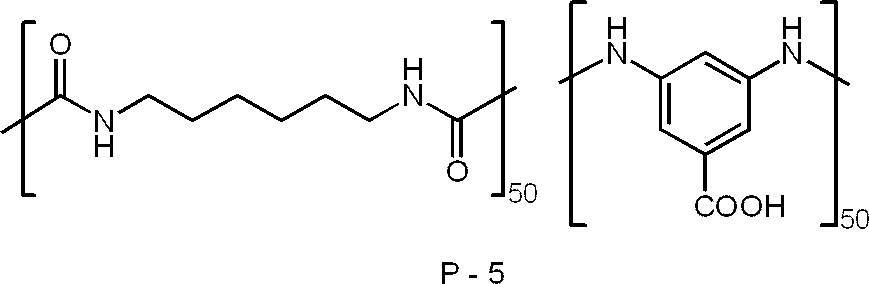
<ポリウレアP-6>
コンデンサー及び撹拌機を取り付けた3つ口フラスコに、クロロスルホン酸139.82部を秤取し、次いで、室温中、キサントン(東京化成工業(株)製)29.43部を添加し、室温にて1時間撹拌した。反応液を80℃まで昇温し、8時間撹拌した。本反応液を撹拌しながら、室温まで冷却し、2,000部の氷冷水に晶析し、10分撹拌した後、これをろ取し、2,690部の酢酸エチルに溶解した。本酢酸エチル溶液を分液ロートに移し、純水にて2回分液洗浄し、次いで、飽和食塩水にて分液洗浄した。有機層を三角フラスコに移し、硫酸マグネシウム30部を添加し、撹拌し、固形物をろ過で取り除いた後、エバポレーターを用いて酢酸エチルを留去し、40℃で24時間真空乾燥し、目的物の前駆体S-1(ジスルホン酸クロリド体)28部を得た。前駆体(S-1)であることはNMR(核磁気共鳴)スペクトルから確認した。前駆体S-1について1H-NMRによる分析を行った。その結果を以下に示す。
1H-NMRデータ(重ジメチルスルホキシド(重DMSO)、400MHz、内部標準:テトラメチルシラン)
δ(ppm)=7.62-7.65(d、2H)、8.02-8.05(d、2H)、8.40(s、2H)
コンデンサー及び撹拌機を取り付けた3つ口フラスコに、クロロスルホン酸139.82部を秤取し、次いで、室温中、キサントン(東京化成工業(株)製)29.43部を添加し、室温にて1時間撹拌した。反応液を80℃まで昇温し、8時間撹拌した。本反応液を撹拌しながら、室温まで冷却し、2,000部の氷冷水に晶析し、10分撹拌した後、これをろ取し、2,690部の酢酸エチルに溶解した。本酢酸エチル溶液を分液ロートに移し、純水にて2回分液洗浄し、次いで、飽和食塩水にて分液洗浄した。有機層を三角フラスコに移し、硫酸マグネシウム30部を添加し、撹拌し、固形物をろ過で取り除いた後、エバポレーターを用いて酢酸エチルを留去し、40℃で24時間真空乾燥し、目的物の前駆体S-1(ジスルホン酸クロリド体)28部を得た。前駆体(S-1)であることはNMR(核磁気共鳴)スペクトルから確認した。前駆体S-1について1H-NMRによる分析を行った。その結果を以下に示す。
1H-NMRデータ(重ジメチルスルホキシド(重DMSO)、400MHz、内部標準:テトラメチルシラン)
δ(ppm)=7.62-7.65(d、2H)、8.02-8.05(d、2H)、8.40(s、2H)
コンデンサー及び撹拌機を取り付けた3つ口フラスコに、エチレンジアミン(東京化成工業(株)製)36.06部、テトラヒドロフラン40部を秤量し、0~5℃に冷却しながら撹拌した。上記で得られた前駆体(S-1)11.79部をテトラヒドロフラン66部に溶解した後、滴下ロートに移し、撹拌中の上記三口フラスコ内に1時間かけて滴下し、滴下後、更に1時間撹拌した。本反応液を室温に戻し、2時間撹拌すると、固形成分と液体成分に分離するため、液体成分をデカンテーションした。次いで、フラスコ内の固形成分をN,N-ジメチルアセトアミド(関東化学(株)製)150部、純水20部に溶解させ、炭酸水素ナトリウムを20部溶解した水溶液2,000部に晶析し、これをろ過した。ろ過物を純水500部で洗浄し、次いでテトラヒドロフラン445部洗浄した後、これをろ過し、結晶を得た。結晶を60℃で24時間真空乾燥し、目的物(SA-18)10.1部を得た。目的物であることはNMRスペクトルから確認した。
SA-18について1H-NMRによる分析を行った。その結果を以下に示す。
1H-NMRデータ(重DMSO、400MHz、内部標準:テトラメチルシラン)
δ(ppm)=2.52-2.55(t、4H)、2.75-2.79(t、4H)、7.93-7.95(d、2H)、8.22-8.25(d、2H)、8.57(s、2H)
SA-18について1H-NMRによる分析を行った。その結果を以下に示す。
1H-NMRデータ(重DMSO、400MHz、内部標準:テトラメチルシラン)
δ(ppm)=2.52-2.55(t、4H)、2.75-2.79(t、4H)、7.93-7.95(d、2H)、8.22-8.25(d、2H)、8.57(s、2H)
コンデンサー及び撹拌機を取り付けた3つ口フラスコに、SA-18を35.24部、n-ブチルアミン(和光純薬工業(株)製)0.078部、N,N-ジメチルアセトアミド(関東化学(株)製)200.0部を秤取し、反応液を室温とし、均一溶液とした。次いで、1.3-ビス(イソシアネトメチル)シクロヘキサン(東京化成工業(株)製)15.54部、N,N-ジメチルアセトアミド(関東化学(株)製)80.0部を秤取し室温中、滴下ロートを用いて30分かけて滴下し、その後室温で30分間撹拌して反応させた。次いで、n-ブチルアミン(和光純薬工業(株)製)1.00部、メタノール39.6部を反応液に加え、室温中、30分間反応させた。
上記反応液を純水2,000部、メタノール1,580部の混合液にあけ、ポリマーを析出させた。これをろ取、洗浄、乾燥し、重量平均分子量53,000のバインダーポリマー(ポリウレアP-6)46.7部を得た。
目的物であることは、NMRスペクトル、IRスペクトル、GPC(ポリスチレン換算)から確認した。ポリウレタンP-5の構造は下記の通りである。
なお、括弧の右下の数値は各構造単位の含有比(モル比)を表す。
上記反応液を純水2,000部、メタノール1,580部の混合液にあけ、ポリマーを析出させた。これをろ取、洗浄、乾燥し、重量平均分子量53,000のバインダーポリマー(ポリウレアP-6)46.7部を得た。
目的物であることは、NMRスペクトル、IRスペクトル、GPC(ポリスチレン換算)から確認した。ポリウレタンP-5の構造は下記の通りである。
なお、括弧の右下の数値は各構造単位の含有比(モル比)を表す。

<アクリル樹脂P-14>
N-フェニルマレイミド/メタクリル酸/メタクリルアミド=60/15/25(モル比)の共重合体(重量平均分子量50,000)
N-フェニルマレイミド/メタクリル酸/メタクリルアミド=60/15/25(モル比)の共重合体(重量平均分子量50,000)
〔高分子化合物2〕
<スルホンアミド基含有アクリル樹脂P-7>
N-(p-アミノスルホニルフェニル)メタクリルアミド/メタクリル酸メチル/アクリロニトリル=35/35/30(モル比)の共重合体(重量平均分子量6.5万)
<スルホンアミド基含有アクリル樹脂P-7>
N-(p-アミノスルホニルフェニル)メタクリルアミド/メタクリル酸メチル/アクリロニトリル=35/35/30(モル比)の共重合体(重量平均分子量6.5万)
<スルホンアミド基含有アクリル樹脂P-8>
Hofmannet al., Markromoleculare Cheme, 第177巻、P1791-1813(1976年)に記載の方法により、下記モノマーを合成した。
Hofmannet al., Markromoleculare Cheme, 第177巻、P1791-1813(1976年)に記載の方法により、下記モノマーを合成した。

250mlの反応容器中に、160ミリモルのスルホンアミド基を有する上記モノマー、20.6g(132ミリモル)のベンジルアセトアミド、2.31g(32ミリモル)のアクリル酸及び104gのγ-ブチロラクトンを加え、200rpmで撹拌しながら混合物を140℃に加熱した。この反応は窒素環流下で行った。固形物が溶解した後、反応容器を100℃まで降温した。トリゴノックス DC50(AKZO NOBEL社製)0.37mlとトリゴノックス 141(AKZO NOBEL社製)1.48mlをブチロラクトン3.66mlに溶解したものを順次加えた。反応が開始したのち、反応容器温度を143℃とし、2時間以上かけてトリゴノックス DC50 1.87mlを加えた。反応混合物は400rpmで撹拌しつつ、140℃で2時間反応させた。反応混合物を120℃に降温し、撹拌条件を500rpmに上昇させた。1-メチル-2-プロパノール86.8mlを加え、温度を室温まで降温した。
ポリマーの構造は、1H-NMR スペクトログラフィーとサイズエクスクルージョンクロマトグラフィーにより、ジメチルアセトアミド/0.21%LiClを標章とし、混合カラムにてポリスチレン換算で確認した。
下記に示すスルホンアミド基含有アクリル樹脂P-8のMwは、66,000であった。なお、括弧の右下の数値は各構成単位の含有比(モル比)を表す。
ポリマーの構造は、1H-NMR スペクトログラフィーとサイズエクスクルージョンクロマトグラフィーにより、ジメチルアセトアミド/0.21%LiClを標章とし、混合カラムにてポリスチレン換算で確認した。
下記に示すスルホンアミド基含有アクリル樹脂P-8のMwは、66,000であった。なお、括弧の右下の数値は各構成単位の含有比(モル比)を表す。
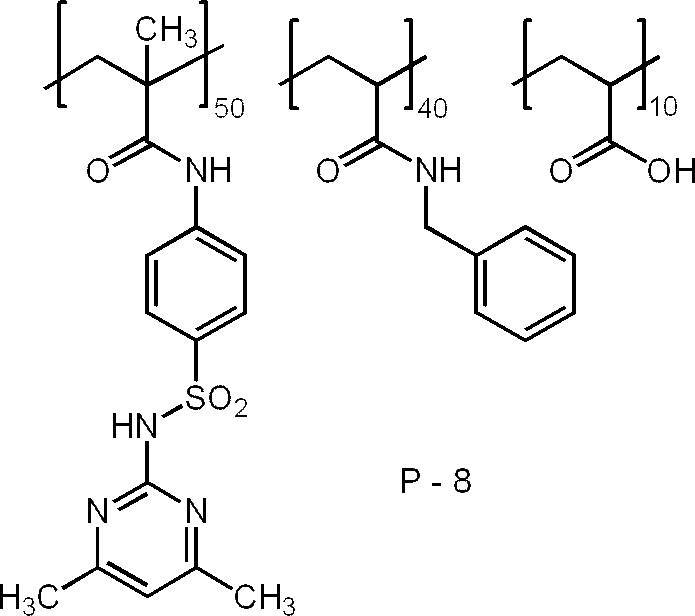
<マレイミド含有アクリル樹脂P-9>
N-フェニルマレイミド/N-4-メチルフェニルマレイミド/アクリロニトリル/メタアクリレート=30/30/20/20(モル比)の共重合体(重量平均分子量6.3万)
N-フェニルマレイミド/N-4-メチルフェニルマレイミド/アクリロニトリル/メタアクリレート=30/30/20/20(モル比)の共重合体(重量平均分子量6.3万)
<マレイミド含有アクリル樹脂P-10>
N-フェニルマレイミド/N-メチルフェニルマレイミド/アクリロニトリル/N-ヒドロキシフェニルマレイミド=30/20/20/30(モル比)の共重合体(重量平均分子量6.1万)
N-フェニルマレイミド/N-メチルフェニルマレイミド/アクリロニトリル/N-ヒドロキシフェニルマレイミド=30/20/20/30(モル比)の共重合体(重量平均分子量6.1万)
<ウレア含有ノボラック樹脂P-11>
無水エタノール(473部)、グアニジンカーボネート91.89部及びエチルアセトアセテート146.1部をフラスコに加えた。反応溶液をゆっくりと還流温度に加熱し、一晩撹拌した。エタノール(237部)が蒸発され、反応混合物は還流下に2時間加熱された。反応混合物を冷却後、196部のヘキサンを加えた。得られた沈殿物をろ過し、洗浄し、乾燥した。6-メチル-イソシトシン119.3部が得られた。
無水エタノール(473部)、グアニジンカーボネート91.89部及びエチルアセトアセテート146.1部をフラスコに加えた。反応溶液をゆっくりと還流温度に加熱し、一晩撹拌した。エタノール(237部)が蒸発され、反応混合物は還流下に2時間加熱された。反応混合物を冷却後、196部のヘキサンを加えた。得られた沈殿物をろ過し、洗浄し、乾燥した。6-メチル-イソシトシン119.3部が得られた。
シリカゲル乾燥チューブが取り付けられたフラスコ中に乾燥されたN,N-ジメチルアセトアミド280.48部及び乾燥された6-メチル-イソシトシン43.76部が加えられた。この混合物にイソホロンジイソシアネート66.22部を加えた。その混合物を、室温で5日間撹拌した。得られた混合物は、更に処理することなしに下記に使用した。
シリカゲル乾燥チューブが取り付けられたフラスコ中にノボラック樹脂50部及び乾燥されたN,N-ジメチルアセトアミド125部を加えた。これに、上記で得られた混合物16.9部及びジブチル錫ジラウレート0.5部を更に加えた。60℃で12時間撹拌した後、反応混合物を水中に注いだ。沈殿をろ別しノボラック樹脂を得た。これを、40℃で真空下に乾燥し、ウレア含有ノボラック樹脂P-11を得た。収率は90%であった。
〔高分子化合物3〕
<ノボラック樹脂P-12>
m-クレゾール/p-クレゾール/フェノール=3/2/5(モル比)の共重合体、Mw8,000
<ノボラック樹脂P-12>
m-クレゾール/p-クレゾール/フェノール=3/2/5(モル比)の共重合体、Mw8,000
<フェノール性水酸基含有アクリル樹脂P-13>
ヒドロキシフェニルアクリルアミド/α-メチルスチレン/アクリロニトリル=35/35/30(モル比)の共重合体(重量平均分子量6万)
ヒドロキシフェニルアクリルアミド/α-メチルスチレン/アクリロニトリル=35/35/30(モル比)の共重合体(重量平均分子量6万)
(実施例1~41、及び、比較例1~8)
〔支持体Aの作製〕
<処理>
(a)機械的粗面化処理(ブラシグレイン法)
パミスの懸濁液(比重1.1g/cm3)を研磨スラリー液としてアルミニウム板の表面に供給しながら、回転する束植ブラシにより機械的粗面化処理を行った。
研磨材のメジアン径(μm)を30μm、ブラシ本数を4本、ブラシの回転数(rpm)を250rpmとした。束植ブラシの材質は6・10ナイロンで、ブラシ毛の直径0.3mm、毛長50mmであった。ブラシは、φ300mmのステンレス製の筒に穴をあけて密になるように植毛した。束植ブラシ下部の2本の支持ローラ(φ200mm)の距離は300mmであった。束植ブラシはブラシを回転させる駆動モータの負荷が、束植ブラシをアルミニウム板に押さえつける前の負荷に対して10kWプラスになるまで押さえつけた。ブラシの回転方向はアルミニウム板の移動方向と同じであった。
〔支持体Aの作製〕
<処理>
(a)機械的粗面化処理(ブラシグレイン法)
パミスの懸濁液(比重1.1g/cm3)を研磨スラリー液としてアルミニウム板の表面に供給しながら、回転する束植ブラシにより機械的粗面化処理を行った。
研磨材のメジアン径(μm)を30μm、ブラシ本数を4本、ブラシの回転数(rpm)を250rpmとした。束植ブラシの材質は6・10ナイロンで、ブラシ毛の直径0.3mm、毛長50mmであった。ブラシは、φ300mmのステンレス製の筒に穴をあけて密になるように植毛した。束植ブラシ下部の2本の支持ローラ(φ200mm)の距離は300mmであった。束植ブラシはブラシを回転させる駆動モータの負荷が、束植ブラシをアルミニウム板に押さえつける前の負荷に対して10kWプラスになるまで押さえつけた。ブラシの回転方向はアルミニウム板の移動方向と同じであった。
(b)アルカリエッチング処理
上記で得られたアルミニウム板に、カセイソーダ濃度26質量%、アルミニウムイオン濃度6.5質量%のカセイソーダ水溶液を、温度70℃でスプレー管により吹き付けてエッチング処理を行った。その後、スプレーによる水洗を行った。アルミニウム溶解量は、10g/m2であった。
上記で得られたアルミニウム板に、カセイソーダ濃度26質量%、アルミニウムイオン濃度6.5質量%のカセイソーダ水溶液を、温度70℃でスプレー管により吹き付けてエッチング処理を行った。その後、スプレーによる水洗を行った。アルミニウム溶解量は、10g/m2であった。
(c)酸性水溶液中でのデスマット処理
次に、硝酸水溶液中でデスマット処理を行った。デスマット処理に用いる硝酸水溶液は、次工程の電気化学的な粗面化に用いた硝酸の廃液を用いた。その液温は35℃であった。デスマット液はスプレーにて吹き付けて3秒間デスマット処理を行った。
次に、硝酸水溶液中でデスマット処理を行った。デスマット処理に用いる硝酸水溶液は、次工程の電気化学的な粗面化に用いた硝酸の廃液を用いた。その液温は35℃であった。デスマット液はスプレーにて吹き付けて3秒間デスマット処理を行った。
(d)電気化学的粗面化処理
硝酸電解60Hzの交流電圧を用いて連続的に電気化学的な粗面化処理を行った。このときの電解液は、温度35℃、硝酸10.4g/Lの水溶液に硝酸アルミニウムを添加してアルミニウムイオン濃度を4.5g/Lに調整した電解液を用いた。交流電源波形としては、電流値がゼロからピークに達するまでの時間tpが0.8msec、duty比1:1、台形の矩形波交流を用いて、カーボン電極を対極として電気化学的な粗面化処理を行った。補助アノードにはフェライトを用いた。電流密度は電流のピーク値で30A/dm2、補助陽極には電源から流れる電流の5%を分流させた。電気量(C/dm2)はアルミニウム板が陽極時の電気量の総和で185C/dm2であった。その後、スプレーによ
る水洗を行った。
硝酸電解60Hzの交流電圧を用いて連続的に電気化学的な粗面化処理を行った。このときの電解液は、温度35℃、硝酸10.4g/Lの水溶液に硝酸アルミニウムを添加してアルミニウムイオン濃度を4.5g/Lに調整した電解液を用いた。交流電源波形としては、電流値がゼロからピークに達するまでの時間tpが0.8msec、duty比1:1、台形の矩形波交流を用いて、カーボン電極を対極として電気化学的な粗面化処理を行った。補助アノードにはフェライトを用いた。電流密度は電流のピーク値で30A/dm2、補助陽極には電源から流れる電流の5%を分流させた。電気量(C/dm2)はアルミニウム板が陽極時の電気量の総和で185C/dm2であった。その後、スプレーによ
る水洗を行った。
(e)アルカリエッチング処理
上記で得られたアルミニウム板に、カセイソーダ濃度5質量%、アルミニウムイオン濃度0.5質量%のカセイソーダ水溶液を、温度50℃でスプレー管により吹き付けてエッチング処理を行った。その後、スプレーによる水洗を行った。アルミニウム溶解量は、0.5g/m2であった。
上記で得られたアルミニウム板に、カセイソーダ濃度5質量%、アルミニウムイオン濃度0.5質量%のカセイソーダ水溶液を、温度50℃でスプレー管により吹き付けてエッチング処理を行った。その後、スプレーによる水洗を行った。アルミニウム溶解量は、0.5g/m2であった。
(f)酸性水溶液中でのデスマット処理
次に、硫酸水溶液中でデスマット処理を行った。デスマット処理に用いる硫酸水溶液は、硫酸濃度170g/L、アルミニウムイオン濃度5g/Lの液を用いた。その液温は、30℃であった。デスマット液はスプレーにて吹き付けて3秒間デスマット処理を行った。
次に、硫酸水溶液中でデスマット処理を行った。デスマット処理に用いる硫酸水溶液は、硫酸濃度170g/L、アルミニウムイオン濃度5g/Lの液を用いた。その液温は、30℃であった。デスマット液はスプレーにて吹き付けて3秒間デスマット処理を行った。
(g)電気化学的粗面化処理
塩酸電解60Hzの交流電圧を用いて連続的に電気化学的な粗面化処理を行った。電解液は、液温35℃、塩酸6.2g/Lの水溶液に塩化アルミニウムを添加してアルミニウムイオン濃度を4.5g/Lに調整した電解液を用いた。電流値がゼロからピークに達するまでの時間tpが0.8msec、duty比1:1、台形の矩形波交流を用いて、カーボン電極を対極として電気化学的な粗面化処理を行った。補助アノードにはフェライトを用いた。
電流密度は電流のピーク値で25A/dm2であり、塩酸電解における電気量(C/dm2)はアルミニウム板が陽極時の電気量の総和で63C/dm2であった。その後、スプレーによる水洗を行った。
塩酸電解60Hzの交流電圧を用いて連続的に電気化学的な粗面化処理を行った。電解液は、液温35℃、塩酸6.2g/Lの水溶液に塩化アルミニウムを添加してアルミニウムイオン濃度を4.5g/Lに調整した電解液を用いた。電流値がゼロからピークに達するまでの時間tpが0.8msec、duty比1:1、台形の矩形波交流を用いて、カーボン電極を対極として電気化学的な粗面化処理を行った。補助アノードにはフェライトを用いた。
電流密度は電流のピーク値で25A/dm2であり、塩酸電解における電気量(C/dm2)はアルミニウム板が陽極時の電気量の総和で63C/dm2であった。その後、スプレーによる水洗を行った。
(h)アルカリエッチング処理
上記で得られたアルミニウム板に、カセイソーダ濃度5質量%、アルミニウムイオン濃度0.5質量%のカセイソーダ水溶液を、温度50℃でスプレー管により吹き付けてエッチング処理を行った。その後、スプレーによる水洗を行った。アルミニウム溶解量は、0.1g/m2であった。
上記で得られたアルミニウム板に、カセイソーダ濃度5質量%、アルミニウムイオン濃度0.5質量%のカセイソーダ水溶液を、温度50℃でスプレー管により吹き付けてエッチング処理を行った。その後、スプレーによる水洗を行った。アルミニウム溶解量は、0.1g/m2であった。
(i)酸性水溶液中でのデスマット処理
次に、硫酸水溶液中でデスマット処理を行った。具体的には、陽極酸化処理工程で発生した廃液(硫酸170g/L水溶液中にアルミニウムイオン5g/Lを溶解)を用い、液温35℃で4秒間デスマット処理を行った。デスマット液はスプレーにて吹き付けて3秒間デスマット処理を行った。
次に、硫酸水溶液中でデスマット処理を行った。具体的には、陽極酸化処理工程で発生した廃液(硫酸170g/L水溶液中にアルミニウムイオン5g/Lを溶解)を用い、液温35℃で4秒間デスマット処理を行った。デスマット液はスプレーにて吹き付けて3秒間デスマット処理を行った。
(j)陽極酸化処理
二段給電電解処理法の陽極酸化装置(第一及び第二電解部長各6m、第一及び第二給電部長各3m、第一及び第二給電極部長各2.4m)を用いて陽極酸化処理を行った。第一及び第二電解部に供給した電解液としては、硫酸を用いた。電解液は、いずれも、硫酸濃度50g/L(アルミニウムイオンを0.5質量%含む。)、温度20℃であった。その後、スプレーによる水洗を行った。
二段給電電解処理法の陽極酸化装置(第一及び第二電解部長各6m、第一及び第二給電部長各3m、第一及び第二給電極部長各2.4m)を用いて陽極酸化処理を行った。第一及び第二電解部に供給した電解液としては、硫酸を用いた。電解液は、いずれも、硫酸濃度50g/L(アルミニウムイオンを0.5質量%含む。)、温度20℃であった。その後、スプレーによる水洗を行った。
(k)シリケート処理
非画像部の親水性を確保するため、2.5質量%3号ケイ酸ソーダ水溶液を用いて50℃で7秒間ディップしてシリケート処理を施した。Siの付着量は10mg/m2であった。その後、スプレーによる水洗を行った。
非画像部の親水性を確保するため、2.5質量%3号ケイ酸ソーダ水溶液を用いて50℃で7秒間ディップしてシリケート処理を施した。Siの付着量は10mg/m2であった。その後、スプレーによる水洗を行った。
<下塗層の形成>
上述の様に作製された支持体上に、以下に示す下塗層塗布液1を塗布した後、80℃で15秒間乾燥し、下塗層を設けた支持体Aを作製した。乾燥後の被覆量は、15mg/m2であった。
上述の様に作製された支持体上に、以下に示す下塗層塗布液1を塗布した後、80℃で15秒間乾燥し、下塗層を設けた支持体Aを作製した。乾燥後の被覆量は、15mg/m2であった。
-下塗層塗布液1-
・重量平均分子量2.8万の下記共重合体:0.3部
・メタノール:100部
・水:1部
・重量平均分子量2.8万の下記共重合体:0.3部
・メタノール:100部
・水:1部
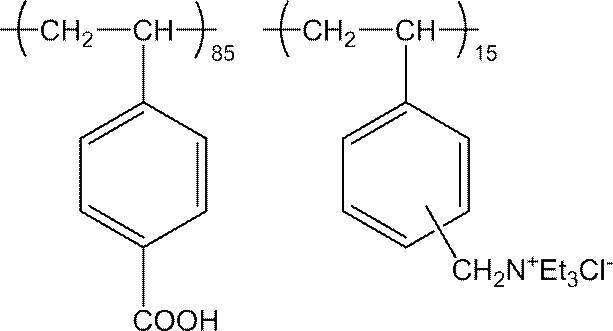
なお、Etはエチル基を表し、括弧の右下の数値は、モル比を表す。
〔下層の上に中間層を塗設する場合(実施例1~19、及び、比較例1~5)〕
<画像記録層の形成>
下塗層を設けた支持体上に、下記組成の下層用塗布液を乾燥後の塗布量が1.1g/m2になるようバーコーターで塗布したのち140℃で60秒間乾燥し、塗膜を形成した。
その後、下記組成の中間層形成用塗布液組成物(II)を、乾燥後の塗布量が、下記表中記載の中間層膜厚になるようにバーコーターで塗布したのち140℃で60秒間乾燥し、塗膜を形成した。
その後、更に下記組成の上層形成用塗布液組成物(III)を乾燥後の塗布量が0.26g/m2になるようバーコーターで塗布したのち、140℃で30秒乾燥し、実施例及び比較例のポジ型平版印刷版原版をそれぞれ作製した。
<画像記録層の形成>
下塗層を設けた支持体上に、下記組成の下層用塗布液を乾燥後の塗布量が1.1g/m2になるようバーコーターで塗布したのち140℃で60秒間乾燥し、塗膜を形成した。
その後、下記組成の中間層形成用塗布液組成物(II)を、乾燥後の塗布量が、下記表中記載の中間層膜厚になるようにバーコーターで塗布したのち140℃で60秒間乾燥し、塗膜を形成した。
その後、更に下記組成の上層形成用塗布液組成物(III)を乾燥後の塗布量が0.26g/m2になるようバーコーターで塗布したのち、140℃で30秒乾燥し、実施例及び比較例のポジ型平版印刷版原版をそれぞれ作製した。
(下層形成用塗布液組成物(I))
・表に記載の高分子化合物1:3.5部
・赤外線吸収剤(IR色素(1):下記構造):0.2部
・4,4’-ビスヒドロキシフェニルスルホン:0.3部
・テトラヒドロフタル酸:0.4部
・p-トルエンスルホン酸:0.02部
・3-メトキシ-4-ジアゾジフェニルアミンヘキサフルオロホスフェート:0.06部
・エチルバイオレットの対イオンを6-ヒドロキシナフタレンスルホン酸に変えたもの:0.15部
・フッ素系界面活性剤(メガファックF-780、DIC(株)製):0.07部
・メチルエチルケトン:30部
・1-メトキシ-2-プロパノール:15部
・γ-ブチロラクトン:15部
・表に記載の高分子化合物1:3.5部
・赤外線吸収剤(IR色素(1):下記構造):0.2部
・4,4’-ビスヒドロキシフェニルスルホン:0.3部
・テトラヒドロフタル酸:0.4部
・p-トルエンスルホン酸:0.02部
・3-メトキシ-4-ジアゾジフェニルアミンヘキサフルオロホスフェート:0.06部
・エチルバイオレットの対イオンを6-ヒドロキシナフタレンスルホン酸に変えたもの:0.15部
・フッ素系界面活性剤(メガファックF-780、DIC(株)製):0.07部
・メチルエチルケトン:30部
・1-メトキシ-2-プロパノール:15部
・γ-ブチロラクトン:15部
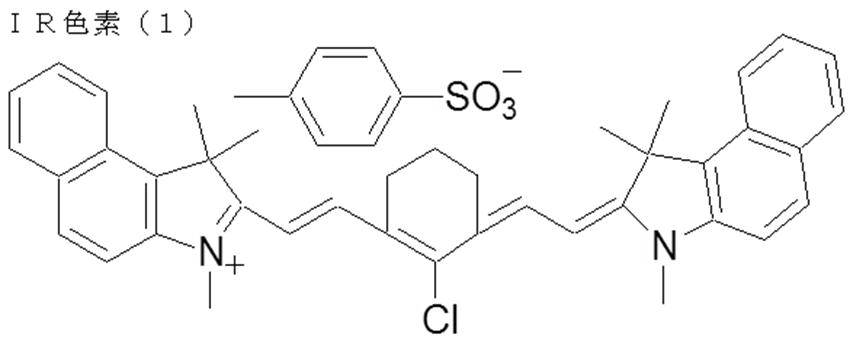
(中間層形成用組成物(II))
・表に記載の高分子化合物2:1部
・γ-ブチロラクトン:15部
・メチルエチルケトン:30部
・1-メトキシ-2-プロパノール:15部
・表に記載の高分子化合物2:1部
・γ-ブチロラクトン:15部
・メチルエチルケトン:30部
・1-メトキシ-2-プロパノール:15部
(上層形成用塗布液組成物(III))
・表に記載の高分子化合物3:0.68部
・赤外線吸収剤(IR色素(1):上記構造):0.045部
・フッ素系界面活性剤(メガファックF-780、DIC(株)製):0.03部
・メチルエチルケトン:15.0部
・1-メトキシ-2-プロパノール:30.0部
・1-(4-メチルベンジル)-1-フェニルピペリジニウムの5-ベンゾイル-4-ヒドロキシ-2-メトキシベンゼンスルホン酸塩:0.01部
・表に記載の高分子化合物3:0.68部
・赤外線吸収剤(IR色素(1):上記構造):0.045部
・フッ素系界面活性剤(メガファックF-780、DIC(株)製):0.03部
・メチルエチルケトン:15.0部
・1-メトキシ-2-プロパノール:30.0部
・1-(4-メチルベンジル)-1-フェニルピペリジニウムの5-ベンゾイル-4-ヒドロキシ-2-メトキシベンゼンスルホン酸塩:0.01部
〔下層の上に中間層を塗設する場合(実施例40)〕
下層用塗布液(I)中の3-メトキシ-4-ジアゾジフェニルアミンヘキサフルオロホスフェートを上記オニウム塩化合物ON-3に変更した以外は、実施例3と同様にして、実施例40のポジ型平版印刷版原版を作製した。
下層用塗布液(I)中の3-メトキシ-4-ジアゾジフェニルアミンヘキサフルオロホスフェートを上記オニウム塩化合物ON-3に変更した以外は、実施例3と同様にして、実施例40のポジ型平版印刷版原版を作製した。
〔下層の上に中間層を塗設する場合(比較例6)〕
上記下塗層を設けた支持体上に、下記組成の下層用塗布液組成物(V)を乾燥後の塗布量が、1.1g/m2になるようバーコーターで塗布したのち140℃で60秒間乾燥し、塗膜を形成した。
その後、下記組成の中間層形成用塗布液組成物(VI)を、乾燥後の塗布量が、下記表中記載の中間層膜厚になるようにバーコーターで塗布したのち160℃で40秒間乾燥し、塗膜を形成した。
その後、下記上層形成用塗布液組成物(VII)を乾燥後の塗布量が0.4g/m2になるようバーコーターで塗布したのち、130℃で40秒乾燥し、比較例6のポジ型平版印刷版原版を作製した。
上記下塗層を設けた支持体上に、下記組成の下層用塗布液組成物(V)を乾燥後の塗布量が、1.1g/m2になるようバーコーターで塗布したのち140℃で60秒間乾燥し、塗膜を形成した。
その後、下記組成の中間層形成用塗布液組成物(VI)を、乾燥後の塗布量が、下記表中記載の中間層膜厚になるようにバーコーターで塗布したのち160℃で40秒間乾燥し、塗膜を形成した。
その後、下記上層形成用塗布液組成物(VII)を乾燥後の塗布量が0.4g/m2になるようバーコーターで塗布したのち、130℃で40秒乾燥し、比較例6のポジ型平版印刷版原版を作製した。
(下層用塗布液(V))
・上記の高分子化合物P-14:3.2部
・赤外線吸収剤(IR色素(1):下記構造):0.94部
・クリスタルバイオレット:0.08部
・メガファックF-177:0.05部
・γ-ブチロラクトン:10.0部
・メチルエチルケトン:61.0部
・1-メトキシ-2-プロパノール:14.0部
・水:9.34部
・上記の高分子化合物P-14:3.2部
・赤外線吸収剤(IR色素(1):下記構造):0.94部
・クリスタルバイオレット:0.08部
・メガファックF-177:0.05部
・γ-ブチロラクトン:10.0部
・メチルエチルケトン:61.0部
・1-メトキシ-2-プロパノール:14.0部
・水:9.34部
(中間層形成用組成物(VI))
・上記特定高分子化合物P-7:3.50部
・メガファックF-177:0.02部
・γ-ブチロラクトン:20.0部
・メチルエチルケトン:60.0部
・1-メトキシ-2-プロパノール:20.0部
・上記特定高分子化合物P-7:3.50部
・メガファックF-177:0.02部
・γ-ブチロラクトン:20.0部
・メチルエチルケトン:60.0部
・1-メトキシ-2-プロパノール:20.0部
(上層形成用塗布液組成物(VII))
・上記高分子化合物P-1:10.0部
・エチルバイオレット:0.03部
・メガファックF-177:0.05部
・3-ペンタノン:60.0部
・プロピレングリコールモノメチルエーテル-2-アセテート:8.0部
・上記高分子化合物P-1:10.0部
・エチルバイオレット:0.03部
・メガファックF-177:0.05部
・3-ペンタノン:60.0部
・プロピレングリコールモノメチルエーテル-2-アセテート:8.0部
〔下層からの相分離によって中間層を形成する場合(実施例20~39、並びに、比較例7及び8)〕
<画像記録層の形成>
下塗層を設けた支持体上に、下記組成の下層及び中間層形成用塗布液組成物(IV)を、乾燥後の塗布量が、1.1g/m2になるようバーコーターで塗布したのち140℃で60秒間乾燥し、塗膜を形成した。
その後、上記上層形成用塗布液組成物(III)を乾燥後の塗布量が0.26g/m2になるようバーコーターで塗布したのち、140℃で30秒乾燥し、実施例及び比較例のポジ型平版印刷版原版をそれぞれ作製した。
<画像記録層の形成>
下塗層を設けた支持体上に、下記組成の下層及び中間層形成用塗布液組成物(IV)を、乾燥後の塗布量が、1.1g/m2になるようバーコーターで塗布したのち140℃で60秒間乾燥し、塗膜を形成した。
その後、上記上層形成用塗布液組成物(III)を乾燥後の塗布量が0.26g/m2になるようバーコーターで塗布したのち、140℃で30秒乾燥し、実施例及び比較例のポジ型平版印刷版原版をそれぞれ作製した。
〔下層からの相分離によって中間層を形成する場合(実施例41)〕
下層及び中間層形成用塗布液(IV)中の3-メトキシ-4-ジアゾジフェニルアミンヘキサフルオロホスフェートを上記オニウム塩化合物ON-3に変更した以外は、実施例22と同様にして実施例41のポジ型平版印刷版原版を作製した。
下層及び中間層形成用塗布液(IV)中の3-メトキシ-4-ジアゾジフェニルアミンヘキサフルオロホスフェートを上記オニウム塩化合物ON-3に変更した以外は、実施例22と同様にして実施例41のポジ型平版印刷版原版を作製した。
(下層及び中間層形成用塗布液(IV))
・表に記載の高分子化合物1:表に記載の添加量
・表に記載の高分子化合物2:表に記載の添加量
・赤外線吸収剤(IR色素(1):上記構造):0.2部
・4,4’-ビスヒドロキシフェニルスルホン:0.3部
・テトラヒドロフタル酸:0.4部
・p-トルエンスルホン酸:0.02部
・3-メトキシ-4-ジアゾジフェニルアミンヘキサフルオロホスフェート:0.06部
・エチルバイオレットの対イオンを6-ヒドロキシナフタレンスルホン酸に変えたもの:0.15部
・フッ素系界面活性剤(メガファックF-780、DIC(株)製):0.07部
・メチルエチルケトン:30部
・1-メトキシ-2-プロパノール:15部
・γ-ブチロラクトン:15部
・表に記載の高分子化合物1:表に記載の添加量
・表に記載の高分子化合物2:表に記載の添加量
・赤外線吸収剤(IR色素(1):上記構造):0.2部
・4,4’-ビスヒドロキシフェニルスルホン:0.3部
・テトラヒドロフタル酸:0.4部
・p-トルエンスルホン酸:0.02部
・3-メトキシ-4-ジアゾジフェニルアミンヘキサフルオロホスフェート:0.06部
・エチルバイオレットの対イオンを6-ヒドロキシナフタレンスルホン酸に変えたもの:0.15部
・フッ素系界面活性剤(メガファックF-780、DIC(株)製):0.07部
・メチルエチルケトン:30部
・1-メトキシ-2-プロパノール:15部
・γ-ブチロラクトン:15部
<中間層及び下層における相分離形成状態の観察>
上記で得られた実施例1~41及び比較例1~8の平版印刷版原版を、ミクロトーム等で切断して得た画像記録層断面に導電性をもたせた後、走査型電子顕微鏡(SEM)で写真撮影して観察した。明瞭なコントラストが得にくい場合は、切断した断面を富士フイルム(株)製現像液XP-Dを純水で10倍に希釈したアルカリ水溶液に1秒から5秒適宜浸漬し、高分子化合物1、2及び3のアルカリ溶解性の差異によって、コントラストのある画像を得た。
実施例1~41の平版印刷版原版には、下層と上層との間に約10nm~30nmの中間層が形成され、比較例1、2、4及び7の平版印刷版原版には、明確な中間層は見られなかった。
また、実施例20~39及び41、並びに、比較例5の平版印刷版原版における各下層には分散相が存在することが確認された。分散相の大きさは0.05μm~0.55μmの範囲であった。一方、比較例1~4及び6~8の下層は均一な相であり、明確な分散相は見られなかった。
上記で得られた実施例1~41及び比較例1~8の平版印刷版原版を、ミクロトーム等で切断して得た画像記録層断面に導電性をもたせた後、走査型電子顕微鏡(SEM)で写真撮影して観察した。明瞭なコントラストが得にくい場合は、切断した断面を富士フイルム(株)製現像液XP-Dを純水で10倍に希釈したアルカリ水溶液に1秒から5秒適宜浸漬し、高分子化合物1、2及び3のアルカリ溶解性の差異によって、コントラストのある画像を得た。
実施例1~41の平版印刷版原版には、下層と上層との間に約10nm~30nmの中間層が形成され、比較例1、2、4及び7の平版印刷版原版には、明確な中間層は見られなかった。
また、実施例20~39及び41、並びに、比較例5の平版印刷版原版における各下層には分散相が存在することが確認された。分散相の大きさは0.05μm~0.55μmの範囲であった。一方、比較例1~4及び6~8の下層は均一な相であり、明確な分散相は見られなかった。
<画像形成性の評価>
作製した上記各平版印刷版原版を、富士フイルム(株)製現像液XP-D(希釈して、電導度を43mS/cmとしたもの、pH13.1、30℃)を入れた容器に2秒ごとに時間を変えて浸漬し、その後水洗した。グレタグマクベス社製の光学濃度計を用いて、各浸漬時間における未露光部の記録層のシアン濃度を測定した。
次いで、Creo社製Trendsetterにてビーム強度15W、ドラム回転速度150rpmで全面露光し、上記と同様にして、露光部の記録層のシアン濃度を測定した。
未露光部の濃度が、浸漬時間0秒の濃度に対して3%以上を維持する時間をa、露光部のシアン濃度が完全に支持体の濃度となるまでの時間をbとしたとき、a-bの値を求め、画像形成性評価の基準とした。得られた値が大きいほど、露光時の溶解促進効果が大きく、溶解ディスクリミネーションに優れ、画像形成性に優れると評価する。
a-bが0未満の場合1点、0以上5未満の場合2点、5以上10未満の場合3点、10以上15未満の場合4点、15以上の場合5点とし、4点以上で良好と評価した。
結果を以下の表1~表4に示す。
作製した上記各平版印刷版原版を、富士フイルム(株)製現像液XP-D(希釈して、電導度を43mS/cmとしたもの、pH13.1、30℃)を入れた容器に2秒ごとに時間を変えて浸漬し、その後水洗した。グレタグマクベス社製の光学濃度計を用いて、各浸漬時間における未露光部の記録層のシアン濃度を測定した。
次いで、Creo社製Trendsetterにてビーム強度15W、ドラム回転速度150rpmで全面露光し、上記と同様にして、露光部の記録層のシアン濃度を測定した。
未露光部の濃度が、浸漬時間0秒の濃度に対して3%以上を維持する時間をa、露光部のシアン濃度が完全に支持体の濃度となるまでの時間をbとしたとき、a-bの値を求め、画像形成性評価の基準とした。得られた値が大きいほど、露光時の溶解促進効果が大きく、溶解ディスクリミネーションに優れ、画像形成性に優れると評価する。
a-bが0未満の場合1点、0以上5未満の場合2点、5以上10未満の場合3点、10以上15未満の場合4点、15以上の場合5点とし、4点以上で良好と評価した。
結果を以下の表1~表4に示す。
<UVインキ耐刷性の評価>
-露光及び現像-
上記のようにして得られた各ポジ型平版印刷版原版を、Creo社製Trendsetterにて、ビーム強度15W、ドラム回転速度150rpmで、テストパターンを画像状に描き込みを行った。その後、富士フイルム(株)製現像液XP-D(希釈して、電導度43mS/cmとしたもの、pH13.1)を仕込んだ富士フイルム(株)製PSプロセッサーLP940Hを用い、現像温度30℃、現像時間はそれぞれの画像形成性の評価から得たbの値に対して2秒長い現像時間で現像を行った。
以上のようにして、実施例1~41及び比較例1~8の平版印刷版をそれぞれ得た。
-露光及び現像-
上記のようにして得られた各ポジ型平版印刷版原版を、Creo社製Trendsetterにて、ビーム強度15W、ドラム回転速度150rpmで、テストパターンを画像状に描き込みを行った。その後、富士フイルム(株)製現像液XP-D(希釈して、電導度43mS/cmとしたもの、pH13.1)を仕込んだ富士フイルム(株)製PSプロセッサーLP940Hを用い、現像温度30℃、現像時間はそれぞれの画像形成性の評価から得たbの値に対して2秒長い現像時間で現像を行った。
以上のようにして、実施例1~41及び比較例1~8の平版印刷版をそれぞれ得た。
-印刷(紫外線硬化型インキ(UVインキ)を使用した耐刷性評価)-
得られた平版印刷版を、三菱重工(株)製印刷機ダイヤ1F-2を用いて連続して印刷した。インキとしては、(株)T&K TOKA製T&K BEST CURE BF WRO墨(UVインキ)を使用した。この際、どれだけの枚数が充分なインキ濃度を保って印刷できるかを目視にて測定し、UVインキ耐刷性を評価した。枚数が多いほどUVインキ耐刷性に優れ、5万枚以上で良好と評価する。結果を以下の表1~表4に示す。
得られた平版印刷版を、三菱重工(株)製印刷機ダイヤ1F-2を用いて連続して印刷した。インキとしては、(株)T&K TOKA製T&K BEST CURE BF WRO墨(UVインキ)を使用した。この際、どれだけの枚数が充分なインキ濃度を保って印刷できるかを目視にて測定し、UVインキ耐刷性を評価した。枚数が多いほどUVインキ耐刷性に優れ、5万枚以上で良好と評価する。結果を以下の表1~表4に示す。
<耐薬品性の評価1>
上記耐刷性の評価と同様にして印刷を行った。この際、5,000枚印刷する毎に、クリーナー(東洋インキ(株)製、FDプレートクリーナー)を含ませたポリスチレン(PS)スポンジで版面を5往復拭く工程を加え、耐薬品性を評価した。この時の耐刷性が、上述の耐刷枚数の80%~100%であるものを5、60%~80%であるものを4、40~60%であるものを3、20~40%であるものを2、20%未満を1とした。クリーナーで版面を拭く工程を加えた場合であっても、耐刷指数に変化が小さいほど耐薬品性に優れるものと評価する。結果を以下の表1~表4に示す。
上記耐刷性の評価と同様にして印刷を行った。この際、5,000枚印刷する毎に、クリーナー(東洋インキ(株)製、FDプレートクリーナー)を含ませたポリスチレン(PS)スポンジで版面を5往復拭く工程を加え、耐薬品性を評価した。この時の耐刷性が、上述の耐刷枚数の80%~100%であるものを5、60%~80%であるものを4、40~60%であるものを3、20~40%であるものを2、20%未満を1とした。クリーナーで版面を拭く工程を加えた場合であっても、耐刷指数に変化が小さいほど耐薬品性に優れるものと評価する。結果を以下の表1~表4に示す。
<耐薬品性の評価2>
得られた平版印刷版の50%網点画像部に、UVウォッシュ 58(LOHAS PRINT製)を1ml滴下し、10分静置後水洗し、富士フイルム(株)製PSガム液GU-7を含ませたポリスチレン(PS)スポンジで版面を2往復拭く工程を加えた。
上記の平版印刷版を、三菱重工(株)製印刷機ダイヤ1F-2を用いて連続して印刷した。インキとしては、(株)T&K TOKA製T&K BEST CURE BF WRO墨(UVインキ)を使用した。
500枚印刷後、印刷紙面上の網点画像部を観察し、滴下部の網点画像の損傷の程度を目視で官能評価した。このとき、滴下の跡が分からないものを5、滴下部の網点がやや細り滴下の跡が識別できるものを4、滴下部の網点が細り残った網点がややかすれているものを3、滴下部の網点のほとんどがかすれているものを2、滴下部の網点が完全に抜けているものを1とし、4以上を許容とした。結果を以下の表1~表4に示す。
得られた平版印刷版の50%網点画像部に、UVウォッシュ 58(LOHAS PRINT製)を1ml滴下し、10分静置後水洗し、富士フイルム(株)製PSガム液GU-7を含ませたポリスチレン(PS)スポンジで版面を2往復拭く工程を加えた。
上記の平版印刷版を、三菱重工(株)製印刷機ダイヤ1F-2を用いて連続して印刷した。インキとしては、(株)T&K TOKA製T&K BEST CURE BF WRO墨(UVインキ)を使用した。
500枚印刷後、印刷紙面上の網点画像部を観察し、滴下部の網点画像の損傷の程度を目視で官能評価した。このとき、滴下の跡が分からないものを5、滴下部の網点がやや細り滴下の跡が識別できるものを4、滴下部の網点が細り残った網点がややかすれているものを3、滴下部の網点のほとんどがかすれているものを2、滴下部の網点が完全に抜けているものを1とし、4以上を許容とした。結果を以下の表1~表4に示す。
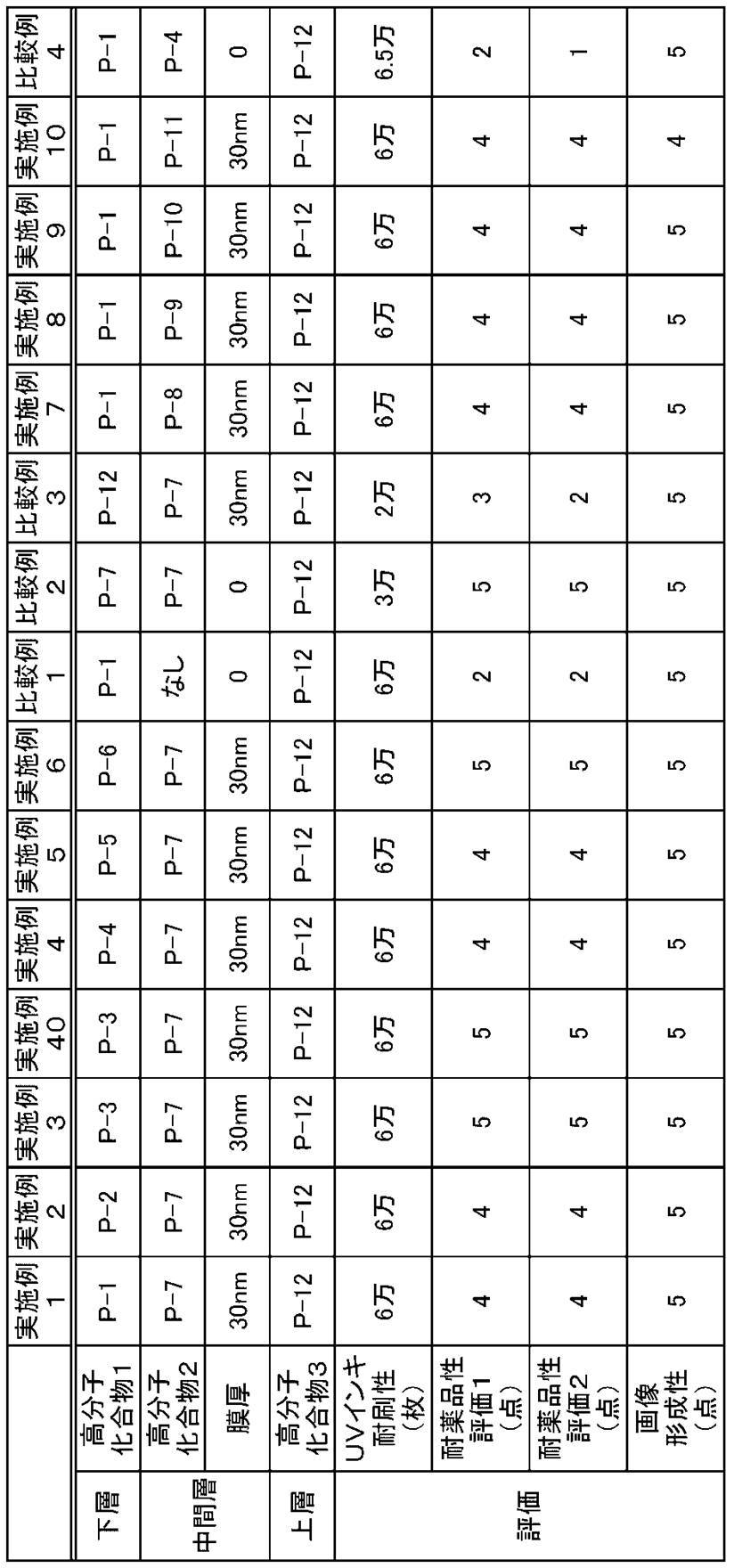
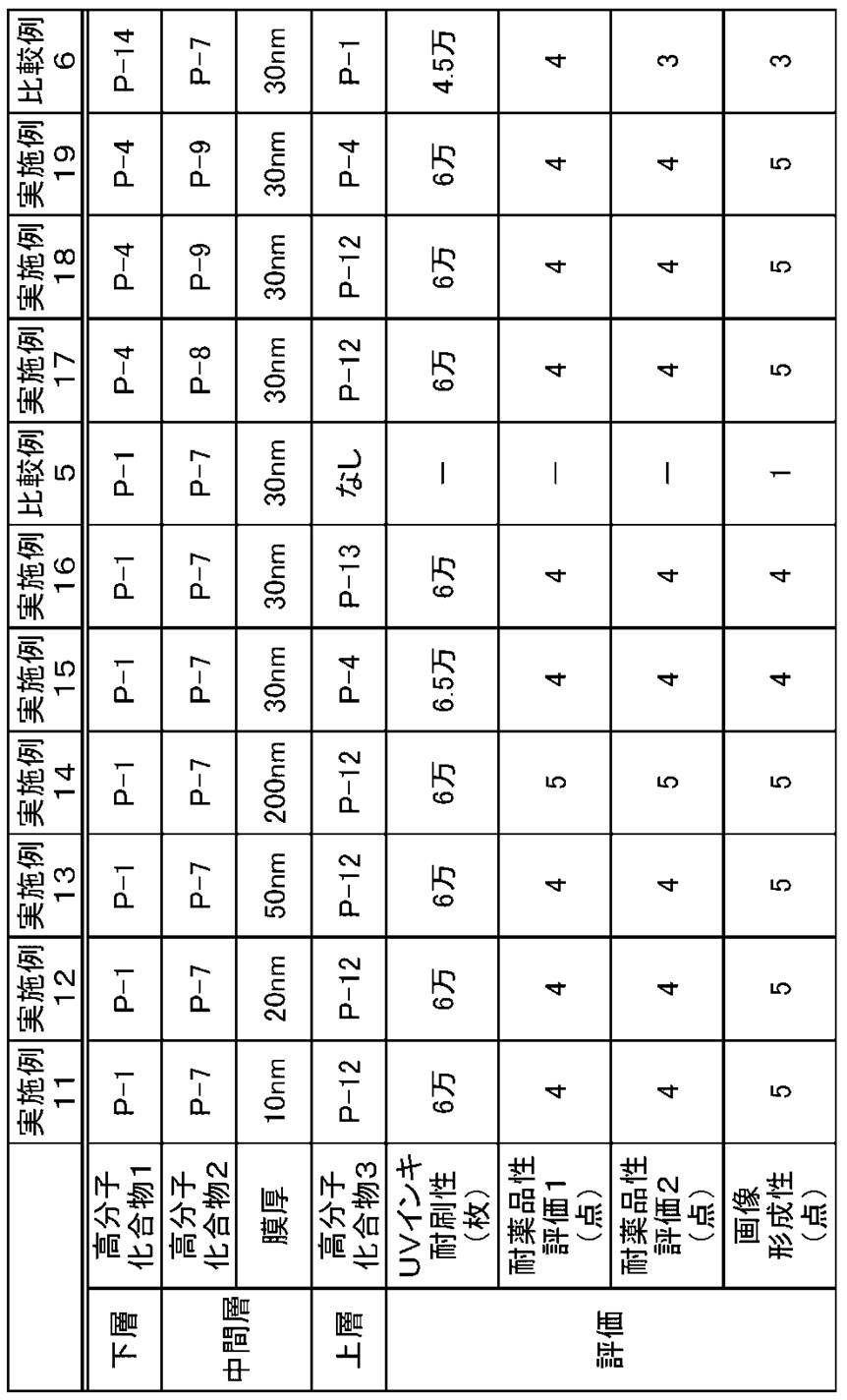
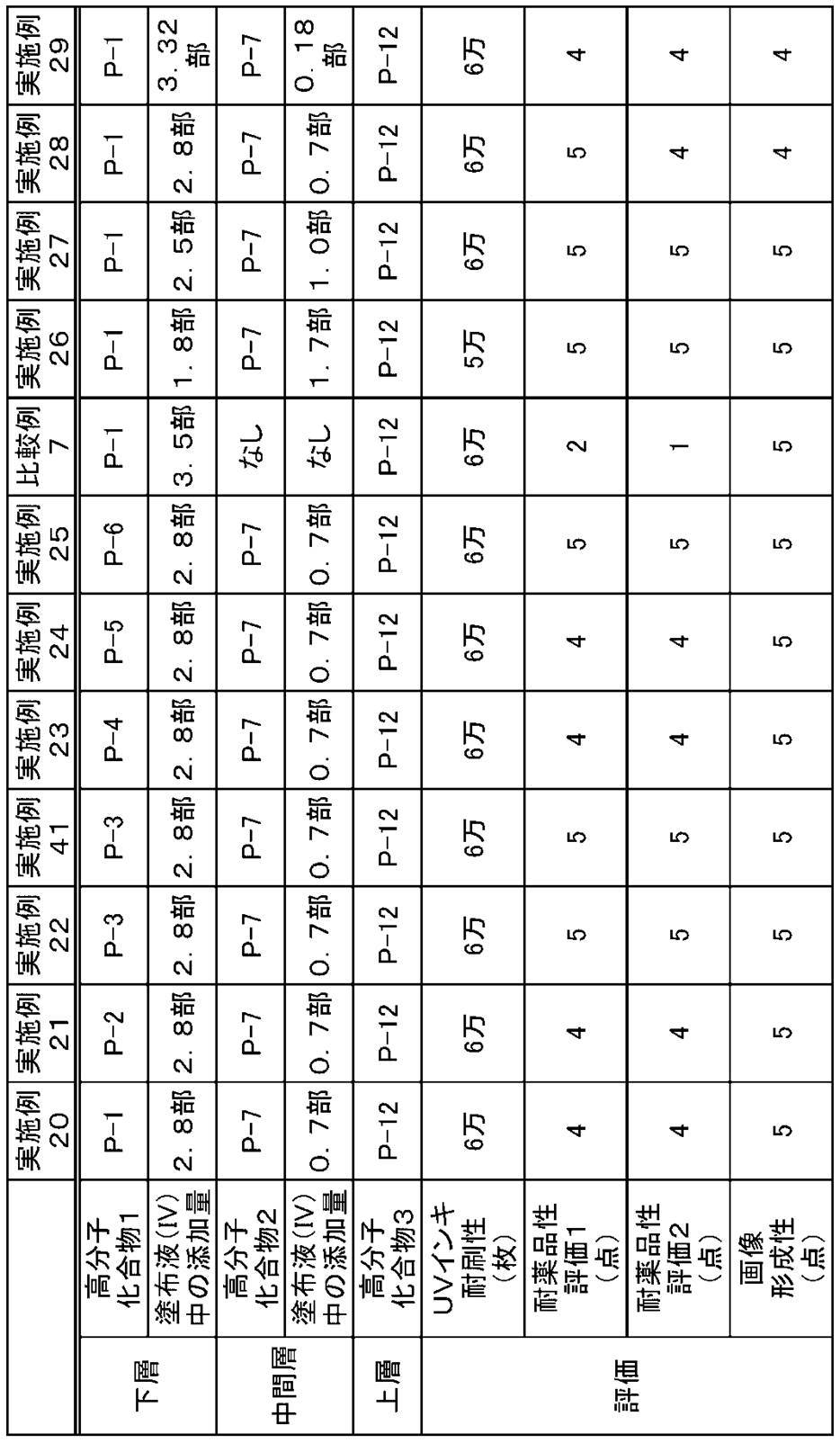
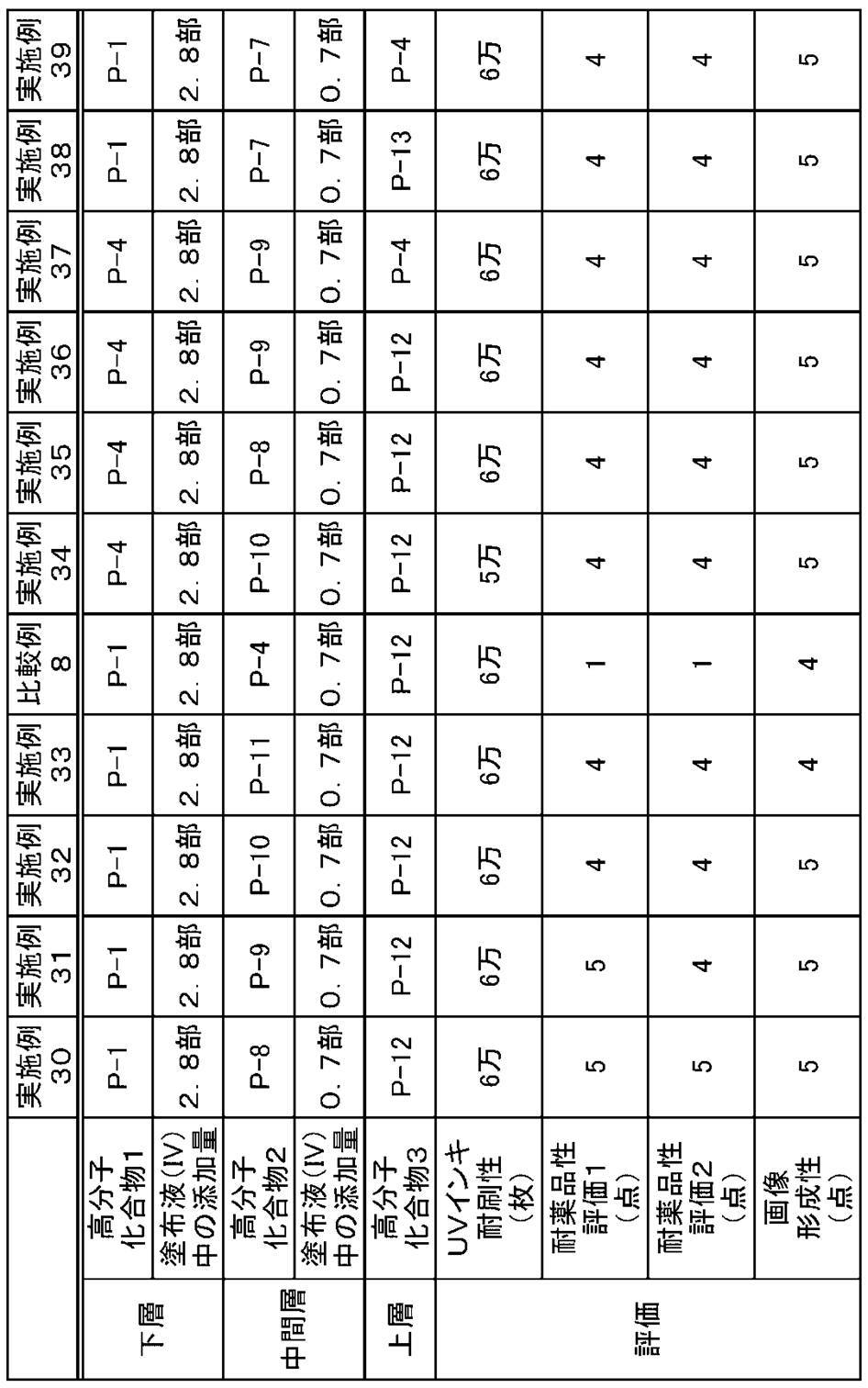
表1及び表2の結果から明らかなように、高分子化合物1を含む下層の上に、高分子化合物2を含む中間層を塗設し、更に高分子化合物3を含む上層を塗設した本開示に係る平版印刷版原版は、良好なUVインキ耐刷性、良好な耐薬品性、及び、画像形成性を示すことが分かる。
また、中間層の膜厚については、膜厚10nm以上の実施例11~14では、良好な耐薬品性を示した。
表3及び表4の結果から明らかなように、本開示の高分子化合物1と高分子化合物2を特定の存在比で含む下層及び中間層形成用塗布液を塗設することで下層及び中間層を形成し、更に高分子化合物3を含む上層を塗設した平版印刷版原版も、良好なUVインキ耐刷性、良好な耐薬品性、画像形成性を示すことが分かる。
また、下層及び中間層形成用塗布液中の高分子化合物1の割合が、高分子化合物の全質量に対し、50質量%以上である実施例26~29では良好な耐刷性を示した。
また、中間層の膜厚については、膜厚10nm以上の実施例11~14では、良好な耐薬品性を示した。
表3及び表4の結果から明らかなように、本開示の高分子化合物1と高分子化合物2を特定の存在比で含む下層及び中間層形成用塗布液を塗設することで下層及び中間層を形成し、更に高分子化合物3を含む上層を塗設した平版印刷版原版も、良好なUVインキ耐刷性、良好な耐薬品性、画像形成性を示すことが分かる。
また、下層及び中間層形成用塗布液中の高分子化合物1の割合が、高分子化合物の全質量に対し、50質量%以上である実施例26~29では良好な耐刷性を示した。
2016年9月29日に出願された日本国特許出願第2016-192050号、及び、2017年3月21日に出願された日本国特許出願第2017-054715号の開示、及び、は、その全体が参照により本明細書に取り込まれる。
本明細書に記載された全ての文献、特許出願、及び、技術規格は、個々の文献、特許出願、及び、技術規格が参照により取り込まれることが具体的かつ個々に記された場合と同程度に、本明細書中に参照により取り込まれる。
本明細書に記載された全ての文献、特許出願、及び、技術規格は、個々の文献、特許出願、及び、技術規格が参照により取り込まれることが具体的かつ個々に記された場合と同程度に、本明細書中に参照により取り込まれる。
Claims (13)
- 親水性表面又は親水性層を有する支持体上に、下層、中間層及び上層をこの順に少なくとも有し、
前記下層が、水に不溶かつアルカリ水溶液に可溶な、ウレタン結合、アセタール構造、及び、ウレア結合よりなる群から選ばれる少なくとも一つの構造を主鎖に有する高分子化合物1を含み、
前記中間層が、水に不溶かつアルカリ水溶液に可溶な、スルホンアミド基、活性イミド基、及び、ウレア結合よりなる群から選ばれる少なくとも一つの構造を側鎖に有する高分子化合物2を含み、
前記上層が、水に不溶かつアルカリ水溶液に可溶な、フェノール性ヒドロキシ基を有する高分子化合物3を含み、
前記下層、中間層及び上層のうち1つ以上の層に赤外線吸収剤を含有する
ポジ型平版印刷版原版。 - 前記下層が、高分子化合物2を更に含む請求項1に記載のポジ型平版印刷版原版。
- 前記下層において、高分子化合物1と高分子化合物2とが海島構造を形成している請求項2に記載のポジ型平版印刷版原版。
- 前記中間層の厚さが、5nm以上である請求項1~請求項3のいずれか1項に記載のポジ型平版印刷版原版。
- 前記中間層の厚さが、10nm以上である請求項1~請求項4のいずれか1項に記載のポジ型平版印刷版原版。
- 前記高分子化合物3が、フェノール樹脂、及び、側鎖にフェノール性ヒドロキシ基を有するアセタール樹脂よりなる群から選ばれる少なくとも1種の高分子化合物である請求項1~請求項5のいずれか1項に記載のポジ型平版印刷版原版。
- 前記高分子化合物3が、フェノール性ヒドロキシ基を有するノボラック樹脂である請求項1~請求項6のいずれか1項に記載のポジ型平版印刷版原版。
- 前記上層が、赤外線吸収剤を含有する請求項1~請求項7のいずれか1項に記載のポジ型平版印刷版原版。
- 前記下層、中間層及び上層のうち少なくとも1つの層に、オニウム塩化合物を含有する請求項1~請求項8のいずれか1項に記載のポジ型平版印刷版原版。
- 高分子化合物1及び高分子化合物2を含む塗布液を準備する工程、
親水性表面又は親水性層を有する支持体上に、前記塗布液を塗布及び乾燥して相分離により下層及び中間層を形成する工程、並びに、
前記中間層上に上層を形成する工程を含む
請求項1~請求項9のいずれか1項に記載のポジ型平版印刷版原版の製造方法。 - 前記塗布液に含まれる前記高分子化合物1と前記高分子化合物2との存在比が、質量基準で95:5~50:50である請求項10に記載のポジ型平版印刷版原版の製造方法。
- 前記塗布液に含まれる前記高分子化合物1と前記高分子化合物2との存在比が、質量基準で90:10~60:40である請求項10又は請求項11に記載のポジ型平版印刷版原版の製造方法。
- 請求項1~請求項9のいずれか1項に記載の平版印刷版原版を画像様に露光する露光工程、及び、
露光した平版印刷版原版をpH8.5~13.5のアルカリ水溶液を用いて現像する現像工程、を含む
平版印刷版の作製方法。
Priority Applications (4)
| Application Number | Priority Date | Filing Date | Title |
|---|---|---|---|
| EP17855666.8A EP3521927B1 (en) | 2016-09-29 | 2017-09-07 | Positive working lithographic printing plate precursor, method for manufacturing the precursor and method for producing lithographic printing plate |
| JP2018542334A JP6625232B2 (ja) | 2016-09-29 | 2017-09-07 | ポジ型平版印刷版原版及びその製造方法、並びに、平版印刷版の作製方法 |
| CN201780058708.4A CN109791361B (zh) | 2016-09-29 | 2017-09-07 | 正型平版印刷版原版及其制造方法、以及平版印刷版的制作方法 |
| US16/351,513 US10649337B2 (en) | 2016-09-29 | 2019-03-13 | Positive type lithographic printing plate precursor, method of producing same, and method of preparing lithographic printing plate |
Applications Claiming Priority (4)
| Application Number | Priority Date | Filing Date | Title |
|---|---|---|---|
| JP2016192050 | 2016-09-29 | ||
| JP2016-192050 | 2016-09-29 | ||
| JP2017-054715 | 2017-03-21 | ||
| JP2017054715 | 2017-03-21 |
Related Child Applications (1)
| Application Number | Title | Priority Date | Filing Date |
|---|---|---|---|
| US16/351,513 Continuation US10649337B2 (en) | 2016-09-29 | 2019-03-13 | Positive type lithographic printing plate precursor, method of producing same, and method of preparing lithographic printing plate |
Publications (1)
| Publication Number | Publication Date |
|---|---|
| WO2018061708A1 true WO2018061708A1 (ja) | 2018-04-05 |
Family
ID=61760311
Family Applications (1)
| Application Number | Title | Priority Date | Filing Date |
|---|---|---|---|
| PCT/JP2017/032371 Ceased WO2018061708A1 (ja) | 2016-09-29 | 2017-09-07 | ポジ型平版印刷版原版及びその製造方法、並びに、平版印刷版の作製方法 |
Country Status (5)
| Country | Link |
|---|---|
| US (1) | US10649337B2 (ja) |
| EP (1) | EP3521927B1 (ja) |
| JP (1) | JP6625232B2 (ja) |
| CN (1) | CN109791361B (ja) |
| WO (1) | WO2018061708A1 (ja) |
Cited By (1)
| Publication number | Priority date | Publication date | Assignee | Title |
|---|---|---|---|---|
| WO2020080371A1 (ja) * | 2018-10-17 | 2020-04-23 | 富士フイルム株式会社 | 平版印刷版原版、及び、平版印刷版の作製方法 |
Families Citing this family (2)
| Publication number | Priority date | Publication date | Assignee | Title |
|---|---|---|---|---|
| CN109791361B (zh) * | 2016-09-29 | 2022-06-03 | 富士胶片株式会社 | 正型平版印刷版原版及其制造方法、以及平版印刷版的制作方法 |
| EP4190581A4 (en) * | 2020-07-31 | 2024-01-24 | FUJIFILM Corporation | ORIGINAL PLATE FOR PRESS DEVELOPMENT TYPE LITHOGRAPHIC PRINTING PLATE, METHOD FOR MANUFACTURING LITHOGRAPHIC PRINTING PLATE, AND LITHOGRAPHIC PRINTING METHOD |
Citations (8)
| Publication number | Priority date | Publication date | Assignee | Title |
|---|---|---|---|---|
| JP2003156850A (ja) * | 2001-11-15 | 2003-05-30 | Kodak Polychrome Graphics Co Ltd | 熱的に画像形成可能な部材におけるアブレーションの最小化 |
| JP2004157460A (ja) * | 2002-11-08 | 2004-06-03 | Fuji Photo Film Co Ltd | 平版印刷版原版 |
| JP2005017599A (ja) * | 2003-06-25 | 2005-01-20 | Fuji Photo Film Co Ltd | 平版印刷版原版の製造方法 |
| JP2005091703A (ja) * | 2003-09-17 | 2005-04-07 | Fuji Photo Film Co Ltd | 平版印刷版原版 |
| JP2005258070A (ja) * | 2004-03-11 | 2005-09-22 | Fuji Photo Film Co Ltd | 平版印刷版原版 |
| JP2006154512A (ja) * | 2004-11-30 | 2006-06-15 | Fuji Photo Film Co Ltd | 平版印刷版原版 |
| JP2007256537A (ja) * | 2006-03-22 | 2007-10-04 | Fujifilm Corp | 感光性平版印刷版 |
| JP2012078457A (ja) * | 2010-09-30 | 2012-04-19 | Fujifilm Corp | 赤外線感光性ポジ型平版印刷版原版、その製造方法、平版印刷版、並びに平版印刷版の作製方法 |
Family Cites Families (19)
| Publication number | Priority date | Publication date | Assignee | Title |
|---|---|---|---|---|
| US6294311B1 (en) | 1999-12-22 | 2001-09-25 | Kodak Polychrome Graphics Llc | Lithographic printing plate having high chemical resistance |
| JP2003107720A (ja) * | 2001-09-28 | 2003-04-09 | Fuji Photo Film Co Ltd | 平版印刷版用原版 |
| US7358032B2 (en) * | 2002-11-08 | 2008-04-15 | Fujifilm Corporation | Planographic printing plate precursor |
| JP4057893B2 (ja) | 2002-11-08 | 2008-03-05 | 富士フイルム株式会社 | 平版印刷版原版 |
| US6942957B2 (en) * | 2003-07-17 | 2005-09-13 | Kodak Polychrome Graphics Llc | Ionic liquids as developability enhancing agents in multilayer imageable elements |
| US7014983B1 (en) * | 2004-10-05 | 2006-03-21 | Eastman Kodak Company | Multilayer imageable element |
| US7247418B2 (en) * | 2005-12-01 | 2007-07-24 | Eastman Kodak Company | Imageable members with improved chemical resistance |
| EP1854627A1 (en) * | 2006-05-12 | 2007-11-14 | Agfa Graphics N.V. | Method for making a lithographic printing plate |
| JP5164640B2 (ja) * | 2008-04-02 | 2013-03-21 | 富士フイルム株式会社 | 平版印刷版原版 |
| EP2159049B1 (en) * | 2008-09-02 | 2012-04-04 | Agfa Graphics N.V. | A heat-sensitive positive-working lithographic printing plate precursor |
| EP2365389B1 (en) * | 2010-03-08 | 2013-01-16 | Fujifilm Corporation | Positive-working lithographic printing plate precursor for infrared laser and process for making lithographic printing plate |
| JP5690645B2 (ja) * | 2010-05-31 | 2015-03-25 | 富士フイルム株式会社 | 平版印刷版原版、その製版方法、及び、新規高分子化合物。 |
| JP5301015B2 (ja) * | 2011-07-25 | 2013-09-25 | 富士フイルム株式会社 | 感光性平版印刷版原版及び平版印刷版の作製方法 |
| US8703381B2 (en) * | 2011-08-31 | 2014-04-22 | Eastman Kodak Company | Lithographic printing plate precursors for on-press development |
| BR112016022650B1 (pt) | 2014-03-31 | 2022-03-03 | Fujifilm Corporation | Composição de resina fotossensível, placa original de impressão litográfica e método para produção de placa de impressão litográfica |
| BR112016022496B1 (pt) | 2014-03-31 | 2022-06-07 | Fujifilm Corporation | Composição de resina fotossensível, precursor de placa de impressão litográfica compreendendo a mesma, e método para produzir placa de impressão litográfica |
| EP3182205B1 (en) * | 2014-09-26 | 2021-04-07 | FUJIFILM Corporation | Photosensitive resin composition, lithographic printing original plate, method for producing lithographic printing plate, and polymer compound |
| JP6615232B2 (ja) * | 2016-01-29 | 2019-12-04 | 富士フイルム株式会社 | ポジ型平版印刷版原版、及び、平版印刷版の作製方法 |
| CN109791361B (zh) * | 2016-09-29 | 2022-06-03 | 富士胶片株式会社 | 正型平版印刷版原版及其制造方法、以及平版印刷版的制作方法 |
-
2017
- 2017-09-07 CN CN201780058708.4A patent/CN109791361B/zh active Active
- 2017-09-07 EP EP17855666.8A patent/EP3521927B1/en active Active
- 2017-09-07 WO PCT/JP2017/032371 patent/WO2018061708A1/ja not_active Ceased
- 2017-09-07 JP JP2018542334A patent/JP6625232B2/ja active Active
-
2019
- 2019-03-13 US US16/351,513 patent/US10649337B2/en active Active
Patent Citations (8)
| Publication number | Priority date | Publication date | Assignee | Title |
|---|---|---|---|---|
| JP2003156850A (ja) * | 2001-11-15 | 2003-05-30 | Kodak Polychrome Graphics Co Ltd | 熱的に画像形成可能な部材におけるアブレーションの最小化 |
| JP2004157460A (ja) * | 2002-11-08 | 2004-06-03 | Fuji Photo Film Co Ltd | 平版印刷版原版 |
| JP2005017599A (ja) * | 2003-06-25 | 2005-01-20 | Fuji Photo Film Co Ltd | 平版印刷版原版の製造方法 |
| JP2005091703A (ja) * | 2003-09-17 | 2005-04-07 | Fuji Photo Film Co Ltd | 平版印刷版原版 |
| JP2005258070A (ja) * | 2004-03-11 | 2005-09-22 | Fuji Photo Film Co Ltd | 平版印刷版原版 |
| JP2006154512A (ja) * | 2004-11-30 | 2006-06-15 | Fuji Photo Film Co Ltd | 平版印刷版原版 |
| JP2007256537A (ja) * | 2006-03-22 | 2007-10-04 | Fujifilm Corp | 感光性平版印刷版 |
| JP2012078457A (ja) * | 2010-09-30 | 2012-04-19 | Fujifilm Corp | 赤外線感光性ポジ型平版印刷版原版、その製造方法、平版印刷版、並びに平版印刷版の作製方法 |
Non-Patent Citations (1)
| Title |
|---|
| See also references of EP3521927A4 * |
Cited By (1)
| Publication number | Priority date | Publication date | Assignee | Title |
|---|---|---|---|---|
| WO2020080371A1 (ja) * | 2018-10-17 | 2020-04-23 | 富士フイルム株式会社 | 平版印刷版原版、及び、平版印刷版の作製方法 |
Also Published As
| Publication number | Publication date |
|---|---|
| JP6625232B2 (ja) | 2019-12-25 |
| CN109791361B (zh) | 2022-06-03 |
| EP3521927A1 (en) | 2019-08-07 |
| CN109791361A (zh) | 2019-05-21 |
| JPWO2018061708A1 (ja) | 2019-02-14 |
| EP3521927A4 (en) | 2019-11-27 |
| EP3521927B1 (en) | 2021-10-27 |
| US10649337B2 (en) | 2020-05-12 |
| US20190212652A1 (en) | 2019-07-11 |
Similar Documents
| Publication | Publication Date | Title |
|---|---|---|
| JP6185187B2 (ja) | 感光性樹脂組成物、平版印刷版原版、平版印刷版の作製方法、及び、高分子化合物 | |
| EP2497639B1 (en) | Thermal positive-type planographic original printing plate and method of making planographic printing plate | |
| JP6154065B2 (ja) | 感光性樹脂組成物、平版印刷版原版及び平版印刷版の作製方法 | |
| JP6605017B2 (ja) | 感光性樹脂組成物、平版印刷版原版、平版印刷版の作製方法、及び、高分子化合物 | |
| JP6243010B2 (ja) | 感光性樹脂組成物、平版印刷版原版、及び、平版印刷版の作製方法 | |
| US10649337B2 (en) | Positive type lithographic printing plate precursor, method of producing same, and method of preparing lithographic printing plate | |
| JP5388908B2 (ja) | 赤外線レーザー用ポジ型平版印刷版原版、及び、平版印刷版の製版方法 | |
| EP1577111A1 (en) | Positive-type photosensitive composition | |
| JP6615232B2 (ja) | ポジ型平版印刷版原版、及び、平版印刷版の作製方法 | |
| JP2016156968A (ja) | ポジ型平版印刷版原版、及び、平版印刷版の作製方法 | |
| JP6434633B2 (ja) | 感光性樹脂組成物、平版印刷版原版及び平版印刷版の製版方法 | |
| WO2018139059A1 (ja) | ポジ型平版印刷版原版、及び、平版印刷版の作製方法 | |
| WO2017145717A1 (ja) | ポジ型感光性樹脂組成物、ポジ型平版印刷版原版、及び、平版印刷版の作製方法 | |
| WO2019167968A1 (ja) | 感光性樹脂組成物、並びに、平版印刷版原版の作製方法及び平版印刷版の作製方法 | |
| WO2019167967A1 (ja) | ポジ型平版印刷版原版、及び、平版印刷版の作製方法 | |
| JP2019152698A (ja) | 感光性樹脂組成物、平版印刷版原版及び平版印刷版の作製方法 | |
| WO2019163286A1 (ja) | ポジ型平版印刷版原版、及び、平版印刷版の作製方法 | |
| WO2020111050A1 (ja) | 平版印刷版原版、及び、平版印刷版の作製方法 | |
| WO2020110650A1 (ja) | 平版印刷版原版、及び、平版印刷版の作製方法 | |
| WO2017056761A1 (ja) | 感光性樹脂組成物、平版印刷版原版、及び、平版印刷版の製版方法 | |
| JP2020122934A (ja) | ポジ型平版印刷版原版、及び平版印刷版の作製方法 | |
| JP2020122935A (ja) | ポジ型平版印刷版原版、及び、平版印刷版の作製方法 |
Legal Events
| Date | Code | Title | Description |
|---|---|---|---|
| ENP | Entry into the national phase |
Ref document number: 2018542334 Country of ref document: JP Kind code of ref document: A |
|
| 121 | Ep: the epo has been informed by wipo that ep was designated in this application |
Ref document number: 17855666 Country of ref document: EP Kind code of ref document: A1 |
|
| NENP | Non-entry into the national phase |
Ref country code: DE |
|
| ENP | Entry into the national phase |
Ref document number: 2017855666 Country of ref document: EP Effective date: 20190429 |