WO2018062187A1 - 偏光性積層体および眼鏡 - Google Patents
偏光性積層体および眼鏡 Download PDFInfo
- Publication number
- WO2018062187A1 WO2018062187A1 PCT/JP2017/034759 JP2017034759W WO2018062187A1 WO 2018062187 A1 WO2018062187 A1 WO 2018062187A1 JP 2017034759 W JP2017034759 W JP 2017034759W WO 2018062187 A1 WO2018062187 A1 WO 2018062187A1
- Authority
- WO
- WIPO (PCT)
- Prior art keywords
- layer
- polarizing
- polarizing laminate
- resin material
- polyamide
- Prior art date
- Legal status (The legal status is an assumption and is not a legal conclusion. Google has not performed a legal analysis and makes no representation as to the accuracy of the status listed.)
- Ceased
Links
Images


Classifications
-
- B—PERFORMING OPERATIONS; TRANSPORTING
- B29—WORKING OF PLASTICS; WORKING OF SUBSTANCES IN A PLASTIC STATE IN GENERAL
- B29D—PRODUCING PARTICULAR ARTICLES FROM PLASTICS OR FROM SUBSTANCES IN A PLASTIC STATE
- B29D11/00—Producing optical elements, e.g. lenses or prisms
- B29D11/00634—Production of filters
- B29D11/00644—Production of filters polarizing
-
- G—PHYSICS
- G02—OPTICS
- G02B—OPTICAL ELEMENTS, SYSTEMS OR APPARATUS
- G02B5/00—Optical elements other than lenses
- G02B5/30—Polarising elements
- G02B5/3025—Polarisers, i.e. arrangements capable of producing a definite output polarisation state from an unpolarised input state
- G02B5/3033—Polarisers, i.e. arrangements capable of producing a definite output polarisation state from an unpolarised input state in the form of a thin sheet or foil, e.g. Polaroid
-
- B—PERFORMING OPERATIONS; TRANSPORTING
- B29—WORKING OF PLASTICS; WORKING OF SUBSTANCES IN A PLASTIC STATE IN GENERAL
- B29D—PRODUCING PARTICULAR ARTICLES FROM PLASTICS OR FROM SUBSTANCES IN A PLASTIC STATE
- B29D11/00—Producing optical elements, e.g. lenses or prisms
- B29D11/00009—Production of simple or compound lenses
-
- B—PERFORMING OPERATIONS; TRANSPORTING
- B32—LAYERED PRODUCTS
- B32B—LAYERED PRODUCTS, i.e. PRODUCTS BUILT-UP OF STRATA OF FLAT OR NON-FLAT, e.g. CELLULAR OR HONEYCOMB, FORM
- B32B27/00—Layered products comprising a layer of synthetic resin
- B32B27/34—Layered products comprising a layer of synthetic resin comprising polyamides
-
- G—PHYSICS
- G02—OPTICS
- G02B—OPTICAL ELEMENTS, SYSTEMS OR APPARATUS
- G02B1/00—Optical elements characterised by the material of which they are made; Optical coatings for optical elements
- G02B1/10—Optical coatings produced by application to, or surface treatment of, optical elements
- G02B1/14—Protective coatings, e.g. hard coatings
-
- G—PHYSICS
- G02—OPTICS
- G02B—OPTICAL ELEMENTS, SYSTEMS OR APPARATUS
- G02B5/00—Optical elements other than lenses
- G02B5/30—Polarising elements
-
- G—PHYSICS
- G02—OPTICS
- G02C—SPECTACLES; SUNGLASSES OR GOGGLES INSOFAR AS THEY HAVE THE SAME FEATURES AS SPECTACLES; CONTACT LENSES
- G02C7/00—Optical parts
- G02C7/12—Polarisers
-
- B—PERFORMING OPERATIONS; TRANSPORTING
- B32—LAYERED PRODUCTS
- B32B—LAYERED PRODUCTS, i.e. PRODUCTS BUILT-UP OF STRATA OF FLAT OR NON-FLAT, e.g. CELLULAR OR HONEYCOMB, FORM
- B32B2307/00—Properties of the layers or laminate
- B32B2307/40—Properties of the layers or laminate having particular optical properties
- B32B2307/42—Polarizing, birefringent, filtering
Definitions
- the present invention relates to a polarizing laminate and glasses.
- Sunglasses including sunglasses with degrees
- goggles are used for the purpose of anti-glare, eye protection from wind and rain, dust, chemicals, etc.
- sunglasses without a frame are also used from the viewpoint of fashionability and lightness.
- Polycarbonate or the like is used as the plastic material constituting such a polarizing laminate.
- the fixing strength of the polarizing laminate is not sufficient. That is, when such a polarizing laminate is subjected to processing such as drilling, cracks, cracks and the like are likely to occur. Thus, there was a problem that the workability (cracking resistance) of the polarizing laminate was not sufficient.
- An object of the present invention is to provide a polarizing laminate that can maintain a stable quality (particularly polarization characteristics) for a long period of time and is excellent in workability and durability (particularly water resistance and weather resistance).
- An object of the present invention is to provide a spectacle having the polarizing laminate.
- a polarizing film having a first surface and a second surface that is the surface opposite to the first surface; A first layer provided on the first surface side and made of a first resin material containing polyamide; A polarizing laminate comprising a second layer provided on the second surface side and made of a second resin material containing polyamide, According to JIS K 7060: 1995, when the bar hardness of the polarizing laminate was measured before and after immersing the polarizing laminate in 80 ° C. distilled water for 15 minutes, the bar after the immersion was measured.
- -A polarizing laminate having a Col hardness of 70% or more and 100% or less with respect to the Barcol hardness before the immersion.
- any one of the above (1) to (4), wherein the second surface provided with the second layer faces the eyes of the user The polarizing laminated body of description.
- the retardation of the first layer is 2600 or more and 8000 or less
- the water absorption rate of the first layer and the second layer measured according to JIS K 7209: 2000 is 0.5% or more and 6.0% or less (1) to (1) to The polarizing laminate according to any one of (7).
- a polarizing laminate that can maintain stable quality (particularly polarization characteristics) for a long period of time and is excellent in workability and durability (particularly water resistance and weather resistance).
- the glasses equipped with the polarizing laminate can be provided.
- FIG. 1 is a perspective view showing sunglasses as an example of eyeglasses of the present invention provided with the polarizing laminate of the present invention.
- FIG. 2 is an enlarged cross-sectional view of the polarizing laminate of the present invention.
- FIG. 1 is a perspective view showing sunglasses as an example of the glasses of the present invention provided with the polarizing laminate of the present invention
- FIG. 2 is an enlarged sectional view of the polarizing laminate of the present invention.
- FIGS. 1 and 2 the upper side is referred to as “upper” or “upper”, and the lower side is also referred to as “lower” or “lower”.
- the drawings referred to in this specification a part of the drawings is exaggerated and is greatly different from actual dimensions.
- a sunglasses (glasses) 1 includes a frame 2 attached to a user's head and a polarizing laminate (lens) 3 fixed to the frame 2.
- the “lens” includes both a lens with a degree (for example, a myopic lens, a farsighted lens, an astigmatic lens, etc.) and a lens without a degree.
- the frame 2 includes a rim portion 21, a bridge portion 22, a temple portion 23 that is hung on the user's ear, and a nose pad portion 24 so as to be attached to the user's head (FIG. 1). ).
- Each rim portion 21 has a ring shape and is a portion on which the polarizing laminate (lens) 3 is attached.
- the bridge portion 22 is a portion that connects the rim portions 21.
- Each temple portion 23 has a vine shape and is connected to an edge portion of each rim portion 21. This temple part 23 is a part hung on a user's ear.
- the nose pad portion 24 is a portion that comes into contact with the user's nose when the sunglasses 1 is worn on the user's head. Thereby, a mounting state can be maintained stably.
- the constituent material of the frame 2 is not particularly limited, and various metal materials, various resin materials, and the like can be used.
- the shape of the frame 2 is not limited to the illustrated shape as long as it can be worn on the user's head.
- Each rim portion 21 is provided with a polarizing laminate (lens) 3.
- the polarizing laminate (lens) 3 can maintain stable quality for a long period of time and is excellent in workability. For this reason, the sunglasses (glasses) 1 including the polarizing laminate (lens) 3 can also maintain stable quality for a long period of time.
- the polarizing laminate (lens) 3 includes a polarizing film 31 having a first surface 311 and a second surface 312 opposite to the first surface 311; A first layer (first polyamide layer) 32 that is arranged on the surface 311 side and made of a first resin material containing polyamide, and a second resin that is arranged on the second surface 312 side and contains polyamide A second layer (second polyamide layer) 33 made of a material, and an adhesive layer (first adhesive layer) arranged between the polarizing film 31 and the first layer 32 to bond (adhere) them. 34 and an adhesive layer (second adhesive layer) 35 disposed between the polarizing film 31 and the second layer 33 to bond (adhere) them.
- the polarizing film 31 is covered with the first layer 32 made of the first resin material containing polyamide, and the other side of the polarizing film 31 contains the second polyamide. It coat
- the polarizing laminate 3 has excellent resistance to stress such as bending by including the first layer 32 made of the first resin material containing polyamide having a relatively high elastic modulus. Therefore, when the polarizing laminate 3 is fitted into the frame 2 or screwed, it can exhibit an excellent fixing force.
- the polarizing laminate 3 is less likely to be cracked or cracked during processing such as drilling. That is, the polarizing laminate 3 has excellent processability. Moreover, the material containing the polyamide (the first resin material and the second resin material) can easily control the retardation by stretching, and can further improve the polarization characteristics of the polarizing laminate 3 as a whole. it can.
- the polarizing film when at least one surface of the polarizing film is not covered, the polarizing film is easily scratched, and excellent polarization characteristics cannot be stably exhibited over a long period of time.
- the polarizing laminate 3 may be applied to, for example, goggles and sun visors, but is preferably a spectacle lens that is applied to the spectacles as described above.
- spectacle lenses are subjected to large loads during processing such as fitting into a frame or screwing, and are attached to the human body, so that the spectacle lenses may drop off, crack, break, etc. during use.
- the harmful effect of is particularly large.
- the polarizing laminate even when the polarizing laminate is applied to a spectacle lens, it is possible to effectively prevent problems such as cracks at the time of processing. The occurrence of a serious problem can be effectively prevented. Therefore, when the polarizing laminate is applied to a spectacle lens, the effect of the present invention is more remarkably exhibited.
- the polarizing laminate 3 (each of the first layer 32 and the second layer 33) has the following characteristics (Barcol hardness ratio). That is, according to JIS K 7060: 1995, when the bar hardness of the polarizing laminate 3 before and after immersing the polarizing laminate 3 in 80 ° C. distilled water for 15 minutes was measured, The polarizing laminate 3 has a feature that the col hardness is 70% or more and 100% or less with respect to the bar col hardness before immersion. Thereby, workability and durability can be made compatible at a higher level. Further, the Barcol hardness ratio is preferably 75% or more and 100%. Thereby, the said effect can be exhibited more notably.
- the polarizing layered product 3 may have the first layer 32 and the second layer 33 facing either side during use.
- the first resin material and the second resin material have different properties (physical properties) as will be described later, the surface on which the second layer 33 is provided faces the user's eyes. It is preferable to be used.
- the polarizing film 31 has a function of extracting linearly polarized light having a polarization plane in a predetermined direction from incident light (unpolarized natural light). As a result, the incident light that enters the eye through the polarizing laminate (lens) 3 is polarized.
- the degree of polarization of the polarizing film 31 is not particularly limited, but is preferably 50% or more and 100% or less, and more preferably 80% or more and 100% or less. Further, the visible light transmittance of the polarizing film 31 is not particularly limited, but is preferably 10% or more and 80% or less, and more preferably 20% or more and 50% or less.
- the constituent material of the polarizing film 31 is not particularly limited as long as it has the above functions.
- polyvinyl alcohol (PVA) partially formalized polyvinyl alcohol, polyethylene vinyl alcohol, polyvinyl butyral, polycarbonate, ethylene- Films made by adsorbing and dyeing dichroic substances such as iodine and dichroic dyes on polymer films composed of partially saponified vinyl acetate copolymers, uniaxially stretched films, dehydrated polyvinyl alcohol and poly Examples thereof include polyene-based oriented films such as a dehydrochlorinated product of vinyl chloride.
- the polarizing film 31 is preferably a film uniaxially stretched by adsorbing or dyeing iodine or a dichroic dye on a polymer film mainly composed of polyvinyl alcohol (PVA).
- PVA polyvinyl alcohol
- Polyvinyl alcohol (PVA) is a material excellent in transparency, heat resistance, affinity with iodine or dichroic dye as a dyeing agent, and orientation during stretching. Therefore, the polarizing film 31 containing PVA as a main material has excellent polarizing ability as well as excellent heat resistance.
- dichroic dye examples include chloratin fast red, congo red, brilliant blue 6B, benzoperpurine, chlorazole black BH, direct blue 2B, diamine green, chrysophenone, sirius yellow, direct first red, and acid black. Etc.
- the thickness of the polarizing film 31 is not particularly limited, and is preferably 5 ⁇ m or more and 60 ⁇ m or less, for example, and more preferably 10 ⁇ m or more and 40 ⁇ m or less.
- the first layer 32 is made of a first resin material containing polyamide.
- the polyamide may be a copolymer (random copolymer, block copolymer, etc.) containing two or more monomers for at least one of dicarboxylic acid and diamine.
- the polyamide examples include semi-aromatic polyamide and alicyclic polyamide.
- Semi-aromatic polyamide is preferable from the viewpoint of workability of the polarizing laminate 3
- alicyclic polyamide is preferable from the viewpoint of impact resistance of the polarizing laminate 3.
- the polarizing laminate 3 includes the first layer 32 made of the first resin material containing the alicyclic polyamide, thereby obtaining an effect that the impact resistance required for the spectacle lens can be ensured. .
- the semi-aromatic polyamide means a polyamide in which one of dicarboxylic acid and diamine as monomers constituting the polyamide is an aromatic compound and the other is an aliphatic compound.
- the semi-aromatic polyamide can be represented by the following formula (1).
- R 1 and R 2 are divalent aromatic substituent, the other is a divalent aliphatic substituent, and n is an integer of 2 or more.
- the semi-aromatic polyamide may be a polyamide in which one of dicarboxylic acid and diamine as a monomer constituting the polyamide is an aromatic compound and the other is an aliphatic compound, and is represented by the above formula (1). However, it is preferable that the following conditions are satisfied.
- the aromatic substituent of R 1 and R 2 in the above formula (1) is preferably the one represented by the following formula (2).
- l and m are each independently an integer of 0 or more and 2 or less.
- the workability of the polarizing laminated body 3 can be improved more.
- the retardation of the first layer 32 by stretching can be controlled more easily.
- the aliphatic substituent of R 1 and R 2 in the above formula (1) is preferably a substituent having 4 to 18 carbon atoms, and is a hydrocarbon group having 4 to 18 carbon atoms. More preferably, it is a saturated hydrocarbon group having 4 to 18 carbon atoms. Thereby, the workability of the polarizing laminate 3 can be further improved.
- the semi-aromatic polyamide preferably contains an aromatic dicarboxylic acid and an aliphatic diamine as constituent monomers.
- the workability of the polarizing laminated body 3 can be improved more.
- the retardation of the first layer 32 by stretching can be controlled more easily.
- the semi-aromatic polyamide may contain an aliphatic dicarboxylic acid and an aromatic diamine as constituent monomers.
- n is an integer of 2 or more.
- n is an integer of 2 or more.
- n is an integer of 2 or more.
- n is an integer of 2 or more, C 6 H 9 denotes a hydrocarbon group of a linear state.
- the workability of the polarizing laminated body 3 can be improved more.
- the retardation of the first layer 32 by stretching can be controlled more easily.
- the semi-aromatic polyamide for example, a copolymer (block copolymer) represented by the following formula (7) can be used.
- n are each independently an integer of 2 or more.
- the alicyclic polyamide has an alicyclic chemical structure in the molecule, and may have an alicyclic chemical structure in the main chain structure, or an alicyclic in the side chain structure. It may have the chemical structure
- Examples of the alicyclic polyamide include a compound in which at least one of dicarboxylic acid and diamine as a monomer constituting the polyamide has an alicyclic chemical structure.
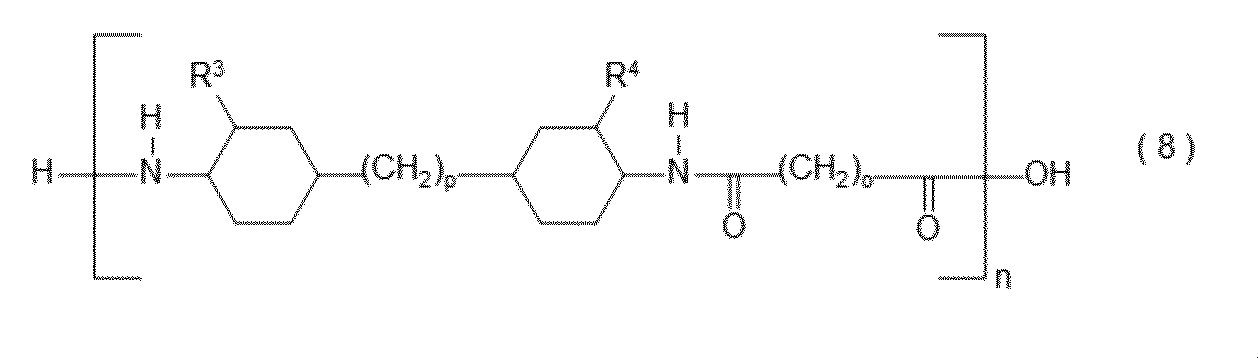
- the alicyclic polyamide is represented by, for example, the following formula (8).
- R 3 and R 4 are each independently a hydrogen atom or a hydrocarbon group having 4 or less carbon atoms, o is an integer of 2 or more and 14 or less, and p is 0 or more and 6 or less.) And n is an integer of 2 or more.
- alicyclic polyamide contained in the first layer 32 are represented by, for example, the following formula (9) and the following formula (10).
- n is an integer of 2 or more.
- n is an integer of 2 or more.
- the glass transition point (glass transition temperature) of the polyamide contained in the first layer 32 is preferably 140 ° C. or higher and 190 ° C. or lower, more preferably 140 ° C. or higher and 180 ° C. or lower, and 140 ° C. As mentioned above, it is more preferable that it is 170 degrees C or less, and it is especially preferable that it is 150 degrees C or more and 170 degrees C or less. Thereby, the workability and durability of the polarizing laminate 3 can be compatible at a higher level.
- the first layer 32 only needs to contain polyamide, and may contain other components in addition to the polyamide.
- examples of such components include colorants such as dyes, fillers, alignment aids, stabilizers (heat stabilizers, ultraviolet absorbers, antioxidants, etc.), plasticizers, flame retardants, antistatic agents, and viscosity.
- examples thereof include resin materials other than regulators and polyamides.
- the dye examples include acid dyes, direct dyes, reactive dyes, basic dyes, and the like, and one or more selected from these can be used in combination.
- the dye examples include C.I. I. Acid Yellow 17, 23, 42, 44, 79, 142, C.I. I. Acid Red 52, 80, 82, 249, 254, 289, C.I. I. Acid Blue 9, 45, 249, C.I. I. Acid Black 1, 2, 24, 94, C.I. I. Food Black 1, 2, C.I. I. Direct Yellow 1,12,24,33,50,55,58,86,132,142,144,173, C.I. I. Direct Red 1, 4, 9, 80, 81, 225, 227, C.I. I. Direct Blue 1, 2, 15, 71, 86, 87, 98, 165, 199, 202, C.I. I. Direct Black 19, 38, 51, 71, 154, 168, 171, 195, C.I. I. Reactive Red 14, 32, 55, 79, 249, C.I. I. Reactive black 3, 4, 35 etc. are mentioned.
- the filler examples include borosilicates such as calcium borosilicate and aluminum borosilicate, TiO 2 , SnO 2 , ZnO, Fe 2 O 3 , Fe 3 O 4 , SiO 2 , Al 2 O 3 , and ZrO 2 .
- borosilicates such as calcium borosilicate and aluminum borosilicate, TiO 2 , SnO 2 , ZnO, Fe 2 O 3 , Fe 3 O 4 , SiO 2 , Al 2 O 3 , and ZrO 2 .
- a metal oxide etc. are mentioned.
- the shape of the filler is not particularly limited, and may be any shape such as a spherical shape or a scale shape. Further, the color of the filler may be colorless or any color such as red, blue, and yellow.
- alignment aid those having a function of improving the degree of orientation of the particles constituting the filler can be used.
- the alignment aid include, for example, alcohols such as methanol, ethanol, propanol, n-butanol and t-butanol, carboxylic acids such as acetic acid, butyric acid and benzoic acid, esters such as ethyl acetate and ethyl lactate, Dimethyl phthalate, diethyl phthalate, dibutyl phthalate, di-2-ethylhexyl phthalate, diisodecyl phthalate, butyl benzyl phthalate, di-2-ethylhexyl adipate, di-n-alkoxy adipate 610, azelaic acid di- Examples include 2-ethylhexyl, dibutyl sebacate, di-2-ethylhexyl sebacate, tributyl phosphate, tri-2-ethylhexyl phosphate, triphenyl phosphate, tricresyl
- the content of the polyamide in the first layer 32 is preferably 60% by mass or more, more preferably 70% by mass or more, and further preferably 80% by mass or more.
- the color of the first layer 32 may be colorless or any color such as red, blue, and yellow.
- the retardation (product of birefringence ( ⁇ n) and thickness (d)) of the first layer 32 is preferably 2600 or more and 8000 or less. As a result, even if the lens shape is bent, iridescent color unevenness is unlikely to occur, and the effect of preventing color loss is obtained.
- the thickness of the first layer 32 is not particularly limited, but is preferably 100 ⁇ m or more and 800 ⁇ m or less, and more preferably 200 ⁇ m or more and 600 ⁇ m or less.
- the first layer 32 can be formed by the following method. For example, a sheet material made of a first resin material containing polyamide is obtained by extrusion molding. The first layer 32 is formed by stretching the obtained sheet material while heating at a predetermined temperature. In addition, retardation can be adjusted with the magnification (drawing ratio) which stretches a sheet material. Therefore, even if the first resin material constituting the first layer 32 and the second resin material constituting the second layer 33 are the same, the first layer 32 and the second layer The retardation of the layer 33 can be adjusted to be different from each other.
- the sheet temperature during stretching of the sheet material is not particularly limited, but is preferably 140 ° C. or higher and 170 ° C. or lower, more preferably 145 ° C. or higher and 165 ° C. or lower.
- the second layer 33 is made of a second resin material containing polyamide.
- Examples of the polyamide used for the second layer 33 include the same polyamides as those used for the first layer 32.
- the glass transition point (glass transition temperature) of the polyamide contained in the second layer 33 is preferably 140 ° C. or higher and 190 ° C. or lower, more preferably 140 ° C. or higher and 180 ° C. or lower, and 140 ° C. As mentioned above, it is more preferable that it is 170 degrees C or less, and it is especially preferable that it is 150 degrees C or more and 170 degrees C or less. Thereby, the workability and durability of the polarizing laminate 3 can be compatible at a higher level.
- the second layer 33 only needs to contain polyamide, and may contain other components in addition to polyamide.
- examples of such components include colorants such as dyes, fillers, alignment aids, stabilizers (heat stabilizers, ultraviolet absorbers, antioxidants, etc.), plasticizers, flame retardants, antistatic agents, and viscosity.
- examples thereof include resin materials other than regulators and polyamides.
- the content of polyamide in the second layer 33 is preferably 60% by mass or more, more preferably 70% by mass or more, and further preferably 80% by mass or more.
- the color of the second layer 33 may be colorless or any color such as red, blue, and yellow.
- the retardation (product of birefringence ( ⁇ n) and thickness (d)) of the second layer 33 is preferably 0 or more and 500 or less.
- the light-polarizing laminated body 3 can make comparatively high intensity
- the retardation is composed of the second resin material containing polyamide together with the first layer 32 composed of the first resin material containing polyamide and having a retardation of 2600 or more and 8000 or less, and the retardation is 0 or more and 500 or less.
- the thickness of the second layer 33 is not particularly limited, but is preferably 50 ⁇ m or more and 500 ⁇ m or less, and more preferably 100 ⁇ m or more and 300 ⁇ m or less.
- the second layer 33 can be formed by a method similar to the method of forming the first layer 32.
- it can be suitably formed by bonding a sheet material made of a second resin material containing polyamide to the polarizing film 31.
- An adhesive layer (first adhesive layer) 34 is provided between the polarizing film 31 and the first layer 32 to join (adhere) them. Thereby, the durability of the polarizing laminate 3 can be particularly improved.
- the adhesive (or pressure-sensitive adhesive) constituting the adhesive layer 34 is not particularly limited, and examples thereof include acrylic adhesives, urethane adhesives, epoxy adhesives, and silicone adhesives.
- urethane adhesives are preferable. Thereby, the followability with respect to the shape change can be particularly improved while further improving the transparency, adhesive strength, and durability of the adhesive layer 34. As a result, it is possible to manufacture the polarizing laminate 3 that is suitably adapted to various processes such as bending.
- the adhesive layer 34 is preferably formed by the following method. First, a two-component urethane adhesive is applied to the first layer 32 to obtain a coating layer. Next, the adhesive layer 34 is formed by applying to the coating layer a first process for causing the curing reaction to proceed in a low-humidity environment and a second process for setting the processing temperature to be higher than that of the first process. .
- the amount of the NCO group can be suitably adjusted so as to be a suitable amount according to the hydroxyl group of the main agent.
- urethane bond formation is suitably advanced in the initial stage of the curing reaction (polymerization reaction), and it is possible to effectively prevent bubbles caused by the generation of carbon dioxide from adversely affecting the appearance and function of the polarizing laminate 3. be able to. Furthermore, the productivity of the polarizing laminate 3 can be improved.
- the humidity when performing the first treatment is preferably 60% RH or less, and more preferably 55% RH or less.
- the temperature at the time of performing a 1st process is 10 degreeC or more and 30 degrees C or less.
- the treatment time of the first treatment is preferably 12 hours or more and 60 hours or less, and more preferably 18 hours or more and 48 hours or less.
- the productivity of the polarizing laminate 3 can be further improved while sufficiently progressing the formation reaction of the target urethane bond.
- the temperature at which the second treatment is performed is preferably higher than the treatment temperature in the first treatment, and specifically, it is preferably 30 ° C. or more and 50 ° C. or less.
- the productivity of the polarizing laminate 3 can be further improved while reliably preventing the unintended quality deterioration of the polarizing laminate 3.
- the treatment time of the second treatment is preferably 12 hours or more and 60 hours or less, and more preferably 18 hours or more and 48 hours or less.
- the productivity of the polarizing laminate 3 can be further improved while reliably preventing the unintended quality deterioration of the polarizing laminate 3.
- the adhesive layer 34 may contain components other than the adhesive (or pressure-sensitive adhesive).
- components other than the adhesive include stabilizers (thermal stabilizers, ultraviolet absorbers, antioxidants, etc.), plasticizers, colorants, flame retardants, antistatic agents, viscosity modifiers, and the like.
- the content of the adhesive in the adhesive layer 34 is preferably 50% by mass or more, and more preferably 60% by mass or more.
- the thickness of the adhesive layer 34 is not particularly limited, for example, it is preferably 0.1 ⁇ m or more and 80 ⁇ m or less, more preferably 1 ⁇ m or more and 60 ⁇ m or less, and further preferably 2 ⁇ m or more and 50 ⁇ m or less. preferable.
- An adhesive layer (second adhesive layer) 35 is provided between the polarizing film 31 and the second layer 33 to join (adhere) them. Thereby, the durability of the polarizing laminate 3 can be particularly improved.
- the adhesive layer (second adhesive layer) 35 preferably satisfies the same conditions as the adhesive layer (first adhesive layer) 34 described above. Thereby, the second adhesive layer 35 can exhibit the same effects as those described above obtained by the first adhesive layer 34.
- the polarizing laminate 3 is illustrated as a flat plate as an enlarged cross-sectional view, but the entire polarizing laminate 3 is not limited to a flat plate and may have any shape.
- the polarizing laminate 3 may have a plano-convex lens shape, a plano-concave lens shape, a biconvex lens shape, a biconcave lens shape, an uneven lens shape, or the like.
- the first layer 32 is preferably provided on the convex surface side. That is, it is preferable that the polarizing laminate 3 has a curved plate shape so that the first layer 32 forms a convex surface.
- the first layer 32 configured in this manner is provided on the concave surface side of the polarizing laminate, and can easily maintain a high retardation as compared with a layer formed of a material containing polyamide.
- the thickness of the polarizing laminate 3 is not particularly limited. However, it is preferably 0.4 mm or more and 5.0 mm or less, more preferably 0.5 mm or more and 5.0 mm or less, and further preferably 0.5 mm or more and 3.0 mm or less. It is particularly preferable that the distance is not less than 65 mm and not more than 3.0 mm. Thereby, the light-polarizing laminated body 3 can make comparatively high intensity
- the water absorption rate of the 1st layer 32 or the 2nd layer 33 measured based on JISK7209: 2000 is 0.5% or more and 6.0% or less.
- the water absorption rates of both the first layer 32 and the second layer 33 are more preferably within the above range.
- the first resin material and the second resin material may have different glass transition temperatures.
- the layer having the smaller glass transition temperature can be suitably stretched to develop retardation. Therefore, the polarizing laminate 3 having excellent processability and excellent polarization characteristics as a whole is obtained.
- the glass transition temperature of the first resin material that constitutes the first layer 32 is lower than the glass transition temperature of the second resin material that constitutes the second layer 33, Thus, stretching for developing retardation can be suitably performed at a relatively low temperature. For this reason, the polarizing laminate 3 is excellent in workability.
- the polarization characteristic of the 1st layer 32 and the polarization characteristic of the polarizing film 31 couple
- the difference between these glass transition temperatures is preferably 3 ° C. or more and 35 ° C. or less. It is more preferably 15 ° C. or higher and 30 ° C. or lower. Thereby, the said effect can be exhibited more reliably and the polarizing laminated body 3 which has the outstanding reliability can be obtained. Furthermore, the material selection of the first resin material and the second resin material is relatively easy.
- the difference in glass transition temperature between the first resin material and the second resin material can be expressed by, for example, changing the composition of the monomer component of polyamide or changing the degree of polymerization.
- each part of the polarizing laminate and the glasses of the present invention can be replaced with a member having an arbitrary configuration that can exhibit the same function.
- the polarizing laminate and the glasses of the present invention may be added with arbitrary components in addition to the above-described configuration.
- the polarizing laminate of the present invention may include a protective layer for protecting the surface of the first layer, an intermediate layer, a power adjusting layer for adjusting the power as a lens, and the like. .
- the constituent materials of the protective layer, the intermediate layer, and the frequency adjusting layer are not particularly limited.
- polyester resins such as polyethylene terephthalate (PET), polybutylene terephthalate (PBT), and polyethylene naphthalate (PEN), polyethylene, and polypropylene
- resin materials such as polyolefin resin, polyimide resin, polyamide resin, polycarbonate resin, polyurethane resin, acrylic resin such as polymethyl methacrylate, acetate resin, allyl resin, silicone resin, etc.
- those mainly composed of a polyamide resin, a polycarbonate resin, a polyurethane resin, an acrylic resin, an allyl resin, or a silicone resin are preferably used.
- polyolefin such as polyethylene, polypropylene, ethylene-propylene copolymer, polyvinyl chloride, polystyrene, polyamide, polyimide, polycarbonate, poly- (4-methylpentene-1), Ionomer, acrylic resin, polymethyl methacrylate, acrylonitrile-butadiene-styrene copolymer (ABS resin), acrylonitrile-styrene copolymer (AS resin), butadiene-styrene copolymer, polyethylene terephthalate (PET), polybutylene terephthalate Polyester such as (PBT), polyether, polyether ketone (PEK), polyether ether ketone (PEEK), polyether imide, polyacetal (POM), polyphenyleneoxy , Polysulfone, polyethersulfone, polyphenylene sulfide, polyarylate, aromatic polyester (liquid crystal polyolefin, polyethylene, polypropylene, ethylene-
- Example 1 Manufacture of polarizing laminate> First, the polyvinyl alcohol film was dyed with an aqueous solution in which a dye was dissolved while being stretched in a water bath, and was treated with boric acid. Thereafter, the treated polyvinyl alcohol film was washed with water and dried. As a result, a polarizing film having a thickness of 35 ⁇ m was obtained.
- a polyamide resin manufactured by Grilamid TR90 EMS was used as the first resin material, and a first sheet having a thickness of 0.5 mm was obtained by extrusion molding using a vent type single screw extruder. The first sheet was uniaxially stretched 1.5 times while being heated to 140 ° C. to obtain a sheet-like first layer having a thickness of 0.4 mm.
- a polyamide resin (Grilamid® TR90® EMS) was used as the second resin material, and a sheet-like second layer having a thickness of 0.2 mm was obtained by extrusion molding using a vent type single screw extruder.
- a two-component moisture-curable polyurethane adhesive (main agent: Takelac A-520, manufactured by Mitsui Chemicals, Inc., curing agent: Mitsui Chemicals, Inc.) Takenate A-50) was applied with a bar coater so that the thickness after drying was 20 ⁇ m.
- a two-component moisture-curing polyurethane adhesive as a second adhesive (main agent: Takelac® A-520, manufactured by Mitsui Chemicals, Inc., curing agent: Mitsui Chemicals, Inc.) Takenate A-50) was applied with a bar coater so that the thickness after drying was 20 ⁇ m.
- the first layer and the second layer coated with the first adhesive and the second adhesive, respectively, are put in an oven, and the solvent content in the first adhesive and the second adhesive is dried. Until heated. Thereby, while obtaining the 1st laminated body by which the adhesive bond layer (1st adhesive bond layer) was laminated
- the first laminate is laminated on the polarizing film so that the first adhesive layer is in contact with one surface of the polarizing film, and the second adhesive layer is formed on the other surface of the polarizing film.
- the second laminate was laminated on the polarizing film such that the polarizing laminate was obtained.
- the first laminated body, the polarizing film, and the second laminated body were respectively pressed using a rubber roll of a laminator machine, so that the total thickness of the polarizing laminated body was 0.75 mm.
- the Barcol hardness ratio and the water absorption rate of the obtained polarizing laminate were measured by the following methods. With respect to the obtained polarizing laminate (each of the first layer and the second layer), the barcol hardness was measured in accordance with JIS K 7060: 1995, and the barcol hardness value before immersion (before immersion) give Barcol hardness of the value x 2) of the first layer Barcol hardness values x 1 and the second layer of. Next, after immersing the polarizing laminate in 80 ° C.
- Examples 2 to 4 and Comparative Example 1 The polarizing laminates of Examples 2 to 9 and Comparative Examples 1 to 2 were obtained in the same manner as in Example 1 except that the configuration of the polarizing laminate was changed as shown in Table 1. In addition, when changing the structure of the polarizing laminate, the thicknesses of the first sheet and the second sheet were adjusted.
- A-1 is an alicyclic polyamide having a glass transition temperature of 155 ° C. (manufactured by Grilamid TR90 EMS), and A-2 is an alicyclic polyamide having a glass transition temperature of 125 ° C.
- TR90LX A-3 is an alicyclic polyamide (Trogamid140cx °C Daicel Evonik) having a glass transition temperature of 140 ° C
- B-1 is a semi-aromatic polyamide having a glass transition temperature of 125 ° C.
- C-1 is aliphatic polyamide TR55 (manufactured by EMS) having a glass transition temperature of 160 ° C.
- D-1 is aliphatic polyamide TR55LX having a glass transition temperature of 110 ° C. (Manufactured by EMS).
- Appearance evaluation was performed on the polarizing laminates produced in each Example and Comparative Example. Below, these evaluation methods are demonstrated.
- the produced polarizing lens was placed on a backlight with a polarizer so that the first layer faced downward, and the appearance was observed with transmitted light in both a crossed Nicol state and a parallel Nicol state. .
- a and B mean a pass, and C means a failure.
- C Overall rainbow pattern occurred, practical problem
- the produced polarizing lens was placed on a backlight with a polarizer so that the first layer faced downward, and the appearance was observed with transmitted light in both a crossed Nicol state and a parallel Nicol state. .
- A means a pass and B means a failure.
- a and B mean a pass, and C means a failure.
- the produced polarizing lens was immersed in pure water at 60 ° C. for 30 minutes, and then the polarizing lens was taken out, cooled and dried at room temperature. Thereafter, the water resistance of the polarizing lens (polarizing laminate) was evaluated based on the following evaluation criteria.
- a and B mean a pass, and C means a failure.
- the produced polarizing lens was immersed in pure water at 60 ° C. for 30 minutes, and then the polarizing lens was taken out, cooled and dried at room temperature. Then, based on the following evaluation criteria, the weather resistance of the polarizing lens (polarizing laminate) was evaluated.
- a and B mean a pass, and C means a failure.
- the polarizing laminates of each example are suppressed in the occurrence of rainbow patterns and color loss and superior in workability and durability (water resistance and weather resistance) as compared with the polarizing laminates of the comparative examples. As a result. Therefore, the polarizing laminate of each example can maintain a stable quality for a long period of time equivalent to or higher than that of a conventional product, and is excellent in workability and durability.
- the polarizing laminate of the present invention includes a polarizing film having a first surface and a second surface that is the surface opposite to the first surface, and a polyamide provided on the first surface side.
- the hardness is 70% or more and 100% or less with respect to the Barcol hardness before immersion. Accordingly, it is possible to provide a polarizing laminate that can maintain stable quality for a long period of time and is excellent in workability and durability, and it is possible to provide glasses equipped with the polarizing laminate. Therefore, the present invention has industrial applicability.
Landscapes
- Physics & Mathematics (AREA)
- General Physics & Mathematics (AREA)
- Optics & Photonics (AREA)
- Health & Medical Sciences (AREA)
- Engineering & Computer Science (AREA)
- Ophthalmology & Optometry (AREA)
- Manufacturing & Machinery (AREA)
- Mechanical Engineering (AREA)
- General Health & Medical Sciences (AREA)
- Laminated Bodies (AREA)
- Polarising Elements (AREA)
- Eyeglasses (AREA)
Abstract
本発明の偏光性積層体は、第1の面と、第1の面とは反対の面である第2の面とを有する偏光膜と、第1の面の側に設けられ、ポリアミドを含む第1の樹脂材料で構成された第1の層と、第2の面の側に設けられ、ポリアミドを含む第2の樹脂材料で構成された第2の層とを備える。また、JIS K 7060:1995に準拠して、80℃の蒸留水に偏光性積層体を15分浸漬する前後の偏光性積層体のバ-コル硬さを測定したとき、浸漬後のバ-コル硬さが、浸漬前のバ-コル硬さに対して70%以上、100%以下である。
Description
本発明は、偏光性積層体および眼鏡に関する。
防眩や、風雨、塵芥、薬品等から眼を保護する等の目的で、サングラス(度付きサングラスを含む)、ゴーグル、サンバイザー等が利用されている。また、ファッション性、軽量性等の観点から、フレームのないサングラスも利用されている。
従来、上記のようなサングラス等では、偏光フィルムの両面をガラス材料やプラスチック材料で構成された層で被覆した構造の偏光性積層体(レンズ)が用いられていた(例えば、特許文献1参照)。
このような偏光性積層体を構成する前記プラスチック材料としては、ポリカーボネート等が用いられている。
しかしながら、このような偏光性積層体を、フレーム等へはめ込んだ場合やねじ止めした場合、偏光性積層体の固定力が十分ではない。すなわち、このような偏光性積層体に、孔開け加工等の加工を施す時にクラック、割れ等が生じやすい。このように、偏光性積層体の加工性(耐割れ性)が十分ではないという問題があった。
しかしながら、このような偏光性積層体を、フレーム等へはめ込んだ場合やねじ止めした場合、偏光性積層体の固定力が十分ではない。すなわち、このような偏光性積層体に、孔開け加工等の加工を施す時にクラック、割れ等が生じやすい。このように、偏光性積層体の加工性(耐割れ性)が十分ではないという問題があった。
本発明の目的は、長期間安定した品質(特に、偏光特性)を保持することができ、加工性および耐久性(特に、耐水性および耐候性)に優れる偏光性積層体を提供すること、また、前記偏光性積層体を備えた眼鏡を提供することにある。
このような目的は、下記(1)~(11)の本発明により達成される。
(1) 第1の面と、前記第1の面とは反対の面である第2の面とを有する偏光膜と、
前記第1の面の側に設けられ、ポリアミドを含む第1の樹脂材料で構成された第1の層と、
前記第2の面の側に設けられ、ポリアミドを含む第2の樹脂材料で構成された第2の層とを備える偏光性積層体であって、
JIS K 7060:1995に準拠して、80℃の蒸留水に前記偏光性積層体を15分浸漬する前後の前記偏光性積層体のバ-コル硬さを測定したとき、前記浸漬後の前記バ-コル硬さが、前記浸漬前の前記バ-コル硬さに対して70%以上、100%以下であることを特徴とする偏光性積層体。
(1) 第1の面と、前記第1の面とは反対の面である第2の面とを有する偏光膜と、
前記第1の面の側に設けられ、ポリアミドを含む第1の樹脂材料で構成された第1の層と、
前記第2の面の側に設けられ、ポリアミドを含む第2の樹脂材料で構成された第2の層とを備える偏光性積層体であって、
JIS K 7060:1995に準拠して、80℃の蒸留水に前記偏光性積層体を15分浸漬する前後の前記偏光性積層体のバ-コル硬さを測定したとき、前記浸漬後の前記バ-コル硬さが、前記浸漬前の前記バ-コル硬さに対して70%以上、100%以下であることを特徴とする偏光性積層体。
(2) 前記第1の樹脂材料および前記第2の樹脂材料のうちの少なくとも一方に含まれる前記ポリアミドのガラス転移温度が140℃以上、190℃以下である上記(1)に記載の偏光性積層体。
(3) 前記第1の樹脂材料および前記第2の樹脂材料のうちの少なくとも一方に含まれる前記ポリアミドは、脂環式ポリアミドである上記(1)または(2)に記載の偏光性積層体。
(4) 前記偏光性積層体は、眼鏡用レンズである上記(1)ないし(3)のいずれかに記載の偏光性積層体。
(5) 前記偏光性積層体を使用するとき、前記第2の層が設けられた前記第2の面が、使用者の目側に向いている上記(1)ないし(4)のいずれかに記載の偏光性積層体。
(6) 前記第1の層が凸面を構成するように、前記偏光性積層体が湾曲板状をなしている上記(1)ないし(5)のいずれかに記載の偏光性積層体。
(7) 前記第1の層のリタデーションが2600以上、8000以下であり、
前記第2の層のリタデーションが0以上、500以下である上記(1)ないし(6)のいずれかに記載の偏光性積層体。
前記第2の層のリタデーションが0以上、500以下である上記(1)ないし(6)のいずれかに記載の偏光性積層体。
(8) JIS K 7209:2000に準拠して測定された、前記第1の層および前記第2の層の吸水率は、0.5%以上、6.0%以下である上記(1)ないし(7)のいずれかに記載の偏光性積層体。
(9) 前記第1の樹脂材料と前記第2の樹脂材料とは、ガラス転移温度が異なる上記(1)ないし(8)のいずれかに記載の偏光性積層体。
(10) 前記第1の樹脂材料の前記ガラス転移温度と、前記第2の樹脂材料の前記ガラス転移温度の差は、3℃以上、35℃以下である上記(9)に記載の偏光性積層体。
(11) 上記(1)ないし(10)のいずれかに記載の前記偏光性積層体を備えたことを特徴とする眼鏡。
本発明によれば、長期間安定した品質(特に、偏光特性)を保持することができ、加工性および耐久性(特に、耐水性および耐候性)に優れる偏光性積層体を提供すること、また、前記偏光性積層体を備えた眼鏡を提供することができる。
以下、本発明の偏光性積層体および眼鏡を添付図面に示す好適な実施形態に基づいて詳細に説明する。
図1は、本発明の偏光性積層体を備える本発明の眼鏡の一例としてのサングラスを示す斜視図、図2は、本発明の偏光性積層体の拡大断面図である。
なお、図1、図2では、上側を「上方」または「上」と言い、下側を「下方」または「下」とも言う。また、本明細書で参照する図面では、一部を誇張して図示しており、実際の寸法とは大きく異なる。
図1に示すように、サングラス(眼鏡)1は、使用者の頭部に装着されるフレーム2と、フレーム2に固定された偏光性積層体(レンズ)3とを備えている。なお、本明細書中においては、「レンズ」とは、度付きのレンズ(例えば、近視用レンズ、遠視用レンズ、乱視用レンズ等)、度なしのレンズの双方を含む。
フレーム2は、使用者の頭部に装着されるように、リム部21と、ブリッジ部22と、使用者の耳に掛けられるテンプル部23と、ノーズパッド部24を有している(図1)。
各リム部21は、リング状をなしており、内側に偏光性積層体(レンズ)3が装着される部分である。
ブリッジ部22は、各リム部21を連結する部分である。
各テンプル部23は、つる状をなし、各リム部21の縁部に連結されている。このテンプル部23は、使用者の耳に掛けられる部分である。
各テンプル部23は、つる状をなし、各リム部21の縁部に連結されている。このテンプル部23は、使用者の耳に掛けられる部分である。
ノーズパッド部24は、サングラス1を使用者の頭部に装着した装着状態において、使用者の鼻と当接する部分である。これにより、装着状態を安定的に維持することができる。
このフレーム2の構成材料としては、特に限定されず、各種金属材料や、各種樹脂材料等を用いることができる。
なお、フレーム2の形状は、使用者の頭部に装着することができるものであれば、図示の形状に限定されない。
各リム部21には、それぞれ、偏光性積層体(レンズ)3が装着されている。
偏光性積層体(レンズ)3は、後に詳述するように、長期間安定した品質を保持することができ、加工性に優れる。このため、偏光性積層体(レンズ)3を備えるサングラス(眼鏡)1も長期間安定した品質を保持することができる。
偏光性積層体(レンズ)3は、後に詳述するように、長期間安定した品質を保持することができ、加工性に優れる。このため、偏光性積層体(レンズ)3を備えるサングラス(眼鏡)1も長期間安定した品質を保持することができる。
図2に示すように、偏光性積層体(レンズ)3は、第1の面311および第1の面311とは反対の面である第2の面312を有する偏光膜31と、第1の面311側に配され、ポリアミドを含む第1の樹脂材料で構成された第1の層(第1のポリアミド層)32と、第2の面312側に配され、ポリアミドを含む第2の樹脂材料で構成された第2の層(第2のポリアミド層)33と、偏光膜31と第1の層32との間に配されこれらを接合(接着)する接着層(第1の接着層)34と、偏光膜31と第2の層33との間に配されこれらを接合(接着)する接着層(第2の接着層)35とを備える。
このように、偏光膜31の一方の面の側がポリアミドを含む第1の樹脂材料で構成された第1の層32で被覆されるとともに、偏光膜31の他方の面の側がポリアミドを含む第2の樹脂材料で構成された第2の層33で被覆される。これにより、偏光性積層体3は、偏光膜31が好適に保護され、長期間にわたって優れた偏光特性を保持することができる。また、偏光性積層体3は、弾性率が比較的高いポリアミドを含む第1の樹脂材料で構成された第1の層32を備えることにより、曲げ等の応力に対する優れた耐性を有する。そのため、偏光性積層体3は、フレーム2にはめ込まれた際やねじ止めされた際に、優れた固定力を発揮することができる。また、偏光性積層体3は、孔開け加工等の加工時にクラック、割れ等を生じにくい。すなわち、偏光性積層体3は優れた加工性を有する。また、ポリアミドを含む材料(第1の樹脂材料および第2の樹脂材料)は、延伸によるリタデーションの制御を容易に行うことができ、偏光性積層体3全体としての偏光特性をより向上させることができる。
これに対し、上記のような構成を有さない場合には、上記のような優れた効果は得られない。
例えば、偏光膜の少なくとも一方の面が被覆されていない場合には、偏光膜に傷等が付きやすく、優れた偏光特性を長期間にわたって安定的に発揮することができない。
偏光性積層体3は、例えば、ゴーグル、サンバイザー等に適用されてもよいが、前述したような眼鏡に適用される眼鏡用レンズであるのが好ましい。
眼鏡用レンズは、一般に、フレームへのはめ込みや、ねじ止め等の加工時に大きな負荷がかかるとともに、人体に装着して用いるため、使用時に、眼鏡用レンズの脱落や、クラック、割れ等を生じることによる弊害が特に大きい。しかし、本発明では、偏光性積層体を眼鏡用レンズに適用した場合であっても、加工時におけるクラック、割れ等の問題を効果的に防止することができ、使用時においても、上記のような問題の発生を効果的に防止することができる。したがって、偏光性積層体を眼鏡用レンズに適用した場合に、本発明による効果がより顕著に発揮される。
さらに、偏光性積層体3(第1の層32および第2の層33のそれぞれ)は、以下に示す特徴(バーコル硬さ比率)を有する。すなわち、JIS K 7060:1995に準拠して、80℃の蒸留水に偏光性積層体3を15分浸漬する前後の偏光性積層体3のバ-コル硬さを測定したとき、浸漬後のバ-コル硬さが、浸漬前のバ-コル硬さに対して70%以上、100%以下であるという特徴を偏光性積層体3は有する。これにより、加工性および耐久性をより高いレベルで両立することができる。また、バーコル硬さ比率は、好ましくは、75%以上100%である。これにより、上記効果をより顕著に発揮することができる。
なお、偏光性積層体3は、使用時において、第1の層32、第2の層33がどちら側を向いていてもよい。ただし、第1の樹脂材料および第2の樹脂材料が、後述するように異なる特性(物性)を有する場合、第2の層33が設けられた面が、使用者の目側に向いた状態で用いられることが好ましい。
(偏光膜)
偏光膜31は、入射光(偏光していない自然光)から、所定の一方向に偏光面をもつ直線偏光を取出す機能を有している。これにより、偏光性積層体(レンズ)3を介して目に入射する入射光は、偏光される。
偏光膜31は、入射光(偏光していない自然光)から、所定の一方向に偏光面をもつ直線偏光を取出す機能を有している。これにより、偏光性積層体(レンズ)3を介して目に入射する入射光は、偏光される。
偏光膜31の偏光度は、特に限定されないが、例えば、50%以上、100%以下であるのが好ましく、80%以上、100%以下であるのがより好ましい。また、偏光膜31の可視光線透過率は、特に限定されないが、例えば、10%以上、80%以下であるのが好ましく、20%以上、50%以下であるのがより好ましい。
このような偏光膜31の構成材料としては、上記機能を有していれば特に限定されないが、例えば、ポリビニルアルコール(PVA)、部分ホルマール化ポリビニルアルコール、ポリエチレンビニルアルコール、ポリビニルブチラール、ポリカーボネート、エチレン-酢酸ビニル共重合体部分ケン価物等で構成された高分子フィルムに、ヨウ素や二色性染料等の二色性物質を吸着、染色させ、一軸延伸したフィルム、ポリビニルアルコールの脱水処理物やポリ塩化ビニルの脱塩酸処理物等のポリエン系配向フィルム等が挙げられる。
これらの中でも、偏光膜31は、ポリビニルアルコール(PVA)を主材料とした高分子フィルムに、ヨウ素または二色性染料を吸着、染色させ、一軸延伸したフィルムが好ましい。ポリビニルアルコール(PVA)は透明性、耐熱性、染色剤であるヨウ素または二色性染料との親和性、延伸時の配向性のいずれもが優れた材料である。したがって、PVAを主材料とする偏光膜31は、優れた耐熱性とともに、優れた偏光能を有する。
なお、上記二色性染料としては、例えばクロラチンファストレッド、コンゴーレッド、ブリリアントブルー6B、ベンゾパープリン、クロラゾールブラックBH、ダイレクトブルー2B、ジアミングリーン、クリソフェノン、シリウスイエロー、ダイレクトファーストレッド、アシドブラックなどが挙げられる。
この偏光膜31の厚さは、特に限定されず、例えば、5μm以上、60μm以下であるのが好ましく、10μm以上、40μm以下であるのがより好ましい。
(第1の層)
第1の層32は、ポリアミドを含む第1の樹脂材料で構成されている。
なお、ポリアミドは、ジカルボン酸、ジアミンのうち少なくとも一方について、2種以上のモノマーを含む共重合体(ランダム共重合体、ブロック共重合体等)であってもよい。
第1の層32は、ポリアミドを含む第1の樹脂材料で構成されている。
なお、ポリアミドは、ジカルボン酸、ジアミンのうち少なくとも一方について、2種以上のモノマーを含む共重合体(ランダム共重合体、ブロック共重合体等)であってもよい。
ポリアミドとしては、例えば、半芳香族ポリアミド、脂環式ポリアミドが挙げられる。偏光性積層体3の加工性の点からは半芳香族ポリアミドが好ましく、偏光性積層体3の耐衝撃性の点からは脂環式ポリアミドが好ましい。特に、偏光性積層体3は、脂環式ポリアミドを含む第1の樹脂材料で構成された第1の層32を含むことにより、眼鏡レンズに必要な耐衝撃性を担保できるという効果が得られる。
なお、本明細書において、半芳香族ポリアミドとは、ポリアミドを構成するモノマーとしてのジカルボン酸、ジアミンのうちの一方が芳香族性化合物であり、他方が脂肪族化合物であるポリアミドのことを言う。
言い換えると、半芳香族ポリアミドは、下記式(1)で示すことができる。
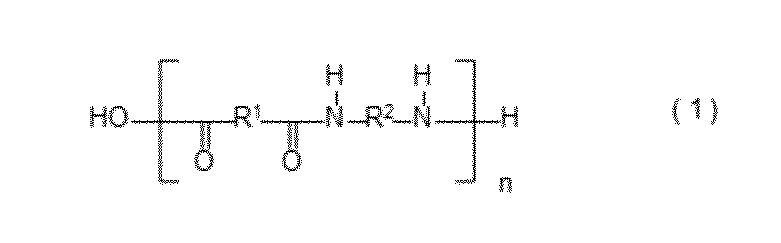
半芳香族ポリアミドは、ポリアミドを構成するモノマーとしてのジカルボン酸、ジアミンのうちの一方が芳香族性化合物であり、他方が脂肪族化合物であるポリアミドであればよく、上記式(1)で示すことができるが、以下の条件を満足するのが好ましい。
上記式(1)中のR1、R2のうちの芳香族置換基としては、下記式(2)で示されるものであるのが好ましい。

これにより、偏光膜31をより好適に保護することができるとともに、偏光性積層体3の加工性をより向上させることができる。また、延伸による第1の層32のリタデーションの制御をより容易に行うことができる。
上記式(1)中のR1、R2のうちの脂肪族置換基は、炭素数が4以上18以下の置換基であるのが好ましく、炭素数が4以上18以下の炭化水素基であるのがより好ましく、炭素数が4以上18以下の飽和炭化水素基であるのがさらに好ましい。
これにより、偏光性積層体3の加工性をより向上させることができる。
これにより、偏光性積層体3の加工性をより向上させることができる。
半芳香族ポリアミドは、芳香族ジカルボン酸と、脂肪族ジアミンとを構成モノマーとして含むのが好ましい。
これにより、偏光膜31をより好適に保護することができるとともに、偏光性積層体3の加工性をより向上させることができる。また、延伸による第1の層32のリタデーションの制御をより容易に行うことができる。
なお、半芳香族ポリアミドは、脂肪族ジカルボン酸と、芳香族ジアミンとを構成モノマーとして含んでいてもよい。
第1の層32中に含まれる半芳香族ポリアミドの具体例は、例えば、下記式(3)~下記式(6)で示される。


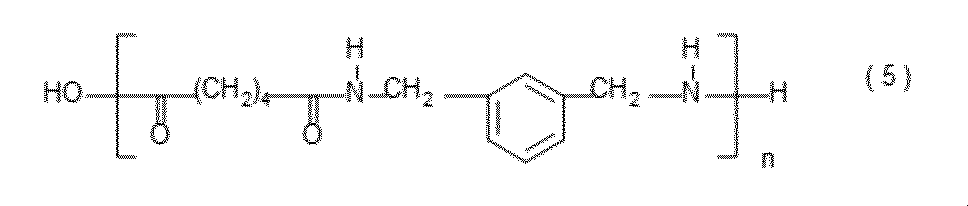

これにより、偏光膜31をより好適に保護することができるとともに、偏光性積層体3の加工性をより向上させることができる。また、延伸による第1の層32のリタデーションの制御をより容易に行うことができる。
なお、半芳香族ポリアミドとしては、例えば、下記式(7)で示されるような共重合体(ブロック共重合体)等を用いることができる。

これにより、半芳香族ポリアミドの弾性率や、第1の層32の偏光膜31に対する密着性等の制御をより好適に行うことができる。
脂環式ポリアミドは、その分子内に脂環式の化学構造を有しており、主鎖構造内に脂環式の化学構造を有していてもよいし、側鎖構造内に脂環式の化学構造を有していてもよい。
脂環式ポリアミドとしては、例えば、ポリアミドを構成するモノマーとしてのジカルボン酸、ジアミンのうちの少なくとも一方が脂環式の化学構造を有する化合物等が挙げられる。
脂環式ポリアミドは、例えば、下記式(8)で示される。
脂環式ポリアミドは、例えば、下記式(8)で示される。
第1の層32中に含まれる脂環式ポリアミドの具体例は、例えば、下記式(9)、下記式(10)で示される。

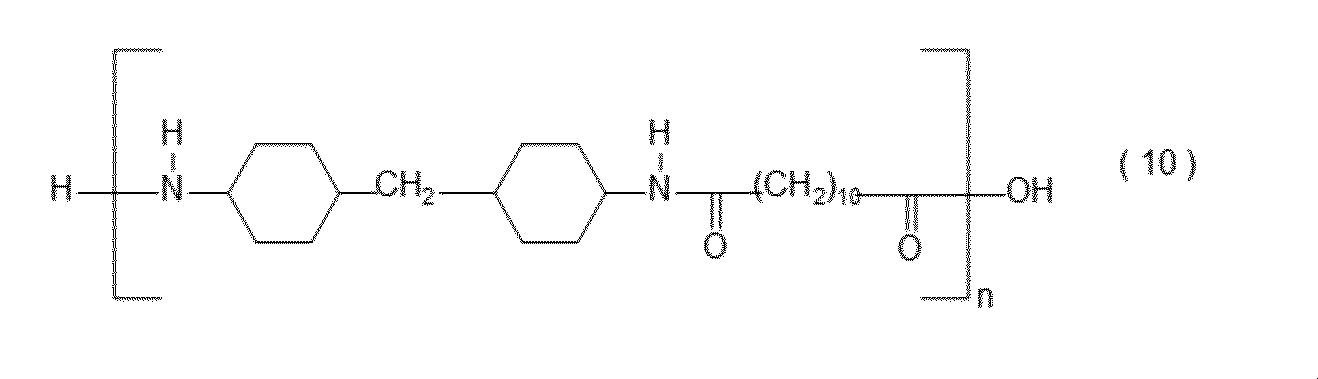
第1の層32中に含まれるポリアミドのガラス転移点(ガラス転移温度)は、140℃以上、190℃以下であるのが好ましく、140℃以上、180℃以下であるのがより好ましく、140℃以上、170℃以下であるのがさらに好ましく、150℃以上、170℃以下であるのが特に好ましい。
これにより、偏光性積層体3の加工性および耐久性をより高いレベルで両立することができる。
これにより、偏光性積層体3の加工性および耐久性をより高いレベルで両立することができる。
第1の層32は、ポリアミドを含んでいればよく、ポリアミドに加え、他の成分を含んでいてもよい。このような成分としては、例えば、染料等の着色剤、充填材、配向助剤、安定剤(熱安定剤、紫外線吸収剤、酸化防止剤等)、可塑剤、難燃剤、帯電防止剤、粘度調整剤、ポリアミド以外の樹脂材料等が挙げられる。
染料としては、例えば、酸性染料、直接染料、反応性染料、および塩基性染料等が挙げられ、これらから選択される1種または2種以上を組み合わせて用いることができる。
染料の具体例としては、例えば、C.I.アシッドイエロー 17,23,42,44,79,142、C.I.アシッドレッド 52,80,82,249,254,289、C.I.アシッドブルー 9,45,249、C.I.アシッドブラック 1,2,24,94、C.I.フードブラック 1,2、C.I.ダイレクトイエロー 1,12,24,33,50,55,58,86,132,142,144,173、C.I.ダイレクトレッド 1,4,9,80,81,225,227、C.I.ダイレクトブルー 1,2,15,71,86,87,98,165,199,202、C.I.ダイレクトブラック 19,38,51,71,154,168,171,195、C.I.リアクティブレッド 14,32,55,79,249、C.I.リアクティブブラック 3,4,35等が挙げられる。
充填材としては、例えば、ホウケイ酸カルシウム、ホウケイ酸アルミニウム等のホウケイ酸塩、TiO2、SnO2、ZnO、Fe2O3、Fe3O4、SiO2、Al2O3、ZrO2等の金属酸化物等が挙げられる。
充填材の形状は、特に限定されず、球状、鱗片状等のいかなる形状であってもよい。
また、充填材の色は、無色であっても、赤色、青色、黄色等、いかなる色であってもよい。
また、充填材の色は、無色であっても、赤色、青色、黄色等、いかなる色であってもよい。
配向助剤としては、充填材を構成する粒子の配向度を向上させる機能を有するものを用いることができる。
配向助剤の具体例としては、例えば、メタノール、エタノール、プロパノール、n-ブタノール、t-ブタノール等のアルコール類、酢酸、酪酸、安息香酸等のカルボン酸類、酢酸エチル、乳酸エチル等のエステル類、フタル酸ジメチル、フタル酸ジエチル、フタル酸ジブチル、フタル酸ジ-2-エチルヘキシル、フタル酸ジイソデシル、フタル酸ブチルベンジル、アジピン酸ジ-2-エチルヘキシル、アジピン酸ジ-n-アルキ610、アゼライン酸ジ-2-エチルヘキシル、セバシン酸ジブチル、セバシン酸ジ-2-エチルヘキシル、リン酸トリブチル、リン酸トリ-2-エチルヘキシル、リン酸トリフェニル、リン酸トリクレジル、アセチルクエン酸トリブチル等が挙げられる。
第1の層32中におけるポリアミドの含有率は、60質量%以上であるのが好ましく、70質量%以上であるのがより好ましく、80質量%以上であるのがさらに好ましい。
これにより、前述したようなポリアミドを含む第1の層32を備えることによる効果をより顕著に発揮させることができる。
第1の層32の色は、無色であっても、赤色、青色、黄色等、いかなる色であってもよい。
第1の層32のリタデーション(複屈折率(Δn)と厚み(d)との積)は、2600以上、8000以下が好ましい。
これにより、レンズ形状に曲げ加工を施しても、虹色の色ムラが生じ難く、色抜けしないという効果が得られる。
これにより、レンズ形状に曲げ加工を施しても、虹色の色ムラが生じ難く、色抜けしないという効果が得られる。
また、第1の層32の厚さは、特に限定されないが、100μm以上、800μm以下であるのが好ましく、200μm以上、600μm以下であるのがより好ましい。
第1の層32は、次の方法によって形成することができる。例えば、押出成形により、ポリアミドを含む第1の樹脂材料で構成されたシート材を得る。得られたシート材を所定の温度で加熱しながら延伸することにより、第1の層32が形成される。なお、リタデーションは、シート材を延伸する倍率(延伸倍率)によって、調整することができる。したがって、第1の層32を構成する第1の樹脂材料と、第2の層33を構成する第2の樹脂材料とが同一である場合であっても、第1の層32と第2の層33のリタデーションを互いに異なるように調整可能である。
前記シート材の延伸の際のシート温度は、特に限定されないが、140℃以上、170℃以下であるのが好ましく、145℃以上、165℃以下であるのがより好ましい。
(第2の層)
第2の層33は、ポリアミドを含む第2の樹脂材料で構成されている。
第2の層33は、ポリアミドを含む第2の樹脂材料で構成されている。
第2の層33に用いられるポリアミドとしては、第1の層32で挙げたポリアミドと同様のポリアミドが挙げられる。第2の層33中に含まれるポリアミドのガラス転移点(ガラス転移温度)は、140℃以上、190℃以下であるのが好ましく、140℃以上、180℃以下であるのがより好ましく、140℃以上、170℃以下であるのがさらに好ましく、150℃以上、170℃以下であるのが特に好ましい。これにより、偏光性積層体3の加工性および耐久性をより高いレベルで両立することができる。
第2の層33は、ポリアミドを含んでいればよく、ポリアミドに加え、他の成分を含んでいてもよい。このような成分としては、例えば、染料等の着色剤、充填材、配向助剤、安定剤(熱安定剤、紫外線吸収剤、酸化防止剤等)、可塑剤、難燃剤、帯電防止剤、粘度調整剤、ポリアミド以外の樹脂材料等が挙げられる。
第2の層33中におけるポリアミドの含有率は、60質量%以上であるのが好ましく、70質量%以上であるのがより好ましく、80質量%以上であるのがさらに好ましい。
これにより、第2の層33を備えることによっても、前述したようなポリアミドを含む第1の層32を備えることによって得られる効果と同様の効果をより顕著に発揮させることができる。
第2の層33の色は、無色であっても、赤色、青色、黄色等、いかなる色であってもよい。
第2の層33のリタデーション(複屈折率(Δn)と厚み(d)との積)は、0以上、500以下が好ましい。これにより、偏光性積層体3は、比較的高い強度と、軽量化とをより高いレベルで両立することができる。さらに、ポリアミドを含む第1の樹脂材料で構成された、リタデーションが2600以上、8000以下の第1の層32とともに、ポリアミドを含む第2の樹脂材料で構成された、リタデーションが0以上、500以下の第2の層33を備えることにより、偏光性積層体3の加工性および耐久性を特に高いレベルで両立することができる。
また、第2の層33の厚さは、特に限定されないが、50μm以上、500μm以下であるのが好ましく、100μm以上、300μm以下であるのがより好ましい。
第2の層33は、第1の層32を形成する方法と同様の方法により形成することができる。例えば、ポリアミドを含む第2の樹脂材料で構成されたシート材を偏光膜31に接合することにより、好適に形成することができる。
(第1の接着層)
偏光膜31と第1の層32との間には、これらを接合(接着)する接着層(第1の接着層)34が設けられている。
これにより、偏光性積層体3の耐久性等を特に向上させることができる。
偏光膜31と第1の層32との間には、これらを接合(接着)する接着層(第1の接着層)34が設けられている。
これにより、偏光性積層体3の耐久性等を特に向上させることができる。
接着層34を構成する接着剤(または粘着剤)としては、特に限定されず、例えば、アクリル系接着剤、ウレタン系接着剤、エポキシ系接着剤、シリコーン系接着剤等が挙げられる。
これらの中でも、ウレタン系接着剤が好ましい。これにより、接着層34の透明性、接着強度、耐久性をより向上させつつ、形状変化に対する追従性を特に向上させることができる。その結果、曲げ加工等の各種加工により好適に対応した偏光性積層体3を製造することができる。
特に、接着層34は、次に示す方法で形成されることが好ましい。まず、2液型のウレタン系接着剤を第1の層32に塗布し、塗布層を得る。次に、低湿度の環境下で硬化反応を進行させる第1の処理と、処理温度を第1の処理よりも高温とする第2の処理とを塗布層に施すことにより接着層34を形成する。
これにより、NCO基の量が、主剤の水酸基に対して過剰となることを防止することができる。すなわち、NCO基の量を、主剤の水酸基に応じた好適な量となるように、好適に調整することができる。加えて、硬化反応(重合反応)の初期段階でウレタン結合の形成を好適に進行させ、二酸化炭素の発生による気泡が偏光性積層体3の外観、機能に悪影響を与えることを効果的に防止することができる。さらに、偏光性積層体3の生産性を向上させることができる。
第1の処理を行う際の湿度は、60%RH以下であるのが好ましく、55%RH以下であるのがより好ましい。
これにより、二酸化炭素を発生する副反応をより効果的に防止、抑制することができ、上記のような効果がより顕著に発揮される。
また、第1の処理を行う際の温度は、10℃以上、30℃以下であるのが好ましい。
これにより、二酸化炭素を発生する副反応をより効果的に防止、抑制することができるとともに、偏光性積層体3の生産性をより向上させることができる。
これにより、二酸化炭素を発生する副反応をより効果的に防止、抑制することができるとともに、偏光性積層体3の生産性をより向上させることができる。
第1の処理の処理時間は、12時間以上、60時間以下であるのが好ましく、18時間以上、48時間以下であるのがより好ましい。
これにより、目的とするウレタン結合の形成反応を十分に進行させつつ、偏光性積層体3の生産性をより向上させることができる。
第2の処理を行う際の温度は、第1の処理での処理温度よりも高いことが好ましく、具体的には、30℃以上、50℃以下であるのが好ましい。
これにより、偏光性積層体3の不本意な品質低下をより確実に防止しつつ、偏光性積層体3の生産性をより向上させることができる。
第2の処理の処理時間は、12時間以上、60時間以下であるのが好ましく、18時間以上、48時間以下であるのがより好ましい。
これにより、偏光性積層体3の不本意な品質低下をより確実に防止しつつ、偏光性積層体3の生産性をより向上させることができる。
また、接着層34は、接着剤(または粘着剤)以外の成分を含んでいてもよい。
このような成分としては、例えば、安定剤(熱安定剤、紫外線吸収剤、酸化防止剤等)、可塑剤、着色剤、難燃剤、帯電防止剤、粘度調整剤等が挙げられる。
このような成分としては、例えば、安定剤(熱安定剤、紫外線吸収剤、酸化防止剤等)、可塑剤、着色剤、難燃剤、帯電防止剤、粘度調整剤等が挙げられる。
接着層34中における接着剤の含有率は、50質量%以上であるのが好ましく、60質量%以上であるのがより好ましい。
接着層34の厚さは、特に限定されないが、例えば、0.1μm以上、80μm以下であるのが好ましく、1μm以上、60μm以下であるのがより好ましく、2μm以上、50μm以下であるのがさらに好ましい。
これにより、偏光性積層体3の光学特性をより向上させつつ、偏光性積層体3の耐久性、加工性等をより向上させることができる。
(第2の接着層)
偏光膜31と第2の層33との間には、これらを接合(接着)する接着層(第2の接着層)35が設けられている。
これにより、偏光性積層体3の耐久性等を特に向上させることができる。
偏光膜31と第2の層33との間には、これらを接合(接着)する接着層(第2の接着層)35が設けられている。
これにより、偏光性積層体3の耐久性等を特に向上させることができる。
接着層(第2の接着層)35は、前述した接着層(第1の接着層)34と同様の条件を満足するのが好ましい。
これにより、第2の接着層35は、第1の接着層34によって得られる前述した効果と同様の効果を発揮することができる。
これにより、第2の接着層35は、第1の接着層34によって得られる前述した効果と同様の効果を発揮することができる。
図2では、偏光性積層体3の一部を拡大断面図として平板状に図示しているが、偏光性積層体3全体としては、平板状に限らず、いかなる形状であってもよい。例えば、偏光性積層体3は、平凸レンズ状、平凹レンズ状、両凸レンズ状、両凹レンズ状、凹凸レンズ状等であってもよい。
特に、偏光性積層体3が湾曲板状をなしている場合、第1の層32は凸面側に設けられているのが好ましい。すなわち、第1の層32が凸面を構成するように、偏光性積層体3が湾曲板状をなしていることが好ましい。
このように構成された第1の層32は、偏光性積層体の凹面側に設けられ、ポリアミドを含む材料で構成された層に比べて、高いリタデーションを維持しやすい。
また、偏光性積層体3の厚さ(偏光性積層体3の使用状態において、偏光性積層体3のうち、使用者の目に入射する光が入射する部位の厚さ)は、特に限定されないが、0.4mm以上、5.0mm以下であるのが好ましく、0.5mm以上、5.0mm以下であるのがより好ましく、0.5mm以上、3.0mm以下であるのがさらに好ましく、0.65mm以上、3.0mm以下であるのが特に好ましい。
これにより、偏光性積層体3は、比較的高い強度と、軽量化とをより高いレベルで両立することができる。
これにより、偏光性積層体3は、比較的高い強度と、軽量化とをより高いレベルで両立することができる。
また、JIS K 7209:2000に準拠して測定された、第1の層32または第2の層33の吸水率は、0.5%以上、6.0%以下であることが好ましい。さらに、第1の層32および第2の層33の両方の吸水率が、上記範囲内であることがより好ましい。
これにより、偏光性積層体3の加工性および耐久性をより高いレベルで両立することができる。
これにより、偏光性積層体3の加工性および耐久性をより高いレベルで両立することができる。
また、第1の樹脂材料と第2の樹脂材料とは、ガラス転移温度が異なっていてもよい。この場合、第1の層32および第2の層33のうちの、ガラス転移温度が小さい方の層に対して、リタデーションを発現させるための延伸を好適に行うことができる。よって、優れた加工性と全体として優れた偏光特性を有する偏光性積層体3が得られる。
例えば、第1の層32を構成する第1の樹脂材料のガラス転移温度が、第2の層33を構成する第2の樹脂材料のガラス転移温度よりも低い場合、第1の層32に対して、比較的低い温度で、リタデーションを発現させるための延伸を好適に行うことができる。このため、偏光性積層体3は、加工性に優れる。また、上記延伸方向と、偏光膜31の偏光方向を一致させることにより、第1の層32の偏光特性と、偏光膜31の偏光特性とが相まって、偏光性積層体3は、全体として偏光特性に優れる。
例えば、第1の層32を構成する第1の樹脂材料のガラス転移温度が、第2の層33を構成する第2の樹脂材料のガラス転移温度よりも低い場合、第1の層32に対して、比較的低い温度で、リタデーションを発現させるための延伸を好適に行うことができる。このため、偏光性積層体3は、加工性に優れる。また、上記延伸方向と、偏光膜31の偏光方向を一致させることにより、第1の層32の偏光特性と、偏光膜31の偏光特性とが相まって、偏光性積層体3は、全体として偏光特性に優れる。
また、第1の樹脂材料のガラス転移温度と、第2の樹脂材料のガラス転移温度とが異なっている場合、これらのガラス転移温度の差は、3℃以上、35℃以下であるのが好ましく、15℃以上、30℃以下であるのがより好ましい。これにより、上記効果をより確実に発揮することができ、優れた信頼性を有する偏光性積層体3を得ることができる。さらに、第1の樹脂材料および第2の樹脂材料の、材料の選定が比較的容易となる。なお、第1の樹脂材料と第2の樹脂材料におけるガラス転移温度の差異は、例えば、ポリアミドのモノマー成分の組成を異ならせることや、重合度を異ならせることにより発現させることができる。
以上、本発明の好適な実施形態について説明したが、本発明は、前述した実施形態に限定されず、本発明の目的を達成できる範囲での変形、改良等は本発明に含まれる。
例えば、本発明の偏光性積層体および眼鏡を構成する各部は、同様の機能を発揮し得る任意の構成の部材と置換することができる。
また、本発明の偏光性積層体および眼鏡は、前述した構成に加え、任意の構成物が付加されていてもよい。
より具体的には、例えば、本発明の偏光性積層体は、第1の層の表面を保護する保護層や、中間層、レンズとしての度数を調整する度数調整層等を備えていてもよい。
保護層、中間層、度数調整層の構成材料としては、特に限定されず、例えば、ポリエチレンテレフタレート(PET)、ポリブチレンテレフタレート(PBT)、ポリエチレンナフタレート(PEN)等のポリエステル系樹脂、ポリエチレン、ポリプロピレンのようなポリオレフィン系樹脂、ポリイミド系樹脂、ポリアミド系樹脂、ポリカーボネート系樹脂、ポリウレタン系樹脂、ポリメチルメタクリレート等のアクリル系樹脂、アセテート系樹脂、アリル系樹脂、シリコーン系樹脂等の各種樹脂材料が挙げられるが、これらの中でもポリアミド系樹脂、ポリカーボネート系樹脂、ポリウレタン系樹脂、アクリル系樹脂、アリル系樹脂、シリコーン系樹脂を主材料とするものが好ましく用いられる。
特に、度数調整層の構成材料としては、例えば、ポリエチレン、ポリプロピレン、エチレン-プロピレン共重合体等のポリオレフィン、ポリ塩化ビニル、ポリスチレン、ポリアミド、ポリイミド、ポリカーボネート、ポリ-(4-メチルペンテン-1)、アイオノマー、アクリル系樹脂、ポリメチルメタクリレート、アクリロニトリル-ブタジエン-スチレン共重合体(ABS樹脂)、アクリロニトリル-スチレン共重合体(AS樹脂)、ブタジエン-スチレン共重合体、ポリエチレンテレフタレート(PET)、ポリブチレンテレフタレート(PBT)等のポリエステル、ポリエーテル、ポリエーテルケトン(PEK)、ポリエーテルエーテルケトン(PEEK)、ポリエーテルイミド、ポリアセタール(POM)、ポリフェニレンオキシド、ポリサルフォン、ポリエーテルサルフォン、ポリフェニレンサルファイド、ポリアリレート、芳香族ポリエステル(液晶ポリマー)、ポリテトラフルオロエチレン、ポリフッ化ビニリデン、その他フッ素系樹脂、エポキシ樹脂、フェノール樹脂、ユリア樹脂、メラミン樹脂、シリコーン樹脂、ポリウレタン等、またはこれらを主とする共重合体、ブレンド体、ポリマーアロイ等の樹脂材料や、ソーダガラス、結晶性ガラス、石英ガラス、鉛ガラス、カリウムガラス、ホウケイ酸ガラス、無アルカリガラス等のガラス材料、サファイア、水晶等の各種結晶等が挙げられる。
特に、度数調整層の構成材料としては、例えば、ポリエチレン、ポリプロピレン、エチレン-プロピレン共重合体等のポリオレフィン、ポリ塩化ビニル、ポリスチレン、ポリアミド、ポリイミド、ポリカーボネート、ポリ-(4-メチルペンテン-1)、アイオノマー、アクリル系樹脂、ポリメチルメタクリレート、アクリロニトリル-ブタジエン-スチレン共重合体(ABS樹脂)、アクリロニトリル-スチレン共重合体(AS樹脂)、ブタジエン-スチレン共重合体、ポリエチレンテレフタレート(PET)、ポリブチレンテレフタレート(PBT)等のポリエステル、ポリエーテル、ポリエーテルケトン(PEK)、ポリエーテルエーテルケトン(PEEK)、ポリエーテルイミド、ポリアセタール(POM)、ポリフェニレンオキシド、ポリサルフォン、ポリエーテルサルフォン、ポリフェニレンサルファイド、ポリアリレート、芳香族ポリエステル(液晶ポリマー)、ポリテトラフルオロエチレン、ポリフッ化ビニリデン、その他フッ素系樹脂、エポキシ樹脂、フェノール樹脂、ユリア樹脂、メラミン樹脂、シリコーン樹脂、ポリウレタン等、またはこれらを主とする共重合体、ブレンド体、ポリマーアロイ等の樹脂材料や、ソーダガラス、結晶性ガラス、石英ガラス、鉛ガラス、カリウムガラス、ホウケイ酸ガラス、無アルカリガラス等のガラス材料、サファイア、水晶等の各種結晶等が挙げられる。
以下、本発明を実施例に基づいて詳細に説明するが、本発明はこれに限定されない。
(実施例1)
<偏光性積層体の製造>
まず、ポリビニルアルコール系フィルムを、水槽中で延伸しながら、染料を溶解した水溶液にて染色し、ホウ酸で処理した。その後、処理されたポリビニルアルコール系フィルムを水洗いし、乾燥した。これにより、厚さが35μmの偏光膜を得た。
<偏光性積層体の製造>
まず、ポリビニルアルコール系フィルムを、水槽中で延伸しながら、染料を溶解した水溶液にて染色し、ホウ酸で処理した。その後、処理されたポリビニルアルコール系フィルムを水洗いし、乾燥した。これにより、厚さが35μmの偏光膜を得た。
一方で、第1の樹脂材料としてポリアミド樹脂(Grilamid TR90 EMS社製)を用い、ベント式単軸押出機による押出成形により厚さ0.5mmの第1のシートを得た。該第1のシートが140℃となるように加熱しながら1.5倍に一軸延伸することにより、厚さ0.4mmのシート状の第1の層を得た。
また、第2の樹脂材料としてポリアミド樹脂(Grilamid TR90 EMS社製)を用い、ベント式単軸押出機による押出成形により、厚さ0.2mmのシート状の第2の層を得た。
次いで、第1の層の一方の面上に、第1の接着剤として二液型湿気硬化型ポリウレタン接着剤(主剤:三井化学(株)製 タケラック A-520、硬化剤:三井化学(株)製 タケネート A-50)をバーコーターにて乾燥後の厚さが20μmになるように塗布した。また、第2の層の一方の面上に、第2の接着剤として二液型湿気硬化型ポリウレタン接着剤(主剤:三井化学(株)製 タケラック A-520、硬化剤:三井化学(株)製 タケネート A-50)をバーコーターにて乾燥後の厚さが20μmになるように塗布した。
次いで、第1の接着剤および第2の接着剤がそれぞれ塗布された第1の層および第2の層を、オーブンに入れ、第1の接着剤および第2の接着剤中の溶剤分が乾燥するまで加熱した。これにより、第1の層の一方の面上に接着剤層(第1の接着剤層)が積層された第1の積層体を得るとともに、第2の層の一方の面上に接着剤層(第2の接着剤層)が積層された第2の積層体を得た。
その後、偏光膜の一方の面上に、第1の接着剤層が接触するように、第1の積層体を偏光膜に積層し、偏光膜の他方の面上に、第2の接着剤層が接触するように、第2の積層体を偏光膜に積層して偏光性積層体を得た。この際、ラミネーター機のゴムロールを用いて、第1の積層体、偏光膜および第2の積層体をそれぞれ圧着させて、偏光性積層体の総厚を0.75mmとした。
なお、第1の層および第2の層をそれぞれ構成する第1の樹脂材料および第2の樹脂材料であるポリアミド樹脂は、主として脂環式ポリアミドを含んでいた。また、得られた偏光性積層体のバーコル硬さ比率および吸水率を、以下の方法で測定した。
得られた偏光性積層体(第1の層および第2の層のそれぞれ)について、JIS K 7060:1995に準拠してバーコル硬さを測定し、浸漬前のバーコル硬さの値(浸漬前の第1の層のバーコル硬さの値x1および第2の層のバーコル硬さの値x2)を得た。次に、80℃の蒸留水に偏光性積層体を15分浸漬した後、偏光性積層体のバ-コル硬さを測定し、浸漬後のバ-コル硬さの値(浸漬後の第1の層のバーコル硬さの値y1および第2の層のバーコル硬さの値y2)を得た。浸漬前のバ-コル硬さの値x1、x2に対する浸漬後のバーコル硬さの値y1、y2の比率をそれぞれ計算し、第1の層のバーコル硬さ比率(100×y1/x1)および第2の層のバーコル硬さ比率(100×y2/x2)を得た。
また、JIS K 7209:2000に準拠して、第1の層および第2の層の吸水率をそれぞれ測定した。これらの結果を、表1にまとめて示す。
得られた偏光性積層体(第1の層および第2の層のそれぞれ)について、JIS K 7060:1995に準拠してバーコル硬さを測定し、浸漬前のバーコル硬さの値(浸漬前の第1の層のバーコル硬さの値x1および第2の層のバーコル硬さの値x2)を得た。次に、80℃の蒸留水に偏光性積層体を15分浸漬した後、偏光性積層体のバ-コル硬さを測定し、浸漬後のバ-コル硬さの値(浸漬後の第1の層のバーコル硬さの値y1および第2の層のバーコル硬さの値y2)を得た。浸漬前のバ-コル硬さの値x1、x2に対する浸漬後のバーコル硬さの値y1、y2の比率をそれぞれ計算し、第1の層のバーコル硬さ比率(100×y1/x1)および第2の層のバーコル硬さ比率(100×y2/x2)を得た。
また、JIS K 7209:2000に準拠して、第1の層および第2の層の吸水率をそれぞれ測定した。これらの結果を、表1にまとめて示す。
(実施例2~実施例4および比較例1)
偏光性積層体の構成を表1に示すように変更したこと以外は、実施例1と同様にして実施例2~実施例9および比較例1~比較例2の偏光性積層体を得た。なお、偏光性積層体の構成の変更に際し、第1のシートおよび第2のシートの厚さを調整した。
偏光性積層体の構成を表1に示すように変更したこと以外は、実施例1と同様にして実施例2~実施例9および比較例1~比較例2の偏光性積層体を得た。なお、偏光性積層体の構成の変更に際し、第1のシートおよび第2のシートの厚さを調整した。
なお、表1中のA-1は、ガラス転移温度が155℃の脂環式ポリアミド(Grilamid TR90 EMS社製)であり、A-2は、ガラス転移温度が125℃の脂環式ポリアミド(TR90LX EMS社製)であり、A-3は、ガラス転移温度が140℃の脂環式ポリアミド(Trogamid cx ダイセルエボニック社製)であり、B-1は、ガラス転移温度が125℃の半芳香族ポリアミド(Grivory G21 EMS社製)であり、C-1は、ガラス転移温度が160℃の脂肪族ポリアミドTR55(EMS社製)であり、D-1は、ガラス転移温度が110℃の脂肪族ポリアミドTR55LX(EMS社製)である。
1.外観評価
各実施例および比較例で作製した偏光性積層体について、外観評価を行った。以下に、これらの評価方法について説明する。
各実施例および比較例で作製した偏光性積層体について、外観評価を行った。以下に、これらの評価方法について説明する。
(1)虹模様の発生状況
各実施例および比較例の偏光性積層体を、一辺6cmに打ち抜き、試験片を得た。この試験片を、60℃にて1日間予備乾燥した。乾燥した試験片を、レマ成形機(真空成形機)CR-32型にて曲率半径87mm(6カーブ)の凹金型に挿入し、143℃、4分間、吸引しつつ熱曲げ加工を行った。これにより、偏光レンズを作製した。
各実施例および比較例の偏光性積層体を、一辺6cmに打ち抜き、試験片を得た。この試験片を、60℃にて1日間予備乾燥した。乾燥した試験片を、レマ成形機(真空成形機)CR-32型にて曲率半径87mm(6カーブ)の凹金型に挿入し、143℃、4分間、吸引しつつ熱曲げ加工を行った。これにより、偏光レンズを作製した。
そして、作製した偏光レンズを、第1の層が下方を向くように、偏光子付きのバックライト上に載せて、直交ニコル、平行ニコルの両方の状態にて、透過光による外観観察を行った。この際、下記評価基準に基づいて、着色干渉縞による虹模様が発生しているか否かを確認した。
なお、AおよびBは合格を意味し、Cは不合格を意味する。
A:虹模様の発生なし
B:部分的に虹模様が発生していたが、実用上問題なし
C:全体的に虹模様が発生しており、実用上問題あり
A:虹模様の発生なし
B:部分的に虹模様が発生していたが、実用上問題なし
C:全体的に虹模様が発生しており、実用上問題あり
(2)色抜けの発生状況
各実施例および比較例の偏光性積層体を、一辺6cmに打ち抜き、試験片を得た。この試験片を、60℃にて1日間予備乾燥した。乾燥した試験片を、レマ成形機(真空成形機)CR-32型にて曲率半径87mm(6カーブ)の凹金型に挿入し、143℃、4分間吸引しつつ熱曲げ加工を行った。これにより、偏光レンズを作製した。
各実施例および比較例の偏光性積層体を、一辺6cmに打ち抜き、試験片を得た。この試験片を、60℃にて1日間予備乾燥した。乾燥した試験片を、レマ成形機(真空成形機)CR-32型にて曲率半径87mm(6カーブ)の凹金型に挿入し、143℃、4分間吸引しつつ熱曲げ加工を行った。これにより、偏光レンズを作製した。
そして、作製した偏光レンズを、第1の層が下方を向くように、偏光子付きのバックライト上に載せて、直交ニコル、平行ニコルの両方の状態にて、透過光による外観観察を行った。この際、下記評価基準に基づいて、色抜けが発生しているか否か、すなわち、透過光が生じているかを確認した。
なお、Aは合格を意味し、Bは不合格を意味する。
A:色抜けの発生なし
B:部分的に色抜けが発生していた
A:色抜けの発生なし
B:部分的に色抜けが発生していた
2.加工性評価
各実施例および比較例で作製した偏光性積層体に対して、レンズ加工機(株式会社タクボ精機製作所製、DM-3)を用いて孔開け加工を施した。孔の直径は2mmだった。この際、下記評価基準に基づいて、偏光性積層体の加工性を評価した。
各実施例および比較例で作製した偏光性積層体に対して、レンズ加工機(株式会社タクボ精機製作所製、DM-3)を用いて孔開け加工を施した。孔の直径は2mmだった。この際、下記評価基準に基づいて、偏光性積層体の加工性を評価した。
なお、AおよびBは合格を意味し、Cは不合格を意味する。
A:クラックの発生なし
B:クラックが僅かに発生したが、実用上問題なし
C:クラックが発生し、実用上問題あり
A:クラックの発生なし
B:クラックが僅かに発生したが、実用上問題なし
C:クラックが発生し、実用上問題あり
3.耐水性評価
各実施例および比較例の偏光性積層体を、一辺6cmに打ち抜き、試験片を得た。この試験片を、60℃にて1日間予備乾燥した。乾燥した試験片を、レマ成形機(真空成形機)CR-32型にて曲率半径87mm(6カーブ)の凹金型に挿入し、143℃、4分間吸引しつつ熱曲げ加工を行った。これにより、偏光レンズを作製した。
各実施例および比較例の偏光性積層体を、一辺6cmに打ち抜き、試験片を得た。この試験片を、60℃にて1日間予備乾燥した。乾燥した試験片を、レマ成形機(真空成形機)CR-32型にて曲率半径87mm(6カーブ)の凹金型に挿入し、143℃、4分間吸引しつつ熱曲げ加工を行った。これにより、偏光レンズを作製した。
そして、作製した偏光レンズを、60℃純水中に30分浸漬した後、偏光レンズを取り出し、室温で冷却、乾燥させた。その後、下記評価基準に基づいて、偏光レンズ(偏光性積層体)の耐水性を評価した。
なお、AおよびBは合格を意味し、Cは不合格を意味する。
A:偏光レンズの質量の減少率は、浸漬前と比べて、0.2%以内だった
B:偏光レンズの質量の減少率は、浸漬前と比べて、0.2%より大きく、1.0%未満だった
C:偏光レンズの質量の減少率は、浸漬前と比べて、1.0%以上だった
A:偏光レンズの質量の減少率は、浸漬前と比べて、0.2%以内だった
B:偏光レンズの質量の減少率は、浸漬前と比べて、0.2%より大きく、1.0%未満だった
C:偏光レンズの質量の減少率は、浸漬前と比べて、1.0%以上だった
4.耐候性評価
各実施例および比較例の偏光性積層体を、一辺6cmに打ち抜き、試験片を得た。この試験片を、60℃にて1日間予備乾燥した。乾燥した試験片を、レマ成形機(真空成形機)CR-32型にて曲率半径87mm(6カーブ)の凹金型に挿入し、143℃、4分間吸引しつつ熱曲げ加工を行った。これにより、偏光レンズを作製した。
各実施例および比較例の偏光性積層体を、一辺6cmに打ち抜き、試験片を得た。この試験片を、60℃にて1日間予備乾燥した。乾燥した試験片を、レマ成形機(真空成形機)CR-32型にて曲率半径87mm(6カーブ)の凹金型に挿入し、143℃、4分間吸引しつつ熱曲げ加工を行った。これにより、偏光レンズを作製した。
そして、作製した偏光レンズを、60℃純水中に30分浸漬した後、偏光レンズを取り出し、室温で冷却、乾燥させた。その後、下記評価基準に基づいて、偏光レンズ(偏光性積層体)の耐候性を評価した。
なお、AおよびBは合格を意味し、Cは不合格を意味する。
A:浸漬後の偏光レンズのヘーズは、0.2%以内だった
B:浸漬後の偏光レンズのヘーズは、0.2%より大きく、1.0%未満だった
C:浸漬後の偏光レンズのヘーズは、1.0%以上だった
これらの結果を、表1にまとめて示す。
A:浸漬後の偏光レンズのヘーズは、0.2%以内だった
B:浸漬後の偏光レンズのヘーズは、0.2%より大きく、1.0%未満だった
C:浸漬後の偏光レンズのヘーズは、1.0%以上だった
これらの結果を、表1にまとめて示す。

各実施例の偏光性積層体は、各比較例の偏光性積層体に比べ、虹模様の発生および色抜けの発生が抑制され、加工性および耐久性(耐水性および耐候性)に優れている結果となった。従って、各実施例の偏光性積層体は、従来品と同等またはそれ以上に長期間安定した品質を保持することができ、加工性および耐久性に優れる。
本発明の偏光性積層体は、第1の面と、第1の面とは反対の面である第2の面とを有する偏光膜と、第1の面の側に設けられ、ポリアミドを含む第1の樹脂材料で構成された第1の層と、第2の面の側に設けられ、ポリアミドを含む第2の樹脂材料で構成された第2の層とを備える。また、JIS K 7060:1995に準拠して、80℃の蒸留水に偏光性積層体を15分浸漬する前後の偏光性積層体のバ-コル硬さを測定したとき、浸漬後のバ-コル硬さが、浸漬前のバ-コル硬さに対して70%以上、100%以下である。これにより、長期間安定した品質を保持することができ、加工性および耐久性に優れる偏光性積層体を提供すること、また、前記偏光性積層体を備えた眼鏡を提供することができる。したがって、本発明は、産業上の利用可能性を有する。
1 サングラス(眼鏡)
2 フレーム
21 リム部
22 ブリッジ部
23 テンプル部
24 ノーズパッド部
3 偏光性積層体(レンズ)
31 偏光膜
311 第1の面
312 第2の面
32 第1の層(第1のポリアミド層)
33 第2の層(第2のポリアミド層)
34 接着層(第1の接着層)
35 接着層(第2の接着層)
2 フレーム
21 リム部
22 ブリッジ部
23 テンプル部
24 ノーズパッド部
3 偏光性積層体(レンズ)
31 偏光膜
311 第1の面
312 第2の面
32 第1の層(第1のポリアミド層)
33 第2の層(第2のポリアミド層)
34 接着層(第1の接着層)
35 接着層(第2の接着層)
Claims (11)
- 第1の面と、前記第1の面とは反対の面である第2の面とを有する偏光膜と、
前記第1の面の側に設けられ、ポリアミドを含む第1の樹脂材料で構成された第1の層と、
前記第2の面の側に設けられ、ポリアミドを含む第2の樹脂材料で構成された第2の層とを備える偏光性積層体であって、
JIS K 7060:1995に準拠して、80℃の蒸留水に前記偏光性積層体を15分浸漬する前後の前記偏光性積層体のバ-コル硬さを測定したとき、前記浸漬後の前記バ-コル硬さが、前記浸漬前の前記バ-コル硬さに対して70%以上、100%以下であることを特徴とする偏光性積層体。 - 前記第1の樹脂材料および前記第2の樹脂材料のうちの少なくとも一方に含まれる前記ポリアミドのガラス転移温度が140℃以上、190℃以下である請求項1に記載の偏光性積層体。
- 前記第1の樹脂材料および前記第2の樹脂材料のうちの少なくとも一方に含まれる前記ポリアミドは、脂環式ポリアミドである請求項1または2に記載の偏光性積層体。
- 前記偏光性積層体は、眼鏡用レンズである請求項1ないし3のいずれか1項に記載の偏光性積層体。
- 前記偏光性積層体を使用するとき、前記第2の層が設けられた前記第2の面が、使用者の目側に向いている請求項1ないし4のいずれか1項に記載の偏光性積層体。
- 前記第1の層が凸面を構成するように、前記偏光性積層体が湾曲板状をなしている請求項1ないし5のいずれか1項に記載の偏光性積層体。
- 前記第1の層のリタデーションが2600以上、8000以下であり、
前記第2の層のリタデーションが0以上、500以下である請求項1ないし6のいずれか1項に記載の偏光性積層体。 - JIS K 7209:2000に準拠して測定された、前記第1の層および前記第2の層の吸水率は、0.5%以上、6.0%以下である請求項1ないし7のいずれか1項に記載の偏光性積層体。
- 前記第1の樹脂材料と前記第2の樹脂材料とは、ガラス転移温度が異なる請求項1ないし8のいずれか1項に記載の偏光性積層体。
- 前記第1の樹脂材料の前記ガラス転移温度と、前記第2の樹脂材料の前記ガラス転移温度の差は、3℃以上、35℃以下である請求項9に記載の偏光性積層体。
- 請求項1ないし10のいずれか1項に記載の前記偏光性積層体を備えたことを特徴とする眼鏡。
Priority Applications (3)
| Application Number | Priority Date | Filing Date | Title |
|---|---|---|---|
| EP17856137.9A EP3521875B1 (en) | 2016-09-29 | 2017-09-26 | Polarizing laminate and eye glasses |
| US16/337,518 US10836127B2 (en) | 2016-09-29 | 2017-09-26 | Polarized laminate and eye glasses |
| JP2018503619A JP6414362B2 (ja) | 2016-09-29 | 2017-09-26 | 偏光性積層体および眼鏡 |
Applications Claiming Priority (8)
| Application Number | Priority Date | Filing Date | Title |
|---|---|---|---|
| JP2016191222 | 2016-09-29 | ||
| JP2016-191223 | 2016-09-29 | ||
| JP2016-191224 | 2016-09-29 | ||
| JP2016-191222 | 2016-09-29 | ||
| JP2016191223 | 2016-09-29 | ||
| JP2016191224 | 2016-09-29 | ||
| JP2017-119783 | 2017-06-19 | ||
| JP2017119783 | 2017-06-19 |
Publications (1)
| Publication Number | Publication Date |
|---|---|
| WO2018062187A1 true WO2018062187A1 (ja) | 2018-04-05 |
Family
ID=61760469
Family Applications (1)
| Application Number | Title | Priority Date | Filing Date |
|---|---|---|---|
| PCT/JP2017/034759 Ceased WO2018062187A1 (ja) | 2016-09-29 | 2017-09-26 | 偏光性積層体および眼鏡 |
Country Status (4)
| Country | Link |
|---|---|
| US (1) | US10836127B2 (ja) |
| EP (1) | EP3521875B1 (ja) |
| JP (1) | JP6414362B2 (ja) |
| WO (1) | WO2018062187A1 (ja) |
Cited By (7)
| Publication number | Priority date | Publication date | Assignee | Title |
|---|---|---|---|---|
| JP2019111808A (ja) * | 2017-12-25 | 2019-07-11 | 株式会社トクヤマ | 積層体、該積層体からなる光学基材、および該光学基材を備えた光学物品 |
| US20220043282A1 (en) * | 2018-12-12 | 2022-02-10 | Daicel Aboshi Sangyo Co., Ltd. | Thin polarizing lens |
| WO2022211048A1 (ja) * | 2021-03-31 | 2022-10-06 | 住友ベークライト株式会社 | 偏光シート、偏光レンズおよび光学部品 |
| JP2022158919A (ja) * | 2021-03-31 | 2022-10-17 | 住友ベークライト株式会社 | 偏光シート、偏光レンズおよび光学部品 |
| JP2023149257A (ja) * | 2022-03-30 | 2023-10-13 | 住友ベークライト株式会社 | 偏光性積層体、偏光性湾曲積層体、眼鏡用レンズおよび眼鏡 |
| JP2023151668A (ja) * | 2022-03-31 | 2023-10-16 | 住友ベークライト株式会社 | 偏光性湾曲積層体、偏光性積層体、眼鏡用レンズおよび眼鏡 |
| JP2023151667A (ja) * | 2022-03-31 | 2023-10-16 | 住友ベークライト株式会社 | 偏光性湾曲積層体、偏光性積層体、眼鏡用レンズおよび眼鏡 |
Families Citing this family (4)
| Publication number | Priority date | Publication date | Assignee | Title |
|---|---|---|---|---|
| JP7350464B2 (ja) * | 2017-09-07 | 2023-09-26 | ポリプラ・エボニック株式会社 | 偏光性シート、及びこれを備えた偏光レンズ |
| IT202000014581A1 (it) * | 2020-06-18 | 2021-12-18 | Luxottica Srl | Lente polarizzata e metodo per realizzare una lente polarizzata |
| CN117295986A (zh) * | 2021-03-31 | 2023-12-26 | 住友电木株式会社 | 偏振片、偏振透镜和光学部件 |
| US11086146B1 (en) | 2021-04-07 | 2021-08-10 | Jessica Renee Alfonso | Anti-fog and anti-impact rim clip for eye glasses |
Citations (3)
| Publication number | Priority date | Publication date | Assignee | Title |
|---|---|---|---|---|
| JP2006227591A (ja) * | 2005-01-21 | 2006-08-31 | Daicel Chem Ind Ltd | 偏光性積層体及びその製造方法 |
| JP2011128331A (ja) | 2009-12-17 | 2011-06-30 | Inui Lens:Kk | 眼鏡用レンズ |
| JP2012215866A (ja) * | 2011-03-29 | 2012-11-08 | Sumitomo Bakelite Co Ltd | 偏光レンズの製造方法、偏光レンズ、防眩製品および防護製品 |
Family Cites Families (4)
| Publication number | Priority date | Publication date | Assignee | Title |
|---|---|---|---|---|
| JP3801165B2 (ja) | 2003-11-05 | 2006-07-26 | 株式会社麗光 | 透明ガスバリアフイルム |
| EP1804094B1 (en) | 2004-10-08 | 2014-09-03 | Daicel Corporation | Protective film for polarizing film and polarizing multilayer body |
| JP2007093649A (ja) | 2005-09-27 | 2007-04-12 | Tsutsunaka Plast Ind Co Ltd | 偏光レンズ |
| JP4987297B2 (ja) * | 2005-12-28 | 2012-07-25 | ダイセル・エボニック株式会社 | 機能性光学レンズ及びその製造方法 |
-
2017
- 2017-09-26 JP JP2018503619A patent/JP6414362B2/ja active Active
- 2017-09-26 EP EP17856137.9A patent/EP3521875B1/en active Active
- 2017-09-26 US US16/337,518 patent/US10836127B2/en active Active
- 2017-09-26 WO PCT/JP2017/034759 patent/WO2018062187A1/ja not_active Ceased
Patent Citations (3)
| Publication number | Priority date | Publication date | Assignee | Title |
|---|---|---|---|---|
| JP2006227591A (ja) * | 2005-01-21 | 2006-08-31 | Daicel Chem Ind Ltd | 偏光性積層体及びその製造方法 |
| JP2011128331A (ja) | 2009-12-17 | 2011-06-30 | Inui Lens:Kk | 眼鏡用レンズ |
| JP2012215866A (ja) * | 2011-03-29 | 2012-11-08 | Sumitomo Bakelite Co Ltd | 偏光レンズの製造方法、偏光レンズ、防眩製品および防護製品 |
Non-Patent Citations (1)
| Title |
|---|
| See also references of EP3521875A4 |
Cited By (9)
| Publication number | Priority date | Publication date | Assignee | Title |
|---|---|---|---|---|
| JP2019111808A (ja) * | 2017-12-25 | 2019-07-11 | 株式会社トクヤマ | 積層体、該積層体からなる光学基材、および該光学基材を備えた光学物品 |
| JP7118876B2 (ja) | 2017-12-25 | 2022-08-16 | 株式会社トクヤマ | 積層体、該積層体からなる光学基材、および該光学基材を備えた光学物品 |
| US20220043282A1 (en) * | 2018-12-12 | 2022-02-10 | Daicel Aboshi Sangyo Co., Ltd. | Thin polarizing lens |
| US11803068B2 (en) * | 2018-12-12 | 2023-10-31 | Daicel Aboshi Sangyo Co., Ltd. | Thin polarizing lens |
| WO2022211048A1 (ja) * | 2021-03-31 | 2022-10-06 | 住友ベークライト株式会社 | 偏光シート、偏光レンズおよび光学部品 |
| JP2022158919A (ja) * | 2021-03-31 | 2022-10-17 | 住友ベークライト株式会社 | 偏光シート、偏光レンズおよび光学部品 |
| JP2023149257A (ja) * | 2022-03-30 | 2023-10-13 | 住友ベークライト株式会社 | 偏光性積層体、偏光性湾曲積層体、眼鏡用レンズおよび眼鏡 |
| JP2023151668A (ja) * | 2022-03-31 | 2023-10-16 | 住友ベークライト株式会社 | 偏光性湾曲積層体、偏光性積層体、眼鏡用レンズおよび眼鏡 |
| JP2023151667A (ja) * | 2022-03-31 | 2023-10-16 | 住友ベークライト株式会社 | 偏光性湾曲積層体、偏光性積層体、眼鏡用レンズおよび眼鏡 |
Also Published As
| Publication number | Publication date |
|---|---|
| US10836127B2 (en) | 2020-11-17 |
| JPWO2018062187A1 (ja) | 2018-10-04 |
| EP3521875B1 (en) | 2023-04-19 |
| US20190283349A1 (en) | 2019-09-19 |
| EP3521875A4 (en) | 2019-09-25 |
| EP3521875A1 (en) | 2019-08-07 |
| JP6414362B2 (ja) | 2018-10-31 |
Similar Documents
| Publication | Publication Date | Title |
|---|---|---|
| JP6414362B2 (ja) | 偏光性積層体および眼鏡 | |
| JP5550944B2 (ja) | 1眼タイプ偏光眼鏡 | |
| CN103827734B (zh) | 偏振光眼镜镜片 | |
| JP5881966B2 (ja) | レンズおよび眼鏡 | |
| CN104880834B (zh) | 复合型偏光镜片及其制作方法 | |
| JPH0339903A (ja) | 防眩用ポリカーボネート偏光板 | |
| JP5633228B2 (ja) | 偏光板、偏光レンズおよび防眩製品 | |
| CN104114351A (zh) | 制造偏振光学制品的方法和偏振光学制品 | |
| JP2007093649A (ja) | 偏光レンズ | |
| JP2018077471A (ja) | 偏光性積層体および眼鏡 | |
| JP2018005228A (ja) | 偏光性積層体および眼鏡 | |
| JP2014139664A (ja) | 内面反射防止機能付きワイヤーグリッド偏光レンズ | |
| JP2023151668A (ja) | 偏光性湾曲積層体、偏光性積層体、眼鏡用レンズおよび眼鏡 | |
| JP2022158919A (ja) | 偏光シート、偏光レンズおよび光学部品 | |
| JP7647790B2 (ja) | レンズの製造方法 | |
| CN117518527A (zh) | 临时偏光贴片 | |
| JP2011053244A (ja) | 偏光板、偏光レンズおよび防眩製品 | |
| TW201622999A (zh) | 具防霧膜層之基材的製作方法及其組成結構 | |
| JP2024146499A (ja) | 偏光シート、偏光レンズおよび光学部品 | |
| JP2023149257A (ja) | 偏光性積層体、偏光性湾曲積層体、眼鏡用レンズおよび眼鏡 | |
| JP2025097863A (ja) | 偏光性積層体、偏光性湾曲積層体、眼鏡用レンズおよび眼鏡 | |
| JP2023151667A (ja) | 偏光性湾曲積層体、偏光性積層体、眼鏡用レンズおよび眼鏡 | |
| WO2022211048A1 (ja) | 偏光シート、偏光レンズおよび光学部品 | |
| CN117295986A (zh) | 偏振片、偏振透镜和光学部件 | |
| JP2025154896A (ja) | 偏光性湾曲積層体およびレンズの製造方法 |
Legal Events
| Date | Code | Title | Description |
|---|---|---|---|
| WWE | Wipo information: entry into national phase |
Ref document number: 2018503619 Country of ref document: JP |
|
| 121 | Ep: the epo has been informed by wipo that ep was designated in this application |
Ref document number: 17856137 Country of ref document: EP Kind code of ref document: A1 |
|
| NENP | Non-entry into the national phase |
Ref country code: DE |
|
| ENP | Entry into the national phase |
Ref document number: 2017856137 Country of ref document: EP Effective date: 20190429 |