WO2018062385A1 - フォトクロミックレンズおよび重合性組成物 - Google Patents
フォトクロミックレンズおよび重合性組成物 Download PDFInfo
- Publication number
- WO2018062385A1 WO2018062385A1 PCT/JP2017/035210 JP2017035210W WO2018062385A1 WO 2018062385 A1 WO2018062385 A1 WO 2018062385A1 JP 2017035210 W JP2017035210 W JP 2017035210W WO 2018062385 A1 WO2018062385 A1 WO 2018062385A1
- Authority
- WO
- WIPO (PCT)
- Prior art keywords
- group
- carbon atoms
- compound
- substituted
- linear
- Prior art date
- Legal status (The legal status is an assumption and is not a legal conclusion. Google has not performed a legal analysis and makes no representation as to the accuracy of the status listed.)
- Ceased
Links
Images


Classifications
-
- G—PHYSICS
- G02—OPTICS
- G02B—OPTICAL ELEMENTS, SYSTEMS OR APPARATUS
- G02B1/00—Optical elements characterised by the material of which they are made; Optical coatings for optical elements
- G02B1/04—Optical elements characterised by the material of which they are made; Optical coatings for optical elements made of organic materials, e.g. plastics
-
- B—PERFORMING OPERATIONS; TRANSPORTING
- B29—WORKING OF PLASTICS; WORKING OF SUBSTANCES IN A PLASTIC STATE IN GENERAL
- B29D—PRODUCING PARTICULAR ARTICLES FROM PLASTICS OR FROM SUBSTANCES IN A PLASTIC STATE
- B29D11/00—Producing optical elements, e.g. lenses or prisms
- B29D11/00634—Production of filters
- B29D11/00653—Production of filters photochromic
-
- B—PERFORMING OPERATIONS; TRANSPORTING
- B32—LAYERED PRODUCTS
- B32B—LAYERED PRODUCTS, i.e. PRODUCTS BUILT-UP OF STRATA OF FLAT OR NON-FLAT, e.g. CELLULAR OR HONEYCOMB, FORM
- B32B27/00—Layered products comprising a layer of synthetic resin
- B32B27/18—Layered products comprising a layer of synthetic resin characterised by the use of special additives
- B32B27/20—Layered products comprising a layer of synthetic resin characterised by the use of special additives using fillers, pigments, thixotroping agents
-
- B—PERFORMING OPERATIONS; TRANSPORTING
- B32—LAYERED PRODUCTS
- B32B—LAYERED PRODUCTS, i.e. PRODUCTS BUILT-UP OF STRATA OF FLAT OR NON-FLAT, e.g. CELLULAR OR HONEYCOMB, FORM
- B32B27/00—Layered products comprising a layer of synthetic resin
- B32B27/30—Layered products comprising a layer of synthetic resin comprising vinyl (co)polymers; comprising acrylic (co)polymers
- B32B27/308—Layered products comprising a layer of synthetic resin comprising vinyl (co)polymers; comprising acrylic (co)polymers comprising acrylic (co)polymers
-
- C—CHEMISTRY; METALLURGY
- C08—ORGANIC MACROMOLECULAR COMPOUNDS; THEIR PREPARATION OR CHEMICAL WORKING-UP; COMPOSITIONS BASED THEREON
- C08K—Use of inorganic or non-macromolecular organic substances as compounding ingredients
- C08K5/00—Use of organic ingredients
- C08K5/04—Oxygen-containing compounds
- C08K5/15—Heterocyclic compounds having oxygen in the ring
- C08K5/151—Heterocyclic compounds having oxygen in the ring having one oxygen atom in the ring
- C08K5/1545—Six-membered rings
-
- C—CHEMISTRY; METALLURGY
- C08—ORGANIC MACROMOLECULAR COMPOUNDS; THEIR PREPARATION OR CHEMICAL WORKING-UP; COMPOSITIONS BASED THEREON
- C08K—Use of inorganic or non-macromolecular organic substances as compounding ingredients
- C08K5/00—Use of organic ingredients
- C08K5/56—Organo-metallic compounds, i.e. organic compounds containing a metal-to-carbon bond
-
- C—CHEMISTRY; METALLURGY
- C09—DYES; PAINTS; POLISHES; NATURAL RESINS; ADHESIVES; COMPOSITIONS NOT OTHERWISE PROVIDED FOR; APPLICATIONS OF MATERIALS NOT OTHERWISE PROVIDED FOR
- C09B—ORGANIC DYES OR CLOSELY-RELATED COMPOUNDS FOR PRODUCING DYES, e.g. PIGMENTS; MORDANTS; LAKES
- C09B47/00—Porphines; Azaporphines
-
- C—CHEMISTRY; METALLURGY
- C09—DYES; PAINTS; POLISHES; NATURAL RESINS; ADHESIVES; COMPOSITIONS NOT OTHERWISE PROVIDED FOR; APPLICATIONS OF MATERIALS NOT OTHERWISE PROVIDED FOR
- C09B—ORGANIC DYES OR CLOSELY-RELATED COMPOUNDS FOR PRODUCING DYES, e.g. PIGMENTS; MORDANTS; LAKES
- C09B57/00—Other synthetic dyes of known constitution
-
- C—CHEMISTRY; METALLURGY
- C09—DYES; PAINTS; POLISHES; NATURAL RESINS; ADHESIVES; COMPOSITIONS NOT OTHERWISE PROVIDED FOR; APPLICATIONS OF MATERIALS NOT OTHERWISE PROVIDED FOR
- C09B—ORGANIC DYES OR CLOSELY-RELATED COMPOUNDS FOR PRODUCING DYES, e.g. PIGMENTS; MORDANTS; LAKES
- C09B67/00—Influencing the physical, e.g. the dyeing or printing properties of dyestuffs without chemical reactions, e.g. by treating with solvents grinding or grinding assistants, coating of pigments or dyes; Process features in the making of dyestuff preparations; Dyestuff preparations of a special physical nature, e.g. tablets, films
- C09B67/0033—Blends of pigments; Mixtured crystals; Solid solutions
- C09B67/0034—Mixtures of two or more pigments or dyes of the same type
-
- C—CHEMISTRY; METALLURGY
- C09—DYES; PAINTS; POLISHES; NATURAL RESINS; ADHESIVES; COMPOSITIONS NOT OTHERWISE PROVIDED FOR; APPLICATIONS OF MATERIALS NOT OTHERWISE PROVIDED FOR
- C09B—ORGANIC DYES OR CLOSELY-RELATED COMPOUNDS FOR PRODUCING DYES, e.g. PIGMENTS; MORDANTS; LAKES
- C09B69/00—Dyes not provided for by a single group of this subclass
- C09B69/10—Polymeric dyes; Reaction products of dyes with monomers or with macromolecular compounds
- C09B69/108—Polymeric dyes; Reaction products of dyes with monomers or with macromolecular compounds containing a phthalocyanine dye
-
- C—CHEMISTRY; METALLURGY
- C09—DYES; PAINTS; POLISHES; NATURAL RESINS; ADHESIVES; COMPOSITIONS NOT OTHERWISE PROVIDED FOR; APPLICATIONS OF MATERIALS NOT OTHERWISE PROVIDED FOR
- C09K—MATERIALS FOR MISCELLANEOUS APPLICATIONS, NOT PROVIDED FOR ELSEWHERE
- C09K9/00—Tenebrescent materials, i.e. materials for which the range of wavelengths for energy absorption is changed as a result of excitation by some form of energy
- C09K9/02—Organic tenebrescent materials
-
- G—PHYSICS
- G02—OPTICS
- G02B—OPTICAL ELEMENTS, SYSTEMS OR APPARATUS
- G02B1/00—Optical elements characterised by the material of which they are made; Optical coatings for optical elements
- G02B1/04—Optical elements characterised by the material of which they are made; Optical coatings for optical elements made of organic materials, e.g. plastics
- G02B1/041—Lenses
-
- G—PHYSICS
- G02—OPTICS
- G02B—OPTICAL ELEMENTS, SYSTEMS OR APPARATUS
- G02B5/00—Optical elements other than lenses
- G02B5/20—Filters
- G02B5/22—Absorbing filters
- G02B5/23—Photochromic filters
-
- G—PHYSICS
- G02—OPTICS
- G02C—SPECTACLES; SUNGLASSES OR GOGGLES INSOFAR AS THEY HAVE THE SAME FEATURES AS SPECTACLES; CONTACT LENSES
- G02C7/00—Optical parts
- G02C7/10—Filters, e.g. for facilitating adaptation of the eyes to the dark; Sunglasses
-
- G—PHYSICS
- G02—OPTICS
- G02C—SPECTACLES; SUNGLASSES OR GOGGLES INSOFAR AS THEY HAVE THE SAME FEATURES AS SPECTACLES; CONTACT LENSES
- G02C7/00—Optical parts
- G02C7/10—Filters, e.g. for facilitating adaptation of the eyes to the dark; Sunglasses
- G02C7/102—Photochromic filters
-
- B—PERFORMING OPERATIONS; TRANSPORTING
- B32—LAYERED PRODUCTS
- B32B—LAYERED PRODUCTS, i.e. PRODUCTS BUILT-UP OF STRATA OF FLAT OR NON-FLAT, e.g. CELLULAR OR HONEYCOMB, FORM
- B32B2307/00—Properties of the layers or laminate
- B32B2307/40—Properties of the layers or laminate having particular optical properties
- B32B2307/42—Polarizing, birefringent, filtering
-
- B—PERFORMING OPERATIONS; TRANSPORTING
- B32—LAYERED PRODUCTS
- B32B—LAYERED PRODUCTS, i.e. PRODUCTS BUILT-UP OF STRATA OF FLAT OR NON-FLAT, e.g. CELLULAR OR HONEYCOMB, FORM
- B32B2551/00—Optical elements
-
- C—CHEMISTRY; METALLURGY
- C09—DYES; PAINTS; POLISHES; NATURAL RESINS; ADHESIVES; COMPOSITIONS NOT OTHERWISE PROVIDED FOR; APPLICATIONS OF MATERIALS NOT OTHERWISE PROVIDED FOR
- C09K—MATERIALS FOR MISCELLANEOUS APPLICATIONS, NOT PROVIDED FOR ELSEWHERE
- C09K2211/00—Chemical nature of organic luminescent or tenebrescent compounds
- C09K2211/10—Non-macromolecular compounds
- C09K2211/1018—Heterocyclic compounds
-
- C—CHEMISTRY; METALLURGY
- C09—DYES; PAINTS; POLISHES; NATURAL RESINS; ADHESIVES; COMPOSITIONS NOT OTHERWISE PROVIDED FOR; APPLICATIONS OF MATERIALS NOT OTHERWISE PROVIDED FOR
- C09K—MATERIALS FOR MISCELLANEOUS APPLICATIONS, NOT PROVIDED FOR ELSEWHERE
- C09K2211/00—Chemical nature of organic luminescent or tenebrescent compounds
- C09K2211/14—Macromolecular compounds
Definitions
- the present invention relates to a photochromic lens and a polymerizable composition excellent in visibility (contrast property).
- Plastic lenses are rapidly spreading to optical elements such as eyeglass lenses and camera lenses because they are lighter and harder to break than inorganic lenses. In recent years, plastic lenses having photochromic performance have been developed.
- Patent Document 1 discloses glasses having a high refractive index and excellent photochromic characteristics by radical polymerization of a polymerizable composition containing a photochromic compound, (meth) acrylate having a specific structure, and divinylbenzene by a cast polymerization method. It is disclosed that a photochromic lens can be provided.
- Patent Document 2 a composition containing a photochromic compound and a polymerizable monomer having a di (meth) acryl group is radically polymerized by a casting polymerization method, thereby having a photochromic property having a high photoresponsiveness and a low It is disclosed that a photochromic optical material having various physical properties such as specific gravity and impact resistance can be provided.
- Patent Document 3 discloses that anti-glare performance and contrast can be imparted by adding a tetraazaporphyrin compound to a plastic lens made of a thermosetting resin or a thermoplastic resin.
- permeability spectrum of the obtained plastic spectacles lens is disclosed by the Example (FIG. 8 etc.).
- Patent Document 3 does not disclose a photochromic compound, and the lens of the document is intended to suppress glare caused by visible light by adding a dye. It is not disclosed that the excess spectrum changes depending on the presence or absence.
- Patent Document 4 discloses a photochromic lens composed of a functional resin layer, which includes a photochromic agent such as a spiropyran compound and a specific wavelength absorber such as a tetraazaporphyrin compound.
- Patent Document 5 discloses a polarizing lens comprising a polarizing film containing a specific organic dye compound and a resin layer laminated on both surfaces of the polarizing film. It is described that a coating layer containing a photochromic dye or the like may be provided on the resin layer.
- Patent Document 6 discloses a photochromic lens made of a composition containing a photochromic polymer represented by a specific formula and a polymerizable matrix material selected from polymethacrylate and the like.
- the photochromic lens develops color under sunlight, the transmittance is lowered and dazzling can be suppressed. However, if the transmittance is too low, the outline and color of the object become unclear, which may cause visual fatigue.
- Patent Document 3 the tetraazaporphyrin compound described in Patent Document 3 is excellent in contrast in a region where the color density is low as a result of adding to the photochromic material.
- the color density is high and the transmittance at a wavelength of 550 nm is 25% or less.
- Patent Documents 4 to 6 do not disclose the relationship between specific component combinations and transmittance.
- the present inventors have developed a remarkable contrast property even in a high color density region when the minimum transmittance between 575 nm and 600 nm is 5% or more lower than the transmittance at 550 nm. I found out that I can do it.
- a photochromic lens in which transmittance at 23 ° C. after irradiation for 15 minutes at an illuminance of 50000 lux using a xenon lamp satisfies the following conditions.
- the transmittance at 550 nm is 25% or less.
- the transmittance a at 550 nm is larger than the minimum transmittance b between 575 nm and 600 nm, and the difference between the transmittance a and the transmittance b is 5% or more.
- It has one or more inflection points in the transmittance curve from 550 nm to 600 nm.
- a 1 to A 8 are each independently a hydrogen atom, a halogen atom, a nitro group, a cyano group, a hydroxyl group, an amino group, a carboxyl group, a sulfonic acid group, or a straight chain having 1 to 20 carbon atoms.
- R 1 and R 2 may be the same or different and are independently hydrogen; A linear or branched alkyl group having 1 to 12 carbon atoms; A cycloalkyl group having 3 to 12 carbon atoms; A substituted or unsubstituted aryl group having 6 to 24 carbon atoms or a heteroaryl group having 4 to 24 carbon atoms (as a substituent, a halogen atom, a hydroxyl group, a linear or branched alkyl group having 1 to 12 carbon atoms, Straight chain or branched alkoxy group having 1 to 12 carbon atoms, straight chain or branched haloalkyl group having 1 to 12 carbon atoms substituted with at least one halogen atom, carbon number substituted with at least one halogen atom A linear or branched haloalkoxy group having 1 to 12 carbon atoms, a phenoxy group or a naphthoxy group substituted by at least one linear or branched alkyl group or alkoxy group
- PC and PC ′ may be the same or different.
- R 1 to R 18 are hydrogen, a halogen atom, a carboxyl group, an acetyl group, a formyl group, an optionally substituted C1 to C20 aliphatic group, an optionally substituted C3 to C20 alicyclic group, or C6 to C20 aromatic organic groups which may be substituted may be the same or different, and these aliphatic groups, alicyclic groups or aromatic organic groups may contain an oxygen atom or a nitrogen atom.
- any one group contained in the compounds represented by the general formulas (c) to (f) is bonded to L or L ′ which is a divalent organic group, where L and L ′ are oxyethylene chains, A divalent organic group containing at least one selected from an oxypropylene chain, a (thio) ester group, and a (thio) amide group.
- Chain is at least one selected from a polysiloxane chain and a polyoxyalkylene chain Monovalent or divalent containing Indicates the mechanism.
- the photochromic lens according to any one of [1] to [7], including at least one selected from poly (meth) acrylate, polyallyl carbonate, and poly (thio) urethane.
- the poly (meth) acrylate is derived from at least two compounds selected from the compounds represented by the following general formula (i), general formula (ii), general formula (iii) and formula (iv).
- R represents a hydrogen atom or a methyl group, and a plurality of R may be the same or different.
- M and n represent an integer of 0 to 20, and may be the same or different.
- R represents a hydrogen atom or a methyl group, and a plurality of R may be the same or different.
- the photochromic lens includes a mixture composed of the polyallyl carbonate and the poly (meth) acrylate, and the mixture is represented by the general formula (11) and includes an allyl carbonate compound having two or more allyloxycarbonyl groups ( The structural unit (b) derived from the structural unit (a) derived from A) and the (meth) acrylate compound (B) containing two or more (meth) acryl groups represented by the general formula (12) And comprising Containing 5% to 30% by weight of the structural unit (a) and 70% to 95% by weight of the structural unit (b) with respect to 100% by weight of the structural unit (a) and the structural unit (b) The photochromic lens according to [8].
- R 1 is a C5-C40 cycloaliphatic polyol optionally containing a di- to 20-valent group derived from a linear or branched C3-C35 aliphatic polyol which may contain a hetero atom or a hetero atom.
- R 1 does not include an allyloxycarbonyl group.
- R 2 represents a divalent to tetravalent organic group having 1 to 30 carbon atoms which may contain a hetero atom or an aromatic group.
- R 3 represents a hydrogen atom or a methyl group.
- Compound (A) is diethylene glycol, dipropylene glycol, triethylene glycol, tetraethylene glycol, 1,3-propanediol, 1,4-butanediol, 1,5-pentanediol, 1,6-hexanediol.
- Neopentyl glycol 3-methyl-1,5-pentanediol, 2-methyl-2-ethyl-1,3-propanediol, 2,2-diethyl-1,3-propanediol, 2,2,4- Of at least one diol selected from trimethyl-1,3-pentanediol, 1,4-dimethylolcyclohexane and 4,8-bis (hydroxymethyl)-[5.2.1.0 2.6 ] tricyclodecane Bis (allyl carbonate) compounds, A tris (allyl carbonate) compound of at least one triol selected from glycerol, trimethylolpropane and tris (hydroxyethyl) isocyanurate; A tetra (allyl carbonate) compound of at least one tetraol selected from pentaerythritol, diglycerol and ditrimethylolpropane; At least one selected from a hexa (allyl carbonate) compound of dipentaeryth
- the poly (thio) urethane includes (a) a structural unit derived from a polyisocyanate compound, (b) a structural unit derived from a polyol compound having a number average molecular weight of 100 or more, and (c) two The photochromic lens according to [8], comprising a functional unit or higher active hydrogen compound (excluding the compound (b)).
- the polyisocyanate compound (a) is hexamethylene diisocyanate, pentamethylene diisocyanate, xylylene diisocyanate, isophorone diisocyanate, bis (isocyanatomethyl) cyclohexane, dicyclohexylmethane diisocyanate, 2,5-bis (isocyanatomethyl) bicyclo- [2.2.1] -heptane, 2,6-bis (isocyanatomethyl) bicyclo- [2.2.1] -heptane, at least selected from the group consisting of tolylene diisocyanate, phenylene diisocyanate, and diphenylmethane diisocyanate
- the photochromic lens according to [16] which is one type.
- the active hydrogen compound (c) is glycerin, pentaerythritol tetrakis (2-mercaptoacetate), pentaerythritol tetrakis (3-mercaptopropionate), 4-mercaptomethyl-1,8-dimercapto-3,6- Dithiaoctane, 5,7-dimercaptomethyl-1,11-dimercapto-3,6,9-trithiaundecane, 4,7-dimercaptomethyl-1,11-dimercapto-3,6,9-trithiaundecane, 4,8-dimercaptomethyl-1,11-dimercapto-3,6,9-trithiaundecane, 1,1,3,3-tetrakis (mercaptomethylthio) propane, and trimethylolpropane tris (3-mercaptopropio At least one selected from the group consisting of ] To [23].
- a tetraazaporphyrin compound represented by the following general formula (1) At least one selected from dimming dyes represented by the following general formula (5), general formula (a) and general formula (b); A polymerizable composition comprising a polymerizable compound.
- a 1 to A 8 are each independently a hydrogen atom, a halogen atom, a nitro group, a cyano group, a hydroxyl group, an amino group, a carboxyl group, a sulfonic acid group, or a straight chain having 1 to 20 carbon atoms.
- PC and PC ′ represent any one of the general formulas (c) to (f).
- PC and PC ′ may be the same or different.
- R 1 to R 18 are hydrogen, a halogen atom, a carboxyl group, an acetyl group, a formyl group, an optionally substituted C1 to C20 aliphatic group, an optionally substituted C3 to C20 alicyclic group, or C6 to C20 aromatic organic groups which may be substituted may be the same or different, and these aliphatic groups, alicyclic groups or aromatic organic groups may contain an oxygen atom or a nitrogen atom.
- the polymerizable compound includes at least two selected from the compounds represented by the following general formula (i), general formula (ii), general formula (iii), and formula (iv). [25] The polymerizable composition described in 1.
- R represents a hydrogen atom or a methyl group, and a plurality of R may be the same or different.
- M and n represent an integer of 0 to 20, and may be the same or different.
- R represents a hydrogen atom or a methyl group, and a plurality of R may be the same or different.
- the polymerizable compound is represented by the following general formula (11), an allyl carbonate compound (A) containing two or more allyloxycarbonyl groups, and a general formula (12) ) (Meth) acrylate compound (B) containing two or more acrylic groups, [25], comprising 100% by weight of compound (A) and compound (B) in an amount of 5% to 30% by weight of compound (A) and 70% to 95% by weight of compound (B).
- the polymerizable composition as described.
- R 1 is a C5-C40 cycloaliphatic polyol optionally containing a di- to 20-valent group derived from a linear or branched C3-C35 aliphatic polyol which may contain a hetero atom or a hetero atom.
- R 1 does not include an allyloxycarbonyl group.
- R 2 represents a divalent to tetravalent organic group having 1 to 30 carbon atoms which may contain a hetero atom or an aromatic group.
- R 3 represents a hydrogen atom or a methyl group.
- the polymerizable compound includes (a) a polyisocyanate compound, (b) a polyol compound having a number average molecular weight of 100 or more, (c) a bifunctional or more active hydrogen compound (provided that the compound (b) The polymerizable composition according to [25].
- a photochromic lens obtained by curing the polymerizable composition as described in any one of [25] to [28].
- a bis (allyl carbonate) compound of a diol means a compound having a structure in which two hydroxyl groups of a diol are replaced with allyl carbonate groups. Diols may be used alone or in combination of two or more.
- a bis (allyl carbonate) compound of a mixture of diethylene glycol and neopentyl glycol (1) a compound having a structure in which two hydroxyl groups of diethylene glycol are replaced with allyl carbonate groups; (2) A compound having a structure in which two hydroxyl groups of neopentyl glycol are replaced with allyl carbonate groups.
- an oligomer of a bis (allyl carbonate) compound of a mixture of diethylene glycol and neopentyl glycol It means any of the following (3), (4) or (5), or a mixture of two or more selected from these.
- Neopentylglycol bis (allyl carbonate) compound oligomer A compound having a structure in which two or more molecules of neopentyl glycol are oligomerized via a carbonate bond and the terminal hydroxyl group is replaced with an allyl carbonate group.
- Diethylene glycol and neopentyl glycol oligomers of bis (allyl carbonate) compounds One or more molecules of diethylene glycol and one or more molecules of neopentyl glycol are oligomerized in the same molecule in random combinations via carbonate bonds, A compound having a structure in which a terminal hydroxyl group is replaced with an allyl carbonate group.
- a bis (allyl carbonate) compound of a tri- or higher functional polyol and “bis (allyl carbonate) compound using two or more diols and a tri- or higher functional polyol”.
- an oligomer of a bis (allyl carbonate) compound of a tri- or higher functional polyol or “an oligomer of a bis (allyl carbonate) compound using two or more types of diol and a tri- or higher functional polyol”
- all of the terminal hydroxyl groups are It includes a structure in which allyloxycarbonate groups are replaced, and a structure in which some hydroxyl groups are replaced with allyloxycarbonate groups.
- “1 to 10” means “1 or more and 10 or less”.
- a hetero atom means an atom other than C and H.
- “when decolored” means a method in accordance with ISO / DIS 8980-3 (JIS T7333), and the sample is stored at 65 ° C. in a dark place for 2 hours and then at least 12 ° C. in a dark place at 23 ° C. This means that the time has been saved.
- the molded article of the present invention it is possible to provide a photochromic lens having excellent antiglare properties and excellent contrast while maintaining a high color density.
- FIG. 2 is a chart showing a transmittance curve of a resin flat plate obtained in Example 1.
- FIG. 6 is a chart showing a transmittance curve of a resin flat plate obtained in Example 2.
- FIG. 6 is a chart showing a transmittance curve of a resin flat plate obtained in Example 3.
- 6 is a chart showing a transmittance curve of a resin flat plate obtained in Example 4.
- 6 is a chart showing a transmittance curve of a resin flat plate obtained in Example 5.
- FIG. 6 is a chart showing a transmittance curve of a resin flat plate obtained in Example 6.
- FIG. 10 is a chart showing a transmittance curve of a resin flat plate obtained in Example 7.
- 10 is a chart showing a transmittance curve of a resin flat plate obtained in Example 8.
- 10 is a chart showing a transmittance curve of a resin flat plate obtained in Example 9.
- 5 is a chart showing a transmittance curve of a resin flat plate obtained in Comparative Example 1.
- 10 is a chart showing a transmittance curve of a resin flat plate obtained in Comparative Example 2.
- 10 is a chart showing a transmittance curve of a resin flat plate obtained in Comparative Example 3.
- 10 is a chart showing a transmittance curve of a resin flat plate obtained in Comparative Example 4.
- 10 is a chart showing a transmittance curve of a resin flat plate obtained in Comparative Example 5.
- 10 is a chart showing a transmittance curve of a resin flat plate obtained in Comparative Example 6.
- 10 is a chart showing a transmittance curve of a resin flat plate obtained in Comparative Example 7.
- 10 is a chart showing a transmittance curve of a resin flat plate obtained in Comparative Example 8.
- the transmittance at 23 ° C. after irradiation with an illuminance of 50000 lux for 15 minutes using a xenon lamp satisfies the following conditions.
- the transmittance at 550 nm is 25% or less, preferably 23% or less, more preferably 21% or less.
- the transmittance a at 550 nm is larger than the minimum transmittance b between 575 nm and 600 nm, and the difference (ab) between the transmittance a and the transmittance b is 5% or more, preferably 7% or more. More preferably, it is 9% or more.
- the photochromic lens of this embodiment can have a luminous transmittance at the time of decoloring of 70% or more, preferably 72% or more, and more preferably 75% or more.
- the photochromic lens of the present embodiment can exhibit photochromic performance, and also exhibits excellent visibility (contrast properties) in any state when the photochromic lens is colored or decolored. Can do.
- the photochromic lens of this embodiment comprises a tetraazaporphyrin compound, a light control dye, and a resin.
- a tetraazaporphyrin compound for example, a tetraazaporphyrin compound, a light control dye, and a resin.
- the tetraazaporphyrin compound of the present embodiment has, for example, a main absorption peak (P) between 565 nm and 605 nm in a visible light absorption spectrum measured with a chloroform or toluene solution, and the peak (P)
- the extinction coefficient (ml / g ⁇ cm) of the peak apex (Pmax: the point indicating the maximum extinction coefficient in the peak) is 0.5 ⁇ 10 5 or more, and 1 / of the absorbance of (Pmax) of the peak (P).
- the peak width at the absorbance of 4 is 50 nm or less, and the peak width at the absorbance of 1/2 of the (Pmax) absorbance of the peak (P) is 30 nm or less, and the (Pmax) of the peak (P)
- a compound having a peak width at an absorbance of 2/3 of the absorbance within a range of 20 nm or less can be used.
- the peak apex (Pmax) of the main absorption peak (P) is preferably between 580 nm and 590 nm. Further, the peak width at the absorbance at 1/4 of the absorbance at the peak apex (Pmax) of the main absorption peak (P) is 40 nm or less, and 1 of the absorbance at the peak apex (Pmax) of the main absorption peak (P).
- the peak width at the absorbance at / 2 may be 25 nm or less, and the peak width at the absorbance at 2/3 of the absorbance at the peak apex (Pmax) of the main absorption peak (P) may be 20 nm or less.
- tetraazaporphyrin compound a compound represented by the following general formula (1) is preferably used.
- a 1 to A 8 are each independently a hydrogen atom, a halogen atom, a nitro group, a cyano group, a hydroxyl group, an amino group, a carboxyl group, a sulfonic acid group, a straight chain having 1 to 20 carbon atoms, Branched or cyclic alkyl group, alkoxy group having 1 to 20 carbon atoms, aryloxy group having 6 to 20 carbon atoms, monoalkylamino group having 1 to 20 carbon atoms, dialkylamino group having 2 to 20 carbon atoms, carbon number 7 Represents a dialkylamino group having 20 to 20 carbon atoms, an aralkyl group having 7 to 20 carbon atoms, an aryl group having 6 to 20 carbon atoms, a heteroaryl group, an alkylthio group having 6 to 20 carbon atoms, and an arylthio group having 6 to 20 carbon atoms, A ring excluding an aromatic ring may
- M is more preferably divalent copper.
- Specific examples include a tetra-t-butyl-tetraazaporphyrin / copper complex represented by the following formula (1a), which corresponds to the product number of PD-311S (manufactured by Mitsui Chemicals). .
- Cu represents divalent copper
- tC 4 H 9 represents a tertiary-butyl group
- substitution positions of the four substituents are A 1 or A 2 in the general formula (1).
- a 3 or a 4 one of a 5 or a 6, is either a 7 or a 8.
- the photochromic lens of the present embodiment can contain 1 to 15 ppm, preferably 5 to 15 ppm of the tetraazaporphyrin compound with respect to 100% by weight of the resin. Although the amount of addition differs depending on the type of tetraazaporphyrin compound, it cannot be unconditionally limited.
- the photochromic compound represented by b) is appropriately selected depending on the type and amount of addition.
- the dimming dye is not particularly limited, and any conventionally known compound that can be used for the photochromic lens can be appropriately selected and used.
- any conventionally known compound that can be used for the photochromic lens can be appropriately selected and used.
- one type or two or more types can be used from a spiropyran compound, a spirooxazine compound, a fulgide compound, a naphthopyran compound, and a bisimidazole compound, depending on the desired coloration.
- at least one selected from general formula (b) can also be used.
- spiropyran compounds examples include indole and spirobenzopyran indole rings and benzene rings substituted with halogen, methyl, ethyl, methylene, ethylene, hydroxyl groups, etc., indolinospironaphthopyran indole rings and Each substituted product in which the naphthalene ring is substituted with halogen, methyl, ethyl, methylene, ethylene, hydroxyl group, etc., each substitution in which the indole ring of indinospiroquinolinopyran is substituted with halogen, methyl, ethyl, methylene, ethylene, hydroxyl group, etc. And indolinospiropyridopyran indole ring substituted with halogen, methyl, ethyl, methylene, ethylene, hydroxyl group and the like.
- spirooxazine-based compounds examples include indolinospirobenzoxazine substituted with indole ring and benzene ring substituted with halogen, methyl, ethyl, methylene, ethylene, hydroxyl group, etc., indolinospironaphthoxazine
- indole and naphthalene ring is substituted with halogen, methyl, ethyl, methylene, ethylene, hydroxyl group, etc.
- indole ring of indinospirophenanthrooxazine is halogen, methyl, ethyl, methylene, ethylene, hydroxyl group, etc.
- Examples of the fulgide compound include N-cyanomethyl-6,7-dihydro-4-methyl-2-phenylspiro (5,6-benzo [b] thiophenedicarboximide-7,2′-tricyclo [3. 3.1.1 3,7 ] decane], N-cyanomethyl-6,7-dihydro-2- (p-methoxyphenyl) -4-methylspiro (5,6-benzo [b] thiophenedicarboximide-7, 2′-tricyclo [3.3.1.1 3,7 ] decane), 6,7-dihydro-N-methoxycarbonylmethyl-4-methyl-2-phenylspiro (5,6-benzo [b] thiophene Carboximido-7,2′-tricyclo [3.3.1.1 3,7 ] decane), 6,7-dihydro-4-methyl-2- (p-methylphenyl) -N-nitromethylspiro (5 , 6-Benzo [b Thiophene-dicarboximi
- naphthopyran compounds examples include spiro [norbornane-2,2 ′-[2H] benzo [h] chromene], spiro [bicyclo [3.3.1] nonane-9,2 ′-[2H] benzo [ h] chromene], 7'-methoxyspiro [bicyclo [3.3.1] nonane-9,2 '-[2H] benzo [h] chromene], 7'-methoxyspir [norbornane-2,2'-[2H] ] Benzo [f] chromene], 2,2-dimethyl-7-octoxy [2H] benzo [h] chromene, spiro [2-bicyclo [3.3.1] nonene-9,2 '-[2H] benzo [ h] chromene], spiro [2-bicyclo [3.3.1] nonene-9,2 ′-[2H] benzo [f] chromene], 6-morpholino-3,3-bis (3-
- R 1 and R 2 may be the same or different and independently represent hydrogen; A linear or branched alkyl group having 1 to 12 carbon atoms; A cycloalkyl group having 3 to 12 carbon atoms; A substituted or unsubstituted aryl group having 6 to 24 carbon atoms or a heteroaryl group having 4 to 24 carbon atoms; An aralkyl group or a heteroaralkyl group (a linear or branched alkyl group having 1 to 4 carbon atoms is substituted with the aryl group or heteroaryl group);
- the substituted aryl group having 6 to 24 carbon atoms or the substituted heteroaryl group having 4 to 24 carbon atoms includes a halogen atom, a hydroxyl group, a linear or branched alkyl group having 1 to 12 carbon atoms, carbon A linear or branched alkoxy group having 1 to 12 carbon atoms, a linear or branched haloalkyl group having 1 to 12 carbon atoms substituted with at least one halogen atom, and one carbon atom substituted with at least one halogen atom -12 linear or branched haloalkoxy group, phenoxy or naphthoxy group substituted by at least one linear or branched alkyl group or alkoxy group having 1 to 12 carbon atoms, straight chain having 2 to 12 carbon atoms A chain or branched alkenyl group, —NH 2 group, —NHR group, —N (R) 2 group (wherein R is a linear or branched alkyl group having 1 to 6 carbon
- R 3 may be the same or different and independently represents a halogen atom;
- At least two adjacent R 3 bonded to each other include a carbon atom to which R 3 is attached, can form one or more aromatic ring group or non-aromatic ring group.
- the aromatic ring group or non-aromatic ring group includes one ring or two annelated rings that may contain a heteroatom selected from the group consisting of oxygen, sulfur, and nitrogen.
- l is an integer from 0 to 2.
- m is an integer from 0 to 4.
- a naphthopyran-based compound at least one terminal of each of the polysiloxane oligomer, polyalkylene oxide, and polyalkyl ester described in WO2013 / 78086, WO2012 / 149599, WO2010 / 020770, and WO2009 / 146509
- Examples include compounds to which a photochromic dye molecule is added, and compounds having the structure represented by the general formula (3) or the general formula (4) described above bonded by a linking group and having two or more naphthopyran rings in one molecule. It is done.
- Preferred examples of the naphthopyran compound represented by the general formula (3) include a compound represented by the following general formula (5) (hereinafter also referred to as the compound (5)).
- R 1 , R 2 , R 3 and m are the same as described above, and A represents an annelated ring represented by the following formulas (A 1 ) to (A 5 ).
- the dotted line represents the carbon C 5 carbon C 6 bond of the naphthopyran ring of the general formula (5).
- the ⁇ bond of the annelated ring (A 4 ) or (A 5 ) is bonded to carbon C 5 or carbon C 6 of the naphthopyran ring of the general formula (5).
- R 4 is the same or different and independently represents OH, a linear or branched alkyl or alkoxy group having 1 to 6 carbon atoms, or two R 4 form carbonyl (CO).
- R 5 , R 6 and R 7 are independently a halogen atom (preferably fluorine, chlorine or bromine); A linear or branched alkyl group having 1 to 12 carbon atoms (preferably a linear or branched alkyl group having 1 to 6 carbon atoms); A straight-chain or branched haloalkyl group having 1 to 6 carbon atoms (preferably a fluoroalkyl group) substituted by at least one halogen atom; A cycloalkyl group having 3 to 12 carbon atoms; A straight-chain or branched alkoxy group having 1 to 6 carbon atoms; A substituted or unsubstituted phenyl or benzyl group (as a substituent, when the R 1 and R 2 groups of the general formula (5) independently correspond to an aryl or heteroaryl group, the definition of the R 1 and R 2 groups described above) At least one of the substituted groups)); -NH 2 , -NHR (Wherein R is a linear or branched
- n is an integer from 0 to 6
- o is an integer from 0 to 2
- p is an integer from 0 to 4
- q is an integer from 0 to 3.
- n is an integer from 0 to 2
- p is an integer from 0 to 4
- n is from 0 to 2. Is an integer.
- the photochromic compound of the general formula (5) is combined with a discoloration reaction rate applied to a required use, and has high coloring suitability even at 40 ° C. Easily achievable colors range from orange to blue.
- the compound represented by the following general formula (6) can be preferably used as the compound (5).
- Ar 1 and Ar 2 are aromatic groups, which may be the same or different and each represents an optionally substituted benzene ring or thiophene ring.
- substituent on the benzene ring or thiophene ring include linear or branched alkyl groups having 1 to 10 carbon atoms, linear or branched alkoxy groups having 1 to 10 carbon atoms, and linear or branched alkyl groups having 1 to 6 carbon atoms. Mention may be made of alkylmono (or di) substituted amino groups.
- R 3 , R 4 , R 5 , m, n, and p are as defined above.
- a compound represented by the following general formula (7) can be used more preferably.
- R 10 and R 11 may be the same as or different from each other, a linear or branched alkyl group having 1 to 10 carbon atoms, a linear or branched alkoxy group having 1 to 10 carbon atoms, A linear or branched alkylmono (or di) substituted amino group having 1 to 6 carbon atoms is represented.
- m 2
- bonded to adjacent R 3 together can form a ring structure containing a carbon atom R 3 is attached.
- r and s are integers from 0 to 4.
- the ring structure is a substituted or unsubstituted aryl group having 6 to 24 carbon atoms or a heteroaryl group having 3 to 24 carbon atoms.
- R 3 , R 4 , R 5 , m, n, and p are as defined above.
- Specific examples of the compound represented by the general formula (7) include a compound represented by the following formula (8) or the following formula (9). In this embodiment, the compound shown by Formula (8) and Formula (9) is preferable.
- the compound represented by the general formula (5) which is a photochromic compound can be synthesized by a known method. For example, it can be synthesized by the method described in JP-T-2004-500319. Furthermore, as a specific example of the naphthopyran compound represented by the general formula (3), a compound represented by the following formula (10) can be given as a preferred example.
- the photochromic lens of the present embodiment can contain 100 to 3000 ppm, preferably 100 to 2000 ppm of a naphthopyran compound with respect to 100% by weight of the resin.
- the amount of addition varies depending on the type of the naphthopyran compound, and thus cannot be generally limited.
- At least one selected from general formula (a) and general formula (b) can also be used.
- PC-L-Chain (a) PC-L-Chain-L'-PC '(b)
- PC and PC ′ represent monovalent groups derived from the compounds of the general formulas (c) to (f).
- PC and PC ′ may be the same or different.
- R 1 to R 18 are hydrogen, a halogen atom, a carboxyl group, an acetyl group, a formyl group, an optionally substituted C1-C20 aliphatic group, or an optionally substituted C3 ⁇ C20 alicyclic group or C6 to C20 aromatic organic group which may be substituted, each of which may be the same or different.
- These aliphatic group, alicyclic group or aromatic organic group may contain an oxygen atom or a nitrogen atom. Any one group contained in the compounds represented by the general formulas (c) to (f) is bonded to L or L ′ which is a divalent organic group.
- Examples of the optionally substituted C1-C20 aliphatic group include a straight-chain or branched C1-C10 alkyl group, a straight-chain or branched C1-C10 alkoxy group, a straight-chain or branched-chain group.
- C2-C10 alkenyl group C1-C10 hydroxyalkyl group, C1-C10 hydroxyalkoxy group, C1-C10 alkyl group substituted with C1-C10 alkoxy group, C1-C10 alkoxy group substituted with C1-C10 alkoxy group C1-C5 haloalkyl group, C1-C5 dihaloalkyl group, C1-C5 trihaloalkyl group, C1-C10 alkylamino group, C1-C10 aminoalkyl group, linear or branched C1-C20 alkoxycarbonyl group, etc. Can be mentioned.
- Examples of the C3-C20 alicyclic group which may be substituted include a C3-C20 cycloalkyl group and a C6-C20 bicycloalkyl group.
- Examples of the optionally substituted C6-C20 aromatic organic group include a phenyl group, a C7-C16 alkoxyphenyl group, an arylamino group, a diarylamino group, an aryl C1-C5 alkylamino group, a cyclic amino group, an arylcarbonyl group, Examples include aroyl groups.
- R 1 and R 2 are preferably a hydrogen atom; a halogen atom; A linear or branched C1-C10 alkyl group, a linear or branched C1-C10 alkoxy group, a C1-C10 hydroxyalkoxy group, a C1-C10 alkoxy group substituted with a C1-C10 alkoxy group, An optionally substituted C1-C20 aliphatic group such as a C1-C5 haloalkyl group, a C1-C5 dihaloalkyl group, a C1-C5 trihaloalkyl group, a C1-C5 alkylamino group; C6-C20 aromatic which may be substituted, such as phenyl group, C7-C16 alkoxyphenyl group, C1-C5 dialkylamino group, arylamino group, diarylamino group, aryl C1-C5 alkylamino group, cyclic amino group, etc. Organic group
- R 3 is preferably a hydrogen atom; a halogen atom; a carboxyl group; an acetyl group; Linear or branched C1-C10 alkyl group, linear or branched C2-C10 alkenyl group, linear or branched C1-C10 alkoxy group, C1-C10 hydroxyalkyl group A C1-C20 fatty group which may be substituted, such as a C1-C10 alkyl group substituted with a C1-C10 alkoxy group, a C1-C10 aminoalkyl group, a linear or branched C1-C20 alkoxycarbonyl group, etc.
- An optionally substituted C3-C20 alicyclic group such as a C3-C20 cycloalkyl group, a C6-C20 bicycloalkyl group;
- an optionally substituted C6-C20 aromatic organic group such as an arylcarbonyl group, a formyl group, an aroyl group, and the like.
- R 4 is preferably a hydrogen atom; a halogen atom; a carboxyl group; an acetyl group; a formyl group; Linear or branched C1-C10 alkyl group, linear or branched C2-C10 alkenyl group, linear or branched C1-C10 alkoxy group, C1-C10 hydroxyalkyl group A C1-C20 fatty group which may be substituted, such as a C1-C10 alkyl group substituted with a C1-C10 alkoxy group, a C1-C10 aminoalkyl group, a linear or branched C1-C20 alkoxycarbonyl group, etc.
- An optionally substituted C3-C20 alicyclic group such as a C3-C20 cycloalkyl group, a C6-C20 bicycloalkyl group;
- Aromatic organic group and the like.
- R 3 and R 4 may be bonded to each other.
- general formula (g) or (h) can be mentioned.
- a dotted line portion represents a bond between the carbon atom to which R 3 is bonded and the carbon atom to which R 4 is bonded.
- R 5 , R 6 , R 7 , R 8 , R 9 , R 10 , R 14 , R 15 , R 16 represent the same functional groups as R 1 and R 2 .
- a plurality of R 5 to R 7 may be the same or different.
- R 11 is preferably a hydrogen atom; a halogen atom; An optionally substituted C1-C20 aliphatic group such as a linear or branched C1-C20 alkyl group, a C1-C5 haloalkyl group, a C1-C5 dihaloalkyl group, a C1-C5 trihaloalkyl group; C3-C20 cycloalkyl group, C6-C20 bicycloalkyl group, C3-C20 cycloalkyl group substituted with C1-C5 alkyl group, C6-C20 bicycloalkyl group substituted with C1-C5 alkyl group, etc.
- a C3-C20 alicyclic group which may be substituted; And an optionally substituted C6-C20 aromatic organic group such as an aryl group substituted with a C1-C5 alkyl group.
- R 12 and R 13 are preferably a hydrogen atom; a halogen atom; C1-C20 aliphatic group optionally substituted such as C1-C10 alkyl group, C1-C5 alkylalkoxycarbonyl group; C3-C20 alicyclic ring optionally substituted such as C5-C7 cycloalkyl group Group, etc.
- R 17 and R 18 are preferably a hydrogen atom; a halogen atom; Linear or branched C1-C10 alkyl group, C1-C10 hydroxyalkyl group, etc., optionally substituted C1-C20 aliphatic group; C5-C7 cycloalkyl group, etc. A good C3 to C20 alicyclic group;
- L and L ′ in the general formula (a) or (b) are divalent organics containing at least one group selected from an oxyethylene chain, an oxypropylene chain, a (thio) ester group, and a (thio) amide group. Indicates a group.
- L and L ′ are represented by general formulas (i) to (o). L and L ′ may be the same or different.
- Y represents oxygen and sulfur.
- R 19 represents hydrogen or a linear or branched C1-C10 alkyl group.
- R 20 represents a linear or branched C1-C10 alkyl group.
- p represents an integer of 0 to 15, and r represents an integer of 0 to 10.
- Q is a divalent group derived from a linear or branched C1-C10 alkylene group, a C1-C10 alkenylene group, a substituted aryl group at the 1,2-, 1,3-, or 1,4-position.
- a divalent group derived from a substituted heteroaryl group * 1, * 2 represents a bond, * 1 binds to a monovalent or divalent organic group represented by “Chain”, * 2 represents a monovalent organic group represented by PC or PC ′ Join.
- “Chain” in the general formula (a) or (b) represents a monovalent or divalent organic group containing one or more selected from a polysiloxane chain and a polyoxyalkylene chain.
- the polysiloxane chain include a polydimethylsiloxane chain, a polymethylphenylsiloxane chain, and a polymethylhydrosiloxane chain.
- the polyoxyalkylene chain include a polyoxyethylene chain, a polyoxypropylene chain, and a polyoxyhexamethylene chain.
- Chain represents a monovalent organic group of the general formula (p) or (q) when the photochromic compound is the general formula (a).
- Chain represents a divalent organic group of the general formula (r) or (s) when the photochromic compound is the general formula (b).
- R 21 represents a linear or branched C1-C10 alkyl group.
- R 22 represents a linear or branched C1-C10 alkyl group.
- R 23 represents hydrogen, a methyl group, or an ethyl group.
- n represents an integer of 4 to 75, and m represents an integer of 1 to 50.
- q represents an integer of 1 to 3.
- * 3 and * 4 represent a bond, * 3 is bonded to a divalent organic group represented by L, and * 4 is bonded to a divalent organic group represented by L ′.
- the photochromic lens (100% by weight) of the present embodiment can contain 100 to 3000 ppm, preferably 100 to 2000 ppm of the photochromic compound represented by the general formula (a) or the general formula (b).
- the amount of addition cannot be unconditionally limited because the performance varies depending on the type of photochromic compound represented by the general formula (a) or the general formula (b), but the general formula (a) or the general formula (b) It is appropriately selected depending on the performance of the photochromic compound represented and the type and addition amount of the tetraazaporphyrin compound.
- the photochromic compound of this embodiment is obtained by the method described in WO2009 / 146509, WO2010 / 20770, WO2012 / 149599, and WO2012 / 162725.
- Reversacol Humber Blue polydimethylsiloxane chain, naphthopyran chromophore (general formula (c)) of Vivimed, Reversacol Calder Blue (polydimethylsiloxane chain, naphthopyran chromophore (general formula ( c)), Reversesol Trent Blue (polydimethylsiloxane chain, naphthopyran chromophore (general formula (c)), Reversescol Pennine Green (polydimethylsiloxane chain, naphthopyran chromophore (general formula (c)), Reversesol Heath Green ( Polyoxyalkylene chain, naphthopyran chromophore (general formula (c)), ReversesolacChilli Red (polydimethylsiloxane chain Naphthopyran-based chromophore (general formula (c)), Reversacol
- the photochromic lens of the present embodiment can express even better visibility even when colored by including a specific tetraazaporphyrin compound and a specific light-controlling dye in combination.
- the resin constituting the photochromic lens (base material) is at least one selected from poly (meth) acrylate, polyallyl carbonate, and poly (thio) urethane.
- the poly (meth) acrylate is, for example, from at least two polymerizable monomers selected from compounds represented by the general formula (i), the general formula (ii), the general formula (iii), and the formula (iv). Contains derived structural units.
- R represents a hydrogen atom or a methyl group, and a plurality of R may be the same or different.
- m and n represent an integer of 0 to 20, and may be the same or different.
- R represents a hydrogen atom or a methyl group, and a plurality of R may be the same or different.
- p represents an integer of 0 to 20.
- R represents a hydrogen atom or a methyl group
- q represents an integer of 0 to 20.
- Examples of the polymerizable monomer having a (meth) acrylic group represented by the general formula (i) include bisphenol A dimethacrylate, methylene-bis (4,1-phenylene) -bis (2-methacrylate), and bisphenol A diester.
- polymerizable monomer having a (meth) acrylic group represented by the general formula (ii) ethylene glycol dimethacrylate, diethylene glycol dimethacrylate, triethylene glycol dimethacrylate, tetraethylene glycol dimethacrylate, ethylene glycol diacrylate, Examples thereof include diethylene glycol diacrylate, triethylene glycol diacrylate, and tetraethylene glycol diacrylate.
- Examples of the polymerizable monomer having a (meth) acrylic group represented by the general formula (iii) include methacrylic acid, acrylic acid, 2-hydroxyethyl methacrylate, 2-hydroxyethyl acrylate, 2- (2-hydroxyethoxy) Examples include ethyl methacrylate and 2- (2-hydroxyethoxy) ethyl acrylate.
- polymerizable monomers having a (meth) acryl group include butanediol dimethacrylate, hexamethylene dimethacrylate, 2,2-bis (4-methacryloyloxyethoxy-3,5-dibromophenyl) propane, 2 , 2-bis (4-methacryloyloxypentaethoxyphenyl) propane, pentaerythritol tree acrylate, pentaerythritol tetraacrylate, trimethylolpropane triacrylate, dipentaerythritol hexaacrylate, bisphenol A-diglycidyl ether diacrylate, bisphenol A- Diglycidyl ether dimethacrylate, tetrabromobisphenol A-diglycidyl ether diacrylate, tetrabromobisphenol A-diglycy It can include one or more compounds selected from a group consisting of such as ether dimethacrylate.
- Monomers other than polymerizable monomers having (meth) acrylic groups include styrene, alphamethylstyrene, alphamethylstyrene dimer, benzyl methacrylate, chlorostyrene , Bromostyrene, methoxystyrene, monobenzylmalic acid, dibenzylmalic acid, monobenzylfumarate, dibenzylfumarate, methylbenzylmalic acid, dimethylmalic acid, diethylmalic acid, dibutylmalic acid, dibutylfumarate, monobutyl
- One or more compounds selected from the group consisting of malic acid, monopentyl malic acid, dipentyl malic acid, monopentyl fumarate, dipentyl fumarate and diethylene glycol bisaryl carbonate can be used.
- a structural unit derived from a polymerizable monomer represented by the general formula (i) can be contained in 100% by weight of poly (meth) acrylate in an amount of 20 to 70% by weight, preferably 30 to 60% by weight.
- the structural unit derived from the polymerizable monomer represented by the general formula (ii) can be contained in an amount of 10 to 60% by weight, preferably 20 to 50% by weight
- the structural unit derived from the polymerizable monomer represented by the general formula (iii) can be contained in an amount of 2 to 20% by weight, preferably 5 to 15% by weight
- the structural unit derived from the compound represented by the formula (iv) can be contained in an amount of 1 to 20% by weight, preferably 3 to 15% by weight, more preferably 5 to 10% by weight.
- the polymeric composition of this embodiment can contain these polymeric monomers in said amount.
- the poly (meth) acrylate include SunSensors-55 monomer as a trade name.
- a mixture of polyallyl carbonate, which is a resin constituting the photochromic lens (base material), and poly (meth) acrylate is an allyl carbonate compound represented by the following general formula (11) and containing two or more allyloxycarbonyl groups
- the structural unit (a) and the structural unit (b) are contained in an amount of 5% to 30% by weight and the structural unit (b) is 70% by weight to the total of 100% by weight of the structural unit (a) and the structural unit (b). Contains 95% by weight.
- the polymeric composition of this embodiment can contain these polymeric monomers in said amount.
- R 1 is derived from a linear or branched C3 to C35 aliphatic polyol that may contain a heteroatom, or a C5 to C40 cyclic aliphatic polyol that may contain a heteroatom.
- 2 to 20-valent groups of m represents an integer of 2 to 10.
- R 1 does not contain an allyloxycarbonyl group.
- R 2 represents a divalent to tetravalent organic group having 1 to 30 carbon atoms which may contain a hetero atom or an aromatic group.
- R 3 represents a hydrogen atom or a methyl group.
- n represents an integer of 2 to 4.
- the allyl carbonate compound (A) can contain the oligomer.
- the oligomer is poly (allyl carbonate) in which two or more molecules of polyol are linked through a carbonate bond generated by transesterification of allyl carbonate and polyol generated in the production process.
- This allyl carbonate compound is a poly (allyl carbonate) of a linear or branched aliphatic polyol having 3 to 12 carbon atoms.
- poly (allyl carbonates) of cycloaliphatic polyols having 5 to 16 carbon atoms in the molecule can usually have 2 to 6, preferably 2 to 4 hydroxyl groups in the molecule.
- allyl carbonate ie derived from two or more polyols, that can be obtained by mechanical mixing of a single polyol poly (allyl carbonate), or a chemical starting from a mixture of polyols and diallyl carbonate It is also possible to use what can be obtained directly by reaction. Finally, all these poly (allyl carbonates) can be in the form of monomers or a mixture of monomers and oligomers.
- polyol constituting R 1 of the general formula (11) examples include diethylene glycol, dipropylene glycol, triethylene glycol, tetraethylene glycol, 1,3-propanediol, 1,4-butanediol, 1,5 -Pentanediol, 1,6-hexanediol, neopentyl glycol, 3-methyl-1,5-pentanediol, 2-methyl-2-ethyl-1,3-propanediol, 2,2-diethyl-1,3 -Propanediol, 2,2,4-trimethyl-1,3-pentanediol, 1,4-dimethylolcyclohexane, 4,8-bis (hydroxymethyl)-[5.2.1.0 2,6 ] tri Cyclodecane, glycerol, trimethylolpropane, tris (hydroxyethyl) isocyanurate, penta Risuritoru, diglycerol,
- examples of the allyl carbonate compound (A) include, for example, diethylene glycol, dipropylene glycol, triethylene glycol, tetraethylene glycol, 1,3-propanediol, 1,4-butanediol, 1,5-pentanediol, , 6-hexanediol, neopentyl glycol, 3-methyl-1,5-pentanediol, 2-methyl-2-ethyl-1,3-propanediol, 2,2-diethyl-1,3-propanediol, 2 , 2,4-trimethyl-1,3-pentanediol, 1,4-dimethylolcyclohexane and 4,8-bis (hydroxymethyl)-[5.2.1.0 2,6 ] tricyclodecane
- a bis (allyl carbonate) compound of at least one diol A tris (allyl carbonate) compound of at least one triol selected from glycerol, trimethyl
- Diethylene glycol bis (allyl carbonate) compound and mixture thereof with oligomer Diethylene glycol bis (allyl carbonate) can be defined by formula (13).
- the oligomer of diethylene glycol bis (allyl carbonate) can be defined by the formula (14).
- r is 2 or more.
- Compound (13) can be obtained by reacting diethylene glycol bis (chloroformate) with allyl alcohol as described in, for example, “Encyclopedia of Chemical Technology”, Kirk-Othmer, III, Vol. 2, pages 111-112. Can be manufactured by.
- a mixture of diethylene glycol bis (allyl carbonate) (formula (13)) and its oligomer (formula (14)) can be prepared in the presence of a basic catalyst, as described, for example, in EP 35,304. And can be easily produced by transesterification of diallyl carbonate and diethylene glycol. These mixtures usually contain up to about 80% by weight of oligomers.
- (vi) Poly (allyl carbonate) compound of a mixture of diethylene glycol, neopentyl glycol, and pentaerythritol and an oligomer thereof
- the poly (allyl carbonate) compound was obtained by replacing diethylene glycol with two diols, diethylene glycol and neopentyl glycol. Except for this, it is the same as the poly (allyl carbonate) of the above point (v).
- R 2 represents a divalent to tetravalent organic group having 1 to 30 carbon atoms which may contain a hetero atom or an aromatic group.
- R 3 represents a hydrogen atom or a methyl group.
- n represents an integer of 2 to 4.
- Examples of the (meth) acrylate compound (B) include compounds represented by general formula (16) and general formula (17).
- n is preferably a numerical value of 1 to 50, more preferably a numerical value of 1 to 20, further preferably a numerical value of 2 to 10, and particularly preferably a numerical value of 2 to 4.
- the (meth) acrylate compound represented by the general formula (16) is ethylene glycol dimethacrylate, diethylene glycol dimethacrylate, triethylene glycol dimethacrylate, tetraethylene glycol dimethacrylate, ethylene glycol diacrylate, diethylene glycol diacrylate, triethylene glycol diacrylate.
- Acrylate tetraethylene glycol diacrylate, propylene glycol dimethacrylate, dipropylene glycol dimethacrylate, tripropylene glycol dimethacrylate, tetrapropylene glycol dimethacrylate, propylene glycol diacrylate, dipropylene glycol diacrylate, tripropylene glycol diacrylate, tetrapropylene Glycoldi It can include at least one selected from acrylate.
- q represents a numerical value of 1 or more, and the sum of two qs represents a numerical value of 2 to 100.
- R 3 represents a hydrogen atom or a methyl group, and may not be the same.
- X represents a substituted or unsubstituted divalent aromatic group or a divalent aliphatic group which may contain a substituted or unsubstituted aromatic group having 1 to 20 carbon atoms.
- Examples of the (meth) acrylate compound represented by the general formula (17) include bisphenol A dimethacrylate, methylene-bis (4,1-phenylene) -bis (2-methacrylate), bisphenol A diacrylate, methylene-bis (4 , 1-phenylene) -bis (2-acrylate), 2,2-bis (4-methacryloyloxyphenyl) propane, 2,2-bis (4-acryloyloxyphenyl) propane, 2- (4-methacryloyloxyphenyl) -2- (4-methacryloyloxyethoxyphenyl) propane, 2- (4-acryloyloxyphenyl) -2- (4-acryloyloxyethoxyphenyl) propane, 2,2-bis (4-methacryloyloxyethoxyphenyl) propane, 2,2-bis (4-acryloyloxy) Ethoxyphenyl) propane, 2- (4-methacryloyloxyethoxyphenyl) -2- (4- (methacryloyloxyethoxy)
- diethylene glycol dimethacrylate, triethylene glycol dimethacrylate, diethylene glycol diacrylate, triethylene glycol diacrylate, dipropylene glycol dimethacrylate, tripropylene glycol dimethacrylate, dipropylene glycol diacrylate, tripropylene glycol diacrylate At least one selected from the group consisting of diethylene glycol dimethacrylate, triethylene glycol dimethacrylate, diethylene glycol diacrylate, and triethylene glycol diacrylate is more preferable, and diethylene glycol dimethacrylate, triethylene glycol diacrylate is more preferable. From methacrylate At least one member-option is particularly preferred.
- the allyl carbonate compound (A) is contained in the polymerizable composition described later in an amount of 5 wt% to 30 wt%, preferably 5 wt% to 28 wt%, more preferably 5 wt% to 25 wt%.
- the poly (thio) urethane which is a resin constituting the photochromic lens (base material) of the present embodiment, includes (a) a structural unit derived from a polyisocyanate compound, and (b) a polyol compound having a number average molecular weight of 100 or more. And a structural unit derived from a bifunctional or higher functional active hydrogen compound (excluding the compound (b)).
- polyisocyanate compound (a) examples include hexamethylene diisocyanate, pentamethylene diisocyanate, 2,2,4-trimethylhexane diisocyanate, 2,4,4-trimethylhexamethylene diisocyanate, lysine diisocyanatomethyl ester, lysine triisocyanate, m -Xylylene diisocyanate, o-xylylene diisocyanate, p-xylylene diisocyanate, xylylene diisocyanate, ⁇ , ⁇ , ⁇ ', ⁇ '-tetramethylxylylene diisocyanate, bis (isocyanatomethyl) naphthalene, 1,3,5 -Tris (isocyanatomethyl) benzene, bis (isocyanatomethyl) sulfide, bis (isocyanatoethyl) sulfide, bis (isocyanatomethyl) disulfide, bis (
- the polyisocyanate compound (a) includes a modified body and / or a mixture with a modified body.
- modified body of the isocyanate include multimers, biuret modified bodies, allophanate modified bodies, An oxadiazine trione modified body, a polyol modified body, etc. are mentioned.
- multimers include dimers such as uretdione, uretoimine, and carbodiimide, and multimers higher than trimers such as isocyanurate and iminooxadiandione.
- polyisocyanate compound (a) examples include hexamethylene diisocyanate, pentamethylene diisocyanate, m-xylylene diisocyanate, isophorone diisocyanate, bis (isocyanatomethyl) cyclohexane, dicyclohexylmethane diisocyanate, 2,5-bis (isocyanatomethyl) bicyclo- [2.2.1] -heptane, 2,6-bis (isocyanatomethyl) bicyclo- [2.2.1] -heptane, tolylene diisocyanate, phenylene diisocyanate, diphenylmethane diisocyanate are preferred, isophorone diisocyanate, m-xyl Diisocyanate, bis (isocyanatomethyl) cyclohexane, dicyclohexylmethane diisocyanate, 2,5-bis (isocyanatomethyl) bicyclo- [ .2.1]
- polyol compound (b) examples include polyethylene glycol and polypropylene glycol, which may contain low molecular weight oligomers such as ethylene glycol, diethylene glycol, and triethylene glycol, and may be used alone or in combination of two or more. It may be used as a mixture of In this embodiment, polyethylene glycol or polypropylene glycol includes these diol type or triol type.
- the polyol compound (b) may be a compound obtained by adding a tri- or higher functional alcohol and ethylene oxide, propylene oxide, or ⁇ -caprolactone.
- ethylene oxide adduct of glycerol ethylene oxide adduct of trimethylolpropane, ethylene oxide adduct of pentaerythritol, propylene oxide adduct of glycerol, propylene oxide adduct of trimethylolpropane, propylene oxide adduct of pentaerythritol
- Examples include caprolactone-modified glycerol, caprolactone-modified trimethylolpropane, and caprolactone-modified pentaerythritol.
- the lower limit of the number average molecular weight of the polyol compound (b) is 100 or more, preferably 200 or more, more preferably 300 or more, still more preferably 400 or more, particularly preferably 600 or more, and the upper limit is 4000 or less, more preferably 3000. Hereinafter, it is more preferably 2000 or less, particularly preferably 1500 or less.
- the upper and lower limits can be combined as appropriate.
- the photochromic performance can be effectively expressed without impairing excellent properties such as mechanical strength of the poly (thio) urethane resin.
- the polyol compound (b) when the number average molecular weight is 400 to 2000, the color development performance is further improved and the white turbidity of the resin molded product is further suppressed.
- the polyol compound (b) when the number average molecular weight is 400 to 2000, the color development performance is further improved, and the white turbidity of the resin molded product is further suppressed.
- a resin molded body obtained from polypropylene glycol can exhibit higher heat resistance and rigidity as compared with a resin molded body obtained from polyethylene glycol. Accordingly, polypropylene glycol may be more preferable than polyethylene glycol for applications such as spectacle lenses used in various environments and conditions.
- polyol compound (b) examples include 1,4-butanediol, 3-methyl-1,5-pentanediol, 1,9-nonanediol, 1,4-bis (hydroxyethoxy) benzene, 1,3-bis ( m-hydroxyethoxy) benzene, 2,2- [(1,1-biphenyl) -4,4-diylbis (oxy)] bisethanol and other polyethylene glycol adducts and polypropylene glycol adducts, and the like. Or may be used as a mixture of two or more.
- the number average molecular weight of these compounds has a lower limit of 200 or more, preferably 300 or more, more preferably 400 or more, further preferably 500 or more, particularly preferably 600 or more, and an upper limit of 4000 or less, preferably 3000 or less, more Preferably it is 2000 or less, More preferably, it is 1500 or less, Most preferably, it is 1000 or less.
- the upper and lower limits can be combined as appropriate.
- polyol compound (b) examples include a polyethylene glycol adduct of bisphenol A and a polypropylene glycol adduct of bisphenol A, which may be used alone or as a mixture of two or more.
- the number average molecular weight of these compounds has a lower limit of 200 or more, preferably 300 or more, more preferably 400 or more, further preferably 500 or more, particularly preferably 600 or more, and an upper limit of 4000 or less, preferably 3000 or less, more Preferably it is 2000 or less, More preferably, it is 1500 or less.
- the upper and lower limits can be combined as appropriate.
- photochromic performance can be effectively exhibited without impairing excellent properties such as mechanical strength of the poly (thio) urethane resin.
- a polyol compound (b) the polyester compound which consists of a diol compound and dicarboxylic acid can be mentioned.
- the diol compound constituting the polyester compound is not particularly limited, but an aliphatic diol having 2 to 12 carbon atoms in the main chain is preferably used. Examples thereof include ethylene glycol, propylene glycol, 1,4-butanediol, Examples include 3-methyl-1,5-pentanediol and 1,9-nonanediol.
- the dicarboxylic acid constituting the polyester compound is not particularly limited, but an aliphatic dicarboxylic acid or aromatic dicarboxylic acid having 2 to 12 carbon atoms in the main chain is preferably used. Examples thereof include succinic acid and adipic acid. , Sebacic acid, isophthalic acid, terephthalic acid and the like.
- the polyester compound can be used by appropriately combining one or more of these diol compounds and one or more of the dicarboxylic acids.
- a polyester compound obtained by ring-opening polymerization of a lactone can also be used in this embodiment.
- the lactone compound include ⁇ -acetolactone, ⁇ -propiolactone, ⁇ -butyrolactone, ⁇ -valerolactone, and the like.
- the lower limit of the number average molecular weight of these compounds is 600 or more, preferably 800 or more, more preferably 1000 or more, and the upper limit is 4000 or less, more preferably 3000 or less, still more preferably 2000 or less, and particularly preferably 1500 or less. is there.
- the upper and lower limits can be combined as appropriate. When the number average molecular weight is in the above range, photochromic performance can be effectively exhibited without impairing excellent properties such as mechanical strength of the poly (thio) urethane resin.
- polyol compound (b) a compound represented by the general formula (I) can be used.
- R 1 and R 2 represent a hydrogen atom, a methyl group, or an ethyl group, and at least one of them is a hydrogen atom.
- R 1 and R 2 may be the same or different.
- n represents an integer of 30 or more and 500 or less.
- R 3 and R 4 represent a hydrogen atom, a methyl group, or an ethyl group, and at least one of them is a hydrogen atom. R 3 and R 4 may be the same or different.
- a + c is an integer of 2 or more and 400 or less, and b is an integer of 1 or more and 100 or less.
- the number average molecular weight of the compound represented by general formula (I) and general formula (II) is 1000 to 15000, and preferably 1500 to 7500.
- Examples of the compounds represented by the general formula (I) and the general formula (II) include Adeka Pluronic series manufactured by Adeka and Pluronic series manufactured by BASF.
- Examples of the compounds represented by the general formula (I) and the general formula (II) include Adeka Pluronic L-44, L-62, L-64, L-72, P-84, P-85, and BASF manufactured by Adeka Company.
- Pluronic L-43, L-44, L-62, L-64, L-72, P-65, P-84, P-85, F-68, F-77 made by the company are preferable, Adeka Pluronic L-62, L-64, P-84, P-85 manufactured by Adeka Company, Pluronic L-62, L-64, L-72, P-65, P-84, P-85 manufactured by BASF Company F-77 is more preferable.
- These compounds may be used alone or as a mixture of two or more. By using the polyol compound (b) comprising the above compound, photochromic performance can be effectively expressed.
- the polyol compound (b) at least one compound selected from the above exemplary compounds can be used.
- the polyol compound (b) in the polymerizable composition, can be contained in the range of 0.05 to 10 times by weight with respect to the weight of the bifunctional or higher active hydrogen compound (c). In this embodiment, it is used within the said range so that the resin performance calculated
- the range is preferably 0.1 to 5 times by weight.
- the weight ratio of the polyol compound (b) to the active hydrogen compound (c) is in the above range, high dimming performance, that is, high color density and fast density change can be suitably exhibited. Furthermore, since the crosslink density is in the optimum range, an optical material superior in rigidity, surface hardness, heat resistance and the like can be obtained.
- the bifunctional or higher functional hydrogen compound (c) (hereinafter simply referred to as “active hydrogen compound (c)”) is not particularly limited, and examples thereof include a polyol compound, a polythiol compound, and a hydroxyl group.
- the active hydrogen compound (c) does not include the polyol compound (b).
- polyol compound examples include ethylene glycol, diethylene glycol, propylene glycol, dipropylene glycol, tripropylene glycol, butylene glycol, neopentyl glycol, glycerin, trimethylolethane, trimethylolpropane, ditrimethylolpropane, butanetriol, 1,2- Methyl glucoside, pentaerythritol, dipentaerythritol, tripentaerythritol, sorbitol, erythritol, threitol, ribitol, arabinitol, xylitol, allitol, mannitol, dolitol, iditol, glycol, inositol, hexanetriol, triglycerose, diglycerol, triethylene Glycol, polyethylene glycol, tris 2-hydroxyethyl) isocyanurate, cyclobutaned
- polyol compounds include oxalic acid, glutamic acid, adipic acid, acetic acid, propionic acid, cyclohexanecarboxylic acid, ⁇ -oxocyclohexanepropionic acid, dimer acid, phthalic acid, isophthalic acid, salicylic acid, 3-bromopropionic acid, 2 -Condensation reaction product of an organic acid such as bromoglycol, dicarboxycyclohexane, pyromellitic acid, butanetetracarboxylic acid or bromophthalic acid with the above polyol; addition reaction product of the above polyol with an alkylene oxide such as ethylene oxide or propylene oxide Addition products of alkylene polyamines and alkylene oxides such as ethylene oxide and propylene oxide; and bis [4- (hydroxyethoxy) phenyl] sulfide, bis [4- (2 Hydroxypropoxy) phenyl] sulfide, bis [4-
- polythiol compound examples include methanedithiol, 1,2-ethanedithiol, 1,2,3-propanetrithiol, 1,2-cyclohexanedithiol, bis (2-mercaptoethyl) ether, tetrakis (mercaptomethyl) methane, Diethylene glycol bis (2-mercaptoacetate), diethylene glycol bis (3-mercaptopropionate), ethylene glycol bis (2-mercaptoacetate), ethylene glycol bis (3-mercaptopropionate), trimethylolpropane tris (2-mercapto) Acetate), trimethylolpropane tris (3-mercaptopropionate), trimethylol ethane tris (2-mercaptoacetate), trimethylol ethane tris (3-mercaptop) Pionate), pentaerythritol tetrakis (2-mercaptoacetate), pentaerythritol tetrakis (3-mercaptopropionate
- a and b independently represent an integer of 1 to 4, and c represents an integer of 1 to 3.
- Z is hydrogen or a methyl group, and when a plurality of Z are present, they may be the same or different.
- Examples of the thiol compound having a hydroxyl group include 2-mercaptoethanol, 3-mercapto-1,2-propanediol, glycerol bis (mercaptoacetate), 4-mercaptophenol, 2,3-dimercapto-1-propanol, pentaerythritol tris. (3-mercaptopropionate), pentaerythritol tris (thioglycolate) and the like can be mentioned, but are not limited to these exemplified compounds.
- oligomers of these active hydrogen compounds and halogen-substituted products such as chlorine-substituted products and bromine-substituted products may be used.
- These active hydrogen compounds can be used alone or in combination of two or more. From the viewpoint of physical properties such as mechanical strength of the resulting molded article, it is preferable to use a trifunctional or higher functional active hydrogen compound as the active hydrogen compound (c).
- glycerin pentaerythritol tetrakis (2-mercaptoacetate), pentaerythritol tetrakis (3-mercaptopropionate), 4-mercaptomethyl-1,8-dimercapto-3,6-dithiaoctane, 5,7- Dimercaptomethyl-1,11-dimercapto-3,6,9-trithiaundecane, 4,7-dimercaptomethyl-1,11-dimercapto-3,6,9-trithiaundecane, 4,8-dimercapto At least selected from methyl-1,11-dimercapto-3,6,9-trithiaundecane, 1,1,3,3-tetrakis (mercaptomethylthio) propane, trimethylolpropane tris (3-mercaptopropionate) One is preferably used.
- polyol compound (b) and the active hydrogen compound (c) A combination of polyethylene glycol and at least one selected from glycerin, pentaerythritol tetrakis (2-mercaptoacetate), and 4-mercaptomethyl-1,8-dimercapto-3,6-dithiaoctane; A combination of polypropylene glycol and at least one selected from pentaerythritol tetrakis (2-mercaptoacetate) and 4-mercaptomethyl-1,8-dimercapto-3,6-dithiaoctane; A combination of a polypropylene glycol adduct of bisphenol A and 4-mercaptomethyl-1,8-dimercapto-3,6-dithiaoctane; A combination of at least one selected from polyester compounds consisting of 3-methyl-1,5-pentanediol, adipic acid and isophthalic acid and 4-mercaptomethyl-1,8-dimercap
- the lower limit of the functional group equivalent ratio (b / a) of the polyol compound (b) to the polyisocyanate compound (a) is 0.001 or more, preferably 0.010 or more, more preferably 0.015. More preferably, it is 0.018 or more, particularly preferably 0.020 or more, and the upper limit is 0.060 or less, preferably 0.050 or less, more preferably 0.040 or less, and further preferably 0.030 or less.
- the upper and lower limits can be combined as appropriate.
- the lower limit of the functional group equivalent ratio (c / a) of the active hydrogen compound (c) to the polyisocyanate compound (a) is 0.30 or more, preferably 0.40 or more, more preferably 0.00. 50 or more, more preferably 0.60 or more, and the upper limit is 0.99 or less, preferably 0.98 or less, more preferably 0.90 or less, and still more preferably 0.80 or less.
- the upper and lower limits can be combined as appropriate.
- the molar ratio of NCO groups contained in the polyisocyanate compound (a) to the sum of OH groups and SH groups contained in the active hydrogen compound (c) and the polyol compound (b) is usually in the range of 0.8 to 1.2, preferably in the range of 0.85 to 1.15, more preferably in the range of 0.9 to 1.1. is there.
- the NCO group / (OH group + SH group) molar ratio is 0.8 or more, no unreacted OH group or SH group remains, the composition is sufficiently cured, and is excellent in heat resistance, moisture resistance, and light resistance. Resin is obtained, and if the ratio of NCO group / (OH group + SH group) is 1.2 or less, an unreacted NCO group does not remain and a resin excellent in heat resistance, moisture resistance, and light resistance is obtained. It is not necessary to raise the reaction temperature in order to reduce the NCO group, and defects such as coloring are not observed, which is preferable as a resin material.
- a polymerization catalyst in the case of poly (thio) urethane, a tertiary amine compound and an inorganic acid salt or organic acid salt thereof, a metal compound, a quaternary ammonium salt, or an organic sulfonic acid can be exemplified.
- radical polymerization initiator In the case of poly (meth) acrylate and polyallyl carbonate, peroxyester radical polymerization initiator, peroxyketal radical polymerization initiator, peroxymonocarbonate radical polymerization initiator or azo radical polymerization as radical polymerization initiator Mention may be made of initiators.
- peroxyester radical polymerization initiators include t-hexylperoxyneodecanoate, 1,1,3,3-tetramethylbutylperoxyneodecanoate, t-hexylperoxy- 2-ethylhexanoate, 1-cyclohexyl-1-methylethylperoxyneodecanoate, cumylperoxyneodecanoate, t-butylperoxy-2-ethylhexanoate, t-butylperoxypivalate , T-hexyl peroxypivalate, t-butyl peroxyneodecanoate, t-butyl peroxylaurate, t-butyl peroxynonanoate, t-butyl peroxyisobutyrate, t-butyl peroxy -3,3,5-trimethylhexanoate, t-butyl peroxyacetate, t-butyl -Oxy
- Peroxyketal radical polymerization initiators include 1,1-bis (t-hexylperoxy) cyclohexane, 1,1-bis (t-butylperoxy) cyclohexane, 1,1-bis (t-butylperoxy).
- peroxymonocarbonate radical polymerization initiators O, O- (t-butyl) -O-isopropyl monoperoxycarbonate, O, O- (t-amyl) -O-isopropyl monoperoxycarbonate, O, Examples thereof include O- (t-butyl) -O- (2-ethylhexyl) monoperoxycarbonate, O, O- (t-amyl) -O- (2-ethylhexyl) monoperoxycarbonate, and the like.
- the azo radical polymerization initiator include azobisisobutyronitrile and azobisdimethylvaleronitrile. These may be used alone or in combination of two or more. Further, if necessary, another radical polymerization initiator may be used in combination.
- the amount of radical polymerization initiator added is in the range of 0.01 to 10 parts by weight, preferably 0.1 to 5 parts by weight with respect to 100 parts by weight of the polymerizable composition. If it is less than 0.01 parts by weight, curing is insufficient, and if it exceeds 10 parts by weight, the molded product tends to be distorted.
- UV absorbers examples include benzotriazole UV absorbers, triazine UV absorbers, benzophenone UV absorbers, cyanoacrylate UV absorbers, diphenylacrylate UV absorbers, phenol UV absorbers, and oxaanilide UV absorbers. And malonic acid ester UV absorbers.
- the addition amount of the ultraviolet absorber is not limited in general because the ultraviolet ray region to be absorbed varies depending on the type of the ultraviolet absorber, but is 0.01 to 5 parts by weight, preferably 0 with respect to 100 parts by weight of the polymerizable composition. The range is from 0.02 to 2 parts by weight.
- Olefin compounds including episulfide compounds, alcohol compounds, amine compounds, epoxy compounds, organic acids and anhydrides thereof, (meth) acrylate compounds, etc., as resin modifiers, as long as the effects of the present invention are not impaired. Etc.
- the polymerizable composition of the present embodiment includes the tetraazaporphyrin compound represented by the general formula (1) and the light control represented by the general formula (5), the general formula (a), and the general formula (b). And at least one selected from pigments and the polymerizable compound constituting the resin. Furthermore, the above-mentioned other components can be included.
- the polymerizable composition can be prepared by mixing these components at once or by mixing them and then finally mixing them together.
- the polymerizable composition of the present embodiment can contain 1 to 15 ppm, preferably 5 to 15 ppm of a tetraazaporphyrin compound with respect to a total of 100% by weight of the polymerizable compound.
- a naphthopyran compound which is a photochromic compound, can be contained in an amount of 100 to 3000 ppm, preferably 10 to 2000 ppm, and a photochromic compound represented by the general formula (a) or (b) is contained in an amount of 100 to 3000 ppm, preferably 100 to 2000 ppm. be able to.
- the addition amount of the tetraazaporphyrin compound, the naphthopyran compound that is a photochromic compound, and the photochromic compound represented by the general formula (a) or the general formula (b) cannot be generally limited because the performance varies depending on the type. These are appropriately selected depending on the type and amount added.
- the mixing temperature is usually 25 ° C or lower. From the viewpoint of the pot life of the polymerizable composition, it may be preferable that the temperature is further lowered. However, if the solubility of the catalyst and additive in the monomer is not good, it is possible to preheat and dissolve in the monomer and resin modifier.
- the method for producing the resin molded body is not particularly limited, but cast polymerization may be mentioned as a preferred production method.
- a polymerizable composition is injected between molding molds held by a gasket or a tape.
- a defoaming treatment under reduced pressure, a filtration treatment such as pressurization or reduced pressure, and the like.
- the polymerization conditions are not limited because the conditions vary greatly depending on the composition of the polymerizable composition, the type and amount of the catalyst used, the shape of the mold, etc., but are approximately 1 to 50 at a temperature of ⁇ 50 to 150 ° C. Done over time. In some cases, it is preferable to hold in the temperature range of 10 to 150 ° C. or gradually raise the temperature and cure in 1 to 48 hours.
- the resin molded body may be subjected to a treatment such as annealing as necessary.
- the treatment temperature is usually 50 to 150 ° C., preferably 90 to 140 ° C., more preferably 100 to 130 ° C.
- a chain extender when molding the resin, in addition to the above “other components”, a chain extender, a crosslinking agent, a light stabilizer, an antioxidant, Various additives such as bluing agents, oil-soluble dyes, fillers, and adhesion improvers may be added.
- the resin molded body of the present embodiment can be formed into various shapes by changing the type of mold at the time of casting polymerization.
- the molded body obtained from the polymerizable composition for an optical material of the present embodiment can obtain a material having both excellent surface hardness and light control performance without impairing transparency. It can be used for various optical materials. In particular, it can be suitably used as a photochromic lens or a plastic polarizing lens.
- the photochromic lens using the lens substrate made of the molded body of the present embodiment may be used with a coating layer on one side or both sides, if necessary.
- the photochromic lens of the present embodiment is composed of a lens substrate made of the above-described polymerizable composition and a coating layer.
- the coating layer include a primer layer, a hard coat layer, an antireflection layer, an antifogging coat layer, a stain proof layer, and a water repellent layer.
- a primer layer a hard coat layer
- an antireflection layer an antifogging coat layer
- a stain proof layer a water repellent layer.
- Each of these coating layers can be used alone, or a plurality of coating layers can be used in multiple layers. When a coating layer is applied to both sides, a similar coating layer or a different coating layer may be applied to each surface.
- Each of these coating layers is an infrared absorber for the purpose of protecting the eyes from infrared rays, a light stabilizer and an antioxidant for the purpose of improving the weather resistance of the lens, and a dye, a pigment and an antistatic agent for the purpose of improving the fashionability of the lens.
- a known additive for enhancing the performance of the lens may be used in combination.
- various leveling agents for the purpose of improving coating properties may be used.
- the primer layer is usually formed between a hard coat layer described later and the lens substrate.
- the primer layer is a coating layer for the purpose of improving the adhesion between the hard coat layer formed thereon and the lens substrate, and in some cases, the impact resistance can be improved.
- Any material can be used for the primer layer as long as it has high adhesion to the obtained lens, but usually a primer mainly composed of urethane resin, epoxy resin, polyester resin, melanin resin, or polyvinyl acetal.
- a composition or the like is used.
- the primer composition may use an appropriate solvent that does not affect the lens for the purpose of adjusting the viscosity of the composition. Of course, you may use it without a solvent.
- the primer layer can be formed by either a coating method or a dry method.
- the primer layer is formed by solidifying after applying the primer composition to the lens by a known coating method such as spin coating or dip coating.
- a dry method it forms by well-known dry methods, such as CVD method and a vacuum evaporation method.
- the surface of the lens may be subjected to a pretreatment such as an alkali treatment, a plasma treatment, or an ultraviolet treatment as necessary for the purpose of improving adhesion.
- the hard coat layer is a coating layer for the purpose of imparting functions such as scratch resistance, abrasion resistance, moisture resistance, warm water resistance, heat resistance, and weather resistance to the lens surface.
- the hard coat layer is generally composed of an organic silicon compound having a curing property and an element selected from the element group of Si, Al, Sn, Sb, Ta, Ce, La, Fe, Zn, W, Zr, In, and Ti.
- a hard coat composition containing at least one kind of fine particles composed of one or more kinds of oxide fine particles and / or a composite oxide of two or more elements selected from these element groups is used.
- the hard coat composition includes at least amines, amino acids, metal acetylacetonate complexes, organic acid metal salts, perchloric acids, perchloric acid salts, acids, metal chlorides and polyfunctional epoxy compounds. It is preferable to include any of them.
- a suitable solvent that does not affect the lens may be used for the hard coat composition, or it may be used without a solvent.
- the hard coat layer is usually formed by applying a hard coat composition by a known coating method such as spin coating or dip coating and then curing.
- a known coating method such as spin coating or dip coating and then curing.
- the curing method include thermal curing, a curing method by irradiation with energy rays such as ultraviolet rays and visible rays, and the like.
- the refractive index of the hard coat layer is preferably in the range of ⁇ 0.1 in the difference in refractive index from the lens.
- the antireflection layer is usually formed on the hard coat layer as necessary.
- inorganic oxides such as SiO 2 and TiO 2 are used, and vacuum deposition, sputtering, ion plating, ion beam assist, and CVD are used. It is formed by the dry method.
- an organic type it is formed by a wet method using a composition containing an organosilicon compound and silica-based fine particles having internal cavities.
- the antireflection layer has a single layer and a multilayer, and when used in a single layer, the refractive index is preferably at least 0.1 lower than the refractive index of the hard coat layer.
- a multilayer antireflection film is preferably used. In that case, a low refractive index film and a high refractive index film are alternately laminated. Also in this case, the refractive index difference between the low refractive index film and the high refractive index film is preferably 0.1 or more.
- Examples of the high refractive index film include ZnO, TiO 2 , CeO 2 , Sb 2 O 5 , SnO 2 , ZrO 2 , and Ta 2 O 5, and examples of the low refractive index film include an SiO 2 film. .
- an antifogging layer, an antifouling layer and a water repellent layer may be formed as necessary.
- the processing method and processing materials are not particularly limited, and a known antifogging treatment is possible. Methods, antifouling treatment methods, water repellent treatment methods, and materials can be used.
- a method of covering the surface with a surfactant for example, a method of adding a hydrophilic film to the surface to make it water absorbent, a method of covering the surface with fine irregularities and increasing water absorption
- a method of covering the surface with fine irregularities and increasing water absorption examples thereof include a method of absorbing water by utilizing photocatalytic activity, and a method of preventing water droplet adhesion by applying a super water-repellent treatment.
- a method of forming a water repellent treatment layer by vapor deposition or sputtering of a fluorine-containing silane compound or the like, or a method of forming a water repellent treatment layer by coating after dissolving the fluorine-containing silane compound in a solvent Etc a method of forming a water repellent treatment layer by vapor deposition or sputtering of a fluorine-containing silane compound or the like, or a method of forming a water repellent treatment layer by coating after dissolving the fluorine-containing silane compound in a solvent Etc.
- the plastic polarizing lens of this embodiment includes a polarizing film and a base material layer made of a molded body formed by curing the polymerizable composition of this embodiment, which is formed on at least one surface of the polarizing film.
- the polarizing film in the present embodiment can be composed of a thermoplastic resin.
- the thermoplastic resin include polyester resin, polycarbonate resin, polyolefin resin, polyimide resin, polyvinyl alcohol resin, and polyvinyl chloride resin. From the viewpoints of water resistance, heat resistance and moldability, polyester resins and polycarbonate resins are preferable, and polyester resins are more preferable.
- polyester resin examples include polyethylene terephthalate, polyethylene naphthalate, and polybutylene terephthalate.
- Polyethylene terephthalate is preferable from the viewpoint of water resistance, heat resistance, and moldability.
- the polarizing film include a dichroic dye-containing polyester polarizing film, an iodine-containing polyvinyl alcohol polarizing film, and a dichroic dye-containing polyvinyl alcohol polarizing film.
- the polarizing film may be used after heat treatment for drying and stabilization.
- the polarizing film is treated with primer coating, chemical treatment (chemical treatment with gas or alkali), corona discharge treatment, plasma treatment, ultraviolet irradiation treatment, electron beam irradiation treatment.
- one or two or more kinds of pretreatments selected from roughening treatment, flame treatment and the like may be used. Among such pretreatments, one or more selected from primer coating treatment, chemical treatment, corona discharge treatment, and plasma treatment are particularly preferred.
- the plastic polarizing lens of this embodiment is provided on one surface of the polarizing film on the object plane side or the eyepiece surface, or on both the object plane surface and the eyepiece surface.
- curing the polymeric composition for optical materials of this embodiment is laminated
- a base material layer obtained by curing the polymerizable composition for an optical material of the present embodiment is laminated on at least the surface on the objective surface side of the polarizing film.
- the base material layer formed on the other surface of the polarizing film contains a tetraazaporphyrin compound and a light-modulating dye. It can be formed from the polymerizable composition of this embodiment not included, and can also be formed from plastic materials such as acrylic resin, allyl carbonate resin, polycarbonate resin, polyurethane resin, polythiourethane resin, and polysulfide resin.
- the plastic polarizing lens of this embodiment is not particularly limited, and examples thereof include a method in which a lens substrate is bonded to both surfaces of a polarizing film, a method in which a polymerizable composition is cast-polymerized on both surfaces of a polarizing film, and the like.
- a method in which a lens substrate is bonded to both surfaces of a polarizing film a method in which a polymerizable composition is cast-polymerized on both surfaces of a polarizing film, and the like.
- an example formed by a casting polymerization method will be described.
- the manufacturing method of the plastic polarizing lens of this embodiment is, for example, Forming a first polymerizable composition layer on the objective surface side of the polarizing film in the mold, and forming a second polymerizable composition layer on the other surface of the polarizing film; Polymerizing and curing the polymerizable composition layer, and laminating a base material layer on both surfaces of the polarizing film.
- the first polymerizable composition layer is formed from the polymerizable composition of the present embodiment.
- the layer of the first polymerizable composition and the layer of the second polymerizable composition are the same resin composition, the temperature control of the polymerization process is facilitated. It is formed from the polymerizable composition for an optical material according to the present embodiment, which does not contain an azaporphyrin compound and a photochromic dye.
- the lens casting mold is generally composed of two substantially disk-shaped glass molds held by gaskets.
- a polarizing film is placed in the lens casting mold space so that the film surface is parallel to the front mold inner surface facing the film.
- a gap is formed between the polarizing film and the mold.
- the polarizing film may be attached in advance. Then, the first polymerizable composition is injected between the mold and the objective film side surface of the polarizing film to form a first polymerizable composition layer, and then the eyepiece side surface of the polarizing film and the mold
- the second polymerizable composition can be injected into the gap to form a layer of the second polymerizable composition.
- the first polymerizable composition is placed on a forming surface for forming the objective surface of the lens of the mold, and the first polymerizable composition is covered with the polarizing film over the entire forming surface.
- the second polymerizable composition may be injected into the gap with the surface on which the second polymerizable composition is formed to form a layer of the second polymerizable composition.
- the polymerization conditions for the polymerizable composition vary depending on the composition of the polymerizable composition, the type and amount of catalyst used, the shape of the mold, etc., but the polymerization is carried out at a temperature of 5 to 140 ° C. for 1 to 50 hours. In some cases, it is preferable to hold in a temperature range of 5 to 130 ° C. or gradually raise the temperature and cure in 1 to 25 hours.
- the plastic polarized lens of this embodiment can be obtained by releasing the laminate cured by polymerization from the mold.
- the laminated body after polymerization and release may be subjected to a heat treatment such as annealing as necessary.
- the treatment temperature is 90 to 150 ° C., preferably 110 to 130 ° C., more preferably 115 to 125 ° C.
- the treatment time is in the range of 1 to 10 hours, preferably 2 to 5 hours.
- -Luminous transmittance at the time of decoloring Using a multi-photometry system MSPD-7700 manufactured by Otsuka Electronics, the spectral transmittance of a molded sample processed to a thickness of 2 mm was measured at a temperature of 23 ° C. to ISO 8980-3 Based on this, the luminous transmittance (% T) during decoloring was calculated. When the luminous transmittance during decoloring was 70% T or more, it was judged that the transparency was high.
- Luminous transmittance during color development Otsuka Electronics instantaneous multiphotometry system MSPD-7700 equipped with an excitation light source xenon lamp MS-35AAA / FB2000-O manufactured by Ushio Electric Co., Ltd., temperature 23 ° C., illumination 50000 lux
- the molded sample processed to a thickness of 2 mm was irradiated with excitation light for 15 minutes, the spectral transmittance was measured, and the luminous transmittance (% T) during color development was calculated based on ISO 8980-3. . If the luminous transmittance during color development was 25% T or less, it was judged that the color development performance was high.
- Photochromic compounds ⁇ Reversacol Wembley Gray (polyoxyalkylene chain, naphthopyran chromophore (general formula (c))) ⁇ Reversacol Heath Green (polyoxyalkylene chain, naphthopyran chromophore (general formula (c))) ⁇ Reversacol Chilli Red (polyoxyalkylene chain, naphthopyran chromophore (general formula (c))) ⁇ Reversacol Cayenne Red (polyoxyalkylene chain, naphthopyran chromophore (general formula (c))) monomer: ⁇ SunSensors-55 monomer (Mitsui Chemicals): 44% by weight of dimethacrylate of general formula (i), 18% by weight of diacrylate of general formula (ii), 15% by weight of dimethacrylate of general formula (ii), 9% by weight of methacrylate of general formula (iii
- Example 1 Product name SunSensors-55 monomer (Mitsui Chemicals) 100.0 parts by weight, photochromic compound product name Reversacol Heath Green (Vivimed) 0.0215 parts by weight, Reversacol Wembley Gray (Vivimed) 0.0540 parts by weight, tetraazaporphyrin compound After adding 0.0010 parts by weight of the product name PD-311S (Mitsui Chemicals), 0.25 parts by weight of 2,2′-azobis [2,4-dimethylvaleronitrile], 1,1-bis (t-butylperoxy) ) 0.03 part by weight of cyclohexane was added, mixed and stirred to dissolve. Degassed under 5 mmHg for 60 minutes.
- the solution was filtered through a 1 ⁇ m PTFE filter and poured into a mold mold composed of a glass mold and a tape. After the mold was put into an oven, the temperature was gradually raised from 35 ° C. to 95 ° C. over 23 hours for polymerization. After the polymerization was completed, the mold was removed from the oven and released to obtain a 2 mm thick resin flat plate. The obtained resin flat plate was further annealed at 110 ° C. for 1 hour. The obtained evaluation results are shown in Table 1. Furthermore, the transmittance
- Example 2 The same procedure as in Example 1 was carried out except that the photochromic compound was changed to 0.0900 parts by weight of the product name Reversacol Heath Green (manufactured by Vivimed) and 0.0400 parts by weight of Reversacol Chilli Red (manufactured by Vivimed).
- the obtained evaluation results are shown in Table 1.
- permeability curve of the obtained resin flat plate is shown in FIG.
- Example 3 The same procedure as in Example 1 was conducted except that the photochromic compound was changed to 0.0900 parts by weight of the product name Reversacol Heath Green (manufactured by Vivimed) and 0.0400 parts by weight of Reversacol Cayenne Red (manufactured by Vivimed). The obtained evaluation results are shown in Table 1. Furthermore, the transmittance
- Example 4 Product name SunSensors-50 monomer (Mitsui Chemicals) 100.0 parts by weight, photochromic compound product name Reversacol Heath Green (Vivimed) 0.0285 parts by weight, Reversacol Wembley Gray (Vivimed) 0.0530 parts by weight, tetraazaporphyrin compound After adding 0.0010 parts by weight of the product name PD-311S (Mitsui Chemicals), 0.55 parts by weight of t-butyl-peroxyneodecanoate, 1,1,3,3-tetramethylbutyl-2-ethylper 0.15 part by weight of oxyhexanoate was added and mixed and stirred to dissolve. Degassed under 5 mmHg for 60 minutes.
- the solution was filtered through a 1 ⁇ m PTFE filter and poured into a mold mold composed of a glass mold and a tape. After this mold was put into an oven, it was polymerized by gradually raising the temperature from 30 ° C. to 85 ° C. over 23 hours. After the polymerization was completed, the mold was removed from the oven and released to obtain a 2 mm thick resin flat plate. The obtained resin flat plate was further annealed at 110 ° C. for 1 hour. The obtained evaluation results are shown in Table 1. Furthermore, the transmittance
- Example 5 The same procedure as in Example 4 was carried out except that the photochromic compound was changed to 0.0900 parts by weight of the product name Reversacol Heath Green (manufactured by Vivimed) and 0.0400 parts by weight of Reversacol Cayenne Red (manufactured by Vivimed).
- the obtained evaluation results are shown in Table 1.
- permeability curve of the obtained resin flat plate is shown in FIG.
- Example 6 To 49.6 parts by weight of a mixture of 2,5-bis (isocyanatomethyl) -bicyclo [2.2.1] heptane and 2,6-bis (isocyanatomethyl) -bicyclo [2.2.1] heptane, tetraaza Product name PD-311S (Mitsui Chemicals Co., Ltd.) 0.0010 parts by weight as a porphyrin compound, Johoku Chemical Co., Ltd.
- Example 7 The same procedure as in Example 6 was performed except that the photochromic compound was changed to 0.1285 parts by weight of the product name Reversacol Heath Green (manufactured by Vivimed) and 0.0855 parts by weight of Reversacol Cayenne Red (manufactured by Vivimed).
- the obtained evaluation results are shown in Table 1.
- permeability curve of the obtained resin flat plate is shown in FIG.
- Example 8 Product name PD-311S (manufactured by Mitsui Chemicals Co., Ltd.) 0.0010 parts by weight, tetraphenyl phosphite 0.10 parts by weight, and acid phosphate ester by Johoku Chemical Industry Co., Ltd.
- Example 9 The same procedure as in Example 8 was performed except that the photochromic compound was changed to 0.1285 parts by weight of the product name Reversacol Heath Green (manufactured by Vivimed) and 0.0855 parts by weight of Reversacol Cayenne Red (manufactured by Vivimed).
- the obtained evaluation results are shown in Table 1.
- permeability curve of the obtained resin flat plate is shown in FIG.
- Dye A Reversacol Wembley Gray (Vivimed)
- Dye B Reversacol Heath Green (Vivimed)
- Dye C Reversacol Chilli Red (Vivimed)
- Dye D Reversacol Cayenne Red (Vivimed)
- A1 Mixture of 2,5-bis (isocyanatomethyl) -bicyclo [2.2.1] heptane and 2,6-bis (isocyanatomethyl) -bicyclo [2.2.1] heptane A2: 1,3 -Xylylene diisocyanate
- B1 pentaerythritol tetrakis (3-mercaptopropionate)
- B2 4-mercaptomethyl-1,8-dimercapto-3,6-dithiaoctane
- B3 5,7-dimercaptomethyl-1,11-dimercapto-3,6,9-trithiaundecane, 4,7-dimercapto Composition C
- the luminous transmittance during decoloring is as high as 70% T or higher, and the luminous transmittance during color development is as high as 25% T or less, exhibiting high coloring performance. Since the difference in transmittance between 550 nm and 585 nm was 5% or more, it was confirmed that high contrast performance was maintained.
Landscapes
- Physics & Mathematics (AREA)
- Chemical & Material Sciences (AREA)
- Organic Chemistry (AREA)
- Optics & Photonics (AREA)
- General Physics & Mathematics (AREA)
- Health & Medical Sciences (AREA)
- Ophthalmology & Optometry (AREA)
- Engineering & Computer Science (AREA)
- General Health & Medical Sciences (AREA)
- Materials Engineering (AREA)
- Chemical Kinetics & Catalysis (AREA)
- Polymers & Plastics (AREA)
- Medicinal Chemistry (AREA)
- Manufacturing & Machinery (AREA)
- Mechanical Engineering (AREA)
- Eyeglasses (AREA)
- Optical Filters (AREA)
- Compositions Of Macromolecular Compounds (AREA)
- Polyurethanes Or Polyureas (AREA)
- Macromonomer-Based Addition Polymer (AREA)
Abstract
Description
特許文献2には、フォトクロミック化合物とジ(メタ)アクリル基を有する重合性単量体を含む組成物を注型重合法でラジカル重合させることにより、光応答性の速いフォトクロミック性を有するとともに、低比重、耐衝撃性等の諸物性を有するフォトクロミック光学材料を提供できることが開示されている。
特許文献3には、熱硬化性樹脂または熱可塑性樹脂からなるプラスチックレンズに、テトラアザポルフィリン化合物を添加することで、防眩性能とコントラスト性を付与できることが開示されている。なお、実施例には、得られたプラスチック眼鏡レンズの透過率スペクトルが開示されている(図8等)。しかしながら、特許文献3には、フォトクロミック化合物については開示されておらず、当該文献のレンズは色素の添加により可視光による眩しさを抑制することを目的とするものであることから、光の照射の有無により過率スペクトルが変化することは開示されていない。
特許文献5には、特定の有機色素化合物を含む偏光フィルムと、該偏光フィルムの両面に積層された樹脂層と、からなる偏光レンズが開示されている。前記樹脂層上に、フォトクロミック染料等を含むコーティング層を設けてもよいと記載されている。
特許文献6には、特定の式で表されるフォトクロミックポリマーと、ポリメタクリレート等から選択される重合性マトリックス材料とを含む組成物からなる、フォトクロミックレンズが開示されている。
なお、特許文献4~6には、特定の成分の組み合わせと透過率との関係については開示されていない。
[1] キセノンランプを用いて、照度50000ルクスで15分間照射後の23℃における透過率が、以下の条件を満たす、フォトクロミックレンズ。
(1)550nmでの透過率が25%以下である。
(2)550nmでの透過率aは575nm~600nmの間の最小透過率bよりも大きく、透過率aと透過率bとの差が5%以上である。
(3)550nm~600nmまでの透過率曲線において変曲点を1点以上有する。
[2] 消色時における視感透過率が70%以上である、[1]記載のフォトクロミックレンズ。
[3] 下記一般式(1)で表されるテトラアザポルフィリン化合物を含んでなる、[1]または[2]記載のフォトクロミックレンズ。

[4] 前記テトラアザポルフィリン化合物において、Mが銅原子、ニッケル原子、またはコバルト原子である、[3]に記載のフォトクロミックレンズ。
[5] 前記テトラアザポルフィリン化合物が、下記一般式(1a)で表される、[3]または[4]に記載のフォトクロミックレンズ。
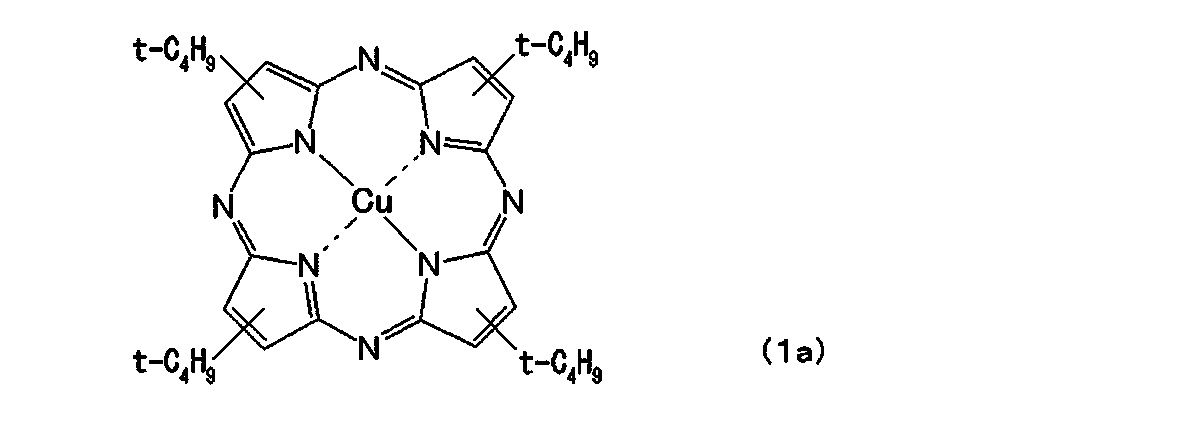
[6] 下記一般式(5)で表される調光色素を含む、[1]~[5]のいずれかに記載のフォトクロミックレンズ。
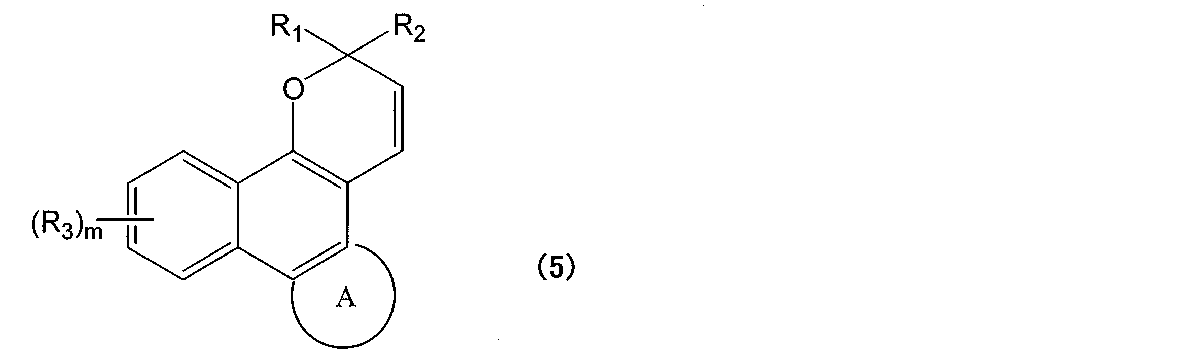
炭素数1~12の直鎖または分岐アルキル基;
炭素数3~12のシクロアルキル基;
置換または無置換である、炭素数6~24のアリール基または炭素数4~24のヘテロアリール基(置換基として、ハロゲン原子、水酸基、炭素数1~12の直鎖または分枝のアルキル基、炭素数1~12の直鎖または分枝のアルコキシ基、少なくとも1つのハロゲン原子で置換された炭素数1~12の直鎖または分枝のハロアルキル基、少なくとも1つのハロゲン原子で置換された炭素数1~12の直鎖または分枝のハロアルコキシ基、少なくとも一つの炭素数1~12の直鎖または分枝のアルキル基またはアルコキシ基により置換されたフェノキシ基またはナフトキシ基、炭素数2~12の直鎖または分枝のアルケニル基、-NH2基、-NHR基、-N(R)2基(Rが炭素数1~6の直鎖または分枝のアルキル基である。Rが2つ存在する場合、2つのRは同一でも異なっていてもよい。)、およびメタクリロイル基またはアクリロイル基から選択される少なくとも1つの置換基を有する。);
アラルキルまたはヘテロアラルキル基(炭素数1~4の直鎖または分岐アルキル基が前記のアリール基またはヘテロアリール基で置換されている。)
を表し、
R3は同一でも異なっていてもよく、独立して、ハロゲン原子;
炭素数1~12の直鎖または分岐アルキル基;
炭素数3~12のシクロアルキル基;
炭素数1~12の直鎖または分岐アルコキシ基;
少なくとも1つのハロゲン原子で置換された炭素数1~12の直鎖または分枝のハロアルキル基、少なくとも1つのハロゲン原子で置換された炭素数3~12のハロシクロアルキル基、少なくとも1つのハロゲン原子で置換された炭素数1~12の直鎖または分岐ハロアルコキシ基;
置換または無置換である、炭素数6~24のアリール基または炭素数4~24のヘテロアリール基(置換基として、ハロゲン原子、水酸基、炭素数1~12の直鎖または分枝のアルキル基、炭素数1~12の直鎖または分枝のアルコキシ基、少なくとも1つのハロゲン原子で置換された炭素数1~12の直鎖または分枝のハロアルキル基、少なくとも1つのハロゲン原子で置換された炭素数1~12の直鎖または分枝のハロアルコキシ基、少なくとも一つの炭素数1~12の直鎖または分枝のアルキル基またはアルコキシ基により置換されたフェノキシ基またはナフトキシ基、炭素数2~12の直鎖または分枝のアルケニル基、およびアミノ基、から選択される少なくとも1つの置換基を有する。);
アラルキルまたはヘテロアラルキル基(炭素数1~4の直鎖または分岐アルキル基が前記のアリール基またはヘテロアリール基で置換されている。);
置換または無置換のフェノキシまたはナフトキシ基(置換基として、炭素数1~6の直鎖または分岐アルキル基またはアルコキシ基から選択される少なくとも1つの置換基を有する。);
-NH2、-NHR、-CONH2、または-CONHR
(Rが、炭素数1~6の直鎖または分枝のアルキル基である。);
-OCOR8または-COOR8(ここで、R8が、炭素数1~6の直鎖または分枝のアルキル基、または炭素数3~6のシクロアルキル基、またはR1、R2において、置換アリールまたは置換ヘテロアリール基の置換基の少なくとも1つにより置換されているフェニル基または無置換のフェニル基である。);
を表し、
mが0~4までの整数であり;
Aが、下記式(A2)または式(A4)

点線が、一般式(5)のナフトピラン環の炭素C5炭素C6結合を表し;
アネル化環(A4)のα結合が、一般式(5)のナフトピラン環の炭素C5または炭素C6に結合されることができ;
R4が、同じかまたは異なり、独立して、OH、炭素数1~6の直鎖または分枝のアルキル基またはアルコキシ基を表し、もしくは2つのR4がカルボニル(CO)を形成し;
R5が、ハロゲン;
炭素数1~12の直鎖または分枝のアルキル基;
少なくとも1つのハロゲン原子により置換された、炭素数1~6の直鎖または分枝のハロアルキル基;
炭素数3~12のシクロアルキル基;
炭素数1~6の直鎖または分枝のアルコキシ基;
置換または無置換のフェニルまたはベンジル基(置換基として、一般式(5)のR1、R2基が独立してアリールまたはヘテロアリール基に対応する場合、R1、R2基の定義において上述した置換基の少なくとも1つを有する。);
-NH2、-NHR
(ここで、Rが、炭素数1~6の直鎖または分枝のアルキル基である。);
置換または無置換であるフェノキシまたはナフトキシ基(置換基として、少なくとも炭素数1~6の直鎖または分枝のアルキル基またはアルコキシ基を有する。);
-COR9、-COOR9または-CONHR9基(ここで、R9が、炭素数1~6の直鎖または分枝のアルキル基、または炭素数3~6のシクロアルキル基、または置換または無置換のフェニルまたはベンジル基(置換基として、一般式(5)のR1、R2基が独立してアリールまたはヘテロアリール基に対応する場合、R1、R2基の定義において上述した置換基の少なくとも1つを有する。));
Aが(A4)を示す場合、nが0~2までの整数であり、pが0~4までの整数であり、Aが(A2)を示す場合、nが0~2までの整数である。)
[7] 下記一般式(a)または下記一般式(b)で表される調光色素を含む、[1]~[5]のいずれかに記載のフォトクロミックレンズ。
PC-L-Chain (a)
PC-L-Chain-L'-PC' (b)
(PCとPC'は一般式(c)~(f)のいずれかを示す。PCとPC'は同一でも異なっていても良い。)
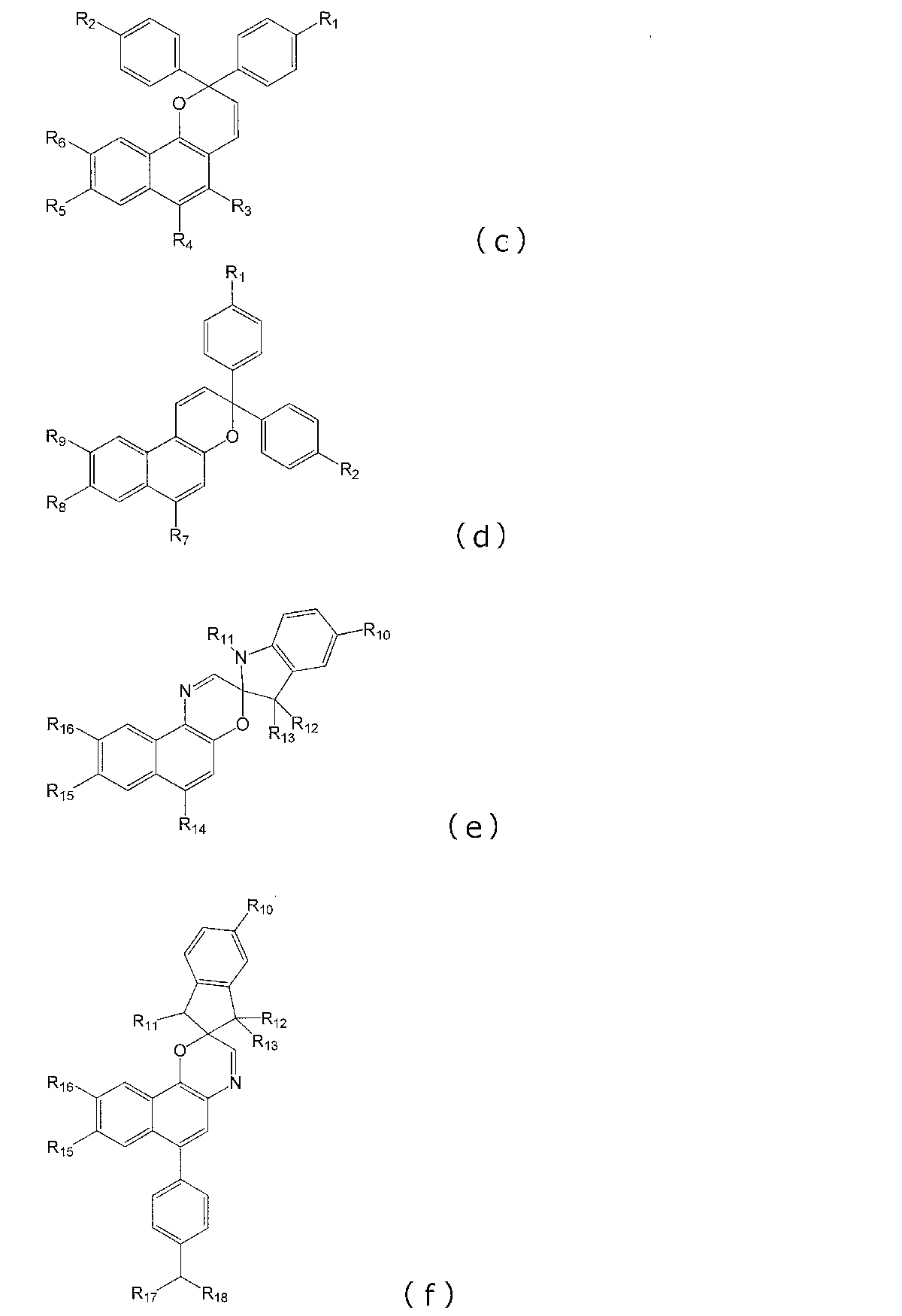
[8] ポリ(メタ)アクリレート、ポリアリルカーボネート、およびポリ(チオ)ウレタンから選択される少なくとも一種を含む、[1]~[7]のいずれかに記載のフォトクロミックレンズ。
[9] 前記ポリ(メタ)アクリレートは、下記一般式(i)、一般式(ii)、一般式(iii)および式(iv)で表される化合物から選択される少なくとも2種から誘導される構成単位を含む、[8]に記載のフォトクロミックレンズ。
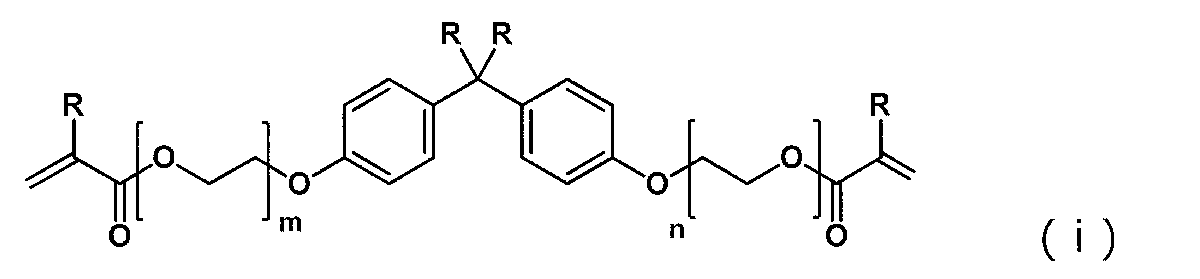



構成単位(a)および構成単位(b)の合計100重量%に対して、構成単位(a)を5重量%~30重量%、構成単位(b)を70重量%~95重量%含む、
[8]に記載のフォトクロミックレンズ。

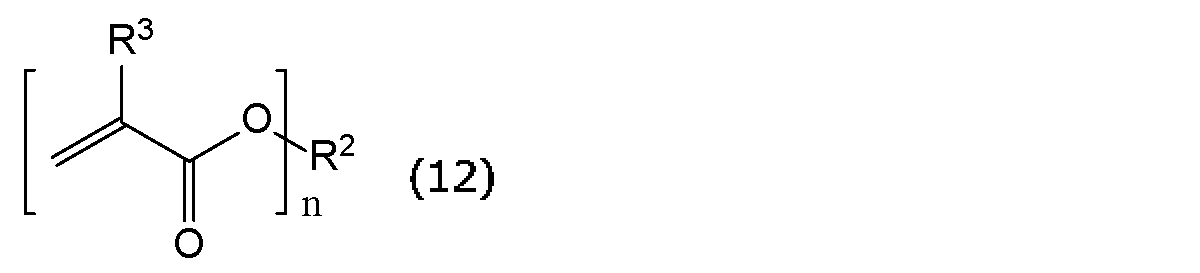
[11] 化合物(A)が、ジエチレングリコール、ジプロピレングリコール、トリエチレングリコール、テトラエチレングリコール、1,3-プロパンジオール、1,4-ブタンジオール、1,5-ペンタンジオール、1,6-ヘキサンジオール、ネオペンチルグリコール、3-メチル-1,5-ペンタンジオール、2-メチル-2-エチル-1,3-プロパンジオール、2,2-ジエチル-1,3-プロパンジオール、2,2,4-トリメチル-1,3-ペンタンジオール、1,4-ジメチロールシクロヘキサンおよび4,8-ビス(ヒドロキシメチル)-[5.2.1.02.6 ]トリシクロデカンから選択される少なくとも1種のジオールのビス(アリルカーボネート)化合物、
グリセロール、トリメチロールプロパンおよびトリス(ヒドロキシエチル)イソシアヌレートから選択される少なくとも1種のトリオールのトリス(アリルカーボネート)化合物、
ペンタエリスリトール、ジグリセロールおよびジトリメチロールプロパンから選択される少なくとも1種のテトラオールのテトラ(アリルカーボネート)化合物、
ジペンタエリスリトールのヘキサ(アリルカーボネート)化合物、および
前記ジオール、前記トリオール、前記テトラオールおよび前記ジペンタエリスリトールから選択される少なくとも2種類の化合物の混合ポリ(アリルカーボネート)化合物、から選択される少なくとも一種である、[10]に記載のフォトクロミックレンズ。
[12] 化合物(A)が、
(i)ジエチレングリコールのビス(アリルカーボネート)化合物およびそのオリゴマーとの混合物、
(ii) ジエチレングリコールとネオペンチルグリコールの混合物のビス(アリルカーボネート)化合物およびそのオリゴマーとの混合物、
(iii) ジエチレングリコールとトリス(ヒドロキシエチル)イソシアヌレートの混合物のポリ(アリルカーボネート)化合物およびそのオリゴマーとの混合物、
(iv) ジエチレングリコールとトリメチロールプロパンの混合物のポリ(アリルカーボネート)化合物およびそのオリゴマーとの混合物、
(v) ジエチレングリコールとペンタエリスリトールの混合物のポリ(アリルカーボネート)化合物およびそのオリゴマーとの混合物、
(vi) ジエチレングリコールとネオペンチルグリコールとペンタエリスリトールの混合物のポリ(アリルカーボネート)化合物およびそのオリゴマーとの混合物、および
(vii) ジエチレングリコールとネオペンチルグリコールとペンタエリスリトールの混合物のポリ(アリルカーボネート)化合物およびそのオリゴマーとの混合物と、
ジエチレングリコールのビス(アリルカーボネート)化合物およびそのオリゴマーとの混合物と、を含むポリ(アリルカーボネート)混合物から選択される少なくとも一種である、[10]または[11]に記載のフォトクロミックレンズ。
[13] 化合物(B)が、一般式(16)、一般式(17)で表される化合物から選択される少なくとも一種である、[10]~[12]のいずれかに記載のフォトクロミックレンズ。
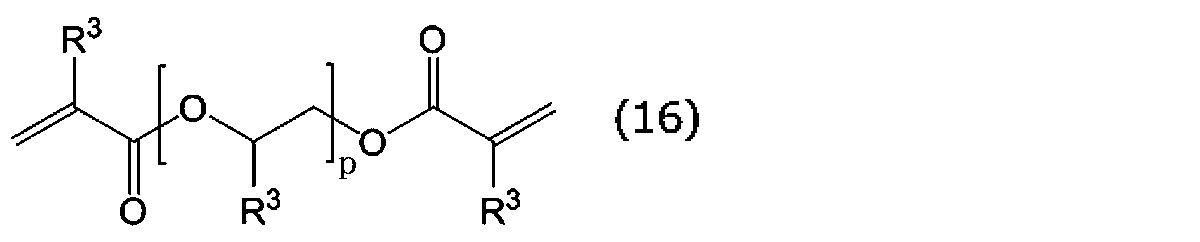
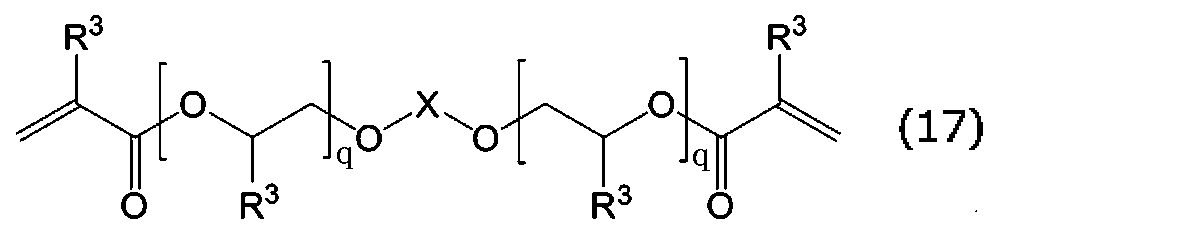
[14] 化合物(B)が、一般式(16)において、pが2~4で表される化合物から選択される、[13]に記載のフォトクロミックレンズ。
[15] 化合物(B)が、ジエチレングリコールジメタクリレート、トリエチレングリコールジメタクリレート、ジエチレングリコールジアクリレート、およびトリエチレングリコールジアクリレートから選択される少なくとも一種である、[14]に記載のフォトクロミックレンズ。
[16] 前記ポリ(チオ)ウレタンは、(a)ポリイソシアネート化合物から誘導される構成単位と、(b)数平均分子量が100以上であるポリオール化合物から誘導される構成単位と、(c)二官能以上の活性水素化合物(ただし、前記化合物(b)を除く)から誘導される構成単位とを含む、[8]に記載のフォトクロミックレンズ。
[17] ポリイソシアネート化合物(a)が、ヘキサメチレンジイソシアネート、ペンタメチレンジイソシアネート、キシリレンジイソシアネート、イソホロンジイソシアネート、ビス(イソシアナトメチル)シクロヘキサン、ジシクロヘキシルメタンジイソシアネート、2,5-ビス(イソシアナトメチル)ビシクロ-[2.2.1]-ヘプタン、2,6-ビス(イソシアナトメチル)ビシクロ-[2.2.1]-ヘプタン、トリレンジイソシアネート、フェニレンジイソシアネート、およびジフェニルメタンジイソシアネートよりなる群から選択される少なくとも1種である、[16]に記載のフォトクロミックレンズ。
[18] ポリオール化合物(b)が、ポリエチレングリコールまたはポリプロピレングリコールのジオール型またはトリオール型である、[16]または[17]に記載のフォトクロミックレンズ。
[19] ポリオール化合物(b)の数平均分子量が200~4000である、[18]に記載のフォトクロミックレンズ。
[20] ポリオール化合物(b)の数平均分子量が400~2000である、[18]に記載のフォトクロミックレンズ。
[21] ポリオール化合物(b)の数平均分子量が600~1500である、[18]に記載のフォトクロミックレンズ。
[22] 活性水素化合物(c)が、ポリオール化合物、ポリチオール化合物および水酸基を有するチオール化合物よりなる群から選択される少なくとも1種である、[16]~[21]のいずれかに記載のフォトクロミックレンズ。
[23] 活性水素化合物(c)が三官能以上の活性水素化合物である、[16]~[22]のいずれかに記載のフォトクロミックレンズ。
[24] 活性水素化合物(c)が、グリセリン、ペンタエリスリトールテトラキス(2-メルカプトアセテート)、ペンタエリスリトールテトラキス(3-メルカプトプロピオネート)、4-メルカプトメチル-1,8-ジメルカプト-3,6-ジチアオクタン、5,7-ジメルカプトメチル-1,11-ジメルカプト-3,6,9-トリチアウンデカン、4,7-ジメルカプトメチル-1,11-ジメルカプト-3,6,9-トリチアウンデカン、4,8-ジメルカプトメチル-1,11-ジメルカプト-3,6,9-トリチアウンデカン、1,1,3,3-テトラキス(メルカプトメチルチオ)プロパン、およびトリメチロールプロパントリス(3-メルカプトプロピオネート)よりなる群から選択される少なくとも1種である、[16]~[23]のいずれかに記載のフォトクロミックレンズ。
[25] 下記一般式(1)で表されるテトラアザポルフィリン化合物と、
下記一般式(5)、一般式(a)および一般式(b)で表される調光色素から選択される少なくとも一種と、
重合性化合物と、を含む重合性組成物。
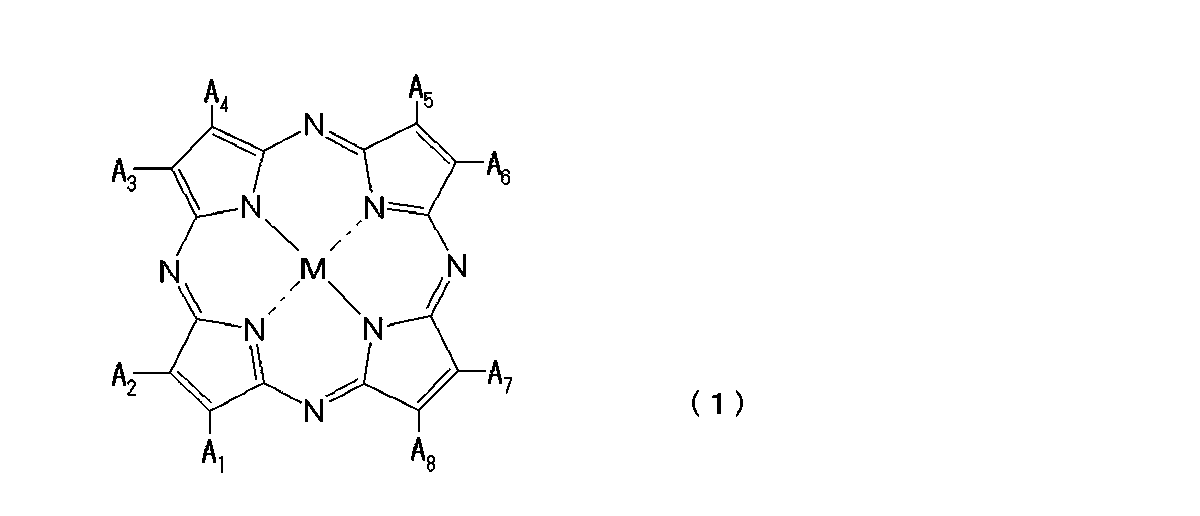

炭素数1~12の直鎖または分岐アルキル基;
炭素数3~12のシクロアルキル基;
置換または無置換である、炭素数6~24のアリール基または炭素数4~24のヘテロアリール基(置換基として、ハロゲン原子、水酸基、炭素数1~12の直鎖または分枝のアルキル基、炭素数1~12の直鎖または分枝のアルコキシ基、少なくとも1つのハロゲン原子で置換された炭素数1~12の直鎖または分枝のハロアルキル基、少なくとも1つのハロゲン原子で置換された炭素数1~12の直鎖または分枝のハロアルコキシ基、少なくとも一つの炭素数1~12の直鎖または分枝のアルキル基またはアルコキシ基により置換されたフェノキシ基またはナフトキシ基、炭素数2~12の直鎖または分枝のアルケニル基、-NH2基、-NHR基、-N(R)2基(Rが炭素数1~6の直鎖または分枝のアルキル基である。Rが2つ存在する場合、2つのRは同一でも異なっていてもよい。)、およびメタクリロイル基またはアクリロイル基から選択される少なくとも1つの置換基を有する。);
アラルキルまたはヘテロアラルキル基(炭素数1~4の直鎖または分岐アルキル基が前記のアリール基またはヘテロアリール基で置換されている。)
を表し、
R3は同一でも異なっていてもよく、独立して、ハロゲン原子;
炭素数1~12の直鎖または分岐アルキル基;
炭素数3~12のシクロアルキル基;
炭素数1~12の直鎖または分岐アルコキシ基;
少なくとも1つのハロゲン原子で置換された炭素数1~12の直鎖または分枝のハロアルキル基、少なくとも1つのハロゲン原子で置換された炭素数3~12のハロシクロアルキル基、少なくとも1つのハロゲン原子で置換された炭素数1~12の直鎖または分岐ハロアルコキシ基;
置換または無置換である、炭素数6~24のアリール基または炭素数4~24のヘテロアリール基(置換基として、ハロゲン原子、水酸基、炭素数1~12の直鎖または分枝のアルキル基、炭素数1~12の直鎖または分枝のアルコキシ基、少なくとも1つのハロゲン原子で置換された炭素数1~12の直鎖または分枝のハロアルキル基、少なくとも1つのハロゲン原子で置換された炭素数1~12の直鎖または分枝のハロアルコキシ基、少なくとも一つの炭素数1~12の直鎖または分枝のアルキル基またはアルコキシ基により置換されたフェノキシ基またはナフトキシ基、炭素数2~12の直鎖または分枝のアルケニル基、およびアミノ基、から選択される少なくとも1つの置換基を有する。);
アラルキルまたはヘテロアラルキル基(炭素数1~4の直鎖または分岐アルキル基が前記のアリール基またはヘテロアリール基で置換されている。);
置換または無置換のフェノキシまたはナフトキシ基(置換基として、炭素数1~6の直鎖または分岐アルキル基またはアルコキシ基から選択される少なくとも1つの置換基を有する。);
-NH2、-NHR、-CONH2、または-CONHR
(Rが、炭素数1~6の直鎖または分枝のアルキル基である。);
-OCOR8または-COOR8(ここで、R8が、炭素数1~6の直鎖または分枝のアルキル基、または炭素数3~6のシクロアルキル基、またはR1、R2において、置換アリールまたは置換ヘテロアリール基の置換基の少なくとも1つにより置換されているフェニル基または無置換のフェニル基である。);
を表し、
mが0~4までの整数であり;
Aが、下記式(A2)または式(A4)
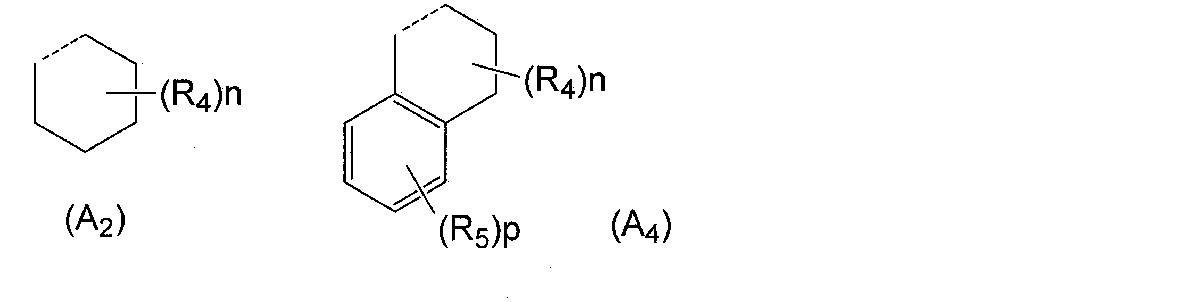
点線が、一般式(5)のナフトピラン環の炭素C5炭素C6結合を表し;
アネル化環(A4)のα結合が、一般式(5)のナフトピラン環の炭素C5または炭素C6に結合されることができ;
R4が、同じかまたは異なり、独立して、OH、炭素数1~6の直鎖または分枝のアルキル基またはアルコキシ基を表し、もしくは2つのR4がカルボニル(CO)を形成し;
R5が、ハロゲン;
炭素数1~12の直鎖または分枝のアルキル基;
少なくとも1つのハロゲン原子により置換された、炭素数1~6の直鎖または分枝のハロアルキル基;
炭素数3~12のシクロアルキル基;
炭素数1~6の直鎖または分枝のアルコキシ基;
置換または無置換のフェニルまたはベンジル基(置換基として、一般式(5)のR1、R2基が独立してアリールまたはヘテロアリール基に対応する場合、R1、R2基の定義において上述した置換基の少なくとも1つを有する。);
-NH2、-NHR
(ここで、Rが、炭素数1~6の直鎖または分枝のアルキル基である。);
置換または無置換であるフェノキシまたはナフトキシ基(置換基として、少なくとも炭素数1~6の直鎖または分枝のアルキル基またはアルコキシ基を有する。);
-COR9、-COOR9または-CONHR9基(ここで、R9が、炭素数1~6の直鎖または分枝のアルキル基、または炭素数3~6のシクロアルキル基、または置換または無置換のフェニルまたはベンジル基(置換基として、一般式(5)のR1、R2基が独立してアリールまたはヘテロアリール基に対応する場合、R1、R2基の定義において上述した置換基の少なくとも1つを有する。));
Aが(A4)を示す場合、nが0~2までの整数であり、pが0~4までの整数であり、Aが(A2)を示す場合、nが0~2までの整数である。)
PC-L-Chain (a)
PC-L-Chain-L'-PC' (b)
(PCとPC'は一般式(c)~(f)のいずれかを示す。PCとPC'は同一でも異なっていても良い。)
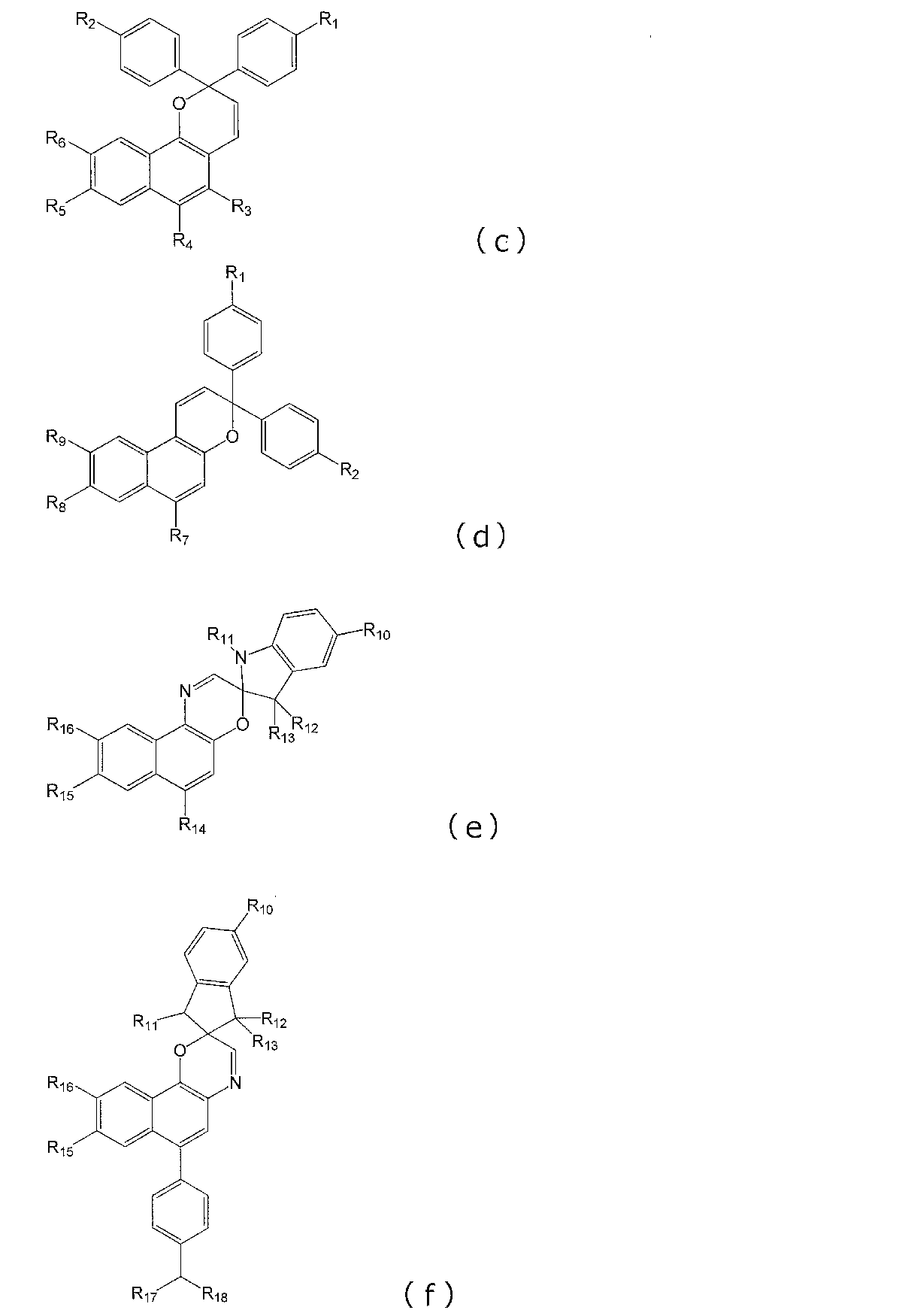
[26] 前記重合性化合物は、下記一般式(i)、一般式(ii)、一般式(iii)および式(iv)で表される化合物から選択される少なくとも2種を含む、[25]に記載の重合性組成物。
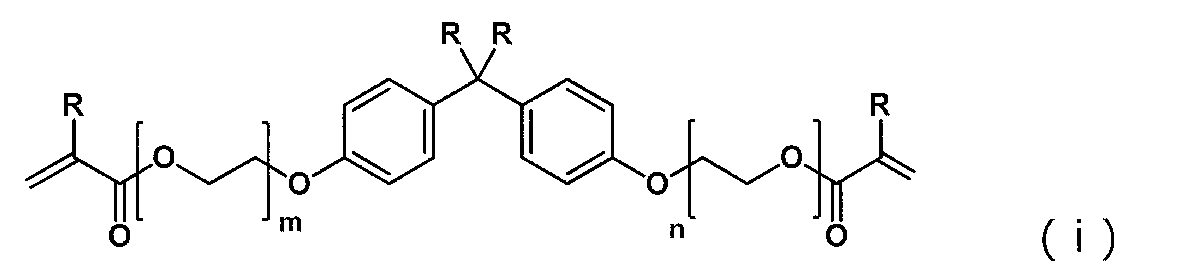



化合物(A)および化合物(B)の合計100重量%において、化合物(A)を5重量%~30重量%、化合物(B)を70重量%~95重量%の量で含む、[25]に記載の重合性組成物。

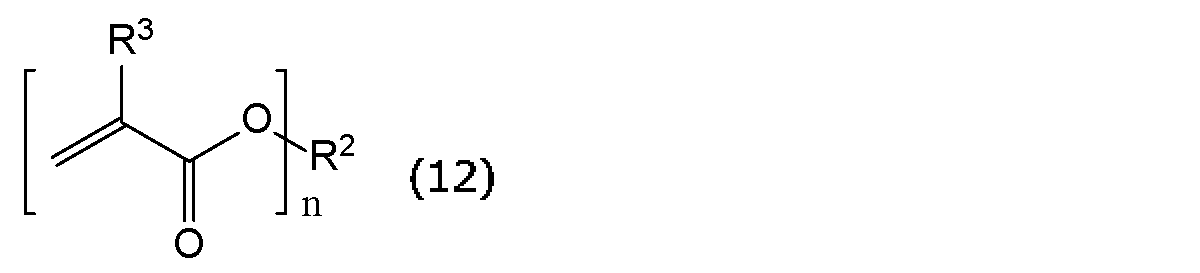
[28] 前記重合性化合物は、(a)ポリイソシアネート化合物と、(b)数平均分子量が100以上であるポリオール化合物と、(c)二官能以上の活性水素化合物(ただし、前記化合物(b)を除く)を含む、[25]に記載の重合性組成物。
[29] [25]~[28]のいずれかに記載の重合性組成物を硬化したフォトクロミックレンズ。
[30] 偏光フィルムと、
前記偏光フィルムの少なくとも対物面側の面上に形成された、[25]~[28]のいずれかに記載の重合性組成物からなる基材層と、を備えるプラスチック偏光レンズ。
本発明において、例えば、「ジエチレングリコールとネオペンチルグリコールの混合物のビス(アリルカーボネート)化合物」とは、
(1)ジエチレングリコールの2つの水酸基がアリルカーボネート基で置き換えられた構造を有する化合物、
(2)ネオペンチルグリコールの2つの水酸基がアリルカーボネート基で置き換えられた構造を有する化合物、を意味する。
また、本発明において、例えば、「ジエチレングリコールとネオペンチルグリコールの混合物のビス(アリルカーボネート)化合物のオリゴマー」とは、
下記(3)、(4)、または(5)の何れか、またはこれらから選択される2種以上の混合物を意味する。
(3)ジエチレングリコールのビス(アリルカーボネート)化合物のオリゴマー
2分子以上のジエチレングリコールがカーボネート結合を介してオリゴマー化し、末端の水酸基がアリルカーボネート基で置き換えられた構造を有する化合物。
(4)ネオペンチルグリコールのビス(アリルカーボネート)化合物のオリゴマー
2分子以上のネオペンチルグリコールがカーボネート結合を介してオリゴマー化し、末端の水酸基がアリルカーボネート基で置き換えられた構造を有する化合物。
(5)ジエチレングリコールとネオペンチルグリコールの、ビス(アリルカーボネート)化合物のオリゴマー
1分子以上のジエチレングリコールと1分子以上のネオペンチルグリコールを、カーボネート結合を介して、ランダムな組み合わせで同一分子内でオリゴマー化し、末端の水酸基がアリルカーボネート基で置き換えられた構造を有する化合物。
「3官能以上のポリオールのビス(アリルカーボネート)化合物」、「ジオールと3官能以上のポリオールを2種類以上用いたビス(アリルカーボネート)化合物」の場合も同様である。
「3官能以上のポリオールのビス(アリルカーボネート)化合物のオリゴマー」、「ジオールと3官能以上のポリオールを、2種類以上用いたビス(アリルカーボネート)化合物のオリゴマー」の場合、末端のすべての水酸基がアリルオキシカーボネート基に置き換えられた構造、一部の水酸基がアリルオキシカーボネート基に置き換えられた構造を含む。
本発明において、例えば「1~10」は「1以上、10以下」を意味する。
本発明において、ヘテロ原子とはC,H以外の原子を意味する。
本発明において、「消色時」とは、ISO/DIS 8980-3(JIS T7333)に準拠した方法で、試料を65℃暗所下で2時間保存し、その後23℃暗所下で少なくとも12時間保存した状態のことを意味する。
本実施形態のフォトクロミックレンズは、キセノンランプを用いて、照度50000ルクスで15分間照射した後の23℃における透過率が以下の条件を満たす。
(1)550nmでの透過率が25%以下、好ましくは23%以下、より好ましくは21%以下である。
(2)550nmでの透過率aは575nm~600nmの間の最小透過率bよりも大きく、透過率aと透過率bとの差(a-b)が5%以上、好ましくは7%以上、より好ましくは9%以上である。
(3)550nm~600nmまでの透過率曲線において変曲点を1点以上有する。
なお、キセノンランプを用いて照度50000ルクスで照射する条件については、ISO8980-3に準拠したものである。
さらに、本実施形態のフォトクロミックレンズは、消色時における視感透過率が70%以上、好ましくは72%以上、より好ましくは75%以上とすることができる。
これにより、本実施形態のフォトクロミックレンズは、フォトクロミック性能を発揮し得るとともに、さらにフォトクロミックレンズが発色した時、および消色した時の何れの状態においても優れた視認性(コントラスト性)を発現することができる。
以下、各成分について説明する。
本実施形態のテトラアザポルフィリン化合物としては、たとえば、クロロホルム又はトルエン溶液で測定された可視光吸収分光スペクトルにおいて、565nm~605nmの間に主吸収ピーク(P)を有し、該ピーク(P)のピーク頂点(Pmax:ピーク中で最大吸光係数を示す点)の吸光係数(ml/g・cm)が0.5×105以上であり、該ピーク(P)の(Pmax)の吸光度の1/4の吸光度におけるピーク幅が50nm以下であり、かつ該ピーク(P)の(Pmax)の吸光度の1/2の吸光度におけるピーク幅が30nm以下であり、かつ該ピーク(P)の(Pmax)の吸光度の2/3の吸光度におけるピーク幅が20nm以下の範囲である化合物を用いることができる。
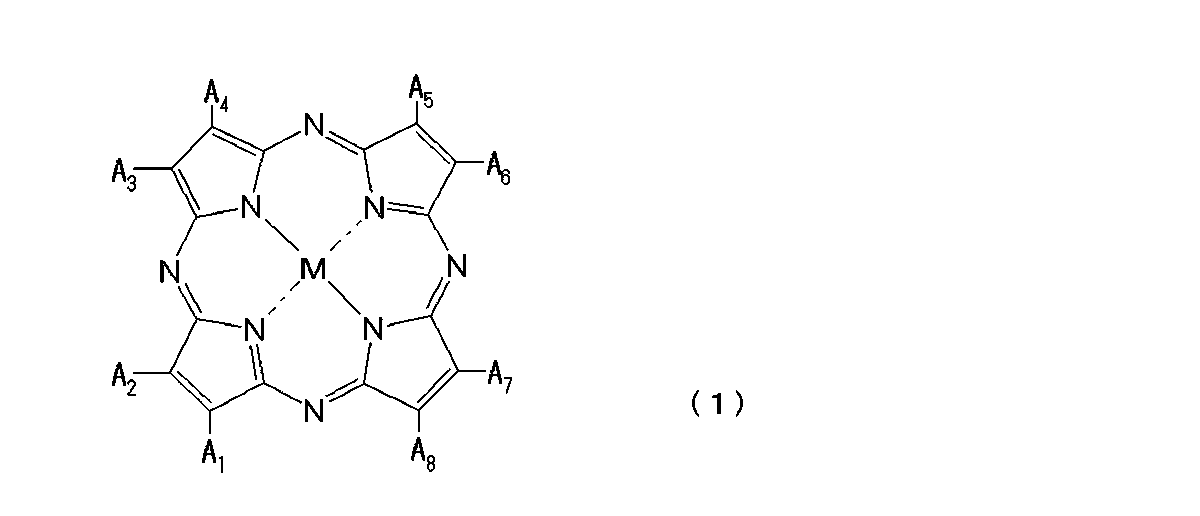
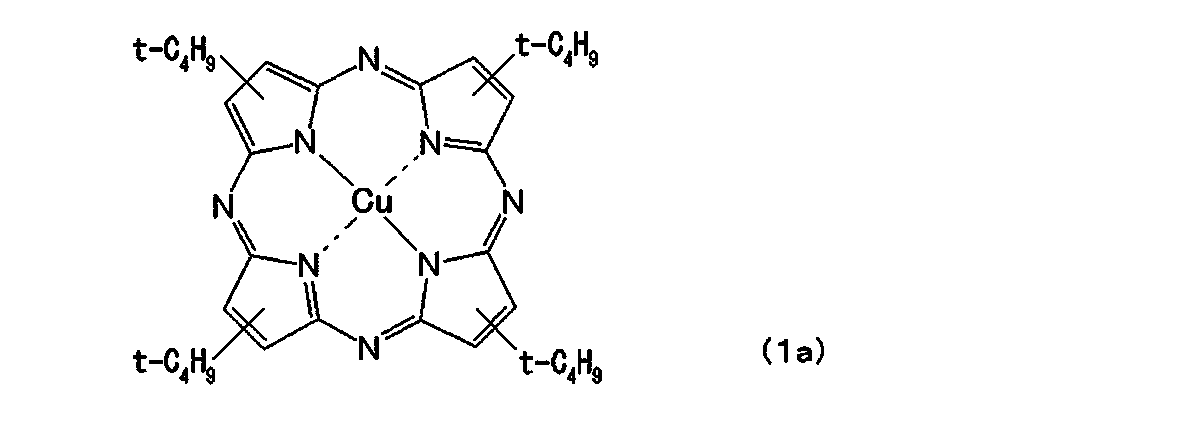
本実施形態のフォトクロミックレンズは、樹脂100重量%に対して、テトラアザポルフィリン化合物を1~15ppm、好ましくは5~15ppm含むことができる。添加量については、テトラアザポルフィリン化合物の種類により性能が異なるため一概に限定することはできないが、テトラアザポルフィリン化合物の性能や、フォトクロミック化合物であるナフトピラン系化合物、一般式(a)または一般式(b)で表されるフォトクロミック化合物の種類や添加量によって適宜選定される。
本実施形態において、調光色素(フォトクロミック化合物)としては、特に制限はなく、フォトクロミックレンズに使用しうる従来公知の化合物の中から、任意のものを適宜選択して用いることができる。例えば、スピロピラン系化合物、スピロオキサジン系化合物、フルギド系化合物、ナフトピラン系化合物、ビスイミダゾール化合物、から所望の着色に応じて、1種または2種以上を用いることができ、後述する一般式(a)および一般式(b)から選択される少なくとも1種を用いることもできる。

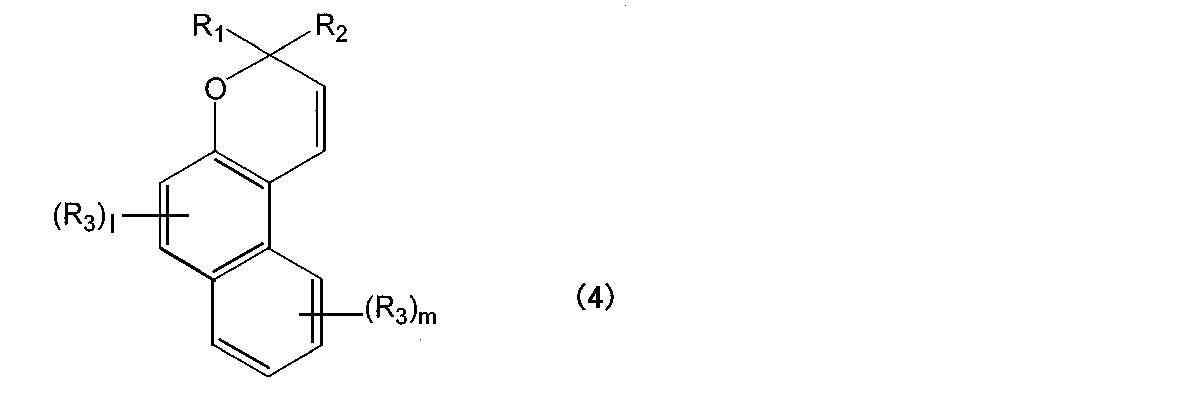
炭素数1~12の直鎖または分岐アルキル基;
炭素数3~12のシクロアルキル基;
置換または無置換である、炭素数6~24のアリール基または炭素数4~24のヘテロアリール基;
アラルキルまたはヘテロアラルキル基(炭素数1~4の直鎖または分岐アルキル基が前記のアリール基またはヘテロアリール基で置換されている。)を示す。
炭素数1~12の直鎖または分岐アルキル基;
炭素数3~12のシクロアルキル基;
炭素数1~12の直鎖または分岐アルコキシ基;
少なくとも1つのハロゲン原子で置換された炭素数1~12の直鎖または分枝のハロアルキル基、少なくとも1つのハロゲン原子で置換された炭素数3~12のハロシクロアルキル基、少なくとも1つのハロゲン原子で置換された炭素数1~12の直鎖または分岐ハロアルコキシ基;
置換または無置換である、炭素数6~24のアリール基または炭素数4~24のヘテロアリール基(置換基として、ハロゲン原子、水酸基、炭素数1~12の直鎖または分枝のアルキル基、炭素数1~12の直鎖または分枝のアルコキシ基、少なくとも1つのハロゲン原子で置換された炭素数1~12の直鎖または分枝のハロアルキル基、少なくとも1つのハロゲン原子で置換された炭素数1~12の直鎖または分枝のハロアルコキシ基、少なくとも一つの炭素数1~12の直鎖または分枝のアルキル基またはアルコキシ基により置換されたフェノキシ基またはナフトキシ基、炭素数2~12の直鎖または分枝のアルケニル基、およびアミノ基、から選択される少なくとも1つの置換基を有する。);
アラルキルまたはヘテロアラルキル基(炭素数1~4の直鎖または分岐アルキル基が前記のアリール基またはヘテロアリール基で置換されている。);
置換または無置換のフェノキシまたはナフトキシ基(置換基として、炭素数1~6の直鎖または分岐アルキル基またはアルコキシ基から選択される少なくとも1つの置換基を有する。);
-NH2、-NHR、-CONH2、または-CONHR
(Rが、炭素数1~6の直鎖または分枝のアルキル基である。);
-OCOR8または-COOR8(ここで、R8が、炭素数1~6の直鎖または分枝のアルキル基、または炭素数3~6のシクロアルキル基、またはR1、R2において、置換アリールまたは置換ヘテロアリール基の置換基の少なくとも1つにより置換されているフェニル基または無置換のフェニル基である。);
を表す。
lは、0~2までの整数である。mは、0~4までの整数である。
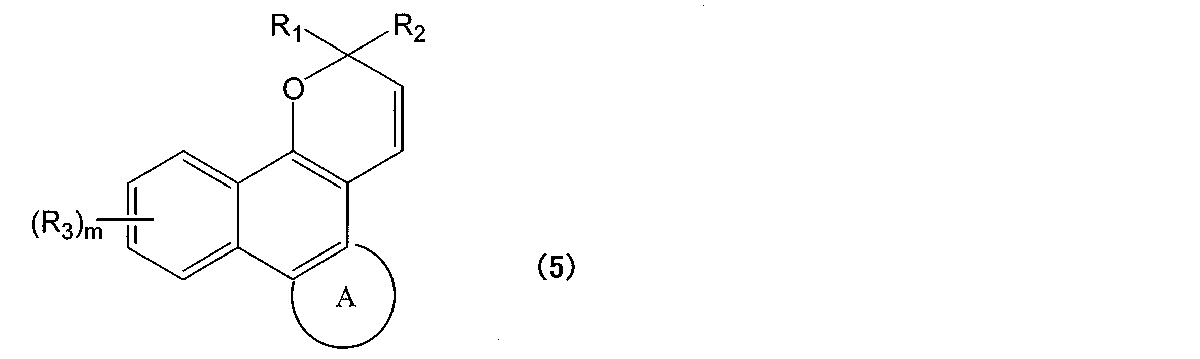

炭素数1~12の直鎖または分枝のアルキル基(好ましくは、炭素数1~6の直鎖または分枝のアルキル基);
少なくとも1つのハロゲン原子により置換された、炭素数1~6の直鎖または分枝のハロアルキル基(好ましくは、フルオロアルキル基);
炭素数3~12のシクロアルキル基;
炭素数1~6の直鎖または分枝のアルコキシ基;
置換または無置換のフェニルまたはベンジル基(置換基として、一般式(5)のR1、R2基が独立してアリールまたはヘテロアリール基に対応する場合、R1、R2基の定義において上述した置換基の少なくとも1つを有する。);
-NH2、-NHR
(ここで、Rが、炭素数1~6の直鎖または分枝のアルキル基である。);
置換または無置換であるフェノキシまたはナフトキシ基(置換基として、少なくとも炭素数1~6の直鎖または分枝のアルキル基またはアルコキシ基を有する。);
-COR9、-COOR9または-CONHR9基(ここで、R9が、炭素数1~6の直鎖または分枝のアルキル基、または炭素数3~6のシクロアルキル基、または置換または無置換のフェニルまたはベンジル基(置換基として、一般式(5)のR1、R2基が独立してアリールまたはヘテロアリール基に対応する場合、R1、R2基の定義において上述した置換基の少なくとも1つを有する)を表す。)を表す。
なお、Aが(A4)を示す場合、nが0~2までの整数であり、pが0~4までの整数であり、Aが(A2)を示す場合、nが0~2までの整数である。
本実施形態では、化合物(5)として、下記一般式(6)で表される化合物を好ましく用いることができる。

化合物(5)として、下記一般式(7)で表される化合物をさらに好ましく用いることができる。

R3、R4、R5、m、n、pは前記と同義である。
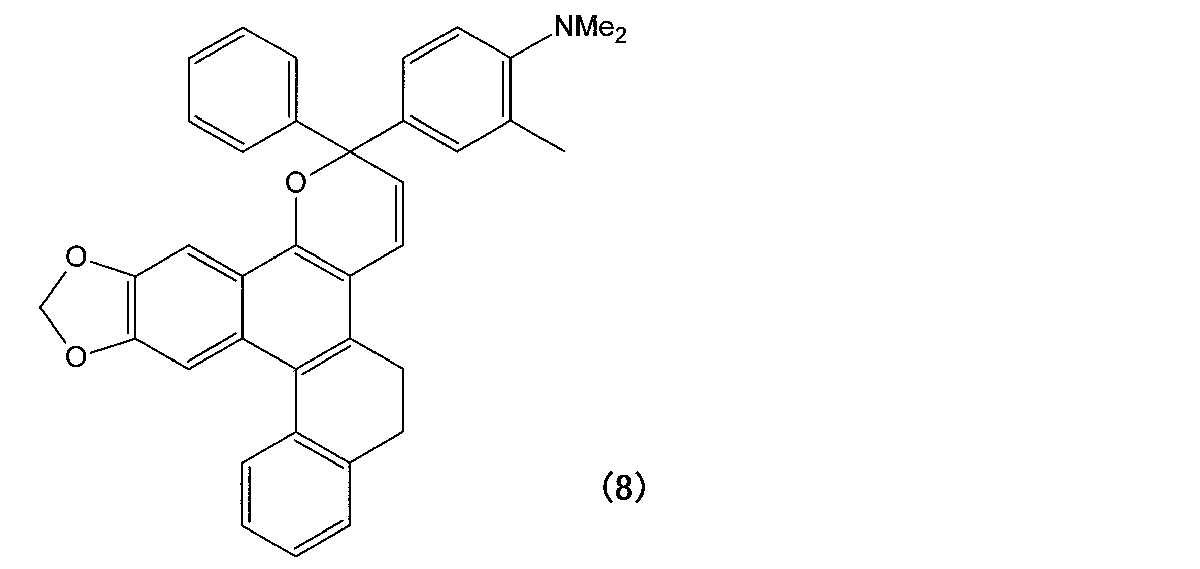
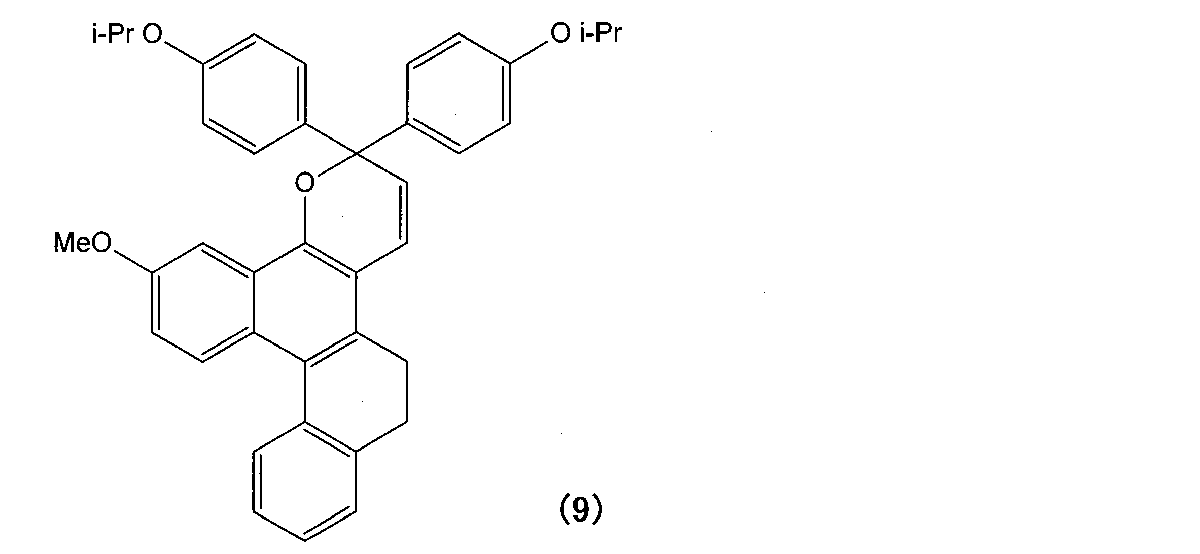
また、さらに一般式(3)で表されるナフトピラン系化合物の具体例としては、下記式(10)で示される化合物を好ましい例として挙げることができる。
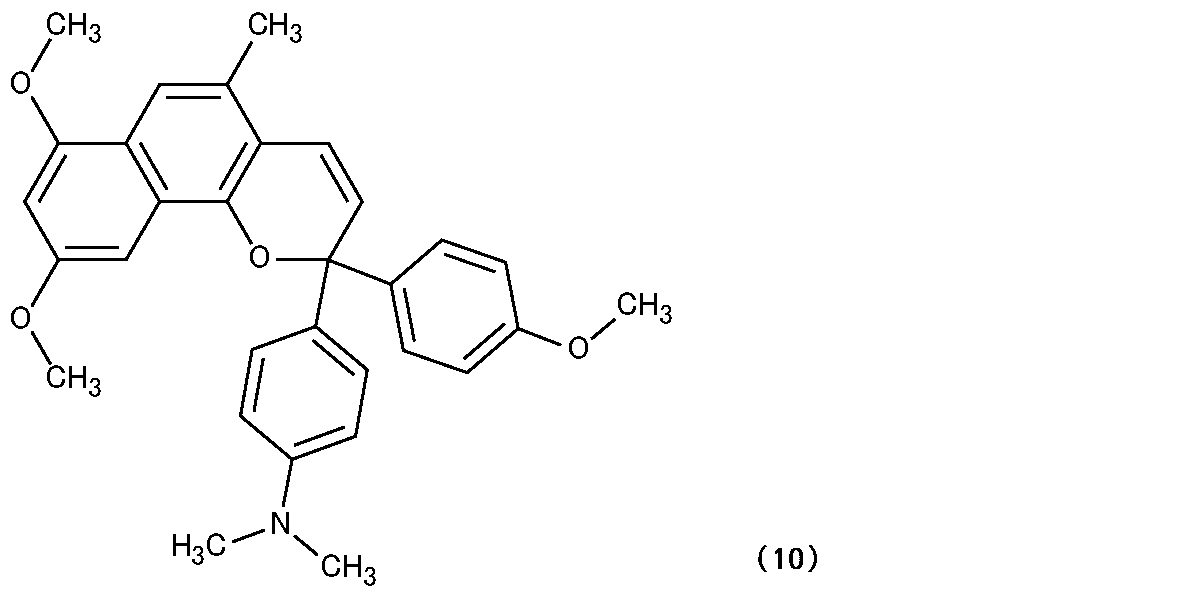
本実施形態のフォトクロミックレンズは、樹脂100重量%に対して、ナフトピラン系化合物を100~3000ppm、好ましくは100~2000ppm含むことができる。添加量については、ナフトピラン系化合物の種類により性能が異なるため一概に限定することはできないが、ナフトピラン系化合物の性能やテトラアザポルフィリン化合物の種類や添加量によって適宜選定される。
PC-L-Chain (a)
PC-L-Chain-L'-PC' (b)
PCとPC'は一般式(c)~(f)の化合物から誘導される1価の基を示す。PCとPC'は同一でも異なっていてもよい。

置換されてもよいC6~C20の芳香族有機基としては、フェニル基、C7~C16アルコキシフェニル基、アリールアミノ基、ジアリールアミノ基、アリールC1~C5アルキルアミノ基、環状アミノ基、アリールカルボニル基、アロイル基等を挙げることができる。
直鎖あるいは分枝鎖状のC1~C10アルキル基、直鎖あるいは分枝鎖状のC1~C10アルコキシ基、C1~C10ヒドロキシアルコキシ基、C1~C10アルコキシ基で置換されたC1~C10アルコキシ基、C1~C5ハロアルキル基、C1~C5ジハロアルキル基、C1~C5トリハロアルキル基、C1~C5アルキルアミノ基等の、置換されてもよいC1~C20の脂肪族基;
フェニル基、C7~C16アルコキシフェニル基、C1~C5ジアルキルアミノ基、アリールアミノ基、ジアリールアミノ基、アリールC1~C5アルキルアミノ基、環状アミノ基等の、置換されてもよいC6~C20の芳香族有機基;等を挙げることができる。R1とR2は、それぞれ同一でも異なってもよい。
直鎖あるいは分枝鎖状のC1~C10アルキル基、直鎖あるいは分枝鎖状のC2~C10アルケ二ル基、直鎖あるいは分枝鎖状のC1~C10アルコキシ基、C1~C10ヒドロキシアルキル基、C1~C10アルコキシ基で置換されたC1~C10アルキル基、C1~C10アミノアルキル基、直鎖あるいは分枝鎖状のC1~C20アルコキシカルボニル基等の、置換されてもよいC1~C20の脂肪族基;
C3~C20のシクロアルキル基、C6~C20のビシクロアルキル基等の、置換されてもよいC3~C20の脂環族基;
アリールカルボニル基、ホルミル基、アロイル基等の、置換されてもよいC6~C20の芳香族有機基;等を挙げることができる。
直鎖あるいは分枝鎖状のC1~C10アルキル基、直鎖あるいは分枝鎖状のC2~C10アルケ二ル基、直鎖あるいは分枝鎖状のC1~C10アルコキシ基、C1~C10ヒドロキシアルキル基、C1~C10アルコキシ基で置換されたC1~C10アルキル基、C1~C10アミノアルキル基、直鎖あるいは分枝鎖状のC1~C20アルコキシカルボニル基等の、置換されてもよいC1~C20の脂肪族基;
C3~C20のシクロアルキル基、C6~C20のビシクロアルキル基等の、置換されてもよいC3~C20の脂環族基;
アリールカルボニル基、アロイル基、フェニル基、C7~C16アルコキシフェニル基、C1~C10ジアルコキシフェニル基、C1~C10アルキルフェニル基、C1~C10ジアルキルフェニル基等の、置換されてもよいC6~C20の芳香族有機基;等を挙げることができる。
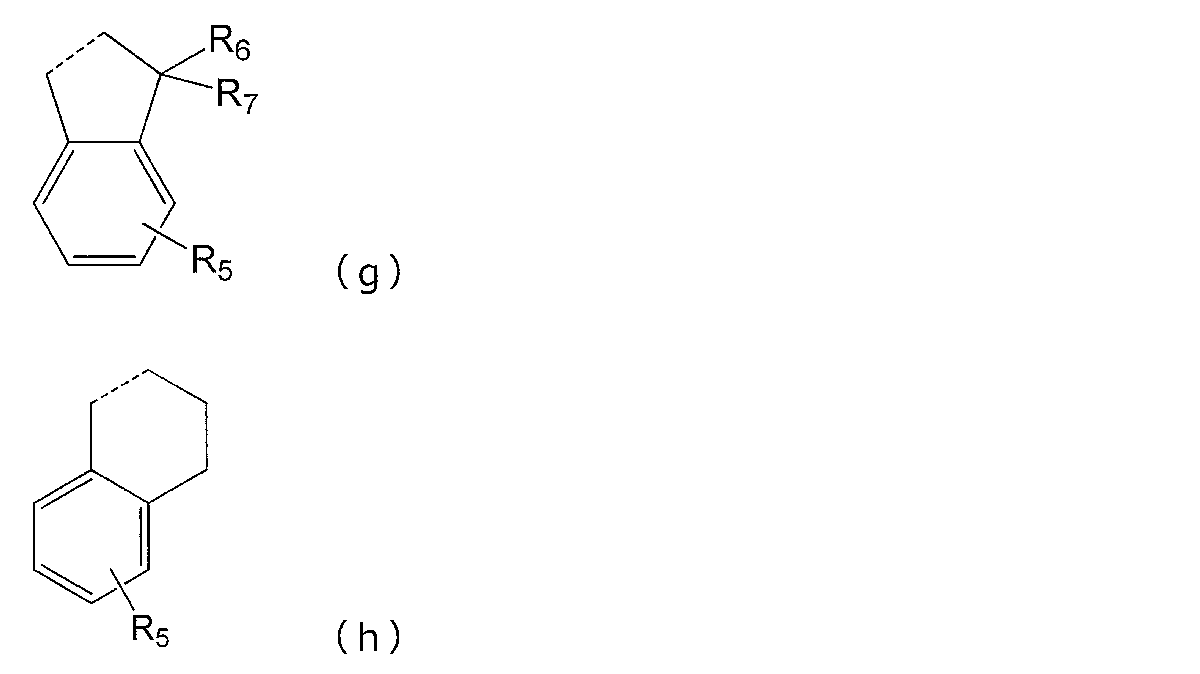
直鎖あるいは分枝鎖状のC1~C20アルキル基、C1~C5ハロアルキル基、C1~C5ジハロアルキル基、C1~C5トリハロアルキル基等の、置換されてもよいC1~C20の脂肪族基;
C3~C20のシクロアルキル基、C6~C20のビシクロアルキル基、C1~C5アルキル基で置換されたC3~C20シクロアルキル基、C1~C5アルキル基で置換されたC6~C20のビシクロアルキル基等の、置換されてもよいC3~C20の脂環族基;
C1~C5アルキル基で置換されたアリール基等の、置換されてもよいC6~C20の芳香族有機基;等を挙げることができる。
C1~C10アルキル基、C1~C5アルキルアルコキシカルボニル基等の、置換されてもよいC1~C20の脂肪族基;C5~C7のシクロアルキル基等の、置換されてもよいC3~C20の脂環族基;等を示す。
直鎖あるいは分枝鎖状のC1~C10アルキル基、C1~C10ヒドロキシアルキル基等の、置換されてもよいC1~C20の脂肪族基;C5~C7のシクロアルキル基等の、置換されてもよいC3~C20の脂環族基;等を示す。
具体的には、LとL'は、一般式(i)~(o)で表される。LとL'は同一でも異なっていてもよい。
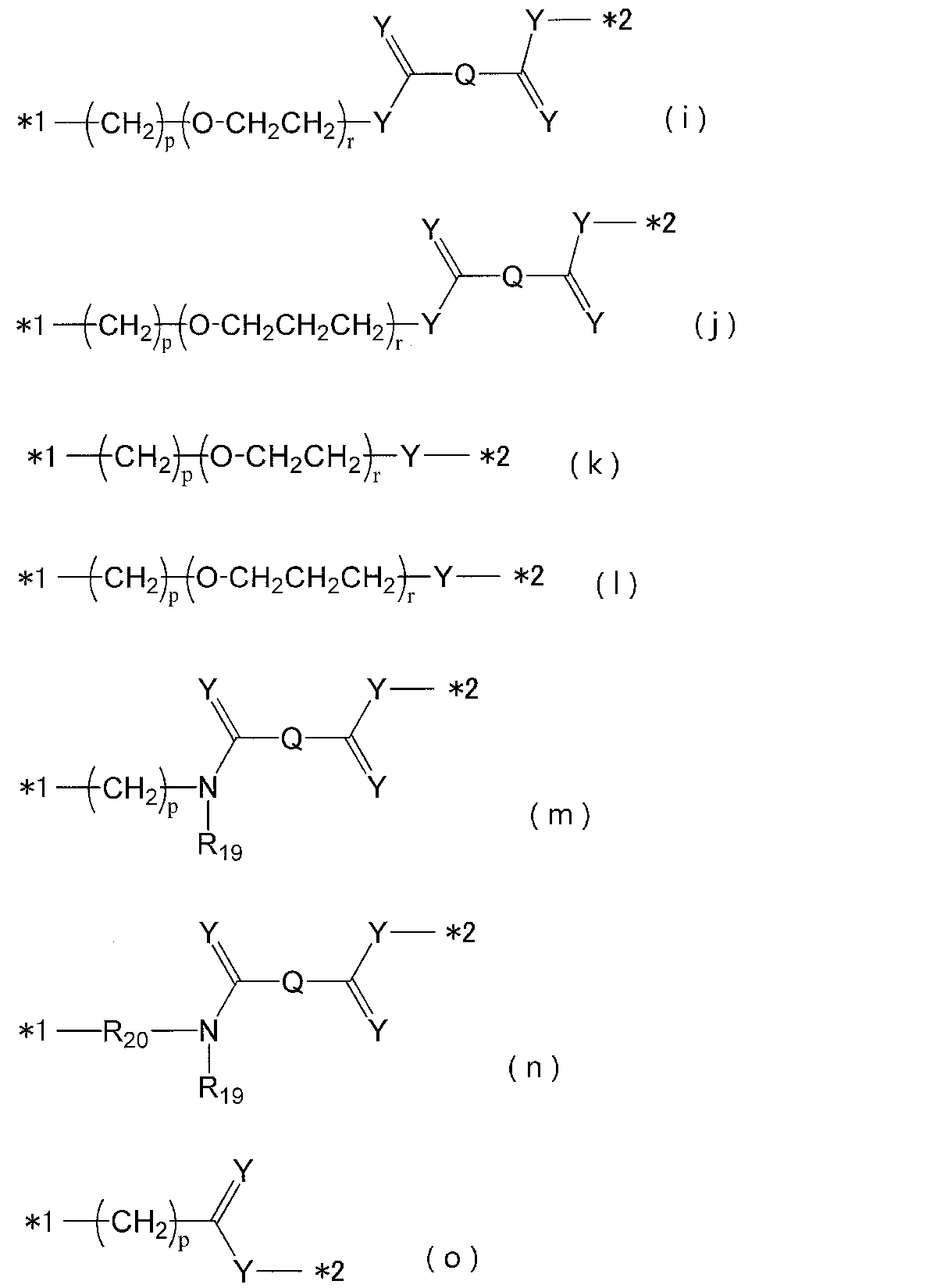
Yは、酸素、硫黄を示す。
R19は、水素、直鎖あるいは分枝鎖状のC1~C10アルキル基を示す。
R20は、直鎖あるいは分枝鎖状のC1~C10アルキル基を示す。
pは、0~15の整数を示し、rは、0~10の整数を示す。
Qは、直鎖あるいは分枝鎖状のC1~C10アルキレン基、C1~C10アルケニレン基、1,2-、1,3-、1,4-位の置換アリール基から誘導される2価の基、置換ヘテロアリール基から誘導される2価の基等を示す。
*1、*2は結合手を表し、*1は「Chain」で表される1価または2価の有機基と結合し、*2はPCまたはPC' で表される1価の有機基と結合する。
ポリシロキサン鎖としては、ポリジメチルシロキサン鎖、ポリメチルフェニルシロキサン鎖、ポリメチルヒドロシロキサン鎖等が挙げられる。
ポリオキシアルキレン鎖としては、ポリオキシエチレン鎖、ポリオキシプロピレン鎖、ポリオキシヘキサメチレン鎖等が挙げられる。
「Chain」は、フォトクロミック化合物が一般式(a)の場合は、一般式(p)または(q)の1価の有機基を示す。

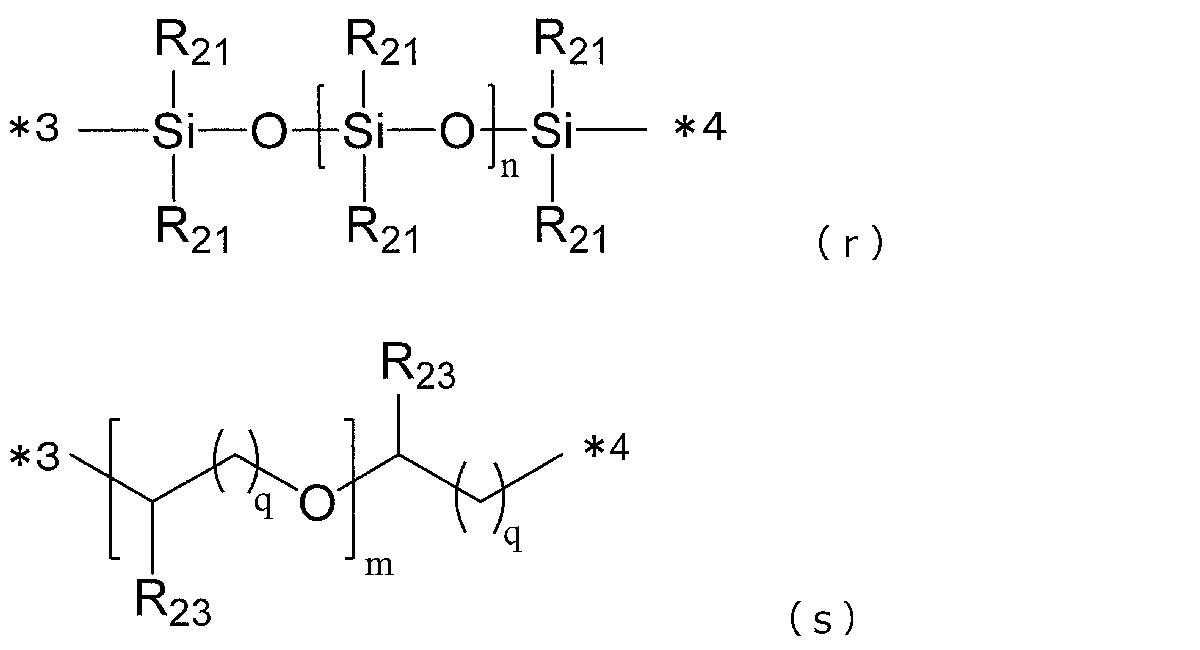
R21は、直鎖あるいは分枝鎖状のC1~C10アルキル基を示す。
R22は、直鎖あるいは分枝鎖状のC1~C10アルキル基を示す。
R23は、水素、メチル基、エチル基を示す。
nは4~75の整数を示し、mは1~50の整数を示す。
qは1~3の整数を示す。
*3、*4は結合手を表し、*3はLで表される2価の有機基と結合し、*4はL'で表される2価の有機基と結合する。
フォトクロミックレンズ(基材)を構成する樹脂としては、ポリ(メタ)アクリレート、ポリアリルカーボネート、ポリ(チオ)ウレタンから選択される少なくとも1種である。
ポリ(メタ)アクリレートは、例えば、一般式(i)、一般式(ii)、一般式(iii)および式(iv)で表される化合物から選択される少なくとも2種の重合性単量体から誘導される構成単位を含む。
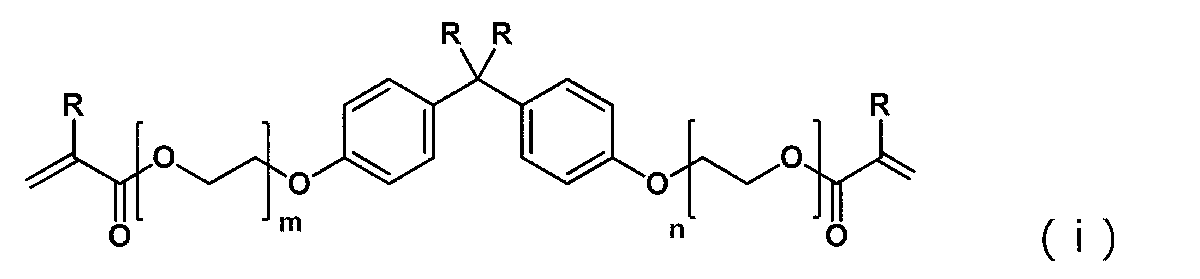



一般式(ii)で表される重合性単量体から誘導される構成単位を、10~60重量%、好ましくは20~50重量%含むことができ、
一般式(iii)で表される重合性単量体から誘導される構成単位を、2~20重量%、好ましくは5~15重量%含むことができ、
式(iv)で表される化合物から誘導される構成単位を、1重量%~20重量%、好ましくは3重量%~15重量%、さらに好ましくは5重量%~10重量%含むことができる。
なお、本実施形態の重合性組成物は、これらの重合性単量体を上記の量で含むことができる。
ポリ(メタ)アクリレートとしては、商品名として例えば、SunSensors-55モノマーが挙げられる。
フォトクロミックレンズ(基材)を構成する樹脂であるポリアリルカーボネートとポリ(メタ)アクリレートからなる混合物は、下記一般式(11)で表される、アリルオキシカルボニル基を2つ以上含むアリルカーボネート化合物(A)から誘導される構成単位(a)と、一般式(12)で表される、(メタ)アクリル基を2つ以上含む(メタ)アクリレート化合物(B)から誘導される構成単位(b)とを含んでなり、構成単位(a)および構成単位(b)の合計100重量%に対して、構成単位(a)を5重量%~30重量%、構成単位(b)を70重量%~95重量%含む。
なお、本実施形態の重合性組成物は、これらの重合性単量体を上記の量で含むことができる。

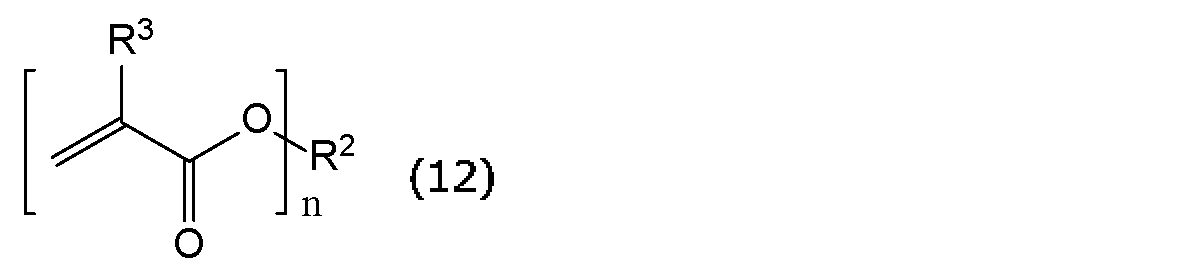
グリセロール、トリメチロールプロパンおよびトリス(ヒドロキシエチル)イソシアヌレートから選択される少なくとも1種のトリオールのトリス(アリルカーボネート)化合物、
ペンタエリスリトール、ジグリセロールおよびジトリメチロールプロパンから選択される少なくとも1種のテトラオールのテトラ(アリルカーボネート)化合物、
ジペンタエリスリトールのヘキサ(アリルカーボネート)化合物、および
前記ジオール、前記トリオール、前記テトラオールおよび前記ジペンタエリスリトールから選択される少なくとも2種類の化合物の混合ポリ(アリルカーボネート)化合物、から選択される少なくとも1種を含む。
(i) ジエチレングリコールのビス(アリルカーボネート)化合物およびそのオリゴマーとの混合物
ジエチレングリコールビス(アリルカーボネート)は、式(13)で定義することができる。


化合物(13)は、例えば「化学技術の百科辞典」、Kirk-Othmer 、III 版、第2巻、111~112頁に記載のように、ジエチレングリコールビス(クロロホルメート)をアリルアルコールと反応させることによって製造することができる。ジエチレングリコールビス(アリルカーボネート)(式(13))とそのオリゴマー(式(14))の混合物は、例えば、欧州特許第35,304号明細書に記載されているように、塩基性触媒の存在下にて操作して、ジアリルカーボネートとジエチレングリコールとのエステル交換によって簡便に製造することができる。これらの混合物は通常はオリゴマー約80重量%までを含む。
このビス(アリルカーボネート)化合物は、ジエチレングリコールをジエチレングリコールとネオペンチルグリコールとの混合物で置換したこと以外は、前記の点(i) のビス(アリルカーボネート)と同様である。
このポリ(アリルカーボネート)化合物は、例えば、米国特許第4,812,545号に記載されているように、ジエチレングリコールとトリス(ヒドロキシエチル)イソシアヌレートとの混合物のジアリルカーボネートのエステル交換によって得ることができる。
このポリ(アリルカーボネート)化合物は、トリス(ヒドロキシエチル)イソシアヌレートをトリメチロールプロパンで置換したこと以外は、前記の点(iii) のポリ(アリルカーボネート)と同様である。
このポリ(アリルカーボネート)化合物は、トリス(ヒドロキシエチル)イソシアヌレートをペンタエリスリトールで置換したこと以外は、前記の点(iii) のポリ(アリルカーボネート)化合物と同様である。
このポリ(アリルカーボネート)化合物は、ジエチレングリコールをジエチレングリコールとネオペンチルグリコールの2種のジオールで置換したこと以外は、前記の点(v) のポリ(アリルカーボネート)と同様である。
ジエチレングリコールのビス(アリルカーボネート)化合物およびそのオリゴマーとの混合物と、を含むポリ(アリルカーボネート)混合物
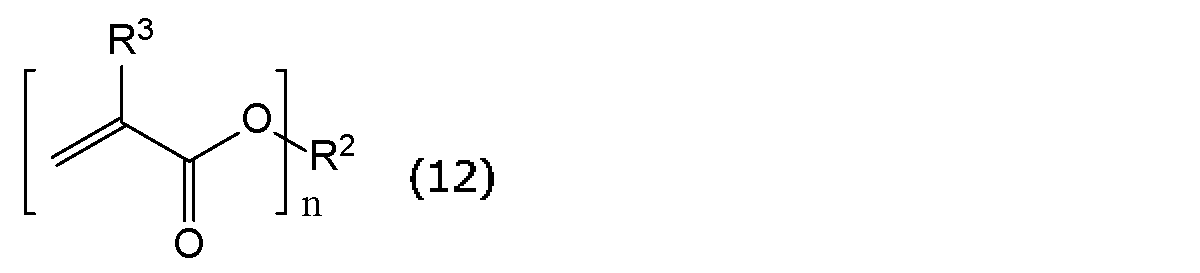
また、(メタ)アクリレート化合物(B)は、一般式(16)、一般式(17)で表される化合物を挙げることができる。
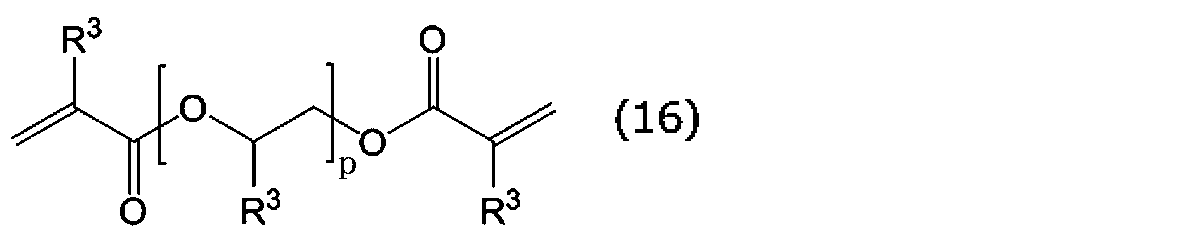

本実施形態のフォトクロミックレンズ(基材)を構成する樹脂であるポリ(チオ)ウレタンは、(a)ポリイソシアネート化合物から誘導される構成単位と、(b)数平均分子量が100以上であるポリオール化合物から誘導される構成単位と、(c)二官能以上の活性水素化合物(ただし、前記化合物(b)を除く)から誘導される構成単位とを含む。
ポリオール化合物(b)としては、数平均分子量が100以上である化合物から選択される少なくとも1種の化合物を用いることができる。
また、ポリオール化合物(b)がポリプロピレングリコールの場合、数平均分子量が400~2000であると発色性能がより改善され、樹脂成形体の白濁がより抑制される。
ポリオール化合物(b)としては、ジオール化合物とジカルボン酸からなるポリエステル化合物を挙げることができる。
ポリエステル化合物はこれらのジオール化合物の1種または2種以上と、ジカルボン酸の1種または2種以上とを適宜組み合わせて使用することができる。
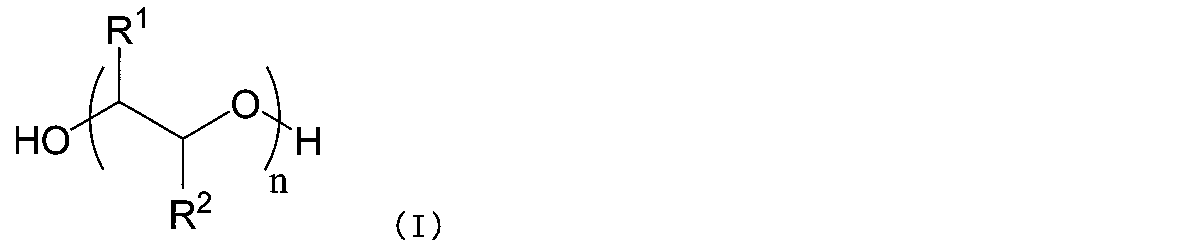
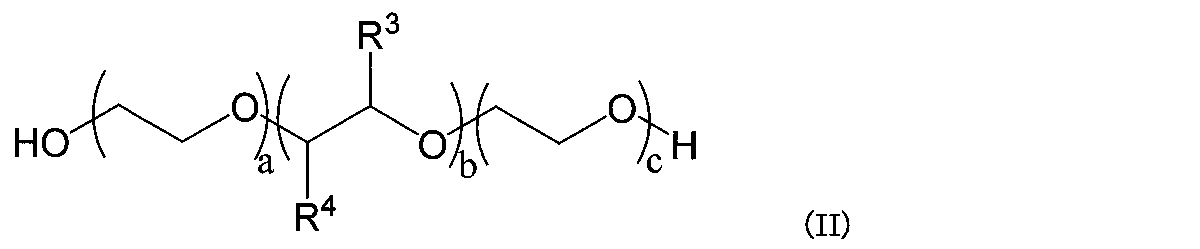
一般式(I)および一般式(II)で表される化合物の数平均分子量は、1000から15000であり、1500から7500が好ましい。
一般式(I)および一般式(II)で表される化合物としては、アデカ社製のアデカプルロニックL-44、L-62、L-64、L-72、P-84、P-85、BASF社製のプルロニックL-43、L-44、L-62、L-64、L-72、P-65、P-84、P-85、F-68、F-77が好ましく、
アデカ社製のアデカプルロニックL-62、L-64、P-84、P-85、BASF社製のプルロニックL-62、L-64、L-72、P-65、P-84、P-85、F-77がより好ましい。これら化合物は単独で用いてもよく、2種以上の混合物として用いてもよい。
上記のような化合物からなるポリオール化合物(b)を用いることにより、フォトクロミック性能を効果的に発現することができる。
エポキシ樹脂等の高分子ポリオールが挙げられる。本実施形態においては、これらから選択される少なくとも1種を組み合わせて用いることができる。
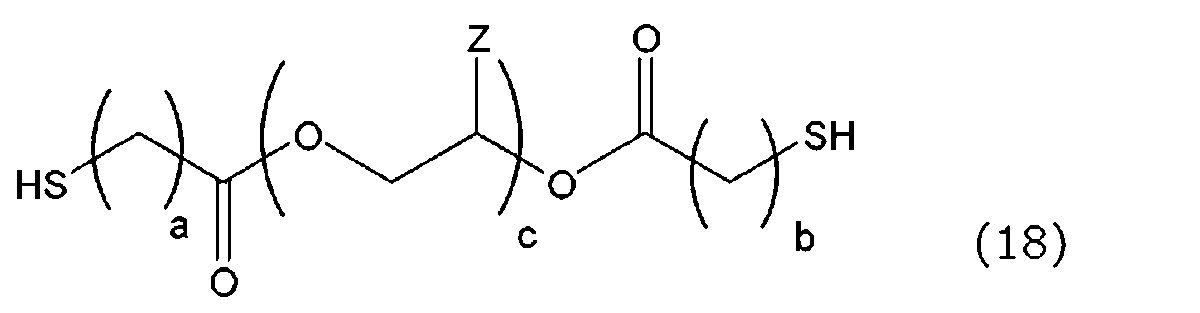
得られる成形体の機械的強度などの物性の観点から、活性水素化合物(c)として、三官能以上の活性水素化合物を用いることが好ましい。
ポリエチレングリコールと、グリセリン、ペンタエリスリトールテトラキス(2-メルカプトアセテート)、および4-メルカプトメチル-1,8-ジメルカプト-3,6-ジチアオクタンから選択される少なくとも1種との組み合わせ、
ポリプロピレングリコールと、ペンタエリスリトールテトラキス(2-メルカプトアセテート)および4-メルカプトメチル-1,8-ジメルカプト-3,6-ジチアオクタンから選択される少なくとも1種との組み合わせ、
ビスフェノールAのポリプロピレングリコール付加体と、4-メルカプトメチル-1,8-ジメルカプト-3,6-ジチアオクタンとの組み合わせ、
3-メチル-1,5-ペンタンジオール、アジピン酸、イソフタル酸から成るポリエステル化合物から選択される少なくとも1種と、4-メルカプトメチル-1,8-ジメルカプト-3,6-ジチアオクタンとの組み合わせ、
ポリプロピレングリコールのトリオール型と、5,7-ジメルカプトメチル-1,11-ジメルカプト-3,6,9-トリチアウンデカン、4,7-ジメルカプトメチル-1,11-ジメルカプト-3,6,9-トリチアウンデカン、4,8-ジメルカプトメチル-1,11-ジメルカプト-3,6,9-トリチアウンデカンを含む組成物との組み合わせ、
ポリプロピレングリコールのジオール型と、5,7-ジメルカプトメチル-1,11-ジメルカプト-3,6,9-トリチアウンデカン、4,7-ジメルカプトメチル-1,11-ジメルカプト-3,6,9-トリチアウンデカン、4,8-ジメルカプトメチル-1,11-ジメルカプト-3,6,9-トリチアウンデカンを含む組成物との組み合わせ、
ポリプロピレングリコールのジオール型と、4-メルカプトメチル-1,8-ジメルカプト-3,6-ジチアオクタンとの組み合わせ、
一般式(II)で表される化合物と、ペンタエリスリトールテトラキス(2-メルカプトアセテート)および4-メルカプトメチル-1,8-ジメルカプト-3,6-ジチアオクタンから選択される少なくとも1種との組み合わせ、
一般式(II)で表される化合物と、5,7-ジメルカプトメチル-1,11-ジメルカプト-3,6,9-トリチアウンデカン、4,7-ジメルカプトメチル-1,11-ジメルカプト-3,6,9-トリチアウンデカン、4,8-ジメルカプトメチル-1,11-ジメルカプト-3,6,9-トリチアウンデカンを含む組成物との組み合わせ、
等を挙げることができるが、これらの組み合わせに限定されるものではない。
本実施形態においては、重合触媒、紫外線吸収剤、樹脂改質剤、内部離型剤等をさらに含んでもよい。
重合触媒としては、ポリ(チオ)ウレタンの場合は、3級アミン化合物およびその無機酸塩または有機酸塩、金属化合物、4級アンモニウム塩、または有機スルホン酸等を挙げることができる。
ポリ(メタ)アクリレート、ポリアリルカーボネートの場合は、ラジカル重合開始剤としてパーオキシエステル系ラジカル重合開始剤、パーオキシケタール系ラジカル重合開始剤、パーオキシモノカーボネート系ラジカル重合開始剤又はアゾ系ラジカル重合開始剤を挙げることができる。
アゾ系ラジカル重合開始剤としては、例えば、アゾビスイソブチロニトリル、アゾビスジメチルバレロニトリル等が挙げられる。
これらは1種又は2種以上を混合して用いることができる。また、さらに必要に応じて他のラジカル重合開始剤を併用しても良い。
紫外線吸収剤の添加量は、紫外線吸収剤の種類によって吸収する紫外線領域が異なるため一概に限定はできないが、重合性組成物100重量部に対して、0.01~5重量部、好ましくは0.02~2重量部の範囲である。
本実施形態の重合性組成物は、一般式(1)で表される前記テトラアザポルフィリン化合物と、一般式(5)、一般式(a)および一般式(b)で表される前記調光色素から選択される少なくとも一種と、前記樹脂を構成する前記重合性化合物と、を含む。さらに、上記のその他の成分を含むことができる。重合性組成物はこれらの成分を、一括混合あるいは各々混合してから最終的に一つに混合して、調製することができる。
本実施形態の樹脂成形体は、注型重合時のモールドの種類を変えることにより種々の形状に形成することができる。
本実施形態の光学材料用重合性組成物から得られた成形体は、透明性を損なうことなく、優れた表面硬度、調光性能を兼ね揃えた材料を得ることができるため、プラスチックレンズ等の各種光学材料に使用することが可能である。特に、フォトクロミックレンズやプラスチック偏光レンズとして好適に用いることができる。
本実施形態の成形体からなるレンズ基材を用いたフォトクロミックレンズは必要に応じて、片面又は両面にコーティング層を施して用いてもよい。
本実施形態のフォトクロミックレンズは、上述の重合性組成物からなるレンズ基材とコーティング層とからなる。
塗布によるコーティングを行う層に関しては塗布性の改善を目的とした各種レベリング剤を使用してもよい。
ハードコート層は、レンズ表面に耐擦傷性、耐摩耗性、耐湿性、耐温水性、耐熱性、耐候性等機能を与えることを目的としたコーティング層である。
本実施形態のプラスチック偏光レンズは、偏光フィルムと、前記偏光フィルムの少なくとも一方の面に形成された、本実施形態の重合性組成物を硬化させた成形体からなる基材層と、を備える。
偏光フィルムは乾燥、安定化のため加熱処理を施したうえで使用してもよい。
さらに、偏光フィルムは、アクリル系樹脂との密着性を向上させるために、プライマーコーティング処理、薬品処理(ガス又はアルカリ等の薬液処理)、コロナ放電処理、プラズマ処理、紫外線照射処理、電子線照射処理、粗面化処理、火炎処理などから選ばれる1種又は2種以上の前処理を行った上で使用してもよい。このような前処理のなかでも、プライマーコーティング処理、薬品処理、コロナ放電処理、プラズマ処理から選ばれる1種又は2種以上が特に好ましい。
モールド内で、偏光フィルムの対物面側の面上に第1重合性組成物層を形成し、偏光フィルムの他方の面上に第2重合性組成物層を形成する工程と、
前記重合性組成物層を重合硬化して、前記偏光フィルムの両面に基材層を積層する工程と、を含むことができる。
第1重合性組成物層は、本実施形態の重合性組成物から形成される。第1重合性組成物の層と第2重合性組成物の層とが同一の樹脂組成である場合、重合工程の温度管理等が容易となることから、第2重合性組成物の層はテトラアザポルフィリン化合物および調光色素を含まない本実施形態の光学材料用重合性組成物から形成される。
そして、モールドと偏光フィルムの対物面側の面との間に第1重合性組成物を注入して第1重合性組成物の層を形成し、次いで、偏光フィルムの接眼面側の面とモールドとの間隙に、第2重合性組成物を注入し、第2重合性組成物の層を形成することができる。
重合により硬化した積層体を鋳型より離型して、本実施形態のプラスチック偏光レンズを得ることができる。
なお、得られた基材層の表面には、プラスチック眼鏡レンズと同様な前記コーティング層を形成してもよい。
・発色時の視感透過率:ウシオ電気社製の励起光源キセノンランプMS-35AAA/FB2000-Oを備えた、大塚電子製瞬間マルチ測光システムMSPD-7700を用いて、温度23℃、照度50000ルクスの条件で、2mm厚に加工した成形体サンプルに、励起光を15分間照射後、分光透過率を測定し、ISO8980-3に基づいて、発色時の視感透過率(%T)を算出した。発色時の視感透過率が25%T以下であれば、発色性能が高いと判断した。
・視認性:上記のように成形体サンプルが発色した時の550nm、575nm~600nmの間の最小透過率(585nmにおける透過率)を測定し、その差を求めた。その差が5%T以上であれば、視認性が高いと判断することができる。
また、実際に、得られたレンズを通して晴天下の屋外を観察し、樹木の小枝などの物体の輪郭が明瞭であり、且つ、緑、黄、赤のコントラストが高く、物体を明瞭に視認することができたものを「良好」、できなかったものを「不良」とした(野外テスト)。
フォトクロミック化合物:
・Reversacol Wembley Grey(ポリオキシアルキレン鎖、ナフトピラン系発色団(一般式(c)))
・Reversacol Heath Green(ポリオキシアルキレン鎖、ナフトピラン系発色団(一般式(c)))
・Reversacol Chilli Red(ポリオキシアルキレン鎖、ナフトピラン系発色団(一般式(c)))
・Reversacol Cayenne Red(ポリオキシアルキレン鎖、ナフトピラン系発色団(一般式(c)))
モノマー:
・SunSensors-55モノマー(三井化学社製):
一般式(i)のジメタクリレート44重量%、一般式(ii)のジアクリレート18重量%、一般式(ii)のジメタクリレート15重量%、一般式(iii)のメタクリレート9重量%、一般式(iv)のジビニルベンゼン4.5重量%を主成分とする重合性組成物
・SunSensors-50モノマー(三井化学社製):
一般式(11)のポリアリルカーボネート12重量%、一般式(12)の(メタ)アクリレート86重量%を主成分とする重合性組成物
製品名SunSensors-55モノマー(三井化学社製)100.0重量部に、フォトクロミック化合物として製品名Reversacol Heath Green(Vivimed社製)0.0215重量部、Reversacol Wembley Grey(Vivimed社製)0.0540重量部、テトラアザポルフィリン化合物として製品名PD-311S(三井化学社製)0.0010重量部を加えたのち、2,2'-アゾビス[2,4-ジメチルバレロニトリル]0.25重量部、1,1-ビス(t-ブチルパーオキシ)シクロヘキサン0.03重量部、を加え、混合撹拌して溶解させた。5mmHg下60分間脱気した。1μmPTFE製フィルターにてろ過を行い、ガラスモールドとテープからなるモールド型へ注入した。このモールド型をオーブンへ投入後、35℃~95℃まで23時間かけて徐々に昇温して重合した。重合終了後、オーブンからモールド型を取り出し、離型して2mm厚樹脂平板を得た。得られた樹脂平板をさらに110℃で1時間アニール化を行った。得られた評価結果は表-1に示す。さらに、得られた樹脂平板の透過率曲線を図1に示す。
フォトクロミック化合物として、製品名Reversacol Heath Green(Vivimed社製)0.0900重量部、Reversacol Chilli Red(Vivimed社製)0.0400重量部に変えた以外は、実施例1と同様に行った。得られた評価結果は表-1に示す。さらに、得られた樹脂平板の透過率曲線を図2に示す。
フォトクロミック化合物として、製品名Reversacol Heath Green(Vivimed社製)0.0900重量部、Reversacol Cayenne Red(Vivimed社製)0.0400重量部に変えた以外は、実施例1と同様に行った。得られた評価結果は表-1に示す。さらに、得られた樹脂平板の透過率曲線を図3に示す。
製品名SunSensors-50モノマー(三井化学社製)100.0重量部に、フォトクロミック化合物として製品名Reversacol Heath Green(Vivimed社製)0.0285重量部、Reversacol Wembley Grey(Vivimed社製)0.0530重量部、テトラアザポルフィリン化合物として製品名PD-311S(三井化学社製)0.0010重量部を加えたのち、t-ブチル-パーオキシネオデカノエート0.55重量部、1,1,3,3-テトラメチルブチル-2-エチルパーオキシヘキサノエート0.15重量部を加え、混合撹拌して溶解させた。5mmHg下60分間脱気した。1μmPTFE製フィルターにてろ過を行い、ガラスモールドとテープからなるモールド型へ注入した。このモールド型をオーブンへ投入後、30℃~85℃まで23時間かけて徐々に昇温して重合した。重合終了後、オーブンからモールド型を取り出し、離型して2mm厚樹脂平板を得た。得られた樹脂平板をさらに110℃で1時間アニール化を行った。得られた評価結果は表-1に示す。さらに、得られた樹脂平板の透過率曲線を図4に示す。
フォトクロミック化合物として、製品名Reversacol Heath Green(Vivimed社製)0.0900重量部、Reversacol Cayenne Red(Vivimed社製)0.0400重量部に変えた以外は、実施例4と同様に行った。得られた評価結果は表-1に示す。さらに、得られた樹脂平板の透過率曲線を図5に示す。
2,5-ビス(イソシアナトメチル)-ビシクロ[2.2.1]ヘプタンと2,6-ビス(イソシアナトメチル)-ビシクロ[2.2.1]ヘプタンの混合物49.6重量部に、テトラアザポルフィリン化合物として製品名PD-311S(三井化学社製)0.0010重量部、酸性リン酸エステルとして城北化学工業社製JP-506Hを0.30重量部、アデカ社製アデカプルロニックL-64を2.0重量部、フォトクロミック化合物としてReversacol Wembley Grey(Vivimed社製)0.0745重量部、Reversacol Heath Green(Vivimed社製)0.0610重量部、紫外線吸収剤としてHOSTAVIN PR-25を0.075重量部加え、撹拌して溶解した。この混合液にペンタエリスリトールテトラキス(3-メルカプトプロピオネート)23.4重量部、4-メルカプトメチル-1,8-ジメルカプト-3,6-ジチアオクタン25.0重量部を添加して撹拌した後、ジメチルチンジクロリド0.040重量部を加え、均一に溶解した。5mmHg下60分間脱気した。1μmPTFE製フィルターにてろ過を行い、ガラスモールドとテープからなるモールド型へ注入した。このモールド型をオーブンへ投入後、30℃~120℃まで23時間かけて徐々に昇温して重合した。重合終了後、オーブンからモールド型を取り出し、離型して2mm厚樹脂平板を得た。得られた樹脂平板をさらに120℃で1時間アニール化を行った。得られた評価結果は表-1に示す。さらに、得られた樹脂平板の透過率曲線を図6に示す。
フォトクロミック化合物として、製品名Reversacol Heath Green(Vivimed社製)0.1285重量部、Reversacol Cayenne Red(Vivimed社製)0.0855重量部に変えた以外は、実施例6と同様に行った。得られた評価結果は表-1に示す。さらに、得られた樹脂平板の透過率曲線を図7に示す。
1,3-キシリレンジイソシアネート49.7重量部に、テトラアザポルフィリン化合物として製品名PD-311S(三井化学社製)0.0010重量部、トリフェニルホスファイト0.10重量部、酸性リン酸エステルとして城北化学工業社製JP-506Hを0.30重量部、アデカ社製アデカプルロニックL-64を2.0重量部、フォトクロミック化合物としてReversacol Wembley Grey(Vivimed社製)0.0745重量部、Reversacol Heath Green(Vivimed社製)0.0610重量部、紫外線吸収剤としてHOSTAVIN PR-25を0.10重量部加え、撹拌して溶解した。この混合液に5,7-ジメルカプトメチル-1,11-ジメルカプト-3,6,9-トリチアウンデカン、4,7-ジメルカプトメチル-1,11-ジメルカプト-3,6,9-トリチアウンデカン、4,8-ジメルカプトメチル-1,11-ジメルカプト-3,6,9-トリチアウンデカンを含む組成物48.3重量部を添加して撹拌した後、ジメチルチンジクロリド0.008重量部を加え、均一に溶解した。5mmHg下60分間脱気した。1μmPTFE製フィルターにてろ過を行い、ガラスモールドとテープからなるモールド型へ注入した。このモールド型をオーブンへ投入後、30℃~120℃まで23時間かけて徐々に昇温して重合した。重合終了後、オーブンからモールド型を取り出し、離型して2mm厚樹脂平板を得た。得られた樹脂平板をさらに120℃で1時間アニール化を行った。得られた評価結果は表-1に示す。さらに、得られた樹脂平板の透過率曲線を図8に示す。
フォトクロミック化合物として、製品名Reversacol Heath Green(Vivimed社製)0.1285重量部、Reversacol Cayenne Red(Vivimed社製)0.0855重量部に変えた以外は、実施例8と同様に行った。得られた評価結果は表-1に示す。さらに、得られた樹脂平板の透過率曲線を図9に示す。
テトラアザポルフィリン化合物を無添加とした以外は、実施例1、3から9と同様に行った。得られた評価結果は表-1に示す。得られた樹脂平板の透過率曲線を図10から17に示す。
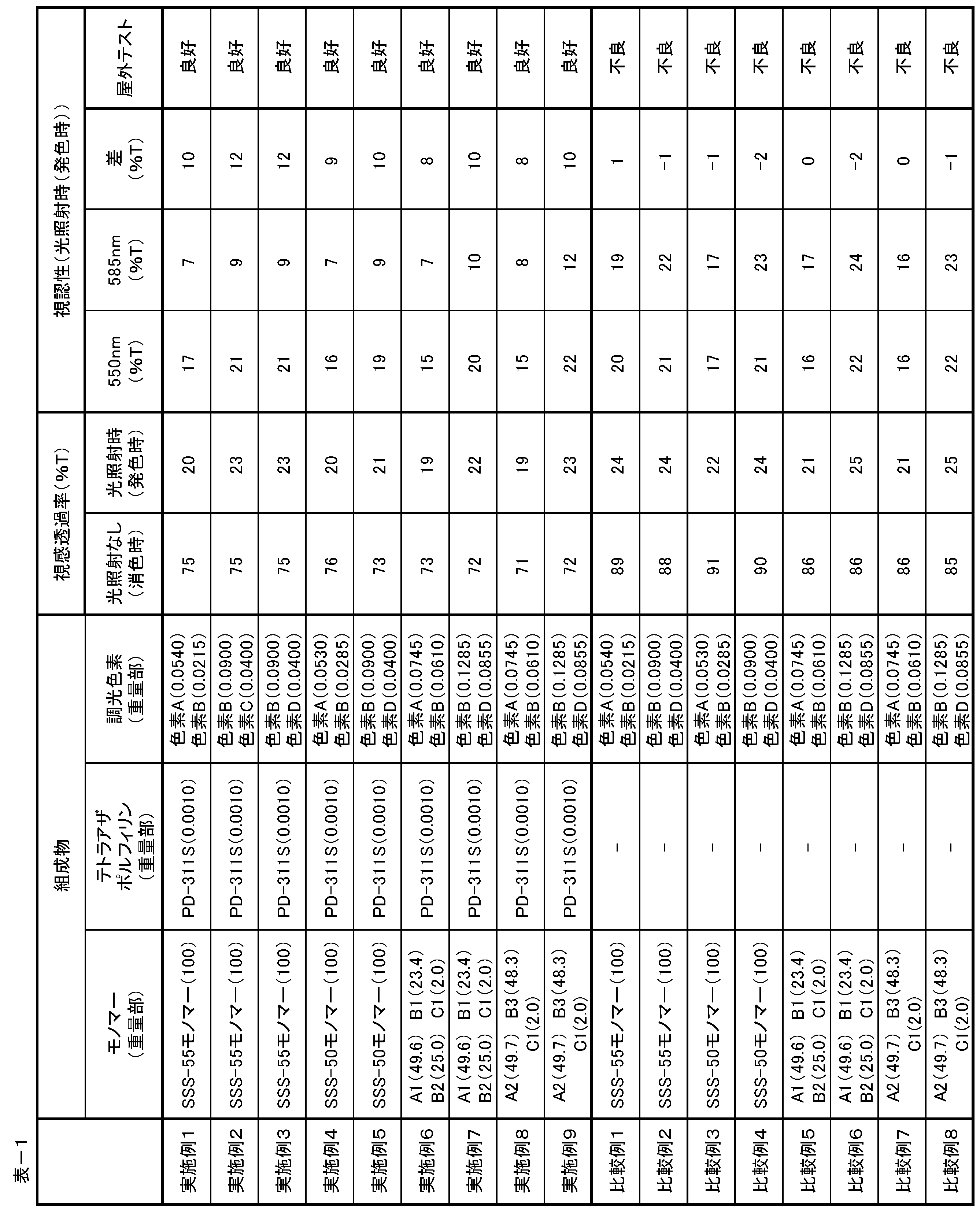
色素A:Reversacol Wembley Grey(Vivimed社製)
色素B:Reversacol Heath Green(Vivimed社製)
色素C;Reversacol Chilli Red(Vivimed社製)
色素D;Reversacol Cayenne Red(Vivimed社製)
A1:2,5-ビス(イソシアナトメチル)-ビシクロ[2.2.1]ヘプタンと2,6-ビス(イソシアナトメチル)-ビシクロ[2.2.1]ヘプタンの混合物
A2:1,3-キシリレンジイソシアネート
B1:ペンタエリスリトールテトラキス(3-メルカプトプロピオネート)
B2:4-メルカプトメチル-1,8-ジメルカプト-3,6-ジチアオクタン
B3:5,7-ジメルカプトメチル-1,11-ジメルカプト-3,6,9-トリチアウンデカン、4,7-ジメルカプトメチル-1,11-ジメルカプト-3,6,9-トリチアウンデカン、4,8-ジメルカプトメチル-1,11-ジメルカプト-3,6,9-トリチアウンデカンを含む組成物
C1:アデカ社製アデカプルロニックL-64
Claims (30)
- キセノンランプを用いて、照度50000ルクスで15分間照射後の23℃における透過率が、以下の条件を満たす、フォトクロミックレンズ。
(1)550nmでの透過率が25%以下である。
(2)550nmでの透過率aは575nm~600nmの間の最小透過率bよりも大きく、透過率aと透過率bとの差が5%以上である。
(3)550nm~600nmまでの透過率曲線において変曲点を1点以上有する。 - 消色時における視感透過率が70%以上である、請求項1記載のフォトクロミックレンズ。
- 下記一般式(1)で表されるテトラアザポルフィリン化合物を含んでなる、請求項1または2記載のフォトクロミックレンズ。

- 前記テトラアザポルフィリン化合物において、Mが銅原子、ニッケル原子、またはコバルト原子である、請求項3に記載のフォトクロミックレンズ。
- 前記テトラアザポルフィリン化合物が、下記一般式(1a)で表される、請求項3または4に記載のフォトクロミックレンズ。
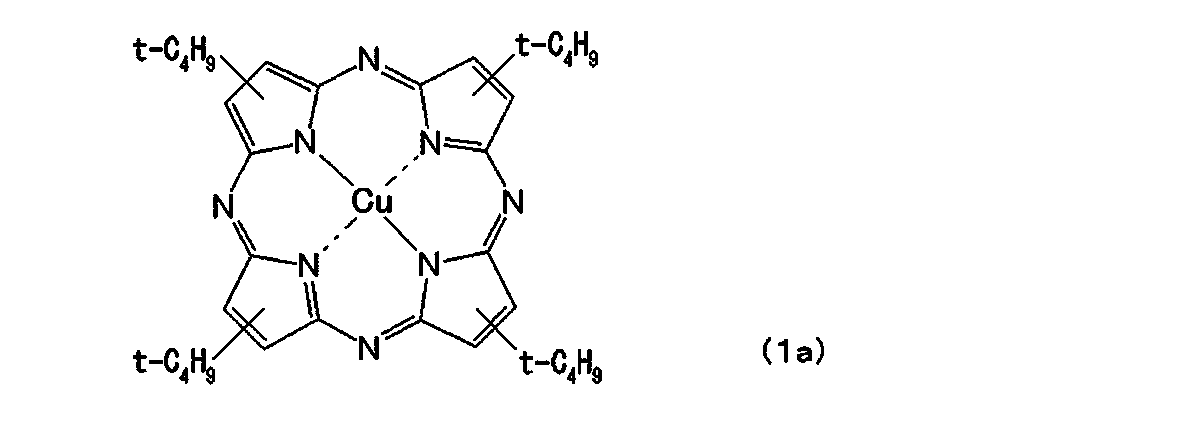
- 下記一般式(5)で表される調光色素を含む、請求項1~5のいずれかに記載のフォトクロミックレンズ。
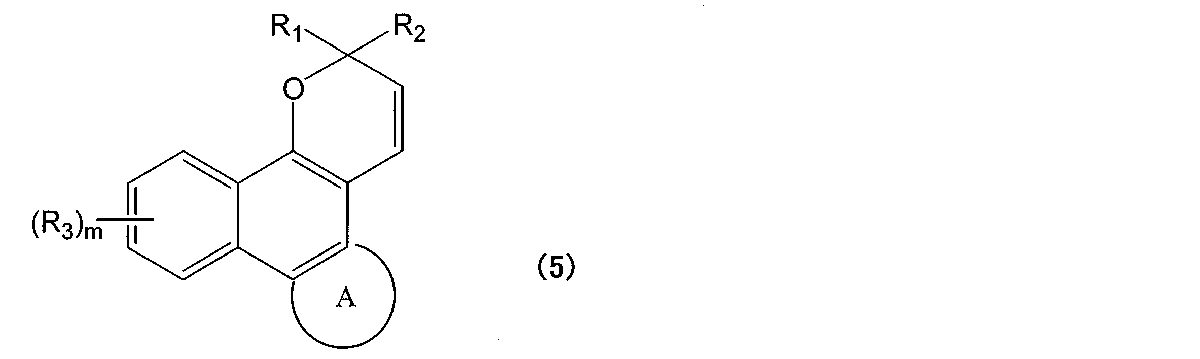
炭素数1~12の直鎖または分岐アルキル基;
炭素数3~12のシクロアルキル基;
置換または無置換である、炭素数6~24のアリール基または炭素数4~24のヘテロアリール基(置換基として、ハロゲン原子、水酸基、炭素数1~12の直鎖または分枝のアルキル基、炭素数1~12の直鎖または分枝のアルコキシ基、少なくとも1つのハロゲン原子で置換された炭素数1~12の直鎖または分枝のハロアルキル基、少なくとも1つのハロゲン原子で置換された炭素数1~12の直鎖または分枝のハロアルコキシ基、少なくとも一つの炭素数1~12の直鎖または分枝のアルキル基またはアルコキシ基により置換されたフェノキシ基またはナフトキシ基、炭素数2~12の直鎖または分枝のアルケニル基、-NH2基、-NHR基、-N(R)2基(Rが炭素数1~6の直鎖または分枝のアルキル基である。Rが2つ存在する場合、2つのRは同一でも異なっていてもよい。)、およびメタクリロイル基またはアクリロイル基から選択される少なくとも1つの置換基を有する。);
アラルキルまたはヘテロアラルキル基(炭素数1~4の直鎖または分岐アルキル基が前記のアリール基またはヘテロアリール基で置換されている。)
を表し、
R3は同一でも異なっていてもよく、独立して、ハロゲン原子;
炭素数1~12の直鎖または分岐アルキル基;
炭素数3~12のシクロアルキル基;
炭素数1~12の直鎖または分岐アルコキシ基;
少なくとも1つのハロゲン原子で置換された炭素数1~12の直鎖または分枝のハロアルキル基、少なくとも1つのハロゲン原子で置換された炭素数3~12のハロシクロアルキル基、少なくとも1つのハロゲン原子で置換された炭素数1~12の直鎖または分岐ハロアルコキシ基;
置換または無置換である、炭素数6~24のアリール基または炭素数4~24のヘテロアリール基(置換基として、ハロゲン原子、水酸基、炭素数1~12の直鎖または分枝のアルキル基、炭素数1~12の直鎖または分枝のアルコキシ基、少なくとも1つのハロゲン原子で置換された炭素数1~12の直鎖または分枝のハロアルキル基、少なくとも1つのハロゲン原子で置換された炭素数1~12の直鎖または分枝のハロアルコキシ基、少なくとも一つの炭素数1~12の直鎖または分枝のアルキル基またはアルコキシ基により置換されたフェノキシ基またはナフトキシ基、炭素数2~12の直鎖または分枝のアルケニル基、およびアミノ基、から選択される少なくとも1つの置換基を有する。);
アラルキルまたはヘテロアラルキル基(炭素数1~4の直鎖または分岐アルキル基が前記のアリール基またはヘテロアリール基で置換されている。);
置換または無置換のフェノキシまたはナフトキシ基(置換基として、炭素数1~6の直鎖または分岐アルキル基またはアルコキシ基から選択される少なくとも1つの置換基を有する。);
-NH2、-NHR、-CONH2、または-CONHR
(Rが、炭素数1~6の直鎖または分枝のアルキル基である。);
-OCOR8または-COOR8(ここで、R8が、炭素数1~6の直鎖または分枝のアルキル基、または炭素数3~6のシクロアルキル基、またはR1、R2において、置換アリールまたは置換ヘテロアリール基の置換基の少なくとも1つにより置換されているフェニル基または無置換のフェニル基である。);
を表し、
mが0~4までの整数であり;
Aが、下記式(A2)または式(A4)
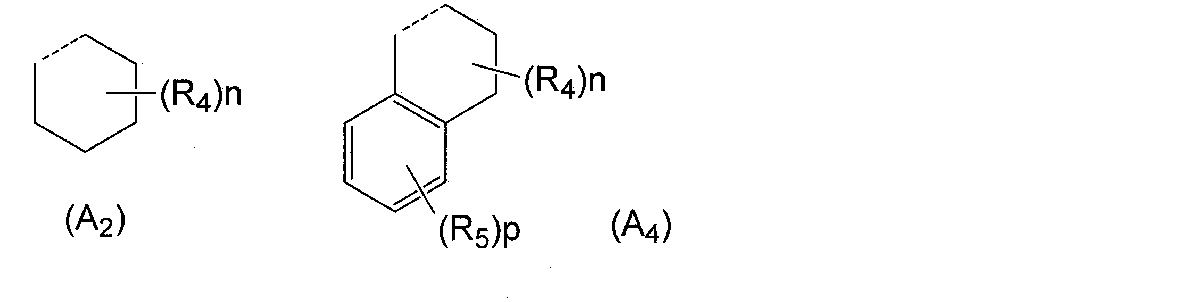
点線が、一般式(5)のナフトピラン環の炭素C5炭素C6結合を表し;
アネル化環(A4)のα結合が、一般式(5)のナフトピラン環の炭素C5または炭素C6に結合されることができ;
R4が、同じかまたは異なり、独立して、OH、炭素数1~6の直鎖または分枝のアルキル基またはアルコキシ基を表し、もしくは2つのR4がカルボニル(CO)を形成し;
R5が、ハロゲン;
炭素数1~12の直鎖または分枝のアルキル基;
少なくとも1つのハロゲン原子により置換された、炭素数1~6の直鎖または分枝のハロアルキル基;
炭素数3~12のシクロアルキル基;
炭素数1~6の直鎖または分枝のアルコキシ基;
置換または無置換のフェニルまたはベンジル基(置換基として、一般式(5)のR1、R2基が独立してアリールまたはヘテロアリール基に対応する場合、R1、R2基の定義において上述した置換基の少なくとも1つを有する。);
-NH2、-NHR
(ここで、Rが、炭素数1~6の直鎖または分枝のアルキル基である。);
置換または無置換であるフェノキシまたはナフトキシ基(置換基として、少なくとも炭素数1~6の直鎖または分枝のアルキル基またはアルコキシ基を有する。);
-COR9、-COOR9または-CONHR9基(ここで、R9が、炭素数1~6の直鎖または分枝のアルキル基、または炭素数3~6のシクロアルキル基、または置換または無置換のフェニルまたはベンジル基(置換基として、一般式(5)のR1、R2基が独立してアリールまたはヘテロアリール基に対応する場合、R1、R2基の定義において上述した置換基の少なくとも1つを有する。));
Aが(A4)を示す場合、nが0~2までの整数であり、pが0~4までの整数であり、Aが(A2)を示す場合、nが0~2までの整数である。) - 下記一般式(a)または下記一般式(b)で表される調光色素を含む、請求項1~5のいずれかに記載のフォトクロミックレンズ。
PC-L-Chain (a)
PC-L-Chain-L'-PC' (b)
(PCとPC'は一般式(c)~(f)のいずれかを示す。PCとPC'は同一でも異なっていても良い。)
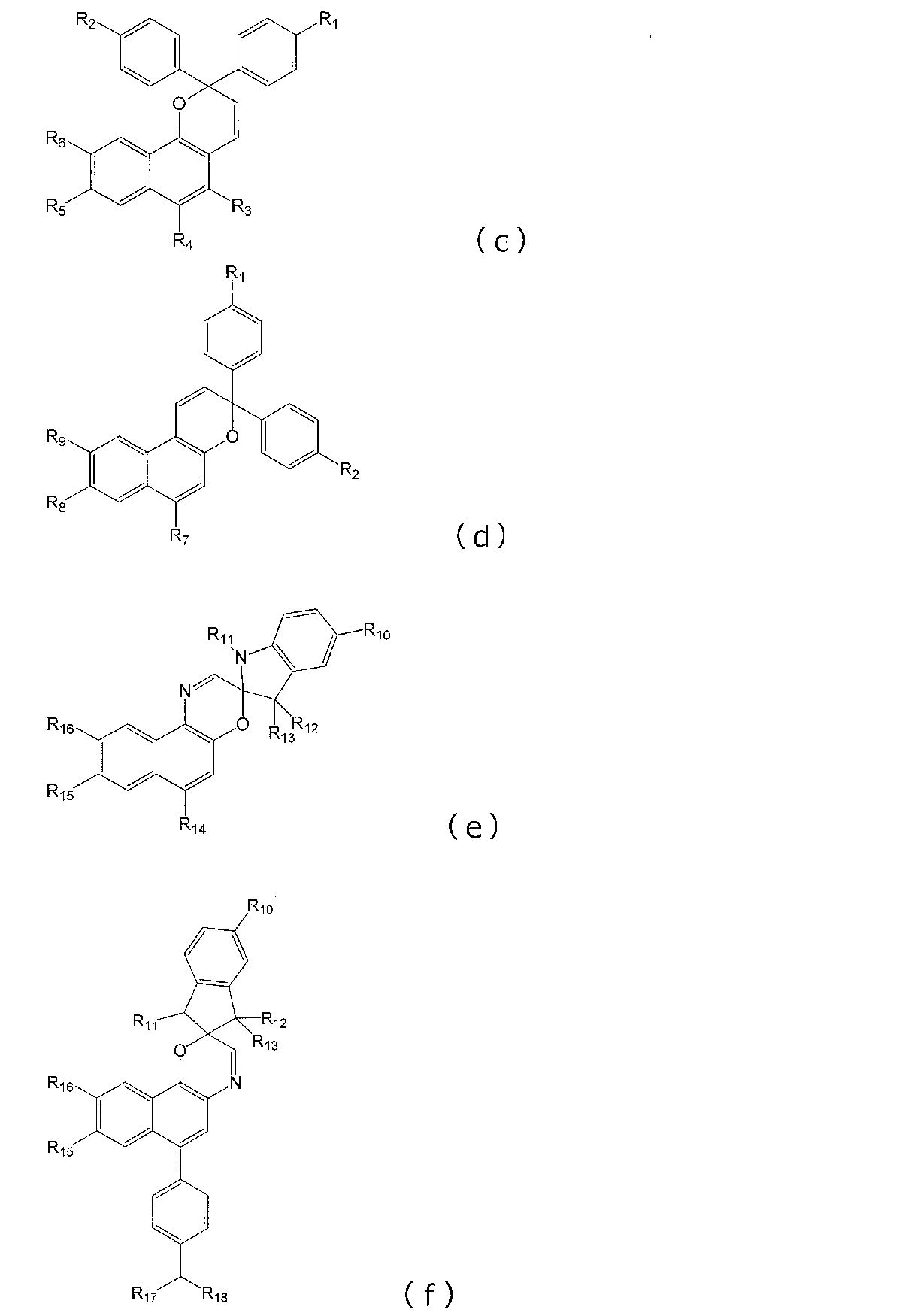
- ポリ(メタ)アクリレート、ポリアリルカーボネート、およびポリ(チオ)ウレタンから選択される少なくとも一種を含む、請求項1~7のいずれかに記載のフォトクロミックレンズ。
- 前記ポリ(メタ)アクリレートは、下記一般式(i)、一般式(ii)、一般式(iii)および式(iv)で表される化合物から選択される少なくとも2種から誘導される構成単位を含む、請求項8に記載のフォトクロミックレンズ。
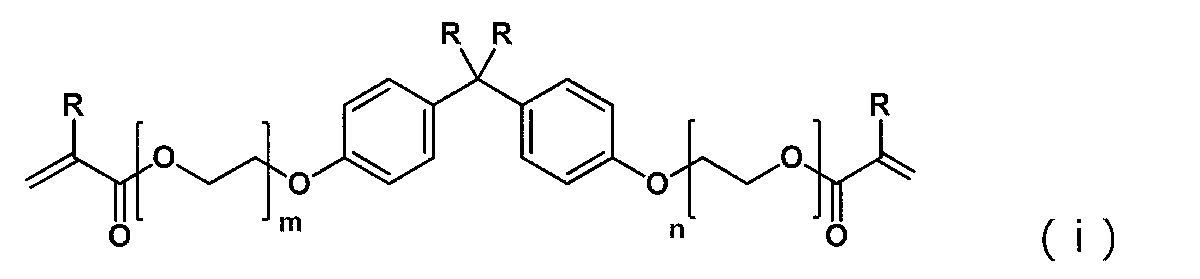



- フォトクロミックレンズは前記ポリアリルカーボネートと前記ポリ(メタ)アクリレートからなる混合物を含み、当該混合物は、一般式(11)で表される、アリルオキシカルボニル基を2つ以上含むアリルカーボネート化合物(A)から誘導される構成単位(a)と、一般式(12)で表される、(メタ)アクリル基を2つ以上含む(メタ)アクリレート化合物(B)から誘導される構成単位(b)とを含んでなり、
構成単位(a)および構成単位(b)の合計100重量%に対して、構成単位(a)を5重量%~30重量%、構成単位(b)を70重量%~95重量%含む、
請求項8に記載のフォトクロミックレンズ。

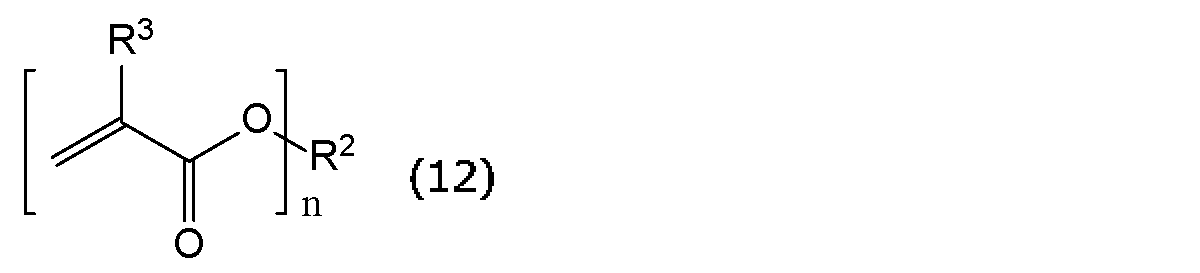
- 化合物(A)が、ジエチレングリコール、ジプロピレングリコール、トリエチレングリコール、テトラエチレングリコール、1,3-プロパンジオール、1,4-ブタンジオール、1,5-ペンタンジオール、1,6-ヘキサンジオール、ネオペンチルグリコール、3-メチル-1,5-ペンタンジオール、2-メチル-2-エチル-1,3-プロパンジオール、2,2-ジエチル-1,3-プロパンジオール、2,2,4-トリメチル-1,3-ペンタンジオール、1,4-ジメチロールシクロヘキサンおよび4,8-ビス(ヒドロキシメチル)-[5.2.1.02,6]トリシクロデカンから選択される少なくとも1種のジオールのビス(アリルカーボネート)化合物、
グリセロール、トリメチロールプロパンおよびトリス(ヒドロキシエチル)イソシアヌレートから選択される少なくとも1種のトリオールのトリス(アリルカーボネート)化合物、
ペンタエリスリトール、ジグリセロールおよびジトリメチロールプロパンから選択される少なくとも1種のテトラオールのテトラ(アリルカーボネート)化合物、
ジペンタエリスリトールのヘキサ(アリルカーボネート)化合物、および
前記ジオール、前記トリオール、前記テトラオールおよび前記ジペンタエリスリトールから選択される少なくとも2種類の化合物の混合ポリ(アリルカーボネート)化合物、から選択される少なくとも一種である、請求項10に記載のフォトクロミックレンズ。 - 化合物(A)が、
(i)ジエチレングリコールのビス(アリルカーボネート)化合物およびそのオリゴマーとの混合物、
(ii) ジエチレングリコールとネオペンチルグリコールの混合物のビス(アリルカーボネート)化合物およびそのオリゴマーとの混合物、
(iii) ジエチレングリコールとトリス(ヒドロキシエチル)イソシアヌレートの混合物のポリ(アリルカーボネート)化合物およびそのオリゴマーとの混合物、
(iv) ジエチレングリコールとトリメチロールプロパンの混合物のポリ(アリルカーボネート)化合物およびそのオリゴマーとの混合物、
(v) ジエチレングリコールとペンタエリスリトールの混合物のポリ(アリルカーボネート)化合物およびそのオリゴマーとの混合物、
(vi) ジエチレングリコールとネオペンチルグリコールとペンタエリスリトールの混合物のポリ(アリルカーボネート)化合物およびそのオリゴマーとの混合物、および
(vii) ジエチレングリコールとネオペンチルグリコールとペンタエリスリトールの混合物のポリ(アリルカーボネート)化合物およびそのオリゴマーとの混合物と、
ジエチレングリコールのビス(アリルカーボネート)化合物およびそのオリゴマーとの混合物と、を含むポリ(アリルカーボネート)混合物、から選択される少なくとも一種である、請求項10または11に記載のフォトクロミックレンズ。 - 化合物(B)が、一般式(16)、一般式(17)で表される化合物から選択される少なくとも一種である、請求項10~12のいずれかに記載のフォトクロミックレンズ。


- 化合物(B)が、一般式(16)において、pが2~4で表される化合物から選択される、請求項13に記載のフォトクロミックレンズ。
- 化合物(B)が、ジエチレングリコールジメタクリレート、トリエチレングリコールジメタクリレート、ジエチレングリコールジアクリレート、およびトリエチレングリコールジアクリレートから選択される少なくとも一種である、請求項14に記載のフォトクロミックレンズ。
- 前記ポリ(チオ)ウレタンは、(a)ポリイソシアネート化合物から誘導される構成単位と、(b)数平均分子量が100以上であるポリオール化合物から誘導される構成単位と、(c)二官能以上の活性水素化合物(ただし、前記化合物(b)を除く)から誘導される構成単位とを含む、請求項8に記載のフォトクロミックレンズ。
- ポリイソシアネート化合物(a)が、ヘキサメチレンジイソシアネート、ペンタメチレンジイソシアネート、キシリレンジイソシアネート、イソホロンジイソシアネート、ビス(イソシアナトメチル)シクロヘキサン、ジシクロヘキシルメタンジイソシアネート、2,5-ビス(イソシアナトメチル)ビシクロ-[2.2.1]-ヘプタン、2,6-ビス(イソシアナトメチル)ビシクロ-[2.2.1]-ヘプタン、トリレンジイソシアネート、フェニレンジイソシアネート、およびジフェニルメタンジイソシアネートよりなる群から選択される少なくとも1種である、請求項16に記載のフォトクロミックレンズ。
- ポリオール化合物(b)が、ポリエチレングリコールまたはポリプロピレングリコールのジオール型またはトリオール型である、請求項16または17に記載のフォトクロミックレンズ。
- ポリオール化合物(b)の数平均分子量が200~4000である、請求項18に記載のフォトクロミックレンズ。
- ポリオール化合物(b)の数平均分子量が400~2000である、請求項18に記載のフォトクロミックレンズ。
- ポリオール化合物(b)の数平均分子量が600~1500である、請求項18に記載のフォトクロミックレンズ。
- 活性水素化合物(c)が、ポリオール化合物、ポリチオール化合物および水酸基を有するチオール化合物よりなる群から選択される少なくとも1種である、請求項16~21のいずれかに記載のフォトクロミックレンズ。
- 活性水素化合物(c)が三官能以上の活性水素化合物である、請求項16~22のいずれかに記載のフォトクロミックレンズ。
- 活性水素化合物(c)が、グリセリン、ペンタエリスリトールテトラキス(2-メルカプトアセテート)、ペンタエリスリトールテトラキス(3-メルカプトプロピオネート)、4-メルカプトメチル-1,8-ジメルカプト-3,6-ジチアオクタン、5,7-ジメルカプトメチル-1,11-ジメルカプト-3,6,9-トリチアウンデカン、4,7-ジメルカプトメチル-1,11-ジメルカプト-3,6,9-トリチアウンデカン、4,8-ジメルカプトメチル-1,11-ジメルカプト-3,6,9-トリチアウンデカン、1,1,3,3-テトラキス(メルカプトメチルチオ)プロパン、およびトリメチロールプロパントリス(3-メルカプトプロピオネート)よりなる群から選択される少なくとも1種である、請求項16~23のいずれかに記載のフォトクロミックレンズ。
- 下記一般式(1)で表されるテトラアザポルフィリン化合物と、
下記一般式(5)、一般式(a)および一般式(b)で表される調光色素から選択される少なくとも一種と、
重合性化合物と、を含む重合性組成物。
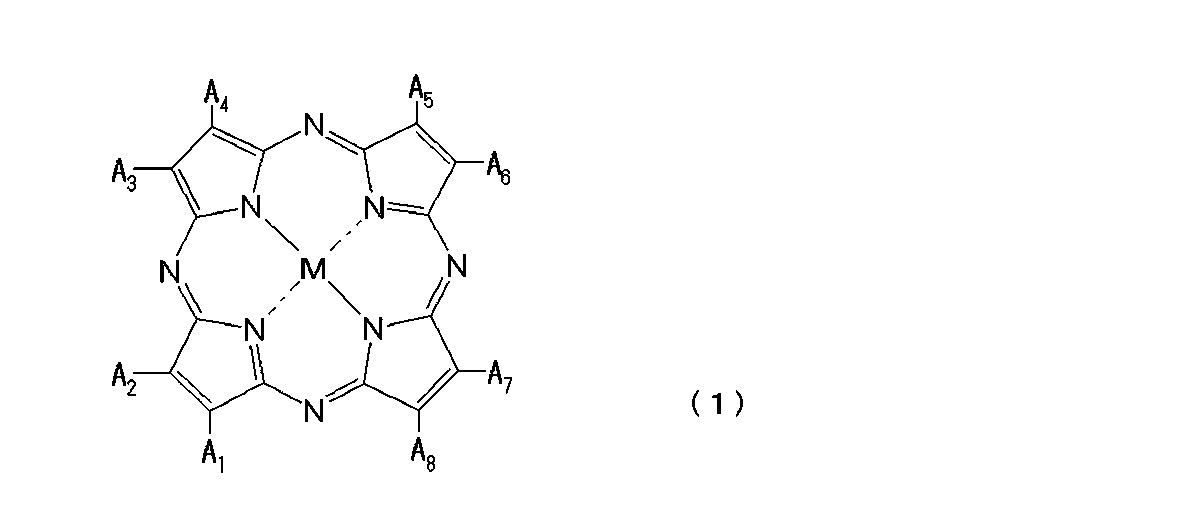
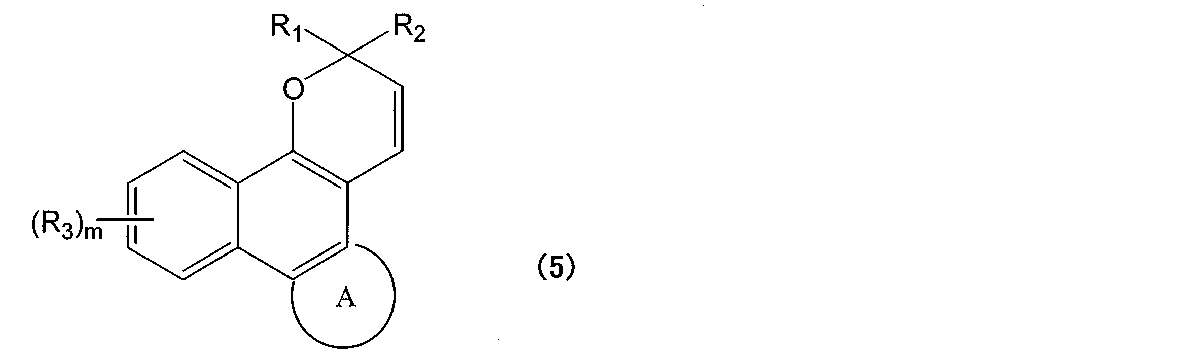
炭素数1~12の直鎖または分岐アルキル基;
炭素数3~12のシクロアルキル基;
置換または無置換である、炭素数6~24のアリール基または炭素数4~24のヘテロアリール基(置換基として、ハロゲン原子、水酸基、炭素数1~12の直鎖または分枝のアルキル基、炭素数1~12の直鎖または分枝のアルコキシ基、少なくとも1つのハロゲン原子で置換された炭素数1~12の直鎖または分枝のハロアルキル基、少なくとも1つのハロゲン原子で置換された炭素数1~12の直鎖または分枝のハロアルコキシ基、少なくとも一つの炭素数1~12の直鎖または分枝のアルキル基またはアルコキシ基により置換されたフェノキシ基またはナフトキシ基、炭素数2~12の直鎖または分枝のアルケニル基、-NH2基、-NHR基、-N(R)2基(Rが炭素数1~6の直鎖または分枝のアルキル基である。Rが2つ存在する場合、2つのRは同一でも異なっていてもよい。)、およびメタクリロイル基またはアクリロイル基から選択される少なくとも1つの置換基を有する。);
アラルキルまたはヘテロアラルキル基(炭素数1~4の直鎖または分岐アルキル基が前記のアリール基またはヘテロアリール基で置換されている。)
を表し、
R3は同一でも異なっていてもよく、独立して、ハロゲン原子;
炭素数1~12の直鎖または分岐アルキル基;
炭素数3~12のシクロアルキル基;
炭素数1~12の直鎖または分岐アルコキシ基;
少なくとも1つのハロゲン原子で置換された炭素数1~12の直鎖または分枝のハロアルキル基、少なくとも1つのハロゲン原子で置換された炭素数3~12のハロシクロアルキル基、少なくとも1つのハロゲン原子で置換された炭素数1~12の直鎖または分岐ハロアルコキシ基;
置換または無置換である、炭素数6~24のアリール基または炭素数4~24のヘテロアリール基(置換基として、ハロゲン原子、水酸基、炭素数1~12の直鎖または分枝のアルキル基、炭素数1~12の直鎖または分枝のアルコキシ基、少なくとも1つのハロゲン原子で置換された炭素数1~12の直鎖または分枝のハロアルキル基、少なくとも1つのハロゲン原子で置換された炭素数1~12の直鎖または分枝のハロアルコキシ基、少なくとも一つの炭素数1~12の直鎖または分枝のアルキル基またはアルコキシ基により置換されたフェノキシ基またはナフトキシ基、炭素数2~12の直鎖または分枝のアルケニル基、およびアミノ基、から選択される少なくとも1つの置換基を有する。);
アラルキルまたはヘテロアラルキル基(炭素数1~4の直鎖または分岐アルキル基が前記のアリール基またはヘテロアリール基で置換されている。);
置換または無置換のフェノキシまたはナフトキシ基(置換基として、炭素数1~6の直鎖または分岐アルキル基またはアルコキシ基から選択される少なくとも1つの置換基を有する。);
-NH2、-NHR、-CONH2、または-CONHR
(Rが、炭素数1~6の直鎖または分枝のアルキル基である。);
-OCOR8または-COOR8(ここで、R8が、炭素数1~6の直鎖または分枝のアルキル基、または炭素数3~6のシクロアルキル基、またはR1、R2において、置換アリールまたは置換ヘテロアリール基の置換基の少なくとも1つにより置換されているフェニル基または無置換のフェニル基である。);
を表し、
mが0~4までの整数であり;
Aが、下記式(A2)または式(A4)
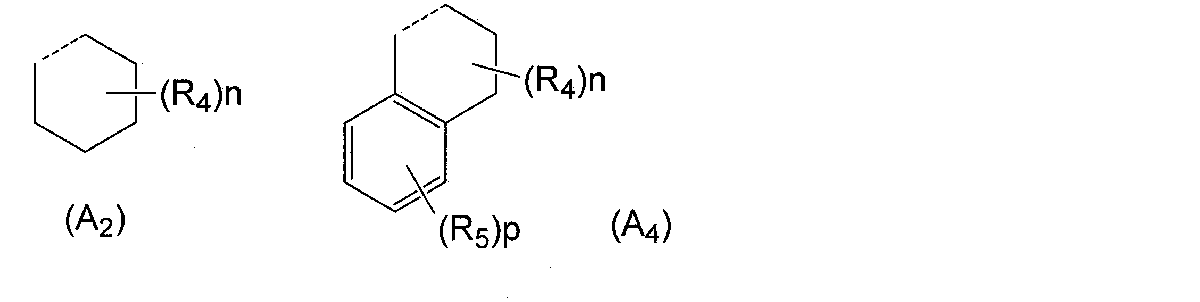
点線が、一般式(5)のナフトピラン環の炭素C5炭素C6結合を表し;
アネル化環(A4)のα結合が、一般式(5)のナフトピラン環の炭素C5または炭素C6に結合されることができ;
R4が、同じかまたは異なり、独立して、OH、炭素数1~6の直鎖または分枝のアルキル基またはアルコキシ基を表し、もしくは2つのR4がカルボニル(CO)を形成し;
R5が、ハロゲン;
炭素数1~12の直鎖または分枝のアルキル基;
少なくとも1つのハロゲン原子により置換された、炭素数1~6の直鎖または分枝のハロアルキル基;
炭素数3~12のシクロアルキル基;
炭素数1~6の直鎖または分枝のアルコキシ基;
置換または無置換のフェニルまたはベンジル基(置換基として、一般式(5)のR1、R2基が独立してアリールまたはヘテロアリール基に対応する場合、R1、R2基の定義において上述した置換基の少なくとも1つを有する。);
-NH2、-NHR
(ここで、Rが、炭素数1~6の直鎖または分枝のアルキル基である。);
置換または無置換であるフェノキシまたはナフトキシ基(置換基として、少なくとも炭素数1~6の直鎖または分枝のアルキル基またはアルコキシ基を有する。);
-COR9、-COOR9または-CONHR9基(ここで、R9が、炭素数1~6の直鎖または分枝のアルキル基、または炭素数3~6のシクロアルキル基、または置換または無置換のフェニルまたはベンジル基(置換基として、一般式(5)のR1、R2基が独立してアリールまたはヘテロアリール基に対応する場合、R1、R2基の定義において上述した置換基の少なくとも1つを有する。));
Aが(A4)を示す場合、nが0~2までの整数であり、pが0~4までの整数であり、Aが(A2)を示す場合、nが0~2までの整数である。)
PC-L-Chain (a)
PC-L-Chain-L'-PC' (b)
(PCとPC'は一般式(c)~(f)のいずれかを示す。PCとPC'は同一でも異なっていても良い。)
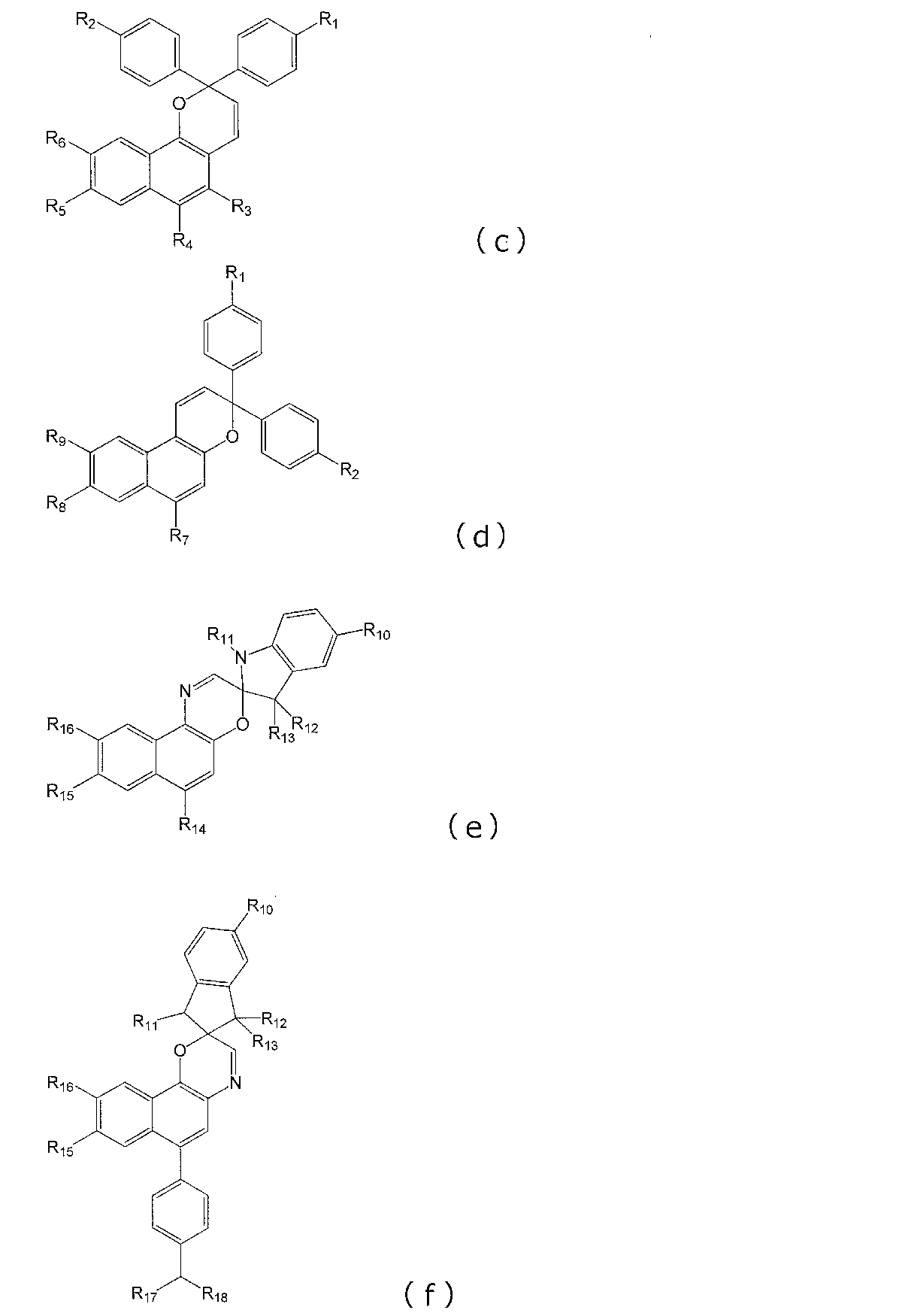
- 前記重合性化合物は、下記一般式(i)、一般式(ii)、一般式(iii)および式(iv)で表される化合物から選択される少なくとも2種を含む、請求項25に記載の重合性組成物。
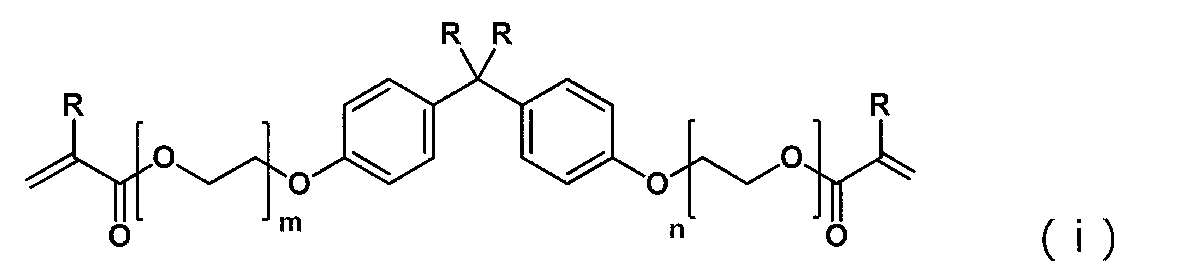



- 前記重合性化合物は、下記一般式(11)で表される、アリルオキシカルボニル基を2つ以上含むアリルカーボネート化合物(A)、および下記一般式(12)で表される、(メタ)アクリル基を2つ以上含む(メタ)アクリレート化合物(B)を含み、
化合物(A)および化合物(B)の合計100重量%において、化合物(A)を5重量%~30重量%、化合物(B)を70重量%~95重量%の量で含む、請求項25に記載の重合性組成物。

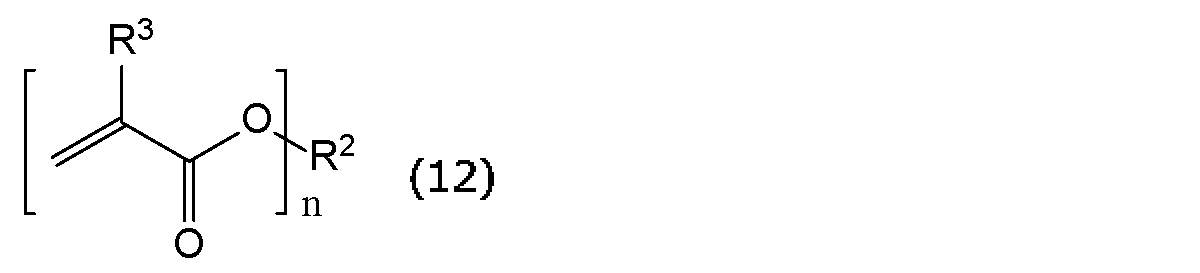
- 前記重合性化合物は、(a)ポリイソシアネート化合物と、(b)数平均分子量が100以上であるポリオール化合物と、(c)二官能以上の活性水素化合物(ただし、前記化合物(b)を除く)を含む、請求項25に記載の重合性組成物。
- 請求項25~28のいずれかに記載の重合性組成物を硬化したフォトクロミックレンズ。
- 偏光フィルムと、
前記偏光フィルムの少なくとも対物面側の面上に形成された、請求項25~28のいずれかに記載の重合性組成物からなる基材層と、を備えるプラスチック偏光レンズ。
Priority Applications (5)
| Application Number | Priority Date | Filing Date | Title |
|---|---|---|---|
| JP2017566154A JP6307209B1 (ja) | 2016-09-30 | 2017-09-28 | フォトクロミックレンズおよび重合性組成物 |
| CN201780056496.6A CN109716216B (zh) | 2016-09-30 | 2017-09-28 | 光致变色透镜及聚合性组合物 |
| KR1020197007428A KR102323294B1 (ko) | 2016-09-30 | 2017-09-28 | 포토크로믹 렌즈 및 중합성 조성물 |
| EP17856334.2A EP3521907B1 (en) | 2016-09-30 | 2017-09-28 | Photochromic lens and polymerizable composition |
| US16/333,867 US20190211258A1 (en) | 2016-09-30 | 2017-09-28 | Photochromic lens and polymerizable composition |
Applications Claiming Priority (4)
| Application Number | Priority Date | Filing Date | Title |
|---|---|---|---|
| JP2016-194499 | 2016-09-30 | ||
| JP2016194499 | 2016-09-30 | ||
| JP2017-157506 | 2017-08-17 | ||
| JP2017157506 | 2017-08-17 |
Publications (1)
| Publication Number | Publication Date |
|---|---|
| WO2018062385A1 true WO2018062385A1 (ja) | 2018-04-05 |
Family
ID=61759816
Family Applications (1)
| Application Number | Title | Priority Date | Filing Date |
|---|---|---|---|
| PCT/JP2017/035210 Ceased WO2018062385A1 (ja) | 2016-09-30 | 2017-09-28 | フォトクロミックレンズおよび重合性組成物 |
Country Status (6)
| Country | Link |
|---|---|
| US (1) | US20190211258A1 (ja) |
| EP (1) | EP3521907B1 (ja) |
| JP (1) | JP6307209B1 (ja) |
| KR (1) | KR102323294B1 (ja) |
| CN (1) | CN109716216B (ja) |
| WO (1) | WO2018062385A1 (ja) |
Cited By (2)
| Publication number | Priority date | Publication date | Assignee | Title |
|---|---|---|---|---|
| WO2021024962A1 (ja) * | 2019-08-06 | 2021-02-11 | 三井化学株式会社 | 光学材料 |
| JPWO2022224771A1 (ja) * | 2021-04-21 | 2022-10-27 |
Families Citing this family (8)
| Publication number | Priority date | Publication date | Assignee | Title |
|---|---|---|---|---|
| KR102303085B1 (ko) * | 2016-10-11 | 2021-09-15 | 미쯔이가가꾸가부시끼가이샤 | 광학 재료용 중합성 조성물 및 그의 용도 |
| JP7291620B2 (ja) * | 2019-12-27 | 2023-06-15 | 大日本印刷株式会社 | テトラアザポルフィリン化合物、インキ組成物、フィルム、光学材料、光学フィルム、ディスプレイ表面フィルム、及び表示装置 |
| US20210284778A1 (en) * | 2020-03-11 | 2021-09-16 | Alcon Inc. | Photochromic polydiorganosiloxane vinylic crosslinkers |
| JP2023161056A (ja) * | 2020-08-31 | 2023-11-06 | 三井化学株式会社 | 光学材料用重合性組成物およびフォトクロミックレンズ |
| CN116648657A (zh) * | 2020-12-09 | 2023-08-25 | 依视路国际公司 | 特别是用于太阳镜的眼科制品 |
| CN117178209A (zh) * | 2021-04-21 | 2023-12-05 | 株式会社德山 | 光学物品、眼镜透镜和眼镜 |
| WO2023068316A1 (ja) * | 2021-10-20 | 2023-04-27 | 興和株式会社 | コントラスト改善機能を有するソフトコンタクトレンズ用材料 |
| WO2026063915A1 (en) * | 2024-09-17 | 2026-03-26 | Carl Zeiss Vision International Gmbh | Curable composition for anti-glare lenses with high refractive index |
Citations (16)
| Publication number | Priority date | Publication date | Assignee | Title |
|---|---|---|---|---|
| US4812545A (en) | 1985-05-15 | 1989-03-14 | Enichem Sintesi S.P.A. | Process for the preparation of substitutes for optical glasses and polymerizable liquid composition suitable to that purpose |
| JP2004078052A (ja) | 2002-08-22 | 2004-03-11 | Nof Corp | フォトクロミック光学材料の製造方法 |
| JP2008134618A (ja) | 2006-10-26 | 2008-06-12 | Hopunikku Kenkyusho:Kk | プラスチック眼鏡レンズ |
| WO2009146509A1 (en) | 2008-06-05 | 2009-12-10 | Advanced Polymerik Pty Ltd | Photochromic polymer and composition comprising photochromic polymer |
| JP2010001297A (ja) * | 2009-07-31 | 2010-01-07 | Transitions Optical Inc | 置換ナフトピラン類 |
| WO2010020770A1 (en) | 2008-08-18 | 2010-02-25 | James Robinson Limited | Polydialkylsiloxane-bridged bi-photochromic molecules |
| US20100123105A1 (en) * | 2008-11-17 | 2010-05-20 | Gallas James M | Light filters using yellow melanin and melanin-like oligomers and photochromic dyes |
| WO2012020570A1 (ja) | 2010-08-12 | 2012-02-16 | 三井化学株式会社 | プラスチック偏光レンズ、その製造方法および偏光フィルム |
| WO2012141306A1 (ja) | 2011-04-13 | 2012-10-18 | Hoya株式会社 | 眼鏡用フォトクロミックレンズ |
| WO2012149599A1 (en) | 2011-05-03 | 2012-11-08 | Advanced Polymerik Pty Ltd | Photochromic polymer |
| WO2012162725A1 (en) | 2011-06-03 | 2012-12-06 | Advanced Polymerik Pty Ltd | Photochromic polymers |
| WO2013078086A1 (en) | 2011-11-22 | 2013-05-30 | Transitions Optical, Inc. | Photochromic compounds having at least two photochromic moieties |
| JP2014156067A (ja) | 2013-02-15 | 2014-08-28 | Ito Kogaku Kogyo Kk | 樹脂レンズの製造方法 |
| WO2015115648A1 (ja) * | 2014-02-03 | 2015-08-06 | 三井化学株式会社 | 光学材料用重合性組成物、当該組成物から得られる光学材料およびプラスチックレンズ |
| JP2016194499A (ja) | 2015-03-31 | 2016-11-17 | 孝男 中村 | 土壌放射線量低減方法 |
| JP2017157506A (ja) | 2016-03-04 | 2017-09-07 | 三菱電機株式会社 | 照明システム |
Family Cites Families (4)
| Publication number | Priority date | Publication date | Assignee | Title |
|---|---|---|---|---|
| US7094368B2 (en) * | 2003-12-10 | 2006-08-22 | Transitions Optical, Inc. | Pyrano-quinolines, pyrano-quinolinones, combinations thereof, photochromic compositions and articles |
| US7527754B2 (en) * | 2005-12-21 | 2009-05-05 | Transitions Optical, Inc. | Photochromic indeno-fused naphthopyrans |
| US8415413B2 (en) * | 2011-01-25 | 2013-04-09 | Talex Optical Co., Ltd. | Eyeglass lens made of allyl diglycol carbonate resin |
| JP6513346B2 (ja) * | 2014-07-07 | 2019-05-15 | タレックス光学工業株式会社 | 機能性積層眼鏡レンズ |
-
2017
- 2017-09-28 CN CN201780056496.6A patent/CN109716216B/zh active Active
- 2017-09-28 KR KR1020197007428A patent/KR102323294B1/ko active Active
- 2017-09-28 US US16/333,867 patent/US20190211258A1/en not_active Abandoned
- 2017-09-28 WO PCT/JP2017/035210 patent/WO2018062385A1/ja not_active Ceased
- 2017-09-28 EP EP17856334.2A patent/EP3521907B1/en active Active
- 2017-09-28 JP JP2017566154A patent/JP6307209B1/ja active Active
Patent Citations (16)
| Publication number | Priority date | Publication date | Assignee | Title |
|---|---|---|---|---|
| US4812545A (en) | 1985-05-15 | 1989-03-14 | Enichem Sintesi S.P.A. | Process for the preparation of substitutes for optical glasses and polymerizable liquid composition suitable to that purpose |
| JP2004078052A (ja) | 2002-08-22 | 2004-03-11 | Nof Corp | フォトクロミック光学材料の製造方法 |
| JP2008134618A (ja) | 2006-10-26 | 2008-06-12 | Hopunikku Kenkyusho:Kk | プラスチック眼鏡レンズ |
| WO2009146509A1 (en) | 2008-06-05 | 2009-12-10 | Advanced Polymerik Pty Ltd | Photochromic polymer and composition comprising photochromic polymer |
| WO2010020770A1 (en) | 2008-08-18 | 2010-02-25 | James Robinson Limited | Polydialkylsiloxane-bridged bi-photochromic molecules |
| US20100123105A1 (en) * | 2008-11-17 | 2010-05-20 | Gallas James M | Light filters using yellow melanin and melanin-like oligomers and photochromic dyes |
| JP2010001297A (ja) * | 2009-07-31 | 2010-01-07 | Transitions Optical Inc | 置換ナフトピラン類 |
| WO2012020570A1 (ja) | 2010-08-12 | 2012-02-16 | 三井化学株式会社 | プラスチック偏光レンズ、その製造方法および偏光フィルム |
| WO2012141306A1 (ja) | 2011-04-13 | 2012-10-18 | Hoya株式会社 | 眼鏡用フォトクロミックレンズ |
| WO2012149599A1 (en) | 2011-05-03 | 2012-11-08 | Advanced Polymerik Pty Ltd | Photochromic polymer |
| WO2012162725A1 (en) | 2011-06-03 | 2012-12-06 | Advanced Polymerik Pty Ltd | Photochromic polymers |
| WO2013078086A1 (en) | 2011-11-22 | 2013-05-30 | Transitions Optical, Inc. | Photochromic compounds having at least two photochromic moieties |
| JP2014156067A (ja) | 2013-02-15 | 2014-08-28 | Ito Kogaku Kogyo Kk | 樹脂レンズの製造方法 |
| WO2015115648A1 (ja) * | 2014-02-03 | 2015-08-06 | 三井化学株式会社 | 光学材料用重合性組成物、当該組成物から得られる光学材料およびプラスチックレンズ |
| JP2016194499A (ja) | 2015-03-31 | 2016-11-17 | 孝男 中村 | 土壌放射線量低減方法 |
| JP2017157506A (ja) | 2016-03-04 | 2017-09-07 | 三菱電機株式会社 | 照明システム |
Cited By (6)
| Publication number | Priority date | Publication date | Assignee | Title |
|---|---|---|---|---|
| WO2021024962A1 (ja) * | 2019-08-06 | 2021-02-11 | 三井化学株式会社 | 光学材料 |
| JPWO2021024962A1 (ja) * | 2019-08-06 | 2021-02-11 | ||
| JP7233542B2 (ja) | 2019-08-06 | 2023-03-06 | 三井化学株式会社 | 光学材料 |
| JPWO2022224771A1 (ja) * | 2021-04-21 | 2022-10-27 | ||
| WO2022224771A1 (ja) * | 2021-04-21 | 2022-10-27 | 株式会社トクヤマ | 光学物品、眼鏡レンズ、および眼鏡 |
| KR20230169168A (ko) | 2021-04-21 | 2023-12-15 | 가부시끼가이샤 도꾸야마 | 광학 물품, 안경 렌즈 및 안경 |
Also Published As
| Publication number | Publication date |
|---|---|
| KR20190035902A (ko) | 2019-04-03 |
| JP6307209B1 (ja) | 2018-04-04 |
| EP3521907A4 (en) | 2020-09-23 |
| CN109716216B (zh) | 2021-05-07 |
| EP3521907B1 (en) | 2024-12-04 |
| CN109716216A (zh) | 2019-05-03 |
| JPWO2018062385A1 (ja) | 2018-09-27 |
| US20190211258A1 (en) | 2019-07-11 |
| EP3521907A1 (en) | 2019-08-07 |
| KR102323294B1 (ko) | 2021-11-05 |
Similar Documents
| Publication | Publication Date | Title |
|---|---|---|
| JP6307209B1 (ja) | フォトクロミックレンズおよび重合性組成物 | |
| JP6472890B2 (ja) | 光学材料用重合性組成物、該組成物から得られる光学材料およびプラスチックレンズ | |
| JP6833034B2 (ja) | 光学材料用重合性組成物および成形体 | |
| KR101821078B1 (ko) | 광학 재료용 중합성 조성물, 당해 조성물로부터 얻어지는 광학 재료 및 플라스틱 렌즈 | |
| JP6475848B2 (ja) | 光学材料用重合性組成物の製造方法および光学材料の製造方法 | |
| US11866648B2 (en) | Process for producing polymerizable composition for optical materials | |
| JP6431987B2 (ja) | 成形体および光学材料用重合性組成物 | |
| CN114144456A (zh) | 光学材料 | |
| JP2019215450A (ja) | 光学材料用重合性組成物およびその用途 | |
| JP7357451B2 (ja) | 光学材料用重合性組成物 | |
| JP2019066827A (ja) | フォトクロミックレンズ |
Legal Events
| Date | Code | Title | Description |
|---|---|---|---|
| WWE | Wipo information: entry into national phase |
Ref document number: 2017566154 Country of ref document: JP |
|
| 121 | Ep: the epo has been informed by wipo that ep was designated in this application |
Ref document number: 17856334 Country of ref document: EP Kind code of ref document: A1 |
|
| ENP | Entry into the national phase |
Ref document number: 20197007428 Country of ref document: KR Kind code of ref document: A |
|
| NENP | Non-entry into the national phase |
Ref country code: DE |
|
| ENP | Entry into the national phase |
Ref document number: 2017856334 Country of ref document: EP Effective date: 20190430 |