WO2018066619A1 - 組成物 - Google Patents
組成物 Download PDFInfo
- Publication number
- WO2018066619A1 WO2018066619A1 PCT/JP2017/036195 JP2017036195W WO2018066619A1 WO 2018066619 A1 WO2018066619 A1 WO 2018066619A1 JP 2017036195 W JP2017036195 W JP 2017036195W WO 2018066619 A1 WO2018066619 A1 WO 2018066619A1
- Authority
- WO
- WIPO (PCT)
- Prior art keywords
- meth
- acrylate
- elastomer
- mass
- tricyclic
- Prior art date
- Legal status (The legal status is an assumption and is not a legal conclusion. Google has not performed a legal analysis and makes no representation as to the accuracy of the status listed.)
- Ceased
Links
Classifications
-
- C—CHEMISTRY; METALLURGY
- C08—ORGANIC MACROMOLECULAR COMPOUNDS; THEIR PREPARATION OR CHEMICAL WORKING-UP; COMPOSITIONS BASED THEREON
- C08F—MACROMOLECULAR COMPOUNDS OBTAINED BY REACTIONS ONLY INVOLVING CARBON-TO-CARBON UNSATURATED BONDS
- C08F290/00—Macromolecular compounds obtained by polymerising monomers on to polymers modified by introduction of aliphatic unsaturated end or side groups
- C08F290/02—Macromolecular compounds obtained by polymerising monomers on to polymers modified by introduction of aliphatic unsaturated end or side groups on to polymers modified by introduction of unsaturated end groups
- C08F290/04—Polymers provided for in subclasses C08C or C08F
- C08F290/048—Polymers of monomers having two or more carbon-to-carbon double bonds as defined in group C08F36/00
-
- C—CHEMISTRY; METALLURGY
- C08—ORGANIC MACROMOLECULAR COMPOUNDS; THEIR PREPARATION OR CHEMICAL WORKING-UP; COMPOSITIONS BASED THEREON
- C08F—MACROMOLECULAR COMPOUNDS OBTAINED BY REACTIONS ONLY INVOLVING CARBON-TO-CARBON UNSATURATED BONDS
- C08F220/00—Copolymers of compounds having one or more unsaturated aliphatic radicals, each having only one carbon-to-carbon double bond, and only one being terminated by only one carboxyl radical or a salt, anhydride ester, amide, imide or nitrile thereof
- C08F220/02—Monocarboxylic acids having less than ten carbon atoms; Derivatives thereof
- C08F220/10—Esters
- C08F220/12—Esters of monohydric alcohols or phenols
- C08F220/16—Esters of monohydric alcohols or phenols of phenols or of alcohols containing two or more carbon atoms
- C08F220/18—Esters of monohydric alcohols or phenols of phenols or of alcohols containing two or more carbon atoms with acrylic or methacrylic acids
- C08F220/1818—C13or longer chain (meth)acrylate, e.g. stearyl (meth)acrylate
-
- C—CHEMISTRY; METALLURGY
- C08—ORGANIC MACROMOLECULAR COMPOUNDS; THEIR PREPARATION OR CHEMICAL WORKING-UP; COMPOSITIONS BASED THEREON
- C08F—MACROMOLECULAR COMPOUNDS OBTAINED BY REACTIONS ONLY INVOLVING CARBON-TO-CARBON UNSATURATED BONDS
- C08F2/00—Processes of polymerisation
- C08F2/44—Polymerisation in the presence of compounding ingredients, e.g. plasticisers, dyestuffs, fillers
-
- C—CHEMISTRY; METALLURGY
- C08—ORGANIC MACROMOLECULAR COMPOUNDS; THEIR PREPARATION OR CHEMICAL WORKING-UP; COMPOSITIONS BASED THEREON
- C08F—MACROMOLECULAR COMPOUNDS OBTAINED BY REACTIONS ONLY INVOLVING CARBON-TO-CARBON UNSATURATED BONDS
- C08F220/00—Copolymers of compounds having one or more unsaturated aliphatic radicals, each having only one carbon-to-carbon double bond, and only one being terminated by only one carboxyl radical or a salt, anhydride ester, amide, imide or nitrile thereof
- C08F220/02—Monocarboxylic acids having less than ten carbon atoms; Derivatives thereof
- C08F220/10—Esters
- C08F220/12—Esters of monohydric alcohols or phenols
- C08F220/16—Esters of monohydric alcohols or phenols of phenols or of alcohols containing two or more carbon atoms
- C08F220/18—Esters of monohydric alcohols or phenols of phenols or of alcohols containing two or more carbon atoms with acrylic or methacrylic acids
-
- C—CHEMISTRY; METALLURGY
- C08—ORGANIC MACROMOLECULAR COMPOUNDS; THEIR PREPARATION OR CHEMICAL WORKING-UP; COMPOSITIONS BASED THEREON
- C08F—MACROMOLECULAR COMPOUNDS OBTAINED BY REACTIONS ONLY INVOLVING CARBON-TO-CARBON UNSATURATED BONDS
- C08F220/00—Copolymers of compounds having one or more unsaturated aliphatic radicals, each having only one carbon-to-carbon double bond, and only one being terminated by only one carboxyl radical or a salt, anhydride ester, amide, imide or nitrile thereof
- C08F220/02—Monocarboxylic acids having less than ten carbon atoms; Derivatives thereof
- C08F220/10—Esters
- C08F220/12—Esters of monohydric alcohols or phenols
- C08F220/16—Esters of monohydric alcohols or phenols of phenols or of alcohols containing two or more carbon atoms
- C08F220/18—Esters of monohydric alcohols or phenols of phenols or of alcohols containing two or more carbon atoms with acrylic or methacrylic acids
- C08F220/1811—C10or C11-(Meth)acrylate, e.g. isodecyl (meth)acrylate, isobornyl (meth)acrylate or 2-naphthyl (meth)acrylate
-
- C—CHEMISTRY; METALLURGY
- C08—ORGANIC MACROMOLECULAR COMPOUNDS; THEIR PREPARATION OR CHEMICAL WORKING-UP; COMPOSITIONS BASED THEREON
- C08F—MACROMOLECULAR COMPOUNDS OBTAINED BY REACTIONS ONLY INVOLVING CARBON-TO-CARBON UNSATURATED BONDS
- C08F279/00—Macromolecular compounds obtained by polymerising monomers on to polymers of monomers having two or more carbon-to-carbon double bonds as defined in group C08F36/00
- C08F279/02—Macromolecular compounds obtained by polymerising monomers on to polymers of monomers having two or more carbon-to-carbon double bonds as defined in group C08F36/00 on to polymers of conjugated dienes
-
- C—CHEMISTRY; METALLURGY
- C08—ORGANIC MACROMOLECULAR COMPOUNDS; THEIR PREPARATION OR CHEMICAL WORKING-UP; COMPOSITIONS BASED THEREON
- C08F—MACROMOLECULAR COMPOUNDS OBTAINED BY REACTIONS ONLY INVOLVING CARBON-TO-CARBON UNSATURATED BONDS
- C08F279/00—Macromolecular compounds obtained by polymerising monomers on to polymers of monomers having two or more carbon-to-carbon double bonds as defined in group C08F36/00
- C08F279/02—Macromolecular compounds obtained by polymerising monomers on to polymers of monomers having two or more carbon-to-carbon double bonds as defined in group C08F36/00 on to polymers of conjugated dienes
- C08F279/04—Vinyl aromatic monomers and nitriles as the only monomers
-
- C—CHEMISTRY; METALLURGY
- C08—ORGANIC MACROMOLECULAR COMPOUNDS; THEIR PREPARATION OR CHEMICAL WORKING-UP; COMPOSITIONS BASED THEREON
- C08F—MACROMOLECULAR COMPOUNDS OBTAINED BY REACTIONS ONLY INVOLVING CARBON-TO-CARBON UNSATURATED BONDS
- C08F290/00—Macromolecular compounds obtained by polymerising monomers on to polymers modified by introduction of aliphatic unsaturated end or side groups
- C08F290/02—Macromolecular compounds obtained by polymerising monomers on to polymers modified by introduction of aliphatic unsaturated end or side groups on to polymers modified by introduction of unsaturated end groups
- C08F290/04—Polymers provided for in subclasses C08C or C08F
-
- C—CHEMISTRY; METALLURGY
- C08—ORGANIC MACROMOLECULAR COMPOUNDS; THEIR PREPARATION OR CHEMICAL WORKING-UP; COMPOSITIONS BASED THEREON
- C08F—MACROMOLECULAR COMPOUNDS OBTAINED BY REACTIONS ONLY INVOLVING CARBON-TO-CARBON UNSATURATED BONDS
- C08F290/00—Macromolecular compounds obtained by polymerising monomers on to polymers modified by introduction of aliphatic unsaturated end or side groups
- C08F290/02—Macromolecular compounds obtained by polymerising monomers on to polymers modified by introduction of aliphatic unsaturated end or side groups on to polymers modified by introduction of unsaturated end groups
- C08F290/06—Polymers provided for in subclass C08G
- C08F290/062—Polyethers
-
- C—CHEMISTRY; METALLURGY
- C08—ORGANIC MACROMOLECULAR COMPOUNDS; THEIR PREPARATION OR CHEMICAL WORKING-UP; COMPOSITIONS BASED THEREON
- C08F—MACROMOLECULAR COMPOUNDS OBTAINED BY REACTIONS ONLY INVOLVING CARBON-TO-CARBON UNSATURATED BONDS
- C08F4/00—Polymerisation catalysts
- C08F4/40—Redox systems
-
- C—CHEMISTRY; METALLURGY
- C08—ORGANIC MACROMOLECULAR COMPOUNDS; THEIR PREPARATION OR CHEMICAL WORKING-UP; COMPOSITIONS BASED THEREON
- C08L—COMPOSITIONS OF MACROMOLECULAR COMPOUNDS
- C08L33/00—Compositions of homopolymers or copolymers of compounds having one or more unsaturated aliphatic radicals, each having only one carbon-to-carbon double bond, and only one being terminated by only one carboxyl radical, or of salts, anhydrides, esters, amides, imides or nitriles thereof; Compositions of derivatives of such polymers
- C08L33/04—Homopolymers or copolymers of esters
- C08L33/06—Homopolymers or copolymers of esters of esters containing only carbon, hydrogen and oxygen, which oxygen atoms are present only as part of the carboxyl radical
- C08L33/10—Homopolymers or copolymers of methacrylic acid esters
-
- C—CHEMISTRY; METALLURGY
- C08—ORGANIC MACROMOLECULAR COMPOUNDS; THEIR PREPARATION OR CHEMICAL WORKING-UP; COMPOSITIONS BASED THEREON
- C08L—COMPOSITIONS OF MACROMOLECULAR COMPOUNDS
- C08L51/00—Compositions of graft polymers in which the grafted component is obtained by reactions only involving carbon-to-carbon unsaturated bonds; Compositions of derivatives of such polymers
- C08L51/04—Compositions of graft polymers in which the grafted component is obtained by reactions only involving carbon-to-carbon unsaturated bonds; Compositions of derivatives of such polymers grafted on to rubbers
-
- C—CHEMISTRY; METALLURGY
- C08—ORGANIC MACROMOLECULAR COMPOUNDS; THEIR PREPARATION OR CHEMICAL WORKING-UP; COMPOSITIONS BASED THEREON
- C08L—COMPOSITIONS OF MACROMOLECULAR COMPOUNDS
- C08L9/00—Compositions of homopolymers or copolymers of conjugated diene hydrocarbons
- C08L9/02—Copolymers with acrylonitrile
-
- C—CHEMISTRY; METALLURGY
- C09—DYES; PAINTS; POLISHES; NATURAL RESINS; ADHESIVES; COMPOSITIONS NOT OTHERWISE PROVIDED FOR; APPLICATIONS OF MATERIALS NOT OTHERWISE PROVIDED FOR
- C09J—ADHESIVES; NON-MECHANICAL ASPECTS OF ADHESIVE PROCESSES IN GENERAL; ADHESIVE PROCESSES NOT PROVIDED FOR ELSEWHERE; USE OF MATERIALS AS ADHESIVES
- C09J151/00—Adhesives based on graft polymers in which the grafted component is obtained by reactions only involving carbon-to-carbon unsaturated bonds; Adhesives based on derivatives of such polymers
- C09J151/003—Adhesives based on graft polymers in which the grafted component is obtained by reactions only involving carbon-to-carbon unsaturated bonds; Adhesives based on derivatives of such polymers grafted on to macromolecular compounds obtained by reactions only involving unsaturated carbon-to-carbon bonds
-
- C—CHEMISTRY; METALLURGY
- C09—DYES; PAINTS; POLISHES; NATURAL RESINS; ADHESIVES; COMPOSITIONS NOT OTHERWISE PROVIDED FOR; APPLICATIONS OF MATERIALS NOT OTHERWISE PROVIDED FOR
- C09J—ADHESIVES; NON-MECHANICAL ASPECTS OF ADHESIVE PROCESSES IN GENERAL; ADHESIVE PROCESSES NOT PROVIDED FOR ELSEWHERE; USE OF MATERIALS AS ADHESIVES
- C09J151/00—Adhesives based on graft polymers in which the grafted component is obtained by reactions only involving carbon-to-carbon unsaturated bonds; Adhesives based on derivatives of such polymers
- C09J151/04—Adhesives based on graft polymers in which the grafted component is obtained by reactions only involving carbon-to-carbon unsaturated bonds; Adhesives based on derivatives of such polymers grafted on to rubbers
-
- C—CHEMISTRY; METALLURGY
- C09—DYES; PAINTS; POLISHES; NATURAL RESINS; ADHESIVES; COMPOSITIONS NOT OTHERWISE PROVIDED FOR; APPLICATIONS OF MATERIALS NOT OTHERWISE PROVIDED FOR
- C09J—ADHESIVES; NON-MECHANICAL ASPECTS OF ADHESIVE PROCESSES IN GENERAL; ADHESIVE PROCESSES NOT PROVIDED FOR ELSEWHERE; USE OF MATERIALS AS ADHESIVES
- C09J151/00—Adhesives based on graft polymers in which the grafted component is obtained by reactions only involving carbon-to-carbon unsaturated bonds; Adhesives based on derivatives of such polymers
- C09J151/08—Adhesives based on graft polymers in which the grafted component is obtained by reactions only involving carbon-to-carbon unsaturated bonds; Adhesives based on derivatives of such polymers grafted on to macromolecular compounds obtained otherwise than by reactions only involving carbon-to-carbon unsaturated bonds
-
- C—CHEMISTRY; METALLURGY
- C09—DYES; PAINTS; POLISHES; NATURAL RESINS; ADHESIVES; COMPOSITIONS NOT OTHERWISE PROVIDED FOR; APPLICATIONS OF MATERIALS NOT OTHERWISE PROVIDED FOR
- C09J—ADHESIVES; NON-MECHANICAL ASPECTS OF ADHESIVE PROCESSES IN GENERAL; ADHESIVE PROCESSES NOT PROVIDED FOR ELSEWHERE; USE OF MATERIALS AS ADHESIVES
- C09J4/00—Adhesives based on organic non-macromolecular compounds having at least one polymerisable carbon-to-carbon unsaturated bond ; adhesives, based on monomers of macromolecular compounds of groups C09J183/00 - C09J183/16
- C09J4/06—Organic non-macromolecular compounds having at least one polymerisable carbon-to-carbon unsaturated bond in combination with a macromolecular compound other than an unsaturated polymer of groups C09J159/00 - C09J187/00
-
- C—CHEMISTRY; METALLURGY
- C08—ORGANIC MACROMOLECULAR COMPOUNDS; THEIR PREPARATION OR CHEMICAL WORKING-UP; COMPOSITIONS BASED THEREON
- C08F—MACROMOLECULAR COMPOUNDS OBTAINED BY REACTIONS ONLY INVOLVING CARBON-TO-CARBON UNSATURATED BONDS
- C08F222/00—Copolymers of compounds having one or more unsaturated aliphatic radicals, each having only one carbon-to-carbon double bond, and at least one being terminated by a carboxyl radical and containing at least one other carboxyl radical in the molecule; Salts, anhydrides, esters, amides, imides, or nitriles thereof
- C08F222/10—Esters
- C08F222/1006—Esters of polyhydric alcohols or polyhydric phenols
- C08F222/102—Esters of polyhydric alcohols or polyhydric phenols of dialcohols, e.g. ethylene glycol di(meth)acrylate or 1,4-butanediol dimethacrylate
-
- C—CHEMISTRY; METALLURGY
- C08—ORGANIC MACROMOLECULAR COMPOUNDS; THEIR PREPARATION OR CHEMICAL WORKING-UP; COMPOSITIONS BASED THEREON
- C08F—MACROMOLECULAR COMPOUNDS OBTAINED BY REACTIONS ONLY INVOLVING CARBON-TO-CARBON UNSATURATED BONDS
- C08F222/00—Copolymers of compounds having one or more unsaturated aliphatic radicals, each having only one carbon-to-carbon double bond, and at least one being terminated by a carboxyl radical and containing at least one other carboxyl radical in the molecule; Salts, anhydrides, esters, amides, imides, or nitriles thereof
- C08F222/10—Esters
- C08F222/1006—Esters of polyhydric alcohols or polyhydric phenols
- C08F222/103—Esters of polyhydric alcohols or polyhydric phenols of trialcohols, e.g. trimethylolpropane tri(meth)acrylate
Definitions
- the present invention relates to a composition containing a polymerizable monomer.
- the present invention relates to an adhesive composition in which the polymerizable monomer is a polymerizable (meth) acrylic acid derivative.
- a room temperature curable adhesive that cures at room temperature tends to increase year by year for labor saving, resource saving, energy saving, and the like.
- a second generation acrylic adhesive SGA
- SGA second generation acrylic adhesive
- SGA is a two-component type, it does not require accurate metering of the two agents, and is cured at room temperature even with incomplete metering or mixing, so it has excellent workability. In addition, SGA is widely used because of its high peel strength and impact strength. Such SGA is disclosed in Patent Documents 1 and 2.
- Patent Document 3 has a novolak type vinyl ester, (B) a bisphenol A type vinyl ester having a number average molecular weight of 800 or more, and (C) a molecular structure excluding a (meth) acryloxy moiety having 6 to 12 carbon atoms.
- alkyl (meth) acrylate Selected from alkyl (meth) acrylate, alkoxyalkyl (meth) acrylate, alkyl polyalkylene glycol (meth) acrylate, alkoxy polyalkylene glycol (meth) acrylate, alkylene di (meth) acrylate and polyalkylene glycol di (meth) acrylate
- a two-component adhesive composition comprising at least one (meth) acrylic acid ester compound, (D) an organic peroxide and (E) a curing accelerator is described. However, there is no description about tricyclic bifunctional (meth) acrylate.
- Patent Document 4 describes (a) 10 to 150 parts by mass of methacrylic acid, (b) 100 parts by mass of (meth) acrylic monomer other than methacrylic acid containing isobornyl (meth) acrylate as an essential component, and (c) polymerizable at the terminal. 5-60 parts by mass of a liquid rubber having an unsaturated double bond, and (d) an organic peroxide, and (e) a reducing agent that forms a redox catalyst system with the organic peroxide as essential components. Describes a heat-resistant acrylic adhesive composition characterized by However, there is no description about tricyclic bifunctional (meth) acrylate.
- JP 49-132119 A Japanese Patent Laid-Open No. 53-2543 JP 2005-54107 A Japanese Patent Laid-Open No. 9-241585
- Patent Documents 1 and 2 have been required to have improved heat resistance and be usable in a high temperature atmosphere.
- the composition shown in Patent Document 3 needs to be cured by heating, and since it does not contain an elastomer component, there is a high possibility that there is a problem in properties at low temperatures.
- Patent Document 4 discloses a heat-resistant composition containing methacrylic acid as an essential component, but in recent years, there has been a growing demand for adhesives that do not use raw materials with strong odor such as methacrylic acid.
- An object of the present invention is to provide an adhesive composition that satisfies these requirements, for example, exhibits sufficient tensile shear strength or peel strength even at high temperatures.
- the present invention can provide the following. (1) (1-1) a tricyclic monofunctional (meth) acrylate in which the tricycle is alicyclic and (1-2) a tricyclic bifunctional (meth) acrylate in which the tricycle is alicyclic, 1-3) a polymerizable monomer containing a bifunctional (meth) acrylate having a bisphenol structure, (2) a polymerization initiator, (3) a composition containing a reducing agent, and (1-1) a tricyclic monomer
- the functional (meth) acrylate is (1) 40 to 75% by mass in the polymerizable monomer
- (1-2) the tricyclic bifunctional (meth) acrylate is (1) 10 to 40% by mass in the polymerizable monomer.
- (1-3) a composition in which the bifunctional (meth) acrylate having a bisphenol structure is (1) 15 to 40% by mass in the polymerizable monomer, and (4) the composition containing an elastomer.
- Elastomer is polymerized at (4-1) terminal
- the composition containing an elastomer having an unsaturated double bond, and (4) the elastomer contains (4-2) an elastomer having no polymerizable unsaturated double bond at the terminal
- the elastomer is the composition containing (4-3) methyl (meth) acrylate-butadiene- (meth) acrylonitrile-styrene copolymer, and (4) the elastomer is (4-1) terminal.
- the composition containing a copolymer, (4) the (meth) acrylonitrile content of the elastomer is 20 mol% or less,
- the composition is divided into two parts, a first part and a second part, wherein the first part contains at least (2) a polymerization initiator, and the second part contains at least (3) a reducing agent,
- a curable resin composition comprising the composition, an adhesive composition comprising the composition, and a joined body joined via the adhesive composition.
- the adhesive composition according to the present invention can exhibit sufficient tensile shear strength or peel strength even at high temperatures, for example.
- the polymerizable monomer only needs to be capable of radical polymerization. Among these, a polymerizable vinyl monomer is preferable from the viewpoints of curing speed and adhesiveness. Among the polymerizable vinyl monomers, a polymerizable (meth) acrylic acid derivative is preferable.
- the polymerizable (meth) acrylic acid derivative is preferably 70 parts by mass or more in 100 parts by mass of the polymerizable monomer, and all the polymerizable monomers are preferably polymerizable (meth) acrylic acid derivatives.
- the polymerizable (meth) acrylic acid derivative means a polymerizable acrylic acid derivative or a polymerizable methacrylic acid derivative. These are usually liquid or solid.
- (meth) acrylate is preferable.
- Monofunctional (meth) acrylate refers to a compound having one (meth) acryloyl group.
- a bifunctional (meth) acrylate refers to a compound having two (meth) acryloyl groups.
- Examples of the polymerizable monomer include (1-1) tricyclic monofunctional (meth) acrylate in which the tricycle is alicyclic, (1-2) tricyclic bifunctional (meth) acrylate, and (1-3) It preferably consists of a bifunctional (meth) acrylate having a bisphenol structure.
- the tricyclic monofunctional (meth) acrylate refers to a tricyclic monofunctional (meth) acrylate in which the tricycle is alicyclic. Tricycle means three connected rings.
- the tricyclic monofunctional (meth) acrylate of the present invention refers to a monofunctional (meth) acrylate having an alicyclic hydrocarbon group containing three connected rings. As the alicyclic hydrocarbon group, an unsubstituted saturated hydrocarbon group is preferable.
- the tricyclic monofunctional (meth) acrylates a structure containing a dicyclopentane skeleton and a part connected thereto, or a monofunctional (meth) acrylate having a dicyclopentadiene skeleton is preferable.
- the monofunctional (meth) acrylate having a structure containing a dicyclopentane skeleton and a part connected thereto and a dicyclopentadiene skeleton include dicyclopentanyl (meth) acrylate, dicyclopentenyloxyethyl (meth) acrylate, and dicyclopentadiene. Examples thereof include pentenyl (meth) acrylate.
- dicyclopentanyl (meth) acrylate is preferable.
- dicyclopentanyl (meth) acrylate include FA-513M manufactured by Hitachi Chemical.
- the amount of the tricyclic monofunctional (meth) acrylate to be used is preferably 40 to 75% by mass, and most preferably 50 to 65% by mass in the (1) polymerizable monomer.
- the numerical range in this specification includes an upper limit value and a lower limit value unless otherwise specified.
- Tricyclic bifunctional (meth) acrylate refers to a tricyclic bifunctional (meth) acrylate in which the tricycle is alicyclic. Tricycle means three connected rings.
- the tricyclic bifunctional (meth) acrylate of the present invention refers to a bifunctional (meth) acrylate having an alicyclic hydrocarbon group containing three connected rings. As the alicyclic hydrocarbon group, an unsubstituted saturated hydrocarbon group is preferable.
- tricyclic bifunctional (meth) acrylates a dicyclopentane skeleton and a structure including a part connected to the dicyclopentane skeleton, and a difunctional (meth) acrylate having a dicyclopentadiene skeleton are preferable.
- difunctional (meth) acrylates having a structure containing a dicyclopentane skeleton and a part connected thereto and a dicyclopentadiene skeleton tricyclodecane dimethanol di (meth) acrylate is preferred.
- Examples of tricyclodecane dimethanol di (meth) acrylate include NK ester A-DCP and DCP manufactured by Shin-Nakamura Chemical Co., Ltd.
- the amount of the tricyclic bifunctional (meth) acrylate used is preferably 10 to 40% by mass in the polymerizable monomer (1), and most preferably 10 to 30% by mass.
- Tricyclic monofunctional (meth) acrylates and tricyclic bifunctional (meth) acrylates can be obtained, for example, by reacting (meth) acrylic acid with a tricyclic hydrocarbon containing at least one double bond. ,can get.
- the tricyclic hydrocarbon include dicyclopentadiene, gluconeene, aristolene, cedrene, brvonene, tricycloalkene and the like. Of the tricyclic hydrocarbons, dicyclopentadiene is preferred.
- the bifunctional (meth) acrylate having a bisphenol structure is preferably di (meth) acrylate having two (meth) acryloyl groups via an oxyalkylene structure at the end of the bisphenol skeleton.
- the oxyalkylene structure may have a hydroxyl group.
- the compound of the general formula (A) is preferable.
- R 6 and R 6 ′ are preferably alkylene groups having no hydroxyl group from the viewpoint of storage stability.
- Bifunctional (meth) acrylates in which R 6 and R 6 ′ are alkylene groups having no hydroxyl group include NK ester BPE-100 (manufactured by Shin-Nakamura Chemical Co., Ltd.), NK ester BPE-200 ( Shin Nakamura Chemical Co., Ltd.), NK Ester BPE-500 (Shin Nakamura Chemical Co., Ltd.), Light Ester BP-2EM (Kyoeisha Chemical Co., Ltd.), Light Ester BP-6EM (Kyoeisha Chemical Co., Ltd.), M-211B (manufactured by Toa Gosei Co., Ltd.), Miramer M241 (manufactured by Miwon Specialty Chemical Co., Ltd.), Miramer M245 (manufactured by Miwon Specialty Chemical Co., cit. Ltd.), Miramer M2101 (from Miwon Specialty Chemical Co., Ltd.), and the like. These 1 type (s) or
- R 5 and R 5 ′ are preferably a methyl group.
- R 6 and R 6 ′ are preferably an alkylene group having 1 to 12 carbon atoms, and more preferably an ethylene group.
- the alkylene group preferably has no hydroxyl group.
- p + q is preferably 15 or less, more preferably 10 in terms of the resin properties and the combustion resistance of the cured product.
- p and q are each independently a number of 1 to 20, preferably 1 to 8, and more preferably 5.
- the amount of the bifunctional (meth) acrylate having a bisphenol structure is preferably 15 to 40% by mass, more preferably 15 to 30% by mass in (1) the polymerizable monomer.
- a polymerizable substance other than the polymerizable monomer can be used in combination with the curable resin composition of the present invention.
- examples of such polymerizable substances include maleic acid having a polymerizable unsaturated bond, maleic anhydride, fumaric acid, itaconic acid, polycarboxylic acids such as itaconic anhydride and citraconic acid, and monocarboxylic acids such as crotonic acid and isocrotonic acid.
- examples thereof include acids and polymerizable olefin hydrocarbons having 6 or more carbon atoms. These 1 type (s) or 2 or more types can be used.
- the amount used is preferably less than 30 parts by mass in 100 parts by mass of the polymerizable monomer from the viewpoint of the curing speed and the like.
- the (2) polymerization initiator used in the present invention is preferably a thermal radical polymerization initiator.
- the thermal radical polymerization initiators organic peroxides are preferable from the viewpoint of reactivity.
- organic peroxide examples include cumene hydroperoxide, paramentane hydroperoxide, and tertiary butyl hydroperoxide. Of these, cumene hydroperoxide is preferred in terms of reactivity.
- the amount of the organic peroxide used is preferably 0.1 to 20 parts by mass, more preferably 0.5 to 15 parts by mass with respect to 100 parts by mass of the polymerizable monomer. If it is less than 0.1 parts by mass, the curing rate may be slow, and if it exceeds 20 parts by mass, the storage stability may be poor.
- the (3) reducing agent used in the present invention can be any known reducing agent that reacts with the polymerization initiator to generate radicals.
- the reducing agent include tertiary amines, thiourea derivatives, transition metal salts, and the like.
- Examples of the tertiary amine include triethylamine, tripropylamine, tributylamine, N, N-dimethylparatoluidine and the like.
- Examples of thiourea derivatives include 2-mercaptobenzimidazole, methylthiourea, dibutylthiourea, ethylenethiourea, acetyl-2-thiourea, benzoylthiourea, N, N-diphenylthiourea, N, N-diethylthiourea, N, N -Dibutylthiourea, tetramethylthiourea and the like.
- transition metal salts examples include cobalt naphthenate, copper naphthenate, and vanadyl acetylacetonate. Of the transition metal salts, vanadyl acetylacetonate is preferred. One or more of these may be used. Of these, transition metal salts are preferred.
- the amount of the reducing agent used is preferably 0.01 to 10 parts by weight, more preferably 0.1 to 5 parts by weight, based on 100 parts by weight of the polymerizable monomer. If it is less than 0.01 parts by mass, the curing rate may be slow, and if it exceeds 10 parts by mass, the storage stability may be poor.
- the elastomer used in the present invention refers to a polymer substance having rubber-like elasticity at room temperature, and is preferably one that can be dissolved or dispersed in a polymerizable monomer.
- Such elastomers include butadiene polymers, (meth) acrylonitrile-butadiene- (meth) acrylic acid copolymers, (meth) acrylonitrile-butadiene-methyl (meth) acrylate copolymers, methyl (meth) acrylate-butadienes.
- a thermoplastic elastomer etc. are mentioned.
- the elastomer may have a polymerizable unsaturated double bond at the terminal, and may not have a polymerizable unsaturated double bond at the terminal.
- it When it has a polymerizable unsaturated double bond in the terminal of an elastomer, it can control that an adhesive becomes high viscosity and coatability falls.
- a compound having a polymerizable unsaturated double bond at both terminals of the elastomer is preferable.
- the polymerizable unsaturated double bond is preferably a (meth) acryloyl group and / or a vinyl group, and more preferably a (meth) acryloyl group in terms of good reactivity.
- glycidyl (meth) acrylate is reacted with the carboxyl groups.
- a method of dehydrating the carboxyl group and hydroxy (meth) acrylate may be mentioned.
- diisocyanate and hydroxy (meth) acrylate may be reacted in advance and reacted with a liquid rubber having a reactive hydroxyl group at the terminal.
- an elastomer obtained by introducing carboxyl groups at both ends of the elastomer and then reacting the carboxyl groups with glycidyl (meth) acrylate is preferable.
- a rubber obtained by using (meth) acrylonitrile rubber as a rubber component, introducing a carboxyl group at both ends of the rubber component, and then reacting the carboxyl group with glycidyl methacrylate is manufactured by An Emerald Performance material " Hypro 1300X33LC VTBNX "and the like.
- the (meth) acrylonitrile content is excellent in peel strength at low temperatures and can withstand strong impact.
- the following ranges are preferred.
- the (meth) acrylonitrile content is preferably 30 mol% or less, more preferably 25 mol% or less, and most preferably 20 mol% or less.
- the (meth) acrylonitrile content is preferably 1 mol% or more, more preferably 3 mol% or more, and most preferably 10 mol% or more.
- the (meth) acrylonitrile content is 10 mol% or more, the effect of the present invention is easily obtained, and when the (meth) acrylonitrile content is 30 mol% or less, a metal such as copper is an object to be deposited. Less susceptible to corrosion.
- (4-1) an elastomer having a polymerizable unsaturated double bond at the terminal, and (4-2) a polymerizable unsaturated diester at the terminal in terms of good solubility and adhesiveness to the polymerizable monomer.
- One or more of an elastomer having no heavy bond and a (4-3) methyl (meth) acrylate-butadiene- (meth) acrylonitrile-styrene copolymer is preferred, and (4-1) a polymerizable unsaturated double end An elastomer having a bond, (4-2) an elastomer having no polymerizable unsaturated double bond at the terminal, and (4-3) methyl (meth) acrylate-butadiene- (meth) acrylonitrile-styrene copolymer It is more preferable.
- Examples of (4-1) an elastomer having a polymerizable unsaturated double bond at the terminal and (4-2) an elastomer having no polymerizable unsaturated double bond at the terminal include (4-3) methyl (meth) acrylate- It is preferable to remove the butadiene- (meth) acrylonitrile-styrene copolymer.
- (4-1) Elastomer having a polymerizable unsaturated double bond at the end
- (4-2) Elastomer not having a polymerizable unsaturated double bond at the end
- (4-3) Methyl (meth) acrylate-butadiene-
- the content ratio is (4-), (4-1), (4-2), and (4-3) in a total of 100 parts by mass.
- 1) :( 4-2) :( 4-3) 5 to 30:30 to 80:10 to 50 is preferable, and 10 to 20:50 to 70:20 to 30 is more preferable.
- (meth) acrylonitrile-butadiene rubber is preferable.
- (meth) acrylonitrile-butadiene rubber is preferred.
- (meth) acrylonitrile-butadiene rubber is preferred.
- (meth) acrylonitrile-butadiene rubber is preferred.
- the amount of the elastomer used is preferably (1) 5 to 50 parts by weight, more preferably 10 to 40 parts by weight, and most preferably 20 to 35 parts by weight with respect to 100 parts by weight of the polymerizable monomer. If it is less than 5 parts by mass, the peel strength and impact resistance at low temperatures may be small, and if it exceeds 50 parts by mass, the viscosity will increase, workability will deteriorate, and curability may be insufficient.
- a particulate material In the present invention, it is preferable to use a particulate material.
- the particulate material it is preferable to use a particulate material that does not dissolve in (1) to (4).
- the granular material makes it easy for the cured body to maintain a certain thickness, allows adhesion with improved dimensional accuracy, and allows the thickness of the cured body to be controlled.
- the particulate material not dissolved in (1) to (4) may be either organic particles or inorganic particles.
- organic particles include polyethylene particles, polypropylene particles, crosslinked polymethyl methacrylate particles, crosslinked polystyrene particles, and crosslinked polymethyl methacrylate polystyrene copolymer particles.
- inorganic particles include ceramic particles such as glass, silica, alumina, and titanium.
- the granular material is preferably spherical in terms of improving processing accuracy, that is, controlling the film thickness of the adhesive.
- organic particles are preferable from the viewpoint of storage stability due to particle sedimentation and the reactivity of the composition.
- polyethylene particles are preferable.
- the average particle diameter of the granular material by the laser method is preferably 20 to 200 ⁇ m. In view of dimensional accuracy, the average particle diameter is preferably 35 to 150 ⁇ m, and most preferably 50 to 120 ⁇ m.
- the standard deviation of the particle size and particle size distribution in the present invention is measured by “Laser Diffraction Particle Size Analyzer SALD-2200” manufactured by Shimadzu Corporation.
- the amount of the particulate material used is preferably 0.01 to 10 parts by mass, and more preferably 0.1 to 5 parts by mass with respect to 100 parts by mass of the polymerizable monomer.
- paraffins can be used to quickly cure the portion in contact with air.
- paraffins include paraffin, carnauba wax and beeswax.
- a polymerization inhibitor can be used for the purpose of improving storage stability.
- examples of the polymerization inhibitor include amines, phenols, and quinones.
- the present invention is used as a two-component composition.
- all the essential components of the present invention are not mixed during storage, but are divided into a first part and a second part, at least a polymerization initiator in the first part and at least a reducing agent in the second part separately.
- it can be used as a two-component composition by applying the first agent and the second agent simultaneously or separately, contacting, and curing.
- the amount of each component used is preferably a mass part in a total of 100 parts by mass of the first agent and the second agent.
- the composition of the present invention can be used as a curable resin composition.
- the composition of the present invention can be used as an adhesive composition.
- the adherend is joined by the adhesive composition of the present invention to produce a joined body.
- the various materials of the adherend are not limited, such as paper, wood, ceramic, glass, ceramics, rubber, plastic, mortar, concrete, and metal, but when the adherend is metal, it exhibits excellent adhesion.
- Reducing agent vanadyl acetylacetonate (commercially available) (4-1)
- As an elastomer having a polymerizable unsaturated double bond at the terminal the following was used.
- Hypro TM 1300X33LC VTBNX manufactured by CVC Thermoset Specialties: acrylonitrile-butadiene rubber having methacryloyl groups at both ends, acrylonitrile content 18 mol% (4-2)
- acrylonitrile-butadiene rubber having methacryloyl groups at both ends, acrylonitrile content 18 mol% (4-2)
- N240S acrylonitrile-butadiene rubber, acrylonitrile content 26 mol%
- N250S acrylonitrile-butadiene rubber, acrylonitrile content 19.5 mol%
- BL-20 manufactured by Denka: methyl methacrylate-butadiene-acrylonitrile-styrene copolymer, acrylonitrile content 3 mol%, but does not have a polymerizable unsaturated double bond at the terminal.
- the polyethylene filler is spherical.
- the amount of the polyethylene filler used is 2 parts by mass with respect to 100 parts by mass of the polymerizable monomer.
- the tensile shear bond strength (unit: MPa) was measured under conditions of a tensile speed of 10 mm / min in an environment of a temperature of 23 ° C. and a relative humidity of 50%.
- a sample cured for 24 hours at room temperature was heated for 30 minutes in a high-temperature bath SPHH-201 (registered trademark, manufactured by Espec Co., Ltd.) at 80 ° C., and similarly in an 80 ° C. atmosphere. evaluated.
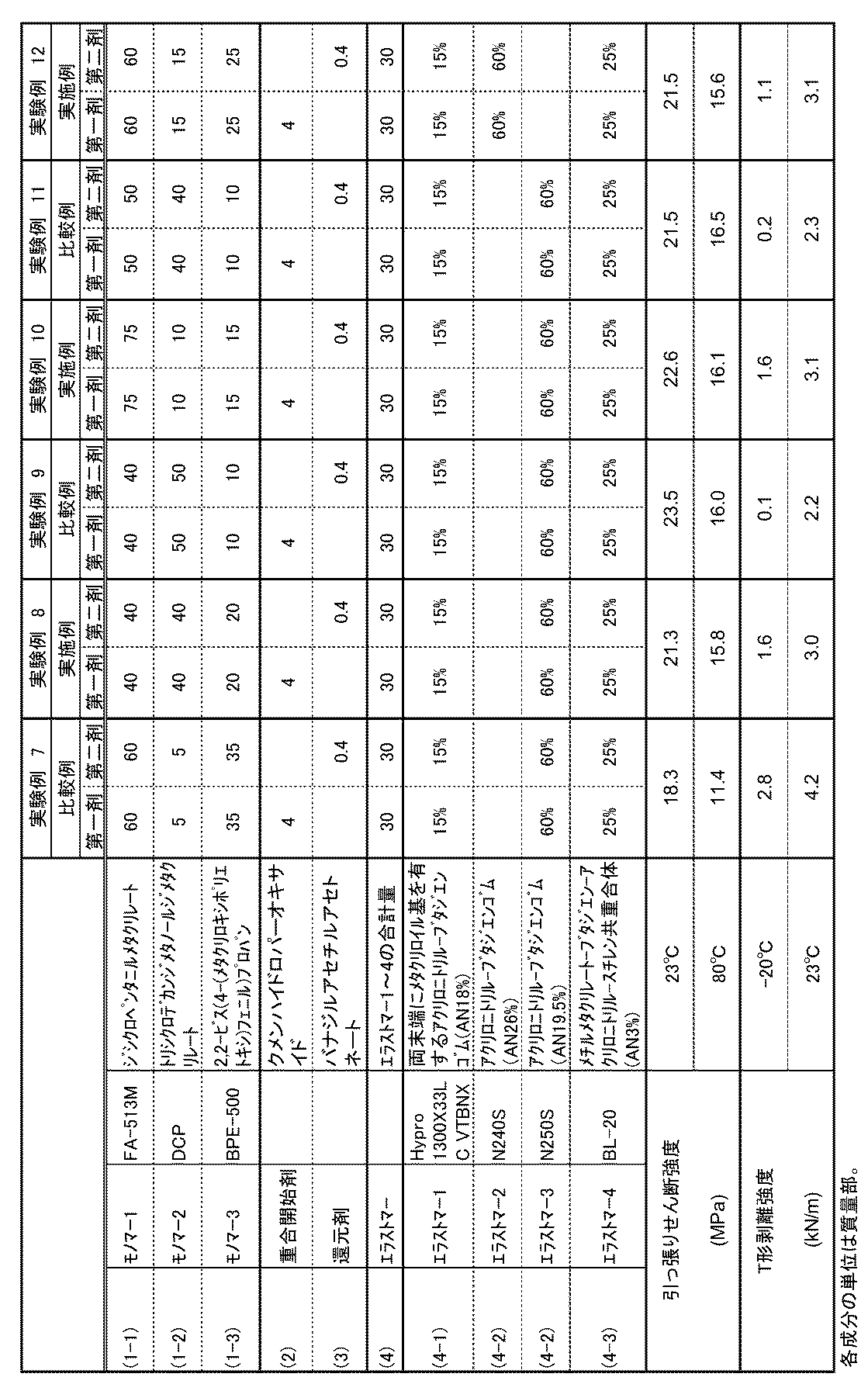
- the tensile shear strength at room temperature is 18 MPa or higher and the tensile shear strength at 80 ° C. is 14 MPa or higher, it is preferable in that sufficient adhesive strength is exhibited even at room temperature and high temperature.
- a polyethylene filler having a particle size of 100 ⁇ m was added to the adhesive composition.
- the polyethylene filler is spherical.
- the amount of the polyethylene filler used is 2 parts by mass with respect to 100 parts by mass of the polymerizable monomer.
- the peel adhesion strength (unit: kN / m) was measured under the conditions of a temperature of 23 ° C. and a relative humidity of 50% under a tensile speed of 50 mm / min.
- a sample cured at room temperature for 24 hours was cooled with a low temperature incubator WU-200 (registered trademark, manufactured by Espec Corp.) at ⁇ 20 ° C. for 30 minutes, and similarly evaluated in an atmosphere at ⁇ 20 ° C. did.
- the T-type peel strength at room temperature is 3.0 kN / m or more, and the T-type peel strength at ⁇ 20 ° C. is 1.5 kN / m or more. This is preferable.
- Example 1 A first agent and a second agent were prepared with the compositions shown in Table 1.
- the elastomers are (4-1) an elastomer having a polymerizable unsaturated double bond at the terminal, (4-2) an elastomer having no polymerizable unsaturated double bond at the terminal, and (4-3) methyl (meth) acrylate.
- the tricyclic monofunctional (meth) acrylate is (1) 40 to 75% by mass in the polymerizable monomer, and (1-2) the tricyclic bifunctional (meth).
- the acrylate is (1) 10 to 40% by mass in the polymerizable monomer
- the bifunctional (meth) acrylate having a bisphenol structure is (1) 15 to 40% by mass in the polymerizable monomer
- Both the tensile shear strength and the T-shaped peel strength showed sufficient adhesive strength.
- the tensile shear strength or the T-shaped peel strength was low.
- the adhesive composition according to the embodiment of the present invention has adhesiveness and is excellent in both physical properties of tensile shear strength and T-shaped peel strength.
- the adhesive composition according to the embodiment of the present invention further has a sufficient tensile shear strength even in a high temperature atmosphere such as 80 ° C. or higher.
- the adhesive composition according to the embodiment of the present invention can further have a sufficient T-shaped peel strength even in a low-temperature atmosphere such as ⁇ 20 ° C. or lower.
Landscapes
- Chemical & Material Sciences (AREA)
- Organic Chemistry (AREA)
- Chemical Kinetics & Catalysis (AREA)
- Health & Medical Sciences (AREA)
- Medicinal Chemistry (AREA)
- Polymers & Plastics (AREA)
- Engineering & Computer Science (AREA)
- Materials Engineering (AREA)
- Adhesives Or Adhesive Processes (AREA)
- Macromonomer-Based Addition Polymer (AREA)
- Graft Or Block Polymers (AREA)
- Addition Polymer Or Copolymer, Post-Treatments, Or Chemical Modifications (AREA)
- Polymerisation Methods In General (AREA)
Abstract
Description
重合性モノマーはラジカル重合可能なものであればよい。これらの中では、硬化速度や接着性等の点で、重合性ビニルモノマーが好ましい。重合性ビニルモノマーの中では、重合性(メタ)アクリル酸誘導体が好ましい。重合性(メタ)アクリル酸誘導体は重合性モノマー100質量部中、70質量部以上であることが好ましく、重合性モノマーが全て重合性(メタ)アクリル酸誘導体であることが好ましい。ここで重合性(メタ)アクリル酸誘導体とは、重合性アクリル酸誘導体又は重合性メタクリル酸誘導体をいう。これらは通常、液状ないし固形のものが利用される。重合性(メタ)アクリル酸誘導体の中では、(メタ)アクリレートが好ましい。単官能(メタ)アクリレートとは、(メタ)アクリロイル基を1個有する化合物をいう。二官能(メタ)アクリレートとは、(メタ)アクリロイル基を2個有する化合物をいう。
三環式単官能(メタ)アクリレートとは、三環が脂環族である三環式単官能(メタ)アクリレートをいう。三環とは、三個の接続した環をいう。本発明の三環式単官能(メタ)アクリレートとは、三個の接続した環を含む脂環族炭化水素基を有する単官能(メタ)アクリレートをいう。脂環族炭化水素基としては、非置換の飽和炭化水素基が好ましい。三環式単官能(メタ)アクリレートの中では、ジシクロペンタン骨格とこれに接続した一環を含む構造や、またはジシクロペンタジエン骨格を有する単官能(メタ)アクリレートが好ましい。ジシクロペンタン骨格とこれに接続した一環を含む構造やジシクロペンタジエン骨格を有する単官能(メタ)アクリレートとしては、ジシクロペンタニル(メタ)アクリレート、ジシクロペンテニルオキシエチル(メタ)アクリレート、ジシクロペンテニル(メタ)アクリレート等が挙げられる。これらの中では、ジシクロペンタニル(メタ)アクリレートが好ましい。ジシクロペンタニル(メタ)アクリレートとしては例えば、日立化成社製のFA-513Mが挙げられる。
三環式二官能(メタ)アクリレートとは、三環が脂環族である三環式二官能(メタ)アクリレートをいう。三環とは、三個の接続した環をいう。本発明の三環式二官能(メタ)アクリレートとは、三個の接続した環を含む脂環族炭化水素基を有する二官能(メタ)アクリレートをいう。脂環族炭化水素基としては、非置換の飽和炭化水素基が好ましい。三環式二官能(メタ)アクリレートの中では、ジシクロペンタン骨格とこれに接続した一環を含む構造や、ジシクロペンダジエン骨格を有する二官能(メタ)アクリレートが好ましい。ジシクロペンタン骨格とこれに接続した一環を含む構造やジシクロペンタジエン骨格を有する二官能(メタ)アクリレートの中では、トリシクロデカンジメタノールジ(メタ)アクリレートが好ましい。トリシクロデカンジメタノールジ(メタ)アクリレートとしては例えば、新中村化学工業株式会社製のNKエステルA-DCPやDCPが挙げられる。
ビスフェノール構造を有する二官能(メタ)アクリレートとは、ビスフェノール骨格の末端にオキシアルキレン構造を介し、(メタ)アクリロイル基を2個有するジ(メタ)アクリレートが好ましい。オキシアルキレン構造は水酸基を有しても良い。(1-3)の中では、一般式(A)の化合物が好ましい。

本発明で使用する(2)重合開始剤としては、熱ラジカル重合開始剤が好ましい。熱ラジカル重合開始剤の中では、反応性の点で、有機過酸化物が好ましい。
本発明で使用する(3)還元剤は、前記重合開始剤と反応し、ラジカルを発生する公知の還元剤であれば使用できる。還元剤としては、例えば、第3級アミン、チオ尿素誘導体及び遷移金属塩等が挙げられる。
本発明では、剥離強度と衝撃強度向上のため、(4)エラストマーを硬化性樹脂組成物に使用することが好ましい。
本発明では、粒状物質を使用することが好ましい。粒状物質としては、(1)~(4)に溶解しない粒状物質を使用することが好ましい。粒状物質により、硬化体が一定の厚みを保持することが容易となり、寸法精度が向上したまま接着でき、硬化体の厚みを制御できる。
二剤型の組成物である場合、各成分の使用量は、第一剤と第二剤の合計100質量部中の質量部であることが好ましい。
(1-1)三環式単官能(メタ)アクリレートとして、下記を用いた。
FA-513M(日立化成社製):ジシクロペンタニルメタクリレート
(1-2)三環式二官能(メタ)アクリレートとして、下記を用いた。
NKエステルDCP(新中村化学工業社製):トリシクロデカンジメタノールジメタクリレート
(1-3)ビスフェノール構造を有する二官能(メタ)アクリレートを含有する重合性モノマーとして、下記を用いた。
BPE500(新中村化学工業社製):2,2-ビス(4-(メタクリロキシポリエトキシ)フェニル)プロパン、上記一般式(A)において、p=5、q=5
(2)重合開始剤として、下記を用いた。
重合開始剤:クメンハイドロパーオキサイド(市販品)
(3)還元剤として、下記を用いた。
還元剤:バナジルアセチルアセトネート(市販品)
(4-1)末端に重合性不飽和二重結合を有するエラストマーとして、下記を用いた。
HyproTM1300X33LC VTBNX(CVC Thermoset Specialties社製):両末端にメタクリロイル基を有するアクリロニトリル-ブタジエンゴム、アクリロニトリル含有量18モル%
(4-2)末端に重合性不飽和二重結合を有しないエラストマーとして、下記を用いた。
N240S(JSR社製):アクリロニトリル-ブタジエンゴム、アクリロニトリル含有量26モル%
N250S(JSR社製):アクリロニトリル-ブタジエンゴム、アクリロニトリル含有量19.5モル%
(4-3)メチル(メタ)アクリレート-ブタジエン-(メタ)アクリロニトリル-スチレン共重合体として、下記を用いた。
BL-20(デンカ社製):メチルメタクリレート-ブタジエン-アクリロニトリル-スチレン共重合体、アクリロニトリル含有量3モル%、但し末端に重合性不飽和二重結合を有しない。
JIS K-6850:1999、接着剤―剛性被着材の引っ張りせん断強さ試験方法に準拠し、一枚の試験片(100×25×1.6mm、鉄板、規格SPCC)の片面に第一剤と第二剤を混合した接着剤を塗布し、もう一方の試験片(100×25×1.6mm、鉄板、規格SPCC)と直ちに重ね合わせて貼り合わせたのち、室温で24時間養生し、これを引っ張りせん断接着強さ測定用試料とした。尚、接着剤組成物層の厚さを均一化するため、粒径100μmのポリエチレンフィラーを接着剤組成物に添加した。ポリエチレンフィラーは球状である。ポリエチレンフィラーの使用量は、重合性モノマー100質量部に対して2質量部である。引っ張りせん断接着強さ(単位:MPa)は、温度23℃、相対湿度50%の環境下で、引張速度10mm/分の条件で測定した。又、高温下での接着性の評価として、室温で24時間養生した試料を80℃の高温槽SPHH-201(エスペック社製、登録商標)で30分加温したのち80℃雰囲気下で同様に評価した。
JIS K-6854-3:1999、接着剤―はく離接着強さ試験方法 T形はく離に準拠し、一枚の試験片(200×25×1.0mm、アルミニウム板、規格A5052P)の片面に第一剤と第二剤を混合した接着剤を塗布し、もう一方の試験片(200×25×1.0mm、アルミニウム板、規格A5052P)と直ちに重ね合わせて貼り合わせたのち、室温で24時間養生し、これを剥離接着強さ測定用試料とした。尚、接着剤組成物層の厚さを均一化するため、粒径100μmのポリエチレンフィラーを接着剤組成物に添加した。ポリエチレンフィラーは球状である。ポリエチレンフィラーの使用量は、重合性モノマー100質量部に対して2質量部である。剥離接着強さ(単位:kN/m)は、温度23℃、相対湿度50%の環境下で、引張速度50mm/分の条件で測定した。又、耐寒性の評価として、室温で24時間養生した試料を-20℃の低温恒温器WU-200(エスペック社製、登録商標)で30分冷却し、-20℃の雰囲気下で同様に評価した。
表1に示す組成にて第一剤と第二剤を調製した。
表1に示す通り、重合性モノマーの配合比率を変更したほかは、実験例1と同様に評価した。結果を表1に併記した。
(4-2)末端に重合性不飽和二重結合を有しないエラストマーとして、アクリロニトリル-ブタジエンゴム(アクリロニトリル含有量26モル%)を用いたほかは、実験例1と同様に評価した。結果を表1に併記した。表1に併記した通り、23℃でのT形剥離強度は高かったが、-20℃でのT形剥離強度が高くなかった。

Claims (11)
- (1)(1-1)三環が脂環族である三環式単官能(メタ)アクリレートと(1-2)三環が脂環族である三環式二官能(メタ)アクリレート、(1-3)ビスフェノール構造を有する二官能(メタ)アクリレートを含有する重合性モノマー、(2)重合開始剤、(3)還元剤を含有する組成物であり、(1-1)三環式単官能(メタ)アクリレートが(1)重合性モノマー中40~75質量%であり、(1-2)三環式二官能(メタ)アクリレートが(1)重合性モノマー中10~40質量%であり、(1-3)ビスフェノール構造を有する二官能(メタ)アクリレートが(1)重合性モノマー中15~40質量%である組成物。
- 更に、(4)エラストマーを含有する請求項1記載の組成物。
- (4)エラストマーが、(4-1)末端に重合性不飽和二重結合を有するエラストマーを含有する請求項2記載の組成物。
- (4)エラストマーが、(4-2)末端に重合性不飽和二重結合を有しないエラストマーを含有する請求項2記載の組成物。
- (4)エラストマーが、(4-3)メチル(メタ)アクリレート-ブタジエン-(メタ)アクリロニトリル-スチレン共重合体を含有する請求項2記載の組成物。
- (4)エラストマーが、(4-1)末端に重合性不飽和二重結合を有するエラストマー、(4-2)末端に重合性不飽和二重結合を有しないエラストマー、および(4-3)メチル(メタ)アクリレート-ブタジエン-(メタ)アクリロニトリル-スチレン共重合体を含有する請求項2記載の組成物。
- (4)エラストマーのうちの(メタ)アクリロニトリル含有量が20モル%以下である請求項2~6のうちの1項記載の組成物。
- 請求項1~7のうちの1項記載の組成物を第一剤と第二剤の二剤に分け、第一剤が少なくとも(2)重合開始剤を含有し、第二剤が少なくとも(3)還元剤を含有する組成物。
- 請求項1~8のうちの1項記載の組成物からなる硬化性樹脂組成物。
- 請求項1~8のうちの1項記載の組成物からなる接着剤組成物。
- 請求項10記載の接着剤組成物を介して接合する接合体。
Priority Applications (5)
| Application Number | Priority Date | Filing Date | Title |
|---|---|---|---|
| EP17858456.1A EP3524627A4 (en) | 2016-10-06 | 2017-10-04 | COMPOSITION |
| CN201780056092.7A CN109689711A (zh) | 2016-10-06 | 2017-10-04 | 组合物 |
| KR1020197004531A KR102360748B1 (ko) | 2016-10-06 | 2017-10-04 | 조성물 |
| US16/335,607 US11332562B2 (en) | 2016-10-06 | 2017-10-04 | Composition |
| JP2018543947A JP6905991B2 (ja) | 2016-10-06 | 2017-10-04 | 組成物 |
Applications Claiming Priority (2)
| Application Number | Priority Date | Filing Date | Title |
|---|---|---|---|
| JP2016-197675 | 2016-10-06 | ||
| JP2016197675 | 2016-10-06 |
Publications (1)
| Publication Number | Publication Date |
|---|---|
| WO2018066619A1 true WO2018066619A1 (ja) | 2018-04-12 |
Family
ID=61832206
Family Applications (1)
| Application Number | Title | Priority Date | Filing Date |
|---|---|---|---|
| PCT/JP2017/036195 Ceased WO2018066619A1 (ja) | 2016-10-06 | 2017-10-04 | 組成物 |
Country Status (7)
| Country | Link |
|---|---|
| US (1) | US11332562B2 (ja) |
| EP (1) | EP3524627A4 (ja) |
| JP (2) | JP6905991B2 (ja) |
| KR (1) | KR102360748B1 (ja) |
| CN (1) | CN109689711A (ja) |
| TW (1) | TWI752097B (ja) |
| WO (1) | WO2018066619A1 (ja) |
Cited By (3)
| Publication number | Priority date | Publication date | Assignee | Title |
|---|---|---|---|---|
| JP2020026507A (ja) * | 2018-08-16 | 2020-02-20 | 三菱ケミカル株式会社 | 二剤型アクリル系接着剤組成物、それにより接合された接合体 |
| WO2022092037A1 (ja) * | 2020-10-30 | 2022-05-05 | デンカ株式会社 | 防食被覆材、防食被覆層及びコンクリート構造物の防食方法 |
| WO2026079379A1 (ja) * | 2024-10-07 | 2026-04-16 | デンカ株式会社 | 組成物、物品およびモータ |
Families Citing this family (1)
| Publication number | Priority date | Publication date | Assignee | Title |
|---|---|---|---|---|
| CN120731492A (zh) * | 2023-03-10 | 2025-09-30 | 电化株式会社 | 粘合片材、半导体零件的制造方法 |
Citations (4)
| Publication number | Priority date | Publication date | Assignee | Title |
|---|---|---|---|---|
| JPH01282206A (ja) * | 1988-05-06 | 1989-11-14 | Matsushita Electric Ind Co Ltd | 耐熱性樹脂組成物 |
| JPH05306378A (ja) * | 1991-10-25 | 1993-11-19 | Nippon Zeon Co Ltd | 紫外線硬化性組成物、該硬化性組成物を用いるコート層を有する成形品、その製造方法、及び該硬化性組成物を用いる接着方法 |
| JPH0737274A (ja) * | 1993-07-21 | 1995-02-07 | Three Bond Co Ltd | 光ディスク用接着剤組成物およびそれを用いた光ディスク |
| JP2006269041A (ja) * | 2005-02-24 | 2006-10-05 | Dainippon Ink & Chem Inc | 光ディスク用紫外線硬化型組成物及びこれを用いた光ディスク |
Family Cites Families (15)
| Publication number | Priority date | Publication date | Assignee | Title |
|---|---|---|---|---|
| US3890407A (en) | 1972-07-20 | 1975-06-17 | Du Pont | Novel adhesive compositions |
| US3814953A (en) | 1972-12-29 | 1974-06-04 | Ibm | Master-slave binary divider circuit |
| JPS532543A (en) | 1976-06-29 | 1978-01-11 | Denki Kagaku Kogyo Kk | Rapid-setting acrylic resin adhesive |
| US4536546A (en) * | 1983-09-22 | 1985-08-20 | Illinois Tool Works Inc. | (Meth)acrylate-based compositions |
| US4769419A (en) * | 1986-12-01 | 1988-09-06 | Dawdy Terrance H | Modified structural adhesives |
| US5112691A (en) * | 1988-08-29 | 1992-05-12 | Illinois Tool Works, Inc. | Adhesive for low temperature applications |
| JP3934701B2 (ja) | 1996-03-07 | 2007-06-20 | 大倉工業株式会社 | 耐熱性アクリル系接着剤組成物 |
| TW353666B (en) * | 1996-04-18 | 1999-03-01 | Denki Kagaku Kogyo Kk | Curable resin composition |
| US5932625A (en) * | 1997-05-30 | 1999-08-03 | Dsm N.V. | Photo-curable resin composition and process for preparing resin-basedmold |
| JP2002167557A (ja) * | 2000-12-01 | 2002-06-11 | Sekisui Chem Co Ltd | 粘着剤用組成物、粘着剤及び粘着シート |
| US6433091B1 (en) * | 2001-05-10 | 2002-08-13 | Henkel Loctite Corporation | Adhesive composition |
| JP2005054107A (ja) | 2003-08-06 | 2005-03-03 | Showa Highpolymer Co Ltd | 耐熱性接着剤およびその使用方法 |
| JP4207161B2 (ja) * | 2005-04-20 | 2009-01-14 | セイコーエプソン株式会社 | マイクロカプセル化金属粒子及びその製造方法、水性分散液、並びに、インクジェット用インク |
| JP2010079958A (ja) | 2008-09-24 | 2010-04-08 | Sekisui Chem Co Ltd | 仮接着用接着剤 |
| JP6050751B2 (ja) * | 2011-07-15 | 2016-12-21 | デンカ株式会社 | 透光性硬質基板積層体の製造方法及び透光性硬質基板貼り合わせ装置 |
-
2017
- 2017-10-04 WO PCT/JP2017/036195 patent/WO2018066619A1/ja not_active Ceased
- 2017-10-04 CN CN201780056092.7A patent/CN109689711A/zh active Pending
- 2017-10-04 KR KR1020197004531A patent/KR102360748B1/ko active Active
- 2017-10-04 JP JP2018543947A patent/JP6905991B2/ja active Active
- 2017-10-04 US US16/335,607 patent/US11332562B2/en active Active
- 2017-10-04 EP EP17858456.1A patent/EP3524627A4/en not_active Withdrawn
- 2017-10-05 TW TW106134405A patent/TWI752097B/zh active
-
2020
- 2020-09-07 JP JP2020150098A patent/JP7045431B2/ja active Active
Patent Citations (4)
| Publication number | Priority date | Publication date | Assignee | Title |
|---|---|---|---|---|
| JPH01282206A (ja) * | 1988-05-06 | 1989-11-14 | Matsushita Electric Ind Co Ltd | 耐熱性樹脂組成物 |
| JPH05306378A (ja) * | 1991-10-25 | 1993-11-19 | Nippon Zeon Co Ltd | 紫外線硬化性組成物、該硬化性組成物を用いるコート層を有する成形品、その製造方法、及び該硬化性組成物を用いる接着方法 |
| JPH0737274A (ja) * | 1993-07-21 | 1995-02-07 | Three Bond Co Ltd | 光ディスク用接着剤組成物およびそれを用いた光ディスク |
| JP2006269041A (ja) * | 2005-02-24 | 2006-10-05 | Dainippon Ink & Chem Inc | 光ディスク用紫外線硬化型組成物及びこれを用いた光ディスク |
Non-Patent Citations (1)
| Title |
|---|
| See also references of EP3524627A4 * |
Cited By (4)
| Publication number | Priority date | Publication date | Assignee | Title |
|---|---|---|---|---|
| JP2020026507A (ja) * | 2018-08-16 | 2020-02-20 | 三菱ケミカル株式会社 | 二剤型アクリル系接着剤組成物、それにより接合された接合体 |
| JP7196460B2 (ja) | 2018-08-16 | 2022-12-27 | 三菱ケミカル株式会社 | 二剤型アクリル系接着剤組成物、それにより接合された接合体 |
| WO2022092037A1 (ja) * | 2020-10-30 | 2022-05-05 | デンカ株式会社 | 防食被覆材、防食被覆層及びコンクリート構造物の防食方法 |
| WO2026079379A1 (ja) * | 2024-10-07 | 2026-04-16 | デンカ株式会社 | 組成物、物品およびモータ |
Also Published As
| Publication number | Publication date |
|---|---|
| JP6905991B2 (ja) | 2021-07-21 |
| JPWO2018066619A1 (ja) | 2019-07-25 |
| TWI752097B (zh) | 2022-01-11 |
| US20190284437A1 (en) | 2019-09-19 |
| CN109689711A (zh) | 2019-04-26 |
| JP2020200479A (ja) | 2020-12-17 |
| EP3524627A1 (en) | 2019-08-14 |
| US11332562B2 (en) | 2022-05-17 |
| KR20190065238A (ko) | 2019-06-11 |
| EP3524627A4 (en) | 2019-10-16 |
| JP7045431B2 (ja) | 2022-03-31 |
| KR102360748B1 (ko) | 2022-02-09 |
| TW201819560A (zh) | 2018-06-01 |
Similar Documents
| Publication | Publication Date | Title |
|---|---|---|
| JP7045431B2 (ja) | 組成物 | |
| JP6694057B2 (ja) | 組成物 | |
| JP2018172565A (ja) | アクリル系硬化性樹脂組成物 | |
| TW201816024A (zh) | 含有反應性倍半矽氧烷的黏著組合物 | |
| JP5671500B2 (ja) | 樹脂組成物、粘着剤および重合体の製造方法 | |
| US20240059940A1 (en) | Composition including monomer with a carboxylic acid group, monomer with a hydroxyl group, a cycloalkyl monomer, and crosslinker and related articles and methods | |
| CN116981705A (zh) | 包含具有羧酸基团的丙烯酸类单体、具有羟基基团的丙烯酸类单体、(甲基)丙烯酸烷基酯单体和交联剂的组合物以及相关制品和方法 | |
| JP5556118B2 (ja) | 硬化性(メタ)アクリル系樹脂組成物、積層材中間膜及び積層材 | |
| JP6739519B2 (ja) | 組成物 | |
| JP7318883B2 (ja) | (メタ)アクリル系樹脂組成物 | |
| JP2012031358A (ja) | 紫外線硬化型粘着剤組成物 | |
| JP7196460B2 (ja) | 二剤型アクリル系接着剤組成物、それにより接合された接合体 | |
| JPH0232304B2 (ja) | Akurireetonokokaseisoseibutsu | |
| CN109072029B (zh) | 自由基固化型粘接组合物、粘接剂 | |
| JP5193461B2 (ja) | 接着剤組成物 | |
| CN107949590B (zh) | 组合物和粘合剂组合物 | |
| CN111344374B (zh) | 自由基固化型粘接组合物、粘接剂 | |
| JP6579613B2 (ja) | 組成物 | |
| EP4695313A1 (en) | Two-part adhesive composition and method of making a bonded article | |
| JP6857502B2 (ja) | 組成物 | |
| JP2021031508A (ja) | 接着剤、接着剤セット及び構造体の製造方法 | |
| JP2017031266A (ja) | 組成物 |
Legal Events
| Date | Code | Title | Description |
|---|---|---|---|
| ENP | Entry into the national phase |
Ref document number: 2018543947 Country of ref document: JP Kind code of ref document: A |
|
| 121 | Ep: the epo has been informed by wipo that ep was designated in this application |
Ref document number: 17858456 Country of ref document: EP Kind code of ref document: A1 |
|
| ENP | Entry into the national phase |
Ref document number: 20197004531 Country of ref document: KR Kind code of ref document: A |
|
| NENP | Non-entry into the national phase |
Ref country code: DE |
|
| ENP | Entry into the national phase |
Ref document number: 2017858456 Country of ref document: EP Effective date: 20190506 |