WO2018066638A1 - ニッケル酸化鉱の湿式製錬方法 - Google Patents
ニッケル酸化鉱の湿式製錬方法 Download PDFInfo
- Publication number
- WO2018066638A1 WO2018066638A1 PCT/JP2017/036245 JP2017036245W WO2018066638A1 WO 2018066638 A1 WO2018066638 A1 WO 2018066638A1 JP 2017036245 W JP2017036245 W JP 2017036245W WO 2018066638 A1 WO2018066638 A1 WO 2018066638A1
- Authority
- WO
- WIPO (PCT)
- Prior art keywords
- solid
- nickel
- oxide ore
- nickel oxide
- liquid
- Prior art date
- Legal status (The legal status is an assumption and is not a legal conclusion. Google has not performed a legal analysis and makes no representation as to the accuracy of the status listed.)
- Ceased
Links
Images


Classifications
-
- C—CHEMISTRY; METALLURGY
- C22—METALLURGY; FERROUS OR NON-FERROUS ALLOYS; TREATMENT OF ALLOYS OR NON-FERROUS METALS
- C22B—PRODUCTION AND REFINING OF METALS; PRETREATMENT OF RAW MATERIALS
- C22B3/00—Extraction of metal compounds from ores or concentrates by wet processes
- C22B3/20—Treatment or purification of solutions, e.g. obtained by leaching
- C22B3/22—Treatment or purification of solutions, e.g. obtained by leaching by physical processes, e.g. by filtration, by magnetic means, or by thermal decomposition
-
- C—CHEMISTRY; METALLURGY
- C22—METALLURGY; FERROUS OR NON-FERROUS ALLOYS; TREATMENT OF ALLOYS OR NON-FERROUS METALS
- C22B—PRODUCTION AND REFINING OF METALS; PRETREATMENT OF RAW MATERIALS
- C22B23/00—Obtaining nickel or cobalt
- C22B23/04—Obtaining nickel or cobalt by wet processes
- C22B23/0407—Leaching processes
- C22B23/0415—Leaching processes with acids or salt solutions except ammonium salts solutions
- C22B23/043—Sulfurated acids or salts thereof
-
- C—CHEMISTRY; METALLURGY
- C22—METALLURGY; FERROUS OR NON-FERROUS ALLOYS; TREATMENT OF ALLOYS OR NON-FERROUS METALS
- C22B—PRODUCTION AND REFINING OF METALS; PRETREATMENT OF RAW MATERIALS
- C22B3/00—Extraction of metal compounds from ores or concentrates by wet processes
- C22B3/20—Treatment or purification of solutions, e.g. obtained by leaching
- C22B3/44—Treatment or purification of solutions, e.g. obtained by leaching by chemical processes
-
- C—CHEMISTRY; METALLURGY
- C22—METALLURGY; FERROUS OR NON-FERROUS ALLOYS; TREATMENT OF ALLOYS OR NON-FERROUS METALS
- C22B—PRODUCTION AND REFINING OF METALS; PRETREATMENT OF RAW MATERIALS
- C22B19/00—Obtaining zinc or zinc oxide
- C22B19/20—Obtaining zinc otherwise than by distilling
- C22B19/26—Refining solutions containing zinc values, e.g. obtained by leaching zinc ores
-
- Y—GENERAL TAGGING OF NEW TECHNOLOGICAL DEVELOPMENTS; GENERAL TAGGING OF CROSS-SECTIONAL TECHNOLOGIES SPANNING OVER SEVERAL SECTIONS OF THE IPC; TECHNICAL SUBJECTS COVERED BY FORMER USPC CROSS-REFERENCE ART COLLECTIONS [XRACs] AND DIGESTS
- Y02—TECHNOLOGIES OR APPLICATIONS FOR MITIGATION OR ADAPTATION AGAINST CLIMATE CHANGE
- Y02P—CLIMATE CHANGE MITIGATION TECHNOLOGIES IN THE PRODUCTION OR PROCESSING OF GOODS
- Y02P10/00—Technologies related to metal processing
- Y02P10/20—Recycling
Definitions
- the present invention relates to a hydrometallurgical method of nickel oxide ore containing zinc, and more particularly to a hydrometallurgical method of nickel oxide ore with improved solid-liquid separability of the zinc sulfide slurry produced in the dezincification step.
- nickel oxide ore As a method of smelting nickel oxide ore by a wet method, nickel oxide ore is placed in a pressure vessel such as an autoclave together with sulfuric acid and treated at a high temperature and high pressure of about 220 to 280 ° C.
- a high pressure acid leaching (HPAL) process for leaching valuable metals such as cobalt and cobalt.
- Patent Document 1 sulfuric acid is added to a slurry of nickel oxide ore, and a leaching step of leaching while stirring at a temperature of 220 to 280 ° C., and a leaching slurry generated in the leaching step are washed in multiple stages,
- a solid-liquid separation step for obtaining a leachate containing nickel and cobalt and a leach residue by solid-liquid separation, and adding calcium carbonate so that the pH is 4 or less while suppressing oxidation of the leachate, and adding trivalent iron
- An HPAL including a neutralization step for generating a neutralized starch slurry and a mother liquor for nickel recovery, and a sulfidation step for blowing a hydrogen sulfide gas into the mother liquor to produce a sulfide containing nickel and cobalt and a poor liquor.
- This HPAL process makes it possible to simplify the leaching process and the solid-liquid separation process, reduce the amount of neutralizing agent consumed in the neutralization process and the amount of starch, and further reduce the amount of starch used in the process efficiently. It is described that simple and highly efficient smelting becomes possible.
- Patent Document 2 discloses a hydrometallurgy method in which a series of treatments including a leaching and solid-liquid separation process, a neutralization process, a dezincing process, and a nickel recovery process are performed on nickel oxide ore. Discloses a technique for producing a zinc recovery mother liquor containing nickel and cobalt by adding a sulfurizing agent to a neutralized final solution containing zinc together with nickel and cobalt to produce zinc sulfide and separating the zinc sulfide. ing. And in this dezincing process, clogging of the filter cloth is suppressed by improving the filterability of zinc sulfide, thereby reducing the frequency of cleaning and replacement work of the filter cloth and increasing the nickel recovery rate. It is described that it can.
- a leaching residue is added to the leachate in the neutralization step, and the pH of the neutralization final solution treated in the dezincification step is adjusted to 3.0 to 3.5.
- a suspension of neutralized starch and leaching residue is left in the neutralized final solution so that its turbidity is 100 to 400 NTU.
- the HPAL process does not require oxide ore reduction and drying steps, and is all performed in a wet process. Therefore, it is advantageous in terms of energy and cost. Further, it is possible to obtain a sulfide containing nickel and cobalt of high purity concentrated to a nickel grade of 50 to 60% by mass. As a result, the equipment for handling and purification can be made compact in the subsequent purification step, so that the cost can be reduced.
- a filter press is often used in an industrial filtration process.
- the pressure of the slurry supplied to the filter press increases as the filter cloth of the filter press becomes clogged.
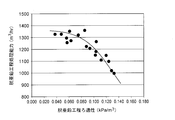
- the processing capacity decreases as the differential pressure of the filter per unit integrated flow rate during filtration increases. Specifically, when the value obtained by dividing the differential pressure at the filter by the integrated flow rate becomes larger than about 0.10 kPa / m 3 , the processing capacity is remarkably lowered.
- the present invention has been made in view of the above-described conventional problems, and improves the solid-liquid separability of the zinc sulfide slurry produced in the dezincing step of the HPAL process, thereby prematurely blocking the filtration device. It aims at providing the hydrometallurgy method of the nickel oxide ore which improves production efficiency by suppressing.
- the present inventors added sulfide to the neutralized final solution obtained by neutralizing the leachate obtained by acid leaching of nickel oxide ore in the HPAL process.
- the result of repeated earnest research focusing on the point that Fe contained in the neutralization final solution reacts with the sulfurizing agent added in the dezincification process to form fine iron sulfide
- the present inventors have found that the solid-liquid separability of the slurry containing sulfide can be improved by setting the Fe concentration remaining in the neutralized final solution to a predetermined concentration or less, and the present invention has been completed.
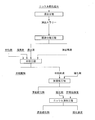
- the nickel oxide ore is placed in a pressure vessel together with a sulfuric acid solution and leached in acid leaching under high pressure, and the leaching slurry obtained in the leaching step is washed.
- a solid-liquid separation step for obtaining a leachate containing nickel and an impurity element and a leach residue by solid-liquid separation, and adding a neutralizing agent to the leachate to adjust pH and adding an aggregating agent to contain an impurity element After producing a Japanese starch, a neutralization step of solid-liquid separation of the neutralized starch from a neutralized final solution containing nickel, and after adding a sulfurizing agent to the neutralized final solution to produce zinc sulfide , A zinc removal step in which the slurry containing zinc sulfide is solid-liquid separated to obtain zinc sulfide and a solution after dezincing, and a mixed sulfide containing nickel is generated by adding a sulfurizing agent to the solution after zinc removal After the sulfidation, the mixed sulfide is subjected to solid-liquid separation from the liquid after sulfidation.
- a nickel oxide ore hydrometallurgy method comprising a recovery step, wherein the neutralizing agent is added in an amount so that the Fe concentration in the neutralized final solution obtained in the neutralization step is 1.25 g / L or less. It is characterized by adjusting.
- the present invention it is possible to improve the solid-liquid separability of the slurry containing zinc sulfide produced in the dezincing step in the nickel oxide ore hydrometallurgical process.
- the hydrometallurgical method of one specific example of the present invention was obtained by a leaching process in which nickel oxide ore was placed in a pressure vessel together with a sulfuric acid solution and acid leached under high pressure, and the leaching process.
- solid-liquid separation step for obtaining a leaching solution containing nickel and impurity elements and a leaching residue by solid-liquid separation, adjusting the pH by adding a neutralizing agent to the leaching solution and adding a flocculant
- the slurry containing the zinc sulfide is subjected to solid-liquid separation to obtain a zinc sulfide and a liquid after dezincing, and a sulfurizing agent is added to the liquid after dezincing to add nickel.
- the mixed sulfide is solid-liquid separated from the liquid after sulfidation. It is composed of a Le recovery process.
- the differential pressure of the filter per unit integrated flow rate during filtration is maintained at a value less than 0.10 kPa / m 3.
- the concentration of Fe contained in the neutralized final solution treated in the dezincing step is adjusted.
- the reason why the differential pressure per unit integrated flow rate is used as an index of filterability is that, in a smelting plant that industrially processes nickel oxide ore, constant rate filtration that supplies slurry at a constant flow rate to the filtration device is performed. This is because it is generally employed, so that the management of the filtration device becomes easy.
- the differential pressure per unit integrated flow rate at the time of filtration is the total flow rate of the slurry processed by the filtration device between the time when the filter cloth of the filtration device is replaced or washed and the time of the current filtration.
- the total flow rate can be obtained from, for example, an integrated flow meter provided on the slurry supply side of the filtration device.
- As a specific method for adjusting the Fe concentration of the above neutralized final solution it can be performed by increasing or decreasing the amount of neutralizing agent added in the neutralization step. That is, when the Fe concentration in the neutralized final solution is lowered, the amount of neutralizing agent added may be increased.
- a neutralizing agent slaked lime, limestone, sodium hydroxide, etc. can be used, and among these, slaked lime is preferable from an industrial viewpoint.
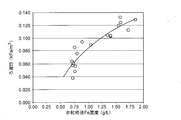
- the solid-liquid separability in a dezincing process can be changed by adjusting the Fe density
- the differential pressure can be reduced by setting the Fe concentration in the neutralized final solution to 1.25 g / L or less.
- the pressure difference can be made smaller than 0.10 kPa / m 3, and the pressure difference can be made remarkably smaller by making it 0.75 g / L or less.
- a flocculant is added together with the neutralizer or to the slurry after neutralization in order to promote sedimentation and separation of the produced neutralized starch.
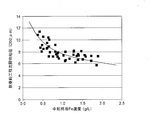
- the ratio of the addition amount of the flocculant is preferably adjusted to 12 g or less per ton of the slurry amount after addition of the neutralizing agent, and more preferably 10 g or less, as shown in FIG.
- filterability can be further improved by adding a predetermined amount of flocculant and maintaining the Fe concentration of the above-described neutralized final solution at 1.25 g / L or less.
- flocculant may mix impurities, such as iron and aluminum, if an inorganic type is used, it is preferable to use a cationic polymer flocculant.
- a leaching residue may be added after neutralization as shown by the dotted line in FIG.
- the addition amount of the flocculant per ton of the slurry after neutralization after adding the leaching residue may be 12 g or less, more preferably 10 g or less.
- the optimum amount of the flocculant added is selected while observing the sedimentation property of the slurry.
- the lower limit of the addition amount of the flocculant is not particularly limited, but is preferably 8 g / L or more per ton of the slurry after neutralization. The reason is that for solid-liquid separation of the slurry after neutralization, for example, the amount of flocculant added can theoretically be reduced by extending the standing time, but this is not preferable from an industrial viewpoint. Because.
- the present inventors have further found that when zinc is precipitated as a sulfide by adding a sulfurizing agent in the dezincing step, the filterability can also be improved by adjusting the addition amount of the sulfurizing agent. That is, the sulfiding agent is not limited to hydrogen sulfide gas, and a solid material such as sodium sulfide or sodium hydrogen sulfide or a liquid material obtained by dissolving them can be used. When used, the reaction of Formula 1 below occurs.
- FIG. 6 is a graph when 12 g of the flocculant is added per 1 ton of the slurry.
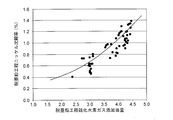
- the addition amount of the sulfiding agent exceeds 3.5 molar equivalents, the differential pressure exceeds 1.0 kPa / m 3 , and particularly when it exceeds 4.5 molar equivalents, as shown in FIG. Is significantly increased, resulting in nickel loss and an increase in the starch load of the filter.
- the lower limit of the addition amount of the sulfiding agent is preferably 1.0 molar equivalent. In this way, zinc is slightly easier to sulfidize than nickel, so it may not be possible to separate zinc and nickel well by simply adding a sulfiding agent. By adjusting the ratio, only zinc can be selectively sulfided while suppressing the sulfidation of valuable nickel.
- the nickel precipitation rate of FIG. 7 was calculated by the following formula 2.
- Nickel precipitation rate (%) (Nickel concentration of neutralized final solution ⁇ Nickel concentration of dezincified solution) / Nickel concentration of neutralized final solution ⁇ 100
- nickel oxide ore was placed in a pressure vessel together with sulfuric acid and heated to a temperature of 240 to 260 ° C. to perform high pressure press leaching.
- the obtained leaching slurry was subjected to solid-liquid separation to obtain a leaching residue and a leaching solution.
- slaked lime is continuously added as a neutralizing agent to adjust the pH within a range of 2 to 3, and as a coagulant manufactured by Kurita Kogyo Co., Ltd. Of KURIFARM PA-904 was added continuously to produce a slurry.
- the slurry was subjected to solid-liquid separation to obtain a neutralized final solution, and hydrogen sulfide gas was continuously blown into the neutralized final solution to precipitate sulfides.
- the slurry of the reaction solution containing sulfide was supplied to a filter press immediately after washing the filter cloth, and solid-liquid separation was performed.
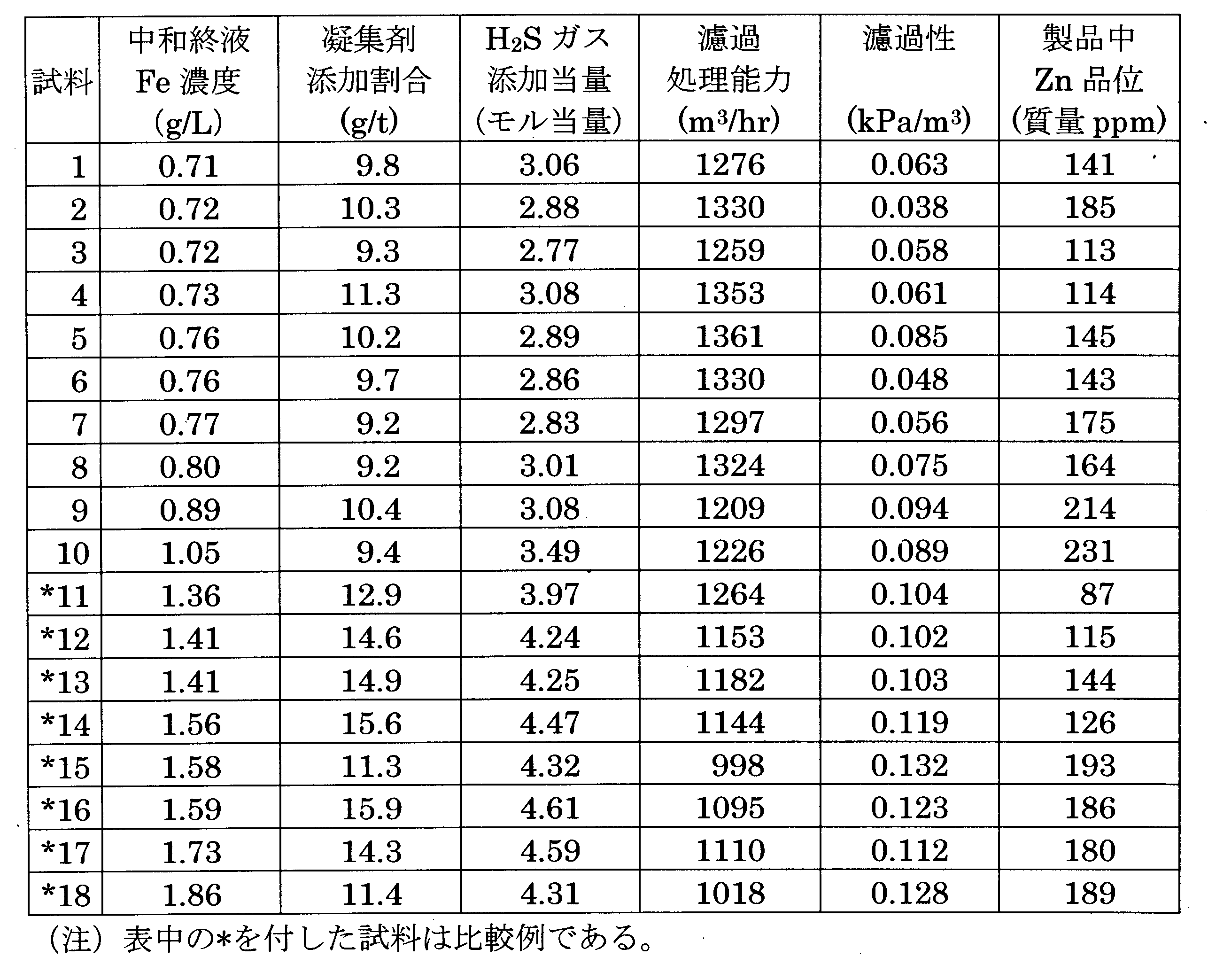
- the amount of flocculant added and the amount of hydrogen sulfide blown were changed stepwise, and the Fe concentration of the neutralized final solution, the differential pressure in the filter press, and the amount treated in each case were measured.
- samples 1 to 18 having different processing conditions were processed.
- the Fe concentration of the neutralized final solution in the treatment of these samples 1 to 18, the addition ratio of the flocculant in the neutralization step, the addition equivalent of hydrogen sulfide gas in the dezincification step, the processing capacity and filterability of the filter press, in the product Table 1 shows the Zn quality.
- the neutralized final solution for the treatment of these samples 1 to 18 was composed of 3.6 to 4.0 g / L for nickel, 0.30 to 0.39 g / L for cobalt, zinc for components other than the Fe concentration. Was 0.09 to 0.11 g / L, and the pH was in the range of 2.72 to 2.90.
- the filter press filterability is determined by dividing the difference between the pressure gauges provided on the liquid supply side and the drainage side of the filter press by the integrated flow rate from the start of operation, which was obtained with the integrated flow meter provided on the liquid supply side of the filter press. And asked.
- the processing capacity in the filter press was obtained from a flow meter on the liquid supply side.
- the Zn quality in the product was determined by measuring the mixed sulfide obtained in the nickel recovery step by fluorescent X-ray analysis (XRF). Further, the addition ratio of the flocculant and the addition equivalent of the hydrogen sulfide gas were calculated from the following formulas 3 and 4, respectively.
- Flocculant addition ratio addition amount of flocculant (g / hr) / total flow rate of leachate and neutralizing agent (t / hr)
- Hydrogen sulfide gas addition equivalent hydrogen sulfide gas addition amount (mol / hr) / [neutralization final solution flow rate ⁇ molar concentration of zinc] (mol / hr)
Landscapes
- Chemical & Material Sciences (AREA)
- Engineering & Computer Science (AREA)
- Organic Chemistry (AREA)
- Materials Engineering (AREA)
- Mechanical Engineering (AREA)
- Metallurgy (AREA)
- Manufacturing & Machinery (AREA)
- Life Sciences & Earth Sciences (AREA)
- Environmental & Geological Engineering (AREA)
- General Life Sciences & Earth Sciences (AREA)
- Geochemistry & Mineralogy (AREA)
- Geology (AREA)
- Chemical Kinetics & Catalysis (AREA)
- General Chemical & Material Sciences (AREA)
- Manufacture And Refinement Of Metals (AREA)
Abstract
Description
Zn2++H2S=ZnS+2H+
ニッケル沈殿率(%)=(中和終液のニッケル濃度-脱亜鉛後液のニッケル濃度)/中和終液のニッケル濃度×100
凝集剤添加割合=凝集剤の添加量(g/hr)/浸出液と中和剤との合計流量(t/hr)
硫化水素ガスの添加当量=硫化水素ガス添加量(mol/hr)/[中和終液流量×亜鉛のモル濃度](mol/hr)
Claims (3)
- ニッケル酸化鉱石を硫酸溶液とともに加圧容器に入れて高圧下で酸浸出する浸出工程と、該浸出工程で得た浸出スラリーを洗浄した後、固液分離してニッケル及び不純物元素を含む浸出液と浸出残渣とを得る固液分離工程と、該浸出液に中和剤を添加してpH調整するとともに凝集剤を添加して不純物元素を含む中和澱物を生成した後、該中和澱物をニッケルを含む中和終液から固液分離する中和工程と、該中和終液に硫化剤を添加して亜鉛硫化物を生成した後、該亜鉛硫化物を含むスラリーを固液分離して亜鉛硫化物と脱亜鉛後液とを得る脱亜鉛工程と、該脱亜鉛後液に硫化剤を添加してニッケルを含む混合硫化物を生成した後、該混合硫化物を硫化後液から固液分離するニッケル回収工程とからなるニッケル酸化鉱の湿式製錬方法であって、
前記中和工程で得られる中和終液のFe濃度が1.25g/L以下になるように前記中和剤の添加量を調整することを特徴とするニッケル酸化鉱石の湿式製錬方法。 - 前記凝集剤の添加量を、前記浸出液及び前記中和剤の合計量1トンあたり12g以下とすることを特徴とする、請求項1に記載のニッケル酸化鉱石の湿式製錬方法。
- 前記中和終液に含まれる亜鉛量に対して前記硫化剤を1モル当量以上3.5モル当量以下となる量を添加することを特徴とする、請求項1及び2に記載のニッケル酸化鉱石の湿式製錬方法。
Priority Applications (3)
| Application Number | Priority Date | Filing Date | Title |
|---|---|---|---|
| EP17858474.4A EP3524700A4 (en) | 2016-10-07 | 2017-10-05 | HYDROMETALLURGICAL METHOD FOR REFINING NICKEL OXIDE ORE |
| AU2017341012A AU2017341012B2 (en) | 2016-10-07 | 2017-10-05 | Hydrometallurgical method for refining nickel oxide ore |
| PH12019500736A PH12019500736A1 (en) | 2016-10-07 | 2019-04-04 | Hydrometallurgical method for refining nickel oxide ore |
Applications Claiming Priority (2)
| Application Number | Priority Date | Filing Date | Title |
|---|---|---|---|
| JP2016198688A JP6828359B2 (ja) | 2016-10-07 | 2016-10-07 | ニッケル酸化鉱の湿式製錬方法 |
| JP2016-198688 | 2016-10-07 |
Publications (1)
| Publication Number | Publication Date |
|---|---|
| WO2018066638A1 true WO2018066638A1 (ja) | 2018-04-12 |
Family
ID=61830952
Family Applications (1)
| Application Number | Title | Priority Date | Filing Date |
|---|---|---|---|
| PCT/JP2017/036245 Ceased WO2018066638A1 (ja) | 2016-10-07 | 2017-10-05 | ニッケル酸化鉱の湿式製錬方法 |
Country Status (5)
| Country | Link |
|---|---|
| EP (1) | EP3524700A4 (ja) |
| JP (1) | JP6828359B2 (ja) |
| AU (1) | AU2017341012B2 (ja) |
| PH (1) | PH12019500736A1 (ja) |
| WO (1) | WO2018066638A1 (ja) |
Families Citing this family (4)
| Publication number | Priority date | Publication date | Assignee | Title |
|---|---|---|---|---|
| JP7115170B2 (ja) * | 2018-09-12 | 2022-08-09 | 住友金属鉱山株式会社 | ニッケル酸化鉱石の処理方法及び該処理方法を含んだニッケルコバルト混合硫化物の製造方法 |
| JP7095606B2 (ja) * | 2019-01-17 | 2022-07-05 | 住友金属鉱山株式会社 | 湿式製錬法によるニッケル酸化鉱石からのニッケルコバルト混合硫化物の製造方法 |
| CN111041211A (zh) * | 2019-12-10 | 2020-04-21 | 赤峰中色锌业有限公司 | 一种湿法炼锌高浸渣综合回收和无害化处理方法 |
| JP7508977B2 (ja) | 2020-09-29 | 2024-07-02 | 住友金属鉱山株式会社 | 脱亜鉛処理方法、ニッケル酸化鉱石の湿式製錬方法 |
Citations (2)
| Publication number | Priority date | Publication date | Assignee | Title |
|---|---|---|---|---|
| JP2005350766A (ja) | 2004-05-13 | 2005-12-22 | Sumitomo Metal Mining Co Ltd | ニッケル酸化鉱石の湿式製錬方法 |
| JP2010037626A (ja) | 2008-08-07 | 2010-02-18 | Sumitomo Metal Mining Co Ltd | 亜鉛硫化物の分離方法 |
Family Cites Families (2)
| Publication number | Priority date | Publication date | Assignee | Title |
|---|---|---|---|---|
| JP2004305917A (ja) * | 2003-04-07 | 2004-11-04 | Sumitomo Metal Mining Co Ltd | 硫酸ニッケル水溶液からの亜鉛の除去方法 |
| JP5904100B2 (ja) * | 2012-11-20 | 2016-04-13 | 住友金属鉱山株式会社 | 中和スラリーの沈降分離方法、並びにニッケル酸化鉱石の湿式製錬方法 |
-
2016
- 2016-10-07 JP JP2016198688A patent/JP6828359B2/ja not_active Expired - Fee Related
-
2017
- 2017-10-05 EP EP17858474.4A patent/EP3524700A4/en not_active Withdrawn
- 2017-10-05 WO PCT/JP2017/036245 patent/WO2018066638A1/ja not_active Ceased
- 2017-10-05 AU AU2017341012A patent/AU2017341012B2/en active Active
-
2019
- 2019-04-04 PH PH12019500736A patent/PH12019500736A1/en unknown
Patent Citations (2)
| Publication number | Priority date | Publication date | Assignee | Title |
|---|---|---|---|---|
| JP2005350766A (ja) | 2004-05-13 | 2005-12-22 | Sumitomo Metal Mining Co Ltd | ニッケル酸化鉱石の湿式製錬方法 |
| JP2010037626A (ja) | 2008-08-07 | 2010-02-18 | Sumitomo Metal Mining Co Ltd | 亜鉛硫化物の分離方法 |
Non-Patent Citations (1)
| Title |
|---|
| See also references of EP3524700A4 |
Also Published As
| Publication number | Publication date |
|---|---|
| EP3524700A1 (en) | 2019-08-14 |
| AU2017341012A1 (en) | 2019-05-02 |
| EP3524700A4 (en) | 2020-06-03 |
| JP2018059167A (ja) | 2018-04-12 |
| AU2017341012B2 (en) | 2023-03-16 |
| PH12019500736A1 (en) | 2019-12-02 |
| JP6828359B2 (ja) | 2021-02-10 |
Similar Documents
| Publication | Publication Date | Title |
|---|---|---|
| JP5287016B2 (ja) | 亜鉛硫化物の分離方法 | |
| JP5644878B2 (ja) | 固液分離処理方法、並びにニッケル酸化鉱石の湿式製錬方法 | |
| JP7095606B2 (ja) | 湿式製錬法によるニッケル酸化鉱石からのニッケルコバルト混合硫化物の製造方法 | |
| JP6750698B2 (ja) | ニッケル高圧浸出残渣の固液分離方法 | |
| JP6828359B2 (ja) | ニッケル酸化鉱の湿式製錬方法 | |
| TW201934763A (zh) | 從硫酸鋅溶液回收鐵之方法 | |
| JP5348267B2 (ja) | 脱亜鉛処理プラント及び脱亜鉛プラントの操業方法、並びにニッケル酸化鉱石の湿式製錬方法 | |
| JP5692458B1 (ja) | 固液分離処理方法、並びにニッケル酸化鉱石の湿式製錬方法 | |
| JP2019000834A (ja) | ニッケル高圧浸出残渣の固液分離方法 | |
| AU2017369155B2 (en) | Wet metallurgy method for nickel oxide ore | |
| JP7279546B2 (ja) | ニッケル酸化鉱石の浸出処理方法及びこれを含む湿式製錬方法 | |
| JP7115170B2 (ja) | ニッケル酸化鉱石の処理方法及び該処理方法を含んだニッケルコバルト混合硫化物の製造方法 | |
| WO2017110572A1 (ja) | 硫化剤の除去方法 | |
| JP2019157236A (ja) | 固液分離処理方法、ニッケル酸化鉱石の湿式製錬方法 | |
| JP7506356B2 (ja) | 高濃度スラリーを得るためのシックナーの管理方法 | |
| JP6610368B2 (ja) | 塩化ニッケル水溶液の不純物除去方法 | |
| JP6551481B2 (ja) | ニッケル酸化鉱石の湿式製錬方法 | |
| JP5673471B2 (ja) | 塩化ニッケル水溶液中の銅イオン除去方法及び電気ニッケルの製造方法 | |
| JP6634870B2 (ja) | 塩化ニッケル水溶液の脱鉄方法 | |
| JP7585804B2 (ja) | 固液分離処理方法、ニッケル酸化鉱石の湿式製錬方法 | |
| JP2019077928A (ja) | 中和処理方法およびニッケル酸化鉱石の湿式製錬方法 | |
| JP2020076130A (ja) | ニッケル酸化鉱石の湿式製錬方法 | |
| JP6981206B2 (ja) | 硫酸ニッケル水溶液の脱亜鉛システム、及びその方法 | |
| JP7585921B2 (ja) | ニッケル酸化鉱石の湿式製錬方法 | |
| JP2025008671A (ja) | 亜鉛硫化物の粒径制御方法 |
Legal Events
| Date | Code | Title | Description |
|---|---|---|---|
| 121 | Ep: the epo has been informed by wipo that ep was designated in this application |
Ref document number: 17858474 Country of ref document: EP Kind code of ref document: A1 |
|
| NENP | Non-entry into the national phase |
Ref country code: DE |
|
| ENP | Entry into the national phase |
Ref document number: 2017341012 Country of ref document: AU Date of ref document: 20171005 Kind code of ref document: A |
|
| ENP | Entry into the national phase |
Ref document number: 2017858474 Country of ref document: EP Effective date: 20190507 |