WO2018070534A1 - エポキシ樹脂、エポキシ樹脂組成物、エポキシ樹脂硬化物及び複合材料 - Google Patents
エポキシ樹脂、エポキシ樹脂組成物、エポキシ樹脂硬化物及び複合材料 Download PDFInfo
- Publication number
- WO2018070534A1 WO2018070534A1 PCT/JP2017/037267 JP2017037267W WO2018070534A1 WO 2018070534 A1 WO2018070534 A1 WO 2018070534A1 JP 2017037267 W JP2017037267 W JP 2017037267W WO 2018070534 A1 WO2018070534 A1 WO 2018070534A1
- Authority
- WO
- WIPO (PCT)
- Prior art keywords
- epoxy resin
- temperature
- epoxy
- compound
- cured
- Prior art date
- Legal status (The legal status is an assumption and is not a legal conclusion. Google has not performed a legal analysis and makes no representation as to the accuracy of the status listed.)
- Ceased
Links
Images

Classifications
-
- C—CHEMISTRY; METALLURGY
- C08—ORGANIC MACROMOLECULAR COMPOUNDS; THEIR PREPARATION OR CHEMICAL WORKING-UP; COMPOSITIONS BASED THEREON
- C08G—MACROMOLECULAR COMPOUNDS OBTAINED OTHERWISE THAN BY REACTIONS ONLY INVOLVING UNSATURATED CARBON-TO-CARBON BONDS
- C08G59/00—Polycondensates containing more than one epoxy group per molecule; Macromolecules obtained by polymerising compounds containing more than one epoxy group per molecule using curing agents or catalysts which react with the epoxy groups
- C08G59/18—Macromolecules obtained by polymerising compounds containing more than one epoxy group per molecule using curing agents or catalysts which react with the epoxy groups ; e.g. general methods of curing
- C08G59/20—Macromolecules obtained by polymerising compounds containing more than one epoxy group per molecule using curing agents or catalysts which react with the epoxy groups ; e.g. general methods of curing characterised by the epoxy compounds used
- C08G59/22—Di-epoxy compounds
- C08G59/24—Di-epoxy compounds carbocyclic
- C08G59/245—Di-epoxy compounds carbocyclic aromatic
-
- C—CHEMISTRY; METALLURGY
- C08—ORGANIC MACROMOLECULAR COMPOUNDS; THEIR PREPARATION OR CHEMICAL WORKING-UP; COMPOSITIONS BASED THEREON
- C08G—MACROMOLECULAR COMPOUNDS OBTAINED OTHERWISE THAN BY REACTIONS ONLY INVOLVING UNSATURATED CARBON-TO-CARBON BONDS
- C08G59/00—Polycondensates containing more than one epoxy group per molecule; Macromolecules obtained by polymerising compounds containing more than one epoxy group per molecule using curing agents or catalysts which react with the epoxy groups
- C08G59/18—Macromolecules obtained by polymerising compounds containing more than one epoxy group per molecule using curing agents or catalysts which react with the epoxy groups ; e.g. general methods of curing
- C08G59/20—Macromolecules obtained by polymerising compounds containing more than one epoxy group per molecule using curing agents or catalysts which react with the epoxy groups ; e.g. general methods of curing characterised by the epoxy compounds used
-
- C—CHEMISTRY; METALLURGY
- C08—ORGANIC MACROMOLECULAR COMPOUNDS; THEIR PREPARATION OR CHEMICAL WORKING-UP; COMPOSITIONS BASED THEREON
- C08G—MACROMOLECULAR COMPOUNDS OBTAINED OTHERWISE THAN BY REACTIONS ONLY INVOLVING UNSATURATED CARBON-TO-CARBON BONDS
- C08G59/00—Polycondensates containing more than one epoxy group per molecule; Macromolecules obtained by polymerising compounds containing more than one epoxy group per molecule using curing agents or catalysts which react with the epoxy groups
- C08G59/02—Polycondensates containing more than one epoxy group per molecule
- C08G59/04—Polycondensates containing more than one epoxy group per molecule of polyhydroxy compounds with epihalohydrins or precursors thereof
- C08G59/06—Polycondensates containing more than one epoxy group per molecule of polyhydroxy compounds with epihalohydrins or precursors thereof of polyhydric phenols
- C08G59/066—Polycondensates containing more than one epoxy group per molecule of polyhydroxy compounds with epihalohydrins or precursors thereof of polyhydric phenols with chain extension or advancing agents
-
- C—CHEMISTRY; METALLURGY
- C08—ORGANIC MACROMOLECULAR COMPOUNDS; THEIR PREPARATION OR CHEMICAL WORKING-UP; COMPOSITIONS BASED THEREON
- C08G—MACROMOLECULAR COMPOUNDS OBTAINED OTHERWISE THAN BY REACTIONS ONLY INVOLVING UNSATURATED CARBON-TO-CARBON BONDS
- C08G59/00—Polycondensates containing more than one epoxy group per molecule; Macromolecules obtained by polymerising compounds containing more than one epoxy group per molecule using curing agents or catalysts which react with the epoxy groups
- C08G59/18—Macromolecules obtained by polymerising compounds containing more than one epoxy group per molecule using curing agents or catalysts which react with the epoxy groups ; e.g. general methods of curing
- C08G59/20—Macromolecules obtained by polymerising compounds containing more than one epoxy group per molecule using curing agents or catalysts which react with the epoxy groups ; e.g. general methods of curing characterised by the epoxy compounds used
- C08G59/22—Di-epoxy compounds
- C08G59/24—Di-epoxy compounds carbocyclic
-
- C—CHEMISTRY; METALLURGY
- C08—ORGANIC MACROMOLECULAR COMPOUNDS; THEIR PREPARATION OR CHEMICAL WORKING-UP; COMPOSITIONS BASED THEREON
- C08G—MACROMOLECULAR COMPOUNDS OBTAINED OTHERWISE THAN BY REACTIONS ONLY INVOLVING UNSATURATED CARBON-TO-CARBON BONDS
- C08G59/00—Polycondensates containing more than one epoxy group per molecule; Macromolecules obtained by polymerising compounds containing more than one epoxy group per molecule using curing agents or catalysts which react with the epoxy groups
- C08G59/18—Macromolecules obtained by polymerising compounds containing more than one epoxy group per molecule using curing agents or catalysts which react with the epoxy groups ; e.g. general methods of curing
- C08G59/40—Macromolecules obtained by polymerising compounds containing more than one epoxy group per molecule using curing agents or catalysts which react with the epoxy groups ; e.g. general methods of curing characterised by the curing agents used
-
- C—CHEMISTRY; METALLURGY
- C08—ORGANIC MACROMOLECULAR COMPOUNDS; THEIR PREPARATION OR CHEMICAL WORKING-UP; COMPOSITIONS BASED THEREON
- C08G—MACROMOLECULAR COMPOUNDS OBTAINED OTHERWISE THAN BY REACTIONS ONLY INVOLVING UNSATURATED CARBON-TO-CARBON BONDS
- C08G59/00—Polycondensates containing more than one epoxy group per molecule; Macromolecules obtained by polymerising compounds containing more than one epoxy group per molecule using curing agents or catalysts which react with the epoxy groups
- C08G59/18—Macromolecules obtained by polymerising compounds containing more than one epoxy group per molecule using curing agents or catalysts which react with the epoxy groups ; e.g. general methods of curing
- C08G59/40—Macromolecules obtained by polymerising compounds containing more than one epoxy group per molecule using curing agents or catalysts which react with the epoxy groups ; e.g. general methods of curing characterised by the curing agents used
- C08G59/50—Amines
- C08G59/5033—Amines aromatic
-
- C—CHEMISTRY; METALLURGY
- C08—ORGANIC MACROMOLECULAR COMPOUNDS; THEIR PREPARATION OR CHEMICAL WORKING-UP; COMPOSITIONS BASED THEREON
- C08J—WORKING-UP; GENERAL PROCESSES OF COMPOUNDING; AFTER-TREATMENT NOT COVERED BY SUBCLASSES C08B, C08C, C08F, C08G or C08H
- C08J5/00—Manufacture of articles or shaped materials containing macromolecular substances
- C08J5/04—Reinforcing macromolecular compounds with loose or coherent fibrous material
-
- C—CHEMISTRY; METALLURGY
- C08—ORGANIC MACROMOLECULAR COMPOUNDS; THEIR PREPARATION OR CHEMICAL WORKING-UP; COMPOSITIONS BASED THEREON
- C08L—COMPOSITIONS OF MACROMOLECULAR COMPOUNDS
- C08L63/00—Compositions of epoxy resins; Compositions of derivatives of epoxy resins
-
- C—CHEMISTRY; METALLURGY
- C08—ORGANIC MACROMOLECULAR COMPOUNDS; THEIR PREPARATION OR CHEMICAL WORKING-UP; COMPOSITIONS BASED THEREON
- C08G—MACROMOLECULAR COMPOUNDS OBTAINED OTHERWISE THAN BY REACTIONS ONLY INVOLVING UNSATURATED CARBON-TO-CARBON BONDS
- C08G59/00—Polycondensates containing more than one epoxy group per molecule; Macromolecules obtained by polymerising compounds containing more than one epoxy group per molecule using curing agents or catalysts which react with the epoxy groups
- C08G59/18—Macromolecules obtained by polymerising compounds containing more than one epoxy group per molecule using curing agents or catalysts which react with the epoxy groups ; e.g. general methods of curing
- C08G59/68—Macromolecules obtained by polymerising compounds containing more than one epoxy group per molecule using curing agents or catalysts which react with the epoxy groups ; e.g. general methods of curing characterised by the catalysts used
- C08G59/688—Macromolecules obtained by polymerising compounds containing more than one epoxy group per molecule using curing agents or catalysts which react with the epoxy groups ; e.g. general methods of curing characterised by the catalysts used containing phosphorus
-
- C—CHEMISTRY; METALLURGY
- C08—ORGANIC MACROMOLECULAR COMPOUNDS; THEIR PREPARATION OR CHEMICAL WORKING-UP; COMPOSITIONS BASED THEREON
- C08J—WORKING-UP; GENERAL PROCESSES OF COMPOUNDING; AFTER-TREATMENT NOT COVERED BY SUBCLASSES C08B, C08C, C08F, C08G or C08H
- C08J2363/00—Characterised by the use of epoxy resins; Derivatives of epoxy resins
Definitions
- the present invention relates to an epoxy resin, an epoxy resin composition, a cured epoxy resin, and a composite material.
- Epoxy resins are used in various applications by taking advantage of their excellent heat resistance. In recent years, in response to the increase in the actual use temperature of power devices using epoxy resins, studies on epoxy resins having excellent thermal conductivity have been underway.
- An epoxy resin containing an epoxy compound having a mesogen structure in the molecule (hereinafter also referred to as a mesogen-containing epoxy resin) is known as an epoxy resin having excellent thermal conductivity.
- mesogen-containing epoxy resins generally have a higher viscosity than other epoxy resins, and sufficient fluidity may not be obtained during operation.
- an object of the present invention is to provide an epoxy resin and an epoxy resin composition excellent in handleability, and an epoxy resin cured product and a composite material obtained using these.
- Means for solving the above problems include the following embodiments.
- An epoxy resin containing an epoxy compound having a mesogenic structure A temperature lowering step of decreasing the temperature of the epoxy resin from 150 ° C. to 30 ° C. at a rate of 2 ° C./min; and a temperature increasing step of increasing the temperature of the epoxy resin from 30 ° C. to 150 ° C. at a rate of 2 ° C./min; ,
- Dynamic shear viscosity ⁇ ′1 (Pa ⁇ s) measured in the temperature lowering step in the temperature range of 30 ° C. to 150 ° C. and dynamics measured at the same temperature as the measured temperature of ⁇ ′1 in the temperature raising step.
- An epoxy resin composition comprising the epoxy resin according to ⁇ 1> or ⁇ 2> and a curing agent.
- a cured epoxy resin which is a cured product of the epoxy resin composition according to ⁇ 3>.
- a composite material comprising the cured epoxy resin according to ⁇ 4> and a reinforcing material.
- an epoxy resin and an epoxy resin composition excellent in handleability and an epoxy resin cured product and a composite material obtained by using these.
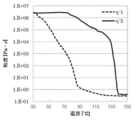
- Example 3 is a graph showing the measurement results of dynamic shear viscosity of the epoxy resin produced in Example 1.
- 4 is a graph showing the measurement results of dynamic shear viscosity of the epoxy resin produced in Comparative Example 1.
- the numerical values indicated by using “to” include numerical values described before and after “to” as the minimum value and the maximum value, respectively.
- the upper limit value or the lower limit value described in one numerical range may be replaced with the upper limit value or the lower limit value of another numerical range. Good.
- the upper limit value or the lower limit value of the numerical range may be replaced with the values shown in the examples.
- the content rate or content of each component in the composition is such that when there are a plurality of substances corresponding to each component in the composition, the plurality of kinds present in the composition unless otherwise specified. It means the total content or content of substances.
- the “epoxy compound” means a compound having an epoxy group in the molecule.
- the “epoxy resin” is a concept that captures a plurality of epoxy compounds as an aggregate, and means an uncured state.
- the epoxy resin of this embodiment is an epoxy resin containing an epoxy compound having a mesogenic structure, A temperature lowering step of decreasing the temperature of the epoxy resin from 150 ° C. to 30 ° C. at a rate of 2 ° C./min; and a temperature increasing step of increasing the temperature of the epoxy resin from 30 ° C. to 150 ° C. at a rate of 2 ° C./min; ,
- Dynamic shear viscosity ⁇ ′1 (Pa ⁇ s) measured in the temperature lowering step in the temperature range of 30 ° C. to 150 ° C. and dynamics measured at the same temperature as the measured temperature of ⁇ ′1 in the temperature raising step.
- the maximum value of ⁇ ′2 / ⁇ ′1 obtained from the dynamic shear viscosity ⁇ ′2 (Pa ⁇ s) is 20 or less, and ⁇ ′2 at 100 ° C. is 1000 Pa ⁇ s or less.
- the dynamic shear viscosity (hereinafter, also simply referred to as viscosity) of the epoxy resin is measured in a vibration mode using a rheometer in accordance with the standard of JIS K 7244-10: 2005.
- a parallel plate having a diameter of 12 mm is used, and the measurement conditions are a frequency of 1 Hz, a gap of 0.2 mm, and a strain of 2%.
- the measurement is performed by allowing the epoxy resin to melt at 150 ° C. for 3 minutes or more, and then lowering the temperature of the epoxy resin from 150 ° C. to 30 ° C. at a rate of 2 ° C./min.
- the rheometer for example, “MCR-301” manufactured by Anton Paar can be used.
- Mesogen-containing epoxy resins generally have high molecular orientation and high crystallinity. When the temperature of the highly crystalline mesogen-containing epoxy resin is changed, a phase transition occurs between the liquid crystal phase or the isotropic phase and the crystalline phase at any temperature.
- the viscosity measured when the temperature of a mesogen-containing epoxy resin that exhibits a liquid crystal phase or an isotropic phase at 150 ° C. and a crystalline phase at 30 ° C. is lowered from 150 ° C. to 30 ° C. at a rate of 2 ° C./min.
- the viscosity measured when the temperature of the mesogen-containing epoxy resin is increased from 30 ° C. to 150 ° C. at a rate of 2 ° C./minute the temperature rises from the viscosity during temperature reduction even at the same temperature.
- the viscosity at the time shows a higher phenomenon (temperature hysteresis). This phenomenon is caused by the fact that the phase transition to the crystal phase due to the strong orientation of the mesogenic structure cannot follow the temperature change at a rate of 2 ° C./min.
- a mesogen-containing epoxy resin exhibiting temperature hysteresis is in an equilibrium state by being maintained at 100 ° C., for example, and even if it exhibits a crystalline phase, it is in equilibrium at 100 ° C. under a temperature drop condition of 2 ° C./min.
- the viscosity value corresponding to the liquid crystal phase or the isotropic phase state is not measured, and when the temperature is raised from the crystallized state after cooling to 30 ° C. and reaches 100 ° C., the viscosity corresponding to the crystal phase state The value of is measured.
- the state of the phase is different between the temperature drop and the temperature rise, so that a difference occurs between the viscosity at the temperature drop and the temperature rise.
- the mesogen-containing epoxy resin exhibiting temperature hysteresis has a higher viscosity when the temperature is raised than when the temperature is lowered even at the same temperature.
- an epoxy resin that is easily crystallized to such a degree when the temperature is changed at a rate of 2 ° C./minute in the equilibrium state, the crystal phase is shown and handling of fluidity, applicability, moldability, etc. May become unstable.
- the resin crystallizes after being formed into a sheet. Therefore, when stored in a roll or other roll, cracks may occur depending on the thickness of the sheet. May occur.
- the maximum value of ⁇ ′2 / ⁇ ′1 obtained in the temperature range of 30 ° C. to 150 ° C. is 20 or less. That is, the value of the viscosity ⁇ ′2 at the time of temperature rise is relatively close to the viscosity ⁇ ′1 at the time of temperature drop, and the viscosity is sufficiently lowered at the time of temperature rise. For this reason, it can be suitably used for a processing method involving relatively rapid heating. Furthermore, the epoxy resin of this embodiment has excellent coating properties because ⁇ ′2 at 100 ° C. is 1000 Pa ⁇ s or less.
- the temperature at which the epoxy resin melts is not particularly limited as long as it is 150 ° C. or lower, which is the start temperature of the temperature lowering process. From the viewpoint of handleability of the epoxy resin, the temperature at which the epoxy resin melts is preferably 130 ° C. or less, and more preferably 100 ° C. or less. However, the lower the melting temperature, the lower the molecular orientation. For this reason, from the viewpoint of ensuring the molecular orientation in the curing process, the melting point of the epoxy resin is preferably 0 ° C. or higher, and more preferably 50 ° C. or higher. The melting point of the epoxy resin can be determined, for example, from the melting peak temperature measured at a heating rate of 10 ° C./min in differential scanning calorimetry.
- the maximum value of ⁇ ′2 / ⁇ ′1 obtained in the temperature range of 30 ° C. to 150 ° C. is 20 or less, preferably 10 or less, more preferably 5 or less, and preferably 2 or less. Further preferred. As the maximum value of ⁇ ′2 / ⁇ ′1 is smaller, the crystallinity of the mesogen-containing epoxy resin is suppressed, and a sufficient working time can be ensured when the resin is formed and processed.
- the minimum value of ⁇ ′2 / ⁇ ′1 obtained in the temperature range of 30 ° C. to 150 ° C. is not particularly limited.
- a mesogen-containing epoxy resin that undergoes a phase transition within a temperature range of 30 ° C. to 150 ° C. has a higher viscosity ( ⁇ ′2) measured at the time of temperature rise than the viscosity ( ⁇ ′1) measured at the time of temperature drop.
- ⁇ ′2 / ⁇ ′1 is normally a value of 1 or more.
- the minimum value of ⁇ ′2 / ⁇ ′1 is theoretically 1. However, the minimum value of ⁇ ′2 / ⁇ ′1 may be less than 1 due to circumstances such as measurement conditions.
- the epoxy resin of the present embodiment has a liquid crystal phase or a phase transition between an isotropic phase and a crystalline phase within a temperature range of 30 ° C. to 150 ° C., or at any temperature of 30 ° C. to 150 ° C. It may be a liquid crystal phase or an isotropic phase. From the viewpoint of handleability, a liquid crystal phase or an isotropic phase is preferable at any temperature of 30 ° C. to 150 ° C.
- the epoxy resin of this embodiment is a liquid crystal phase or an isotropic phase at any temperature of 30 ° C. to 150 ° C.
- the maximum value of ⁇ ′2 / ⁇ ′1 even if it does not exhibit temperature hysteresis May exhibit temperature hysteresis in a range that satisfies the condition that is 20 or less.
- the liquid crystal phase is a smectic phase
- the orientation is relatively stronger than the nematic phase, and the value of ⁇ ′2 / ⁇ ′1 tends to increase.
- the value of ⁇ ′2 / ⁇ ′1 tends to be smaller than that of the epoxy resin showing the crystal phase.
- the temperature when ⁇ ′2 / ⁇ ′1 is the maximum value is not particularly limited.
- the range of ⁇ ′1 when the temperature of the epoxy resin is 100 ° C. is not particularly limited.
- a range of 0.1 Pa ⁇ s to 500 Pa ⁇ s is preferable, and a range of 1 Pa to 50 Pa is more preferable.
- ⁇ ′2 when the temperature of the epoxy resin is 100 ° C. is 1000 Pa ⁇ s or less, preferably 500 Pa ⁇ s or less, and more preferably 200 Pa ⁇ s or less. More preferably, it is 50 Pa ⁇ s or less.
- the epoxy resin of this embodiment preferably forms a higher order structure in a cured state (resin matrix).
- the higher order structure means a structure including a higher order structure in which constituent elements are arranged to form a micro ordered structure, and corresponds to, for example, a crystal phase and a liquid crystal phase.
- the presence or absence of such a higher order structure can be determined by a polarizing microscope. That is, in the observation in the crossed Nicols state, it can be distinguished by seeing interference fringes due to depolarization.
- This higher order structure usually exists in an island shape in the cured product of the epoxy resin composition to form a domain structure, and one of the islands corresponds to one higher order structure.
- the constituent elements of this higher order structure are formed by covalent bonds.
- Examples of the higher order structure formed in the cured state include a nematic structure and a smectic structure.
- Each of the nematic structure and the smectic structure is a kind of liquid crystal structure.
- the nematic structure is a liquid crystal structure in which the molecular long axis is oriented in a uniform direction and has only an alignment order.
- the smectic structure is a liquid crystal structure having a one-dimensional positional order in addition to the orientation order and having a layer structure. The order is higher in the smectic structure than in the nematic structure.
- a higher order structure having a smectic structure From the viewpoint of thermal conductivity and fracture toughness of the cured product, it is preferable to form a higher order structure having a smectic structure. Whether or not a smectic structure is formed in the cured product of the epoxy resin composition can be determined by X-ray diffraction measurement of the cured product. X-ray diffraction measurement can be performed, for example, using an X-ray diffraction apparatus manufactured by Rigaku Corporation.
- the tube current is 20 mA
- the sampling width is 0.01 °
- 2 ⁇ 2 to 30 °
- the cured product has a smectic structure
- 2 ⁇ 2 to 10 A diffraction peak appears in the range of °.
- the epoxy resin of the present embodiment includes an epoxy compound having a mesogenic structure.
- the epoxy compound having a mesogenic structure contained in the epoxy resin may be only one type or two or more types.
- the mesogen structure is a partial structure that contributes to the development of liquid crystallinity. And a structure in which two or more of the mesogenic structures are bonded via a bonding group.
- the compound which has a mesogen structure may show liquid crystallinity by reaction induction, it is important whether it shows liquid crystallinity as hardened
- At least a part of the epoxy compound may be a compound (hereinafter also referred to as a multimer) including a structure derived from two or more of the epoxy compounds in the monomer state (hereinafter also referred to as an epoxy monomer).
- a multimer including a structure derived from two epoxy monomers may be particularly referred to as a dimer.
- the multimer may be obtained by reacting with a compound having a functional group capable of reacting with the epoxy group of the epoxy monomer, or may be obtained by self-polymerization of the epoxy monomers.
- Examples of the multimer obtained by reacting with a compound having a functional group capable of reacting with an epoxy group of an epoxy monomer include compounds having a structure represented by the following general formula (A) or (B).
- * represents a bonding position with an adjacent atom.
- Adjacent atoms include oxygen and nitrogen atoms.
- R 1 to R 3 each independently represents an alkyl group having 1 to 8 carbon atoms.
- n, m and l each independently represents an integer of 0 to 4.
- n, m and l are each independently preferably an integer of 0 to 2, more preferably an integer of 0 to 1, and even more preferably 0.
- the structure represented by the general formula (B) is preferable.
- the maximum value of ⁇ ′2 / ⁇ ′1 of the epoxy resin is smaller than when the multimer has a structure represented by the general formula (A). It tends to be easy. The reason for this is not clear, but it is presumed that the molecular mobility increased with the increase in the molecular weight of the multimer and the orientation decreased.
- the structure represented by the following general formula (a) or (b) is preferable.
- a multimer having such a structure tends to have a linear molecular structure. For this reason, it is considered that the stacking property of molecules is high and higher-order structures are more easily formed.
- R 1 ⁇ R 3, n, m and l are * in formula (A) and (B), R 1 ⁇ R 3, n, The definition and preferred examples of m and l are the same.
- the epoxy compound may be an epoxy compound having a structure represented by the following general formula (I).
- the epoxy resin containing the epoxy compound having the structure represented by the general formula (I) has a higher glass transition temperature of the obtained cured product and fracture toughness than the epoxy resin containing the epoxy compound having another mesogenic structure. The value tends to be high. Furthermore, an epoxy resin containing an epoxy compound having a structure represented by the general formula (I) exhibits superior molecular orientation compared to an epoxy resin containing an epoxy compound having another mesogenic structure, and such a compound. Tends to have a relatively low melting point and excellent handleability.
- R 1 to R 4 each independently represents a hydrogen atom or an alkyl group having 1 to 3 carbon atoms.
- R 1 to R 4 are each independently preferably a hydrogen atom or an alkyl group having 1 to 2 carbon atoms, more preferably a hydrogen atom or a methyl group, and even more preferably a hydrogen atom.
- 2 to 4 of R 1 to R 4 are hydrogen atoms, more preferably 3 or 4 are hydrogen atoms, and more preferably that all 4 are hydrogen atoms.
- any of R 1 to R 4 is an alkyl group having 1 to 3 carbon atoms
- at least one of R 1 and R 4 is preferably an alkyl group having 1 to 3 carbon atoms.
- the epoxy compound has two or more structures represented by the general formula (I), at least one selected from the group consisting of structural units represented by the following general formulas (II-A) to (II-D) It may be an epoxy compound having one.
- R 1 to R 4 each independently represents a hydrogen atom or an alkyl group having 1 to 3 carbon atoms, and R 5 and R 6 each independently represent carbon.
- n and m each independently represents an integer of 0 to 4.
- X independently represents -0- or -NH-.
- R 1 to R 4 in general formulas (II-A) to (II-D) are the same as the specific examples of R 1 to R 4 in general formula (I), and preferred ranges thereof are also the same. .
- R 5 and R 6 each independently represents an alkyl group having 1 to 8 carbon atoms, preferably an alkyl group having 1 to 3 carbon atoms, More preferably, it is a group.
- n and m each independently represent an integer of 0 to 4, preferably an integer of 0 to 2, and preferably an integer of 0 to 1. Is more preferred and 0 is even more preferred. That is, the benzene ring to which R 5 or R 6 is attached in the general formulas (II-A) to (II-D) preferably has 2 to 4 hydrogen atoms, and preferably 3 or 4 hydrogen atoms. More preferably, it has an atom, and further preferably has 4 hydrogen atoms.
- Formula (II-a) ⁇ R 1 ⁇ R 6 in (II-d), n, definition and preferred examples of m and X have the general formula (II-A) R 1 in the ⁇ (II-D) ⁇ R 6 , N, m and X are the same as defined and preferred examples.
- the structure in the case where the epoxy compound is an epoxy compound (dimer compound) containing two structural units represented by the general formula (I) is represented by the following general formulas (III-A) to (III to F). And at least one selected from the group consisting of epoxy compounds.
- Formula (III-A) ⁇ R 1 in (III ⁇ F) ⁇ R 6 , n, the definition of m and X have the general formula (II-A) R 1 in the ⁇ (II-D) ⁇ R 6, n , M and X are the same, and the preferred range is also the same.
- Formula (III-a) ⁇ R 1 in (III ⁇ f) ⁇ R 6 , n, the definition of m and X have the general formula (III-A) R 1 in the ⁇ (III-F) ⁇ R 6, n , M and X are the same, and the preferred range is also the same.
- a method for synthesizing a multimer by reacting an epoxy monomer with a compound having a functional group capable of reacting with an epoxy group of the epoxy monomer is not particularly limited. Specifically, for example, by dissolving an epoxy monomer, a compound having a functional group capable of reacting with an epoxy group of the epoxy monomer, and a reaction catalyst used as necessary in a solvent, stirring while heating, Multimers can be synthesized. Alternatively, for example, by mixing a specific epoxy monomer and a compound having a functional group capable of reacting with an epoxy group of the specific epoxy monomer without using a reaction catalyst and a solvent, if necessary, and stirring while heating, Specific epoxy compounds can be synthesized.
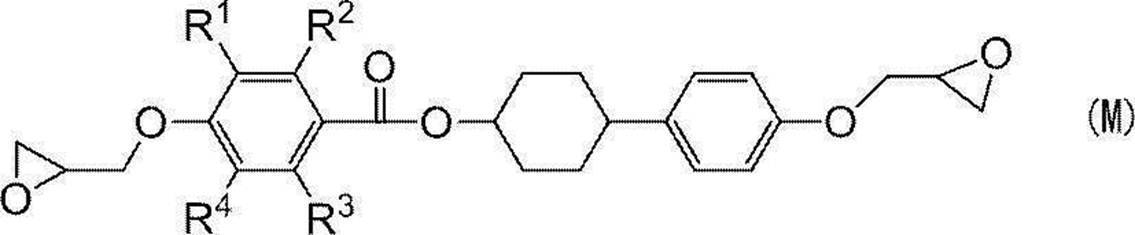
- Examples of the epoxy monomer include an epoxy compound represented by the following general formula (M).
- the epoxy compound represented by the general formula (M) has a mesogenic structure, and reacts with a curing agent to form a smectic liquid crystal structure in the cured product.
- an epoxy monomer contains the epoxy compound represented by general formula (M)
- only 1 type may be sufficient as the epoxy compound represented by general formula (M)
- 2 or more types may be sufficient as it.
- R 1 to R 4 each independently represents a hydrogen atom or an alkyl group having 1 to 3 carbon atoms.
- R 1 to R 4 are each independently preferably a hydrogen atom or an alkyl group having 1 to 2 carbon atoms, more preferably a hydrogen atom or a methyl group, and even more preferably a hydrogen atom.
- 2 to 4 of R 1 to R 4 are hydrogen atoms, more preferably 3 or 4 are hydrogen atoms, and more preferably that all 4 are hydrogen atoms.
- any of R 1 to R 4 is an alkyl group having 1 to 3 carbon atoms
- at least one of R 1 and R 4 is preferably an alkyl group having 1 to 3 carbon atoms.
- the solvent is not particularly limited as long as it can dissolve the epoxy monomer and the compound having a functional group capable of reacting with the epoxy group of the epoxy monomer and can be heated to a temperature necessary for the reaction of both compounds.
- Specific examples include cyclohexanone, cyclopentanone, ethyl lactate, propylene glycol monomethyl ether, N-methylpyrrolidone and the like.
- the amount of the solvent is not particularly limited as long as it is an amount capable of dissolving the epoxy monomer, the compound having a functional group capable of reacting with the epoxy group of the epoxy monomer, and the reaction catalyst used as necessary at the reaction temperature.
- solubility differs depending on the type of raw material before the reaction, the type of solvent, etc., for example, if the charged solid content concentration is 20% by mass to 60% by mass, the viscosity of the solution after the reaction is in a preferred range. There is a tendency.
- the compound having a functional group capable of reacting with the epoxy group of the epoxy monomer is not particularly limited. From the viewpoint of forming a smectic structure in the cured product, a compound having a functional group capable of reacting with an epoxy group of an epoxy monomer is a dihydroxybenzene compound having a structure in which two hydroxyl groups are bonded to one benzene ring, and two amino groups.
- a diaminobenzene compound having a structure in which a group is bonded to one benzene ring, a dihydroxybiphenyl compound having a structure in which one hydroxyl group is bonded to each of two benzene rings forming a biphenyl structure, and two benzene rings forming a biphenyl structure It is preferably at least one selected from the group consisting of diaminobiphenyl compounds each having a structure in which one amino group is bonded (hereinafter also referred to as a specific aromatic compound).
- a multimer having at least one selected from the group consisting of structures represented by general formulas (IA) to (ID) by reacting an epoxy group of an epoxy monomer with a hydroxyl group or an amino group of a specific aromatic compound Can be synthesized.
- Examples of the dihydroxybenzene compound include 1,2-dihydroxybenzene (catechol), 1,3-dihydroxybenzene (resorcinol), 1,4-dihydroxybenzene (hydroquinone), and derivatives thereof.
- Examples of the diaminobenzene compound include 1,2-diaminobenzene, 1,3-diaminobenzene, 1,4-diaminobenzene, and derivatives thereof.
- Examples of the dihydroxybiphenyl compound include 3,3′-dihydroxybiphenyl, 3,4′-dihydroxybiphenyl, 4,4′-dihydroxybiphenyl, and derivatives thereof.
- Examples of the diaminobiphenyl compound include 3,3′-diaminobiphenyl, 3,4′-diaminobiphenyl, 4,4′-diaminobiphenyl, and derivatives thereof.
- Examples of the derivative of the specific aromatic compound include a compound in which a substituent such as an alkyl group having 1 to 8 carbon atoms is bonded to the benzene ring of the specific aromatic compound.
- a specific aromatic compound may be used individually by 1 type, and may use 2 or more types together.
- 1,4-dihydroxybenzene, 1,4-diaminobenzene, 4,4′-dihydroxybiphenyl and 4,4 are used as specific aromatic compounds.
- '-Diaminobiphenyl is preferred.
- the multimer obtained by reacting them with an epoxy monomer tends to have a linear structure. For this reason, it is considered that the stacking property of the molecule is high and it is easy to form a smectic structure in the cured product.
- reaction catalyst is not particularly limited, and an appropriate one can be selected from the viewpoint of reaction rate, reaction temperature, storage stability, and the like. Specific examples include imidazole compounds, organophosphorus compounds, tertiary amines, and quaternary ammonium salts.
- a reaction catalyst may be used individually by 1 type, and may use 2 or more types together.
- an organic phosphorus compound is preferable as the reaction catalyst.
- the organic phosphorus compound include an organic phosphine compound, a compound having an intramolecular polarization formed by adding a compound having a ⁇ bond such as maleic anhydride, a quinone compound, diazophenylmethane, and a phenol resin to an organic phosphine compound, And a complex of a phosphine compound and an organic boron compound.
- organic phosphine compound examples include triphenylphosphine, diphenyl (p-tolyl) phosphine, tris (alkylphenyl) phosphine, tris (alkoxyphenyl) phosphine, tris (alkylalkoxyphenyl) phosphine, tris (dialkylphenyl) phosphine, Tris (trialkylphenyl) phosphine, tris (tetraalkylphenyl) phosphine, tris (dialkoxyphenyl) phosphine, tris (trialkoxyphenyl) phosphine, tris (tetraalkoxyphenyl) phosphine, trialkylphosphine, dialkylarylphosphine, alkyldiaryl A phosphine etc. are mentioned.
- quinone compound examples include 1,4-benzoquinone, 2,5-toluquinone, 1,4-naphthoquinone, 2,3-dimethylbenzoquinone, 2,6-dimethylbenzoquinone, 2,3-dimethoxy-5-methyl- Examples include 1,4-benzoquinone, 2,3-dimethoxy-1,4-benzoquinone, and phenyl-1,4-benzoquinone.
- organic boron compound examples include tetraphenyl borate, tetra-p-tolyl borate, and tetra-n-butyl borate.
- the amount of the reaction catalyst is not particularly limited. From the viewpoint of reaction rate and storage stability, 0.1 to 1.5 parts by mass with respect to 100 parts by mass of the total of the epoxy monomer and the compound having a functional group capable of reacting with the epoxy group of the epoxy monomer. Preferably, the amount is 0.2 to 1 part by mass.
- all of the epoxy monomers may react to form a multimer, or a part of the epoxy monomer may remain unreacted in the monomer state. .
- Multimer synthesis can be performed using a reaction vessel such as a flask for a small scale and a synthesis kettle for a large scale.
- a specific synthesis method is as follows, for example. First, an epoxy monomer is put into a reaction vessel, a solvent is put in if necessary, and heated to a reaction temperature with an oil bath or a heat medium to dissolve the epoxy monomer. A compound having a functional group capable of reacting with the epoxy group of the epoxy monomer is added thereto, and then a reaction catalyst is introduced as necessary to start the reaction. Subsequently, a multimer is obtained by distilling a solvent off under reduced pressure as needed.
- the reaction temperature is not particularly limited as long as the reaction between the epoxy group of the epoxy monomer and the functional group capable of reacting with the epoxy group proceeds, and is preferably in the range of 100 ° C. to 180 ° C., for example, More preferably, it is in the range of ⁇ 150 ° C.
- the reaction temperature is set to 100 ° C. or higher, the time until the reaction is completed tends to be shortened.
- the reaction temperature to 180 ° C. or lower, the possibility of gelation tends to be reduced.
- the compounding ratio of the epoxy monomer used for the synthesis of the multimer and the compound having a functional group capable of reacting with the epoxy group of the epoxy monomer is not particularly limited.
- the ratio (A / B) between the number of equivalents of epoxy groups (A) and the number of equivalents of functional groups capable of reacting with epoxy groups (A / B) is in the range of 100/100 to 100/1.
- a blending ratio in which A / B is in the range of 100/50 to 100/1 is preferable.
- the structure of the multimer is, for example, the molecular weight of the multimer estimated from the reaction between the epoxy monomer used for the synthesis and a compound having a functional group capable of reacting with the epoxy group of the epoxy monomer, UV, and mass spectrum. It can be determined by collating the molecular weight of the target compound determined by liquid chromatography carried out using a liquid chromatograph equipped with a detector.
- the content of the multimer is preferably 10% by mass or more of the entire epoxy resin, more preferably 20% by mass or more, and further preferably 30% by mass or more. From the viewpoint of heat resistance, it is preferably 80% by mass or less, more preferably 75% by mass or less, and still more preferably 70% by mass or less, based on the entire epoxy resin.
- the content of the dimer compound is preferably 10% by mass or more of the entire epoxy resin, more preferably 15% by mass or more, and further preferably 20% by mass or more. preferable.
- the content of the dimer compound is preferably 60% by mass or less, more preferably 55% by mass or less, and further preferably 50% by mass or less of the entire epoxy resin. preferable.
- the content of the epoxy monomer is preferably 30% by mass or more of the entire epoxy resin, more preferably 35% by mass or more, and further preferably 40% by mass or more. From the viewpoint of handleability, it is preferably 90% by mass or less, more preferably 80% by mass or less, and further preferably 70% by mass or less.
- the epoxy resin contains an epoxy compound (epoxy monomer) having a mesogen structure and an epoxy compound (multimer) having two or more mesogen structures having the same structure as the mesogen structure of the epoxy monomer, the viewpoint of handling properties of the epoxy resin Therefore, it is preferable that the ratio of the epoxy monomer obtained by liquid chromatography is 50% or less of the whole epoxy resin.
- An epoxy resin in which the proportion of epoxy monomer obtained by liquid chromatography is 50% or less of the whole epoxy resin is ⁇ ′2 / ⁇ ′1 as compared with an epoxy resin in which the proportion of epoxy monomer exceeds 50% of the whole epoxy resin.
- the maximum value tends to be small and tends to be excellent in handleability. The reason is not clear, but when the proportion of the epoxy monomer is 50% or less of the entire epoxy resin, a polymer having high molecular mobility and relatively low orientation becomes the main component in the system, and the epoxy resin It is presumed that the crystallization rate is remarkably lowered or no phase transition to the crystal phase occurs.
- Liquid chromatography is performed at a sample concentration of 0.5% by mass, tetrahydrofuran as the mobile phase, and a flow rate of 1.0 ml / min.
- the measurement can be performed using, for example, a high performance liquid chromatograph “L6000” manufactured by Hitachi, Ltd. and a data analysis apparatus “C-R4A” manufactured by Shimadzu Corporation.
- As the column for example, “G2000HXL” and “G3000HXL” which are GPC columns manufactured by Tosoh Corporation can be used.
- the proportion of the epoxy monomer obtained by liquid chromatography is preferably 50% or less of the entire epoxy resin, more preferably 49% or less, and 48% or less. Further preferred.
- the proportion of the epoxy monomer obtained by liquid chromatography is preferably 35% or more of the entire epoxy resin, more preferably 37% or more, and 40%. More preferably, it is the above.
- the epoxy resin may contain an epoxy monomer represented by the general formula (I), a multimer of the epoxy monomer, and other epoxy monomers. By including other epoxy monomers, effects such as further suppression of crystallization can be expected.
- Other epoxy monomers include 3,3 ', 5,5'-tetramethyl-4,4'-biphenol diglycidyl ether.
- the number average molecular weight (Mn) and the weight average molecular weight (Mw) of the epoxy resin are not particularly limited and can be selected according to desired properties of the epoxy resin.
- the number average molecular weight (Mn) and the weight average molecular weight (Mw) of the epoxy resin are values obtained by liquid chromatography.
- Liquid chromatography is performed at a sample concentration of 0.5% by mass, tetrahydrofuran as the mobile phase, and a flow rate of 1.0 ml / min.
- a calibration curve is prepared using a polystyrene standard sample, and Mn and Mw are measured in terms of polystyrene using the calibration curve.
- the measurement can be performed using, for example, a high performance liquid chromatograph “L6000” manufactured by Hitachi, Ltd. and a data analysis apparatus “C-R4A” manufactured by Shimadzu Corporation.
- As the GPC column for example, “G2000HXL” and “G3000HXL” manufactured by Tosoh Corporation can be used.
- the epoxy resin composition of the present embodiment includes the epoxy resin of the above-described embodiment and a curing agent.
- the curing agent is not particularly limited as long as it is a compound capable of causing a curing reaction with the epoxy resin contained in the epoxy resin composition of the present embodiment.
- Specific examples of the curing agent include amine curing agents, phenol curing agents, acid anhydride curing agents, polymercaptan curing agents, polyaminoamide curing agents, isocyanate curing agents, and blocked isocyanate curing agents. Only one type or two or more types of curing agents may be used.
- the curing agent is preferably an amine curing agent or a phenol curing agent, and from the viewpoint of heat resistance, an amine curing agent is more preferable, particularly an aromatic ring.
- a compound having two or more amino groups directly bonded to is more preferable.
- amine curing agents include 3,3′-diaminodiphenylsulfone, 4,4′-diaminodiphenylsulfone, 4,4′-diaminodiphenylmethane, 4,4′-diaminodiphenyl ether, 4,4′-diamino- 3,3'-dimethoxybiphenyl, 4,4'-diaminophenylbenzoate, 1,5-diaminonaphthalene, 1,3-diaminonaphthalene, 1,4-diaminonaphthalene, 1,8-diaminonaphthalene, 1,3-diamino Examples include benzene, 1,4-diaminobenzene, 4,4′-diaminobenzanilide, trimethylene-bis-4-aminobenzoate, and the like.
- the phenol curing agent examples include a low molecular phenol compound and a phenol novolac resin obtained by connecting low molecular phenol compounds with a methylene chain to form a novolac.
- Low molecular phenol compounds include monofunctional phenol compounds such as phenol, o-cresol, m-cresol, and p-cresol, bifunctional phenol compounds such as catechol, resorcinol, hydroquinone, 1,2,3-trihydroxybenzene, 1 , 2,4-trihydroxybenzene, trifunctional phenol compounds such as 1,3,5-trihydroxybenzene and the like.
- the content of the curing agent in the epoxy resin composition is not particularly limited. From the viewpoint of the efficiency of the curing reaction, the ratio between the number of active hydrogen equivalents (amine equivalent number) of the curing agent contained in the epoxy resin composition and the epoxy equivalent number of epoxy resin (amine equivalent number / epoxy equivalent number). Is preferably in an amount of 0.3 to 3.0, more preferably in an amount of 0.5 to 2.0.
- An epoxy resin composition may contain other components other than an epoxy resin and a hardening
- a curing catalyst and a filler may be included.
- Specific examples of the curing catalyst include compounds exemplified as reaction catalysts that can be used for the synthesis of multimers.
- the use of the epoxy resin composition of this embodiment is not particularly limited, it can be suitably used for a processing method involving relatively rapid heating of the epoxy resin composition.
- a processing method involving relatively rapid heating of the epoxy resin composition.
- suitable for the manufacture of FRP involving the step of impregnating the epoxy resin composition while heating the gap between the fibers, and the production of a sheet-like material involving the step of spreading the epoxy resin composition with a squeegee etc.
- the epoxy resin composition of this embodiment can also be suitably used in a processing method in which it is desired to omit or reduce the addition of a solvent for decreasing the viscosity from the viewpoint of suppressing the generation of voids in the cured product.
- the epoxy resin cured product of the present embodiment is obtained by curing the epoxy resin composition of the present embodiment.
- the composite material of this embodiment includes the epoxy resin cured product of this embodiment and a reinforcing material.
- the material of the reinforcing material included in the composite material is not particularly limited and can be selected according to the use of the composite material.
- Specific examples of the reinforcing material include carbon materials, glass, aromatic polyamide resins (for example, Kevlar (registered trademark)), ultrahigh molecular weight polyethylene, alumina, boron nitride, aluminum nitride, mica, silicon, and the like.
- the shape of the reinforcing material is not particularly limited, and examples thereof include fibrous and particulate (filler).
- the reinforcing material contained in the composite material may be one type or two or more types.
- Example 2 An epoxy resin was obtained in the same manner as in Example 1 except that 3.1 g of hydroquinone was added instead of 5.2 g of 4,4′-dihydroxybiphenyl. Next, a cured epoxy resin was obtained in the same manner as in Example 1 except that the amount of 4,4′-diaminodiphenyl sulfone was changed to 9.8 g.
- Example 3 2.5 g of 3,3 ′, 5,5′-tetramethyl-4,4′-biphenol diglycidyl ether was added to 50 g of the epoxy resin synthesized in Example 2 to obtain an epoxy resin. Next, a cured epoxy resin was obtained in the same manner as in Example 1 except that the amount of 4,4′-diaminodiphenylsulfone was 10.1 g.
- Example 4 An epoxy resin was obtained in the same manner as in Example 1 except that 3.0 g of catechol was added instead of 5.2 g of 4,4′-dihydroxybiphenyl. Next, a cured epoxy resin was obtained in the same manner as in Example 1 except that the amount of 4,4′-diaminodiphenylsulfone was 10.1 g.
- Example 5 An epoxy resin was obtained in the same manner as in Example 1 except that 3.0 g of hydroquinone was added instead of 5.2 g of 4,4′-dihydroxybiphenyl. Next, a cured epoxy resin was obtained in the same manner as in Example 1 except that the amount of 4,4′-diaminodiphenyl sulfone was changed to 9.8 g.
- Example 6 An epoxy resin was obtained in the same manner as in Example 1 except that 2.9 g of hydroquinone was added instead of 5.2 g of 4,4′-dihydroxybiphenyl. Next, a cured epoxy resin was obtained in the same manner as in Example 1 except that the amount of 4,4′-diaminodiphenyl sulfone was changed to 9.9 g.
- the dynamic shear viscosity (Pa ⁇ s) of the epoxy resin was measured in a vibration mode with a rheometer (MCR-301, manufactured by Anton Paar). For the measurement, a parallel plate with a diameter of 12 mm was used, and the measurement conditions were a frequency of 1 Hz, a gap of 0.2 mm, and a strain of 2%. The measurement is performed by allowing the epoxy resin to melt at 150 ° C. for 3 minutes or more, and then lowering the temperature of the epoxy resin from 150 ° C. to 30 ° C. at a rate of 2 ° C./min. A temperature raising step for increasing the temperature from 0 ° C. to 150 ° C.
- Epoxy resin maintains fluidity and can sweep 10 cm with a generally uniform appearance.
- B The epoxy resin maintains fluidity to a certain extent and can be swept by 10 cm, but is partially faint.
- C Epoxy resin exhibits a certain degree of fluidity and can be swept, but blurring is noticeable.
- D The viscosity of the epoxy resin is too high to sweep or cannot be swept at all.
- the fracture toughness value (MPa ⁇ m 1/2 ) was measured as an index for evaluating the fracture toughness of the cured epoxy resin.
- the fracture toughness value of the test piece was calculated by performing a three-point bending measurement based on ASTM D5045. Instron 5948 (Instron) was used as the evaluation device. The results are shown in Table 1.
- the glass transition temperature (Tg, ° C.) was measured as an index for evaluating the heat resistance of the cured epoxy resin.
- the glass transition temperature of the test piece was calculated by performing dynamic viscoelasticity measurement in a tensile mode. The measurement conditions were a frequency of 10 Hz, a heating rate of 5 ° C./min, and a strain of 0.1%. In the obtained temperature-tan ⁇ relationship diagram, the temperature at which tan ⁇ was maximized was regarded as the glass transition temperature.
- RSA-G2 manufactured by TA Instruments
- the epoxy resins produced in Examples 1 to 7 where the maximum value of ⁇ ′2 / ⁇ ′1 is 20 or less are comparative examples in which the maximum value of ⁇ ′2 / ⁇ ′1 exceeds 20. Compared with the epoxy resins prepared in 1-4, the coating property was excellent. In Comparative Example 5, although the maximum value of ⁇ ′2 / ⁇ ′1 was 20 or less, ⁇ ′2 greatly exceeded 1000 Pa ⁇ s, and the applicability was poor. In addition, the cured epoxy resins produced in Examples 1 to 7 all exhibited high fracture toughness values and high glass transition temperatures.
Landscapes
- Chemical & Material Sciences (AREA)
- Health & Medical Sciences (AREA)
- Chemical Kinetics & Catalysis (AREA)
- Medicinal Chemistry (AREA)
- Polymers & Plastics (AREA)
- Organic Chemistry (AREA)
- Engineering & Computer Science (AREA)
- Manufacturing & Machinery (AREA)
- Materials Engineering (AREA)
- Epoxy Resins (AREA)
- Compositions Of Macromolecular Compounds (AREA)
- Reinforced Plastic Materials (AREA)
Abstract
Description
本発明は上記状況に鑑み、取り扱い性に優れるエポキシ樹脂及びエポキシ樹脂組成物、並びにこれらを用いて得られるエポキシ樹脂硬化物及び複合材料を提供することを課題とする。
<1>メソゲン構造を有するエポキシ化合物を含むエポキシ樹脂であり、
前記エポキシ樹脂の温度を150℃から30℃まで2℃/分の速度で下降させる降温工程と、前記エポキシ樹脂の温度を30℃から150℃まで2℃/分の速度で上昇させる昇温工程と、をこの順に実施したときに、
30℃から150℃の温度範囲における、前記降温工程において測定される動的せん断粘度η´1(Pa・s)と、前記昇温工程においてη´1の測定温度と同じ温度で測定される動的せん断粘度η´2(Pa・s)とから得られるη´2/η´1の最大値が20以下であり、かつ100℃におけるη´2が1000Pa・s以下であるエポキシ樹脂。
本明細書中に段階的に記載されている数値範囲において、一つの数値範囲で記載された上限値又は下限値は、他の段階的な記載の数値範囲の上限値又は下限値に置き換えてもよい。また、本明細書中に記載されている数値範囲において、その数値範囲の上限値又は下限値は、実施例に示されている値に置き換えてもよい。
本明細書において組成物中の各成分の含有率又は含有量は、組成物中に各成分に該当する物質が複数種存在する場合、特に断らない限り、組成物中に存在する当該複数種の物質の合計の含有率又は含有量を意味する。
本明細書において「エポキシ化合物」とは、分子中にエポキシ基を有する化合物を意味する。「エポキシ樹脂」とは、複数のエポキシ化合物を集合体として捉える概念であって硬化していない状態のものを意味する。
本実施形態のエポキシ樹脂は、メソゲン構造を有するエポキシ化合物を含むエポキシ樹脂であり、
前記エポキシ樹脂の温度を150℃から30℃まで2℃/分の速度で下降させる降温工程と、前記エポキシ樹脂の温度を30℃から150℃まで2℃/分の速度で上昇させる昇温工程と、をこの順に実施したときに、
30℃から150℃の温度範囲における、前記降温工程において測定される動的せん断粘度η´1(Pa・s)と、前記昇温工程においてη´1の測定温度と同じ温度で測定される動的せん断粘度η´2(Pa・s)とから得られるη´2/η´1の最大値が20以下であり、かつ100℃におけるη´2が1000Pa・s以下である。
測定は、エポキシ樹脂を150℃で3分以上放置して溶融させた後、エポキシ樹脂の温度を150℃から30℃まで2℃/分の速度で下降させる降温工程と、エポキシ樹脂の温度を30℃から150℃まで2℃/分の速度で上昇させる昇温工程と、をこの順に実施し、その間の動的せん断粘度を少なくとも1点/℃以上の間隔で測定する。レオメータとしては、例えば、アントンパール社の「MCR-301」を用いることができる。
さらに、温度ヒステリシスを示す樹脂をシート化した場合においても、シート化後に樹脂が結晶化するため、ロール等の巻物で保管した場合に、シートの厚みによってはクラックを生じるなど、品質管理上の問題が生じるおそれがある。
さらに本実施形態のエポキシ樹脂は、100℃におけるη´2が1000Pa・s以下であるため、塗布性に優れている。
エポキシ樹脂の融点は、たとえば、示差走査熱量測定における加熱速度10℃/分で測定される融解ピーク温度から求めることができる。
本実施形態のエポキシ樹脂において、エポキシ樹脂の温度が100℃であるときのη´1の範囲は特に制限されない。例えば、0.1Pa・s~500Pa・sの範囲が好ましく、1Pa~50Paの範囲がより好ましい。
本実施形態のエポキシ樹脂において、エポキシ樹脂の温度が100℃であるときのη´2は1000Pa・s以下であり、500Pa・s以下であることが好ましく、200Pa・s以下であることがより好ましく、50Pa・s以下であることがさらに好ましい。
本実施形態のエポキシ樹脂は、メソゲン構造を有するエポキシ化合物を含む。エポキシ樹脂に含まれるメソゲン構造を有するエポキシ化合物は1種のみでも2種以上であってもよい。
なお、メソゲン構造を有する化合物は、反応誘起で液晶性を示す場合もあるため、硬化物として液晶性を示すか否かが重要である。


一般式(I)で表される構造を有するエポキシ化合物を含むエポキシ樹脂は、他のメソゲン構造を有するエポキシ化合物を含むエポキシ樹脂に比べ、得られる硬化物のガラス転移温度が高く、かつ破壊じん性値が高い傾向にある。
さらに、一般式(I)で表される構造を有するエポキシ化合物を含むエポキシ樹脂は、他のメソゲン構造を有するエポキシ化合物を含むエポキシ樹脂に比べ、優れた分子配向性を示し、かつそのような化合物としては比較的融点が低く取り扱い性に優れる傾向にある。

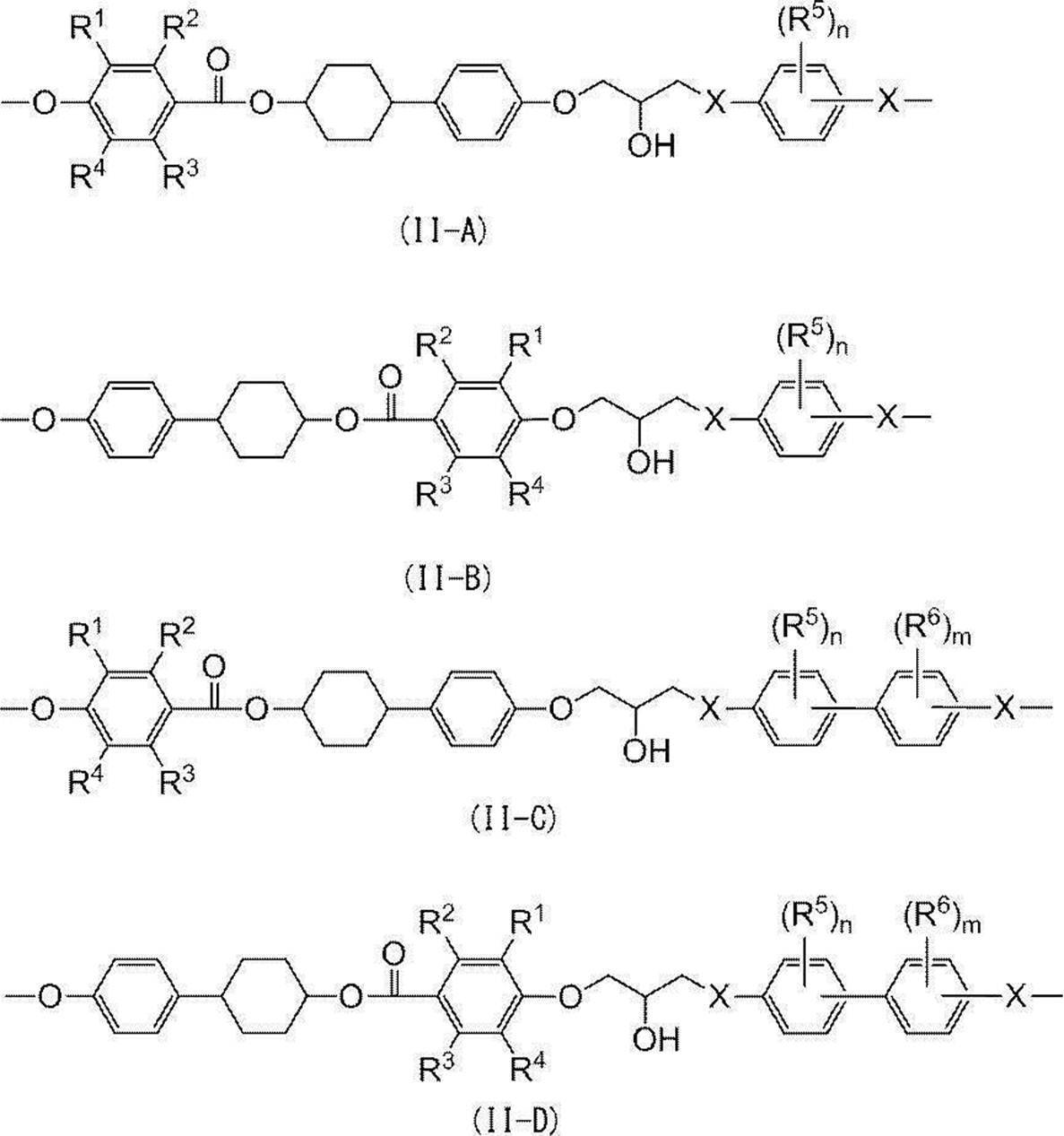


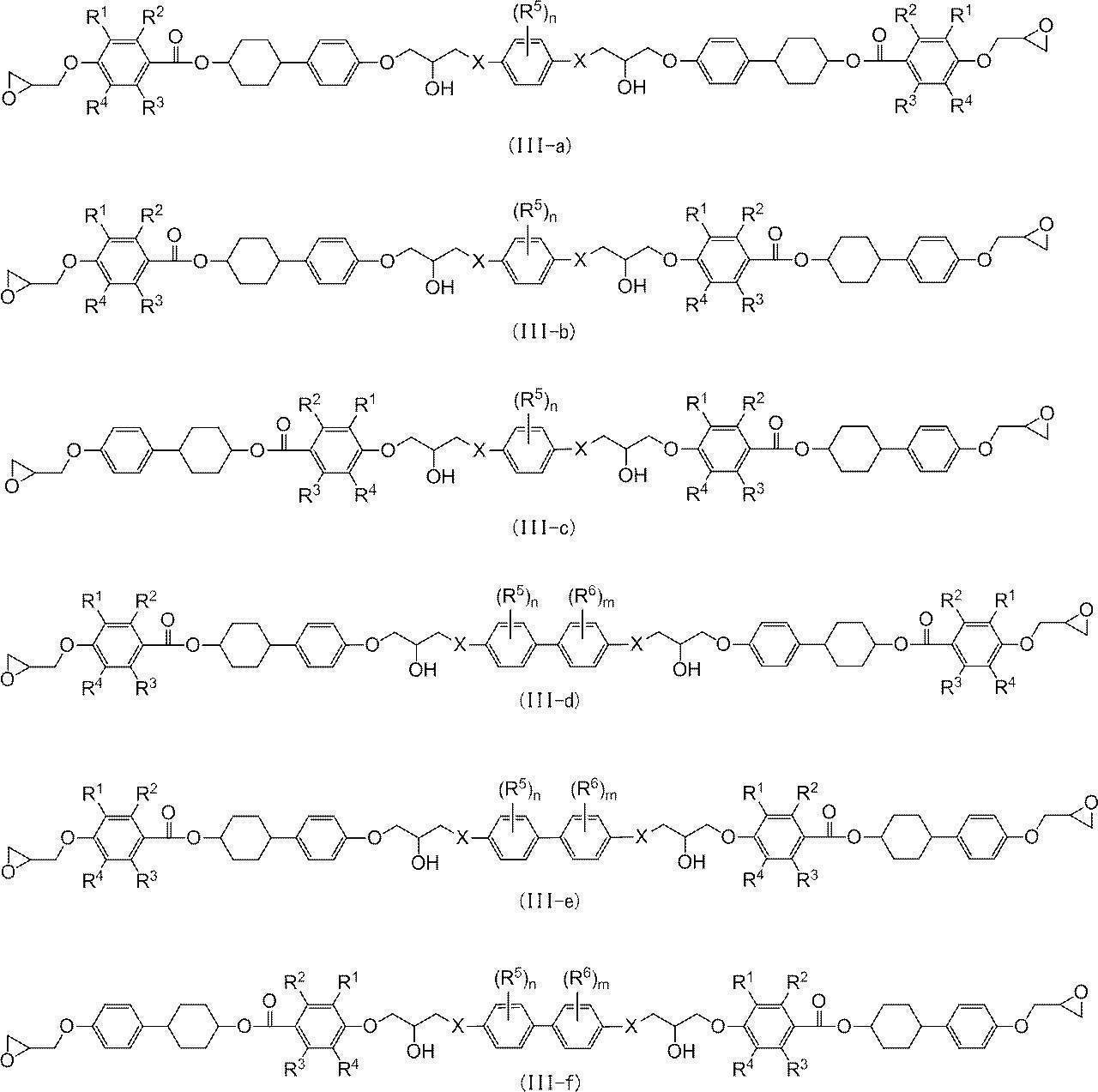
エポキシモノマーと、エポキシモノマーのエポキシ基と反応しうる官能基を有する化合物とを反応させて多量体を合成する方法は、特に制限されない。具体的には、例えば、エポキシモノマーと、エポキシモノマーのエポキシ基と反応しうる官能基を有する化合物と、必要に応じて用いる反応触媒とを溶媒中に溶解し、加熱しながら撹拌することで、多量体を合成することができる。
あるいは、例えば、特定エポキシモノマーと、特定エポキシモノマーのエポキシ基と反応しうる官能基を有する化合物を、必要に応じて用いる反応触媒と溶媒を用いずに混合し、加熱しながら撹拌することで、特定エポキシ化合物を合成することができる。
ジアミノベンゼン化合物としては、1,2-ジアミノベンゼン、1,3-ジアミノベンゼン、1,4-ジアミノベンゼン、これらの誘導体等が挙げられる。
ジヒドロキシビフェニル化合物としては、3,3’-ジヒドロキシビフェニル、3,4’-ジヒドロキシビフェニル、4,4’-ジヒドロキシビフェニル、これらの誘導体等が挙げられる。
ジアミノビフェニル化合物としては、3,3’-ジアミノビフェニル、3,4’-ジアミノビフェニル、4,4’-ジアミノビフェニル、これらの誘導体等が挙げられる。
特定芳香族化合物の誘導体としては、特定芳香族化合物のベンゼン環に炭素数1~8のアルキル基等の置換基が結合した化合物が挙げられる。特定芳香族化合物は、1種を単独で用いてもよく、2種以上を併用してもよい。
有機リン化合物の好ましい例としては、有機ホスフィン化合物、有機ホスフィン化合物に無水マレイン酸、キノン化合物、ジアゾフェニルメタン、フェノール樹脂等のπ結合をもつ化合物を付加してなる分子内分極を有する化合物、有機ホスフィン化合物と有機ボロン化合物との錯体などが挙げられる。
まず、エポキシモノマーを反応容器に投入し、必要に応じて溶媒を入れ、オイルバス又は熱媒により反応温度まで加温し、エポキシモノマーを溶解する。そこにエポキシモノマーのエポキシ基と反応しうる官能基を有する化合物を投入し、次いで必要に応じて反応触媒を投入し、反応を開始させる。次いで、必要に応じて減圧下で溶媒を留去することで、多量体が得られる。
エポキシモノマーに由来するピークの面積の割合(%)=(エポキシモノマーに由来するピークの面積/全てのエポキシ化合物に由来するピークの合計面積)×100
液体クロマトグラフィーは、試料濃度を0.5質量%とし、移動相にテトラヒドロフランを用い、流速を1.0ml/minとして行う。検量線はポリスチレン標準サンプルを用いて作成し、それを用いてポリスチレン換算値でMn及びMwを測定する。
測定は、例えば、株式会社日立製作所製の高速液体クロマトグラフ「L6000」と、株式会社島津製作所製のデータ解析装置「C-R4A」を用いて行うことができる。GPCカラムとしては、例えば、東ソー株式会社製の「G2000HXL」及び「G3000HXL」を用いることができる。
本実施形態のエポキシ樹脂組成物は、上述した実施形態のエポキシ樹脂と、硬化剤と、を含む。
硬化剤は、本実施形態のエポキシ樹脂組成物に含まれるエポキシ樹脂と硬化反応を生じることができる化合物であれば、特に制限されない。硬化剤の具体例としては、アミン硬化剤、フェノール硬化剤、酸無水物硬化剤、ポリメルカプタン硬化剤、ポリアミノアミド硬化剤、イソシアネート硬化剤、ブロックイソシアネート硬化剤等が挙げられる。硬化剤は、1種のみでも2種以上であってもよい。
エポキシ樹脂組成物は、必要に応じてエポキシ樹脂と硬化剤以外のその他の成分を含んでもよい。例えば、硬化触媒、フィラー等を含んでもよい。硬化触媒の具体例としては、多量体の合成に使用しうる反応触媒として例示した化合物が挙げられる。
本実施形態のエポキシ樹脂組成物の用途は特に制限されないが、エポキシ樹脂組成物の比較的急速な加温を伴う加工方法にも好適に用いることができる。例えば、繊維間の空隙にエポキシ樹脂組成物を加温しながら含浸する工程を伴うFRPの製造、エポキシ樹脂組成物を加温しながらスキージ等で広げる工程を伴うシート状物の製造などにも好適に用いることができる。
本実施形態のエポキシ樹脂組成物は、硬化物中のボイドの発生を抑制する観点から粘度低下のための溶剤の添加を省略又は低減することが望まれる加工方法にも好適に用いることができる。
本実施形態のエポキシ樹脂硬化物は、本実施形態のエポキシ樹脂組成物を硬化して得られる。本実施形態の複合材料は、本実施形態のエポキシ樹脂硬化物と、強化材と、を含む。
500mLの三口フラスコに、エポキシモノマーとして(4-{4-(2,3-エポキシプロポキシ)フェニル}シクロヘキシル=4-(2,3-エポキシプロポキシ)ベンゾエート、下記構造)を50g量り取り、そこにプロピレングリコールモノメチルエーテルを80g添加した。三口フラスコに冷却管及び窒素導入管を設置し、溶媒に漬かるように撹拌羽を取り付けた。この三口フラスコを120℃のオイルバスに浸漬し、撹拌を開始した。エポキシモノマーが溶解し、透明な溶液になったことを確認した後、4、4’-ジヒドロキシビフェニルを5.2g、反応触媒としてトリフェニルホスフィンを0.5g添加し、120℃のオイルバス温度で加熱を継続した。3時間加熱を継続した後に、反応溶液からプロピレングリコールモノメチルエーテルを減圧留去し、残渣を室温(25℃)まで冷却することにより、エポキシモノマーの一部が4、4’-ジヒドロキシビフェニルと反応して多量体を形成した状態のエポキシ樹脂を得た。

4,4’-ジヒドロキシビフェニル5.2gに替えて、ヒドロキノンを3.1g添加した以外は実施例1と同様にして、エポキシ樹脂を得た。
次いで、4,4’-ジアミノジフェニルスルホンの量を9.8gとした以外は実施例1と同様にして、エポキシ樹脂硬化物を得た。
実施例2で合成したエポキシ樹脂50gに、3,3’,5,5’-テトラメチル-4,4’-ビフェノールジグリシジルエーテルを2.5g添加し、エポキシ樹脂を得た。
次いで、4,4’-ジアミノジフェニルスルホンの量を10.1gとした以外は実施例1と同様にして、エポキシ樹脂硬化物を得た。
4,4’-ジヒドロキシビフェニル5.2gに替えて、カテコールを3.0g添加した以外は実施例1と同様にして、エポキシ樹脂を得た。
次いで、4,4’-ジアミノジフェニルスルホンの量を10.1gとした以外は実施例1と同様にして、エポキシ樹脂硬化物を得た。
4,4’-ジヒドロキシビフェニル5.2gに替えて、ヒドロキノンを3.0g添加した以外は実施例1と同様にして、エポキシ樹脂を得た。
次いで、4,4’-ジアミノジフェニルスルホンの量を9.8gとした以外は実施例1と同様にして、エポキシ樹脂硬化物を得た。
4,4’-ジヒドロキシビフェニル5.2gに替えて、ヒドロキノンを2.9g添加した以外は実施例1と同様にして、エポキシ樹脂を得た。
次いで、4,4’-ジアミノジフェニルスルホンの量を9.9gとした以外は実施例1と同様にして、エポキシ樹脂硬化物を得た。
エポキシモノマーとして(4-{4-(2,3-エポキシプロポキシ)フェニル}シクロヘキシル=4-(2,3-エポキシプロポキシ)ベンゾエート)に替えて、下記構造で表されるメソゲンエポキシモノマーを50g量り取り、4,4’-ジヒドロキシビフェニル5.2gに替えて、ヒドロキノンを1.4g添加した以外は実施例1と同様にして、エポキシ樹脂を得た。
次いで、4,4’-ジアミノジフェニルスルホンの量を12.1gとした以外は実施例1と同様にして、エポキシ樹脂硬化物を得た。

4,4’-ジヒドロキシビフェニル5.2gに替えて、ヒドロキノンを1.6g添加した以外は実施例1と同様にして、エポキシ樹脂を得た。
次いで、4,4’-ジアミノジフェニルスルホンの量を11.2gとした以外は実施例1と同様にして、エポキシ樹脂硬化物を得た。
4,4’-ジヒドロキシビフェニル5.2gに替えて、ヒドロキノンを2.8g添加した以外は実施例1と同様にして、エポキシ樹脂を得た。
次いで、4,4’-ジアミノジフェニルスルホンの量を10.1gとした以外は実施例1と同様にして、エポキシ樹脂硬化物を得た。
4,4’-ジヒドロキシビフェニル5.2gに替えて、カテコールを1.2g添加した以外は実施例1と同様にして、エポキシ樹脂を得た。
次いで、4,4’-ジアミノジフェニルスルホンの量を12.2gとした以外は実施例1と同様にして、エポキシ樹脂硬化物を得た。
4,4’-ジヒドロキシビフェニル5.2gに替えて、レゾルシノールを2.5g添加した以外は実施例1と同様にして、エポキシ樹脂を得た。
次いで、4,4’-ジアミノジフェニルスルホンの量を10.6gとした以外は実施例1と同様にして、エポキシ樹脂硬化物を得た。
4,4’-ジヒドロキシビフェニル5.2gに替えて、レゾルシノールを3.7g添加した以外は実施例1と同様にして、エポキシ樹脂を得た。
次いで、4,4’-ジアミノジフェニルスルホンの量を9.0gとした以外は実施例1と同様にして、エポキシ樹脂硬化物を得た。
エポキシ樹脂の動的せん断粘度(Pa・s)は、レオメータ(MCR-301、アントンパール社製)により振動モードで測定した。測定には直径12mmの平行平板プレートを用い、測定条件は、周波数1Hz、ギャップ0.2mm、ひずみ2%とした。
測定は、エポキシ樹脂を150℃で3分以上放置して溶融させた後、エポキシ樹脂の温度を150℃から30℃まで2℃/分の速度で下降させる降温工程と、エポキシ樹脂の温度を30℃から150℃まで2℃/分の速度で上昇させる昇温工程と、をこの順に実施した。降温工程及び昇温工程では、エポキシ樹脂の粘度を1点/℃の間隔で測定し、降温時の動的せん断粘度η´1と昇温時の動的せん断粘度η´2とからη´2/η´1の最大値を計算した。η´2/η´1が最大値となるときの温度と、100℃におけるη´2及びη´1の測定値とあわせて結果を表1に示す。また、実施例1と比較例1で作製したエポキシ樹脂の動的せん断粘度の測定結果のグラフを図1及び図2に示す。
エポキシ樹脂の塗布性と流動性を次のように評価した。150℃に加熱したホットプレート上にステンレス板を設置して充分加熱した後、ステンレス板の上にPETフィルムを置き、固定した。次いで、PETフィルムの上にエポキシ樹脂を数g程度載せて、溶融させた。次いで、ホットプレートの温度を100℃まで下げ、同温度で5分ほど放置した。その後、予め100℃に加熱したアプリケータを、ギャップ100μmとして掃引し、エポキシ樹脂をPETフィルム上に引き伸ばした。このときのエポキシ樹脂の塗布性を、下記の評価基準に従って評価した。結果を表1に示す。
B…エポキシ樹脂が一定程度流動性を保ち、10cm掃引できるが、一部かすれる。
C…エポキシ樹脂が一定程度流動性を示して掃引できるが、かすれが目立つ
D…エポキシ樹脂の粘度が高すぎてほとんど掃引できないか、全く掃引できない。
エポキシ樹脂硬化物の破壊じん性の評価の指標として、破壊じん性値(MPa・m1/2)を測定した。試験片の破壊じん性値は、ASTM D5045に基づいて3点曲げ測定を行って算出した。評価装置には、インストロン5948(インストロン社製)を用いた。結果を表1に示す。
エポキシ樹脂硬化物の耐熱性の評価の指標として、ガラス転移温度(Tg、℃)を測定した。試験片のガラス転移温度は、引張りモードによる動的粘弾性測定を行って算出した。測定条件は、周波数10Hz、昇温速度5℃/分、ひずみ0.1%とした。得られた温度―tanδ関係図において、tanδが最大となる温度を、ガラス転移温度とみなした。評価装置には、RSA-G2(ティー・エイ・インスツルメント社製)を用いた。結果を表1に示す。
エポキシ樹脂硬化物中にスメクチック構造が形成されているか否かを確認するために、X線回折測定を行った。測定条件は、CuKα線を用い、管電圧40kV、管電流20mA、サンプリング幅0.01°、走査速度を1°/分、測定角度を2θ=2°~30°とした。評価装置には、株式会社リガク製のX線回折装置を用いた。結果を表1に示す。
有…2θ=2°~10°の範囲に回折ピークが現れ、スメクチック構造が形成されている。
無…2θ=2°~10°の範囲に回折ピークが現れず、スメクチック構造が形成されていない。

また、実施例1~7で作製したエポキシ樹脂の硬化物は、いずれも高い破壊じん性値と高いガラス転移温度を示した。
本明細書に記載された全ての文献、特許出願、および技術規格は、個々の文献、特許出願、および技術規格が参照により取り込まれることが具体的かつ個々に記された場合と同程度に、本明細書中に援用されて取り込まれる。
Claims (5)
- メソゲン構造を有するエポキシ化合物を含むエポキシ樹脂であり、
前記エポキシ樹脂の温度を150℃から30℃まで2℃/分の速度で下降させる降温工程と、前記エポキシ樹脂の温度を30℃から150℃まで2℃/分の速度で上昇させる昇温工程と、をこの順に実施したときに、
30℃から150℃の温度範囲における、前記降温工程において測定される動的せん断粘度η´1(Pa・s)と、前記昇温工程においてη´1の測定温度と同じ温度で測定される動的せん断粘度η´2(Pa・s)とから得られるη´2/η´1の最大値が20以下であり、かつ100℃におけるη´2が1000Pa・s以下である、エポキシ樹脂。 - 硬化剤と反応させて硬化させた際にスメクチック構造を硬化物中に形成する、請求項1に記載のエポキシ樹脂。
- 請求項1又は請求項2に記載のエポキシ樹脂と、硬化剤と、を含む、エポキシ樹脂組成物。
- 請求項3に記載のエポキシ樹脂組成物の硬化物である、エポキシ樹脂硬化物。
- 請求項4に記載のエポキシ樹脂硬化物と、強化材と、を含む複合材料。
Priority Applications (6)
| Application Number | Priority Date | Filing Date | Title |
|---|---|---|---|
| KR1020197011420A KR102345562B1 (ko) | 2016-10-14 | 2017-10-13 | 에폭시 수지, 에폭시 수지 조성물, 에폭시 수지 경화물 및 복합 재료 |
| EP17860947.5A EP3514191B1 (en) | 2016-10-14 | 2017-10-13 | Epoxy resin, epoxy resin composition, epoxy resin cured object, and composite material |
| US16/341,559 US10800872B2 (en) | 2016-10-14 | 2017-10-13 | Epoxy resin, epoxy resin composition, epoxy resin cured product, and composite material |
| JP2018545083A JPWO2018070534A1 (ja) | 2016-10-14 | 2017-10-13 | エポキシ樹脂、エポキシ樹脂組成物、エポキシ樹脂硬化物及び複合材料 |
| CA3040449A CA3040449A1 (en) | 2016-10-14 | 2017-10-13 | Epoxy resin, epoxy resin composition, epoxy resin cured product, and composite material |
| CN201780063273.2A CN109843966B (zh) | 2016-10-14 | 2017-10-13 | 环氧树脂、环氧树脂组合物、环氧树脂固化物和复合材料 |
Applications Claiming Priority (2)
| Application Number | Priority Date | Filing Date | Title |
|---|---|---|---|
| JPPCT/JP2016/080629 | 2016-10-14 | ||
| PCT/JP2016/080629 WO2018070051A1 (ja) | 2016-10-14 | 2016-10-14 | エポキシ樹脂、エポキシ樹脂組成物、エポキシ樹脂硬化物及び複合材料 |
Publications (1)
| Publication Number | Publication Date |
|---|---|
| WO2018070534A1 true WO2018070534A1 (ja) | 2018-04-19 |
Family
ID=61905403
Family Applications (2)
| Application Number | Title | Priority Date | Filing Date |
|---|---|---|---|
| PCT/JP2016/080629 Ceased WO2018070051A1 (ja) | 2016-10-14 | 2016-10-14 | エポキシ樹脂、エポキシ樹脂組成物、エポキシ樹脂硬化物及び複合材料 |
| PCT/JP2017/037267 Ceased WO2018070534A1 (ja) | 2016-10-14 | 2017-10-13 | エポキシ樹脂、エポキシ樹脂組成物、エポキシ樹脂硬化物及び複合材料 |
Family Applications Before (1)
| Application Number | Title | Priority Date | Filing Date |
|---|---|---|---|
| PCT/JP2016/080629 Ceased WO2018070051A1 (ja) | 2016-10-14 | 2016-10-14 | エポキシ樹脂、エポキシ樹脂組成物、エポキシ樹脂硬化物及び複合材料 |
Country Status (8)
| Country | Link |
|---|---|
| US (1) | US10800872B2 (ja) |
| EP (1) | EP3514191B1 (ja) |
| JP (2) | JPWO2018070534A1 (ja) |
| KR (1) | KR102345562B1 (ja) |
| CN (1) | CN109843966B (ja) |
| CA (1) | CA3040449A1 (ja) |
| TW (1) | TWI767946B (ja) |
| WO (2) | WO2018070051A1 (ja) |
Cited By (7)
| Publication number | Priority date | Publication date | Assignee | Title |
|---|---|---|---|---|
| WO2019160143A1 (ja) * | 2018-02-19 | 2019-08-22 | 日立化成株式会社 | エポキシ樹脂、エポキシ樹脂組成物、エポキシ樹脂硬化物及び複合材料 |
| WO2019198703A1 (ja) * | 2018-04-10 | 2019-10-17 | 日立化成株式会社 | エポキシ樹脂、エポキシ樹脂組成物、エポキシ樹脂硬化物及び複合材料 |
| WO2020045560A1 (ja) * | 2018-08-31 | 2020-03-05 | Jnc株式会社 | 組成物、硬化物、積層体および電子機器 |
| WO2020053937A1 (ja) * | 2018-09-10 | 2020-03-19 | 日立化成株式会社 | エポキシ樹脂、エポキシ樹脂組成物、エポキシ樹脂硬化物及び複合材料 |
| JP2020079417A (ja) * | 2016-10-14 | 2020-05-28 | 日立化成株式会社 | エポキシ樹脂、エポキシ樹脂組成物、エポキシ樹脂硬化物及び複合材料 |
| CN112673041A (zh) * | 2018-09-10 | 2021-04-16 | 昭和电工材料株式会社 | 环氧树脂、环氧树脂组合物、环氧树脂固化物及复合材料 |
| JP2021155484A (ja) * | 2020-03-25 | 2021-10-07 | 日鉄ケミカル&マテリアル株式会社 | エポキシ樹脂組成物および硬化物 |
Families Citing this family (5)
| Publication number | Priority date | Publication date | Assignee | Title |
|---|---|---|---|---|
| KR102686755B1 (ko) * | 2016-10-14 | 2024-07-18 | 가부시끼가이샤 레조낙 | 에폭시 수지, 에폭시 수지 조성물, 에폭시 수지 경화물 및 복합 재료 |
| KR102408631B1 (ko) * | 2017-09-29 | 2022-06-13 | 쇼와덴코머티리얼즈가부시끼가이샤 | 에폭시 수지, 에폭시 수지 조성물, 에폭시 수지 경화물 및 복합 재료 |
| WO2019064545A1 (ja) * | 2017-09-29 | 2019-04-04 | 日立化成株式会社 | エポキシ樹脂、エポキシ樹脂組成物、エポキシ樹脂硬化物及び複合材料 |
| US10597485B2 (en) * | 2017-10-17 | 2020-03-24 | Hitachi Chemical Company, Ltd. | Production methods for glassy liquid-crystalline epoxy resin and glassy liquid-crystalline epoxy resin composition, storage methods for liquid-crystalline epoxy resin and liquid-crystalline epoxy resin composition, glassy liquid-crystalline epoxy resin and glassy liquid-crystalline epoxy resin composition, liquid-crystalline epoxy resin and liquid-crystalline epoxy resin composition, and production method for cured epoxy resin |
| JP7095732B2 (ja) * | 2018-02-22 | 2022-07-05 | 昭和電工マテリアルズ株式会社 | エポキシ樹脂、エポキシ樹脂組成物、エポキシ樹脂硬化物及びその製造方法、複合材料、絶縁部材、電子機器、構造材料並びに移動体 |
Citations (3)
| Publication number | Priority date | Publication date | Assignee | Title |
|---|---|---|---|---|
| JP2011074366A (ja) | 2009-09-03 | 2011-04-14 | Sumitomo Chemical Co Ltd | ジエポキシ化合物、該化合物を含む組成物及び該組成物を硬化して得られる硬化物 |
| JP2016113540A (ja) | 2014-12-15 | 2016-06-23 | 日立化成株式会社 | エポキシ樹脂組成物、樹脂シート、半硬化エポキシ樹脂組成物、硬化エポキシ樹脂組成物及び金属基板 |
| WO2016104772A1 (ja) | 2014-12-26 | 2016-06-30 | 日立化成株式会社 | エポキシ樹脂、エポキシ樹脂組成物、無機フィラー含有エポキシ樹脂組成物、樹脂シート、硬化物、及びエポキシ化合物 |
Family Cites Families (18)
| Publication number | Priority date | Publication date | Assignee | Title |
|---|---|---|---|---|
| US2951778A (en) * | 1958-06-05 | 1960-09-06 | Grace W R & Co | High temperature adhesive containing polyepoxide resin mixture |
| JP2004010762A (ja) | 2002-06-07 | 2004-01-15 | Hitachi Ltd | エポキシ樹脂,エポキシ樹脂組成物,エポキシ樹脂硬化物及びそれらの製造方法 |
| US20090142981A1 (en) * | 2007-12-03 | 2009-06-04 | Velsicol Chemical Corporation | Novel Compositions Comprising Structural Isomers Of 1,4-Cyclohexanedimethanol Dibenzoate and Polymer Compositions Containing Same |
| JP5348740B2 (ja) * | 2008-06-23 | 2013-11-20 | 日本化薬株式会社 | エポキシ樹脂、エポキシ樹脂組成物、およびその硬化物 |
| JP5019272B2 (ja) | 2008-09-30 | 2012-09-05 | Tdk株式会社 | エポキシプレポリマー、並びに、これを用いたエポキシ樹脂組成物、硬化物、半硬化物、プリプレグ及び複合基板 |
| JP5885330B2 (ja) * | 2011-07-26 | 2016-03-15 | 日本化薬株式会社 | エポキシ樹脂、エポキシ樹脂組成物、プリプレグおよびそれらの硬化物 |
| WO2013065759A1 (ja) * | 2011-11-02 | 2013-05-10 | 日立化成株式会社 | エポキシ樹脂組成物、半硬化エポキシ樹脂組成物、硬化エポキシ樹脂組成物、樹脂シート、プリプレグ、積層板、金属基板、配線板、半硬化エポキシ樹脂組成物の製造方法及び硬化エポキシ樹脂組成物の製造方法 |
| JP5911700B2 (ja) * | 2011-11-11 | 2016-04-27 | 新日鉄住金化学株式会社 | 難燃性エポキシ樹脂及び該エポキシ樹脂を必須成分とする組成物、硬化物 |
| JP6102082B2 (ja) * | 2012-04-26 | 2017-03-29 | 日立化成株式会社 | エポキシ樹脂組成物、半硬化エポキシ樹脂組成物、硬化エポキシ樹脂組成物、樹脂シート、プリプレグ、積層板、金属基板、及びプリント配線板 |
| JP2017095524A (ja) * | 2014-03-28 | 2017-06-01 | 新日鉄住金化学株式会社 | エポキシ樹脂、エポキシ樹脂組成物、及びその硬化物 |
| JP2016155985A (ja) * | 2015-02-26 | 2016-09-01 | 日立化成株式会社 | エポキシ樹脂組成物、半硬化エポキシ樹脂組成物、硬化エポキシ樹脂組成物、及びそれらを用いた樹脂シート、プリプレグ、積層板、金属基板、配線板、パワー半導体装置 |
| JP6680351B2 (ja) * | 2016-02-25 | 2020-04-15 | 日立化成株式会社 | エポキシ樹脂組成物、半硬化エポキシ樹脂組成物、硬化エポキシ樹脂組成物、成形物及び成形硬化物 |
| WO2017221811A1 (ja) * | 2016-06-22 | 2017-12-28 | 日立化成株式会社 | エポキシ樹脂組成物、硬化物及び複合材料 |
| KR102686755B1 (ko) * | 2016-10-14 | 2024-07-18 | 가부시끼가이샤 레조낙 | 에폭시 수지, 에폭시 수지 조성물, 에폭시 수지 경화물 및 복합 재료 |
| WO2018070053A1 (ja) * | 2016-10-14 | 2018-04-19 | 日立化成株式会社 | エポキシ樹脂、エポキシ樹脂組成物、エポキシ樹脂硬化物及び複合材料 |
| WO2018070051A1 (ja) | 2016-10-14 | 2018-04-19 | 日立化成株式会社 | エポキシ樹脂、エポキシ樹脂組成物、エポキシ樹脂硬化物及び複合材料 |
| JP6988882B2 (ja) * | 2017-03-15 | 2022-01-05 | 昭和電工マテリアルズ株式会社 | エポキシ樹脂、エポキシ樹脂組成物、エポキシ樹脂硬化物及び複合材料 |
| US10597485B2 (en) | 2017-10-17 | 2020-03-24 | Hitachi Chemical Company, Ltd. | Production methods for glassy liquid-crystalline epoxy resin and glassy liquid-crystalline epoxy resin composition, storage methods for liquid-crystalline epoxy resin and liquid-crystalline epoxy resin composition, glassy liquid-crystalline epoxy resin and glassy liquid-crystalline epoxy resin composition, liquid-crystalline epoxy resin and liquid-crystalline epoxy resin composition, and production method for cured epoxy resin |
-
2016
- 2016-10-14 WO PCT/JP2016/080629 patent/WO2018070051A1/ja not_active Ceased
-
2017
- 2017-10-13 JP JP2018545083A patent/JPWO2018070534A1/ja active Pending
- 2017-10-13 CA CA3040449A patent/CA3040449A1/en active Pending
- 2017-10-13 TW TW106135134A patent/TWI767946B/zh active
- 2017-10-13 KR KR1020197011420A patent/KR102345562B1/ko active Active
- 2017-10-13 US US16/341,559 patent/US10800872B2/en active Active
- 2017-10-13 EP EP17860947.5A patent/EP3514191B1/en active Active
- 2017-10-13 WO PCT/JP2017/037267 patent/WO2018070534A1/ja not_active Ceased
- 2017-10-13 CN CN201780063273.2A patent/CN109843966B/zh active Active
-
2020
- 2020-02-19 JP JP2020026634A patent/JP7160058B2/ja active Active
Patent Citations (4)
| Publication number | Priority date | Publication date | Assignee | Title |
|---|---|---|---|---|
| JP2011074366A (ja) | 2009-09-03 | 2011-04-14 | Sumitomo Chemical Co Ltd | ジエポキシ化合物、該化合物を含む組成物及び該組成物を硬化して得られる硬化物 |
| JP2016113540A (ja) | 2014-12-15 | 2016-06-23 | 日立化成株式会社 | エポキシ樹脂組成物、樹脂シート、半硬化エポキシ樹脂組成物、硬化エポキシ樹脂組成物及び金属基板 |
| WO2016104772A1 (ja) | 2014-12-26 | 2016-06-30 | 日立化成株式会社 | エポキシ樹脂、エポキシ樹脂組成物、無機フィラー含有エポキシ樹脂組成物、樹脂シート、硬化物、及びエポキシ化合物 |
| WO2016104788A1 (ja) * | 2014-12-26 | 2016-06-30 | 日立化成株式会社 | エポキシ樹脂成形材料、成形物、成形硬化物及び成形物の製造方法 |
Non-Patent Citations (1)
| Title |
|---|
| See also references of EP3514191A4 |
Cited By (16)
| Publication number | Priority date | Publication date | Assignee | Title |
|---|---|---|---|---|
| JP2020079417A (ja) * | 2016-10-14 | 2020-05-28 | 日立化成株式会社 | エポキシ樹脂、エポキシ樹脂組成物、エポキシ樹脂硬化物及び複合材料 |
| JP7160058B2 (ja) | 2016-10-14 | 2022-10-25 | 昭和電工マテリアルズ株式会社 | エポキシ樹脂、エポキシ樹脂組成物、エポキシ樹脂硬化物及び複合材料 |
| US11919995B2 (en) | 2018-02-19 | 2024-03-05 | Resonac Corporation | Epoxy resin, epoxy resin composition, epoxy resin cured product, and composite material |
| WO2019160143A1 (ja) * | 2018-02-19 | 2019-08-22 | 日立化成株式会社 | エポキシ樹脂、エポキシ樹脂組成物、エポキシ樹脂硬化物及び複合材料 |
| US11352562B2 (en) | 2018-04-10 | 2022-06-07 | Showa Denko Materials Co., Ltd. | Epoxy resin, epoxy resin composition, epoxy resin cured product and composite material |
| WO2019198703A1 (ja) * | 2018-04-10 | 2019-10-17 | 日立化成株式会社 | エポキシ樹脂、エポキシ樹脂組成物、エポキシ樹脂硬化物及び複合材料 |
| WO2020045560A1 (ja) * | 2018-08-31 | 2020-03-05 | Jnc株式会社 | 組成物、硬化物、積層体および電子機器 |
| CN112673041A (zh) * | 2018-09-10 | 2021-04-16 | 昭和电工材料株式会社 | 环氧树脂、环氧树脂组合物、环氧树脂固化物及复合材料 |
| CN112673040A (zh) * | 2018-09-10 | 2021-04-16 | 昭和电工材料株式会社 | 环氧树脂、环氧树脂组合物、环氧树脂固化物及复合材料 |
| JPWO2020053937A1 (ja) * | 2018-09-10 | 2021-08-30 | 昭和電工マテリアルズ株式会社 | エポキシ樹脂、エポキシ樹脂組成物、エポキシ樹脂硬化物及び複合材料 |
| WO2020053937A1 (ja) * | 2018-09-10 | 2020-03-19 | 日立化成株式会社 | エポキシ樹脂、エポキシ樹脂組成物、エポキシ樹脂硬化物及び複合材料 |
| JP2023099224A (ja) * | 2018-09-10 | 2023-07-11 | 株式会社レゾナック | エポキシ樹脂、エポキシ樹脂組成物、エポキシ樹脂硬化物及び複合材料 |
| CN112673040B (zh) * | 2018-09-10 | 2024-05-28 | 株式会社力森诺科 | 环氧树脂、环氧树脂组合物、环氧树脂固化物及复合材料 |
| US12049538B2 (en) | 2018-09-10 | 2024-07-30 | Showa Denko Materials Co., Ltd. | Epoxy resin, epoxy resin composition, epoxy resin cured product and composite material |
| JP2021155484A (ja) * | 2020-03-25 | 2021-10-07 | 日鉄ケミカル&マテリアル株式会社 | エポキシ樹脂組成物および硬化物 |
| JP7444667B2 (ja) | 2020-03-25 | 2024-03-06 | 日鉄ケミカル&マテリアル株式会社 | エポキシ樹脂組成物および硬化物 |
Also Published As
| Publication number | Publication date |
|---|---|
| JPWO2018070534A1 (ja) | 2019-06-24 |
| US10800872B2 (en) | 2020-10-13 |
| CN109843966B (zh) | 2022-05-31 |
| EP3514191A4 (en) | 2020-04-15 |
| CN109843966A (zh) | 2019-06-04 |
| TWI767946B (zh) | 2022-06-21 |
| WO2018070051A1 (ja) | 2018-04-19 |
| JP2020079417A (ja) | 2020-05-28 |
| KR20190069441A (ko) | 2019-06-19 |
| CA3040449A1 (en) | 2018-04-19 |
| TW201821468A (zh) | 2018-06-16 |
| US20190284332A1 (en) | 2019-09-19 |
| JP7160058B2 (ja) | 2022-10-25 |
| EP3514191B1 (en) | 2021-08-04 |
| EP3514191A1 (en) | 2019-07-24 |
| KR102345562B1 (ko) | 2021-12-29 |
Similar Documents
| Publication | Publication Date | Title |
|---|---|---|
| JP7160058B2 (ja) | エポキシ樹脂、エポキシ樹脂組成物、エポキシ樹脂硬化物及び複合材料 | |
| JP6891901B2 (ja) | エポキシ樹脂、エポキシ樹脂組成物、エポキシ樹脂硬化物及び複合材料 | |
| JP6635201B2 (ja) | エポキシ樹脂、エポキシ樹脂組成物、エポキシ樹脂硬化物及び複合材料 | |
| JP6988882B2 (ja) | エポキシ樹脂、エポキシ樹脂組成物、エポキシ樹脂硬化物及び複合材料 | |
| JP6775737B2 (ja) | エポキシ樹脂組成物、硬化物及び複合材料 | |
| JP6866939B2 (ja) | エポキシ樹脂、エポキシ樹脂組成物、エポキシ樹脂硬化物及び複合材料 | |
| CN111148777B (zh) | 环氧树脂、环氧树脂组合物、环氧树脂固化物及复合材料 | |
| WO2019198703A1 (ja) | エポキシ樹脂、エポキシ樹脂組成物、エポキシ樹脂硬化物及び複合材料 | |
| JP2019065126A (ja) | エポキシ樹脂組成物、エポキシ樹脂硬化物及び複合材料 | |
| WO2019043843A1 (ja) | エポキシ樹脂硬化物、エポキシ樹脂組成物、成形体及び複合材料 | |
| WO2019198158A1 (ja) | エポキシ樹脂、エポキシ樹脂組成物、エポキシ樹脂硬化物及び複合材料 |
Legal Events
| Date | Code | Title | Description |
|---|---|---|---|
| DPE1 | Request for preliminary examination filed after expiration of 19th month from priority date (pct application filed from 20040101) | ||
| 121 | Ep: the epo has been informed by wipo that ep was designated in this application |
Ref document number: 17860947 Country of ref document: EP Kind code of ref document: A1 |
|
| ENP | Entry into the national phase |
Ref document number: 2018545083 Country of ref document: JP Kind code of ref document: A |
|
| ENP | Entry into the national phase |
Ref document number: 3040449 Country of ref document: CA |
|
| NENP | Non-entry into the national phase |
Ref country code: DE |
|
| ENP | Entry into the national phase |
Ref document number: 20197011420 Country of ref document: KR Kind code of ref document: A |
|
| ENP | Entry into the national phase |
Ref document number: 2017860947 Country of ref document: EP Effective date: 20190418 |