WO2018074176A1 - 感熱転写記録用シート - Google Patents
感熱転写記録用シート Download PDFInfo
- Publication number
- WO2018074176A1 WO2018074176A1 PCT/JP2017/035284 JP2017035284W WO2018074176A1 WO 2018074176 A1 WO2018074176 A1 WO 2018074176A1 JP 2017035284 W JP2017035284 W JP 2017035284W WO 2018074176 A1 WO2018074176 A1 WO 2018074176A1
- Authority
- WO
- WIPO (PCT)
- Prior art keywords
- group
- general formula
- substituted
- alkyl group
- unsubstituted
- Prior art date
- Legal status (The legal status is an assumption and is not a legal conclusion. Google has not performed a legal analysis and makes no representation as to the accuracy of the status listed.)
- Ceased
Links
- 0 *C(C(N=Nc1ccccc1)=C(N(*)C1=O)O)=C1C#N Chemical compound *C(C(N=Nc1ccccc1)=C(N(*)C1=O)O)=C1C#N 0.000 description 17
- GPSFDPSCQHDIAU-UITAMQMPSA-N CC(C1/C=C(/C(C)=NN2C)\C2=O)=NN(C)C1=O Chemical compound CC(C1/C=C(/C(C)=NN2C)\C2=O)=NN(C)C1=O GPSFDPSCQHDIAU-UITAMQMPSA-N 0.000 description 1
- WBOKVXKZYNJGMI-UYRXBGFRSA-N CC(CC=C1)C=C1N1N=C(C)C(/C=C(/C(C)=NN2c3ccccc3)\C2=O)C1=O Chemical compound CC(CC=C1)C=C1N1N=C(C)C(/C=C(/C(C)=NN2c3ccccc3)\C2=O)C1=O WBOKVXKZYNJGMI-UYRXBGFRSA-N 0.000 description 1
- QJRQYGUVMDGWTQ-UHFFFAOYSA-N CCCCN(CCCC)c1nc(-c2ccccc2)c(C)[s]1 Chemical compound CCCCN(CCCC)c1nc(-c2ccccc2)c(C)[s]1 QJRQYGUVMDGWTQ-UHFFFAOYSA-N 0.000 description 1
- TVORRMCWYMGSHL-XFFZJAGNSA-N CCN1N=C(C)C(/C=C(/C(C)=NN2CC)\C2=O)C1=O Chemical compound CCN1N=C(C)C(/C=C(/C(C)=NN2CC)\C2=O)C1=O TVORRMCWYMGSHL-XFFZJAGNSA-N 0.000 description 1
Classifications
-
- B—PERFORMING OPERATIONS; TRANSPORTING
- B41—PRINTING; LINING MACHINES; TYPEWRITERS; STAMPS
- B41M—PRINTING, DUPLICATING, MARKING, OR COPYING PROCESSES; COLOUR PRINTING
- B41M5/00—Duplicating or marking methods; Sheet materials for use therein
- B41M5/26—Thermography ; Marking by high energetic means, e.g. laser otherwise than by burning, and characterised by the material used
- B41M5/382—Contact thermal transfer or sublimation processes
- B41M5/385—Contact thermal transfer or sublimation processes characterised by the transferable dyes or pigments
- B41M5/3858—Mixtures of dyes, at least one being a dye classifiable in one of groups B41M5/385 - B41M5/39
-
- B—PERFORMING OPERATIONS; TRANSPORTING
- B41—PRINTING; LINING MACHINES; TYPEWRITERS; STAMPS
- B41M—PRINTING, DUPLICATING, MARKING, OR COPYING PROCESSES; COLOUR PRINTING
- B41M5/00—Duplicating or marking methods; Sheet materials for use therein
- B41M5/26—Thermography ; Marking by high energetic means, e.g. laser otherwise than by burning, and characterised by the material used
- B41M5/382—Contact thermal transfer or sublimation processes
- B41M5/385—Contact thermal transfer or sublimation processes characterised by the transferable dyes or pigments
- B41M5/3852—Anthraquinone or naphthoquinone dyes
-
- B—PERFORMING OPERATIONS; TRANSPORTING
- B41—PRINTING; LINING MACHINES; TYPEWRITERS; STAMPS
- B41M—PRINTING, DUPLICATING, MARKING, OR COPYING PROCESSES; COLOUR PRINTING
- B41M5/00—Duplicating or marking methods; Sheet materials for use therein
- B41M5/26—Thermography ; Marking by high energetic means, e.g. laser otherwise than by burning, and characterised by the material used
- B41M5/382—Contact thermal transfer or sublimation processes
- B41M5/385—Contact thermal transfer or sublimation processes characterised by the transferable dyes or pigments
- B41M5/3854—Dyes containing one or more acyclic carbon-to-carbon double bonds, e.g., di- or tri-cyanovinyl, methine
-
- B—PERFORMING OPERATIONS; TRANSPORTING
- B41—PRINTING; LINING MACHINES; TYPEWRITERS; STAMPS
- B41M—PRINTING, DUPLICATING, MARKING, OR COPYING PROCESSES; COLOUR PRINTING
- B41M5/00—Duplicating or marking methods; Sheet materials for use therein
- B41M5/26—Thermography ; Marking by high energetic means, e.g. laser otherwise than by burning, and characterised by the material used
- B41M5/382—Contact thermal transfer or sublimation processes
- B41M5/385—Contact thermal transfer or sublimation processes characterised by the transferable dyes or pigments
- B41M5/3856—Dyes characterised by an acyclic -X=C group, where X can represent both nitrogen and a substituted carbon atom
-
- B—PERFORMING OPERATIONS; TRANSPORTING
- B41—PRINTING; LINING MACHINES; TYPEWRITERS; STAMPS
- B41M—PRINTING, DUPLICATING, MARKING, OR COPYING PROCESSES; COLOUR PRINTING
- B41M5/00—Duplicating or marking methods; Sheet materials for use therein
- B41M5/26—Thermography ; Marking by high energetic means, e.g. laser otherwise than by burning, and characterised by the material used
- B41M5/382—Contact thermal transfer or sublimation processes
- B41M5/385—Contact thermal transfer or sublimation processes characterised by the transferable dyes or pigments
- B41M5/388—Azo dyes
-
- B—PERFORMING OPERATIONS; TRANSPORTING
- B41—PRINTING; LINING MACHINES; TYPEWRITERS; STAMPS
- B41M—PRINTING, DUPLICATING, MARKING, OR COPYING PROCESSES; COLOUR PRINTING
- B41M5/00—Duplicating or marking methods; Sheet materials for use therein
- B41M5/26—Thermography ; Marking by high energetic means, e.g. laser otherwise than by burning, and characterised by the material used
- B41M5/382—Contact thermal transfer or sublimation processes
- B41M5/385—Contact thermal transfer or sublimation processes characterised by the transferable dyes or pigments
- B41M5/39—Dyes containing one or more carbon-to-nitrogen double bonds, e.g. azomethine
-
- B—PERFORMING OPERATIONS; TRANSPORTING
- B41—PRINTING; LINING MACHINES; TYPEWRITERS; STAMPS
- B41M—PRINTING, DUPLICATING, MARKING, OR COPYING PROCESSES; COLOUR PRINTING
- B41M5/00—Duplicating or marking methods; Sheet materials for use therein
- B41M5/26—Thermography ; Marking by high energetic means, e.g. laser otherwise than by burning, and characterised by the material used
- B41M5/382—Contact thermal transfer or sublimation processes
- B41M5/392—Additives, other than colour forming substances, dyes or pigments, e.g. sensitisers, transfer promoting agents
-
- B—PERFORMING OPERATIONS; TRANSPORTING
- B41—PRINTING; LINING MACHINES; TYPEWRITERS; STAMPS
- B41M—PRINTING, DUPLICATING, MARKING, OR COPYING PROCESSES; COLOUR PRINTING
- B41M5/00—Duplicating or marking methods; Sheet materials for use therein
- B41M5/26—Thermography ; Marking by high energetic means, e.g. laser otherwise than by burning, and characterised by the material used
- B41M5/40—Thermography ; Marking by high energetic means, e.g. laser otherwise than by burning, and characterised by the material used characterised by the base backcoat, intermediate, or covering layers, e.g. for thermal transfer dye-donor or dye-receiver sheets; Heat, radiation filtering or absorbing means or layers; combined with other image registration layers or compositions; Special originals for reproduction by thermography
- B41M5/42—Intermediate, backcoat, or covering layers
-
- C—CHEMISTRY; METALLURGY
- C09—DYES; PAINTS; POLISHES; NATURAL RESINS; ADHESIVES; COMPOSITIONS NOT OTHERWISE PROVIDED FOR; APPLICATIONS OF MATERIALS NOT OTHERWISE PROVIDED FOR
- C09B—ORGANIC DYES OR CLOSELY-RELATED COMPOUNDS FOR PRODUCING DYES, e.g. PIGMENTS; MORDANTS; LAKES
- C09B67/00—Influencing the physical, e.g. the dyeing or printing properties of dyestuffs without chemical reactions, e.g. by treating with solvents grinding or grinding assistants, coating of pigments or dyes; Process features in the making of dyestuff preparations; Dyestuff preparations of a special physical nature, e.g. tablets, films
- C09B67/0033—Blends of pigments; Mixtured crystals; Solid solutions
- C09B67/0034—Mixtures of two or more pigments or dyes of the same type
-
- C—CHEMISTRY; METALLURGY
- C09—DYES; PAINTS; POLISHES; NATURAL RESINS; ADHESIVES; COMPOSITIONS NOT OTHERWISE PROVIDED FOR; APPLICATIONS OF MATERIALS NOT OTHERWISE PROVIDED FOR
- C09B—ORGANIC DYES OR CLOSELY-RELATED COMPOUNDS FOR PRODUCING DYES, e.g. PIGMENTS; MORDANTS; LAKES
- C09B67/00—Influencing the physical, e.g. the dyeing or printing properties of dyestuffs without chemical reactions, e.g. by treating with solvents grinding or grinding assistants, coating of pigments or dyes; Process features in the making of dyestuff preparations; Dyestuff preparations of a special physical nature, e.g. tablets, films
- C09B67/0033—Blends of pigments; Mixtured crystals; Solid solutions
- C09B67/0041—Blends of pigments; Mixtured crystals; Solid solutions mixtures containing one azo dye
-
- B—PERFORMING OPERATIONS; TRANSPORTING
- B41—PRINTING; LINING MACHINES; TYPEWRITERS; STAMPS
- B41M—PRINTING, DUPLICATING, MARKING, OR COPYING PROCESSES; COLOUR PRINTING
- B41M2205/00—Printing methods or features related to printing methods; Location or type of the layers
- B41M2205/02—Dye diffusion thermal transfer printing (D2T2)
-
- B—PERFORMING OPERATIONS; TRANSPORTING
- B41—PRINTING; LINING MACHINES; TYPEWRITERS; STAMPS
- B41M—PRINTING, DUPLICATING, MARKING, OR COPYING PROCESSES; COLOUR PRINTING
- B41M2205/00—Printing methods or features related to printing methods; Location or type of the layers
- B41M2205/06—Printing methods or features related to printing methods; Location or type of the layers relating to melt (thermal) mass transfer
-
- B—PERFORMING OPERATIONS; TRANSPORTING
- B41—PRINTING; LINING MACHINES; TYPEWRITERS; STAMPS
- B41M—PRINTING, DUPLICATING, MARKING, OR COPYING PROCESSES; COLOUR PRINTING
- B41M2205/00—Printing methods or features related to printing methods; Location or type of the layers
- B41M2205/30—Thermal donors, e.g. thermal ribbons
-
- B—PERFORMING OPERATIONS; TRANSPORTING
- B41—PRINTING; LINING MACHINES; TYPEWRITERS; STAMPS
- B41M—PRINTING, DUPLICATING, MARKING, OR COPYING PROCESSES; COLOUR PRINTING
- B41M7/00—After-treatment of prints, e.g. heating, irradiating, setting of the ink, protection of the printed stock
- B41M7/0027—After-treatment of prints, e.g. heating, irradiating, setting of the ink, protection of the printed stock using protective coatings or layers by lamination or by fusion of the coatings or layers
Definitions
- the present invention relates to a thermal transfer recording sheet.
- the color printing method corresponding to these include an electrophotographic method, an ink jet method, and a thermal transfer recording method.
- the thermal transfer recording method is excellent as a method that can be printed easily regardless of the surrounding environment because it can be printed by a dry process and is small and excellent in portability of a printer.
- the dye is used as the color material, the density of the image can be expressed by the density gradation of the color material, so that the image clarity and color reproducibility are excellent.
- a thermal transfer recording sheet having a color material layer containing a heat transferable color material (dye) on a sheet-like substrate and an image receiving sheet having a color material receiving layer on the surface are superimposed. . Then, by heating the thermal transfer recording sheet, the color material in the sheet is transferred to the image receiving sheet for recording.
- yellow, magenta, and cyan are recorded in an overlapping manner, it is known that catalyst fading occurs between dyes when they are mixed. For this reason, even if a single color dye having high light resistance is used, there is a difference in light resistance between colors when mixing colors, for example, only cyan in black is faded after recording, and the image becomes reddish or yellowish. There was a case.
- Patent Document 1 discloses a thermal transfer sheet that can improve the light resistance of the dye after thermal transfer by containing an anti-fading agent.
- JP 2012-250400 A discloses a protective layer transfer sheet capable of imparting high light resistance to an image-formed transfer object, and styrene and an ultraviolet-absorbing monomer as a surface layer.
- a protective layer transfer sheet containing at least a copolymer obtained by copolymerization is disclosed.
- the present invention relates to a thermal transfer recording sheet comprising a substrate, a yellow dye layer containing a yellow dye, a magenta dye layer containing a magenta dye, and a cyan dye layer containing a cyan dye, the yellow dye layer and the magenta dye
- Any one or more layers of the layer and the cyan dye layer contain one or more compounds selected from the group of compounds represented by the following general formulas (1) and (2),
- the cyan dye contains one or more compounds selected from the compound groups represented by the following general formulas (3) to (6), and the cyan dye is selected from the compound groups represented by the following general formulas (7) to (9)
- a sheet for thermal transfer recording comprising one or more compounds.
- R 1 to R 8 are each independently a substituted or unsubstituted alkyl group having 1 to 8 carbon atoms, a substituted or unsubstituted alkenyl group, a substituted or unsubstituted aralkyl group, a substituted Or an unsubstituted alkynyl group or a substituted or unsubstituted aryl group, R 1 and R 2 , R 3 and R 4 , R 5 and R 6 , and R 7 and R 8 are each bonded to nitrogen A ring structure may be formed together with the atom, and X ⁇ represents an anion.
- R ′ 1 to R ′ 8 each independently represents a substituted or unsubstituted alkyl group having 1 to 8 carbon atoms, a substituted or unsubstituted alkenyl group, a substituted or unsubstituted aralkyl group.
- R ′ 1 and R ′ 2 , R ′ 3 and R ′ 4 , R ′ 5 and R ′ 6 , and R ′ 7 R ′ 8 may form a cyclic structure together with the nitrogen atom to which each is bonded, and
- X ′ ⁇ represents an anion.
- R 9 to R 12 each independently represents an alkyl group or a substituted or unsubstituted aryl group.
- R 13 represents an alkyl group, a substituted or unsubstituted aryl group, or a substituted or unsubstituted amino group
- R 14 represents a hydrogen atom, an alkyl group, a substituted or unsubstituted aryl group.
- —N (—R a ) R b each independently represent a hydrogen atom, an alkyl group, or an acyl group, and R a and R b may form a cyclic structure together with nitrogen atoms bonded to each other.
- R 15 represents an alkyl group
- R 16 represents a hydrogen atom or an alkyl group
- Y represents a carbonyl group or a sulfonyl group
- n represents an integer of 1 to 3.
- R 17 and R 18 each independently represents an alkyl group or an aryl group.
- R 19 and R 20 each independently represent an alkyl group or an aryl group.
- R 21 to R 25 each independently represents an alkyl group or an aryl group.
- R 26 and R 27 each independently represent an alkyl group or a substituted or unsubstituted aryl group.
- R 28 to R 32 each independently represents an alkyl group or an aryl group.
- the present invention also provides a substrate, a yellow dye layer containing a yellow dye, a magenta dye layer containing a magenta dye, a cyan dye layer containing a cyan dye, and an image formed by transferring each dye layer onto a transfer target.
- a thermal transfer recording sheet having a protective layer for protecting the surface, wherein the protective layer contains one or more compounds selected from the compound group represented by the general formulas (1) and (2)
- the yellow dye contains one or more compounds selected from the compound group represented by the general formulas (3) to (6), and the cyan dye is represented by the general formulas (7) to (9).
- a thermal transfer recording sheet comprising at least one compound selected from the group of compounds to be prepared.
- thermo transfer recording sheet capable of obtaining an image having excellent light resistance and improved imbalance.
- first and second thermal transfer recording sheets can provide images with good imbalance and excellent light resistance. It was.
- the first thermal transfer recording sheet has at least a base material and three kinds of dye layers (yellow dye layer, magenta dye layer and cyan dye layer) on the base material. These dye layers are formed using a composition (yellow dye composition, magenta dye composition or cyan dye composition) containing a dye (yellow dye, magenta dye or cyan dye) corresponding to each dye layer. .
- One or more dye layers of these three dye layers are one or more compounds selected from the compound group represented by the general formulas (1) and (2) (hereinafter referred to as “first compound”). ”).
- the yellow dye layer is formed by preparing a composition (yellow dye composition) containing at least the first compound and the yellow dye.
- the yellow dye used in the yellow dye layer one or more compounds selected from the compound groups represented by the general formulas (3) to (6) are used as the yellow dye used in the yellow dye layer. Furthermore, as the cyan dye used in the cyan dye layer, one or more compounds selected from the compound group represented by the general formulas (7) to (9) are used.
- the first thermal transfer recording sheet is characterized in that the specific yellow dye and cyan dye and the first compound are used.
- the second thermal transfer recording sheet has at least a base material, three kinds of dye layers (yellow dye layer, magenta dye layer and cyan dye layer) on the base material, and a protective layer. And the 1st compound is included in the protective layer.
- one or more compounds selected from the compound groups represented by the general formulas (3) to (6) are used for the yellow dye used in the yellow dye layer.
- the cyan dye used in the cyan dye layer one or more compounds selected from the compound group represented by the general formulas (7) to (9) are used.
- the second thermal transfer recording sheet is characterized in that the first compound is used for the protective layer and the specific yellow dye and cyan dye are used for the dye layer.
- the first thermal transfer recording sheet can have a protective layer (transfer protective layer described later) containing the first compound. Further, the second thermal transfer recording sheet can contain a first compound in a dye layer (for example, a yellow dye layer). In this case, the first and second thermal transfer recording sheets have the same form.
- the first thermal transfer recording sheet comprises a substrate, a yellow dye layer containing a specific yellow dye on the substrate, and a magenta dye layer containing a magenta dye. And a cyan dye layer containing a specific cyan dye. And the 1st compound is included in at least 1 sort (s) of dye layers of these layers.
- the first thermal transfer recording sheet may have a dye layer (for example, a black dye layer) other than the above three types.
- the substrate that the first thermal transfer recording sheet has supports the dye layer supports the dye layer.
- the substrate is not particularly limited, and a substrate having an appropriate heat resistance and strength, which is conventionally known in the field of thermal transfer recording sheets, can be used.
- the base material examples include polyethylene terephthalate film, polyethylene naphthalate film, polycarbonate film, polyimide film, polyamide film, aramid film, polystyrene film, 1,4-polycyclohexylenedimethylene terephthalate film, polysulfone film, polypropylene film, polyphenylene
- examples thereof include a sulfide film, a polyvinyl alcohol film, a cellophane film, a cellulose derivative film, a polyethylene film, a polyvinyl chloride film, a nylon film, a condenser paper, and paraffin paper.
- a polyethylene terephthalate film is preferable as a substrate from the viewpoints of mechanical strength, solvent resistance, and economy.
- the thickness of the base material can be from 0.5 ⁇ m to 50 ⁇ m, and from the viewpoint of transferability, the thickness is preferably from 3 ⁇ m to 10 ⁇ m.
- Adhesion treatment (adhesive layer)
- a composition containing a dye die composition
- the base material is preferably subjected to an adhesion treatment on the coated surface as necessary.
- the adhesion treatment is not particularly limited, and a method known in the field of thermal transfer recording sheets can be used.
- Examples of the adhesion treatment include ozone treatment, corona discharge treatment, ultraviolet treatment, plasma treatment, low temperature plasma treatment, primer treatment, and chemical treatment. Two or more of these processes may be combined. Moreover, you may use the method of coating an adhesive layer on a base material for the adhesion process of a base material.
- the adhesive layer is not particularly limited, and an adhesive layer known in the field of thermal transfer recording sheets can be used.
- Examples of the material used for the adhesive layer include polyester resin, polystyrene resin, polyacrylate resin, polyamide resin, polyether resin, polyvinyl acetate resin, polyethylene resin, polypropylene resin, polyvinyl chloride resin, polyvinyl alcohol resin, and polyvinyl alcohol.
- Examples thereof include organic materials such as butyral resin, and inorganic fine particles such as silica, alumina, magnesium carbonate, magnesium oxide, and titanium oxide.
- a heat-resistant slipping layer For the purpose of improving heat resistance and running performance of the thermal head, it is preferable to provide a heat-resistant slipping layer on the surface of the substrate opposite to the surface on which the dye layer is present.
- the heat resistant slipping layer is composed of a layer containing a heat resistant resin. It does not specifically limit as a heat resistant resin,
- a heat resistant resin for example, the following resin can be used. That is, polyvinyl butyral resin, polyvinyl acetal resin, polyester resin, polyether resin, polybutadiene resin, vinyl chloride-vinyl acetate copolymer resin, styrene-butadiene copolymer resin, polyurethane acrylate, polyester acrylate, polyimide resin, polycarbonate resin, etc. .
- the heat resistant slipping layer may contain additives such as a crosslinking agent, a release agent, a lubricant and a slipperiness imparting agent.
- the lubricant include amino-modified silicone compounds and carboxy-modified silicone compounds.
- lubricity imparting agent microparticles
- the heat resistant slipping layer can be formed by applying and drying a heat resistant slipping layer coating solution prepared by adding a heat resistant resin, an additive or the like to a solvent and dissolving or dispersing the solution.
- the method for applying the heat resistant slipping layer coating solution is not particularly limited, and for example, a method using a bar coater, a gravure coater, a reverse roll coater, a rod coater, or an air doctor coater can be used. Among these, a coating method using a gravure coater that can easily adjust the film thickness is preferable.
- the heat resistant slipping layer coating solution is applied to the substrate so that the thickness of the heat resistant slipping layer after drying is in the range of 0.1 ⁇ m to 5 ⁇ m.
- the first thermal transfer recording sheet comprises a layer containing a yellow dye (yellow dye layer), a layer containing a magenta dye (magenta dye layer), and a layer containing a cyan dye (cyan dye layer). ). And the dye composition containing a 1st compound is used for formation of one or more layers of these layers.
- the first thermal transfer recording sheet may contain the first compound in one of the three dye layers, and the first or second dye layer may contain the first compound. It may contain a compound. Moreover, the structure containing either one of the compound represented by General formula (1) and the compound represented by General formula (2) may be sufficient as one type of dye layer, and the structure containing both may be sufficient.
- the first thermal transfer recording sheet only needs to have at least one dye layer containing at least one first compound among the above three dye layers.
- Each dye layer includes a dye corresponding to each dye layer, a first compound (applied to one or more of a yellow dye layer, a magenta dye layer, and a cyan dye layer), and, if necessary, a medium (water or organic Solvent), a binder resin, a surfactant, and an additive such as a wax.
- the yellow dye layer includes a yellow dye containing one or more compounds represented by the following general formulas (3) to (6), one or more first compounds, a medium, a binder resin, A composition (yellow dye composition) containing a surfactant and a wax can be used.
- each dye layer of the first thermal transfer recording sheet has the compounds represented by the general formulas (3) to (6) as yellow dyes and the general formulas (7) to (9) as cyan dyes.
- the compounds represented include, for example, compounds represented by general formulas (10) to (14) as magenta dyes.
- the dye that can be used in combination with the compounds (dyes) represented by the general formulas (3) to (14) is a dye that is known and used for thermal transfer in the field of thermal transfer recording sheets. If it transfers with heat, it will not be specifically limited. These dyes can be used in consideration of hue, printing sensitivity, light resistance, storage stability, solubility in a binder resin, dispersibility, and the like.
- R 1 to R 8 are each independently a substituted or unsubstituted alkyl group having 1 to 8 carbon atoms, a substituted or unsubstituted alkenyl group, a substituted or unsubstituted aralkyl group, a substituted Or an unsubstituted alkynyl group or a substituted or unsubstituted aryl group.
- R 1 and R 2 , R 3 and R 4 , R 5 and R 6 , and R 7 and R 8 may form a cyclic structure together with the nitrogen atom to which each is bonded.
- X ⁇ represents an anion.
- R ′ 1 to R ′ 8 each independently represents a substituted or unsubstituted alkyl group having 1 to 8 carbon atoms, a substituted or unsubstituted alkenyl group, a substituted or unsubstituted aralkyl group. Represents a substituted or unsubstituted alkynyl group or a substituted or unsubstituted aryl group.
- R ′ 1 and R ′ 2 , R ′ 3 and R ′ 4 , R ′ 5 and R ′ 6 , and R ′ 7 and R ′ 8 may form a ring together with the nitrogen atom to which each is bonded. .
- X ′ ⁇ represents an anion.
- the substituted or unsubstituted alkyl group having 1 to 8 carbon atoms represented by R 1 to R 8 and R ′ 1 to R ′ 8 is a carbon containing a substituent.
- the substituent include an alkoxy group and a cyano group (—CN).
- Examples of the substituted or unsubstituted alkyl group having 1 to 8 carbon atoms include linear, branched or cyclic alkyl groups having 1 to 8 carbon atoms in total, and alkoxyalkyl having 1 to 8 carbon atoms in total. And a cyanoalkyl group having 1 to 8 carbon atoms in total.
- the substituted or unsubstituted alkenyl groups that can be represented by R 1 to R 8 and R ′ 1 to R ′ 8 are not particularly limited.
- a substituent a hydroxy group and a carboxy group can be mentioned, for example.
- the total carbon number of the alkenyl group containing a substituent can be made into 2 or more and 8 or less, for example.
- substituted or unsubstituted alkenyl group examples include a vinyl group, a propenyl group, a butenyl group, a pentenyl group, a hexenyl group, a heptenyl group, an octanyl group, a 2-hydroxyvinyl group, a 3-hydroxypropenyl group, and 3 -Carboxypropenyl group and the like.
- the substituted or unsubstituted aralkyl groups that can be represented by R 1 to R 8 and R ′ 1 to R ′ 8 are not particularly limited.
- a substituent an alkyl group and a halogen atom (for example, a chlorine atom or a fluorine atom) can be mentioned, for example.
- the total carbon number of the aralkyl group containing a substituent can be 7-12, for example, Preferably it is 7-8.
- substituted or unsubstituted aralkyl group examples include benzyl group, p-chlorobenzyl group, p-methylbenzyl group, phenethyl group (for example, 2-phenylethyl group), 3-phenylpropyl group, ⁇ - And a naphthylmethyl group and a ⁇ -naphthylethyl group.
- the substituted or unsubstituted alkynyl groups that can be represented by R 1 to R 8 and R ′ 1 to R ′ 8 are not particularly limited.
- the substituent include a hydroxy group, a carboxy group, and a halogen atom (for example, a chlorine atom or a fluorine atom).
- the total carbon number of the alkynyl group containing a substituent can be 2-8, for example, Preferably it is 3-6.
- substituted or unsubstituted alkynyl group examples include propynyl group, butynyl group, pentynyl group, hexynyl group, 2-hydroxybutynyl group, 2-carboxypentynyl group, and 2-chlorobutynyl group. It is done.
- the substituted or unsubstituted aryl group that can be represented by R 1 to R 8 and R ′ 1 to R ′ 8 is not particularly limited.
- a substituent an alkyl group and an alkoxy group can be mentioned, for example.
- the total carbon number of the aryl group including a substituent can be, for example, 6 or more and 14 or less, preferably 6 or more and 12 or less.
- substituted or unsubstituted aryl group examples include a phenyl group, a tolyl group (for example, 2-methylphenyl group), a 3-propylphenyl group, a xylyl group (for example, 2,6-dimethylphenyl group), and a naphthyl group. , ⁇ -methylnaphthyl group, ⁇ -ethylnaphthyl group, and the like.
- R 1 and R 2 , R 3 and R 4 , R 5 and R 6 , R 7 and R 8 and R ′ 1 and R ′ 2 , R ′ 3 and R ′ 4 , R ′ 5 and R ′ 6 , and R ′ 7 and R ′ 8 may form a cyclic structure together with the nitrogen atom to which they are bonded.
- the cyclic structure include a substituted or unsubstituted 5-membered ring, a substituted or unsubstituted 6-membered ring, and a substituted or unsubstituted 7-membered ring.
- ring structure examples include the following. That is, examples include a pyrrolidine ring as a 5-membered ring, a piperidine ring, a morpholine ring, and a piperazine ring as a 6-membered ring, and an azepane ring as a 7-membered ring. Furthermore, examples of the substituent that these cyclic structures may have include alkyl groups such as a methyl group and an ethyl group.
- R 1 and R 2 , R 3 and R 4 , R 5 and R 6 , R 7 and R 8 , R ′ 1 and R ′ 2 , R ′ 3 and R ′ 4 , R ′ 5 and R ′ 6 , and R ′ 7 and R ′ 8 preferably each represent the same substituent. By showing these same substituents, an image with excellent light resistance and improved imbalance can be obtained.
- R 1 to R 8 and R ′ 1 to R ′ 8 are excellent in light resistance and can provide an image with improved imbalance. Independently, it is preferably a substituted or unsubstituted alkyl group having 1 to 8 carbon atoms. In particular, R 1 to R 8 and R ′ 1 to R ′ 8 are more preferably an unsubstituted alkyl group or a cyanoalkyl group having a total of 3 to 8 carbon atoms.
- the anions that can be represented by X ⁇ and X ′ ⁇ are not particularly limited, and examples thereof include fluoride ions, chloride ions, bromide ions, and iodide ions.
- compounds (1), (3), (5), (9), (11), (20), (22), (23), (25), (26), (30) , (31), (32) are preferably used.
- an image having excellent light resistance and improved imbalance can be obtained.
- the first compound can be produced, for example, by the following method. That is, a main skeleton is formed by an Ullmann reaction, and an amino compound is obtained by reducing a nitrogen atom to which R 1 to R 8 and R ′ 1 to R ′ 8 are bonded to an amino group by a reduction reaction. Subsequently, the amino group is selectively alkylated, alkenylated, aralkylated, arylated, alkynylated, etc. to replace R 1 to R 8 and R ′ 1 to R ′ 8 , and then silver chloride
- the first compound can be obtained by performing an electrolytic oxidation reaction or the like.
- the first compound is asymmetric (for example, when R 1 and R 2 in general formula (1) are different from R 5 and R 6 , etc.), the above-described alkylation and the like are performed in multiple steps. Go and synthesize.
- the first compound has the following characteristics. That is, the maximum absorption wavelength is in the near infrared range of 900 nm to 1,400 nm, and the molar extinction coefficient has a large peak of about tens of thousands to hundreds of thousands. Furthermore, since absorption in the visible range is small, there is almost no risk of causing a change in color tone or fading even when added to a dye composition (ink). Further, even when added to the protective layer, the color tone of the image is not impaired.
- Yellow dye compounds represented by general formulas (3) to (6)
- the first thermal transfer recording sheet contains at least one of the compounds represented by the general formulas (3) to (6) as a yellow dye in the yellow dye layer. That is, as a yellow dye, these compounds may be used individually by 1 type, and may use 2 or more types together.
- R 9 to R 12 each independently represents an alkyl group or a substituted or unsubstituted aryl group.
- the alkyl group that can be represented by R 9 to R 12 is not particularly limited, and examples thereof include linear, branched, or cyclic alkyl groups having 1 to 20 carbon atoms. Groups.
- alkyl group examples include methyl group, ethyl group, n-propyl group, iso-propyl group, n-butyl group, sec-butyl group, tert-butyl group, octyl group, dodecyl group, nonadecyl group, and cyclobutyl group. And cyclopentyl group, cyclohexyl group, methylcyclohexyl group, 2-ethylpropyl group, 2-ethylhexyl group and the like.
- an alkyl group having 1 to 4 carbon atoms is preferable because it is easy to obtain an image having excellent light resistance and improved imbalance.
- the substituted or unsubstituted aryl group that can be represented by R 9 to R 12 is not particularly limited.
- the substituent include an alkyl group.
- the total carbon number of the aryl group containing a substituent can be made into 6 or more and 10 or less, for example.
- Examples of the substituted or unsubstituted aryl group include a phenyl group, a 2-methylphenyl group, a 3-methylphenyl group, a 4-methylphenyl group, and a naphthyl group.
- the phenyl group is preferable because it is easy to obtain an image with excellent light resistance and improved imbalance.
- Specific examples of the compound represented by the general formula (3) include the following compounds (41) to (48), but are not limited to these compounds.
- the compounds represented by the general formula (3) it is preferable to use at least one of the compounds (43) to (46) as the yellow dye. In addition, it is more preferable to use the compound (43) as the compound represented by the general formula (3) because an image having excellent light resistance and improved imbalance can be easily obtained.
- R 13 represents an alkyl group, a substituted or unsubstituted aryl group, or a substituted or unsubstituted amino group.
- R 14 represents a hydrogen atom, an alkyl group, a substituted or unsubstituted aryl group, or —N (—R a ) R b .
- R a and R b each independently represent a hydrogen atom, an alkyl group, or an acyl group.
- R 15 represents an alkyl group.
- R 16 represents a hydrogen atom or an alkyl group.
- Y represents a carbonyl group or a sulfonyl group.
- n represents an integer of 1 to 3.
- the alkyl group that R 13 can represent is not particularly limited, and examples thereof include linear or branched carbon such as methyl group, ethyl group, propyl group, and butyl group. Examples include an alkyl group having a number of 1 or more and 4 or less.
- the substituted or unsubstituted aryl group which R ⁇ 13> can show is not specifically limited.
- the substituent include an alkyl group such as a methyl group.
- the total carbon number of the aryl group containing a substituent can be 6 or more and 12 or less, for example.
- Examples of the substituted or unsubstituted aryl group include a phenyl group, a 2-methylphenyl group, a 3-methylphenyl group, and a 4-methylphenyl group.
- the substituted or unsubstituted amino group (—NH 2 , —NHRc, —NRcRd (Rc and Rd represent a substituent)) that R 13 can represent is not particularly limited. Absent. Examples of the substituent include alkyl groups such as a methyl group and an ethyl group.
- Examples of the substituted or unsubstituted amino group include a monomethylamino group, a dimethylamino group, and a diethylamino group.
- R 13 is preferably an alkyl group and R 13 is more preferably a methyl group because an image having excellent light resistance and improved imbalance can be easily obtained.
- the alkyl group that can be represented by R 14 is not particularly limited, and examples thereof include linear, branched, or cyclic alkyl groups having 1 to 20 carbon atoms. .
- alkyl groups an image having excellent light resistance and improved imbalance is easily obtained, so that a methyl group, an ethyl group, an n-propyl group, an iso-propyl group, an n-butyl group, and 2-ethylhexyl group is preferable, and ethyl group and n-propyl group are more preferable.
- the substituted or unsubstituted aryl group that R 14 can represent is not particularly limited, and examples thereof include the same aryl group as R 13 in general formula (4). it can.
- R 14 represents —N (—R a ) R b
- the alkyl group that R a and R b can represent is not particularly limited, and the general formula (4) The same alkyl group as R ⁇ 14 > of can be mentioned.
- the acyl group that can be represented by R a and R b is not particularly limited, and examples thereof include alkylcarbonyl groups such as acetyl group and ethylhexinoyl group, and arylcarbonyl groups such as benzoyl group. .
- the cyclic structure formed by combining R a and R b together with the nitrogen atom includes light resistance and imbalance. It can be appropriately selected from the viewpoint. Examples of this cyclic structure include a pyrrolidine ring, a piperidine ring, an azepane ring, and an azocan ring.
- At least one of R a and R b is an alkyl group because an image having excellent light resistance and improved imbalance can be easily obtained. Furthermore, it is more preferable that at least one of R a and R b is a methyl group.
- an alkyl group which may be represented by R 15 and R 16 are not particularly limited.
- the alkyl group for example, it includes the same alkyl group as R 14 in formula (4).
- R 15 and R 16 preferably independently represent the following groups, since an image having excellent light resistance and improved imbalance can be easily obtained. That is, an ethyl group, an n-butyl group, a sec-butyl group, a dodecyl group, a cyclohexyl group, a methylcyclohexyl group, a 2-ethylpropyl group, and a 2-ethylhexyl group are preferable, and an n-butyl group and a 2-ethylhexyl group are preferable. Groups are more preferred. Further, it is preferable that R 15 and R 16 represent the same alkyl group because an image having excellent light resistance and improved imbalance can be easily obtained.
- Y can represent a carbonyl group or a sulfonyl group, but a carbonyl group is preferable because an image with excellent light resistance and improved imbalance can be easily obtained.
- n represents an integer of 1 to 3 (an integer of 1 or more and 3 or less).
- n represents an integer of 1 or more and 3 or less.
- connection site of the R 15 (R 16 —) NY— group to the phenyl group is not particularly limited, and can be set as appropriate.
- the compounds represented by the general formula (4) at least one of the compounds (51), (52) and (53) is used as the yellow dye, which is excellent in light resistance and improved in imbalance. It is preferable because the obtained image is easily obtained.
- R 17 and R 18 each independently represents an alkyl group or an aryl group.
- an alkyl group which may be represented by R 17 and R 18 are not particularly limited, examples thereof include the same alkyl group as R 14 in formula (4).
- these alkyl groups linear or branched alkyl groups having 1 to 8 carbon atoms (for example, propyl) are preferred because images having excellent light resistance and improved imbalance can be easily obtained.
- R 17 and R 18 are more preferably butyl groups.
- an aryl group which may be represented by R 17 and R 18 are not particularly limited, for example, phenyl group and naphthyl group.
- the phenyl group is preferable because an image with excellent light resistance and an improved imbalance can be easily obtained.
- the yellow dye it is preferable to use at least one of the compounds (56) to (58) among the compounds represented by the general formula (5). Further, it is more preferable to use the compound (57) as the compound represented by the general formula (5) because an image having excellent light resistance and improved imbalance can be easily obtained.
- R 19 and R 20 each independently represent an alkyl group or an aryl group.
- the alkyl group that can be represented by R 19 and R 20 is not particularly limited, and examples thereof include linear, branched, or cyclic alkyl groups having 1 to 20 carbon atoms. Is mentioned.
- R 19 is preferably a linear, branched or cyclic alkyl group having 1 to 6 carbon atoms, more preferably a methyl group, a butyl group, and a cyclohexyl group, and a cyclohexyl group being Further preferred.
- R 20 is preferably a linear alkyl group having 1 to 8 carbon atoms, more preferably a methyl group, an ethyl group, and an octyl group, from the viewpoint of light resistance and imbalance. Groups are more preferred.
- an aryl group which may be represented by R 19 and R 20 are not particularly limited, for example, phenyl group and naphthyl group.
- a phenyl group is preferable because it is easy to obtain an image having excellent light resistance and improved imbalance.
- the compounds represented by the general formula (6) it is preferable to use one or both of the compounds (63) and (64) as the yellow dye. Further, it is more preferable to use the compound (63) as the compound represented by the general formula (6) because an image having excellent light resistance and improved imbalance can be easily obtained.
- an existing yellow dye is used in the dye composition for the purpose of toning. May be added.
- existing yellow dyes include, but are not limited to, compounds (65) and (66).
- the first thermal transfer recording sheet contains at least one of the compound groups represented by the general formulas (7) to (9) as a cyan dye in the cyan dye layer. That is, as a cyan dye, these compounds may be used alone or in combination of two or more.
- R 21 to R 25 each independently represents an alkyl group or an aryl group.
- the alkyl group and aryl group that can be represented by R 21 to R 25 are not particularly limited.
- the alkyl group is preferably a linear or branched alkyl group having 1 to 4 carbon atoms because it is excellent in light resistance and improved in imbalance, and is preferably a methyl group or an ethyl group. N-butyl group and tert-butyl group are more preferable, and methyl group and ethyl group are more preferable.
- the aryl group is preferably a phenyl group because it is excellent in light resistance and an image with improved imbalance can be easily obtained.
- the compounds represented by the general formula (7) it is preferable to use at least one of the compounds (67) to (69) as the cyan dye. Moreover, it is more preferable to use the compound (68) as the compound represented by the general formula (7) because an image having excellent light resistance and improved imbalance can be easily obtained.
- R 26 and R 27 each independently represent an alkyl group or a substituted or unsubstituted aryl group.
- the alkyl groups that R 26 and R 27 can represent are not particularly limited, and examples thereof include the same alkyl groups as R 19 and R 20 in general formula (6). Can do.
- the alkyl group is preferably a linear alkyl group having 1 to 4 carbon atoms, and more preferably a methyl group and a butyl group, since an image having excellent light resistance and improved imbalance can be easily obtained.
- a substituted or unsubstituted aryl group may be represented by R 26 and R 27 are not particularly limited.
- the substituent include an alkyl group.
- the total carbon number of the aryl group containing a substituent can be made into 6 or more and 10 or less, for example.
- the substituted or unsubstituted aryl group include a phenyl group, a tolyl group (for example, 3-methylphenyl group), a p- (n-butyl) phenyl group, and a naphthyl group.
- a tolyl group is preferable because an image having excellent light resistance and improved imbalance can be easily obtained.
- Specific examples of the compound represented by the general formula (8) include the following compounds (74) to (79), but are not limited to these compounds.
- the compounds represented by the general formula (8) it is preferable to use at least one of the compounds (75) to (77) as the cyan dye. Further, it is more preferable to use the compound (76) as the compound represented by the general formula (8) because an image having excellent light resistance and improved imbalance can be easily obtained.
- R 28 to R 32 each independently represents an alkyl group or an aryl group.
- the alkyl group that can be represented by R 28 to R 32 is not particularly limited, and examples thereof include a linear, branched, or cyclic alkyl group having 1 to 20 carbon atoms. Is mentioned.
- a linear or branched alkyl group having 1 to 8 carbon atoms is preferred because it is easy to obtain an image with excellent light resistance and improved imbalance.
- a methyl group, a 1-ethylpentyl group and a 2-ethylhexyl group are preferred. Groups are more preferred.
- the aryl group that can be represented by R 28 to R 32 is not particularly limited, and examples thereof include a phenyl group and a naphthyl group.
- the phenyl group is preferable because it is easy to obtain an image with excellent light resistance and improved imbalance.
- Specific examples of the compound represented by the general formula (9) include compounds (80) to (85) below, but are not limited to these compounds.
- the compounds represented by the general formula (9) it is preferable to use at least one of the compounds (80), (81) and (85) as the cyan dye. Further, it is more preferable to use the compound (80) as the compound represented by the general formula (9) because an image having excellent light resistance and improved imbalance can be easily obtained.
- an existing cyan dye can be used in combination as the cyan dye.
- the first thermal transfer recording sheet preferably contains at least one of the compounds represented by the general formulas (10) to (14) as a magenta dye in the magenta dye layer. That is, as a magenta dye, these compounds may be used alone or in combination of two or more.
- R 33 represents an alkyl group which may contain an ether-functional oxygen atom, or a substituted or unsubstituted aryl group.
- the alkyl group that may contain an ether-functional oxygen atom represented by R 33 is not particularly limited.
- the alkyl group may be linear, branched, or cyclic.
- examples of the alkyl group which may contain an ether-functional oxygen atom include a methyl group, an ethyl group, an n-propyl group, an iso-propyl group, an n-butyl group, a sec-butyl group, and a tert group.
- linear or branched alkyl groups having 1 to 8 carbon atoms which may contain an ether-functional oxygen atom, have excellent light resistance and an improved imbalance. It is preferable because it is easily processed.
- the alkyl group having 1 to 8 carbon atoms include a methyl group, a 2-ethylhexyl group, and an ethoxyethoxyethyl group.
- a substituted or unsubstituted aryl group is not particularly limited.
- the substituent include an alkyl group and an alkoxy group.
- the total carbon number of the aryl group containing a substituent can be made into 6 or more and 10 or less, for example.
- Examples of the substituted or unsubstituted aryl group include a phenyl group, a 2-methylphenyl group, a 3-methylphenyl group, a 4-methylphenyl group, a naphthyl group, and a p-methoxyphenyl group.
- the phenyl group, 2-methylphenyl group, 3-methylphenyl group, 4-methylphenyl group, methoxyphenyl group, and naphthyl group are excellent in light resistance and can provide an image with improved imbalance. It is preferable because it is easy, and a phenyl group and a 3-methylphenyl group are more preferable.
- the compounds represented by the general formula (10) it is preferable to use at least one of the compounds (86) to (90) as the magenta dye.
- the compounds (86) and (88) are used as the compound represented by the general formula (10)
- an image with excellent light resistance and improved imbalance is obtained. It is more preferable because it is easily processed.
- R 34 and R 35 each independently represents an alkyl group or a substituted or unsubstituted aryl group.
- the alkyl group that R 34 and R 35 can represent is not particularly limited, and examples thereof include the same alkyl groups as R 19 and R 20 in general formula (6). Can do.
- the alkyl group is preferably a straight-chain alkyl group having 1 to 4 carbon atoms, and more preferably a methyl group and a butyl group, since an image having excellent light resistance and improved imbalance is easily obtained.
- the substituted or unsubstituted aryl group that can be represented by R 34 and R 35 is not particularly limited as long as it is a substituted or unsubstituted aryl group.
- the substituent include an alkyl group.
- the total carbon number of the aryl group containing a substituent can be made into 6 or more and 10 or less, for example.
- Examples of the substituted or unsubstituted aryl group include a phenyl group, a 2-methylphenyl group, a 3-methylphenyl group, a 4-methylphenyl group, a xylyl group (for example, 3,5-dimethylphenyl group), a naphthyl group, And p- (n-butyl) phenyl group.
- a phenyl group, a 4-methylphenyl group and a xylyl group are excellent in light resistance and can easily provide an image with improved imbalance. preferable.
- Specific examples of the compound represented by the general formula (11) include compounds (95) to (103) below, but are not limited to these compounds.
- the compounds represented by the general formula (11) it is preferable to use at least one of the compounds (97) to (102) as the magenta dye. Further, as the compound represented by the general formula (11), it is possible to use at least one of the compounds (97), (101) and (102), which is excellent in light resistance and improved in imbalance. Is more preferable because it is easily obtained.
- R 36 to R 40 each independently represents an alkyl group or a substituted or unsubstituted aryl group.
- the alkyl group that R 36 to R 40 can represent is not particularly limited, and examples thereof include the same alkyl groups as R 19 and R 20 in general formula (6). Can do. Further, among these alkyl groups, linear or branched alkyl groups having 1 to 4 carbon atoms (for example, methyl) are excellent because they are easy to obtain an image with excellent light resistance and improved imbalance. Group, ethyl group, n-butyl group and tert-butyl group).
- the substituted or unsubstituted aryl group that can be represented by R 36 to R 40 is not particularly limited.
- the substituent include an alkyl group and an alkoxy group.
- the total carbon number of the aryl group containing a substituent can be made into 6 or more and 10 or less, for example.
- Examples of this substituted or unsubstituted aryl group include a phenyl group, a 2-methylphenyl group, a 3-methylphenyl group, a 4-methylphenyl group, a naphthyl group, and a p-methoxyphenyl group.
- the aryl group is preferably a phenyl group, a 2-methylphenyl group, a 3-methylphenyl group, a 4-methylphenyl group, and a methoxyphenyl group because it is excellent in light resistance and an image with improved imbalance can be easily obtained.
- 2-methylphenyl group, 3-methylphenyl group and 4-methylphenyl group are more preferable.
- the compounds represented by the general formula (12) it is preferable to use at least one of the compounds (106) to (110) as the magenta dye. Further, when at least one of the compounds (107) to (109) is used as the compound represented by the general formula (12), it is easy to obtain an image having excellent light resistance and improved imbalance. Therefore, it is more preferable.
- R 41 to R 44 each independently represents an alkyl group or a substituted or unsubstituted aryl group.
- the alkyl group that R 41 to R 44 can represent is not particularly limited, and examples thereof include the same alkyl groups as R 19 and R 20 in general formula (6). Can do. Further, among these alkyl groups, linear or branched alkyl groups having 1 to 4 carbon atoms (for example, methyl) are excellent because they are easy to obtain an image with excellent light resistance and improved imbalance. Group, ethyl group, n-propyl group and tert-butyl group).
- the substituted or unsubstituted aryl group that can be represented by R 41 to R 44 is not particularly limited.
- substituents include an alkyl group.
- the total carbon number of the aryl group containing a substituent can be made into 6 or more and 10 or less, for example.
- Examples of the substituted or unsubstituted aryl group include a phenyl group, a tolyl group (for example, 4-methylphenyl group), and a naphthyl group.
- a phenyl group and a tolyl group are preferable because an image having excellent light resistance and improved imbalance can be easily obtained.
- Specific examples of the compound represented by the general formula (13) include the following compounds (113) to (121), but are not limited to these compounds.
- magenta dye it is preferable to use at least one of the compounds (113) and (115) to (117) among the compounds represented by the general formula (13). Further, it is more preferable to use the compound (115) as the compound represented by the general formula (13) because an image having excellent light resistance and improved imbalance can be easily obtained.
- R 45 and R 46 each independently represents an alkyl group.
- R 47 represents a hydrogen atom, an alkyl group, or a substituted or unsubstituted aryl group.
- R 48 represents an alkyl group or a substituted or unsubstituted aryl group.
- R 49 represents a hydrogen atom, an alkyl group, a substituted or unsubstituted aryl group, or —N (—R 50 ) R 51 .
- R 50 and R 51 each independently represent a hydrogen atom, an alkyl group, an aryl group, or an acyl group, or a cyclic structure together with a nitrogen atom to which R 50 and R 51 are bonded. It may be formed.
- the alkyl group that R 45 and R 46 can represent is not particularly limited, and examples thereof include linear, branched, or cyclic alkyl having 1 to 20 carbon atoms. Groups.
- branched alkyl groups such as a 2-butylbutyl group and a 2-ethylhexyl group are preferred because an image with excellent light resistance and improved imbalance is easily obtained.
- the alkyl group that R 47 can represent is not particularly limited, and examples thereof include the same alkyl groups as R 19 and R 20 in general formula (6).
- a tert-butyl group is preferable because it is easy to obtain an image with excellent light resistance and improved imbalance.
- the substituted or unsubstituted aryl group that R 47 can represent is not particularly limited.
- the substituent include alkyl groups such as a methyl group and an ethyl group, and alkoxy groups such as a methoxy group.
- the total carbon number of the aryl group containing a substituent can be 6 or more and 12 or less, for example.
- Examples of the substituted or unsubstituted aryl group include a phenyl group, 2-methylphenyl group, 3-methylphenyl group, 4-methylphenyl group, xylyl group (for example, 2,6-dimethylphenyl group) 2,6- Examples thereof include a diethylphenyl group, a 3-methoxyphenyl group, a 2,6-dimethoxyphenyl group, a 2,4,6-trimethylphenyl group, and a 2,4,6-triethylphenyl group.
- the phenyl group is preferable because it is easy to obtain an image having excellent light resistance and improved imbalance.
- R 47 is preferably a phenyl group or a tert-butyl group, but is particularly preferably a tert-butyl group from the viewpoint of light resistance and imbalance.
- the alkyl group that R 48 can represent is not particularly limited.
- the linear or branched carbon number is 1 to 8 (for example, the main chain has 1 carbon atom).
- a methyl group an ethyl group, an n-propyl group, an iso-propyl group, an n-butyl group, an iso-butyl group, a 2-methylbutyl group, a 2,3,3-trimethylbutyl group, etc.
- a methyl group is preferable because an image having excellent light resistance and improved imbalance can be easily obtained.
- the substituted or unsubstituted aryl group that R 48 can represent is not particularly limited.
- the substituent include an alkyl group such as a methyl group and an alkoxy group such as a methoxy group.
- the total carbon number of the aryl group containing a substituent can be 6 or more and 8 or less, for example.
- Examples of the substituted or unsubstituted aryl group include a phenyl group, a 2-methylphenyl group, a 3-methylphenyl group, a 4-methylphenyl group, a 4-methoxyphenyl group, and a xylyl group (for example, 3,5-dimethylphenyl). Group).
- the phenyl group is preferable because it is excellent in light resistance and an image with improved imbalance is easily obtained.
- the alkyl group that can be represented by R 49 is not particularly limited, and examples thereof include linear or branched alkyl groups having 1 to 8 carbon atoms.
- More specific examples include a methyl group, an ethyl group, an n-propyl group, an iso-propyl group, an n-butyl group, and an iso-butyl group.
- a methyl group is preferable because an image having excellent light resistance and improved imbalance can be easily obtained.
- a substituted or unsubstituted aryl group may be represented by R 49 is not particularly limited.
- the substituent include an alkyl group such as a methyl group and an alkoxy group such as a methoxy group.
- the total carbon number of the aryl group containing a substituent can be 6 or more and 12 or less, for example.
- this substituted or unsubstituted aryl group include a phenyl group and a naphthyl group. Of these aryl groups, the phenyl group is preferable because it is excellent in light resistance and an image with improved imbalance is easily obtained.
- R 49 is —N (—R 50 ) R 51
- the alkyl group that can be represented by R 50 and R 51 is not particularly limited.
- the same alkyl group as R 19 and R 20 in 6) can be exemplified.
- a methyl group is preferable because it is easy to obtain an image having excellent light resistance and improved imbalance.
- the aryl group that R 50 and R 51 can represent is not particularly limited, and examples thereof include a phenyl group and A naphthyl group can be mentioned.
- the phenyl group is preferable because it is excellent in light resistance and an image with improved imbalance is easily obtained.
- R 48 is —N (—R 50 ) R 51
- the acyl group that R 50 and R 51 can represent is not particularly limited.
- an unsubstituted alkylcarbonyl group having 30 or less a substituted or unsubstituted arylcarbonyl group having 7 to 30 carbon atoms, and —C ( ⁇ O) —A (A represents a heterocycle). More specifically, an acetyl group, a propionyl group, a pivaloyl group, a benzoyl group, a naphthoyl group, and the like can be given.
- Examples of —C ( ⁇ O) —A include a 2-pyridylcarbonyl group and a 2-furylcarbonyl group.
- Examples of the substituent for the arylcarbonyl group include an alkyl group having 1 to 4 carbon atoms and an alkoxy group having 1 to 4 carbon atoms.
- R 49 is —N (—R 50 ) R 51
- the cyclic structure formed by R 50 and R 51 together with the nitrogen atoms bonded to each other is not particularly limited. Examples thereof include a piperidine ring, a piperazine ring, and a morpholine ring.
- R 50 and R 51 when at least one of R 50 and R 51 is an alkyl group, light resistance is excellent, which is preferable. Furthermore, when at least one of R 50 and R 51 is a methyl group, it is more preferable because an image having excellent light resistance and improved imbalance can be easily obtained.
- Specific examples of the compound represented by the general formula (14) include compounds (122) to (132) below, but are not limited to these compounds.
- an existing magenta dye may be used as the magenta dye, or the general formulas (10) to (14).
- a compound and an existing magenta dye can be used in combination.
- the binder resin that can be used for the dye layer of the first thermal transfer recording sheet is not particularly limited, and various resins can be used. Among these, it is preferable to use the following water-soluble resins and organic solvent-soluble resins.
- the water-soluble resin cellulose resin, polyacrylic acid resin, starch resin, and epoxy resin can be used.
- the organic solvent-soluble resin include polyacrylate resin, polymethacrylate resin, polystyrene resin, polycarbonate resin, polyether sulfone resin, polyvinyl butyral resin, ethyl cellulose resin, acetyl cellulose resin, polyester resin, AS resin, and phenoxy resin. Can be used. These binder resins may be used alone or in combination of two or more as necessary.
- a surfactant may be added to the dye layer of the first thermal transfer recording sheet in order to give sufficient slipperiness when the thermal head is heated (printing).
- the surfactant that can be added to the dye layer include a cationic surfactant, an anionic surfactant, and a nonionic surfactant.
- Examples of the cationic surfactant include dodecyl ammonium chloride, dodecyl ammonium bromide, dodecyl trimethyl ammonium bromide, dodecyl pyridinium chloride, dodecyl pyridinium bromide, and hexadecyl trimethyl ammonium bromide.
- anionic surfactant examples include fatty acid soaps such as sodium stearate and sodium dodecanoate, sodium dodecyl sulfate, sodium dodecylbenzene sulfate, and sodium lauryl sulfate.
- nonionic surfactants include dodecyl polyoxyethylene ether, hexadecyl polyoxyethylene ether, nonylphenyl polyoxyethylene ether, lauryl polyoxyethylene ether, sorbitan monooleate polyoxyethylene ether, and monodecanoyl sucrose. Can be mentioned.
- Wax Wax may be added to the dye layer of the first thermal transfer recording sheet in order to give sufficient slipperiness when the thermal head is not heated.
- the wax that can be added to the dye layer include, but are not limited to, polyethylene wax, paraffin wax, and fatty acid ester wax.
- a medium that can be used for preparing each dye composition of the first thermal transfer recording sheet is not particularly limited, and examples thereof include water and an organic solvent.
- the organic solvent include alcohols such as methanol, ethanol, isopropanol and isobutanol; cellosolves such as methyl cellosolve and ethyl cellosolve; aromatic hydrocarbons such as toluene, xylene and chlorobenzene; ethyl acetate and butyl acetate, etc.
- Esters such as acetone, methyl ethyl ketone, methyl isobutyl ketone and cyclohexanone; halogenated hydrocarbons such as methylene chloride, chloroform and trichloroethylene; ethers such as tetrahydrofuran and dioxane; N, N-dimethylformamide, N-methylpyrrolidone Etc. can be preferably used.
- These organic solvents may be used alone or in combination of two or more as required. Moreover, water and an organic solvent can also be used together.
- each dye (yellow dye, magenta dye or cyan dye) in each dye composition depends on the storage stability of the sheet. From the viewpoint, the total amount is preferably 1 part by mass or more and 200 parts by mass or less with respect to 100 parts by mass of the binder resin. From the viewpoint of dispersion of the dye, it is more preferably 50 parts by mass or more and 180 parts by mass or less with respect to 100 parts by mass of the binder resin.
- content of the dye in a dye composition means the total amount of the mass part of each dye, when mixing and using 2 or more types of dye.
- content of the dye means the total number of parts by mass of these dyes.
- the first compound When the first compound is contained in a dye composition (for example, a yellow dye composition), an image having excellent light resistance and improved imbalance is easily obtained.
- a dye composition for example, a yellow dye composition
- the content is preferable. That is, the total content of the first compound in the dye composition is preferably 0.5 parts by mass or more and 50 parts by mass or less with respect to 100 parts by mass of the dye (total mass of the dye used). It is more preferable that the amount is 0.0 part by mass or more and 30 parts by mass or less.
- Content of the other components in a dye composition can be set suitably, and is not specifically limited.
- the first thermal transfer recording sheet has at least a dye layer including a yellow dye layer, a magenta dye layer, and a cyan dye layer. You may have a conventionally well-known black dye layer.
- the black dye layer can be formed using a black dye or a composition containing an existing yellow dye, magenta dye, and cyan dye, and the black dye layer can also contain a first compound.
- the first heat-sensitive transfer recording sheet may have a transferable protective layer for protecting the image surface after image formation on the base material in the surface order with the above-described dye layer. Good. Moreover, this transferable protective layer can also be formed on a sheet (base material) different from the dye layer.
- the first thermal transfer recording sheet is not particularly limited, but each dye layer can be formed on a substrate in the surface order. it can.
- a yellow dye layer, a magenta dye layer, and a cyan dye layer can be repeatedly produced on the base material (base material sheet) along the moving direction of the base material.
- base material sheet base material sheet
- a thermal transfer sheet having a dye layer in this order a yellow image is first formed, then a series of images are formed in the order of a magenta image and then a cyan image, thereby forming one full-color image. The Then, this series of image formation is repeated.
- dye layers other than these dye layers can also be added suitably, for example, a black dye layer (heat-meltable black layer) can also be added on a base material.
- the dye layer can be formed by applying a composition for a dye layer (dye composition) to a substrate and drying.
- the method for applying each dye composition onto the substrate is not particularly limited, and examples thereof include a method using a bar coater, a gravure coater, a reverse roll coater, a rod coater, an air doctor coater and the like. Among these, a coating method using a gravure coater that can easily adjust the film thickness is preferable.
- coating each dye composition will not be specifically limited if it can fully dry, For example, drying for 1 second or more and 5 minutes or less is performed at the temperature of 50 to 120 degreeC. it can.
- drying for 1 second or more and 5 minutes or less is performed at the temperature of 50 to 120 degreeC. it can.
- the coating amount of the dye composition is preferably applied from the viewpoint of transferability so that the thickness after drying of the dye layer is in the range of 0.1 ⁇ m to 5 ⁇ m.
- the method for producing the first thermal transfer recording sheet is not particularly limited, and for example, it can be produced as follows.
- a first compound for example, an organic solvent
- a binder Resin, surfactant, and wax are added slowly with stirring to allow for good media fit.
- a mechanical shearing force is applied by a disperser, so that these components are stably dissolved or dispersed in fine particles in a medium to prepare a dye composition.
- the target dye layer can be produced by applying and drying this dye composition on a base film as a substrate.
- three kinds of dye compositions prepared by the above methods can be used.
- the disperser used in the preparation of the dye composition is not particularly limited, but for example, a media-type disperser such as a rotary shear type homogenizer, a ball mill, a sand mill, an attritor, and a high-pressure counter collision type.
- a media-type disperser such as a rotary shear type homogenizer, a ball mill, a sand mill, an attritor, and a high-pressure counter collision type.
- a disperser or the like can be used.
- the first thermal transfer recording sheet can be produced by forming other layers such as the black dye layer and the transferable protective layer described above.
- the first thermal transfer recording sheet is not limited to the thermal transfer recording sheet produced by this manufacturing method.
- the first thermal transfer recording sheet is superposed on a transfer target, for example, an image receiving sheet having a colorant receiving layer on its surface, and this thermal transfer recording sheet is used.
- a heating method such as a thermal head
- the color material in the sheet is transferred to the image receiving sheet to form an image.
- the protective layer portion sheet is overlaid on the image formed on the image receiving sheet, and a heating method such as a thermal head is used.
- the protective layer can be transferred (formed) onto the image by heating.
- the heating means for heating the first thermal transfer recording sheet for printing is not particularly limited, but not only a conventional method using a thermal head but also infrared rays or laser light can be used. . Moreover, it can also be used as an energization type dye transfer sheet by using an energization heating film that generates heat when electricity is applied to the base film itself of the substrate.
- the second thermal transfer recording sheet comprises a base material, a yellow dye layer containing a specific yellow dye on the base material, and a magenta dye layer containing a magenta dye. And a dye layer including a cyan dye layer containing a specific cyan dye, and at least a protective layer for protecting an image surface formed by transferring the dye layer onto a transfer target. And a 1st compound is used for this protective layer.
- the second thermal transfer recording sheet can also have a dye layer other than the above (for example, a black dye layer).
- the base material possessed by the second thermal transfer recording sheet supports the dye layer and the protective layer.
- the substrate is not particularly limited, and the same substrate as the first thermal transfer recording sheet can be used.
- the thickness of the substrate, the adhesive layer, and the heat-resistant slipping layer are also used for the first thermal transfer recording. It can be similar to a sheet.
- the second thermal transfer recording sheet has at least a yellow dye layer, a magenta dye layer, and a cyan dye layer.
- Each dye layer is formed using a composition containing a dye corresponding to each dye layer and, if necessary, additives such as a medium (water, organic solvent, etc.), a binder resin, a surfactant, and a wax. can do.
- a composition (yellow dye composition) containing a yellow dye of the general formulas (3) to (6), a medium, a binder resin, a surfactant, and a wax can be used for the yellow dye layer.
- a composition (yellow dye composition) containing a yellow dye of the general formulas (3) to (6) a medium, a binder resin, a surfactant, and a wax can be used. .
- the compounds represented by the general formulas (3) to (6) are used as yellow dyes, and the compounds represented by the general formulas (7) to (9) are used as cyan dyes.
- the magenta dye for example, compounds represented by the general formulas (10) to (14) are used.
- it is a dye that is known and used for thermal transfer, and is not particularly limited as long as it is transferred by heat, hue, print sensitivity, light resistance, storage stability, In consideration of solubility and dispersibility in the binder resin, the compounds (dyes) represented by these general formulas (3) to (14) can be used in combination. Furthermore, a 1st compound can also be included in these dye layers.
- These dyes used for the second thermal transfer recording sheet are yellow dyes (general formulas (3) to (6)) as in the first thermal transfer recording sheet.
- Compound), cyan dye (compounds represented by general formulas (7) to (9)) and magenta dye (compound represented by general formulas (10) to (14)), and existing dyes Can be used.
- Additives such as medium, binder resin, surfactant and wax
- the same additives as those of the first thermal transfer recording sheet can be used for various additives.
- each dye (yellow dye, magenta dye or cyan dye) in each dye composition depends on the storage stability of the sheet. From the viewpoint, the total amount is preferably 1 part by mass or more and 200 parts by mass or less with respect to 100 parts by mass of the binder resin. From the viewpoint of the dispersion of the dye (colorant), the amount is more preferably 50 parts by mass or more and 180 parts by mass or less with respect to 100 parts by mass of the binder resin.
- content of the said dye means the total amount of the mass part of each dye pigment
- the dye content means the total number of parts by mass of these dyes.
- Content of the other components in a dye composition can be set suitably, and is not specifically limited.
- the protective layer in the second thermal transfer recording sheet contains the first compound.
- the first compound the same compound as the first thermal transfer recording sheet can be used.
- composition for forming a protective layer can contain a binder resin in addition to the first compound.
- the binder resin used for the protective layer is not particularly limited, and examples thereof include acrylic resins such as polystyrene, polymethyl methacrylate, and polyethyl acrylate, styrene resins such as poly ⁇ -methylstyrene, Polyvinyl chloride, polyvinyl acetate, vinyl chloride-vinyl acetate copolymers, polyvinyl resins such as polyvinyl butyral, polyvinyl acetal, polyamide resins, epoxy resins, polyurethane resins, petroleum resins, ionomers, ethylene-acrylic acid copolymers, Examples thereof include synthetic resins such as ethylene-acrylic acid ester copolymers, and these can be preferably used.
- acrylic resins such as polystyrene, polymethyl methacrylate, and polyethyl acrylate
- styrene resins such as poly ⁇ -methylstyrene
- Polyvinyl chloride polyvinyl a
- composition for forming the protective layer includes a medium (such as water or an organic solvent), a surfactant, a wax, an ultraviolet absorber, an antiseptic, an antioxidant, an antistatic agent, and a viscosity modifier. Etc. can be included.
- a medium such as water or an organic solvent
- the total content of the first compound in the composition for forming the protective layer is 0.1 parts by mass or more and 50 parts by mass or less with respect to 100 parts by mass of the binder resin from the viewpoint of storage stability of the sheet. preferable. Furthermore, from the viewpoint of improving the color and light resistance of the printed material, the total content of the first compound is more preferably 0.5 parts by mass or more and 20 parts by mass or less with respect to 100 parts by mass of the binder resin.
- the content of other components in the composition for forming the protective layer can be appropriately set and is not particularly limited.
- the thickness of the protective layer is preferably from 0.1 ⁇ m to 5 ⁇ m from the viewpoint of transferability.
- the second thermal transfer recording sheet can have other layers such as the black dye layer described above.
- release layer between the protective layer and the substrate in order to facilitate the peeling of the protective layer from the thermal transfer recording sheet.
- the release layer can contain, for example, an acrylic resin such as polymethyl methacrylate and polyethyl acrylate. Further, the thickness of the release layer can be, for example, 0.1 ⁇ m or more and 1.5 ⁇ m or less.
- the second thermal transfer recording sheet is not particularly limited, but each dye layer and protective layer are sequentially arranged on a substrate. Can be formed. For example, it is possible to repeatedly produce a yellow dye layer, a magenta dye layer, a cyan dye layer, and a black dye layer on a base material (base material sheet) along the direction of movement of the base material, and further prepare a protective layer. it can.
- a thermal transfer sheet having a dye layer and a protective layer is used in this order, a yellow image is first formed, and then a series of image formation is performed in the order of a magenta image, a cyan image, and a black image. Two full-color images are formed. This series of image formation is repeated, and finally the protective layer is transferred onto the formed image.
- dye layers other than these dye layers can be appropriately added on the substrate.
- the method for producing the second thermal transfer recording sheet is not particularly limited, and can be obtained, for example, as follows.
- the compounds represented by the general formulas (1) to (2) are used, and for each dye layer, the dye (color) corresponding to the target dye layer represented by the general formulas (3) to (14) is used.
- the material is gradually added to the medium together with the binder resin, surfactant, wax, and the like while stirring, so that the material is fully accustomed to the medium.
- these components are stably dissolved in the medium or dispersed in the form of fine particles, and each composition (for dye layer forming dye composition or protective layer forming) A composition) is prepared.
- the target dye layer and protective layer can be produced by applying each composition to a base film as a substrate and drying.
- the peeling layer is previously formed on a base material using resin etc. for forming a peeling layer.
- the disperser used for preparation of each composition including the composition for forming the protective layer
- the coating method and the coating amount on the base material of each composition including the composition for forming the protective layer
- the drying conditions are as follows.
- the first thermal transfer recording sheet can be the same.
- the second heat-sensitive transfer recording sheet can be produced by forming other layers such as the heat-resistant slipping layer described above.
- the second thermal transfer recording sheet is not limited to the thermal transfer recording sheet produced by this manufacturing method.
- the second thermal transfer recording sheet is superposed on an image receiving sheet having a colorant receiving layer on the surface, and this thermal transfer recording sheet is used as a thermal head or the like.
- this thermal transfer recording sheet is used as a thermal head or the like.
- the color material in the sheet is transferred to the image receiving sheet to form an image, and the protective layer is transferred onto the image formed on the image receiving sheet.
- the heating means for heating the second thermal transfer recording sheet is not particularly limited, and the same means as the first thermal transfer recording sheet can be used.
- the protective layer may be transferred only to the region where the image is formed, or may be transferred to the entire surface of the image receiving sheet.
- Comparative compound (1) was used as the comparative compound.
- This comparative compound (1) can be synthesized by a known method similar to the method for producing the compounds represented by the general formulas (1) and (2).
- the compounding ratio of the yellow dye in Table 1 is as follows: Compound represented by the general formula (3): Compound represented by the general formula (4): Compound represented by the general formula (5): General formula (6 The compounding ratio of the compound represented by: Compound (65) or (66) is meant.
- the total content of yellow dyes in the yellow dye compositions (Y1 to Y15) was 5 parts by mass.
- magenta dye compositions (M1) to (M14) were prepared.
- the compounding ratio of the magenta dye in Table 3 is as follows: compound represented by general formula (10): compound represented by general formula (11): compound represented by general formula (12): general formula (13 ): A compounding ratio of the compound represented by the general formula (14).
- the total content of magenta dye in the magenta dye composition (M1 to M14) was 5 parts by mass.
- Example 1 As a base material, a polyethylene terephthalate film (trade name: Lumirror, manufactured by Toray Industries, Inc.) having a thickness of 4.5 ⁇ m was used. On this base material, a yellow dye composition (Y14) was prepared so that the thickness after drying became 1 ⁇ m. ) was applied and dried to form a yellow dye layer.
- a polyethylene terephthalate film (trade name: Lumirror, manufactured by Toray Industries, Inc.) having a thickness of 4.5 ⁇ m was used.
- a yellow dye composition (Y14) was prepared so that the thickness after drying became 1 ⁇ m. ) was applied and dried to form a yellow dye layer.
- magenta dye layer was formed in a region adjacent to the yellow dye layer in the same manner as the yellow dye layer except that the magenta dye composition (M13) was used instead of the yellow dye composition (Y14).
- a cyan dye layer was formed in the region adjacent to the magenta dye layer using the cyan dye composition (C1).
- a first thermal transfer recording sheet having a yellow dye layer, a magenta dye layer and a cyan dye layer was produced.
- the thermal transfer recording sheet having the yellow dye layer, the magenta dye layer and the cyan dye layer thus prepared the image is transferred to a photographic paper by using a modified Canon Selfy (trade name) image sample (1). Produced. At that time, for each of yellow, magenta, and cyan, the output is adjusted so that the optical density (OD) of the printed material becomes 1.0, and the ink is printed in the order of yellow, magenta, and cyan. A black image was printed by superimposing and forming an image sample. The obtained image sample was used for evaluation described later. The color measurement of the image sample was performed using a reflection densitometer SpectroLino (trade name, manufactured by Gretag Macbeth).
- Examples 2 to 33, Comparative Examples 1 to 5 A thermal transfer recording sheet having a yellow dye layer, a magenta dye layer and a cyan dye layer in the same manner as in Example 1, except that the dye composition of each color used in Example 1 was changed as shown in Table 4. Were prepared. Then, in the same manner as in Example 1, image samples 2 to 33 and image samples 34 to 38 (comparative image samples 1 to 5) were output, and evaluation described later was performed.
- the initial optical density (OD) is OD 0 and the OD after 30 hours exposure. D. When OD 30 . D.
- the OD residual ratio of each component of cyan, magenta and yellow in the black image was calculated.
- each O.D. D. The absolute value of the residual rate difference was calculated as follows.
- Bk C-Y 100 ⁇ absolute value (yellow component O.D. residual ratio - cyan component O.D. residual rate)
- Bk M-Y 100 ⁇ absolute value (yellow component O.D. residual ratio - magenta component O.D. residual rate)
- Bk C ⁇ M 100 ⁇ absolute value (cyan component OD residual rate ⁇ magenta component OD residual rate)
- Yellow dye compositions (Y17) and (Y18) were prepared in the same manner as in Preparation Example 16 except that the yellow dye was changed to the yellow dye and the blending ratio shown in Table 6 in Preparation Example 16 of the yellow dye composition. Produced. At that time, the total content of yellow dyes in the yellow dye composition (Y16 to Y18) was 5 parts by mass, respectively.
- magenta dye composition production examples 15 to 17 A magenta dye composition for producing a thermal transfer recording sheet was prepared in the same manner as in Production Example 16 except that the yellow dye was changed to the magenta dye shown in Table 7 in a compounding ratio in Production Example 16 of the yellow dye composition. (M15) to (M17) were produced. At that time, the total content of the magenta dye in the magenta dye composition (M15 to M17) was 5 parts by mass.
- cyan dye compositions (C14) to (C16) were prepared in the same manner as in Preparation Example 16 except that the yellow dye was changed to the cyan dye shown in Table 8 in the compounding ratio in Preparation Example 16 of the yellow dye composition. Each was produced. At that time, the total content of the cyan dye in the cyan dye composition (C14 to C16) was 5 parts by mass.
- Preparation Examples 2 to 12 of Composition for Forming Protective Layer> the compounds represented by the general formulas (1) to (2) were changed to the compounds shown in Table 9, and the compounding ratio with the acrylic resin was further shown in Table 9.
- Protective layer forming compositions (H2) to (H12) were produced in the same manner as in Production Example 1 except that the composition was changed to.
- a base material As a base material, a polyethylene terephthalate film (trade name: Lumirror, manufactured by Toray Industries, Inc.) having a thickness of 4.5 ⁇ m was used. On this base material, a yellow dye composition (Y16) was prepared so that the thickness after drying became 1 ⁇ m. ) was applied and dried to form a yellow dye layer.
- a polyethylene terephthalate film (trade name: Lumirror, manufactured by Toray Industries, Inc.) having a thickness of 4.5 ⁇ m was used.
- a yellow dye composition (Y16) was prepared so that the thickness after drying became 1 ⁇ m. ) was applied and dried to form a yellow dye layer.
- magenta dye layer was formed in a region adjacent to the yellow dye layer in the same manner as the yellow dye layer except that the magenta dye composition (M15) was used instead of the yellow dye composition (Y16).
- a cyan dye layer was formed using a cyan dye composition (C14) in a region adjacent to the magenta dye layer.
- a coating solution obtained by adding 20 parts of acrylic resin (trade name: BR85, manufactured by Mitsubishi Rayon Co., Ltd.) to a mixed solution of 40 parts of methyl ethyl ketone and 40 parts of toluene has a thickness after drying. It apply
- this protective layer forming composition (coating solution) (H1) was applied on the release layer so that the thickness after drying was 2 ⁇ m, and dried to form a protective layer.
- a color material layer sheet (S1) having a yellow dye layer, a magenta dye layer, a cyan dye layer, and a protective layer was produced.
- Example 34 Using the color material layer sheet (S1) thus produced, an image sample (39) was produced by transferring an image onto photographic paper with a modified Selfy (trade name) manufactured by Canon. At that time, the printing order was yellow, magenta, cyan, and protective layer. For each of yellow, magenta, and cyan, the output was adjusted so that the optical density (OD) of the printed material was 1.0, and a black image was printed in an overlapping manner to obtain an image sample. The obtained image sample was used for evaluation described later. The color measurement of the image sample was performed using a reflection densitometer SpectroLino (trade name, manufactured by Gretag Macbeth).
- Example 34 image samples 40 to 51 and image samples 52 and 53 (comparative image samples 6 and 7) were obtained in the same manner as in Example 34 except that the color material layer sheet used was changed as shown in Table 11. ) was output and the evaluation described below was performed.
- the initial optical density (OD) is OD 0 and the OD after 60 hours exposure.
- the residual rate was calculated.
- the absolute value of the residual rate difference was calculated as follows.
- Bk C-Y 100 ⁇ absolute value (yellow component O.D. residual ratio - cyan component O.D. residual rate)
- Bk M-Y 100 ⁇ absolute value (yellow component O.D. residual ratio - magenta component O.D. residual rate)
- Bk C ⁇ M 100 ⁇ absolute value (cyan component OD residual rate ⁇ magenta component OD residual rate)
Landscapes
- Physics & Mathematics (AREA)
- Optics & Photonics (AREA)
- Chemical & Material Sciences (AREA)
- Chemical Kinetics & Catalysis (AREA)
- Organic Chemistry (AREA)
- Thermal Transfer Or Thermal Recording In General (AREA)
Abstract
本発明は、耐光性に優れインバランスが良好な画像が得られる感熱転写記録用シートの提供することを目的とする。 本発明は、基材、イエロー染料層、マゼンタ染料層及びシアン染料層、並びに必要に応じて保護層を有し、1種以上の染料層又は保護層中に、特定のアミニウム塩又はジイモニウム塩を含む感熱転写記録用シートに関し、イエロー染料及びシアン染料として特定の染料を含む発明である。
Description
本発明は、感熱転写記録用シートに関する。
近年、携帯式カラーディスプレイデバイスの普及に伴い、デバイスで撮影、または、作成した写真や書類を手軽にカラープリントする需要が高まっている。これらに対応するカラープリント方式としては、電子写真方式、インクジェット方式、感熱転写記録方式などが挙げられる。その中でも感熱転写記録方式は、ドライプロセスでプリントできること、小型でプリンターの携帯性に優れることから、周囲の環境によらず、手軽にプリントできる方法として優れている。また、色材として染料を用いているため、色材の濃度階調で画像の濃淡を表現できることから、画像の鮮明性及び色の再現性に優れる。
感熱転写記録方式では、シート状の基材上に熱移行性の色材(染料)を含む色材層を有する感熱転写記録用シートと、色材受容層を表面に有する受像シートとを重ね合わせる。そして、感熱転写記録用シートを加熱することにより、このシート中の色材を、受像シートに転写して記録を行う。この方式では、イエロー、マゼンタ及びシアンを重ねて記録するため、混色した場合に、染料間での触媒褪色が起こることが知られている。そのため、単色では耐光性が高い染料を用いても、混色時、各色間において耐光性に差が生じ、例えば記録後にブラック中でシアンのみが褪色し、画像が赤味や黄味を帯びてしまう場合があった。このような画像中での各色間の褪色度合いの差を「インバランス」という。すべての色が同じ程度に褪色する場合は「インバランスが良好」といい、特定の色のみが褪色する場合は「インバランスが不良」という。
ここで、特許文献1には、退色防止剤を含有することにより、感熱転写後の色素の耐光性を向上させることができる感熱転写シートが開示されている。また、特開2012-250400号公報には、画像が形成された被転写体に高い耐光性を付与することができる保護層転写シートとして、表面層に、スチレンと紫外線吸収性単量体とを少なくとも共重合してなる共重合体を含む保護層転写シートが開示されている。
しかし、特許文献1及び2に記載の方法では、インバランスに対する向上効果が小さい場合があり、インバランスがより改善された感熱転写記録用シートの開発が求められている。
本発明は、基材、イエロー染料を含むイエロー染料層、マゼンタ染料を含むマゼンタ染料層、及びシアン染料を含むシアン染料層を有する感熱転写記録用シートであって、該イエロー染料層、該マゼンタ染料層、及び、該シアン染料層のいずれか1つ以上の層が、下記一般式(1)及び(2)で表される化合物群から選ばれる1種以上の化合物を含み、該イエロー染料が、下記一般式(3)~(6)で表される化合物群から選ばれる1種以上の化合物を含み、該シアン染料が、下記一般式(7)~(9)で表される化合物群から選ばれる1種以上の化合物を含むことを特徴とする感熱転写記録用シートである。

一般式(1)中、R1~R8は、各々独立して、置換もしくは無置換の炭素数1~8のアルキル基、置換もしくは無置換のアルケニル基、置換もしくは無置換のアラルキル基、置換もしくは無置換のアルキニル基、または、置換もしくは無置換のアリール基を示し、R1とR2、R3とR4、R5とR6、及びR7とR8は、それぞれが結合した窒素原子と一緒に環状構造を形成してもよく、X-は陰イオンを示す。

一般式(2)中、R’1~R’8は、各々独立して、置換もしくは無置換の炭素数1~8のアルキル基、置換もしくは無置換のアルケニル基、置換もしくは無置換のアラルキル基、置換もしくは無置換のアルキニル基、または、置換もしくは無置換のアリール基を示し、R’1とR’2、R’3とR’4、R’5とR’6、及びR’7とR’8は、それぞれが結合した窒素原子と一緒に環状構造を形成してもよく、X’-は陰イオンを示す。
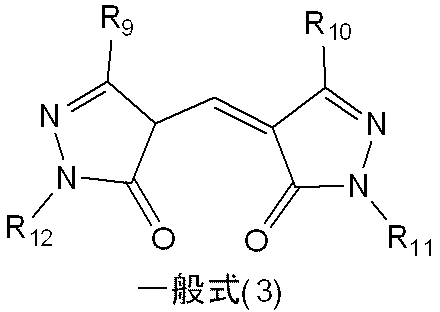
一般式(3)中、R9~R12は、各々独立して、アルキル基、または置換もしくは無置換のアリール基を示す。
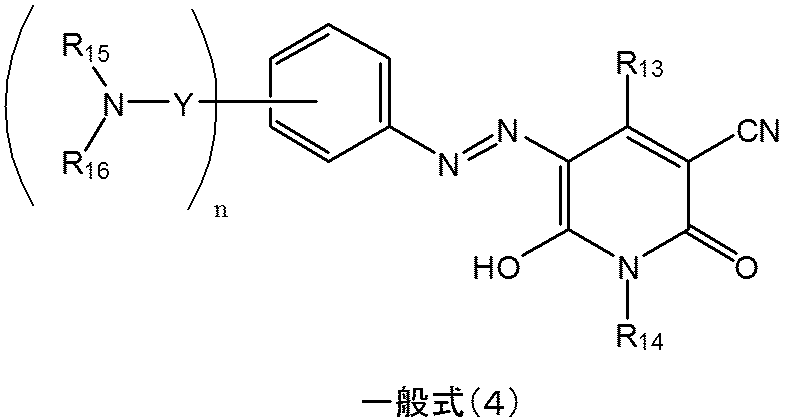
一般式(4)中、R13は、アルキル基、置換もしくは無置換のアリール基、または置換もしくは無置換のアミノ基を示し、R14は、水素原子、アルキル基、置換もしくは無置換のアリール基、または-N(-Ra)Rbを示す。ただしRa及びRbは、各々独立して水素原子、アルキル基、または、アシル基を示し、RaとRbは互いに結合した窒素原子と一緒に環状構造を形成してもよい。R15はアルキル基を示し、R16は水素原子、またはアルキル基を示し、Yはカルボニル基、またはスルホニル基を示し、nは1~3の整数を示す。

一般式(5)中、R17及びR18は、各々独立して、アルキル基、またはアリール基を示す。

一般式(6)中、R19及びR20は、各々独立して、アルキル基、またはアリール基を示す。

一般式(7)中、R21~R25は、各々独立して、アルキル基、またはアリール基を示す。

一般式(8)中、R26及びR27は、各々独立して、アルキル基、または置換もしくは無置換のアリール基を示す。

一般式(9)中、R28~R32は、各々独立して、アルキル基、またはアリール基を示す。
一般式(1)中、R1~R8は、各々独立して、置換もしくは無置換の炭素数1~8のアルキル基、置換もしくは無置換のアルケニル基、置換もしくは無置換のアラルキル基、置換もしくは無置換のアルキニル基、または、置換もしくは無置換のアリール基を示し、R1とR2、R3とR4、R5とR6、及びR7とR8は、それぞれが結合した窒素原子と一緒に環状構造を形成してもよく、X-は陰イオンを示す。
一般式(2)中、R’1~R’8は、各々独立して、置換もしくは無置換の炭素数1~8のアルキル基、置換もしくは無置換のアルケニル基、置換もしくは無置換のアラルキル基、置換もしくは無置換のアルキニル基、または、置換もしくは無置換のアリール基を示し、R’1とR’2、R’3とR’4、R’5とR’6、及びR’7とR’8は、それぞれが結合した窒素原子と一緒に環状構造を形成してもよく、X’-は陰イオンを示す。
一般式(3)中、R9~R12は、各々独立して、アルキル基、または置換もしくは無置換のアリール基を示す。
一般式(4)中、R13は、アルキル基、置換もしくは無置換のアリール基、または置換もしくは無置換のアミノ基を示し、R14は、水素原子、アルキル基、置換もしくは無置換のアリール基、または-N(-Ra)Rbを示す。ただしRa及びRbは、各々独立して水素原子、アルキル基、または、アシル基を示し、RaとRbは互いに結合した窒素原子と一緒に環状構造を形成してもよい。R15はアルキル基を示し、R16は水素原子、またはアルキル基を示し、Yはカルボニル基、またはスルホニル基を示し、nは1~3の整数を示す。
一般式(5)中、R17及びR18は、各々独立して、アルキル基、またはアリール基を示す。
一般式(6)中、R19及びR20は、各々独立して、アルキル基、またはアリール基を示す。
一般式(7)中、R21~R25は、各々独立して、アルキル基、またはアリール基を示す。
一般式(8)中、R26及びR27は、各々独立して、アルキル基、または置換もしくは無置換のアリール基を示す。
一般式(9)中、R28~R32は、各々独立して、アルキル基、またはアリール基を示す。
また本発明は、基材、イエロー染料を含むイエロー染料層、マゼンタ染料を含むマゼンタ染料層、シアン染料を含むシアン染料層、及び、各染料層を被転写体上に転写して形成される画像面を保護するための保護層を有する感熱転写記録用シートであって、該保護層が、該一般式(1)及び(2)で表される化合物群から選ばれる1種以上の化合物を含み、該イエロー染料が、該一般式(3)~(6)で表される化合物群から選ばれる1種以上の化合物を含み、該シアン染料が、該一般式(7)~(9)で表される化合物群から選ばれる1種以上の化合物を含むことを特徴とする感熱転写記録用シートである。
以上説明したように、本発明によれば、耐光性に優れ、かつ、インバランスが改善された画像を得ることができる感熱転写記録用シートを提供することができる。
本発明の他の特徴は、添付された図面を参照して各種実施の形態を例示する以下の説明により明らかにされる。
以下に、本発明を詳細に説明する。
本発明者らは、上記課題を解決すべく鋭意検討を行った結果、以下の第1及び第2の感熱転写記録用シートにより、インバランスが良好で耐光性に優れる画像が得られることを見出した。
第1の感熱転写記録用シートは、少なくとも、基材と、基材上に、3種の染料層(イエロー染料層、マゼンタ染料層及びシアン染料層)とを有する。これらの染料層は、各染料層に応じた染料(イエロー染料、マゼンタ染料またはシアン染料)を含有する組成物(イエロー染料組成物、マゼンタ染料組成物またはシアン染料組成物)を用いて形成される。そして、これらの3種の染料層のうちの1種以上の染料層が、一般式(1)及び(2)で表される化合物群から選ばれる1種以上の化合物(以下、「第1化合物」と称することがある)を含む。例えば、イエロー染料層の形成に第1化合物を用いる場合は、イエロー染料層は、第1化合物とイエロー染料とを少なくとも含有する組成物(イエロー染料組成物)を調製して形成される。
また、第1の感熱転写記録用シートは、イエロー染料層に用いるイエロー染料に、一般式(3)~(6)で表される化合物群から選ばれる1種以上の化合物を用いる。さらに、シアン染料層に用いるシアン染料に、一般式(7)~(9)で表される化合物群から選ばれる1種以上の化合物を用いる。
このように、第1の感熱転写記録用シートは、特定のイエロー染料及びシアン染料、並びに第1化合物を用いる点に特徴を有する。
第2の感熱転写記録用シートは、少なくとも、基材と、基材上に3種の染料層(イエロー染料層、マゼンタ染料層及びシアン染料層)と、保護層を有する。そして、その保護層中に、第1化合物を含む。
また、第1の感熱転写記録用シートと同様に、イエロー染料層に用いるイエロー染料に、一般式(3)~(6)で表される化合物群から選ばれる1種以上の化合物を用いる。さらに、シアン染料層に用いるシアン染料に、一般式(7)~(9)で表される化合物群から選ばれる1種以上の化合物を用いる。
このように、第2の感熱転写記録用シートは、保護層に第1化合物を用い、染料層に特定のイエロー染料及びシアン染料を用いる点に特徴を有する。
なお、第1の感熱転写記録用シートは、第1化合物を含む保護層(後述する転写性保護層)を有することができる。また、第2の感熱転写記録用シートは、染料層(例えばイエロー染料層)中に第1化合物を含むことができる。この場合、第1及び第2の感熱転写記録用シートは、同一の形態となる。
以下に、第1及び第2の感熱転写記録用シートについて、より詳細に説明する。
(I)第1の感熱転写記録用シート
第1の感熱転写記録用シートは、基材、並びに基材上に、特定のイエロー染料を含有するイエロー染料層と、マゼンタ染料を含有するマゼンタ染料層と、特定のシアン染料を含有するシアン染料層とを少なくとも有する。そして、これら層のうちの少なくとも1種の染料層に、第1化合物を含む。
第1の感熱転写記録用シートは、基材、並びに基材上に、特定のイエロー染料を含有するイエロー染料層と、マゼンタ染料を含有するマゼンタ染料層と、特定のシアン染料を含有するシアン染料層とを少なくとも有する。そして、これら層のうちの少なくとも1種の染料層に、第1化合物を含む。
なお、第1の感熱転写記録用シートは、上記3種以外の染料層(例えばブラック染料層)等を有することもできる。
以下に、第1の感熱転写記録用シートの構成について詳細に説明する。
(I-1)基材
第1の感熱転写記録用シートが有する基材は、染料層を支持するものである。基材としては特に限定されず、感熱転写記録用シートの分野で従来公知の、適度な耐熱性と強度とを有する基材を用いることができる。
第1の感熱転写記録用シートが有する基材は、染料層を支持するものである。基材としては特に限定されず、感熱転写記録用シートの分野で従来公知の、適度な耐熱性と強度とを有する基材を用いることができる。
基材としては、例えば、ポリエチレンテレフタレートフィルム、ポリエチレンナフタレートフィルム、ポリカーボネートフィルム、ポリイミドフィルム、ポリアミドフィルム、アラミドフィルム、ポリスチレンフィルム、1,4-ポリシクロヘキシレンジメチレンテレフタレートフィルム、ポリサルホンフィルム、ポリプロピレンフィルム、ポリフェニレンサルフィドフィルム、ポリビニルアルコールフィルム、セロハンフィルム、セルロース誘導体フィルム、ポリエチレンフィルム、ポリ塩化ビニルフィルム、ナイロンフィルム、コンデンサー紙、パラフィン紙が挙げられる。これらの中でも、ポリエチレンテレフタレートフィルムが、機械的強度、耐溶剤性、及び経済性の観点から、基材として好ましい。
・基材の厚み
基材の厚さは、0.5μm以上50μm以下とすることができ、転写性の観点から、3μm以上10μm以下の厚さとすることが好ましい。
基材の厚さは、0.5μm以上50μm以下とすることができ、転写性の観点から、3μm以上10μm以下の厚さとすることが好ましい。
・接着処理(接着層)
基材上に、各染料層を形成するために染料を含む組成物(染料組成物)を塗布する場合、染料組成物の濡れ性及び接着性等が不足する場合がある。そのため基材は、必要に応じてその塗工面に接着処理を行うことが好ましい。
基材上に、各染料層を形成するために染料を含む組成物(染料組成物)を塗布する場合、染料組成物の濡れ性及び接着性等が不足する場合がある。そのため基材は、必要に応じてその塗工面に接着処理を行うことが好ましい。
接着処理としては特に限定されず、感熱転写記録用シートの分野で公知の方法を用いることができる。接着処理としては、例えば、オゾン処理、コロナ放電処理、紫外線処理、プラズマ処理、低温プラズマ処理、プライマー処理、化学薬品処理を挙げることができる。また、これらの処理を2つ以上組み合わせて行っても良い。また、基材の接着処理には、基材上に接着層を塗工する方法を用いても良い。
この接着層としては特に限定されず、感熱転写記録用シートの分野で公知の接着層を用いることができる。
接着層に用いる材料としては、例えば、ポリエステル樹脂、ポリスチレン樹脂、ポリアクリル酸エステル樹脂、ポリアミド樹脂、ポリエーテル樹脂、ポリ酢酸ビニル樹脂、ポリエチレン樹脂、ポリプロピレン樹脂、ポリ塩化ビニル樹脂、ポリビニルアルコール樹脂、ポリビニルブチラール樹脂等の有機材料、シリカ、アルミナ、炭酸マグネシウム、酸化マグネシウム、酸化チタン等の無機微粒子が挙げられる。
・耐熱滑性層
耐熱性やサーマルヘッドの走行性を向上させる目的で、基材の染料層がある面と反対側の面に耐熱滑性層を設けることが好ましい。
耐熱性やサーマルヘッドの走行性を向上させる目的で、基材の染料層がある面と反対側の面に耐熱滑性層を設けることが好ましい。
耐熱滑性層は、耐熱樹脂を含む層からなる。耐熱樹脂としては特に限定されず、例えば以下の樹脂を用いることができる。即ち、ポリビニルブチラール樹脂、ポリビニルアセタール樹脂、ポリエステル樹脂、ポリエーテル樹脂、ポリブタジエン樹脂、塩化ビニル―酢酸ビニル共重合体樹脂、スチレン-ブタジエン共重合体樹脂、ポリウレタンアクリレート、ポリエステルアクリレート、ポリイミド樹脂、ポリカーボネート樹脂等。
また、耐熱滑性層は、架橋剤、離型剤、潤滑剤及び滑り性付与剤等の添加剤を含んでいても良い。潤滑剤としては、例えば、アミノ変性シリコーン化合物、カルボキシ変性シリコーン化合物が挙げられる。また、滑り性付与剤としては、例えば、耐熱性微粒子であるシリカ等の微粒子が挙げられる。
耐熱滑性層は、耐熱樹脂及び添加剤等を溶剤に加え、溶解または分散させて調製した耐熱滑性層塗布液を、基材に塗布及び乾燥することで形成することができる。耐熱滑性層塗布液を塗布する方法としては特に限定されず、例えば、バーコーター、グラビアコーター、リバースロールコーター、ロッドコーター、エアドクタコーターを用いた方法を用いることができる。この中でも、膜厚の調整が容易なグラビアコーターを用いた塗布方法が好ましい。
耐熱滑性層塗布液の基材に対する塗布量は、乾燥後の耐熱滑性層の厚さが、0.1μm以上5μm以下の範囲となるように塗布することが、転写性の観点から好ましい。
(I-2-1)染料層
第1の感熱転写記録用シートは、イエロー染料を含む層(イエロー染料層)、マゼンタ染料を含む層(マゼンタ染料層)及びシアン染料を含む層(シアン染料層)を含む染料層を有する。そして、これらの層のうちの1つ以上の層の形成に、第1化合物を含む染料組成物を用いる。
第1の感熱転写記録用シートは、イエロー染料を含む層(イエロー染料層)、マゼンタ染料を含む層(マゼンタ染料層)及びシアン染料を含む層(シアン染料層)を含む染料層を有する。そして、これらの層のうちの1つ以上の層の形成に、第1化合物を含む染料組成物を用いる。
つまり、第1の感熱転写記録用シートは、3種の染料層のうちの1種の染料層に第1化合物を含んでいてもよく、また、2種あるいは3種全ての染料層に第1化合物を含んでいてもよい。また、1種の染料層に、一般式(1)で表される化合物及び一般式(2)で表される化合物のいずれか一方を含む構成でもよく、両方を含む構成でもよい。
即ち、第1の感熱転写記録用シートは、上記3種の染料層のうち、第1化合物が1種でも含まれる染料層を少なくとも1層有していれば良い。
各染料層は、各染料層に応じた染料と、第1化合物(イエロー染料層、マゼンタ染料層及びシアン染料層のうちの1種以上に適用)と、必要に応じて、媒体(水や有機溶剤等)、結着樹脂、界面活性剤及びワックス等の添加剤とを含む組成物を用いて形成できる。例えばイエロー染料層は、後述する一般式(3)~(6)で表される化合物のうち1種以上を含むイエロー染料と、第1化合物の1種以上と、媒体と、結着樹脂と、界面活性剤と、ワックスとを含む組成物(イエロー染料組成物)を用いることができる。
このように、第1の感熱転写記録用シートの各染料層は、イエロー染料として一般式(3)~(6)で表される化合物を、シアン染料として一般式(7)~(9)で表される化合物を、マゼンタ染料として例えば一般式(10)~(14)で表される化合物を含む。
なお、一般式(3)~(14)で表される化合物(染料)と併用することができる染料としては、感熱転写記録用シートの分野で、熱転写用として公知で用いられている染料であって熱で移行するものであれば特に限定されない。これら染料は、色相、印画感度、耐光性、保存性、結着樹脂への溶解性や分散性等を考慮して、用いることができる。
(I-2-2)染料層形成用の染料組成物に含む成分
以下に、これらの染料層の形成に用いる組成物に含む各成分について説明する。
以下に、これらの染料層の形成に用いる組成物に含む各成分について説明する。
(i)少なくとも1種の染料層形成用の染料組成物に含有させる化合物
(i‐1)第1化合物
まず、一般式(1)及び(2)で表される化合物について説明する。なお、第1化合物は、一般式(1)及び(2)で表される化合物群から選ばれる1種以上の化合物であることから、一種類に限定されるものではない。例えば、第1化合物として、一般式(1)で表される化合物の2種以上、一般式(2)で表される化合物の2種以上、一般式(1)で表される化合物の1種以上と一般式(2)で表される化合物の1種以上等、2種以上の第1化合物を組み合わせて用いてもよい。

(i‐1)第1化合物
まず、一般式(1)及び(2)で表される化合物について説明する。なお、第1化合物は、一般式(1)及び(2)で表される化合物群から選ばれる1種以上の化合物であることから、一種類に限定されるものではない。例えば、第1化合物として、一般式(1)で表される化合物の2種以上、一般式(2)で表される化合物の2種以上、一般式(1)で表される化合物の1種以上と一般式(2)で表される化合物の1種以上等、2種以上の第1化合物を組み合わせて用いてもよい。
一般式(1)中、R1~R8は、各々独立して、置換もしくは無置換の炭素数1~8のアルキル基、置換もしくは無置換のアルケニル基、置換もしくは無置換のアラルキル基、置換もしくは無置換のアルキニル基、または、置換もしくは無置換のアリール基を示す。R1とR2、R3とR4、R5とR6、及びR7とR8は、それぞれが結合した窒素原子と一緒に環状構造を形成してもよい。X-は陰イオンを示す。

一般式(2)中、R’1~R’8は、各々独立して、置換もしくは無置換の炭素数1~8のアルキル基、置換もしくは無置換のアルケニル基、置換もしくは無置換のアラルキル基、置換もしくは無置換のアルキニル基、または、置換もしくは無置換のアリール基を示す。R’1とR’2、R’3とR’4、R’5とR’6、及びR’7とR’8は、それぞれが結合した窒素原子と一緒に環を形成してもよい。X’-は陰イオンを示す。
一般式(1)及び(2)中、R1~R8及びR’1~R’8が示すことのできる、置換もしくは無置換の炭素数1~8のアルキル基は、置換基を含む炭素数の合計が1以上8以下のアルキル基であれば、特に限定されるものではない。置換基としては、例えば、アルコキシ基及びシアノ基(-CN)を挙げることができる。
置換もしくは無置換の炭素数1~8のアルキル基としては、例えば、直鎖状、分岐状、もしくは、環状の合計炭素数1以上8以下のアルキル基、合計炭素数1以上8以下のアルコキシアルキル基、合計炭素数1以上8以下のシアノアルキル基が挙げられる。より具体的には、メチル基、エチル基、n-プロピル基、iso-プロピル基、n-ブチル基、sec-ブチル基、tert-ブチル基、iso-ブチル基、オクチル基、シクロブチル基、シクロペンチル基、シクロヘキシル基、メチルシクロヘキシル基、シクロヘキシルメチル基、2-エチルプロピル基、2-エチルヘキシル基、メトキシエチル基、メトキシプロピル基、シアノプロピル基、及び、シアノエチル基等が挙げられる。
一般式(1)及び(2)中、R1~R8及びR’1~R’8が示すことのできる置換もしくは無置換のアルケニル基は、特に限定されるものではない。なお、置換基としては、例えば、ヒドロキシ基及びカルボキシ基を挙げることができる。また、置換基を含むアルケニル基の合計炭素数は、例えば2以上8以下とすることができる。
置換もしくは無置換のアルケニル基としては、具体的には、ビニル基、プロペニル基、ブテニル基、ペンテニル基、ヘキセニル基、ヘプテニル基、オクタニル基、2-ヒドロキシビニル基、3-ヒドロキシプロペニル基、及び3-カルボキシプロペニル基等が挙げられる。
一般式(1)及び(2)中、R1~R8及びR’1~R’8が示すことのできる置換もしくは無置換のアラルキル基は、特に限定されるものではない。なお、置換基としては、例えば、アルキル基、並びにハロゲン原子(例えば、塩素原子またはフッ素原子)を挙げることができる。また、置換基を含むアラルキル基の合計炭素数は、例えば、7以上12以下、好ましくは7以上8以下とすることができる。
置換もしくは無置換のアラルキル基としては、具体的には、ベンジル基、p-クロロベンジル基、p-メチルベンジル基、フェネチル基(例えば、2-フェニルエチル基)、3-フェニルプロピル基、α-ナフチルメチル基、及び、β-ナフチルエチル基等が挙げられる。
一般式(1)及び(2)中、R1~R8及びR’1~R’8が示すことのできる置換もしくは無置換のアルキニル基は、特に限定されるものではない。なお、置換基としては、例えば、ヒドロキシ基、カルボキシ基、及び、ハロゲン原子(例えば、塩素原子またはフッ素原子)を挙げることができる。また、置換基を含むアルキニル基の合計炭素数は、例えば、2以上8以下、好ましくは3以上6以下とすることができる。
置換もしくは無置換のアルキニル基としては、具体的には、プロピニル基、ブチニル基、ペンチニル基、ヘキシニル基、2-ヒドロキシブチニル基、2-カルボキシペンチニル基、及び、2-クロロブチニル基等が挙げられる。
一般式(1)及び(2)中、R1~R8及びR’1~R’8が示すことのできる置換もしくは無置換のアリール基は、特に限定されるものではない。なお、置換基としては、例えば、アルキル基、及びアルコキシ基を挙げることができる。また、置換基を含むアリール基の合計炭素数は、例えば、6以上14以下、好ましくは6以上12以下とすることができる。
置換もしくは無置換のアリール基としては、具体的には、フェニル基、トリル基(例えば2-メチルフェニル基)、3-プロピルフェニル基、キシリル基(例えば2,6-ジメチルフェニル基)、ナフチル基、α-メチルナフチル基、及びβ-エチルナフチル基等が挙げられる。
さらに、一般式(1)及び(2)中、R1とR2、R3とR4、R5とR6、及びR7とR8並びにR’1とR’2、R’3とR’4、R’5とR’6、及びR’7とR’8はそれぞれが結合した窒素原子と一緒に環状構造を形成しても良い。この環状構造としては、例えば、置換もしくは無置換の5員環、置換もしくは無置換の6員環、置換もしくは無置換の7員環を挙げることができる。
この環状構造としては、具体的には以下のものを挙げることができる。即ち、5員環としてピロリジン環等、6員環としてピペリジン環、モルホリン環、ピペラジン環等、7員環としてアゼパン環等を挙げることができる。さらに、これらの環状構造が有していてもよい置換基としては、例えば、メチル基、エチル基等のアルキル基を挙げることができる。
なお、一般式(1)中の、R1とR2、R3とR4、R5とR6、及びR7とR8並びにR’1とR’2、R’3とR’4、R’5とR’6、及びR’7とR’8は、それぞれ同一の置換基を示すことが好ましい。これらが同一の置換基を示すことにより、耐光性に優れ、かつ、インバランスが改善された画像を得ることができる。
また、一般式(1)及び(2)中、R1~R8及びR’1~R’8は、耐光性に優れ、かつ、インバランスが改善された画像を得ることができるため、各々独立して、置換もしくは無置換の炭素数1~8のアルキル基を示すことが好ましい。特に、R1~R8及びR’1~R’8は、合計炭素数3~8の無置換のアルキル基またはシアノアルキル基を示すことがより好ましい。
一般式(1)及び(2)中、X-及びX’-が示すことのできる陰イオンは、特に限定されるものではなく、例えば、フッ化物イオン、塩化物イオン、臭化物イオン、ヨウ化物イオン、過塩素酸イオン(ClO4
-)、硝酸イオン、メタンスルホン酸イオン、ベンゼンスルホン酸イオン、p-トルエンスルホン酸イオン、p-トリフルオロメチルベンゼンスルホン酸イオン、2,3,4,5,6-ペンタフルオロベンゼンスルホン酸イオン、メチル硫酸イオン、エチル硫酸イオン、プロピル硫酸イオン、テトラフルオロホウ酸イオン(BF4
-)、テトラフェニルホウ酸イオン、ヘキサフルオロリン酸イオン(PF6
-)、ベンゼンスルフィン酸イオン、酢酸イオン、トリフルオロ酢酸イオン、プロピオン酸イオン、安息香酸イオン、しゅう酸イオン、コハク酸イオン、マロン酸イオン、オレイン酸イオン、ステアリン酸イオン、クエン酸イオン、ピコリン酸イオン、一水素二リン酸イオン、二水素二リン酸イオン、ペンタフルオロプロピオン酸イオン、ペンタクロロスズ酸イオン、クロロスルホン酸イオン、フルオロスルホン酸イオン、トリフルオロメタンスルホン酸イオン、ヘキサフルオロヒ酸イオン、ヘキサフルオロアンチモン酸イオン(SbF6
-)、モリブデン酸イオン、タングステン酸イオン、チタン酸イオン、ジルコン酸イオン、ナフタレンジスルホン酸イオン、トリス(トリフルオロメタンスルホニル)メチドイオン(C(SO2CF3)3
-)、ビス(トリフルオロメタンスルホニル)イミドイオン(N(SO2CF3)2
-)、ビス(パーフルオロエタンスルホニル)イミドイオン(N(SO2CF2CF3)2
-)、ペンタフルオロフェニルビス(トリフルオロメタンスルホニル)メチドチオン、テトラキス(ペンタフルオロフェニル)ホウ素イオン、及び下記式で示される1,1,2,2,3,3-ヘキサフルオロプロパン-1,3-ジスルホニルイミドイオンなどの陰イオンが挙げられる。

(i‐2)第1化合物の具体例
一般式(1)で表される化合物の具体例として、化合物(1)~(4)、(7)、(8)、(12)、(14)~(16)、(18)~(20)、(22)、(24)、(25)、(28)、(30)及び(32)~(40)を以下に示すが、これらの化合物に限定されるものではない。また、一般式(2)で表される化合物の具体例として、化合物(5)、(6)、(9)~(11)、(13)、(17)、(21)、(23)、(26)、(27)、(29)及び(31)を以下に示すが、これらの化合物に限定されるものではない。
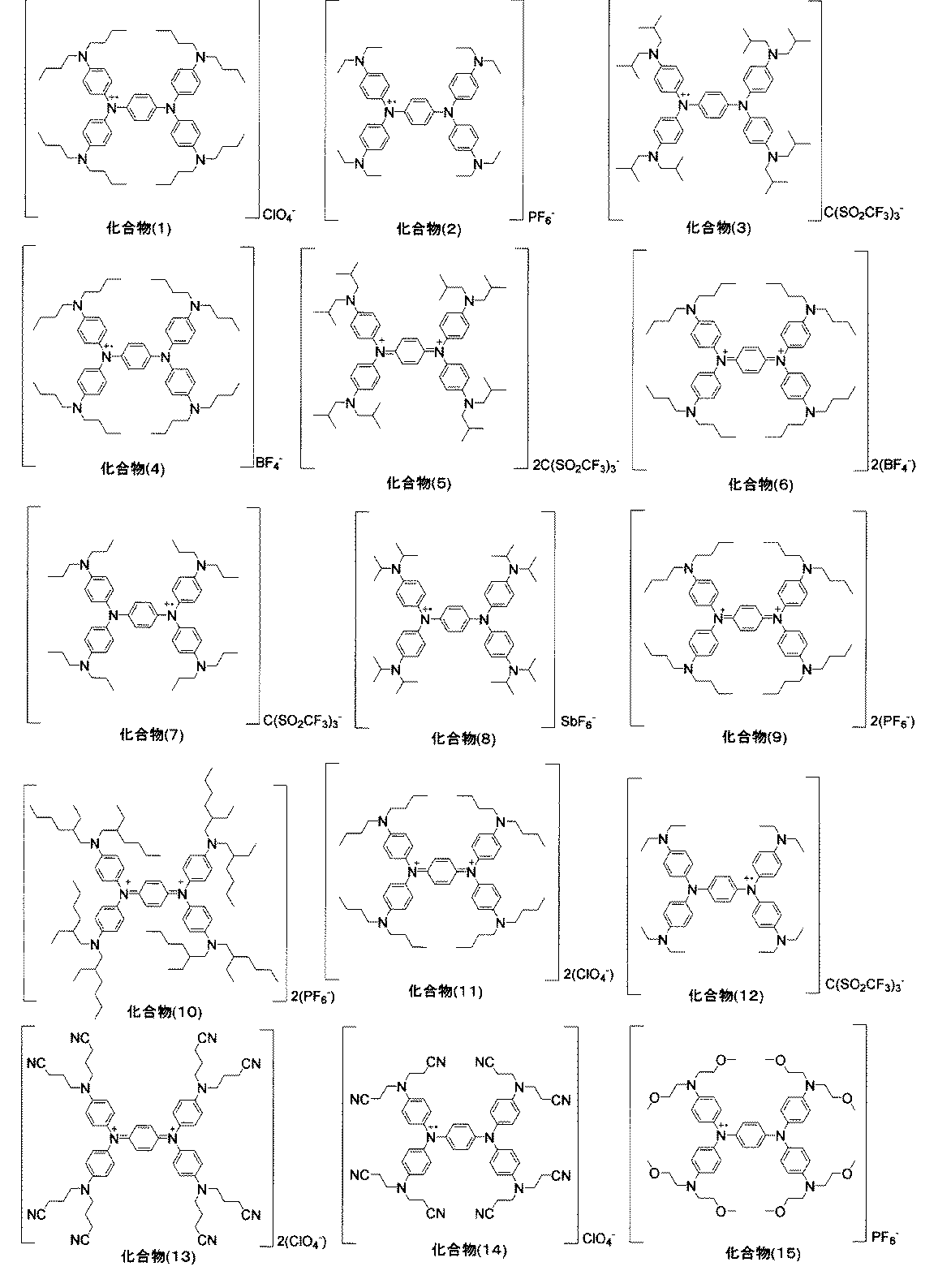
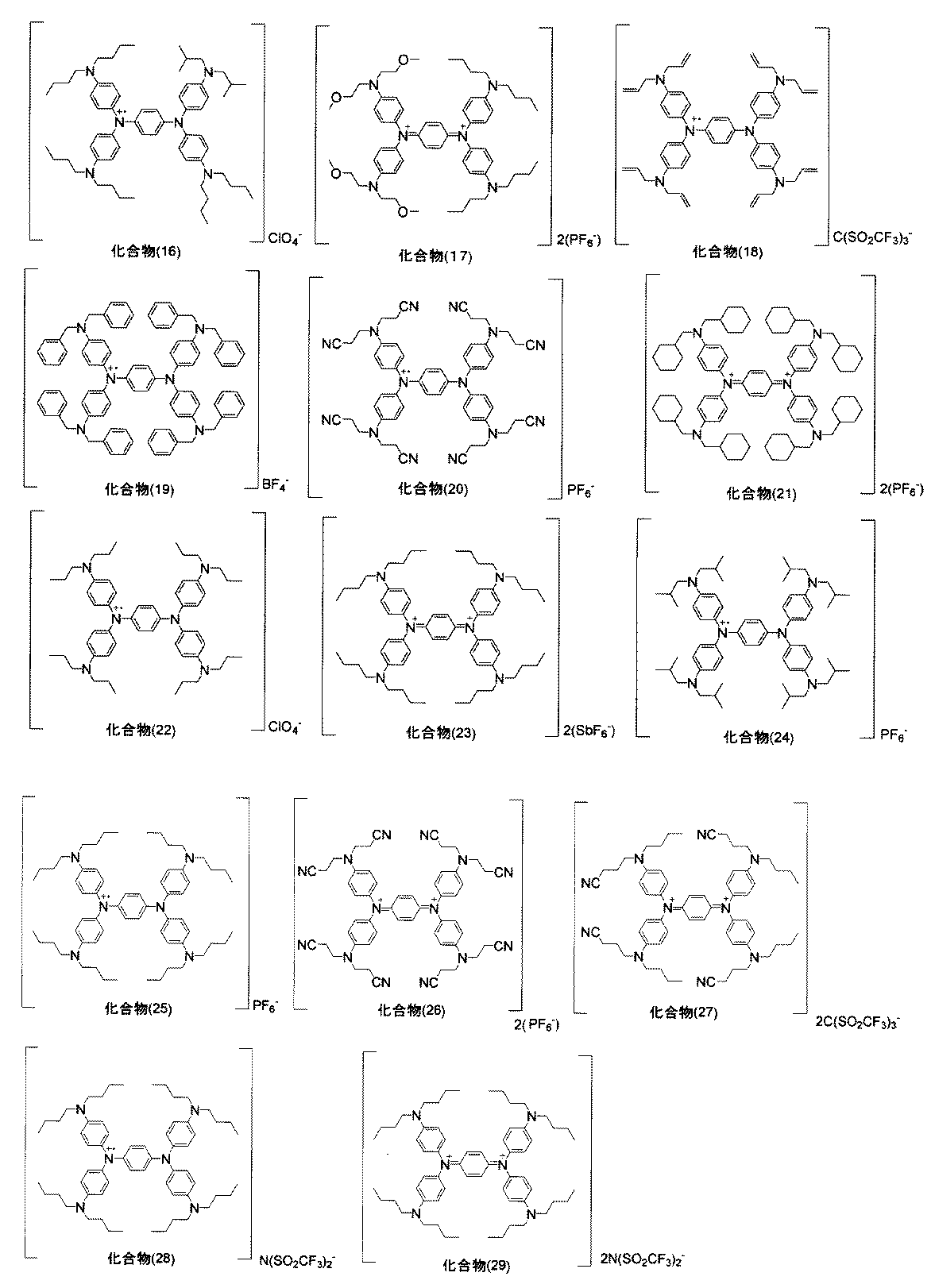

一般式(1)で表される化合物の具体例として、化合物(1)~(4)、(7)、(8)、(12)、(14)~(16)、(18)~(20)、(22)、(24)、(25)、(28)、(30)及び(32)~(40)を以下に示すが、これらの化合物に限定されるものではない。また、一般式(2)で表される化合物の具体例として、化合物(5)、(6)、(9)~(11)、(13)、(17)、(21)、(23)、(26)、(27)、(29)及び(31)を以下に示すが、これらの化合物に限定されるものではない。
第1化合物としては、化合物(1)、(3)、(5)、(9)、(11)、(20)、(22)、(23)、(25)、(26)、(30)、(31)、(32)を用いることが好ましい。これらの化合物を用いることにより、耐光性に優れ、かつインバランスが改善された画像を得ることができる。さらに、インバランス改善の観点から、第1化合物として、化合物(1)、(3)、(20)、(25)、(30)及び(32)のうちの少なくとも1種を用いることが好ましい。
(i‐3)第1化合物の合成方法
第1化合物は、米国特許明細書3,251,881号、米国特許明細書3,484,467号及び特開昭61-69991号公報などに記載された公知の方法を参考にして合成することができる。
第1化合物は、米国特許明細書3,251,881号、米国特許明細書3,484,467号及び特開昭61-69991号公報などに記載された公知の方法を参考にして合成することができる。
より具体的には、第1化合物は、例えば次の方法により製造することができる。即ち、ウルマン反応により主骨格を形成し、還元反応によりR1~R8及びR’1~R’8が結合する窒素原子をアミノ基へと還元することによりアミノ体を得る。続いて、アミノ基に対し選択的にアルキル化、アルケニル化、アラルキル化、アリール化、及びアルキニル化等を行ってR1~R8及びR’1~R’8を置換した後、銀塩酸化あるいは電解酸化反応等を行うことにより、第1化合物を得ることができる。また、第1化合物が非対称な場合(例えば、一般式(1)中のR1及びR2と、R5及びR6とが異なる場合等)には、前述のアルキル化等を多段階的に行って合成すれば良い。
(i‐4)第1化合物の特徴
第1化合物は、以下の特徴を有する。即ち、極大吸収波長が900nm以上1,400nm以下の近赤外の範囲であり、かつ、モル吸光係数が数万~数十万程度と大きいピークを持つ。さらに、可視域での吸収が小さいため、染料組成物(インク)中に添加した場合であっても、染料(着色剤)の色調の変化や退色を生じさせる恐れは殆どない。また、保護層中に添加した場合であっても、画像の色調を損なわない。
(ii)イエロー染料(一般式(3)~(6)で表される化合物)
第1の感熱転写記録用シートは、イエロー染料層中に、イエロー染料として、一般式(3)~(6)で表される化合物群のうちの少なくとも1種を含む。即ち、イエロー染料として、これらの化合物を1種単独で用いても良いし、2種以上を併用しても良い。
第1化合物は、以下の特徴を有する。即ち、極大吸収波長が900nm以上1,400nm以下の近赤外の範囲であり、かつ、モル吸光係数が数万~数十万程度と大きいピークを持つ。さらに、可視域での吸収が小さいため、染料組成物(インク)中に添加した場合であっても、染料(着色剤)の色調の変化や退色を生じさせる恐れは殆どない。また、保護層中に添加した場合であっても、画像の色調を損なわない。
(ii)イエロー染料(一般式(3)~(6)で表される化合物)
第1の感熱転写記録用シートは、イエロー染料層中に、イエロー染料として、一般式(3)~(6)で表される化合物群のうちの少なくとも1種を含む。即ち、イエロー染料として、これらの化合物を1種単独で用いても良いし、2種以上を併用しても良い。
(ii‐1)一般式(3)で表される化合物
まず、一般式(3)で表される化合物(イエロー染料)について説明する。

まず、一般式(3)で表される化合物(イエロー染料)について説明する。
一般式(3)中、R9~R12は、各々独立して、アルキル基、または置換もしくは無置換のアリール基を示す。
一般式(3)中、R9~R12が示すことのできるアルキル基は、特に限定されるものではなく、例えば、直鎖状、分岐状、もしくは、環状の炭素数1以上20以下のアルキル基が挙げられる。
このアルキル基としては、例えば、メチル基、エチル基、n-プロピル基、iso-プロピル基、n-ブチル基、sec-ブチル基、tert-ブチル基、オクチル基、ドデシル基、ノナデシル基、シクロブチル基、シクロペンチル基、シクロヘキシル基、メチルシクロヘキシル基、2-エチルプロピル基、2-エチルヘキシル基等が挙げられる。これらのアルキル基の中では、炭素数1以上4以下のアルキル基が、耐光性に優れ、かつインバランスが改善された画像が得られ易いため好ましい。
一般式(3)中、R9~R12が示すことのできる置換もしくは無置換のアリール基は、特に限定されるものではない。置換基としては、例えばアルキル基を挙げることができる。また、置換基を含むアリール基の合計炭素数は、例えば6以上10以下とすることができる。
この置換もしくは無置換のアリール基としては、例えば、フェニル基、2-メチルフェニル基、3-メチルフェニル基、4-メチルフェニル基、及びナフチル基が挙げられる。これらのアリール基の中では、フェニル基が、耐光性に優れ、かつインバランスが改善された画像が得られ易いため好ましい。
一般式(3)で表される化合物の具体例として、以下に、化合物(41)~(48)を示すが、これらの化合物に限定されるものではない。
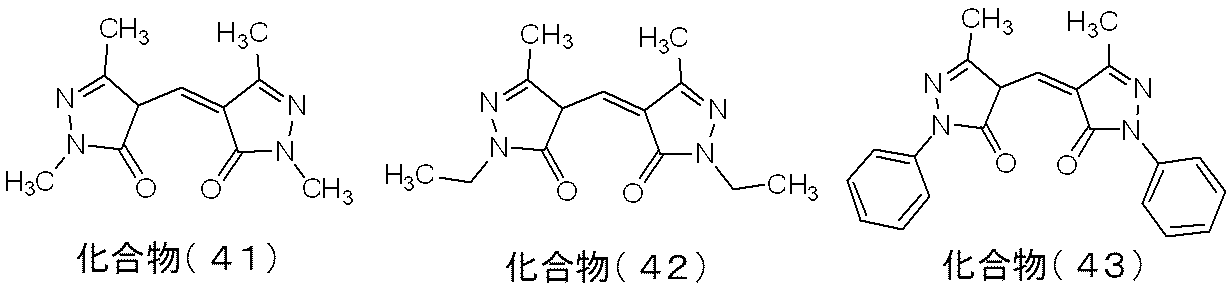

イエロー染料として、一般式(3)で表される化合物の中でも、化合物(43)~(46)のうちの少なくとも1種を用いることが好ましい。また、一般式(3)で表される化合物として、化合物(43)を用いることが、耐光性に優れ、かつインバランスが改善された画像が得られ易いためより好ましい。
(ii‐2)一般式(4)で表される化合物
次に、一般式(4)で表される化合物(イエロー染料)について説明する。

次に、一般式(4)で表される化合物(イエロー染料)について説明する。
一般式(4)中、R13は、アルキル基、置換もしくは無置換のアリール基、または置換もしくは無置換のアミノ基を示す。R14は、水素原子、アルキル基、置換もしくは無置換のアリール基、または-N(-Ra)Rbを示す。ただし、Ra及びRbは、各々独立して、水素原子、アルキル基、または、アシル基を示す。また、RaとRbとが結合した窒素原子と一緒に環状構造を形成してもよい。R15はアルキル基を示す。R16は、水素原子、またはアルキル基を示す。Yは、カルボニル基、またはスルホニル基を示す。nは、1~3の整数を示す。
一般式(4)中、R13が示すことのできるアルキル基は、特に限定されるものではなく、例えば、メチル基、エチル基、プロピル基、ブチル基等の、直鎖状もしくは分岐状の炭素数1以上4以下のアルキル基が挙げられる。
一般式(4)中、R13が示すことのできる置換もしくは無置換のアリール基は、特に限定されるものではない。置換基としては、例えばメチル基等のアルキル基を挙げることができる。また、置換基を含むアリール基の合計炭素数は、例えば6以上12以下とすることができる。
この置換もしくは無置換のアリール基としては、例えば、フェニル基、2-メチルフェニル基、3-メチルフェニル基、及び4-メチルフェニル基が挙げられる。
一般式(4)中、R13が示すことのできる置換もしくは無置換のアミノ基(-NH2、-NHRc、-NRcRd(Rc及びRdは置換基を表す))は、特に限定されるものではない。置換基としては、例えば、メチル基、エチル基などのアルキル基を挙げることができる。
この置換もしくは無置換のアミノ基としては、例えば、モノメチルアミノ基、ジメチルアミノ基、ジエチルアミノ基が挙げられる。
これらの中でも、耐光性に優れ、かつインバランスが改善された画像が得られ易いことから、R13はアルキル基であることが好ましく、R13はメチル基であることがより好ましい。
一般式(4)中、R14が示すことのできるアルキル基は、特に限定されるものではなく、例えば、直鎖状、分岐状、もしくは環状の炭素数1以上20以下のアルキル基が挙げられる。
より具体的には、メチル基、エチル基、n-プロピル基、iso-プロピル基、n-ブチル基、sec-ブチル基、tert-ブチル基、オクチル基、ドデシル基、ノナデシル基、シクロブチル基、シクロペンチル基、シクロヘキシル基、メチルシクロヘキシル基、2-エチルプロピル基、2-エチルヘキシル基等が挙げられる。
これらのアルキル基の中では、耐光性に優れ、かつインバランスが改善された画像が得られ易いことから、メチル基、エチル基、n-プロピル基、iso-プロピル基、n-ブチル基、及び、2-エチルヘキシル基が好ましく、特にエチル基、及びn-プロピル基がより好ましい。
一般式(4)中、R14が示すことのできる置換もしくは無置換のアリール基は、特に限定されるものではなく、例えば、一般式(4)のR13と同様のアリール基を挙げることができる。
一般式(4)中、R14が-N(-Ra)Rbを示す場合、Ra及びRbが示すことのできるアルキル基は、特に限定されるものではなく、一般式(4)のR14と同様のアルキル基を挙げることができる。また、Ra及びRbが示すことのできるアシル基は、特に限定されるものではなく、例えば、アセチル基、エチルヘキシノイル基等のアルキルカルボニル基、ベンゾイル基等のアリールカルボニル基が挙げられる。
一般式(4)中、R14が-N(-Ra)Rbを示す場合、このRa及びRbが結合し窒素原子と一緒に形成する環状構造としては、耐光性及びインバランスの観点から適宜選択できる。この環状構造としては、例えば、ピロリジン環、ピペリジン環、アゼパン環、及びアゾカン環が挙げられる。
なお、これらの中でも、Ra及びRbのうちの少なくとも一方がアルキル基である場合、耐光性に優れ、かつインバランスが改善された画像が得られ易いため好ましい。さらに、Ra及びRbのうちの少なくとも一方がメチル基の場合がより好ましい。
一般式(4)中、R15及びR16が示すことのできるアルキル基は、特に限定されるものではない。このアルキル基としては、例えば、一般式(4)のR14と同様のアルキル基を挙げることができる。
またこれらの中でも、耐光性に優れ、かつインバランスが改善された画像が得られ易いことから、R15及びR16は、各々独立して以下の基を示すことが好ましい。即ち、エチル基、n-ブチル基、sec-ブチル基、ドデシル基、シクロヘキシル基、メチルシクロヘキシル基、2-エチルプロピル基、及び、2-エチルヘキシル基が好ましく、n-ブチル基、及び、2-エチルヘキシル基がより好ましい。また、R15及びR16が同一のアルキル基を示す場合、耐光性に優れ、かつインバランスが改善された画像が得られ易いため好ましい。
一般式(4)中、Yはカルボニル基またはスルホニル基を示すことができるが、カルボニル基を示す場合、耐光性に優れ、かつインバランスが改善された画像が得られ易いため好ましい。
一般式(4)中、nは1~3の整数(1以上3以下の整数)を示すが、nが1である場合、耐光性に優れ、かつインバランスが改善された画像が得られ易いため好ましい。
なお、一般式(4)ではアゾ体が記載されているが、互変異性体であるヒドラゾ体も含むものとする。
また、一般式(4)において、R15(R16-)N-Y-基のフェニル基に対する接続部位は特に限定されず、適宜設定することができる。
一般式(4)で表される化合物の具体例として、以下に化合物(49)~(53)を示すが、これらの化合物に限定されるものではない。

イエロー染料として、一般式(4)で表される化合物の中でも、化合物(51)、(52)及び(53)のうちの少なくとも1種を用いることが、耐光性に優れ、かつインバランスが改善された画像が得られ易いため、好ましい。
(ii‐3)一般式(5)で表される化合物
次に、一般式(5)で表される化合物(イエロー染料)について説明する。

次に、一般式(5)で表される化合物(イエロー染料)について説明する。
一般式(5)中、R17及びR18は、各々独立して、アルキル基、またはアリール基を示す。
一般式(5)中、R17及びR18が示すことのできるアルキル基は、特に限定されるものではなく、例えば、一般式(4)のR14と同様のアルキル基を挙げることができる。また、これらのアルキル基の中では、耐光性に優れ、かつインバランスが改善された画像が得られ易いことから、直鎖状または分岐状の炭素数1以上8以下のアルキル基(例えば、プロピル基、ブチル基及び2-エチルヘキシル基)が好ましい。さらに、耐光性及びインバランスの観点から、R17及びR18はいずれもブチル基であることがより好ましい。
一般式(5)中、R17及びR18が示すことのできるアリール基は、特に限定されるものではなく、例えば、フェニル基、及びナフチル基が挙げられる。これらのアリール基の中では、フェニル基が耐光性に優れ、かつインバランスが改善された画像が得られ易いため好ましい。
一般式(5)で表される化合物の具体例として、以下に、化合物(54)~(59)を示すが、これらの化合物に限定されるものではない。
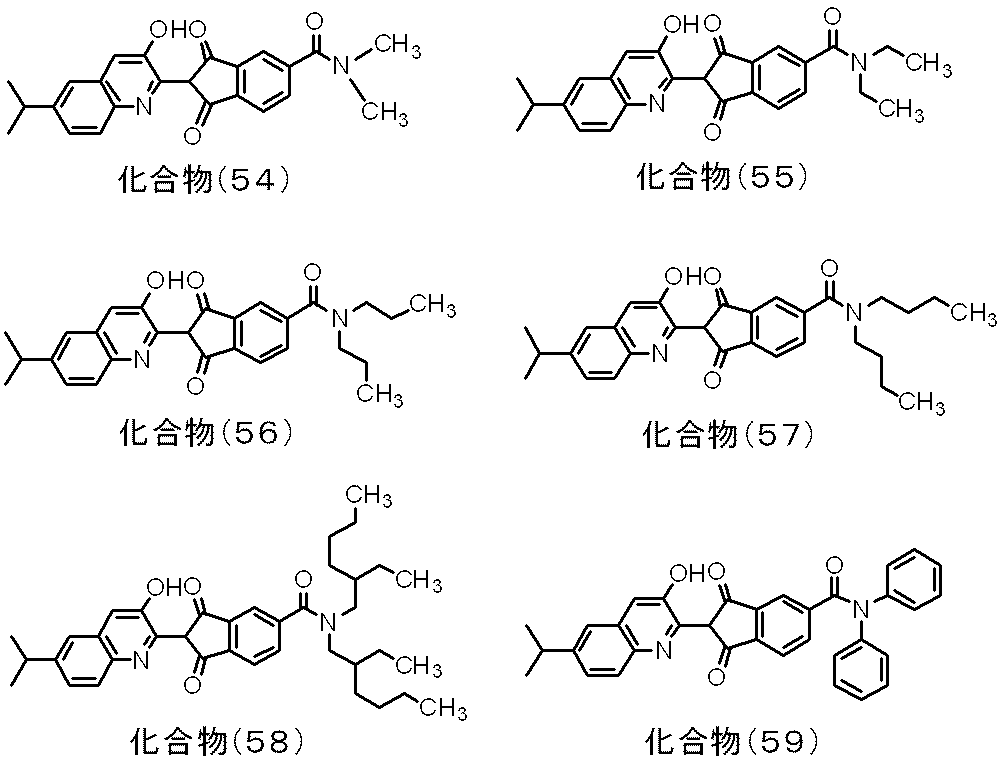
イエロー染料として、一般式(5)で表される化合物の中でも、化合物(56)~(58)のうちの少なくとも1種を用いることが好ましい。また、一般式(5)で表される化合物として、化合物(57)を用いることが、耐光性に優れ、かつインバランスが改善された画像が得られ易いためより好ましい。
(ii‐4)一般式(6)で表される化合物
次に、一般式(6)で表される化合物(イエロー染料)について説明する。
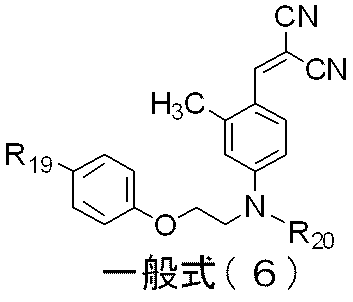
次に、一般式(6)で表される化合物(イエロー染料)について説明する。
一般式(6)中、R19及びR20は、各々独立して、アルキル基、またはアリール基を示す。
一般式(6)中、R19及びR20が示すことのできるアルキル基は、特に限定されるものではなく、例えば、直鎖状、分岐状、もしくは環状の炭素数1以上20以下のアルキル基が挙げられる。
より具体的には、メチル基、エチル基、n-プロピル基、iso-プロピル基、n-ブチル基、sec-ブチル基、tert-ブチル基、オクチル基、ドデシル基、ノナデシル基、シクロブチル基、シクロペンチル基、シクロヘキシル基、メチルシクロヘキシル基、2-エチルプロピル基、2-エチルヘキシル基等が挙げられる。
これらのアルキル基の中で、R19については、直鎖状、分岐状または環状の炭素数1以上6以下のアルキル基が好ましく、メチル基、ブチル基、及びシクロヘキシル基がより好ましく、シクロヘキシル基がさらに好ましい。
これらのアルキル基の中でR20については、耐光性及びインバランスの観点から、直鎖状の炭素数1以上8以下のアルキル基が好ましく、メチル基、エチル基及びオクチル基がより好ましく、エチル基がさらに好ましい。
一般式(6)中、R19及びR20が示すことのできるアリール基は、特に限定されるものではなく、例えば、フェニル基、及びナフチル基が挙げられる。これらのアリール基の中ではフェニル基が、耐光性に優れ、かつインバランスが改善された画像が得られ易いため好ましい。
一般式(6)で表される化合物の具体例として、以下に、化合物(60)~(64)を示すが、これらの化合物に限定されるものではない。

イエロー染料として、一般式(6)で表される化合物の中でも、化合物(63)及び(64)のいずれか一方または両方を用いることが好ましい。また、一般式(6)で表される化合物として、化合物(63)を用いることが、耐光性に優れ、かつインバランスが改善された画像が得られ易いためより好ましい。
(ii-5)その他の化合物
イエロー染料層を形成する際、その染料組成物中に、一般式(3)~(6)で表される化合物の他に、調色の目的で既存のイエロー染料を加えても良い。既存のイエロー染料としては、例えば化合物(65)及び(66)を挙げることができるが、これらに限定されるものではない。

イエロー染料層を形成する際、その染料組成物中に、一般式(3)~(6)で表される化合物の他に、調色の目的で既存のイエロー染料を加えても良い。既存のイエロー染料としては、例えば化合物(65)及び(66)を挙げることができるが、これらに限定されるものではない。
(iii)シアン染料(一般式(7)~(9)で表される化合物)
第1の感熱転写記録用シートは、シアン染料層中に、シアン染料として、一般式(7)~(9)で表される化合物群のうちの少なくとも1種を含む。即ち、シアン染料として、これらの化合物を1種単独で用いても良いし、2種以上を併用しても良い。
第1の感熱転写記録用シートは、シアン染料層中に、シアン染料として、一般式(7)~(9)で表される化合物群のうちの少なくとも1種を含む。即ち、シアン染料として、これらの化合物を1種単独で用いても良いし、2種以上を併用しても良い。
(iii‐1)一般式(7)で表される化合物
次に、一般式(7)で表される化合物(シアン染料)について説明する。
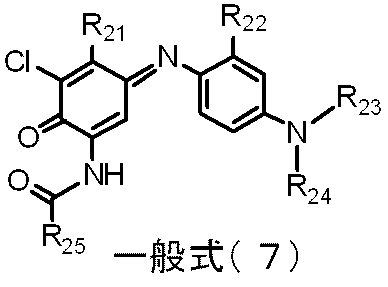
次に、一般式(7)で表される化合物(シアン染料)について説明する。
一般式(7)中、R21~R25は、各々独立して、アルキル基、またはアリール基を示す。
一般式(7)中、R21~R25が示すことのできるアルキル基及びアリール基は、特に限定されるものではなく、例えば、一般式(6)のR19及びR20と同様のアルキル基及びアリール基を挙げることができる。また、アルキル基は、耐光性に優れ、かつインバランスが改善された画像が得られ易いことから、直鎖状または分岐状の炭素数1以上4以下のアルキル基が好ましく、メチル基、エチル基、n-ブチル基及びtert-ブチル基がより好ましく、メチル基及びエチル基がさらに好ましい。また、アリール基は、耐光性に優れ、かつインバランスが改善された画像が得られ易いことから、フェニル基が好ましい。
一般式(7)で表される化合物の具体例として、以下に化合物(67)~(73)を示すが、これらの化合物に限定されるものではない。

シアン染料として、一般式(7)で表される化合物の中でも、化合物(67)~(69)のうちの少なくとも1種を用いることが好ましい。また、一般式(7)で表される化合物として、化合物(68)を用いることが、耐光性に優れ、かつインバランスが改善された画像が得られ易いためより好ましい。
(iii-2)一般式(8)で表される化合物
次に、一般式(8)で表される化合物(シアン染料)について説明する。

次に、一般式(8)で表される化合物(シアン染料)について説明する。
一般式(8)中、R26及びR27は、各々独立して、アルキル基、または置換もしくは無置換のアリール基を示す。
一般式(8)中、R26及びR27が示すことのできるアルキル基は、特に限定されるものではなく、例えば、一般式(6)のR19及びR20と同様のアルキル基を挙げることができる。耐光性に優れ、かつインバランスが改善された画像が得られ易いため、アルキル基は、直鎖状の炭素数1以上4以下のアルキル基が好ましく、メチル基及びブチル基がより好ましい。
一般式(8)中、R26及びR27が示すことのできる置換もしくは無置換のアリール基は、特に限定されるものではない。置換基としては、例えばアルキル基を挙げることができる。また、置換基を含むアリール基の合計炭素数は、例えば6以上10以下とすることができる。
この置換もしくは無置換のアリール基としては、例えば、フェニル基、トリル基(例えば3-メチルフェニル基)、p-(n-ブチル)フェニル基、及びナフチル基が挙げられる。これらのアリール基の中では、トリル基が、耐光性に優れ、かつインバランスが改善された画像が得られ易いため好ましい。
この置換もしくは無置換のアリール基としては、例えば、フェニル基、トリル基(例えば3-メチルフェニル基)、p-(n-ブチル)フェニル基、及びナフチル基が挙げられる。これらのアリール基の中では、トリル基が、耐光性に優れ、かつインバランスが改善された画像が得られ易いため好ましい。
一般式(8)で表される化合物の具体例として、以下に化合物(74)~(79)を示すが、これらの化合物に限定されるものではない。

シアン染料として、一般式(8)で表される化合物の中でも、化合物(75)~(77)のうちの少なくとも1種を用いることが好ましい。また、一般式(8)で表される化合物として、化合物(76)を用いることが、耐光性に優れ、かつインバランスが改善された画像が得られ易いためより好ましい。
(iii‐3)一般式(9)で表される化合物
次に、一般式(9)で表される化合物(シアン染料)について説明する。

次に、一般式(9)で表される化合物(シアン染料)について説明する。
一般式(9)中、R28~R32は、各々独立して、アルキル基、またはアリール基を示す。
一般式(9)中、R28~R32が示すことのできるアルキル基は、特に限定されるものではなく、例えば、直鎖状、分岐状、もしくは環状の炭素数1以上20以下のアルキル基が挙げられる。
より具体的には、メチル基、エチル基、n-プロピル基、iso-プロピル基、n-ブチル基、sec-ブチル基、tert-ブチル基、iso-ペンチル基、オクチル基、ドデシル基、ノナデシル基、シクロブチル基、シクロペンチル基、シクロヘキシル基、メチルシクロヘキシル基、2-エチルプロピル基、1-エチルペンチル基、及び2-エチルヘキシル基等が挙げられる。耐光性に優れ、かつインバランスが改善された画像が得られ易いため、直鎖状または分岐状の炭素数1以上8以下のアルキル基が好ましく、メチル基、1-エチルペンチル基及び2-エチルヘキシル基がより好ましい。
一般式(9)中、R28~R32が示すことのできるアリール基は、特に限定されるものではなく、例えば、フェニル基、及び、ナフチル基が挙げられる。これらのアリール基の中では、フェニル基が、耐光性に優れ、かつインバランスが改善された画像が得られ易いため好ましい。
一般式(9)で表される化合物の具体例として、以下に、化合物(80)~(85)を示すが、これらの化合物に限定されるものではない。

シアン染料として、一般式(9)で表される化合物の中でも、化合物(80)、(81)及び(85)のうちの少なくとも1種を用いることが好ましい。また、一般式(9)で表される化合物として、化合物(80)を用いることが、耐光性に優れ、かつインバランスが改善された画像が得られ易いためより好ましい。
なお、シアン染料として、これらの一般式(7)~(9)で表される化合物の他に、既存のシアン染料を併用することもできる。
(iv)マゼンタ染料(一般式(10)~(14)で表される化合物)
第1の感熱転写記録用シートは、マゼンタ染料層中にマゼンタ染料として、一般式(10)~(14)で表される化合物群のうちの少なくとも1種を含むことが好ましい。即ち、マゼンタ染料として、これらの化合物を1種単独で用いても良いし、2種以上を併用しても良い。
第1の感熱転写記録用シートは、マゼンタ染料層中にマゼンタ染料として、一般式(10)~(14)で表される化合物群のうちの少なくとも1種を含むことが好ましい。即ち、マゼンタ染料として、これらの化合物を1種単独で用いても良いし、2種以上を併用しても良い。
(iv-1)一般式(10)で表される化合物
次に、一般式(10)で表される化合物(マゼンタ染料)について説明する。

次に、一般式(10)で表される化合物(マゼンタ染料)について説明する。
一般式(10)中、R33は、エーテル官能性の酸素原子を含んでいてもよいアルキル基、または、置換もしくは無置換のアリール基を示す。
一般式(10)中、R33が示すことのできるエーテル官能性の酸素原子を含んでいてもよいアルキル基は、特に限定されるものではなく、例えば、直鎖状、分岐状、もしくは、環状の炭素数1以上20以下のエーテル官能性の酸素原子を含んでいてもよいアルキル基が挙げられる。
エーテル官能性の酸素原子を含んでいてもよいアルキル基としては、より具体的には、メチル基、エチル基、n-プロピル基、iso-プロピル基、n-ブチル基、sec-ブチル基、tert-ブチル基、オクチル基、ドデシル基、ノナデシル基、シクロブチル基、シクロペンチル基、シクロヘキシル基、メチルシクロヘキシル基、2-エチルプロピル基、2-エチルヘキシル基、及びエトキシエトキシエチル基等が挙げられる。これらの中でも、直鎖状または分岐状の、エーテル官能性の酸素原子を含んでいてもよい炭素数1以上8以下のアルキル基が、耐光性に優れ、かつインバランスが改善された画像が得られ易いため好ましい。この炭素数1以上8以下のアルキル基としては、例えば、メチル基、2-エチルヘキシル基及びエトキシエトキシエチル基を挙げることができる。
一般式(10)中、R33が示すことのできる、置換もしくは無置換のアリール基は特に限定されるものではない。置換基としては、例えば、アルキル基、及びアルコキシ基を挙げることができる。また、置換基を含むアリール基の合計炭素数は、例えば6以上10以下とすることができる。
この置換もしくは無置換のアリール基としては、例えば、フェニル基、2-メチルフェニル基、3-メチルフェニル基、4-メチルフェニル基、ナフチル基、及びp-メトキシフェニル基が挙げられる。これらの中でも、フェニル基、2-メチルフェニル基、3-メチルフェニル基、4-メチルフェニル基、メトキシフェニル基、及びナフチル基が、耐光性に優れ、かつインバランスが改善された画像が得られ易いため好ましく、フェニル基及び3-メチルフェニル基がより好ましい。
一般式(10)で表される化合物の具体例として、以下に化合物(86)~(94)を示すが、これらの化合物に限定されるものではない。

マゼンタ染料として、一般式(10)で表される化合物の中でも、化合物(86)~(90)のうちの少なくとも1種を用いることが好ましい。また、一般式(10)で表される化合物として、化合物(86)及び(88)のうちのいずれか一方または両方を用いることが、耐光性に優れ、かつインバランスが改善された画像が得られ易いためより好ましい。
(iv-2)一般式(11)で表される化合物
次に、一般式(11)で表される化合物(マゼンタ染料)について説明する。

次に、一般式(11)で表される化合物(マゼンタ染料)について説明する。
一般式(11)中、R34及びR35は、各々独立して、アルキル基、または置換もしくは無置換のアリール基を示す。
一般式(11)中、R34及びR35が示すことのできるアルキル基は、特に限定されるものではなく、例えば、一般式(6)のR19及びR20と同様のアルキル基を挙げることができる。アルキル基は、耐光性に優れ、かつインバランスが改善された画像が得られ易いことから、直鎖状の炭素数1以上4以下のアルキル基が好ましく、メチル基及びブチル基がより好ましい。
一般式(11)中、R34及びR35が示すことのできる置換もしくは無置換のアリール基は、置換もしくは無置換のアリール基であれば特に限定されるものではない。置換基としては、例えばアルキル基を挙げることができる。また、置換基を含むアリール基の合計炭素数は、例えば6以上10以下とすることができる。
この置換もしくは無置換のアリール基としては、例えば、フェニル基、2-メチルフェニル基、3-メチルフェニル基、4-メチルフェニル基、キシリル基(例えば3,5-ジメチルフェニル基)、ナフチル基、及び、p-(n-ブチル)フェニル基が挙げられる。これらのアリール基の中では、フェニル基、4-メチルフェニル基及びキシリル基(例えば、3,5-ジメチルフェニル基)が、耐光性に優れ、かつインバランスが改善された画像が得られ易いため好ましい。
一般式(11)で表される化合物の具体例として、以下に化合物(95)~(103)を示すが、これらの化合物に限定されるものではない。

マゼンタ染料として、一般式(11)で表される化合物の中でも、化合物(97)~(102)のうちの少なくとも1種を用いることが好ましい。また、一般式(11)で表される化合物として、化合物(97)、(101)及び(102)のうちの少なくとも1種を用いることが、耐光性に優れ、かつインバランスが改善された画像が得られ易いためより好ましい。
(iv-3)一般式(12)で表される化合物
次に、一般式(12)で表される化合物(マゼンタ染料)について説明する。

次に、一般式(12)で表される化合物(マゼンタ染料)について説明する。
一般式(12)中、R36~R40は、各々独立して、アルキル基、または置換もしくは無置換のアリール基を示す。
一般式(12)中、R36~R40が示すことのできるアルキル基は、特に限定されるものではなく、例えば、一般式(6)のR19及びR20と同様のアルキル基を挙げることができる。また、これらのアルキル基の中では、耐光性に優れ、かつインバランスが改善された画像が得られ易いことから、直鎖状または分岐状の炭素数1以上4以下のアルキル基(例えば、メチル基、エチル基、n-ブチル基及びtert-ブチル基)が好ましい。
一般式(12)中、R36~R40が示すことのできる置換もしくは無置換のアリール基は、特に限定されるものではない。置換基としては、例えば、アルキル基及びアルコキシ基を挙げることができる。また、置換基を含むアリール基の合計炭素数は、例えば6以上10以下とすることができる。
この置換もしくは無置換のアリール基としては、例えば、フェニル基、2-メチルフェニル基、3-メチルフェニル基、4-メチルフェニル基、ナフチル基、及び、p-メトキシフェニル基が挙げられる。アリール基は、耐光性に優れ、かつインバランスが改善された画像が得られ易いことから、フェニル基、2-メチルフェニル基、3-メチルフェニル基、4-メチルフェニル基及びメトキシフェニル基が好ましく、2-メチルフェニル基、3-メチルフェニル基、4-メチルフェニル基がより好ましい。
一般式(12)で表される化合物の具体例として、以下に、化合物(104)~(112)を示すが、これらの化合物に限定されるものではない。
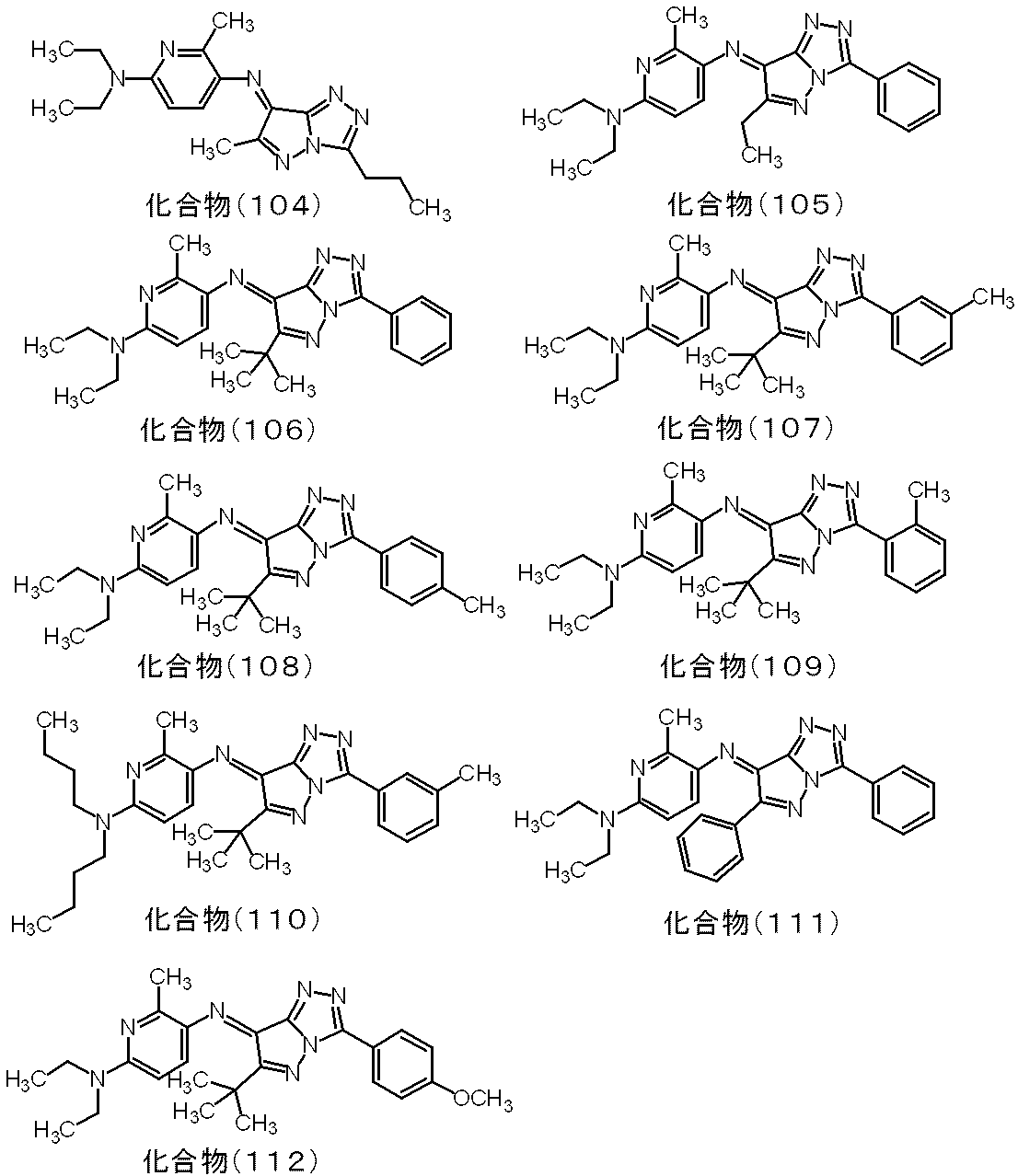
マゼンタ染料として、一般式(12)で表される化合物の中でも、化合物(106)~(110)のうちの少なくとも1種を用いることが好ましい。また、一般式(12)で表される化合物として、化合物(107)~(109)のうちの少なくとも1種を用いることが、耐光性に優れ、かつインバランスが改善された画像が得られ易いためより好ましい。
(iv-4)一般式(13)で表される化合物
次に、一般式(13)で表される化合物(マゼンタ染料)について説明する。

次に、一般式(13)で表される化合物(マゼンタ染料)について説明する。
一般式(13)中、R41~R44は、各々独立して、アルキル基、または置換もしくは無置換のアリール基を示す。
一般式(13)中、R41~R44が示すことのできるアルキル基は、特に限定されるものではなく、例えば、一般式(6)のR19及びR20と同様のアルキル基を挙げることができる。また、これらのアルキル基の中では、耐光性に優れ、かつインバランスが改善された画像が得られ易いことから、直鎖状または分岐状の炭素数1以上4以下のアルキル基(例えば、メチル基、エチル基、n-プロピル基及びtert-ブチル基)が好ましい。
一般式(13)中、R41~R44が示すことのできる置換もしくは無置換のアリール基は、特に限定されるものではない。置換基としては、例えば、アルキル基を挙げることができる。また、置換基を含むアリール基の合計炭素数は、例えば6以上10以下とすることができる。
この置換もしくは無置換のアリール基としては、例えば、フェニル基、トリル基(例えば4-メチルフェニル基)、及びナフチル基が挙げられる。これらのアリール基の中では、フェニル基及びトリル基が、耐光性に優れ、かつインバランスが改善された画像が得られ易いため好ましい。
一般式(13)で表される化合物の具体例として、以下に化合物(113)~(121)を示すが、これらの化合物に限定されるものではない。
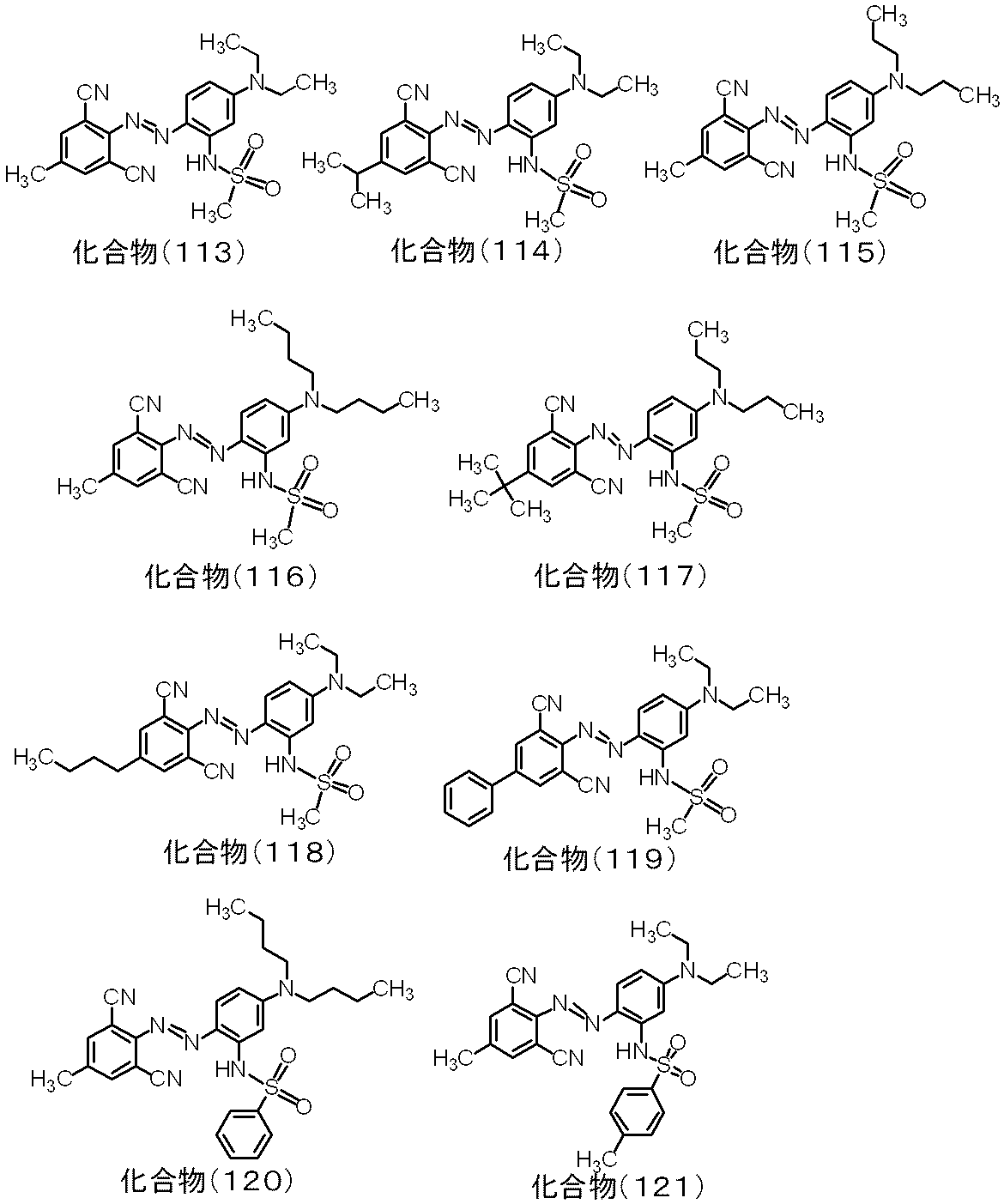
マゼンタ染料としては、一般式(13)で表される化合物の中でも、化合物(113)、(115)~(117)のうちの少なくとも1種を用いることが好ましい。また、一般式(13)で表される化合物として、化合物(115)を用いることが、耐光性に優れ、かつインバランスが改善された画像が得られ易いためより好ましい。
(iv-5)一般式(14)で表される化合物
次に、一般式(14)で表される化合物(マゼンタ染料)について説明する。

次に、一般式(14)で表される化合物(マゼンタ染料)について説明する。
一般式(14)中、R45及びR46は、各々独立してアルキル基を示す。R47は、水素原子、アルキル基、または、置換もしくは無置換のアリール基を示す。R48は、アルキル基、または、置換もしくは無置換のアリール基を示す。R49は、水素原子、アルキル基、置換もしくは無置換のアリール基、または、-N(-R50)R51を示す。ただし、R50及びR51は、各々独立して、水素原子、アルキル基、アリール基、または、アシル基を示すか、あるいは、R50とR51とが結合した窒素原子と一緒に環状構造を形成してもよい。
一般式(14)中、R45及びR46が示すことのできるアルキル基は、特に限定されるものではなく、例えば、直鎖状、分岐状、もしくは、環状の炭素数1以上20以下のアルキル基が挙げられる。
より具体的には、メチル基、エチル基、n-プロピル基、iso-プロピル基、n-ブチル基、sec-ブチル基、tert-ブチル基、オクチル基、ドデシル基、ノナデシル基、シクロブチル基、シクロペンチル基、シクロヘキシル基、メチルシクロヘキシル基、2-ブチルブチル基、2-エチルプロピル基、2-エチルヘキシル基等が挙げられる。なお、これらのアルキル基の中では、2-ブチルブチル基、及び2-エチルヘキシル基等の分岐状のアルキル基が、耐光性に優れ、かつインバランスが改善された画像が得られ易いため好ましい。
一般式(14)中、R47が示すことのできるアルキル基は、特に限定されるものではなく、例えば、一般式(6)のR19及びR20と同様のアルキル基を挙げることができる。また、これらのアルキル基の中では、tert-ブチル基が、耐光性に優れ、かつインバランスが改善された画像が得られ易いため好ましい。
一般式(14)中、R47が示すことのできる置換もしくは無置換のアリール基は、特に限定されるものではない。置換基としては、例えば、メチル基及びエチル基等のアルキル基、並びにメトキシ基等のアルコキシ基が挙げられる。また、置換基を含むアリール基の合計炭素数は、例えば6以上12以下とすることができる。
この置換もしくは無置換のアリール基としては、例えば、フェニル基、2-メチルフェニル基、3-メチルフェニル基、4-メチルフェニル基、キシリル基(例えば2,6-ジメチルフェニル基)2,6-ジエチルフェニル基、3-メトキシフェニル基、2,6-ジメトキシフェニル基、2,4,6-トリメチルフェニル基、並びに2,4,6-トリエチルフェニル基が挙げられる。また、これらのアリール基の中では、フェニル基が、耐光性に優れ、かつインバランスが改善された画像が得られ易いため好ましい。
R47は、フェニル基またはtert-ブチル基であることが好ましいが、耐光性及びインバランスの観点から、特にtert-ブチル基である場合が好ましい。
一般式(14)中、R48が示すことのできるアルキル基は、特に限定されるものではなく、例えば、直鎖状もしくは分岐状の炭素数1以上8以下(例えば主鎖の炭素数が1以上4以下)のアルキル基が挙げられる。
より具体的には、メチル基、エチル基、n-プロピル基、iso-プロピル基、n-ブチル基、iso-ブチル基、2-メチルブチル基、及び、2,3,3-トリメチルブチル基等が挙げられる。これらのアルキル基の中では、メチル基が、耐光性に優れ、かつインバランスが改善された画像が得られ易いため好ましい。
一般式(14)中、R48が示すことのできる置換もしくは無置換のアリール基は、特に限定されるものではない。置換基としては、例えば、メチル基等のアルキル基、及びメトキシ基等のアルコキシ基が挙げられる。また、置換基を含むアリール基の合計炭素数は、例えば6以上8以下とすることができる。
この置換もしくは無置換のアリール基としては、例えば、フェニル基、2-メチルフェニル基、3-メチルフェニル基、4-メチルフェニル基、4-メトキシフェニル基、キシリル基(例えば3,5-ジメチルフェニル基)が挙げられる。また、これらのアリール基の中では、フェニル基が耐光性に優れ、かつインバランスが改善された画像が得られ易いため好ましい。
一般式(14)中、R49が示すことのできるアルキル基は、特に限定されるものではなく、例えば、直鎖状もしくは分岐状の炭素数1以上8以下のアルキル基が挙げられる。
より具体的には、メチル基、エチル基、n-プロピル基、iso-プロピル基、n-ブチル基、及びiso-ブチル基等が挙げられる。これらのアルキル基の中では、メチル基が、耐光性に優れ、かつインバランスが改善された画像が得られ易いため好ましい。
一般式(14)中、R49が示すことのできる置換もしくは無置換のアリール基は特に限定されるものではない。置換基としては、例えば、メチル基等のアルキル基、及びメトキシ基等のアルコキシ基等を挙げることができる。また、置換基を含むアリール基の合計炭素数は、例えば、6以上12以下とすることができる。この置換もしくは無置換のアリール基としては、例えば、フェニル基、及びナフチル基が挙げられる。また、これらのアリール基の中では、フェニル基が耐光性に優れ、かつインバランスが改善された画像が得られ易いため好ましい。
一般式(14)中、R49が-N(-R50)R51である場合、R50及びR51が示すことのできるアルキル基は、特に限定されるものではなく、例えば、一般式(6)のR19及びR20と同様のアルキル基を挙げることができる。また、これらのアルキル基の中では、メチル基が、耐光性に優れ、かつインバランスが改善された画像が得られ易いため好ましい。
一般式(14)中、R49が-N(-R50)R51である場合、R50及びR51が示すことのできるアリール基は、特に限定されるものではなく、例えば、フェニル基及びナフチル基を挙げることができる。また、これらのアリール基の中では、フェニル基が耐光性に優れ、かつインバランスが改善された画像が得られ易いため好ましい。
一般式(14)中、R48が-N(-R50)R51である場合、R50及びR51が示すことのできるアシル基は、特に限定されるものではなく、例えば、炭素数2以上30以下の無置換のアルキルカルボニル基、炭素数7以上30以下の置換もしくは無置換のアリールカルボニル基、-C(=O)-A(Aはヘテロ環を表す)が挙げられる。より具体的には、アセチル基、プロピオニル基、ピバロイル基、ベンゾイル基、及びナフトイル基等が挙げられる。また、-C(=O)-Aとしては、2-ピリジルカルボニル基、及び2-フリルカルボニル基等が挙げられる。なお、アリールカルボニル基の置換基としては、例えば炭素数1以上4以下のアルキル基、炭素数1以上4以下のアルコキシ基等が挙げられる。
一般式(14)中、R49が-N(-R50)R51である場合、R50及びR51が互いに結合した窒素原子と一緒に形成する環状構造としては、特に限定されるものではなく、例えば、ピペリジン環、ピペラジン環、及びモルホリン環が挙げられる。
なお、これらの中でも、R50及びR51のうちの少なくとも一方がアルキル基である場合、耐光性が優れるため好ましい。さらに、R50及びR51のうちの少なくとも一方がメチル基の場合に、耐光性に優れ、かつインバランスが改善された画像が得られ易いためより好ましい。
一般式(14)で表される化合物の具体例として、以下に化合物(122)~(132)を示すが、これらの化合物に限定されるものではない。

一般式(14)で表される化合物として、化合物(122)~(124)及び(128)のうちの少なくとも1種を用いることが、耐光性に優れ、かつインバランスが改善された画像が得られ易いため好ましい。
なお、マゼンタ染料として、これらの一般式(10)~(14)で表される化合物の他に、既存のマゼンタ染料を用いてもよく、また一般式(10)~(14)で表される化合物と既存のマゼンタ染料を併用することもできる。
(v)結着樹脂
第1の感熱転写記録用シートの染料層に用いることができる結着樹脂としては、特に限定されず、様々な樹脂を用いることができる。その中でも、以下の水溶性樹脂及び有機溶剤可溶性の樹脂を用いることが好ましい。例えば、水溶性樹脂としては、セルロース樹脂、ポリアクリル酸樹脂、澱粉樹脂、及びエポキシ樹脂等を用いることができる。また、有機溶剤可溶性の樹脂としては、ポリアクリレート樹脂、ポリメタクリレート樹脂、ポリスチレン樹脂、ポリカーボネート樹脂、ポリエーテルスルホン樹脂、ポリビニルブチラール樹脂、エチルセルロース樹脂、アセチルセルロース樹脂、ポリエステル樹脂、AS樹脂、及びフェノキシ樹脂等を用いることができる。なおこれらの結着樹脂は、単独で用いても良いし、必要に応じて2種類以上組み合わせて用いてもよい。
第1の感熱転写記録用シートの染料層に用いることができる結着樹脂としては、特に限定されず、様々な樹脂を用いることができる。その中でも、以下の水溶性樹脂及び有機溶剤可溶性の樹脂を用いることが好ましい。例えば、水溶性樹脂としては、セルロース樹脂、ポリアクリル酸樹脂、澱粉樹脂、及びエポキシ樹脂等を用いることができる。また、有機溶剤可溶性の樹脂としては、ポリアクリレート樹脂、ポリメタクリレート樹脂、ポリスチレン樹脂、ポリカーボネート樹脂、ポリエーテルスルホン樹脂、ポリビニルブチラール樹脂、エチルセルロース樹脂、アセチルセルロース樹脂、ポリエステル樹脂、AS樹脂、及びフェノキシ樹脂等を用いることができる。なおこれらの結着樹脂は、単独で用いても良いし、必要に応じて2種類以上組み合わせて用いてもよい。
(vi)界面活性剤
第1の感熱転写記録用シートの染料層に、サーマルヘッド加熱時(印画時)に十分な滑性を持たせるために、界面活性剤を添加してもよい。染料層中に添加することができる界面活性剤としては、例えば、カチオン界面活性剤、アニオン界面活性剤、及びノニオン界面活性剤が挙げられる。
第1の感熱転写記録用シートの染料層に、サーマルヘッド加熱時(印画時)に十分な滑性を持たせるために、界面活性剤を添加してもよい。染料層中に添加することができる界面活性剤としては、例えば、カチオン界面活性剤、アニオン界面活性剤、及びノニオン界面活性剤が挙げられる。
カチオン界面活性剤としては、例えば、ドデシルアンモニウムクロライド、ドデシルアンモニウムブロマイド、ドデシルトリメチルアンモニウムブロマイド、ドデシルピリジニウムクロライド、ドデシルピリジニウムブロマイド、ヘキサデシルトリメチルアンモニウムブロマイドが挙げられる。
アニオン界面活性剤としては、例えば、ステアリン酸ナトリウム、ドデカン酸ナトリウム等の脂肪酸石鹸、ドデシル硫酸ナトリウム、ドデシルベンゼン硫酸ナトリウム、ラウリル硫酸ナトリウムが挙げられる。
ノニオン界面活性剤としては、例えば、ドデシルポリオキシエチレンエーテル、ヘキサデシルポリオキシエチレンエーテル、ノニルフェニルポリオキシエチレンエーテル、ラウリルポリオキシエチレンエーテル、ソルビタンモノオレアートポリオキシエチレンエーテル、モノデカノイルショ糖が挙げられる。
(vii)ワックス
第1の感熱転写記録用シートの染料層に、サーマルヘッド非加熱時に十分な滑性を持たせるために、ワックスを添加してもよい。染料層中に添加することができるワックスとしては、例えば、ポリエチレンワックス、パラフィンワックス、脂肪酸エステルワックスが挙げられるが、これらに限定されるものではない。
第1の感熱転写記録用シートの染料層に、サーマルヘッド非加熱時に十分な滑性を持たせるために、ワックスを添加してもよい。染料層中に添加することができるワックスとしては、例えば、ポリエチレンワックス、パラフィンワックス、脂肪酸エステルワックスが挙げられるが、これらに限定されるものではない。
(viii)その他の添加剤
第1の感熱転写記録用シートの染料層には、上記した添加物以外にも必要に応じて、紫外線吸収剤、防腐剤、酸化防止剤、帯電防止剤、及び粘度調整剤等を添加しても良い。
第1の感熱転写記録用シートの染料層には、上記した添加物以外にも必要に応じて、紫外線吸収剤、防腐剤、酸化防止剤、帯電防止剤、及び粘度調整剤等を添加しても良い。
(ix)媒体
第1の感熱転写記録用シートの各染料組成物の調製に用いることができる媒体は、特に限定されるものではないが、例えば水及び有機溶剤が挙げられる。有機溶剤としては、例えば、メタノール、エタノール、イソプロパノール及びイソブタノール等のアルコール類;メチルセロソルブ及びエチルセロソルブ等のセロソルブ類;トルエン、キシレン及びクロロベンゼン等の芳香族炭化水素類;酢酸エチル及び酢酸ブチル等のエステル類;アセトン、メチルエチルケトン、メチルイソブチルケトン及びシクロヘキサノン等のケトン類;塩化メチレン、クロロホルム及びトリクロロエチレン等のハロゲン化炭化水素類;テトラヒドロフラン及びジオキサン等のエーテル類;N,N-ジメチルホルムアミド、N-メチルピロリドン等を好ましく用いることができる。これらの有機溶剤は、単独で用いてもよいし、必要に応じて2種類以上組み合わせて用いてもよい。また、水と有機溶剤を併用することもできる。
第1の感熱転写記録用シートの各染料組成物の調製に用いることができる媒体は、特に限定されるものではないが、例えば水及び有機溶剤が挙げられる。有機溶剤としては、例えば、メタノール、エタノール、イソプロパノール及びイソブタノール等のアルコール類;メチルセロソルブ及びエチルセロソルブ等のセロソルブ類;トルエン、キシレン及びクロロベンゼン等の芳香族炭化水素類;酢酸エチル及び酢酸ブチル等のエステル類;アセトン、メチルエチルケトン、メチルイソブチルケトン及びシクロヘキサノン等のケトン類;塩化メチレン、クロロホルム及びトリクロロエチレン等のハロゲン化炭化水素類;テトラヒドロフラン及びジオキサン等のエーテル類;N,N-ジメチルホルムアミド、N-メチルピロリドン等を好ましく用いることができる。これらの有機溶剤は、単独で用いてもよいし、必要に応じて2種類以上組み合わせて用いてもよい。また、水と有機溶剤を併用することもできる。
(I-2-3)染料層形成用の染料組成物の組成
・染料の含有量
各染料組成物中の各染料(イエロー染料、マゼンタ染料またはシアン染料)の含有量は、シートの保存性の観点から、結着樹脂100質量部に対して、合計で1質量部以上200質量部以下であることが好ましい。染料の分散の観点からは、結着樹脂100質量部に対して、50質量部以上180質量部以下であることがより好ましい。
・染料の含有量
各染料組成物中の各染料(イエロー染料、マゼンタ染料またはシアン染料)の含有量は、シートの保存性の観点から、結着樹脂100質量部に対して、合計で1質量部以上200質量部以下であることが好ましい。染料の分散の観点からは、結着樹脂100質量部に対して、50質量部以上180質量部以下であることがより好ましい。
なお、染料組成物中の染料の含有量は、染料を2種以上混合して用いる場合は、各染料の質量部の合計量を意味する。例えばイエロー染料として、一般式(3)~(6)で表される化合物と、既存の染料とを併用した場合も、染料の含有量とは、これらの染料の合計の質量部数を意味する。
・第1化合物の含有量
第1化合物を染料組成物(例えばイエロー染料組成物)中に含有させる場合は、耐光性に優れ、かつインバランスが改善された画像が得られ易いことから、以下の含有量とすることが好ましい。即ち、染料組成物中の第1化合物の合計含有量は、染料100質量部(用いた染料の合計質量部)に対して、0.5質量部以上50質量部以下であることが好ましく、1.0質量部以上30質量部以下であることがより好ましい。
第1化合物を染料組成物(例えばイエロー染料組成物)中に含有させる場合は、耐光性に優れ、かつインバランスが改善された画像が得られ易いことから、以下の含有量とすることが好ましい。即ち、染料組成物中の第1化合物の合計含有量は、染料100質量部(用いた染料の合計質量部)に対して、0.5質量部以上50質量部以下であることが好ましく、1.0質量部以上30質量部以下であることがより好ましい。
・その他の成分の含有量
染料組成物中のその他の成分の含有量は、適宜設定することができ、特に限定されない。
染料組成物中のその他の成分の含有量は、適宜設定することができ、特に限定されない。
(I-3)その他の層
(i)ブラック染料層
第1の感熱転写記録用シートは、少なくとも、イエロー染料層、マゼンタ染料層及びシアン染料層を含む染料層を有するが、さらに染料層として、従来公知のブラック染料層を有していても良い。なおブラック染料層は、ブラック染料、もしくは既存のイエロー染料、マゼンタ染料、及びシアン染料を含む組成物を用いて形成することができ、このブラック染料層中に第1化合物を含むこともできる。
(i)ブラック染料層
第1の感熱転写記録用シートは、少なくとも、イエロー染料層、マゼンタ染料層及びシアン染料層を含む染料層を有するが、さらに染料層として、従来公知のブラック染料層を有していても良い。なおブラック染料層は、ブラック染料、もしくは既存のイエロー染料、マゼンタ染料、及びシアン染料を含む組成物を用いて形成することができ、このブラック染料層中に第1化合物を含むこともできる。
(ii)転写性保護層
第1の感熱転写記録用シートは、基材上に、画像形成後に画像面を保護するための転写性保護層を上述の染料層と面順次に有していてもよい。また、この転写性保護層を染料層とは異なるシート(基材)上に形成することもできる。
第1の感熱転写記録用シートは、基材上に、画像形成後に画像面を保護するための転写性保護層を上述の染料層と面順次に有していてもよい。また、この転写性保護層を染料層とは異なるシート(基材)上に形成することもできる。
(I-4)第1の感熱転写記録用シートの作製方法
第1の感熱転写記録用シートは、特に限定されるわけではないが、基材上に面順次に各染料層を形成することができる。例えば、基材(基材シート)上に、基材の移動方向に沿ってイエロー染料層、マゼンタ染料層及びシアン染料層を繰り返し作製することができる。この順に染料層を有する感熱転写用シートを用いた場合には、まずイエロー画像が形成され、次いでマゼンタ画像、さらにシアン画像という順序で一連の画像形成が行われ、1つのフルカラーの画像が形成される。そして、この一連の画像形成が繰り返されることになる。なお、これらの染料層以外の染料層も適宜追加することができ、例えば、基材上にブラック染料層(熱溶融性ブラック層)を追加することもできる。
第1の感熱転写記録用シートは、特に限定されるわけではないが、基材上に面順次に各染料層を形成することができる。例えば、基材(基材シート)上に、基材の移動方向に沿ってイエロー染料層、マゼンタ染料層及びシアン染料層を繰り返し作製することができる。この順に染料層を有する感熱転写用シートを用いた場合には、まずイエロー画像が形成され、次いでマゼンタ画像、さらにシアン画像という順序で一連の画像形成が行われ、1つのフルカラーの画像が形成される。そして、この一連の画像形成が繰り返されることになる。なお、これらの染料層以外の染料層も適宜追加することができ、例えば、基材上にブラック染料層(熱溶融性ブラック層)を追加することもできる。
染料層は、染料層用組成物(染料組成物)を基材へ塗布、乾燥して形成することができる。各染料組成物を基材上へ塗布する方法としては、特に限定されず、例えば、バーコーター、グラビアコーター、リバースロールコーター、ロッドコーター、エアドクタコーター等を用いた方法が挙げられる。この中でも、膜厚の調整が容易なグラビアコーターを用いた塗布方法が好ましい。
また、各染料組成物を塗布した後の乾燥条件は、十分に乾燥することができれば特に限定されず、例えば、50℃以上120℃以下の温度で、1秒以上5分以下乾燥を行うことができる。各染料組成物を十分に乾燥することにより、地汚れの発生や、巻き取りの際の染料組成物の裏移りを予防し易く、さらに、巻き返しの際の裏移りした染料組成物による異なる色相の染料層への再転移も予防し易い。
染料組成物の塗布量としては、染料層の乾燥後の厚さが0.1μm以上5μm以下の範囲となるように塗布することが、転写性の観点から好ましい。
第1の感熱転写記録用シートを作製する方法は特に限定されるものではないが、例えば以下のようにして作製することができる。
まず、媒体(例えば有機溶剤)中に、第1化合物、一般式(3)~(14)で表される目的の染料層に対応する色の染料(色材)、必要に応じて、結着樹脂、界面活性剤、及びワックスを撹拌しながら徐々に加え、十分に媒体になじませる。この際、分散機により機械的剪断力を加えることで、これらの成分を安定して媒体中に溶解または微粒子状に分散させ、染料組成物を調製する。この染料組成物を基材であるベースフィルムに塗布及び乾燥することにより、目的の染料層を作製することができる。イエロー、マゼンタ及びシアンの各染料層を基材上に面順次で形成する場合は、上記方法によりそれぞれ作製した3種の染料組成物を用いることができる。
なお、染料組成物の調製の際に用いる分散機としては特に限定されるものではないが、例えば、回転せん断型ホモジナイザー、ボールミル、サンドミル、アトライター等のメディア式分散機、並びに高圧対向衝突式の分散機等を用いることができる。
さらに必要に応じて、上述したブラック染料層、転写性保護層等の他の層を形成することにより、第1の感熱転写記録用シートを作製することができる。
なお、第1の感熱転写記録用シートは、この製造方法で作製された感熱転写記録用シートに限定されるものではない。
(I-5)第1の感熱転写記録用シートの使用方法
第1の感熱転写記録用シートは、被転写体、例えば色材受容層を表面に有する受像シートと重ね合わせ、この感熱転写記録用シートをサーマルヘッドなどの加熱方法を用いて加熱することにより、シート中の色材を受像シートに転写させて、画像形成を行うものである。なお、第1の感熱転写記録用シートが上述した転写性保護層を有する場合は、この受像シートに形成された画像上にこの保護層部分のシートを重ね合わせ、サーマルヘッドなどの加熱方法を用いて加熱することにより、画像上に保護層を転写(形成)することができる。
第1の感熱転写記録用シートは、被転写体、例えば色材受容層を表面に有する受像シートと重ね合わせ、この感熱転写記録用シートをサーマルヘッドなどの加熱方法を用いて加熱することにより、シート中の色材を受像シートに転写させて、画像形成を行うものである。なお、第1の感熱転写記録用シートが上述した転写性保護層を有する場合は、この受像シートに形成された画像上にこの保護層部分のシートを重ね合わせ、サーマルヘッドなどの加熱方法を用いて加熱することにより、画像上に保護層を転写(形成)することができる。
第1の感熱転写記録用シートを印画のために加熱する加熱手段としては、特に限定されるものではないが、サーマルヘッドを用いた常法のみならず、赤外線またはレーザー光も利用することができる。また、基材のベースフィルムそのものに電気を流すことによって発熱する通電発熱フィルムを用いて、通電型染料転写シートとして用いることもできる。
(II)第2の感熱転写記録用シート
第2の感熱転写記録用シートは、基材、並びに基材上に、特定のイエロー染料を含有するイエロー染料層と、マゼンタ染料を含有するマゼンタ染料層と、特定のシアン染料を含有するシアン染料層とを含む染料層、及び染料層を被転写体上に転写して形成される画像面を保護するための保護層を少なくとも有する。そして、この保護層に第1化合物を用いる。
第2の感熱転写記録用シートは、基材、並びに基材上に、特定のイエロー染料を含有するイエロー染料層と、マゼンタ染料を含有するマゼンタ染料層と、特定のシアン染料を含有するシアン染料層とを含む染料層、及び染料層を被転写体上に転写して形成される画像面を保護するための保護層を少なくとも有する。そして、この保護層に第1化合物を用いる。
なお、第2の感熱転写記録用シートは、上記以外の染料層(例えばブラック染料層)を有することもできる。
以下に、第2の感熱転写記録用シートの構成について詳細に説明する。
(II-1)基材
第2の感熱転写記録用シートが有する基材は、染料層及び保護層を支持するものである。基材としては特に限定されず、第1の感熱転写記録用シートと同様の基材を用いることができ、基材の厚みや接着層、耐熱滑性層についても、第1の感熱転写記録用シートと同様にすることができる。
第2の感熱転写記録用シートが有する基材は、染料層及び保護層を支持するものである。基材としては特に限定されず、第1の感熱転写記録用シートと同様の基材を用いることができ、基材の厚みや接着層、耐熱滑性層についても、第1の感熱転写記録用シートと同様にすることができる。
(II-2-1)染料層
第2の感熱転写記録用シートは、少なくともイエロー染料層、マゼンタ染料層及びシアン染料層を有する。各染料層は、各染料層に応じた染料と、必要に応じて、媒体(水や有機溶剤等)、結着樹脂、界面活性剤及びワックス等の添加剤とを含む組成物を用いて形成することができる。例えばイエロー染料層は、一般式(3)~(6)のイエロー染料と、媒体と、結着樹脂と、界面活性剤と、ワックスとを含む組成物(イエロー染料組成物)を用いることができる。
第2の感熱転写記録用シートは、少なくともイエロー染料層、マゼンタ染料層及びシアン染料層を有する。各染料層は、各染料層に応じた染料と、必要に応じて、媒体(水や有機溶剤等)、結着樹脂、界面活性剤及びワックス等の添加剤とを含む組成物を用いて形成することができる。例えばイエロー染料層は、一般式(3)~(6)のイエロー染料と、媒体と、結着樹脂と、界面活性剤と、ワックスとを含む組成物(イエロー染料組成物)を用いることができる。
なお、第2の感熱転写記録用シートでは、イエロー染料として一般式(3)~(6)で表される化合物を、シアン染料として一般式(7)~(9)で表される化合物を、マゼンタ染料として例えば一般式(10)~(14)で表される化合物を用いる。なお、感熱転写記録用シートの分野で、熱転写用として公知で用いられている染料であって、熱で移行するものであれば、特に限定されず、色相、印画感度、耐光性、保存性、結着樹脂への溶解性や分散性等を考慮して、これらの一般式(3)~(14)で表される化合物(染料)と併用することができる。さらに、これらの染料層中に第1化合物を含むこともできる。
(II-2-2)染料層形成用の染料組成物に含む成分
以下に、染料層の形成に用いる組成物に含まれる各成分について説明する。
以下に、染料層の形成に用いる組成物に含まれる各成分について説明する。
(i)イエロー染料、シアン染料及びマゼンタ染料
第2の感熱転写記録用シートに用いるこれらの染料は、第1の感熱転写記録用シートと同様に、イエロー染料(一般式(3)~(6)で表される化合物)、シアン染料(一般式(7)~(9)で表される化合物)及びマゼンタ染料(一般式(10)~(14)で表される化合物)、並びに、既存の染料を用いることができる。
第2の感熱転写記録用シートに用いるこれらの染料は、第1の感熱転写記録用シートと同様に、イエロー染料(一般式(3)~(6)で表される化合物)、シアン染料(一般式(7)~(9)で表される化合物)及びマゼンタ染料(一般式(10)~(14)で表される化合物)、並びに、既存の染料を用いることができる。
(ii)媒体、結着樹脂、界面活性剤及びワックス等の添加剤
各種添加剤についても、第1の感熱転写記録用シートと同様の添加剤を用いることができる。
各種添加剤についても、第1の感熱転写記録用シートと同様の添加剤を用いることができる。
(II-2-3)染料層形成用の染料組成物の組成
・染料の含有量
各染料組成物中の各染料(イエロー染料、マゼンタ染料またはシアン染料)の含有量は、シートの保存性の観点から、結着樹脂100質量部に対して、合計で1質量部以上200質量部以下であることが好ましい。染料(着色剤)の分散の観点からは、結着樹脂100質量部に対して、50質量部以上180質量部以下であることがより好ましい。
・染料の含有量
各染料組成物中の各染料(イエロー染料、マゼンタ染料またはシアン染料)の含有量は、シートの保存性の観点から、結着樹脂100質量部に対して、合計で1質量部以上200質量部以下であることが好ましい。染料(着色剤)の分散の観点からは、結着樹脂100質量部に対して、50質量部以上180質量部以下であることがより好ましい。
なお、上記染料の含有量は、染料を2種以上混合して用いる場合は、各染料色素の質量部の合計量を意味する。例えば、イエロー染料として、一般式(3)~(6)で表される化合物と、既存の染料とを併用した場合も、染料の含有量とは、これらの染料の合計の質量部数を意味する。
・その他の成分の含有量
染料組成物中のその他の成分の含有量は、適宜設定することができ、特に限定されない。
染料組成物中のその他の成分の含有量は、適宜設定することができ、特に限定されない。
(II-3)保護層
第2の感熱転写記録用シート中の保護層は第1化合物を含む。なお、第1化合物としては、第1の感熱転写記録用シートと同様の化合物を用いることができる。
第2の感熱転写記録用シート中の保護層は第1化合物を含む。なお、第1化合物としては、第1の感熱転写記録用シートと同様の化合物を用いることができる。
また、この保護層形成用の組成物は、第1化合物の他に、結着樹脂を含むことができる。
保護層に使用する結着樹脂としては、特に限定されるものではないが、例えば、ポリスチレン、ポリメタクリル酸メチル、ポリアクリル酸エチル等のアクリル系樹脂、ポリα-メチルスチレン等のスチレン系樹脂、ポリ塩化ビニル、ポリ酢酸ビニル、塩化ビニル-酢酸ビニル共重合体、ポリビニルブチラール、ポリビニルアセタール等のビニル系樹脂、ポリアミド樹脂、エポキシ樹脂、ポリウレタン樹脂、石油樹脂、アイオノマー、エチレン-アクリル酸共重合体、エチレン-アクリル酸エステル共重合体等の合成樹脂等を挙げることができ、これらを好適に用いることができる。
また、保護層形成用の組成物は、この他にも、媒体(水や有機溶剤等)、界面活性剤、ワックス、紫外線吸収剤、防腐剤、酸化防止剤、帯電防止剤、及び粘度調整剤等の添加剤を含むことができる。これらの各種添加剤としては、第1の感熱転写記録用シートと同様の添加剤を用いることができる。
保護層形成用の組成物中の第1化合物の合計の含有量は、シートの保存性の観点から、結着樹脂100質量部に対して0.1質量部以上50質量部以下であることが好ましい。さらに、印画物の色と耐光性向上の観点から、第1化合物の合計含有量は、結着樹脂100質量部に対して0.5質量部以上20質量部以下であることがより好ましい。
また、保護層形成用の組成物中のその他の成分の含有量は、適宜設定することができ、特に限定されない。
保護層の厚みは、転写性の観点から0.1μm以上5μm以下が好ましい。
(II-4)その他の層
第2の感熱転写記録用シートは、第1の感熱転写記録用シートと同様に、上述したブラック染料層等の他の層を有することができる。
第2の感熱転写記録用シートは、第1の感熱転写記録用シートと同様に、上述したブラック染料層等の他の層を有することができる。
また、保護層と基材との間に、感熱転写記録用シートからの保護層の剥離を容易にするため、剥離層(離型層)を形成することが好ましい。
この剥離層は、例えば、ポリメタクリル酸メチル及びポリアクリル酸エチル等のアクリル系樹脂等を含むことができる。また、剥離層の厚みは、例えば0.1μm以上1.5μm以下とすることができる。
(II-5)第2の感熱転写記録用シートの作製方法
第2の感熱転写記録用シートは、特に限定されるわけではないが、基材上に面順次に、各染料層、並びに保護層を形成することができる。例えば、基材(基材シート)上に、基材の移動方向に沿って、イエロー染料層、マゼンタ染料層、シアン染料層、及びブラック染料層を繰り返し作製し、さらに保護層を作製することができる。この順に、染料層及び保護層を有する感熱転写用シートを用いた場合には、まずイエロー画像が形成され、次いでマゼンタ画像、さらにシアン画像、ブラック画像という順序で一連の画像形成が行われ、1つのフルカラーの画像が形成される。そして、この一連の画像形成が繰り返され、最終的に、形成された画像上に保護層が転写されることになる。
第2の感熱転写記録用シートは、特に限定されるわけではないが、基材上に面順次に、各染料層、並びに保護層を形成することができる。例えば、基材(基材シート)上に、基材の移動方向に沿って、イエロー染料層、マゼンタ染料層、シアン染料層、及びブラック染料層を繰り返し作製し、さらに保護層を作製することができる。この順に、染料層及び保護層を有する感熱転写用シートを用いた場合には、まずイエロー画像が形成され、次いでマゼンタ画像、さらにシアン画像、ブラック画像という順序で一連の画像形成が行われ、1つのフルカラーの画像が形成される。そして、この一連の画像形成が繰り返され、最終的に、形成された画像上に保護層が転写されることになる。
なお、これらの染料層以外の染料層も、基材上に適宜追加することができる。
第2の感熱転写記録用シートを作製する方法は、特に限定されるものではないが、例えば、以下のようにして得ることができる。
保護層については一般式(1)~(2)で表される化合物を、各染料層については一般式(3)~(14)で表される目的の染料層に対応する色の染料(色材)を、結着樹脂、界面活性剤及びワックス等と一緒に、媒体中に撹拌しながら徐々に加え、十分に媒体になじませる。この際、分散機により機械的剪断力を加えることで、これらの成分を安定して、媒体中に溶解または微粒子状に分散させ、各組成物(染料層形成用染料組成物または保護層形成用組成物)を調製する。この各組成物を基材であるベースフィルムに塗布及び乾燥することにより、目的の染料層及び保護層を作製することができる。なお、保護層と基材との間に剥離層を形成する場合は、剥離層を形成するための樹脂等を用いて、基材上に予め剥離層を形成しておく。
なお、(保護層形成用組成物も含む)各組成物の作製に用いる分散機、(保護層形成用組成物も含む)各組成物の基材上の塗布方法や塗布量、並びに乾燥条件は、第1の感熱転写記録用シートと同様とすることができる。
さらに必要に応じて、上述した耐熱滑性層等の他の層を形成することにより、第2の感熱転写記録用シートを作製することができる。
なお、第2の感熱転写記録用シートは、この製造方法で作製された感熱転写記録用シートに限定されるものではない。
(II-6)第2の感熱転写記録用シートの使用方法
第2の感熱転写記録用シートは、色材受容層を表面に有する受像シートと重ね合わせ、この感熱転写記録用シートをサーマルヘッドなどの加熱方法を用いて加熱することにより、シート中の色材を受像シートに転写させて画像形成を行い、この受像シートに形成された画像上に保護層を転写するものである。第2の感熱転写記録用シートを加熱する加熱手段としては、特に限定されるものではなく、第1の感熱転写記録用シートと同様の手段を用いることができる。なお保護層は、画像を形成した領域にのみ転写してもよいし、受像シートの全面に転写してもよい。
第2の感熱転写記録用シートは、色材受容層を表面に有する受像シートと重ね合わせ、この感熱転写記録用シートをサーマルヘッドなどの加熱方法を用いて加熱することにより、シート中の色材を受像シートに転写させて画像形成を行い、この受像シートに形成された画像上に保護層を転写するものである。第2の感熱転写記録用シートを加熱する加熱手段としては、特に限定されるものではなく、第1の感熱転写記録用シートと同様の手段を用いることができる。なお保護層は、画像を形成した領域にのみ転写してもよいし、受像シートの全面に転写してもよい。
以下、実施例及び比較例を挙げて、本発明をさらに詳細に説明するが、本発明はこれらの実施例に限定されるものではない。なお、文中「部」とあるのは特に断りのない限り質量基準である。
[一般式(1)及び(2)で表される化合物の製造]
一般式(1)及び(2)で表わされる化合物は、上述した公知の方法によって合成することが可能である。
一般式(1)及び(2)で表わされる化合物は、上述した公知の方法によって合成することが可能である。
[比較化合物]
比較化合物としては、比較化合物(1)を使用した。なお、この比較化合物(1)は、一般式(1)及び(2)で表わされる化合物の製造方法と同様の公知の方法によって合成することが可能である。

比較化合物としては、比較化合物(1)を使用した。なお、この比較化合物(1)は、一般式(1)及び(2)で表わされる化合物の製造方法と同様の公知の方法によって合成することが可能である。
(I)第1の感熱転写記録用シート
[各染料組成物の作製]
<イエロー染料組成物の作製例1>
メチルエチルケトン45部及びトルエン45部の混合溶液に、ポリビニルブチラール樹脂(商品名:KS-3、積水化学(株)製)5部を少しずつ添加して溶解させた。この溶液に、以下の化合物を添加して完全に溶解させることで、感熱転写記録用シート作製用のイエロー染料組成物(Y1)を得た。
・第1化合物:
化合物(1) 0.05部、
・イエロー染料:
一般式(3)で表される化合物: 化合物(43) 1.25部
一般式(4)で表される化合物: 化合物(51) 2.50部
既存のイエロー染料: 化合物(66) 1.25部
[各染料組成物の作製]
<イエロー染料組成物の作製例1>
メチルエチルケトン45部及びトルエン45部の混合溶液に、ポリビニルブチラール樹脂(商品名:KS-3、積水化学(株)製)5部を少しずつ添加して溶解させた。この溶液に、以下の化合物を添加して完全に溶解させることで、感熱転写記録用シート作製用のイエロー染料組成物(Y1)を得た。
・第1化合物:
化合物(1) 0.05部、
・イエロー染料:
一般式(3)で表される化合物: 化合物(43) 1.25部
一般式(4)で表される化合物: 化合物(51) 2.50部
既存のイエロー染料: 化合物(66) 1.25部
<イエロー染料組成物の作製例2~15>
イエロー染料組成物の作製例1において、第1化合物及びイエロー染料を、表1に示す種類の化合物と配合比に変更した以外は、作製例1と同じ方法で、感熱転写記録用シート作製用のイエロー染料組成物(Y2)~(Y15)をそれぞれ作製した。
イエロー染料組成物の作製例1において、第1化合物及びイエロー染料を、表1に示す種類の化合物と配合比に変更した以外は、作製例1と同じ方法で、感熱転写記録用シート作製用のイエロー染料組成物(Y2)~(Y15)をそれぞれ作製した。
なお、表1中のイエロー染料の配合比は、一般式(3)で表される化合物:一般式(4)で表される化合物:一般式(5)で表される化合物:一般式(6)で表される化合物:化合物(65)または(66)の配合比を意味する。また、イエロー染料組成物(Y1~Y15)中のイエロー染料の合計含有量は、それぞれ5質量部とした。

<シアン染料組成物の作製例1~13>
イエロー染料組成物の作製例1において、一般式(1)~(2)で表される化合物及びイエロー染料を、表2に示す種類の化合物と配合比に変更した以外は、この作製例1と同じ方法で、シアン染料組成物(C1)~(C13)をそれぞれ作製した。なお、表2中のシアン染料の配合比は、一般式(7)で表される化合物:一般式(8)で表される化合物:一般式(9)で表される化合物の配合比を意味する。また、シアン染料組成物(C1~C13)中のシアン染料の合計含有量は、それぞれ5質量部とした。
イエロー染料組成物の作製例1において、一般式(1)~(2)で表される化合物及びイエロー染料を、表2に示す種類の化合物と配合比に変更した以外は、この作製例1と同じ方法で、シアン染料組成物(C1)~(C13)をそれぞれ作製した。なお、表2中のシアン染料の配合比は、一般式(7)で表される化合物:一般式(8)で表される化合物:一般式(9)で表される化合物の配合比を意味する。また、シアン染料組成物(C1~C13)中のシアン染料の合計含有量は、それぞれ5質量部とした。

<マゼンタ染料組成物の作製例1~14>
イエロー染料組成物の作製例1において、一般式(1)~(2)で表される化合物及びイエロー染料を、表3に示す種類の化合物と配合比に変更した以外は、この作製例1と同じ方法で、マゼンタ染料組成物(M1)~(M14)をそれぞれ作製した。なお、表3中のマゼンタ染料の配合比は、一般式(10)で表される化合物:一般式(11)で表される化合物:一般式(12)で表される化合物:一般式(13)で表される化合物:一般式(14)で表される化合物の配合比を意味する。また、マゼンタ染料組成物(M1~M14)中のマゼンタ染料の合計含有量は、それぞれ5質量部とした。
イエロー染料組成物の作製例1において、一般式(1)~(2)で表される化合物及びイエロー染料を、表3に示す種類の化合物と配合比に変更した以外は、この作製例1と同じ方法で、マゼンタ染料組成物(M1)~(M14)をそれぞれ作製した。なお、表3中のマゼンタ染料の配合比は、一般式(10)で表される化合物:一般式(11)で表される化合物:一般式(12)で表される化合物:一般式(13)で表される化合物:一般式(14)で表される化合物の配合比を意味する。また、マゼンタ染料組成物(M1~M14)中のマゼンタ染料の合計含有量は、それぞれ5質量部とした。

[画像サンプルの作製]
〔実施例1〕
基材として、厚さ4.5μmのポリエチレンテレフタレートフィルム(商品名:ルミラー、東レ(株)製)を用い、この基材上に、乾燥後の厚みが1μmになるようにイエロー染料組成物(Y14)を塗布し、乾燥することによって、イエロー染料層を形成した。
〔実施例1〕
基材として、厚さ4.5μmのポリエチレンテレフタレートフィルム(商品名:ルミラー、東レ(株)製)を用い、この基材上に、乾燥後の厚みが1μmになるようにイエロー染料組成物(Y14)を塗布し、乾燥することによって、イエロー染料層を形成した。
次いで、イエロー染料組成物(Y14)の代わりに、マゼンタ染料組成物(M13)を用いた以外はイエロー染料層と同じ方法で、イエロー染料層の隣の領域に、マゼンタ染料層を形成した。
同様にして、このマゼンタ染料層の隣の領域に、シアン染料組成物(C1)を用いて、シアン染料層を形成した。こうして、イエロー染料層、マゼンタ染料層及びシアン染料層を有する第1の感熱転写記録用シートを作製した。
作製したイエロー染料層、マゼンタ染料層及びシアン染料層を有する感熱転写記録用シートを用いて、Canon製Selphy(商品名)の改造機で、印画紙に画像を転写して画像サンプル(1)を作製した。その際、イエロー、マゼンタ及びシアンそれぞれについて、印画物の光学濃度(O.D.)が1.0になるように出力を調整し、さらに、その出力で、イエロー、マゼンタ及びシアンの順番にインクを重ねてブラック画像を印画し、画像サンプルとした。得られた画像サンプルを用いて、後述する評価を行った。なお、画像サンプルの測色は、反射濃度計SpectroLino(商品名、Gretag Macbeth社製)を用いて行った。
〔実施例2~33、比較例1~5〕
実施例1において、使用する各色の染料組成物を表4に示すように変更した以外は、実施例1と同様にして、イエロー染料層、マゼンタ染料層及びシアン染料層を有する感熱転写記録用シートをそれぞれ作製した。そして、実施例1と同様にして、画像サンプル2~33、並びに、画像サンプル34~38(比較画像サンプル1~5)を出力し、後述する評価を行った。
実施例1において、使用する各色の染料組成物を表4に示すように変更した以外は、実施例1と同様にして、イエロー染料層、マゼンタ染料層及びシアン染料層を有する感熱転写記録用シートをそれぞれ作製した。そして、実施例1と同様にして、画像サンプル2~33、並びに、画像サンプル34~38(比較画像サンプル1~5)を出力し、後述する評価を行った。
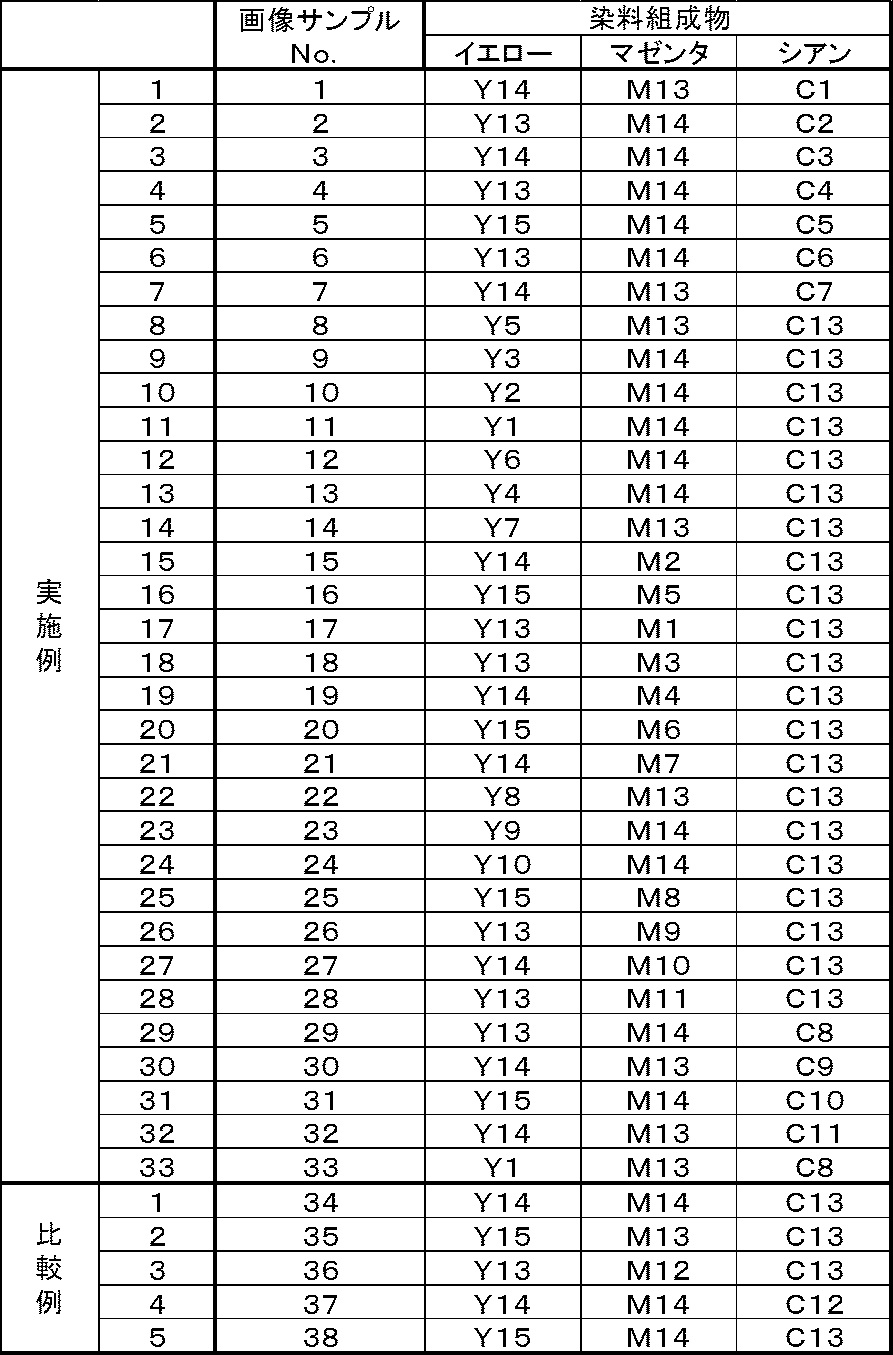
[評価]
<インバランス評価>
実施例1~33、比較例1~5で得られた画像サンプルをキセノン試験装置(商品名:AtlasCi4000、スガ試験機(株)製)に投入し、照度:340nmで0.28W/m2、温度:40℃、相対湿度:50%の条件下、30時間曝露した。
<インバランス評価>
実施例1~33、比較例1~5で得られた画像サンプルをキセノン試験装置(商品名:AtlasCi4000、スガ試験機(株)製)に投入し、照度:340nmで0.28W/m2、温度:40℃、相対湿度:50%の条件下、30時間曝露した。
初期の光学濃度(O.D.)をOD0とし、30時間曝露後のO.D.をOD30とした時、O.D.残存率を以下の数式1のように定義した。
(数式1) O.D.残存率=OD30/OD0
(数式1) O.D.残存率=OD30/OD0
この式に従い、ブラック画像中のシアン、マゼンタ及びイエロー各成分のOD残存率を算出した。インバランスの評価として各O.D.残存率の差分の絶対値を以下のように算出した。
BkC-Y=100×絶対値(イエロー成分O.D.残存率―シアン成分O.D.残存率)
BkM-Y=100×絶対値(イエロー成分O.D.残存率―マゼンタ成分O.D.残存率)
BkC―M=100×絶対値(シアン成分O.D.残存率―マゼンタ成分O.D.残存率)
BkC-Y=100×絶対値(イエロー成分O.D.残存率―シアン成分O.D.残存率)
BkM-Y=100×絶対値(イエロー成分O.D.残存率―マゼンタ成分O.D.残存率)
BkC―M=100×絶対値(シアン成分O.D.残存率―マゼンタ成分O.D.残存率)
上記式より算出した3つの値(BkC-Y、BkM-Y及びBkC―M)を以下の評価基準に基づき、それぞれ評価した。これらの各値及びその評価結果を表5に示す。インバランス(BkC-Y、BkM-Y及びBkC―M)が15以下の場合、インバランスは良好であると判断できる。
(評価基準)
A:インバランス<10 (インバランスが非常に良好)
B:10≦インバランス≦15 (インバランスが良好)
C:15<インバランス (インバランスが不良)。
A:インバランス<10 (インバランスが非常に良好)
B:10≦インバランス≦15 (インバランスが良好)
C:15<インバランス (インバランスが不良)。

表5より明らかなように、実施例に記載の第1の感熱転写記録用シートを用いて形成した画像サンプルは、比較例の感熱転写記録用シートを用いて形成した画像サンプルと比較して、インバランスが良好であった。
(II)第2の感熱転写記録用シート
<イエロー染料組成物の作製例16>
メチルエチルケトン45部及びトルエン45部の混合溶液に、ポリビニルブチラール樹脂(商品名:KS-3、積水化学(株)製)5部を少しずつ添加して溶解させた。この溶液に、以下のイエロー染料を添加して完全に溶解させることで、感熱転写記録用シート作製用のイエロー染料組成物(Y16)を得た。
・イエロー染料:
一般式(3)で表される化合物: 化合物(43) 1.25部
一般式(4)で表される化合物: 化合物(51) 2.50部
既存のイエロー染料: 化合物(66) 1.25部
<イエロー染料組成物の作製例16>
メチルエチルケトン45部及びトルエン45部の混合溶液に、ポリビニルブチラール樹脂(商品名:KS-3、積水化学(株)製)5部を少しずつ添加して溶解させた。この溶液に、以下のイエロー染料を添加して完全に溶解させることで、感熱転写記録用シート作製用のイエロー染料組成物(Y16)を得た。
・イエロー染料:
一般式(3)で表される化合物: 化合物(43) 1.25部
一般式(4)で表される化合物: 化合物(51) 2.50部
既存のイエロー染料: 化合物(66) 1.25部
<イエロー染料組成物の作製例17及び18>
イエロー染料組成物の作製例16において、イエロー染料を表6に示すイエロー染料及び配合比に変更した以外は、この作製例16と同じ方法で、イエロー染料組成物(Y17)及び(Y18)をそれぞれ作製した。その際、イエロー染料組成物(Y16~Y18)中のイエロー染料の合計含有量は、それぞれ5質量部とした。
イエロー染料組成物の作製例16において、イエロー染料を表6に示すイエロー染料及び配合比に変更した以外は、この作製例16と同じ方法で、イエロー染料組成物(Y17)及び(Y18)をそれぞれ作製した。その際、イエロー染料組成物(Y16~Y18)中のイエロー染料の合計含有量は、それぞれ5質量部とした。

<マゼンタ染料組成物の作製例15~17>
イエロー染料組成物の作製例16において、イエロー染料を、表7に示すマゼンタ染料と配合比に変更した以外は、この作製例16と同じ方法で、感熱転写記録用シート作製用のマゼンタ染料組成物(M15)~(M17)をそれぞれ作製した。なお、その際、マゼンタ染料組成物(M15~M17)中のマゼンタ染料の合計含有量は、それぞれ5質量部とした。
イエロー染料組成物の作製例16において、イエロー染料を、表7に示すマゼンタ染料と配合比に変更した以外は、この作製例16と同じ方法で、感熱転写記録用シート作製用のマゼンタ染料組成物(M15)~(M17)をそれぞれ作製した。なお、その際、マゼンタ染料組成物(M15~M17)中のマゼンタ染料の合計含有量は、それぞれ5質量部とした。

<シアン染料組成物の作製例14~16>
イエロー染料組成物の作製例16において、イエロー染料を、表8に示すシアン染料と配合比に変更した以外は、この作製例16と同じ方法で、シアン染料組成物(C14)~(C16)をそれぞれ作製した。なお、その際、シアン染料組成物(C14~C16)中のシアン染料の合計含有量は、それぞれ5質量部とした。
イエロー染料組成物の作製例16において、イエロー染料を、表8に示すシアン染料と配合比に変更した以外は、この作製例16と同じ方法で、シアン染料組成物(C14)~(C16)をそれぞれ作製した。なお、その際、シアン染料組成物(C14~C16)中のシアン染料の合計含有量は、それぞれ5質量部とした。

<保護層形成用組成物の作製例1>
メチルエチルケトン45部及びトルエン45部の混合溶液にアクリル樹脂(三菱レイヨン(株)製、商品名:ダイアナールBR-85)10部を少しずつ添加して溶解させた。その後この溶液に、化合物(1)0.5部を添加して完全に溶解させて、保護層形成用の塗布液(組成物)を調製した。
メチルエチルケトン45部及びトルエン45部の混合溶液にアクリル樹脂(三菱レイヨン(株)製、商品名:ダイアナールBR-85)10部を少しずつ添加して溶解させた。その後この溶液に、化合物(1)0.5部を添加して完全に溶解させて、保護層形成用の塗布液(組成物)を調製した。
<保護層形成用組成物の作製例2~12>
保護層形成用組成物の作製例1において、一般式(1)~(2)で表される化合物を表9に示す化合物に変更し、さらに、アクリル樹脂との配合比を表9に示すように変更した以外は、この作製例1と同じ方法で、保護層形成用組成物(H2)~(H12)をそれぞれ作製した。
保護層形成用組成物の作製例1において、一般式(1)~(2)で表される化合物を表9に示す化合物に変更し、さらに、アクリル樹脂との配合比を表9に示すように変更した以外は、この作製例1と同じ方法で、保護層形成用組成物(H2)~(H12)をそれぞれ作製した。

<色材層シートの作製例1>
基材として、厚さ4.5μmのポリエチレンテレフタレートフィルム(商品名:ルミラー、東レ(株)製)を用い、この基材上に、乾燥後の厚みが1μmになるようにイエロー染料組成物(Y16)を塗布し、乾燥することによって、イエロー染料層を形成した。
基材として、厚さ4.5μmのポリエチレンテレフタレートフィルム(商品名:ルミラー、東レ(株)製)を用い、この基材上に、乾燥後の厚みが1μmになるようにイエロー染料組成物(Y16)を塗布し、乾燥することによって、イエロー染料層を形成した。
次いで、イエロー染料組成物(Y16)の代わりに、マゼンタ染料組成物(M15)を用いた以外はイエロー染料層と同じ方法で、イエロー染料層の隣の領域にマゼンタ染料層を形成した。
同様にして、このマゼンタ染料層の隣の領域に、シアン染料組成物(C14)を用いてシアン染料層を形成した。
さらに、シアン染料層の隣の領域に、メチルエチルケトン40部及びトルエン40部の混合溶液にアクリル樹脂(商品名:BR85 三菱レイヨン(株)製)20部を添加した塗布液を、乾燥後の厚みが0.5μmになるように塗布し、乾燥させて剥離層を形成した。
続いて、この剥離層上に、乾燥後の厚みが2μmになるようにこの保護層形成用組成物(塗布液)(H1)を塗布し、乾燥することによって、保護層を形成した。
こうして、イエロー染料層、マゼンタ染料層、シアン染料層、及び保護層を有する色材層シート(S1)を作製した。
<色材層シートの作製例2~15>
色材層シートの作製例1において、用いたイエロー染料組成物、マゼンタ染料組成物、シアン染料組成物、及び保護層形成用組成物を、表10に示す組成物に変更した以外は、この作製例1と同様にして、色材層シート(S2)~(S15)をそれぞれ作製した。
色材層シートの作製例1において、用いたイエロー染料組成物、マゼンタ染料組成物、シアン染料組成物、及び保護層形成用組成物を、表10に示す組成物に変更した以外は、この作製例1と同様にして、色材層シート(S2)~(S15)をそれぞれ作製した。

〔画像サンプルの作製〕
〔実施例34〕
作製した色材層シート(S1)を用いて、Canon製Selphy(商品名)の改造機で、印画紙に画像を転写して画像サンプル(39)を作製した。その際印画順は、イエロー、マゼンタ、シアン、及び保護層の順とした。イエロー、マゼンタ、及びシアンそれぞれについて、印画物の光学濃度(O.D.)が1.0になるように出力を調整し、重ねてブラック画像を印画し、画像サンプルとした。得られた画像サンプルを用いて、後述する評価を行った。なお、画像サンプルの測色は、反射濃度計SpectroLino(商品名、Gretag Macbeth社製)を用いて行った。
〔実施例34〕
作製した色材層シート(S1)を用いて、Canon製Selphy(商品名)の改造機で、印画紙に画像を転写して画像サンプル(39)を作製した。その際印画順は、イエロー、マゼンタ、シアン、及び保護層の順とした。イエロー、マゼンタ、及びシアンそれぞれについて、印画物の光学濃度(O.D.)が1.0になるように出力を調整し、重ねてブラック画像を印画し、画像サンプルとした。得られた画像サンプルを用いて、後述する評価を行った。なお、画像サンプルの測色は、反射濃度計SpectroLino(商品名、Gretag Macbeth社製)を用いて行った。
〔実施例35~46、比較例6、7〕
実施例34において、使用する色材層シートを表11に示すように変更した以外は、実施例34と同様にして、画像サンプル40~51、並びに画像サンプル52及び53(比較画像サンプル6及び7)を出力し、後述する評価を行った。
実施例34において、使用する色材層シートを表11に示すように変更した以外は、実施例34と同様にして、画像サンプル40~51、並びに画像サンプル52及び53(比較画像サンプル6及び7)を出力し、後述する評価を行った。
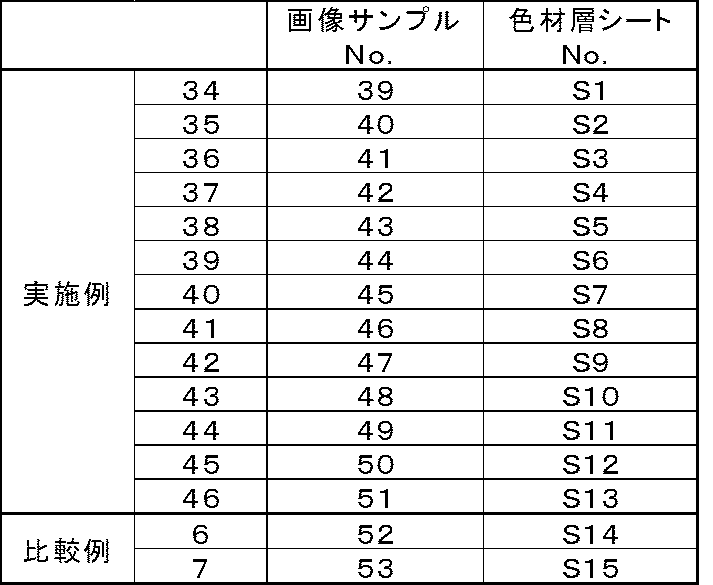
[評価]
<インバランス評価>
実施例34~46、比較例6、7で得られた画像サンプルをキセノン試験装置(商品名:AtlasCi4000、スガ試験機(株)製)に投入し、照度:340nmで0.28W/m2、温度:40℃、相対湿度:50%の条件下、60時間曝露した。
<インバランス評価>
実施例34~46、比較例6、7で得られた画像サンプルをキセノン試験装置(商品名:AtlasCi4000、スガ試験機(株)製)に投入し、照度:340nmで0.28W/m2、温度:40℃、相対湿度:50%の条件下、60時間曝露した。
初期の光学濃度(O.D.)をOD0とし、60時間曝露後のO.D.をOD60とした時、O.D.残存率を以下の数式2のように定義した。
(数式2)O.D.残存率=OD60/OD0
(数式2)O.D.残存率=OD60/OD0
この式に従い、ブラック画像中のシアン、マゼンタ、及びイエロー各成分のO.D.残存率を算出した。インバランスとして各O.D.残存率の差分の絶対値を以下のように算出した。
BkC-Y=100×絶対値(イエロー成分O.D.残存率―シアン成分O.D.残存率)
BkM-Y=100×絶対値(イエロー成分O.D.残存率―マゼンタ成分O.D.残存率)
BkC―M=100×絶対値(シアン成分O.D.残存率―マゼンタ成分O.D.残存率)
BkC-Y=100×絶対値(イエロー成分O.D.残存率―シアン成分O.D.残存率)
BkM-Y=100×絶対値(イエロー成分O.D.残存率―マゼンタ成分O.D.残存率)
BkC―M=100×絶対値(シアン成分O.D.残存率―マゼンタ成分O.D.残存率)
上記式より算出した3つの値(BkC-Y、BkM-Y、及びBkC―M)を以下の評価基準に基づき、それぞれ評価した。これらの各値及びその評価結果を表12に示す。インバランス(BkC-Y、BkM-Y、及びBkC―M)が15以下の場合、インバランスは良好であると判断できる。
(評価基準)
A:インバランス<10 (インバランスが非常に良好)
B:10≦インバランス≦15 (インバランスが良好)
C:15<インバランス (インバランスが不良)。
A:インバランス<10 (インバランスが非常に良好)
B:10≦インバランス≦15 (インバランスが良好)
C:15<インバランス (インバランスが不良)。

表12より明らかなように、実施例に記載の第2の感熱転写記録用シートを用いて形成した画像サンプルは、比較例と比べてインバランスが良好であった。
この出願は2016年10月19日に出願された日本国特許出願番号2016-205523の優先権を主張するものであり、それらの内容を引用してこの出願の一部とするものである。
Claims (18)
- 基材、
イエロー染料を含むイエロー染料層、
マゼンタ染料を含むマゼンタ染料層、及び、
シアン染料を含むシアン染料層、
を有する感熱転写記録用シートであって、
該イエロー染料層、該マゼンタ染料層、及び、該シアン染料層のいずれか1つ以上の層は、下記一般式(1)及び(2)で表される化合物群から選ばれる1種以上の化合物を含み、
該イエロー染料が、下記一般式(3)~(6)で表される化合物群から選ばれる1種以上の化合物を含み、
該シアン染料が、下記一般式(7)~(9)で表される化合物群から選ばれる1種以上の化合物を含む、
ことを特徴とする感熱転写記録用シート。
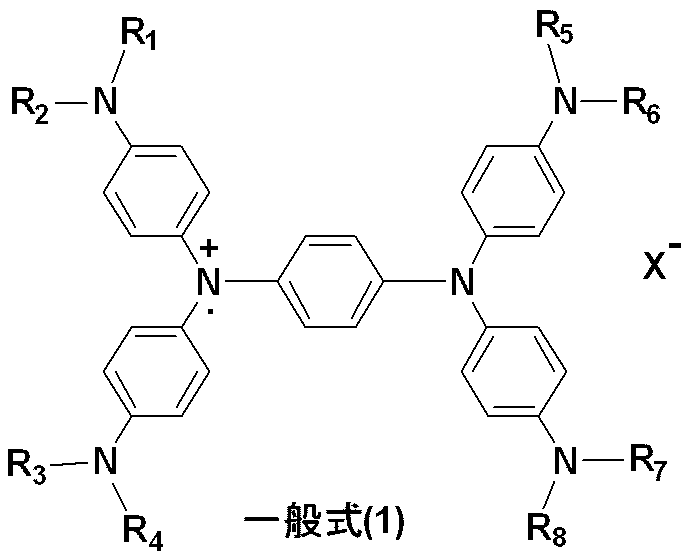
[一般式(1)中、R1~R8は、各々独立して、置換もしくは無置換の炭素数1~8のアルキル基、置換もしくは無置換のアルケニル基、置換もしくは無置換のアラルキル基、置換もしくは無置換のアルキニル基、または、置換もしくは無置換のアリール基を示し、R1とR2、R3とR4、R5とR6、及び、R7とR8は、それぞれ結合して環を形成してもよく、X-は陰イオンを示す。]
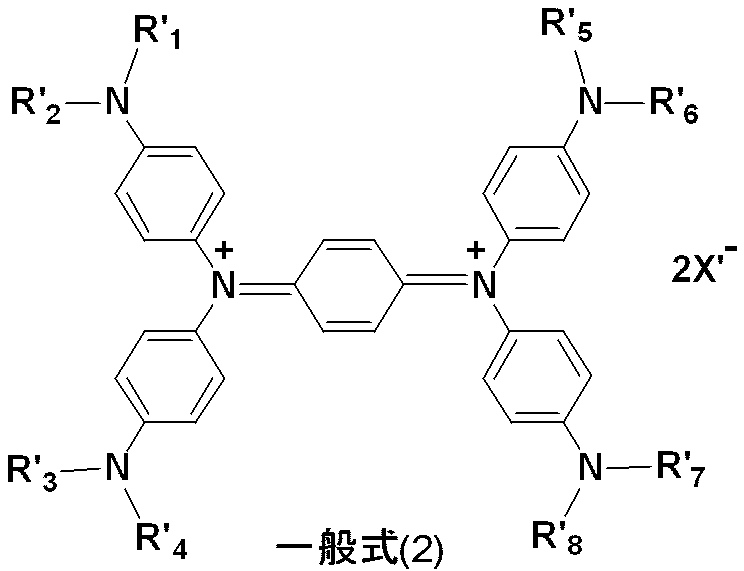
[一般式(2)中、R’1~R’8は、各々独立して、置換もしくは無置換の炭素数1~8のアルキル基、置換もしくは無置換のアルケニル基、置換もしくは無置換のアラルキル基、置換もしくは無置換のアルキニル基、または、置換もしくは無置換のアリール基を示し、R’1とR’2、R’3とR’4、R’5とR’6、及び、R’7とR’8は、それぞれ結合して環を形成してもよく、X’-は陰イオンを示す。]

[一般式(3)中、R9~R12は、各々独立して、アルキル基、または、置換もしくは無置換のアリール基を示す。]

[一般式(4)中、R13は、アルキル基、置換もしくは無置換のアリール基、または、置換もしくは無置換のアミノ基を示し、R14は、水素原子、アルキル基、置換もしくは無置換のアリール基、または、-N(-Ra)Rbを示し、ただし、Ra及びRbは、各々独立して、水素原子、アルキル基、または、アシル基を示し、RaとRbとが結合した窒素原子と一緒に環状構造を形成してもよく、R15は、アルキル基を示し、R16は、水素原子、または、アルキル基を示し、Yは、カルボニル基、または、スルホニル基を示し、nは、1~3の整数を示す。]
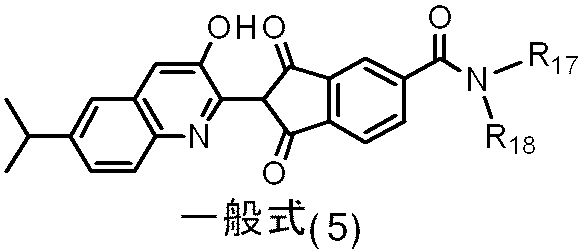
[一般式(5)中、R17及びR18は、各々独立して、アルキル基、または、アリール基を示す。]

[一般式(6)中、R19及びR20は、各々独立して、アルキル基、または、アリール基を示す。]

[一般式(7)中、R21~R25は、各々独立して、アルキル基、または、アリール基を示す。]

[一般式(8)中、R26及びR27は、各々独立して、アルキル基、または、置換もしくは無置換のアリール基を示す。]
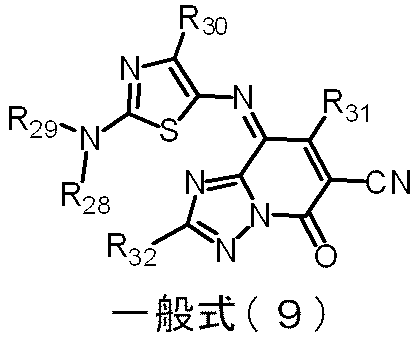
[一般式(9)中、R28~R32は、各々独立して、アルキル基、または、アリール基を示す。] - 前記一般式(1)中のR1~R8が、各々独立して、置換もしくは無置換の炭素数1~8のアルキル基を示す、請求項1に記載の感熱転写記録用シート。
- 前記一般式(1)中のR1~R8が、各々独立して、炭素数3~8の無置換のアルキル基、またはシアノアルキル基を示す、請求項2に記載の感熱転写記録用シート。
- 前記一般式(1)中の、R1とR2、R3とR4、R5とR6、及び、R7とR8が、それぞれ同一の置換基を示す、請求項1~3のいずれか一項に記載の感熱転写記録用シート。
- 前記一般式(2)中のR’1~R’8が、各々独立して、置換もしくは無置換の炭素数1~8のアルキル基を示す、請求項1に記載の感熱転写記録用シート。
- 前記一般式(2)中のR’1~R’8が、各々独立して、炭素数3~8の、無置換のアルキル基、または、シアノアルキル基を示す、請求項5に記載の感熱転写記録用シート。
- 前記一般式(2)中の、R’1とR’2、R’3とR’4、R’5とR’6、及び、R’7とR’8が、それぞれ同一の置換基を示す、請求項1、5及び6のいずれか一項に記載の感熱転写記録用シート。
- 前記マゼンタ染料が、下記一般式(10)~(14)で表される化合物群から選ばれる1種以上の化合物を含む、請求項1~7のいずれか一項に記載の感熱転写記録用シート。

[一般式(10)中、R33は、エーテル官能性の酸素原子を含んでいてもよいアルキル基、または、置換もしくは無置換のアリール基を示す。]
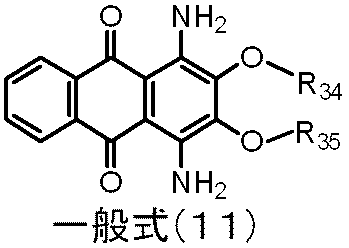
[一般式(11)中、R34及びR35は、各々独立して、アルキル基、または、置換もしくは無置換のアリール基を示す。]
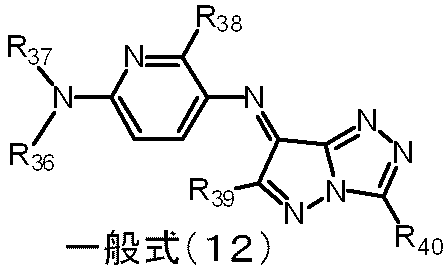
[一般式(12)中、R36~R40は、各々独立して、アルキル基、または、置換もしくは無置換のアリール基を示す。]

[一般式(13)中、R41~R44は、各々独立して、アルキル基、または、置換もしくは無置換のアリール基を示す。]

[一般式(14)中、R45及びR46は、各々独立して、アルキル基を示し、R47は、水素原子、アルキル基、または、置換もしくは無置換のアリール基を示し、R48は、アルキル基、または、置換もしくは無置換のアリール基を示し、R49は、水素原子、アルキル基、置換もしくは無置換のアリール基、または、-N(-R50)R51を示し、ただし、R50及びR51は、各々独立して、水素原子、アルキル基、アリール基、または、アシル基を示すか、あるいは、R50とR51とが結合した窒素原子と一緒に形成する環状構造を示す。]。 - 前記イエロー染料層、前記マゼンタ染料層、及び、前記シアン染料層が、前記基材上に面順次に形成されている、請求項1~8のいずれか一項に記載の感熱転写記録用シート。
- 基材と、
イエロー染料を含むイエロー染料層、
マゼンタ染料を含むマゼンタ染料層、
シアン染料を含むシアン染料層、及び、
該イエロー染料層、該マゼンタ染料層、及び、該シアン染料層を被転写体上に転写して形成される画像面を保護するための保護層、
を有する感熱転写記録用シートであって、
該保護層は、下記一般式(1)及び(2)で表される化合物群から選ばれる1種以上の化合物を含み、
該イエロー染料が、下記一般式(3)~(6)で表される化合物群から選ばれる1種以上の化合物を含み、
該シアン染料が、下記一般式(7)~(9)で表される化合物群から選ばれる1種以上の化合物を含む、
ことを特徴とする感熱転写記録用シート。
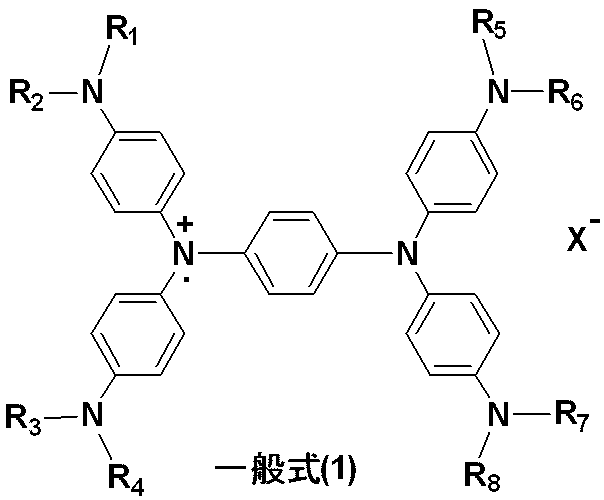
[一般式(1)中、R1~R8は、各々独立して、置換もしくは無置換の炭素数1~8のアルキル基、置換もしくは無置換のアルケニル基、置換もしくは無置換のアラルキル基、置換もしくは無置換のアルキニル基、または、置換もしくは無置換のアリール基を示し、R1とR2、R3とR4、R5とR6、及び、R7とR8は、それぞれ結合して環を形成してもよく、X-は陰イオンを示す。]

[一般式(2)中、R’1~R’8は、各々独立して、置換もしくは無置換の炭素数1~8のアルキル基、置換もしくは無置換のアルケニル基、置換もしくは無置換のアラルキル基、置換もしくは無置換のアルキニル基、または、置換もしくは無置換のアリール基を示し、R’1とR’2、R’3とR’4、R’5とR’6、及び、R’7とR’8は、それぞれ結合して環を形成してもよく、X’-は陰イオンを示す。]

[一般式(3)中、R9~R12は、各々独立して、アルキル基、または、置換もしくは無置換のアリール基を示す。]
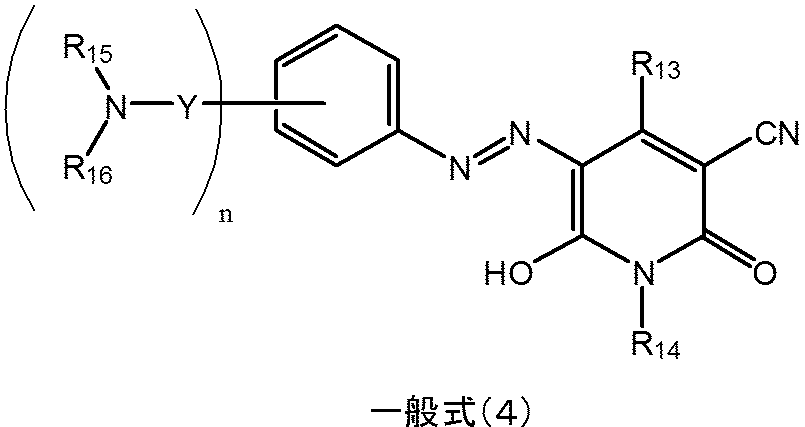
[一般式(4)中、R13は、アルキル基、置換もしくは無置換のアリール基、または、置換もしくは無置換のアミノ基を示し、R14は、水素原子、アルキル基、置換もしくは無置換のアリール基、または、-N(-Ra)Rbを示し、ただし、Ra及びRbは、各々独立して、水素原子、アルキル基、または、アシル基を示し、RaとRbとが互いに結合した窒素原子と一緒に環状構造を形成してもよく、R15は、アルキル基を示し、R16は、水素原子、または、アルキル基を示し、Yは、カルボニル基、または、スルホニル基を示し、nは、1~3の整数を示す。]
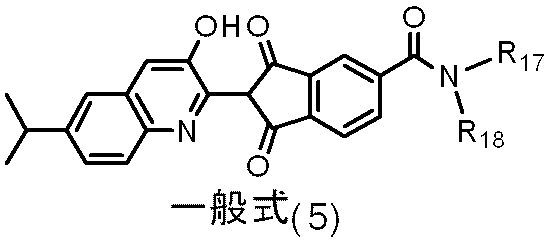
[一般式(5)中、R17及びR18は、各々独立して、アルキル基、または、アリール基を示す。]

[一般式(6)中、R19及びR20は、各々独立して、アルキル基、または、アリール基を示す。]

[一般式(7)中、R21~R25は、各々独立して、アルキル基、または、アリール基を示す。]

[一般式(8)中、R26及びR27は、各々独立して、アルキル基、または、置換もしくは無置換のアリール基を示す。]

[一般式(9)中、R28~R32は、各々独立して、アルキル基、または、アリール基を示す。] - 前記一般式(1)中のR1~R8が、各々独立して、置換もしくは無置換の炭素数1~8のアルキル基を示す、請求項10に記載の感熱転写記録用シート。
- 前記一般式(1)中のR1~R8が、各々独立して、炭素数3~8の、無置換のアルキル基、または、シアノアルキル基を示す、請求項11に記載の感熱転写記録用シート。
- 前記一般式(1)中の、R1とR2、R3とR4、R5とR6、及び、R7とR8が、それぞれ同一の置換基を示す、請求項10~12のいずれか一項に記載の感熱転写記録用シート。
- 前記一般式(2)中のR’1~R’8が、各々独立して、置換もしくは無置換の炭素数1~8のアルキル基を示す、請求項10に記載の感熱転写記録用シート。
- 前記一般式(2)中のR’1~R’8が、各々独立して、炭素数3~8の、無置換のアルキル基、または、シアノアルキル基を示す、請求項14に記載の感熱転写記録用シート。
- 前記一般式(2)中の、R’1とR’2、R’3とR’4、R’5とR’6、及び、R’7とR’8が、それぞれ同一の置換基を示す、請求項10、14及び15のいずれか一項に記載の感熱転写記録用シート。
- 前記マゼンタ染料が、下記一般式(10)~(14)で表される化合物群から選ばれる1種以上の化合物を含む、請求項10~16のいずれか一項に記載の感熱転写記録用シート。

[一般式(10)中、R33は、エーテル官能性の酸素原子を含んでいてもよいアルキル基、または、置換もしくは無置換のアリール基を示す。]

[一般式(11)中、R34及びR35は、各々独立して、アルキル基、または、置換もしくは無置換のアリール基を示す。]

[一般式(12)中、R36~R40は、各々独立して、アルキル基、または、置換もしくは無置換のアリール基を示す。]

[一般式(13)中、R41~R44は、各々独立して、アルキル基、または、置換もしくは無置換のアリール基を示す。]
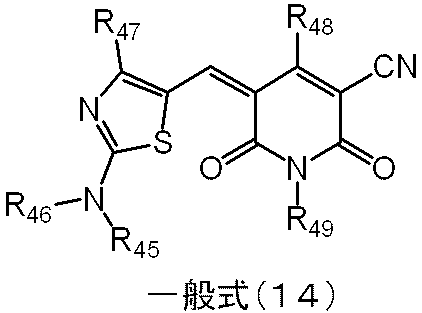
[一般式(14)中、R45及びR46は、各々独立して、アルキル基を示し、R47は、水素原子、アルキル基、または、置換もしくは無置換のアリール基を示し、R48は、アルキル基、または、置換もしくは無置換のアリール基を示し、R49は、水素原子、アルキル基、置換もしくは無置換のアリール基、または、-N(-R50)R51を示し、ただし、R50及びR51は、各々独立して、水素原子、アルキル基、アリール基、または、アシル基を示すか、あるいは、R50とR51とが互いに結合した窒素原子と一緒に形成する環状構造を示す。] - 前記イエロー染料層、前記マゼンタ染料層、前記シアン染料層及び前記保護層が、該基材上に面順次に形成されている請求項10~17のいずれか一項に記載の感熱転写記録用シート。
Priority Applications (2)
| Application Number | Priority Date | Filing Date | Title |
|---|---|---|---|
| EP17862498.7A EP3530478B1 (en) | 2016-10-19 | 2017-09-28 | Sheet for thermal transfer recording |
| US16/362,942 US11097566B2 (en) | 2016-10-19 | 2019-03-25 | Thermal transfer recording sheet |
Applications Claiming Priority (2)
| Application Number | Priority Date | Filing Date | Title |
|---|---|---|---|
| JP2016-205523 | 2016-10-19 | ||
| JP2016205523 | 2016-10-19 |
Related Child Applications (1)
| Application Number | Title | Priority Date | Filing Date |
|---|---|---|---|
| US16/362,942 Continuation US11097566B2 (en) | 2016-10-19 | 2019-03-25 | Thermal transfer recording sheet |
Publications (1)
| Publication Number | Publication Date |
|---|---|
| WO2018074176A1 true WO2018074176A1 (ja) | 2018-04-26 |
Family
ID=62018493
Family Applications (1)
| Application Number | Title | Priority Date | Filing Date |
|---|---|---|---|
| PCT/JP2017/035284 Ceased WO2018074176A1 (ja) | 2016-10-19 | 2017-09-28 | 感熱転写記録用シート |
Country Status (4)
| Country | Link |
|---|---|
| US (1) | US11097566B2 (ja) |
| EP (1) | EP3530478B1 (ja) |
| JP (1) | JP6961450B2 (ja) |
| WO (1) | WO2018074176A1 (ja) |
Cited By (2)
| Publication number | Priority date | Publication date | Assignee | Title |
|---|---|---|---|---|
| WO2021039463A1 (ja) * | 2019-08-23 | 2021-03-04 | 国立大学法人東京大学 | ドーパントおよび導電性組成物ならびにその製造方法 |
| US11097566B2 (en) | 2016-10-19 | 2021-08-24 | Canon Kabushiki Kaisha | Thermal transfer recording sheet |
Families Citing this family (7)
| Publication number | Priority date | Publication date | Assignee | Title |
|---|---|---|---|---|
| WO2019146506A1 (ja) | 2018-01-25 | 2019-08-01 | キヤノン株式会社 | 化合物、液体組成物、感熱転写記録用シート、トナー、カラーフィルター用レジスト組成物、及びカラーフィルター |
| JP2019202488A (ja) * | 2018-05-24 | 2019-11-28 | 凸版印刷株式会社 | マゼンタ色熱転写シート及びマゼンタ色染料インク |
| US11801703B2 (en) * | 2019-06-27 | 2023-10-31 | Canon Kabushiki Kaisha | Heat sensitive transfer recording sheet |
| US11904621B2 (en) | 2019-08-30 | 2024-02-20 | Canon Kabushiki Kaisha | Thermal transfer recording sheet |
| JP7550399B2 (ja) * | 2020-04-17 | 2024-09-13 | 国立大学法人 東京大学 | ドーパント及び導体材料 |
| EP4144802A4 (en) * | 2020-05-01 | 2024-07-10 | The University of Tokyo | Conductor material |
| US20240025197A1 (en) * | 2022-07-20 | 2024-01-25 | Canon Kabushiki Kaisha | Thermal transfer recording sheet |
Citations (9)
| Publication number | Priority date | Publication date | Assignee | Title |
|---|---|---|---|---|
| JPH07156562A (ja) * | 1993-12-10 | 1995-06-20 | Ricoh Co Ltd | 被熱転写シート |
| JPH08118832A (ja) * | 1994-10-24 | 1996-05-14 | Sony Corp | 熱転写リボン |
| JP2000103174A (ja) * | 1998-09-28 | 2000-04-11 | Mitsubishi Chemicals Corp | 感熱転写シート |
| JP2001158879A (ja) * | 1999-09-21 | 2001-06-12 | Nippon Kayaku Co Ltd | 退色防止剤、該退色防止剤を含有する光情報記録媒体及び感熱転写シート |
| JP2002067517A (ja) * | 2000-08-28 | 2002-03-08 | Dainippon Printing Co Ltd | 熱転写フィルム及び熱転写方法 |
| JP2008080735A (ja) * | 2006-09-28 | 2008-04-10 | Dainippon Printing Co Ltd | 熱転写印画物の製造方法、および熱転写シート |
| JP2010253944A (ja) * | 2009-03-31 | 2010-11-11 | Dainippon Printing Co Ltd | 熱転写シート |
| US20130287974A1 (en) * | 2010-12-27 | 2013-10-31 | Jung Hyo Lee | Thermal transfer film |
| JP2014156106A (ja) * | 2013-02-18 | 2014-08-28 | Dainippon Printing Co Ltd | 熱転写シート |
Family Cites Families (17)
| Publication number | Priority date | Publication date | Assignee | Title |
|---|---|---|---|---|
| US3251881A (en) | 1963-05-16 | 1966-05-17 | American Cyanamid Co | N, n, n', n'-tetrakis(p-nitro- or amino-substituted-phenyl)-p-arylenediamines |
| US3484467A (en) | 1967-01-05 | 1969-12-16 | American Cyanamid Co | Diaryl - (n,n - diarylaminoaryl)-aminium hexafluoroantimonates and hexafluoroarsenates |
| JPS6169991A (ja) | 1984-09-13 | 1986-04-10 | Nippon Kayaku Co Ltd | N,N,N′,N′,−テトラキス(p−ジアルキルアミノ)−p−フエニレンジアミンのアミニウム塩の製造法 |
| CA2049362C (en) * | 1989-03-30 | 2001-07-03 | Diane M. Foley | Near infrared laser absorbing coating and method for using same in color imaging and proofing |
| JPH08310138A (ja) * | 1995-05-18 | 1996-11-26 | Dainippon Printing Co Ltd | 熱転写シ−ト、それを使用してなる熱転写方法および熱転写物 |
| EP1670645B1 (en) * | 2003-09-26 | 2012-05-02 | Eastman Kodak Company | Biguanide bleaching agent for thermal-imaging |
| JP5056433B2 (ja) * | 2008-01-21 | 2012-10-24 | ソニー株式会社 | 感熱転写体、感熱転写体セット及び記録方法 |
| CN102307949B (zh) | 2009-03-31 | 2013-12-18 | 大日本印刷株式会社 | 新的偶氮甲碱化合物和使用该偶氮甲碱化合物色素而成的热转印片 |
| JP5907672B2 (ja) | 2011-06-01 | 2016-04-26 | 大日本印刷株式会社 | 保護層転写シート |
| US8926740B2 (en) | 2011-07-27 | 2015-01-06 | Canon Kabushiki Kaisha | Pigment dispersion, and resist composition for color filter and ink composition each using the pigment dispersion |
| US8951340B2 (en) | 2011-10-04 | 2015-02-10 | Canon Kabushiki Kaisha | Water-insoluble coloring matter compound, ink using the water-insoluble coloring matter compound, thermal transfer recording sheet and resist composition for color filter |
| CN104144988A (zh) | 2012-02-29 | 2014-11-12 | 佳能株式会社 | 颜料分散体以及包含该颜料分散体的滤色器用黄色抗蚀剂组合物和墨组合物 |
| EP2891689B1 (en) | 2012-08-29 | 2016-12-28 | Canon Kabushiki Kaisha | Dye compound, ink, resist composition for color filter, and heat-sensitive transfer recording sheet |
| CN104583334B (zh) | 2012-08-29 | 2017-05-17 | 佳能株式会社 | 色素化合物、墨、滤色器用抗蚀剂组合物和热敏转印记录用片材 |
| CN106061748B (zh) * | 2014-02-28 | 2018-08-31 | 佳能株式会社 | 热敏转印记录用片 |
| CN106061749B (zh) * | 2014-02-28 | 2018-12-25 | 佳能株式会社 | 热敏转印记录用片 |
| EP3530478B1 (en) | 2016-10-19 | 2021-06-30 | Canon Kabushiki Kaisha | Sheet for thermal transfer recording |
-
2017
- 2017-09-28 EP EP17862498.7A patent/EP3530478B1/en active Active
- 2017-09-28 WO PCT/JP2017/035284 patent/WO2018074176A1/ja not_active Ceased
- 2017-10-12 JP JP2017198431A patent/JP6961450B2/ja active Active
-
2019
- 2019-03-25 US US16/362,942 patent/US11097566B2/en active Active
Patent Citations (9)
| Publication number | Priority date | Publication date | Assignee | Title |
|---|---|---|---|---|
| JPH07156562A (ja) * | 1993-12-10 | 1995-06-20 | Ricoh Co Ltd | 被熱転写シート |
| JPH08118832A (ja) * | 1994-10-24 | 1996-05-14 | Sony Corp | 熱転写リボン |
| JP2000103174A (ja) * | 1998-09-28 | 2000-04-11 | Mitsubishi Chemicals Corp | 感熱転写シート |
| JP2001158879A (ja) * | 1999-09-21 | 2001-06-12 | Nippon Kayaku Co Ltd | 退色防止剤、該退色防止剤を含有する光情報記録媒体及び感熱転写シート |
| JP2002067517A (ja) * | 2000-08-28 | 2002-03-08 | Dainippon Printing Co Ltd | 熱転写フィルム及び熱転写方法 |
| JP2008080735A (ja) * | 2006-09-28 | 2008-04-10 | Dainippon Printing Co Ltd | 熱転写印画物の製造方法、および熱転写シート |
| JP2010253944A (ja) * | 2009-03-31 | 2010-11-11 | Dainippon Printing Co Ltd | 熱転写シート |
| US20130287974A1 (en) * | 2010-12-27 | 2013-10-31 | Jung Hyo Lee | Thermal transfer film |
| JP2014156106A (ja) * | 2013-02-18 | 2014-08-28 | Dainippon Printing Co Ltd | 熱転写シート |
Non-Patent Citations (1)
| Title |
|---|
| See also references of EP3530478A4 * |
Cited By (8)
| Publication number | Priority date | Publication date | Assignee | Title |
|---|---|---|---|---|
| US11097566B2 (en) | 2016-10-19 | 2021-08-24 | Canon Kabushiki Kaisha | Thermal transfer recording sheet |
| WO2021039463A1 (ja) * | 2019-08-23 | 2021-03-04 | 国立大学法人東京大学 | ドーパントおよび導電性組成物ならびにその製造方法 |
| JPWO2021039463A1 (ja) * | 2019-08-23 | 2021-03-04 | ||
| CN114341104A (zh) * | 2019-08-23 | 2022-04-12 | 国立大学法人东京大学 | 掺杂物以及导电性组合物及其制造方法 |
| CN114341104B (zh) * | 2019-08-23 | 2024-03-15 | 国立大学法人东京大学 | 掺杂物以及导电性组合物及其制造方法 |
| US12046390B2 (en) | 2019-08-23 | 2024-07-23 | The University Of Tokyo | Dopant, electroconductive composition and method for producing same |
| TWI851795B (zh) * | 2019-08-23 | 2024-08-11 | 國立大學法人東京大學 | 摻雜物、及導電性組成物以及其製造方法 |
| JP7678451B2 (ja) | 2019-08-23 | 2025-05-16 | 国立大学法人 東京大学 | ドーパントおよび導電性組成物ならびにその製造方法 |
Also Published As
| Publication number | Publication date |
|---|---|
| EP3530478B1 (en) | 2021-06-30 |
| US11097566B2 (en) | 2021-08-24 |
| EP3530478A4 (en) | 2020-09-09 |
| EP3530478A1 (en) | 2019-08-28 |
| JP2018065382A (ja) | 2018-04-26 |
| JP6961450B2 (ja) | 2021-11-05 |
| US20190217648A1 (en) | 2019-07-18 |
Similar Documents
| Publication | Publication Date | Title |
|---|---|---|
| JP6961450B2 (ja) | 感熱転写記録用シート | |
| CN106061748B (zh) | 热敏转印记录用片 | |
| JP4510914B2 (ja) | 色素化合物、イエロートナー、感熱転写記録用シート、及びインク | |
| JP6429678B2 (ja) | 感熱転写記録用シート | |
| JP2018089960A (ja) | 感熱転写記録用シートセットおよび画像形成方法 | |
| JP7336198B2 (ja) | 液体組成物、感熱転写記録用シート、トナー、カラーフィルター用レジスト組成物、及びカラーフィルター | |
| JP7523996B2 (ja) | 感熱転写記録用シート | |
| EP3339045B1 (en) | Thermal transfer donor sheet | |
| CN108456164B (zh) | 色素化合物和热转印记录用片材 | |
| CN100526393C (zh) | 热转印油墨、热转印片材及使用该热转印片材的热转印记录方法 | |
| US11958978B2 (en) | Coloring compound and thermal transfer recording sheet | |
| JPH0692046A (ja) | 熱染料昇華転写に使用するための黒着色染料混合物 | |
| JP7154746B2 (ja) | 感熱転写記録用シート | |
| WO2019107263A1 (ja) | 色素化合物及び感熱転写記録用シート | |
| JPH03114892A (ja) | 感熱転写記録材料及び画像形成方法 | |
| JP2024014712A (ja) | 感熱転写記録用シート | |
| JP7591011B2 (ja) | 印画物及び印画物の製造方法 | |
| JP3896990B2 (ja) | 感熱転写記録用インドアニリン系色素、並びにそれを用いた感熱転写記録用インク及び感熱転写記録用シート | |
| JP3353530B2 (ja) | 転写シート | |
| JPH03142287A (ja) | 感熱転写記録材料 | |
| JPH03124494A (ja) | 感熱転写材料 | |
| JPH07290842A (ja) | 転写シート |
Legal Events
| Date | Code | Title | Description |
|---|---|---|---|
| 121 | Ep: the epo has been informed by wipo that ep was designated in this application |
Ref document number: 17862498 Country of ref document: EP Kind code of ref document: A1 |
|
| NENP | Non-entry into the national phase |
Ref country code: DE |
|
| ENP | Entry into the national phase |
Ref document number: 2017862498 Country of ref document: EP Effective date: 20190520 |