WO2018074305A1 - ジオール、ジオールの製造方法、ジ(メタ)アクリレートおよびジ(メタ)アクリレートの製造方法 - Google Patents
ジオール、ジオールの製造方法、ジ(メタ)アクリレートおよびジ(メタ)アクリレートの製造方法 Download PDFInfo
- Publication number
- WO2018074305A1 WO2018074305A1 PCT/JP2017/036844 JP2017036844W WO2018074305A1 WO 2018074305 A1 WO2018074305 A1 WO 2018074305A1 JP 2017036844 W JP2017036844 W JP 2017036844W WO 2018074305 A1 WO2018074305 A1 WO 2018074305A1
- Authority
- WO
- WIPO (PCT)
- Prior art keywords
- group
- carbon atoms
- general formula
- alkyl group
- diol
- Prior art date
- Legal status (The legal status is an assumption and is not a legal conclusion. Google has not performed a legal analysis and makes no representation as to the accuracy of the status listed.)
- Ceased
Links
- 0 *C(CC1(C(*)C2)OCC(*)(CO)CO1)C21OCC(*)(CO)CO1 Chemical compound *C(CC1(C(*)C2)OCC(*)(CO)CO1)C21OCC(*)(CO)CO1 0.000 description 2
Classifications
-
- C—CHEMISTRY; METALLURGY
- C07—ORGANIC CHEMISTRY
- C07D—HETEROCYCLIC COMPOUNDS
- C07D493/00—Heterocyclic compounds containing oxygen atoms as the only ring hetero atoms in the condensed system
- C07D493/02—Heterocyclic compounds containing oxygen atoms as the only ring hetero atoms in the condensed system in which the condensed system contains two hetero rings
- C07D493/10—Spiro-condensed systems
-
- C—CHEMISTRY; METALLURGY
- C07—ORGANIC CHEMISTRY
- C07B—GENERAL METHODS OF ORGANIC CHEMISTRY; APPARATUS THEREFOR
- C07B61/00—Other general methods
Definitions
- the present invention relates to a diol having a dispiro structure, a method for producing the diol, and a method for producing di (meth) acrylate and di (meth) acrylate using the diol.
- Patent Documents 1 to 3 disclose a method for producing a polyhydric alcohol having a cyclic acetal such as spiroglycol and having a high purity cyclic acetal.
- Spiroglycols described in Patent Documents 1 to 3 are excellent materials, but in recent years, higher thermal stability is required.
- the present invention aims to solve such problems, and provides a diol excellent in thermal stability, a method for producing a diol, and a method for producing di (meth) acrylate and di (meth) acrylate. It is intended to do.
- a diol represented by the following general formula (1) can solve the above problems.
- the above problem has been solved by the following means ⁇ 1>, preferably ⁇ 2> to ⁇ 26>.
- ⁇ 1> a diol represented by the following general formula (1);
- R 1 and R 2 each independently represent a hydrocarbon group
- R 3 each independently represents a hydrogen atom, a group containing a hetero atom, a halogen atom, or a group having 1 to 6 carbon atoms.
- a linear alkyl group, a branched alkyl group having 3 to 6 carbon atoms, or an aryl group, and a group having 6 to 12 carbon atoms is represented.
- R 3 in the general formula (1) independently includes a hydrogen atom, a linear alkyl group having 1 to 6 carbon atoms, a branched alkyl group having 3 to 6 carbon atoms, or an aryl group,
- the diol according to ⁇ 1> which is a group having 6 to 12 carbon atoms.
- R 3 in the general formula (1) is each independently a hydrogen atom or a methyl group.
- R 1 and R 2 in the general formula (1) each independently represent a linear alkyl group having 1 to 7 carbon atoms, a branched alkyl group having 3 to 7 carbon atoms, or an aryl group, The diol according to any one of 1> to ⁇ 3>.
- R 1 and R 2 in the general formula (1) each independently represent a linear alkyl group having 1 to 7 carbon atoms or a branched alkyl group having 3 to 7 carbon atoms, The diol according to any one of ⁇ 3>.
- ⁇ 6> Any one of ⁇ 1> to ⁇ 3>, wherein R 1 and R 2 in the general formula (1) are each independently a linear alkyl group or aryl group having 1 to 7 carbon atoms.
- ⁇ 7> The diol according to ⁇ 1>, wherein R 1 and R 2 in the general formula (1) are each independently an ethyl group, a methyl group or a phenyl group, and R 3 is a hydrogen atom.
- a method for producing a diol comprising subjecting a 1,4-cyclohexanedione derivative represented by the following general formula (2) and a triol represented by the following general formula (3) to a dehydration cyclization reaction;
- R 4 represents a hydrogen atom, a group containing a hetero atom, a halogen atom, a linear alkyl group having 1 to 6 carbon atoms, a branched alkyl group having 3 to 6 carbon atoms, or an aryl group. And represents a group having 6 to 12 carbon atoms;
- R 5 represents a hydrocarbon group.
- ⁇ 12> The method for producing a diol according to ⁇ 11>, wherein the acid catalyst includes at least one of methanesulfonic acid and paratoluenesulfonic acid.
- the method for producing the diol includes removing water generated by the dehydration cyclization reaction from the reaction system.
- ⁇ 14> The method for producing a diol according to ⁇ 13>, wherein the water generated by the dehydration cyclization reaction is removed by azeotropy with an organic solvent.
- ⁇ 15> The method for producing a diol according to ⁇ 14>, wherein the organic solvent contains at least one of toluene and cyclohexane.
- the compound represented by the general formula (2) is 1,4-cyclohexanedione, and the compound represented by the general formula (3) is trimethylolpropane, trimethylolethane, and tris (hydroxymethyl).
- the compound represented by the general formula (2) is 1,4-cyclohexanedione, and the compound represented by the general formula (3) is at least one of trimethylolpropane and trimethylolethane.
- ⁇ 18> The method for producing a diol according to any one of ⁇ 8> to ⁇ 17>, wherein the diol is the diol according to any one of ⁇ 1> to ⁇ 7>.
- Di (meth) acrylate represented by the following general formula (4);
- R 1 and R 2 each independently represent a hydrocarbon group
- R 3 each independently represents a hydrogen atom, a group containing a hetero atom, a halogen atom, or a carbon atom having 1 to 6 carbon atoms.
- each R 6 independently represents a hydrogen atom or a methyl group.
- R 3 in the general formula (4) independently includes a hydrogen atom, a linear alkyl group having 1 to 6 carbon atoms, a branched alkyl group having 3 to 6 carbon atoms, or an aryl group,
- R 3 in the general formula (4) is each independently a hydrogen atom or a methyl group.
- R 1 and R 2 in the general formula (4) each independently represent a linear alkyl group having 1 to 7 carbon atoms, a branched alkyl group having 3 to 7 carbon atoms, or an aryl group, The di (meth) acrylate according to any one of 19> to ⁇ 21>.
- R 1 and R 2 in the general formula (4) each independently represent a linear alkyl group having 1 to 7 carbon atoms or a branched alkyl group having 3 to 7 carbon atoms, ⁇ 21> The di (meth) acrylate according to any one of the above.
- R 1 and R 2 in the general formula (4) are each independently a linear alkyl group having 1 to 7 carbon atoms or an aryl group Di (meth) acrylate described in 1.
- R 1 and R 2 in the general formula (4) are each independently an ethyl group, a methyl group, or a phenyl group, and R 3 is a hydrogen atom
- a method for producing di (meth) acrylate, comprising dehydrating condensation reaction of the diol according to any one of ⁇ 1> to ⁇ 7> with (meth) acrylic acid.
- the present invention it is possible to provide a diol excellent in thermal stability, a method for producing a diol, and a method for producing di (meth) acrylate and di (meth) acrylate.
- the diol of this embodiment is a diol represented by the following general formula (1).
- R 1 and R 2 each independently represent a hydrocarbon group
- R 3 each independently represents a hydrogen atom, a group containing a hetero atom, a halogen atom, or a group having 1 to 6 carbon atoms.
- a linear alkyl group, a branched alkyl group having 3 to 6 carbon atoms, or an aryl group, and a group having 6 to 12 carbon atoms is represented.
- a diol having excellent thermal stability can be obtained.
- the diol represented by the general formula (1) usually tends to have a lower melting point than spiroglycol and has high handling properties.
- a rigid material can be obtained by using the structure represented by the general formula (1).
- the melting point of the diol represented by the general formula (1) in the present embodiment can be, for example, 220 ° C. or lower, and can be 218 ° C. or lower, 200 ° C. or lower, or 180 ° C. or lower.
- the lower limit of the melting point of the diol represented by the general formula (1) is not particularly defined, but for example, it is sufficiently excellent in handleability even when it is 150 ° C. or higher, and further 160 ° C. or higher.
- the diol represented by the general formula (1) of the present embodiment has a neo structure in which the ⁇ -positions of two hydroxyl groups do not have a hydrogen atom, and the advantage that olefin formation by ⁇ -elimination hardly occurs essentially. There is also.
- the diol represented by the general formula (1) may have a plurality of geometric isomers resulting from two 6-membered ring acetal structures, and in this embodiment, any one or a mixture of geometric isomers. Indicates. Moreover, the conformation of each of the three continuous six-membered ring structures is not fixed, and possible conformations can be taken freely.
- the production ratio of the geometric isomer of the diol represented by the general formula (1) varies depending on the reaction conditions (reaction solvent species, reaction catalyst species, reaction temperature) and the like, and is not particularly limited.
- the mixture of geometric isomers of diols having a dispiro structure obtained in this embodiment can be used as a mixture or separated into each geometric isomer by a conventionally known method.
- R 1 and R 2 may be the same or different and each is a hydrocarbon group, preferably a linear alkyl group having 1 to 7 carbon atoms, 7 represents a branched alkyl group or aryl group, more preferably a straight-chain alkyl group having 1 to 7 carbon atoms or a branched alkyl group having 3 to 7 carbon atoms, and a straight-chain group having 1 to 7 carbon atoms. More preferred is an alkyl group.
- the hydrocarbon group as R 1 and R 2 does not contain an ether bond.
- R 1 and R 2 there can also be mentioned forms each independently representing a linear alkyl group having 1 to 7 carbon atoms, a branched alkyl group having 3 to 7 carbon atoms, or an aryl group.
- the straight-chain alkyl group having 1 to 7 carbon atoms is preferably a straight-chain alkyl group having 1 to 5 carbon atoms, more preferably a straight-chain alkyl group having 1 to 3 carbon atoms, and a methyl group Or it is more preferable that it is an ethyl group.
- the branched alkyl group having 3 to 7 carbon atoms is preferably a branched alkyl group having 3 to 5 carbon atoms, more preferably a branched alkyl group having 3 or 4 carbon atoms, and a branched alkyl group having 3 carbon atoms. More preferably, it is an alkyl group.
- the aryl group is preferably an aryl group having 6 to 20 carbon atoms, more preferably an aryl group having 6 to 14 carbon atoms, still more preferably a phenyl group, a naphthyl group or an anthracenyl group, and even more preferably a phenyl group.
- R 1 and R 2 in the general formula (1) are, for example, each independently a methyl group, ethyl group, n-propyl group, isopropyl group, n-butyl group, 1-methylpropyl group, 2-methylpropyl group Group, 1,1-dimethylethyl group (tert-butyl group), n-pentyl group, 1-methylbutyl group, 2-methylbutyl group, 3-methylbutyl group, 1-ethylpropyl group, 1,1-dimethylpropyl group, 1,2-dimethylpropyl group, 2,2-dimethylpropyl group (neopentyl group), n-hexyl group, 1-methylpentyl group, 2-methylpentyl group, 3-methylpentyl group, 4-methylpentyl group, 1 , 1-dimethylbutyl group, 1,2-dimethylbutyl group, 1,3-dimethylbutyl group, 2,2-dimethylbutyl group, 2,3-
- R 1 and R 2 are each independently more preferably a methyl group, an ethyl group, an n-propyl group, an isopropyl group, or an n-butyl group, and more preferably a methyl group or an ethyl group. Also preferred is an embodiment in which at least one of R 1 and R 2 is a phenyl group. From the viewpoint of the production method is particularly convenient, it is preferred that R 1 and R 2 are the same, a R 1 and R 2 are identical, and particularly preferably a methyl group or an ethyl group. Also preferred is an embodiment in which both R 1 and R 2 are phenyl groups.
- each R 3 independently represents a hydrogen atom, a group containing a hetero atom, a halogen atom, a linear alkyl group having 1 to 6 carbon atoms, a branched alkyl group having 3 to 6 carbon atoms, or A group containing an aryl group and having 6 to 12 carbon atoms, including a hydrogen atom, a linear alkyl group having 1 to 6 carbon atoms, a branched alkyl group having 3 to 6 carbon atoms, or an aryl group, A group having 6 to 12 carbon atoms is preferable, and a hydrogen atom, a linear alkyl group having 1 to 6 carbon atoms, or a branched alkyl group having 3 to 6 carbon atoms is more preferable.
- a methyl group is more preferable, and a hydrogen atom is more preferable.
- the hetero atom contained in the group containing a hetero atom include an oxygen atom, a sulfur atom, and a nitrogen atom.
- Preferred examples of the group containing a hetero atom include an alkoxy group, an alkylthioether group, an amino group, and a nitro group.
- the alkyl chain constituting the alkoxy group or alkylthioether group is preferably a linear alkyl chain having 1 to 6 carbon atoms, and more preferably a linear alkyl chain having 1 to 3 carbon atoms.
- the straight-chain alkyl group having 1 to 6 carbon atoms is preferably a straight-chain alkyl group having 1 to 5 carbon atoms, more preferably a straight-chain alkyl group having 1 to 3 carbon atoms, and a methyl group Or it is more preferable that it is an ethyl group.
- the branched alkyl group having 3 to 6 carbon atoms is preferably a branched alkyl group having 3 to 5 carbon atoms, more preferably a branched alkyl group having 3 or 4 carbon atoms, and a branched alkyl group having 3 carbon atoms. More preferably, it is an alkyl group.
- the group containing an aryl group and having 6 to 12 carbon atoms is preferably a phenyl group or an alkyl group substituted with a phenyl group, and more preferably a phenyl group.
- the carbon number of the alkyl group constituting the alkyl group substituted with a phenyl group is preferably 1 to 3, more preferably 1 or 2, and even more preferably 1.
- R 3 in the general formula (1) is, for example, a hydrogen atom, methyl group, ethyl group, n-propyl group, isopropyl group, n-butyl group, 1-methylpropyl group, 2-methylpropyl group, 1, 1-dimethylethyl group (tert-butyl group), n-pentyl group, 1-methylbutyl group, 2-methylbutyl group, 3-methylbutyl group, 1-ethylpropyl group, 1,1-dimethylpropyl group, 1,2- Dimethylpropyl group, 2,2-dimethylpropyl group (neopentyl group), n-hexyl group, 1-methylpentyl group, 2-methylpentyl group, 3-methylpentyl group, 4-methylpentyl group, 1,1-dimethyl Butyl, 1,2-dimethylbutyl, 1,3-dimethylbutyl, 2,2-dimethylbutyl, 2,3-dimethylbutyl, 3,3
- R 3 is more preferably a hydrogen atom, a methyl group, an ethyl group, an n-propyl group, an isopropyl group, or an n-butyl group. From the viewpoint of easy industrial availability, it is particularly preferable that R 3 is a hydrogen atom.
- R 1 and R 2 in the general formula (1) are each independently an ethyl group, a methyl group or a phenyl group, and R 3 is a hydrogen atom.
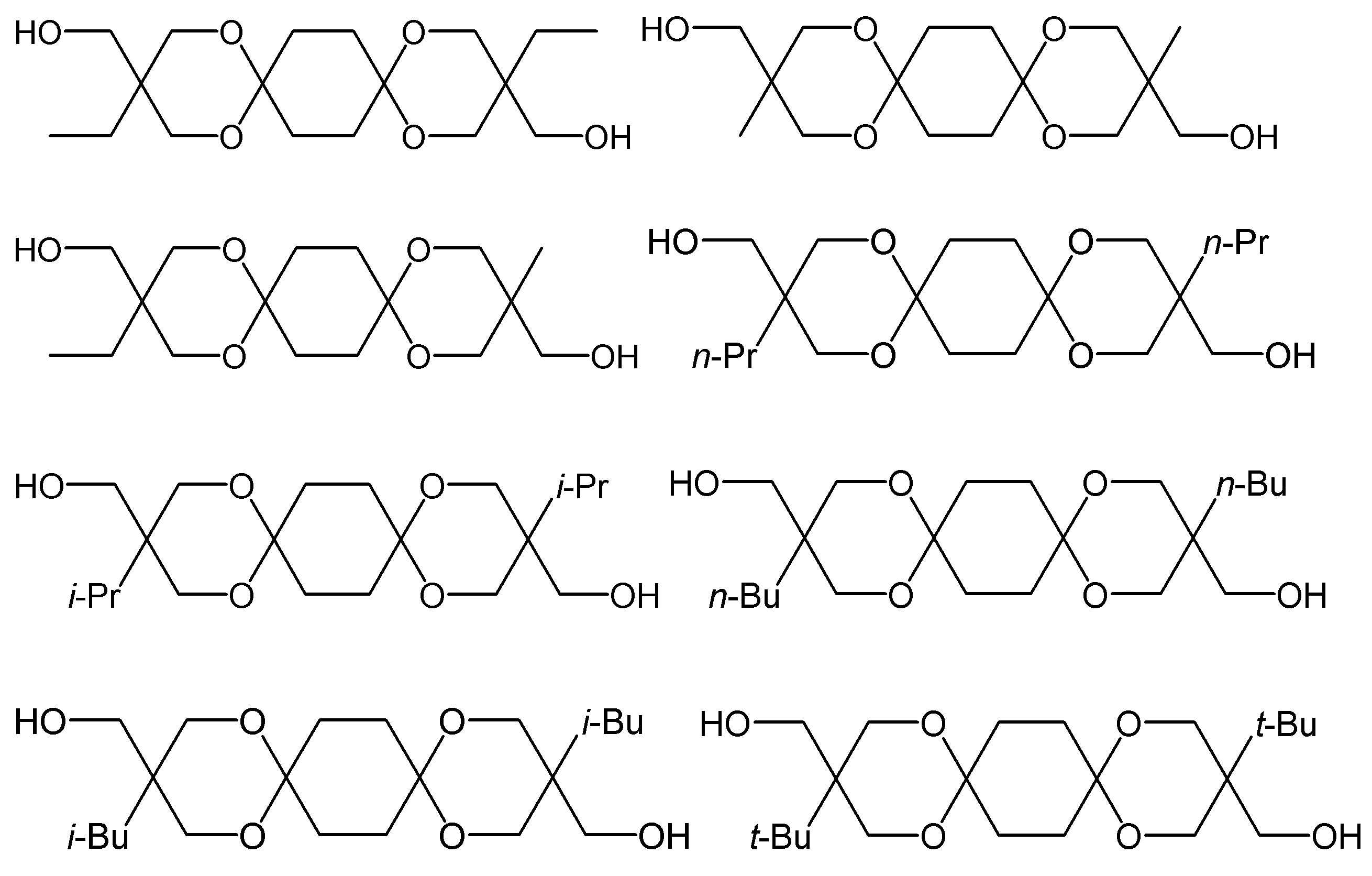
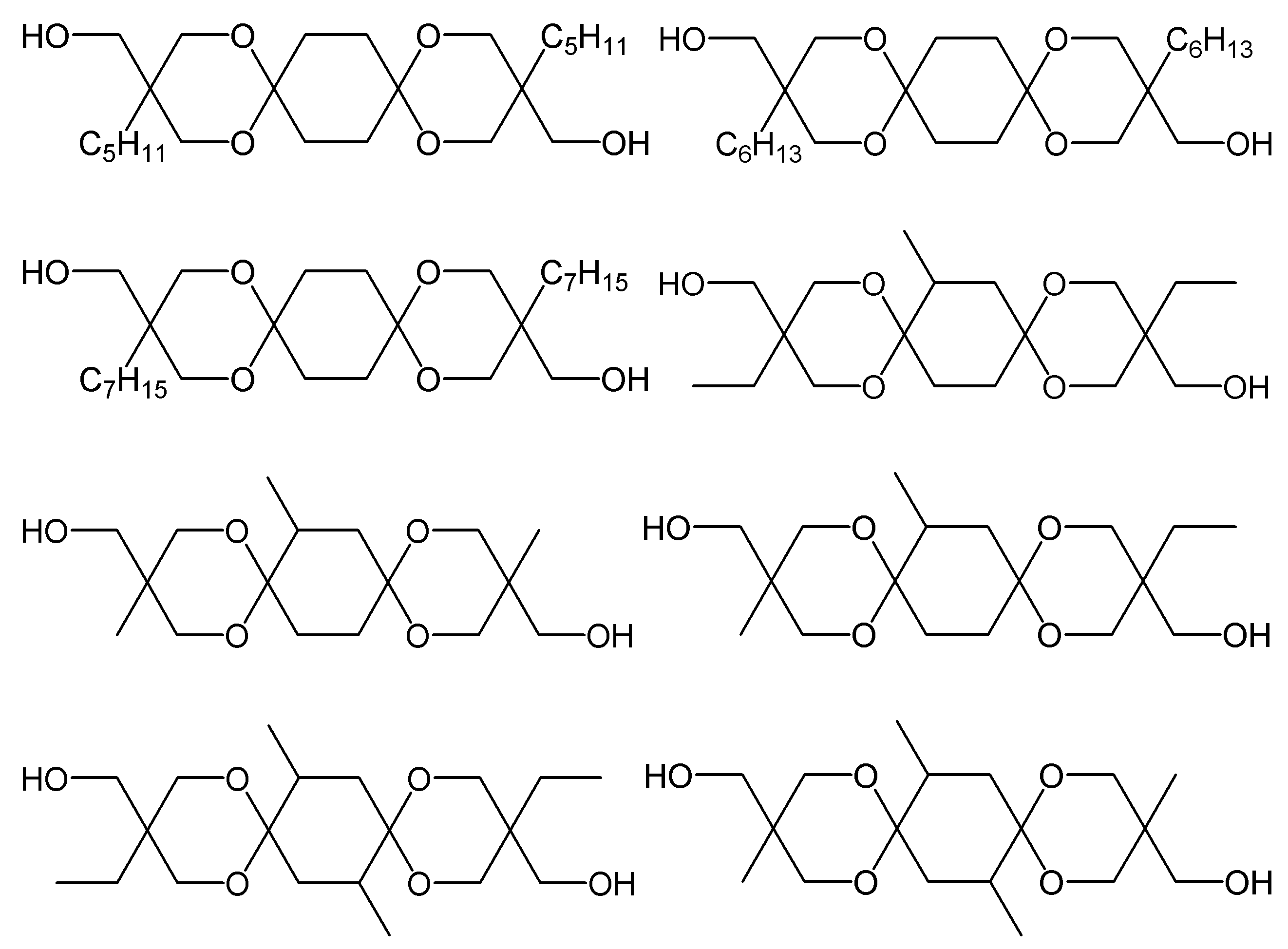
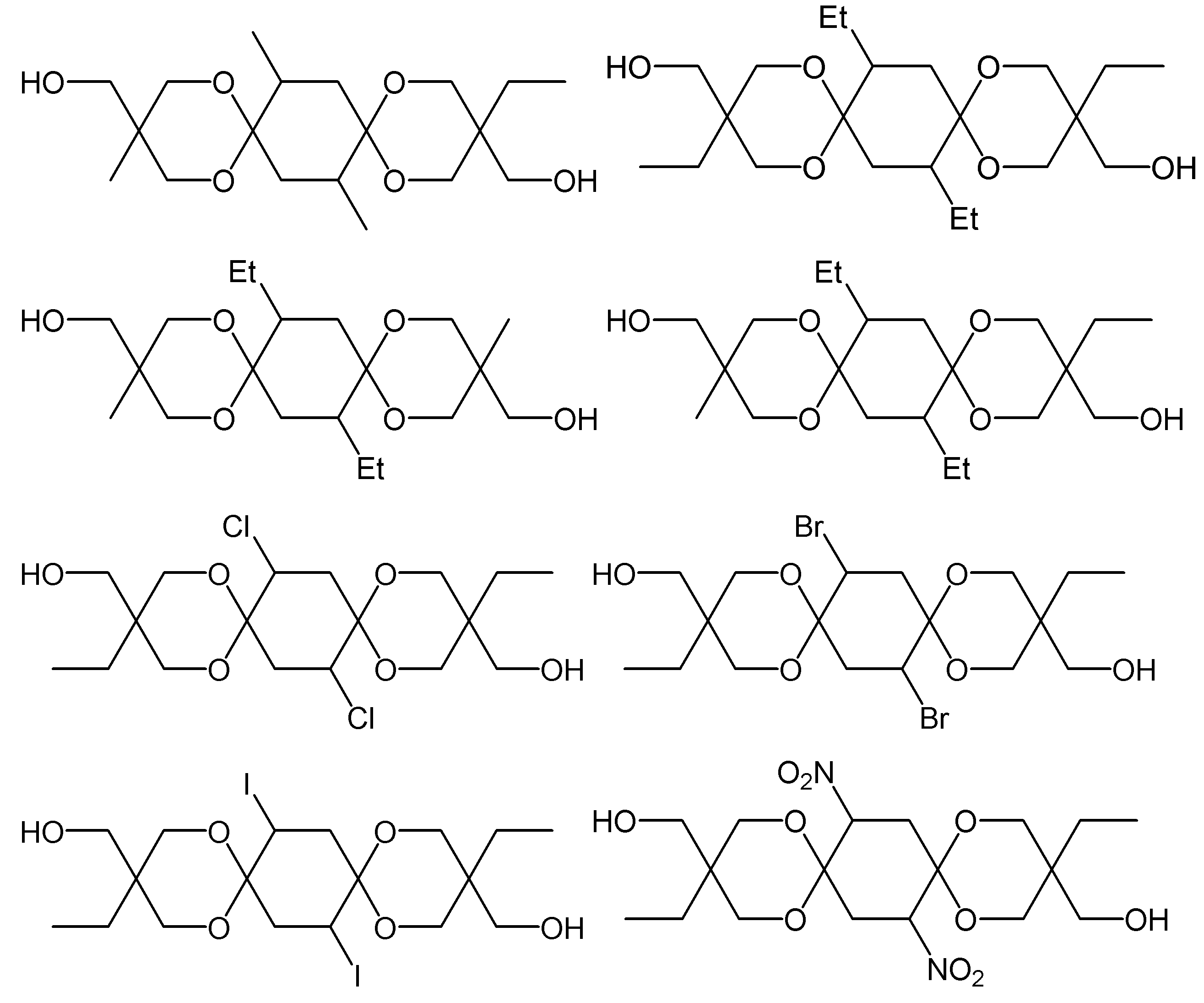
- Some diols are exemplified.
- R 1 and R 2 in the general formula (1) are each independently an ethyl group or a methyl group, and R 3 is a hydrogen atom.
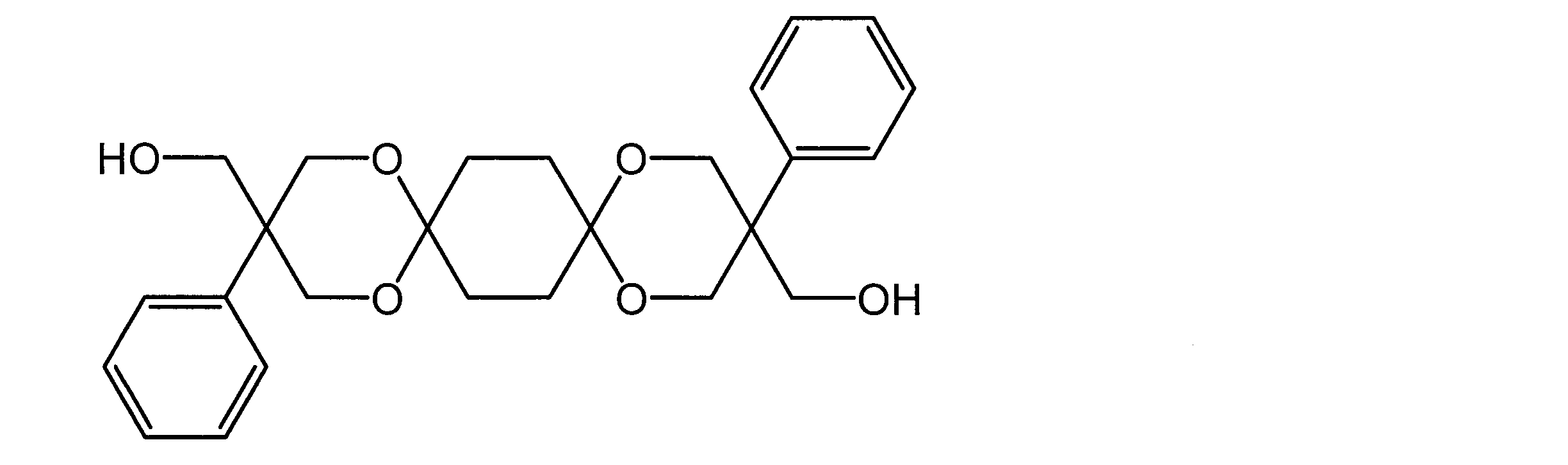
- a diol that is Below, the diol preferably used by this embodiment is shown. Needless to say, the present embodiment is not limited thereto.
- Me represents a methyl group
- Et represents an ethyl group
- Pr represents a propyl group
- Bu represents a butyl group.
- the molecular weight of the diol represented by the general formula (1) is preferably 300 to 550, more preferably 300 to 500.
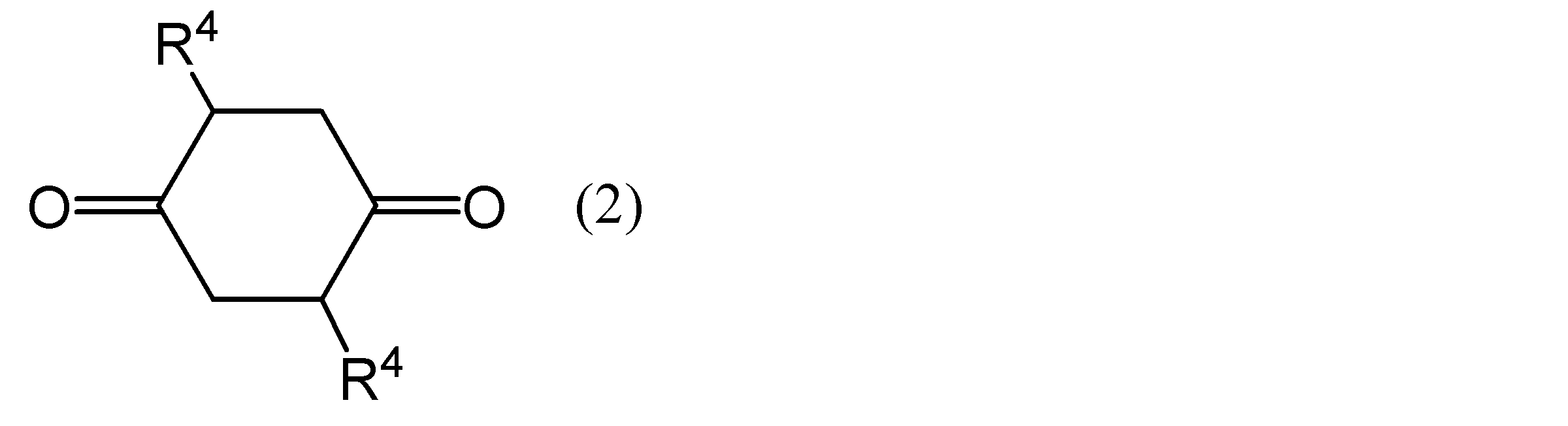
- the diol of this embodiment can be obtained by subjecting a 1,4-cyclohexanedione derivative represented by the following general formula (2) and a triol represented by the following general formula (3) to a dehydration cyclization reaction.
- a 1,4-cyclohexanedione derivative represented by the general formula (2) and a triol represented by the following general formula (3) may be used alone or in combination of two or more.
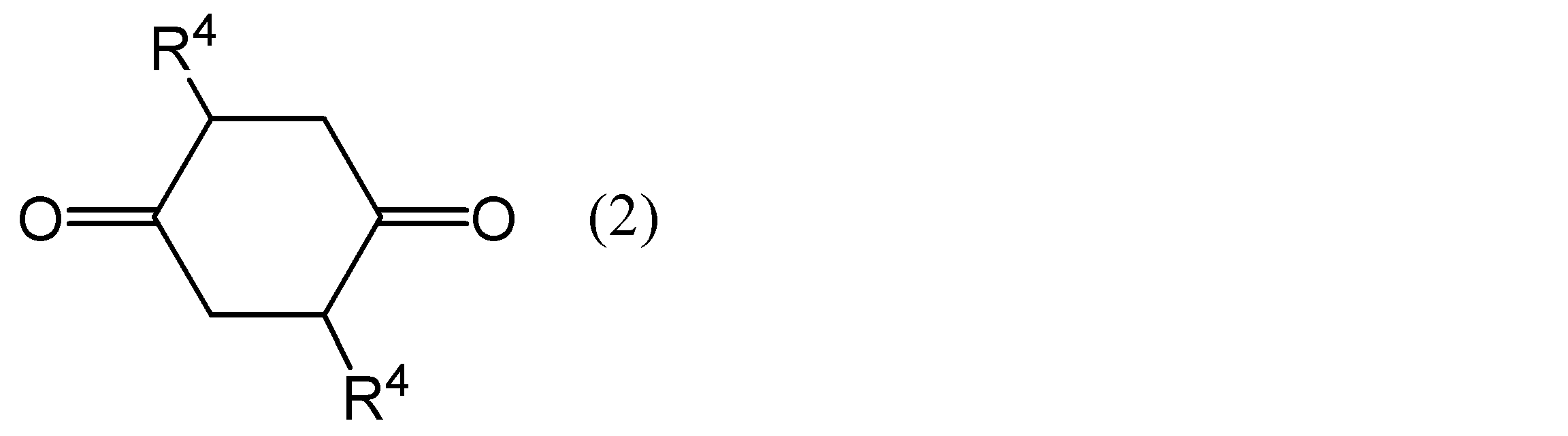
- R 4 represents a hydrogen atom, a group containing a hetero atom, a halogen atom, a linear alkyl group having 1 to 6 carbon atoms, a branched alkyl group having 3 to 6 carbon atoms, or an aryl group. And a group having 6 to 12 carbon atoms.
- R 5 represents a hydrocarbon group.
- the hydrocarbon group represents a linear alkyl group having 1 to 7 carbon atoms, a branched alkyl group having 3 to 7 carbon atoms, or an aryl group.
- R 5 represents a linear alkyl group having 1 to 7 carbon atoms or a branched alkyl group having 3 to 7 carbon atoms.
- the hydrocarbon group as R 5 does not contain an ether bond.
- R 4 in the general formula (2) has the same meaning as R 3 in the general formula (1), and the preferred range is also the same.
- the method for producing the 1,4-cyclohexanedione derivative represented by the general formula (2) used in the present embodiment is not particularly limited, and those produced by a conventionally known method can be used.
- Organic Synthesis, Coll. Vol. 5, p. 288 (1973) and Vol. 45, p. 25 (1965) reported a method for synthesizing 1,4-cyclohexanedione in two steps from succinic acid diester.
- J.H. Chem. Soc. , Perkin Trans. 1, 1979, p3095 includes a method for synthesizing a 1,4-cyclohexanedione derivative in which an alkyl group is introduced into the ⁇ -position of a carbonyl.
- the present inventor attempted the same examination as in the present embodiment using cyclohexanedione isomers (1,2-isomer, 1,3-isomer) other than 1,4-cyclohexanedione.
- cyclohexanedione isomers (1,2-isomer, 1,3-isomer) other than 1,4-cyclohexanedione.
- 1,2-dispiro isomer and 1,3-dispiro isomer corresponding to each isomer could be confirmed, but the reaction yield was extremely low.
- 1,4 It is preferable to use a cyclohexanedione derivative.
- R 5 in the general formula (3) has the same meaning as R 1 and R 2 in the general formula (1), and the preferred range is also the same.
- the compound represented by the general formula (2) is 1,4-cyclohexanedione, and the compound represented by the general formula (3) is trimethylolpropane, trimethylolethane, and tris (hydroxymethyl). It is particularly preferred that it is at least one of toluene (preferably at least one of trimethylolpropane and trimethylolethane).
- the use amount of the triol represented by the general formula (3) with respect to the use amount of the 1,4-cyclohexanedione derivative represented by the general formula (2) is a desired dispiro structure. If it is the quantity which can produce
- the lower limit of the amount is preferably 2.00 equivalents or more, more preferably 2.05 equivalents or more, still more preferably 2.08 equivalents or more, and 2.10 equivalents on a molar basis. It is still more preferable that it is above.
- the upper limit of the amount used is preferably 5.00 equivalents or less, more preferably 3.00 equivalents or less, further preferably 2.50 equivalents or less, and 2.30 equivalents or less. More preferably.
- the dehydration cyclization reaction (acetalization reaction) in the present embodiment is preferably performed in the presence of an acid catalyst.
- a known acid catalyst may be used as the acid catalyst, and there is no particular limitation. Specific examples of such acid catalysts include organic acids such as paratoluenesulfonic acid and methanesulfonic acid, mineral acids such as hydrochloric acid, sulfuric acid, nitric acid, and phosphoric acid, Nafion (trade name, manufactured by Sigma-Aldrich), and positive acids.
- a solid acid catalyst such as an ion exchange resin can be used. However, in this embodiment, since the reaction product is usually precipitated in the reaction solution as a solid, it is preferable to use organic acids or mineral acids from the viewpoint of ease of post-reaction treatment.
- the acid catalyst is preferably a homogeneous acid catalyst.
- the acid catalyst may be a hydrate.
- the acid catalyst preferably contains at least one of methanesulfonic acid, paratoluenesulfonic acid, sulfuric acid, hydrochloric acid, nitric acid, and phosphoric acid, and at least one of methanesulfonic acid, paratoluenesulfonic acid, and sulfuric acid. It is more preferable that at least one of methanesulfonic acid and paratoluenesulfonic acid is included. Two or more acid catalysts may be used in combination.
- the amount of the acid catalyst used is not particularly limited, but is preferably 0.00001 to 0.1 equivalent on a molar basis with respect to the amount of the 1,4-cyclohexanedione derivative represented by the general formula (2). From the viewpoint of reaction time, 0.00001 equivalent or more is more preferable, 0.0001 equivalent or more is more preferable, and from the viewpoint of suppression of by-product formation and catalyst removal, 0.1 equivalent or less is more preferable, and 0.05 equivalent or less. Is more preferable.
- an organic solvent is used as a reaction solvent.
- a solvent may be used.
- water generated by the dehydration cyclization reaction can be easily removed out of the reaction system, and the progress of the dehydration cyclization reaction can be accelerated.
- the organic solvent is not particularly limited as long as it does not cause a side reaction with the raw material, and an organic solvent that is separated into two layers from water and azeotropes with water is preferable.
- the method for producing a diol of the present embodiment includes removing water generated by the dehydration cyclization reaction from the reaction system.
- the method for removing water from the reaction system is not particularly limited, and a method generally known as a method for removing water produced by the dehydration reaction from the reaction system can be employed.
- the water generated by the dehydration cyclization reaction is preferably removed by azeotropy with the organic solvent as described above, but when the water is removed, the water derived from the raw material is also removed together. Is preferred.
- reaction temperature for removing water in the case of using an organic solvent capable of forming an azeotrope with water is not particularly limited as long as it is a temperature at which water and the organic solvent azeotrope.
- the organic solvent is preferably water-insoluble or sparingly water-soluble, and more preferably a hydrocarbon solvent.
- hydrocarbon solvent paraffins, aromatic hydrocarbons and alicyclic hydrocarbons are preferable, pentane, hexane, heptane, octane, benzene, toluene, xylene, cyclohexane, ligroin and petroleum ether are more preferable. And cyclohexane are more preferred.
- An organic solvent may be used individually by 1 type, or 2 or more types may be mixed and used for it.
- water-insoluble or poorly water-soluble refers to a property that the solubility in water at room temperature is 2 g / L or less.
- the amount of the organic solvent used is not particularly limited, but is 10 to 10,000 with respect to 100 parts by mass of the total amount of the 1,4-cyclohexanedione derivative represented by the general formula (2) and the triol represented by the general formula (3).
- the amount is preferably part by mass, more preferably 20 to 5000 parts by mass, and still more preferably 30 to 1000 parts by mass.
- the amount of the organic solvent used is within the above numerical range, when the organic solvent can form an azeotrope with water, water can be more effectively and reliably removed from the system.
- the reaction temperature of the dehydration cyclization reaction depends on the boiling point thereof, but is, for example, 50 to 180 ° C., preferably 70 to 150 ° C., more The temperature is preferably 85 to 125 ° C.
- the reaction pressure of the dehydration cyclization reaction is not particularly limited as long as the dehydration cyclization reaction proceeds at the above reaction temperature, and may be normal pressure. In some cases, the reaction is performed under reduced pressure. It is also effective.
- the atmosphere around the reaction system at the time of the reaction is not particularly limited, and may be any of an air atmosphere, a nitrogen atmosphere, and a nitrogen flow.
- the reaction time may be appropriately adjusted depending on the amount of catalyst and the reaction temperature, but it is usually preferably 2 to 48 hours, more preferably 5 to 20 hours.
- the purity of the diol represented by the general formula (1) obtained by GC analysis can be 95% by mass or more.
- the isolation yield of the diol represented by General formula (1) obtained can also be 90 mass% or more.
- the diol obtained by the production method of the present embodiment can be isolated by a known purification method after appropriate post-treatment such as neutralization, filtration, washing and concentration. Specific examples include crystallization, distillation, adsorption treatment, column chromatography, preparative HPLC (liquid chromatography), and preparative gas chromatography. Moreover, depending on the use of the next reaction, it can be used as it is without purification, particularly without performing an isolation operation, only by the post-treatment in the production method of the present embodiment.
- the diol of this embodiment can be used as a raw material for various industrial materials.
- the diol of this embodiment can be used as a raw material for thermoplastic resins or a raw material for (meth) acrylates.
- the (meth) acrylate may be a monofunctional (meth) acrylate having one (meth) acryloyloxy group or a di (meth) acrylate having two (meth) acryloyloxy groups.
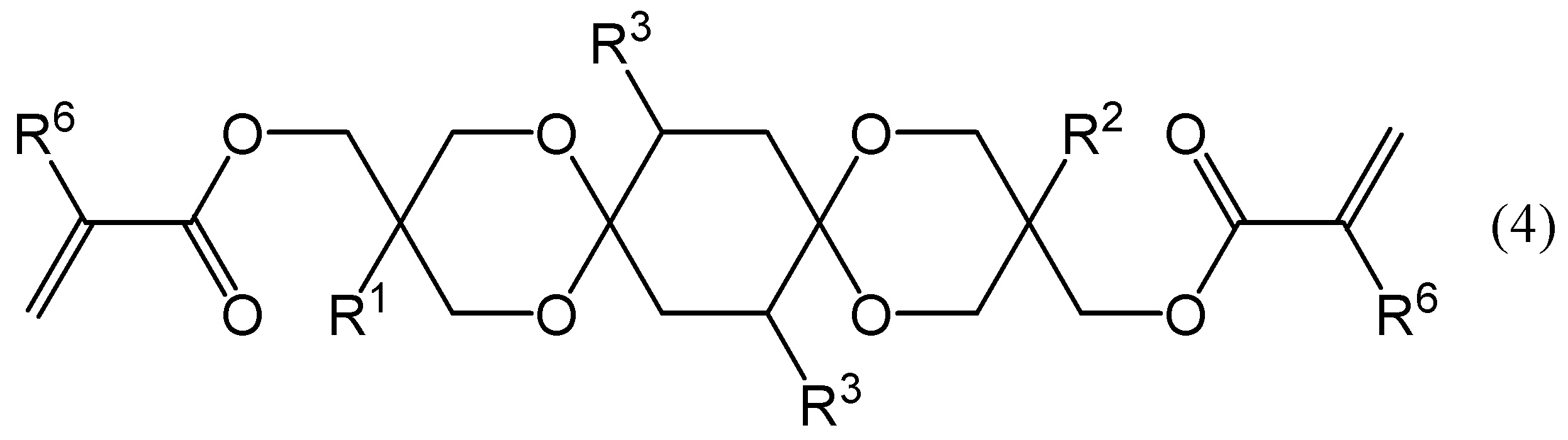
- Examples of the di (meth) acrylate of this embodiment include di (meth) acrylate represented by the following general formula (4).
- R 1 and R 2 each independently represent a hydrocarbon group
- R 3 each independently represents a hydrogen atom, a group containing a hetero atom, a halogen atom, or a carbon atom having 1 to 6 carbon atoms.
- each R 6 independently represents a hydrogen atom or a methyl group.
- An example of the embodiment of the hydrocarbon group is a linear alkyl group having 1 to 7 carbon atoms, a branched alkyl group having 3 to 7 carbon atoms, or an aryl group.
- R 1 and R 2 in the general formula (4) has the same meaning as R 1 and R 2 in the general formula (1), and preferred ranges are also the same.
- R 3 in the general formula (4) has the same meaning as R 3 in the general formula (1), and preferred ranges are also the same.
- R 6 in the general formula (4) is preferably a hydrogen atom.
- the di (meth) acrylate of this embodiment is a dehydration condensation reaction between the diol represented by the general formula (1) of this embodiment and (meth) acrylic acid, or the general formula (1) of this embodiment. It is synthesized by a transesterification reaction between the represented diol and a (meth) acrylic acid ester.
- (Meth) acrylic acid is preferably acrylic acid
- (meth) acrylic acid ester is preferably acrylic acid ester.
- (meth) acrylic acid is preferably used in the range of 2 to 10 moles, more preferably 2.5 to 5 moles per mole of polyol.
- the (meth) acrylic acid ester is preferably used in the range of 2 to 20 moles, more preferably 2.5 to 8 moles per mole of the polyol.
- the dehydration condensation reaction between the diol represented by the general formula (1) and (meth) acrylic acid can be carried out by a known method using an acid catalyst, an organic solvent and a polymerization inhibitor.
- the acid catalyst that can be used in the dehydration condensation reaction is arbitrarily selected from known ones such as sulfuric acid, hydrochloric acid, phosphoric acid, methanesulfonic acid, paratoluenesulfonic acid, benzenesulfonic acid, boron trifluoride, and cationic ion exchange resins. You can choose. Two or more catalysts may be used simultaneously. The amount of the catalyst used is preferably from 0.1 to 10 mol%, more preferably from 1 to 5 mol%, based on 1 mol of the diol.
- the organic solvent is not particularly limited as long as it does not cause a side reaction with the raw material.
- the organic solvent can be removed out of the system in order to accelerate the progress of the reaction, that is, the organic solvent can be separated into two layers and can be shared. Boiling organic solvents are preferred.
- an organic solvent selected from hexane, heptane, cyclohexane, methylcyclohexane, benzene, toluene, xylene and the like can be suitably used. Two or more organic solvents may be mixed and used.
- the amount of the organic solvent used can be derived from the minimum amount of the organic solvent necessary for azeotropic dehydration from the azeotropic composition ratio of the theoretical amount of water to be produced and the organic solvent to be used.
- a Dean-Stark apparatus is used, dehydration can be performed while continuously returning the azeotropic organic solvent to the reaction vessel, so that the amount used can be reduced from the theoretical value. More simply, it is preferably 20 to 200% by mass, more preferably 30 to 100% by mass, based on the total mass of the diol represented by the general formula (1) and (meth) acrylic acid. preferable.
- the polymerization inhibitor is not particularly limited as long as it is a compound capable of scavenging radicals.
- hydroquinone, paramethoxyphenol, tert-butylhydroquinone, parabenzoquinone and 2,2,6,6-tetramethylpiperidine-1-oxide It can select arbitrarily from well-known things, such as. Two or more polymerization inhibitors may be used simultaneously.
- the amount of the polymerization inhibitor used is preferably 0.001 to 5% by mass and more preferably 0.01 to 1% by mass with respect to (meth) acrylic acid.
- (meth) acrylic acid esters examples include methyl (meth) acrylate, ethyl (meth) acrylate, n-propyl (meth) acrylate, isopropyl (meth) acrylate, and n-butyl (meth) acrylate.
- Known (meth) acrylic acid esters can be used.
- the (meth) acrylic acid ester used for the transesterification reaction is preferably methyl (meth) acrylate because it is easy to distill off the produced alcohol. Only one (meth) acrylic acid ester may be used, or two or more thereof may be used.
- the reactor since the reaction can proceed rapidly by removing the lower alcohol produced in the reaction from the reaction system, the reactor is equipped with a distillation column and the reaction is carried out while distilling off the lower alcohol. Is preferred.
- a known Lewis acid catalyst can be used for the transesterification reaction.
- these Lewis acid catalysts may be generated in the reaction system using a base.
- a known base catalyst in the transesterification reaction lithium methoxide, sodium methoxide, potassium methoxide, lithium ethoxide, sodium ethoxide, potassium ethoxide and the like can be used. Two or more catalysts may be used at the same time as long as there is no problem.
- the polymerization inhibitor the polymerization inhibitor described in the dehydration condensation reaction between the diol represented by the general formula (1) and (meth) acrylic acid is preferably used.
- the di (meth) acrylate represented by the general formula (4) of this embodiment is a paint, coating agent, hard coat agent, ink, adhesive, adhesive, resist material, molding as a reactive diluent or viscosity modifier. It can be used for applications such as materials and surface finishing agents.
- High-resolution mass spectrometry High-resolution mass (millimeter, MS) analysis of the compounds was performed by LC-MS direct injection method or DART (Direct Analysis in Real Time) method.
- High-performance liquid chromatography (HPLC) apparatus U3000 (manufactured by Thermo Fisher Scientific)
- DART device DART-Os (manufactured by AMR)
- MS equipment LTQ Orbitrap Discovery (manufactured by Thermo Fisher Scientific) Measurement conditions when using HPLC Column: None Mobile phase: 0.1% by mass formic acid aqueous solution: A mixture of acetonitrile (volume ratio 50:50) Flow rate: 0.2 mL / min Sample concentration: 100 ppm by mass Injection volume: 10 ⁇ L MS measurement conditions (LC-MS direct injection)
- Ionization method Positive ESI
- Capillary temperature 300 ° C
- Capillary voltage 22V
- Tube lens voltage 100V Measurement conditions when using DART Ion source temperature: 400 °
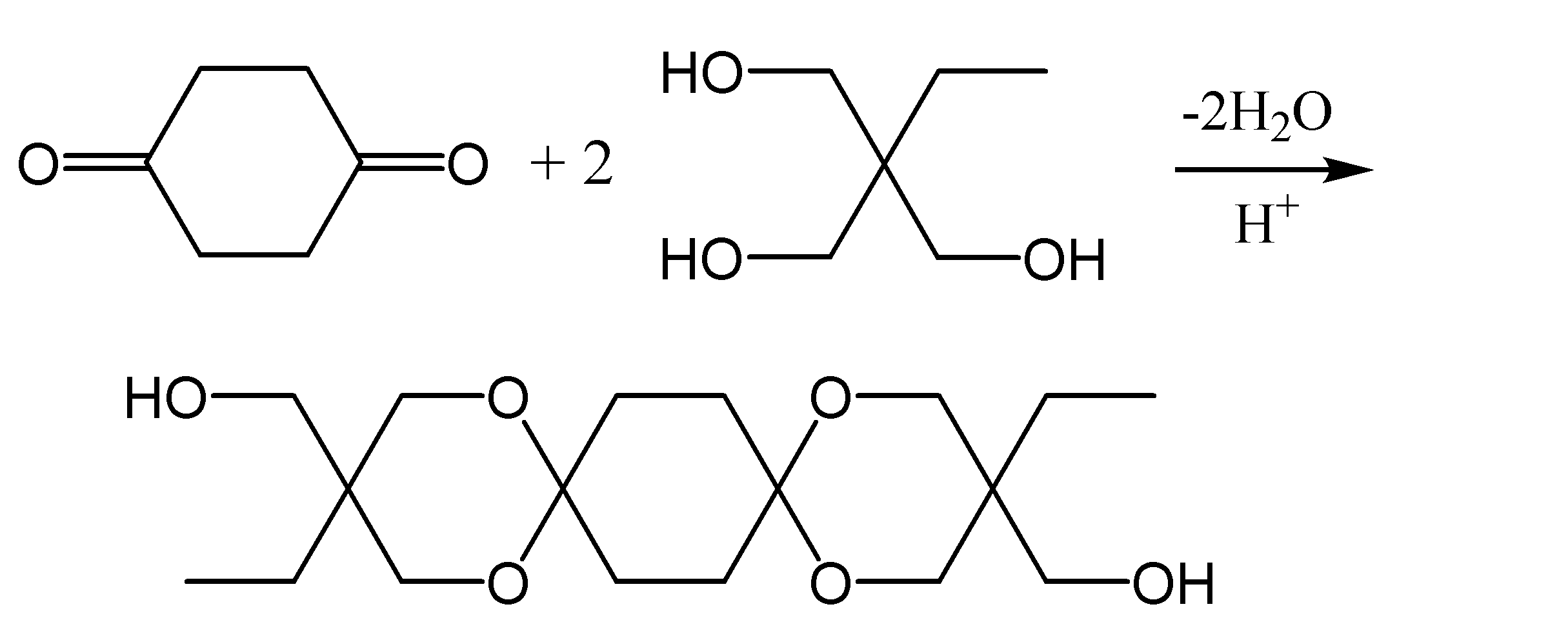
- Example 1 10.0 g of 1,4-cyclohexanedione (manufactured by Tokyo Chemical Industry Co., Ltd., reagent), 25.1 g of trimethylolpropane (manufactured by Mitsubishi Gas Chemical Company), 300 g of toluene (manufactured by Wako Pure Chemical Industries, Ltd., special grade reagent), Methanesulfonic acid (manufactured by Tokyo Kasei Kogyo Co., Ltd., 0.26 g) is placed in a 300 mL round bottom flask and heated under normal pressure so that the temperature in the kettle becomes 90 ° C to 112 ° C. Went.
- 1,4-cyclohexanedione manufactured by Tokyo Chemical Industry Co., Ltd., reagent
- 25.1 g of trimethylolpropane manufactured by Mitsubishi Gas Chemical Company
- 300 g of toluene manufactured by Wako Pure Chemical Industries, Ltd., special grade reagent
- Example 1 The structure of Compound A obtained in Example 1 was identified from various spectra of 1 HNMR, 13 CNMR, DEPT, H-HCOSY, and HMQC. 13 C NMR ⁇ 25.7 and 30.4 were assigned as two non-equivalent two methylene groups in the cyclohexane ring from DEPT135 and HMQC spectra.
- the molecular weight of Compound A was measured by LC-MS analysis (electrospray method [ESI positive mode], high resolution mass spectrometry [Millimass]).
- electrospray method electrospray method
- molecules are ionized and mass analyzed without almost fragmenting them, so molecular weight information can be obtained, and at the same time, high-resolution mass analysis can be verified as a composition formula. it can. Since the mass number (molecular weight M + 1) of [M + H] + protonated while maintaining the molecular structure was 345.222620 (C 18 H 33 O 6 ), the composition formula of compound A was C 18 H 32 O 6 was required.
- Example 2 The dehydration cyclization reaction was carried out at a temperature in the kettle of 95 ° C. to 112 under the same conditions as in Example 1 except that 25.1 g of trimethylolpropane was changed to 22.5 g of trimethylolethane (Mitsubishi Gas Chemical Co., Ltd.). .
- Compound B obtained after drying under reduced pressure was 27.1 g (GC purity 98.2%, isolated yield 94%).
- the reaction scheme of Example 2 is shown below.
- Example 2 The structure of Compound B obtained in Example 2 was identified from various spectra of 1 HNMR, 13 CNMR, DEPT, H-HCOSY, and HMQC. 13 C NMR ⁇ 25.8 and 30.3 were assigned as two non-equivalent two methylene groups in the cyclohexane ring were observed from DEPT135 and HMQC spectra.
- the molecular weight of Compound B was measured using LC-MS analysis. Since the mass number (molecular weight M + 1) of protonated [M + H] + was 317.19489 (C 16 H 29 O 6 ), the composition formula of Compound B was determined to be C 16 H 28 O 6 .
- Example 3 The dehydration cyclization reaction was performed under the same conditions as in Example 1 except that 0.26 g of methanesulfonic acid was changed to 0.51 g of paratoluenesulfonic acid monohydrate (manufactured by Wako Pure Chemical Industries, Ltd., special grade reagent). It was. Compound A obtained after drying under reduced pressure was 30.9 g (GC purity 97.5%, isolated yield 98%).
- Example 4 A dehydration cyclization reaction was performed under the same conditions as in Example 1 except that 300 g of toluene was changed to 300 g of cyclohexane (manufactured by Wako Pure Chemical Industries, Ltd., special grade reagent). Compound A obtained after drying under reduced pressure was 31.0 g (GC purity 96.5%, isolated yield 97%).
- Example 5 Compound C obtained in Example 5 was identified by measuring millimass using DART-MS analysis. Since the mass number (molecular weight M + 1) of protonated [M + H] + was 331.21131 (C 17 H 31 O 6 ), the composition formula of compound C was determined to be C 17 H 30 O 6 .
- the melting point of the mixture containing Compound A obtained in Example 1, Compound B obtained in Example 2, and Compound C obtained in Example 5 was measured by DSC.
- comparative example 1 spiroglycol (manufactured by Mitsubishi Gas Chemical Company), as reference example 1, isosorbide (manufactured by Tokyo Chemical Industry Co., Ltd., purity 98% or more), as reference example 2, cyclohexanediol (manufactured by Tokyo Chemical Industry Co., Ltd., The melting point of the cis-trans mixture (purity 99% or more) was measured by DSC. The measurement results are shown in Table 1.
- Example 1 The heat resistance of the mixture containing Compound A obtained in Example 1, Compound B obtained in Example 2, and Compound C obtained in Example 5 was evaluated according to the method described above.
- Comparative Example 1 the heat resistance of spiroglycol (manufactured by Mitsubishi Gas Chemical Company) was also evaluated. Table 2 shows the weight loss rate of each compound after 240 minutes.
- Example 6 17.2 g of the compound A obtained in Example 1 was added to 13.1 g of acrylic acid (made by Wako Pure Chemical Industries, special grade reagent), 0.54 g of paratoluenesulfonic acid (made by Wako Pure Chemical Industries, special grade reagent), hydroquinone 59 0.7 mg (Wako Pure Chemical Industries, special grade reagent), Paramethoxyphenol 80.6 mg (Wako Pure Chemical Industries, special grade reagent), Toluene 19.9 g (Wako Pure Chemical Industries, special grade reagent), Cyclohexane 19 .9 g (manufactured by Wako Pure Chemical Industries, Ltd., special grade reagent) was added and reacted in a 96 ° C.
- acrylic acid made by Wako Pure Chemical Industries, special grade reagent
- paratoluenesulfonic acid made by Wako Pure Chemical Industries, special grade reagent
- hydroquinone 59 0.7 mg
- Example 5 The reaction scheme of Example 5 is shown below.
- Example 6 The melting point of Compound D obtained in Example 6 was measured by DSC.
- spiroglycol diacrylate compound described in JP-A-63-268722
- isosorbide diacrylate compound described in GB 586141
- trans-cyclohexane as Reference Example 4
- Dimethanol diacrylate compound described in Journal of Polymer Science, Part A-1: Polymer Chemistry (1966), 4, 519-28
- tricyclodecane dimethanol diacrylate manufactured by Sigma-Aldrich
- the diacrylate of the present invention has a higher melting point than spiroglycol diacrylate having a similar alicyclic structure.
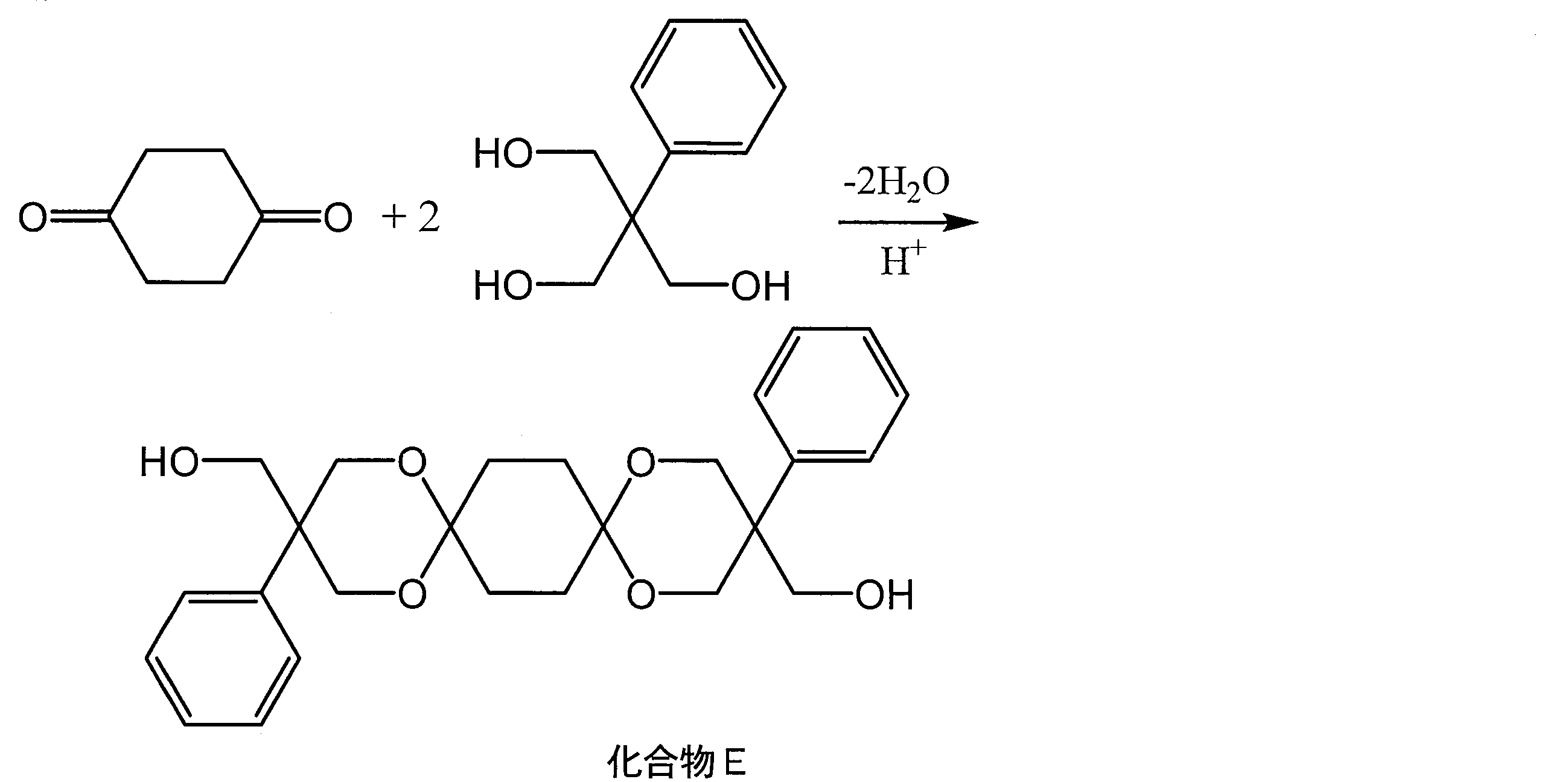
- Example 7 1.47 g of 1,4-cyclohexanedione (manufactured by Tokyo Chemical Industry Co., Ltd., reagent), 5.0 g of ⁇ , ⁇ , ⁇ -tris (hydroxymethyl) toluene (TORONTO RESEACH CHEMICALS), and toluene (Wako Pure Chemical Industries, Ltd.) 100 g of a special grade reagent manufactured by the company and 0.08 g of p-toluenesulfonic acid monohydrate (manufactured by Wako Pure Chemical Industries, Ltd., special grade reagent) are placed in a 300 mL round bottom flask and set in the kettle under normal pressure.
- the dehydration cyclization reaction was performed by heating to a temperature of 90 ° C to 112 ° C. At that temperature, water produced by the reaction was removed from the system by using a Dean-Stark trap while azeotroping with toluene, and the reaction was continued for 4 hours until the distillation of water stopped.
- the product was in the form of a slurry in the reaction system after removing water. After cooling the reaction slurry to 25 ° C., the product was filtered, neutralized and washed with caustic soda water, washed with water, and dried under reduced pressure to obtain Compound E (5.0 g) (HPLC purity 98.5%, Isolation yield 86%).
- the reaction scheme of Example 7 is shown below.
- Example 7 The structure of Compound E obtained in Example 7 was identified from various spectra of 1 HNMR, 13 CNMR, DEPT, H-HCOSY, and HMQC. 13 C NMR ⁇ 25.1 and 31.3 belonged to two non-equivalent two methylene groups in the cyclohexane ring observed from DEPT135 and HMQC spectra.
- Example 7 Compound E obtained in Example 7 was identified by measuring millimass using DART-MS analysis. Since the mass number (molecular weight M + 1) of protonated [M + H] + was 441.227717 (C 26 H 33 O 6 ), the composition formula of compound E was determined to be C 26 H 32 O 6 .
- the diol having a dispiro structure obtained in the present embodiment has higher thermal stability and lower melting point than spiroglycol, and has improved handling properties. Therefore, in the production of various resins (thermoplastic resins) using the diol component as a raw material, improvement in production efficiency and workability is expected. Moreover, since it is a monomer diol having a rigid structure, physical properties (high hardness, abrasion resistance, transparency, heat resistance, weather resistance, optical properties) of various resins (thermoplastic resins) obtained can be expected. Therefore, the industrial applicability of the present invention is great.
Landscapes
- Chemical & Material Sciences (AREA)
- Organic Chemistry (AREA)
- Organic Low-Molecular-Weight Compounds And Preparation Thereof (AREA)
- Heterocyclic Carbon Compounds Containing A Hetero Ring Having Oxygen Or Sulfur (AREA)
- Catalysts (AREA)
- Low-Molecular Organic Synthesis Reactions Using Catalysts (AREA)
Abstract
Description
本発明は、かかる課題を解決することを目的とするものであって、熱安定性に優れたジオール、ならびに、ジオールの製造方法、ジ(メタ)アクリレートおよびジ(メタ)アクリレートの製造方法を提供することを目的とするものである。
<1>下記一般式(1)で表されるジオール;
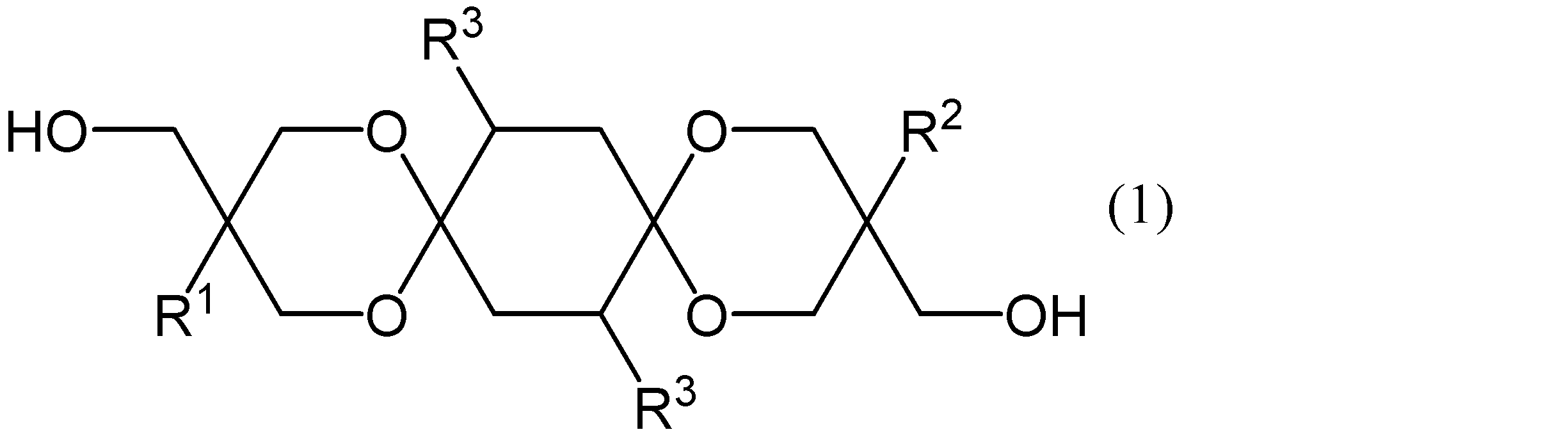
<2>前記一般式(1)におけるR3が、それぞれ独立に、水素原子、炭素数1~6の直鎖のアルキル基または炭素数3~6の分岐したアルキル基または、アリール基を含み、炭素数が6~12である基である、<1>に記載のジオール。
<3>前記一般式(1)におけるR3が、それぞれ独立に、水素原子またはメチル基である、<1>に記載のジオール。
<4>前記一般式(1)におけるR1およびR2が、それぞれ独立に、炭素数1~7の直鎖のアルキル基、炭素数3~7の分岐したアルキル基またはアリール基を表す、<1>~<3>のいずれか1つに記載のジオール。
<5>前記一般式(1)におけるR1およびR2が、それぞれ独立に、炭素数1~7の直鎖のアルキル基または炭素数3~7の分岐したアルキル基を表す、<1>~<3>のいずれか1つに記載のジオール。
<6>前記一般式(1)におけるR1およびR2が、それぞれ独立に、炭素数1~7の直鎖のアルキル基またはアリール基である、<1>~<3>のいずれか1つに記載のジオール。
<7>前記一般式(1)におけるR1およびR2が、それぞれ独立に、エチル基、メチル基またはフェニル基であり、R3が、水素原子である、<1>に記載のジオール。
<8>下記一般式(2)で表される1,4-シクロヘキサンジオン誘導体と、下記一般式(3)で表されるトリオールを脱水環化反応させることを含む、ジオールの製造方法;
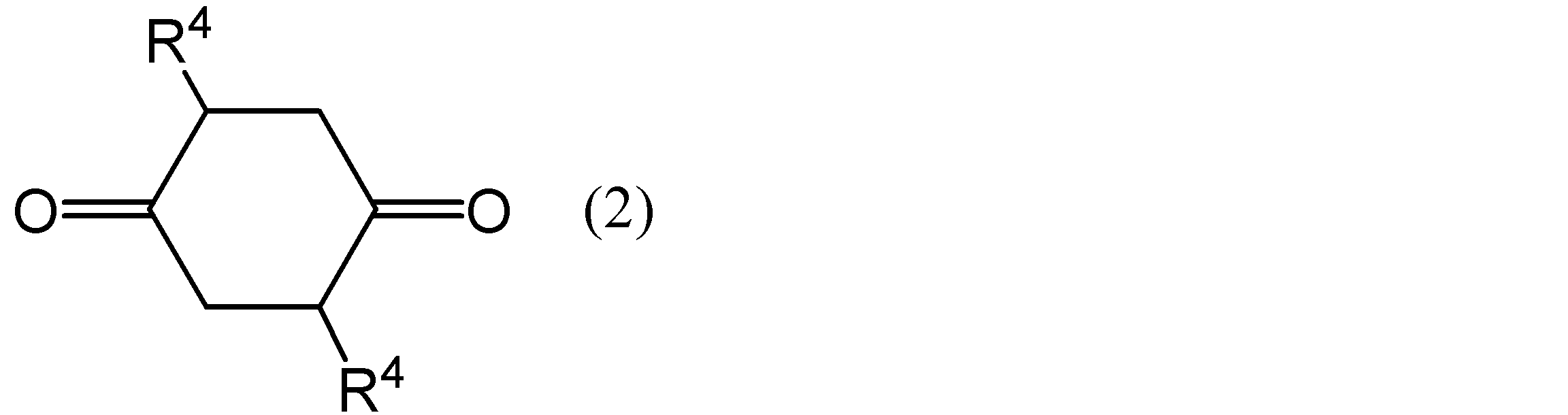
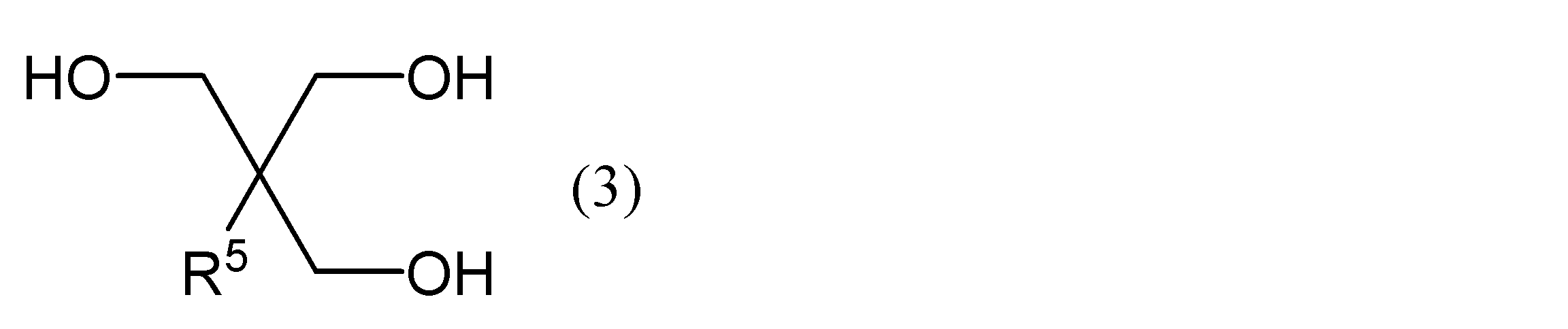
<9>前記一般式(3)中、R5は、炭素数1~7の直鎖のアルキル基、炭素数3~7の分岐したアルキル基またはアリール基を表す、<8>に記載のジオールの製造方法。
<10>前記一般式(3)中、R5は、炭素数1~7の直鎖のアルキル基または炭素数3~7の分岐したアルキル基を表す、<8>に記載のジオールの製造方法。
<11>前記脱水環化反応を酸触媒の存在下で行う、<8>~<10>のいずれか1つに記載のジオールの製造方法。
<12>前記酸触媒が、メタンスルホン酸およびパラトルエンスルホン酸の少なくとも1種を含む、<11>に記載のジオールの製造方法。
<13>前記ジオールの製造方法において、脱水環化反応により生成した水を、反応系から除去することを含む、<8>~<12>のいずれか1つに記載のジオールの製造方法。
<14>前記脱水環化反応により生成した水の除去は、有機溶媒との共沸により行う、<13>に記載のジオールの製造方法。
<15>前記有機溶媒が、トルエンおよびシクロヘキサンの少なくとも一方を含む、<14>に記載のジオールの製造方法。
<16>前記一般式(2)で表される化合物が、1,4-シクロヘキサンジオンであり、前記一般式(3)で表される化合物が、トリメチロールプロパン、トリメチロールエタンおよびトリス(ヒドロキシメチル)トルエンの少なくとも1種である、<8>~<15>のいずれか1つに記載のジオールの製造方法。
<17>前記一般式(2)で表される化合物が、1,4-シクロヘキサンジオンであり、前記一般式(3)で表される化合物が、トリメチロールプロパンまたはトリメチロールエタンの少なくとも1種である、<8>~<15>のいずれか1つに記載のジオールの製造方法。
<18>前記ジオールが、<1>~<7>のいずれか1つに記載のジオールである、<8>~<17>のいずれか1つに記載のジオールの製造方法。
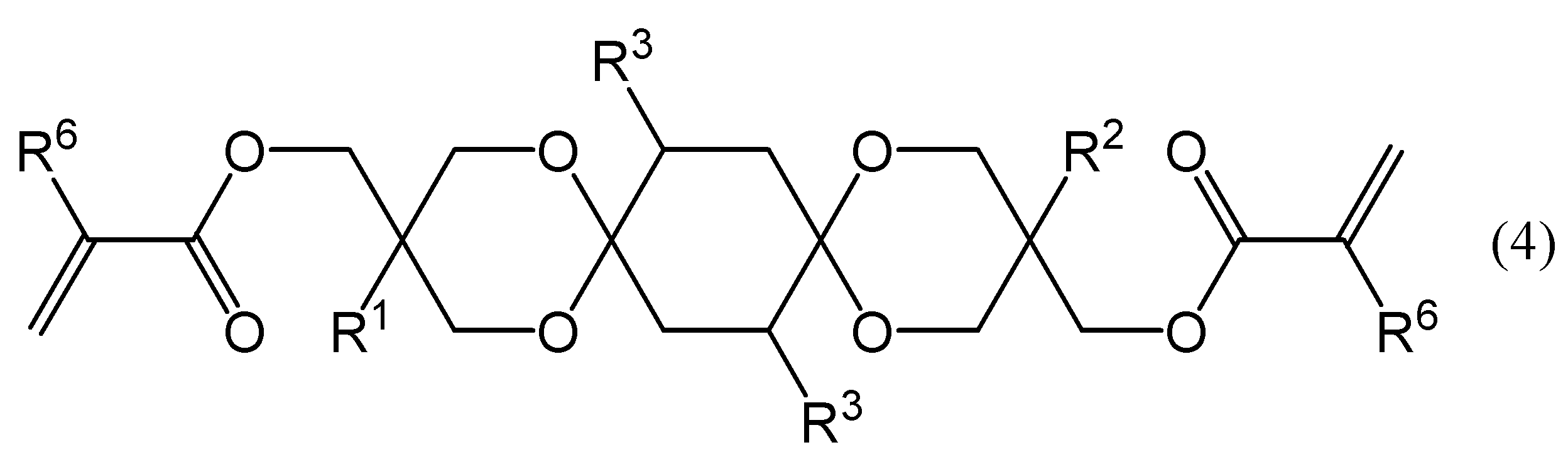
<19>下記一般式(4)で表されるジ(メタ)アクリレート;
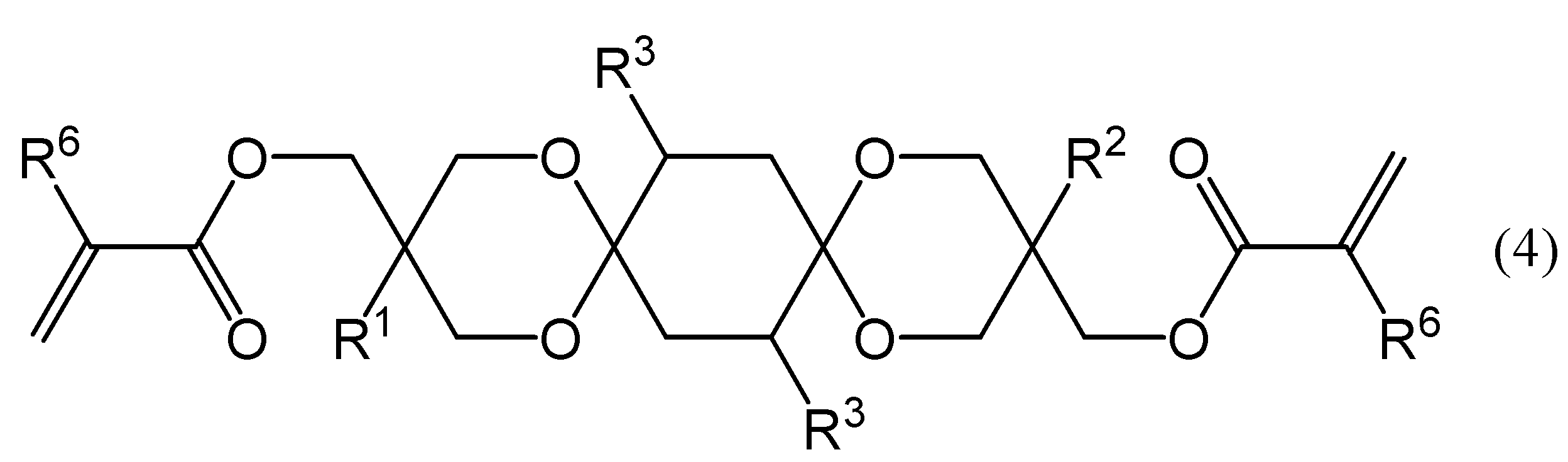
<20>前記一般式(4)におけるR3が、それぞれ独立に、水素原子、炭素数1~6の直鎖のアルキル基、炭素数3~6の分岐したアルキル基または、アリール基を含み、炭素数が6~12である基である、<19>に記載のジ(メタ)アクリレート。
<21>前記一般式(4)におけるR3が、それぞれ独立に、水素原子またはメチル基である、<19>に記載のジ(メタ)アクリレート。
<22>前記一般式(4)におけるR1およびR2が、それぞれ独立に、炭素数1~7の直鎖のアルキル基、炭素数3~7の分岐したアルキル基またはアリール基を表す、<19>~<21>のいずれか1つに記載のジ(メタ)アクリレート。
<23>前記一般式(4)におけるR1およびR2が、それぞれ独立に、炭素数1~7の直鎖のアルキル基または炭素数3~7の分岐したアルキル基を表す、<19>~<21>のいずれか1つに記載のジ(メタ)アクリレート。
<24>前記一般式(4)におけるR1およびR2が、それぞれ独立に、炭素数1~7の直鎖のアルキル基またはアリール基である、<19>~<21>のいずれか1つに記載のジ(メタ)アクリレート。
<25>前記一般式(4)におけるR1およびR2が、それぞれ独立に、エチル基、メチル基またはフェニル基であり、R3が水素原子である、<19>~<21>のいずれか1つに記載のジ(メタ)アクリレート。
<26><1>~<7>のいずれか1つに記載のジオールを、(メタ)アクリル酸と脱水縮合反応させることを含む、ジ(メタ)アクリレートの製造方法。
(メタ)アクリレートとは、アクリレートとメタクリレートの両方を意味する。(メタ)アクリル酸等についても同様である。
以下、本発明を実施するための形態(以下、単に「本実施形態」という)について詳細に説明する。なお、以下の本実施形態は、本発明を説明するための例示であり、本発明は本実施形態のみに限定されない。
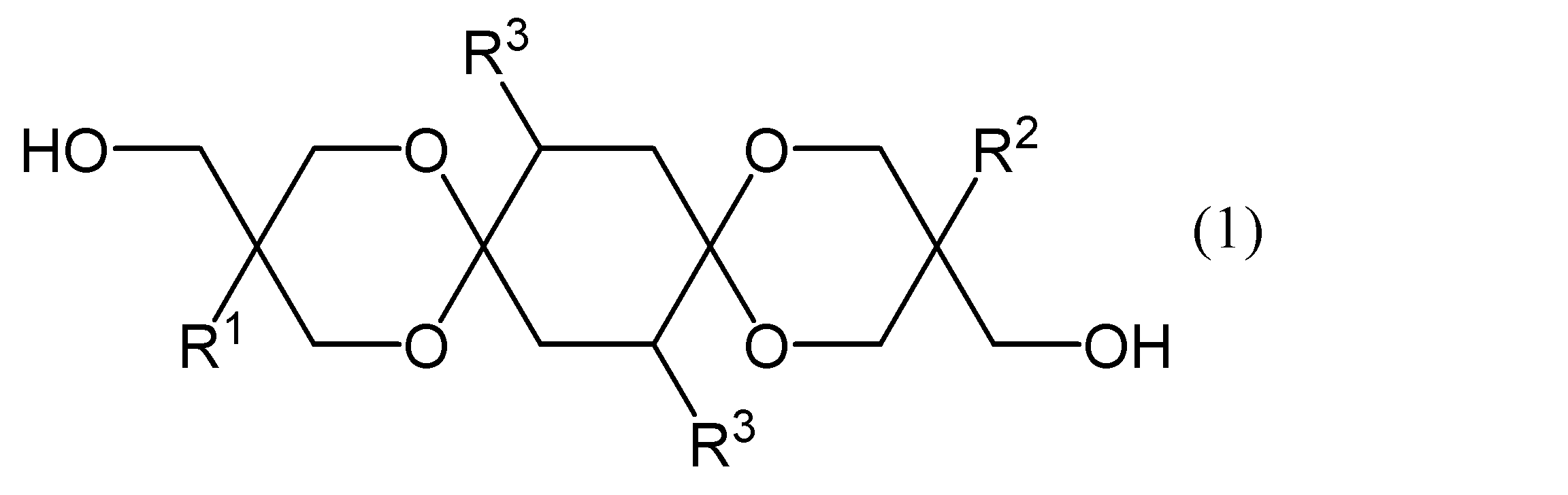
このような構成のジオールを採用することにより、熱安定性に優れたジオールが得られる。さらに、一般式(1)で表されるジオールは、スピログリコールよりも、通常、低い融点を有する傾向にあり、ハンドリング性が高い。さらに、一般式(1)で表される構造とすることにより、剛直な材料が得られる。
本実施形態における一般式(1)で表されるジオールの融点は、例えば、220℃以下とすることができ、さらには218℃以下、200℃以下、180℃以下とすることもできる。一般式(1)で表されるジオールの融点の下限値は、特に定めるものではないが、例えば、150℃以上、さらには160℃以上であっても十分にハンドリング性に優れる。
また、本実施形態の一般式(1)で表されるジオールは、2つの水酸基のβ位が水素原子を持たないネオ構造であり、β脱離によるオレフィンの生成が本質的に起こりにくいという利点もある。
但し、R1およびR2としての炭化水素基は、エーテル結合を含まない。また、R1およびR2の実施形態として、それぞれ独立に、炭素数1~7の直鎖のアルキル基、炭素数3~7の分岐したアルキル基またはアリール基を表す形態も挙げられる。
炭素数1~7の直鎖のアルキル基は、炭素数1~5の直鎖のアルキル基であることが好ましく、炭素数1~3の直鎖のアルキル基であることがより好ましく、メチル基またはエチル基であることがさらに好ましい。
炭素数3~7の分岐したアルキル基は、炭素数3~5の分岐したアルキル基であることが好ましく、炭素数3または4の分岐したアルキル基であることがより好ましく、炭素数3の分岐したアルキル基であることがさらに好ましい。
アリール基は、炭素数6~20のアリール基が好ましく、炭素数6~14のアリール基がより好ましく、フェニル基、ナフチル基、アントラセニル基がさらに好ましく、フェニル基が一層好ましい。
これらの中ではR1とR2が、それぞれ独立して、メチル基、エチル基、n-プロピル基、イソプロピル基、n-ブチル基であることがより好ましく、メチル基またはエチル基がさらに好ましい。また、R1とR2の少なくとも一方がフェニル基である態様も好ましい。また、製造方法が特に簡便になるという観点から、R1とR2が同一であることが好ましく、R1とR2が同一であって、メチル基またはエチル基であることが特に好ましい。また、R1とR2の両方がフェニル基である態様も好ましい。
ヘテロ原子を含む基に含まれるヘテロ原子としては、酸素原子、硫黄原子、窒素原子が例示される。
ヘテロ原子を含む基は、アルコキシ基、アルキルチオエーテル基、アミノ基、ニトロ基が好ましい例として挙げられる。また、アルコキシ基またはアルキルチオエーテル基を構成するアルキル鎖は、炭素数1~6の直鎖のアルキル鎖が好ましく、炭素数1~3の直鎖のアルキル鎖がより好ましい。
炭素数1~6の直鎖のアルキル基は、炭素数1~5の直鎖のアルキル基であることが好ましく、炭素数1~3の直鎖のアルキル基であることがより好ましく、メチル基またはエチル基であることがさらに好ましい。
炭素数3~6の分岐したアルキル基は、炭素数3~5の分岐したアルキル基であることが好ましく、炭素数3または4の分岐したアルキル基であることがより好ましく、炭素数3の分岐したアルキル基であることがさらに好ましい。
アリール基を含み、炭素数が6~12である基は、フェニル基、フェニル基で置換されたアルキル基が好ましく、フェニル基がより好ましい。フェニル基で置換されたアルキル基を構成するアルキル基の炭素数は、1~3が好ましく、1または2がより好ましく、1がさらに好ましい。
これらの中ではR3は、水素原子、メチル基、エチル基、n-プロピル基、イソプロピル基、n-ブチル基であるとより好ましい。また、工業的に入手が容易であるという観点から、R3が水素原子である場合が特に好ましい。
以下に、本実施形態で好ましく用いられるジオールを示す。本実施形態がこれらに限定されるものではないことは言うまでもない。尚、Meはメチル基を、Etはエチル基を、Prはプロピル基を、Buはブチル基を表す。


炭化水素基は、炭素数1~7の直鎖のアルキル基、炭素数3~7の分岐したアルキル基またはアリール基を表す。一実施形態としては、R5は、炭素数1~7の直鎖のアルキル基または炭素数3~7の分岐したアルキル基を表す。但し、R5としての炭化水素基は、エーテル結合を含まない。
本実施形態では、酸触媒が、メタンスルホン酸、パラトルエンスルホン酸、硫酸、塩酸、硝酸およびリン酸の少なくとも1種を含むことが好ましく、メタンスルホン酸、パラトルエンスルホン酸および硫酸の少なくとも1種を含むことがより好ましく、メタンスルホン酸およびパラトルエンスルホン酸の少なくとも1種を含むことがさらに好ましい。酸触媒は2種以上を併用してもよい。
酸触媒の使用量としては特に限定されないが、一般式(2)で表される1,4-シクロヘキサンジオン誘導体の量に対してモル基準で0.00001~0.1当量が好ましい。反応時間の観点からは0.00001当量以上がより好ましく、0.0001当量以上がさらに好ましく、副生物の生成抑制や触媒除去の観点からは0.1当量以下がより好ましく、0.05当量以下がさらに好ましい。
すなわち、本実施形態のジオールの製造方法において、脱水環化反応により生成した水を、反応系から除去することを含むことが好ましい。水を反応系内から除去する方法としては、特に限定されず、脱水反応によって生成する水を反応系内から除去する方法として一般的に知られている方法を採用することができる。本実施形態では、脱水環化反応により生成した水の除去は、上述の通り、有機溶媒との共沸により行うことが好ましいが、前記水の除去に際し、原料由来の水も一緒に除去することが好ましい。
有機溶媒との共沸を行う場合、有機溶媒と水とを共沸留分として留去したのち、2層分離した水のみを上記系内から除去する方法が例示される。水と共沸混合物を形成し得る有機溶媒を用いる場合の水を除去する反応温度は、水と有機溶媒が共沸する温度であれば特に限定されない。
ここで、「非水溶性または難水溶性」とは、室温における水に対する溶解度が2g/L以下である性質をいう。
本実施形態の製造方法によって得られるジオールは、中和、ろ過、洗浄、濃縮等の適当な後処理を行ったのち、公知の精製方法によって単離することができる。具体的には晶析、蒸留、吸着処理、カラムクロマトグラフィー、分取HPLC(液体クロマトグラフィー)、分取ガスクロマトグラフィー等があげられる。また、次反応の用途によっては、本実施形態の製造方法における後処理のみで、特に単離操作を行うことなく未精製のまま使用することもできる。
(メタ)アクリレートは、(メタ)アクリロイルオキシ基を1つ有する単官能(メタ)アクリレートであってもよいし、(メタ)アクリロイルオキシ基を2つ有するジ(メタ)アクリレートであってもよい。
本実施形態のジ(メタ)アクリレートとしては、下記一般式(4)で表されるジ(メタ)アクリレートが挙げられる。
上記炭化水素基の実施形態の一例は、炭素数1~7の直鎖のアルキル基、炭素数3~7の分岐したアルキル基またはアリール基であり、他の実施形態の一例は、炭素数1~7の直鎖のアルキル基または炭素数3~7の分岐したアルキル基である。
一般式(4)におけるR3は、一般式(1)におけるR3と同義であり、好ましい範囲も同様である。
一般式(4)におけるR6は、水素原子が好ましい。
一般式(1)で表されるジオールと(メタ)アクリル酸の脱水縮合反応としては、酸触媒、有機溶媒および重合禁止剤を用い、公知の手法で行うことができる。
脱水縮合反応に用いることのできる酸触媒としては、硫酸、塩酸、リン酸、メタンスルホン酸、パラトルエンスルホン酸、ベンゼンスルホン酸、三フッ化ホウ素およびカチオン型イオン交換樹脂等公知のものから任意に選択できる。
触媒は2種以上を同時に用いてもよい。触媒の使用量はジオール1モルに対して、0.1~10モル%であることが好ましく、1~5モル%であることがより好ましい。
また重合禁止剤は2種以上を同時に使用してもよい。重合禁止剤の使用量は、(メタ)アクリル酸に対して、0.001~5質量%であることが好ましく、0.01~1質量%であることがより好ましい。
(メタ)アクリル酸エステルとしては、(メタ)アクリル酸メチル、(メタ)アクリル酸エチル、(メタ)アクリル酸n-プロピル、(メタ)アクリル酸イソプロピル、および(メタ)アクリル酸n-ブチルなどの公知の(メタ)アクリル酸エステル使用することができる。特に、生成するアルコールの留去が容易なことからエステル交換反応に用いる(メタ)アクリル酸エステルは、(メタ)アクリル酸メチルが好ましい。(メタ)アクリル酸エステルは1種のみ用いてもよいし、2種以上用いてもよい。
また、反応で生じる低級アルコールを反応系中から除くことで反応を速やかに進行させることができるため、反応器としては蒸留塔を備えたものを用い、低級アルコールを留去しながら反応を行うことが好適である。
一方、エステル交換反応での公知の塩基触媒としては、リチウムメトキシド、ナトリウムメトキシド、カリウムメトキシド、リチウムエトキシド、ナトリウムエトキシドおよびカリウムエトキシドなどを用いることができる。
触媒は支障がない範囲で適宜、2種以上を同時に用いてもよい。
重合禁止剤は、一般式(1)で表されるジオールと(メタ)アクリル酸の脱水縮合反応で述べた重合禁止剤が好ましく用いられる。
(1)反応収率および生成物の純度
反応収率および生成物の純度はガスクロマトグラフィー(装置名:Agilent 6850、アジレント社製)もしくは高速液体クロマトグラフィー(装置名:Chromaster、日立ハイテクサイエンス社製)にて、内部標準法で定量した。
(2)核磁気共鳴装置(NMR)
化合物の構造決定にはNMRを使用した(日本電子社製、型式:JNM-ECA500)。使用した重溶媒および測定周波数は各化合物の帰属中に記載した。
化合物の高分解能質量(ミリマス、MS)分析は、LC-MSのダイレクトインジェクション法、もしくはDART(Direct Analysis in Real Time)法にて行った。
HPLC(High-performance liquid chromatography)装置:U3000(Thermo Fisher Scientific社製)
DART装置:DART-Os(エーエムアール社製)
MS装置:LTQ Orbitrap Discovery(Thermo Fisher Scientific社製)
HPLC使用時の測定条件
カラム:なし
移動相:0.1質量%のギ酸水溶液:アセトニトリル(体積比50:50)の混合液
流速:0.2mL/分
試料濃度:100質量ppm
注入量:10μL
MS測定条件(LC-MSダイレクトインジェクション時)
イオン化法:Positive ESI
キャピラリ-温度:300℃
キャピラリ-電圧:22V
チューブレンズ電圧:100V
DART使用時の測定条件
イオン源温度:400℃
MS測定条件(DART時)
イオン化法:DART
キャピラリ-温度:200℃
キャピラリ-電圧:35V
チューブレンズ電圧:100V
化合物の融点は、示差走査型熱量計(型式:DSC7020、日立ハイテクサイエンス社製)を用い、試料約10mgをアルミ製の非密封容器に入れ、窒素ガス気流中、昇温速度10℃/分の条件で測定した。
化合物の耐熱性は、リガク社製Thermo Plus TG8120を使用した。150mL/分の窒素気流中、10℃/分の昇温速度で190℃まで昇温し、190℃一定条件での重量減少率を測定した。
1,4-シクロヘキサンジオン(東京化成工業社製、試薬)10.0gと、トリメチロールプロパン(三菱ガス化学社製)25.1gと、トルエン(和光純薬工業社製、特級試薬)300gと、メタンスルホン酸(東京化成工業社製、試薬)0.26gとを、300mLの丸底フラスコに収容し、常圧下で釜内温度が90℃~112℃となるように加熱して脱水環化反応を行った。その温度にて、反応によって生成した水をトルエンと共沸させながらディーン・スターク・トラップを用いて系内から系外へ除去して、水の留出が止まるまで10時間反応させた。水を除去した後の反応系内は生成物がスラリー状になっていた。反応スラリー液を25℃まで冷却したのち、生成物をろ過、苛性ソーダ水にて中和洗浄、水にて洗浄、減圧乾燥をすることで化合物A30.3gを得た(GC純度98.4%、単離収率97%)。
下記に実施例1の反応スキームを示す。

トリメチロールプロパン25.1gをトリメチロールエタン(三菱ガス化学社製)22.5gに変更した以外は実施例1と同様の条件にて、釜内温度95℃~112で脱水環化反応を行った。減圧乾燥後に得られた化合物Bは27.1g(GC純度98.2%、単離収率94%)であった。
下記に実施例2の反応スキームを示す。


メタンスルホン酸0.26gを、パラトルエンスルホン酸1水和物(和光純薬工業社製、特級試薬)0.51gに変更した以外は実施例1と同様の条件にて脱水環化反応を行った。減圧乾燥後に得られた化合物Aは30.9g(GC純度97.5%、単離収率98%)であった。
トルエン300gを、シクロヘキサン(和光純薬工業社製、特級試薬)300gに変更した以外は実施例1と同様の条件にて脱水環化反応を行った。減圧乾燥後に得られた化合物Aは31.0g(GC純度96.5%、単離収率97%)であった。
トリメチロールプロパン25.1gを、トリメチロールプロパン(三菱ガス化学社製)12.5gとトリメチロールエタン(三菱ガス化学社製)11.2gに変更した以外は実施例1と同様の条件にて、釜内温度95℃~112で脱水環化反応を行った。減圧乾燥後の生成物は化合物Aと化合物Bと化合物Cの混合物として28.4g(GC純度96.5%、化合物A:化合物B:化合物C=44:7:49、単離収率96%但し全て化合物Cとして計算)であった。
下記に実施例5の反応スキームを示す。



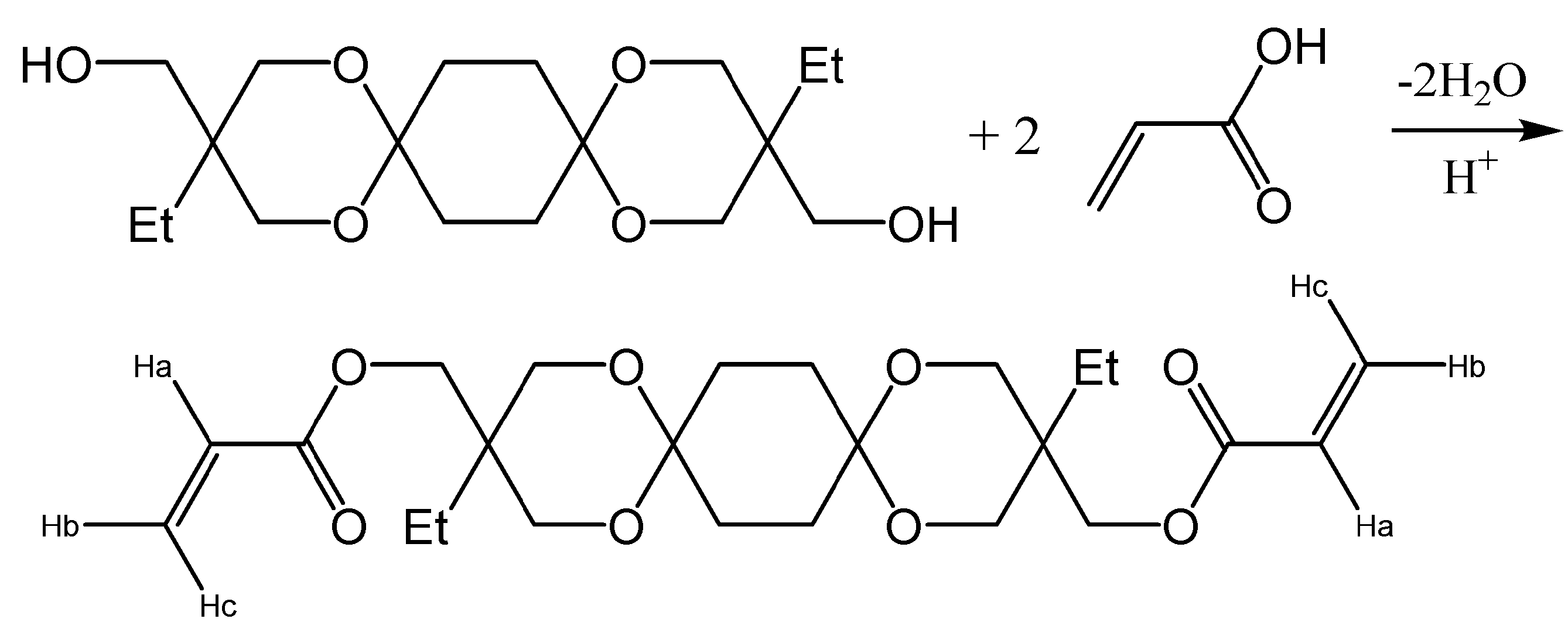
実施例1で得られた化合物A17.2gにアクリル酸13.1g(和光純薬工業社製、特級試薬)、パラトルエンスルホン酸0.54g(和光純薬工業社製、特級試薬)、ヒドロキノン59.7mg(和光純薬工業社製、特級試薬)、パラメトキシフェノール80.6mg(和光純薬工業社製、特級試薬)、トルエン19.9g(和光純薬工業社製、特級試薬)、シクロヘキサン19.9g(和光純薬工業社製、特級試薬)を加え、96℃の油浴で13時間、留出する水を抜きながら反応させた。室温に冷却後、20質量%の水酸化ナトリウム水溶液15mLで4回洗浄後、水15mLで3回洗浄した。パラメトキシフェノール16mgを加えた後、エバポレーターで濃縮し、得られた固体をヘキサン/酢酸エチル:8/1(体積比)の混合液でよく洗浄し、結晶性の化合物Dを得た。下記に実施例5の反応スキームを示す。


1,4-シクロヘキサンジオン(東京化成工業社製、試薬)1.47gと、α、α、α-トリス(ヒドロキシメチル)トルエン(TORONTO RESEACH CHEMICALS社製)5.0gと、トルエン(和光純薬工業社製、特級試薬)100gと、パラトルエンスルホン酸1水和物(和光純薬工業社製、特級試薬)0.08gとを、300mLの丸底フラスコに収容し、常圧下で釜内の設定温度が90℃~112℃となるように加熱して脱水環化反応を行った。その温度にて、反応によって生成した水をトルエンと共沸させながらディーン・スターク・トラップを用いて系内から系外へ除去して、水の留出が止まるまで4時間反応させた。水を除去した後の反応系内は生成物がスラリー状になっていた。反応スラリー液を25℃まで冷却したのち、生成物をろ過、苛性ソーダ水にて中和洗浄、水にて洗浄、減圧乾燥をすることで化合物E5.0gを得た(HPLC純度98.5%、単離収率86%)。
下記に実施例7の反応スキームを示す。

Claims (26)
- 下記一般式(1)で表されるジオール;

- 前記一般式(1)におけるR3が、それぞれ独立に、水素原子、炭素数1~6の直鎖のアルキル基または炭素数3~6の分岐したアルキル基または、アリール基を含み、炭素数が6~12である基である、請求項1に記載のジオール。
- 前記一般式(1)におけるR3が、それぞれ独立に、水素原子またはメチル基である、請求項1に記載のジオール。
- 前記一般式(1)におけるR1およびR2が、それぞれ独立に、炭素数1~7の直鎖のアルキル基、炭素数3~7の分岐したアルキル基またはアリール基を表す、請求項1~3のいずれか1項に記載のジオール。
- 前記一般式(1)におけるR1およびR2が、それぞれ独立に、炭素数1~7の直鎖のアルキル基または炭素数3~7の分岐したアルキル基を表す、請求項1~3のいずれか1項に記載のジオール。
- 前記一般式(1)におけるR1およびR2が、それぞれ独立に、炭素数1~7の直鎖のアルキル基またはアリール基である、請求項1~3のいずれか1項に記載のジオール。
- 前記一般式(1)におけるR1およびR2が、それぞれ独立に、エチル基、メチル基またはフェニル基であり、R3が、水素原子である、請求項1に記載のジオール。
- 下記一般式(2)で表される1,4-シクロヘキサンジオン誘導体と、下記一般式(3)で表されるトリオールを脱水環化反応させることを含む、ジオールの製造方法;

- 前記一般式(3)中、R5は、炭素数1~7の直鎖のアルキル基、炭素数3~7の分岐したアルキル基またはアリール基を表す、請求項8に記載のジオールの製造方法。
- 前記一般式(3)中、R5は、炭素数1~7の直鎖のアルキル基または炭素数3~7の分岐したアルキル基を表す、請求項8に記載のジオールの製造方法。
- 前記脱水環化反応を酸触媒の存在下で行う、請求項8~10のいずれか1項に記載のジオールの製造方法。
- 前記酸触媒が、メタンスルホン酸およびパラトルエンスルホン酸の少なくとも1種を含む、請求項11に記載のジオールの製造方法。
- 前記ジオールの製造方法において、脱水環化反応により生成した水を、反応系から除去することを含む、請求項8~12のいずれか1項に記載のジオールの製造方法。
- 前記脱水環化反応により生成した水の除去は、有機溶媒との共沸により行う、請求項13に記載のジオールの製造方法。
- 前記有機溶媒が、トルエンおよびシクロヘキサンの少なくとも一方を含む、請求項14に記載のジオールの製造方法。
- 前記一般式(2)で表される化合物が、1,4-シクロヘキサンジオンであり、前記一般式(3)で表される化合物が、トリメチロールプロパン、トリメチロールエタンおよびトリス(ヒドロキシメチル)トルエンの少なくとも1種である、請求項8~15のいずれか1項に記載のジオールの製造方法。
- 前記一般式(2)で表される化合物が、1,4-シクロヘキサンジオンであり、前記一般式(3)で表される化合物が、トリメチロールプロパンまたはトリメチロールエタンの少なくとも1種である、請求項8~15のいずれか1項に記載のジオールの製造方法。
- 前記ジオールが、請求項1~7のいずれか1項に記載のジオールである、請求項8~17のいずれか1項に記載のジオールの製造方法。
- 下記一般式(4)で表されるジ(メタ)アクリレート;
- 前記一般式(4)におけるR3が、それぞれ独立に、水素原子、炭素数1~6の直鎖のアルキル基、炭素数3~6の分岐したアルキル基または、アリール基を含み、炭素数が6~12である基である、請求項19に記載のジ(メタ)アクリレート。
- 前記一般式(4)におけるR3が、それぞれ独立に、水素原子またはメチル基である、請求項19に記載のジ(メタ)アクリレート。
- 前記一般式(4)におけるR1およびR2が、それぞれ独立に、炭素数1~7の直鎖のアルキル基、炭素数3~7の分岐したアルキル基またはアリール基を表す、請求項19~21のいずれか1項に記載のジ(メタ)アクリレート。
- 前記一般式(4)におけるR1およびR2が、それぞれ独立に、炭素数1~7の直鎖のアルキル基または炭素数3~7の分岐したアルキル基を表す、請求項19~21のいずれか1項に記載のジ(メタ)アクリレート。
- 前記一般式(4)におけるR1およびR2が、それぞれ独立に、炭素数1~7の直鎖のアルキル基またはアリール基である、請求項19~21のいずれか1項に記載のジ(メタ)アクリレート。
- 前記一般式(4)におけるR1およびR2が、それぞれ独立に、エチル基、メチル基またはフェニル基であり、R3が水素原子である、請求項19~21のいずれか1項に記載のジ(メタ)アクリレート。
- 請求項1~7のいずれか1項に記載のジオールを、(メタ)アクリル酸と脱水縮合反応させることを含む、ジ(メタ)アクリレートの製造方法。
Priority Applications (5)
| Application Number | Priority Date | Filing Date | Title |
|---|---|---|---|
| JP2018546273A JP7021640B2 (ja) | 2016-10-18 | 2017-10-11 | ジオール、ジオールの製造方法、ジ(メタ)アクリレートおよびジ(メタ)アクリレートの製造方法 |
| US16/342,329 US10633391B2 (en) | 2016-10-18 | 2017-10-11 | Diol, method for manufacturing diol, di(meth)acrylate, and method for manufacturing di(meth)acrylate |
| CN201780064369.0A CN110167945A (zh) | 2016-10-18 | 2017-10-11 | 二醇、二醇的制造方法、二(甲基)丙烯酸酯及二(甲基)丙烯酸酯的制造方法 |
| EP17863267.5A EP3530664B1 (en) | 2016-10-18 | 2017-10-11 | Diol, process for producing diol, di(meth)acrylate, and process for producing di(meth)acrylate |
| KR1020197012806A KR102388871B1 (ko) | 2016-10-18 | 2017-10-11 | 디올, 디올의 제조 방법, 디(메트)아크릴레이트 및 디(메트)아크릴레이트의 제조 방법 |
Applications Claiming Priority (2)
| Application Number | Priority Date | Filing Date | Title |
|---|---|---|---|
| JP2016204125 | 2016-10-18 | ||
| JP2016-204125 | 2016-10-18 |
Publications (1)
| Publication Number | Publication Date |
|---|---|
| WO2018074305A1 true WO2018074305A1 (ja) | 2018-04-26 |
Family
ID=62018563
Family Applications (1)
| Application Number | Title | Priority Date | Filing Date |
|---|---|---|---|
| PCT/JP2017/036844 Ceased WO2018074305A1 (ja) | 2016-10-18 | 2017-10-11 | ジオール、ジオールの製造方法、ジ(メタ)アクリレートおよびジ(メタ)アクリレートの製造方法 |
Country Status (7)
| Country | Link |
|---|---|
| US (1) | US10633391B2 (ja) |
| EP (1) | EP3530664B1 (ja) |
| JP (1) | JP7021640B2 (ja) |
| KR (1) | KR102388871B1 (ja) |
| CN (1) | CN110167945A (ja) |
| TW (1) | TWI731180B (ja) |
| WO (1) | WO2018074305A1 (ja) |
Cited By (11)
| Publication number | Priority date | Publication date | Assignee | Title |
|---|---|---|---|---|
| JP2018199764A (ja) * | 2017-05-26 | 2018-12-20 | 三菱瓦斯化学株式会社 | ポリエステル樹脂、成形品およびポリエステル樹脂の製造方法 |
| WO2019117019A1 (ja) * | 2017-12-15 | 2019-06-20 | 三菱瓦斯化学株式会社 | ジオールの製造方法 |
| WO2019188114A1 (ja) * | 2018-03-28 | 2019-10-03 | 三菱瓦斯化学株式会社 | ポリカーボネートおよび成形体 |
| JPWO2022091996A1 (ja) * | 2020-10-27 | 2022-05-05 | ||
| WO2022091990A1 (ja) * | 2020-10-27 | 2022-05-05 | 新日本理化株式会社 | 環式ジオール化合物、該化合物の製造方法及び該化合物の用途 |
| WO2023074439A1 (ja) * | 2021-10-29 | 2023-05-04 | 帝人株式会社 | 熱可塑性樹脂および光学部材 |
| JP2023067738A (ja) * | 2021-10-29 | 2023-05-16 | 帝人株式会社 | 熱可塑性樹脂および光学部材 |
| JP2023180708A (ja) * | 2022-06-10 | 2023-12-21 | 三菱瓦斯化学株式会社 | 硬化性樹脂組成物及び硬化物 |
| WO2024024602A1 (ja) | 2022-07-25 | 2024-02-01 | 三菱瓦斯化学株式会社 | 環式ジオール化合物から得られる樹脂、及びそれを含む光学レンズ |
| JP2024016426A (ja) * | 2022-07-26 | 2024-02-07 | 帝人株式会社 | 熱可塑性樹脂および光学部材 |
| KR20250039312A (ko) | 2022-07-25 | 2025-03-20 | 신닛폰 리카 가부시키가이샤 | 환식 디올 화합물, 수지 개질제, 해당 수지 개질제를 사용한 수지, 및 해당 수지의 용도 |
Families Citing this family (1)
| Publication number | Priority date | Publication date | Assignee | Title |
|---|---|---|---|---|
| CN111377939A (zh) * | 2020-03-02 | 2020-07-07 | 上海大学 | 螺二醇双烯酸酯及其制备方法 |
Citations (10)
| Publication number | Priority date | Publication date | Assignee | Title |
|---|---|---|---|---|
| GB586141A (en) | 1944-05-30 | 1947-03-07 | Walter Norman Haworth | Preparation of acrylic and methacrylic resinoid derivatives |
| JPS59148776A (ja) | 1983-02-14 | 1984-08-25 | Mitsubishi Gas Chem Co Inc | 多価アルコ−ルの製造方法 |
| JPS6072883A (ja) * | 1983-09-29 | 1985-04-24 | Toagosei Chem Ind Co Ltd | 環状アクリル酸エステル |
| JPS63268722A (ja) | 1987-04-28 | 1988-11-07 | Dainippon Ink & Chem Inc | 不飽和ポリエステル樹脂組成物 |
| JP2000044570A (ja) | 1998-07-27 | 2000-02-15 | Mitsubishi Gas Chem Co Inc | スピログリコールの製造方法 |
| JP2005029563A (ja) | 2003-06-18 | 2005-02-03 | Mitsubishi Gas Chem Co Inc | スピログリコールの製造方法 |
| JP2006083172A (ja) * | 2004-09-15 | 2006-03-30 | Dongjin Semichem Co Ltd | スピロ環状ケタール基を有するフォトレジスト用モノマー、ポリマーおよびこれを含むフォトレジスト組成物 |
| JP2008297327A (ja) * | 2007-05-29 | 2008-12-11 | Fujifilm Corp | 液晶組成物、液晶素子及びスピロ環化合物 |
| CN102020627A (zh) * | 2009-09-23 | 2011-04-20 | 天津市化学试剂研究所 | 一种三羟甲基丙烷缩酮丙烯酸酯的制备方法 |
| WO2016052476A1 (ja) | 2014-09-29 | 2016-04-07 | 三菱瓦斯化学株式会社 | ポリエーテルジオール及びその製造方法 |
Family Cites Families (4)
| Publication number | Priority date | Publication date | Assignee | Title |
|---|---|---|---|---|
| JP2005343837A (ja) * | 2004-06-04 | 2005-12-15 | Fuji Photo Film Co Ltd | 1,3−ジオキソラン−4,6−ジオン化合物の製造方法 |
| CN1931858B (zh) * | 2004-09-15 | 2011-09-21 | 株式会社东进世美肯 | 包含具有螺环缩酮基团的单体的光刻胶聚合物及其组合物 |
| JP6303877B2 (ja) * | 2014-07-02 | 2018-04-04 | 三菱瓦斯化学株式会社 | ポリエーテルポリオール及びその製造方法 |
| JP6432603B2 (ja) * | 2014-10-22 | 2018-12-05 | 三菱瓦斯化学株式会社 | トリアクリレート化合物及びその製造方法並びに組成物 |
-
2017
- 2017-10-11 JP JP2018546273A patent/JP7021640B2/ja active Active
- 2017-10-11 US US16/342,329 patent/US10633391B2/en active Active
- 2017-10-11 EP EP17863267.5A patent/EP3530664B1/en active Active
- 2017-10-11 WO PCT/JP2017/036844 patent/WO2018074305A1/ja not_active Ceased
- 2017-10-11 KR KR1020197012806A patent/KR102388871B1/ko active Active
- 2017-10-11 CN CN201780064369.0A patent/CN110167945A/zh active Pending
- 2017-10-17 TW TW106135380A patent/TWI731180B/zh active
Patent Citations (10)
| Publication number | Priority date | Publication date | Assignee | Title |
|---|---|---|---|---|
| GB586141A (en) | 1944-05-30 | 1947-03-07 | Walter Norman Haworth | Preparation of acrylic and methacrylic resinoid derivatives |
| JPS59148776A (ja) | 1983-02-14 | 1984-08-25 | Mitsubishi Gas Chem Co Inc | 多価アルコ−ルの製造方法 |
| JPS6072883A (ja) * | 1983-09-29 | 1985-04-24 | Toagosei Chem Ind Co Ltd | 環状アクリル酸エステル |
| JPS63268722A (ja) | 1987-04-28 | 1988-11-07 | Dainippon Ink & Chem Inc | 不飽和ポリエステル樹脂組成物 |
| JP2000044570A (ja) | 1998-07-27 | 2000-02-15 | Mitsubishi Gas Chem Co Inc | スピログリコールの製造方法 |
| JP2005029563A (ja) | 2003-06-18 | 2005-02-03 | Mitsubishi Gas Chem Co Inc | スピログリコールの製造方法 |
| JP2006083172A (ja) * | 2004-09-15 | 2006-03-30 | Dongjin Semichem Co Ltd | スピロ環状ケタール基を有するフォトレジスト用モノマー、ポリマーおよびこれを含むフォトレジスト組成物 |
| JP2008297327A (ja) * | 2007-05-29 | 2008-12-11 | Fujifilm Corp | 液晶組成物、液晶素子及びスピロ環化合物 |
| CN102020627A (zh) * | 2009-09-23 | 2011-04-20 | 天津市化学试剂研究所 | 一种三羟甲基丙烷缩酮丙烯酸酯的制备方法 |
| WO2016052476A1 (ja) | 2014-09-29 | 2016-04-07 | 三菱瓦斯化学株式会社 | ポリエーテルジオール及びその製造方法 |
Non-Patent Citations (4)
| Title |
|---|
| "Part A-l: Polymer Chemistry", JOURNAL OF POLYMER SCIENCE, vol. 4, 1966, pages 519 - 28 |
| J. CHEM. SOC., PERKIN TRANS., vol. 1, 1979, pages 3095 |
| ORGANIC SYNTHESES, vol. 45, 1965, pages 25 |
| ORGANIC SYNTHESES, vol. 5, 1973, pages 288 |
Cited By (28)
| Publication number | Priority date | Publication date | Assignee | Title |
|---|---|---|---|---|
| JP2018199764A (ja) * | 2017-05-26 | 2018-12-20 | 三菱瓦斯化学株式会社 | ポリエステル樹脂、成形品およびポリエステル樹脂の製造方法 |
| JP7205493B2 (ja) | 2017-12-15 | 2023-01-17 | 三菱瓦斯化学株式会社 | ジオールの製造方法 |
| WO2019117019A1 (ja) * | 2017-12-15 | 2019-06-20 | 三菱瓦斯化学株式会社 | ジオールの製造方法 |
| EP3725790A4 (en) * | 2017-12-15 | 2020-11-18 | Mitsubishi Gas Chemical Company, Inc. | DIOL MANUFACTURING PROCESS |
| JPWO2019117019A1 (ja) * | 2017-12-15 | 2021-01-07 | 三菱瓦斯化学株式会社 | ジオールの製造方法 |
| US11261194B2 (en) | 2017-12-15 | 2022-03-01 | Mitsubishi Gas Chemical Company, Inc. | Production method of diol |
| WO2019188114A1 (ja) * | 2018-03-28 | 2019-10-03 | 三菱瓦斯化学株式会社 | ポリカーボネートおよび成形体 |
| JPWO2019188114A1 (ja) * | 2018-03-28 | 2021-04-08 | 三菱瓦斯化学株式会社 | ポリカーボネートおよび成形体 |
| US11306180B2 (en) | 2018-03-28 | 2022-04-19 | Mitsubishi Gas Chemical Company, Inc. | Polycarbonate and molded article |
| JP7207402B2 (ja) | 2018-03-28 | 2023-01-18 | 三菱瓦斯化学株式会社 | ポリカーボネートおよび成形体 |
| WO2022091990A1 (ja) * | 2020-10-27 | 2022-05-05 | 新日本理化株式会社 | 環式ジオール化合物、該化合物の製造方法及び該化合物の用途 |
| JPWO2022091990A1 (ja) * | 2020-10-27 | 2022-05-05 | ||
| JP7436927B2 (ja) | 2020-10-27 | 2024-02-22 | 新日本理化株式会社 | 環式ジオール化合物、該化合物の製造方法及び該化合物の用途 |
| WO2022091996A1 (ja) * | 2020-10-27 | 2022-05-05 | 三菱瓦斯化学株式会社 | 熱可塑性樹脂及びそれを含む光学レンズ |
| JPWO2022091996A1 (ja) * | 2020-10-27 | 2022-05-05 | ||
| US12509579B2 (en) | 2020-10-27 | 2025-12-30 | Mitsubishi Gas Chemical Company, Inc. | Thermoplastic resin and optical lens including same |
| CN116323753A (zh) * | 2020-10-27 | 2023-06-23 | 三菱瓦斯化学株式会社 | 热塑性树脂和含有该热塑性树脂的光学透镜 |
| CN116323753B (zh) * | 2020-10-27 | 2025-12-05 | 三菱瓦斯化学株式会社 | 热塑性树脂和含有该热塑性树脂的光学透镜 |
| JP7757978B2 (ja) | 2020-10-27 | 2025-10-22 | 三菱瓦斯化学株式会社 | 熱可塑性樹脂及びそれを含む光学レンズ |
| TWI894385B (zh) * | 2020-10-27 | 2025-08-21 | 日商三菱瓦斯化學股份有限公司 | 熱塑性樹脂及包含其之光學透鏡 |
| WO2023074439A1 (ja) * | 2021-10-29 | 2023-05-04 | 帝人株式会社 | 熱可塑性樹脂および光学部材 |
| JP2023067738A (ja) * | 2021-10-29 | 2023-05-16 | 帝人株式会社 | 熱可塑性樹脂および光学部材 |
| JP2023180708A (ja) * | 2022-06-10 | 2023-12-21 | 三菱瓦斯化学株式会社 | 硬化性樹脂組成物及び硬化物 |
| KR20250039312A (ko) | 2022-07-25 | 2025-03-20 | 신닛폰 리카 가부시키가이샤 | 환식 디올 화합물, 수지 개질제, 해당 수지 개질제를 사용한 수지, 및 해당 수지의 용도 |
| KR20250042740A (ko) | 2022-07-25 | 2025-03-27 | 미츠비시 가스 가가쿠 가부시키가이샤 | 고리형 디올 화합물로부터 얻어지는 수지, 및 그것을 포함하는 광학 렌즈 |
| WO2024024602A1 (ja) | 2022-07-25 | 2024-02-01 | 三菱瓦斯化学株式会社 | 環式ジオール化合物から得られる樹脂、及びそれを含む光学レンズ |
| JP2024016426A (ja) * | 2022-07-26 | 2024-02-07 | 帝人株式会社 | 熱可塑性樹脂および光学部材 |
| JP7849238B2 (ja) | 2022-07-26 | 2026-04-21 | 帝人株式会社 | 熱可塑性樹脂および光学部材 |
Also Published As
| Publication number | Publication date |
|---|---|
| TWI731180B (zh) | 2021-06-21 |
| TW201827440A (zh) | 2018-08-01 |
| JPWO2018074305A1 (ja) | 2019-09-05 |
| EP3530664A4 (en) | 2019-08-28 |
| KR20190099193A (ko) | 2019-08-26 |
| JP7021640B2 (ja) | 2022-02-17 |
| EP3530664A1 (en) | 2019-08-28 |
| US10633391B2 (en) | 2020-04-28 |
| EP3530664B1 (en) | 2020-11-25 |
| KR102388871B1 (ko) | 2022-04-20 |
| CN110167945A (zh) | 2019-08-23 |
| US20190256524A1 (en) | 2019-08-22 |
Similar Documents
| Publication | Publication Date | Title |
|---|---|---|
| WO2018074305A1 (ja) | ジオール、ジオールの製造方法、ジ(メタ)アクリレートおよびジ(メタ)アクリレートの製造方法 | |
| JP6565687B2 (ja) | シクロブタンテトラカルボン酸誘導体の製造方法 | |
| CN105916865B (zh) | 环丁烷四羧酸衍生物的制造方法 | |
| JP6565686B2 (ja) | シクロブタンテトラカルボン酸誘導体の製造方法 | |
| KR102656753B1 (ko) | 디올의 제조 방법 | |
| JP5003180B2 (ja) | グリセリルモノ(メタ)アクリレートの製造法 | |
| EP2994450A1 (en) | Process of production of dehydrolinalyl acetate (ii) | |
| JP7137060B2 (ja) | 新規な環式ジオール化合物 | |
| EP4025553A1 (en) | A process to make aromatic enol ethers and olefin isomers of aromatic enol ethers |
Legal Events
| Date | Code | Title | Description |
|---|---|---|---|
| 121 | Ep: the epo has been informed by wipo that ep was designated in this application |
Ref document number: 17863267 Country of ref document: EP Kind code of ref document: A1 |
|
| ENP | Entry into the national phase |
Ref document number: 2018546273 Country of ref document: JP Kind code of ref document: A |
|
| NENP | Non-entry into the national phase |
Ref country code: DE |
|
| ENP | Entry into the national phase |
Ref document number: 20197012806 Country of ref document: KR Kind code of ref document: A |
|
| ENP | Entry into the national phase |
Ref document number: 2017863267 Country of ref document: EP Effective date: 20190520 |