WO2018074485A1 - ソーダライムガラス板 - Google Patents
ソーダライムガラス板 Download PDFInfo
- Publication number
- WO2018074485A1 WO2018074485A1 PCT/JP2017/037587 JP2017037587W WO2018074485A1 WO 2018074485 A1 WO2018074485 A1 WO 2018074485A1 JP 2017037587 W JP2017037587 W JP 2017037587W WO 2018074485 A1 WO2018074485 A1 WO 2018074485A1
- Authority
- WO
- WIPO (PCT)
- Prior art keywords
- glass plate
- terms
- content
- less
- converted
- Prior art date
- Legal status (The legal status is an assumption and is not a legal conclusion. Google has not performed a legal analysis and makes no representation as to the accuracy of the status listed.)
- Ceased
Links
Classifications
-
- C—CHEMISTRY; METALLURGY
- C03—GLASS; MINERAL OR SLAG WOOL
- C03C—CHEMICAL COMPOSITION OF GLASSES, GLAZES OR VITREOUS ENAMELS; SURFACE TREATMENT OF GLASS; SURFACE TREATMENT OF FIBRES OR FILAMENTS MADE FROM GLASS, MINERALS OR SLAGS; JOINING GLASS TO GLASS OR OTHER MATERIALS
- C03C3/00—Glass compositions
- C03C3/04—Glass compositions containing silica
- C03C3/076—Glass compositions containing silica with 40% to 90% silica, by weight
- C03C3/095—Glass compositions containing silica with 40% to 90% silica, by weight containing rare earths
-
- C—CHEMISTRY; METALLURGY
- C03—GLASS; MINERAL OR SLAG WOOL
- C03C—CHEMICAL COMPOSITION OF GLASSES, GLAZES OR VITREOUS ENAMELS; SURFACE TREATMENT OF GLASS; SURFACE TREATMENT OF FIBRES OR FILAMENTS MADE FROM GLASS, MINERALS OR SLAGS; JOINING GLASS TO GLASS OR OTHER MATERIALS
- C03C3/00—Glass compositions
- C03C3/04—Glass compositions containing silica
- C03C3/076—Glass compositions containing silica with 40% to 90% silica, by weight
- C03C3/083—Glass compositions containing silica with 40% to 90% silica, by weight containing aluminium oxide or an iron compound
- C03C3/085—Glass compositions containing silica with 40% to 90% silica, by weight containing aluminium oxide or an iron compound containing an oxide of a divalent metal
- C03C3/087—Glass compositions containing silica with 40% to 90% silica, by weight containing aluminium oxide or an iron compound containing an oxide of a divalent metal containing calcium oxide, e.g. common sheet or container glass
-
- C—CHEMISTRY; METALLURGY
- C03—GLASS; MINERAL OR SLAG WOOL
- C03C—CHEMICAL COMPOSITION OF GLASSES, GLAZES OR VITREOUS ENAMELS; SURFACE TREATMENT OF GLASS; SURFACE TREATMENT OF FIBRES OR FILAMENTS MADE FROM GLASS, MINERALS OR SLAGS; JOINING GLASS TO GLASS OR OTHER MATERIALS
- C03C4/00—Compositions for glass with special properties
- C03C4/08—Compositions for glass with special properties for glass selectively absorbing radiation of specified wave lengths
-
- C—CHEMISTRY; METALLURGY
- C03—GLASS; MINERAL OR SLAG WOOL
- C03C—CHEMICAL COMPOSITION OF GLASSES, GLAZES OR VITREOUS ENAMELS; SURFACE TREATMENT OF GLASS; SURFACE TREATMENT OF FIBRES OR FILAMENTS MADE FROM GLASS, MINERALS OR SLAGS; JOINING GLASS TO GLASS OR OTHER MATERIALS
- C03C2204/00—Glasses, glazes or enamels with special properties
Definitions
- the present invention relates to a soda lime glass plate, in particular, a soda lime glass plate having high heat insulating properties.
- soda lime glass having high heat insulation (hereinafter, soda lime glass is also simply referred to as glass). This is because if the heat insulating property is low, the temperature in the vehicle that has been exposed to sunlight increases, which may be uncomfortable for the occupant, and the cooling load increases, resulting in deterioration of fuel consumption.
- Tts solar heat gain rate
- Te solar transmittance
- a window glass such as a vehicle is also required to have a high visible light transmittance from the viewpoint of ensuring visibility and safety.
- the front glass of automobiles is required to have a visible light transmittance of 70% or more.
- Tv_A visible light transmittance
- Patent Document 1 describes a heat-absorbing glass plate in which Te is 50% or less in terms of a 4 mm thickness converted value of the glass plate.
- Tv_A of this heat ray absorbing glass plate is more than 65% in terms of a 4 mm thickness converted value of the glass plate.
- iron exists as divalent or trivalent iron, but divalent iron has an absorption peak near a wavelength of 1100 nm, and trivalent iron has an absorption peak near a wavelength of 400 nm.
- divalent iron has an absorption peak near a wavelength of 1100 nm
- trivalent iron has an absorption peak near a wavelength of 400 nm.
- the content of divalent iron that transmits the visible light region and absorbs the infrared region may be increased.
- increasing the redox ratio also has the unfavorable result that amber color occurs in the glass due to the reduction of sulfur (S) contained as a fining component.
- iron can provide an effect of lowering Tts as described above, but it also acts as a coloring component, so that conventional highly heat-insulating glass has a green or blue color.
- coloring is not always preferable for a window glass of a vehicle or the like.
- An object of the present invention is to provide a gray soda-lime glass plate that has a high heat insulating property and a high visible light transmittance, and at the same time is closer to an achromatic color.
- the content of total sulfur converted to SO 3 is 0.001 to 0.2% in terms of mass% on an oxide basis
- the total iron content converted to Fe 2 O 3 is 0.15 to 0.4% in terms of mass% based on oxide
- the content of total tin in terms of SnO 2 is divalent iron in terms of oxide 0.02 to 1% by mass percentage of the reference
- Fe 2 O in the total iron as calculated as 3 Fe 2 O 3 Is a mass ratio of 45 to 70%
- the visible light transmittance Tv_A defined in JIS R 3106: 1998 is 70% or more in terms of the 3.85 mm thickness converted value of the glass plate
- ISO-9050: 2003 stipulated solar heat gain rate Tts is 63.7% or less in terms of 3.85 mm thickness converted to glass plate
- JIS Z 8781-4 2013 standard L * a * b * color A soda lime glass plate in which c * in the space is 4 or less in terms of a 3.85 mm thickness converted value of the glass plate.
- [4] H ⁇ 491 ⁇ [Fe 2+ ] + 54.8 ⁇ [Fe 3+ ] ⁇ 17.2 ⁇ [SnO 2 ] ⁇ 45.2 ⁇ [CeO 2 ] + 130 ⁇ [SO 3 ] ⁇ 0.390 ⁇ [CoO] +0 .608 ⁇ [Se] ⁇ 3.95 ⁇ ⁇ [thickness]
- [Fe 2+ ] is the content in mass% of Fe 2+ converted to Fe 2 O 3
- [Fe 3+ ] is the content in mass% of Fe 3+ converted to Fe 2 O 3.
- [SnO 2 ] is the content in terms of mass% of all tin converted to SnO 2
- [CeO 2 ] is the content in terms of mass% of all cerium converted to CeO 2
- [SO 3 ] is SO 3
- the content of all sulfur in terms of mass% in terms of [CoO] is the content in terms of ppm of total cobalt in terms of CoO
- [Se] is the content in terms of ppm of selenium
- [thickness ] Represents the thickness of the glass plate in mm.
- the parameter H defined as 140 ⁇ H ⁇ 350
- the soda-lime glass plate according to any one of the above [1] to [3], which satisfies the relationship: [5] ⁇ [CoO] + 6.4 ⁇ [MgO] (In the above formula, [CoO] represents the content of all cobalt converted to CoO in mass ppm, and [MgO] represents the content of MgO in mass%.)
- the stimulus purity Pe defined in JIS Z 8701: 1999 is 2.5% or less in terms of the thickness converted to 3.85 mm of the glass plate, and the principal wavelength Dw of transmitted light defined in JIS Z 8701: 1999 is 3 of the glass plate.
- ISO-13837A The soda-lime glass plate according to any one of the above [1] to [11], wherein the solar radiation transmittance Te specified in 2008 is 66% or less in terms of a thickness converted to 3.85 mm of the glass plate.
- a soda-lime glass plate that has high heat insulation and high visible light transmittance, is gray, and suppresses bubbles while suppressing bubbles by the action of a clarifying agent. Can be provided.
- Fe-Redox is calculated by the following equation.
- Fe-Redox (%) (0.0486 ⁇ ⁇ 1140 nm ⁇ 0.0175) / [Fe 2 O 3 ]
- ⁇ 1140 nm is the absorption coefficient (unit: cm ⁇ 1 ) at a wavelength of 1140 nm
- [Fe 2 O 3 ] is the total iron content (unit: mass%) converted to Fe 2 O 3 .
- the total sulfur content, the total cobalt content, the total tin content, the total cerium content, and the total titanium content are SO 3 , CoO, SnO 2 , CeO 2 , and TiO 2, respectively. Expressed as a quantity.
- the visible light transmittance Tv_A is a visible light transmittance calculated by measuring the transmittance with a spectrophotometer in accordance with JIS R 3106: 1998.
- a standard A light source and a value of a double field of view are used. In this specification, it represents with the value converted into plate thickness 3.85mm.
- the value converted to a plate thickness of 3.85 mm is a value obtained by measuring the refractive index of the glass plate whose transmittance was measured, and by the reflectance of the glass plate calculated from the refractive index using the Cermeier equation. In consideration of reflection, the value of the glass plate (here, visible light transmittance Tv_A) is converted to a value of a plate thickness of 3.85 mm.
- the solar heat gain rate Tts is specified in ISO-9050: 2003. In this specification, it represents with the value converted into plate thickness 3.85mm.
- the solar transmittance Te is defined in ISO-13837A: 2008. In this specification, it represents with the value converted into plate thickness 3.85mm.
- the ultraviolet transmittance Tuv is an ultraviolet transmittance calculated by measuring the transmittance with a spectrophotometer in accordance with ISO-9050: 2003. In this specification, it represents with the value converted into plate thickness 3.85mm.
- SDF Skin Damage Factor
- the L * a * b * color space is based on the standard of JIS Z 8781-4: 2013 (using a D65 standard light source with a double field of view).
- X, Y, Z coordinates (XYZ color system) can be calculated from the transmittance spectrum of the glass sample and converted into a * b * coordinates therefrom.
- the smaller c * is, the lower the saturation is, that is, gray. In this specification, it represents with the value converted into plate thickness 3.85mm.
- the stimulus purity Pe is the stimulus purity calculated according to JIS Z 8701: 1999. In this specification, it represents with the value converted into plate thickness 3.85mm.
- the principal wavelength Dw of the transmitted light is the principal wavelength of the transmitted light calculated according to JIS Z 8701: 1999. In this specification, it represents with the value converted into plate thickness 3.85mm.
- Soda lime glass means a glass containing SiO 2 as a main component and additionally containing Na 2 O and CaO, as generally understood by those skilled in the art.
- soda lime glass each component and characteristic of the soda lime glass according to the embodiment of the present invention will be described.
- the soda-lime glass plate by embodiment of this invention contains iron (Fe). Iron has the effect of lowering Tts and Tv_A, and also acts as a blue, green to yellow coloring component. In a window glass such as a vehicle, Tts is required to be low, but it is not desirable that Tv_A is lowered or colored. Therefore, the optimum range of Fe content is found by checking the balance with other components and other elements. This has been difficult in the past.
- the total iron hereinafter, simply referred to as Fe 2 O 3.
- Fe 2 O 3. which in terms of Fe 2 O 3 content of 0.15 to represented by mass% based on oxide 0.4%.
- the content of Fe 2 O 3 is preferably 0.2% or more, more preferably 0.22% or more, and further preferably 0.24% or more. Further, if the content of Fe 2 O 3 is 0.4% or less, Tv_A can be sufficiently increased.
- the content of Fe 2 O 3 is more preferably 0.37% or less, further preferably 0.35% or less, still more preferably 0.32% or less, still more preferably 0.3% or less, and 0.28% The following is particularly preferable, and 0.25% or less is most preferable.
- Fe-Redox affects Tts, but also relates to amber color generation. Conventionally, it has been difficult to determine the optimum Fe-Redox in consideration of the amount of Fe 2 O 3, the amount of SO 3 described later, and other factors.
- the Fe-Redox in the soda lime glass plate according to the embodiment of the present invention is 45 to 70%. If Fe-Redox is 45% or more, Tts can be sufficiently suppressed.
- Fe-Redox is preferably 47% or more, more preferably 49% or more, still more preferably 51% or more, still more preferably 53% or more, particularly preferably 55% or more, and most preferably 57% or more.
- Fe-Redox is 70% or less, the glass melting process does not become complicated, and amber coloration due to sulfur reduction is unlikely to occur.
- Fe-Redox is preferably 67% or less, more preferably 64% or less, still more preferably 63% or less, and particularly preferably 61% or less. It will be understood by those skilled in the art that the adjustment of Fe-Redox can be achieved by adjusting the amount of reducing agent or oxidizing agent input.
- the soda-lime glass plate by embodiment of this invention contains sulfur (S).
- Sulfur is mainly derived from mirabilite (Na 2 SO 4 ) used as a fining agent.
- the content of total sulfur converted to SO 3 (hereinafter, also simply referred to as SO 3 ) is 0.001% to 0. 2%.
- SO 3 total sulfur converted to SO 3
- the content of SO 3 is preferably 0.003% or more, more preferably 0.01% or more, and further preferably 0.02% or more. If the content of SO 3 is 0.2% or less, amber color development can be sufficiently suppressed.
- the content of SO 3 is preferably 0.1% or less, more preferably 0.05% or less, and further preferably 0.03% or less.
- the soda-lime glass plate according to the embodiment of the present invention contains a tin (Sn) component for suppressing amber color development and clarifying. Since Sn acts as an oxidizing agent, it contributes to the adjustment of Fe-Redox.
- SnO 2 the content of total tin converted to SnO 2 (hereinafter, also simply referred to as SnO 2 ) is 0.02 to 1% in terms of mass% on an oxide basis. is there. If the content of SnO 2 is 0.02% or more, amber color development is suppressed and clarity is good.
- the content of SnO 2 is preferably 0.1% or more, more preferably 0.15% or more, further preferably 0.2% or more, and particularly preferably 0.3% or more. Further, when the content of SnO 2 is less than 1%, it is possible to suppress the material cost, less volatilization of the production line.
- the content of SnO 2 is preferably 0.7% or less, more preferably 0.5% or less, further preferably 0.45% or less, and particularly preferably 0.4% or less.
- the soda lime glass plate according to the embodiment of the present invention may contain selenium (Se).
- Se is a red coloring component, a component that keeps Pe low, and has the effect of reducing c * in the soda-lime glass plate of the embodiment of the present invention.
- the Se content is preferably 5 ppm or more in terms of mass ppm (0.0005% or more in terms of mass%), more preferably 6 ppm or more, and even more preferably 7 ppm or more. More preferably, it is 8 ppm or more, and particularly preferably 10 ppm or more. Adding an excessive amount of Se may decrease Tv_A described later, and is not preferable from the viewpoint of cost.
- the Se content is preferably 20 ppm or less, more preferably 17 ppm or less, further preferably 15 ppm or less, and particularly preferably 14 ppm or less.
- the soda lime glass plate according to the embodiment of the present invention may contain cobalt (Co) in addition to selenium.
- Co is a blue coloring component and has an action of keeping c * and Pe low together with Se. It has been found that controlling Se and Co added together with Fe 2 O 3 in a very narrow range is particularly useful in reducing c * while maintaining heat insulation and visible light transmittance. It was issued.
- the total cobalt content converted to CoO (hereinafter, also simply referred to as CoO) is preferably expressed in ppm by mass on the oxide basis, 2 ppm or more (0.0002% or more in terms of mass%), more preferably 3 ppm or more, and even more preferably 4 ppm or more. If too much CoO is added, Tv may be lowered, and the glass may be blue.
- the content of CoO is preferably 15 ppm or less, more preferably 10 ppm or less, further preferably 8 ppm or less, still more preferably 6 ppm or less, and particularly preferably 5 ppm or less.
- the soda lime glass plate according to the embodiment of the present invention may contain cerium (Ce). Cerium provides the action of reducing the ultraviolet transmittance.
- CeO 2 the content of total cerium converted to CeO 2 (hereinafter, also simply referred to as CeO 2 ) is preferably 0.1% or more in terms of mass% based on oxide. More preferably, it is 0.15% or more, more preferably 0.25% or more, and particularly preferably 0.3% or more. Ce is expensive, and if it is too much, the visible light transmittance is also reduced. Therefore, the CeO 2 content is preferably 2.0% or less, more preferably 1.0% or less, and even more preferably 0.5. % Or less, particularly preferably 0.4% or less.
- the soda lime glass plate according to the embodiment of the present invention may contain titanium (Ti).
- Ti although not as much as cerium, provides the action of absorbing ultraviolet light and is less expensive than cerium.
- the total titanium content converted to TiO 2 (hereinafter, also simply referred to as TiO 2 ) is preferably 0.001% or more in terms of mass% on the basis of oxide. More preferably, it is 0.002% or more, and still more preferably 0.01% or more. Since Ti absorbs not only ultraviolet rays but also visible light, its content is preferably 0.8% or less, more preferably 0.1% or less, still more preferably 0.05% or less, particularly preferably. Is 0.02% or less.
- the soda lime glass plate according to the embodiment of the present invention may contain further coloring components, for example, MnO 2 , MnO, Cr 2 O 3 , V 2 O 5 , NiO, Er 2 O 3 in addition to those described above. , It may not contain further coloring components.
- MnO 2 , MnO, Cr 2 O 3 , V 2 O 5 , NiO, and Er 2 O 3 are substantially mixed (that is, a case where unavoidable impurities are mixed). Except) Does not contain.
- substantially not containing means that MnO 2 and MnO are 0.0015% by mass or less (preferably 0.001% or less, more preferably 0.0005% or less) in total, and Cr 2 O 3 And NiO are each 0.0015% by mass or less (preferably 0.001% or less, more preferably 0.0005% or less), and V 2 O 5 is 0.01% by mass or less (preferably 0.005% or less). More preferably, it is 0.003% or less), and Er 2 O 3 is 0.008% by mass or less (preferably 0.005% or less, more preferably 0.003% or less).
- the soda lime glass plate according to the embodiment of the present invention is expressed in mass% based on oxide, SiO 2 : 65 to 78%, Al 2 O 3 : 0 to 5%, CaO: 5-12%, MgO: 0 to 10%, It is preferable to contain Na 2 O: 5 to 18% and K 2 O: 0 to 5%.
- SiO 2 is a main component of the soda lime glass plate. If the content of SiO 2 is 65% or more, the weather resistance is good, which is preferable. The content of SiO 2 is more preferably 67% or more, still more preferably 68% or more, still more preferably 69% or more, and particularly preferably 70% or more. If the content of SiO 2 is 78% or less, devitrification hardly occurs, which is preferable. The content of SiO 2 is more preferably 77% or less, still more preferably 76% or less, still more preferably 75% or less, still more preferably 74.8% or less, particularly preferably 74% or less, and 72% or less. Most preferred.
- Al 2 O 3 is a component that improves weather resistance.
- the content of Al 2 O 3 is 0% or more. When Al 2 O 3 is contained, the weather resistance is improved.
- the content of Al 2 O 3 is preferably 0.1% or more, more preferably 0.2% or more, further preferably 0.3% or more, particularly preferably 0.4% or more, and 0.5% or more. Most preferred. If the content of Al 2 O 3 is 5% or less, the solubility is good, which is preferable.
- the content of Al 2 O 3 is more preferably 4% or less, further preferably 3.5% or less, still more preferably 2% or less, particularly preferably 1.3% or less, and most preferably 1% or less.
- CaO is a component that promotes the melting of the glass raw material and improves the weather resistance. If the content of CaO is 5% or more, the solubility and weather resistance are good, which is preferable.
- the content of CaO is more preferably 6% or more, more preferably 7% or more, still more preferably 8% or more, particularly preferably 8.5% or more, and most preferably 9% or more. If the content of CaO is 12% or less, devitrification hardly occurs, which is preferable.
- the content of CaO is more preferably 11.5% or less, and further preferably 11% or less.
- MgO is a component that promotes the melting of the glass raw material and improves the weather resistance.
- the content of MgO is 0% or more. When MgO is contained, solubility and weather resistance are improved.
- the content of MgO is preferably 0.1% or more, more preferably 0.2% or more, further preferably 0.3% or more, and particularly preferably 0.5% or more. If the content of MgO is 10% or less, devitrification hardly occurs, which is preferable.
- the content of MgO is more preferably 8% or less, further preferably 6% or less, still more preferably 4% or less, particularly preferably 2% or less, and most preferably 1% or less.
- Na 2 O is a component that promotes dissolution of the glass raw material. If the content of Na 2 O is 5% or more, the solubility is good, which is preferable.
- the content of Na 2 O is more preferably 8% or more, further preferably 11% or more, still more preferably 13% or more, and particularly preferably 13.5% or more. If the content of Na 2 O is 18% or less, the weather resistance is good, which is preferable.
- the content of Na 2 O is more preferably 16% or less, further preferably 15% or less, still more preferably 14% or less, and particularly preferably 13.8% or less.
- K 2 O is a component that promotes melting of the glass raw material.
- the content of K 2 O is 0% or more. When K 2 O is contained, the solubility is improved.
- the content of K 2 O is preferably 0.05% or more, more preferably 0.1% or more, and further preferably 0.15% or more. If the content of K 2 O is 5% or less, the weather resistance is good, which is preferable.
- the content of K 2 O is more preferably 3% or less, further preferably 2% or less, still more preferably 1.5% or less, particularly preferably 1% or less, and particularly preferably 0.5% or less.
- the visible light transmittance Tv_A of the soda lime glass plate according to the embodiment of the present invention is 70% or more in terms of the thickness of the glass plate of 3.85 mm.
- Tv_A is preferably 71% or more, more preferably 72% or more in terms of a 3.85 mm thickness converted value of the glass plate.
- the soda-lime glass plate according to the embodiment of the present invention has a solar heat acquisition rate Tts of 63.7% or less in terms of a 3.85 mm thickness converted value of the glass plate, and is therefore characterized by high heat insulation.
- Tts is preferably 63.5% or less, more preferably 63.0% or less, further preferably 62.0% or less, and particularly preferably 61.0% or less.
- the solar transmittance Te of the soda-lime glass plate according to the embodiment of the present invention is preferably 66% or less, more preferably 60% or less, and still more preferably 55% or less in terms of the 3.85 mm thickness converted value of the glass plate. More preferably, it is at most 52%, particularly preferably at most 50%.
- Vehicle window glass also protects the human body and equipment in the vehicle from ultraviolet rays.
- the ultraviolet transmittance Tuv of the soda lime glass plate according to the embodiment of the present invention is preferably 35% or less, more preferably 33% or less, and even more preferably 32% or less, in terms of the 3.85 mm thickness converted value of the glass plate. Especially preferably, it is 31% or less.
- the SDF (Skin Damage Factor) of the soda lime glass plate according to the embodiment of the present invention is preferably 10% or less. More preferably, it is 9% or less, More preferably, it is 8% or less, Most preferably, it is 7% or less.
- the c * in the L * a * b * color space is 4 or less in terms of the thickness converted to 3.85 mm of the glass plate. Is characterized by a suppressed gray. The smaller c *, the easier it is to look gray. c * is preferably 3.8 or less, more preferably 3.6 or less, and particularly preferably 3.5 or less.
- a * is preferably ⁇ 4 to 1 in terms of a thickness of 3.85 mm of the glass plate.
- a * may be ⁇ 3.9 or more and may be ⁇ 3.8 or more.
- a * may be 0 or less, ⁇ 1 or less, or ⁇ 2 or less.
- b * is preferably ⁇ 1 to 4 in terms of a thickness of 3.85 mm of the glass plate.
- b * may be ⁇ 0.5 or more, or 0 or more.
- b * may be 3 or less, 2.5 or less, or 2 or less. It is particularly preferable that a * is ⁇ 4 to 1 and b * is ⁇ 1 to 4 in terms of the converted thickness of the glass plate to 3.85 mm.
- the stimulation purity Pe of the soda lime glass plate according to the embodiment of the present invention is preferably 2.5% or less in terms of the 3.85 mm thickness converted value of the glass plate. Pe is more preferably 2.0% or less, still more preferably 1.7% or less, and particularly preferably 1.5% or less.
- the dominant wavelength Dw of the transmitted light of the soda lime glass plate according to the embodiment of the present invention is preferably 485 to 565 nm in terms of the thickness of the glass plate of 3.85 mm.
- Dw is more preferably 490 nm or more, further preferably 495 nm or more, and particularly preferably 500 nm or more.
- Dw is more preferably 550 nm or less, further preferably 530 nm or less, and particularly preferably 510 nm or less.
- ⁇ Tv_A ⁇ c * Is preferably 350 or less.
- the soot is more preferably 330 or less, further preferably 310 or less, and particularly preferably 300 or less.
- the area of the main surface of the glass plate is preferably 4 m 2 or less. If the area of the glass plate is 4 m 2 or less, the glass plate looks more gray.
- the area of the glass is more preferably 3 m 2 or less, further preferably 2.5 m 2 or less, and particularly preferably 2 m 2 or less.
- H ⁇ 491 ⁇ [Fe 2+ ] + 54.8 ⁇ [Fe 3+ ] ⁇ 17.2 ⁇ [SnO 2 ] ⁇ 45.2 ⁇ [CeO 2 ] + 130 ⁇ [SO 3 ] ⁇ 0.390 ⁇ [CoO] +0 .608 ⁇ [Se] ⁇ 3.95 ⁇ ⁇ [thickness]
- the parameter H defined as 140 ⁇ H ⁇ 350 It is preferable to adjust so as to satisfy the condition.
- [Fe 2+ ] is the content in terms of mass% of Fe 2+ converted to Fe 2 O 3
- [Fe 3+ ] is the content in terms of mass% of Fe 3+ converted to Fe 2 O 3
- [SnO 2 ] is the content in terms of mass% of all tin converted to SnO 2
- [CeO 2 ] is the content in terms of mass% of all cerium converted to CeO 2
- [SO 3 ] is in SO 3 Content in terms of mass% of converted total sulfur
- [CoO] is the content in mass ppm of total cobalt converted to CoO
- [Se] is the content in mass ppm of selenium
- [Thickness] Is the thickness in mm of the glass plate.
- the parameter H is more preferably 150 or more, further preferably 160 or more, and particularly preferably 170 or more.
- the parameter H is more preferably 330 or less, still more preferably 320 or less, and particularly preferably 310 or less.
- ⁇ [CoO] + 6.4 ⁇ [MgO]
- the parameter ⁇ defined as ⁇ ⁇ 25 It is preferable to adjust so as to satisfy the condition.
- [CoO] is the content in terms of mass ppm of total cobalt converted to CoO
- [MgO] is the content in terms of mass% of MgO.
- the parameter ⁇ is more preferably 24 or less, further preferably 20 or less, particularly preferably 18 or less, and most preferably 16 or less.
- the soda lime glass plate according to the embodiment of the present invention can be manufactured by ordinary means known to those skilled in the art. For example, it is manufactured by preparing glass raw materials so as to have the final composition described above, melting these raw materials at 1400 ° C. to 1550 ° C. in a melting furnace to obtain molten glass, and molding the molten glass can do.
- Examples 1 to 30 and 38 to 51 are examples, and examples 31 to 37 and 52 are comparative examples.
- Examples 31, 32, and 33 correspond to Examples 2, 4, and 6 described in Patent Document 1, respectively.
- the raw materials were put into a platinum crucible and melted at 1550 ° C. for 2 hours so that the glass compositions shown in the following Tables 1 to 4 were obtained, and then the molten solution was poured onto a carbon plate and gradually cooled, soda lime glass The board was manufactured. Both surfaces of the obtained plate were polished to obtain a glass plate having a thickness of 3.85 mm.
- a blank in the table means that it is not substantially contained.
- XRF fluorescent X-ray apparatus
- ZSX100e fluorescent X-ray apparatus
- the transmittance was measured every 1 nm with a spectrophotometer (Lambda 950, manufactured by Perkin Elmer), and Fe-Redox was calculated from the transmittance at a wavelength of 1150 nm.
- the amount of divalent iron determined from the transmittance at a wavelength of 1150 nm was converted into the mass of Fe 2 O 3 as described above and used for the calculation of Fe-Redox. Further, the optical characteristics shown in the table were obtained.
- the soda lime glass plates of Examples 1 to 30 and 38 to 51 maintain high visible light transmittance while having high heat insulating properties, that is, solar heat gain rate Tts of 63.7% or less, and It can be seen that a gray color represented by a c * value of 4 or less is achieved.
- the c * value exceeds 4 and the desired achromatic gray is not achieved.
- the visible light transmittance (Examples 34, 36, 37, 52)
- the ultraviolet blocking property Examples 31 to 35
- the clarity Examples 36, 37
- soda lime glass plate of the present invention combines heat insulation, visible light transmission, and gray color, it is particularly useful as a window glass for vehicles such as automobiles, and for other applications where these characteristics are desired. Is also applicable.
Landscapes
- Chemical & Material Sciences (AREA)
- Life Sciences & Earth Sciences (AREA)
- Engineering & Computer Science (AREA)
- Chemical Kinetics & Catalysis (AREA)
- General Chemical & Material Sciences (AREA)
- Geochemistry & Mineralogy (AREA)
- Materials Engineering (AREA)
- Organic Chemistry (AREA)
- Glass Compositions (AREA)
Abstract
本発明は、高い断熱性および可視光透過率を有すると同時に、より無彩色に近いグレー色のガラスを提供することを目的とする。本発明は、SO3に換算した全硫黄の含有量が0.001~0.2%、Fe2O3に換算した全鉄の含有量が0.15~0.4%、SnO2に換算した全スズの含有量が0.02~1%、及びFe2O3に換算した全鉄中のFe2O3に換算した2価の鉄の質量割合が45~70%であり、可視光透過率Tv_Aが70%以上であり、日射熱取得率Ttsが63.7%以下であり、かつL*a*b*色空間におけるc*が4以下であるソーダライムガラス板に関する。
Description
本発明は、ソーダライムガラス板、特に、高い断熱性を有するソーダライムガラス板に関する。
自動車をはじめとする乗物等の窓ガラスとしては、断熱性が高いソーダライムガラス(以下、ソーダライムガラスを単にガラスともいう)を用いることが求められる。断熱性が低いと、日射を受けた車両内の温度が上昇して乗員にとって不快となり得るだけでなく、冷房負荷が増し燃費の悪化にもつながるからである。
ガラスの断熱性の指標としては、ISO-9050:2003に規定される日射熱取得率(Tts)がある。Ttsが低いことは、日射エネルギーの透過率が低いこと、すなわち断熱性が高いことを意味する。Ttsと相関する指標として、ISO-13837A:2008に規定される日射透過率(Te)があり、Teが小さいほどTtsも小さくなるという関係がある。
乗物等の窓ガラスには、視認性・安全性の確保の観点から、可視光の透過率が高いことも求められる。道路運送車両法の保安基準では、自動車の前面ガラスは可視光線透過率が70%以上であることが要求されている。可視光線透過率の指標としては、JIS R3106:1998に規定される可視光透過率(Tv_A)がある。
特許文献1は、Teがガラス板の4mm厚さ換算値で50%以下である熱線吸収ガラス板を記載している。この熱線吸収ガラス板のTv_Aは、ガラス板の4mm厚さ換算値で65%超である。
ガラス中において鉄は2価または3価の鉄として存在するが、2価の鉄は波長1100nm付近に吸収のピークを有し、3価の鉄は波長400nm付近に吸収のピークを有する。ガラスの可視光透過率を高く維持しながらTtsを下げて断熱性を高めるためには、可視光域を透過させて赤外域を吸収する2価の鉄の含有量を増やせばよいと考えられ、そのためには、全鉄に対する2価の鉄の比率(レドックス比)を高めることが考えられる。しかしながら、レドックス比を高めることは、清澄成分として含まれる硫黄(S)の還元によりガラスにアンバー色が生じるという好ましくない結果ももたらす。アンバー色発生を抑制するためにはスズ(Sn)の添加が有効となり得るが、Snは高価であり、その投入量を増やすと製造ラインでの揮散も増加するため、Sn添加量には限度がある。また、不適切な量のSnは鉄のレドックス比にも悪影響となり得る。このように、各成分がそれぞれ利点と制約を有し互いに影響し合うため、これらの成分の最適なバランスを見出すことは困難であった。
また、鉄は上記のようにTtsを下げる作用を提供し得るが、着色成分としても作用し、そのため従来の高断熱性ガラスは緑色ないし青色を帯びていた。しかしながら、このような着色は乗物等の窓ガラスとしては必ずしも好ましくない。
本発明は、高い断熱性および高い可視光透過率を有すると同時に、より無彩色に近いグレー色のソーダライムガラス板を提供することを課題とする。
本発明には、下記の各態様が含まれる。
[1]
SO3に換算した全硫黄の含有量が、酸化物基準の質量%表示で0.001~0.2%、
Fe2O3に換算した全鉄の含有量が、酸化物基準の質量%表示で0.15~0.4%、
SnO2に換算した全スズの含有量が、酸化物基準の質量%表示で0.02~1%、及び
Fe2O3に換算した全鉄中のFe2O3に換算した2価の鉄の質量割合が45~70%であり、
JIS R 3106:1998規定の可視光透過率Tv_Aが、ガラス板の3.85mm厚さ換算値で70%以上であり、
ISO-9050:2003規定の日射熱取得率Ttsが、ガラス板の3.85mm厚さ換算値で63.7%以下であり、かつ
JIS Z 8781-4:2013規格のL*a*b*色空間におけるc*が、ガラス板の3.85mm厚さ換算値で4以下である、ソーダライムガラス板。
[2]
Seの含有量が、質量ppm表示で5~20ppmである、前記[1]に記載のソーダライムガラス板。
[3]
CoOに換算した全コバルトの含有量が、酸化物基準の質量ppm表示で0~15ppmである、前記[1]または[2]に記載のソーダライムガラス板。
[4]
H={491×[Fe2+]+54.8×[Fe3+]-17.2×[SnO2]-45.2×[CeO2]+130×[SO3]-0.390×[CoO]+0.608×[Se]-3.95}×[厚さ]
(上記式中、[Fe2+]はFe2O3に換算したFe2+の質量%表示での含有量、[Fe3+]はFe2O3に換算したFe3+の質量%表示での含有量、[SnO2]はSnO2に換算した全スズの質量%表示での含有量、[CeO2]はCeO2に換算した全セリウムの質量%表示での含有量、[SO3]はSO3に換算した全硫黄の質量%表示での含有量、[CoO]はCoOに換算した全コバルトの質量ppm表示での含有量、[Se]はセレンの質量ppm表示での含有量、[厚さ]はガラス板のmm表示での厚さを表す。)
と定義されるパラメータHが、
140≦H≦350
の関係を満たす、前記[1]~[3]のいずれか1に記載のソーダライムガラス板。
[5]
Σ=[CoO]+6.4×[MgO]
(上記式中、[CoO]はCoOに換算した全コバルトの質量ppm表示での含有量、[MgO]はMgOの質量%表示での含有量を表す。)
と定義されるパラメータΣが、
Σ≦25
の関係を満たす、前記[1]~[4]のいずれか1に記載のソーダライムガラス板。
[6]
ISO-9050:2003規定の紫外線透過率Tuvがガラス板の3.85mm厚さ換算値で35%以下である、前記[1]~[5]のいずれか1に記載のソーダライムガラス板。
[7]
CeO2に換算した全セリウムの含有量が、酸化物基準の質量%表示で0.1~2.0%である、前記[1]~[6]のいずれか1に記載のソーダライムガラス板。
[8]
TiO2に換算した全チタンの含有量が、酸化物基準の質量%表示で0.001~0.8%である、前記[1]~[7]のいずれか1に記載のソーダライムガラス板。
[9]
酸化物基準の質量%表示で、
SiO2:65~78%、
Al2O3:0~5%、
CaO:5~12%、
MgO:0~10%、
Na2O:5~18%、および
K2O:0~5%を含む、前記[1]~[8]のいずれか1に記載のソーダライムガラス板。
[10]
JIS Z 8781-4:2013規格のL*a*b*色空間における座標が、ガラス板の3.85mm厚さ換算値で、-4≦a*≦1、かつ-1≦b*≦4である、前記[1]~[9]のいずれか1に記載のソーダライムガラス板。
[11]
JIS Z 8701:1999規定の刺激純度Peが、ガラス板の3.85mm厚さ換算値で2.5%以下であり、かつJIS Z 8701:1999規定の透過光の主波長Dwがガラス板の3.85mm厚さ換算値で485~565nmである、前記[1]~[10]のいずれか1に記載のソーダライムガラス板。
[12]
ISO-13837A:2008規定の日射透過率Teがガラス板の3.85mm厚さ換算値で66%以下である、前記[1]~[11]のいずれか1に記載のソーダライムガラス板。
[1]
SO3に換算した全硫黄の含有量が、酸化物基準の質量%表示で0.001~0.2%、
Fe2O3に換算した全鉄の含有量が、酸化物基準の質量%表示で0.15~0.4%、
SnO2に換算した全スズの含有量が、酸化物基準の質量%表示で0.02~1%、及び
Fe2O3に換算した全鉄中のFe2O3に換算した2価の鉄の質量割合が45~70%であり、
JIS R 3106:1998規定の可視光透過率Tv_Aが、ガラス板の3.85mm厚さ換算値で70%以上であり、
ISO-9050:2003規定の日射熱取得率Ttsが、ガラス板の3.85mm厚さ換算値で63.7%以下であり、かつ
JIS Z 8781-4:2013規格のL*a*b*色空間におけるc*が、ガラス板の3.85mm厚さ換算値で4以下である、ソーダライムガラス板。
[2]
Seの含有量が、質量ppm表示で5~20ppmである、前記[1]に記載のソーダライムガラス板。
[3]
CoOに換算した全コバルトの含有量が、酸化物基準の質量ppm表示で0~15ppmである、前記[1]または[2]に記載のソーダライムガラス板。
[4]
H={491×[Fe2+]+54.8×[Fe3+]-17.2×[SnO2]-45.2×[CeO2]+130×[SO3]-0.390×[CoO]+0.608×[Se]-3.95}×[厚さ]
(上記式中、[Fe2+]はFe2O3に換算したFe2+の質量%表示での含有量、[Fe3+]はFe2O3に換算したFe3+の質量%表示での含有量、[SnO2]はSnO2に換算した全スズの質量%表示での含有量、[CeO2]はCeO2に換算した全セリウムの質量%表示での含有量、[SO3]はSO3に換算した全硫黄の質量%表示での含有量、[CoO]はCoOに換算した全コバルトの質量ppm表示での含有量、[Se]はセレンの質量ppm表示での含有量、[厚さ]はガラス板のmm表示での厚さを表す。)
と定義されるパラメータHが、
140≦H≦350
の関係を満たす、前記[1]~[3]のいずれか1に記載のソーダライムガラス板。
[5]
Σ=[CoO]+6.4×[MgO]
(上記式中、[CoO]はCoOに換算した全コバルトの質量ppm表示での含有量、[MgO]はMgOの質量%表示での含有量を表す。)
と定義されるパラメータΣが、
Σ≦25
の関係を満たす、前記[1]~[4]のいずれか1に記載のソーダライムガラス板。
[6]
ISO-9050:2003規定の紫外線透過率Tuvがガラス板の3.85mm厚さ換算値で35%以下である、前記[1]~[5]のいずれか1に記載のソーダライムガラス板。
[7]
CeO2に換算した全セリウムの含有量が、酸化物基準の質量%表示で0.1~2.0%である、前記[1]~[6]のいずれか1に記載のソーダライムガラス板。
[8]
TiO2に換算した全チタンの含有量が、酸化物基準の質量%表示で0.001~0.8%である、前記[1]~[7]のいずれか1に記載のソーダライムガラス板。
[9]
酸化物基準の質量%表示で、
SiO2:65~78%、
Al2O3:0~5%、
CaO:5~12%、
MgO:0~10%、
Na2O:5~18%、および
K2O:0~5%を含む、前記[1]~[8]のいずれか1に記載のソーダライムガラス板。
[10]
JIS Z 8781-4:2013規格のL*a*b*色空間における座標が、ガラス板の3.85mm厚さ換算値で、-4≦a*≦1、かつ-1≦b*≦4である、前記[1]~[9]のいずれか1に記載のソーダライムガラス板。
[11]
JIS Z 8701:1999規定の刺激純度Peが、ガラス板の3.85mm厚さ換算値で2.5%以下であり、かつJIS Z 8701:1999規定の透過光の主波長Dwがガラス板の3.85mm厚さ換算値で485~565nmである、前記[1]~[10]のいずれか1に記載のソーダライムガラス板。
[12]
ISO-13837A:2008規定の日射透過率Teがガラス板の3.85mm厚さ換算値で66%以下である、前記[1]~[11]のいずれか1に記載のソーダライムガラス板。
本発明の実施形態によれば、高い断熱性および高い可視光透過率を有すると同時にグレー色であり、かつ、清澄剤の作用により泡が抑えられながらアンバー発色も抑制されているソーダライムガラス板を提供することができる。
まず、本明細書で使用される用語を説明する。特に示されない限り、以下に提供される用語の定義が本明細書および請求の範囲を通じて適用される。
数値範囲を示す「~」は、その前後に記載された数値をそれぞれ下限値および上限値として含むことを意味する。
全鉄の含有量は、Fe2O3の量として表すが、ガラス中に存在する鉄がすべて3価の鉄(Fe3+)として存在しているわけではなく、2価の鉄(Fe2+)も存在する。Fe2O3に換算した全鉄中の、Fe2O3に換算した2価の鉄の質量割合(百分率)を、Fe-Redoxという。
Fe-Redoxは、下記の式により算出される。
Fe-Redox(%)=(0.0486×α1140nm-0.0175)/[Fe2O3]
ここで、α1140nmは波長1140nmにおける吸収係数(単位:cm-1)、[Fe2O3]はFe2O3に換算した全鉄の含有量(単位:質量%)である。
Fe-Redoxは、下記の式により算出される。
Fe-Redox(%)=(0.0486×α1140nm-0.0175)/[Fe2O3]
ここで、α1140nmは波長1140nmにおける吸収係数(単位:cm-1)、[Fe2O3]はFe2O3に換算した全鉄の含有量(単位:質量%)である。
同様に、全硫黄の含有量、全コバルトの含有量、全スズの含有量、全セリウムの含有量、および全チタンの含有量は、それぞれSO3、CoO、SnO2、CeO2、およびTiO2の量として表す。
可視光透過率Tv_Aは、JIS R 3106:1998に従い分光光度計により透過率を測定して算出される可視光透過率である。重価係数は、標準のA光源、2度視野の値を用いる。本明細書では、板厚3.85mmに換算した値で表す。
ここで、板厚3.85mmに換算した値とは、透過率を測定したガラス板の屈折率を測定し、セルマイヤーの式を用いて屈折率から算出した当該ガラス板の反射率により、多重反射を考慮して当該ガラス板の値(ここでは可視光透過率Tv_A)を板厚3.85mmの値に換算したものである。
ここで、板厚3.85mmに換算した値とは、透過率を測定したガラス板の屈折率を測定し、セルマイヤーの式を用いて屈折率から算出した当該ガラス板の反射率により、多重反射を考慮して当該ガラス板の値(ここでは可視光透過率Tv_A)を板厚3.85mmの値に換算したものである。
日射熱取得率Ttsは、ISO-9050:2003に規定されるものである。本明細書では、板厚3.85mmに換算した値で表す。
日射透過率Teは、ISO-13837A:2008に規定されるものである。本明細書では、板厚3.85mmに換算した値で表す。
紫外線透過率Tuvは、ISO-9050:2003に従い分光光度計により透過率を測定して算出される紫外線透過率である。本明細書では、板厚3.85mmに換算した値で表す。
SDF(Skin Damage Factor)は紫外線カットの一指標であり、ISO-9050:2003に規定されるものである。本明細書では、板厚3.85mmに換算した値で表す。
L*a*b*色空間は、JIS Z 8781-4:2013の規格に基づくものである(D65標準光源2度視野使用)。ガラスサンプルの透過率スペクトルからX,Y,Z座標(XYZ表色系)を算出し、そこからa*b*座標に変換することができる。c*は、c*={(a*)2+(b*)2}1/2として求められる。c*が小さいほど彩度が低くなり、すなわちグレーとなる。本明細書では、板厚3.85mmに換算した値で表す。
刺激純度Peは、JIS Z 8701:1999に従って算出した刺激純度である。本明細書では、板厚3.85mmに換算した値で表す。
透過光の主波長Dwは、JIS Z 8701:1999に従って算出した透過光の主波長である。本明細書では、板厚3.85mmに換算した値で表す。
透過光の主波長Dwは、JIS Z 8701:1999に従って算出した透過光の主波長である。本明細書では、板厚3.85mmに換算した値で表す。
「ソーダライムガラス」は、当業者に通常理解されるように、SiO2を主要成分として含有し、他にNa2O及びCaOを含むガラスを意味する。以下、本発明の実施形態によるソーダライムガラスの各成分および特性について説明する。
本発明の実施形態によるソーダライムガラス板は、鉄(Fe)を含有する。鉄は、TtsおよびTv_Aを下げる作用を有し、また、青、緑ないし黄の着色成分としても作用する。乗物等の窓ガラスにおいては、Ttsが低いことが求められるが、Tv_Aが下がったり着色されたりすることは望ましくなく、従って他成分・他要素とのバランスを見極めてFe含有量の最適範囲を見出すことは従来困難であった。
本発明の実施形態によるソーダライムガラス板において、Fe2O3に換算した全鉄(以下、単にFe2O3ともいう。)の含有量は、酸化物基準の質量%表示で0.15~0.4%である。Fe2O3の含有量が0.15%以上であれば、Ttsを十分に抑えることができる。Fe2O3の含有量は0.2%以上が好ましく、0.22%以上がより好ましく、0.24%以上がさらに好ましい。また、Fe2O3の含有量が0.4%以下であれば、Tv_Aを十分に高くできる。Fe2O3の含有量は0.37%以下がより好ましく、0.35%以下がさらに好ましく、0.32%以下がよりさらに好ましく、0.3%以下がことさらに好ましく、0.28%以下が特に好ましく、0.25%以下が最も好ましい。
本発明の実施形態によるソーダライムガラス板において、Fe2O3に換算した全鉄(以下、単にFe2O3ともいう。)の含有量は、酸化物基準の質量%表示で0.15~0.4%である。Fe2O3の含有量が0.15%以上であれば、Ttsを十分に抑えることができる。Fe2O3の含有量は0.2%以上が好ましく、0.22%以上がより好ましく、0.24%以上がさらに好ましい。また、Fe2O3の含有量が0.4%以下であれば、Tv_Aを十分に高くできる。Fe2O3の含有量は0.37%以下がより好ましく、0.35%以下がさらに好ましく、0.32%以下がよりさらに好ましく、0.3%以下がことさらに好ましく、0.28%以下が特に好ましく、0.25%以下が最も好ましい。
Fe-Redoxは、上述したように、Ttsに影響する反面、アンバー色発生にも関連している。Fe2O3量、後述するSO3量、およびその他の要素との兼ね合いで最適なFe-Redoxを見極めることは従来困難であった。
本発明の実施形態によるソーダライムガラス板におけるFe-Redoxは、45~70%である。Fe-Redoxを45%以上とすればTtsを十分に抑えることができる。Fe-Redoxは、47%以上が好ましく、49%以上がより好ましく、51%以上がさらに好ましく、53%以上がよりさらに好ましく、55%以上が特に好ましく、57%以上が最も好ましい。一方で、Fe-Redoxが70%以下であれば、ガラスの溶解工程が複雑にならず、硫黄の還元によるアンバー発色が生じにくい。Fe-Redoxは、67%以下が好ましく、64%以下がより好ましく、63%以下がさらに好ましく、61%以下が特に好ましい。Fe-Redoxの調節は還元剤あるいは酸化剤の投入量を調節すること等により達成され得ることが当業者に理解される。
本発明の実施形態によるソーダライムガラス板におけるFe-Redoxは、45~70%である。Fe-Redoxを45%以上とすればTtsを十分に抑えることができる。Fe-Redoxは、47%以上が好ましく、49%以上がより好ましく、51%以上がさらに好ましく、53%以上がよりさらに好ましく、55%以上が特に好ましく、57%以上が最も好ましい。一方で、Fe-Redoxが70%以下であれば、ガラスの溶解工程が複雑にならず、硫黄の還元によるアンバー発色が生じにくい。Fe-Redoxは、67%以下が好ましく、64%以下がより好ましく、63%以下がさらに好ましく、61%以下が特に好ましい。Fe-Redoxの調節は還元剤あるいは酸化剤の投入量を調節すること等により達成され得ることが当業者に理解される。
本発明の実施形態によるソーダライムガラス板は、硫黄(S)を含有する。硫黄は主として、清澄剤として用いられる芒硝(Na2SO4)に由来する。
本発明の実施形態によるソーダライムガラス板において、SO3に換算した全硫黄(以下、単にSO3ともいう。)の含有量は、酸化物基準の質量%表示で、0.001%~0.2%である。SO3の含有量が0.001%以上であれば、ガラス溶融時の清澄効果が良く、泡が少なくなる。SO3の含有量は、0.003%以上が好ましく、0.01%以上がより好ましく、0.02%以上がさらに好ましい。SO3の含有量が0.2%以下であればアンバー発色を十分に抑えられる。SO3の含有量は、0.1%以下が好ましく、0.05%以下がより好ましく、0.03%以下がさらに好ましい。
本発明の実施形態によるソーダライムガラス板において、SO3に換算した全硫黄(以下、単にSO3ともいう。)の含有量は、酸化物基準の質量%表示で、0.001%~0.2%である。SO3の含有量が0.001%以上であれば、ガラス溶融時の清澄効果が良く、泡が少なくなる。SO3の含有量は、0.003%以上が好ましく、0.01%以上がより好ましく、0.02%以上がさらに好ましい。SO3の含有量が0.2%以下であればアンバー発色を十分に抑えられる。SO3の含有量は、0.1%以下が好ましく、0.05%以下がより好ましく、0.03%以下がさらに好ましい。
本発明の実施形態によるソーダライムガラス板は、アンバー発色の抑制や清澄のためにスズ(Sn)成分を含有する。Snは酸化剤として作用するため、Fe-Redoxの調整にも寄与する。本発明の実施形態によるソーダライムガラス板において、SnO2に換算した全スズ(以下、単にSnO2ともいう。)の含有量は、酸化物基準の質量%表示で、0.02~1%である。SnO2の含有量が0.02%以上であれば、アンバー発色が抑制され、清澄性がよい。SnO2の含有量は、0.1%以上が好ましく、0.15%以上がより好ましく、0.2%以上がさらに好ましく、0.3%以上が特に好ましい。また、SnO2の含有量が1%以下であれば、原料コストを抑えることができ、製造ラインでの揮散が少ない。SnO2の含有量は、0.7%以下が好ましく、0.5%以下がより好ましく、0.45%以下がさらに好ましく、0.4%以下が特に好ましい。
本発明の実施形態によるソーダライムガラス板は、セレン(Se)を含有し得る。Seは赤色の着色成分であり、Peを低く抑える成分であると共に、本発明の実施形態のソーダライムガラス板においてc*を低下させる作用を有する。
本発明の実施形態によるソーダライムガラス板において、Seの含有量は、好ましくは、質量ppm表示で5ppm以上(質量%表示で0.0005%以上)、より好ましくは6ppm以上、さらに好ましくは7ppm以上、よりさらに好ましくは8ppm以上、特に好ましくは10ppm以上である。過剰量のSeを加えることは、後述するTv_Aを低下させる可能性があり、またコストの観点からも好ましくない。Seの含有量は20ppm以下が好ましく、17ppm以下がより好ましく、15ppm以下がさらに好ましく、14ppm以下が特に好ましい。
本発明の実施形態によるソーダライムガラス板において、Seの含有量は、好ましくは、質量ppm表示で5ppm以上(質量%表示で0.0005%以上)、より好ましくは6ppm以上、さらに好ましくは7ppm以上、よりさらに好ましくは8ppm以上、特に好ましくは10ppm以上である。過剰量のSeを加えることは、後述するTv_Aを低下させる可能性があり、またコストの観点からも好ましくない。Seの含有量は20ppm以下が好ましく、17ppm以下がより好ましく、15ppm以下がさらに好ましく、14ppm以下が特に好ましい。
本発明の実施形態によるソーダライムガラス板は、セレンに加えてコバルト(Co)を含有し得る。Coは、青色の着色成分であり、Seと共にc*とPeを低く抑える作用を有する。Fe2O3と合わせて添加されるSeおよびCoをごく狭い範囲の量にコントロールすることが、断熱性、可視光透過性を維持しながらc*を低下させる上で特に有用であることが見出された。
本発明の実施形態によるソーダライムガラス板において、Coを含有する場合、CoOに換算した全コバルトの含有量(以下、単にCoOともいう。)は、好ましくは、酸化物基準の質量ppm表示で、2ppm以上(質量%表示で0.0002%以上)、より好ましくは3ppm以上、さらに好ましくは4ppm以上である。CoOを加えすぎると、Tvが低下する可能性があり、ガラスが青色を帯びるおそれがある。CoOの含有量は15ppm以下が好ましく、10ppm以下がより好ましく、8ppm以下がさらに好ましく、6ppm以下がよりさらに好ましく、5ppm以下が特に好ましい。
本発明の実施形態によるソーダライムガラス板において、Coを含有する場合、CoOに換算した全コバルトの含有量(以下、単にCoOともいう。)は、好ましくは、酸化物基準の質量ppm表示で、2ppm以上(質量%表示で0.0002%以上)、より好ましくは3ppm以上、さらに好ましくは4ppm以上である。CoOを加えすぎると、Tvが低下する可能性があり、ガラスが青色を帯びるおそれがある。CoOの含有量は15ppm以下が好ましく、10ppm以下がより好ましく、8ppm以下がさらに好ましく、6ppm以下がよりさらに好ましく、5ppm以下が特に好ましい。
本発明の実施形態によるソーダライムガラス板は、セリウム(Ce)を含有してもよい。セリウムは紫外線透過率を低下させる作用を提供する。
本発明の実施形態によるソーダライムガラス板において、CeO2に換算した全セリウムの含有量(以下、単にCeO2ともいう。)は、好ましくは、酸化物基準の質量%表示で0.1%以上であり、より好ましくは0.15%以上であり、さらに好ましくは0.25%以上であり、特に好ましくは0.3%以上である。Ceは高価であり、また多すぎると可視光透過率も減少させてしまうため、CeO2の含有量は2.0%以下が好ましく、より好ましくは1.0%以下、さらに好ましくは0.5%以下であり、特に好ましくは0.4%以下である。
本発明の実施形態によるソーダライムガラス板において、CeO2に換算した全セリウムの含有量(以下、単にCeO2ともいう。)は、好ましくは、酸化物基準の質量%表示で0.1%以上であり、より好ましくは0.15%以上であり、さらに好ましくは0.25%以上であり、特に好ましくは0.3%以上である。Ceは高価であり、また多すぎると可視光透過率も減少させてしまうため、CeO2の含有量は2.0%以下が好ましく、より好ましくは1.0%以下、さらに好ましくは0.5%以下であり、特に好ましくは0.4%以下である。
本発明の実施形態によるソーダライムガラス板は、チタン(Ti)を含有してもよい。Tiは、セリウムほどではないが紫外線を吸収する作用を提供し、かつセリウムより安価である。
本発明の実施形態によるソーダライムガラス板において、TiO2に換算した全チタンの含有量(以下、単にTiO2ともいう。)は、好ましくは、酸化物基準の質量%表示で0.001%以上であり、より好ましくは0.002%以上であり、さらに好ましくは0.01%以上である。Tiは紫外線だけでなく可視光も吸収してしまうため、その含有量は0.8%以下とすることが好ましく、より好ましくは0.1%以下、さらに好ましくは0.05%以下、特に好ましくは0.02%以下である。
本発明の実施形態によるソーダライムガラス板において、TiO2に換算した全チタンの含有量(以下、単にTiO2ともいう。)は、好ましくは、酸化物基準の質量%表示で0.001%以上であり、より好ましくは0.002%以上であり、さらに好ましくは0.01%以上である。Tiは紫外線だけでなく可視光も吸収してしまうため、その含有量は0.8%以下とすることが好ましく、より好ましくは0.1%以下、さらに好ましくは0.05%以下、特に好ましくは0.02%以下である。
本発明の実施形態によるソーダライムガラス板は、上述したものの他にさらなる着色成分、例えばMnO2、MnO、Cr2O3、V2O5、NiO、Er2O3を含有してもよいが、さらなる着色成分を含有しなくてもよい。本発明の実施形態のガラス板は、好ましくは、MnO2、MnO、Cr2O3、V2O5、NiO、Er2O3を実質的に(即ち、不可避的な不純物として混入する場合を除き)含有しない。本願明細書において実質的に含有しないとは、MnO2及びMnOが合計で0.0015質量%以下(好ましくは0.001%以下、より好ましくは0.0005%以下)であり、Cr2O3およびNiOがそれぞれ0.0015質量%以下(好ましくは0.001%以下、より好ましくは0.0005%以下)であり、V2O5が0.01質量%以下(好ましくは0.005%以下、より好ましくは0.003%以下)であり、Er2O3が0.008質量%以下(好ましくは0.005%以下、より好ましくは0.003%以下)であることをいう。
本発明の実施形態によるソーダライムガラス板は、酸化物基準の質量%表示で、
SiO2:65~78%、
Al2O3:0~5%、
CaO:5~12%、
MgO:0~10%、
Na2O:5~18%、および
K2O:0~5%を含むことが好ましい。
SiO2:65~78%、
Al2O3:0~5%、
CaO:5~12%、
MgO:0~10%、
Na2O:5~18%、および
K2O:0~5%を含むことが好ましい。
SiO2はソーダライムガラス板の主要成分である。
SiO2の含有量が65%以上であれば、耐候性が良好となり好ましい。SiO2の含有量は67%以上がより好ましく、68%以上がさらに好ましく、69%以上がよりさらに好ましく、70%以上が特に好ましい。SiO2の含有量が78%以下であれば、失透しにくくなり好ましい。SiO2の含有量は、77%以下がより好ましく、76%以下がさらに好ましく、75%以下がよりさらに好ましく、74.8%以下がことさらに好ましく、74%以下が特に好ましく、72%以下が最も好ましい。
SiO2の含有量が65%以上であれば、耐候性が良好となり好ましい。SiO2の含有量は67%以上がより好ましく、68%以上がさらに好ましく、69%以上がよりさらに好ましく、70%以上が特に好ましい。SiO2の含有量が78%以下であれば、失透しにくくなり好ましい。SiO2の含有量は、77%以下がより好ましく、76%以下がさらに好ましく、75%以下がよりさらに好ましく、74.8%以下がことさらに好ましく、74%以下が特に好ましく、72%以下が最も好ましい。
Al2O3は、耐候性を向上させる成分である。
Al2O3の含有量は0%以上である。Al2O3を含有すると耐候性が良好となる。Al2O3の含有量は、0.1%以上が好ましく、0.2%以上がより好ましく、0.3%以上がさらに好ましく、0.4%以上が特に好ましく、0.5%以上が最も好ましい。Al2O3の含有量が5%以下であれば、溶解性が良好となり好ましい。Al2O3の含有量は、4%以下がより好ましく、3.5%以下がさらに好ましく、2%以下がよりさらに好ましく、1.3%以下が特に好ましく、1%以下が最も好ましい。
Al2O3の含有量は0%以上である。Al2O3を含有すると耐候性が良好となる。Al2O3の含有量は、0.1%以上が好ましく、0.2%以上がより好ましく、0.3%以上がさらに好ましく、0.4%以上が特に好ましく、0.5%以上が最も好ましい。Al2O3の含有量が5%以下であれば、溶解性が良好となり好ましい。Al2O3の含有量は、4%以下がより好ましく、3.5%以下がさらに好ましく、2%以下がよりさらに好ましく、1.3%以下が特に好ましく、1%以下が最も好ましい。
CaOは、ガラス原料の溶解を促進し、耐候性を向上させる成分である。
CaOの含有量が5%以上であれば、溶解性、耐候性が良好となり好ましい。CaOの含有量は、6%以上がより好ましく、7%以上がさらに好ましく、8%以上がよりさらに好ましく、8.5%以上が特に好ましく、9%以上が最も好ましい。CaOの含有量が12%以下であれば、失透しにくくなり好ましい。CaOの含有量は、11.5%以下がより好ましく、11%以下がさらに好ましい。
CaOの含有量が5%以上であれば、溶解性、耐候性が良好となり好ましい。CaOの含有量は、6%以上がより好ましく、7%以上がさらに好ましく、8%以上がよりさらに好ましく、8.5%以上が特に好ましく、9%以上が最も好ましい。CaOの含有量が12%以下であれば、失透しにくくなり好ましい。CaOの含有量は、11.5%以下がより好ましく、11%以下がさらに好ましい。
MgOは、ガラス原料の溶解を促進し、耐候性を向上させる成分である。
MgOの含有量は0%以上である。MgOを含有すると溶解性、耐候性が良好となる。MgOの含有量は、0.1%以上が好ましく、0.2%以上がより好ましく、0.3%以上がさらに好ましく、0.5%以上が特に好ましい。MgOの含有量が10%以下であれば、失透しにくくなり好ましい。MgOの含有量は、8%以下がより好ましく、6%以下がさらに好ましく、4%以下がよりさらに好ましく、2%以下が特に好ましく、1%以下が最も好ましい。
MgOの含有量は0%以上である。MgOを含有すると溶解性、耐候性が良好となる。MgOの含有量は、0.1%以上が好ましく、0.2%以上がより好ましく、0.3%以上がさらに好ましく、0.5%以上が特に好ましい。MgOの含有量が10%以下であれば、失透しにくくなり好ましい。MgOの含有量は、8%以下がより好ましく、6%以下がさらに好ましく、4%以下がよりさらに好ましく、2%以下が特に好ましく、1%以下が最も好ましい。
Na2Oは、ガラス原料の溶解を促進する成分である。
Na2Oの含有量が5%以上であれば、溶解性が良好となり好ましい。Na2Oの含有量は、8%以上がより好ましく、11%以上がさらに好ましく、13%以上がよりさらに好ましく、13.5%以上が特に好ましい。Na2Oの含有量が18%以下であれば、耐候性が良好となり好ましい。Na2Oの含有量は、16%以下がより好ましく、15%以下がさらに好ましく、14%以下がよりさらに好ましく、13.8%以下が特に好ましい。
Na2Oの含有量が5%以上であれば、溶解性が良好となり好ましい。Na2Oの含有量は、8%以上がより好ましく、11%以上がさらに好ましく、13%以上がよりさらに好ましく、13.5%以上が特に好ましい。Na2Oの含有量が18%以下であれば、耐候性が良好となり好ましい。Na2Oの含有量は、16%以下がより好ましく、15%以下がさらに好ましく、14%以下がよりさらに好ましく、13.8%以下が特に好ましい。
K2Oはガラス原料の溶解を促進する成分である。
K2Oの含有量は0%以上である。K2Oを含有すると溶解性が良好となる。K2Oの含有量は、0.05%以上が好ましく、0.1%以上がより好ましく、0.15%以上がさらに好ましい。K2Oの含有量が5%以下であれば、耐候性が良好となり好ましい。K2Oの含有量は、3%以下がより好ましく、2%以下がさらに好ましく、1.5%以下がよりさらに好ましく、1%以下が特に好ましく、0.5%以下が特に好ましい。
K2Oの含有量は0%以上である。K2Oを含有すると溶解性が良好となる。K2Oの含有量は、0.05%以上が好ましく、0.1%以上がより好ましく、0.15%以上がさらに好ましい。K2Oの含有量が5%以下であれば、耐候性が良好となり好ましい。K2Oの含有量は、3%以下がより好ましく、2%以下がさらに好ましく、1.5%以下がよりさらに好ましく、1%以下が特に好ましく、0.5%以下が特に好ましい。
本発明の実施形態によるソーダライムガラス板の可視光透過率Tv_Aは、ガラス板の3.85mm厚さ換算値で70%以上である。Tv_Aは、ガラス板の3.85mm厚さ換算値で71%以上が好ましく、72%以上がより好ましい。
本発明の実施形態によるソーダライムガラス板は、日射熱取得率Ttsがガラス板の3.85mm厚さ換算値で63.7%以下であり、従って高い断熱性で特徴付けられる。Ttsは好ましくは63.5%以下であり、より好ましくは63.0%以下であり、さらに好ましくは62.0%以下であり、特に好ましくは61.0%以下である。
本発明の実施形態によるソーダライムガラス板の日射透過率Teは、ガラス板の3.85mm厚さ換算値で66%以下であることが好ましく、より好ましくは60%以下、さらに好ましくは55%以下、よりさらに好ましくは52%以下、特に好ましくは50%以下である。
乗物等の窓ガラスは、車両内の人体や備品を紫外線から守る役割も果たす。本発明の実施形態によるソーダライムガラス板の紫外線透過率Tuvは、ガラス板の3.85mm厚さ換算値で35%以下であることが好ましく、より好ましくは33%以下、さらに好ましくは32%以下、特に好ましくは31%以下である。
本発明の実施形態によるソーダライムガラス板のSDF(Skin Damage Factor)は10%以下であることが好ましい。より好ましくは9%以下、さらに好ましくは8%以下、特に好ましくは7%以下である。
本発明の実施形態によるソーダライムガラス板は、L*a*b*色空間におけるc*が、ガラス板の3.85mm厚さ換算値で4以下であり、従って、青、緑、アンバーといった発色が抑えられたグレーであることによって特徴付けられる。c*が小さいほど、グレーに見えやすい。c*は好ましくは3.8以下、より好ましくは3.6以下、特に好ましくは3.5以下である。
また、a*はガラス板の3.85mm厚さ換算値で-4~1であることが好ましい。a*は-3.9以上であってもよく、-3.8以上であってもよい。また、a*は0以下であってもよく、-1以下であってもよく、-2以下であってもよい。
b*はガラス板の3.85mm厚さ換算値で-1~4であることが好ましい。b*は-0.5以上であってもよく、0以上であってもよい。また、b*は3以下であってもよく、2.5以下であってもよく、2以下であってもよい。
ガラス板の3.85mm厚さ換算値で、a*が-4~1であり、かつb*が-1~4であることが特に好ましい。
b*はガラス板の3.85mm厚さ換算値で-1~4であることが好ましい。b*は-0.5以上であってもよく、0以上であってもよい。また、b*は3以下であってもよく、2.5以下であってもよく、2以下であってもよい。
ガラス板の3.85mm厚さ換算値で、a*が-4~1であり、かつb*が-1~4であることが特に好ましい。
本発明の実施形態によるソーダライムガラス板の刺激純度Peは、ガラス板の3.85mm厚さ換算値で2.5%以下であることが好ましい。Peはより好ましくは2.0%以下、さらに好ましくは1.7%以下、特に好ましくは1.5%以下である。
また、本発明の実施形態によるソーダライムガラス板の透過光の主波長Dwは、ガラス板の3.85mm厚さ換算値で485~565nmであることが好ましい。Dwはより好ましくは490nm以上、さらに好ましくは495nm以上、特に好ましくは500nm以上である。また、Dwはより好ましくは550nm以下、さらに好ましくは530nm以下、特に好ましくは510nm以下である。
本発明の実施形態において、望ましいグレー色のガラス板とするためには、
Π=Tv_A×c*
と定義されるパラメータΠが350以下であることが好ましい。Tv_Aが小さいほど、c*が大きい場合でもグレーに見えやすい。これは、人間の主観によるものである。Πはより好ましくは330以下、さらに好ましくは310以下、特に好ましくは300以下である。
Π=Tv_A×c*
と定義されるパラメータΠが350以下であることが好ましい。Tv_Aが小さいほど、c*が大きい場合でもグレーに見えやすい。これは、人間の主観によるものである。Πはより好ましくは330以下、さらに好ましくは310以下、特に好ましくは300以下である。
ガラス板の面積が小さいほど、グレーに見えやすい。これは、人間の主観によるものであり、ガラス板の面積が小さいほどガラス板の周りの風景が見えやすく、周りの風景とガラスがともに見えることによりガラスの色を感じにくくなるためである。ガラス板の主面の面積は4m2以下が好ましい。ガラス板の面積が4m2以下であれば、ガラス板がよりグレーに見える。ガラスの面積は、より好ましくは3m2以下、さらに好ましくは2.5m2以下、特に好ましくは2m2以下である。
本発明の実施形態において、望ましい可視光透過率、日射熱取得率、紫外線透過率、グレー色、清澄性をバランスよく有するガラス板とするためには、
H={491×[Fe2+]+54.8×[Fe3+]-17.2×[SnO2]-45.2×[CeO2]+130×[SO3]-0.390×[CoO]+0.608×[Se]-3.95}×[厚さ]
と定義されるパラメータHが、
140≦H≦350
という条件を満たすように調整することが好ましい。
上記式中、[Fe2+]はFe2O3に換算したFe2+の質量%表示での含有量、[Fe3+]はFe2O3に換算したFe3+の質量%表示での含有量、[SnO2]はSnO2に換算した全スズの質量%表示での含有量、[CeO2]はCeO2に換算した全セリウムの質量%表示での含有量、[SO3]はSO3に換算した全硫黄の質量%表示での含有量、[CoO]はCoOに換算した全コバルトの質量ppm表示での含有量、[Se]はセレンの質量ppm表示での含有量、[厚さ]はガラス板のmm表示での厚さである。
H={491×[Fe2+]+54.8×[Fe3+]-17.2×[SnO2]-45.2×[CeO2]+130×[SO3]-0.390×[CoO]+0.608×[Se]-3.95}×[厚さ]
と定義されるパラメータHが、
140≦H≦350
という条件を満たすように調整することが好ましい。
上記式中、[Fe2+]はFe2O3に換算したFe2+の質量%表示での含有量、[Fe3+]はFe2O3に換算したFe3+の質量%表示での含有量、[SnO2]はSnO2に換算した全スズの質量%表示での含有量、[CeO2]はCeO2に換算した全セリウムの質量%表示での含有量、[SO3]はSO3に換算した全硫黄の質量%表示での含有量、[CoO]はCoOに換算した全コバルトの質量ppm表示での含有量、[Se]はセレンの質量ppm表示での含有量、[厚さ]はガラス板のmm表示での厚さである。
パラメータHは、より好ましくは150以上、さらに好ましくは160以上、特に好ましくは170以上である。また、パラメータHは、より好ましくは330以下、さらに好ましくは320以下、特に好ましくは310以下である。
本発明の実施形態において、c*が小さく、望ましいグレー色のガラス板とするためには、
Σ=[CoO]+6.4×[MgO]
と定義されるパラメータΣが、
Σ≦25
という条件を満たすように調整することが好ましい。
上記式中、[CoO]はCoOに換算した全コバルトの質量ppm表示での含有量、[MgO]はMgOの質量%表示での含有量である。
パラメータΣは、より好ましくは24以下、さらに好ましくは20以下、特に好ましくは18以下、最も好ましくは16以下である。
Σ=[CoO]+6.4×[MgO]
と定義されるパラメータΣが、
Σ≦25
という条件を満たすように調整することが好ましい。
上記式中、[CoO]はCoOに換算した全コバルトの質量ppm表示での含有量、[MgO]はMgOの質量%表示での含有量である。
パラメータΣは、より好ましくは24以下、さらに好ましくは20以下、特に好ましくは18以下、最も好ましくは16以下である。
本発明の実施形態によるソーダライムガラス板は、当業者に知られる通常の手段により製造することができる。例えば、上述した最終組成となるようにガラス原料を調製して、これらの原料を、溶解窯にて1400℃~1550℃で溶解して溶融ガラスを得て、その溶融ガラスを成形することにより製造することができる。
以下、実施例を挙げて本発明の実施形態を具体的に説明するが、本発明はこれらの例に限定されるものではない。
例1~30、38~51は実施例であり、例31~37、52は比較例である。例31、32、及び33は、特許文献1に記載された例2、4、及び6にそれぞれ相当する。
例1~30、38~51は実施例であり、例31~37、52は比較例である。例31、32、及び33は、特許文献1に記載された例2、4、及び6にそれぞれ相当する。
下記表1~4に示したガラス組成となるように、白金坩堝に原料を投入して1550℃で2時間溶融した後、カーボン板上に溶融液を流し出して徐冷して、ソーダライムガラスの板を製造した。得られた板の両面を研磨し、厚さ3.85mmのガラス板を得た。
表中の空欄は実質的に含有しないことを意味する。
表中の空欄は実質的に含有しないことを意味する。

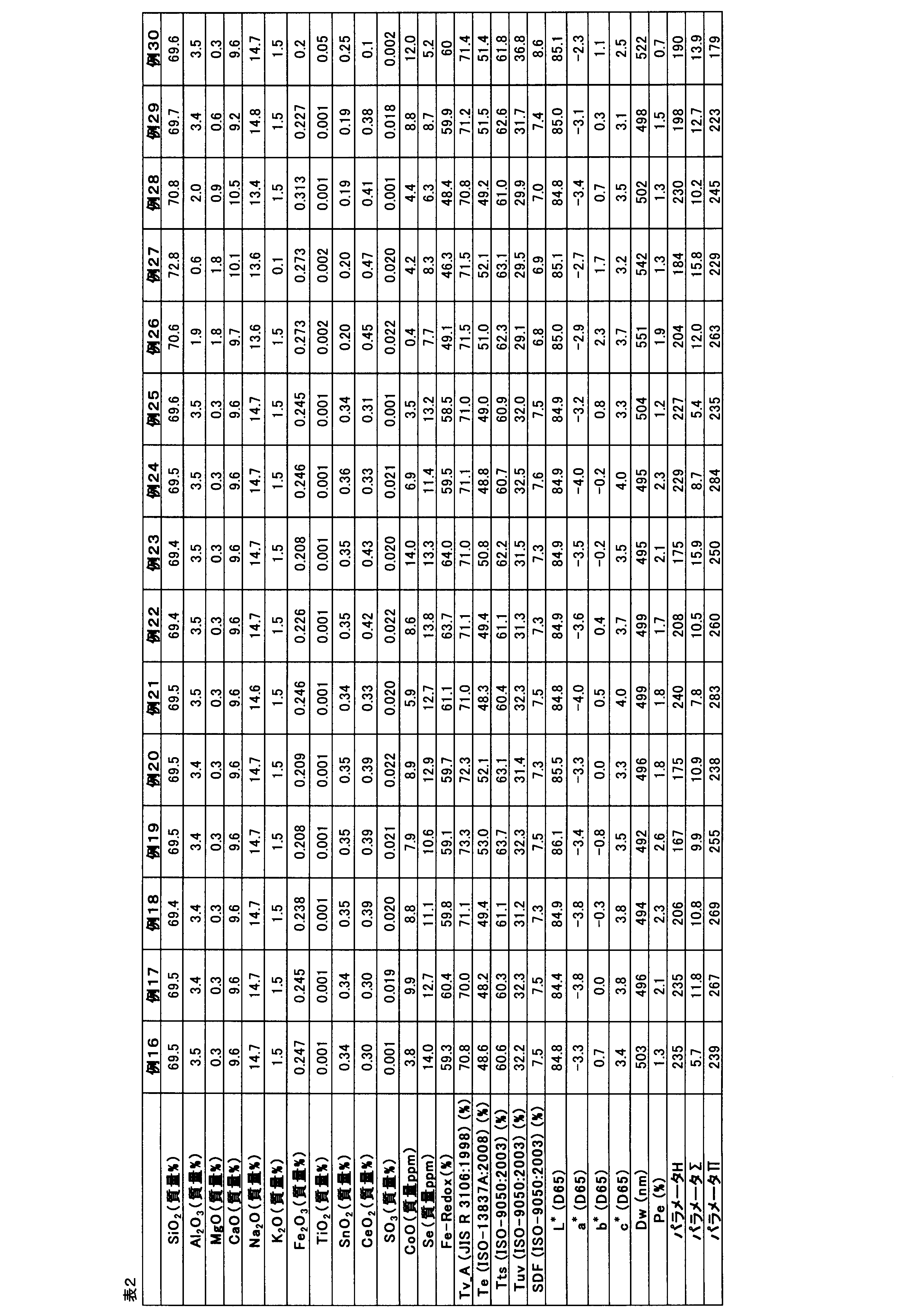
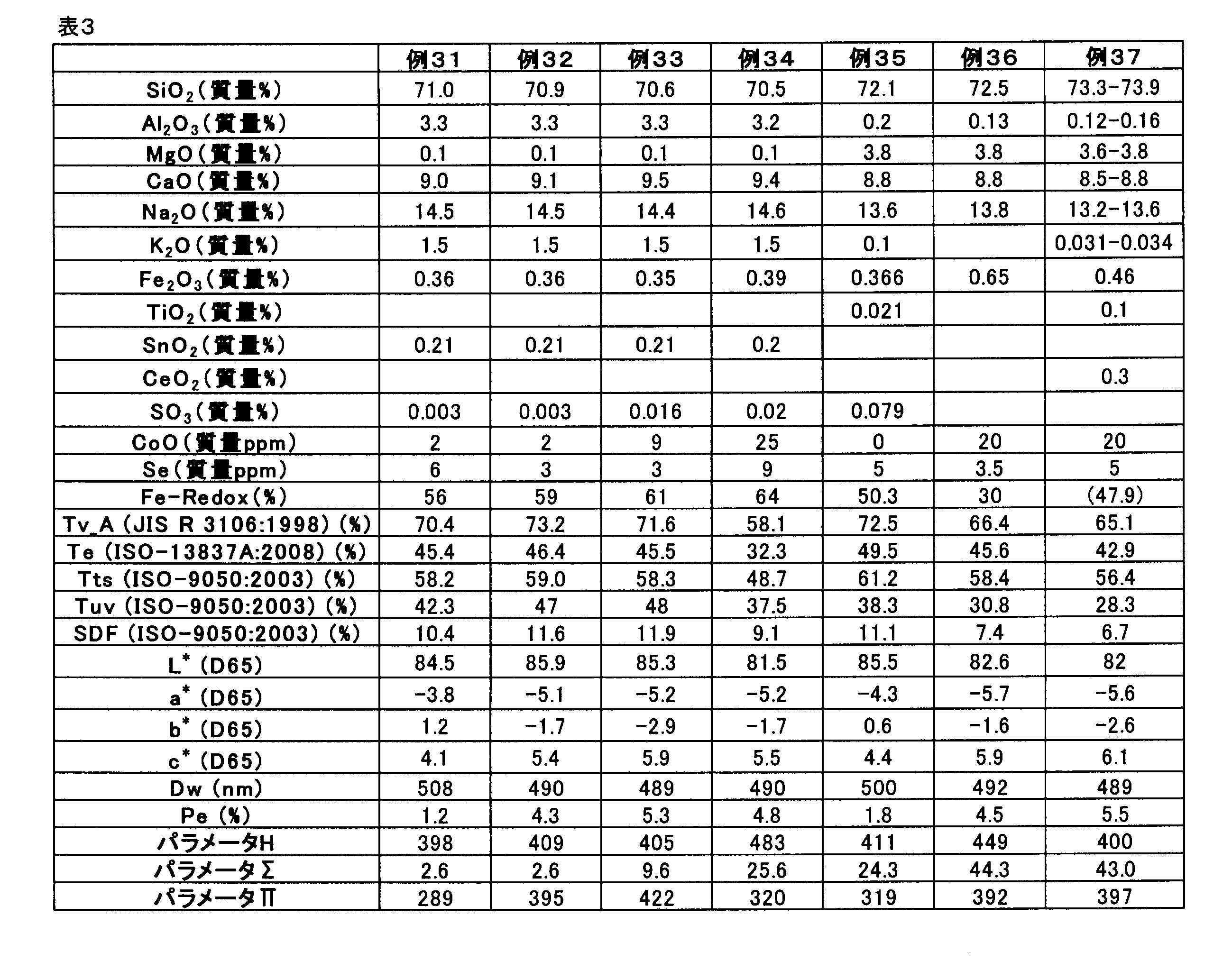
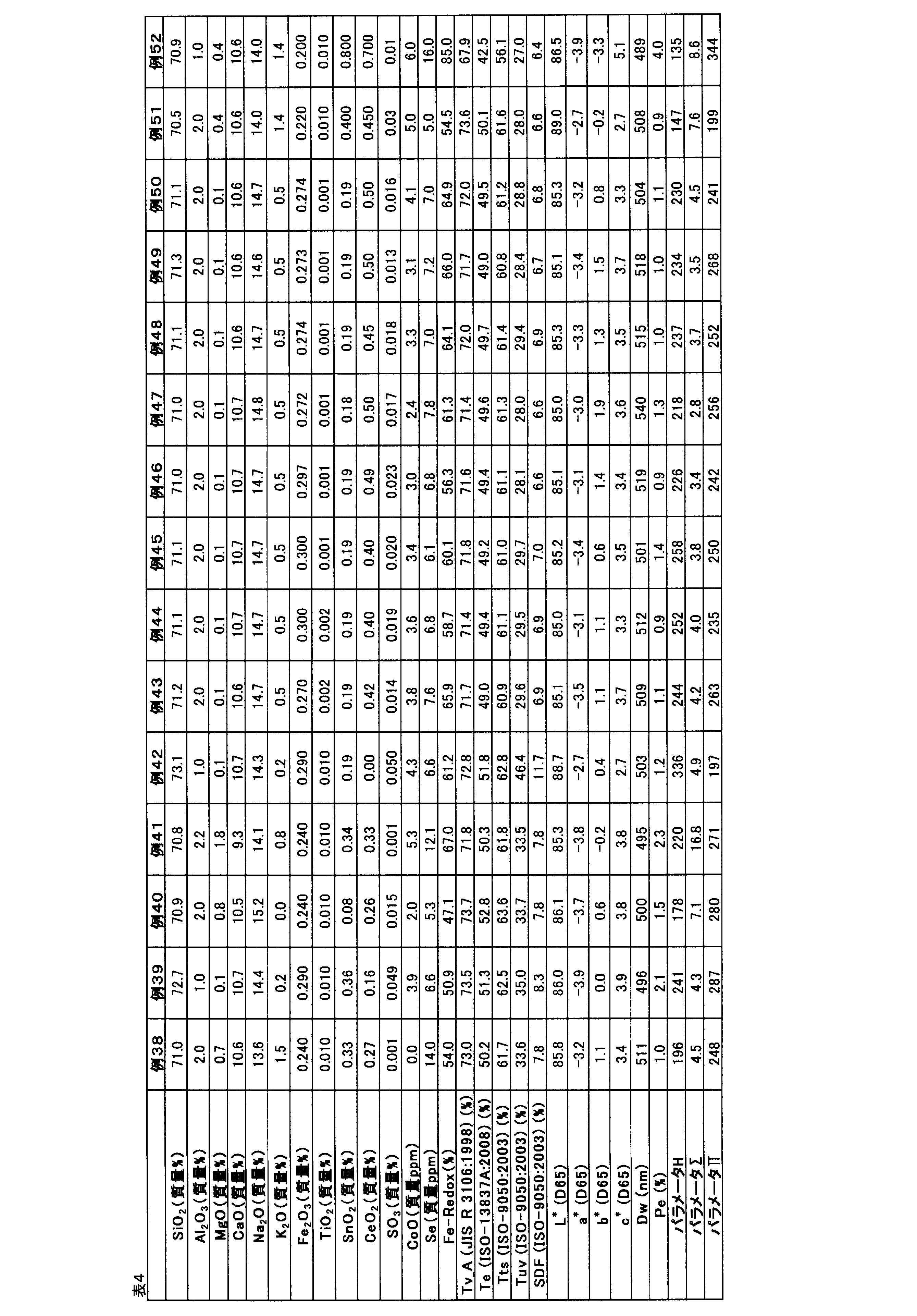
蛍光X線装置(XRF)(リガク社製、ZSX100e)を用いて、上記で得られたガラス板の表面における各成分のX線強度を測定して定量分析を行い、上記組成を確認した。また、分光光度計(Perkin Elmer社製、Lambda950)により1nmごとに透過率を測定し、波長1150nmの透過率からFe-Redoxを算出した。波長1150nmの透過率から決定された2価の鉄の量は、上述のようにFe2O3の質量に換算したうえでFe-Redoxの算出に用いた。また、表に示す光学的特性を求めた。
表1より、例1~30、38~51のソーダライムガラス板は、高い断熱性、すなわち63.7%以下の日射熱取得率Ttsを有しながら、高い可視光透過性を維持し、かつ、4以下のc*値で表されるグレー色を達成していることがわかる。
それに対し、例31~37、52のソーダライムガラス板では、断熱性の基準は満たされているものの、いずれもc*値が4を超えており、望ましい無彩色グレーが達成されていない。また、可視光透過性(例34、36、37、52)、紫外線遮断性(例31~35)や清澄性(例36、37)も不十分であり、自動車等の窓ガラスとして望ましい特性のバランスが得られていない。
それに対し、例31~37、52のソーダライムガラス板では、断熱性の基準は満たされているものの、いずれもc*値が4を超えており、望ましい無彩色グレーが達成されていない。また、可視光透過性(例34、36、37、52)、紫外線遮断性(例31~35)や清澄性(例36、37)も不十分であり、自動車等の窓ガラスとして望ましい特性のバランスが得られていない。
本発明を詳細に、また特定の実施態様を参照して説明したが、本発明の精神と範囲を逸脱することなく様々な変更や修正を加えることができることは当業者にとって明らかである。本出願は2016年10月21日出願の日本特許出願(特願2016-206717)及び2017年5月16日出願の日本特許出願(特願2017-096950)に基づくものであり、その内容はここに参照として取り込まれる。
本発明のソーダライムガラス板は、断熱性、可視光透過性、およびグレー色を兼ね揃えているため、特に自動車等の乗物の窓ガラスとして有用であり、これらの特性が望まれる他の用途にも適用可能である。
Claims (12)
- SO3に換算した全硫黄の含有量が、酸化物基準の質量%表示で0.001~0.2%、
Fe2O3に換算した全鉄の含有量が、酸化物基準の質量%表示で0.15~0.4%、
SnO2に換算した全スズの含有量が、酸化物基準の質量%表示で0.02~1%、及び
Fe2O3に換算した全鉄中のFe2O3に換算した2価の鉄の質量割合が45~70%であり、
JIS R 3106:1998規定の可視光透過率Tv_Aが、ガラス板の3.85mm厚さ換算値で70%以上であり、
ISO-9050:2003規定の日射熱取得率Ttsが、ガラス板の3.85mm厚さ換算値で63.7%以下であり、かつ
JIS Z 8781-4:2013規格のL*a*b*色空間におけるc*が、ガラス板の3.85mm厚さ換算値で4以下である、ソーダライムガラス板。 - Seの含有量が、質量ppm表示で5~20ppmである、請求項1に記載のソーダライムガラス板。
- CoOに換算した全コバルトの含有量が、酸化物基準の質量ppm表示で0~15ppmである、請求項1または2に記載のソーダライムガラス板。
- H={491×[Fe2+]+54.8×[Fe3+]-17.2×[SnO2]-45.2×[CeO2]+130×[SO3]-0.390×[CoO]+0.608×[Se]-3.95}×[厚さ]
(上記式中、[Fe2+]はFe2O3に換算したFe2+の質量%表示での含有量、[Fe3+]はFe2O3に換算したFe3+の質量%表示での含有量、[SnO2]はSnO2に換算した全スズの質量%表示での含有量、[CeO2]はCeO2に換算した全セリウムの質量%表示での含有量、[SO3]はSO3に換算した全硫黄の質量%表示での含有量、[CoO]はCoOに換算した全コバルトの質量ppm表示での含有量、[Se]はセレンの質量ppm表示での含有量、[厚さ]はガラス板のmm表示での厚さを表す。)
と定義されるパラメータHが、
140≦H≦350
の関係を満たす、請求項1~3のいずれか1項に記載のソーダライムガラス板。 - Σ=[CoO]+6.4×[MgO]
(上記式中、[CoO]はCoOに換算した全コバルトの質量ppm表示での含有量、[MgO]はMgOの質量%表示での含有量を表す。)
と定義されるパラメータΣが、
Σ≦25
の関係を満たす、請求項1~4のいずれか1項に記載のソーダライムガラス板。 - ISO-9050:2003規定の紫外線透過率Tuvがガラス板の3.85mm厚さ換算値で35%以下である、請求項1~5のいずれか1項に記載のソーダライムガラス板。
- CeO2に換算した全セリウムの含有量が、酸化物基準の質量%表示で0.1~2.0%である、請求項1~6のいずれか1項に記載のソーダライムガラス板。
- TiO2に換算した全チタンの含有量が、酸化物基準の質量%表示で0.001~0.8%である、請求項1~7のいずれか1項に記載のソーダライムガラス板。
- 酸化物基準の質量%表示で、
SiO2:65~78%、
Al2O3:0~5%、
CaO:5~12%、
MgO:0~10%、
Na2O:5~18%、および
K2O:0~5%を含む、請求項1~8のいずれか1項に記載のソーダライムガラス板。 - JIS Z 8781-4:2013規格のL*a*b*色空間における座標が、ガラス板の3.85mm厚さ換算値で、-4≦a*≦1、かつ-1≦b*≦4である、請求項1~9のいずれか1項に記載のソーダライムガラス板。
- JIS Z 8701:1999規定の刺激純度Peが、ガラス板の3.85mm厚さ換算値で2.5%以下であり、かつJIS Z 8701:1999規定の透過光の主波長Dwがガラス板の3.85mm厚さ換算値で485~565nmである、請求項1~10のいずれか1項に記載のソーダライムガラス板。
- ISO-13837A:2008規定の日射透過率Teがガラス板の3.85mm厚さ換算値で66%以下である、請求項1~11のいずれか1項に記載のソーダライムガラス板。
Priority Applications (5)
| Application Number | Priority Date | Filing Date | Title |
|---|---|---|---|
| EP17862004.3A EP3530628B1 (en) | 2016-10-21 | 2017-10-17 | Soda lime glass sheet |
| JP2018546366A JP7120021B2 (ja) | 2016-10-21 | 2017-10-17 | ソーダライムガラス板 |
| CN201780064274.9A CN109863125B (zh) | 2016-10-21 | 2017-10-17 | 钠钙玻璃板 |
| EA201990769A EA037710B1 (ru) | 2017-05-16 | 2017-10-17 | Известково-натриевое листовое стекло |
| US16/388,208 US11548807B2 (en) | 2016-10-21 | 2019-04-18 | Soda lime glass sheet |
Applications Claiming Priority (4)
| Application Number | Priority Date | Filing Date | Title |
|---|---|---|---|
| JP2016-206717 | 2016-10-21 | ||
| JP2016206717 | 2016-10-21 | ||
| JP2017096950 | 2017-05-16 | ||
| JP2017-096950 | 2017-05-16 |
Related Child Applications (1)
| Application Number | Title | Priority Date | Filing Date |
|---|---|---|---|
| US16/388,208 Continuation US11548807B2 (en) | 2016-10-21 | 2019-04-18 | Soda lime glass sheet |
Publications (1)
| Publication Number | Publication Date |
|---|---|
| WO2018074485A1 true WO2018074485A1 (ja) | 2018-04-26 |
Family
ID=62019356
Family Applications (1)
| Application Number | Title | Priority Date | Filing Date |
|---|---|---|---|
| PCT/JP2017/037587 Ceased WO2018074485A1 (ja) | 2016-10-21 | 2017-10-17 | ソーダライムガラス板 |
Country Status (5)
| Country | Link |
|---|---|
| US (1) | US11548807B2 (ja) |
| EP (1) | EP3530628B1 (ja) |
| JP (1) | JP7120021B2 (ja) |
| CN (1) | CN109863125B (ja) |
| WO (1) | WO2018074485A1 (ja) |
Families Citing this family (3)
| Publication number | Priority date | Publication date | Assignee | Title |
|---|---|---|---|---|
| CN109485252B (zh) * | 2018-06-19 | 2021-09-28 | 原思平 | 一种高透可见光和吸收近红外线的功能玻璃的着色添加剂、应用及功能玻璃 |
| CN112748141A (zh) * | 2020-12-28 | 2021-05-04 | 漳州旗滨玻璃有限公司 | 一种钠钙硅玻璃中硒元素的检测方法 |
| CN116813195A (zh) * | 2023-05-23 | 2023-09-29 | 广东烨嘉光电科技股份有限公司 | 一种光学玻璃和光学硅胶一体成型工艺 |
Citations (4)
| Publication number | Priority date | Publication date | Assignee | Title |
|---|---|---|---|---|
| JP2003502258A (ja) * | 1999-06-11 | 2003-01-21 | ピーピージー・インダストリーズ・オハイオ・インコーポレイテッド | 透過色のシフトが減少した、着色されたガラス組成物及び自動車の可視パネル |
| JP2009507753A (ja) * | 2005-09-08 | 2009-02-26 | ピーピージー・インダストリーズ・オハイオ・インコーポレイテッド | Uv吸収性灰色ガラス組成物 |
| WO2015170759A1 (ja) * | 2014-05-09 | 2015-11-12 | 旭硝子株式会社 | 熱線吸収ガラス板およびその製造方法 |
| WO2016171141A1 (ja) * | 2015-04-23 | 2016-10-27 | 旭硝子株式会社 | 熱線および紫外線吸収ガラス板、ならびにその製造方法 |
Family Cites Families (12)
| Publication number | Priority date | Publication date | Assignee | Title |
|---|---|---|---|---|
| US7071133B2 (en) | 1993-11-16 | 2006-07-04 | Ppg Industries Ohio, Inc. | Colored glass compositions and-automotive vision panels with-reduced transmitted-color shift |
| JP3669019B2 (ja) * | 1994-10-05 | 2005-07-06 | 旭硝子株式会社 | 濃グレー色ガラス |
| JP2001316128A (ja) | 2000-03-02 | 2001-11-13 | Nippon Sheet Glass Co Ltd | 淡色着色高透過ガラスおよびその製造方法 |
| JP2002338298A (ja) * | 2001-05-22 | 2002-11-27 | Central Glass Co Ltd | 紫外線赤外線吸収ガラスおよびその製法 |
| FR2826649B1 (fr) * | 2001-07-02 | 2003-09-19 | Saint Gobain | Composition de verre gris destinee a la fabrication de vitrage |
| US7135425B2 (en) * | 2002-12-13 | 2006-11-14 | Guardian Industries Corp. | Grey glass composition |
| US20090025426A1 (en) * | 2007-07-23 | 2009-01-29 | Guardian Industries Corp. | UV treated grey glass and method of making same |
| MX2011006118A (es) * | 2008-12-08 | 2011-06-28 | Vidrio Plano De Mexico Sa De Cv | Composición de vidrio gris neutro. |
| EP2492248B1 (en) * | 2009-10-22 | 2020-01-15 | AGC Inc. | Heat-ray-absorbing glass plate |
| CN102712524B (zh) | 2010-01-26 | 2016-01-13 | 旭硝子株式会社 | 着色玻璃板 |
| CN103641309B (zh) * | 2013-11-01 | 2018-10-16 | 何开生 | 吸收紫外线和红外线的玻璃组合物及其应用 |
| EP3068738A1 (en) * | 2013-11-16 | 2016-09-21 | Türkiye Sise Ve Cam Fabrikalari A.S. | Privacy glass for vehicles |
-
2017
- 2017-10-17 EP EP17862004.3A patent/EP3530628B1/en active Active
- 2017-10-17 JP JP2018546366A patent/JP7120021B2/ja active Active
- 2017-10-17 WO PCT/JP2017/037587 patent/WO2018074485A1/ja not_active Ceased
- 2017-10-17 CN CN201780064274.9A patent/CN109863125B/zh active Active
-
2019
- 2019-04-18 US US16/388,208 patent/US11548807B2/en active Active
Patent Citations (4)
| Publication number | Priority date | Publication date | Assignee | Title |
|---|---|---|---|---|
| JP2003502258A (ja) * | 1999-06-11 | 2003-01-21 | ピーピージー・インダストリーズ・オハイオ・インコーポレイテッド | 透過色のシフトが減少した、着色されたガラス組成物及び自動車の可視パネル |
| JP2009507753A (ja) * | 2005-09-08 | 2009-02-26 | ピーピージー・インダストリーズ・オハイオ・インコーポレイテッド | Uv吸収性灰色ガラス組成物 |
| WO2015170759A1 (ja) * | 2014-05-09 | 2015-11-12 | 旭硝子株式会社 | 熱線吸収ガラス板およびその製造方法 |
| WO2016171141A1 (ja) * | 2015-04-23 | 2016-10-27 | 旭硝子株式会社 | 熱線および紫外線吸収ガラス板、ならびにその製造方法 |
Non-Patent Citations (1)
| Title |
|---|
| See also references of EP3530628A4 * |
Also Published As
| Publication number | Publication date |
|---|---|
| JP7120021B2 (ja) | 2022-08-17 |
| EP3530628A4 (en) | 2020-06-17 |
| JPWO2018074485A1 (ja) | 2019-08-08 |
| CN109863125A (zh) | 2019-06-07 |
| CN109863125B (zh) | 2022-08-23 |
| US11548807B2 (en) | 2023-01-10 |
| EP3530628A1 (en) | 2019-08-28 |
| US20190241461A1 (en) | 2019-08-08 |
| EP3530628B1 (en) | 2022-08-03 |
Similar Documents
| Publication | Publication Date | Title |
|---|---|---|
| JP6711426B2 (ja) | 紫外線吸収性ガラス物品 | |
| JP6318288B2 (ja) | 濃緑灰色低透過ガラス組成物 | |
| US9249047B2 (en) | Ultraviolet and infrared absorptive glass | |
| US10611671B2 (en) | Heat-ray- and ultraviolet-absorbent glass sheet, and method for manufacturing same | |
| JP7201320B2 (ja) | 紫外線吸収性ガラス物品 | |
| US11548807B2 (en) | Soda lime glass sheet | |
| WO2017209148A1 (ja) | 紫外線遮蔽ガラス板及び該ガラス板を用いた車両用ガラス窓 | |
| CN106458710B (zh) | 热线吸收玻璃板及其制造方法 | |
| JP6627558B2 (ja) | 紫外線吸収ガラス板 | |
| EP3385234A1 (en) | Glass | |
| WO2018117193A1 (ja) | 紫外線吸収性ガラス | |
| KR101062872B1 (ko) | 회색 소다라임 유리 조성물 | |
| JP7127654B2 (ja) | ガラス板 | |
| WO2017217324A1 (ja) | 紫外線吸収性ガラス | |
| WO2017126595A1 (ja) | 紫外線吸収性ガラス | |
| JP2019038710A (ja) | 紫外線吸収ガラス板 | |
| WO2017150684A1 (ja) | 紫外線吸収性ガラス | |
| EA037710B1 (ru) | Известково-натриевое листовое стекло |
Legal Events
| Date | Code | Title | Description |
|---|---|---|---|
| 121 | Ep: the epo has been informed by wipo that ep was designated in this application |
Ref document number: 17862004 Country of ref document: EP Kind code of ref document: A1 |
|
| ENP | Entry into the national phase |
Ref document number: 2018546366 Country of ref document: JP Kind code of ref document: A |
|
| NENP | Non-entry into the national phase |
Ref country code: DE |
|
| ENP | Entry into the national phase |
Ref document number: 2017862004 Country of ref document: EP Effective date: 20190521 |