WO2018075434A1 - Soil treatment - Google Patents
Soil treatment Download PDFInfo
- Publication number
- WO2018075434A1 WO2018075434A1 PCT/US2017/056857 US2017056857W WO2018075434A1 WO 2018075434 A1 WO2018075434 A1 WO 2018075434A1 US 2017056857 W US2017056857 W US 2017056857W WO 2018075434 A1 WO2018075434 A1 WO 2018075434A1
- Authority
- WO
- WIPO (PCT)
- Prior art keywords
- soil
- ppm
- paa
- peracetic acid
- acid
- Prior art date
- Legal status (The legal status is an assumption and is not a legal conclusion. Google has not performed a legal analysis and makes no representation as to the accuracy of the status listed.)
- Ceased
Links
Classifications
-
- A—HUMAN NECESSITIES
- A01—AGRICULTURE; FORESTRY; ANIMAL HUSBANDRY; HUNTING; TRAPPING; FISHING
- A01N—PRESERVATION OF BODIES OF HUMANS OR ANIMALS OR PLANTS OR PARTS THEREOF; BIOCIDES, e.g. AS DISINFECTANTS, AS PESTICIDES OR AS HERBICIDES; PEST REPELLANTS OR ATTRACTANTS; PLANT GROWTH REGULATORS
- A01N37/00—Biocides, pest repellants or attractants, or plant growth regulators containing organic compounds containing a carbon atom having three bonds to hetero atoms with at the most two bonds to halogen, e.g. carboxylic acids
- A01N37/16—Biocides, pest repellants or attractants, or plant growth regulators containing organic compounds containing a carbon atom having three bonds to hetero atoms with at the most two bonds to halogen, e.g. carboxylic acids containing the group; Thio analogues thereof
-
- A—HUMAN NECESSITIES
- A01—AGRICULTURE; FORESTRY; ANIMAL HUSBANDRY; HUNTING; TRAPPING; FISHING
- A01M—CATCHING, TRAPPING OR SCARING OF ANIMALS; APPARATUS FOR THE DESTRUCTION OF NOXIOUS ANIMALS OR NOXIOUS PLANTS
- A01M17/00—Apparatus for the destruction of vermin in soil or in foodstuffs
- A01M17/002—Injection of toxic gases or fluids into the soil
-
- A—HUMAN NECESSITIES
- A01—AGRICULTURE; FORESTRY; ANIMAL HUSBANDRY; HUNTING; TRAPPING; FISHING
- A01N—PRESERVATION OF BODIES OF HUMANS OR ANIMALS OR PLANTS OR PARTS THEREOF; BIOCIDES, e.g. AS DISINFECTANTS, AS PESTICIDES OR AS HERBICIDES; PEST REPELLANTS OR ATTRACTANTS; PLANT GROWTH REGULATORS
- A01N59/00—Biocides, pest repellants or attractants, or plant growth regulators containing elements or inorganic compounds
-
- A—HUMAN NECESSITIES
- A61—MEDICAL OR VETERINARY SCIENCE; HYGIENE
- A61L—METHODS OR APPARATUS FOR STERILISING MATERIALS OR OBJECTS IN GENERAL; DISINFECTION, STERILISATION OR DEODORISATION OF AIR; CHEMICAL ASPECTS OF BANDAGES, DRESSINGS, ABSORBENT PADS OR SURGICAL ARTICLES; MATERIALS FOR BANDAGES, DRESSINGS, ABSORBENT PADS OR SURGICAL ARTICLES
- A61L2/00—Disinfection or sterilisation of materials or objects, in general; Accessories therefor
- A61L2/16—Disinfection or sterilisation of materials or objects, in general; Accessories therefor using chemical substances
- A61L2/18—Liquid substances
- A61L2/186—Peroxide solutions
-
- A—HUMAN NECESSITIES
- A61—MEDICAL OR VETERINARY SCIENCE; HYGIENE
- A61L—METHODS OR APPARATUS FOR STERILISING MATERIALS OR OBJECTS IN GENERAL; DISINFECTION, STERILISATION OR DEODORISATION OF AIR; CHEMICAL ASPECTS OF BANDAGES, DRESSINGS, ABSORBENT PADS OR SURGICAL ARTICLES; MATERIALS FOR BANDAGES, DRESSINGS, ABSORBENT PADS OR SURGICAL ARTICLES
- A61L2103/00—Materials or objects being the target of disinfection or sterilisation
- A61L2103/05—Living organisms or biological materials
Definitions
- the present invention relates to compositions and methods for soil disinfection.
- the compositions and methods are useful against a variety of plant pathogens, including nematodes, bacteria, and fungi.
- methyl bromide (CH 3 Br) had been the most widely used and most universal fumigant in the world. It is known for being extremely effective as a nematicide, insecticide, fungicide, and herbicide. Methyl bromide has been used extensively as a soil fumigant, a commodity quarantine treatment for exports and imports, as a pesticide on numerous crops, and as a structural fumigant applied to building surfaces. However, methyl bromide has contributed to the depletion of the ozone layer in the stratosphere. In accord with the Montreal Protocol, the import and manufacture of methyl bromide in the United States and other developed countries was banned in 2005. For developing countries, the reductions were more gradual and the phase-out was delayed until 2015.
- US 5, 168,655 discloses an aqueous solution comprising peracetic acid being made in-situ by mixing acetic acid, hydrogen peroxide, 2,6-pyridine dicarboxylic acid, dodecyl benzene sulphonic acid, and water.
- the solution is used in an irrigation system to partially control bacteria, fungal, spores, yeast, and molds in hydroponic substrates.
- US 5,168,655 requires that the substrate contain only a minimal amount of organic matter because excessive amounts of organic matter, such as those in soil, are believed to inactivate the peracetic acid.
- Aromatic alkyl sulphonic acid specifically odecyl benzene sulphonic acid, is disclosed as a wetting agent in the solution in US 5, 168,655.
- EP 0035800 discloses an aqueous solution containing hydrogen peroxide and/or peracids having 1 to 4 carbon as soil treatment agent to control phytopathogenic harmful organisms, such as fungi, bacteria, and nematodes.
- the present invention relates to and aqueous composition
- a peracid can be peracetic acid.
- the peracetic acid can be an aqueous equilibrium solution comprising a weight ratio of peracetic acid : hydrogen peroxide between 1 : 0.01 to 1 : 14 and a weight ratio of peracetic acid : acetic acid between 1 : 0.2 to 1 : 19.
- the peracetic acid concentration can be from about 3000 ppm to about 25,000 ppm.
- the polyoxyethylene alkylether carboxylic acid concentration can be from about 250 ppm to about 25,000 ppm.
- the peracid can be peracetic acid.
- the pathogenic microorganism can be a nematode, bacteria, or fungus.
- the agricultural medium can include soil, sand, or a synthetic growth medium.
- the agricultural medium can be contacted with the composition by spraying, drenching, injecting, sprinkling, or infusing the composition into the agricultural medium.
- the aqueous solution is applied at about 1.5 mL/cm 2 of agricultural medium.
- machine When only a single machine is illustrated, the term “machine” shall also be taken to include any collection of machines that individually or jointly execute a set (or multiple sets) of instructions to perform any one or more of the methodologies discussed herein.
- means-plus-function clauses if used, are intended to cover the structures described, suggested, or rendered obvious by the written description or drawings for performing the recited function, including not only structural equivalents but also equivalent structures.
- the present invention is directed to formulations for treatment of soil to control plant parasitic nematodes and soil-borne plant pathogens, for example, bacteria and fungi.
- the formulations include (i) peracids, such as peracetic acid and (ii) anionic surfactants, such as capryleth-9 carboxylic acid.
- peracids such as peracetic acid
- anionic surfactants such as capryleth-9 carboxylic acid.
- Peracetic acid is typically employed in the form of an aqueous equilibrium mixture of acetic acid (AA), hydrogen peroxide (H2O2) and peracetic acid (PAA). The weight ratios of these components may vary greatly, depending upon the particular grade of PAA employed.
- grades of PAA which may be employed are those having a weight ratio of PAA : hydrogen peroxide between 1 : 0.01 to 1 : 14 and a weight ratio of PAA : acetic acid between 1 : 0.2 to 1 : 19.
- Commercially available peracetic acid solutions include 5% PAA with 22% H2O2 and 10.5% AA, 15% PAA with 10% H2O2 and 35% AA, 15% PAA with 23% H2O2 and 16% AA, 22% PAA with 10% H2O2 and 35% AA, and 35% PAA with 6.5% H2O2 and 40% AA.
- the anionic surfactant can be a polyoxyethylene alkylether carboxylic acid, or a related anionic surfactant, including, for example, polyoxyethylene octyl ether carboxylic acid, polyoxyethylene(8) octyl ether carboxylic acid, poly oxy ethyl ene(10) oleyl ether carboxylic acid, polyoxyethylene(lO) lauryl ether carboxylic acid, polyoxyethylene(3) lauryl ether carboxylic acid, polyoxyethylene(5) lauryl ether carboxylic acid, polyoxyethylene(7) lauryl ether carboxylic acid, polyoxyethylene(2) oleyl ether carboxylic acid, polyoxyethylene(5) oleyl ether carboxylic acid, polyoxyethylene(9) oleyl ether carboxylic acid, and salts of above said polyoxyethylene alkylether carboxylic acids in sodium, potassium, or other cation forms.
- the anionic surfactant is polyoxyethylene alkylether carboxylic acid
- compositions of the invention can include a peracid, for example peracetic acid, and an anionic surfactant, for example, capryleth-9- carboxylic acid (C9CA).
- a peracid for example peracetic acid
- an anionic surfactant for example, capryleth-9- carboxylic acid (C9CA).
- the peracid and the anionic surfactant can be diluted with water to the desired concentrations and combined at the point of use.
- the peracid and the anionic surfactants can be combined to form a mixture and the mixture can be diluted with water before use.
- the peracid and the anionic surfactant can be combined and stored before use or they can be combined and used directly.
- compositions employed in the formulation of the invention can further include or exclude sequestriants such as dipicolinic acid and 1 -hydroxy ethylidene -1, 1,- diphosphonic acid, as well as other ingredients such as mineral acid catalysts (sulfuric, nitric, or phosphoric acids); and short chain fatty esters (C6-C12) forming mixed peracids in solution.
- sequestriants such as dipicolinic acid and 1 -hydroxy ethylidene -1, 1,- diphosphonic acid
- other ingredients such as mineral acid catalysts (sulfuric, nitric, or phosphoric acids); and short chain fatty esters (C6-C12) forming mixed peracids in solution.
- compositions employed in the formulation of the invention may further include or exclude one or more additional oxidants selected from the group consisting of chloroperbenzoic acid, perheptanoic acid, peroctanoic acid, perdecanoic acid, performic acid, percitric acid, perglycolic acid, perlactic acid and perbenzoic acid.
- additional oxidants selected from the group consisting of chloroperbenzoic acid, perheptanoic acid, peroctanoic acid, perdecanoic acid, performic acid, percitric acid, perglycolic acid, perlactic acid and perbenzoic acid.
- compositions are diluted into water before use, and the diluted formulation can be applied using application techniques and equipment for soil fumigants in liquid form, such as trench applications, handgun applications, shank (chisel) applications, sweep or blade applications, drench application, and chemigation.
- application techniques and equipment for soil fumigants in liquid form such as trench applications, handgun applications, shank (chisel) applications, sweep or blade applications, drench application, and chemigation.
- the present formulations may be used to control plant parasitic nematodes and soil-borne plant pathogens of bacteria and fungi.
- Exemplary plant parasitic nematodes include root knot nematodes such as Meloidogyne hapla, Meloidogyne incognita, Meloidogyne enterolobii and Meloidogyne mayaguensis; cyst nematodes such as soybean cyst nematodes (Heterodera glycines); potato cyst nematodes (Globodera pallida and G. rostochiensis) and cereal cyst nematodes (Heterodera avenae and H.
- root knot nematodes such as Meloidogyne hapla, Meloidogyne incognita, Meloidogyne enterolobii and Meloidogyne mayaguensis
- cyst nematodes such as soybean cyst nematodes
- root lesion nematodes such as (Pratylenchus spp., including P. penetrans, P. thornei, P. neglectus, P. zeae, P. vulnus and P. coffeae; and the burrowing nematode, Radopholus similis.
- Exemplary soil bacteria include Bacillus species, for example Bacillus mycoides.
- Exemplary soil fungi include Aspergillus species, for example Aspergillus niger.
- Peracetic acid formulations were evaluated for nematocidal and bactericidal activity. Formaldehyde was used as a positive control. The test conditions are described below and the results are summarized in Tables 1, 2, and 3. [0021] Test method: A peracetic acid stock solution containing 5% PAA and 22% H2O2 (VigorOx® from PeroxyChem, LLC) was used for methods that specified 1750 ppm PAA. A peracetic acid stock solution containing 15% PAA and 10% H2O2 (VigorOx SP-15) was used for methods that specified 3525 ppm PAA. A stock solution of formaldehyde (37% in 10-15%) methanol) was used to prepare a 1%> aqueous solution of formaldehyde (with about 0.3%> methanol).
- the Root-knot Nematode Egg Hatch Assay was carried out essentially as follows. Eggs were collected from roots of infected tomato plants. To release the eggs, the egg masses were placed in a solution of sodium hypochlorite and manually shaken. The solution was centrifuged and the eggs washed with distilled water. Eggs were kept in the dark until needed for the experiments and used in the same day of collection. The experiments were performed in pots filled with pasteurized soil inoculated with about several thousands of individual eggs and then drenched with each treatment solution and controls. The treated soils were covered and incubated for the time periods indicated below. Following the incubation period, the soils were transferred to collect hatched J2 (second stage juveniles). The collected material was observed under the microscope and the number of J2 counted.
- Root Knot Nematode Egg Hatch Assay The results of the Root Knot Nematode Egg Hatch Assay are shown in Table 2. Seedlings were inoculated and cultured in pasteurized Pemberton soil for 14 days. Seedlings were then treated with either formaldehyde, 1750 ppm PAA or 3525 ppm PAA for 13 days. Nematode eggs were extracted from infected roots and their ability to hatch was evaluated. As shown in Table 2, treatment of soil with 3525 ppm PAA resulted in a 51% reduction of the J2 (second stage juvenile) population relativity to control. Treatment of soil with 1750 ppm PAA did not reduce the J2 population relative to untreated controls. Treatment with 1% formaldehyde resulted in a 78% reduction relative to untreated controls.
- Peracetic acid formulations were evaluated for nematocidal activity either alone or in combination with C9CA.
- Formaldehyde was used as a positive control.
- Test method A peracetic acid stock solution containing 15% PAA and 10% H2O2 (VigorOx SP-15) was used for methods that specified 3750, 5000, 7500, 10000 ppm PAA. Capryleth-9 carboxylic acid (C9CA) was used at concentrations of 5000 and 10000 ppm. A stock solution of formaldehyde (37% in 10-15%> methanol) was used to prepare a 1%> aqueous solution of formaldehyde. The final methanol concentration was about 0.3%>.
- Root Knot Nematode Egg Hatch Assay The results of the Root Knot Nematode Egg Hatch Assay are shown in Table 4. Seedlings were inoculated and cultured for 22 days and then treated for 21 days with either PAA alone at various concentrations, C9CA alone at various concentrations, or a combination of PAA and C9CA. Nematode eggs were extracted from infected roots and their ability to hatch was evaluated.
- Example 2 As shown in Example 2, PAA alone at a dosage between 3500 to 10000 ppm provided a moderate reduction in J2 nematode population in soil, which is consistent with the result in Example 1.
- C9CA provided minimal nematicidal activity when used alone at either 5000 ppm or 10000 ppm. When PAA and C9CA were used together, the effect on reduction of nematode population was substantially greater than the effect of either agent alone. PAA alone at 5000 ppm produced a 20% reduction in egg hatch. C9CA alone did not reduce the nematode population.
- Peracetic acid formulations were evaluated for nematocidal activity either alone or in combination with C9CA. Distilled water was used as a control in order to calculate the percentage of egg hatch that occurred in untreated soil.
- Test method A peracetic acid stock solution containing 15% PAA and 10% H2O2 (VigorOx SP-15) was used for methods that specified 3500 and 20,000 ppm PAA.
- Root Knot Nematode Egg Hatch Assay The results of the Root Knot Nematode Egg Hatch Assay are shown in Table 5. Seedlings were inoculated and cultured for 22 days and then treated for 21 days with either PAA alone at various concentrations, C9CA alone at various concentrations, or a combination of PAA and C9CA. Nematode eggs were extracted from infected roots and their ability to hatch was evaluated.
- Soil treatment with 3500 ppm PAA +250 ppm C9CA reduced egg hatching to 45% of distilled water treated control levels.
- Soil treatment at higher doses, (20000 ppm PAA +10000 ppm C9CA) reduced the percentage of egg hatching to only 11%) of distilled water treated controls. This synergistic effect was unexpected.
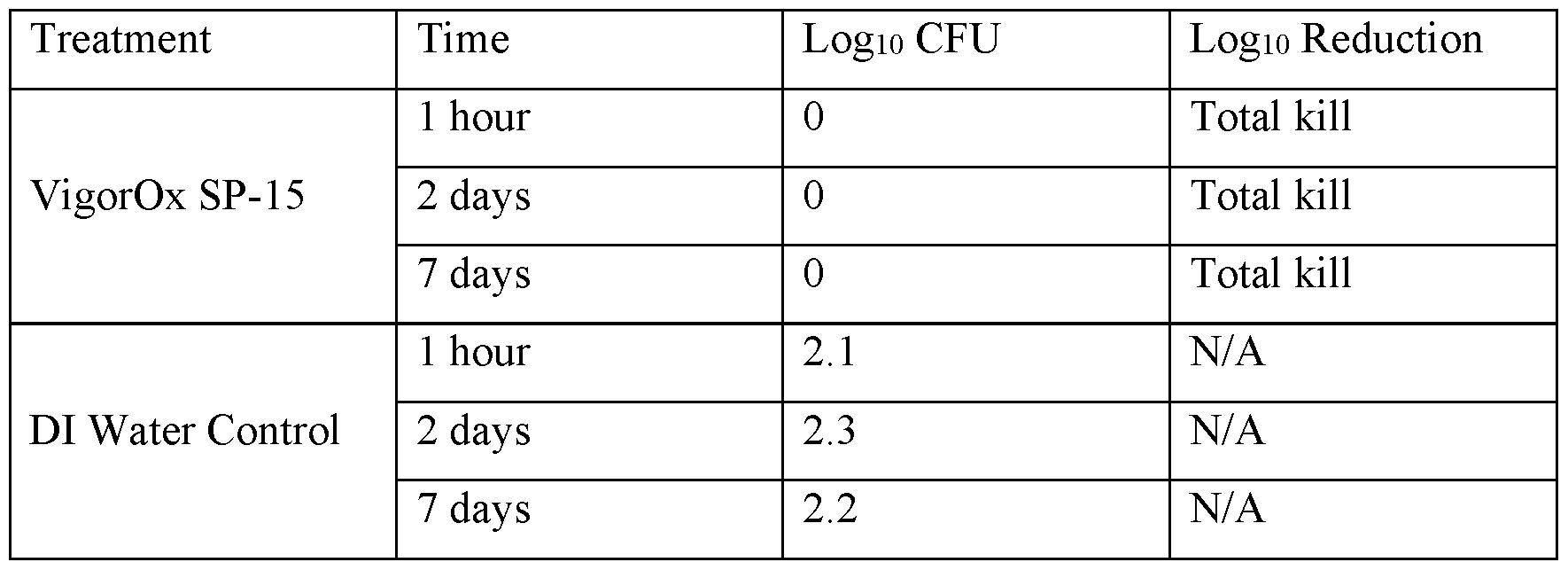
- Test method A peracetic acid stock solution containing 15% PAA and 10% H2O2 (VigorOx SP-15) was used for methods that specified 3525 ppm PAA. Deionized water was used as a control.
- soil was scooped from the cell and measured into a sterile plastic centrifuge tube. Deionized water was then added to each soil sample. The tubes were then capped, shaken to suspend soil, and vortexed at maximum speed using the lab vortex. The samples were allowed to settle for several seconds, and then 2 mL of fluid was removed from the tube. One ml of the removed sample was diluted in 9 mL Butterfi eld's buffer. The remainder of the removed sample was plated onto Petrifilm APC. The diluted sample was further serially diluted and plated on APC. The plates were all incubated at 30 ⁇ 2°C for 2-5 days and then colonies on the plates were counted.
- PAA was evaluated either alone or in combination with C9CA for fungicidal activity.
- Test method A peracetic acid stock solution containing 15% PAA and 10% H2O2 (VigorOx SP-15) was used for methods that specified 3500 and 20,000 ppm PAA.
- Solutions were applied as a soil drench with an application volume of 1.5 ml/cm 2 .
- the Test Medium was pasteurized Pemberton soil.
- the spore inoculum was Aspergillus niger ATCC 16404.
- the fungicidal activity of the compositions was evaluated as follows: Soil was pasteurized to remove background microbial content. The soil was the filled into test cells. Aspergillus niger ATCC 16404 was grown on Potato Dextrose Agar (PDA) plates for 5 days at 35°C.
- a culture for test was prepared by washing a plate with Butterfield's buffer, grinding in a sterile tissue grinder, and filtering through a cell filter to remove hyphae and debris.
- the suspension was diluted 1 : 100 in Butterfield's buffer and was added to the soil as the inoculum.
- the inoculum was enumerated on Petrifilm APC to determine the titer.
- soil was scooped from the cell and weighed into a sterile plastic cup.
- Sterile deionized water was added to the cup using a serological pipette.
- the cups were then capped, shaken to suspend soil, and vortexed at maximum speed using the lab vortex.
- the samples were allowed to settle for several seconds, and then 2 mL of fluid was removed from the tube.
- One ml of the removed fluid was diluted in 9 mL Butterfi eld's buffer.
- the remaining removed fluid was plated onto Petrifilm Petrifilm YM.
- the diluted sample was further serially diluted and plated to 10 "3 on YM.
- the plates were all incubated at 35 ⁇ 2°C for 3 to 4 days and colonies were counted.
- PAA alone provided a Logio reduction of more than 2 at even at the short treatment time of one hour. Aspergillus niger was completely eliminated after 24 hrs of treatment. Doubling the PAA dosage to 7000 ppm resulted in complete elimination even after only one hour of treatment.
Landscapes
- Life Sciences & Earth Sciences (AREA)
- Health & Medical Sciences (AREA)
- General Health & Medical Sciences (AREA)
- Pest Control & Pesticides (AREA)
- Environmental Sciences (AREA)
- Zoology (AREA)
- Wood Science & Technology (AREA)
- Engineering & Computer Science (AREA)
- Agronomy & Crop Science (AREA)
- Plant Pathology (AREA)
- Dentistry (AREA)
- Chemical & Material Sciences (AREA)
- Soil Sciences (AREA)
- Public Health (AREA)
- Animal Behavior & Ethology (AREA)
- Veterinary Medicine (AREA)
- Epidemiology (AREA)
- General Chemical & Material Sciences (AREA)
- Chemical Kinetics & Catalysis (AREA)
- Food Science & Technology (AREA)
- Insects & Arthropods (AREA)
- Inorganic Chemistry (AREA)
- Agricultural Chemicals And Associated Chemicals (AREA)
Abstract
Description



Claims
Priority Applications (7)
| Application Number | Priority Date | Filing Date | Title |
|---|---|---|---|
| CA3041034A CA3041034A1 (en) | 2016-10-18 | 2017-10-17 | Soil treatment |
| TNP/2019/000123A TN2019000123A1 (en) | 2016-10-18 | 2017-10-17 | Soil treatment |
| EP17861784.1A EP3528629A4 (en) | 2016-10-18 | 2017-10-17 | SOIL TREATMENT |
| MX2019004547A MX2019004547A (en) | 2016-10-18 | 2017-10-17 | SOIL TREATMENT. |
| CN201780078220.8A CN110087464B (en) | 2016-10-18 | 2017-10-17 | Soil treatment |
| BR112019007845-2A BR112019007845A2 (en) | 2016-10-18 | 2017-10-17 | soil treatment |
| IL266098A IL266098A (en) | 2016-10-18 | 2019-04-17 | Soil treatment |
Applications Claiming Priority (2)
| Application Number | Priority Date | Filing Date | Title |
|---|---|---|---|
| US201662409525P | 2016-10-18 | 2016-10-18 | |
| US62/409,525 | 2016-10-18 |
Publications (1)
| Publication Number | Publication Date |
|---|---|
| WO2018075434A1 true WO2018075434A1 (en) | 2018-04-26 |
Family
ID=61902068
Family Applications (1)
| Application Number | Title | Priority Date | Filing Date |
|---|---|---|---|
| PCT/US2017/056857 Ceased WO2018075434A1 (en) | 2016-10-18 | 2017-10-17 | Soil treatment |
Country Status (9)
| Country | Link |
|---|---|
| US (2) | US20180103638A1 (en) |
| EP (1) | EP3528629A4 (en) |
| CN (1) | CN110087464B (en) |
| BR (1) | BR112019007845A2 (en) |
| CA (1) | CA3041034A1 (en) |
| IL (1) | IL266098A (en) |
| MX (1) | MX2019004547A (en) |
| TN (1) | TN2019000123A1 (en) |
| WO (1) | WO2018075434A1 (en) |
Families Citing this family (5)
| Publication number | Priority date | Publication date | Assignee | Title |
|---|---|---|---|---|
| CA3067360A1 (en) | 2017-06-15 | 2018-12-20 | Peroxychem Llc | Antimicrobial treatment of animal carcasses and food products |
| US11597664B2 (en) | 2017-11-20 | 2023-03-07 | Evonik Operations Gmbh | Disinfection method for water and wastewater |
| AU2019222745B2 (en) | 2018-02-14 | 2021-11-04 | Evonik Operations Gmbh | Treatment of cyanotoxin-containing water |
| KR102658089B1 (en) | 2018-05-31 | 2024-04-16 | 에보닉 오퍼레이션스 게엠베하 | Sporogenic methods and compositions |
| CN111727807B (en) * | 2020-07-23 | 2022-03-22 | 薛力云 | Continuous cropping pretreatment method for bamboo fungus |
Citations (11)
| Publication number | Priority date | Publication date | Assignee | Title |
|---|---|---|---|---|
| EP0035800A2 (en) | 1980-02-02 | 1981-09-16 | Norddeutsche Affinerie Ag | Soil treating agent |
| US5168655A (en) | 1988-09-29 | 1992-12-08 | Albright & Wilson Limited | Hydroponic crop production |
| US5607856A (en) * | 1993-12-01 | 1997-03-04 | High Desert Research Group, Inc. | Soil treatment for agriculture |
| WO2000027964A1 (en) | 1998-11-10 | 2000-05-18 | The Procter & Gamble Company | Processes of soaking fabrics |
| US6168808B1 (en) | 1997-04-24 | 2001-01-02 | Chemoxal Sa | Synergistic composition of peracetic acid and amine oxide |
| US20030129254A1 (en) * | 2001-07-13 | 2003-07-10 | Saraya Co., Ltd., A Japanese Corporation | Bactericidal/disinfectant peracetic and acid composition |
| US20050152991A1 (en) | 2004-01-09 | 2005-07-14 | Ecolab Inc. | Medium chain peroxycarboxylic acid compositions |
| US20070010420A1 (en) | 2005-07-06 | 2007-01-11 | Ecolab | Surfactant peroxycarboxylic acid compositions |
| WO2007125101A1 (en) | 2006-04-27 | 2007-11-08 | Centennial Ventures B.V. | Low foaming enhanced biocidal hydrogen peroxide composition |
| US20100279906A1 (en) * | 2007-09-17 | 2010-11-04 | Byotrol Plc | Formulations comprising an anti-microbial composition |
| WO2016206729A1 (en) | 2015-06-23 | 2016-12-29 | Ecolab Usa Inc. | An aqueous antimicrobial film-forming composition for teat treatment by spray application |
Family Cites Families (63)
| Publication number | Priority date | Publication date | Assignee | Title |
|---|---|---|---|---|
| US5122538A (en) | 1990-07-23 | 1992-06-16 | Ecolab Inc. | Peroxy acid generator |
| US5200189A (en) * | 1991-07-23 | 1993-04-06 | Ecolab Inc. | Peroxyacid antimicrobial composition |
| US5632676A (en) | 1993-10-12 | 1997-05-27 | Fmc Corporation | Use of peracetic acid to sanitize processed fowl |
| US5439663A (en) | 1994-08-01 | 1995-08-08 | Fmc Corporation | Method for producing Caro's acid |
| US5518692A (en) * | 1994-10-20 | 1996-05-21 | The Regents Of The University Of California | Methyl iodide as a soil fumigant |
| US6090297A (en) | 1995-06-16 | 2000-07-18 | Fmc Corporation | Method for treating tailing slurries with Caro's acid |
| US5849985A (en) | 1997-01-14 | 1998-12-15 | Fmc Corporation | Use of persulfate to destroy haloform |
| US6028104A (en) | 1997-01-30 | 2000-02-22 | Ecolab Inc. | Use of peroxygen compounds in the control of hairy wart disease |
| FR2759911B1 (en) | 1997-02-26 | 1999-12-17 | Chemoxal Sa | DISINFECTANT COMPOSITION BASED ON PERACETIC ACID AND A NON-IONIC SURFACTANT |
| US5977403A (en) | 1997-08-04 | 1999-11-02 | Fmc Corporation | Method for the production of lower organic peracids |
| CN1208558A (en) * | 1998-07-28 | 1999-02-24 | 迟东明 | Method for preventing and treating disease of crops by using peroxyacetic acid |
| US6365099B1 (en) | 1998-11-12 | 2002-04-02 | Fmc Corporation | In situ gas scrubbing method and system for odor and corrosion control in wastewater collection systems |
| EP1143799B1 (en) | 1999-01-19 | 2003-04-02 | SteriFx, Inc. | Multi-purpose acid compositions |
| EP1438380A4 (en) | 2001-08-07 | 2004-12-08 | Fmc Corp | High retention sanitizer systems |
| AU2003280419A1 (en) | 2002-06-26 | 2004-01-19 | Fmc Corporation | Oxidation of organic compounds |
| CA2519793A1 (en) | 2003-03-03 | 2004-09-16 | Adventus Intellectual Property Inc. | Composite material for a permeable reactive barrier |
| JP2007521940A (en) | 2003-07-29 | 2007-08-09 | エフ エム シー コーポレーション | Treatment of environmental pollutants |
| DK1647529T3 (en) | 2003-08-22 | 2015-12-21 | Peroxychem Spain S L U | Sewage Purification Procedure |
| PL1720802T3 (en) | 2004-02-26 | 2013-12-31 | Fmc Corp | Oxidation of organic compounds at high ph |
| US7927635B2 (en) * | 2004-11-30 | 2011-04-19 | Redox Chemicals, Inc. | Nematicides from Juglandaceae and methods of use thereof |
| JP2009529479A (en) | 2005-08-31 | 2009-08-20 | エフ エム シー コーポレーション | Autooxidation of hydrogen peroxide by hydrogenation in a microreactor |
| ATE540000T1 (en) | 2005-08-31 | 2012-01-15 | Fmc Corp | AUTOXIDATIVE PRODUCTION OF HYDROGEN PEROXIDE USING OXIDATION IN A MICROREACTOR |
| CA2625080C (en) | 2005-10-20 | 2014-08-05 | Fmc Corporation | Oxidation of organic compounds |
| MX2009006649A (en) | 2006-12-22 | 2009-08-12 | Fmc Corp | IMPROVED PERACETIC ACID COMPOSITION. |
| UY30962A1 (en) | 2007-03-15 | 2009-09-30 | RECOVERY OF WATERPROOF HYDROGEN PEROXIDE IN THE PRODUCTION OF H2O2 BY AUTOXIDATION | |
| CA2629987C (en) | 2007-04-30 | 2017-02-14 | Fmc Corporation | Flue gas desulfurization process utilizing hydrogen peroxide |
| US7947745B1 (en) | 2007-10-09 | 2011-05-24 | Fritz Industries, Inc | Reducing the viscosity of an aqueous fluid |
| EP2238106A2 (en) | 2008-02-04 | 2010-10-13 | FMC Corporation | Rapid dilution of peracid solutions to equilibrated solutions |
| CA2746736C (en) | 2008-12-18 | 2017-08-01 | Fmc Corporation | Peracetic acid oil-field biocide and method |
| WO2010088594A2 (en) | 2009-02-02 | 2010-08-05 | Fmc Corporation | Sterilization method |
| WO2010099055A2 (en) | 2009-02-27 | 2010-09-02 | Fmc Corporation | Peracid oil-field viscosity breaker and method |
| CA2760777C (en) | 2009-05-15 | 2017-09-05 | Fmc Corporation | Combustion flue gas nox treatment |
| WO2011017194A2 (en) | 2009-08-03 | 2011-02-10 | Fmc Corporation | Activation of reactive compound with catalyst |
| US20110274766A1 (en) | 2010-05-05 | 2011-11-10 | Allen Randall R | Synergy of Strong Acids and Peroxy Compounds |
| US20110311645A1 (en) | 2010-06-16 | 2011-12-22 | Diaz Raul O | Microbiological control in oil and gas operations |
| IL225247A (en) * | 2010-09-14 | 2017-10-31 | Pimi Agro Cleantech Ltd | Preparations and methods for treating edible material and bedding for them |
| PL2665496T3 (en) | 2011-01-20 | 2020-05-18 | Peroxychem Llc | Peracetic acid vapor sterilization, preferably of food and drink containers |
| CN104053632A (en) | 2011-08-26 | 2014-09-17 | 俄亥俄州大学 | Compositions and methods for treating biofilms |
| US9321664B2 (en) | 2011-12-20 | 2016-04-26 | Ecolab Usa Inc. | Stable percarboxylic acid compositions and uses thereof |
| PT2825212T (en) | 2012-03-13 | 2018-03-14 | Peroxychem Llc | SUMMARY |
| BR112014023489A8 (en) | 2012-03-22 | 2017-07-25 | Fmc Corp | ENVIRONMENTAL REPAIR PROCESS |
| DK2828208T3 (en) | 2012-03-22 | 2022-05-16 | Peroxychem Llc | ACTIVATION OF PERSULFATES WITH ORGANIC ACID |
| US8835140B2 (en) | 2012-06-21 | 2014-09-16 | Ecolab Usa Inc. | Methods using peracids for controlling corn ethanol fermentation process infection and yield loss |
| CA2891465C (en) | 2012-11-14 | 2020-12-29 | Peroxychem Llc | Trailer and method for transporting peracetic acid |
| CN103843817A (en) | 2012-12-06 | 2014-06-11 | 夏美洲 | Hydrogen peroxide and peracetic acid mixed disinfectant and preparation method thereof |
| US20140256811A1 (en) | 2013-03-05 | 2014-09-11 | Ecolab Usa Inc. | Efficient stabilizer in controlling self accelerated decomposition temperature of peroxycarboxylic acid compositions with mineral acids |
| US8822719B1 (en) | 2013-03-05 | 2014-09-02 | Ecolab Usa Inc. | Peroxycarboxylic acid compositions suitable for inline optical or conductivity monitoring |
| WO2014210472A1 (en) | 2013-06-27 | 2014-12-31 | Peroxychem Llc | Wastewater treatment method |
| MX386320B (en) | 2013-09-13 | 2025-03-18 | Evonik Operations Gmbh | TREATMENT OF NITROGEN OXIDES IN FLUE GAS STREAMS. |
| US9656890B2 (en) | 2013-11-11 | 2017-05-23 | Peroxychem, Llc | Treatment of arsenic contaminated soil and water |
| WO2015138848A1 (en) | 2014-03-14 | 2015-09-17 | Peroxychem, Llc | Treatment of contaminated soil and water |
| US9414609B1 (en) | 2014-11-19 | 2016-08-16 | Zeco, Inc. | Method for reduction in microbial activity in poultry processing |
| US11040902B2 (en) | 2014-12-18 | 2021-06-22 | Ecolab Usa Inc. | Use of percarboxylic acids for scale prevention in treatment systems |
| CA3012476A1 (en) | 2016-01-25 | 2017-08-03 | Peroxychem Llc | Well treatment methods and compositions |
| WO2017189997A1 (en) | 2016-04-29 | 2017-11-02 | Peroxychem Llc | Wastewater treatment method |
| US20180065874A1 (en) | 2016-09-02 | 2018-03-08 | Peroxychem Llc | Reduction of disinfection byproduct formation in drinking water |
| CA3067360A1 (en) | 2017-06-15 | 2018-12-20 | Peroxychem Llc | Antimicrobial treatment of animal carcasses and food products |
| WO2019099623A1 (en) | 2017-11-16 | 2019-05-23 | Peroxychem Llc | Disinfection method for water and wastewater |
| US11597664B2 (en) | 2017-11-20 | 2023-03-07 | Evonik Operations Gmbh | Disinfection method for water and wastewater |
| AU2019222745B2 (en) | 2018-02-14 | 2021-11-04 | Evonik Operations Gmbh | Treatment of cyanotoxin-containing water |
| KR102658089B1 (en) | 2018-05-31 | 2024-04-16 | 에보닉 오퍼레이션스 게엠베하 | Sporogenic methods and compositions |
| US20210253454A1 (en) | 2018-06-19 | 2021-08-19 | Evonik Operations Gmbh | Micellar delivery method |
| US20190388574A1 (en) | 2018-06-22 | 2019-12-26 | Peroxychem Llc | Sterilization method |
-
2017
- 2017-10-17 CA CA3041034A patent/CA3041034A1/en not_active Abandoned
- 2017-10-17 EP EP17861784.1A patent/EP3528629A4/en not_active Withdrawn
- 2017-10-17 BR BR112019007845-2A patent/BR112019007845A2/en active Search and Examination
- 2017-10-17 US US15/785,544 patent/US20180103638A1/en not_active Abandoned
- 2017-10-17 MX MX2019004547A patent/MX2019004547A/en unknown
- 2017-10-17 CN CN201780078220.8A patent/CN110087464B/en not_active Expired - Fee Related
- 2017-10-17 TN TNP/2019/000123A patent/TN2019000123A1/en unknown
- 2017-10-17 WO PCT/US2017/056857 patent/WO2018075434A1/en not_active Ceased
-
2019
- 2019-04-17 IL IL266098A patent/IL266098A/en unknown
-
2020
- 2020-07-23 US US16/936,663 patent/US11122802B2/en not_active Expired - Fee Related
Patent Citations (11)
| Publication number | Priority date | Publication date | Assignee | Title |
|---|---|---|---|---|
| EP0035800A2 (en) | 1980-02-02 | 1981-09-16 | Norddeutsche Affinerie Ag | Soil treating agent |
| US5168655A (en) | 1988-09-29 | 1992-12-08 | Albright & Wilson Limited | Hydroponic crop production |
| US5607856A (en) * | 1993-12-01 | 1997-03-04 | High Desert Research Group, Inc. | Soil treatment for agriculture |
| US6168808B1 (en) | 1997-04-24 | 2001-01-02 | Chemoxal Sa | Synergistic composition of peracetic acid and amine oxide |
| WO2000027964A1 (en) | 1998-11-10 | 2000-05-18 | The Procter & Gamble Company | Processes of soaking fabrics |
| US20030129254A1 (en) * | 2001-07-13 | 2003-07-10 | Saraya Co., Ltd., A Japanese Corporation | Bactericidal/disinfectant peracetic and acid composition |
| US20050152991A1 (en) | 2004-01-09 | 2005-07-14 | Ecolab Inc. | Medium chain peroxycarboxylic acid compositions |
| US20070010420A1 (en) | 2005-07-06 | 2007-01-11 | Ecolab | Surfactant peroxycarboxylic acid compositions |
| WO2007125101A1 (en) | 2006-04-27 | 2007-11-08 | Centennial Ventures B.V. | Low foaming enhanced biocidal hydrogen peroxide composition |
| US20100279906A1 (en) * | 2007-09-17 | 2010-11-04 | Byotrol Plc | Formulations comprising an anti-microbial composition |
| WO2016206729A1 (en) | 2015-06-23 | 2016-12-29 | Ecolab Usa Inc. | An aqueous antimicrobial film-forming composition for teat treatment by spray application |
Non-Patent Citations (2)
| Title |
|---|
| G R HANKS ET AL.: "Evaluation of a Peroxyacetic Acid Disinfectant in Hot water Treatment for the Contra/ of Basal Rot (Fusarium oxysporum f. sp. narcissi) and Stem Nematode (Ditylenchus dipsaci) in Narcissus", J. PATHOLOGY, 19 May 1999 (1999-05-19), pages 271 - 279, Retrieved from the Internet <URL:https://onlinelibrarv.wilev.com/doi/pdfdirect/10.1046/i.1439-0434.1999.147005271.x> |
| See also references of EP3528629A4 |
Also Published As
| Publication number | Publication date |
|---|---|
| MX2019004547A (en) | 2019-12-09 |
| EP3528629A4 (en) | 2020-04-08 |
| CN110087464B (en) | 2022-04-19 |
| CA3041034A1 (en) | 2018-04-26 |
| US20200352165A1 (en) | 2020-11-12 |
| US20180103638A1 (en) | 2018-04-19 |
| CN110087464A (en) | 2019-08-02 |
| US11122802B2 (en) | 2021-09-21 |
| BR112019007845A2 (en) | 2019-07-16 |
| EP3528629A1 (en) | 2019-08-28 |
| TN2019000123A1 (en) | 2020-10-05 |
| IL266098A (en) | 2019-06-30 |
Similar Documents
| Publication | Publication Date | Title |
|---|---|---|
| US11122802B2 (en) | Soil treatment | |
| EP3531835B1 (en) | Materials and methods for the control of nematodes | |
| JPH06507399A (en) | Fatty acid-based compositions for controlling established plant infections | |
| EP3509420A1 (en) | Formulations containing fluopyram for the control of nematodes | |
| Yeon et al. | Control of root-knot nematodes by a mixture of maleic acid and copper sulfate | |
| EP2986111A1 (en) | A package for plant antimicrobial treatment | |
| EP2349293B1 (en) | Cinnamaldehyde-allicin compositions and their method of use | |
| GB2187958A (en) | Peracid treatment of plants | |
| EP0207653A1 (en) | Herbicidal compositions comprising microbial herbicides and chemical herbicides or plant growth regulators | |
| US20080166437A1 (en) | Methods of reducing pests and treating gastrointestinal nematode infections | |
| JP2010528006A (en) | Cinnamic aldehyde formulation and method of use | |
| KR20170077997A (en) | Mixed strain having nematicidal effect against root knot nematode and uses thereof | |
| US9642371B2 (en) | Compositions and methods comprising colletotrichum for controlling plant species | |
| JP5492216B2 (en) | Composition comprising cinnamon oil (and / or its constituent cinnamaldehyde) and diallyl disulfide, its preparation and method of use thereof | |
| US11439151B2 (en) | Process for treating an agricultural medium | |
| US20220183287A1 (en) | Methods for killing pests | |
| US20100291247A1 (en) | Oil formulations and methods of use | |
| JP6703774B2 (en) | Nematode resistance inducer containing phytol or its analog or metabolites thereof as an active ingredient, and method for controlling nematode | |
| JP4283435B2 (en) | How to protect plants | |
| US20180014537A1 (en) | Novel compositions and methods for controlling soil borne pathogens of agricultural crops | |
| Fadina et al. | Biological Control of Root Knot Nematodes (Meloidogyne spp.) On Tissue Cultural Banana (Dwarf Carvendish Var. Basarai) | |
| Ouassat et al. | Research Article Advances in Agriculture, Horticulture and Entomology AAHE-106 | |
| WO2008143990A1 (en) | Cinnamon oil formulations and methods of use | |
| Addoh | Studies on damping-off of alfalfa cuttings in the greenhouse |
Legal Events
| Date | Code | Title | Description |
|---|---|---|---|
| 121 | Ep: the epo has been informed by wipo that ep was designated in this application |
Ref document number: 17861784 Country of ref document: EP Kind code of ref document: A1 |
|
| ENP | Entry into the national phase |
Ref document number: 3041034 Country of ref document: CA |
|
| NENP | Non-entry into the national phase |
Ref country code: DE |
|
| REG | Reference to national code |
Ref country code: BR Ref legal event code: B01A Ref document number: 112019007845 Country of ref document: BR |
|
| ENP | Entry into the national phase |
Ref document number: 2017861784 Country of ref document: EP Effective date: 20190520 |
|
| ENP | Entry into the national phase |
Ref document number: 112019007845 Country of ref document: BR Kind code of ref document: A2 Effective date: 20190417 |