WO2018079072A1 - 角膜矯正コンタクトレンズ - Google Patents
角膜矯正コンタクトレンズ Download PDFInfo
- Publication number
- WO2018079072A1 WO2018079072A1 PCT/JP2017/031616 JP2017031616W WO2018079072A1 WO 2018079072 A1 WO2018079072 A1 WO 2018079072A1 JP 2017031616 W JP2017031616 W JP 2017031616W WO 2018079072 A1 WO2018079072 A1 WO 2018079072A1
- Authority
- WO
- WIPO (PCT)
- Prior art keywords
- region
- curvature
- radius
- contact lens
- reverse
- Prior art date
- Legal status (The legal status is an assumption and is not a legal conclusion. Google has not performed a legal analysis and makes no representation as to the accuracy of the status listed.)
- Ceased
Links
Images




Classifications
-
- G—PHYSICS
- G02—OPTICS
- G02C—SPECTACLES; SUNGLASSES OR GOGGLES INSOFAR AS THEY HAVE THE SAME FEATURES AS SPECTACLES; CONTACT LENSES
- G02C7/00—Optical parts
- G02C7/02—Lenses; Lens systems ; Methods of designing lenses
- G02C7/04—Contact lenses for the eyes
- G02C7/047—Contact lens fitting; Contact lenses for orthokeratology; Contact lenses for specially shaped corneae
Definitions
- the present invention relates to a corneal correction contact lens. More specifically, the present invention relates to a corneal correction contact lens having a structure for deforming the shape of the corneal surface.
- a treatment method that changes the focal length of the cornea itself by deforming the shape of the cornea surface by wearing contact lenses with multiple radii of curvature in multiple stages and this treatment
- a corneal correction contact lens orthokeratology lens used in the method is known (for example, Patent Document 1).
- the surface of the cornea 2 has a forward convex curvature with respect to the retina (an aspherical shape convex on the left side in FIG. 1). For this reason, the light is converged in front of the retina 6 without being focused on the retina 6.
- the cornea-correcting contact lens 1 is worn on the cornea 2 like a corset to correct the shape of the corneal surface 7 shown in FIG.
- the corneal surface 7 can be made flat as shown in FIG.
- the refractive power of the light is adjusted, and the focal point is formed on the retina 6.
- the visual acuity can be improved for a certain period of time.
- a corneal correction contact lens As for a corneal correction contact lens, the shape of the surface in contact with the corneal surface is generally divided into four parts. That is, a base region that is a concave spherical surface that is placed in the center of the corneal correction contact lens and that presses the corneal surface to correct the surface curve, and is arranged around the base region, and an annular shape that accepts corneal tissue moving from the base region Annular alignment area, which is arranged around the reverse area and around the reverse area, and adjusts the fitting between the cornea-correcting contact lens and cornea and the centering of the cornea-correcting contact lens, forming the edge, removing the lens and cornea-correcting contact of tear An annular peripheral region that helps inflow into the lens.
- the curvature radius of the base region is determined from the average curvature radius of the cornea before correction and the power to be corrected.
- the shape derived from the conventional design concept based on the above formula is derived from a medical approach aimed at securing a region for receiving moving corneal tissue, the cornea depends on the frequency to be corrected. The lens depth in the region related to the correction will be different.
- the lens depth in the region for correcting the cornea is deepened, so that the cornea is pressed in the axial direction. May become shallower or may not come into contact, the center of the cornea cannot be pressed sufficiently, the expected correction power cannot be obtained, or it takes time to obtain corrected visual acuity. May have occurred.
- the amount of pressure applied to the cornea in the axial direction becomes deep, the cornea surface may be strongly pressed, which may damage the cornea and may cause complications due to decreased intraocular pressure. There was a risk of ruining. That is, in the conventional method for deriving the value of the radius of curvature of the reverse region only from the radius of curvature of the base region to be corrected, there is a risk that the correction effect may vary or the cornea may be damaged.
- the corneal correction in which the lens depth of the region for correcting the cornea is constant under the same radius of curvature of the alignment region Provide contact lenses.
- the present invention has the following configuration.
- a corneal correction contact lens for correcting visual acuity by changing the shape of the cornea wherein a lens surface in contact with the cornea is arranged in the center and a central portion called a base region that presses the cornea, An annular portion arranged around the reverse region and called an alignment region, an annular portion arranged around the reverse region and called an alignment region, and an annular portion arranged around the alignment region and called a peripheral region.
- the curvature radius and width of the base region, the width of the reverse region, the curvature radius and width of the alignment region, the curvature radius and width of the peripheral region, and the curvature radius of the reverse region can be changed even if the power to be corrected changes.
- the corneal correction contact lens characterized in that the lens depth required for correcting the cornea is constant, (2) The corneal correction contact lens according to (1), wherein the lens depth necessary for correction of the cornea is constant under the radius of curvature of the same alignment region in the corneal correction contact lens, (3)
- the curvature radius of the reverse region is derived according to the curvature radius and width of the base region, the width of the reverse region, the curvature radius and width of the alignment region, and the curvature radius and width of the peripheral region.
- the depth is T B
- the reverse region lens depth is T R , the point where the curve of the base region and the contact lens central axis intersect, and the point where the extension line of the alignment region curve and the contact lens central axis intersect when the straight line distance was set to S P
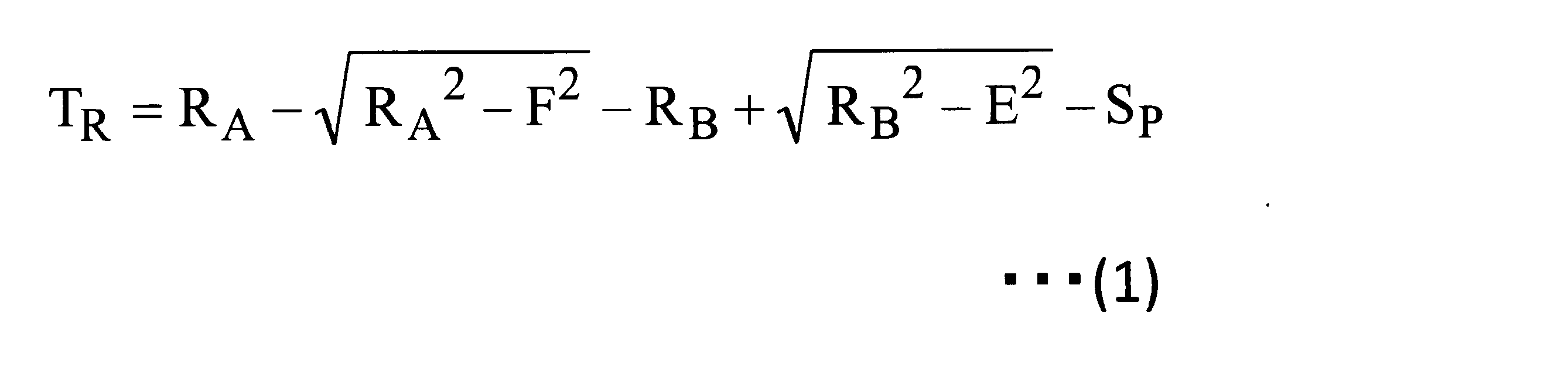
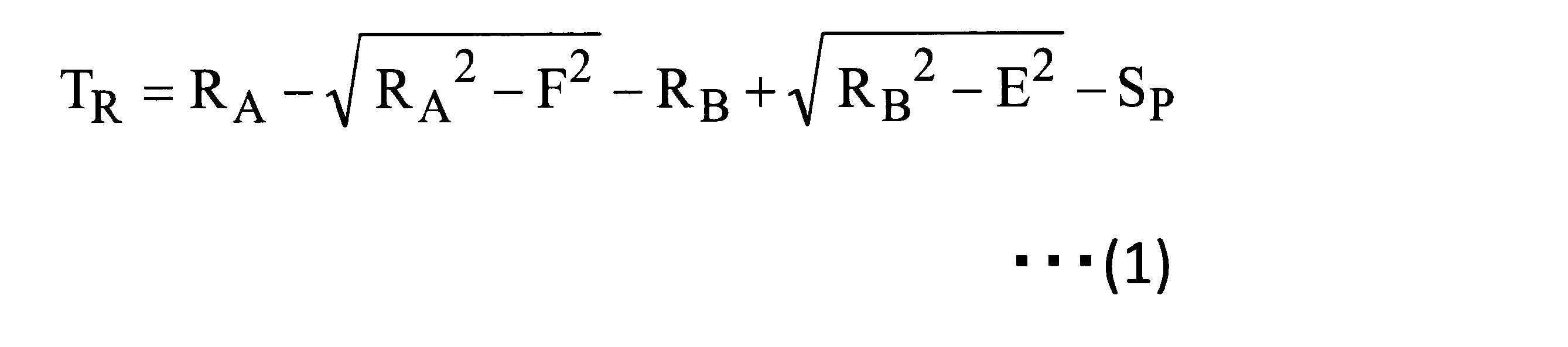
- the lens depth T R of the reverse region is derived by the following formula (1)
- the radius of curvature R R of the reverse region, with T R is derived by the following formula (2)
- the corneal correction contact lens according to (1) wherein the curvature radius and width of the alignment region are different in the vertical direction and the horizontal direction when viewed from the central direction of the contact lens (7)
- the corneal correction contact lens according to (6) wherein the depth of the lens necessary for correcting the cornea is constant under the same maximum curvature radius of the alignment region, (8)
- the curvature radius of the reverse region is derived according to the curvature radius and width of the base region, the width of the reverse region, the maximum value and the maximum value of the curvature radius of the alignment region, and the curvature radius and width of the peripheral region.
- the corneal correction contact lens according to (6) or (7), (9) The width of the base region is W B , the width of the reverse region is W R , the radius of curvature of the base region is R B , the radius of curvature of the reverse region is R R , and the maximum value of the curvature radius of the alignment region is R AV , base
- the lens depth in the region is T B
- the lens depth in the reverse region is T R
- the lens depth T R of the reverse region is derived by the following formula (3), the radius of curvature R R of the reverse region, the T R
- the lens depth of the region for correction of the cornea is constant under the same radius of curvature of the alignment region.
- a corneal correction contact lens is provided.
- the present invention relates to a corneal correction contact lens for correcting visual acuity by changing the shape of the cornea, wherein a lens surface in contact with the cornea is arranged in the center and a central portion called a base region that presses the cornea, a base region An annular portion that is arranged around the reverse region and is called a reverse region, an annular portion that is arranged around the reverse region and is called an alignment region, and an annular portion that is arranged around the alignment region and is called a peripheral region.
- the curvature radius and width of the base area, the width of the reverse area, the curvature radius and width of the alignment area, the curvature radius and width of the peripheral area, and the curvature radius of the reverse area are changed even if the power to be corrected changes. Therefore, the lens depth required for cornea correction is constant, and more specifically, in the same alignment region. Under rate radius is orthokeratology contact lens the depth of the lens required for correction of the cornea, characterized in that a constant.
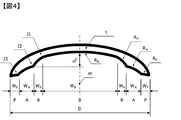
- the corneal correction contact lens of the present invention is preferably a hard contact lens having high oxygen permeability. As shown in FIG. 4, the corneal correction contact lens of the present invention has a surface shape of 4 in contact with the cornea 2 of FIG. Divided into two parts.
- a base region B which is a central spherical portion responsible for correcting the surface curvature radius
- An annular reverse region R disposed around the base region B and receiving corneal tissue moving from the base region B
- An annular alignment region A that is arranged around the reverse region R and adjusts the fitting of the corneal correction contact lens 1 and the cornea 2 and the centering of the corneal correction contact lens 1;
- This is a peripheral region P that forms an edge and assists in the removal of the lens and the flow of tears into the corneal correction contact lens 1.
- a space is formed between the corneal correction contact lens 1 and the cornea 2 and plays a role of receiving the corneal tissue that moves by correction in the base region B.
- the alignment region A contributes to the centering adjustment of the corneal correction contact lens 1 in contact with the cornea 2 or close to contact with a distance of several microns. Moreover, the radius of curvature R A of the alignment region A, in order to improve the fit to the cornea 2, the center points C A is located on the contact lens center axis M, a value close to the corneal surface curvature radius of the front orthodontic It is preferable to become.
- the peripheral region P it plays a role in helping the inflow of tears from the end of the corneal correction contact lens 1 to the cornea 2, and the cross-sectional shape forms a rounded conical shape in order to reduce the feeling of foreign objects during wearing. It is preferable.
- all the curved surfaces have a radius of curvature centered on the central axis M of the contact lens, and have a concave saddle shape with respect to the cornea 2 shown in FIG.
- transition point J1 between the base region and the reverse region where the curved surfaces are connected should not be damaged when worn.
- it is preferably rounded, and the radius of curvature is preferably 0.02 to 4.00 mm.
- FIG. 5 is a schematic diagram of the corneal correction contact lens 1 of the present invention.
- the width of the base region is W B
- the width of the reverse region is W R
- the width of the alignment region is W A
- the width of the peripheral region is W P
- the radius of curvature of the base region is R B
- the radius of curvature of the reverse region R R the radius of curvature of the alignment region R A , the radius of curvature of the peripheral region R P
- the lens depth of the base region T B the lens depth of the reverse region T R
- K1 point curve and the contact lens center axis of the base region intersect, the point extension and the contact lens center axis M of the curve in the alignment region intersects K2, the linear distance between the S P.
- the lens depth T B of the base region is derived from the following equation (4) by the width W B of the base region.
- the radius of curvature R A of the alignment regions, in order to improve fitting to the cornea 2 is preferably set to a value close to the average radius of curvature R K of the cornea before straightening.
- the lens depth T R of the reverse area by specifying the value of the depth S K of the lens according to the correction of the cornea, value to determine the radius of curvature R R of the reverse area to meet, it is possible to a depth S K of the lens according to the correction of the cornea with constant.
- T B , R B , W B , T R , W R , R A , W A , R P , and W P are used to determine the transition point J1 between the base region and the reverse region and the reverse region and the alignment region.
- a transition point J2 can be determined.
- the frequency to be corrected changes under the radius of curvature RA of the same alignment region. It is possible to a certain depth S K of the lens according to the correction of the cornea even.
- the linear length lens depth from S P reverse regions of the T derives the R, by determining the curvature radius R R of the reverse area to meet the value, the depth S K of the lens according to the correction of the cornea may be constant.
- the transition point J2 of the base region and the transition point J1 and reverse region and an alignment region of the reverse region it can be a lens depth S K of the region required for correction of the cornea constant.
- This is the corneal correction contact lens of the present invention.
- the average radius of curvature R K of the cornea when it is assumed to be the same uniform curved surface of curvature radius R A of the alignment region, that curve and the contact lens center axis M of the base region intersect and K1, it is also possible to replace the linear distance S P output K2 point extension and the contact lens center axis M of the curve in the alignment region intersect, the design value of the pressing amount assumed in the cornea of the eye axis direction.
- the corneal correction contact lens of the present invention leads to a prescription based on a design value that assumes an appropriate amount of pressing of the cornea according to the degree of correction. This is preferable because a shape capable of sufficiently pressing the center portion can be derived as compared with a conventional corneal correction contact lens.
- the values of the formula (1), the formula (2), and the formula (4) are ⁇ 10% as the center value If the curved surface passes through the range, a practically sufficient effect can be obtained.
- corneal correction contact lens for toric. This is because, as shown in FIG. 6, a look at the orthokeratology contact lens from the central axis, the radius of curvature R A and width W A of the alignment regions differ in longitudinal and lateral directions.
- the value of the radius of curvature of the alignment region is maximized, the radius of curvature in the horizontal direction shown in FIG. 6 is R AV , and the value of the radius of curvature of the alignment region is minimized, FIG.
- R AH the radius of curvature in the vertical direction shown
- R AH the radius of curvature in the vertical direction shown
- the width W AV radius of curvature R AV alignment region, W AV (Contact lens diameter D ⁇ (W B + 2 ⁇ W R + 2 ⁇ W P )) / 2
- the shape of the alignment region becomes an elliptical shape having an aspect ratio larger than 0.90 and smaller than 1.00.
- the toric corneal correction contact lens aspect of the present invention will be described in detail with reference to FIG.
- FIG. 7 is a schematic diagram of a toric corneal correction contact lens 1 according to the present invention, which passes through the central axis M of the corneal correction contact lens and has a maximum value of the radius of curvature of the alignment region as shown in FIG. It is a section of a direction.
- the width of the base region is W B
- the width of the reverse region is W R
- the width of the alignment region is W AV
- the width of the peripheral region is W P
- the radius of curvature of the base region is R B
- the radius of curvature of the reverse region R R the maximum curvature radius of the alignment region is R AV
- the radius of curvature of the peripheral region is R P
- the lens depth of the base region is T B
- the lens depth of the reverse region is T R
- the cornea is corrected.
- the lens depth T B of the base region is derived from the following equation (4) by the width W B of the base region.
- the radius of curvature R AV that maximizes the alignment region is preferably a value close to the maximum radius of curvature R KT of the cornea before correction in order to enhance the fitting to the cornea 2.
- the lens radius necessary for correcting the cornea is constant by changing the radius of curvature R R of the reverse region. under maximum curvature radius R AV alignment region, wherein the depth S K of the lens according to the correction of the cornea is constant.
- the central axis M of orthokeratology contact lenses of the present invention as, in a cross section radius of curvature of the numerical value of the alignment region is maximized, and specifying a value of the depth S K of the lens according to the correction of the cornea deriving a lens depth T R of the reverse region, by determining the curvature radius R R of the reverse area to satisfy its value can be the depth S K of the lens according to the correction of the cornea with constant is there.
- the K1 point curve and the contact lens center axis M of the base region intersect, the point extension and the contact lens center axis M of the curve of curvature of the alignment region radius is the maximum value intersect K3, the linear distance S PT and deriving a lens depth T R of the reverse region, by determining the curvature radius R R of the reverse area to meet the value, the depth S K of the lens according to the correction of the cornea may be constant.
- the transition point J2 of the base region and the transition point J1 and reverse region and an alignment region of the reverse region it can be a lens depth S K of the region required for correction of the cornea constant.
- This is the toric corneal correction contact lens of the present invention.
- the maximum curvature radius R KT of the cornea is the same as the maximum curvature radius R AV of the alignment region, a point K1 where the curve of the base region and the contact lens central axis M intersect, the linear distance S PT of K3 that the radius of curvature of the alignment regions intersect an extension line and a contact lens center axis M of the curve having the maximum value, it is also possible to replace the assumed design value pressing amount of the cornea in the axial direction .
- the corneal correction contact lens for toric of the present invention leads to prescription based on a design value assuming an appropriate pressing amount of the cornea according to the frequency to be corrected. This is preferable because a shape capable of sufficiently pressing the center portion can be derived as compared with a conventional corneal correction contact lens.
- Example 1 For sample A, a corneal correction contact lens was prepared for the eye assuming that the refractive power of the cornea was 42.00 diopters, the corneal curvature radius was 8.04 mm, and the refractive error was -2.50. At this time, since the target corrective power was +0.75 diopter, the curvature radius R B of the base region of orthokeratology contact lens is 8.71mm.
- curvature radius R R of the reverse region was determined from the following equation (2).
- the curvature radius R R of the lens depth T R and reverse regions of the reverse area of orthokeratology contact lenses Sample A were 0.20 mm, a 7.34Mm, the lens according to the correction of corneal depth S K was 0.77 mm.
- Example 2 Similarly, for sample B, a corneal correction contact lens was prepared for the eye assuming that the refractive power of the cornea was 42.00 diopters, the corneal curvature radius was 8.04 mm, and the refractive error was ⁇ 5.00. .
- the target correction power is due to the same manner +0.75 diopters and the sample A, the curvature R B of the base region of orthokeratology contact lens is 9.31mm.
- curvature radius R R of the reverse region was determined from the following equation (2).
- the lens depth T R of the reverse region and the radius of curvature R R of the reverse region of the corneal correction contact lens of Sample B are 0.24 mm and 6.41 mm, respectively, and the lens depth S for the correction of the cornea K was 0.77 mm.
- Example 3 For sample C, an eye assuming that the refractive power of the cornea is 42.00 diopters, the lateral corneal curvature radius is 8.04 mm, the longitudinal corneal curvature radius is 7.76 mm, and the refractive error is -2.50.
- the target corneal correction contact lens for toric was manufactured. At this time, since the target corrective power was +0.75 diopter, the curvature R B of the base region of orthokeratology contact lens is 8.71mm. In addition, the orthokeratology contact lens diameter D 10.6 mm, the width W B of the base region 6.20Mm, and 0.40mm width W R of the reverse area.
- curvature radius R R of the reverse region was determined from the following equation (2).
- the curvature radius R R of the lens depth T R and reverse regions of the reverse area of orthokeratology contact lens sample C respectively 0.20 mm, a 7.34Mm
- the lens according to the correction of corneal depth S K was 0.77 mm.
- Example 4 For sample D, an eye assuming that the refractive power of the cornea is 42.00 diopters, the lateral corneal curvature radius is 8.04 mm, the longitudinal corneal curvature radius is 7.76 mm, and the refractive error is ⁇ 5.00.
- the target corneal correction contact lens for toric was manufactured. In this case, the target correction power is due to the same manner +0.75 diopters and the sample C, the curvature R B of the base region of orthokeratology contact lens is 9.31mm.
- the orthokeratology contact lens diameter D 10.6 mm, the width W B of the base region 6.20Mm, and 0.40mm width W R of the reverse area.
- curvature radius R R of the reverse region was determined from the following equation (2).
- the curvature radius R R of the lens depth T R and reverse regions of the reverse area of orthokeratology contact lenses Sample D are each 0.24 mm, a 6.41Mm, the lens according to the correction of corneal depth S K was 0.77 mm.
- the present invention can be applied as a contact lens for corneal correction.
Landscapes
- Health & Medical Sciences (AREA)
- Ophthalmology & Optometry (AREA)
- Physics & Mathematics (AREA)
- General Health & Medical Sciences (AREA)
- General Physics & Mathematics (AREA)
- Optics & Photonics (AREA)
- Eyeglasses (AREA)
- Prostheses (AREA)
Abstract
角膜の形状を変えることにより視力を矯正するための角膜矯正コンタクトレンズであって、角膜と接するレンズ面が、中央に配置されて角膜を押圧するベース領域と称する中央部分、ベース領域の周囲に配置されてリバース領域と称する環状の部分、リバース領域の周囲に配置されてアライメント領域と称する環状の部分、アライメント領域の周囲に配置されてペリフェラル領域と称する環状の部分、を有してなり、ベース領域の曲率半径および幅、リバース領域の幅、アライメント領域の曲率半径および幅、ペリフェラル領域の曲率半径および幅、および、矯正したい度数が変化しても、リバース領域の曲率半径を変化させることで、同じアライメント領域の曲率半径の下では、角膜の矯正に必要なレンズの深さが一定であることを特徴とする角膜矯正コンタクトレンズである。
Description
本発明は、角膜矯正コンタクトレンズに関する。より詳細には、角膜表面の形状を変形させるための構造を有する角膜矯正コンタクトレンズに関する。
近視を矯正する手段として、複数の曲率半径を多段階に設けたコンタクトレンズを夜間装用して、角膜表面の形状を変形させ、角膜自体の焦点距離を変える治療法(オルソケラトロジー)および、この治療法に使用する角膜矯正コンタクトレンズ(オルソケラトロジーレンズ)が知られている(例えば特許文献1)。
角膜矯正コンタクトレンズを用いた視力矯正の仕組みを説明する。
まず近視の状態では、図1に示すように、角膜2の表面は、網膜に対して前に凸の曲率(図1で左側に凸の非球面形状)を有する。このため、焦点が網膜6上に結ばれることなく、網膜6の前で光の収束が起こる。
この角膜2に、図2に示すように、角膜矯正コンタクトレンズ1をコルセットのように装用し、図1に示す角膜表面7の形状を矯正させる。
これにより、角膜矯正コンタクトレンズ1を取り外した後も、図3に示すように、角膜表面7を扁平化させた状態とすることができる。
このため、光の屈折力が調整されて、焦点が網膜6上に結ばれることとなり、一定時間、視力の改善を得られるものである。
角膜矯正コンタクトレンズについて、角膜表面に接する面の形状が4つの部位に分かれるものが一般的である。すなわち、角膜矯正コンタクトレンズの中央に配置され、角膜表面を押圧して表面曲線の矯正を担う凹球面であるベース領域、ベース領域の周囲に配置され、ベース領域より移動する角膜組織を受け入れる環状のリバース領域、リバース領域の周囲に配置され、角膜矯正コンタクトレンズと角膜とのフィッティングおよび角膜矯正コンタクトレンズのセンタリングを調整する環状のアライメント領域、エッジを形成し、レンズの取り外しや涙液の角膜矯正コンタクトレンズ内への流入を助ける環状のペリフェラル領域である。
特許文献1に記載される従来の角膜矯正コンタクトレンズでは、ベース領域の曲率半径は矯正前の角膜の平均曲率半径と矯正したい度数から決定されている。
アライメント領域の曲率半径は、角膜へのフィッティングを高めるためにも矯正前の角膜の平均曲率半径に近い値となり、ベース領域の曲率半径をRB、リバース領域の曲率半径をRRとしたとき、
RR=RB+11.00D~15.00D(D:ジオプトリー)
を満足するように形成されていた。
RR=RB+11.00D~15.00D(D:ジオプトリー)
を満足するように形成されていた。
しかし、上記式に基づく従来の設計思想で導出された形状は、移動する角膜組織を受け入れる領域が確保されることを目的とした医学的なアプローチから導出されているため、矯正したい度数によって、角膜の矯正にかかる領域のレンズ深さが異なることとなる。
この結果、上記式に基づく従来の導出手段によれば、矯正する度数が小さい場合には、角膜の矯正に掛かる領域のレンズ深さが深くなることから、眼軸方向へ角膜が押圧される量が浅くなる場合や、接触しない場合もあり、角膜中心部を十分に押圧することができず、期待する矯正度数が得られない、あるいは矯正視力を得るために時間を要するなど、矯正効果にバラツキを生じる場合があった。
また、眼軸方向へ角膜が押圧される量が深くなる場合には、角膜表面を強く押し付けることから角膜を傷つける虞や、眼圧が低下することによる合併症を引き起こしやすくなる虞、眼の表面を荒らす虞があった。即ち、従来の、矯正したいベース領域の曲率半径からだけのリバース領域の曲率半径の値の導出方法では、矯正効果にバラツキを生じる虞や角膜を傷つける虞があった。
また、眼軸方向へ角膜が押圧される量が深くなる場合には、角膜表面を強く押し付けることから角膜を傷つける虞や、眼圧が低下することによる合併症を引き起こしやすくなる虞、眼の表面を荒らす虞があった。即ち、従来の、矯正したいベース領域の曲率半径からだけのリバース領域の曲率半径の値の導出方法では、矯正効果にバラツキを生じる虞や角膜を傷つける虞があった。
そこで、本発明では、ベース領域の曲率半径と、アライメント領域の曲率半径から、リバース領域の曲率半径を導出した方が好ましいことを見出した。
本発明では、矯正したい度数が異なる場合においても、リバース領域の曲率半径を変化させることで、同じアライメント領域の曲率半径の下では、角膜の矯正に掛かる領域のレンズ深さを一定とする角膜矯正コンタクトレンズを提供する。
前記課題を解決するために、本発明は以下の構成を有する。
(1)角膜の形状を変えることにより視力を矯正するための角膜矯正コンタクトレンズであって、角膜と接するレンズ面が、中央に配置されて角膜を押圧するベース領域と称する中央部分、ベース領域の周囲に配置されてリバース領域と称する環状の部分、リバース領域の周囲に配置されてアライメント領域と称する環状の部分、アライメント領域の周囲に配置されてペリフェラル領域と称する環状の部分、を有してなり、ベース領域の曲率半径および幅、リバース領域の幅、アライメント領域の曲率半径および幅、ペリフェラル領域の曲率半径および幅、および、矯正したい度数が変化しても、リバース領域の曲率半径を変化させることで、角膜の矯正に必要なレンズの深さが一定であることを特徴とする角膜矯正コンタクトレンズ、
(2)角膜矯正コンタクトレンズにおいて、同じアライメント領域の曲率半径の下で、角膜の矯正に必要なレンズの深さが一定である(1)に記載する角膜矯正コンタクトレンズ、
(3)角膜矯正コンタクトレンズにおいて、リバース領域の曲率半径が、ベース領域の曲率半径および幅、リバース領域の幅、アライメント領域の曲率半径および幅、および、ペリフェラル領域の曲率半径および幅に応じて導出されてなる(1)または(2)に記載の角膜矯正コンタクトレンズ、
(4)ベース領域の幅をWB、リバース領域の幅をWR、ベース領域の曲率半径をRB、リバース領域の曲率半径をRR、アライメント領域の曲率半径をRA、ベース領域のレンズ深さをTB、リバース領域のレンズ深さをTR、ベース領域の曲線とコンタクトレンズ中心軸とが交わる点と、アライメント領域の曲線の延長線とコンタクトレンズ中心軸とが交わる点、との直線距離をSPとしたとき、リバース領域のレンズ深さTRが、下記式(1)で導出され、リバース領域の曲率半径RRが、TRを用いて下記式(2)で導出される(3)に記載の角膜矯正コンタクトレンズ、
(2)角膜矯正コンタクトレンズにおいて、同じアライメント領域の曲率半径の下で、角膜の矯正に必要なレンズの深さが一定である(1)に記載する角膜矯正コンタクトレンズ、
(3)角膜矯正コンタクトレンズにおいて、リバース領域の曲率半径が、ベース領域の曲率半径および幅、リバース領域の幅、アライメント領域の曲率半径および幅、および、ペリフェラル領域の曲率半径および幅に応じて導出されてなる(1)または(2)に記載の角膜矯正コンタクトレンズ、
(4)ベース領域の幅をWB、リバース領域の幅をWR、ベース領域の曲率半径をRB、リバース領域の曲率半径をRR、アライメント領域の曲率半径をRA、ベース領域のレンズ深さをTB、リバース領域のレンズ深さをTR、ベース領域の曲線とコンタクトレンズ中心軸とが交わる点と、アライメント領域の曲線の延長線とコンタクトレンズ中心軸とが交わる点、との直線距離をSPとしたとき、リバース領域のレンズ深さTRが、下記式(1)で導出され、リバース領域の曲率半径RRが、TRを用いて下記式(2)で導出される(3)に記載の角膜矯正コンタクトレンズ、

(式(1)中、E=WB/2、F=WB/2+WRを表す。)

(式(2)中、E=WB/2、F=WB/2+WRを表す。)
(5)レンズ深さTRおよび曲率半径RRが、それぞれ導出されたレンズ深さTRおよび曲率半径RRを基準とする±10%の範囲内である(4)に記載する角膜矯正コンタクトレンズ、
(6)アライメント領域の曲率半径および幅がコンタクトレンズ中心軸方向から見て縦方向と横方向で異なる(1)に記載の角膜矯正コンタクトレンズ、
(7)アライメント領域の曲率半径の最大値が同じ下で、角膜の矯正に必要なレンズの深さが一定である(6)に記載の角膜矯正コンタクトレンズ、
(8)リバース領域の曲率半径が、ベース領域の曲率半径および幅、リバース領域の幅、アライメント領域の曲率半径の最大値および幅の最大値、および、ペリフェラル領域の曲率半径および幅に応じて導出されてなる(6)または(7)に記載の角膜矯正コンタクトレンズ、
(9)ベース領域の幅をWB、リバース領域の幅をWR、ベース領域の曲率半径をRB、リバース領域の曲率半径をRR、アライメント領域の曲率半径の最大値をRAV、ベース領域のレンズ深さをTB、リバース領域のレンズ深さをTR、ベース領域の曲線とコンタクトレンズ中心軸とが交わる点と、アライメント領域の曲率半径の最大値となる曲線の延長線とコンタクトレンズ中心軸とが交わる点、との直線距離をSPとしたとき、リバース領域のレンズ深さTRが、下記式(3)で導出され、リバース領域の曲率半径RRが、TRを用いて下記式(2)で導出される(6)から(8)のいずれかに記載の角膜矯正コンタクトレンズ、
(5)レンズ深さTRおよび曲率半径RRが、それぞれ導出されたレンズ深さTRおよび曲率半径RRを基準とする±10%の範囲内である(4)に記載する角膜矯正コンタクトレンズ、
(6)アライメント領域の曲率半径および幅がコンタクトレンズ中心軸方向から見て縦方向と横方向で異なる(1)に記載の角膜矯正コンタクトレンズ、
(7)アライメント領域の曲率半径の最大値が同じ下で、角膜の矯正に必要なレンズの深さが一定である(6)に記載の角膜矯正コンタクトレンズ、
(8)リバース領域の曲率半径が、ベース領域の曲率半径および幅、リバース領域の幅、アライメント領域の曲率半径の最大値および幅の最大値、および、ペリフェラル領域の曲率半径および幅に応じて導出されてなる(6)または(7)に記載の角膜矯正コンタクトレンズ、
(9)ベース領域の幅をWB、リバース領域の幅をWR、ベース領域の曲率半径をRB、リバース領域の曲率半径をRR、アライメント領域の曲率半径の最大値をRAV、ベース領域のレンズ深さをTB、リバース領域のレンズ深さをTR、ベース領域の曲線とコンタクトレンズ中心軸とが交わる点と、アライメント領域の曲率半径の最大値となる曲線の延長線とコンタクトレンズ中心軸とが交わる点、との直線距離をSPとしたとき、リバース領域のレンズ深さTRが、下記式(3)で導出され、リバース領域の曲率半径RRが、TRを用いて下記式(2)で導出される(6)から(8)のいずれかに記載の角膜矯正コンタクトレンズ、

(式(3)中、E=WB/2、F=WB/2+WRを表す。)
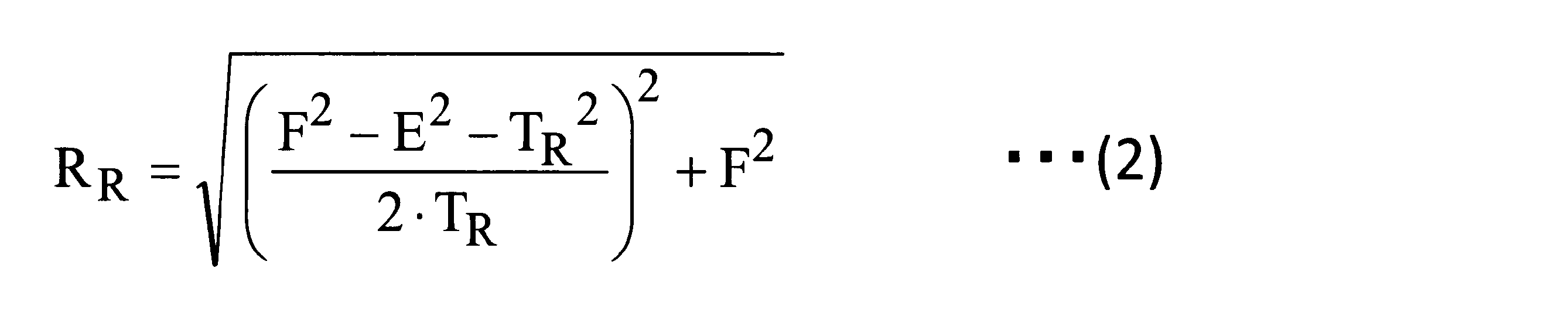
(式(2)中、E=WB/2、F=WB/2+WRを表す。)
(10)レンズ深さTRおよび曲率半径RRが、それぞれ導出されたレンズ深さTRおよび曲率半径RRを基準とする±10%の範囲内である(9)に記載の角膜矯正コンタクトレンズである。
(10)レンズ深さTRおよび曲率半径RRが、それぞれ導出されたレンズ深さTRおよび曲率半径RRを基準とする±10%の範囲内である(9)に記載の角膜矯正コンタクトレンズである。
本発明によれば、矯正したい度数が異なる場合においても、リバース領域の曲率半径を変化させることで、同じアライメント領域の曲率半径の下では、角膜の矯正に掛かる領域のレンズ深さを一定とする角膜矯正コンタクトレンズを提供する。
本発明は、角膜の形状を変えることにより視力を矯正するための角膜矯正コンタクトレンズであって、角膜と接するレンズ面が、中央に配置されて角膜を押圧するベース領域と称する中央部分、ベース領域の周囲に配置されてリバース領域と称する環状の部分、リバース領域の周囲に配置されてアライメント領域と称する環状の部分、アライメント領域の周囲に配置されてペリフェラル領域と称する環状の部分、を有してなり、ベース領域の曲率半径および幅、リバース領域の幅、アライメント領域の曲率半径および幅、ペリフェラル領域の曲率半径および幅、および、矯正したい度数が変化しても、リバース領域の曲率半径を変化させることで、角膜の矯正に必要なレンズの深さが一定であり、さらに詳細には、同じアライメント領域の曲率半径の下で、角膜の矯正に必要なレンズの深さが一定であることを特徴とする角膜矯正コンタクトレンズである。
以下、本発明の好ましい実施形態の一例を示す。
まず、本発明の角膜矯正コンタクトレンズは酸素透過性の高いハードコンタクトレンズであることが好ましく、図4に示すように、本発明の角膜矯正コンタクトレンズは図1の角膜2と接する面形状は4つの部位に分かれる。
それらは、図1に示す角膜2と接して、角膜表面7を押圧して表面曲率半径の矯正を担う中央の球面部分であるベース領域B、
ベース領域Bの周囲に配置され、ベース領域Bより移動する角膜組織を受け入れる環状のリバース領域R、
リバース領域Rの周囲に配置され、角膜矯正コンタクトレンズ1と角膜2とのフィッティングおよび角膜矯正コンタクトレンズ1のセンタリングを調整する環状のアライメント領域A、
エッジを形成し、レンズの取り外しや涙液の角膜矯正コンタクトレンズ1内への流入を助けるペリフェラル領域Pである。
ベース領域Bの周囲に配置され、ベース領域Bより移動する角膜組織を受け入れる環状のリバース領域R、
リバース領域Rの周囲に配置され、角膜矯正コンタクトレンズ1と角膜2とのフィッティングおよび角膜矯正コンタクトレンズ1のセンタリングを調整する環状のアライメント領域A、
エッジを形成し、レンズの取り外しや涙液の角膜矯正コンタクトレンズ1内への流入を助けるペリフェラル領域Pである。
ベース領域Bの曲率半径RBは、コンタクトレンズ中心軸Mを含む断面形状において、その中心点CBはコンタクトレンズ中心軸M上に位置し、角膜表面7が矯正したい度数になるように曲率半径は決定される。この曲率半径に応じて角膜表面7の形状が変化するため近視を矯正することができる。
リバース領域Rでは、角膜矯正コンタクトレンズ1と角膜2の間に空間が形成され、ベース領域Bでの矯正により移動する角膜組織を受け入れる役割を担う。
アライメント領域Aは、角膜2と接触、ないしは数ミクロンの距離をおいて接触に近い状態で、角膜矯正コンタクトレンズ1のセンタリング調整に寄与する。また、アライメント領域Aの曲率半径RAは、角膜2へのフィッティングを高めるためにも、その中心点CAはコンタクトレンズ中心軸M上に位置し、矯正前の角膜表面曲率半径に近い値となることが好ましい。
ペリフェラル領域Pでは、角膜矯正コンタクトレンズ1端部から角膜2への涙液の流入を助ける役割を担い、装用時の異物感を少なくするため、その断面形状は丸みを帯びた円錐形状を成していることが好ましい。
ここで、図4に示すように、すべての曲面は、コンタクトレンズ中心軸Mを中心とした曲率半径であり、図1に示す角膜2に対して凹型の椀状をなしている。
また、曲面が連なるベース領域とリバース領域の移行点J1や、リバース領域とアライメント領域の移行点J2、アライメント領域とペリフェラル領域の移行点J3については、装用したときに角膜2をキズつけないようにするためにも丸みを帯びていることが好ましく、その曲率半径は0.02~4.00mmであることが好ましい。
本発明の態様について、図5を用いて詳細に説明する。図5は、本発明の角膜矯正コンタクトレンズ1の概略模式図である。
図5中、ベース領域の幅をWB、リバース領域の幅をWR、アライメント領域の幅をWA、ペリフェラル領域の幅をWP、ベース領域の曲率半径をRB、リバース領域の曲率半径をRR、アライメント領域の曲率半径をRA、ペリフェラル領域の曲率半径をRP、ベース領域のレンズ深さをTB、リバース領域のレンズ深さをTR、角膜の矯正に掛かるレンズの深さSK(=TB+TR)、および、
ベース領域の曲線とコンタクトレンズ中心軸が交わる点K1と、アライメント領域の曲線の延長線とコンタクトレンズ中心軸Mが交わる点K2、との直線距離をSPとする。
ベース領域の曲線とコンタクトレンズ中心軸が交わる点K1と、アライメント領域の曲線の延長線とコンタクトレンズ中心軸Mが交わる点K2、との直線距離をSPとする。
ベース領域の曲率半径RBについては、矯正したい度数になるように曲率半径が決定されるため、ベース領域のレンズ深さTBは、ベース領域の幅WBによって下記式(4)より導出される。

アライメント領域の曲率半径RAは、角膜2へのフィッティングを高めるためにも、矯正前の角膜の平均曲率半径RKに近い値とすることが好ましい。
本発明では、角膜矯正コンタクトレンズの中心軸Mを含む断面において、前記RB、WB、WR、RA、WA、RP、WP、および、矯正したい度数が変化しても、リバース領域の曲率半径RRを変化させることで、角膜の矯正に必要なレンズの深さが一定であり、さらには、同じアライメント領域の曲率半径RAの下で、角膜の矯正に掛かるレンズの深さSKが一定であることを特徴とする。
具体的には、本発明の角膜矯正コンタクトレンズの中心軸Mを含む断面において、角膜の矯正に掛かるレンズの深さSKの値を指定してリバース領域のレンズ深さTRを導出し、その値を満たすようにリバース領域の曲率半径RRを決定することで、角膜の矯正に掛かるレンズの深さSKを一定とすることが可能である。
つまり、本発明の角膜矯正コンタクトレンズの中心軸Mを含む断面において、前記RB、WB、SK、および、TBより、リバース領域のレンズ深さTRが、TR=SK-TBにより求められる。この結果、前記TB、RB、WB、TR、WR、RA、WA、RP、および、WPより、ベース領域とリバース領域の移行点J1およびリバース領域とアライメント領域の移行点J2を決定することができる。
リバース領域Rの曲線は、ベース領域とリバース領域の移行点J1と、リバース領域とアライメント領域のJ2を通るものであれば、同じアライメント領域の曲率半径RAの下で、矯正したい度数が変化しても角膜の矯正に掛かるレンズの深さSKを一定にすることが可能である。
ここで、リバース領域の曲率半径RRについて、その中心点CRがコンタクトレンズ中心軸M上に位置するものであれば、矯正により移動する角膜組織を受け入れるための適度な空間を形成できることから、さらに好ましい。
また、ベース領域の曲線とコンタクトレンズ中心軸Mが交わる点K1と、アライメント領域の曲線の延長線とコンタクトレンズ中心軸Mが交わる点K2、との直線距離SPからリバース領域のレンズ深さTRを導出し、その値を満たすようにリバース領域の曲率半径RRを決定することで、角膜の矯正に掛かるレンズの深さSKを一定としても良い。
角膜矯正コンタクトレンズの中心軸Mを含む断面において、前記RB、WB、WR、RA、WA、RP、WP、TB、TR、そして、K1とK2の直線距離をSP、計算式を簡略化するために、E=WB/2、F=WB/2+WRとしたとき、リバース領域のレンズ深さTRは、下記式(1)で導出される。

このリバース領域のレンズ深さTRを用いたリバース領域の曲率半径RRは、その中心点CRがコンタクトレンズ中心軸M上に位置し、下記式(2)

を満足する。このとき、ベース領域とリバース領域の移行点J1およびリバース領域とアライメント領域の移行点J2を通り、角膜の矯正に掛かる領域のレンズ深さSKを一定にすることができる。これが本発明の角膜矯正コンタクトレンズである。
また、本発明によれば、角膜の平均曲率半径RKが、アライメント領域の曲率半径RAと同じ一様な曲面であると仮定したとき、ベース領域の曲線とコンタクトレンズ中心軸Mが交わる点K1と、アライメント領域の曲線の延長線とコンタクトレンズ中心軸Mが交わる点K2の直線距離SPを、眼軸方向への角膜の押さえ量を仮定した設計値と置き換えることもできる。
このため、本発明の角膜矯正コンタクトレンズは、矯正したい度数に応じて、適切な角膜の押さえ量を仮定した設計値を基にした処方にも繋がる。これより、従来の角膜矯正コンタクトレンズと比べて、中心部を十分に押圧することができる形状を導出することができるので好ましい。
なお、正確に式(1)および式(2)、式(4)に一致しなくても、式(1)および式(2)、式(4)の値を中心値とする±10%の範囲内を通る曲面とすれば、実用上十分な効果を得ることができる。
また、トーリック用の角膜矯正コンタクトレンズがある。これは、図6に示すように、角膜矯正コンタクトレンズを中心軸方向から見て、アライメント領域の曲率半径RAおよび幅WAが縦方向と横方向で異なる。
トーリック用の角膜矯正コンタクトレンズにおいては、アライメント領域の曲率半径の数値が最大となる、図6で示す横方向の曲率半径をRAV、アライメント領域の曲率半径の数値が最小となる、図6で示す縦方向の曲率半径をRAHとしたとき、RAV=RAH+0.50D~6.00D(D:ジオプトリー)を満足するように形成される。
また、アライメント領域の曲率半径RAVの幅WAVについては、
WAV=(コンタクトレンズ径D-(WB+2・WR+2・WP))/2
を満足するように導出され、角膜矯正コンタクトレンズを中心軸方向から見て、アライメント領域の形状は、縦横比が0.90より大きく、1.00未満の楕円形状となる。
WAV=(コンタクトレンズ径D-(WB+2・WR+2・WP))/2
を満足するように導出され、角膜矯正コンタクトレンズを中心軸方向から見て、アライメント領域の形状は、縦横比が0.90より大きく、1.00未満の楕円形状となる。
本発明のトーリック用の角膜矯正コンタクトレンズ態様について、図7を用いて詳細に説明する。
図7は、本発明のトーリック用の角膜矯正コンタクトレンズ1の概略模式図であり、角膜矯正コンタクトレンズの中心軸Mを通り、アライメント領域の曲率半径の数値が最大となる、図6で示す横方向の断面である。
図7中、ベース領域の幅をWB、リバース領域の幅をWR、アライメント領域の幅をWAV、ペリフェラル領域の幅をWP、ベース領域の曲率半径をRB、リバース領域の曲率半径をRR、アライメント領域の最大となる曲率半径をRAV、ペリフェラル領域の曲率半径をRP、ベース領域のレンズ深さをTB、リバース領域のレンズ深さをTR、角膜の矯正に掛かるレンズの深さSK(=TB+TR)、および、
ベース領域の曲線とコンタクトレンズ中心軸が交わる点K1と、アライメント領域の曲率半径が最大値となる曲線の延長線とコンタクトレンズ中心軸Mが交わる点K3、との直線距離をSPTとする。
ベース領域の曲線とコンタクトレンズ中心軸が交わる点K1と、アライメント領域の曲率半径が最大値となる曲線の延長線とコンタクトレンズ中心軸Mが交わる点K3、との直線距離をSPTとする。
ベース領域の曲率半径RBについては、矯正したい度数になるように曲率半径が決定されるため、ベース領域のレンズ深さTBは、ベース領域の幅WBによって下記式(4)より導出される。

アライメント領域の最大となる曲率半径RAVは、角膜2へのフィッティングを高めるためにも、矯正前の角膜の最大曲率半径RKTに近い値とすることが好ましい。
本発明では、角膜矯正コンタクトレンズの中心軸Mをとおり、アライメント領域の曲率半径の数値が最大となる断面において、前記RB、WB、WR、RAV、WAV、RAH、WAH、RP、WP、および、矯正したい度数が変化しても、リバース領域の曲率半径RRを変化させることで、角膜の矯正に必要なレンズの深さが一定であり、さらには、同じアライメント領域の最大曲率半径RAVの下で、角膜の矯正に掛かるレンズの深さSKが一定であることを特徴とする。
具体的には、本発明の角膜矯正コンタクトレンズの中心軸Mをとおり、アライメント領域の曲率半径の数値が最大となる断面において、角膜の矯正に掛かるレンズの深さSKの値を指定してリバース領域のレンズ深さTRを導出し、その値を満たすようにリバース領域の曲率半径RRを決定することで、角膜の矯正に掛かるレンズの深さSKを一定とすることが可能である。
ここで、リバース領域の曲率半径RRについて、その中心点CRがコンタクトレンズ中心軸M上に位置するものであれば、矯正により移動する角膜組織を受け入れるための適度な空間を形成できることから、さらに好ましい。
また、ベース領域の曲線とコンタクトレンズ中心軸Mが交わる点K1と、アライメント領域の曲率半径が最大値となる曲線の延長線とコンタクトレンズ中心軸Mが交わる点K3、との直線距離SPTからリバース領域のレンズ深さTRを導出し、その値を満たすようにリバース領域の曲率半径RRを決定することで、角膜の矯正に掛かるレンズの深さSKを一定としても良い。
角膜矯正コンタクトレンズの中心軸Mを通り、アライメント領域の曲率半径の数値が最大となる断面において、前記RB、WB、WR、RAV、WAV、RP、WP、TB、TR、そして、K1とK3の直線距離をSPT、計算式を簡略化するために、E=WB/2、F=WB/2+WRとしたとき、リバース領域のレンズ深さTRは、下記式(3)で導出される。

このリバース領域のレンズ深さTRを用いたリバース領域の曲率半径RRは、その中心点CRがコンタクトレンズ中心軸M上に位置し、下記式(2)

を満足する。このとき、ベース領域とリバース領域の移行点J1およびリバース領域とアライメント領域の移行点J2を通り、角膜の矯正に掛かる領域のレンズ深さSKを一定にすることができる。これが本発明のトーリック用の角膜矯正コンタクトレンズである。
また、本発明によれば、角膜の最大曲率半径RKTが、アライメント領域の最大曲率半径RAVと同じであると仮定したとき、ベース領域の曲線とコンタクトレンズ中心軸Mが交わる点K1と、アライメント領域の曲率半径が最大値となる曲線の延長線とコンタクトレンズ中心軸Mが交わる点K3の直線距離SPTを、眼軸方向への角膜の押さえ量を仮定した設計値と置き換えることもできる。
このため、本発明のトーリック用の角膜矯正コンタクトレンズは、矯正したい度数に応じて、適切な角膜の押さえ量を仮定した設計値を基にした処方にも繋がる。これより、従来の角膜矯正コンタクトレンズと比べて、中心部を十分に押圧することができる形状を導出することができるので好ましい。
なお、正確に式(2)から式(4)に一致しなくても、式(2)から式(4)の値を中心値とする±10%の範囲内を通る曲面とすれば、実用上十分な効果を得ることができる。
以下本発明について、実施例を示して説明する。尚、それぞれの曲率半径の値および高さについては接触式の輪郭形状測定器(ミツトヨ社製)にて計測した。
[実施例1]
サンプルAについて、角膜の屈折力が42.00ジオプトリー、角膜曲率半径が8.04mm、屈折異常が-2.50であると仮定した眼を対象とする、角膜矯正コンタクトレンズを製作した。このとき、目標矯正度数は+0.75ジオプトリーとしたため、角膜矯正コンタクトレンズのベース領域の曲率半径RBは8.71mmである。また、角膜矯正コンタクトレンズ径Dを10.6mm、ベース領域の幅WBを6.20mm、リバース領域の幅WRを0.40mm、アライメント領域の曲率半径RAを8.04mm、ベース領域の曲線とコンタクトレンズ中心軸が交わる点と、アライメント領域の曲線の延長線とコンタクトレンズ中心軸が交わる点、との直線距離SPを0.03mmとし、計算式を省略するために、E=WB/2、F=WB/2+WRとした下記式(1)より、リバース領域のレンズ深さTRを導出し、
サンプルAについて、角膜の屈折力が42.00ジオプトリー、角膜曲率半径が8.04mm、屈折異常が-2.50であると仮定した眼を対象とする、角膜矯正コンタクトレンズを製作した。このとき、目標矯正度数は+0.75ジオプトリーとしたため、角膜矯正コンタクトレンズのベース領域の曲率半径RBは8.71mmである。また、角膜矯正コンタクトレンズ径Dを10.6mm、ベース領域の幅WBを6.20mm、リバース領域の幅WRを0.40mm、アライメント領域の曲率半径RAを8.04mm、ベース領域の曲線とコンタクトレンズ中心軸が交わる点と、アライメント領域の曲線の延長線とコンタクトレンズ中心軸が交わる点、との直線距離SPを0.03mmとし、計算式を省略するために、E=WB/2、F=WB/2+WRとした下記式(1)より、リバース領域のレンズ深さTRを導出し、
このリバース領域のレンズ深さTRを用いて、下記式(2)よりリバース領域の曲率半径RRを求めた。

この結果、サンプルAの角膜矯正コンタクトレンズのリバース領域のレンズ深さTRおよびリバース領域の曲率半径RRは、それぞれ0.20mm、7.34mmであり、角膜の矯正に掛かるレンズの深さSKは、0.77mmとなった。
[実施例2]
同様に、サンプルBについて、角膜の屈折力が42.00ジオプトリー、角膜曲率半径が8.04mm、屈折異常が-5.00であると仮定した眼を対象とする、角膜矯正コンタクトレンズを製作した。このとき、目標矯正度数は、サンプルAと同様に+0.75ジオプトリーとしたため、角膜矯正コンタクトレンズのベース領域の曲率RBは9.31mmである。また、角膜矯正コンタクトレンズ径Dを10.6mm、ベース領域の幅WBを6.20mm、リバース領域の幅WRを0.40mm、アライメント領域の曲率半径RAを8.04mm、ベース領域の曲線とコンタクトレンズ中心軸が交わる点と、アライメント領域の曲線の延長線とコンタクトレンズ中心軸が交わる点、との直線距離SPを0.03mmとし、計算式を省略するために、E=WB/2、F=WB/2+WRとした下記式(1)より、リバース領域のレンズ深さTRを導出し、
同様に、サンプルBについて、角膜の屈折力が42.00ジオプトリー、角膜曲率半径が8.04mm、屈折異常が-5.00であると仮定した眼を対象とする、角膜矯正コンタクトレンズを製作した。このとき、目標矯正度数は、サンプルAと同様に+0.75ジオプトリーとしたため、角膜矯正コンタクトレンズのベース領域の曲率RBは9.31mmである。また、角膜矯正コンタクトレンズ径Dを10.6mm、ベース領域の幅WBを6.20mm、リバース領域の幅WRを0.40mm、アライメント領域の曲率半径RAを8.04mm、ベース領域の曲線とコンタクトレンズ中心軸が交わる点と、アライメント領域の曲線の延長線とコンタクトレンズ中心軸が交わる点、との直線距離SPを0.03mmとし、計算式を省略するために、E=WB/2、F=WB/2+WRとした下記式(1)より、リバース領域のレンズ深さTRを導出し、

このリバース領域のレンズ深さTRを用いて、下記式(2)よりリバース領域の曲率半径RRを求めた。

この結果、サンプルBの角膜矯正コンタクトレンズのリバース領域のレンズ深さTRおよびリバース領域の曲率半径RRは、それぞれ0.24mm、6.41mmであり、角膜の矯正に掛かるレンズの深さSKは、0.77mmとなった。
[実施例3]
サンプルCについて、角膜の屈折力が42.00ジオプトリー、横方向の角膜曲率半径が8.04mm、縦方向の角膜曲率半径が7.76mm、屈折異常が-2.50であると仮定した眼を対象とする、トーリック用の角膜矯正コンタクトレンズを製作した。このとき、目標矯正度数は+0.75ジオプトリーとしたため、角膜矯正コンタクトレンズのベース領域の曲率RBは8.71mmである。また、角膜矯正コンタクトレンズ径Dを10.6mm、ベース領域の幅WBを6.20mm、リバース領域の幅WRを0.40mmとした。ここで、アライメント領域の曲率半径の数値が最大となる曲率半径RAVは8.04mm、ベース領域の曲線とコンタクトレンズ中心軸が交わる点と、アライメント領域の曲線の延長線とコンタクトレンズ中心軸が交わる点、との直線距離SPTを0.03mmとし、計算式を省略するために、E=WB/2、F=WB/2+WRとした下記式(3)より、リバース領域のレンズ深さTRを導出し、
サンプルCについて、角膜の屈折力が42.00ジオプトリー、横方向の角膜曲率半径が8.04mm、縦方向の角膜曲率半径が7.76mm、屈折異常が-2.50であると仮定した眼を対象とする、トーリック用の角膜矯正コンタクトレンズを製作した。このとき、目標矯正度数は+0.75ジオプトリーとしたため、角膜矯正コンタクトレンズのベース領域の曲率RBは8.71mmである。また、角膜矯正コンタクトレンズ径Dを10.6mm、ベース領域の幅WBを6.20mm、リバース領域の幅WRを0.40mmとした。ここで、アライメント領域の曲率半径の数値が最大となる曲率半径RAVは8.04mm、ベース領域の曲線とコンタクトレンズ中心軸が交わる点と、アライメント領域の曲線の延長線とコンタクトレンズ中心軸が交わる点、との直線距離SPTを0.03mmとし、計算式を省略するために、E=WB/2、F=WB/2+WRとした下記式(3)より、リバース領域のレンズ深さTRを導出し、

このリバース領域のレンズ深さTRを用いて、下記式(2)よりリバース領域の曲率半径RRを求めた。

この結果、サンプルCの角膜矯正コンタクトレンズのリバース領域のレンズ深さTRおよびリバース領域の曲率半径RRは、それぞれ0.20mm、7.34mmであり、角膜の矯正に掛かるレンズの深さSKは、0.77mmとなった。
[実施例4]
サンプルDについて、角膜の屈折力が42.00ジオプトリー、横方向の角膜曲率半径が8.04mm、縦方向の角膜曲率半径が7.76mm、屈折異常が-5.00であると仮定した眼を対象とする、トーリック用の角膜矯正コンタクトレンズを製作した。このとき、目標矯正度数は、サンプルCと同様に+0.75ジオプトリーとしたため、角膜矯正コンタクトレンズのベース領域の曲率RBは9.31mmである。また、角膜矯正コンタクトレンズ径Dを10.6mm、ベース領域の幅WBを6.20mm、リバース領域の幅WRを0.40mmとした。ここで、アライメント領域の曲率半径の数値が最大となる曲率半径RAVは8.04mm、ベース領域の曲線とコンタクトレンズ中心軸が交わる点と、アライメント領域の曲線の延長線とコンタクトレンズ中心軸が交わる点、との直線距離SPTを0.03mmとし、計算式を省略するために、E=WB/2、F=WB/2+WRとした下記式(3)より、リバース領域のレンズ深さTRを導出し、
サンプルDについて、角膜の屈折力が42.00ジオプトリー、横方向の角膜曲率半径が8.04mm、縦方向の角膜曲率半径が7.76mm、屈折異常が-5.00であると仮定した眼を対象とする、トーリック用の角膜矯正コンタクトレンズを製作した。このとき、目標矯正度数は、サンプルCと同様に+0.75ジオプトリーとしたため、角膜矯正コンタクトレンズのベース領域の曲率RBは9.31mmである。また、角膜矯正コンタクトレンズ径Dを10.6mm、ベース領域の幅WBを6.20mm、リバース領域の幅WRを0.40mmとした。ここで、アライメント領域の曲率半径の数値が最大となる曲率半径RAVは8.04mm、ベース領域の曲線とコンタクトレンズ中心軸が交わる点と、アライメント領域の曲線の延長線とコンタクトレンズ中心軸が交わる点、との直線距離SPTを0.03mmとし、計算式を省略するために、E=WB/2、F=WB/2+WRとした下記式(3)より、リバース領域のレンズ深さTRを導出し、

このリバース領域のレンズ深さTRを用いて、下記式(2)よりリバース領域の曲率半径RRを求めた。

この結果、サンプルDの角膜矯正コンタクトレンズのリバース領域のレンズ深さTRおよびリバース領域の曲率半径RRは、それぞれ0.24mm、6.41mmであり、角膜の矯正に掛かるレンズの深さSKは、0.77mmとなった。
これらより、同じアライメント領域の曲率半径の下、トーリックを対象とする場合には同じ最大となるアライメント領域の曲率半径の下では、矯正したい度数が異なる場合においても、リバース領域の曲率半径を変化させることで、角膜の矯正に掛かる領域のレンズ深さが一定となる角膜矯正コンタクトレンズを得ることができた。
本発明は、角膜矯正用のコンタクトレンズとして適用できるものである。
1:角膜矯正コンタクトレンズ
2:角膜
3:眼軸
4:虹彩
5:水晶体
6:網膜
7:角膜表面
D:角膜矯正コンタクトレンズ径
B:ベース領域
R:リバース領域
A:アライメント領域
P:ペリフェラル領域
J1:ベース領域とリバース領域が交わる移行点
J2:リバース領域とアライメント領域とが交わる移行点
J3:アライメント領域とペリフェラル領域とが交わる移行点
K1:ベース領域の曲線とコンタクトレンズ中心軸が交わる点
K2:アライメント領域の曲線の延長線とコンタクトレンズ中心軸が交わる点
K3:アライメント領域の曲率半径が最大値となる曲線の延長線とコンタクトレンズ中心軸Mが交わる点
M:コンタクトレンズ中心軸
CB:ベース領域の曲率半径の中心点
CR:リバース領域の曲率半径の中心点
CA:アライメント領域の曲率半径の中心点
CAV:アライメント領域の最大曲率半径の中心点
CP:ペリフェラレル領域の曲率半径の中心点
RK:角膜の平均曲率半径
RKT:角膜の最大曲率半径
RB:ベース領域の曲率半径
RR:リバース領域の曲率半径
RA:アライメント領域の曲率半径
RAH:トーリック用の角膜矯正コンタクトレンズにおけるアライメント領域の最小曲率半径
RAV:トーリック用の角膜矯正コンタクトレンズにおけるアライメント領域の最大曲率半径
RP:ペリフェラル領域の曲率半径
RPH:トーリック用の角膜矯正コンタクトレンズにおけるアライメント領域最小曲率半径をもつ方向のペリフェラル領域の曲率半径
TB:ベース領域のレンズ深さ
TR:リバース領域のレンズ深さ
SK:角膜の矯正に掛かる領域のレンズ深さ
SP:ベース領域の曲線とコンタクトレンズ中心軸が交わる点と、アライメント領域の曲線の延長線とコンタクトレンズ中心軸が交わる点、との直線距離
SPT:ベース領域の曲線とコンタクトレンズ中心軸が交わる点と、アライメント領域の曲率半径が最大値となる曲線の延長線とコンタクトレンズ中心軸が交わる点、との直線距離
WB:ベース領域の幅
WR:リバース領域の幅
WA:アライメント領域の幅
WAH:トーリック用の角膜矯正コンタクトレンズにおけるアライメント領域最小曲率半径をもつ方向の幅
WAV:トーリック用の角膜矯正コンタクトレンズにおけるアライメント領域最大曲率半径をもつ方向の幅
WP:ペリフェラル領域の幅
WPH:トーリック用の角膜矯正コンタクトレンズにおけるアライメント領域最小曲率半径をもつ方向のペリフェラル領域の幅
2:角膜
3:眼軸
4:虹彩
5:水晶体
6:網膜
7:角膜表面
D:角膜矯正コンタクトレンズ径
B:ベース領域
R:リバース領域
A:アライメント領域
P:ペリフェラル領域
J1:ベース領域とリバース領域が交わる移行点
J2:リバース領域とアライメント領域とが交わる移行点
J3:アライメント領域とペリフェラル領域とが交わる移行点
K1:ベース領域の曲線とコンタクトレンズ中心軸が交わる点
K2:アライメント領域の曲線の延長線とコンタクトレンズ中心軸が交わる点
K3:アライメント領域の曲率半径が最大値となる曲線の延長線とコンタクトレンズ中心軸Mが交わる点
M:コンタクトレンズ中心軸
CB:ベース領域の曲率半径の中心点
CR:リバース領域の曲率半径の中心点
CA:アライメント領域の曲率半径の中心点
CAV:アライメント領域の最大曲率半径の中心点
CP:ペリフェラレル領域の曲率半径の中心点
RK:角膜の平均曲率半径
RKT:角膜の最大曲率半径
RB:ベース領域の曲率半径
RR:リバース領域の曲率半径
RA:アライメント領域の曲率半径
RAH:トーリック用の角膜矯正コンタクトレンズにおけるアライメント領域の最小曲率半径
RAV:トーリック用の角膜矯正コンタクトレンズにおけるアライメント領域の最大曲率半径
RP:ペリフェラル領域の曲率半径
RPH:トーリック用の角膜矯正コンタクトレンズにおけるアライメント領域最小曲率半径をもつ方向のペリフェラル領域の曲率半径
TB:ベース領域のレンズ深さ
TR:リバース領域のレンズ深さ
SK:角膜の矯正に掛かる領域のレンズ深さ
SP:ベース領域の曲線とコンタクトレンズ中心軸が交わる点と、アライメント領域の曲線の延長線とコンタクトレンズ中心軸が交わる点、との直線距離
SPT:ベース領域の曲線とコンタクトレンズ中心軸が交わる点と、アライメント領域の曲率半径が最大値となる曲線の延長線とコンタクトレンズ中心軸が交わる点、との直線距離
WB:ベース領域の幅
WR:リバース領域の幅
WA:アライメント領域の幅
WAH:トーリック用の角膜矯正コンタクトレンズにおけるアライメント領域最小曲率半径をもつ方向の幅
WAV:トーリック用の角膜矯正コンタクトレンズにおけるアライメント領域最大曲率半径をもつ方向の幅
WP:ペリフェラル領域の幅
WPH:トーリック用の角膜矯正コンタクトレンズにおけるアライメント領域最小曲率半径をもつ方向のペリフェラル領域の幅
Claims (10)
- 角膜の形状を変えることにより視力を矯正するための角膜矯正コンタクトレンズであって、
角膜と接するレンズ面が、
中央に配置されて角膜を押圧するベース領域と称する中央部分、
ベース領域の周囲に配置されてリバース領域と称する環状の部分、
リバース領域の周囲に配置されてアライメント領域と称する環状の部分、
アライメント領域の周囲に配置されてペリフェラル領域と称する環状の部分、を有してなり、
ベース領域の曲率半径および幅、リバース領域の幅、アライメント領域の曲率半径および幅、ペリフェラル領域の曲率半径および幅、および、矯正したい度数
が変化しても、リバース領域の曲率半径を変化させることで、角膜の矯正に必要なレンズの深さが一定であることを特徴とする角膜矯正コンタクトレンズ。 - 同じアライメント領域の曲率半径の下で、角膜の矯正に必要なレンズの深さが一定である請求項1に記載の角膜矯正コンタクトレンズ。
- リバース領域の曲率半径が、
ベース領域の曲率半径および幅、リバース領域の幅、アライメント領域の曲率半径および幅、および、ペリフェラル領域の曲率半径および幅
に応じて導出されてなる請求項1または2に記載の角膜矯正コンタクトレンズ。 - ベース領域の幅をWB、リバース領域の幅をWR、ベース領域の曲率半径をRB、リバース領域の曲率半径をRR、アライメント領域の曲率半径をRA、ベース領域のレンズ深さをTB、リバース領域のレンズ深さをTR、ベース領域の曲線とコンタクトレンズ中心軸とが交わる点と、アライメント領域の曲線の延長線とコンタクトレンズ中心軸とが交わる点、との直線距離をSPとしたとき、
リバース領域のレンズ深さTRが、下記式(1)で導出され、
リバース領域の曲率半径RRが、TRを用いて下記式(2)で導出される請求項1から3のいずれかに記載の角膜矯正コンタクトレンズ。

- レンズ深さTRおよび曲率半径RRが、それぞれ導出されたレンズ深さTRおよび曲率半径RRを基準とする±10%の範囲内である請求項4に記載の角膜矯正コンタクトレンズ。
- アライメント領域の曲率半径および幅がコンタクトレンズ中心軸方向から見て縦方向と横方向で異なる請求項1に記載の角膜矯正コンタクトレンズ。
- アライメント領域の曲率半径の最大値が同じ下で、角膜の矯正に必要なレンズの深さが一定である請求項6に記載の角膜矯正コンタクトレンズ。
- リバース領域の曲率半径が、
ベース領域の曲率半径および幅、リバース領域の幅、アライメント領域の曲率半径の最大値および幅の最大値、および、ペリフェラル領域の曲率半径および幅
に応じて導出されてなる請求項6または7に記載の角膜矯正コンタクトレンズ。 - ベース領域の幅をWB、リバース領域の幅をWR、ベース領域の曲率半径をRB、リバース領域の曲率半径をRR、アライメント領域の曲率半径の最大値をRAV、ベース領域のレンズ深さをTB、リバース領域のレンズ深さをTR、ベース領域の曲線とコンタクトレンズ中心軸とが交わる点と、アライメント領域の曲率半径の最大値となる曲線の延長線とコンタクトレンズ中心軸とが交わる点、との直線距離をSPとしたとき、
リバース領域のレンズ深さTRが、下記式(3)で導出され、
リバース領域の曲率半径RRが、TRを用いて下記式(2)で導出される請求項6から8のいずれかに記載の角膜矯正コンタクトレンズ。


- レンズ深さTRおよび曲率半径RRが、それぞれ導出されたレンズ深さTRおよび曲率半径RRを基準とする±10%の範囲内である請求項9に記載の角膜矯正コンタクトレンズ。
Priority Applications (4)
| Application Number | Priority Date | Filing Date | Title |
|---|---|---|---|
| JP2017546741A JP6458876B2 (ja) | 2016-10-31 | 2017-09-01 | 角膜矯正コンタクトレンズ |
| SG11201811411UA SG11201811411UA (en) | 2016-10-31 | 2017-09-01 | Orthokeratology lens |
| EP17863363.2A EP3495873A4 (en) | 2016-10-31 | 2017-09-01 | ORTHOCERATOLOGICAL LENS |
| CN201780047629.3A CN109564357B (zh) | 2016-10-31 | 2017-09-01 | 角膜塑形镜 |
Applications Claiming Priority (2)
| Application Number | Priority Date | Filing Date | Title |
|---|---|---|---|
| JP2016-212570 | 2016-10-31 | ||
| JP2016212570 | 2016-10-31 |
Publications (1)
| Publication Number | Publication Date |
|---|---|
| WO2018079072A1 true WO2018079072A1 (ja) | 2018-05-03 |
Family
ID=62023325
Family Applications (1)
| Application Number | Title | Priority Date | Filing Date |
|---|---|---|---|
| PCT/JP2017/031616 Ceased WO2018079072A1 (ja) | 2016-10-31 | 2017-09-01 | 角膜矯正コンタクトレンズ |
Country Status (6)
| Country | Link |
|---|---|
| EP (1) | EP3495873A4 (ja) |
| JP (1) | JP6458876B2 (ja) |
| CN (1) | CN109564357B (ja) |
| MY (1) | MY180472A (ja) |
| SG (1) | SG11201811411UA (ja) |
| WO (1) | WO2018079072A1 (ja) |
Cited By (2)
| Publication number | Priority date | Publication date | Assignee | Title |
|---|---|---|---|---|
| KR20230128374A (ko) * | 2021-03-03 | 2023-09-04 | 쉔양칸겐더메디컬사이언스앤드테크놀로지씨오엘티디 | 기하학적 볼륨 제어 각막 굴절 치료용 콘택트렌즈 |
| JP2025530491A (ja) * | 2022-10-19 | 2025-09-11 | クーパーヴィジョン インターナショナル リミテッド | 角膜矯正コンタクトレンズ及び関連方法 |
Families Citing this family (3)
| Publication number | Priority date | Publication date | Assignee | Title |
|---|---|---|---|---|
| CN108681100B (zh) * | 2018-05-17 | 2020-01-07 | 珠海艾格医疗科技开发有限公司 | 一种角膜塑形镜的制造方法 |
| EP4273619A1 (en) | 2022-05-04 | 2023-11-08 | Pauné Fabré, Jaime | Orthokeratology contact lens |
| CN115877590B (zh) * | 2022-12-21 | 2025-06-06 | 上海艾康特医疗科技有限公司 | 一种定位弧区优化的角膜塑形镜设计方法 |
Citations (3)
| Publication number | Priority date | Publication date | Assignee | Title |
|---|---|---|---|---|
| JP3881221B2 (ja) | 2001-11-16 | 2007-02-14 | 石根 三井 | 近視および/または乱視矯正用コンタクトレンズ |
| JP2008112121A (ja) * | 2006-10-30 | 2008-05-15 | Eyemed Co Ltd | マルチリバースゾーンオルソkレンズ |
| US20120057121A1 (en) * | 2009-02-27 | 2012-03-08 | Dewoolfson Bruce H | Orthokeratology lens wear combined with chemical treatment to correct myopia, hyperopia or astigmatism |
Family Cites Families (6)
| Publication number | Priority date | Publication date | Assignee | Title |
|---|---|---|---|---|
| CN1256908A (zh) * | 2000-01-14 | 2000-06-21 | 欧科镜光学制造(大连)有限公司 | 治疗近视角膜接触镜片及其制造方法 |
| US8668331B2 (en) * | 2011-09-27 | 2014-03-11 | Johnson & Johnson Vision Care, Inc. | Method for designing non-round soft contact lenses |
| US8950859B2 (en) * | 2011-12-25 | 2015-02-10 | Global-Ok Vision, Inc. | Multi-focal optical lenses |
| US8888277B2 (en) * | 2012-10-26 | 2014-11-18 | Johnson & Johnson Vision Care, Inc. | Contact lens with improved fitting characteristics |
| CN104808353B (zh) * | 2014-01-27 | 2017-05-31 | 爱博诺德(北京)医疗科技有限公司 | 角膜塑形镜 |
| CN205157909U (zh) * | 2015-12-07 | 2016-04-13 | 齐备 | 软性角膜接触镜 |
-
2017
- 2017-09-01 SG SG11201811411UA patent/SG11201811411UA/en unknown
- 2017-09-01 MY MYPI2019002358A patent/MY180472A/en unknown
- 2017-09-01 JP JP2017546741A patent/JP6458876B2/ja active Active
- 2017-09-01 WO PCT/JP2017/031616 patent/WO2018079072A1/ja not_active Ceased
- 2017-09-01 EP EP17863363.2A patent/EP3495873A4/en not_active Ceased
- 2017-09-01 CN CN201780047629.3A patent/CN109564357B/zh active Active
Patent Citations (3)
| Publication number | Priority date | Publication date | Assignee | Title |
|---|---|---|---|---|
| JP3881221B2 (ja) | 2001-11-16 | 2007-02-14 | 石根 三井 | 近視および/または乱視矯正用コンタクトレンズ |
| JP2008112121A (ja) * | 2006-10-30 | 2008-05-15 | Eyemed Co Ltd | マルチリバースゾーンオルソkレンズ |
| US20120057121A1 (en) * | 2009-02-27 | 2012-03-08 | Dewoolfson Bruce H | Orthokeratology lens wear combined with chemical treatment to correct myopia, hyperopia or astigmatism |
Cited By (6)
| Publication number | Priority date | Publication date | Assignee | Title |
|---|---|---|---|---|
| KR20230128374A (ko) * | 2021-03-03 | 2023-09-04 | 쉔양칸겐더메디컬사이언스앤드테크놀로지씨오엘티디 | 기하학적 볼륨 제어 각막 굴절 치료용 콘택트렌즈 |
| JP2024509767A (ja) * | 2021-03-03 | 2024-03-05 | シェンヤン・カンゲンデ・メディカル・サイエンス・アンド・テクノロジー・カンパニー・リミテッド | 幾何学的体積制御角膜屈折治療コンタクトレンズ |
| JP7701458B2 (ja) | 2021-03-03 | 2025-07-01 | シェンヤン・カンゲンデ・メディカル・サイエンス・アンド・テクノロジー・カンパニー・リミテッド | 幾何学的体積制御角膜屈折治療コンタクトレンズ |
| KR102922851B1 (ko) * | 2021-03-03 | 2026-02-05 | 쉔양칸겐더메디컬사이언스앤드테크놀로지씨오엘티디 | 기하학적 볼륨 제어 각막 굴절 치료용 콘택트렌즈 |
| JP2025530491A (ja) * | 2022-10-19 | 2025-09-11 | クーパーヴィジョン インターナショナル リミテッド | 角膜矯正コンタクトレンズ及び関連方法 |
| JP7842306B2 (ja) | 2022-10-19 | 2026-04-07 | クーパーヴィジョン インターナショナル リミテッド | 角膜矯正コンタクトレンズ及び関連方法 |
Also Published As
| Publication number | Publication date |
|---|---|
| MY180472A (en) | 2020-11-30 |
| JP6458876B2 (ja) | 2019-01-30 |
| SG11201811411UA (en) | 2019-01-30 |
| CN109564357B (zh) | 2020-02-11 |
| CN109564357A (zh) | 2019-04-02 |
| JPWO2018079072A1 (ja) | 2018-11-15 |
| EP3495873A4 (en) | 2019-09-11 |
| EP3495873A1 (en) | 2019-06-12 |
Similar Documents
| Publication | Publication Date | Title |
|---|---|---|
| US12313918B2 (en) | Vision correction lens and method for preparation of the same | |
| JP6458876B2 (ja) | 角膜矯正コンタクトレンズ | |
| EP1334398B1 (en) | Contact lens and methods of manufacture | |
| KR102553989B1 (ko) | 콘택트 렌즈 및 그 제조 방법 | |
| CN114391121A (zh) | 用于延缓近视进展的镜片和方法 | |
| CN110275316B (zh) | 一种多功能硬性角膜接触镜 | |
| CN215986770U (zh) | 重塑角膜前表面形状的角膜塑形镜 | |
| WO2019109862A2 (zh) | 角膜塑形镜以及用于制造角膜塑形镜的方法 | |
| CN108132544A (zh) | 双重离焦的接触式镜片 | |
| US20240045232A1 (en) | Orthokeratology lens with displaced shaping zone | |
| CN107765448B (zh) | 连续变焦隐形眼镜 | |
| CN210038367U (zh) | 角膜塑形镜组件 | |
| CN109188716A (zh) | 一种具有预防近视加深和治疗假性近视功能的环焦棱透镜 | |
| JP2007526512A (ja) | 支持周縁部を備えた眼鏡レンズ | |
| CN207301528U (zh) | 一种固定补偿量的周边远视性离焦控制镜片 | |
| CN112147795B (zh) | 角膜塑形镜制造方法、角膜塑形镜销售方法与角膜塑形镜组件 | |
| CN215986772U (zh) | 近视控制型的角膜接触镜 | |
| CN114740636B (zh) | 眼外佩戴眼科透镜 | |
| CN112415777A (zh) | 夜戴型的角膜塑形镜 | |
| CN116482875B (zh) | 一种用于调节青少年眼轴生长趋势的眼镜片 | |
| CN210155447U (zh) | 一种多功能硬性角膜接触镜 | |
| CN112433390B (zh) | 角膜塑形镜 | |
| JP4195663B2 (ja) | 乱視矯正用レンズの製造方法 | |
| CN116057457A (zh) | 适于矫正配戴者眼睛的异常屈光的镜片元件的制造方法 | |
| CN114967176B (zh) | 基于角膜形态和屈光数据的角膜塑形镜制作方法和装置 |
Legal Events
| Date | Code | Title | Description |
|---|---|---|---|
| WWE | Wipo information: entry into national phase |
Ref document number: 2017546741 Country of ref document: JP |
|
| 121 | Ep: the epo has been informed by wipo that ep was designated in this application |
Ref document number: 17863363 Country of ref document: EP Kind code of ref document: A1 |
|
| ENP | Entry into the national phase |
Ref document number: 2017863363 Country of ref document: EP Effective date: 20190306 |
|
| NENP | Non-entry into the national phase |
Ref country code: DE |