WO2018083885A1 - エポキシ樹脂組成物および構造体 - Google Patents
エポキシ樹脂組成物および構造体 Download PDFInfo
- Publication number
- WO2018083885A1 WO2018083885A1 PCT/JP2017/032806 JP2017032806W WO2018083885A1 WO 2018083885 A1 WO2018083885 A1 WO 2018083885A1 JP 2017032806 W JP2017032806 W JP 2017032806W WO 2018083885 A1 WO2018083885 A1 WO 2018083885A1
- Authority
- WO
- WIPO (PCT)
- Prior art keywords
- epoxy resin
- resin composition
- composition according
- temperature
- less
- Prior art date
- Legal status (The legal status is an assumption and is not a legal conclusion. Google has not performed a legal analysis and makes no representation as to the accuracy of the status listed.)
- Ceased
Links
- TUOGPKCRIVZKOK-UHFFFAOYSA-N COc1cc(cccc2)c2cc1O[S-](c1ccccc1)[IH]Oc(cc(cccc1)c1c1)c1OC Chemical compound COc1cc(cccc2)c2cc1O[S-](c1ccccc1)[IH]Oc(cc(cccc1)c1c1)c1OC TUOGPKCRIVZKOK-UHFFFAOYSA-N 0.000 description 1
Images


Classifications
-
- C—CHEMISTRY; METALLURGY
- C08—ORGANIC MACROMOLECULAR COMPOUNDS; THEIR PREPARATION OR CHEMICAL WORKING-UP; COMPOSITIONS BASED THEREON
- C08G—MACROMOLECULAR COMPOUNDS OBTAINED OTHERWISE THAN BY REACTIONS ONLY INVOLVING UNSATURATED CARBON-TO-CARBON BONDS
- C08G59/00—Polycondensates containing more than one epoxy group per molecule; Macromolecules obtained by polymerising compounds containing more than one epoxy group per molecule using curing agents or catalysts which react with the epoxy groups
- C08G59/18—Macromolecules obtained by polymerising compounds containing more than one epoxy group per molecule using curing agents or catalysts which react with the epoxy groups ; e.g. general methods of curing
- C08G59/20—Macromolecules obtained by polymerising compounds containing more than one epoxy group per molecule using curing agents or catalysts which react with the epoxy groups ; e.g. general methods of curing characterised by the epoxy compounds used
- C08G59/22—Di-epoxy compounds
- C08G59/24—Di-epoxy compounds carbocyclic
- C08G59/245—Di-epoxy compounds carbocyclic aromatic
-
- C—CHEMISTRY; METALLURGY
- C08—ORGANIC MACROMOLECULAR COMPOUNDS; THEIR PREPARATION OR CHEMICAL WORKING-UP; COMPOSITIONS BASED THEREON
- C08G—MACROMOLECULAR COMPOUNDS OBTAINED OTHERWISE THAN BY REACTIONS ONLY INVOLVING UNSATURATED CARBON-TO-CARBON BONDS
- C08G59/00—Polycondensates containing more than one epoxy group per molecule; Macromolecules obtained by polymerising compounds containing more than one epoxy group per molecule using curing agents or catalysts which react with the epoxy groups
- C08G59/18—Macromolecules obtained by polymerising compounds containing more than one epoxy group per molecule using curing agents or catalysts which react with the epoxy groups ; e.g. general methods of curing
- C08G59/40—Macromolecules obtained by polymerising compounds containing more than one epoxy group per molecule using curing agents or catalysts which react with the epoxy groups ; e.g. general methods of curing characterised by the curing agents used
- C08G59/50—Amines
- C08G59/5046—Amines heterocyclic
- C08G59/5053—Amines heterocyclic containing only nitrogen as a heteroatom
- C08G59/5073—Amines heterocyclic containing only nitrogen as a heteroatom having two nitrogen atoms in the ring
-
- C—CHEMISTRY; METALLURGY
- C08—ORGANIC MACROMOLECULAR COMPOUNDS; THEIR PREPARATION OR CHEMICAL WORKING-UP; COMPOSITIONS BASED THEREON
- C08G—MACROMOLECULAR COMPOUNDS OBTAINED OTHERWISE THAN BY REACTIONS ONLY INVOLVING UNSATURATED CARBON-TO-CARBON BONDS
- C08G59/00—Polycondensates containing more than one epoxy group per molecule; Macromolecules obtained by polymerising compounds containing more than one epoxy group per molecule using curing agents or catalysts which react with the epoxy groups
- C08G59/18—Macromolecules obtained by polymerising compounds containing more than one epoxy group per molecule using curing agents or catalysts which react with the epoxy groups ; e.g. general methods of curing
- C08G59/20—Macromolecules obtained by polymerising compounds containing more than one epoxy group per molecule using curing agents or catalysts which react with the epoxy groups ; e.g. general methods of curing characterised by the epoxy compounds used
- C08G59/32—Epoxy compounds containing three or more epoxy groups
- C08G59/3218—Carbocyclic compounds
-
- C—CHEMISTRY; METALLURGY
- C08—ORGANIC MACROMOLECULAR COMPOUNDS; THEIR PREPARATION OR CHEMICAL WORKING-UP; COMPOSITIONS BASED THEREON
- C08G—MACROMOLECULAR COMPOUNDS OBTAINED OTHERWISE THAN BY REACTIONS ONLY INVOLVING UNSATURATED CARBON-TO-CARBON BONDS
- C08G59/00—Polycondensates containing more than one epoxy group per molecule; Macromolecules obtained by polymerising compounds containing more than one epoxy group per molecule using curing agents or catalysts which react with the epoxy groups
- C08G59/18—Macromolecules obtained by polymerising compounds containing more than one epoxy group per molecule using curing agents or catalysts which react with the epoxy groups ; e.g. general methods of curing
- C08G59/40—Macromolecules obtained by polymerising compounds containing more than one epoxy group per molecule using curing agents or catalysts which react with the epoxy groups ; e.g. general methods of curing characterised by the curing agents used
- C08G59/62—Alcohols or phenols
-
- C—CHEMISTRY; METALLURGY
- C08—ORGANIC MACROMOLECULAR COMPOUNDS; THEIR PREPARATION OR CHEMICAL WORKING-UP; COMPOSITIONS BASED THEREON
- C08G—MACROMOLECULAR COMPOUNDS OBTAINED OTHERWISE THAN BY REACTIONS ONLY INVOLVING UNSATURATED CARBON-TO-CARBON BONDS
- C08G59/00—Polycondensates containing more than one epoxy group per molecule; Macromolecules obtained by polymerising compounds containing more than one epoxy group per molecule using curing agents or catalysts which react with the epoxy groups
- C08G59/18—Macromolecules obtained by polymerising compounds containing more than one epoxy group per molecule using curing agents or catalysts which react with the epoxy groups ; e.g. general methods of curing
- C08G59/40—Macromolecules obtained by polymerising compounds containing more than one epoxy group per molecule using curing agents or catalysts which react with the epoxy groups ; e.g. general methods of curing characterised by the curing agents used
- C08G59/62—Alcohols or phenols
- C08G59/621—Phenols
-
- C—CHEMISTRY; METALLURGY
- C08—ORGANIC MACROMOLECULAR COMPOUNDS; THEIR PREPARATION OR CHEMICAL WORKING-UP; COMPOSITIONS BASED THEREON
- C08G—MACROMOLECULAR COMPOUNDS OBTAINED OTHERWISE THAN BY REACTIONS ONLY INVOLVING UNSATURATED CARBON-TO-CARBON BONDS
- C08G59/00—Polycondensates containing more than one epoxy group per molecule; Macromolecules obtained by polymerising compounds containing more than one epoxy group per molecule using curing agents or catalysts which react with the epoxy groups
- C08G59/18—Macromolecules obtained by polymerising compounds containing more than one epoxy group per molecule using curing agents or catalysts which react with the epoxy groups ; e.g. general methods of curing
- C08G59/68—Macromolecules obtained by polymerising compounds containing more than one epoxy group per molecule using curing agents or catalysts which react with the epoxy groups ; e.g. general methods of curing characterised by the catalysts used
- C08G59/686—Macromolecules obtained by polymerising compounds containing more than one epoxy group per molecule using curing agents or catalysts which react with the epoxy groups ; e.g. general methods of curing characterised by the catalysts used containing nitrogen
-
- C—CHEMISTRY; METALLURGY
- C08—ORGANIC MACROMOLECULAR COMPOUNDS; THEIR PREPARATION OR CHEMICAL WORKING-UP; COMPOSITIONS BASED THEREON
- C08G—MACROMOLECULAR COMPOUNDS OBTAINED OTHERWISE THAN BY REACTIONS ONLY INVOLVING UNSATURATED CARBON-TO-CARBON BONDS
- C08G59/00—Polycondensates containing more than one epoxy group per molecule; Macromolecules obtained by polymerising compounds containing more than one epoxy group per molecule using curing agents or catalysts which react with the epoxy groups
- C08G59/18—Macromolecules obtained by polymerising compounds containing more than one epoxy group per molecule using curing agents or catalysts which react with the epoxy groups ; e.g. general methods of curing
- C08G59/68—Macromolecules obtained by polymerising compounds containing more than one epoxy group per molecule using curing agents or catalysts which react with the epoxy groups ; e.g. general methods of curing characterised by the catalysts used
- C08G59/688—Macromolecules obtained by polymerising compounds containing more than one epoxy group per molecule using curing agents or catalysts which react with the epoxy groups ; e.g. general methods of curing characterised by the catalysts used containing phosphorus
-
- C—CHEMISTRY; METALLURGY
- C08—ORGANIC MACROMOLECULAR COMPOUNDS; THEIR PREPARATION OR CHEMICAL WORKING-UP; COMPOSITIONS BASED THEREON
- C08K—Use of inorganic or non-macromolecular organic substances as compounding ingredients
- C08K3/00—Use of inorganic substances as compounding ingredients
-
- C—CHEMISTRY; METALLURGY
- C08—ORGANIC MACROMOLECULAR COMPOUNDS; THEIR PREPARATION OR CHEMICAL WORKING-UP; COMPOSITIONS BASED THEREON
- C08K—Use of inorganic or non-macromolecular organic substances as compounding ingredients
- C08K3/00—Use of inorganic substances as compounding ingredients
- C08K3/01—Use of inorganic substances as compounding ingredients characterized by their specific function
- C08K3/013—Fillers, pigments or reinforcing additives
-
- C—CHEMISTRY; METALLURGY
- C08—ORGANIC MACROMOLECULAR COMPOUNDS; THEIR PREPARATION OR CHEMICAL WORKING-UP; COMPOSITIONS BASED THEREON
- C08K—Use of inorganic or non-macromolecular organic substances as compounding ingredients
- C08K3/00—Use of inorganic substances as compounding ingredients
- C08K3/34—Silicon-containing compounds
- C08K3/36—Silica
-
- C—CHEMISTRY; METALLURGY
- C08—ORGANIC MACROMOLECULAR COMPOUNDS; THEIR PREPARATION OR CHEMICAL WORKING-UP; COMPOSITIONS BASED THEREON
- C08K—Use of inorganic or non-macromolecular organic substances as compounding ingredients
- C08K5/00—Use of organic ingredients
- C08K5/04—Oxygen-containing compounds
- C08K5/13—Phenols; Phenolates
-
- C—CHEMISTRY; METALLURGY
- C08—ORGANIC MACROMOLECULAR COMPOUNDS; THEIR PREPARATION OR CHEMICAL WORKING-UP; COMPOSITIONS BASED THEREON
- C08K—Use of inorganic or non-macromolecular organic substances as compounding ingredients
- C08K5/00—Use of organic ingredients
- C08K5/16—Nitrogen-containing compounds
- C08K5/34—Heterocyclic compounds having nitrogen in the ring
- C08K5/3442—Heterocyclic compounds having nitrogen in the ring having two nitrogen atoms in the ring
- C08K5/3445—Five-membered rings
-
- C—CHEMISTRY; METALLURGY
- C08—ORGANIC MACROMOLECULAR COMPOUNDS; THEIR PREPARATION OR CHEMICAL WORKING-UP; COMPOSITIONS BASED THEREON
- C08K—Use of inorganic or non-macromolecular organic substances as compounding ingredients
- C08K7/00—Use of ingredients characterised by shape
- C08K7/16—Solid spheres
- C08K7/18—Solid spheres inorganic
-
- C—CHEMISTRY; METALLURGY
- C08—ORGANIC MACROMOLECULAR COMPOUNDS; THEIR PREPARATION OR CHEMICAL WORKING-UP; COMPOSITIONS BASED THEREON
- C08L—COMPOSITIONS OF MACROMOLECULAR COMPOUNDS
- C08L63/00—Compositions of epoxy resins; Compositions of derivatives of epoxy resins
-
- C—CHEMISTRY; METALLURGY
- C09—DYES; PAINTS; POLISHES; NATURAL RESINS; ADHESIVES; COMPOSITIONS NOT OTHERWISE PROVIDED FOR; APPLICATIONS OF MATERIALS NOT OTHERWISE PROVIDED FOR
- C09K—MATERIALS FOR MISCELLANEOUS APPLICATIONS, NOT PROVIDED FOR ELSEWHERE
- C09K3/00—Materials not provided for elsewhere
- C09K3/10—Materials in mouldable or extrudable form for sealing or packing joints or covers
-
- C—CHEMISTRY; METALLURGY
- C08—ORGANIC MACROMOLECULAR COMPOUNDS; THEIR PREPARATION OR CHEMICAL WORKING-UP; COMPOSITIONS BASED THEREON
- C08K—Use of inorganic or non-macromolecular organic substances as compounding ingredients
- C08K2201/00—Specific properties of additives
- C08K2201/002—Physical properties
- C08K2201/003—Additives being defined by their diameter
-
- C—CHEMISTRY; METALLURGY
- C08—ORGANIC MACROMOLECULAR COMPOUNDS; THEIR PREPARATION OR CHEMICAL WORKING-UP; COMPOSITIONS BASED THEREON
- C08K—Use of inorganic or non-macromolecular organic substances as compounding ingredients
- C08K2201/00—Specific properties of additives
- C08K2201/002—Physical properties
- C08K2201/005—Additives being defined by their particle size in general
-
- C—CHEMISTRY; METALLURGY
- C08—ORGANIC MACROMOLECULAR COMPOUNDS; THEIR PREPARATION OR CHEMICAL WORKING-UP; COMPOSITIONS BASED THEREON
- C08K—Use of inorganic or non-macromolecular organic substances as compounding ingredients
- C08K5/00—Use of organic ingredients
- C08K5/0008—Organic ingredients according to more than one of the "one dot" groups of C08K5/01 - C08K5/59
- C08K5/0025—Crosslinking or vulcanising agents; including accelerators
-
- C—CHEMISTRY; METALLURGY
- C09—DYES; PAINTS; POLISHES; NATURAL RESINS; ADHESIVES; COMPOSITIONS NOT OTHERWISE PROVIDED FOR; APPLICATIONS OF MATERIALS NOT OTHERWISE PROVIDED FOR
- C09K—MATERIALS FOR MISCELLANEOUS APPLICATIONS, NOT PROVIDED FOR ELSEWHERE
- C09K2200/00—Chemical nature of materials in mouldable or extrudable form for sealing or packing joints or covers
- C09K2200/02—Inorganic compounds
- C09K2200/0243—Silica-rich compounds, e.g. silicates, cement, glass
- C09K2200/0247—Silica
-
- C—CHEMISTRY; METALLURGY
- C09—DYES; PAINTS; POLISHES; NATURAL RESINS; ADHESIVES; COMPOSITIONS NOT OTHERWISE PROVIDED FOR; APPLICATIONS OF MATERIALS NOT OTHERWISE PROVIDED FOR
- C09K—MATERIALS FOR MISCELLANEOUS APPLICATIONS, NOT PROVIDED FOR ELSEWHERE
- C09K2200/00—Chemical nature of materials in mouldable or extrudable form for sealing or packing joints or covers
- C09K2200/06—Macromolecular organic compounds, e.g. prepolymers
- C09K2200/0645—Macromolecular organic compounds, e.g. prepolymers obtained otherwise than by reactions involving carbon-to-carbon unsaturated bonds
- C09K2200/0647—Polyepoxides
Definitions
- the present invention relates to an epoxy resin composition and a structure.
- the maximum exothermic peak temperature in the DSC curve of the epoxy resin composition obtained when the temperature is raised from 30 ° C. to 200 ° C. under a temperature rising rate of 10 ° C./min using a differential scanning calorimeter is 80 ° C. or higher and 145 ° C.
- An epoxy resin composition having a temperature of 0 ° C. or lower is provided.
- a structure comprising a cured product of the above epoxy resin composition is provided.
- an epoxy resin composition excellent in low-temperature curability and a structure using the same can be provided.
- the epoxy resin composition of the present embodiment can include an epoxy resin, a curing agent, an inorganic filler, and a curing accelerator.
- the epoxy resin composition of the present embodiment in the DSC curve of the epoxy resin composition obtained when the temperature is increased from 30 ° C. to 200 ° C. under a temperature increase rate of 10 ° C./min using a differential scanning calorimeter.
- the maximum exothermic peak temperature can be 80 ° C. or higher and 145 ° C. or lower.
- the present inventor has focused on low-temperature curability in the epoxy resin composition and further studied, and found that the low-temperature curability can be stably evaluated by using the maximum exothermic peak temperature in the DSC curve as an index. As a result of further diligent research based on such knowledge, it was found that the low temperature curability of the epoxy resin composition can be improved by setting the maximum exothermic peak temperature to a predetermined value or less, and the present invention has been completed.
- an epoxy resin composition having good curability can be realized even when cured under a low temperature condition of 120 ° C. or lower.
- the epoxy resin in this embodiment includes monomers, oligomers, and polymers in general having two or more epoxy groups in one molecule, and the molecular weight and molecular structure are not particularly limited.
- the epoxy resin include bifunctional or crystalline epoxy resins such as biphenyl type epoxy resins, bisphenol A type epoxy resins, bisphenol F type epoxy resins, stilbene type epoxy resins, and hydroquinone type epoxy resins; cresol novolac type epoxy resins , Phenol novolac type epoxy resins, naphthol novolak type epoxy resins and other novolak type epoxy resins; phenylene skeleton-containing phenol aralkyl type epoxy resins, biphenylene skeleton containing phenol aralkyl type epoxy resins, phenylene skeleton containing naphthol aralkyl type epoxy resins, etc.
- Epoxy resin epoxy resin
- trifunctional epoxy resin such as triphenolmethane type epoxy resin and alkyl-modified triphenolmethane type epoxy resin
- Dicyclopentadiene-modified phenol type epoxy resins modified phenol type epoxy resins such as terpene-modified phenol type epoxy resins
- heterocycle-containing epoxy resins such as triazine nucleus-containing epoxy resins.
- the lower limit of the content of the epoxy resin in the epoxy resin composition of the present embodiment is, for example, preferably 8% by mass or more, and preferably 10% by mass or more with respect to the total solid content of the epoxy resin composition. Is more preferable, and it is particularly preferably 12% by mass or more.
- the upper limit of the content of the epoxy resin is, for example, preferably 30% by mass or less, and more preferably 20% by mass or less, based on the total solid content of the epoxy resin composition.
- the total solid content of the epoxy resin composition refers to the non-volatile content in the epoxy resin composition, and refers to the remainder excluding volatile components such as water and solvent.
- content with respect to the whole epoxy resin composition refers to content with respect to the whole solid content except the solvent of a resin composition, when a solvent is included.
- the curing agent in the present embodiment is not particularly limited as long as it is generally used in an epoxy resin composition.
- a phenol resin curing agent for example, a phenol resin curing agent, an amine curing agent, an acid anhydride curing agent, and a mercaptan system.
- a curing agent for example, a phenol resin-based curing agent is preferable from the viewpoint of balance of flame resistance, moisture resistance, electrical characteristics, curability, storage stability, and the like.
- the phenolic resin-based curing agent is not particularly limited as long as it is generally used in epoxy resin compositions.
- amine curing agent examples include aliphatic polyamines such as diethylenetriamine (DETA), triethylenetetramine (TETA), and metaxylylenediamine (MXDA), diaminodiphenylmethane (DDM), m-phenylenediamine (MPDA), and diaminodiphenylsulfone.
- aliphatic polyamines such as diethylenetriamine (DETA), triethylenetetramine (TETA), and metaxylylenediamine (MXDA), diaminodiphenylmethane (DDM), m-phenylenediamine (MPDA), and diaminodiphenylsulfone.
- DDS diethylenetriamine
- TETA triethylenetetramine
- MXDA metaxylylenediamine
- DDM diaminodiphenylmethane
- MPDA m-phenylenediamine
- diaminodiphenylsulfone examples include aromatic polyamine
- ⁇ Acid anhydride curing agent examples include alicyclic acid anhydrides such as hexahydrophthalic anhydride (HHPA), methyltetrahydrophthalic anhydride (MTHPA) and maleic anhydride, trimellitic anhydride (TMA) and pyromellitic anhydride.
- alicyclic acid anhydrides such as hexahydrophthalic anhydride (HHPA), methyltetrahydrophthalic anhydride (MTHPA) and maleic anhydride, trimellitic anhydride (TMA) and pyromellitic anhydride.
- aromatic acid anhydrides such as acid (PMDA), benzophenone tetracarboxylic acid (BTDA), and phthalic anhydride, and these may be used alone or in combination of two or more.
- mercaptan-based curing agent examples include trimethylolpropane tris (3-mercaptobutyrate), trimethylolethane tris (3-mercaptobutyrate), and these may be used alone or in combination of two or more. Also good.
- ⁇ Other curing agents examples include isocyanate compounds such as isocyanate prepolymers and blocked isocyanates, and organic acids such as carboxylic acid-containing polyester resins. These may be used alone or in combination of two or more. . Moreover, you may use in combination of 2 or more types of a different type
- the equivalent ratio between the epoxy resin and the curing agent that is, the ratio of the number of moles of epoxy groups in the epoxy resin / the number of moles of phenolic hydroxyl groups in the phenol resin curing agent is particularly limited.
- a range of 0.5 to 2 is preferable, a range of 0.6 to 1.8 is more preferable, and 0.8 or more A range of 1.5 or less is most preferred.
- the epoxy resin composition of this embodiment can contain an inorganic filler.
- the inorganic filler include fused silica such as fused crushed silica and fused spherical silica, silica such as crystalline silica, alumina, aluminum hydroxide, silicon nitride, and aluminum nitride. These may be used alone or in combination of two or more. Among these, silica such as fused crushed silica, fused spherical silica, and crystalline silica is preferable, and fused spherical silica can be used more preferably.
- the lower limit value of the average particle diameter (D50) of the inorganic filler may be, for example, 0.01 ⁇ m or more, 1 ⁇ m or more, or 5 ⁇ m or more. Thereby, the fluidity
- the upper limit of the average particle diameter (D50) of an inorganic filler is 50 micrometers or less, for example, Preferably it is 40 micrometers or less. Thereby, it can suppress reliably that unfilling etc. arise.
- the inorganic filler of this embodiment can include at least an inorganic filler having an average particle diameter (D50) of 1 ⁇ m or more and 50 ⁇ m or less. Thereby, fluidity
- the average particle size (D50) of the inorganic filler is measured on a volume basis by using a commercially available laser diffraction particle size distribution analyzer (for example, SALD-7000, manufactured by Shimadzu Corporation). And the median diameter (D50) can be made into an average particle diameter.
- a commercially available laser diffraction particle size distribution analyzer for example, SALD-7000, manufactured by Shimadzu Corporation.
- the median diameter (D50) can be made into an average particle diameter.
- the inorganic filler for example, two or more kinds of fillers having different average particle diameters (D50) may be used in combination. Thereby, the filler of the inorganic filler with respect to the total solid of an epoxy resin composition can be improved more effectively.
- the inclusion of a filler having an average particle size of 0.01 ⁇ m or more and 1 ⁇ m or less and a filler having an average particle size of 1 ⁇ m or more and 50 ⁇ m or less improves the filling property of the epoxy resin composition. From the above, it may be used as an example.
- a second filler having a size of 15 ⁇ m or less and a third filler having an average particle size of 15 ⁇ m or more and 50 ⁇ m or less can be included.
- the lower limit of the content of the inorganic filler is, for example, preferably 70% by mass or more, more preferably 73% by mass or more, and 75% by mass with respect to the total solid content of the epoxy resin composition.
- the above is particularly preferable. Thereby, low moisture absorption and low thermal expansion can be improved, and the temperature cycle resistance and reflow resistance of the semiconductor device and other structures can be improved more effectively.
- the upper limit of the content of the inorganic filler is, for example, preferably 95% by mass or less, more preferably 93% by mass or less, based on the total solid content of the epoxy resin composition, 90 It is particularly preferable that the content is not more than mass%. Thereby, it becomes possible to improve the fluidity
- the epoxy resin composition of this embodiment can further contain, for example, a curing accelerator.
- a curing accelerator Any curing accelerator may be used as long as it promotes the crosslinking reaction between the epoxy resin and the curing agent, and those used in general epoxy resin compositions can be used.
- the said hardening accelerator can contain an imidazole series hardening accelerator.
- the imidazole curing accelerator include imidazole, 2-methylimidazole, 2-undecylimidazole, 2-heptadecylimidazole, 1,2-dimethylimidazole, 2-ethyl-4-methylimidazole, and 2-phenylimidazole.
- 2-phenyl-4-methylimidazole 1-benzyl-2-phenylimidazole, 1-benzyl-2-methylimidazole, 1-cyanoethyl-2-methylimidazole, 1-cyanoethyl-2-ethyl-4-methylimidazole, 1-cyanoethyl-2-undecylimidazole, 1-cyanoethyl-2-phenylimidazole, 1-cyanoethyl-2-undecylimidazolium trimellitate, 1-cyanoethyl-2-phenylimidazolium trimellitate, 2,4- Amino-6- [2′-methylimidazolyl (1 ′)]-ethyl-s-triazine, 2,4-diamino-6- [2′-undecylimidazolyl (1 ′)]-ethyl-s-triazine, 2 , 4-Diamino-6- [2'-ethyl-4-methylimidazo
- the functional group of the imidazole-based curing accelerator is, for example, preferably 3 or less, and more preferably 1 or less.
- the lower limit of the content of the curing accelerator is, for example, preferably 0.20% by mass or more and 0.40% by mass or more with respect to the total solid content of the epoxy resin composition. Is more preferable, and 0.70% by mass or more is particularly preferable.
- the upper limit value of the content of the curing accelerator is, for example, preferably 3.0% by mass or less and more preferably 2.0% by mass or less with respect to the total solid content of the epoxy resin composition. preferable.
- molding can be aimed at.
- the lower limit of the content of the curing accelerator is, for example, preferably 3.5% by mass or more, and more preferably 4.0% by mass or more, based on the total solid content of the epoxy resin. And 5.0% by mass or more is particularly preferable.
- the upper limit value of the content of the curing accelerator may be, for example, 12.0% by mass or less, 11.0% by mass or less, or 10.0% by mass or less with respect to the total solid content of the epoxy resin. Good.
- the epoxy resin composition of this embodiment can contain a coupling agent, for example.
- a coupling agent known cups such as various silane compounds such as epoxy silane, mercapto silane, amino silane, alkyl silane, ureido silane, vinyl silane, methacryl silane, titanium compounds, aluminum chelates, aluminum / zirconium compounds, etc.
- a ring agent can be used.
- Examples include vinyltrichlorosilane, vinyltrimethoxysilane, vinyltriethoxysilane, vinyltris ( ⁇ -methoxyethoxy) silane, ⁇ -methacryloxypropyltrimethoxysilane, ⁇ - (3,4-epoxycyclohexyl) ethyltrimethoxy.
- silane compounds such as epoxy silane, mercapto silane, amino silane, alkyl silane, ureido silane, or vinyl silane are more preferable. Further, from the viewpoint of more effectively improving the filling property and moldability, it is particularly preferable to use a secondary aminosilane represented by phenylaminopropyltrimethoxysilane.
- the lower limit of the content of the coupling agent is preferably 0.1% by mass or more, and more preferably 0.15% by mass or more, based on the total solid content of the epoxy resin composition.
- liquidity of an epoxy resin composition can be made favorable.
- the upper limit of content of a coupling agent is 1 mass% or less with respect to the total solid of an epoxy resin composition, and it is more preferable that it is 0.5 mass% or less.
- the epoxy resin composition of the present embodiment further includes an ion-trapping agent such as hydrotalcite; a colorant such as carbon black and bengara; a natural wax such as carnauba wax; and a synthetic wax such as montanic ester wax.
- an ion-trapping agent such as hydrotalcite
- a colorant such as carbon black and bengara
- a natural wax such as carnauba wax
- a synthetic wax such as montanic ester wax.
- higher fatty acids such as zinc stearate and metal salts thereof or mold release agents such as paraffin; various additives such as antioxidants may be appropriately blended.
- the epoxy resin composition of this embodiment can contain a low stress agent, for example.
- the low stress agent include silicone oil, silicone rubber, polyisoprene, 1,2-polybutadiene, 1,4-polybutadiene and other polybutadiene, styrene-butadiene rubber, acrylonitrile-butadiene rubber, polychloroprene, poly (oxypropylene), poly One or more selected from thermoplastic elastomers such as (oxytetramethylene) glycol, polyolefin glycol, poly- ⁇ -caprolactone, polysulfide rubber, and fluororubber can be included.
- the inclusion of at least one of silicone rubber, silicone oil, and acrylonitrile-butadiene rubber controls the elastic modulus within a desired range, and the resulting semiconductor package and other structures have temperature cycle resistance. From the viewpoint of improving the reflow resistance, it can be selected as a particularly preferred embodiment.
- content of the whole low stress agent is 0.05 mass% or more with respect to the total solid of an epoxy resin composition, and it is 0.10 mass% or more. More preferred.
- the content of the low stress agent is preferably 2% by mass or less and more preferably 1% by mass or less with respect to the total solid content of the epoxy resin composition.
- each raw material component described above is mixed by a known means to obtain a mixture. Furthermore, a kneaded product is obtained by melt-kneading the mixture.
- a kneaded product is obtained by melt-kneading the mixture.
- an extrusion kneader such as a single-screw kneading extruder, a biaxial kneading extruder, or a roll kneader such as a mixing roll can be used, but a twin-screw kneading extruder is used. It is preferable.
- the kneaded product can be made into a powder, granule, tablet, or sheet.
- Examples of a method for obtaining a powdery resin composition include a method of pulverizing a kneaded product with a pulverizer. You may grind
- the pulverizer for example, a hammer mill, a stone mill type grinder, a roll crusher, or the like can be used.
- a die having a small diameter is installed at the outlet of a kneading apparatus, and a kneaded material in a molten state discharged from the die is fixed to a predetermined length with a cutter or the like.
- a granulation method typified by a hot-cut method of cutting into two can also be used. In this case, after obtaining a granular or powdery resin composition by a granulation method such as a hot cut method, it is preferable to perform deaeration before the temperature of the resin composition is lowered so much.
- the upper limit value of the maximum exothermic peak temperature in the DSC curve of the epoxy resin composition is, for example, 145 ° C. or less, preferably 140 ° C. or less, more preferably 138 ° C. or less. More preferably, it is 135 ° C. or lower.
- the low temperature curability of the epoxy resin composition can be improved.
- the curing time when cured at a low temperature of 120 ° C. or lower can be shortened.
- the lower limit of the maximum exothermic peak temperature is not particularly limited, but may be, for example, 80 ° C. or higher, 90 ° C. or higher, or 100 ° C. or higher.
- the low viscosity state of the epoxy resin composition can be maintained during low temperature curing. For this reason, the filling property of an epoxy resin composition can be improved.
- the DSC curve is obtained by measuring the epoxy resin composition using a differential scanning calorimeter at a temperature increase rate of 10 ° C./min and a temperature increased from 30 ° C. to 200 ° C. It is done.
- the upper limit value of the heat generation start temperature in the DSC curve is, for example, 110 ° C. or less, preferably 105 ° C. or less, more preferably 95 ° C. or less, and further preferably 92 ° C. or less. .
- the lower limit value of the heat generation start temperature in the DSC curve is, for example, 70 ° C. or higher, preferably 75 ° C. or higher, more preferably 80 ° C. or higher.
- mixing can be suppressed and the state where the viscosity of an epoxy resin composition is low can be maintained at the time of low temperature hardening.
- the heat generation start temperature is the difference between the heat generation amount height H1 at 70 ° C. and the heat generation amount height H MAX at the maximum heat generation peak temperature, ⁇ H1, and the heat generation starts when the heat generation amount height H1 is used as a reference.
- the exothermic peak exceeding 30% of ⁇ H1 in the DSC curve of this embodiment is one.
- the epoxy resin composition excellent in manufacturing stability is realizable.
- the peak height at the maximum exothermic peak temperature is represented by the difference in calorific value between the calorific value at 70 ° C. and the calorific value at the maximum exothermic peak temperature.
- the lower limit of the calorific value difference is, for example, 120 microW / mg or more, preferably 140 microW / mg or more, and more preferably 160 microW / mg or more.
- the upper limit value of the calorific value difference is not particularly limited, but may be 400 micro W / mg or less, for example.
- the maximum exothermic peak temperature and exothermic start temperature in the DSC curve are obtained.
- the use of an imidazole-based curing accelerator incorporated into the three-dimensional crosslinked structure of the thermosetting resin as a curing accelerator, or among the imidazole-based curing accelerators increases the reactivity at low temperatures.
- the lower limit value of the glass transition temperature of the cured product obtained by press-molding the epoxy resin composition of the present embodiment at 140 ° C. for 3 minutes and then post-curing at 140 ° C. for 4 hours is, for example, 140 ° C or higher is preferable, 150 ° C or higher is more preferable, and 160 ° C or higher is more preferable. Thereby, the heat resistance of the hardened
- the upper limit value of the glass transition temperature of the cured product is not particularly limited, but may be, for example, 250 ° C. or lower, or 230 ° C. or lower.
- the upper limit of the time until the torque value measured with a curast meter at 120 ° C. reaches 2 N ⁇ m from the start of measurement is, for example, 300 seconds or less, preferably It is 280 seconds or less, more preferably 200 seconds or less.
- the lower limit value of the time is not particularly limited, but may be, for example, 30 seconds or more, 50 seconds or more, or 100 seconds or more.
- molding can be improved.
- the upper limit value of the minimum melt viscosity of the Koka flow tester measured at 120 ° C. and a load of 40 kgf is, for example, 100 Pa ⁇ s or less, preferably 90 Pa ⁇ s or less, More preferably, it is 80 Pa ⁇ s or less.
- molding can be improved.
- the lower limit value of the minimum melt viscosity of the Koka type flow tester is not particularly limited, but may be, for example, 20 Pa ⁇ s or more.
- the epoxy resin composition of the present embodiment can be used for various applications.
- the epoxy resin composition of the present embodiment can be used for a sealing resin composition or a fixing resin composition.
- an electronic component such as a semiconductor chip can be sealed, and the semiconductor sealing resin composition used in the semiconductor package, a substrate mounted with the electronic component, etc.
- sealed electronic control unit sealing resin composition, or sensor, sensor module, camera, camera module, display module, dry battery / coin battery module sealing resin composition, etc. is there.
- it can use suitably for the use for which low temperature sealing is calculated
- the fixing resin composition according to the present embodiment can also be used for fixing motor parts, and can be applied to, for example, a rotor core magnet fixing and a stator fixing resin composition.
- the structure of this embodiment includes a cured product of the above epoxy resin composition.
- Examples of the structure include a semiconductor package, an electronic control unit that seals a substrate on which electronic components are mounted, a sensor, a sensor module, a camera, a camera module, a module with a display, a module with a dry battery / coin battery, a motor, etc. Is mentioned.
- FIG. 1 is a view showing a cross-sectional structure of an example of a semiconductor device using the epoxy resin composition of the present embodiment.
- the semiconductor element 1 is fixed on the die pad 3 via the die bond material cured body 2.
- the electrode pads of the semiconductor element 1 and the lead frame 5 are connected by bonding wires 4.
- the semiconductor element 1 is sealed with a cured body 6 of the epoxy resin composition of the present embodiment.
- FIG. 2 is a view showing a cross-sectional structure of an example of a single-side sealed semiconductor device using the epoxy resin composition of the present embodiment.
- the semiconductor element 1 is fixed via the die-bonding material cured body 2 on the solder resist 7 of a laminate in which a layer of the solder resist 7 is formed.
- the solder resist 7 on the electrode pad is removed by a developing method so that the electrode pad of the substrate 8 is exposed.
- the electrode pads of the semiconductor element 1 and the electrode pads of the substrate 8 are connected by bonding wires 4. Only the single side
- the electrode pads on the substrate 8 are bonded to the solder balls 9 on the non-sealing surface side on the substrate 8 inside.
- FIG. 3 is a schematic cross-sectional view showing an example of the structure (vehicle-mounted electronic control unit 10) of the present embodiment.
- the on-vehicle electronic control unit 10 is used to control an engine, various on-vehicle devices, and the like.
- the in-vehicle electronic control unit 10 includes, for example, a substrate 12, an electronic component 16 mounted on the substrate 12, and a sealing resin layer 14 that seals the substrate 12 and the electronic component 16. I have.
- the substrate 12 has a connection terminal 18 for connecting to the outside on at least one side.
- the in-vehicle electronic control unit 10 according to an example of the present embodiment is electrically connected to the counterpart connector via the connection terminal 18 by fitting the connection terminal 18 and the counterpart connector.
- the substrate 12 is a wiring substrate in which circuit wiring is provided on one or both of one surface and the other surface opposite to the one surface, for example. As shown in FIG. 3, the substrate 12 has, for example, a flat plate shape. In the present embodiment, for example, an organic substrate formed of an organic material such as polyimide can be used as the substrate 12.
- the thickness of the substrate 12 is not particularly limited, but may be, for example, 0.1 mm or more and 5 mm or less, and preferably 0.5 mm or more and 3 mm or less.
- the substrate 12 may be provided with a through hole 120 that penetrates the substrate 12 and connects one surface to the other surface, for example.
- the wiring provided on one surface of the substrate 12 and the wiring provided on the other surface are electrically connected via the conductor pattern provided in the through hole 120.
- the conductive pattern is formed along the wall surface of the through hole 120. That is, the conductive pattern in the through hole 120 is formed in a cylindrical shape.
- the voids formed by the inner wall surface of the conductive pattern are filled with the cured product (encapsulating resin layer 14) of the epoxy resin composition of the present embodiment.
- an electronic component 16 is mounted on one or both of one surface and the other surface of the substrate 12.
- the electronic component 16 is not particularly limited as long as it can be mounted on a vehicle-mounted electronic control unit.
- a microcomputer may be mentioned.
- the substrate 12 may be mounted on a metal base, for example.
- the metal base can function as a heat sink for dissipating heat generated from the electronic component 16.
- the vehicle-mounted electronic control unit 10 can be formed by integrally sealing a metal base and the substrate 12 mounted on the metal base with an epoxy resin composition.
- a metal material which comprises a metal base For example, iron, copper, aluminum, an alloy containing these 1 type, or 2 or more types etc. can be included.
- the on-vehicle electronic control unit 10 does not have to have a metal base.
- Epoxy resin 1 Orthocresol novolac type epoxy resin (manufactured by Nippon Kayaku Co., Ltd., EOCN-1020-55, epoxy equivalent 196 g / eq, softening point 55 ° C.)
- Epoxy resin 2 Orthocresol novolak type epoxy resin (manufactured by Nippon Kayaku Co., Ltd., EOCN-1020-62, epoxy equivalent 198 g / eq, softening point 62 ° C.)
- Epoxy resin 3 biphenyl type epoxy resin (manufactured by Mitsubishi Chemical Corporation, YX-4000K, epoxy equivalent 185 g / eq, melting point 108 ° C.)
- Epoxy resin 4 Triphenolmethane type epoxy resin (manufactured by Mitsubishi Chemical Corporation, 1032H60, epoxy equivalent 171 g / eq, softening point 59 ° C.)
- Epoxy resin 5 Naphthalene type epoxy resin (manufactured by DIC)
- Curing agent 1 Phenol novolak resin (manufactured by Sumitomo Bakelite Co., Ltd., PR-55617, hydroxyl group equivalent 104, softening point 74 ° C.)
- Curing agent 2 phenol resin having a trisphenylmethane skeleton represented by the following general formula (4) (manufactured by Air Water Co., Ltd., HE910-20, hydroxyl group equivalent 101, softening point 88 ° C.)
- Curing agent 3 phenol aralkyl resin having a biphenylene skeleton (Maywa Kasei Co., Ltd., MEHC-7800-4S, hydroxyl equivalent 168, softening point 62 ° C.)
- Inorganic filler Inorganic filler 1: fused spherical silica (manufactured by Denka Co., Ltd., FB-950, average particle size 23 ⁇ m) Inorganic filler 2: fused spherical silica (manufactured by Denka Co., Ltd., FB-105, average particle size 11 ⁇ m) Inorganic filler 3: fused spherical silica (manufactured by Admatechs, SO-25R, average particle size 0.5 ⁇ m)
- Curing accelerator 1 2-phenylimidazole (manufactured by Shikoku Chemicals Co., Ltd.)
- Curing accelerator 2 2-methylimidazole (manufactured by Shikoku Chemicals Co., Ltd.)
- Curing accelerator 3 2-phenyl-4-methylimidazole (manufactured by Shikoku Chemicals Co., Ltd.)
- Curing accelerator 4 2-phenyl-4-methyl-5-hydroxymethylimidazole (manufactured by Shikoku Chemicals Co., Ltd.)
- Curing accelerator 5 Triphenylphosphine (PP-360, manufactured by KAI Kasei Co., Ltd.)
- Curing accelerator 6 Curing accelerator 6 represented by the following formula [Synthesis Method of Curing Accelerator 6] In a flask containing 1800 g of methanol, 249.5 g of phenyltrimethoxysilane and 384.0 g of 2,3-dihydroxynaphthalene were added and dissolved, and then 231.5
- Curing accelerator 7 Curing accelerator 7 represented by the following formula
- Curing accelerator 8 Curing accelerator 8 represented by the following formula
- Curing accelerator 9 Curing accelerator 9 represented by the following formula (compound with 1,4-benzoquinone and triphenylphosphine added)
- Coupling agent 1 N-phenyl ⁇ -aminopropyltrimethoxysilane (manufactured by Shin-Etsu Chemical Co., Ltd., KBM-573)
- Mold release agent 1 Carnauba wax (manufactured by Toa Kasei Co., Ltd., C-WAX)
- Colorant 1 Carbon black (Mitsubishi Chemical Corporation, # 5)
- DSC differential scanning calorimeter
- 10 mg of the above epoxy resin composition was measured under a nitrogen stream under a temperature increase rate of 10 ° C./min and a temperature range of 30 ° C. to 200 ° C.
- the difference between the heat generation amount height H1 at 70 ° C. and the heat generation amount height H MAX at the maximum heat generation peak temperature is ⁇ H1, and the heat generation amount height reaches 10% of ⁇ H1 with respect to the heat generation amount height H1.
- the temperature at the time of heating was defined as the heat generation start temperature.
- the exothermic peak was over 30% of ⁇ H1.
- the glass transition temperature of the cured product of the obtained epoxy resin composition was measured as follows. First, using a transfer molding machine, an epoxy resin composition was injection molded at a mold temperature of 140 ° C. (each example) and 175 ° C. (each comparative example), an injection pressure of 9.8 MPa, and a curing time of 3 minutes, and 15 mm ⁇ 4 mm A test piece of ⁇ 4 mm was obtained. Next, the obtained test pieces were post-cured at 140 ° C. (each example) and 175 ° C. (each comparative example) for 4 hours, and then measured using a thermomechanical analyzer (manufactured by SII, TMA / SS6100). The measurement was performed under conditions of a range of 0 ° C. to 320 ° C. and a heating rate of 5 ° C./min. From this measurement result, the glass transition temperature was calculated. The results are shown in Table 1.
- the epoxy resin compositions of Examples 1 to 10 were found to have excellent low-temperature curability because the rate of increase in the curast torque value in the low-temperature region was faster than the epoxy resin compositions of Comparative Examples 1 to 4. did.
- the epoxy resin compositions of Example 1 to Example 10 have a relatively high exothermic starting temperature, so that the viscosity of the epoxy resin composition can be kept low, and the filling property at the time of molding can be maintained. It has been found that it can be increased.
- the epoxy resin composition of Example 1 to Example 10 has a relatively high glass transition temperature, it is expected that the temperature cycle resistance can be improved.
Landscapes
- Chemical & Material Sciences (AREA)
- Organic Chemistry (AREA)
- Health & Medical Sciences (AREA)
- Chemical Kinetics & Catalysis (AREA)
- Medicinal Chemistry (AREA)
- Polymers & Plastics (AREA)
- Engineering & Computer Science (AREA)
- Materials Engineering (AREA)
- Epoxy Resins (AREA)
- Structures Or Materials For Encapsulating Or Coating Semiconductor Devices Or Solid State Devices (AREA)
- Compositions Of Macromolecular Compounds (AREA)
Abstract
Description
エポキシ樹脂と、
硬化剤と、
無機充填材と、
硬化促進剤と、を含む、エポキシ樹脂組成物であって、
示差走査熱量計を用いて昇温速度10℃/分の条件下で30℃から200℃まで昇温した際に得られる当該エポキシ樹脂組成物のDSC曲線における最大発熱ピーク温度が、80℃以上145℃以下である、エポキシ樹脂組成物が提供される。
本実施形態のエポキシ樹脂組成物は、エポキシ樹脂と、硬化剤と、無機充填材と、硬化促進剤と、を含むことができる。本実施形態のエポキシ樹脂組成物において、示差走査熱量計を用いて昇温速度10℃/分の条件下で30℃から200℃まで昇温した際に得られる当該エポキシ樹脂組成物のDSC曲線における最大発熱ピーク温度が、80℃以上145℃以下とすることができる。
本実施形態におけるエポキシ樹脂としては、1分子内にエポキシ基を2個以上有するモノマー、オリゴマー、ポリマー全般であり、その分子量、分子構造を特に限定するものではない。
上記エポキシ樹脂としては、たとえば、ビフェニル型エポキシ樹脂、ビスフェノールA型エポキシ樹脂、ビスフェノールF型エポキシ樹脂、スチルベン型エポキシ樹脂、ハイドロキノン型エポキシ樹脂等の2官能性または結晶性エポキシ樹脂;クレゾールノボラック型エポキシ樹脂、フェノールノボラック型エポキシ樹脂、ナフトールノボラック型エポキシ樹脂等のノボラック型エポキシ樹脂;フェニレン骨格含有フェノールアラルキル型エポキシ樹脂、ビフェニレン骨格含有フェノールアラルキル型エポキシ樹脂、フェニレン骨格含有ナフトールアラルキル型エポキシ樹脂等のフェノールアラルキル型エポキシ樹脂;トリフェノールメタン型エポキシ樹脂およびアルキル変性トリフェノールメタン型エポキシ樹脂等の3官能型エポキシ樹脂;ジシクロペンタジエン変性フェノール型エポキシ樹脂、テルペン変性フェノール型エポキシ樹脂等の変性フェノール型エポキシ樹脂;トリアジン核含有エポキシ樹脂等の複素環含有エポキシ樹脂等が挙げられる。これらは1種類を単独で用いても2種類以上を組み合わせて用いてもよい。
一方で、エポキシ樹脂の含有量の上限値は、エポキシ樹脂組成物の全固形分に対して、例えば30質量%以下であることが好ましく、20質量%以下であることがより好ましい。エポキシ樹脂の含有量を上記上限値以下とすることにより、エポキシ樹脂組成物を用いて形成される硬化物を備える半導体装置およびその他の構造体について、耐湿信頼性や耐リフロー性、耐温度サイクル性を向上させることができる。
本実施形態における硬化剤は、エポキシ樹脂組成物に一般に使用されているものであれば特に制限はないが、例えば、フェノール樹脂系硬化剤、アミン系硬化剤、酸無水物系硬化剤、メルカプタン系硬化剤等、が挙げられる。これらの中でも、耐燃性、耐湿性、電気特性、硬化性、保存安定性等のバランスの点からフェノール樹脂系硬化剤が好ましい。
上記フェノール樹脂系硬化剤としては、エポキシ樹脂組成物に一般に使用されているものであれば特に制限はないが、例えば、フェノールノボラック樹脂、クレゾールノボラック樹脂をはじめとするフェノール、クレゾール、レゾルシン、カテコール、ビスフェノールA、ビスフェノールF、フェニルフェノール、アミノフェノール、α-ナフトール、β-ナフトール、ジヒドロキシナフタレン等のフェノール類とホルムアルデヒドやケトン類とを酸性触媒下で縮合又は共縮合させて得られるノボラック樹脂、上記したフェノール類とジメトキシパラキシレン又はビス(メトキシメチル)ビフェニルから合成されるフェニレン骨格を有するフェノールアラルキル樹脂、ビフェニレン骨格を有するフェノールアラルキル樹脂などのフェノールアラルキル樹脂、トリスフェニルメタン骨格を有するフェノール樹脂、などが挙げられ、これらを単独で用いても2種以上を組み合わせて用いてもよい。
上記アミン系硬化剤としては、ジエチレントリアミン(DETA)やトリエチレンテトラミン(TETA)やメタキシリレンジアミン(MXDA)などの脂肪族ポリアミン、ジアミノジフェニルメタン(DDM)やm-フェニレンジアミン(MPDA)やジアミノジフェニルスルホン(DDS)などの芳香族ポリアミンのほか、ジシアンジアミド(DICY)や有機酸ジヒドララジドなどを含むポリアミン化合物などが挙げられ、これらを単独で用いても2種以上を組み合わせて用いてもよい。
上記酸無水物系硬化剤としては、ヘキサヒドロ無水フタル酸(HHPA)やメチルテトラヒドロ無水フタル酸(MTHPA)や無水マレイン酸などの脂環族酸無水物、無水トリメリット酸(TMA)や無水ピロメリット酸(PMDA)やベンゾフェノンテトラカルボン酸(BTDA)、無水フタル酸などの芳香族酸無水物などが挙げられ、これらを単独で用いても2種以上を組み合わせて用いてもよい。
メルカプタン系硬化剤としては、トリメチロールプロパントリス(3-メルカプトブチレート)、トリメチロールエタントリス(3-メルカプトブチレート)などが挙げられ、これらを単独で用いても2種以上を組み合わせて用いてもよい。
その他の硬化剤としては、イソシアネートプレポリマーやブロック化イソシアネートなどのイソシアネート化合物、カルボン酸含有ポリエステル樹脂などの有機酸類などが挙げられ、これらを単独で用いても2種以上を組み合わせて用いてもよい。
また、上記のうち異なる系の硬化剤の2種以上を組み合わせて用いてもよい。
本実施形態のエポキシ樹脂組成物は、無機充填材を含有することができる。
上記無機充填材としては、たとえば、溶融破砕シリカ及び溶融球状シリカ等の溶融シリカ、結晶シリカ等のシリカ、アルミナ、水酸化アルミニウム、窒化珪素、および窒化アルミ等が挙げられる。これらを単独で用いても2種以上を組み合わせて用いてもよい。この中でも、好ましくは、溶融破砕シリカ、溶融球状シリカ、結晶シリカ等のシリカであり、より好ましくは溶融球状シリカを使用することができる。
また、本実施形態の無機充填材の一例としては、エポキシ樹脂組成物の充填性をさらに向上させる観点から、たとえば、平均粒径0.01μm以上1μm以下の第一充填材と、平均粒径1μmより大きく15μm以下の第二充填材、平均粒径15μmより大きく50μm以下の第三充填材を含むことができる。
本実施形態のエポキシ樹脂組成物は、たとえば硬化促進剤をさらに含むことができる。硬化促進剤は、エポキシ樹脂と、硬化剤と、の架橋反応を促進させるものであればよく、一般のエポキシ樹脂組成物に使用するものを用いることができる。
上記イミダゾール系硬化促進剤としては、例えば、イミダゾール、2-メチルイミダゾール、2-ウンデシルイミダゾール、2-ヘプタデシルイミダゾール、1,2-ジメチルイミダゾール、2-エチル-4-メチルイミダゾール、2-フェニルイミダゾール、2-フェニル-4-メチルイミダゾール、1-ベンジル-2-フェニルイミダゾール、1-ベンジル-2-メチルイミダゾール、1-シアノエチル-2-メチルイミダゾール、1-シアノエチル-2-エチル-4-メチルイミダゾール、1-シアノエチル-2-ウンデシルイミダゾール、1-シアノエチル-2-フェニルイミダゾール、1-シアノエチル-2-ウンデシルイミダゾリウムトリメリテイト、1-シアノエチル-2-フェニルイミダゾリウムトリメリテイト、2,4-ジアミノ-6-[2’-メチルイミダゾリル(1’)]-エチル-s-トリアジン、2,4-ジアミノ-6-[2’-ウンデシルイミダゾリル(1’)]-エチル-s-トリアジン、2,4-ジアミノ-6-[2’-エチル-4-メチルイミダゾリル(1’)]-エチル-s-トリアジン、2,4-ジアミノ-6-[2’-メチルイミダゾリル(1’)]-エチル-s-トリアジンのイソシアヌル酸付加物、2-フェニルイミダゾールのイソシアヌル酸付加物、2-メチルイミダゾールのイソシアヌル酸付加物、2-フェニル-4,5-ジヒドロキシジメチルイミダゾール、2-フェニル-4-メチル-5-ヒドロキシメチルイミダゾールなどが挙げられる。これらを単独で用いても2種以上を組み合わせて用いてもよい。
この中でも、低温硬化性と充填性の向上の観点から、2-フェニルイミダゾール、2-メチルイミダゾール、2-フェニル-4-メチルイミダゾール、および2-フェニル-4-メチル-5-ヒドロキシメチルイミダゾールからなる群から選択される一種以上を含むことが好ましい。より好ましくは、2-フェニルイミダゾール及び/または2-メチルイミダゾールを用いることが好ましい。
また、低温硬化性と充填性のバランスの観点から、イミダゾール系硬化促進剤の官能基は、例えば、3個以下が好ましく、1個以下がより好ましい。
本実施形態のエポキシ樹脂組成物は、たとえばカップリング剤を含むことができる。カップリング剤としては、たとえばエポキシシラン、メルカプトシラン、アミノシラン、アルキルシラン、ウレイドシラン、ビニルシラン、メタクリルシラン等の各種シラン系化合物、チタン系化合物、アルミニウムキレート類、アルミニウム/ジルコニウム系化合物等の公知のカップリング剤を用いることができる。これらを例示すると、ビニルトリクロロシラン、ビニルトリメトキシシラン、ビニルトリエトキシシラン、ビニルトリス(β-メトキシエトキシ)シラン、γ-メタクリロキシプロピルトリメトキシシラン、β-(3,4-エポキシシクロヘキシル)エチルトリメトキシシラン、γ-グリシドキシプロピルトリメトキシシラン、γ-グリシドキシプロピルトリエトキシシラン、γ-グリシドキシプロピルメチルジメトキシシラン、γ-メタクリロキシプロピルメチルジエトキシシラン、γ-メタクリロキシプロピルトリエトキシシラン、ビニルトリアセトキシシラン、γ-メルカプトプロピルトリメトキシシラン、γ-アミノプロピルトリエトキシシラン、γ-アニリノプロピルトリメトキシシラン、γ-アニリノプロピルメチルジメトキシシラン、γ-[ビス(β-ヒドロキシエチル)]アミノプロピルトリエトキシシラン、N-β-(アミノエチル)-γ-アミノプロピルトリメトキシシラン、N-β-(アミノエチル)-γ-アミノプロピルトリエトキシシラン、N-β-(アミノエチル)-γ-アミノプロピルメチルジメトキシシラン、フェニルアミノプロピルトリメトキシシラン、γ-(β-アミノエチル)アミノプロピルジメトキシメチルシラン、N-(トリメトキシシリルプロピル)エチレンジアミン、N-(ジメトキシメチルシリルイソプロピル)エチレンジアミン、メチルトリメトキシシラン、ジメチルジメトキシシラン、メチルトリエトキシシラン、N-β-(N-ビニルベンジルアミノエチル)-γ-アミノプロピルトリメトキシシラン、γ-クロロプロピルトリメトキシシラン、ヘキサメチルジシラン、ビニルトリメトキシシラン、γ-メルカプトプロピルメチルジメトキシシラン、3-イソシアネートプロピルトリエトキシシラン、3-アクリロキシプロピルトリメトキシシラン、3-トリエトキシシリル-N-(1,3-ジメチル-ブチリデン)プロピルアミンの加水分解物等のシラン系カップリング剤、イソプロピルトリイソステアロイルチタネート、イソプロピルトリス(ジオクチルパイロホスフェート)チタネート、イソプロピルトリ(N-アミノエチル-アミノエチル)チタネート、テトラオクチルビス(ジトリデシルホスファイト)チタネート、テトラ(2,2-ジアリルオキシメチル-1-ブチル)ビス(ジトリデシル)ホスファイトチタネート、ビス(ジオクチルパイロホスフェート)オキシアセテートチタネート、ビス(ジオクチルパイロホスフェート)エチレンチタネート、イソプロピルトリオクタノイルチタネート、イソプロピルジメタクリルイソステアロイルチタネート、イソプロピルトリドデシルベンゼンスルホニルチタネート、イソプロピルイソステアロイルジアクリルチタネート、イソプロピルトリ(ジオクチルホスフェート)チタネート、イソプロピルトリクミルフェニルチタネート、テトライソプロピルビス(ジオクチルホスファイト)チタネート等のチタネート系カップリング剤が挙げられる。これらは、1種を単独で用いてもよく、2種以上を組み合わせて用いてもよい。これらの中でも、エポキシシラン、メルカプトシラン、アミノシラン、アルキルシラン、ウレイドシランまたはビニルシランのシラン系化合物がより好ましい。また、充填性や成形性をより効果的に向上させる観点からは、フェニルアミノプロピルトリメトキシシランに代表される2級アミノシランを用いることが特に好ましい。
本実施形態のエポキシ樹脂組成物には、さらに必要に応じて、ハイドロタルサイト等のイオン捕捉剤;カーボンブラック、ベンガラ等の着色剤;カルナバワックス等の天然ワックス、モンタン酸エステルワックス等の合成ワックス、ステアリン酸亜鉛等の高級脂肪酸およびその金属塩類もしくはパラフィン等の離型剤;酸化防止剤等の各種添加剤を適宜配合してもよい。
上記発熱量差の下限値は、例えば、120マイクロW/mg以上であり、好ましくは140マイクロW/mg以上であり、より好ましくは160マイクロW/mg以上である。これにより、エポキシ樹脂組成物の硬化性を向上させることができる。一方で、上記発熱量差の上限値は、特に限定されないが、例えば、400マイクロW/mg以下としてもよい。
車載用電子制御ユニット10は、エンジンや各種車載機器等を制御するために用いられる。図3に示すように、車載用電子制御ユニット10は、たとえば基板12と、基板12上に搭載された電子部品16と、基板12および電子部品16を封止する封止樹脂層14と、を備えている。基板12は、少なくとも一辺において、外部と接続するための接続端子18を有している。本実施形態の一例に係る車載用電子制御ユニット10は、接続端子18と相手方コネクタを嵌合することによって、接続端子18を介して上記相手方コネクタに電気的に接続されることとなる。
(エポキシ樹脂組成物の調製)
まず、表1に従い配合された各原材料を常温でミキサーを用いて混合した後、70~90℃でロール混練した。次いで、得られた混練物を冷却した後、これを粉砕してエポキシ樹脂組成物を得た。表1中における各成分の詳細は下記のとおりである。また、表1中の単位は、質量%である。
エポキシ樹脂1:オルソクレゾールノボラック型エポキシ樹脂(日本化薬(株)製、EOCN-1020-55、エポキシ当量196g/eq、軟化点55℃)
エポキシ樹脂2:オルソクレゾールノボラック型エポキシ樹脂(日本化薬(株)製、EOCN-1020-62、エポキシ当量198g/eq、軟化点62℃)
エポキシ樹脂3:ビフェニル型エポキシ樹脂(三菱化学(株)製、YX-4000K、エポキシ当量185g/eq、融点108℃)
エポキシ樹脂4:トリフェノールメタン型エポキシ樹脂(三菱化学(株)製、1032H60、エポキシ当量171g/eq、軟化点59℃)
エポキシ樹脂5:ナフタレン型エポキシ樹脂(DIC(株)製、HP-4770、エポキシ当量205g/eq、軟化点72℃)
硬化剤1:フェノールノボラック樹脂(住友ベークライト(株)製、PR-55617、水酸基当量104、軟化点74℃)
硬化剤2::下記一般式(4)で表されるトリスフェニルメタン骨格を有するフェノール樹脂(エア・ウォーター(株)製、HE910-20、水酸基当量101、軟化点88℃)

無機充填材1:溶融球状シリカ(デンカ(株)製、FB-950、平均粒径23μm)
無機充填材2:溶融球状シリカ(デンカ(株)製、FB-105、平均粒径11μm)
無機充填材3:溶融球状シリカ((株)アドマテックス製、SO-25R、平均粒径0.5μm)
硬化促進剤1:2-フェニルイミダゾール(四国化成工業(株)製)
硬化促進剤2:2-メチルイミダゾール(四国化成工業(株)製)
硬化促進剤3:2-フェニル-4-メチルイミダゾール(四国化成工業(株)製)
硬化促進剤4:2-フェニル-4-メチル-5-ヒドロキシメチルイミダゾール(四国化成工業(株)製)
硬化促進剤5:トリフェニルホスフィン(PP-360、ケイ・アイ化成(株)製)
硬化促進剤6:下記式で表される硬化促進剤6

メタノール1800gを入れたフラスコに、フェニルトリメトキシシラン249.5g、2,3-ジヒドロキシナフタレン384.0gを加えて溶かし、次に室温攪拌下28%ナトリウムメトキシド-メタノール溶液231.5gを滴下した。さらにそこへ予め用意したテトラフェニルホスホニウムブロマイド503.0gをメタノール600gに溶かした溶液を室温攪拌下滴下すると結晶が析出した。析出した結晶を濾過、水洗、真空乾燥し、桃白色結晶の上記硬化促進剤6を得た。

撹拌装置付きのセパラブルフラスコに4,4’-ビスフェノールS37.5g(0.15モル)、メタノール100mlを仕込み、室温で撹拌溶解し、更に攪拌しながら予め50mlのメタノールに水酸化ナトリウム4.0g(0.1モル)を溶解した溶液を添加した。次いで予め150mlのメタノールにテトラフェニルホスホニウムブロマイド41.9g(0.1モル)を溶解した溶液を加えた。しばらく攪拌を継続し、300mlのメタノールを追加した後、フラスコ内の溶液を大量の水に撹拌しながら滴下し、白色沈殿を得た。沈殿を濾過、乾燥し、白色結晶の上記硬化促進剤7を得た。

冷却管及び攪拌装置付きのセパラブルフラスコに2,3-ジヒドロキシナフタレン12.81g(0.080mol)、テトラフェニルホスホニウムブロミド16.77g(0.040mol)及びメタノール100mlを仕込み攪拌し、均一に溶解させた。予め水酸化ナトリウム1.60g(0.04ml)を10mlのメタノールに溶解した水酸化ナトリウム溶液をフラスコ内に徐々に滴下すると結晶が析出した。析出した結晶をろ過、水洗、真空乾燥し、上記式で表される硬化促進剤8を得た。

冷却管及び攪拌装置付きのセパラブルフラスコにベンゾキノン6.49g(0.060mol)、トリフェニルホスフィン17.3g(0.066mol)およびアセトン40mlを仕込み、攪拌下、室温で反応した。析出した結晶をアセトンで洗浄後、ろ過、乾燥し暗緑色結晶の1,4-ベンゾキノンとトリフェニルホスフィンを付加させた化合物(硬化促進剤9)を得た。
カップリング剤1:N-フェニルγ-アミノプロピルトリメトキシシラン(信越化学(株)製、KBM-573)
離型剤1:カルナバワックス(東亜化成(株)製、C-WAX)
着色剤1:カーボンブラック(三菱化学(株)製、#5)
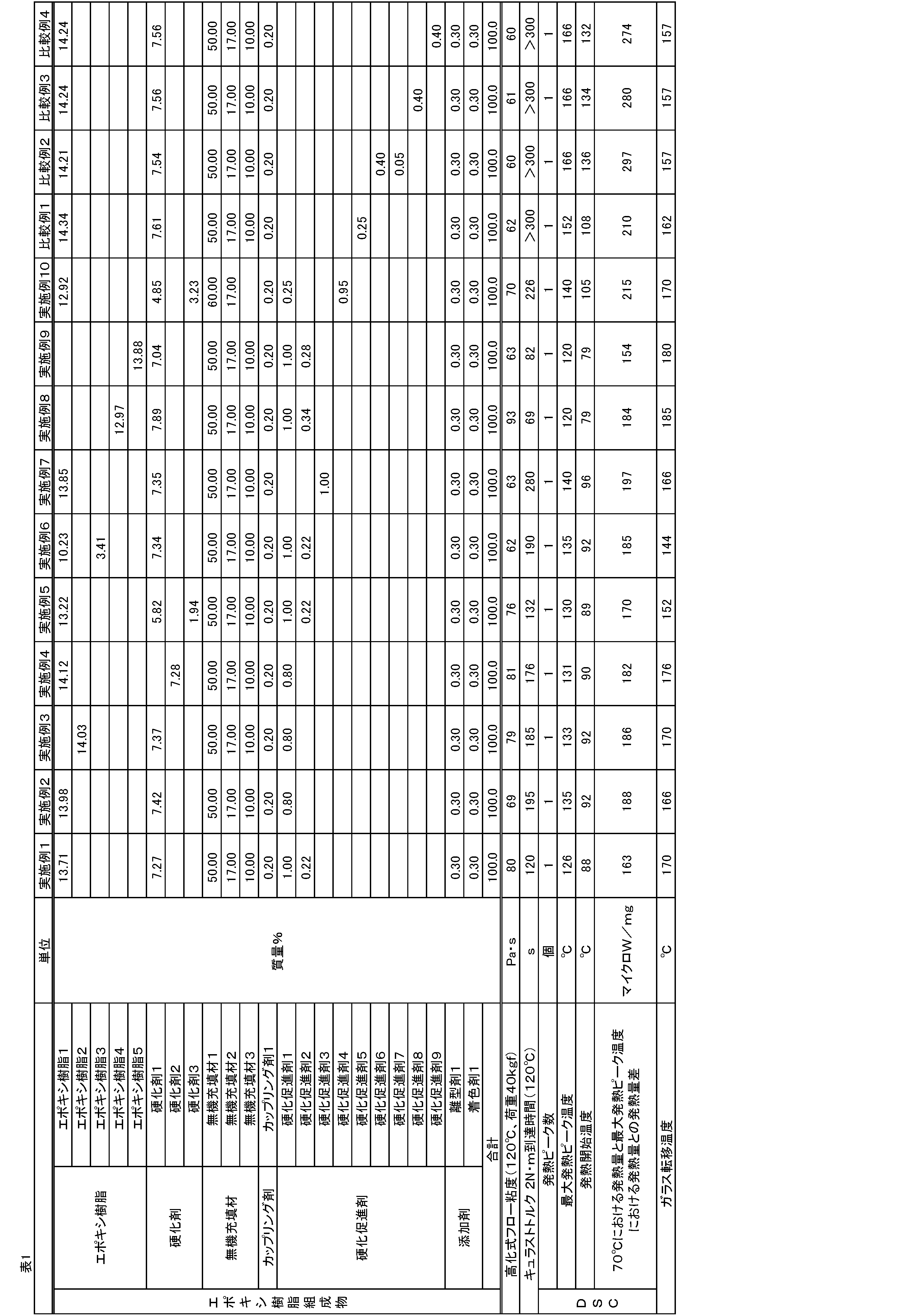
高化式フローテスター(島津製作所(株)製、CFT-500D)を用いて、温度120℃、荷重40kgf(ピストン面積1cm2)、ダイ穴直径0.50mm、ダイ長さ1.00mmの試験条件で、得られたエポキシ樹脂組成物のみかけの粘度ηを測定した。粘度ηは、以下の計算式より算出した。計算式中、Qは単位時間あたりに流れるエポキシ樹脂組成物の流量である。表1中の単位はPa・sである。
η=(πD4P/128LQ)×10-3(Pa・s)
η:みかけの粘度
D:ダイ穴直径(mm)
P:試験圧力(Pa)
L:ダイ長さ(mm)
Q:フローレート(cm3/s)
キュラストメーター((株)エー・アンド・デイ製、キュラストメーターMODEL7)を用い、金型温度120℃、振幅角度±0.25度にて、得られたエポキシ樹脂組成物のトルク値を経時的に測定した。測定結果に基づいて、測定開始から、トルク値が2N・mに達する時間(s)を算出した。
示差走査熱量計(SII製、DSC7020)を用い、窒素気流下で、昇温速度を10℃/分で30℃から200℃の温度範囲条件にて、10mgの上記エポキシ樹脂組成物について測定した。70℃における発熱量高さH1と最大発熱ピーク温度における発熱量高さHMAXとの差をΔH1とし、発熱量高さH1を基準にしたときに発熱量高さが、ΔH1の10%に達した時の温度を、発熱開始温度とした。発熱ピークは、ΔH1の30%を超えるものとした。
得られたエポキシ樹脂組成物の硬化物のガラス転移温度を次のように測定した。まず、トランスファー成形機を用いて金型温度140℃(各実施例)および175℃(各比較例)、注入圧力9.8MPa、硬化時間3分でエポキシ樹脂組成物を注入成形し、15mm×4mm×4mmの試験片を得た。次いで、得られた試験片を140℃(各実施例)および175℃(各比較例)、4時間で後硬化した後、熱機械分析装置(SII製、TMA/SS6100)を用いて、測定温度範囲0℃~320℃、昇温速度5℃/分の条件下で測定を行った。この測定結果から、ガラス転移温度を算出した。結果を表1に示す。
Claims (20)
- エポキシ樹脂と、
硬化剤と、
無機充填材と、
硬化促進剤と、を含む、エポキシ樹脂組成物であって、
示差走査熱量計を用いて昇温速度10℃/分の条件下で30℃から200℃まで昇温した際に得られる当該エポキシ樹脂組成物のDSC曲線における最大発熱ピーク温度が、80℃以上145℃以下である、エポキシ樹脂組成物。 - 請求項1に記載のエポキシ樹脂組成物であって、
当該エポキシ樹脂組成物の硬化物のガラス転移温度が、140℃以上250℃以下である、エポキシ樹脂組成物。 - 請求項1または2に記載のエポキシ樹脂組成物であって、
前記DSC曲線における発熱開始温度が、70℃以上110℃以下の範囲内にある、エポキシ樹脂組成物。 - 請求項1から3のいずれか1項に記載のエポキシ樹脂組成物であって、
前記DSC曲線における、70℃における発熱量高さH1と最大発熱ピーク温度における発熱量高さHMAXとの差を表すΔH1の30%を超える発熱ピークは、1つである、エポキシ樹脂組成物。 - 請求項1から4のいずれか1項に記載のエポキシ樹脂組成物であって、
120℃においてキュラストメーターで測定したトルク値が、測定開始から2N・mに到達するまでの時間が、30秒以上300秒以下である、エポキシ樹脂組成物。 - 請求項1から5のいずれか1項に記載のエポキシ樹脂組成物であって、
120℃かつ荷重40kgfで測定した高化式フローテスタの最低溶融粘度が、20Pa・s以上100Pa・s以下である、エポキシ樹脂組成物。 - 請求項1から6のいずれか1項に記載のエポキシ樹脂組成物であって、
70℃における発熱量と最大発熱ピーク温度における発熱量との発熱量差が、120マイクロW/mg以上400マイクロW/mg以下である、エポキシ樹脂組成物。 - 請求項1から7のいずれか1項に記載のエポキシ樹脂組成物であって、
前記エポキシ樹脂の含有量が、当該エポキシ樹脂組成物の全固形分に対して、8質量%以上30質量%以下である、エポキシ樹脂組成物。 - 請求項1から8のいずれか1項に記載のエポキシ樹脂組成物であって、
前記硬化促進剤が、イミダゾール系硬化促進剤を含む、エポキシ樹脂組成物。 - 請求項9に記載のエポキシ樹脂組成物であって、
前記イミダゾール系硬化促進剤が、2-フェニルイミダゾール、2-メチルイミダゾール、2-フェニル-4-メチルイミダゾール、および2-フェニル-4-メチル-5-ヒドロキシメチルイミダゾールからなる群から選択される一種以上を含む、エポキシ樹脂組成物。 - 請求項9または10に記載のエポキシ樹脂組成物であって、
前記イミダゾール系硬化促進剤の官能基数は、3個以下である、エポキシ樹脂組成物。 - 請求項9から11のいずれか1項に記載のエポキシ樹脂組成物であって、
前記硬化促進剤が、異なる種類の前記イミダゾール系硬化促進剤を含む、エポキシ樹脂組成物。 - 請求項1から12のいずれか1項に記載のエポキシ樹脂組成物であって、
前記硬化促進剤の含有量が、前記エポキシ樹脂の全固形分に対して、3.5質量%以上12.0質量%以下である、エポキシ樹脂組成物。 - 請求項1から13のいずれか1項に記載のエポキシ樹脂組成物であって、
前記硬化剤が、フェノール樹脂系硬化剤を含む、エポキシ樹脂組成物。 - 請求項1から14のいずれか1項に記載のエポキシ樹脂組成物であって、
前記無機充填材は、平均粒径D50が1μm以上50μm以下の充填材を含む、エポキシ樹脂組成物。 - 請求項1から15のいずれか1項に記載のエポキシ樹脂組成物であって、
前記無機充填材が、異なる平均粒径D50を有する充填材を含む、エポキシ樹脂組成物。 - 請求項1から16のいずれか1項に記載のエポキシ樹脂組成物であって、
前記無機充填材が、溶融シリカを含む、エポキシ樹脂組成物。 - 請求項1から17のいずれか1項に記載のエポキシ樹脂組成物であって、
粉粒状、顆粒状、タブレット状、またはシート状である、エポキシ樹脂組成物。 - 請求項1から18のいずれか1項に記載のエポキシ樹脂組成物であって、
封止用樹脂組成物に用いる、エポキシ樹脂組成物。 - 請求項1から19のいずれか1項に記載のエポキシ樹脂組成物の硬化物を備える、構造体。
Priority Applications (6)
| Application Number | Priority Date | Filing Date | Title |
|---|---|---|---|
| CN201780067682.XA CN109890894B (zh) | 2016-11-02 | 2017-09-12 | 环氧树脂组合物和结构体 |
| JP2018500809A JP6436263B2 (ja) | 2016-11-02 | 2017-09-12 | エポキシ樹脂組成物および構造体 |
| EP17866886.9A EP3536745B1 (en) | 2016-11-02 | 2017-09-12 | Epoxy resin composition and structure |
| KR1020197013437A KR102026123B1 (ko) | 2016-11-02 | 2017-09-12 | 에폭시 수지 조성물 및 구조체 |
| US16/346,784 US10513579B2 (en) | 2016-11-02 | 2017-09-12 | Epoxy resin composition and structure |
| BR112019006982-8A BR112019006982B1 (pt) | 2016-11-02 | 2017-09-12 | Composição de resina epóxi e estrutura |
Applications Claiming Priority (2)
| Application Number | Priority Date | Filing Date | Title |
|---|---|---|---|
| JP2016214890 | 2016-11-02 | ||
| JP2016-214890 | 2016-11-02 |
Publications (1)
| Publication Number | Publication Date |
|---|---|
| WO2018083885A1 true WO2018083885A1 (ja) | 2018-05-11 |
Family
ID=62075479
Family Applications (1)
| Application Number | Title | Priority Date | Filing Date |
|---|---|---|---|
| PCT/JP2017/032806 Ceased WO2018083885A1 (ja) | 2016-11-02 | 2017-09-12 | エポキシ樹脂組成物および構造体 |
Country Status (8)
| Country | Link |
|---|---|
| US (1) | US10513579B2 (ja) |
| EP (1) | EP3536745B1 (ja) |
| JP (1) | JP6436263B2 (ja) |
| KR (1) | KR102026123B1 (ja) |
| CN (1) | CN109890894B (ja) |
| BR (1) | BR112019006982B1 (ja) |
| HU (1) | HUE055552T2 (ja) |
| WO (1) | WO2018083885A1 (ja) |
Cited By (10)
| Publication number | Priority date | Publication date | Assignee | Title |
|---|---|---|---|---|
| JP2020094092A (ja) * | 2018-12-10 | 2020-06-18 | 住友ベークライト株式会社 | ステータコア絶縁用樹脂組成物 |
| WO2020137989A1 (ja) * | 2018-12-27 | 2020-07-02 | 住友ベークライト株式会社 | 封止用樹脂組成物、半導体装置、及び半導体装置の製造方法 |
| WO2020189711A1 (ja) * | 2019-03-20 | 2020-09-24 | 住友ベークライト株式会社 | 成形材料用樹脂組成物、成形体および構造体 |
| WO2021161360A1 (ja) * | 2020-02-10 | 2021-08-19 | 三菱電機株式会社 | エポキシ樹脂組成物、エポキシ樹脂硬化物およびエポキシ樹脂硬化物の製造方法 |
| JP2021158176A (ja) * | 2020-03-26 | 2021-10-07 | 住友ベークライト株式会社 | 電子装置および封止用樹脂組成物 |
| JP2021193158A (ja) * | 2020-06-08 | 2021-12-23 | 信越化学工業株式会社 | 熱硬化性エポキシ樹脂組成物、熱硬化性エポキシ樹脂シート、及びその硬化物 |
| JPWO2022054817A1 (ja) * | 2020-09-14 | 2022-03-17 | ||
| JP2022099653A (ja) * | 2020-12-23 | 2022-07-05 | 住友ベークライト株式会社 | 封止用樹脂組成物、電子装置の製造方法、半導体装置および電子装置 |
| US20220315695A1 (en) * | 2019-08-08 | 2022-10-06 | Sumitomo Bakelite Co., Ltd. | Encapsulating resin composition and electronic component |
| EP4074488A4 (en) * | 2021-02-17 | 2023-01-25 | Sumitomo Bakelite Co., Ltd. | SEALING RESIN COMPOSITION FOR INJECTION MOLDING |
Families Citing this family (3)
| Publication number | Priority date | Publication date | Assignee | Title |
|---|---|---|---|---|
| CN114437511A (zh) * | 2021-12-31 | 2022-05-06 | 江苏科化新材料科技有限公司 | 环氧树脂组合物及其应用、环氧树脂成型材料及其制备方法与应用 |
| KR102925042B1 (ko) * | 2023-04-14 | 2026-02-09 | 주식회사 케이씨씨 | 에폭시 수지 조성물 |
| US20250250433A1 (en) * | 2024-02-01 | 2025-08-07 | Westlake Epoxy Inc. | Epoxy resin compositions and uses thereof |
Citations (9)
| Publication number | Priority date | Publication date | Assignee | Title |
|---|---|---|---|---|
| JPH08164532A (ja) * | 1994-12-14 | 1996-06-25 | Tokuyama Corp | 熱硬化性組成物の硬化方法 |
| JP2001226463A (ja) * | 2000-02-17 | 2001-08-21 | Sumitomo Bakelite Co Ltd | エポキシ樹脂組成物及び半導体装置 |
| JP2008081684A (ja) * | 2006-09-28 | 2008-04-10 | Sumitomo Bakelite Co Ltd | 一液型エポキシ樹脂組成物 |
| JP2008081685A (ja) * | 2006-09-28 | 2008-04-10 | Sumitomo Bakelite Co Ltd | 一液型エポキシ樹脂組成物 |
| JP2009235211A (ja) * | 2008-03-26 | 2009-10-15 | Panasonic Electric Works Co Ltd | エポキシ樹脂組成物及び片面モールド型半導体装置 |
| JP2015086359A (ja) * | 2013-09-24 | 2015-05-07 | 日東電工株式会社 | 半導体チップ封止用熱硬化性樹脂シート及び半導体パッケージの製造方法 |
| JP2015137344A (ja) * | 2014-01-24 | 2015-07-30 | 住友ベークライト株式会社 | 封止用エポキシ樹脂組成物、及び半導体装置 |
| JP2016084342A (ja) | 2014-10-22 | 2016-05-19 | 三星エスディアイ株式会社Samsung SDI Co.,Ltd. | ホスホニウム系化合物、それを含むエポキシ樹脂組成物、およびそれを用いて製造された半導体装置 |
| JP2016214890A (ja) | 2016-06-23 | 2016-12-22 | 京楽産業.株式会社 | 遊技機 |
Family Cites Families (3)
| Publication number | Priority date | Publication date | Assignee | Title |
|---|---|---|---|---|
| JP2001270931A (ja) * | 2000-03-27 | 2001-10-02 | Sumitomo Bakelite Co Ltd | エポキシ樹脂組成物及び半導体装置 |
| KR20120064701A (ko) * | 2009-09-16 | 2012-06-19 | 스미또모 베이크라이트 가부시키가이샤 | 접착 필름, 다층 회로 기판, 전자 부품 및 반도체 장치 |
| CN102167886B (zh) * | 2011-01-14 | 2012-09-26 | 黄文迎 | 环氧树脂组合物及其制备方法 |
-
2017
- 2017-09-12 KR KR1020197013437A patent/KR102026123B1/ko active Active
- 2017-09-12 CN CN201780067682.XA patent/CN109890894B/zh active Active
- 2017-09-12 BR BR112019006982-8A patent/BR112019006982B1/pt not_active IP Right Cessation
- 2017-09-12 EP EP17866886.9A patent/EP3536745B1/en active Active
- 2017-09-12 HU HUE17866886A patent/HUE055552T2/hu unknown
- 2017-09-12 US US16/346,784 patent/US10513579B2/en not_active Expired - Fee Related
- 2017-09-12 JP JP2018500809A patent/JP6436263B2/ja active Active
- 2017-09-12 WO PCT/JP2017/032806 patent/WO2018083885A1/ja not_active Ceased
Patent Citations (9)
| Publication number | Priority date | Publication date | Assignee | Title |
|---|---|---|---|---|
| JPH08164532A (ja) * | 1994-12-14 | 1996-06-25 | Tokuyama Corp | 熱硬化性組成物の硬化方法 |
| JP2001226463A (ja) * | 2000-02-17 | 2001-08-21 | Sumitomo Bakelite Co Ltd | エポキシ樹脂組成物及び半導体装置 |
| JP2008081684A (ja) * | 2006-09-28 | 2008-04-10 | Sumitomo Bakelite Co Ltd | 一液型エポキシ樹脂組成物 |
| JP2008081685A (ja) * | 2006-09-28 | 2008-04-10 | Sumitomo Bakelite Co Ltd | 一液型エポキシ樹脂組成物 |
| JP2009235211A (ja) * | 2008-03-26 | 2009-10-15 | Panasonic Electric Works Co Ltd | エポキシ樹脂組成物及び片面モールド型半導体装置 |
| JP2015086359A (ja) * | 2013-09-24 | 2015-05-07 | 日東電工株式会社 | 半導体チップ封止用熱硬化性樹脂シート及び半導体パッケージの製造方法 |
| JP2015137344A (ja) * | 2014-01-24 | 2015-07-30 | 住友ベークライト株式会社 | 封止用エポキシ樹脂組成物、及び半導体装置 |
| JP2016084342A (ja) | 2014-10-22 | 2016-05-19 | 三星エスディアイ株式会社Samsung SDI Co.,Ltd. | ホスホニウム系化合物、それを含むエポキシ樹脂組成物、およびそれを用いて製造された半導体装置 |
| JP2016214890A (ja) | 2016-06-23 | 2016-12-22 | 京楽産業.株式会社 | 遊技機 |
Non-Patent Citations (1)
| Title |
|---|
| See also references of EP3536745A4 |
Cited By (18)
| Publication number | Priority date | Publication date | Assignee | Title |
|---|---|---|---|---|
| JP7639854B2 (ja) | 2018-12-10 | 2025-03-05 | 住友ベークライト株式会社 | ステータコア絶縁用樹脂組成物 |
| JP2020094092A (ja) * | 2018-12-10 | 2020-06-18 | 住友ベークライト株式会社 | ステータコア絶縁用樹脂組成物 |
| JP2023126257A (ja) * | 2018-12-10 | 2023-09-07 | 住友ベークライト株式会社 | ステータコア絶縁用樹脂組成物 |
| JP7302166B2 (ja) | 2018-12-10 | 2023-07-04 | 住友ベークライト株式会社 | ステータコア絶縁用樹脂組成物 |
| EP3904417A4 (en) * | 2018-12-27 | 2022-11-02 | Sumitomo Bakelite Co., Ltd. | RESIN COMPOSITION FOR SEALING, SEMICONDUCTOR DEVICE AND MANUFACTURING METHOD OF SEMICONDUCTOR DEVICE |
| WO2020137989A1 (ja) * | 2018-12-27 | 2020-07-02 | 住友ベークライト株式会社 | 封止用樹脂組成物、半導体装置、及び半導体装置の製造方法 |
| JPWO2020137989A1 (ja) * | 2018-12-27 | 2021-03-25 | 住友ベークライト株式会社 | 封止用樹脂組成物、半導体装置、及び半導体装置の製造方法 |
| JPWO2020189711A1 (ja) * | 2019-03-20 | 2021-04-30 | 住友ベークライト株式会社 | 成形材料用樹脂組成物、成形体および構造体 |
| WO2020189711A1 (ja) * | 2019-03-20 | 2020-09-24 | 住友ベークライト株式会社 | 成形材料用樹脂組成物、成形体および構造体 |
| US20220315695A1 (en) * | 2019-08-08 | 2022-10-06 | Sumitomo Bakelite Co., Ltd. | Encapsulating resin composition and electronic component |
| WO2021161360A1 (ja) * | 2020-02-10 | 2021-08-19 | 三菱電機株式会社 | エポキシ樹脂組成物、エポキシ樹脂硬化物およびエポキシ樹脂硬化物の製造方法 |
| JP2021158176A (ja) * | 2020-03-26 | 2021-10-07 | 住友ベークライト株式会社 | 電子装置および封止用樹脂組成物 |
| JP2021193158A (ja) * | 2020-06-08 | 2021-12-23 | 信越化学工業株式会社 | 熱硬化性エポキシ樹脂組成物、熱硬化性エポキシ樹脂シート、及びその硬化物 |
| JP7336419B2 (ja) | 2020-06-08 | 2023-08-31 | 信越化学工業株式会社 | 熱硬化性エポキシ樹脂組成物、熱硬化性エポキシ樹脂シート、及びその硬化物 |
| JPWO2022054817A1 (ja) * | 2020-09-14 | 2022-03-17 | ||
| WO2022054817A1 (ja) * | 2020-09-14 | 2022-03-17 | パナソニックIpマネジメント株式会社 | 封止用樹脂組成物及びその製造方法 |
| JP2022099653A (ja) * | 2020-12-23 | 2022-07-05 | 住友ベークライト株式会社 | 封止用樹脂組成物、電子装置の製造方法、半導体装置および電子装置 |
| EP4074488A4 (en) * | 2021-02-17 | 2023-01-25 | Sumitomo Bakelite Co., Ltd. | SEALING RESIN COMPOSITION FOR INJECTION MOLDING |
Also Published As
| Publication number | Publication date |
|---|---|
| JPWO2018083885A1 (ja) | 2018-11-08 |
| EP3536745B1 (en) | 2021-05-12 |
| CN109890894B (zh) | 2020-04-21 |
| KR20190058648A (ko) | 2019-05-29 |
| BR112019006982A2 (pt) | 2019-06-25 |
| US10513579B2 (en) | 2019-12-24 |
| BR112019006982B1 (pt) | 2020-09-01 |
| KR102026123B1 (ko) | 2019-09-30 |
| JP6436263B2 (ja) | 2018-12-12 |
| CN109890894A (zh) | 2019-06-14 |
| HUE055552T2 (hu) | 2021-12-28 |
| US20190256647A1 (en) | 2019-08-22 |
| EP3536745A1 (en) | 2019-09-11 |
| EP3536745A4 (en) | 2020-05-13 |
Similar Documents
| Publication | Publication Date | Title |
|---|---|---|
| JP6436263B2 (ja) | エポキシ樹脂組成物および構造体 | |
| JP6265308B1 (ja) | Lds用熱硬化性樹脂組成物、樹脂成形品および三次元成形回路部品 | |
| JP7302166B2 (ja) | ステータコア絶縁用樹脂組成物 | |
| JP6583278B2 (ja) | 半導体封止用樹脂組成物、半導体装置および構造体 | |
| CN107418143A (zh) | 半导体密封用环氧树脂组合物和半导体装置 | |
| JP7155929B2 (ja) | モールドアンダーフィル材料および電子装置 | |
| WO2016139985A1 (ja) | 封止用樹脂組成物、車載用電子制御ユニットの製造方法、および車載用電子制御ユニット | |
| JP6281178B2 (ja) | 電子装置、自動車および電子装置の製造方法 | |
| JP2017125150A (ja) | 樹脂組成物 | |
| JP2024166236A (ja) | 熱硬化性樹脂組成物、及び電子装置 | |
| JP2017195319A (ja) | 半導体封止用樹脂組成物および半導体装置 | |
| WO2020137989A1 (ja) | 封止用樹脂組成物、半導体装置、及び半導体装置の製造方法 | |
| CN111684588A (zh) | 半导体密封用树脂组合物、半导体装置和半导体密封用树脂组合物的制造方法 | |
| CN111433284B (zh) | 环氧树脂组合物和电子装置 | |
| JP2017088828A (ja) | 半導体封止用樹脂組成物、半導体装置および構造体 | |
| JP2021113241A (ja) | 封止用樹脂組成物および一次電池付モジュール | |
| JP2018024770A (ja) | 封止用樹脂組成物、および半導体装置 | |
| JP7155502B2 (ja) | 半導体装置およびその製造方法ならびに封止用樹脂組成物 | |
| JP2020152823A (ja) | 封止用樹脂組成物、フィルムコンデンサおよびその製造方法 | |
| JP2021158176A (ja) | 電子装置および封止用樹脂組成物 | |
| JP7501131B2 (ja) | Lds用熱硬化性樹脂組成物および構造体 | |
| JP7463845B2 (ja) | フェノキシ樹脂およびその用途 | |
| JP2019099726A (ja) | エポキシ樹脂および電子装置 | |
| US20250197628A1 (en) | Resin composition for encapsulation and method for producing single-sided encapsulation structure | |
| JP2017125149A (ja) | 封止用樹脂組成物および電子装置 |
Legal Events
| Date | Code | Title | Description |
|---|---|---|---|
| WWE | Wipo information: entry into national phase |
Ref document number: 2018500809 Country of ref document: JP |
|
| 121 | Ep: the epo has been informed by wipo that ep was designated in this application |
Ref document number: 17866886 Country of ref document: EP Kind code of ref document: A1 |
|
| REG | Reference to national code |
Ref country code: BR Ref legal event code: B01A Ref document number: 112019006982 Country of ref document: BR |
|
| NENP | Non-entry into the national phase |
Ref country code: DE |
|
| ENP | Entry into the national phase |
Ref document number: 20197013437 Country of ref document: KR Kind code of ref document: A |
|
| ENP | Entry into the national phase |
Ref document number: 2017866886 Country of ref document: EP Effective date: 20190603 |
|
| ENP | Entry into the national phase |
Ref document number: 112019006982 Country of ref document: BR Kind code of ref document: A2 Effective date: 20190405 |