THIONYL TETRAFLUORIDE MODIFIED COMPOUNDS AND USES
CROSS-REFERENCE TO RELATED APPLICATIONS
This application claims the benefit of U.S. Provisional Application Serial No.
62/427,489 filed on November 29, 2016, which is incorporated herein by reference in its entirety.
FIELD OF INVENTION
This invention relates to use of thionyl tetrafluoride as a polyvalent connector for SuFEx Click Chemistry. More particularly, this invention relates to iminosulfur fluoride compounds, polymers, and methods of preparing such compounds and polymers.
STATEMENT OF FEDERALLY SPONSORED RESEARCH
This invention was made with government support under Grant Nos. P50 GM103368 and ROl GMl 17145 awarded by the National Institutes of Health. The government has certain rights in this invention.
BACKGROUND
The foundation of Click Chemistry as a framework for creating functional molecular assemblies was inspired by the examination of Nature's favorite molecules and, the realization of her preference for making intermolecular connections through carbon-heteroatom linkages. [Ref. 1]. A stringent criteria for a process to earn Click Chemistry status was defined in 2001 [Ref. 1], highlighting the need for near perfect reactions to aid in the rapid synthesis of useful new materials.
The discovery of the Cu(I) catalyzed azide-alkyne cycloaddition reaction (CuAAC; Click I) in 2002 [Ref. 2], has since had a profound influence on the evolution of Click
Chemistry, demonstrating immense versatility and application in fields as diverse as materials science [Ref. 3], bioconjugation [Ref. 4] and drug discovery. [Ref. 5, 6].
In 2014, a new Click Chemistry reaction was introduced; SuFEx (Sulfur(VI) Fluoride Exchange; Click II) - a technology for creating molecular connections with absolute reliability. [Ref. 7]. SuFEx exploits a unique SVI-F bond activation phenomenon that allows
extraction of fluoride through a combination of H-bonding and Lewis acid effects, promoting exchange of SVI-F for SVI-0 and SVI-N bonds; a process often mediated by select amine catalysts (e.g. Et3 ) [Ref. 8] and silicon functionalized substrates. [Ref. 9-13].
Early in the development of SuFEx, sulfuryl fluoride (S02F2) [Ref. 7, 14] was identified as an excellent sulfur(VI) hub for creating diaryl sulfate links between molecules. Under SuFEx conditions, the latent reactivity of the otherwise stable SVI-F bond is roused to react with 'SuFExable' substrates. [Ref. 7, 15].
While this new area of Click Chemistry technology is just emerging, SuFEx has already found several applications, for example: the synthesis of tosylates [Ref. 9] and sulfonyl azides [Ref. 10]; application in polymer chemistry [Ref. 11] and post polymerization modification [Ref. 12, 13]; Suzuki coupling of aryl and heteroaryl fluorosulfates with boronic acids. [Ref. 15]. Of particular significance, however, is the realization of the potential for SuFEx in biological applications. [Ref. 16]. In a recent study, fluorosulfate based probes proved to be remarkable substrates, capable of selectively capturing protein side-chain groups, especially the hydroxyl on tyrosine, in live human cells. [Ref. 16a]. The remarkable chemistry offered by S(VI)"F and SuFEx holds much promise for future discovery applications. [Ref. 16]. There is an ongoing need for additional Click Chemistry reactions. The methods described herein address this need.
Seeking to expand the range of useful SuFEx connectors, other sulfur(VI) oxyfluoride gases were considered: SF6 (sulfur hexafluoride) and 0=SF4 (thionyl tetrafluoride, also referred to herein as SOF4) (FIG. 1). While SF6 is the most functionalized of these, it is also famously inert. [Ref. 17]. Thionyl tetrafluoride was first reported in 1902 by Moissan and Lebeau [Ref. 18], and is a colorless gas that boils at -49 °C. It comprises a structure based on a trigonal bipyramid with the oxygen occupying an equatorial position (FIG. 1). [Ref. 19]. The gas is classically prepared by reacting SOF2 with F2; [Ref. 18] a process that benefits from a silver fluoride catalyst. [Ref. 20]. An improved synthesis of 0=SF4, i.e., for labs with no access to F2, was reported in 1960 by Smith and Engelhardt at CRD DuPont in Wilmington, who found that in the presence of a catalytic amount of N02, the oxidation of SF4 by 02 was enhanced, giving good yields of the 0=SF4 gas. [Ref. 21].
SUMMARY OF THE INVENTION
Iminosulfur oxydifluoride compounds and derivatives thereof are prepared utilizing thionyl tetrafluorides (0=SF4).
Iminosulfur oxydifluoride compounds having the formulas R1-N=SOF2 and
R1-N=SO(XA)2 are described herein, in which R is an organic group, and each X
independently is selected from F, or an organic group bonded to S by and oxygen or nitrogen atom. The iminosulfur oxydifluoride compounds are formed by reacting a primary amine with 0=SF4 gas or as a solution of 0=SF4 in an aprotic solvent such as acetonitrile.
Compounds having the formula R3- H-SO- H-CH(R4)C(=0)OH, in which R3 and R4 are organic groups are also described herein. Methods of making such compounds and reactions of such compounds are also described.
Compounds having fluorine substituents are of considerable commercial and technical importance and utility due to the unique properties imparted by the fluorine atom. For example, many fluorine-containing compounds having a reactive fluorine are used as fluorinating agents, catalysts, handles for covalently attaching the compound to another material by replacement of the reactive fluorine, as well as protecting groups for hydroxyl, thiol, and amino substituents. Additionally, reactive sulfur-fluorine bonds can be selectively reacted and transformed into other functional groups, e.g., as described in US2015/034516 to Dong et al.
Compounds including substituted iminosulfuroxy groups, e.g., -N=SOR2 in which each
R is an organic group bonded to S by a covalent bond, an oxygen atom, or a nitrogen atom, are useful as electron-withdrawing functional groups, catalysts, solvents (in the case of liquid compounds), as well as being a linking group for attaching multiple organic compounds together.
The following embodiments illustrate certain aspects of the compounds and methods described herein.
Embodiment 1 is a compound of formula R1-N= S(0)(XA)2. R1 comprises at least one first organic moiety selected from the group consisting of hydrocarbyl (e.g., alkyl, aryl, alkylaryl, arylalkyl, a terpene, an alkene, a steroid, an alkyne) a terpenoid, a heterocycle, an alkenyl-substituted aryl, an alkynyl-substituted aryl, a carbohydrate, a polymer, an amino acid, a polypeptide, a nucleotide, a nucleic acid, an enzyme, -CH(R2)-C(=0)OH (wherein R2 is H or
a second organic moiety), and a nucleoside moiety. Each XA independently is F, ORx, N(RX)2, Het, or Rx; each Rx independently is a third organic moiety; NHet comprises a heterocyclic moiety bonded to S by a nitrogen-sulfur covalent bond; with the provisos that when R1 is alkyl, aryl, alkylaiyl, aiylalkyl, a terpene, a terpenoid, an alkene, an alkyne, an alkenyl- substituted aryl, or an alkynyl-substituted aryl, then one at least XA is ORx, N(RX)2, NHet , or R . When both Xft groups are F, the compounds are iminosulfur oxydifluorides. Non-limiting examples of compounds of Embodiment 1 are shown in Examples 4-47 and 55-84, below, and in Figures 2A, 2B, 3, 4, 6, 7, and 11.
Embodiment 2 is a compound of Embodiment 1, wherein R1 is or comprises a nucleoside moiet selected from the group consisting of:
wherein each R
Y independently is H, phosphate, a phosphate ester, sulfate, a sulfate ester, or a fourth organic moiety; and each R
z independently is a fifth organic moiety. Non-limiting examples of the compounds of Embodiment 2 are shown in Examples 25, 26, 46, and 55, below.
Embodiment 3 is the compound of Embodiment 1 or 2, wherein R1 is or comprises an alkynyl-substituted phenyl group, such as, e.g., shown in Examples 6, 34-43, 47, 53, 59, 61, and 66-71, below.
Embodiment 4 is the compound of any one of Embodiments 1 to 3, wherein R1 comprises an alkynyl group, such as, e.g., shown in Examples 6, 17, 25, 34-43, 46, 47, 53, 55, 59, 61, and 66-71, below.
Embodiment 5 is the compound of Embodiment 1, wherein R1 is -CH(R2)-C(=0)OH; and R2 is H or a side chain of an amino acid selected from the group consisting of alanine, arginine, asparagine, aspartic acid, cysteine, glutamic acid, glutamine, histidine, isoleucine, leucine, lysine, methionine, phenylalanine, proline, serine, threonine, tryptophan, tyrosine, valine, ornithine, 2,6-dimethyltyrosine, O-methyl-tyrosine, and para-amino-phenylalanine, such as is shown in Example 14, below.
Embodiment 6 is a compound of Embodiment 1, wherein R1 is an amino-substituted polymer and the -N=S(0)(XA)2 replaces at least one amino group thereof. Non-limiting examples of some primary amino-substituted polymers include amino-substituted polystyrene, polylysine, amino-substituted polyethylene copolymers, amino-substituted polyethers, polyallylamine and copolymers thereof (e.g., acrylamide-allylamine copolymers, N- vinylpyrrolidone-allylamine copolymers, acrylamide-allylamine copolymers, and the like), branched polyethyleneimines, and the like.
Embodiment 7 is a compound of Embodiment 1, wherein R1 is a polypeptide.
Embodiment 8 is a compound of Embodiment 7, wherein the polypeptide comprises a lysine residue and the -N=S(0)(XA)2 replaces the sidechain amino group of the lysine residue.
Embodiment 9 is the compound of any one of Embodiments 1 to 8, wherein the R1 comprises one or more substituents selected from the group consisting of functional groups hydroxyl, halogen, nitro, -C(0)R30, -C(0)OR3°, -C(O)N(R30)2, -CN, -SOvR30, -SOVN(R30)2, R30SOVN(R30)-, -N(R30)SOVR30, -S03R3°, -N(R30)2, -N(R30)OR30, -N(R30)C(O)R30,
-N(R3U)C(0)ORjU, -N(RjU)C(0)N(RjU)2, -OC(0)N(R3U)2, -OC(0)ORjU, azido, alkyl, cycloalkyl, alkenyl, alkynyl, alkoxy, fluoroalkyl, fluoroalkoxy, aryl, aryloxy, heteroaryl, poly(ethyleneoxy), alkynyl-terminated poly(ethyleneoxy), a fatty acid, a carbohydrate, an amino acid, a polypeptide; wherein each R30 independently is H, alkyl, or aryl, and v is 0, 1, or 2. Non-limiting examples of the compounds of Embodiment 10 are shown in Examples 5-47, and 52-71, below.
Embodiment 10 is the compound of any one of Embodiments 1 to 9, wherein at least one XA is F. Non-limiting examples of the compounds of Embodiment 10 are shown in Examples 4-47, 55-59, 70-76 and 78, below.
Embodiment 11 is the compound of any one of Embodiments 1 to 10, wherein at least one X is N(R )2. Non-limiting examples of the compounds of Embodiment 11 are shown in Examples 34-47, 62-64, 70 and 71, below.
Embodiment 12 is the compound of any one of Embodiments 1 to 10, wherein at least one XA is NHet and comprises a heterocyclic ring selected from the group consisting of an aziridine ring, an azetidine ring, a pyrrolidine ring, a piperidine ring, a piperazine ring, a morpholine ring, a thiazolidine ring, and a thiomorpholine ring. Non-limiting examples of the compounds of Embodiment 12 are shown in Examples 37-43, below.
Embodiment 13 is the compound of any one of Embodiments 1 to 10, wherein at least one XA is NHet and comprises a heterocyclic ring selected from the group consisting of a pyrrole ring, an imidazole ring, a pyrazole ring, a 1,2,3-triazole ring, a 1,2,4-triazole ring, a tetrazole ring, an indole ring, a benzimidazole ring, a benzotriazole ring, and a purine ring.
Embodiment 14 is the compound of any one of Embodiments 1 to 13, wherein at least one X is OR . Non-limiting examples of the compounds of Embodiment 14 are shown in Examples 52-59, 61-71 and 73-77, below and in Figures 6-10, 12A, 12B and 13.
Embodiment 15 is the compound of any one of Embodiments 1 to 14, wherein at least one X is R (e.g., alkyl, aryl, heteroaryl, and the like, preferably aryl or heteroaryl) such as shown, e.g., in Examples 80 to 83, below.
Embodiment 16 is the compound of any one of Embodiments 1 to 11, wherein both XA groups are F (i.e., iminosulfur oxydifluorides). Non-limiting examples of the compounds of Embodiment 16 are shown in Examples 4-32, 76, and 84, below, and in Figures 2A, 2B, 3 and 11.
Embodiment 17 is the compound of any one of Embodiments 1 to 9, wherein both XA groups are N(RX)2, such as is shown in Example 27, below.
Embodiment 18 is the compound of any one of Embodiments 1 to 9, 12 and 13, wherein both XA groups are Het.
Embodiment 19 is the compound of any one of Embodiments 1 to 9, and 14, wherein both X groups are OR . Non-limiting examples of the compounds of Embodiment 19 are shown in Examples 60, 61, and 66-69, below, and in Figure 8.
Embodiment 20 is the compound of any one of Embodiments 1 to 9, and 15, wherein both X groups are Rx (e.g., alkyl, aryl, heteroaryl, and the like, preferably at least one Rx being aryl or heteroaryl) such as shown, e.g., in Example 81, below.
Embodiment 21 is a compound of formula R3-NH-SO-NH-CH(R4)C(=0)OH, wherein R is an organic group, and R4 is H or an organic group. Non-limiting examples of the compounds of Embodiment 21 are shown in Examples 49, 50 and 51.
Embodiment 22 is the compound of Embodiment 21, wherein R4 is H or a side chain of an amino acid selected from the group consisting of alanine, arginine, asparagine, aspartic acid, cysteine, glutamic acid, glutamine, histidine, isoleucine, leucine, lysine, methionine, phenylalanine, proline, serine, threonine, tryptophan, tyrosine, valine, ornithine, 2,6- dimethyltyrosine, O-methyl-tyrosine, and para-amino-phenylalanine. Non-limiting examples of the compounds of Embodiment 22 are shown in Examples 49, 50 and 51.
Embodiment 23 is a method for preparing an iminosulfur oxydifluoride compound of
Embodiment 16, comprising contacting an amino compound of formula R1-NX2 with thionyl tetrafluoride (0=SF4) to form an iminosulfur oxydifluoride compound of formula R1-N=SOF2; wherein each X independently is H or Si(R16)3; and each R16 independently is an alkyl group, an aryl group, an arylalkyl group or an alkylaryl group; with the proviso that when both X groups are H, the amino compound is contacted with the SOF4 in the presence of a tertiary amine. The 0=SF4 can be supplied as a gas or as a solution in an aprotic solvent such as acetonitrile. Non-limiting examples of the method of Embodiment 23 are shown in Examples 4-43 and 84, below.
Embodiment 24 is the method of Embodiment 23, wherein each X is H. Non-limiting examples of the method of Embodiment 23 are shown in Examples 4-43 and 84, below.
Embodiment 25 is the method of Embodiment 23, wherein one X is H and one X is Si(R16)3.
Embodiment 26 is the method of Embodiment 23, wherein both X groups are Si(R16)3. Embodiment 27 is a method for preparing a sulfamoyl amino acid compound of Embodiment 21, the method comprising contacting a compound of formula R3-N=SOF2 with an alpha-amino acid of formula H2N-CH(R4)C(=0)OH in the presence of a tertiary amine in a solvent at a buffered pH of about 7 to 7.4 to form the sulfamoyl amino acid compound wherein R4 is H or a sixth organic moiety. Non-limiting examples of the method of Embodiment 27 are shown in Examples 49, 50 and 51, below.
Embodiment 28 is the method of Embodiment 27, wherein R4 is H or a side chain of an amino acid selected from the group consisting of alanine, arginine, asparagine, aspartic acid, cysteine, glutamic acid, glutamine, histidine, isoleucine, leucine, lysine, methionine, phenylalanine, proline, serine, threonine, tryptophan, tyrosine, valine, ornithine, 2,6- dimethyltyrosine, O-methyl-tyrosine, and para-amino-phenylalanine. Non-limiting examples of the method of Embodiment 28 are shown in Examples 49, 50 and 51, below.
Embodiment 29 is a method for preparing a sulfamoyl amino acid compound having the formula R1-NH-SO-NH-CH(R17)C(=0)OH, the method comprising contacting a compound of Embodiment 16 with an alpha-amino acid of formula H2N-CH(R17)C(=0)OH in the presence of a tertiary amine in a solvent at a buffered pH of about 7 to 7.4 to form the sulfamoyl amino acid compound; wherein R17 is H or a sixth organic moiety. Non-limiting examples of the method of Embodiment 29 are shown in Examples 49, 50 and 51, below.
Embodiment 30 is a method of Embodiment 29, wherein R17 is H or a side chain of an amino acid selected from the group consisting of alanine, arginine, asparagine, aspartic acid, cysteine, glutamic acid, glutamine, histidine, isoleucine, leucine, lysine, methionine, phenylalanine, proline, serine, threonine, tryptophan, tyrosine, valine, ornithine, 2,6- dimethyltyrosine, O-methyl-tyrosine, and para-amino-phenylalanine. Non-limiting examples of the method of Embodiment 30 are shown in Examples 50 and 51, below.
Embodiment 31 is a method for preparing a sulfurofluoridoimidate compound comprising contacting an iminosulfur oxydifluoride compound of formula R15-N=SOF2 with about one molar equivalent of an organosilyl ether compound of formula R18-0-Si(R19)3 in the presence of a catalyst to form a sulfurofluoridoimidate compound of formula
15 18 15 18
R -N=SO(F)(0-R ); wherein RiJ is a first organic moiety; R is a second organic moiety; each R19 independently is an alkyl group, an aryl group, an arylalkyl group or an alkylaryl group; and the catalyst is selected from at least one member of the group consisting of an amidine base, a guanidine base, a phosphorine base, and a fluorine-containing anion. Non- limiting examples of the method of Embodiment 31 are shown in Examples 53-61, 66-69, 73- 74, and 76, below.
Embodiment 32 is a method for preparing a compound of formula
comprising contacting an iminosulfur oxydifluoride compound of formula R15-N=SOF2 with about two molar equivalents of an organo silylether compound of formula R18-0-Si(R19)3 in the presence of a catalyst to form the compound of formula R15-N=SO(0-R18)2; wherein R15 is a first organic moiety; R18 is a second organic moiety; each R19 independently is an alkyl group, an aryl group, an arylalkyl group or an alkylaryl group; and the catalyst is selected from at least one member of the group consisting of an amidine base, a guanidine base, a phosphorine base, and a fluorine-containing anion. Non-limiting examples of the method of Embodiment 31 are shown in Examples 60, 61, and 66-69, below.
Embodiment 33 is a method for preparing a sulfurimidate compound comprising contacting an iminosulfur oxydifluoride compound of formula R
15-N=SOF
2 with an organo bis-silylether compound of Formula (I): (I) I in the presence of a catal st to form a sulfurimidate compound of Formula (II):
wherein R15 is a first organic moiety; each of X3 and X4 independently is O-Si(R20)3;
each R20 independently is an alkyl group, an aryl group, an arylalkyl group or an alkylaryl
21 22 3 4
group; RZi and R" are connected organic moieties in which the X and X groups are separated from each other by 2, 3, 4, or 5 atoms; and the catalyst is selected from at least one member of the group consisting of an amidine base, a guanidine base, a phosphorine base, and a fluorine-
containing anion. Non-limiting examples of the method of Embodiment 33 are shown in Examples 66-69, below.
Embodiment 34 is a method for preparing a sulfuramidoyl fluoride compound comprising contacting a compound of Embodiment 16 with a secondary amine of formula HNRX2 or a heterocycle HNHet, to form a sulfuramidoyl fluoride compound of formula
R1-N=SO(F)(XA); wherein XA is N(RX)2 or NHet. Non-limiting examples of the method of Embodiment 34 are shown in Examples 34-47, below.
Embodiment 35 is a method for preparing a compound of formula
R15-N=SO(NR23R24)(0-R18) comprising contacting a compound of formula
R15-N=SO(F)(0-R18) with a secondary amine of formula R23-NHR24 to form the compound of formula R15-N=SO(NR23R24)(0-R18); wherein R15 is a first organic moiety; R18 is a second organic moiety; R23 is a third organic moiety; and R24 is a fourth organic moiety or H. Non- limiting examples of the method of Embodiment 35 are shown in Examples 63 and 64, below.
Embodiment 36 is a method for preparing a compound of formula
15 23 24 18
R -N=SO(NR R )(0-R ) comprising contacting a sulfuramidoyl fluoride compound of formula R15-N=SO(F)(NR23R24) with an organo silylether compound of formula
R18-0-Si(R19)3 in the presence of a catalyst to form a sulfonimidate compound of formula R15-N=SO(NR23R24)(0-R18); wherein R15 is a first organic moiety; R18 is a second organic moiety; each R19 independently is an alkyl group, an aryl group, an arylalkyl group or an alkylaryl group; R23 is a third organic moiety; R24 is a fourth organic moiety or H; and the catalyst is selected from at least one member of the group consisting of an amidine base, a guanidine base, a phosphorine base, and a fluorine-containing anion. A non-limiting example of the method of Embodiment 36 is shown in Example 62, below.
Embodiment 37 is a method for preparing a compound of formula R15-N=SO(F)(Rx); comprising contacting an iminosulfur oxydifluoride compound of formula R15-N=SOF2 with an organo lithium compound of formula RxLi (e.g., about 1.3 to 2.2. equiv.); wherein R15 is a first organic moiety; and Rx is a second organic moiety. Non-limiting examples of the method of Embodiment 37 are shown in Example 80, below.
Embodiment 38 is the method of Embodiment 37, wherein R
x is an aryl or heteroaryl group. Non-limiting examples of the method of Embodiment 37 are shown in Example 80, below.
Embodiment 39 is a method for preparing a compound of formula
comprising contacting a compound of formula R
15-N=SO(F)(R
x) with an organo lithium compound of formula R
xLi; wherein R
15 is a first organic moiety; and R
x is a second organic moiety. Non-limiting examples of the method of Embodiment 39 are shown in Example 81, below.
Embodiment 40 is a method for preparing a compound of formula
R15-N=SO(Rx)(0-R18) comprising contacting a compound of formula R15-N=SO(F)(Rx) with a silyl ether compound of formula R33-0-Si(R34)3 in the presence of a catalyst; wherein R15 is a first organic moiety; Rx is a second organic moiety; R33 is a third organic moiety; each R34 independently is an alkyl group, an aryl group, an arylalkyl group or an alkylaryl group; and the catalyst is selected from at least one member of the group consisting of an amidine base, a guanidine base, a phosphorine base, and a fluorine-containing anion. Non-limiting examples of the method of Embodiment 40 are shown in Example 82, below.
Embodiment 41 is a method for preparing a compound of formula
R15-N=SO(Rx)(NR35R36) comprising contacting a compound of formula R15-N=SO(F)(Rx)
35 36 15 X with an amino compound of formula HNR R ; wherein R is a first organic moiety; R is a
35 36 35 36 second organic moiety; each R and R independently is an organic group, or R and R together with the N attached thereto are a heterocyclic group. Non-limiting examples of the method of Embodiment 41 are shown in Example 83, below.
Embodiment 42 is a method of preparing an iminosulfur oxyfluoride polymer comprising contacting a bis-(iminosulfur oxydifluoride) monomer with a bis-(silyl ether) monomer in the presence of a catalyst for the iminosulfur oxyfluoride polymer; wherein the catalyst is selected from at least one member of the group consisting of an amidine base, a guanidine base, a phosphorine base, and a fluorine-containing anion. Non-limiting examples of the method of Embodiment 42 are shown in Examples 73-79, below, and in Figures 10, 12A, and 13.
Embodiment 43 is the method of Embodiment 42, wherein the bis(iminosulfur oxydifluoride) monomer is a compound of Formula (III):
<
m>
the bis-(silyl ether) monomer is a compound of Formula (IV):
and the iminosulfur oxyfluoride polymer is a compound of Formula (V):
wherein x is the average number of repeating units in the polymer, and has a value of greater than 1, e.g., greater than 10, greater than 20, greater than 30, greater than 50, greater than 100, greater than 1000; or greater than 10,000; each of Z1 and Z2 independently is a divalent organic group; and each R26 independently is an alkyl group, an aryl group, an arylalkyl group or an alkylaryl group. Non-limiting examples of the method of Embodiment 43 are shown in Examples 73-79, below, and in Figure 10, 12 A, and 13.
Embodiment 44 is the method of Embodiment 43, wherein each of Z1 and/or Z2 independently is a divalent organic group of Formula (VI):
wherein X
5 is selected from -CH
2-, -CH(R
28)-, -C(R
28)
2-, -R
28-, -OR
280-, -0-, -S-, and -S0
2-; each R
27 independently is a substituent selected from a halogen (e.g., CI, Br, I), an alkyl, an alkoxy, an aryl, an alkylaryl, an arylalkyl, and a heteroatom-containing substituent comprising one or more oxygen, nitrogen, or sulfur atoms, optionally in combination with carbon and hydrogen (e.g., acyl, acyloxy, amido, and the like); R
28 is selected from alkyl, aryl, arylalkyl, and alkylaryl; and each y independently is 0, 1, 2, 3, and 4. Non-limiting examples of the method of Embodiment 44 are shown in Example 73, below, and in Figures 10 and 12A.
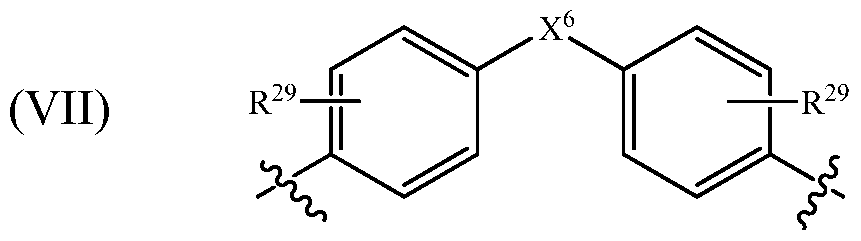
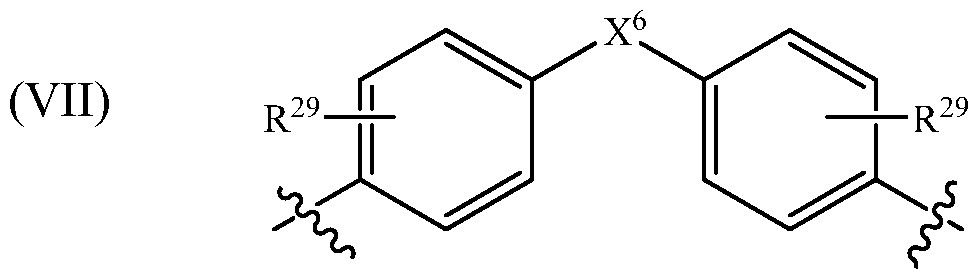
Embodiment 45 is the method of Embodiment 43, wherein each of Z
1 and/or Z
2 independently is a divalent organic group of Formula (VII):
wherein each R
29 independently is a hydrocarbyl group, and X
6 is a covalent bond, -C(CH
3)
2-, -C(CF
3)
2-, or -S0
2-. Non-limiting examples of the method of Embodiment 45 are shown in Example 73, below and in Figures 10 and 12 A.
Embodiment 46 is the method of any one of Embodiments 42 to 45, contacting the bis- (iminosulfur oxydifluonde) monomer and the a bis-(silyl ether) monomer with a cross-linking monomer comprising at least three iminosulfur oxydifluoride groups in the presence of the catalyst to form a crosslinked iminosulfur oxyfluoride polymer. A non-limiting example of the method of Embodiment 46 is shown in Example 76, below.
Embodiment 47 is the method of any one of Embodiments 42 to 46, contacting the bis- (iminosulfur oxydifluoride) monomer and the a bis-(silyl ether) monomer with a cross-linking monomer comprising at least three silyl ether groups in the presence of the catalyst to form a crosslinked iminosulfur oxyfluoride polymer.
Embodiment 48 is an iminosulfur oxyfluoride polymer of Formula (V):
wherein x is the average number of repeating units in the polymer, and has a value of greater than 1, e.g., greater than 10, greater than 20, greater than 30, greater than 50, greater than 100, greater than 1000; or greater than 10,000; and each of Z1 and Z2 independently is a divalent organic group. Non-limiting examples of the polymer of Embodiment 48 are shown in Example 73, below and in Figures 10, 12 A, 12B, 12C, and 13.
Embodiment 49 is the polymer of Embodiment 48, wherein each of Z
1 and/or Z
2 independently is a divalent or anic group of Formula (VI): (VI)
wherein X
5 is selected from -CH
2-, -CH(R
28)-, -C(R
28)
2-, -R
28-, -OR
280-, -0-, -S-, and -S0
2-; each R
27 independently is a substituent selected from a halogen (e.g., CI, Br, I), an alkyl, an alkoxy, an aryl, an alkylaryl, an arylalkyl, and a heteroatom-containing substituent comprising one or more oxygen, nitrogen, or sulfur atoms, optionally in combination with carbon and hydrogen (e.g., acyl, acyloxy, amido, and the like); R
28 is selected from alkyl, aryl, arylalkyl, and alkylaryl; and each y independently is 0, 1, 2, 3, and 4. Non-limiting examples of the polymer of Embodiment 49 are shown in Example 73, below and in Figures 10, 12 A, 12B, and 12C.
Embodiment 50 is the polymer of Embodiment 48, wherein each of Z1 and/or Z2 independently are divalent groups of Formula (VII):
wherein each R29 independently is a hydrocarbyl group, and X6 is a covalent bond, -C(CH3)2-, -C(CF3)2-, or -S02-. Non-limiting examples of the polymer of Embodiment 47 are shown in Example 73, below and in Figures 10, 12 A, 12B, and 12C.
Embodiment 51 is the polymer of any one of Embodiments 48 to 50 comprising at least one crosslinking monomer unit, a non-limiting example of which can be found in Example 76, below.
Embodiment 52 is a polymer of Formula (VIII):
wherein x is the average number of repeating units in the polymer, and has a value of greater than 1, e.g., greater than 10, greater than 20, greater than 30, greater than 50, greater than 100, greater than 1000; or greater than 10,000; and each of Z1 and Z2 independently is a divalent organic group; each X 1 of the polymer i ·ndependently i *s F or R31 ; at least one X 7' i*s R3J1i; and R3J is an organic moiety; with the provisos that when X7 is R31, E is oxygen or tertiary amino
nitrogen; and when X7 is F, E is a covalent bond. Non-limiting examples of the polymer of Embodiment 52 are shown in Examples 73-78, below and in Figure 10.
Embodiment 53 is the polymer of Embodiment 52, wherein each of Z
1 and/or Z
2 independently is a divalent organic group of Formula (VI):
wherein X5 is selected from -CH2-, -CH(R28)-, -C(R28)2-, -R28-, -OR280-, -0-, -S-, and -S02-; each R27 independently is a substituent selected from a halogen (e.g., CI, Br, I), an alkyl, an alkoxy, an aryl, an alkylaryl, an arylalkyl, and a heteroatom-containing substituent comprising one or more oxygen, nitrogen, or sulfur atoms, optionally in combination with carbon and hydrogen (e.g., acyl, acyloxy, amido, and the like); R28 is selected from alkyl, aryl, arylalkyl, and alkylaryl; and each y independently is 0, 1, 2, 3, and 4. Non-limiting examples of the polymer of Embodiment 53 are shown in Examples 73-75 and 78, below and in Figure 10.
Embodiment 54 is the polymer of Embodiment 52, wherein each of Z
1 and/or Z
2 independentl are divalent roups of Formula (VII):
wherein each R29 independently is a hydrocarbyl group, and X6 is a covalent bond, -C(CH3)2-, -C(CF3)2-, or -S02-. Non-limiting examples of the polymer of Embodiment 54 are shown in Examples 73-75 and 78, below, and in Figure 10.
Embodiment 55 is the polymer of any one of Embodiments 52 to 54, wherein at least one R31 of the polymer comprises an organic moiety selected from the group consisting of hydrocarbyl (e.g., alkyl, aryl, alkylaryl, arylalkyl, a terpene, an alkene, a steroid, an alkyne) a terpenoid, a heterocycle, an alkenyl-substituted aryl, an alkynyl-substituted aryl, a
carbohydrate, an amino acid, a polypeptide, a nucleotide, a nucleic acid, an enzyme,
-CH(R2)-C(=0)OH (wherein R2 is H or a second organic moiety), and a nucleoside moiety Non-limiting examples of the polymer of Embodiment 55 are shown in Examples 73-75 and 78, below and in Figure 10.
Embodiment 56 is the polymer of any one of Embodiments 52 to 55, wherein at least one R31 of the polymer comprises a heterocyclic moiety. Non-limiting examples of the polymer of Embodiment 56 are shown in Examples 75 and 77, below, and in Figure 10.
Embodiment 57 is the polymer of any one of Embodiments 52 to 56, wherein at least one R31 of the polymer comprises an effector group selected from an antimicrobial agent and a catalyst. A non-limiting example of the polymer of Embodiment 57 is shown in Example 78, below.
Embodiment 58 is the polymer of Embodiment 57, wherein the effector group is an antimicrobial agent selected from at least one member of the group consisting of an antibacterial agent, an antiviral agent, an antifungal agent, and an antiparasitic agent. A non- limiting example of the polymer of Embodiment 58 is shown in Example 78, below.
Embodiment 59 is the polymer of Embodiment 57, wherein the effector group is a catalyst comprising at least one enzyme selected from the group consisting of an
oxidoreductase, a transferase, a hydrolase, a lyase, an isomerase, and a ligase.
Embodiment 60 is the polymer of any one of Embodiments 52 to 59, wherein R31 comprises at least one terminal alkyne group. Non-limiting examples of the polymer of Embodiment 60 are shown in Examples 74-77, below, and in Figure 10.
Embodiment 61 is the polymer of Embodiment 60, wherein R
31 comprises:
wherein R32 is a divalent Ci to Cio hydrocarbyl group. Non-limiting examples of the polymer of Embodiment 61 are shown in Examples 74-77, below, and in Figure 10.
Embodiment 62 is the polymer of any one of Embodiments 60 and 61, wherein R31 comprises propargyl or ethynyl- substituted phenyl. Non-limiting examples of the polymer of Embodiment 62 are shown in Examples 74-77, below, and in Figure 10.
Embodiment 63 is a method of forming a polymer of any one of Embodiments 52 to 62 comprising contacting the polymer of any one of Embodiments 48 to 51 with: (a) a compound of formula R31-E-Si(R32)3 in the presence of a catalyst, wherein E is oxygen, or (b) a compound of formula R31-E-H, wherein E is oxygen or tertiary amino nitrogen; each R32 independently is an alkyl group, an aryl group, an arylalkyl group or an alkylaryl group; and wherein the catalyst is selected from at least one member of the group consisting of an amidine
base, a guanidine base, a phosphorine base, and a fluorine-containing anion. A non-limiting example of the method of Embodiment 60 is shown in Example 75-78, below.
BRIEF DESCRIPTION OF THE DRAWINGS FIG. 1 illustrates structure and boiling point of SF6, 0=SF4; and SO2F2.
FIG. 2 A illustrates the reaction of primary amines with 0=SF4 in the presence of Et3N. [a] indicates the reaction without Et3N.
FIG. 2B illustrates additional reactions of primary amines with 0=SF4 in the presence of Et3N. [b] indicates the amine was generated in situ by reducing azide under Staudinger conditions with PMe3 and 1 to 3 equiv of H20.
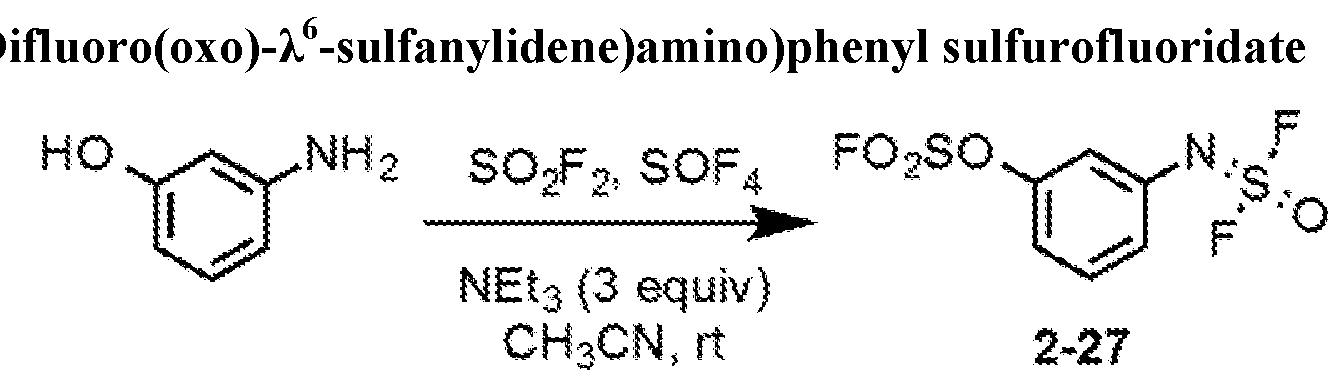
FIG. 3 illustrates the selectivity of S02F2 and 0=SF4 towards aromatic hydroxyl and amino groups.
FIG. 4 shows the reaction of iminosulfur oxydifluorides with secondary amines. In [a], 1.2 equiv of proline methyl ester and 2 equiv of Et3N and in [b], 1 equiv of amoxapine and 2 equiv of Et3N were used; the solvent was DMSO.
FIG. 5 illustrates the reaction of iminosulfur oxydifluorides with amino acids.
FIG. 6 illustrates connecting amines with phenols
FIG. 7 shows a comparison of the reactivity of iminosulfur oxydifluoride with sulfonyl fluoride and fluorosulfate.
FIG. 8 shows the connections of primary amines with two phenols or one phenol and one secondary amine
FIG. 9 illustrates the reaction of iminosulfur oxydifluorides with catechols and the activity of the product towards amines.
FIG. 10 illustrates polymer synthesis based on the iminosulfur oxydifluoride.
FIG. 11 illustrates reactions of SOF4 based polymers.
FIG. 12A illustrates the polymerization reaction using different silyl ethers.
FIG. 12B illustrates additional polymerization reactions using different silyl ethers.
FIG. 12C illustrates more additional polymerization reactions using different silyl ethers.
FIG. 13 illustrates the polymerization reaction using a N=S(=0)(-F)-N type linker.
FIG. 14 provides micrographic images of zebrafish embryos: (A) and (B) Phenotypes generated by incubating zebrafish embryos with Compound 2-23 at various concentration; (C) Lysates from Compound 2-23 treated or untreated embryos at 24 hpf were reacted with biotin- azide, pull-down with streptavidin beads and analyzed using SDS-PAGE.
DETAILED DESCRIPTION
Detailed studies on the SuFEx chemistry of 0=SF4 and its iminosulfur oxydifluoride products are reported herein. Presence of tertiary amine bases, such as triethylamine (Et3N) and Ν,Ν-diisopropylethylamine (DIPEA) improved reaction rates and yields. The initial products still have two S-F handles, and each fluoride can be substituted in a serial manner by secondary alkyl amines and/or phenols (as their aryl silyl ether under SuFEx catalysis [Ref. 7]). The final products for up to three steps arise in excellent overall yields [Ref. 23], thereby allowing controlled projections to be intentionally substituted along three of the four tetrahedral axes departing the S-(VI)-central hub.
Given the fidelity and scope of these three serial transformations, thionyl tetrafluoride
(0=SF4) has been identified as another good connective gas for SuFEx Click Chemistry.
First Dimension Connectivity: 0=SF4 Reacts with Primary Amines and Anilines
As described herein, the presence of a tertiary amine base significantly improved the reactions of 0=SF4 with primary amines: exposing a solution of primary amine, 1 to 2 mol equiv of Et3N or DIPEA in CH3CN, to 0=SF4 gas, resulted in excellent yields of the tetrahedral iminosulfur oxydifluoride products (FIG. 2). Furthermore, the reactions were chemo selective - reacting preferentially with the primary amine over the other functional groups represented in FIG. 2, for example the catechol 2-16 and the indole 2-17.
The selective decoration of FL moieties in biologically significant building blocks was also readily accomplished giving the 'SuFExable' steroid-N=SOF2 cases (FIG. 2, 2-21 and 2-22) and also the nucleotide-N=SOF2 cases (2-23 and 2-24) in good yields. With the a-amino amide 1-25, intramolecular displacement of the remaining fluoride occurs giving the cyclic sulfamide 2-25 in moderate yield (FIG. 2). Generating the reactive amine in situ, from the corresponding azide under Staudinger conditions, did not adversely affect the yield of the iminosulfur oxydifluoride products (2-9, 2-22, 2-23).
Chemoselectivity of 0=SF4: Aniline vs. Phenols
Noteworthy is the observed chemoselective preference of 0=SF4 for aniline vs. phenol (1-16→ 2-16; FIG. 2); this contrasts with the S02F2 which demonstrates the reverse order of preference with aminophenols. [Ref. 7, 10].
To probe this selectivity effect further, reactions of aminophenols with both gases (0=SF4 and S02F2) simultaneously were explored. When acetonitrile solutions of the aminophenols 1-26 through 1-28 were exposed to a 1 : 1 ratio of 0=SF4 : S02F2 in the presence of Et3N (3 equiv), the corresponding SuFEx products 2-26 through 2-28 were formed in excellent yields, respectively (FIG. 3). This outcome is explained by the preferential reaction pairing of S02F2 with phenol and 0=SF4 with amine, together with the decreasing
opportunities for cross-over reaction for each gas as the reaction proceeds and, at least in the case of the F2OS=N-Ar-OH, the enhanced acidity of the phenol group (FIG. 3). This demonstrates one of the most important principles of Click Chemistry - it should not matter which permutation of the multi -reaction enabled core modules pays off in a given search, for the linking reactions are all near perfect, and no purification is warranted. Benzene, being planar and highly symmetrical [hexagonal, (D6h)] has six identical C-H bonds to switch out for substituents, and best known is the family of distributed isomers of which there are three, i.e., para, meta, and ortho. In the case at hand, one of these groups is an -OH and the other is an NH2, or precisely the three aminophenol isomers 1-26, 1-27, and 1-28. All three permutations of the hexagonally determined departure vectors are opened up nicely here by the 'two gases' at once solution, since between the three 'gassed' products, 2-26, 2-27, and 2-28, we have one of each of the two new 'SuFExable' groups departing on either 60°, 120°, or 180° in plane from the benzene core (FIG. 3).
Second Dimension Connectivity: Iminosulfur Oxydifluorides with Amines or Amino Acids
Cramer and Coffman surveyed the reactivity of Ph-N=SOF2 with a selection of amines and found that weakly basic N-methylaniline gave no reaction; on the other hand, tert- butylamine could substitute two fluorines, while piperidine could substitute only one fluorine. The difluoride could also react with sodium ethoxide to form the ethyl phenylsulfamate. [Ref. 22]. As discussed in detail herein, a wider selection of amine nucleophiles (FIG. 4) can react
with the iminosulfur oxydifluorides than has previously been reported. For example, the reaction with secondary amines proceeded smoothly: when 2 mol equiv of the given amine were added to a solution of the iminosulfur oxydifluorides (2) in acetonitrile at room temperature, the mono- substituted products (3) were formed in excellent yields, leaving a single unreacted fluoride in place. These impressively clean transformations required no further purification. [Ref. 24]. The reaction of the iminosulfur oxydifluorides (2-8) with a selection of amino acids proceeded equally well, albeit with concomitant hydrolytic loss of the second fluoride, giving the unsymmetrical sulfamide products (4-1 through 4-3) in excellent yields (FIG. 5).
Iminosulfur Oxydifluorides with Aryl Silyl Ethers
In the spirit of Click Chemistry (i.e. the goal of creating stable and useful
intermolecular linkages), the reaction of the iminosulfur oxydifluorides (2) with aryl silyl ethers (5) under DBU/BEMP activation was evaluated. In the presence of DBU (10 mol%) and 1 mol equiv of the respective aryl silyl ether (5), the SuFEx reactions of the iminosulfur oxydifluorides (2) reached completion within just 5 minutes, giving the corresponding sulfurofluoridoimidates (6) in excellent yield (FIG. 6). Reducing the catalyst loading to 2 mol% proved equally effective, resulting in similar yields of products on gram scale. Even the complex reactants: AZT derivative (2-23) and estrone (5-3) were readily connected.
The exchange of just one S-F bond under typical SuFEx conditions revealed that the reactivity of the remaining S-F bond of the sulfurofluoridoimidate is significantly attenuated relative to the S-F bonds of the iminosulfur oxydifluoride. This is a welcome feature, particularly for instances when sequential SuFEx based modification are desirable. In order to further calibrate the relative reactivity profiles of the various S-F environments, a series of competition experiments were performed on substrates presenting two or more types of S-F functionality (FIG. 7). When the para-άι substituted benzene derivative 2-3, comprising both aryl sulfonyl fluoride (Ar-S02F) and aryl iminosulfur oxydifluoride groups (Ar-N=SOF2), was treated with one equivalent of the aryl silyl ether 5-1 and DBU 10 mol% in acetonitrile, the SuFEx reaction occurred exclusively at the iminosulfur oxydifluoride center to give the corresponding product 6-5 in 95% yield - the sulfonyl fluoride (-S02F) group remained untouched (FIG. 7). Similarly, when the SuFEx reaction was performed with the analogous fluorosulfate (-OS02F) substrate 2-26 under modified conditions [DBU (5 mol%);
CH3CN:toluene (1 : 1)], the exchange again occurred exclusively at the iminosulfur
oxydifluoride center to give the corresponding product 6-6 in 94% yield. When the sulfurofluoridoimidate 6-6 itself was exposed to the aryl silyl ether (5-5) in the presence of DBU (10 mol%) over 16 hours, SuFEx catalysis achieved linkage exchange at the
fluorosulfate group, giving the mixed sulfate-sulfurofluoridoimidate linked product 6-7 (FIG. 7). From these experiments, the suggested order of reactivity of S02F2 and 0=SF4 derived S-F bonds towards SuFEx reactions with aryl silyl ethers is: -N=SOF2 > -OS02F > - N=S(0)(OAr)F. Third Dimension Connectivity: Amines and Aryl Silyl Ethers
Additional catalysts such as 2-tert-butylimino-2-diethylamino-l,3-dimethylperhydro- 1,3,2-diazaphosphorine (BEMP) was evaluated for activating the remaining S^-F bond of the corresponding sulfurofluoridoimidates (6). Indeed, the treatment of 6-2 with the aryl silyl ether 5-1 in the presence of 10 mol% BEMP (CH3CN, r.t, lh), gave the corresponding sulfurimidate 7-1 in almost quantitative yield. BEMP proved equally efficient at lower concentrations (5 mol%), and even two phenol linkages could be installed in one pot without compromising yield (7-2). Interestingly, secondary amines alone react directly with 6-2, producing 7-3, 7-4 in excellent yields (FIG. 8).
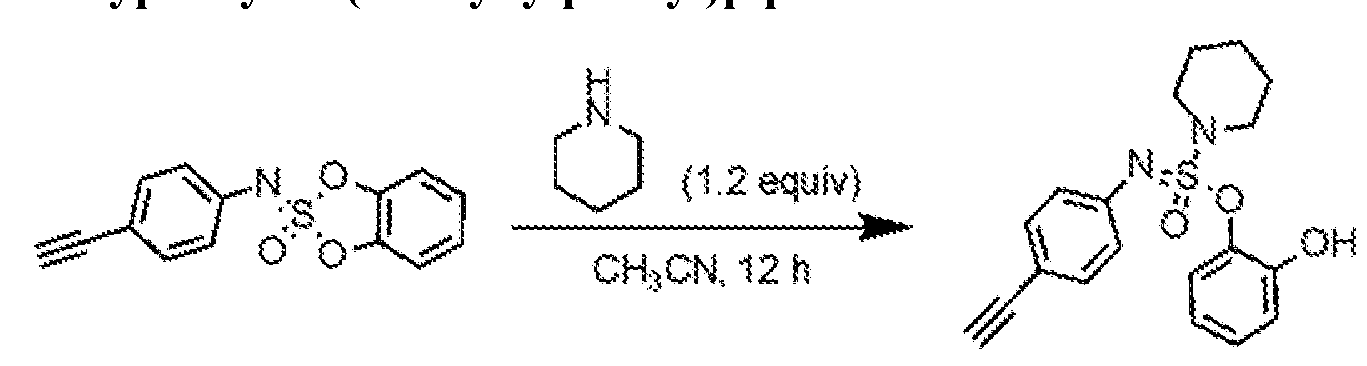
Another manifestation of the third dimension of SuFEx plugin-reactions from 0=SF4 derived hubs is the direct reaction of phenyliminosulfur oxydifluorides (2-4) with TMS- protected catechols (FIG. 9). The entrained inter- and intramolecular SuFEx reactions proceeded smoothly with DBU (5 mol%), to form the four (9-1 through 9-4) iminooxy cyclic catechol sulfuryl derivatives in excellent yields (FIG. 9). Of particular significance, the imino cyclic catecholate 9-1 is readily ring opened by piperidine and Boc-piperazine to give the corresponding amino sulfonimidate products 10-1 and 10-2 in excellent yields.
The application of the SuFEx Click Chemistry in the efficient synthesis of polysulfates through the linking of fluorosulfates and silyl ethers. [Ref. 11]. A priori, the bis(aryl iminosulfur oxydifluoride) 2-6 and the bis(aryl silyl ether) 5-6 appeared perfectly setup for the polymer synthesis. Indeed, therein A-A/B-B style polymerization proceeded smoothly under a SuFEx conditions (DBU 2 mol%), producing a polymer with a molecular weight of 204 KDa and PDI as low as 1.6 (FIG. 10). Expanding the scope of this core polymer pi, branching was
readily achieved by the second dimensional SuFEx reaction of the remaining S -F bond with the alkynylaryl silyl ether (5-5). The efficiency of the reaction was demonstrated with an impressive substitution rate of approximately 93% based on the ratio of methyl vs. terminal alkynyl protons in 1H MR. In a final demonstration of the power of combined Click
Chemistry, the alkyne decorated SuFEx polymer was reacted with the AZT (11) under the ligand-accelerated CuAAC conditions [Ref. 25] to give the nucleoside decorated polymer p3 in excellent yield. NMR analysis showed that all alkyne groups in the parent polymer were converted into the corresponding triazoles.
In summary, 0=SF4 gas provides a new SuFEx connector that reacts efficiently with primary amines to form reactive iminosulfur oxydifluoride derivatives. These derivatives provide S-F groups that are reactive toward amino and silyl ether compounds to provide a variety of useful molecules.
In another aspect, the versatility and power of the SOF4 derived iminosulfur oxydifluorides can be utilized to prepare linear polymers comprising -N=S(0)(F)- groups in the polymer backbone, which can be selectively reacted to form a branched polymer.
A method of preparing an iminosulfur oxyfluoride polymer comprises contacting a bis- (iminosulfur oxydifluoride) monomer with a bis-(silyl ether) monomer in the presence of a catalyst to for the iminosulfur oxyfluoride polymer. The catalyst is selected from an amidine base, a guanidine base, a phosphorine base, and a fluorine-containing anion (e.g., fluoride or an HF-fluoride, such as bifluoride).
In some method embodiments, the bis(iminosulfur oxydifluoride) monomer can be. e.g., a compound of Formula (III):
wherein Z
1 is a divalent organic group.
Additionally, the bis-(silyl ether) can be, e.g., a compound of Formula (IV):
wherein Z
2 is a divalent organic group; and each R
26 independently is an alkyl group, an aryl group, an arylalkyl group or an alkylaryl group.
In some method embodiments, the iminosulfur oxyfluoride polymer produced by the method can a compound of Formula (V):
wherein x is the average number of repeating units in the polymer, and has a value of greater than 1, e.g., greater than 10, greater than 20, greater than 30, greater than 50, greater than 100, greater than 1000; or greater than 10,000; and each of Z1 and Z2 independently is a divalent organic group.
In another aspect, iminosulfur oxyfluoride polymer is provided, which comprises a polymer of Formula (V):
wherein x is the average number of repeating units in the polymer, and has a value of greater than 1, e.g., greater than 10, greater than 20, greater than 30, greater than 50, greater than 100, greater than 1000; or greater than 10,000; and each of Z1 and Z2 independently is a divalent organic group.
In some embodiments, Z
1 and/or Z
2 of the monomer and/or polymer is a divalent organi c group of F ormul a (VI) :
in which X5 is selected from -CH2-, -CH(R28)-, -C(R28)2-, -0-, -S-, and -S02-; each R27 independently is a substituent, which can be selected, for example, from a halogen (e.g., CI, Br, I), an alkyl, an alkoxy, an aryl, an alkylaryl, an arylalkyl, and a heteroatom-containing substituent comprising one or more oxygen, nitrogen, or sulfur atoms, optionally in
combination with carbon and hydrogen (e.g., acyl, acyloxy, amido, and the like). R28 preferably is selected from alkyl, aryl, arylalkyl, and alkylaryl. The subscript y is 0, 1, 2, 3, or 4.
In some exemplary embodiments, Z1 and/or Z2 of the polymers/or and monomers independently are divalent groups of Formula (VII):
wherein each R29 independently is a hydrocarbyl group, and X6 is a covalent bond, -C(CH3)2-, -C(CF3)2-, or -S02-.
Preferably, the monomers are reacted in approximately equimolar amounts or with an excess (e.g., 0.01 up to about 10 mol% excess) of one monomer (e.g., the fluorinated monomer). The monomers can be contacted with one another in neat (solventless or bulk) form, or in a solvent (e.g., a halogenated hydrocarbon, acetonitrile, pyridine, N- methylpyrrolidone, and the like), a combination of solvents (e.g., together or sequentially added), or a combination of solventless and solvent conditions (e.g., sequentially). Typically, the polymerization is performed at a temperature in the range of about 20 to about 200 °C for about 0.5 to about 48 hours. Additionally, the reaction conditions and monomers are surprisingly tolerant of a large variety of organic moieties and substituents. This translates into an unprecedented freedom of selection of monomer components, including monomers with groups that are known to interfere with normal acid-base reactions, and the ability to tailor the functionality of the resulting polymer to a very high degree.
In any of the reactions and products described herein (e.g., in Embodiments 1 through 60, above), including reactions and products involving or comprising discrete small molecules and polymers, each of the organic groups or moieties independently can be selected from the group consisting of consisting of a hydrocarbon group, alkyl, aryl, alkylaryl, arylalkyl, a steroid, a terpene, a terpenoid, an alkene, an alkyne, a heterocycle, an alkenyl-substituted aryl, an alkynyl-substituted aryl, a carbohydrate, a polymer, an amino acid, a polypeptide, a nucleotide, a nucleic acid, an enzyme, -CH(R2)-C(=0)OH (wherein R2 is H or a second organic moiety), a nucleoside moiety, and a combination of two or more thereof. Additionally, the organic groups and moieties can be substituted with one or more functional group. Non- limiting examples of such functional groups include e.g., hydroxyl, halogen, nitro, -C(0)R30, -C(0)OR30, -C(O)N(R30)2, -CN, -SOvR30, -SOVN(R30)2, R30SOVN(R30)-, -N(R30)SOVR30, -SO3R30, -N(R30)2, -N(R30)OR30, -N(R30)C(O)R30, -N(R30)C(O)OR30, -N(R30)C(O)N(R30)2, -OC(O)N(R30)2, -OC(0)OR30, azido, alkyl, cycloalkyl, alkenyl, alkynyl, alkoxy, fluoroalkyl, fluoroalkoxy, aryl, aryloxy, heteroaryl, poly(ethyleneoxy), alkynyl-terminated
poly(ethyleneoxy), a fatty acid, a carbohydrate, an amino acid, a polypeptide; wherein each R30 independently is H, alkyl, or aryl, and v is 0, 1, or 2.
The term "hydrocarbon" and grammatical variations thereof is well known in the art and refers to an organic compound consisting entirely of hydrogen and carbon. Hydrocarbons can be saturated (contain no multiple bonds), unsaturated (containing at least one double or triple bond, or aromatic (containing an aromatic ring system such as a benzene ring, or a condensed aromatic ring system such as a naphthalene, anthracene, and similar systems).
Hydrocarbons can include linear chains of carbons atoms, branched chains of carbon atoms, rings of carbon atoms, or any combination thereof. Non-limiting examples of hydrocarbons include alkanes, alkenes, alkynes, aromatic (aryl) compounds, aromatic compounds substituted by an alkyl alkenyl, or alkynyl group), cycloalkanes, cycloalkenes, terpenes, and the like.
Unless otherwise specified, a hydrocarbon group can be attached to any of the compounds and polymers of Embodiments 1 through 22 and 45 through 59 at any position on the hydrocarbon structure, e.g., by replacement of a hydrogen atom
The term "hydrocarbyl" and grammatical variations thereof refers to univalent groups formed by removing a hydrogen atom from a hydrocarbon, e.g. ethyl, phenyl, phenylmethyl,
methylphenyl, ethynylphenyl, propargyl, or any other hydrocarbon group lacking a hydrogen atom thereof, and the like.
The term "carbohydrate" and grammatical variations thereof is well known in the art refers to, for example, polyhydroxylated compounds that formally have an empirical elemental formula (CH20)w in which w is >1. Non-limiting examples of carbohydrates include sugars (e.g., glucose, maltose), polysaccharides (e.g., starches, cellulose), and modified versions of sugars and polysaccharides (e.g., comprising one or more functional group in place of or in addition to hydroxyl groups, such as amino, ethers, esters), as well as deoxy sugars and deoxy polysaccharides ( i.e., sugars and polysaccharides in which an OH has been replaced by an H), and the like. The carbohydrates can be naturally occurring materials, synthetic materials, or a combination thereof. Unless otherwise specified, a carbohydrate group can be attached to any of the compounds and polymers of Embodiments 1 through 22 and 45 through 59 at any position on the carbohydrate structure, e.g., by replacement of a hydrogen atom or heteroatom.
The term "amino acid" and grammatical variations thereof is well known in the art and refers to, for example, organic compounds comprising at least one amino group, and at least one carboxylic acid group. Examples of amino acids include natural or synthetic alpha-amino acids (e.g., the common proteogenic amino acids, as well as non-proteogenic amino acids such as ornithine, which can be chiral materials, e.g., levo or dextro stereoisomers, or mixtures thereof, or achiral materials, depending on the structure), as well as compounds in which the amino group and carboxylic acid group are separated by more than one carbon. Unless otherwise specified, an amino acid group can be attached to any of the compounds and polymers of Embodiments 1 through 22 and 45 through 59 at any position on the amino acid structure, e.g., by replacement of a hydrogen atom or heteroatom.
The term "polypeptide" and grammatical variations thereof is well known in the art and refers to, e.g., materials including two or more amino acids (generally alpha-amino acids) joined together by peptide (amide) bonds between the carboxylic acid group (typically an alpha-carboxylic acid group) of one amino acid and the amino group (typically the alpha- amino group) of another amino acid. As used herein, the term polypeptide also encompasses proteins, as well as materials having a polypeptide core structure with additional functional or protecting groups appended to the polypeptide backbone. The term "peptide analog" and grammatical variations thereof refers to polypeptide-like materials in which one or more
peptide bond is replaced by a non-peptide linkage, such as an ester, an ether, and the like. Unless otherwise specified, a polypeptide group can be attached to any of the compounds and polymers of Embodiments 1 through 22 and 45 through 59 at any position on the polypeptide structure, e.g., by replacement of a hydrogen atom or heteroatom.
The term "steroid", as used herein, refers to any of a large group of substances that have in common a ring system based on a 1,2-cyclopentanoperhydrophenanthrene, and includes, for example, natural bile acids, corticosteroids, sex hormones, plant steroids, and sterols, as well as synthetic derivatives thereof. Unless otherwise specified, a steroid group can be attached to any of the compounds and polymers of Embodiments 1 through 22 and 45 through 59 at any position on the steroid structure, e.g., by replacement of a hydrogen atom or heteroatom.
The term "terpene", as used herein, refers to any member of a class of hydrocarbons occurring particularly in essential oils, and composed of multiple isoprene units, and may be acyclic, cyclic, or multicyclic, as well as saturated or unsaturated. Unless otherwise specified, a terpene group can be attached to any of the compounds and polymers of Embodiments 1 through 22 and 45 through 59 at any position on the terpene structure, e.g., by replacement of a hydrogen atom or heteroatom.
The term "terpenoid", as used herein, refers to a terpene that includes an oxygenated functional group (e.g., ketone, aldehyde, hydroxyl, carboxyl, group). Unless otherwise specified, a terpenoid group can be attached to any of the compounds and polymers of
Embodiments 1 through 22 and 45 through 59 at any position on the terpenoid structure, e.g., by replacement of a hydrogen atom or heteroatom.
As used herein, the term "nucleoside", which is well known in the art, refers generally to a purine or pyrimidine base linked to C-l of a beta-D-ribofuranose or 2-deoxy-beta-D- ribofuranose through a nitrogen atom of the pyrimidine (at N-l) or purine (at N-9) base.
Unless otherwise specified, a nucleoside group can be attached to any of the compounds and polymers of Embodiments 1 through 22 and 45 through 59 at any position on the nucleoside structure, e.g., by replacement of a hydrogen atom or heteroatom. In some cases, the nucleoside is a group set forth in Embodiment 2, above.
As used herein, the term "nucleotide", which is well known in the art, refers generally to a nucleoside that is phosphorylated by an orthophosphate of oligophosphate at any of the
hydroxyl groups of the sugar portion of the molecule. Typically the phosphate group is at either the 3' or 5' hydroxyl group of the sugard portion of the molecule. Unless otherwise specified, a nucleotide group can be attached to any of the compounds and polymers of Embodiments 1 through 22 and 45 through 59 at any position on the nucleotide structure, e.g., by replacement of a hydrogen atom or heteroatom. In some cases, the nucleotide is a phosphorylated version of a group set forth in Embodiment 2, above.
As used herein, the term "nucleic acid", which is well known in the art, refers generally to a single or double stranded polynucleotide comprising multiple nucleotides bound together through phosphodiester linkages, generally between the 5' hydroxyl of one nucleotide unit and the 3' hydroxyl group of an adjacent nucleotide forming a generally linear chain of nucleotide units, as is well known in the art. Unless otherwise specified, a nucleic acid group can be attached to any of the compounds and polymers of Embodiments 1 through 22 and 45 through 59 at any position on the nucleic acid structure, e.g., by replacement of a hydrogen atom or heteroatom.
The term "effector group" refers to a chemical gent that can perform a particular chemical or biochemical function, such as, e.g., antimicrobial agents and catalysts such as enzymes. Polymer bound antimicrobial agents are useful as microbe-resistant polymer films or articles, e.g., for marine use, medical use, or use as a sanitary surface for food preparation, pharmaceutical packaging, and the like. Polymer bound enzymes (also known as immobilized enzymes) are useful as catalysts in laboratory and industrial processes, including in some cases, aqueous or nonaqueous processes. For example, immobilized enzymes have been used in the production of high-fructose corn syrup, pectin hydrolysis, debittering of fruit juices, interesterifications of food, fats, and oils, biodiesel production, carbon dioxide capture, and numerous other applications. Unless otherwise specified, an effector group can be attached to any of the compounds and polymers of Embodiments 1 through 22 and 45 through 59 at any position on the effector group structure, e.g., by replacement of a hydrogen atom or
heteroatom.
Polymers suitable for use as substituents in the compounds and methods of any of Embodiments 1 to 44 described above include any polymeric structure. In some embodiments, the polymer is a polystyrene, a polyamide, a polycarbonate, a polyurethane, and the like. In some embodiments the polymer is an amino-substituted polymer comprising primary amino
groups in which one or more of the primary amino groups has been reacted with thionyl tetrafluoride as described herein to form an iminosulfur oxydifluoride group from the primary amino group. Non-limiting examples of some primary amino-substituted polymers include amino-substituted polystyrene, polylysine, amino-substituted polyethylene copolymers, amino- substituted polyethers, polyallylamine and copolymers thereof (e.g., acryamide-allylamine copolymers, N-vinylpyrrolidone-allylamine copolymers, acrylamide-allylamine copolymers, and the like), branched polyethyleneimines, and the like.
In any of Embodiments 1 through 60 or any other compounds, polymers, and methods described herein, the organic groups of the compounds and polymers can be bound by direct linkage of the components of the compounds and polymers or can be bound through an intercalated link of differing length (also known as a spacer), e.g., by a hydrocarbon-based linker, such as an alkylene group, an aryl group, and the like, by a heteroatom (i.e., a non- carbon atom), or other functional groups.
Molecular weight values of polymers, such as number average molecular weight (Mn) and weight average molecular weight (Mw), as well as polydispersity index values ("PDF, i.e., Mw/Mn) used herein are based on gel permeation chromatography (GPC) versus polystyrene standards. Molecular weight parameters for which there is no explicit description or contextual implication of being GPC values should be interpreted as GPC-derived values. The molecular weight values are reported in units of g/mol (also referred to as Daltons, "Da") or Kg/mol (also referred to as kDa).
As described herein, the monomers and other reactant compounds can be contacted with one another neat or in a solvent. Non-limiting examples of suitable solvents include a halogenated hydrocarbons (e.g., dichloromethane, chloroform, carbon tetrachloride, perchloroethane, chlorofluorocarbons, fluorocarbons, and the like), ethers (e.g., diethyl ether, tetrahydrofuran, dimethoxyethane, and the like), esters (e.g., ethyl acetate), nitriles (e.g., acetonitrile, and the like), ketones (e.g., acetone, methylethylketone), pyridines (e.g., pyridine, picolines, and the like), amides (e.g., N-methylpyrrolidone, acetamide, dimethylacetamide, and the like), sulfoxides (e.g., dimethylsulfoxide, and the like), and sulfones (e.g., sulfolane, dimethyl sulfone, and the like). Preferably, the solvent is non-aqueous and aprotic. If desired, mixed solvent systems can be used, or the polymerization reaction can be performed sequentially in different solvents or in a combination of solventless and solution conditions
(e.g., beginning in one solvent (or solventless) and completing the polymerization in another solvent).
In some embodiments, the catalyst used in reactions of an S-F compound with a silyl ether or silyl amine, such as the polymerization and discrete, small molecule reactions described above, comprises at least one material selected from the group consisting of an amidine, a guanidine, a phosphazene, a nitrogen-heterocyclic (N-heterocyclic) carbene, a tertiary alkoxide, and a fluoride salt. For example, the basic catalyst can comprise an amidine base (e.g., l,8-diazabicyclo[5.4.0]undec-7-ene (DBU), and the like), a guanidine (e.g., 1,1,3,3- tetramethylguanidine (TMG), l,5,7-triazabicyclo[4.4.0]dec-5-ene (TBD), and 7-methyl-l,5,7- triazabicyclo-[4.4.0]dec-5-ene (MTBD) and the like), a phosphazene base (e.g., 2-tert- butylimino-2-diethylamino- 1 ,3 -dimethylperhydro- 1 ,3 ,2-diazaphosphorine (BEMP), 1 -tert- butyl-4,4,4-tris-(dimethylamino)-2,2-bis[tris(dimethylamino)-phosphoranylidenamino]- 2 5,4 5-catenadi(phosphazene) (P4-t-Bu), and the like), a nitrogen-heterocyclic carbene (e.g., an imidazole-2-ylidene, a l,2,4-triazole-5-ylidene, a thiazole-2-ylidene, an imidazolin-2- ylidene, and the like), a tertiary alkoxide (e.g., potassium tert-butoxide and the like), or a fluoride-containing salt (e.g., CsF, CsFFIF, KF, tetrabutylammonium fluoride (TBAF), tris(dimethylamino)sulfonium-difluorotrimethylsilicate (TASF), and the like), or a
combination of two or more thereof. Preferably, the base comprises an amidine, a
phosphazene, or both. If desired, a combination of catalysts can be added as a mixture or sequentially.
In some embodiments, the catalyst for reaction of an S-F compound and a silyl ether or silyl amine comprises an HF-fluoride salt of formula (R+)(F(HF)W ~), wherein R+ is an organic cation or a chelated metal cation, and w is 1 or greater. As used herein, "organic cation" refers to cationic species comprising one of more organic (carbon-hydrogen-based) moiety bound to a positively charged heteroatom, such as S, N, or P, and includes various onium cations such as quaternary ammonium cations, organosulfonium cations (e.g., sulfonium cations comprising three groups, such as alkyl, aryl aminoalkyl, and/or aminoaryl groups, bound to a positively charged S, such as tris(dialkylamino)sulfonium), organophosphonium cations (e.g., phosphonium cations comprising four groups, such as alkyl, aryl, aminoalkyl, aminoaryl and/or other substituent groups bound to a positively charged P), quaternized nitrogen heterocyclic cations (e.g., nitrogen heteroaromatic compounds comprising at least one
positively charged nitrogen in the heteroaromatic ring, such as imidazolium cations in which both nitrogen atoms in an imidazole ring are alkylated), as well as cationic polymers, including both insoluble and soluble polymers (e.g., cationic polystyrene beads with appended quaternary ammonium groups). Chelated metal cations preferably comprise a monovalent metal ion (e.g., an alkali metal such as potassium and the like, or a monovalent transition metal, etc.) complexed with a chelating ligand, preferably a neutral (non-charged) ligand such as a crown ether (e.g., 18-crown-6, 12-crown-4, 15-crown-5, dibenzo-18-crown-6, and the like) and/or an azacrown ether (e.g., diaza-18-crown-6, and the like).
As used herein, "HF-fluoride" refers to anions comprising a fluoride anion bound to one of more hydrogen fluoride molecules, e.g., in a chain such as bifluoride ion (FHF"), and having the general formula F(HF)W ~, where n is 1 or greater, with w generally being in the range of 1 to 10 (e.g., w is in the range of 1 to 2, 1 to 3, 1 to 4, 1, to 5, 1 to 6, etc.). When w is 1, the FIF-fluoride ion is bifluoride, when w is greater than 1, the HF-fluoride is a polyHF fluoride.
In some embodiments, the HF-fluoride catalyst comprises an organosulfonium bifluoride or polyHF fluoride such as tris(dialkylamino)sulfonium bifluoride salt of formula: (Ra 2N)3 S+(FHF)~ wherein each Ra independently is an alkyl group comprising 1 to 20 carbon atoms, or two Ra groups together comprise a 4 or 5 carbon alkylidene group (e.g., -CH2-CRX 2- CH2-, or -CH2CRX 2CRX 2CH2- wherein each Rx independently is H or alkyl) thereby forming a 5 or 6 membered ring with the N atom attached thereto; each Ra alkyl or alkylidene group includes at least two hydrogen atoms on a carbon atom adjacent to the sulfur atom thereof, and each Ra independently can be linear or branched; or a polyHF fluoride analog thereof. The tris(dialkylamino)sulfonium bifluoride salt can be prepared, e.g., by the methods described in U.S. Patent No. 4,598,161 to Farnham et al., which is incorporated herein by reference in its entirety.
Tris(dialkylamino)sulfonium bifluoride salts have been reported to catalyze a living addition polymerization of olefinic monomers, such as methyl methacrylate, but heretofore have not been described as catalysts for condensation-type polymerizations (i.e.,
polymerizations in which a neutral molecule is produced from end groups of the monomers during formation of the polymer chain), particularly silyl and fluoro containing monomers, as in the methods described herein.
In other embodiments, the catalyst can be an organophosphonium bifluoride or polyHF fluoride, such as tetrabutylphosphonium bifluoride or polyHF fluoride, (Ph3P— N=PPh3 +) bifluoride or polyHF fluoride, and the like.
In other embodiments, the catalyst can be a quaternary ammonium bifluoride or polyHF fluoride, such as tetrabutylammonium bifluoride or polyHF fluoride,
tetraethyl ammonium bifluoride or polyHF fluoride, and the like.
In other embodiments, the catalyst can be a quaternized heteroaromatic bifluoride or polyHF fluoride, such as an imidazolium bifluoride or polyHF fluoride (e.g., N,N- dimethylimidazolium bifluoride, N,N-di(isopropyl)imidazolium bifluoride, and the like).
In some other embodiments, the catalyst can be a polymer supported bifluoride or polyHF fluoride, such as a quaternary amino-substituted polystyrene bifluoride or polyHF fluoride.
In yet other embodiments, the catalyst can be a chelated metal bifluoride or polyHF fluoride, such as potassium 18-crown-6, and the like.
Bifluoride salts can be prepared by reaction of corresponding onium halide salts (e.g.,
CI or Br) with silver(I) bifluoride (AgHF2); see, Vergote et al., Chem. Eur. J. 2012, 18, p. 793- 798). Alternatively, the catalysts can be prepared by the reaction of corresponding onium halide salts (e.g., CI or Br) with anhydrous HF; see, (1) Matsumoto et al., Solid State Sci. 2002, 4, 23-26; (2) Hagiwara et al., J. Fluorine Chem. 1999, p. 1-3.
The poly-HF bonded onium catalysts can be obtained via the reaction of corresponding onium halide salts with anhydrous HF, as well; for selected examples, see, (1) Momota et al., Electrochim Acta. 1993, 38, p. 619-624; (2) Rozhkov et al. Tetrahedron 1975, 31, p. 977-981; (3) Ballinger et al., Electrochim Acta. 1985, 30, 1075-1077; and references therein.
Polymer-supported F(HF)W " also has been described; see, Cousseau et al., B. Soc. Chim. Fr. 1986, p. 910-915. To explore the potential properties of SOF4 based polymers, several substrates were prepared (FIG. 11). The polymerization was conducted with different silyl ethers, all giving excellent yields and molecular weight (FIGS. 12A, 12B, and 12C).
The silyl fluoride byproduct of the reaction of an S-F compound with a silyl ether or silyl amine, such as the polymerization and discrete molecule reactions described above, can be recycled by reaction with a salt (e.g., a sodium or potassium salt) of a phenolic monomer precursor (e.g., bisphenol A) to form a useful bis-silylated monomer (e.g., a bis-silyl bisphenol
A) and a fluoride salt (e.g., sodium fluoride). The bis-silylated monomer can be utilized in another polymerization reaction.
The following examples are presented to illustrate certain, embodiments, aspects and features of the invention, but are not to be considered as limiting.
EXAMPLES
Abbreviations
BEMP = 2-tert-butylimino-2-diethylamino- 1,3 -dimethyl perhy dro- 1,3,2- diazaphosphorine; DBU = l,8-diazabicyclo[5.4.0]undec-7-ene; TMS = trimethylsilyl; TBS = fert-butyldimethylsilyl
General Information
1H spectra were recorded on BRUKER AV-600™, BRUKER AV-400™ instruments; 13C NMR were recorded on BRUKER AV-600™. 19F NMR were recorded on BRUKER AV- 400™. The chemical shifts (δ) are expressed in parts per million relative to TMS or residual acetonitrile or DMSO as internal standards. Proton magnetic resonance (1H NMR) spectra were recorded at 600 or 400 MHz with chemical shifts rounded to the nearest hundredth of a part per million (ppm). Carbon magnetic resonance (13C NMR) spectra were recorded at 150 MHz with chemical shifts rounded to the nearest tenth of a ppm. Fluorine magnetic resonance (19F NMR) spectra were recorded at 376 MHz with chemical shifts rounded to the nearest tenth of a ppm. NMR acquisitions were performed at 295 K unless otherwise noted. Abbreviations are: s, singlet; d, doublet; t, triplet; q, quartet, p, pentet; and br s, broad singlet. Infrared spectra were recorded as pure undiluted samples using THERMONICOLET AVATAR™ 370 Fourier transform infrared spectrometer with a SMART MIRACLE™ HATR attachment. Melting points (mp) were determined using a THOMAS-HOOVER™ melting point apparatus and are uncorrected. GC-MS data were recorded on an AGILENT 7890A GC™ system with an
AGILENT 5975C INERT™ MSD system or SHFMADZU GCMS-QP2010 SE™ operating in the electron impact (EI+) mode. LC-MS was performed on an AGILENT 1260™ LC/MSD with an AGILENT 6120™ quadrupole mass spectrometer (electrospray ionization, ES) eluting with 0.1% trifluoroacetic acid in H20 and 0.05% trifluoroacetic acid in CH3CN. High resolution mass spectrometry was performed on an AGILENT™ ES-TOF instrument. Pre- coated MERCK™ F-254 silica gel plates were used for thin layer analytical chromatography
(TLC) and visualized with short wave UV light or by potassium permanganate stain. Column chromatography was performed using EMD (Merck) Silica Gel 60 (40-63 μιη).
Ex. 1: Preparation of SOF4
N02 (20 mol%)
SF4 + 02 ► SOF4
236 °C
87%
This procedure was slightly modified from the Smith and Engelhardt method (W. C. Smith, V. A. Engelhardt, J. Am. Chem. Soc. 1960, 82, 3838.). An autoclave was purchased from Parr Instrument Company. The autoclave main body is Alloy 400, and has a maximum pressure rating of 3000 psi. Stainless steel material will be badly corroded in this reaction. Rupture disc: 526HCPG Inconel (Must be Gold faced - A Rupture disc that is made of Alloy 600 will burst here). Shield should be used during the reaction. N02 and SF4 are highly toxic, and should be filled into the autoclave in an efficiently ventilated hooded area. The hose used for filling of N02 and SF4 must be corrosive-resistant (i.e. the A506HC Assembly from Parr). The hose used for filling of 02 is the A495HC Hose Assembly (The same hose must not be used for other reducing gas, i.e. H2).
About 450 mL of the autoclave was cooled by immersing into a dry ice/acetone bath. Next, 10.0 g of N02 followed by 100 g of SF4 were sequentially transferred into the autoclave. The system was then warmed to room temperature and 02 slowly introduced into the system until the final pressure reached 500 psi. The autoclave was then heated to about 238 °C (oil bath temperature) in an efficiently ventilated and hooded area for 8 hours. The max-pressure reached 1700 psi and then slowly dropped to 1250 psi. The reaction was allowed to cool to room temperature upon standing. The Autoclave was then immersed into a dry ice/acetone bath for 15 minutes, and the excess of 02 was released and passed through an aqueous solution of NaOH (10% in water). After most of the 02 had been released, the valve was closed. The autoclave was then warmed up to about 0 °C in an ice/NaCl bath. 19F NMR (CD2C12) showed that the major F-containing product was SOF4, together with minor quantities of SOF2 and S02F2. To another autoclave was added 100 mL of DMF (anhydrous) and cooled in a liquid nitrogen bath. The gas was then transferred from the reaction autoclave into the DMF-
containing autoclave. The autoclave was then warmed up to room temperature and kept for 1.5 hours. 19F NMR (CD2CI2) indicated that most of the SOF2 had been removed and that the residual S02F2 had no adverse effect on later reactions. The gas was then transferred (use liquid nitrogen bath) and stored in a small gas tank for use (100 g, 87%).
Ex. 2: The reaction of amines with SOF
4
General Procedure I: A round-bottom flask with a magnetic stir bar is charged with amine, acetonitrile (0.2 M) and triethylamine. The flask is then sealed with a SUBA-SEAL® Septum, and an empty balloon, attached to a needle fixed syringe, is inserted into the septum. A needle linked to a vacuum pump is then inserted into the septum, and the atmosphere in the flask is evacuated under reduced pressure until bubbles form and the balloon collapses around the syringe as a tight seal. The needle connected to the vacuum pump is then removed. Next, approximately one equivalent of SOF4 is introduced into the flask via a separate syringe (i.e., 1 mmol of the amine, used 25 mL flask, after evacuation of the air, the SOF4 is added until tension of the balloon is released). After stirring at room temperature for 0.5 hours, the CH3CN is removed under reduced pressure and rotary evaporation. The product is purified by flash column chromatography over silica gel.
Ex. 3: 1,4-Phenylenedisulfurimidoyl difluoride
o
Molecular Weight: 276.22
2-1
89%
yellow osl
Following the General Procedure I: The reaction of benzene- 1,4-diamine (108 mg, 1.00 mmol), Et3N (300 uL, d = 0.725 g/mL, 2.15 mmol) and SOF4 in 5 mL of CH3CN,
afforded 2-1 (247 mg, 89%) as yellow oil. 1H NMR (600 MHz, CDC13) δ 7.13 (s, 4H); 13C NMR (150 MHz, CDC13) δ 133.6, 124.3 (t, J= 2.9 Hz); 19F NMR (376 MHz, CDC13) δ 46.1; EI (m/z): 276 [M]+. Ex. 4: 1 -Phenylenedisulfurimidoyl difluoride
98%
yellow oil
Following the General Procedure I: The reaction of benzene-l,3-diamine (108 mg, 1.00 mmol), Et3N (300 uL, d = 0.725 g/mL, 2.15 mmol), and SOF4 in 5 mL of CH3CN afforded 2-2 (258.3 mg, 98%) as yellow oil. 1H NMR (600 MHz, CDC13) δ 7.35 (t, J= 8.1 Hz, 1H), 7.02 (dd, J= 8.1, 2.0 Hz, 2H), 6.91 (d, J= 2.6 Hz, 1H); 13C NMR (150 MHz, CDC13) δ 137.3, 130.7, 121.17 (m), 119.2 (m); 19F NMR (376 MHz, CDC13) δ 46.3; EI (m/z): 276 [M]+.
Following the General Procedure I but without Et3N: The reaction of benzene-1,3- diamine (108 mg, 1.00 mmol) and SOF4 in 5 mL of CH3CN afforded 2-2 (209 mg, 76%) as yellow oil.
Ex. 5: (4-(Fluorosulfonyl)phenyl)iminosulfur oxydifluoride
92%
yeiiow liquid
Following the General Procedure I: The reaction of 4-aminobenzenesulfonyl fluoride (87.6 mg, 0.50 mmol), Et3N (139 uL, 1.00 mmol) and SOF4 in 5 mL of CH3CN, afforded 2-3 (120 mg, 92%) as yellow liquid. 1H MR (600 MHz, CDC13) δ 8.04 (d, J= 8.7 Hz, 1H), 7.39 (d, J= 8.7 Hz, 1H); 13C NMR (150 MHz, CDC13) δ 142.8, 130.4, 130.2, 124.7, 124.7; 19F NMR (376 MHz, CDC13) δ 66.1, 47.0; EI (m/z): 259 [M]+.
Ex. 6: (4-E hynylphenyl)sulfurimidoyl difluoride
2-4
91%
yellow liquid
Following the General Procedure I: The reaction of 4-ethynylaniline (1.17 g, 10.0 mmol), Et3N (2.02 g, 2.78 mL, d = 0.725 g/mL, 20.0 mmol) and SOF4 in 20.0 mL of CH3CN, afforded 2-4 (1.83 g, 91%) as yellow liquid. 1H MR (400 MHz, CDC13) δ 7.48 (d, J= 8.5 Hz, 2H), 7.08 (d, J= 8.5 Hz, 2H), 3.10 (s, 1H); 13C NMR (150 MHz, CDC13) δ 136.4, 133.5, 123.6, 123.5, 123.5, 120.1, 82.5, 78.0, 77.2, 77.0, 76.8; 19F NMR (376 MHz, CDC13) δ 46.7; EI (m/z): 201 [M]+.
Following the General Procedure I but without Et3N: The reaction of 4- ethynylaniline (2.34 g, 20.0 mmol) and SOF4 in 40.0 mL of CH3CN afforded 2-4 (2.82 g, 70%)) as yellow liquid.
Ex. 7: (3,4-Dichloro henyl)sulfurimidoyl difluoride
2-5
90%
colorless liquid
Following the General Procedure I: The reaction of 3,4-dichloroaniline (1.78 g, 11.0 mmol), Et3N (1.11 g, 1.53 mL, d = 0.725 g/mL, 11.0 mmol) and SOF4 in 25 mL of CH3CN, afforded 2-5 (2.43 g, 90%) as colorless liquid. 1H NMR (400 MHz, CDC13) δ 7.43 (d, J= 8.6 Hz, 1H), 7.33 - 7.17 (m, 1H), 6.99 (dd, J = 8.6, 2.5 Hz, 1H); 13C NMR (150 MHz, CDC13) δ 135.3 (t, J = 2.0 Hz), 133.5, 131.2, 130.8 , 125.5 (d, J= 3.0 Hz), 122.9 (t, J = 3.1 Hz); 19F NMR (376 MHz, CDC13) δ 46.5; EI (m/z): 245 [M(35C1, 35C1)]+, 247 [M(35C1, 37C1)]+. Ex. 8: (Sulfonylbis(4,l-phenylene))disulfurimidoyl difluoride
white solid
A round-bottom flask (500 mL) with a magnetic stir bar was charged with 4,4'- sulfonyldianiline (24.8 g, 0.10 mol), acetonitrile (200 mL) and triethylamine (20.2 g, 27.9 mL, 0.20 mol). The flask was then sealed with a SUBA-SEAL® Septum, and an empty balloon, attached to a needle fixed syringe, was inserted into the flask. A needle linked to a vacuum pump was then inserted into the flask, and the atmosphere evacuated under reduced pressure until bubbles formed and the balloon became tense. The flask was immersed into an ice water bath and allowed to cool. Then, SOF4 was slowly introduced into the flask via a needle, until the reaction had completed (TLC). The CH3CN was removed under reduced pressure and rotary evaporation. The mixture was dissolved in EtOAc (500 mL) and washed with PBS buffer (pH = 7.0, 2 x 100 mL) and brine (100 mL). After removing the solvent, the product
was purified by flash column chromatography over silica gel (hex/EA = 4/1) to give 2-6 (38.3 g 92%) as a white solid. Mp: 111 °C; 1H NMR (600 MHz, CDC13) δ 7.94 (d, J= 8.7 Hz, 4H), 7.25 (d, J= 8.7 Hz, 4H). 13C NMR (150 MHz, CDC13) δ 140.8, 138.9, 129.5, 124.5 (m); 19F NMR (376 MHz, CDC13) δ 46.9; ESI-MS (m/z): 417 [M+H]+.
Ex. 9: (Propane-2,2-diylbis(4,l-phenylene))disulfurimidoyl difluoride
CH
3CN, r
30 mm 2-7
99%
elio Iquid
Following the General Procedure I: The reaction of 4,4'-(propane-2,2-diyl)dianiline (250 mg, 1.10 mmol), Et3N (222 mg, 306 uL, d = 0.725 g/mL, 2.20 mmol), and SOF4 in 5.5 mL of CH3CN afforded 2-7 (432 mg, 99%) as yellow liquid. 1H NMR (600 MHz, CDC13) δ 7.23 - 7.17 (m, 4H), 7.06 - 7.00 (m, 4H), 1.66 (s, 6H); 13C NMR (150 MHz, CDC13) δ 148.2, 133.8, 128.0, 123.1, 123.1, 42.5, 30.7; 19F NMR (376 MHz, CDC13) δ 46.3; EI (m/z): 394 [M]+.
Ex. 10: tert-Butyl 3-((difluoro(oxo)- λ -sulfanylidene)amino)azetidine-l-carboxylate
2-8
98%
coloriess oi!
Following the General Procedure I: The reaction of benzene-l,3-diamine (108 mg, 1.00 mmol), NEt3 (300 uL, d = 0.725 g/mL, 2.00 mmol), and SOF4 in 5mL of CH3CN afforded 2-8 (247 mg, 89%) as colorless oil. 1H NMR (600 MHz, CDC13) δ 4.37 (dddd, J= 10.5, 7.2, 4.2, 1.6 Hz, 1H), 4.22 (dd, J= 9.1, 7.4 Hz, 2H), 3.96 (dd, J= 9.3, 5.0 Hz, 2H), 1.44 (s, 9H); 13C NMR (150 MHz, CDC13) δ 155.9, 80.1, 57.2, 44.8, 28.3; 19F NMR (376 MHz, CDC13) δ 47.9; ESI-MS (m/z): 257 [M+H]+.
Ex. 11: (3-((2-Oxo-2H-chromen-4-yl)oxy)propyl)sulfurimidoyl difluoride
2 h
2-9
88%
white soii
Typical Procedure A: A Schlenk tube (25 mL) with a magnetic stir bar was charged with azide (123 mg, 0.50 mmol), toluene (5mL), and H20 (9.00 pL). The tube was then sealed with a SUBA-SEAL® Septum, and the air in the tube replaced with N2 using a vacuum line and acetone/dry ice bath. PMe3 (1.10 mL, 1.00 M) was added to the tube at 0 °C. After addition, the reaction was warmed to room temperature and stirred for 2 hours. Then a balloon was attached to the tube. Et3N (70.0 [iL, 0.50 mmol) was added and a needle linked to a vacuum pump inserted into the flask. The atmosphere was evacuated under reduced pressure until bubbles formed and the balloon became tense. The needle connected with the vacuum pump was then removed. Then SOF4 was introduced into the flask via a separate needle. After stirring at room temperature for 0.5 hour, the toluene was removed under reduced pressure and rotary evaporation. The product was purified by flash column chromatography over silica gel (hexanes/EA = 2: 1 ~ 1 : 1) to give 2-9 (134 mg, 88%) as a white solid. Mp 85-86 °C; 1H NMR (400 MHz, CDC13) δ 7.79 (dd, J= 7.9, 1.6 Hz, 1H), 7.55 (ddd, J= 8.7, 7.3, 1.6 Hz, 1H), 7.37 - 7.17 (m, 2H), 5.71 (s, 1H), 4.27 (t, J= 5.9 Hz, 2H), 3.65 (tt, J= 6.5, 3.9 Hz, 2H), 2.24 (p, J = 6.1 Hz, 2H); 13C NMR (150 MHz, CDC13) δ 165.1, 162.5, 153.1, 132.3, 123.8, 122.6, 116.6, 115.4, 90.6, 65.5, 42.3, 29.4; 19F NMR (376 MHz, CDC13) δ 46.3; ESI-MS (m/z): 304 [M+H]+.
Ex. 12: (2-Ph noxyethyl)sulfurimidoyl difluoride
93%
coSorfess oil
Following the General Procedure I: The reaction of 2-phenoxyethan-l -amine (68.6 mg, 0.50 mmol), Et3N (140 uL, d = 0.725 g/mL, 1.00 mmol), and SOF4 in 5mL of CH3CN afforded of 2-10 (102 mg, 93%) as colorless oil. 1H NMR (600 MHz, CDC13) δ 7.35 - 7.23 (m, 2H), 6.97 (tt, J= 7.4, 1.1 Hz, 1H), 6.94 - 6.80 (m, 2H), 4.07 (t, J= 5.3 Hz, 2H), 3.70 (tt, J = 5.3, 3.9 Hz, 2H); 13C NMR (150 MHz, CDC13) δ 158.1, 129.5, 121.3, 114.5, 66.6, 66.6, 45.3; 19F NMR (376 MHz, CDC13) δ 47.3; ESI-MS (m/z): 222 [M+H]+.
Following the General Procedure I but without Et3N: The reaction of 2- phenoxyethan-1 -amine (137 mg, 1.00 mmol) and SOF4 in 5.00 mL of CH3CN afforded 2-10 (126 mg, 57%) as colorless oil.
Ex. 13: (((3aS,5aR,8aR,8bS)-2,2,7,7-Tetramethyltetrahydro-3aH-bis([l,3]dioxolo)[4,5- 6:4', '-< |pyran-3a-yl)methyl)sulfurimidoyl difluoride
2-11
82%
colorless oi!
Following the General Procedure I: The reaction of the amine (259 mg, 1.00 mmol), Et3N (280 uL, d = 0.725 g/mL, 1.00 mmol), and SOF4 in 5 mL of CH3CN afforded 2-11 (281 mg, 82%) as colorless oil. [a]25 D = -33.3 (c = 1.00, CHC13); 1H NMR (600 MHz, CDC13) δ 4.62 (dd, J= 7.8, 2.2 Hz, 1H), 4.32 (d, J= 2.2 Hz, 1H), 4.24 (d, J= 7.9 Hz, 1H), 3.92 (d, J = 12.9 Hz, 1H), 3.77 (d, J= 13.0 Hz, 1H), 3.65 (d, J= 12.9 Hz, 1H), 3.49 (dt, J= 12.7, 4.0 Hz,
1H), 1.55 (s, 3H), 1.47 (s, 3H), 1.42 (s, 3H), 1.35 (s, 3H); 13C NMR (150 MHz, CDC13) δ 109.1, 109.1, 101.7, 70.8, 70.3, 70.1, 61.6, 50.0, 26.6, 25.8, 25.3, 24.0; 19F NMR (376 MHz, CDC13) δ 47.1 (d, J= 200.1 Hz), 45.7 (d, J= 200.2 Hz); ESI-MS (m/z): 344 [M+H]+. Ex. 14: Methyl (R)-2-((difluoro(o - 6-sulfanylidene)amino)-2-phenylacetate
90%
colorless oil
Following the General Procedure I: The reaction of methyl (R)-2-amino-2- phenylacetate hydrochloride (101 mg, 0.50 mmol), Et3N (210 [iL, d = 0.725 g/mL, 1.5 mmol), and SOF4 in 5.00 mL of CH3CN afforded 2-12 (1 12 mg, 90%) as colorless oil. [a]25 D = 95.4 (c = 1.00, CHC13); 1H NMR (600 MHz, CDC13) δ 7.54 - 7.21 (m, 5H), 5.28 (s, 1H), 3.73 (s, 3H);
13C NMR (150 MHz, CDC13) δ 169.2 (t, J= 3.7 Hz), 135.4, 129.0, 128.9, 127.1, 77.2, 77.0, 76.8, 62.2, 53.1 ; 19F NMR (376 MHz, CDC13) δ 50.5 (d, J= 197.6 Hz), 48.8 (d, J= 197.2 Hz);
ESI-MS (m/z): 272 [M+Na]+.
Ex. 15: (R)-(2-((ieri-Butyldimethylsilyl)oxy)-l-phenylethyl)sulfurimidoyl difluoride
2-13
72%
ioriess
Following the General Procedure I: The reaction of (R)-2-((tert- butyldimethylsilyl)oxy)-l-phenylethan-l-amine (126 mg, 0.50 mmol), Et3N (140 μΕ, d = 0.725 g/mL, 1.00 mmol), and SOF4 in 5 mL of CH3CN afforded 2-13 (120 mg, 72%) as colorless oil. [a]25 D = -41.7 (c = 1.00, CHC13); 1H NMR (600 MHz, CDC13) δ 7.43 - 7.34 (m, 5H), 4.77 (ddt, J = 8.7, 4.2, 1.8 Hz, 1H), 3.82 - 3.70 (m, 2H), 0.95 (s, 9H), 0.10 (d, J = 9.2 Hz, 6H); 13C NMR (150 MHz, CDC13) δ 137.9, 128.5, 128.2, 126.7, 68.5, 68.4, 63.8, 25.8, 18.3, -
5.5, -5.6; iyF NMR (376 MHz, CDC13) δ 51.2 (d, J= 192.1 Hz), 48.0 (d, J= 191.9 Hz); EI (m/z): 320 [M-Me]+.
Ex. 16: (Adamantan-l-yl)sulfurimidoyl difluoride
2-14
91 %
light yeilow liquid
Following the General Procedure I: The reaction of adamantan-1 -amine (151 mg, 1.00 mmol), Et3 (280 μί, d = 0.725 g/mL, 2.00 mmol), and SOF4 in 5.00 mL of CH3CN afforded 2-14 (213 mg, 81%) as colorless oil. 1H NMR (600 MHz, CDC13) δ 2.05 (s, 3H), 1.88 (d, J= 2.9 Hz, 6H), 1.69 - 1.51 (m, 6H); 13C NMR (150 MHz, CDC13) δ 59.6, 44.3, 35.7,
29.8; 19F NMR (376 MHz, CDC13) δ 59.6; EI (m/z): 235 [M]+.
Ex. 17: (l-Ethynylcyclohexyl)sulfurimidoyl difluoride
2-15
81 %
colorless liquid
Following the General Procedure I: The reaction of 1-ethynylcyclohexan-l -amine (123 mg, 1.00 mmol), DIPEA (259 mg, 348 uL, d = 0.742 g/mL, 2.00 mmol), and SOF4 in 5 mL of CH3CN afforded 2-15 (167 mg, 81%) as colorless oil. 1H NMR (400 MHz, CDC13) δ 2.56 (s, 1H), 1.98 (dt, J= 11.1, 4.6 Hz, 2H), 1.83 - 1.48 (m, 7H), 1.37-1.25 (m, 1H); 13C NMR (150 MHz, CDC13) δ 83.9, 73.3, 57.3, 40.06, 24.7, 22.5; 19F NMR (376 MHz, CDC13) δ 53.6; EI (m/z): 207 [M]+.
Ex. 18: (3,4-Dihydroxyphenethyl)sulfurimidoyl difluoride
54%
yei!ow oil
Following the General Procedure I: The reaction of the dopamine hydrochloride (94.8 mg, 0.50 mmol), Et3N (210 uL, d = 0.725 g/mL, 1.50 mmol), and SOF4 in 5mL of CH3CN afforded 2-16 (64.0 mg, 54%) as yellow oil. 1H NMR (600 MHz, CDC13) δ 6.79 (d, 7= 8.1 Hz, 1H), 6.72 (s, 1H), 6.64 (d, 7= 8.1 Hz, 1H), 5.60 (s, 1H), 5.53 (s, 1H), 3.54 - 3.48 (m, 2H), 2.78 (t, 7= 7.2 Hz, 2H); 13C NMR (150 MHz, CDC13) δ 143.5, 142.1, 131.0, 121.4, 116.0, 115.5, 47.4, 36.4; 19F NMR (376 MHz, CDC13) δ 46.9; ESI-MS (m/z): 236 [M-H]-.
Ex. 19: (2-(li -indol-3-yl)ethyl)sulfurimidoyl difluoride
2-17
75%
gray solid
Following the General Procedure I: The reaction of tryptamine (80.1 mg, 0.50 mmol), Et3N (140 uL, d = 0.725 g/mL, 1.0 mmol), and SOF4 in 5.00 mL of CH3CN afforded of 2-17 (91.2 mg, 75%) as a as grey solid. Mp. 43-44 °C; 1H NMR (600 MHz, CDC13) δ 7.83 (s, 1H), 7.56 (dd, 7= 7.9, 1.1 Hz, 1H), 7.28 (dd, 7= 8.1, 1.0 Hz, 1H), 7.19 (ddd, 7= 8.1, 6.9, 1.2 Hz, 1H), 7.12 (ddd, 7= 8.0, 6.9, 1.1 Hz, 1H), 6.94 (d, 7= 2.4 Hz, 1H), 3.60 (tt, 7= 7.6, 4.0 Hz, 2H), 3.04 (t, 7= 7.5 Hz, 2H); 13C NMR (150 MHz, CDC13) δ 136.1, 127.0, 122.4, 122.1, 119.5, 118.8, 111.9, 111.2, 46.5, 26.8; 19F NMR (376 MHz, CDC13) δ 47.0; ESI-MS (m/z): 245 [M+H]+.
Ex. 20: (((lR,4aS,10aR)-7-Isopropyl-l,4a-dimethyl-l,2,3,4,4a,9,10,10a- octahydrophenanthren-l-yl)methyl)sulfurimidoyl difluoride
2-1
91%
white solid
Following the General Procedure I: The reaction of the amine (173 mg, 0.50 mmol), Et3N (210 uL, d = 0.725 g/mL, 1.50 mmol), and SOF4 in 5mL of CH3CN afforded 2-18 (168 mg, 91%) as white solid. Mp. 73-74 °C; [a]25 D = 51.1 (c = 1.00, CHC13); 1H MR (600 MHz, CDC13) δ 7.17 (d, J= 8.2 Hz, 1H), 6.99 (dd, J= 8.3, 2.0 Hz, 1H), 6.88 (d, J = 2.1 Hz, 1H), 3.29 (dt, J = 12.3, 3.8 Hz, 1H), 3.00 (dt, J= 12.3, 4.0 Hz, 1H), 2.91 - 2.83 (m, 2H), 2.85 - 2.78 (m, 1H), 2.27 (dd, J = 13.0, 3.4 Hz, 1H), 1.82 - 1.63 (m, 5H), 1.51 - 1.41 (m, 1H), 1.39 (td, J = 13.2, 9.4 Hz, 2H), 1.24 - 1.19 (m, 9H), 0.93 (s, 3H); 13C NMR (150 MHz, CDC13) δ 147.0, 145.6, 134.5, 126.8, 124.3, 123.9, 56.7, 44.2, 38.2, 37.3, 37.3, 35.6, 33.4, 30.0, 25.2, 24.0, 18.8, 18.6, 18.3; 19F NMR (376 MHz, CDC13) δ 46.3; EI (m/z): 369 [M]+.
Ex. 21: Octadecylsulfurimidoyl difluoride
2-19
82%
light ye!iow liquid
Following the General Procedure I: The reaction of the amine (270 mg, 1.00 mmol), Et3N (280 uL, d = 0.725 g/mL, 2.00 mmol), and SOF4 in 5.00 mL of CH3CN afforded 2-19 (290 mg, 82%) as light yellow liquid. 1H NMR (600 MHz, CDC13) δ 3.34 (tt, J= 6.9, 4.0 Hz, 2H), 1.61 (p, J = 7.0 Hz, 2H), 1.26 (s, 30H), 0.88 (t, J = 7.0 Hz, 3H); 13C NMR (150 MHz, CDC13) δ 46.3, 31.9, 29.7, 29.7, 29.6, 29.6, 29.5, 29.4, 29.0, 26.5, 22.7, 14.1; 19F NMR (376
MHz, CDCI3) δ 46.6; HRMS (ESI-TOF) Calculated for Ci8H38F2NOS+ [M+H]+: 354.2637; found: 354.2634.
Ex. 22: ((Ethane-l,2-diylbis(oxy))bis(ethane-2,l-diyl))disulfurimidoyl difluoride
2-20
92%
light yellow liquid
Following the General Procedure I: The reaction of the amine (148 mg, 1.00 mmol), Et3N (560 |iL, d = 0.725 g/mL, 4.00 mmol), and SOF4 in 5 mL of CH3CN afforded 2-20
(291mg, 92%) as light yellow liquid. 1H NMR (600 MHz, CDC13) δ 3.68 - 3.61 (m, 8H), 3.56-3.48 (m, 4H); 13C NMR (150 MHz, CDC13) δ 70.6, 70.2, 45.9; 19F NMR (376 MHz, CDC13) δ 47.2; ESI-MS (m/z): 317 [M+H]+.
Ex. 23: ((8R,9S,13S)-13-Methyl-17-oxo-7,8,9,ll,12,13,14,15,16,17-decahydro-6H- cyclopenta[ ]phenanthren-3-yl)sulfurimidoyl difluoride
2-21
95%
white sold
Following the General Procedure I: The reaction of the amine (81.0 mg, 0.30 mmol),
Et3N (84.0 μί, d = 0.725 g/mL, 0.60 mmol), and SOF4 in 5 mL of CH3CN afforded 2-21 (101 mg, 95%) as white solid. Mp. 66-67 °C; [a]25 D = 126.8 (c = 1.00, CHC13); 1H NMR (600 MHz, CDC13) δ 7.26 (d, J= 8.3 Hz, 1H), 6.91 (d, J= 8.3 Hz, 1H), 6.86 (s, 1H), 2.90 (dd, J = 8.5, 3.6 Hz, 2H), 2.51 (dd, J= 19.1, 8.8 Hz, 1H), 2.42 - 2.37 (m, 1H), 2.27 (s, 1H), 2.18 - 2.12 (m, 1H), 2.09 - 2.00 (m, 2H), 1.97 (d, J= 11.6 Hz, 1H), 1.72 - 1.32 (m, 6H), 0.91 (s, 3H); 13C NMR (150 MHz, CDC13) δ 220.5, 138.2, 137.8, 133.7, 126.6, 123.6, 120.7, 50.4, 47.9, 44.0,
37.9, 35.8, 31.5, 29.2, 26.2, 25.7, 21.5, 13.8; 19F NMR (376 MHz, CDC13) δ 46.2; ESI-MS (m/z): 354 [M+H]+.
Ex. 24: ((3S,8R,9S,10R,13S,14S,17R)-17-Ethyl-10,13-dimethyl-17-((R)-6-methylheptan-2- yl)-2,3,4,7,8,9,10,ll,12,13,14,15,16,17-tetradecahydro-li -cyclopenta[ ]phenanthren-3- yl)sulfurimidoyl difluoride
white sotici
Following the Typical Procedure A: The difluoride 2-22 (209 mg, 89%), was produced as a white solid from 206 mg (0.50 mmol) of the azide. Mp 107-108 °C; [a]25D = - 4.8 (c = 1.00, CHC13); 1H NMR (600 MHz, CDC13) δ 5.39 (s, 1H), 3.41 (t, J = 1 1.3 Hz, 1H), 2.42 (t, J = 12.6 Hz, 1H), 2.29 (d, J = 1 1.8 Hz, 1H), 2.04 - 1.95 (m, 2H), 1.90 - 1.80 (m, 3H), 1.76 - 1.66 (m, 1H), 1.63 - 0.79 (m, 36H), 0.68 (s, 3H); 13C NMR (150 MHz, CDC13) δ 139.8, 122.6, 58.0, 56.7, 56.1, 50.1, 42.3, 40.7, 39.7, 39.5, 37.6, 36.4, 36.2, 35.8, 31.9, 31.8, 30.6, 28.1, 28.0, 24.3, 23.8, 22.8, 22.6, 21.0, 19.3, 18.7, 11.9; 19F NMR (376 MHz, CDC13) δ 50.5; EI (m/z): 469 [M]+.
Ex. 25: ((2S,3S,5R)-5-(5-Methyl-2,4-dioxo-3,4-dihydropyrimidin-l(2H)-yl)-2-((prop-2-yn- l-yloxy)methyl)tetrahydrofuran-3-yl)sulfurimidoyl difluoride
2-23
59%
white solid
Following the Typical Procedure A except that THF as solvent and 3.00 equiv of H20 were used: The difluoride 2-23 (107 mg, 59%), was produced a white solid from 153 mg (0.50 mmol) of AZT. Mp 72-73 °C; [a]25 D = 46.1 (c = 1.00, CHC13); 1H MR (400 MHz, CDC13) δ 8.71 (s, 1H), 7.64 - 7.59 (m, 1H), 6.26 (t, J= 5.8 Hz, 1H), 4.34 (d, J= 6.6 Hz, 1H), 4.26 (d, J = 2.4 Hz, 2H), 4.11 (dt, J= 5.1, 2.3 Hz, 1H), 3.92 (dd, J= 10.8, 2.3 Hz, 1H), 3.75 (dd, J = 10.8, 2.4 Hz, 1H), 2.54 - 2.31 (m, 3H), 1.95 (d, J= 1.3 Hz, 3H); 13C MR (150 MHz, CDC13) δ 164.0, 150.3, 135.5, 110.9, 84.8, 84.4, 78.5, 75.5, 67.8, 58.6, 54.7, 39.8, 12.6; 19F MR (376 MHz, CDC13) δ 49.0 (d, J= 201.3 Hz), 47.3 (d, J= 202.8 Hz); ESI-MS (m/z): 264 [M+H]+.
FIG. 14 provides micrographic images of zebrafish embryos. Panels (A) and (B) illustrate phenotypes generated by incubating zebrafish embryos with Compound 2-23 at various concentrations. As seen in the images, there were significant phenotypical changes in the embryos treated at concentrations of 10 and 20 μΜ. Panel (C) provides SDS-PAGE images of lysates from Compound 2-23 treated or untreated embryos at 24 hours post fertilization (hpf). The lysates were treated with biotin-azide and a copper(I) catalyst to react with the terminal alkyne via a copper-catalyzed azide-alkyne Click reaction and thereby attach biotin to any Compound 2-23 that may have been bound to a protein in the lysate. The biotinated lysate was then pulled-down with streptavidin beads and analyzed using SDS- PAGE. The results indicate that Compound 2-23 bound to a protein of approximately 130 KDa size and perhaps some smaller peptides between 25 and 30 KDa in size.
Ex. 26: (9-((3aR,4R,6R,6aR)-6-(((teri-Butyldimethylsilyl)oxy)methyl)-2,2- dimethyltetrahydrofuro[3,4-< |[l,3]dioxol-4-yl)-9H-purin-6-yl)sulfurimidoyl difluoride
2-24
85%
ye!iow oiS
Following the General Procedure I: The reaction of the amine (210 mg, 0.5 Ommol), DIPEA (129 mg, d = 0.742 g/mL, 174 μί, 1.00 mmol), and SOF4 in 5 mL of CH3CN afforded 2-24 (214 mg, 85%) as a yellow oil. [a]25 D = -36.3 (c = 1.00, CHC13); 1H MR (600 MHz, CDC13) δ 8.72 (s, 1H), 8.37 (s, 1H), 6.24 (d, J = 2.6 Hz, 1H), 5.20 (dd, J = 6.2, 2.5 Hz, 1H), 4.93 (dd, J = 6.2, 2.1 Hz, 1H), 4.49 (d, J= 3.0 Hz, 1H), 3.90 (dd, J = 1 1.4, 3.3 Hz, 1H), 3.78 (dd, J = 1 1.4, 3.6 Hz, 1H), 1.63 (s, 3H), 1.40 (s, 3H), 0.80 (s, 9H); 13C MR (150 MHz, CDC13) δ 152.2, 152.1, 148.4, 143.0, 126.7, 1 14.0, 92.0, 87.4, 85.2, 81.4, 63.6, 27.1, 25.7, 25.2, 18.2, -5.6, -5.7; 19F NMR (376 MHz, CDC13) δ 48.8; ESI-MS (m/z): 506 [M+H]+. Ex. 27: (4R)-2-Cyclohexyl-l-fluoro-4-((S)-(4-(4-fluorophenyl)piperazin-l- yl)(phenyl)methyl)-2,4-dihydro-3H-l 6,2,5-thiadiazol-3-one 1-oxide
2-25
66%
white solid
Following the General Procedure I: The reaction of the amine (106 mg, 0.25 mmol), triethylamine (140 μΐ^, 1.00 mmol), and SOF4 in 5 mL of CH3CN afforded a mixture. The CH3CN was then removed under reduced pressure and rotary evaporation. The mixture was dissolved in 5 mL of CH2C12 and 5.00 g of silica gel was added and stirring at room
temperature overnight. The product was purified by flash column chromatography over silica gel (hexanes/EA = 4: 1) to give 2-25 (80.0 mg, 66%, dr. = 1.57: 1) as a white solid. Mp: 139- 140 °C; [a]25 D = 1 1.6 (c = 1.00, CHC13); 1H NMR (600 MHz, CDC13) δ 7.54 (ddd, J = 8.0, 3.0, 1.4 Hz, 2H), 7.39 - 7.28 (m, 3H), 6.91 (t, J = 8.7 Hz, 2H), 6.77 (ddd, J = 9.2, 4.6, 3.1 Hz, 2H), 4.71 - 4.52 (m, 1H), 4.34 - 4.28 (m, 1H), 4.08 - 3.96 (m, 1H), 3.05 - 2.90 (m, 6H), 2.41 - 2.35 (m, 2H), 2.09 - 1.82 (m, 6H), 1.69 (dq, J = 10.3, 3.5 Hz, 1H), 1.42 - 1.30 (m, 2H), 1.28 - 1.18 (m, 1H); 13C NMR (150 MHz, CDC13) δ 172.9, 172.8, 157.8, 156.2, 147.9, 147.8, 135.6, 129.5, 129.4, 128.2, 128.2, 128.0, 127.9, 1 17.5, 1 17.5, 1 17.5, 1 17.4, 1 15.5, 1 15.4, 1 15.3, 1 15.3, 71.6, 71.6, 68.4, 67.9, 67.8, 56.9, 56.6, 52.1, 52.0, 50.6, 50.2, 30.6, 29.9, 29.7, 29.3,
25.7, 25.7, 25.6, 24.8, 24.7; iyF NMR (376 MHz, CDC13) δ 79.6, 78.1, -125.3; ESI-MS (m/z):
489 [M+H]+.
Ex. 28: 4-((Difluoro(oxo)- 6-sulfanylidene)amino)phenyl sulfurofluoridate
mp: 50 °C
General Procedure II: A 500 mL round-bottom flask with a magnetic stir bar was charged with 4-aminophenol (1.09 g, 10.0 mmol), acetonitrile (20 mL), and triethylamine (3.03 g, 4.18 mL, 30.0 mmol). The flask was then sealed with a SUBA-SEAL® Septum, and an empty balloon, attached to a needle fixed syringe, was inserted into the flask. A needle linked to a vacuum pump was then inserted into the flask, and the atmosphere evacuated under reduced pressure until bubbles formed and the balloon became tense. The needle connected to the vacuum pump was then removed. Next a balloon containing SO2F2 (~ 250 mL) mounted on a separate needle fixed syringe was inserted in the seal, then the SOF4 gas was introduced into the reaction flask until the completion of the reaction (TLC). The reaction mixture was further stirred at room temperature for 15 minutes, and then the CH3CN was removed under reduced pressure and rotary evaporation. The product was purified by flash column chromatography over silica gel (hexanes/EA = 5: 1) affording 2-26 (2.48 g, 90%) as light yellow solid. Mp: 50 °C; 1H NMR (600 MHz, CDC13) δ 7.39 - 7.32 (m, 2H), 7.25 - 7.21 (m, 2H); 13C NMR (150 MHz, CDC13) δ 147.5, 136.4, 125.4, 122.4; 19F NMR (376 MHz, CDC13) δ 46.2, 37.1; ESI-MS (m/z): 276 [M+H]+.
Ex. 29: 3-((D
93%, 2.54 g
ye! Sow liquid
Following the General Procedure II: The reaction of 4-aminophenol (1.09 g, 10.0 mmol), acetonitrile (20 mL) and triethylamine (3.03 g, 4.18 mL, 30.0 mmol) gave 2-27 (2.60g, 93%) as yellow liquid. 1H NMR (600 MHz, CDC13) δ 7.49 (t, J= 8.2 Hz, 1H), 7.28 - 7.23 (m, 1H), 7.21 (ddd, 7= 8.1, 2.1, 0.9 Hz, 1H), 7.14 (td, 7= 2.3, 0.7 Hz, 1H); 19F NMR (376 MHz, CDC13) 5 46.4, 37.7; 13C NMR (150 MHz, CDC13) δ 150.3, 137.9 , 131.3, 123.7 (t, 7= 2.4 Hz), 118.6, 116.8 (t, 7= 3.4 Hz); EI (m/z): 275 [M]+.
Ex. 30: 2-((Difluor te
Following the General Procedure II: The reaction of 4-aminophenol (109 mg, 1.00 mmol), acetonitrile (5 mL) and triethylamine (303 mg, 0.418 mL, 3 mmol) gave 2-28 (193.3 mg, 70%) as yellow liquid. 1H NMR (600 MHz, CDC13) δ 7.48 - 7.38 (m, 2H), 7.38 - 7.29 (m, 2H); ijC NMR (150 MHz, CDC13) δ 143.2 (t, 7= 3.7 Hz), 129.7, 128.9, 127.5, 125.3 (t, 7 = 1.8 Hz), 122.7; 19F NMR (376 MHz, CDC13) δ 47.7, 39.9; EI (m/z): 275 [M]+.
Ex. 31: (4-Hydroxyphenyl)sulfurimidoyl difluoride
yelfow oil
mp 50 °C
Following the General Procedure I: The reaction of 4-aminophenol (109 mg, 1.00 mmol), Et3 (101 mg, d = 0.725 g/mL, 140 uL, 1.00 mmol), and SOF4 in 5 mL of CH3CN afforded 2-29 (84.8 mg, 44%) mg as a yellow oil. 1H NMR (400 MHz, CDC13) δ 6.99 (d, J = 8.1 Hz, 2H), 6.81 (d, J= 8.2 Hz, 2H), 6.10 (s, 1H); 13C NMR (150 MHz, CDC13) δ 153.6, 129.0, 124.6 (t, J= 3.2 Hz), 116.3; 19F NMR (376 MHz, CDC13) δ 45.59; EI (m/z): 193 [M]+.
43%, 84 mg
yellow oil
Following the General Procedure I: The reaction of 3-aminophenol (109 mg, 1.00 mmol), NEt3 (101 mg, d = 0.725 g/mL, 140 |iL, 1.0 mmol), and SOF4 in 5 mL of CH3CN afforded 2-30 (83.9 mg , 43%) as a yellow oil. 1H NMR (600 MHz, CDC13) δ 7.19 (t, J= 8.1 Hz, 1H), 6.77 - 6.66 (m, 2H), 6.64 (t, J= 2.2 Hz, 1H), 6.05 (s, 1H); 13C NMR (150 MHz, CDC13) 6 156.5, 137.0, 130.5, 115.8 (d, J= 3.7 Hz), 113.4, 110.9 (t, J= 3.2 Hz); 19F NMR (376 MHz, CDC13) δ 46.0; ESI-MS (m/z): 194 [M+H]+.
Ex. 32: ((l ^^SjS^-S-methyl-S-azabicycloP^.lJoctan-S-y^sulfurimidoyl difluoride
73%
coior!ess oii
Following the General Procedure I: the reaction of the amine (106.6 mg, 0.5 mmol), Et3 (280 uL, d = 0.725 g/mL, 2.0 mmol), and SOF4 in 5 mL of CH3CN afforded 82.1 mg (73%) as colorless oil. Ex. 33: The reaction of iminosulfur oxydifluorides with amines
General Procedure III: A 3 mL vial with a magnetic stir bar was charged with iminosulfur oxydifluonde (0.10 mmol), 1 mL of CH3CN, and the amine (2 equiv). The mixture was stirred at room temperature for 0.5 hours then diluted with ethyl acetate (10 mL). The solution was washed with cold aq. HC1 (0.1 M, 5 mL), water and brine, then dried over anhydrous MgS04. After filtration, the solvent was removed under reduced pressure and rotary evaporation. Where required the products could be purified by flash column
chromatography over silica gel.
Ex. 34: A^-(4-Ethynylphenyl)-N^V-dimethylsulfuramidimidoyl fluoride
colorless oil
Following the General Procedure III: The reaction of the iminosulfur oxydifluoride 2-4 (20.1 mg, 0.10 mmol) with dimethylamine (9.00 mg, 0.20 mmol) gave 3-1 (24.1 mg) as colorless oil. 1H MR (400 MHz, CDC13 δ 7.37 - 7.30 (m, 2H), 7.02 - 6.94 (m, 2H), 3.02 (d, J= 2.1 Hz, 6H), 2.96 (s, 1H); 13C NMR (150 MHz, CDC13) δ 140.9 (d, J= 2.4 Hz), 133.1, 123.14 (d, 7= 3.1 Hz), 116.9 , 83.5 , 76.6, 38.8; 19F NMR (376 MHz, CDC13) 5 45.4; 19F NMR (376 MHz, CDC13) δ 45.4; ESI-MS (m/z): 227 [M+H]+.
Ex. 35: N-Benz -A^-(4-ethynylphenyl)-N-methylsulfuramidimidoyl fluoride
3-2
quant
colorless oil
Following the General Procedure III: The reaction of the iminosulfur oxydifluonde 2-4 (20.1 mg, 0.10 mmol) with N-methyl-l-phenylmethanamine (24.2 mg, 0.20 mmol) gave 3- 2 (32.6 mg) as colorless oil. 1H MR (400 MHz, CDC13) δ 7.38 - 7.25 (m, 5H), 7.01 (d, J = 8.5 Hz, 2H), 4.53 (dd, J= 3.2, 1.5 Hz, 2H), 2.96 (s, 1H), 2.89 (d, J= 2.1 Hz, 3H); 13C MR (150 MHz, CDC13) δ 141.0, 134.2, 133.2, 128.9, 128.5, 128.4, 123.2, 123.2, 117.0, 83.5, 76.7, 76.7, 55.1, 35.4; 19F NMR (376 MHz, CDC13) δ 52.4; ESI-MS (m/z): 303 [M+H]+. ^-(4-Ethynylphenyl)-N-methyl-N-(prop-2-yn-l-yl)sulfuramidimidoyl fluoride
99%
yeiiow oii
Following the General Procedure III: The reaction of the iminosulfur oxydifluonde 2-4 (20.1 mg, 0.10 mmol) with N-methylprop-2-yn-l -amine (13.8 mg, 0.20 mmol) gave 3-3 (24.1 mg, 96%) as yellow oil after column chromatographic purification over silica gel
(Hexanes/EA = 10: 1). 1H MR (600 MHz, CDC13) δ 7.47 - 7.41 (m, 2H), 7.12 - 7.04 (m, 2H), 4.34 (dt, J= 17.8, 2.0 Hz, 1H), 4.24 (dt, J= 17.8, 2.4 Hz, 1H), 3.19 (d, J= 1.6 Hz, 3H), 3.07 (s, 1H), 2.47 (t, J= 2.5 Hz, 1H); 13C NMR (150 MHz, CDC13) δ 140.5, 133.2, 123.2 (d, J = 3.1 Hz), 117.3, 83.4, 76.7, 75.6, 75.0, 41.4, 35.6; 19F NMR (376 MHz, CDC13) δ 52.2; ESI- MS (m/z): 251 [M+H]+.
Ex. 37: N-(4-Ethynylphenyl)azetidine-l-sulfonimidoyl fluoride
ye!!ow on
Following the General Procedure III: The reaction of the iminosulfur oxydifluonde 2-4 (20.1 mg, 0.10 mmol) with azetidine (9.4 mg, 0.10 mmol) in the presence of triethylamine (42 uL, 0.30 mmol) gave 3-4 (23.1 mg, 97%) as yellow oil. 1H MR (600 MHz, CDC13) δ 7.35 - 7.30 (m, 2H), 6.99 - 6.93 (m, 2H), 4.13 (dqd, J= 17.3, 8.0, 1.4 Hz, 4H), 2.96 (s, 1H), 2.28 (q, J= 7.8 Hz, 2H); 13C NMR (150 MHz, CDC13) δ 140.6 (d, J= 4.2 Hz), 133.1, 123.3 (d, J= 3.2 Hz), 117.1, 83.5, 76.6, 52.9, 15.3; ESI-MS (m/z): 239 M+H]+. Ex. 38: N-(4-Ethynylphenyl)pyrrolidine-l-sulfonimidoyl fluoride
3-5
quant
colorless oil
Following the General Procedure III: The reaction of the iminosulfur oxydifluoride 2-4 (20.1 mg, 0.10 mmol) with pyrrolidine (14.2 mg, 0.20 mmol) gave 3-5 (25.4 mg) as colorless oil. 1H MR (400 MHz, CDC13) δ 7.32 (d, J= 8.5 Hz, 2H), 7.02 - 6.95 (m, 2H), 3.50 (dp, J= 6.7, 3.3 Hz, 4H), 2.96 (s, 1H), 1.99 - 1.90 (m, 4H); 13C NMR (150 MHz, CDC13) δ 141.24 (d, J= 3.2 Hz), 133.10, 123.15 (d, J= 2.6 Hz), 116.8, 83.6, 76.5, 49.5, 25.7; 19F NMR (376 MHz, CDC13) δ 47.7; ESI-MS (m/z): 253 [M+H]+.
Ex. 39: N-( -Ethynylphenyl)piperidine-l-sulfonimidoyl fluoride
S-8
quant
ye!iow oi
Following the General Procedure III: The reaction of the iminosulfur oxydifluonde 2-4 (20.1 mg, 0.10 mmol) with piperidine (17.0 mg, 0.20 mmol) gave 3-6 (27.9 mg) as colorless oil. 1H MR (600 MHz, CDC13) δ 7.42 - 7.37 (m, 2H), 7.08 - 7.03 (m, 2H), 3.58 - 3.47 (m, 4H), 3.03 (s, 1H), 1.72 (dtt, J = 8.6, 4.6, 2.2 Hz, 4H), 1.65 - 1.50 (m, 2H); 13C MR (150 MHz, CDC13) 5 141.2 (d, J= 2.1 Hz), 133.1, 123.1 (d, J= 3.1 Hz), 116.8, 83.6, 76.6, 48.2, 24.8, 23.3; 19F MR (376 MHz, CDC13) δ 50.1; ESI-MS (m/z): 267 [M+H]+. Ex. 40: N- 4-Ethynylphen l)-4-oxopiperidine-l-sulfonimidoyl fluoride
75%
yeliow solid
Following the General Procedure III: The reaction of the iminosulfur oxydifluoride 2-4 (20.1 mg, 0.10 mmol) with 4-piperidone hydrochloride monohydrate (15.3 mg, 0.10 mmol) and DIPEA (25.9 mg, 35 uL, d = 0.742 g/mL) in 1 mL of CH
3CN and 0.20 mL of H
20 gave 3-7 (21.0 mg, 75%) as a yellow solid after flash column chromatographic purification over silica gel (Hexanes/EA = 2: 1). Mp: 70 °C; 1H NMR (600 MHz, CDC1
3) δ 7.45 - 7.40 (m, 2H), 7.11 - 7.04 (m, 2H), 3.97 - 3.88 (m, 4H), 3.05 (s, 1H), 2.65 (td, J= 6.2, 3.3 Hz, 4H);
13C NMR (150 MHz, CDC1
3) δ 204.1, 140.3 (d, J= 3.3 Hz), 133.3, 123.2 (d, J= 2.8 Hz), 117.6, 83.3, 76.9, 46.7, 40.1;
19F NMR (376 MHz, CDC1
3) δ 56.6; ESI-MS (m/z): 281 [M+H]
+.
Ex. 41: N- 4-Eth n l hen l mor holine-4-sulfonimido l fluoride
(2 equiv) 30 mjn
99%
yellow oil
Following the General Procedure III: the reaction of the iminosulfur oxydifluoride 2- 4 (20.1 mg, 0.10 mmol) with piperidine (17.4 mg, 0.20 mmol) gave 3-8 (26.5 mg, 99%) as yellow oil. 1H NMR (600 MHz, CDC13) δ 7.43 - 7.38 (m, 2H), 7.08 - 7.02 (m, 2H), 3.86 - 3.76 (m, 4H), 3.60 - 3.47 (m, 4H), 3.04 (s, 1H); 13C NMR (150 MHz, CDC13) δ 140.4 (d, J = 3.2 Hz), 133.2, 123.2 (d, J= 3.1 Hz), 117.3, 83.4, 76.8, 65.7, 47.1; 19F NMR (376 MHz, CDC13) δ 48.1 ; ESI-MS (m/z): 269 [M+H]+. Ex. 42: N-(4-Ethynylphenyl)-4,6,6-trimethyl-2-azabicyclo[2.2.2]octane-2-sulfonimidoyl fluoride
3-9
88%
colorless oil
Following the General Procedure III: The reaction of the iminosulfur oxydifluoride 2-4 (20.1 mg, 0.10 mmol) with the amine (30.6 mg, 0.20 mmol) gave of 3-9 (29.3 mg, 88%, d.r. = 1.19: 1). as colorless oil after column purification (hexanes/EA = 4: 1).
1H NMR (600 MHz, CDC13) δ 7.32 (dd, J= 8.5, 2.6 Hz, 2H), 6.98 (dd, J= 8.4, 4.0 Hz, 2H), 4.39 - 4.34 (m, 1H), 3.39 (m, 1H), 3.19 (dt, J= 9.7, 2.5 Hz, 1H), 2.95 (d, J= 1.5 Hz, 1H), 1.92 - 1.69 (m, 2H), 1.55 - 1.23 (m, 5H), 1.10 (d, J= 13.0 Hz, 3H), 1.05 (d, J= 4.6 Hz, 3H), 0.89 (s, 2H); 13C NMR (150 MHz, CDC13) δ 141.6, 133.1, 123.2, 116.6, 116.6, 83.7, 76.5, 65.8, 61.7, 60.1, 59.9, 58.3, 51.2, 43.8, 43.5, 43.1, 42.6, 40.7, 40.6, 36.3, 36.3, 31.6, 31.6, 29.9, 29.9, 24.7, 24.6; 19F NMR (376 MHz, CDC13) δ 53.0, 51.3; ESI-MS (m/z): 335 [M+H]+.
Ex. 43: Methyl (N-(4-ethynylphenyl)-S-fluorosulfonimidoyl)-L-prolinate
3-10
97%
coioriess oil
Following the General Procedure III: The reaction of the iminosulfur oxydifluonde 2-4 (20.1 mg, 0.10 mmol) with methyl prolinate hydrochloride (20 mg, 0.12 mmol) gave 3-10 (30.0 mg, 97%, dr = 1.24: 1), as colorless oil after column chromatographic purification over silica gel (hexanes/EA = 3 : 1). [a]25 D = -55.8 (c = 1.00, CHC13); 1H MR (600 MHz, CDC13) δ 7.42 - 7.35 (m, 2H), 7.05 (d, J= 8.6 Hz, 1H), 7.02 - 6.97 (m, 1H), 4.58 (dddd, J= 19.2, 8.7, 3.6, 1.9 Hz, 1H), 3.77 (d, J= 12.5 Hz, 4H), 3.69 (ddt, J= 9.6, 6.9, 2.3 Hz, 1H), 3.03 (d, 7= 1.1 Hz, 1H), 2.42 - 2.29 (m, 1H), 2.23 - 2.01 (m, 3H); 13C NMR (150 MHz, CDC13) δ 171.3, 171.2, 140.7, 140.6 (d, 7= 2.8 Hz), 133.1, 133.1, 123.2 (d, 7= 2.2 Hz), 123.1 (d, 7= 2.5 Hz), 117.0, 83.5, 76.6, 62.5, 61.7, 52.7, 52.6, 50.2, 49.4, 30.9, 30.9, 24.7, 24.6; 19F MR (376 MHz, CDC13) δ 55.0, 54.5; ESI-MS (m/z): 311 [M+H]+.
Ex. 44: N-(((lR,4aS,10aR)-7-Isopropyl-l,4a-dimethyl-l,2,3,4,4a,9,10,10a- octahydrophenanthren-l-yl)methyl)piperidine-l-sulfonimidoyl fluoride
98%
colorless oil
Following the General Procedure III: The reaction of the iminosulfur oxydifluoride 2-18 (37.3 mg, 0.10 mmol) with morpholine (17.4 mg, 0.20 mmol) gave 3-11 (26.5 mg, 99%, dr. = 1 : 1) as colorless oil. [a]25 D = 19.0 (c = 1.00, CHC13); 1H NMR (600 MHz, CDC13) δ 7.22 (dd, 7= 8.2, 1.9 Hz, 1H), 7.03 (dt, 7= 8.2, 2.6 Hz, 1H), 6.92 (d, 7= 2.4 Hz, 1H), 3.67 -
2.75 (m, 8H), 2.37 - 2.19 (m, 1H), 1.94 - 1.34 (m, 15H), 1.32 - 1.19 (m, 9H), 0.95 (d, J= l Hz, 3H); 13C MR (150 MHz, CDC13) δ 147.5, 147.4, 145.3, 145.3, 135.1, 134.9, 126.8, 126.8, 124.4, 124.3, 123.7, 123.6, 54.8, 48.1, 48.0, 44.6, 44.2, 38.5, 38.4, 37.5, 37.5, 37.4, 35.8, 35.7, 33.4, 30.4, 30.3, 25.5, 25.4, 24.8, 24.7, 24.0, 23.9, 23.5, 18.8, 18.8, 18.72, 18.7, 18.6; 19F NMR (376 MHz, CDC13) δ 50.9, 50.2; HRMS (ESI-TOF) Calcd for C25H40FN2OS [M+H]+: 435.2840; found: 435.2839.
Ex. 45: N-(3-((2-Oxo-2H-chromen-4-yl)oxy)propyl)piperidine-l-sulfonimidoyl fluoride
99%
ye!!ow oil
Following the General Procedure III: the reaction of the iminosulfur oxydifluoride 2-
9 (30.3 mg, 0.1 mmol) with piperidine (17.0 mg, 0.2 mmol) gave 3-12 (36.5 mg, 99%) as yellow oil. 1H NMR (400 MHz, CDC13) δ 7.83 (dd, J= 7.9, 1.7 Hz, 1H), 7.63 - 7.46 (m, 1H), 7.35 - 7.23 (m, 2H), 5.71 (s, 1H), 4.26 (t, J= 6.2 Hz, 2H), 3.56 - 3.48 (m, 1H), 3.40 (q, J= 4.6 Hz, 4H), 2.17 (q, J= 6.2 Hz, 2H), 1.68 (dq, J= 9.0, 3.2, 2.7 Hz, 4H), 1.58 (q, J= 5.6 Hz, 2H); 13C NMR (150 MHz, CDC13) δ 165.6, 163.0, 153.3, 132.3, 123.8, 122.9, 116.7, 115.7, 90.5, 66.5, 48.1, 40.3, 30.6, 24.8, 23.3; 19F NMR (376 MHz, CDC13) δ 49.8; ESI-MS (m/z): 369 [M+H]+.
Ex. 46: N-((2S,3S,5R)-5-(5-Methyl-2,4-dioxo-3,4-dihydropyrimidin-l(2H)-yl)-2-((prop-2- yn-l-yloxy)methyl)tetrahydrofuran-3-yl)azetidine-l-sulfonimidoyl fluoride
3-13
86%
white solid
Following the General Procedure III: The reaction of the iminosulfur oxydifluonde 2-23 (36.3 mg, 0.10 mmol) with azetidine (11.4 mg, 0.20 mmol) gave 3-13 (34.5 mg, 86%, dr. = 1.08: 1) as white solid after flash column chromatographic purification over silica gel (hexanes/EA = 1 : 1,). Mp: 105-106 °C; [a]25 D = 37.7 (c = 1.00, CHC13); 1H NMR (600 MHz, CDC13) δ 9.06 (d, J= 7.0 Hz, 1H), 7.68 (dd, J= 11.6, 1.5 Hz, 1H), 6.26 (dd, J= 6.5, 5.1 Hz, 1H), 4.30 - 4.18 (m, 3H), 4.18 - 4.07 (m, 4H), 3.98 (dq, J= 5.6, 2.7 Hz, 1H), 3.90 (ddd, J = 10.7, 4.9, 2.3 Hz, 1H), 3.71 (dt, J= 10.7, 2.7 Hz, 1H), 2.49 (q, J= 2.3 Hz, 1H), 2.38 - 2.19 (m, 4H), 1.95 (s, 3H); 13C NMR (150 MHz, CDC13) δ 163.9, 150.4, 150.3, 135.9, 110.6, 85.5, 85.4, 85.3, 84.8, 84.7, 78.9, 78.9, 75.2, 75.2, 68.4, 68.4, 58.6, 52.8, 52.6, 52.4, 40.8, 40.8, 15.3, 15.3, 12.6; 19F NMR (377 MHz, CDC13) δ 44.6, 42.6; ESI-MS (m/z): 401 [M+H]+.
Ex. 47: 4-(2-Chlorodibenzo[6, ] [l,4]oxazepin-ll-yl)-N-(4-ethynylphenyl)piperazine-l- sulfonimidoyl fluoride
99%
yellow solid
Following the General Procedure III: the reaction of the iminosulfur oxydifluoride 2- 4 (20.1 mg, 0.10 mmol) with amoxapine (31.3 mg, 0.10 mmol) and Et3 (28 uL, 0.20 mmol) gave 3-14 (48.8 mg, 99%) as yellow solid. Mp: 72-75 °C; 1H NMR (600 MHz, CDC13) δ 7.45 - 7.38 (m, 3H), 7.31 (d, J= 2.6 Hz, 1H), 7.20 (d, J= 8.6 Hz, 1H), 7.16 (dd, J= 8.2, 1.7 Hz, 1H), 7.13 - 7.09 (m, 2H), 7.09 - 7.00 (m, 3H), 3.67 (s, 8H), 3.04 (s, 1H); 13C NMR (150 MHz, CDC13) 5 159.4, 158.3, 151.7, 140.5, 139.4, 133.2, 133.1, 130.6, 128.6, 127.1, 125.9, 125.4, 124.5, 123.2, 122.9, 120.2, 117.3, 83.4, 46.8, 46.5; 19F NMR (376 MHz, CDC13) δ 50.2; ESI- MS (m/z): 495 [M(35C1)+H]+; 497 [M(35C1)+H]+. Ex. 48: The reaction of iminosulfur oxydifluorides with amino acids
General Procedure IV: A 5 mL vial with a magnetic stir bar was charged with 1 mL of CH3CN, 1 mL PBS buffer (pH = 7.0), amino acid (0.5 M in H20, 0.4 mL), DIPEA (0.50 mmol), iminosulfur oxydifluoride (0.10 mmol) in order. The mixture was stirred at room temperature for 20 hours then diluted with ethyl acetate (10 mL). The solution was washed with cold aq. HC1 (1 M, 10 mL), water and brine, then dried over anhydrous MgS04. After filtration, the solvent was removed under reduced pressure and rotary evaporation. The products obtained required no further purification. -(4-ethynylphenyl)sulfamoyl)glycine
Following the General Procedure IV: The reaction of the iminosulfur oxydifluoride 2-4 (20.1 mg, 0.1 mmol) with glycine (0.2 mmol) gave 4-1 (24.3 mg, 96%) as yellow solid. Mp: 113-115 °C; 1H NMR (600 MHz, CD3CN) δ 7.85 (s, 1H), 7.44 (d, J= 8.6 Hz, 2H), 7.16 (d, J= 8.7 Hz, 2H), 5.97 (s, 1H), 3.73 (s, 2H), 3.34 (s, 1H); 13C NMR (150 MHz, CD3CN) δ 170.8, 139.7, 133.9, 119.9, 117.9, 83.9, 78.4, 44.5; ESI-MS (m/z): 255 [M+H]+.
Ex. 50: (N-(4-Ethynylphenyl)sulfamoyl)-L-alanine
Following the General Procedure IV: The reaction of the iminosulfur oxydifluonde 2-4 (20.1 mg, 0.10 mmol) with alanine (0.20 mmol) gave 4-2 (26.1 mg, 97%) as yellow solid. Mp: 163-165 °C; [a]25 D = 0.5 (c = 1.00, MeOH); 1H MR (400 MHz, CD3CN) δ 7.88 (s, 1H), 7.49 - 7.42 (m, 2H), 7.21 - 7.12 (m, 2H), 6.12 (d, J= 8.5 Hz, 1H), 3.99 (dq, J= 8.6, 7.2 Hz, 1H), 1.28 (d, J= 7.2 Hz, 3H); 13C NMR (150 MHz, CD3CN) δ 173.8, 139.7, 133.9, 119.6, 117.7, 83.87, 78.4, 52.3, 18.9; ESI-MS (m/z): 269 [M+H]+. Ex. -(4-Ethynylphenyl)sulfamoyl)-L-phenylalanine
Following the General Procedure IV: The reaction of the iminosulfur oxydifluonde 2-4 (20.1 mg, 0.10 mmol) with phenylalanine (0.20 mmol) gave 4-3 (33.0 mg, 96%) as yellow solid. Mp: 115-117 °C; [a]25 D = -21.3 (c = 1.00, MeOH); 1H NMR (600 MHz, CD3CN) δ 7.80 (s, 1H), 7.38 - 7.30 (m, 2H), 7.25 - 7.15 (m, 3H), 7.15 - 7.08 (m, 2H), 7.02 - 6.91 (m, 2H), 6.07 (d, J= 9.2 Hz, 1H), 4.20 - 4.07 (m, 1H), 3.34 (s, 1H), 3.01 (dd, J= 14.0, 5.6 Hz, 1H), 2.84 (dd, J= 14.0, 8.2 Hz, 1H); 13C NMR (150 MHz, CD3CN) δ 172.9, 139.5, 137.2, 133.8, 130.3, 129.3, 127.8, 119.4, 118.3, 117.6, 83.9, 78.3, 58.2, 38.9, 1.7, 1.6, 1.5, 1.3, 1.2, 1.2, 1.0, 0.9; ESI-MS (m/z): 345 [M+H]+.
Ex. 52: The reaction of iminosulfur oxydifluorides with phenols
General Procedure V: A 3 mL vial with a magnetic stir bar was charged with iminosulfur oxydifluoride (0.10 mmol), ArOTBS (1 equiv), and 1 mL of CH
3CN. After all the
starting materials dissolved, DBU or BEMP (5.00 μιηοΐ) was added. On completion of the reaction (TLC), the product was purified by flash column chromatography over silica gel. '-biphenyl]-4-yl (4-ethynylphenyl)sulfurofluoridoimidate
24 5-1 (1 equiv) 5 l S-1
96% w ite solid mp; 94-95 ¾
Following the General Procedure V: The reaction of the iminosulfur oxydifluoride 2- 4 (50.3 mg, 0.25 mmol) with phenoxysilane (71 mg, 0.25 mmol) gave 6-1 (84.3 mg, 96%) as white solid. Mp: 94-95 °C; 1H MR (600 MHz, CDC13) δ 7.51 (d, J= 8.6 Hz, 2H), 7.44 (d, J = 7.6 Hz, 2H), 7.38 - 7.32 (m, 4H), 7.28 (d, J= 6.9 Hz, 3H), 7.02 (d, J= 8.4 Hz, 2H), 2.97 (s, 1H); 13C MR (150 MHz, CDC13) δ 149.4, 141.5, 139.3, 139.1 (d, 7 = 3.5 Hz), 139.1, 133.3, 128.9, 128.77, 127.9, 127.1, 123.6 (d, 7 = 3.5 Hz), 121.5, 1 18.6, 83.1, 77.4; 19F MR (376 MHz, CDC13) δ 50.3; ESI-MS (m/z): 352 [M+H]+.
Ex. 54: phenyl (3,4-dichlorophenyl)sulfurofluoridoimidate
2.68 § cdoriess oil
Following the General Procedure V: the reaction of the iminosulfur oxydifluoride 2-5 (2.214 g, 9.00 mmol) with phenoxysilane (1.880 g, 9.00 mmol) in the presence of DBU (27.0 mg, 0.18 mmol) gave 6-2 (2.681 g, 93%) as colorless oil. 1H MR (600 MHz, CDC13) δ 7.49 - 7.43 (m, 2H), 7.43 - 7.35 (m, 2H), 7.33 (dt, 7= 8.6, 1.1 Hz, 2H), 7.24 (d, 7 = 2.5 Hz, 1H), 7.00 (dd, 7 = 8.6, 2.5 Hz, 1H); 13C MR (150 MHz, CDC13) δ 150.1, 130.8, 130.3, 128.7, 128.4, 125.6, 125.6, 123.2, 121.2; 19F NMR (376 MHz, CDC13) δ 49.4; ESI-MS (m/z): 320 [M(35C1, 35C1)+H]+; 322 [M(35C1, 37C1)+H]+.
Ex. 55: (8R,9S,13S)-13-Methyl-17-oxo-7,8,9,ll,12,13,14,15,16,17-decahydro-6H- cyclopenta[ ]phenanthren-3-yl ((2S,3S,5R)-5-(5-methyl-2,4-dioxo-3,4-dihydropyrimidin- l(2H)-yl)-2-((prop-2-yn-l-yloxy)methyl)tetrahydrofuran-3-yl)sulfurofluoridoimidate
Following the General Procedure V: The reaction of the iminosulfur oxydifluoride 2-
23 (73.0 mg, 0.20 mmol) with phenoxysilane (77.0 mg, 0.20 mmol) in the presence of BEMP
(10.0 uL, 1 M/hexanes) gave 6-3 (97 mg, 79%, dr. = 1 : 1) as white solid. Mp: 94-95 °C; [a]25 D
= 107.8 (c = 1.00, CHC13); 1H MR (600 MHz, CDC13) δ 9.55 (d, J = 4.6 Hz, 1H), 7.69 (s, 1H), 7.35 (t, J= 7.5 Hz, 1H), 7.13 - 7.04 (m, 2H), 6.25 (t, J = 5.7 Hz, 1H), 4.34 (dd, J = 15.7, 7.2 Hz, 1H), 4.25 (dt, J = 11.2, 2.6 Hz, 2H), 4.07 (ddd, J= 18.7, 5.7, 2.8 Hz, 1H), 3.92 (ddd, J = 10.9, 4.6, 2.3 Hz, 1H), 3.79 - 3.69 (m, 1H), 2.95 (dt, J= 8.6, 4.2 Hz, 2H), 2.56 - 2.25 (m, 6H), 2.21 - 1.88 (m, 8H), 1.68 - 1.44 (m, 6H), 0.92 (s, 3H); 13C MR (150 MHz, CDC13) δ 220.3, 164.1, 150.3, 147.9, 139.9, 139.1, 135.8, 127.0, 126.9, 121.0, 120.9, 118.1, 118.1, 110.5, 84.8, 84.8, 84.8, 78.8, 78.7, 75.3, 75.3, 68.1, 67.9, 58.6, 54.1, 53.9, 50.2, 47.7, 43.9, 40.2, 40.2, 37.7, 35.7, 31.4, 29.3, 25.9, 25.6, 21.4, 13.7, 12.6; 19F NMR (376 MHz, CDC13) δ 51.0, 49.6; MS [M + H]+ 614.
Ex. 56: 4'-(Prop-2-yn-l-yloxy)-[l,l'-biphenyl]-4-yl (3-((2-oxo-2H-chromen-4- yl)oxy)propyl)sulfurofluoridoimidate
2-9 S-4 (1 ec v} S-4
78%. 39
white soiW, mp: 122 «C
Following the General Procedure V: The reaction of the iminosulfur oxydifluoride 2- 9 (30.3 mg, 0.10 mmol) with phenoxysilane (33.9 mg, 0.10 mmol) gave 6-4 (38.5 mg, 76%) as white solid. Mp: 122 °C; 1H MR (600 MHz, CDC13) δ 7.81 (dd, J= 7.9, 1.6 Hz, 1H), 7.57 - 7.50 (m, 3H), 7.50 - 7.43 (m, 2H), 7.35 - 7.21 (m, 4H), 7.10 - 7.01 (m, 2H), 5.69 (s, 1H), 4.74 (d, J= 2.4 Hz, 2H), 4.25 (td, J= 6.0, 1.4 Hz, 2H), 3.64 (td, J= 6.2, 4.1 Hz, 2H), 2.55 (t, J= 2.4 Hz, 1H), 2.20 (pd, J= 6.0, 1.3 Hz, 2H); 13C NMR (150 MHz, CDC13) δ 165.4, 162.7, 157.5, 153.3, 149.1, 140.6, 132.7, 132.3, 128.2, 128.2, 123.8, 122.8, 121.4, 1 16.7, 1 15.6, 1 15.3, 90.6, 78.3, 75.7, 66.00, 55.8, 42.1, 29.9; 19F NMR (376 MHz, CDC13) δ 48.5; LC-MS [M+H]+ 508. Ex '-Biphenyl]-4-yl (4-(fluorosulfonyl)phenyl)sulfurofluoridoimidate
white solid
mp: 77-78 «C
Following the General Procedure V: The reaction of the iminosulfur oxydifluoride 2- 3 (27.5 mg, 0.10 mmol) with phenoxysilane (28.4 mg, 0.10 mmol) in the presence of DBU (10.0 uL, 1 M/CH3CN, fresh prepared) gave 6-5 (39 mg, 95%) as white solid. Mp: 77-78 °C; 1H NMR (600 MHz, CDC13) δ 7.98 (d, J= 8.5 Hz, 2H), 7.66 (d, J= 8.4 Hz, 2H), 7.56 (d, J = 7.7 Hz, 2H), 7.47 (t, J= 7.5 Hz, 2H), 7.44 - 7.31 (m, 5H); 13C NMR (150 MHz, CDC13) δ 149.2, 145.9 (d, J= 3.3 Hz), 141.9, 139.2, 130.1, 129.0, 128.9, 128.5 (d, J= 25.3 Hz), 128.1, 127.2, 124.5 (d, J= 2.6 Hz), 121.5; 19F NMR (376 MHz, CDC13) δ 66.2, 50.5; HRMS (ESI- TOF) Calcd for Ci8Hi4F2N04S2+ [M+H]+: 410.0327; found: 410.0326.
Ex. 58: 4-((Fluoro(((8R,9S,13S)-13-methyl-17-oxo-7,8,9,ll,12,13,14,15,16,17-decahydro- 6H-cyclopenta[ ]phenanthren-3-yl)oxy)(oxo)- 6-sulfanylidene)amino)phenyl
sulfurofluoridate
Following the General Procedure V: the reaction of the iminosulfur oxydifluoride 2- 26 (55 mg, 0.2 mmol) with estrone silane 5-3 (77 mg, 0.2 mmol) gave 6-6 (98.9 mg, 94%, d.r. = 1 : 1) as colorless oil. [a]25 D = 70.4 (c = 1.00, CHC13); 1H MR (600 MHz, CDC13) δ 7.35 (d, J= 8.7 Hz, 1H), 7.31 - 7.27 (m, 2H), 7.25 - 7.19 (m, 2H), 7.10 (dt, J= 8.7, 2.7 Hz, 1H), 7.05 (d, J= 2.6 Hz, 1H), 2.93 (dd, J= 9.2, 4.3 Hz, 2H), 2.57 - 2.47 (m, 1H), 2.40 (dd, J= 13.0, 4.2 Hz, 1H), 2.30 (d, J= 4.2 Hz, 1H), 2.21 - 2.11 (m, 1H), 2.11 - 2.01 (m, 2H), 1.98 (dt, J= 12.7, 2.8 Hz, 1H), 1.70 - 1.39 (m, 6H), 0.92 (s, 3H); 13C NMR (150 MHz, CDC13) δ 220.2, 147.9, 146.5, 140.3, 139.2, 139.2 (d, 7= 3.1 Hz), 127.1, 125.2 (d, 7= 3.2 Hz), 121.8, 120.9 (d, 7= 3.2 Hz), 118.1 (d, 7= 2.3 Hz), 50.3, 47.7, 44.0, 37.7, 35.7, 31.4, 29.3, 25.9, 25.6, 21.5, 13.7; 19F NMR (376 MHz, CDC13) δ 49.2, 49.1, 36.8; ESI-MS (m/z): 526 [M+H]+.
Ex. 59: (8R,9S,13S)-13-Methyl-17-oxo-7,8,9,ll,12,13,14,15,16,17-decahydro-6H- cyclopenta [a] phenanthren-3-yl (4-(((3- ethynylphenoxy)sulfonyl)oxy)phenyl)sulfurofluoridoimidate
Following the General Procedure V: The reaction of the 6-6 (105 mg, 0.20 mmol) with silyl ether 5-5 (46.4 mg, 0.20 mmol) gave 6-7 (108.3 mg, 87%, dr. = 1 : 1) as yellow oil. [a]
25 D = 61.9 (c = 1.00, CHC1
3); 1H NMR (600 MHz, CDC1
3) δ 7.49 - 7.42 (m, 2H), 7.39 (t, J = 8.0 Hz, 1H), 7.36 - 7.30 (m, 2H), 7.29 - 7.24 (m, 2H), 7.22 - 7.16 (m, 2H), 7.09 (dt, J= 8.7, 2.9 Hz, 1H), 7.04 (d, J = 2.5 Hz, 1H), 3.16 (s, 1H), 2.98 - 2.87 (m, 2H), 2.56 - 2.46 (m, 1H), 2.39 (dd, J= 12.8, 4.2 Hz, 1H), 2.29 (d, J= 4.2 Hz, 1H), 2.14 (dd, J= 19.1, 9.0 Hz, 1H), 2.05 (dddd, J= 10.6, 8.3, 5.6, 4.3 Hz, 2H), 2.00 - 1.94 (m, 1H), 1.68 - 1.38 (m, 6H), 0.91 (s, 3H);
13C MR (150 MHz, CDC1
3) δ 220.4, 149.9, 148.0, 146.9, 140.2, 139.2, 131.3, 130.0, 127.1, 125.0, 125.0, 124.5, 124.3, 122.0, 121.6, 121.0 (d, J= 4.0 Hz), 118.2 (d, J = 3.3 Hz), 81.7, 79.2, 50.3, 47.8, 44.0, 37.7, 35.7, 31.4, 29.3, 26.0, 25.6, 21.5, 13.7;
19F MR (376 MHz, CDC1
3) δ 49.0, 49.0; ESI-MS (m/z): 624 [M+H]
+.
Connections of primary amines with two phenols or one phenol and one secondary amine Ex. '-Biphenyl]-4-yl phenyl (3,4-dichlorophenyl)sulfurimidate
To a 3 mL vial charged with a magnetic stir bar was added the sulfurofluoridoimidate 6-2 (32 mg, 0.10 mmol), ArOTBS 5-1 (28 mg, 0.10 mmol), and 1 mL of CH3CN. After all the starting materials were dissolved, BEMP (10.0 μΐ^, 1 M/hexanes) was added. After the completion of the reaction (TLC), the product was purified by flash column chromatography over silica gel to give 7-1 (46 mg, 98%) as colorless oil. 1H NMR (600 MHz, CDC13) δ 7.62 - 7.57 (m, 2H), 7.54 (d, J= 7.4 Hz, 2H), 7.46 - 7.29 (m, 10H), 7.25 (d, J= 2.6 Hz, 1H), 7.00 (dd, J= 8.6, 2.6 Hz, 1H), 0.09 (s, 1H); 13C NMR (150 MHz, CDC13) δ 150.2, 149.5, 140.8, 140.6, 139.6, 132.6, 130.6, 129.9, 128.9, 128.6, 127.8, 127.6, 127.2, 127.1, 125.3, 123.0, 121.9, 121.7; ESI-MS (m/z): 470 [M(35C1, 35C1)+H]+, 472 [M(37C1, 35C1)+H]+.
E '-biphenyl]-4-yl) (4-ethynylphenyl)sulfurimidate
white solid, mp: 129 :C
A 3 mL vial with a magnetic stir bar was charged with iminosulfur oxydifluoride 2-4 (20.1 mg, 0.10 mmol), ArOTBS 5-1 (57 mg, 0.10 mmol), and 1 mL of CH3CN. After all the starting materials dissolved, BEMP (5.00 μΐ., 1 M/hexanes) was added. After the completion of the reaction (TLC), the product was purified by flash column chromatography over silica gel (hexanes/EA = 10: 1) to give 7-2 (45 mg, 90%) as white solid. Mp: 129 °C; 1H MR (600 MHz, CDC13) δ 7.62 - 7.57 (m, 4H), 7.57 - 7.51 (m, 4H), 7.46 - 7.40 (m, 6H), 7.40 - 7.33 (m, 6H), 7.18 - 7.13 (m, 2H), 3.05 (s, 1H); 13C NMR (150 MHz, CDC13) δ 149.6, 149.6, 141.6, 140.7, 140.7, 139.7, 133.2, 128.9, 128.6, 127.7, 127.1, 127.1, 123.4, 122.0, 117.2, 83.5, 76.8; ESI-MS (m/z): 502 [M+H]+. -(3,4-dichlorophenyl)pyrrolidine-l-sulfonimidate
98%, 36 mg colorless oi! A 3 mL vial with a magnetic stir bar was charged with sulfurofluoridoimidate 6-2 (32 mg, 0.10 mmol), 1 mL of CH3CN, and pyrrolidine (17.8 mg, 0.25 mmol) and the reaction mixture stirred at room temperature. After the completion of the reaction (TLC), the product was purified by flash column chromatography over silica gel (hexanes/EA = 10: 1) to give 7-3 (36.2 mg, 98%) as colorless oil. 1H NMR (600 MHz, CDC13) δ 7.40 - 7.34 (m, 2H), 7.30 - 7.22 (m, 4H), 7.17 (d, J= 2.5 Hz, 1H), 6.92 (dd, J= 8.6, 2.5 Hz, 1H), 3.44 (t, J= 5.5 Hz, 4H), 1.73 - 1.54 (m, 6H); 13C NMR (150 MHz, CDC13) δ 150.5, 142.9, 132.3, 130.3, 130.3, 129.6,
126.7, 125.5, 124.9, 122.7, 122.05, 48.2, 25.1, 23.5; ESI-MS (m/z): 371 [M(35C1, 35C1)+H]+, 373 [M(37C1, 35C1)+H]+.
Ex 63: Phenyl N-(3,4-dichlorophenyl)morpholine-4-sulfonimidate
96 %: 37 mg ye low oil
A 3 mL vial with a magnetic stir bar was charged with sulfurofluoridoimidate 6-2 (32 mg, 0.10 mmol), 1 mL of DMSO, and morpholine (21.8 mg, 0.25 mmol) and the reaction mixture was stirred at room temperature. After the completion of the reaction (TLC) (48 hours), the product was purified by flash column chromatography over silica gel (hexanes/EA = 5 : 1) to give 7-4 (37.0 mg, 96%) as yellow oil. 1H NMR (600 MHz, CDC13) δ 7.43 - 7.35
(m, 2H), 7.31 - 7.23 (m, 4H), 7.16 (d, J = 2.5 Hz, 1H), 6.90 (dd, J = 8.6, 2.5 Hz, 1H), 3.77 (q, J = 4.6 Hz, 4H), 3.48 (t, J = 4.8 Hz, 4H); 13C MR (150 MHz, CDC13) δ 150.2, 142.3, 132.4, 130.4, 129.7, 126.9, 125.9, 124.9, 122.6, 121.9, 66.0, 65.9, 47.3, 47.3; ESI-MS (m/z): 320 [M(35C1, 35C1)+H]+; 322 [M(35C1, 37C1)+H]+.
Ex. 64: Phenyl N-(3,4-dichlorophenyl)piperidine-l-sulfonimidate
Following a similar procedure as used with 7-3 and 7-4 above using piperidine in place of pyrrolidine or morpholine, phenyl N-(3,4-dichlorophenyl)piperidine-l-sulfonimidate was obtained. lH NMR (600 MHz, Chloroform-d) δ 7.40 - 7.34 (m, 2H), 7.30 - 7.22 (m, 4H), 7.17 (d, J = 2.5 Hz, 1H), 6.92 (dd, J= 8.6, 2.5 Hz, 1H), 3.44 (t, J= 5.5 Hz, 4H), 1.73 - 1.54 (m, 6H); 13C NMR (151 MHz, CDC13) δ 150.47, 142.91, 132.28, 130.29, 130.28, 129.60, 126.67, 125.48, 124.87, 122.65, 122.05, 48.20, 25.11, 23.54.
Ex. 65: The reaction of iminosulfur oxydifluorides with catechols
General Procedure VI: A 3 mL vial with a magnetic stir bar was charged with iminosulfur oxydifluoride 2-4 (0.10 mmol), silyl ether (0.10 mmol, 1 equiv), and 1 mL of CH3CN. After all the starting materials dissolved, DBU (5.00 μιηοΐ) was added. After the completion of the reaction (TLC), the product was purified by flash column chromatography over silica gel.
Ex. 66: -((4-Ethynylphenyl)imino)-2
4-benzo[</| [l,3,2]dioxathiole 2-oxide
9-1
84%
113 mg, yellow solid
Following the General Procedure VI: the reaction of the iminosulfur oxydifluoride 2- 4 (100 mg, 0.50 mmol) with silyl ether (254 mg, 0.50 mmol) in the presence of DBU (3.80 mg, 25 μιηοΐ) gave 9-1 (1 13 mg, 84%) as yellow solid. Mp: 97-98 °C; 1H MR (400 MHz, CDC13) δ 7.39 (d, J = 8.3 Hz, 2H), 7.15 (s, 4H), 7.07 (d, J = 8.3 Hz, 2H), 3.03 (s, 1H); 13C MR (150 MHz, CDC13) δ 143.2, 139.7, 133.2, 124.8, 124.1, 1 18.8, 1 1 1.7, 1 1 1.7, 82.9, 77.4; ESI-MS (m/z): 272 [M+H]+. -((4-Ethynylphenyl)imino)-4,7-dimethyl-2 4-benzo[< | [l,3,2]dioxathiole 2-oxide
9-2
96%
28.7 mg, ye!fow sofid
Following the General Procedure VI: the reaction of the iminosulfur oxydifluoride 2-
4 (20 mg, 0.10 mmol) with silyl ether (25 mg, 0.10 mmol) in the presence of DBU (5.00 μί, 1 M/CH3CN, fresh prepared.) gave 9-2 (28.7 mg, 96%,) as white solid. Mp: 101 °C; 1H MR
(600 MHz, CDC13) δ 7.39 (d, J= 8.4 Hz, 2H), 7.06 (d, J= 8.4 Hz, 2H), 6.84 (s, 2H), 3.03 (s, 1H), 2.27 (s, 6H); 13C NMR (150 MHz, CDC13) δ 141.7, 140.1, 133.2, 125.8, 125.8, 124.0 119.4, 118.5, 83.1, 77.3, 14.6; ESI-MS (m/z): 300 [M+H]+.
Ex. 68: Ethyl (E)-3-(2-((4-ethynylphenyl)imino)-2-oxido-2 4-benzo[< |[l,3,2]dioxathiol-5- yl)acrylate D CBHU 3 (C5Nm. o rtl >
87%
32 mg, eilow solid
Following the General Procedure VI: The reaction of the iminosulfur oxydifluoride 2-4 (20.1 mg, 0.10 mmol) with silyl ether (35.3 mg, 0.10 mmol) in the presence of DBU (5.00 uL, 1 M/CH3CN, fresh prepared.) gave 9-3 (32.0 mg, 87%,) as yellow solid. Mp: 72-73 °C; 1H NMR (600 MHz, CDC13) δ 7.58 (d, J= 16.0 Hz, 1H), 7.42 - 7.37 (m, 2H), 7.32 (d, J= 1.8 Hz, 1H), 7.31 - 7.25 (m, 1H), 7.16 (d, J= 8.4 Hz, 1H), 7.09 - 7.04 (m, 2H), 6.35 (d, J= 16.0 Hz, 1H), 4.27 (q, J= 7.1 Hz, 2H), 3.04 (s, 1H), 1.34 (t, J= 7.1 Hz, 3H); 13C NMR (150 MHz, CDC13) 5 166.3, 143.9, 143.5, 142.2, 139.2, 133.3, 131.9, 125.4, 124.1, 119.8, 119.0, 111.9, 111.9, 111.9, 110.0, 109.9, 82.9, 77.5, 60.8, 14.3; ESI-MS (m/z): 370 [M+H]+.
Ex. 69: 6-
30 mg, white solid
Following the General Procedure VI: The reaction of the iminosulfur oxydifluoride 2-4 (20.1 mg, 0.10 mmol) with silyl ether (33.0 mg, 0.10 mmol) in the presence of DBU (5.00 uL, 1 M/CH3CN, fresh prepared.) gave 9-4 (29.7 mg, 87%,) as white solid. Mp: 138-139 °C; 1H NMR (600 MHz, CDC13) δ 7.59 - 7.54 (m, 2H), 7.44 - 7.37 (m, 4H), 7.33 - 7.26 (m, 4H),
7.01 (d, J = 8.5 Hz, 2H), 2.96 (s, 1H); 13C NMR (150 MHz, CDC13) δ 148.2, 141.2, 133.0, 130.3, 129.2, 129.0, 128.2, 123.6, 122.5, 122.5, 1 17.1, 83.5, 76.7; ESI-MS (m/z): 348 [M+H]+.
Ex. 70: 2-Hydroxyphenyl N-(4-ethynylphenyl)piperidine-l-sulfonimidate
10-1
97%, 34 mg
while solid, mp; 93 C
General Procedure VII: A vial (3.00 mL) with a magnetic stir bar was charged with the cyclic imidosulfates 9-1 (27.1 mg, 0.10 mmol), 1 mL of CH3CN, and piperidine (10.2 mg, 0.12 mmol). The reaction was stirred at room temperature and monitored with TLC. After the completion of the reaction, the product was purified by flash column chromatography over silica gel (hexanes/EA = 10: 1) to give 10-1 (34.0 mg, 97%) as white solid. Mp: 93 °C; 1H
NMR (600 MHz, CDC13) δ 9.41 (s, 1H), 7.37 (s, 2H), 7.19 (td, J= 7.8, 1.6 Hz, 1H), 7.13 (dd, J = 8.1, 1.6 Hz, 1H), 7.06 (dd, J = 8.1, 1.6 Hz, 1H), 7.03 - 6.97 (m, 2H), 6.88 (td, J= 7.8, 1.6 Hz, 1H), 3.52 (td, 7 = 7.1, 4.1 Hz, 4H), 3.01 (s, 1H), 1.72 - 1.56 (m, 4H); 13C NMR (150 MHz, CDC13) δ 149.6, 142.6, 138.3, 133.1, 128.7, 123.9, 122.2, 120.6, 1 19.8, 1 16.2, 83.6, 76.5, 48.5, 25.0, 23.40; ESI-MS (m/z): 356 [M+H]+.
Ex. 71: tert-Butyl 4-(N-(4-ethynylphenyl)-S-(2- hydroxyphenoxy)sulfonimidoyl)piperazine-l-carboxylate
84%, 36 mg
white soii i, mp: 139-141 "C
Following the General Procedure VII: The reaction of 9-1 (27.0 g, 0.10 mmol), 1- Boc-piperazine (22.4 mg, 0.12 mmol) in acetonitrile (1 mL) gave 10-2 (38.0 mg, 84%) as white solid. Mp: 139-141 °C; 1H MR (600 MHz, CDC13) δ 9.06 (s, 1H), 7.45 - 7.32 (m, 2H), 7.20 (ddd, J= 8.1, 7.4, 1.6 Hz, 1H), 7.13 (dd, J= 8.1, 1.6 Hz, 1H), 7.07 (dd, J= 8.2, 1.6 Hz, 1H), 7.04 - 6.96 (m, 2H), 6.90 (ddd, J= 8.1, 7.4, 1.6 Hz, 1H), 3.53 (td, J= 9.4, 8.8, 4.1 Hz, 8H), 3.03 (s, 1H), 1.46 (s, 9H); 13C MR (150 MHz, CDC13) δ 154.2, 149.4, 141.9, 138.0, 133.2, 129.0, 123.8, 122.4, 120.8, 119.8, 116.8, 83.40, 80.7, 77.2, 77.0, 76.8, 76.7, 47.3, 28.3; ESI-MS (m/z): 458 [M+H]+. Ex. 72: General procedure for making the polymer
A vial (60 mL) with magnetic stir bar was charged with the difluoride (5 mmol), bisphenol-TBS (5 mmol) and 10 mL of anhydrous MP. The vial was sealed with a SUBA- SEAL® Septum and the atmosphere evacuated with a needle linked with a pump until there were no bubbles formed in the solution (5-10 minutes). Then DBU (0.15 mmol, d = 1.018 g/mL) was added into the vial via a needle. After stirring at room temperature for 15 minutes, the solution thickened and the stir bar stopped stirring. After staying at room temperature for 3.5 hours, 10 mL of DMF was added while shaking the flask to promote the dissolution. The resulting solution was poured into 150 mL of MeOH slowly with mechanical stir. The solution was stirring in MeOH for 20 minutes and then filtered. The white solid was washed with MeOH three times (50 mL X 3) and dried in the vacuum oven (60 °C) for 24 hours to give the polymer.
Ex. 73: Polymer synthesis based on the iminosulfur oxydifluoride
white solid
MW ~ 204.5 KDa
PDI: 1.6
PI
A round-bottom flask (250 mL) with magnetic stir bar was charged with the difluoride (12.49 g, 30 mmol), BP A- TBS (13.70 g, 30 mmol) and 40 mL of anhydrous MP. The flask was sealed with a SUBA-SEAL® Septum and the atmosphere evacuated with a needle linked with a pump until there were no bubbles formed in the solution (5-10 minutes). Then DBU (91.3 mg, 90 [iL, 0.6 mmol, d = 1.018 g/mL) was added into the flask via a needle. After stirring at room temperature for 15 minutes, the solution thickened and the stir bar stopped stirring. After staying at room temperature for 3 hours, 50 mL of DMF was added while shaking the flask to promote the dissolution. The resulting solution was poured into 600 mL of MeOH slowly with mechanical stir. The solution was stirred in MeOH for 20 minutes and then filtered. The white solid was washed with MeOH three times (150 mL X 3) and dried in the vacuum oven (60 °C) for 24 hours to give 18.0 g of the polymer PI (99%). TGA: 261.18 °C; DSC: 150.78 °C. 1H MR (600 MHz, OMF-d7) δ 8.23 (d, J= 8.7 Hz, 4H), 7.63 (m, 12H), 1.88 (s, 6H); 13C MR (151 MHz, DMF) δ 150.54, 147.94, 143.03, 137.79, 129.20, 128.75, 124.32, 120.90, 118.23, 116.03, 42.51, 29.74; 19F NMR (376 MHz, DMF-d ) δ 50.68;
The polymerization works well for the substrates derived from both meta and para dibenzylamines, although in a low rate and the reaction time is 24 hours.
94%
Mw = 103 K, PDI = 1.7
x. 74: Derivatization of polymer with ethynyl phenyl substituent.
hydrogen in methyl Vs. teminal alkyne the 1H NMR. No F signal in 19F NMR.
P2
To a vial (50 mL) with a magnetic stir bar was added the polymer (604 mg, 1 mmol), ArOTBS (51 1 mg, 2.2 mmol), and 10 mL of anhydrous MP. The flask was sealed with a SUBA-SEAL® Septum, the atmosphere evacuated with a needle linked with a pump until there were no bubbles formed in the solution (5-10 minutes). Then BEMP (0.1 mL, 1M) was added into the vial via a needle. After stirring at room temperature for 9 hours, the resulting solution was poured into 150 mL of MeOH slowly with stirring. The polymer was filtered. The white solid was washed with MeOH three times (10 mL X 3) and dried in the vacuum oven (60 °C) for 24 hours to give 742 mg of the polymer P2 (93%) as white solid. 1H NMR (600 MHz, OMF-d ) δ 8.19 - 8.13 (m, 4H), 7.79 - 7.68 (m, 8H), 7.63 - 7.51 (m, 12H), 4.49 (s, 2H), 1.85 (s, 6H); 13C MR (151 MHz, DMF) δ 149.81, 131.24, 130.62, 128.94, 128.45, 124.58, 123.96, 123.78, 122.27, 121.06, 81.50, 81.37, 42.38, 29.82.
Ex. 75: Click derivatization of ethynyl phenyl substituted polymer a CuAAC reaction.
To a vial (20 mL) with magnetic stir was added the polymer P2 (160 mg), AZT (107 mg, 0.4 mmol), and 4 mL of DMSO. The mixture was stirred at room temperature until the solid was dissolved. To a 1 mL microcentrifuge tube was added CuS0
4 (0.01 mmol, 0.1 mL, 0.1 mol/L in H
20), BTTP (9.0 mg, 0.02 mmol) and DMSO (0.1 mL). The mixture was shaken until all the BTTP was dissolved and then 25 mg of sodium ascorbate was added to this blue solution and the color was changed to light yellow immediately. This mixture was transferred to the 20 mL vial and the mixture was heated to 50 °C (oil bath) for 20 hours. The resulting solution was poured into 100 mL of MeOH slowly with stirring. The polymer was filtrated. The white solid was washed with MeOH three times (3 mL X 3) and dried in the vacuum oven (60 °C) for 24 hours to give 255.5 mg of the polymer P3 (96%). 1H MR (600 MHz, DMSO- d
6) δ 11.35 (s, 2H), 8.87 (s, 2H), 7.97 - 7.74 (m, 10H), 7.54 (t, J= 7.9 Hz, 2H), 7.28 (d, J= 8.1 Hz, 14H), 6.44 (t, J= 6.6 Hz, 2H), 5.54 - 5.10 (m, 4H), 4.27 (q, J= 4.1 Hz, 2H), 3.69 (ddd, J = 41.5, 12.1, 3.6 Hz, 4H), 2.74 (dq, J= 54.7, 6.9, 6.5 Hz, 4H), 1.80 (s, 6H), 1.57 (s, 6H);
13C NMR (151 MHz, DMSO) δ 163.72, 150.43, 150.19, 149.57, 147.50, 145.29, 145.01, 136.21, 135.95, 132.85, 131.08, 129.00, 128.51, 124.55, 123.80, 121.94, 121.10, 120.74, 117.78, 109.65, 84.40, 83.90, 60.71, 59.51, 42.33, 40.06, 37.14, 30.16, 12.26.
Ex. 76: Preparation of a cross-linking polymer using a substrate with three iminosulfur oxydifluoride groups
96%, 6.9 g
gray solid
l,3,5-Tris(4-iminosulfuroxydifluorophenyl)benzene was prepared from the
corresponding amino compound by the general method of Example 4 and reacted with 4,4'-bis- (t-butyldimethylsilyoxy)biphenyl according to the general method of Example 72 to form a crosslinked polymer. The final product was a gel with MP and could not be dissolved in any common solvents.
Ex. 77: Reaction of iminosulfur oxyfluoride polymer with secondary amine.
The fluoride of any of the polymers described herein can be modified with a secondary amine as illustrated below.
93%
Mw 59 K, PDI 1.6
70 °C, 36 h
87%
Mw 66 K, PDI 1.6
General procedure: The starting polymer (1 mmol) and a secondary amine (or amine HCl salt with tnethylamine) were dissolved in 5 mL of DMSO. The reaction was stirred at
room temperature until the completion of substitution of all fluoride in the starting polymer (checked with 19F MR). The resulting solution was poured into 50 mL of MeOH slowly with stirring. The solution was stirring in MeOH for 20 minutes and filtrated. The white solid was washed with MeOH three times (15 mL X 3) and dried in the vacuum oven (60 °C) for 24 hours to give the polymer.
Ex. 78: Installation of Vancomycin into the polymer chain with a CuAAC reaction
50%
101 mg gray solid
A vial (20 mL) with magnetic stirrer was added the polymer (39 mg), Vancomycin-azide (165 mg, 0.1 mmol) and 2 mL of DMSO. The mixture was stirred at room temperature until the solid was dissolved. To a 1 mL of microcentrifuge tube was added CuS04 (0.005 mmol, 0.05 mL, 0.1 mol/L in H20), BTTP (4.3 mg, 0.01 mmol) and DMSO (0.05 mL). The mixture was shaken until all the BTTP was dissolved and then 13 mg of sodium ascorbate was added to this blue solution and the color was changed to light yellow immediately. This mixture was transferred to the 20 mL vial and the mixture was heated to 50 °C (oil bath) for 20 hours. The resulting solution was poured into 15 mL of cold MeOH slowly with stirring. The polymer was filtrated. The white solid was washed with MeOH three times (2 mL X 3) and dried in the vacuum oven (40 °C) for 24 hours to give the vancomycin polymer (101 mg, 50%) as gray solid.
Ex. 79: General procedure for making a polymer with a N=S(=0)(-F)-N type linker
A vial (20 mL) with magnetic stirrer was added the polymer (5 mmol), 10 mL of
DMSO and triethylamine (10 mmol). Bis-amine (5 mmol) was added after the solid was dissolved. This mixture was stirring at room temperature for 3 hours and then the mixture was poured into 150 mL of MeOH slowly with stirring. The solution was stirring in MeOH for 20 minutes and filtrated. The solid was washed with MeOH three times (50 mL X 3) and dried in the vacuum oven (60 °C) for 24 hours to give the N=S(=0)(-F)-N type linked polymer as a solid. Examples of polymers formed by this method are shown in FIG. 13.
Ex. 80: Preparation of sulfonimidoyl fluorides.
R -N=SOF2 + R -Li >R -N=SO(F)(RA)
General Procedure: A 12 mL screw-capped borosilicate glass tube (Outer Diameter (O.D.) = 16mm, Length (L) = 100 mm) equipped with a magnetic stir bar is flame-dried under vacuum and then filled with N2 gas supplied by a balloon attached through a syringe. After the tube has cooled to room temperature, an iminosulfur oxydifluoride (0.2 mmol) and an aprotic solvent (e.g., cyclopentyl methyl ether, tetrahydrofuran, dibutyl ether, a hydrocarbon such as hexane, and the like, about 2 mL) are added. The tube is then cooled to about -78 °C in a dry ice/acetone bath, and an excess amount (e.g., about 1.3 to 2.2 equiv.) of an organo lithium compound (Rx-Li, preferably an aryl lithium compound, ArLi) in an aprotic solvent (e.g., cyclopentyl methyl ether, tetrahydrofuran, dibutyl ether, a hydrocarbon such as hexane, and the like) is added dropwise under vigorous stirring. The reaction is allowed to run for about 5 mins at the same temperature, and then is quenched by adding an acid (e.g., about 2 mL of 10 wt% acetic acid in methanol). The resulting mixture is warmed to room temperature and then transferred to a 50 mL round-bottomed flask. Solvent is removed on a rotary evaporator, and
the sulfonimidoyl fluoride product is isolated via column chromatography. R is a first organic group; Rx can be any organic group compatible with organo lithium reagents, and preferably is an aryl group (Ar). The Ar group can be unsubstituted aromatic hydrocarbon, a substituted aromatic hydrocarbon, a heteroaromatic group, a substituted heteroaromatic group, and the like. The method is generally applicable to any combination of R15, Rx, and Ar.
Compounds prepared by the General Procedure include Compounds II- 1, II-2, II-3, II-4, 11-13, 11-22, 11-23, 11-25 and 11-28 below, in the yields indicated.
I (±), 81 % (0.5 g scale) }|«2<:±j, 70% H-3 ¾;t 74%
11-23 , 90% iS-25 ?±), 69% tti, 87%
As indicated in the structures above, all of the products were obtained as racemic mixtures (±).
Ex. 81: Preparation of Sulfoximines.
R15-N=SO(F)(Rx) + R^-Li - R^-^SC R^R*2)
General Procedure: A 12 mL screw-capped borosilicate glass tube (O.D. = 16mm, L = 100 mm) equipped with a magnetic stir bar is flame-dried under vacuum, and then is filled with N2 gas supplied by a balloon attached through a syringe. After the tube has cooled to room temperature, a sulfonimidoyl fluoride as described in Example 80 (R15-N=SO(F)(Rx),
0.2 mmol) and an aprotic solvent (e.g., THF) (2 mL) are added. The resulting solution is cooled to about -78 °C in a dry ice/acetone bath. An organo lithium reagent (RX2Li, 0.4 mmol) is added dropwise under vigorous stirring. The reaction is allowed to stir for about 5 mins at the same temperature and then is quenched by adding an acid (e.g., 2 mL of 10 wt% acetic acid in methanol). The resulting mixture is warmed to room temperature, transferred to a 50 mL round-bottomed bottle, and the solvent is removed on the rotary evaporator. The crude product is then purified by column chromatography. RX2 is an organic group such as a saturated hydrocarbon, a substituted saturated hydrocarbon, aryl, substituted aryl, heteroaryl, a substituted heteroaryl, and the like, while Rx and R15 are as described in Example 80. The method is generally applicable to any combination of R15, Rx, and RX2.
Compounds prepared by the General Procedure include Compounds III-7 and III-10, below, in the yields indicated.
iil-7, 81% IIM0 (±>, 91%
Ex. 82: Preparation of Sulfonimidates. R1-N=SO(F)(Rx) + R33-0-Si(R34)3 > R1-N=SO(OR33)(Rx)
General Procedure: A 12 mL screw-capped borosilicate glass tube (O.D. = 16mm, L = 100 mm) equipped with a magnetic stir bar is flame-dried under vacuum, and then is filled with N2 gas supplied by a balloon attached through a syringe. After the tube has cooled to room temperature, sulfonimidoyl fluoride as described in Example 80 (R15-N=SO(F)(Rx), 0.2 mmol), a silylether (R33-0-Si(R34)3, 0.20 mmol), and an aprotic solvent (2 mL) is added. The vessel is then moved to a pre-heated oil bath (60 °C) and is stirred for about 5 mins. A catalyst selected from at least one member of the group consisting of an amidine base, a guanidine base, a phosphorine base, and a fluorine-containing anion (e.g., DBU, about 0.06 mmol) is added though a syringe and the reaction mixture is stirred for several hours (e.g., 10 hours) at the same temperature. The vessel is then cooled to room temperature and the crude product is
transferred to a 50 mL round-bottomed bottle. Solvent is removed on a rotary evaporator and the crude product is purified by column chromatography. R is an organic moiety, and each R34 independently is an alkyl group, an aryl group, an arylalkyl group or an alkylaryl group.
15 X 33 34
The method is generally applicable to any combination of R , R , R , and R .
Compounds prepared by the General Procedure include Compounds IV-2 and IV-3, below, in the yields indicated.
Ex. 83: Preparation of Sulfonimidamides.
R -N=SO(F)(R ) + R - H-R -> R15-N=SO( R35R36)(Rx)
General Procedure: A sulfonimidoyl fluoride as described in Example 80
(R15-N=SO(F)(Rx), 0.2 mmol), an amine (R35- H-R36, 0.4 mmol), a solvent (e.g., CH3CN) (2.0 mL), and then a catalyst selected from at least one member of the group consisting of an amidine base, a guanidine base, a phosphorine base, and a fluorine-containing anion (e.g., DBU) (0.4 mmol) are added to a 12 mL screw-capped borosilicate glass tube (O.D. = 16mm, L = 100 mm) equipped with a magnetic stir bar under a nitrogen atmosphere. The vessel is moved to a pre-heated oil bath (60 °C) and is stirred until full conversion of the sulfonimidoyl fluoride is observed by TLC (e.g., for about 24 hours). Subsequently, the vessel is cooled to room temperature and the resulting mixture is transferred to a 50 mL round-bottomed bottle. Solvent is removed on a rotary evaporator and the crude product is purified by column chromatography. The amine R35- H-R36 can be a secondary amine (e.g., a substituted or unsubstituted amine wherein R35 and R36 each comprise an organic group) or a heterocyclic secondary amine (i.e., R35 and R36 together with the N atom of the amine form a ring
15 X 35 36 structure). The method is generally applicable to any combination of R , R , R , and R .
Compounds prepared by the General Procedure include Compounds V-l and V-2, below, in the yields indicated.
Ex. 84: Preparation of Iminosulfur Oxydifluorides using a solution of thionyl
tetrafluoride.
In an alternative to the procedure described in Example 2, the thionyl tetrafluoride can be added to the primary amine as a pre-prepared solution in an aprotic solvent. For example, gaseous thionyl tetrafluoride can be dissolved in acetonitrile to form a stable solution. The concentration of thionyl tetrafluoride in the solution can be determined gravimetrically (e.g., by weighing the acetonitrile before and after adding the SOF4) or by spectroscopic means (e.g., UV-Vis spectroscopy). Two example of iminosulfur oxydifluoride preparation utilizing an acetonitrile solution are shown below. The amines were reacted with an excess of thionyl tetrafluoride/acetonitrile solution in the presence of 10 equivalents of triethylamine (Et3 ) in acetonitrile to afford the iminosulfur difluorides in high yields (see Schemes 84A and 84 B, below). In the case of Scheme 84B, the amino phenol compound was simultaneously treated with solution of SOF4 in acetonitrile and sulfuryl fluoride (S02F2) in acetonitrile. As shown in Scheme 84B, the SOF4 selectively reacted with the amino group, whereas the S02F2 reacted with the phenol, further illustrating the high selectivity for the reactions SOF4 and S02F2 reactions with primary amines and phenols, respectively.
Schemes 84A and 84B.
{MS43S}
0.1 μη¾ο! 67%
REFERENCES
(1) (a) Sharpless, K. B.; Kolb, H. C. Book of Abstracts, 217th ACS National Meeting,
Anaheim, CA, March 21-25 1999, ORGA-105, Accession Number 199: 145537. (b) Kolb, H. C; Finn, M. G.; Sharpless, K. B. Angew. Chem. Int. Ed. 2001, 40, 2004.
(2) (a) Rostovtsev, V. V.; Green, L. G.; Fokin, V. V.; Sharpless, K. B. Angew. Chem. Int.
Ed. 2002, 41, 2596. (b) Torn0e, C. W.; Christensen, C; Meldal, M. J. Org. Chem. 2002, 67, 3057.
(3) (a) For examples see: Xi, W.; Scott, T. F.; Kloxin, C. J.; Bowman, C. N. Adv. Funct.
Mater. 2014, 24, 2572. (b) Liu, Y.; Diaz, D. D.; Accurso, A. A.; Sharpless, K. B.; Fokin V. V.; Finn, M. G. J. Polymer Sci., Part A. 2007, 45, 5182. (c) Diaz, D. D.; Punna, S.; Holzer, P.; McPherson, A. K.; Sharpless, K. B.; Fokin, V. V.; Finn, M. G. J. Polym. Sci. Part A: Polym. Chem. 2004, 42, 4392. (d) Wu, P.; Feldman, A. K.; Nugent, A. K.;
Hawker, C. L; Scheel, A.; Voit, B.; Pyun, L; Frechet, J. M. L; Sharpless, K. B.; Fokin, V. V. Angew. Chem. Int. Ed, 2004, 43, 3928.
(4) (a) Rouhanifard, S. H.; Nordstrom, L. U.; Zheng, T.; Wu, P. Chem. Soc. Rev. 2013, 42, 4284. (b) McKay, C. S.; Finn, M. G. Chem. Biol. 2014, 21, 1075.
(5) (a) Kolb, H. C; Sharpless, K. B. DrugDiscov. Today 2003, 8, 1128. (b) Thirumurugan, P.; Matosiuk, D.; Jozwiak, K. Chem. Rev. 2013, 113, 4905.
(6) Moses, J. E.; Moorhouse, A. D. Chem. Soc. Rev. 2007, 36, 1249.
(7) Dong, J.; Krasnova, L.; Finn, M. G.; Sharpless, K. B. Angew. Chem. Int. Ed. 2014, 53, 9430.
(8) The catalysis is exceedingly facile and not yet fully understood.
(9) Gembus, V.; Marsais, F.; Levacher, V. Synlett, 2008, 1463.
(10) Barrow, A. S.; Moses, J. E. Synlett, 2016, 27, 1480.
(11) Dong, J.; Sharpless, K. B.; Kwisnek, L.; Oakdale, J. S.; Fokin, V. V. Angew. Chem. Int.
Ed. 2014, 53, 9466.
(12) Yatvin, J.; Brooks, K.; Locklin, J. Angew. Chem., Int. Ed. 2015, 5 ,13370.
(13) Oakdale, J. S.; Kwisnek, L.; Fokin, V. V. Macromolecules, 2016, 49, 4473.
(14) (a) As a fumigant, sulfuryl fluoride (S02F2) has been produced annually at more than 3 million kilograms per year since 2000, with a price as low as $l/kg. see Andersen, M. P. S.; Blake, D. R.; Rowland, F. S.; Hurley, M. D.; Wallington, T. J. Environ. Sci.
Technol. 2009, 43, 1067. (b) We and others in North America have purchased multi- kilogram amounts of sulfuryl fluoride, S02F2, from Synquest Laboratories Inc., Alachua, Florida 32616 (http://www.synquestlabs.com). It is shipped by truck, and in our case arrived in under two weeks.
(15) (a) Zhang, E.; Tang, J.; Li, S.; Wu, P.; Moses, J. E.; Sharpless, K. B. Chem. Eur. J.
2016, 22, 5692.
(16) (a) Chen, W.; Dong, J.; Plate, L.; Mortenson, D. E.; Brighty, G. J.; Li, S.; Liu, Y.;
Galmozzi, A.; Lee, P. S.; Hulce, J. J.; Cravatt, B. F.; Saez, E.; Powers, E. T.; Wilson, I. A.; Sharpless, K. B.; Kelly, J. W. J. Am. Chem. Soc. 2016, 138, 7353. (b)
Narayanan, A.; Jones, L. H. Chem. Sci. 2015, 6, 2650.
(17) (a) Cowen, H. C; Rinding, F.; Warhurst, E. J. Chem. Soc. 1953, 4168. (b) Siegel, B.;
Breisacher, P. J. Inorg. Nucl. Chem. 1970, 32, 1469. (c) Brewer, L.; Chang, C. A.; King, B. A. Inorg. Chem. 1970, 9, 814. (d)
https://en.wikipedia.0rg/wiki/Sulfur_hexafluoride#cite_note-6.
(18) (a) Moissan, H.; Lebeau, P. Compt. Rend. 1901, 132, 374. (b) Moissan, H.; Lebeau, P.
Ann. Chim. Et. Phys. 1902, 26, 145.
(19) Jonas, H. Z Anorg. Allg. Chem. 1951, 265, 273.
(20) Dudley, F. B.; Cady, G. H.; Eggers Jr., D. F. J. Am. Chem. Soc. 1956, 78, 1553.
(21) Smith, W. C, Engelhardt, V. A. J. Am. Chem. Soc. 1960, 82, 3838.
(22) (a) Cramer, R.; Coffman, D. D. J. Org. Chem. 1961, 26, 4010. (b) Cramer, R. D. U.S.
Patent US3410669 A 1968.
(23) Including the initial anchoring step, introducing the imido ligand and leaving two
fluorides.
(24) Although they are all stable to silica gel chromatography and TLC analysis.
(25) (a) Soriano del Amo, D.; Wang, W.; Jiang, H.; Besanseney, C; Yan, A, C; Levy, M.;
Liu, Y.; Marlow, F. Wu, P. J. Am. Chem. Soc. 2010, 132, 16893; (b) Wang, W.; Hong, S.; Tran, A.; Jiang, H.; Triano, R.; Liu, Y. Chen, X.; Wu, P. Chem. Asian J. 2011, 6, 2796.
All references, including publications, patent applications, and patents, cited herein are hereby incorporated by reference to the same extent as if each reference were individually and specifically indicated to be incorporated by reference and were set forth in its entirety herein.
Preferred embodiments of this invention are described herein, including the best mode known to the inventors for carrying out the invention. Variations of those preferred embodiments may become apparent to those of ordinary skill in the art upon reading the foregoing description. The inventors expect skilled artisans to employ such variations as appropriate, and the inventors intend for the invention to be practiced otherwise than as specifically described herein. Accordingly, this invention includes all modifications and equivalents of the subject matter recited in the claims appended hereto as permitted by applicable law. Moreover, any combination of the above-described elements in all possible variations thereof is encompassed by the invention unless otherwise indicated herein or otherwise clearly contradicted by context.