WO2018105295A1 - 難燃性ポリアミド樹脂組成物およびそれからなる成形品 - Google Patents
難燃性ポリアミド樹脂組成物およびそれからなる成形品 Download PDFInfo
- Publication number
- WO2018105295A1 WO2018105295A1 PCT/JP2017/040303 JP2017040303W WO2018105295A1 WO 2018105295 A1 WO2018105295 A1 WO 2018105295A1 JP 2017040303 W JP2017040303 W JP 2017040303W WO 2018105295 A1 WO2018105295 A1 WO 2018105295A1
- Authority
- WO
- WIPO (PCT)
- Prior art keywords
- weight
- polyamide resin
- parts
- acid
- resin composition
- Prior art date
- Legal status (The legal status is an assumption and is not a legal conclusion. Google has not performed a legal analysis and makes no representation as to the accuracy of the status listed.)
- Ceased
Links
Classifications
-
- C—CHEMISTRY; METALLURGY
- C08—ORGANIC MACROMOLECULAR COMPOUNDS; THEIR PREPARATION OR CHEMICAL WORKING-UP; COMPOSITIONS BASED THEREON
- C08L—COMPOSITIONS OF MACROMOLECULAR COMPOUNDS
- C08L77/00—Compositions of polyamides obtained by reactions forming a carboxylic amide link in the main chain; Compositions of derivatives of such polymers
-
- C—CHEMISTRY; METALLURGY
- C08—ORGANIC MACROMOLECULAR COMPOUNDS; THEIR PREPARATION OR CHEMICAL WORKING-UP; COMPOSITIONS BASED THEREON
- C08K—Use of inorganic or non-macromolecular organic substances as compounding ingredients
- C08K3/00—Use of inorganic substances as compounding ingredients
- C08K3/01—Use of inorganic substances as compounding ingredients characterized by their specific function
- C08K3/013—Fillers, pigments or reinforcing additives
-
- C—CHEMISTRY; METALLURGY
- C08—ORGANIC MACROMOLECULAR COMPOUNDS; THEIR PREPARATION OR CHEMICAL WORKING-UP; COMPOSITIONS BASED THEREON
- C08K—Use of inorganic or non-macromolecular organic substances as compounding ingredients
- C08K3/00—Use of inorganic substances as compounding ingredients
- C08K3/02—Elements
- C08K3/04—Carbon
-
- C—CHEMISTRY; METALLURGY
- C08—ORGANIC MACROMOLECULAR COMPOUNDS; THEIR PREPARATION OR CHEMICAL WORKING-UP; COMPOSITIONS BASED THEREON
- C08K—Use of inorganic or non-macromolecular organic substances as compounding ingredients
- C08K3/00—Use of inorganic substances as compounding ingredients
- C08K3/18—Oxygen-containing compounds, e.g. metal carbonyls
- C08K3/20—Oxides; Hydroxides
- C08K3/22—Oxides; Hydroxides of metals
-
- C—CHEMISTRY; METALLURGY
- C08—ORGANIC MACROMOLECULAR COMPOUNDS; THEIR PREPARATION OR CHEMICAL WORKING-UP; COMPOSITIONS BASED THEREON
- C08K—Use of inorganic or non-macromolecular organic substances as compounding ingredients
- C08K5/00—Use of organic ingredients
- C08K5/04—Oxygen-containing compounds
- C08K5/09—Carboxylic acids; Metal salts thereof; Anhydrides thereof
- C08K5/098—Metal salts of carboxylic acids
-
- C—CHEMISTRY; METALLURGY
- C08—ORGANIC MACROMOLECULAR COMPOUNDS; THEIR PREPARATION OR CHEMICAL WORKING-UP; COMPOSITIONS BASED THEREON
- C08K—Use of inorganic or non-macromolecular organic substances as compounding ingredients
- C08K5/00—Use of organic ingredients
- C08K5/16—Nitrogen-containing compounds
- C08K5/20—Carboxylic acid amides
-
- C—CHEMISTRY; METALLURGY
- C08—ORGANIC MACROMOLECULAR COMPOUNDS; THEIR PREPARATION OR CHEMICAL WORKING-UP; COMPOSITIONS BASED THEREON
- C08K—Use of inorganic or non-macromolecular organic substances as compounding ingredients
- C08K5/00—Use of organic ingredients
- C08K5/16—Nitrogen-containing compounds
- C08K5/34—Heterocyclic compounds having nitrogen in the ring
- C08K5/3467—Heterocyclic compounds having nitrogen in the ring having more than two nitrogen atoms in the ring
- C08K5/3477—Six-membered rings
- C08K5/3492—Triazines
-
- C—CHEMISTRY; METALLURGY
- C08—ORGANIC MACROMOLECULAR COMPOUNDS; THEIR PREPARATION OR CHEMICAL WORKING-UP; COMPOSITIONS BASED THEREON
- C08L—COMPOSITIONS OF MACROMOLECULAR COMPOUNDS
- C08L25/00—Compositions of, homopolymers or copolymers of compounds having one or more unsaturated aliphatic radicals, each having only one carbon-to-carbon double bond, and at least one being terminated by an aromatic carbocyclic ring; Compositions of derivatives of such polymers
- C08L25/02—Homopolymers or copolymers of hydrocarbons
- C08L25/04—Homopolymers or copolymers of styrene
- C08L25/06—Polystyrene
-
- C—CHEMISTRY; METALLURGY
- C08—ORGANIC MACROMOLECULAR COMPOUNDS; THEIR PREPARATION OR CHEMICAL WORKING-UP; COMPOSITIONS BASED THEREON
- C08K—Use of inorganic or non-macromolecular organic substances as compounding ingredients
- C08K3/00—Use of inorganic substances as compounding ingredients
- C08K3/02—Elements
- C08K3/08—Metals
- C08K2003/0856—Iron
Definitions
- the present invention relates to a flame-retardant polyamide resin composition containing a colorant having excellent product appearance and excellent glow wire characteristics, moldability, and mechanical characteristics, and a molded article comprising the same.
- polyamide resin is excellent in mechanical properties, heat resistance, flame retardancy, electrical properties, moldability, etc., so industrial parts such as automobile parts and electrical and electronic parts, and parts such as daily necessities such as daily furniture It is an indispensable resin especially for connector applications.
- products are required to have an aesthetic shape and appearance, and safety awareness has been increasing. Therefore, high flame retardance has been demanded in addition to good appearance and various colors in casings, exterior parts, connectors, and the like.
- Examples of flame retardant evaluation methods include UL94 (Under Writer's Laboratories Inc., USA).
- Another flame retardant evaluation method is a glow wire test assuming an electric fire. This test evaluates whether or not to ignite with a hot red wire pressed against a test piece.
- the object is to confirm whether or not the spread of fire can be prevented when a flame is applied to a resin material used in the vicinity of a portion that may ignite.
- the required temperature of glow wire ignition temperature which represents the safety as a product, is changed from 725 ° C to 775 ° C according to IEC 60335-1 4th edition ("Safety of electrical equipment for home and similar use"). It has been changed and advanced flame retardant technology is required.
- a technique for coloring connectors has been demanded in order to prevent connectors from being connected to wrong positions by connecting connectors of the same color.
- a technique for obtaining a good appearance and a variety of colors specifically, as a technique for imparting excellent dispersibility to a colorant, for example, an ⁇ , ⁇ -ethylenically unsaturated group having, for example, a colorant and at least one carboxyl group
- a colorant for example, an ⁇ , ⁇ -ethylenically unsaturated group having, for example, a colorant and at least one carboxyl group
- a composition containing a copolymer containing a monomer as an essential component and a metal carboxylate has been disclosed (see, for example, Patent Document 1).
- a technique for obtaining high flame retardancy and moldability for example, 12 to 38 parts by mass of a triazine flame retardant, a higher fatty acid metal salt and a carboxylic acid amide wax are blended with 100 parts by weight of a polyamide resin having a specific structure.
- a flame retardant polyamide resin composition is disclosed (see, for example, Patent Document 2). Japanese Patent Laid-Open No. 2-91160 International Publication No. 2013/099522
- Patent Document 1 is an invention relating to a dispersant, and there is no description as to whether a thermoplastic resin composition containing the dispersant has sufficient moldability and flame retardancy (glow wire characteristics). Furthermore, in the technique described in Patent Document 1, clouding occurs on the surface of the molded product, and the product appearance deteriorates. Moreover, in the resin composition described in Patent Document 2, the colorant is merely exemplified as an optional component, and when the colorant is added, the flame retardancy (glow wire characteristics) of the resin composition. There is no mention of any improvement in product appearance. Thus, it is desired that the resin composition has both flame retardancy (glow wire characteristics) and product appearance.
- the present invention provides a flame retardant polyamide resin composition containing a colorant that is excellent in product appearance and excellent in glow wire characteristics, moldability, and mechanical properties, and a molded article including the same, in view of the above-described problems of the prior art. Is an issue.
- the polyamide resin composition of the present invention has the following constitution. That is, (A) 15 to 45 parts by weight of (B) triazine compound, (C) 0.01 to 4 parts by weight of colorant, and (D) 0.01 to 4 parts by weight of dispersant for 100 parts by weight of polyamide resin.
- a polyamide resin composition containing 2.0 parts by weight, wherein (C) 10% weight loss temperature of thermogravimetric measurement (TGA) of colorant is 825 ° C. or more, and (D) thermogravimetric measurement of dispersant A polyamide resin composition having a 10% weight loss (TGA) of 360 ° C. or higher.
- the molded product of the present invention has the following configuration. That is, A molded article comprising the polyamide resin composition.
- the polyamide resin composition of the present invention preferably contains (D) a dispersant and (C) a colorant in a weight ratio of (D) / (C) of 0.15 to 200.
- the (D) dispersant preferably contains a higher fatty acid metal salt (D1) and / or a fatty acid amide wax (D2).
- a molded article having a good appearance can be obtained while maintaining excellent glow wire characteristics, good moldability and mechanical properties.
- weight means “mass”.
- the polyamide resin used in the present invention includes a polyamide resin obtained by polymerization of a lactam having three or more members, a polymerizable amino acid, a diamine and a dibasic acid, or a mixture thereof.
- the (A) polyamide resin used in the present invention is at least (a1) caproamide units of 50% by weight to 98% by weight and (a2) hexamethylene azide.
- a (A1) polyamide 6 / polyamide 66 copolymer resin (hereinafter sometimes abbreviated as (A1)) containing a copolymer polyamide resin of 2% by weight or more and 50% by weight or less of pamide units is preferred.
- (A1) Polyamide 6 / polyamide 66 copolymer resin more preferably (a1) copolymer of caproamide units of 70 wt% to 98 wt% and (a2) hexamethylene adipamide units of 2 wt% to 30 wt%
- Polyamide resins most preferably (a1) copolyamide resins having caproamide units of 90% by weight to 97% by weight and (a2) hexamethylene adipamide units of 3% by weight to 10% by weight.
- (A1) 2 to 50% by weight of caproamide unit and (a2) 50% to 98% by weight of hexamethylene adipamide unit are included. More preferably, it contains a polymerized resin (hereinafter sometimes abbreviated as (A2)). From the viewpoint of mechanical properties (toughness) and moldability of the molded product, (a1) / (a2) is preferably 30/70 to 2/98 (weight ratio), and 10/90 to 2/98 (weight ratio). More preferred.
- the mechanical properties (toughness) of the molded product are improved without impairing the glow wire properties, and even when a large amount of (B) triazine compound and (C) colorant is blended, Good mechanical properties (toughness) can be maintained.
- (A3) polyhexamethylene adipamide resin (hereinafter sometimes abbreviated as (A3)) may be blended. From the viewpoint of moldability, it is preferable to blend (A3) into (A1). From the viewpoint of mechanical properties (toughness) and formability, it is preferable to blend (A3) into (A1) and (A2). By blending (A3), moldability and mechanical properties (toughness) are improved without impairing the glow wire properties.
- the ratio is preferably 90/10 (weight ratio) or less.
- the molecular weight of the (A) polyamide resin used in the present invention is not particularly limited, but from the viewpoint of fluidity of the obtained resin composition, it was dissolved in 98% concentrated sulfuric acid at a concentration of 1 g / dL in accordance with JIS K 6810.
- the relative viscosity of the solution is preferably in the range of 1.8 to 5.0 at 25 ° C., more preferably in the range of 1.8 to 4.0.
- the relative viscosity of each polyamide resin preferably satisfies the above range.
- the method for producing the (A) polyamide resin used in the present invention there is no particular limitation on the method for producing the (A) polyamide resin used in the present invention.
- the above-described three-membered or more lactam, polymerizable amino acid, diamine and dibasic acid, or a mixture thereof is contained in a polymerization can.
- a desired polyamide resin can be obtained by producing an oligomer by condensation under high pressure and high temperature, and then proceeding the polymerization to an appropriate melt viscosity under reduced pressure.
- a commercial item can also be used.
- (B) triazine compound 15 to 45 parts by weight (15 to 45 parts by weight) of (B) triazine compound is blended with 100 parts by weight of (A) polyamide resin.
- (B) When the compounding amount of the triazine compound is less than 15 parts by weight, the glow wire characteristics of the molded product are deteriorated. 15 parts by weight or more is preferable, and 20 parts by weight or more is more preferable.
- the blending amount of the (B) triazine compound exceeds 45 parts by weight, the mechanical properties (toughness) of the molded product are lowered. It is preferably 40 parts by weight or less, and more preferably 35 parts.
- the (B) triazine compound refers to a compound having a triazine skeleton containing three nitrogen atoms and having an unsaturated 6-membered ring structure.
- the triazine compound is known as a flame retardant that can be blended with a thermoplastic resin to impart flame retardancy. Specific examples include melamine, melem, melam, melon, and their salts with cyanuric acid, cyanuric acid, and mixtures thereof. Melamine cyanurate is particularly preferable from the viewpoint of heat resistance and good mixing with a polyamide resin.
- the average particle size of the triazine compound is preferably 15 ⁇ m or less. When the average particle size is 15 ⁇ m or less, the mechanical properties (toughness) are further improved.
- the average particle diameter is a volume average particle diameter calculated from a value measured according to JIS K 5600-9-3 (2006).
- MC25 (melamine cyanurate) manufactured by Italmatch
- MC4000 (melamine cyanurate)
- MC6000 (melamine cyanurate) manufactured by Nissan Chemical Co., Ltd.
- the colorant used in the present invention has a thermogravimetric measurement (TGA) 10% weight reduction temperature of 825 ° C. or higher from the viewpoint of product appearance and glow wire characteristics.
- TGA thermogravimetric measurement
- limiting in particular in the upper limit of decomposition temperature The below boiling point in the normal pressure of each coloring agent is preferable.
- the 10% weight reduction temperature of the colorant is less than 825 ° C., the glow wire ignition temperature is lowered, cloudiness and silver streaks are generated on the product surface, and the appearance is lowered.
- the 10% weight loss temperature of thermogravimetry is measured as follows. According to JISK 7120 (1987) standard, (C) Colorant as a sample, measured at a measurement temperature of 40 ° C to 850 ° C at a heating rate of 20 ° C / min, and the temperature when the sample weight decreased by 10% by weight Is the 10% weight loss temperature. Nitrogen is used as the inflow gas used for the measurement, and the flow rate is set to 200 ml / min.
- Colorants generally include dyes such as natural dyes and synthetic dyes, inorganic pigments and organic pigments, etc., and the thermogravimetric (TGA) 10% weight reduction temperature used in the present invention is 825 ° C.
- TGA thermogravimetric
- C colorant
- bengara black iron oxide, titanium yellow, yellow lead, ultramarine, ultramarine, titanium dioxide, zinc oxide, zinc sulfide, chromium oxide, sodium carbonate, yellow iron oxide, metal silicate
- inorganic pigments such as silica, alumina, and other metal oxides. Two or more of these may be used.
- the content of (C) the colorant is 0.01 to 4 parts by weight (0.01 parts by weight or more and 4 parts by weight or less) with respect to (A) 100 parts by weight of the polyamide resin.
- the content of (C) is less than 0.01 parts by weight, sufficient color development of the molded product cannot be obtained. 0.05 parts by weight or more is preferable.
- the content of (C) exceeds 4 parts by weight, mechanical properties (toughness) are lowered. 3 parts by weight or less is preferable.
- Dispersant used in the present invention has a 10% weight loss temperature of 360 ° C. or higher in thermogravimetry (TGA) described in JIS K 7120 (1987) standard from the viewpoint of product appearance and glow wire characteristics. Although there is no restriction
- TGA thermogravimetry
- the 10% weight reduction temperature of the dispersant is less than 360 ° C., it causes deterioration of mechanical properties (toughness) or deterioration of moldability due to decomposition of the polyamide resin. In addition, the glow wire ignition temperature is lowered, and the appearance of the molded product surface is reduced due to cloudiness and silver streaks.
- thermogravimetry The 10% weight loss temperature of thermogravimetry (TGA) is measured using the method described above. Note that “360 ° C.” is an empirical value, and details of the action mechanism of the (D) dispersant in the present invention are currently unknown, but it is assumed that (D) the decomposition temperature of the dispersant is related. Is done. In other words, when the decomposition temperature of the (D) dispersant is lower than the decomposition temperature of the (A) polyamide resin, in the glow wire ignition temperature test, the dispersant is decomposed before the decomposition of the polyamide resin. It is estimated that the glow wire ignition temperature is thereby lowered. The effect is remarkable when the content of the (D) dispersant exceeds the content described later (that is, when the content is large).
- the (D) dispersant having a 10% weight loss temperature of 360 ° C. or higher in thermogravimetry (TGA) used in the present invention includes (D1) a higher fatty acid metal salt, (D2) a carboxylic acid amide wax, and a fatty acid polyester type.
- a wax is mentioned.
- (D1) higher fatty acid metal salts and / or (D2) carboxylic acid amide waxes are preferred.
- (D1) Higher fatty acid metal salts are more preferable, and (D1) higher fatty acid metal salts and (D2) carboxylic acid amide waxes are more preferably used in combination.
- Examples of higher fatty acid metal salts include salts of aliphatic carboxylic acids or hydroxycarboxylic acids having 12 or more carbon atoms with metal ions.
- aliphatic carboxylic acids or hydroxycarboxylic acids such as lauric acid, myristic acid, palmitic acid, stearic acid, behenic acid, serotic acid, oleic acid, erucic acid, 12-hydroxystearic acid and lithium, calcium, barium , Salts with metal ions such as magnesium.
- lithium stearate, calcium stearate, and composite alkaline soap are preferable, and lithium stearate and calcium stearate are preferable from the viewpoints of moldability and mechanical properties (toughness).
- Li-St (lithium stearate) manufactured by Nitto Kasei Kogyo Co., Ltd. can be used.
- Carboxylic acid amide waxes include compounds obtained by polycondensation of aliphatic carboxylic acids, hydroxycarboxylic acids and / or polybasic acids and diamines.
- Examples of the aliphatic carboxylic acid or hydroxycarboxylic acid used in the carboxylic acid amide wax include, for example, lauric acid, myristic acid, palmitic acid, stearic acid, behenic acid, serotic acid, montanic acid, melicic acid, olein Examples include acids, erucic acid, and 12-hydroxystearic acid.
- Polybasic acids used in the carboxylic acid amide wax (D2) include oxalic acid, malonic acid, succinic acid, glutamic acid, adipic acid, pimelic acid, azelaic acid, sebacic acid, 1,10-decanedicarboxylic acid.
- Examples include acids, phthalic acid, terephthalic acid, cyclohexanedicarboxylic acid, and cyclohexylsuccinic acid.
- the diamine used in the carboxylic acid amide wax (D2) includes ethylenediamine, 1,3-propanediamine, 1,4-butanediamine, hexamethylenediamine, metaxylenediamine, tolylenediamine, paraxylenediamine, Examples thereof include phenylenediamine, isophoronediamine, 1,10-decanediamine, 1,12-dodecanediamine, 4,4-diaminodicyclohexylmethane, and 4,4-diaminodiphenylmethane.
- a polycondensate of ethylenediamine, sebacic acid and stearic acid is preferable. Two or more of these may be used.
- WH215 polycondensate of ethylenediamine and sebacic acid and stearic acid
- WH255 polycondensate of ethylenediamine and sebacic acid and stearic acid manufactured by Kyoeisha Chemical Co.
- WH255 having higher heat resistance is more preferable.
- fatty acid polyester wax examples include compounds obtained by esterification reaction of aliphatic carboxylic acid and hydroxycarboxylic acid with alcohol and polyhydric alcohol.
- Examples of the aliphatic carboxylic acid and hydroxycarboxylic acid used in the fatty acid ester wax include lauric acid, myristic acid, palmitic acid, stearic acid, behenic acid, serotic acid, oleic acid, erucic acid, and 12-hydroxystearic acid. Is mentioned.
- examples of alcohols and polyhydric alcohols used in the fatty acid polyester wax include methanol, ethanol, propanol, pentaerythritol, and dipentaerythritol.
- the content of the (D) dispersant is 0.01 to 2.0 parts by weight (0.01 parts by weight or more and 2.0 parts by weight or less) with respect to (A) 100 parts by weight of the polyamide resin.
- the total amount of (D1) and (D2) is taken as the content of (D) dispersant.
- the content of (D) is less than 0.01 parts by weight, mechanical properties (toughness) and moldability are lowered, and aggregates (C) are generated in the molded product. 0.05 parts by weight or more is preferable, and 0.10 parts by weight or more is more preferable.
- the content of (D) exceeds 2.0 parts by weight, the glow wire characteristics of the molded product are lowered, and the mechanical characteristics (toughness) are also lowered.
- the amount is preferably 1.5 parts by weight or less.
- the weight ratio (D) / (C) of the content of the (D) dispersant and the content of the (C) colorant is It is preferably 0.15 or more. 0.25 or more is more preferable and 0.5 or more is still more preferable. From the viewpoint of obtaining good color developability of the colorant, (D) / (C) is preferably 200 or less, and more preferably 100 or less. 30 or less is preferable, 10 or less is more preferable, and 5 or less is still more preferable.
- a colorant In order to color the resin, a colorant is used. However, if a colorant is simply added to a polyamide resin composition containing a flame retardant, the glow wire characteristics are deteriorated. Further, when the colorant aggregates, facial appearance appears on the surface of the molded product, and the appearance deteriorates. Even in the case where a dispersant is simply used to stably disperse the colorant, (C) the colorant and (D) the dispersant in a molded product that requires high flame resistance (glow wire characteristics). Gas is generated by thermal decomposition of the material, and the surface of the molded product becomes cloudy.
- the weight ratio (D) / (C) of (D) dispersant to (C) colorant is preferably 0.15 or more and 200 or less, thereby suppressing aggregation of the colorant and clouding of the molded product. Can be suppressed.
- polyamide resin composition of the present invention other polymers, copper-based heat stabilizers, hindered phenol-based, phosphorus-based, sulfur-based antioxidants, heat stabilizers, etc., as long as the object of the present invention is not impaired.
- One or more usual additives such as ultraviolet absorbers, antistatic agents, and colorants including dyes and pigments can be blended.
- the method for producing the polyamide resin composition of the present invention is not particularly limited, and examples thereof include a method of melt kneading at a temperature of 220 ° C. to 330 ° C. using a kneader such as a single or twin screw extruder or a kneader. Moreover, since the flame retardant such as the (B) triazine compound exhibits a higher flame retardant effect as its dispersibility becomes better, a production method in which it is blended simultaneously with the resin component is preferable.
- a molded product having excellent glow wire characteristics can be obtained. Specifically, a molded article having a glow wire ignition temperature of 775 ° C. or higher measured by a test method described in IEC60695-2-13 can be obtained.
- Glow Wire Glow Wire Ignition Temperature is called GW-IT (Glow Wire Ignition Temperature) and is the lowest wire that has a burning time of 5 seconds or more when a wire heated to a specific temperature is pressed against a resin molded product. It is temperature.
- the glow wire ignition temperature required in IEC 60335-1 4th edition is 775 ° C or higher, but the glow wire temperature (Glow Wire Test) described in IEC 60695-2-11 for products with more complicated shapes is required for connector members.
- the glow wire ignition temperature is preferably 800 ° C. or higher, more preferably 825 ° C. or higher, and most preferably 850 ° C. or higher.
- Glow wire ignition temperature (3mm thickness)
- GW-IT glow wire ignition temperature
- Tensile breaking strain ISO 527-1, 527-2 (3) Releasability
- the load applied to the ejector plate at the time of mold release was measured with a load cell, and this value was taken as the mold release force. A release force of 350 N or less was accepted.
- the number of aggregates is 0 to 1 Possible: The number of aggregates is 1 to 5 Not possible: The number of aggregates is 6 or more (b) Molded product surface condition The surface of 5 test pieces obtained by the above method is visually confirmed, Judgment was made according to the following criteria. Note that cloudiness refers to a phenomenon in which the surface of a molded product changes in part due to the generated gas, and silver streak refers to a defect in appearance that appears when the surface of the molded product becomes rough due to the generated gas.
- Thermogravimetric measurement According to the standard of JIS K 7120 (1987), when the sample weight is 2.5 to 3.5 mg, the measurement temperature is 40 ° C. to 850 ° C., the heating rate is 20 ° C./min, and the sample weight is reduced by 10% by weight. The temperature of was 10% weight loss temperature. However, the inflow gas used for the measurement was nitrogen, and the flow rate was set to 200 ml / min.
- Reference Example 1 Polyamide 6 / polyamide 66 copolymer resin 95.0 parts by weight of ⁇ -caprolactam, 5.0 parts by weight of hexamethylenediamine and adipic acid salt were dissolved in pure water, and 1 part by weight of water was added. The obtained raw material was used as a raw material for polymerization, and the obtained raw material was sent to a polymerization tower. The raw materials were reacted while adjusting the temperature of the polymerization tower with a heater attached to the upper part, middle part, and lower part of the polymerization tower.
- the polymer discharged into the water bath was pelletized with a strand cutter, and the obtained pellets were subjected to hot water extraction at 95 ° C./20 hours / bath ratio 20 times to remove unreacted raw materials and oligomers. After extraction, it was dried under reduced pressure at 80 ° C./30 hours to obtain (A1) a copolymerized polyamide resin.
- the relative viscosity with 98% sulfuric acid according to JIS K 6810 was 2.75.
- the ratio of polyamide 6 / polyamide 66 in (A1) was 95% by weight / 5% by weight.
- Reference Example 3 (A3) Polyhexamethylene adipamide polyamide 66 (“Amilan” (registered trademark) CM3001N manufactured by Toray Industries, Inc .: relative viscosity in 98% sulfuric acid: 3.0)
- Reference Example 4 (B1) Triazine compound manufactured by Italmatch, Inc .: MC25 (melamine cyanurate) was used. The average particle diameter (volume average value) measured according to JIS K 5600-9-3 was 4 ⁇ m.
- Reference Example 5 (C1) Morishita Bengar Kogyo Co., Ltd .: MR-120 (Bengara) was used.
- the 10% weight loss temperature was 850 ° C. or higher.
- Reference Example 6 (C2) TY-70 (titanium yellow) manufactured by Ishihara Sangyo Co., Ltd. was used. This 10% weight loss temperature: 850 ° C. or more.
- Reference Example 7 (C3) Morishita Bengar Kogyo Co., Ltd .: MR-970D (black iron oxide) was used.
- the 10% weight loss temperature was 850 ° C. or higher.
- Reference Example 8 Mitsubishi Chemical Corporation: Mitsubishi carbon black # 25 (carbon black) was used.
- the 10% weight loss temperature was 344 ° C.
- Reference Example 10 (D1-1) Nitto Kasei Kogyo Co., Ltd .: Ca-St (calcium stearate) was used. The 10% weight loss temperature was 421 ° C.
- Reference Example 11 (D1-2) Nitto Kasei Kogyo Co., Ltd .: Li-St (lithium stearate) was used. The 10% weight loss temperature was 465 ° C.
- Reference Example 12 (D1-3) manufactured by Nitto Kasei Kogyo Co., Ltd .: HRC-12 (composite alkaline soap) was used.
- the 10% weight loss temperature was 470 ° C.
- Reference Example 13 (D1-4) Nitto Kasei Kogyo Co., Ltd .: Zn-St (zinc stearate) was used. The 10% weight loss temperature was 350 ° C.
- Reference Example 14 (D2-1) Carboxylic acid amide wax: WH215 (polycondensate of ethylenediamine, sebacic acid and stearic acid) manufactured by Kyoeisha Chemical Co., Ltd. was used. The 10% weight loss temperature was 369 ° C.
- Reference Example 15 (D2-2) Carboxylic acid amide wax: WH255 (polycondensate of ethylenediamine, sebacic acid and stearic acid) manufactured by Kyoeisha Chemical Co., Ltd. was used. The 10% weight loss temperature was 367 ° C.
- Reference Example 16 (D2-3) Carboxylic acid amide wax Kao Corporation: Kao Wax EB-G (ethylene bisstearyl amide) was used. The 10% weight loss temperature was 359 ° C.
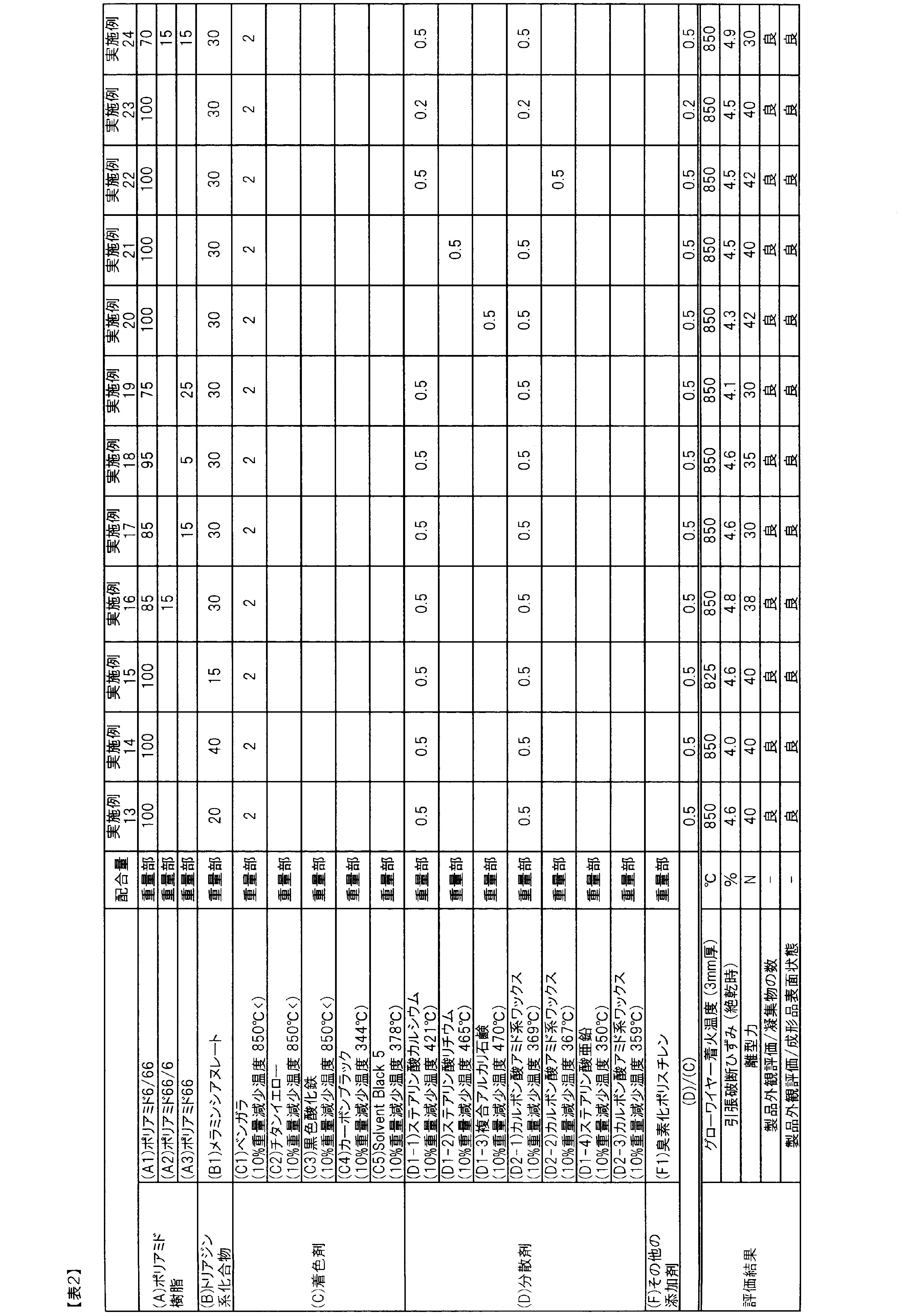
- Examples 1 to 24 (A) Polyamide resin, (B) Triazine compound, (C) Colorant, (D) Dispersant using a twin screw extruder (Nippon Steel Works: TEX30 ⁇ ) in the blending amounts shown in Tables 1 and 2 Then, top feed (original feed), melt kneading under conditions of cylinder set temperature 280 ° C, discharge rate 40 kg / hour, screw rotation speed 250 rpm, forming a strand-shaped gut, cooling with a cooling bath, then with a cutter Granulation gave pellets. Using the obtained pellets, various characteristics were examined by the above evaluation method. The results are shown in Tables 1-2.
- the polyamide resin composition of the present invention can be easily molded by ordinary methods such as injection molding, extrusion molding and blow molding, and the obtained molded product has excellent product appearance, excellent moldability, and glow wire characteristics. It has excellent mechanical properties (toughness) and is suitable for electrical and electronic parts, automobile parts, housings, exterior parts, and connectors. Further, it is particularly suitable for connector parts because it is particularly excellent in glow wire characteristics and mechanical characteristics (toughness), which are characteristics required for electric and electronic parts.
- Molded articles formed by molding the polyamide resin composition of the present invention are liquid crystal televisions, plasma displays, PDAs, small televisions, radios, notebook computers, personal computers, printers, scanners, computer peripherals, video decks, DVD decks, CD decks. , MD deck, DAT deck, amplifier, cassette deck, portable CD player, portable MD player, digital camera, home phone, office phone, toys, medical equipment, rice cooker parts, microwave oven parts, acoustic parts, lighting parts, It is particularly suitable for connectors used for refrigerator parts, air conditioner parts, facsimile parts, and copier parts.
Landscapes
- Chemical & Material Sciences (AREA)
- Health & Medical Sciences (AREA)
- Chemical Kinetics & Catalysis (AREA)
- Medicinal Chemistry (AREA)
- Polymers & Plastics (AREA)
- Organic Chemistry (AREA)
- Compositions Of Macromolecular Compounds (AREA)
Abstract
Description
(A)ポリアミド樹脂100重量部に対して、(B)トリアジン系化合物を15~45重量部、(C)着色剤を0.01~4重量部、および(D)分散剤を0.01~2.0重量部を含有するポリアミド樹脂組成物であって、(C)着色剤の熱重量測定(TGA)の10%重量減少温度が825℃以上であり、(D)分散剤の熱重量測定(TGA)の10%重量減少が360℃以上であるポリアミド樹脂組成物、である。
上記ポリアミド樹脂組成物からなる成形品、である。
つまり、本発明者らは(B)難燃剤、特定の(C)着色剤および、特定の(D)分散剤を用いる本発明のポリアミド樹脂組成物を用いれば、難燃性(グローワイヤー特性)および成形品外観の向上を両立させることができることを見出した。特に、(D)分散剤と(C)着色剤の重量比(D)/(C)を好ましくは0.15以上200以下とすることにより、着色剤の凝集を抑え、かつ、成形品のくもりを抑制することができる。
実施例および比較例で得られたペレットを、日精樹脂工業(株)製の射出成形機NEX1000により、シリンダ温度280℃、金型表面温度80℃、スクリュー回転数130rpm、射出圧力100MPa、射出速度100mm/秒、射出/冷却=20/20秒の条件で射出成形し、80mm×80mm×3mmの試験片を作製した。得られた試験片を用いて、IEC60695-2-13に準拠してグローワイヤー着火温度(GW-IT)を測定し、GW-IT:775℃以上を満たしたときに合格とした。
ISO1874-2に従い、実施例および比較例で得られたペレットを、日精樹脂工業(株)製の射出成形機NEX1000により、シリンダ温度280℃、金型表面温度80℃、スクリュー回転数150rpm、成形品平行部流速200mm/秒、射出/冷却=20/20秒の条件で射出成形し、ISO Type-A規格の試験片を作製した。
上記方法により得られた試験片をアルミの防湿袋に真空密閉した。この試験片を用いて、以下の標準方法に従って引張り破断ひずみを測定した。引張り破断ひずみ(絶乾時)が3.5%以上であれば、靱性に優れると判断した。
(3)離型性
実施例および比較例で得られたペレットを、日精樹脂工業(株)製の射出成形機NEX1000により、シリンダ温度280℃、金型表面温度80℃、スクリュー回転数150rpm、射出圧力100MPa、射出速度100mm/秒、射出/冷却=10/10秒の条件で射出成形し、25mm×25mm×25mm、肉厚1mmの箱型成形品を作製した。離型時にかかるエジェクタプレートへの負荷をロードセルで測定し、この数値を離型力とした。離型力が350N以下を合格とした。
実施例および比較例で得られたペレットを日精樹脂工業(株)製の射出成形機NEX1000により、シリンダ温度280℃、金型表面温度80℃、スクリュー回転数150rpm、射出圧力100MPa、射出速度100mm/秒、射出/冷却=20/20秒の条件で、縦90mm×横50mm×肉厚3mmの角板を5mm×2mmのサイドゲートで作製した。
上記方法により得られた試験片10枚を目視にて顔料の凝集物数を確認し、以下の基準で判定した。
可:凝集物の数が1~5個
不可:凝集物の数が6個以上
(b)成形品表面状態
上記方法により得られた試験片5枚の表面を目視確認し、以下の基準で判定した。尚、くもりとは発生ガスにより成形品表面が部分的に色調変化する現象を指し、シルバー・ストリークとは発生ガスにより成形品表面が荒れることにより現れる外観不良現象を指す。
不可:成形品表面にくもり、またはシルバー・ストリークのいずれかが観察された場合
(5)熱重量測定(TGA)
JIS K 7120(1987)規格に準拠し、サンプル質量2.5~3.5mg、測定温度40℃~850℃まで、昇温速度20℃/分で測定し、サンプル重量が10重量%減少した時の温度を10%重量減少温度とした。但し、測定に使用する流入ガスは窒素を使用し、流量を200ml/分に設定した。
ε-カプロラクタム95.0重量部とヘキサメチレンジアミンとアジピン酸の塩5.0重量部とを純水に溶解し、水分を1重量部添加したものを重合用の原料とし、得られた原料を重合塔に送った。重合塔上部、中間部、下部に取り付けられたヒーターにより重合塔の温度を加熱調整しながら、原料を反応させた。水浴中に吐出したポリマーをストランドカッターでペレタイズし、得られたペレットを95℃/20時間/浴比20倍にて熱水抽出を行い、未反応原料とオリゴマーを除去した。抽出後80℃/30時間減圧乾燥し、(A1)共重合ポリアミド樹脂を得た。JIS K 6810に従った98%硫酸での相対粘度は2.75であった。(A1)のポリアミド6/ポリアミド66の割合は、95重量%/5重量%であった。
ε-カプロラクタム3.0重量部とヘキサメチレンジアミンとアジピン酸の塩97.0重量部とを重合缶に投入し、水分量が45重量部となるように水分を加え、重合缶内を窒素で置換した後、260℃まで昇温した。ついで、1.7MPaにて1時間制圧・重合後、吐出・カッティングし、(A2)共重合ポリアミド樹脂を得た。JIS K 6810に従った98%硫酸での相対粘度は2.60であった。(A2)のポリアミド66/ポリアミド6の割合は、97重量%/3重量%であった。
ポリアミド66(東レ株式会社製“アミラン”(登録商標)CM3001N:98%硫酸での相対粘度:3.0)
参考例4 (B1)トリアジン系化合物
イタルマッチ社製:MC25(メラミンシアヌレート)を用いた。なお、JIS K 5600-9-3に準じて平均粒子径(体積平均値)を測定したところ、4μmであった。
(C1)森下弁柄工業(株)製:MR-120(ベンガラ)を使用した。この10%重量減少温度は850℃以上であった。
(C2)石原産業(株)製:TY-70(チタンイエロー)を使用した。この10%重量減少温度:850℃以上であった。
(C3)森下弁柄工業(株)製:MR-970D(黒色酸化鉄)を使用した。この10%重量減少温度は850℃以上であった。
(C4)三菱化学(株)製:三菱カーボンブラック#25(カーボンブラック)を使用した。この10%重量減少温度は344℃であった。
(C5)C.I.No.Solvent Black5を使用した。この10%重量減少温度は378℃であった。
(D1-1)日東化成工業(株)製:Ca-St(ステアリン酸カルシウム)を使用した。この10%重量減少温度は421℃であった。
(D1-2)日東化成工業(株)製:Li-St(ステアリン酸リチウム)を使用した。この10%重量減少温度は465℃であった。
(D1-3)日東化成工業(株)製:HRC-12(複合アルカリ石鹸)を使用した。この10%重量減少温度は470℃であった。
(D1-4)日東化成工業(株)製:Zn-St(ステアリン酸亜鉛)を使用した。この10%重量減少温度は350℃であった。
共栄社化学(株)製:WH215(エチレンジアミンとセバシン酸、ステアリン酸との重縮合物)を使用した。この10%重量減少温度は369℃であった。
共栄社化学(株)製:WH255(エチレンジアミンとセバシン酸、ステアリン酸との重縮合物)を使用した。この10%重量減少温度は367℃であった。
花王(株)製:カオーワックスEB-G(エチレンビスステアリルアマイド)を使用した。この10%重量減少温度は359℃であった。
アルベマール(株)製:SAYTEX HP-3010G(臭素化ポリスチレン)を使用した。
(A)ポリアミド樹脂、(B)トリアジン系化合物、(C)着色剤、(D)分散剤を表1~2に示す配合量で2軸押出機((株)日本製鋼所:TEX30α)を用いて、トップフィード(元込めフィード)し、シリンダ設定温度280℃、吐出量40kg/時、スクリュー回転数250rpmの条件で溶融混練し、ストランド状のガットを成形し、冷却バスで冷却後、カッターで造粒してペレットを得た。得られたペレットを用いて、前記の評価方法によって諸特性を調べた。その結果を表1~2に示す。
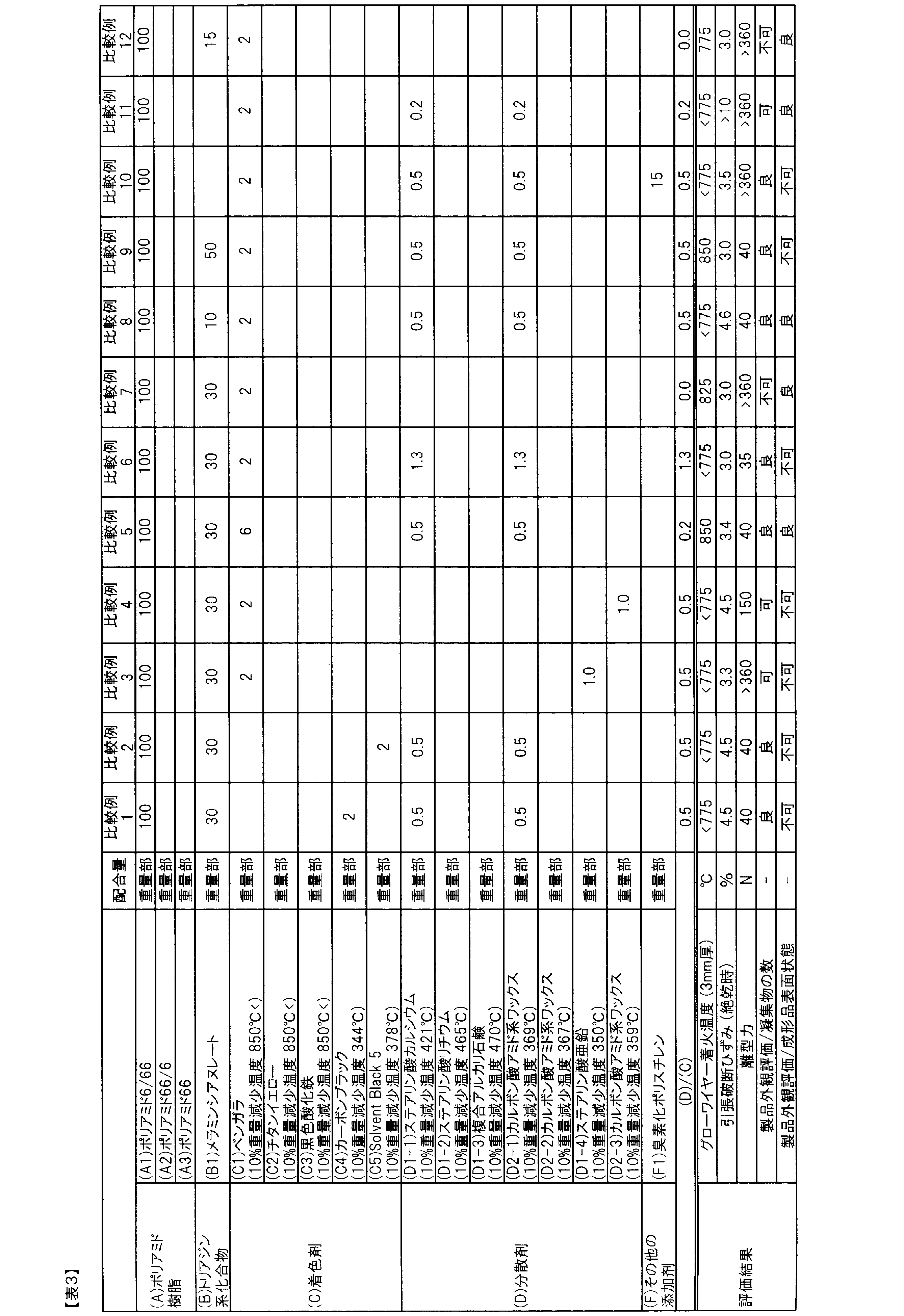
(A)ポリアミド樹脂、(B)トリアジン系化合物、(C)着色剤、(D)分散剤、(F)その他の添加剤を表3に示す配合量で2軸押出機((株)日本製鋼所:TEX30α)を用いて、トップフィード(元込めフィード)し、シリンダ設定温度280℃、吐出量40kg/時、スクリュー回転数250rpmの条件で溶融混練し、ストランド状のガットを成形し、冷却バスで冷却後、カッターで造粒してペレットを得た。得られたペレットを用いて、前記の評価方法によって諸特性を調べた。その結果を表3に示す。

Claims (5)
- (A)ポリアミド樹脂100重量部に対して、(B)トリアジン系化合物を15~45重量部、(C)着色剤を0.01~4重量部、および(D)分散剤を0.01~2.0重量部を含有するポリアミド樹脂組成物であって、(C)着色剤の熱重量測定(TGA)の10%重量減少温度が825℃以上であり、(D)分散剤の熱重量測定(TGA)の10%重量減少が360℃以上であるポリアミド樹脂組成物。
- (D)分散剤および(C)着色剤を、(D)/(C)が0.15以上200以下の重量比で含む請求項1に記載のポリアミド樹脂組成物。
- (D)分散剤が高級脂肪酸金属塩(D1)および/または脂肪酸アミド系ワックス(D2)を含む請求項1または2に記載のポリアミド樹脂組成物。
- (D)分散剤が高級脂肪酸金属塩(D1)および脂肪酸アミド系ワックス(D2)を(D1)/(D2)=80/20~20/80の重量比で含む請求項2または3に記載のポリアミド樹脂組成物。
- 請求項1~4いずれかに記載のポリアミド樹脂組成物からなる成形品。
Priority Applications (5)
| Application Number | Priority Date | Filing Date | Title |
|---|---|---|---|
| CN201780070633.1A CN109983078B (zh) | 2016-12-06 | 2017-11-08 | 阻燃性聚酰胺树脂组合物及由其形成的成型品 |
| US16/462,375 US20190338123A1 (en) | 2016-12-06 | 2017-11-08 | Flame-retardant polyamide resin composition and molded article comprising same |
| EP17878983.0A EP3530698B1 (en) | 2016-12-06 | 2017-11-08 | Flame-retardant polyamide resin composition and molded article comprising same |
| JP2017563150A JP6493567B2 (ja) | 2016-12-06 | 2017-11-08 | 難燃性ポリアミド樹脂組成物およびそれからなる成形品 |
| KR1020197011119A KR102008651B1 (ko) | 2016-12-06 | 2017-11-08 | 난연성 폴리아미드 수지 조성물 및 이것으로 이루어지는 성형품 |
Applications Claiming Priority (2)
| Application Number | Priority Date | Filing Date | Title |
|---|---|---|---|
| JP2016236645 | 2016-12-06 | ||
| JP2016-236645 | 2016-12-06 |
Publications (1)
| Publication Number | Publication Date |
|---|---|
| WO2018105295A1 true WO2018105295A1 (ja) | 2018-06-14 |
Family
ID=62491838
Family Applications (1)
| Application Number | Title | Priority Date | Filing Date |
|---|---|---|---|
| PCT/JP2017/040303 Ceased WO2018105295A1 (ja) | 2016-12-06 | 2017-11-08 | 難燃性ポリアミド樹脂組成物およびそれからなる成形品 |
Country Status (7)
| Country | Link |
|---|---|
| US (1) | US20190338123A1 (ja) |
| EP (1) | EP3530698B1 (ja) |
| JP (1) | JP6493567B2 (ja) |
| KR (1) | KR102008651B1 (ja) |
| CN (1) | CN109983078B (ja) |
| TW (1) | TWI761390B (ja) |
| WO (1) | WO2018105295A1 (ja) |
Cited By (1)
| Publication number | Priority date | Publication date | Assignee | Title |
|---|---|---|---|---|
| US11401416B2 (en) | 2017-10-17 | 2022-08-02 | Celanese Sales Germany Gmbh | Flame retardant polyamide composition |
Citations (7)
| Publication number | Priority date | Publication date | Assignee | Title |
|---|---|---|---|---|
| JPH11106645A (ja) * | 1997-09-30 | 1999-04-20 | Asahi Chem Ind Co Ltd | 難燃性ポリアミド組成物 |
| JP2006282943A (ja) * | 2005-04-04 | 2006-10-19 | Toray Ind Inc | 成形性が改良されたポリアミド樹脂組成物 |
| JP2008239896A (ja) * | 2007-03-28 | 2008-10-09 | Mitsubishi Engineering Plastics Corp | 難燃性ポリアミド樹脂組成物、およびこの難燃性樹脂組成物より製造された成形品 |
| JP2008308680A (ja) * | 2007-05-17 | 2008-12-25 | Mitsubishi Engineering Plastics Corp | 難燃性ポリアミド樹脂組成物 |
| WO2013099522A1 (ja) * | 2011-12-27 | 2013-07-04 | 東レ株式会社 | 難燃性ポリアミド樹脂組成物およびそれからなる成形品 |
| JP2013203997A (ja) * | 2012-03-29 | 2013-10-07 | Sumitomo Chemical Co Ltd | 液晶ポリエステル組成物、液晶ポリエステル成形体及び液晶ポリエステル組成物を用いたコネクター |
| WO2014042068A1 (ja) * | 2012-09-14 | 2014-03-20 | 三菱エンジニアリングプラスチックス株式会社 | 熱可塑性樹脂組成物および樹脂成形品 |
Family Cites Families (5)
| Publication number | Priority date | Publication date | Assignee | Title |
|---|---|---|---|---|
| JPH0291160A (ja) | 1988-09-28 | 1990-03-30 | Dainippon Ink & Chem Inc | 熱可塑性樹脂の着色剤用分散剤及びそれを含有する組成物 |
| JP2000119512A (ja) * | 1998-10-12 | 2000-04-25 | Asahi Chem Ind Co Ltd | 難燃性強化ポリアミド樹脂組成物 |
| CN103857368B (zh) | 2011-10-19 | 2015-04-22 | 花王株式会社 | 积纤装置 |
| CN103408750A (zh) * | 2013-07-12 | 2013-11-27 | 东华大学 | 一种三聚氰胺氰尿酸盐阻燃聚酰胺材料的制备方法 |
| EP2924067A1 (de) * | 2014-03-26 | 2015-09-30 | LANXESS Deutschland GmbH | Polyamidzusammensetzungen |
-
2017
- 2017-11-08 EP EP17878983.0A patent/EP3530698B1/en active Active
- 2017-11-08 KR KR1020197011119A patent/KR102008651B1/ko active Active
- 2017-11-08 JP JP2017563150A patent/JP6493567B2/ja active Active
- 2017-11-08 CN CN201780070633.1A patent/CN109983078B/zh active Active
- 2017-11-08 WO PCT/JP2017/040303 patent/WO2018105295A1/ja not_active Ceased
- 2017-11-08 US US16/462,375 patent/US20190338123A1/en not_active Abandoned
- 2017-11-13 TW TW106139093A patent/TWI761390B/zh active
Patent Citations (7)
| Publication number | Priority date | Publication date | Assignee | Title |
|---|---|---|---|---|
| JPH11106645A (ja) * | 1997-09-30 | 1999-04-20 | Asahi Chem Ind Co Ltd | 難燃性ポリアミド組成物 |
| JP2006282943A (ja) * | 2005-04-04 | 2006-10-19 | Toray Ind Inc | 成形性が改良されたポリアミド樹脂組成物 |
| JP2008239896A (ja) * | 2007-03-28 | 2008-10-09 | Mitsubishi Engineering Plastics Corp | 難燃性ポリアミド樹脂組成物、およびこの難燃性樹脂組成物より製造された成形品 |
| JP2008308680A (ja) * | 2007-05-17 | 2008-12-25 | Mitsubishi Engineering Plastics Corp | 難燃性ポリアミド樹脂組成物 |
| WO2013099522A1 (ja) * | 2011-12-27 | 2013-07-04 | 東レ株式会社 | 難燃性ポリアミド樹脂組成物およびそれからなる成形品 |
| JP2013203997A (ja) * | 2012-03-29 | 2013-10-07 | Sumitomo Chemical Co Ltd | 液晶ポリエステル組成物、液晶ポリエステル成形体及び液晶ポリエステル組成物を用いたコネクター |
| WO2014042068A1 (ja) * | 2012-09-14 | 2014-03-20 | 三菱エンジニアリングプラスチックス株式会社 | 熱可塑性樹脂組成物および樹脂成形品 |
Cited By (2)
| Publication number | Priority date | Publication date | Assignee | Title |
|---|---|---|---|---|
| US11401416B2 (en) | 2017-10-17 | 2022-08-02 | Celanese Sales Germany Gmbh | Flame retardant polyamide composition |
| US11981812B2 (en) | 2017-10-17 | 2024-05-14 | Celanese Sales Germany Gmbh | Flame retardant polyamide composition |
Also Published As
| Publication number | Publication date |
|---|---|
| KR102008651B1 (ko) | 2019-08-07 |
| CN109983078A (zh) | 2019-07-05 |
| CN109983078B (zh) | 2020-01-21 |
| EP3530698A1 (en) | 2019-08-28 |
| JP6493567B2 (ja) | 2019-04-03 |
| US20190338123A1 (en) | 2019-11-07 |
| TWI761390B (zh) | 2022-04-21 |
| EP3530698B1 (en) | 2020-09-16 |
| KR20190045378A (ko) | 2019-05-02 |
| TW201823358A (zh) | 2018-07-01 |
| EP3530698A4 (en) | 2019-11-13 |
| JPWO2018105295A1 (ja) | 2018-12-06 |
Similar Documents
| Publication | Publication Date | Title |
|---|---|---|
| CN101679743B (zh) | 聚酰胺树脂组合物 | |
| JP5966931B2 (ja) | 難燃性ポリアミド樹脂組成物およびそれからなる成形品 | |
| TW201249930A (en) | Flame retardant semi-aromatic polyamide composition and moulded products made therefrom | |
| JP2010168559A (ja) | ポリアミド樹脂組成物およびそれからなる成形品 | |
| EP0448221A1 (en) | Flame-retardant nylon resin composition | |
| JP2005171232A (ja) | 難燃性ポリアミド樹脂組成物 | |
| JP6493567B2 (ja) | 難燃性ポリアミド樹脂組成物およびそれからなる成形品 | |
| CN106554616A (zh) | 聚酰胺树脂组合物及其成型体 | |
| JP2005200636A (ja) | 難燃性ポリアミド樹脂組成物 | |
| JP4526911B2 (ja) | ポリアミドマスターバッチペレット | |
| JP2019006866A (ja) | ポリブチレンテレフタレート系樹脂組成物及び成形体 | |
| JP2010001365A (ja) | 難燃性ポリアミド樹脂組成物およびこれを用いた成形品 | |
| JP2008239896A (ja) | 難燃性ポリアミド樹脂組成物、およびこの難燃性樹脂組成物より製造された成形品 | |
| JP6811557B2 (ja) | ポリアミド樹脂組成物および成形体 | |
| EP1533343A1 (en) | Flame-retardant polyamide resin composition | |
| JP3362061B2 (ja) | ポリアミド樹脂組成物 | |
| JP5803100B2 (ja) | ポリアミド樹脂組成物およびそれからなる成形品 | |
| JP2018193437A (ja) | 熱可塑性樹脂組成物およびそれを成形してなる成形体 | |
| JP2019175584A (ja) | コネクターおよび樹脂組成物 | |
| JP5130765B2 (ja) | 難燃性ポリアミド樹脂組成物、およびこの難燃性樹脂組成物より製造された成形品 | |
| JP4209293B2 (ja) | 難燃性ポリアミド樹脂組成物 | |
| US6204314B1 (en) | Film retardant polyamide resin composition | |
| JP7293858B2 (ja) | 金属端子が圧入される溝を有する成形品用ポリアミド樹脂組成物およびそれからなる成形品 | |
| JPH11302533A (ja) | 難燃ポリアミド樹脂成形品 | |
| US20240352248A1 (en) | Liquid crystal polyester pellet composition and injection molded article |
Legal Events
| Date | Code | Title | Description |
|---|---|---|---|
| ENP | Entry into the national phase |
Ref document number: 2017563150 Country of ref document: JP Kind code of ref document: A |
|
| 121 | Ep: the epo has been informed by wipo that ep was designated in this application |
Ref document number: 17878983 Country of ref document: EP Kind code of ref document: A1 |
|
| ENP | Entry into the national phase |
Ref document number: 20197011119 Country of ref document: KR Kind code of ref document: A |
|
| ENP | Entry into the national phase |
Ref document number: 2017878983 Country of ref document: EP Effective date: 20190520 |
|
| NENP | Non-entry into the national phase |
Ref country code: DE |