WO2018123959A1 - 低結晶性セルロースの製造方法及び樹脂組成物 - Google Patents
低結晶性セルロースの製造方法及び樹脂組成物 Download PDFInfo
- Publication number
- WO2018123959A1 WO2018123959A1 PCT/JP2017/046413 JP2017046413W WO2018123959A1 WO 2018123959 A1 WO2018123959 A1 WO 2018123959A1 JP 2017046413 W JP2017046413 W JP 2017046413W WO 2018123959 A1 WO2018123959 A1 WO 2018123959A1
- Authority
- WO
- WIPO (PCT)
- Prior art keywords
- cellulose
- less
- mass
- group
- parts
- Prior art date
- Legal status (The legal status is an assumption and is not a legal conclusion. Google has not performed a legal analysis and makes no representation as to the accuracy of the status listed.)
- Ceased
Links
Images

Classifications
-
- C—CHEMISTRY; METALLURGY
- C08—ORGANIC MACROMOLECULAR COMPOUNDS; THEIR PREPARATION OR CHEMICAL WORKING-UP; COMPOSITIONS BASED THEREON
- C08J—WORKING-UP; GENERAL PROCESSES OF COMPOUNDING; AFTER-TREATMENT NOT COVERED BY SUBCLASSES C08B, C08C, C08F, C08G or C08H
- C08J3/00—Processes of treating or compounding macromolecular substances
- C08J3/12—Powdering or granulating
-
- C—CHEMISTRY; METALLURGY
- C08—ORGANIC MACROMOLECULAR COMPOUNDS; THEIR PREPARATION OR CHEMICAL WORKING-UP; COMPOSITIONS BASED THEREON
- C08L—COMPOSITIONS OF MACROMOLECULAR COMPOUNDS
- C08L1/00—Compositions of cellulose, modified cellulose or cellulose derivatives
- C08L1/02—Cellulose; Modified cellulose
-
- C—CHEMISTRY; METALLURGY
- C08—ORGANIC MACROMOLECULAR COMPOUNDS; THEIR PREPARATION OR CHEMICAL WORKING-UP; COMPOSITIONS BASED THEREON
- C08L—COMPOSITIONS OF MACROMOLECULAR COMPOUNDS
- C08L23/00—Compositions of homopolymers or copolymers of unsaturated aliphatic hydrocarbons having only one carbon-to-carbon double bond; Compositions of derivatives of such polymers
- C08L23/02—Compositions of homopolymers or copolymers of unsaturated aliphatic hydrocarbons having only one carbon-to-carbon double bond; Compositions of derivatives of such polymers not modified by chemical after-treatment
- C08L23/04—Homopolymers or copolymers of ethene
- C08L23/06—Polyethylene
-
- C—CHEMISTRY; METALLURGY
- C08—ORGANIC MACROMOLECULAR COMPOUNDS; THEIR PREPARATION OR CHEMICAL WORKING-UP; COMPOSITIONS BASED THEREON
- C08L—COMPOSITIONS OF MACROMOLECULAR COMPOUNDS
- C08L23/00—Compositions of homopolymers or copolymers of unsaturated aliphatic hydrocarbons having only one carbon-to-carbon double bond; Compositions of derivatives of such polymers
- C08L23/02—Compositions of homopolymers or copolymers of unsaturated aliphatic hydrocarbons having only one carbon-to-carbon double bond; Compositions of derivatives of such polymers not modified by chemical after-treatment
- C08L23/10—Homopolymers or copolymers of propene
- C08L23/12—Polypropene
-
- C—CHEMISTRY; METALLURGY
- C08—ORGANIC MACROMOLECULAR COMPOUNDS; THEIR PREPARATION OR CHEMICAL WORKING-UP; COMPOSITIONS BASED THEREON
- C08J—WORKING-UP; GENERAL PROCESSES OF COMPOUNDING; AFTER-TREATMENT NOT COVERED BY SUBCLASSES C08B, C08C, C08F, C08G or C08H
- C08J2301/00—Characterised by the use of cellulose, modified cellulose or cellulose derivatives
- C08J2301/02—Cellulose; Modified cellulose
-
- C—CHEMISTRY; METALLURGY
- C08—ORGANIC MACROMOLECULAR COMPOUNDS; THEIR PREPARATION OR CHEMICAL WORKING-UP; COMPOSITIONS BASED THEREON
- C08J—WORKING-UP; GENERAL PROCESSES OF COMPOUNDING; AFTER-TREATMENT NOT COVERED BY SUBCLASSES C08B, C08C, C08F, C08G or C08H
- C08J2423/00—Characterised by the use of homopolymers or copolymers of unsaturated aliphatic hydrocarbons having only one carbon-to-carbon double bond; Derivatives of such polymers
- C08J2423/26—Characterised by the use of homopolymers or copolymers of unsaturated aliphatic hydrocarbons having only one carbon-to-carbon double bond; Derivatives of such polymers modified by chemical after-treatment
-
- C—CHEMISTRY; METALLURGY
- C08—ORGANIC MACROMOLECULAR COMPOUNDS; THEIR PREPARATION OR CHEMICAL WORKING-UP; COMPOSITIONS BASED THEREON
- C08L—COMPOSITIONS OF MACROMOLECULAR COMPOUNDS
- C08L2203/00—Applications
- C08L2203/30—Applications used for thermoforming
-
- C—CHEMISTRY; METALLURGY
- C08—ORGANIC MACROMOLECULAR COMPOUNDS; THEIR PREPARATION OR CHEMICAL WORKING-UP; COMPOSITIONS BASED THEREON
- C08L—COMPOSITIONS OF MACROMOLECULAR COMPOUNDS
- C08L2205/00—Polymer mixtures characterised by other features
- C08L2205/02—Polymer mixtures characterised by other features containing two or more polymers of the same C08L -group
- C08L2205/025—Polymer mixtures characterised by other features containing two or more polymers of the same C08L -group containing two or more polymers of the same hierarchy C08L, and differing only in parameters such as density, comonomer content, molecular weight, structure
-
- C—CHEMISTRY; METALLURGY
- C08—ORGANIC MACROMOLECULAR COMPOUNDS; THEIR PREPARATION OR CHEMICAL WORKING-UP; COMPOSITIONS BASED THEREON
- C08L—COMPOSITIONS OF MACROMOLECULAR COMPOUNDS
- C08L2205/00—Polymer mixtures characterised by other features
- C08L2205/03—Polymer mixtures characterised by other features containing three or more polymers in a blend
-
- C—CHEMISTRY; METALLURGY
- C08—ORGANIC MACROMOLECULAR COMPOUNDS; THEIR PREPARATION OR CHEMICAL WORKING-UP; COMPOSITIONS BASED THEREON
- C08L—COMPOSITIONS OF MACROMOLECULAR COMPOUNDS
- C08L2205/00—Polymer mixtures characterised by other features
- C08L2205/06—Polymer mixtures characterised by other features having improved processability or containing aids for moulding methods
Definitions
- the present invention relates to a method for producing low crystalline cellulose and a cellulose-containing powder.
- the present invention further relates to a resin composition. More specifically, the present invention relates to a resin composition that can be suitably used as daily miscellaneous goods, home appliance parts, automobile parts, and the like, and a production method thereof, and a molded body of the resin composition and a production method thereof.
- plastic materials derived from petroleum which is a finite resource, have been widely used, but in recent years, technologies with less environmental impact have come to the spotlight. Materials using cellulose fibers have attracted attention.
- Patent Document 1 discloses that a molded product of a composition in which cellulose having a crystallinity of less than 50% is blended with a polyolefin resin and / or a styrene resin has both strength and flexibility, and further has high impact resistance. It has been reported that it has an excellent effect of being excellent. And it is disclosed that the cellulose used here is prepared by reducing the crystallinity to less than 50% by pulverization, but it is flexible and resistant while maintaining the strength of the resulting molded product. From the viewpoint of further improving the impact properties, the cellulose having a reduced crystallinity is used by adding a pulverization aid and pulverizing to reduce the average particle diameter to 30 ⁇ m or less. It is also disclosed.
- Patent Document 2 0.1 to 100 parts by mass of a specific grinding aid is added to 100 parts by mass of a low crystalline cellulose raw material having a cellulose I-type crystallinity of 33% or less, followed by a dry grinding process. By doing so, a method for producing cellulose particles having an average particle diameter of preferably 50 ⁇ m or less is disclosed.
- Patent Document 3 when a cellulose-containing raw material having a cellulose I-type crystallinity of more than 33% is used and the cellulose content in the remaining components obtained by removing water from the cellulose-containing raw material is 20% by mass or more Discloses a method for producing a low crystalline cellulose having an average particle size of 10 to 200 ⁇ m by treating the cellulose-containing raw material together with a grinding aid in a grinding machine.
- Patent Document 4 when adding flat cellulose particles or fibrous fine cellulose to various base materials (for example, thermoplastic resin), the shape effect is obtained by orienting the flat cellulose particles or fibrous fine cellulose.
- base materials for example, thermoplastic resin
- the shape effect is obtained by orienting the flat cellulose particles or fibrous fine cellulose.
- the physical properties of the composite for example, dimensional stability, damping / soundproofing properties, gas barrier It is disclosed that the property, wear resistance, heat resistance, heat insulation, surface smoothness, electrical insulation characteristics, etc. are improved.
- the present invention relates to the following [1] to [10].
- [1] One type selected from the group consisting of the following (A), (B), and (C) with respect to 100 parts by mass of the cellulose-containing raw material having a cellulose I-type crystallization index of 10% or more and less than 100% Production of cellulose-containing powder having a cellulose I-type crystallization index of -20% or more and less than 50%, comprising a step of adding two or more additives in an amount of 0.1 to 100 parts by mass and dry-grinding Method.
- the cellulose I type crystallization index is -20% or more and less than 50%, and the following (A), (B), and (C) with respect to 100 parts by mass of the cellulose-containing raw material Cellulose-containing powder formed by containing 0.1 part by mass or more and 100 parts by mass or less of one or more additives selected from the group consisting of:
- a thermoplastic resin composition comprising the cellulose composite (b).
- thermoplastic resin (a) and a cellulose composite (b) in which a cellulose-affinity polymer and cellulose are pulverized and have a cellulose I crystallization index of -20% to less than 50% are blended
- a method for producing a resin composition [9] The production method according to [8], wherein the cellulose composite (b) is a cellulose-containing powder produced by the production method according to [1].
- the cellulose composite (b) is the cellulose-containing powder according to [2].
- FIG. 1 is a schematic diagram showing the maximum height and diagonal length of a molded body.
- the present invention relates to a method for easily preparing a cellulose-containing powder, which is a low crystalline cellulose that can provide a resin composition having both rigidity and toughness when blended in a resin, and a cellulose-containing powder.
- the present invention relates to a resin composition having both toughness and rigidity, a method for producing the resin composition, a molded body of the resin composition, and a method for producing the resin composition.
- the low crystalline cellulose obtained by the present invention has an excellent effect that it can provide a resin composition having both rigidity and toughness when blended in a resin. Furthermore, the resin composition of the present invention has an excellent effect of achieving both toughness and rigidity. Furthermore, the resin composition of the present invention exhibits excellent effects in weld strength, impact resistance at low temperatures, and warpage suppression.
- Cellulose-containing powder production method of the present invention and cellulose-containing powder Cellulose has higher strength as the degree of crystallinity, but low crystalline cellulose has many non-crystalline parts and the proportion of hydrogen bonds decreases. It excels in toughness while being excellent in strength.
- Such low crystalline cellulose can be produced, for example, by subjecting the raw material cellulose to pulverization as described in Patent Documents 1 to 3 described above. It has been found that the presence of an agent makes it possible to easily prepare a low crystalline cellulose that can impart rigidity and toughness when blended with a resin.
- the pulverization aids and the like described in Patent Documents 1 to 3 are already known.
- a polymer compound having an acid anhydride By using components different from conventional cellulose grinding aids such as a low molecular weight compound having (C) a silane coupling agent, the detailed reason is unknown, but the affinity between the additive and cellulose is good. This is presumably because the additive easily penetrates into the inside of the cellulose crystal and the pulverization force is easily transmitted, so that the structure is broken from the inside of the cellulose crystal.
- these assumptions do not limit the present invention.
- the crystallinity of cellulose is a cellulose I-type crystallization index calculated by the Segal method from the diffraction intensity value by the X-ray diffraction method, and is specifically defined as follows. .
- the crystal structure of cellulose is confirmed by measuring under the following conditions using “MiniFlex 600” manufactured by Rigaku Corporation.
- the measurement sample is prepared by compressing a pellet having an area of 320 mm 2 ⁇ thickness of 1 mm. Further, the crystallinity of the cellulose I-type crystal structure is obtained by calculating the obtained X-ray diffraction intensity based on the following formula (A).
- the cellulose production method of the invention 1 comprises (A), (B), and (C) described later with respect to 100 parts by mass of a cellulose-containing raw material having a cellulose I-type crystallization index of 10% or more and less than 100%.
- One or more additives selected from the group are added in an amount of 0.1 parts by mass or more and 100 parts by mass or less, and include a dry pulverization process.
- a cellulose-containing powder having a cellulose I crystallization index of ⁇ 20% or more and less than 50% is obtained.
- the cellulose-containing powder is described as low crystalline cellulose.
- the cellulose-containing raw material used in Invention 1 is not particularly limited as long as the cellulose I-type crystallization index satisfies 10% or more and less than 100%, but is preferably 20% from the viewpoint of mixing properties of cellulose and additives. More preferably, it is 30% or more, more preferably 40% or more, further preferably 50% or more, and further preferably 60% or more. From the viewpoint of being available at a low cost, those having a crystallization index of, for example, 50% or more may be used.
- woody coniferous and broadleaf
- herbaceous grass, mallow, legumes, non-woody raw material of palms
- pulp from fibers around cotton seeds
- cotton linter pulp to be obtained Examples thereof include cotton linter pulp to be obtained
- papers newspaper, cardboard, magazines, high-quality paper, etc.
- the size and shape of the cellulose-containing raw material are particularly limited. Absent. For example, a fiber, powder, sphere, chip, or flake can be used. Moreover, these mixtures may be sufficient.
- the shape may be adjusted in advance using a cutting machine such as a shredder. Specifically, for example, the shape having a size within one side of 0.1 to 70 mm, preferably 0.5 to 70 mm, more preferably 1 to 50 mm, and still more preferably 1 to 30 mm. Are illustrated.
- size of a cellulose containing raw material can be measured using a caliper.
- the composition of the cellulose-containing raw material is not particularly limited.
- the cellulose content in the raw material is preferably 30% by mass or more, more preferably 50% by mass or more, and further preferably 70% by mass or more.
- an upper limit is 100 mass%, and 99 mass% or less is illustrated.
- the cellulose content in the cellulose-containing raw material is the cellulose content in the remaining components excluding moisture in the cellulose-based raw material.
- water content in a cellulose containing raw material there is no restriction
- the cellulose-containing raw material used in Invention 1 may be subjected to a drying treatment.
- the treatment method is not limited, and a known drying method may be selected as appropriate.
- a hot air heat receiving method, a conductive heat receiving method, a dehumidifying air drying method, a cold air drying method, a microwave drying method, an infrared drying method Examples include a sun drying method, a vacuum drying method, and a freeze drying method.
- These drying methods may be performed singly or in combination of two or more, and a drying apparatus can be appropriately selected depending on the drying method.
- the drying process can be either a batch process or a continuous process.
- the temperature in the drying treatment cannot be determined unconditionally depending on the drying means, drying time, etc., but is preferably 10 ° C. or higher, more preferably 50 ° C. or higher, and further preferably 60 ° C. or higher. Moreover, Preferably it is 250 degrees C or less, More preferably, it is 150 degrees C or less.
- the lower limit is preferably 0.01 hr or more, more preferably 0.02 hr or more, and the upper limit is preferably 2 hr or less, more preferably 1 hr or less. If necessary, the drying process may be performed under reduced pressure, and the pressure is exemplified by about 1 to 120 kPa.
- the water content in the cellulose-containing raw material after the drying treatment is preferably 4.5% by mass or less, more preferably 4.0% by mass or less, still more preferably 3.5% by mass or less, and still more preferably 3.0%. It is below mass%. With such an amount of water, even in the pulverization process in the presence of the additive, the process can be performed satisfactorily without causing lumps.
- the crystallization index of the cellulose-containing raw material after the drying treatment has a crystallization index comparable to that of the crystallization index before the treatment.
- the combination may be two or more types in (A), two or more types in (B), or two or more types in (C).
- the combination of (A) and (C) is preferable from the viewpoint of the affinity with the resin when blended with the resin in addition to the affinity with the cellulose.
- the acid anhydride in the compound (A) is not particularly limited, and examples thereof include maleic anhydride, succinic anhydride, and glutaric anhydride.
- Examples of the polymer in the compound (A) include resins such as polyolefin resins, acrylic resins, and styrene resins, and polyolefin resins are preferable from the viewpoint of compatibility with the resin to be blended.
- polyolefin resins examples include ethylene polymers [high density polyethylene, medium density polyethylene, low density polyethylene, ethylene and one or more other vinyl compounds (eg, ⁇ -olefin, vinyl acetate, methacrylic acid, acrylic acid, etc.) Copolymer, etc.], propylene polymer [polypropylene, copolymer of propylene and one or more other vinyl compounds, etc.], ethylene propylene copolymer, polybutene, poly-4-methylpentene-1, etc.
- ethylene polymers high density polyethylene, medium density polyethylene, low density polyethylene, ethylene and one or more other vinyl compounds (eg, ⁇ -olefin, vinyl acetate, methacrylic acid, acrylic acid, etc.) Copolymer, etc.
- propylene polymer polypropylene, copolymer of propylene and one or more other vinyl compounds, etc.
- ethylene propylene copolymer polybutene
- poly-4-methylpentene-1 etc
- compound (A) examples include maleic anhydride-modified polyolefin, and more specifically maleic anhydride-modified polypropylene.
- the compound may be prepared according to a known method, or a commercially available product may be used. Suitable commercially available products include, for example, “Yomex” (polypropylene having maleic anhydride) manufactured by Sanyo Chemical Industries, Ltd., “OREVAC G” (polypropylene having maleic anhydride) manufactured by Arkema, and “Rotada” (acid) manufactured by Arkema. Polyolefin resin having anhydride), “Bondyne” manufactured by Sumitomo Chemical Co., Ltd. (polyolefin resin having acid anhydride) and the like are exemplified.
- the weight average molecular weight (Mw) of the compound (A) is preferably 1,000 or more, more preferably 5,000 or more, still more preferably 10,000 or more, still more preferably 20, from the viewpoint of affinity with cellulose. 000 or more. Further, from the viewpoint of grindability, it is preferably 150,000 or less, more preferably 140,000 or less, and still more preferably 130,000 or less.
- the weight average molecular weight of a high molecular compound can be measured in accordance with the method as described in the below-mentioned Example.
- the compound (A) has a melting point of preferably 250 ° C. or lower, more preferably 200 ° C. or lower, still more preferably 180 ° C. or lower, and more preferably 170 ° C. from the viewpoint of suppressing the deterioration of cellulose when complexed with a resin.
- the following are preferred.
- a minimum is not specifically limited, For example, it is about 100 degreeC.
- fusing point can be measured in accordance with the method as described in the below-mentioned Example.
- the acid anhydride in the compound (B) is not particularly limited, and examples thereof include the same acid anhydrides as in the compound (A).
- a hydrocarbon group can be mentioned as a low molecule in a compound.
- the hydrocarbon group include a chain saturated hydrocarbon group, a chain unsaturated hydrocarbon group, a cyclic saturated hydrocarbon group, and an aromatic hydrocarbon group.
- the chain saturated hydrocarbon group may be linear or branched. From the viewpoint of grindability, the chain saturated hydrocarbon group has preferably 1 or more, more preferably 3 or more, still more preferably 5 or more, still more preferably 10 or more, and still more preferably 15 or more. Moreover, from a reactive viewpoint with a cellulose, 30 or less are preferable, 24 or less are more preferable, 20 or less are still more preferable, and 18 or less are still more preferable.
- chain saturated hydrocarbon group examples include, for example, methyl group, ethyl group, propyl group, isopropyl group, butyl group, sec-butyl group, tert-butyl group, isobutyl group, pentyl group, tert-pentyl group, Examples include isopentyl group, hexyl group, isohexyl group, heptyl group, octyl group, 2-ethylhexyl group, nonyl group, decyl group, dodecyl group, tridecyl group, tetradecyl group, octadecyl group, docosyl group, octacosanyl group and the like.
- propyl group isopropyl group, butyl group, sec-butyl group, tert-butyl group, isobutyl group, pentyl group, tert-pentyl group, isopentyl group, hexyl group, isohexyl group, heptyl group, octyl group, 2-ethylhexyl group, nonyl group, decyl group, dodecyl group, tridecyl group, tetradecyl group, octadecyl group, docosyl group, octacosyl group, more preferably pentyl group, tert-pentyl group, isopentyl group, hexyl group, isohexyl group A heptyl group, an octyl group, a 2-ethylhexyl group, a nonyl group, a decyl group, isopentyl group,
- the chain unsaturated hydrocarbon group may be linear or branched.
- the number of carbon atoms of the chain unsaturated hydrocarbon group is preferably 2 or more, more preferably 3 or more, still more preferably 5 or more, and still more preferably 10 or more, from the viewpoint of grindability.
- 30 or less are preferable, 24 or less are more preferable, 20 or less are still more preferable, and 18 or less are still more preferable.
- chain unsaturated hydrocarbon group examples include, for example, ethenyl group, propenyl group, butenyl group, isobutenyl group, isoprenyl group, pentenyl group, hexenyl group, heptenyl group, octenyl group, nonenyl group, decenyl group, dodecenyl group. , Tridecenyl group, tetradecenyl group, and octadecenyl group.
- an isopenyl group a pentenyl group, a hexenyl group, a heptenyl group, an octenyl group, a nonenyl group, a decenyl group, a dodecenyl group, a tridecenyl group, a tetradecenyl group, and an octadecenyl group, more preferably a decenyl group, a dodecenyl group, and a tridecenyl group.
- Group, tetradecenyl group and octadecenyl group preferably an isopenyl group, a pentenyl group, a hexenyl group, a heptenyl group, an octenyl group, a nonenyl group, a decenyl group, a dodecenyl group, a tridecenyl group, a tetradec
- the number of carbon atoms of the cyclic saturated hydrocarbon group is preferably 3 or more, more preferably 4 or more, and still more preferably 5 or more.
- the number of carbon atoms of the cyclic saturated hydrocarbon group is preferably 3 or more, more preferably 4 or more, and still more preferably 5 or more.
- 20 or less are preferable, 16 or less are more preferable, 12 or less are still more preferable, and 8 or less are still more preferable.
- cyclic saturated hydrocarbon group examples include, for example, cyclopropyl group, cyclobutyl group, cyclopentyl group, cyclohexyl group, cycloheptyl group, cyclooctyl group, cyclononyl group, cyclodecyl group, cyclododecyl group, cyclotridecyl group, A cyclotetradecyl group, a cyclooctadecyl group, etc. are mentioned.
- a cyclopropyl group preferably a cyclobutyl group, a cyclopentyl group, a cyclohexyl group, a cycloheptyl group, a cyclooctyl group, a cyclononyl group, a cyclodecyl group, and a cyclododecyl group, and more preferably a cyclopentyl group, a cyclohexyl group, and a cycloheptyl group.
- a cyclooctyl group preferably a cyclopropyl group, a cyclobutyl group, a cyclopentyl group, a cyclohexyl group, a cycloheptyl group, a cyclooctyl group, a cyclononyl group, a cyclodecyl group, and a cyclododecyl group.
- the aromatic hydrocarbon group is selected from the group consisting of an aryl group and an aralkyl group, for example.
- the aryl group and aralkyl group may be substituted or unsubstituted on the aromatic ring itself.
- the aryl group may have a total carbon number of 6 or more, and from the viewpoint of grindability, it is preferably 24 or less, more preferably 20 or less, still more preferably 14 or less, still more preferably 12 or less, and even more preferably 10 or less. is there.
- the total carbon number of the aralkyl group is 7 or more, preferably 8 or more from the viewpoint of grindability, and preferably 24 or less, more preferably 20 or less, more preferably from the viewpoint of reactivity with cellulose. Is 14 or less, more preferably 13 or less, and still more preferably 11 or less.
- aryl group examples include a phenyl group, a naphthyl group, an anthryl group, a phenanthryl group, a biphenyl group, a triphenyl group, and a terphenyl group.
- aralkyl group examples include benzyl group, phenethyl group, phenylpropyl group, phenylpentyl group, phenylhexyl group, phenylheptyl group, and phenyloctyl group.
- the above-described hydrocarbon group may have a substituent.
- the total number of carbon atoms of the hydrocarbon group including the substituent is within the above range.
- the substituent include a methoxy group, an ethoxy group, a propoxy group, an isopropoxy group, a butoxy group, an isobutoxy group, a sec-butoxy group, a tert-butoxy group, a pentyloxy group, an isopentyloxy group, and a hexyloxy group.
- An alkoxy group having 1 to 6 carbon atoms methoxycarbonyl group, ethoxycarbonyl group, propoxycarbonyl group, isopropoxycarbonyl group, butoxycarbonyl group, isobutoxycarbonyl group, sec-butoxycarbonyl group, tert-butoxycarbonyl group, pentyloxycarbonyl Group, an alkoxy-carbonyl group having 1 to 6 carbon atoms of an alkoxy group such as an isopentyloxycarbonyl group; a halogen atom such as a fluorine atom, a chlorine atom, a bromine atom or an iodine atom; a carbon number of 1 such as an acetyl group or a propionyl group ⁇ 6 Sill group; an aralkyl group; an aralkyloxy group; an alkylamino group having 1 to 6 carbon atoms; the carbon number of the alkyl group have dialkylamino group having 1 to 6.
- (B) compounds include alkyl or alkenyl glutaric anhydrides such as alkyl or alkenyl succinic anhydrides such as dodecenyl succinic anhydride and hexadecenyl succinic anhydride, hexadecyl glutaric anhydride, and octadecyl glutaric anhydride. Is mentioned. These may be prepared according to known methods or commercially available products may be used. As described above, the number of carbon atoms of alkyl and alkenyl is preferably 2 or more, more preferably 3 or more, still more preferably 5 or more, and still more preferably 10 or more, from the viewpoint of reactivity with cellulose. 30 or less, more preferably 24 or less, still more preferably 20 or less, and even more preferably 18 or less.
- the molecular weight of the compound is preferably 50 or more, more preferably 100 or more, and still more preferably 200 or more, from the viewpoint of grindability. Moreover, from a viewpoint of affinity with a cellulose, Preferably it is 600 or less, More preferably, it is 500 or less, More preferably, it is 400 or less. In the present specification, the molecular weight of the low molecular weight compound can be calculated based on the atomic weight of the constituent atoms.
- (C) Silane coupling agent examples include coupling agents such as isocyanate silane, amino silane, mercapto silane, epoxy silane, vinyl silane, methacryl silane, and epoxy silane.
- coupling agents such as isocyanate silane, amino silane, mercapto silane, epoxy silane, vinyl silane, methacryl silane, and epoxy silane.
- a coupling agent of isocyanate silane, aminosilane, mercaptosilane, or epoxysilane is preferable.
- Examples of the isocyanate silane include 3-isocyanatopropyltrimethoxysilane, 3-isocyanatopropyltriethoxysilane, tris- (3-trimethoxysilylpropyl) isocyanurate, and the like.
- Examples of the aminosilane include 3-aminopropyltriethoxysilane, n- ⁇ (aminoethyl) ⁇ -aminopropyltriethoxysilane, and the like.
- Examples of mercaptosilane include 3-mercaptopropyltrimethoxysilane.
- epoxy silane examples include 2- (3,4-epoxycyclohexyl) ethyltrimethoxysilane, 3-glycidoxypropyltrimethoxysilane, and 3-glycidoxypropylmethyldiethoxysilane.
- the additive is used in an amount of 0.1 parts by mass or more and 100 parts by mass or less based on 100 parts by mass of the cellulose-containing raw material from the viewpoint of achieving both rigidity and toughness when blended in the resin.
- it is preferably 0.5 parts by mass or more, more preferably 1 part by mass or more, more preferably 3 parts by mass or more, and further preferably 5 parts by mass.
- it is preferably 75 parts by mass or less, more preferably 50 parts by mass or less, still more preferably 25 parts by mass or less, and still more preferably. Is 20 parts by mass or less.
- the additive is used in an amount of 0.1 to 100 parts by weight, preferably 0.5 parts by weight, based on 100 parts by weight of the cellulose-containing raw material, from the viewpoint of achieving both rigidity and toughness when blended in the resin. 75 parts by mass or less, more preferably 0.5 parts by mass or more and 50 parts by mass or less, more preferably 1 part by mass or more and 25 parts by mass or less, further preferably 1 part by mass or more and 20 parts by mass or less, and further preferably 3 parts by mass.
- the amount is 20 parts by mass or less, more preferably 5 parts by mass or more and 20 parts by mass or less. When two or more additives are used, the amount used means the total amount.
- the medium type pulverizer includes a container driven pulverizer and a medium agitating pulverizer.
- Examples of the container-driven crusher include a rolling mill, a vibration mill, a planetary mill, and a centrifugal fluid mill.
- a tower type pulverizer such as a tower mill
- an agitator type pulverizer such as an attritor, an aquamizer and a sand grinder
- a distribution tank type pulverizer such as a visco mill and a pearl mill
- a distribution pipe type pulverizer examples thereof include an annular pulverizer such as a coball mill; a continuous dynamic pulverizer and the like.
- the crystallinity of cellulose obtained can be controlled by appropriately adjusting the peripheral speed of the rotor, the sample supply speed, the stirring time, and the like.
- the material of the medium that can be used is not particularly limited, and examples thereof include iron, stainless steel, alumina, zirconia, silicon carbide, silicon nitride, and glass.
- bowl, a rod, a tube, etc. are mentioned.
- the rod is a rod-shaped medium, and a rod having a cross section of a polygon such as a quadrangle or a hexagon, a circle, or an ellipse can be used.
- the filling rate of the medium varies depending on the model of the pulverizer and the shape of the medium. For example, in the case of a rod, it is preferably 10% or more, more preferably 15% or more, preferably 70% or less, More preferably, it is 60% or less. When the filling rate is within this range, the contact frequency between the cellulose-containing raw material and the rod is improved, and the grinding efficiency can be improved.
- the filling rate refers to the apparent volume of the medium relative to the volume of the stirring unit of the pulverizer. From the viewpoint of increasing the contact frequency between the cellulose-containing raw material and the rod and improving the grinding efficiency, it is preferable to use a plurality of rods.
- the treatment time cannot be generally determined depending on the type of pulverizer and the type, size, and filling rate of the medium, but is preferably 0.01 hr or more, more preferably 0.05 hr, from the viewpoint of reducing the crystallinity. From the viewpoint of productivity, it is preferably 10 hr or less, more preferably 5 hr or less, still more preferably 2 hr or less, further preferably 1 hr or less, and still more preferably 0.5 hr or less. is there.
- the treatment temperature is not particularly limited, but is usually about 5 to 250 ° C. from the viewpoint of preventing deterioration due to heat.
- the difference between the cellulose type I crystallization index (A) before and after the pulverization process is preferably 30 to 120%, more preferably 40 to 100%, and still more preferably 50 to 90%.
- the low crystalline cellulose raw material does not adhere to the inside of the pulverizer and can be processed in a dry manner.
- a cellulose-containing powder having a reduced crystallinity and a cellulose I-type crystallization index of ⁇ 20% or more and less than 50% is obtained.
- the degree of reduction in crystallinity cannot be determined unconditionally depending on the conditions of the pulverization process or the raw material used for the pulverization process, but the cellulose I-type crystallization index of the obtained cellulose-containing powder is determined by the raw material used for the process. It is smaller than the cellulose I-type crystallization index.
- the cellulose I-type crystallization index of the cellulose-containing powder with reduced crystallinity is preferably ⁇ 20% or more, more preferably ⁇ 10% or more, and more preferably 0% or more from the viewpoint of improving rigidity when blended with a resin.
- 50% or less is preferred, 40% or less is more preferred, 30% or less is more preferred, 25% or less is even more preferred, and when blended in a resin From the viewpoint of achieving both rigidity and toughness, it is preferably -20% to 50%, more preferably -10% to 40%, still more preferably 0% to 30%, and even more preferably 0% to 25%. It is as follows.
- the obtained cellulose-containing powder preferably has a sharp particle size distribution from the viewpoint of achieving both rigidity and toughness when blended with a resin.
- the cellulose-containing powder is more than 250 ⁇ m.
- the content of particles having a particle size (also referred to as “particle ratio”) is preferably 50% by volume or less, more preferably 45% by volume or less, and more preferably 40% by volume in the total powder (of the obtained cellulose-containing powder). The following is more preferable, 30% by volume or less is further preferable, 20% by volume or less is further preferable, and from the viewpoint of production efficiency, 0.1% by volume or more is preferable, and 1% by volume or more is more preferable.
- the content of particles having a particle size of more than 250 ⁇ m is preferably 0.1 to 50% by volume, more preferably 0.1 to 45% by volume, and still more preferably 0.1 to 40% by volume in the total powder.
- 0.1 to 30% by volume is more preferable, 0.1 to 20% by volume is more preferable, and 1 to 20% by volume is still more preferable.
- the content of particles having a particle size of 32 ⁇ m or less is preferably 30% by volume or less, more preferably 25% by volume or less, and more preferably 20% by volume in the total powder.
- the following is more preferable, 10% by volume or less is further preferable, 5% by volume or less is further preferable, and 0.01% by volume or more is preferable from the viewpoint of improving toughness when blended with production efficiency and resin, and 0.1% by volume.
- the above is more preferable, and 0.3% by volume or more is even more preferable.
- the content of particles having a particle size of 32 ⁇ m or less is preferably 0.01 to 30% by volume, more preferably 0.01 to 25% by volume, and still more preferably 0.01 to 20% by volume in the total powder.
- 0.01 to 10% by volume is more preferable, 0.01 to 5% by volume is further preferable, 0.1 to 5% by volume is further preferable, and 0.3 to 5% by volume is further preferable.
- the content of particles having a particle size of more than 32 ⁇ m and 150 ⁇ m or less is preferably 40% by volume or more, more preferably 45% by volume or more in the total powder.
- 50% by volume or more is more preferable, and from the viewpoint of production efficiency, it is preferably 98% by volume or less, more preferably 95% by volume or less, still more preferably 90% by volume or less, and from these viewpoints, 40 to 98% by volume is preferable. 45 to 95% by volume is more preferable, and 50 to 90% by volume is still more preferable.
- the content of particles having a particle size of more than 32 ⁇ m and 250 ⁇ m or less is preferably 40% by volume or more, more preferably 45% by volume or more in the total powder.
- 50% by volume or more is more preferable, 60% by volume or more is more preferable, and from the viewpoint of production efficiency, 98% by volume or less is preferable, 95% by volume or less is more preferable, and 90% by volume or less is more preferable.
- the median diameter of the obtained cellulose-containing powder is preferably 32 ⁇ m or more, more preferably 50 ⁇ m or more, still more preferably 80 ⁇ m or more, more preferably 80 ⁇ m or more in the total powder from the viewpoint of achieving both rigidity and toughness when blended in a resin. From the same viewpoint, it is preferably 400 ⁇ m or less, more preferably 300 ⁇ m or less, still more preferably 250 ⁇ m or less, still more preferably 200 ⁇ m or less, preferably 32 to 400 ⁇ m, more preferably 50 to 300 ⁇ m, and more preferably 80 ⁇ m or more. Is more preferably 250 ⁇ m, more preferably 100 to 200 ⁇ m.
- the above-mentioned particle size distribution and median diameter can be obtained by the method described in the examples.
- low crystalline cellulose containing an additive can be easily produced without going through a complicated process.
- the cellulose-containing powder of the invention 1 has a cellulose I-type crystallization index of ⁇ 20% or more and less than 50%, and consists of the following (A), (B), and (C) with respect to 100 parts by mass of the cellulose-containing raw material.
- One or two or more additives selected from the group are contained in an amount of 0.1 to 100 parts by mass.
- C Silane coupling agent
- the cellulose-containing powder of the invention 1 preferably has a ratio of particles having a particle size of 32 ⁇ m or less in the whole cellulose-containing powder of 10% by volume or less. Furthermore, the cellulose-containing powder of the invention 1 is preferably such that the content of particles having a particle size of more than 32 ⁇ m and 150 ⁇ m or less of the cellulose-containing powder is 40% by volume or more in the total powder.
- the cellulose-containing powder of the invention 1 can be produced by, for example, the production method of the invention 1 described above, and details, properties, specific examples of numerical values and numerical ranges of each component are the same as those in the production method of the invention 1 described above. It is the same.
- the low crystalline cellulose obtained from the invention 1 and the cellulose-containing powder of the invention 1 can be used as an alternative to the conventionally used cellulose, blended with various resins and rubbers, machine tool parts, household appliance parts It can be suitably used for various applications such as automobile parts and tires.
- Examples of resins that can be blended with the low crystalline cellulose obtained from Invention 1 and the cellulose-containing powder of Invention 1 are polyethylene (PE resin), polypropylene (PP resin), polystyrene (PS resin), and polyvinyl acetate (PVAc resin). ), Polyvinyl chloride (PVC resin), polyvinylidene chloride (PVDC resin), polyacrylic acid (PA resin), polyacrylate ester (PAE resin), polybutadiene (PB resin), polyisoprene (PIP resin), and poly One or more selected from chloroprene (PCP resin) and the like are preferable, and polypropylene resin is more preferable.
- PE resin polyethylene
- PP resin polypropylene
- PS resin polystyrene
- PVAc resin polyvinyl acetate
- PVDC resin Polyvinyl chloride
- PVDC resin polyvinylidene chloride
- PA resin polyacrylic acid
- PAE resin polyacrylate ester
- the blending ratio of the resin and the low crystalline cellulose is preferably 5 parts by mass or more of the low-crystalline cellulose or the cellulose-containing powder of the invention 1 with respect to 100 parts by mass of the resin. Is more preferably 15 parts by weight or more, more preferably 70 parts by weight or less, more preferably 50 parts by weight or less, further preferably 40 parts by weight or less, further preferably 30 parts by weight or less, and preferably 5 to 70 parts by weight. Parts, more preferably 5 to 50 parts by weight, still more preferably 5 to 40 parts by weight, even more preferably 5 to 30 parts by weight, still more preferably 10 to 30 parts by weight, and even more preferably 15 to 30 parts by weight. is there.
- the resin composition of the invention 2 is characterized by containing a cellulose composite having a cellulose I-type crystallization index of ⁇ 20% or more and less than 50% obtained by a specific treatment with respect to a thermoplastic resin.
- a cellulose having a “cellulose I type crystallization index of ⁇ 20% or more and less than 50%” is referred to as low crystalline cellulose.
- cellulose has high crystallinity.
- the polymer when such cellulose is mixed and pulverized with a polymer having an affinity site for the cellulose, the polymer easily penetrates into the inside of the cellulose, thereby suppressing not only the cellulose surface but also the strong interaction inside the cellulose. It is considered that the low crystallization progresses, and not only the elastic modulus is improved by stabilizing the interface between the matrix resin and the cellulose, but also the dispersion state of the cellulose in the resin is improved and the breaking strain is improved.
- the crystallinity of cellulose is a cellulose I-type crystallization index calculated by the Segal method from the diffraction intensity value by the X-ray diffraction method, and is defined by the following calculation formula (A).
- the cellulose I type crystallization index described in the invention 2 and the cellulose I type crystallization index described in the invention 1 are essentially the same. Therefore, the invention 2 is the cellulose type I described in the invention 2.
- the embodiment using not only the crystallization index but also the cellulose type I crystallization index described in Invention 1 can be included.
- the crystal structure of cellulose is confirmed by measuring under the following conditions using “RigakuRINT 2500VC X-RAY diffractometer” manufactured by Rigaku Corporation.
- the measurement sample is prepared by compressing a pellet having an area of 320 mm 2 ⁇ thickness of 1 mm. Further, the crystallinity of the cellulose I-type crystal structure is obtained by calculating the obtained X-ray diffraction intensity based on the following formula (A).
- thermoplastic resin in the invention 2 is not particularly limited, and is a saturated polyester resin, olefin resin, cellulose resin, nylon resin, vinyl chloride resin, styrene resin, vinyl ether resin, polyvinyl alcohol resin, polyamide resin. , Polycarbonate resins, polysulfone resins and the like. These resins may be used alone or as a mixed resin of two or more. Of these, olefin-based resins are preferable from the viewpoint of improving toughness.
- the olefin resin examples include polyethylene (PE resin), polypropylene (PP resin), polystyrene (PS resin), polyvinyl acetate (PVAc resin), polyvinyl chloride (PVC resin), and polyvinylidene chloride (PVDC).
- Resin polyacrylic acid (PA resin), polyacrylic ester (PAE resin), polybutadiene (PB resin), polyisoprene (PIP resin), polychloroprene (PCP resin) and the like.
- PA resin polyacrylic acid
- PAE resin polyacrylic ester
- PB resin polybutadiene
- PIP resin polyisoprene
- PCP resin polychloroprene
- the content of the olefin-based resin in the thermoplastic resin is preferably 60% by mass or more, more preferably 70% by mass or more, still more preferably 80% by mass or more, and still more preferably, from the viewpoint of achieving both the rigidity and toughness of the resin composition. Is 90% by mass or more, more preferably 95% by mass or more.
- An upper limit is not specifically limited, What consists of olefin resin, ie, 100 mass%, may be sufficient.
- the content of the thermoplastic resin in the resin composition of the invention 2 is preferably 60% by mass or more, more preferably 70% by mass or more, and further preferably 75% by mass or more, from the viewpoint of improving the toughness of the obtained resin composition. More preferably, it is 80 mass% or more. Moreover, from a viewpoint of improving the rigidity of the resin composition obtained, Preferably it is 95 mass% or less, More preferably, it is 92.5 mass% or less, More preferably, it is 90 mass% or less.
- the low crystalline cellulose composite (b) is a mixed pulverized product of a polymer having a cellulose affinity site and cellulose. Specifically, for example, a cellulose-containing raw material in the presence of a polymer having a cellulose affinity site. It can be obtained by grinding.
- the cellulose-containing raw material that can be used in the invention 2 is not particularly limited, but the cellulose I-type crystallization index is preferably 10% or more, more preferably 30% or more, still more preferably 50% or more, and further preferably 70%. Anything above is sufficient.
- woody coniferous and broadleaf
- herbaceous grass, mallow, legumes, non-woody raw material of palms
- pulp from fibers around cotton seeds
- cotton linter pulp to be obtained Examples thereof include cotton linter pulp to be obtained) and papers (newspaper, cardboard, magazines, high-quality paper, etc.).
- the size and shape of the cellulose-containing raw material are not particularly limited.
- a fiber, powder, sphere, chip, or flake can be used.
- these mixtures may be sufficient.
- the shape may be adjusted in advance using a cutting machine such as a shredder.
- a chip shape of 0.1 to 70 mm square, preferably 1 to 50 mm square, more preferably 1 to 30 mm square is exemplified.
- size of a cellulose containing raw material can be measured using a caliper.
- the composition of the cellulose-containing raw material is not particularly limited.
- the cellulose content in the raw material is preferably 30% by mass or more, more preferably 50% by mass or more, and further preferably 70% by mass or more.
- an upper limit is 100 mass%, and 99 mass% or less is illustrated.
- the cellulose content in the cellulose-containing raw material is the cellulose content in the remaining components excluding moisture in the cellulose-based raw material.
- water content in a cellulose containing raw material there is no restriction
- the cellulose-containing raw material that can be used in Invention 2 may be subjected to a drying treatment from the viewpoint of handleability.
- the treatment method is not limited, and a known drying method may be selected as appropriate.
- a hot air heat receiving method, a conductive heat receiving method, a dehumidifying air drying method, a cold air drying method, a microwave drying method, an infrared drying method Examples include a sun drying method, a vacuum drying method, and a freeze drying method.
- These drying methods may be performed singly or in combination of two or more, and a drying apparatus can be appropriately selected depending on the drying method.
- the drying process can be either a batch process or a continuous process.
- the temperature in the drying process cannot be determined unconditionally depending on the drying means, drying time, etc., it is preferably 10 ° C. or higher, more preferably 50 ° C. or higher, and still more preferably 60 ° C. or higher, from the viewpoint of processing capability in drying. Moreover, from a viewpoint of the cost in drying, it is preferably 250 ° C. or lower, more preferably 150 ° C. or lower.
- the lower limit is preferably 0.01 hr or more, more preferably 0.02 hr or more, and the upper limit is preferably 2 hr or less, more preferably 1 hr or less. If necessary, the drying process may be performed under reduced pressure, and the pressure is exemplified by about 1 to 120 kPa.
- the water content in the cellulose-containing raw material after the drying treatment is preferably 4.5% by mass or less, more preferably 4.0% by mass or less, and still more preferably from the viewpoint of obtaining a desired cellulose fiber composite. 5 mass% or less, More preferably, it is 3.0 mass% or less. With such an amount of water, even in the pulverization process in the presence of the additive, the process can be performed satisfactorily without causing lumps.
- the crystallization index of the cellulose-containing raw material after the drying treatment has a crystallization index comparable to that of the crystallization index before the treatment.
- the polymer that can be used in the invention 2 has a cellulose affinity site.
- the cellulose affinity site means a functional group capable of forming a covalent bond, ionic bond, or hydrogen bond with cellulose.
- the cellulose affinity site examples include at least one selected from the group consisting of an acid anhydride group, a carboxyl group, an amino group, an imino group, an alkoxysilyl group, a silanol group, a silyl ether group, a hydroxyl group, and an epoxy group. Mention may be made of various functional groups. Moreover, as a polymer which has a cellulose affinity part, the olefin type polymer which has said functional group can be mentioned, for example.
- the olefin polymer is preferably an ethylene polymer [high-density polyethylene, medium-density polyethylene, low-density polyethylene, ethylene and one or more other vinyl compounds (for example, from the viewpoint of balancing the rigidity and toughness of the resin composition. copolymers with ⁇ -olefin, vinyl acetate, methacrylic acid, acrylic acid, etc.], propylene-based polymers [polypropylene, copolymers of propylene with one or more other vinyl compounds], ethylene propylene Copolymers, polybutene, poly-4-methylpentene-1, and the like, more preferably ethylene polymers and propylene polymers.
- ethylene polymer high-density polyethylene, medium-density polyethylene, low-density polyethylene, ethylene and one or more other vinyl compounds (for example, from the viewpoint of balancing the rigidity and toughness of the resin composition. copolymers with ⁇ -olefin, vinyl acetate, me
- the functional group in the polyolefin resin that is, the cellulose affinity site is composed of an acid anhydride group, carboxyl group, amino group, imino group, alkoxysilyl group, silanol group, silyl ether group, hydroxyl group, and epoxy group.
- it is at least one selected from the group, it is preferably an acid anhydride group, a silanol group, a silyl ether group, a hydroxyl group, or an epoxy group from the viewpoint of achieving both rigidity and toughness of the resin composition, and more preferably It is an acid anhydride group.
- the polymer having a cellulose-affinity site may be a polymer compound having the acid anhydride (A) of Invention 1, and in that case, the preferred embodiment is also the same.
- the content of the cellulose affinity moiety in the polymer having a cellulose affinity moiety is preferably 1% by mass or more, more preferably 3% by mass or more, and further preferably 5% by mass or more, from the viewpoint of improving the rigidity of the resin composition. From the viewpoint of improving the toughness of the resin composition, it is preferably 70% by mass or less, more preferably 50% by mass or less, and still more preferably 30% by mass or less.
- Such a compound may be prepared according to a known method, or a commercially available product may be used.
- Suitable commercially available products include “Bond First 7M” (a copolymer of polyethylene having an epoxy group and (meth) acrylic acid) manufactured by Sumitomo Chemical Co., Ltd., and “Lex Pearl” (a polyolefin having an epoxy group) manufactured by Nippon Polyethylene.
- the weight average molecular weight (Mw) of the polymer is preferably 5,000 or more, more preferably 7,500 or more, and further preferably 10,000 or more, from the viewpoint of improving the rigidity of the resin composition. Further, from the viewpoint of improving the toughness of the resin composition, it is preferably 500,000 or less, more preferably 250,000 or less, still more preferably 150,000 or less, still more preferably 100,000 or less, and even more preferably 50,000. It is as follows. In this specification, the weight average molecular weight of a high molecular compound can be measured in accordance with the method as described in the below-mentioned Example.
- the melting point (° C.) of the polymer is preferably 30 ° C. or higher, more preferably 40 ° C. or higher, further preferably 60 ° C. or higher, more preferably 80 ° C. or higher, from the viewpoint of the rigidity of the resulting cellulose. Moreover, from the viewpoint of the toughness of the cellulose obtained, it is preferably 220 ° C. or lower, more preferably 200 ° C. or lower, still more preferably 180 ° C. or lower, and further preferably 160 ° C. or lower. In this specification, melting
- the low crystalline cellulose composite (b) is also preferably a cellulose-containing powder obtained by the method for producing a cellulose-containing powder described in Invention 1 and a cellulose-containing powder described in Invention 1. At that time, a preferred embodiment of the cellulose-containing powder is as described in Invention 1.
- the content of the polymer in the low crystalline cellulose composite (b) is preferably 0.1 parts by mass or more, more preferably from the viewpoint of achieving both rigidity and toughness of the resin composition with respect to 100 parts by mass of the cellulose-containing raw material. Is 1 part by mass or more, more preferably 5 parts by mass or more, further preferably 10 parts by mass or more, more preferably 12 parts by mass or more, and from the same viewpoint, preferably 100 parts by mass or less, more preferably 75 parts by mass. It is not more than part by mass, more preferably not more than 55 parts by mass, further preferably not more than 40 parts by mass, and further preferably not more than 30 parts by mass.
- the low crystalline cellulose composite (b) can be obtained, for example, by pulverizing a cellulose-containing raw material in the presence of a polymer having a cellulose affinity site.
- the pulverization include a dry pulverization method using the cellulose-containing raw material and the polymer.
- pulverizing a cellulose-containing raw material in the presence of an additive is referred to as “mixed pulverization”.
- the medium type pulverizer includes a container drive type pulverizer and a medium stirring type pulverizer.
- Examples of the container-driven crusher include a rolling mill, a vibration mill, a planetary mill, and a centrifugal fluid mill.
- a tower type pulverizer such as a tower mill
- an agitator type pulverizer such as an attritor, an aquamizer and a sand grinder
- a distribution tank type pulverizer such as a visco mill and a pearl mill
- a distribution pipe type pulverizer examples thereof include an annular pulverizer such as a coball mill; a continuous dynamic pulverizer and the like.
- the crystallinity of cellulose obtained can be controlled by adjusting the peripheral speed of the rotor, the sample supply speed, the stirring time, and the like.
- the material of the medium that can be used is not particularly limited, and examples thereof include iron, stainless steel, alumina, zirconia, silicon carbide, silicon nitride, and glass.
- bowl, a rod, a tube, etc. are mentioned.
- the rod is a rod-shaped medium, and a rod having a cross section of a polygon such as a quadrangle or a hexagon, a circle, or an ellipse can be used.
- the filling rate of the medium varies depending on the model of the pulverizer and the shape of the medium. For example, in the case of a rod, it is preferably 10% or more, more preferably 15% or more, preferably 70% or less, More preferably, it is 60% or less. When the filling rate is within this range, the contact frequency between the cellulose-containing raw material and the rod is improved, and the grinding efficiency can be improved.
- the filling rate refers to the apparent volume of the medium relative to the volume of the stirring unit of the pulverizer. From the viewpoint of increasing the contact frequency between the cellulose-containing raw material and the rod and improving the grinding efficiency, it is preferable to use a plurality of rods.
- the treatment time cannot be generally determined depending on the type of pulverizer and the type, size, and filling rate of the medium, but is preferably 0.01 hr or more, more preferably 0.05 hr, from the viewpoint of reducing the crystallinity. As described above, it is more preferably 0.1 hr or more, preferably 10 hr or less, more preferably 5 hr or less, and further preferably 2 hr or less.
- the treatment temperature is not particularly limited, but is usually about 5 to 250 ° C. from the viewpoint of preventing deterioration due to heat.
- the low crystalline cellulose raw material does not adhere to the inside of the pulverizer and can be processed in a dry manner.
- a low crystalline cellulose composite having a reduced crystallinity and a cellulose I-type crystallization index of ⁇ 20% or more and less than 50% is obtained.
- the degree of reduction in crystallinity cannot be determined unconditionally depending on the conditions of the pulverization process or the raw material subjected to the pulverization process, but the cellulose I-type crystallization index of the obtained cellulose composite is determined by the raw material subjected to the process.
- the cellulose I-type crystallization index is preferably ⁇ 10% or more, more preferably 0% or more from the viewpoint of improving the rigidity of the resin composition. From the viewpoint of improving the toughness of the resin composition, it is preferably 30% or less, more preferably 10% or less, and still more preferably 5% or less.
- the low crystalline cellulose composite has a sharp particle size distribution, and the content of particles having a particle size of 250 ⁇ m or more is preferably 30% by volume or less, more preferably 25% by volume or less in the total powder. 20 volume% or less is still more preferable.
- the content of particles having a particle size of 32 ⁇ m or less is preferably 30% by volume or less, more preferably 25% by volume or less, and still more preferably 20% by volume or less in the total powder.
- the average particle size of the low crystalline cellulose composite is preferably 150 ⁇ m or less, and more preferably 100 ⁇ m or less. Moreover, it is preferable that it is 40 micrometers or more from a viewpoint which makes the intensity
- the average particle diameter and particle size distribution of a cellulose can be measured by the method as described in the below-mentioned Example.
- the content of the low crystalline cellulose composite in the resin composition of the invention 2 is preferably 5 parts by mass or more, more preferably from the viewpoint of the rigidity of the obtained resin composition with respect to 100 parts by mass of the thermoplastic resin. 10 parts by mass or more, more preferably 15 parts by mass or more, and from the viewpoint of toughness of the resulting resin composition, preferably 70 parts by mass or less, more preferably 50 parts by mass or less, still more preferably 40 parts by mass or less, and further Preferably it is 30 mass parts or less.
- the content of the low crystalline cellulose composite in the resin composition is preferably 4% by mass or more, more preferably 9% by mass or more, and still more preferably 13 from the viewpoint of improving the rigidity of the obtained resin composition. It is at least mass%. Further, from the viewpoint of toughness of the obtained resin composition, it is preferably 41% by mass or less, more preferably 33% by mass or less, still more preferably 29% by mass or less, and further preferably 23% by mass or less.
- the resin composition of the invention 2 can further use a crystal nucleating agent in addition to the above components from the viewpoint of the rigidity of the resulting molded article.
- the crystal nucleating agent include inorganic crystal nucleating agents and organic crystal nucleating agents.
- inorganic crystal nucleating agents include natural or synthetic silicate compounds, titanium oxide, barium sulfate, tricalcium phosphate, calcium carbonate, sodium phosphate, kaolinite, halloysite, talc, smectite, vermulite, mica, etc. It is done.
- organic crystal nucleating agent examples include amides, organic acid metal salts, sorbitol derivatives, and nonitol derivatives, and organic acid metal salts and sorbitol derivatives are preferable from the viewpoint of improving rigidity.
- organic acid metal salts include sodium benzoate, aluminum dibenzoate, potassium benzoate, lithium benzoate, sodium ⁇ .naphthalate sodium cyclohexylsan carboxylate, zinc phenylphosphonate, and metal phosphate salts.
- sorbitol derivative examples include 1,3: 2,4-bis-O- (4-methylbenzylidene) -D-sorbitol and the like, and the sorbitol derivative is preferable from the viewpoint of both rigidity and toughness.
- the content of the crystal nucleating agent is preferably 0.1 parts by mass or more, more preferably 0.3 parts by mass or more, and still more preferably 0.5 parts by mass with respect to 100 parts by mass of the thermoplastic resin from the viewpoint of crystallization speed. From the viewpoint of resin physical properties, it is preferably 12 parts by mass or less, more preferably 10 parts by mass or less, still more preferably 5 parts by mass or less, still more preferably 3 parts by mass or less, and further preferably 1.5 parts by mass. Or less.
- the content of the crystal nucleating agent in the resin composition is preferably 0.04% by mass or more, more preferably 0.25% by mass or more, and further preferably 0.4% by mass or more from the viewpoint of crystallization speed. From the viewpoint of resin physical properties, it is preferably 17% by mass or less, more preferably 11% by mass or less, preferably 9% by mass or less, more preferably 5% by mass or less, still more preferably 3% by mass or less, and still more preferably. It is 1.5 mass% or less.
- the resin composition of the invention 2 includes, as components other than the above, a plasticizer; a filler (inorganic filler, organic filler); a hydrolysis inhibitor; a flame retardant; an antioxidant; Type surfactant, UV absorber, antistatic agent, antifogging agent, light stabilizer, pigment, antifungal agent, antibacterial agent, foaming agent, surfactant, starch, alginic acid and other polysaccharides, gelatin Natural protein such as tannin, zeolite and casein; inorganic compounds such as tannin, zeolite, ceramics and metal powder; fragrance; flow regulator; leveling agent; conductive agent; ultraviolet dispersant; Can be contained in a range that does not impair.
- the resin composition is preferably 20% by mass or less, more preferably about 10% by mass or less, More preferably about 5% by mass or less.
- the resin composition of the invention 2 can be prepared without particular limitation as long as it contains the above-mentioned low crystalline cellulose composite with respect to the thermoplastic resin.
- the raw materials containing various additives are stirred with a Henschel mixer or the like, or melt kneaded or solvent cast using a known kneader such as a closed kneader, a single or twin screw extruder, or an open roll kneader.
- a known kneader such as a closed kneader, a single or twin screw extruder, or an open roll kneader.
- the raw material can be mixed in advance using a Henschel mixer, a supermixer or the like in advance, and then subjected to melt kneading.
- the resin composition of the invention 2 is improved in dispersibility of the modified cellulose by the compatibilizing agent.
- the raw materials are not mixed separately in advance, but can be mixed and melt-kneaded at a time.
- the resin composition in order to promote the plasticity of the thermoplastic resin, it may be melt-mixed in the presence of a supercritical gas. After the melt-kneading, the melt-kneaded product may be dried according to a known method.
- the melt kneading temperature is preferably 180 ° C. or higher, more preferably 190 ° C. or higher, further preferably 200 ° C. or higher, preferably 300 ° C. or lower, more preferably, from the viewpoint of improving moldability and deterioration prevention of the resin composition. Is 290 ° C. or lower, more preferably 280 ° C. or lower.
- the melt-kneading time cannot be generally determined depending on the melt-kneading temperature and the type of the kneader, but is preferably 15 seconds or more and 900 seconds or less.
- Invention 2 also provides a method for producing the resin composition of Invention 2.
- the method for producing the resin composition of the invention 2 is not particularly limited as long as it includes a step of mixing the above-described low crystalline cellulose composite with respect to 100 parts by mass of the above-described thermoplastic resin.
- a raw material further containing various additives as necessary is preferably 180 ° C. or higher, more preferably 190 ° C. or higher, more preferably 200 ° C. or higher, preferably Is exemplified by mixing at a temperature of 300 ° C. or lower, more preferably 290 ° C. or lower, and still more preferably 280 ° C.
- the mixing time is not set to one depending on the composition of the raw materials and the mixing temperature, and is, for example, 15 seconds to 900 seconds.
- the term of the resin composition of the invention 2 can be referred for the preparation method of a low crystalline cellulose composite.
- the resin composition of the invention 2 has both rigidity and toughness, it is suitable for daily miscellaneous goods, home appliance parts, automobile parts, etc. by using various molding methods such as injection molding, extrusion molding, and thermoforming. Can be used.
- Invention 2 also provides a molded article containing the resin composition of Invention 2.
- the molded body is not particularly limited as long as it is a molded body of the resin composition of the invention 2.
- a known molding method such as extrusion molding, injection molding, press molding, cast molding, or solvent casting is used for the resin composition.
- a molded body corresponding to the application can be obtained by drying and curing.
- the thickness is preferably 0.05 mm or more, more preferably 0.1 mm or more, and further preferably 0.15 mm or more. Moreover, 1.5 mm or less is preferable, 1.0 mm or less is more preferable, and 0.5 mm or less is still more preferable.
- the molded body of the resin composition of the invention 2 thus obtained is excellent in toughness and rigidity, it is used as a packaging material for various uses, for example, daily necessities, cosmetics, home appliances, blister packs, trays, lunch box lids, etc. It can be suitably used for food containers, industrial trays used for transportation and protection of industrial parts.
- This invention discloses the manufacturing method of the following cellulose containing powder and cellulose containing powder further regarding embodiment mentioned above. Furthermore, regarding the embodiment described above, the present invention further discloses the following composition, production method, method for producing a molded article, and a low crystalline composite.
- the cellulose I-type crystallization index of the cellulose-containing raw material is preferably 20% or more, more preferably 30% or more, further preferably 40% or more, more preferably 50% or more, and further preferably 60% or more.
- the amount of the additive used is preferably 0.5 parts by mass or more, more preferably 1 part by mass or more, more preferably 3 parts by mass or more, and further preferably 5 parts by mass with respect to 100 parts by mass of the cellulose-containing raw material.
- the manufacturing method of the cellulose containing powder as described in said ⁇ 1> or ⁇ 2> which is more than a part.
- the amount of the additive used is preferably 75 parts by mass or less, more preferably 50 parts by mass or less, further preferably 25 parts by mass or less, and further preferably 20 parts by mass or less with respect to 100 parts by mass of the cellulose-containing raw material.
- the method for producing a cellulose-containing powder according to any one of ⁇ 1> to ⁇ 3>, wherein ⁇ 5> The amount of the additive used is preferably 0.5 parts by mass or more and 75 parts by mass or less, more preferably 0.5 parts by mass or more and 50 parts by mass or less, more preferably 100 parts by mass of the cellulose-containing raw material.
- the cellulose content in the raw material is preferably 30% by mass or more, more preferably 50% by mass or more, and still more preferably 70% by mass or more, according to any one of the above items ⁇ 1> to ⁇ 5>. Of manufacturing cellulose-containing powder.
- ⁇ 7> The method for producing a cellulose-containing powder according to any one of ⁇ 1> to ⁇ 6>, wherein the upper limit of the cellulose content in the raw material is preferably 100% by mass, and more preferably 99% by mass or less. . ⁇ 8>
- the water content in the cellulose-containing raw material is preferably 0.01% by mass or more, more preferably 0.1% by mass or more, further preferably 0.5% by mass or more, and further preferably 1.0% by mass.
- the water content in the cellulose-containing raw material is preferably 50% by mass or less, more preferably 40% by mass or less, further preferably 30% by mass or less, and further preferably 20% by mass or less, ⁇ 1> ⁇ ⁇ 8>
- the water content in the cellulose-containing raw material after the drying treatment is preferably 4.5% by mass or less, more preferably 4.0% by mass or less, further preferably 3.5% by mass or less, and further preferably 3%.
- the combination is two or more in (A), two or more in (B), two or more in (C), (A) and ( The combinations ⁇ B>, (B) and (C), (A) and (C), and (A), (B) and (C) are preferable.
- ⁇ 1> to ⁇ 10> The manufacturing method of the cellulose containing powder of any one.
- ⁇ 12> The cellulose-containing powder according to any one of ⁇ 1> to ⁇ 11>, wherein the additive is preferably one or more selected from the group consisting of (A) and (C). Production method.
- the polyolefin resin is preferably an ethylene polymer [high-density polyethylene, medium-density polyethylene, low-density polyethylene, ethylene and one or more other vinyl compounds (for example, ⁇ -olefin, vinyl acetate, methacrylic acid, Copolymers with acrylic acid etc.], propylene polymers [polypropylene, copolymers of propylene with one or more other vinyl compounds, etc.], ethylene propylene copolymers, polybutene and poly-4-methyl
- the method for producing a cellulose-containing powder according to any one of ⁇ 1> to ⁇ 14>, which is pentene-1.
- the weight average molecular weight of the compound (A) is preferably 1,000 or more, more preferably 5,000 or more, still more preferably 10,000 or more, and further preferably 20,000 or more, ⁇ 1> ⁇ ⁇ 15>
- the method for producing a cellulose-containing powder according to any one of the above. ⁇ 17> The ⁇ 1> to ⁇ 16>, wherein the compound (A) has a weight average molecular weight of preferably 150,000 or less, more preferably 140,000 or less, and further preferably 130,000 or less.
- the low molecule in the compound (B) is preferably a hydrocarbon group, more preferably a chain saturated hydrocarbon group, a chain unsaturated hydrocarbon group, a cyclic saturated hydrocarbon group, and an aromatic hydrocarbon group.
- the method for producing a cellulose-containing powder according to any one of ⁇ 1> to ⁇ 21>, wherein ⁇ 23>
- the chain saturated hydrocarbon group preferably has 1 or more carbon atoms, more preferably 3 or more, further preferably 5 or more, further preferably 10 or more, and further preferably 15 or more, ⁇ 1> to ⁇ 22 >
- the chain saturated hydrocarbon group preferably has 30 or less carbon atoms, more preferably 24 or less, further preferably 20 or less, and further preferably 18 or less, in any one of the above items ⁇ 1> to ⁇ 23>
- the manufacturing method of the cellulose-containing powder of description The manufacturing method of the cellulose-containing powder of description.
- a chain saturated hydrocarbon group is preferably a methyl group, ethyl group, propyl group, isopropyl group, butyl group, sec-butyl group, tert-butyl group, isobutyl group, pentyl group, tert-pentyl group, isopentyl group Group, hexyl group, isohexyl group, heptyl group, octyl group, 2-ethylhexyl group, nonyl group, decyl group, dodecyl group, tridecyl group, tetradecyl group, octadecyl group, docosyl group, octacosanyl group, etc.
- the number of carbon atoms of the chain unsaturated hydrocarbon group is preferably 2 or more, more preferably 3 or more, further preferably 5 or more, and further preferably 10 or more, ⁇ 1> to ⁇ 25> above
- the number of carbon atoms of the chain unsaturated hydrocarbon group is preferably 30 or less, more preferably 24 or less, further preferably 20 or less, and further preferably 18 or less, any one of the above items ⁇ 1> to ⁇ 26>
- the chain unsaturated hydrocarbon group is preferably ethenyl group, propenyl group, butenyl group, isobutenyl group, isoprenyl group, pentenyl group, hexenyl group, heptenyl group, octenyl group, nonenyl group, decenyl group, dodecenyl group,
- ⁇ 29> The cellulose-containing powder according to any one of ⁇ 1> to ⁇ 28>, wherein the cyclic saturated hydrocarbon group has 3 or more, preferably 4 or more, and more preferably 5 or more. Production method. ⁇ 30> The number of carbon atoms of the cyclic saturated hydrocarbon group is preferably 20 or less, more preferably 16 or less, further preferably 12 or less, and further preferably 8 or less, in any one of the above items ⁇ 1> to ⁇ 29> The manufacturing method of the cellulose-containing powder of description.
- the cyclic saturated hydrocarbon group is preferably a cyclopropyl group, a cyclobutyl group, a cyclopentyl group, a cyclohexyl group, a cycloheptyl group, a cyclooctyl group, a cyclononyl group, a cyclodecyl group, a cyclododecyl group, a cyclotridecyl group, a cyclo
- the method for producing a cellulose-containing powder according to any one of ⁇ 1> to ⁇ 30>, wherein the cellulose-containing powder is a tetradecyl group or a cyclooctadecyl group.
- ⁇ 32> The method for producing a cellulose-containing powder according to any one of ⁇ 1> to ⁇ 31>, wherein the aromatic hydrocarbon group is preferably selected from the group consisting of an aryl group and an aralkyl group.
- the aromatic hydrocarbon group is preferably selected from the group consisting of an aryl group and an aralkyl group.
- ⁇ 33> The method for producing a cellulose-containing powder according to any one of ⁇ 1> to ⁇ 32>, wherein the total carbon number of the aryl group is preferably 6 or more.
- the total number of carbon atoms of the aryl group is preferably 24 or less, more preferably 20 or less, still more preferably 14 or less, still more preferably 12 or less, and even more preferably 10 or less, ⁇ 1> to ⁇ 33>
- ⁇ 35> The method for producing a cellulose-containing powder according to any one of ⁇ 1> to ⁇ 34>, wherein the total number of carbon atoms in the aralkyl group is preferably 7 or more, more preferably 8 or more.
- the total carbon number of the aralkyl group is preferably 24 or less, more preferably 20 or less, still more preferably 14 or less, still more preferably 13 or less, and even more preferably 11 or less, ⁇ 1> to ⁇ 35>
- the aryl group is preferably a phenyl group, a naphthyl group, an anthryl group, a phenanthryl group, a biphenyl group, a triphenyl group and a terphenyl group, and the aralkyl group is preferably a benzyl group, a phenethyl group or a phenylpropyl group.
- the method for producing a cellulose-containing powder according to any one of ⁇ 1> to ⁇ 36>, wherein the cellulose is a phenylpentyl group, a phenylhexyl group, a phenylheptyl group, or a phenyloctyl group.
- the hydrocarbon group has a substituent, and the substituent is preferably a methoxy group, an ethoxy group, a propoxy group, an isopropoxy group, a butoxy group, an isobutoxy group, a sec-butoxy group, or a tert-butoxy group.
- An alkoxy group having 1 to 6 carbon atoms such as pentyloxy group, isopentyloxy group, hexyloxy group; methoxycarbonyl group, ethoxycarbonyl group, propoxycarbonyl group, isopropoxycarbonyl group, butoxycarbonyl group, isobutoxycarbonyl group, alkoxy-carbonyl groups having 1 to 6 carbon atoms of alkoxy groups such as sec-butoxycarbonyl group, tert-butoxycarbonyl group, pentyloxycarbonyl group, isopentyloxycarbonyl group; fluorine atom, chlorine atom, bromine atom, iodine atom Halogen atoms such as An acyl group having 1 to 6 carbon atoms such as an acetyl group or a propionyl group; an aralkyl group; an aralkyloxy group; an alkylamino group having 1 to 6 carbon atoms; a dialkylamino group having 1
- ⁇ 39> The production of the cellulose-containing powder according to any one of ⁇ 1> to ⁇ 38>, wherein the molecular weight of the compound (B) is preferably 50 or more, more preferably 100 or more, and still more preferably 200 or more.
- Method. ⁇ 40> The production of the cellulose-containing powder according to any one of ⁇ 1> to ⁇ 39>, wherein the molecular weight of the compound (B) is preferably 600 or less, more preferably 500 or less, and still more preferably 400 or less.
- the compound is preferably one or more selected from alkyl or alkenyl succinic anhydride and alkyl or alkenyl glutaric anhydride, more preferably dodecenyl succinic anhydride, hexadecenyl succinic anhydride, hexadecyl glutaric anhydride
- the method for producing a cellulose-containing powder according to any one of ⁇ 1> to ⁇ 40>, wherein the cellulose-containing powder is a product and octadecylglutaric anhydride.
- the compound (C) is preferably a coupling agent such as isocyanate silane, aminosilane, mercaptosilane, epoxy silane, vinyl silane, methacryl silane, and epoxy silane, according to any one of the above items ⁇ 1> to ⁇ 41>.
- a coupling agent such as isocyanate silane, aminosilane, mercaptosilane, epoxy silane, vinyl silane, methacryl silane, and epoxy silane, according to any one of the above items ⁇ 1> to ⁇ 41>.
- Isocyanate silane is preferably 3-isocyanatopropyltrimethoxysilane, 3-isocyanatopropyltriethoxysilane and tris- (3-trimethoxysilylpropyl) isocyanurate, and aminosilane is preferably ⁇ -aminopropyltri Ethoxysilane and n- ⁇ (aminoethyl) ⁇ -aminopropyltriethoxysilane, mercaptosilane is preferably 3-mercaptopropyltrimethoxysilane, and epoxysilane is preferably 2- (3,4-epoxy (Cyclohexyl) ethyltrimethoxysilane, 3-glycidoxypropyltrimethoxysilane, 3-glycidoxypropylmethyldiethoxysilane, the production of cellulose-containing powder according to any one of the above ⁇ 1> to ⁇ 42> Method.
- ⁇ 44> The method for producing a cellulose-containing powder according to any one of ⁇ 1> to ⁇ 43>, wherein the dry pulverization treatment is preferably performed with a medium pulverizer.
- the medium pulverizer is preferably a container-driven pulverizer and a medium stirring pulverizer.
- the container-driven pulverizer is preferably a rolling mill, a vibration mill, a planetary mill, or a centrifugal fluid mill.
- a medium stirring type pulverizer preferably a tower type pulverizer such as a tower mill; an agitating tank type pulverizer such as an attritor, an aquamizer, a sand grinder; a distribution tank type pulverizer such as a visco mill or a pearl mill; a distribution pipe type
- the processing time of the pulverization treatment is preferably 10 hr or less, more preferably 5 hr or less, further preferably 2 hr or less, further preferably 1 hr or less, and still more preferably 0.5 hr or less, ⁇ 1> to ⁇ 48>
- ⁇ 50> The method for producing a cellulose-containing powder according to any one of ⁇ 1> to ⁇ 49>, wherein the treatment temperature of the pulverization treatment is preferably 5 ° C. or higher.
- ⁇ 51> The method for producing a cellulose-containing powder according to any one of ⁇ 1> to ⁇ 50>, wherein a treatment temperature of the pulverization treatment is preferably 250 ° C. or less.
- ⁇ 52> Any one of the above items ⁇ 1> to ⁇ 51>, wherein the cellulose-containing powder produced has a cellulose I-type crystallization index of preferably ⁇ 20% or more, more preferably ⁇ 10% or more, and further preferably 0% or more. 2.
- the cellulose type crystallization index of the produced cellulose-containing powder is preferably 50% or less, more preferably 40% or less, still more preferably 30% or less, and even more preferably 25% or less, ⁇ 1> ⁇ ⁇ 52>
- the cellulose I-type crystallization index of the produced cellulose-containing powder is preferably ⁇ 20% to 50%, more preferably ⁇ 10% to 40%, still more preferably 0% to 30%, and more.
- the ratio of particles having a particle size of 32 ⁇ m or less in the whole cellulose-containing powder produced is preferably 30% by volume or less, more preferably 25% by volume or less, further preferably 20% by volume or less, and more preferably 10% by volume or less.
- the ratio of particles having a particle size of 32 ⁇ m or less in the whole cellulose-containing powder produced is preferably 0.01% by volume or more, more preferably 0.1% by volume or more, and further more preferably 0.3% by volume or more.
- the method for producing a cellulose-containing powder according to any one of the above items ⁇ 1> to ⁇ 55>. ⁇ 57> The content of particles having a particle size of 32 ⁇ m or less in the whole cellulose-containing powder produced is preferably 0.01 to 30% by volume, more preferably 0.01 to 25% by volume in the total powder. 0.01 to 20% by volume is more preferable, 0.01 to 10% by volume is further preferable, 0.01 to 5% by volume is further preferable, 0.1 to 5% by volume is further preferable, and 0.3 to 5% by volume. %.
- the content of particles having a particle diameter of more than 250 ⁇ m in the whole cellulose-containing powder produced is preferably 50% by volume or less, and 45% by volume or less in the total powder (of the obtained cellulose-containing powder).
- the content of particles having a particle size of more than 250 ⁇ m in the whole produced cellulose-containing powder is preferably 0.1% by volume or more in the total powder (of the obtained cellulose-containing powder), and 1% by volume.
- the content of particles having a particle size of more than 250 ⁇ m in the whole cellulose-containing powder produced is preferably 0.1 to 50% by volume, more preferably 0.1 to 45% by volume, ⁇ 1> to ⁇ 59>, preferably 0.1 to 40% by volume, more preferably 0.1 to 30% by volume, still more preferably 0.1 to 20% by volume, and still more preferably 1 to 20% by volume.
- the proportion of particles having a particle size of more than 32 ⁇ m and 150 ⁇ m or less in the whole cellulose-containing powder produced is preferably 40% by volume or more, more preferably 45% by volume or more, and further preferably 50% by volume or more, ⁇ 1
- the proportion of particles having a particle size of more than 32 ⁇ m and 150 ⁇ m or less in the whole cellulose-containing powder produced is preferably 98% by volume or less, more preferably 95% by volume or less, and further preferably 90% by volume or less, ⁇ 1
- the proportion of particles having a particle size of more than 32 ⁇ m and 150 ⁇ m or less in the whole cellulose-containing powder produced is preferably 40 to 98% by volume, more preferably 45 to 95% by volume, and still more preferably 50 to 90% by volume.
- Resins that can be blended with the produced cellulose-containing powder are preferably polypropylene resin, polyethylene resin, polystyrene resin, polyvinyl acetate resin, polyvinyl chloride resin, polyvinylidene chloride resin, polyacrylic acid resin, polyacrylic acid
- the blending ratio of the resin and the produced cellulose-containing powder is preferably 5 parts by mass or more, more preferably 10 parts by mass or more, and more preferably 15 parts by mass or more with respect to 100 parts by mass of the resin.
- the blending ratio of the resin and the produced cellulose-containing powder is preferably 70 parts by mass or less, more preferably 50 parts by mass or less, and 40 parts by mass with respect to 100 parts by mass of the resin.
- ⁇ 67> The method for producing a cellulose-containing powder according to any one of ⁇ 1> to ⁇ 66>, wherein the obtained molded article has a tensile elastic modulus (GPa) of preferably 1.9 GPa or more.
- GPa tensile elastic modulus
- the tensile fracture strain (%) of the obtained molded body is preferably 4% or more when the resin type is PP, and preferably 50% or more when the resin type is PE.
- the yield point stress (MPa) of the obtained molded body is preferably 35 MPa or more when the resin type is PP, and preferably 11 MPa or more when the resin type is PE.
- MPa yield point stress
- Difference in type I crystallization index (A) of cellulose before and after the pulverization process [type I crystallization index of cellulose before pulverization (A) ⁇ type I crystallization index of cellulose after pulverization (A )] Is preferably 30% or more, more preferably 40% or more, and still more preferably 50% or more.
- the difference in cellulose type I crystallization index (A) before and after the pulverization step is preferably 120% or less, more preferably 100% or less, and even more preferably 90% or less.
- ⁇ 72> Difference in cellulose type I crystallization index (A) before and after the pulverization process [type I crystallization index of cellulose before pulverization (A) ⁇ type I crystallization index of cellulose after pulverization (A )] Is preferably 30 to 120%, more preferably 40 to 100%, and still more preferably 50 to 90%,
- the content of particles having a particle diameter of more than 32 ⁇ m and not more than 250 ⁇ m in the whole cellulose-containing powder produced is preferably 40% by volume or more, more preferably 45% by volume or more, and more preferably 50% by volume or more.
- the content of particles having a particle size of more than 32 ⁇ m and not more than 250 ⁇ m in the whole cellulose-containing powder produced is preferably 98% by volume or less, more preferably 95% by volume or less, and 90% by volume or less in the total powder.
- the content of particles having a particle size of more than 32 ⁇ m and not more than 250 ⁇ m in the whole cellulose-containing powder produced is preferably 40 to 98% by volume, more preferably 45 to 95% by volume, and 50 to 90% by volume.
- Cellulose I type crystallization index is -20% or more and less than 50%, and is selected from the group consisting of the following (A), (B), and (C) with respect to 100 parts by mass of the cellulose-containing raw material.
- a cellulose-containing powder comprising 0.1 part by mass or more and 100 parts by mass or less of seeds or two or more additives.
- ⁇ 77> The cellulose-containing powder according to ⁇ 76>, which is produced by the method for producing a cellulose-containing powder according to any one of ⁇ 1> to ⁇ 75>.
- ⁇ 78> The cellulose-containing powder according to ⁇ 76> or ⁇ 77>, wherein the cellulose I-type crystallization index of the cellulose-containing powder is preferably ⁇ 10% or more, more preferably 0% or more.
- the cellulose I-type crystallization index of the cellulose-containing powder is preferably 50% or less, more preferably 40% or less, further preferably 30% or less, and further preferably 25% or less, ⁇ 76> to ⁇ 78 > The cellulose-containing powder according to any one of the above.
- the cellulose I-type crystallization index of the cellulose-containing powder is preferably -20% to 50%, more preferably -10% to 40%, further preferably 0% to 30%, and still more preferably.
- the additive is preferably 0.5 parts by mass or more, more preferably 1 part by mass or more, more preferably 3 parts by mass or more, and further preferably 5 parts by mass or more with respect to 100 parts by mass of the cellulose-containing raw material.
- the additive is preferably 75 parts by mass or less, more preferably 50 parts by mass or less, further preferably 25 parts by mass or less, further preferably 20 parts by mass or less, with respect to 100 parts by mass of the cellulose-containing raw material.
- the cellulose-containing powder according to any one of ⁇ 76> to ⁇ 81>.
- the amount of the additive used is preferably 0.5 parts by mass or more and 75 parts by mass or less, more preferably 0.5 parts by mass or more and 50 parts by mass or less, further preferably 100 parts by mass of the cellulose-containing raw material.
- the proportion of particles having a particle size of 32 ⁇ m or less in the whole cellulose-containing powder is preferably 30% by volume or less, more preferably 25% by volume or less, further preferably 20% by volume or less, and further preferably 10% by volume or less,
- the ratio of particles having a particle size of 32 ⁇ m or less in the whole cellulose-containing powder is preferably 0.01% by volume or more, more preferably 0.1% by volume or more, and still more preferably 0.3% by volume or more, ⁇ 76> to ⁇ 84>
- the cellulose-containing powder according to any one of items.
- the content of particles having a particle size of 32 ⁇ m or less in the entire ⁇ 86> cellulose-containing powder is preferably 0.01 to 30% by volume, more preferably 0.01 to 25% by volume, based on the total powder. To 20% by volume, more preferably 0.01 to 10% by volume, further preferably 0.01 to 5% by volume, further preferably 0.1 to 5% by volume, and further 0.3 to 5% by volume.
- the content of particles having a particle size of more than 250 ⁇ m is preferably 50% by volume or less, more preferably 45% by volume or less in the total powder (of the obtained cellulose-containing powder),
- the content of particles having a particle size of more than 250 ⁇ m in the whole cellulose-containing powder is preferably 0.1% by volume or more, more preferably 1% by volume or more, any one of the above ⁇ 76> to ⁇ 87>
- the content of particles having a particle size of more than 250 ⁇ m in the whole cellulose-containing powder is preferably 0.1 to 50% by volume, more preferably 0.1 to 45% by volume, and 0.1 to 40% by volume. Is more preferably 0.1 to 30% by volume, more preferably 0.1 to 20% by volume, and still more preferably 1 to 20% by volume, according to any one of the above ⁇ 76> to ⁇ 88>.
- Cellulose-containing powder is preferably 0.1% by volume or more, more preferably 1% by volume or more, any one of the above ⁇ 76> to ⁇ 87>
- the content of particles having a particle size of more than 32 ⁇ m and 250 ⁇ m or less in the entire cellulose-containing powder is preferably 40% by volume or more, more preferably 45% by volume or more, still more preferably 50% by volume or more, and 60% by volume.
- the content of particles having a particle size of more than 32 ⁇ m and 250 ⁇ m or less in the whole cellulose-containing powder is preferably 98% by volume or less, more preferably 95% by volume or less, and still more preferably 90% by volume or less, ⁇ 76
- the content of particles having a particle size of more than 32 ⁇ m and not more than 250 ⁇ m in the whole cellulose-containing powder is preferably 40 to 98% by volume, more preferably 45 to 95% by volume, still more preferably 50 to 90% by volume,
- the ratio of particles having a particle size of more than 32 ⁇ m and 150 ⁇ m or less in the whole cellulose-containing powder is preferably 40% by volume or more, more preferably 45% by volume or more, and further preferably 50% by volume or more, ⁇ 76> to ⁇ 92>
- the ratio of the particles having a particle size of more than 32 ⁇ m and 150 ⁇ m or less in the whole cellulose-containing powder is preferably 98% by volume or less, more preferably 95% by volume or less, and further preferably 90% by volume or less, ⁇ 76> to ⁇ 93>
- the proportion of particles having a particle size of more than 32 ⁇ m and 150 ⁇ m or less in the whole cellulose-containing powder is preferably 40 to 98% by volume, more preferably 45 to 95% by volume, and further preferably 50 to 90% by volume, ⁇ 76 >
- Resins that can be blended with cellulose-containing powder are preferably polypropylene resin, polyethylene resin, polystyrene resin, polyvinyl acetate resin, polyvinyl chloride resin, polyvinylidene chloride resin, polyacrylic acid resin, polyacrylic ester resin, The cellulose-containing powder according to any one of ⁇ 76> to ⁇ 95>, wherein the cellulose-containing powder is at least one selected from a polybutadiene resin, a polyisoprene resin, and a polychloroprene resin, and more preferably a polypropylene resin.
- the mixing ratio of the resin and the cellulose-containing powder is preferably 5 parts by mass or more, more preferably 10 parts by mass or more, and further preferably 15 parts by mass or more, with respect to 100 parts by mass of the resin.
- the mixing ratio of the resin and the cellulose-containing powder is preferably 70 parts by mass or less, more preferably 50 parts by mass or less, still more preferably 40 parts by mass or less, relative to 100 parts by mass of the resin, 30
- the mixing ratio of the resin and the cellulose-containing powder is preferably 5 to 70 parts by mass, more preferably 5 to 50 parts by mass, and further preferably 5 to 40 parts by mass with respect to 100 parts by mass of the resin.
- a low crystalline cellulose composite which is a mixed pulverized product of a thermoplastic resin (a) and a polymer having a cellulose affinity site and cellulose, and has a cellulose I-type crystallization index of -20% or more and less than 50%
- a thermoplastic resin composition comprising (b).
- thermoplastic resin (a) in the thermoplastic resin composition is preferably 60% by mass or more, more preferably 70% by mass or more, still more preferably 75% by mass or more, and further preferably 80% by mass or more.
- the thermoplastic resin composition according to ⁇ 101>, wherein ⁇ 103> The thermoplastic resin (a) content in the thermoplastic resin composition is preferably 95% by mass or less, more preferably 92.5% by mass or less, and still more preferably 90% by mass or less. > Or ⁇ 102>.
- thermoplastic resin (a) is preferably a saturated polyester resin, olefin resin, cellulose resin, nylon resin, vinyl chloride resin, styrene resin, vinyl ether resin, polyvinyl alcohol resin, polyamide resin, polycarbonate resin
- the olefin resin is preferably polyethylene (PE resin), polypropylene (PP resin), polystyrene (PS resin), polyvinyl acetate (PVAc resin), polyvinyl chloride (PVC resin), polyvinylidene chloride (PVDC) Resin), polyacrylic acid (PA resin), polyacrylic ester (PAE resin), polybutadiene (PB resin), polyisoprene (PIP resin) or polychloroprene (PCP resin), ⁇ 101> to ⁇ 104> Any thermoplastic resin composition.
- PE resin polyethylene
- PP resin polypropylene
- PS resin polystyrene
- PVAc resin polyvinyl acetate
- PVC resin polyvinyl chloride
- PVDC polyvinylidene chloride
- PA resin polyacrylic acid
- PAE resin polyacrylic ester
- PB resin polybutadiene
- PIP resin polyisoprene
- PCP resin polychloroprene
- the content of the olefin-based resin in the thermoplastic resin (a) is preferably 60% by mass or more, more preferably 70% by mass or more, still more preferably 80% by mass or more, and further preferably 90% by mass or more.
- the polymer having a cellulose affinity site is preferably selected from the group consisting of an acid anhydride group, carboxyl group, amino group, imino group, alkoxysilyl group, silanol group, silyl ether group, hydroxyl group, and epoxy group.
- the thermoplastic resin composition according to any one of ⁇ 101> to ⁇ 107>, which is an olefin polymer having at least one selected functional group.
- the olefin polymer is preferably an ethylene polymer [high density polyethylene, medium density polyethylene, low density polyethylene, ethylene and one or more other vinyl compounds (for example, ⁇ -olefin, vinyl acetate, methacrylic acid).
- thermoplastic resin composition according to any one of ⁇ 101> to ⁇ 108>, which is methylpentene-1.
- the content of the cellulose affinity moiety in the polymer having a cellulose affinity moiety is preferably 1% by mass or more, more preferably 3% by mass or more, and further preferably 5% by mass or more.
- the content of the cellulose affinity moiety in the polymer having a cellulose affinity moiety is preferably 70% by mass or less, more preferably 50% by mass or less, and still more preferably 30% by mass or less.
- the weight average molecular weight (Mw) of the polymer having a cellulose affinity site is preferably 5,000 or more, more preferably 7,500 or more, and still more preferably 10,000 or more.
- the weight average molecular weight (Mw) of the polymer having a cellulose affinity site is preferably 500,000 or less, more preferably 250,000 or less, still more preferably 150,000 or less, still more preferably 100,000 or less, More preferably, the thermoplastic resin composition according to any one of ⁇ 101> to ⁇ 112>, which is 50,000 or less.
- the polymer having a cellulose-affinity moiety preferably has a melting point of 30 ° C. or higher, more preferably 40 ° C. or higher, still more preferably 60 ° C. or higher, still more preferably 80 ° C. or higher.
- the melting point of the polymer having a cellulose affinity site is preferably 220 ° C. or less, more preferably 200 ° C. or less, still more preferably 180 ° C. or less, and further preferably 160 ° C. or less.
- the content of the polymer having a cellulose affinity site in the low crystalline cellulose composite (b) is preferably 0.1 parts by mass or more with respect to 100 parts by mass of cellulose (that is, cellulose-containing raw material).
- thermoplastic resin composition according to any one of ⁇ 101> to ⁇ 115>, more preferably 1 part by mass or more, further preferably 5 parts by mass or more, further preferably 10 parts by mass or more, and further preferably 12 parts by mass or more. object.
- the content of the polymer having a cellulose affinity site in the low crystalline cellulose composite (b) is preferably 100 parts by mass or less, more preferably 100 parts by mass or less, relative to 100 parts by mass of cellulose (ie, cellulose-containing raw material).
- the cellulose I-type crystallization index of the cellulose-containing raw material (that is, the polymer having a cellulose-affinity site and the cellulose used for the pulverization treatment) is preferably 10% or more, more preferably 30% or more, and still more preferably
- the cellulose content according to any one of ⁇ 101> to ⁇ 118>, wherein the cellulose content in the cellulose-containing raw material is preferably 30% by mass or more, more preferably 50% by mass or more, and still more preferably 70% by mass or more.
- Thermoplastic resin composition is preferably 10% or more, more preferably 30% or more, and still more preferably
- thermoplastic resin composition according to any one of ⁇ 101> to ⁇ 119>, wherein the upper limit of the cellulose content in the cellulose-containing raw material is preferably 100% by mass.
- the water content in the cellulose-containing raw material is preferably 0.01% by mass or more, more preferably 0.1% by mass or more, still more preferably 0.5% by mass or more, and further preferably 1.0% by mass.
- the water content in the cellulose-containing raw material is preferably 50% by mass or less, more preferably 40% by mass or less, still more preferably 30% by mass or less, and further preferably 20% by mass or less, ⁇ 101> ⁇
- the water content in the cellulose-containing raw material after the drying treatment is preferably 4.5% by mass or less, more preferably 4.0% by mass or less, still more preferably 3.5% by mass or less, and further preferably 3%.
- ⁇ 124> The heat according to any one of ⁇ 101> to ⁇ 123>, wherein the cellulose I type crystallization index of the low crystalline cellulose composite (b) is preferably ⁇ 10% or more, more preferably 0% or more.
- Plastic resin composition ⁇ 125> The above-mentioned ⁇ 101> to ⁇ 124, wherein the cellulose I type crystallization index of the low crystalline cellulose composite (b) is preferably 30% or less, more preferably 10% or less, and further preferably 5% or less. > The thermoplastic resin composition according to any one of the above.
- the content of particles having a particle size of 250 ⁇ m or more in the low crystalline cellulose composite (b) is preferably 30% by volume or less, more preferably 25% by volume or less, and more preferably 20% by volume or less in the total powder. More preferably, the thermoplastic resin composition according to any one of ⁇ 101> to ⁇ 125>.
- the content of particles having a particle size of 32 ⁇ m or less of the low crystalline cellulose composite (b) is preferably 30% by volume or less, more preferably 25% by volume or less, and more preferably 20% by volume or less in the total powder. More preferably, the thermoplastic resin composition according to any one of ⁇ 101> to ⁇ 126>.
- thermoplastic resin composition according to any one of ⁇ 101> to ⁇ 127>, wherein the average particle size of the low crystalline cellulose composite (b) is preferably 40 ⁇ m or more, more preferably 50 ⁇ m or more.
- the average particle size of the low crystalline cellulose composite (b) is preferably 150 ⁇ m or less, more preferably 100 ⁇ m or less.
- the content of the low crystalline cellulose composite (b) in the thermoplastic resin composition is preferably 5 parts by mass or more, more preferably 10 parts by mass or more, and still more preferably with respect to 100 parts by mass of the thermoplastic resin.
- thermoplastic resin composition according to any one of ⁇ 101> to ⁇ 129>, wherein is 15 parts by mass or more.
- the content of the low crystalline cellulose composite (b) in the thermoplastic resin composition is preferably 70 parts by mass or less, more preferably 50 parts by mass or less, still more preferably with respect to 100 parts by mass of the thermoplastic resin.
- the content of the low crystalline cellulose composite (b) in the thermoplastic resin composition is preferably 4% by mass or more, more preferably 9% by mass or more, and further preferably 13% by mass or more. 101> to ⁇ 131>.
- the content of the low crystalline cellulose composite (b) in the thermoplastic resin composition is preferably 41% by mass or less, more preferably 33% by mass or less, still more preferably 29% by mass or less, and further preferably 23%.
- the thermoplastic resin composition is preferably one in which a crystal nucleating agent is further used, and the crystal nucleating agent is preferably a natural or synthetic silicate compound, titanium oxide, barium sulfate, tricalcium phosphate, Inorganic crystal nucleating agents such as calcium carbonate, sodium phosphate, kaolinite, halloysite, talc, smectite, vermulite, mica, etc., organic crystal nucleating agents such as amide, organic acid metal salts, sorbitol derivatives, nonitol derivatives
- the thermoplastic resin composition according to any one of ⁇ 101> to ⁇ 133>.
- the content of the crystal nucleating agent is preferably 0.1 parts by mass or more, more preferably 0.3 parts by mass or more, still more preferably 0.5 parts by mass or more with respect to 100 parts by mass of the thermoplastic resin.
- the content of the crystal nucleating agent is preferably 12 parts by mass or less, more preferably 10 parts by mass or less, still more preferably 5 parts by mass or less, further preferably 3 parts by mass with respect to 100 parts by mass of the thermoplastic resin.
- the content of the crystal nucleating agent in the thermoplastic resin composition is preferably 0.04% by mass or more, more preferably 0.25% by mass or more, and further preferably 0.4% by mass or more.
- the content of the crystal nucleating agent in the thermoplastic resin composition is preferably 17% by mass or less, more preferably 11% by mass or less, preferably 9% by mass or less, more preferably 5% by mass or less, and still more preferably.
- the thermoplastic resin composition is preferably further a plasticizer as an optional additive; filler (inorganic filler, organic filler); hydrolysis inhibitor; flame retardant; antioxidant; hydrocarbon waxes UV absorbers; antistatic agents; antifogging agents; light stabilizers; pigments; fungicides; antibacterial agents; foaming agents; surfactants; polysaccharides such as starches and alginic acid Natural proteins such as gelatin, glue and casein; inorganic compounds such as tannins, zeolites, ceramics, and metal powders; fragrances; flow regulators; leveling agents; conductive agents; ultraviolet dispersants; deodorants;
- the thermoplastic resin composition according to any one of the above ⁇ 101> to ⁇ 138>, which contains a material and another resin composition.
- thermoplastic resin composition The content of the optional additive in the thermoplastic resin composition is preferably 20% by mass or less, more preferably about 10% by mass or less, and still more preferably about 5% by mass or less.
- thermoplastic resin composition according to any one of the above.
- ⁇ 141> The thermoplastic resin composition according to any one of the above ⁇ 101> to ⁇ 140>, which is suitably used for household goods, home appliance parts, automobile parts, and the like.
- ⁇ 142> The heat according to any one of ⁇ 101> to ⁇ 141>, wherein the cellulose composite (b) is a cellulose-containing powder produced by the production method according to any one of ⁇ 1> to ⁇ 75>.
- Plastic resin composition ⁇ 143> The thermoplastic resin composition according to any one of ⁇ 101> to ⁇ 141>, wherein the cellulose composite (b) is the cellulose-containing powder according to any one of ⁇ 76> to ⁇ 99>.
- thermoplastic resin (a) and the low crystalline cellulose composite (b) a raw material containing various additives as necessary is preferably 180 ° C. or higher, more preferably 190 ° C. or higher, more preferably The production method according to ⁇ 144>, wherein the mixing is performed at a temperature of 200 ° C. or higher.
- a raw material containing various additives as necessary is preferably 300 ° C. or lower, more preferably 290 ° C. or lower, and still more preferably The manufacturing method according to ⁇ 144> or ⁇ 145>, wherein the mixing is performed at a temperature of 280 ° C. or lower.
- ⁇ 147> The method according to any one of ⁇ 144> to ⁇ 146>, wherein the mixing time of the raw materials is preferably 15 seconds or longer.
- ⁇ 148> The method according to any one of ⁇ 144> to ⁇ 147>, wherein the mixing time of the raw materials is preferably 900 seconds or less.
- ⁇ 149> The production according to any one of ⁇ 144> to ⁇ 148>, wherein the cellulose composite (b) is a cellulose-containing powder produced by the production method according to any one of ⁇ 1> to ⁇ 75>.
- Method. ⁇ 150> The production method according to any one of ⁇ 144> to ⁇ 148>, wherein the cellulose composite (b) is the cellulose-containing powder according to any one of ⁇ 76> to ⁇ 99>.
- thermoplastic resin composition according to any one of ⁇ 101> to ⁇ 143> and ⁇ 163>.
- ⁇ 152> The molded body according to ⁇ 151>, wherein the molded body is preferably in the form of a sheet, and the thickness thereof is preferably 0.05 mm or more, more preferably 0.1 mm or more, and further preferably 0.15 mm or more.
- the molded body is preferably in the form of a sheet, and the thickness is preferably 1.5 mm or less, more preferably 1.0 mm or less, and even more preferably 0.5 mm or less, according to the above ⁇ 151> or ⁇ 152>. Molded body.
- ⁇ 154> As a packaging material for daily necessities, cosmetics, home appliances, etc., it can be suitably used for food containers such as blister packs and trays, lids for lunch boxes, industrial trays used for transportation and protection of industrial parts, etc.
- a low crystalline cellulose composite (b) which is a mixed pulverized product of a polymer having a cellulose-affinity part and cellulose, and has a cellulose I-type crystallization index of -20% or more and less than 50%.
- ⁇ 156> The polymer according to ⁇ 155>, wherein the polymer having a cellulose-affinity moiety has a weight average molecular weight (Mw) of preferably 5,000 or more, more preferably 7,500 or more, and still more preferably 10,000 or more.
- Mw weight average molecular weight of the polymer having a cellulose affinity site is preferably 500,000 or less, more preferably 250,000 or less, still more preferably 100,000 or less, and even more preferably 50,000 or less.
- the low crystalline cellulose composite (b) has a cellulose I-type crystallization index of preferably ⁇ 10% or more, more preferably 0% or more, and the low crystalline structure according to any one of the above ⁇ 155> to ⁇ 157> Crystalline cellulose composite (b).
- the cellulose I type crystallization index of the low crystalline cellulose composite (b) is preferably 30% or less, more preferably 10% or less, and further preferably 5% or less, ⁇ 155> to ⁇ 158 > The low crystalline cellulose composite (b) according to any one of the above.
- the mass of the polymer having a cellulose affinity site in the low crystalline cellulose composite (b) is preferably 0.1 parts by mass or more with respect to 100 parts by mass of cellulose (that is, cellulose-containing raw material).
- the low crystalline cellulose according to any one of the above ⁇ 155> to ⁇ 159>, more preferably 1 part by mass or more, further preferably 5 parts by mass or more, further preferably 10 parts by mass or more, and further preferably 12 parts by mass or more.
- the content of the polymer having a cellulose affinity site in the low crystalline cellulose composite (b) is preferably 100 parts by mass or less, more preferably 100 parts by mass or less, relative to 100 parts by mass of cellulose (that is, cellulose-containing raw material). Is 75 parts by mass or less, more preferably 55 parts by mass or less, more preferably 40 parts by mass or less, and still more preferably 30 parts by mass or less.
- the cellulose I-type crystallization index of the cellulose-containing raw material (that is, the polymer having a cellulose-affinity site and the cellulose used for the pulverization treatment) is preferably 10% or more, more preferably 30% or more, still more preferably
- ⁇ 163> The resin composition according to any one of ⁇ 101> to ⁇ 143>, wherein the polymer having a cellulose-affinity site is a polymer compound having (A) an acid anhydride.
- ⁇ 164> The method according to any one of ⁇ 144> to ⁇ 150>, wherein the polymer having a cellulose-affinity moiety is a polymer compound having (A) an acid anhydride.
- the particle size of the cellulose-containing powder is measured by sieve classification, and using a magnetic sieve AS-200 (manufactured by Letze), a 250 ⁇ m test sieve, a 150 ⁇ m test sieve, and a 32 ⁇ m test are specified according to JIS Z 8801, respectively.
- the particle size distribution was measured by classifying with a sieve, and the powder remaining on the 250 ⁇ m test sieve passed through a “ ⁇ m particle size”, 150 ⁇ m test sieve, and remained on the 32 ⁇ m test sieve.
- the powder is defined as “particles having a particle size of more than 32 ⁇ m and 150 ⁇ m or less”, and the powder having passed through a 32 ⁇ m test sieve is defined as “particles having a particle size of 32 ⁇ m or less”. Further, the particle ratio (volume%) of the “particles having a particle size of more than 32 ⁇ m and not more than 250 ⁇ m” is 100% by volume with respect to the whole cellulose-containing powder as 100% by volume ⁇ (volume% of “particles exceeding 250 ⁇ m”) ⁇ (“ The value obtained by “volume% of particles of 32 ⁇ m or less”).
- Each of the test sieves is a utility model manufactured by Iida Manufacturing Co., Ltd.
- Average particle size and particle size distribution of cellulose The average particle size and particle size distribution are measured using a laser diffraction / scattering particle size distribution measuring apparatus “LA-920” (manufactured by Horiba, Ltd.). Measurement conditions are that ultrasonic treatment is performed for 1 minute before measurement, water is used as a dispersion medium at the time of measurement, and a volume-based median diameter is measured at a temperature of 25 ° C.
- the melting point is measured by increasing the temperature from 20 ° C. to 500 ° C. at a temperature increase rate of 10 ° C./min using a DSC apparatus (Perkin Elmer, Diamond DSC).
- the weight average molecular weight (Mw) is measured by GPC (gel permeation chromatography) under the following measurement conditions. ⁇ Measurement conditions> Column: Showa Denko Corporation Shodex HT-806M x 1 + Shodex HT-803 x 2 Column temperature: 130 ° C Detector: RI Eluent: o-dichlorobenzene Flow rate: 1.0 mL / min Sample concentration: 1 mg / mL Injection volume: 0.1 mL Conversion standard: Polystyrene
- the average particle diameter (volume-based median diameter) is measured by a dry method using a laser diffraction / scattering particle size distribution analyzer (manufactured by Beckman Coulter, model number: LS13 320).
- the chip-shaped cellulose-containing raw material obtained by the cutting treatment was dried using a biaxial horizontal stirring dryer (manufactured by Nara Machinery Co., Ltd., biaxial paddle dryer “NPD-1.6W (1/2)”).
- the drying temperature was 140 ° C., 8 kg of the raw material was previously charged, and dried by batch treatment for 60 minutes under atmospheric pressure, so that the water content of the raw material was 0.8% by mass.
- the apparatus was tilted by 2 °, and the raw material was dried by continuous treatment. At this time, the feed rate of the raw material was 18 kg / h.
- the water content of the dried raw material obtained by continuous treatment was also 0.8% by mass.
- the obtained raw material after the drying treatment was stored in an aluminum bag until just before the pulverization treatment in order to prevent moisture absorption during storage.
- the cellulose type I crystallization index after the drying treatment calculated from the X-ray diffraction intensity was 81%.
- Resin composition Composition raw materials shown in Tables 1 and 2, that is, low crystalline cellulose and resin are combined as shown in Tables 1 and 2, and a rotational speed of 90 rpm is used using a kneader (Toyo Seiki Seisakusho, Lab Plast Mill). The mixture was melt kneaded at 200 ° C. for 8 minutes to obtain a resin composition.
- the obtained resin composition was injection molded using an injection molding machine (J110AD-180H manufactured by Nippon Steel Works, cylinder temperature setting 6 locations).
- the cylinder temperature was set to 270 ° C. from the nozzle tip side to the fifth unit, the remaining 1 unit to 230 ° C., and the bottom of the hopper to 45 ° C.
- the mold temperature was set to 80 ° C., and a flat test piece (127 mm ⁇ 12.7 mm ⁇ 1.6 mm) was molded to obtain a molded body of the resin composition.
- Example 1-6 The composition shown in Table 1 was pulverized in the same manner as in Example 1-1 except that powdered cellulose (median diameter 31.4 ⁇ m) was used as the raw material cellulose instead of the chip-like cellulose-containing raw material. Using the raw materials, a resin composition and a molded body thereof were obtained in the same manner as in Example 1-1.
- Comparative Examples 1-1 to 1-2 In the cellulose treatment of Example 1-2 or Example 1-5, the pulverization treatment was performed without adding the additive. Next, a pulverized cellulose (“unmixed pulverized cellulose” in Table 2), a resin and additives as a raw material for the composition were used as shown in Table 2, and the resin was obtained in the same manner as in Example 1-1. A composition and its molding were obtained.
- Comparative Example 1-4 As the raw material cellulose, the chips used in Example 1-1 were further pulverized into fibers using a coffee mill instead of the chip-shaped cellulose-containing raw material. In addition, as a pulverizer, a planetary ball mill (Prit type P-6, manufactured by Fritsch, 100 ⁇ 10 mm alumina balls as a medium, the total pulverized product is 40 g) was used. The resin composition and its molded body were obtained in the same manner as in Example 1-1 using the composition raw materials shown in Table 2.
- ASAN-PT manufactured by Kao Corporation, dodecenyl succinic anhydride, molecular weight 266 Z-6011: manufactured by Toray Dow Corning Co., Ltd., 3-aminopropyltriethoxysilane ⁇ resin>
- PP polypropylene resin, manufactured by Nippon Polypro Co., Ltd., trade name: Novatec PP EA9
- PE Polyethylene resin, manufactured by Japan Polyethylene Corporation, trade name: Novatec LL UF641
- Test Example 1-1 In a constant temperature room at 25 ° C., a tensile test was performed using five of the obtained molded bodies, and tensile modulus (GPa), tensile breaking strain (%) and yield point stress (MPa) were examined.
- GPa tensile modulus
- MPa yield point stress
- an autograph precision universal testing machine (AGS-10kNX) manufactured by SHIMADZU was used, a five-point test was performed for each sample according to JIS K7127, and the average value was measured. Was averaged.
- AGS-10kNX autograph precision universal testing machine manufactured by SHIMADZU was used
- a five-point test was performed for each sample according to JIS K7127, and the average value was measured.
- the tensile modulus is excellent if the resin type is PP and 1.9 GPa or higher, and the yield point stress is the resin type.
- Example 1-2 and Comparative Example 1-1 From Table 1 and Table 2, it can be seen from the comparison between Example 1-2 and Comparative Example 1-1 and the comparison between Example 1-5 and Comparative Example 1-2 that the resin composition is the same. It can be seen that Example 1-2 or Example 1-5 in which the cellulose is pulverized in the presence of an additive has higher rigidity and toughness of the molded article of the resin composition.
- the pulverization time was shorter than that of the example in order to prepare a cellulose I type crystallization index after pulverization treatment of 50% or more.
- the powder after pulverization was coarse and clogging occurred in the apparatus, so the median diameter could not be measured.
- coarse particles that can be visually confirmed were observed on the resin surface.
- Example 2-1 Sheet-like wood pulp that is a cellulose-containing raw material (“HV +” manufactured by Tenbeck, 800 mm ⁇ 600 mm ⁇ 1.0 mm, crystallization index 82%, ⁇ -cellulose content 96 mass%, water content 8.0 mass%), The sheet pelletizer (“SG (E) -220” manufactured by Horai Co., Ltd.), which is a slitter cutter, was cut into a rectangular parallelepiped having a size of about 3 mm ⁇ 1.5 mm ⁇ 1.0 mm.
- the chip-shaped cellulose-containing raw material obtained by the cutting treatment was dried using a biaxial horizontal stirring dryer (manufactured by Nara Machinery Co., Ltd., biaxial paddle dryer “NPD-1.6W (1/2)”).
- the drying temperature was 140 ° C., 8 kg of the raw material was previously charged, and dried by batch treatment for 60 minutes under atmospheric pressure, so that the water content of the raw material was 0.8% by mass.
- the apparatus was tilted by 2 °, and the raw material was dried by continuous treatment. At this time, the feed rate of the raw material was 18 kg / h.
- the water content of the dried raw material obtained by continuous treatment was also 0.8% by mass.
- the obtained raw material after the drying treatment was stored in an aluminum bag until just before the pulverization treatment in order to prevent moisture absorption during storage.
- the cellulose type I crystallization index after the drying treatment calculated from the X-ray diffraction intensity was 81%.
- thermoplastic resin 25 parts by mass of the obtained low crystalline cellulose composite and 100 parts by mass of a thermoplastic resin were melt-kneaded for 8 minutes at a rotation speed of 90 rpm and 200 ° C. using a kneader (Toyo Seiki Seisakusho, Lab Plast Mill). A resin composition was obtained.
- Example 2-2 Example 2-1 except that 80 g of the chip-like cellulose-containing raw material (apparent specific gravity (hardened) 0.18 g / mL) at the time of cellulose pulverization was changed to 20 g and maleic anhydride-modified polypropylene (Yumex 1001) as an additive was changed to 20 g. In the same manner as above, a low crystalline cellulose composite was obtained. A resin composition and its sheet were prepared in the same manner as in Example 2-1.
- Example 2-3 Example 2-3 except that 86 g of a chip-like cellulose-containing raw material (apparent specific gravity (hardened) 0.18 g / mL) at the time of cellulose pulverization was changed to 14 g and maleic anhydride-modified polypropylene (Yumex 1001) as an additive was changed to 14 g. In the same manner as above, a low crystalline cellulose composite was obtained. A resin composition and its sheet were prepared in the same manner as in Example 2-1.
- Example 2-4 80 g of chip-shaped cellulose-containing raw material (apparent specific gravity (hardened) 0.18 g / mL) at the time of cellulose pulverization treatment, poly (ethylene-glycidyl methacrylate) copolymer (“Bond First E” manufactured by Sumitomo Chemical Co., Ltd.) as an additive, A low crystalline cellulose composite was obtained in the same manner as in Example 2-1, except that BF-E, weight average molecular weight 35,000, melting point 103 ° C.) was changed to 20 g. A resin composition and its sheet were prepared in the same manner as in Example 2-1.
- Examples 2-5 to 2-7 and Comparative Examples 2-1 to 2-4 A resin composition and its sheet were prepared in the same manner as in Example 2-1, except that the raw materials shown in Table 3 were used.
- Example 2-8 A low crystalline cellulose composite was obtained in the same manner as in Example 2-5. In Example 2-8, cellulose corresponds to the filler.
- Comparative Examples 2-7 and 2-8 1 g of stearic acid was added to 50 g of the chip-like cellulose-containing raw material (apparent specific gravity (hardened) 0.18 g / mL) obtained by the drying treatment of Example 2-1. First, the adsorbed moisture of the cellulose-containing raw material was removed to 0.1% by mass or less by drying under reduced pressure at 40 ° C. The sample (51 g) was reduced in particle size using a planetary ball mill (manufactured by FRISCH, ⁇ 5 mm zirconia beads). The planetary ball mill was pulverized for 10 minutes at a rotational speed of 200 rpm and suspended for 10 minutes as one cycle, and continuously operated for 72 cycles to obtain a low crystallized cellulose composite. The resin composition and its sheet were prepared in the same manner as in Example 2-1.
- Comparative Examples 2-12 and 2-13 A resin composition and a molded body thereof were prepared in the same manner as in Example 2-8, except that glass fibers were added using a side feeder instead of the low crystalline cellulose composite when melt kneading.
- the raw material in Table 3 and Table 4 is as follows.
- Talc Nihon Talc Co., Ltd., Microace P6 Glass fiber: manufactured by Nippon Electric Glass Co., Ltd., T-480
- Umex 1001 Sanyo Kasei Kogyo Co., Ltd., maleic anhydride-modified polypropylene, weight average molecular weight 40000, melting point 142 ° C., content of cellulose affinity part 5 mass% Bond First-E (BF-E): manufactured by Sumitomo Chemical Co., Ltd., poly (ethylene-polyglycidyl methacrylate) copolymer, weight average molecular weight 35000, melting point 103 ° C., content of cellulose affinity part 12% by mass
- Umex 1010 manufactured by Sanyo Chemical Industries, maleic acid-modified polypropylene, weight average molecular weight 30000, melting point 141 ° C. Stearic acid: Aldrich, molecular weight 284.48 Among the compatibilizers, Umex 1001 and BondFirst-E correspond to the “polymer having a cellulose affinity site” in the present specification.
- Test Example 2-1 breaking strain improvement rate, elastic modulus improvement rate
- a tensile test was performed, and the tensile modulus (GPa) and tensile breaking strain (%) were examined.
- the improvement rate and the elastic modulus improvement rate were determined from the following formulas (I) and (II).
- an autograph precision universal testing machine (AGS-10kNX) manufactured by SHIMADZU was used, and a 5-point test was performed for each sample according to JIS K7127. The larger the numerical value of the breaking strain improvement rate, the better the toughness, and the higher the elastic modulus improvement rate, the better the rigidity.
- Breaking strain improvement rate (%) (ES / EB) ⁇ 100 (I)
- ES Average value of tensile break strain of five sample test pieces
- EB Average value of tensile break strain of five control test pieces
- Control test piece is a resin composition having a composition obtained by removing only the compatibilizer from the sample resin composition It is a test piece of an object.
- Elastic modulus improvement rate (%) (MS / MB) ⁇ 100 (II) MS: Average value of tensile elastic modulus of five sample test pieces MB: Average value of tensile elastic modulus of five blank test pieces A blank test piece is a test piece of a resin composition containing no additive.
- Test Example 2-2 (weld strength) The obtained resin composition was injection-molded based on ASTM D638 Type I in a thermostatic chamber at 25 ° C. to produce a molded body.
- the molded body in which the weld was generated was supplied from both end gates, and the molded body without the weld was supplied from the side terminal gate, so that three molded bodies were produced for each of the examples and comparative examples.
- the cross-sectional area is 39 mm 2 and the length is 60 mm with the weld (center) portion as the center, and for the molded body without the weld, the cross-sectional area is 39 mm 2 and the length is 60 mm.
- the test piece was obtained.
- the test piece was subjected to a bending test in the same manner as in JIS K 7171 with a distance between fulcrums of 48 mm and a speed of 1 mm / sec, and the bending strength (MPa) and bending elastic modulus (MPa) were examined. Obtained from the equation.
- Weld strength retention (%) bending strength (with weld) / bending strength (without weld) ⁇ 100 It can be said that the higher the retention rate of the weld strength retention rate (%), the higher the weld strength and the better the molded body. Furthermore, it can be determined that the higher the flexural modulus is, the smaller the initial amplitude of vibration is, and it can be said that the molded article has excellent vibration resistance.
- Test Example 2-3 shock resistance at low temperature
- the obtained resin composition pellets were injection molded using an injection molding machine (J110AD-180H manufactured by Nippon Steel Works, cylinder temperature setting: 6 locations).
- the cylinder temperature was set to 200 ° C. from the nozzle tip side to the fifth unit, the remaining 1 unit to 180 ° C., and the bottom of the hopper to 45 ° C.
- a test piece was molded at a mold temperature of 80 ° C. to obtain a molded body of a resin composition.
- the molded body (100 ⁇ 100 ⁇ 1.5 mm) obtained by injection molding was left overnight in a thermostatic chamber at ⁇ 10 ° C. and 1 kg of eggplant using a falling ball impact tester in a thermostatic chamber at ⁇ 10 ° C.
- the mold weight was dropped from a predetermined height, and the height at which the mold weight was not crushed twice was defined as the impact resistance strength at a low temperature. It can be said that the higher the height that is not crushed, the stronger the impact resistance at low temperatures, and the better the molded body.
- Test Example 2-4 (Inhibition of warpage) A molded body (100 ⁇ 100 ⁇ 1.5 mm) obtained by injection molding according to the method of Test Example 2-3 was allowed to stand overnight in a constant temperature room at 25 ° C., and the warp was determined by the following equation.
- Sled maximum height / diagonal length As for the maximum height and diagonal length of the molded product, as shown in FIG. Is the maximum height and the longer is the diagonal length. It can be said that the smaller the warp, the better the molded body is.
- the crystallization index in the table is the cellulose I type crystallization index.
- the cellulose-containing powder obtained by the production method of the present invention can be suitably used for various industrial uses such as household goods, household appliance parts, automobile parts and the like. Furthermore, the cellulose obtained by the production method of the present invention can be suitably used for various industrial uses such as daily goods, household appliance parts, automobile parts and the like.
Landscapes
- Chemical & Material Sciences (AREA)
- Health & Medical Sciences (AREA)
- Chemical Kinetics & Catalysis (AREA)
- Medicinal Chemistry (AREA)
- Polymers & Plastics (AREA)
- Organic Chemistry (AREA)
- Compositions Of Macromolecular Compounds (AREA)
- Processes Of Treating Macromolecular Substances (AREA)
Abstract
本発明は、セルロースI型結晶化指数が10%以上100%未満であるセルロース含有原料100質量部に対して、(A)酸無水物を有する高分子化合物、(B)酸無水物を有する低分子化合物、及び(C)シランカップリング剤からなる群より選ばれる1種又は2種以上の添加剤を0.1質量部以上100質量部以下添加し、乾式で粉砕処理する工程を含む、セルロースI型結晶化指数が-20%以上50%未満であるセルロース含有粉末の製造方法に関する。本発明の製造方法により得られるセルロース含有粉末は、日用雑貨品、家電部品、自動車部品等の様々な工業用途に好適に使用することができる。
Description
本発明は、低結晶性セルロースの製造方法、及びセルロース含有粉末に関する。さらに本発明は、樹脂組成物に関する。更に詳しくは、日用雑貨品、家電部品、自動車部品等として好適に使用し得る樹脂組成物及びその製造方法、ならびに、該樹脂組成物の成形体及びその製造方法に関する。
従来、有限な資源である石油由来のプラスチック材料が多用されていたが、近年、環境に対する負荷の少ない技術が脚光を浴びるようになり、かかる技術背景の下、天然に多量に存在するバイオマスであるセルロース繊維を用いた材料が注目されている。
例えば、特許文献1には、ポリオレフィン樹脂及び/又はスチレン系樹脂に結晶化度が50%未満のセルロースを配合させた組成物の成形体が強度及び可撓性を両立し、さらに耐衝撃性に優れるという優れた効果を奏することが報告されている。そして、ここで用いられるセルロースとしては、粉砕処理によって結晶化度を50%未満に低減して調製されることが開示されているが、得られる成形体の強度を維持しながら可撓性や耐衝撃性を更に向上させる観点から、当該結晶化度が低減したセルロースに対して、粉砕助剤を添加して粉砕処理することで平均粒径が30μm以下となるよう小粒径化処理させて用いることも開示されている。
また、特許文献2では、セルロースI型結晶化度が33%以下の低結晶性セルロース原料100質量部に対して、特定の粉砕助剤を0.1~100質量部添加し、乾式で粉砕処理することにより、平均粒子径が好ましくは50μm以下のセルロース粒子を製造する方法が開示されている。一方、特許文献3では、セルロースI型結晶化度が33%を超えるセルロース含有原料を用いて、該セルロース含有原料から水を除いた残余の成分中のセルロース含有量が20質量%以上である場合に、該セルロース含有原料を粉砕助剤と共に粉砕機で処理することで、平均粒径が10~200μmの低結晶性セルロースを製造する方法が開示されている。
さらに、特許文献4では、扁平セルロース粒子または繊維状微細セルロースを種々の母材(例えば、熱可塑性樹脂)に添加する際に、扁平セルロース粒子または繊維状微細セルロースを配向させることによって、その形状効果が有効に利用でき、さらには物性改善成分の添加、または物性改善成分による扁平セルロース粒子または繊維状微細セルロースの表面処理により、複合体の物性、例えば、寸法安定性、制振・防音特性、ガスバリア性、耐磨耗性、耐熱性、断熱性、表面平滑性、電気絶縁特性等が良好となることが開示されている。
本発明は、下記〔1〕~〔10〕に関する。
〔1〕 セルロースI型結晶化指数が10%以上100%未満であるセルロース含有原料100質量部に対して、下記(A)、(B)、及び(C)からなる群より選ばれる1種又は2種以上の添加剤を0.1質量部以上100質量部以下添加し、乾式で粉砕処理する工程を含む、セルロースI型結晶化指数が-20%以上50%未満であるセルロース含有粉末の製造方法。
(A)酸無水物を有する高分子化合物
(B)酸無水物を有する低分子化合物
(C)シランカップリング剤
〔2〕 セルロースI型結晶化指数が-20%以上50%未満であり、セルロース含有原料100質量部に対して、下記(A)、(B)、及び(C)からなる群より選ばれる1種又は2種以上の添加剤を0.1質量部以上100質量部以下含有してなる、セルロース含有粉末。
(A)酸無水物を有する高分子化合物
(B)酸無水物を有する低分子化合物
(C)シランカップリング剤
〔3〕 熱可塑性樹脂(a)、及びセルロース親和性部位を持つポリマーとセルロースとの混合粉砕物であって、セルロースI型結晶化指数が-20%以上50%未満のセルロース複合体(b)を含有してなる、熱可塑性樹脂組成物。
〔4〕 セルロース複合体(b)が、前記〔1〕に記載の製造方法により製造されたセルロース含有粉末である、前記〔3〕に記載の樹脂組成物。
〔5〕 セルロース複合体(b)が、前記〔2〕に記載のセルロース含有粉末である、前記〔3〕に記載の樹脂組成物。
〔6〕 前記〔3〕~〔5〕いずれかに記載の樹脂組成物を含有する成形体。
〔7〕 前記〔3〕~〔5〕いずれかに記載の樹脂組成物を加工して成形体とする、成形体の製造方法。
〔8〕 熱可塑性樹脂(a)、及びセルロース親和性部位を持つポリマーとセルロースとが粉砕処理された、セルロースI型結晶化指数が-20%以上50%未満のセルロース複合体(b)を配合する、樹脂組成物の製造方法。
〔9〕 セルロース複合体(b)が、前記〔1〕に記載の製造方法により製造されたセルロース含有粉末である、前記〔8〕に記載の製造方法。
〔10〕 セルロース複合体(b)が、前記〔2〕に記載のセルロース含有粉末である、前記〔8〕に記載の製造方法。
〔1〕 セルロースI型結晶化指数が10%以上100%未満であるセルロース含有原料100質量部に対して、下記(A)、(B)、及び(C)からなる群より選ばれる1種又は2種以上の添加剤を0.1質量部以上100質量部以下添加し、乾式で粉砕処理する工程を含む、セルロースI型結晶化指数が-20%以上50%未満であるセルロース含有粉末の製造方法。
(A)酸無水物を有する高分子化合物
(B)酸無水物を有する低分子化合物
(C)シランカップリング剤
〔2〕 セルロースI型結晶化指数が-20%以上50%未満であり、セルロース含有原料100質量部に対して、下記(A)、(B)、及び(C)からなる群より選ばれる1種又は2種以上の添加剤を0.1質量部以上100質量部以下含有してなる、セルロース含有粉末。
(A)酸無水物を有する高分子化合物
(B)酸無水物を有する低分子化合物
(C)シランカップリング剤
〔3〕 熱可塑性樹脂(a)、及びセルロース親和性部位を持つポリマーとセルロースとの混合粉砕物であって、セルロースI型結晶化指数が-20%以上50%未満のセルロース複合体(b)を含有してなる、熱可塑性樹脂組成物。
〔4〕 セルロース複合体(b)が、前記〔1〕に記載の製造方法により製造されたセルロース含有粉末である、前記〔3〕に記載の樹脂組成物。
〔5〕 セルロース複合体(b)が、前記〔2〕に記載のセルロース含有粉末である、前記〔3〕に記載の樹脂組成物。
〔6〕 前記〔3〕~〔5〕いずれかに記載の樹脂組成物を含有する成形体。
〔7〕 前記〔3〕~〔5〕いずれかに記載の樹脂組成物を加工して成形体とする、成形体の製造方法。
〔8〕 熱可塑性樹脂(a)、及びセルロース親和性部位を持つポリマーとセルロースとが粉砕処理された、セルロースI型結晶化指数が-20%以上50%未満のセルロース複合体(b)を配合する、樹脂組成物の製造方法。
〔9〕 セルロース複合体(b)が、前記〔1〕に記載の製造方法により製造されたセルロース含有粉末である、前記〔8〕に記載の製造方法。
〔10〕 セルロース複合体(b)が、前記〔2〕に記載のセルロース含有粉末である、前記〔8〕に記載の製造方法。
しかし、近年、かかる低結晶性セルロースをより広範な用途に使用することが期待されており、より優れた物性を有するものを簡便に調製する技術が求められている。
本発明は、樹脂に配合した時に剛性と靱性を両立する樹脂組成物を提供しうる低結晶性セルロースである、セルロース含有粉末を簡便に調製する方法及びセルロース含有粉末に関する。
本発明は、樹脂に配合した時に剛性と靱性を両立する樹脂組成物を提供しうる低結晶性セルロースである、セルロース含有粉末を簡便に調製する方法及びセルロース含有粉末に関する。
さらに本発明は、靱性と剛性を両立する樹脂組成物及びその製造方法、ならびに、該樹脂組成物の成形体及びその製造方法に関する。
本発明により得られた低結晶性セルロースは、樹脂に配合した際に剛性と靱性を両立する樹脂組成物を提供することができるという優れた効果を奏するものである。
さらに本発明の樹脂組成物は、靱性及び剛性を両立するという優れた効果を奏するものである。さらに本発明の樹脂組成物は、ウェルド強度、低温での耐衝撃性及びソリの抑制に優れた効果を奏するものである。
さらに本発明の樹脂組成物は、靱性及び剛性を両立するという優れた効果を奏するものである。さらに本発明の樹脂組成物は、ウェルド強度、低温での耐衝撃性及びソリの抑制に優れた効果を奏するものである。
発明1.本発明のセルロース含有粉末の製造方法及びセルロース含有粉末
セルロースは結晶化度が高いほど強度が高いものであるが、低結晶性セルロースでは非結晶部分が多く水素結合の存在割合が減少するために、強度に優れながらも靱性にも優れるものとなる。このような低結晶性セルロースは、例えば、前記した特許文献1~3に記載のように原料セルロースを粉砕処理に供することで製造することができるが、発明1では、かかる粉砕処理時に特定の添加剤を存在させることで、簡便に、樹脂に配合した際に剛性と靱性とを付与できる、低結晶性セルロースを調製できることが判明した。粉砕処理時に共存させる成分としては、前記特許文献1~3における粉砕助剤等が既に知られているが、発明1では、(A)酸無水物を有する高分子化合物、(B)酸無水物を有する低分子化合物、(C)シランカップリング剤、といった従来のセルロース用粉砕助剤とは異なる成分を用いることにより、その詳細な理由は不明であるが、添加剤とセルロースの親和性がよく、添加剤がセルロースの結晶内部まで浸透しやすくなって、粉砕力が伝わりやすくなることからセルロースの結晶内部からも構造を壊していくためであると推察される。ただし、これらの推測は、本発明を限定するものではない。なお、発明1に関して、セルロースの結晶化度とは、X線回折法による回折強度値からSegal法により算出したセルロースI型結晶化指数のことであり、具体的には次のように定義される。
セルロースは結晶化度が高いほど強度が高いものであるが、低結晶性セルロースでは非結晶部分が多く水素結合の存在割合が減少するために、強度に優れながらも靱性にも優れるものとなる。このような低結晶性セルロースは、例えば、前記した特許文献1~3に記載のように原料セルロースを粉砕処理に供することで製造することができるが、発明1では、かかる粉砕処理時に特定の添加剤を存在させることで、簡便に、樹脂に配合した際に剛性と靱性とを付与できる、低結晶性セルロースを調製できることが判明した。粉砕処理時に共存させる成分としては、前記特許文献1~3における粉砕助剤等が既に知られているが、発明1では、(A)酸無水物を有する高分子化合物、(B)酸無水物を有する低分子化合物、(C)シランカップリング剤、といった従来のセルロース用粉砕助剤とは異なる成分を用いることにより、その詳細な理由は不明であるが、添加剤とセルロースの親和性がよく、添加剤がセルロースの結晶内部まで浸透しやすくなって、粉砕力が伝わりやすくなることからセルロースの結晶内部からも構造を壊していくためであると推察される。ただし、これらの推測は、本発明を限定するものではない。なお、発明1に関して、セルロースの結晶化度とは、X線回折法による回折強度値からSegal法により算出したセルロースI型結晶化指数のことであり、具体的には次のように定義される。
〔セルロースの結晶構造の確認〕
セルロースの結晶構造は、リガク社製の「MiniFlex600」を用いて以下の条件で測定することにより確認する。測定条件は、X線源:Cu/Kα-radiation、管電圧:30kv、管電流:15mA、測定範囲:回折角2θ=5~35°、X線のスキャンスピード:40°/minとする。測定用サンプルは面積320mm2×厚さ1mmのペレットを圧縮し作製する。また、セルロースI型結晶構造の結晶化度は得られたX線回折強度を、以下の式(A)に基づいて算出する。
セルロースの結晶構造は、リガク社製の「MiniFlex600」を用いて以下の条件で測定することにより確認する。測定条件は、X線源:Cu/Kα-radiation、管電圧:30kv、管電流:15mA、測定範囲:回折角2θ=5~35°、X線のスキャンスピード:40°/minとする。測定用サンプルは面積320mm2×厚さ1mmのペレットを圧縮し作製する。また、セルロースI型結晶構造の結晶化度は得られたX線回折強度を、以下の式(A)に基づいて算出する。
セルロースI型結晶化指数(%)=[(I22.6-I18.5)/I22.6]×100 (A)
〔式中、I22.6はX線回折における格子面(002面)(回折角2θ=22.6°)の回折強度、I18.5はアモルファス部(回折角2θ=18.5°)の回折強度を示す〕
〔式中、I22.6はX線回折における格子面(002面)(回折角2θ=22.6°)の回折強度、I18.5はアモルファス部(回折角2θ=18.5°)の回折強度を示す〕
発明1のセルロースの製造方法は、セルロースI型結晶化指数が10%以上100%未満であるセルロース含有原料100質量部に対して、後述する(A)、(B)、及び(C)からなる群より選ばれる1種又は2種以上の添加剤を0.1質量部以上100質量部以下添加し、乾式で粉砕処理する工程を含むことに特徴を有する。かかる製造方法により、セルロースI型結晶化指数が-20%以上50%未満であるセルロース含有粉末が得られる。発明1において、当該セルロース含有粉末のことを低結晶性セルロースと記載する。
〔セルロース含有原料〕
発明1で用いられるセルロース含有原料は、セルロースI型結晶化指数が10%以上100%未満を充足すれば、特に限定はないが、セルロースと添加剤との混合性の観点から、好ましくは20%以上、より好ましくは30%以上、さらに好ましくは40%以上、さらに好ましくは50%以上、さらに好ましくは60%以上である。安価に入手可能な観点から、該結晶化指数が、例えば50%以上のものを用いてもよい。具体的には、木本系(針葉樹・広葉樹)、草本系(イネ科、アオイ科、マメ科の植物原料、ヤシ科の植物の非木質原料)、パルプ類(綿の種子の周囲の繊維から得られるコットンリンターパルプ等)、紙類(新聞紙、段ボール、雑誌、上質紙等)が例示される。
発明1で用いられるセルロース含有原料は、セルロースI型結晶化指数が10%以上100%未満を充足すれば、特に限定はないが、セルロースと添加剤との混合性の観点から、好ましくは20%以上、より好ましくは30%以上、さらに好ましくは40%以上、さらに好ましくは50%以上、さらに好ましくは60%以上である。安価に入手可能な観点から、該結晶化指数が、例えば50%以上のものを用いてもよい。具体的には、木本系(針葉樹・広葉樹)、草本系(イネ科、アオイ科、マメ科の植物原料、ヤシ科の植物の非木質原料)、パルプ類(綿の種子の周囲の繊維から得られるコットンリンターパルプ等)、紙類(新聞紙、段ボール、雑誌、上質紙等)が例示される。
発明1においては、後述する添加剤存在下での粉砕処理により多段階の複雑な工程を経ずに簡便に低結晶性セルロースを得ることができることから、セルロース含有原料の大きさや形状は特に限定がない。例えば、繊維状、粉末状、球状、チップ状、フレーク状のものを用いることができる。また、これらの混合物であってもよい。あるいは、必要により、シュレッダー等の裁断機を利用して予め前記形状に整えたものであってもよい。具体的には、例えば、1辺が0.1~70mm、好ましくは0.5~70mm、より好ましくは1~50mm、更に好ましくは1~30mmの範囲内に含まれる大きさを有する前記形状のものが例示される。なお、セルロース含有原料の大きさは、ノギスを用いて測定することができる。
セルロース含有原料の組成は、特に限定されず、例えば、原料中のセルロース含有量としては、好ましくは30質量%以上、より好ましくは50質量%以上、更に好ましくは70質量%以上のものが例示される。また、入手性の観点から、上限は100質量%であり、99質量%以下が例示される。ここで、セルロース含有原料中のセルロース含有量とは、セルロース系原料中の水分を除いた残余の成分中のセルロース含有量のことである。
また、セルロース含有原料中の水分含有量としては、特に制限はなく、入手性及びコストの観点から、好ましくは0.01質量%以上、より好ましくは0.1質量%以上、更に好ましくは0.5質量%以上、更に好ましくは1.0質量%以上、更に好ましくは1.5質量%以上、更に好ましくは2.0質量%以上のものが例示される。また、取扱い性の観点から、好ましくは50質量%以下、より好ましくは40質量%以下、更に好ましくは30質量%以下、更に好ましくは20質量%以下のものを用いることができる。
発明1で用いられるセルロース含有原料は、乾燥処理を行なってもよい。その処理方法としては限定されず公知の乾燥方法を適宜選択すればよく、例えば、熱風受熱乾燥法、伝導受熱乾燥法、除湿空気乾燥法、冷風乾燥法、マイクロ波乾燥法、赤外線乾燥法、天日乾燥法、真空乾燥法、凍結乾燥法等が挙げられる。これらの乾燥方法は、単独でも又は2種以上組み合わせて行ってもよく、乾燥装置も乾燥方法に応じて適宜選択することができる。また、乾燥処理はバッチ処理、連続処理のいずれでも可能である。
乾燥処理における温度は、乾燥手段、乾燥時間等により一概には決定できないが、好ましくは10℃以上、より好ましくは50℃以上、更に好ましくは60℃以上である。また、好ましくは250℃以下、より好ましくは150℃以下である。処理時間としては、下限は0.01hr以上が好ましく、0.02hr以上がより好ましく、また、上限は2hr以下が好ましく、1hr以下がより好ましい。必要に応じて減圧下で乾燥処理を行ってもよく、圧力としては、1~120kPa程度が例示される。
乾燥処理後のセルロース含有原料中の水分含有量としては、好ましくは4.5質量%以下、より好ましくは4.0質量%以下、更に好ましくは3.5質量%以下、更に好ましくは3.0質量%以下である。かかる水分量であれば、添加剤存在下での粉砕処理においても、ダマになることがなく良好に処理を行なうことができる。
なお、前記乾燥処理はセルロース含有原料の結晶性に影響しないため、乾燥処理後のセルロース含有原料の結晶化指数は、処理前の結晶化指数と比べて同程度の結晶化指数を有する。
〔添加剤〕
発明1では、(A)酸無水物を有する高分子化合物、(B)酸無水物を有する低分子化合物、及び(C)シランカップリング剤からなる群より選ばれる1種又は2種以上の添加剤を用いる。2種以上用いる場合の組み合わせとしては、(A)の中で2種以上、(B)の中で2種以上、あるいは(C)の中で2種以上であってもよく、また、(A)と(B)の組み合わせ、(B)と(C)の組み合わせ、(A)と(C)の組み合わせ、及び(A)と(B)と(C)の組み合わせのいずれであってもよい。なかでも、セルロースとの親和性に加えて、樹脂に配合した場合の樹脂との親和性の観点から、(A)と(C)の組み合わせが好ましい。
発明1では、(A)酸無水物を有する高分子化合物、(B)酸無水物を有する低分子化合物、及び(C)シランカップリング剤からなる群より選ばれる1種又は2種以上の添加剤を用いる。2種以上用いる場合の組み合わせとしては、(A)の中で2種以上、(B)の中で2種以上、あるいは(C)の中で2種以上であってもよく、また、(A)と(B)の組み合わせ、(B)と(C)の組み合わせ、(A)と(C)の組み合わせ、及び(A)と(B)と(C)の組み合わせのいずれであってもよい。なかでも、セルロースとの親和性に加えて、樹脂に配合した場合の樹脂との親和性の観点から、(A)と(C)の組み合わせが好ましい。
(A)酸無水物を有する高分子化合物
(A)化合物における酸無水物としては、特に限定はなく、例えば、無水マレイン酸、無水コハク酸、無水グルタル酸等を挙げることができる。
(A)化合物における酸無水物としては、特に限定はなく、例えば、無水マレイン酸、無水コハク酸、無水グルタル酸等を挙げることができる。
(A)化合物における高分子としては、ポリオレフィン系樹脂、アクリル系樹脂、スチレン系樹脂等の樹脂を挙げることができ、配合する樹脂との親和性との観点からポリオレフィン系樹脂が好ましい。
ポリオレフィン系樹脂としては、エチレン系重合体[高密度ポリエチレン、中密度ポリエチレン、低密度ポリエチレン、エチレンと他の1種以上のビニル化合物(例えばα-オレフィン、酢酸ビニル、メタアクリル酸、アクリル酸等)との共重合体等]、プロピレン系重合体[ポリプロピレン、プロピレンと他の1種以上のビニル化合物との共重合体等]、エチレンプロピレン共重合体、ポリブテン及びポリ-4-メチルペンテン-1等が例示されるが、好ましくはプロピレン系重合体である。
(A)化合物の具体例としては、例えば、無水マレイン酸変性ポリオレフィンが挙げられ、より具体的には、無水マレイン酸変性ポリプロピレンが挙げられる。
(A)化合物は、公知の方法に従って調製してもよく、市販品を用いてもよい。好適な市販品としては、例えば、三洋化成工業社製「ユーメックス」(無水マレイン酸を有するポリプロピレン)、アルケマ社製「OREVAC G」(無水マレイン酸を有するポリプロピレン)、アルケマ社製「ロタダー」(酸無水物を有するポリオレフィン系樹脂)、住友化学工業社製「ボンダイン」(酸無水物を有するポリオレフィン系樹脂)等が例示される。
(A)化合物の重量平均分子量(Mw)は、セルロースとの親和性の観点から、好ましくは1,000以上、より好ましくは5,000以上、更に好ましくは10,000以上、更に好ましくは20,000以上である。また、粉砕性の観点から、好ましくは150,000以下、より好ましくは140,000以下、更に好ましくは130,000以下である。本明細書において高分子化合物の重量平均分子量は後述の実施例に記載の方法に従って測定することができる。
また、(A)化合物は、樹脂と複合化する際にセルロースの劣化を抑える観点から、融点が好ましくは250℃以下、より好ましくは200℃以下、更に好ましくは180℃以下、更に好ましくは170℃以下であるものが好ましい。下限は特に限定されず、例えば、100℃程度である。本明細書において融点は後述の実施例に記載の方法に従って測定することができる。
(B)酸無水物を有する低分子化合物
(B)化合物における酸無水物としては、特に限定はなく、(A)化合物における酸無水物と同様のものを例示することができる。
(B)化合物における酸無水物としては、特に限定はなく、(A)化合物における酸無水物と同様のものを例示することができる。
(B)化合物における低分子としては、炭化水素基を挙げることができる。
炭化水素基としては、例えば、鎖式飽和炭化水素基、鎖式不飽和炭化水素基、環式飽和炭化水素基、及び芳香族炭化水素基が挙げられる。
炭化水素基としては、例えば、鎖式飽和炭化水素基、鎖式不飽和炭化水素基、環式飽和炭化水素基、及び芳香族炭化水素基が挙げられる。
鎖式飽和炭化水素基は、直鎖状又は分岐状であってもよい。鎖式飽和炭化水素基の炭素数は、粉砕性の観点から、1以上が好ましく、3以上がより好ましく、5以上が更に好ましく、10以上が更に好ましく、15以上が更に好ましい。また、セルロースとの反応性の観点から、30以下が好ましく、24以下がより好ましく、20以下が更に好ましく、18以下がより更に好ましい。
鎖式飽和炭化水素基の具体例としては、例えば、メチル基、エチル基、プロピル基、イソプロピル基、ブチル基、sec-ブチル基、tert-ブチル基、イソブチル基、ペンチル基、tert-ペンチル基、イソペンチル基、ヘキシル基、イソヘキシル基、ヘプチル基、オクチル基、2-エチルヘキシル基、ノニル基、デシル基、ドデシル基、トリデシル基、テトラデシル基、オクタデシル基、ドコシル基、オクタコサニル基等が挙げられる。なかでも、好ましくはプロピル基、イソプロピル基、ブチル基、sec-ブチル基、tert-ブチル基、イソブチル基、ペンチル基、tert-ペンチル基、イソペンチル基、ヘキシル基、イソヘキシル基、ヘプチル基、オクチル基、2-エチルヘキシル基、ノニル基、デシル基、ドデシル基、トリデシル基、テトラデシル基、オクタデシル基、ドコシル基、オクタコシル基であり、より好ましくはペンチル基、tert-ペンチル基、イソペンチル基、ヘキシル基、イソヘキシル基、ヘプチル基、オクチル基、2-エチルヘキシル基、ノニル基、デシル基、ドデシル基、トリデシル基、テトラデシル基、オクタデシル基である。
鎖式不飽和炭化水素基は、直鎖状又は分岐状であってもよい。鎖式不飽和炭化水素基の炭素数は、粉砕性の観点から、2以上が好ましく、3以上がより好ましく、5以上が更に好ましく、10以上がより更に好ましい。また、セルロースとの反応性の観点から、30以下が好ましく、24以下がより好ましく、20以下が更に好ましく、18以下がより更に好ましい。
鎖式不飽和炭化水素基の具体例としては、例えば、エテニル基、プロペニル基、ブテニル基、イソブテニル基、イソプレニル基、ペンテニル基、ヘキセニル基、ヘプテニル基、オクテニル基、ノネニル基、デセニル基、ドデセニル基、トリデセニル基、テトラデセニル基、オクタデセニル基が挙げられる。なかでも、好ましくはイソプレニル基、ペンテニル基、ヘキセニル基、ヘプテニル基、オクテニル基、ノネニル基、デセニル基、ドデセニル基、トリデセニル基、テトラデセニル基、オクタデセニル基であり、より好ましくはデセニル基、ドデセニル基、トリデセニル基、テトラデセニル基、オクタデセニル基である。
環式飽和炭化水素基の炭素数は、粉砕性の観点から、3以上が好ましく、4以上がより好ましく、5以上が更に好ましい。また、セルロースとの反応性の観点から、20以下が好ましく、16以下がより好ましく、12以下が更に好ましく、8以下がより更に好ましい。
環式飽和炭化水素基の具体例としては、例えば、シクロプロピル基、シクロブチル基、シクロペンチル基、シクロヘキシル基、シクロヘプチル基、シクロオクチル基、シクロノニル基、シクロデシル基、シクロドデシル基、シクロトリデシル基、シクロテトラデシル基、シクロオクタデシル基等が挙げられる。なかでも、好ましくはシクロプロピル基、シクロブチル基、シクロペンチル基、シクロヘキシル基、シクロヘプチル基、シクロオクチル基、シクロノニル基、シクロデシル基、シクロドデシル基であり、より好ましくはシクロペンチル基、シクロヘキシル基、シクロヘプチル基、シクロオクチル基である。
芳香族炭化水素基としては、例えば、アリール基及びアラルキル基からなる群より選ばれる。アリール基及びアラルキル基としては、芳香族環そのものが置換されたものでも非置換のものであってもよい。
前記アリール基の総炭素数は6以上であればよく、粉砕性の観点から、好ましくは24以下、より好ましくは20以下、更に好ましくは14以下、更に好ましくは12以下、更に好ましくは10以下である。
前記アラルキル基の総炭素数は7以上であり、粉砕性の観点から、好ましくは8以上であり、また、セルロースとの反応性の観点から、好ましくは24以下、より好ましくは20以下、更に好ましくは14以下、更に好ましくは13以下、更に好ましくは11以下である。
アリール基としては、例えば、フェニル基、ナフチル基、アントリル基、フェナントリル基、ビフェニル基、トリフェニル基、ターフェニル基などが挙げられる。
アラルキル基としては、例えば、ベンジル基、フェネチル基、フェニルプロピル基、フェニルペンチル基、フェニルヘキシル基、フェニルヘプチル基、フェニルオクチル基などが挙げられる。
前記した炭化水素基は置換基を有するものであってもよく、例えば、置換基を含めた炭化水素基全体の総炭素数が前記範囲内となるものが好ましい。置換基としては、例えば、メトキシ基、エトキシ基、プロポキシ基、イソプロポキシ基、ブトキシ基、イソブトキシ基、sec-ブトキシ基、tert-ブトキシ基、ペンチルオキシ基、イソペンチルオキシ基、ヘキシルオキシ基等の炭素数1~6のアルコキシ基;メトキシカルボニル基、エトキシカルボニル基、プロポキシカルボニル基、イソプロポキシカルボニル基、ブトキシカルボニル基、イソブトキシカルボニル基、sec-ブトキシカルボニル基、tert-ブトキシカルボニル基、ペンチルオキシカルボニル基、イソペンチルオキシカルボニル基等のアルコキシ基の炭素数が1~6のアルコキシ-カルボニル基;フッ素原子、塩素原子、臭素原子、ヨウ素原子等のハロゲン原子;アセチル基、プロピオニル基等の炭素数1~6のアシル基;アラルキル基;アラルキルオキシ基;炭素数1~6のアルキルアミノ基;アルキル基の炭素数が1~6のジアルキルアミノ基が挙げられる。なお、前記した炭化水素基そのものが置換基として結合していてもよい。これらは1種単独で又は2種以上が任意の割合でそれぞれ導入されていてもよい。
(B)化合物の具体例としては、例えば、ドデセニル無水コハク酸、ヘキサデセニル無水コハク酸等のアルキル又はアルケニル無水コハク酸、ヘキサデシルグルタル酸無水物、オクタデシルグルタル酸無水物等のアルキル又はアルケニル無水グルタル酸が挙げられる。これらは、公知の方法に従って調製してもよく市販品を用いてもよい。アルキル、アルケニルの炭素数は、前述のとおり、粉砕性の観点から、2以上が好ましく、3以上がより好ましく、5以上が更に好ましく、10以上がより更に好ましく、セルロースとの反応性の観点から、30以下が好ましく、24以下がより好ましく、20以下が更に好ましく、18以下がより更に好ましい。
(B)化合物の分子量は、粉砕性の観点から、好ましくは50以上、より好ましくは100以上、更に好ましくは200以上である。また、セルロースとの親和性の観点から、好ましくは600以下、より好ましくは500以下、更に好ましくは400以下である。本明細書において低分子化合物の分子量は構成原子の原子量に基づいて算出することができる。
(C)シランカップリング剤
(C)化合物としては、例えば、イソシアネートシラン、アミノシラン、メルカプトシラン、エポキシシラン、ビニルシラン、メタクリルシラン、エポキシシラン等のカップリング剤が挙げられる。なかでも、セルロースとの反応性の観点から、イソシアネートシラン、アミノシラン、メルカプトシラン、エポキシシランのカップリング剤が好ましい。
(C)化合物としては、例えば、イソシアネートシラン、アミノシラン、メルカプトシラン、エポキシシラン、ビニルシラン、メタクリルシラン、エポキシシラン等のカップリング剤が挙げられる。なかでも、セルロースとの反応性の観点から、イソシアネートシラン、アミノシラン、メルカプトシラン、エポキシシランのカップリング剤が好ましい。
イソシアネートシランとしては、例えば、3-イソシアネートプロピルトリメトキシシラン、3-イソシアネートプロピルトリエトキシシラン、トリス-(3-トリメトキシシリルプロピル)イソシアヌレート等が挙げられる。
アミノシランとしては、例えば、3-アミノプロピルトリエトキシシラン、n-β(アミノエチル)γ-アミノプロピルトリエトキシシラン等が挙げられる。
メルカプトシランとしては、例えば、3-メルカプトプロピルトリメトキシシラン等が挙げられる。
エポキシシランとしては、2-(3,4-エポキシシクロヘキシル)エチルトリメトキシシラン、3-グリシドキシプロピルトリメトキシシラン、3-グリシドキシプロピルメチルジエトキシシラン等が挙げられる。
アミノシランとしては、例えば、3-アミノプロピルトリエトキシシラン、n-β(アミノエチル)γ-アミノプロピルトリエトキシシラン等が挙げられる。
メルカプトシランとしては、例えば、3-メルカプトプロピルトリメトキシシラン等が挙げられる。
エポキシシランとしては、2-(3,4-エポキシシクロヘキシル)エチルトリメトキシシラン、3-グリシドキシプロピルトリメトキシシラン、3-グリシドキシプロピルメチルジエトキシシラン等が挙げられる。
添加剤の使用量は、樹脂に配合した際に剛性と靱性を両立する観点から、セルロース含有原料100質量部に対して、0.1質量部以上100質量部以下であるが、添加剤とセルロースの混合性を高め、樹脂に配合した際に剛性を向上させる観点から、好ましくは0.5質量部以上、より好ましくは1質量部以上、より好ましくは3質量部以上、更に好ましくは5質量部以上であり、また結晶性を低下させ、樹脂に配合した際に靱性を向上させる観点から、好ましくは75質量部以下、より好ましくは50質量部以下、更に好ましくは25質量部以下、より更に好ましくは20質量部以下である。
添加剤の使用量は、樹脂に配合した際に剛性と靱性を両立する観点から、セルロース含有原料100質量部に対して、0.1質量部以上100質量部以下、好ましくは0.5質量部以上75質量部以下、より好ましくは0.5質量部以上50質量部以下、さらに好ましくは1質量部以上25質量部以下、さらに好ましくは1質量部以上20質量部以下、さらに好ましくは3質量部以上20質量部以下、さらに好ましくは5質量部以上20質量部以下である。
2種以上の添加剤を用いる場合は、使用量とは合計量のことを意味する。
2種以上の添加剤を用いる場合は、使用量とは合計量のことを意味する。
〔粉砕処理〕
前記したセルロース含有原料と添加剤を用いて、乾式で粉砕処理を行なう。発明1において、添加剤存在下でセルロース含有原料を粉砕することを「混合粉砕」と称する。
前記したセルロース含有原料と添加剤を用いて、乾式で粉砕処理を行なう。発明1において、添加剤存在下でセルロース含有原料を粉砕することを「混合粉砕」と称する。
乾式粉砕処理で用いる粉砕機としては、媒体式の粉砕機が好ましい。媒体式の粉砕機には容器駆動式粉砕機と媒体攪拌式粉砕機とがある。容器駆動式粉砕機としては転動ミル、振動ミル、遊星ミル、遠心流動ミル等が挙げられる。また、媒体攪拌式粉砕機としてはタワーミル等の塔型粉砕機;アトライター、アクアマイザー、サンドグラインダー等の攪拌槽型粉砕機;ビスコミル、パールミル等の流通槽型粉砕機;流通管型粉砕機;コボールミル等のアニュラー型粉砕機;連続式のダイナミック型粉砕機等が挙げられる。これらの粉砕機においては、ローターの周速度やサンプル供給スピード、攪拌時間等を適宜調整することで得られるセルロースの結晶性を制御することができる。
また、用いることができる媒体の材質としては、特に制限はなく、例えば、鉄、ステンレス、アルミナ、ジルコニア、炭化珪素、チッ化珪素、ガラス等が挙げられる。媒体の形状としては、特に制限はなく、ボール、ロッド、チューブ等が挙げられる。なお、ロッドとは棒状の媒体であり、ロッドの断面が四角形、六角形等の多角形、円形、楕円形等のものを用いることができる。
媒体の充填率は、粉砕機の機種や媒体の形状により好適な充填率が異なるが、例えば、ロッドの場合、好ましくは10%以上、より好ましくは15%以上であり、好ましくは70%以下、より好ましくは60%以下である。充填率がこの範囲内であれば、セルロース含有原料とロッドとの接触頻度が向上して、粉砕効率を向上させることができる。ここで充填率とは、粉砕機の攪拌部の容積に対する媒体の見かけの体積をいう。また、セルロース含有原料とロッドとの接触頻度を高め粉砕効率を向上させる観点から、ロッドは複数本使用することが好ましい。
処理時間としては、粉砕機の種類及び媒体の種類、大きさ、充填率等により、一概に決定できないが、結晶化度を低下させる観点から、好ましくは0.01hr以上、より好ましくは0.05hr以上、更に好ましくは0.1hr以上であり、生産性の観点から、好ましくは10hr以下、より好ましくは5hr以下、更に好ましくは2hr以下、さらに好ましくは1hr以下、より更に好ましくは0.5hr以下である。処理温度は、特に制限はないが、熱による劣化を防ぐ観点から、通常5~250℃程度である。
粉砕処理工程前後でのセルロースのI型結晶化指数(A)の差[粉砕処理前のセルロースのI型結晶化指数(A)-粉砕処理後のセルロースのI型結晶化指数(A)]は、樹脂に配合した際に剛性と靱性を両立する観点から、好ましくは30%以上、より好ましくは40%以上、更に好ましくは50%以上であり、粉砕効率の観点から、好ましくは120%以下、より好ましくは100%以下、さらに好ましくは90%以下である。これらの観点から、粉砕処理工程前後でのセルロースのI型結晶化指数(A)の差[粉砕処理前のセルロースのI型結晶化指数(A)-粉砕処理後のセルロースのI型結晶化指数(A)]が、好ましくは30~120%、より好ましくは40~100%、さらに好ましくは50~90%である。
上記処理方法によれば、粉砕されたセルロース粒子同士の強い凝集を抑制し、低結晶性セルロースを効率的に、生産性よく製造することができる。また、粉砕機処理の際に、粉砕機の内部に低結晶性セルロース原料が固着せずに、乾式にて処理することができる。
かくして、結晶化度が低減された、セルロースI型結晶化指数が-20%以上50%未満であるセルロース含有粉末が得られる。結晶化度の低減度合いは、粉砕処理の条件や粉砕処理に供した原料によって一概には決定することができないが、得られたセルロース含有粉末のセルロースI型結晶化指数は、処理に供した原料のセルロースI型結晶化指数よりも小さいものとなっている。結晶化度が低減されたセルロース含有粉末のセルロースI型結晶化指数は、樹脂に配合した際に剛性を向上させる観点から、-20%以上が好ましく、-10%以上がより好ましく、0%以上がさらに好ましく、樹脂に配合した際に靱性を向上させる観点から、50%以下が好ましく、40%以下がより好ましく、30%以下がさらに好ましく、25%以下がよりさらに好ましく、樹脂に配合した際に剛性と靱性を両立する観点から、好ましくは-20%以上50%以下、より好ましくは-10%以上40%以下、更に好ましくは0%以上30%以下、より更に好ましくは0%以上25%以下である。
また、得られたセルロース含有粉末は、樹脂に配合した際に剛性と靱性を両立する観点から、粒度分布がシャープなものが好ましく、樹脂に配合した際に剛性を向上させる観点から、250μm超の粒径を有する粒子の含有量(「粒子割合」ともいう。)は、(得られたセルロース含有粉末の)全粉末中、50体積%以下が好ましく、45体積%以下がより好ましく、40体積%以下が更に好ましく、30体積%以下が更に好ましく、20体積%以下が更に好ましく、生産効率の観点から、0.1体積%以上が好ましく、1体積%以上がより好ましい。従って、250μm超の粒径を有する粒子の含有量は、全粉末中、0.1~50体積%が好ましく、0.1~45体積%がより好ましく、0.1~40体積%が更に好ましく、0.1~30体積%が更に好ましく、0.1~20体積%がより好ましく、1~20体積%が更に好ましい。
また、樹脂に配合した際に剛性を向上させる観点から、32μm以下の粒径を有する粒子の含有量は、全粉末中、30体積%以下が好ましく、25体積%以下がより好ましく、20体積%以下が更に好ましく、10体積%以下が更に好ましく、5体積%以下が更に好ましく、生産効率及び樹脂に配合した際に靱性を向上させる観点から0.01体積%以上が好ましく、0.1体積%以上が更に好ましく、0.3体積%以上がより更に好ましい。従って、32μm以下の粒径を有する粒子の含有量は、全粉末中、0.01~30体積%が好ましく、0.01~25体積%がより好ましく、0.01~20体積%が更に好ましく、0.01~10体積%が更に好ましく、0.01~5体積%が更に好ましく、0.1~5体積%が更に好ましく、0.3~5体積%が更に好ましい。
また、樹脂に配合した際に剛性と靱性を両立する観点から、32μm超150μm以下の粒径を有する粒子の含有量は、全粉末中、40体積%以上が好ましく、45体積%以上がより好ましく、50体積%以上が更に好ましく、生産効率の観点から、98体積%以下が好ましく、95体積%以下がより好ましく、90体積%以下が更に好ましく、これらの観点から、40~98体積%が好ましく、45~95体積%がより好ましく、50~90体積%が更に好ましい。
また、樹脂に配合した際に剛性と靱性を両立する観点から、32μm超250μm以下の粒径を有する粒子の含有量は、全粉末中、40体積%以上が好ましく、45体積%以上がより好ましく、50体積%以上が更に好ましく、60体積%以上が更に好ましく、生産効率の観点から、98体積%以下が好ましく、95体積%以下がより好ましく、90体積%以下が更に好ましく、これらの観点から、40~98体積%が好ましく、45~95体積%がより好ましく、50~90体積%が更に好ましく、60~90体積%が更に好ましい。
得られたセルロース含有粉末のメジアン径は、樹脂に配合した際に剛性と靱性を両立する観点から、全粉末中、好ましくは32μm以上、より好ましくは50μm以上、さらに好ましくは80μm以上、より好ましくは100μm以上であり、同様の観点から、好ましくは400μm以下、より好ましくは300μm以下、更に好ましくは250μm以下、より更に好ましくは200μm以下が好ましく、32~400μmが好ましく、50~300μmがより好ましく、80~250μmが更に好ましく、100~200μmが更に好ましい。上述の粒度分布やメジアン径は、実施例記載の方法により求めることができる。
発明1により、複雑な工程を経ずに、添加剤を含んだ低結晶性のセルロースを簡便に製造することができる。
発明1のセルロース含有粉末は、セルロースI型結晶化指数が-20%以上50%未満であり、セルロース含有原料100質量部に対して、下記(A)、(B)、及び(C)からなる群より選ばれる1種又は2種以上の添加剤を0.1質量部以上100質量部以下含有してなるものである。
(A)酸無水物を有する高分子化合物
(B)酸無水物を有する低分子化合物
(C)シランカップリング剤
(A)酸無水物を有する高分子化合物
(B)酸無水物を有する低分子化合物
(C)シランカップリング剤
発明1のセルロース含有粉末は、セルロース含有粉末全体における、粒径が32μm以下の粒子割合が10体積%以下であるものが好ましい。さらに発明1のセルロース含有粉末は、セルロース含有粉末の32μm超150μm以下の粒径を有する粒子の含有量が、全粉末中、40体積%以上であるものが好ましい。
発明1のセルロース含有粉末は、例えば前述の発明1の製造方法によって製造することが可能であり、各成分の詳細や性質、数値の具体例や数値範囲は前述の発明1の製造方法におけるそれらと同様である。
発明1のセルロース含有粉末は、例えば前述の発明1の製造方法によって製造することが可能であり、各成分の詳細や性質、数値の具体例や数値範囲は前述の発明1の製造方法におけるそれらと同様である。
発明1より得られた低結晶性セルロース及び発明1のセルロース含有粉末は、従来用いていたセルロースの代替として用いることが可能であり、各種樹脂やゴム等に配合して、工作機械部品、家電部品、自動車部品、タイヤ等各種用途に好適に用いることができる。
発明1より得られた低結晶性セルロース、及び発明1のセルロース含有粉末が配合可能な樹脂としては、ポリエチレン(PE樹脂)、ポリプロピレン(PP樹脂)、ポリスチレン(PS樹脂)、ポリ酢酸ビニル(PVAc樹脂)、ポリ塩化ビニル(PVC樹脂)、ポリ塩化ビニリデン(PVDC樹脂)、ポリアクリル酸(PA樹脂)、ポリアクリル酸エステル(PAE樹脂)、ポリブタジエン(PB樹脂)、ポリイソプレン(PIP樹脂)、及びポリクロロプレン(PCP樹脂)等から選ばれる一種以上が好ましく、ポリプロピレン樹脂がより好ましい。
樹脂と低結晶性セルロース、即ち樹脂と発明1のセルロース含有粉末との配合比率としては、樹脂100質量部に対して低結晶性セルロース又は発明1のセルロース含有粉末5質量部以上が好ましく、10質量部以上がより好ましく、15質量部以上がさらに好ましく、70質量部以下が好ましく、50質量部以下がより好ましく、40質量部以下がさらに好ましく、30質量部以下さらに好ましく、好ましくは5~70質量部、より好ましくは5~50質量部、さらに好ましくは5~40質量部、より更に好ましくは5~30質量部、より更に好ましくは10~30質量部、より更に好ましくは15~30質量部である。
発明2.本発明の熱可塑性樹脂組成物、成形体、成形体の製造方法及び樹脂組成物の製造方法
〔樹脂組成物〕
発明2の樹脂組成物は、熱可塑性樹脂に対して、特定の処理により得られたセルロースI型結晶化指数が-20%以上50%未満のセルロース複合体を含有することを特徴とする。なお、発明2において、「セルロースI型結晶化指数が-20%以上50%未満」のセルロースのことを、低結晶性セルロースと記載する。
〔樹脂組成物〕
発明2の樹脂組成物は、熱可塑性樹脂に対して、特定の処理により得られたセルロースI型結晶化指数が-20%以上50%未満のセルロース複合体を含有することを特徴とする。なお、発明2において、「セルロースI型結晶化指数が-20%以上50%未満」のセルロースのことを、低結晶性セルロースと記載する。
一般に、セルロースは結晶性が高いものである。しかしながら、かかるセルロースを該セルロースに対して親和性部位を有するポリマーと混合粉砕すると、該ポリマーがセルロースの内部まで浸透しやすくなって、セルロース表面だけでなくセルロース内部の強固な相互作用を抑制するために低結晶化が進行し、マトリックス樹脂とセルロース界面の安定化による弾性率の向上だけではなく、セルロースの樹脂中での分散状態が向上して破断歪が向上すると考えられる。加えて、セルロースはその表面水酸基による水素結合で凝集しやすいが、当該ポリマーによる立体斥力が得られるために、得られたセルロースの分散性がより向上して、該ポリマーとの相互作用による効果がより増強するものと考えられる。ただし、これらの推測は、本発明を限定するものではない。発明2において、セルロースの結晶化度とは、X線回折法による回折強度値からSegal法により算出したセルロースI型結晶化指数のことであり、下記計算式(A)により定義される。なお、発明2で記載したセルロースI型結晶化指数と発明1で記載したセルロースI型結晶化指数とは、本質的に同じであることから、発明2は、発明2で記載されたセルロースI型結晶化指数だけでなく、発明1で記載されたセルロースI型結晶化指数を用いた態様を含むことができる。
〔セルロースの結晶構造の確認〕
セルロースの結晶構造は、リガク社製の「RigakuRINT 2500VC X-RAY diffractometer」を用いて以下の条件で測定することにより確認する。測定条件は、X線源:Cu/Kα-radiation、管電圧:40kv、管電流:120mA、測定範囲:回折角2θ=5~45°、X線のスキャンスピード:10°/minとする。測定用サンプルは面積320mm2×厚さ1mmのペレットを圧縮し作製する。また、セルロースI型結晶構造の結晶化度は得られたX線回折強度を、以下の式(A)に基づいて算出する。
セルロースの結晶構造は、リガク社製の「RigakuRINT 2500VC X-RAY diffractometer」を用いて以下の条件で測定することにより確認する。測定条件は、X線源:Cu/Kα-radiation、管電圧:40kv、管電流:120mA、測定範囲:回折角2θ=5~45°、X線のスキャンスピード:10°/minとする。測定用サンプルは面積320mm2×厚さ1mmのペレットを圧縮し作製する。また、セルロースI型結晶構造の結晶化度は得られたX線回折強度を、以下の式(A)に基づいて算出する。
セルロースI型結晶化指数(%)=[(I22.6-I18.5)/I22.6]×100 (A)
〔式中、I22.6はX線回折における格子面(002面)(回折角2θ=22.6°)の回折強度、I18.5はアモルファス部(回折角2θ=18.5°)の回折強度を示す〕
〔式中、I22.6はX線回折における格子面(002面)(回折角2θ=22.6°)の回折強度、I18.5はアモルファス部(回折角2θ=18.5°)の回折強度を示す〕
[熱可塑性樹脂(a)]
発明2における熱可塑性樹脂としては、特に限定されるものではなく、飽和ポリエステル系樹脂、オレフィン系樹脂、セルロース系樹脂、ナイロン樹脂、塩化ビニル樹脂、スチレン樹脂、ビニルエーテル樹脂、ポリビニルアルコール樹脂、ポリアミド系樹脂、ポリカーボネート系樹脂、ポリスルホン系樹脂等が挙げられる。これらの樹脂は、単独で使用してもよく、2種以上の混合樹脂として用いても良い。なかでも、靱性を向上させる観点から、オレフィン系樹脂が好ましい。
発明2における熱可塑性樹脂としては、特に限定されるものではなく、飽和ポリエステル系樹脂、オレフィン系樹脂、セルロース系樹脂、ナイロン樹脂、塩化ビニル樹脂、スチレン樹脂、ビニルエーテル樹脂、ポリビニルアルコール樹脂、ポリアミド系樹脂、ポリカーボネート系樹脂、ポリスルホン系樹脂等が挙げられる。これらの樹脂は、単独で使用してもよく、2種以上の混合樹脂として用いても良い。なかでも、靱性を向上させる観点から、オレフィン系樹脂が好ましい。
オレフィン系樹脂としては、具体的には、ポリエチレン(PE樹脂)、ポリプロピレン(PP樹脂)、ポリスチレン(PS樹脂)、ポリ酢酸ビニル(PVAc樹脂)、ポリ塩化ビニル(PVC樹脂)、ポリ塩化ビニリデン(PVDC樹脂)、ポリアクリル酸(PA樹脂)、ポリアクリル酸エステル(PAE樹脂)、ポリブタジエン(PB樹脂)、ポリイソプレン(PIP樹脂)、ポリクロロプレン(PCP樹脂)等が例示される。これらのなかでも、樹脂組成物の剛性と靱性を両立させる観点から、ポリエチレン、ポリプロピレンを含有することが好ましく、ポリエチレンを含有することがより好ましい。熱可塑性樹脂におけるオレフィン系樹脂の含有量は、樹脂組成物の剛性と靱性を両立させる観点から、好ましくは60質量%以上、より好ましくは70質量%以上、更に好ましくは80質量%以上、更に好ましくは90質量%以上、更に好ましくは95質量%以上である。上限は特に限定されず、オレフィン系樹脂からなるもの、即ち、100質量%であってもよい。
発明2の樹脂組成物における熱可塑性樹脂の含有量は、得られる樹脂組成物の靱性を向上させる観点から、好ましくは60質量%以上、より好ましくは70質量%以上、更に好ましくは75質量%以上、更に好ましくは80質量%以上である。また、得られる樹脂組成物の剛性を向上させる観点から、好ましくは95質量%以下、より好ましくは92.5質量%以下、更に好ましくは90質量%以下である。
[低結晶性セルロース複合体(b)]
低結晶性セルロース複合体(b)は、セルロース親和性部位を持つポリマーとセルロースとの混合粉砕物であり、具体的には、例えば、セルロース含有原料をセルロース親和性部位を持つポリマーの存在下で粉砕処理を行うことで得られる。
低結晶性セルロース複合体(b)は、セルロース親和性部位を持つポリマーとセルロースとの混合粉砕物であり、具体的には、例えば、セルロース含有原料をセルロース親和性部位を持つポリマーの存在下で粉砕処理を行うことで得られる。
〔セルロース含有原料〕
発明2で用いることができるセルロース含有原料は、特に限定はないが、セルロースI型結晶化指数が好ましくは10%以上、より好ましくは30%以上、更に好ましくは50%以上、更に好ましくは70%以上のものであればよい。具体的には、木本系(針葉樹・広葉樹)、草本系(イネ科、アオイ科、マメ科の植物原料、ヤシ科の植物の非木質原料)、パルプ類(綿の種子の周囲の繊維から得られるコットンリンターパルプ等)、紙類(新聞紙、段ボール、雑誌、上質紙等)が例示される。
発明2で用いることができるセルロース含有原料は、特に限定はないが、セルロースI型結晶化指数が好ましくは10%以上、より好ましくは30%以上、更に好ましくは50%以上、更に好ましくは70%以上のものであればよい。具体的には、木本系(針葉樹・広葉樹)、草本系(イネ科、アオイ科、マメ科の植物原料、ヤシ科の植物の非木質原料)、パルプ類(綿の種子の周囲の繊維から得られるコットンリンターパルプ等)、紙類(新聞紙、段ボール、雑誌、上質紙等)が例示される。
発明2においては、後述するポリマー存在下での粉砕処理により低結晶性セルロース複合体を簡便に得ることができることから、セルロース含有原料の大きさや形状は特に限定がない。例えば、繊維状、粉末状、球状、チップ状、フレーク状のものを用いることができる。また、これらの混合物であってもよい。あるいは、必要により、シュレッダー等の裁断機を利用して予め前記形状に整えたものであってもよい。具体的には、例えば、0.1~70mm角、好ましくは1~50mm角、より好ましくは1~30mm角のチップ状が例示される。なお、セルロース含有原料の大きさは、ノギスを用いて測定することができる。
セルロース含有原料の組成は、特に限定されず、例えば、原料中のセルロース含有量としては、好ましくは30質量%以上、より好ましくは50質量%以上、更に好ましくは70質量%以上のものが例示される。また、入手性の観点から、上限は100質量%であり、99質量%以下が例示される。ここで、セルロース含有原料中のセルロース含有量とは、セルロース系原料中の水分を除いた残余の成分中のセルロース含有量のことである。
また、セルロース含有原料中の水分含有量としては、特に制限はなく、入手性及びコストの観点から、好ましくは0.01質量%以上、より好ましくは0.1質量%以上、更に好ましくは0.5質量%以上、更に好ましくは1.0質量%以上、更に好ましくは1.5質量%以上、更に好ましくは2.0質量%以上のものが例示される。また、取扱い性の観点から、好ましくは50質量%以下、より好ましくは40質量%以下、更に好ましくは30質量%以下、更に好ましくは20質量%以下のものを用いることができる。
発明2で用いることができるセルロース含有原料は、取扱い性の観点から、乾燥処理を行なってもよい。その処理方法としては限定されず公知の乾燥方法を適宜選択すればよく、例えば、熱風受熱乾燥法、伝導受熱乾燥法、除湿空気乾燥法、冷風乾燥法、マイクロ波乾燥法、赤外線乾燥法、天日乾燥法、真空乾燥法、凍結乾燥法等が挙げられる。これらの乾燥方法は、単独でも又は2種以上組み合わせて行ってもよく、乾燥装置も乾燥方法に応じて適宜選択することができる。また、乾燥処理はバッチ処理、連続処理のいずれでも可能である。
乾燥処理における温度は、乾燥手段、乾燥時間等により一概には決定できないが、乾燥における処理能力の観点から、好ましくは10℃以上、より好ましくは50℃以上、更に好ましくは60℃以上である。また、乾燥におけるコストの観点から、好ましくは250℃以下、より好ましくは150℃以下である。処理時間としては、下限は0.01hr以上が好ましく、0.02hr以上がより好ましく、また、上限は2hr以下が好ましく、1hr以下がより好ましい。必要に応じて減圧下で乾燥処理を行ってもよく、圧力としては、1~120kPa程度が例示される。
乾燥処理後のセルロース含有原料中の水分含有量としては、所望のセルロース繊維複合体を得る観点から、好ましくは4.5質量%以下、より好ましくは4.0質量%以下、更に好ましくは3.5質量%以下、更に好ましくは3.0質量%以下である。かかる水分量であれば、添加剤存在下での粉砕処理においても、ダマになることがなく良好に処理を行なうことができる。
なお、前記乾燥処理はセルロース含有原料の結晶性に影響しないため、乾燥処理後のセルロース含有原料の結晶化指数は、処理前の結晶化指数と比べて同程度の結晶化指数を有する。
〔セルロース親和性部位を持つポリマー〕
発明2で用いることができるポリマーは、セルロース親和性部位を有するものである。なお、セルロース親和性部位とは、セルロースと共有結合、イオン結合、又は水素結合を形成し得る官能基を意味する。
発明2で用いることができるポリマーは、セルロース親和性部位を有するものである。なお、セルロース親和性部位とは、セルロースと共有結合、イオン結合、又は水素結合を形成し得る官能基を意味する。
かかるセルロース親和性部位としては、例えば、酸無水物基、カルボキシル基、アミノ基、イミノ基、アルコキシシリル基、シラノール基、シリルエーテル基、ヒドロキシル基、及びエポキシ基からなる群より選択される少なくとも1種の官能基を挙げることができる。また、セルロース親和性部位を持つポリマーとしては、例えば、上記の官能基を有するオレフィン系ポリマーを挙げることができる。
オレフィン系ポリマーとしては、樹脂組成物の剛性と靱性を両立させる観点から、好ましくはエチレン系重合体[高密度ポリエチレン、中密度ポリエチレン、低密度ポリエチレン、エチレンと他の1種以上のビニル化合物(例えばα-オレフィン、酢酸ビニル、メタアクリル酸、アクリル酸等)との共重合体等]、プロピレン系重合体[ポリプロピレン、プロピレンと他の1種以上のビニル化合物との共重合体等]、エチレンプロピレン共重合体、ポリブテン及びポリ-4-メチルペンテン-1等であり、より好ましくはエチレン系重合体、プロピレン系重合体である。
また、ポリオレフィン系樹脂における官能基、即ち、セルロース親和性部位は、酸無水物基、カルボキシル基、アミノ基、イミノ基、アルコキシシリル基、シラノール基、シリルエーテル基、ヒドロキシル基、及びエポキシ基からなる群より選択される少なくとも1種であるが、樹脂組成物の剛性と靱性を両立させる観点から、好ましくは酸無水物基、シラノール基、シリルエーテル基、ヒドロキシル基、エポキシ基であり、より好ましくは酸無水物基である。具体的には、無水マレイン酸、マレイン酸、無水コハク酸、コハク酸、グリシジルメタクリレートが例示される。
セルロース親和性部位を持つポリマーは、発明1の(A)酸無水物を有する高分子化合物であってもよく、その場合、好ましい態様も同じである。
セルロース親和性部位を持つポリマーは、発明1の(A)酸無水物を有する高分子化合物であってもよく、その場合、好ましい態様も同じである。
セルロース親和性部位を持つポリマーにおけるセルロース親和性部位の含有質量は、樹脂組成物の剛性を向上させる観点から、好ましくは1質量%以上、より好ましくは3質量%以上、更に好ましくは5質量%以上であり、樹脂組成物の靱性を向上させる観点から、好ましくは70質量%以下、より好ましくは50質量%以下、更に好ましくは30質量%以下である。
かかる化合物は、公知の方法に従って調製してもよく、市販品を用いてもよい。好適な市販品としては、住友化学工業社製「ボンドファースト 7M」(エポキシ基を有するポリエチレンと(メタ)クリル酸との共重合体)、日本ポリエチレン社製「レクスパール」(エポキシ基を有するポリオレフィン系樹脂)、日本油脂社製「モディパー」(エポキシ基を有するポリオレフィン系樹脂)、三洋化成工業社製「ユーメックス」(無水マレイン酸を有するポリプロピレン)、アルケマ社製「オレヴァック」(無水マレイン酸を有するポリエチレン)、アルケマ社製「ロタダー」(酸無水物を有するポリオレフィン系樹脂)、住友化学工業社製「ボンダイン」(酸無水物を有するポリオレフィン系樹脂)、三井・デュポン・ポリケミカル社製「ニュクレル」(カルボキシル基を有するポリオレフィン系樹脂)、ダウケミカル社製「プリマコール」(カルボキシル基を有するポリオレフィン系樹脂)等が挙げられる。これらは、1種単独で又は2種以上組み合わせて用いることができる。
ポリマーの重量平均分子量(Mw)は、樹脂組成物の剛性を向上させる観点から、好ましくは5,000以上、より好ましくは7,500以上、更に好ましくは10,000以上である。また、樹脂組成物の靱性を向上させる観点から、好ましくは500,000以下、より好ましくは250,000以下、更に好ましくは150,000以下、更に好ましくは100,000以下、更に好ましくは50,000以下である。本明細書において高分子化合物の重量平均分子量は後述の実施例に記載の方法に従って測定することができる。
ポリマーの融点(℃)は、得られるセルロースの剛性の観点から、好ましくは30℃以上、より好ましくは40℃以上、更に好ましくは60℃以上、更に好ましくは80℃以上である。また、得られるセルロースの靱性の観点から、好ましくは220℃以下、より好ましくは200℃以下、更に好ましくは180℃以下、更に好ましくは160℃以下である。本明細書において融点は後述の実施例に記載の方法に従って測定することができる。
低結晶性セルロース複合体(b)は、発明1記載のセルロース含有粉末の製造方法で得られたセルロース含有粉末、及び発明1記載のセルロース含有粉末であることも好ましい。その際に、セルロース含有粉末の好ましい態様は発明1に記載の通りである。
低結晶性セルロース複合体(b)におけるポリマーの含有質量は、セルロース含有原料100質量部に対して、樹脂組成物の剛性と靱性を両立させる観点から、好ましくは0.1質量部以上、より好ましくは1質量部以上、更に好ましくは5質量部以上、更に好ましくは10質量部以上、更に好ましくは12質量部以上であり、また、同様の観点から、好ましくは100質量部以下、より好ましくは75質量部以下、更に好ましくは55質量部以下、更に好ましくは40質量部以下、更に好ましくは30質量部以下である。
〔混合粉砕〕
低結晶性セルロース複合体(b)は、例えば、セルロース含有原料をセルロース親和性部位を持つポリマーの存在下で粉砕処理を行うことで得られる。粉砕処理としては、例えば、前記したセルロース含有原料とポリマーを用いて、乾式で粉砕処理を行なう方法が挙げられる。発明2において、添加剤存在下でセルロース含有原料を粉砕することを「混合粉砕」と称する。
低結晶性セルロース複合体(b)は、例えば、セルロース含有原料をセルロース親和性部位を持つポリマーの存在下で粉砕処理を行うことで得られる。粉砕処理としては、例えば、前記したセルロース含有原料とポリマーを用いて、乾式で粉砕処理を行なう方法が挙げられる。発明2において、添加剤存在下でセルロース含有原料を粉砕することを「混合粉砕」と称する。
乾式粉砕処理で用いる粉砕機としては、媒体式の粉砕機が好ましい。媒体式粉砕機には容器駆動式粉砕機と媒体攪拌式粉砕機とがある。容器駆動式粉砕機としては転動ミル、振動ミル、遊星ミル、遠心流動ミル等が挙げられる。また、媒体攪拌式粉砕機としてはタワーミル等の塔型粉砕機;アトライター、アクアマイザー、サンドグラインダー等の攪拌槽型粉砕機;ビスコミル、パールミル等の流通槽型粉砕機;流通管型粉砕機;コボールミル等のアニュラー型粉砕機;連続式のダイナミック型粉砕機等が挙げられる。これらの粉砕機においては、ローターの周速度やサンプル供給スピード、攪拌時間等を調整することで得られるセルロースの結晶性を制御することができる。
また、用いることができる媒体の材質としては、特に制限はなく、例えば、鉄、ステンレス、アルミナ、ジルコニア、炭化珪素、チッ化珪素、ガラス等が挙げられる。媒体の形状としては、特に制限はなく、ボール、ロッド、チューブ等が挙げられる。なお、ロッドとは棒状の媒体であり、ロッドの断面が四角形、六角形等の多角形、円形、楕円形等のものを用いることができる。
媒体の充填率は、粉砕機の機種や媒体の形状により好適な充填率が異なるが、例えば、ロッドの場合、好ましくは10%以上、より好ましくは15%以上であり、好ましくは70%以下、より好ましくは60%以下である。充填率がこの範囲内であれば、セルロース含有原料とロッドとの接触頻度が向上して、粉砕効率を向上させることができる。ここで充填率とは、粉砕機の攪拌部の容積に対する媒体の見かけの体積をいう。また、セルロース含有原料とロッドとの接触頻度を高め粉砕効率を向上させる観点から、ロッドは複数本使用することが好ましい。
処理時間としては、粉砕機の種類及び媒体の種類、大きさ、充填率等により、一概に決定できないが、結晶化度を低下させる観点から、好ましくは0.01hr以上、より好ましくは0.05hr以上、更に好ましくは0.1hr以上であり、好ましくは10hr以下、より好ましくは5hr以下、更に好ましくは2hr以下である。処理温度は、特に制限はないが、熱による劣化を防ぐ観点から、通常5~250℃程度である。
上記処理方法によれば、粉砕されたセルロース粒子同士の強い凝集を抑制し、低結晶性セルロースを効率的に、生産性よく製造することができる。また、粉砕機処理の際に、粉砕機の内部に低結晶性セルロース原料が固着せずに、乾式にて処理することができる。
かくして、結晶化度が低減された、セルロースI型結晶化指数が-20%以上50%未満である低結晶性セルロース複合体が得られる。結晶化度の低減度合いは、粉砕処理の条件や粉砕処理に供した原料によって一概には決定することができないが、得られたセルロース複合体のセルロースI型結晶化指数は、処理に供した原料のセルロースI型結晶化指数よりも小さいものとなっており、セルロースI型結晶化指数としては、樹脂組成物の剛性を向上させる観点から、好ましくは-10%以上、より好ましくは0%以上であり、樹脂組成物の靱性を向上させる観点から、好ましくは30%以下、より好ましくは10%以下、更に好ましくは5%以下である。
また、低結晶性セルロース複合体は、粒度分布がシャープなものであり、250μm以上の粒径を有する粒子の含有量は、全粉末中、30体積%以下が好ましく、25体積%以下がより好ましく、20体積%以下が更に好ましい。また、32μm以下の粒径を有する粒子の含有量は、全粉末中、30体積%以下が好ましく、25体積%以下がより好ましく、20体積%以下が更に好ましい。
低結晶性セルロース複合体の平均粒径は、150μm以下であることが好ましく、100μm以下であることがより好ましい。また、樹脂組成物の強度と靱性を両立する観点から、40μm以上であることが好ましく、50μm以上であることがより好ましい。なお、セルロースの平均粒径及び粒度分布は、後述の実施例に記載の方法により測定することができる。
発明2の樹脂組成物における低結晶性セルロース複合体の含有量としては、熱可塑性樹脂100質量部に対して、得られる樹脂組成物の剛性の観点から、好ましくは5質量部以上、より好ましくは10質量部以上、更に好ましくは15質量部以上であり、得られる樹脂組成物の靱性の観点から、好ましくは70質量部以下、より好ましくは50質量部以下、更に好ましくは40質量部以下、更に好ましくは30質量部以下である。
また、樹脂組成物中の低結晶性セルロース複合体含有量としては、得られる樹脂組成物の剛性を向上させる観点から、好ましくは4質量%以上、より好ましくは9質量%以上、更に好ましくは13質量%以上である。また、得られる樹脂組成物の靱性の観点から、好ましくは41質量%以下、より好ましくは33質量%以下、更に好ましくは29質量%以下、更に好ましくは23質量%以下である。
[結晶核剤]
また、発明2の樹脂組成物は、得られる成形体の剛性の観点から、前記成分以外に、更に、結晶核剤を用いることができる。
結晶核剤としては、無機系結晶核剤、有機系結晶核剤が挙げられる。無機系結晶核剤としては、天然又は合成珪酸塩化合物、酸化チタン、硫酸バリウム、リン酸三カルシウム、炭酸カルシウム、リン酸ソーダ、カオリナイト、ハロイサイト、タルク、スメクタイト、バーミュライト、マイカ等が挙げられる。有機系結晶核剤としては、アミド、有機酸金属塩、ソルビトール誘導体、ノニトール誘導体、などが挙げられ、剛性向上の観点から、有機酸金属塩及びソルビトール誘導体が好ましい。有機酸金属塩としては、安息香酸ナトリウム、アルミニウムジベンゾエート、カリウムベンゾエート、リチウムベンゾエート、ソジウムβ・ナフタレートソジウムシクロヘキシサンカルボキシレート、フェニルホスホン酸亜鉛、リン酸エステルの金属塩などが例示され、ソルビトール誘導体としては、1,3:2,4-ビス-O-(4-メチルベンジリデン)-D-ソルビトールなどが例示され、剛性と靱性の両立の観点からソルビトール誘導体が好ましい。
また、発明2の樹脂組成物は、得られる成形体の剛性の観点から、前記成分以外に、更に、結晶核剤を用いることができる。
結晶核剤としては、無機系結晶核剤、有機系結晶核剤が挙げられる。無機系結晶核剤としては、天然又は合成珪酸塩化合物、酸化チタン、硫酸バリウム、リン酸三カルシウム、炭酸カルシウム、リン酸ソーダ、カオリナイト、ハロイサイト、タルク、スメクタイト、バーミュライト、マイカ等が挙げられる。有機系結晶核剤としては、アミド、有機酸金属塩、ソルビトール誘導体、ノニトール誘導体、などが挙げられ、剛性向上の観点から、有機酸金属塩及びソルビトール誘導体が好ましい。有機酸金属塩としては、安息香酸ナトリウム、アルミニウムジベンゾエート、カリウムベンゾエート、リチウムベンゾエート、ソジウムβ・ナフタレートソジウムシクロヘキシサンカルボキシレート、フェニルホスホン酸亜鉛、リン酸エステルの金属塩などが例示され、ソルビトール誘導体としては、1,3:2,4-ビス-O-(4-メチルベンジリデン)-D-ソルビトールなどが例示され、剛性と靱性の両立の観点からソルビトール誘導体が好ましい。
結晶核剤の含有量は、熱可塑性樹脂100質量部に対して、結晶化速度の観点から、好ましくは0.1質量部以上、より好ましくは0.3質量部以上、更に好ましくは0.5質量部以上であり、樹脂物性の観点から、好ましくは12質量部以下、より好ましくは10質量部以下、更に好ましくは5質量部以下、更に好ましくは3質量部以下、更に好ましくは1.5質量部以下である。
また、樹脂組成物中の結晶核剤の含有量は、結晶化速度の観点から、好ましくは0.04質量%以上、より好ましくは0.25質量%以上、更に好ましくは0.4質量%以上であり、樹脂物性の観点から、好ましくは17質量%以下、より好ましくは11質量%以下、好ましくは9質量%以下、より好ましくは5質量%以下、更に好ましくは3質量%以下、更に好ましくは1.5質量%以下である。
発明2の樹脂組成物は、前記以外の他の成分として、可塑剤;充填剤(無機充填剤、有機充填剤);加水分解抑制剤;難燃剤;酸化防止剤;炭化水素系ワックス類やアニオン型界面活性剤である滑剤;紫外線吸収剤;帯電防止剤;防曇剤;光安定剤;顔料;防カビ剤;抗菌剤;発泡剤;界面活性剤;でんぷん類、アルギン酸等の多糖類;ゼラチン、ニカワ、カゼイン等の天然たんぱく質;タンニン、ゼオライト、セラミックス、金属粉末等の無機化合物;香料;流動調整剤;レべリング剤;導電剤;紫外線分散剤;消臭剤等を、本発明の効果を損なわない範囲で含有することができる。また、本発明の効果を阻害しない範囲内で他の高分子材料や他の樹脂組成物を添加することも可能である。任意の添加剤の含有割合としては、本発明の効果が損なわれない範囲で適宜含有されても良いが、例えば、樹脂組成物中20質量%以下が好ましく、10質量%程度以下がより好ましく、5質量%程度以下がより更に好ましい。
発明2の樹脂組成物は、前記熱可塑性樹脂に対して、前記した低結晶性セルロース複合体を含有するものであれば特に限定なく調製することができ、例えば、前記した成分の他、さらに必要により各種添加剤を含有する原料を、ヘンシェルミキサー等で攪拌、あるいは密閉式ニーダー、1軸もしくは2軸の押出機、オープンロール型混練機等の公知の混練機を用いて溶融混練又は溶媒キャスト法により調製することができる。原料は、予めヘンシェルミキサー、スーパーミキサー等を用いて均一に混合した後に、溶融混練に供することも可能であり、発明2の樹脂組成物は、相溶化剤によって改質セルロースの分散性が向上することもあって、原料は予め別々に混合するのではなく、一度に混合して溶融混練することができる。なお、樹脂組成物を調製する際に熱可塑性樹脂の可塑性を促進させるため、超臨界ガスを存在させて溶融混合させてもよい。溶融混練後は、公知の方法に従って、溶融混練物を乾燥させてもよい。
溶融混練温度は、樹脂組成物の成形性及び劣化防止を向上する観点から、好ましくは180℃以上、より好ましくは190℃以上、更に好ましくは200℃以上であり、好ましくは300℃以下、より好ましくは290℃以下、更に好ましくは280℃以下である。溶融混練時間は、溶融混練温度、混練機の種類によって一概には決定できないが、15秒間以上900秒間以下が好ましい。
〔樹脂組成物の製造方法〕
発明2はまた、発明2の樹脂組成物の製造方法を提供する。
発明2の樹脂組成物の製造方法としては、前記した熱可塑性樹脂100質量部に対して、前記した低結晶性セルロース複合体を混合する工程を含むものであれば特に限定はない。例えば、熱可塑性樹脂及び低結晶性セルロース複合体の他、さらに必要により各種添加剤を含有する原料を、好ましくは180℃以上、より好ましくは190℃以上、更に好ましくは200℃以上であり、好ましくは300℃以下、より好ましくは290℃以下、更に好ましくは280℃以下の温度で混合する態様が例示される。なお、混合に際しては、生産性の観点から、原料を一度に混合することが好ましい。混合時間は、原料の組成や混合温度に応じて一該には設定されず、例えば、15秒間以上900秒間以下である。なお、低結晶性セルロース複合体の調製方法は、発明2の樹脂組成物の項を参照することができる。
発明2はまた、発明2の樹脂組成物の製造方法を提供する。
発明2の樹脂組成物の製造方法としては、前記した熱可塑性樹脂100質量部に対して、前記した低結晶性セルロース複合体を混合する工程を含むものであれば特に限定はない。例えば、熱可塑性樹脂及び低結晶性セルロース複合体の他、さらに必要により各種添加剤を含有する原料を、好ましくは180℃以上、より好ましくは190℃以上、更に好ましくは200℃以上であり、好ましくは300℃以下、より好ましくは290℃以下、更に好ましくは280℃以下の温度で混合する態様が例示される。なお、混合に際しては、生産性の観点から、原料を一度に混合することが好ましい。混合時間は、原料の組成や混合温度に応じて一該には設定されず、例えば、15秒間以上900秒間以下である。なお、低結晶性セルロース複合体の調製方法は、発明2の樹脂組成物の項を参照することができる。
発明2の樹脂組成物は、剛性及び靱性を両立することから、射出成形、押出成形、熱成形等の様々な成形加工方法を用いることにより、日用雑貨品、家電部品、自動車部品等に好適に用いることができる。
〔成形体及び成形体の製造方法〕
発明2はまた、発明2の樹脂組成物を含有する成形体を提供する。
成形体は、発明2の樹脂組成物の成形体であれば特に限定はなく、例えば、前記樹脂組成物を押出成形、射出成形、プレス成形、注型成形又は溶媒キャスト法等の公知の成形方法を適宜用いることによって調製することができる。例えば、パッケージ型や成形型などに注入あるいは塗布した後、乾燥し硬化させることで用途に応じた成形体を得ることができる。
発明2はまた、発明2の樹脂組成物を含有する成形体を提供する。
成形体は、発明2の樹脂組成物の成形体であれば特に限定はなく、例えば、前記樹脂組成物を押出成形、射出成形、プレス成形、注型成形又は溶媒キャスト法等の公知の成形方法を適宜用いることによって調製することができる。例えば、パッケージ型や成形型などに注入あるいは塗布した後、乾燥し硬化させることで用途に応じた成形体を得ることができる。
シート状の成形体を調製する場合、加工性の観点から、その厚さは0.05mm以上が好ましく、0.1mm以上がより好ましく、0.15mm以上が更に好ましい。また、1.5mm以下が好ましく、1.0mm以下がより好ましく、0.5mm以下が更に好ましい。
かくして得られた発明2の樹脂組成物の成形体は、靱性及び剛性に優れることから、各種用途、例えば、日用品、化粧品、家電製品などの包装材として、ブリスターパックやトレイ、お弁当の蓋等の食品容器、工業部品の輸送や保護に用いる工業用トレイ等に好適に用いることができる。
上述した実施形態に関し、本発明は、さらに以下のセルロース含有粉末の製造方法及びセルロース含有粉末を開示する。
さらに、上述した実施形態に関し、本発明は、さらに以下の組成物、製造方法、成形体成形体の製造方法及び低結晶性複合体を開示する。
さらに、上述した実施形態に関し、本発明は、さらに以下の組成物、製造方法、成形体成形体の製造方法及び低結晶性複合体を開示する。
<1> セルロースI型結晶化指数が10%以上100%未満であるセルロース含有原料100質量部に対して、下記(A)、(B)、及び(C)からなる群より選ばれる1種又は2種以上の添加剤を0.1質量部以上100質量部以下添加し、乾式で粉砕処理する工程を含む、セルロースI型結晶化指数が-20%以上50%未満であるセルロース含有粉末の製造方法。
(A)酸無水物を有する高分子化合物
(B)酸無水物を有する低分子化合物
(C)シランカップリング剤
(A)酸無水物を有する高分子化合物
(B)酸無水物を有する低分子化合物
(C)シランカップリング剤
<2> セルロース含有原料のセルロースI型結晶化指数が、好ましくは20%以上、より好ましくは30%以上、さらに好ましくは40%以上、さらに好ましくは50%以上、さらに好ましくは60%以上である、前記<1>記載のセルロース含有粉末の製造方法。
<3> セルロース含有原料100質量部に対して、添加剤の使用量が、好ましくは0.5質量部以上、より好ましくは1質量部以上、より好ましくは3質量部以上、さらに好ましくは5質量部以上である、前記<1>又は<2>記載のセルロース含有粉末の製造方法。
<4> セルロース含有原料100質量部に対して、添加剤の使用量が、好ましくは75質量部以下、より好ましくは50質量部以下、さらに好ましくは25質量部以下、さらに好ましくは20質量部以下である、前記<1>~<3>いずれか1項に記載のセルロース含有粉末の製造方法。
<5> セルロース含有原料100質量部に対して、添加剤の使用量が、好ましくは0.5質量部以上75質量部以下、より好ましくは0.5質量部以上50質量部以下、さらに好ましくは1質量部以上25質量部以下、さらに好ましくは1質量部以上20質量部以下、さらに好ましくは3質量部以上20質量部以下、さらに好ましくは5質量部以上20質量部以下である、前記<1>~<4>いずれか1項に記載のセルロース含有粉末の製造方法。
<6> 原料中のセルロース含有量が、好ましくは30質量%以上、より好ましくは50質量%以上、さらに好ましくは70質量%以上である、前記<1>~<5>いずれか1項に記載のセルロース含有粉末の製造方法。
<7> 原料中のセルロース含有量が、上限が好ましくは100質量%であり、99質量%以下がより好ましい、前記<1>~<6>いずれか1項に記載のセルロース含有粉末の製造方法。
<8> セルロース含有原料中の水分含有量が、好ましくは0.01質量%以上、より好ましくは0.1質量%以上、さらに好ましくは0.5質量%以上、さらに好ましくは1.0質量%以上、さらに好ましくは1.5質量%以上、さらに好ましくは2.0質量%以上である、前記<1>~<7>いずれか1項に記載のセルロース含有粉末の製造方法。
<9> セルロース含有原料中の水分含有量が、好ましくは50質量%以下、より好ましくは40質量%以下、さらに好ましくは30質量%以下、さらに好ましくは20質量%以下である、前記<1>~<8>いずれか1項に記載のセルロース含有粉末の製造方法。
<10> 乾燥処理後のセルロース含有原料中の水分含有量が、好ましくは4.5質量%以下、より好ましくは4.0質量%以下、さらに好ましくは3.5質量%以下、さらに好ましくは3.0質量%以下である、前記<1>~<9>いずれか1項に記載のセルロース含有粉末の製造方法。
<11> 添加剤を2種以上用いる場合の組み合わせが、(A)の中で2種以上、(B)の中で2種以上、(C)の中で2種以上、(A)と(B)の組み合わせ、(B)と(C)の組み合わせ、(A)と(C)の組み合わせ、及び(A)と(B)と(C)の組み合わせが好ましい、前記<1>~<10>いずれか1項に記載のセルロース含有粉末の製造方法。
<12> 添加剤が(A)及び(C)からなる群より選ばれる1種又は2種以上であることが好ましい、前記<1>~<11>いずれか1項に記載のセルロース含有粉末の製造方法。
<13> (A)化合物における酸無水物が、好ましくは無水マレイン酸、無水コハク酸及び無水グルタル酸である、前記<1>~<12>いずれか1項に記載のセルロース含有粉末の製造方法。
<14> (A)化合物における高分子が、好ましくはポリオレフィン系樹脂、アクリル系樹脂及びスチレン系樹脂である、前記<1>~<13>いずれか1項に記載のセルロース含有粉末の製造方法。
<15> ポリオレフィン系樹脂が、好ましくはエチレン系重合体[高密度ポリエチレン、中密度ポリエチレン、低密度ポリエチレン、エチレンと他の1種以上のビニル化合物(例えばα-オレフィン、酢酸ビニル、メタアクリル酸、アクリル酸等)との共重合体等]、プロピレン系重合体[ポリプロピレン、プロピレンと他の1種以上のビニル化合物との共重合体等]、エチレンプロピレン共重合体、ポリブテン及びポリ-4-メチルペンテン-1である、前記<1>~<14>いずれか1項に記載のセルロース含有粉末の製造方法。
<16> (A)化合物の重量平均分子量が、好ましくは1,000以上、より好ましくは5,000以上、さらに好ましくは10,000以上、さらに好ましくは20,000以上である、前記<1>~<15>いずれか1項に記載のセルロース含有粉末の製造方法。
<17> (A)化合物の重量平均分子量が、好ましくは150,000以下、より好ましくは140,000以下、さらに好ましくは130,000以下である、前記<1>~<16>いずれか1項に記載のセルロース含有粉末の製造方法。
<18> (A)化合物の融点が、好ましくは250℃以下、より好ましくは200℃以下、さらに好ましくは180℃以下、さらに好ましくは170℃以下である、前記<1>~<17>いずれか1項に記載のセルロース含有粉末の製造方法。
<19> (A)化合物の融点の好ましい下限が100℃である、前記<1>~<18>いずれか1項に記載のセルロース含有粉末の製造方法。
<20> (A)化合物が、好ましくは無水マレイン酸変性ポリオレフィンであり、より好ましくは無水マレイン酸変性ポリプロピレンである、前記<1>~<19>いずれか1項に記載のセルロース含有粉末の製造方法。
<21> (B)化合物における酸無水物が、好ましくは無水マレイン酸、無水コハク酸及び無水グルタル酸である、前記<1>~<20>いずれか1項に記載のセルロース含有粉末の製造方法。
<22> (B)化合物における低分子が、好ましくは炭化水素基であり、より好ましくは鎖式飽和炭化水素基、鎖式不飽和炭化水素基、環式飽和炭化水素基及び芳香族炭化水素基である、前記<1>~<21>いずれか1項に記載のセルロース含有粉末の製造方法。
<23> 鎖式飽和炭化水素基の炭素数が、1以上が好ましく、3以上がより好ましく、5以上がさらに好ましく、10以上がさらに好ましく、15以上がさらに好ましい、前記<1>~<22>いずれか1項に記載のセルロース含有粉末の製造方法。
<24> 鎖式飽和炭化水素基の炭素数が、30以下が好ましく、24以下がより好ましく、20以下がさらに好ましく、18以下がさらに好ましい、前記<1>~<23>いずれか1項に記載のセルロース含有粉末の製造方法。
<25> 鎖式飽和炭化水素基が、好ましくはメチル基、エチル基、プロピル基、イソプロピル基、ブチル基、sec-ブチル基、tert-ブチル基、イソブチル基、ペンチル基、tert-ペンチル基、イソペンチル基、ヘキシル基、イソヘキシル基、ヘプチル基、オクチル基、2-エチルヘキシル基、ノニル基、デシル基、ドデシル基、トリデシル基、テトラデシル基、オクタデシル基、ドコシル基、オクタコサニル基等である、前記<1>~<24>いずれか1項に記載のセルロース含有粉末の製造方法。
<26> 鎖式不飽和炭化水素基の炭素数が、2以上が好ましく、3以上がより好ましく、5以上がさらに好ましく、10以上がさらに好ましい、前記<1>~<25>いずれか1項に記載のセルロース含有粉末の製造方法。
<27> 鎖式不飽和炭化水素基の炭素数が、30以下が好ましく、24以下がより好ましく、20以下がさらに好ましく、18以下がさらに好ましい、前記<1>~<26>いずれか1項に記載のセルロース含有粉末の製造方法。
<28> 鎖式不飽和炭化水素基が、好ましくはエテニル基、プロペニル基、ブテニル基、イソブテニル基、イソプレニル基、ペンテニル基、ヘキセニル基、ヘプテニル基、オクテニル基、ノネニル基、デセニル基、ドデセニル基、トリデセニル基、テトラデセニル基、オクタデセニル基である、前記<1>~<27>いずれか1項に記載のセルロース含有粉末の製造方法。
<29> 環式飽和炭化水素基の炭素数が、3以上が好ましく、4以上がより好ましく、5以上がさらに好ましい、前記<1>~<28>いずれか1項に記載のセルロース含有粉末の製造方法。
<30> 環式飽和炭化水素基の炭素数が、20以下が好ましく、16以下がより好ましく、12以下がさらに好ましく、8以下がさらに好ましい、前記<1>~<29>いずれか1項に記載のセルロース含有粉末の製造方法。
<31> 環式飽和炭化水素基が、好ましくはシクロプロピル基、シクロブチル基、シクロペンチル基、シクロヘキシル基、シクロヘプチル基、シクロオクチル基、シクロノニル基、シクロデシル基、シクロドデシル基、シクロトリデシル基、シクロテトラデシル基、シクロオクタデシル基である、前記<1>~<30>いずれか1項に記載のセルロース含有粉末の製造方法。
<32> 芳香族炭化水素基が、好ましくはアリール基及びアラルキル基からなる群より選ばれるものである、前記<1>~<31>いずれか1項に記載のセルロース含有粉末の製造方法。
<33> アリール基の総炭素数が、好ましくは6以上である、前記<1>~<32>いずれか1項に記載のセルロース含有粉末の製造方法。
<34> アリール基の総炭素数が、好ましくは24以下、より好ましくは20以下、さらに好ましくは14以下、さらに好ましくは12以下、さらに好ましくは10以下である、前記<1>~<33>いずれか1項に記載のセルロース含有粉末の製造方法。
<35> アラルキル基の総炭素数が、好ましくは7以上、より好ましくは8以上である、前記<1>~<34>いずれか1項に記載のセルロース含有粉末の製造方法。
<36> アラルキル基の総炭素数が、好ましくは24以下、より好ましくは20以下、さらに好ましくは14以下、さらに好ましくは13以下、さらに好ましくは11以下である、前記<1>~<35>いずれか1項に記載のセルロース含有粉末の製造方法。
<37> アリール基が、好ましくは、フェニル基、ナフチル基、アントリル基、フェナントリル基、ビフェニル基、トリフェニル基及びターフェニル基であり、アラルキル基が、好ましくはベンジル基、フェネチル基、フェニルプロピル基、フェニルペンチル基、フェニルヘキシル基、フェニルヘプチル基及びフェニルオクチル基である、前記<1>~<36>いずれか1項に記載のセルロース含有粉末の製造方法。
<38> 炭化水素基が置換基を有するものであり、その置換基が、好ましくはメトキシ基、エトキシ基、プロポキシ基、イソプロポキシ基、ブトキシ基、イソブトキシ基、sec-ブトキシ基、tert-ブトキシ基、ペンチルオキシ基、イソペンチルオキシ基、ヘキシルオキシ基等の炭素数1~6のアルコキシ基;メトキシカルボニル基、エトキシカルボニル基、プロポキシカルボニル基、イソプロポキシカルボニル基、ブトキシカルボニル基、イソブトキシカルボニル基、sec-ブトキシカルボニル基、tert-ブトキシカルボニル基、ペンチルオキシカルボニル基、イソペンチルオキシカルボニル基等のアルコキシ基の炭素数が1~6のアルコキシ-カルボニル基;フッ素原子、塩素原子、臭素原子、ヨウ素原子等のハロゲン原子;アセチル基、プロピオニル基等の炭素数1~6のアシル基;アラルキル基;アラルキルオキシ基;炭素数1~6のアルキルアミノ基;アルキル基の炭素数が1~6のジアルキルアミノ基である、前記<1>~<37>いずれか1項に記載のセルロース含有粉末の製造方法。
<39> (B)化合物の分子量が、好ましくは50以上、より好ましくは100以上、さらに好ましくは200以上である、前記<1>~<38>いずれか1項に記載のセルロース含有粉末の製造方法。
<40> (B)化合物の分子量が、好ましくは600以下、より好ましくは500以下、さらに好ましくは400以下である、前記<1>~<39>いずれか1項に記載のセルロース含有粉末の製造方法。
<41> (B)化合物が、好ましくはアルキル又はアルケニル無水コハク酸及びアルキル又はアルケニル無水グルタル酸から選ばれる一種以上であり、より好ましくはドデセニル無水コハク酸、ヘキサデセニル無水コハク酸、ヘキサデシルグルタル酸無水物及びオクタデシルグルタル酸無水物である、前記<1>~<40>いずれか1項に記載のセルロース含有粉末の製造方法。
<42> (C)化合物が、好ましくはイソシアネートシラン、アミノシラン、メルカプトシラン、エポキシシラン、ビニルシラン、メタクリルシラン及びエポキシシラン等のカップリング剤である、前記<1>~<41>いずれか1項に記載のセルロース含有粉末の製造方法。
<43> イソシアネートシランが、好ましくは3-イソシアネートプロピルトリメトキシシラン、3-イソシアネートプロピルトリエトキシシラン及びトリス-(3-トリメトキシシリルプロピル)イソシアヌレートであり、アミノシランが、好ましくはγ-アミノプロピルトリエトキシシラン及びn-β(アミノエチル)γ-アミノプロピルトリエトキシシランであり、メルカプトシランが、好ましくは3-メルカプトプロピルトリメトキシシランであり、エポキシシランが、好ましくは2-(3,4-エポキシシクロヘキシル)エチルトリメトキシシラン、3-グリシドキシプロピルトリメトキシシラン、3-グリシドキシプロピルメチルジエトキシシランである、前記<1>~<42>いずれか1項に記載のセルロース含有粉末の製造方法。
<44> 乾式粉砕処理を好ましくは媒体式粉砕機で行う、前記<1>~<43>いずれか1項に記載のセルロース含有粉末の製造方法。
<45> 媒体式粉砕機が好ましくは容器駆動式粉砕機及び媒体攪拌式粉砕機である、前記<1>~<44>いずれか1項に記載のセルロース含有粉末の製造方法。
<46> 容器駆動式粉砕機が、好ましくは転動ミル、振動ミル、遊星ミル、遠心流動ミルである、前記<1>~<45>いずれか1項に記載のセルロース含有粉末の製造方法。
<47> 媒体攪拌式粉砕機が、好ましくはタワーミル等の塔型粉砕機;アトライター、アクアマイザー、サンドグラインダー等の攪拌槽型粉砕機;ビスコミル、パールミル等の流通槽型粉砕機;流通管型粉砕機;コボールミル等のアニュラー型粉砕機;連続式のダイナミック型粉砕機である、前記<1>~<46>いずれか1項に記載のセルロース含有粉末の製造方法。
<48> 粉砕処理の処理時間が、好ましくは0.01hr以上、より好ましくは0.05hr以上、さらに好ましくは0.1hr以上である、前記<1>~<47>いずれか1項に記載のセルロース含有粉末の製造方法。
<49> 粉砕処理の処理時間が、好ましくは10hr以下、より好ましくは5hr以下、さらに好ましくは2hr以下、さらに好ましくは1hr以下、より更に好ましくは0.5hr以下である、前記<1>~<48>いずれか1項に記載のセルロース含有粉末の製造方法。
<50> 粉砕処理の処理温度が、好ましくは5℃以上である、前記<1>~<49>いずれか1項に記載のセルロース含有粉末の製造方法。
<51> 粉砕処理の処理温度が、好ましくは250℃以下である、前記<1>~<50>いずれか1項に記載のセルロース含有粉末の製造方法。
<52> 製造されたセルロース含有粉末のセルロースI型結晶化指数が、-20%以上が好ましく、-10%以上がより好ましく、0%以上がさらに好ましい、前記<1>~<51>いずれか1項に記載のセルロース含有粉末の製造方法。
<53> 製造されたセルロース含有粉末のセルロースI型結晶化指数が、50%以下が好ましく、40%以下がより好ましく、30%以下がさらに好ましく、25%以下がよりさらに好ましい、前記<1>~<52>いずれか1項に記載のセルロース含有粉末の製造方法。
<54> 製造されたセルロース含有粉末のセルロースI型結晶化指数が、好ましくは-20%以上50%以下、より好ましくは-10%以上40%以下、更に好ましくは0%以上30%以下、より更に好ましくは0%以上25%以下である、前記<1>~<53>いずれか1項に記載のセルロース含有粉末の製造方法。
<55> 製造されたセルロース含有粉末全体における、粒径が32μm以下の粒子割合が、30体積%以下が好ましく、25体積%以下がより好ましく、20体積%以下がさらに好ましく、10体積%以下がさらに好ましく、5体積%以下がさらに好ましい、前記<1>~<54>いずれか1項に記載のセルロース含有粉末の製造方法。
<56> 製造されたセルロース含有粉末全体における、粒径が32μm以下の粒子割合が、0.01体積%以上が好ましく、0.1体積%以上が更に好ましく、0.3体積%以上がより更に好ましい、前記<1>~<55>いずれか1項に記載のセルロース含有粉末の製造方法。
<57> 製造されたセルロース含有粉末全体における、32μm以下の粒径を有する粒子の含有量は、全粉末中、0.01~30体積%が好ましく、0.01~25体積%がより好ましく、0.01~20体積%が更に好ましく、0.01~10体積%が更に好ましく、0.01~5体積%が更に好ましく、0.1~5体積%が更に好ましく、0.3~5体積%が更に好ましい、前記<1>~<56>いずれか1項に記載のセルロース含有粉末の製造方法。
<58> 製造されたセルロース含有粉末全体における、250μm超の粒径を有する粒子の含有量が、(得られたセルロース含有粉末の)全粉末中、50体積%以下が好ましく、45体積%以下がより好ましく、40体積%以下がさらに好ましく、30体積%以下がさらに好ましく、20体積%以下がさらに好ましい、前記<1>~<57>いずれか1項に記載のセルロース含有粉末の製造方法。
<59> 製造されたセルロース含有粉末全体における、250μm超の粒径を有する粒子の含有量が、(得られたセルロース含有粉末の)全粉末中、0.1体積%以上が好ましく、1体積%以上がより好ましい、前記<1>~<58>いずれか1項に記載のセルロース含有粉末の製造方法。
<60> 製造されたセルロース含有粉末全体における、250μm超の粒径を有する粒子の含有量は、全粉末中、0.1~50体積%が好ましく、0.1~45体積%がより好ましく、0.1~40体積%が更に好ましく、0.1~30体積%が更に好ましく、0.1~20体積%がより好ましく、1~20体積%が更に好ましい、前記<1>~<59>いずれか1項に記載のセルロース含有粉末の製造方法。
<61> 製造されたセルロース含有粉末全体における、粒径が32μm超150μm以下の粒子割合が、40体積%以上が好ましく、45体積%以上がより好ましく、50体積%以上がさらに好ましい、前記<1>~<60>いずれか1項に記載のセルロース含有粉末の製造方法。
<62> 製造されたセルロース含有粉末全体における、粒径が32μm超150μm以下の粒子割合が、98体積%以下が好ましく、95体積%以下がより好ましく、90体積%以下がさらに好ましい、前記<1>~<61>いずれか1項に記載のセルロース含有粉末の製造方法。
<63> 製造されたセルロース含有粉末全体における、粒径が32μm超150μm以下の粒子割合が、40~98体積%が好ましく、45~95体積%がより好ましく、50~90体積%が更に好ましい、前記<1>~<62>いずれか1項に記載のセルロース含有粉末の製造方法。
<64> 製造されたセルロース含有粉末が配合可能な樹脂が、好ましくはポリプロピレン樹脂、ポリエチレン樹脂、ポリスチレン樹脂、ポリ酢酸ビニル樹脂、ポリ塩化ビニル樹脂、ポリ塩化ビニリデン樹脂、ポリアクリル酸樹脂、ポリアクリル酸エステル樹脂、ポリブタジエン樹脂、ポリイソプレン樹脂及びポリクロロプレン樹脂から選ばれる1種以上であり、より好ましくはポリプロピレン樹脂である、前記<1>~<63>いずれか1項に記載のセルロース含有粉末の製造方法。
<65> 樹脂と製造されたセルロース含有粉末との配合比率が、樹脂100質量部に対して、製造されたセルロース含有粉末5質量部以上が好ましく、10質量部以上がより好ましく、15質量部以上がさらに好ましい、前記<1>~<64>いずれか1項に記載のセルロース含有粉末の製造方法。
<66> 樹脂と、製造されたセルロース含有粉末との配合比率が、樹脂100質量部に対して、製造されたセルロース含有粉末70質量部以下が好ましく、50質量部以下がより好ましく、40質量部以下がさらに好ましく、30質量部以下がさらに好ましい、前記<1>~<65>いずれか1項に記載のセルロース含有粉末の製造方法。
<67> 得られた成型体の引張弾性率(GPa)が、好ましくは1.9GPa以上である、前記<1>~<66>いずれか1項に記載のセルロース含有粉末の製造方法。
<68> 得られた成型体の引張破断歪(%)が、樹脂の種類がPPからなる場合は好ましくは4%以上であり、樹脂の種類がPEからなる場合は好ましくは50%以上である、前記<1>~<67>いずれか1項に記載のセルロース含有粉末の製造方法。
<69> 得られた成型体の降伏点応力(MPa)が、樹脂の種類がPPからなる場合は好ましくは35MPa以上であり、樹脂の種類がPEからなる場合は好ましくは11MPa以上である、前記<1>~<68>いずれか1項に記載のセルロース含有粉末の製造方法。
<70> 粉砕処理工程前後でのセルロースのI型結晶化指数(A)の差[粉砕処理前のセルロースのI型結晶化指数(A)-粉砕処理後のセルロースのI型結晶化指数(A)]が、好ましくは30%以上、より好ましくは40%以上、更に好ましくは50%以上である、前記<1>~<69>いずれか1項に記載のセルロース含有粉末の製造方法。
<71> 粉砕処理工程前後でのセルロースのI型結晶化指数(A)の差が、好ましくは120%以下、より好ましくは100%以下、さらに好ましくは90%以下である、前記<1>~<70>いずれか1項に記載のセルロース含有粉末の製造方法。
<72> 粉砕処理工程前後でのセルロースのI型結晶化指数(A)の差[粉砕処理前のセルロースのI型結晶化指数(A)-粉砕処理後のセルロースのI型結晶化指数(A)]が、好ましくは30~120%、より好ましくは40~100%、さらに好ましくは50~90%である、前記<1>~<71>いずれか1項に記載のセルロース含有粉末の製造方法。
<73> 製造されたセルロース含有粉末全体における、32μm超250μm以下の粒径を有する粒子の含有量が、全粉末中、40体積%以上が好ましく、45体積%以上がより好ましく、50体積%以上が更に好ましく、60体積%以上が更に好ましい、前記<1>~<72>いずれか1項に記載のセルロース含有粉末の製造方法。
<74> 製造されたセルロース含有粉末全体における、32μm超250μm以下の粒径を有する粒子の含有量が、全粉末中、98体積%以下が好ましく、95体積%以下がより好ましく、90体積%以下が更に好ましい、前記<1>~<73>いずれか1項に記載のセルロース含有粉末の製造方法。
<75> 製造されたセルロース含有粉末全体における、32μm超250μm以下の粒径を有する粒子の含有量が、40~98体積%が好ましく、45~95体積%がより好ましく、50~90体積%が更に好ましく、60~90体積%が更に好ましい、前記<1>~<74>いずれか1項に記載のセルロース含有粉末の製造方法。
<3> セルロース含有原料100質量部に対して、添加剤の使用量が、好ましくは0.5質量部以上、より好ましくは1質量部以上、より好ましくは3質量部以上、さらに好ましくは5質量部以上である、前記<1>又は<2>記載のセルロース含有粉末の製造方法。
<4> セルロース含有原料100質量部に対して、添加剤の使用量が、好ましくは75質量部以下、より好ましくは50質量部以下、さらに好ましくは25質量部以下、さらに好ましくは20質量部以下である、前記<1>~<3>いずれか1項に記載のセルロース含有粉末の製造方法。
<5> セルロース含有原料100質量部に対して、添加剤の使用量が、好ましくは0.5質量部以上75質量部以下、より好ましくは0.5質量部以上50質量部以下、さらに好ましくは1質量部以上25質量部以下、さらに好ましくは1質量部以上20質量部以下、さらに好ましくは3質量部以上20質量部以下、さらに好ましくは5質量部以上20質量部以下である、前記<1>~<4>いずれか1項に記載のセルロース含有粉末の製造方法。
<6> 原料中のセルロース含有量が、好ましくは30質量%以上、より好ましくは50質量%以上、さらに好ましくは70質量%以上である、前記<1>~<5>いずれか1項に記載のセルロース含有粉末の製造方法。
<7> 原料中のセルロース含有量が、上限が好ましくは100質量%であり、99質量%以下がより好ましい、前記<1>~<6>いずれか1項に記載のセルロース含有粉末の製造方法。
<8> セルロース含有原料中の水分含有量が、好ましくは0.01質量%以上、より好ましくは0.1質量%以上、さらに好ましくは0.5質量%以上、さらに好ましくは1.0質量%以上、さらに好ましくは1.5質量%以上、さらに好ましくは2.0質量%以上である、前記<1>~<7>いずれか1項に記載のセルロース含有粉末の製造方法。
<9> セルロース含有原料中の水分含有量が、好ましくは50質量%以下、より好ましくは40質量%以下、さらに好ましくは30質量%以下、さらに好ましくは20質量%以下である、前記<1>~<8>いずれか1項に記載のセルロース含有粉末の製造方法。
<10> 乾燥処理後のセルロース含有原料中の水分含有量が、好ましくは4.5質量%以下、より好ましくは4.0質量%以下、さらに好ましくは3.5質量%以下、さらに好ましくは3.0質量%以下である、前記<1>~<9>いずれか1項に記載のセルロース含有粉末の製造方法。
<11> 添加剤を2種以上用いる場合の組み合わせが、(A)の中で2種以上、(B)の中で2種以上、(C)の中で2種以上、(A)と(B)の組み合わせ、(B)と(C)の組み合わせ、(A)と(C)の組み合わせ、及び(A)と(B)と(C)の組み合わせが好ましい、前記<1>~<10>いずれか1項に記載のセルロース含有粉末の製造方法。
<12> 添加剤が(A)及び(C)からなる群より選ばれる1種又は2種以上であることが好ましい、前記<1>~<11>いずれか1項に記載のセルロース含有粉末の製造方法。
<13> (A)化合物における酸無水物が、好ましくは無水マレイン酸、無水コハク酸及び無水グルタル酸である、前記<1>~<12>いずれか1項に記載のセルロース含有粉末の製造方法。
<14> (A)化合物における高分子が、好ましくはポリオレフィン系樹脂、アクリル系樹脂及びスチレン系樹脂である、前記<1>~<13>いずれか1項に記載のセルロース含有粉末の製造方法。
<15> ポリオレフィン系樹脂が、好ましくはエチレン系重合体[高密度ポリエチレン、中密度ポリエチレン、低密度ポリエチレン、エチレンと他の1種以上のビニル化合物(例えばα-オレフィン、酢酸ビニル、メタアクリル酸、アクリル酸等)との共重合体等]、プロピレン系重合体[ポリプロピレン、プロピレンと他の1種以上のビニル化合物との共重合体等]、エチレンプロピレン共重合体、ポリブテン及びポリ-4-メチルペンテン-1である、前記<1>~<14>いずれか1項に記載のセルロース含有粉末の製造方法。
<16> (A)化合物の重量平均分子量が、好ましくは1,000以上、より好ましくは5,000以上、さらに好ましくは10,000以上、さらに好ましくは20,000以上である、前記<1>~<15>いずれか1項に記載のセルロース含有粉末の製造方法。
<17> (A)化合物の重量平均分子量が、好ましくは150,000以下、より好ましくは140,000以下、さらに好ましくは130,000以下である、前記<1>~<16>いずれか1項に記載のセルロース含有粉末の製造方法。
<18> (A)化合物の融点が、好ましくは250℃以下、より好ましくは200℃以下、さらに好ましくは180℃以下、さらに好ましくは170℃以下である、前記<1>~<17>いずれか1項に記載のセルロース含有粉末の製造方法。
<19> (A)化合物の融点の好ましい下限が100℃である、前記<1>~<18>いずれか1項に記載のセルロース含有粉末の製造方法。
<20> (A)化合物が、好ましくは無水マレイン酸変性ポリオレフィンであり、より好ましくは無水マレイン酸変性ポリプロピレンである、前記<1>~<19>いずれか1項に記載のセルロース含有粉末の製造方法。
<21> (B)化合物における酸無水物が、好ましくは無水マレイン酸、無水コハク酸及び無水グルタル酸である、前記<1>~<20>いずれか1項に記載のセルロース含有粉末の製造方法。
<22> (B)化合物における低分子が、好ましくは炭化水素基であり、より好ましくは鎖式飽和炭化水素基、鎖式不飽和炭化水素基、環式飽和炭化水素基及び芳香族炭化水素基である、前記<1>~<21>いずれか1項に記載のセルロース含有粉末の製造方法。
<23> 鎖式飽和炭化水素基の炭素数が、1以上が好ましく、3以上がより好ましく、5以上がさらに好ましく、10以上がさらに好ましく、15以上がさらに好ましい、前記<1>~<22>いずれか1項に記載のセルロース含有粉末の製造方法。
<24> 鎖式飽和炭化水素基の炭素数が、30以下が好ましく、24以下がより好ましく、20以下がさらに好ましく、18以下がさらに好ましい、前記<1>~<23>いずれか1項に記載のセルロース含有粉末の製造方法。
<25> 鎖式飽和炭化水素基が、好ましくはメチル基、エチル基、プロピル基、イソプロピル基、ブチル基、sec-ブチル基、tert-ブチル基、イソブチル基、ペンチル基、tert-ペンチル基、イソペンチル基、ヘキシル基、イソヘキシル基、ヘプチル基、オクチル基、2-エチルヘキシル基、ノニル基、デシル基、ドデシル基、トリデシル基、テトラデシル基、オクタデシル基、ドコシル基、オクタコサニル基等である、前記<1>~<24>いずれか1項に記載のセルロース含有粉末の製造方法。
<26> 鎖式不飽和炭化水素基の炭素数が、2以上が好ましく、3以上がより好ましく、5以上がさらに好ましく、10以上がさらに好ましい、前記<1>~<25>いずれか1項に記載のセルロース含有粉末の製造方法。
<27> 鎖式不飽和炭化水素基の炭素数が、30以下が好ましく、24以下がより好ましく、20以下がさらに好ましく、18以下がさらに好ましい、前記<1>~<26>いずれか1項に記載のセルロース含有粉末の製造方法。
<28> 鎖式不飽和炭化水素基が、好ましくはエテニル基、プロペニル基、ブテニル基、イソブテニル基、イソプレニル基、ペンテニル基、ヘキセニル基、ヘプテニル基、オクテニル基、ノネニル基、デセニル基、ドデセニル基、トリデセニル基、テトラデセニル基、オクタデセニル基である、前記<1>~<27>いずれか1項に記載のセルロース含有粉末の製造方法。
<29> 環式飽和炭化水素基の炭素数が、3以上が好ましく、4以上がより好ましく、5以上がさらに好ましい、前記<1>~<28>いずれか1項に記載のセルロース含有粉末の製造方法。
<30> 環式飽和炭化水素基の炭素数が、20以下が好ましく、16以下がより好ましく、12以下がさらに好ましく、8以下がさらに好ましい、前記<1>~<29>いずれか1項に記載のセルロース含有粉末の製造方法。
<31> 環式飽和炭化水素基が、好ましくはシクロプロピル基、シクロブチル基、シクロペンチル基、シクロヘキシル基、シクロヘプチル基、シクロオクチル基、シクロノニル基、シクロデシル基、シクロドデシル基、シクロトリデシル基、シクロテトラデシル基、シクロオクタデシル基である、前記<1>~<30>いずれか1項に記載のセルロース含有粉末の製造方法。
<32> 芳香族炭化水素基が、好ましくはアリール基及びアラルキル基からなる群より選ばれるものである、前記<1>~<31>いずれか1項に記載のセルロース含有粉末の製造方法。
<33> アリール基の総炭素数が、好ましくは6以上である、前記<1>~<32>いずれか1項に記載のセルロース含有粉末の製造方法。
<34> アリール基の総炭素数が、好ましくは24以下、より好ましくは20以下、さらに好ましくは14以下、さらに好ましくは12以下、さらに好ましくは10以下である、前記<1>~<33>いずれか1項に記載のセルロース含有粉末の製造方法。
<35> アラルキル基の総炭素数が、好ましくは7以上、より好ましくは8以上である、前記<1>~<34>いずれか1項に記載のセルロース含有粉末の製造方法。
<36> アラルキル基の総炭素数が、好ましくは24以下、より好ましくは20以下、さらに好ましくは14以下、さらに好ましくは13以下、さらに好ましくは11以下である、前記<1>~<35>いずれか1項に記載のセルロース含有粉末の製造方法。
<37> アリール基が、好ましくは、フェニル基、ナフチル基、アントリル基、フェナントリル基、ビフェニル基、トリフェニル基及びターフェニル基であり、アラルキル基が、好ましくはベンジル基、フェネチル基、フェニルプロピル基、フェニルペンチル基、フェニルヘキシル基、フェニルヘプチル基及びフェニルオクチル基である、前記<1>~<36>いずれか1項に記載のセルロース含有粉末の製造方法。
<38> 炭化水素基が置換基を有するものであり、その置換基が、好ましくはメトキシ基、エトキシ基、プロポキシ基、イソプロポキシ基、ブトキシ基、イソブトキシ基、sec-ブトキシ基、tert-ブトキシ基、ペンチルオキシ基、イソペンチルオキシ基、ヘキシルオキシ基等の炭素数1~6のアルコキシ基;メトキシカルボニル基、エトキシカルボニル基、プロポキシカルボニル基、イソプロポキシカルボニル基、ブトキシカルボニル基、イソブトキシカルボニル基、sec-ブトキシカルボニル基、tert-ブトキシカルボニル基、ペンチルオキシカルボニル基、イソペンチルオキシカルボニル基等のアルコキシ基の炭素数が1~6のアルコキシ-カルボニル基;フッ素原子、塩素原子、臭素原子、ヨウ素原子等のハロゲン原子;アセチル基、プロピオニル基等の炭素数1~6のアシル基;アラルキル基;アラルキルオキシ基;炭素数1~6のアルキルアミノ基;アルキル基の炭素数が1~6のジアルキルアミノ基である、前記<1>~<37>いずれか1項に記載のセルロース含有粉末の製造方法。
<39> (B)化合物の分子量が、好ましくは50以上、より好ましくは100以上、さらに好ましくは200以上である、前記<1>~<38>いずれか1項に記載のセルロース含有粉末の製造方法。
<40> (B)化合物の分子量が、好ましくは600以下、より好ましくは500以下、さらに好ましくは400以下である、前記<1>~<39>いずれか1項に記載のセルロース含有粉末の製造方法。
<41> (B)化合物が、好ましくはアルキル又はアルケニル無水コハク酸及びアルキル又はアルケニル無水グルタル酸から選ばれる一種以上であり、より好ましくはドデセニル無水コハク酸、ヘキサデセニル無水コハク酸、ヘキサデシルグルタル酸無水物及びオクタデシルグルタル酸無水物である、前記<1>~<40>いずれか1項に記載のセルロース含有粉末の製造方法。
<42> (C)化合物が、好ましくはイソシアネートシラン、アミノシラン、メルカプトシラン、エポキシシラン、ビニルシラン、メタクリルシラン及びエポキシシラン等のカップリング剤である、前記<1>~<41>いずれか1項に記載のセルロース含有粉末の製造方法。
<43> イソシアネートシランが、好ましくは3-イソシアネートプロピルトリメトキシシラン、3-イソシアネートプロピルトリエトキシシラン及びトリス-(3-トリメトキシシリルプロピル)イソシアヌレートであり、アミノシランが、好ましくはγ-アミノプロピルトリエトキシシラン及びn-β(アミノエチル)γ-アミノプロピルトリエトキシシランであり、メルカプトシランが、好ましくは3-メルカプトプロピルトリメトキシシランであり、エポキシシランが、好ましくは2-(3,4-エポキシシクロヘキシル)エチルトリメトキシシラン、3-グリシドキシプロピルトリメトキシシラン、3-グリシドキシプロピルメチルジエトキシシランである、前記<1>~<42>いずれか1項に記載のセルロース含有粉末の製造方法。
<44> 乾式粉砕処理を好ましくは媒体式粉砕機で行う、前記<1>~<43>いずれか1項に記載のセルロース含有粉末の製造方法。
<45> 媒体式粉砕機が好ましくは容器駆動式粉砕機及び媒体攪拌式粉砕機である、前記<1>~<44>いずれか1項に記載のセルロース含有粉末の製造方法。
<46> 容器駆動式粉砕機が、好ましくは転動ミル、振動ミル、遊星ミル、遠心流動ミルである、前記<1>~<45>いずれか1項に記載のセルロース含有粉末の製造方法。
<47> 媒体攪拌式粉砕機が、好ましくはタワーミル等の塔型粉砕機;アトライター、アクアマイザー、サンドグラインダー等の攪拌槽型粉砕機;ビスコミル、パールミル等の流通槽型粉砕機;流通管型粉砕機;コボールミル等のアニュラー型粉砕機;連続式のダイナミック型粉砕機である、前記<1>~<46>いずれか1項に記載のセルロース含有粉末の製造方法。
<48> 粉砕処理の処理時間が、好ましくは0.01hr以上、より好ましくは0.05hr以上、さらに好ましくは0.1hr以上である、前記<1>~<47>いずれか1項に記載のセルロース含有粉末の製造方法。
<49> 粉砕処理の処理時間が、好ましくは10hr以下、より好ましくは5hr以下、さらに好ましくは2hr以下、さらに好ましくは1hr以下、より更に好ましくは0.5hr以下である、前記<1>~<48>いずれか1項に記載のセルロース含有粉末の製造方法。
<50> 粉砕処理の処理温度が、好ましくは5℃以上である、前記<1>~<49>いずれか1項に記載のセルロース含有粉末の製造方法。
<51> 粉砕処理の処理温度が、好ましくは250℃以下である、前記<1>~<50>いずれか1項に記載のセルロース含有粉末の製造方法。
<52> 製造されたセルロース含有粉末のセルロースI型結晶化指数が、-20%以上が好ましく、-10%以上がより好ましく、0%以上がさらに好ましい、前記<1>~<51>いずれか1項に記載のセルロース含有粉末の製造方法。
<53> 製造されたセルロース含有粉末のセルロースI型結晶化指数が、50%以下が好ましく、40%以下がより好ましく、30%以下がさらに好ましく、25%以下がよりさらに好ましい、前記<1>~<52>いずれか1項に記載のセルロース含有粉末の製造方法。
<54> 製造されたセルロース含有粉末のセルロースI型結晶化指数が、好ましくは-20%以上50%以下、より好ましくは-10%以上40%以下、更に好ましくは0%以上30%以下、より更に好ましくは0%以上25%以下である、前記<1>~<53>いずれか1項に記載のセルロース含有粉末の製造方法。
<55> 製造されたセルロース含有粉末全体における、粒径が32μm以下の粒子割合が、30体積%以下が好ましく、25体積%以下がより好ましく、20体積%以下がさらに好ましく、10体積%以下がさらに好ましく、5体積%以下がさらに好ましい、前記<1>~<54>いずれか1項に記載のセルロース含有粉末の製造方法。
<56> 製造されたセルロース含有粉末全体における、粒径が32μm以下の粒子割合が、0.01体積%以上が好ましく、0.1体積%以上が更に好ましく、0.3体積%以上がより更に好ましい、前記<1>~<55>いずれか1項に記載のセルロース含有粉末の製造方法。
<57> 製造されたセルロース含有粉末全体における、32μm以下の粒径を有する粒子の含有量は、全粉末中、0.01~30体積%が好ましく、0.01~25体積%がより好ましく、0.01~20体積%が更に好ましく、0.01~10体積%が更に好ましく、0.01~5体積%が更に好ましく、0.1~5体積%が更に好ましく、0.3~5体積%が更に好ましい、前記<1>~<56>いずれか1項に記載のセルロース含有粉末の製造方法。
<58> 製造されたセルロース含有粉末全体における、250μm超の粒径を有する粒子の含有量が、(得られたセルロース含有粉末の)全粉末中、50体積%以下が好ましく、45体積%以下がより好ましく、40体積%以下がさらに好ましく、30体積%以下がさらに好ましく、20体積%以下がさらに好ましい、前記<1>~<57>いずれか1項に記載のセルロース含有粉末の製造方法。
<59> 製造されたセルロース含有粉末全体における、250μm超の粒径を有する粒子の含有量が、(得られたセルロース含有粉末の)全粉末中、0.1体積%以上が好ましく、1体積%以上がより好ましい、前記<1>~<58>いずれか1項に記載のセルロース含有粉末の製造方法。
<60> 製造されたセルロース含有粉末全体における、250μm超の粒径を有する粒子の含有量は、全粉末中、0.1~50体積%が好ましく、0.1~45体積%がより好ましく、0.1~40体積%が更に好ましく、0.1~30体積%が更に好ましく、0.1~20体積%がより好ましく、1~20体積%が更に好ましい、前記<1>~<59>いずれか1項に記載のセルロース含有粉末の製造方法。
<61> 製造されたセルロース含有粉末全体における、粒径が32μm超150μm以下の粒子割合が、40体積%以上が好ましく、45体積%以上がより好ましく、50体積%以上がさらに好ましい、前記<1>~<60>いずれか1項に記載のセルロース含有粉末の製造方法。
<62> 製造されたセルロース含有粉末全体における、粒径が32μm超150μm以下の粒子割合が、98体積%以下が好ましく、95体積%以下がより好ましく、90体積%以下がさらに好ましい、前記<1>~<61>いずれか1項に記載のセルロース含有粉末の製造方法。
<63> 製造されたセルロース含有粉末全体における、粒径が32μm超150μm以下の粒子割合が、40~98体積%が好ましく、45~95体積%がより好ましく、50~90体積%が更に好ましい、前記<1>~<62>いずれか1項に記載のセルロース含有粉末の製造方法。
<64> 製造されたセルロース含有粉末が配合可能な樹脂が、好ましくはポリプロピレン樹脂、ポリエチレン樹脂、ポリスチレン樹脂、ポリ酢酸ビニル樹脂、ポリ塩化ビニル樹脂、ポリ塩化ビニリデン樹脂、ポリアクリル酸樹脂、ポリアクリル酸エステル樹脂、ポリブタジエン樹脂、ポリイソプレン樹脂及びポリクロロプレン樹脂から選ばれる1種以上であり、より好ましくはポリプロピレン樹脂である、前記<1>~<63>いずれか1項に記載のセルロース含有粉末の製造方法。
<65> 樹脂と製造されたセルロース含有粉末との配合比率が、樹脂100質量部に対して、製造されたセルロース含有粉末5質量部以上が好ましく、10質量部以上がより好ましく、15質量部以上がさらに好ましい、前記<1>~<64>いずれか1項に記載のセルロース含有粉末の製造方法。
<66> 樹脂と、製造されたセルロース含有粉末との配合比率が、樹脂100質量部に対して、製造されたセルロース含有粉末70質量部以下が好ましく、50質量部以下がより好ましく、40質量部以下がさらに好ましく、30質量部以下がさらに好ましい、前記<1>~<65>いずれか1項に記載のセルロース含有粉末の製造方法。
<67> 得られた成型体の引張弾性率(GPa)が、好ましくは1.9GPa以上である、前記<1>~<66>いずれか1項に記載のセルロース含有粉末の製造方法。
<68> 得られた成型体の引張破断歪(%)が、樹脂の種類がPPからなる場合は好ましくは4%以上であり、樹脂の種類がPEからなる場合は好ましくは50%以上である、前記<1>~<67>いずれか1項に記載のセルロース含有粉末の製造方法。
<69> 得られた成型体の降伏点応力(MPa)が、樹脂の種類がPPからなる場合は好ましくは35MPa以上であり、樹脂の種類がPEからなる場合は好ましくは11MPa以上である、前記<1>~<68>いずれか1項に記載のセルロース含有粉末の製造方法。
<70> 粉砕処理工程前後でのセルロースのI型結晶化指数(A)の差[粉砕処理前のセルロースのI型結晶化指数(A)-粉砕処理後のセルロースのI型結晶化指数(A)]が、好ましくは30%以上、より好ましくは40%以上、更に好ましくは50%以上である、前記<1>~<69>いずれか1項に記載のセルロース含有粉末の製造方法。
<71> 粉砕処理工程前後でのセルロースのI型結晶化指数(A)の差が、好ましくは120%以下、より好ましくは100%以下、さらに好ましくは90%以下である、前記<1>~<70>いずれか1項に記載のセルロース含有粉末の製造方法。
<72> 粉砕処理工程前後でのセルロースのI型結晶化指数(A)の差[粉砕処理前のセルロースのI型結晶化指数(A)-粉砕処理後のセルロースのI型結晶化指数(A)]が、好ましくは30~120%、より好ましくは40~100%、さらに好ましくは50~90%である、前記<1>~<71>いずれか1項に記載のセルロース含有粉末の製造方法。
<73> 製造されたセルロース含有粉末全体における、32μm超250μm以下の粒径を有する粒子の含有量が、全粉末中、40体積%以上が好ましく、45体積%以上がより好ましく、50体積%以上が更に好ましく、60体積%以上が更に好ましい、前記<1>~<72>いずれか1項に記載のセルロース含有粉末の製造方法。
<74> 製造されたセルロース含有粉末全体における、32μm超250μm以下の粒径を有する粒子の含有量が、全粉末中、98体積%以下が好ましく、95体積%以下がより好ましく、90体積%以下が更に好ましい、前記<1>~<73>いずれか1項に記載のセルロース含有粉末の製造方法。
<75> 製造されたセルロース含有粉末全体における、32μm超250μm以下の粒径を有する粒子の含有量が、40~98体積%が好ましく、45~95体積%がより好ましく、50~90体積%が更に好ましく、60~90体積%が更に好ましい、前記<1>~<74>いずれか1項に記載のセルロース含有粉末の製造方法。
<76> セルロースI型結晶化指数が-20%以上50%未満であり、セルロース含有原料100質量部に対して、下記(A)、(B)、及び(C)からなる群より選ばれる1種又は2種以上の添加剤を0.1質量部以上100質量部以下含有してなる、セルロース含有粉末。
(A)酸無水物を有する高分子化合物
(B)酸無水物を有する低分子化合物
(C)シランカップリング剤
(A)酸無水物を有する高分子化合物
(B)酸無水物を有する低分子化合物
(C)シランカップリング剤
<77> 前記<1>~<75>いずれか1項に記載のセルロース含有粉末の製造方法によって製造された、前記<76>に記載のセルロース含有粉末。
<78> セルロース含有粉末のセルロースI型結晶化指数が、-10%以上が好ましく、0%以上がより好ましい、前記<76>又は<77>に記載のセルロース含有粉末。
<79> セルロース含有粉末のセルロースI型結晶化指数が、50%以下が好ましく、40%以下がより好ましく、30%以下がさらに好ましく、25%以下がよりさらに好ましい、前記<76>~<78>いずれか1項に記載のセルロース含有粉末。
<80> セルロース含有粉末のセルロースI型結晶化指数が、好ましくは-20%以上50%以下、より好ましくは-10%以上40%以下、更に好ましくは0%以上30%以下、より更に好ましくは0%以上25%以下である、前記<76>~<79>いずれか1項に記載のセルロース含有粉末。
<81> 添加剤が、セルロース含有原料100質量部に対して、好ましくは0.5質量部以上、より好ましくは1質量部以上、より好ましくは3質量部以上、さらに好ましくは5質量部以上である、前記<76>~<80>いずれか1項に記載のセルロース含有粉末。
<82> 添加剤が、セルロース含有原料100質量部に対して、好ましくは75質量部以下、より好ましくは50質量部以下、さらに好ましくは25質量部以下、さらに好ましくは20質量部以下である、前記<76>~<81>いずれか1項に記載のセルロース含有粉末。
<83> セルロース含有原料100質量部に対して、添加剤の使用量が、好ましくは0.5質量部以上75質量部以下、より好ましくは0.5質量部以上50質量部以下、さらに好ましくは1質量部以上25質量部以下、さらに好ましくは1質量部以上20質量部以下、さらに好ましくは3質量部以上20質量部以下、さらに好ましくは5質量部以上20質量部以下である、前記<76>~<82>いずれか1項に記載のセルロース含有粉末。
<84> セルロース含有粉末全体における、粒径が32μm以下の粒子割合が、30体積%以下が好ましく、25体積%以下がより好ましく、20体積%以下がさらに好ましく、10体積%以下がさらに好ましく、5体積%以下がさらに好ましい、前記<76>~<83>いずれか1項に記載のセルロース含有粉末。
<85> セルロース含有粉末全体における、粒径が32μm以下の粒子割合が、0.01体積%以上が好ましく、0.1体積%以上が更に好ましく、0.3体積%以上がより更に好ましい、前記<76>~<84>いずれか1項に記載のセルロース含有粉末。
<86>セルロース含有粉末全体における、32μm以下の粒径を有する粒子の含有量は、全粉末中、0.01~30体積%が好ましく、0.01~25体積%がより好ましく、0.01~20体積%が更に好ましく、0.01~10体積%が更に好ましく、0.01~5体積%が更に好ましく、0.1~5体積%が更に好ましく、0.3~5体積%が更に好ましい、前記<76>~<85>いずれか1項に記載のセルロース含有粉末。
<87> セルロース含有粉末全体における、250μm超の粒径を有する粒子の含有量が、(得られたセルロース含有粉末の)全粉末中、50体積%以下が好ましく、45体積%以下がより好ましく、40体積%以下がさらに好ましく、30体積%以下がさらに好ましく、20体積%以下がさらに好ましい、前記<76>~<86>いずれか1項に記載のセルロース含有粉末。
<88> セルロース含有粉末全体における、250μm超の粒径を有する粒子の含有量が、0.1体積%以上が好ましく、1体積%以上がより好ましい、前記<76>~<87>いずれか1項に記載のセルロース含有粉末。
<89> セルロース含有粉末全体における、250μm超の粒径を有する粒子の含有量は、0.1~50体積%が好ましく、0.1~45体積%がより好ましく、0.1~40体積%が更に好ましく、0.1~30体積%が更に好ましく、0.1~20体積%がより好ましく、1~20体積%が更に好ましい、前記<76>~<88>いずれか1項に記載のセルロース含有粉末。
<90> セルロース含有粉末全体における、32μm超250μm以下の粒径を有する粒子の含有量が、40体積%以上が好ましく、45体積%以上がより好ましく、50体積%以上が更に好ましく、60体積%以上が更に好ましい、前記<76>~<89>いずれか1項に記載のセルロース含有粉末。
<91> セルロース含有粉末全体における、32μm超250μm以下の粒径を有する粒子の含有量が、98体積%以下が好ましく、95体積%以下がより好ましく、90体積%以下が更に好ましい、前記<76>~<90>いずれか1項に記載のセルロース含有粉末。
<92> セルロース含有粉末全体における、32μm超250μm以下の粒径を有する粒子の含有量が、40~98体積%が好ましく、45~95体積%がより好ましく、50~90体積%が更に好ましく、60~90体積%が更に好ましい、前記<76>~<91>いずれか1項に記載のセルロース含有粉末。
<93> セルロース含有粉末全体における、粒径が32μm超150μm以下の粒子割合が、40体積%以上が好ましく、45体積%以上がより好ましく、50体積%以上がさらに好ましい、前記<76>~<92>いずれか1項に記載のセルロース含有粉末。
<94> セルロース含有粉末全体における、粒径が32μm超150μm以下の粒子割合が、98体積%以下が好ましく、95体積%以下がより好ましく、90体積%以下がさらに好ましい、前記<76>~<93>いずれか1項に記載のセルロース含有粉末。
<95> セルロース含有粉末全体における、粒径が32μm超150μm以下の粒子割合が、40~98体積%が好ましく、45~95体積%がより好ましく、50~90体積%が更に好ましい、前記<76>~<94>いずれか1項に記載のセルロース含有粉末。
<96> セルロース含有粉末が配合可能な樹脂が、好ましくはポリプロピレン樹脂、ポリエチレン樹脂、ポリスチレン樹脂、ポリ酢酸ビニル樹脂、ポリ塩化ビニル樹脂、ポリ塩化ビニリデン樹脂、ポリアクリル酸樹脂、ポリアクリル酸エステル樹脂、ポリブタジエン樹脂、ポリイソプレン樹脂及びポリクロロプレン樹脂から選ばれる一種以上であり、より好ましくはポリプロピレン樹脂である、前記<76>~<95>いずれか1項に記載のセルロース含有粉末。
<97> 前記樹脂とセルロース含有粉末との混合比率が、樹脂100質量部に対して、セルロース含有粉末5質量部以上が好ましく、10質量部以上がより好ましく、15質量部以上がさらに好ましい、前記<96>に記載のセルロース含有粉末。
<98> 前記樹脂とセルロース含有粉末との混合比率が、樹脂100質量部に対して、セルロース含有粉末70質量部以下が好ましく、50質量部以下がより好ましく、40質量部以下がさらに好ましく、30質量部以下さらに好ましい、前記<96>又は<97>に記載のセルロース含有粉末。
<99> 前記樹脂とセルロース含有粉末との混合比率が、樹脂100質量部に対して、好ましくは5~70質量部、より好ましくは5~50質量部、さらに好ましくは5~40質量部、より更に好ましくは5~30質量部、より更に好ましくは10~30質量部、より更に好ましくは15~30質量部である、前記<96>~<98>いずれか1項に記載のセルロース含有粉末。
<78> セルロース含有粉末のセルロースI型結晶化指数が、-10%以上が好ましく、0%以上がより好ましい、前記<76>又は<77>に記載のセルロース含有粉末。
<79> セルロース含有粉末のセルロースI型結晶化指数が、50%以下が好ましく、40%以下がより好ましく、30%以下がさらに好ましく、25%以下がよりさらに好ましい、前記<76>~<78>いずれか1項に記載のセルロース含有粉末。
<80> セルロース含有粉末のセルロースI型結晶化指数が、好ましくは-20%以上50%以下、より好ましくは-10%以上40%以下、更に好ましくは0%以上30%以下、より更に好ましくは0%以上25%以下である、前記<76>~<79>いずれか1項に記載のセルロース含有粉末。
<81> 添加剤が、セルロース含有原料100質量部に対して、好ましくは0.5質量部以上、より好ましくは1質量部以上、より好ましくは3質量部以上、さらに好ましくは5質量部以上である、前記<76>~<80>いずれか1項に記載のセルロース含有粉末。
<82> 添加剤が、セルロース含有原料100質量部に対して、好ましくは75質量部以下、より好ましくは50質量部以下、さらに好ましくは25質量部以下、さらに好ましくは20質量部以下である、前記<76>~<81>いずれか1項に記載のセルロース含有粉末。
<83> セルロース含有原料100質量部に対して、添加剤の使用量が、好ましくは0.5質量部以上75質量部以下、より好ましくは0.5質量部以上50質量部以下、さらに好ましくは1質量部以上25質量部以下、さらに好ましくは1質量部以上20質量部以下、さらに好ましくは3質量部以上20質量部以下、さらに好ましくは5質量部以上20質量部以下である、前記<76>~<82>いずれか1項に記載のセルロース含有粉末。
<84> セルロース含有粉末全体における、粒径が32μm以下の粒子割合が、30体積%以下が好ましく、25体積%以下がより好ましく、20体積%以下がさらに好ましく、10体積%以下がさらに好ましく、5体積%以下がさらに好ましい、前記<76>~<83>いずれか1項に記載のセルロース含有粉末。
<85> セルロース含有粉末全体における、粒径が32μm以下の粒子割合が、0.01体積%以上が好ましく、0.1体積%以上が更に好ましく、0.3体積%以上がより更に好ましい、前記<76>~<84>いずれか1項に記載のセルロース含有粉末。
<86>セルロース含有粉末全体における、32μm以下の粒径を有する粒子の含有量は、全粉末中、0.01~30体積%が好ましく、0.01~25体積%がより好ましく、0.01~20体積%が更に好ましく、0.01~10体積%が更に好ましく、0.01~5体積%が更に好ましく、0.1~5体積%が更に好ましく、0.3~5体積%が更に好ましい、前記<76>~<85>いずれか1項に記載のセルロース含有粉末。
<87> セルロース含有粉末全体における、250μm超の粒径を有する粒子の含有量が、(得られたセルロース含有粉末の)全粉末中、50体積%以下が好ましく、45体積%以下がより好ましく、40体積%以下がさらに好ましく、30体積%以下がさらに好ましく、20体積%以下がさらに好ましい、前記<76>~<86>いずれか1項に記載のセルロース含有粉末。
<88> セルロース含有粉末全体における、250μm超の粒径を有する粒子の含有量が、0.1体積%以上が好ましく、1体積%以上がより好ましい、前記<76>~<87>いずれか1項に記載のセルロース含有粉末。
<89> セルロース含有粉末全体における、250μm超の粒径を有する粒子の含有量は、0.1~50体積%が好ましく、0.1~45体積%がより好ましく、0.1~40体積%が更に好ましく、0.1~30体積%が更に好ましく、0.1~20体積%がより好ましく、1~20体積%が更に好ましい、前記<76>~<88>いずれか1項に記載のセルロース含有粉末。
<90> セルロース含有粉末全体における、32μm超250μm以下の粒径を有する粒子の含有量が、40体積%以上が好ましく、45体積%以上がより好ましく、50体積%以上が更に好ましく、60体積%以上が更に好ましい、前記<76>~<89>いずれか1項に記載のセルロース含有粉末。
<91> セルロース含有粉末全体における、32μm超250μm以下の粒径を有する粒子の含有量が、98体積%以下が好ましく、95体積%以下がより好ましく、90体積%以下が更に好ましい、前記<76>~<90>いずれか1項に記載のセルロース含有粉末。
<92> セルロース含有粉末全体における、32μm超250μm以下の粒径を有する粒子の含有量が、40~98体積%が好ましく、45~95体積%がより好ましく、50~90体積%が更に好ましく、60~90体積%が更に好ましい、前記<76>~<91>いずれか1項に記載のセルロース含有粉末。
<93> セルロース含有粉末全体における、粒径が32μm超150μm以下の粒子割合が、40体積%以上が好ましく、45体積%以上がより好ましく、50体積%以上がさらに好ましい、前記<76>~<92>いずれか1項に記載のセルロース含有粉末。
<94> セルロース含有粉末全体における、粒径が32μm超150μm以下の粒子割合が、98体積%以下が好ましく、95体積%以下がより好ましく、90体積%以下がさらに好ましい、前記<76>~<93>いずれか1項に記載のセルロース含有粉末。
<95> セルロース含有粉末全体における、粒径が32μm超150μm以下の粒子割合が、40~98体積%が好ましく、45~95体積%がより好ましく、50~90体積%が更に好ましい、前記<76>~<94>いずれか1項に記載のセルロース含有粉末。
<96> セルロース含有粉末が配合可能な樹脂が、好ましくはポリプロピレン樹脂、ポリエチレン樹脂、ポリスチレン樹脂、ポリ酢酸ビニル樹脂、ポリ塩化ビニル樹脂、ポリ塩化ビニリデン樹脂、ポリアクリル酸樹脂、ポリアクリル酸エステル樹脂、ポリブタジエン樹脂、ポリイソプレン樹脂及びポリクロロプレン樹脂から選ばれる一種以上であり、より好ましくはポリプロピレン樹脂である、前記<76>~<95>いずれか1項に記載のセルロース含有粉末。
<97> 前記樹脂とセルロース含有粉末との混合比率が、樹脂100質量部に対して、セルロース含有粉末5質量部以上が好ましく、10質量部以上がより好ましく、15質量部以上がさらに好ましい、前記<96>に記載のセルロース含有粉末。
<98> 前記樹脂とセルロース含有粉末との混合比率が、樹脂100質量部に対して、セルロース含有粉末70質量部以下が好ましく、50質量部以下がより好ましく、40質量部以下がさらに好ましく、30質量部以下さらに好ましい、前記<96>又は<97>に記載のセルロース含有粉末。
<99> 前記樹脂とセルロース含有粉末との混合比率が、樹脂100質量部に対して、好ましくは5~70質量部、より好ましくは5~50質量部、さらに好ましくは5~40質量部、より更に好ましくは5~30質量部、より更に好ましくは10~30質量部、より更に好ましくは15~30質量部である、前記<96>~<98>いずれか1項に記載のセルロース含有粉末。
<101> 熱可塑性樹脂(a)、及びセルロース親和性部位を持つポリマーとセルロースとの混合粉砕物であって、セルロースI型結晶化指数が-20%以上50%未満の低結晶性セルロース複合体(b)を含有してなる、熱可塑性樹脂組成物。
<102> 熱可塑性樹脂組成物における熱可塑性樹脂(a)の含有量が、好ましくは60質量%以上、より好ましくは70質量%以上、更に好ましくは75質量%以上、更に好ましくは80質量%以上である、前記<101>記載の熱可塑性樹脂組成物。
<103> 熱可塑性樹脂組成物における熱可塑性樹脂(a)の含有量が、好ましくは95質量%以下、より好ましくは92.5質量%以下、更に好ましくは90質量%以下である、前記<101>又は<102>記載の熱可塑性樹脂組成物。
<104> 熱可塑性樹脂(a)が、好ましくは、飽和ポリエステル系樹脂、オレフィン系樹脂、セルロース系樹脂、ナイロン樹脂、塩化ビニル樹脂、スチレン樹脂、ビニルエーテル樹脂、ポリビニルアルコール樹脂、ポリアミド系樹脂、ポリカーボネート系樹脂及びポリスルホン系樹脂からなる群より選択される1種以上である、前記<101>~<103>いずれか記載の熱可塑性樹脂組成物。
<105> オレフィン系樹脂が、好ましくは、ポリエチレン(PE樹脂)、ポリプロピレン(PP樹脂)、ポリスチレン(PS樹脂)、ポリ酢酸ビニル(PVAc樹脂)、ポリ塩化ビニル(PVC樹脂)、ポリ塩化ビニリデン(PVDC樹脂)、ポリアクリル酸(PA樹脂)、ポリアクリル酸エステル(PAE樹脂)、ポリブタジエン(PB樹脂)、ポリイソプレン(PIP樹脂)又はポリクロロプレン(PCP樹脂)である、前記<101>~<104>いずれか記載の熱可塑性樹脂組成物。
<106> 熱可塑性樹脂(a)におけるオレフィン系樹脂の含有量が、好ましくは60質量%以上、より好ましくは70質量%以上、更に好ましくは80質量%以上、更に好ましくは90質量%以上、更に好ましくは95質量%以上である、前記<101>~<105>いずれか記載の熱可塑性樹脂組成物。
<107> 熱可塑性樹脂(a)におけるオレフィン系樹脂の含有量の好ましい上限が100質量%である、前記<101>~<106>いずれか記載の熱可塑性樹脂組成物。
<108> セルロース親和性部位を持つポリマーが、好ましくは、酸無水物基、カルボキシル基、アミノ基、イミノ基、アルコキシシリル基、シラノール基、シリルエーテル基、ヒドロキシル基、及びエポキシ基からなる群より選択される少なくとも1種の官能基を有するオレフィン系ポリマーである、前記<101>~<107>いずれか記載の熱可塑性樹脂組成物。
<109> オレフィン系ポリマーが、好ましくは、エチレン系重合体[高密度ポリエチレン、中密度ポリエチレン、低密度ポリエチレン、エチレンと他の1種以上のビニル化合物(例えばα-オレフィン、酢酸ビニル、メタアクリル酸、アクリル酸等)との共重合体等]、プロピレン系重合体[ポリプロピレン、プロピレンと他の1種以上のビニル化合物との共重合体等]、エチレンプロピレン共重合体及びポリブテン及びポリ-4-メチルペンテン-1である、前記<101>~<108>いずれか記載の熱可塑性樹脂組成物。
<110> セルロース親和性部位を持つポリマーにおけるセルロース親和性部位の含有質量が、好ましくは1質量%以上、より好ましくは3質量%以上、更に好ましくは5質量%以上である、前記<101>~<109>いずれか記載の熱可塑性樹脂組成物。
<111> セルロース親和性部位を持つポリマーにおけるセルロース親和性部位の含有質量が、好ましくは70質量%以下、より好ましくは50質量%以下、更に好ましくは30質量%以下である、前記<101>~<110>いずれか記載の熱可塑性樹脂組成物。
<112> セルロース親和性部位を持つポリマーの重量平均分子量(Mw)が、好ましくは5,000以上、より好ましくは7,500以上、更に好ましくは10,000以上である、前記<101>~<111>いずれか記載の熱可塑性樹脂組成物。
<113> セルロース親和性部位を持つポリマーの重量平均分子量(Mw)が、好ましくは500,000以下、より好ましくは250,000以下、更に好ましくは150,000以下、更に好ましくは100,000以下、更に好ましくは50,000以下である、前記<101>~<112>いずれか記載の熱可塑性樹脂組成物。
<114> セルロース親和性部位を持つポリマーの融点が、好ましくは30℃以上、より好ましくは40℃以上、更に好ましくは60℃以上、更に好ましくは80℃以上である、前記<101>~<113>いずれか記載の熱可塑性樹脂組成物。
<115> セルロース親和性部位を持つポリマーの融点が、好ましくは220℃以下、より好ましくは200℃以下、更に好ましくは180℃以下、更に好ましくは160℃以下である、前記<101>~<114>いずれか記載の熱可塑性樹脂組成物。
<116> 低結晶性セルロース複合体(b)における、セルロース親和性部位を持つポリマーの含有質量が、セルロース(即ち、セルロース含有原料)100質量部に対して、好ましくは0.1質量部以上、より好ましくは1質量部以上、更に好ましくは5質量部以上、更に好ましくは10質量部以上、更に好ましくは12質量部以上である、前記<101>~<115>いずれか記載の熱可塑性樹脂組成物。
<117> 低結晶性セルロース複合体(b)における、セルロース親和性部位を持つポリマーの含有質量が、セルロース(即ち、セルロース含有原料)100質量部に対して、好ましくは100質量部以下、より好ましくは75質量部以下、更に好ましくは55質量部以下、更に好ましくは40質量部以下、更に好ましくは30質量部以下である、前記<101>~<116>いずれか記載の熱可塑性樹脂組成物。
<118> セルロース含有原料(即ち、セルロース親和性部位を持つポリマーと粉砕処理に供されるセルロース)のセルロースI型結晶化指数が、好ましくは10%以上、より好ましくは30%以上、更に好ましくは50%以上、更に好ましくは70%以上である、前記<101>~<117>いずれか記載の熱可塑性樹脂組成物。
<119> セルロース含有原料中のセルロース含有量が、好ましくは30質量%以上、より好ましくは50質量%以上、更に好ましくは70質量%以上である、前記<101>~<118>いずれか記載の熱可塑性樹脂組成物。
<120> セルロース含有原料中のセルロース含有量の上限が好ましくは100質量%である、前記<101>~<119>いずれか記載の熱可塑性樹脂組成物。
<121> セルロース含有原料中の水分含有量が、好ましくは0.01質量%以上、より好ましくは0.1質量%以上、更に好ましくは0.5質量%以上、更に好ましくは1.0質量%以上、更に好ましくは1.5質量%以上、更に好ましくは2.0質量%以上である、前記<101>~<120>いずれか記載の熱可塑性樹脂組成物。
<122> セルロース含有原料中の水分含有量が、好ましくは50質量%以下、より好ましくは40質量%以下、更に好ましくは30質量%以下、更に好ましくは20質量%以下である、前記<101>~<121>いずれか記載の熱可塑性樹脂組成物。
<123> 乾燥処理後のセルロース含有原料中の水分含有量が、好ましくは4.5質量%以下、より好ましくは4.0質量%以下、更に好ましくは3.5質量%以下、更に好ましくは3.0質量%以下である、前記<101>~<122>いずれか記載の熱可塑性樹脂組成物。
<124> 低結晶性セルロース複合体(b)のセルロースI型結晶化指数が、好ましくは-10%以上、より好ましくは0%以上である、前記<101>~<123>いずれか記載の熱可塑性樹脂組成物。
<125> 低結晶性セルロース複合体(b)のセルロースI型結晶化指数が、好ましくは30%以下、より好ましくは10%以下、更に好ましくは5%以下である、前記<101>~<124>いずれか記載の熱可塑性樹脂組成物。
<126> 低結晶性セルロース複合体(b)の250μm以上の粒径を有する粒子の含有量が、全粉末中、30体積%以下が好ましく、25体積%以下がより好ましく、20体積%以下が更に好ましい、前記<101>~<125>いずれか記載の熱可塑性樹脂組成物。
<127> 低結晶性セルロース複合体(b)の32μm以下の粒径を有する粒子の含有量が、全粉末中、30体積%以下が好ましく、25体積%以下がより好ましく、20体積%以下が更に好ましい、前記<101>~<126>いずれか記載の熱可塑性樹脂組成物。
<128> 低結晶性セルロース複合体(b)の平均粒径が、40μm以上が好ましく、50μm以上がより好ましい、前記<101>~<127>いずれか記載の熱可塑性樹脂組成物。
<129> 低結晶性セルロース複合体(b)の平均粒径が、150μm以下が好ましく、100μm以下がより好ましい、前記<101>~<128>いずれか記載の熱可塑性樹脂組成物。
<130> 熱可塑性樹脂組成物における低結晶性セルロース複合体(b)の含有量が、熱可塑性樹脂100質量部に対して、好ましくは5質量部以上、より好ましくは10質量部以上、更に好ましくは15質量部以上である、前記<101>~<129>いずれか記載の熱可塑性樹脂組成物。
<131> 熱可塑性樹脂組成物における低結晶性セルロース複合体(b)の含有量が、熱可塑性樹脂100質量部に対して、好ましくは70質量部以下、より好ましくは50質量部以下、更に好ましくは40質量部以下、更に好ましくは30質量部以下である、前記<101>~<130>いずれか記載の熱可塑性樹脂組成物。
<132> 熱可塑性樹脂組成物における低結晶性セルロース複合体(b)の含有量が、好ましくは4質量%以上、より好ましくは9質量%以上、更に好ましくは13質量%以上である、前記<101>~<131>いずれか記載の熱可塑性樹脂組成物。
<133> 熱可塑性樹脂組成物における低結晶性セルロース複合体(b)の含有量が、好ましくは41質量%以下、より好ましくは33質量%以下、更に好ましくは29質量%以下、更に好ましくは23質量%以下である、前記<101>~<132>いずれか記載の熱可塑性樹脂組成物。
<134> 熱可塑性樹脂組成物が、好ましくはさらに結晶核剤が用いられたものであり、結晶核剤が、好ましくは、天然又は合成珪酸塩化合物、酸化チタン、硫酸バリウム、リン酸三カルシウム、炭酸カルシウム、リン酸ソーダ、カオリナイト、ハロイサイト、タルク、スメクタイト、バーミュライト、マイカ等の無機系結晶核剤、アミド、有機酸金属塩、ソルビトール誘導体、ノニトール誘導体、などの有機系結晶核剤である、前記<101>~<133>いずれか記載の熱可塑性樹脂組成物。
<135> 結晶核剤の含有量が、熱可塑性樹脂100質量部に対して、好ましくは0.1質量部以上、より好ましくは0.3質量部以上、更に好ましくは0.5質量部以上である、前記<101>~<134>いずれか記載の熱可塑性樹脂組成物。
<136> 結晶核剤の含有量が、熱可塑性樹脂100質量部に対して、好ましくは12質量部以下、より好ましくは10質量部以下、更に好ましくは5質量部以下、更に好ましくは3質量部以下、更に好ましくは1.5質量部以下である、前記<101>~<135>いずれか記載の熱可塑性樹脂組成物。
<137> 熱可塑性樹脂組成物中の結晶核剤の含有量が、好ましくは0.04質量%以上、より好ましくは0.25質量%以上、更に好ましくは0.4質量%以上である、前記<101>~<136>いずれか記載の熱可塑性樹脂組成物。
<138> 熱可塑性樹脂組成物中の結晶核剤の含有量が、好ましくは17質量%以下、より好ましくは11質量%以下、好ましくは9質量%以下、より好ましくは5質量%以下、更に好ましくは3質量%以下、更に好ましくは1.5質量%以下である、前記<101>~<137>いずれか記載の熱可塑性樹脂組成物。
<139> 熱可塑性樹脂組成物が、好ましくはさらに任意の添加剤として可塑剤;充填剤(無機充填剤、有機充填剤);加水分解抑制剤;難燃剤;酸化防止剤;炭化水素系ワックス類やアニオン型界面活性剤である滑剤;紫外線吸収剤;帯電防止剤;防曇剤;光安定剤;顔料;防カビ剤;抗菌剤;発泡剤;界面活性剤;でんぷん類、アルギン酸等の多糖類;ゼラチン、ニカワ、カゼイン等の天然たんぱく質;タンニン、ゼオライト、セラミックス、金属粉末等の無機化合物;香料;流動調整剤;レべリング剤;導電剤;紫外線分散剤;消臭剤;他の高分子材料や他の樹脂組成物を含有する、前記<101>~<138>いずれか記載の熱可塑性樹脂組成物。
<140> 熱可塑性樹脂組成物における任意の添加剤の含有割合が、20質量%以下が好ましく、10質量%程度以下がより好ましく、5質量%程度以下がより更に好ましい、前記<101>~<139>いずれか記載の熱可塑性樹脂組成物。
<141> 日用雑貨品、家電部品、自動車部品等に好適に用いられる、前記<101>~<140>いずれか記載の熱可塑性樹脂組成物。
<142> セルロース複合体(b)が、前記<1>~<75>いずれかに記載の製造方法により製造されたセルロース含有粉末である、前記<101>~<141>いずれかに記載の熱可塑性樹脂組成物。
<143> セルロース複合体(b)が、前記<76>~<99>いずれかに記載のセルロース含有粉末である、前記<101>~<141>いずれかに記載の熱可塑性樹脂組成物。
<103> 熱可塑性樹脂組成物における熱可塑性樹脂(a)の含有量が、好ましくは95質量%以下、より好ましくは92.5質量%以下、更に好ましくは90質量%以下である、前記<101>又は<102>記載の熱可塑性樹脂組成物。
<104> 熱可塑性樹脂(a)が、好ましくは、飽和ポリエステル系樹脂、オレフィン系樹脂、セルロース系樹脂、ナイロン樹脂、塩化ビニル樹脂、スチレン樹脂、ビニルエーテル樹脂、ポリビニルアルコール樹脂、ポリアミド系樹脂、ポリカーボネート系樹脂及びポリスルホン系樹脂からなる群より選択される1種以上である、前記<101>~<103>いずれか記載の熱可塑性樹脂組成物。
<105> オレフィン系樹脂が、好ましくは、ポリエチレン(PE樹脂)、ポリプロピレン(PP樹脂)、ポリスチレン(PS樹脂)、ポリ酢酸ビニル(PVAc樹脂)、ポリ塩化ビニル(PVC樹脂)、ポリ塩化ビニリデン(PVDC樹脂)、ポリアクリル酸(PA樹脂)、ポリアクリル酸エステル(PAE樹脂)、ポリブタジエン(PB樹脂)、ポリイソプレン(PIP樹脂)又はポリクロロプレン(PCP樹脂)である、前記<101>~<104>いずれか記載の熱可塑性樹脂組成物。
<106> 熱可塑性樹脂(a)におけるオレフィン系樹脂の含有量が、好ましくは60質量%以上、より好ましくは70質量%以上、更に好ましくは80質量%以上、更に好ましくは90質量%以上、更に好ましくは95質量%以上である、前記<101>~<105>いずれか記載の熱可塑性樹脂組成物。
<107> 熱可塑性樹脂(a)におけるオレフィン系樹脂の含有量の好ましい上限が100質量%である、前記<101>~<106>いずれか記載の熱可塑性樹脂組成物。
<108> セルロース親和性部位を持つポリマーが、好ましくは、酸無水物基、カルボキシル基、アミノ基、イミノ基、アルコキシシリル基、シラノール基、シリルエーテル基、ヒドロキシル基、及びエポキシ基からなる群より選択される少なくとも1種の官能基を有するオレフィン系ポリマーである、前記<101>~<107>いずれか記載の熱可塑性樹脂組成物。
<109> オレフィン系ポリマーが、好ましくは、エチレン系重合体[高密度ポリエチレン、中密度ポリエチレン、低密度ポリエチレン、エチレンと他の1種以上のビニル化合物(例えばα-オレフィン、酢酸ビニル、メタアクリル酸、アクリル酸等)との共重合体等]、プロピレン系重合体[ポリプロピレン、プロピレンと他の1種以上のビニル化合物との共重合体等]、エチレンプロピレン共重合体及びポリブテン及びポリ-4-メチルペンテン-1である、前記<101>~<108>いずれか記載の熱可塑性樹脂組成物。
<110> セルロース親和性部位を持つポリマーにおけるセルロース親和性部位の含有質量が、好ましくは1質量%以上、より好ましくは3質量%以上、更に好ましくは5質量%以上である、前記<101>~<109>いずれか記載の熱可塑性樹脂組成物。
<111> セルロース親和性部位を持つポリマーにおけるセルロース親和性部位の含有質量が、好ましくは70質量%以下、より好ましくは50質量%以下、更に好ましくは30質量%以下である、前記<101>~<110>いずれか記載の熱可塑性樹脂組成物。
<112> セルロース親和性部位を持つポリマーの重量平均分子量(Mw)が、好ましくは5,000以上、より好ましくは7,500以上、更に好ましくは10,000以上である、前記<101>~<111>いずれか記載の熱可塑性樹脂組成物。
<113> セルロース親和性部位を持つポリマーの重量平均分子量(Mw)が、好ましくは500,000以下、より好ましくは250,000以下、更に好ましくは150,000以下、更に好ましくは100,000以下、更に好ましくは50,000以下である、前記<101>~<112>いずれか記載の熱可塑性樹脂組成物。
<114> セルロース親和性部位を持つポリマーの融点が、好ましくは30℃以上、より好ましくは40℃以上、更に好ましくは60℃以上、更に好ましくは80℃以上である、前記<101>~<113>いずれか記載の熱可塑性樹脂組成物。
<115> セルロース親和性部位を持つポリマーの融点が、好ましくは220℃以下、より好ましくは200℃以下、更に好ましくは180℃以下、更に好ましくは160℃以下である、前記<101>~<114>いずれか記載の熱可塑性樹脂組成物。
<116> 低結晶性セルロース複合体(b)における、セルロース親和性部位を持つポリマーの含有質量が、セルロース(即ち、セルロース含有原料)100質量部に対して、好ましくは0.1質量部以上、より好ましくは1質量部以上、更に好ましくは5質量部以上、更に好ましくは10質量部以上、更に好ましくは12質量部以上である、前記<101>~<115>いずれか記載の熱可塑性樹脂組成物。
<117> 低結晶性セルロース複合体(b)における、セルロース親和性部位を持つポリマーの含有質量が、セルロース(即ち、セルロース含有原料)100質量部に対して、好ましくは100質量部以下、より好ましくは75質量部以下、更に好ましくは55質量部以下、更に好ましくは40質量部以下、更に好ましくは30質量部以下である、前記<101>~<116>いずれか記載の熱可塑性樹脂組成物。
<118> セルロース含有原料(即ち、セルロース親和性部位を持つポリマーと粉砕処理に供されるセルロース)のセルロースI型結晶化指数が、好ましくは10%以上、より好ましくは30%以上、更に好ましくは50%以上、更に好ましくは70%以上である、前記<101>~<117>いずれか記載の熱可塑性樹脂組成物。
<119> セルロース含有原料中のセルロース含有量が、好ましくは30質量%以上、より好ましくは50質量%以上、更に好ましくは70質量%以上である、前記<101>~<118>いずれか記載の熱可塑性樹脂組成物。
<120> セルロース含有原料中のセルロース含有量の上限が好ましくは100質量%である、前記<101>~<119>いずれか記載の熱可塑性樹脂組成物。
<121> セルロース含有原料中の水分含有量が、好ましくは0.01質量%以上、より好ましくは0.1質量%以上、更に好ましくは0.5質量%以上、更に好ましくは1.0質量%以上、更に好ましくは1.5質量%以上、更に好ましくは2.0質量%以上である、前記<101>~<120>いずれか記載の熱可塑性樹脂組成物。
<122> セルロース含有原料中の水分含有量が、好ましくは50質量%以下、より好ましくは40質量%以下、更に好ましくは30質量%以下、更に好ましくは20質量%以下である、前記<101>~<121>いずれか記載の熱可塑性樹脂組成物。
<123> 乾燥処理後のセルロース含有原料中の水分含有量が、好ましくは4.5質量%以下、より好ましくは4.0質量%以下、更に好ましくは3.5質量%以下、更に好ましくは3.0質量%以下である、前記<101>~<122>いずれか記載の熱可塑性樹脂組成物。
<124> 低結晶性セルロース複合体(b)のセルロースI型結晶化指数が、好ましくは-10%以上、より好ましくは0%以上である、前記<101>~<123>いずれか記載の熱可塑性樹脂組成物。
<125> 低結晶性セルロース複合体(b)のセルロースI型結晶化指数が、好ましくは30%以下、より好ましくは10%以下、更に好ましくは5%以下である、前記<101>~<124>いずれか記載の熱可塑性樹脂組成物。
<126> 低結晶性セルロース複合体(b)の250μm以上の粒径を有する粒子の含有量が、全粉末中、30体積%以下が好ましく、25体積%以下がより好ましく、20体積%以下が更に好ましい、前記<101>~<125>いずれか記載の熱可塑性樹脂組成物。
<127> 低結晶性セルロース複合体(b)の32μm以下の粒径を有する粒子の含有量が、全粉末中、30体積%以下が好ましく、25体積%以下がより好ましく、20体積%以下が更に好ましい、前記<101>~<126>いずれか記載の熱可塑性樹脂組成物。
<128> 低結晶性セルロース複合体(b)の平均粒径が、40μm以上が好ましく、50μm以上がより好ましい、前記<101>~<127>いずれか記載の熱可塑性樹脂組成物。
<129> 低結晶性セルロース複合体(b)の平均粒径が、150μm以下が好ましく、100μm以下がより好ましい、前記<101>~<128>いずれか記載の熱可塑性樹脂組成物。
<130> 熱可塑性樹脂組成物における低結晶性セルロース複合体(b)の含有量が、熱可塑性樹脂100質量部に対して、好ましくは5質量部以上、より好ましくは10質量部以上、更に好ましくは15質量部以上である、前記<101>~<129>いずれか記載の熱可塑性樹脂組成物。
<131> 熱可塑性樹脂組成物における低結晶性セルロース複合体(b)の含有量が、熱可塑性樹脂100質量部に対して、好ましくは70質量部以下、より好ましくは50質量部以下、更に好ましくは40質量部以下、更に好ましくは30質量部以下である、前記<101>~<130>いずれか記載の熱可塑性樹脂組成物。
<132> 熱可塑性樹脂組成物における低結晶性セルロース複合体(b)の含有量が、好ましくは4質量%以上、より好ましくは9質量%以上、更に好ましくは13質量%以上である、前記<101>~<131>いずれか記載の熱可塑性樹脂組成物。
<133> 熱可塑性樹脂組成物における低結晶性セルロース複合体(b)の含有量が、好ましくは41質量%以下、より好ましくは33質量%以下、更に好ましくは29質量%以下、更に好ましくは23質量%以下である、前記<101>~<132>いずれか記載の熱可塑性樹脂組成物。
<134> 熱可塑性樹脂組成物が、好ましくはさらに結晶核剤が用いられたものであり、結晶核剤が、好ましくは、天然又は合成珪酸塩化合物、酸化チタン、硫酸バリウム、リン酸三カルシウム、炭酸カルシウム、リン酸ソーダ、カオリナイト、ハロイサイト、タルク、スメクタイト、バーミュライト、マイカ等の無機系結晶核剤、アミド、有機酸金属塩、ソルビトール誘導体、ノニトール誘導体、などの有機系結晶核剤である、前記<101>~<133>いずれか記載の熱可塑性樹脂組成物。
<135> 結晶核剤の含有量が、熱可塑性樹脂100質量部に対して、好ましくは0.1質量部以上、より好ましくは0.3質量部以上、更に好ましくは0.5質量部以上である、前記<101>~<134>いずれか記載の熱可塑性樹脂組成物。
<136> 結晶核剤の含有量が、熱可塑性樹脂100質量部に対して、好ましくは12質量部以下、より好ましくは10質量部以下、更に好ましくは5質量部以下、更に好ましくは3質量部以下、更に好ましくは1.5質量部以下である、前記<101>~<135>いずれか記載の熱可塑性樹脂組成物。
<137> 熱可塑性樹脂組成物中の結晶核剤の含有量が、好ましくは0.04質量%以上、より好ましくは0.25質量%以上、更に好ましくは0.4質量%以上である、前記<101>~<136>いずれか記載の熱可塑性樹脂組成物。
<138> 熱可塑性樹脂組成物中の結晶核剤の含有量が、好ましくは17質量%以下、より好ましくは11質量%以下、好ましくは9質量%以下、より好ましくは5質量%以下、更に好ましくは3質量%以下、更に好ましくは1.5質量%以下である、前記<101>~<137>いずれか記載の熱可塑性樹脂組成物。
<139> 熱可塑性樹脂組成物が、好ましくはさらに任意の添加剤として可塑剤;充填剤(無機充填剤、有機充填剤);加水分解抑制剤;難燃剤;酸化防止剤;炭化水素系ワックス類やアニオン型界面活性剤である滑剤;紫外線吸収剤;帯電防止剤;防曇剤;光安定剤;顔料;防カビ剤;抗菌剤;発泡剤;界面活性剤;でんぷん類、アルギン酸等の多糖類;ゼラチン、ニカワ、カゼイン等の天然たんぱく質;タンニン、ゼオライト、セラミックス、金属粉末等の無機化合物;香料;流動調整剤;レべリング剤;導電剤;紫外線分散剤;消臭剤;他の高分子材料や他の樹脂組成物を含有する、前記<101>~<138>いずれか記載の熱可塑性樹脂組成物。
<140> 熱可塑性樹脂組成物における任意の添加剤の含有割合が、20質量%以下が好ましく、10質量%程度以下がより好ましく、5質量%程度以下がより更に好ましい、前記<101>~<139>いずれか記載の熱可塑性樹脂組成物。
<141> 日用雑貨品、家電部品、自動車部品等に好適に用いられる、前記<101>~<140>いずれか記載の熱可塑性樹脂組成物。
<142> セルロース複合体(b)が、前記<1>~<75>いずれかに記載の製造方法により製造されたセルロース含有粉末である、前記<101>~<141>いずれかに記載の熱可塑性樹脂組成物。
<143> セルロース複合体(b)が、前記<76>~<99>いずれかに記載のセルロース含有粉末である、前記<101>~<141>いずれかに記載の熱可塑性樹脂組成物。
<144> 熱可塑性樹脂(a)、及びセルロース親和性部位を持つポリマーとセルロースとが粉砕処理された、セルロースI型結晶化指数が-20%以上50%未満の低結晶性セルロース複合体(b)を配合する、樹脂組成物の製造方法。
<145> 熱可塑性樹脂(a)及び低結晶性セルロース複合体(b)の他、さらに必要により各種添加剤を含有する原料を、好ましくは180℃以上、より好ましくは190℃以上、更に好ましくは200℃以上の温度で混合する、前記<144>記載の製造方法。
<146> 熱可塑性樹脂(a)及び低結晶性セルロース複合体(b)の他、さらに必要により各種添加剤を含有する原料を、好ましくは300℃以下、より好ましくは290℃以下、更に好ましくは280℃以下の温度で混合する、前記<144>又は<145>記載の製造方法。
<147> 原料の混合時間が、好ましくは15秒間以上である、前記<144>~<146>いずれか記載の製造方法。
<148> 原料の混合時間が、好ましくは900秒間以下である、前記<144>~<147>いずれか記載の製造方法。
<149> セルロース複合体(b)が、前記<1>~<75>いずれかに記載の製造方法により製造されたセルロース含有粉末である、前記<144>~<148>いずれかに記載の製造方法。
<150> セルロース複合体(b)が、前記<76>~<99>いずれかに記載のセルロース含有粉末である、前記<144>~<148>いずれかに記載の製造方法。
<146> 熱可塑性樹脂(a)及び低結晶性セルロース複合体(b)の他、さらに必要により各種添加剤を含有する原料を、好ましくは300℃以下、より好ましくは290℃以下、更に好ましくは280℃以下の温度で混合する、前記<144>又は<145>記載の製造方法。
<147> 原料の混合時間が、好ましくは15秒間以上である、前記<144>~<146>いずれか記載の製造方法。
<148> 原料の混合時間が、好ましくは900秒間以下である、前記<144>~<147>いずれか記載の製造方法。
<149> セルロース複合体(b)が、前記<1>~<75>いずれかに記載の製造方法により製造されたセルロース含有粉末である、前記<144>~<148>いずれかに記載の製造方法。
<150> セルロース複合体(b)が、前記<76>~<99>いずれかに記載のセルロース含有粉末である、前記<144>~<148>いずれかに記載の製造方法。
<151> 前記<101>~<143>、<163>いずれか記載の熱可塑性樹脂組成物を含有する成形体。
<152> 成形体が好ましくはシート状であり、その厚さは0.05mm以上が好ましく、0.1mm以上がより好ましく、0.15mm以上が更に好ましい、前記<151>記載の成形体。
<153> 成形体が好ましくはシート状であり、その厚さは1.5mm以下が好ましく、1.0mm以下がより好ましく、0.5mm以下が更に好ましい、前記<151>又は<152>記載の成形体。
<154> 日用品、化粧品、家電製品などの包装材として、ブリスターパックやトレイ、お弁当の蓋等の食品容器、工業部品の輸送や保護に用いる工業用トレイ等に好適に用いることができる、前記<151>~<153>いずれか記載の成形体。
<153> 成形体が好ましくはシート状であり、その厚さは1.5mm以下が好ましく、1.0mm以下がより好ましく、0.5mm以下が更に好ましい、前記<151>又は<152>記載の成形体。
<154> 日用品、化粧品、家電製品などの包装材として、ブリスターパックやトレイ、お弁当の蓋等の食品容器、工業部品の輸送や保護に用いる工業用トレイ等に好適に用いることができる、前記<151>~<153>いずれか記載の成形体。
<155> セルロース親和性部位を持つポリマーとセルロースとの混合粉砕物であって、セルロースI型結晶化指数が-20%以上50%未満である低結晶性セルロース複合体(b)。
<156> セルロース親和性部位を持つポリマーの重量平均分子量(Mw)が、好ましくは5,000以上、より好ましくは7,500以上、更に好ましくは10,000以上である、前記<155>記載の低結晶性セルロース複合体(b)。
<157> セルロース親和性部位を持つポリマーの重量平均分子量(Mw)が、好ましくは500,000以下、より好ましくは250,000以下、更に好ましくは100,000以下、更に好ましくは50,000以下である、前記<155>又は<156>記載の低結晶性セルロース複合体(b)。
<158> 低結晶性セルロース複合体(b)のセルロースI型結晶化指数が、好ましくは-10%以上、より好ましくは0%以上である、前記<155>~<157>いずれか記載の低結晶性セルロース複合体(b)。
<159> 低結晶性セルロース複合体(b)のセルロースI型結晶化指数が、好ましくは30%以下、より好ましくは10%以下、更に好ましくは5%以下である、前記<155>~<158>いずれか記載の低結晶性セルロース複合体(b)。
<160> 低結晶性セルロース複合体(b)における、セルロース親和性部位を持つポリマーの含有質量が、セルロース(即ち、セルロース含有原料)100質量部に対して、好ましくは0.1質量部以上、より好ましくは1質量部以上、更に好ましくは5質量部以上、更に好ましくは10質量部以上、更に好ましくは12質量部以上である、前記<155>~<159>いずれか記載の低結晶性セルロース複合体(b)。
<161> 低結晶性セルロース複合体(b)における、セルロース親和性部位を持つポリマーの含有質量が、セルロース(即ち、セルロース含有原料)100質量部に対して、好ましくは100質量部以下、より好ましくは75質量部以下、更に好ましくは55質量部以下、更に好ましくは40質量部以下、更に好ましくは30質量部以下である、前記<155>~<160>いずれか記載の低結晶性セルロース複合体(b)。
<162> セルロース含有原料(即ち、セルロース親和性部位を持つポリマーと粉砕処理に供されるセルロース)のセルロースI型結晶化指数が、好ましくは10%以上、より好ましくは30%以上、更に好ましくは50%以上、更に好ましくは70%以上である、前記<155>~<161>いずれか記載の低結晶性セルロース複合体(b)。
<157> セルロース親和性部位を持つポリマーの重量平均分子量(Mw)が、好ましくは500,000以下、より好ましくは250,000以下、更に好ましくは100,000以下、更に好ましくは50,000以下である、前記<155>又は<156>記載の低結晶性セルロース複合体(b)。
<158> 低結晶性セルロース複合体(b)のセルロースI型結晶化指数が、好ましくは-10%以上、より好ましくは0%以上である、前記<155>~<157>いずれか記載の低結晶性セルロース複合体(b)。
<159> 低結晶性セルロース複合体(b)のセルロースI型結晶化指数が、好ましくは30%以下、より好ましくは10%以下、更に好ましくは5%以下である、前記<155>~<158>いずれか記載の低結晶性セルロース複合体(b)。
<160> 低結晶性セルロース複合体(b)における、セルロース親和性部位を持つポリマーの含有質量が、セルロース(即ち、セルロース含有原料)100質量部に対して、好ましくは0.1質量部以上、より好ましくは1質量部以上、更に好ましくは5質量部以上、更に好ましくは10質量部以上、更に好ましくは12質量部以上である、前記<155>~<159>いずれか記載の低結晶性セルロース複合体(b)。
<161> 低結晶性セルロース複合体(b)における、セルロース親和性部位を持つポリマーの含有質量が、セルロース(即ち、セルロース含有原料)100質量部に対して、好ましくは100質量部以下、より好ましくは75質量部以下、更に好ましくは55質量部以下、更に好ましくは40質量部以下、更に好ましくは30質量部以下である、前記<155>~<160>いずれか記載の低結晶性セルロース複合体(b)。
<162> セルロース含有原料(即ち、セルロース親和性部位を持つポリマーと粉砕処理に供されるセルロース)のセルロースI型結晶化指数が、好ましくは10%以上、より好ましくは30%以上、更に好ましくは50%以上、更に好ましくは70%以上である、前記<155>~<161>いずれか記載の低結晶性セルロース複合体(b)。
<163> セルロース親和性部位を持つポリマーが、(A)酸無水物を有する高分子化合物である、前記<101>~<143>いずれか記載の樹脂組成物。
<164> セルロース親和性部位を持つポリマーが、(A)酸無水物を有する高分子化合物である、前記<144>~<150>いずれか記載の製造方法。
以下、実施例及び比較例を示して本発明を具体的に説明するが、本発明は下記実施例に制限されるものではない。例中の部は、特記しない限り質量部である。なお、「常圧(大気圧)」とは101.3kPaを、「常温(室温)」とは25℃を示す。
〔セルロース含有粉末の粒度分布〕
セルロース含有粉末の粒度は篩分級により測定し、電磁篩AS-200(レッツェ社製)を用いて、それぞれJIS Z 8801に規定される250μmの試験用篩、150μmの試験用篩、32μmの試験用篩で分級して粒度分布を測定し、250μmの試験用篩に残った粉末を粒径が「250μm超の粒子」、150μmの試験用篩を通過し、かつ、32μmの試験用篩に残った粉末を粒径が「32μm超150μm以下の粒子」、32μmの試験用篩を通過した粉末を粒径が「32μm以下の粒子」とする。さらに、粒径が「32μm超250μm以下の粒子」の粒子割合(体積%)は、セルロース含有粉末全体を100体積%とし、100体積%-(「250μm超の粒子」の体積%)-(「32μm以下の粒子」の体積%)で求められる値とする。なお、前記の各試験用篩は、株式会社飯田製作所製の実用新案型とする。
セルロース含有粉末の粒度は篩分級により測定し、電磁篩AS-200(レッツェ社製)を用いて、それぞれJIS Z 8801に規定される250μmの試験用篩、150μmの試験用篩、32μmの試験用篩で分級して粒度分布を測定し、250μmの試験用篩に残った粉末を粒径が「250μm超の粒子」、150μmの試験用篩を通過し、かつ、32μmの試験用篩に残った粉末を粒径が「32μm超150μm以下の粒子」、32μmの試験用篩を通過した粉末を粒径が「32μm以下の粒子」とする。さらに、粒径が「32μm超250μm以下の粒子」の粒子割合(体積%)は、セルロース含有粉末全体を100体積%とし、100体積%-(「250μm超の粒子」の体積%)-(「32μm以下の粒子」の体積%)で求められる値とする。なお、前記の各試験用篩は、株式会社飯田製作所製の実用新案型とする。
〔セルロースの平均粒径及び粒度分布〕
平均粒径及び粒度分布は、レーザー回折/散乱式粒度分布測定装置「LA-920」(堀場製作所社製)を用いて測定する。測定条件は、測定前に超音波で1分間処理し、測定時の分散媒体として水を用い、体積基準のメジアン径を温度25℃にて測定する。
平均粒径及び粒度分布は、レーザー回折/散乱式粒度分布測定装置「LA-920」(堀場製作所社製)を用いて測定する。測定条件は、測定前に超音波で1分間処理し、測定時の分散媒体として水を用い、体積基準のメジアン径を温度25℃にて測定する。
〔セルロースの水分含有量〕
赤外線加熱乾燥質量測定装置(島津製作所製、MOC-120H)を用いて、サンプル1gに対して150℃恒温で30秒ごとの測定を行い、直前の測定値からの重量減少が0.1%以下となった時点での、初期値からの重量減少値を水分含有量とする。
赤外線加熱乾燥質量測定装置(島津製作所製、MOC-120H)を用いて、サンプル1gに対して150℃恒温で30秒ごとの測定を行い、直前の測定値からの重量減少が0.1%以下となった時点での、初期値からの重量減少値を水分含有量とする。
〔添加剤又はポリマーの融点〕
融点は、DSC装置(パーキンエルマー社製、ダイアモンドDSC)を用い、昇温速度10℃/分で20℃から500℃まで昇温して測定を行う。
融点は、DSC装置(パーキンエルマー社製、ダイアモンドDSC)を用い、昇温速度10℃/分で20℃から500℃まで昇温して測定を行う。
〔添加剤又はポリマーの重量平均分子量〕
重量平均分子量(Mw)は、GPC(ゲルパーミエーションクロマトグラフィー)により、下記の測定条件で測定する。
<測定条件>
カラム:昭和電工社製 Shodex HT-806M×1本+Shodex HT-803×2本
カラム温度:130℃
検出器:RI
溶離液:o-ジクロロベンゼン
流速:1.0mL/min
サンプル濃度:1mg/mL
注入量:0.1mL
換算標準:ポリスチレン
重量平均分子量(Mw)は、GPC(ゲルパーミエーションクロマトグラフィー)により、下記の測定条件で測定する。
<測定条件>
カラム:昭和電工社製 Shodex HT-806M×1本+Shodex HT-803×2本
カラム温度:130℃
検出器:RI
溶離液:o-ジクロロベンゼン
流速:1.0mL/min
サンプル濃度:1mg/mL
注入量:0.1mL
換算標準:ポリスチレン
〔セルロース含有粉末のメジアン径〕
セルロース含有粉末について、レーザー回折散乱法粒度分布測定装置(ベックマン・コールター社製、型番:LS13 320)を用いて乾式で平均粒径(体積基準のメジアン径)を測定する。
セルロース含有粉末について、レーザー回折散乱法粒度分布測定装置(ベックマン・コールター社製、型番:LS13 320)を用いて乾式で平均粒径(体積基準のメジアン径)を測定する。
実施例1-1~1-5、比較例1-3
(セルロース処理)
〔裁断処理〕
セルロース含有原料であるシート状木材パルプ〔テンベック社製「HV+」、800mm×600mm×1.0mm、結晶化指数81%、α-セルロース含有量96質量%、水分含量8.0質量%〕を、スリッターカッターであるシートペレタイザ〔ホーライ社製「SG(E)-220」〕にかけ、約3mm×1.5mm×1.0mmの大きさの直方体に裁断した。
(セルロース処理)
〔裁断処理〕
セルロース含有原料であるシート状木材パルプ〔テンベック社製「HV+」、800mm×600mm×1.0mm、結晶化指数81%、α-セルロース含有量96質量%、水分含量8.0質量%〕を、スリッターカッターであるシートペレタイザ〔ホーライ社製「SG(E)-220」〕にかけ、約3mm×1.5mm×1.0mmの大きさの直方体に裁断した。
〔乾燥処理〕
裁断処理により得られたチップ状のセルロース含有原料を、2軸横型攪拌乾燥機〔奈良機械製作所社製、2軸パドルドライヤー「NPD-1.6W(1/2)」〕を用いて乾燥した。乾燥温度は140℃とし、あらかじめ前記原料を8kg仕込み、大気圧下において60分間バッチ処理で乾燥して、前記原料の水分含量を0.8質量%とした。その後、装置を2°傾け、連続処理にて前記原料を乾燥した。このとき前記原料の供給速度は18kg/hであった。連続処理で得られた乾燥した前記原料の水分含量も0.8質量%であった。得られた乾燥処理後の前記原料は、保管中の吸湿を防ぐため、粉砕処理の直前までアルミニウム製の袋で保管した。X線回折強度から算出した乾燥処理後の前記原料のセルロースのI型結晶化指数は81%であった。
裁断処理により得られたチップ状のセルロース含有原料を、2軸横型攪拌乾燥機〔奈良機械製作所社製、2軸パドルドライヤー「NPD-1.6W(1/2)」〕を用いて乾燥した。乾燥温度は140℃とし、あらかじめ前記原料を8kg仕込み、大気圧下において60分間バッチ処理で乾燥して、前記原料の水分含量を0.8質量%とした。その後、装置を2°傾け、連続処理にて前記原料を乾燥した。このとき前記原料の供給速度は18kg/hであった。連続処理で得られた乾燥した前記原料の水分含量も0.8質量%であった。得られた乾燥処理後の前記原料は、保管中の吸湿を防ぐため、粉砕処理の直前までアルミニウム製の袋で保管した。X線回折強度から算出した乾燥処理後の前記原料のセルロースのI型結晶化指数は81%であった。
〔粉砕処理〕
バッチ式振動ミル〔中央化工機社製「MB-1」、容器内径142mm、容器内部の円柱形の空間の軸方向長さ220mm、容器容量3.6L〕の容器内部に、直径30mm、長さ211mmのステンレス製の円柱状媒体を13本配置し粉砕を行った。乾燥処理により得られたチップ状のセルロース含有原料(見かけ比重(固め)0.18g/mL)100質量部に対して、表1及び表2に記載の添加剤を表1及び表2に示す量添加し、表1及び表2に記載の時間、振動ミルは振幅8mm、振動数20Hzの条件で運転して粉砕し、低結晶性セルロースを得た。なお、容器内部におけるセルロース含有原料と添加剤の合計質量は100gであった。
バッチ式振動ミル〔中央化工機社製「MB-1」、容器内径142mm、容器内部の円柱形の空間の軸方向長さ220mm、容器容量3.6L〕の容器内部に、直径30mm、長さ211mmのステンレス製の円柱状媒体を13本配置し粉砕を行った。乾燥処理により得られたチップ状のセルロース含有原料(見かけ比重(固め)0.18g/mL)100質量部に対して、表1及び表2に記載の添加剤を表1及び表2に示す量添加し、表1及び表2に記載の時間、振動ミルは振幅8mm、振動数20Hzの条件で運転して粉砕し、低結晶性セルロースを得た。なお、容器内部におけるセルロース含有原料と添加剤の合計質量は100gであった。
(樹脂組成物)
表1及び表2に示す組成物原料、即ち低結晶性セルロースと樹脂を表1及び表2に示すように組み合わせて、混練機(東洋精機製作所製、ラボプラストミル)を用いて、回転数90rpm、200℃で8分間溶融混練して、樹脂組成物を得た。
表1及び表2に示す組成物原料、即ち低結晶性セルロースと樹脂を表1及び表2に示すように組み合わせて、混練機(東洋精機製作所製、ラボプラストミル)を用いて、回転数90rpm、200℃で8分間溶融混練して、樹脂組成物を得た。
(成型体)
得られた樹脂組成物を、射出成形機(日本製鋼所社製 J110AD-180H、シリンダー温度設定6箇所)を用いて射出成形した。シリンダー温度をノズル先端側から5ユニット目までを270℃、残りの1ユニットを230℃、ホッパー下を45℃に設定した。金型温度は80℃に設定し、平板試験片(127mm×12.7mm×1.6mm)を成形し、樹脂組成物の成型体を得た。
得られた樹脂組成物を、射出成形機(日本製鋼所社製 J110AD-180H、シリンダー温度設定6箇所)を用いて射出成形した。シリンダー温度をノズル先端側から5ユニット目までを270℃、残りの1ユニットを230℃、ホッパー下を45℃に設定した。金型温度は80℃に設定し、平板試験片(127mm×12.7mm×1.6mm)を成形し、樹脂組成物の成型体を得た。
実施例1-6
原料セルロースとして、チップ状のセルロース含有原料に替えて、粉末セルロース(メジアン径31.4μm)を用いたこと以外は、実施例1-1と同様にして、粉砕処理を行い、表1に示す組成物原料を用いて、実施例1-1と同様にして樹脂組成物及びその成型体を得た。
原料セルロースとして、チップ状のセルロース含有原料に替えて、粉末セルロース(メジアン径31.4μm)を用いたこと以外は、実施例1-1と同様にして、粉砕処理を行い、表1に示す組成物原料を用いて、実施例1-1と同様にして樹脂組成物及びその成型体を得た。
比較例1-1~1-2
実施例1-2又は実施例1-5のセルロース処理において、添加剤を添加せずに粉砕処理を行なった。次いで、組成物原料としての、粉砕処理されたセルロース(表2中の「非混合粉砕セルロース」)、樹脂及び添加剤を表2に示すように用いて、実施例1-1と同様にして樹脂組成物及びその成型体を得た。
実施例1-2又は実施例1-5のセルロース処理において、添加剤を添加せずに粉砕処理を行なった。次いで、組成物原料としての、粉砕処理されたセルロース(表2中の「非混合粉砕セルロース」)、樹脂及び添加剤を表2に示すように用いて、実施例1-1と同様にして樹脂組成物及びその成型体を得た。
比較例1-4
原料セルロースとして、チップ状のセルロース含有原料に替えて、実施例1-1に使用したチップをさらにコーヒーミルで繊維状に粉砕したものを用いた。また、粉砕装置として、遊星ボールミル(フリッチュ製のP-6型、φ10mmのアルミナボール100個を媒体とし、粉砕物の合計が40g)を用い、回転数250rpm、50min粉砕、10min停止を24サイクル繰り返して粉砕処理を行い、表2に示す組成物原料を用いて、実施例1-1と同様にして樹脂組成物及びその成型体を得た。
原料セルロースとして、チップ状のセルロース含有原料に替えて、実施例1-1に使用したチップをさらにコーヒーミルで繊維状に粉砕したものを用いた。また、粉砕装置として、遊星ボールミル(フリッチュ製のP-6型、φ10mmのアルミナボール100個を媒体とし、粉砕物の合計が40g)を用い、回転数250rpm、50min粉砕、10min停止を24サイクル繰り返して粉砕処理を行い、表2に示す組成物原料を用いて、実施例1-1と同様にして樹脂組成物及びその成型体を得た。
なお、表1及び表2における原料は以下の通りである。
<添加剤>
ユーメックス1001:三洋化成工業社製、無水マレイン酸変性ポリプロピレン、重量平均分子量40,000、融点142℃
OREVAC G CA 100:アルケマ社製、無水マレイン酸変性ポリプロピレン、重量平均分子量116,000、融点161℃
ASAN-PT:花王社製、ドデセニル無水コハク酸、分子量266
Z-6011:東レダウコーニング(株)製、3-アミノプロピルトリエトキシシラン
<樹脂>
PP:ポリプロピレン樹脂、日本ポリプロ社製、商品名:ノバテックPP EA9
PE:ポリエチレン樹脂、日本ポリエチレン社製、商品名:ノバテックLL UF641
<添加剤>
ユーメックス1001:三洋化成工業社製、無水マレイン酸変性ポリプロピレン、重量平均分子量40,000、融点142℃
OREVAC G CA 100:アルケマ社製、無水マレイン酸変性ポリプロピレン、重量平均分子量116,000、融点161℃
ASAN-PT:花王社製、ドデセニル無水コハク酸、分子量266
Z-6011:東レダウコーニング(株)製、3-アミノプロピルトリエトキシシラン
<樹脂>
PP:ポリプロピレン樹脂、日本ポリプロ社製、商品名:ノバテックPP EA9
PE:ポリエチレン樹脂、日本ポリエチレン社製、商品名:ノバテックLL UF641
得られた成型体の特性を、下記の試験例1-1の方法に従って評価した。結果を表1及び表2に示す。
試験例1-1
25℃の恒温室において、得られた成型体を5個用いて、引っ張り試験を行い、引張弾性率(GPa)、引張破断歪(%)および降伏点応力(MPa)を調べた。なお、引っ張り試験には、SHIMADZU社製 オートグラフ精密万能試験機(AGS-10kNX)を用い、JIS K7127に従って、1サンプルにつき5点試験を行って平均値を測定値とし、サンプル5個の測定値を平均化したものを算出した。なお、構成樹脂の組成によって一概には決定することができないが、引張弾性率は樹脂の種類がPPからなる場合1.9GPa以上であれば優れた剛性を示し、降伏点応力は樹脂の種類がPPからなる場合35MPa以上、PEからなる場合11MPa以上、引張破断歪は樹脂の種類がPPからなる場合4%以上、PEからなる場合50%以上であれば優れた靱性を示すものと判断することができる。
25℃の恒温室において、得られた成型体を5個用いて、引っ張り試験を行い、引張弾性率(GPa)、引張破断歪(%)および降伏点応力(MPa)を調べた。なお、引っ張り試験には、SHIMADZU社製 オートグラフ精密万能試験機(AGS-10kNX)を用い、JIS K7127に従って、1サンプルにつき5点試験を行って平均値を測定値とし、サンプル5個の測定値を平均化したものを算出した。なお、構成樹脂の組成によって一概には決定することができないが、引張弾性率は樹脂の種類がPPからなる場合1.9GPa以上であれば優れた剛性を示し、降伏点応力は樹脂の種類がPPからなる場合35MPa以上、PEからなる場合11MPa以上、引張破断歪は樹脂の種類がPPからなる場合4%以上、PEからなる場合50%以上であれば優れた靱性を示すものと判断することができる。

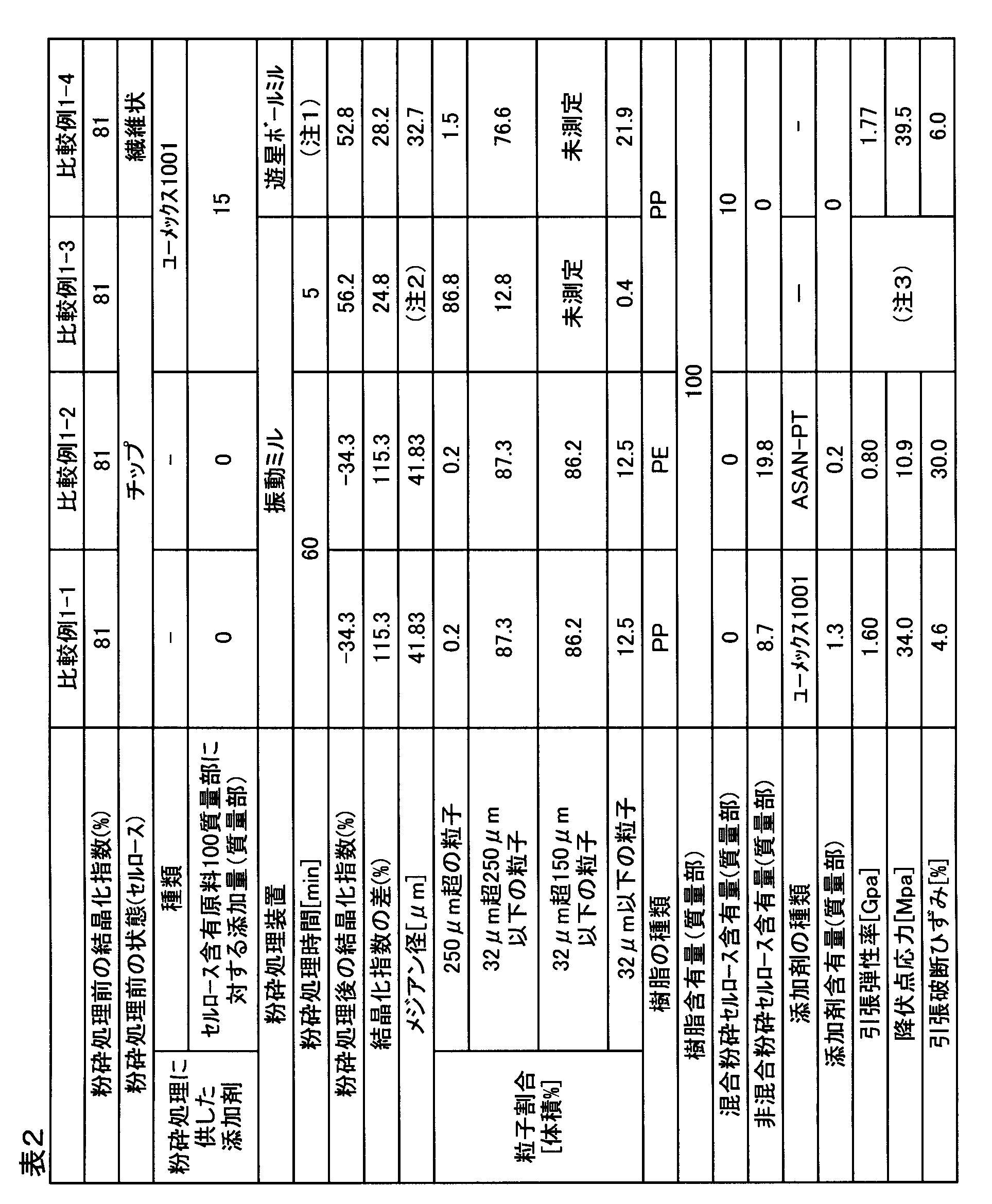
(注1):比較例1-4に記載のサイクルを実施した。
(注2):粗大粒子が存在したため、メジアン径を測定することができなかった。
(注3):樹脂組成物表面に粗大粒子が確認され、製品としての外観が劣悪だったため成形体の評価を行わなかった。
(注2):粗大粒子が存在したため、メジアン径を測定することができなかった。
(注3):樹脂組成物表面に粗大粒子が確認され、製品としての外観が劣悪だったため成形体の評価を行わなかった。
表1及び表2より、実施例1-2と比較例1-1の対比、ならびに、実施例1-5と比較例1-2の対比より、樹脂組成物の組成が同じであっても、添加剤の存在下でのセルロースの粉砕処理がある実施例1-2又は実施例1-5の方が、樹脂組成物の成形体の剛性が高く、かつ、靱性にも優れることが分かる。比較例1-3においては、粉砕処理後のセルロースI型結晶化指数が50%以上であるものを調製するために、粉砕時間を実施例よりも短くした。その結果、比較例1-3では、粉砕後の粉末は粗く、装置内で詰りが発生したためメジアン径は測定できなかった。また、樹脂と複合化したものは樹脂表面に目視で確認できる粗大な粒子が見られた。
実施例2-1
〔裁断処理〕
セルロース含有原料であるシート状木材パルプ〔テンベック社製「HV+」、800mm×600mm×1.0mm、結晶化指数82%、α-セルロース含有量96質量%、水分含量8.0質量%〕を、スリッターカッターであるシートペレタイザ〔ホーライ社製「SG(E)-220」〕にかけ、約3mm×1.5mm×1.0mmの大きさの直方体に裁断した。
〔裁断処理〕
セルロース含有原料であるシート状木材パルプ〔テンベック社製「HV+」、800mm×600mm×1.0mm、結晶化指数82%、α-セルロース含有量96質量%、水分含量8.0質量%〕を、スリッターカッターであるシートペレタイザ〔ホーライ社製「SG(E)-220」〕にかけ、約3mm×1.5mm×1.0mmの大きさの直方体に裁断した。
〔乾燥処理〕
裁断処理により得られたチップ状のセルロース含有原料を、2軸横型攪拌乾燥機〔奈良機械製作所社製、2軸パドルドライヤー「NPD-1.6W(1/2)」〕を用いて乾燥した。乾燥温度は140℃とし、あらかじめ前記原料を8kg仕込み、大気圧下において60分間バッチ処理で乾燥して、前記原料の水分含量を0.8質量%とした。その後、装置を2°傾け、連続処理にて前記原料を乾燥した。このとき前記原料の供給速度は18kg/hであった。連続処理で得られた乾燥した前記原料の水分含量も0.8質量%であった。得られた乾燥処理後の前記原料は、保管中の吸湿を防ぐため、粉砕処理の直前までアルミニウム製の袋で保管した。X線回折強度から算出した乾燥処理後の前記原料のセルロースのI型結晶化指数は81%であった。
裁断処理により得られたチップ状のセルロース含有原料を、2軸横型攪拌乾燥機〔奈良機械製作所社製、2軸パドルドライヤー「NPD-1.6W(1/2)」〕を用いて乾燥した。乾燥温度は140℃とし、あらかじめ前記原料を8kg仕込み、大気圧下において60分間バッチ処理で乾燥して、前記原料の水分含量を0.8質量%とした。その後、装置を2°傾け、連続処理にて前記原料を乾燥した。このとき前記原料の供給速度は18kg/hであった。連続処理で得られた乾燥した前記原料の水分含量も0.8質量%であった。得られた乾燥処理後の前記原料は、保管中の吸湿を防ぐため、粉砕処理の直前までアルミニウム製の袋で保管した。X線回折強度から算出した乾燥処理後の前記原料のセルロースのI型結晶化指数は81%であった。
〔粉砕処理〕
バッチ式振動ミル〔中央化工機社製「MB-1」、容器内径142mm、容器内部の円柱形の空間の軸方向長さ220mm、容器容量3.6L〕の容器内部に、直径30mm、長さ211mmのステンレス製の円柱状媒体を13本配置し粉砕を行った。乾燥処理により得られたチップ状のセルロース含有原料(見かけ比重(固め)0.18g/mL)を67g、添加剤として無水マレイン酸変性ポリプロピレン(三洋化成工業社製「ユーメックス1001」、MA-PP、重量平均分子量40,000、融点142℃)33gを添加し、30分粉砕した。振動ミルは振幅8mm、振動数20Hzの条件で運転し、ポリマーとセルロースとの混合粉砕物である低結晶性セルロース複合体を得た。
バッチ式振動ミル〔中央化工機社製「MB-1」、容器内径142mm、容器内部の円柱形の空間の軸方向長さ220mm、容器容量3.6L〕の容器内部に、直径30mm、長さ211mmのステンレス製の円柱状媒体を13本配置し粉砕を行った。乾燥処理により得られたチップ状のセルロース含有原料(見かけ比重(固め)0.18g/mL)を67g、添加剤として無水マレイン酸変性ポリプロピレン(三洋化成工業社製「ユーメックス1001」、MA-PP、重量平均分子量40,000、融点142℃)33gを添加し、30分粉砕した。振動ミルは振幅8mm、振動数20Hzの条件で運転し、ポリマーとセルロースとの混合粉砕物である低結晶性セルロース複合体を得た。
(樹脂組成物)
得られた低結晶性セルロース複合体25質量部と熱可塑性樹脂100質量部とを混練機(東洋精機製作所製、ラボプラストミル)を用いて、回転数90rpm、200℃で8分間溶融混練して、樹脂組成物を得た。
得られた低結晶性セルロース複合体25質量部と熱可塑性樹脂100質量部とを混練機(東洋精機製作所製、ラボプラストミル)を用いて、回転数90rpm、200℃で8分間溶融混練して、樹脂組成物を得た。
(シート)
得られた樹脂組成物ペレットを21cm×21cm×0.4mmのスペーサーと共に金属板で挟みオートプレス機(東洋精機製)を用いて200℃、0.5MPaで2分間プレスした後、200℃、20MPaで2分間プレスする事によりプレスシートを得た。
得られた樹脂組成物ペレットを21cm×21cm×0.4mmのスペーサーと共に金属板で挟みオートプレス機(東洋精機製)を用いて200℃、0.5MPaで2分間プレスした後、200℃、20MPaで2分間プレスする事によりプレスシートを得た。
実施例2-2
セルロース粉砕処理時のチップ状のセルロース含有原料(見かけ比重(固め)0.18g/mL)を80g、添加剤として無水マレイン酸変性ポリプロピレン(ユーメックス1001)を20gに変更した以外、実施例2-1と同様にして、低結晶性セルロース複合体を得た。また、樹脂組成物及びそのシートを実施例2-1と同様にして調製した。
セルロース粉砕処理時のチップ状のセルロース含有原料(見かけ比重(固め)0.18g/mL)を80g、添加剤として無水マレイン酸変性ポリプロピレン(ユーメックス1001)を20gに変更した以外、実施例2-1と同様にして、低結晶性セルロース複合体を得た。また、樹脂組成物及びそのシートを実施例2-1と同様にして調製した。
実施例2-3
セルロース粉砕処理時のチップ状のセルロース含有原料(見かけ比重(固め)0.18g/mL)を86g、添加剤として無水マレイン酸変性ポリプロピレン(ユーメックス1001)を14gに変更した以外、実施例2-1と同様にして、低結晶性セルロース複合体を得た。また、樹脂組成物及びそのシートを実施例2-1と同様にして調製した。
セルロース粉砕処理時のチップ状のセルロース含有原料(見かけ比重(固め)0.18g/mL)を86g、添加剤として無水マレイン酸変性ポリプロピレン(ユーメックス1001)を14gに変更した以外、実施例2-1と同様にして、低結晶性セルロース複合体を得た。また、樹脂組成物及びそのシートを実施例2-1と同様にして調製した。
実施例2-4
セルロース粉砕処理時のチップ状のセルロース含有原料(見かけ比重(固め)0.18g/mL)を80g、添加剤としてポリ(エチレン-グリシジルメタクリレート)共重合体(住友化学社製「ボンドファーストE」、BF-E、重量平均分子量35,000、融点103℃)を20gに変更した以外、実施例2-1と同様にして、低結晶性セルロース複合体を得た。また、樹脂組成物及びそのシートを実施例2-1と同様にして調製した。
セルロース粉砕処理時のチップ状のセルロース含有原料(見かけ比重(固め)0.18g/mL)を80g、添加剤としてポリ(エチレン-グリシジルメタクリレート)共重合体(住友化学社製「ボンドファーストE」、BF-E、重量平均分子量35,000、融点103℃)を20gに変更した以外、実施例2-1と同様にして、低結晶性セルロース複合体を得た。また、樹脂組成物及びそのシートを実施例2-1と同様にして調製した。
実施例2-5~2-7及び比較例2-1~2-4
表3に示す原料を用いる以外は、実施例2-1と同様にして樹脂組成物及びそのシートを調製した。
表3に示す原料を用いる以外は、実施例2-1と同様にして樹脂組成物及びそのシートを調製した。
実施例2-8
実施例2-5と同様にして低結晶セルロース複合体を得た。なお、実施例2-8において、セルロースがフィラーに該当する。
実施例2-5と同様にして低結晶セルロース複合体を得た。なお、実施例2-8において、セルロースがフィラーに該当する。
(樹脂組成物)
得られた低結晶性セルロース複合体及び熱可塑性樹脂(並びに比較例2-10~2-11においては更に無機フィラー)を、表4に示す質量部で二軸混練機(日本製鋼所製TEX28)を用いて、回転数250rpm、ヒーター温度200℃、吐出18kg/hで溶融混練して、樹脂組成物を得た。得られた樹脂組成物を用いて、試験例2-2及び試験例2-3に従って成形体を得た。
得られた低結晶性セルロース複合体及び熱可塑性樹脂(並びに比較例2-10~2-11においては更に無機フィラー)を、表4に示す質量部で二軸混練機(日本製鋼所製TEX28)を用いて、回転数250rpm、ヒーター温度200℃、吐出18kg/hで溶融混練して、樹脂組成物を得た。得られた樹脂組成物を用いて、試験例2-2及び試験例2-3に従って成形体を得た。
比較例2-5及び2-6
バッチ式振動ミル〔中央化工機社製「MB-1」、容器内径142mm、容器内部の円柱形の空間の軸方向長さ220mm、容器容量3.6L〕の容器内部に、直径30mm、長さ211mmのステンレス製の円柱状媒体を13本配置し、次に示す粉砕を行った。即ち、実施例2-1の乾燥処理により得られたチップ状のセルロース含有原料(見かけ比重(固め)0.18g/mL)を50g添加し、40分粉砕した。振動ミルは振幅8mm、振動数20Hzの条件で運転し、低結晶性セルロースを得た。次いで、低結晶性セルロース100質量部に対して10質量部のユーメックス1010をこのミルに添加して、同じ運転条件で15分間運転し、低結晶セルロース複合体を得た。樹脂組成物及びそのシートは実施例2-1と同様に調製した。
バッチ式振動ミル〔中央化工機社製「MB-1」、容器内径142mm、容器内部の円柱形の空間の軸方向長さ220mm、容器容量3.6L〕の容器内部に、直径30mm、長さ211mmのステンレス製の円柱状媒体を13本配置し、次に示す粉砕を行った。即ち、実施例2-1の乾燥処理により得られたチップ状のセルロース含有原料(見かけ比重(固め)0.18g/mL)を50g添加し、40分粉砕した。振動ミルは振幅8mm、振動数20Hzの条件で運転し、低結晶性セルロースを得た。次いで、低結晶性セルロース100質量部に対して10質量部のユーメックス1010をこのミルに添加して、同じ運転条件で15分間運転し、低結晶セルロース複合体を得た。樹脂組成物及びそのシートは実施例2-1と同様に調製した。
比較例2-7及び2-8
実施例2-1の乾燥処理により得られたチップ状のセルロース含有原料(見かけ比重(固め)0.18g/mL)の50gに、1gのステアリン酸を添加した。まず、40℃での減圧乾燥により、セルロース含有原料の吸着水分を0.1質量%以下まで除去した。その試料(51g)を、遊星ボールミル〔FRITSCH社製、Φ5mmジルコニア製ビーズ〕を用いて小粒径化した。遊星ボールミルの回転数200rpmにて10分間粉砕-10分間休止を1サイクルとし、連続して72サイクル繰り返し運転し、低晶化セルロース複合体を得た。樹脂組成物及びそのシートは実施例2-1と同様に調製した。
実施例2-1の乾燥処理により得られたチップ状のセルロース含有原料(見かけ比重(固め)0.18g/mL)の50gに、1gのステアリン酸を添加した。まず、40℃での減圧乾燥により、セルロース含有原料の吸着水分を0.1質量%以下まで除去した。その試料(51g)を、遊星ボールミル〔FRITSCH社製、Φ5mmジルコニア製ビーズ〕を用いて小粒径化した。遊星ボールミルの回転数200rpmにて10分間粉砕-10分間休止を1サイクルとし、連続して72サイクル繰り返し運転し、低晶化セルロース複合体を得た。樹脂組成物及びそのシートは実施例2-1と同様に調製した。
比較例2-9~2-11
低結晶セルロース複合体を使用しないこと(比較例2-9)、又は低結晶セルロース複合体の代わりに表4に示すタルクを用いること(比較例2-10~2-11)以外は、実施例2-8と同様にして樹脂組成物及びその成型体を調製した。
低結晶セルロース複合体を使用しないこと(比較例2-9)、又は低結晶セルロース複合体の代わりに表4に示すタルクを用いること(比較例2-10~2-11)以外は、実施例2-8と同様にして樹脂組成物及びその成型体を調製した。
比較例2-12及び2-13
溶融混練を行う際に、低結晶セルロース複合体の代わりにガラス繊維をサイドフィーダーを用いて添加した以外は実施例2-8と同様にして樹脂組成物及びその成形体を調製した。
溶融混練を行う際に、低結晶セルロース複合体の代わりにガラス繊維をサイドフィーダーを用いて添加した以外は実施例2-8と同様にして樹脂組成物及びその成形体を調製した。
尚、表3及び表4における原料は以下の通りである。
<熱可塑性樹脂>
ポリエチレン樹脂:日本ポリエチレン社製、ノバテックLL UF641
ポリプロピレン樹脂(EA9):日本ポリプロ社製、ノバテックPP EA9
ポリプロピレン樹脂(MA3):日本ポリプロ社製、ノバテックPP MA3
<結晶性セルロース粒子>
KCフロック:日本製紙ケミカル社製、結晶性セルロース粒子、セルロースI型結晶化指数78.5%、メジアン径 28μm
<無機フィラー>
タルク:日本タルク社製、ミクロエースP6
ガラス繊維:日本電気硝子社製、T-480
<熱可塑性樹脂>
ポリエチレン樹脂:日本ポリエチレン社製、ノバテックLL UF641
ポリプロピレン樹脂(EA9):日本ポリプロ社製、ノバテックPP EA9
ポリプロピレン樹脂(MA3):日本ポリプロ社製、ノバテックPP MA3
<結晶性セルロース粒子>
KCフロック:日本製紙ケミカル社製、結晶性セルロース粒子、セルロースI型結晶化指数78.5%、メジアン径 28μm
<無機フィラー>
タルク:日本タルク社製、ミクロエースP6
ガラス繊維:日本電気硝子社製、T-480
<相溶化剤>
ユーメックス1001:三洋化成工業社製、無水マレイン酸変性ポリプロピレン、重量平均分子量40000、融点142℃、セルロース親和性部位の含有質量5質量%
ボンドファースト-E(BF-E):住友化学社製、ポリ(エチレン-ポリグリシジルメタクリレート)共重合体、重量平均分子量35000、融点103℃、セルロース親和性部位の含有質量12質量%
ユーメックス1010:三洋化成工業社製、マレイン酸変性ポリプロピレン、重量平均分子量30000、融点141℃
ステアリン酸:Aldrich社製、分子量284.48
上記相溶化剤の中で、ユーメックス1001及びボンドファースト-Eが、本明細書における「セルロース親和性部位を持つポリマー」に該当する。
ユーメックス1001:三洋化成工業社製、無水マレイン酸変性ポリプロピレン、重量平均分子量40000、融点142℃、セルロース親和性部位の含有質量5質量%
ボンドファースト-E(BF-E):住友化学社製、ポリ(エチレン-ポリグリシジルメタクリレート)共重合体、重量平均分子量35000、融点103℃、セルロース親和性部位の含有質量12質量%
ユーメックス1010:三洋化成工業社製、マレイン酸変性ポリプロピレン、重量平均分子量30000、融点141℃
ステアリン酸:Aldrich社製、分子量284.48
上記相溶化剤の中で、ユーメックス1001及びボンドファースト-Eが、本明細書における「セルロース親和性部位を持つポリマー」に該当する。
<結晶核剤>
ゲルオールMDLM30G:新日本理化社製、1,3:2,4-ビス-O-(4-メチルベンジリデン)-D-ソルビトール
NA-11:ADEKA社製、リン酸エステルの金属塩「アデカスタブNA-11」
ゲルオールMDLM30G:新日本理化社製、1,3:2,4-ビス-O-(4-メチルベンジリデン)-D-ソルビトール
NA-11:ADEKA社製、リン酸エステルの金属塩「アデカスタブNA-11」
シート又は成形体の特性を、下記の試験例2-1~2-4の方法に従って評価した。結果を表3及び表4に示す。
試験例2-1(破断歪向上率、弾性率向上率)
25℃の恒温室において、得られたシートをJIS K7127に基づき5号試験片を5個作製して、引っ張り試験を行い、引張弾性率(GPa)と引張破断歪(%)を調べ、破断歪向上率と弾性率向上率を以下の式(I)及び(II)から求めた。引っ張り試験には、SHIMADZU社製 オートグラフ精密万能試験機(AGS-10kNX)を用い、JIS K7127に従って、1サンプルにつき5点試験を行った。破断歪向上率は数値が大きいほど靱性に優れる事を示し、弾性率向上率は数値が大きいほど剛性に優れていることを示す。また、引張弾性率は0.9GPa以上であれば、優れた強度を示すものである。なお、破断歪向上率を算出する際のコントロール試験片としては、実施例2-1~2-4及び比較例2-5、2-7に対しては比較例2-2、実施例2-5~2-7及び比較例2-6、2-8に対しては比較例2-4の樹脂組成物の試験片をそれぞれ用いた。
25℃の恒温室において、得られたシートをJIS K7127に基づき5号試験片を5個作製して、引っ張り試験を行い、引張弾性率(GPa)と引張破断歪(%)を調べ、破断歪向上率と弾性率向上率を以下の式(I)及び(II)から求めた。引っ張り試験には、SHIMADZU社製 オートグラフ精密万能試験機(AGS-10kNX)を用い、JIS K7127に従って、1サンプルにつき5点試験を行った。破断歪向上率は数値が大きいほど靱性に優れる事を示し、弾性率向上率は数値が大きいほど剛性に優れていることを示す。また、引張弾性率は0.9GPa以上であれば、優れた強度を示すものである。なお、破断歪向上率を算出する際のコントロール試験片としては、実施例2-1~2-4及び比較例2-5、2-7に対しては比較例2-2、実施例2-5~2-7及び比較例2-6、2-8に対しては比較例2-4の樹脂組成物の試験片をそれぞれ用いた。
破断歪向上率(%)=(ES/EB)×100 (I)
ES:サンプル試験片5個の引張破断歪の平均値
EB:コントロール試験片5個の引張破断歪の平均値
コントロール試験片とは、サンプル樹脂組成物から相溶化剤のみを除いた組成の樹脂組成物の試験片のことである。
ES:サンプル試験片5個の引張破断歪の平均値
EB:コントロール試験片5個の引張破断歪の平均値
コントロール試験片とは、サンプル樹脂組成物から相溶化剤のみを除いた組成の樹脂組成物の試験片のことである。
弾性率向上率(%)=(MS/MB)×100 (II)
MS:サンプル試験片5個の引張弾性率の平均値
MB:ブランク試験片5個の引張弾性率の平均値
ブランク試験片とは、添加剤を含有しない樹脂組成物の試験片のことである。
MS:サンプル試験片5個の引張弾性率の平均値
MB:ブランク試験片5個の引張弾性率の平均値
ブランク試験片とは、添加剤を含有しない樹脂組成物の試験片のことである。
試験例2-2(ウェルド強度)
得られた樹脂組成物を、25℃の恒温室において、ASTM D638 TypeIに基づいて射出成形して、成形体を作製した。ウェルドが発生している成形体は両末端ゲートから、ウェルドが無い成形体は方末端ゲートから樹脂組成物を供給して、各実施例及び比較例あたり、それぞれ3個の成形体を作製した。ウェルドが発生している成形体については、ウェルド(中央)部を中心として断面積39mm2、長さ60mmに切り出し、ウェルドが無い成形体については、断面積39mm2、長さ60mmに切り出し、それぞれの試験片を得た。
得られた樹脂組成物を、25℃の恒温室において、ASTM D638 TypeIに基づいて射出成形して、成形体を作製した。ウェルドが発生している成形体は両末端ゲートから、ウェルドが無い成形体は方末端ゲートから樹脂組成物を供給して、各実施例及び比較例あたり、それぞれ3個の成形体を作製した。ウェルドが発生している成形体については、ウェルド(中央)部を中心として断面積39mm2、長さ60mmに切り出し、ウェルドが無い成形体については、断面積39mm2、長さ60mmに切り出し、それぞれの試験片を得た。
試験片について、支点間距離48mm、速度1mm/secとして、JIS K 7171の規格と同様に曲げ試験を行い、曲げ強度(MPa)と曲げ弾性率(MPa)を調べ、ウェルド強度保持率を以下の式より求めた。
ウェルド強度保持率(%)=曲げ強度(ウェルド有)/曲げ強度(ウェルド無)×100
ウェルド強度保持率(%)の保持率が高いほど、ウェルド強度が高く、優れた成形体であるということができる。
さらに、曲げ弾性率が高いほど、振動の初期振幅が小さいと判断でき、耐振性を有する優れた成形体であるということができる。
ウェルド強度保持率(%)の保持率が高いほど、ウェルド強度が高く、優れた成形体であるということができる。
さらに、曲げ弾性率が高いほど、振動の初期振幅が小さいと判断でき、耐振性を有する優れた成形体であるということができる。
試験例2-3(低温での耐衝撃強度)
得られた樹脂組成物ペレットを、射出成形機(日本製鋼所社製 J110AD-180H、シリンダー温度設定6箇所)を用いて射出成形した。シリンダー温度をノズル先端側から5ユニット目までを200℃、残りの1ユニットを180℃、ホッパー下を45℃に設定した。金型温度を80℃に設定して試験片を成形し、樹脂組成物の成形体を得た。
得られた樹脂組成物ペレットを、射出成形機(日本製鋼所社製 J110AD-180H、シリンダー温度設定6箇所)を用いて射出成形した。シリンダー温度をノズル先端側から5ユニット目までを200℃、残りの1ユニットを180℃、ホッパー下を45℃に設定した。金型温度を80℃に設定して試験片を成形し、樹脂組成物の成形体を得た。
射出成形し得られた成形体(100×100×1.5mm)を、-10℃の恒温槽に一晩静置し、-10℃の恒温室において、落球衝撃試験機を用いて1kgのナス型重りを所定高さから落下させ、2回連続破砕しない高さを低温での耐衝撃強度とした。
破砕しない高さが高いほど、低温での耐衝撃強度が強い、優れた成形体であるということができる。
破砕しない高さが高いほど、低温での耐衝撃強度が強い、優れた成形体であるということができる。
試験例2-4(ソリの抑制)
試験例2-3の方法で射出成形して得られた成形体(100×100×1.5mm)を25℃の恒温室にて一晩静置し、ソリを以下の式により求めた。
試験例2-3の方法で射出成形して得られた成形体(100×100×1.5mm)を25℃の恒温室にて一晩静置し、ソリを以下の式により求めた。
ソリ=最大高さ/対角線長
成形体の最大高さ及び対角線長に関しては、図1に示されるように、成形体を直角三角形の斜辺に見立てた場合に直角を挟む2辺のうちの短い方を最大高さとし、長い方を対角線長とする。ソリが小さいほど、変形が小さな優れた成形体であるということができる。
成形体の最大高さ及び対角線長に関しては、図1に示されるように、成形体を直角三角形の斜辺に見立てた場合に直角を挟む2辺のうちの短い方を最大高さとし、長い方を対角線長とする。ソリが小さいほど、変形が小さな優れた成形体であるということができる。

なお、表中の結晶化指数とは、セルロースI型結晶化指数のことである。
表3より、実施例と比較例の対比より、樹脂組成物の構成原料が同じであっても、ポリマーと予め粉砕処理を行なったセルロース複合体を含有する実施例の方が、剛性が高く、かつ、靱性にも優れることが分かる。特に、比較例2-5、2-6は、背景技術の欄に記載の特許文献1の非晶質セルロースIに相当するものであるが、これらの比較例に対して、実施例の方が、顕著に剛性が高く、かつ、靱性にも優れることが分かる。

表4より、実施例と比較例の対比より、ポリマーと予め粉砕処理を行なったセルロース複合体を含有する実施例の方が、ウェルド強度、低温での耐衝撃強度、ソリ抑制に優れる事が分かる。
本発明の製造方法により得られるセルロース含有粉末は、日用雑貨品、家電部品、自動車部品等の様々な工業用途に好適に使用することができる。
さらに本発明の製造方法により得られるセルロースは、日用雑貨品、家電部品、自動車部品等の様々な工業用途に好適に使用することができる。
さらに本発明の製造方法により得られるセルロースは、日用雑貨品、家電部品、自動車部品等の様々な工業用途に好適に使用することができる。
A 最大高さ
D 対角線長
D 対角線長
Claims (21)
- セルロースI型結晶化指数が10%以上100%未満であるセルロース含有原料100質量部に対して、下記(A)、(B)、及び(C)からなる群より選ばれる1種又は2種以上の添加剤を0.1質量部以上100質量部以下添加し、乾式で粉砕処理する工程を含む、セルロースI型結晶化指数が-20%以上50%未満であるセルロース含有粉末の製造方法。
(A)酸無水物を有する高分子化合物
(B)酸無水物を有する低分子化合物
(C)シランカップリング剤 - 添加剤が(A)及び(C)からなる群より選ばれる1種又は2種以上である、請求項1記載の製造方法。
- 乾式粉砕処理を媒体式粉砕機で行う、請求項1又は2に記載の製造方法。
- 製造されたセルロース含有粉末全体における、粒径が32μm以下の粒子割合が10体積%以下である請求項1~3いずれかに記載の製造方法。
- セルロース含有原料のセルロースI型結晶化指数が50%以上である、請求項1~4いずれかに記載の製造方法。
- 製造されたセルロース含有粉末全体における、粒径が32μm超250μm以下の粒子割合が40体積%以上である、請求項1~5いずれかに記載の製造方法。
- (A)化合物が、無水マレイン酸変性ポリオレフィンである、請求項1~6いずれかに記載の製造方法。
- (B)化合物が、アルキル又はアルケニル無水コハク酸及びアルキル又はアルケニル無水グルタル酸から選ばれる一種以上である、請求項1~7いずれかに記載の製造方法。
- (C)化合物が、イソシアネートシラン、アミノシラン、メルカプトシラン、及びエポキシシランから選ばれる一種以上である、請求項1~8いずれかに記載の製造方法。
- セルロースI型結晶化指数が-20%以上50%未満であり、セルロース含有原料100質量部に対して、下記(A)、(B)、及び(C)からなる群より選ばれる1種又は2種以上の添加剤を0.1質量部以上100質量部以下含有してなる、セルロース含有粉末。
(A)酸無水物を有する高分子化合物
(B)酸無水物を有する低分子化合物
(C)シランカップリング剤 - セルロース含有粉末全体における、粒径が32μm以下の粒子割合が10体積%以下である、請求項10に記載のセルロース含有粉末。
- セルロース含有粉末全体における、粒径が32μm超250μm以下の粒子割合が40体積%以上である、請求項10又は11に記載のセルロース含有粉末。
- 熱可塑性樹脂(a)、及びセルロース親和性部位を持つポリマーとセルロースとの混合粉砕物であって、セルロースI型結晶化指数が-20%以上50%未満のセルロース複合体(b)を含有してなる、熱可塑性樹脂組成物。
- セルロース親和性部位を持つポリマーの重量平均分子量(Mw)が5000以上500000以下である請求項13に記載の樹脂組成物。
- セルロース親和性部位が、酸無水物基、カルボキシル基、アミノ基、イミノ基、アルコキシシリル基、シラノール基、シリルエーテル基、ヒドロキシル基、及びエポキシ基からなる群より選択される少なくとも1種の官能基である請求項13又は14に記載の樹脂組成物。
- セルロース複合体(b)が、請求項1~9のいずれかに記載の製造方法により製造されたセルロース含有粉末である、請求項13~15いずれかに記載の樹脂組成物。
- セルロース複合体(b)が、請求項10~12のいずれかに記載のセルロース含有粉末である、請求項13~15いずれかに記載の樹脂組成物。
- 樹脂組成物におけるセルロース複合体(b)の含有量が熱可塑性樹脂(a)100質量部に対して、5質量部以上、70質量部以下である、請求項13~17いずれかに記載の樹脂組成物。
- 請求項13~18いずれかに記載の樹脂組成物を含有する成形体。
- 請求項13~18いずれかに記載の樹脂組成物を加工して成形体とする、成形体の製造方法。
- 熱可塑性樹脂(a)、及びセルロース親和性部位を持つポリマーとセルロースとが粉砕処理された、セルロースI型結晶化指数が-20%以上50%未満のセルロース複合体(b)を配合する、樹脂組成物の製造方法。
Priority Applications (3)
| Application Number | Priority Date | Filing Date | Title |
|---|---|---|---|
| CN201780079097.1A CN110121511B (zh) | 2016-12-27 | 2017-12-25 | 低结晶性纤维素的制造方法及树脂组合物 |
| EP17887358.4A EP3564268A4 (en) | 2016-12-27 | 2017-12-25 | METHOD OF MANUFACTURING LOW CRYSTALLINE CELLULOSE AND RESIN COMPOSITION |
| US16/463,246 US20200062910A1 (en) | 2016-12-27 | 2017-12-25 | Method for producing low crystallinity cellulose, and resin composition |
Applications Claiming Priority (4)
| Application Number | Priority Date | Filing Date | Title |
|---|---|---|---|
| JP2016253929 | 2016-12-27 | ||
| JP2016-253929 | 2016-12-27 | ||
| JP2016253931 | 2016-12-27 | ||
| JP2016-253931 | 2016-12-27 |
Publications (1)
| Publication Number | Publication Date |
|---|---|
| WO2018123959A1 true WO2018123959A1 (ja) | 2018-07-05 |
Family
ID=62707669
Family Applications (1)
| Application Number | Title | Priority Date | Filing Date |
|---|---|---|---|
| PCT/JP2017/046413 Ceased WO2018123959A1 (ja) | 2016-12-27 | 2017-12-25 | 低結晶性セルロースの製造方法及び樹脂組成物 |
Country Status (4)
| Country | Link |
|---|---|
| US (1) | US20200062910A1 (ja) |
| EP (1) | EP3564268A4 (ja) |
| CN (1) | CN110121511B (ja) |
| WO (1) | WO2018123959A1 (ja) |
Cited By (3)
| Publication number | Priority date | Publication date | Assignee | Title |
|---|---|---|---|---|
| JPWO2020235653A1 (ja) * | 2019-05-21 | 2021-06-10 | 旭化成株式会社 | セルロース樹脂組成物を収容するための容器及びこれとセルロース樹脂組成物とを有する包装体 |
| WO2022013160A1 (en) | 2020-07-16 | 2022-01-20 | Henriques Normark Birgitta | Streptococcal vaccines |
| WO2026021930A2 (en) | 2024-07-24 | 2026-01-29 | Henriques Normark Birgitta | Immunization against group a streptococcus (gas) |
Families Citing this family (1)
| Publication number | Priority date | Publication date | Assignee | Title |
|---|---|---|---|---|
| KR102322821B1 (ko) | 2020-03-31 | 2021-11-04 | 서울대학교산학협력단 | 아민기가 도입된 셀룰로오스 나노크리스탈을 이용한 폴리프로필렌 나노복합재료 및 그 제조방법 |
Citations (7)
| Publication number | Priority date | Publication date | Assignee | Title |
|---|---|---|---|---|
| JP2004231796A (ja) | 2003-01-30 | 2004-08-19 | Hyogo Prefecture | 扁平セルロース粒子または繊維状微細セルロースを用いた新規複合体 |
| JP2010037526A (ja) | 2008-08-08 | 2010-02-18 | Kao Corp | 低結晶性セルロースの製造方法 |
| JP2010155982A (ja) | 2008-12-05 | 2010-07-15 | Kao Corp | セルロース粒子の製造方法 |
| JP2011137094A (ja) | 2009-12-28 | 2011-07-14 | Kao Corp | 樹脂組成物 |
| JP2011153297A (ja) * | 2009-12-28 | 2011-08-11 | Kao Corp | 生分解性樹脂組成物 |
| JP2011152786A (ja) * | 2009-12-28 | 2011-08-11 | Kao Corp | ポリ乳酸樹脂射出成形体の製造方法 |
| JP2015155535A (ja) * | 2014-01-16 | 2015-08-27 | 昭博 西岡 | 非晶化セルロースを複合化した熱可塑性樹脂組成物とその製造方法 |
Family Cites Families (5)
| Publication number | Priority date | Publication date | Assignee | Title |
|---|---|---|---|---|
| JP3650816B2 (ja) * | 2001-07-05 | 2005-05-25 | 独立行政法人産業技術総合研究所 | 高結晶性セルロース含有ポリマーアロイの製造方法 |
| EP1990362A1 (en) * | 2007-05-09 | 2008-11-12 | Borealis Technology Oy | Polyolefin compositions with highly crystalline cellulose regenerate fibers |
| WO2009054373A1 (ja) * | 2007-10-25 | 2009-04-30 | Kao Corporation | セルロースエーテル誘導体の製造方法 |
| FR2962735B1 (fr) * | 2010-07-13 | 2013-03-15 | Centre Nat Rech Scient | Nouveaux materiaux composites a base de cellulose |
| EP3656820B1 (en) * | 2017-07-21 | 2022-03-02 | Kao Corporation | Asphalt composition, method for producing same and additive for asphalt |
-
2017
- 2017-12-25 EP EP17887358.4A patent/EP3564268A4/en not_active Withdrawn
- 2017-12-25 US US16/463,246 patent/US20200062910A1/en not_active Abandoned
- 2017-12-25 WO PCT/JP2017/046413 patent/WO2018123959A1/ja not_active Ceased
- 2017-12-25 CN CN201780079097.1A patent/CN110121511B/zh active Active
Patent Citations (7)
| Publication number | Priority date | Publication date | Assignee | Title |
|---|---|---|---|---|
| JP2004231796A (ja) | 2003-01-30 | 2004-08-19 | Hyogo Prefecture | 扁平セルロース粒子または繊維状微細セルロースを用いた新規複合体 |
| JP2010037526A (ja) | 2008-08-08 | 2010-02-18 | Kao Corp | 低結晶性セルロースの製造方法 |
| JP2010155982A (ja) | 2008-12-05 | 2010-07-15 | Kao Corp | セルロース粒子の製造方法 |
| JP2011137094A (ja) | 2009-12-28 | 2011-07-14 | Kao Corp | 樹脂組成物 |
| JP2011153297A (ja) * | 2009-12-28 | 2011-08-11 | Kao Corp | 生分解性樹脂組成物 |
| JP2011152786A (ja) * | 2009-12-28 | 2011-08-11 | Kao Corp | ポリ乳酸樹脂射出成形体の製造方法 |
| JP2015155535A (ja) * | 2014-01-16 | 2015-08-27 | 昭博 西岡 | 非晶化セルロースを複合化した熱可塑性樹脂組成物とその製造方法 |
Non-Patent Citations (1)
| Title |
|---|
| See also references of EP3564268A4 |
Cited By (4)
| Publication number | Priority date | Publication date | Assignee | Title |
|---|---|---|---|---|
| JPWO2020235653A1 (ja) * | 2019-05-21 | 2021-06-10 | 旭化成株式会社 | セルロース樹脂組成物を収容するための容器及びこれとセルロース樹脂組成物とを有する包装体 |
| US12330848B2 (en) | 2019-05-21 | 2025-06-17 | Asahi Kasei Kabushiki Kaisha | Container for containing cellulose resin composition and package comprising same and cellulose resin composition |
| WO2022013160A1 (en) | 2020-07-16 | 2022-01-20 | Henriques Normark Birgitta | Streptococcal vaccines |
| WO2026021930A2 (en) | 2024-07-24 | 2026-01-29 | Henriques Normark Birgitta | Immunization against group a streptococcus (gas) |
Also Published As
| Publication number | Publication date |
|---|---|
| CN110121511B (zh) | 2021-08-13 |
| EP3564268A1 (en) | 2019-11-06 |
| CN110121511A (zh) | 2019-08-13 |
| EP3564268A4 (en) | 2020-08-05 |
| US20200062910A1 (en) | 2020-02-27 |
Similar Documents
| Publication | Publication Date | Title |
|---|---|---|
| JP2018104702A (ja) | 樹脂組成物 | |
| JP6857468B2 (ja) | 樹脂組成物 | |
| Sailaja et al. | Mechanical and thermal properties of compatibilized composites of polyethylene and esterified lignin | |
| Wong et al. | Thermal and flammability properties of wollastonite-filled thermoplastic composites: a review | |
| CN104602879B (zh) | 制造复合产品的方法和系统以及复合产品 | |
| JP6606296B2 (ja) | セルロース・アルミニウム分散ポリエチレン樹脂複合材、これを用いたペレット及び成形体、並びにこれらの製造方法 | |
| CN110121511B (zh) | 低结晶性纤维素的制造方法及树脂组合物 | |
| JP5482061B2 (ja) | タルク粉末を含む樹脂組成物 | |
| US20060084728A1 (en) | Polymer composites containing keratin | |
| Vuluga et al. | Effect of SEBS on morphology, thermal, and mechanical properties of PP/organoclay nanocomposites | |
| CN104602880B (zh) | 制造复合产品的方法和系统以及复合产品 | |
| JP6403328B2 (ja) | 非晶化セルロースを複合化した熱可塑性樹脂組成物とその製造方法 | |
| JP2002220549A (ja) | 顆粒状無機質充填剤及びその製造方法並びに該顆粒状無機質充填剤を配合してなる樹脂組成物 | |
| JP6691759B2 (ja) | 樹脂組成物 | |
| JP2011137094A (ja) | 樹脂組成物 | |
| Murugan et al. | Development of HDPE‐modified eggshell composite | |
| WO2019039569A1 (ja) | セルロース繊維分散ポリオレフィン樹脂複合材、これを用いたペレット及び成形体、並びにセルロース繊維分散ポリオレフィン樹脂複合材の製造方法 | |
| Lashgari et al. | A study on some properties of polypropylene based nanocomposites made using almond shell flour and organoclay. | |
| Melo et al. | Reuse of natural waste to improve the thermal stability, stiffness, and toughness of postconsumer polypropylene composites | |
| JP7041510B2 (ja) | 低結晶性セルロースの製造方法 | |
| JP6727085B2 (ja) | 樹脂組成物 | |
| Chun et al. | Development of biocomposites from cocoa pod husk and polypropylene: effect of filler content and 3-aminopropyltriethoxylsilane | |
| Chun et al. | Effect of eco-degradant on properties of low density polyethylene/corn stalk eco-composites | |
| WO2019026258A1 (ja) | 樹脂組成物 | |
| JP7184627B2 (ja) | セルロース複合粉末の製造方法 |
Legal Events
| Date | Code | Title | Description |
|---|---|---|---|
| 121 | Ep: the epo has been informed by wipo that ep was designated in this application |
Ref document number: 17887358 Country of ref document: EP Kind code of ref document: A1 |
|
| NENP | Non-entry into the national phase |
Ref country code: DE |
|
| ENP | Entry into the national phase |
Ref document number: 2017887358 Country of ref document: EP Effective date: 20190729 |