WO2018137609A1 - 抗体偶联物、相关的药物组合物及应用 - Google Patents
抗体偶联物、相关的药物组合物及应用 Download PDFInfo
- Publication number
- WO2018137609A1 WO2018137609A1 PCT/CN2018/073785 CN2018073785W WO2018137609A1 WO 2018137609 A1 WO2018137609 A1 WO 2018137609A1 CN 2018073785 W CN2018073785 W CN 2018073785W WO 2018137609 A1 WO2018137609 A1 WO 2018137609A1
- Authority
- WO
- WIPO (PCT)
- Prior art keywords
- cancer
- antibody
- cells
- cell
- antibody conjugate
- Prior art date
- Legal status (The legal status is an assumption and is not a legal conclusion. Google has not performed a legal analysis and makes no representation as to the accuracy of the status listed.)
- Ceased
Links
Images



Classifications
-
- C—CHEMISTRY; METALLURGY
- C07—ORGANIC CHEMISTRY
- C07K—PEPTIDES
- C07K16/00—Immunoglobulins [IG], e.g. monoclonal or polyclonal antibodies
- C07K16/18—Immunoglobulins [IG], e.g. monoclonal or polyclonal antibodies against material from animals or humans
- C07K16/28—Immunoglobulins [IG], e.g. monoclonal or polyclonal antibodies against material from animals or humans against receptors, cell surface antigens or cell surface determinants
- C07K16/30—Immunoglobulins [IG], e.g. monoclonal or polyclonal antibodies against material from animals or humans against receptors, cell surface antigens or cell surface determinants from tumour cells
- C07K16/3076—Immunoglobulins [IG], e.g. monoclonal or polyclonal antibodies against material from animals or humans against receptors, cell surface antigens or cell surface determinants from tumour cells against structure-related tumour-associated moieties
- C07K16/3092—Immunoglobulins [IG], e.g. monoclonal or polyclonal antibodies against material from animals or humans against receptors, cell surface antigens or cell surface determinants from tumour cells against structure-related tumour-associated moieties against tumour-associated mucins
-
- A—HUMAN NECESSITIES
- A61—MEDICAL OR VETERINARY SCIENCE; HYGIENE
- A61P—SPECIFIC THERAPEUTIC ACTIVITY OF CHEMICAL COMPOUNDS OR MEDICINAL PREPARATIONS
- A61P29/00—Non-central analgesic, antipyretic or antiinflammatory agents, e.g. antirheumatic agents; Non-steroidal antiinflammatory drugs [NSAID]
-
- A—HUMAN NECESSITIES
- A61—MEDICAL OR VETERINARY SCIENCE; HYGIENE
- A61K—PREPARATIONS FOR MEDICAL, DENTAL OR TOILETRY PURPOSES
- A61K39/00—Medicinal preparations containing antigens or antibodies
- A61K39/395—Antibodies; Immunoglobulins; Immune serum, e.g. antilymphocytic serum
-
- A—HUMAN NECESSITIES
- A61—MEDICAL OR VETERINARY SCIENCE; HYGIENE
- A61K—PREPARATIONS FOR MEDICAL, DENTAL OR TOILETRY PURPOSES
- A61K40/00—Cellular immunotherapy
- A61K40/10—Cellular immunotherapy characterised by the cell type used
- A61K40/11—T-cells, e.g. tumour infiltrating lymphocytes [TIL] or regulatory T [Treg] cells; Lymphokine-activated killer [LAK] cells
-
- A—HUMAN NECESSITIES
- A61—MEDICAL OR VETERINARY SCIENCE; HYGIENE
- A61K—PREPARATIONS FOR MEDICAL, DENTAL OR TOILETRY PURPOSES
- A61K40/00—Cellular immunotherapy
- A61K40/10—Cellular immunotherapy characterised by the cell type used
- A61K40/15—Natural-killer [NK] cells; Natural-killer T [NKT] cells
-
- A—HUMAN NECESSITIES
- A61—MEDICAL OR VETERINARY SCIENCE; HYGIENE
- A61K—PREPARATIONS FOR MEDICAL, DENTAL OR TOILETRY PURPOSES
- A61K40/00—Cellular immunotherapy
- A61K40/40—Cellular immunotherapy characterised by antigens that are targeted or presented by cells of the immune system
- A61K40/41—Vertebrate antigens
- A61K40/42—Cancer antigens
-
- A—HUMAN NECESSITIES
- A61—MEDICAL OR VETERINARY SCIENCE; HYGIENE
- A61K—PREPARATIONS FOR MEDICAL, DENTAL OR TOILETRY PURPOSES
- A61K47/00—Medicinal preparations characterised by the non-active ingredients used, e.g. carriers or inert additives; Targeting or modifying agents chemically bound to the active ingredient
- A61K47/50—Medicinal preparations characterised by the non-active ingredients used, e.g. carriers or inert additives; Targeting or modifying agents chemically bound to the active ingredient the non-active ingredient being chemically bound to the active ingredient, e.g. polymer-drug conjugates
- A61K47/51—Medicinal preparations characterised by the non-active ingredients used, e.g. carriers or inert additives; Targeting or modifying agents chemically bound to the active ingredient the non-active ingredient being chemically bound to the active ingredient, e.g. polymer-drug conjugates the non-active ingredient being a modifying agent
- A61K47/56—Medicinal preparations characterised by the non-active ingredients used, e.g. carriers or inert additives; Targeting or modifying agents chemically bound to the active ingredient the non-active ingredient being chemically bound to the active ingredient, e.g. polymer-drug conjugates the non-active ingredient being a modifying agent the modifying agent being an organic macromolecular compound, e.g. an oligomeric, polymeric or dendrimeric molecule
- A61K47/59—Medicinal preparations characterised by the non-active ingredients used, e.g. carriers or inert additives; Targeting or modifying agents chemically bound to the active ingredient the non-active ingredient being chemically bound to the active ingredient, e.g. polymer-drug conjugates the non-active ingredient being a modifying agent the modifying agent being an organic macromolecular compound, e.g. an oligomeric, polymeric or dendrimeric molecule obtained otherwise than by reactions only involving carbon-to-carbon unsaturated bonds, e.g. polyureas or polyurethanes
- A61K47/593—Polyesters, e.g. PLGA or polylactide-co-glycolide
-
- A—HUMAN NECESSITIES
- A61—MEDICAL OR VETERINARY SCIENCE; HYGIENE
- A61K—PREPARATIONS FOR MEDICAL, DENTAL OR TOILETRY PURPOSES
- A61K47/00—Medicinal preparations characterised by the non-active ingredients used, e.g. carriers or inert additives; Targeting or modifying agents chemically bound to the active ingredient
- A61K47/50—Medicinal preparations characterised by the non-active ingredients used, e.g. carriers or inert additives; Targeting or modifying agents chemically bound to the active ingredient the non-active ingredient being chemically bound to the active ingredient, e.g. polymer-drug conjugates
- A61K47/51—Medicinal preparations characterised by the non-active ingredients used, e.g. carriers or inert additives; Targeting or modifying agents chemically bound to the active ingredient the non-active ingredient being chemically bound to the active ingredient, e.g. polymer-drug conjugates the non-active ingredient being a modifying agent
- A61K47/62—Medicinal preparations characterised by the non-active ingredients used, e.g. carriers or inert additives; Targeting or modifying agents chemically bound to the active ingredient the non-active ingredient being chemically bound to the active ingredient, e.g. polymer-drug conjugates the non-active ingredient being a modifying agent the modifying agent being a protein, peptide or polyamino acid
- A61K47/65—Peptidic linkers, binders or spacers, e.g. peptidic enzyme-labile linkers
-
- A—HUMAN NECESSITIES
- A61—MEDICAL OR VETERINARY SCIENCE; HYGIENE
- A61K—PREPARATIONS FOR MEDICAL, DENTAL OR TOILETRY PURPOSES
- A61K47/00—Medicinal preparations characterised by the non-active ingredients used, e.g. carriers or inert additives; Targeting or modifying agents chemically bound to the active ingredient
- A61K47/50—Medicinal preparations characterised by the non-active ingredients used, e.g. carriers or inert additives; Targeting or modifying agents chemically bound to the active ingredient the non-active ingredient being chemically bound to the active ingredient, e.g. polymer-drug conjugates
- A61K47/51—Medicinal preparations characterised by the non-active ingredients used, e.g. carriers or inert additives; Targeting or modifying agents chemically bound to the active ingredient the non-active ingredient being chemically bound to the active ingredient, e.g. polymer-drug conjugates the non-active ingredient being a modifying agent
- A61K47/68—Medicinal preparations characterised by the non-active ingredients used, e.g. carriers or inert additives; Targeting or modifying agents chemically bound to the active ingredient the non-active ingredient being chemically bound to the active ingredient, e.g. polymer-drug conjugates the non-active ingredient being a modifying agent the modifying agent being an antibody, an immunoglobulin or a fragment thereof, e.g. an Fc-fragment
- A61K47/6835—Medicinal preparations characterised by the non-active ingredients used, e.g. carriers or inert additives; Targeting or modifying agents chemically bound to the active ingredient the non-active ingredient being chemically bound to the active ingredient, e.g. polymer-drug conjugates the non-active ingredient being a modifying agent the modifying agent being an antibody, an immunoglobulin or a fragment thereof, e.g. an Fc-fragment the modifying agent being an antibody or an immunoglobulin bearing at least one antigen-binding site
- A61K47/6883—Polymer-drug antibody conjugates, e.g. mitomycin-dextran-Ab; DNA-polylysine-antibody complex or conjugate used for therapy
-
- A—HUMAN NECESSITIES
- A61—MEDICAL OR VETERINARY SCIENCE; HYGIENE
- A61K—PREPARATIONS FOR MEDICAL, DENTAL OR TOILETRY PURPOSES
- A61K47/00—Medicinal preparations characterised by the non-active ingredients used, e.g. carriers or inert additives; Targeting or modifying agents chemically bound to the active ingredient
- A61K47/50—Medicinal preparations characterised by the non-active ingredients used, e.g. carriers or inert additives; Targeting or modifying agents chemically bound to the active ingredient the non-active ingredient being chemically bound to the active ingredient, e.g. polymer-drug conjugates
- A61K47/69—Medicinal preparations characterised by the non-active ingredients used, e.g. carriers or inert additives; Targeting or modifying agents chemically bound to the active ingredient the non-active ingredient being chemically bound to the active ingredient, e.g. polymer-drug conjugates the conjugate being characterised by physical or galenical forms, e.g. emulsion, particle, inclusion complex, stent or kit
- A61K47/6921—Medicinal preparations characterised by the non-active ingredients used, e.g. carriers or inert additives; Targeting or modifying agents chemically bound to the active ingredient the non-active ingredient being chemically bound to the active ingredient, e.g. polymer-drug conjugates the conjugate being characterised by physical or galenical forms, e.g. emulsion, particle, inclusion complex, stent or kit the form being a particulate, a powder, an adsorbate, a bead or a sphere
- A61K47/6927—Medicinal preparations characterised by the non-active ingredients used, e.g. carriers or inert additives; Targeting or modifying agents chemically bound to the active ingredient the non-active ingredient being chemically bound to the active ingredient, e.g. polymer-drug conjugates the conjugate being characterised by physical or galenical forms, e.g. emulsion, particle, inclusion complex, stent or kit the form being a particulate, a powder, an adsorbate, a bead or a sphere the form being a solid microparticle having no hollow or gas-filled cores
- A61K47/6929—Medicinal preparations characterised by the non-active ingredients used, e.g. carriers or inert additives; Targeting or modifying agents chemically bound to the active ingredient the non-active ingredient being chemically bound to the active ingredient, e.g. polymer-drug conjugates the conjugate being characterised by physical or galenical forms, e.g. emulsion, particle, inclusion complex, stent or kit the form being a particulate, a powder, an adsorbate, a bead or a sphere the form being a solid microparticle having no hollow or gas-filled cores the form being a nanoparticle, e.g. an immuno-nanoparticle
- A61K47/6931—Medicinal preparations characterised by the non-active ingredients used, e.g. carriers or inert additives; Targeting or modifying agents chemically bound to the active ingredient the non-active ingredient being chemically bound to the active ingredient, e.g. polymer-drug conjugates the conjugate being characterised by physical or galenical forms, e.g. emulsion, particle, inclusion complex, stent or kit the form being a particulate, a powder, an adsorbate, a bead or a sphere the form being a solid microparticle having no hollow or gas-filled cores the form being a nanoparticle, e.g. an immuno-nanoparticle the material constituting the nanoparticle being a polymer
- A61K47/6935—Medicinal preparations characterised by the non-active ingredients used, e.g. carriers or inert additives; Targeting or modifying agents chemically bound to the active ingredient the non-active ingredient being chemically bound to the active ingredient, e.g. polymer-drug conjugates the conjugate being characterised by physical or galenical forms, e.g. emulsion, particle, inclusion complex, stent or kit the form being a particulate, a powder, an adsorbate, a bead or a sphere the form being a solid microparticle having no hollow or gas-filled cores the form being a nanoparticle, e.g. an immuno-nanoparticle the material constituting the nanoparticle being a polymer the polymer being obtained otherwise than by reactions involving carbon to carbon unsaturated bonds, e.g. polyesters, polyamides or polyglycerol
- A61K47/6937—Medicinal preparations characterised by the non-active ingredients used, e.g. carriers or inert additives; Targeting or modifying agents chemically bound to the active ingredient the non-active ingredient being chemically bound to the active ingredient, e.g. polymer-drug conjugates the conjugate being characterised by physical or galenical forms, e.g. emulsion, particle, inclusion complex, stent or kit the form being a particulate, a powder, an adsorbate, a bead or a sphere the form being a solid microparticle having no hollow or gas-filled cores the form being a nanoparticle, e.g. an immuno-nanoparticle the material constituting the nanoparticle being a polymer the polymer being obtained otherwise than by reactions involving carbon to carbon unsaturated bonds, e.g. polyesters, polyamides or polyglycerol the polymer being PLGA, PLA or polyglycolic acid
-
- A—HUMAN NECESSITIES
- A61—MEDICAL OR VETERINARY SCIENCE; HYGIENE
- A61P—SPECIFIC THERAPEUTIC ACTIVITY OF CHEMICAL COMPOUNDS OR MEDICINAL PREPARATIONS
- A61P35/00—Antineoplastic agents
-
- A—HUMAN NECESSITIES
- A61—MEDICAL OR VETERINARY SCIENCE; HYGIENE
- A61P—SPECIFIC THERAPEUTIC ACTIVITY OF CHEMICAL COMPOUNDS OR MEDICINAL PREPARATIONS
- A61P37/00—Drugs for immunological or allergic disorders
- A61P37/02—Immunomodulators
-
- C—CHEMISTRY; METALLURGY
- C07—ORGANIC CHEMISTRY
- C07K—PEPTIDES
- C07K16/00—Immunoglobulins [IG], e.g. monoclonal or polyclonal antibodies
- C07K16/18—Immunoglobulins [IG], e.g. monoclonal or polyclonal antibodies against material from animals or humans
- C07K16/28—Immunoglobulins [IG], e.g. monoclonal or polyclonal antibodies against material from animals or humans against receptors, cell surface antigens or cell surface determinants
-
- C—CHEMISTRY; METALLURGY
- C07—ORGANIC CHEMISTRY
- C07K—PEPTIDES
- C07K16/00—Immunoglobulins [IG], e.g. monoclonal or polyclonal antibodies
- C07K16/18—Immunoglobulins [IG], e.g. monoclonal or polyclonal antibodies against material from animals or humans
- C07K16/28—Immunoglobulins [IG], e.g. monoclonal or polyclonal antibodies against material from animals or humans against receptors, cell surface antigens or cell surface determinants
- C07K16/2803—Immunoglobulins [IG], e.g. monoclonal or polyclonal antibodies against material from animals or humans against receptors, cell surface antigens or cell surface determinants against the immunoglobulin superfamily
- C07K16/283—Immunoglobulins [IG], e.g. monoclonal or polyclonal antibodies against material from animals or humans against receptors, cell surface antigens or cell surface determinants against the immunoglobulin superfamily against Fc-receptors, e.g. CD16, CD32, CD64
-
- C—CHEMISTRY; METALLURGY
- C07—ORGANIC CHEMISTRY
- C07K—PEPTIDES
- C07K16/00—Immunoglobulins [IG], e.g. monoclonal or polyclonal antibodies
- C07K16/46—Hybrid immunoglobulins
-
- C—CHEMISTRY; METALLURGY
- C07—ORGANIC CHEMISTRY
- C07K—PEPTIDES
- C07K17/00—Carrier-bound or immobilised peptides; Preparation thereof
- C07K17/02—Peptides being immobilised on, or in, an organic carrier
- C07K17/08—Peptides being immobilised on, or in, an organic carrier the carrier being a synthetic polymer
-
- C—CHEMISTRY; METALLURGY
- C12—BIOCHEMISTRY; BEER; SPIRITS; WINE; VINEGAR; MICROBIOLOGY; ENZYMOLOGY; MUTATION OR GENETIC ENGINEERING
- C12N—MICROORGANISMS OR ENZYMES; COMPOSITIONS THEREOF; PROPAGATING, PRESERVING, OR MAINTAINING MICROORGANISMS; MUTATION OR GENETIC ENGINEERING; CULTURE MEDIA
- C12N15/00—Mutation or genetic engineering; DNA or RNA concerning genetic engineering, vectors, e.g. plasmids, or their isolation, preparation or purification; Use of hosts therefor
- C12N15/09—Recombinant DNA-technology
- C12N15/63—Introduction of foreign genetic material using vectors; Vectors; Use of hosts therefor; Regulation of expression
- C12N15/79—Vectors or expression systems specially adapted for eukaryotic hosts
- C12N15/85—Vectors or expression systems specially adapted for eukaryotic hosts for animal cells
-
- C—CHEMISTRY; METALLURGY
- C07—ORGANIC CHEMISTRY
- C07K—PEPTIDES
- C07K2317/00—Immunoglobulins specific features
- C07K2317/30—Immunoglobulins specific features characterized by aspects of specificity or valency
- C07K2317/31—Immunoglobulins specific features characterized by aspects of specificity or valency multispecific
-
- C—CHEMISTRY; METALLURGY
- C07—ORGANIC CHEMISTRY
- C07K—PEPTIDES
- C07K2317/00—Immunoglobulins specific features
- C07K2317/50—Immunoglobulins specific features characterized by immunoglobulin fragments
- C07K2317/56—Immunoglobulins specific features characterized by immunoglobulin fragments variable (Fv) region, i.e. VH and/or VL
- C07K2317/569—Single domain, e.g. dAb, sdAb, VHH, VNAR or nanobody®
Definitions
- the present invention relates to the field of immunomedicine, and more particularly to multispecific antibody conjugates, particularly multispecific antibody conjugates for inducing an immune response to diseases such as cancer or infectious diseases.
- the invention also relates to related compositions, methods of use and uses of the antibody conjugates.
- bispecific antibodies can bind to two or more different antigens.
- a number of recombinant strategies have been developed to synthesize bispecific antibodies, including single-stranded variable fragment (scFv)-derived forms such as diabodies, tandem diabodies, BiTe (bispecific T cell adaptors) and DART (dual affinity) Retargeting) and immunoglobulin G (IgG) based forms such as Triomab, DVD-Ig (double variable domain antibody) and 2-in-1 antibodies.
- scFv single-stranded variable fragment
- BiTe bispecific T cell adaptors
- DART dual affinity
- IgG immunoglobulin G
- Multispecific antibody conjugates are disclosed herein.
- the multispecific antibody conjugates described herein comprise a multispecific antibody conjugated to a nanomaterial, such as a nanoparticle.
- the multispecific antibody preferably comprises at least one first binding moiety and at least one second binding moiety, wherein the first binding moiety binds to a cytotoxic effector cell, preferably binds to an antigen on a cytotoxic effector cell, said second binding moiety binding
- the target cell preferably binds to an antigen on the target cell.
- the cytotoxic effector cell can be a cytotoxic cell.
- the cytotoxic cell can be a white blood cell.
- the leukocytes may be selected from the group consisting of macrophages, neutrophils, eosinophils, NK cells, B cells, and T cells.
- the white blood cells can be T cells.
- the white blood cells can be NK cells.
- the leukocytes may be NK-like T cells, ie NKT cells.
- the white blood cells may be NK cells and T cells.
- the cytotoxic effector cells comprise cells selected from the group consisting of T cells, NK cells, and NKT cells.
- the cytotoxic effector cells can be selected from the group consisting of T cells, NK cells, NKT cells, and CIK cells.
- the target cell may be a cell to be cleared, and may be a diseased cell or a disease-related cell.
- the target cell can be a cancer cell or a tumor cell.
- the target cell can be a leukemia cell.
- the target cell can be a lymphocyte.
- the target cell can be a metastatic cell.
- Target cells can be genetically modified.
- Target cells can contain genetic mutations. Gene mutations can include oncogene mutations.
- the gene mutation can be a mutation of a tumor suppressor gene.
- the gene mutation can be a mutation of the proto-oncogene.
- the target cell can be a cell associated with an inflammatory disease and/or an autoimmune disease.
- the target cell can be an infected cell.
- the target cell can be a pathogenic cell.
- the multispecific antibody is preferably bispecific.
- one binding site (first binding site) of the bispecific antibody is directed against an antigen on leukocytes, and the second binding site binds to a target cell (which may be a diseased cell or a disease-associated cell or a pathogen (ie, a microorganism) )) on the antigen.
- the multispecific antibody may also be trispecific; preferably, at least one binding site (first binding site) is directed against an antigen on leukocytes, and at least one second binding site is bound to a target cell (may be An antigen on a diseased cell or disease-associated cell or pathogen (ie, a microorganism).
- the antigen on the exemplary T cells is selected from the group consisting of CD2, CD3, CD4, CD5, CD6, CD8, CD25, CD28, CD30, CD40, CD40L, CD44, CD45, CD69 and CD90.
- Exemplary antigens expressed on NK cells are selected from the group consisting of CD2, CD8, CD11b, CD16, CD38, CD56, CD57, ADAM17, KIR, KAR, KLR, and CD137.
- the antigen on an exemplary monocyte is selected from the group consisting of CD74, HLA-DR ⁇ chain, CD14, CD16, CD64, and CD89.
- the antigen on exemplary neutrophils is selected from the group consisting of CEACAM6, CEACAM8, CD16b, CD32a, CD89, CD177, CD11a, CD11b, and SLC44A2.
- the antigen on the leukocytes may also be a checkpoint antigen and may be selected from the group consisting of LSECtin, CTLA4, PD1, PD-L1, LAG3, B7-H3, B7-H4, KIR and TIM3.
- the antigen on the T cell is CD3, CD4 or CD8 and the antigen on the NK cell is CD16 or CD56.
- the second binding moiety can bind to an antigen on a diseased cell or disease-associated cell or pathogen.
- the second binding portion of the antibody can target any type of tumor and antigen on any type of tumor cell.
- Exemplary cancer types that can be targeted include acute lymphoblastic leukemia, acute myeloid leukemia, biliary cancer, breast cancer, cervical cancer, chronic lymphocytic leukemia, chronic myelogenous leukemia, colorectal cancer, endometrial cancer , esophageal cancer, gastric cancer, head and neck cancer, Hodgkin's lymphoma, lung cancer, bone marrow thyroid cancer, non-Hodgkin's lymphoma, multiple myeloma, kidney cancer, ovarian cancer, pancreatic cancer, glioma, black Oncoma, liver cancer, prostate cancer, bladder cancer, neuroendocrine cancer, gastrointestinal pancreatic tumor, exocrine pancreatic cancer and Ewing sarcoma.
- the antigen on the tumor cell or cancer cell may be selected from the group consisting of: carbonic anhydrase IX, alpha-fetoprotein, ⁇ -actinin-4, A3, A33 antibody-specific antigen, AFP, ART-4, B7, Ba 733 , BAGE, BrE3-antigen, CA125, CAMEL, CAP-1, CASP-8/m, CCCL19, CCCL21, CD1, CD1a, CD2, CD3, CD4, CD5, CD8, CD11A, CD14, CD15, CD16, CD18, CD19, CD20, CD21, CD22, CD23, CD25, CD29, CD30, CD32b, CD33, CD37, CD38, CD40, CD40L, CD45, CD46, CD52, CD54, CD55, CD59, CD64, CD66a-e, CD67, CD70, CD70L, CD74, CD79a, CD79b, CD80, CD83, CD95, CD126, CD132, CD133, CD138, CD
- the antigen on the tumor cell or cancer cell may also be selected from the group consisting of cholecystokinin B receptor, gonadotropin releasing hormone receptor, somatostatin receptor 2, avb3 integrin, gastrin releasing peptide receptor. , cell surface proteins of neurokinin 1 receptor, melanocortin 1 receptor, neurotensin receptor, neuropeptide Y receptor, and C-type lectin-like molecule 1.
- the second binding moiety can bind to cells associated with inflammatory diseases and/or autoimmune diseases.
- the inflammatory disease and/or autoimmune disease may, for example, be selected from the group consisting of rheumatoid arthritis, ankylosing spondylitis, psoriasis, psoriatic arthritis, ulcerative colitis, Crohn's disease, systemic Lupus erythematosus, juvenile diabetes, autoimmune uveitis, multiple sclerosis, Parkinson's disease, Alzheimer's disease, and ischemia-reperfusion injury (see WO 2014/180577).
- the pathogen may be selected from the group consisting of HIV virus, mycobacterium tuberculosis, Streptococcus agalactiae, methicillin-resistant Staphylococcus aureus, Legionella Pneumophilia), Streptococcus pyogenes, Escherichia coli, Neisseria gonorrhoeae, Neisseria meningitidis, Pneumococcus, Cryptococcus neoformans Cryptococcus neoformans), Histoplasma capsulatum, Hemophilis influenzae B, Treponema pallidum, Lyme disease spirochetes, Pseudomonas aeruginosa (Pseudomonas aeruginosa), Mycobacterium leprae, Brucella abortus, rabies virus, influenza virus, cytomegalovirus, herpes simplex virus type I, herpes simplex virus type II,
- the antibodies used may be murine antibodies, sheep antibodies, etc., chimeric antibodies, humanized and human antibodies or fragments thereof.
- the antibody may also be a heavy chain antibody (such as a camelid antibody) or a fragment thereof.
- the multispecific antibody may be various types of multispecific antibodies, for example, may be a single-chain variable fragment (scFv)-derived form, a form comprising a heavy chain antibody variable region fragment, based on immunoglobulin G (IgG) Form and combination of the above forms.
- the antibody may comprise a scFv and/or a heavy chain antibody variable region fragment.
- the nanomaterial may be a pharmaceutically acceptable nanomaterial, preferably a biodegradable nanomaterial, such as a nanoparticle. More preferably, the nanomaterial is polylactic acid-glycolic acid, polylactic acid, polycaprolactone, polytetramethylene glycol succinate, polyaniline, polycarbonate, ethylene lactide copolymer or glycolide caprolactone. Any one or a mixture of at least two of the copolymers is most preferably polylactic acid-glycolic acid (PLGA), polylactic acid (PLA) and/or polycaprolactone (PCL).
- PLGA polylactic acid-glycolic acid
- PLA polylactic acid
- PCL polycaprolactone
- the average particle diameter of the nanoparticles may be, for example, about 10-990 nm, for example, about 900 nm, about 850 nm, about 800 nm, about 750 nm, about 700 nm, about 650 nm, about 600 nm, about 550 nm, about 500 nm, about 450 nm, about 400 nm.
- the nanoparticles have an average particle diameter in the range of 10 to 500 nm, more preferably in the range of 10 to 300 nm.
- the present disclosure also provides pharmaceutical compositions comprising the multispecific antibody conjugates disclosed herein.
- the pharmaceutical composition may also comprise leukocytes, such as leukocytes that bind to the multispecific antibody conjugate, preferably white blood cells and/or NK cells.
- the pharmaceutical composition may also contain other therapeutic agents for treating the disease.
- the present disclosure also provides methods of treating a disease or condition comprising administering the conjugate or pharmaceutical composition to a subject in need thereof.
- the method of treatment can also include sequential or simultaneous administration of other therapeutic agents that treat the disease.
- the present disclosure also provides the use of the conjugates and pharmaceutical compositions in the manufacture of a medicament for treating or preventing a disease or condition.
- the present disclosure also relates to such conjugates and pharmaceutical compositions for treating or preventing a disease or condition.
- the conjugates and pharmaceutical compositions disclosed herein can be used to treat cancer, such as the cancers disclosed herein.
- Exemplary cancer types include acute lymphoblastic leukemia, acute myeloid leukemia, biliary cancer, breast cancer, cervical cancer, chronic lymphocytic leukemia, chronic myelogenous leukemia, colorectal cancer, endometrial cancer, esophageal cancer, Gastric cancer, head and neck cancer, Hodgkin's lymphoma, lung cancer, bone marrow thyroid cancer, non-Hodgkin's lymphoma, multiple myeloma, kidney cancer, ovarian cancer, pancreatic cancer, glioma, melanoma, liver cancer , prostate cancer, bladder cancer, neuroendocrine cancer, gastrointestinal pancreatic tumor, exocrine pancreatic cancer and Ewing sarcoma.
- a subject infected with a pathogenic organism such as a bacterium, virus or fungus can be treated using the conjugates or pharmaceutical compositions disclosed herein.
- fungi that can be treated include Microsporum, Trichophyton, Epidermidis, S. sphaericus, Cryptococcus neoformans, Coccidioides, capsular histoplasma, dermatitis buds or Candida albicans.
- viruses include human immunodeficiency virus (HIV), herpes virus, cytomegalovirus, rabies virus, influenza virus, human papilloma virus, hepatitis B virus, hepatitis C virus, Sendai virus, feline leukemia virus, Reo virus , poliovirus, human serum parvovirus, simian virus 40, respiratory syncytial virus, mouse mammary tumor virus, varicella-zoster virus, dengue virus, rubella virus, measles virus, adenovirus, human T cell leukemia Toxic leukemia virus, Epstein-Barr virus, murine leukemia virus, mumps virus, vesicular stomatitis virus, Sindbis virus, lymphocytic choriomeningitis virus or bluetongue virus.
- HCV human immunodeficiency virus
- herpes virus cytomegalovirus
- rabies virus influenza virus
- human papilloma virus hepatitis
- Exemplary bacteria include Bacillus anthracis, Streptococcus agalactiae, Legionella pneumophila, Streptococcus pyogenes, Escherichia coli, Neisseria gonorrhoeae, Neisseria meningitidis, Pneumococcal, Haemophilus influenzae type B, pale Treponema pallidum, Lyme disease spirochete, Pseudomonas aeruginosa, Mycobacterium leprae, Brucella abortus, Mycobacterium tuberculosis or Mycoplasma.
- CLAIMS 1 An antibody conjugate comprising a multispecific antibody conjugated to a nanomaterial, preferably a biodegradable nanomaterial, such as a nanoparticle, preferably cytotoxic effector cells and targets simultaneously cell.
- a nanomaterial preferably a biodegradable nanomaterial, such as a nanoparticle, preferably cytotoxic effector cells and targets simultaneously cell.
- CD2 CD2, CD3, CD4, CD5, CD6, CD8, CD25, CD28, CD30, CD40, CD40L, CD44, CD45, CD69 and CD90, preferably the antigen is CD3.
- CD2 CD2, CD8, CD11b, CD16, CD38, CD56, CD57, ADAM17, KIR, KAR, KLR and CD137, preferably selected from the group consisting of CD16 and CD56.
- Non-Hodgkin's lymphoma B-cell lymphoma, B-cell leukemia, T-cell lymphoma, T-cell leukemia, acute lymphocytic leukemia, chronic lymphocytic leukemia, Burkitt's lymphoma, Hodgkin's lymphoma , hairy cell leukemia, acute myeloid leukemia, chronic myelogenous leukemia, multiple myeloma, glioma, Waldenstrom's macroglobulinemia, carcinoma, melanoma, sarcoma, glioma, skin cancer, oral cavity Cancer, gastrointestinal cancer, colon cancer, stomach cancer, lung cancer, lung cancer, breast cancer, ovarian cancer, prostate cancer, uterine cancer, endometrial cancer, cervical cancer, bladder cancer, pancreatic cancer, bone cancer, liver cancer, gallbladder cancer , kidney cancer, testicular cancer, epithelial cancer, colorectal cancer, stomach cancer, brain cancer, glioblasto
- the antibody conjugate according to item 11, wherein the inflammatory disease and/or autoimmune disease is selected from the group consisting of:
- Rheumatoid arthritis ankylosing spondylitis, psoriasis, psoriatic arthritis, ulcerative colitis, Crohn's disease, systemic lupus erythematosus, juvenile diabetes, autoimmune uveitis, multiple Hardening, Parkinson's disease, Alzheimer's disease, and ischemia-reperfusion injury.
- scFv single-chain variable fragment
- IgG globulin G
- the antibody conjugate according to item 13 wherein the antibody comprises a single chain variable region fragment (scFv) and/or a heavy chain antibody variable region fragment.
- scFv single chain variable region fragment
- the antibody conjugate according to any of the preceding items wherein the antibody is a bispecific antibody or a trispecific antibody, preferably a bispecific antibody.
- bispecific antibody is selected from the group consisting of a diabody, a tandem diabody, a BiTe (bispecific T cell adapter), DART (double affinity) Targeting), Triomab and DVD-Ig (double variable domain antibody).
- the DNL complex and the dimer, the IgG-scFv fusion is preferably a bsAb, a Bs1Ab
- the nanomaterial is polylactic acid-glycolic acid, polylactic acid, polycaprolactone, polybutylene glycol succinate, polyaniline, polycarbonate Any one or a mixture of at least two of ethylene lactide copolymer and glycolide caprolactone copolymer, most preferably polylactic acid-glycolic acid (PLGA), polylactic acid (PLA) and/or poly Lactone (PCL).
- PLGA polylactic acid-glycolic acid
- PLA polylactic acid
- PCL poly Lactone
- composition according to item 25 which further comprises a cytotoxic effector cell, preferably a leukocyte selected from the group consisting of a T cell, an NK cell, an NKT cell, a macrophage, a neutrophil Eosinophils, preferably comprising cytotoxic effector cells selected from the group consisting of T cells and NK cells, are preferably used for immunotherapy.
- a cytotoxic effector cell preferably a leukocyte selected from the group consisting of a T cell, an NK cell, an NKT cell, a macrophage, a neutrophil Eosinophils, preferably comprising cytotoxic effector cells selected from the group consisting of T cells and NK cells
- tumor or cancer is selected from the group consisting of:
- inflammatory disease and/or autoimmune disease is selected from the group consisting of:
- Rheumatoid arthritis ankylosing spondylitis, psoriasis, psoriatic arthritis, ulcerative colitis, Crohn's disease, systemic lupus erythematosus, juvenile diabetes, autoimmune uveitis, multiple Hardening, Parkinson's disease, Alzheimer's disease, and ischemia-reperfusion injury.
- a method for treating a tumor or a cancer or an inflammatory disease and/or an autoimmune disease comprising administering the antibody conjugate of any one of items 1 to 25 or the pharmaceutical composition of item 26 or 27.
- the antibody conjugate further comprises other antibody portions that specifically bind to a cytotoxic effector cell or target cell.
- the cytotoxic effector cell comprises a cell selected from the group consisting of a T cell, an NK cell, and an NKT cell
- the cytotoxic effector cell preferably It is selected from the group consisting of T cells, NK cells, NKT cells, and CIK cells.
- the antibody comprises a binding moiety that specifically binds to the antigen CD123.
- FIG. 1 is a schematic view showing the structure of the bispecific antibody BiTE (CD16-MUC1).
- FIG. 2 shows a purified electropherogram of the bispecific antibody BiTE (CD16-MUC1).
- FIG. 3 is a schematic view showing the structure of the bispecific antibody BiTE (CD16-CEA).
- Figure 4 shows the expression and purification of the bispecific antibody BiTE (CD16-CEA).
- Figure 4A shows the analysis of the Ni-NTA purification process;
- Figure 4B shows the Q-sepharose HP purification process analysis.
- Figure 5 shows the killing rate of the bispecific antibody BiTE (CD16-MUC1) and the antibody conjugate BiTE (CD16-MUCl)-PLGA in combination with NK cells on lung cancer cell A549 (human non-small cell lung cancer cells).
- Figure 6 shows the killing rate of bispecific antibody BiTE (CD16-CEA) and antibody conjugate BiTE (CD16-CEA)-PLGA in combination with NK cells against intestinal cancer cell HCT116.
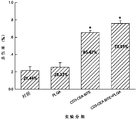
- Figure 7 shows the killing rate of the bispecific antibody CD16-MUC1 BiTE and the antibody conjugate CD16-MUC1 BiTE+PLGA in combination with NK cells on lung cancer cell A549 (human non-small cell lung cancer cells).
- Figure 8 shows that the bispecific antibody BiTE (CD3-MUC1) and the antibody conjugate BiTE (CD3-MUC1)-PLGA were combined with NK cells for lung cancer cell A549 (human non-small cell lung cancer cells) after being placed at 37 ° C for different time. Kill rate.
- Figure 9 shows the killing rate of the bispecific antibody CD3-CEA BiTE and antibody conjugate CD3-CEA BiTE+PLGA NPs in combination with T cells on lung cancer cell A549 (human non-small cell lung cancer cells).
- Figure 10 shows the target fragment HCBF-6 (NcoI-UCHT1-VH-HindIII-CH-XhoI-CEA-Flag) and HCBF-6 used to prepare the bispecific antibody CD3-CEA BiTE (ie CEA-S-Fab). Sequence of (NcoI-UCHT1-VH-HindIII-CH-XhoI-CEA-Flag).
- antibody refers to the immunological activity (ie, specificity) of a full-length (ie, naturally occurring or formed by a normal immunoglobulin gene fragment rearrangement process) of an immunoglobulin molecule (eg, an IgG antibody) or an immunoglobulin molecule. Sexually bound) parts, such as antibody fragments.
- Antibody includes monoclonal antibodies, polyclonal antibodies, bispecific antibodies, multispecific antibodies, murine antibodies, heavy chain antibodies (such as camelid antibodies), chimeric antibodies, humanized and human antibodies, and the like.
- a "heavy chain antibody” is an antibody that contains only a heavy chain and does not contain a light chain, such as a camelid antibody, a cartilage fish such as a shark antibody, and the like.
- an “antibody fragment” is a part of an intact antibody, such as F(ab') 2 , F(ab) 2 , Fab', Fab, Fv, scFv, dAb, and the like. Regardless of the structure, the antibody fragment binds to the same antigen as recognized by the full length antibody.
- an antibody fragment comprises an isolated fragment consisting of a variable region, such as an "Fv” fragment consisting of a heavy or light chain variable region or a recombinant single sequence in which the light chain and heavy chain variable regions are joined by a peptide linker.
- Chain polypeptide molecule (“scFv protein").
- Single-chain antibodies are usually abbreviated as “the scFv", the polypeptide chain comprises V H and V L, composed of domains, said domains interact to form an antigen binding site.
- V H domains and V L typically linked by a peptide having 1 to 25 amino acid residues.
- Antibody fragments also include bifunctional antibodies, trifunctional antibodies, and single domain antibodies (dAbs).
- Antibody fragments also include fragments of heavy chain antibodies, such as single domain antibodies (sdAbs) or fragments comprising variable regions.
- a “multispecific antibody” is an antibody that can simultaneously bind at least two targets having different structures (eg, two different antigens, two different epitopes on the same antigen).
- a “bispecific antibody” is an antibody that can simultaneously bind two targets with different structures.
- the bispecific antibody or multispecific antibody used may be a known type of antibody.
- the multispecific antibody eg, a bispecific antibody
- the multispecific antibodies can be diabodies, tandem diabodies, BiTe (bispecific T cell adapters), DART (parental retargeting), Triomab and DVD-Ig (double
- the variable domain antibody may be a single-chain diabody (scDb, for example, a bispecific monomer scDb), a tandem scDb (tandem scDb, Tandab), a linear dimeric scDb (linear dimeric scDb, LD- scDb), circular dimeric scDb (CD-scDb), tandem di scFv (tandem di-scFv, eg bispecific T cell adapter (BiTE)), tandem three scFv (tandem tri-scFv), Trifunctional antibody (tri(a)body), bispecific Fab2, di-miniantibody, tetrabody, scFv-Fc-scFv fusion
- the multispecific antibody may comprise a first binding moiety that binds to leukocytes and a second binding moiety that binds to an antigen on a disease-associated or to be cleared cell (target cell).
- the first binding moiety and/or the second binding moiety can have one or more binding specificities.
- Antigens on exemplary T cells include CD2, CD3, CD4, CD5, CD6, CD8, CD25, CD28, CD30, CD40, CD40L, CD44, CD45, CD69, and CD90.
- exemplary antigens may be selected from the group consisting of CD8, CD16, CD56, CD57, ADAM17, and CD137;
- monocytes the exemplary antigen may be selected from the group consisting of CD74, HLA-DR ⁇ chain, CD14, CD16, CD64, and CD89;
- Exemplary antigens for neutrophils include CEACAM6, CEACAM8, CD16b, CD32a, CD89, CD177, CD11a, CD11b, and SLC44A2.
- the first binding moiety for NK binds to CD16 or CD56.
- diseases-associated antigens such as tumor associated antigen (TAA) or antigens expressed by pathogens, are known.
- TAA tumor associated antigen
- the TAA is MUC1, CD19, CD20, CD33, CD38, EGFR and HER2.
- the antigen on the target cell can be a cancer cell receptor or a cancer associated antigen, particularly selected from the group consisting of a B cell line antigen (CD19, CD20, CD21, CD22, CD23, etc.), VEGF, VEGFR , EGFR, carcinoembryonic antigen (CEA), placental growth factor (PlGF), tenascin, HER-2/neu, EGP-1, EGP-2, CD25, CD30, CD33, CD38, CD40, CD45, CD52, CD74 , CD80, CD138, NCA66, CEACAM1, CEACAM6 (carcinoembryonic antigen-associated cell adhesion molecule 6), MUC1, MUC2, MUC3, MUC4, MUC16, IL-6, alpha-fetoprotein (AFP), A3, CA125, colon-specific antigen -p(CSAp), folate receptor, HLA-DR, human chorionic gonadotropin (HCG), Ia, EL-2,
- the target cell can also be a cell associated with an inflammatory disease and/or an autoimmune disease.
- the inflammatory disease and/or autoimmune disease may, for example, be selected from the group consisting of rheumatoid arthritis, ankylosing spondylitis, psoriasis, psoriatic arthritis, ulcerative colitis, Crohn's Disease, systemic lupus erythematosus, juvenile diabetes, autoimmune uveitis, multiple sclerosis, Parkinson's disease, Alzheimer's disease, and ischemia-reperfusion injury.
- the target cell can also be a pathogen or a cell infected with a pathogen.
- the pathogen may be, for example, a pathogenic organism such as a bacterium, a virus or a fungus.
- the binding moiety useful in the claimed antibody conjugate is preferably an antibody or fragment thereof.
- Techniques for preparing monoclonal antibodies that are actually directed against any target antigen are well known in the art.
- Known and/or commercially available antibodies can also be used.
- Exemplary antibodies for the treatment of, for example, cancer include, but are not limited to, LL1 (anti-CD74), LL2 or RFB4 (anti-CD22), veltuzumab (hA20, anti-CD20), rituximab (anti-CD20), Tocilizumab (GA101, anti-CD20), ranibizumab (anti-PD1), nilutuzumab (anti-PD1), MK-3475 (anti-PD1), AMP-224 (anti-PD1), pipizhudan Anti-(PD1), MDX-1105 (anti-PD-L1), MEDI4736 (anti-PD-L1), MPDL3280A (anti-PD-L1), BMS-936559 (anti-PD-L1), Ipilimumab (anti-CTLA4) , Trevizumab (anti-CTL4A), RS7 (anti-epithelin-1 (EGP-1, also known as TROP-2)), PAM4 or
- the nanomaterial for coupling the first binding moiety (eg, an antibody or fragment thereof) and the second binding moiety (eg, an antibody or fragment thereof) may be a pharmaceutically acceptable nanomaterial, preferably a biodegradable nanomaterial, more preferably Any one of polylactic acid-glycolic acid, polylactic acid, polycaprolactone, polybutylene glycol succinate, polyaniline, polycarbonate, ethylene lactide copolymer or glycolide caprolactone copolymer Or a mixture of at least two, most preferably polylactic acid-glycolic acid (PLGA), polylactic acid (PLA) and/or polycaprolactone (PCL).
- PLGA polylactic acid-glycolic acid
- PLA polylactic acid
- PCL polycaprolactone
- the preparation of the multispecific antibody conjugate of the present invention is described below by taking a bispecific antibody conjugate comprising two antibodies conjugated to the nanoparticles as an example.
- the preparation method comprises the following steps:
- the nanomaterial obtained in the step (1) is linked to a mixture of the first antibody portion and the second antibody portion.
- the preparation of the nano material comprises: completely dissolving the nano material with a solvent, stirring, adding water to form a uniform emulsion.
- the agitation may be carried out at a rotational speed of 500 to 20,000 rpm/min, for example, the rotational speed may be 500 rpm/min, 700 rpm/min, 800 rpm/min, 1000 rpm/min, 1100 rpm/min, 1200 rpm/min, 1300 rpm/min, 1400 rpm/ Min, 1480 rpm/min, 1500 rpm/min, 2000 rpm/min, 2200 rpm/min, 2500 rpm/min, 3000 rpm/min, 3500 rpm/min, 4000 rpm/min, 4200 rpm/min, 4500 rpm/min, 5000 rpm/min, 5500 rpm/min, 6000 rpm/min, 6500 rpm/min, 7000 rpm/min, 7500
- the nano material is polylactic acid-glycolic acid (PLGA), polylactic acid (PLA), polycaprolactone (PCL), polytetramethylene glycol succinate, polyaniline, polycarbonate, ethylene-propylene cross Any one or a mixture of at least two of an ester copolymer or a glycolide caprolactone copolymer.
- PLGA polylactic acid-glycolic acid
- PLA polylactic acid
- PCL polycaprolactone
- polytetramethylene glycol succinate polyaniline
- polycarbonate polycarbonate
- the solvent is any one or a mixture of at least two of acetone, methyl ethyl ketone, methanol, ethanol or isopropyl alcohol.
- the collecting of the nanomaterial comprises: collecting the prepared nanomaterial by centrifugation, then resuspending it with deionized water, and repeating the operation of washing the nanomaterial twice.
- the centrifugation can be carried out at a rotational speed of 8000-15000 rpm/min, for example, the rotational speed can be 8000 rpm/min, 9000 rpm/min, 10000 rpm/min, 11000 rpm/min, 12000 rpm/min, 13000 rpm/min, 14000 rpm/min, 14500 rpm/min. , 14800 rpm / min, 15000 rpm / min. Higher speeds can be used if necessary.
- Nanomaterials can be collected or further purified by other methods. The nanoparticles may have an average particle diameter as described above
- the activation of the nanomaterial comprises: using 1-10 mg/mL of 1-ethyl-(3-dimethylaminopropyl)carbodiimide hydrochloride (EDS) and N-hydroxysuccinyl
- EDS 1-ethyl-(3-dimethylaminopropyl)carbodiimide hydrochloride
- NHS N-hydroxysuccinyl
- the amine (NHS) mixed solvent activates the nanomaterial at room temperature for 0.5-5 h.
- the joining comprises: collecting the activated nanomaterial by centrifugation, and then washing the nanomaterial once with the linking reaction solution. Adding the bispecific antibody to be ligated (and optionally the other antibody portions in equal amounts) to the ligation reaction solution, and then resuspending the ligation reaction solution containing the bispecific antibody (and optionally other antibody portions)
- the nanomaterial is subjected to a reaction at room temperature for 0.5-5 h. After the reaction, the nanomaterials were collected by centrifugation, and the nanomaterials were washed twice with Dunsen's phosphate buffer solution, and then resuspended in Dun's phosphate buffer solution (D-PBS) and stored at 4 ° C until use. Other methods of activation of the nanomaterial can be employed.
- the preparation method of the antibody conjugate of the present invention specifically includes the following steps:
- the nanomaterials were collected by centrifugation, and the nanomaterials were washed twice with Dunsen's phosphate buffer solution, and then resuspended in Dun's phosphate buffer solution and stored at 4 ° C until use.
- the invention also relates to a pharmaceutical composition comprising the antibody conjugate.
- the pharmaceutical composition may also comprise leukocytes, such as T cells, NK cells.
- compositions herein may be formulated using one or more physiologically acceptable carriers comprising excipients and auxiliaries which facilitate the passage of the active agent into the pharmaceutically acceptable formulation. Proper formulation depends on the route of administration chosen. For example, an overview of pharmaceutical compositions can be found, for example, in Ansel et al, PHARMACEUTICAL DOSAGE FORMS AND DRUG DELIVERY SYSTEMS, 5th edition (Lea & Febiger 1990); and Gennaro (ed.), REMINGTON'S PHARMACEUTICAL SCIENCES, 18th edition ( Mack Publishing Company 1990) and its revised edition.
- the pharmaceutical compositions disclosed herein may further comprise one or more diluents, excipients or carriers that are pharmaceutically acceptable.
- the pharmaceutical composition may comprise a pharmaceutical or pharmaceutical agent, a carrier, an adjuvant such as a preservative, a stabilizer, a wetting or emulsifying agent, a dissolution promoter, a salt for regulating the osmotic pressure, and/or a buffer.
- an adjuvant such as a preservative, a stabilizer, a wetting or emulsifying agent, a dissolution promoter, a salt for regulating the osmotic pressure, and/or a buffer.
- compositions may also contain other therapeutically valuable substances, such as one or more other therapeutic agents for treating the disease.
- other therapeutic agents may be other agents for treating cancer, such as cyclophosphamide, etoposide, carmustine, vincristine, etc., and may also be used to treat cancer antibodies, antibody-drug conjugates. (ADC), interferon and/or checkpoint inhibitor antibodies.
- ADC antibody-drug conjugates.
- Various embodiments are directed to methods of treating a disease or condition (eg, cancer) in a subject, such as a mammal, including a human, domesticated or companion pet, such as a dog and a cat, comprising administering to the subject a therapeutically effective amount of the text.
- a disease or condition eg, cancer
- a subject such as a mammal, including a human, domesticated or companion pet, such as a dog and a cat
- administering comprising administering to the subject a therapeutically effective amount of the text.
- Said conjugate or pharmaceutical composition comprising administering to the subject a therapeutically effective amount of the text.
- the antibody conjugates or pharmaceutical compositions described herein may be formulated, administered subcutaneously or even by other parenteral routes, such as intravenously, intramuscularly, intraperitoneally or intravascularly, to a mammal via, for example, bolus injection or continuous
- the infusion is for intravenous administration.
- the antibody conjugate or pharmaceutical composition is infused for a period of less than about 4 hours, and more preferably for a period of less than about 3 hours.
- the first bolus can be infused over 30 minutes, preferably even 15 minutes, and the remainder is infused over the next 2-3 hours.
- the injectable preparation may be presented in unit dosage form, for example, in ampoules or in multi-dose containers with the addition of a preservative.
- compositions may take such forms as suspensions, solutions or emulsions in oily or aqueous vehicles, and may contain formulations such as suspending, stabilizing and/or dispersing agents.
- the active ingredient may be in the form of a powder which is reconstituted with a suitable vehicle (for example, sterile pyrogen-free water) before use.
- Controlled release formulations can be prepared by using a polymer to complex or adsorb the agent to be administered.
- biocompatible polymers include poly(ethylene-vinyl acetate) copolymer matrices and polyanhydride copolymer matrices of stearic acid dimers and sebacic acid. Sherwood et al, Bio/Technology 10: 1446 (1992). The rate of release from such a matrix depends on the molecular weight of the therapeutic agent, the amount of agent within the matrix, and the size of the dispersed particles. Saltzman et al, Biophys. J.
- the dosage of the antibody conjugate administered to a human will vary depending on factors such as the age, weight, height, sex, general medical condition, and past medical history of the patient. It may be desirable to provide the recipient with an antibody conjugate dose as a single intravenous infusion in the range of about 0.1 [mu]g/kg to 25 mg/kg (in the first binding portion and the second binding in the multispecific antibody conjugate) Part of the total amount), but lower or higher doses can also be administered, as the case may be. For example, for a 70 kg patient, a dose of 0.1 ⁇ g/kg to 20 mg/kg is 0.7 ⁇ g to 1400 mg.
- the dose can be repeated as needed, for example, once a week for 4-10 weeks, once a week for 8 weeks or once a week for 4 weeks. In maintenance therapy, it can also be administered at a lower frequency, if desired, such as every other week for several months, or monthly or quarterly for many months. It is also possible to administer 2, 3, 4, 5 or 6 times continuously for each course of treatment, for example, about 10 days, 15 days, 20 days, 25 days, 30 days, 35 days, 40 days after continuous administration. 45 days, 50, 55 days or 60 days or more for the next course of treatment.
- the antibody conjugates can be administered with effector cells such as leukocytes (such as T cells, NK cells), for example, intravenously together.
- effector cells such as leukocytes (such as T cells, NK cells), for example, intravenously together.
- the antibody conjugate is administered with the effector cells, for example, once a week for 4-10 weeks, once weekly for 8 weeks, or once weekly for 4 weeks.
- antibody conjugates and effector cells can also be administered at lower frequency as needed, such as every few weeks or weeks for several months, or monthly or quarterly for many months. It is also possible to administer 2, 3, 4, 5 or 6 times continuously for each course of treatment, for example, about 10 days, 15 days, 20 days, 25 days, 30 days, 35 days, 40 days after continuous administration. 45 days, 50, 55 days or 60 days or more for the next course of treatment.
- the dosage of other therapeutic agents for human administration will vary depending on factors such as the age, weight, height, sex, general medical condition, and past medical history of the patient. It may be desirable to provide the recipient with an antibody conjugate dose as a single intravenous infusion in the range of about 1 mg/kg to 25 mg/kg, but lower or higher doses may also be administered, as appropriate. For example, for a 70 kg patient, a dose of 1-20 mg/kg is 70-1,400 mg. The dose can be repeated as needed, for example, once a week for 4-10 weeks, once a week for 8 weeks or once a week for 4 weeks. In maintenance therapy, it can also be administered at a lower frequency, if desired, such as every other week for several months, or monthly or quarterly for many months.
- Other therapeutic agents can be administered in one dose every 2 weeks or 3 weeks, for a total of at least 3 doses repeated.
- the combination can be administered twice a week for 4 to 6 weeks. If so the dose was reduced to about 200-300mg / m 2 (per dose for patients 1.7m 340mg, for a 70kg patient is or 4.9mg / kg), it may be administered once or twice a week even for 4 to 10 weeks.
- the time course of administration can be reduced, i.e., every 2 or 3 weeks for 2-3 months. However, it has been determined that even higher doses can be administered even by slow iv infusion, such as 20 mg/kg once a week or once every 2-3 weeks, for repeated dosing cycles.
- the time course of administration can optionally be repeated at other intervals, and the dosage can be administered by various parenteral routes with appropriate adjustments in dosage and time course.
- the antibody conjugates or pharmaceutical compositions described herein are useful in the treatment of cancer therapies.
- cancer include, but are not limited to, carcinoma, lymphoma, glioblastoma, melanoma, sarcoma and leukemia, myeloma or lymphoid malignancies.
- squamous cell carcinoma eg, epithelial squamous cell carcinoma
- Ewing's sarcoma e.g., Ewing's sarcoma
- Weems's tumor astrocytoma
- lung cancer including small cell lung cancer, Non-small cell lung cancer, lung adenocarcinoma and lung squamous cell carcinoma
- peritoneal cancer hepatocellular carcinoma
- gastric cancer or stomach cancer including gastrointestinal cancer
- pancreatic cancer glioblastoma multiforme
- cervical cancer ovary Cancer
- liver cancer bladder cancer
- hepatocellular carcinoma hepatocellular carcinoma
- neuroendocrine tumor medullary thyroid carcinoma
- thyroid differentiated cancer breast cancer, ovarian cancer
- colon cancer rectal cancer, endometrial cancer or uterine cancer
- salivary gland Cancer kidney or kidney cancer, prostate cancer, genital cancer, anal cancer, penile cancer, and head and neck cancer.
- cancer includes primary malignant cells or tumors (eg, cells that have not migrated to a site other than the original malignant disease or tumor site in the subject) and secondary malignant cells or tumors (eg, by metastasis, ie, A malignant cell or tumor cell migrates to a tumor produced by a secondary site different from the original tumor site).
- primary malignant cells or tumors eg, cells that have not migrated to a site other than the original malignant disease or tumor site in the subject
- secondary malignant cells or tumors eg, by metastasis, ie, A malignant cell or tumor cell migrates to a tumor produced by a secondary site different from the original tumor site.
- Cancers that benefit from the therapeutic methods of the invention are directed to cells that express, overexpress, or aberrantly express IGF-1R.
- cancer or malignant diseases include, but are not limited to, acute childhood lymphoblastic leukemia, acute lymphoblastic leukemia, acute lymphocytic leukemia, acute myeloid leukemia, adrenocortical carcinoma, adult (primary) hepatocytes Cancer, adult (primary) liver cancer, adult acute lymphocytic leukemia, adult acute myeloid leukemia, adult Hodgkin's lymphoma, adult lymphocytic lymphoma, adult non-Hodgkin's lymphoma, adult primary Liver cancer, adult soft tissue sarcoma, AIDS-related lymphoma, AIDS-related malignant disease, anal cancer, astrocytoma, cholangiocarcinoma, bladder cancer, bone cancer, brain stem glioma, brain tumor, breast cancer, renal pelvis And ureteral cancer, central nervous system (primary) lymphoma, central nervous system lymphoma, cerebellar astrocytoma, cerebral a
- the antibody conjugates, compositions, and methods described and claimed herein can be used to treat malignant or pre-malignant conditions and to prevent progression to a neoplastic or malignant state, including but not limited to those described above. Indicating such use for conditions that are known or suspected to progress in advance into a tumor or cancer, especially in the case of non-neoplastic cell growth that has occurred from hyperplasia, metaplasia or, most particularly, dysplasia (on this) For a review of abnormal growth conditions, see Robbins and Angell, BASIC PATHOLOGY, 2nd ed., WBSaunders Co., Philadelphia, pp. 68-79 (1976).
- Dysplasia is often a precursor to cancer and is mainly found in the epithelium. It is the most disordered form of non-neoplastic cell growth and involves the loss of individual cell identity and cell structure orientation. In the presence of chronic irritation or inflammation, dysplasia characteristically occurs.
- Dysplastic disorders that can be treated include, but are not limited to, non-perspiration ectodermal dysplasia, anterior dysplasia, asphyxiating thoracic dysplasia, atrial-finger dysplasia, bronchopulmonary dysplasia, brain dysplasia, cervical dysplasia, cartilage Ectodermal dysplasia, clavicular skull dysplasia, congenital ectodermal dysplasia, skull dysplasia, craniofacial dysplasia, dysplasia of the skull, dentine dysplasia, poor dysplasia, ectodermal dysplasia, teeth Enamel dysplasia, cerebral ocular dysplasia, unilateral epiphyseal dysplasia, multiple epiphyseal dysplasia, punctate epiphyseal dysplasia, epithelial dysplasia, facial genital dysplasia, familial jaw fibrosis, familial white Wrinkle dysplasia,
- pre-neoplastic conditions include, but are not limited to, benign abnormal proliferative disorders (eg, benign tumors, fibrocystic conditions, tissue hypertrophy, intestinal polyps or adenomas and esophageal dysplasia), leukoplakia, keratosis, Bowen's Disease, farmer's skin, solar cheilitis and solar keratosis.
- benign abnormal proliferative disorders eg, benign tumors, fibrocystic conditions, tissue hypertrophy, intestinal polyps or adenomas and esophageal dysplasia
- leukoplakia keratosis
- Bowen's Disease farmer's skin
- solar cheilitis solar cheilitis
- the method of the invention is used to inhibit the growth, progression and/or metastasis of cancer, particularly the cancers listed above.
- hyperproliferative diseases, disorders, and/or conditions include, but are not limited to, progression and/or metastasis of malignant diseases and related conditions, such as leukemia (including acute leukemia (eg, acute lymphocytic leukemia, acute myeloid leukemia (including bone marrow formation) Cytoplasmic, promyelocytic, myelomonocytic, monocytic, and erythroleukemia) and chronic leukemia (eg, chronic myeloid (granulocytic) leukemia and chronic lymphocytic leukemia), true red blood cells Hyperplasia, lymphoma (eg, Jay's disease and non-Hodgkin's disease), multiple myeloma, Waldenstrom's macroglobulinemia, heavy chain disease, and solid tumors, including but not limited to sarcoma and Carcinoma, such as fibrosarcoma, mucinous sarcoma, liposarcoma, chondrosarcom
- kits/kit containing a component suitable for treating or diagnosing a diseased tissue of a patient.
- An exemplary kit/kit can contain one or more antibody conjugates, pharmaceutical compositions, leukocytes, and/or other therapeutic agents as described herein. If a composition containing multiple components for administration is not formulated for delivery via the digestive tract, such as by oral delivery, a device capable of delivering the kit components by some other route may be included.
- a device capable of delivering the kit components by some other route may be included.
- One type of device for applications such as parenteral delivery is a syringe for injecting a composition into a subject.
- An inhalation device can also be used.
- the therapeutic agent can be provided in the form of a prefilled syringe or automatic injection pen containing a sterile liquid formulation or a lyophilized formulation.
- the kit/kit components can be packaged together or separated into two or more containers.
- the container can be a vial containing a sterile lyophilized formulation of a composition suitable for reconstitution.
- the kit/kit may also contain one or more buffers suitable for reconstituting and/or diluting other reagents.
- Other containers that may be used include, but are not limited to, bags, trays, boxes, tubes, and the like.
- the kit/kit components can be aseptically packaged and maintained in a container. Another component that can be included is the instructions for the user of the drug delivery kit/kit.
- BiTE Anti-CD16 VHH-anti-MUCl VHH bispecific Nanobody
- SEQ ID NO: 1 the amino acid sequence of anti-MUCl VHH is shown in SEQ ID NO: 1
- SEQ ID NO: 2 the amino acid sequence of anti-CD16 VHH is shown in SEQ ID NO: 2.
- the amino acid sequence of the linker peptide is shown in SEQ ID NO: 3.
- the nucleotide sequence was redesigned and optimized, and a NcoI restriction site was added at the 5' end of the sequence, and a Hind III restriction site was added at the 3' end.
- DsbA-anti-MUC1 VHH-GS-anti-CD16 VHH-6His was directly synthesized and ligated into the vector pETDuet by double digestion to form an expression plasmid.
- a schematic diagram of the structure of BiTE (CD16-MUC1) is shown in FIG.
- the plasmid was transformed into E. coli DH5 ⁇ competent cell line, positive clones were selected, and cultured in LB medium (3 mL) containing 100 ⁇ g/ml ampicillin overnight at 37 ° C. The supernatant was centrifuged at 5000 rpm at room temperature, and the obtained Escherichia coli was used for Qiagen.
- the company's plasmid extraction kit cleaves and extracts the plasmid to obtain an expression vector.
- the purified pETDuet-bsAb expression vector was transformed into E. coli BL21 (DE3) strain, and positive clones were selected and cultured in LB medium (3 mL) containing 100 ⁇ g/mL ampicillin overnight at 37 ° C, and transferred to 100 ⁇ g/mL ampicillin.
- LB medium 3 mL
- the cells were cultured at 37 ° C until the OD600 was at 0.6-0.8, and IPTG was added at a final concentration of 0.05 mM, and induced at 16 ° C for 16 hours. At 4000 rpm, the supernatant was discarded by centrifugation.
- the precipitate was added to a solution of 20 mM Tris-HCl, pH 8.0, 25% sucrose, 1 mM EDTA in a weight ratio of 1:4, resuspended, ice bathed for 30 min, 8500 g, and centrifuged at 4 ° C for 20 minutes. The supernatant.
- the precipitate was resuspended in a weight ratio of 1:5 by adding 5 mM MgCl 2 , 1 mg/mL lysozyme solution, ice-cooled for 20 min, 8500 g, and centrifuged at 4 ° C for 20 minutes, and the supernatant was taken.
- Binding Two supernatants were combined and passed through a 2 mL Ni-NTA (Qiagen) gravity settling column.
- the impurities were removed by 20 mL of 20 mM Tris-HCl pH 8.0, 15 mM imidazole, 1 M NaCl and 20 mL of 20 mM Tris-HCl pH 8.0, 25 mM imidazole, 1 M NaCl.
- the fractions were eluted with 50 mM imidazole, 100 mM imidazole, and 200 mM imidazole, dialyzed against 20 mM PB, pH 7.6, 10% glycerol at 4 °C overnight.
- the bispecific antibody BiTE (CD16-MUC1) specifically binds to MUC1 expressed by cells such as LS174T, HT29 and SKOV3, but not to total protein in CHO and HepG2. (data not shown).
- the anti-CD16 VHH-anti-CEA VHH bispecific Nanobody is hereinafter referred to as BiTE (CD16-CEA), and its structural schematic is shown in Figure 3, wherein the amino acid sequence of anti-CEA VHH is shown in SEQ ID NO: 4, the amino acid sequence of anti-CD16 VHH. Shown in SEQ ID NO: 5.
- the nucleotide sequence was redesigned and optimized, and a NcoI restriction site was added at the 5' end of the sequence, and a Hind III restriction site was added at the 3' end.
- DsbA-anti-CEA VHH-(GGGGS)3-anti-CD16 VHH-6His was directly synthesized and ligated into the vector pETDuet by double digestion to form a pETDuet-bsAb expression plasmid.
- the bispecific antibody BiTE (CD16-MUC1) specifically binds to CEA expressed by cells such as LS174T, HT29 and SKOV3-CEA, but not to total protein in SKOV3.
- the positive control had the same experimental results (data not shown).
- Bispecific antibody conjugates (BiTE(CD16-MUC1)-PLGA and BiTE(CD16-CEA)-PLGA with BiTE (CD16-MUC1) and BiTE (CD16-CEA), respectively, coupled to PLGA nanoparticles were prepared. ).
- the specific preparation method of the bispecific antibody conjugate is as follows:
- PLGA was completely dissolved in acetone to a concentration of 5 mg/mL, and a solution of PLGA and acetone was magnetically stirred at 1000 rpm/min in a volume ratio of acetone to deionized water of 1:4. Add deionized water to form a uniform emulsion, and then continue to stir until the acetone is evaporated;
- BiTE CD16-MUC1
- BiTE CD16-CEA
- the nanomaterial was resuspended with the ligation reaction solution containing the BiTE, and the reaction was allowed to proceed at room temperature for 0.5 h.
- the nanomaterials were collected by centrifugation, and the nanomaterials were washed twice with Dunsen's phosphate buffer solution, and then resuspended in Dun's phosphate buffer solution and stored at 4 ° C for use.
- cytokine-free X-vivo 15 medium purchased from lonza
- the cytokine-free X-vivo 15 medium was used to adjust the density of NK cells (obtained by peripheral blood mononuclear cells induced by healthy blood donors) so that the number of NK cells in a volume of 100 ⁇ l was 4 times that of the target cells ( The effective target ratio is 4:1).
- Killing rate [1 - (experimental group - effect control group) / (target control group - blank control group)] ⁇ 100%
- the blank control indicates the addition of the medium
- the target control group indicates the addition of the target cells + medium
- the effect control group indicates the addition of the effector cells + medium
- the experimental group indicates the addition of the effector cells + target cells + medium + bispecific antibody coupling Things.
- Figure 5 shows the killing rate of the bispecific antibody BiTE (CD16-MUC1) and the antibody conjugate BiTE (CD16-MUCl)-PLGA in combination with NK cells on lung cancer cell A549 (human non-small cell lung cancer cells).
- Figure 6 shows the killing rate of bispecific antibody BiTE (CD16-CEA) and antibody conjugate BiTE (CD16-CEA)-PLGA in combination with NK cells against intestinal cancer cell HCT116.
- control means adding effector cells + target cells + medium;
- BiTE means adding effector cells + target cells + medium + BiTE;
- BiTE-PLGA means adding effector cells + target cells + medium + BiTE-PLGA (ie, bispecific antibodies) Conjugate) wherein the PLGA nanoparticles have an average particle size of about 50 nm.
- a bispecific antibody conjugate having a PLGA nanoparticle average particle size of about 100-150 nm was prepared according to the method of Example 3 using the same bispecific antibody.
- the conjugate of Muc1 VHH (the sequence of which is shown in SEQ ID NO: 1) was prepared using the same PLGA nanoparticles as a control.
- the ability of the prepared bispecific antibody conjugate to kill tumor cells was evaluated.
- cytokine-free X-vivo 15 medium purchased from lonza
- the cytokine-free X-vivo 15 medium was used to adjust the density of NK cells (obtained by peripheral blood mononuclear cells induced by healthy blood donors) so that the number of NK cells in a volume of 100 ⁇ l was 4 times that of the target cells ( The effective target ratio is 4:1).
- Killing rate [1 - (experimental group - effect control group) / (target control group - blank control group)] ⁇ 100%
- the blank control indicates the addition of the medium
- the target control group indicates the addition of the target cells + medium
- the effect control group indicates the addition of the effector cells + medium
- the experimental group indicates the addition of the effector cells + target cells + medium + bispecific antibody coupling Things.
- Table 2 and Figure 7 show the killing rate of the bispecific antibody BiTE and the antibody conjugate BiTE-PLGA in combination with NK cells on lung cancer cell A549 (human non-small cell lung cancer cells).
- control means adding effector cells + target cells + medium
- MUC1 + PLGA NPs means adding effector cells + target cells + medium + PLGA nanoparticles
- BiTE means adding effector cells + target cells + medium + bispecific Antibody
- BiTE-PLGA NPs means addition of effector cells + target cells + medium + bispecific antibody conjugate.
- the stability of the bispecific antibody and its conjugate was tested simultaneously.
- the bispecific antibody (CD16-MUC1 BiTE) and the bispecific antibody conjugate (BiTE-PLGA) having a PLGA nanoparticle average particle size of about 100-150 nm were left at 37 ° C for several days.
- the results of the stability experiment are shown in Figure 8 (three or more representative experimental results, using spss 16.0, T test, *p ⁇ 0.05, ** p ⁇ 0.01).
- a bispecific antibody CD3-CEA BiTE (ie CEA-S-Fab) was prepared in which the binding portion that specifically binds to CD3 is a Fab fragment of an anti-CD3 antibody, and specifically binds to CEA. Part of the single domain antibody portion.
- CEA-S-Fab an anti-CEA single domain antibody was genetically linked to the C-terminus of anti-CD3 VH-CH1 (Behar G et al, Protein Eng Des Sel. 2008; 21(1):1 –10).
- the target fragment is anti-CD3 VH-CH1-CEA VHH (ie HCBF-6 (NcoI-UCHT1-VH-HindIII-CH-XhoI-CEA-Flag), see Figure 10) and anti-CD3 VL-CL (ie HCBF-6 ( NcoI-UCHT1-VH-HindIII-CH-XhoI-CEA-Flag), see Figure 10) were cloned into vectors and transformed into BL21 (DE3) for co-expression.
- CEA-S-Fab is formed by heterodimerization of anti-CD3 VH-CH1-CEA VHH with an anti-CD3 VL-CL polypeptide.
- CEA-S-Fab was extracted from the periplasm and purified CEA-S-Fab by Ni-NTA agarose affinity.
- a bispecific antibody conjugate CD3-CEA BiTE+PLGA NPs having an average PLGA nanoparticle size of about 100-150 nm was prepared according to the method of Example 3 using the prepared bispecific antibody.
- the ability of the prepared bispecific antibody and bispecific antibody conjugate to kill tumor cells was evaluated using the same PLGA nanoparticles as a control.
- DC-CIK cells were adjusted using cytokine-free X-vivo 15 medium (using peripheral blood of healthy blood donors).
- Mononuclear cells induced amplification to obtain a density such that the number of DC-CIK cells in a volume of 100 ⁇ l is 4 times that of the target cells (target ratio is 4:1), and 100 ⁇ l of DC-CIK cell suspension is added to the cancer cell culture plate and added.
- Killing rate [1 - (experimental group - effect control group) / (target control group - blank control group)] ⁇ 100%
- the blank control indicates the addition of the medium
- the target control group indicates the addition of the target cells + medium
- the effect control group indicates the addition of the effector cells + medium
- the experimental group indicates the effector cells + target cells + medium + bispecific antibody.
- Figure 9 shows the killing rate of the bispecific antibody BiTE and the antibody conjugate BiTE-PLGA in combination with T cell pairs.
- control means adding effector cells + target cells + medium
- PLGA means adding effector cells + target cells + medium + PLGA nanoparticles
- CD3-CEA BiTE means adding effector cells + target cells + medium + Bispecific antibody
- CD3-CEA BiTE + PLGA NPs means addition of effector cells + target cells + medium + bispecific antibody conjugate.
- conjugates have multiple bispecific antibodies coupled to them, and cytotoxic effector cells and The binding of the target cells is stronger, and the stimulation of the cytotoxic effector cells may be stronger, resulting in an increase in the killing rate of the target cells.
Landscapes
- Health & Medical Sciences (AREA)
- Chemical & Material Sciences (AREA)
- Life Sciences & Earth Sciences (AREA)
- General Health & Medical Sciences (AREA)
- Organic Chemistry (AREA)
- Immunology (AREA)
- Medicinal Chemistry (AREA)
- Animal Behavior & Ethology (AREA)
- Veterinary Medicine (AREA)
- Public Health (AREA)
- Engineering & Computer Science (AREA)
- Genetics & Genomics (AREA)
- Epidemiology (AREA)
- Bioinformatics & Cheminformatics (AREA)
- Pharmacology & Pharmacy (AREA)
- Biochemistry (AREA)
- Proteomics, Peptides & Aminoacids (AREA)
- Molecular Biology (AREA)
- Biophysics (AREA)
- Nanotechnology (AREA)
- Nuclear Medicine, Radiotherapy & Molecular Imaging (AREA)
- Chemical Kinetics & Catalysis (AREA)
- General Chemical & Material Sciences (AREA)
- Biotechnology (AREA)
- Cell Biology (AREA)
- Zoology (AREA)
- Biomedical Technology (AREA)
- Microbiology (AREA)
- Wood Science & Technology (AREA)
- General Engineering & Computer Science (AREA)
- Mycology (AREA)
- Plant Pathology (AREA)
- Physics & Mathematics (AREA)
- Rheumatology (AREA)
- Pain & Pain Management (AREA)
- Medicines Containing Antibodies Or Antigens For Use As Internal Diagnostic Agents (AREA)
- Medicines That Contain Protein Lipid Enzymes And Other Medicines (AREA)
- Peptides Or Proteins (AREA)
- Hematology (AREA)
- Developmental Biology & Embryology (AREA)
Abstract
本发明提供了一种多特异性抗体偶联物(如双特异性抗体偶联物)、及其相关的组合物、治疗方法和用途。所述抗体偶联物包含偶联于纳米材料上的多特异性抗体,例如双特异性抗体。所述抗体偶联物可用来调节免疫应答、治疗或预防疾病或病症(例如癌症、自身免疫病、病原体感染或炎性疾病)等。
Description
本发明涉及免疫医学领域,尤其涉及多特异性抗体偶联物,特别是用于诱导对诸如癌症或传染病等疾病的免疫应答的多特异性抗体偶联物。本发明还涉及所述抗体偶联物的相关组合物、使用方法及用途。
发明背景
一些抗体,诸如多特异性抗体(如双特异性抗体),可与两种或更多种不同抗原结合。已开发了许多重组体策略来合成双特异性抗体,包括单链可变片段(scFv)衍生的形式,诸如双抗体、串联双抗体、BiTe(双特异性T细胞衔接体)和DART(双亲和力再靶向)以及基于免疫球蛋白G(IgG)的形式如Triomab、DVD-Ig(双可变域抗体)和二合一抗体。然而,这样的双特异性抗体可能具有较差的药代动力学和物理性质(诸如免疫原性)。因此,需要能够改善现有技术中的双特异性抗体的替代技术。
发明内容
本文公开了多特异性抗体偶联物。本文所述的多特异性抗体偶联物包含偶联于纳米材料(如纳米微粒)上的多特异性抗体。
所述多特异性抗体优选包含至少一个第一结合部分和至少一个第二结合部分,其中第一结合部分结合细胞毒性效应细胞,优选结合细胞毒性效应细胞上的抗原,所述第二结合部分结合靶细胞,优选结合靶细胞上的抗原。
所述细胞毒性效应细胞可以是细胞毒性细胞。所述细胞毒性细胞可以是白细胞。所述白细胞可以选自巨噬细胞、嗜中性粒细胞、嗜酸性粒细胞、NK细胞、B细胞和T细胞。白细胞可以是T细胞。白细胞可以是NK细胞。所述白细胞可以是NK样T细胞,即NKT细胞。所述白细胞可以是NK细胞和T细胞。所述细胞毒性效应细胞包含选自T细胞、NK细胞和NKT细胞的细胞。所述细胞毒性效应细胞可以选自T细胞、NK细胞、NKT细胞和CIK细胞。
靶细胞可以是有待清除的细胞,可以是患病细胞或疾病相关细胞。例如,靶细胞可以是癌细胞或肿瘤细胞。靶细胞可以是白血病细胞。靶细胞可以是淋巴细胞。靶细胞可以是转移细胞。靶细胞可进行遗传修饰。靶细胞可包含基因突变。基因突变可包含癌基因突变。基因突变可以是肿瘤抑制基因的突变。基因突变可以是原癌基因的突变。靶细胞可以是炎性疾病和/或自身免疫病相关的细胞。靶细胞可以是受感染细胞。靶细胞可以是病原细胞。
所述多特异性抗体优选是双特异性的。优选所述双特异性抗体的一个结合位点(第一结合位点)针对白细胞上的抗原,且第二结合位点结合于靶细胞(可以是患病细胞或疾病相关细胞或病原体(即微生物))上的抗原。所述多特异性抗体也可以是三特异性的;优选其中至少一个结合位点(第一结合位点)针对白细胞上的抗原,而至少一个第二结合位点结合于靶细胞(可以是患病细胞或疾病相关细胞或病原体(即微生物))上的抗原。
示例性T细胞上的抗原选自CD2、CD3、CD4、CD5、CD6、CD8、CD25、CD28、CD30、CD40、CD40L、CD44、CD45、CD69和CD90。NK细胞上表达的示例性抗原选自CD2、CD8、CD11b、CD16、CD38、CD56、CD57、ADAM17、KIR、KAR、KLR和CD137。示例性单核细胞上的抗原选自CD74、HLA-DRα链、CD14、CD16、CD64和CD89。示例性嗜中性粒细胞上的抗原选自CEACAM6、CEACAM8、CD16b、CD32a、CD89、CD177、CD11a、CD11b和SLC44A2。白细胞上的抗原还可以是检查点抗原,可以选自LSECtin、CTLA4、PD1、PD-L1、LAG3、B7-H3、B7-H4、KIR和TIM3。优选地,T细胞上的抗原是CD3、CD4或CD8,NK细胞上的抗原是CD16或CD56。
所述第二结合部分可以结合患病细胞或疾病相关细胞或病原体上的抗原。在某些实施方案中,所述抗体的第二结合部分可以靶向任何类型的肿瘤和任何类型的肿瘤细胞上的抗原。可以靶向的示例性癌症类型包括急性淋巴母细胞性白血病、急性髓性白血病、胆癌、乳腺癌、子宫颈癌、慢性淋巴细胞性白血病、慢性髓性白血病、结肠直肠癌、子宫内膜癌、食道癌、胃癌、头颈癌、何杰金氏淋巴瘤、肺癌、骨髓甲状腺癌、非何杰金氏淋巴瘤、多发性骨髓瘤、肾癌、卵巢癌、胰腺癌、神经胶质瘤、黑素瘤、肝癌、前列腺癌、膀胱癌、神经内分泌癌、胃肠胰肿瘤、外分泌胰腺癌和尤因肉瘤。然而,本领域普通技术人员应认识到,已知肿瘤相关抗原实际上可用于任何类型的癌症。
所述肿瘤细胞或癌细胞上的抗原可以选自:碳酸酐酶IX、甲胎蛋白、α-辅肌动蛋白-4、A3、A33抗体特异性抗原、AFP、ART-4、B7、Ba 733、BAGE、BrE3-抗原、CA125、CAMEL、CAP-1、CASP-8/m、、CCCL19、CCCL21、CD1、CD1a、CD2、CD3、CD4、CD5、CD8、CD11A、CD14、CD15、CD16、CD18、CD19、CD20、CD21、CD22、CD23、CD25、CD29、CD30、CD32b、CD33、CD37、CD38、CD40、CD40L、CD45、CD46、CD52、CD54、CD55、CD59、CD64、CD66a-e、CD67、CD70、CD70L、CD74、CD79a、CD79b、CD80、CD83、CD95、CD126、CD132、CD133、CD138、CD147、CD154、CDC27、CDK-4/m、CDKN2A、CXCR4、CXCR7、CXCL12、HIF-1α、结肠特异性抗原-p(CSAp)、CEA(CEACAM5)、CEACAM6、c-met、DAM、EGFR、EGFRvIII、EGP-1、EGP-2、ELF2-M、Ep-CAM、Flt-1、Flt-3、叶酸受体、G250抗原、GAGE、gp100、GROB、HLA-DR、HM1.24、人绒毛膜促性腺激素(HCG)和其亚单位、HER2/neu、HMGB-1、低氧可诱导因子(HIF-1)、HSP70-2M、HST-2、Ia、IGF-1R、IFN-γ、IFN-α、IFN-β、IL-2、IL-4R、IL-6R、IL-13R、IL-15R、IL-17R、IL-18R、IL-6、IL-8、IL-12、IL-15、IL-17、IL-18、IL-23、IL-25、胰岛素样生长因子-1(IGF-1)、KC4-抗原、KS-1-抗原、KS1-4、Le-Y、LDR/FUT、巨噬细胞迁移抑制因子(MIF)、MAGE、MAGE-3、MART-1、MART-2、NY-ESO-1、TRAG-3、mCRP、MCP-1、MIP-1A、MIP-1B、MIF、MUC1、MUC2、MUC3、MUC4、MUC5ac、MUC13、MUC16、MUM-1/2、MUM-3、NCA66、NCA95、NCA90、胰腺癌粘蛋白、胎盘生长因子、p53、PLAGL2、前列腺酸性磷酸酶、PSA、PRAME、PSMA、PlGF、ILGF、ILGF-1R、IL-6、IL-25、RS5、RANTES、T101、SAGE、S100、存活蛋白、存活蛋白-2B、TAC、TAG-72、腱生蛋白、TRAIL受体、TNF-α、Tn抗原、汤姆森-弗里德里希抗原、肿瘤坏死抗原、TROP-2、VEGFR、 ED-B纤连蛋白、WT-1、17-1A-抗原、补体因子C3、C3a、C3b、C5a、C5、血管生成标记物、bcl-2、bcl-6、Kras、cMET、致癌基因产物。
所述肿瘤细胞或癌细胞上的抗原也可以选自胆囊收缩素B受体、促性腺激素释放激素受体、促生长素抑制素受体2、avb3整联蛋白、胃泌素释放肽受体、神经激肽1受体、黑皮质素1受体、神经降压肽受体、神经肽Y受体和C型凝集素样分子1的细胞表面蛋白。
所述第二结合部分可以结合炎性疾病和/或自身免疫病相关的细胞。所述炎性疾病和/或自身免疫病例如可以选自类风湿性关节炎、强直性脊柱炎、银屑病、银屑病性关节炎、溃疡性结肠炎、克罗恩氏病、全身性红斑狼疮、青少年糖尿病、自身免疫性葡萄膜炎、多发性硬化、帕金森病、阿耳茨海默氏病和缺血-再灌注损伤(参见WO2014/180577)。
所述病原体可以选自HIV病毒、结核分枝杆菌(mycobacterium tuberculosis)、无乳链球菌(Streptococcus agalactiae)、抗甲氧西林性金黄色葡萄球菌(meticillin-resistant Staphylococcus aureus)、嗜肺军团菌(Legionella pneumophilia)、酿脓链球菌(Streptococcus pyogenes)、大肠杆菌(Escherichia coli)、淋病奈瑟氏菌(Neisseria gonorrhoeae)、脑膜炎奈瑟氏菌(Neisseria meningitidis)、肺炎球菌(Pneumococcus)、新型隐球菌(Cryptococcus neoformans)、荚膜组织胞浆菌(Histoplasma capsulatum)、B型流感嗜血杆菌(Hemophilis influenzae B)、苍白密螺旋体(Treponema pallidum)、莱姆病螺旋体(Lyme disease spirochetes)、铜绿假单胞菌(Pseudomonas aeruginosa)、麻风分枝杆菌(Mycobacterium leprae)、流产布鲁氏菌(Brucella abortus)、狂犬病病毒、流感病毒、巨细胞病毒、I型单纯疱疹病毒、II型单纯疱疹病毒、人血清细小样病毒、呼吸道合胞病毒、水痘-带状疱疹病毒、乙型肝炎病毒、丙型肝炎病毒、麻疹病毒、腺病毒、人T细胞白血病病毒、埃-巴二氏病毒、鼠白血病病毒、腮腺炎病毒、水泡性口膜炎病毒、辛德毕斯病毒、淋巴细胞性脉络丛脑膜炎病毒、疣病毒、蓝舌病病毒、仙台病毒、猫白血病毒、呼肠孤病毒、脊髓灰质炎病毒、猿猴病毒40、小鼠乳腺瘤病毒、登革热病毒、风疹病毒、西尼罗河病毒、恶性疟原虫(Plasmodium falciparum)、间日疟原虫(Plasmodium vivax)、刚地弓形虫(Toxoplasma gondii)、让氏锥虫(Trypanosoma rangeli)、克氏锥虫(Trypanosoma cruzi)、罗德西亚锥虫(Trypanosoma rhodesiensei)、布氏锥虫(Trypanosoma brucei)、曼森氏裂体吸虫(Schistosoma mansoni)、日本裂体吸虫(Schistosoma japonicum)、牛巴贝虫(Babesia bovis)、艾美耳球虫(Elmeria tenella)、旋盘尾丝虫(Onchocerca volvulus)、热带利什曼虫(Leishmania tropica)、旋毛虫(Trichinella spiralis)、小泰勒虫(Theileria parva)、泡状带绦虫(Taenia hydatigena)、羊绦虫(Taenia ovis)、牛肉绦虫(Taenia saginata)、细粒棘球绦虫(Echinococcus granulosus)、科氏中殖孔绦虫(Mesocestoides corti)、关节炎支原体(Mycoplasma arthritidis)、鼻支原体(M.hyorhinis)、口腔支原体(M.orale)、精氨酸支原体(M.arginini)、拉氏无胆甾原体(Acholeplasma laidlawii)、唾液支原体(M.salivarium)和肺炎支原体(M.pneumoniae)。
所使用的抗体可以是鼠类抗体、羊抗体等、嵌合抗体、人源化和人抗体或其片段。 所述抗体也可以是重链抗体(如骆驼抗体)或其片段。所述多特异性抗体可以是各种类型的多特异性抗体,例如可以是单链可变片段(scFv)衍生的形式、包含重链抗体可变区片段的形式、基于免疫球蛋白G(IgG)的形式以及上述形式的组合。所述抗体可以包含scFv和/或重链抗体可变区片段。
所述纳米材料可以是可药用的纳米材料,优选为生物可降解纳米材料,例如为纳米微粒。所述纳米材料更优选为聚乳酸-羟基乙酸、聚乳酸、聚己内酯、聚丁二醇丁二酸酯、聚苯胺、聚碳酸酯、乙丙交酯共聚物或乙交酯己内酯共聚物中的任意一种或至少两种的混合物,最优选为聚乳酸-羟基乙酸(PLGA)、聚乳酸(PLA)和/或聚己内酯(PCL)。所述纳米微粒的平均粒径可以例如为大约10-990nm,例如为约900nm、约850nm、约800nm、约750nm、约700nm、约650nm、约600nm、约550nm、约500nm、约450nm、约400nm、约350nm、约300nm、约250nm、约200nm、约150nm、约100nm或小于100nm,例如大小为约90nm、约80nm、约70nm、约60nm、约50nm、约40nm、约30nm、约20nm或约10nm。优选纳米颗粒的平均粒径在10-500nm范围内,更优选在10-300nm范围内。
本公开还提供药物组合物,其包含本文所公开的多特异性抗体偶联物。所述药物组合物还可以包含白细胞,例如与所述多特异性抗体偶联物相结合的白细胞,所述白细胞优选T细胞和/或NK细胞。所述药物组合物还可以含有治疗疾病的其他治疗剂。
本公开也提供疾病或病症的治疗方法,其包括给有需要的受治疗者施用所述偶联物或药物组合物。所述治疗方法还可以包括序贯或同时施用治疗所述疾病的其他治疗剂。
本公开还提供所述偶联物和药物组合物在制备用治疗或预防疾病或病症的药物中的用途。
本公开也涉及用于治疗或预防疾病或病症的所述偶联物和药物组合物。
在某些实施方案中,本文公开的偶联物和药物组合物可以用于治疗癌症,例如本文公开的癌症。示例性癌症类型包括急性淋巴母细胞性白血病、急性髓性白血病、胆癌、乳腺癌、子宫颈癌、慢性淋巴细胞性白血病、慢性髓性白血病、结肠直肠癌、子宫内膜癌、食道癌、胃癌、头颈癌、何杰金氏淋巴瘤、肺癌、骨髓甲状腺癌、非何杰金氏淋巴瘤、多发性骨髓瘤、肾癌、卵巢癌、胰腺癌、神经胶质瘤、黑素瘤、肝癌、前列腺癌、膀胱癌、神经内分泌癌、胃肠胰肿瘤、外分泌胰腺癌和尤因肉瘤。
在其它实施方案中,可以使用本文公开的偶联物或药物组合物治疗感染了诸如细菌、病毒或真菌等致病生物体的受试者。可以治疗的示例性真菌包括小孢霉、发癣菌、表皮癣菌、申克孢子丝菌、新型隐球菌、粗球孢子菌、荚膜组织胞浆菌、皮炎芽生菌或白色念珠菌。示例性病毒包括人免疫缺陷病毒(HIV)、疱疹病毒、巨细胞病毒、狂犬病病毒、流感病毒、人类乳头状瘤病毒、乙型肝炎病毒、丙型肝炎病毒、仙台病毒、猫白血病毒、Reo病毒、脊髓灰质炎病毒、人血清细小样病毒、猿猴病毒40、呼吸道合胞病毒、小鼠乳腺瘤病毒、水痘-带状疱疹病毒、登革热病毒、风疹病毒、麻疹病毒、腺病毒、人类T细胞白血病毒白血病病毒、埃-巴二氏病毒、鼠类白血病毒白血病病毒、腮腺炎病毒、水泡性口膜炎病毒、辛德毕斯病毒、淋巴细胞性脉络丛脑膜炎病毒或蓝舌 病病毒。示例性细菌包括炭疽杆菌、无乳链球菌、嗜肺军团菌、酿脓链球菌、大肠杆菌、淋病奈瑟氏菌、脑膜炎奈瑟氏球菌、肺炎球菌属、B型流感嗜血杆菌、苍白密螺旋体、莱姆病螺旋体、铜绿假单胞菌、麻风分枝杆菌、流产布鲁氏菌、结核分枝杆菌或支原体。
具体而言,本文公开了以下发明:
1.抗体偶联物,其包含偶联于纳米材料上的多特异性抗体,所述纳米材料优选为生物可降解纳米材料,例如为纳米微粒,所述抗体优选同时结合细胞毒性效应细胞和靶细胞。
2.根据项1所述的抗体偶联物,其中所述抗体包含特异性结合细胞毒性效应细胞的结合部分。
3.根据项2所述的抗体偶联物,其中所述细胞毒性效应细胞包括T细胞。
4.根据项3所述的抗体偶联物,其中所述抗体包含特异性结合选自下述抗原的结合部分:
CD2、CD3、CD4、CD5、CD6、CD8、CD25、CD28、CD30、CD40、CD40L、CD44、CD45、CD69和CD90,所述抗原优选为CD3。
5.根据项2所述的抗体偶联物,其中所述细胞毒性效应细胞包括NK细胞。
6.根据项5所述的抗体偶联物,其中所述抗体包含特异性结合选自下述抗原的结合部分:
CD2、CD8、CD11b、CD16、CD38、CD56、CD57、ADAM17、KIR、KAR、KLR和CD137,所述抗原优选选自CD16和CD56。
7.根据任一前述项所述的抗体偶联物,其中所述抗体包含特异性结合靶细胞的结合部分,所述靶细胞优选为疾病相关细胞。
8.根据项7所述的抗体偶联物,其中所述疾病为肿瘤或癌症。
9.根据项8所述的抗体偶联物,其中所述肿瘤或癌症选自由以下组成的组:
非何杰金氏淋巴瘤、B细胞淋巴瘤、B细胞白血病、T细胞淋巴瘤、T细胞白血病、急性淋巴细胞性白血病、慢性淋巴细胞性白血病、伯基特淋巴瘤、何杰金氏淋巴瘤、毛细胞白血病、急性骨髓性白血病、慢性骨髓性白血病、多发性骨髓瘤、神经胶质瘤、华氏巨球蛋白血症、癌瘤、黑素瘤、肉瘤、神经胶质瘤、皮肤癌、口腔癌、胃肠道癌、结肠癌、胃癌、肺癌、肺癌、乳腺癌、卵巢癌、前列腺癌、子宫癌、子宫内膜癌、子宫颈癌、膀胱癌、胰腺癌、骨癌、肝癌、胆囊癌、肾癌、睾丸癌、上皮癌、结直肠癌、胃癌、脑癌、胶质母细胞瘤、胰腺癌、髓样白血病、宫颈癌、甲状腺髓样癌、星形细胞瘤、前列腺癌、膀胱癌、神经内分泌癌、胃肠胰肿瘤、外分泌胰腺癌和尤因肉瘤。
10.根据项9所述的抗体偶联物,其中所述抗体包含特异性结合选自下述抗原的结合部分:
碳酸酐酶IX、甲胎蛋白、α-辅肌动蛋白-4、A3、A33抗体特异性抗原、AFP、ART-4、B7、Ba 733、BAGE、BrE3-抗原、CA125、CAMEL、CAP-1、CASP-8/m、、CCCL19、CCCL21、CD1、CD1a、CD2、CD3、CD4、CD5、CD8、CD11A、CD14、CD15、CD16、CD18、CD19、CD20、CD21、CD22、CD23、CD25、CD29、CD30、CD32b、CD33、 CD37、CD38、CD40、CD40L、CD45、CD46、CD52、CD54、CD55、CD59、CD64、CD66a-e、CD67、CD70、CD70L、CD74、CD79a、CD79b、CD80、CD83、CD95、CD126、CD132、CD133、CD138、CD147、CD154、CDC27、CDK-4/m、CDKN2A、CXCR4、CXCR7、CXCL12、HIF-1α、结肠特异性抗原-p(CSAp)、CEA(CEACAM5)、CEACAM6、c-met、DAM、EGFR、EGFRvIII、EGP-1、EGP-2、ELF2-M、Ep-CAM、Flt-1、Flt-3、叶酸受体、G250抗原、GAGE、gp100、GROB、HLA-DR、HM1.24、人绒毛膜促性腺激素(HCG)和其亚单位、HER2/neu、HMGB-1、低氧可诱导因子(HIF-1)、HSP70-2M、HST-2、Ia、IGF-1R、IFN-γ、IFN-α、IFN-β、IL-2、IL-4R、IL-6R、IL-13R、IL-15R、IL-17R、IL-18R、IL-6、IL-8、IL-12、IL-15、IL-17、IL-18、IL-23、IL-25、胰岛素样生长因子-1(IGF-1)、KC4-抗原、KS-1-抗原、KS1-4、Le-Y、LDR/FUT、巨噬细胞迁移抑制因子(MIF)、MAGE、MAGE-3、MART-1、MART-2、NY-ESO-1、TRAG-3、mCRP、MCP-1、MIP-1A、MIP-1B、MIF、MUC1、MUC2、MUC3、MUC4、MUC5ac、MUC13、MUC16、MUM-1/2、MUM-3、NCA66、NCA95、NCA90、胰腺癌粘蛋白、胎盘生长因子、p53、PLAGL2、前列腺酸性磷酸酶、PSA、PRAME、PSMA、PlGF、ILGF、ILGF-1R、IL-6、IL-25、RS5、RANTES、T101、SAGE、S100、存活蛋白、存活蛋白-2B、TAC、TAG-72、腱生蛋白、TRAIL受体、TNF-α、Tn抗原、汤姆森-弗里德里希抗原、肿瘤坏死抗原、TROP-2、VEGFR、ED-B纤连蛋白、WT-1、17-1A-抗原、补体因子C3、C3a、C3b、C5a、C5、血管生成标记物、bcl-2、bcl-6、Kras、cMET、致癌基因产物,所述抗原优选选自MUC1、CEA、CD19和CD20。
11.根据项7所述的抗体偶联物,其中所述靶细胞为炎症疾病和/或自身免疫病相关细胞。
12.根据项11所述的抗体偶联物,其中所述炎症疾病和/或自身免疫病选自由以下组成的组:
类风湿性关节炎、强直性脊柱炎、银屑病、银屑病性关节炎、溃疡性结肠炎、克罗恩氏病、全身性红斑狼疮、青少年糖尿病、自身免疫性葡萄膜炎、多发性硬化、帕金森病、阿耳茨海默氏病和缺血-再灌注损伤。
13.根据项1-12中任一项所述的抗体偶联物,其中所述抗体选自单链可变片段(scFv)衍生的形式、包含重链抗体可变区片段的形式、基于免疫球蛋白G(IgG)的形式以及上述形式的组合。
14.根据项13所述的抗体偶联物,其中所述抗体包含单链可变区片段(scFv)和/或重链抗体可变区片段。
15.根据任一前述项所述的抗体偶联物,其中所述抗体为双特异性抗体或三特异性抗体,优选为双特异性抗体。
16.根据项15所述的抗体偶联物,其中所述双特异性抗体选自由以下组成的组:双抗体、串联双抗体、BiTe(双特异性T细胞衔接体)、DART(双亲和力再靶向)、Triomab和DVD-Ig(双可变域抗体)。
17.根据项15所述的抗体偶联物,其中所述抗体为选自由以下组成的组的抗体形 式:单链双功能抗体(scDb)、串联scDb(Tandab)、线性二聚scDb(LD-scDb)、环状二聚scDb(CD-scDb)、串联二scFv、串联三scFv、三功能抗体、双特异性Fab2、二小型抗体、四功能抗体、scFv-Fc-scFv融合物、与Fab融合的单域抗原结合片段(S-Fab)、串联二VHH、二双功能抗体、DVD-Ig、IgG-scFab、scFab-dsscFv、Fv2-Fc、IgG-scFv融合物、钮入孔物(KiH)、DNL复合物和双体,所述IgG-scFv融合物优选为bsAb、Bs1Ab、Bs2Ab、Bs3Ab、Ts1Ab或Ts2Ab。
18.根据项17所述的抗体偶联物,其中所述抗体为双特异性T细胞衔接体。
19.根据项18所述的抗体偶联物,其中所述抗体为特异性结合CD3和特异性结合CD19的双特异性T细胞衔接体,优选为兰妥莫单抗(blinatumomab)。
20.根据项18所述的抗体偶联物,其中所述抗体为串联二scFv、S-Fab或串联二VHH,优选为包含SEQ ID NO:1和2所示序列的串联二VHH。
21.根据项13-17中任一项所述的抗体偶联物,其中所述抗体包含特异性结合NK细胞的结合部分。
22.根据项21所述的抗体偶联物,其中所述抗体为同时结合CD16和CEA的双特异性抗体。
23.根据项21或22所述的抗体偶联物,其中所述抗体为串联二scFv。
24.根据任一前述项所述的抗体偶联物,其中所述纳米材料为聚乳酸-羟基乙酸、聚乳酸、聚己内酯、聚丁二醇丁二酸酯、聚苯胺、聚碳酸酯、乙丙交酯共聚物和乙交酯己内酯共聚物中的任意一种或至少两种的混合物,最优选为聚乳酸-羟基乙酸(PLGA)、聚乳酸(PLA)和/或聚己内酯(PCL)。
25.根据项24所述的抗体偶联物,其中纳米微粒的平均直径在10-990nm范围内,优选在10-500nm范围内,更优选在10-300nm范围内,优选平均直径为约400nm、约350nm、约300nm、约250nm、约200nm、约150nm、约100nm或小于100nm,例如为约90nm、约80nm、约70nm、约60nm、约50nm、约40nm、约30nm、约20nm或约10nm。
26.药物组合物,其包含项1-25中任一项所述的抗体偶联物。
27.根据项25所述的药物组合物,其还包含细胞毒性效应细胞,所述细胞毒性效应细胞优选为白细胞,选自T细胞、NK细胞、NKT细胞、巨噬细胞、嗜中性粒细胞、嗜酸性粒细胞,优选为包含选自T细胞和NK细胞的细胞毒性效应细胞,所述药物组合物优选用于免疫治疗。
28.项1-25中任一项所述的抗体偶联物或项26或27所述的药物组合物在制备免疫治疗药物中的用途,所述药物优选用于治疗肿瘤或癌症或者用于治疗炎症疾病和/或自身免疫病。
29.项28所述的用途,其中所述肿瘤或癌症选自:
急性淋巴母细胞性白血病、急性髓性白血病、胆癌、乳腺癌、子宫颈癌、慢性淋巴细胞性白血病、慢性髓性白血病、结肠直肠癌、子宫内膜癌、食道癌、胃癌、头颈癌、何杰金氏淋巴瘤、肺癌、骨髓甲状腺癌、非何杰金氏淋巴瘤、多发性骨髓瘤、肾癌、卵 巢癌、胰腺癌、神经胶质瘤、黑素瘤、肝癌、前列腺癌、膀胱癌、神经内分泌癌、胃肠胰肿瘤、外分泌胰腺癌和尤因肉瘤。
30.项28所述的用途,其中所述炎症疾病和/或自身免疫病选自由以下组成的组:
类风湿性关节炎、强直性脊柱炎、银屑病、银屑病性关节炎、溃疡性结肠炎、克罗恩氏病、全身性红斑狼疮、青少年糖尿病、自身免疫性葡萄膜炎、多发性硬化、帕金森病、阿耳茨海默氏病和缺血-再灌注损伤。
31.用于治疗肿瘤或癌症或炎症疾病和/或自身免疫病的方法,包括施用项1-25中任一项所述的抗体偶联物或项26或27所述的药物组合物。
32.根据任一前述项所述的抗体偶联物、药物组合物、用途或方法,其中所述抗体偶联物还包含其他抗体部分,所述其他抗体部分特异性结合细胞毒性效应细胞或靶细胞。
33.根据任一前述项所述的偶联物、药物组合物、用途或方法,其中所述细胞毒性效应细胞包含选自T细胞、NK细胞和NKT细胞的细胞,所述细胞毒性效应细胞优选选自T细胞、NK细胞、NKT细胞和CIK细胞。
34.根据任一前述项所述的偶联物、药物组合物、用途或方法,其中所述抗体包含特异性结合抗原CD123的结合部分。
35.根据任一前述项所述的偶联物、药物组合物、用途或方法,其中所述抗体包含特异性结合抗原CD89的结合部分。
附图简述
图1为双特异性抗体BiTE(CD16-MUC1)的结构示意图。
图2显示双特异性抗体BiTE(CD16-MUC1)的纯化电泳图。
图3为双特异性抗体BiTE(CD16-CEA)的结构示意图。
图4显示双特异性抗体BiTE(CD16-CEA)的表达与纯化。图4A显示Ni-NTA纯化过程分析;图4B显示Q-sepharose HP纯化过程分析。
图5显示双特异性抗体BiTE(CD16-MUC1)及抗体偶联物BiTE(CD16-MUC1)-PLGA联合NK细胞对肺癌细胞A549(人非小细胞肺癌细胞)的杀伤率。
图6显示双特异性抗体BiTE(CD16-CEA)及抗体偶联物BiTE(CD16-CEA)-PLGA联合NK细胞对肠癌细胞HCT116的杀伤率。
图7显示双特异性抗体CD16-MUC1 BiTE及抗体偶联物CD16-MUC1 BiTE+PLGA联合NK细胞对肺癌细胞A549(人非小细胞肺癌细胞)的杀伤率。
图8显示双特异性抗体BiTE(CD3-MUC1)及抗体偶联物BiTE(CD3-MUC1)-PLGA在37℃下放置不同时间后联合NK细胞对肺癌细胞A549(人非小细胞肺癌细胞)的杀伤率。
图9显示双特异性抗体CD3-CEA BiTE及抗体偶联物CD3-CEA BiTE+PLGA NPs联合T细胞对肺癌细胞A549(人非小细胞肺癌细胞)的杀伤率。
图10显示了用于制备双特异性抗体CD3-CEA BiTE(即CEA-S-Fab)的目的片段HCBF-6(NcoI-UCHT1-VH-HindIII-CH-XhoI-CEA-Flag)和HCBF-6(NcoI-UCHT1-VH-HindIII-CH-XhoI-CEA-Flag)的序列。
在描述本发明方法和组合物之前,应当理解,本发明并不局限于所述的特定方法或组合物,因此当然可能会有所不同。还应当理解的是,本文所使用的术语仅用于描述特定的实施方案,并非限制性的。描述实施例是为本领域的普通技术人员提供如何制造和使用本发明的完整的公开内容和描述,并非旨在限制发明人视为其发明的范围,也并非旨在表示下面的实验是进行的全部或仅有的实验。已经努力确保所用数字(例如量、温度等)的准确度,但一些实验误差和偏差应该予以考虑。
除非另有定义,否则本文使用的所有技术和科学术语具有如由本发明所属领域的普通技术人员通常理解的相同的含义。现在描述一些潜在的和优选的方法和材料,尽管类似或等同于本文描述的任何方法和材料可以用于实施或测试本发明。本文提及的所有出版物在此通过引用并入,以公开和描述与所引用的出版物有关的方法和/或材料。可以理解的是,存在矛盾的情况下,以本公开内容取代所引用的出版物中的任何公开内容。
如在阅读本公开内容时对本领域技术人员显而易见的,每个本文所述和说明的单独的实施方案具有分立的组件和特征,其可容易地与其他若干实施方案中的特征分离或结合,而不脱离本发明的范围或实质。可以按所列举事件的顺序或逻辑上可能的任何其他顺序实施任何列举的方法。
除非另外说明,否则本文和所附权利要求中所用的“一个(种)”意指“一个(种)或多个(种)”。
当提供数值范围时,应当理解,该范围的上限和下限之间的每个中间值(至下限单位的十分之一)也被具体地公开,除非上下文另有明确说明。在所述范围中的任何所述值或中间值之间的各个较小的范围以及在所述范围内的其他所述值或中间值包含在本发明之内。这些较小范围的上限和下限可独立地包含在该范围内或排除在该范围之外,并且服从于所述范围中任何所特定地排除的,其中上下限中任一个或两个或无一个包含在所述较小范围内的每个范围也包含在本发明内。当所述范围包含一个或两个界限,除去任一或两个那些包含在内的界限的范围也包含在本发明中。
本文所使用的“抗体”是指全长(即天然存在的或由正常免疫球蛋白基因片段重排过程形成的)免疫球蛋白分子(例如IgG抗体)或免疫球蛋白分子的免疫活性(即特异性结合)部分,如抗体片段。“抗体”包括单克隆抗体、多克隆抗体、双特异性抗体、多特异性抗体、鼠类抗体、重链抗体(如骆驼抗体)、嵌合抗体、人源化和人抗体等。“重链抗体”是仅含有重链而不含轻链的抗体,例如骆驼抗体、软骨鱼如鲨鱼抗体等等。
“抗体片段”是完整抗体的一部分,诸如F(ab')
2、F(ab)
2、Fab'、Fab、Fv、scFv、dAb等等。无论结构如何,抗体片段结合与全长抗体所识别的相同抗原。举例来说,抗体片段包括由可变区组成的经分离片段,诸如由重链或轻链可变区组成的“Fv”片段或轻链与重链可变区通过肽连接子连接的重组单链多肽分子(“scFv蛋白”)。“单链抗体”通常缩写 为“scFv”,由包含V
H和V
L结构域的多肽链组成,所述结构域相互作用以形成抗原结合位点。V
H和V
L结构域通常通过具有1至25个氨基酸残基的肽连接。抗体片段还包括双功能抗体、三功能抗体和单结构域抗体(dAb)。“抗体片段”也包括重链抗体的片段,如单域抗体(sdAb)或包含可变区的片段。
“多特异性抗体”是可以同时结合至少两个具有不同结构的靶标(例如两个不同的抗原、同一抗原上的两个不同的表位)的抗体。“双特异性抗体”是可以同时结合两个具有不同结构的靶标的抗体。所用的双特异性抗体或多特异性抗体可以已知类型的抗体。例如,所述多特异性抗体(如双特异性抗体)可以是单链可变片段(scFv)衍生的形式、包含重链抗体可变区片段的形式、基于免疫球蛋白G(IgG)的形式以及上述形式的组合。所述多特异性抗体(如双特异性抗体)可以是双抗体、串联双抗体、BiTe(双特异性T细胞衔接体)、DART(双亲和力再靶向)、Triomab和DVD-Ig(双可变域抗体),可以是单链双功能抗体(single-chain diabody,scDb,例如为双特异性单体scDb)、串联scDb(tandem scDb,Tandab)、线性二聚scDb(linear dimeric scDb,LD-scDb)、环状二聚scDb(circular dimeric scDb,CD-scDb)、串联二scFv(tandem di-scFv,例如双特异性T细胞衔接体(BiTE))、串联三scFv(tandem tri-scFv)、三功能抗体(tri(a)body)、双特异性Fab2、二小型抗体(di-miniantibody)、四功能抗体(tetrabody)、scFv-Fc-scFv融合物、与Fab融合的单域抗原结合片段(S-Fab)(参见例如CN106188305A)、二双功能抗体(di-diabody)、DVD-Ig、IgG-scFab、scFab-dsscFv、Fv2-Fc、IgG-scFv融合物、钮入孔物(KiH)、停靠和锁定(Dock and Lock)(DNL))复合物(参见例如CN101534865A)和双体(DuoBodies),所述IgG-scFv融合物可以为bsAb、Bs1Ab、Bs2Ab、Bs3Ab、Ts1Ab或Ts2Ab。所述多特异性抗体也可以是包含两个或更多个重链抗体可变区的多特异性抗体,如双特异性抗体。
所述多特异性抗体可以包含结合白细胞的第一结合部分和结合疾病相关的或有待清除的细胞(靶细胞)上的抗原的第二结合部分。所述第一结合部分和/或第二结合部分可以具有一种或多种结合特异性。
示例性T细胞上的抗原包括CD2、CD3、CD4、CD5、CD6、CD8、CD25、CD28、CD30、CD40、CD40L、CD44、CD45、CD69和CD90。对于NK细胞,其它示例性抗原可以选自CD8、CD16、CD56、CD57、ADAM17和CD137;对于单核细胞,示例性抗原可以选自CD74、HLA-DRα链、CD14、CD16、CD64和CD89;而对于嗜中性粒细胞,示例性抗原包括CEACAM6、CEACAM8、CD16b、CD32a、CD89、CD177、CD11a、CD11b和SLC44A2。在优选的实施方案中,针对NK的第一结合部分结合于CD16或CD56。如以下所论述,疾病相关抗原,诸如肿瘤相关抗原(TAA)或病原体表达的抗原的许多实例是已知的。优选TAA是MUC1、CD19、CD20、CD33、CD38、EGFR和HER2。
在某些实施方案中,靶细胞上的抗原可以是癌细胞受体或癌症相关抗原,特别选自以下的抗原:B细胞系抗原(CD19、CD20、CD21、CD22、CD23等)、VEGF、VEGFR、EGFR、癌胚抗原(CEA)、胎盘生长因子(PlGF)、腱生蛋白、HER-2/neu、EGP-1、EGP-2、 CD25、CD30、CD33、CD38、CD40、CD45、CD52、CD74、CD80、CD138、NCA66、CEACAM1、CEACAM6(癌胚抗原相关细胞粘连分子6)、MUC1、MUC2、MUC3、MUC4、MUC16、IL-6、甲胎蛋白(AFP)、A3、CA125、结肠特异性抗原-p(CSAp)、叶酸受体、HLA-DR、人绒膜促性腺激素(HCG)、Ia、EL-2、胰岛素样生长因子(IGF)和IGF受体、KS-1、Le(y)、MAGE、坏死抗原、PAM-4、前列腺酸性磷酸酶(PAP)、Pr1、前列腺特异性抗原(PSA)、前列腺特异性膜抗原(PSMA)、S100、T101、TAC、TAG72、TRAIL受体和碳酸酐酶IX。
在某些实施方案中,所述靶细胞也可以是炎症疾病和/或自身免疫病相关的细胞。所述炎症疾病和/或自身免疫病例如可以选自由以下组成的组:类风湿性关节炎、强直性脊柱炎、银屑病、银屑病性关节炎、溃疡性结肠炎、克罗恩氏病、全身性红斑狼疮、青少年糖尿病、自身免疫性葡萄膜炎、多发性硬化、帕金森病、阿耳茨海默氏病和缺血-再灌注损伤。
所述靶细胞也可以是病原体或感染了病原体的细胞。所述病原体例如可以为细菌、病毒或真菌等致病生物体。
可用于要求保护的抗体偶联物中的结合部分优选为抗体或其片段。用于制备实际上针对任何靶抗原的单克隆抗体的技术在本领域中是熟知的。也可以使用已知的和/或市售的抗体。例如,可以使用选自以下的抗体:hR1(抗IGF-1R)、hPAM4(抗粘蛋白)、KC4(抗粘蛋白)、hA20(抗CD20)、hA19(抗CD19)、hIMMU31(抗AFP)、hLL1(抗CD74)、hLL2(抗CD22)、RFB4(抗CD22)、hMu-9(抗CSAp)、hL243(抗HLA-DR)、hMN-14(抗CEACAM5)、hMN-15(抗CEACAM6)、hRS7(抗TROP-2)、hMN-3(抗CEACAM6)、CC49(抗TAG-72)、J591(抗PSMA)、D2/B(抗PSMA)、G250(抗碳酸酐酶IX)、英夫利昔单抗(抗TNF-α)、聚乙二醇化赛妥珠单抗(certolizumab pegol)(抗TNF-α)、阿达木单抗(抗TNF-α)、阿仑单抗(抗CD52)、贝伐单抗(抗VEGF)、西妥昔单抗(抗EGFR)、吉姆单抗(抗CD33)、替伊莫单抗(抗CD20)、帕尼单抗(panitumumab)(抗EGFR)、利妥昔单抗(抗CD20)、托西莫单抗(抗CD20)、GA101(抗CD20)、曲妥单抗(抗HER2/neu)、帕妥珠单抗、托珠单抗(tocilizumab)(抗IL-6受体)、巴利昔单抗(抗CD25)、达克珠单抗(抗CD25)、依法利珠单抗(efalizumab)(抗CD11a)、莫罗单抗(muromonab)-CD3(抗CD3受体)、那他珠单抗(抗α4整合素)、BWA-3(抗组蛋白H2A/H4)、LG2-1(抗组蛋白H3)、MRA12(抗组蛋白H1)、PR1-1(抗组蛋白H2B)、LG11-2(抗组蛋白H2B)、LG2-2(抗组蛋白H2B)、P4/D10(抗gp120)和奥玛珠单抗(omalizumab)(抗IgE)。可以使用上述抗体的片段。
用于治疗例如癌症的示例性抗体包括但不限于LL1(抗CD74)、LL2或RFB4(抗CD22)、维妥珠单抗(hA20、抗CD20)、利妥昔单抗(抗CD20)、奥妥珠单抗(GA101、抗CD20)、兰利珠单抗(抗PD1)、尼鲁单抗(抗PD1)、MK-3475(抗PD1)、AMP-224(抗PD1)、皮地珠单抗(抗PD1)、MDX-1105(抗PD-L1)、MEDI4736(抗PD-L1)、MPDL3280A(抗PD-L1)、BMS-936559(抗PD-L1)、伊匹单抗(抗CTLA4)、曲维珠单抗(抗CTL4A)、RS7(抗上皮糖蛋白-1(EGP-1,也称为TROP-2))、PAM4或KC4(均为抗粘蛋白)、MN-14(抗 癌胚抗原(CEA,也称为CD66e或CEACAM5)、MN-15或MN-3(抗CEACAM6)、Mu-9(抗结肠特异性抗原-p)、Immu 31(抗甲胎蛋白)、R1(抗IGF-1R)、A19(抗CD19)、TAG-72(例如CC49)、Tn、J591或HuJ591(抗PSMA(前列腺特异性膜抗原))、AB-PG1-XG1-026(抗PSMA二聚体)、D2/B(抗PSMA)、G250(抗碳酸酐酶IX MAb)、L243(抗HLA-DR)、阿仑单抗(抗CD52)、贝伐单抗(抗VEGF)、西妥昔单抗(抗EGFR)、吉姆单抗(抗CD33)、替伊莫单抗(抗CD20);帕尼单抗(抗EGFR);托西莫单抗(抗CD20);PAM4(又名克里伏单抗,抗粘蛋白)、BWA-3(抗组蛋白H2A/H4)、LG2-1(抗组蛋白H3)、MRA12(抗组蛋白H1)、PR1-1(抗组蛋白H2B)、LG11-2(抗组蛋白H2B)、LG2-2(抗组蛋白H2B)和曲妥单抗(抗ErbB2)。此类抗体在本领域中是已知的。
纳米材料
用于偶联第一结合部分(例如抗体或其片段)和第二结合部分(例如抗体或其片段)的纳米材料可以是可药用的纳米材料,优选为生物可降解纳米材料,更优选为聚乳酸-羟基乙酸、聚乳酸、聚己内酯、聚丁二醇丁二酸酯、聚苯胺、聚碳酸酯、乙丙交酯共聚物或乙交酯己内酯共聚物中的任意一种或至少两种的混合物,最优选为聚乳酸-羟基乙酸(PLGA)、聚乳酸(PLA)和/或聚己内酯(PCL)。这些纳米材料及其制备方法是本领域已知的,例如可以采用下文描述的方法制备所述纳米材料。
本发明抗体偶联物的制备
以下以包含偶联于纳米微粒的两种抗体的双特异性抗体偶联物为例,描述本发明的多特异性抗体偶联物的制备方法。所述制备方法包括以下步骤:
(1)纳米材料的制备、收集和活化;
(2)将步骤(1)得到的纳米材料与第一抗体部分和第二抗体部分的混合物进行连接。
在步骤(1)中,所述纳米材料的制备包括:利用溶剂将纳米材料完全溶解,搅拌,加水,形成均匀的乳浊液。其中所述搅拌可以在500-20000rpm/min的转速下进行,例如转速可以是500rpm/min、700rpm/min、800rpm/min、1000rpm/min、1100rpm/min、1200rpm/min、1300rpm/min、1400rpm/min、1480rpm/min、1500rpm/min、2000rpm/min、2200rpm/min、2500rpm/min、3000rpm/min、3500rpm/min、4000rpm/min、4200rpm/min、4500rpm/min、5000rpm/min、5500rpm/min、6000rpm/min、6500rpm/min、7000rpm/min、7500rpm/min、8000rpm/min、8500rpm/min、9000rpm/min、9500rpm/min、10000rpm/min、11000rpm/min、12000rpm/min、13000rpm/min、14000rpm/min、15000rpm/min、16000rpm/min、17000rpm/min、18000rpm/min、19000rpm/min或20000rpm/min。必要时,可以采用更高的转速。
优选地,所述纳米材料为聚乳酸-羟基乙酸(PLGA)、聚乳酸(PLA)、聚己内酯(PCL)、聚丁二醇丁二酸酯、聚苯胺、聚碳酸酯、乙丙交酯共聚物或乙交酯己内酯共聚物中的任意一种或至少两种的混合物。
优选地,所述溶剂为丙酮、丁酮、甲醇、乙醇或异丙醇中的任意一种或至少两种的 混合物。
优选地,所述纳米材料的收集包括:通过离心收集制备的纳米材料,然后用去离子水重悬,重复操作2次洗涤纳米材料。所述离心可以在8000-15000rpm/min的转速下进行,例如转速可以是8000rpm/min、9000rpm/min、10000rpm/min、11000rpm/min、12000rpm/min、13000rpm/min、14000rpm/min、14500rpm/min、14800rpm/min、15000rpm/min。必要时,可以采用更高的转速。可以采用其他方法收集或进一步纯化纳米材料(纳米微粒)。纳米微粒可以具有如上所述的平均粒径
优选地,所述纳米材料的活化包括:用1-10mg/mL的1-乙基-(3-二甲基氨基丙基)碳二亚胺盐酸盐(EDS)和N-羟基琥珀酰亚胺(NHS)混合溶剂于室温活化纳米材料0.5-5h。
本发明的步骤(2)中,所述连接包括:活化后的纳米材料通过离心收集,然后用连接反应液洗涤纳米材料1次。将需要连接的双特异性抗体(和任选的其他抗体部分等量混合)加入到连接反应液,然后用含有所述双特异性抗体(和任选的其他抗体部分)的连接反应液重悬纳米材料,于室温进行接反应0.5-5h。反应结束后离心收集纳米材料,用杜氏磷酸盐缓冲溶液洗涤纳米材料2次,然后再重悬到杜氏磷酸盐缓冲溶液(D-PBS)中放4℃保存备用。可以采用其他方法进行纳米材料的活化。
本发明抗体偶联物的制备方法例如具体包括以下步骤:
(1)纳米材料的制备:利用丙酮将纳米材料完全溶解至浓度为5-30mg/mL,按照丙酮和去离子水1:4的体积比,在500-1500rpm/min磁力搅拌的状态下将纳米材料与丙酮的溶液加入去离子水中,形成均匀的乳浊液,然后继续搅拌至丙酮挥发;
(2)纳米材料的收集:8000-15000rpm/min离心收集制备的纳米材料,然后用去离子水重悬,重复操作2次洗涤纳米材料;也可以进一步纯化纳米材料,以获得适当大小的纳米材料;
(3)纳米材料的活化:利用1-10mg/mL的1-乙基-(3-二甲基氨基丙基)碳二亚胺盐酸盐和N-羟基琥珀酰亚胺混合溶剂室温活化纳米材料0.5-5h;
(4)纳米材料连接抗体:将活化后的纳米材料离心收集,然后用0.1M、pH=8.0的杜氏磷酸盐缓冲溶液洗涤纳米材料1次,将需要连接的双特异性抗体(和任选的其他抗体部分等量混合)加入到连接反应液,然后用含有所述双特异性抗体(和任选的其他抗体部分)的连接反应液重悬纳米材料,室温连接反应0.5-5h,反应结束后离心收集纳米材料,用杜氏磷酸盐缓冲溶液洗涤纳米材料2次,然后再重悬到杜氏磷酸盐缓冲溶液中放4℃保存备用。
药物组合物
本发明还涉及包含所述抗体偶联物的药物组合物。所述药物组合物还可以包含白细胞,例如T细胞、NK细胞。
本文的药物组合物可使用一种或多种生理上可接受的载体进行配制,该载体包含促进活性剂进入药学上使用的制剂的过程的赋形剂和助剂。适当的配制依赖于所选的施用途径。例如,药物组合物的概述可以在例如以下文献中找到:Ansel等, PHARMACEUTICAL DOSAGE FORMS AND DRUG DELIVERY SYSTEMS,第5版(Lea & Febiger 1990);和Gennaro(编),REMINGTON’S PHARMACEUTICAL SCIENCES,第18版(Mack Publishing Company 1990)和其修订版。本文公开的药物组合物可进一步包含药学上可接受的一种或多种稀释剂、赋形剂或载体。所述药物组合物可包含医药或药物剂、载体、佐剂诸如防腐剂、稳定剂、润湿剂或乳化剂、溶解促进剂、用于调节渗透压的盐和/或缓冲剂。
此外,该药物组合物还可以含有在治疗上有价值的其他物质,诸如一种或多种治疗疾病的其他治疗剂。例如,其他治疗剂可以是用于治疗癌症的其他药剂,例如环磷酰胺、依托泊苷、卡莫司汀、长春新碱等,也可以也用于治疗癌症的抗体、抗体-药物缀合物(ADC)、干扰素和/或检查点抑制子抗体。
治疗性治疗方法
各种实施方案涉及治疗受治疗者(诸如哺乳动物,包括人、驯养或伴侣宠物,诸如犬和猫)的疾病或病症(如癌症)的方法,其包括向受治疗者施用治疗有效量的本文所述的偶联物或药物组合物。
本文所述的抗体偶联物或药物组合物可以经配制,经皮下或甚至通过其它肠胃外途径,诸如经静脉内、肌肉内、腹膜内或血管内施用于哺乳动物,经由例如推注或连续输注用于静脉内施用。优选地,抗体偶联物或药物组合物输注持续少于约4个小时的时间,且更优选地持续少于约3个小时的时间。举例来说,第一次推注可在30分钟,优选地甚至15分钟内输注,且其余部分在接下来的2-3小时内输注。注射制剂可以呈单位剂型提供,例如,在安瓿或多剂量容器中,其中添加防腐剂。组合物可采用诸如于油性或水性媒剂中的混悬液、溶液或乳液的形式,并且可含有配制剂,诸如悬浮剂、稳定剂和/或分散剂。替代地,活性成分可呈在使用前用合适的媒剂(例如无菌无热原质水)复原的粉末形式。
可以采用额外药学方法来控制治疗性抗体偶联物、药物组合物和/或其他治疗剂的作用持续时间。可以通过使用聚合物以复合或吸附欲施用的药剂来制备控制释放制剂。举例来说,生物相容性聚合物包括聚(乙烯-乙酸乙烯酯)共聚物基质和硬脂酸二聚体与癸二酸的聚酐共聚物基质。Sherwood等,Bio/Technology 10:1446(1992)。从此类基质释放的速率取决于治疗剂的分子量、基质内的药剂的量,和分散粒子的大小。Saltzman等,Biophys.J.55:163(1989);Sherwood等,同上。其它固体剂型描述于以下文献中:Ansel等,PHARMACEUTICAL DOSAGE FORMS AND DRUG DELIVERY SYSTEMS,第5版(Lea & Febiger 1990);以及Gennaro(编),REMINGTON’S PHARMACEUTICAL SCIENCES,第18版(Mack Publishing Company 1990)和其修订版。
更一般来说,所述的抗体偶联物用于人类的施用剂量将取决于诸如患者年龄、体重、身高、性别、一般医学病状和既往病史的因素而变化。可能需要给接受者提供在约0.1μg/kg-25mg/kg范围内的作为单次静脉输注的抗体偶联物剂量(以多特异性抗体偶联物中的第一结合部分和第二结合部分的总量计),但也可以施用更低或更高的剂量,视情况决定。举例来说,对于70kg患者,0.1μg/kg-20mg/kg的剂量是0.7μg-1400mg。 需要时剂量可以重复,例如每周一次持续4-10周、每周一次持续8周或每周一次持续4周。在维持疗法中,需要时其还可以较低频率给予,诸如每隔一周一次持续若干个月,或者每月或每季度一次持续许多个月。也可以每个疗程连续施用2次、3次、4次、5次或6次,在连续施用后间隔例如约10天、15天、20天、25天、30天、35天、40天、45天、50、55天或60天或更长时间再进行下一个疗程。
所述的抗体偶联物可以与效应细胞如白细胞(诸如T细胞、NK细胞)一起施用,例如一起静脉回输。当抗体偶联物与效应细胞一起施用时,例如每周一次持续4-10周、每周一次持续8周或每周一次持续4周。在维持疗法中,需要时抗体偶联物与效应细胞还可以较低频率给予,诸如每隔一周或数周一次持续若干个月,或者每月或每季度一次持续许多个月。也可以每个疗程连续施用2次、3次、4次、5次或6次,在连续施用后间隔例如约10天、15天、20天、25天、30天、35天、40天、45天、50、55天或60天或更长时间再进行下一个疗程。
一般来说,其他治疗剂用于人类的施用剂量将取决于诸如患者年龄、体重、身高、性别、一般医学病状和既往病史的因素而变化。可能需要给接受者提供在约1mg/kg至25mg/kg范围内的作为单次静脉输注的抗体偶联物剂量,但也可以施用更低或更高的剂量,视情况决定。举例来说,对于70kg患者,1-20mg/kg的剂量是70-1,400mg。需要时剂量可以重复,例如每周一次持续4-10周、每周一次持续8周或每周一次持续4周。在维持疗法中,需要时其还可以较低频率给予,诸如每隔一周一次持续若干个月,或者每月或每季度一次持续许多个月。
其他治疗剂可以按照每2周或3周一个剂量施用,总共重复至少3个剂量。或者,所述组合可以每周施用2次,持续4至6周。如果使剂量降至约200-300mg/m
2(对于1.7m患者是每剂340mg,或对于70kg患者是4.9mg/kg),则其可每周施用一次或甚至两次持续4至10周。替代地,给药时程可减少,即,每2或3周一次持续2-3个月。然而已经确定,甚至可通过缓慢i.v.输注施用甚至更高的剂量,诸如20mg/kg每周一次或每2-3周一次,用于重复给药循环。给药时程可任选地以其它间隔重复,且剂量可在对剂量和时程进行适当调节的情况下通过各种胃肠外途径给予。
在优选的实施方案中,本文所述的抗体偶联物或药物组合物可用于治疗癌症疗法。癌症的实例包括但不限于癌瘤、淋巴瘤、成胶质细胞瘤、黑素瘤、肉瘤和白血病、骨髓瘤或淋巴恶性疾病。此类癌症的更特定实例如下所述且包括:鳞状细胞癌(例如上皮鳞状细胞癌)、尤因氏肉瘤、韦尔姆斯氏肿瘤、星形细胞瘤、肺癌(包括小细胞肺癌、非小细胞肺癌、肺腺癌和肺鳞状癌)、腹膜癌、肝细胞癌、胃癌或胃部癌症(包括胃肠癌)、胰腺癌、多形性成胶质细胞瘤、宫颈癌、卵巢癌、肝癌、膀胱癌、肝细胞瘤、肝细胞癌瘤、神经内分泌肿瘤、甲状腺髓样癌、甲状腺分化癌、乳腺癌、卵巢癌、结肠癌、直肠癌、子宫内膜癌或子宫癌、唾液腺癌、肾脏癌或肾癌、前列腺癌、阴门癌、肛门癌、阴茎癌以及头颈癌。术语“癌症”包括原发性恶性细胞或肿瘤(例如细胞未迁移至受治疗者体内除原始恶性病或肿瘤部位以外的部位的肿瘤)和继发性恶性细胞或肿瘤(例如由转移,即,恶性细胞或肿瘤细胞迁移至与原始肿瘤部位不同的次级部位而产生的肿瘤)。得益 于本发明的治疗方法的癌症涉及表达、过度表达或异常表达IGF-1R的细胞。
癌症或恶性病的其它实例包括但不限于:急性儿童成淋巴细胞性白血病、急性成淋巴细胞性白血病、急性淋巴细胞性白血病、急性骨髓性白血病、肾上腺皮质癌、成人(原发性)肝细胞癌、成人(原发性)肝癌、成人急性淋巴细胞性白血病、成人急性骨髓性白血病、成人何杰金氏淋巴瘤、成人淋巴细胞性淋巴瘤、成人非何杰金氏淋巴瘤、成人原发性肝癌、成人软组织肉瘤、AIDS相关性淋巴瘤、AIDS相关性恶性病、肛门癌、星形细胞瘤、胆管癌、膀胱癌、骨癌、脑干神经胶质瘤、脑瘤、乳腺癌、肾盂和输尿管癌、中枢神经系统(原发性)淋巴瘤、中枢神经系统淋巴瘤、小脑星形细胞瘤、大脑星形细胞瘤、宫颈癌、儿童(原发性)肝细胞癌、儿童(原发性)肝癌、儿童急性成淋巴细胞性白血病、儿童急性骨髓性白血病、儿童脑干神经胶质瘤、儿童小脑星形细胞瘤、儿童大脑星形细胞瘤、儿童颅外胚细胞瘤、儿童何杰金氏病、儿童何杰金氏淋巴瘤、儿童下丘脑和视通路神经胶质瘤、儿童成淋巴细胞性白血病、儿童成神经管细胞瘤、儿童非何杰金氏淋巴瘤、儿童松果体和幕上原始神经外胚层瘤、儿童原发性肝癌、儿童横纹肌肉瘤、儿童软组织肉瘤、儿童视通路和下丘脑神经胶质瘤、慢性淋巴细胞性白血病、慢性髓细胞性白血病、结肠癌、皮肤T细胞淋巴瘤、内分泌胰岛细胞癌、子宫内膜癌、室管膜瘤、上皮癌、食道癌、尤因氏肉瘤和相关肿瘤、外分泌胰腺癌、颅外胚细胞瘤、性腺外胚细胞瘤、肝外胆管癌、眼癌、女性乳癌、高歇氏病、胆囊癌、胃部癌、胃肠道良性肿瘤、胃肠道肿瘤、胚细胞瘤、妊娠性滋养层细胞瘤、毛细胞白血病、头颈癌、肝细胞癌、何杰金氏淋巴瘤、高丙种球蛋白血症、下咽癌、肠癌、眼内黑素瘤、胰岛细胞癌、胰岛细胞胰腺癌、卡波济氏肉瘤、肾癌、喉癌、唇口腔癌、肝癌、肺癌、淋巴增生性病症、巨球蛋白血症、男性乳腺癌、恶性间皮瘤、恶性胸腺瘤、成神经管细胞瘤、黑素瘤、间皮瘤、转移性原发灶隐匿性鳞状颈癌、转移性原发性鳞状颈癌、转移性鳞状颈癌、多发性骨髓瘤、多发性骨髓瘤/浆细胞赘瘤、骨髓发育不良综合症、髓细胞性白血病、骨髓性白血病、骨髓增生性病症、鼻腔和副鼻窦癌、鼻咽癌、成神经细胞瘤、非何杰金氏淋巴瘤、非黑素瘤皮肤癌、非小细胞肺癌、转移性原发灶隐匿性鳞状颈癌、口咽癌、骨肉瘤/恶性纤维肉瘤、骨肉瘤/恶性纤维组织细胞瘤、骨肉瘤/骨骼的恶性纤维组织细胞瘤、卵巢上皮癌、卵巢胚细胞瘤、卵巢低恶性潜能肿瘤、胰腺癌、病变蛋白血症、真性红细胞增多症、副甲状腺癌、阴茎癌、嗜铬细胞瘤、垂体肿瘤、原发性中枢神经系统淋巴瘤、原发性肝癌、前列腺癌、直肠癌、肾细胞癌、肾盂和输尿管癌、成视网膜细胞瘤、横纹肌肉瘤、唾液腺癌、肉状瘤病肉瘤、塞扎里综合症、皮肤癌、小细胞肺癌、小肠癌、软组织肉瘤、鳞状颈癌、胃癌、幕上原始神经外胚层和松果体瘤、T细胞淋巴瘤、睾丸癌、胸腺瘤、甲状腺癌、肾盂和输尿管的移行迁移细胞癌、移行迁移肾盂和输尿管癌、滋养层细胞瘤、输尿管和肾盂细胞癌、输尿管癌、子宫癌、子宫肉瘤、阴道癌、视通路和下丘脑神经胶质瘤、阴门癌、瓦尔登斯特伦巨球蛋白血症、韦尔姆斯氏瘤和位于以上所列出的器官系统中的除赘瘤以外任何其它过度增生性疾病。
本文中所描述和要求保护的抗体偶联物、组合物和方法可用于治疗恶性或恶变前病状和预防进展成赘生性或恶性状态,包括但不限于上文所描述的那些病症。指示此类用 途用于已知或疑似提前进展成赘瘤或癌症的病状,特别是在已发生由增生、化生或最特别的是发育不良组成的非赘生性细胞生长的情况下(关于此类异常生长病状的综述,参见Robbins和Angell,BASIC PATHOLOGY,第2版,W.B.Saunders Co.,Philadelphia,第68-79页(1976))。
发育不良往往是癌症的前兆,并且主要发现于上皮中。它是非赘生性细胞生长的最无序形式,涉及个别细胞一致性和细胞结构定向的丧失。在存在慢性刺激或炎症的情况下,特征性地发生发育不良。可以治疗的发育不良病症包括但不限于:无汗性外胚层发育不良、前面部发育不良、窒息性胸廓发育不良、心房-手指发育不良、支气管肺发育不良、大脑发育不良、宫颈发育不良、软骨外胚层发育不良、锁骨颅骨发育不良、先天性外胚层发育不良、颅骨干发育不良、颅腕跗发育不良、颅骨干骺端发育不良、牙本质发育不良、骨干结构不良、外胚层发育不良、牙釉质发育不良、脑性眼球发育不全、偏侧骨骺发育不良、多发性骨骺发育不良、点状骨骺发育不良、上皮异常增生、面指生殖器发育不良、家族性颌骨纤维性发育不良、家族性白色皱褶性发育不良、纤维肌肉发育不良、骨纤维性结构不良、旺盛骨性发育不良、遗传性肾视网膜发育不良、有汗性外胚层发育不良、少汗性外胚层发育不良、淋巴细胞减少性胸腺发育不良、乳腺发育不良、下颌骨颜面发育不良、干骺端发育不良、蒙蒂尼氏发育不良、单骨纤维性骨发育不良、粘液上皮发育不良、多发性骨骺发育不良、眼耳脊椎发育不良、眼齿指发育不良、眼椎骨发育不全、牙原性发育不良、眼下颌骨发育不良、根尖周牙骨质结构不良、多骨纤维性结构不良、假性软骨发育不全性脊椎骨骺发育不良、视网膜发育不良、中隔-眼发育不良、脊椎骨骺发育不良和脑室径向发育不良。
可以治疗的其它赘生前病症包括但不限于良性异常增生性病症(例如良性肿瘤、纤维囊性病状、组织肥大、肠息肉或腺瘤和食道发育不良)、粘膜白斑病、角化病、博文氏病、农夫皮肤、日光性唇炎和日光性角化病。
在优选的实施方案中,使用本发明的方法抑制癌症,特别是上文所列出的癌症的生长、进展和/或转移。
其它过度增生性疾病、病症和/或病状包括但不限于恶性病和相关病症的进展和/或转移,诸如白血病(包括急性白血病(例如急性淋巴细胞性白血病、急性骨髓细胞性白血病(包括成骨髓细胞性、早幼粒细胞性、骨髓单核细胞性、单核细胞性和红白血病))和慢性白血病(例如慢性骨髓细胞性(粒细胞性)白血病和慢性淋巴细胞性白血病))、真性红细胞增多症、淋巴瘤(例如何杰金氏病和非何杰金氏病)、多发性骨髓瘤、瓦尔登斯特伦巨球蛋白血症、重链病和实体肿瘤,包括但不限于肉瘤和癌瘤,诸如纤维肉瘤、粘液肉瘤、脂肪肉瘤、软骨肉瘤、骨原性肉瘤、脊索瘤、血管肉瘤、内皮肉瘤、淋巴管肉瘤、淋巴管内皮肉瘤、滑膜瘤、间皮瘤、尤因氏瘤、平滑肌肉瘤、横纹肌肉瘤、结肠癌、胰腺癌、乳癌、卵巢癌、前列腺癌、鳞状细胞癌、基底细胞癌、腺癌、汗腺癌、皮脂腺癌、乳头状癌、乳头状腺癌、囊腺癌、髓样癌、支气管癌、肾细胞癌、肝细胞瘤、胆管癌、绒毛膜癌、精原细胞瘤、胚胎癌、韦尔姆斯氏瘤、宫颈癌、睾丸癌、肺癌、小细胞肺癌、膀胱癌、上皮癌、神经胶质瘤、星形细胞瘤、成神经管细胞瘤、颅咽管瘤、室管膜瘤、松 果体瘤、成血管细胞瘤、听神经瘤、少突神经胶质瘤、脑脊膜瘤、黑素瘤、成神经细胞瘤和成视网膜细胞瘤。
药盒/试剂盒
各种实施方案可涉及含有适合治疗或诊断患者的患病组织的组分的药盒/试剂盒。示例性药盒/试剂盒可以含有如本文中所描述的一种或多种抗体偶联物、药物组合物、白细胞和/或其他治疗剂。如果未配制含有供施用的多种组分的组合物以便经由消化道递送,诸如通过口服递送,则可以包括能够通过一些其它途径递送试剂盒组分的装置。用于诸如肠胃外递送的应用的一种类型装置是注射器,其用于将组合物注入受治疗者体内。还可以使用吸入装置。在某些实施方案中,治疗剂可以呈含有无菌液体制剂或冻干制剂的预填充式注射器或自动注射笔形式提供。
药盒/试剂盒组分可以包装在一起或分隔于两个或更多个容器中。在一些实施方案中,容器可以是含有适合于复原的组合物的无菌冻干制剂的小瓶。药盒/试剂盒还可以含有一种或多种适合于复原和/或稀释其它试剂的缓冲液。可以使用的其它容器包括但不限于袋、盘、盒、管等等。药盒/试剂盒组分可以无菌包装和维持于容器中。可以包括的另一个组件是给药盒/试剂盒使用者的说明书。
实施例
提供以下实施例用于说明本发明,而非限制本发明的权利要求。
实施例1.抗CD16 VHH-抗MUC1 VHH双特异性纳米抗体的制备
1.抗CD16 VHH-抗MUC1 VHH双特异性纳米抗体核苷酸序列的设计和合成
抗CD16 VHH-抗MUC1 VHH双特异性纳米抗体在下文中简称BiTE(CD16-MUC1),其中抗MUC1 VHH的氨基酸序列示于SEQ ID NO:1,抗CD16 VHH的氨基酸序列示于SEQ ID NO:2,连接肽的氨基酸序列示于SEQ ID NO:3。根据该双特异性抗体的序列和连接形式,重新设计和优化核苷酸序列,并在该序列的5’端加入NcoI酶切位点,在其3’端加入Hind III酶切位点。直接合成DsbA-anti-MUC1 VHH-GS-anti-CD16 VHH-6His,并通过双酶切连接到载体pETDuet中,形成表达质粒。BiTE(CD16-MUC1)的结构示意图如图1所示。
2.载体转化BL21(DE3)
将质粒转化大肠杆菌DH5α感受态细胞株,选取阳性克隆,在含有100μg/ml氨苄青霉素的LB培养基(3mL)中37℃过夜培养,菌液5000rpm常温离心弃上清,所得的大肠杆菌用Qiagen公司的质粒提取试剂盒裂解并提取质粒,获得表达载体。
3.BiTE(CD16-MUC1)的表达与纯化
纯化后的pETDuet-bsAb表达载体,转化大肠杆菌BL21(DE3)菌株,选取阳性克隆,在含有100μg/mL氨苄青霉素的LB培养基(3mL)中37℃过夜培养,转移到含有100μg/mL氨苄青霉素的300mL LB中,37℃培养至OD600在0.6-0.8,加入终浓度为0.05mM的IPTG,16℃诱导16小时。4000rpm,离心弃上清,沉淀按照1:4的重量体积比加入20mM Tris-HCl,pH8.0,25%蔗糖,1mM EDTA溶液,重悬后冰浴30min,8500g,4℃离心20分钟,保留上清。沉淀按照1:5的重量体积比加入5mM MgCl
2,1mg/mL的溶菌酶溶液 重悬,冰浴20min,8500g,4℃离心20分钟,取上清。
结合:合并两次上清,过2mL Ni-NTA(Qiagen公司)重力沉降柱。
除杂:依次以20mL 20mM Tris-HCl pH8.0,15mM咪唑,1M NaCl和20mL 20mM Tris-HCl pH8.0,25mM咪唑,1M NaCl进行除杂。
洗脱:依次以10mL 20mM Tris-HCl pH8.0,50mM咪唑,0.15M NaCl、10mL 20mM Tris-HCl pH8.0,100mM咪唑,0.15M NaCl、10mL 20mM Tris-HCl pH8.0,200mM咪唑,0.15M NaCl、10mL 20mM Tris-HCl pH8.0,500mM咪唑,0.15M NaCl进行洗脱。
合并50mM咪唑、100mM咪唑以及200mM咪唑洗脱组分,以20mM PB,pH7.6,10%甘油4℃透析过夜。
1mL Q-HP纯化:透析过夜后含目标组分溶液,20000g,4℃离心20min后上样,上样流速1mL/min,收集流穿组分进行超滤浓缩。
实验结果见图2。
经过体外结合MUC1测试(流式细胞术和Western blot),表明双特异性抗体BiTE(CD16-MUC1)可特异结合LS174T、HT29以及SKOV3等细胞表达的MUC1,而与CHO、HepG2中总蛋白无结合(数据未显示)。
实施例2.抗CD16 VHH-抗CEA VHH双特异性纳米抗体的制备
抗CD16 VHH-抗CEA VHH双特异性纳米抗体在下文简称BiTE(CD16-CEA),其结构示意图见图3,其中抗CEA VHH的氨基酸序列示于SEQ ID NO:4,抗CD16 VHH的氨基酸序列示于SEQ ID NO:5。根据该双特异性抗体的序列和连接形式,重新设计和优化核苷酸序列,并在该序列的5’端加入NcoI酶切位点,在其3’端加入Hind III酶切位点。直接合成DsbA-anti-CEA VHH-(GGGGS)3-anti-CD16 VHH-6His,并通过双酶切连接到载体pETDuet中,形成pETDuet-bsAb表达质粒。
按照实施例1所述的方法,进行载体转化和BiTE(CD16-CEA)的表达与纯化。实验结果见图4。
经过体外结合MUC1测试(流式细胞术和Western blot),表明双特异性抗体BiTE(CD16-MUC1)可特异结合LS174T、HT29以及SKOV3-CEA等细胞表达的CEA,而与SKOV3中总蛋白无结合;阳性对照具有相同的实验结果(数据未显示)。
实施例3.双特异性抗体偶联物的制备
制备了分别具有偶联于PLGA纳米颗粒的BiTE(CD16-MUC1)和BiTE(CD16-CEA)的双特异性抗体偶联物(BiTE(CD16-MUC1)-PLGA和BiTE(CD16-CEA)-PLGA)。
双特异性抗体偶联物的具体制备方法如下:
(1)PLGA纳米颗粒的制备:用丙酮将PLGA完全溶解至浓度为5mg/mL,按照丙酮和去离子水1:4的体积比,在1000rpm/min磁力搅拌的状态下将PLGA与丙酮的溶液加入去离子水中,形成均匀的乳浊液,然后继续搅拌至丙酮挥发;
(2)PLGA纳米颗粒的收集:以8000rpm/min离心10min收集制备的较大颗粒的纳米颗粒;再以15000rpm/min离心10min收集得到较小颗粒的纳米颗粒。弃去较大颗粒的纳米颗粒,较小颗粒的纳米颗粒用去离子水重悬,重复操作2次洗涤纳米颗粒。可 以进一步纯化纳米材料,以获得更小的纳米颗粒。使用较小颗粒的纳米颗粒分别进行如下操作;
(3)PLGA纳米颗粒的活化:用5mg/mL的1-乙基-(3-二甲基氨基丙基)碳二亚胺盐酸盐和N-羟基琥珀酰亚胺混合溶剂于室温下活化PLGA纳米颗粒1h;
(4)PLGA纳米颗粒连接抗体:活化后的纳米材料通过离心收集,然后用0.1M、pH=8.0的杜氏磷酸盐缓冲溶液洗涤纳米材料1次。将需要连接的BiTE(CD16-MUC1)或BiTE(CD16-CEA)加入到连接反应液,然后用含有所述BiTE的连接反应液重悬纳米材料,于室温下连接反应进行0.5h。反应结束后离心收集纳米材料,用杜氏磷酸盐缓冲溶液洗涤纳米材料2次,然后再重悬到杜氏磷酸盐缓冲溶液中放4℃保存备用。
实施例4.双特异性抗体偶联物对癌细胞的杀伤效力
对实施例3中制备的双特异性抗体偶联物杀伤肿瘤细胞的能力进行了评估。
具体而言,于96孔板中,以5000个靶细胞/孔培养12h后,弃原培养基。用无细胞因子的X-vivo 15培养基(购于lonza公司)调整NK细胞(用健康献血者的外周血单核细胞诱导扩增获得)密度,使100μl体积NK细胞数量为靶细胞4倍(效靶比为4:1)。加100μl NK细胞悬液到癌细胞培养板中,并加入10μl制备的双特异性抗体偶联物(双特异性抗体偶联物含量为0.2mg,含有BiTE 0.2μg)或者双特异性抗体(BiTE(CD16-MUC1)或BiTE(CD16-CEA))(0.2μg),于培养箱中孵育8h。然后加入CCK-8试剂,按照试剂说明进行孵育。用酶标仪检测450nm处吸光值。对数据进行统计分析,按照以下公式计算DC-CIK细胞对癌细胞的杀伤率。
杀伤率=[1-(实验组-效应对照组)/(靶对照组-空白对照组)]×100%
其中,空白对照表示加入培养基;靶对照组表示加入靶细胞+培养基;效应对照组表示加入效应细胞+培养基;实验组表示加入效应细胞+靶细胞+培养基+双特异性抗体偶联物。
结果示于表1和图5-6中。图5显示双特异性抗体BiTE(CD16-MUC1)及抗体偶联物BiTE(CD16-MUC1)-PLGA联合NK细胞对肺癌细胞A549(人非小细胞肺癌细胞)的杀伤率。图6显示双特异性抗体BiTE(CD16-CEA)及抗体偶联物BiTE(CD16-CEA)-PLGA联合NK细胞对肠癌细胞HCT116的杀伤率。其中对照表示加入效应细胞+靶细胞+培养基;BiTE表示加入效应细胞+靶细胞+培养基+BiTE;BiTE-PLGA表示加入效应细胞+靶细胞+培养基+BiTE-PLGA(即双特异性抗体偶联物),其中PLGA纳米颗粒的平均粒径约为50nm。
表1.双特异性抗体和双特异性抗体偶联物对肿瘤细胞的杀伤能力比较(效靶比为4:1)


实施例5.双特异性抗体偶联物对癌细胞的杀伤效力
按照实施例3的方法,使用同样的双特异性抗体,制备了PLGA纳米颗粒平均粒径约为100-150nm的双特异性抗体偶联物。另外,使用同样的PLGA纳米颗粒制备Muc1VHH(其序列示于SEQ ID NO:1)偶联物作为对照。
对所制备的双特异性抗体偶联物杀伤肿瘤细胞的能力进行了评估。
具体而言,于96孔板中,以5000个靶细胞/孔培养12h后,弃原培养基。用无细胞因子的X-vivo 15培养基(购于lonza公司)调整NK细胞(用健康献血者的外周血单核细胞诱导扩增获得)密度,使100μl体积NK细胞数量为靶细胞4倍(效靶比为4:1)。加100μl NK细胞悬液到癌细胞培养板中,并加入10μl制备的双特异性抗体偶联物CD16-MUC1 BiTE+PLGA NPs(偶联物含量为0.2mg,含有CD16-MUC1 BiTE 0.2μg)或者双特异性抗体(BiTE)(0.2μg),或者加入作为对照的Muc1+PLGA NPs(偶联物含量为0.2mg,含有Muc1 VHH 0.1μg)或PLGA纳米颗粒即PLGA NPs(0.2mg)。于培养箱中孵育48h。然后加入CCK-8试剂,按照试剂说明进行孵育。用酶标仪检测450nm处吸光值。对数据进行统计分析,按照以下公式计算DC-CIK细胞对癌细胞的杀伤率。
杀伤率=[1-(实验组-效应对照组)/(靶对照组-空白对照组)]×100%
其中,空白对照表示加入培养基;靶对照组表示加入靶细胞+培养基;效应对照组表示加入效应细胞+培养基;实验组表示加入效应细胞+靶细胞+培养基+双特异性抗体偶联物。
结果示于表2和图7中。表2和图7显示双特异性抗体BiTE及抗体偶联物BiTE-PLGA联合NK细胞对肺癌细胞A549(人非小细胞肺癌细胞)的杀伤率。其中对照(control)表示加入效应细胞+靶细胞+培养基;MUC1+PLGA NPs表示加入效应细胞+靶细胞+培养基+PLGA纳米颗粒;BiTE表示加入效应细胞+靶细胞+培养基+双特异性抗体;BiTE-PLGA NPs表示加入效应细胞+靶细胞+培养基+双特异性抗体偶联物。
表2.双特异性抗体或双特异性抗体偶联物对肿瘤细胞A549的杀伤能力(效靶比为4:1)
| 实验分组 | 杀伤率 |
| 对照(control) | 31.52% |
| PLGA纳米颗粒(PLGA NPs) | 32.47% |
| MUC1+PLGA NPs | 32.50% |
| CD16-MUC1 BiTE | 73.90% |
| CD16-MUC1 BiTE+PLGA NPs | 83.40% |
实施例6.双特异抗体偶联物的稳定性
在实施例5中所述的实验中,同时对双特异性抗体及其偶联物的稳定性进行了测试。具体而言,将双特异性抗体(CD16-MUC1 BiTE)及PLGA纳米颗粒平均粒径约为100-150nm的双特异性抗体偶联物(BiTE-PLGA)在37℃下放置数天,测试在37℃下放置不同时间的抗体和抗体偶联物联合NK细胞对肺癌细胞A549(人非小细胞肺癌细胞) 的杀伤率。稳定性实验结果显示于图8(三次以上代表性实验结果,采用spss 16.0,T检验,*p<0.05,**p<0.01)。
图8所示结果表明:在模拟人体温度37℃的条件下,经纳米颗粒修饰的双特异性抗体(抗体偶联物)经过6天(6d)后其活性仍然存在,联合NK细胞对A549的杀伤率达到56.81%。相比之下,等量未经修饰的双特性抗体组杀伤率仅为33.64%,与不加双特性抗体时杀伤率31.52%比起来无显著差异,说明已经失去了活性。因此,经纳米颗粒修饰后的双特异性抗体明显提高了其稳定性。
实施例7.双特异性抗体偶联物联合T细胞对癌细胞的杀伤效力
制备了双特异性抗体CD3-CEA BiTE(即CEA-S-Fab),在所述双特异性抗体中,特异性结合CD3的结合部分为抗CD3抗体的Fab片段,而特异性结合CEA的结合部分为单域抗体部分。
简而言之,为了构建CEA-S-Fab,将抗CEA单域抗体经基因工程连接至抗CD3 VH-CH1的C末端(Behar G等,Protein Eng Des Sel.2008;21(1):1–10)。将目的片段抗CD3 VH-CH1-CEA VHH(即HCBF-6(NcoI-UCHT1-VH-HindIII-CH-XhoI-CEA-Flag),参见图10)和抗CD3 VL-CL(即HCBF-6(NcoI-UCHT1-VH-HindIII-CH-XhoI-CEA-Flag),参见图10)分别克隆到载体中,转化到BL21(DE3)中进行共表达。CEA-S-Fab经由抗CD3 VH-CH1-CEA VHH与抗CD3 VL-CL多肽异二聚化而形成。从细胞周质提取CEA-S-Fab并通过Ni-NTA琼脂糖亲和纯化CEA-S-Fab。
为了确定CEA-S-Fab是否正确地形成为异二聚体,进行凝胶过滤以分析所纯化的CEA-S-Fab。经检测,所纯化的CEA-S-Fab的分子量与CEA-S-Fab的预期分子量(约65kD)相应,表明大多数CEA-S-Fab正确地折叠为异二聚体。
按照实施例3的方法,使用所制备的双特异性抗体,制备了PLGA纳米颗粒平均粒径约为100-150nm的双特异性抗体偶联物CD3-CEA BiTE+PLGA NPs。另外,使用同样的PLGA纳米颗粒作为对照,对所制备的双特异性抗体及双特异性抗体偶联物杀伤肿瘤细胞的能力进行了评估。
具体而言,于96孔板中,以5000个靶细胞每孔培养12h后,弃原培养基,利用无细胞因子的X-vivo 15培养基调整DC-CIK细胞(用健康献血者的外周血单核细胞诱导扩增获得)密度,使100μl体积DC-CIK细胞数量为靶细胞4倍(效靶比为4:1),加100μl DC-CIK细胞悬液到癌细胞培养板中,并加入10μl制备的双特异性抗体(双特异性抗体用量为0.28μg)或抗体偶联物(含双特异性抗体0.28μg),培养箱中孵育8h,然后加入CCK-8试剂,按照试剂说明进行孵育,用酶标仪检测450nm处吸光值。对数据进行统计分析,按照以下公式计算DC-CIK细胞对肺癌细胞A549(人非小细胞肺癌细胞)的杀伤率。
杀伤率=[1-(实验组-效应对照组)/(靶对照组-空白对照组)]×100%
其中,空白对照表示加入培养基;靶对照组表示加入靶细胞+培养基;效应对照组表示加入效应细胞+培养基;实验组表示效应细胞+靶细胞+培养基+双特异性抗体。
图9显示双特异性抗体BiTE及抗体偶联物BiTE-PLGA联合T细胞对的杀伤率。 其中对照(control)表示加入效应细胞+靶细胞+培养基;“PLGA”表示加入效应细胞+靶细胞+培养基+PLGA纳米颗粒;“CD3-CEA BiTE”表示加入效应细胞+靶细胞+培养基+双特异性抗体;“CD3-CEA BiTE+PLGA NPs”表示加入效应细胞+靶细胞+培养基+双特异性抗体偶联物。
图9所示的结果表明,双特异性抗体偶联物联合T细胞对癌细胞的杀伤率(75.91%)高于双特异性抗体本身联合T细胞对癌细胞的杀伤率(65.42%)。
本公开提供的实验结果表明:将双特异性抗体BiTE偶联于纳米材料上,显著提高了BiTE联合NK细胞对肿瘤细胞或癌细胞的杀伤率。这种效果对于本领域普通技术人员而言是预料不到的技术效果。
尽管不希望受理论的束缚,但本发明人推测:相对于未经偶联的双特异性抗体而言,偶联物因其上偶联了多个双特异性抗体,与细胞毒性效应细胞和靶细胞的结合更强,对细胞毒性效应细胞的刺激也可能更强,导致对靶细胞的杀伤率得以提高。
另外,实验结果也表明,将双特异性抗体偶联于纳米材料上,也显著提高了其稳定性。预计相比于双特异性抗体如BiTE,抗体偶联物在体内的半寿期更长,因而预期双特异性抗体偶联物在动物体内或人体内的效果相比于双特异性抗体更为出色。
* * *
根据本公开内容,不需要过度实验就可以制备和使用本文中所公开和要求保护的所有偶联物、组合物和方法。尽管已经就优选实施方案描述了组合物和方法,但本领域技术人员应显而易见,可在不背离本发明的理念、精神和范围的情况下对本文中所描述的偶联物、组合物和方法以及方法中的步骤或步骤顺序施加变化。更具体地说,可以用化学上和生理学上相关的某些试剂来替代本文中所描述的试剂,同时可实现相同或类似的结果。认为对本领域技术人员显而易见的所有此类相似的取代和修改都在如由所附权利要求所限定的本发明精神、范围和理念之内。
Claims (10)
- 抗体偶联物,其包含偶联于纳米材料上的多特异性抗体,所述纳米材料优选为生物可降解纳米材料,例如为纳米微粒。
- 根据权利要求1所述的抗体偶联物,其中所述多特异性抗体包含特异性结合细胞毒性效应细胞的结合部分。
- 根据权利要求2所述的抗体偶联物,其中所述细胞毒性效应细胞包括T细胞和/或NK细胞。
- 根据权利要求1-3中任一项所述的抗体偶联物,其中所述抗体包含特异性结合靶细胞的结合部分,所述靶细胞优选为疾病相关细胞。
- 根据权利要求4所述的抗体偶联物,其中所述疾病为肿瘤或癌症。
- 根据权利要求4所述的抗体偶联物,其中所述疾病为炎症疾病和/或自身免疫病。
- 根据权利要求1-6所述的抗体偶联物,其中所述抗体为双特异性抗体。
- 根据任一前述权利要求所述的抗体偶联物,其中所述纳米材料为聚乳酸-羟基乙酸、聚乳酸、聚己内酯、聚丁二醇丁二酸酯、聚苯胺、聚碳酸酯、乙丙交酯共聚物和乙交酯己内酯共聚物中的任意一种或至少两种的混合物。
- 药物组合物,其包含权利要求1-8中任一项所述的抗体偶联物。
- 权利要求1-8中任一项所述的抗体偶联物或权利要求9所述的药物组合物在制备免疫治疗药物中的用途。
Priority Applications (4)
| Application Number | Priority Date | Filing Date | Title |
|---|---|---|---|
| EP18744269.4A EP3599250A4 (en) | 2017-01-24 | 2018-01-23 | ANTIBODY CONJUGATE AND RELATED PHARMACEUTICAL COMPOSITION AND APPLICATION |
| CN202610079104.9A CN121891524A (zh) | 2017-01-24 | 2018-01-23 | 抗体偶联物、相关的药物组合物及应用 |
| CN201880008261.4A CN110382550A (zh) | 2017-01-24 | 2018-01-23 | 抗体偶联物、相关的药物组合物及应用 |
| US16/480,506 US20210395387A9 (en) | 2016-10-13 | 2018-01-23 | Antibody conjugate, and related pharmaceutical composition and application |
Applications Claiming Priority (4)
| Application Number | Priority Date | Filing Date | Title |
|---|---|---|---|
| CN201710052692 | 2017-01-24 | ||
| CN201710052692.8 | 2017-01-24 | ||
| CN201710480066.9 | 2017-06-21 | ||
| CN201710480066.9A CN109096402A (zh) | 2017-06-21 | 2017-06-21 | 用于肿瘤治疗的双特异性抗体和抗体偶联物及其应用 |
Publications (1)
| Publication Number | Publication Date |
|---|---|
| WO2018137609A1 true WO2018137609A1 (zh) | 2018-08-02 |
Family
ID=62978099
Family Applications (1)
| Application Number | Title | Priority Date | Filing Date |
|---|---|---|---|
| PCT/CN2018/073785 Ceased WO2018137609A1 (zh) | 2016-10-13 | 2018-01-23 | 抗体偶联物、相关的药物组合物及应用 |
Country Status (4)
| Country | Link |
|---|---|
| US (1) | US20210395387A9 (zh) |
| EP (1) | EP3599250A4 (zh) |
| CN (2) | CN121891524A (zh) |
| WO (1) | WO2018137609A1 (zh) |
Families Citing this family (4)
| Publication number | Priority date | Publication date | Assignee | Title |
|---|---|---|---|---|
| CN109689692B (zh) * | 2016-06-22 | 2021-11-12 | 本康生物制药(深圳)有限公司 | 用于肿瘤治疗的双特异性抗体和抗体偶联物及其应用 |
| WO2021127184A1 (en) * | 2019-12-17 | 2021-06-24 | The Johns Hopkins University | MANAbodies TARGETING TUMOR ANTIGENS AND METHODS OF USING |
| US20230310629A1 (en) * | 2020-06-03 | 2023-10-05 | Merck Patent Gmbh | Bispecific antibody-drug conjugates targeting egfr and muc1 and uses thereof |
| EP4192877A4 (en) * | 2020-08-05 | 2024-10-16 | Synthekine, Inc. | SYNTHETIC IL2RB/IL2RG CYTOKINES |
Citations (4)
| Publication number | Priority date | Publication date | Assignee | Title |
|---|---|---|---|---|
| CN101534865A (zh) | 2005-10-19 | 2009-09-16 | Ibc药品公司 | 生物活性装配体的制备方法及其用途 |
| WO2016165632A1 (zh) * | 2015-04-14 | 2016-10-20 | 深圳市中联生物科技开发有限公司 | 一种能联合免疫细胞增强肿瘤杀伤能力的双特异性抗体及其制备方法和应用 |
| CN106188305A (zh) | 2015-06-01 | 2016-12-07 | 中山大学 | 具有融合至常规Fab片段的单域抗原结合片段的二价抗体 |
| WO2017219974A1 (zh) * | 2016-06-22 | 2017-12-28 | 本康生物制药(深圳)有限公司 | 用于肿瘤治疗的双特异性抗体和抗体偶联物及其应用 |
Family Cites Families (5)
| Publication number | Priority date | Publication date | Assignee | Title |
|---|---|---|---|---|
| US8383081B2 (en) * | 1999-05-10 | 2013-02-26 | Immunomedics, Inc. | Anti-CD74 immunoconjugates and methods of use |
| ES2820729T3 (es) * | 2013-02-15 | 2021-04-22 | Univ Johns Hopkins | Redirectores de células T específicas de antígenos |
| WO2015095412A1 (en) * | 2013-12-19 | 2015-06-25 | Zhong Wang | Bispecific antibody with two single-domain antigen-binding fragments |
| PL2915485T3 (pl) * | 2014-03-06 | 2018-01-31 | Matthias Rath | Realizowany komputerowo sposób i system do badania albo ćwiczenia funkcji kognitywnych użytkownika |
| CN109195992A (zh) * | 2016-04-29 | 2019-01-11 | 本康生物制药(深圳)有限公司 | 多特异性结合偶联物、相关的药物组合物及应用 |
-
2018
- 2018-01-23 US US16/480,506 patent/US20210395387A9/en active Pending
- 2018-01-23 EP EP18744269.4A patent/EP3599250A4/en active Pending
- 2018-01-23 CN CN202610079104.9A patent/CN121891524A/zh active Pending
- 2018-01-23 CN CN201880008261.4A patent/CN110382550A/zh active Pending
- 2018-01-23 WO PCT/CN2018/073785 patent/WO2018137609A1/zh not_active Ceased
Patent Citations (4)
| Publication number | Priority date | Publication date | Assignee | Title |
|---|---|---|---|---|
| CN101534865A (zh) | 2005-10-19 | 2009-09-16 | Ibc药品公司 | 生物活性装配体的制备方法及其用途 |
| WO2016165632A1 (zh) * | 2015-04-14 | 2016-10-20 | 深圳市中联生物科技开发有限公司 | 一种能联合免疫细胞增强肿瘤杀伤能力的双特异性抗体及其制备方法和应用 |
| CN106188305A (zh) | 2015-06-01 | 2016-12-07 | 中山大学 | 具有融合至常规Fab片段的单域抗原结合片段的二价抗体 |
| WO2017219974A1 (zh) * | 2016-06-22 | 2017-12-28 | 本康生物制药(深圳)有限公司 | 用于肿瘤治疗的双特异性抗体和抗体偶联物及其应用 |
Non-Patent Citations (6)
| Title |
|---|
| ANSELLEAFEBIGER ET AL.: "PHARMACEUTICAL DOSAGE FORMS AND DRUG DELIVERY SYSTEMS", 1990, MACK PUBLISHING COMPANY |
| BEHAR G ET AL., PROTEIN ENG DES SEL., vol. 21, no. 1, 2008, pages 1 - 10 |
| ROBBINSANGELL: "BASIC PATHOLOGY", 1976, W.B. SAUNDERS CO., pages: 68 - 79 |
| SALTZMAN ET AL., BIOPHYS. J., vol. 55, 1989, pages 163 |
| See also references of EP3599250A4 |
| SHERWOOD ET AL., BIO/TECHNOLOGY, vol. 10, 1992, pages 1446 |
Also Published As
| Publication number | Publication date |
|---|---|
| US20210395387A9 (en) | 2021-12-23 |
| EP3599250A1 (en) | 2020-01-29 |
| US20200071420A1 (en) | 2020-03-05 |
| EP3599250A4 (en) | 2021-06-09 |
| CN121891524A (zh) | 2026-04-21 |
| CN110382550A (zh) | 2019-10-25 |
Similar Documents
| Publication | Publication Date | Title |
|---|---|---|
| US11000603B2 (en) | Multi-specific binding conjugate, related pharmaceutical compositions and use | |
| WO2017185662A1 (zh) | 多特异性结合偶联物、相关的药物组合物及应用 | |
| JP6024025B2 (ja) | 少容量投与用のアロタイプ選択抗体の限外濾過濃縮 | |
| JP6361039B2 (ja) | 疾患に対する免疫反応を誘導するための併用療法 | |
| JP6427789B2 (ja) | Cl2aリンカーを有する抗体−sn−38免疫複合体 | |
| AU2016285853B8 (en) | Antibody-SN-38 immunoconjugates with a CL2A linker | |
| US20160361360A1 (en) | Disease therapy with chimeric antigen receptor (car) constructs and t cells (car-t) or nk cells (car-nk) expressing car constructs | |
| US9694088B2 (en) | Pro-drug form (P2PDox) of the highly potent 2-pyrrolinodoxorubicin conjugated to antibodies for targeted therapy of cancer | |
| JP2025038043A (ja) | Cd3/c20二重特異性抗体のサイトカイン放出症候群を軽減する投与戦略 | |
| US20150125386A1 (en) | Humanized anti-ceacam5 antibody and uses thereof | |
| WO2019136335A1 (en) | Precision molecular adaptor system for car-t immunotherapy | |
| EP3316885A1 (en) | Antibody-sn-38 immunoconjugates with a cl2a linker | |
| EP3599250A1 (en) | Antibody conjugate, and related pharmaceutical composition and application | |
| US10322176B2 (en) | Subcutaneous administration of anti-CD74 antibody for systemic lupus erythematosus | |
| HK40002482A (zh) | 多特异性结合偶联物、相关的药物组合物及应用 | |
| HK40002217A (zh) | 多特异性结合偶联物、相关的药物组合物及应用 | |
| EP3337508A1 (en) | Subcutaneous anti-hla-dr monoclonal antibody for treatment of hematologic malignancies | |
| HK40002482B (zh) | 多特异性结合偶联物、相关的药物组合物及应用 |
Legal Events
| Date | Code | Title | Description |
|---|---|---|---|
| 121 | Ep: the epo has been informed by wipo that ep was designated in this application |
Ref document number: 18744269 Country of ref document: EP Kind code of ref document: A1 |
|
| NENP | Non-entry into the national phase |
Ref country code: DE |
|
| ENP | Entry into the national phase |
Ref document number: 2018744269 Country of ref document: EP Effective date: 20190826 |