WO2018151087A1 - プリント物およびプリント物の製造方法 - Google Patents
プリント物およびプリント物の製造方法 Download PDFInfo
- Publication number
- WO2018151087A1 WO2018151087A1 PCT/JP2018/004868 JP2018004868W WO2018151087A1 WO 2018151087 A1 WO2018151087 A1 WO 2018151087A1 JP 2018004868 W JP2018004868 W JP 2018004868W WO 2018151087 A1 WO2018151087 A1 WO 2018151087A1
- Authority
- WO
- WIPO (PCT)
- Prior art keywords
- layer
- inkjet
- printed matter
- ink
- fluororesin
- Prior art date
- Legal status (The legal status is an assumption and is not a legal conclusion. Google has not performed a legal analysis and makes no representation as to the accuracy of the status listed.)
- Ceased
Links
Images


Classifications
-
- B—PERFORMING OPERATIONS; TRANSPORTING
- B41—PRINTING; LINING MACHINES; TYPEWRITERS; STAMPS
- B41M—PRINTING, DUPLICATING, MARKING, OR COPYING PROCESSES; COLOUR PRINTING
- B41M5/00—Duplicating or marking methods; Sheet materials for use therein
- B41M5/50—Recording sheets characterised by the coating used to improve ink, dye or pigment receptivity, e.g. for ink-jet or thermal dye transfer recording
- B41M5/52—Macromolecular coatings
- B41M5/529—Macromolecular coatings characterised by the use of fluorine- or silicon-containing organic compounds
-
- B—PERFORMING OPERATIONS; TRANSPORTING
- B41—PRINTING; LINING MACHINES; TYPEWRITERS; STAMPS
- B41M—PRINTING, DUPLICATING, MARKING, OR COPYING PROCESSES; COLOUR PRINTING
- B41M3/00—Printing processes to produce particular kinds of printed work, e.g. patterns
- B41M3/008—Sequential or multiple printing, e.g. on previously printed background; Mirror printing; Recto-verso printing; using a combination of different printing techniques; Printing of patterns visible in reflection and by transparency; by superposing printed artifacts
-
- B—PERFORMING OPERATIONS; TRANSPORTING
- B05—SPRAYING OR ATOMISING IN GENERAL; APPLYING FLUENT MATERIALS TO SURFACES, IN GENERAL
- B05D—PROCESSES FOR APPLYING FLUENT MATERIALS TO SURFACES, IN GENERAL
- B05D1/00—Processes for applying liquids or other fluent materials
- B05D1/26—Processes for applying liquids or other fluent materials performed by applying the liquid or other fluent material from an outlet device in contact with, or almost in contact with, the surface
-
- B—PERFORMING OPERATIONS; TRANSPORTING
- B05—SPRAYING OR ATOMISING IN GENERAL; APPLYING FLUENT MATERIALS TO SURFACES, IN GENERAL
- B05D—PROCESSES FOR APPLYING FLUENT MATERIALS TO SURFACES, IN GENERAL
- B05D7/00—Processes, other than flocking, specially adapted for applying liquids or other fluent materials to particular surfaces or for applying particular liquids or other fluent materials
- B05D7/24—Processes, other than flocking, specially adapted for applying liquids or other fluent materials to particular surfaces or for applying particular liquids or other fluent materials for applying particular liquids or other fluent materials
-
- B—PERFORMING OPERATIONS; TRANSPORTING
- B32—LAYERED PRODUCTS
- B32B—LAYERED PRODUCTS, i.e. PRODUCTS BUILT-UP OF STRATA OF FLAT OR NON-FLAT, e.g. CELLULAR OR HONEYCOMB, FORM
- B32B15/00—Layered products comprising a layer of metal
- B32B15/04—Layered products comprising a layer of metal comprising metal as the main or only constituent of a layer, which is next to another layer of the same or of a different material
- B32B15/08—Layered products comprising a layer of metal comprising metal as the main or only constituent of a layer, which is next to another layer of the same or of a different material of synthetic resin
- B32B15/082—Layered products comprising a layer of metal comprising metal as the main or only constituent of a layer, which is next to another layer of the same or of a different material of synthetic resin comprising vinyl resins; comprising acrylic resins
-
- B—PERFORMING OPERATIONS; TRANSPORTING
- B41—PRINTING; LINING MACHINES; TYPEWRITERS; STAMPS
- B41J—TYPEWRITERS; SELECTIVE PRINTING MECHANISMS, i.e. MECHANISMS PRINTING OTHERWISE THAN FROM A FORME; CORRECTION OF TYPOGRAPHICAL ERRORS
- B41J2/00—Typewriters or selective printing mechanisms characterised by the printing or marking process for which they are designed
- B41J2/005—Typewriters or selective printing mechanisms characterised by the printing or marking process for which they are designed characterised by bringing liquid or particles selectively into contact with a printing material
- B41J2/01—Ink jet
-
- B—PERFORMING OPERATIONS; TRANSPORTING
- B41—PRINTING; LINING MACHINES; TYPEWRITERS; STAMPS
- B41J—TYPEWRITERS; SELECTIVE PRINTING MECHANISMS, i.e. MECHANISMS PRINTING OTHERWISE THAN FROM A FORME; CORRECTION OF TYPOGRAPHICAL ERRORS
- B41J2/00—Typewriters or selective printing mechanisms characterised by the printing or marking process for which they are designed
- B41J2/005—Typewriters or selective printing mechanisms characterised by the printing or marking process for which they are designed characterised by bringing liquid or particles selectively into contact with a printing material
- B41J2/01—Ink jet
- B41J2/21—Ink jet for multi-colour printing
- B41J2/2107—Ink jet for multi-colour printing characterised by the ink properties
-
- B—PERFORMING OPERATIONS; TRANSPORTING
- B41—PRINTING; LINING MACHINES; TYPEWRITERS; STAMPS
- B41M—PRINTING, DUPLICATING, MARKING, OR COPYING PROCESSES; COLOUR PRINTING
- B41M5/00—Duplicating or marking methods; Sheet materials for use therein
- B41M5/0023—Digital printing methods characterised by the inks used
-
- B—PERFORMING OPERATIONS; TRANSPORTING
- B41—PRINTING; LINING MACHINES; TYPEWRITERS; STAMPS
- B41M—PRINTING, DUPLICATING, MARKING, OR COPYING PROCESSES; COLOUR PRINTING
- B41M5/00—Duplicating or marking methods; Sheet materials for use therein
- B41M5/50—Recording sheets characterised by the coating used to improve ink, dye or pigment receptivity, e.g. for ink-jet or thermal dye transfer recording
- B41M5/502—Recording sheets characterised by the coating used to improve ink, dye or pigment receptivity, e.g. for ink-jet or thermal dye transfer recording characterised by structural details, e.g. multilayer materials
-
- B—PERFORMING OPERATIONS; TRANSPORTING
- B41—PRINTING; LINING MACHINES; TYPEWRITERS; STAMPS
- B41M—PRINTING, DUPLICATING, MARKING, OR COPYING PROCESSES; COLOUR PRINTING
- B41M7/00—After-treatment of prints, e.g. heating, irradiating, setting of the ink, protection of the printed stock
- B41M7/0018—After-treatment of prints, e.g. heating, irradiating, setting of the ink, protection of the printed stock using ink-fixing material, e.g. mordant, precipitating agent, after printing, e.g. by ink-jet printing, coating or spraying
-
- B—PERFORMING OPERATIONS; TRANSPORTING
- B41—PRINTING; LINING MACHINES; TYPEWRITERS; STAMPS
- B41M—PRINTING, DUPLICATING, MARKING, OR COPYING PROCESSES; COLOUR PRINTING
- B41M7/00—After-treatment of prints, e.g. heating, irradiating, setting of the ink, protection of the printed stock
- B41M7/0045—After-treatment of prints, e.g. heating, irradiating, setting of the ink, protection of the printed stock using protective coatings or film forming compositions cured by mechanical wave energy, e.g. ultrasonics, cured by electromagnetic radiation or waves, e.g. ultraviolet radiation, electron beams, or cured by magnetic or electric fields, e.g. electric discharge, plasma
-
- C—CHEMISTRY; METALLURGY
- C09—DYES; PAINTS; POLISHES; NATURAL RESINS; ADHESIVES; COMPOSITIONS NOT OTHERWISE PROVIDED FOR; APPLICATIONS OF MATERIALS NOT OTHERWISE PROVIDED FOR
- C09D—COATING COMPOSITIONS, e.g. PAINTS, VARNISHES OR LACQUERS; FILLING PASTES; CHEMICAL PAINT OR INK REMOVERS; INKS; CORRECTING FLUIDS; WOODSTAINS; PASTES OR SOLIDS FOR COLOURING OR PRINTING; USE OF MATERIALS THEREFOR
- C09D11/00—Inks
- C09D11/02—Printing inks
- C09D11/10—Printing inks based on artificial resins
- C09D11/106—Printing inks based on artificial resins containing macromolecular compounds obtained by reactions only involving carbon-to-carbon unsaturated bonds
-
- C—CHEMISTRY; METALLURGY
- C09—DYES; PAINTS; POLISHES; NATURAL RESINS; ADHESIVES; COMPOSITIONS NOT OTHERWISE PROVIDED FOR; APPLICATIONS OF MATERIALS NOT OTHERWISE PROVIDED FOR
- C09D—COATING COMPOSITIONS, e.g. PAINTS, VARNISHES OR LACQUERS; FILLING PASTES; CHEMICAL PAINT OR INK REMOVERS; INKS; CORRECTING FLUIDS; WOODSTAINS; PASTES OR SOLIDS FOR COLOURING OR PRINTING; USE OF MATERIALS THEREFOR
- C09D11/00—Inks
- C09D11/30—Inkjet printing inks
- C09D11/32—Inkjet printing inks characterised by colouring agents
- C09D11/322—Pigment inks
-
- C—CHEMISTRY; METALLURGY
- C09—DYES; PAINTS; POLISHES; NATURAL RESINS; ADHESIVES; COMPOSITIONS NOT OTHERWISE PROVIDED FOR; APPLICATIONS OF MATERIALS NOT OTHERWISE PROVIDED FOR
- C09D—COATING COMPOSITIONS, e.g. PAINTS, VARNISHES OR LACQUERS; FILLING PASTES; CHEMICAL PAINT OR INK REMOVERS; INKS; CORRECTING FLUIDS; WOODSTAINS; PASTES OR SOLIDS FOR COLOURING OR PRINTING; USE OF MATERIALS THEREFOR
- C09D11/00—Inks
- C09D11/30—Inkjet printing inks
- C09D11/38—Inkjet printing inks characterised by non-macromolecular additives other than solvents, pigments or dyes
-
- C—CHEMISTRY; METALLURGY
- C09—DYES; PAINTS; POLISHES; NATURAL RESINS; ADHESIVES; COMPOSITIONS NOT OTHERWISE PROVIDED FOR; APPLICATIONS OF MATERIALS NOT OTHERWISE PROVIDED FOR
- C09D—COATING COMPOSITIONS, e.g. PAINTS, VARNISHES OR LACQUERS; FILLING PASTES; CHEMICAL PAINT OR INK REMOVERS; INKS; CORRECTING FLUIDS; WOODSTAINS; PASTES OR SOLIDS FOR COLOURING OR PRINTING; USE OF MATERIALS THEREFOR
- C09D11/00—Inks
- C09D11/30—Inkjet printing inks
- C09D11/40—Ink-sets specially adapted for multi-colour inkjet printing
Definitions
- the present invention relates to a printed matter and a method for producing the printed matter. More specifically, the present invention relates to a printed matter exhibiting excellent weather resistance even when a top coat is not provided on an inkjet image layer, and a method for producing the printed matter.
- Patent Document 1 discloses a fluorine coating composition containing a main agent composed of a copolymer containing a fluoroolefin and a curing agent containing a polyisocyanate compound.
- a top coat may be provided to provide weather resistance.
- the composition is provided by a method other than coating (for example, an ink jet method) and then the top coat is provided by coating, the manufacturing process becomes complicated.
- the present invention has been made to solve such problems, and a printed matter in which an inkjet image layer showing excellent weather resistance even when no topcoat is provided is formed by an inkjet method, and An object of the present invention is to provide a method for producing a printed matter.
- the printed matter of one embodiment of the present invention that solves the above problems includes a base material and an ink jet image layer formed on the base material, and the ink jet image layer includes a color material and a fluororesin. It is a thing.
- the manufacturing method of the printed matter of 1 aspect of this invention which solves the said subject is an inkjet process which forms an inkjet image layer which provides an inkjet ink on a base material with an inkjet system, and contains a coloring material and a fluororesin.
- a method for producing a printed matter is an inkjet process which forms an inkjet image layer which provides an inkjet ink on a base material with an inkjet system, and contains a coloring material and a fluororesin.
- FIG. 1 is a schematic cross-sectional view for explaining a case where an inkjet image layer is a single layer in a printed matter according to an embodiment of the present invention.
- FIG. 2 is a schematic cross-sectional view for explaining a case where there are two inkjet image layers in the printed matter according to the embodiment of the present invention.
- the printed matter of one embodiment of the present invention includes a base material and an inkjet image layer formed on the base material.
- the inkjet image layer includes a color material and a fluororesin.
- the inkjet image layer is formed by the inkjet method.
- the printed matter includes an inkjet image layer containing a fluororesin.
- Such an ink jet image layer exhibits sufficient weather resistance even when a top coat is not provided. Therefore, the printed matter shows a desired color over a long period of time.
- the printed matter of the present embodiment may further include a base layer between the base material and the inkjet image layer.
- a top coat may be further provided so as to show more excellent weather resistance.
- the substrate of the printed material is not particularly limited.
- the base material is a steel plate, a metal plate such as aluminum or stainless steel, a plastic plate or film such as acrylic, polycarbonate, ABS, polypropylene, polyester or vinyl chloride, a ceramic plate, concrete, wood, glass or the like.
- the substrate is made of cationic dyeable polyester (CDP) fiber, polyethylene terephthalate (PET) fiber, polybutylene terephthalate (PBT) fiber, polytrimethylene terephthalate (PTT) fiber, wholly aromatic polyester fiber, polylactic acid fiber, etc. It may be a polyester fiber, acetate fiber, triacetate fiber, polyurethane fiber, nylon fiber, or a fabric made of a composite fiber thereof.
- the fabric is preferably treated with a pretreatment agent before printing.
- Pretreatment agents include water-soluble polymers, water-insoluble inert organic compounds, flame retardants, UV absorbers, anti-reducing agents, antioxidants, pH adjusters, hydrotropes, antifoaming agents, penetrants, microporous Examples are forming agents and the like. Examples of methods for applying these pretreatment agents to the fabric include pad methods, spray methods, dipping methods, coating methods, laminating methods, gravure methods, and ink jet methods.
- a base layer is a layer suitably provided between a base material and an inkjet image layer.
- the base layer can be provided in order to make the surface of the base material uniform or to improve the adhesion between the base material and the inkjet image layer.
- the base layer can be formed by applying a base composition onto the substrate.
- the resin composition constituting the base composition is not particularly limited.
- the resin composition constituting the base composition is a polyester resin, a polyurethane resin, an acrylic resin, a silicone resin, an epoxy resin, an alkyd resin, an aminoalkyd resin, a fluororesin, or the like. These may be used in combination.
- a base layer contains a fluororesin as a resin composition so that the outstanding weather resistance may be provided.
- the fluororesin the same fluororesin as that contained in the inkjet image layer described later can be used.
- the fluororesin is preferably contained in the resin composition so as to be 5% by mass or more, more preferably 10% by mass or more. Moreover, it is preferable that a fluororesin is contained so that it may become 80 mass% or less in a resin composition, and it is more preferable that it is contained so that it may become 50 mass% or less.
- the fluororesin is contained within the above range, the printed matter including the obtained base layer exhibits not only an inkjet image layer described later but also excellent weather resistance throughout.
- Base composition can be hardener, dispersant, slip agent, thickener, anti-settling agent, antifoaming agent, antistatic agent, antioxidant, curing catalyst, antiglare agent, leveling agent, smoothing as required.
- An agent, an ultraviolet absorber and the like may be blended.
- the method for forming the base layer on the substrate is not particularly limited.
- the base layer can be formed by applying the base composition onto a substrate by spraying, roll coater, hand coating, ink jet method or the like.
- the thickness of the base layer is not particularly limited.
- the thickness of the base layer is preferably 5 ⁇ m or more in terms of dry film thickness, and more preferably 10 ⁇ m or more in terms of dry film thickness.
- the thickness of the base layer is preferably 100 ⁇ m or less in terms of dry film thickness, and more preferably 50 ⁇ m or less in terms of dry film thickness.
- the inkjet image layer is a layer formed on the above-described substrate by an inkjet method, and mainly includes a color material and a fluororesin.
- an inkjet image layer may be provided on a base layer.
- Such an ink jet image layer exhibits sufficient weather resistance even when a top coat is not provided.
- blended with the inkjet ink used for formation of an inkjet image layer is demonstrated.
- the inkjet image layer may be formed of a single inkjet ink, or formed of a plurality of inkjet inks having different compositions (for example, a first inkjet ink and a second inkjet ink described later). May be.
- the color material may be included in any one and the fluororesin may be included in at least any one.
- Coloring material may be various inorganic pigments or organic pigments.
- Inorganic pigments include oxides, composite oxides, hydroxides, sulfides, ferrocyanides, chromates, carbonates, silicates, phosphates, carbons (carbon black), Examples thereof include metal powders.
- Organic pigments include nitroso, dyed lakes, azo lakes, insoluble azos, monoazos, disazos, condensed azos, benzimidazolones, phthalocyanines, anthraquinones, perylenes, quinacridones, dioxazines, Illustrative are isoindolines, azomethines, pyrrolopyrroles and the like. These may be used in combination. Among these, it is preferable that the printed matter of the present embodiment includes an inorganic pigment as the color material from the viewpoint of hardly causing fading due to deterioration of the color material.
- the content of the color material is not particularly limited.
- the content of the color material is preferably 0.01% by mass or more, more preferably 0.1% by mass or more in the inkjet ink.
- the content of the coloring material is preferably 30% by mass or less, and more preferably 20% by mass or less in the inkjet ink.
- the content of the coloring material is less than 0.01% by mass, there is a tendency that sufficient coloring is not performed.
- the content of the color material exceeds 30% by mass, the viscosity of the ink-jet ink increases, and the ejection stability during ink-jet printing tends to decrease.
- the fluororesin is not particularly limited.
- the fluororesin is a copolymer of various fluorine-containing monomers and vinyl monomers.
- the fluororesin is preferably a copolymer with a vinyl ether monomer among vinyl monomers.
- the fluororesin is more preferably a copolymer of fluoroethylene described later and a vinyl ether monomer.
- the fluorine-containing monomer examples include tetrafluoroethylene, chlorotrifluoroethylene, trichlorofluoroethylene, hexafluoropropylene, vinylidene fluoride, vinyl fluoride, and trifluoromethyltrifluoroethylene.
- the fluorine-containing monomer is preferably fluoroethylene, more preferably tetrafluoroethylene or chlorotrifluoroethylene, from the viewpoint that a printed matter having excellent weather resistance can be obtained.
- vinyl monomers include nonionic monoethylenically unsaturated monomers and bifunctional vinyl monomers.
- nonionic monoethylenically unsaturated monomer include styrene, vinyl toluene, ethylene, vinyl acetate, vinyl chloride, vinylidene chloride, acrylonitrile, (meth) acrylamide, (meth) acrylic acid ester, and the like.
- (Meth) acrylic acid esters include methyl acrylate, methyl methacrylate, ethyl (meth) acrylate, butyl (meth) acrylate, 2-hydroxyethyl methacrylate, 2-ethylhexyl (meth) acrylate, benzyl (meth) acrylate, lauryl Examples include (meth) acrylate, oleyl (meth) acrylate, palmityl (meth) acrylate, stearyl (meth) acrylate and the like.
- bifunctional vinyl monomer examples include divinylbenzene, allyl methacrylate, ethylene glycol dimethacrylate, 1,3-butane-diol dimethacrylate, diethylene glycol dimethacrylate, trimethylolpropane trimethacrylate, and the like.
- vinyl ether examples include ethylene glycol divinyl ether, diethylene glycol divinyl ether, triethylene glycol divinyl ether, propylene glycol divinyl ether, dipropylene glycol divinyl ether, butanediol divinyl ether, hexanediol divinyl ether, cyclohexanedimethanol divinyl ether, trimethylolpropane tri Di- or trivinyl ether compounds such as vinyl ether, ethyl vinyl ether, n-butyl vinyl ether, isobutyl vinyl ether, octadecyl vinyl ether, cyclohexyl vinyl ether, hydroxybutyl vinyl ether, 2-ethylhexyl vinyl ether, cyclohexane dimethanol monovinyl ether, n-propyl vinyl Ether, isopropyl vinyl ether, isopropenyl ether -o- propylene carbonate, do
- the copolymerization ratio between the fluorine-containing monomer and the vinyl monomer is not particularly limited.
- the polymerization method is not particularly limited.
- the polymerization method is solution polymerization, suspension polymerization, bulk polymerization, emulsion polymerization and the like.
- the resulting fluororesin may be an alternating copolymer, a block copolymer, a random copolymer, or a graft copolymer.
- the fluororesin is preferably an alternating copolymer of fluoroethylene and a vinyl monomer. Ink-jet inks containing such a fluororesin tend to provide printed matter with even better weather resistance.
- the “alternate copolymer” refers to a bond between a fluoroethylene unit and a vinyl monomer unit, a bond between a fluoroethylene unit and a fluoroethylene unit, and a vinyl monomer unit and a vinyl monomer unit.
- the alternating copolymer of this embodiment preferably contains 90 to 100 mol% of a bond between a fluoroethylene unit and a vinyl monomer unit.
- the alternating copolymer may include a small number of random bond portions or block bond portions.
- bonding can be distinguished, for example by 1 H NMR measurement, 29 Si NMR measurement, etc.
- Journal of Applied Polymer Science, Vol. 106, 1007-1013 (2007) can be referred to.
- the fluororesin of the present embodiment preferably has a hydroxyl value of 20 mgKOH / g or more, more preferably 30 mgKOH / g or more.
- the fluororesin preferably has a hydroxyl value of 100 mgKOH / g or less, more preferably 80 mgKOH / g or less.
- the hydroxyl value is within the above range, the inkjet ink is excellent in curability and more excellent in ejection stability during inkjet printing.
- the hydroxyl value is less than 20 mgKOH / g, it tends to hardly react with the curing agent.
- the hydroxyl value represents the number of mg of potassium hydroxide required to neutralize acetic acid bonded to a hydroxyl group when 1 g of a sample (solid content of resin) is acetylated, It is a value measured by a method according to the method described in JIS K 0070.
- the acid value of the fluororesin is preferably 5 mgKOH / g or less, and more preferably 4 mgKOH / g or less.
- the acid value is 5 mgKOH / g or less, the dispersion system of the ink-jet ink is easy to stabilize and the ejection stability is excellent.
- the acid value exceeds 5 mgKOH / g, the dispersion system of the inkjet ink tends to be unstable, and the ejection stability tends to be lowered.
- an acid value represents the mass (mg) of potassium hydroxide required in order to neutralize the acidic component contained in 1 g of samples (solid content of resin), and is described in JIS K 0070. It is a value measured by a method according to the method.
- the fluororesin of this embodiment is preferably a solvent soluble type.
- the fluororesin preferably has a solubility in diethylene glycol diethyl ether of 500 (g / L) or more, and more preferably 1000 (g / L) or more.
- solubility of the fluororesin in the glycol ether solvent is within the above range, the inkjet ink is less likely to cause reprecipitation of the fluororesin for a long time, and the ejection stability during inkjet printing is more excellent.
- the fluororesin of the present embodiment preferably has a solubility in water of 50 (g / L) or less, more preferably 30 (g / L) or less in terms of solid content.
- the printed matter obtained using such an ink-jet ink has good water resistance and more excellent weather resistance.
- the solubility in water exceeds 50 (g / L)
- the printed matter obtained using such an inkjet ink tends to have poor water resistance.
- the fluororesin of the present embodiment may be used in a state where it is dispersed or dissolved in a predetermined solvent, or may be used in a solvent-free state (ie, solid to semi-solid state) that does not contain a solvent.
- a solvent-free state ie, solid to semi-solid state
- the fluororesin of this embodiment does not contain such a solvent that is not excellent in head suitability, and is more preferably in a solvent-free state.
- Such a solvent-free fluororesin originally does not contain a solvent that is not excellent in head suitability, so that it is difficult to damage the head of the ink jet recording apparatus during ink jet printing.
- the weight average molecular weight (Mw) of the fluororesin is not particularly limited.
- Mw is preferably 5000 or more, and more preferably 8000 or more.
- Mw is preferably 50000 or less, and more preferably 40000 or less.
- Mw is within the above range, the fluororesin is easily dissolved in the solvent.
- the ink-jet ink has improved drying properties and excellent ejection stability during ink-jet printing.
- the obtained printed matter has less stickiness on the surface of the image layer, and is excellent in anti-blocking property when the printed items are overlapped.
- Mw is less than 5000, the obtained printed matter tends to be sticky, and the anti-blocking property tends to decrease.
- Mw is a value measured by, for example, GPC (gel permeation chromatography), and can be measured using a high-speed GPC device (HLC-8120GPC, manufactured by Tosoh Corporation).
- the content of fluororesin is not particularly limited.
- the fluororesin in terms of solid content, is preferably 2% by mass or more, more preferably 5% by mass or more in the inkjet ink.
- a fluororesin is 40 mass% or less in an inkjet ink, and it is more preferable that it is 30 mass% or less.
- content of a fluororesin is 2 mass% or more, there exists a tendency for the discharge stability at the time of inkjet printing to be excellent.
- the content of the fluororesin exceeds 40% by mass, the viscosity of the ink-jet ink increases, and the ejection stability during ink-jet printing tends to decrease.
- the ink-jet ink can contain optional components well known in the field of ink-jet ink, in addition to the above-described color material and fluororesin.
- optional components include various binder resins (excluding fluororesins), various solvents, curing agents, curing catalysts, slip agents (leveling agents), dispersants, polymerization accelerators, polymerization inhibitors, and penetration accelerators. , Wetting agents (humectants), fixing agents, antifungal agents, preservatives, antioxidants, chelating agents, thickeners and the like.
- Binder resin can be contained, for example, in order to adjust the viscosity of inkjet ink or to adjust the hardness and shape of the printed matter to be obtained.
- binder resin is not particularly limited.
- the binder resin is epoxy resin, diallyl phthalate resin, silicone resin, phenol resin, unsaturated polyester resin, polyimide resin, polyurethane resin, melamine resin, urea resin, ionomer resin, ethylene ethyl acrylate resin, acrylonitrile acrylate styrene.
- Copolymer resin acrylonitrile styrene resin, acrylonitrile chlorinated polyethylene styrene copolymer resin, ethylene vinyl acetate resin, ethylene vinyl alcohol copolymer resin, acrylonitrile butadiene styrene copolymer resin, vinyl chloride resin, chlorinated polyethylene resin, polyvinylidene chloride resin, acetic acid Cellulose resin, polyoxymethylene resin, polyamide resin, polyarylate resin, thermoplastic polyurethane elastomer, polyether ether Tonne resin, polyethersulfone resin, polyethylene, polypropylene, polycarbonate resin, polystyrene, polystyrene maleic acid copolymer resin, polystyrene acrylic acid copolymer resin, polyphenylene ether resin, polyphenylene sulfide resin, polybutadiene resin, polybutylene terephthalate resin, acrylic resin, Examples include methacrylic resin, methylpenten
- the binder resin can be appropriately selected in consideration of film strength, viscosity, residual viscosity of the ink-jet ink, dispersion stability of the color material, thermal stability, non-coloring property, water resistance, and chemical resistance.
- the binder resin may be used in combination.
- the binder resin is preferably an acrylic resin, a vinyl chloride resin, or a silicone resin from the viewpoint of excellent heat resistance and weather resistance.
- Acrylic resin is not particularly limited.
- the acrylic resin is exemplified by a polymer of acrylic ester (acrylate) or methacrylic ester (methacrylate). More specifically, the acrylic resin is an acrylic acid alkyl ester such as methyl acrylate, ethyl acrylate, propyl acrylate, butyl acrylate, isobutyl acrylate, 2-ethylhexyl acrylate; Alkyl methacrylates such as ethyl acrylate, propyl methacrylate, butyl methacrylate, isobutyl methacrylate, 2-ethylhexyl methacrylate; 2-hydroxyethyl acrylate, 2-hydroxypropyl acrylate, 2-hydroxybutyl acrylate, etc.
- Hydroxyl group-containing acrylic esters polymers such as hydroxy group-containing methacrylates such as 2-hydroxyethyl methacrylate, 2-hydroxypropyl methacrylate, 4-hydroxybutyl methacrylate, etc. . These may be used in combination.
- the weight average molecular weight (Mw) of the acrylic resin is not particularly limited.
- Mw is preferably 5000 or more, and more preferably 10,000 or more.
- Mw is preferably 100,000 or less, and more preferably 50,000 or less.
- an inkjet ink containing such an acrylic resin has excellent ejection stability during inkjet printing.
- the vinyl chloride resin is not particularly limited.
- examples of the vinyl chloride resin include copolymers of vinyl chloride and other monomers such as vinyl acetate, vinylidene chloride, acrylic acid, maleic acid, vinyl alcohol, and the like.
- the vinyl chloride resin is preferably a copolymer (a vinyl chloride copolymer) containing a structural unit derived from vinyl chloride and vinyl acetate.
- the vinyl acetate copolymer can be obtained by suspension polymerization, for example.
- the vinyl acetate copolymer preferably contains 70 to 90% by mass of vinyl chloride units. If it is the said range, since a vinyl chloride copolymer will melt
- the vinyl chloride / vinyl chloride copolymer may include other structural units in addition to the vinyl chloride unit and the vinyl acetate unit, if necessary.
- examples of other structural units include carboxylic acid units, vinyl alcohol units, and hydroxyalkyl acrylate units.
- another structural unit is a vinyl alcohol unit.
- the number average molecular weight (Mn) of the vinyl chloride resin is not particularly limited.
- Mn of the vinyl chloride resin is preferably 10,000 or more, and more preferably 12000 or more. Further, Mn is preferably 50000 or less, and more preferably 42000 or less. Mn can be measured by GPC and can be obtained as a relative value in terms of polystyrene.
- silicone resin is not particularly limited.
- silicone resins include methyl straight silicone resin (polydimethylsiloxane), methylphenyl straight silicone resin (polydimethylsiloxane in which a part of methyl group is substituted with phenyl group), acrylic resin-modified silicone resin, polyester Examples thereof include a resin-modified silicone resin, an epoxy resin-modified silicone resin, an alkyd resin-modified silicone resin, and a rubber-based silicone resin. These may be used in combination.
- the silicone resin is preferably a methyl-based straight silicone resin, a methylphenyl-based straight silicone resin, or an acrylic resin-modified silicone resin.
- the silicone resin may be dissolved in an organic solvent or the like.
- organic solvent include xylene and toluene.
- the number average molecular weight (Mn) of the silicone resin is not particularly limited.
- the Mn of the silicone resin is preferably 10,000 or more, and more preferably 20,000 or more. Further, Mn is preferably 5000000 or less, and more preferably 3000000 or less. Mn can be measured by GPC and can be obtained as a relative value in terms of polystyrene.
- the content of the binder resin is not particularly limited.
- the binder resin in the inkjet ink is preferably 1% by mass or more, more preferably 3% by mass or more, and further preferably 5% by mass or more in terms of solid content.
- the binder resin is preferably 40% by mass or less, more preferably 30% by mass or less, and further preferably 25% by mass or less in the inkjet ink.
- the content of the binder resin is less than 1% by mass, it is difficult to obtain desired performance as a binder, and the adhesion to a base material (or a base layer provided on the base material) tends to decrease.
- the content of the binder resin exceeds 40% by mass, the viscosity of the ink-jet ink tends to increase, and the ejection stability during ink-jet printing tends to decrease.
- a solvent is a liquid component for melt
- the kind of solvent is not specifically limited.
- the solvent is water, glycol ether solvent, acetate solvent, alcohol solvent, ketone solvent, ester solvent, hydrocarbon solvent, fatty acid ester solvent, aromatic solvent or the like. These may be used in combination.
- the solvent of the present embodiment preferably includes at least one of a glycol ether solvent and an acetate solvent. Both the glycol ether solvent and the acetate solvent have a low viscosity and a relatively high boiling point. Therefore, the ink-jet ink containing these as a solvent has a further improved drying property, and more excellent ejection stability during ink-jet printing.
- Glycol ether solvents are ethylene glycol monomethyl ether, ethylene glycol monoethyl ether, ethylene glycol mono (iso) propyl ether, ethylene glycol monobutyl ether, diethylene glycol monoethyl ether, diethylene glycol mono-n-butyl ether, propylene glycol monomethyl ether, propylene glycol Monoethyl ether, propylene glycol mono-n-propyl ether, propylene glycol mono-n-butyl ether, dipropylene glycol monomethyl ether, dipropylene glycol monoethyl ether, dipropylene glycol mono-n-propyl ether, dipropylene glycol mono-n -Butyl ether, triethylene glycol monomethyl Ether, triethylene glycol monoethyl ether, triethylene glycol mono-n-propyl ether, triethylene glycol mono-n-butyl ether, tripropylene glycol monoethyl ether
- Acetate solvents include ethylene glycol monomethyl ether acetate, ethylene glycol monoethyl ether acetate, ethylene glycol monopropyl ether acetate, ethylene glycol monoisopropyl ether acetate, ethylene glycol mono-n-butyl ether acetate, ethylene glycol mono-sec-butyl ether acetate, Ethylene glycol monoisobutyl ether acetate, ethylene glycol mono-tert-butyl ether acetate, propylene glycol monomethyl ether acetate, propylene glycol monoethyl ether acetate, propylene glycol monoisopropyl ether acetate, propylene glycol monopropyl ether acetate, propylene group Cole mono-n-butyl ether acetate, propylene glycol mono-sec-butyl ether acetate, propylene glycol monoisobutyl ether acetate, propylene glycol mono-ter
- the solvent of the present embodiment preferably has a boiling point of 150 ° C. or higher, and more preferably 180 ° C. or higher. Further, the solvent preferably has a boiling point of 300 ° C. or lower, and more preferably 280 ° C. or lower. When the boiling point is within the above range, the ink-jet ink has more improved drying properties and more excellent ejection stability during ink-jet printing. Moreover, according to the ink-jet ink, a clear printed matter with less bleeding is likely to be formed. When the boiling point of the solvent is less than 150 ° C., the inkjet ink tends to dry near the head nozzle, and the ejection stability tends to decrease.
- the content of the solvent is not particularly limited.
- the solvent is preferably 50% by mass or more, and more preferably 60% by mass or more in the inkjet ink. Further, the solvent is preferably 99% by mass or less, more preferably 80% by mass or less in the inkjet ink.
- the content of the solvent is less than 50% by mass, the viscosity of the inkjet ink is increased, and the ejection stability during inkjet printing tends to be reduced.
- the content of the solvent exceeds 99% by mass, the ratio of the binder resin that can be added to the ink-jet ink decreases, and the desired performance tends to be difficult to obtain.
- a curing agent may be formulated to cure the inkjet ink.
- the curing agent is not particularly limited.
- the curing agent is a carbodiimide compound, an aziridine compound, a metal chelate compound, an isocyanate compound, a melamine compound, an epoxy compound, an oxazoline compound, a urea compound, a polyamine compound, or a polyethyleneimine compound. And acrylamide compounds.
- a curing agent may be used in combination. Among these, it is preferable that the hardening
- the isocyanate resin may be a compound having two or more isocyanate groups in one molecule, and any of general-purpose type, hard yellowing type, non-yellowing type and the like can be used.
- general-purpose type include tolylene diisocyanate (TDI), isocyanurate which is a trimerized product of TDI, 4,4-diphenylmethane diisocyanate (MDI), and polymeric diphenylmethane diisocyanate (polymeric MDI).
- TDI tolylene diisocyanate
- MDI 4,4-diphenylmethane diisocyanate
- polymeric MDI polymeric MDI
- hardly yellowing type include xylylenediamine (XDI).
- the non-yellowing type examples include hexamethylene diisocyanate (HDI), isophorone diisocyanate (IPDI), hydrogenated XDI, and hydrogenated MDI.
- the curing agent preferably contains a non-yellowing type blocked isocyanate, and more preferably a non-yellowing type blocked isocyanate having an isocyanurate structure.
- An inkjet ink containing such a curing agent is more excellent in curability.
- the printed matter obtained is further excellent in weather resistance. Therefore, the printed matter tends to exhibit a desired color over a longer period.
- the content of the curing agent is not particularly limited. Since it varies depending on the addition amount of the fluororesin, the hydroxyl value and the acid value, it is not uniquely determined.
- the content of the curing agent in the inkjet ink is preferably 0.1% by mass or more, and more preferably 1% by mass or more. Further, the content of the curing agent is preferably 20% by mass or less, and more preferably 10% by mass or less in the inkjet ink.
- curing agent is less than 0.1 mass%, it cannot fully react with a fluororesin, and there exists a tendency for desired performance not to be obtained.
- the content of the curing agent exceeds 20% by mass, there is a risk of excessive addition with respect to the fluororesin, and the weather resistance of the obtained printed matter tends to decrease.
- Curing catalyst As curing catalyst, organic acid salts, alcoholates and chelate compounds of metals such as tin, titanium, zirconium, iron, antimony, bismuth, manganese, zinc and aluminum; amines such as hexylamine and dodecylamine; hexyl acetate Examples include amines, amine salts such as dodecylamine phosphate; quaternary ammonium salts such as benzyltrimethylammonium acetate; alkali metal salts such as potassium acetate, and the like.
- metals such as tin, titanium, zirconium, iron, antimony, bismuth, manganese, zinc and aluminum
- amines such as hexylamine and dodecylamine
- hexyl acetate examples include amines, amine salts such as dodecylamine phosphate; quaternary ammonium salts such as benzyltrimethylammonium acetate; alkal
- organic bismuth compounds such as bismuth octylate and bismuth neodecanoate
- organic tin compounds such as dibutyltin dilaurate, dibutyltin dioctylate, dimethyltin dineodecanoate, stannous octoate, tetrabutyl titanate, tetraisopropyl titanate
- organic titanium compounds such as isopropoxybis (acetylacetone) titanium and diisopropoxybis (ethylacetoacetate) titanium. These may be used in combination.
- the curing catalyst is preferably a tin-based compound, more preferably a dialkyltin-based compound such as dibutyltin dilaurate or dimethyltin dineodecanoate, and further preferably dibutyltin dilaurate.
- dibutyltin dilaurate is included as a curing catalyst, the resulting inkjet ink is excellent in curability.
- the content when the curing catalyst is blended is not particularly limited.
- the content of the curing catalyst is preferably 0.001% by mass or more and more preferably 0.01% by mass or more in the inkjet ink.
- the content of the curing catalyst is preferably 5% by mass or less, and more preferably 3% by mass or less in the inkjet ink.
- the content of the curing catalyst is less than 0.001% by mass, the performance as a curing catalyst tends not to be sufficiently exhibited.
- the content of the curing catalyst exceeds 5% by mass, the curability of the ink-jet ink increases, and the ejection stability during ink-jet printing tends to decrease.
- a dispersing agent is contained suitably in order to disperse a coloring material.
- the dispersant is not particularly limited.
- the dispersant is an anionic surfactant, a nonionic surfactant, a polymer dispersant, or the like.
- a dispersant may be used in combination.
- Anionic surfactants include fatty acid salts, alkyl sulfate esters, alkylbenzene sulfonates, alkyl naphthalene sulfonates, lignin sulfonates, dialkyl sulfosuccinates, alkyl phosphate ester salts, naphthalene sulfonate formalin condensates, Examples thereof include oxyethylene alkyl sulfate salts and substituted derivatives thereof.
- Nonionic surfactants are polyoxyethylene alkyl ether, polyoxyethylene alkyl phenyl ether, polyoxyethylene fatty acid ester, sorbitan fatty acid ester, polyoxyethylene sorbitan fatty acid ester, polyoxyethylene alkylamine, glycerin fatty acid ester, oxyethyleneoxy Examples include propylene block polymers and substituted derivatives thereof.
- a polymer dispersant having both an acid value and a base value and having an acid value larger than the base value is preferable from the viewpoint of obtaining more stable dispersion characteristics.
- polymer dispersants are PB series manufactured by Ajinomoto Fine Techno Co., Hinoact series manufactured by Kawaken Fine Chemical Co., Solsperse Series manufactured by Nihon Lubrizol Co., Ltd., Enomoto Kasei Co., Ltd. ) DISPARLON series manufactured by BASF Japan Ltd., Efka (registered trademark) series manufactured by BASF Japan Ltd., and the like.
- the content of the dispersing agent is appropriately determined depending on the type and content of the color material to be dispersed.
- the content of the dispersant is preferably 5 parts by mass or more, and more preferably 10 parts by mass or more with respect to 100 parts by mass of the color material.
- the content of the dispersant is less than 5 parts by mass, the color material tends to be difficult to be dispersed.
- the content of the dispersant exceeds 150 parts by mass, the raw material cost tends to increase or the dispersion of the coloring material tends to be hindered.
- the viscosity of the inkjet ink is not particularly limited.
- the viscosity of the ink-jet ink is preferably 5 mPa ⁇ s or more, more preferably 6 mPa ⁇ s or more at 30 ° C. Further, the viscosity of the inkjet ink is preferably 30 mPa ⁇ s or less, more preferably 20 mPa ⁇ s or less, at 30 ° C. When the viscosity is within the above range, the inkjet ink is excellent in ejection stability.
- the viscosity of the inkjet ink is less than 5 mPa ⁇ s, the ejection stability during inkjet printing tends to decrease.
- the viscosity exceeds 30 mPa ⁇ s, the inkjet ink cannot be ejected well from the head nozzle, and the ejection stability during inkjet printing tends to decrease.
- the viscosity can be measured using a B-type viscometer (manufactured by Toki Sangyo Co., Ltd., model number: TVB-20LT).
- the method for adjusting the viscosity within the above range is not particularly limited.
- the viscosity can be adjusted by the addition amount of the fluororesin used and the type and addition amount of the solvent used.
- the viscosity may be adjusted using a viscosity adjusting agent such as a thickener as necessary.
- the surface tension of inkjet ink is not particularly limited.
- the surface tension of the inkjet ink is preferably 20 dyne / cm or more at 25 ° C., and more preferably 22 dyne / cm or more.
- the surface tension of the ink-jet ink is preferably 40 dyne / cm or less, more preferably 38 dyne / cm or less at 25 ° C.
- the surface tension is within the above range, the inkjet ink has excellent ejection stability.
- the surface tension is less than 20 dyne / cm, the ink-jet ink tends to be too wet and easy to spread.
- the surface tension can be measured using a static surface tension meter (plate method) (manufactured by Kyowa Interface Science Co., Ltd., model number: CBVP-A3).
- the method for adjusting the surface tension within the above range is not particularly limited.
- the surface tension can be adjusted by adding an acrylic surface conditioner, a silicone surface conditioner, a fluorine surface conditioner, or the like.
- the wetness index of the inkjet image layer is not particularly limited.
- the wetting index of the inkjet image layer is preferably 20 dyne / cm or more, and more preferably 25 dyne / cm or more.
- the wetting index of the ink jet image layer is preferably 50 dyne / cm or less, and more preferably 40 dyne / cm or less.
- the wetting index can be measured according to the method described in JIS K 6768.
- the inkjet image layer of the present embodiment may be composed of a single layer or a plurality of layers.
- FIG. 1 is a schematic cross-sectional view of a printed material 1 on which a single-layer inkjet image layer 4 is formed.
- FIG. 2 is a schematic cross-sectional view of a printed product 1a on which a plurality of layers (first layer 41a and second layer 42a) of the inkjet image layer 4a are formed.
- a case where the printed matter includes a base layer is illustrated.
- the base layer may be omitted as appropriate. If the base layer is omitted, an inkjet image layer can be formed on the substrate.
- the printed matter 1 includes a base material 2, a base layer 3 formed on the base material 2, and a single inkjet image layer 4 formed on the base layer 3.
- the inkjet image layer 4 includes a color material and a fluororesin. Since such an inkjet image layer is blended with a fluororesin, it exhibits sufficient weather resistance even when a top coat is not provided.
- the inkjet image layer may be composed of a plurality of layers.
- FIG. 2 illustrates a printed product 1a on which an inkjet image layer 4a having two layers is formed.
- the printed material 1 a includes a base material 2, a base layer 3 formed on the base material 2, and a plurality of inkjet image layers 4 a formed on the base layer 3.
- the inkjet image layer can be, for example, a layer containing a color material for one layer and a layer not containing a color material for the other layer.
- FIG. 2 illustrates a printed product 1a on which an inkjet image layer 4a having two layers is formed.
- the printed material 1 a includes a base material 2, a base layer 3 formed on the base material 2, and a plurality of inkjet image layers 4 a formed on the base layer 3.
- the inkjet image layer can be, for example, a layer containing a color material for one layer and a layer not containing a color material for the other layer.
- the inkjet image layer 4a is comprised from the 1st layer 41a containing a color material and the 2nd layer 42a which covers the 1st layer 41a and does not contain a color material is illustrated.
- the printed material is less likely to cause the color material to fall off due to the deterioration of the resin, compared to the case where the printed matter is composed of a single layer.
- the printed material can be provided with a layer that does not contain a color material so as to be interlocked with the first layer containing the color material.
- a printed matter in which an inkjet image layer is composed of a plurality of layers can be processed into an appearance with an easy to express unevenness and an excellent design. Furthermore, such a printed matter can be provided with functionality only where necessary by adding, for example, a functional pigment to the second layer.
- the second layer 42a may be provided so as to cover the entire surface of the first layer 41a, or may be provided so as to cover a part thereof.
- the fluororesin when the inkjet image layer is composed of a plurality of layers (for example, two layers), the fluororesin may be contained in at least one of the first layer and the second layer. More preferably, the fluororesin is contained in both the first layer and the second layer.
- the case where a fluororesin is contained in both the first layer and the second layer will be described in detail as an example.
- the 1st layer may be formed by giving the 1st ink-jet ink on a base layer by an ink-jet system.
- the first ink-jet ink has the same configuration as that of the above-described ink-jet ink, and includes the above-described color material, a fluororesin, and optional components as appropriate.
- the first inkjet ink of the present embodiment preferably contains an antioxidant among the optional components.
- the antioxidant is not particularly limited.
- the antioxidant is a phenol-based antioxidant, a phosphorus-based antioxidant, or the like.
- the phenolic antioxidant is preferably a hindered phenolic antioxidant.
- Hindered phenolic antioxidants include 2,6-di-t-butyl-p-cresol, C2-10 alkylene bis (t-butylphenol) [for example, 2,2′-methylene bis (4-methyl-6-t -Butylphenol), 4,4'-methylenebis (2,6-di-t-butylphenol), etc.], tris (di-t-butyl-hydroxybenzyl) benzene [for example, 1,3,5-trimethyl-2,4 , 6-tris (3,5-di-t-butyl-4-hydroxybenzyl) benzene, etc.], C2-10 alkanediol-bis [(di-t-butyl-hydroxyphenyl) propionate] [for example, 1,6 -Hexanediol-bis [3- (3,5-di-t-butyl-4-hydroxyphenyl) propionate] etc.],
- Phosphorus antioxidants include mono to tris (branched C3-6 alkyl-phenyl) such as tris (2,4-di-t-butylphenyl) phosphite, bis (2-t-butylphenyl) phenyl phosphite, etc. ) Phosphites; bis (2,6-di-t-butyl-4-methylphenyl) pentaerythritol diphosphite, bis (2,4-di-t-butylphenyl) pentaerythritol diphosphite, etc.
- Branched C3-6 alkyl-aryl phosphites of polyhydric alcohols phosphonite compounds such as tetrakis (2,4-di-t-butylphenyl) -4,4'-biphenylenediphosphonite; tris (2 , 4-di-tert-butylphenyl) phosphate; triphenyl phosphate compounds; metal phosphates such as primary li Calcium acid, alkali or alkaline earth metal phosphates such as monobasic sodium phosphate monohydrate (or its hydrate) and the like.
- the content of the antioxidant is preferably 0.1% by mass or more with respect to the total amount of the first inkjet ink.
- the content of the antioxidant is preferably 1.0% by mass or less, and more preferably 0.5% by mass or less, with respect to the total amount of the first inkjet ink.
- the second layer can be formed by applying the second inkjet ink onto the first layer by an inkjet method.
- the second ink-jet ink has the same configuration as that of the first ink-jet ink described above except that it does not contain a coloring material, and includes the above-described fluororesin and an optional component as appropriate.
- the second ink-jet ink containing no coloring material does not contain the above-described various inorganic pigments and organic pigments (that is, pigments mainly used for coloring). Therefore, the second ink-jet ink may contain a pigment (for example, an extender pigment) that is not mainly used for coloring, various matting agents, and the like.
- a pigment for example, an extender pigment
- extender pigments include calcium carbonate, kaolin clay, barium sulfate, aluminum hydroxide, and talc.
- the matting agent include silica and resin beads.
- a 2nd layer can be formed as a layer which shows suitably glossiness.
- the second layer can be formed as a matte layer.
- the 2nd inkjet ink which does not contain a coloring material may contain the pigment for providing various functionality to an inkjet layer.
- pigments include silver nanoparticles for imparting an antibacterial effect, gold nanoparticles for imparting a deodorizing effect, and metal particles such as zinc sulfide particles for imparting a light emitting effect. .
- the second inkjet ink of the present embodiment preferably contains an ultraviolet absorber or a light stabilizer among optional components. These may be used in combination.
- the ultraviolet absorber or the light stabilizer is preferably blended in order to improve the weather resistance of the printed matter. That is, the second layer can reduce the amount of ultraviolet rays that are transmitted to the first layer by including an ultraviolet absorber. As a result, the printed material is prevented from deteriorating the first layer, and delamination and discoloration between the first layer and the second layer are particularly reduced. As a result, the printed matter can exhibit a desired color for a longer period of time.
- UV absorbers examples include benzotriazole UV absorbers, benzophenone UV absorbers, triazine derivatives, and salicylic acid derivatives.
- Benzotriazole ultraviolet absorbers include 2- (2′-hydroxy-5′-methylphenyl) benzotriazole, 2- (2′-hydroxy-5′-tert-butylphenyl) benzotriazole, 2- (2′- Hydroxy-5′-tert-butylphenyl) -5-chlorobenzotriazole, 2- (2′-hydroxy-3 ′, 5′-di-tert-butylphenyl) benzotriazole, 2- (2′-hydroxy-3) '-Tert-butyl-5'-methylphenyl) -5-chlorobenzotriazole, 2- (2'-hydroxy-3', 5'-di-tert-butylphenyl) -5-chlorobenzotriazole, 2- ( 2'-hydroxy-3', 5'-di-tert-butylphenyl) -5
- Benzophenone ultraviolet absorbers include 2-hydroxybenzophenone, 5-chloro-2-hydroxybenzophenone, 2,4-dihydroxybenzophenone, 2-hydroxy-4-methoxybenzophenone, 2-hydroxy-4-octyloxybenzophenone, 2-hydroxy -4-dodecyloxybenzophenone, 2-hydroxy-4-octadecyloxybenzophenone, 2,2'-dihydroxy-4-methoxybenzophenone, 2,2'-dihydroxy-4,4'-dimethoxybenzophenone, 2-hydroxy-4 Examples include -methoxy-5-sulfobenzophenone.
- the triazine derivative is 2- [4- ⁇ (2-hydroxy-3-dodecyloxy-propyl) oxy ⁇ -2-hydroxyphenyl] -4,6-bis (2,4-dimethylphenyl) -1,3,5- Triazine, 2- [4- ⁇ (2-hydroxy-3-tridecyloxy-propyl) oxy ⁇ -2-hydroxyphenyl] -4,6-bis (2,4-dimethylphenyl) -1,3,5-triazine, 2- ⁇ 4- (Octyl-2-methylethanoate) oxy-2-hydroxyphenyl-4,6- ⁇ bis (2,4-dimethylphenyl) ⁇ -1,3,5-triazine [BASF Japan K.K.
- Tris [2,4,6- [2- ⁇ 4- (octyl-2-methylethanoate) oxy-2-hydroxyphenyl ⁇ ]]-1,3,5-triazi Etc. can be mentioned.
- the salicylic acid derivative include phenyl salicylate, p-tert-butylphenyl salicylate, p-octylphenyl salicylate, p- (1,1,3,3-tetramethylbutyl) phenyl salicylate and the like. These may be used in combination.
- the ultraviolet absorber is 2- ⁇ 4- (octyl-2-methylethanoate) oxy-2-hydroxyphenyl-4,6- ⁇ bis (2,4) because of its excellent ultraviolet absorbing ability.
- -Dimethylphenyl) ⁇ -1,3,5-triazine is preferred.
- the content of the ultraviolet absorber when the ultraviolet absorber is blended is not particularly limited.
- the content of the ultraviolet absorber is preferably 0.01% by mass or more, and more preferably 0.1% by mass or more in the second inkjet ink.
- the content of the ultraviolet absorber is preferably 10% by mass or less, more preferably 5% by mass or less in the second inkjet ink.
- content of a ultraviolet absorber is less than 0.01 mass%, there exists a tendency for the effect as a ultraviolet absorber not to fully exhibit.
- the content of the ultraviolet absorber exceeds 10% by mass, no further effect can be obtained, and the cost tends to increase as the second inkjet ink.
- a light stabilizer is suitably mix
- Examples of light stabilizers include hindered amine light stabilizers.
- the hindered amine light stabilizers are 2,2,6,6-tetramethyl-4-piperidyl stearate, 1,2,2,6,6-pentamethyl-4-piperidyl stearate, 2,2,6,6- Tetramethyl-4-piperidylbenzoate, bis (2,2,6,6-tetramethyl-4-piperidyl) sebacate, bis (1,2,2,6,6-pentamethyl-4-piperidyl) sebacate, bis (1 -Undecyloxy-2,2,6,6-tetramethyl-4-piperidyl) carbonate, tetrakis (2,2,6,6-tetramethyl-4-piperidylbutanetetracarboxylate, tetrakis (1,2,2) , 6,6-Pentamethyl-4-piperidylbutanetetracarboxylate, bis (2,2,6,6-tetramethyl-4-piperidyl) di (tri Syl
- the light stabilizer is bis (1-octyloxy-2,2,6,6-tetramethyl-4-piperidyl) because it is liquid and stable without reacting with other materials. -Preferably decandioate.
- the content of the light stabilizer is not particularly limited.
- the content of the light stabilizer in the second inkjet ink is preferably 0.01% by mass or more, and more preferably 0.1% by mass or more.
- the content of the light stabilizer is preferably 10% by mass or less, more preferably 5% by mass or less in the second inkjet ink.
- the content of the light stabilizer is less than 0.01% by mass, the effect as the light stabilizer tends not to be sufficiently exhibited.
- the content of the light stabilizer exceeds 10% by mass, no further effect can be obtained, and the cost tends to increase as the second inkjet ink.
- the thickness of the second layer is not particularly limited.
- the thickness of the second layer may be a thickness required to sufficiently block, for example, ultraviolet rays that are transmitted through the first layer.
- the thickness of the second layer varies depending on the content of the ultraviolet absorber when the second layer contains the ultraviolet absorber. Therefore, the thickness of the second layer is not uniquely determined.
- the thickness of the second layer can be adjusted to 5 to 20 ⁇ m when 2% by mass of an ultraviolet absorber (for example, tinuvin 479) is blended. Thereby, ultraviolet rays can be reduced by 70% or more by the second layer.
- the ultraviolet rays here refer to a wavelength of 360 nm.
- the printed material is prevented from deteriorating the first layer, and delamination and discoloration between the first layer and the second layer are particularly reduced.
- the degree to which ultraviolet rays have been reduced can be measured by, for example, an infrared visible spectrophotometer (UV-1700, manufactured by Shimadzu Corporation).
- the wetting index of the first layer and the second layer are both the same as the wetting index of the inkjet image layer described above.
- the wetting index of the first layer is preferably equal to or higher than the wetting index of the second layer.
- the printed material can be applied uniformly without the second layer being repelled.
- the first ink-jet ink constituting the first layer and the second ink-jet ink constituting the second layer may contain the same curing agent as the base layer and the ink-jet ink described above.
- the printed matter of this embodiment includes a curing agent in the base layer, the first layer, and the second layer, the crosslinking start temperature (T1) of the curing agent (the curing agent for the base layer) included in the base layer, The crosslinking start temperature (T2) of the curing agent (first layer curing agent) contained in the first layer and the crosslinking initiation temperature (T3) of the curing agent (second layer curing agent) contained in the second layer.
- T1 ⁇ T2 ⁇ T3 is preferable, and T1 ⁇ T2 ⁇ T3 is more preferable.
- the first layer to be cured at the same or low temperature as the second layer.
- the base layer can be cured at the same or low temperature as the first layer.
- an ink jet image layer is formed on the base layer formed more firmly. Thereby, an inkjet image does not easily cause bleeding or the like.
- the crosslinking start temperature (T2) of the first layer curing agent and the crosslinking start temperature (T3) of the second layer curing agent are T2 ⁇ T3. preferable. This allows the first layer to be cured at the same or low temperature as the second layer. As a result, in the obtained printed matter, the second layer is formed on the first layer formed more firmly. Thereby, an inkjet image does not easily cause bleeding or the like.
- the first ink-jet ink constituting the first layer and the second ink-jet ink constituting the second layer preferably contain the above-mentioned fluororesin in a total amount of 4 to 40% by mass.
- the fluororesin is preferably contained so as to be 2 to 15% by mass in the first inkjet ink constituting the first layer.
- the fluororesin is preferably contained in the second inkjet ink constituting the second layer so as to be 2 to 25% by mass.
- the fluororesin having the above content is contained in the second ink-jet ink, the viscosity becomes appropriate, and the obtained printed matter tends to exhibit sufficient weather resistance.
- the printed matter of this embodiment can form an inkjet image layer by an inkjet method. Further, the printed matter includes an inkjet image layer containing a fluororesin. Such an image layer exhibits sufficient weather resistance even when a top coat is not provided. Therefore, the printed matter shows a desired color over a long period of time.
- the method for producing a printed material mainly includes an ink jet process in which an ink jet ink is applied on a substrate by an ink jet method to form an ink jet image layer including a color material and a fluororesin.
- the obtained printed matter has excellent weather resistance. Therefore, the printed matter can exhibit a desired color over a long period of time.
- the manufacturing method of the printed matter of this embodiment may further include the base layer formation process which forms a base layer on a base material. In this case, the above-described inkjet process can be performed on the base material on which the base layer is formed.
- the base layer forming step is performed and the ink jet step is performed on the base material on which the base layer is formed is illustrated.
- the details of the base material, the base layer, and the inkjet ink are the same as those described above in the embodiment of the printed matter.
- the method for applying the base composition onto the substrate to form the base layer is not particularly limited.
- the base layer can be formed by applying the base composition onto the substrate by spraying, roll coater, hand coating, ink jet method or the like.
- the method for applying the ink jet ink onto the base layer by the ink jet recording method is not particularly limited.
- examples of such methods include a charge modulation method, a microdot method, a charge ejection control method, a continuous method such as an ink mist method, a piezo method, a pulse jet method, a bubble jet (registered trademark) method, and an electrostatic suction method.
- -A demand method etc. are illustrated.
- the inkjet process includes a first layer forming process in which a first inkjet ink containing a color material is applied onto a base layer. And a second layer forming step of applying a second inkjet ink that does not include a color material so as to cover the first layer.
- the fluororesin may be contained in at least one of the first inkjet ink and the second inkjet ink. The details of the first inkjet ink and the second inkjet ink are the same as those described above in the embodiment of the printed matter.
- a desired inkjet image is formed by the first layer containing the color material, and then the first layer is covered by the second layer not containing the color material. Since the obtained printed matter contains a fluororesin in at least one of the first layer and the second layer, excellent weather resistance is imparted.
- the surface tension of the first inkjet ink is adjusted to be equal to or higher than the surface tension of the second inkjet ink. It is preferable. Thereby, the second inkjet ink can be uniformly applied without being repelled.
- the substrate to which the inkjet ink has been applied is then dried. Drying conditions are not particularly limited. As an example, the drying may be performed by heat treatment at 50 to 250 ° C. for 1 to 60 minutes. Such drying can remove the solvent in the inkjet ink. Drying is preferably performed at the same time or immediately after the inkjet ink is applied to the substrate in order to prevent bleeding of the inkjet image.
- the printed matter in which the top coat is not provided is illustrated.
- the present invention may be provided with a top coat so as to cover the inkjet image layer.
- the printed matter obtained can be given further excellent weather resistance.
- the inkjet image layer is composed of two layers.
- the inkjet image layer may be composed of three or more layers. In this case, at least one of the layers constituting the inkjet image layer only needs to contain a fluororesin.
- the fluororesin may be included only in the first layer or only in the second layer.
- the fluororesin is contained only in the first layer, the printed material can be produced at a relatively low cost.
- the fluororesin is contained only in the second layer, the printed matter can reduce a reduction in glossiness of the surface.
- the base layer forming step is performed and the ink jet step is performed on the base material on which the base layer is formed is illustrated.
- the base layer forming step may be omitted.
- the inkjet process is a process in which an inkjet ink is applied on a substrate by an inkjet method to form an inkjet image layer including a color material and a fluororesin.
- the embodiment of the present invention has been described above.
- the present invention is not particularly limited to the above embodiment.
- the above-described embodiments mainly describe the invention having the following configuration.
- a printed matter including a substrate and an inkjet image layer formed on the substrate, and the inkjet image layer includes a color material and a fluororesin.
- an inkjet image layer can be formed on the printed matter by an inkjet method.
- the printed matter includes an inkjet image layer containing a fluororesin.
- Such an ink jet image layer exhibits sufficient weather resistance even when a top coat is not provided. Therefore, the printed matter shows a desired color over a long period of time.
- the inkjet image layer includes a first layer that includes the color material, and a second layer that covers the first layer and does not include a color material, and the fluororesin includes the first layer or The printed matter according to (1), which is contained in at least one of the second layers.
- a desired inkjet image can be formed by the first layer containing the color material.
- the first layer may be covered with the second layer that does not include the coloring material. Since at least one of the first layer and the second layer contains a fluororesin, the obtained inkjet image layer exhibits excellent weather resistance.
- the printed matter can suppress the deterioration of the first layer.
- the printed matter can exhibit further excellent weather resistance. Therefore, the printed matter can exhibit a desired color for a longer period of time.
- the first layer further includes a first layer curing agent
- the second layer further includes a second layer curing agent
- the crosslinking reaction initiation temperature of the first layer curing agent is The printed matter according to any one of (2) to (4), which is not higher than the crosslinking reaction initiation temperature of the curing agent for the second layer.
- the second layer can be formed on the printed matter on the first layer formed more firmly.
- the ink jet image layer hardly causes bleeding or the like.
- an inkjet image layer can be formed on the base layer of the printed matter by an inkjet method.
- the printed matter includes an inkjet image layer containing a fluororesin.
- Such an ink jet image layer exhibits sufficient weather resistance even when a top coat is not provided. Therefore, the printed matter shows a desired color over a long period of time.
- a base layer is further included between the substrate and the inkjet image layer, the base layer further includes a base layer curing agent, and a crosslinking reaction initiation temperature of the base layer curing agent is: (5) description which is below the crosslinking reaction start temperature of the said 1st layer hardening
- an ink jet image layer can be formed on the base layer formed more firmly on the printed matter.
- the ink jet image layer hardly causes bleeding or the like.
- the printed matter exhibits excellent weather resistance not only on the portion where the inkjet image layer is formed but also on the whole.
- the printed matter is less likely to cause fading due to deterioration of the color material.
- the printed matter can be given further excellent weather resistance.
- a method for producing a printed matter comprising: an inkjet step of applying an inkjet ink on a substrate by an inkjet method to form an inkjet image layer containing a color material and a fluororesin.
- this manufacturing method can manufacture a printed matter on which an inkjet image layer is formed by an inkjet method.
- the obtained printed matter includes an inkjet image layer containing a fluororesin.
- Such an ink jet image layer exhibits sufficient weather resistance even when a top coat is not provided. Therefore, according to this manufacturing method, the printed matter which shows a desired color over a long period of time can be manufactured.
- the inkjet ink includes a first inkjet ink that includes the color material and a second inkjet ink that does not include a color material, and the fluororesin includes the first inkjet ink and the second inkjet ink.
- the inkjet process is included in at least one of the inkjet inks, and the inkjet process includes a first layer forming process of applying the first inkjet ink on the substrate, and the first layer so as to cover the first layer.
- the present manufacturing method can form a desired inkjet image by the first layer containing the color material. Moreover, this manufacturing method can cover a 1st layer with the 2nd layer which does not contain a coloring material. According to this production method, since at least one of the first layer and the second layer contains the fluororesin, excellent weather resistance can be imparted to the obtained inkjet image layer.
- the second layer can be applied more uniformly.
- the method further includes a base layer forming step of forming a base layer on the base material, wherein the ink jet step is performed on the base material on which the base layer is formed.
- a base layer forming step of forming a base layer on the base material wherein the ink jet step is performed on the base material on which the base layer is formed.
- the manufacturing method of the printed matter in any one of.
- this manufacturing method can manufacture a printed matter in which an ink jet image layer is formed on a base layer by an ink jet method.
- the obtained printed matter includes an inkjet image layer containing a fluororesin.
- Such an ink jet image layer exhibits sufficient weather resistance even when a top coat is not provided. Therefore, according to this manufacturing method, the printed matter which shows a desired color over a long period of time can be manufactured.
- (Fluorine resin) LF-200F ethylene trifluoride / vinyl monomer alternating copolymer, manufactured by Asahi Glass Co., Ltd., hydroxyl value: 50 mgKOH / g, acid value: 0 mgKOH / g, Mw: 20000, nonvolatile content: 100%
- (Dispersant) Solsperse 33000 Polymer dispersant, base number 41.6 mgKOH / g, manufactured by Nippon Lubrizol Co., Ltd.
- Pigment Hostaperm Blue BT617D: Cyan-based organic pigment, Clariant's Dipyroxide Blue # 9410: Cyan-based inorganic pigment, manufactured by Dainichi Seika Kogyo (solvent) DEDG: Diethylene glycol diethyl ether, glycol ether solvent, boiling point: 189 ° C, manufactured by Nippon Emulsifier Co., Ltd. MTEM: Tetraethylene glycol dimethyl ether, glycol ether solvent, boiling point: 275 ° C, manufactured by Toho Chemical Industry Co., Ltd.
- curing agent X2252-2 Blocked isocyanate, crosslinking reaction start temperature: 110 ° C., manufactured by Asahi Kasei Chemicals Corporation (catalyst) Dibutyltin dilaurate: metal compound catalyst (light stabilizer) Tinuvin 123: HALS, manufactured by BASF Japan Ltd. (UV absorber) Tinuvin 479: UVA, manufactured by BASF Japan Ltd. (wetting agent) F-556: Fluorosurfactant, manufactured by DIC Corporation (antioxidant) IRGANOX1010: BASF Japan Ltd. IRGAFOS168: BASF Japan Ltd.
- Base composition 1 Supercoat DB5000 line (white polyester-based thermosetting paint, crosslinking reaction start temperature: 110 ° C., manufactured by Taiho Paint Co., Ltd.)
- Base composition 2 Bonflon # 1000SR topcoat (white fluorine-based thermosetting paint, crosslinking reaction start temperature: 90 ° C., manufactured by AGC Co-Tech Co., Ltd.)
- first ink-jet ink for forming the first layer and the second ink-jet ink for forming the second layer are respectively formed on the basis of the formulations described in the following table. 2 inkjet inks 1 to 4 were prepared.
- composition for top coat The second inkjet ink 4 was used as a topcoat composition for forming the topcoat.
- each layer base layer, inkjet image layer, and topcoat as necessary
- each layer was formed by the following method to produce a printed matter.
- a single inkjet image layer was formed using only the first inkjet ink.
- Others formed the inkjet image layer which consists of multiple layers (2 layers). Only Example 11 and Comparative Example 4 were provided with a top coat.
- Example 12 A printed matter was produced in the same manner as in Example 1 except that the inkjet layer was formed directly on the substrate without forming the base layer.
- inkjet image layer An inkjet image layer was formed on a substrate (or a substrate on which a base layer was formed) according to the following inkjet conditions.
- the second ink-jet ink 4 was applied by air spray at about 150 g / m 2 (dry film thickness was about 30 ⁇ m) and dried at 200 ° C. for 1 minute.
- the printed materials of Examples 1 to 12 were less susceptible to discoloration and glossiness than the printed images of Comparative Examples 1 to 4, and the gloss was not easily lowered. And it was hard to peel off.
- the inkjet image layer is formed directly on the substrate and the inkjet layer is formed on the substrate on which the base layer is formed. In both cases, it was found that an ink-jet image layer is formed that hardly changes color, does not easily lose gloss, and does not peel easily.
- the printed matter of Example 9 showed the same excellent weather resistance as the printed matter of Example 11 provided with the top coat, the present invention is a case where the top coat is not provided. Was also found to exhibit excellent weather resistance.
Landscapes
- Chemical & Material Sciences (AREA)
- Engineering & Computer Science (AREA)
- Life Sciences & Earth Sciences (AREA)
- Wood Science & Technology (AREA)
- Organic Chemistry (AREA)
- Materials Engineering (AREA)
- Electromagnetism (AREA)
- Physics & Mathematics (AREA)
- Mechanical Engineering (AREA)
- Plasma & Fusion (AREA)
- Chemical Kinetics & Catalysis (AREA)
- Inks, Pencil-Leads, Or Crayons (AREA)
- Ink Jet Recording Methods And Recording Media Thereof (AREA)
- Ink Jet (AREA)
- Application Of Or Painting With Fluid Materials (AREA)
- Laminated Bodies (AREA)
Abstract
基材と、基材上に形成されたインクジェット画像層とを含み、インクジェット画像層は、色材とフッ素樹脂とを含む、プリント物。
Description
本発明は、プリント物およびプリント物の製造方法に関する。より詳細には、本発明は、インクジェット画像層にトップコートが設けられていない場合であっても優れた耐候性を示すプリント物およびプリント物の製造方法に関する。
近年、耐候性の優れたプリント物を作製するための組成物として、フッ素樹脂を含む組成物が注目されている。たとえば、特許文献1には、フルオロオレフィン等を含む共重合体からなる主剤と、ポリイソシアネート化合物を含む硬化剤とを含むフッ素塗料組成物が開示されている。
しかしながら、塗料組成物を塗工する方法以外の方法により、耐候性の優れたプリント物を得るための技術は知られていない。また、従来、画像を形成した後に、耐候性を付与するためにトップコートを設ける場合がある。しかしながら、組成物を塗工以外の方法(たとえばインクジェット方式)により設けた後に、塗工によってトップコートを設ける場合、製造工程が煩雑となる。
本発明は、このような課題を解決するためになされたものであり、トップコートが設けられていない場合であっても優れた耐候性を示すインクジェット画像層を、インクジェット方式によって形成したプリント物およびプリント物の製造方法を提供することを目的とする。
上記課題を解決する本発明の一態様のプリント物は、基材と、前記基材上に形成されたインクジェット画像層とを含み、前記インクジェット画像層は、色材とフッ素樹脂とを含む、プリント物である。
また、上記課題を解決する本発明の一態様のプリント物の製造方法は、基材上に、インクジェットインクをインクジェット方式により付与し、色材とフッ素樹脂とを含むインクジェット画像層を形成するインクジェット工程とを含む、プリント物の製造方法である。
<プリント物>
本発明の一実施形態のプリント物は、基材と、基材上に形成されたインクジェット画像層とを含む。インクジェット画像層は、色材とフッ素樹脂とを含む。このように、本実施形態のプリント物は、インクジェット方式によって、インクジェット画像層が形成される。また、プリント物は、フッ素樹脂を含むインクジェット画像層を含む。このようなインクジェット画像層は、トップコートが設けられていない場合であっても、充分な耐候性を示す。そのため、プリント物は、長期にわたり、所望の色彩を示す。なお、本実施形態のプリント物は、基材とインクジェット画像層との間に、ベース層がさらに含まれてもよい。また、本実施形態のプリント物は、トップコートが設けられていない場合であっても充分な耐候性を示すが、より優れた耐候性を示すように、トップコートがさらに設けられてもよい。以下、それぞれについて説明する。
本発明の一実施形態のプリント物は、基材と、基材上に形成されたインクジェット画像層とを含む。インクジェット画像層は、色材とフッ素樹脂とを含む。このように、本実施形態のプリント物は、インクジェット方式によって、インクジェット画像層が形成される。また、プリント物は、フッ素樹脂を含むインクジェット画像層を含む。このようなインクジェット画像層は、トップコートが設けられていない場合であっても、充分な耐候性を示す。そのため、プリント物は、長期にわたり、所望の色彩を示す。なお、本実施形態のプリント物は、基材とインクジェット画像層との間に、ベース層がさらに含まれてもよい。また、本実施形態のプリント物は、トップコートが設けられていない場合であっても充分な耐候性を示すが、より優れた耐候性を示すように、トップコートがさらに設けられてもよい。以下、それぞれについて説明する。
(基材)
プリント物の基材は特に限定されない。一例を挙げると、基材は、鋼板、アルミ、ステンレス等の金属板、アクリル、ポリカーボネート、ABS、ポリプロピレン、ポリエステル、塩化ビニル等のプラスチック板またはフィルム、窯業板、コンクリート、木材、ガラス等である。また、基材は、カチオン可染ポリエステル(CDP)繊維、ポリエチレンテレフタレート(PET)繊維、ポリブチレンテレフタレート(PBT)繊維、ポリトリメチレンテレフタレート(PTT)繊維、全芳香族ポリエステル繊維、ポリ乳酸繊維等のポリエステル系繊維やアセテート繊維、トリアセテート繊維、ポリウレタン繊維、ナイロン繊維等またはこれらの複合繊維からなる布帛等であってもよい。これらは、用途に応じて適宜選定され得る。基材が布帛である場合、布帛は、プリント前に、前処理剤により処理されることが好ましい。前処理剤としては、水溶性ポリマー、非水溶性不活性有機化合物、難燃剤、紫外線吸収剤、還元防止剤、酸化防止剤、pH調整剤、ヒドロトロープ剤、消泡剤、浸透剤、ミクロポーラス形成剤等が例示される。これら前処理剤を布帛に付与する方法としては、パッド法、スプレー法、浸漬法、コーティング法、ラミネート法、グラビア法、インクジェット法等が例示される。
プリント物の基材は特に限定されない。一例を挙げると、基材は、鋼板、アルミ、ステンレス等の金属板、アクリル、ポリカーボネート、ABS、ポリプロピレン、ポリエステル、塩化ビニル等のプラスチック板またはフィルム、窯業板、コンクリート、木材、ガラス等である。また、基材は、カチオン可染ポリエステル(CDP)繊維、ポリエチレンテレフタレート(PET)繊維、ポリブチレンテレフタレート(PBT)繊維、ポリトリメチレンテレフタレート(PTT)繊維、全芳香族ポリエステル繊維、ポリ乳酸繊維等のポリエステル系繊維やアセテート繊維、トリアセテート繊維、ポリウレタン繊維、ナイロン繊維等またはこれらの複合繊維からなる布帛等であってもよい。これらは、用途に応じて適宜選定され得る。基材が布帛である場合、布帛は、プリント前に、前処理剤により処理されることが好ましい。前処理剤としては、水溶性ポリマー、非水溶性不活性有機化合物、難燃剤、紫外線吸収剤、還元防止剤、酸化防止剤、pH調整剤、ヒドロトロープ剤、消泡剤、浸透剤、ミクロポーラス形成剤等が例示される。これら前処理剤を布帛に付与する方法としては、パッド法、スプレー法、浸漬法、コーティング法、ラミネート法、グラビア法、インクジェット法等が例示される。
(ベース層)
ベース層は、基材とインクジェット画像層との間に好適に設けられる層である。ベース層は、基材の表面を均一化したり、基材とインクジェット画像層との密着性を高めるために設けられ得る。ベース層は、ベース組成物を基材上に付与することにより形成され得る。
ベース層は、基材とインクジェット画像層との間に好適に設けられる層である。ベース層は、基材の表面を均一化したり、基材とインクジェット画像層との密着性を高めるために設けられ得る。ベース層は、ベース組成物を基材上に付与することにより形成され得る。
ベース組成物を構成する樹脂組成物は特に限定されない。一例を挙げると、ベース組成物を構成する樹脂組成物は、ポリエステル樹脂、ポリウレタン樹脂、アクリル樹脂、シリコーン樹脂、エポキシ樹脂、アルキド樹脂、アミノアルキド樹脂、フッ素樹脂等である。これらは併用されてもよい。これらの中でも、ベース層は、優れた耐候性が付与されるように、樹脂組成物としてフッ素樹脂を含むことが好ましい。フッ素樹脂は、後述するインクジェット画像層に含まれるフッ素樹脂と同様のものが用いられ得る。
ベース組成物にフッ素樹脂が含まれる場合、フッ素樹脂は、樹脂組成物中、5質量%以上となるよう含まれることが好ましく、10質量%以上となるよう含まれることがより好ましい。また、フッ素樹脂は、樹脂組成物中、80質量%以下となるよう含まれることが好ましく、50質量%以下となるよう含まれることがより好ましい。フッ素樹脂が上記範囲内で含まれることにより、得られるベース層を備えるプリント物は、後述するインクジェット画像層のみでなく、全般にわたって優れた耐候性が示される。
ベース組成物は、必要に応じて、硬化剤、分散剤、スリップ剤、増粘剤、沈降防止剤、消泡剤、帯電防止剤、酸化防止剤、硬化触媒、防眩剤、レベリング剤、平滑剤、紫外線吸収剤等が配合されてもよい。
ベース層を基材上に形成する方法は特に限定されない。一例を挙げると、ベース層は、ベース組成物を、スプレー、ロールコーター、手塗り、インクジェット方式等によって基材上に付与することにより形成され得る。
ベース層が設けられる場合において、ベース層の厚みは特に限定されない。一例を挙げると、ベース層の厚みは、ドライ膜厚で5μm以上であることが好ましく、ドライ膜厚で10μm以上であることがより好ましい。また、ベース層の厚みは、ドライ膜厚で100μm以下であることが好ましく、ドライ膜厚で50μm以下であることがより好ましい。
(インクジェット画像層)
インクジェット画像層は、インクジェット方式によって上記した基材上に形成される層であり、色材とフッ素樹脂とを主に含む。なお、基材上にベース層が設けられる場合には、インクジェット画像層は、ベース層上に設けられてもよい。このようなインクジェット画像層は、トップコートが設けられていない場合であっても、充分な耐候性を示す。以下、インクジェット画像層の形成に用いられるインクジェットインクに配合される各成分について説明する。なお、本実施形態において、インクジェット画像層は、単一のインクジェットインクによって形成されてもよく、組成の異なる複数のインクジェットインク(たとえば後述する第1のインクジェットインクおよび第2のインクジェットインク)によって形成されてもよい。複数のインクジェットインクによってインクジェット画像層が形成される場合において、色材は、いずれか一方に含まれればよく、フッ素樹脂は、少なくともいずれか一方に含まれればよい。
インクジェット画像層は、インクジェット方式によって上記した基材上に形成される層であり、色材とフッ素樹脂とを主に含む。なお、基材上にベース層が設けられる場合には、インクジェット画像層は、ベース層上に設けられてもよい。このようなインクジェット画像層は、トップコートが設けられていない場合であっても、充分な耐候性を示す。以下、インクジェット画像層の形成に用いられるインクジェットインクに配合される各成分について説明する。なお、本実施形態において、インクジェット画像層は、単一のインクジェットインクによって形成されてもよく、組成の異なる複数のインクジェットインク(たとえば後述する第1のインクジェットインクおよび第2のインクジェットインク)によって形成されてもよい。複数のインクジェットインクによってインクジェット画像層が形成される場合において、色材は、いずれか一方に含まれればよく、フッ素樹脂は、少なくともいずれか一方に含まれればよい。
・色材
色材は、各種無機顔料または有機顔料であってもよい。無機顔料としては、酸化物類、複合酸化物類、水酸化物類、硫化物類、フェロシアン化物類、クロム酸塩類、炭酸塩類、ケイ酸塩類、リン酸塩類、炭素類(カーボンブラック)、金属粉類等が例示される。有機顔料としては、ニトロソ類、染付レーキ類、アゾレーキ類、不溶性アゾ類、モノアゾ類、ジスアゾ類、縮合アゾ類、ベンゾイミダゾロン類、フタロシアニン類、アントラキノン類、ペリレン類、キナクリドン類、ジオキサジン類、イソインドリン類、アゾメチン類、ピロロピロール類等が例示される。これらは併用されてもよい。これらの中でも、本実施形態のプリント物は、色材の劣化による退色を起こしにくい点から、色材として無機顔料を含むことが好ましい。
色材は、各種無機顔料または有機顔料であってもよい。無機顔料としては、酸化物類、複合酸化物類、水酸化物類、硫化物類、フェロシアン化物類、クロム酸塩類、炭酸塩類、ケイ酸塩類、リン酸塩類、炭素類(カーボンブラック)、金属粉類等が例示される。有機顔料としては、ニトロソ類、染付レーキ類、アゾレーキ類、不溶性アゾ類、モノアゾ類、ジスアゾ類、縮合アゾ類、ベンゾイミダゾロン類、フタロシアニン類、アントラキノン類、ペリレン類、キナクリドン類、ジオキサジン類、イソインドリン類、アゾメチン類、ピロロピロール類等が例示される。これらは併用されてもよい。これらの中でも、本実施形態のプリント物は、色材の劣化による退色を起こしにくい点から、色材として無機顔料を含むことが好ましい。
色材の含有量は特に限定されない。一例を挙げると、色材の含有量は、インクジェットインク中、0.01質量%以上であることが好ましく、0.1質量%以上であることがより好ましい。また、色材の含有量は、インクジェットインク中、30質量%以下であることが好ましく、20質量%以下であることがより好ましい。色材の含有量が0.01質量%未満である場合、充分な着色が施されない傾向がある。一方、色材の含有量が30質量%を超える場合、インクジェットインクの粘度が高くなり、インクジェットプリント時における吐出安定性が低下する傾向がある。
・フッ素樹脂
フッ素樹脂は、プリント物に耐候性を付与するために配合される。フッ素樹脂は特に限定されない。一例を挙げると、フッ素樹脂は、各種含フッ素モノマーと、ビニルモノマーとの共重合体である。これらの中でも、フッ素樹脂は、ビニルモノマーの中でも、ビニルエーテルモノマーとの共重合体であることが好ましい。また、フッ素樹脂は、後述するフルオロエチレンと、ビニルエーテルモノマーとの共重合体であることがより好ましい。
フッ素樹脂は、プリント物に耐候性を付与するために配合される。フッ素樹脂は特に限定されない。一例を挙げると、フッ素樹脂は、各種含フッ素モノマーと、ビニルモノマーとの共重合体である。これらの中でも、フッ素樹脂は、ビニルモノマーの中でも、ビニルエーテルモノマーとの共重合体であることが好ましい。また、フッ素樹脂は、後述するフルオロエチレンと、ビニルエーテルモノマーとの共重合体であることがより好ましい。
含フッ素モノマーとしては、テトラフルオロエチレン、クロロトリフルオロエチレン、トリクロロフルオロエチレン、ヘキサフルオロプロピレン、フッ化ビニリデン、フッ化ビニル、トリフルオロメチルトリフルオロエチレン等が例示される。これらの中でも、優れた耐候性を示すプリント物が得られる点から、含フッ素モノマーは、フルオロエチレンであることが好ましく、テトラフルオロエチレン、クロロトリフルオロエチレンであることがより好ましい。
ビニルモノマーとしては、非イオン性モノエチレン不飽和モノマー、二官能性ビニルモノマー等が例示される。非イオン性モノエチレン不飽和モノマーとしては、スチレン、ビニルトルエン、エチレン、ビニルアセテート、塩化ビニル、塩化ビニリデン、アクリロニトリル、(メタ)アクリルアミド、(メタ)アクリル酸エステル等が例示される。(メタ)アクリル酸エステルとしては、メチルアクリレート、メチルメタクリレート、エチル(メタ)アクリレート、ブチル(メタ)アクリレート、2-ヒドロキシエチルメタクリレート、2-エチルへキシル(メタ)アクリレート、ベンジル(メタ)アクリレート、ラウリル(メタ)アクリレート、オレイル(メタ)アクリレート、パルミチル(メタ)アクリレート、ステアリル(メタ)アクリレート等が例示される。二官能性ビニルモノマーとしては、ジビニルベンゼン、アリルメタクリレート、エチレングリコールジメタクリレート、1,3-ブタン-ジオールジメタクリレート、ジエチレングリコールジメタクリレート、トリメチロールプロパントリメタクリレート等が例示される。
ビニルエーテルとしては、エチレングリコールジビニルエーテル、ジエチレングリコールジビニルエーテル、トリエチレングリコールジビニルエーテル、プロピレングリコールジビニルエーテル、ジプロピレングリコールジビニルエーテル、ブタンジオールジビニルエーテル、ヘキサンジオールジビニルエーテル、シクロヘキサンジメタノールジビニルエーテル、トリメチロールプロパントリビニルエーテル等のジまたはトリビニルエーテル化合物、エチルビニルエーテル、n-ブチルビニルエーテル、イソブチルビニルエーテル、オクタデシルビニルエーテル、シクロヘキシルビニルエーテル、ヒドロキシブチルビニルエーテル、2-エチルヘキシルビニルエーテル、シクロヘキサンジメタノールモノビニルエーテル、n-プロピルビニルエーテル、イソプロピルビニルエーテル、イソプロペニルエーテル-o-プロピレンカーボネート、ドデシルビニルエーテル、ジエチレングリコールモノビニルエーテル、オクタデシルビニルエーテル等のモノビニルエーテル化合物等が例示される。
含フッ素モノマーと、ビニルモノマーとの共重合割合は特に限定されない。一例を挙げると、共重合割合は、含フッ素モノマー:ビニルモノマー=3~1:1~2(重量比)である。共重合割合がこのような範囲内である場合、得られるプリント物は、優れた耐候性を示しやすい。なお、重合方法は特に限定されない。一例を挙げると、重合方法は、溶液重合、懸濁重合、塊状重合、乳化重合等である。
得られるフッ素樹脂は、交互共重合体、ブロック共重合体、ランダム共重合体、グラフト共重合体のいずれであってもよい。これらの中でも、フッ素樹脂は、フルオロエチレンとビニルモノマーとの交互共重合体であることが好ましい。このようなフッ素樹脂を含むインクジェットインクは、耐候性がさらに優れるプリント物が得られやすい。なお、本実施形態において、「交互共重合体」とは、フルオロエチレン単位と、ビニルモノマー単位との結合が、フルオロエチレン単位とフルオロエチレン単位との結合、および、ビニルモノマー単位とビニルモノマー単位との結合の合計よりも、はるかに多く含まれる共重合体を意味する。具体的には、本実施形態の交互共重合体は、フルオロエチレン単位と、ビニルモノマー単位との結合を、90~100モル%含むことが好ましい。なお、本実施形態において、交互共重合体は、少数のランダム結合部分やブロック結合部分を含んでいてもよい。また、上記結合は、たとえば1H NMR測定および29Si NMR測定等により区別し得る。また、交互共重合性の分析方法については、たとえば、Journal of Applied Polymer Science, Vol. 106, 1007-1013 (2007)等を参照し得る。
本実施形態のフッ素樹脂は、水酸基価が20mgKOH/g以上であることが好ましく、30mgKOH/g以上であることがより好ましい。また、フッ素樹脂は、水酸基価が100mgKOH/g以下であることが好ましく、80mgKOH/g以下であることがより好ましい。水酸基価が上記範囲内である場合、インクジェットインクは、硬化性が優れ、かつ、インクジェットプリント時における吐出安定性がより優れる。水酸基価が20mgKOH/g未満である場合、硬化剤と反応しにくい傾向がある。一方、水酸基価が100mgKOH/gを超える場合、インクジェットインクの分散系が不安定となりやすく、吐出安定性が低下しやすい傾向がある。なお、本実施形態において、水酸基価とは、試料(樹脂の固形分)1gをアセチル化させたとき、水酸基と結合した酢酸を中和するのに必要とする水酸化カリウムのmg数を表し、JIS K 0070に記載の方法に準ずる方法により測定される値である。
フッ素樹脂は、酸価が5mgKOH/g以下であることが好ましく、4mgKOH/g以下であることがより好ましい。酸価が5mgKOH/g以下である場合、インクジェットインクの分散系が安定しやすく、吐出安定性が優れる。一方、酸価が5mgKOH/gを超える場合、インクジェットインクの分散系が不安定となりやすく、吐出安定性が低下しやすい傾向がある。なお、本実施形態において、酸価とは、試料(樹脂の固形分)1g中に含まれる酸性成分を中和するために要する水酸化カリウムの質量(mg)を表し、JIS K 0070に記載の方法に準ずる方法により測定される値である。
本実施形態のフッ素樹脂は、溶剤可溶型であることが好ましい。具体的には、固形分換算で、フッ素樹脂は、ジエチレングリコールジエチルエーテルに対する溶解度が500(g/L)以上であることが好ましく、1000(g/L)以上であることがより好ましい。フッ素樹脂は、グリコールエーテル系溶剤に対する溶解度が上記範囲内である場合、インクジェットインクは、長期的にフッ素樹脂の再析出が起こりにくく、インクジェットプリント時における吐出安定性がより優れる。
また、本実施形態のフッ素樹脂は、固形分換算で、水に対する溶解度が50(g/L)以下であることが好ましく、30(g/L)以下であることがより好ましい。これにより、このようなインクジェットインクを用いて得られるプリント物は、耐水性が良好となり、かつ、耐候性がより優れる。一方、水に対する溶解度が50(g/L)を超える場合、このようなインクジェットインクを用いて得られるプリント物は、耐水性が低下する傾向がある。
本実施形態のフッ素樹脂は、所定の溶剤に分散または溶解された状態で使用されてもよく、溶剤を含まない無溶剤の状態(すなわち固体~半固体状)で使用されてもよい。ただし、溶剤に分散または溶解された状態のフッ素樹脂は、溶剤の種類によっては、インクジェットインク中に含有されると、インクジェットプリント時にヘッドを傷める可能性がある。そのため、本実施形態のフッ素樹脂は、そのようなヘッド適性の優れていない溶剤を含んでいないことが好ましく、無溶剤の状態であることがより好ましい。このような無溶剤のフッ素樹脂は、元々、ヘッド適性の優れていない溶剤が含まれていないため、インクジェットプリント時において、インクジェット記録装置のヘッドを傷めにくい。
フッ素樹脂の重量平均分子量(Mw)は、特に限定されない。一例を挙げると、Mwは、5000以上であることが好ましく、8000以上であることがより好ましい。Mwは、50000以下であることが好ましく、40000以下であることがより好ましい。Mwが上記範囲内である場合、フッ素樹脂は、溶剤に溶解しやすい。また、インクジェットインクは、乾燥性が改善されており、インクジェットプリント時における吐出安定性が優れている。さらに、得られるプリント物は、画像層表面のベタツキが少なく、プリント物同士を重ねた際のブロッキング防止性が優れている。Mwが5000未満である場合、得られるプリント物は、ベタツキが生じやすく、ブロッキング防止性が低下する傾向がある。一方、Mwが50000を超える場合、フッ素樹脂の溶解性が低下したり、インクジェットプリント時におけるインクジェットインクの吐出安定性が低下する傾向がある。なお、本実施形態において、Mwは、たとえばGPC(ゲルパーミエーションクロマトグラフィー)により測定された値であり、高速GPC装置(東ソー(株)製、HLC-8120GPC)を用いて測定し得る。
フッ素樹脂の含有量は特に限定されない。一例を挙げると、固形分換算で、フッ素樹脂は、インクジェットインク中、2質量%以上であることが好ましく、5質量%以上であることがより好ましい。また、フッ素樹脂は、インクジェットインク中、40質量%以下であることが好ましく、30質量%以下であることがより好ましい。フッ素樹脂の含有量が2質量%以上である場合、インクジェットプリント時における吐出安定性が優れる傾向がある。一方、フッ素樹脂の含有量が40質量%を超える場合、インクジェットインクの粘度が高くなり、インクジェットプリント時における吐出安定性が低下する傾向がある。
(任意成分)
インクジェットインクは、上記した色材およびフッ素樹脂以外にも、インクジェットインクの分野において周知な任意成分を含有することができる。一例を挙げると、任意成分は、各種バインダー樹脂(ただしフッ素樹脂を除く)、各種溶剤、硬化剤、硬化触媒、スリップ剤(レベリング剤)、分散剤、重合促進剤、重合禁止剤、浸透促進剤、湿潤剤(保湿剤)、定着剤、防黴剤、防腐剤、酸化防止剤、キレート剤、増粘剤等である。
インクジェットインクは、上記した色材およびフッ素樹脂以外にも、インクジェットインクの分野において周知な任意成分を含有することができる。一例を挙げると、任意成分は、各種バインダー樹脂(ただしフッ素樹脂を除く)、各種溶剤、硬化剤、硬化触媒、スリップ剤(レベリング剤)、分散剤、重合促進剤、重合禁止剤、浸透促進剤、湿潤剤(保湿剤)、定着剤、防黴剤、防腐剤、酸化防止剤、キレート剤、増粘剤等である。
・バインダー樹脂
バインダー樹脂は、たとえば、インクジェットインクの粘度を調整したり、得られるプリント物の硬度の調整や形状を制御するために含有され得る。
バインダー樹脂は、たとえば、インクジェットインクの粘度を調整したり、得られるプリント物の硬度の調整や形状を制御するために含有され得る。
バインダー樹脂の種類は特に限定されない。一例を挙げると、バインダー樹脂は、エポキシ樹脂、ジアリルフタレート樹脂、シリコーン樹脂、フェノール樹脂、不飽和ポリエステル樹脂、ポリイミド樹脂、ポリウレタン樹脂、メラミン樹脂、ユリア樹脂、アイオノマー樹脂、エチレンエチルアクリレート樹脂、アクリロニトリルアクリレートスチレン共重合樹脂、アクリロニトリルスチレン樹脂、アクリロニトリル塩化ポリエチレンスチレン共重合樹脂、エチレン酢ビ樹脂、エチレンビニルアルコール共重合樹脂、アクリロニトリルブタジエンスチレン共重合樹脂、塩化ビニル樹脂、塩素化ポリエチレン樹脂、ポリ塩化ビニリデン樹脂、酢酸セルロース樹脂、ポリオキシメチレン樹脂、ポリアミド樹脂、ポリアリレート樹脂、熱可塑性ポリウレタンエラストマー、ポリエーテルエーテルケトン樹脂、ポリエーテルスルホン樹脂、ポリエチレン、ポリプロピレン、ポリカーボネート樹脂、ポリスチレン、ポリスチレンマレイン酸共重合樹脂、ポリスチレンアクリル酸共重合樹脂、ポリフェニレンエーテル樹脂、ポリフェニレンサルファイド樹脂、ポリブタジエン樹脂、ポリブチレンテレフタレート樹脂、アクリル樹脂、メタクリル樹脂、メチルペンテン樹脂、ポリ乳酸、ポリブチレンサクシネート樹脂、ブチラール樹脂、ホルマール樹脂、ポリビニルアルコール、ポリビニルピロリドン、エチルセルロース、カルボキシメチルセルロース、ゼラチン、およびこれらの共重合樹脂等が例示される。バインダー樹脂は、膜強度、粘度、インクジェットインクの残部粘度、色材の分散安定性、熱安定性、非着色性、耐水性、耐薬品性を考慮し、適宜選択され得る。バインダー樹脂は、併用されてもよい。
これらの中でも、バインダー樹脂は耐熱性および耐候性が優れている点から、アクリル樹脂、塩化ビニル樹脂、シリコーン樹脂であることが好ましい。
アクリル樹脂は特に限定されない。一例を挙げると、アクリル樹脂は、アクリル酸エステル(アクリレート)またはメタクリル酸エステル(メタクリレート)の重合体が例示される。より具体的には、アクリル樹脂は、アクリル酸メチル、アクリル酸エチル、アクリル酸プロピル、アクリル酸ブチル、アクリル酸イソブチル、アクリル酸2-エチルへキシル等のアクリル酸アルキルエステル類;メタクリル酸メチル、メタクリル酸エチル、メタクリル酸プロピル、メタクリル酸ブチル、メタクリル酸イソブチル、メタクリル酸2-エチルヘキシル等のメタクリル酸アルキルエステル類;アクリル酸2-ヒドロキシエチル、アクリル酸2-ヒドロキシプロピル、アクリル酸2-ヒドロキシブチル等のヒドロキシ基含有アクリル酸エステル類;メタクリル酸2-ヒドロキシエチル、メタクリル酸2-ヒドロキシプロピル、メタクリル酸4-ヒドロキシブチル等のヒドロキシ基含有メタクリル酸エステル類などの重合体が例示される。これらは併用されてもよい。
アクリル樹脂の重量平均分子量(Mw)は特に限定されない。一例を挙げると、Mwは、5000以上であることが好ましく、10000以上であることがより好ましい。Mwは、100000以下であることが好ましく、50000以下であることがより好ましい。Mwが上記範囲内である場合、このようなアクリル樹脂を含むインクジェットインクは、インクジェットプリント時における吐出安定性が優れている。
塩化ビニル樹脂は特に限定されない。一例を挙げると、塩化ビニル樹脂は、塩化ビニルと、酢酸ビニル、塩化ビニリデン、アクリル酸、マレイン酸、ビニルアルコール等の他のモノマーとの共重合体等が例示される。これらの中でも、塩化ビニル樹脂は、塩化ビニルおよび酢酸ビニルに由来する構成単位を含む共重合体(塩酢ビ共重合体)であることが好ましい。
塩酢ビ共重合体は、たとえば懸濁重合によって得ることができる。塩酢ビ共重合体は、塩化ビニル単位を70~90質量%含有することが好ましい。上記範囲であれば、塩酢ビ共重合体は、インクジェットインク中に安定して溶解するため長期の保存安定性が優れる。また、インクジェットインクは、吐出安定性が優れる。
塩酢ビ共重合体は、塩化ビニル単位および酢酸ビニル単位のほかに、必要に応じて、その他の構成単位を備えていてもよい。一例を挙げると、その他の構成単位は、カルボン酸単位、ビニルアルコール単位、ヒドロキシアルキルアクリレート単位等が例示される。これらの中でも、その他の構成単位は、ビニルアルコール単位であることが好ましい。
塩化ビニル樹脂の数平均分子量(Mn)は特に限定されない。一例を挙げると、塩化ビニル樹脂のMnは、10000以上であることが好ましく、12000以上であることがより好ましい。また、Mnは、50000以下であることが好ましく、42000以下であることがより好ましい。なお、Mnは、GPCによって測定することが可能であり、ポリスチレン換算とした相対値として求めることができる。
シリコーン樹脂は特に限定されない。一例を挙げると、シリコーン樹脂は、メチル系ストレートシリコーンレジン(ポリジメチルシロキサン)、メチルフェニル系ストレートシリコーンレジン(メチル基の一部をフェニル基に置換したポリジメチルシロキサン)、アクリル樹脂変性シリコーンレジン、ポリエステル樹脂変性シリコーンレジン、エポキシ樹脂変性シリコーンレジン、アルキッド樹脂変性シリコーンレジンおよびゴム系のシリコーンレジン等が例示される。これらは併用されてもよい。これらの中でも、シリコーン樹脂は、メチル系ストレートシリコーンレジン、メチルフェニル系ストレートシリコーンレジン、アクリル樹脂変性シリコーンレジンが好ましい。
シリコーン樹脂は、有機溶媒等に溶解されたものであってもよい。有機溶媒は、キシレン、トルエン等が例示される。
シリコーン樹脂の数平均分子量(Mn)は特に限定されない。一例を挙げると、シリコーン樹脂のMnは、10000以上であることが好ましく、20000以上であることがより好ましい。また、Mnは、5000000以下であることが好ましく、3000000以下であることがより好ましい。なお、Mnは、GPCによって測定することが可能であり、ポリスチレン換算とした相対値として求めることができる。
バインダー樹脂全体の説明に戻り、バインダー樹脂の含有量は特に限定されない。一例を挙げると、バインダー樹脂は、固形分換算で、インクジェットインク中、1質量%以上であることが好ましく、3質量%以上であることがより好ましく、5質量%以上であることがさらに好ましい。また、バインダー樹脂は、インクジェットインク中、40質量%以下であることが好ましく、30質量%以下であることがより好ましく、25質量%以下であることがさらに好ましい。バインダー樹脂の含有量が1質量%未満である場合、バインダーとしての所望の性能が得られにくく、基材(または基材に設けられたベース層)への密着性などが低下する傾向がある。一方、バインダー樹脂の含有量が40質量%を超える場合、インクジェットインクの粘度が高くなり、インクジェットプリント時における吐出安定性が低下する傾向がある。
・溶剤
溶剤は、インクジェットインクにおいて、バインダー樹脂を溶解するための液体成分である。溶剤の種類は特に限定されない。一例を挙げると、溶剤は、水、グリコールエーテル系溶剤、アセテート系溶剤、アルコール系溶剤、ケトン系溶剤、エステル系溶剤、炭化水素系溶剤、脂肪酸エステル系溶剤、芳香族系溶剤等である。これらは併用されてもよい。本実施形態の溶剤は、これらの中でも、グリコールエーテル系溶剤およびアセテート系溶剤のうち、少なくともいずれか一方を含むことが好ましい。グリコールエーテル系溶剤およびアセテート系溶剤は、いずれも低粘度であり、かつ、比較的沸点が高い。そのため、これらを溶剤として含むインクジェットインクは、乾燥性がより改善されており、インクジェットプリント時における吐出安定性がより優れている。
溶剤は、インクジェットインクにおいて、バインダー樹脂を溶解するための液体成分である。溶剤の種類は特に限定されない。一例を挙げると、溶剤は、水、グリコールエーテル系溶剤、アセテート系溶剤、アルコール系溶剤、ケトン系溶剤、エステル系溶剤、炭化水素系溶剤、脂肪酸エステル系溶剤、芳香族系溶剤等である。これらは併用されてもよい。本実施形態の溶剤は、これらの中でも、グリコールエーテル系溶剤およびアセテート系溶剤のうち、少なくともいずれか一方を含むことが好ましい。グリコールエーテル系溶剤およびアセテート系溶剤は、いずれも低粘度であり、かつ、比較的沸点が高い。そのため、これらを溶剤として含むインクジェットインクは、乾燥性がより改善されており、インクジェットプリント時における吐出安定性がより優れている。
グリコールエーテル系溶剤は、エチレングリコールモノメチルエーテル、エチレングリコールモノエチルエーテル、エチレングリコールモノ(イソ)プロピルエーテル、エチレングリコールモノブチルエーテル、ジエチレングリコールモノエチルエーテル、ジエチレングリコールモノ-n-ブチルエーテル、プロピレングリコールモノメチルエーテル、プロピレングリコールモノエチルエーテル、プロピレングリコールモノ-n-プロピルエーテル、プロピレングリコールモノ-n-ブチルエーテル、ジプロピレングリコールモノメチルエーテル、ジプロピレングリコールモノエチルエーテル、ジプロピレングリコールモノ-n-プロピルエーテル、ジプロピレングリコールモノ-n-ブチルエーテル、トリエチレングリコールモノメチルエーテル、トリエチレングリコールモノエチルエーテル、トリエチレングリコールモノ-n-プロピルエーテル、トリエチレングリコールモノ-n-ブチルエーテル、トリプロピレングリコールモノエチルエーテル、トリプロピレングリコールモノ-n-プロピルエーテル、トリプロピレングリコールモノ-n-ブチルエーテル、ジエチレングリコールジメチルエーテル、トリエチレングリコールジメチルエーテル、テトラエチレングリコールジメチルエーテル、ポリエチレングリコールジメチルエーテル、ジエチレングリコールジエチルエーテル、ジエチレングリコールジブチルエーテル、ジエチレングリコールエチルメチルエーテル、ジエチレングリコールイソプロピルメチルエーテル、ジエチレングリコールブチルメチルエーテル、トリエチレングリコールブチルメチルエーテル、ジプロピレングリコールジメチルエーテル、トリプロピレングリコールジメチルエーテル等が例示される。
アセテート系溶剤は、エチレングリコールモノメチルエーテルアセテート、エチレングリコールモノエチルエーテルアセテート、エチレングリコールモノプロピルエーテルアセテート、エチレングリコールモノイソプロピルエーテルアセテート、エチレングリコールモノ-n-ブチルエーテルアセテート、エチレングリコールモノ-sec-ブチルエーテルアセテート、エチレングリコールモノイソブチルエーテルアセテート、エチレングリコールモノ-tert-ブチルエーテルアセテート、プロピレングリコールモノメチルエーテルアセテート、プロピレングリコールモノエチルエーテルアセテート、プロピレングリコールモノイソプロピルエーテルアセテート、プロピレングリコールモノプロピルエーテルアセテート、プロピレングリコールモノ-n-ブチルエーテルアセテート、プロピレングリコールモノ-sec-ブチルエーテルアセテート、プロピレングリコールモノイソブチルエーテルアセテート、プロピレングリコールモノ-tert-ブチルエーテルアセテート、3-メチル-3-メトキシブチルアセテート、3-メチル-3-エトキシブチルアセテート、3-メチル-3-プロポキシブチルアセテート、3-メチル-3-イソプロポキシブチルアセテート、3-メチル-3-n-ブトキシエチルアセテート、3-メチル-3-イソブトキシシブチルアセテート、3-メチル-3-sec-ブトキシシブチルアセテート、3-メチル-3-tert-ブトキシシブチルアセテート等のアルキレングリコールモノアルキルエーテルアセテート類、エチレングリコールジアセテート、ジエチレングリコールジアセテート、トリエチレングリコールジアセテート、プロピレングリコールジアセテート、ジプロピレングリコールジアセテート、トリプロピレングリコールジアセテート等が例示される。
本実施形態の溶剤は、沸点が150℃以上であることが好ましく、180℃以上であることがより好ましい。また、溶剤は、沸点が300℃以下であることが好ましく、280℃以下であることがより好ましい。沸点が上記範囲内である場合、インクジェットインクは、乾燥性がより改善されており、インクジェットプリント時における吐出安定性がより優れている。また、インクジェットインクによれば、滲みの少ない鮮明なプリント物が形成されやすい。溶剤の沸点が150℃未満である場合、インクジェットインクがヘッドノズル付近で乾燥しやすくなり、吐出安定性が低下する傾向がある。一方、溶剤の沸点が300℃を超える場合、インクジェットインクは乾燥しにくくなり、プリント物の形成時における乾燥工程に時間がかかりやすい。また、得られるプリント物は、画像が滲みやすい。
溶剤の含有量は特に限定されない。一例を挙げると、溶剤は、インクジェットインク中、50質量%以上であることが好ましく、60質量%以上であることがより好ましい。また、溶剤は、インクジェットインク中、99質量%以下であることが好ましく、80質量%以下であることがより好ましい。溶剤の含有量が50質量%未満である場合、インクジェットインクの粘度が高くなり、インクジェットプリント時における吐出安定性が低下する傾向がある。一方、溶剤の含有量が99質量%を超える場合、インクジェットインク中に添加できるバインダー樹脂の割合が低くなり、所望の性能が得られにくい傾向がある。
・硬化剤
硬化剤は、インクジェットインクを硬化させるために配合され得る。硬化剤は特に限定されない。一例を挙げると、硬化剤は、カルボジイミド系化合物、アジリジン系化合物、金属キレート系化合物、イソシアネート系化合物、メラミン系化合物、エポキシ系化合物、オキサゾリン系化合物、尿素系化合物、ポリアミン系化合物、ポリエチレンイミン系化合物、アクリルアミド系化合物等である。硬化剤は、併用されてもよい。これらの中でも、硬化剤は、イソシアネート樹脂を含んでいることが好ましい。これにより、このようなインクジェットインクを用いて得られるプリント物は、耐候性がより優れる。
硬化剤は、インクジェットインクを硬化させるために配合され得る。硬化剤は特に限定されない。一例を挙げると、硬化剤は、カルボジイミド系化合物、アジリジン系化合物、金属キレート系化合物、イソシアネート系化合物、メラミン系化合物、エポキシ系化合物、オキサゾリン系化合物、尿素系化合物、ポリアミン系化合物、ポリエチレンイミン系化合物、アクリルアミド系化合物等である。硬化剤は、併用されてもよい。これらの中でも、硬化剤は、イソシアネート樹脂を含んでいることが好ましい。これにより、このようなインクジェットインクを用いて得られるプリント物は、耐候性がより優れる。
イソシアネート樹脂としては、イソシアネート基を1分子中に2個以上有する化合物であればよく、汎用型、難黄変型、無黄変型等のいずれも使用し得る。汎用型としては、トリレンジイソシアネート(TDI)、TDIの3量化物であるイソシアヌレート、4,4-ジフェニルメタンジイソシアネート(MDI)、ポリメリックジフェニルメタンジイソシアネート(ポリメリックMDI)が例示される。難黄変型としては、キシリレンジアミン(XDI)等が例示される。無黄変型としては、ヘキサメチレンジイソシアネート(HDI)、イソホロンジイソシアネート(IPDI)、水添XDIおよび水添MDI等が例示される。これらの中でも、硬化剤は、無黄変型のブロックイソシアネートを含むことが好ましく、イソシアヌレート構造を有する無黄変型のブロックイソシアネートであることがより好ましい。このような硬化剤が配合されたインクジェットインクは、より硬化性が優れる。また、このようなインクジェットインクが用いられることにより、得られるプリント物は、耐候性がさらに優れる。そのため、プリント物は、さらに長期にわたり、所望の色彩を示しやすい。
硬化剤の含有量は特に限定されない。フッ素樹脂の添加量や水酸基価や酸価によっても変動するため、一義的には決定されない。一例を挙げると、硬化剤の含有量は、インクジェットインク中、0.1質量%以上であることが好ましく、1質量%以上であることがより好ましい。また、硬化剤の含有量は、インクジェットインク中、20質量%以下であることが好ましく、10質量%以下であることがより好ましい。硬化剤の含有量が0.1質量%未満である場合、フッ素樹脂と充分に反応できず、所望の性能が得られない傾向がある。一方、硬化剤の含有量が20質量%を超える場合、フッ素樹脂に対して過剰添加のおそれがあり、得られるプリント物の耐候性が逆に低下する傾向がある。
・硬化触媒
硬化触媒としては、スズ、チタン、ジルコニウム、鉄、アンチモン、ビスマス、マンガン、亜鉛、アルミニウム等の金属の有機酸塩、アルコラートおよびキレート化合物;ヘキシルアミン、ドデシルアミンのようなアミン;酢酸ヘキシルアミン、リン酸ドデシルアミンのようなアミン塩;ベンジルトリメチルアンモニウムアセテートのような第4級アンモニウム塩;酢酸カリウムのようなアルカリ金属の塩等が例示される。より具体的には、オクチル酸ビスマス、ネオデカン酸ビスマスなどの有機ビスマス化合物、ジラウリル酸ジブチルスズ、ジオクチル酸ジブチルスズ、ジネオデカン酸ジメチルスズ、スタナスオクトエートなどの有機スズ化合物、テトラブチルチタネート、テトライソプロピルチタネート、ジイソプロポキシビス(アセチルアセトン)チタン、ジイソプロポキシビス(エチルアセトアセテート)チタンなどの有機チタン化合物等が例示される。これらは併用されてもよい。本実施形態では、硬化触媒は、スズ系の化合物であることが好ましく、ジラウリル酸ジブチルスズ、ジネオデカン酸ジメチルスズ等のジアルキルスズ系化合物であることがより好ましく、ジラウリル酸ジブチルスズであることがさらに好ましい。硬化触媒としてジラウリル酸ジブチルスズが含まれる場合、得られるインクジェットインクは、硬化性が優れる。
硬化触媒としては、スズ、チタン、ジルコニウム、鉄、アンチモン、ビスマス、マンガン、亜鉛、アルミニウム等の金属の有機酸塩、アルコラートおよびキレート化合物;ヘキシルアミン、ドデシルアミンのようなアミン;酢酸ヘキシルアミン、リン酸ドデシルアミンのようなアミン塩;ベンジルトリメチルアンモニウムアセテートのような第4級アンモニウム塩;酢酸カリウムのようなアルカリ金属の塩等が例示される。より具体的には、オクチル酸ビスマス、ネオデカン酸ビスマスなどの有機ビスマス化合物、ジラウリル酸ジブチルスズ、ジオクチル酸ジブチルスズ、ジネオデカン酸ジメチルスズ、スタナスオクトエートなどの有機スズ化合物、テトラブチルチタネート、テトライソプロピルチタネート、ジイソプロポキシビス(アセチルアセトン)チタン、ジイソプロポキシビス(エチルアセトアセテート)チタンなどの有機チタン化合物等が例示される。これらは併用されてもよい。本実施形態では、硬化触媒は、スズ系の化合物であることが好ましく、ジラウリル酸ジブチルスズ、ジネオデカン酸ジメチルスズ等のジアルキルスズ系化合物であることがより好ましく、ジラウリル酸ジブチルスズであることがさらに好ましい。硬化触媒としてジラウリル酸ジブチルスズが含まれる場合、得られるインクジェットインクは、硬化性が優れる。
硬化触媒が配合される場合の含有量は特に限定されない。一例を挙げると、硬化触媒の含有量は、インクジェットインク中、0.001質量%以上であることが好ましく、0.01質量%以上であることがより好ましい。また、硬化触媒の含有量は、インクジェットインク中、5質量%以下であることが好ましく、3質量%以下であることがより好ましい。硬化触媒の含有量が0.001質量%未満である場合、硬化触媒としての性能が充分に発揮されない傾向がある。一方、硬化触媒の含有量が5質量%を超える場合、インクジェットインクの硬化性が高くなり、インクジェットプリント時における吐出安定性が低下する傾向がある。
・分散剤
分散剤は、色材を分散させるために好適に含有される。分散剤は特に限定されない。一例を挙げると、分散剤は、アニオン系界面活性剤、ノニオン系界面活性剤、高分子分散剤等である。分散剤は併用されてもよい。
分散剤は、色材を分散させるために好適に含有される。分散剤は特に限定されない。一例を挙げると、分散剤は、アニオン系界面活性剤、ノニオン系界面活性剤、高分子分散剤等である。分散剤は併用されてもよい。
アニオン系界面活性剤は、脂肪酸塩、アルキル硫酸エステル塩、アルキルベンゼンスルホン酸塩、アルキルナフタレンスルホン酸塩、リグニンスルホン酸塩、ジアルキルスルホコハク酸塩、アルキルリン酸エステル塩、ナフタレンスルホン酸ホルマリン縮合物、ポリオキシエチレンアルキル硫酸エステル塩およびこれらの置換誘導体等が例示される。
ノニオン系界面活性剤は、ポリオキシエチレンアルキルエーテル、ポリオキシエチレンアルキルフェニルエーテル、ポリオキシエチレン脂肪酸エステル、ソルビタン脂肪酸エステル、ポリオキシエチレンソルビタン脂肪酸エステル、ポリオキシエチレンアルキルアミン、グリセリン脂肪酸エステル、オキシエチレンオキシプロピレンブロックポリマーおよびこれらの置換誘導体等が例示される。
高分子分散剤は、酸価と塩基価を両方持ち、かつ、酸価が塩基価より大きいものが、より安定な分散特性が得られる観点から好ましい。一例を挙げると、高分子分散剤は、味の素ファインテクノ(株)製のPBシリーズ、川研ファインケミカル(株)製のヒノアクトシリーズ、日本ルーブリゾール(株)製のソルスパースシリーズ、楠本化成(株)製のDISPARLONシリーズ、BASFジャパン(株)製のEfka(登録商標)シリーズ等が例示される。
分散剤の含有量は、分散すべき色材の種類および含有量によって適宜決定される。一例を挙げると、分散剤の含有量は、色材100質量部に対して、5質量部以上であることが好ましく、10質量部以上であることがより好ましい。また、分散剤の含有量は、色材100質量部に対して、150質量部以下であることが好ましく、80質量部以下であることがより好ましい。分散剤の含有量が5質量部未満である場合、色材が分散されにくい傾向がある。一方、分散剤の含有量が150質量部を超える場合、原料コストが上がったり、色材の分散が阻害される傾向がある。
インクジェットインク全体の説明に戻り、インクジェットインクの粘度は特に限定されない。インクジェットインクの粘度は、30℃において、5mPa・s以上であることが好ましく、6mPa・s以上であることがより好ましい。また、インクジェットインクの粘度は、30℃において、30mPa・s以下であることが好ましく、20mPa・s以下であることがより好ましい。粘度が上記範囲内である場合、インクジェットインクは、吐出安定性が優れる。インクジェットインクは、粘度が5mPa・s未満である場合、インクジェットプリント時における吐出安定性が低下する傾向がある。一方、粘度が30mPa・sを超える場合、ヘッドノズルからインクジェットインクを上手く吐出させることができず、インクジェットプリント時における吐出安定性が低下する傾向がある。なお、本実施形態において、粘度は、B型粘度計(東機産業(株)製、型番:TVB-20LT)を用いて測定することができる。
なお、粘度を上記範囲内に調整する方法は特に限定されない。一例を挙げると、粘度は、使用するフッ素樹脂の添加量や使用する溶剤の種類や添加量で調整され得る。粘度は、必要に応じて増粘剤等の粘度調整剤を使用して調整されてもよい。
インクジェットインクの表面張力は特に限定されない。インクジェットインクの表面張力は、25℃において、20dyne/cm以上であることが好ましく、22dyne/cm以上であることがより好ましい。また、インクジェットインクの表面張力は、25℃において、40dyne/cm以下であることが好ましく、38dyne/cm以下であることがより好ましい。表面張力が上記範囲内である場合、インクジェットインクは、吐出安定性が優れる。表面張力が20dyne/cm未満である場合、インクジェットインクは、濡れ性が良くなり過ぎて、滲みやすくなる傾向がある。一方、表面張力が40dyne/cmを超える場合、基材(または基材上にベース層が設けられる場合はベース層)の表面においてインクジェットインクが弾かれやすく、得られるプリント物が不鮮明になる傾向がある。なお、本実施形態において、表面張力は、静的表面張力計(プレート法)(販売者:協和界面科学(株)製、型番:CBVP-A3)を用いて測定することができる。
なお、表面張力を上記範囲内に調整する方法は特に限定されない。一例を挙げると、表面張力は、アクリル系表面調整剤、シリコーン系表面調整剤、フッ素系表面調整剤等を添加することにより調整され得る。
インクジェット画像層の濡れ指数は特に限定されない。一例を挙げると、インクジェット画像層の濡れ指数は、20dyne/cm以上であることが好ましく、25dyne/cm以上であることがより好ましい。また、インクジェット画像層の濡れ指数は、50dyne/cm以下であることが好ましく、40dyne/cm以下であることがより好ましい。濡れ指数が上記範囲内であることにより、プリント物は、インクジェット画像層上にさらに他のインクや塗料等を付与した場合であっても、均一な塗膜を得られやすいという利点がある。なお、本実施形態において、濡れ指数は、JIS K 6768に記載の方法に準拠して測定し得る。
<インクジェット画像層の層構成について>
インクジェット画像層全体の説明に戻り、本実施形態のインクジェット画像層は、単層で構成されてもよく、複数層で構成されてもよい。図1は、単層のインクジェット画像層4の形成されたプリント物1の模式的な断面図である。図2は、複数層(第1層41aおよび第2層42a)のインクジェット画像層4aが形成されたプリント物1aの模式的な断面図である。なお、以下の説明において、プリント物は、ベース層を含む場合が例示されている。ベース層は、適宜省略されてもよい。ベース層が省略される場合、インクジェット画像層は、基材上に形成され得る。
インクジェット画像層全体の説明に戻り、本実施形態のインクジェット画像層は、単層で構成されてもよく、複数層で構成されてもよい。図1は、単層のインクジェット画像層4の形成されたプリント物1の模式的な断面図である。図2は、複数層(第1層41aおよび第2層42a)のインクジェット画像層4aが形成されたプリント物1aの模式的な断面図である。なお、以下の説明において、プリント物は、ベース層を含む場合が例示されている。ベース層は、適宜省略されてもよい。ベース層が省略される場合、インクジェット画像層は、基材上に形成され得る。
(単層のインクジェット画像層が形成される場合)
図1に示されるように、プリント物1は、基材2と、基材2上に形成されたベース層3と、ベース層3上に形成された単層のインクジェット画像層4とを含む。インクジェット画像層4は、上記のとおり、色材とフッ素樹脂とを含む。このようなインクジェット画像層は、フッ素樹脂が配合されているため、トップコートが設けられていない場合であっても、充分な耐候性を示す。
図1に示されるように、プリント物1は、基材2と、基材2上に形成されたベース層3と、ベース層3上に形成された単層のインクジェット画像層4とを含む。インクジェット画像層4は、上記のとおり、色材とフッ素樹脂とを含む。このようなインクジェット画像層は、フッ素樹脂が配合されているため、トップコートが設けられていない場合であっても、充分な耐候性を示す。
(複数層のインクジェット画像層が形成される場合)
一方、インクジェット画像層は、複数の層から構成されてもよい。図2では2層からなるインクジェット画像層4aの形成されたプリント物1aが例示されている。この場合、プリント物1aは、基材2と、基材2上に形成されたベース層3と、ベース層3上に形成された複数層のインクジェット画像層4aとを含む。インクジェット画像層は、たとえば一方の層に関して色材を含有させた層とし、他方の層に関して色材を含有させない層とすることができる。図2では、インクジェット画像層4aが、色材を含む第1層41aと、第1層41aを覆い、かつ、色材を含まない第2層42aとから構成されている場合が例示されている。このように、インクジェット画像層が複数層から構成されている場合、プリント物は、単層から構成されている場合と比較して、樹脂の劣化による色材の脱落を起こしにくい。また、プリント物は、色材を含む第1層と連動されるように色材を含有させない層を付与させることもできる。そのため、複数層からインクジェット画像層が構成されたプリント物は、より凹凸表現を表現しやすく意匠性の優れた外観に加工できる。さらに、このようなプリント物は、第2層に例えば機能性を有した顔料などを添加すれば、必要なところだけに機能性を付与することができる。なお、第2層42aは、第1層41aの全面を覆うよう設けられてもよく、一部を覆うよう設けられてもよい。
一方、インクジェット画像層は、複数の層から構成されてもよい。図2では2層からなるインクジェット画像層4aの形成されたプリント物1aが例示されている。この場合、プリント物1aは、基材2と、基材2上に形成されたベース層3と、ベース層3上に形成された複数層のインクジェット画像層4aとを含む。インクジェット画像層は、たとえば一方の層に関して色材を含有させた層とし、他方の層に関して色材を含有させない層とすることができる。図2では、インクジェット画像層4aが、色材を含む第1層41aと、第1層41aを覆い、かつ、色材を含まない第2層42aとから構成されている場合が例示されている。このように、インクジェット画像層が複数層から構成されている場合、プリント物は、単層から構成されている場合と比較して、樹脂の劣化による色材の脱落を起こしにくい。また、プリント物は、色材を含む第1層と連動されるように色材を含有させない層を付与させることもできる。そのため、複数層からインクジェット画像層が構成されたプリント物は、より凹凸表現を表現しやすく意匠性の優れた外観に加工できる。さらに、このようなプリント物は、第2層に例えば機能性を有した顔料などを添加すれば、必要なところだけに機能性を付与することができる。なお、第2層42aは、第1層41aの全面を覆うよう設けられてもよく、一部を覆うよう設けられてもよい。
また、本実施形態において、インクジェット画像層が複数層(たとえば2層)から構成される場合、上記フッ素樹脂は、第1層または第2層のうち少なくともいずれか一方に含まれればよい。フッ素樹脂は、第1層および第2層の両方に含まれることがより好ましい。以下、一例として、第1層および第2層の両方にフッ素樹脂が含まれる場合について詳細に説明する。
・第1層
第1層は、第1のインクジェットインクをベース層上にインクジェット方式にて付与することにより形成され得る。第1のインクジェットインクは、上記したインクジェットインクと同様の構成であり、上記した色材と、フッ素樹脂と、適宜任意成分を含む。
第1層は、第1のインクジェットインクをベース層上にインクジェット方式にて付与することにより形成され得る。第1のインクジェットインクは、上記したインクジェットインクと同様の構成であり、上記した色材と、フッ素樹脂と、適宜任意成分を含む。
本実施形態の第1のインクジェットインクは、任意成分の中でも、酸化防止剤を含むことが好ましい。酸化防止剤は特に限定されない。一例を挙げると、酸化防止剤は、フェノール系酸化防止剤、リン系酸化防止剤等である。
フェノール系酸化防止剤は、ヒンダードフェノール系酸化防止剤が好ましい。ヒンダードフェノール系酸化防止剤は、2,6-ジ-t-ブチル-p-クレゾール、C2-10アルキレンビス(t-ブチルフェノール)[たとえば、2,2’-メチレンビス(4-メチル-6-t-ブチルフェノール)、4,4’-メチレンビス(2,6-ジ-t-ブチルフェノール)等]、トリス(ジ-t-ブチル-ヒドロキシベンジル)ベンゼン[たとえば、1,3,5-トリメチル-2,4,6-トリス(3,5-ジ-t-ブチル-4-ヒドロキシベンジル)ベンゼン等]、C2-10アルカンジオール-ビス[(ジ-t-ブチル-ヒドロキシフェニル)プロピオネート][たとえば、1,6-ヘキサンジオール-ビス[3-(3,5-ジ-t-ブチル-4-ヒドロキシフェニル)プロピオネート]等]、ジまたはトリオキシC2-4アルカンジオール-ビス(t-ブチル-ヒドロキシフェニル)プロピオネート[たとえば、トリエチレングリコール-ビス[3-(3-t-ブチル-5-メチル-4-ヒドロキシフェニル)プロピオネート]等]、C3-8アルカントリオール-ビス[(ジ-t-ブチル-ヒドロキシフェニル)プロピオネート]、C4-8アルカンテトラオールテトラキス[(ジ-t-ブチル-ヒドロキシフェニル)プロピオネート][たとえば、ペンタエリスリトールテトラキス[3-(3,5-ジ-t-ブチル-4-ヒドロキシフェニル)プロピオネート]等]、長鎖アルキル(ジ-t-ブチルフェニル)プロピオネート[たとえば、n-オクタデシル-3-(4’,5’-ジ-t-ブチルフェニル)プロピオネート、ステアリル-2-(3,5-ジ-t-ブチル-4-ヒドロキシフェニル)プロピオネート等]、2-t-ブチル-6-(3-t-ブチル-5-メチル-2-ヒドロキシベンジル)-4-メチルフェニルアクリレート、4,4’-チオビス(3-メチル-6-t-ブチルフェノール)等が例示される。
リン系酸化防止剤は、トリス(2,4-ジ-t-ブチルフェニル)ホスファイト、ビス(2-t-ブチルフェニル)フェニルホスファイト等のモノ~トリス(分岐鎖状C3-6アルキル-フェニル)ホスファイト;ビス(2,6-ジ-t-ブチル-4-メチルフェニル)ペンタエリスリトールジフォスファイト、ビス(2,4-ジ-t-ブチルフェニル)ペンタエリスリトールジフォスファイト等の脂肪族多価アルコールの(分岐鎖状C3-6アルキル-アリール)ホスファイト;テトラキス(2,4-ジ-t-ブチルフェニル)-4,4’-ビフェニレンジホスフォナイト等のホスフォナイト系化合物;トリス(2,4-ジ-t-ブチルフェニル)ホスフェート等のトリフェニルホスフェート系化合物;リン酸金属塩、たとえば、第一リン酸カルシウム、第一リン酸ナトリウム一水和物等のアルカリまたはアルカリ土類金属リン酸塩(またはその水和物)等が例示される。
酸化防止剤が含有される場合、酸化防止剤の含有量は、第1のインクジェットインク全量に対し、0.1質量%以上であることが好ましい。また、酸化防止剤の含有量は、第1のインクジェットインク全量に対し、1.0質量%以下であることが好ましく、0.5質量%以下であることがより好ましい。酸化防止剤の含有量が上記範囲内であることにより、得られるプリント物は、第1層の劣化、特に黄変が防がれやすい。
・第2層
第2層は、第2のインクジェットインクを第1層上にインクジェット方式にて付与することにより形成され得る。第2のインクジェットインクは、色材を含んでいない点以外は、上記した第1のインクジェットインクと同様の構成であり、上記したフッ素樹脂と、適宜任意成分を含む。
第2層は、第2のインクジェットインクを第1層上にインクジェット方式にて付与することにより形成され得る。第2のインクジェットインクは、色材を含んでいない点以外は、上記した第1のインクジェットインクと同様の構成であり、上記したフッ素樹脂と、適宜任意成分を含む。
なお、本実施形態において、色材を含まない第2のインクジェットインクは、上記した各種無機顔料および有機顔料(すなわち着色を主目的とした顔料)を含んでいないことを意味する。そのため、第2のインクジェットインクは、着色を主目的としない顔料(たとえば体質顔料)や、各種艶消し剤等を含んでもよい。体質顔料は、炭酸カルシウム、カオリンクレー、硫酸バリウム、水酸化アルミニウム、タルク等が例示される。艶消し剤は、シリカ、樹脂ビーズ等が例示される。これにより、第2層は、適宜光沢を示す層として形成され得る。また、第2層は、マット感のある層として形成され得る。他にも、色材を含まない第2のインクジェットインクは、インクジェット層に各種機能性を付与するための顔料が含まれてもよい。このような顔料としては、抗菌効果等を付与するための銀ナノ粒子、脱臭効果等を付与するための金ナノ粒子、発光効果等を付与するための硫化亜鉛粒子等の金属粒子が例示される。
本実施形態の第2のインクジェットインクは、任意成分の中でも、紫外線吸収剤または光安定剤を含むことが好ましい。これらは併用されてもよい。紫外線吸収剤または光安定剤は、プリント物の耐候性を向上させるために好適に配合される。すなわち、第2層は、紫外線吸収剤が含まれることにより、第1層に透過する紫外線の量を低減させ得る。これにより、プリント物は、第1層の劣化が防がれ、第1層と第2層との層間剥離や、変色が特に低減される。その結果、プリント物は、さらに長期にわたり、所望の色彩を示すことができる。
紫外線吸収剤は、ベンゾトリアゾール系紫外線吸収剤、ベンゾフェノン系紫外線吸収剤、トリアジン誘導体、サリチル酸誘導体等が例示される。ベンゾトリアゾール系紫外線吸収剤は、2-(2’-ヒドロキシ-5’-メチルフェニル)ベンゾトリアゾール、2-(2’-ヒドロキシ-5’-tert-ブチルフェニル)ベンゾトリアゾール、2-(2’-ヒドロキシ-5’-tert-ブチルフェニル)-5-クロロベンゾトリアゾール、2-(2’-ヒドロキシ-3’,5’-ジ-tert-ブチルフェニル)ベンゾトリアゾール、2-(2’-ヒドロキシ-3’-tert-ブチル-5’-メチルフェニル)-5-クロロベンゾトリアゾール、2-(2’-ヒドロキシ-3’,5’-ジ-tert-ブチルフェニル)-5-クロロベンゾトリアゾール、2-(2’-ヒドロキシ-3’、5’-ジ-tert-アミルフェニル)ベンゾトリアゾール、2-(2’-ヒドロキシ-4’-オクチルフェニル)ベンゾトリアゾール、2-(2’-ヒドロキシ-5’-メタクリロキシエチルフェニル)-2H-ベンゾトリアゾ-ル、2-{(2’-ヒドロキシ-3’,3’’,4’’,5’’,6’’-テトラヒドロフタルイミドメチル)-5’-メチルフェニル}ベンゾトリアゾール等が例示される。ベンゾフェノン系紫外線吸収剤は、2-ヒドロキシベンゾフェノン、5-クロロ-2-ヒドロキシベンゾフェノン、2,4-ジヒドロキシベンゾフェノン、2-ヒドロキシ-4-メトキシベンゾフェノン、2-ヒドロキシ-4-オクチルオキシベンゾフェノン、2-ヒドロキシ-4-ドデシルオキシベンゾフェノン、2-ヒドロキシ-4-オクタデシロキシベンゾフェノン、2,2’-ジヒドロキシ-4-メトキシベンゾフェノン、2,2’-ジヒドロキシ-4,4’-ジメトキシベンゾフェノン、2-ヒドロキシ-4-メトキシ-5-スルホベンゾフェノン等が例示される。トリアジン誘導体は、2-[4-{(2-ヒドロキシ-3-ドデシロキシ-プロピル)オキシ}-2-ヒドロキシフェニル]-4,6-ビス(2,4-ジメチルフェニル)-1,3,5-トリアジン、2-[4-{(2-ヒドロキシ-3-トリデシロキシ-プロピル)オキシ}-2-ヒドロキシフェニル]-4,6-ビス(2,4-ジメチルフェニル)-1,3,5-トリアジン、2-{4-(オクチル-2-メチルエタノエート)オキシ-2-ヒドロキシフェニル-4,6-{ビス(2,4-ジメチルフェニル)}-1,3,5-トリアジン[BASFジャパン(株)製、商品名チヌビン479]、トリス[2,4,6-[2-{4-(オクチル-2-メチルエタノエート)オキシ-2-ヒドロキシフェニル}]]-1,3,5-トリアジン等が例示される。サリチル酸誘導体は、フェニルサリシレート、p-tert-ブチルフェニルサリシレート、p-オクチルフェニルサリシレート、p-(1,1,3,3-テトラメチルブチル)フェニルサリシレート等が例示される。これらは併用されてもよい。これらの中でも、優れた紫外線吸収能力がある点から、紫外線吸収剤は、2-{4-(オクチル-2-メチルエタノエート)オキシ-2-ヒドロキシフェニル-4,6-{ビス(2,4-ジメチルフェニル)}-1,3,5-トリアジンであることが好ましい。
紫外線吸収剤が配合される場合の紫外線吸収剤の含有量は特に限定されない。一例を挙げると、紫外線吸収剤の含有量は、第2のインクジェットインク中、0.01質量%以上であることが好ましく、0.1質量%以上であることがより好ましい。また、紫外線吸収剤の含有量は、第2のインクジェットインク中、10質量%以下であることが好ましく、5質量%以下であることがより好ましい。紫外線吸収剤の含有量が0.01質量%未満である場合、紫外線吸収剤としての効果が充分に発揮されない傾向がある。一方、紫外線吸収剤の含有量が10質量%を超える場合、これ以上の効果が得られないうえに、第2のインクジェットインクとしてコスト高になる傾向がある。
・光安定剤
光安定剤は、プリント物の耐候性を向上させるために好適に配合される。これにより、プリント物は、さらに長期にわたり、所望の色彩を示すことができる。
光安定剤は、プリント物の耐候性を向上させるために好適に配合される。これにより、プリント物は、さらに長期にわたり、所望の色彩を示すことができる。
光安定剤としては、ヒンダードアミン系光安定剤等が例示される。ヒンダードアミン系光安定剤は、2,2,6,6-テトラメチル-4-ピペリジルステアレート、1,2,2,6,6-ペンタメチル-4-ピペリジルステアレート、2,2,6,6-テトラメチル-4-ピペリジルベンゾエート、ビス(2,2,6,6-テトラメチル-4-ピペリジル)セバケート、ビス(1,2,2,6,6-ペンタメチル-4-ピペリジル)セバケート、ビス(1-ウンデシルオキシ-2,2,6,6-テトラメチル-4-ピペリジル)カーボネート、テトラキス(2,2,6,6-テトラメチル-4-ピペリジルブタンテトラカルボキシレート、テトラキス(1,2,2,6,6-ペンタメチル-4-ピペリジルブタンテトラカルボキシレート、ビス(2,2,6,6-テトラメチル-4-ピペリジル)・ジ(トリデシル)-1,2,3,4-ブタンテトラカルボキシレート、ビス(1,2,2,6,6-ペンタメチル-4-ピペリジル)・ジ(トリデシル)-1,2,3,4-ブタンテトラカルボキシレート、ビス(1,2,2,6,6-ペンタメチル-4-ピペリジル)-2-ブチル-2-(3,5-ジ第三ブチル-4-ヒドロキシベンジル)マロネート、1-(2-ヒドロキシエチル)-2,2,6,6-テトラメチル-4-ピペリジノール/コハク酸ジエチル重縮合物、1,6-ビス(2,2,6,6-テトラメチル-4-ピペリジルアミノ)ヘキサン/ジブロモエタン重縮合物、1,6-ビス(2,2,6,6-テトラメチル-4-ピペリジルアミノ)ヘキサン/2,4-ジクロロ-6-モルホリノ-s-トリアジン重縮合物、1,6-ビス(2,2,6,6-テトラメチル-4-ピペリジルアミノ)ヘキサン/2,4-ジクロロ-6-第三オクチルアミノ-s-トリアジン重縮合物、1,5,8,12-テトラキス[2,4-ビス(N-ブチル-N-(2,2,6,6-テトラメチル-4-ピペリジル)アミノ)-s-トリアジン-6-イル]-1,5,8,12-テトラアザドデカン、1,5,8,12-テトラキス[2,4-ビス(N-ブチル-N-(1,2,2,6,6-ペンタメチル-4-ピペリジル)アミノ)-s-トリアジン-6-イル]-1,5,8,12-テトラアザドデカン、1,6,11-トリス[2,4-ビス(N-ブチル-N-(2,2,6,6-テトラメチル-4-ピペリジル)アミノ)-s-トリアジン-6-イルアミノウンデカン、1,6,11-トリス[2,4-ビス(N-ブチル-N-(1,2,2,6,6-ペンタメチル-4-ピペリジル)アミノ)-s-トリアジン-6-イルアミノウンデカン、ビス(1-オクチルオキシ-2,2,6,6-テトラメチル-4-ピペリジル)-デカンジオアート等が例示される。これらは併用されてもよい。これらの中でも、液状であり、他の材料と反応することもなく安定である点から、光安定剤は、ビス(1-オクチルオキシ-2,2,6,6-テトラメチル-4-ピペリジル)-デカンジオアートであることが好ましい。
光安定剤が配合される場合の光安定剤の含有量は特に限定されない。一例を挙げると、光安定剤の含有量は、第2のインクジェットインク中、0.01質量%以上であることが好ましく、0.1質量%以上であることがより好ましい。また、光安定剤の含有量は、第2のインクジェットインク中、10質量%以下であることが好ましく、5質量%以下であることがより好ましい。光安定剤の含有量が0.01質量%未満である場合、光安定剤としての効果が充分に発揮されない傾向がある。一方、光安定剤の含有量が10質量%を超える場合、これ以上の効果が得られないうえに、第2のインクジェットインクとしてコスト高になる傾向がある。
第2層の厚みは特に限定されない。第2層の厚みは、たとえば第1層に透過する紫外線を充分に遮断するために要される厚みであればよい。このような第2層の厚みは、第2層に紫外線吸収剤が含まれる場合には、紫外線吸収剤の含有量によっても変動する。そのため、第2層の厚みは、一義的には決定されない。一例を挙げると、第2層の厚みは、紫外線吸収剤(たとえばチヌビン479)が2質量%配合されている場合には、5~20μmとなるよう調整され得る。これにより、第2層によって、紫外線が、70%以上低減され得る。なお、ここでいう紫外線は360nmの波長を指す。その結果、プリント物は、第1層の劣化が防がれ、第1層と第2層との層間剥離や、変色が特に低減される。なお、紫外線がどの程度低減されたかは、たとえば、赤外可視分光光度計(UV-1700、(株)島津製作所製)によって測定し得る。
第1層および第2層の濡れ指数は、いずれも上記したインクジェット画像層の濡れ指数と同様である。本実施形態のプリント物は、複数層からなるインクジェット画像層が形成される場合、第1層の濡れ指数が、第2層の濡れ指数に対して、同等もしくは高いことが好ましく、高いことがより好ましい。このように第1層の濡れ指数が第2層の濡れ指数に対して同等以上であることにより、プリント物は、第2層が弾かれることなく均一に塗布され得る。
第1層を構成する第1のインクジェットインクおよび第2層を構成する第2のインクジェットインクには、上記したベース層およびインクジェットインクと同様の硬化剤が含有されてもよい。本実施形態のプリント物は、ベース層、第1層および第2層に硬化剤が含まれる場合において、ベース層に含まれる硬化剤(ベース層用硬化剤)の架橋開始温度(T1)と、第1層に含まれる硬化剤(第1層用硬化剤)の架橋開始温度(T2)と、第2層に含まれる硬化剤(第2層用硬化剤)の架橋開始温度(T3)とが、T1≦T2≦T3であることが好ましく、T1<T2≦T3であることがより好ましい。これにより、第1層は、第2層と同じかまたは低温にて硬化し得る。また、ベース層は、第1層と同じかまたは低温にて硬化し得る。その結果、得られるプリント物は、より強固に形成されたベース層上に、インクジェット画像層が形成されることとなる。これにより、インクジェット画像は、滲み等を生じにくい。
また、本実施形態のプリント物は、上記第1層用硬化剤の架橋開始温度(T2)と、上記第2層用硬化剤の架橋開始温度(T3)とが、T2≦T3であることが好ましい。これにより、第1層は、第2層と同じかまたは低温にて硬化し得る。その結果、得られるプリント物は、より強固に形成された第1層上に、第2層が形成されることとなる。これにより、インクジェット画像は、滲み等を生じにくい。
第1層を構成する第1のインクジェットインクおよび第2層を構成する第2のインクジェットインクには、上記したフッ素樹脂が、合計で4~40質量%となるよう含有されることが好ましい。この場合、フッ素樹脂は、第1層を構成する第1のインクジェットインク中に、2~15質量%となるよう含有されることが好ましい。第1のインクジェットインクに上記含有量のフッ素樹脂が含まれていることにより、顔料が塗膜に保持されやすく、脱落しにくい。また、フッ素樹脂は、第2層を構成する第2のインクジェットインク中に、2~25質量%となるよう含有されることが好ましい。第2のインクジェットインクに上記含有量のフッ素樹脂が含まれていることにより、適度な粘度となり、かつ、得られるプリント物は、充分な耐候性を示しやすい。
以上、本実施形態のプリント物は、インクジェット方式によって、インクジェット画像層を形成し得る。また、プリント物は、フッ素樹脂を含むインクジェット画像層を含む。このような画像層は、トップコートが設けられない場合であっても、充分な耐候性を示す。そのため、プリント物は、長期にわたり、所望の色彩を示す。
<プリント物の製造方法>
本発明の一実施形態のプリント物の製造方法は、基材上に、インクジェットインクをインクジェット方式により付与し、色材とフッ素樹脂とを含むインクジェット画像層を形成するインクジェット工程を主に含む。本実施形態のプリント物の製造方法によれば、得られるプリント物は、耐候性が優れる。そのため、プリント物は、長期にわたり、所望の色彩を示すことができる。また、本実施形態のプリント物の製造方法は、基材上に、ベース層を形成するベース層形成工程がさらに含まれてもよい。この場合、上記したインクジェット工程は、ベース層の形成された基材に対して行われ得る。本実施形態では、ベース層形成工程が行われ、ベース層の形成された基材に対してインクジェット工程が行われる場合について例示する。なお、基材、ベース層およびインクジェットインクの詳細は、プリント物の実施形態において上記したものと同様である。
本発明の一実施形態のプリント物の製造方法は、基材上に、インクジェットインクをインクジェット方式により付与し、色材とフッ素樹脂とを含むインクジェット画像層を形成するインクジェット工程を主に含む。本実施形態のプリント物の製造方法によれば、得られるプリント物は、耐候性が優れる。そのため、プリント物は、長期にわたり、所望の色彩を示すことができる。また、本実施形態のプリント物の製造方法は、基材上に、ベース層を形成するベース層形成工程がさらに含まれてもよい。この場合、上記したインクジェット工程は、ベース層の形成された基材に対して行われ得る。本実施形態では、ベース層形成工程が行われ、ベース層の形成された基材に対してインクジェット工程が行われる場合について例示する。なお、基材、ベース層およびインクジェットインクの詳細は、プリント物の実施形態において上記したものと同様である。
(ベース層形成工程)
ベース層形成工程において、ベース層を形成するためにベース組成物を基材上に付与する方法は特に限定されない。ベース層は、ベース組成物を、スプレー、ロールコーター、手塗り、インクジェット方式等によって基材上に付与することにより形成され得る。
ベース層形成工程において、ベース層を形成するためにベース組成物を基材上に付与する方法は特に限定されない。ベース層は、ベース組成物を、スプレー、ロールコーター、手塗り、インクジェット方式等によって基材上に付与することにより形成され得る。
(インクジェット工程)
インクジェット工程において、インクジェット記録方式によりインクジェットインクをベース層上に付与する方式は特に限定されない。このような方式としては、荷電変調方式、マイクロドット方式、帯電噴射制御方式、インクミスト方式等の連続方式、ピエゾ方式、パルスジェット方式、バブルジェット(登録商標)方式、静電吸引方式等のオン・デマンド方式等が例示される。
インクジェット工程において、インクジェット記録方式によりインクジェットインクをベース層上に付与する方式は特に限定されない。このような方式としては、荷電変調方式、マイクロドット方式、帯電噴射制御方式、インクミスト方式等の連続方式、ピエゾ方式、パルスジェット方式、バブルジェット(登録商標)方式、静電吸引方式等のオン・デマンド方式等が例示される。
複数層(たとえば上記した第1層および第2層)からなるインクジェット画像層を形成する場合、インクジェット工程は、色材を含む第1のインクジェットインクをベース層上に付与する第1層形成工程と、第1層を覆うように、色材を含まない第2のインクジェットインクを付与する第2層形成工程とを含んでもよい。また、フッ素樹脂は、第1のインクジェットインクまたは第2のインクジェットインクの少なくともいずれか一方に含まれていてもよい。なお、第1のインクジェットインクおよび第2のインクジェットインクの詳細は、プリント物の実施形態において上記したものと同様である。このような製造方法によれば、色材を含む第1層によって所望のインクジェット画像が形成され、次いで、色材を含まない第2層によって、第1層が覆われる。得られるプリント物は、第1層または第2層の少なくともいずれか一方にフッ素樹脂が含まれることとなるため、優れた耐候性が付与される。
また、複数層(たとえば上記した第1層および第2層)からなるインクジェット画像層を形成する場合、第1のインクジェットインクの表面張力は、第2のインクジェットインクの表面張力以上となるよう調整されていることが好ましい。これにより、第2のインクジェットインクは、弾かれることなく均一に塗布され得る。
インクジェットインクが付与された基材は、次いで、乾燥される。乾燥条件は特に限定されない。一例を挙げると、乾燥は、50~250℃で1~60分間の熱処理を行われ得る。このような乾燥により、インクジェットインク中の溶剤が取り除かれ得る。乾燥は、インクジェット画像の滲みを防止するために、インクジェットインクが基材に付与された同時もしくは直後に行われることが好ましい。
以上、本発明の実施形態について、適宜図面を参照して説明した。本発明のプリント物およびプリント物の製造方法は、たとえば次のような変形実施形態を採用することができる。
(1)上記実施形態では、トップコートが設けられていないプリント物について例示した。これに代えて、本発明は、インクジェット画像層を覆うように、トップコートが設けられてもよい。この場合、得られるプリント物は、さらに優れた耐候性が付与され得る。
(2)上記実施形態では、インクジェット画像層が2層からなる場合について例示した。これに代えて、本発明は、インクジェット画像層が3層以上から構成されてもよい。この場合、インクジェット画像層を構成する層のうち、少なくとも1層がフッ素樹脂を含有していればよい。
(3)上記実施形態では、インクジェット画像層が第1層および第2層からなる場合において、第1層および第2層の両方にフッ素樹脂が含まれる場合について例示した。これに代えて、本発明は、フッ素樹脂が第1層のみに含まれてもよく、第2層のみに含まれてもよい。フッ素樹脂が第1層のみに含まれる場合、プリント物は、比較的安価に作製できる。一方、フッ素樹脂が第2層のみに含まれる場合、プリント物は、表面の光沢度低下を軽減できる。
(4)上記実施形態(プリント物の製造方法)では、ベース層形成工程が行われ、ベース層の形成された基材に対してインクジェット工程が行われる場合について例示した。これに代えて、本発明は、ベース層形成工程は省略されてもよい。この場合、インクジェット工程は、基材上に、インクジェットインクをインクジェット方式により付与し、色材とフッ素樹脂とを含むインクジェット画像層を形成する工程である。
以上、本発明の一実施形態について説明した。本発明は、上記実施形態に格別限定されない。なお、上記した実施形態は、以下の構成を有する発明を主に説明するものである。
(1)基材と、前記基材上に形成されたインクジェット画像層とを含み、前記インクジェット画像層は、色材とフッ素樹脂とを含む、プリント物。
このような構成によれば、プリント物は、インクジェット方式によって、インクジェット画像層が形成され得る。また、プリント物は、フッ素樹脂を含むインクジェット画像層を含む。このようなインクジェット画像層は、トップコートが設けられていない場合であっても、充分な耐候性を示す。そのため、プリント物は、長期にわたり、所望の色彩を示す。
(2)前記インクジェット画像層は、前記色材を含む第1層と、前記第1層を覆い、かつ、色材を含まない第2層とを含み、前記フッ素樹脂は、前記第1層または前記第2層の少なくともいずれか一方に含まれる、(1)記載のプリント物。
このような構成によれば、色材を含む第1層によって所望のインクジェット画像が形成され得る。また、色材を含まない第2層によって、第1層が覆われ得る。第1層または第2層の少なくともいずれか一方にはフッ素樹脂が含まれているため、得られるインクジェット画像層は、優れた耐候性を示す。
(3)前記第1層は、酸化防止剤を含む、(2)記載のプリント物。
このような構成によれば、プリント物は、第1層の劣化を抑えることができる。
(4)前記第2層は、紫外線吸収剤または光安定剤を含む、(2)または(3)記載のプリント物。
このような構成によれば、プリント物は、さらに優れた耐候性を示し得る。そのため、プリント物は、さらに長期にわたり、所望の色彩を示すことができる。
(5)前記第1層は、第1層用硬化剤をさらに含み、前記第2層は、第2層用硬化剤をさらに含み、前記第1層用硬化剤の架橋反応開始温度は、前記第2層用硬化剤の架橋反応開始温度以下である、(2)~(4)のいずれかに記載のプリント物。
このような構成によれば、プリント物は、より強固に形成された第1層上に、第2層が形成され得る。その結果、得られるプリント物において、インクジェット画像層は、滲み等を生じにくい。
(6)前記基材と前記インクジェット画像層との間に、ベース層がさらに含まれる、(1)~(5)のいずれかに記載のプリント物。
このような構成によれば、プリント物は、インクジェット方式によって、ベース層上にインクジェット画像層が形成され得る。また、プリント物は、フッ素樹脂を含むインクジェット画像層を含む。このようなインクジェット画像層は、トップコートが設けられていない場合であっても、充分な耐候性を示す。そのため、プリント物は、長期にわたり、所望の色彩を示す。
(7)前記基材と前記インクジェット画像層との間に、ベース層がさらに含まれ、前記ベース層は、ベース層用硬化剤をさらに含み、前記ベース層用硬化剤の架橋反応開始温度は、前記第1層用硬化剤の架橋反応開始温度以下であり、前記第1層用硬化剤の架橋反応開始温度は、前記第2層用硬化剤の架橋反応開始温度以下である、(5)記載のプリント物。
このような構成によれば、プリント物は、より強固に形成されたベース層上に、インクジェット画像層が形成され得る。その結果、得られるプリント物において、インクジェット画像層は、滲み等を生じにくい。
(8)前記ベース層は、フッ素樹脂を含む、(6)または(7)記載のプリント物。
このような構成によれば、インクジェット画像層だけでなく、ベース層にも優れた耐候性が付与される。そのため、プリント物は、インクジェット画像層の形成された部位だけでなく、全般にわたって優れた耐候性を示す。
(9)前記色材は、無機顔料を含む、(1)~(8)のいずれかに記載のプリント物。
このような構成によれば、プリント物は、色材の劣化による退色を起こしにくい。
(10)前記インクジェット画像層上に、さらにトップコートが形成されている、(1)~(9)のいずれかに記載のプリント物。
このような構成によれば、プリント物は、さらなる優れた耐候性が付与され得る。
(11)基材上に、インクジェットインクをインクジェット方式により付与し、色材とフッ素樹脂とを含むインクジェット画像層を形成するインクジェット工程とを含む、プリント物の製造方法。
このような構成によれば、本製造方法は、インクジェット方式によって、インクジェット画像層の形成されたプリント物を製造し得る。得られたプリント物は、フッ素樹脂を含むインクジェット画像層を含む。このようなインクジェット画像層は、トップコートが設けられていない場合であっても、充分な耐候性を示す。そのため、本製造方法によれば、長期にわたり、所望の色彩を示すプリント物を製造し得る。
(12)前記インクジェットインクは、前記色材を含む第1のインクジェットインクと、色材を含まない第2のインクジェットインクとを含み、前記フッ素樹脂は、前記第1のインクジェットインクおよび前記第2のインクジェットインクのうち、少なくともいずれか一方に含まれ、前記インクジェット工程は、前記第1のインクジェットインクを前記基材上に付与する第1層形成工程と、前記第1層を覆うように、前記第2のインクジェットインクを付与する第2層形成工程とを含む、(11)記載のプリント物の製造方法。
このような構成によれば、本製造方法は、色材を含む第1層によって所望のインクジェット画像を形成し得る。また、本製造方法は、色材を含まない第2層によって、第1層を覆うことができる。本製造方法によれば、第1層または第2層の少なくともいずれか一方にフッ素樹脂が含まれることとなるため、得られるインクジェット画像層には優れた耐候性が付与され得る。
(13)前記第1のインクジェットインクの表面張力は、前記第2のインクジェットインクの表面張力以上である、(12)記載のプリント物の製造方法。
このような構成によれば、本製造方法は、第2層がより均一に付与され得る。
(14)前記基材上に、ベース層を形成するベース層形成工程をさらに含み、前記インクジェット工程は、前記ベース層の形成された前記基材に対して行われる、(11)~(13)のいずれかに記載のプリント物の製造方法。
このような構成によれば、本製造方法は、インクジェット方式によって、ベース層上にインクジェット画像層の形成されたプリント物を製造し得る。得られたプリント物は、フッ素樹脂を含むインクジェット画像層を含む。このようなインクジェット画像層は、トップコートが設けられていない場合であっても、充分な耐候性を示す。そのため、本製造方法によれば、長期にわたり、所望の色彩を示すプリント物を製造し得る。
以下、実施例により本発明をより具体的に説明する。本発明は、これら実施例に何ら限定されない。
使用した原料を以下に示す。
(フッ素樹脂)
LF-200F:三フッ化エチレン/ビニルモノマー交互共重合体、旭硝子(株)製、水酸基価:50mgKOH/g、酸価:0mgKOH/g、Mw:20000、不揮発分:100%
アクリル樹脂:BR-105:三菱レイヨン(株)製、Mw:50000
(分散剤)
ソルスパース33000:高分子分散剤、塩基価41.6mgKOH/g、日本ルーブリゾール(株)製
(顔料)
Hostaperm Blue BT617D:シアン系有機顔料、クラリアント社製
ダイピロキサイドブルー#9410:シアン系無機顔料、大日精化工業(株)製
(溶剤)
DEDG:ジエチレングリコールジエチルエーテル、グリコールエーテル系溶剤、沸点:189℃、日本乳化剤(株)製
MTEM:テトラエチレングリコールジメチルエーテル、グリコールエーテル系溶剤、沸点:275℃、東邦化学工業(株)製
(硬化剤)
X2252-2:ブロックイソシアネート、架橋反応開始温度:110℃、旭化成ケミカルズ(株)製
(触媒)
ジラウリル酸ジブチル錫:金属化合物系触媒
(光安定剤)
チヌビン123:HALS、BASFジャパン(株)製
(紫外線吸収剤)
チヌビン479:UVA、BASFジャパン(株)製
(濡れ剤)
F-556:フッ素系界面活性剤、DIC(株)製
(酸化防止剤)
IRGANOX1010:BASFジャパン(株)製
IRGAFOS168:BASFジャパン(株)製
(フッ素樹脂)
LF-200F:三フッ化エチレン/ビニルモノマー交互共重合体、旭硝子(株)製、水酸基価:50mgKOH/g、酸価:0mgKOH/g、Mw:20000、不揮発分:100%
アクリル樹脂:BR-105:三菱レイヨン(株)製、Mw:50000
(分散剤)
ソルスパース33000:高分子分散剤、塩基価41.6mgKOH/g、日本ルーブリゾール(株)製
(顔料)
Hostaperm Blue BT617D:シアン系有機顔料、クラリアント社製
ダイピロキサイドブルー#9410:シアン系無機顔料、大日精化工業(株)製
(溶剤)
DEDG:ジエチレングリコールジエチルエーテル、グリコールエーテル系溶剤、沸点:189℃、日本乳化剤(株)製
MTEM:テトラエチレングリコールジメチルエーテル、グリコールエーテル系溶剤、沸点:275℃、東邦化学工業(株)製
(硬化剤)
X2252-2:ブロックイソシアネート、架橋反応開始温度:110℃、旭化成ケミカルズ(株)製
(触媒)
ジラウリル酸ジブチル錫:金属化合物系触媒
(光安定剤)
チヌビン123:HALS、BASFジャパン(株)製
(紫外線吸収剤)
チヌビン479:UVA、BASFジャパン(株)製
(濡れ剤)
F-556:フッ素系界面活性剤、DIC(株)製
(酸化防止剤)
IRGANOX1010:BASFジャパン(株)製
IRGAFOS168:BASFジャパン(株)製
<ベース組成物>
ベース層を形成するためのベース組成物として、以下のものを用いた。
ベース組成物1:スーパーコートDB5000ライン(白色ポリエステル系熱硬化型塗料、架橋反応開始温度:110℃、大豊塗料(株)製)
ベース組成物2:ボンフロン#1000SR上塗(白色フッ素系熱硬化型塗料、架橋反応開始温度:90℃、AGCコーテック(株)製)
ベース層を形成するためのベース組成物として、以下のものを用いた。
ベース組成物1:スーパーコートDB5000ライン(白色ポリエステル系熱硬化型塗料、架橋反応開始温度:110℃、大豊塗料(株)製)
ベース組成物2:ボンフロン#1000SR上塗(白色フッ素系熱硬化型塗料、架橋反応開始温度:90℃、AGCコーテック(株)製)
<第1のインクジェットインクおよび第2のインクジェットインク>
第1層を形成するための第1のインクジェットインクおよび第2層を形成するための第2のインクジェットインクとして、以下の表に記載の処方に基づき、それぞれ第1のインクジェットインク1~4および第2のインクジェットインク1~4を調製した。
第1層を形成するための第1のインクジェットインクおよび第2層を形成するための第2のインクジェットインクとして、以下の表に記載の処方に基づき、それぞれ第1のインクジェットインク1~4および第2のインクジェットインク1~4を調製した。
<トップコート用組成物>
トップコートを形成するためのトップコート用組成物として、第2のインクジェットインク4を用いた。
トップコートを形成するためのトップコート用組成物として、第2のインクジェットインク4を用いた。

(粘度)
B型粘度計(東機産業(株)製、TVB-20LT)を用いて30℃条件下にて測定した。
(表面張力)
静的表面張力計(プレート法)(協和界面科学(株)製、CBVP-A3)を用いて測定した。
B型粘度計(東機産業(株)製、TVB-20LT)を用いて30℃条件下にて測定した。
(表面張力)
静的表面張力計(プレート法)(協和界面科学(株)製、CBVP-A3)を用いて測定した。
(実施例1~11、比較例1~4)
以下の表2に示される処方に従って、下記方法により各層(ベース層、インクジェット画像層、必要に応じてトップコート)を形成し、プリント物を作製した。なお、実施例1~3および比較例1は、第1のインクジェットインクのみを用いて単層のインクジェット画像層を形成した。他は、複数層(2層)からなるインクジェット画像層を形成した。実施例11および比較例4のみ、トップコートを設けた。
以下の表2に示される処方に従って、下記方法により各層(ベース層、インクジェット画像層、必要に応じてトップコート)を形成し、プリント物を作製した。なお、実施例1~3および比較例1は、第1のインクジェットインクのみを用いて単層のインクジェット画像層を形成した。他は、複数層(2層)からなるインクジェット画像層を形成した。実施例11および比較例4のみ、トップコートを設けた。
(実施例12)
ベース層を形成せず、基材に対して直接インクジェット画像層を形成した以外は、実施例1と同様の方法によりプリント物を作製した。
ベース層を形成せず、基材に対して直接インクジェット画像層を形成した以外は、実施例1と同様の方法によりプリント物を作製した。
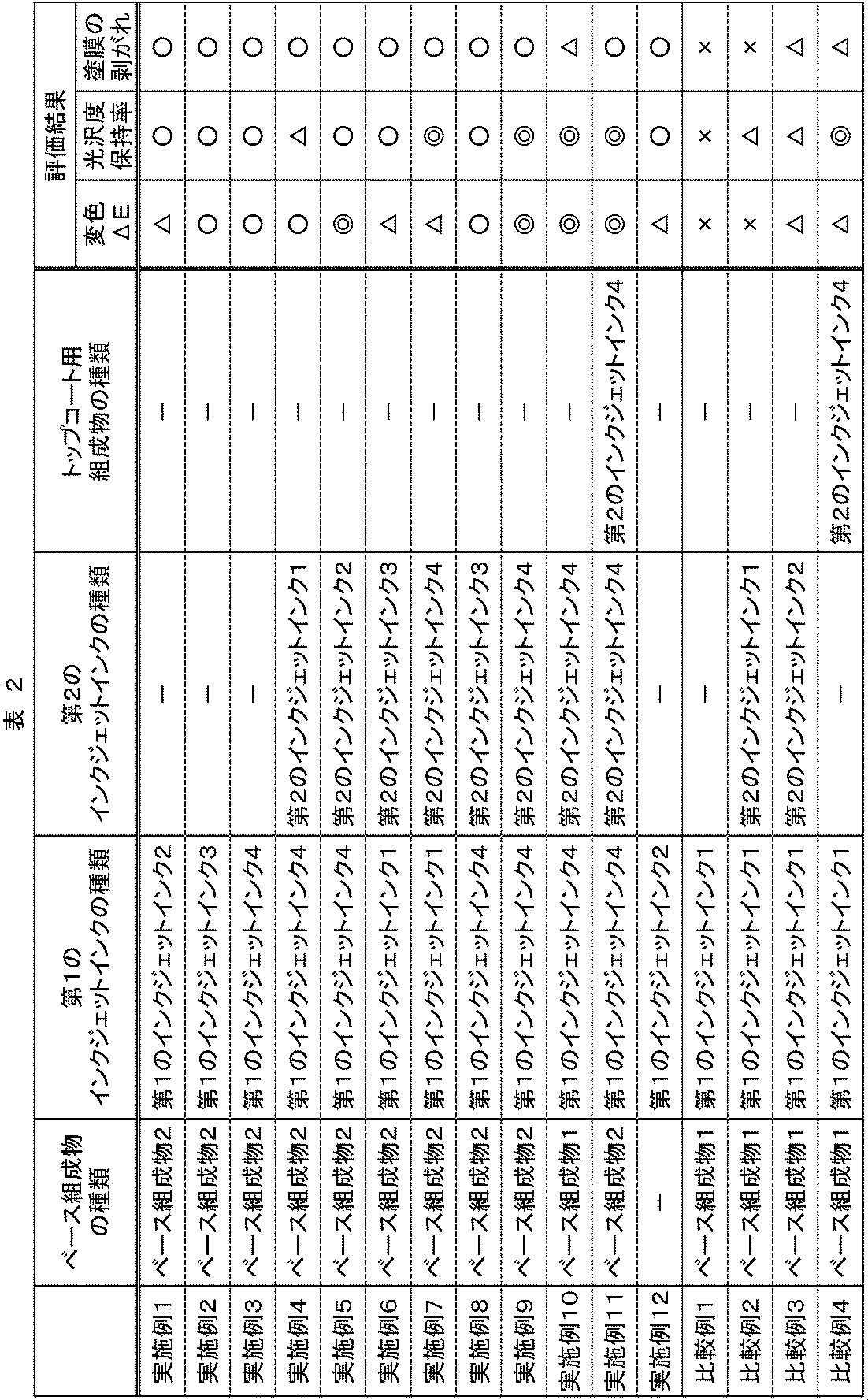
(ベース層の形成)
・ベース組成物1を用いる場合
基材(クロメート処理を行ったアルミ鋼板)にベース組成物1をエアスプレーで約150g/m2塗布(ドライ膜厚が約25μm)し、140℃環境下で20分間の乾燥を行った。
・ベース組成物2を用いる場合
基材(クロメート処理を行ったアルミ鋼板)にベース組成物2をエアスプレーで約150g/m2塗布(ドライ膜厚が約25μm)し、200℃環境下で3分間の乾燥を行った。
・ベース組成物1を用いる場合
基材(クロメート処理を行ったアルミ鋼板)にベース組成物1をエアスプレーで約150g/m2塗布(ドライ膜厚が約25μm)し、140℃環境下で20分間の乾燥を行った。
・ベース組成物2を用いる場合
基材(クロメート処理を行ったアルミ鋼板)にベース組成物2をエアスプレーで約150g/m2塗布(ドライ膜厚が約25μm)し、200℃環境下で3分間の乾燥を行った。
(インクジェット画像層の形成)
以下のインクジェット条件にしたがい、基材(またはベース層の形成された基材)上にインクジェット画像層を形成した。
<インクジェット条件>
インクジェット記録装置:ピエゾ方式
ノズル径:40μm
駆動電圧:70V
インクドットサイズ:30pl
周波数:12kHz
解像度:400×800dpi
基材温度:60℃(加温)
評価柄:100mm角のベタ柄
<乾燥条件>
加熱乾燥(200℃環境下、1分間)
以下のインクジェット条件にしたがい、基材(またはベース層の形成された基材)上にインクジェット画像層を形成した。
<インクジェット条件>
インクジェット記録装置:ピエゾ方式
ノズル径:40μm
駆動電圧:70V
インクドットサイズ:30pl
周波数:12kHz
解像度:400×800dpi
基材温度:60℃(加温)
評価柄:100mm角のベタ柄
<乾燥条件>
加熱乾燥(200℃環境下、1分間)
(トップコートの形成)
トップコート用組成物として、第2のインクジェットインク4をエアスプレーで約150g/m2塗布(ドライ膜厚が約30μm)し、200℃環境下で1分間の乾燥を行った。
トップコート用組成物として、第2のインクジェットインク4をエアスプレーで約150g/m2塗布(ドライ膜厚が約30μm)し、200℃環境下で1分間の乾燥を行った。
実施例1~12および比較例1~4により得られたプリント物について、以下の評価方法および評価基準に基づいて評価した。結果を表2に示す。
<変色ΔE>
プリント物に対して、スーパーUVテスター(岩崎電気社製、SUV-W161)を用いて、超促進耐候試験として紫外線照射6時間(UV条件100mW/cm2、温度63℃、湿度50%)実施後、次いでシャワー30秒の後、なりゆきで結露2時間実施を1サイクルとし、合計1000時間実施した。試験前後のΔEを色差とした。色差は分光測色計(コニカミノルタ(株)製、CM-3700)を用いて、測定した。
(評価基準)
◎:色差がΔE≦3であった
○:色差が3<ΔE≦8であった
△:色差が8<ΔE≦16であった
×:色差がΔE>16であった
<光沢度保持率>
光沢度保持率は、プリント物の超促進耐候試験前に対する試験後の光沢度の比率とした。光沢度はグロスチェッカー((株)堀場製作所製、IG-410)を用いて、測定した。
(評価基準)
◎:光沢度保持率は50%以上であった
○:光沢度保持率は30%以上50%未満であった
△:光沢度保持率は10%以上30%未満であった
×:光沢度保持率は、10%未満であった
<塗膜の剥がれ>
JIS K 5400に準じ、超促進耐候試験後のサンプルを碁盤目テープ剥離(1mm幅、100マス)試験を実施し、塗膜の剥離を確認した。
(評価基準)
○:塗膜は剥がれなかった
△:塗膜は一部が剥がれた
×:塗膜は全部が剥がれた
プリント物に対して、スーパーUVテスター(岩崎電気社製、SUV-W161)を用いて、超促進耐候試験として紫外線照射6時間(UV条件100mW/cm2、温度63℃、湿度50%)実施後、次いでシャワー30秒の後、なりゆきで結露2時間実施を1サイクルとし、合計1000時間実施した。試験前後のΔEを色差とした。色差は分光測色計(コニカミノルタ(株)製、CM-3700)を用いて、測定した。
(評価基準)
◎:色差がΔE≦3であった
○:色差が3<ΔE≦8であった
△:色差が8<ΔE≦16であった
×:色差がΔE>16であった
<光沢度保持率>
光沢度保持率は、プリント物の超促進耐候試験前に対する試験後の光沢度の比率とした。光沢度はグロスチェッカー((株)堀場製作所製、IG-410)を用いて、測定した。
(評価基準)
◎:光沢度保持率は50%以上であった
○:光沢度保持率は30%以上50%未満であった
△:光沢度保持率は10%以上30%未満であった
×:光沢度保持率は、10%未満であった
<塗膜の剥がれ>
JIS K 5400に準じ、超促進耐候試験後のサンプルを碁盤目テープ剥離(1mm幅、100マス)試験を実施し、塗膜の剥離を確認した。
(評価基準)
○:塗膜は剥がれなかった
△:塗膜は一部が剥がれた
×:塗膜は全部が剥がれた
表2に示されるように、実施例1~12のプリント物は、比較例1~4のプリント物と比べて、形成されたインクジェット画像層が、いずれも変色しにくく、光沢が低下しにくく、かつ、剥がれにくかった。特に、実施例1および実施例12から分かるように、本発明のプリント物は、基材に直接インクジェット画像層が形成される場合と、ベース層の形成された基材にインクジェット画像層が形成される場合とにおいて、いずれも変色しにくく、光沢が低下しにくく、かつ、剥がれにくいインクジェット画像層が形成されることがわかった。また、実施例9のプリント物は、トップコートを設けた実施例11のプリント物と同程度の優れた耐候性を示したことから、本発明は、トップコートが設けられていない場合であっても、優れた耐候性を示すことが分かった。
1、1a プリント物
2 基材
3 ベース層
4、4a インクジェット画像層
41a 第1層
42a 第2層
2 基材
3 ベース層
4、4a インクジェット画像層
41a 第1層
42a 第2層
Claims (14)
- 基材と、前記基材上に形成されたインクジェット画像層とを含み、
前記インクジェット画像層は、色材とフッ素樹脂とを含む、プリント物。 - 前記インクジェット画像層は、前記色材を含む第1層と、前記第1層を覆い、かつ、色材を含まない第2層とを含み、
前記フッ素樹脂は、前記第1層または前記第2層の少なくともいずれか一方に含まれる、請求項1記載のプリント物。 - 前記第1層は、酸化防止剤を含む、請求項2記載のプリント物。
- 前記第2層は、紫外線吸収剤または光安定剤を含む、請求項2または3記載のプリント物。
- 前記第1層は、第1層用硬化剤をさらに含み、
前記第2層は、第2層用硬化剤をさらに含み、
前記第1層用硬化剤の架橋反応開始温度は、前記第2層用硬化剤の架橋反応開始温度以下である、請求項2~4のいずれか1項に記載のプリント物。 - 前記基材と前記インクジェット画像層との間に、ベース層がさらに含まれる、請求項1~5のいずれか1項に記載のプリント物。
- 前記基材と前記インクジェット画像層との間に、ベース層がさらに含まれ、
前記ベース層は、ベース層用硬化剤をさらに含み、
前記ベース層用硬化剤の架橋反応開始温度は、前記第1層用硬化剤の架橋反応開始温度以下であり、
前記第1層用硬化剤の架橋反応開始温度は、前記第2層用硬化剤の架橋反応開始温度以下である、請求項5記載のプリント物。 - 前記ベース層は、フッ素樹脂を含む、請求項6または7記載のプリント物。
- 前記色材は、無機顔料を含む、請求項1~8のいずれか1項に記載のプリント物。
- 前記インクジェット画像層上に、さらにトップコートが形成されている、請求項1~9のいずれか1項に記載のプリント物。
- 基材上に、インクジェットインクをインクジェット方式により付与し、色材とフッ素樹脂とを含むインクジェット画像層を形成するインクジェット工程を含む、プリント物の製造方法。
- 前記インクジェットインクは、前記色材を含む第1のインクジェットインクと、色材を含まない第2のインクジェットインクとを含み、
前記フッ素樹脂は、前記第1のインクジェットインクおよび前記第2のインクジェットインクのうち、少なくともいずれか一方に含まれ、
前記インクジェット工程は、前記第1のインクジェットインクを前記基材上に付与する第1層形成工程と、前記第1層を覆うように、前記第2のインクジェットインクを付与する第2層形成工程とを含む、請求項11記載のプリント物の製造方法。 - 前記第1のインクジェットインクの表面張力は、前記第2のインクジェットインクの表面張力以上である、請求項12記載のプリント物の製造方法。
- 前記基材上に、ベース層を形成するベース層形成工程をさらに含み、
前記インクジェット工程は、前記ベース層の形成された前記基材に対して行われる、請求項11~13のいずれか1項に記載のプリント物の製造方法。
Priority Applications (3)
| Application Number | Priority Date | Filing Date | Title |
|---|---|---|---|
| EP18754197.4A EP3572236A4 (en) | 2017-02-20 | 2018-02-13 | PRINTED MATERIAL AND METHOD FOR PRODUCING PRINTED MATTERS |
| CN201880012675.4A CN110709254A (zh) | 2017-02-20 | 2018-02-13 | 印刷物和印刷物的制造方法 |
| US16/480,040 US20190375226A1 (en) | 2017-02-20 | 2018-02-13 | Printed matter and production method for printed matter |
Applications Claiming Priority (2)
| Application Number | Priority Date | Filing Date | Title |
|---|---|---|---|
| JP2017-029349 | 2017-02-20 | ||
| JP2017029349A JP6531125B2 (ja) | 2017-02-20 | 2017-02-20 | プリント物およびプリント物の製造方法 |
Publications (1)
| Publication Number | Publication Date |
|---|---|
| WO2018151087A1 true WO2018151087A1 (ja) | 2018-08-23 |
Family
ID=63170498
Family Applications (1)
| Application Number | Title | Priority Date | Filing Date |
|---|---|---|---|
| PCT/JP2018/004868 Ceased WO2018151087A1 (ja) | 2017-02-20 | 2018-02-13 | プリント物およびプリント物の製造方法 |
Country Status (5)
| Country | Link |
|---|---|
| US (1) | US20190375226A1 (ja) |
| EP (1) | EP3572236A4 (ja) |
| JP (1) | JP6531125B2 (ja) |
| CN (1) | CN110709254A (ja) |
| WO (1) | WO2018151087A1 (ja) |
Cited By (1)
| Publication number | Priority date | Publication date | Assignee | Title |
|---|---|---|---|---|
| EP3498791A4 (en) * | 2016-08-10 | 2020-04-01 | Seiren Co., Ltd. | INK, AND METHOD FOR MANUFACTURING PRINTED ARTICLE |
Families Citing this family (3)
| Publication number | Priority date | Publication date | Assignee | Title |
|---|---|---|---|---|
| JP6623275B1 (ja) * | 2018-11-30 | 2019-12-18 | セーレン株式会社 | 積層シート |
| JP7221164B2 (ja) * | 2019-07-30 | 2023-02-13 | セーレン株式会社 | インクジェットインクおよびプリント物 |
| US20210040684A1 (en) * | 2019-08-07 | 2021-02-11 | Prism Inks, Inc. | Pretreating natural fiber fabrics for dye sublimation ink printing |
Citations (12)
| Publication number | Priority date | Publication date | Assignee | Title |
|---|---|---|---|---|
| JPS6191276A (ja) * | 1984-10-12 | 1986-05-09 | Nippon Telegr & Teleph Corp <Ntt> | インクジエツト記録用インク |
| JPH07118583A (ja) * | 1993-10-20 | 1995-05-09 | Dainippon Toryo Co Ltd | インクジェット印刷用組成物 |
| JPH08300808A (ja) * | 1995-05-12 | 1996-11-19 | Mitsubishi Paper Mills Ltd | インクジェット用被記録材 |
| JP2009242468A (ja) * | 2008-03-28 | 2009-10-22 | Fujifilm Corp | インク組成物 |
| JP2010167334A (ja) * | 2009-01-20 | 2010-08-05 | Seiren Co Ltd | 建築板の製造方法 |
| JP2010222387A (ja) * | 2009-03-19 | 2010-10-07 | Fujifilm Corp | インク組成物、インクジェット記録方法、印刷物、及び、成形印刷物の製造方法 |
| JP2011057744A (ja) * | 2009-09-07 | 2011-03-24 | Hitachi Maxell Ltd | クリア層形成用インク組成物及びそれを用いた印刷物 |
| WO2012133667A1 (ja) * | 2011-03-31 | 2012-10-04 | 大日本塗料株式会社 | 複層塗膜及び該複層塗膜の製造方法 |
| JP2013067770A (ja) * | 2011-09-09 | 2013-04-18 | Fujifilm Corp | 複層形成用インクセット、インクジェット記録方法、及び、印刷物 |
| JP2013199719A (ja) * | 2012-03-26 | 2013-10-03 | Seiko Epson Corp | インクジェット捺染用前処理剤、インクジェット捺染用インクセット、インクジェット捺染方法 |
| JP5481859B2 (ja) | 2006-10-16 | 2014-04-23 | 旭硝子株式会社 | フッ素塗料組成物 |
| JP2017008243A (ja) * | 2015-06-24 | 2017-01-12 | セイコーエプソン株式会社 | 非水系インクジェットインク組成物及び記録方法 |
Family Cites Families (3)
| Publication number | Priority date | Publication date | Assignee | Title |
|---|---|---|---|---|
| US5401303A (en) * | 1994-04-26 | 1995-03-28 | E. I. Du Pont De Nemours And Company | Aqueous inks having improved halo characteristics |
| JP2011178944A (ja) * | 2010-03-03 | 2011-09-15 | Seiko Epson Corp | インクジェット用インク |
| JP2013124260A (ja) * | 2011-12-13 | 2013-06-24 | Seiko Epson Corp | インクセット、インクジェット記録装置及び記録物 |
-
2017
- 2017-02-20 JP JP2017029349A patent/JP6531125B2/ja active Active
-
2018
- 2018-02-13 EP EP18754197.4A patent/EP3572236A4/en not_active Withdrawn
- 2018-02-13 CN CN201880012675.4A patent/CN110709254A/zh not_active Withdrawn
- 2018-02-13 US US16/480,040 patent/US20190375226A1/en not_active Abandoned
- 2018-02-13 WO PCT/JP2018/004868 patent/WO2018151087A1/ja not_active Ceased
Patent Citations (12)
| Publication number | Priority date | Publication date | Assignee | Title |
|---|---|---|---|---|
| JPS6191276A (ja) * | 1984-10-12 | 1986-05-09 | Nippon Telegr & Teleph Corp <Ntt> | インクジエツト記録用インク |
| JPH07118583A (ja) * | 1993-10-20 | 1995-05-09 | Dainippon Toryo Co Ltd | インクジェット印刷用組成物 |
| JPH08300808A (ja) * | 1995-05-12 | 1996-11-19 | Mitsubishi Paper Mills Ltd | インクジェット用被記録材 |
| JP5481859B2 (ja) | 2006-10-16 | 2014-04-23 | 旭硝子株式会社 | フッ素塗料組成物 |
| JP2009242468A (ja) * | 2008-03-28 | 2009-10-22 | Fujifilm Corp | インク組成物 |
| JP2010167334A (ja) * | 2009-01-20 | 2010-08-05 | Seiren Co Ltd | 建築板の製造方法 |
| JP2010222387A (ja) * | 2009-03-19 | 2010-10-07 | Fujifilm Corp | インク組成物、インクジェット記録方法、印刷物、及び、成形印刷物の製造方法 |
| JP2011057744A (ja) * | 2009-09-07 | 2011-03-24 | Hitachi Maxell Ltd | クリア層形成用インク組成物及びそれを用いた印刷物 |
| WO2012133667A1 (ja) * | 2011-03-31 | 2012-10-04 | 大日本塗料株式会社 | 複層塗膜及び該複層塗膜の製造方法 |
| JP2013067770A (ja) * | 2011-09-09 | 2013-04-18 | Fujifilm Corp | 複層形成用インクセット、インクジェット記録方法、及び、印刷物 |
| JP2013199719A (ja) * | 2012-03-26 | 2013-10-03 | Seiko Epson Corp | インクジェット捺染用前処理剤、インクジェット捺染用インクセット、インクジェット捺染方法 |
| JP2017008243A (ja) * | 2015-06-24 | 2017-01-12 | セイコーエプソン株式会社 | 非水系インクジェットインク組成物及び記録方法 |
Non-Patent Citations (2)
| Title |
|---|
| JOURNAL OF APPLIED POLYMER SCIENCE, vol. 106, 2007, pages 1007 - 1013 |
| See also references of EP3572236A4 |
Cited By (1)
| Publication number | Priority date | Publication date | Assignee | Title |
|---|---|---|---|---|
| EP3498791A4 (en) * | 2016-08-10 | 2020-04-01 | Seiren Co., Ltd. | INK, AND METHOD FOR MANUFACTURING PRINTED ARTICLE |
Also Published As
| Publication number | Publication date |
|---|---|
| JP6531125B2 (ja) | 2019-06-12 |
| CN110709254A (zh) | 2020-01-17 |
| EP3572236A4 (en) | 2020-01-22 |
| JP2018134767A (ja) | 2018-08-30 |
| EP3572236A1 (en) | 2019-11-27 |
| US20190375226A1 (en) | 2019-12-12 |
Similar Documents
| Publication | Publication Date | Title |
|---|---|---|
| WO2018151087A1 (ja) | プリント物およびプリント物の製造方法 | |
| JP6366669B2 (ja) | インクジェットインクセット、プリント物の製造方法およびプリント物 | |
| JP7285707B2 (ja) | 紫外線硬化型インクジェットインク、プリント物およびプリント物の製造方法 | |
| EP3587515A1 (en) | Ink-jet recording liquid set, preparation method of pretreatment liquid for ink-jet recording, printed matter, and ink-jet recording method | |
| JP6491803B1 (ja) | 水系インクジェットインクおよびプリント物の製造方法 | |
| WO2023153189A1 (ja) | 塗料用組成物 | |
| JP6181827B1 (ja) | インクおよびプリント物の製造方法 | |
| JP2019043140A (ja) | プリント物およびプリント物の製造方法 | |
| JP4197130B2 (ja) | 乳化重合樹脂組成物 | |
| JP7221164B2 (ja) | インクジェットインクおよびプリント物 | |
| JP7386115B2 (ja) | インクジェットインクセット、プリント物の製造方法およびプリント物 | |
| JP6623275B1 (ja) | 積層シート | |
| JP2016079265A (ja) | 航空機内装用の水性塗料用組成物および航空機内装材 | |
| JP7506614B2 (ja) | 被膜形成方法、及び積層体 | |
| JP2024146381A (ja) | 表面保護層形成用塗料組成物および塗装体 | |
| US20130197155A1 (en) | Aqueous coating composition, and two-pack type curable aqueous coating kit | |
| JP7166104B2 (ja) | インクジェットインクセット、プリント物およびプリント物の製造方法 | |
| WO2021251135A1 (ja) | フッ素樹脂組成物、硬化被膜、積層フィルム、および構造体 | |
| JP2022072085A (ja) | インクおよびプリント物 | |
| WO2025100180A1 (ja) | 樹脂組成物、インクジェットプリント物の製造方法、塗料塗装物の製造方法 | |
| WO2019103088A1 (ja) | 非水系インクジェットインク、プリント物およびプリント物の製造方法 | |
| JP7226934B2 (ja) | 樹脂組成物及び積層体 | |
| JP2003096384A (ja) | 昇華熱転写用塗料組成物及び塗装金属板 |
Legal Events
| Date | Code | Title | Description |
|---|---|---|---|
| 121 | Ep: the epo has been informed by wipo that ep was designated in this application |
Ref document number: 18754197 Country of ref document: EP Kind code of ref document: A1 |
|
| NENP | Non-entry into the national phase |
Ref country code: DE |
|
| ENP | Entry into the national phase |
Ref document number: 2018754197 Country of ref document: EP Effective date: 20190821 |