WO2018151282A1 - 養殖システム及び水産生物の生産方法 - Google Patents
養殖システム及び水産生物の生産方法 Download PDFInfo
- Publication number
- WO2018151282A1 WO2018151282A1 PCT/JP2018/005595 JP2018005595W WO2018151282A1 WO 2018151282 A1 WO2018151282 A1 WO 2018151282A1 JP 2018005595 W JP2018005595 W JP 2018005595W WO 2018151282 A1 WO2018151282 A1 WO 2018151282A1
- Authority
- WO
- WIPO (PCT)
- Prior art keywords
- aquaculture
- water
- nitrifying bacteria
- shrimp
- tank
- Prior art date
- Legal status (The legal status is an assumption and is not a legal conclusion. Google has not performed a legal analysis and makes no representation as to the accuracy of the status listed.)
- Ceased
Links
Images


Classifications
-
- A—HUMAN NECESSITIES
- A01—AGRICULTURE; FORESTRY; ANIMAL HUSBANDRY; HUNTING; TRAPPING; FISHING
- A01K—ANIMAL HUSBANDRY; AVICULTURE; APICULTURE; PISCICULTURE; FISHING; REARING OR BREEDING ANIMALS, NOT OTHERWISE PROVIDED FOR; NEW BREEDS OF ANIMALS
- A01K63/00—Receptacles for live fish, e.g. aquaria; Terraria
- A01K63/04—Arrangements for treating water specially adapted to receptacles for live fish
- A01K63/045—Filters for aquaria
-
- A—HUMAN NECESSITIES
- A01—AGRICULTURE; FORESTRY; ANIMAL HUSBANDRY; HUNTING; TRAPPING; FISHING
- A01K—ANIMAL HUSBANDRY; AVICULTURE; APICULTURE; PISCICULTURE; FISHING; REARING OR BREEDING ANIMALS, NOT OTHERWISE PROVIDED FOR; NEW BREEDS OF ANIMALS
- A01K61/00—Culture of aquatic animals
- A01K61/50—Culture of aquatic animals of shellfish
- A01K61/59—Culture of aquatic animals of shellfish of crustaceans, e.g. lobsters or shrimps
-
- A—HUMAN NECESSITIES
- A01—AGRICULTURE; FORESTRY; ANIMAL HUSBANDRY; HUNTING; TRAPPING; FISHING
- A01K—ANIMAL HUSBANDRY; AVICULTURE; APICULTURE; PISCICULTURE; FISHING; REARING OR BREEDING ANIMALS, NOT OTHERWISE PROVIDED FOR; NEW BREEDS OF ANIMALS
- A01K61/00—Culture of aquatic animals
- A01K61/80—Feeding devices
- A01K61/85—Feeding devices for use with aquaria
-
- A—HUMAN NECESSITIES
- A01—AGRICULTURE; FORESTRY; ANIMAL HUSBANDRY; HUNTING; TRAPPING; FISHING
- A01K—ANIMAL HUSBANDRY; AVICULTURE; APICULTURE; PISCICULTURE; FISHING; REARING OR BREEDING ANIMALS, NOT OTHERWISE PROVIDED FOR; NEW BREEDS OF ANIMALS
- A01K63/00—Receptacles for live fish, e.g. aquaria; Terraria
- A01K63/04—Arrangements for treating water specially adapted to receptacles for live fish
-
- A—HUMAN NECESSITIES
- A01—AGRICULTURE; FORESTRY; ANIMAL HUSBANDRY; HUNTING; TRAPPING; FISHING
- A01K—ANIMAL HUSBANDRY; AVICULTURE; APICULTURE; PISCICULTURE; FISHING; REARING OR BREEDING ANIMALS, NOT OTHERWISE PROVIDED FOR; NEW BREEDS OF ANIMALS
- A01K63/00—Receptacles for live fish, e.g. aquaria; Terraria
- A01K63/04—Arrangements for treating water specially adapted to receptacles for live fish
- A01K63/042—Introducing gases into the water, e.g. aerators, air pumps
-
- C—CHEMISTRY; METALLURGY
- C02—TREATMENT OF WATER, WASTE WATER, SEWAGE, OR SLUDGE
- C02F—TREATMENT OF WATER, WASTE WATER, SEWAGE, OR SLUDGE
- C02F3/00—Biological treatment of water, waste water, or sewage
- C02F3/02—Aerobic processes
- C02F3/10—Packings; Fillings; Grids
-
- C—CHEMISTRY; METALLURGY
- C02—TREATMENT OF WATER, WASTE WATER, SEWAGE, OR SLUDGE
- C02F—TREATMENT OF WATER, WASTE WATER, SEWAGE, OR SLUDGE
- C02F3/00—Biological treatment of water, waste water, or sewage
- C02F3/34—Biological treatment of water, waste water, or sewage characterised by the microorganisms used
-
- A—HUMAN NECESSITIES
- A01—AGRICULTURE; FORESTRY; ANIMAL HUSBANDRY; HUNTING; TRAPPING; FISHING
- A01K—ANIMAL HUSBANDRY; AVICULTURE; APICULTURE; PISCICULTURE; FISHING; REARING OR BREEDING ANIMALS, NOT OTHERWISE PROVIDED FOR; NEW BREEDS OF ANIMALS
- A01K63/00—Receptacles for live fish, e.g. aquaria; Terraria
- A01K63/06—Arrangements for heating or lighting in, or attached to, receptacles for live fish
- A01K63/065—Heating or cooling devices
-
- C—CHEMISTRY; METALLURGY
- C02—TREATMENT OF WATER, WASTE WATER, SEWAGE, OR SLUDGE
- C02F—TREATMENT OF WATER, WASTE WATER, SEWAGE, OR SLUDGE
- C02F2101/00—Nature of the contaminant
- C02F2101/10—Inorganic compounds
- C02F2101/16—Nitrogen compounds, e.g. ammonia
- C02F2101/163—Nitrates
-
- C—CHEMISTRY; METALLURGY
- C02—TREATMENT OF WATER, WASTE WATER, SEWAGE, OR SLUDGE
- C02F—TREATMENT OF WATER, WASTE WATER, SEWAGE, OR SLUDGE
- C02F2103/00—Nature of the water, waste water, sewage or sludge to be treated
- C02F2103/20—Nature of the water, waste water, sewage or sludge to be treated from animal husbandry
-
- Y—GENERAL TAGGING OF NEW TECHNOLOGICAL DEVELOPMENTS; GENERAL TAGGING OF CROSS-SECTIONAL TECHNOLOGIES SPANNING OVER SEVERAL SECTIONS OF THE IPC; TECHNICAL SUBJECTS COVERED BY FORMER USPC CROSS-REFERENCE ART COLLECTIONS [XRACs] AND DIGESTS
- Y02—TECHNOLOGIES OR APPLICATIONS FOR MITIGATION OR ADAPTATION AGAINST CLIMATE CHANGE
- Y02A—TECHNOLOGIES FOR ADAPTATION TO CLIMATE CHANGE
- Y02A40/00—Adaptation technologies in agriculture, forestry, livestock or agroalimentary production
- Y02A40/80—Adaptation technologies in agriculture, forestry, livestock or agroalimentary production in fisheries management
- Y02A40/81—Aquaculture, e.g. of fish
Definitions
- the present invention relates to a closed circulation type aquaculture system for aquaculture of aquatic products.
- Patent Document 1 discloses an endless circular circulation type aquarium.
- a water management device for taking out the aquaculture water in the aquarium out of the basin and adjusting it to a predetermined state and then returning it to the aquarium, an aeration channel for aeration of the treated water fed from the water management device, and a circulating water flow in a certain direction
- An aquaculture facility equipped with an airflow device for generating water and a feeding device has been reported.
- Non-Patent Document 1 terrestrial aquaculture systems that have introduced bio-floc technology have attracted attention, and have been demonstrated in Southeast Asia, mainly shrimp aquaculture, and are being introduced in Japan (for example, Non-Patent Document 1).
- the aquaculture tank is supplied with carbon and nitrogen by feeding the organic feed, but carbon and nitrogen are not fed into the aquaculture tank in the form of unused feed (residual food) and manure. Remains. Carbon is dissolved in the water in the aquaculture tank as carbon dioxide, and the excess is released from the water, but nitrogen is in the form of inorganic ammonia (NH 4 ) as a decomposition product of residual food and manure from nitrifying bacteria. It dissolves in water, and ammonia is sequentially oxidized into nitrite (NO 2 ) and nitric acid (NO 3 ) by the nitrifying action of nitrifying bacteria. When organic matter in the aquaculture water is added and the amount of carbon in the aquaculture water is increased, the carbon / nitrogen ratio (C / N ratio) increases, and nitrifying bacteria that form biofloc grow using nitrogen as a nutrient.
- C / N ratio carbon / nitrogen ratio
- biofloc technology it is possible to maintain the water quality of the aquaculture tank by controlling the C / N ratio.
- the C / N ratio when the C / N ratio is low, the organic matter decomposition rate by nitrifying bacteria increases, and the amount of ammonia and nitrous acid generated increases.
- the C / N ratio when the C / N ratio is high, the organic matter decomposition rate is high. Becomes smaller, nitrogen is taken up by nitrifying bacteria, and the amount of ammonia and nitrous acid generated decreases.
- An ideal C / N ratio exists depending on the aquaculture product to be cultured and the nitrifying bacteria constituting the biofloc to be used.
- the C / N ratio is low, organic matter decomposition by nitrifying bacteria is accelerated, and harmful ammonia and nitrous acid are increased.
- the C / N ratio is high, the decomposition of organic substances by nitrifying bacteria slows down, and the microorganisms grow by forming proteins using the nitrogen component as nutrients (and the amount of biofloc also increases). Since nitrogen components are consumed as nutrients, the generation of ammonia and nitrous acid is suppressed.
- the C / N ratio is set high to ensure that harmful ammonia and nitrous acid are excessively generated.
- an object of the present invention is to provide an aquaculture system that can easily control the quality of the aquaculture water (C / N ratio) in a closed circulation aquaculture system that has introduced bio-floc technology. is there.
- the present invention relates to the following aquaculture system invention.
- a culture system using a bio-off-lock wherein the culture tank is provided with a nitrifying bacteria immobilization material having nitrifying bacteria supported on a carrier in an aquaculture tank.
- the aquaculture system according to ⁇ 1> wherein the carrier in the nitrifying bacteria immobilization material is an effervescent carrier.
- the aquaculture tank is provided with an air injector for circulating the water flow in the aquaculture tank, and an aeration device for discharging the aquaculture water and mixing the air.
- the aquaculture system according to ⁇ 1> or ⁇ 2> which is packed in an aqueous container.
- ⁇ 4> The aquaculture system according to ⁇ 3>, wherein a water-permeable container packed with the nitrifying bacteria immobilizing material is disposed downstream of the air injector and / or the aeration apparatus.
- ⁇ 5> The aquaculture system according to any one of ⁇ 1> to ⁇ 4>, wherein the aquaculture tank is provided with one or more of a water wheel, a feeder, and a heat insulating material.
- ⁇ 6> The aquaculture system according to any one of ⁇ 1> to ⁇ 5>, wherein the aquaculture tank is installed on land.
- the other aspect of this invention is invention which concerns on the production method of the following aquatic products.
- a method for producing an aquatic product comprising culturing a target aquatic product using the aquaculture system according to any one of ⁇ 1> to ⁇ 6>.
- ⁇ 11> The method for producing an aquatic product according to ⁇ 10>, wherein the shrimp is a prawn superfamily.
- ⁇ 12> The method for producing an aquatic product according to ⁇ 11>, wherein the prawn superfamily is the prawn family.
- ⁇ 13> The method for producing an aquatic product according to ⁇ 12>, wherein the Shrimpidae belongs to the genus Litopenius.
- ⁇ 14> The method for producing an aquatic product according to ⁇ 13>, wherein the genus Litopenius is Litopenaeus vannamei.
- ⁇ X1> A nitrifying bacteria immobilization material having nitrifying bacteria supported on a carrier.
- aquatic organisms can be efficiently cultivated by appropriately maintaining the water quality of the aquaculture tank in the biofloc aquaculture system.
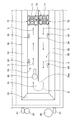
- FIG. 1 is a partially omitted sectional view of an aquaculture system according to an embodiment of the present invention. It is a partially omitted enlarged view of the aquaculture tank shown in FIG.
- the aquaculture system of the present invention (hereinafter simply referred to as “cultivation system of the present invention”) is a culture system using biofloc, and is provided with a nitrifying bacteria immobilization material having nitrifying bacteria supported on a carrier in an aquaculture tank. Aquaculture system.
- the aquaculture system of the present invention is preferably a closed circulation aquaculture system.
- bio floc refers to a mass of microorganisms that are artificially produced in the aquaculture tank of aquatic products such as seafood and crustaceans. By this bio floc, the poisonous ammonia and nitrous acid which are increased by feeding can be reduced, and the bio floc itself can be used as a protein source.
- cultured water is water or an aqueous solution used for breeding in an aquarium for aquatic organisms, and includes fresh water, seawater, and brackish water. These should be selected appropriately for each aquatic organism to be bred. Seawater and brackish water may be prepared using artificial seawater. Changes may be made appropriately depending on the breeding time from the egg to the shipping size.
- One of the features of the aquaculture system of the present invention is that, together with the nitrifying bacteria contained in the biofloc, a carrier (nitrifying bacteria immobilization material) holding the nitrifying bacteria is used in combination in the aquaculture tank.
- a carrier nitrifying bacteria immobilization material holding the nitrifying bacteria
- ammonia nitrogen is nitrified synergistically not only by nitrifying bacteria contained in biofloc but also by nitrifying bacteria retained on the carrier, so that biofloc becomes excessive due to growth of nitrifying bacteria. The increase is suppressed.
- nitrifying bacteria examples include ammonia oxidizing bacteria and nitrite oxidizing bacteria.
- An “ammonia-oxidizing bacterium” is a bacterium that oxidizes ammonia nitrogen in aquaculture water, for example, ammonium ions, to convert them into nitrite ions under an aerobic atmosphere. Is a bacterium that further oxidizes nitrite ions in the aquaculture water produced by the above in an aerobic atmosphere and converts them into nitrate ions.
- the types of nitrifying bacteria include, but are not particularly limited to, nitrobacter, nitrospina, nitrococcus, and the like. It can be appropriately selected in consideration of various conditions such as aquaculture density, size of aquaculture tank (amount of aquaculture water) and temperature. Further, the nitrifying bacteria contained in the biofloc and the nitrifying bacteria immobilized on the carrier may be the same or different.
- the nitrifying bacteria immobilization material is one in which nitrifying bacteria are held on a carrier.
- the type of the carrier is not particularly limited as long as the support of nitrifying bacteria is not hindered and there is no adverse effect on the aquaculture target, both inorganic carriers made of inorganic materials such as ceramics and organic carriers made of organic materials such as resins. Can be used.
- the shape of the carrier is not limited as long as the support of nitrifying bacteria is not hindered, and examples thereof include powder, granules, lumps, and plates.
- a porous carrier is preferable because more nitrifying bacteria can be supported and the contact with culture water is enhanced.
- inorganic porous carrier for example, natural mineral silicate compounds such as montmorillonite, zeolite, and kaolin are also suitable for supporting nitrifying bacteria, so that it is expected that the fixing ability of nitrifying bacteria is improved.
- inorganic carriers other than silicate compounds such as alumina can also be used. These may be used alone or in combination of two or more.
- the particle size of the inorganic carrier is not particularly limited as long as the support of nitrifying bacteria is not inhibited. On the other hand, particles that are too small may be screened and removed for the purpose of ensuring quality.
- a carrier having a particle diameter of about 0.1 ⁇ m to 250 ⁇ m can be used, but is not limited thereto.
- the organic porous carrier is not limited as long as it is a structure made of a polymer that does not dissolve in water and has high affinity for microorganisms, but polyurethane foam having excellent wear resistance and long life is a suitable resin. It is mentioned as a material.
- Specific examples of organic porous carriers that can be used include foamable carriers, non-woven fabric carriers, porous gel carriers, and hollow fiber membrane carriers. These may be used alone or in combination of two or more.
- the effervescent carrier is a structure having open cells, has a large specific surface area, and can fix nitrifying bacteria at a high concentration per unit volume, so that it can be suitably used as a carrier for nitrifying bacteria immobilization material. .
- foam carriers include, for example, Micro Breath (registered trademark) (manufactured by Aion Co., Ltd.), Biotube (registered trademark) (manufactured by JFE Engineering Co., Ltd.), APG (manufactured by Nisshinbo Chemical Co., Ltd.), and porous cellulose.
- Examples include a carrier (manufactured by EYELA), biofrontier net (manufactured by Kansai Kako), and aqua cube (manufactured by Sekisui Aqua System Co., Ltd.).
- the size is arbitrary, but when used in a container having water permeability described later, a larger one than the hole (mesh) of the container having water permeability is selected so as not to flow out.
- the method for fixing the nitrifying bacteria to the carrier is arbitrary, but for example, a dispersion in which nitrifying bacteria are dispersed in water and the carrier may be mixed. After mixing, for example, by contacting with oxygen, the nitrifying bacteria are fixed while growing on the carrier, and a nitrifying bacteria immobilizing material is obtained.
- the nitrifying bacteria immobilization material may be disposed in contact with the aquaculture water in the aquaculture tank. In principle, it may be dispersed in the water of the aquaculture tank (cultured water), but if dispersed, it becomes difficult to recover. Therefore, a mode in which the nitrifying bacteria immobilizing material is put in a container having water permeability is a preferable usage form.
- the container having water permeability include a cage container having water permeability.
- the “cage-like container” is a substantially rectangular parallelepiped housing in which each surface of the container is formed in a net shape (or a hole shape) so that water can pass through, and nitrification is performed in the filling space inside the container.
- the shape and size of the water-permeable container are appropriately selected in consideration of the type and size of the nitrifying bacteria immobilization material, the size of the aquaculture facility, the type and growth degree of the aquaculture product. Also.
- the material may be either metal or plastic, and may be appropriately selected according to the conditions of the aquaculture equipment.
- the nitrifying bacteria-immobilizing material is placed in a water-permeable container (for example, a cage-like container) to facilitate the collection and arrangement of the nitrifying bacteria-immobilizing material, and the state of the aquaculture water (C According to the / N ratio, it becomes easy to control the amount of the nitrifying bacteria immobilization material (that is, the amount of nitrifying bacteria other than biofloc). Further, since the nitrifying bacteria immobilizing material flows and does not disappear by being placed in a container having water permeability, it can be used stably.
- a water-permeable container for example, a cage-like container
- the aquaculture tank When the aquaculture tank is equipped with an air injector for circulating the water flow in the aquaculture tank and an aeration device for discharging the aquaculture water and mixing the air, it is put in a container having water permeability. It is preferable that the nitrifying bacteria fixing material is disposed downstream of the air injector and / or the aeration apparatus in the aquaculture system of the present invention.
- the term downstream is used to mean downstream of the water flow generated by the air injector and / or the aeration device.
- each of the air injector and the aeration device ejects water and air.
- the “air injector” is disposed in water to circulate the water flow in the aquaculture tank, and the “aeration device” "Is aimed at draining the aquaculture water and mixing the air, and distinguishes the two in that the drain is on the water. Specific examples are as described in the embodiments of the present invention described later.
- the nitrifying bacteria immobilization material placed in a water-permeable container downstream of the air injector or aeration device that generates water flow, the nitrifying bacteria immobilization material is in a so-called fluidized bed state with water. Since the contact is forced, nitrifying bacteria held in the nitrifying bacteria immobilization material can be utilized to the maximum extent. Furthermore, even if the amount of nitrifying bacteria immobilization material is the same, the nitrification action by nitrifying bacteria can be controlled by the amount of water in the air injector or aeration device, so the quality of the aquaculture water (C / N ratio) can be controlled more easily. It becomes possible.
- any one or more of a water wheel, a feeder, and a heat insulating material are provided in the aquaculture tank. Specific examples are as described in the embodiments of the present invention described later.
- a preferred embodiment of the aquaculture system of the present invention is a so-called aquaculture system in which an aquaculture tank is installed on land.
- marine products are included in the aquatic products to be cultured.
- Marine products include crustaceans.
- Crustaceans include shrimp (especially Vietnamese silk). “Shrimp” is not limited in size, and includes “so-called lobster”, “prawn”, and “shrimp” in food classification.
- the shrimp that is the subject of the present invention is preferably a shrimp, and the shrimp superfamily is preferred.
- the prawn superfamily is preferred.
- examples include organisms of the family Penaeidae, such as shrimp belonging to the genus Farfantepenaeus, Fenneropenaeus, Litopenaeus, Marsupenaeus, Melicertus, Metapenaeopsis, Metapenaeus, Penaeus, Trachypenaeus, Xiphopenaeus and the like.
- edible shrimp include Shrimp (Marsupenaeus japonicus), Southernshrimp (Melicertus canaliculatus), Shrimp (Black Tiger) (Penaeus chinensis), Shrimp (Penaeus chinensis), Bear Shrimp (Penaeus semis) latisulcatus), Indian shrimp (Fenneropenaeus indicus), Japanese shrimp (Metapenaeus ensis), Vietnamese shrimp (Metapenaeus ensis), Shrimp (Metapenaeus intermedius), Penaeus occidentalis, Blue shrimp (Penaeus stylirostris), Red tail shrimp (Penaeus vancopenae It is not limited to these.
- the Shrimp family the genus Litopenius, in particular, Limeopenaeus vannamei is one of the aquaculture objects in the aquaculture system of the present invention.
- shrimp species with swimming ability and species without swimming ability.
- the species with swimming ability can use the aquarium three-dimensionally and is therefore suitable for production in an overcrowded state.
- either kind of shrimp can be cultivated.
- the overcrowded state there are more opportunities for contact between the shrimps and the productivity increases, and therefore, a species having a swimming property is more preferable.
- Examples of swimming species include, for example, shrimp (Marsupenaeus japonicus), bovine shrimp (Penaeus monodon), button shrimp (Pandalus nipponensis), grape shrimp (Pandalopsis coccinata), cherry shrimp (Lucensosergia lucens), pink shrimp (Pandalus eouschin), And shrimp (Metapenaeus ensis) and shrimp (Litopenaeus vannamei).
- non-submerged shrimp that do not dive in the sand is preferable because it can be reared at a high density in the aquaculture system of the present invention.
- Non-submersible shrimp includes lobame shrimp (Litopenaeus vannamei) and korai shrimp.
- the production method of the aquatic product of the present invention is a method of culturing a target aquatic product using the above-described aquaculture system of the present invention.
- the quality of the aquaculture water can be easily controlled in the closed circulation type aquaculture system incorporating the bio-floc technology, and the target aquatic product is efficiently cultivated. It becomes possible.
- the survival rate can be increased.
- feed efficiency can be increased.
- the growth can be accelerated and the culture period can be shortened.
- the target of the production method of aquatic products is shrimp
- the target of cultivation includes juvenile shrimp to parent shrimp.
- the “fry shrimp” as used in the present invention means one having a weight of less than 1 g, and does not include until it grows from egg to fry shrimp.
- “Parent shrimp” means a shrimp grown from the young shrimp. For example, in the case of vaname shrimp, the parent shrimp is usually shipped after being grown to about 15 g or more.
- Water quality is controlled by the type and amount of nitrifying bacteria immobilization material used with Bio-Lock. Breeds at a pH of 5-10, preferably 6-9, more preferably 7-8. When pH falls or rises, you may adjust by adding an alkali agent and an acid other than a nitrifying bacteria fixed material, or adjusting a water-exchange rate.
- the water temperature is kept at 23-32 ° C, preferably 25-30 ° C, more preferably 27-29 ° C. The water temperature can be adjusted by heating using sunlight, a heater or the like, or cooling using a cooler, ice or the like.
- the aquaculture system 100 is an on-shore aquaculture system and is suitable for the cultivation of vaname shrimp, but the aquaculture target is not limited to this, and the above-described aquatic products can be targeted.
- the aquaculture system 100 of the present embodiment has three aquaculture tanks 50.
- the aquaculture tank 50 is formed in the heat retaining house 10 as shown in FIG.
- the “thermal insulation house” is a structure for maintaining the temperature of the aquaculture facility within a predetermined range.
- the temperature inside the heat insulation house can be kept at a temperature suitable for cultivation by isolating the heat insulation house from the outside air.
- the heat insulating house 10 is constructed by covering the periphery of a bowl-shaped building 11 formed by combining a plurality of pipe materials, angle materials, and the like with a synthetic resin film material 12.
- the heat insulating house 10 has a three-row structure.
- the size of the heat insulation house 10 the number of continuous buildings, etc. are not limited, it can be set according to the size and situation of the construction site.
- the upper surface and the outer peripheral surface of the aquaculture tank 50 are covered with a plurality of plate-like heat insulating materials 40 (for example, a foamed synthetic resin material).
- a plurality of heat insulating materials 40 are detachably disposed on a plurality of receiving beams 41 supported in a horizontal state by the constituent members of the building 11.
- the heat insulating material 40 has a heat insulating function and also has a function of shielding light (sunlight) from the outside.
- the upper surface of the aquaculture tank 50 is Since the entire aquaculture tank 50 is covered with the heat insulating material 40 and disposed in the heat retaining house 10, the dissipation of the aquaculture water W can be suppressed. Moreover, since the water temperature change of the culture water W in the culture water tank 50 is suppressed by the heat insulating material 40, utility costs can be reduced.
- a boiler 30 that is a heating means for the aquaculture water W in the aquaculture tank 50 and a fuel tank 31 that stores fuel used in the boiler 30 are disposed in the vicinity of the boiler 30. Thereby, the temperature in the heat insulation house 10 can be raised.
- the boiler 30 is operated as necessary, and the air injector 60, the water wheel 70, the aeration device 80, while keeping the room temperature in the heat retaining house 10 and the water temperature of the culture water W in the culture water tank 50 appropriately, By operating the circulation pump 91 and the automatic feeder 20, it is possible to perform aquaculture of aquatic products (for example, vaname shrimp) in the aquaculture water W in the aquaculture tank 50.
- aquatic products for example, vaname shrimp
- the aquaculture tank 50 has a rectangular shape in plan view.
- the rectangular short-side inner wall surfaces 51 and 51 and the long-side inner wall surfaces 52 and 52 constituting the aquaculture tank 50 are shown in FIGS. Are inclined toward the inside of the aquaculture tank 50 (see FIG. 2).
- the aquaculture tank 50 is formed by forming concave portions from the ground G in the direction of gravity, and laying synthetic resin sheets having water shielding properties on the inner wall surface and bottom surface of the concave portions. Is formed.
- the shape of the bottom surface 53 of the aquaculture tank 50 in plan view is rectangular, and is generally horizontal.
- the aquaculture system 100 is provided with the aquaculture tank 50 by laying a synthetic resin sheet material (for example, a PE protection sheet) in the concave portion formed on the ground G.
- a synthetic resin sheet material for example, a PE protection sheet
- plastic and metal aquaculture tanks can also be used.
- the inner wall surfaces 51, 52 of the aquaculture tank 50 are formed to have a downward slope toward the inside of the aquaculture tank 50, so that the inner wall surfaces 51, 52 form an obtuse angle with respect to the bottom surface 53. Therefore, it is easy to collect shrimp and residue when harvesting.
- the inclination angle of the inner wall surfaces 51 and 52 of the aquaculture tank 50 is set to about 45 degrees with respect to the horizontal plane H, but is not limited to this. It is possible to make the angle as high as about 70 to 70 degrees.
- an endless flow channel 55 that can circulate around the partition wall 54 while the water flow S of the culture water W flows in the horizontal direction is formed.
- a plurality of air injectors 60 are arranged on the bottom surface 53 of the aquaculture tank 50 along the longitudinal direction of the endless water channel 55.
- a pair of water turbines 70, 70 are disposed in the portion of the aquaculture water tank 50 near the end in the longitudinal direction with the partition wall 54 interposed therebetween.
- the aeration apparatus 80 is arrange
- a precipitation tank 90 and a circulation pump 91 are arranged outside the short side portion of the aquaculture tank 50, respectively.
- An automatic feeder 20 and a circulation pump 91 are arranged outside one short side portion of the aquaculture tank 50.
- the water turbine 70 includes a rotating blade 71 that can rotate around a horizontal axis, and a motor 72 for driving the rotating blade 71.
- the rotation direction of the rotary blade 71 can be switched.
- the aquaculture water W in the aquaculture tank 50 is supplied to the aquaculture water W in each figure.
- a circulating water stream S that swirls continuously around the partition wall 54 can be generated, so that aquatic products having the property of swimming along the water stream S (for example, prawns, bovine shrimp, button shrimp, grape shrimp) It is suitable for aquaculture of tiger shrimp, cherry shrimp, pink shrimp, cormorant shrimp, reed shrimp, vaname shrimp).
- oxygen in the air can be efficiently supplied into the culture water W by operating the aeration apparatus 80 and the plurality of water wheels 70. Since the rotation direction of the rotary blade 71 of the water turbine 70 can be changed, it can be rotated in an appropriate direction according to the situation such as the direction of the circulating water flow S. In addition, when the rotary blade 71 of the water wheel 70 is rotated forward, the speed of the water flow S does not increase. However, when the water blade S is rotated reversely against the water flow S, water is pushed out and the flow becomes faster. This is useful when the water stream S is not sufficiently generated by the air injector.
- nitrifying bacteria immobilization material of this embodiment nitrifying bacteria can be immobilized at a high concentration, and a water-swellable polyurethane foam that is a foaming carrier that is relatively durable as an organic carrier (when expanded: 10 ⁇ 10 ⁇ 10mm) is used.
- a carrier can be used in addition to this.
- a highly porous inorganic carrier that requires higher durability can be used.
- the aeration apparatus 80 activates nitrifying bacteria that are aerobic bacteria in order to discharge the aquaculture water and mix the air. Furthermore, since the nitrifying bacteria immobilization material put in the cage container flows in the container and forcibly comes into contact with water, it is possible to make maximum use of the nitrifying bacteria held in the nitrifying bacteria immobilization material. it can. Since the nitrification action by nitrifying bacteria can also be controlled by the amount of water in the aeration apparatus, the quality of the aquaculture water (C / N ratio) can be more easily controlled.
- a nitrifying bacteria immobilization material placed in a water-permeable cage container is disposed downstream of the aeration device 80, but one or more air injectors among the plurality of air injectors 60.
- a nitrifying bacteria immobilization material placed in a cage container having water permeability may be disposed at 60.
- the present invention can be widely used in fields such as aquaculture and aquaculture as a closed circulation aquaculture system for growing aquatic products such as shrimps on land.
- fields such as aquaculture and aquaculture as a closed circulation aquaculture system for growing aquatic products such as shrimps on land.
- the nitrifying bacteria contained in the biofloc not only the nitrifying bacteria contained in the biofloc but also the nitrogenous nitrogen is supplementarily nitrified by the nitrifying bacteria carried on the carrier, thereby avoiding an excessive amount of biofloc.
- the quality of the aquaculture water can be maintained.
- the quality of the aquaculture water can be maintained by making it possible to control the C / N ratio in the aquaculture water. According to the present invention, it is possible to produce a marine product that is more delicious, fresh, and / or lasts longer.
Landscapes
- Life Sciences & Earth Sciences (AREA)
- Environmental Sciences (AREA)
- Biodiversity & Conservation Biology (AREA)
- Marine Sciences & Fisheries (AREA)
- Animal Husbandry (AREA)
- Microbiology (AREA)
- Zoology (AREA)
- Hydrology & Water Resources (AREA)
- Engineering & Computer Science (AREA)
- Environmental & Geological Engineering (AREA)
- Water Supply & Treatment (AREA)
- Chemical & Material Sciences (AREA)
- Organic Chemistry (AREA)
- Farming Of Fish And Shellfish (AREA)
Abstract
Description
有害なアンモニアや亜硝酸が過剰に発生することを確実に抑制するために、C/N比を高く設定する。この場合、養殖水槽のバイオフロックを構成する硝化細菌が増加しすぎて、養殖水槽のバイオフロック自体が過剰量になるという問題があった。その結果、余剰のバイオフロックの回収頻度を上げる必要があり、高コスト化の一因となり、養殖水の交換を頻繁に行うことを前提としていない、閉鎖循環式の養殖システムにおける利点を損なっていた。
かかる状況下、本発明の目的は、バイオフロック技術を導入した閉鎖循環式の養殖システムにおいて、養殖水の水質(C/N比)の制御を容易に行うことができる養殖システムを提供することである。
<1> バイオフロックを用いた養殖システムであって、養殖水槽に担体に硝化細菌を担持した硝化細菌固定化材を備える養殖システム。
<2> 前記硝化細菌固定化材における担体が、発泡性担体である、前記<1>に記載の養殖システム。
<3> 前記養殖水槽に、前記養殖水槽内の水流を循環させるためのエアインジェクターと、養殖水を排出し空気を混合させるための曝気装置と、を備え、前記硝化細菌固定化材が、通水性を有する容器に詰められた、前記<1>または<2>に記載の養殖システム。
<4> 前記硝化細菌固定化材が詰められた通水性を有する容器が、前記エアインジェクター及び/又は記曝気装置の下流に配置された、前記<3>に記載の養殖システム。
<5> 前記養殖水槽に、水車、給餌機、及び断熱材のうちのいずれか1以上を設けた、前記<1>から<4>のいずれかに記載の養殖システム。
<6> 前記養殖水槽を陸上に設置した、前記<1>から<5>のいずれかに記載の養殖システム。
<7> 前記<1>から<6>のいずれかに記載の養殖システムを使用して、対象の水産生物を養殖する、水産生物の生産方法。
<8> 前記養殖水槽で育成される前記水産生物が、海産生物である、前記<1>から<7>のいずれかに記載の水産生物の生産方法。
<9> 前記海産生物が、甲殻類である、前記<8>記載の水産生物の生産方法。
<10> 前記甲殻類が、エビ目である、前記<9>記載の水産生物の生産方法。
<11> 前記エビ目が、クルマエビ上科である、前記<10>記載の水産生物の生産方法。
<12> 前記クルマエビ上科が、クルマエビ科である、前記<11>記載の水産生物の生産方法。
<13> 前記クルマエビ科が、リトペニウス属である、前記<12>記載の水産生物の生産方法。
<14> 前記リトペニウス属が、バナメイエビ(Litopenaeus vannamei)である、前記<13>記載の水産生物の生産方法。
<X1> 担体に硝化細菌を担持した硝化細菌固定化材。
<X2> 水産生物の養殖のためにバイオフロックと共に使用されるための前記<X1>に記載の硝化細菌固定化材。
<X3> 前記担体が発泡担体である前記<X1>又は<X2>に記載の硝化細菌固定化材。
本明細書において「養殖水」とは、水生生物を養殖する水槽に飼育のために使用する水または水溶液であり、淡水、海水、汽水を含む。これらは飼育する水生生物毎に適切なものを選択する。海水、汽水は人工海水を用いて調製したものでもよい。卵から出荷サイズまでの飼育時期により、適切に変更を加えてもよい。
担体の種類は、硝化細菌の担持が阻害されず、また、養殖対象への悪影響がない限り、特に制限はなく、セラミックなどの無機物からなる無機担体、樹脂等の有機物からなる有機担体のいずれも使用できる。
粒状担体としては、例えば、粒子径が0.1μm~250μm程度のものを用いることができるが、これに制限されない。
特に発泡性担体は、連通気泡を有する構造体であり、比表面積が大きく、単位体積当たりに硝化細菌を高濃度に固定化できるため、硝化細菌固定化材の担体として、好適に用いることができる。発泡性担体の市販品としては、例えば、マイクロブレス(登録商標)(アイオン株式会社製)、バイオチューブ(登録商標)(JFEエンジニアリング株式会社製)、APG(日清紡ケミカル株式会社製)、多孔性セルロース担体(EYELA製)、バイオフロンテアネット(関西化工製)、アクアキューブ(積水アクアシステム株式会社製)などが挙げられる。大きさは任意であるが、後述する通水性を有する容器に入れてして使用するときは、流出しないようにその通水性を有する容器の穴(網目)より大きなものが選択される。
ここで、「カゴ状容器」とは、水が通過できるように、容器の各面が網状(或いは孔状)等で形成された略直方体形状の筐体であり、容器内部の充填空間に硝化細菌固定化材を充填可能なものである。
通水性を有する容器の形状や大きさは、硝化細菌固定化材の種類や大きさ、養殖設備の大きさ、養殖される水産物の種類や成長度合い等を考慮して適宜選択される。また。材質も金属製、プラスチック製のいずれでもよく、養殖設備の状況等に応じて適宜選択すればよい。
養殖水槽において、硝化細菌固定化材を、通水性を有する容器(例えば、カゴ状容器)に入れて使用することにより、硝化細菌固定化材の回収、配置が容易となり、養殖水の状態(C/N比)に応じて、硝化細菌固定化材の量(すなわち、バイオフロック以外の硝化細菌量)を制御することが容易となる。また、通水性を有する容器に入れられたことにより、硝化細菌固定化材が流れて行って消失することがなく、安定して使用することができる。
また、硝化細菌の能力(硝化作用)として過剰な場合には通水性を有する容器の数やそれぞれの容器の硝化細菌固定化材の量を調節することにより容易に硝化作用を調節することが可能である。また、硝化細菌固定化材を容易に交換することができるため、能力の低下した場合や雑菌が繁殖して交換が必要となったときに有用である。
なお、本発明においてエアインジェクター及び曝気装置はそれぞれ水と空気を噴出するものであるが、「エアインジェクター」は養殖水槽内の水流を循環させるために水中に配置されるものであり、「曝気装置」は、養殖水を排出し空気を混合させることを目的とし、排水口は水上にある点で、両者を区別する。具体例は、後述する本発明の実施形態で記載の通りである。
さらには、硝化細菌固定化材の量が同じでも、エアインジェクターや曝気装置の水量によっても、硝化細菌による硝化作用を制御できるので、より容易に養殖水の水質(C/N比)を制御することが可能となる。
また砂に潜ることの少ない非潜砂性のエビは本発明に養殖システムにおいて特に高密度で飼育できるため好ましい。非潜砂性のエビとしては、バナメイエビ(Litopenaeus vannamei)、コウライエビが挙げられる。
本発明の水産生物の生産方法によれば、バイオフロック技術を導入した閉鎖循環式の養殖システムにおいて養殖水の水質の制御を容易に行うことができ、対象となる水産生物を効率的に養殖することが可能となる。効率的な養殖において、一の態様では生残率を上げることができる。また、一の態様では飼料効率を上げることができる。また一の態様では成長を早め、養殖期間を短くすることができる。
本発明でいう「稚エビ」とは、体重1g未満のものを意味し、卵から稚エビに成長するまでものは含まれない。また、「親エビ」とは上記幼エビより成長したエビを意味する。親エビは、例えば、バナメイエビの場合、通常、15g以上程度まで成長させて出荷される。
なお、養殖システム100は陸上養殖システムであり、バナメイエビの養殖に適したものであるが、養殖対象はこれに限定されず、上述した水産生物を対象とすることができる。
図2に示すように、保温ハウス10は、複数のパイプ材やアングル材などを組み合わせて形成された蒲鉾型の建屋11の周りを合成樹脂フィルム材12で被覆することによって構築されている。なお、図2では省略しているが、本実施形態において、保温ハウス10は3つの連棟構造である。なお、保温ハウス10のサイズ、連棟数などは限定しないので、施工現場の広さや状況に応じて設定することができる。
養殖水槽50内でバナメイエビを養殖する場合、養殖水Wの温度は比較的高く(28℃程度)保つ必要があるため、水の蒸散が問題となるが、本実施形態では養殖水槽50の上面は断熱材40で覆われ、養殖水槽50全体が保温ハウス10内に配置されているため、養殖水Wの散逸を抑制することができる。また、断熱材40により養殖水槽50内の養殖水Wの水温変化が抑制されるため、光熱費を削減することができる。
養殖システム100においては、必要に応じてボイラー30を運転し、保温ハウス10内の室温及び養殖水槽50内の養殖水Wの水温を適正に保ちながら、エアインジェクター60、水車70、曝気装置80、循環ポンプ91及び自動給餌機20を稼働させることにより、養殖水槽50内の養殖水W中で水産生物(例えば、バナメイエビ)などの養殖を行うことができる。
養殖水槽50の底面53の平面視形状は長方形をなしており、全体的に水平である。
また、養殖水槽50の長手方向の端部近傍には、それぞれ曝気装置80が配置されている。さらに、養殖水槽50の短辺部分の外部には、それぞれ沈殿槽90及び循環ポンプ91が配置されている。養殖水槽50の一方の短辺部分の外部には自動給餌機20及び循環ポンプ91が配置されている。
曝気装置80は、養殖水を排出し空気を混合させるため、好気性細菌である硝化細菌を活発化する。さらにカゴ状容器に入れられた硝化細菌固定化材は容器の中で、流動して水と強制的に接触するため、硝化細菌固定化材に保持された硝化細菌を最大限に利用することができる。曝気装置の水量によっても、硝化細菌による硝化作用を制御できるので、より容易に養殖水の水質(C/N比)を制御することが可能となる。
10c 頂上部
11 建屋
12 合成樹脂フィルム材
16 換気口
20 自動給餌機
30 ボイラー
31 燃料タンク
40 断熱材
41 受け梁
50 養殖水槽
51,52 内壁面
53 底面
54 隔壁
54a 端部
55 無端流水路
60 エアインジェクター
70 水車
71 回転羽根
72 モータ
80 曝気装置
90 沈殿槽
91 循環ポンプ
100 養殖システム
G 地面
H 水平面
S 水流
Claims (14)
- バイオフロックを用いた養殖システムであって、養殖水槽に担体に硝化細菌を担持した硝化細菌固定化材を備えることを特徴とする養殖システム。
- 前記硝化細菌固定化材における担体が、発泡性担体である請求項1に記載の養殖システム。
- 前記硝化細菌固定化材が、通水性を有する容器に詰められた請求項1または2に記載の養殖システム。
- 前記養殖水槽に、前記養殖水槽内の水流を循環させるためのエアインジェクターと、養殖水を排出し空気を混合させるための曝気装置と、を備え、
前記硝化細菌固定化材が詰められた通水性を有する容器が、前記エアインジェクター及び/又は前記曝気装置の下流に配置された請求項3に記載の養殖システム。 - 前記養殖水槽に、水車、給餌機、及び断熱材のうちのいずれか1以上を設けた請求項1から4のいずれかかに記載の養殖システム。
- 前記養殖水槽を陸上に設置した請求項1から5のいずれかに記載の養殖システム。
- 請求項1から6のいずれかに記載の養殖システムを使用して、対象の水産生物を養殖することを特徴とする水産生物の生産方法。
- 前記水産生物が、海産生物である請求項7に記載の水産生物の生産方法。
- 前記海産生物が、甲殻類である請求項8記載の水産生物の生産方法。
- 前記甲殻類が、エビ目である請求項9記載の水産生物の生産方法。
- 前記エビ目が、クルマエビ上科である請求項10記載の水産生物の生産方法。
- 前記クルマエビ上科が、クルマエビ科である請求項11記載の水産生物の生産方法。
- 前記クルマエビ科が、リトペニウス属である請求項12記載の水産生物の生産方法。
- 前記リトペニウス属が、バナメイエビ(Litopenaeus vannamei)である請求項13記載の水産生物の生産方法。
Priority Applications (5)
| Application Number | Priority Date | Filing Date | Title |
|---|---|---|---|
| EP18754411.9A EP3583843A4 (en) | 2017-02-17 | 2018-02-16 | AQUACULTURE SYSTEM AND PRODUCTION PROCESS FOR AQUATIC ORGANISMS |
| CN201880011825.XA CN110300519B (zh) | 2017-02-17 | 2018-02-16 | 养殖系统及水产生物的生产方法 |
| JP2018568645A JP7126957B2 (ja) | 2017-02-17 | 2018-02-16 | 養殖システム及び水産生物の生産方法 |
| KR1020197023017A KR102655729B1 (ko) | 2017-02-17 | 2018-02-16 | 양식 시스템 및 수산생물의 생산 방법 |
| US16/542,615 US20190364856A1 (en) | 2017-02-17 | 2019-08-16 | Aquaculture system and producing method for aquatic organisms |
Applications Claiming Priority (2)
| Application Number | Priority Date | Filing Date | Title |
|---|---|---|---|
| JP2017028271 | 2017-02-17 | ||
| JP2017-028271 | 2017-02-17 |
Related Child Applications (1)
| Application Number | Title | Priority Date | Filing Date |
|---|---|---|---|
| US16/542,615 Continuation US20190364856A1 (en) | 2017-02-17 | 2019-08-16 | Aquaculture system and producing method for aquatic organisms |
Publications (1)
| Publication Number | Publication Date |
|---|---|
| WO2018151282A1 true WO2018151282A1 (ja) | 2018-08-23 |
Family
ID=63169482
Family Applications (1)
| Application Number | Title | Priority Date | Filing Date |
|---|---|---|---|
| PCT/JP2018/005595 Ceased WO2018151282A1 (ja) | 2017-02-17 | 2018-02-16 | 養殖システム及び水産生物の生産方法 |
Country Status (6)
| Country | Link |
|---|---|
| US (1) | US20190364856A1 (ja) |
| EP (1) | EP3583843A4 (ja) |
| JP (1) | JP7126957B2 (ja) |
| KR (1) | KR102655729B1 (ja) |
| CN (1) | CN110300519B (ja) |
| WO (1) | WO2018151282A1 (ja) |
Cited By (3)
| Publication number | Priority date | Publication date | Assignee | Title |
|---|---|---|---|---|
| CN110628644A (zh) * | 2019-09-09 | 2019-12-31 | 天津农学院 | 一种新型生物絮团及应用和利用其标粗凡纳滨对虾的方法 |
| KR20220093136A (ko) * | 2019-10-21 | 2022-07-05 | 칭다오 유니버시티 오브 테크놀로지 | 폴리우레탄 바이오필름 및 흰다리새우의 고밀도 육묘 및 양식 방법 |
| JP2023551590A (ja) * | 2020-10-08 | 2023-12-08 | アタラヤ,インコーポレイティド | エビ養殖のためのシステムおよび方法 |
Families Citing this family (5)
| Publication number | Priority date | Publication date | Assignee | Title |
|---|---|---|---|---|
| EP3583844A4 (en) * | 2017-02-17 | 2020-12-16 | Nippon Suisan Kaisha, Ltd. | AQUACULTURE SYSTEM |
| US12557795B2 (en) * | 2017-12-27 | 2026-02-24 | Gis Gas Infusion Systems Inc. | Water oxygenation system and method to improve the efficacy and utilization of fish slides and ladders |
| WO2021146212A1 (en) | 2020-01-13 | 2021-07-22 | University Of Washington | Microbe-based systems, compositions, and methods thereof |
| JP7207377B2 (ja) * | 2020-06-30 | 2023-01-18 | 株式会社羽根 | 養殖用水槽内給餌用水流遮蔽体、及び養殖用水槽内給餌方法 |
| CN114409092B (zh) * | 2021-12-21 | 2023-04-07 | 郑州安大黄埔贸易有限公司 | 一种有机生物絮团的构建方法 |
Citations (5)
| Publication number | Priority date | Publication date | Assignee | Title |
|---|---|---|---|---|
| JP3022030U (ja) | 1995-08-25 | 1996-03-12 | 守哉 南浦 | 水産物の養殖設備 |
| JP2002018477A (ja) * | 2001-05-22 | 2002-01-22 | Hitachi Plant Eng & Constr Co Ltd | 旋回流曝気装置 |
| JP2008005747A (ja) * | 2006-06-28 | 2008-01-17 | Hitachi Plant Technologies Ltd | 飼育水浄化用の包括固定化担体、飼育水の浄化方法及び装置、並びに水槽セット |
| JP2012115250A (ja) * | 2010-11-29 | 2012-06-21 | Yoichi Kadokami | 硝化菌を利用した活魚輸送法 |
| US20150342156A1 (en) * | 2014-05-29 | 2015-12-03 | Richard L. Sheriff | Shrimp culturing system |
Family Cites Families (15)
| Publication number | Priority date | Publication date | Assignee | Title |
|---|---|---|---|---|
| JPS54111495A (en) * | 1978-02-14 | 1979-08-31 | Toshirou Yamada | Cultivating pond structure of cultivated livings in water and cultivation |
| JPH11225616A (ja) * | 1998-02-12 | 1999-08-24 | Kurio:Kk | 魚介類飼育循環瀘過槽及び循環瀘過装置 |
| JP4161124B2 (ja) * | 2000-06-29 | 2008-10-08 | 日立造船株式会社 | 生物的硝化装置 |
| US6447681B1 (en) * | 2000-08-07 | 2002-09-10 | Kent Sea Tech Corporation | Aquaculture wastewater treatment system and method of making same |
| JP2005087083A (ja) * | 2003-09-17 | 2005-04-07 | Yoichi Kadokami | 浄化用フィルター及びその製造法並びに同フィルターの保存法 |
| CN1546650A (zh) * | 2003-12-08 | 2004-11-17 | 韩舞鹰 | 高活性、高稳定性液体硝化细菌的规模生产工艺 |
| KR101220799B1 (ko) | 2004-08-30 | 2013-01-11 | 가부시키가이샤 히타치플랜트테크놀로지 | 폐수처리방법 및 장치 |
| CN102206016B (zh) * | 2010-03-29 | 2013-08-28 | 华东师范大学 | 一种分级式黑臭河水净化方法 |
| CN103086508B (zh) * | 2011-11-04 | 2014-07-23 | 中国科学院城市环境研究所 | 一种提高脱氮效果的微生物燃料电池废水处理系统 |
| KR101508054B1 (ko) | 2013-06-08 | 2015-04-07 | 주식회사 네오엔비즈 | 사육수와 양분 공급이 가능한 천장 배관이 형성된 바이오플락용 수조 |
| CN203922942U (zh) * | 2014-06-10 | 2014-11-05 | 曾仁毅 | 一种食品加工厂蛋白质废水硝化处理装置 |
| US20150373954A1 (en) | 2014-06-27 | 2015-12-31 | Chi-Tse Kuo | Water treatment equipment for recirculating aquaculture |
| KR20160091018A (ko) * | 2015-01-23 | 2016-08-02 | 조민재 | 새우 양식장 |
| CN104843871B (zh) * | 2015-05-04 | 2016-09-21 | 成都八八五生物科技发展有限公司 | 一种控制水体中亚硝酸盐的方法 |
| CN106259137B (zh) * | 2016-08-09 | 2019-11-08 | 中国水产科学研究院南海水产研究所 | 一种跑道式高密度封闭水产养殖系统及养殖水产的方法 |
-
2018
- 2018-02-16 WO PCT/JP2018/005595 patent/WO2018151282A1/ja not_active Ceased
- 2018-02-16 EP EP18754411.9A patent/EP3583843A4/en active Pending
- 2018-02-16 CN CN201880011825.XA patent/CN110300519B/zh active Active
- 2018-02-16 JP JP2018568645A patent/JP7126957B2/ja active Active
- 2018-02-16 KR KR1020197023017A patent/KR102655729B1/ko active Active
-
2019
- 2019-08-16 US US16/542,615 patent/US20190364856A1/en not_active Abandoned
Patent Citations (5)
| Publication number | Priority date | Publication date | Assignee | Title |
|---|---|---|---|---|
| JP3022030U (ja) | 1995-08-25 | 1996-03-12 | 守哉 南浦 | 水産物の養殖設備 |
| JP2002018477A (ja) * | 2001-05-22 | 2002-01-22 | Hitachi Plant Eng & Constr Co Ltd | 旋回流曝気装置 |
| JP2008005747A (ja) * | 2006-06-28 | 2008-01-17 | Hitachi Plant Technologies Ltd | 飼育水浄化用の包括固定化担体、飼育水の浄化方法及び装置、並びに水槽セット |
| JP2012115250A (ja) * | 2010-11-29 | 2012-06-21 | Yoichi Kadokami | 硝化菌を利用した活魚輸送法 |
| US20150342156A1 (en) * | 2014-05-29 | 2015-12-03 | Richard L. Sheriff | Shrimp culturing system |
Non-Patent Citations (3)
| Title |
|---|
| HARGREAVES, JOHN A.: "Biofloc Production Systems for Aquaculture", SRAC PUBLICATIONS, April 2013 (2013-04-01), XP055537379 * |
| SCIENTIFIC REPORTS OF HOKKAIDO FISHERIES RESEARCH INSTITUTES, vol. 86, 2014, pages 81 - 102 |
| See also references of EP3583843A4 |
Cited By (5)
| Publication number | Priority date | Publication date | Assignee | Title |
|---|---|---|---|---|
| CN110628644A (zh) * | 2019-09-09 | 2019-12-31 | 天津农学院 | 一种新型生物絮团及应用和利用其标粗凡纳滨对虾的方法 |
| CN110628644B (zh) * | 2019-09-09 | 2021-12-31 | 天津农学院 | 一种新型生物絮团及应用和利用其标粗凡纳滨对虾的方法 |
| KR20220093136A (ko) * | 2019-10-21 | 2022-07-05 | 칭다오 유니버시티 오브 테크놀로지 | 폴리우레탄 바이오필름 및 흰다리새우의 고밀도 육묘 및 양식 방법 |
| KR102799540B1 (ko) * | 2019-10-21 | 2025-04-23 | 칭다오 유니버시티 오브 테크놀로지 | 폴리우레탄 바이오필름 및 흰다리새우의 고밀도 육묘 및 양식 방법 |
| JP2023551590A (ja) * | 2020-10-08 | 2023-12-08 | アタラヤ,インコーポレイティド | エビ養殖のためのシステムおよび方法 |
Also Published As
| Publication number | Publication date |
|---|---|
| CN110300519B (zh) | 2023-03-14 |
| KR102655729B1 (ko) | 2024-04-09 |
| EP3583843A4 (en) | 2020-12-16 |
| JPWO2018151282A1 (ja) | 2019-12-12 |
| CN110300519A (zh) | 2019-10-01 |
| EP3583843A1 (en) | 2019-12-25 |
| JP7126957B2 (ja) | 2022-08-29 |
| KR20190111055A (ko) | 2019-10-01 |
| US20190364856A1 (en) | 2019-12-05 |
Similar Documents
| Publication | Publication Date | Title |
|---|---|---|
| JP7126957B2 (ja) | 養殖システム及び水産生物の生産方法 | |
| KR101479840B1 (ko) | 사육수 분사 파이프가 형성된 바이오플락 시스템용 양식수조 | |
| JP6297816B2 (ja) | アワビの養殖方法とその養殖システム | |
| MXPA97004360A (en) | System and method of mariculture to open heaven to raise animals mari | |
| JPH11501524A (ja) | 開放式海洋養殖システムと海生動物の養殖方法 | |
| CN101336621A (zh) | 自动化循环水维生与养殖系统 | |
| JP2012095630A (ja) | マイクロ・ナノバルブにより活性化された微生物を使った、水生動物と植物の並行栽培システム | |
| JP7262713B2 (ja) | エビ養殖用の養殖システム | |
| CA1132408A (en) | Abalone mariculture | |
| JP6498585B2 (ja) | 水生動物の養殖方法及び養殖期間を短縮する方法 | |
| JP2016208890A (ja) | アワビの養殖方法とそのシステム | |
| CN104686427A (zh) | 一种松江鲈鱼集约化生态养殖方法 | |
| JP2017163938A (ja) | 水棲生物の養殖方法 | |
| CN105981657A (zh) | 刀鱼温室大棚规模化生态养殖方法 | |
| JP6150996B2 (ja) | 陸上養殖システム | |
| JP3535103B2 (ja) | 真珠養殖方法とそのシステム | |
| KR20200073366A (ko) | 고순도 순환여과시스템을 이용한 아쿠아포닉스장치 | |
| KR20170009407A (ko) | 양식용 케이지를 이용한 수산생물의 양식장치와 양식방법 | |
| JP6956409B2 (ja) | 循環型飼育栽培装置 | |
| CN105502675B (zh) | 一种浮岛流水聚藻控藻系统 | |
| KR101725614B1 (ko) | 축제식 양식장에서 복합양식을 위한 조개류 양식 장치 | |
| JP2014212723A (ja) | 水棲生物養殖装置および水棲生物養殖方法、ならびに植物水耕栽培装置および植物水耕栽培方法 | |
| CN109329161A (zh) | 生态饵料的投放方法 | |
| CN115226662A (zh) | 一种提高牡蛎苗种培育速度的微生态系统构建的方法 | |
| CN206402940U (zh) | 一种水产养殖围栏 |
Legal Events
| Date | Code | Title | Description |
|---|---|---|---|
| 121 | Ep: the epo has been informed by wipo that ep was designated in this application |
Ref document number: 18754411 Country of ref document: EP Kind code of ref document: A1 |
|
| ENP | Entry into the national phase |
Ref document number: 20197023017 Country of ref document: KR Kind code of ref document: A |
|
| ENP | Entry into the national phase |
Ref document number: 2018568645 Country of ref document: JP Kind code of ref document: A |
|
| NENP | Non-entry into the national phase |
Ref country code: DE |
|
| ENP | Entry into the national phase |
Ref document number: 2018754411 Country of ref document: EP Effective date: 20190917 |