WO2018155488A1 - 食品微粒子含有油脂組成物及びその製造法 - Google Patents
食品微粒子含有油脂組成物及びその製造法 Download PDFInfo
- Publication number
- WO2018155488A1 WO2018155488A1 PCT/JP2018/006205 JP2018006205W WO2018155488A1 WO 2018155488 A1 WO2018155488 A1 WO 2018155488A1 JP 2018006205 W JP2018006205 W JP 2018006205W WO 2018155488 A1 WO2018155488 A1 WO 2018155488A1
- Authority
- WO
- WIPO (PCT)
- Prior art keywords
- food
- oil
- mass
- fat
- composition
- Prior art date
- Legal status (The legal status is an assumption and is not a legal conclusion. Google has not performed a legal analysis and makes no representation as to the accuracy of the status listed.)
- Ceased
Links
Classifications
-
- A—HUMAN NECESSITIES
- A23—FOODS OR FOODSTUFFS; TREATMENT THEREOF, NOT COVERED BY OTHER CLASSES
- A23L—FOODS, FOODSTUFFS OR NON-ALCOHOLIC BEVERAGES, NOT OTHERWISE PROVIDED FOR; PREPARATION OR TREATMENT THEREOF
- A23L5/00—Preparation or treatment of foods or foodstuffs, in general; Food or foodstuffs obtained thereby; Materials therefor
- A23L5/30—Physical treatment, e.g. electrical or magnetic means, wave energy or irradiation
- A23L5/32—Physical treatment, e.g. electrical or magnetic means, wave energy or irradiation using phonon wave energy, e.g. sound or ultrasonic waves
-
- A—HUMAN NECESSITIES
- A23—FOODS OR FOODSTUFFS; TREATMENT THEREOF, NOT COVERED BY OTHER CLASSES
- A23D—EDIBLE OILS OR FATS, e.g. MARGARINES, SHORTENINGS OR COOKING OILS
- A23D7/00—Edible oil or fat compositions containing an aqueous phase, e.g. margarines
- A23D7/005—Edible oil or fat compositions containing an aqueous phase, e.g. margarines characterised by ingredients other than fatty acid triglycerides
-
- A—HUMAN NECESSITIES
- A23—FOODS OR FOODSTUFFS; TREATMENT THEREOF, NOT COVERED BY OTHER CLASSES
- A23D—EDIBLE OILS OR FATS, e.g. MARGARINES, SHORTENINGS OR COOKING OILS
- A23D7/00—Edible oil or fat compositions containing an aqueous phase, e.g. margarines
-
- A—HUMAN NECESSITIES
- A23—FOODS OR FOODSTUFFS; TREATMENT THEREOF, NOT COVERED BY OTHER CLASSES
- A23D—EDIBLE OILS OR FATS, e.g. MARGARINES, SHORTENINGS OR COOKING OILS
- A23D9/00—Other edible oils or fats, e.g. shortenings or cooking oils
-
- A—HUMAN NECESSITIES
- A23—FOODS OR FOODSTUFFS; TREATMENT THEREOF, NOT COVERED BY OTHER CLASSES
- A23D—EDIBLE OILS OR FATS, e.g. MARGARINES, SHORTENINGS OR COOKING OILS
- A23D9/00—Other edible oils or fats, e.g. shortenings or cooking oils
- A23D9/007—Other edible oils or fats, e.g. shortenings or cooking oils characterised by ingredients other than fatty acid triglycerides
-
- A—HUMAN NECESSITIES
- A23—FOODS OR FOODSTUFFS; TREATMENT THEREOF, NOT COVERED BY OTHER CLASSES
- A23L—FOODS, FOODSTUFFS OR NON-ALCOHOLIC BEVERAGES, NOT OTHERWISE PROVIDED FOR; PREPARATION OR TREATMENT THEREOF
- A23L17/00—Food-from-the-sea products; Fish products; Fish meal; Fish-egg substitutes; Preparation or treatment thereof
- A23L17/60—Edible seaweed
-
- A—HUMAN NECESSITIES
- A23—FOODS OR FOODSTUFFS; TREATMENT THEREOF, NOT COVERED BY OTHER CLASSES
- A23L—FOODS, FOODSTUFFS OR NON-ALCOHOLIC BEVERAGES, NOT OTHERWISE PROVIDED FOR; PREPARATION OR TREATMENT THEREOF
- A23L19/00—Products from fruits or vegetables; Preparation or treatment thereof
- A23L19/01—Instant products; Powders; Flakes; Granules
-
- A—HUMAN NECESSITIES
- A23—FOODS OR FOODSTUFFS; TREATMENT THEREOF, NOT COVERED BY OTHER CLASSES
- A23L—FOODS, FOODSTUFFS OR NON-ALCOHOLIC BEVERAGES, NOT OTHERWISE PROVIDED FOR; PREPARATION OR TREATMENT THEREOF
- A23L27/00—Spices; Flavouring agents or condiments; Artificial sweetening agents; Table salts; Dietetic salt substitutes; Preparation or treatment thereof
- A23L27/10—Natural spices, flavouring agents or condiments; Extracts thereof
-
- A—HUMAN NECESSITIES
- A23—FOODS OR FOODSTUFFS; TREATMENT THEREOF, NOT COVERED BY OTHER CLASSES
- A23L—FOODS, FOODSTUFFS OR NON-ALCOHOLIC BEVERAGES, NOT OTHERWISE PROVIDED FOR; PREPARATION OR TREATMENT THEREOF
- A23L27/00—Spices; Flavouring agents or condiments; Artificial sweetening agents; Table salts; Dietetic salt substitutes; Preparation or treatment thereof
- A23L27/60—Salad dressings; Mayonnaise; Ketchup
-
- A—HUMAN NECESSITIES
- A23—FOODS OR FOODSTUFFS; TREATMENT THEREOF, NOT COVERED BY OTHER CLASSES
- A23L—FOODS, FOODSTUFFS OR NON-ALCOHOLIC BEVERAGES, NOT OTHERWISE PROVIDED FOR; PREPARATION OR TREATMENT THEREOF
- A23L29/00—Foods or foodstuffs containing additives; Preparation or treatment thereof
- A23L29/03—Organic compounds
- A23L29/035—Organic compounds containing oxygen as heteroatom
- A23L29/04—Fatty acids or derivatives
-
- A—HUMAN NECESSITIES
- A23—FOODS OR FOODSTUFFS; TREATMENT THEREOF, NOT COVERED BY OTHER CLASSES
- A23L—FOODS, FOODSTUFFS OR NON-ALCOHOLIC BEVERAGES, NOT OTHERWISE PROVIDED FOR; PREPARATION OR TREATMENT THEREOF
- A23L33/00—Modifying nutritive qualities of foods; Dietetic products; Preparation or treatment thereof
- A23L33/10—Modifying nutritive qualities of foods; Dietetic products; Preparation or treatment thereof using additives
-
- A—HUMAN NECESSITIES
- A23—FOODS OR FOODSTUFFS; TREATMENT THEREOF, NOT COVERED BY OTHER CLASSES
- A23L—FOODS, FOODSTUFFS OR NON-ALCOHOLIC BEVERAGES, NOT OTHERWISE PROVIDED FOR; PREPARATION OR TREATMENT THEREOF
- A23L33/00—Modifying nutritive qualities of foods; Dietetic products; Preparation or treatment thereof
- A23L33/10—Modifying nutritive qualities of foods; Dietetic products; Preparation or treatment thereof using additives
- A23L33/105—Plant extracts, their artificial duplicates or their derivatives
-
- A—HUMAN NECESSITIES
- A23—FOODS OR FOODSTUFFS; TREATMENT THEREOF, NOT COVERED BY OTHER CLASSES
- A23P—SHAPING OR WORKING OF FOODSTUFFS, NOT FULLY COVERED BY A SINGLE OTHER SUBCLASS
- A23P10/00—Shaping or working of foodstuffs characterised by the products
- A23P10/40—Shaping or working of foodstuffs characterised by the products free-flowing powder or instant powder, i.e. powder which is reconstituted rapidly when liquid is added
- A23P10/47—Shaping or working of foodstuffs characterised by the products free-flowing powder or instant powder, i.e. powder which is reconstituted rapidly when liquid is added using additives, e.g. emulsifiers, wetting agents or dust-binding agents
Definitions
- the present invention relates to a food fine particle-containing oil and fat composition containing vegetables and the like and a method for producing the same.
- compositions containing them have various active ingredients, it has been desired that compositions containing them be used for various purposes. However, these compositions are unstable, and various utilization characteristics diminish with changes in the composition, thus preventing application to various uses. Conventionally, there has been no composition having various utilization characteristics that allows various vegetables, fruits, algae and the like to exist stably in the composition and can be used for various applications.
- Patent Document 1 a seasoning (Patent Document 1) containing pulverized green-yellow vegetables in the presence of oil when pulverizing green-yellow vegetables, non-nut plant material , And a spread food in which the powder having an average particle diameter of less than about 100 ⁇ m is produced, and then the powder having an average particle diameter of less than about 100 ⁇ m is exposed to an elevated temperature has been reported (Patent Document 2).
- Patent Documents 3 and 4 it has been reported that sweet bread and sandwich fillings contain very small amounts of dried vegetables and fruits (Patent Documents 3 and 4).
- JP 2006-141291 A Special table 2009-543562 Japanese Patent Laid-Open No. 2-186842 Japanese Patent Laid-Open No. 7-327605
- Patent Document 1 is an invention related to beans that generally do not contain much water, and it has been difficult to apply to beans that are generally rich in water.
- the method of Patent Document 2 is not preferable because the desired nut flavor is generated by further exposing the powder after refinement to elevated temperature, and the stability of the composition is impaired by excessive heating.
- various vegetables, fruits, algae, etc. can stably exist in the composition, and a composition having various utilization characteristics that can be used for various purposes is realized. could not.
- Patent Documents 3 and 4 contain 5 to 14% of vegetables and fruits, but these are only used as an auxiliary material for imparting flavor, and most of the powdered food is made up of ingredients such as sugar and tuna. The powdered food was not stabilized in the composition. Therefore, an object of the present invention is to provide a composition having various utilization characteristics that allows various vegetables, fruits, algae and the like to stably exist in the composition and can be used for various applications. There is.
- the present inventors have provided a composition having various utilization characteristics that can stably use various vegetables, fruits, algae and the like in the composition and can be used for various applications.
- a composition containing a mixture of fine particles of various vegetables, fruits, algae, etc. and fats and oils in a certain ratio without directly mixing vegetables, fruits, algae, etc. into the fats and oils. If the characteristics such as the moisture content of the composition and the mode diameter of the composition are adjusted, various vegetables, fruits, algae, etc. can be stably retained in the fat and oil and can be used for various applications.
- the present inventors have found that the composition has industrially favorable characteristics, and has completed the present invention.
- the present invention relates to the following [1] to [54].
- An oil and fat composition containing at least one food fine particle selected from vegetables, fruits and algae and an oil and fat (1) The content of food fine particles is 2% by mass or more and 98% by mass or less, (2) The total fat content is 10% by mass to 98% by mass, (3) The mode diameter in a state where ultrasonic treatment is performed is 0.3 ⁇ m or more and 200 ⁇ m or less, (4) A fine particle-containing oil and fat composition for foods, wherein the moisture content is less than 20% by mass.
- An oil and fat composition containing fine food particles wherein one or more dry foods selected from dried vegetables, dried fruits and dried algae are refined in the presence of fats and oils, (1) The content of food fine particles is 2% by mass or more and 98% by mass or less, (2) The total fat content is 10% by mass to 98% by mass, (3) The mode diameter in a state of ultrasonic treatment is 0.3 ⁇ m or more and 200 ⁇ m or less, (4) A food fine particle-containing oil or fat composition having a moisture content of less than 20% by mass. [25] The food fine particle-containing fat / oil composition according to [24], wherein the food fine particle-containing fat / oil composition has a maximum particle size of 30 ⁇ m or more before ultrasonic treatment.
- a method for reducing the water activity of a dried food-containing fat composition comprising at least one dried food selected from dried vegetables, dried fruits and dried algae and fats and oils, comprising the dried food-containing fat composition
- a food fine particle-containing oil / fat composition containing fine particles of one or more foods selected from vegetables, fruits and algae and fats and oils, wherein the total content of the food is 2% by mass or more and 90% by mass or less
- the mode diameter in the state which ultrasonically treated the food-containing oil-fat composition whose oil-and-fat content is 10 mass% or more and 98 mass% or less and whose water content is less than 20 mass% is 0.
- a food fine particle-containing fat and oil composition obtained by refinement until the water activity of the food-containing fat and oil composition decreases by 0.01 or more before and after the treatment.
- the mode diameter in a state in which the food-containing oil and fat composition having a fat content of 10% by mass or more and 98% by mass or less and a moisture content of less than 20% by mass is subjected to ultrasonic treatment.
- a method for producing a fine oil particle-containing fat composition comprising subjecting to a fine particle treatment until the water absorption index of the food-containing fat composition increases by 0.1 or more before and after the treatment.
- a method for increasing the water absorption index of a dried food-containing fat composition comprising at least one dried food selected from dried vegetables, dried fruits and dried algae and fats and oils, comprising the dried food-containing fat composition
- a method comprising subjecting an object to refinement.
- a food fine particle-containing oil / fat composition containing fine particles of one or more foods selected from vegetables, fruits and algae and fats and oils, wherein the total content of the food is 2% by mass or more and 90% by mass or less
- the mode diameter in the state which ultrasonically treated the food-containing oil-fat composition whose oil-and-fat content is 10 mass% or more and 98 mass% or less and whose water content is less than 20 mass% is 0.
- a process for producing a fine oil particle-containing fat composition comprising subjecting to a fine particle treatment until the haze value of the food-containing fat composition increases by 1 or more before and after the treatment.
- a method for increasing the haze value of a dried food-containing fat composition comprising at least one dried food selected from dried vegetables, dried fruits and dried algae and fats and oils, comprising the dried food-containing fat composition
- a method for producing a food fine particle-containing oil and fat composition comprising fine particles of one or more foods selected from vegetables, fruits and algae and fats and oils, wherein the total content of food is 2% by mass or more and 90%
- the mode diameter in a state in which the food-containing oil and fat composition having a fat content of 10% by mass or more and 98% by mass or less and a moisture content of less than 20% by mass is subjected to ultrasonic treatment.
- a fine particle-containing oil and fat composition obtained by refining until the haze value of the food-containing oil and fat increases by 1 or more before and after the treatment.
- a method for enhancing the taste of a dry food-containing fat composition comprising at least one dry food selected from dried vegetables, dried fruits and dry algae and fats and oils, comprising the dry food-containing fat composition A method including performing a miniaturization process on the substrate.
- a method for enhancing the throat of a dry food-containing fat composition comprising one or more dry foods selected from dry vegetables, dry fruits and dry algae and fats and oils, the dry food-containing fat composition A method including performing a miniaturization process on the substrate.
- a method for enhancing the stability of a dried food-containing fat composition comprising at least one dried food selected from dried vegetables, dried fruits, and dried algae and fats and oils, comprising the dried food-containing fat composition A method including performing a miniaturization process on the substrate.
- a method for improving the smoothness of a dry food-containing fat composition comprising at least one dry food selected from dried vegetables, dried fruits and dry algae and fats and oils, comprising the dry food-containing fat composition A method comprising subjecting an object to refinement.
- a method for improving the taste of a dry food-containing fat composition comprising at least one dry food selected from dried vegetables, dried fruits and dry algae and fats and oils, comprising the dry food-containing fat composition A method comprising subjecting an object to refinement.
- composition having various utilization characteristics that can stably use various vegetables, fruits, algae and the like in the composition and can be used for various uses is provided.
- the food fine particle-containing oil and fat composition of the present invention is a composition containing one or more food fine particles selected from vegetables, fruits and algae and fats and oils, (1) The content of food fine particles is 2% by mass or more and 98% by mass or less, (2) The total fat content is 10% by mass to 98% by mass, (3) The mode diameter in a state where ultrasonic treatment is performed is 0.3 ⁇ m or more and 200 ⁇ m or less, (4) The water content is less than 20% by mass.
- the food (foodstuff) that is the raw material of the fine food particles used in the first aspect is at least one selected from vegetables (including moss, mushrooms), fruits and algae, and processed products thereof ( Including cooking, lye removal, peeling, seed removal, ripening, salting, and processed skin products).
- Any vegetable can be used as long as it is used for food and drink, especially radish, carrot, burdock, rutabaga, beet, beetroot, parsnip, turnip, black salsify, sweet potato.
- the present invention includes the following aspects.
- Vegetables As an aspect of using cabbage [5]
- As an example of vegetables as an aspect of using beetroot [6]
- As an example of vegetables as an aspect of using onions [7]
- As an example of vegetables Aspect using broccoli [8]
- asparagus is used as an aspect [9]
- sweet potato is used Use mode
- Any fruit can be used as long as it is used for eating and drinking, but in particular, Karin, Chugokunashi (white pear, Sinanashi), pear, quince, Atlantic quince, Juneberry, Sipova, apple , American cherry (black cherry, dark cherry), apricot (apricot, apricot, apricot), ume (plum), cherry (cherry peach, sweet cherry), sumi cherry, spinosasumomo, plum (Li, acid peach), peach, ginkgo ( Ginkgo), chestnuts, akebi (trees), figs (no flowers), oysters, cassis (blackcurrants), raspberries (kisame), kiwifruit (kiwi), gummy (mushrooms, peppers, persimmons), mulberries (mulberries, Dome), cranberry (white berry cowberry), cowberry (moss peach, rock peach, hamanashi, okamaringo) Pomegranate (
- Algae is used for food and drink such as large algae such as kombu, wakame, laver, aonori, amanita, etc., green algae, red algae, cyanobacteria, dinoflagellates, euglena etc. Anything can be used as long as it can be used.
- Algae are rich in polysaccharides and are difficult to miniaturize, so vegetables and fruits are more preferable. Moreover, since the foodstuff with a moisture content of 50% or more in a dry state has a low stability (particularly light resistance) when made into an oil and fat composition, a highly stable oil and fat composition can be produced.
- the technique of the present invention is useful. That is, in the composition of the present invention, if the food of the present invention (vegetables, fruits, algae) is contained in a fine particle of food as an insoluble component, beans, cereals, and seeds are contained in addition to that.
- the food (vegetables, fruits, algae) mass of the present invention accounts for 30% by mass or more based on the total mass of the insoluble components in the composition. Then, since the effect of the present invention is exhibited, an aspect occupying 30% by mass or more is preferable, an aspect occupying 50% by mass or more is more preferable because the effect is more easily exhibited, and an aspect occupying 70% by mass or more is further included. Preferably, an aspect occupying 90% by mass or more is more preferable, and an aspect occupying 100% is most preferable.
- the proportion of the insoluble component (dried carrot + sugar: 50% by mass) of the food of the present invention is 40% by mass.
- the composition of the present invention does not contain beans (such as mung beans), the composition of the present invention does not contain grains (such as rice), and the composition of the present invention includes beans and grains.
- beans such as mung beans
- the composition of the present invention does not contain grains (such as rice)
- the composition of the present invention includes beans and grains.
- a mode that does not contain beans, a mode that does not contain beans, cereals, and seeds are included.
- these foodstuffs may be used alone or in combination of two or more.
- the oil and fat composition using dry food as the food material is preferably used as the food material because the characteristic of oil and fat viscosity is remarkably increased when water is added.
- the water activity of the food is 0.95 or less from the viewpoint that the oil and fat viscosity at the time of water addition tends to be expressed and the range of application to various foods and drinks is widened. 9 or less is more preferable, 0.8 or less is more preferable, and 0.65 or less is more preferable.
- the water activity of food is 0.10 or more, more preferably 0.20 or more, further preferably 0.30 or more, and most preferably 0.40 or more.
- the moisture content may be adjusted by carrying out a drying treatment.
- the timing for performing the drying process may be any timing, but a method using a food material that has been previously dried is preferable.
- the food drying method may be any method generally used for food drying, such as sun drying, shade drying, freeze drying, air drying (hot air drying, fluidized bed drying, spray drying, drum drying, low temperature drying).
- the technique of the present invention capable of producing a highly stable oil and fat composition is more useful and preferable.
- the food fine particles used in the present invention preferably have a fat content of 50% by mass or less, more preferably 40% by mass or less, still more preferably 30% by mass or less, and further 20% by mass.
- the following ingredients are most preferred.
- the mode diameter in a state where the ultrasonic treatment of the composition of the first aspect is performed may be 0.3 ⁇ m or more and 200 ⁇ m or less, but is adjusted so that the mode diameter is 200 ⁇ m or less. It is preferable because it can feel the reverberation of the taste for a long time (hereinafter referred to as “flavor”), more preferably adjusted to 150 ⁇ m or less, and more preferably adjusted to 100 ⁇ m or less. Preferably, it is more preferably adjusted to 80 ⁇ m or less, more preferably adjusted to 45 ⁇ m or less, further preferably adjusted to 30 ⁇ m or less, and 20 ⁇ m or less. More preferably, it is most preferably adjusted to be 11 ⁇ m or less.
- a mode diameter of 0.3 ⁇ m or more is efficient in production, 2.8 ⁇ m or more is more efficient, and 4.6 ⁇ m or more is more efficient.
- the particle diameter is all measured on a volume basis, and when there is no particular limitation, the measured value of the particle diameter represents the result obtained by analyzing the sample after ultrasonic treatment (ultrasonic wave) By performing the treatment, the clusters formed by a plurality of fine particles are crushed, and the measured value tends to be several times to several tens times smaller. Therefore, the value is completely different from the particle diameter measured value before ultrasonic treatment. can get.).
- the mode diameter represents the particle diameter of the channel having the largest particle frequency% in the particle diameter distribution for each channel obtained by measuring the composition using a laser diffraction particle size distribution analyzer. When there are a plurality of channels having the same particle frequency%, the particle diameter of the channel with the smallest particle diameter is adopted.
- the particle size distribution measurement of the sample by the laser diffraction type particle size distribution measuring apparatus can be carried out, for example, by the following method.
- a sample is a thermoplastic solid substance
- it can use for the analysis by a laser analysis type particle size distribution measuring apparatus by heat-processing a sample and making it into a liquid state, and using for an analysis.
- the laser diffraction type particle size distribution measuring apparatus for example, Microtrac MT3300 EXII system manufactured by Microtrack Bell Co., Ltd. can be used.
- the solvent used for the measurement is 95% ethanol (for example, Japanese alcohol sales specific alcohol traceable 95 95 degrees first grade), and DMS2 (Data Management System version 2, Microtrack Bell Co., Ltd.) is used as measurement application software. be able to.
- the cleaning button of the measurement application software is pressed and cleaning is performed.
- the zero adjustment is performed by pressing the Setzoro button of the software, and the sample can be directly input until the sample enters the appropriate concentration range.
- the maximum particle size before sonication is the mode diameter of the sonicated state, 90% integrated diameter (with a measurement time of 10 seconds at a flow rate of 60% after entering the appropriate concentration range.
- the ultrasonic processing button of the same software was pressed, the ultrasonic treatment was performed at a frequency of 40 kHz, an output of 40 W, and 180 seconds, and the defoaming process was performed three times.
- a measurement result obtained by laser diffraction at a flow rate of 60% and a measurement time of 10 seconds can be used as a measurement value.
- the particle size for each measurement channel described in Table 1 can be used as a standard.
- the particle diameter defined for each channel is also referred to as “the particle diameter of the OO channel”.
- the particle frequency% of each channel can be obtained using the total frequency of all the channels in the measurement range as the denominator (also referred to as “particle frequency% of OO channel”).
- the particle frequency% of one channel represents the frequency% of particles of 2000.00 ⁇ m or less and larger than 1826.00 ⁇ m.
- the particle diameter of the composition of the first aspect is preferably adjusted so that the median diameter in a state where ultrasonic treatment is performed is 150 ⁇ m or less in order to improve the throat during eating. It is more preferable to adjust so that it may become below, It is more preferable to adjust so that it may become 80 micrometers or less, It is more preferable to adjust so that it may become 40 micrometers or less, It will become 30 micrometers or less It is more preferable to adjust, and it is especially preferable to adjust so that it may become 25 micrometers or less, and it is most preferable to adjust so that it may be 16 micrometers or less.
- the median diameter in a state where ultrasonic treatment is performed is 0.3 m or more for manufacturing efficiency, 2.5 m or more is more efficient, and 9.0 m or more is more efficient.
- the throat is a tactile sensation when food or drink passes through the throat.
- the median diameter is a particle size distribution obtained by measuring the composition using a laser diffraction particle size distribution measuring device, and when the particle size distribution is divided into two from a certain particle size, the larger side is smaller.
- the numerical value which is the diameter in which the cumulative value of the particle frequency% on the side becomes an equivalent amount is expressed, and is also expressed as d50.
- the 90% integrated diameter (d90) of the state which performed the ultrasonic treatment will be 360 micrometers or less. It is preferably adjusted so that it is adjusted to be 220 ⁇ m or less, more preferably adjusted to be 190 ⁇ m or less, and adjusted to be 150 ⁇ m or less. Is more preferably adjusted to be 90 ⁇ m or less, more preferably adjusted to be 45 ⁇ m or less, particularly preferably adjusted to be 35 ⁇ m or less, Most preferably, the thickness is adjusted to 28 ⁇ m or less.
- the 90% integrated diameter in a state where ultrasonic treatment is performed is efficient in production when 0.4 ⁇ m or more, 5.9 ⁇ m or more is more efficient, and 11.1 ⁇ m or more is the most efficient.
- the 90% cumulative diameter is the particle frequency of the larger side and the smaller side when the particle size distribution obtained by measuring the composition using a laser diffraction particle size distribution analyzer is divided into two from a certain particle size.
- the numerical value is a diameter at which the ratio of the cumulative value of% is 1: 9, and is also expressed as d90.
- the composition of the first aspect is subjected to the mode diameter and / or the ultrasonic treatment in the state in which the ultrasonic treatment is performed. It is adjusted to the median diameter in the performed state, and the arithmetic standard deviation is preferably adjusted to 1 ⁇ m or more and 147 ⁇ m or less, more preferably adjusted to 135 ⁇ m or less, and adjusted to 90 ⁇ m or less. Is more preferably adjusted to 70 ⁇ m or less, more preferably adjusted to 60 ⁇ m or less, further preferably adjusted to 31 ⁇ m or less, particularly preferably adjusted to 15 ⁇ m or less.
- the arithmetic standard deviation is 220% or less with respect to the mode diameter, the tanginess of the composition is improved, and therefore, 200% or less is further preferable, 150% or less is further preferable, and 110% or less is further preferable.
- 70% or less is most preferable.
- a taste is a taste that is immediately felt when food or drink is contained in the mouth, and represents a taste that can be said to be a taste of the moment it is put in the mouth.
- An arithmetic standard deviation of 1 ⁇ m or more is efficient in production, 1.8 ⁇ m or more is more efficient, and 5.0 ⁇ m or more is more efficient.
- the content of the food fine particles in the composition of the first aspect is a paste excluding foods and the like larger than 2000 ⁇ m (2 mm) that are not subject to measurement by the laser diffraction particle size distribution measurement or particle shape image analyzer in the present invention. Measure the content of food fines.
- the paste contains foods larger than 2 mm, for example, the paste is passed through 9 mesh (2 mm openings) to remove foods larger than 2 mm in the paste, and then the supernatant separated by centrifugation is sufficient.
- the weight of the food (vegetables, fruits, algae) of the present invention in the precipitated fraction removed. Since some fats and oils are taken into the precipitated fraction, the total amount of food fine particles represents the total weight of the ingredients and food taken into the precipitated fraction.
- the content of the food fine particles in the composition may be 2% by mass or more and 98% by mass or less, but if it is less than 2% by mass, the taste of the composition becomes unpleasant. In addition, when the content of the food fine particles exceeds 98% by mass, it is not preferable because it becomes a quality that is difficult to eat, as in the first place. In addition, since the composition of the first aspect has a quality that does not “grow” a large amount of food fine particles in the mouth and is easy to ingest without being greasy, the content of food fine particles is preferably 2% by mass or more, preferably 8% by mass. The above is more preferable, 15% by mass or more is further preferable, and 30% by mass or more is most preferable.
- the content of the food fine particles is particularly preferably 98% by mass or less, more preferably 95% by mass or less, further preferably 85% by mass or less, and most preferably 80% by mass or less from the viewpoint of the “original” feeling.
- “Feeling” is the texture of dry, dry and dry food.
- the content of the food fine particles in the present invention is, for example, that an arbitrary amount of the composition is passed through 9 mesh (Tyler mesh), and then the passed fraction is centrifuged at 15000 rpm for 1 minute to sufficiently separate the supernatant.
- the content of food fine particles in the composition can be measured by weighing the food (vegetables, fruits, algae) of the present invention in the precipitated fraction removed. For the remainder on the mesh when passing 9 meshes, after allowing to stand still, after sufficiently passing food fine particles smaller than 9 mesh openings with a spatula or the like so that the particle size of the composition does not change, A passing fraction was obtained.
- Examples of the fats and oils used in the present invention include edible fats and oils, various fatty acids and foods using these as raw materials, and edible fats and oils are preferably used.
- Examples of edible oils include sesame oil, rapeseed oil, high oleic rapeseed oil, soybean oil, palm oil, palm kernel oil, palm stearin, palm olein, palm fractionated oil (PMF), cottonseed oil, corn oil, sunflower oil, high oleic acid Sunflower oil, safflower oil, olive oil, linseed oil, rice oil, coconut oil, sesame oil, flavor oil, coconut oil, grape seed oil, peanut oil, almond oil, cocoa butter, avocado oil, salad oil, canola oil, fish oil, beef tallow , Pork fat, chicken fat, or MCT (medium chain fatty acid triglyceride), diglyceride, hydrogenated oil, transesterified oil, milk fat, ghee, etc., among others, sesame oil, olive oil,
- the liquid edible oil and fat in the present invention is “room temperature (representing 20 ° C. in the present invention), liquid fluidity (specifically, a Boswick viscosity at a predetermined temperature of 20 ° C. for 10 seconds (predetermined temperature for a predetermined time).
- the measured value of the sample falling distance in the trough is 10 cm or more, more preferably 15 cm or more, and still more preferably 28 cm or more.
- the oil and fat portion in the composition for example, an oil and fat component which is liberated when centrifugation is performed at 15000 rpm for 1 minute.
- the sample is a thermoplastic solid, the sample is heated.
- the liquid fluidity (specifically, the Bostwick viscosity at 20 ° C. for 10 seconds in a Boswick viscometer is 10 cm or more, more preferably 15 cm or more, Preferably 28 cm or more).
- the Bostwick viscosity at 20 ° C. for 10 seconds in a Boswick viscometer is 10 cm or more, more preferably 15 cm or more, Preferably 28 cm or more.
- 90% by mass or more of the entire fats and oils are preferably liquid edible fats and oils, and more preferably 92% by mass or more are liquid fats and oils. More preferably 95% by mass or more is liquid oil and fat, and 100% by mass is most preferably liquid oil and fat.
- the edible fats and oils may be fats and oils contained in the ingredients of the composition, but it is preferable to add the fats and oils subjected to the extraction and purification treatment separately from the ingredients because they are familiar with the ingredients, and 10% by mass or more of the total fats and oils It is preferable to add fats and oils that have been subjected to extraction and purification treatment, and it is more preferable to add fats and oils that have been subjected to extraction and purification treatment of 30% by mass or more.
- edible fats and oils are edible fats and oils having a higher proportion of unsaturated fatty acids (total proportion of monounsaturated fatty acids and polyunsaturated fatty acids) than the proportion of saturated fatty acids in the composition. It is preferable because it can be performed, and it is more preferable that the unsaturated fatty acid ratio is larger than twice the saturated fatty acid ratio.
- foods made from edible oils and fats include butter, margarine, shortening, fresh cream, soy milk cream (for example, “Fuji Oil Co., Ltd.“ Kokurimu ”(registered trademark)), etc. In particular, foods whose physical properties are liquid can be used conveniently. Among these, two or more kinds of edible oils and fats and foods made from them may be used in any ratio.
- the “total fat / oil ratio” in the present invention means the total fat / oil in the composition (that is, not only the fat / fat blended at the time of preparing the composition but also the fat / fat contained in food fine particles and other optional components). It represents the weight ratio of the fat and oil) to the whole composition.
- the total fat and oil content ratio of the composition can be measured by analyzing the composition by a method for measuring “lipid” defined by, for example, a law on the standardization of agricultural and forestry materials (JAS method). Although an appropriate measuring method can be used depending on the characteristics of the composition, for example, it can be measured using the measuring method of “oil content” prescribed in “Japanese Agricultural Standard for Dressing”.
- the total fat content is preferably 98% by mass or less, more preferably 95% by mass or less, and further 90% by mass or less.
- 81 mass% or less is the most preferable.
- the composition may contain moisture, but the composition has a quality that easily fades during storage, so the moisture content in the composition is less than 20% by mass. Is preferably less than 15% by mass, more preferably 10% by mass or less, and further preferably 6% by mass or less.
- the moisture content in the composition of the first aspect includes the moisture content of the entire composition (that is, not only the water blended when the composition was prepared, but also the moisture contained in food particulates and other optional ingredients) Represents the weight ratio of the total water) to the total composition.
- the water content of the entire composition can be measured by analyzing the composition by a method for measuring “moisture” stipulated by, for example, the Law Concerning Standardization of Agricultural and Forestry Goods (JAS Law). Although an appropriate measurement method can be used depending on the characteristics of the composition, the measurement can be performed using, for example, the “moisture” measurement method defined in “Semi-solid dressings and emulsified liquid dressings”.
- the composition of the first aspect has a quality that tends to fade during storage when the water activity is higher than 0.97, the water activity is adjusted to be 0.97 or less. Furthermore, it is preferable because the quality is less likely to fade during storage, more preferably adjusted to 0.9 or less, further preferably adjusted to 0.8 or less, 0.65 It is more preferable to adjust so that it may become below, More preferably, it is adjusted so that it may become 0.60 or less, It is most preferable that it is adjusted to 0.50 or less. In addition, when the water activity of the composition of the first aspect is adjusted to 0.20 or more, it is efficient in production, and when it is adjusted to 0.25 or more, it is efficient in manufacturing. When adjusted to the above, it is more efficient in manufacturing.
- a method of blending or mixing a food material subjected to a refinement treatment with fats and oils, a specific pulverization treatment or a refinement treatment being performed on a food material containing fats and oils includes a method of performing a specific refinement treatment on a food-containing fat / oil containing a specific food material in the fat / oil, but it is specific to a food material containing the fat / oil in terms of ease of operation.
- a method of performing a refinement treatment a method of performing a specific refinement treatment on a food-containing fat that contains a specific food material in fats and oils, and a food-containing fat that contains a specific food material in fats and oils
- the method of performing a specific refinement treatment is more preferable, and the food material is particularly preferably a dry food material.
- the pulverization or refinement means used in the present invention is not particularly limited as long as it is a means capable of refining food to a specified size, such as a blender, a mixer, a mill machine, a kneader, a pulverizer, a pulverizer, and a grinder. Any of the equipment called etc. may be sufficient, any of dry pulverization and wet pulverization may be sufficient, and any of high temperature pulverization, normal temperature pulverization, and low temperature pulverization may be sufficient.
- a medium bead mill such as a dry bead mill or a ball mill (rolling type, vibration type, etc.), a jet mill, a high-speed rotation type impact mill (such as a pin mill), a roll mill, a hammer mill, etc.
- a medium agitation mill such as a bead mill or a ball mill (rolling type, vibration type, planetary type mill, etc.), a roll mill, a colloid mill, a starburst, a high-pressure homogenizer, etc.
- a finer means using a medium stirring mill (ball mill, bead mill) or a high-pressure homogenizer can be used more suitably.
- the maximum particle size before ultrasonic treatment that is, the particle size approximated to the maximum particle size observed with the naked eye under a microscope
- the foodstuff The structure of the food is easily destroyed and an unfavorable flavor is easily imparted
- the material is refined to the extent that the maximum particle size after ultrasonic treatment does not include particles of 30 ⁇ m or more, the structure of the food is destroyed and an undesirable flavor is further imparted.
- the fine particle size is adjusted so as to include food fine particles having a maximum particle size larger than 30 ⁇ m before sonication, and food fine particles having a maximum particle size larger than 30 ⁇ m after sonication are included. More preferably, the method of performing the miniaturization is more preferable. In particular, when using a means for refining in a medium such as a medium agitating mill or a high-pressure homogenizer, the structure of the food material is reduced if the refining is performed to the extent that the maximum particle diameter before ultrasonic treatment does not include particles of 30 ⁇ m or more.
- a method of making the particles fine so as to include food fine particles having a maximum particle size larger than 30 ⁇ m before the ultrasonic treatment is preferable, and the maximum particle size after the ultrasonic treatment is 30 ⁇ m. More preferably, the method of refining to include larger food fine particles.
- ultrasonic treatment in the present invention means that a sample before measurement is treated with a frequency of 40 kHz, an output of 40 W, and ultrasonic waves for 180 seconds.
- the maximum particle size (maximum particle size in a state where ultrasonic treatment is not performed) of the food fine particle-containing oil and fat composition before ultrasonic treatment is preferably 30 ⁇ m or more, more preferably 40 ⁇ m or more, and more preferably 50 ⁇ m or more. More preferably, it is most preferable that it is 80 micrometers or more. Further, it can be more suitably used by performing a medium stirring mill treatment before the high-pressure homogenizer treatment or by performing a medium stirring mill treatment after the high-pressure homogenizer treatment.
- the high-pressure homogenizer any one that can be normally used as a high-pressure homogenizer can be used.
- a PANDA2K type homogenizer manufactured by Niro Soavi
- the processing conditions for example, the high-pressure homogenization process under 100 MPa can be performed one or more times to perform the miniaturization process.
- the particle state of the food fine particles is preferably changed by the bead mill treatment.
- the conditions during wet bead mill treatment are the size and properties of the food material, the properties of the desired oil / fat composition containing food fine particles, the size and filling rate of the beads, the outlet mesh size, the feed rate of the raw slurry, the mill What is necessary is just to select and adjust rotation intensity, a method of passing only once (one-pass), a method of circulating repeatedly (circulation), or the like.
- the principle is unclear by subjecting a powdered food material that has been adjusted to a median diameter of 1000 ⁇ m or less to 100 ⁇ m or more in advance for refinement processing, but it is more preferable because adhesion to an object is further enhanced.
- the principle is unknown, but food fine particle content This is useful because the ease of ingestion of the used food when the oil and fat composition is eaten together with the food is significantly improved.
- the viscosity (measuring temperature 20 ° C.) of the food-containing fat and oil containing food in the fat and oil before the refinement treatment is preferably adjusted to 20 Pa ⁇ s or less, and adjusted to 8 Pa ⁇ s or less. Therefore, it is useful because the refinement processing efficiency is further increased.
- the viscosity (measurement temperature: 20 ° C.) of the oil-and-fat composition containing fine food particles is preferably adjusted to be 100 mPa ⁇ s or more, and further adjusted to 500 mPa ⁇ s or more, further It is more preferable because the retention in the mouth is increased.
- the composition of the first aspect is adjusted so that the total light transmittance in a state diluted with water is 99% or less so that the food fine particle content is 0.06% by mass. It is preferable because the color of the appearance of the product becomes vivid, and is most preferably adjusted to 97.7% or less. Further, the adjustment to 90% or more is preferable because the color appearance of the composition becomes bright, and the adjustment is most preferably 93.0% or more.
- the total light transmittance is a light transmittance in consideration of reflection and scattering. For example, the total light transmittance can be measured according to a conventional method using a turbidity measuring device WA6000T (manufactured by Nippon Denshoku Industries Co., Ltd.) based on an integrating sphere photoelectric photometry.
- the composition of the first aspect is adjusted such that the diffuse transmittance in a state diluted with water is 11% or more so that the food fine particle content is 0.06% by mass. It is preferable that the color of the appearance becomes brighter, more preferably adjusted to 19% or more, further preferably adjusted to 26% or more, and 30% or more. Is more preferably adjusted to 35% or more, and most preferably 40% or more.
- the upper limit of the diffuse transmittance is preferably 60% or less so that the coloring of the composition is a natural hue.
- the diffuse transmittance is a transmittance of diffused light excluding a component that exists in a state parallel to the direction of the light among the light transmitted through the sample.
- the turbidity measuring device WA6000T by the integrating sphere photoelectric photometry method can be measured according to a conventional method using (Nippon Denshoku Industries Co., Ltd.).
- the measurement sample adjustment method can be performed using the same method as that for the total light transmittance.
- the composition of the first aspect is adjusted so that the haze value in a state diluted with water is 11% or more so that the food fine particle content is 0.06% by mass. It is preferable because the color of the appearance becomes more vivid, more preferably adjusted to 20% or more, more preferably adjusted to 26% or more, and 30% or more. It is more preferable to adjust, it is further preferable to adjust so that it may become 34% or more, and it is most preferable to adjust to 41% or more.
- the upper limit of the haze value is preferably 70% or less, and more preferably 60% or less, in order for the composition to have a natural hue. Further, those subjected to bead mill treatment are most preferable because the color development becomes more vivid.
- Haze value (%) diffuse transmittance / total light transmittance ⁇ 100
- the acetic acid equivalent acidity of the composition of the first embodiment is preferably adjusted to be 0.01% by mass or more, so that the taste of the composition can be felt in the mouth for a long time, and is preferably 0.1% by mass. It is more preferable to adjust so that it may become the above, and it is most preferable to adjust so that it may become 0.2 mass% or more. Moreover, since the flavor of an oil-fat composition will be impaired when acetic acid conversion acidity is higher than 10 mass%, it is preferable to adjust an acetic acid conversion acidity to 10 mass% or less.
- the acetic acid equivalent acidity can be measured according to the method of measuring “acidity” stipulated in the Japanese Agricultural Standard for brewed vinegar, except that the sample is collected by weight. One acid such as acetic acid, citric acid or hydrochloric acid is used. Adjustment is possible by using the above or by using one or more kinds of foods containing these acids.
- the viscosity adjustment of the composition of the first aspect becomes easy, and is preferably 1.0 or more. It is more preferable to be adjusted so that it is 2.0, more preferable to be adjusted to 2.0 or more, more preferable to be adjusted to 3.0 or more, 3.5 or more It is more preferable to adjust so that it may become, and it is most preferable to adjust so that it may become 4.0 or more. Moreover, it is preferable to adjust water absorption index
- exponent to 10.0 or less from the point which maintains the flavor of an oil-fat composition favorable, It is further more preferable to adjust to 9.0 or less, It is adjusting to 8.0 or less Most preferred.
- the water absorption index is an index for evaluating the water holding power of the composition. Since general fat and oil compositions do not mix with water, the water absorption index is zero or very low.
- the water absorption index can be measured, for example, by the following method. The sample is dispensed in an arbitrary weight into a stirring vessel, and while stirring (about 120 rpm), pure water at about 25 ° C. is dropped at a rate of about 20 mL / min, and the stirring state of the sample is observed to mix the added water. Add until no more (oil-water separation occurs and oil droplets form on the surface).
- the composition of the first aspect has substantially uniformly dispersed physical properties without using a stabilizer or an emulsifier. Uniformity can be evaluated from the appearance by storing the oil-and-fat composition containing fine food particles in a stationary state for about 12 hours. Moreover, it is preferable from the point of handleability that the physical property of a composition is a paste-form. Further, the Bostwick viscosity (measurement temperature: 20 ° C.) is more preferably 28.0 cm or less in 1 second, further preferably 26.0 cm or less, further preferably 20.0 cm or less, and 17.0 cm or less. And most preferred.
- the Bostwick viscosity (measurement temperature 20 ° C.) is preferably 0.1 cm or more in 1 second from the viewpoint of taste, more preferably 1.0 cm or more, and most preferably 2.0 cm or more.
- the Bostwick viscosity of the present invention should be measured using a Bostwick viscometer (in the present invention, the trough length is 28.0 cm, and the Bostwick viscosity, that is, the flow-down distance within the trough of the sample is 28.0 cm at the maximum). Can do. Specifically, it can be measured using a KO type Boswick wick meter (manufactured by Fukaya Iron Works Co., Ltd.).
- the Bostwick viscosity can be measured.
- the value of the Bostwick viscosity is 0 cm.
- the filling is used for filling or sandwiching bread or sandwiches, it is intended to have a low fluidity and difficult to fall off.
- the food fine particle-containing oil and fat composition according to the second aspect is a food fine particle-containing oil and fat composition obtained by refining one or more dry foods selected from dried vegetables, dried fruits and dry algae in the presence of fats and oils. Because (1) The content of food fine particles is 2% by mass or more and 98% by mass or less, (2) The total fat content is 10% by mass to 98% by mass, (3) The mode diameter in a state where ultrasonic treatment is performed is 0.3 ⁇ m or more and 200 ⁇ m or less, (4) The water content is less than 20% by mass.
- the present inventors have conducted a refinement process for the food-containing oil and fat until the oil is reduced to a specific size or less. It has been found that various useful and remarkable effects that have not been known to those skilled in the art have been developed. That is, according to the second aspect of the invention, the food fine particle-containing fat and oil composition having excellent industrial quality such as good storage stability (light resistance improvement, color tone improvement during storage) and dispersibility (oil separation during standing). Can be provided.
- the vegetables, fruits and algae used in the second aspect are the same as those described in the first aspect.
- the refinement process in the fats and oils is smooth, and the refinement process in the fats and oils is performed using the dried ingredients in advance. Therefore, it is more preferable because various favorable characteristics such as improvement in taste, reduction in water activity, improvement in smoothness, and improvement in the water absorption index are exhibited.
- the water activity of the food is 0.97 or less, which is preferable in terms of easy expression of oil and fat viscosity at the time of addition and the application range of the composition is widened, and more preferably 0.95 or less. 0.9 or less is more preferable, 0.8 or less is more preferable, and 0.65 or less is more preferable.
- ingredients used in the present invention are preferably ingredients with a fat content of 50% by mass or less, more preferably 40% by mass or less, further preferably 30% by mass or less, and more preferably 20% by mass or less. More preferred is a foodstuff.
- the oil / fat part (for example, the oil / fat component liberated when centrifugation is performed at 15000 rpm for 1 minute) is in a liquid form (specifically, Bostwick). It is preferable that the Boswick viscosity for 10 seconds at 20 ° C. in the viscometer is 10 cm or more, more preferably 15 cm or more, and further preferably 28 cm or more. Furthermore, when two or more types of fats and oils including liquid fats and oils are used, 90% by mass or more of the entire fats and oils are preferably liquid edible fats and oils, and more preferably 92% by mass or more are liquid fats and oils. More preferably 95% by mass or more is liquid oil and fat, and 100% by mass is most preferably liquid oil and fat.
- the mode diameter of the state which performed the ultrasonic treatment of the processed food fine particle containing fats-and-oils composition will be 0.3 micrometer or more and 200 micrometers or less. Therefore, the reason is unknown, but the composition after the treatment is diluted with water so that the water activity is decreased, the water absorption index is increased, and the food fine particle content is 0.06% by mass. This is preferable because the total light transmittance and diffuse transmittance are decreased, the haze value is increased, the oil and fat separation is difficult to be performed, and the taste is improved.
- the mode diameter of the processed food fine particle-containing oil and fat composition in which the ultrasonic treatment is performed is adjusted to be 200 ⁇ m or less, and is 150 ⁇ m or less. Is more preferably adjusted to be 100 ⁇ m or less, further preferably adjusted to be 80 ⁇ m or less, and is adjusted to be 45 ⁇ m or less. More preferably, it is more preferably adjusted to be 30 ⁇ m or less, further preferably adjusted to be 20 ⁇ m or less, and most preferably adjusted to be 11 ⁇ m or less. In addition, it is efficient in production to adjust the mode diameter of the composition to be 0.3 ⁇ m or more, 2.8 ⁇ m or more is more efficient, and 4.6 ⁇ m or more is more efficient. is there. The definition of the mode diameter and the measuring method are the same as those described in the first embodiment.
- the median diameter of the state which performed the ultrasonic treatment of the processed food fine particle containing fats and oils may be 0.3 micrometer or more and 150 micrometers or less.
- the treated composition exhibits characteristics such as improved throat.
- the median diameter in a state where the processed food fine particle-containing oil and fat composition is subjected to ultrasonic treatment is adjusted to be 0.3 ⁇ m or more and 150 ⁇ m or less, and 135 ⁇ m.
- the definition of the median diameter and the measuring method are the same as those described in the first embodiment.
- 90% integrated diameter (d90) of the state which performed the ultrasonic treatment of the processed food fine particle containing fats and oils composition is 0.4 micrometer or more and 360 micrometers or less.
- the reason for this is unclear, but the reason is unclear, but it is preferable because the composition after the treatment exhibits characteristics such as improved light resistance.
- the 90% integrated diameter (d90) of the state after the ultrasonic treatment of the processed food fine particle-containing oil and fat composition is adjusted to be 0.4 ⁇ m or more and 360 ⁇ m or less.
- it is adjusted to be 220 ⁇ m or less, more preferably adjusted to be 190 ⁇ m or less, more preferably adjusted to be 150 ⁇ m or less, and 90 ⁇ m. It is more preferable to adjust so that it may become below, It is further more preferable to adjust so that it may be set to 45 micrometers or less, It is especially preferable to adjust so that it may be set to 35 micrometers or less, It is set to 28 micrometers or less Most preferably, it is adjusted. In addition, it is efficient in production to adjust the 90% integrated diameter of the composition to 0.4 ⁇ m or more, 5.9 ⁇ m or more is more efficient, and 11.1 ⁇ m or more is the most efficient. Is. The definition and measurement method of the 90% integrated diameter (d90) are the same as those described in the first embodiment.
- the content of the food fine particles in the composition of the second aspect may be 2% by mass or more and 98% by mass or less, as in the first aspect, but the taste of the composition is less than 2% by mass. It becomes greasy and is not preferable. In addition, when the content of the food fine particles exceeds 98% by mass, it is not preferable because it becomes a quality that is difficult to eat, as in the first place.
- the content of food fine particles is preferably 2% by mass or more, and 8% by mass The above is more preferable, 15% by mass or more is further preferable, and 30% by mass or more is most preferable. Further, the content of the food fine particles is particularly preferably 98% by mass or less, more preferably 95% by mass or less, further preferably 85% by mass or less, and most preferably 80% by mass or less from the viewpoint of the “original” feeling. “Feeling” is the texture of dry, dry and dry food.
- the refined treatment carried out in the food containing fat and oil is processed with the processed food fine particle containing fat and oil composition.
- the mode diameter and / or the median diameter of the sonicated state are adjusted to the above ranges, and the arithmetic standard deviation is adjusted to 1 ⁇ m to 147 ⁇ m. It is preferably carried out, more preferably adjusted to 135 ⁇ m or less, more preferably adjusted to 90 ⁇ m or less, more preferably adjusted to 70 ⁇ m or less, and adjusted to 60 ⁇ m or less.
- the arithmetic standard deviation of the composition is adjusted to be 220% or less with respect to the mode diameter in the state of being subjected to the ultrasonic treatment, since the taste of the composition is improved. 200% or less is more preferred, 150% or less is more preferred, 110% or less is more preferred, and 70% or less is most preferred.
- the total content of one or more foods (foodstuffs) selected from vegetables, fruits and algae in the food-containing fats and oils to be refined is 2% by mass or more and 90% by mass or less.
- the content of food fine particles is adjusted to 2 mass% to 98 mass%, and the total fat content is adjusted to 10 mass% or more and 98 mass% or less when the fat content is 10 mass% or more and 98 mass% or less. It is preferable in production that the water content is adjusted to less than 20% by mass.
- the fats and oils used in the second aspect are the same as those described in the first aspect.
- the total fat content of the composition of the second aspect is usually 10% by mass or more. Among these, 10% by mass or more, further 15% by mass or more, particularly 20% by mass or more, and particularly 30% by mass or more are preferable. If the lower limit is not reached, the fat and oil may be too little and the food fine particles may not be sufficiently dispersed in the fat or oil.
- the total fat content of the composition of the second aspect is usually 98% by mass or less. Of these, 98% by mass or less, further 95% by mass or less, particularly 90% by mass or less, and particularly 81% by mass or less are preferable. If the total fat content exceeds the upper limit, the oiliness may be strong and difficult to take.
- the food-containing fats and oils used in the second aspect may contain moisture, but since it becomes a quality that is difficult to be refined in the fats and oils (sintered powder),
- the content is desirably less than 20% by mass, more desirably less than 15% by mass, further desirably 10% by mass or less, and further desirably 6% by mass or less.
- moisture content it is the same as that of what was demonstrated in the 1st aspect.
- the water activity of the final composition is reduced by performing the micronization treatment of the second aspect in the fats and oils contained in food, but when the water activity of the final composition is higher than 0.97, it is being stored. Therefore, it is preferable that the water activity of the final composition is adjusted to 0.97 or less, and is adjusted to 0.9 or less. Is more preferably adjusted to 0.8 or less, more preferably adjusted to 0.65 or less, and adjusted to 0.60 or less. More preferably, it is most preferably adjusted to 0.50 or less. Further, when the water activity of the final composition is adjusted to 0.20 or more, it is efficient in production, and when it is adjusted to 0.25 or more, it is efficient in manufacturing. When adjusted, it is more efficient in manufacturing.
- the miniaturization means used in the present invention is not particularly limited, and the same means as described in the first aspect can be used.
- the structure of the food is destroyed when the maximum particle size before sonication (that is, the maximum particle size observed with the naked eye under a microscope) is reduced to a level that does not include particles of 30 ⁇ m or more. Unfavorable flavor is likely to be imparted, and since the maximum particle size after sonication is reduced to a level that does not include particles of 30 ⁇ m or more, the structure of the food material is destroyed and it becomes easier to impart an undesirable flavor.
- a method of miniaturizing so as to include food fine particles having a maximum particle size larger than 30 ⁇ m before ultrasonic treatment is preferable, and miniaturizing so as to include food fine particles having a maximum particle size larger than 30 ⁇ m after ultrasonic treatment.
- the method is further preferred.
- the structure of the food material is reduced if the refining is performed to the extent that the maximum particle diameter before ultrasonic treatment does not include particles of 30 ⁇ m or more.
- a method of making the particles fine so as to include food fine particles having a maximum particle size larger than 30 ⁇ m before the ultrasonic treatment is preferable, and the maximum particle size after the ultrasonic treatment is 30 ⁇ m. More preferably, the method of refining to include larger food fine particles.
- the maximum particle diameter before ultrasonication of the oil-and-fat composition containing food fine particles is 30 ⁇ m or more, more preferably 40 ⁇ m or more, further preferably 50 ⁇ m or more, and 80 ⁇ m or more. Most preferred.
- a pulverizing method using a wet bead mill because it provides a highly stable quality in which oil and fat separation hardly occurs when the composition is allowed to stand as compared with other processing methods.
- the particle shape of the food fine particles is preferably changed by the bead mill treatment.
- the conditions during wet bead mill treatment are the size and properties of the food material, the properties of the desired oil / fat composition containing food fine particles, the size and filling rate of the beads, the outlet mesh size, the feed rate of the raw slurry, the mill What is necessary is just to select and adjust rotation intensity, a method of passing only once (one-pass), a method of circulating repeatedly (circulation), or the like.
- the principle is unknown by subjecting a powdered food material, which has been adjusted to a median diameter of 1000 ⁇ m or less and 100 ⁇ m or more in advance, to a refinement treatment, but it is more preferable because adhesion to an object is further enhanced.
- the oil containing the dried food in advance is subjected to a medium stirring mill treatment, particularly a wet bead mill treatment. This is useful because the ease of ingestion of the used food when the food is eaten together with the food is significantly improved.
- the viscosity (measuring temperature 20 ° C.) of the food-containing fat and oil containing food in the fat and oil before the refinement treatment is preferably adjusted to 20 Pa ⁇ s or less, and adjusted to 8 Pa ⁇ s or less. Therefore, it is useful because the refinement processing efficiency is further increased.
- the final composition viscosity (measuring temperature: 20 ° C.) is preferably adjusted to be 100 mPa ⁇ s or more, and is adjusted so as to be 500 mPa ⁇ s or more. Therefore, it is more preferable because the final composition has a function of increasing the retention in the mouth of the food to be used.
- transmission of the state which diluted the food fine particle containing fats and oils composition after processing was diluted with water so that the food fine particle content might be 0.06 mass% The reason is unknown by adjusting the ratio to be 99% or less, but it is preferable because the composition after the treatment develops a characteristic that the color appearance of the composition becomes vivid, 97 It is more preferable to adjust so that it may become 0.7% or less, and it is most preferable to adjust so that it may become 97.0% or less.
- the total light transmittance is a light transmittance in consideration of reflection and scattering, and the measurement method is the same as that described in the first embodiment.
- permeability of the state diluted with water so that the food fine particle content fat-and-oil composition after a process may become 0.06 mass% of the food fine particles is 11
- the composition after the treatment is preferable because it develops a characteristic that the color appearance of the composition becomes more vivid, and is preferably 19% or more. It is more preferable to adjust so that it may become, It is more preferable to adjust so that it may become 26% or more, It is further more preferable to adjust so that it may become 30% or more, It will become 35% or more Is more preferably adjusted to 40% or more, and most preferably adjusted to 40% or more.
- the upper limit of the diffuse transmittance is preferably 60% or less so that the coloring of the composition is a natural hue.
- the diffuse transmittance is the transmittance of diffused light excluding the component that exists in a state parallel to the direction of the light among the light transmitted through the sample, and the measurement method has been described in the first embodiment. It is the same as that.
- the haze value of the state diluted with water so that the processed food fine particle containing fats and oils composition may become 0.06 mass% of the food fine particles is 11% The reason for this is unclear, but it is preferable because the coloring of the appearance of the composition becomes more vivid, more preferably 20% or more.
- the upper limit of the haze value is preferably 70% or less, and more preferably 60% or less, in order for the composition to have a natural hue.
- the micronization process is a medium stirring mill process because the color development becomes more vivid, and a wet bead mill process is most preferable.
- the cause is unknown, but there is a possibility that changes that cannot be measured, such as changes in the three-dimensional structure of the refined material, have occurred.
- the haze value is obtained by dividing the diffuse transmittance by the total light transmittance, and the measurement method is the same as that described in the first embodiment.
- the water absorption index is increased by performing the refinement process in food-containing fats and oils, but the final composition has been adjusted so that the water absorption index is 0.5 or more.
- the water absorption index of the final composition is preferably adjusted to 10.0 or less, and more preferably adjusted to 9.0 or less.
- the water absorption index is an index for evaluating the water holding power of the composition. Since general fat and oil compositions do not mix with water, the water absorption index is zero or very low. About the measuring method, it is the same as that of what was demonstrated in the 1st aspect. Moreover, about the refinement
- the Bostwick viscosity (measurement temperature 20 ° C.) is preferably 0.1 cm or more in 1 second from the viewpoint of taste, more preferably 1.0 cm or more, and preferably 2.0 cm or more.
- the Bostwick viscosity can be measured by the same method as described in the first embodiment.
- various foods and food additives used for general foods may be used as necessary within the range satisfying the constituent requirements. Examples thereof are described in the first aspect. It is the same as that.
- the description of the first aspect is applied to all the matters, composition, manufacturing method, physical properties, characteristics, effects, and the like of the composition of the second aspect that are not particularly described.
- the food fine particle-containing oil and fat composition of the first and second aspects described above (sometimes collectively referred to as “the composition of the present invention”) is suitably used as a raw material or material for foods and beverages or liquid seasonings. be able to. That is, the present invention includes foods and drinks and liquid seasonings containing the food fine particle-containing oil and fat composition of the present invention.
- seasonings such as sauce, sauce, dip, mayonnaise, dressing, butter and jam with high dispersion stability can be produced.
- the amount added to the seasoning is preferably about 0.001 to 50% by mass. In the production, the composition may be added to the seasoning at any timing.
- the composition may be added to the seasoning, the composition raw material (foodstuff) may be added to the seasoning raw material, and then the refinement treatment may be carried out.
- a method of adding the composition to the seasoning is industrially convenient and preferable.
- composition of the present invention may contain various foods, food additives, and the like used for general foods as necessary as long as the constituent requirements are satisfied.
- emulsifiers as so-called food additives and / or colorants as food additives and / or thickening stabilizers as food additives (for example, food additive display pocket book (2011)
- the quality that does not add “colorants”, “thickening stabilizers” and “emulsifiers” in the “Food Additive Substance Name Table for Labeling” is desirable, and in particular emulsifiers as food additives It is preferable not to add, since the quality of the material is easy to feel.
- food additives for example, the substances listed in “Food Additive Substances for Labeling” in the Food Additive Labeling Pocket Book (2016 edition) used for food additives
- Do not quality is most desirable.
- sugars such as glucose, sucrose, fructose, glucose fructose liquid sugar, and fructose glucose liquid sugar
- the present invention includes the following aspects.
- the fat content in the food-containing fat is the total added weight of the externally added fat added to the food-containing fat (that is, added during preparation of the food-containing fat) It represents the weight ratio of the oil / fat to the food-containing oil / fat.
- the content of fats and oils in the food-containing fats and oils may be 10% by mass or more and 98% by mass or less, but if it is less than 10% by mass, the amount of fats and oils is too small and the processed food fine particles are not sufficiently dispersed in the fats and oils.
- the content of fats and oils in food-containing fats and oils is preferably 10% by mass or more, more preferably 15% by mass or more, further preferably 20% by mass or more, and most preferably 30% by mass or more. If the content of fats and oils in food-containing fats and oils is more than 98% by mass, the final composition has a high oiliness and is difficult to ingest, so the content of fats and oils in food-containing fats and oils is preferably 98% by mass or less. 95 mass% or less is more preferable, 90 mass% or less is further more preferable, and 80 mass% or less is the most preferable.
- the total content of the food (foodstuff) in the food-containing fat is the total blended mass of the food used in the food-containing fat (that is, the food-containing fat and oil). It represents the weight ratio of the food material used during preparation to the food-containing fat / oil (representing the weight before being added to the food-containing fat / oil).
- the total content of foods (foodstuffs) in the food-containing fats and oils may be 2% by mass or more and 90% by mass or less, but if it is less than 2% by mass, the final taste of the composition is not preferable.
- the total content of the food (foodstuff) in the food-containing fats and oils exceeds 90% by mass, it is not preferable because the final composition has a quality that is difficult to eat.
- the total content of food (foodstuffs) in the food-containing fat is preferably 2% by mass or more. More preferably, it is more preferably 10% by mass or more, particularly preferably 20% by mass or more, and most preferably 30% by mass or more.
- the total content of foods (foodstuffs) in the food-containing fats and oils is particularly preferably 90% by mass or less, more preferably 85% by mass or less, further preferably 70% by mass or less, and 60% by mass from the standpoint of the feeling of “momoso” % Or less is most preferable.
- the “feeling of the first” feeling represents a dry and dry texture without water.
- the principle of the composition of the present invention is unknown, it shows the property that the water activity of the composition is reduced by performing the refining treatment, and this tendency is particularly seen when the food material is refined in fats and oils. Remarkably recognized. Therefore, the following inventions are included in the present invention as derivative embodiments focusing on the effect of reducing the water activity by the refinement treatment in the method for producing the composition of the present invention.
- the total content of one or more foods selected from vegetables, fruits and algae is 2% by mass or more and 90% by mass or less, and the content of fats and oils is 10% by mass or more and 98% by mass or less,
- the mode diameter in the state which carried out the ultrasonic treatment of the food-containing fat and oil composition whose water content is less than 20 mass% becomes 0.3 to 200 ⁇ m, and the water activity of the food-containing fat and oil composition is before and after the treatment.
- the manufacturing method of the oil-and-fat composition containing food fine particles including carrying out the refinement
- a method for reducing the water activity of a dried food-containing fat composition comprising one or more dried foods selected from dried vegetables, dried fruits and dried algae and fats and oils, comprising the dried food-containing fat composition
- a method comprising subjecting an object to refinement.
- (3) A food fine particle-containing oil / fat composition containing fine particles of one or more foods selected from vegetables, fruits and algae and fats and oils, wherein the total content of the food is 2% by mass or more and 90% by mass or less.
- the mode diameter in the state which ultrasonically treated the food-containing oil-fat composition whose oil-and-fat content is 10 mass% or more and 98 mass% or less and whose water content is less than 20 mass% is 0.
- a food fine particle-containing fat and oil composition obtained by refinement until the water activity of the food-containing fat and oil composition decreases by 0.01 or more before and after the treatment.
- the principle of the composition of the present invention is unknown, it shows the property that the water absorption index of the composition is increased by performing the refining treatment, and this tendency is particularly seen when the food material is refined in fats and oils. Remarkably recognized.
- the property which does not escape the deliciousness of foodstuffs, or the property which becomes easy to get entangled with foodstuffs can be provided with respect to the food-drinks using this invention composition. From the above characteristics, it can be suitably used as a pasta sauce that does not escape the deliciousness of the used pasta or as a dip sauce that is easily entangled with food.
- the following invention is included in the present invention as a derivative aspect focusing on the effect of increasing the water absorption index by the refinement treatment in the method for producing the composition of the present invention.
- a method for producing a food fine particle-containing oil and fat composition comprising fine particles of one or more foods selected from vegetables, fruits and algae and fats and oils, wherein the total content of the food is 2 to 90% by mass.
- the mode diameter in a state in which the food-containing oil and fat composition having a fat content of 10% by mass or more and 98% by mass or less and a moisture content of less than 20% by mass is subjected to ultrasonic treatment.
- a method for producing a fine oil particle-containing fat composition comprising subjecting to a fine particle treatment until the water absorption index of the food-containing fat composition increases by 0.1 or more before and after the treatment.
- a method for increasing the water absorption index of a dried food-containing fat composition comprising one or more dried foods selected from dried vegetables, dried fruits and dried algae and fats and oils, comprising the dried food-containing fat composition A method comprising subjecting an object to refinement.
- a food fine particle-containing oil / fat composition containing fine particles of one or more foods selected from vegetables, fruits and algae and fats and oils, wherein the total content of the food is 2% by mass or more and 90% by mass or less.
- the mode diameter in the state which ultrasonically treated the food-containing oil-fat composition whose oil-and-fat content is 10 mass% or more and 98 mass% or less and whose water content is less than 20 mass% is 0.
- the present invention includes the following inventions as derivative embodiments focusing on the effect of increasing the haze value by the refinement treatment in the method for producing the composition of the present invention.
- the mode diameter in a state in which the food-containing oil and fat composition having a fat content of 10% by mass or more and 98% by mass or less and a moisture content of less than 20% by mass is subjected to ultrasonic treatment.
- a process for producing a fine oil particle-containing fat composition comprising subjecting to a fine particle treatment until the haze value of the food-containing fat composition increases by 1 or more before and after the treatment.
- a method for increasing the haze value of a dried food-containing fat composition comprising one or more dried foods selected from dried vegetables, dried fruits and dried algae and fats and oils, the dried food-containing fat composition
- (9) A method for producing a food fine particle-containing oil and fat composition comprising fine particles of one or more foods selected from vegetables, fruits and algae and fats and oils, wherein the total content of the food is 2% by mass or more and 90%
- the mode diameter in a state in which the food-containing oil and fat composition having a fat content of 10% by mass or more and 98% by mass or less and a moisture content of less than 20% by mass is subjected to ultrasonic treatment. Is a fine particle-containing oil and fat composition obtained by refining until the haze value of the food-containing oil and fat increases by 1 or more before and after the treatment.
- the food fine particle-containing oil / fat composition of the present invention has a characteristic that the viscosity is improved when water of about 1% to 50% of the water absorption at the time of measuring the water absorption index is added to the composition. Therefore, the viscosity of the oil / fat composition can be adjusted to a desired range by adding an arbitrary amount of water in the range of 1% to 50% of the water absorption at the time of measuring the water absorption index to the composition of the present invention. Can do.
- the principle of the composition of the present invention is unknown, it shows the property that the composition is enhanced by performing the refining treatment, and this tendency is particularly noticeable when the food material is refined in fats and oils. This tendency is most noticeable when wet bead milling is performed.
- the present composition itself or a food / beverage using the present composition a characteristic of good taste.
- it can be suitably used for food and drink with delicate seasonings such as Japanese food. Therefore, the following invention is included in the present invention as a derivative aspect focusing on the effect of improving the taste by the refinement process in the method for producing the composition of the present invention.
- a method for enhancing the taste of a dry food-containing fat composition comprising one or more dry foods selected from dry vegetables, dry fruits and dry algae and fats and oils, the dry food-containing fat composition A method including performing a miniaturization process on the substrate.
- the principle of the composition of the present invention is unknown, it shows the property that the throat of the composition is increased by performing the refining treatment, and this tendency is particularly noticeable when the refining treatment of the food material is performed in fats and oils. This tendency is most noticeable when wet bead milling is performed.
- the present composition itself or a food and drink using the present composition a characteristic of good throat. In particular, it can be suitably used for food and drink for elderly people and infants with low swallowing power. Therefore, the following invention is included in the present invention as a derivative aspect focusing on the effect of improving the throat by the refinement process in the method for producing the composition of the present invention.
- a method for enhancing the throat of a dry food-containing oil and fat composition containing one or more dry foods selected from dry vegetables, dry fruits and dry algae and fats and oils, and the dry food-containing oil and fat composition A method including performing a miniaturization process on the substrate.
- the principle of the composition of the present invention is unknown, it exhibits the property that the stability of the composition, such as light resistance and storage stability, is improved by performing the refining treatment, and in particular, the refining treatment of the food material is performed in fats and oils.
- the wet bead mill treatment is performed, the tendency is most noticeable. Due to this unknown attribute, it is possible to impart the property of good stability to the present composition itself or to foods and drinks using the present composition. In particular, it can be suitably used for a room-temperature distribution product such as dry glossy that is severely deteriorated. Therefore, the following inventions are included in the present invention as derivative embodiments focusing on the effect of improving the stability by the refinement process in the method for producing the composition of the present invention. (12) A method for enhancing the stability of a dried food-containing fat composition comprising one or more dried foods selected from dried vegetables, dried fruits and dried algae, and fats and oils, the dried food-containing fat composition A method including performing a miniaturization process on the substrate.
- the principle of the composition of the present invention is unknown, it shows the property that the smoothness of the composition is increased by performing the refining treatment, and the tendency is particularly remarkable when the refining treatment of the food is performed in fats and oils. This tendency is most noticeable when wet bead milling is performed. Due to this unknown attribute, it is possible to give the present composition itself or a food / beverage product using the present composition a characteristic of smooth texture. In particular, it can be used suitably for emulsified liquid seasonings such as mayonnaise. Therefore, the following inventions are included in the present invention as derivative embodiments that focus on the smoothness-improving effect of the refinement process in the method for producing the composition of the present invention. (13) A method for increasing the smoothness of a dried food-containing fat composition comprising one or more dried foods selected from dried vegetables, dried fruits and dried algae and fats and oils, the dried food-containing fat composition A method including performing a miniaturization process on the substrate.
- the principle of the composition of the present invention is unknown, it shows the property that the pioneering of the composition is enhanced by performing the refining treatment, and the tendency is particularly remarkable when the refining treatment of the food is performed in fats and oils. This tendency is most noticeable when wet bead milling is performed. Due to this unknown attribute, the present composition itself or a food or drink using the present composition can be given a property of good taste. In particular, it can be suitably used for improving the taste quality of acetic acid-containing foods and beverages such as sushi whose taste tends to blur over time. Therefore, the following inventions are included in the present invention as a derivative aspect focusing on the effect of improving the taste by the refinement process in the method for producing the composition of the present invention.
- a method for enhancing the taste of a dry food-containing oil / fat composition containing one or more dry foods selected from dry vegetables, dry fruits and dry algae and fats and oils, the dry food-containing oil / fat composition A method including performing a miniaturization process on the substrate.
- the oil-and-fat composition containing food fine particles was prepared as follows.
- the avocado slurry 500 g was fed at a flow rate of 45 rpm. Then, zirconia beads having a diameter of 1.0 mm were injected into a miniaturization processing chamber filled with 80% of the processing chamber volume, and the miniaturization processing was performed.
- the refinement treatment conditions were a mill rotational strength of 2590 rpm (8 m / sec) and a mesh size of the treated product outlet of 0.3 ⁇ m to separate the beads and the refinement treatment slurry.
- the liquid temperature was maintained at 35 ° C. or lower with cooling water throughout the processing. After the injection, the micronization process was performed by passing through the micronization chamber only once (one pass), and the micronized product was collected from the spout.
- a pasty avocado fine particle-containing oil and fat composition was obtained by the above-described refinement treatment (Avocado: Example 43).
- a zirconia bead having a diameter of 2.0 mm was injected into a miniaturization chamber filled with 80% of the processing chamber volume, and further miniaturization was performed.
- the refinement treatment conditions were a mill rotational strength of 1900 rpm (6 m / sec) and a cone separator at the outlet of the treated product of 0.7 mm to separate the beads and the refinement treatment paste.
- the liquid temperature was maintained at 50 ° C. or lower with cooling water throughout the processing.
- the micronization process was performed by passing through the micronization chamber only once (one pass), and the micronized product was collected from the spout.
- air-dried dried broccoli a kind of vegetable, air-dried dried pumpkin, air-dried tomato, air-dried dried paprika, air-dried dried shiitake, a kind of vegetables (mushrooms), fruits
- the air-dried dried yuzu, which is a kind of algae, and the air-dried dried macomb, which is a kind of algae, were processed in the same manner as in Examples 24 and 25 except that the ingredients were changed, and the following samples were obtained.
- Example 49 (Sample processed by changing only ingredients using the same method as in Example 25) Broccoli: Example 20
- Example 34 Tomato: Example 39
- Paprika Example 42 Yuzu: Example 46 Shiitake: Example 48
- Example 50 For potatoes, purple potatoes, garlic, Chinese cabbage, onions, beetroot, zucchini, basil, cabbage, asparagus, and sweet potatoes, dry air dried products were treated in the same way, and the samples obtained were similarly treated. evaluated. As a result, the same tendency as the above-mentioned material was recognized.
- treatment was performed in the same manner as in Example 25 except that the ingredients were changed for undried raw yuzu, raw shiitake mushroom, and raw makonbu, and comparative examples 10 to 12 were obtained. It was.
- Example 25 (Creation of compositions with different types of fats and oils) 3.
- Example 33 Example 34 in the aspect of “performing a specific refinement process for a food-containing fat and oil containing a specific food material in the fat and oil”
- olive oil is used as the fat and oil.
- salad oil saturated fatty acid 7%, unsaturated fatty acid 88%) is used as an edible oil / fat in which the proportion of unsaturated fatty acids is higher than the proportion of saturated fatty acids in the composition in the same manner as olive oil instead of oil.
- Example 27, Example 28, Example 35, and Example 36 were obtained, respectively.
- Example 24 the types of fats and oils in food-containing fats and oils are shown as commercially available salad oils, and the contents of foods (food ingredients) and fats and oils are shown in Table 7. Production was carried out under the same conditions except that the composition was changed as described above to obtain compositions having a different content of food fine particles and a proportion of total fats and oils.
- Example 29 the types of fats and oils in food-containing fats and oils are shown as commercially available salad oils
- Table 7 the contents of foods (food ingredients) and fats and oils are shown in Table 7. Production was carried out under the same conditions except that the composition was changed as described above to obtain compositions having a different content of food fine particles and a proportion of total fats and oils.
- Haze value, diffuse transmittance, total light transmittance The haze value is measured using a turbidity measuring device WA6000T (manufactured by Nippon Denshoku Industries Co., Ltd.) by an integrating sphere photoelectric photometry. Measurement was performed according to a conventional method. That is, a dilution ratio was adjusted according to the content of food fine particles in the oil and fat composition to prepare a 0.06% by mass diluted solution, and measurement was performed.
- the composition corresponding to 0.06 g of the food fine particle content is 0.08 g, so that a total of 100 g of water is added to 0.08 g of the composition.
- a 0.06 mass% diluted solution prepared by adding and stirring well was prepared.
- the prepared 0.06 mass% diluted solution is put into a quartz cell having an optical path length of 5 mm, and the diffuse transmittance and the total light transmittance are measured using water as a control.
- the haze value is calculated by dividing the diffuse transmittance by the total light transmittance.
- the cleaning button of the measurement application software was pressed to perform cleaning, and then the zero adjustment was performed by pressing the Setzoro button of the software, and the sample was directly input until the sample concentration was within the appropriate concentration range.
- the maximum particle size is in the state in which ultrasonic treatment is performed with the measurement result (maximum particle size before ultrasonic treatment) measured by laser diffraction for 10 seconds at a flow rate of 60% after entering the appropriate concentration range.
- the particle size for each measurement channel shown in Table 1 was used as a standard. Measure the frequency of particles that are smaller than the particle size specified for each channel and larger than the particle size specified for the channel whose number is one larger (the lower limit particle size for the maximum measurement range channel) for each channel. Then, the particle frequency% of each channel was obtained using the total frequency of all channels in the measurement range as the denominator. Specifically, the particle frequency% in each of the 132 channels below was measured. For the results obtained by measurement, the particle diameter of the channel with the largest particle frequency% was taken as the mode diameter. When a plurality of channels having exactly the same particle frequency% exist, the particle diameter of the channel having the smallest particle diameter among them is adopted as the mode diameter.
- Bostwick viscosity was measured using a KO-type Bostwick viscometer (manufactured by Fukaya Iron Works). At the time of measurement, set it horizontally using the level of the device, close the gate, fill the reservoir with the temperature adjusted to 20 ° C to full, and press down the trigger to open the gate and measure the time at the same time. The flow-down distance of the material in the trough when 1 second elapsed was measured.
- each of the 8 items such as “Taste Nobi”, “Over the Throat”, “Preference”, “Color of appearance”, “Ease of ingestion”, “Tone”, “Feeling in the first place”, “Oiliness” is rated 5 points. Evaluation was performed. The “taste spread” was evaluated in five stages: 5: good taste spread, 4: slightly good taste spread, 3: normal, 2: slightly unfavorable taste spread, 1: unfavorable taste spread. “Throat” was rated on a five-point scale: 5: good over the throat, 4: good over the throat, 3: normal, 2: over the throat over slightly, 1: over the throat over.
- the “taste” was evaluated in five stages: 5: taste is preferred, 4: taste is slightly preferred, 3: normal, 2: taste is not preferred, and 1: taste is not preferred.
- “Ease of ingestion” was evaluated in five stages: 5: easy to ingest, 4: easy to ingest, 3: normal, 2: slightly difficult to ingest, 1: difficult to ingest.
- the “priority” was evaluated in five stages: 5: preferred for the preferred, 4: slightly preferred for the preferred, 3: normal, 2: slightly preferred for the preferred, and 1: not preferred for the preferred.
- the “original feeling” was evaluated in five grades: 5: weak feeling in the first place, 4: slightly weak feeling in the first place, 3: normal, 2: slightly strong feeling in the first place, 1: strong feeling in the first place.
- Each evaluation item was evaluated by a method in which each inspector selects one of the numbers closest to his / her own evaluation.
- the total of the evaluation results was calculated from the arithmetic average value of the scores of a total of 10 people.
- identification training as shown in A) to C) below is carried out. In particular, they have excellent results, have experience in product development, and have a wealth of knowledge about the quality of food such as taste and appearance. Inspectors who can make an absolute evaluation on the inspection items were selected, and an objective sensory test was conducted by a total of 10 inspectors.
- a taste discrimination test for accurately identifying each taste sample from a total of 7 samples prepared one by one and adding 2 distilled water to this, B) 5 types of saline solutions with slightly different concentrations, a concentration difference identification test for accurately identifying the concentration difference between acetic acid aqueous solutions, and C) A three-point identification test for accurately identifying B company soy sauce from three samples, one for manufacturer B company soy sauce and two for manufacturer A company soy sauce.
- Oil separation after standing overnight 5: little oil separation after standing overnight, 4: little oil separation after standing overnight, 3: tolerance, but 2
- Each inspector selects one of the numbers closest to his / her own evaluation in 5 stages:: Oil separation after standing overnight is slightly higher, 1: Oil separation after standing overnight is higher. evaluated. The total of the evaluation results was calculated from the arithmetic average value of the scores of a total of 10 people.
- the unit of the numerical value obtained as a result of the measurement by the integrating sphere photoelectric photometry method in the examples is “%”
- the particle size distribution The unit of numerical values obtained as a result of the measurement of (maximum particle diameter, mode diameter, 90% integrated diameter (d90), median diameter (d50), arithmetic standard deviation) is “ ⁇ m”.
- the maximum particle size represents a measurement value before ultrasonic treatment
- the mode diameter, 90% integrated diameter (d90), median diameter (d50), and arithmetic standard deviation are ultrasonicated (frequency 40 kHz). , Output 40 W, 180 seconds).
Landscapes
- Chemical & Material Sciences (AREA)
- Life Sciences & Earth Sciences (AREA)
- Engineering & Computer Science (AREA)
- Food Science & Technology (AREA)
- Polymers & Plastics (AREA)
- Health & Medical Sciences (AREA)
- Nutrition Science (AREA)
- Oil, Petroleum & Natural Gas (AREA)
- Mycology (AREA)
- Botany (AREA)
- Marine Sciences & Fisheries (AREA)
- Zoology (AREA)
- Preparation Of Fruits And Vegetables (AREA)
- Seeds, Soups, And Other Foods (AREA)
- Edible Oils And Fats (AREA)
- Coloring Foods And Improving Nutritive Qualities (AREA)
- General Preparation And Processing Of Foods (AREA)
Abstract
Description
従って、本発明の課題は、多様な野菜類、果実類、藻類等を組成物中で安定的に存在させ、かつ多様な用途に用いることができる様々な利用特性をもった組成物を提供することにある。
(1)食品微粒子の含有量が2質量%以上98質量%以下、
(2)全油脂分割合が10質量%以上98質量%以下、
(3)超音波処理を行った状態のモード径が0.3μm以上200μm以下、
(4)水分の含有量が20質量%未満
である、食品の微粒子含有油脂組成物。
〔2〕食品微粒子含有油脂組成物の超音波処理前の最大粒子径が30μm以上である、〔1〕記載の食品微粒子含有油脂組成物。
〔3〕ボストウィック粘度計による測定温度20℃、測定時間1秒の粘度が0.1cm以上28cm以下である〔1〕又は〔2〕記載の食品微粒子含有油脂組成物。
〔4〕食品微粒子含有油脂組成物の食品微粒子の含有量が15質量%以上である、〔1〕~〔3〕のいずれかに記載の食品微粒子含有油脂組成物。
〔5〕組成物の油脂部について、ボストウィック粘度計における20℃、10秒間のボストウィック粘度が10cm以上である、〔1〕~〔4〕のいずれかに記載の食品微粒子含有油脂組成物。
〔6〕液体状油脂を含む2種類以上の油脂を使用し、油脂全体の90質量%以上が液体状食用油脂であることである、〔1〕~〔5〕のいずれかに記載の食品微粒子含有油脂組成物。
〔7〕組成物中の不溶性成分全体の質量に対して、野菜類、果実類、及び藻類の合計質量が30質量%以上を占める、〔1〕~〔6〕のいずれかに記載の食品微粒子含有油脂組成物。
〔8〕食品微粒子が、油脂含有量50質量%以下の食品の微粒子である〔1〕~〔7〕のいずれかに記載の食品微粒子含有油脂組成物。
〔9〕食品微粒子含有量0.06質量%に希釈時の全光線透過率が99%以下である〔1〕~〔8〕のいずれかに記載の食品微粒子含有油脂組成物。
〔10〕食品微粒子含有量0.06質量%に希釈時のヘイズ値が11%~70%である〔1〕~〔9〕のいずれかに記載の食品微粒子含有油脂組成物。
〔11〕食品微粒子含有量0.06質量%に希釈時の拡散透過率が11%以上である〔1〕~〔10〕のいずれかに記載の食品微粒子含有油脂組成物。
〔12〕水分活性が0.97以下である〔1〕~〔11〕のいずれかに記載の食品微粒子含有油脂組成物。
〔13〕吸水量指数が0.5以上10以下である〔1〕~〔12〕のいずれかに記載の食品微粒子含有油脂組成物。
〔14〕超音波処理を行った状態の50%積算径(メジアン径)が0.3μm以上150μm以下である〔1〕~〔13〕のいずれかに記載の食品微粒子含有油脂組成物。
〔15〕ボストウィック粘度計による測定温度20℃、測定時間1秒の粘度が1.0cm以上28cm以下である〔1〕~〔14〕のいずれかに記載の食品微粒子含有油脂組成物。
〔16〕食品微粒子が、乾燥食品を媒体攪拌ミル処理した状態のものである、〔1〕~〔15〕のいずれかに記載の食品微粒子含有油脂組成物。
〔17〕食品の水分活性が0.10以上0.95以下である、〔1〕~〔16〕のいずれかに記載の食品微粒子含有油脂組成物。
〔18〕食品添加物製剤としての乳化剤を含有しない、〔1〕~〔17〕のいずれかに記載の食品微粒子含有油脂組成物。
〔19〕〔1〕~〔18〕のいずれかに記載の食品微粒子含有油脂組成物を含有する飲食品。
〔20〕〔1〕~〔18〕のいずれかに記載の食品微粒子含有油脂組成物を含有する液状調味料。
〔21〕乾燥野菜類、乾燥果実類及び乾燥藻類から選ばれる1種以上の乾燥食品微粒子と油脂とを配合することを含む、〔1〕~〔18〕のいずれかに記載の食品微粒子含有油脂組成物の製造法。
〔22〕乾燥野菜類、乾燥果実類及び乾燥藻類から選ばれる1種以上の乾燥食品を油脂の存在下に粉砕処理することを含む、〔1〕~〔21〕のいずれかに記載の食品微粒子含有油脂組成物の製造法。
〔23〕粉砕処理が、媒体攪拌ミル粉砕処理である〔22〕記載の製造法。
〔24〕乾燥野菜類、乾燥果実類及び乾燥藻類から選ばれる1種以上の乾燥食品が油脂の存在下に微細化処理されてなる食品微粒子含有油脂組成物であって、
(1)食品微粒子の含有量が2質量%以上98質量%以下、
(2)全油脂分割合が10質量%以上98質量%以下、
(3)超音波処理した状態のモード径が0.3μm以上200μm以下、
(4)水分の含有量が20質量%未満
である、食品微粒子含有油脂組成物。
〔25〕食品微粒子含有油脂組成物の超音波処理前の最大粒子径が30μm以上である、〔24〕記載の食品微粒子含有油脂組成物。
〔26〕ボストウィック粘度計による測定温度20℃、測定時間1秒の粘度が0.1cm以上28cm以下である〔24〕又は〔25〕記載の食品微粒子含有油脂組成物。
〔27〕食品微粒子含有油脂組成物の食品微粒子の含有量が15質量%以上である〔24〕~〔26〕のいずれかに記載の食品微粒子含有油脂組成物。
〔28〕組成物の油脂部について、ボストウィック粘度計における20℃、10秒間のボストウィック粘度が10cm以上である、〔24〕~〔27〕のいずれかに記載の食品微粒子含有油脂組成物。
〔29〕液体状油脂を含む2種類以上の油脂を使用し、油脂全体の90質量%以上が液体状食用油脂であることである、〔24〕~〔28〕のいずれかに記載の食品微粒子含有油脂組成物。
〔30〕組成物中の不溶性成分全体の重量に対して、野菜類、果実類、及び藻類の合計重量が30質量%以上を占める、〔24〕~〔29〕のいずれかに記載の食品微粒子含有油脂組成物。
〔31〕食品微粒子が、油脂含有量50質量%以下の食品の微粒子である〔24〕~〔30〕のいずれかに記載の食品微粒子含有油脂組成物。
〔32〕食品微粒子含有量0.06質量%に希釈時の全光線透過率が99%以下である〔24〕~〔31〕のいずれかに記載の食品微粒子含有油脂組成物。
〔33〕食品微粒子含有量0.06質量%に希釈時のヘイズ値が11%~70%である〔24〕~〔32〕のいずれかに記載の食品微粒子含有油脂組成物。
〔34〕食品微粒子含有量0.06質量%に希釈時の拡散透過率が11%以上である〔24〕~〔33〕のいずれかに記載の食品微粒子含有油脂組成物。
〔35〕水分活性が0.97以下である〔24〕~〔34〕のいずれかに記載の食品微粒子含有油脂組成物。
〔36〕吸水量指数が0.5以上10以下である〔24〕~〔35〕のいずれかに記載の食品微粒子含有油脂組成物。
〔37〕超音波処理した状態の50%積算径(メジアン径)が0.3μm以上150μm以下である〔24〕~〔36〕のいずれかに記載の食品微粒子含有油脂組成物。
〔38〕ボストウィック粘度計による測定温度20℃、測定時間1秒の粘度が1.0cm以上28cm以下である〔24〕~〔37〕のいずれかに記載の食品微粒子含有油脂組成物。
〔39〕〔24〕~〔38〕のいずれかに記載の食品微粒子含有油脂組成物を含有する飲食品。
〔40〕〔24〕~〔38〕のいずれかに記載の食品微粒子含有油脂組成物を含有する液状調味料。
〔41〕野菜類、果実類及び藻類から選ばれる1種以上の食品の合計含有量が2質量%以上90質量%以下であり、油脂の含有量が10質量%以上98質量%以下であり、水分の含有量が20質量%未満である食品含有油脂組成物を、超音波処理を行った状態におけるモード径が0.3μm以上200μm以下となり、かつ食品含有油脂組成物の水分活性が処理前後で0.01以上低下するまで微細化処理することを含む、食品微粒子含有油脂組成物の製造法。
〔42〕乾燥野菜類、乾燥果実類及び乾燥藻類から選ばれる1種以上の乾燥食品と油脂とを含有する乾燥食品含有油脂組成物の水分活性を低下させる方法であって、乾燥食品含有油脂組成物に微細化処理を行なうことを含む方法。
〔43〕野菜類、果実類及び藻類から選ばれる1種以上の食品の微粒子と油脂とを含有する食品微粒子含有油脂組成物であって、食品の合計含有量が2質量%以上90質量%以下であり、油脂の含有量が10質量%以上98質量%以下であり、水分の含有量が20質量%未満である食品含有油脂組成物を、超音波処理を行った状態におけるモード径が0.3μm以上200μm以下となり、かつ食品含有油脂組成物の水分活性が処理前後で0.01以上低下するまで微細化処理して得られる、食品微粒子含有油脂組成物。
〔44〕野菜類、果実類及び藻類から選ばれる1種以上の食品の微粒子と油脂とを含有する食品微粒子含有油脂組成物の製造法であって、食品の合計含有量が2質量%以上90質量%以下であり、油脂の含有量が10質量%以上98質量%以下であり、水分の含有量が20質量%未満である食品含有油脂組成物を、超音波処理を行った状態におけるモード径が0.3μm以上200μm以下となり、かつ食品含有油脂組成物の吸水量指数が処理前後で0.1以上増加するまで微細化処理することを含む、食品微粒子含有油脂組成物の製造法。
〔45〕乾燥野菜類、乾燥果実類及び乾燥藻類から選ばれる1種以上の乾燥食品と油脂とを含有する乾燥食品含有油脂組成物の吸水量指数を高める方法であって、乾燥食品含有油脂組成物に微細化処理を行なうことを含む方法。
〔46〕野菜類、果実類及び藻類から選ばれる1種以上の食品の微粒子と油脂とを含有する食品微粒子含有油脂組成物であって、食品の合計含有量が2質量%以上90質量%以下であり、油脂の含有量が10質量%以上98質量%以下であり、水分の含有量が20質量%未満である食品含有油脂組成物を、超音波処理を行った状態におけるモード径が0.3μm以上200μm以下となり、かつ食品含有油脂組成物の吸水量指数が処理前後で0.1以上増加するまで微細化処理して得られる、食品微粒子含有油脂組成物。
〔47〕野菜類、果実類及び藻類から選ばれる1種以上の食品の微粒子と油脂とを含有する食品微粒子含有油脂組成物の製造法であって、食品の合計含有量が2質量%以上90質量%以下であり、油脂の含有量が10質量%以上98質量%以下であり、水分の含有量が20質量%未満である食品含有油脂組成物を、超音波処理を行った状態におけるモード径が0.3μm以上200μm以下となり、かつ食品含有油脂組成物のヘイズ値が処理前後で1以上増加するまで微細化処理することを含む、食品微粒子含有油脂組成物の製造法。
〔48〕乾燥野菜類、乾燥果実類及び乾燥藻類から選ばれる1種以上の乾燥食品と油脂とを含有する乾燥食品含有油脂組成物のヘイズ値を高める方法であって、乾燥食品含有油脂組成物に微細化処理を行なうことを含む方法。
〔49〕野菜類、果実類及び藻類から選ばれる1種以上の食品の微粒子と油脂とを含有する食品微粒子含有油脂組成物の製造法であって、食品の合計含有量が2質量%以上90質量%以下であり、油脂の含有量が10質量%以上98質量%以下であり、水分の含有量が20質量%未満である食品含有油脂組成物を、超音波処理を行った状態におけるモード径が0.3μm以上200μm以下となり、かつ食品含有油脂のヘイズ値が処理前後で1以上増加するまで微細化処理して得られる、食品微粒子含有油脂組成物。
〔50〕乾燥野菜類、乾燥果実類及び乾燥藻類から選ばれる1種以上の乾燥食品と油脂とを含有する乾燥食品含有油脂組成物の味のびを高める方法であって、乾燥食品含有油脂組成物に微細化処理を行なうことを含む方法。
〔51〕乾燥野菜類、乾燥果実類及び乾燥藻類から選ばれる1種以上の乾燥食品と油脂とを含有する乾燥食品含有油脂組成物ののど越しを高める方法であって、乾燥食品含有油脂組成物に微細化処理を行なうことを含む方法。
〔52〕乾燥野菜類、乾燥果実類及び乾燥藻類から選ばれる1種以上の乾燥食品と油脂とを含有する乾燥食品含有油脂組成物の安定性を高める方法であって、乾燥食品含有油脂組成物に微細化処理を行なうことを含む方法。
〔53〕乾燥野菜類、乾燥果実類及び乾燥藻類から選ばれる1種以上の乾燥食品と油脂とを含有する乾燥食品含有油脂組成物のなめらかさを改善する方法であって、乾燥食品含有油脂組成物に微細化処理を行なうことを含む方法。
〔54〕乾燥野菜類、乾燥果実類及び乾燥藻類から選ばれる1種以上の乾燥食品と油脂とを含有する乾燥食品含有油脂組成物の先味を改善する方法であって、乾燥食品含有油脂組成物に微細化処理を行なうことを含む方法。
本発明の食品微粒子含有油脂組成物は、野菜類、果実類及び藻類から選ばれる1種以上の食品微粒子と油脂とを含有する組成物であって、
(1)食品微粒子の含有量が2質量%以上98質量%以下、
(2)全油脂分割合が10質量%以上98質量%以下、
(3)超音波処理を行った状態におけるモード径が0.3μm以上200μm以下、
(4)水分の含有量が20質量%未満
であることを特徴とする。
すなわち、第1の態様の発明によって、良好な食味と、保存性や分散性が良好といった産業上優れた品質を持ち、飲食物に使用した場合に様々な利用特性を持つ、摂食性に優れた食品微粒子含有油脂組成物を提供することができる。
〔1〕野菜類の一つとして、カボチャを使用する態様
〔2〕野菜類の一つとして、トマトを使用する態様
〔3〕野菜類の一つとして、パプリカを使用する態様
〔4〕野菜類の一つとして、キャベツを使用する態様
〔5〕野菜類の一つとして、ビートルートを使用する態様
〔6〕野菜類の一つとして、タマネギを使用する態様
〔7〕野菜類の一つとして、ブロッコリーを使用する態様
〔8〕野菜類の一つとして、アスパラガスを使用する態様
〔9〕野菜類の一つとして、ムラサキイモを使用する態様
〔10〕野菜類の一つとして、サツマイモを使用する態様
また、本発明には、本発明の組成物に豆類(緑豆など)を含まない態様、本発明の組成物に穀物類(コメなど)を含まない態様、本発明の組成物に豆類と穀物類を含まない態様、本発明の組成物に豆類、穀物類、種実類を含まない態様が含まれる。
また、これらの食材は、1種類でもよいし、2種以上を組み合わせて用いてもよい。
また、あらかじめ乾燥処理を施した食材を用いて油脂中で微細化処理を行なうことで、水分活性の低下や、味のびの向上や、なめらかさの向上や、吸水量指数の向上など、様々な好ましい特性が発現するため、さらに好ましい。
レーザ回折式粒度分布測定装置は、例えばマイクロトラック・ベル株式会社のMicrotrac MT3300 EXIIシステムを使用することができる。測定時の溶媒は、95%エタノール(例えば、日本アルコール販売 特定アルコール トレーサブル95 95度1級)を使用し、測定アプリケーションソフトウェアとして、DMS2(Data Management System version2、マイクロトラック・ベル株式会社)を使用することができる。測定に際しては、測定アプリケーションソフトウェアの洗浄ボタンを押下して洗浄を実施したのち、同ソフトのSetzoroボタンを押下してゼロ合わせを実施し、サンプルローディングで適正濃度範囲に入るまでサンプルを直接投入できる。超音波処理前の最大粒子径は、適正濃度範囲に入った後流速60%で10秒の測定時間でレーザ回折した測定結果を、超音波処理を行った状態のモード径、90%積算径(d90)、メジアン径(d50)、算術標準偏差については、同ソフトの超音波処理ボタンを押下して周波数40kHz、出力40W、180秒間の超音波処理を行い、3回の脱泡処理を行ったうえで、流速60%で10秒の測定時間でレーザ回折した測定結果を測定値とすることができる。
測定条件としては、分布表示:体積、粒子屈折率:1.60、溶媒屈折率:1.36、測定上限(μm)=2000.00μm、測定下限(μm)=0.021μm、の条件で測定することができる。
本発明におけるチャンネル(CH)ごとの粒子径分布を測定する際は、表1に記載した測定チャンネルごとの粒子径を規格として用いて測定することができる。各チャンネルに規定された粒子径を、「○○チャンネルの粒子径」とも称する。各チャンネルに規定された粒子径以下で、かつ数字が一つ大きいチャンネルに規定された粒子径(測定範囲の最大チャンネルにおいては、測定下限粒子径)よりも大きい粒子の頻度を各チャンネルごとに測定し、測定範囲内の全チャンネルの合計頻度を分母として、各チャンネルの粒子頻度%を求めることができる(「○○チャンネルの粒子頻度%」とも称する)。例えば1チャンネルの粒子頻度%は、2000.00μm以下かつ1826.00μmより大きい粒子の頻度%を表す。
また、算術標準偏差は1μm以上が製造上効率的であり、1.8μm以上がさらに効率的であり、5.0μm以上がさらに効率的である。
本発明における食品微粒子の含有量は、例えば任意の量の組成物を9メッシュ(タイラーメッシュ)パスさせた後、通過画分に対して15000rpmで1分間の遠心分離を行い、分離上清を充分に取り除いた沈殿画分中の本発明の食品(野菜類、果実類、藻類)重量を量ることで組成物中の食品微粒子の含有量を測定することができる。9メッシュパスさせる際のメッシュ上残分については、充分に静置した後、組成物の粒子サイズが変わらないようにヘラなどで9メッシュの目開きより小さい食品微粒子を充分に通過させた後、通過画分を得た。
食用油脂の例としては、ごま油、菜種油、高オレイン酸菜種油、大豆油、パーム油、パーム核油、パームステアリン、パームオレイン、パーム分別油(PMF)、綿実油、コーン油、ひまわり油、高オレイン酸ひまわり油、サフラワー油、オリーブ油、亜麻仁油、米油、椿油、荏胡麻油、香味油、ココナッツオイル、グレープシードオイル、ピーナッツオイル、アーモンドオイル、カカオバター、アボカドオイル、サラダ油、キャノーラ油、魚油、牛脂、豚脂、鶏脂、又はMCT(中鎖脂肪酸トリグリセリド)、ジグリセリド、硬化油、エステル交換油、乳脂、ギーなど、が挙げられるが、中でもごま油、オリーブ油、菜種油、大豆油、乳脂、ひまわり油、米油、パームオレインなどの液体状食用油脂については、食品組成物のなめらかさを高める効果があり、本発明をより効果的に用いることができるためより好ましい。
また、食用油脂を原料とする食品の例としては、バター、マーガリン、ショートニング、生クリーム、豆乳クリーム(例えば不二製油株式会社の「濃久里夢(こくりーむ)」(登録商標))など、が挙げられるが、特にその物性が液体状の食品が、便利に用いることができる。これらのうち二種以上の食用油脂やそれらを原料とする食品を任意の比率で併用してもよい。
また、高圧ホモジナイザー処理前に媒体攪拌ミル処理を行なうか、高圧ホモジナイザー処理後に媒体攪拌ミル処理を行なうことで、さらに好適に用いることができる。高圧ホモジナイザーとしては通常高圧ホモジナイザーとして用いることができるものはどのようなものでも用いることができるが、例えばPANDA2K型ホモジナイザー(Niro Soavi社製)を用いることができる。処理条件としては、例えば100MPa下での高圧均質化処理を単数回または複数回実施することで微細化処理を行なうことができる。
さらにビーズミル処理をしたものは、発色がさらに鮮やかになるため、最も好ましい。その原因は不明であるが微細化物の立体構造が変化するなど計測不可能な変化が起こっている可能性がある。
ヘイズ値とは、拡散透過率を全光線透過率で割り返すことで以下式のように求められる。
(数1)
ヘイズ値(%)=拡散透過率/全光線透過率×100
(数2)
吸水量指数=吸水量(mL)/油脂組成物重量(g)
なお、特許文献3、4で挙げたような一般的なフィリングは、流動性がないため、ボストウィック粘度(測定温度20℃、1秒間)の数値は0cmとなる。さらに、フィリングの用途はパンやサンドイッチに詰めたり、挟んだりするものであることから、流動性が低くたれ落ちにくい品質が志向されている。
第2の態様における食品微粒子含有油脂組成物は、乾燥野菜類、乾燥果実類及び乾燥藻類から選ばれる1種以上の乾燥食品が油脂の存在下に微細化処理されてなる食品微粒子含有油脂組成物であって、
(1)食品微粒子の含有量が2質量%以上98質量%以下、
(2)全油脂分割合が10質量%以上98質量%以下、
(3)超音波処理を行った状態におけるモード径が0.3μm以上200μm以下、
(4)水分の含有量が20質量%未満
であることを特徴とする。
さらに微細化処理が媒体攪拌ミル処理であると、発色がさらに鮮やかになるため好ましく、湿式ビーズミル処理であると最も好ましい。その原因は不明であるが微細化物の立体構造が変化するなど計測不可能な変化が起こっている可能性がある。
ヘイズ値とは、拡散透過率を全光線透過率で割り返すことで求められ、その測定方法については、第1の態様において説明したものと同様である。
吸水量指数とは、組成物の抱水力を評価する指標である。一般的な油脂組成物は水と混ざり合わないため、吸水量指数はゼロか、ごく低い値を示す。その測定方法については、第1の態様において説明したものと同様である。
また、食品含有油脂中で実施する微細化処理については、処理後の食品微粒子含有油脂組成物のボストウィック粘度(測定温度20℃)が1秒間で28.0cm以下であるとより好ましく、26.0cm以下であるとさらに好ましく、20.0cm以下であるとさらに好ましく、17.0cm以下であると最も好ましい。また、ボストウィック粘度(測定温度20℃)が1秒間で0.1cm以上であると、食味の点で好ましく、1.0cm以上であるとさらに好ましく、2.0cm以上であると好ましい。ボストウィック粘度は第1の態様において説明したものと同様の方法で測定することができる。
その他、第2の態様の組成物の成分・組成・製法・物性・特性・効果等について、特に記載なき事項については、全て第1の態様についての記載が適用される。
以上説明した第1及び第2の態様の食品微粒子含有油脂組成物(「本発明の組成物」と総称する場合がある。)は、飲食品又は液状調味料の原料や素材として好適に使用することができる。即ち、本発明には、本発明の食品微粒子含有油脂組成物を含有する飲食品及び液状調味料が包含される。本発明の組成物を原料の一部として用いることで、分散安定性の高いソースやたれやディップやマヨネーズやドレッシングやバターやジャムなどの調味料を製造することができる。調味料への添加量は概ね0.001~50質量%程度が望ましい。また、製造に際しては、前記組成物をどのタイミングで調味料に添加しても良い。詳細には、調味料に対して組成物を添加しても良く、調味料の原料に組成物原料(食材)を添加してから微細化処理を実施しても良く、それらの方法を組み合わせても良いが、調味料に対して組成物を添加する方法が産業的に便利であり、好ましい。
〔1〕食品添加物製剤を含有しない態様
〔2〕食品添加物製剤としての乳化剤を含有しない態様
以上説明した本発明の第1及び第2の態様から派生する態様として、以下の態様も挙げることができる。
従って、本発明の組成物の製造法における微細化処理による水分活性の低下効果に着目した派生態様として、本発明には以下の発明が含まれる。
(1)野菜類、果実類及び藻類から選ばれる1種以上の食品の合計含有量が2質量%以上90質量%以下であり、油脂の含有量が10質量%以上98質量%以下であり、水分の含有量が20質量%未満である食品含有油脂組成物を、超音波処理を行った状態におけるモード径が0.3μm以上200μm以下となり、かつ食品含有油脂組成物の水分活性が処理前後で0.01以上低下するまで微細化処理することを含む、食品微粒子含有油脂組成物の製造法。
(2)乾燥野菜類、乾燥果実類及び乾燥藻類から選ばれる1種以上の乾燥食品と油脂とを含有する乾燥食品含有油脂組成物の水分活性を低下させる方法であって、乾燥食品含有油脂組成物に微細化処理を行なうことを含む方法。
(3)野菜類、果実類及び藻類から選ばれる1種以上の食品の微粒子と油脂とを含有する食品微粒子含有油脂組成物であって、食品の合計含有量が2質量%以上90質量%以下であり、油脂の含有量が10質量%以上98質量%以下であり、水分の含有量が20質量%未満である食品含有油脂組成物を、超音波処理を行った状態におけるモード径が0.3μm以上200μm以下となり、かつ食品含有油脂組成物の水分活性が処理前後で0.01以上低下するまで微細化処理して得られる、食品微粒子含有油脂組成物。
従って、本発明の組成物の製造法における微細化処理による吸水量指数の増加効果に着目した派生態様として、本発明には以下の発明が含まれる。
(4)野菜類、果実類及び藻類から選ばれる1種以上の食品の微粒子と油脂とを含有する食品微粒子含有油脂組成物の製造法であって、食品の合計含有量が2質量%以上90質量%以下であり、油脂の含有量が10質量%以上98質量%以下であり、水分の含有量が20質量%未満である食品含有油脂組成物を、超音波処理を行った状態におけるモード径が0.3μm以上200μm以下となり、かつ食品含有油脂組成物の吸水量指数が処理前後で0.1以上増加するまで微細化処理することを含む、食品微粒子含有油脂組成物の製造法。
(5)乾燥野菜類、乾燥果実類及び乾燥藻類から選ばれる1種以上の乾燥食品と油脂とを含有する乾燥食品含有油脂組成物の吸水量指数を高める方法であって、乾燥食品含有油脂組成物に微細化処理を行なうことを含む方法。
(6)野菜類、果実類及び藻類から選ばれる1種以上の食品の微粒子と油脂とを含有する食品微粒子含有油脂組成物であって、食品の合計含有量が2質量%以上90質量%以下であり、油脂の含有量が10質量%以上98質量%以下であり、水分の含有量が20質量%未満である食品含有油脂組成物を、超音波処理を行った状態におけるモード径が0.3μm以上200μm以下となり、かつ食品含有油脂組成物の吸水量指数が処理前後で0.1以上増加するまで微細化処理して得られる、食品微粒子含有油脂組成物。
従って、本発明の組成物の製造法における微細化処理によるヘイズ値の増加効果に着目した派生態様として、本発明には以下の発明が含まれる。
(7)野菜類、果実類及び藻類から選ばれる1種以上の食品の微粒子と油脂とを含有する食品微粒子含有油脂組成物の製造法であって、食品の合計含有量が2質量%以上90質量%以下であり、油脂の含有量が10質量%以上98質量%以下であり、水分の含有量が20質量%未満である食品含有油脂組成物を、超音波処理を行った状態におけるモード径が0.3μm以上200μm以下となり、かつ食品含有油脂組成物のヘイズ値が処理前後で1以上増加するまで微細化処理することを含む、食品微粒子含有油脂組成物の製造法。
(8)乾燥野菜類、乾燥果実類及び乾燥藻類から選ばれる1種以上の乾燥食品と油脂とを含有する乾燥食品含有油脂組成物のヘイズ値を高める方法であって、乾燥食品含有油脂組成物に微細化処理を行なうことを含む方法。
(9)野菜類、果実類及び藻類から選ばれる1種以上の食品の微粒子と油脂とを含有する食品微粒子含有油脂組成物の製造法であって、食品の合計含有量が2質量%以上90質量%以下であり、油脂の含有量が10質量%以上98質量%以下であり、水分の含有量が20質量%未満である食品含有油脂組成物を、超音波処理を行った状態におけるモード径が0.3μm以上200μm以下となり、かつ食品含有油脂のヘイズ値が処理前後で1以上増加するまで微細化処理して得られる、食品微粒子含有油脂組成物。
従って、本発明の組成物の製造法における微細化処理による味のびの向上効果に着目した派生態様として、本発明には以下の発明が含まれる。
(10)乾燥野菜類、乾燥果実類及び乾燥藻類から選ばれる1種以上の乾燥食品と油脂とを含有する乾燥食品含有油脂組成物の味のびを高める方法であって、乾燥食品含有油脂組成物に微細化処理を行なうことを含む方法。
従って、本発明の組成物の製造法における微細化処理によるのど越しの向上効果に着目した派生態様として、本発明には以下の発明が含まれる。
(11)乾燥野菜類、乾燥果実類及び乾燥藻類から選ばれる1種以上の乾燥食品と油脂とを含有する乾燥食品含有油脂組成物ののど越しを高める方法であって、乾燥食品含有油脂組成物に微細化処理を行なうことを含む方法。
従って、本発明の組成物の製造法における微細化処理による安定性の向上効果に着目した派生態様として、本発明には以下の発明が含まれる。
(12)乾燥野菜類、乾燥果実類及び乾燥藻類から選ばれる1種以上の乾燥食品と油脂とを含有する乾燥食品含有油脂組成物の安定性を高める方法であって、乾燥食品含有油脂組成物に微細化処理を行なうことを含む方法。
従って、本発明の組成物の製造法における微細化処理によるなめらかさの向上効果に着目した派生態様として、本発明には以下の発明が含まれる。
(13)乾燥野菜類、乾燥果実類及び乾燥藻類から選ばれる1種以上の乾燥食品と油脂とを含有する乾燥食品含有油脂組成物のなめらかさを高める方法であって、乾燥食品含有油脂組成物に微細化処理を行なうことを含む方法。
従って、本発明の組成物の製造法における微細化処理による先味の向上効果に着目した派生態様として、本発明には以下の発明が含まれる。
(14)乾燥野菜類、乾燥果実類及び乾燥藻類から選ばれる1種以上の乾燥食品と油脂とを含有する乾燥食品含有油脂組成物の先味を高める方法であって、乾燥食品含有油脂組成物に微細化処理を行なうことを含む方法。
以上、前記の第1及び第2の態様から派生する各種の態様について例示の上で説明したが、その成分・組成・製法・物性・特性・効果等の詳細については、全て第1及び第2の態様についての記載が適用される。
食品微粒子含有油脂組成物は以下のとおりに調製した。
野菜類の一種であるトマトのエアドライ乾燥物2000g、ニンジンのエアドライ乾燥物2000gを、高精度の粉砕が可能な産業用のミキサー粉砕機(大阪ケミカル社販、商品名「ワンダークラッシャー WC-3」)にて、超音波処理を行った状態におけるモード径が100~200μm程度になるまで微細化処理を施した。次に、この処理物を、乾式微粉砕機(日清エンジニアリング社製、商品名「スーパージェットミル SJ-500(表中でSJ-500と表記)」)を用いて、微細化処理した。結果、トマト、ニンジンの微細化粉末を得た。
ジェットミル粉砕は処理条件の詳細は以下の通りである。
ニンジン粉砕時 2本
トマト粉砕時 6本
(供給量kg/h)
ニンジン粉砕時 2kg/h
トマト粉砕時 1kg/h
(ジェットミル粉砕時の圧力)
0.75MPa
果実類の一種であるアボカドの果肉部のフリーズドライ乾燥物1000gを、高精度の粉砕が可能な産業用のミキサー粉砕機(大阪ケミカル社販、商品名「ワンダークラッシャー WC-3」(表中でWC-3と記載))にて、超音波処理を行った状態におけるd90が300μm以下程度になるまで微細化処理を施した。結果、アボカド由来の油脂分により、ペースト状のアボカドスラリー(食品含有油脂)を得た(実施例44)。
次に、湿式ビーズミル微粉砕機(アシザワ・ファインテック社製、商品名「スターミル ラボスターミニ LMZ015(表中でLMZ015と記載)」)を用いて、このアボカドスラリー500gを、送液量45rpmの流速で、直径1.0mmのジルコニア製ビーズを処理室容量に対して80%充填した微細化処理室に注入し、微細化処理を施した。微細化処理条件は、ミル回転強度2590rpm(8m/sec)、処理物出口のメッシュサイズを0.3μmとして、ビーズと微細化処理スラリーを分離した。また、加工処理を通じて液温を冷却水により35℃以下に維持した。微細化処理は注入後、1回のみの微細化処理室の通過(ワンパス)によって行ない、注出口から微細化処理物を回収した。
野菜類の一種であるニンジンのエアドライ乾燥物6000gを、高精度の粉砕が可能な産業用のミキサー粉砕機(大阪ケミカル社販、商品名「ワンダークラッシャー WC-3(表中でWC-3と記載)」)にて、d90が300μm以下程度になるまで微細化処理した。次に、この微細化処理物5000gを、市販のオリーブオイル5000gに混合し、スパーテルで外見上均一になるまでよく攪拌し、微細化処理物と油の混合物であるスラリー(食品(食材)含有量50.0%、油脂の含有量50.0%の食品含有油脂)を調製した(実施例25)。
次に、湿式ビーズミル微粉砕機(広島メタル&マシナリー社社製、商品名「ウルトラ・アペックス・ミルAM-1(表中でAM-1と記載)」)を用いて、このスラリー5000gを、スラリー供給量5L/hの流速で、直径2.0mmのジルコニア製ビーズを処理室容量に対して80%充填した微細化処理室に注入し、さらに微細化処理を施した。微細化処理条件は、ミル回転強度1900rpm(6m/sec)、処理物出口のコーンセパレータを0.7mmとして、ビーズと微細化処理ペーストを分離した。また、加工処理を通じて冷却水により液温を50℃以下に維持した。微細化処理は注入後、1回のみの微細化処理室の通過(ワンパス)によって行ない、注出口から微細化処理物を回収した。
(流量)5L/h
(周速)1911rpm(=6m/s)
(メディア材質)ジルコニア
(メディア量)2.96kg※粉砕室容量の80%
(メディア径)φ2.0mm
(コーンセパレータ)0.7mm
(実施例24と同様の手法で食材のみを変更して処理したサンプル)
ブロッコリー:実施例19
カボチャ:実施例33
トマト:実施例38
パプリカ:実施例41
ゆず:実施例45
しいたけ:実施例47
マコンブ:実施例49
(実施例25と同様の手法で食材のみを変更して処理したサンプル)
ブロッコリー:実施例20
カボチャ:実施例34
トマト:実施例39
パプリカ:実施例42
ゆず:実施例46
しいたけ:実施例48
マコンブ:実施例50
また、じゃがいも、ムラサキイモ、ニンニク、ハクサイ、タマネギ、ビートルート、ズッキーニ、バジル、キャベツ、アスパラガス、サツマイモのエアドライ乾燥物についても、同様の手法にて処理を行ない、得られたサンプルについても同様に評価した。その結果、上記の素材と同様の傾向が認められた。
また、比較例として、乾燥していない生のゆず、生のしいたけ、生のマコンブに対して食材を変更した以外は実施例25と同様の手法にて処理を行い、比較例10~12を得た。
また、比較例として、乾燥していない生のブロッコリー100g、生のにんじん100g、生のトマト100g、生のパプリカ100g、と市販のオリーブオイル100gとをそれぞれ混合し、一般的な家庭用ミキサー粉砕機(TESCOM社製、商品名「真空ミキサー TMV1100」)で微細化処理した。微細化処理は「真空ミキサー」モードを5回連続して実施し、比較例5、比較例7~9を得た。
3.「油脂に特定の食品素材を含有させた食品含有油脂に対して特定の微細化処理を行なう」態様の実施例24、実施例25、実施例33、実施例34の製造方法について、油脂としてオリーブオイルの代わりに、オリーブオイルと同様に組成中の飽和脂肪酸割合よりも不飽和脂肪酸割合が多い食用油脂として、サラダ油(飽和脂肪酸7%、不飽和脂肪酸88%)を用いた以外は同じ条件で製造を行い、それぞれ実施例27、実施例28、実施例35、実施例36を得た。
3.「油脂に特定の食品素材を含有させた食品含有油脂に対して特定の微細化処理を行なう」態様のうち、「実施例24」「実施例33」の製造方法に対して、食品含有油脂における食品(食材)含有量、油脂の含有量を表2に示すように変更した以外は同じ条件で製造を行ない、食品微粒子含有量と全油脂分割合が異なる微細化食品含有油脂組成物を得た(にんじん:比較例1、2、実施例1~9、カボチャ:比較例3、4、実施例10~18)。
また、「実施例24」、「実施例33」の製造方法に対して、それぞれ食品含有油脂における油脂の種類を市販のサラダ油に、食品(食材)含有量と油脂の含有量を表7に示すように変更した以外は同じ条件で製造を行ない、食品微粒子含有量と全油脂分割合が異なる組成物を得た。(ニンジン:実施例29、カボチャ:実施例37)
3.「油脂に特定の食品素材を含有させた食品含有油脂に対して特定の微細化処理を行なう」態様のうち、「実施例24」「実施例33」の製造方法に対して、食品含有油脂に対して実施する微細化処理方法を、(1)~(3)のように変更した以外は同じ条件で製造を行ない、実施例21~23、実施例30~32を得た。高圧ホモジナイザー処理に際しては「Niro Soavi社製、PANDA2K型ホモジナイザー(表中でPANDA2Kと記載)」を用いて、100MPa下での高圧均質化処理を単数回実施した。
(1)食品含有油脂に対してビーズミル処理後に高圧ホモジナイザー処理したもの:実施例21、実施例30
(2)食品含有油脂に対して高圧ホモジナイザー処理後にビーズミル処理したもの:実施例22、実施例31
(3)食品含有油脂に対して高圧ホモジナイザー処理のみ実施したもの:実施例23、実施例32
(1)ヘイズ値、拡散透過率、全光線透過率
ヘイズ値は、積分球式光電光度法による濁度測定器WA6000T(日本電色工業株式会社製)を用いて定法に従って測定した。すなわち、油脂組成物の食品微粒子含有量に応じて希釈割合を調整して0.06質量%希釈液を作成し、測定を行なった。例えば食品微粒子含有量75%の食品微粒子含有油脂組成物であれば、食品微粒子含有量0.06g相当量の組成物は0.08gであるので、組成物0.08gに水を合計100gになるように添加して良く攪拌して製造した0.06質量%希釈液を作成した。作成した0.06質量%希釈液を光路長5mmの石英セルに入れ、水を対照として拡散透過率、全光線透過率を測定し、ヘイズ値については拡散透過率を全光線透過率で割り返すことで算出した。
レーザ回折式粒度分布測定装置として、マイクロトラック・ベル株式会社のMicrotrac MT3300 EX2システムを用いて油脂組成物の粒子径分布を測定した。測定時の溶媒は、95%エタノール(例えば、日本アルコール販売 特定アルコール トレーサブル95 95度1級)を使用し、測定アプリケーションソフトウェアとして、DMS2(Data Management System version2、マイクロトラック・ベル株式会社)を用いた。測定に際しては、測定アプリケーションソフトウェアの洗浄ボタンを押下して洗浄を実施したのち、同ソフトのSetzoroボタンを押下してゼロ合わせを実施し、サンプルローディングで適正濃度範囲に入るまでサンプルを直接投入した。最大粒子径は、適正濃度範囲に入った後、流速60%で10秒の測定時間でレーザ回折した測定結果を測定値(超音波処理前最大粒子径)とし、超音波処理を行った状態におけるモード径、90%積算径(d90)、メジアン径(d50)、算術標準偏差については、適正濃度範囲に入った後、同ソフトの超音波処理ボタンを押下して周波数40kHz、出力40W、180秒間の超音波処理を行い、3回の脱泡処理を行ったうえで、流速60%で10秒の測定時間でレーザー回折した結果を測定値(モード径、90%積算径、メジアン径、算術標準偏差)とした。
測定条件としては、分布表示:体積、粒子屈折率:1.60、溶媒屈折率:1.36、測定上限(μm)=2000.00μm、測定下限(μm)=0.021μm、の条件で測定した。
本発明におけるチャンネルごとの粒子径分布を測定する際は、表1に記載した測定チャンネルごとの粒子径を規格として用いて測定した。各チャンネルに規定された粒子径以下で、かつ数字が一つ大きいチャンネルに規定された粒子径(測定範囲の最大チャンネルにおいては、測定下限粒子径)よりも大きい粒子の頻度を各チャンネルごとに測定し、測定範囲内の全チャンネルの合計頻度を分母として、各チャンネルの粒子頻度%を求めた。具体的には以下132チャンネルのそれぞれにおける粒子頻度%を測定した。測定して得られた結果について、粒子頻度%がもっとも大きいチャンネルの粒子径をモード径とした。全く同じ粒子頻度%のチャンネルが複数存在する場合には、その中で最も粒子径の小さいチャンネルの粒子径をモード径として採用した。

水分活性測定については、水分活性測定装置(Novasina社製、TH-500 AW SPRINT)を用い、20度±0.5℃の測定条件で約6mLのサンプルを定法に従い測定した。
試料を攪拌容器に任意の重量分取し、攪拌(約120rpm)しながら、約20mL/minの速度で約25℃の純水を滴下し、試料の攪拌状態を観察して、添加水が混和しなくなるまで(油水分離が生じ液面に油滴が生じる)加えた。水と油脂が混和しなくなった状態を終点とし、添加水の総量を吸水量として次式により吸水量指数を求めた。測定は、室温約25℃で実施した。
吸水量指数=吸水量(mL)/油脂組成物重量(g)
ボストウィック粘度はKO式ボストウィック粘度計(深谷鉄工所社製)を用いて測定した。測定時には装置の水準器を用いて水平に設置し、ゲートを閉じた後リザーバーに20℃に温度調整したサンプルを満量まで充填し、ゲートを開くためにトリガーを押し下げると同時に時間を計測し、1秒経過時点でのトラフ内の材料の流下距離を測定した。
実施例、比較例で得られた各組成物のサンプルについて、大さじ1杯を、クラッカー(「ルヴァン(登録商標)」ヤマザキビスケット社製)に戴置したものを試食して、喫食前の外観の発色及び喫食時の食味について品質を評価する官能試験を、訓練された官能検査員のべ10名によって行った。この官能試験では、「味のび」「のど越し」「嗜好性」「外観の発色」「摂取しやすさ」「先味」「もそもそ感」「油っこさ」といった8項目についてそれぞれ5点満点で評価を行った。「味のび」については、5:味のびが良い、4:味のびがやや良い、3:普通、2:味のびがやや良くない、1:味のびが良くない、の5段階で評価した。「のど越し」については、5:のど越しが良い、4:のど越しがやや良い、3:普通、2:のど越しがやや良くない、1:のど越しが良くない、の5段階で評価した。「嗜好性」については、5:味が好ましい、4:やや味が好ましい、3:普通、2:やや味が好ましくない、1:味が好ましくない、の5段階で評価した。「外観の発色」については、5:外観の発色が鮮やか、4:外観の発色がやや鮮やか、3:普通、2:外観の発色がやや鮮やかでない、1:外観の発色が鮮やかでない、の5段階で評価した。「摂取しやすさ」については、5:摂取しやすい、4:やや摂取しやすい、3:普通、2:やや摂取しにくい、1:摂取しにくい、の5段階で評価した。「先味」については、5:先味が好ましい、4:先味がやや好ましい、3:普通、2:先味がやや好ましくない、1:先味が好ましくない、の5段階で評価した。「もそもそ感」については、5:もそもそ感が弱い、4:もそもそ感がやや弱い、3:普通、2:もそもそ感がやや強い、1:もそもそ感が強い、の5段階で評価した。「油っこさ」については、5:油っこさが弱い、4:油っこさがやや弱い、3:普通、2:油っこさがやや強い、1:油っこさが強い、の5段階で評価した。各評価項目について、各検査員が自らの評価と最も近い数字をどれか一つ選択する方式で評価した。また、評価結果の集計はのべ10名のスコアの算術平均値から算出した。
官能検査員の訓練に際しては、下記A)乃至C)のような識別訓練を実施し、特に成績が優秀でかつ商品開発経験があり食品の味や外観といった品質についての知識が豊富で、各官能検査項目に関して絶対評価することが可能な検査員を選抜し、検査員のべ10名によって客観性のある官能検査を行った。
A)五味(甘味:砂糖の味、酸味:酒石酸の味、旨み:グルタミン酸ナトリウムの味、塩味:塩化ナトリウムの味、苦味:カフェインの味)について、各成分の閾値に近い濃度の水溶液を各1つずつ作製し、これに蒸留水2つを加えた計7つのサンプルから、それぞれの味のサンプルを正確に識別する味質識別試験、
B)濃度がわずかに異なる5種類の食塩水溶液、酢酸水溶液の濃度差を正確に識別する濃度差識別試験、及び、
C)メーカーA社醤油2つにメーカーB社醤油1つの計3つのサンプルからB社醤油を正確に識別する3点識別試験。
実施例で得られた各組成物のサンプルについて、50gを、透明ガラス瓶に充填したものの品質を評価した。
「耐光性」については、25000ルクスの照度下に14日間保管したサンプルの外観を冷蔵保管サンプルと比較して評価した。
「40℃1ヶ月保管後の色調」については、40℃に30日間保管したサンプルの外観を冷蔵保管サンプルと比較して評価した。「一晩静置後の油脂分離」については、サンプルを常温で12時間程度静置し、静置後のサンプルの油脂分離状態を製造直後のサンプルの状態と比較して評価した。
この官能試験では、「耐光性」「40℃1ヶ月保管後の色調」「一晩静置後の油脂分離」といった3項目について、訓練された官能検査員のべ10名によって評価を行った。「耐光性」「40℃1ヶ月保管後の色調」については、5:色調変化が小さい、4:色調変化がやや小さい、3:変化はあるが許容範囲、2:色調変化がやや大きい、1:色調変化が大きい、の5段階で各検査員が自らの評価と最も近い数字をどれか一つ選択する方式で評価した。「一晩静置後の油脂分離」については、5:一晩静置後の油脂分離が少ない、4:一晩静置後の油脂分離がやや少ない、3:分離はあるが許容範囲、2:一晩静置後の油脂分離がやや多い、1:一晩静置後の油脂分離が多い、の5段階で各検査員が自らの評価と最も近い数字をどれか一つ選択する方式で評価した。また、評価結果の集計はのべ10名のスコアの算術平均値から算出した。
「水分の含有量(%)」については、「ドレッシングの日本農林規格(半固体状ドレッシング及び乳化液状ドレッシング)」に規定された「水分」の測定方法を用いて組成物を測定した。
組成物の「食品微粒子含有量(%)」については、100gの組成物を9メッシュ(タイラーメッシュ)パスさせた後、通過画分に対して15000rpmで1分間の遠心分離を行い、分離上清を充分に取り除いた沈殿画分中の本発明の食品(野菜類、果実類、藻類)重量を量ることで組成物中の食品微粒子の含有量を測定した。9メッシュパスさせる際のメッシュ上残分については、充分に静置した後、組成物の粒子サイズが変わらないようにヘラなどで9メッシュの目開きより小さい食品微粒子を充分に通過させた後、通過画分を得た。
組成物の「全油脂分割合(%)」については、「ドレッシングの日本農林規格」に規定された「油脂含有率」の測定方法を用いて組成物を測定した。
実施例中の「%」は特に指定がない限り「質量%」を表す。また、実施例中の積分球式光電光度法による測定(全光線透過率、ヘイズ値、平行線透過率、拡散透過光)の結果得られた数値の単位は「%」であり、粒子径分布(最大粒子径、モード径、90%積算径(d90)、メジアン径(d50)、算術標準偏差)の測定の結果得られた数値の単位は「μm」である。また、粒子径分布のうち、最大粒子径は超音波処理前の測定値を表し、モード径、90%積算径(d90)、メジアン径(d50)、算術標準偏差については超音波処理(周波数40kHz、出力40W、180秒間)後の状態における測定値を表す。
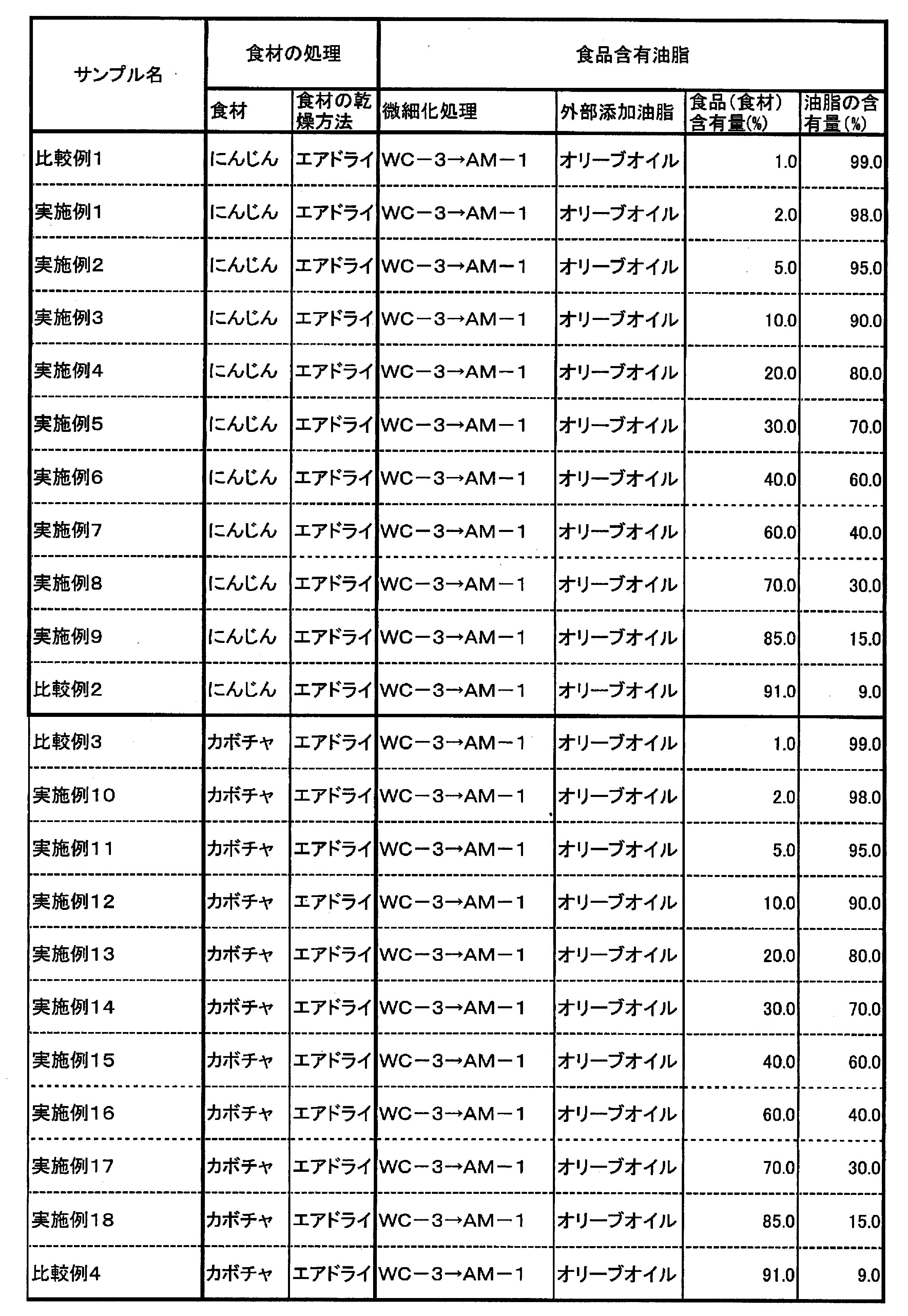


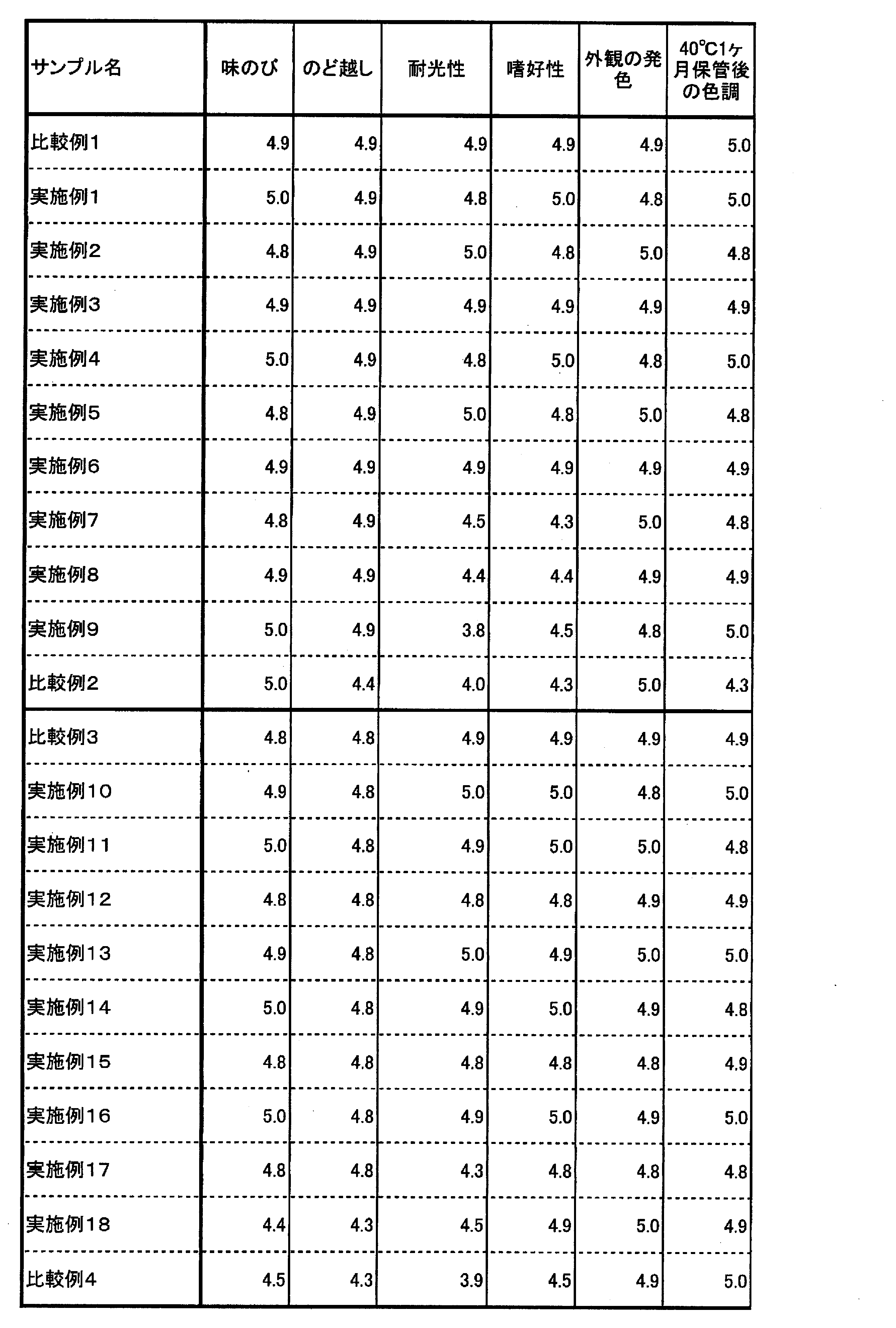

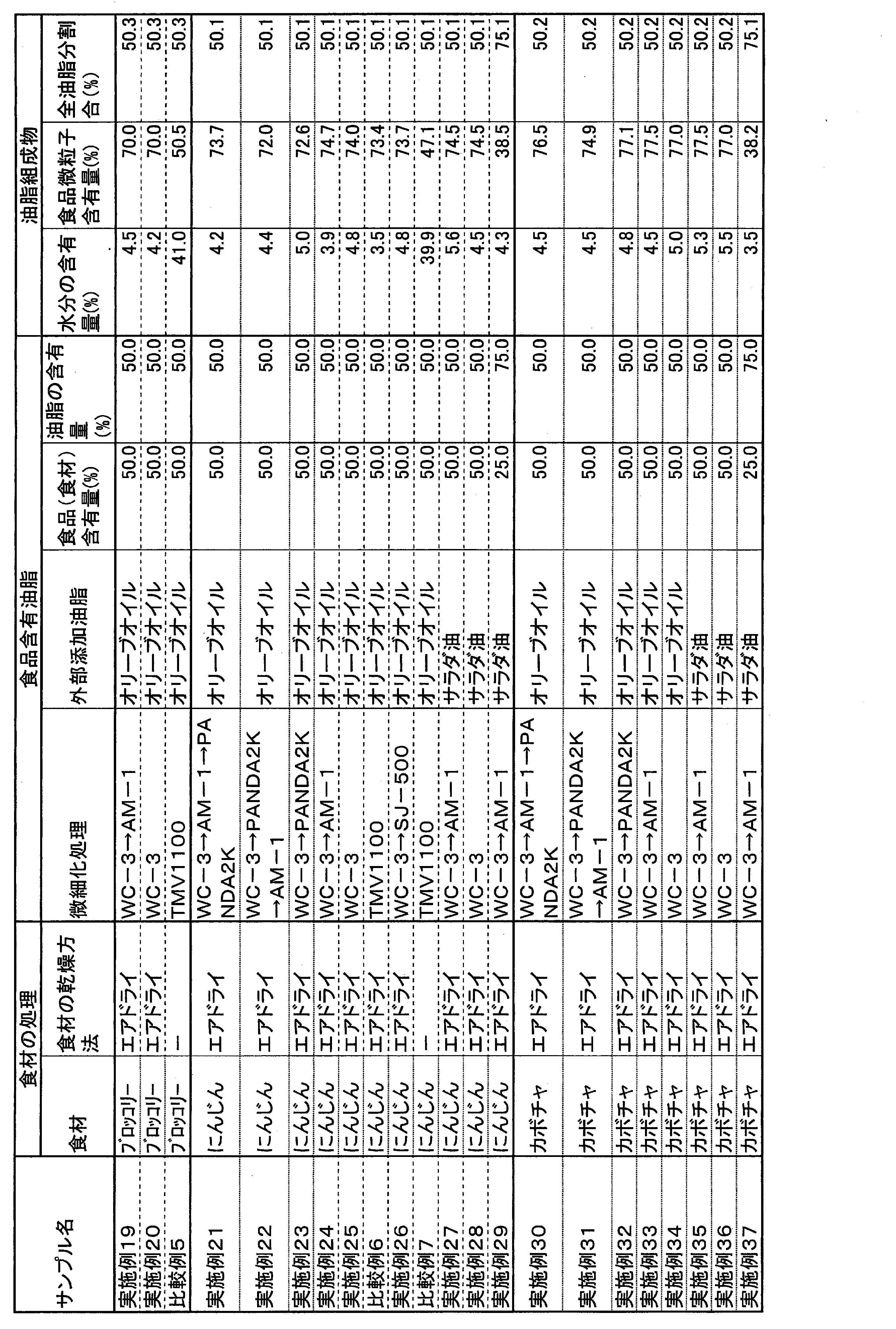


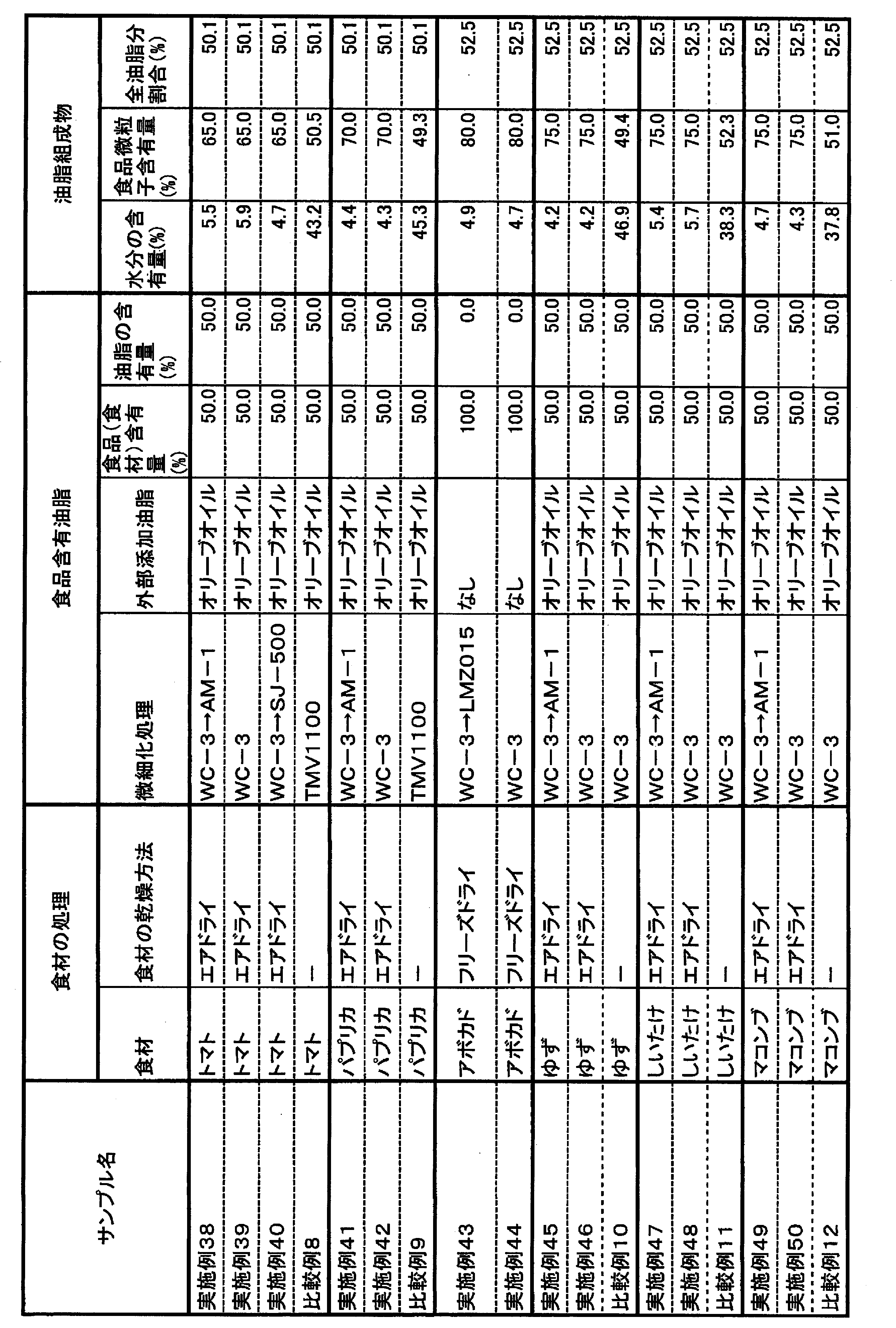
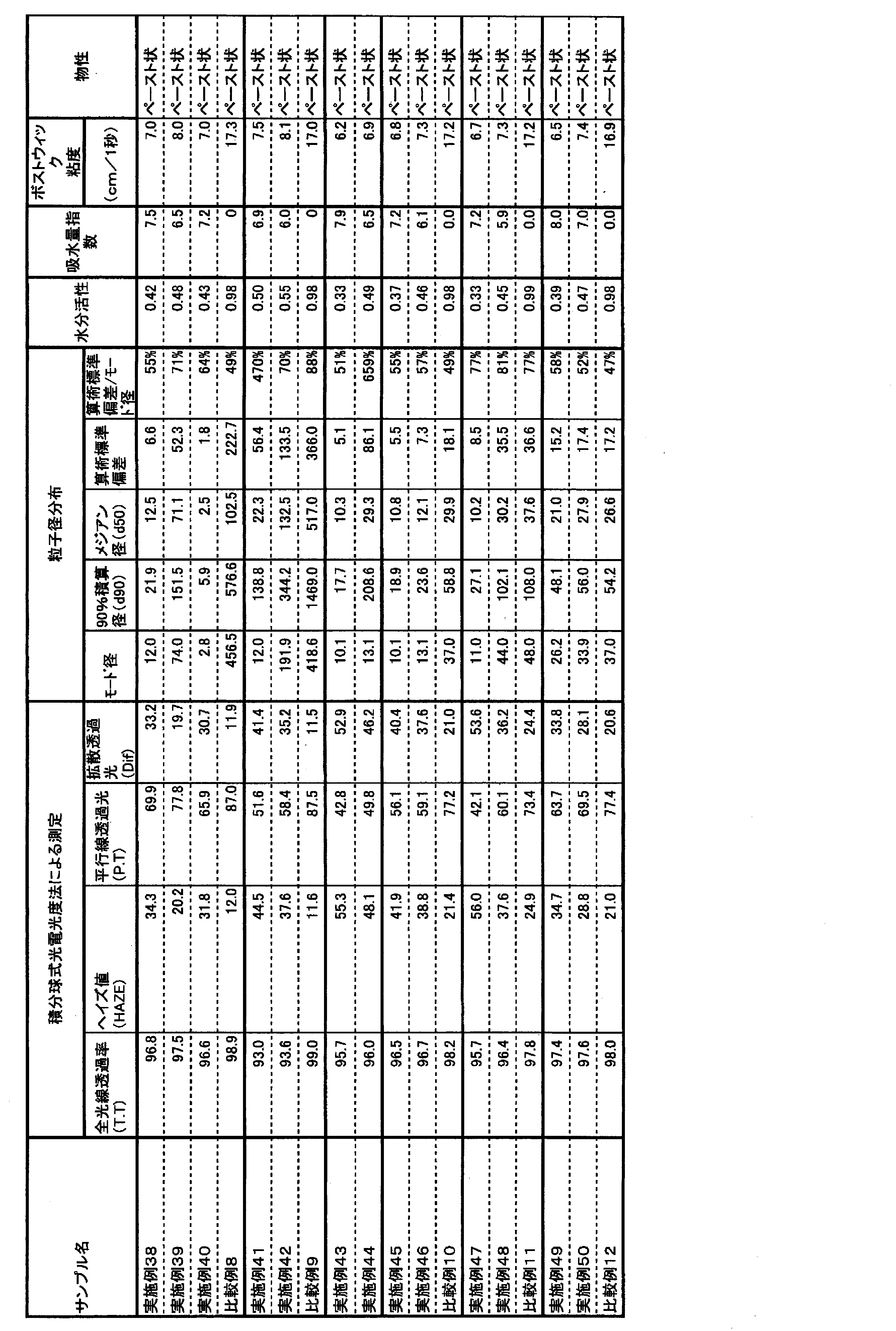


Claims (51)
- 野菜類、果実類及び藻類から選ばれる1種以上の食品微粒子と油脂とを含有する油脂組成物であって、
(1)食品微粒子の含有量が2質量%以上98質量%以下、
(2)全油脂分割合が10質量%以上98質量%以下、
(3)超音波処理を行った状態のモード径が0.3μm以上200μm以下、
(4)水分の含有量が20質量%未満
である、食品の微粒子含有油脂組成物。 - 食品微粒子含有油脂組成物の超音波処理前の最大粒子径が30μm以上である、請求項1記載の食品微粒子含有油脂組成物。
- ボストウィック粘度計による測定温度20℃、測定時間1秒の粘度が0.1cm以上28cm以下である請求項1又は2記載の食品微粒子含有油脂組成物。
- 食品微粒子含有油脂組成物の食品微粒子の含有量が15質量%以上である、請求項1~3のいずれかに記載の食品微粒子含有油脂組成物。
- 組成物の油脂部について、ボストウィック粘度計における20℃、10秒間のボストウィック粘度が10cm以上である、請求項1~4のいずれかに記載の食品微粒子含有油脂組成物。
- 液体状油脂を含む2種類以上の油脂を使用し、油脂全体の90質量%以上が液体状食用油脂であることである、請求項1~5のいずれかに記載の食品微粒子含有油脂組成物。
- 組成物中の不溶性成分全体の質量に対して、野菜類、果実類、及び藻類の合計質量が30質量%以上を占める、請求項1~6のいずれかに記載の食品微粒子含有油脂組成物。
- 食品微粒子が、油脂含有量50質量%以下の食品の微粒子である請求項1~7のいずれかに記載の食品微粒子含有油脂組成物。
- 食品微粒子含有量0.06質量%に希釈時の全光線透過率が99%以下である請求項1~8のいずれかに記載の食品微粒子含有油脂組成物。
- 食品微粒子含有量0.06質量%に希釈時のヘイズ値が11%~70%である請求項1~9のいずれかに記載の食品微粒子含有油脂組成物。
- 食品微粒子含有量0.06質量%に希釈時の拡散透過率が11%以上である請求項1~10のいずれかに記載の食品微粒子含有油脂組成物。
- 水分活性が0.97以下である請求項1~11のいずれかに記載の食品微粒子含有油脂組成物。
- 吸水量指数が0.5以上10以下である請求項1~12のいずれかに記載の食品微粒子含有油脂組成物。
- 超音波処理を行った状態の50%積算径(メジアン径)が0.3μm以上150μm以下である請求項1~13のいずれかに記載の食品微粒子含有油脂組成物。
- ボストウィック粘度計による測定温度20℃、測定時間1秒の粘度が1.0cm以上28cm以下である請求項1~14のいずれかに記載の食品微粒子含有油脂組成物。
- 請求項1~15のいずれかに記載の食品微粒子含有油脂組成物を含有する飲食品。
- 請求項1~15のいずれかに記載の食品微粒子含有油脂組成物を含有する液状調味料。
- 乾燥野菜類、乾燥果実類及び乾燥藻類から選ばれる1種以上の乾燥食品微粒子と油脂とを配合することを含む、請求項1~15のいずれかに記載の食品微粒子含有油脂組成物の製造法。
- 乾燥野菜類、乾燥果実類及び乾燥藻類から選ばれる1種以上の乾燥食品を油脂の存在下に粉砕処理することを含む、請求項1~15のいずれかに記載の食品微粒子含有油脂組成物の製造法。
- 粉砕処理が、媒体攪拌ミル粉砕処理である請求項19記載の製造法。
- 乾燥野菜類、乾燥果実類及び乾燥藻類から選ばれる1種以上の乾燥食品が油脂の存在下に微細化処理されてなる食品微粒子含有油脂組成物であって、
(1)食品微粒子の含有量が2質量%以上98質量%以下、
(2)全油脂分割合が10質量%以上98質量%以下、
(3)超音波処理した状態のモード径が0.3μm以上200μm以下、
(4)水分の含有量が20質量%未満
である、食品微粒子含有油脂組成物。 - 食品微粒子含有油脂組成物の超音波処理前の最大粒子径が30μm以上である、請求項21記載の食品微粒子含有油脂組成物。
- ボストウィック粘度計による測定温度20℃、測定時間1秒の粘度が0.1cm以上28cm以下である請求項21又は22記載の食品微粒子含有油脂組成物。
- 食品微粒子含有油脂組成物の食品微粒子の含有量が15質量%以上である、請求項21~23のいずれかに記載の食品微粒子含有油脂組成物。
- 組成物の油脂部について、ボストウィック粘度計における20℃、10秒間のボストウィック粘度が10cm以上である、請求項21~24のいずれかに記載の食品微粒子含有油脂組成物。
- 液体状油脂を含む2種類以上の油脂を使用し、油脂全体の90質量%以上が液体状食用油脂であることである、請求項21~25のいずれかに記載の食品微粒子含有油脂組成物。
- 組成物中の不溶性成分全体の重量に対して、野菜類、果実類、及び藻類の合計重量が30質量%以上を占める、請求項21~26のいずれかに記載の食品微粒子含有油脂組成物。
- 食品微粒子が、油脂含有量50質量%以下の食品の微粒子である請求項21~27のいずれかに記載の食品微粒子含有油脂組成物。
- 食品微粒子含有量0.06質量%に希釈時の全光線透過率が99%以下である請求項21~28のいずれかに記載の食品微粒子含有油脂組成物。
- 食品微粒子含有量0.06質量%に希釈時のヘイズ値が11%~70%である請求項21~29のいずれかに記載の食品微粒子含有油脂組成物。
- 食品微粒子含有量0.06質量%に希釈時の拡散透過率が11%以上である請求項21~30のいずれかに記載の食品微粒子含有油脂組成物。
- 水分活性が0.97以下である請求項21~31のいずれかに記載の食品微粒子含有油脂組成物。
- 吸水量指数が0.5以上10以下である請求項21~32のいずれかに記載の食品微粒子含有油脂組成物。
- 超音波処理した状態の50%積算径(メジアン径)が0.3μm以上150μm以下である請求項21~33のいずれかに記載の食品微粒子含有油脂組成物。
- ボストウィック粘度計による測定温度20℃、測定時間1秒の粘度が1.0cm以上28cm以下である請求項21~34のいずれかに記載の食品微粒子含有油脂組成物。
- 請求項21~34のいずれかに記載の食品微粒子含有油脂組成物を含有する飲食品。
- 請求項21~34のいずれかに記載の食品微粒子含有油脂組成物を含有する液状調味料。
- 野菜類、果実類及び藻類から選ばれる1種以上の食品の合計含有量が2質量%以上90質量%以下であり、油脂の含有量が10質量%以上98質量%以下であり、水分の含有量が20質量%未満である食品含有油脂組成物を、超音波処理を行った状態におけるモード径が0.3μm以上200μm以下となり、かつ食品含有油脂組成物の水分活性が処理前後で0.01以上低下するまで微細化処理することを含む、食品微粒子含有油脂組成物の製造法。
- 乾燥野菜類、乾燥果実類及び乾燥藻類から選ばれる1種以上の乾燥食品と油脂とを含有する乾燥食品含有油脂組成物の水分活性を低下させる方法であって、乾燥食品含有油脂組成物に微細化処理を行なうことを含む方法。
- 野菜類、果実類及び藻類から選ばれる1種以上の食品の微粒子と油脂とを含有する食品微粒子含有油脂組成物であって、食品の合計含有量が2質量%以上90質量%以下であり、油脂の含有量が10質量%以上98質量%以下であり、水分の含有量が20質量%未満である食品含有油脂組成物を、超音波処理を行った状態におけるモード径が0.3μm以上200μm以下となり、かつ食品含有油脂組成物の水分活性が処理前後で0.01以上低下するまで微細化処理して得られる、食品微粒子含有油脂組成物。
- 野菜類、果実類及び藻類から選ばれる1種以上の食品の微粒子と油脂とを含有する食品微粒子含有油脂組成物の製造法であって、食品の合計含有量が2質量%以上90質量%以下であり、油脂の含有量が10質量%以上98質量%以下であり、水分の含有量が20質量%未満である食品含有油脂組成物を、超音波処理を行った状態におけるモード径が0.3μm以上200μm以下となり、かつ食品含有油脂組成物の吸水量指数が処理前後で0.1以上増加するまで微細化処理することを含む、食品微粒子含有油脂組成物の製造法。
- 乾燥野菜類、乾燥果実類及び乾燥藻類から選ばれる1種以上の乾燥食品と油脂とを含有する乾燥食品含有油脂組成物の吸水量指数を高める方法であって、乾燥食品含有油脂組成物に微細化処理を行なうことを含む方法。
- 野菜類、果実類及び藻類から選ばれる1種以上の食品の微粒子と油脂とを含有する食品微粒子含有油脂組成物であって、食品の合計含有量が2質量%以上90質量%以下であり、油脂の含有量が10質量%以上98質量%以下であり、水分の含有量が20質量%未満である食品含有油脂組成物を、超音波処理を行った状態におけるモード径が0.3μm以上200μm以下となり、かつ食品含有油脂組成物の吸水量指数が処理前後で0.1以上増加するまで微細化処理して得られる、食品微粒子含有油脂組成物。
- 野菜類、果実類及び藻類から選ばれる1種以上の食品の微粒子と油脂とを含有する食品微粒子含有油脂組成物の製造法であって、食品の合計含有量が2質量%以上90質量%以下であり、油脂の含有量が10質量%以上98質量%以下であり、水分の含有量が20質量%未満である食品含有油脂組成物を、超音波処理を行った状態におけるモード径が0.3μm以上200μm以下となり、かつ食品含有油脂組成物のヘイズ値が処理前後で1以上増加するまで微細化処理することを含む、食品微粒子含有油脂組成物の製造法。
- 乾燥野菜類、乾燥果実類及び乾燥藻類から選ばれる1種以上の乾燥食品と油脂とを含有する乾燥食品含有油脂組成物のヘイズ値を高める方法であって、乾燥食品含有油脂組成物に微細化処理を行なうことを含む方法。
- 野菜類、果実類及び藻類から選ばれる1種以上の食品の微粒子と油脂とを含有する食品微粒子含有油脂組成物の製造法であって、食品の合計含有量が2質量%以上90質量%以下であり、油脂の含有量が10質量%以上98質量%以下であり、水分の含有量が20質量%未満である食品含有油脂組成物を、超音波処理を行った状態におけるモード径が0.3μm以上200μm以下となり、かつ食品含有油脂のヘイズ値が処理前後で1以上増加するまで微細化処理して得られる、食品微粒子含有油脂組成物。
- 乾燥野菜類、乾燥果実類及び乾燥藻類から選ばれる1種以上の乾燥食品と油脂とを含有する乾燥食品含有油脂組成物の味のびを高める方法であって、乾燥食品含有油脂組成物に微細化処理を行なうことを含む方法。
- 乾燥野菜類、乾燥果実類及び乾燥藻類から選ばれる1種以上の乾燥食品と油脂とを含有する乾燥食品含有油脂組成物ののど越しを高める方法であって、乾燥食品含有油脂組成物に微細化処理を行なうことを含む方法。
- 乾燥野菜類、乾燥果実類及び乾燥藻類から選ばれる1種以上の乾燥食品と油脂とを含有する乾燥食品含有油脂組成物の安定性を高める方法であって、乾燥食品含有油脂組成物に微細化処理を行なうことを含む方法。
- 乾燥野菜類、乾燥果実類及び乾燥藻類から選ばれる1種以上の乾燥食品と油脂とを含有する乾燥食品含有油脂組成物のなめらかさを改善する方法であって、乾燥食品含有油脂組成物に微細化処理を行なうことを含む方法。
- 乾燥野菜類、乾燥果実類及び乾燥藻類から選ばれる1種以上の乾燥食品と油脂とを含有する乾燥食品含有油脂組成物の先味を改善する方法であって、乾燥食品含有油脂組成物に微細化処理を行なうことを含む方法。
Priority Applications (11)
| Application Number | Priority Date | Filing Date | Title |
|---|---|---|---|
| JP2018538665A JP6511588B2 (ja) | 2017-02-22 | 2018-02-21 | 食品微粒子含有油脂組成物及びその製造法 |
| CA3054391A CA3054391A1 (en) | 2017-02-22 | 2018-02-21 | Fine food-particle-containing oil/fat composition and method for producing same |
| EP18756589.0A EP3539389A4 (en) | 2017-02-22 | 2018-02-21 | FOOD PARTICULAR OIL / FAT COMPOSITION AND METHOD FOR THE MANUFACTURE THEREOF |
| CN201880013327.9A CN110312430B (zh) | 2017-02-22 | 2018-02-21 | 含食品微粒的油脂组合物和其制造方法 |
| PH1/2019/501912A PH12019501912B1 (en) | 2017-02-22 | 2018-02-21 | Fine food-particle-containing oil/fat composition and method for producing same |
| KR1020197023418A KR102149627B1 (ko) | 2017-02-22 | 2018-02-21 | 식품 미립자 함유 유지 조성물 및 그 제조법 |
| BR112019017483-4A BR112019017483B1 (pt) | 2017-02-22 | 2018-02-21 | composições de óleo/gordura contendo partículas finas de alimentos, métodos para produzir as ditas composições e métodos para aumentar o índice de absorção de água, para aumentar um valor de opacidade, para acentuar a extensão do sabor, para acentuar a sensação de deglutição e para acentuar a estabilidade, para aprimorar a suavidade e para aprimorar um sabor inicial das ditas composições |
| MX2019009988A MX2019009988A (es) | 2017-02-22 | 2018-02-21 | Composicion de aceite/grasa que contiene particulas finas de alimento y metodo para la produccion de la misma. |
| SG11201907788SA SG11201907788SA (en) | 2017-02-22 | 2018-02-21 | Fine food-particle-containing oil/fat composition and method for producing same |
| AU2018225919A AU2018225919B2 (en) | 2017-02-22 | 2018-02-21 | Fine food-particle-containing oil/fat composition and method for producing same |
| US16/548,014 US20190373925A1 (en) | 2017-02-22 | 2019-08-22 | Fine food-particle-containing oil/fat composition and method for producing same |
Applications Claiming Priority (4)
| Application Number | Priority Date | Filing Date | Title |
|---|---|---|---|
| JP2017031523 | 2017-02-22 | ||
| JP2017-031523 | 2017-02-22 | ||
| JPPCT/JP2017/033406 | 2017-09-15 | ||
| JP2017033406 | 2017-09-15 |
Related Child Applications (1)
| Application Number | Title | Priority Date | Filing Date |
|---|---|---|---|
| US16/548,014 Continuation US20190373925A1 (en) | 2017-02-22 | 2019-08-22 | Fine food-particle-containing oil/fat composition and method for producing same |
Publications (1)
| Publication Number | Publication Date |
|---|---|
| WO2018155488A1 true WO2018155488A1 (ja) | 2018-08-30 |
Family
ID=63253303
Family Applications (1)
| Application Number | Title | Priority Date | Filing Date |
|---|---|---|---|
| PCT/JP2018/006205 Ceased WO2018155488A1 (ja) | 2017-02-22 | 2018-02-21 | 食品微粒子含有油脂組成物及びその製造法 |
Country Status (13)
| Country | Link |
|---|---|
| US (1) | US20190373925A1 (ja) |
| EP (1) | EP3539389A4 (ja) |
| JP (1) | JP6511588B2 (ja) |
| KR (1) | KR102149627B1 (ja) |
| CN (1) | CN110312430B (ja) |
| AU (1) | AU2018225919B2 (ja) |
| BR (1) | BR112019017483B1 (ja) |
| CA (1) | CA3054391A1 (ja) |
| MX (1) | MX2019009988A (ja) |
| PH (1) | PH12019501912B1 (ja) |
| SG (1) | SG11201907788SA (ja) |
| TW (1) | TWI683625B (ja) |
| WO (1) | WO2018155488A1 (ja) |
Cited By (10)
| Publication number | Priority date | Publication date | Assignee | Title |
|---|---|---|---|---|
| WO2019039478A1 (ja) * | 2017-08-24 | 2019-02-28 | 株式会社Mizkan Holdings | 液状又は半固体状乳化調味料及びその製造法、風味改善方法 |
| WO2019049915A1 (ja) * | 2017-09-11 | 2019-03-14 | 株式会社Mizkan Holdings | 乳化調味料及びその製造方法 |
| WO2019163857A1 (ja) * | 2018-02-22 | 2019-08-29 | 株式会社Mizkan Holdings | 食品油脂混合物及びその製造方法 |
| WO2019193780A1 (ja) * | 2018-04-06 | 2019-10-10 | 株式会社Mizkan Holdings | 微粒子複合体含有組成物及びその製造法 |
| WO2019235150A1 (ja) * | 2018-06-08 | 2019-12-12 | 株式会社Mizkan Holdings | 微粒子複合体含有油脂組成物及びその製造法 |
| JP6792310B1 (ja) * | 2019-05-22 | 2020-11-25 | 株式会社Mizkan Holdings | 不溶性食物繊維含有固形状組成物及びその製造法 |
| WO2020235138A1 (ja) * | 2019-05-22 | 2020-11-26 | 株式会社Mizkan Holdings | 不溶性食物繊維含有固形状組成物及びその製造法 |
| KR20220097027A (ko) * | 2020-12-31 | 2022-07-07 | 씨제이제일제당 (주) | 유지의 산패 억제용 조성물 |
| JP2022543192A (ja) * | 2019-08-04 | 2022-10-11 | オメガ 3 ガリリー リミテッド | 食用固形物の油懸濁液及びその調製方法 |
| JP2023026201A (ja) * | 2021-08-13 | 2023-02-24 | アヲハタ株式会社 | 油脂食品組成物 |
Families Citing this family (6)
| Publication number | Priority date | Publication date | Assignee | Title |
|---|---|---|---|---|
| SG11201907813UA (en) * | 2018-01-12 | 2019-09-27 | Mizkan Holdings Co Ltd | Paste containing fine food particles, and method for producing same |
| JP2023047353A (ja) * | 2019-12-17 | 2023-04-06 | アサマ化成株式会社 | 静菌効果を有する食用油脂組成物 |
| RU2759830C1 (ru) * | 2020-08-12 | 2021-11-18 | Федеральное государственное бюджетное образовательное учреждение высшего образования "Московский государственный университет технологий и управления имени К.Г. Разумовского (ПКУ)" | Способ производства мучных восточных сладостей |
| CN112414813B (zh) * | 2020-11-24 | 2022-12-13 | 青岛赛时检验有限公司 | 一种柴油总污染物含量的能力验证样品及制备方法和应用 |
| KR102770746B1 (ko) * | 2021-04-01 | 2025-02-19 | 전남대학교산학협력단 | 점조도가 증가된 저칼로리 꼬치용 쌈장 맛 소스 및 그의 제조 방법 |
| KR102514937B1 (ko) * | 2022-03-29 | 2023-03-30 | (주)콩두에프앤씨 | 들기름 버터 크림 제조 방법 및 이를 통해 생산되는 들기름 버터 크림 |
Citations (5)
| Publication number | Priority date | Publication date | Assignee | Title |
|---|---|---|---|---|
| JPH02186942A (ja) | 1989-01-11 | 1990-07-23 | Miyoshi Oil & Fat Co Ltd | フィリング組成物 |
| JPH07327605A (ja) | 1994-05-30 | 1995-12-19 | Barilla G E R F Lli Spa | 辛口スナック用フィリング及びその製造方法 |
| WO1997041741A1 (en) * | 1996-05-02 | 1997-11-13 | Josef Palicka | Tablet made of vegetable substance |
| JP2006141291A (ja) | 2004-11-19 | 2006-06-08 | Oriental Foods Kk | 粉砕緑黄色野菜及びその製造方法並びに食品調味料 |
| JP2009543562A (ja) | 2006-07-19 | 2009-12-10 | グレイン フーズ シーアールシー リミテッド | スプレッド食品およびその製造方法 |
Family Cites Families (4)
| Publication number | Priority date | Publication date | Assignee | Title |
|---|---|---|---|---|
| FR2198707A1 (en) * | 1973-09-14 | 1974-04-05 | Uncle Ben S Australia Pty | Food product with plastic texture - from powdered animal protein suspended in oily/fatty vehicle |
| WO2000038541A1 (en) * | 1998-12-23 | 2000-07-06 | Unilever N.V. | Fortification of food products with olive fruit ingredients |
| EP1269864A1 (en) * | 2001-06-20 | 2003-01-02 | Societe Des Produits Nestle S.A. | "Hard bouillon tablet" |
| KR101139064B1 (ko) * | 2009-06-25 | 2012-04-30 | 전현철 | 달콤한 소금과 비타녹차조미유를 함유하는 조미 김(海苔) 조성물 |
-
2018
- 2018-02-21 BR BR112019017483-4A patent/BR112019017483B1/pt active IP Right Grant
- 2018-02-21 AU AU2018225919A patent/AU2018225919B2/en active Active
- 2018-02-21 CN CN201880013327.9A patent/CN110312430B/zh active Active
- 2018-02-21 WO PCT/JP2018/006205 patent/WO2018155488A1/ja not_active Ceased
- 2018-02-21 MX MX2019009988A patent/MX2019009988A/es unknown
- 2018-02-21 PH PH1/2019/501912A patent/PH12019501912B1/en unknown
- 2018-02-21 JP JP2018538665A patent/JP6511588B2/ja active Active
- 2018-02-21 SG SG11201907788SA patent/SG11201907788SA/en unknown
- 2018-02-21 EP EP18756589.0A patent/EP3539389A4/en not_active Withdrawn
- 2018-02-21 KR KR1020197023418A patent/KR102149627B1/ko active Active
- 2018-02-21 CA CA3054391A patent/CA3054391A1/en active Pending
- 2018-02-22 TW TW107105951A patent/TWI683625B/zh active
-
2019
- 2019-08-22 US US16/548,014 patent/US20190373925A1/en not_active Abandoned
Patent Citations (5)
| Publication number | Priority date | Publication date | Assignee | Title |
|---|---|---|---|---|
| JPH02186942A (ja) | 1989-01-11 | 1990-07-23 | Miyoshi Oil & Fat Co Ltd | フィリング組成物 |
| JPH07327605A (ja) | 1994-05-30 | 1995-12-19 | Barilla G E R F Lli Spa | 辛口スナック用フィリング及びその製造方法 |
| WO1997041741A1 (en) * | 1996-05-02 | 1997-11-13 | Josef Palicka | Tablet made of vegetable substance |
| JP2006141291A (ja) | 2004-11-19 | 2006-06-08 | Oriental Foods Kk | 粉砕緑黄色野菜及びその製造方法並びに食品調味料 |
| JP2009543562A (ja) | 2006-07-19 | 2009-12-10 | グレイン フーズ シーアールシー リミテッド | スプレッド食品およびその製造方法 |
Non-Patent Citations (1)
| Title |
|---|
| See also references of EP3539389A4 |
Cited By (29)
| Publication number | Priority date | Publication date | Assignee | Title |
|---|---|---|---|---|
| WO2019039478A1 (ja) * | 2017-08-24 | 2019-02-28 | 株式会社Mizkan Holdings | 液状又は半固体状乳化調味料及びその製造法、風味改善方法 |
| US11412767B2 (en) | 2017-08-24 | 2022-08-16 | Mizkan Holdings Co., Ltd. | Liquid or semi-solid emulsion seasoning, method for manufacturing same and flavor improving method |
| WO2019049915A1 (ja) * | 2017-09-11 | 2019-03-14 | 株式会社Mizkan Holdings | 乳化調味料及びその製造方法 |
| JPWO2019049915A1 (ja) * | 2017-09-11 | 2019-11-07 | 株式会社Mizkan Holdings | 乳化調味料及びその製造方法 |
| EP3632220A4 (en) * | 2017-09-11 | 2020-06-24 | Mizkan Holdings Co., Ltd. | Emulsified seasoning and method for manufacturing same |
| WO2019163857A1 (ja) * | 2018-02-22 | 2019-08-29 | 株式会社Mizkan Holdings | 食品油脂混合物及びその製造方法 |
| JP6607628B1 (ja) * | 2018-02-22 | 2019-11-20 | 株式会社Mizkan Holdings | 食品油脂混合物及びその製造方法 |
| WO2019193780A1 (ja) * | 2018-04-06 | 2019-10-10 | 株式会社Mizkan Holdings | 微粒子複合体含有組成物及びその製造法 |
| US11678686B2 (en) | 2018-04-06 | 2023-06-20 | Mizkan Holdings Co., Ltd. | Composition containing fine particle composite and method for manufacturing the same |
| US12004551B2 (en) | 2018-06-08 | 2024-06-11 | Mizkan Holdings Co., Ltd. | Fat/oil composition containing fine particle composite and method for producing same |
| WO2019235150A1 (ja) * | 2018-06-08 | 2019-12-12 | 株式会社Mizkan Holdings | 微粒子複合体含有油脂組成物及びその製造法 |
| JP6792310B1 (ja) * | 2019-05-22 | 2020-11-25 | 株式会社Mizkan Holdings | 不溶性食物繊維含有固形状組成物及びその製造法 |
| AU2020278263B2 (en) * | 2019-05-22 | 2021-08-12 | Mizkan Holdings Co., Ltd. | Solid composition containing insoluble dietary fiber and method for manufacturing the same |
| EP3841890A4 (en) * | 2019-05-22 | 2021-12-29 | Mizkan Holdings Co., Ltd. | Insoluble dietary fiber-containing solid composition and method for manufacturing same |
| CN112955026A (zh) * | 2019-05-22 | 2021-06-11 | 味滋康控股有限公司 | 含有不溶性食物纤维的固状组合物及其制造方法 |
| KR102419703B1 (ko) | 2019-05-22 | 2022-07-11 | 미쯔칸 홀딩즈 씨오., 엘티디. | 불용성 식물 섬유 함유 고형상 조성물 및 그 제조법 |
| KR20210065978A (ko) * | 2019-05-22 | 2021-06-04 | 미쯔칸 홀딩즈 씨오., 엘티디. | 불용성 식물 섬유 함유 고형상 조성물 및 그 제조법 |
| EP4321035A3 (en) * | 2019-05-22 | 2024-05-22 | Mizkan Holdings Co., Ltd. | Insoluble dietary fiber-containing solid composition and method for manufacturing same |
| WO2020235138A1 (ja) * | 2019-05-22 | 2020-11-26 | 株式会社Mizkan Holdings | 不溶性食物繊維含有固形状組成物及びその製造法 |
| JP7474836B2 (ja) | 2019-08-04 | 2024-04-25 | オメガ 3 ガリリー リミテッド | 食用固形物の油懸濁液及びその調製方法 |
| US11832631B2 (en) | 2019-08-04 | 2023-12-05 | Omega 3 Galilee Ltd. | Oil suspensions of edible solids, triglycerides with saturated fatty acids, MCT oils with antioxidants and solid and semi-solid oil-derivatives for food |
| JP2024063142A (ja) * | 2019-08-04 | 2024-05-10 | オメガ 3 ガリリー リミテッド | 食用固形物の油懸濁液及びその調製方法 |
| JP2022543192A (ja) * | 2019-08-04 | 2022-10-11 | オメガ 3 ガリリー リミテッド | 食用固形物の油懸濁液及びその調製方法 |
| US12439934B2 (en) | 2019-08-04 | 2025-10-14 | Omega 3 Galilee Ltd. | Oil suspensions of edible solids, triglycerides with saturated fatty acids, mct oils with antioxidants and solid and semi-solid oil-derivatives for food applications |
| JP7788480B2 (ja) | 2019-08-04 | 2025-12-18 | オメガ 3 ガリリー リミテッド | 食用固形物の油懸濁液及びその調製方法 |
| JP7788480B6 (ja) | 2019-08-04 | 2026-01-21 | オメガ 3 ガリリー リミテッド | 食用固形物の油懸濁液及びその調製方法 |
| KR20220097027A (ko) * | 2020-12-31 | 2022-07-07 | 씨제이제일제당 (주) | 유지의 산패 억제용 조성물 |
| KR102738989B1 (ko) | 2020-12-31 | 2024-12-06 | 씨제이제일제당 (주) | 유지의 산패 억제용 조성물 |
| JP2023026201A (ja) * | 2021-08-13 | 2023-02-24 | アヲハタ株式会社 | 油脂食品組成物 |
Also Published As
| Publication number | Publication date |
|---|---|
| BR112019017483B1 (pt) | 2020-10-20 |
| TWI683625B (zh) | 2020-02-01 |
| CN110312430A (zh) | 2019-10-08 |
| KR102149627B1 (ko) | 2020-08-28 |
| EP3539389A4 (en) | 2019-11-20 |
| US20190373925A1 (en) | 2019-12-12 |
| MX2019009988A (es) | 2019-10-14 |
| KR20190099083A (ko) | 2019-08-23 |
| SG11201907788SA (en) | 2019-09-27 |
| TW201836476A (zh) | 2018-10-16 |
| CN110312430B (zh) | 2021-09-14 |
| AU2018225919A1 (en) | 2019-08-29 |
| JPWO2018155488A1 (ja) | 2019-02-28 |
| BR112019017483A2 (pt) | 2020-03-17 |
| JP6511588B2 (ja) | 2019-05-15 |
| PH12019501912A1 (en) | 2020-03-16 |
| PH12019501912B1 (en) | 2022-06-22 |
| CA3054391A1 (en) | 2018-08-30 |
| EP3539389A1 (en) | 2019-09-18 |
| AU2018225919B2 (en) | 2020-04-30 |
Similar Documents
| Publication | Publication Date | Title |
|---|---|---|
| WO2018155488A1 (ja) | 食品微粒子含有油脂組成物及びその製造法 | |
| JP6471273B1 (ja) | 食品微粒子含有ペースト及びその製造法 | |
| US11678686B2 (en) | Composition containing fine particle composite and method for manufacturing the same | |
| US12004551B2 (en) | Fat/oil composition containing fine particle composite and method for producing same | |
| US20200154742A1 (en) | Emulsified condiment and production method thereof | |
| JP6582304B1 (ja) | 微粒子複合体含有組成物及びその製造法 | |
| JPWO2019049915A1 (ja) | 乳化調味料及びその製造方法 | |
| HK40009155A (en) | Food-particle-containing oil/fat composition and method for producing same | |
| HK40009155B (zh) | 含食品微粒的油脂组合物和其制造方法 | |
| HK40007520A (en) | Food-particle-containing oil/fat composition and method for producing same |
Legal Events
| Date | Code | Title | Description |
|---|---|---|---|
| ENP | Entry into the national phase |
Ref document number: 2018538665 Country of ref document: JP Kind code of ref document: A |
|
| 121 | Ep: the epo has been informed by wipo that ep was designated in this application |
Ref document number: 18756589 Country of ref document: EP Kind code of ref document: A1 |
|
| ENP | Entry into the national phase |
Ref document number: 2018756589 Country of ref document: EP Effective date: 20190614 |
|
| ENP | Entry into the national phase |
Ref document number: 20197023418 Country of ref document: KR Kind code of ref document: A |
|
| ENP | Entry into the national phase |
Ref document number: 3054391 Country of ref document: CA |
|
| NENP | Non-entry into the national phase |
Ref country code: DE |
|
| ENP | Entry into the national phase |
Ref document number: 2018225919 Country of ref document: AU Date of ref document: 20180221 Kind code of ref document: A |
|
| REG | Reference to national code |
Ref country code: BR Ref legal event code: B01A Ref document number: 112019017483 Country of ref document: BR |
|
| ENP | Entry into the national phase |
Ref document number: 112019017483 Country of ref document: BR Kind code of ref document: A2 Effective date: 20190822 |