WO2018169023A1 - 複合体結晶とこれを備えるケモセンサ - Google Patents
複合体結晶とこれを備えるケモセンサ Download PDFInfo
- Publication number
- WO2018169023A1 WO2018169023A1 PCT/JP2018/010344 JP2018010344W WO2018169023A1 WO 2018169023 A1 WO2018169023 A1 WO 2018169023A1 JP 2018010344 W JP2018010344 W JP 2018010344W WO 2018169023 A1 WO2018169023 A1 WO 2018169023A1
- Authority
- WO
- WIPO (PCT)
- Prior art keywords
- group
- crystal
- complex crystal
- supramolecular
- composite
- Prior art date
- Legal status (The legal status is an assumption and is not a legal conclusion. Google has not performed a legal analysis and makes no representation as to the accuracy of the status listed.)
- Ceased
Links
- QXENIPSNYCZWNY-UHFFFAOYSA-N COc1ccc(C(c2ccccc2)(c2ccccc2)N)cc1 Chemical compound COc1ccc(C(c2ccccc2)(c2ccccc2)N)cc1 QXENIPSNYCZWNY-UHFFFAOYSA-N 0.000 description 1
- UZRNNAKVIOZYCR-UHFFFAOYSA-N NC(C1=CC=CCC1)(c1ccccc1)c1cnccc1 Chemical compound NC(C1=CC=CCC1)(c1ccccc1)c1cnccc1 UZRNNAKVIOZYCR-UHFFFAOYSA-N 0.000 description 1
- INKSEXJAJBKDFK-UHFFFAOYSA-N NC(C1=COCC1)(c1ccccc1)c1ccccc1 Chemical compound NC(C1=COCC1)(c1ccccc1)c1ccccc1 INKSEXJAJBKDFK-UHFFFAOYSA-N 0.000 description 1
- QCOONDHSMGALKD-UHFFFAOYSA-N NC(c(cc1)ccc1F)(c(cc1)ccc1F)c(cc1)ccc1F Chemical compound NC(c(cc1)ccc1F)(c(cc1)ccc1F)c(cc1)ccc1F QCOONDHSMGALKD-UHFFFAOYSA-N 0.000 description 1
- SKJULJRMMPHQDC-UHFFFAOYSA-N NC(c1c[s]cc1)(c1ccccc1)c1ccccc1 Chemical compound NC(c1c[s]cc1)(c1ccccc1)c1ccccc1 SKJULJRMMPHQDC-UHFFFAOYSA-N 0.000 description 1
Images



Classifications
-
- C—CHEMISTRY; METALLURGY
- C07—ORGANIC CHEMISTRY
- C07D—HETEROCYCLIC COMPOUNDS
- C07D279/00—Heterocyclic compounds containing six-membered rings having one nitrogen atom and one sulfur atom as the only ring hetero atoms
- C07D279/10—1,4-Thiazines; Hydrogenated 1,4-thiazines
- C07D279/14—1,4-Thiazines; Hydrogenated 1,4-thiazines condensed with carbocyclic rings or ring systems
- C07D279/18—[b, e]-condensed with two six-membered rings
- C07D279/22—[b, e]-condensed with two six-membered rings with carbon atoms directly attached to the ring nitrogen atom
-
- B—PERFORMING OPERATIONS; TRANSPORTING
- B01—PHYSICAL OR CHEMICAL PROCESSES OR APPARATUS IN GENERAL
- B01D—SEPARATION
- B01D53/00—Separation of gases or vapours; Recovering vapours of volatile solvents from gases; Chemical or biological purification of waste gases, e.g. engine exhaust gases, smoke, fumes, flue gases, aerosols
- B01D53/14—Separation of gases or vapours; Recovering vapours of volatile solvents from gases; Chemical or biological purification of waste gases, e.g. engine exhaust gases, smoke, fumes, flue gases, aerosols by absorption
-
- B—PERFORMING OPERATIONS; TRANSPORTING
- B01—PHYSICAL OR CHEMICAL PROCESSES OR APPARATUS IN GENERAL
- B01J—CHEMICAL OR PHYSICAL PROCESSES, e.g. CATALYSIS OR COLLOID CHEMISTRY; THEIR RELEVANT APPARATUS
- B01J20/00—Solid sorbent compositions or filter aid compositions; Sorbents for chromatography; Processes for preparing, regenerating or reactivating thereof
- B01J20/22—Solid sorbent compositions or filter aid compositions; Sorbents for chromatography; Processes for preparing, regenerating or reactivating thereof comprising organic material
-
- B—PERFORMING OPERATIONS; TRANSPORTING
- B01—PHYSICAL OR CHEMICAL PROCESSES OR APPARATUS IN GENERAL
- B01J—CHEMICAL OR PHYSICAL PROCESSES, e.g. CATALYSIS OR COLLOID CHEMISTRY; THEIR RELEVANT APPARATUS
- B01J20/00—Solid sorbent compositions or filter aid compositions; Sorbents for chromatography; Processes for preparing, regenerating or reactivating thereof
- B01J20/30—Processes for preparing, regenerating, or reactivating
-
- C—CHEMISTRY; METALLURGY
- C07—ORGANIC CHEMISTRY
- C07C—ACYCLIC OR CARBOCYCLIC COMPOUNDS
- C07C211/00—Compounds containing amino groups bound to a carbon skeleton
- C07C211/01—Compounds containing amino groups bound to a carbon skeleton having amino groups bound to acyclic carbon atoms
- C07C211/26—Compounds containing amino groups bound to a carbon skeleton having amino groups bound to acyclic carbon atoms of an unsaturated carbon skeleton containing at least one six-membered aromatic ring
- C07C211/27—Compounds containing amino groups bound to a carbon skeleton having amino groups bound to acyclic carbon atoms of an unsaturated carbon skeleton containing at least one six-membered aromatic ring having amino groups linked to the six-membered aromatic ring by saturated carbon chains
-
- C—CHEMISTRY; METALLURGY
- C07—ORGANIC CHEMISTRY
- C07C—ACYCLIC OR CARBOCYCLIC COMPOUNDS
- C07C217/00—Compounds containing amino and etherified hydroxy groups bound to the same carbon skeleton
- C07C217/54—Compounds containing amino and etherified hydroxy groups bound to the same carbon skeleton having etherified hydroxy groups bound to carbon atoms of at least one six-membered aromatic ring and amino groups bound to acyclic carbon atoms or to carbon atoms of rings other than six-membered aromatic rings of the same carbon skeleton
- C07C217/56—Compounds containing amino and etherified hydroxy groups bound to the same carbon skeleton having etherified hydroxy groups bound to carbon atoms of at least one six-membered aromatic ring and amino groups bound to acyclic carbon atoms or to carbon atoms of rings other than six-membered aromatic rings of the same carbon skeleton with amino groups linked to the six-membered aromatic ring, or to the condensed ring system containing that ring, by carbon chains not further substituted by singly-bound oxygen atoms
- C07C217/58—Compounds containing amino and etherified hydroxy groups bound to the same carbon skeleton having etherified hydroxy groups bound to carbon atoms of at least one six-membered aromatic ring and amino groups bound to acyclic carbon atoms or to carbon atoms of rings other than six-membered aromatic rings of the same carbon skeleton with amino groups linked to the six-membered aromatic ring, or to the condensed ring system containing that ring, by carbon chains not further substituted by singly-bound oxygen atoms with amino groups and the six-membered aromatic ring, or the condensed ring system containing that ring, bound to the same carbon atom of the carbon chain
-
- C—CHEMISTRY; METALLURGY
- C07—ORGANIC CHEMISTRY
- C07C—ACYCLIC OR CARBOCYCLIC COMPOUNDS
- C07C255/00—Carboxylic acid nitriles
- C07C255/01—Carboxylic acid nitriles having cyano groups bound to acyclic carbon atoms
- C07C255/32—Carboxylic acid nitriles having cyano groups bound to acyclic carbon atoms having cyano groups bound to acyclic carbon atoms of a carbon skeleton containing at least one six-membered aromatic ring
- C07C255/42—Carboxylic acid nitriles having cyano groups bound to acyclic carbon atoms having cyano groups bound to acyclic carbon atoms of a carbon skeleton containing at least one six-membered aromatic ring the carbon skeleton being further substituted by singly-bound nitrogen atoms, not being further bound to other hetero atoms
-
- C—CHEMISTRY; METALLURGY
- C07—ORGANIC CHEMISTRY
- C07D—HETEROCYCLIC COMPOUNDS
- C07D209/00—Heterocyclic compounds containing five-membered rings, condensed with other rings, with one nitrogen atom as the only ring hetero atom
- C07D209/56—Ring systems containing three or more rings
- C07D209/80—[b, c]- or [b, d]-condensed
- C07D209/82—Carbazoles; Hydrogenated carbazoles
-
- C—CHEMISTRY; METALLURGY
- C07—ORGANIC CHEMISTRY
- C07D—HETEROCYCLIC COMPOUNDS
- C07D209/00—Heterocyclic compounds containing five-membered rings, condensed with other rings, with one nitrogen atom as the only ring hetero atom
- C07D209/56—Ring systems containing three or more rings
- C07D209/80—[b, c]- or [b, d]-condensed
- C07D209/82—Carbazoles; Hydrogenated carbazoles
- C07D209/86—Carbazoles; Hydrogenated carbazoles with only hydrogen atoms, hydrocarbon or substituted hydrocarbon radicals, directly attached to carbon atoms of the ring system
-
- C—CHEMISTRY; METALLURGY
- C07—ORGANIC CHEMISTRY
- C07D—HETEROCYCLIC COMPOUNDS
- C07D213/00—Heterocyclic compounds containing six-membered rings, not condensed with other rings, with one nitrogen atom as the only ring hetero atom and three or more double bonds between ring members or between ring members and non-ring members
- C07D213/02—Heterocyclic compounds containing six-membered rings, not condensed with other rings, with one nitrogen atom as the only ring hetero atom and three or more double bonds between ring members or between ring members and non-ring members having three double bonds between ring members or between ring members and non-ring members
- C07D213/04—Heterocyclic compounds containing six-membered rings, not condensed with other rings, with one nitrogen atom as the only ring hetero atom and three or more double bonds between ring members or between ring members and non-ring members having three double bonds between ring members or between ring members and non-ring members having no bond between the ring nitrogen atom and a non-ring member or having only hydrogen or carbon atoms directly attached to the ring nitrogen atom
- C07D213/24—Heterocyclic compounds containing six-membered rings, not condensed with other rings, with one nitrogen atom as the only ring hetero atom and three or more double bonds between ring members or between ring members and non-ring members having three double bonds between ring members or between ring members and non-ring members having no bond between the ring nitrogen atom and a non-ring member or having only hydrogen or carbon atoms directly attached to the ring nitrogen atom with substituted hydrocarbon radicals attached to ring carbon atoms
- C07D213/36—Radicals substituted by singly-bound nitrogen atoms
- C07D213/38—Radicals substituted by singly-bound nitrogen atoms having only hydrogen or hydrocarbon radicals attached to the substituent nitrogen atom
-
- C—CHEMISTRY; METALLURGY
- C07—ORGANIC CHEMISTRY
- C07D—HETEROCYCLIC COMPOUNDS
- C07D213/00—Heterocyclic compounds containing six-membered rings, not condensed with other rings, with one nitrogen atom as the only ring hetero atom and three or more double bonds between ring members or between ring members and non-ring members
- C07D213/02—Heterocyclic compounds containing six-membered rings, not condensed with other rings, with one nitrogen atom as the only ring hetero atom and three or more double bonds between ring members or between ring members and non-ring members having three double bonds between ring members or between ring members and non-ring members
- C07D213/04—Heterocyclic compounds containing six-membered rings, not condensed with other rings, with one nitrogen atom as the only ring hetero atom and three or more double bonds between ring members or between ring members and non-ring members having three double bonds between ring members or between ring members and non-ring members having no bond between the ring nitrogen atom and a non-ring member or having only hydrogen or carbon atoms directly attached to the ring nitrogen atom
- C07D213/60—Heterocyclic compounds containing six-membered rings, not condensed with other rings, with one nitrogen atom as the only ring hetero atom and three or more double bonds between ring members or between ring members and non-ring members having three double bonds between ring members or between ring members and non-ring members having no bond between the ring nitrogen atom and a non-ring member or having only hydrogen or carbon atoms directly attached to the ring nitrogen atom with hetero atoms or with carbon atoms having three bonds to hetero atoms with at the most one bond to halogen, e.g. ester or nitrile radicals, directly attached to ring carbon atoms
- C07D213/72—Nitrogen atoms
- C07D213/74—Amino or imino radicals substituted by hydrocarbon or substituted hydrocarbon radicals
-
- C—CHEMISTRY; METALLURGY
- C07—ORGANIC CHEMISTRY
- C07D—HETEROCYCLIC COMPOUNDS
- C07D241/00—Heterocyclic compounds containing 1,4-diazine or hydrogenated 1,4-diazine rings
- C07D241/36—Heterocyclic compounds containing 1,4-diazine or hydrogenated 1,4-diazine rings condensed with carbocyclic rings or ring systems
- C07D241/38—Heterocyclic compounds containing 1,4-diazine or hydrogenated 1,4-diazine rings condensed with carbocyclic rings or ring systems with only hydrogen or carbon atoms directly attached to the ring nitrogen atoms
- C07D241/46—Phenazines
- C07D241/48—Phenazines with hydrocarbon radicals, substituted by nitrogen atoms, directly attached to the ring nitrogen atoms
-
- C—CHEMISTRY; METALLURGY
- C07—ORGANIC CHEMISTRY
- C07D—HETEROCYCLIC COMPOUNDS
- C07D265/00—Heterocyclic compounds containing six-membered rings having one nitrogen atom and one oxygen atom as the only ring hetero atoms
- C07D265/28—1,4-Oxazines; Hydrogenated 1,4-oxazines
- C07D265/34—1,4-Oxazines; Hydrogenated 1,4-oxazines condensed with carbocyclic rings
- C07D265/38—[b, e]-condensed with two six-membered rings
-
- C—CHEMISTRY; METALLURGY
- C07—ORGANIC CHEMISTRY
- C07D—HETEROCYCLIC COMPOUNDS
- C07D279/00—Heterocyclic compounds containing six-membered rings having one nitrogen atom and one sulfur atom as the only ring hetero atoms
- C07D279/10—1,4-Thiazines; Hydrogenated 1,4-thiazines
- C07D279/14—1,4-Thiazines; Hydrogenated 1,4-thiazines condensed with carbocyclic rings or ring systems
- C07D279/18—[b, e]-condensed with two six-membered rings
- C07D279/22—[b, e]-condensed with two six-membered rings with carbon atoms directly attached to the ring nitrogen atom
- C07D279/24—[b, e]-condensed with two six-membered rings with carbon atoms directly attached to the ring nitrogen atom with hydrocarbon radicals, substituted by amino radicals, attached to the ring nitrogen atom
- C07D279/26—[b, e]-condensed with two six-membered rings with carbon atoms directly attached to the ring nitrogen atom with hydrocarbon radicals, substituted by amino radicals, attached to the ring nitrogen atom without other substituents attached to the ring system
-
- C—CHEMISTRY; METALLURGY
- C07—ORGANIC CHEMISTRY
- C07D—HETEROCYCLIC COMPOUNDS
- C07D307/00—Heterocyclic compounds containing five-membered rings having one oxygen atom as the only ring hetero atom
- C07D307/02—Heterocyclic compounds containing five-membered rings having one oxygen atom as the only ring hetero atom not condensed with other rings
- C07D307/34—Heterocyclic compounds containing five-membered rings having one oxygen atom as the only ring hetero atom not condensed with other rings having two or three double bonds between ring members or between ring members and non-ring members
- C07D307/38—Heterocyclic compounds containing five-membered rings having one oxygen atom as the only ring hetero atom not condensed with other rings having two or three double bonds between ring members or between ring members and non-ring members with substituted hydrocarbon radicals attached to ring carbon atoms
- C07D307/52—Radicals substituted by nitrogen atoms not forming part of a nitro radical
-
- C—CHEMISTRY; METALLURGY
- C07—ORGANIC CHEMISTRY
- C07D—HETEROCYCLIC COMPOUNDS
- C07D333/00—Heterocyclic compounds containing five-membered rings having one sulfur atom as the only ring hetero atom
- C07D333/02—Heterocyclic compounds containing five-membered rings having one sulfur atom as the only ring hetero atom not condensed with other rings
- C07D333/04—Heterocyclic compounds containing five-membered rings having one sulfur atom as the only ring hetero atom not condensed with other rings not substituted on the ring sulphur atom
- C07D333/06—Heterocyclic compounds containing five-membered rings having one sulfur atom as the only ring hetero atom not condensed with other rings not substituted on the ring sulphur atom with only hydrogen atoms, hydrocarbon or substituted hydrocarbon radicals, directly attached to the ring carbon atoms
- C07D333/14—Radicals substituted by singly bound hetero atoms other than halogen
- C07D333/20—Radicals substituted by singly bound hetero atoms other than halogen by nitrogen atoms
-
- C—CHEMISTRY; METALLURGY
- C07—ORGANIC CHEMISTRY
- C07D—HETEROCYCLIC COMPOUNDS
- C07D333/00—Heterocyclic compounds containing five-membered rings having one sulfur atom as the only ring hetero atom
- C07D333/02—Heterocyclic compounds containing five-membered rings having one sulfur atom as the only ring hetero atom not condensed with other rings
- C07D333/04—Heterocyclic compounds containing five-membered rings having one sulfur atom as the only ring hetero atom not condensed with other rings not substituted on the ring sulphur atom
- C07D333/26—Heterocyclic compounds containing five-membered rings having one sulfur atom as the only ring hetero atom not condensed with other rings not substituted on the ring sulphur atom with hetero atoms or with carbon atoms having three bonds to hetero atoms with at the most one bond to halogen, e.g. ester or nitrile radicals, directly attached to ring carbon atoms
- C07D333/30—Hetero atoms other than halogen
- C07D333/36—Nitrogen atoms
-
- C—CHEMISTRY; METALLURGY
- C09—DYES; PAINTS; POLISHES; NATURAL RESINS; ADHESIVES; COMPOSITIONS NOT OTHERWISE PROVIDED FOR; APPLICATIONS OF MATERIALS NOT OTHERWISE PROVIDED FOR
- C09K—MATERIALS FOR MISCELLANEOUS APPLICATIONS, NOT PROVIDED FOR ELSEWHERE
- C09K11/00—Luminescent materials, e.g. electroluminescent or chemiluminescent
- C09K11/06—Luminescent materials, e.g. electroluminescent or chemiluminescent containing organic luminescent materials
-
- G—PHYSICS
- G01—MEASURING; TESTING
- G01N—INVESTIGATING OR ANALYSING MATERIALS BY DETERMINING THEIR CHEMICAL OR PHYSICAL PROPERTIES
- G01N21/00—Investigating or analysing materials by the use of optical means, i.e. using sub-millimetre waves, infrared, visible or ultraviolet light
- G01N21/62—Systems in which the material investigated is excited whereby it emits light or causes a change in wavelength of the incident light
- G01N21/63—Systems in which the material investigated is excited whereby it emits light or causes a change in wavelength of the incident light optically excited
- G01N21/64—Fluorescence; Phosphorescence
-
- G—PHYSICS
- G01—MEASURING; TESTING
- G01N—INVESTIGATING OR ANALYSING MATERIALS BY DETERMINING THEIR CHEMICAL OR PHYSICAL PROPERTIES
- G01N27/00—Investigating or analysing materials by the use of electric, electrochemical, or magnetic means
- G01N27/02—Investigating or analysing materials by the use of electric, electrochemical, or magnetic means by investigating impedance
- G01N27/04—Investigating or analysing materials by the use of electric, electrochemical, or magnetic means by investigating impedance by investigating resistance
-
- G—PHYSICS
- G01—MEASURING; TESTING
- G01N—INVESTIGATING OR ANALYSING MATERIALS BY DETERMINING THEIR CHEMICAL OR PHYSICAL PROPERTIES
- G01N27/00—Investigating or analysing materials by the use of electric, electrochemical, or magnetic means
Definitions
- the present disclosure relates to a composite crystal and a chemosensor including the composite crystal.
- the complex crystal is a crystal composed of two or more kinds of molecules.
- the complex crystal has a structure in which molecules are arranged by an interaction that is not a covalent bond. Examples of interactions are hydrogen bonds, ionic bonds, and ⁇ - ⁇ interactions. The force acting between molecules by these interactions is weaker than that due to covalent bonds.
- One type of complex crystal has a structure in which supramolecular units and guest molecules having supramolecular units as hosts are arranged.
- the supramolecular unit is composed of two or more types of molecules.
- This crystal has a hierarchical structure of a primary structure and a secondary structure.
- the primary structure is an arrangement of the two or more molecules constituting the supramolecular unit.
- the secondary structure is an arrangement of supramolecular units constituting the complex crystal and guest molecules. Both sequences are based on interactions that are not covalent bonds.
- the name “supermolecular unit” reflects the primary structure and the secondary structure. Specifically, the “supermolecule” reflects a primary structure that is a non-covalent bond sequence of two or more molecules.
- the “unit” reflects that this supramolecule is one unit of the secondary structure constituting the complex crystal.
- An example of the supramolecular unit is an organic salt of an anion that is an organic acid and a cation that is a protonated base.
- an ionic bond acts between an anion and a cation.
- An example of an organic acid is sulfonic acid.
- An example of a base is an amine.
- a complex crystal of a supramolecular unit that is an organic salt and a guest molecule can be formed, for example, by the following method.
- One is a method of recrystallizing an organic salt with a solvent which is a guest molecule.
- organic salts are arranged while inclusion of guest molecules as supramolecular units during recrystallization.
- One is a method of exposing the organic salt to the vapor of guest molecules. In this method, the organic salt is arranged by inclusion of the guest molecule as a supramolecular unit by exposure.
- Patent Document 1 discloses a composite crystal having a supramolecular unit that is an organic salt of an aromatic sulfonic acid and an aromatic amine. Patent Document 1 discloses a method of obtaining a composite crystal by exposing a molded body of an organic salt to vapor of a guest molecule.
- Non-Patent Document 1 disclosed by the applicant discloses a composite crystal having a supramolecular unit that is an organic salt of (4-diphenylamino) phenylcyanoacrylic acid and triphenylmethylamine having a specific bond ratio.
- Non-Patent Document 1 discloses that the fluorescence spectrum of the complex crystal varies depending on the type of guest molecule.
- Non-Patent Document 1 states that “crystals showing fluorescence from blue to orange were obtained as a result of recrystallization using various organic solvents. Crystals showing orange fluorescence as a result of measurements such as calorimetric analysis”. All of the crystals were included with the recrystallization solvent as a guest.
- a crystal exhibiting orange fluorescence not including a recrystallization solvent as a guest is a crystal composed only of (4-diphenylamino) phenylcyanoacrylic acid and not a complex crystal.
- the present disclosure provides a composite crystal having a property of incorporating a chemical substance into the inside and capable of exhibiting a large change in properties at that time.
- the supramolecular unit comprises a cyanoacrylic acid derivative and a trisubstituted methylamine as the molecule;
- the present disclosure provides: A method for producing the composite crystal of the present disclosure, comprising: Detaching the guest molecule from the precursor complex crystal having a structure in which the supramolecular unit and the guest molecule are arranged to form the complex crystal; Desorption of the guest molecules from the precursor complex crystal is performed by supercritical drying using supercritical carbon dioxide, I will provide a.
- the composite crystal of the present disclosure has a property of incorporating a chemical substance into the inside, and may exhibit a large change in characteristics at that time.
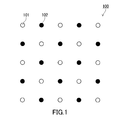
- FIG. 1 is a schematic diagram for explaining a conventional composite crystal.
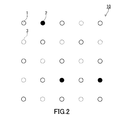
- FIG. 2 is a schematic diagram for explaining the composite crystal of the present disclosure.
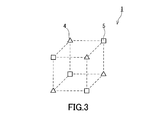
- FIG. 3 is a schematic diagram for explaining the supramolecular unit.
- FIG. 4 is a diagram illustrating an example of a cyanoacrylic acid derivative constituting the supramolecular unit of the complex crystal according to the present disclosure.
- FIG. 5 is a diagram illustrating an example of a trisubstituted methylamine constituting a supramolecular unit of a complex crystal according to the present disclosure.
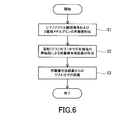
- FIG. 6 is a diagram illustrating an example of a method for producing a composite crystal according to the present disclosure.
- FIG. 7 is a diagram illustrating an example of a method for producing a composite crystal according to the present disclosure.
- FIG. 8 is a schematic diagram illustrating an example of a configuration of a chemosensor according to the present disclosure.
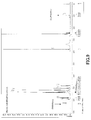
- FIG. 9 is a diagram showing a 1 H-nuclear magnetic resonance (NMR) profile of the precursor composite crystal produced in Example 1.
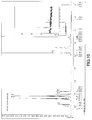
- FIG. 10 is a view showing a 1 H-NMR profile for the composite crystal produced in Example 1.
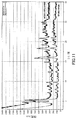
- FIG. 11 is a diagram showing an X-ray diffraction (XRD) profile for the precursor composite crystal and the composite crystal prepared in Example 1.
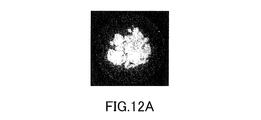
- FIG. 12A is a diagram showing the difference intensity obtained with the composite crystal according to Example 1.
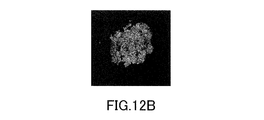
- FIG. FIG. 12B is a diagram showing the difference intensity obtained with the composite crystal according to Comparative Example 1.
- FIG. 13 is a diagram showing the differential intensity obtained with the composite crystal according to Comparative Example 2.
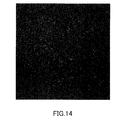
- FIG. 14 is a diagram showing the difference intensity obtained with the composite crystal according to Comparative Example 3.
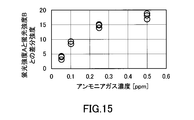
- FIG. 15 is a diagram showing the gas concentration dependence of the difference intensity with respect to ammonia gas in the composite crystal
- a complex crystal of a supramolecular unit and a guest molecule can have a property of incorporating a chemical substance into the inside and a property of changing properties at that time.
- Application of a complex crystal having these properties to a sensor for detecting a chemical substance has been attempted.
- Patent Document 1 discloses a chemosensor including a complex crystal of a specific organic salt.
- the degree of change in the above characteristics corresponds to the sensitivity to chemical substances.
- the sensitivity exhibited by conventional composite crystals is not sufficient.
- Conventional composite crystals are not sensitive to, for example, low concentrations of chemicals. Note that the change in the fluorescence spectrum shown in Non-Patent Document 1 does not result from the incorporation of a chemical substance into the complex crystal. This change is based on the difference in guest molecules constituting the crystal.
- the composite crystal of Patent Document 1 has little change in characteristics when a chemical substance is taken into the inside. More specifically, the composite crystal of Patent Document 1 does not have sensitivity to a chemical substance having a low concentration such as ppm level. For this reason, the said crystal
- An example of a chemosensor that detects low concentrations of chemicals is a chemosensor for breath chemicals and / or skin chemicals.
- the complex crystal of Non-Patent Document 1 has a property of incorporating a chemical substance into the inside and has a possibility of having sensitivity to a low concentration chemical substance. This is because large emission modulation can occur due to disturbance of the electronic structure of (4-diphenylamino) phenylcyanoacrylic acid by a chemical substance.
- the guest molecules constituting the crystal reduce the sensitivity to chemical substances. It is presumed that guest molecules inhibit chemical uptake. Note that the complex crystal of Non-Patent Document 1 does not have the molecular vacancies.
- the inventors have (1) having a structure in which supramolecular units composed of two or more types of molecules are arranged; (2) The supramolecular unit contains a cyanoacrylic acid derivative and a trisubstituted methylamine as molecules constituting the unit, (3) having molecular vacancies between the supramolecular units in which guest molecules having supramolecular units as hosts are not arranged, As a result, it has been found that a composite crystal capable of exhibiting a large change in properties when a chemical substance is taken in is achieved.
- the complex crystal of the present disclosure has higher sensitivity to chemical substances than the conventional complex crystal. This crystal is sensitive to, for example, low concentrations of chemicals. According to the composite crystal of the present disclosure, a chemosensor having sensitivity to a low concentration chemical substance can be achieved.
- the complex crystal according to the first aspect of the present disclosure has a structure in which supramolecular units composed of two or more kinds of molecules are arranged.
- the supramolecular unit contains a cyanoacrylic acid derivative and a trisubstituted methylamine as the molecule.
- the complex crystal has molecular vacancies in which guest molecules having the supramolecular unit as a host are not arranged between the supramolecular units.
- the complex crystal of the first aspect does not substantially contain the guest molecule. According to the 2nd aspect, the above-mentioned effect becomes more reliable.
- the cyanoacrylic acid derivative is a compound represented by the following formula (1).
- Y is a phenylene group, a naphthylene group, a pyridinylene group, a thiophenylene group or a furanylene group, and each group may have a substituent, and R 1 and R 2 are independent of each other.
- Hydrogen atom hydroxyl group, methoxy group, ethoxy group, methyl group, ethyl group, propyl group, isopropyl group, amino group, cyano group, aldehyde group, thiol group, vinyl group, nitro group, halogen atom, carboxy ester group, N-substituted amide group, phenyl group, naphthyl group, pyridyl group, thiophenyl group, or furanyl group.
- the compound represented by the formula (1) may or may not have a bond at the broken line part of the formula (1), and in the case of having a bond, the bond is a single bond, —CH 2 —, —O—, -S- or -NH-.
- the trisubstituted methylamine is a compound represented by the following formula (2).
- R 3 to R 5 in the formula (2) are each independently a phenyl group, a naphthyl group, a pyridyl group, a thiophenyl group, or a furanyl group, and each group may have a substituent.
- the complex crystal according to any one of the first to fourth aspects is obtained from a precursor complex crystal having a structure in which the supramolecular unit and the guest molecule are arranged from a supercritical dioxide.
- This is a composite crystal obtained by desorbing the guest molecules by supercritical drying using carbon.
- the chemosensor according to the sixth aspect of the present disclosure includes, for example, the complex crystal according to any one of the first to fifth aspects, and a detection unit that detects characteristics of the complex crystal.
- the chemosensor detects a predetermined chemical substance based on the change in the characteristic detected by the detection unit.
- the detection unit irradiates light to the complex crystal, and a photodetector that detects light emitted from the complex crystal; Is provided.
- the chemosensor detects the predetermined chemical substance based on the change of the light using the light emitted from the complex crystal as the characteristic.
- the change in the light is caused by light emitted from the complex crystal in a first environmental condition and from the complex crystal in a second environmental condition. It is the difference from the emitted light.
- the manufacturing method according to the ninth aspect of the present disclosure is, for example, a manufacturing method of a complex crystal according to any one of the first to fourth aspects, in which the supramolecular unit and the guest molecule have a structure arranged.
- the guest molecule is desorbed from the complex crystal to form the complex crystal, and the desorption of the guest molecule from the precursor complex crystal is performed by supercritical drying using supercritical carbon dioxide. is there.
- FIG. 1 is a schematic diagram for explaining a conventional composite crystal.
- a supramolecular unit 101 and a guest molecule 102 having the supramolecular unit 101 as a host are arranged.
- the supramolecular unit 101 and the guest molecule 102 are arranged by an interaction that is a non-covalent bond. Examples of interactions are hydrogen bonds, ionic bonds, CH- ⁇ interactions, halogen- ⁇ interactions, halogen-halogen interactions, van der Waals interactions, and ⁇ - ⁇ interactions.
- FIG. 2 is a schematic diagram for explaining the composite crystal of the present disclosure.
- the supramolecular units 1 are arranged by an interaction that is a non-covalent bond.
- the structure 10 has molecular vacancies 3 between the supramolecular units 1 in which the guest molecules 2 hosted by the supramolecular units 1 are not arranged.
- the molecular hole 3 is not a space inside the supramolecular unit 1.
- the arrangement of the supramolecular unit 1 and the guest molecules 2 and / or molecular vacancies 3 can be further established.
- the structure 10 may be a structure in which the guest molecule 102 is detached from the structure 100 of FIG. At this time, the molecular vacancy 3 is a vacant site formed by desorption of the guest molecule 102.
- the sequence of the supramolecular unit 101 before desorption and the sequence of the supramolecular unit 1 after desorption may be different from each other. This is because the arrangement of the supramolecular unit can change when the guest molecule 102 is detached.
- FIG. 2 is merely a schematic representation of an example of the arrangement of the composite crystal of the present disclosure.
- the specific arrangement of the supramolecular unit 1 in the composite crystal of the present disclosure is not limited.
- the molecular vacancies 3 can have a specific arrangement.
- the molecular holes 3 can be arranged in a channel shape or a layer shape in the crystal.
- composition ratio of the supramolecular unit 1, the guest molecule 2, and the molecular hole 3 in the composite crystal of the present disclosure is not limited.
- the content of guest molecules 2 in the composite crystal of the present disclosure is not limited.
- the content rate of the guest molecule 2 in a composite crystal means the ratio of the number of guest molecules 2 to the number of cyanoacrylic acid derivative molecules.
- the content rate of the guest molecule 2 is, for example, 30 mol% or less.
- the content of the guest molecule 2 can be 10 mol% or less, and further 5 mol% or less.
- the content of the guest molecule 2 can be evaluated by thermogravimetric analysis, nuclear magnetic resonance (NMR) measurement, mass spectrometry, or the like for the complex crystal.
- the complex crystal of the present disclosure may not substantially contain the guest molecule 2.
- “substantially free” means a content of 1 mol% or less. Since the measurement limit of the content rate by NMR is 1 mol%, a content rate of less than 1 mol% may be defined as “substantially free”.
- the porosity (the ratio of the number of molecular vacancies 3 to the total number of guest molecules 2 and molecular vacancies 3) in the composite crystal of the present disclosure is, for example, 70% or more, 90% or more, It may be 95% or more, further 99% or more.
- the porosity can be evaluated by thermogravimetric analysis, NMR measurement, mass spectrometry or the like for the composite crystal.
- the content rate of the guest molecule 2 can be controlled by, for example, the method and conditions for detaching the guest molecule 2 in the production method described later.
- conditions are at least one selected from temperature, time (rate), pressure, and supercritical fluid type.
- the arrangement of the supramolecular unit 1, the guest molecule 2 and the molecular vacancy 3, that is, the crystal structure can be evaluated by X-ray diffraction (XRD) measurement or the like on the complex crystal.
- XRD X-ray diffraction
- the arrangement of the supramolecular unit 1, the guest molecules 2 and the molecular vacancies 3 can be controlled by, for example, the conditions for coagulation, recrystallization or exposure in the production method described later, and the method and conditions for desorption of the guest molecules 2.
- conditions are at least one selected from temperature, time (rate), pressure, type of supercritical fluid, and type and mixing ratio of the solvent used for recrystallization or coagulation.
- Supramolecular unit 1 is composed of two or more types of molecules.
- the supramolecular unit 1 can be composed of two types of molecules. In the supramolecular unit 1, two or more kinds of molecules are arranged by an interaction that is a non-covalent bond.
- the composite crystal of the present disclosure has a hierarchical structure of a primary structure and a secondary structure.
- the primary structure is an arrangement of two or more molecules constituting the supramolecular unit 1.
- the secondary structure is a structure 10 in which supramolecular units 1 are arranged.
- FIG. 3 is a schematic diagram for explaining an example of the arrangement of molecules in the supramolecular unit 1.
- two types of molecules 4 and 5 are arranged.
- the binding ratio of molecules 4 and 5 in the supramolecular unit 1 of FIG. 3 is 4: 4.
- an array of four molecules 4 and four molecules 5 constitutes one supramolecular unit 1.
- the supramolecular unit 1 of the complex crystal of the present disclosure includes a cyanoacrylic acid derivative and a trisubstituted methylamine.
- the cyanoacrylic acid derivative and the trisubstituted methylamine are arranged at a predetermined bond ratio.
- Supramolecular unit 1 is an organic salt of a cyanoacrylic acid derivative and a trisubstituted methylamine. Both molecules are arranged by ionic bonds.
- the bond ratio x: y of the cyanoacrylic acid derivative and the trisubstituted methylamine in the supramolecular unit 1 is not limited as long as the cyanoacrylic acid derivative and the trisubstituted methylamine can form an organic salt.
- x and y are, for example, integers of 1 or more, and the upper limit thereof is, for example, 10 and may be 6.
- the binding ratio is, for example, an integer in the range of 1 to 6 and an integer in the range of 1 to 6.
- the binding ratio can be 1: 1, 2: 2, 3: 3, 4: 4, 5: 5 or 6: 6.
- the binding ratio of molecules in the supramolecular unit 1 can be evaluated by XRD measurement or the like for the complex crystal.
- the molecular bond ratio in the supramolecular unit 1 can be controlled by the conditions of coagulation, recrystallization or exposure in the production method described later.
- conditions are at least one selected from temperature, time (rate), pressure, and the type and mixing ratio of the solvent used for recrystallization or coagulation.
- the supramolecular unit 1 may contain a third molecule other than the cyanoacrylic acid derivative and the trisubstituted methylamine.
- the third molecule can form a sequence of supramolecular unit 1 with a cyanoacrylic acid derivative and a trisubstituted methylamine.
- the complex crystal of the present disclosure may include two or more types of supramolecular units 1.
- composition of the complex crystal and the supramolecular unit 1 and the binding ratio of the molecules constituting the supramolecular unit 1 can be evaluated by, for example, NMR measurement and / or XRD measurement.
- the cyanoacrylic acid derivative has a structure in which a substituent is bonded to the ⁇ -position carbon atom in the vinyl group of cyanoacrylic acid.
- This substituent may have a molecular structure in which a cyanoacrylic acid derivative exhibits fluorescence, and the complex crystal may exhibit a change in fluorescence due to incorporation of a chemical substance.
- the change in the fluorescence due to the incorporation of the chemical substance can be used for the detection of the chemical substance in the chemosensor.
- Fluorescence is a property of emitting fluorescence in a wavelength band of 400 to 700 nm by excitation with ultraviolet rays, for example.
- the cyanoacrylic acid derivative may be a compound represented by the following formula (1).
- Y in Formula (1) is a phenylene group, a naphthylene group, a pyridinylene group, a thiophenylene group, or a furanylene group, and each group may have a substituent.
- R 1 and R 2 are each independently a hydrogen atom, hydroxyl group, methoxy group, ethoxy group, methyl group, ethyl group, propyl group, isopropyl group, amino group, cyano group, aldehyde group, thiol group, vinyl group, A nitro group, a halogen atom, a carboxyester group (—COOR 6 ), an N-substituted amide group (—CONHR 7 ), a phenyl group, a naphthyl group, a pyridyl group, a thiophenyl group, or a furanyl group.
- the compound represented by the formula (1) may or may not have a bond at the broken line portion of the formula (1).
- the bond is a single bond, —CH 2 — (methylene group), —O— (ether bond), —S— (sulfide bond) or —NH— (imino group). It is.
- the compound represented by the formula (1) may not have a bond at the broken line part, or may have a single bond at the broken line part.
- Y may be a phenylene group, a naphthylene group, or a pyridinylene group.
- R 1 and R 2 may be independently of each other a hydrogen atom, a methoxy group, a methyl group, an ethyl group, a propyl group, or an isopropyl group.
- Examples of the substituent that Y may have are the groups exemplified as R 1 and R 2 .
- the substituent may be a hydrogen atom, a methoxy group, a methyl group, an ethyl group, a propyl group, or an isopropyl group.
- R 6 is, for example, a methyl group, an ethyl group, a propyl group, or an isopropyl group.
- R 7 is, for example, a methyl group, an ethyl group, a propyl group, an isopropyl group, or a phenyl group.
- FIG. 4 is a diagram illustrating an example of a cyanoacrylic acid derivative constituting the supramolecular unit of the complex crystal according to the present disclosure.
- the trisubstituted methylamine has a structure in which three hydrogen atoms bonded to the methyl group of methylamine are substituted with a substituent. All three substituents may be the same, two may be the same, or all may be different.
- the trisubstituted methylamine can be a compound represented by the following formula (2).
- R 3 to R 5 in the formula (2) are each independently a phenyl group, a naphthyl group, a pyridyl group, a thiophenyl group, or a furanyl group, and each group may have a substituent.
- R 3 to R 5 may independently be a phenyl group, a pyridyl group, or a thiophenyl group.
- Examples of the substituent that R 3 to R 5 may have are the groups exemplified as R 1 and R 2 .
- the substituent may be a hydrogen atom, a methoxy group, a methyl group, an ethyl group, a propyl group, an isopropyl group, or a halogen atom.
- FIG. 5 is a diagram illustrating an example of a trisubstituted methylamine constituting a supramolecular unit of a complex crystal according to the present disclosure.
- triphenylmethylamine diphenyl (thiophen-3-yl) methylamine, diphenyl (pyridin-3-yl) methylamine, (4-methoxyphenyl) diphenyl in the order of (a) to (g).
- the guest molecule 2 is not limited.
- the guest molecule 2 is a compound that can form a precursor complex crystal to be described later, for example, in combination with a cyanoacrylic acid derivative and an organic salt of trisubstituted methylamine.
- the guest molecule 2 can be a compound that defines the size and / or shape of the molecular hole 3 as a template molecule for constructing the complex crystal of the present disclosure.
- the guest molecule 2 can be a recrystallization solvent or a compound that can be used for exposure to an organic salt in the production method described later.
- the guest molecule 2 includes, for example, water, n-pentane, n-hexane, cyclohexane, n-heptane, n-octane, methylcyclohexane, methanol, ethanol, isopropanol (also referred to as “1-methylethanol”), 1-propanol, 1-butanol, 2-butanol, isobutanol (also referred to as “2-methylpropanol”), t-butanol, acetone, methyl ethyl ketone (also referred to as “2-butanone”), methylpropyl ketone (also referred to as “2-pentanone”) , Methyl isopropyl ketone, methyl butyl ketone, methyl isobutyl ketone, diethyl ketone, methyl amyl ketone (also referred to as “methyl-n-pentyl ketone”),
- the complex crystal of the present disclosure may include two or more guest molecules 2.
- the shape of the composite crystal of the present disclosure is not limited.
- the composite crystals of the present disclosure can have various shapes such as particles, films, sheets, bulk, thin films and monoliths. In the complex crystals having these various shapes, the distribution of the molecular vacancies 3 may be uniform or non-uniform.
- the size of the composite crystal of the present disclosure is not limited.
- the size can range from a macro region such as a bulk and a monolith to a micro region typified by a thin film constituting an element on a circuit board.
- the use of the composite crystal of the present disclosure is not limited.
- An example of an application is a chemosensor that detects a chemical substance.
- Chemosensors utilize changes in crystal properties due to chemical uptake. Properties are, for example, absorption spectrum, reflection spectrum, fluorescence spectrum, electrical properties and mass. Depending on the type of chemicals incorporated, the state of property changes can vary. By using this, it is possible to provide a chemosensor that further detects the type of chemical substance.
- the complex crystal of the present disclosure can be formed, for example, by detaching the guest molecule 2 from the precursor complex crystal having a structure in which the supramolecular unit 1 and the guest molecule 2 are arranged.
- the precursor composite crystal can have the structure 100 of FIG.
- the precursor complex crystal may be a crystal that does not include the molecular vacancies 3.
- the method for detaching the guest molecule 2 is not limited.
- An example of the desorption method is heating and / or decompression.
- a method in which the guest molecule 2 is substituted with another compound and the other substituted compound is eliminated can also be employed.
- the other compound may be a compound that is easier to desorb than the guest molecule 2.
- Another example of the guest molecule 2 desorption method is supercritical drying.
- the desorption by supercritical drying structural destruction of the complex crystal at the time of desorption of the guest molecule 2 and deformation associated therewith can be suppressed as compared with desorption by simple heating and / or reduced pressure.
- the arrangement of the supramolecular unit 1 can be more reliably maintained before and after the desorption of the guest molecule 2.
- the shape of the complex crystal can be more reliably maintained before and after the desorption of the guest molecule 2.
- An example of a fluid used for supercritical drying is carbon dioxide in a supercritical state (supercritical carbon dioxide).
- the precursor composite crystal can be formed, for example, by the following method.
- the first method is a method of recrystallizing a cyanoacrylic acid derivative and an organic salt of a 3-substituted methylamine with a solvent that is the guest molecule 2.
- organic salts are arranged by inclusion of guest molecules 2 as supramolecular units 1 by recrystallization. This arrangement forms a precursor composite crystal.
- the organic salt to be recrystallized can be formed, for example, by coagulating a mixture of a cyanoacrylic acid derivative and a trisubstituted methylamine with a solvent.
- a solvent is a compound that can coagulate organic salts.
- the solvent may not be the guest molecule 2.
- the first method can be performed according to a known method for forming a complex crystal by recrystallization of an organic salt.
- an organic salt of a cyanoacrylic acid derivative and a trisubstituted methylamine is recrystallized.
- the first method and the desorption of the guest molecule 2 can be performed continuously.
- the second method is a method in which an organic salt of a cyanoacrylic acid derivative and a trisubstituted methylamine is exposed to the vapor of the guest molecule 2.
- the organic salt is arranged while the guest molecule 2 is included as the supramolecular unit 1 by exposure. This arrangement forms a precursor composite crystal.
- the second method can be performed according to a known method for forming a complex crystal by exposure of an organic salt to the vapor of the guest molecule 2.
- an organic salt of a cyanoacrylic acid derivative and a trisubstituted methylamine is exposed.
- the organic salt to be exposed can be formed, for example, by coagulating a mixture of a cyanoacrylic acid derivative and a trisubstituted methylamine with a solvent.
- a solvent is a compound that can coagulate organic salts.
- the solvent may not be the guest molecule 2.
- a coagulated organic salt can be used as a solution or dispersion, and this can be applied to a substrate by a technique such as spin coating, dispenser, ink jet, 3D printing, etc. to form a molded body of organic salt.
- the shape of the shaped organic salt can be maintained before and after exposure by selecting the exposure method.
- the second method and the desorption of the guest molecule 2 can be carried out continuously.
- the shape of the finally obtained composite crystal can be controlled, for example, by the following method.
- the container may be a container used when the composite crystal is used for a predetermined application.
- An example of the container is a thin tube such as glass.
- the composite crystal filled in the thin tube can be used, for example, in a gas detection tube which is a kind of chemosensor.
- a composite crystal is used as a solution or dispersion, which is applied to a substrate by a technique such as spin coating, dispenser, ink jet, 3D printing.
- a slurry containing composite crystals, a dispersant and a binder is placed on a substrate and dried and solidified.
- FIG. 6 is a diagram illustrating an example of a method for producing a composite crystal according to the present disclosure.
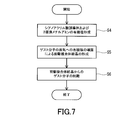
- the method of FIG. 6 includes the following steps S1, S2 and S3.
- Step S1 is a step of forming an organic salt of a cyanoacrylic acid derivative and a trisubstituted methylamine.
- Step S2 is a step of recrystallizing the organic salt formed in step S1 with a solvent that is the guest molecule 2 to form a precursor composite crystal.
- Step S3 is a step of detaching the guest molecule 2 from the precursor complex crystal formed in step S2 to form the complex crystal of the present disclosure.
- FIG. 7 is a diagram illustrating an example of a method for producing a composite crystal of the present disclosure.
- the method of FIG. 7 includes the following steps S4, S5 and S6.
- Step S4 is a step of forming an organic salt of a cyanoacrylic acid derivative and a trisubstituted methylamine.
- Step S5 is a step of exposing the organic salt formed in step S1 to the vapor of guest molecule 2 to form a precursor complex crystal.
- Step S6 is a step of forming the composite crystal of the present disclosure by detaching the guest molecule 2 from the precursor composite crystal formed in Step S5.
- the chemosensor of the present disclosure includes the above-described complex crystal of the present disclosure and a detection unit that detects characteristics of the complex crystal.
- the chemosensor of the present disclosure detects a predetermined chemical substance based on the change in the characteristic detected by the detection unit.
- the detection unit may include a light source that irradiates light to the complex crystal and a photodetector that detects light emitted from the complex crystal.
- the chemosensor of the present disclosure can detect the predetermined chemical substance based on a change in the light using the light emitted from the complex crystal as the characteristic.
- the change in the light is, for example, a difference between light emitted from the complex crystal in a first environmental condition and light emitted from the complex crystal in a second environmental condition.
- the concentration and / or type of the predetermined chemical substance is different between the first environmental condition and the second environmental condition.
- One selected from the first environmental condition and the second environmental condition may be an environmental condition that does not include the predetermined chemical substance.
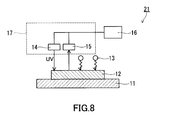
- FIG. 8 is a schematic diagram illustrating an example of a configuration of a chemosensor according to the present disclosure.
- the chemosensor 21 in FIG. 8 is a sensor that detects the chemical substance 13.
- the chemosensor 21 includes the composite crystal 12 of the present disclosure and a detection unit 17 that detects characteristics of the composite crystal 12.
- the composite crystal 12 is disposed on the substrate 11.
- the detection unit 17 is connected to the processing unit 16.
- the processing unit 16 controls the detection unit 17.
- the processing unit 16 evaluates the characteristics of the complex crystal 12 detected by the detection unit 17 and detects the chemical substance 13 based on the change in the characteristics.
- the processing unit 16 can further determine information on the chemical substance 13.
- the information is, for example, type and / or concentration.
- the detection unit 17 includes a light source 14 and a photodetector 15.
- the light source 14 irradiates the composite crystal 12 with light.
- the light is, for example, light from which the composite crystal 12 emits fluorescence.
- the light is, for example, ultraviolet light (UV).
- the photodetector 15 receives light emitted from the composite crystal 12.
- the received light is, for example, fluorescence emitted from the composite crystal 12.
- the processing unit 16 evaluates the light received by the photodetector 15 as the characteristics of the composite crystal 12.
- the processing unit 16 detects the chemical substance 13 based on the change in the light.
- the processing unit 16 can further determine information on the chemical substance 13.
- the chemosensor 21 detects a predetermined chemical substance by using a change in the characteristics of the complex crystal 12 due to the incorporation of the chemical substance 13.
- the chemosensor 21 detects a predetermined chemical substance using, for example, a change in fluorescence emitted from the complex crystal 12.
- a change in fluorescence emitted from the complex crystal 12 For the evaluation by the processing unit 16, not a change in the fluorescence spectrum but a more simplified change, for example, at least one change selected from the wavelength, intensity, luminance, chromaticity, lightness, and saturation of the fluorescence can be used. .
- the state of change in the characteristics of the composite crystal 12 may vary depending on the type and / or concentration of the chemical substance 13 to be incorporated.
- the state detected by the detection unit 17 can be used to determine information on the chemical substance 13.
- the processing unit 16 can store data corresponding to information on the chemical substance 13 in advance.
- the state of the chemical substance 13 can be determined by comparing the state detected by the detection unit 17 with the data.
- the change in characteristics can be evaluated by the difference and / or the rate of change.
- the light source 14 and the photodetector 15 are arranged on the same surface side of the composite crystal 12.
- the light source 14 and the photodetector 15 can be arranged so as to sandwich the composite crystal 12.
- the substrate 11 can be made of a material that transmits light emitted from the composite crystal 12.
- the shape of the composite crystal 12 on the substrate 11 is, for example, a film or a sheet.
- the thickness of the composite crystal 12 is, for example, 0.1 ⁇ m to 3000 ⁇ m.
- the substrate 11 is made of, for example, glass, quartz, silicon or oxide thereof, metal or oxide thereof, compound semiconductor, polytetrafluoroethylene, and resin such as acrylic resin.
- a well-known member can be used for the light source 14, the photodetector 15, and the processing unit 16.
- the detection unit 17 and the composite crystal 12 may be formed on the same substrate 11.
- the detection unit 17 and the composite crystal 12 can be integrally formed on the circuit board.
- the chemosensor 21 may further include an arbitrary member.
- the member is, for example, a member that introduces the chemical substance 13 into the composite crystal 12.
- the member is, for example, a fan that sends air to the composite crystal 12.
- the chemosensor of the present disclosure can utilize changes in the characteristics of the composite crystal 12 other than changes in fluorescence.
- the characteristic is at least one selected from, for example, an absorption spectrum, a reflection spectrum, an electric resistance, and a mass.
- the chemosensor of the present disclosure may include a detection unit 17 corresponding to characteristics for detecting a change.
- the chemosensor that uses the change in the absorption spectrum can have the same structure as the chemosensor 21 of FIG.
- the light source 14 emits light in the visible to ultraviolet region.
- the chemosensor that uses the change in the reflection spectrum can have the same structure as the chemosensor 21 of FIG.
- the light source 14 emits light in the visible to ultraviolet region.
- the detection unit 17 includes a resistance measurement unit that measures the electrical resistance of the composite crystal 12.
- the resistance measurement unit may be a member that performs a four-terminal resistance method.
- a chemosensor that uses a change in electrical resistance includes, for example, a field effect transistor (FET) having a region composed of the composite crystal 12.
- FET field effect transistor
- a specific example includes an FET in which the region is formed between a gate electrode and a gate insulating film. This FET detects the electric resistance of the region changed by the chemical substance uptake.
- a chemosensor that uses a change in mass includes, for example, a quartz crystal microbalance sensor (hereinafter referred to as a QCM sensor).
- the QCM sensor is a sensor that includes a quartz resonator and can measure a very small change in mass.
- a QCM sensor is disclosed in, for example, Japanese Unexamined Patent Application Publication No. 2009-236607.
- a more specific example includes a QCM sensor in which a region composed of the composite crystal 12 is formed on the surface of a crystal resonator. The QCM sensor detects a change in the mass of the region that has changed due to the incorporation of a chemical substance.
- a chemosensor that uses a change in mass includes, for example, a membrane-type surface sensor (Stress sensor) (hereinafter referred to as an MSS sensor).
- the MSS sensor includes a minute plate-like member supported by a connecting portion having piezoresistance and a receptor layer provided on the surface of the plate-like member.
- MSS sensors can measure very small mass changes.
- An MSS sensor is disclosed in, for example, International Publication No. 2011/148774.
- a more specific example includes an MSS sensor in which a region composed of the composite crystal 12 is formed on the surface of a plate-like member. The MSS sensor detects a change in mass in the above-described region that has been changed by the incorporation of a chemical substance.
- the composite crystal and chemosensor of the present disclosure will be described more specifically based on examples.
- the composite crystal and chemosensor of the present disclosure are not limited to the following examples.
- Example 1 and Comparative Example 1 A three-necked flask with an internal volume of 300 mL was charged with 5.00 g (21.5 mmol) of 4-methoxy-N-phenylaniline, 5.57 g (30.1 mmol) of 4-bromobenzaldehyde, and 150 mL of toluene. Next, with stirring, 0.225 g (1.00 mmol) of Pd (OAc) 2 , 0.406 g (2.01 mmol) of t-Bu 3 P, and 5.20 g (37.6 mmol) of potassium carbonate were added. And heated to reflux for 20 hours. Next, after cooling to room temperature and removing insolubles by Celite filtration, the filtrate was concentrated under reduced pressure. Next, the obtained residue was purified by silica gel column chromatography to obtain 5.74 g of 4-((4-methoxyphenyl) (phenyl) amino) benzaldehyde.
- the organic salt is an organic salt of (E) -2-cyano-3- (4-((4-methoxyphenyl) (phenyl) amino) phenyl) acrylic acid and triphenylmethylamine.
- the precursor complex crystal has a structure in which supramolecular units that are organic salts and chloroform and diethyl ketone that are guest molecules are arranged.
- the guest molecule content in the precursor composite crystal is approximately equal to the theoretical maximum value derived from the above confirmed sequence.
- FIG. 9 is a diagram showing a 1 H-NMR profile of the precursor composite crystal of Example 1.
- the precursor complex crystal was treated with supercritical carbon dioxide to desorb guest molecules from the crystal.
- the composite crystal of Example 1 was obtained.
- the obtained composite crystal maintained the shape of the precursor composite crystal.
- the following items (1) to (5) were confirmed for the formed complex crystal by XRD measurement and 1 H-NMR measurement.
- the complex crystal has a structure in which supramolecular units that are organic salts are arranged.
- the arrangement of the supramolecular units maintains the arrangement of the supramolecular units in the precursor complex crystal.
- Molecular vacancies are formed between the supramolecular units.
- the arrangement of molecular vacancies matches the arrangement of guest molecules in the precursor complex crystal.
- the guest molecule content in the composite crystal was below the NMR measurement limit, that is, less than 1 mol%, and the porosity of the composite crystal was 99% or more.
- FIG. 10 is a view showing a 1 H-NMR profile of the complex crystal of Example 1.
- FIG. 11 is a diagram showing XRD profiles of the composite crystal and the precursor composite crystal of Example 1. From the profiles, it was confirmed that both had a peak at the same diffraction angle 2 ⁇ . That is, it was confirmed that both had the same crystal structure except for the presence or absence of guest molecules.
- the composite crystal of Example 1 was exposed to ammonia gas having a concentration of 10 ppm (volume basis; the same applies hereinafter) to evaluate the two-dimensional change in fluorescence intensity (change before and after exposure) exhibited by the composite crystal. .
- the evaluation was performed according to the following procedure. 1.
- the composite crystal particles were placed on a sample stage.
- the sample stage was stored in the gas flow cell.
- the gas flow cell was equipped with a window, a gas inlet and a gas outlet.
- the window had a size and a position capable of irradiating the particles on the sample stage with light and detecting the fluorescence emitted by the particles.
- the fluorescence intensity A of the composite crystal was measured.
- the composite crystal was irradiated with ultraviolet light having a wavelength of 365 nm, and fluorescence emitted from the crystal was photographed with a camera (FLOYD manufactured by Raymer) to obtain fluorescence intensity A.
- a camera FLOYD manufactured by Raymer
- Ammonia gas diluted to a concentration of 10 ppm with nitrogen was introduced into the gas flow cell, and the composite crystal was exposed to the gas.
- the fluorescence intensity B of the composite crystal was measured.
- the fluorescence intensity B was measured in the same manner as the fluorescence intensity A. 4).
- Difference intensity between fluorescence intensity A and fluorescence intensity B was obtained by image processing. The difference was a value obtained by subtracting a relatively small intensity from a relatively large intensity selected from the fluorescence intensity A and the fluorescence intensity B.
- FIGS. 12A and 12B The difference intensities obtained in Example 1 and Comparative Example 1 are shown in FIGS. 12A and 12B.
- FIG. 12A is the difference intensity of the first embodiment.
- FIG. 12B shows the difference intensity of Comparative Example 1.
- the formed organic salt is dissolved in a solvent in which methanol and 1,2-dichloroethane are mixed at a volume ratio of 3: 4, and left at room temperature for 48 hours to be recrystallized to form particulate precursor complex crystals.
- the following items (1) to (3) were confirmed for the formed precursor composite crystal by thermogravimetric analysis, XRD measurement and 1 H-NMR measurement.
- the organic salt is an organic salt of anthracene divinyl sulfonic acid and triphenylmethylamine.
- the precursor complex crystal has a structure in which a supramolecular unit that is an organic salt and 1,2-dichloroethane that is a guest molecule derived from a mixed solvent are arranged.
- the guest molecule content in the precursor composite crystal is approximately equal to the theoretical maximum value derived from the above confirmed sequence.
- the precursor complex crystal was treated with supercritical carbon dioxide to desorb guest molecules from the crystal.
- a composite crystal of Comparative Example 2 was obtained.
- the obtained composite crystal maintained the shape of the precursor composite crystal.
- the following items (1) to (5) were confirmed for the formed complex crystal by XRD measurement and 1 H-NMR measurement.
- the complex crystal has a structure in which supramolecular units that are organic salts are arranged.
- the arrangement of the supramolecular units maintains the arrangement of the supramolecular units in the precursor complex crystal.
- Molecular vacancies are formed between the supramolecular units.
- the arrangement of molecular vacancies matches the arrangement of guest molecules in the precursor complex crystal.
- the content of guest molecules in the composite crystal is below the NMR measurement limit, that is, less than 1 mol%.
- the formed organic salt is dissolved in a solvent in which methanol and o-chlorotoluene are mixed at a volume ratio of 1: 2, and left to stand at room temperature for 48 hours to recrystallize, so that a particulate precursor complex crystal is obtained. Obtained.
- the following items (1) to (3) were confirmed for the formed precursor composite crystal by thermogravimetric analysis, XRD measurement and 1 H-NMR measurement.
- the organic salt is an organic salt of stilbene-4,4′-disulfonic acid and triphenylmethylamine.
- the precursor complex crystal has a structure in which a supramolecular unit that is an organic salt and o-chlorotoluene that is a guest molecule derived from a mixed solvent are arranged.
- the guest molecule content in the precursor composite crystal is approximately equal to the theoretical maximum value derived from the above confirmed sequence.
- the precursor complex crystal was treated with supercritical carbon dioxide to desorb guest molecules from the crystal.
- a composite crystal of Comparative Example 3 was obtained.
- the obtained composite crystal maintained the shape of the precursor composite crystal.
- the following items (1) to (5) were confirmed for the formed complex crystal by XRD measurement and 1 H-NMR measurement.
- the complex crystal has a structure in which supramolecular units that are organic salts are arranged.
- the arrangement of the supramolecular units maintains the arrangement of the supramolecular units in the precursor complex crystal.
- Molecular vacancies are formed between the supramolecular units.
- the arrangement of molecular vacancies matches the arrangement of guest molecules in the precursor complex crystal.
- the content of guest molecules in the composite crystal is below the NMR measurement limit, that is, less than 1 mol%.
- the evaluation result of the difference intensity obtained in Example 2 is shown in FIG.
- the standardized difference intensity shown in FIG. 15 is the following image using image editing software (Photoshop CS2 manufactured by Adobe Systems) on the image showing the two-dimensional difference intensity obtained in the same manner as in Example 1. Determined by carrying out the treatment. First, a region corresponding to the composite crystal particle is selected from the image.
- the region to be selected includes at least 60%, preferably about 80%, of the composite crystal particles visible in the image.
- the area that does not correspond to the particles area where the sample stage is projected
- the ratio of the area that does not correspond to the particles in the selected area does not exceed 3% on the basis of area. Like that.
- the image which shows a two-dimensional difference intensity is a color
- it converts into gray scale beforehand.
- a brightness value for each pixel is extracted from the selected range, and the average value of the extracted brightness values is set as the normalized difference intensity.
- the brightness value is a value based on 256 gradations where black is 0 and white is 255.
- the composite crystal and chemosensor of the present disclosure are not limited to the above-described embodiments, and various modifications and changes can be made within the scope of the invention described in the claims.
- the technical features shown in the embodiments described in the mode for carrying out the invention are for solving some or all of the above-mentioned problems, or for achieving some or all of the above-mentioned effects.
- replacement or combination can be performed as appropriate.
- the technical feature is not described as essential in the present specification, it can be deleted as appropriate.
- the composite crystal of the present disclosure can be applied to, for example, a chemosensor that detects a chemical substance.
Landscapes
- Chemical & Material Sciences (AREA)
- Organic Chemistry (AREA)
- Analytical Chemistry (AREA)
- Chemical Kinetics & Catalysis (AREA)
- Health & Medical Sciences (AREA)
- Engineering & Computer Science (AREA)
- Physics & Mathematics (AREA)
- Pathology (AREA)
- Immunology (AREA)
- General Physics & Mathematics (AREA)
- General Health & Medical Sciences (AREA)
- Life Sciences & Earth Sciences (AREA)
- Biochemistry (AREA)
- Materials Engineering (AREA)
- Nuclear Medicine, Radiotherapy & Molecular Imaging (AREA)
- General Chemical & Material Sciences (AREA)
- Oil, Petroleum & Natural Gas (AREA)
- Electrochemistry (AREA)
- Organic Low-Molecular-Weight Compounds And Preparation Thereof (AREA)
- Investigating, Analyzing Materials By Fluorescence Or Luminescence (AREA)
- Investigating Or Analysing Materials By Optical Means (AREA)
- Investigating Or Analyzing Materials By The Use Of Electric Means (AREA)
Abstract
本開示の複合体結晶は、2種以上の分子から構成される超分子ユニットが配列した構造を有する複合体結晶である。超分子ユニットは、上記分子としてシアノアクリル酸誘導体および3置換メチルアミンを含む。この複合体結晶は、超分子ユニット間に、超分子ユニットをホストとするゲスト分子が配置されていない分子空孔を有する。本開示の複合体結晶は、化学物質を内部に取り込む性質を有し、その際に特性の大きな変化を示しうる。
Description
本開示は、複合体結晶と、複合体結晶を備えるケモセンサとに関する。
複合体結晶は、2種以上の分子から構成される結晶である。複合体結晶は、共有結合ではない相互作用により分子が配列した構造を有する。相互作用の例は、水素結合、イオン結合、およびπ-π相互作用である。これらの相互作用によって分子間に働く力は、共有結合によるものより弱い。
複合体結晶の1種は、超分子ユニットと、超分子ユニットをホストとするゲスト分子とが配列した構造を有する。超分子ユニットは、2種以上の分子から構成される。この結晶は、1次構造および2次構造の階層構造を有する。1次構造は、超分子ユニットを構成する当該2種以上の分子の配列である。2次構造は、複合体結晶を構成する超分子ユニットと、ゲスト分子との配列である。いずれの配列も、共有結合ではない相互作用に基づく。「超分子ユニット」の名称は、1次構造および2次構造を反映している。具体的には、2種以上の分子の非共有結合による配列である1次構造を、「超分子」が反映する。この超分子が複合体結晶を構成する2次構造の1単位であることを、「ユニット」が反映する。
超分子ユニットの一例は、有機酸であるアニオンと、プロトン化された塩基であるカチオンとの有機塩である。この例では、アニオンとカチオンとの間にイオン結合が作用する。有機酸の例はスルホン酸である。塩基の例はアミンである。
有機塩である超分子ユニットと、ゲスト分子との複合体結晶は、例えば、以下の方法により形成できる。1つは、ゲスト分子である溶剤により有機塩を再結晶する方法である。この方法では、再結晶時に、超分子ユニットとしてゲスト分子を包接しながら有機塩が配列する。1つは、ゲスト分子の蒸気に有機塩を曝露する方法である。この方法では、曝露により、超分子ユニットとしてゲスト分子を包接しながら有機塩が配列する。
出願人の先願である特許文献1は、芳香族スルホン酸と芳香族アミンとの有機塩である超分子ユニットを有する複合体結晶を開示する。特許文献1は、有機塩の成形体をゲスト分子の蒸気に曝露して複合体結晶を得る方法を開示する。
出願人が開示する非特許文献1は、特定の結合比を有する(4-ジフェニルアミノ)フェニルシアノアクリル酸とトリフェニルメチルアミンとの有機塩である超分子ユニットを有する複合体結晶を開示する。非特許文献1は、複合体結晶が示す蛍光スペクトルがゲスト分子の種類によって異なることを開示する。なお、非特許文献1には、「種々の有機溶媒によって再結晶した結果、青からオレンジ色までの蛍光を示す結晶が得られた。熱量分析などの測定の結果、オレンジ色の蛍光を示す結晶を除き、全て、再結晶溶媒をゲストとして包接した結晶であった。」との記載がある。再結晶溶媒をゲストとして包接していないオレンジ色の蛍光を示す結晶は、(4-ジフェニルアミノ)フェニルシアノアクリル酸のみにより構成される結晶であり、複合体結晶ではない。
山本淳志ら、「カルボン酸アミン塩を用いた蛍光性有機多孔質構造の階層的構築とゲスト応答的な動的発光変調」、第7回ホスト・ゲスト化学シンポジウム(2011年)、ポスター発表、セッションID:1P-16
本開示は、化学物質を内部に取り込む性質を有し、その際に特性の大きな変化を示しうる複合体結晶を提供する。
本開示は、
2種以上の分子から構成される超分子ユニットが配列した構造を有する複合体結晶であって、
前記超分子ユニットが、前記分子としてシアノアクリル酸誘導体および3置換メチルアミンを含み、
前記超分子ユニット間に、前記超分子ユニットをホストとするゲスト分子が配置されていない分子空孔を有する、複合体結晶、
を提供する。
2種以上の分子から構成される超分子ユニットが配列した構造を有する複合体結晶であって、
前記超分子ユニットが、前記分子としてシアノアクリル酸誘導体および3置換メチルアミンを含み、
前記超分子ユニット間に、前記超分子ユニットをホストとするゲスト分子が配置されていない分子空孔を有する、複合体結晶、
を提供する。
別の側面から、本開示は、
上記本開示の複合体結晶の製造方法であって、
前記超分子ユニットと前記ゲスト分子とが配列した構造を有する前駆複合体結晶から前記ゲスト分子を脱離して前記複合体結晶を形成し、
前記前駆複合体結晶からの前記ゲスト分子の脱離を、超臨界二酸化炭素を用いた超臨界乾燥により実施する、複合体結晶の製造方法、
を提供する。
上記本開示の複合体結晶の製造方法であって、
前記超分子ユニットと前記ゲスト分子とが配列した構造を有する前駆複合体結晶から前記ゲスト分子を脱離して前記複合体結晶を形成し、
前記前駆複合体結晶からの前記ゲスト分子の脱離を、超臨界二酸化炭素を用いた超臨界乾燥により実施する、複合体結晶の製造方法、
を提供する。
本開示の複合体結晶は、化学物質を内部に取り込む性質を有し、その際に特性の大きな変化を示しうる。
(本開示の一態様に到った経緯)
超分子ユニットおよびゲスト分子の複合体結晶は、化学物質を内部に取り込む性質、およびその際に特性が変化する性質を有しうる。これらの性質を有する複合体結晶について、化学物質を検出するセンサ(以下、単に「ケモセンサ」)への応用が試みられている。特許文献1は、特定の有機塩の複合体結晶を含むケモセンサを開示する。ケモセンサでは、上記特性の変化の程度が化学物質に対する感度に相当する。しかし、従来の複合体結晶が示す感度は十分ではない。従来の複合体結晶は、例えば低濃度の化学物質への感度を有さない。なお、非特許文献1が示す蛍光スペクトルの変化は、複合体結晶への化学物質の取り込みに起因しない。この変化は、結晶を構成するゲスト分子の相違に基づく。
超分子ユニットおよびゲスト分子の複合体結晶は、化学物質を内部に取り込む性質、およびその際に特性が変化する性質を有しうる。これらの性質を有する複合体結晶について、化学物質を検出するセンサ(以下、単に「ケモセンサ」)への応用が試みられている。特許文献1は、特定の有機塩の複合体結晶を含むケモセンサを開示する。ケモセンサでは、上記特性の変化の程度が化学物質に対する感度に相当する。しかし、従来の複合体結晶が示す感度は十分ではない。従来の複合体結晶は、例えば低濃度の化学物質への感度を有さない。なお、非特許文献1が示す蛍光スペクトルの変化は、複合体結晶への化学物質の取り込みに起因しない。この変化は、結晶を構成するゲスト分子の相違に基づく。
本発明者らの検討によれば、特許文献1の複合体結晶は、化学物質を内部に取り込む際の特性の変化が小さい。より具体的に、特許文献1の複合体結晶は、ppmレベルのような低濃度の化学物質への感度を有さない。このため当該結晶は、低濃度の化学物質を検出するケモセンサに適していない。低濃度の化学物質を検出するケモセンサの例は、呼気化学物質および/または皮膚化学物質に対するケモセンサである。
本発明者らの検討によれば、非特許文献1の複合体結晶は、化学物質を内部に取り込む性質を有するとともに低濃度の化学物質への感度を有する可能性を持つ。化学物質による(4-ジフェニルアミノ)フェニルシアノアクリル酸の電子構造の乱れによって、大きな発光変調が生じうるためである。しかし、当該結晶を構成するゲスト分子が化学物質への感度を低下させる。ゲスト分子が、化学物質の取り込みを阻害すると推定される。なお、非特許文献1の複合体結晶は、上記分子空孔を有していない。
本発明者らは、
(1)2種以上の分子から構成される超分子ユニットが配列した構造を有し、
(2)超分子ユニットが当該ユニットを構成する分子としてシアノアクリル酸誘導体および3置換メチルアミンを含み、
(3)超分子ユニットをホストとするゲスト分子が配置されていない分子空孔を、超分子ユニット間に有する、
ことにより、化学物質を内部に取り込む際に特性の大きな変化を示しうる複合体結晶が達成されることを見出した。
(1)2種以上の分子から構成される超分子ユニットが配列した構造を有し、
(2)超分子ユニットが当該ユニットを構成する分子としてシアノアクリル酸誘導体および3置換メチルアミンを含み、
(3)超分子ユニットをホストとするゲスト分子が配置されていない分子空孔を、超分子ユニット間に有する、
ことにより、化学物質を内部に取り込む際に特性の大きな変化を示しうる複合体結晶が達成されることを見出した。
本開示の複合体結晶は、従来の複合体結晶に比べて化学物質への感度が高い。この結晶は、例えば低濃度の化学物質への感度を有する。本開示の複合体結晶によれば、低濃度の化学物質への感度を有するケモセンサを達成できる。
(開示の態様)
本開示の第1態様の複合体結晶は、2種以上の分子から構成される超分子ユニットが配列した構造を有する。前記超分子ユニットが、前記分子としてシアノアクリル酸誘導体および3置換メチルアミンを含む。前記複合体結晶は、前記超分子ユニット間に、前記超分子ユニットをホストとするゲスト分子が配置されていない分子空孔を有する。
本開示の第1態様の複合体結晶は、2種以上の分子から構成される超分子ユニットが配列した構造を有する。前記超分子ユニットが、前記分子としてシアノアクリル酸誘導体および3置換メチルアミンを含む。前記複合体結晶は、前記超分子ユニット間に、前記超分子ユニットをホストとするゲスト分子が配置されていない分子空孔を有する。
本開示の第2態様では、例えば、第1態様の複合体結晶において、前記ゲスト分子を実質的に含まない。第2態様によれば、上述の効果がより確実となる。
本開示の第3態様では、例えば、第1または第2態様の複合体結晶において、前記シアノアクリル酸誘導体が以下の式(1)に示す化合物である。

式(1)において、Yは、フェニレン基、ナフチレン基、ピリジニレン基、チオフェニレン基またはフラニレン基であって各基は置換基を有していてもよく、R1およびR2は、互いに独立して、水素原子、水酸基、メトキシ基、エトキシ基、メチル基、エチル基、プロピル基、イソプロピル基、アミノ基、シアノ基、アルデヒド基、チオール基、ビニル基、ニトロ基、ハロゲン原子、カルボキシエステル基、N-置換アミド基、フェニル基、ナフチル基、ピリジル基、チオフェニル基、またはフラニル基である。式(1)に示す化合物は、式(1)の破線部に結合を有していてもいなくてもよく、結合を有する場合の前記結合は、単結合、-CH2-、-O-、-S-または-NH-である。
本開示の第4態様では、例えば、第1から第3のいずれかの態様の複合体結晶において、前記3置換メチルアミンが以下の式(2)に示す化合物である。
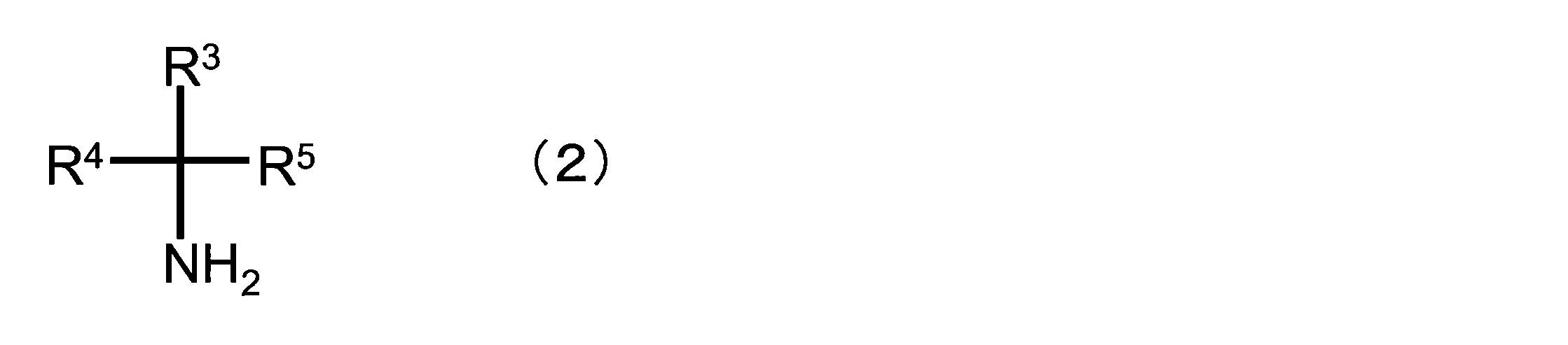
式(2)のR3~R5は、互いに独立して、フェニル基、ナフチル基、ピリジル基、チオフェニル基またはフラニル基であって各基は置換基を有していてもよい。
本開示の第5態様では、例えば、第1から第4のいずれかの態様の複合体結晶が、前記超分子ユニットと前記ゲスト分子とが配列した構造を有する前駆複合体結晶から、超臨界二酸化炭素を用いた超臨界乾燥により前記ゲスト分子を脱離して得た複合体結晶である。
本開示の第6態様のケモセンサは、例えば、第1から第5のいずれかの態様の複合体結晶と、前記複合体結晶の特性を検出する検出部と、を備える。当該ケモセンサは、前記検出部により検出した前記特性の変化に基づいて、所定の化学物質を検出する。
本開示の第7態様では、例えば、第6態様のケモセンサにおいて、前記検出部が、前記複合体結晶に光を照射する光源と、前記複合体結晶から発せられる光を検出する光検出器と、を備える。当該ケモセンサは、前記複合体結晶から発せられる前記光を前記特性として、当該光の変化に基づいて前記所定の化学物質を検出する。
本開示の第8態様では、例えば、第7態様のケモセンサにおいて、前記光の変化が、第1の環境条件において前記複合体結晶から発せられる光と、第2の環境条件において前記複合体結晶から発せられる光との差分である。
本開示の第9態様の製造方法は、例えば、第1から第4のいずれかの態様の複合体結晶の製造方法であって、前記超分子ユニットと前記ゲスト分子とが配列した構造を有する前駆複合体結晶から前記ゲスト分子を脱離して前記複合体結晶を形成し、前記前駆複合体結晶からの前記ゲスト分子の脱離を、超臨界二酸化炭素を用いた超臨界乾燥により実施する製造方法である。
[複合体結晶]
以下、本開示の複合体結晶について、図面を参照しながら説明する。
以下、本開示の複合体結晶について、図面を参照しながら説明する。
図1は、従来の複合体結晶を説明するための模式図である。従来の複合体結晶の構造100では、超分子ユニット101と、超分子ユニット101をホストとするゲスト分子102とが配列している。超分子ユニット101とゲスト分子102とは、非共有結合である相互作用により配列している。相互作用の例は、水素結合、イオン結合、CH-π相互作用、ハロゲン-π相互作用、ハロゲン-ハロゲン相互作用、ファンデルワールス相互作用、およびπ-π相互作用である。
図2は、本開示の複合体結晶を説明するための模式図である。本開示の複合体結晶の構造10では、超分子ユニット1が、非共有結合である相互作用により配列している。構造10は、超分子ユニット1間に、超分子ユニット1をホストとするゲスト分子2が配置されていない分子空孔3を有する。分子空孔3は、超分子ユニット1の内部の空間ではない。
構造10では、超分子ユニット1と、ゲスト分子2および/または分子空孔3との配列がさらに成立しうる。
構造10は、図1の構造100からゲスト分子102が脱離した構造でありうる。このとき分子空孔3は、ゲスト分子102の脱離により形成された空サイトである。ただし、脱離前の超分子ユニット101の配列と、脱離後の超分子ユニット1の配列とは互いに異なっていてもよい。ゲスト分子102の脱離時に超分子ユニットの配列が変化しうるためである。
図2の構造10は、本開示の複合体結晶が有する配列の一例を模式的に表現するに過ぎない。本開示の複合体結晶における超分子ユニット1の具体的な配列は限定されない。
分子空孔3は、特定の配列を有しうる。例えば分子空孔3は、結晶内においてチャネル状または層状に配列しうる。
本開示の複合体結晶における超分子ユニット1、ゲスト分子2および分子空孔3の構成比は限定されない。
分子空孔3を有する限り、本開示の複合体結晶におけるゲスト分子2の含有率は限定されない。本明細書において、複合体結晶におけるゲスト分子2の含有率とは、シアノアクリル酸誘導体分子の数に対するゲスト分子2の数の比を意味する。ゲスト分子2の含有率は、例えば30モル%以下である。ゲスト分子2の含有率は、10モル%以下、さらに5モル%以下でありうる。ゲスト分子2の含有率は、複合体結晶に対する熱重量分析、核磁気共鳴(NMR)測定、質量分析等により評価できる。
本開示の複合体結晶は、ゲスト分子2を実質的に含まなくてもよい。本明細書における「実質的に含まない」は、1モル%以下の含有率を意味する。NMRによる含有率の測定限界が1モル%であることから、1モル%未満の含有率を「実質的に含まない」と定めてもよい。
本開示の複合体結晶における空孔度(ゲスト分子2の数および分子空孔3の数の合計に占める分子空孔3の数の割合)は、例えば、70%以上であり、90%以上、95%以上、さらには99%以上であってもよい。空孔度は、複合体結晶に対する熱重量分析、NMR測定、質量分析等により評価できる。
ゲスト分子2の含有率は、例えば、後述の製造方法におけるゲスト分子2の脱離の方法および条件により制御できる。条件の例は、温度、時間(速度)、圧力、および超臨界流体の種類から選ばれる少なくとも1種である。
超分子ユニット1、ゲスト分子2および分子空孔3の配列、すなわち結晶構造は、複合体結晶に対するX線回折(XRD)測定等により評価できる。
超分子ユニット1、ゲスト分子2および分子空孔3の配列は、例えば、後述の製造方法における凝析、再結晶または曝露の条件、ならびにゲスト分子2の脱離の方法および条件により制御できる。条件の例は、温度、時間(速度)、圧力、超臨界流体の種類、ならびに再結晶または凝析に使用する溶剤の種類および混合比、から選ばれる少なくとも1種である。
超分子ユニット1は、2種以上の分子から構成される。超分子ユニット1は、2種の分子から構成されうる。超分子ユニット1では、非共有結合である相互作用により2種以上の分子が配列している。本開示の複合体結晶は、1次構造および2次構造の階層構造を有する。1次構造は、超分子ユニット1を構成する2種以上の分子の配列である。2次構造は、超分子ユニット1が配列した構造10である。
図3は、超分子ユニット1における分子の配列の一例を説明するための模式図である。図3の超分子ユニット1では、2種の分子4および分子5が配列している。図3の超分子ユニット1における分子4および分子5の結合比は4:4である。換言すれば、4つの分子4と4つの分子5との配列が1つの超分子ユニット1を構成する。
本開示の複合体結晶の超分子ユニット1は、シアノアクリル酸誘導体および3置換メチルアミンを含む。超分子ユニット1では、シアノアクリル酸誘導体および3置換メチルアミンが所定の結合比で配列している。超分子ユニット1は、シアノアクリル酸誘導体および3置換メチルアミンの有機塩である。双方の分子はイオン結合により配列している。
超分子ユニット1におけるシアノアクリル酸誘導体および3置換メチルアミンの結合比x:yは、シアノアクリル酸誘導体および3置換メチルアミンが有機塩を形成しうる限り、限定されない。xおよびyは、例えば、1以上の整数であり、その上限は、例えば10であり、6であってもよい。結合比は、例えば、1から6の範囲の整数:1から6の範囲の整数である。結合比は、1:1、2:2、3:3、4:4、5:5または6:6でありうる。
超分子ユニット1における分子の結合比は、複合体結晶に対するXRD測定等により評価できる。
超分子ユニット1における分子の結合比は、後述の製造方法における凝析、再結晶または曝露の条件により制御できる。条件の例は、温度、時間(速度)、圧力、ならびに再結晶または凝析に使用する溶剤の種類および混合比、から選ばれる少なくとも1種である。
超分子ユニット1は、シアノアクリル酸誘導体および3置換メチルアミン以外の第3の分子を含みうる。第3の分子は、シアノアクリル酸誘導体および3置換メチルアミンとともに超分子ユニット1の配列を形成しうる。
本開示の複合体結晶は、2種以上の超分子ユニット1を含みうる。
複合体結晶および超分子ユニット1の組成、ならびに超分子ユニット1を構成する分子の結合比は、例えば、NMR測定および/またはXRD測定により評価できる。
<シアノアクリル酸誘導体>
シアノアクリル酸誘導体は、シアノアクリル酸のビニル基におけるβ位の炭素原子に置換基が結合した構造を有する。この置換基は、シアノアクリル酸誘導体が蛍光性を示す分子構造であって、化学物質の取り込みによる蛍光の変化を複合体結晶が示す分子構造を有しうる。化学物質の取り込みによる当該蛍光の変化は、ケモセンサにおける化学物質の検出に利用できる。蛍光性は、例えば、紫外線による励起によって波長400~700nmの帯域にある蛍光を発する特性である。
シアノアクリル酸誘導体は、シアノアクリル酸のビニル基におけるβ位の炭素原子に置換基が結合した構造を有する。この置換基は、シアノアクリル酸誘導体が蛍光性を示す分子構造であって、化学物質の取り込みによる蛍光の変化を複合体結晶が示す分子構造を有しうる。化学物質の取り込みによる当該蛍光の変化は、ケモセンサにおける化学物質の検出に利用できる。蛍光性は、例えば、紫外線による励起によって波長400~700nmの帯域にある蛍光を発する特性である。
シアノアクリル酸誘導体は、以下の式(1)に示す化合物でありうる。式(1)のYは、フェニレン基、ナフチレン基、ピリジニレン基、チオフェニレン基またはフラニレン基であって、各基は置換基を有していてもよい。R1およびR2は、互いに独立して、水素原子、水酸基、メトキシ基、エトキシ基、メチル基、エチル基、プロピル基、イソプロピル基、アミノ基、シアノ基、アルデヒド基、チオール基、ビニル基、ニトロ基、ハロゲン原子、カルボキシエステル基(-COOR6)、N-置換アミド基(-CONHR7)、フェニル基、ナフチル基、ピリジル基、チオフェニル基、またはフラニル基である。式(1)に示す化合物は、式(1)の破線部に結合を有していてもいなくてもよい。この化合物が破線部に結合を有する場合の当該結合は、単結合、-CH2-(メチレン基)、-O-(エーテル結合)、-S-(スルフィド結合)または-NH-(イミノ基)である。

式(1)に示す化合物は、破線部に結合を有さなくてもよいし、破線部に単結合を有してもよい。Yは、フェニレン基、ナフチレン基、ピリジニレン基であってもよい。R1およびR2は、互いに独立して、水素原子、メトキシ基、メチル基、エチル基、プロピル基、イソプロピル基であってもよい。
Yが有しうる置換基は、例えばR1およびR2として例示した基である。置換基は、水素原子、メトキシ基、メチル基、エチル基、プロピル基、イソプロピル基であってもよい。R6は、例えばメチル基、エチル基、プロピル基、イソプロピル基である。R7は、例えばメチル基、エチル基、プロピル基、イソプロピル基、フェニル基である。
図4は、本開示に係る複合体結晶の超分子ユニットを構成するシアノアクリル酸誘導体の例を示す図である。図4の例は、(a)から(m)の順に、(E)-2-シアノ-3-(4-(ジフェニルアミノ)フェニル)アクリル酸、(E)-2-シアノ-3-(4-((4-メトキシフェニル)(フェニル)アミノ)フェニル)アクリル酸、(E)-2-シアノ-3-(5-(ジフェニルアミノ)チオフェン-2-イル)アクリル酸、(E)-3-(4-(9H-カルバゾール-9-イル)フェニル)-2-シアノアクリル酸、(E)-2-シアノ-3-(4-(フェニル(パラ-トリル)アミノ)フェニル)アクリル酸、(E)-2-シアノ-3-(5-(ジフェニルアミノ)ピリジン-2-イル)アクリル酸、(E)-3-(4-(10H-フェノチアジン-10-イル)フェニル)-2-シアノアクリル酸、(E)-2-シアノ-3-(4-((4-ヒドロキシフェニル)(フェニル)アミノ)フェニル)アクリル酸、(E)-2-シアノ-3-(4-(フェナジン-5(10H)-イル)フェニル)アクリル酸、(E)-3-(4-(10H-フェノキサジン-10-イル)フェニル)-2-シアノアクリル酸、(E)-2-シアノ-3-(6-(ジフェニルアミノ)ナフタレン-2-イル)アクリル酸、(E)-2-シアノ-3-(4-(ジフェニルアミノ)チオフェン-2-イル)アクリル酸、(E)-3-(4-((4-アミノフェニル)(フェニル)アミノ)フェニル)-2-シアノアクリル酸である。
<3置換メチルアミン>
3置換メチルアミンは、メチルアミンのメチル基に結合した3つの水素原子が置換基により置換された構造を有する。3つの置換基は全て同一でも、2つが同一でも、全て異なっていてもよい。
3置換メチルアミンは、メチルアミンのメチル基に結合した3つの水素原子が置換基により置換された構造を有する。3つの置換基は全て同一でも、2つが同一でも、全て異なっていてもよい。
3置換メチルアミンは、以下の式(2)に示す化合物でありうる。式(2)のR3~R5は、互いに独立して、フェニル基、ナフチル基、ピリジル基、チオフェニル基またはフラニル基であって、各基は置換基を有していてもよい。R3~R5は、互いに独立してフェニル基、ピリジル基、チオフェニル基であってもよい。R3~R5が有しうる置換基は、例えばR1およびR2として例示した基である。置換基は、水素原子、メトキシ基、メチル基、エチル基、プロピル基、イソプロピル基、ハロゲン原子であってもよい。

図5は、本開示に係る複合体結晶の超分子ユニットを構成する3置換メチルアミンの例を示す図である。図5の例は、(a)から(g)の順に、トリフェニルメチルアミン、ジフェニル(チオフェン-3-イル)メチルアミン、ジフェニル(ピリジン-3-イル)メチルアミン、(4-メトキシフェニル)ジフェニルメチルアミン、トリス(4-フルオロフェニル)メチルアミン、ナフタレン-1-イルジフェニルメチルアミン、フラン-3-イルジフェニルメチルアミンである。
<ゲスト分子>
本開示の複合体結晶がゲスト分子2を含む場合、ゲスト分子2は限定されない。ゲスト分子2は、例えば、シアノアクリル酸誘導体および3置換メチルアミンの有機塩との組み合わせにより、後述する前駆複合体結晶を形成可能な化合物である。
本開示の複合体結晶がゲスト分子2を含む場合、ゲスト分子2は限定されない。ゲスト分子2は、例えば、シアノアクリル酸誘導体および3置換メチルアミンの有機塩との組み合わせにより、後述する前駆複合体結晶を形成可能な化合物である。
ゲスト分子2は、本開示の複合体結晶を構築する際の鋳型分子として分子空孔3の大きさ、および/または形状を規定する化合物でありうる。
ゲスト分子2は、後述する製造方法における再結晶の溶剤、または有機塩の曝露に使用可能な化合物でありうる。
ゲスト分子2は、例えば、水、n-ペンタン、n-ヘキサン、シクロヘキサン、n-ヘプタン、n-オクタン、メチルシクロヘキサン、メタノール、エタノール、イソプロパノール(「1-メチルエタノール」ともいう)、1-プロパノール、1-ブタノール、2-ブタノール、イソブタノール(「2-メチルプロパノール」ともいう)、t-ブタノール、アセトン、メチルエチルケトン(「2-ブタノン」ともいう)、メチルプロピルケトン(「2-ペンタノン」ともいう)、メチルイソプロピルケトン、メチルブチルケトン、メチルイソブチルケトン、ジエチルケトン、メチルアミルケトン(「メチル-n-ペンチルケトン」ともいう)、メチル-t-ブチルケトン(「ピナコリン」ともいう)、ベンズアルデヒド、ブチルアルデヒド、酢酸メチル、酢酸エチル、酢酸プロピル、酢酸ブチル、安息香酸メチル、安息香酸エチル、フタル酸ジメチル、ケイ皮酸エチル、ジエチルエーテル、ジイソプロピルエーテル、t-ブチルメチルエーテル、ベンゼン、トルエン、o-キシレン、m-キシレン、p-キシレン、クロロベンゼン、o-クロロトルエン、m-クロロトルエン、p-クロロトルエン、o-ジクロロベンゼン、m-ジクロロベンゼン、p-ジクロロベンゼン、アニソール、エチルベンゼン、1,2-ジエチルベンゼン、1,4-ジエチルベンゼン、1,3,5-トリメチルベンゼン(「メシチレン」ともいう)、1,3-ジイソプロピルベンゼン、n-オクチルベンゼン、ニトロベンゼン、ベンゾニトリル、ジクロロメタン、1,2-ジクロロエタン、クロロホルム、モノフルオロベンゼン、1,2-ジフルオロベンゼン、1,3-ジフルオロベンゼン、1,4-ジフルオロベンゼン、1,3,5-トリフルオロベンゼン、ヘキサフルオロベンゼン、アクリロニトリル、アセトニトリル、N,N-ジメチルホルムアミド、N,N-ジメチルアセトアミド、N-メチル-2-ピロリドン、N,N-ジメチルアミン、N,N-ジエチルアミン、N,N-ジ-n-プロピルアミン、N,N-ジイソプロピルアミン、N,N-ジブチルアミン、N,N-ジメチル-o-トルイジン、N,N-ジメチル-m-トルイジン、N,N-ジメチル-p-トルイジン、N,N-ジエチル-o-トルイジン、N,N-ジエチル-m-トルイジン、N,N-ジエチル-p-トルイジン、ピリジン、ピペリジン、1-メチルピペリジン、ピリミジン、ピリダジン、ピラジン、ピペラジン、α-ピコリン、β-ピコリン、γ-ピコリン、アニリン、N,N-ジメチルアニリン、ジメチルスルホキシド、およびスルホランである。
本開示の複合体結晶は2種以上のゲスト分子2を含みうる。
本開示の複合体結晶の形状は限定されない。本開示の複合体結晶は、粒子、フィルム、シート、バルク、薄膜およびモノリス等の種々の形状を有しうる。これら種々の形状を有する複合体結晶において、分子空孔3の分布は均一であっても不均一であってもよい。
本開示の複合体結晶のサイズは限定されない。サイズは、バルクおよびモノリスのようなマクロな領域から、回路基板上の素子を構成する薄膜に代表されるミクロな領域まで、幅広い範囲をとりうる。
本開示の複合体結晶の用途は限定されない。用途の一例は、化学物質を検出するケモセンサである。ケモセンサは、化学物質の取り込みによる結晶特性の変化を利用する。特性は、例えば、吸収スペクトル、反射スペクトル、蛍光スペクトル、電気的特性および質量である。取り込んだ化学物質の種類により、特性の変化の状態は異なりうる。これを利用して、化学物質の種類をさらに検出するケモセンサとすることも可能である。
[複合体結晶の製法]
本開示の複合体結晶は、例えば、超分子ユニット1とゲスト分子2とが配列した構造を有する前駆複合体結晶からゲスト分子2を脱離して形成できる。前駆複合体結晶は、図1の構造100を有しうる。前駆複合体結晶は、分子空孔3を含まない結晶でありうる。
本開示の複合体結晶は、例えば、超分子ユニット1とゲスト分子2とが配列した構造を有する前駆複合体結晶からゲスト分子2を脱離して形成できる。前駆複合体結晶は、図1の構造100を有しうる。前駆複合体結晶は、分子空孔3を含まない結晶でありうる。
ゲスト分子2の脱離方法は限定されない。脱離方法の例は、加熱および/または減圧である。ゲスト分子2を他の化合物に置換し、置換した他の化合物を脱離する方法も採用できる。他の化合物は、ゲスト分子2よりも脱離が容易な化合物でありうる。
ゲスト分子2の脱離方法の別の例は、超臨界乾燥である。超臨界乾燥による脱離では、単なる加熱および/または減圧による脱離に比べて、ゲスト分子2の脱離時における複合体結晶の構造破壊およびこれに伴う変形を抑制できる。超臨界乾燥による脱離では、ゲスト分子2の脱離の前後において、超分子ユニット1の配列をより確実に保持できる。超臨界乾燥による脱離では、ゲスト分子2の脱離の前後において、複合体結晶の形状をより確実に保持できる。これらの効果は、超臨界流体の高い拡散性および溶解性、ならびにゼロである表面張力に基づく。
超臨界乾燥に使用する流体の例は、超臨界状態にある二酸化炭素(超臨界二酸化炭素)である。
前駆複合体結晶は、例えば、以下の方法により形成できる。
<第1の方法>
第1の方法は、ゲスト分子2である溶剤により、シアノアクリル酸誘導体および3置換メチルアミンの有機塩を再結晶する方法である。この方法では、再結晶により、超分子ユニット1としてゲスト分子2を包接しながら有機塩が配列する。この配列により、前駆複合体結晶が形成される。
第1の方法は、ゲスト分子2である溶剤により、シアノアクリル酸誘導体および3置換メチルアミンの有機塩を再結晶する方法である。この方法では、再結晶により、超分子ユニット1としてゲスト分子2を包接しながら有機塩が配列する。この配列により、前駆複合体結晶が形成される。
再結晶する有機塩は、例えば、シアノアクリル酸誘導体および3置換メチルアミンの混合物を溶剤により凝析して形成できる。溶剤は、有機塩を凝析できる化合物である。溶剤は、ゲスト分子2でなくてもよい。
第1の方法は、有機塩の再結晶により複合体結晶を形成する公知の方法に従って実施できる。ただし、第1の方法では、シアノアクリル酸誘導体および3置換メチルアミンの有機塩を再結晶する。
第1の方法およびゲスト分子2の脱離は連続的に実施できる。
<第2の方法>
第2の方法は、シアノアクリル酸誘導体および3置換メチルアミンの有機塩をゲスト分子2の蒸気に曝露する方法である。この方法では、曝露により、超分子ユニット1としてゲスト分子2を包接しながら有機塩が配列する。この配列により、前駆複合体結晶が形成される。
第2の方法は、シアノアクリル酸誘導体および3置換メチルアミンの有機塩をゲスト分子2の蒸気に曝露する方法である。この方法では、曝露により、超分子ユニット1としてゲスト分子2を包接しながら有機塩が配列する。この配列により、前駆複合体結晶が形成される。
第2の方法は、ゲスト分子2の蒸気への有機塩の曝露により複合体結晶を形成する公知の方法に従って実施できる。ただし、第2の方法では、シアノアクリル酸誘導体および3置換メチルアミンの有機塩を曝露する。
曝露する有機塩は、例えば、シアノアクリル酸誘導体および3置換メチルアミンの混合物を溶剤により凝析して形成できる。溶剤は、有機塩を凝析できる化合物である。溶剤は、ゲスト分子2でなくてもよい。この方法では、凝析時または凝析後に有機塩の成形が可能である。例えば、凝析した有機塩を溶液または分散液とし、これをスピンコート、ディスペンサー、インクジェット、3Dプリント等の手法により基板に塗布して、有機塩の成形体を成形できる。また、曝露方法の選択により、成形した有機塩の形状を曝露の前後で維持できる。
第2の方法およびゲスト分子2の脱離は連続的に実施できる。
最終的に得る複合体結晶の形状は、例えば、以下の手法により制御できる。
・複合体結晶を容器に充填する。容器は、複合体結晶を所定の用途に使用する際の容器でありうる。容器の例は、ガラス等の細管である。細管に充填された複合体結晶は、例えば、ケモセンサの一種であるガス検知管に使用できる。
・複合体結晶を溶液または分散液とし、これをスピンコート、ディスペンサー、インクジェット、3Dプリント等の手法により基板に塗布する。
・複合体結晶、分散剤およびバインダを含むスラリーを基板に配置し、乾燥固化させる。
・複合体結晶を容器に充填する。容器は、複合体結晶を所定の用途に使用する際の容器でありうる。容器の例は、ガラス等の細管である。細管に充填された複合体結晶は、例えば、ケモセンサの一種であるガス検知管に使用できる。
・複合体結晶を溶液または分散液とし、これをスピンコート、ディスペンサー、インクジェット、3Dプリント等の手法により基板に塗布する。
・複合体結晶、分散剤およびバインダを含むスラリーを基板に配置し、乾燥固化させる。
図6は、本開示の複合体結晶を製造する方法の一例を示す図である。図6の方法は、以下の工程S1、S2およびS3を含む。工程S1は、シアノアクリル酸誘導体および3置換メチルアミンの有機塩を形成する工程である。工程S2は、工程S1で形成した有機塩をゲスト分子2である溶剤により再結晶して前駆複合体結晶を形成する工程である。工程S3は、工程S2で形成した前駆複合体結晶からゲスト分子2を脱離して本開示の複合体結晶を形成する工程である。
図7は、本開示の複合体結晶を製造する方法の一例を示す図である。図7の方法は、以下の工程S4、S5およびS6を含む。工程S4は、シアノアクリル酸誘導体および3置換メチルアミンの有機塩を形成する工程である。工程S5は、工程S1で形成した有機塩をゲスト分子2の蒸気に曝露して前駆複合体結晶を形成する工程である。工程S6は、工程S5で形成した前駆複合体結晶からゲスト分子2を脱離して本開示の複合体結晶を形成する工程である。
[ケモセンサ]
本開示のケモセンサは、上述した本開示の複合体結晶と、前記複合体結晶の特性を検出する検出部とを備える。本開示のケモセンサは、前記検出部により検出した前記特性の変化に基づいて、所定の化学物質を検出する。
本開示のケモセンサは、上述した本開示の複合体結晶と、前記複合体結晶の特性を検出する検出部とを備える。本開示のケモセンサは、前記検出部により検出した前記特性の変化に基づいて、所定の化学物質を検出する。
前記検出部は、前記複合体結晶に光を照射する光源と、前記複合体結晶から発せられる光を検出する光検出器と、を備えうる。このとき本開示のケモセンサは、前記複合体結晶から発せられる前記光を前記特性として、当該光の変化に基づいて前記所定の化学物質を検出しうる。前記光の変化は、例えば、第1の環境条件において前記複合体結晶から発せられる光と、第2の環境条件において前記複合体結晶から発せられる光との差分である。第1の環境条件と第2の環境条件との間で、上記所定の化学物質の濃度および/または種類が相違する。第1の環境条件および第2の環境条件から選ばれる一方は、上記所定の化学物質を含まない環境条件でありうる。
図8は、本開示のケモセンサの構成の一例を示す模式図である。図8のケモセンサ21は、化学物質13を検出するセンサである。ケモセンサ21は、本開示の複合体結晶12と、複合体結晶12の特性を検出する検出部17とを備える。複合体結晶12は、基板11上に配置されている。検出部17は、処理部16に接続されている。処理部16は、検出部17を制御する。また、処理部16は、検出部17により検出した複合体結晶12の特性を評価し、当該特性の変化に基づいて化学物質13を検出する。処理部16は、さらに化学物質13の情報を決定しうる。情報は、例えば、種類および/または濃度である。
検出部17は、光源14および光検出器15を備える。光源14は、複合体結晶12に光を照射する。光は、例えば、複合体結晶12が蛍光を発する光である。光は、例えば、紫外光(UV)である。光検出器15は、複合体結晶12から発せられる光を受光する。受光する光は、例えば、複合体結晶12から発せられる蛍光である。処理部16は、光検出器15で受光した光を、複合体結晶12の特性として評価する。処理部16は、当該光の変化に基づいて化学物質13を検出する。処理部16は、化学物質13の情報をさらに決定しうる。
ケモセンサ21は、化学物質13の取り込みによる複合体結晶12の特性の変化を利用して所定の化学物質を検出する。ケモセンサ21は、例えば、複合体結晶12から発せられる蛍光の変化を利用して所定の化学物質を検出する。処理部16による評価には、蛍光スペクトルの変化ではなく、より単純化された変化、例えば蛍光の波長、強度、輝度、色度、明度および彩度から選ばれる少なくとも1種の変化、を利用できる。複合体結晶12の特性の変化の状態は、取り込む化学物質13の種類および/または濃度により異なりうる。検出部17により検出した当該状態を、化学物質13の情報の決定に利用できる。そのために処理部16は、化学物質13の情報に対応するデータを予め蓄えうる。この場合、検出部17で検出した当該状態をデータと対比して、化学物質13の情報を決定しうる。特性の変化は、差分および/または変化率により評価しうる。
図8の例では、光源14および光検出器15が複合体結晶12の同じ面の側に配置されている。光源14および光検出器15は、複合体結晶12を挟持するように配置されうる。このとき、基板11は、複合体結晶12から発せられる光を透過する材料から構成されうる。
基板11上の複合体結晶12の形状は、例えば、フィルムまたはシートである。このとき、複合体結晶12の厚さは、例えば、0.1μm~3000μmである。
基板11は、例えば、ガラス、石英、ケイ素またはその酸化物、金属またはその酸化物、化合物半導体、ポリテトラフルオロエチレンおよびアクリル樹脂等の樹脂により構成される。
光源14、光検出器15および処理部16には、公知の部材を使用できる。
検出部17および複合体結晶12は、同一の基板11上に形成されていてもよい。半導体素子から構成される光源14および光検出器15の採用により、回路基板上に検出部17および複合体結晶12を一体的に形成しうる。
化学物質13の検出が可能である限り、ケモセンサ21は任意の部材をさらに備えうる。当該部材は、例えば、化学物質13を複合体結晶12に導入する部材である。化学物質13が空気中に含まれる場合、当該部材は、例えば空気を複合体結晶12に送るファンである。
本開示のケモセンサは、蛍光の変化以外の複合体結晶12の特性の変化を利用できる。特性は、例えば、吸収スペクトル、反射スペクトル、電気抵抗および質量から選ばれる少なくとも1種である。本開示のケモセンサは、変化を検出する特性に応じた検出部17を備えうる。
吸収スペクトルの変化を利用するケモセンサは、図8のケモセンサ21と同様の構造を有しうる。光源14は、例えば、可視から紫外領域の光を照射する。
反射スペクトルの変化を利用するケモセンサは、図8のケモセンサ21と同様の構造を有しうる。光源14は、例えば、可視から紫外領域の光を照射する。
電気抵抗の変化を利用するケモセンサでは、例えば、複合体結晶12の電気抵抗を測定する抵抗測定部を検出部17が備える。抵抗測定部は、4端子抵抗法を実施する部材でありうる。
電気抵抗の変化を利用するケモセンサは、例えば、複合体結晶12から構成される領域を有する電界効果トランジスタ(FET)を備える。具体的な例は、ゲート電極とゲート絶縁膜との間に上記領域が形成されたFETを備える。化学物質の取り込みにより変化した上記領域の電気抵抗を、このFETは検出する。
質量の変化を利用するケモセンサは、例えば、水晶振動子マイクロバランス(Quartz Crystal Microbalance)センサ(以下、QCMセンサ)を備える。QCMセンサは、水晶振動子を備えた、極めて微小な質量変化を測定できるセンサである。QCMセンサは、例えば、特開2009-236607号公報に開示されている。より具体的な例は、水晶振動子の表面に複合体結晶12から構成される領域が形成されたQCMセンサを備える。化学物質の取り込みにより変化した上記領域の質量変化を、このQCMセンサは検出する。
質量の変化を利用するケモセンサは、例えば、膜型表面センサ(Membrance-type Surface Stress Sensor);(以下、MSSセンサ)を備える。MSSセンサは、ピエゾ抵抗を有する連結部により支持された微小な板状部材と、板状部材の表面に設けられた受容体層とを有する。MSSセンサは、極めて微小な質量変化を測定できる。MSSセンサは、例えば、国際公開第2011/148774号に開示されている。より具体的な例は、板状部材の表面に複合体結晶12から構成される領域が形成されたMSSセンサを備える。化学物質の取り込みにより変化した上記領域の質量変化を、このMSSセンサは検出する。
以下、実施例に基づき、本開示の複合体結晶およびケモセンサをより具体的に説明する。なお、本開示の複合体結晶およびケモセンサは、以下の実施例に限定されない。
(実施例1および比較例1)
内容積300mLの三つ口フラスコに、4-メトキシ-N-フェニルアニリン5.00g(21.5mmol)、4-ブロモベンズアルデヒド5.57g(30.1mmol)、およびトルエン150mLを仕込んだ。次に、撹拌下、0.225g(1.00mmol)のPd(OAc)2、0.406g(2.01mmol)のt-Bu3P、および炭酸カリウム5.20g(37.6mmol)を添加して加熱し、20時間の加熱還流を実施した。次に、室温まで冷却し、セライト濾過にて不溶物を除去した後、濾液を減圧濃縮した。次に、得られた残渣をシリカゲルカラムクロマトグラフィーにより精製して、4-((4-メトキシフェニル)(フェニル)アミノ)ベンズアルデヒド5.74gを得た。
内容積300mLの三つ口フラスコに、4-メトキシ-N-フェニルアニリン5.00g(21.5mmol)、4-ブロモベンズアルデヒド5.57g(30.1mmol)、およびトルエン150mLを仕込んだ。次に、撹拌下、0.225g(1.00mmol)のPd(OAc)2、0.406g(2.01mmol)のt-Bu3P、および炭酸カリウム5.20g(37.6mmol)を添加して加熱し、20時間の加熱還流を実施した。次に、室温まで冷却し、セライト濾過にて不溶物を除去した後、濾液を減圧濃縮した。次に、得られた残渣をシリカゲルカラムクロマトグラフィーにより精製して、4-((4-メトキシフェニル)(フェニル)アミノ)ベンズアルデヒド5.74gを得た。
次に、内容積200mLのナス型フラスコに、得られた4-((4-メトキシフェニル)(フェニル)アミノ)ベンズアルデヒド5.73g(18.89mmol)と、シアノ酢酸2.41g(28.33mmol)およびアセトニトリル50mLとを仕込み、撹拌下、ピペリジン3.74mLを注ぎ加えた後、加熱して、1時間の加熱還流を実施した。次に、室温まで冷却し、析出した結晶を濾取して、濾取した結晶を水150mLに懸濁させた。次に、撹拌下、炭酸ナトリウム水溶液を加えてpHを10以上とした後、希塩酸を加えてpHを4に調整し、結晶を濾取および減圧乾燥して、(E)-2-シアノ-3-(4-((4-メトキシフェニル)(フェニル)アミノ)フェニル)アクリル酸6.12gを得た。
次に、室温下、(E)-2-シアノ-3-(4-((4-メトキシフェニル)(フェニル)アミノ)フェニル)アクリル酸とトリフェニルメチルアミンとを1:1のモル比でメタノール中で混合した。その後、減圧下でメタノールを除去して有機塩を形成した。
次に、形成した有機塩を、クロロホルムおよびジエチルケトンを4:1の体積比で混合した溶剤に溶解し、室温で48時間静置し再結晶して、粒子状の前駆複合体結晶を得た。熱重量分析、XRD測定および1H-NMR測定(基準物質:テトラメチルシラン(TMS);以下、同じ)により、形成した前駆複合体結晶について以下の項目(1)~(3)が確認された。
(1)有機塩は、(E)-2-シアノ-3-(4-((4-メトキシフェニル)(フェニル)アミノ)フェニル)アクリル酸とトリフェニルメチルアミンとの有機塩である。
(2)前駆複合体結晶は、有機塩である超分子ユニットと、ゲスト分子であるクロロホルムおよびジエチルケトンとが配列した構造を有する。
(3)前駆複合体結晶におけるゲスト分子の含有率は、上記確認された配列から導かれる理論上の最大値にほぼ等しい。
(1)有機塩は、(E)-2-シアノ-3-(4-((4-メトキシフェニル)(フェニル)アミノ)フェニル)アクリル酸とトリフェニルメチルアミンとの有機塩である。
(2)前駆複合体結晶は、有機塩である超分子ユニットと、ゲスト分子であるクロロホルムおよびジエチルケトンとが配列した構造を有する。
(3)前駆複合体結晶におけるゲスト分子の含有率は、上記確認された配列から導かれる理論上の最大値にほぼ等しい。
図9は、実施例1の前駆複合体結晶の1H-NMRプロファイルを示す図である。当該プロファイルにおいて、化学シフト0.89ppmのピークがジエチルケトンのピークであり、8.32ppmのピークがクロロホルムのピークである。
次に、超臨界二酸化炭素により前駆複合体結晶を処理して、当該結晶からゲスト分子を脱離させた。このようにして、実施例1の複合体結晶を得た。得られた複合体結晶は、前駆複合体結晶の形状を維持していた。XRD測定および1H-NMR測定により、形成した複合体結晶について以下の項目(1)~(5)が確認された。
(1)複合体結晶は、有機塩である超分子ユニットが配列した構造を有する。
(2)超分子ユニットの配列は、前駆複合体結晶における超分子ユニットの配列を維持している。
(3)超分子ユニットの間に、分子空孔が形成されている。
(4)分子空孔の配列は、前駆複合体結晶におけるゲスト分子の配列に一致する。
(5)複合体結晶におけるゲスト分子の含有率は、NMRの測定限界以下、すなわち1モル%未満、であり、複合体結晶の空孔度は99%以上であった。
(1)複合体結晶は、有機塩である超分子ユニットが配列した構造を有する。
(2)超分子ユニットの配列は、前駆複合体結晶における超分子ユニットの配列を維持している。
(3)超分子ユニットの間に、分子空孔が形成されている。
(4)分子空孔の配列は、前駆複合体結晶におけるゲスト分子の配列に一致する。
(5)複合体結晶におけるゲスト分子の含有率は、NMRの測定限界以下、すなわち1モル%未満、であり、複合体結晶の空孔度は99%以上であった。
図10は、実施例1の複合体結晶の1H-NMRプロファイルを示す図である。当該プロファイルには、ジエチルケトンおよびクロロホルムのピークが存在しない。図11は、実施例1の複合体結晶および前駆複合体結晶のXRDプロファイルを示す図である。当該プロファイルから、両者が同じ回折角2θにピークを有することが確認された。すなわち、ゲスト分子の有無を除き、両者が同じ結晶構造を有することが確認された。
次に、実施例1の複合体結晶を濃度10ppm(体積基準;以下同じ)のアンモニアガスに曝露して、複合体結晶が示す二次元の蛍光強度の変化(曝露の前後における変化)を評価した。評価は以下の手順で実施した。
1.複合体結晶の粒子を試料台に配置した。次に、ガスフローセル中に試料台を格納した。ガスフローセルは、窓、ガス導入口およびガス排出口を備えていた。窓は、試料台上の粒子に光を照射可能、かつ粒子の発する蛍光を検出可能なサイズおよび位置を有していた。
2.ガスフローセルにアンモニアガスを導入する前に、複合体結晶の蛍光強度Aを測定した。具体的には、波長365nmの紫外光を複合体結晶に照射し、その際に当該結晶が発する蛍光をカメラ(レイマー製FLOYD)により撮影して蛍光強度Aを得た。
3.窒素により濃度10ppmに希釈したアンモニアガスをガスフローセルに導入し、複合体結晶を当該ガスに曝露した。曝露開始から10分経過後、複合体結晶の蛍光強度Bを測定した。蛍光強度Bの測定は、蛍光強度Aの測定と同様に実施した。
4.画像処理により蛍光強度Aと蛍光強度Bとの差分強度を得た。差分は、蛍光強度Aおよび蛍光強度Bから選ばれる相対的に大きな強度から相対的に小さい強度を差し引いた値とした。
1.複合体結晶の粒子を試料台に配置した。次に、ガスフローセル中に試料台を格納した。ガスフローセルは、窓、ガス導入口およびガス排出口を備えていた。窓は、試料台上の粒子に光を照射可能、かつ粒子の発する蛍光を検出可能なサイズおよび位置を有していた。
2.ガスフローセルにアンモニアガスを導入する前に、複合体結晶の蛍光強度Aを測定した。具体的には、波長365nmの紫外光を複合体結晶に照射し、その際に当該結晶が発する蛍光をカメラ(レイマー製FLOYD)により撮影して蛍光強度Aを得た。
3.窒素により濃度10ppmに希釈したアンモニアガスをガスフローセルに導入し、複合体結晶を当該ガスに曝露した。曝露開始から10分経過後、複合体結晶の蛍光強度Bを測定した。蛍光強度Bの測定は、蛍光強度Aの測定と同様に実施した。
4.画像処理により蛍光強度Aと蛍光強度Bとの差分強度を得た。差分は、蛍光強度Aおよび蛍光強度Bから選ばれる相対的に大きな強度から相対的に小さい強度を差し引いた値とした。
次に、同様の手順により、前駆複合体結晶を濃度10ppmのアンモニアガスに曝露したときの二次元の蛍光強度の変化を評価した(比較例1)。
これらの評価により、ゲスト分子が脱離していない比較例1の前駆複合体結晶に比べて、ゲスト分子が脱離した実施例1の複合体結晶では、より大きな蛍光強度の変化が確認された。すなわち、比較例1の前駆複合体結晶に比べて、実施例1の複合体結晶は化学物質に対するより大きな蛍光応答性を示すことが確認された。
実施例1および比較例1で得られた差分強度が図12Aおよび図12Bに示される。図12Aは、実施例1の差分強度である。図12Bは、比較例1の差分強度である。
(比較例2)
室温下、アントラセンジビニルスルホン酸とトリフェニルメチルアミンとを1:2のモル比でメタノール中で混合した。その後、減圧下でメタノールを除去して有機塩を形成した。アントラセンジビニルスルホン酸を以下の式(3)に示す。
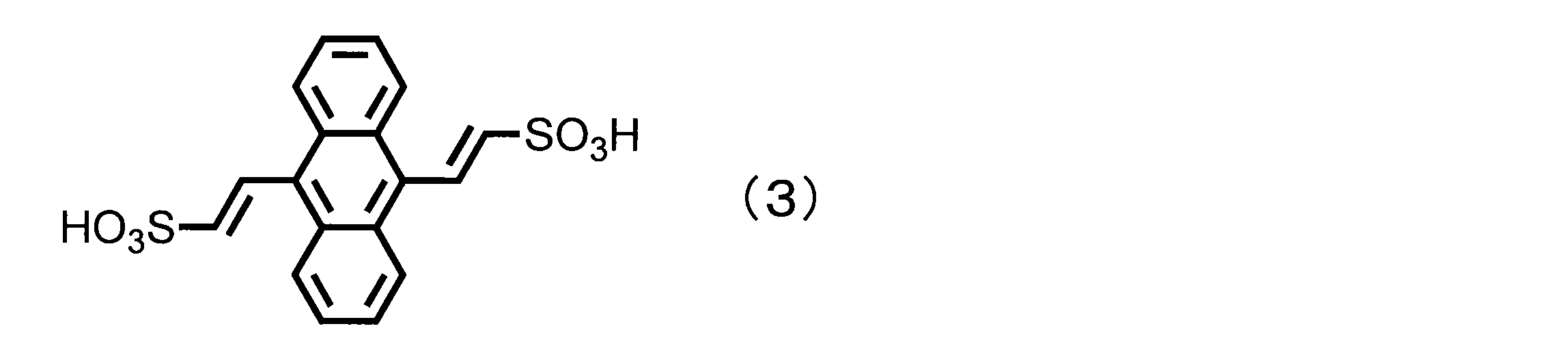
室温下、アントラセンジビニルスルホン酸とトリフェニルメチルアミンとを1:2のモル比でメタノール中で混合した。その後、減圧下でメタノールを除去して有機塩を形成した。アントラセンジビニルスルホン酸を以下の式(3)に示す。
次に、形成した有機塩を、メタノールおよび1,2-ジクロロエタンを3:4の体積比で混合した溶剤に溶解し、室温で48時間静置し再結晶して、粒子状の前駆複合体結晶を得た。熱重量分析、XRD測定および1H-NMR測定により、形成した前駆複合体結晶について以下の項目(1)~(3)が確認された。
(1)有機塩は、アントラセンジビニルスルホン酸とトリフェニルメチルアミンとの有機塩である。
(2)前駆複合体結晶は、有機塩である超分子ユニットと、混合溶剤に由来するゲスト分子である1,2-ジクロロエタンとが配列した構造を有する。
(3)前駆複合体結晶におけるゲスト分子の含有率は、上記確認された配列から導かれる理論上の最大値にほぼ等しい。
(1)有機塩は、アントラセンジビニルスルホン酸とトリフェニルメチルアミンとの有機塩である。
(2)前駆複合体結晶は、有機塩である超分子ユニットと、混合溶剤に由来するゲスト分子である1,2-ジクロロエタンとが配列した構造を有する。
(3)前駆複合体結晶におけるゲスト分子の含有率は、上記確認された配列から導かれる理論上の最大値にほぼ等しい。
次に、超臨界二酸化炭素により前駆複合体結晶を処理して、当該結晶からゲスト分子を脱離させた。このようにして、比較例2の複合体結晶を得た。得られた複合体結晶は、前駆複合体結晶の形状を維持していた。XRD測定および1H-NMR測定により、形成した複合体結晶について以下の項目(1)~(5)が確認された。
(1)複合体結晶は、有機塩である超分子ユニットが配列した構造を有する。
(2)超分子ユニットの配列は、前駆複合体結晶における超分子ユニットの配列を維持している。
(3)超分子ユニットの間に、分子空孔が形成されている。
(4)分子空孔の配列は、前駆複合体結晶におけるゲスト分子の配列に一致する。
(5)複合体結晶におけるゲスト分子の含有率は、NMRの測定限界以下、すなわち1モル%未満、である。
(1)複合体結晶は、有機塩である超分子ユニットが配列した構造を有する。
(2)超分子ユニットの配列は、前駆複合体結晶における超分子ユニットの配列を維持している。
(3)超分子ユニットの間に、分子空孔が形成されている。
(4)分子空孔の配列は、前駆複合体結晶におけるゲスト分子の配列に一致する。
(5)複合体結晶におけるゲスト分子の含有率は、NMRの測定限界以下、すなわち1モル%未満、である。
次に、比較例2の複合体結晶を濃度10ppmのアンモニアガスに曝露したときの二次元の蛍光強度の変化を、実施例1と同様に評価した。
この評価により、比較例2の複合体結晶では、上記アンモニアガスへの曝露による蛍光強度の変化がほとんど生じないことが確認された。すなわち、比較例2の複合体結晶に比べて、化学物質に対する著しく大きな蛍光応答性を実施例1の複合体結晶が示すことが確認された。比較例2で得られた差分強度が図13に示される。
(比較例3)
室温下、スチルベン-4,4’-ジスルホン酸とトリフェニルメチルアミンとを1:2のモル比でメタノール中で混合した。その後、減圧下でメタノールを除去して有機塩を形成した。スチルベン-4,4’-ジスルホン酸を以下の式(4)に示す。
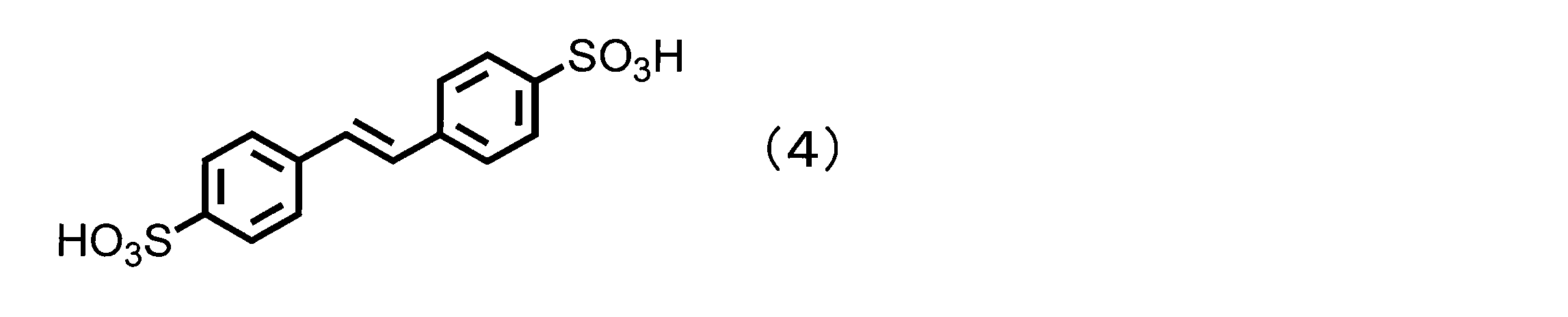
室温下、スチルベン-4,4’-ジスルホン酸とトリフェニルメチルアミンとを1:2のモル比でメタノール中で混合した。その後、減圧下でメタノールを除去して有機塩を形成した。スチルベン-4,4’-ジスルホン酸を以下の式(4)に示す。
次に、形成した有機塩を、メタノールおよびo-クロロトルエンを1:2の体積比で混合した溶剤に溶解し、室温で48時間静置し再結晶して、粒子状の前駆複合体結晶を得た。熱重量分析、XRD測定および1H-NMR測定により、形成した前駆複合体結晶について以下の項目(1)~(3)が確認された。
(1)有機塩は、スチルベン-4,4’-ジスルホン酸とトリフェニルメチルアミンとの有機塩である。
(2)前駆複合体結晶は、有機塩である超分子ユニットと、混合溶剤に由来するゲスト分子であるo-クロロトルエンとが配列した構造を有する。
(3)前駆複合体結晶におけるゲスト分子の含有率は、上記確認された配列から導かれる理論上の最大値にほぼ等しい。
(1)有機塩は、スチルベン-4,4’-ジスルホン酸とトリフェニルメチルアミンとの有機塩である。
(2)前駆複合体結晶は、有機塩である超分子ユニットと、混合溶剤に由来するゲスト分子であるo-クロロトルエンとが配列した構造を有する。
(3)前駆複合体結晶におけるゲスト分子の含有率は、上記確認された配列から導かれる理論上の最大値にほぼ等しい。
次に、超臨界二酸化炭素により前駆複合体結晶を処理して、当該結晶からゲスト分子を脱離させた。このようにして、比較例3の複合体結晶を得た。得られた複合体結晶は、前駆複合体結晶の形状を維持していた。XRD測定および1H-NMR測定により、形成した複合体結晶について以下の項目(1)~(5)が確認された。
(1)複合体結晶は、有機塩である超分子ユニットが配列した構造を有する。
(2)超分子ユニットの配列は、前駆複合体結晶における超分子ユニットの配列を維持している。
(3)超分子ユニットの間に、分子空孔が形成されている。
(4)分子空孔の配列は、前駆複合体結晶におけるゲスト分子の配列に一致する。
(5)複合体結晶におけるゲスト分子の含有率は、NMRの測定限界以下、すなわち1モル%未満、である。
(1)複合体結晶は、有機塩である超分子ユニットが配列した構造を有する。
(2)超分子ユニットの配列は、前駆複合体結晶における超分子ユニットの配列を維持している。
(3)超分子ユニットの間に、分子空孔が形成されている。
(4)分子空孔の配列は、前駆複合体結晶におけるゲスト分子の配列に一致する。
(5)複合体結晶におけるゲスト分子の含有率は、NMRの測定限界以下、すなわち1モル%未満、である。
次に、比較例3の複合体結晶を濃度10ppmのアンモニアガスに曝露したときの二次元の蛍光強度の変化を、実施例1と同様に評価した。
この評価により、比較例3の複合体結晶では、上記アンモニアガスへの曝露による蛍光強度の変化が生じないことが確認された。すなわち、比較例3の複合体結晶に比べて、化学物質に対する著しく大きな蛍光応答性を実施例1の複合体結晶が示すことが確認された。比較例3で得られた差分強度が図14に示される。
(実施例2)
実施例1の複合体結晶を所定の評価濃度のアンモニアガスに曝露したときの蛍光強度の変化を、実施例1と同様に評価した。ただし、実施例1の説明において述べた「手順3」では、各評価濃度となるように窒素で希釈したガスをガスフローセルに導入し、当該ガスに複合体結晶を曝露した。評価濃度は、0.05ppm、0.1ppm、0.25ppmおよび0.5ppmとした。評価は、各評価濃度について、サンプル数n=3で実施した。
実施例1の複合体結晶を所定の評価濃度のアンモニアガスに曝露したときの蛍光強度の変化を、実施例1と同様に評価した。ただし、実施例1の説明において述べた「手順3」では、各評価濃度となるように窒素で希釈したガスをガスフローセルに導入し、当該ガスに複合体結晶を曝露した。評価濃度は、0.05ppm、0.1ppm、0.25ppmおよび0.5ppmとした。評価は、各評価濃度について、サンプル数n=3で実施した。
実施例2で得られた差分強度の評価結果が図15に示される。図15に示される規格化された差分強度は、実施例1と同様に得た二次元の差分強度を示す画像に対して、画像編集ソフト(アドビシステムズ製、Photoshop CS2)を用いた以下の画像処理を実施して求めた。
・最初に、複合体結晶粒子に対応する領域を画像から選択する。選択する領域には、画像内に視認できる複合体結晶粒子のうち、少なくとも60%、好ましくは80%程度の数の粒子が含まれるようにする。選択する領域には、粒子に対応しない領域(試料台が写し出された領域)ができるだけ含まれないようにし、選択した領域に占める、粒子に対応しない領域の割合が面積基準で3%を超えないようにする。なお、二次元の差分強度を示す画像がカラーである場合は、予め、グレースケールに変換しておく。
・次に、選択した範囲についてピクセル毎の明るさ値を抽出し、抽出した明るさ値の平均値を上記規格化された差分強度とする。明るさ値は、黒を0とし、白を255とする256階調による値とする。
・最初に、複合体結晶粒子に対応する領域を画像から選択する。選択する領域には、画像内に視認できる複合体結晶粒子のうち、少なくとも60%、好ましくは80%程度の数の粒子が含まれるようにする。選択する領域には、粒子に対応しない領域(試料台が写し出された領域)ができるだけ含まれないようにし、選択した領域に占める、粒子に対応しない領域の割合が面積基準で3%を超えないようにする。なお、二次元の差分強度を示す画像がカラーである場合は、予め、グレースケールに変換しておく。
・次に、選択した範囲についてピクセル毎の明るさ値を抽出し、抽出した明るさ値の平均値を上記規格化された差分強度とする。明るさ値は、黒を0とし、白を255とする256階調による値とする。
図15に示すように、実施例2の複合体結晶では、濃度0.5ppm以下のアンモニアガスに対して蛍光強度の大きな変化が確認された。また、アンモニアガスの濃度に依存して差分強度が変化する蛍光応答性を示すことが確認された。
本開示の複合体結晶およびケモセンサは、上述した各実施形態に限定されることなく、特許請求の範囲に記載した発明の範囲内で種々の変形、変更が可能である。例えば、発明を実施するための形態に記載した実施形態に示された技術的特徴は、上述の課題の一部または全部を解決するため、あるいは、上述の効果の一部または全部を達成するために、適宜、差し替えや、組み合わせを行うことが可能である。また、その技術的特徴が本明細書中に必須なものとして説明されていなければ、適宜、削除することが可能である。
本開示の複合体結晶は、例えば、化学物質を検出するケモセンサに応用できる。
Claims (9)
- 2種以上の分子から構成される超分子ユニットが配列した構造を有する複合体結晶であって、
前記超分子ユニットが、前記分子としてシアノアクリル酸誘導体および3置換メチルアミンを含み、
前記超分子ユニット間に、前記超分子ユニットをホストとするゲスト分子が配置されていない分子空孔を有する、複合体結晶。 - 前記ゲスト分子を実質的に含まない、請求項1に記載の複合体結晶。
- 前記シアノアクリル酸誘導体が以下の式(1)に示す化合物である、請求項1または2に記載の複合体結晶。

- 前記3置換メチルアミンが以下の式(2)に示す化合物である、請求項1~3のいずれかに記載の複合体結晶。

- 前記超分子ユニットと前記ゲスト分子とが配列した構造を有する前駆複合体結晶から、超臨界二酸化炭素を用いた超臨界乾燥により前記ゲスト分子を脱離して得た、請求項1~4のいずれかに記載の複合体結晶。
- 請求項1~5のいずれかに記載の複合体結晶と、
前記複合体結晶の特性を検出する検出部と、を備え、
前記検出部により検出した前記特性の変化に基づいて、所定の化学物質を検出するケモセンサ。 - 前記検出部が、前記複合体結晶に光を照射する光源と、前記複合体結晶から発せられる光を検出する光検出器と、を備え、
前記複合体結晶から発せられる前記光を前記特性として、当該光の変化に基づいて前記所定の化学物質を検出する請求項6に記載のケモセンサ。 - 前記光の変化が、第1の環境条件において前記複合体結晶から発せられる光と、第2の環境条件において前記複合体結晶から発せられる光との差分である請求項7に記載のケモセンサ。
- 請求項1~4のいずれかに記載の複合体結晶の製造方法であって、
前記超分子ユニットと前記ゲスト分子とが配列した構造を有する前駆複合体結晶から前記ゲスト分子を脱離して前記複合体結晶を形成し、
前記前駆複合体結晶からの前記ゲスト分子の脱離を、超臨界二酸化炭素を用いた超臨界乾燥により実施する、複合体結晶の製造方法。
Priority Applications (4)
| Application Number | Priority Date | Filing Date | Title |
|---|---|---|---|
| US16/493,675 US11434213B2 (en) | 2017-03-16 | 2018-03-15 | Complex crystal and chemosensor provided with same |
| CN201880018194.4A CN110418781A (zh) | 2017-03-16 | 2018-03-15 | 复晶体和具备其的化学传感器 |
| EP18768431.1A EP3597631A4 (en) | 2017-03-16 | 2018-03-15 | COMPLEX CRYSTAL AND CHEMICAL SENSOR EQUIPPED WITH SAME |
| JP2019506278A JP7104688B2 (ja) | 2017-03-16 | 2018-03-15 | 複合体結晶とこれを備えるケモセンサ |
Applications Claiming Priority (2)
| Application Number | Priority Date | Filing Date | Title |
|---|---|---|---|
| JP2017-051795 | 2017-03-16 | ||
| JP2017051795 | 2017-03-16 |
Publications (1)
| Publication Number | Publication Date |
|---|---|
| WO2018169023A1 true WO2018169023A1 (ja) | 2018-09-20 |
Family
ID=63522293
Family Applications (1)
| Application Number | Title | Priority Date | Filing Date |
|---|---|---|---|
| PCT/JP2018/010344 Ceased WO2018169023A1 (ja) | 2017-03-16 | 2018-03-15 | 複合体結晶とこれを備えるケモセンサ |
Country Status (5)
| Country | Link |
|---|---|
| US (1) | US11434213B2 (ja) |
| EP (1) | EP3597631A4 (ja) |
| JP (1) | JP7104688B2 (ja) |
| CN (1) | CN110418781A (ja) |
| WO (1) | WO2018169023A1 (ja) |
Cited By (1)
| Publication number | Priority date | Publication date | Assignee | Title |
|---|---|---|---|---|
| WO2026014462A1 (ja) * | 2024-07-11 | 2026-01-15 | 国立大学法人大阪大学 | 有機塩、パーフルオロアルキル化合物の検出装置、および、パーフルオロアルキル化合物の検出方法 |
Families Citing this family (2)
| Publication number | Priority date | Publication date | Assignee | Title |
|---|---|---|---|---|
| WO2022004685A1 (ja) * | 2020-07-02 | 2022-01-06 | パナソニックIpマネジメント株式会社 | 機能性部材とこれを備えた化学物質センサー |
| CN112939887B (zh) * | 2021-02-04 | 2022-05-27 | 山西大学 | 一种基于碱性染料的近红外荧光探针及其制备方法和应用 |
Citations (4)
| Publication number | Priority date | Publication date | Assignee | Title |
|---|---|---|---|---|
| JPH02254425A (ja) * | 1989-03-29 | 1990-10-15 | Teijin Ltd | 有機非線形光学材料 |
| JP2009236607A (ja) | 2008-03-26 | 2009-10-15 | Seiko Epson Corp | Qcmデバイス |
| WO2011148774A1 (ja) | 2010-05-24 | 2011-12-01 | 独立行政法人物質・材料研究機構 | 表面応力センサ |
| JP2015193563A (ja) | 2014-03-31 | 2015-11-05 | パナソニック株式会社 | 包接結晶物粉末、包接結晶膜および包接結晶の製造方法 |
Family Cites Families (5)
| Publication number | Priority date | Publication date | Assignee | Title |
|---|---|---|---|---|
| US2906773A (en) * | 1957-08-01 | 1959-09-29 | Dow Chemical Co | 2, 2'-oxybis (p-phenylenemethylene) bis (2-thiopseudourea) compounds |
| DE68911969T2 (de) * | 1988-03-28 | 1994-07-21 | Teijin Ltd | Organischer nichtlinearer optischer Stoff. |
| US5196147A (en) * | 1988-03-28 | 1993-03-23 | Teijin Limited | Organic nonlinear optical substance |
| JPH03126925A (ja) * | 1989-10-13 | 1991-05-30 | Teijin Ltd | ジオキシ環を含む非線形光学における第2高調波発生材料 |
| EP1777517A4 (en) * | 2004-08-11 | 2010-09-22 | Nippon Telegraph & Telephone | ELEMENT FOR DETECTION OF OZONE GAS |
-
2018
- 2018-03-15 EP EP18768431.1A patent/EP3597631A4/en not_active Withdrawn
- 2018-03-15 CN CN201880018194.4A patent/CN110418781A/zh active Pending
- 2018-03-15 WO PCT/JP2018/010344 patent/WO2018169023A1/ja not_active Ceased
- 2018-03-15 US US16/493,675 patent/US11434213B2/en active Active
- 2018-03-15 JP JP2019506278A patent/JP7104688B2/ja active Active
Patent Citations (4)
| Publication number | Priority date | Publication date | Assignee | Title |
|---|---|---|---|---|
| JPH02254425A (ja) * | 1989-03-29 | 1990-10-15 | Teijin Ltd | 有機非線形光学材料 |
| JP2009236607A (ja) | 2008-03-26 | 2009-10-15 | Seiko Epson Corp | Qcmデバイス |
| WO2011148774A1 (ja) | 2010-05-24 | 2011-12-01 | 独立行政法人物質・材料研究機構 | 表面応力センサ |
| JP2015193563A (ja) | 2014-03-31 | 2015-11-05 | パナソニック株式会社 | 包接結晶物粉末、包接結晶膜および包接結晶の製造方法 |
Non-Patent Citations (4)
| Title |
|---|
| AMAMOTO, ATSUSHI ET AL.: "Hierarchical construction of fluorescent organic porous structures and guest responsive fluorescent modulation by ammonium carboxylates", ORGANIC CRYSTAL GROUP NEWSLETTER, vol. 29, 1 January 2011 (2011-01-01), pages 59, XP055636634 * |
| ATSUSHI YAMAMOTO ET AL.: "Hierarchical Construction of Fluorescent Organic Porous Structures and Guest Responsive Fluorescent Modulation by Ammonium Carboxylates", 7TH HOST-GUEST CHEMISTRY SYMPOSIUM, 2011 |
| HARIHARAN, P. S. ET AL.: "Molecular engineering of triphenylamine based aggregation enhanced emissive fluorophore: structure-dependent mechanochromism and self-reversible fluorescence switching", CRYSTAL GROWTH & DESIGN, vol. 17, no. 1, 21 November 2016 (2016-11-21), pages 146 - 155, XP055558578 * |
| See also references of EP3597631A4 |
Cited By (1)
| Publication number | Priority date | Publication date | Assignee | Title |
|---|---|---|---|---|
| WO2026014462A1 (ja) * | 2024-07-11 | 2026-01-15 | 国立大学法人大阪大学 | 有機塩、パーフルオロアルキル化合物の検出装置、および、パーフルオロアルキル化合物の検出方法 |
Also Published As
| Publication number | Publication date |
|---|---|
| JP7104688B2 (ja) | 2022-07-21 |
| EP3597631A1 (en) | 2020-01-22 |
| EP3597631A4 (en) | 2020-03-18 |
| US11434213B2 (en) | 2022-09-06 |
| CN110418781A (zh) | 2019-11-05 |
| US20200010437A1 (en) | 2020-01-09 |
| JPWO2018169023A1 (ja) | 2020-05-14 |
Similar Documents
| Publication | Publication Date | Title |
|---|---|---|
| Chen et al. | Highly sensitive detection of low-level water content in organic solvents and cyanide in aqueous media using novel solvatochromic AIEE fluorophores | |
| Merz et al. | Synthesis, Photophysical and Electronic Properties of New Red‐to‐NIR Emitting Donor–Acceptor Pyrene Derivatives | |
| Zhao et al. | Fluorescence quenching of a conjugated polymer by synergistic amine-carboxylic acid and π–π interactions for selective detection of aromatic amines in aqueous solution | |
| Xue et al. | Aggregation-induced emission nanofiber as a dual sensor for aromatic amine and acid vapor | |
| Chow et al. | Design and synthesis of heterobimetallic Ru (II)–Ln (III) complexes as chemodosimetric ensembles for the detection of biogenic amine odorants | |
| Poutanen et al. | Thermal isomerization of hydroxyazobenzenes as a platform for vapor sensing | |
| Liu et al. | Single-layer assembly of pyrene end-capped terthiophene and its sensing performances to nitroaromatic explosives | |
| Sun et al. | Strong blue emissive nanofibers constructed from benzothizole modified tert-butyl carbazole derivative for the detection of volatile acid vapors | |
| WO2018169022A1 (ja) | 複合体結晶とこれを備えるケモセンサ | |
| JP6652248B2 (ja) | 空気中、溶液中および拭き取り試料からのNOxベースの爆発物を検出するための蛍光染料フィルム、検出試薬、方法、分析物感知層の生成方法、分析物感知層、及び、使用 | |
| JP7104688B2 (ja) | 複合体結晶とこれを備えるケモセンサ | |
| CN103525404B (zh) | 一种基于共轭高分子的荧光传感器阵列及其应用 | |
| Li et al. | Dithienylethene-bridged difluoroboron β-diketonate dyes: Optical switching behaviors and triple sensing for volatile amine vapors | |
| Lucenti et al. | Unravelling the intricate photophysical behavior of 3-(pyridin-2-yl) triimidazotriazine AIE and RTP polymorphs | |
| Asthana et al. | Recent advances in AIEgen-based chemosensors for small molecule detection, with a focus on ion sensing | |
| CN110330497A (zh) | 一种碟烯-苝二酰亚胺衍生物及其合成方法和对气相挥发性芳香烃的传感应用 | |
| Thangadurai et al. | A novel colorimetric and fluorescent sensor for fluoride and pyrophosphate based on fluorenone signaling units | |
| Dinda et al. | Selective Detection of Primary Aromatic Amines through Enhanced Luminescence of a 2D+ 2D Inclined Polycatenated Microporous Nitro-Functionalized Metal–Organic Framework | |
| Zhang et al. | Nonplanar Perylene Monoimide‐Based Fluorescent Film for Enhanced BTX Sensing | |
| JP2015193563A (ja) | 包接結晶物粉末、包接結晶膜および包接結晶の製造方法 | |
| Rizzo et al. | Insights into the effect of the spacer on the properties of imidazolium based AIE luminogens | |
| Kolev et al. | The crystal structure and optical properties of 1-methyl-4-[2-(4-hydroxyphenyl) ethenyl] pyridinium dihydrogenphosphate: new aspects on crystallographic disorder and its effect on polarized solid-state IR spectra | |
| Mızrak et al. | Synthesis, characterization and partition coefficients for VOC vapor adsorption onto novel pyridine derivatives Co (II) phthalocyanines | |
| Brilmayer et al. | The interplay of nanoconfinement and pH from the perspective of a dye‐reporter molecule | |
| Tripathi et al. | Multiphase detection of crucial biological amines using a 2, 4, 6-tristyrylpyrylium dye |
Legal Events
| Date | Code | Title | Description |
|---|---|---|---|
| 121 | Ep: the epo has been informed by wipo that ep was designated in this application |
Ref document number: 18768431 Country of ref document: EP Kind code of ref document: A1 |
|
| ENP | Entry into the national phase |
Ref document number: 2019506278 Country of ref document: JP Kind code of ref document: A |
|
| NENP | Non-entry into the national phase |
Ref country code: DE |
|
| ENP | Entry into the national phase |
Ref document number: 2018768431 Country of ref document: EP Effective date: 20191016 |