WO2018190290A1 - キシリレンジイソシアネート組成物、キシリレンジイソシアネート変性体組成物、二液型樹脂原料および樹脂 - Google Patents
キシリレンジイソシアネート組成物、キシリレンジイソシアネート変性体組成物、二液型樹脂原料および樹脂 Download PDFInfo
- Publication number
- WO2018190290A1 WO2018190290A1 PCT/JP2018/014896 JP2018014896W WO2018190290A1 WO 2018190290 A1 WO2018190290 A1 WO 2018190290A1 JP 2018014896 W JP2018014896 W JP 2018014896W WO 2018190290 A1 WO2018190290 A1 WO 2018190290A1
- Authority
- WO
- WIPO (PCT)
- Prior art keywords
- mass
- xdi
- ppm
- composition
- dci
- Prior art date
- Legal status (The legal status is an assumption and is not a legal conclusion. Google has not performed a legal analysis and makes no representation as to the accuracy of the status listed.)
- Ceased
Links
Images



Classifications
-
- C—CHEMISTRY; METALLURGY
- C08—ORGANIC MACROMOLECULAR COMPOUNDS; THEIR PREPARATION OR CHEMICAL WORKING-UP; COMPOSITIONS BASED THEREON
- C08G—MACROMOLECULAR COMPOUNDS OBTAINED OTHERWISE THAN BY REACTIONS ONLY INVOLVING UNSATURATED CARBON-TO-CARBON BONDS
- C08G18/00—Polymeric products of isocyanates or isothiocyanates
- C08G18/06—Polymeric products of isocyanates or isothiocyanates with compounds having active hydrogen
- C08G18/70—Polymeric products of isocyanates or isothiocyanates with compounds having active hydrogen characterised by the isocyanates or isothiocyanates used
- C08G18/72—Polyisocyanates or polyisothiocyanates
- C08G18/74—Polyisocyanates or polyisothiocyanates cyclic
- C08G18/76—Polyisocyanates or polyisothiocyanates cyclic aromatic
- C08G18/7614—Polyisocyanates or polyisothiocyanates cyclic aromatic containing only one aromatic ring
- C08G18/7628—Polyisocyanates or polyisothiocyanates cyclic aromatic containing only one aromatic ring containing at least one isocyanate or isothiocyanate group linked to the aromatic ring by means of an aliphatic group
- C08G18/7642—Polyisocyanates or polyisothiocyanates cyclic aromatic containing only one aromatic ring containing at least one isocyanate or isothiocyanate group linked to the aromatic ring by means of an aliphatic group containing at least two isocyanate or isothiocyanate groups linked to the aromatic ring by means of an aliphatic group having a primary carbon atom next to the isocyanate or isothiocyanate groups, e.g. xylylene diisocyanate or homologues substituted on the aromatic ring
-
- C—CHEMISTRY; METALLURGY
- C07—ORGANIC CHEMISTRY
- C07C—ACYCLIC OR CARBOCYCLIC COMPOUNDS
- C07C265/00—Derivatives of isocyanic acid
- C07C265/12—Derivatives of isocyanic acid having isocyanate groups bound to carbon atoms of six-membered aromatic rings
-
- C—CHEMISTRY; METALLURGY
- C07—ORGANIC CHEMISTRY
- C07C—ACYCLIC OR CARBOCYCLIC COMPOUNDS
- C07C265/00—Derivatives of isocyanic acid
- C07C265/14—Derivatives of isocyanic acid containing at least two isocyanate groups bound to the same carbon skeleton
-
- C—CHEMISTRY; METALLURGY
- C08—ORGANIC MACROMOLECULAR COMPOUNDS; THEIR PREPARATION OR CHEMICAL WORKING-UP; COMPOSITIONS BASED THEREON
- C08G—MACROMOLECULAR COMPOUNDS OBTAINED OTHERWISE THAN BY REACTIONS ONLY INVOLVING UNSATURATED CARBON-TO-CARBON BONDS
- C08G18/00—Polymeric products of isocyanates or isothiocyanates
- C08G18/06—Polymeric products of isocyanates or isothiocyanates with compounds having active hydrogen
- C08G18/28—Polymeric products of isocyanates or isothiocyanates with compounds having active hydrogen characterised by the compounds used containing active hydrogen
- C08G18/30—Low-molecular-weight compounds
- C08G18/32—Polyhydroxy compounds; Polyamines; Hydroxyamines
- C08G18/3203—Polyhydroxy compounds
-
- C—CHEMISTRY; METALLURGY
- C08—ORGANIC MACROMOLECULAR COMPOUNDS; THEIR PREPARATION OR CHEMICAL WORKING-UP; COMPOSITIONS BASED THEREON
- C08G—MACROMOLECULAR COMPOUNDS OBTAINED OTHERWISE THAN BY REACTIONS ONLY INVOLVING UNSATURATED CARBON-TO-CARBON BONDS
- C08G18/00—Polymeric products of isocyanates or isothiocyanates
- C08G18/06—Polymeric products of isocyanates or isothiocyanates with compounds having active hydrogen
- C08G18/28—Polymeric products of isocyanates or isothiocyanates with compounds having active hydrogen characterised by the compounds used containing active hydrogen
- C08G18/30—Low-molecular-weight compounds
- C08G18/32—Polyhydroxy compounds; Polyamines; Hydroxyamines
- C08G18/3225—Polyamines
-
- C—CHEMISTRY; METALLURGY
- C08—ORGANIC MACROMOLECULAR COMPOUNDS; THEIR PREPARATION OR CHEMICAL WORKING-UP; COMPOSITIONS BASED THEREON
- C08G—MACROMOLECULAR COMPOUNDS OBTAINED OTHERWISE THAN BY REACTIONS ONLY INVOLVING UNSATURATED CARBON-TO-CARBON BONDS
- C08G18/00—Polymeric products of isocyanates or isothiocyanates
- C08G18/06—Polymeric products of isocyanates or isothiocyanates with compounds having active hydrogen
- C08G18/28—Polymeric products of isocyanates or isothiocyanates with compounds having active hydrogen characterised by the compounds used containing active hydrogen
- C08G18/30—Low-molecular-weight compounds
- C08G18/38—Low-molecular-weight compounds having heteroatoms other than oxygen
- C08G18/3855—Low-molecular-weight compounds having heteroatoms other than oxygen having sulfur
- C08G18/3876—Low-molecular-weight compounds having heteroatoms other than oxygen having sulfur containing mercapto groups
-
- C—CHEMISTRY; METALLURGY
- C08—ORGANIC MACROMOLECULAR COMPOUNDS; THEIR PREPARATION OR CHEMICAL WORKING-UP; COMPOSITIONS BASED THEREON
- C08G—MACROMOLECULAR COMPOUNDS OBTAINED OTHERWISE THAN BY REACTIONS ONLY INVOLVING UNSATURATED CARBON-TO-CARBON BONDS
- C08G18/00—Polymeric products of isocyanates or isothiocyanates
- C08G18/06—Polymeric products of isocyanates or isothiocyanates with compounds having active hydrogen
- C08G18/70—Polymeric products of isocyanates or isothiocyanates with compounds having active hydrogen characterised by the isocyanates or isothiocyanates used
- C08G18/71—Monoisocyanates or monoisothiocyanates
- C08G18/712—Monoisocyanates or monoisothiocyanates containing halogens
-
- C—CHEMISTRY; METALLURGY
- C08—ORGANIC MACROMOLECULAR COMPOUNDS; THEIR PREPARATION OR CHEMICAL WORKING-UP; COMPOSITIONS BASED THEREON
- C08G—MACROMOLECULAR COMPOUNDS OBTAINED OTHERWISE THAN BY REACTIONS ONLY INVOLVING UNSATURATED CARBON-TO-CARBON BONDS
- C08G18/00—Polymeric products of isocyanates or isothiocyanates
- C08G18/06—Polymeric products of isocyanates or isothiocyanates with compounds having active hydrogen
- C08G18/70—Polymeric products of isocyanates or isothiocyanates with compounds having active hydrogen characterised by the isocyanates or isothiocyanates used
- C08G18/71—Monoisocyanates or monoisothiocyanates
- C08G18/714—Monoisocyanates or monoisothiocyanates containing nitrogen in addition to isocyanate or isothiocyanate nitrogen
-
- C—CHEMISTRY; METALLURGY
- C08—ORGANIC MACROMOLECULAR COMPOUNDS; THEIR PREPARATION OR CHEMICAL WORKING-UP; COMPOSITIONS BASED THEREON
- C08G—MACROMOLECULAR COMPOUNDS OBTAINED OTHERWISE THAN BY REACTIONS ONLY INVOLVING UNSATURATED CARBON-TO-CARBON BONDS
- C08G18/00—Polymeric products of isocyanates or isothiocyanates
- C08G18/06—Polymeric products of isocyanates or isothiocyanates with compounds having active hydrogen
- C08G18/70—Polymeric products of isocyanates or isothiocyanates with compounds having active hydrogen characterised by the isocyanates or isothiocyanates used
- C08G18/72—Polyisocyanates or polyisothiocyanates
- C08G18/74—Polyisocyanates or polyisothiocyanates cyclic
- C08G18/76—Polyisocyanates or polyisothiocyanates cyclic aromatic
-
- C—CHEMISTRY; METALLURGY
- C08—ORGANIC MACROMOLECULAR COMPOUNDS; THEIR PREPARATION OR CHEMICAL WORKING-UP; COMPOSITIONS BASED THEREON
- C08L—COMPOSITIONS OF MACROMOLECULAR COMPOUNDS
- C08L75/00—Compositions of polyureas or polyurethanes; Compositions of derivatives of such polymers
- C08L75/04—Polyurethanes
-
- C—CHEMISTRY; METALLURGY
- C09—DYES; PAINTS; POLISHES; NATURAL RESINS; ADHESIVES; COMPOSITIONS NOT OTHERWISE PROVIDED FOR; APPLICATIONS OF MATERIALS NOT OTHERWISE PROVIDED FOR
- C09D—COATING COMPOSITIONS, e.g. PAINTS, VARNISHES OR LACQUERS; FILLING PASTES; CHEMICAL PAINT OR INK REMOVERS; INKS; CORRECTING FLUIDS; WOODSTAINS; PASTES OR SOLIDS FOR COLOURING OR PRINTING; USE OF MATERIALS THEREFOR
- C09D175/00—Coating compositions based on polyureas or polyurethanes; Coating compositions based on derivatives of such polymers
- C09D175/04—Polyurethanes
-
- G—PHYSICS
- G02—OPTICS
- G02B—OPTICAL ELEMENTS, SYSTEMS OR APPARATUS
- G02B1/00—Optical elements characterised by the material of which they are made; Optical coatings for optical elements
- G02B1/04—Optical elements characterised by the material of which they are made; Optical coatings for optical elements made of organic materials, e.g. plastics
-
- G—PHYSICS
- G02—OPTICS
- G02B—OPTICAL ELEMENTS, SYSTEMS OR APPARATUS
- G02B1/00—Optical elements characterised by the material of which they are made; Optical coatings for optical elements
- G02B1/04—Optical elements characterised by the material of which they are made; Optical coatings for optical elements made of organic materials, e.g. plastics
- G02B1/041—Lenses
Definitions
- the present invention relates to a xylylene diisocyanate composition, a modified xylylene diisocyanate composition, a two-component resin material and a resin.
- xylylene diisocyanate is known as a raw material of polyurethane resin used in various industrial products.
- Such xylylene diisocyanate is obtained by reacting xylylenediamine and carbonyl chloride, and it is known that a chlorinated product is by-produced during this reaction (see, for example, Patent Document 1).
- Patent Document 1 discloses xylylene diisocyanate containing 0.1% by weight of chloromethylbenzyl isocyanate as a by-product chlorinated product.
- the polyurethane resin is required to have excellent discoloration resistance depending on the purpose and application.
- the polyurethane resin produced from xylylene diisocyanate described in Patent Document 1 may not ensure sufficient discoloration resistance.
- the present invention provides a xylylene diisocyanate composition, a xylylene diisocyanate-modified composition, and a two-component resin material that can stably produce a resin having excellent resistance to discoloration.
- the present invention [1] includes xylylene diisocyanate and a compound represented by the following chemical formula (1), wherein the content of the compound represented by the following formula (1) is 0.6 ppm or more and 60 ppm or less. Is included.
- the present invention [2] is the xylylene diisocyanate composition according to the above [1], further comprising chloromethylbenzyl isocyanate, wherein the content ratio of the chloromethylbenzyl isocyanate is 0.2 ppm or more and 3000 ppm or less.
- the present invention [3] includes the xylylene diisocyanate composition according to the above [2], wherein the content ratio of the chloromethylbenzyl isocyanate is 0.2 ppm or more and 1600 ppm or less.
- the present invention [4] is a modified composition obtained by modifying the xylylene diisocyanate composition according to any one of the above [1] to [3], and has the following functional groups (a) to (i): The xylylene diisocyanate modified composition containing at least one of the above.
- the present invention [5] is an isocyanate component containing the xylylene diisocyanate composition according to any one of the above [1] to [3] and / or the xylylene diisocyanate modified composition according to the above [4]. And a resin that is a reaction product of the active hydrogen group-containing component.
- the present invention [6] includes the resin according to the above [5], which is an optical material.
- the present invention [7] includes the resin according to the above [6], which is an optical lens.
- the present invention [8] is an isocyanate component containing the xylylene diisocyanate composition according to any one of the above [1] to [3] and / or the xylylene diisocyanate modified composition according to the above [4]. And a two-component resin raw material containing an active hydrogen group-containing component.
- the present invention [9] includes the two-component resin raw material according to the above [8], which is a coating raw material.
- xylylenediamine and hydrogen chloride are mixed to form a xylylenediamine hydrochloride, and the xylylenediamine hydrochloride and carbonyl chloride are subjected to an isocyanate reaction to produce xylylenediamine.
- An isocyanate forming step for producing a reaction mass containing xylylene diisocyanate and a compound represented by the following chemical formula (1) by producing an isocyanate and a compound represented by the following chemical formula (1), and purifying the reaction mass A purification step of preparing a xylylene diisocyanate composition, and the xylylene diisocyanate composition in which the content of the compound represented by the following chemical formula (1) in the xylylene diisocyanate composition is 0.6 ppm or more and 60 ppm or less Including manufacturing methods.
- the present invention [11] includes the method for producing a xylylene diisocyanate composition according to the above [10], wherein in the step of preparing the reaction mass, the reaction pressure (gauge pressure) exceeds atmospheric pressure.
- This invention [12] contains the manufacturing method of the xylylene diisocyanate composition as described in said [10] or [11] in which the said salt formation process and said isocyanate formation process are implemented continuously.
- the xylylene diisocyanate composition of the present invention contains xylylene diisocyanate and the compound represented by the chemical formula (1), and the content ratio of the compound represented by the chemical formula (1) is 0.6 ppm or more and 60 ppm or less.
- the xylylene diisocyanate composition of the present invention and a resin produced from a resin raw material containing the composition are excellent in discoloration resistance.
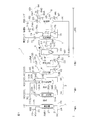
- FIG. 1 is a schematic configuration diagram of an embodiment of a plant for producing the xylylene diisocyanate composition of the present invention.
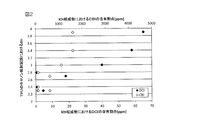
- FIG. 2 is a graph showing the correlation between the respective content ratios of DCI and CBI in the xylylene diisocyanate composition and the color difference in the xenon irradiation test of the elastomer.
- FIG. 3 is a graph showing the correlation between the content ratios of DCI and CBI in the xylylene diisocyanate composition and the color difference in the UV irradiation test of the foam.
- FIG. 4A is a graph showing the correlation between the content ratios of DCI and CBI in the xylylene diisocyanate composition and the yellow index value of the plastic lens A.
- FIG. 4B is a graph showing a correlation between each content ratio of DCI and CBI in the xylylene diisocyanate composition and the yellow index value of the plastic lens B.
- FIG. 5 is a graph showing the correlation between the respective content ratios of DCI and CBI in the xylylene diisocyanate composition and the color difference in the UV irradiation test of the two-component curable sealant.
- FIG. 6 is a graph showing the correlation between the content ratios of DCI and CBI in the xylylene diisocyanate composition and the color difference in the UV irradiation test of the coating material (agent A 1).
- FIG. 1 shows a graph showing a correlation between each content ratio of DCI and CBI in the xylylene diisocyanate composition and the yellow index value of the plastic lens B.
- FIG. 5 is a graph showing the correlation between the respective content ratios of DCI and CBI in the xylylene diisocyanate composition and the color difference
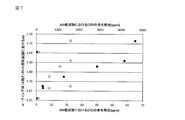
- FIG. 7 is a graph showing the correlation between the content ratios of DCI and CBI in the xylylene diisocyanate composition and the color difference in the UV irradiation test of the coating material (agent A 2).
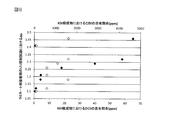
- FIG. 8 is a graph showing the correlation between the content ratios of DCI and CBI in the xylylene diisocyanate composition and the color difference in the UV irradiation test of the adhesive for lamination.
- FIG. 9 is a graph showing the correlation between the respective content ratios of DCI and CBI in the xylylene diisocyanate composition and the color difference in the UV irradiation test of the one-part curable sealant.
- the xylylene diisocyanate composition of the present invention is an almost single compound (ie, xylylene diisocyanate) containing 99% by mass or more of xylylene diisocyanate as a main component. Since it contains the compound shown in (1), it is defined as a xylylene diisocyanate composition.
- the xylylene diisocyanate composition of the present invention contains xylylene diisocyanate and a compound represented by the following chemical formula (1) as essential components.
- the xylylene diisocyanate composition is an XDI composition
- the xylylene diisocyanate is XDI
- the compound (dichloromethylbenzyl isocyanate) represented by the following chemical formula (1) is DCI.
- XDI includes 1,2-XDI (o-XDI), 1,3-XDI (m-XDI), and 1,4-XDI (p-XDI) as structural isomers. These structural isomers of XDI may be used alone or in combination of two or more.
- XDI is preferably 1,3-XDI and 1,4-XDI, and more preferably 1,3-XDI.
- the content ratio (purity) of XDI is, for example, 99.50% by mass or more, preferably 99.70% by mass or more, more preferably 99.90% by mass or more, for example, relative to the total mass of the XDI composition. 99.999 mass% or less, preferably 99.990 mass% or less.
- the content ratio of XDI can be measured according to the method described in Examples described later.
- DCI is a chlorine compound by-produced in the production of XDI described later.
- DCI includes o-DCI, m-DCI, and p-DCI as structural isomers. One or more of these DCI structural isomers may be contained in the XDI composition.
- the structural isomer of DCI by-produced in the production of XDI corresponds to the structural isomer of XDI produced. Therefore, the XDI composition contains DCI corresponding to the structural isomers of XDI described above. That is, the XDI composition contains o-DCI when it contains o-XDI, contains m-DCI when it contains m-XDI, and contains p-DCI when it contains p-XDI. To do.
- DCI examples include m-DCI and p-DCI, and more preferred is m-DCI.
- the content ratio of DCI is 0.6 ppm or more and 60 ppm or less with respect to the total mass of the XDI composition.
- the content ratio of DCI can be measured by analyzing by gas chromatography in accordance with the method described in Examples described later.
- the suitable range of the content rate of DCI according to the use of an XDI composition is explained in full detail later.
- the XDI composition may further contain chloromethylbenzyl isocyanate (monochloromethylbenzyl isocyanate) represented by the following chemical formula (2).
- chloromethylbenzyl isocyanate is referred to as CBI.
- CBI is a chlorine compound by-produced in the production of XDI described later. That is, in the manufacture of XDI, DCI may be produced as a by-product and CBI may be produced as a by-product.
- CBI includes o-CBI, m-CBI, and p-CBI as structural isomers. One or more of these CBI structural isomers may be contained in the XDI composition.
- the structural isomer of CBI produced as a by-product in the production of XDI corresponds to the structural isomer of XDI produced as in the case of DCI.
- the content ratio of CBI is, for example, 0.2 ppm or more, preferably 6 ppm or more, more preferably 100 ppm or more, such as 5000 ppm or less, preferably 4000 ppm or less, more preferably, relative to the total mass of the XDI composition. It is 3000 ppm or less, particularly preferably 1600 ppm or less, and particularly preferably 1000 ppm or less.
- the content ratio of CBI can be measured according to the method described in Examples described later.
- the content ratio of CBI is, for example, 2 times or more, preferably 10 times or more, more preferably 20 times or more, for example, 800 times or less, preferably 300 times or less, with respect to the content ratio of DCI. More preferably, it is 50 times or less.
- the content ratio of CBI is in the above range, yellowing of the resin produced from the XDI composition can be reliably suppressed.
- the CBI content is less than or equal to the above upper limit, the yellowing of the resin produced from the XDI composition can be reliably suppressed, and the urethanization reaction during the production of the resin can proceed smoothly, It is possible to reliably improve the mechanical characteristics.
- the XDI composition may further contain other by-products such as dichloromethane imino-methylbenzyl isocyanate, xylylene dichloride (XDC), and cyanobenzyl isocyanate (MCN) represented by the following chemical formula (3).
- XDC xylylene dichloride
- MN cyanobenzyl isocyanate
- the cyanobenzyl isocyanate (MCN) represented by the chemical formula (3) is not substantially contained in the XDI composition. .
- the content ratio of cyanobenzyl isocyanate (MCN) represented by the chemical formula (3) is, for example, 500 ppm or less, preferably less than 300 ppm, more preferably less than 100 ppm with respect to the total mass of the XDI composition. For example, it is 0 ppm or more.
- the content ratio of MCN can be measured according to the method described in the examples described later.
- the content ratio of MCN is not more than the above upper limit, the coloring (yellowing) of the resin produced from the XDI composition can be more reliably suppressed.
- the concentration (HC) of hydrolyzable chlorine in the XDI composition is, for example, 10 ppm or more, preferably 20 ppm or more, for example, 1500 ppm or less, preferably 1000 ppm or less.
- the concentration of hydrolyzable chlorine (HC concentration) is measured according to the method for determining hydrolyzable chlorine described in JIS K-1603-3 (2007).
- the concentration of hydrolyzable chlorine includes the above-mentioned DCI, CBI, and other by-products. Therefore, the concentration of hydrolyzable chlorine in the XDI composition and the content ratio of DCI in the XDI composition do not correlate, as is clear from the examples described later. As a result, the content ratio of DCI in the XDI composition cannot be calculated from the concentration of hydrolyzable chlorine in the XDI composition.
- XDI composition for example, xylylenediamine as a raw material is isocyanated to produce a reaction mass (composition before purification) containing XDI and DCI, and then the reaction mass is purified.
- XDA xylylenediamine
- XDA includes 1,2-XDA (o-XDA), 1,3-XDA (m-XDA), and 1,4-XDA (p-XDA) as structural isomers.
- step A Reaction mass production process
- XDA and hydrogen chloride are mixed to form an XDA hydrochloride, and then the hydrochloride and carbonyl chloride (phosgene) are reacted (phosgenation method of amine hydrochloride).
- the production process of the reaction mass is performed by mixing XDA and hydrogen chloride to form a salt formation step (step A), and reacting XDA hydrochloride and carbonyl chloride to convert XDA hydrochloride to isocyanate.
- Is phosgenation and an isocyanate conversion step (step B).
- Such a salt-forming step (step A) and an isocyanate step (step B) are liquid phase methods.
- step A for example, XDA and hydrogen chloride are mixed in the presence of an inert solvent to produce XDA hydrochloride (salt formation).
- the inert solvent examples include aromatic hydrocarbons such as benzene, toluene and xylene, aliphatic hydrocarbons such as octane and decane, and alicyclic hydrocarbons such as cyclohexane, methylcyclohexane and ethylcyclohexane.
- Halogenated aromatic hydrocarbons such as chlorotoluene, chlorobenzene, dichlorobenzene, dibromobenzene, trichlorobenzene, such as nitrobenzene, N, N-dimethylformamide, N, N-dimethylacetamide, N, N′-dimethyl
- Nitrogen-containing compounds such as imidazolidinone, for example, ethers such as dibutyl ether, ethylene glycol dimethyl ether, ethylene glycol diethyl ether, such as heptanone, diisobutyl ketone, methyl isobutyl ketone, Ketones such as ruethyl ketone, for example, fatty acid esters such as ethyl acetate, butyl acetate, amyl acetate, ethoxyethyl acetate, and aromatic carboxylic acid esters such as methyl salicylate, dimethyl phthalate, dibutyl phthalate, methyl
- halogenated aromatic hydrocarbons are preferable, and chlorobenzene and dichlorobenzene are more preferable.
- the content ratio of XDA in the amine solution is not particularly limited, but is, for example, 3.0% by mass or more, preferably 5.0% by mass or more, for example, 30% by mass or less, preferably 20% by mass or less.
- the mass ratio (total amine concentration) of supplied XDA to the total mass of XDA and inert solvent is, for example, 3% by mass or more, preferably 5% by mass or more, for example, 30% by mass or less, preferably 20%. It is 15 mass% or less, More preferably, it is 15 mass% or less.
- the supply ratio of hydrogen chloride is, for example, 2 times mol or more, for example, 10 times mol or less, preferably 6 times mol or less, more preferably 4 times mol or less with respect to 1 mol of XDA.
- the salt formation temperature in such a salt formation step is, for example, 30 ° C. or higher, preferably 50 ° C. or higher, more preferably 60 ° C. or higher, for example 160 ° C. or lower, preferably 150 ° C. or lower, more preferably, 140 ° C. or lower.
- the salt formation pressure (gauge pressure) in the salt formation step is, for example, atmospheric pressure (0 MPaG) or more, preferably 0.01 MPaG or more, more preferably 0.02 MPaG or more, for example, 1.0 MPaG or less, preferably 0. .5 MPaG or less, more preferably 0.4 MPaG or less.
- XDA hydrochloride is produced from XDA and hydrogen chloride (hydrochloric acid chlorination reaction), and a slurry containing XDA hydrochloride is produced.
- step B carbonyl chloride is supplied to the slurry containing XDA hydrochloride, and XDA hydrochloride and carbonyl chloride are reacted (isocyanate reaction, phosgenation).
- the supply ratio of carbonyl chloride is, for example, 4 times mol or more, preferably 5 times mol or more, more preferably 6 times mol or more, for example, 50 times mol or less, preferably 40 times mol or less, with respect to 1 mol of XDA hydrochloride. Double mol or less, More preferably, it is 30 mol or less.
- the supply ratio of carbonyl chloride affects the reaction rate of the isocyanate reaction and the production of by-product DCI.
- the amount of DCI produced can be adjusted by adjusting the supply ratio of carbonyl chloride to the above range. Specifically, when the supply rate of carbonyl chloride is increased, the amount of DCI produced can be increased, and when the supply rate of carbonyl chloride is reduced, the amount of DCI produced can be reduced.
- the reaction time of the isocyanate step is, for example, 4 hr or more, preferably 6 hr or more, for example, 25 hr or less, preferably 20 hr or less, more preferably 15 hr or less.
- the amount of CBI and DCI produced can be adjusted by adjusting the reaction time of the isocyanate process to the above range. Specifically, when the reaction time of the isocyanate process is increased, the amount of CBI and DCI generated can be increased while the XDA hydrochloride and carbonyl chloride can be reacted reliably. When the time is reduced, it is possible to reduce the amount of CBI and DCI generated while reducing the by-product tar component.
- the reaction temperature in such an isocyanate process is, for example, 90 ° C. or higher, preferably 100 ° C. or higher, more preferably 110 ° C. or higher, for example, 190 ° C. or lower, preferably 180 ° C. or lower, more preferably 160 ° C. It is below °C.
- the reaction rate can be improved, which can be suitably carried out industrially.
- the temperature in the isocyanate process is not more than the above upper limit, excessive production of by-products (CBI, DCI, etc.) can be suppressed, and an XDI composition can be produced by simple purification.
- reaction pressure (gauge pressure) in the isocyanate step for example, it exceeds atmospheric pressure (0 MPaG), preferably 0.0005 MPaG or more, more preferably 0.001 MPaG or more, still more preferably 0.003 MPaG or more, Particularly preferably, 0.01 MPaG (10 kPaG) or more, particularly preferably 0.02 MPaG (20 kPaG) or more, most preferably 0.03 MPaG (30 kPaG) or more, for example, 0.6 MPaG or less, preferably 0.4 MPaG or less. More preferably, it is 0.2 MPaG or less.
- reaction pressure in the isocyanate process is equal to or lower than atmospheric pressure (that is, under reduced pressure or atmospheric pressure)
- DCI cannot be sufficiently generated in the isocyanate process.
- reaction pressure in the isocyanate process is equal to or higher than the lower limit, DCI can be reliably generated in the isocyanate process.
- the production amounts of CBI and DCI can be adjusted by adjusting the reaction pressure in the isocyanate step to the above range. Specifically, when the reaction pressure in the isocyanate process is increased, excess carbonyl chloride can be recovered by a cooler, and energy efficiency is improved compared to the case where a refrigerator is required for recovery of carbonyl chloride. However, the generation amount of CBI and DCI can be increased.
- Such an isocyanate formation step can be carried out by either a batch type or a continuous type, but is preferably carried out by a continuous type. That is, preferably, the slurry (XDA hydrochloride) produced in the stirring tank is continuously fed from the stirring tank to a reaction tank different from the stirring tank, and the XDA hydrochloride and carbonyl chloride are reacted in the reaction tank. The reaction solution (reaction mass) is continuously taken out from the reaction vessel.
- XDA hydrochloride may not react with excess carbonyl chloride at a high temperature for a long time, and DCI may not be generated.
- a large amount of carbonyl chloride is required to react a slurry having a relatively high concentration of XDA hydrochloride with carbonyl chloride in the initial stage of the reaction, and a carbonyl chloride recovery device and by-product chloride are produced.
- the hydrogen gas processing apparatus becomes large.
- the continuous isocyanate process the supply amount of carbonyl chloride and the amount of by-produced hydrogen chloride gas can be made constant, and the carbonyl chloride recovery device and the hydrogen chloride gas treatment device can be made compact. At the same time, operation can be stabilized. Accordingly, the continuous isocyanate process is more suitable than the batch isocyanate process from the viewpoint of automatic operation for mass production of XDI.
- the isocyanate process is preferably a continuous reaction.
- the isocyanate process is preferably performed as a multistage process from the viewpoint of volumetric efficiency in the reaction vessel.
- the number of stages of the isocyanate process is, for example, 2 or more and 5 or less.
- the range of the total residence time in the two-stage isocyanate process is the same as the range of the reaction time described above, and the carbonyl chloride in the two-stage isocyanate process has the same range.
- the range of the supply ratio is the same as the above-described range of the supply ratio of carbonyl chloride.
- XDA hydrochloride and carbonyl chloride react to produce XDI as a main component.
- DCI may be generated as a by-product
- CBI may be further generated as a by-product.
- a degassing step a desolvation step, and a detarring step are performed on the reaction solution (reaction mixture) (step C).
- excess gas such as carbonyl chloride and by-product hydrogen chloride is removed from the reaction solution (reaction mixture) by a known degassing tower.
- the solvent removal step the inert solvent is distilled off from the reaction solution using a known distillation column.
- tar components are removed from the reaction solution by a known detarring device. In addition, let the reaction mass from which the tar component was removed by the detarring process be detarring mass.
- reaction mass preferably, a detarring mass
- XDI and DCI are produced.
- the content ratio of XDI in the reaction mass is, for example, 80.0% by mass or more, preferably 90.0% by mass or more, more preferably 95.0% by mass or more, for example, 99.0% by mass or less, preferably , 98.5% by mass or less, more preferably 98.0% by mass or less.
- the content ratio of DCI in the reaction mass is, for example, 1 ppm or more, preferably 2 ppm or more, more preferably 5 ppm or more, for example, 80 ppm or less, preferably 70 ppm or less, more preferably 50 ppm or less.
- the content ratio of CBI in the reaction mass is, for example, 0.1% by mass or more, preferably 0.3% by mass or more, more preferably 0.5% by mass or more, for example, It is 3.0 mass% or less, Preferably, it is 1.5 mass% or less, More preferably, it is 1.0 mass% or less.
- the content ratio of the inert solvent in the reaction mass is, for example, 0.1% by mass or more, preferably 0.3% by mass or more, more preferably 0.5% by mass. As mentioned above, More preferably, it is 1.0 mass% or more, for example, 5.0 mass% or less, Preferably, it is 3.0 mass% or less.
- step D Reaction mass purification step (step D) Next, the reaction mass (composition before purification) is purified, and the content ratio of DCI is adjusted to the above range.
- Examples of the purification method for the reaction mass include industrial separation methods such as crystallization and distillation, and preferably distillation.
- industrial separation methods such as crystallization and distillation, and preferably distillation.
- low boiling substances low-boiling components
- the purification step of the reaction mass includes a delow boiling step for distilling low boiling substances from the reaction mass and a rectification step for rectifying the delow boiling mass.
- reaction mass preferably, detar mass
- a delow boiling tower to distill off the low boilers.
- Examples of the delow boiling tower include a plate tower and a packed tower, and preferably a packed tower.
- the number of theoretical plates of the deboiling tower is, for example, 3 or more, preferably 5 or more, more preferably 7 or more, for example, 40 or less, preferably 20 or less, more preferably 15 or less. It is.
- the bottom temperature of the deboiling tower is, for example, 130 ° C. or higher, preferably 140 ° C. or higher, more preferably 150 ° C. or higher, such as 200 ° C. or lower, preferably 190 ° C. or lower, more preferably 180 ° C. It is as follows.
- the temperature at the top of the deboiling tower is, for example, 90 ° C or higher, preferably 100 ° C or higher, more preferably 110 ° C or higher, such as 160 ° C or lower, preferably 150 ° C or lower, more preferably 140 ° C. It is as follows.
- the overhead pressure of the deboiling tower is, for example, 0.05 kPa or more, preferably 0.1 kPa or more, more preferably 0.2 kPa or more, for example, 3.0 kPa or less, preferably 2.0 kPa or less, more Preferably, it is 1.0 kPa or less.
- the tower reflux ratio of the delow boiling tower is, for example, 1 or more, preferably 5 or more, more preferably 10 or more, for example 80 or less, preferably 60 or less, more preferably 50 or less.
- the residence time of the deboiling tower is, for example, 0.1 hour or more, preferably 0.2 hours or more, more preferably 0.3 hours or more, for example, 10 hours or less, preferably 5 hours or less, more Preferably, it is 3 hours or less.
- the low-boiling mass is distilled by a rectification column, and the XDI composition is taken out as a fraction.
- Examples of the rectification tower include a plate tower and a packed tower, and a packed tower is preferable.
- the theoretical plate number of the rectifying column is, for example, 1 or more, for example, 20 or less, preferably 10 or less, more preferably 5 or less.
- the bottom temperature of the rectifying column is, for example, 120 ° C. or higher, preferably 130 ° C. or higher, more preferably 140 ° C. or higher, for example, 190 ° C. or lower, preferably 180 ° C. or lower, more preferably 170 ° C. or lower. It is.
- the top temperature of the rectifying column is, for example, 90 ° C. or higher, preferably 110 ° C. or higher, more preferably 130 ° C. or higher, for example, 180 ° C. or lower, preferably 170 ° C. or lower, more preferably 160 ° C. or lower. It is.
- the top pressure of the rectifying column is, for example, 0.05 kPa or more, preferably 0.1 kPa or more, more preferably 0.2 kPa or more, for example, 3.0 kPa or less, preferably 2.0 kPa or less, more preferably Is 1.0 kPa or less.
- the tower top reflux ratio of the rectifying column is, for example, 0.1 or more, preferably 0.2 or more, more preferably 0.3 or more, for example, 50 or less, preferably 20 or less, more preferably 10 or more. It is as follows.
- the residence time of the rectifying column is, for example, 0.2 hours or more, preferably 0.5 hours or more, more preferably 1.0 hours or more, for example, 20 hours or less, preferably 10 hours or less.
- the content ratio of DCI in the XDI composition can be adjusted, and the XDI composition is taken out as a fraction.
- the content rate of DCI in an XDI composition can also be adjusted by adding DCI to an XDI composition.
- Plant (3-1) Plant Configuration The above-described method for producing an XDI composition is carried out, for example, by the plant 1 shown in FIG. As shown in FIG. 1, in the plant 1, a two-stage continuous isocyanateation process is carried out in an isocyanate unit 3 to be described later, and the above supply ratio of carbonyl chloride, reaction temperature, reaction pressure, average residence time, and the like. Is adjusted as appropriate to adjust the generation amounts of XDI and DCI. Then, in the delow boiling unit 7 to be described later, a delow boiling step is performed, and the above-described column top reflux ratio and the like are appropriately adjusted, whereby the content ratio of DCI in the XDI composition is adjusted.
- the plant 1 is an apparatus for producing an XDI composition.
- the plant 1 includes a salt-forming unit 2, an isocyanate unit 3, a degassing unit 4, a desolvation unit 5, a detarring unit 6, a delow boiling unit 7, and a rectification unit 8.
- the salt formation unit 2 is an XDA hydrochloride production apparatus that can perform the salt formation step (step A) and produces XDA hydrochloride from XDA and hydrogen chloride.
- the salt making unit 2 includes a stirring tank 21, a hydrogen chloride supply line 24, an amine supply line 22, a solvent supply line 23, an exhaust line 25, and a hydrochloride liquid feeding line 26.
- the stirring tank 21 is composed of, for example, a heat and pressure resistant container whose temperature and pressure can be controlled.
- a stirring blade (not shown) for stirring and mixing XDA and hydrogen chloride is provided.
- a stirring blade for example, a paddle blade, an inclined paddle blade, a turbine blade, a three-bladed blade, a twin star blade, a full zone blade, a Max blend blade, and their Examples include multistage stirring blades combined with blades.
- the stirring tank 21 is provided with a cooling device 27 capable of cooling the inside of the stirring tank 21.
- the cooling device 27 include a jacket capable of supplying a refrigerant, a cooling coil, and an external circulation cooler.
- FIG. 1 shows a case where the cooling device 27 is a jacket capable of supplying cooling water (refrigerant).
- the hydrogen chloride supply line 24 supplies hydrogen chloride (HCl) gas to the stirring tank 21.
- the downstream end of the hydrogen chloride supply line 24 is connected to the bottom of the stirring tank 21.
- the upstream end of the hydrogen chloride supply line 24 is connected to a tank for storing hydrogen chloride.
- the amine supply line 22 supplies XDA to the stirring tank 21.
- the downstream end of the amine supply line 22 is connected to the top of the stirring tank 21.
- the upstream end of the amine supply line 22 is connected to a tank that stores XDA.
- the solvent supply line 23 supplies the above-described inert solvent to the amine supply line 22.
- the downstream end of the solvent supply line 23 is connected to the middle part of the amine supply line 22.
- the upstream end of the solvent supply line 23 is connected to a tank that stores an inert solvent.
- the exhaust line 25 discharges surplus hydrogen chloride gas from the stirring tank 21 in the salt formation process.
- the upstream end of the exhaust line 25 is connected to the top of the agitation tank 21.
- the downstream end of the exhaust line 25 is connected to a hydrogen chloride gas recovery device.
- the hydrochloride feeding line 26 sends a slurry containing XDA hydrochloride from the stirring vessel 21 to the isocyanate unit 3.
- the upstream end portion of the hydrochloride liquid feeding line 26 is connected to the stirring tank 21.
- the upstream end of the hydrochloride liquid feeding line 26 is connected to the bottom of the stirring tank 21, but is appropriately connected to the top or side of the stirring tank 21 due to constraints such as layout. You can also.
- the downstream end of the hydrochloride liquid feeding line 26 is connected to a reaction tank 31A described later. In FIG.
- the downstream end of the hydrochloride liquid feeding line 26 is connected to the top of the reaction tank 31A, but it can also be connected to the side or bottom of the reaction tank 31A and fed into the liquid by piping.
- a known slurry pump for feeding slurry for example, a gear pump, a non-seal pump, a mechanical seal pump, and a magnet pump, is provided in the middle of the hydrochloride feeding line 26.
- the slurry can also be fed by the pressure difference between the stirring tank 21 and the reaction tank 31A.
- the slurry pumps for feeding the slurry can be provided in the reaction tank 31A and the reaction tank 31B, or the slurry can be fed by a pressure difference.
- the isocyanate unit 3 is an XDI production apparatus that can carry out the above-described isocyanate process (Step B) and produces XDI by reacting XDA hydrochloride with carbonyl chloride.
- the isocyanate unit 3 can perform a two-stage continuous isocyanate process, and includes a first isocyanate unit 3A, a second isocyanate unit 3B, and a carbonyl chloride supply line 30.
- the first isocyanate unit 3A and the second isocyanate unit 3B have the same configuration except for the connecting portion of the reaction mass liquid feeding line described later. Therefore, the configuration of the first isocyanate unit 3A will be described in detail, and the description of the second isocyanate unit 3B will be omitted.
- the first isocyanate unit 3A includes a reaction tank 31A, an exhaust line 33A, a condenser 35A, a reflux line 34A, and a reaction mass liquid feed line 32A.
- the reaction tank, the exhaust line, the condenser, the reflux line, and the reaction mass feed line provided in the second isocyanate unit 3B are the reaction tank 31B, the exhaust line 33B, the condenser 35B, the reflux line 34B, and the reaction mass feed line 32B. To do.
- the reaction tank 31A is composed of, for example, a heat and pressure resistant container whose temperature and pressure can be controlled.
- the downstream end of the hydrochloride liquid feeding line 26 is connected to the reaction tank 31A.
- the downstream end of the hydrochloride liquid feeding line 26 is connected to the top of the reaction tank 31 ⁇ / b> A.
- it is appropriately connected to the side and bottom of the reaction tank 31 ⁇ / b> A due to constraints such as layout. You can also.
- a stirring blade (not shown) for stirring and mixing the slurry and carbonyl chloride is provided.
- the stirring blade include the stirring blade described above.
- the reaction tank 31A is provided with a heating device 36A capable of heating the inside of the reaction tank 31A.
- the heating device 36A include a jacket capable of supplying a heat medium, a steam coil, and an external circulation heater.
- FIG. 1 shows a case where the heating device 36A is a jacket capable of supplying steam (heat medium).
- the exhaust line 33A discharges gas components including surplus carbonyl chloride, by-produced hydrogen chloride gas and an inert solvent from the reaction tank 31A.
- the upstream end of the exhaust line 33A is connected to the top of the reaction tank 31A.
- the downstream end of the exhaust line 33A is connected to a carbonyl chloride recovery device.
- the capacitor 35A is provided in the middle of the exhaust line 33A.
- the condenser 35A cools the gas component passing through the exhaust line 33A and condenses an inert solvent, a part of carbonyl chloride, and the like in the gas component. Thereby, it isolate
- a known adjustment valve for adjusting the internal pressure of the reaction tank 31A is provided downstream of the condenser 35A in the exhaust line 33A.
- the reflux line 34A returns the reflux liquid separated in the condenser 35A to the reaction tank 31A.
- the upstream end of the reflux line 34A is connected to the capacitor 35A.
- the downstream end of the reflux line 34A is connected to the top of the reaction tank 31A.
- the reaction mass feed line 32A of the first isocyanate unit 3A sends the reaction mass (primary reaction mass) in the first isocyanate process from the reaction tank 31A to the reaction tank 31B of the second isocyanate unit 3B. .
- the upstream end of the reaction mass feed line 32A is connected to the reaction tank 31A.
- the upstream end of the reaction mass liquid supply line 32A is connected to the bottom of the reaction tank 31A, but it can also be connected to the side of the reaction tank 31A and sent by an overflow method.
- the downstream end of the reaction mass liquid feed line 32A is connected to the reaction tank 31B. In FIG.
- the downstream end of the reaction mass liquid supply line 32A is connected to the top of the reaction tank 31B, but is appropriately connected to the side and bottom of the reaction tank 31B due to restrictions on layout and the like. You can also.
- a known liquid feed pump for feeding a reaction mass is provided in the middle of the reaction mass feed line 32A, for example, a gear pump, a non-seal pump, a mechanical seal pump, a magnet type A pump is provided.
- the reaction mass liquid feed line 32B of the second isocyanate unit 3B feeds the reaction mass (secondary reaction mass) in the second isocyanate process from the reaction tank 31B to the degassing unit 4.
- the upstream end of the reaction mass liquid feed line 32B is connected to the reaction tank 31B.
- the upstream end of the reaction mass liquid supply line 32B is connected to the bottom of the reaction tank 31B, but can also be connected to the side of the reaction tank 31A for liquid supply.
- the downstream end of the reaction mass liquid feed line 32B is connected to the substantially vertical center of the degassing tower 41 described later.
- the above-described liquid feed pump for feeding the reaction mass (secondary reaction mass) is provided in the middle of the reaction mass liquid feed line 32B.
- the carbonyl chloride supply line 30 supplies carbonyl chloride to each of the reaction tank 31A and the reaction tank 31B.
- the downstream end of the carbonyl chloride supply line 30 is branched and connected to each of the reaction tank 31A and the reaction tank 31B.
- the downstream end of the carbonyl chloride supply line 30 is connected to the tops of the reaction tank 31A and the reaction tank 31B, but is connected to the top and bottom of the reaction tank 31A and the reaction tank 31B. It can also feed into a liquid with piping and can connect to each bottom part of reaction tank 31A and reaction tank 31B.
- the upstream end of the carbonyl chloride supply line 30 is connected to a tank that stores liquefied carbonyl chloride.
- the degassing unit 4 can perform the degassing process described above.
- the degassing unit 4 includes a degassing tower 41, an exhaust line 45, a condenser 46, a degassing mass feed line 42, a circulation line 43, and a reboiler 44.
- the degassing tower 41 separates a gas containing carbonyl chloride, hydrogen chloride and the like from the reaction mass.
- the degassing tower 41 includes a known separation tower, for example, a tray tower, a packed tower, and a regular packed tower.
- a downstream end portion of the reaction mass liquid feed line 32B is connected to a substantially vertical center of the degassing tower 41.
- the exhaust line 45 is connected to a condenser 46, and after the solvent contained in the gas separated by the degassing tower 41 is separated by the condenser 46, the gas is discharged.
- the upstream end of the gas exhaust line 45 separated in the degassing tower 41 is connected to the top of the degassing tower 41.
- the downstream end of the exhaust line 45 is connected to a carbonyl chloride recovery device.
- the capacitor 46 is provided in the middle of the exhaust line 45.
- the condenser 46 cools and condenses the solvent contained in the gas separated by the degassing tower 41.
- the degassing mass feed line 42 sends the reaction mass (degassing mass) after the degassing step from the degassing tower 41 to the desolvation unit 5.
- the upstream end of the degassing mass feed line 42 is connected to the tower bottom of the degassing tower 41.
- the downstream end of the degassing mass feed line 42 is connected to the substantially vertical center of the desolvation tower 51 described later.
- the circulation line 43 returns a part of the degassing mass fed to the degassing mass feeding line 42 to the degassing tower 41.
- An upstream end portion of the circulation line 43 is connected to a middle portion of the degassing mass feeding line 42.
- the downstream end of the circulation line 43 is connected to the bottom of the degassing tower 41.
- the liquid feed pump for feeding the degassed mass is provided on the downstream side or the upstream side of the connection part of the circulation line 43 in the degassed mass liquid feed line 42.
- the reboiler 44 is provided in the middle of the circulation line 43.
- the reboiler 44 heats the degassing mass that passes through the circulation line 43. Thereby, the reboiler 44 adjusts the internal temperature of the degassing tower 41.
- the reboiler 44 may be a known heat exchanger such as a thermosiphon reboiler, a forced circulation reboiler, or a thin film reboiler.
- the desolvation unit 5 can perform the desolvation process described above.
- the desolvation unit 5 includes a desolvation tower 51, a solvent discharge line 55, a condenser 56, a desolvation mass feeding line 52, a circulation line 53, and a reboiler 54.
- the desolvation tower 51 removes the inert solvent from the degassing mass.
- the desolvation tower 51 comprises a known distillation tower, for example, a tray tower, a packed tower, and a regular packed tower, and distills off the inert solvent.
- a downstream end portion of the degassing mass liquid feed line 42 is connected to a substantially vertical center of the desolvation tower 51.
- the solvent discharge line 55 discharges the inert solvent distilled off by the desolvation tower 51 and aggregated by the condenser 56.
- the upstream end of the solvent discharge line 55 is connected to the top of the desolvation tower 51.
- the downstream end of the solvent discharge line 55 is connected to a tank that stores an inert solvent.
- the recovered inert solvent is preferably reused as a reaction solvent in the salt formation step and the isocyanate step.
- the capacitor 56 is provided in the middle of the solvent discharge line 55.
- the condenser 56 cools and condenses the inert solvent distilled off by the desolvation tower 51.
- the desolvation mass feeding line 52 feeds the reaction mass (desolvation mass) after the desolvation step from the desolvation tower 51 to the detar unit 6.
- the upstream end of the desolvation mass feed line 52 is connected to the bottom of the desolvation tower 51.
- the downstream end portion of the desolvation mass feeding line 52 is connected to the substantially vertical center of the detarring device 61 described later.
- the circulation line 53 returns a part of the desolvation mass sent to the desolvation mass feeding line 52 to the desolvation tower 51.
- the upstream end of the circulation line 53 is connected to the middle part of the desolvation mass feeding line 52.
- the downstream end of the circulation line 53 is connected to the bottom of the desolvation tower 51.
- the said liquid feeding pump for feeding a desolvent mass is provided in the downstream or upstream rather than the connection part of the circulation line 53 in the desolvent mass liquid feeding line 52.
- the reboiler 54 is provided in the middle of the circulation line 53.
- the reboiler 54 heats the solvent removal mass that passes through the circulation line 53. Thereby, the reboiler 54 adjusts the internal temperature of the desolvation tower 51.
- the reboiler 54 can use the heat exchanger described above.
- the detarring unit 6 can perform the detarring process described above.
- the detarring unit 6 includes a detarring device 61, a tar discharge line 62, and a detarring mass feed line 63.
- the detarring device 61 separates tar components from the desolvent mass.
- the detarring device 61 is, for example, a known thin film evaporator.
- the detarring device 61 includes a casing 61A, a wiper 61B, and an internal capacitor 61C.
- the casing 61A is provided with a jacket for heating the inside of the casing 61A and a suction pipe (not shown) for decompressing the inside of the casing 61A.
- the wiper 61B is disposed in the casing 61A.
- the wiper 61B is disposed slightly spaced from the inner peripheral surface of the casing 61A.
- the wiper 61B can be rotated by a motor (not shown).
- the internal capacitor 61C is composed of, for example, a heat exchanger in which refrigerant is circulated.
- the internal capacitor 61C is provided on the bottom wall of the casing 61A in the casing 61A.
- the tar discharge line 62 discharges tar components separated by the detarring device 61.
- the upstream end of the tar discharge line 62 is connected to the lower part of the casing 61A.
- the downstream end of the second extraction line 28 is connected to a tank for storing tar components.
- XDI contained in the tar component can be recovered from the recovered tar component by a known method and charged into any unit of the plant 1. Thereby, the improvement of the yield of XDI can be aimed at.
- the detar mass feeding line 63 feeds the desolvation mass (detar mass) from which the tar component has been separated from the detarring device 61 to the delowing boiling unit 7.
- the upstream end of the detar mass feed line 63 is connected to the internal capacitor 61C.
- the downstream end of the detarking liquid feed line 63 is connected to the substantially vertical center of the delow boiling tower 71 described later.
- the detar mass feeding line 63 is provided with a flow meter 63A and a control valve 63B.
- the flow meter 63 ⁇ / b> A is provided in the middle of the detar mass feeding line 63.
- the flow meter 63 ⁇ / b> A measures the flow rate of the detarred mass passing through the detarred mass feeding line 63.
- the control valve 63B is provided in a portion between the flow meter 63A and the delow boiling tower 71 in the detar mass feeding line 63.
- the control valve 63B can open and close the detar mass feeding line 63.
- the control valve 63B can adjust the flow rate of the detar mass passing through the detar mass feed line 63, that is, the supply amount of the detar mass to the deboiling tower 71, based on the measurement result of the flow meter 63A.
- the delow boiling unit 7 can carry out the above delow boiling step.
- the delow boiling unit 7 includes a delow boiling tower 71, a suction line 72, a condenser 73, a low boiling discharge line 74, a tower top reflux line 75, a delow boiling mass liquid feed line 76, and a tower bottom circulation.
- a line 77 and a reboiler 78 are provided.
- the delow boiling tower 71 removes low boiling substances from the detarred mass.
- the delow boiling tower 71 is composed of, for example, the distillation tower exemplified in the description of the above delow boiling process, and distills off low boiling substances.
- a downstream end portion of the detar mass feeding line 63 is connected to the center of the delow boiling tower 71 in the vertical direction.
- the suction line 72 connects, for example, a decompression device such as a vacuum pump and the delow boiling tower 71.
- the decompression device depressurizes the inside of the delow boiling tower 71 via the suction line 72 and adjusts the internal pressure of the delow boiling tower 71.
- the upstream end of the suction line 72 is connected to the top of the delow boiling tower 71.
- the downstream end of the suction line 72 is connected to a decompression device.
- the capacitor 73 is provided in the middle of the suction line 72.
- the condenser 73 cools and condenses the low-boiling matter in the gaseous state that passes through the suction line 72.
- the low boiling discharge line 74 discharges low boiling substances condensed in the condenser 73.
- the upstream end of the low boiling discharge line 74 is connected to the capacitor 73.
- the downstream end of the low boiling discharge line 74 is connected to a tank that stores low boiling substances.
- XDI contained in the low-boiling material can be recovered from the recovered low-boiling material by a known method and charged into any unit of the plant 1. Thereby, the improvement of the yield of XDI can be aimed at.
- the low boiling discharge line 74 is provided with a flow meter 74A and a control valve 74B.
- the flow meter 74 ⁇ / b> A is provided in the low boiling discharge line 74 on the downstream side of the connection portion of the tower top reflux line 75.
- the flow meter 74 ⁇ / b> A measures the flow rate of low-boiling substances discharged through the low-boiling discharge line 74.
- the control valve 74B is provided downstream of the flow meter 74A in the low boiling discharge line 74.
- the control valve 74B can open and close the low boiling discharge line 74.
- the control valve 74B can adjust the supply amount of the low boiling matter discharged from the low boiling discharge line 74 based on the measurement result of the flow meter 74A.
- the tower top reflux line 75 returns a part of the low boiling substances passing through the low boiling discharge line 74 to the delow boiling tower 71.
- the upstream end of the column top reflux line 75 is connected to a portion of the low boiling discharge line 74 between the delow boiling tower 71 and the flow meter 74A.
- the downstream end of the column top reflux line 75 is connected to the column top of the delow boiling tower 71.
- the tower top reflux line 75 is provided with a flow meter 75A.
- the flow meter 75 ⁇ / b> A measures the flow rate of low-boiling substances that pass through the tower top reflux line 75 and is returned to the delow boiling tower 71.
- the delow boiling mass liquid feed line 76 feeds the detarred mass (delow low boiling mass) from which low boiling substances have been removed from the delow boiling tower 71 to the rectification unit 8.
- the upstream end of the delow boiling mass liquid feed line 76 is connected to the bottom of the delow boiling tower 71.
- the downstream end of the delow boiling mass liquid feed line 76 is connected to the substantially vertical center of the rectifying column 81 described later.
- the tower bottom circulation line 77 returns a part of the delow boiling mass sent to the delow boiling mass feed line 76 to the delow boiling tower 71.
- the upstream end of the tower bottom circulation line 77 is connected to the middle part of the delow boiling mass liquid feed line 76.
- the downstream end of the tower bottom circulation line 77 is connected to the tower bottom of the delow boiling tower 71.
- the above-described liquid feed pump for feeding the delow boiling mass is provided on the downstream side of the connection portion of the tower bottom circulation line 77 in the delow boiling mass liquid feed line 76.
- the reboiler 78 is provided in the middle of the tower bottom circulation line 77.
- the reboiler 78 heats the low boiling mass that passes through the bottom circulation line 77. Thereby, the reboiler 78 adjusts the internal temperature of the deboiling tower 71.
- the reboiler 78 can use the heat exchanger described above.
- the rectification unit 8 can perform the rectification process described above.
- the rectification unit 8 includes a rectification column 81, a tar discharge line 86, a column bottom circulation line 87, a reboiler 88, a suction line 82, a condenser 83, an XDI take-out line 84, and a column top reflux line 85. Is provided.
- the rectification tower 81 distills the detarred mass to distill the XDI composition.
- the rectification column 81 is composed of, for example, the distillation column exemplified in the description of the rectification step.
- a downstream end portion of the delow boiling mass liquid feed line 76 is connected to a substantially vertical center of the rectifying column 81.
- the tar discharge line 86 discharges the tar component remaining after the XDI composition is distilled off from the rectification column 81 in the rectification column 81.
- the upstream end of the tar discharge line 86 is connected to the bottom of the rectifying column 81.
- the downstream end of the tar discharge line 86 is connected to a tank that stores a tar component.
- the tar component of the rectifying column 81 can be charged as it is into a unit upstream from the delow boiling unit 7 as it is. Thereby, the improvement of the yield of XDI can be aimed at.
- the tower bottom circulation line 87 returns a part of the tar component that passes through the tar discharge line 86 to the rectification tower 81.
- the upstream end of the tower bottom circulation line 87 is connected to the middle part of the tar discharge line 86.
- the downstream end of the column bottom circulation line 87 is connected to the column bottom of the rectifying column 81.
- the reboiler 88 is provided in the middle of the tower bottom circulation line 87.
- the reboiler 88 heats the tar component passing through the bottom circulation line 87. Thereby, the reboiler 88 adjusts the column bottom temperature of the rectifying column 81.
- the reboiler 88 can use the heat exchanger described above.
- the suction line 82 connects, for example, a decompression device such as a vacuum pump and the rectification tower 81.
- the decompression device decompresses the inside of the rectifying column 81 via the suction line 82 and adjusts the internal pressure of the rectifying column 81.
- the upstream end of the rectifying column 81 is connected to the top of the rectifying column 81.
- the downstream end of the suction line 82 is connected to a decompression device.
- the capacitor 83 is provided in the middle of the suction line 82.
- the condenser 83 cools and condenses the gaseous XDI composition passing through the suction line 82.
- the XDI take-out line 84 sends the XDI composition condensed in the condenser 83.
- the upstream end of the XDI take-out line 84 is connected to the capacitor 83.
- the downstream end of the XDI take-out line 84 is connected to a tank that stores the XDI composition.
- the XDI take-out line 84 is provided with a flow meter 84A and a control valve 84B.
- the flow meter 84 ⁇ / b> A is provided on the downstream side of the connection portion of the tower top reflux line 85 in the XDI extraction line 84.
- the flow meter 84A measures the flow rate of the XDI composition passing through the XDI take-out line 84.
- the control valve 84B is provided on the downstream side of the flow meter 84A in the XDI take-out line 84.
- the control valve 84B can open and close the XDI take-out line 84.
- the control valve 84B can adjust the outflow amount of the XDI composition from the XDI take-out line 84 based on the measurement result of the flow meter 84A.
- the tower top reflux line 85 returns a part of the XDI composition passing through the XDI take-out line 84 to the rectification tower 81.
- the upstream end of the column top reflux line 85 is connected to a portion of the XDI take-out line 84 between the condenser 83 and the flow meter 84A.
- the downstream end of the column top reflux line 85 is connected to the column top of the rectification column 81.
- the tower top reflux line 85 is provided with a flow meter 85A.
- the flow meter 85 ⁇ / b> A measures the flow rate of the XDI composition that passes through the top reflux line 85 and is returned to the rectification column 81.
- a control valve and a flow meter are appropriately provided in the liquid feed line between the stirring tank, the reaction tank, the tower, and the detarring machine as necessary to adjust the residence time and supply flow rate of each process. It is also possible to stabilize the operation by controlling.
- an inert solvent is charged into the stirring tank 21.
- hydrogen chloride gas is continuously supplied to the bottom of the agitation tank 21 through the hydrogen chloride supply line 24 at the above supply rate.
- the amine solution in which XDA is dissolved in an inert solvent is continuously supplied to the top of the stirring tank 21 via the amine supply line 22.
- hydrogen chloride gas and an amine solution are stirred and mixed with a stirring blade (salt formation process). Thereby, the slurry containing XDA hydrochloride is manufactured.
- the slurry containing XDA hydrochloride is continuously fed to the top of the reaction tank 31A via the hydrochloride feeding line 26. That is, while continuously supplying the hydrogen chloride gas and the amine solution to the stirring vessel 21, the slurry containing XDA hydrochloride is continuously taken out from the stirring vessel 21 and sent to the reaction vessel 31A.
- reaction liquid primary reaction mass
- XDI, DCI, CBI, an inert solvent, and the like is continuously fed to the top of the reaction vessel 31B via the reaction mass feeding line 32A. That is, while continuously supplying the slurry and carbonyl chloride to the reaction vessel 31A, the primary reaction mass is continuously taken out from the reaction vessel 31A and sent to the reaction vessel 31B.
- the secondary reaction mass is continuously fed to the approximate center in the vertical direction of the degassing tower 41 via the reaction mass feeding line 32B. That is, while continuously supplying the primary reaction mass and carbonyl chloride to the reaction vessel 31B, the secondary reaction mass is continuously taken out from the reaction vessel 31B and sent to the degassing tower 41.
- the secondary reaction mass is separated by the degassing tower 41 into a gas containing carbonyl chloride and hydrogen chloride and a liquid degassing mass containing XDI, DCI, an inert solvent and the like (degassing step).
- the degassing mass is continuously fed to the approximate center in the vertical direction of the desolvation tower 51 via the degassing mass feeding line 42. Then, the inert solvent is distilled off from the degassing mass by the desolvation tower 51 (desolvation step).
- the desolvation mass is continuously fed to the approximate center in the vertical direction of the detarring device 61 via the desolvation mass feeding line 52. Then, the tar component is removed from the solvent removal mass by the detarring device 61 (detarring step).
- the detar mass is continuously fed to the approximate center in the vertical direction of the delow boiling tower 71 via the detar mass feeding line 63.
- the low boiling point is reduced from the detar mass by the conditions of the above delow boiling step (column bottom temperature, column top temperature, column top pressure, column bottom reflux ratio, column top reflux ratio, and residence time). Distill off the product.
- the mixed steam containing low boiling substances is discharged from the top of the delow boiling tower 71 via the suction line 72. Then, the mixed vapor is condensed by the condenser 73. Thereafter, a part of the coagulated liquid containing low-boiling substances is continuously returned to the low-boiling tower 71 through the tower top reflux line 75 by adjusting the flow rate so that the tower top reflux ratio is in the above range. To do. Further, the other part of the coagulated liquid is continuously discharged through the low boiling discharge line 74 with the flow rate adjusted.
- the delow boiling mass is discharged from the delow boiling tower 71 via the delow boiling mass feed line 76. Then, a part of the delow boiling mass is continuously returned to the delow boiling tower 71 via the tower bottom circulation line 77 so as to have the above tower bottom temperature and tower bottom reflux ratio. In addition, the other part of the delow boiling mass is continuously fed to the center of the rectifying column 81 in the vertical direction via the delow boiling mass feeding line 76.
- the XDI composition from the low boiling mass is obtained under the above rectification process conditions (column bottom temperature, column top temperature, column top pressure, column bottom reflux ratio, column top reflux ratio and residence time).
- the product is continuously removed as a fraction.
- the XDI composition in the gaseous state is discharged from the top of the rectification column 81 via the suction line 82. Then, the XDI composition in a gaseous state is aggregated by the capacitor 83. Thereafter, a part of the XDI composition is continuously returned to the rectifying column 81 via the column top reflux line 85 while adjusting the flow rate so that the column top reflux ratio falls within the above range. Also, other portions of the XDI composition are continuously removed via the XDI take-out line 84 with the flow rate adjusted.
- the distillation residue (tar component) in the rectification column 81 is discharged from the bottom of the rectification column 81 via the tar discharge line 86. Then, a part of the distillation residue (tar component) is continuously returned to the rectifying column 81 so as to have the tower bottom temperature and the tower reflux ratio.
- the XDI composition (fine XDI) as a product is continuously produced by the plant 1.
- Polyisocyanate component, active hydrogen group-containing component Such an XDI composition is modified by a known method if necessary and contained in the polyisocyanate component.
- the polyisocyanate component and the active hydrogen group-containing component are suitably used as a raw material for the polyurethane resin.
- the polyisocyanate component contains an XDI composition and / or a xylylene diisocyanate-modified composition obtained by modifying the XDI composition (hereinafter referred to as an XDI-modified composition), preferably, the XDI composition and / or It consists of a modified XDI composition.
- the XDI modified composition is produced by modifying an XDI composition and contains at least one functional group of the following (a) to (i).
- the XDI modified composition contains functional groups (a) to (i) in which XDI is modified and DCI.
- the modified XDI composition containing the functional group (isocyanurate group) in (a) above contains an XDI trimer.
- the XDI composition can be used as a known isocyanuration catalyst. It can be obtained by reacting in the presence and isocyanurating (eg, trimerizing) XDI.
- the XDI modified composition containing the functional group (allophanate group) of (b) above contains an allophanate modified product of XDI.
- an allophanate modified product of XDI For example, after reacting the XDI composition with an alcohol, a known allophanate is formed. It can be obtained by further reaction in the presence of a catalyst.
- the XDI modified composition containing the functional group (biuret group) of (c) above contains an XDI biuret modified product.
- the XDI composition and, for example, water, tertiary alcohol (for example, t-butyl alcohol, etc.), secondary amines (eg, dimethylamine, diethylamine, etc.) and the like, and then further reacted in the presence of a known biuretization catalyst.
- the XDI modified composition containing the functional group (urethane group) of (d) above contains an XDI polyol modified product, for example, an XDI composition and a polyol component (for example, trimethylolpropane). It can be obtained by reaction.
- an XDI polyol modified product for example, an XDI composition and a polyol component (for example, trimethylolpropane). It can be obtained by reaction.
- the XDI modified composition containing the functional group (urea group) of (e) above contains a polyamine modified product of XDI.
- a polyamine modified product of XDI for example, the reaction of the XDI composition with water, a polyamine component (described later) and the like. Can be obtained.
- the XDI modified composition containing the functional group (iminooxadiazinedione group) of (f) above contains an iminooxadiazinedione modified product (asymmetric trimer) of XDI.
- the XDI composition Can be obtained by reacting in the presence of a known iminooxadiazine diionization catalyst, and XDI is iminooxadiazine dione (for example, trimerization).
- the XDI modified composition containing the functional group (uretdione group) of (g) above contains an XDI uretdione modified product.
- it can be obtained by reacting in the presence of a known uretdione catalyst and uretodione (for example, dimerization) of XDI.
- the XDI modified composition containing the functional group (uretonimine group) of (h) above contains a modified uretonimine modified product of XDI.
- the XDI composition is reacted in the presence of a known carbodiimidization catalyst, After forming a carbodiimide group, it can be obtained by adding XDI to the carbodiimide group.
- the XDI modified composition containing the functional group (carbodiimide group) of (i) above contains a carbodiimide modified product of XDI.
- the XDI composition is reacted in the presence of a known carbodiimidization catalyst. Can be obtained.
- the XDI modified body composition should just contain at least 1 type of the functional group of said (a)-(i), and can also contain 2 or more types.
- Such an XDI modified body composition is produced
- the XDI modified composition can be used alone or in combination of two or more.
- the XDI composition can also be used as a blocked XDI composition in which free isocyanate groups contained in the molecule are blocked with a blocking agent. That is, the polyisocyanate component can contain a block XDI composition.
- the block XDI composition is produced, for example, by reacting the XDI composition with a blocking agent.
- blocking agents include oxime, phenol, alcohol, imine, amine, carbamic acid, urea, imidazole, imide, mercaptan, active methylene, acid amide (lactam), heavy Examples include blocking agents such as sulfites.
- oxime blocking agent examples include formaldoxime, acetoaldoxime, methyl ethyl ketoxime, cyclohexanone oxime, acetoxime, diacetyl monooxime, benzophenoxime, 2,2,6,6-tetramethylcyclohexanone oxime, diisopropyl ketone oxime, Methyl tert-butyl ketone oxime, diisobutyl ketone oxime, methyl isobutyl ketone oxime, methyl isopropyl ketone oxime, methyl 2,4-dimethylpentyl ketone oxime, methyl 3-ethyl heptyl ketone oxime, methyl isoamyl ketone oxime, n-amyl ketone oxime 2,2,4,4-tetramethyl-1,3-cyclobutanedione monooxime, 4,4′-dimethoxybenzophenone
- phenol blocking agent examples include phenol, cresol, ethylphenol, n-propylphenol, isopropylphenol, n-butylphenol, sec-butylphenol, tert-butylphenol, n-hexylphenol, 2-ethylhexylphenol, n-octylphenol, n-nonylphenol, di-n-propylphenol, diisopropylphenol, isopropylcresol, di-n-butylphenol, di-sec-butylphenol, di-tert-butylphenol, di-n-octylphenol, di-2-ethylhexylphenol, di- n-nonylphenol, nitrophenol, bromophenol, chlorophenol, fluorophenol, dimethylphenol, styrenation Enol, methyl salicylate, methyl 4-hydroxybenzoate, benzyl 4-hydroxybenzoate, 2-ethylhexyl hydroxybenz
- alcohol-based blocking agents include methanol, ethanol, 2-propanol, n-butanol, sec-butanol, 2-ethylhexyl alcohol, 1- or 2-octanol, cyclohexyl alcohol, ethylene glycol, benzyl alcohol, 2,2 , 2-trifluoroethanol, 2,2,2-trichloroethanol, 2- (hydroxymethyl) furan, 2-methoxyethanol, methoxypropanol, 2-ethoxyethanol, n-propoxyethanol, 2-butoxyethanol, 2-ethoxy Ethoxyethanol, 2-ethoxybutoxyethanol, butoxyethoxyethanol, 2-ethylhexyloxyethanol, 2-butoxyethylethanol, 2-butoxyethoxyethanol, N, N-dibu 2-hydroxyacetamide, N-hydroxysuccinimide, N-morpholine ethanol, 2,2-dimethyl-1,3-dioxolane-4-methanol, 3-oxazolidineethanol, 2-hydroxymethylpyridine, fur
- imine blocking agent examples include ethyleneimine, polyethyleneimine, 1,4,5,6-tetrahydropyrimidine, guanidine and the like.
- amine blocking agents include dibutylamine, diphenylamine, aniline, N-methylaniline, carbazole, bis (2,2,6,6-tetramethylpiperidinyl) amine, di-n-propylamine, diisopropylamine, Isopropylethylamine, 2,2,4- or 2,2,5-trimethylhexamethyleneamine, N-isopropylcyclohexylamine, dicyclohexylamine, bis (3,5,5-trimethylcyclohexyl) amine, piperidine, 2,6 -Dimethylpiperidine, 2,2,6,6-tetramethylpiperidine, (dimethylamino) -2,2,6,6-tetramethylpiperidine, 2,2,6,6-tetramethyl-4-piperidine, 6- Examples include methyl-2-piperidine and 6-aminocaproic acid. It is.
- carbamic acid blocking agent examples include phenyl N-phenylcarbamate.
- urea-based blocking agent examples include urea, thiourea, and ethylene urea.
- imidazole blocking agents include imidazole, 2-methylimidazole, 2-ethyl-4-methylimidazole, 2-isopropylimidazole, 2,4-dimethylimidazole, 4-methylimidazole, 2-phenylimidazole, 4-methyl- Examples include 2-phenylimidazole, pyrazole, 3-methylpyrazole, 3,5-dimethylpyrazole, 1,2,4-triazole, and benzotriazole.
- imide-based blocking agent examples include succinimide, maleic imide, and phthalimide.
- mercaptan blocking agents examples include butyl mercaptan, dodecyl mercaptan, hexyl mercaptan and the like.
- active methylene blocking agents include Meldrum's acid, dimethyl malonate, methyl acetoacetate, ethyl acetoacetate, di-tert-butyl malonate, 1-tert-butyl malonate, diethyl malonate, tert-acetoacetate -Butyl, 2-acetoacetoxyethyl methacrylate, acetylacetone, ethyl cyanoacetate and the like.
- acid amide (lactam) blocking agent examples include acetanilide, N-methylacetamide, acetic acid amide, ⁇ -caprolactam, ⁇ -valerolactam, ⁇ -butyrolactam, pyrrolidone, 2,5-piperazinedione, laurolactam and the like. Can be mentioned.
- the blocking agent is not limited to the above, and other blocking agents such as benzoxazolone, isatoic anhydride, tetrabutylphosphonium acetate, etc. may be mentioned.
- the blocking agents can be used alone or in combination of two or more.
- the XDI composition can also be used as an aqueous block XDI composition in which free isocyanate groups contained in the molecule are blocked by a blocking agent and are dispersed or dissolved in water. That is, the polyisocyanate component can contain an aqueous block XDI composition.
- An aqueous block XDI composition is, for example, a compound having both an isocyanate group remaining unblocked by a blocking agent, a hydrophilic group and an active hydrogen group after blocking a part of free isocyanate groups in the XDI composition with a blocking agent. (Hereinafter, it is produced by reacting with a hydrophilic group-containing active hydrogen compound).
- blocking agent examples include the blocking agents described above.
- the hydrophilic group-containing active hydrogen compound is a compound having at least one hydrophilic group and at least one active hydrogen group.
- the hydrophilic group include an anionic group, a cationic group, and a nonionic group.
- the active hydrogen group is a group that reacts with an isocyanate group, and examples thereof include a hydroxyl group, an amino group, a carboxyl group, and an epoxy group.
- the hydrophilic group-containing active hydrogen compound is more specifically a carboxylic acid group-containing active hydrogen compound, a sulfonic acid group-containing active hydrogen compound, a hydroxyl group-containing active hydrogen compound, a hydrophilic group-containing polybasic acid, or a polyoxyethylene group-containing active hydrogen. Compound etc. are mentioned.
- the hydrophilic group-containing active hydrogen compound can be used alone or in combination of two or more.
- active hydrogen group-containing components for example, polyol components (components mainly containing polyols having two or more hydroxyl groups), polythiol components (components mainly containing polythiols having two or more mercapto groups (thiol groups)), polyamine components (Compounds mainly containing polyamines having two or more amino groups).
- polyol component examples include a low molecular weight polyol and a high molecular weight polyol.
- the low molecular weight polyol is a compound having two or more hydroxyl groups and a number average molecular weight of 60 or more and less than 400.
- Examples of the low molecular weight polyol include ethylene glycol, propylene glycol, 1,3-propanediol, 1,4-butylene glycol, 1,3-butylene glycol, 1,2-butylene glycol, 1,5-pentanediol, 1, 6-hexanediol, neopentyl glycol, alkane (7-22) diol, diethylene glycol, triethylene glycol, dipropylene glycol, 3-methyl-1,5-pentanediol, alkane-1,2-diol (C (carbon number 17-20), isosorbide, 1,3- or 1,4-cyclohexanedimethanol and mixtures thereof, 1,4-cyclohexanediol, hydrogenated bisphenol A, 1,4-dihydroxy-2-butene 2,6-d
- a polyalkylene oxide having a number average molecular weight of 60 or more and less than 400 obtained by adding an alkylene oxide such as ethylene oxide or propylene oxide using the above alcohol as an initiator (random and / or block copolymer of two or more kinds of alkylene oxides). Polymers) are also included in the low molecular weight polyols.
- the high molecular weight polyol is a compound having two or more hydroxyl groups and a number average molecular weight of 400 or more, for example, 10,000 or less, preferably 5000 or less.
- Examples of the high molecular weight polyol include polyether polyol, polyester polyol, polycarbonate polyol, polyurethane polyol, epoxy polyol, vegetable oil polyol, polyolefin polyol, acrylic polyol, silicone polyol, fluorine polyol, and vinyl monomer-modified polyol.
- polyether polyol examples include polyoxy (C2-3) alkylene polyol, polytetramethylene ether glycol, polytrimethylene ether glycol and the like.
- polyoxy (C2-3) alkylene polyols include, for example, addition polymers of C2-3 alkylene oxides such as ethylene oxide and propylene oxide, starting from the above-described low molecular weight polyols (random and / or two or more alkylene oxides). Or a block copolymer).
- polyoxy (C2-3) alkylene include polyethylene glycol, polypropylene glycol, polyethylene polypropylene copolymer, and the like.
- polytetramethylene ether glycol examples include a ring-opening polymer (polytetramethylene ether glycol) obtained by cationic polymerization of tetrahydrofuran, and an amorphous polytetramethylene ether obtained by copolymerizing the above-described dihydric alcohol with a polymerization unit of tetrahydrofuran. And glycols.
- plant-derived polytetramethylene ether glycols starting from tetrahydrofuran produced based on plant-based materials such as furfural can be mentioned.
- polytrimethylene ether glycol examples include a polyol produced by condensation polymerization of plant-derived 1,3-propanediol.
- polyester polyols examples include polycondensates obtained by reacting the above-described low molecular weight polyols (preferably dihydric alcohols) with polybasic acids (preferably dibasic acids) under known conditions.
- polybasic acids examples include oxalic acid, malonic acid, succinic acid, methyl succinic acid, glutaric acid, adipic acid, 1,1-dimethyl-1,3-dicarboxypropane, 3-methyl-3-ethylglutaric acid, Saturated aliphatic dicarboxylic acids (11 to 13 carbon atoms) such as azelaic acid and sebacic acid, for example, unsaturated aliphatic dicarboxylic acids such as maleic acid, fumaric acid and itaconic acid, such as orthophthalic acid, isophthalic acid, terephthalic acid, Aromatic dicarboxylic acids such as toluene dicarboxylic acid and naphthalenedicarboxylic acid, alicyclic dicarboxylic acids such as hexahydrophthalic acid, and other carboxylic acids such as dimer acid, hydrogenated dimer acid and het acid, and the like Acid anhydrides derived from carboxylic acids such
- polyester polyols include hydroxycarboxylic acids such as the above-described low molecular weight polyols and hydroxyl group-containing vegetable oil fatty acids (for example, castor oil fatty acid containing ricinoleic acid, hydrogenated castor oil fatty acid containing 12-hydroxystearic acid). And vegetable oil-based polyester polyols obtained by a condensation reaction under known conditions.
- Polyester polyols obtained by ring-opening polymerization of lactones such as ⁇ -caprolactone and ⁇ -valerolactone for example, using the above-described low molecular weight polyol (preferably dihydric alcohol) as an initiator, Examples include caprolactone polyol, polyvalerolactone polyol, and lactone polyester polyol obtained by copolymerizing the above-described dihydric alcohol.
- polycarbonate polyol for example, a ring-opening polymer of ethylene carbonate using the above-described low molecular weight polyol (preferably a dihydric alcohol) as an initiator, or a copolymer of, for example, the above-described dihydric alcohol and a ring-opening polymer.
- a ring-opening polymer of ethylene carbonate using the above-described low molecular weight polyol preferably a dihydric alcohol
- a copolymer of, for example, the above-described dihydric alcohol and a ring-opening polymer preferably a dihydric alcohol
- the polyurethane polyol is a polyester polyol, polyether polyol and / or polycarbonate polyol obtained as described above, in a ratio that the equivalent ratio of hydroxyl group to isocyanate group (OH / NCO) exceeds 1, and the above polyisocyanate (xylylene diene).
- examples thereof include polyester polyurethane polyol, polyether polyurethane polyol, polycarbonate polyurethane polyol, and polyester polyether polyurethane polyol obtained by reacting with isocyanate.
- epoxy polyol examples include an epoxy polyol obtained by a reaction between the above-described low molecular weight polyol and a polyfunctional halohydrin such as epichlorohydrin or ⁇ -methylepichlorohydrin.
- Examples of the vegetable oil polyol include hydroxyl group-containing vegetable oils such as castor oil and coconut oil.
- castor oil polyol, or ester-modified castor oil polyol obtained by reaction of castor oil polyol and polypropylene polyol can be used.
- polystyrene resin examples include polybutadiene polyol and partially saponified ethylene-vinyl acetate copolymer.
- acrylic polyol examples include a copolymer obtained by copolymerizing a hydroxyl group-containing acrylate and a copolymerizable vinyl monomer copolymerizable with the hydroxyl group-containing acrylate.
- hydroxyl group-containing acrylates examples include 2-hydroxyethyl (meth) acrylate, hydroxypropyl (meth) acrylate, hydroxybutyl (meth) acrylate, 2,2-dihydroxymethylbutyl (meth) acrylate, polyhydroxyalkyl maleate, poly And hydroxyalkyl fumarate.
- Preferable examples include 2-hydroxyethyl (meth) acrylate.
- copolymerizable vinyl monomers examples include methyl (meth) acrylate, ethyl (meth) acrylate, propyl (meth) acrylate, isopropyl (meth) acrylate, butyl (meth) acrylate, isobutyl (meth) acrylate, and s-butyl (meth) ) Acrylate, t-butyl (meth) acrylate, pentyl (meth) acrylate, isopentyl (meth) acrylate, hexyl (meth) acrylate, isononyl (meth) acrylate, 2-ethylhexyl (meth) acrylate, cyclohexyl acrylate, isobornyl (meth) Alkyl (meth) acrylates such as acrylate (C1-12), for example, aromatic vinyl monomers such as styrene, vinyltoluene, ⁇ -methylstyrene,
- the acrylic polyol can be obtained by copolymerizing these hydroxyl group-containing acrylate and copolymerizable vinyl monomer in the presence of a suitable solvent and a polymerization initiator.
- the acrylic polyol includes, for example, silicone polyol and fluorine polyol.
- silicone polyol examples include an acrylic polyol in which a silicone compound containing a vinyl group such as ⁇ -methacryloxypropyltrimethoxysilane is blended as the copolymerizable vinyl monomer in the copolymerization of the acrylic polyol described above.
- fluorine polyol for example, in the copolymerization of the acrylic polyol described above, for example, an acrylic polyol in which a fluorine compound containing a vinyl group such as tetrafluoroethylene or chlorotrifluoroethylene is blended as a copolymerizable vinyl monomer can be mentioned.
- the vinyl monomer-modified polyol can be obtained by a reaction between the above-described high molecular weight polyol and the above-described vinyl monomer such as alkyl (meth) acrylate.
- polyol components can be used alone or in combination of two or more.
- polythiol components include aliphatic polythiols, aromatic polythiols, heterocycle-containing polythiols, aliphatic polythiols containing sulfur atoms in addition to mercapto groups, aromatic polythiols containing sulfur atoms in addition to mercapto groups, and sulfur other than mercapto groups.
- polythiol components include aliphatic polythiols, aromatic polythiols, heterocycle-containing polythiols, aliphatic polythiols containing sulfur atoms in addition to mercapto groups, aromatic polythiols containing sulfur atoms in addition to mercapto groups, and sulfur other than mercapto groups.
- examples include heterocycle-containing polythiols containing atoms.
- Examples of the aliphatic polythiol include methanedithiol, 1,2-ethanedithiol, 1,1-propanedithiol, 1,2-propanedithiol, 1,3-propanedithiol, 1,4-butanedithiol, 1,5-pentane Dithiol, 2,2-propanedithiol, 1,6-hexanedithiol, 1,2,3-propanetrithiol, 1,1-cyclohexanedithiol, 1,2-cyclohexanedithiol, 2,2-dimethylpropane-1,3 -Dithiol, 3,4-dimethoxybutane-1,2-dithiol, 2-methylcyclohexane-2,3-dithiol, 1-methylcyclohexane-2,3-dithiol, bicyclo [2,2,1] hepta-exo- cis-2,3-dithiol, tetrakis
- aromatic polythiols examples include 1,2-dimercaptobenzene, 1,3-dimercaptobenzene, 1,4-dimercaptobenzene, 1,2-bis (mercaptomethyl) benzene, 1,3-bis (mercaptomethyl).
- heterocyclic-containing polythiol examples include 2-methylamino-4,6-dithiol-sym-triazine, 2-ethylamino-4,6-dithiol-sym-triazine, 2-amino-4,6-dithiol-sym- Triazine, 2-morpholino-4,6-dithiol-sym-triazine, 2-cyclohexylamino-4,6-dithiol-sym-triazine, 2-methoxy-4,6-dithiol-sym-triazine, 2-phenoxy-4 , 6-dithiol-sym-triazine, 2-thiobenzeneoxy-4,6-dithiol-sym-triazine, 2-thiobutyloxy-4,6-dithiol-sym-triazine, and the like.
- Aliphatic polythiols containing sulfur atoms in addition to mercapto groups include, for example, bis (mercaptomethyl) sulfide, bis (mercaptoethyl) sulfide, bis (mercaptopropyl) sulfide, bis (mercaptomethylthio) methane, and bis (2-mercaptoethyl).
- aromatic polythiols containing sulfur atoms in addition to mercapto groups include 1,2-bis (mercaptomethylthio) benzene, 1,3-bis (mercaptomethylthio) benzene, 1,4-bis (mercaptomethylthio) benzene, 1 , 2-bis (mercaptoethylthio) benzene, 1,3-bis (mercaptoethylthio) benzene, 1,4-bis (mercaptoethylthio) benzene, 1,2,3-tris (mercaptomethylthio) benzene, 1, 2,4-tris (mercaptomethylthio) benzene, 1,3,5-tris (mercaptomethylthio) benzene, 1,2,3-tris (mercaptoethylthio) benzene, 1,2,4-tris (mercaptoethylthio) Benzene, 1,3,5-tris (mercaptoethylthio) benzene
- heterocyclic-containing polythiol containing a sulfur atom in addition to a mercapto group examples include 3,4-thiophenedithiol, 2,5-dimercapto-1,3,4-thiadiazole, and the thioglycolic acid and mercaptopropionic acid. Examples include esters.
- polythiol component further include halogen substitution products such as chlorine substitution products and bromine substitution products of these polythiols.
- polythiol components can be used alone or in combination of two or more.
- polyamine component examples include low molecular weight polyamines and high molecular weight polyamines.
- the low molecular weight polyamine is a compound having two or more amino groups and a number average molecular weight of 60 or more and less than 350.
- Examples of the low molecular weight polyamine include a low molecular weight diamine, a low molecular weight triamine, and a low molecular weight polyamine having 4 or more amino groups.
- low molecular weight diamine examples include aliphatic diamines such as ethylenediamine, 1,3-propanediamine, 1,3- or 1,4-butanediamine, 1,5-pentamethylenediamine, 1,6-hexamethylenediamine, 1,4-cyclohexanediamine, 3-aminomethyl-3,5,5-trimethylcyclohexylamine (isophoronediamine), 4,4'-dicyclohexylmethanediamine, 2,5 (2,6) -bis (aminomethyl) Alicyclic diamines such as bicyclo [2.2.1] heptane, 1,3-bis (aminomethyl) cyclohexane, such as o, m or p-tolylenediamine (TDA, OTD), 3,5-diethyltoluene -2,4-diamine, 3,5-diethyltoluene-2,6-diamine, 3,5-diethylto A mixture of ene-2,4-di
- Examples of the low molecular weight triamine include diethylene triamine.
- Examples of the low molecular weight polyamine having 4 or more amino groups include triethylenetetramine and tetraethylenepentamine.
- the high molecular weight polyamine is a compound having two or more amino groups and a number average molecular weight of 350 or more, for example, 10,000 or less, preferably 5000 or less.
- Examples of the high molecular weight polyamine include polyether polyamines such as polyoxyalkylene ether diamine.
- Polyether polyamines are also available as commercial products, and more specifically, for example, PEG # 1000 diamine manufactured by NOF Corporation, JEFFAMINE series manufactured by Huntsman, and Baxodur series manufactured by BASF. Can be mentioned.
- polyamine components can be used alone or in combination of two or more.
- a polyol component and a polythiol component are preferable.
- a known polyamine, a known monool, a known monoamine, and the like can be blended in the active hydrogen group-containing component at an appropriate ratio, if necessary.
- resin Resin polyurethane resin
- polyurethane resin which is a reaction product of a polyisocyanate component containing an XDI composition and / or an XDI modified composition and an active hydrogen group-containing component, is used for all uses where a polyurethane resin is used. it can.
- the reaction of the polyisocyanate component and the active hydrogen group-containing component when the equivalent ratio of the active hydrogen group to the isocyanate group is less than 1, an isocyanate group-terminated polymer having an isocyanate group at the molecular end is formed, and When the equivalent ratio of active hydrogen groups exceeds 1, an active hydrogen group-terminated polymer having an active hydrogen group at the molecular end is formed.
- the isocyanate group-terminated polymer and the active hydrogen group-terminated polymer are both included in the resin (polyurethane resin).
- the isocyanate group-terminated polymer is a one-part curable resin.
- the resin include ink, transfer foil, pressure-sensitive adhesive, binder, gel, elastomer, foam, adhesive, one-component curable sealant, RIM molded product, micro-foamed polyurethane, various microcapsules, and optical materials.
- Water-based resin thermosetting resin, active energy ray (eg, electron beam, ultraviolet ray, etc.) curable resin, artificial and synthetic leather, slush powder, robot member, mobility member, healthcare material, carbon fiber reinforced plastic (CFRP) Base resin, transparent rubber, transparent hard resin, waterproof material, film, sheet, tube, blade, speaker, sensors, organic EL member, solar power generation member, android member, wearable member, sporting goods, leisure goods , Medical supplies, care products, housing components, acoustic components, lighting components, chandeliers A, outdoor light, packing, vibration proofing, vibration control, seismic isolation member, soundproofing member, daily necessities, sundries, cushions, bedding, stress absorbing material, stress relieving material, automotive interior and exterior parts, transportation equipment members, OA equipment members, It is suitably used for applications such as sundries surface protection members, self-healing materials and health appliances.
- CFRP carbon fiber reinforced plastic
- Elastomer examples include thermoplastic urethane elastomer (TPU), thermosetting urethane elastomer (TSU), and millable polyurethane elastomer.
- TPU thermoplastic urethane elastomer
- TSU thermosetting urethane elastomer
- millable polyurethane elastomer examples include thermoplastic urethane elastomer (TPU), thermosetting urethane elastomer (TSU), and millable polyurethane elastomer.
- the elastomer includes a soft segment formed by a reaction between XDI and a high molecular weight polyol, and a hard segment formed by a reaction between XDI and a low molecular weight polyol and / or a low molecular weight polyamine.
- Such an elastomer is produced, for example, by a reaction between a polyisocyanate component, a high molecular weight polyol (active hydrogen group-containing component), and a low molecular weight polyol and / or a low molecular weight polyamine (active hydrogen group-containing component). That is, the polyisocyanate component, the high molecular weight polyol, the low molecular weight polyol and / or the low molecular weight polyamine are elastomer raw materials.
- the polyisocyanate component that is an elastomer raw material contains, for example, an XDI composition (hereinafter referred to as an XDI composition for elastomer). Moreover, this polyisocyanate component may contain other aromatic isocyanate, aliphatic isocyanate, and araliphatic isocyanate as needed.
- the polyisocyanate component as the elastomer raw material is preferably composed of an XDI composition for elastomer.
- the content ratio of DCI in the XDI composition for elastomer is 0.6 ppm or more, preferably 1.0 ppm or more and 60 ppm or less, preferably 50 ppm or less, more preferably 30 ppm or less, and particularly preferably 20 ppm or less.
- the content ratio of DCI in the XDI composition for elastomer is equal to or more than the above lower limit, the cloudiness and discoloration of the elastomer can be suppressed and the mechanical properties (elongation and strength) of the elastomer can be improved. If the content ratio of DCI in the XDI composition for elastomer is not more than the above upper limit, discoloration of the elastomer can be suppressed and the mechanical properties (elongation and strength) of the elastomer can be improved.
- the high molecular weight polyol which is an elastomer raw material examples include the above polyester polyol (for example, polycaprolactone polyol, adipate polyester polyol (polyester polyol in which adipic acid is used as a polybasic acid)), the above polycarbonate polyol, and the above polytetra A methylene ether glycol (for example, polytetramethylene ether glycol) is mentioned, Preferably an adipate type polyester polyol is mentioned.
- Examples of the low molecular weight polyol that is an elastomer raw material include ethylene glycol and 1,4-butylene glycol, and preferably 1,4-butylene glycol.
- Examples of the low molecular weight polyamine which is an elastomer raw material include the low molecular weight polyamine described above.
- the elastomer can be produced by a known method such as a one-shot method or a prepolymer method.
- an elastomer is produced by reacting a polyisocyanate component, a high molecular weight polyol, a low molecular weight polyol and / or a low molecular weight polyamine at a time.
- a polyisocyanate component and a high molecular weight polyol are first reacted to synthesize an isocyanate group-terminated prepolymer having an isocyanate group at the molecular end.
- the obtained isocyanate group-terminated prepolymer is reacted with a low molecular weight polyol and / or a low molecular weight polyamine to produce an elastomer.
- a known urethanization catalyst such as an amine or an organometallic compound (for example, an organotin compound, preferably dibutyltin dichloride) is added to the elastomer raw material as necessary.
- the elastomer may include a plasticizer, an anti-blocking agent, a heat stabilizer, a light stabilizer, an ultraviolet absorber, a NOx yellowing inhibitor, an antioxidant, a release agent, a pigment, a dye, a lubricant, Nucleating agents, fillers, hydrolysis inhibitors and the like can be blended at an appropriate ratio.
- the elastomer is manufactured.
- Such an elastomer is suppressed in white turbidity, is excellent in discoloration resistance, and is excellent in mechanical properties (elongation and strength).
- Color difference ( ⁇ b) of elastomer in xenon irradiation test (240 hours), for example, 1.0 or more, for example, less than 3.9, preferably 3.5 or less, more preferably 3.0 or less.
- the color difference of the elastomer in the xenon irradiation test can be measured according to the method described in Examples described later.
- the tensile strength of the elastomer is, for example, 30.0 MPa or more, preferably 40.0 MPa or more, more preferably 55.0 MPa or more, for example, 80.0 MPa or less.
- the tensile strength of the elastomer can be measured according to the method described in Examples described later.
- the elongation of the elastomer is, for example, 550% or more, preferably 600% or more, more preferably 650% or more, for example, 1000% or less.
- the elongation of the elastomer can be measured according to the method described in the examples described later.
- (5-2) Foam Examples of the foam include a flexible foam and a rigid foam.
- the hardness (25% CLD) of the flexible foam is, for example, less than 40.6 N / 100 cm 2
- the hardness (25% CLD) of the rigid foam is, for example, 40.6 N / 100 cm 2 or more.
- hardness (25% CLD) can be measured based on the method as described in the Example mentioned later.
- the foam is produced, for example, by reacting and foaming a mixture of a polyisocyanate component, a high molecular weight polyol (active hydrogen group-containing component), and a foaming agent. That is, the polyisocyanate component, the high molecular weight polyol, and the foaming agent are foam raw materials.
- the polyisocyanate component which is a foam raw material contains, for example, an XDI composition (hereinafter referred to as a foam XDI composition). Moreover, this polyisocyanate component may contain other aromatic isocyanate, aliphatic isocyanate, and araliphatic isocyanate as needed.
- the polyisocyanate component which is a foam raw material is preferably composed of an XDI composition for foam.
- the content ratio of DCI in the XDI composition for foam is 0.6 ppm or more, preferably 1.0 ppm or more and 60 ppm or less, preferably 50 ppm or less, more preferably 30 ppm or less, and particularly preferably 20 ppm or less.
- the content ratio of DCI in the XDI composition for foam is within the above range, it is possible to improve foam mechanical properties (elongation and strength) while suppressing discoloration of the foam.
- Examples of the high molecular weight polyol which is a foam raw material include the above polyether polyols.
- foaming agent examples include chemical foaming agents (for example, water) and physical foaming agents (for example, methylene chlorides, chlorofluorocarbons, hydroxychlorofluorocarbons, carbon dioxide, organic foaming agents, inorganic foaming agents, etc.).
- chemical foaming agents for example, water
- physical foaming agents for example, methylene chlorides, chlorofluorocarbons, hydroxychlorofluorocarbons, carbon dioxide, organic foaming agents, inorganic foaming agents, etc.
- the foam can be produced by, for example, a known foaming method.
- components other than the polyisocyanate component that is, high molecular weight polyol and foaming agent as essential components
- a resin premix a resin premix
- the polyisocyanate component and the resin premix are blended and foam-molded to produce a foam.
- foam molding for example, a known method such as a slab foam molding method or a mold foam molding method is used. Moreover, it can also foam by a mechanical floss foaming method.
- the urethanization catalyst, the crosslinking agent, the foam stabilizer and the like can be added to the resin premix as necessary. Furthermore, a heat-resistant stabilizer (antioxidant), a light-resistant stabilizer, a multifunctional stabilizer, etc. can be mix
- the foam is manufactured.
- foams are excellent in discoloration resistance and mechanical properties (elongation and strength).
- the color difference ( ⁇ b) of the foam in the UV irradiation test (24 hours) is, for example, 2.0 or more, for example, 13.0 or less, preferably 12.5 or less, more preferably 12.0 or less.
- the color difference of the foam in the UV irradiation test can be measured according to the method described in Examples described later.
- the tensile strength of the foam is, for example, 30 kPa or more, preferably 50 kPa or more, for example, 300 kPa or less.
- the tensile strength of the foam can be measured according to the method described in Examples described later.
- the elongation at break of the foam is, for example, 50% or more, preferably 80% or more, more preferably 90% or more, for example, 500% or less.
- the elongation at break of the foam can be measured according to the method described in Examples described later.
- the one-component curable sealant is a moisture-curable sealant and is included in a resin (polyurethane resin).
- the one-component curable sealant has an isocyanate group at the molecular end and is cured by reacting with moisture in the air.
- the one-component curable sealant is produced, for example, by a reaction between a polyisocyanate component and a high molecular weight polyol (active hydrogen group-containing component). That is, the polyisocyanate component and the high molecular weight polyol are one-component curable sealing materials.
- the polyisocyanate component which is a one-component curable sealing material contains, for example, an XDI composition (hereinafter referred to as a one-component curable XDI composition). Moreover, this polyisocyanate component may contain other aromatic isocyanate, aliphatic isocyanate, and araliphatic isocyanate as needed.
- the polyisocyanate component, which is a one-component curable sealing material is preferably composed of an XDI composition for sealing.
- the content ratio of DCI in the one-component curable sealing XDI composition is 0.6 ppm or more, preferably 1.0 ppm or more, more preferably 3.0 ppm or more, particularly preferably 4.3 ppm or more, 60 ppm or less, Preferably, it is 50 ppm or less, more preferably 30 ppm or less, and particularly preferably 20 ppm or less.
- the content ratio of DCI in the one-component curable sealing XDI composition is within the above range, discoloration of the sealing material can be suppressed, and mechanical properties (elongation and strength) of the sealing material can be improved.
- Examples of the high molecular weight polyol which is a one-component curable sealing raw material include the polyether polyols described above, and preferably polyoxy (C2-3) alkylene polyols.
- the one-component curable sealing material can be produced, for example, by the above prepolymer method.
- the urethanization catalyst can be added to the one-component curable sealing raw material as necessary.
- latent curing agents for example, oxazolidine compounds, etc.
- fillers for example, silica, calcium carbonate, titanium oxide, etc.
- antioxidants for example, antioxidants, ultraviolet absorbers are optionally included. Etc. can be blended at an appropriate ratio.
- a one-component curable sealing material is manufactured.
- Such a one-component curable sealant is excellent in discoloration resistance and mechanical properties (elongation and strength).
- the color difference ( ⁇ b) of the one-component curable sealant in the UV irradiation test is, for example, 0.5 or more, for example, 5.0 or less, preferably 3.0 or less, more preferably 2.0. It is as follows.
- the color difference of the sealing material in the UV irradiation test can be measured according to the method described in Examples described later.
- the tensile strength of the one-component curable sealing material is, for example, 5 MPa or more, preferably 10 MPa or more, more preferably 12 MPa or more, for example, 50 MPa or less, preferably 45 MPa or less.
- the tensile strength of the sealing material can be measured according to the method described in Examples described later.
- the elongation at break of the one-component curable sealant is, for example, 300% or more, preferably 320% or more, more preferably 330%, particularly preferably 400% or more, such as 1500% or less, preferably 1000%. It is as follows. The breaking elongation of the sealing material can be measured according to the method described in Examples described later.
- optical materials for example, transparent lenses, sunglasses lenses, polarizing lenses, spectacle lenses, camera lenses, pickup lenses, contact lenses, and other optical lenses, for example, in-vehicle lighting panels, headlight lenses , Lamp covers for headlights and taillights, optical elements, optical discs, optical components such as organic EL and LEDs, electrical decorations such as signboards, optical fibers, glass substitutes, interlayer films for laminated glass, windshields for aircraft, etc., large water tanks Examples include walls, transparent roofing materials, glazing materials, transparent materials for daily necessities, protective glasses, hoods, protective shields, automotive safety parts, lighting parts, optical products such as smartphones and tablets.
- an optical lens is preferable.
- Optical materials in particular, optical lenses are manufactured by a reaction between a polyisocyanate component and a polythiol component. That is, the polyisocyanate component and the polythiol component are optical material raw materials.
- the polyisocyanate component that is a raw material for optical materials contains, for example, an XDI composition (hereinafter referred to as an XDI composition for optical materials). Moreover, this polyisocyanate component may contain other aromatic isocyanate, aliphatic isocyanate, and araliphatic isocyanate as needed.
- the polyisocyanate component, which is a raw material for optical materials is preferably composed of an XDI composition for optical materials.
- the content ratio of DCI in the XDI composition for optical materials is 0.6 ppm or more and 60 ppm or less, preferably 50 ppm or less, more preferably 30 ppm or less, and particularly preferably 20 ppm or less.
- the optical material can be stably produced from the XDI composition for optical materials. If the content ratio of DCI in the XDI composition for an optical material is not more than the above upper limit, discoloration of the optical material can be suppressed.
- the content ratio of CBI in the XDI composition for optical materials is, for example, 0.2 ppm or more, preferably 1.0 ppm or more, more preferably 5.0 ppm or more, More preferably 10 ppm or more, particularly preferably 50 ppm or more, particularly preferably 100 ppm or more, such as 4000 ppm or less, preferably 3000 ppm or less, more preferably 1600 ppm or less, still more preferably 600 ppm or less, particularly preferably, 500 ppm or less, particularly preferably 400 ppm or less, and most preferably 300 ppm or less.
- the optical material can be more stably produced from the XDI composition for optical materials. If the content ratio of CBI in the XDI composition for optical materials is not more than the above upper limit, discoloration of the optical material can be reliably suppressed.
- the optical material is further removed from the XDI composition for optical materials. While it can be manufactured more stably, discoloration of the optical material can be reliably suppressed.
- polythiol component for optical material which is a raw material for optical materials, include aliphatic polythiols containing sulfur atoms in addition to the mercapto groups described above, and preferably 1,2-bis.
- optical material manufacturing method examples include the one-shot method described above.
- the urethanization catalyst In the method for producing an optical material, the urethanization catalyst, internal release agent (for example, phosphate ester release agent, alkyl phosphate release agent, fatty acid ester release agent, if necessary) Etc.), ultraviolet absorbers (for example, benzotriazole compounds, formamidine compounds, etc.) and the like can be added to the polyisocyanate component.
- bluing agents, plasticizers, antifoaming agents, leveling agents, matting agents, flame retardants, thixotropic agents, tackifiers, thickeners, lubricants, antistatic agents are necessary.
- Surfactants, reaction retarders, dehydrating agents, antioxidants, hydrolysis inhibitors, weathering stabilizers, and the like can be blended in appropriate proportions.
- optical material is manufactured.
- Such an optical material is excellent in discoloration resistance.
- the yellow index value (Y.I. value) of the optical material is, for example, 3.5 or more, for example, 4.6 or less, preferably 4.3 or less.
- the yellow index value (YI value) of the optical material can be measured according to the method described in Examples described later.
- Two-component resin raw materials using an XDI composition and / or an XDI-modified product composition as an A component and an active hydrogen group-containing component as an B component are, for example, paints and adhesives. It is suitably used for applications such as coating raw materials such as agents, two-component curable sealing raw materials, and potting agents.
- Such a two-component resin raw material is prepared by mixing the A agent (curing agent) and the B agent (main agent) separately prepared immediately before use. Below, the manufacturing method of the resin raw material according to each use is demonstrated.
- the coating raw material is a two-component curable resin raw material for forming a coating, and includes an agent A (curing agent) and an agent B (main agent).
- the coating includes paints, adhesives and the like.
- paints for example, plastic paints, automobile exterior paints, automobile interior paints, paints for electrical and electronic materials, optical materials (lenses, etc.) paints, building material paints, glass coat paints, woodworking Examples thereof include paints, film coating paints, ink paints, artificial leather paints (coat agents), can paints (coat agents), and the like.
- plastic paints examples include paints for casings (mobile phones, smartphones, computers, tablets, etc.), paints for automobile parts (automobile interior materials, headlamps, etc.), paints for household appliances, paints for robot materials, and furniture. Paints, paints for stationery, paints for eyewear materials (lenses, etc.), paints for sports members (golf balls, etc.), paints for bands (watchbands, etc.), paints for optical lenses (surface coating agents) for electronic devices, etc. It is done.
- Examples of automobile exterior paints include paints for new cars, automobile repair paints, paints for exterior parts (aluminum wheels, bumpers, etc.), and the like.
- film coating paints include coatings for optical members (optical films, optical sheets, etc.), optical coating materials, textile coatings, electronic electrical material coatings, food packaging coatings, medical film coatings, and cosmetic packaging coatings. , Decorative film paints, release film paints, and the like.
- coating raw material When the coating raw material is used as an adhesive, examples thereof include industrial adhesives, packaging adhesives (laminate adhesives), hot melt adhesives, and the like.
- Industrial adhesives include, for example, electrical equipment adhesives, liquid crystal display (LCD) adhesives, EL display adhesives, EL lighting adhesives, adhesives for display devices (such as electronic paper and plasma displays), automobiles Adhesives for home appliances, adhesives for solar battery back sheets, adhesives for various batteries (such as lithium ion batteries), and the like.
- LCD liquid crystal display
- EL display adhesives EL lighting adhesives
- adhesives for display devices such as electronic paper and plasma displays
- automobiles Adhesives for home appliances, adhesives for solar battery back sheets, adhesives for various batteries (such as lithium ion batteries), and the like.
- packaging adhesives include food packaging adhesives, household refill packaging adhesives, and the like.
- Examples of the product form of such a coating agent include solvent-based, water-based, solvent-free, and powder.
- the agent A contains, for example, an XDI modified composition (hereinafter referred to as an XDI modified composition for coating) as the polyisocyanate component, and preferably the functional group (isocyanurate group) of the above (a). And / or an XDI modified composition containing the functional group (urethane group) of (d) above.
- a agent may contain other aromatic isocyanate, aliphatic isocyanate, and araliphatic isocyanate as needed.
- the content ratio of DCI in the XDI composition for coating before modification used for the XDI modified composition is 0.6 ppm or more, preferably 2.0 ppm or more and 60 ppm or less.
- the content ratio of DCI in the XDI composition for coating is within the above range, discoloration of the coating material can be suppressed.
- the content of DCI in the XDI composition for coating before modification used in the XDI modified composition is 0.6 ppm or more, preferably 1.0 ppm or more.
- it is 4.0 ppm or more and 60 ppm or less, preferably 50 ppm or less, more preferably 40 ppm or less, still more preferably 30 ppm or less, and particularly preferably 20 ppm or less.
- the content ratio of DCI in the XDI composition for coating used in the coating is within the above range, it is possible to improve adhesion of the cured coating film while suppressing discoloration of the cured coating film.
- the content of DCI in the XDI composition for coating before modification used in the XDI modified composition is 0.6 ppm or more, preferably 1.0 ppm or more, It is 60 ppm or less, preferably 50 ppm or less, more preferably 40 ppm or less, and still more preferably 20 ppm or less.
- the content ratio of DCI in the coating XDI composition used for the adhesive is not less than the above lower limit, an adhesive object (for example, a laminate film) adhered by the adhesive while suppressing discoloration of the adhesive after curing. ) Can be improved.
- the adhesive strength of the adhesive can be improved while suppressing discoloration of the adhesive after curing.
- the B agent contains, for example, the above-described high molecular weight polyol as an active hydrogen group-containing component.
- the high molecular weight polyol that is a coating raw material include the above acrylic polyol, the above polyester polyol, and the above fluorine polyol.
- a urethanization catalyst for the B agent, a urethanization catalyst, a hydrolysis inhibitor, an antifoaming agent, a surfactant, a sliding agent, a surface conditioner, an antioxidant, a weathering stabilizer, a pigment, a dye, A filler, resin powder, etc. can be mix
- the agent A and the agent B are mixed, and the mixture is applied to the object to be coated by a known method and cured.
- Such a coating material is excellent in discoloration resistance.
- the coating color difference ( ⁇ b) in the wet heat durability test (2000 hours) is, for example, 0.5 or more, for example, 2.4 or less, preferably 2.2 or less, more preferably 2.0 or less, and still more preferably. 1.9 or less.
- the color difference of the coating in the wet heat durability test can be measured in accordance with the method described in Examples described later.
- the two-component curable sealing raw material is a two-component curable resin raw material for forming a two-component curable sealing material, and includes agent A (curing agent) and agent B ( Main ingredient).
- agent A curing agent
- agent B Main ingredient
- the two-component curable sealing material is suitably used for industrial, residential and architectural sealing materials.
- the agent A is, for example, an XDI composition (hereinafter referred to as an XDI composition for two-component curable sealing) and / or an XDI modified composition (hereinafter referred to as an XDI modified composition for two-component curable sealing). And preferably contains an XDI modified composition containing the functional group (urethane group) of (d) above. Moreover, A agent may contain other aromatic isocyanate, aliphatic isocyanate, and araliphatic isocyanate as needed.
- the agent A preferably comprises a two-component curable sealing XDI composition and / or an XDI modified composition.
- the content ratio of DCI in the XDI composition for two-component curable sealing is, for example, 0.6 ppm or more, preferably 1.0 ppm or more, more preferably 3.0 ppm or more, and particularly preferably 4.3 ppm or more, 60 ppm. Hereinafter, it is preferably 50 ppm or less, and more preferably 30 ppm or less.
- the content ratio of DCI in the XDI composition for two-component curing type sealing is within the above range, discoloration of the sealing material can be suppressed and the mechanical properties (breaking elongation and strength) of the sealing material can be improved.
- XDI composition for two-component curable sealing if necessary, the urethanization catalyst, hydrolysis inhibitor, antifoaming agent, surfactant, sliding agent, surface conditioner, antioxidant, weathering stability Agents, pigments, dyes, fillers, resin powders, the above low molecular weight polyols, the above fillers, and the like can be blended in an appropriate ratio.
- the B agent contains, as an active hydrogen group-containing component, for example, an isocyanate group-terminated prepolymer that is a reaction product of the above-described high molecular weight polyol and polyisocyanate component.
- an isocyanate group-terminated prepolymer that is a reaction product of the above-described high molecular weight polyol and polyisocyanate component.
- the high molecular weight polyol that is a two-component curable sealing material include the above-described polyether polyols, and preferably polyoxy (C2-3) alkylene polyols.
- an agent A and an agent B are mixed, and the mixture is applied to a sealing object by a known method and cured.
- Such a two-component curable sealing material is formed.
- Such a two-component curable sealant is excellent in discoloration resistance and mechanical properties (breaking elongation and strength).
- the color difference ( ⁇ b) of the two-component curable sealant in the UV irradiation test is, for example, 1.3 or more, for example, 2.0 or less, preferably 1.8 or less.
- the color difference of the two-component curable sealing material in the UV irradiation test can be measured in accordance with the method described in Examples described later.
- the breaking elongation of the two-component curable sealing material is, for example, 1200% or more, preferably 1250% or more, more preferably 1300% or more, for example, 1400% or less.
- the elongation at break of the two-component curable sealant can be measured according to the method described in Examples described later.
- the XDI composition contains XDI and DCI represented by the chemical formula (1).
- the content ratio of DCI is 0.6 ppm or more and 60 ppm or less with respect to the total mass of the XDI composition.
- the content ratio of DCI is in the above range, as will be apparent from the examples described later, the discoloration resistance of the produced resin can be improved regardless of the content ratio of CBI.
- a resin raw material containing a resin which is a reaction product of a polyisocyanate component containing an XDI composition and an active hydrogen group-containing component, or a polyisocyanate component (agent A) and an active hydrogen group-containing component (agent B) Is a variety of industrial products, especially elastomers, micro-foamed polyurethanes, gels, polyurethane solutions, foams, sealants, active energy rays (eg, electron beams, ultraviolet rays) curable resins, optical materials, coating materials, adhesives , Binder, microcapsule, ink, transfer foil, potting material.
- blending ratio content ratio
- physical property values and parameters used in the following description are described in the above-mentioned “Mode for Carrying Out the Invention”, and the corresponding blending ratio (content ratio) ), Physical property values, parameters, etc.
- the upper limit value (numerical value defined as “less than” or “less than”) or lower limit value (number defined as “greater than” or “exceeded”) may be substituted. it can. “Part” and “%” are based on mass unless otherwise specified.
- XDI compositions (or detar masses) of Examples and Comparative Examples described later were analyzed by gas chromatography under the following conditions to obtain the number of moles of XDI. This was converted into mass, and the content ratio (purity) of XDI in the XDI compositions of Examples and Comparative Examples described later was calculated.
- the retention time of the internal standard substance was 8.8 minutes, and the retention time of XDI was 13.8 minutes.
- Optical materials of Examples and Comparative Examples described later were prepared as circular flat plastic lenses having a thickness of 9 mm and a diameter of 75 mm, and chromaticity coordinates x and y were measured using a color difference meter CT-210 manufactured by MINOLTA. . Based on the values of x and y, which are measurement results, Y. I. was calculated.
- a strand was extruded in the range of a cylinder temperature of 150 to 245 ° C., and the strand was cut to thereby cut out the elastomers of Examples and Comparative Examples described later. Pellets were obtained. The pellet was further dried at 80 ° C. for 24 hours under a nitrogen stream.
- the obtained sheet (thickness: 2 mm) was cured for 7 days under constant temperature and humidity conditions of 23 ° C. and relative humidity of 55% to obtain elastomer sheets of Examples and Comparative Examples described later.
- the b value (b1, initial value) of the elastomer sheet was measured with a color pigment meter (CR-200, manufactured by Minolta Camera Co., Ltd.), and then a xenon irradiation test was performed.
- the b value (b2) of the elastomer sheet was measured in the same manner as described above.
- the color difference ⁇ b (
- the xenon irradiation test was performed using a super xenon weather meter (SX75-AP, manufactured by Suga Test Instruments Co., Ltd.), a black panel temperature of 89 ° C., a relative humidity of 50%, and a xenon lamp irradiance of 100 W / m 2 (irradiation wavelength of 300 (-400 nm).
- SX75-AP super xenon weather meter
- the measurement sample was irradiated with ultraviolet rays having a short wavelength (wavelength of 270 to 720 nm) for 24 hours using a QUV weathering tester equipped with an ultraviolet fluorescent lamp.
- the b value (b2) of the measurement sample after 24 hours was measured in the same manner as described above.
- the color difference ⁇ b (
- ) of the foam in the UV irradiation test (24 hours) was calculated.
- the measurement sample was irradiated with ultraviolet rays having a short wavelength (wavelength of 270 to 720 nm) for 240 hours using a QUV weathering tester equipped with an ultraviolet fluorescent lamp.
- the b value (b2) of the measurement sample after 240 hours was measured in the same manner as described above.
- the color difference ⁇ b (
- ) of the two-component curable sealing material in the UV irradiation test (240 hours) was calculated.
- test piece two-component curable sealing material
- a test piece was punched with a JIS-2 dumbbell, and with a tensile tester (A & D, Tensilon) under a tensile speed of 500 mm / min (unit: MPa) and The elongation at break (unit:%) was measured.
- the b value (b1, initial value) of a polyethylene terephthalate base material (hereinafter referred to as a sample) on which a coating of each example and comparative example described later was formed was measured using a color difference meter (SM-T manufactured by Suga Test Instruments Co., Ltd.). JIS Z8722 condition d conformity reflection condition).
- the sample was held at 85 ° C. and a relative humidity of 85% for 2000 hours using a thermo-hygrostat (manufactured by Toyo Seisakusho, THN042PB).
- the b value (b2) of the sample after 2000 hours was measured in the same manner as described above.
- the color difference ⁇ b (
- ) of the coating in the wet heat test was calculated.
- the other surface (shiny surface) of the aluminum foil was coated with the laminating adhesives of Examples and Comparative Examples described later using a solvent-free laminator at a speed of 100 m / min and 80 ° C.
- the film was bonded to the corona-treated surface of an unstretched polypropylene film (CPP, thickness 60 ⁇ m, manufactured by Mitsui Chemicals, Inc., CP RXC-22).
- CPP unstretched polypropylene film
- the coating amount was about 3.0 g / m 2 .
- the adhesive strength between the aluminum foil / unstretched polypropylene film was measured under the conditions of 24 mm, 15 mm width, and tensile speed 300 mm / min according to JIS K 6854-3 (1999).
- the laminate film was cured at 40 ° C. for 4 days, and the laminate adhesives of Examples and Comparative Examples described later were cured.
- the laminate appearance of the obtained laminate film on the white printed polyethylene terephthalate film side was visually evaluated according to the following criteria.
- Laminate appearance; ⁇ Uniformly wet and good appearance. (Triangle
- a bag having a size of 9 cm ⁇ 13 cm was prepared and filled with 150 g of vinegar / salad oil / ketchup mixed at a volume ratio of 1/1/1.
- the bag was placed on a 210 ⁇ 520 ⁇ 105 mm tray, sterilized with hot water under pressure of 0.20 MPa at 121 ° C. for 30 minutes, and then stored at 50 ° C. for 2 weeks.
- the adhesive strength between the aluminum foil / unstretched polypropylene film before and after the hot water sterilization test and after storage at 50 ° C. for 2 weeks was determined according to JIS K 6854-3 (1999), at 24 ° C., 15 mm width, The measurement was performed under the condition of a tensile speed of 300 mm / min.
- a polyethylene terephthalate sheet manufactured by Toray Film Processing Co., Ltd., Lumirror X10S, 50 was used in the same manner as described above so that the coating amount was 4.0 g / m 2 using the adhesives for laminating examples described later and comparative examples. And laminated with a polyethylene terephthalate sheet (Lumirror X10S manufactured by Toray Film Processing Co., Ltd., 50 microns) and cured at 40 ° C. for 4 days to obtain a laminate film.
- the b value (b1, initial value) of the obtained laminate film was measured by a transmission method using a color meter (manufactured by Nippon Denshoku Industries Co., Ltd., spectral color meter, SE-2000).
- the laminate film was irradiated with light continuously for 300 hours with a QUV apparatus (Due Panel Light Control Weather Meter FDP, manufactured by Suga Test Instruments Co., Ltd., continuous irradiation, 70 ° C., 10% RH, irradiance setting 28 W / m 2 ).
- the b value was measured with a colorimeter. The difference between the b value before light irradiation (initial value) and the b value after irradiation was set as the ⁇ b value, and the degree of yellowing of the cured laminate adhesive was evaluated. The results are shown in Table 3.
- the aqueous layer was extracted twice with 15 ml of dichloromethane.
- the dichloromethane layer obtained by liquid separation and the dichloromethane layer obtained by the extraction operation were mixed, and the dichloromethane layer was washed with 20 ml of saturated brine and dried over magnesium sulfate.
- the ratio of the peak area corresponding to DCI (retention time 16.6 minutes) to the total peak area in the obtained gas chromatogram was confirmed to be 99 area% or more.
- the ratio of the peak area corresponding to XDI (retention time 13.8 minutes) to the total peak area in the obtained gas chromatogram was 99 area% or more.
- the content ratio (purity) of XDI in the XDI composition was set to 99 mol%, and it was used as the XDI standard substance.
- the XDI composition was produced by plant 1 shown in FIG. Specifically, 600 parts by mass of orthodichlorobenzene (ODCB) was charged into the stirring tank 21 shown in FIG. Next, the salt formation temperature in the stirring vessel 21 was adjusted to 100 ° C., and the salt formation pressure (gauge pressure) in the stirring vessel 21 was adjusted to 0.1 MPaG. Thereafter, 128 parts by mass of HCl gas is blown into the stirring tank 21 from the hydrogen chloride supply line 24, and a mixed solution (amine solution) of 160 parts by mass of m-XDA and 1240 parts by mass of ODCB is supplied to the stirring tank 21 from the amine supply line 22. Charged over 2 hours. As a result, a slurry in which the concentration of XDA hydrochloride was 12.5% by mass was prepared.
- ODCB orthodichlorobenzene
- HCl gas was continuously blown into the stirring tank 21 from the hydrogen chloride supply line 24 at a supply rate of 64 parts by mass / hr, and an amine solution having an m-XDA concentration of 8% by mass was added to 1000 parts by mass / While continuously charging the stirring tank 21 from the amine supply line 22 at the supply rate of hr, the slurry containing XDA hydrochloride was fed to the reaction tank 31A through the hydrochloride feeding line 26.
- the unreacted carbonyl chloride that was not condensed by the condenser and the by-produced HCl gas were supplied to the carbonyl chloride recovery device (not shown) from the exhaust line 33A and the exhaust line 33B. Thereafter, in the carbonyl chloride recovery device, it was separated into liquefied carbonyl chloride and HCl gas, and the liquefied carbonyl chloride was recovered in a carbonyl chloride storage tank.
- reaction mass was discharged from the reaction tank 31B through the reaction mass liquid feeding line 32B and continuously fed to the degassing tower 41. Thereafter, the reaction mass was degassed in the degas tower 41. Next, the degassing mass was discharged from the degassing tower 41 through the degassing mass feed line 42 and continuously fed to the desolvation tower 51. As a result, 120 parts by mass of a desolvation mass having an m-XDI concentration of 92% by mass was prepared.
- the desolvation mass was discharged from the desolvation tower 51 through the desolvation mass feeding line 52 and continuously fed to the detarring device 61. Thereafter, the desolvation mass was detarred in the detarring device 61 to prepare a detarring mass.
- Table 1 shows the content ratios of ODCB, XDI, CBI, and DCI in the tar-free mass.
- the detar mass was continuously fed to the deboiling tower 71 through the detar mass feeding line 63 at a supply rate of 100 parts by mass / hr.
- the deboiling tower 71 was filled with a packing corresponding to 10 theoretical plates. Then, the low boiling point was removed from the detar mass in the delow boiling tower 71 to prepare a delow boiling mass.
- the mixed vapor from the delow boiling tower 71 was condensed by the condenser 73, and a part of the condensate containing low boiling substances was returned to the delow boiling tower 71 by the tower top reflux line 75. Further, the other part of the condensate was discharged from the low boiling discharge line 74. Further, the delow boiling mass was continuously fed to the rectification column 81 through the delow boiling mass feeding line 76.
- the fraction (XDI composition) from the rectification column 81 is condensed by the condenser 83, and a part of the fraction (XDI composition) is returned to the rectification column 81 by the tower top reflux line 85. . Further, the other part of the fraction (XDI composition) was taken out from the XDI take-out line 84.
- Example 8 and 9 and Comparative Example 1 The amount of ODCB, HCl gas and m-XDA used was changed to 1/2 of Examples 1 to 7, carbonyl chloride feed rate, reaction pressure (gauge pressure), average residence time, overhead reflux, low boiling point
- An XDI composition was produced in the same manner as in Example 1 except that the distillation amount of the product, the column top reflux ratio, and the distillation amount of the XDI composition were changed to the values shown in Table 1.
- Table 1 shows the contents of XDI, CBI, DCI and hydrolyzable chlorine in the XDI composition.
- Comparative Example 2 2000 g of the XDI composition obtained in Example 2 was charged into a 4-neck round flask having an internal volume of 3 L.
- a four-necked flask was equipped with a rectification column of 25 mm ⁇ packed with 70 cm of McMahon packing, a capillary tube with N 2 introduction, and a thermometer.
- an electromagnetic switch, a condenser, and a 500 ml eggplant-shaped flask for receiving the condensate from the condenser were attached to the top of the rectifying tower.
- the top pressure of the rectifying column is adjusted to 0.2 to 0.3 kPa, the temperature in the four-necked round flask is controlled to 150 to 165 ° C., and the top reflux ratio is set to 10 by an electromagnetic switch.
- the distillate was taken out as an XDI composition into a 500 ml eggplant-shaped flask while refluxing.
- Table 1 shows the content ratios of XDI, CBI and DCI in the XDI composition.
- Distillation rate was the same as in Comparative Example 2 except that the distillate was distilled at a column top reflux ratio of 20 to a distillation rate of 50%, and then the distillate was distilled at a column top reflux ratio of 5. The distillate of 50-80% was combined to produce 600 g of XDI composition.
- Table 1 shows the content ratios of XDI, CBI and DCI in the XDI composition.
- Elastomer (TPU) Into a four-necked flask equipped with a stirrer, a thermometer, a reflux tube and a nitrogen supply line, each XDI composition (polyisocyanate component) 198 of Examples 1, 2, 4, 6-9 and Comparative Examples 1 and 2 was added. A mass part and 531.2 parts by mass of an adipate-based polyester polyol (Mitsui Chemicals, Takelac U-2024, active hydrogen group-containing component) having a number average molecular weight of 2000 were charged at 80 ° C. under a nitrogen atmosphere. An isocyanate group-terminated prepolymer was produced by reacting until the NCO group content was 9.1% by mass.
- adipate-based polyester polyol Mitsubishi Chemicals, Takelac U-2024, active hydrogen group-containing component
- the mixture was poured into a stainless steel pad temperature-controlled at 150 ° C. in advance, and reacted at 150 ° C. for 1 hour and then at 100 ° C. for 23 hours to produce an elastomer.
- the elastomer was removed from the pad and cured for 7 days under constant temperature and humidity conditions of room temperature 23 ° C. and relative humidity 55%. (Evaluation of elastomer)
- the resulting elastomer (TPU) was measured for white turbidity, color difference in a xenon irradiation test, and tensile properties (tensile strength and elongation). The results are shown in Table 2.
- Comparative Example 1 and Example 9 have a CBI content of 1600 ppm, but Example 9 in which the DCI content is 58 ppm is compared to Comparative Example 1 in which the DCI content is 65 ppm. Discoloration (increase in ⁇ b) in the irradiation test is significantly suppressed.
- Example 1 In Example 1 in which the DCI content is 0.7 ppm, the mechanical properties (elongation and strength) of the elastomer (TPU) are remarkably improved as compared with Comparative Example 2 in which the DCI content is 0.5 ppm. ing. Further, in Example 9 in which the content ratio of DCI is 58 ppm, the mechanical properties (elongation and strength) of the elastomer (TPU) are remarkably improved as compared with Comparative Example 1 in which the content ratio of DCI is 65 ppm. .
- Foam 60 parts by mass of a polyether polyol (Mitsui Chemicals, Actol G-250) having a number average molecular weight of 700 and 40 parts by mass of a polyether polyol having a number average molecular weight of 5000 (Mitsui Chemicals, Actol T-5000) , 5 parts by weight of triethanolamine, 3 parts by weight of water, 1 part by weight of an amine catalyst (Momentive, 33LV), 1 part by weight of dibutyltin dilaurate, and a foam stabilizer (BYK-9001, manufactured by BYK Chemie) 1 part by mass and 4 parts by mass of dipropylene glycol were stirred and mixed so as to be uniform at a temperature of 23 ° C. and a relative humidity of 55% to prepare a premix.
- a polyether polyol Mitsubishi Chemicals, Actol G-250
- a polyether polyol having a number average molecular weight of 5000 Mitsubishi Chemicals, Actol T-
- Example 1 in which the DCI content is 0.7 ppm is significantly improved in the mechanical properties (elongation and strength) of the foam as compared with Comparative Example 2 in which the DCI content is 0.5 ppm. Further, in Example 9 in which the content ratio of DCI is 58 ppm, the mechanical properties (elongation and strength) of the foam are remarkably improved as compared with Comparative Example 1 in which the content ratio of DCI is 65 ppm.
- Example 5 with a CBI content of 3000 ppm has improved foam mechanical properties (elongation and strength) compared to Example 10 with a CBI content of 4100 ppm.
- plastic lens Preparation of plastic lens A
- dibutyltin dichloride In a flask, 0.001 part by mass of dibutyltin dichloride, 0.07 part by mass of an internal mold release agent (manufactured by Stepan, Zelek UN, acidic phosphate ester), UV absorber (manufactured by Sakai Chemical Industry Co., Ltd., Biosorb 583) 05 parts by mass, 36.4 parts by mass of each of the XDI compositions of Examples 1, 2, 4, 6 to 9 and Comparative Examples 1 and 3 were charged. And they were stirred and dissolved at 25 ° C. for 1 hour to prepare a polyisocyanate component.
- the XDI composition of Comparative Example 3 did not dissolve well with dibutyltin dichloride, the internal mold release agent and the ultraviolet absorber, and the polyisocyanate component became cloudy gel and could not produce a plastic lens.
- the polymerizable composition was degassed at 600 Pa for 1 hour and then filtered through a 3 ⁇ m PTFE filter. Then, it inject
- the XDI composition of Comparative Example 3 did not dissolve well with dibutyltin dichloride, the internal mold release agent and the ultraviolet absorber, and the polyisocyanate component became cloudy gel and could not produce a plastic lens.
- a polymerizable composition comprising 49.3 parts by weight of a mixture of 9-trithiaundecane and 4,8-dimercaptomethyl-1,11-dimercapto-3,6,9-trithiaundecane (polythiol component).
- This polymerizable composition was polymerized in the same manner as in the preparation of the plastic lens A to produce an optical material (plastic lens B). (Evaluation of optical materials) Y. of the obtained plastic lenses A and B I.
- FIG. 4A and FIG. 4B when the content ratio of DCI is 0.6 ppm or more with respect to the total mass of the XDI composition, the polyisocyanate component is prevented from becoming cloudy gel. It was confirmed that the plastic lens can be manufactured stably. Further, when the content ratio of DCI was 60 ppm or less with respect to the total mass of the XDI composition, it was confirmed that the discoloration resistance of the plastic lens was improved regardless of the content ratio of CBI. This is also clear from the comparison between Comparative Example 1 and Example 9.
- Comparative Example 1 and Example 9 have a CBI content of 1600 ppm, the DCI content of 58 ppm is higher than that of Comparative Example 1 in which the DCI content is 65 ppm. . I. The increase in value is remarkably suppressed.
- a planetary mixer was charged with 20.1 parts by weight of 1,4-butanediol and 223.8 parts by weight of polyoxyethyleneoxypropylenediol (ED-56 manufactured by Mitsui Chemicals, Inc.) having a number average molecular weight of 2000 and a number average molecular weight of 2000.
- ED-56 polyoxyethyleneoxypropylenediol
- agent A 100 parts by mass of agent A and 100 parts by mass of agent B were stirred and mixed for 3 minutes under the conditions of 20 ° C. and 50% relative humidity.
- the mixed solution was uniformly applied to a steel plate, and then heat-cured at 100 ° C. for 1 hour, and then cured for 7 days under the conditions of 23 ° C. and relative humidity of 50%, to produce a two-component curable sealing material.
- evaluation of two-component curable sealant The resulting two-component curable sealing material was measured for color difference and tensile properties (tensile strength and elongation at break) in a UV irradiation test. The results are shown in Table 2.
- Example 1 where the DCI content is 0.7 ppm, the elongation of the two-component curable sealing material is significantly improved as compared with Comparative Example 2 where the DCI content is 0.5 ppm. Further, in Example 9 in which the content ratio of DCI is 58 ppm, the elongation and strength of the two-component curable sealing material are remarkably improved as compared with Comparative Example 1 in which the content ratio of DCI is 65 ppm.
- Coating material (A agent 1: XDI TMP adduct body) 463.3 parts by mass of each of the XDI compositions of Examples 1, 3, 4, 7 to 9 and Comparative Examples 1 and 2 were mixed with 36.7 parts by mass of trimethylolpropane, and the mixture was 6 at 70 ° C. under a nitrogen atmosphere. Reacted for hours.
- the XDI modified body composition was manufactured by distilling unreacted XDI out of this reaction liquid using a thin film distillation apparatus.
- the XDI modified composition contained a urethane group which is a reaction product of XDI and trimethylolpropane.
- Ethyl acetate was added to this XDI modified composition so as to have a solid content of 75% by mass to produce a polyisocyanate component (A agent 1).
- the NCO group content in the polyisocyanate component was 11.8% by mass.
- a agent 2 XDI isocyanurate modified
- the equivalent ratio (NCO / OH) of the isocyanate groups of XDI to the hydroxy groups of 1,3-butanediol was 24.
- 0.1 phr (0.037 phr in terms of solid content) of a tetrabutylammonium hydroxide solution (37% methanol solution) was blended as an isocyanuration catalyst at the same temperature, and the isocyanuration reaction was performed in 4 hours from the start of the reaction. Was terminated.
- the obtained reaction solution was passed through a thin-film distillation apparatus (temperature: 150 ° C., degree of vacuum: 50 Pa) to remove unreacted XDI (distillation yield: 60% by mass), thereby producing an XDI modified composition. .
- the XDI modified composition contained an isocyanurate group that is a trimer of XDI. Ethyl acetate was added to this XDI modified composition so as to have a solid content of 75% by mass to produce a polyisocyanate component (A agent 2).
- B agent Fluoropolyol (Daikin Kogyo Co., Ltd., Zeffle GK-570, hydroxyl value (solid content): 64 mgKOH / g, solvent: butyl acetate) 40 parts by mass, titanium oxide (Ishihara Sangyo Co., Ltd., CR93) 52.5 parts by mass Then, 33.8 parts by mass of butyl acetate, 110 parts by mass of glass beads having a diameter of 2 mm, and a paint shaker were stirred for 2 hours. Thereafter, glass beads were removed from the mixed solution by filtration. And the solvent was added so that solid content concentration might be 58 mass%, and the active hydrogen group containing component (B agent) was manufactured.
- the content ratio of titanium oxide in the active hydrogen group-containing component was 45% by mass.
- the obtained polyisocyanate component (each of agent A 1 and agent A 2) and the active hydrogen group-containing component (agent B) are adjusted so that the equivalent ratio of isocyanate groups (NCO / OH) to hydroxyl groups is 1.0.
- butyl acetate was added to the mixture so that the NV value (coating mass) was 60%.
- the mixed solution was applied to the surface of a polyethylene terephthalate (hereinafter referred to as PET) base material and cured by heating at 120 ° C. for 2 minutes.
- the PET substrate coated with the mixed solution was cured at 60 ° C. for 2 days. As a result, a coating having a thickness of about 15 ⁇ m was formed on the PET substrate.
- PET polyethylene terephthalate
- the weather resistance (color difference ⁇ b (
- ) and adhesion (cross cut test) of the coating in the wet heat test) was measured, and the results are shown in Table 3. Also, the correlation between the content ratio of DCI in the XDI composition (lower horizontal axis) and the color difference (vertical axis) in the wet heat test, and the content ratio of CBI in the XDI composition (upper horizontal axis) in the wet heat test The correlation with the color difference (vertical axis) is shown in FIGS.
- Example 1 where the DCI content is 0.7 ppm, the coating adhesion is remarkably improved as compared with Comparative Example 2 where the DCI content is 0.5 ppm. Further, in Example 9 in which the DCI content is 58 ppm, the coating adhesion is remarkably improved as compared with Comparative Example 1 in which the DCI content is 65 ppm.
- TSAOH tetrabutylammonium hydroxide
- reaction mixture was passed through a thin film distillation apparatus (temperature 150 ° C., degree of vacuum 50 Pa) to remove unreacted xylylene diisocyanate.
- the distillation yield was 60.0% by mass.
- the alcohol modification rate in this reaction is 1.96% by mass in the reaction mixture (before distillation), 3.27% by mass in the isocyanurate derivative (after distillation), and the conversion rate of isocyanate group is 34.2% by mass. Yes, the urethane conversion was 5.3% by mass, and the isocyanurate conversion was 28.9% by mass.
- the resulting reaction mixture was diluted with ethyl acetate so as to have a solid content of 75%, and used as a curing agent (A agent) for the laminate adhesive.
- polyester polyol and 57.6 parts by mass of trimellitic anhydride were reacted at 120 to 150 ° C. for 3 hours under a nitrogen stream, cooled to 60 ° C., and Actol T-700 (polypropylene polyol, Mitsui).
- Actol T-700 polypropylene polyol, Mitsui
- Chemical SKC Polyurethane Co., Ltd. 171.4 parts by mass, 1.0 part by mass of phosphoric acid and 20.0 parts by mass of epoxy silane are added and mixed thoroughly. Obtained.
- the main agent and the curing agent were blended at a mass ratio of 10/6 to obtain a laminating adhesive.
- Comparative Example 2 and Example 1 have a CBI content of 100 ppm, the DCI content of 0.7 ppm is compared with Comparative Example 2 in which the DCI content is 0.5 ppm. Thus, discoloration (increase in ⁇ b) in the UV irradiation test is remarkably suppressed.
- both the comparative example 1 and Example 9 have a CBI content of 1600 ppm, the DCI content of 58 ppm is higher than that of Comparative Example 1 in which the DCI content is 65 ppm. The discoloration (increase in ⁇ b) in the UV irradiation test is remarkably suppressed.
- Example 1 in which the content ratio of DCI is 0.7 ppm is significantly improved in the appearance of the laminate film as compared with Comparative Example 2 in which the content ratio of DCI is 0.5 ppm.
- Example 9 in which the DCI content is 58 ppm the appearance of the laminate film is significantly improved as compared with Comparative Example 1 in which the DCI content is 65 ppm.
- One-part curable sealing material In a separable flask equipped with a stirrer, XDI compositions (polyisocyanate component) of 91.67 parts by mass in Examples 1 to 4, 7 to 9 and Comparative Examples 1 and 2 in a nitrogen atmosphere 229.78 parts by mass of polyoxypropylene diol having a number average molecular weight of 3000 (D-3000, Mitsui Chemicals SKC Polyurethane Co., Ltd.) and polyoxypropylene triol having a number average molecular weight of 5000 (Mitsui Chemicals SKC Polyurethane, T -5000) 199.57 parts by weight were charged. These mixtures were reacted at 90 ° C. for 6 hours under a nitrogen atmosphere.
- the one-part curable sealing composition was cured for 7 days under the conditions of 23 ° C. and 50% relative humidity to produce a one-part curable sealant.
- evaluation of one-component curable sealing materials The color difference and tensile properties (tensile strength and elongation at break) of the obtained one-component curable sealing material in a UV irradiation test were measured. The results are shown in Table 3.
- Comparative Example 2 and Example 1 have a CBI content of 100 ppm, the DCI content of 0.7 ppm is compared with Comparative Example 2 in which the DCI content is 0.5 ppm. Thus, discoloration (increase in ⁇ b) in the UV irradiation test is remarkably suppressed.
- both the comparative example 1 and Example 9 have a CBI content of 1600 ppm, the DCI content of 58 ppm is higher than that of Comparative Example 1 in which the DCI content is 65 ppm. The discoloration (increase in ⁇ b) in the UV irradiation test is remarkably suppressed.
- Example 9 where the DCI content is 58 ppm, the tensile strength and elongation at break of the one-part curable sealing material are significantly improved as compared with Comparative Example 1 where the DCI content is 65 ppm.
- the xylylene diisocyanate composition, the xylylene diisocyanate modified composition, the resin and the two-component resin raw material of the present invention are suitably used for various industrial products.
- elastomers, micro-foamed polyurethanes, gels, polyurethane solutions, foams It is suitably used as a sealing material, active energy ray curable resin, optical material, coating material, adhesive, binder, microcapsule, ink, transfer foil, potting material and the like.
Landscapes
- Chemical & Material Sciences (AREA)
- Organic Chemistry (AREA)
- Chemical Kinetics & Catalysis (AREA)
- Polymers & Plastics (AREA)
- Medicinal Chemistry (AREA)
- Health & Medical Sciences (AREA)
- Physics & Mathematics (AREA)
- Optics & Photonics (AREA)
- General Physics & Mathematics (AREA)
- Wood Science & Technology (AREA)
- Materials Engineering (AREA)
- Engineering & Computer Science (AREA)
- Life Sciences & Earth Sciences (AREA)
- Polyurethanes Or Polyureas (AREA)
- Organic Low-Molecular-Weight Compounds And Preparation Thereof (AREA)
- Eyeglasses (AREA)
Abstract
Description

(a)イソシアヌレート基、
(b)アロファネート基、
(c)ビウレット基、
(d)ウレタン基、
(e)ウレア基、
(f)イミノオキサジアジンジオン基、
(g)ウレトジオン基、
(h)ウレトンイミン基、
(i)カルボジイミド基。

本発明のキシリレンジイソシアネート組成物は、主成分としてキシリレンジイソシアネートを99質量%以上含有する、ほぼ単一化合物(つまり、キシリレンジイソシアネート)であるが、副成分として、下記化学式(1)に示す化合物を含有していることから、キシリレンジイソシアネート組成物として定義している。


次に、XDI組成物の製造方法について説明する。
反応マスを製造するには、例えば、XDAと塩化水素とを混合して、XDA塩酸塩を造塩した後、塩酸塩と塩化カルボニル(ホスゲン)とを反応させる(アミン塩酸塩のホスゲン化法)。つまり、反応マスの製造工程は、XDAと塩化水素と混合してXDA塩酸塩を造塩する造塩工程(工程A)と、XDA塩酸塩と塩化カルボニルとを反応させて、XDA塩酸塩をイソシアネート化(ホスゲン化)するイソシアネート化工程(工程B)とを含む。このような造塩工程(工程A)およびイソシアネート化工程(工程B)が液相法である。
次いで、反応マス(精製前組成物)を精製して、DCIの含有割合を上記の範囲に調整する。
(3-1)プラントの構成
上記したXDI組成物の製造方法は、例えば、図1に示すプラント1により実施される。図1に示すように、プラント1では、後述するイソシアネート化ユニット3において、2段の連続式のイソシアネート化工程が実施され、上記した塩化カルボニルの供給割合、反応温度、反応圧力および平均滞留時間などが適宜調整されることにより、XDIおよびDCIの生成量が調整される。そして、後述する脱低沸ユニット7において、脱低沸工程が実施され、上記した塔頂還流比などが適宜調整されることにより、XDI組成物におけるDCIの含有割合が調整される。
脱ガス塔41の上下方向略中央には、反応マス送液ライン32Bの下流端部が接続される。
吸引ライン72の下流端部は、減圧装置に接続される。
次に、プラント1の動作について説明する。
つまり、スラリーおよび塩化カルボニルを反応槽31Aに連続的に供給しながら、一次反応マスを反応槽31Aから連続的に取り出して反応槽31Bに送る。
このようなXDI組成物は、必要により公知の方法で変性体化されて、ポリイソシアネート成分に含有される。ポリイソシアネート成分と、活性水素基含有成分とは、ポリウレタン樹脂の原料として好適に利用される。
(a)イソシアヌレート基、
(b)アロファネート基、
(c)ビウレット基、
(d)ウレタン基、
(e)ウレア基、
(f)イミノオキサジアジンジオン基、
(g)ウレトジオン基、
(h)ウレトンイミン基、
(i)カルボジイミド基。
XDI組成物および/またはXDI変性体組成物を含有するポリイソシアネート成分と活性水素基含有成分との反応生成物である樹脂(ポリウレタン樹脂)は、ポリウレタン樹脂が用いられる全ての用途に利用できる。
エラストマーとして、例えば、熱可塑性ウレタンエラストマー(TPU)、熱硬化性ウレタンエラストマー(TSU)、ミラブル型ポリウレタンエラストマーなどが挙げられる。
フォームとしては、例えば、軟質フォーム、硬質フォームなどが挙げられる。軟質フォームの硬度(25%CLD)は、例えば、40.6N/100cm2未満であり、硬質フォームの硬度(25%CLD)は、例えば、40.6N/100cm2以上である。なお、硬度(25%CLD)は、後述する実施例に記載の方法に準拠して測定できる。
一液硬化型シーリング材は、湿気硬化型シーリング材であって、樹脂(ポリウレタン樹脂)に含まれる。一液硬化型シーリング材は、分子末端にイソシアネート基を有し、空気中の水分と反応して硬化する。
光学材料として、例えば、透明レンズ、サングラスレンズ、偏光レンズ、眼鏡レンズ、カメラレンズ、ピックアップレンズ、コンタクトレンズなどの光学レンズや、例えば、車載用の照明パネル、ヘッドライトレンズ、ヘッドライトおよびテールライトのランプカバー、光学素子、光ディスク、有機ELやLEDなどの光学部品、看板などの電飾、光ファイバ、ガラス代替品、合わせガラスの中間膜、航空機等の風防、大型水槽壁、透明屋根材、グレージング材料、日用品の透明部材、防護メガネ、フード、防御用盾、自動車保安部品、照明部品、スマートフォン、タブレットなどの光学製品などが挙げられる。
XDI組成物および/またはXDI変性体組成物を含有するイソシアネート成分をA剤とし、活性水素基含有成分をB剤とする二液型樹脂原料は、例えば、塗料、接着剤などのコーティング原料、二液硬化型シーリング原料、ポッティング剤などの用途に好適に利用される。このような二液型樹脂原料は、別々に調製されるA剤(硬化剤)およびB剤(主剤)を使用直前に配合するものである。以下において、各用途に応じた樹脂原料の製造方法について説明する。
コーティング原料は、コーティングを形成するための二液硬化型樹脂原料であり、A剤(硬化剤)およびB剤(主剤)を含む。コーティングには、塗料、接着剤などが含まれる。
二液硬化型シーリング原料は、二液硬化型シーリング材を形成するための二液硬化型樹脂原料であって、A剤(硬化剤)およびB剤(主剤)を含む。二液硬化型シーリング原料は、工業用、住宅・建築用シーリング材料などに好適に用いられる。
上記のように、XDI組成物は、XDIと、上記化学式(1)に示すDCIとを含有している。DCIの含有割合は、XDI組成物の総質量に対して、0.6ppm以上60ppm以下である。
1.測定方法
(上記化学式(1)に示す化合物(DCI)の含有割合)
まず、後述する準備例1において合成される純度99mol%のDCIを標準物質として用い、下記の条件でガスクロマトグラフィーにて分析して、得られたガスクロマトグラムの面積値から検量線を作成した(絶対検量線法)。
装置;HP-6890/5873(ヒューレットパッカード社製)
カラム;HP-50+、内径0.25mm×長さ30m×膜厚0.25μm(ヒューレットパッカード社製)
オーブン温度;50℃から280℃まで10℃/minで昇温、280℃到達後6minホールド。
スプリット比;パルスドスプリットレス法
注入口温度;200℃
検出器温度;280℃
キャリアガス;He
キャリアガス流量;1.0ml/min(定流量制御)
サンプル濃度:1.0質量%ジクロロメタン溶液
注入量;1.0μL
検出方法;SIM(モニタリングイオン:m/z 180、215)
(キシリレンジイソシアネート(XDI)の含有割合)
後述する準備例2において準備される純度99mol%のXDIを標準物質として、内部標準法により、下記の条件でガスクロマトグラフィーにて分析して、得られたガスクロマトグラムの面積値から検量線を作成した。
装置;SHIMADZU 2014(島津製作所社製)
充填剤;DB-1(膜厚)1.5μm、
カラム;内径0.53mm×長さ60m(島津製作所社製)
オーブン温度;130℃から220℃まで3℃/minで昇温、220℃到達後300℃まで10℃/minで昇温。
スプリット比;パルスドスプリットレス法
注入口温度;280℃
検出器温度;300℃
キャリアガス;N2 158kPa、H2 55kPa、Air 45kPa(定圧制御)
内部標準物質;1,2,4,5-テトラクロロベンゼンを各サンプルに100mg添加
溶媒;クロロホルム
サンプル濃度:2.0質量%クロロホルム溶液
注入量;2μL
検出方法;FID
(クロロメチルベンジルイソシアネート(CBI)の含有割合)
純度95mol%のCBI(市販品)を標準物質としたこと以外は、上記したXDIの含有割合の測定と同様にして、後述する各実施例および各比較例のXDI組成物(または脱タールマス)をガスクロマトグラフィーにて分析して、後述する各実施例および各比較例のそれぞれのXDI組成物中のCBIの含有割合を算出した。なお、CBIのリテンションタイムは、10.3分であった。
純度95mol%のMCN(市販品)を標準物質としたこと以外は、上記したXDIの含有割合の測定と同様にして、後述する各実施例および各比較例のXDI組成物(または脱タールマス)をガスクロマトグラフィーにて分析して、XDI組成物中のMCNの含有割合を算出した。なお、MCNのリテンションタイムは、11.5分であった。
後述する各実施例および各比較例の光学材料を、厚さ9mm、直径75mmの円形平板プラスチックレンズとして作成し、MINOLTA社製色彩色差計CT-210を用いて色度座標x、yを測定した。測定結果であるxとyの値を元に下記式(2)によりY.I.を算出した。
(エラストマーの白濁)
後述する各実施例および各比較例のエラストマーの白濁を目視により、下記の基準で評価した。
3:透明
2:微白濁
1:白濁
(エラストマーの耐候性試験)
後述する各実施例および各比較例のエラストマーを、ベールカッターによりサイコロ状に切断し、粉砕機にて粉砕した。この粉砕ペレットを窒素気流下、80℃にて24時間乾燥した。単軸押出機(型式:SZW40-28MG,テクノベル社製)を用いてシリンダー温度150~245℃の範囲でストランドを押し出し、それをカットすることによって、後述する各実施例および各比較例のエラストマーのペレットを得た。そのペレットを、さらに窒素気流下、80℃にて24時間乾燥した。
JIS K-7311 ポリウレタン系熱可塑性エラストマーの試験方法に記載の方法に準拠して得られたシートの引張試験を実施した。試験片(エラストマーシート)を、JIS-3号ダンベルにて打ち抜き、引張試験機(東洋精機製作所社製、全自動ゴム引張試験機 TYPE:AE-CT)にて、標線間20mm、引張速度300mm/分の条件で引張強度(単位:MPa)および伸度(単位:%)を測定した。
後述する各実施例および各比較例のフォームから30×40×10mmのサイズの直方体を切り出して、測定試料を作製した後、測定試料のb値(b1、初期値)を、色差計(東京電色社製、カラーエースMODEL TC-1)により測定した。
後述する各実施例および各比較例のフォームから10×10×5cmのサイズの直方体を切り出して、測定試料を作製した後、測定試料の見かけ密度(単位:kg/m3)を、JIS K7222(2005)に準拠して測定した。
JIS K-6400-2(2012年)に記載のD法に準拠して、後述する各実施例および各比較例のフォームの硬度(単位:N/100cm2)を測定した。
後述する各実施例および各比較例のフォームから10×10×5cmのサイズの直方体を切り出して、測定試料を作製した後、測定試料の反発弾性(単位:%)を、JIS K6400-3(2004)に準拠して測定した。
後述する各実施例および各比較例のフォームの引張強度(単位:kPa)および破断伸び(単位:%)を、JIS K6400-5(2004)に準拠して測定した。
後述する各実施例および各比較例の二液硬化型シーリング材を測定試料として作製した後、測定試料のb値(b1、初期値)を、色差計(東京電色社製、カラーエースMODEL TC-1)により測定した。
JIS K-6301に記載の方法に準拠して、後述する各実施例および各比較例の二液硬化型シーリング材の引張試験を実施した。試験片(二液硬化型シーリング材)を、JIS-2号ダンベルにて打ち抜き、引張試験機(A&D社製、テンシロン)にて、引張速度500mm/分の条件で引張強度(単位:MPa)および破断伸び(単位:%)を測定した。
後述する各実施例および各比較例のコーティングが形成されたポリエチレンテレフタレート基材(以下、サンプルとする。)のb値(b1、初期値)を、色差計(スガ試験機社製、SM-T JIS Z8722 条件 d準拠 反射条件)により測定した。
上記した湿熱耐久試験後のサンプルに対して、碁盤目法(JIS K5400-8.5に準拠)によって密着性試験を実施した。
白色印刷ポリエチレンテレフタレートフィルム(厚み12μm)の印刷面(白色印刷インキ;サカタインクス社製 ベルカラーR 白115 1液,ポリエチレンテレフタレートフィルム;東洋紡社製 エステルフィルム E5102)に、後述する各実施例および各比較例のラミネート用接着剤(主剤および硬化剤の配合比(主剤/硬化剤)=10/6)を、無溶剤ラミネーターにて、速度100m/min、80℃で塗布し、塗布面をアルミニウム箔(AL、厚み9μm、東洋アルミ社製軟質アルミハクC)のケシ面と貼り合わせた。
○:均一に濡れていて良好な外観。
△:均一に濡れているが、濡れていないようなドットが僅かに有る。
×:濡れていないようなドットが大量に有る。
後述する各実施例および各比較例のラミネート用接着剤を用い、塗布量4.0g/m2となるように、上記と同様にして、ポリエチレンテレフタレートシート(東レフィルム加工社製、ルミラーX10S、50ミクロン)に塗布し、ポリエチレンテレフタレートシート(東レフィルム加工社製、ルミラーX10S、50ミクロン)と貼り合わせ、40℃で4日間養生して、ラミネートフィルムを得た。
上記の二液硬化型シーリング材のUV照射試験と同様にして、UV照射試験(240時間)における、後述する各実施例および各比較例の一液硬化型シーリング材の色差Δb(=|b2-b1|)を算出した。
JIS K-6301に記載の方法に準拠し、上記の二液硬化型シーリング材の引張試験と同様にして、後述する各実施例および各比較例の一液硬化型シーリング材の引張強度(単位:MPa)および破断伸び(単位:%)を測定した。
(準備例1)
下記化学式(4)に示すスキームにて、上記化学式(1)に示すDCIを合成した。
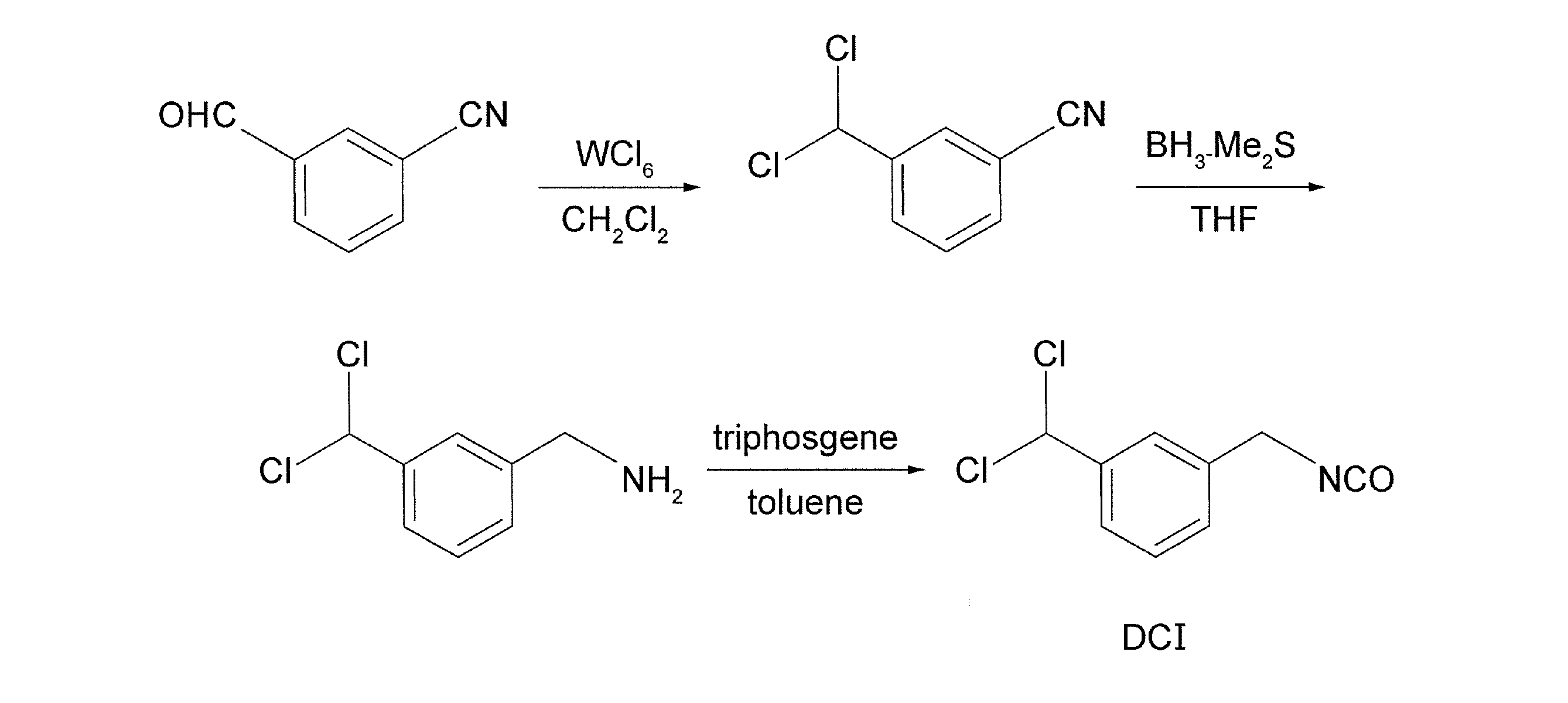
1H-NMR (400MHz,CDCl3) δ7.64-7.33 (4H,m)、6.71 (1H,s)、4.56(2H,s)、
13C-NMR (100MHz,CDCl3) δ46.0、71.3、123.3、124.4、125.7、128.1、129.3、137.6、141.0、
FT-IR : 2256cm-1
MS : m/z=215(M+)
また、得られた3-(ジクロロメチル)ベンジルイソシアネート(DCI)を、検出方法をFIDに変更したこと以外は上記したDCIの含有割合の測定用の条件と同じ条件で、ガスクロマトグラフィーにて分析した。
後述する実施例1において製造されるXDI組成物を、1H-NMR(270MHz,CDCl3)、13C-NMR(100MHz,CDCl3)、FT-IRおよびMSにより分析した。また、そのXDI組成物を、上記したXDIの含有割合の測定用の条件でガスクロマトグラフィーにて分析した。
(実施例1~7および実施例10)
XDI組成物を図1に示すプラント1により製造した。詳しくは、オルソジクロロベンゼン(ODCB)600質量部を、図1に示す撹拌槽21に装入した。次いで、撹拌槽21内の造塩温度を100℃に調節するとともに、撹拌槽21内の造塩圧力(ゲージ圧)を0.1MPaGに調節した。その後、HClガス128質量部を、塩化水素供給ライン24より撹拌槽21に吹き込むとともに、m-XDA160質量部とODCB1240質量部との混合溶液(アミン溶液)を、アミン供給ライン22より撹拌槽21に2時間かけて装入した。これにより、XDA塩酸塩の濃度が12.5質量%であるスラリーを調製した。
塔底温度:160~170℃
塔頂温度:115~125℃
塔頂圧力:0.5~1.0kPa
塔頂還流量:表1に示す。
低沸物の低沸排出ラインからの留出量:表1に示す。
塔頂還流比:表1に示す。
滞留時間:0.3~3hr
その後、精留塔81において脱低沸マスからXDI組成物を留分として調製した。精留塔81は、理論段数3段相当の充填物が充填されていた。
塔底温度:150~160℃
塔頂温度:140~150℃
塔頂圧力:0.5~0.8kPa
XDI組成物のXDI留出ラインからの留出量:表1に示す。
塔頂還流比:1
滞留時間:1~10hr
以上によって、XDI組成物を製造した。XDI組成物における、XDI、CBI、DCIおよび加水分解性塩素の含有割合を表1に示す。
(実施例8、9および比較例1)
ODCB、HClガスおよびm-XDAの使用量を実施例1~7の1/2に変更した点、塩化カルボニルの供給速度、反応圧力(ゲージ圧)、平均滞留時間、塔頂還流量、低沸物の留出量、塔頂還流比およびXDI組成物の留出量を、表1に示す値に変更した点以外は、実施例1と同様にして、XDI組成物を製造した。XDI組成物における、XDI、CBI、DCIおよび加水分解性塩素の含有割合を表1に示す。
(比較例2)
実施例2で得られたXDI組成物2000gを、内容積が3Lの4つ口丸型フラスコに装入した。4つ口フラスコに、マクマフォンパッキンが70cm充填された25mmφの精留塔と、N2導入のキャピラリー管と、温度計とを取り付けた。また、精留塔の塔頂に電磁開閉器と、コンデンサと、コンデンサからの凝縮液を受ける500mlのナス型フラスコとを取り付けた。
(比較例3)
留出率50%まで塔頂還流比を20で留出液を留出し、その後、塔頂還流比5で留出液を留出したこと以外は、比較例2と同様にして、留出率50~80%の留出液を合わせて、XDI組成物600gを製造した。XDI組成物における、XDI、CBIおよびDCIの含有割合を表1に示す。

撹拌機、温度計、還流管および窒素供給ラインを備えた4つ口フラスコに、実施例1、2、4、6~9および比較例1、2のそれぞれのXDI組成物(ポリイソシアネート成分)198質量部と、数平均分子量2000のアジペート系ポリエステルポリオール(三井化学社製、タケラックU-2024、活性水素基含有成分)531.2質量部とを装入し、窒素雰囲気下、80℃にて、NCO基含量が9.1質量%になるまで反応させて、イソシアネート基末端プレポリマーを製造した。
(エラストマーの評価)
得られたエラストマー(TPU)の白濁性、キセノン照射試験における色差および引張物性(引張強度および伸度)を測定した。その結果を表2に示す。また、XDI組成物におけるDCIの含有割合(下側の横軸)とキセノン照射試験における色差(縦軸)との相関、および、XDI組成物におけるCBIの含有割合(上側の横軸)とキセノン照射試験における色差(縦軸)との相関を図2に示す。
数平均分子量700のポリエーテルポリオール(三井化学社製、アクトコールG-250)60質量部と、数平均分子量5000のポリエーテルポリオール(三井化学社製、アクトコールT-5000)40質量部と、トリエタノールアミン5質量部と、水3質量部と、アミン触媒(モメンティブ社製、33LV)1質量部と、ジラウリン酸ジブチル錫1質量部と、整泡剤(ビックケミー社製、BYK-9001)1質量部と、ジプロピレングリコール4質量部とを、温度23℃、相対湿度55%で均一になるように撹拌混合して、プレミックスを調製した。
(フォームの評価)
得られたフォームのUV照射試験における色差、引張物性(引張強度および破断伸び)、見かけ密度、硬度および反発弾性を測定した。その結果を表2に示す。また、XDI組成物におけるDCIの含有割合(下側の横軸)と、UV照射試験における色差(縦軸)との相関、および、XDI組成物におけるCBIの含有割合(上側の横軸)とUV照射試験における色差(縦軸)との相関を図3に示す。
(プラスチックレンズAの調製)
フラスコに、ジブチル錫ジクロライド0.001質量部、内部離型剤(Stepan社製、ゼレックUN、酸性リン酸エステル)0.07質量部、紫外線吸収剤(堺化学工業社製、バイオソーブ583)0.05質量部、実施例1、2、4、6~9および比較例1、3のそれぞれのXDI組成物36.4質量部を仕込んだ。そして、それらを25℃で1時間攪拌して溶解させて、ポリイソシアネート成分を調製した。
フラスコに、ジブチル錫ジクロライド0.01質量部、内部離型剤(Stepan社製、ゼレックUN、酸性リン酸エステル)0.1質量部、紫外線吸収剤(堺化学工業社製、バイオソーブ583)0.05質量部、実施例1、2、4、6~9および比較例1、3のそれぞれのXDI組成物50.7質量部を仕込んだ。そして、それらを25℃で1時間攪拌して溶解させて、ポリイソシアネート成分を調製した。
(光学材料の評価)
得られたプラスチックレンズAおよびBのY.I.値を測定した。その結果を表2に示す。また、XDI組成物におけるDCIの含有割合(下側の横軸)とプラスチックレンズAのY.I.値(縦軸)との相関、および、XDI組成物におけるCBIの含有割合(上側の横軸)とプラスチックレンズAのY.I.値(縦軸)との相関を図4Aに示す。XDI組成物におけるDCIの含有割合(下側の横軸)とプラスチックレンズBのY.I.値(縦軸)との相関、および、XDI組成物におけるCBIの含有割合(上側の横軸)とプラスチックレンズBのY.I.値(縦軸)との相関を図4Bに示す。
撹拌装置を備えるセパラブルフラスコに、実施例1~4、7~9および比較例1、2のそれぞれのXDI組成物(ポリイソシアネート成分)170.0質量部、数平均分子量2000のポリオキシプロピレンジオール(三井化学社製、Diol-2000)553.3質量部、数平均分子量3000のポリオキシプロピレントリオール(三井化学社製、MN-3050)276.7質量部を装入した。それらの混合物を、窒素雰囲気下、80℃にて5時間反応させた。その後、さらに25℃で24時間熟成して、A剤(硬化剤:イソシアネート基末端プレポリマー)を製造した。
(二液硬化型シーリング材の評価)
得られた二液硬化型シーリング材のUV照射試験における色差および引張物性(引張強度および破断伸び)を測定した。その結果を表2に示す。また、XDI組成物におけるDCIの含有割合(下側の横軸)とUV照射試験における色差(縦軸)との相関、および、XDI組成物におけるCBIの含有割合(上側の横軸)とUV照射試験における色差(縦軸)との相関を図5に示す。
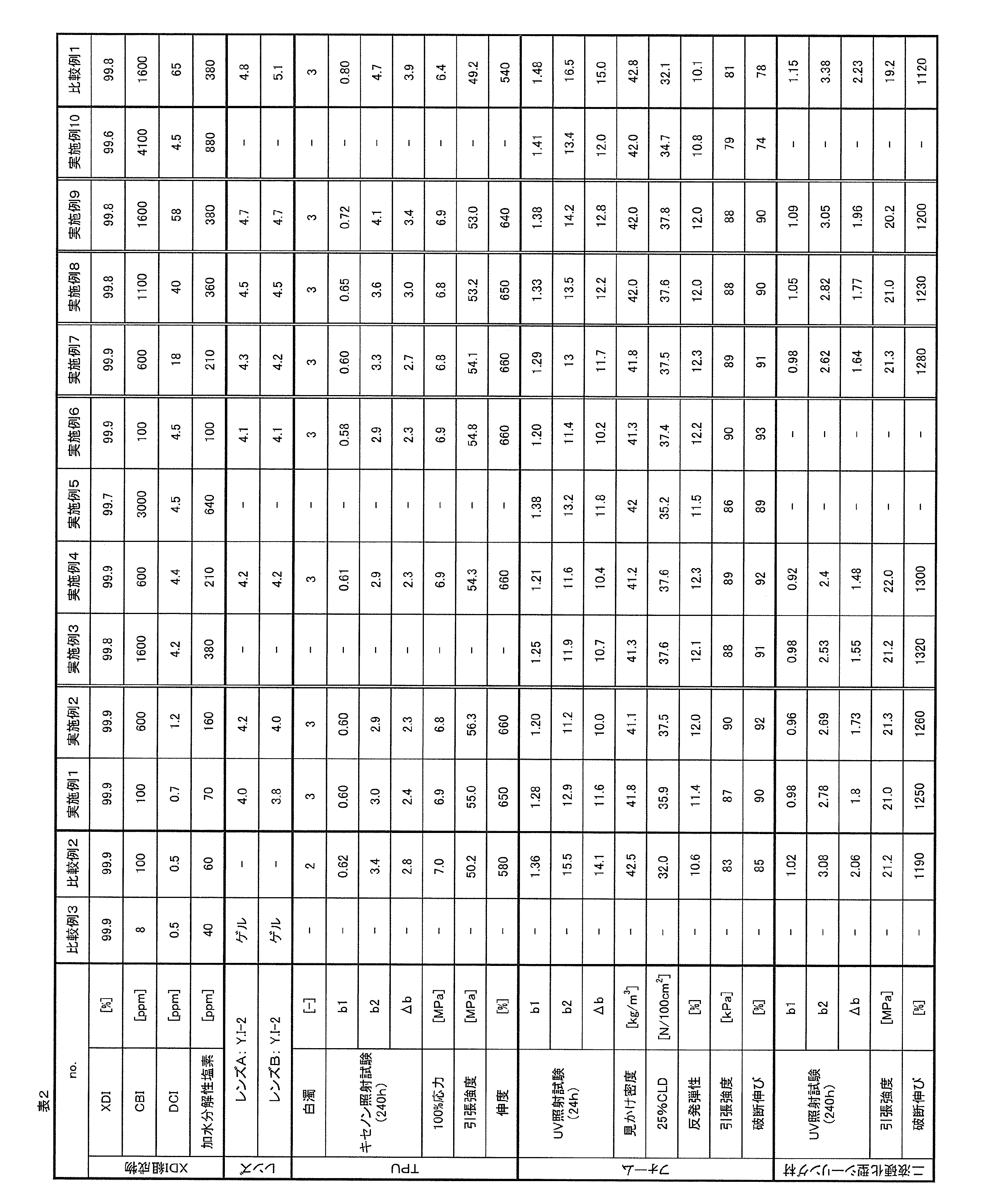
(A剤1:XDIのTMPアダクト体)
実施例1、3、4、7~9および比較例1、2のそれぞれのXDI組成物463.3質量部と、トリメチロールプロパン36.7質量部とを混合し、窒素雰囲気下70℃で6時間反応させた。この反応液を、薄膜蒸留装置を用いて未反応のXDIを留去することにより、XDI変性体組成物を製造した。XDI変性体組成物は、XDIとトリメチロールプロパンとの反応生成物であるウレタン基を含有していた。
(A剤2:XDIのイソシアヌレート変性体)
実施例1、3、4、7~9および比較例1、2のそれぞれのXDI組成物100質量部に、1,3-ブタンジオール2質量部を加え、窒素雰囲気下75℃に昇温して、2時間ウレタン化反応させた。1,3-ブタンジオールのヒドロキシ基に対する、XDIのイソシアネート基の当量比(NCO/OH)は24であった。次いで、同温度でイソシアヌレート化触媒として、テトラブチルアンモニウムのハイドロオキサイドの溶液(37%メタノール溶液)を0.1phr(固形分換算0.037phr)配合し、反応開始から4時間でイソシアヌレート化反応を終了させた。得られた反応液を薄膜蒸留装置(温度150℃、真空度50Pa)に通液して、未反応のXDIを除去(蒸留収率60質量%)することにより、XDI変性体組成物を製造した。XDI変性体組成物は、XDIの三量体であるイソシアヌレート基を含有していた。このXDI変性体組成物を、固形分75質量%となるように、酢酸エチルを加えて、ポリイソシアネート成分(A剤2)を製造した。
(B剤)
フッ素ポリオール(ダイキン工業社製、ゼッフルGK-570、水酸基価(固形分):64mgKOH/g、溶剤:酢酸ブチル)40質量部と、酸化チタン(石原産業社製、CR93)52.5質量部と、酢酸ブチル33.8質量部と、直径2mmガラスビーズ110質量部と、ペイントシェーカーにて2時間撹拌した。その後、その混合液から、ろ過によりガラスビーズを除去した。そして、固形分濃度が58質量%となるように、溶剤を添加して、活性水素基含有成分(B剤)を製造した。活性水素基含有成分中の酸化チタンの含有割合は、45質量%であった。
(コーティングの評価)
得られたポリイソシアネート成分(A剤1およびA剤2のそれぞれ)と活性水素基含有成分(B剤)とを、水酸基に対するイソシアネート基(NCO/OH)の当量比が1.0となるように混合して、混合液を調製した。次いで、混合液に、NV値(塗膜分質量)が60%となるように、酢酸ブチルを添加した。その後、混合液を、ポリエチレンテレフタレート(以下、PETとする。)基材の表面に塗布し、120℃で2分間加熱硬化させた。次いで、混合液が塗布されたPET基材を、60℃で2日間養生させた。これにより、PET基材に、厚みが約15μmのコーティングが形成した。
また、XDI組成物におけるDCIの含有割合(下側の横軸)と湿熱試験における色差(縦軸)との相関、および、XDI組成物におけるCBIの含有割合(上側の横軸)と湿熱試験における色差(縦軸)との相関を図6および図7に示す。
温度計、撹拌装置、窒素導入管および冷却管が装着された反応器に、窒素雰囲気下、実施例1~4、7~9、比較例1および2のそれぞれのXDI組成物100質量部と、2,6-ジ(tert-ブチル)-4-メチルフェノール(別名:ジブチルヒドロキシトルエン、BHT、ヒンダードフェノール系酸化防止剤)0.025質量部と、テトラフェニル・ジプロピレングリコール・ジホスファイト(JPP-100(商品名、城北化学工業社製)有機亜リン酸エステル、助触媒)0.05質量部とを仕込んだ後、この仕込み液に、1,3-ブタンジオール1.96質量部を加え、仕込み液を75℃に昇温して、ウレタン化反応させた。1,3-ブタンジオールのヒドロキシ基に対する、m-キシリレンジイソシアネートのイソシアネート基の当量比(NCO/OH)は24であった。
得られたラミネート用接着剤により接着されたラミネートフィルムの外観、接着強度およびUV照射試験における色差を測定した。その結果を表3に示す。また、XDI組成物におけるDCIの含有割合(下側の横軸)とUV照射試験における色差(縦軸)との相関、および、XDI組成物におけるCBIの含有割合(上側の横軸)とUV照射試験における色差(縦軸)との相関を図8に示す。
撹拌装置を備えるセパラブルフラスコに、窒素雰囲気下、実施例1~4、7~9および比較例1、2のそれぞれのXDI組成物(ポリイソシアネート成分)91.67質量部、予め減圧脱水した数平均分子量3000のポリオキシプロピレンジオール(三井化学SKCポリウレタン社製、D-3000)229.78質量部および数平均分子量5000のポリオキシプロピレントリオール(三井化学SKCポリウレタン社製、T-5000)199.57質量部を装入した。それらの混合物を、窒素雰囲気下、90℃にて6時間反応させた。その後、数平均分子量2000のポリエステルポリオール(三井化学社製、タケラックU-7020)83.90質量部を添加し、90℃にて5時間反応させた。次いで、60℃まで冷却し、プロピレングリコールモノメチルエーテルアセテート105質量部を加えて、同温度にて、1時間撹拌混合し、ポリウレタンプレポリマーを得た。
(一液硬化型シーリング材の評価)
得られた一液硬化型シーリング材のUV照射試験における色差および引張物性(引張強度および破断伸び)を測定した。その結果を表3に示す。また、XDI組成物におけるDCIの含有割合(下側の横軸)とUV照射試験における色差(縦軸)との相関、および、XDI組成物におけるCBIの含有割合(上側の横軸)とUV照射試験における色差(縦軸)との相関を図9に示す。

2 造塩ユニット
3 イソシアネート化ユニット
4 脱ガスユニット
5 脱溶媒ユニット
6 脱タールユニット
7 脱低沸ユニット
8 精留ユニット
Claims (14)
- キシリレンジイソシアネートと、下記化学式(1)に示す化合物とを含み、下記化学式(1)に示す化合物の含有割合が、0.6ppm以上60ppm以下であることを特徴とする、キシリレンジイソシアネート組成物。
化学式(1)

- クロロメチルベンジルイソシアネートをさらに含み、前記クロロメチルベンジルイソシアネートの含有割合が、0.2ppm以上3000ppm以下であることを特徴とする、
請求項1に記載のキシリレンジイソシアネート組成物。 - 前記クロロメチルベンジルイソシアネートの含有割合が、0.2ppm以上1600ppm以下であることを特徴とする、
請求項2に記載のキシリレンジイソシアネート組成物。 - 請求項1に記載のキシリレンジイソシアネート組成物が変性された変性体組成物であり、
下記(a)~(e)の官能基を少なくとも1種含有することを特徴とする、キシリレンジイソシアネート変性体組成物。
(a)イソシアヌレート基、
(b)アロファネート基、
(c)ビウレット基、
(d)ウレタン基、
(e)ウレア基、
(f)イミノオキサジアジンジオン基、
(g)ウレトジオン基、
(h)ウレトンイミン基、
(i)カルボジイミド基 - 請求項1に記載のキシリレンジイソシアネート組成物を含有するイソシアネート成分と、活性水素基含有成分との反応生成物であることを特徴とする、樹脂。
- 光学材料であることを特徴とする、請求項5に記載の樹脂。
- 光学レンズであることを特徴とする、請求項6に記載の樹脂。
- 請求項4に記載のキシリレンジイソシアネート変性体組成物を含有するイソシアネート成分と、活性水素基含有成分との反応生成物であることを特徴とする、樹脂。
- 光学材料であることを特徴とする、請求項8に記載の樹脂。
- 光学レンズであることを特徴とする、請求項9に記載の樹脂。
- 請求項1に記載のキシリレンジイソシアネート組成物を含有するイソシアネート成分をA剤とし、
活性水素基含有成分をB剤とすることを特徴とする、二液型樹脂原料。 - コーティング原料であることを特徴とする、請求項11に記載の二液型樹脂原料。
- 請求項4に記載のキシリレンジイソシアネート変性体組成物を含有するイソシアネート成分をA剤とし、
活性水素基含有成分をB剤とすることを特徴とする、二液型樹脂原料。 - コーティング原料であることを特徴とする、請求項13に記載の二液型樹脂原料。
Priority Applications (10)
| Application Number | Priority Date | Filing Date | Title |
|---|---|---|---|
| EP20215455.5A EP3825301B1 (en) | 2017-04-10 | 2018-04-09 | Xylylenediisocyanate composition, xylylenediisocyanate-modified composition, two-component resin material, and resin |
| KR1020197009724A KR20190129819A (ko) | 2017-04-10 | 2018-04-09 | 자일릴렌 다이아이소사이아네이트 조성물, 자일릴렌 다이아이소사이아네이트 변성체 조성물, 이액형 수지 원료 및 수지 |
| CN201880001979.0A CN109153637B (zh) | 2017-04-10 | 2018-04-09 | 苯二甲撑二异氰酸酯组合物、苯二甲撑二异氰酸酯改性物组合物、二液型树脂原料及树脂 |
| US16/301,257 US10640605B2 (en) | 2017-04-10 | 2018-04-09 | Xylylenediisocyanate composition, xylylenediisocyanate-modified composition, two-component resin material, and resin |
| JP2018519890A JP6373536B1 (ja) | 2017-04-10 | 2018-04-09 | キシリレンジイソシアネート組成物、キシリレンジイソシアネート変性体組成物、二液型樹脂原料および樹脂 |
| EP18784708.2A EP3470393B1 (en) | 2017-04-10 | 2018-04-09 | Xylylene diisocyanate composition, xylylene diisocyanate modification composition, two-component resin starting material, and resin |
| KR1020187033072A KR101970115B1 (ko) | 2017-04-10 | 2018-04-09 | 자일릴렌 다이아이소사이아네이트 조성물, 자일릴렌 다이아이소사이아네이트 변성체 조성물, 이액형 수지 원료 및 수지 |
| BR112018074934A BR112018074934B1 (pt) | 2017-04-10 | 2018-04-09 | composição de xililenodiisocianato, composição de xililenodiisocianato modificada, material de resina de dois componentes e resina |
| KR1020227003632A KR102491064B1 (ko) | 2017-04-10 | 2018-04-09 | 자일릴렌 다이아이소사이아네이트 조성물, 자일릴렌 다이아이소사이아네이트 변성체 조성물, 이액형 수지 원료 및 수지 |
| US16/800,676 US11254783B2 (en) | 2017-04-10 | 2020-02-25 | Xylylenediisocyanate composition, xylylenediisocyanate-modified composition, two-component resin material, and resin |
Applications Claiming Priority (2)
| Application Number | Priority Date | Filing Date | Title |
|---|---|---|---|
| JP2017-077618 | 2017-04-10 | ||
| JP2017077618 | 2017-04-10 |
Related Child Applications (2)
| Application Number | Title | Priority Date | Filing Date |
|---|---|---|---|
| US16/301,257 A-371-Of-International US10640605B2 (en) | 2017-04-10 | 2018-04-09 | Xylylenediisocyanate composition, xylylenediisocyanate-modified composition, two-component resin material, and resin |
| US16/800,676 Continuation US11254783B2 (en) | 2017-04-10 | 2020-02-25 | Xylylenediisocyanate composition, xylylenediisocyanate-modified composition, two-component resin material, and resin |
Publications (1)
| Publication Number | Publication Date |
|---|---|
| WO2018190290A1 true WO2018190290A1 (ja) | 2018-10-18 |
Family
ID=63792656
Family Applications (1)
| Application Number | Title | Priority Date | Filing Date |
|---|---|---|---|
| PCT/JP2018/014896 Ceased WO2018190290A1 (ja) | 2017-04-10 | 2018-04-09 | キシリレンジイソシアネート組成物、キシリレンジイソシアネート変性体組成物、二液型樹脂原料および樹脂 |
Country Status (8)
| Country | Link |
|---|---|
| US (1) | US10640605B2 (ja) |
| EP (2) | EP3825301B1 (ja) |
| JP (1) | JP7103879B2 (ja) |
| KR (2) | KR101970115B1 (ja) |
| CN (6) | CN109153637B (ja) |
| BR (1) | BR112018074934B1 (ja) |
| TW (1) | TWI655178B (ja) |
| WO (1) | WO2018190290A1 (ja) |
Cited By (31)
| Publication number | Priority date | Publication date | Assignee | Title |
|---|---|---|---|---|
| CN111138617A (zh) * | 2018-11-02 | 2020-05-12 | 万华化学集团股份有限公司 | 一种聚氨酯光学材料树脂及其制备方法 |
| CN111217975A (zh) * | 2018-11-27 | 2020-06-02 | 万华化学集团股份有限公司 | 光学材料用树脂的制备方法 |
| CN112778499A (zh) * | 2020-12-30 | 2021-05-11 | 王植源 | 低游离间苯二甲基异氰酸酯聚氨酯预聚物的制备方法 |
| JP2021085009A (ja) * | 2019-11-29 | 2021-06-03 | 三井化学株式会社 | ブロックイソシアネート、および、コーティング剤 |
| JP2021091682A (ja) * | 2019-12-06 | 2021-06-17 | エスケイシー・カンパニー・リミテッドSkc Co., Ltd. | ジイソシアネート組成物、その製造方法およびこれを利用した光学材料 |
| JP2021091893A (ja) * | 2019-12-06 | 2021-06-17 | エスケイシー・カンパニー・リミテッドSkc Co., Ltd. | 光学レンズ用ジイソシアネート組成物およびその調製方法 |
| JP2021091672A (ja) * | 2019-12-06 | 2021-06-17 | エスケイシー・カンパニー・リミテッドSkc Co., Ltd. | ジアミン組成物、およびジイソシアネート組成物の調製方法 |
| WO2021256417A1 (ja) | 2020-06-18 | 2021-12-23 | 三井化学株式会社 | キシリレンジイソシアネート入り容器、キシリレンジイソシアネートの保管方法およびキシリレンジイソシアネートの輸送方法 |
| JP2021195347A (ja) * | 2020-06-17 | 2021-12-27 | 三井化学株式会社 | ポリイソシアネート組成物および変性体組成物 |
| CN114478321A (zh) * | 2022-04-06 | 2022-05-13 | 中国科学院过程工程研究所 | 中间体间苯二亚甲基二氨基甲酸乙酯溶液分离精制净化的方法、装置及用途 |
| WO2022162968A1 (ja) * | 2021-01-28 | 2022-08-04 | 三井化学株式会社 | キシリレンジイソシアネート組成物、キシリレンジイソシアネート変性体組成物、重合性組成物、樹脂、成形体、光学素子およびレンズ |
| JP2022117008A (ja) * | 2021-01-29 | 2022-08-10 | 三井化学株式会社 | 2成分型硬化吹付材 |
| WO2022191247A1 (ja) | 2021-03-10 | 2022-09-15 | 三井化学株式会社 | キシリレンジイソシアネート組成物、光学材料用重合性組成物、樹脂、成形体、光学素子およびレンズ |
| WO2022270550A1 (ja) | 2021-06-22 | 2022-12-29 | 三井化学株式会社 | ポリイソシアネート組成物、重合性組成物、樹脂、成形体、光学素子およびレンズ |
| WO2023022203A1 (ja) | 2021-08-19 | 2023-02-23 | 三井化学株式会社 | イソシアネート製造システム、イソシアネート組成物、重合性組成物、樹脂、及び成形体 |
| JP2023036548A (ja) * | 2021-09-02 | 2023-03-14 | エスケイシー・カンパニー・リミテッド | キシリレンジイソシアネート組成物およびそれを含む光学用重合性組成物 |
| WO2023037645A1 (ja) | 2021-09-09 | 2023-03-16 | 三井化学株式会社 | キシリレンジイソシアネート組成物、重合性組成物、樹脂、成形体、光学素子およびレンズ |
| KR20230081352A (ko) * | 2021-11-30 | 2023-06-07 | 한화솔루션 주식회사 | 이소시아네이트 조성물 및 이의 제조방법 |
| WO2023153484A1 (ja) * | 2022-02-09 | 2023-08-17 | 三井化学株式会社 | ポリチオール組成物の製造方法、ポリチオール組成物、チオウレタン樹脂原料の組成管理システム及びこれらの応用 |
| JP2024503330A (ja) * | 2020-12-30 | 2024-01-25 | ハンワ ソリューションズ コーポレイション | イソシアネート化合物の製造方法 |
| JP2024503331A (ja) * | 2020-12-30 | 2024-01-25 | ハンワ ソリューションズ コーポレイション | イソシアネート化合物の製造方法 |
| JPWO2024048389A1 (ja) * | 2022-08-29 | 2024-03-07 | ||
| WO2024058014A1 (ja) * | 2022-09-14 | 2024-03-21 | 三井化学株式会社 | ポリチオール組成物、重合性組成物、樹脂、成形体、光学材料及びレンズ |
| WO2024070537A1 (ja) * | 2022-09-26 | 2024-04-04 | 三井化学株式会社 | ポリチオール組成物の製造方法及びその応用 |
| WO2024080384A1 (ja) * | 2022-10-14 | 2024-04-18 | 三井化学株式会社 | ポリチオール組成物、重合性組成物、樹脂、成形体、光学材料及びレンズ |
| WO2024190689A1 (ja) * | 2023-03-10 | 2024-09-19 | 三井化学株式会社 | ポリアミン化合物の製造方法 |
| WO2025041722A1 (ja) | 2023-08-24 | 2025-02-27 | 三井化学株式会社 | キシリレンジイソシアネート組成物、重合性組成物、樹脂、成形体、光学素子およびレンズ |
| WO2025079550A1 (ja) | 2023-10-12 | 2025-04-17 | 三井化学株式会社 | キシリレンジイソシアネート組成物、重合性組成物、樹脂、成形体、光学素子およびレンズ |
| JP2025529320A (ja) * | 2022-11-17 | 2025-09-04 | 万華化学集団股▲分▼有限公司 | イソシアネート組成物、変性イソシアネート、ポリウレタン樹脂及び光学材料 |
| JP2025530353A (ja) * | 2022-11-17 | 2025-09-11 | 万華化学集団股▲分▼有限公司 | イソシアネート組成物、その製造方法及び応用 |
| KR20260006207A (ko) | 2024-07-04 | 2026-01-13 | 케이에스랩(주) | 염소화유도체를 포함하는 이소시아네이트 조성물 및 이를 포함하는 광학 수지 |
Families Citing this family (38)
| Publication number | Priority date | Publication date | Assignee | Title |
|---|---|---|---|---|
| US20190106529A1 (en) * | 2016-04-11 | 2019-04-11 | Mitsui Chemicals, Inc. | Xylylene diisocyanate composition, resin, and polymerizable composition |
| JP6373536B1 (ja) * | 2017-04-10 | 2018-08-15 | 三井化学株式会社 | キシリレンジイソシアネート組成物、キシリレンジイソシアネート変性体組成物、二液型樹脂原料および樹脂 |
| KR102340535B1 (ko) | 2019-03-21 | 2021-12-27 | 김근식 | 비염소화 유도체를 포함하는 이소시아네이트 화합물의 제조 방법 및 이들의 조성물 |
| CN111004368B (zh) * | 2019-11-08 | 2021-07-23 | 万华化学集团股份有限公司 | 一种低吸湿率的多异氰酸酯组合物及其制备方法 |
| KR102456419B1 (ko) * | 2019-12-06 | 2022-10-19 | 에스케이씨 주식회사 | 디이소시아네이트 조성물 및 광학 렌즈의 제조방법 |
| KR102217752B1 (ko) * | 2019-12-05 | 2021-02-19 | 에스케이씨 주식회사 | 디이소시아네이트 조성물 및 광학 렌즈의 제조방법 |
| US11932591B2 (en) * | 2019-12-06 | 2024-03-19 | Skc Co., Ltd. | Method of preparing diisocyanate composition and optical lens |
| KR102456421B1 (ko) * | 2019-12-06 | 2022-10-19 | 에스케이씨 주식회사 | 디이소시아네이트 조성물 및 광학 렌즈의 제조방법 |
| KR102457569B1 (ko) * | 2019-12-06 | 2022-10-21 | 에스케이씨 주식회사 | 디이소시아네이트 조성물, 이의 제조방법 및 이를 이용한 광학 재료 |
| KR20210118280A (ko) | 2020-03-19 | 2021-09-30 | 케이에스랩(주) | 비염소화 유도체를 포함하는 이소시아네이트 화합물의 제조 방법 및 이들의 조성물 |
| KR20230029840A (ko) * | 2020-09-03 | 2023-03-03 | 에스케이씨 주식회사 | 자일릴렌디이소시아네이트 조성물 및 이를 포함하는 광학용 중합성 조성물 |
| WO2022050715A1 (ko) * | 2020-09-03 | 2022-03-10 | 에스케이씨 주식회사 | 폴리티올 조성물 및 이를 포함하는 광학용 중합성 조성물 |
| KR20220038207A (ko) | 2020-09-18 | 2022-03-28 | 케이에스랩(주) | 지방족계 이소시아네이트 화합물의 제조 방법 및 이들의 조성물 |
| KR102859933B1 (ko) | 2020-09-18 | 2025-09-16 | 케이에스랩(주) | 크실릴렌 디이소시아네이트 함유 조성물의 제조 방법 |
| CN112661930B (zh) * | 2020-11-27 | 2022-08-05 | 万华化学集团股份有限公司 | 一种苯二亚甲基二异氰酸酯组合物及光学树脂 |
| KR102578617B1 (ko) * | 2020-12-03 | 2023-09-13 | 에스케이씨 주식회사 | 자일릴렌디이소시아네이트 조성물 및 이를 포함하는 중합성 조성물 |
| KR102839454B1 (ko) * | 2020-12-30 | 2025-07-25 | 한화솔루션 주식회사 | 이소시아네이트 화합물의 제조 방법 |
| KR102839457B1 (ko) * | 2020-12-30 | 2025-07-25 | 한화솔루션 주식회사 | 이소시아네이트 화합물의 제조 방법 |
| US20230340183A1 (en) * | 2021-01-28 | 2023-10-26 | Mitsui Chemicals, Inc. | Xylylene diisocyanate composition, xylylene diisocyanate modified composition, polymerizable composition, resin, molded article, optical element, and lens |
| CN116802356A (zh) * | 2021-03-03 | 2023-09-22 | 世联株式会社 | 合成皮革 |
| CN115073707B (zh) * | 2021-03-10 | 2023-09-26 | 万华化学集团股份有限公司 | 一种苯二亚甲基二异氰酸酯组合物及其制备方法和应用 |
| CN113980238B (zh) * | 2021-10-27 | 2024-02-27 | 万华化学集团股份有限公司 | 一种苯二亚甲基二异氰酸酯组合物及其制备方法、应用 |
| CN114031744B (zh) * | 2021-11-29 | 2023-12-19 | 万华化学集团股份有限公司 | 双(异氰酸甲酯基)环己烷组合物、其改性物组合物及制备方法 |
| CN115894296B (zh) * | 2022-11-17 | 2025-04-25 | 万华化学集团股份有限公司 | 一种异氰酸酯组合物、改性异氰酸酯、聚氨酯树脂和光学材料 |
| JP2025524128A (ja) * | 2022-11-17 | 2025-07-25 | 万華化学集団股▲分▼有限公司 | イソシアネート組成物、変性組成物、及びポリウレタンエラストマー |
| CN116217885B (zh) * | 2023-01-03 | 2025-07-04 | 万华化学集团股份有限公司 | 一种苯二异氰酸酯组合物及其制备方法和应用 |
| WO2025005602A1 (ko) * | 2023-06-29 | 2025-01-02 | 케이에스랩(주) | 염소화유도체를 포함하는 이소시아네이트 조성물 및 이를 포함하는 광학 수지 |
| WO2025116045A1 (en) * | 2023-11-27 | 2025-06-05 | Mitsui Chemicals, Inc. | Polythiol composition, polymerizable composition, resin, molded body, optical material, and lens |
| WO2025192825A1 (ko) | 2024-03-15 | 2025-09-18 | 케이에스랩(주) | 이소시아네이트 조성물 내의 염소화 유도체의 함량을 감소시키기 위한 방법 |
| KR102911269B1 (ko) * | 2024-03-19 | 2026-01-12 | 한화솔루션 주식회사 | 이소시아네이트 조성물 및 이를 포함하는 중합성 조성물 |
| WO2025198327A1 (ko) * | 2024-03-19 | 2025-09-25 | 한화솔루션 주식회사 | 이소시아네이트 조성물 및 이를 포함하는 중합성 조성물 |
| KR102806436B1 (ko) * | 2024-03-29 | 2025-05-09 | 한화솔루션 주식회사 | 이소시아네이트 조성물, 이를 포함하는 광학렌즈 및 이를 이용한 이소시아네이트 조성물 보관방법 |
| KR102806439B1 (ko) * | 2024-03-29 | 2025-05-09 | 한화솔루션 주식회사 | 이소시아네이트 조성물, 이를 포함하는 광학렌즈 및 이를 이용한 이소시아네이트 조성물 보관방법 |
| KR102806438B1 (ko) * | 2024-04-09 | 2025-05-09 | 한화솔루션 주식회사 | 이소시아네이트 조성물, 이의 보관방법, 이를 포함하는 비발포형 폴리우레탄 및 광학렌즈 |
| KR102818362B1 (ko) * | 2024-06-14 | 2025-06-11 | 한화솔루션 주식회사 | 이소시아네이트 조성물 및 이를 포함하는 중합성 조성물 |
| KR102849973B1 (ko) * | 2024-09-11 | 2025-08-22 | 한화솔루션 주식회사 | 이소시아네이트 조성물, 이를 포함하는 광학렌즈 및 이를 이용한 이소시아네이트 조성물 보관방법 |
| KR102849974B1 (ko) * | 2024-09-11 | 2025-08-22 | 한화솔루션 주식회사 | 이소시아네이트 조성물, 이를 포함하는 광학렌즈 및 이를 이용한 이소시아네이트 조성물 보관방법 |
| CN120059126B (zh) * | 2025-04-28 | 2025-08-12 | 成都昭管武科技有限公司 | 保温复合材料及其制备方法、应用 |
Citations (8)
| Publication number | Priority date | Publication date | Assignee | Title |
|---|---|---|---|---|
| GB1086782A (en) | 1965-02-19 | 1967-10-11 | Upjohn Co | Process for manufacturing polyisocyanates |
| EP0384463A1 (en) | 1989-02-23 | 1990-08-29 | MITSUI TOATSU CHEMICALS, Inc. | Preparation process of xylylene diisocyanate |
| EP1908749A1 (en) | 2005-07-22 | 2008-04-09 | Mitsui Chemicals, Inc. | Process for production of isocyanate, isocyanate produced by the process, and use of the isocyanate |
| JP2014234429A (ja) | 2013-05-31 | 2014-12-15 | 三菱瓦斯化学株式会社 | 光学材料用重合性組成物およびその製造方法 |
| JP2014234430A (ja) | 2013-05-31 | 2014-12-15 | 三菱瓦斯化学株式会社 | 光学材料用重合性組成物およびその製造方法 |
| WO2015155366A1 (de) * | 2014-04-11 | 2015-10-15 | Bayer Materialscience Ag | Zusammensetzung zur herstellung transparenter polythiourethan-körper |
| WO2016199795A1 (ja) * | 2015-06-12 | 2016-12-15 | 三井化学株式会社 | ポリイソシアネート組成物、ポリウレタン樹脂、二液硬化型ポリウレタン組成物、コーティング材料および接着材料 |
| WO2017179575A1 (ja) * | 2016-04-11 | 2017-10-19 | 三井化学株式会社 | キシリレンジイソシアネート組成物、樹脂および重合性組成物 |
Family Cites Families (22)
| Publication number | Priority date | Publication date | Assignee | Title |
|---|---|---|---|---|
| US3549504A (en) * | 1966-05-05 | 1970-12-22 | Takeda Chemical Industries Ltd | Method for the purification of organic polyisocyanates by fractional distillation in presence of an inert gas or superheated vapor of an organic solvent |
| US3658656A (en) | 1968-11-07 | 1972-04-25 | Takeda Chemical Industries Ltd | Purification of xylylene organic diisocyanate by fractional distillation in the presence of an inert gas or superheated vapor of an organic solvent |
| JPS5632990A (en) * | 1979-08-24 | 1981-04-02 | Mitsubishi Chem Ind Ltd | T-ran (guanosine-2') metahyl transferase |
| US4422976A (en) * | 1981-04-07 | 1983-12-27 | Mitsui Toatsu Chemicals, Incorporated | Continuous preparation of organic isocyanates |
| DE3121036A1 (de) * | 1981-05-27 | 1982-12-16 | Bayer Ag, 5090 Leverkusen | Verfahren zur kontinuierlicehn herstellung von organischen mono- oder polyisocyanaten |
| MY129938A (en) * | 1991-03-19 | 2007-05-31 | Mitsui Toatsu Chemicals | Stabilizing method of isocyanate compounds and isocyanate compositions stabilized thereby. |
| US5576412A (en) | 1993-05-20 | 1996-11-19 | Takeda Chemical Industries, Ltd. | Optical urethane resin |
| JP3993645B2 (ja) | 1993-05-20 | 2007-10-17 | 三井化学ポリウレタン株式会社 | 光学用レンズ |
| JPH07233137A (ja) | 1993-12-27 | 1995-09-05 | Mitsui Toatsu Chem Inc | 脂肪族ポリイソシアナートの製造方法 |
| JP3905409B2 (ja) * | 2002-04-10 | 2007-04-18 | タレックス光学工業株式会社 | 光学レンズ成型用ポリウレタン樹脂組成物および耐衝撃性合成樹脂レンズ |
| DE102004060120A1 (de) * | 2004-12-13 | 2006-06-14 | Basf Ag | Verfahren zur Herstellung von (cyclo)aliphatischen Polyisocyanaten |
| EP1831280B1 (de) | 2004-12-13 | 2008-07-23 | Basf Se | Verfahren zur herstellung von farblosen, lagerstabilen biuretgruppenhaltigen polyisocyanaten |
| JP4606918B2 (ja) | 2005-03-25 | 2011-01-05 | 三井化学株式会社 | 安定化された脂肪族及び/または脂環族イソシアナートを含有する組成物 |
| JP5458478B2 (ja) * | 2006-09-19 | 2014-04-02 | 三菱瓦斯化学株式会社 | 高屈折率高強度樹脂用組成物 |
| US8455695B2 (en) * | 2010-05-07 | 2013-06-04 | Dow Global Technologies Llc | Process for the production of aliphatic isocyanates |
| CN102070491B (zh) * | 2010-11-26 | 2013-12-18 | 万华化学集团股份有限公司 | 基于成盐光气化反应制备苯二亚甲基二异氰酸酯的方法 |
| JP6329017B2 (ja) * | 2013-06-28 | 2018-05-23 | 旭化成株式会社 | ポリイソシアネート組成物 |
| JP5675011B1 (ja) * | 2013-09-26 | 2015-02-25 | 三井化学株式会社 | 1,4−ビス(イソシアナトメチル)シクロヘキサン、ポリイソシアネート組成物、ポリウレタン樹脂および成形品 |
| WO2015115292A1 (ja) * | 2014-01-28 | 2015-08-06 | 三井化学株式会社 | ポリイソシアネート組成物、2液硬化型ポリウレタン樹脂、塗料、接着剤およびポリイソシアネート組成物の製造方法 |
| CN104945283B (zh) * | 2014-03-25 | 2016-10-19 | 万华化学集团股份有限公司 | 一种制备异氰酸酯单体的方法 |
| CN106496073A (zh) * | 2016-09-27 | 2017-03-15 | 江苏嘉隆化工有限公司 | 一种mxdi的制备方法 |
| JP6373536B1 (ja) * | 2017-04-10 | 2018-08-15 | 三井化学株式会社 | キシリレンジイソシアネート組成物、キシリレンジイソシアネート変性体組成物、二液型樹脂原料および樹脂 |
-
2018
- 2018-04-09 CN CN201880001979.0A patent/CN109153637B/zh active Active
- 2018-04-09 US US16/301,257 patent/US10640605B2/en active Active
- 2018-04-09 CN CN202011302565.7A patent/CN112409566A/zh active Pending
- 2018-04-09 CN CN202011302680.4A patent/CN112409569A/zh active Pending
- 2018-04-09 BR BR112018074934A patent/BR112018074934B1/pt active IP Right Grant
- 2018-04-09 WO PCT/JP2018/014896 patent/WO2018190290A1/ja not_active Ceased
- 2018-04-09 CN CN202011306983.3A patent/CN112480364A/zh active Pending
- 2018-04-09 KR KR1020187033072A patent/KR101970115B1/ko active Active
- 2018-04-09 KR KR1020197009724A patent/KR20190129819A/ko not_active Ceased
- 2018-04-09 EP EP20215455.5A patent/EP3825301B1/en active Active
- 2018-04-09 CN CN202011303579.0A patent/CN112409570A/zh active Pending
- 2018-04-09 EP EP18784708.2A patent/EP3470393B1/en active Active
- 2018-04-09 CN CN202011306737.8A patent/CN112480363A/zh active Pending
- 2018-04-10 TW TW107112294A patent/TWI655178B/zh active
- 2018-07-13 JP JP2018133578A patent/JP7103879B2/ja active Active
Patent Citations (8)
| Publication number | Priority date | Publication date | Assignee | Title |
|---|---|---|---|---|
| GB1086782A (en) | 1965-02-19 | 1967-10-11 | Upjohn Co | Process for manufacturing polyisocyanates |
| EP0384463A1 (en) | 1989-02-23 | 1990-08-29 | MITSUI TOATSU CHEMICALS, Inc. | Preparation process of xylylene diisocyanate |
| EP1908749A1 (en) | 2005-07-22 | 2008-04-09 | Mitsui Chemicals, Inc. | Process for production of isocyanate, isocyanate produced by the process, and use of the isocyanate |
| JP2014234429A (ja) | 2013-05-31 | 2014-12-15 | 三菱瓦斯化学株式会社 | 光学材料用重合性組成物およびその製造方法 |
| JP2014234430A (ja) | 2013-05-31 | 2014-12-15 | 三菱瓦斯化学株式会社 | 光学材料用重合性組成物およびその製造方法 |
| WO2015155366A1 (de) * | 2014-04-11 | 2015-10-15 | Bayer Materialscience Ag | Zusammensetzung zur herstellung transparenter polythiourethan-körper |
| WO2016199795A1 (ja) * | 2015-06-12 | 2016-12-15 | 三井化学株式会社 | ポリイソシアネート組成物、ポリウレタン樹脂、二液硬化型ポリウレタン組成物、コーティング材料および接着材料 |
| WO2017179575A1 (ja) * | 2016-04-11 | 2017-10-19 | 三井化学株式会社 | キシリレンジイソシアネート組成物、樹脂および重合性組成物 |
Cited By (66)
| Publication number | Priority date | Publication date | Assignee | Title |
|---|---|---|---|---|
| CN111138617A (zh) * | 2018-11-02 | 2020-05-12 | 万华化学集团股份有限公司 | 一种聚氨酯光学材料树脂及其制备方法 |
| CN111217975B (zh) * | 2018-11-27 | 2022-01-07 | 万华化学集团股份有限公司 | 光学材料用树脂的制备方法 |
| CN111217975A (zh) * | 2018-11-27 | 2020-06-02 | 万华化学集团股份有限公司 | 光学材料用树脂的制备方法 |
| JP2021085009A (ja) * | 2019-11-29 | 2021-06-03 | 三井化学株式会社 | ブロックイソシアネート、および、コーティング剤 |
| JP7343371B2 (ja) | 2019-11-29 | 2023-09-12 | 三井化学株式会社 | ブロックイソシアネート、および、コーティング剤 |
| US11760719B2 (en) | 2019-12-06 | 2023-09-19 | Skc Co., Ltd. | Diamine composition, and method of preparing diisocyanate composition |
| JP7307440B2 (ja) | 2019-12-06 | 2023-07-12 | エスケイシー・カンパニー・リミテッド | 光学レンズ用ジイソシアネート組成物およびその調製方法 |
| JP2021091672A (ja) * | 2019-12-06 | 2021-06-17 | エスケイシー・カンパニー・リミテッドSkc Co., Ltd. | ジアミン組成物、およびジイソシアネート組成物の調製方法 |
| US11702384B2 (en) | 2019-12-06 | 2023-07-18 | Skc Co., Ltd. | Diisocyanate composition for optical lens and preparation method thereof |
| JP7126218B2 (ja) | 2019-12-06 | 2022-08-26 | エスケイシー・カンパニー・リミテッド | ジイソシアネート組成物、その製造方法およびこれを利用した光学材料 |
| JP2021091893A (ja) * | 2019-12-06 | 2021-06-17 | エスケイシー・カンパニー・リミテッドSkc Co., Ltd. | 光学レンズ用ジイソシアネート組成物およびその調製方法 |
| JP7126217B2 (ja) | 2019-12-06 | 2022-08-26 | エスケイシー・カンパニー・リミテッド | ジアミン組成物、およびジイソシアネート組成物の調製方法 |
| JP2021091682A (ja) * | 2019-12-06 | 2021-06-17 | エスケイシー・カンパニー・リミテッドSkc Co., Ltd. | ジイソシアネート組成物、その製造方法およびこれを利用した光学材料 |
| JP7582800B2 (ja) | 2020-06-17 | 2024-11-13 | 三井化学株式会社 | ポリイソシアネート組成物および変性体組成物 |
| JP2021195347A (ja) * | 2020-06-17 | 2021-12-27 | 三井化学株式会社 | ポリイソシアネート組成物および変性体組成物 |
| EP4481446A2 (en) | 2020-06-18 | 2024-12-25 | Mitsui Chemicals, Inc. | Xylylene diisocyanate-containing container, method for storing xylylene diisocyanate, and method for transporting xylylene diisocyanate |
| WO2021256417A1 (ja) | 2020-06-18 | 2021-12-23 | 三井化学株式会社 | キシリレンジイソシアネート入り容器、キシリレンジイソシアネートの保管方法およびキシリレンジイソシアネートの輸送方法 |
| KR20220054849A (ko) | 2020-06-18 | 2022-05-03 | 미쯔이가가꾸가부시끼가이샤 | 크실릴렌디이소시아네이트가 들어간 용기, 크실릴렌디이소시아네이트의 보관 방법 및 크실릴렌디이소시아네이트의 수송 방법 |
| CN112778499A (zh) * | 2020-12-30 | 2021-05-11 | 王植源 | 低游离间苯二甲基异氰酸酯聚氨酯预聚物的制备方法 |
| JP2024503330A (ja) * | 2020-12-30 | 2024-01-25 | ハンワ ソリューションズ コーポレイション | イソシアネート化合物の製造方法 |
| CN112778499B (zh) * | 2020-12-30 | 2021-11-09 | 王植源 | 低游离间苯二甲基异氰酸酯聚氨酯预聚物的制备方法 |
| JP7602049B2 (ja) | 2020-12-30 | 2024-12-17 | ハンワ ソリューションズ コーポレイション | イソシアネート化合物の製造方法 |
| JP2024503331A (ja) * | 2020-12-30 | 2024-01-25 | ハンワ ソリューションズ コーポレイション | イソシアネート化合物の製造方法 |
| WO2022162968A1 (ja) * | 2021-01-28 | 2022-08-04 | 三井化学株式会社 | キシリレンジイソシアネート組成物、キシリレンジイソシアネート変性体組成物、重合性組成物、樹脂、成形体、光学素子およびレンズ |
| JP2022117008A (ja) * | 2021-01-29 | 2022-08-10 | 三井化学株式会社 | 2成分型硬化吹付材 |
| JP7509702B2 (ja) | 2021-01-29 | 2024-07-02 | 三井化学株式会社 | 2成分型硬化吹付材 |
| WO2022191247A1 (ja) | 2021-03-10 | 2022-09-15 | 三井化学株式会社 | キシリレンジイソシアネート組成物、光学材料用重合性組成物、樹脂、成形体、光学素子およびレンズ |
| KR102536700B1 (ko) | 2021-03-10 | 2023-05-30 | 미쯔이가가꾸가부시끼가이샤 | 크실릴렌디이소시아네이트 조성물, 광학 재료용 중합성 조성물, 수지, 성형체, 광학 소자 및 렌즈 |
| CN115667211B (zh) * | 2021-03-10 | 2023-04-28 | 三井化学株式会社 | 苯二甲撑二异氰酸酯组合物、光学材料用聚合性组合物、树脂、成型体、光学元件及透镜 |
| CN115667211A (zh) * | 2021-03-10 | 2023-01-31 | 三井化学株式会社 | 苯二甲撑二异氰酸酯组合物、光学材料用聚合性组合物、树脂、成型体、光学元件及透镜 |
| KR20220164809A (ko) | 2021-03-10 | 2022-12-13 | 미쯔이가가꾸가부시끼가이샤 | 크실릴렌디이소시아네이트 조성물, 광학 재료용 중합성 조성물, 수지, 성형체, 광학 소자 및 렌즈 |
| KR20230145994A (ko) | 2021-03-10 | 2023-10-18 | 미쯔이가가꾸가부시끼가이샤 | 크실릴렌디이소시아네이트 조성물, 광학 재료용 중합성 조성물, 수지, 성형체, 광학 소자 및 렌즈 |
| US11753367B2 (en) | 2021-03-10 | 2023-09-12 | Mitsui Chemicals, Inc. | Xylylene diisocyanate composition, polymerizable composition for optical material, resin, molded article, optical element, and lens |
| EP4674881A2 (en) | 2021-03-10 | 2026-01-07 | Mitsui Chemicals, Inc. | Xylylene diisocyanate composition, polymerizable composition for optical materials, resin, molded body, optical element and lens |
| WO2022270550A1 (ja) | 2021-06-22 | 2022-12-29 | 三井化学株式会社 | ポリイソシアネート組成物、重合性組成物、樹脂、成形体、光学素子およびレンズ |
| KR20240004792A (ko) | 2021-06-22 | 2024-01-11 | 미쯔이가가꾸가부시끼가이샤 | 폴리이소시아네이트 조성물, 중합성 조성물, 수지, 성형체, 광학 소자 및 렌즈 |
| WO2023022203A1 (ja) | 2021-08-19 | 2023-02-23 | 三井化学株式会社 | イソシアネート製造システム、イソシアネート組成物、重合性組成物、樹脂、及び成形体 |
| JP2023036548A (ja) * | 2021-09-02 | 2023-03-14 | エスケイシー・カンパニー・リミテッド | キシリレンジイソシアネート組成物およびそれを含む光学用重合性組成物 |
| JP7808527B2 (ja) | 2021-09-02 | 2026-01-29 | プコア カンパニー リミテッド | キシリレンジイソシアネート組成物およびそれを含む光学用重合性組成物 |
| JP7324385B1 (ja) * | 2021-09-09 | 2023-08-09 | 三井化学株式会社 | キシリレンジイソシアネート組成物、重合性組成物、樹脂、成形体、光学素子およびレンズ |
| KR20230038786A (ko) | 2021-09-09 | 2023-03-21 | 미쯔이가가꾸가부시끼가이샤 | 크실릴렌디이소시아네이트 조성물, 중합성 조성물, 수지, 성형체, 광학 소자 및 렌즈 |
| KR20250021646A (ko) | 2021-09-09 | 2025-02-13 | 미쯔이가가꾸가부시끼가이샤 | 크실릴렌디이소시아네이트 조성물, 중합성 조성물, 수지, 성형체, 광학 소자 및 렌즈 |
| WO2023037645A1 (ja) | 2021-09-09 | 2023-03-16 | 三井化学株式会社 | キシリレンジイソシアネート組成物、重合性組成物、樹脂、成形体、光学素子およびレンズ |
| JP7751742B2 (ja) | 2021-11-30 | 2025-10-08 | ハンワ ソリューションズ コーポレイション | イソシアネート組成物およびその製造方法 |
| KR20230081352A (ko) * | 2021-11-30 | 2023-06-07 | 한화솔루션 주식회사 | 이소시아네이트 조성물 및 이의 제조방법 |
| KR102865449B1 (ko) * | 2021-11-30 | 2025-09-25 | 한화솔루션 주식회사 | 이소시아네이트 조성물 및 이의 제조방법 |
| JP2024542656A (ja) * | 2021-11-30 | 2024-11-15 | ハンワ ソリューションズ コーポレイション | イソシアネート組成物およびその製造方法 |
| WO2023153484A1 (ja) * | 2022-02-09 | 2023-08-17 | 三井化学株式会社 | ポリチオール組成物の製造方法、ポリチオール組成物、チオウレタン樹脂原料の組成管理システム及びこれらの応用 |
| JP7818628B2 (ja) | 2022-02-09 | 2026-02-20 | 三井化学株式会社 | ポリチオール組成物の製造方法、ポリチオール組成物、チオウレタン樹脂原料の組成管理システム及びこれらの応用 |
| JPWO2023153484A1 (ja) * | 2022-02-09 | 2023-08-17 | ||
| CN114478321A (zh) * | 2022-04-06 | 2022-05-13 | 中国科学院过程工程研究所 | 中间体间苯二亚甲基二氨基甲酸乙酯溶液分离精制净化的方法、装置及用途 |
| CN114478321B (zh) * | 2022-04-06 | 2022-07-26 | 中国科学院过程工程研究所 | 中间体间苯二亚甲基二氨基甲酸乙酯溶液分离精制净化的方法、装置及用途 |
| WO2024048389A1 (ja) * | 2022-08-29 | 2024-03-07 | 三井化学株式会社 | ポリチオール組成物の製造方法、ポリアミン化合物の製造方法、及びこれらの応用 |
| JPWO2024048389A1 (ja) * | 2022-08-29 | 2024-03-07 | ||
| JPWO2024058014A1 (ja) * | 2022-09-14 | 2024-03-21 | ||
| WO2024058014A1 (ja) * | 2022-09-14 | 2024-03-21 | 三井化学株式会社 | ポリチオール組成物、重合性組成物、樹脂、成形体、光学材料及びレンズ |
| WO2024070537A1 (ja) * | 2022-09-26 | 2024-04-04 | 三井化学株式会社 | ポリチオール組成物の製造方法及びその応用 |
| JPWO2024070537A1 (ja) * | 2022-09-26 | 2024-04-04 | ||
| JP7817425B2 (ja) | 2022-09-26 | 2026-02-18 | 三井化学株式会社 | ポリチオール組成物の製造方法及びその応用 |
| WO2024080384A1 (ja) * | 2022-10-14 | 2024-04-18 | 三井化学株式会社 | ポリチオール組成物、重合性組成物、樹脂、成形体、光学材料及びレンズ |
| JP2025529320A (ja) * | 2022-11-17 | 2025-09-04 | 万華化学集団股▲分▼有限公司 | イソシアネート組成物、変性イソシアネート、ポリウレタン樹脂及び光学材料 |
| JP2025530353A (ja) * | 2022-11-17 | 2025-09-11 | 万華化学集団股▲分▼有限公司 | イソシアネート組成物、その製造方法及び応用 |
| WO2024190689A1 (ja) * | 2023-03-10 | 2024-09-19 | 三井化学株式会社 | ポリアミン化合物の製造方法 |
| WO2025041722A1 (ja) | 2023-08-24 | 2025-02-27 | 三井化学株式会社 | キシリレンジイソシアネート組成物、重合性組成物、樹脂、成形体、光学素子およびレンズ |
| WO2025079550A1 (ja) | 2023-10-12 | 2025-04-17 | 三井化学株式会社 | キシリレンジイソシアネート組成物、重合性組成物、樹脂、成形体、光学素子およびレンズ |
| KR20260006207A (ko) | 2024-07-04 | 2026-01-13 | 케이에스랩(주) | 염소화유도체를 포함하는 이소시아네이트 조성물 및 이를 포함하는 광학 수지 |
Also Published As
| Publication number | Publication date |
|---|---|
| JP2018177811A (ja) | 2018-11-15 |
| TW201841880A (zh) | 2018-12-01 |
| US10640605B2 (en) | 2020-05-05 |
| JP7103879B2 (ja) | 2022-07-20 |
| EP3470393B1 (en) | 2021-03-03 |
| CN112480363A (zh) | 2021-03-12 |
| CN109153637B (zh) | 2020-12-08 |
| EP3470393A4 (en) | 2020-03-11 |
| EP3825301A1 (en) | 2021-05-26 |
| KR20190129819A (ko) | 2019-11-20 |
| BR112018074934A2 (pt) | 2019-03-12 |
| US20190292304A1 (en) | 2019-09-26 |
| CN109153637A (zh) | 2019-01-04 |
| CN112409566A (zh) | 2021-02-26 |
| KR101970115B1 (ko) | 2019-04-17 |
| KR20180127517A (ko) | 2018-11-28 |
| EP3470393A1 (en) | 2019-04-17 |
| EP3825301B1 (en) | 2024-04-17 |
| BR112018074934B1 (pt) | 2020-04-28 |
| CN112409569A (zh) | 2021-02-26 |
| CN112480364A (zh) | 2021-03-12 |
| CN112409570A (zh) | 2021-02-26 |
| TWI655178B (zh) | 2019-04-01 |
Similar Documents
| Publication | Publication Date | Title |
|---|---|---|
| JP7103879B2 (ja) | キシリレンジイソシアネート組成物、キシリレンジイソシアネート変性体組成物、二液型樹脂原料および樹脂 | |
| JP6373536B1 (ja) | キシリレンジイソシアネート組成物、キシリレンジイソシアネート変性体組成物、二液型樹脂原料および樹脂 | |
| JP6612438B2 (ja) | キシリレンジイソシアネート組成物、樹脂および重合性組成物 | |
| EP3168256B1 (en) | Eyewear material comprising a polyurethane resin, eyewear frame and lens | |
| JP5832400B2 (ja) | 硬質熱可塑性ポリウレタン樹脂、その製造方法および成形品 | |
| JP7717827B2 (ja) | キシリレンジイソシアネート組成物及びその調製方法と使用 | |
| CN114031744A (zh) | 双异氰酸酯甲酯基环己烷组合物、其改性物组合物及制备方法 | |
| CN115073707A (zh) | 一种苯二亚甲基二异氰酸酯组合物及其制备方法和应用 | |
| JP5675011B1 (ja) | 1,4−ビス(イソシアナトメチル)シクロヘキサン、ポリイソシアネート組成物、ポリウレタン樹脂および成形品 | |
| EP4255947B1 (en) | Method for the production of thermoplastic polyoxazolidinone polymers | |
| EP4008736A1 (en) | Method for the production of thermoplastic polyoxazolidinone polymers |
Legal Events
| Date | Code | Title | Description |
|---|---|---|---|
| ENP | Entry into the national phase |
Ref document number: 2018519890 Country of ref document: JP Kind code of ref document: A |
|
| ENP | Entry into the national phase |
Ref document number: 20187033072 Country of ref document: KR Kind code of ref document: A |
|
| 121 | Ep: the epo has been informed by wipo that ep was designated in this application |
Ref document number: 18784708 Country of ref document: EP Kind code of ref document: A1 |
|
| REG | Reference to national code |
Ref country code: BR Ref legal event code: B01A Ref document number: 112018074934 Country of ref document: BR |
|
| ENP | Entry into the national phase |
Ref document number: 2018784708 Country of ref document: EP Effective date: 20190108 |
|
| ENP | Entry into the national phase |
Ref document number: 112018074934 Country of ref document: BR Kind code of ref document: A2 Effective date: 20181130 |
|
| NENP | Non-entry into the national phase |
Ref country code: DE |