WO2018207111A1 - A process for the preparation of sglt2 inhibitors and intermediates thereof - Google Patents
A process for the preparation of sglt2 inhibitors and intermediates thereof Download PDFInfo
- Publication number
- WO2018207111A1 WO2018207111A1 PCT/IB2018/053220 IB2018053220W WO2018207111A1 WO 2018207111 A1 WO2018207111 A1 WO 2018207111A1 IB 2018053220 W IB2018053220 W IB 2018053220W WO 2018207111 A1 WO2018207111 A1 WO 2018207111A1
- Authority
- WO
- WIPO (PCT)
- Prior art keywords
- formula
- compound
- group
- solvent
- sglt2 inhibitors
- Prior art date
- Legal status (The legal status is an assumption and is not a legal conclusion. Google has not performed a legal analysis and makes no representation as to the accuracy of the status listed.)
- Ceased
Links
- 0 *Cc1cc([C@@]([C@]([C@]2C=O)O)O[C@](CO)[C@]2O)ccc1* Chemical compound *Cc1cc([C@@]([C@]([C@]2C=O)O)O[C@](CO)[C@]2O)ccc1* 0.000 description 2
Classifications
-
- C—CHEMISTRY; METALLURGY
- C07—ORGANIC CHEMISTRY
- C07D—HETEROCYCLIC COMPOUNDS
- C07D309/00—Heterocyclic compounds containing six-membered rings having one oxygen atom as the only ring hetero atom, not condensed with other rings
- C07D309/02—Heterocyclic compounds containing six-membered rings having one oxygen atom as the only ring hetero atom, not condensed with other rings having no double bonds between ring members or between ring members and non-ring members
- C07D309/08—Heterocyclic compounds containing six-membered rings having one oxygen atom as the only ring hetero atom, not condensed with other rings having no double bonds between ring members or between ring members and non-ring members with hetero atoms or with carbon atoms having three bonds to hetero atoms with at the most one bond to halogen, e.g. ester or nitrile radicals, directly attached to ring carbon atoms
- C07D309/10—Oxygen atoms
-
- C—CHEMISTRY; METALLURGY
- C07—ORGANIC CHEMISTRY
- C07H—SUGARS; DERIVATIVES THEREOF; NUCLEOSIDES; NUCLEOTIDES; NUCLEIC ACIDS
- C07H7/00—Compounds containing non-saccharide radicals linked to saccharide radicals by a carbon-to-carbon bond
- C07H7/04—Carbocyclic radicals
-
- C—CHEMISTRY; METALLURGY
- C07—ORGANIC CHEMISTRY
- C07D—HETEROCYCLIC COMPOUNDS
- C07D407/00—Heterocyclic compounds containing two or more hetero rings, at least one ring having oxygen atoms as the only ring hetero atoms, not provided for by group C07D405/00
- C07D407/02—Heterocyclic compounds containing two or more hetero rings, at least one ring having oxygen atoms as the only ring hetero atoms, not provided for by group C07D405/00 containing two hetero rings
- C07D407/12—Heterocyclic compounds containing two or more hetero rings, at least one ring having oxygen atoms as the only ring hetero atoms, not provided for by group C07D405/00 containing two hetero rings linked by a chain containing hetero atoms as chain links
-
- C—CHEMISTRY; METALLURGY
- C07—ORGANIC CHEMISTRY
- C07D—HETEROCYCLIC COMPOUNDS
- C07D409/00—Heterocyclic compounds containing two or more hetero rings, at least one ring having sulfur atoms as the only ring hetero atoms
- C07D409/02—Heterocyclic compounds containing two or more hetero rings, at least one ring having sulfur atoms as the only ring hetero atoms containing two hetero rings
- C07D409/10—Heterocyclic compounds containing two or more hetero rings, at least one ring having sulfur atoms as the only ring hetero atoms containing two hetero rings linked by a carbon chain containing aromatic rings
-
- C—CHEMISTRY; METALLURGY
- C07—ORGANIC CHEMISTRY
- C07H—SUGARS; DERIVATIVES THEREOF; NUCLEOSIDES; NUCLEOTIDES; NUCLEIC ACIDS
- C07H1/00—Processes for the preparation of sugar derivatives
-
- C—CHEMISTRY; METALLURGY
- C07—ORGANIC CHEMISTRY
- C07H—SUGARS; DERIVATIVES THEREOF; NUCLEOSIDES; NUCLEOTIDES; NUCLEIC ACIDS
- C07H1/00—Processes for the preparation of sugar derivatives
- C07H1/06—Separation; Purification
-
- C—CHEMISTRY; METALLURGY
- C07—ORGANIC CHEMISTRY
- C07H—SUGARS; DERIVATIVES THEREOF; NUCLEOSIDES; NUCLEOTIDES; NUCLEIC ACIDS
- C07H7/00—Compounds containing non-saccharide radicals linked to saccharide radicals by a carbon-to-carbon bond
- C07H7/06—Heterocyclic radicals
Definitions
- the present invention relates to a novel process for preparing sodium glucose transporters 2 (SGLT2) inhibitor compounds o
- Ri is halogen, alkyl or alkoxy group
- R 2 is aryl group or heterocyclic ring selected from the group of i, ii, iii or iv as given below.
- SGLTs Sodium-glucose co-transporters inhibitors
- SGLT1 and SGLT2 inhibitors provide new therapeutic targets to reduce hyperglycaemia in patients with diabetes.
- SGLT1 enables the small intestine to absorb glucose and contributes to the reabsorption of glucose filtered by the kidney.
- SGLT2 is responsible for reabsorption of most of the glucose filtered by the kidney.
- Inhibitors with varying specificities for these transporters can slow the rate of intestinal glucose absorption and increase the renal elimination of glucose into the urine.
- Sodium-glucose co-transporter 2 (SGLT2) inhibitors are a new class of diabetic medications indicated only for the treatment of type 2 diabetes. They have been studied alone and with other medications including metformin, sulfonylureas, pioglitazone and insulin.
- SGLT2 is a protein in humans that facilitates glucose reabsorption in the kidney. SGLT2 inhibitors block the reabsorption of glucose in the kidney, increase glucose excretion, and lower blood glucose levels.
- SGLT2 inhibitor drugs have been approved or in clinical phase for treatment of type 2 diabetes.
- a significant numbers of SGLT2 are ⁇ -C- arylglucosides derived drug candidates, most of which comprises a central 1- deoxyglucose ring moiety that is arylated with different substitutions.
- the pharmaceutically valuable drugs that are now being marketed are Canagliflozin (Formula I), Dapagliflozin (Formula II), Empagliflozin (Formula III), whereas Ipragliflozin (Formula IV) is approved for marketin in Japan.
- the structures of these compounds are as given below:
- the present invention provides a process for the preparation of SGLT2 inhibitors simple, efficient, cost effective, in reaction itself by designing optimum condition for reaction to reduce effluent load, environment friendly and commercially scalable for large scale operations.
- the primary object of the present invention is to provide a robust and cost effective process for the preparation of sodium glucose trans orters 2 (SGLT2) compound of Formula X,
- Ri and R 2 are as defined above.
- the principle object of the present invention is to provide an efficient process to prepare intermediates of SGLT2 inhibitors having good yield and high purity thereof.
- the major object of the present invention is to provide an efficient process to prepare intermediates of SGLT2 inhibitors having optimized condition to give better reaction profile in terms of significantly reduced impurities and ultimately gives better yield and purity as compared to prior art.
- Another important object of the present invention is to provide SGLT2 inhibitors in high purity, preferably >99%, more preferably >99.5%.
- Another significant object of the present invention is to provide a process for the preparation of SGLT2 inhibitors involving less unit operations.
- Another object of the present invention is to provide an in-situ process starting from compound of formula A to isolate substantially pure acetylated SGLT2 inhibitors.
- the present invention relates to an improved process for the preparation of SGLT2 inhibitors.
- the present invention relates to an improved process for the preparation of SGLT2 inhibitors resulted in good yield, preferably more than 70%.
- the present invention relates to an improved process for the preparation of acetylated SGLT2 inhibitors, wherein acetylated SGLT2 inhibitors resulted in good overall yield, preferably more than 70%.
- the present invention relates to an improved process for the preparation of SGLT2 inhibitors, wherein final compounds resulted in high purity, preferably >99.5%.
- the present invention related to an improved process for the preparation of SGLT2 inhibitors, wherein the multi-step reaction in which condensation reaction, deprotection, reduction, protection to form acetylated SGLT2 inhibitors are conducted in-situ by telescopic monitoring of reaction.
- the present invention relates to a process for the preparation of acetylated SGLT2 inhibitors, wherein purifying formed acetylated SGLT2 inhibitors by treating with suitable solvents or mixture of solvents to obtain acetylated SGLT2 inhibitors having purity greater than 99%.
- mixture means that the mixture of solvents in any suitable ratio. All alternatives are intended to be within the scope of the present invention.
- in-situ typically means "in the reaction mixture” or “not in isolated form” or “existing as residue”.
- the present invention relates to an improved process for the preparation of SGLT2 inhibitors represented by the following formula X and its hydrates, solvates or salts thereof,
- the suitable solvent used in the process herein above is selected from the group comprising of water, alcohols, ethers, amides, esters, nitriles, sulfoxides, ketones, hydrocarbons and halogenated hydrocarbons; wherein alcohol is selected from the group consisting of methanol, ethanol, iso-propanol.
- ester is selected from the group consisting of ethyl acetate, isopropyl acetate
- ketone is selected from the group consisting of acetone, methyl isobutyl ketone, methyl ethyl ketone
- ether is selected from the group consisting of methyl tert-butyl ether, diisopropyl ether, diethyl ether tetrahydrofuran, 2-methyl tetrahydrofuran, cyclopentyl methyl ether, dioxane and the like
- halogenated solvent is selected from the group consisting of dichloromethane, chloroform, chlorobenzene, bromobenzene and the like
- hydrocarbons is selected from the group consisting of toluene, xylene, cyclohexane and the like
- nitrile is selected from the group consisting of acetonitrile, propionit
- reducing agent may be mixture of triethylsilane and aluminum chloride.
- acetylation reagent may be selected from acetic anhydride or acetyl chloride.
- base may be selected from inorganic base or organic base or mixtures thereof.
- the organic base is selected from the group consisting of 1,8- diazabicyclo[5.4.0]undec-7-ene (DBU), l,5-diazabicyclo[4.3.0]non-5-ene (DBN), pyridine, dimethylaminopyridine, dibutyl amine, triethyl amine, tributyl amine, diisopropyl amine, diisopropylethylamine, N-methylmorpholine and the like.
- DBU 1,8- diazabicyclo[5.4.0]undec-7-ene
- DBN l,5-diazabicyclo[4.3.0]non-5-ene
- pyridine dimethylaminopyridine
- dibutyl amine triethyl amine
- tributyl amine diisopropyl amine
- diisopropylethylamine diisopropylethylamine
- the inorganic base is selected from the group consisting of hydroxides of alkali metals or alkaline earth metals such as sodium hydroxide, potassium hydroxide, lithium hydroxide, calcium hydroxide; carbonates such as sodium carbonate, potassium carbonate; bicarbonates of alkali metals or alkaline earth metals such as sodium bicarbonate, potassium bicarbonate; ammonia and the like.
- the main objective of the present invention is to achieve high purity and yield, simultaneously avoiding use of BF 3 -etherate as reducing agent which always requires safety precautions. Moreover that, recovery of compound of formula X via the in-situ transformation from compound of formula A increases overall yield from 46% to 57% as compared to prior art.
- the present invention relates to an improved process for the preparation of acetylated SGLT2 inhibitors of formula F,
- the suitable solvent used in the process herein above is selected from the group comprising of water, alcohols, ethers, amides, esters, nitriles, sulfoxides, ketones, hydrocarbons and halogenated hydrocarbons; wherein alcohol is selected from the group consisting of methanol, ethanol, iso-propanol.
- ester is selected from the group consisting of ethyl acetate, isopropyl acetate
- ketone is selected from the group consisting of acetone, methyl isobutyl ketone, methyl ethyl ketone
- ether is selected from the group consisting of methyl tert-butyl ether, diisopropyl ether, diethyl ether tetrahydrofuran, 2-methyl tetrahydrofuran, cyclopentyl methyl ether, dioxane and the like
- halogenated solvent is selected from the group consisting of dichloromethane, chloroform, chlorobenzene, bromobenzene and the like
- hydrocarbons is selected from the group consisting of toluene, xylene, cyclohexane and the like
- nitrile is selected from the group consisting of acetonitrile, propionit
- organolithium reagent may be selected from n-butyllithium, sec- butyllithium, isopropyllithium, ie/t-butyllithium and the like.
- reducing agent may be mixture of triethylsilane and aluminum chloride.
- acetylating reagent may be selected from acetic anhydride or acetyl chloride.
- base may be selected from inorganic base or organic base or mixtures thereof.
- the organic base is selected from the group consisting of 1,8- diazabicyclo[5.4.0]undec-7-ene (DBU), l,5-diazabicyclo[4.3.0]non-5-ene (DBN), pyridine, dimethylaminopyridine, dibutyl amine, triethyl amine, tributyl amine, diisopropyl amine, diisopropylethylamine, N-methylmorpholine and the like.
- DBU 1,8- diazabicyclo[5.4.0]undec-7-ene
- DBN l,5-diazabicyclo[4.3.0]non-5-ene
- pyridine dimethylaminopyridine
- dibutyl amine triethyl amine
- tributyl amine diisopropyl amine
- diisopropylethylamine diisopropylethylamine
- the inorganic base is selected from the group consisting of hydroxides of alkali metals or alkaline earth metals such as sodium hydroxide, potassium hydroxide, lithium hydroxide, calcium hydroxide; carbonates such as sodium carbonate, potassium carbonate; bicarbonates of alkali metals or alkaline earth metals such as sodium bicarbonate, potassium bicarbonate; ammonia and the like.
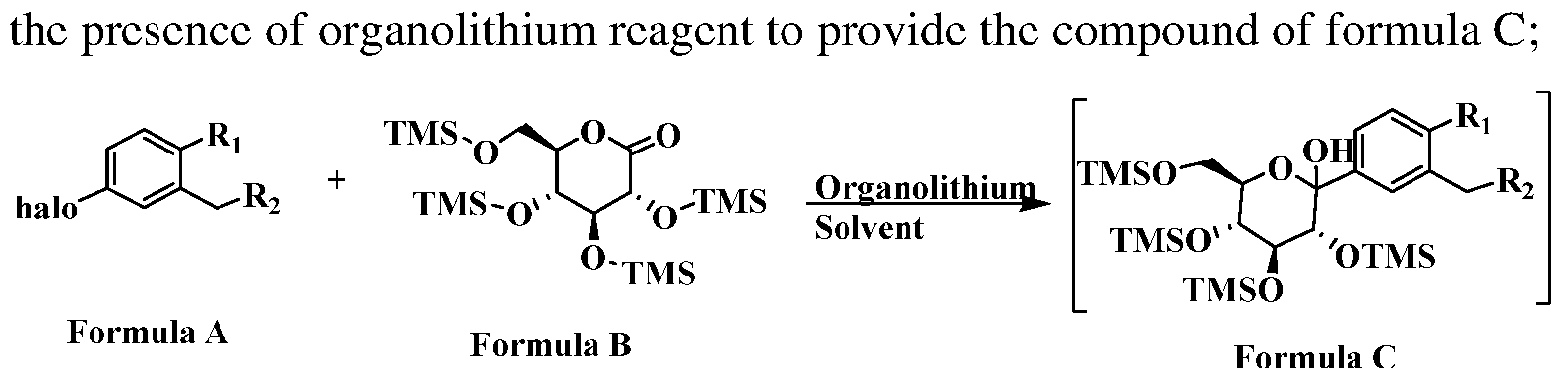
- the present invention relates to a process for the preparation of compound of formula C, comprising the step of: reacting the compound of formula A with the compound of formula B in suitable solvent in the presence of organolithium reagent to provide the compound of formula C, wherein reaction preferably conducted at the temperature -105°C to -90°C. ha
- reaction temperature has critical role, which gives better reaction profile in terms of significantly reduced impurities such as dimer impurity and ultimately gives better yield and purity as compared to prior art.
- the present invention relates to a process for the preparation of acetylated SGLT2 inhibitors of formula F, wherein purifying formed acetylated SGLT2 inhibitors by treating with halogenated solvent and/or alcohol or mixtures thereof yields acetylated SGLT2 inhibitors of formula F having purity greater than 99%.
- the suitable solvent used in the process herein above is selected from the group comprising of water, alcohols, halogenated hydrocarbons; or mixtures thereof, wherein alcohol is selected from the group consisting of methanol, ethanol, iso-propanol. n-butanol, iso-butanol and the like; halogenated solvent is selected from the group consisting of dichloromethane, chloroform, chlorobenzene, bromobenzene and the like.
- the significant advantages of the present invention is to provide purer compound of formula F by treating with halogenated solvent and/or alcohol or mixtures thereof to control the impurities below 0.1%.
- the present invention relates to a process for the preparation of SGLT2 inhibitors of formula X, wherein purifying formed SGLT2 inhibitors by treating with suitable solvent or mixture of solvents or by crystallization or by solvent - antisolvent treatment to provide SGLT2 inhibitors of formula X having purity greater than 99%.
- Example- 1 Preparation of acetylated Canagliflozin (Formula F)
- reaction mass was stirred till completion of reaction at 25°C to 35°C.
- the reaction once completed as indicated by HPLC analysis, was quenched by the addition of trimethylamine.
- water 500 mL
- dichloromethane The combined dichloromethane layers were washed with brine solution.
- This organic layer containing O-methoxy intermediate was added to the mixture of triethylsilane (71.3 gm) and aluminum chloride (98.0 gm) in 1: 1 ratio of acetonitrile and dichloromethane mixture at 0°C to 5°C. Further this reaction was quenched by using 10% aqueous hydrochloric acid solution and the product was extracted using dichloromethane and washed with brine solution.
- the crude acetylated canagliflozin was isolated using isopropyl alcohol by heating the crude oil in isopropyl alcohol at 75-80°C to get white to yellow slurry and gradually cooled to 25-35°C, over the period of 6-7 h. This was then filtrated at 25-35°C and washed with isopropyl alcohol to give acetylated canagliflozin.
- the acetylated canagliflozin is further purified in methylene chloride and isopropyl alcohol (1:5) at 40-45°C followed by the filtration at 25-35°C and drying under vacuum at 60-65°C to obtain acetylated canagliflozin.
- Example-2 Preparation of Canagliflozin hemihydrate (Formula X)
- acetylated canagliflozin was added at temperature 25-35°C.
- the reaction mixture was flushed with methanol (50 mL) and stirred for 10-15 minutes followed by maintaining the reaction mixture at 60-70°C for 2 hours.
- the reaction mixture was then cooled to 25-35°C and acetic acid (5 mL) was added into it at 25-35°C to adjust the pH 6.5-8.0.
- Isopropyl acetate (250 mL) and water (300 mL) were added into the reaction mixture at temperature 25-35°C and stirred for 15-20 minutes followed by separating the layers.
- Aqueous layer was extracted twice with Isopropyl acetate (100 mL). The organic layer was washed with demineralized (DM) water (250 mL) followed by charcoal treatment. The solvent was distilled under vacuum at below 55°C up to 2.5 to 3.5 volumes. The reaction mixture was then cooled to 25-35°C and water (15 mL) was added and stirred 25-30°C for 30-45 minutes. The reaction mixture was then added cyclohexane (250 mL) at 25-30°C and stirred at 25-30°C for 12-15 hours.
- DM demineralized
- the product was filtered under vacuum at 25-30°C and washed the product with cyclohexane (100 mL) and dried the material under vacuum 50-55°C till water and residual solvents comes under limit to obtain Canagliflozin hemihydrate.
- Example-3 Preparation of Canagliflozin hemihydrate (Formula X)
- acetylated canagliflozin was added at temperature 25-35°C.
- the reaction mixture was flushed with methanol (50 mL) and stirred for 10-15 minutes followed by maintaining the reaction mixture at 60-70°C for 2 hours.
- the reaction mixture was then cooled to 25-35°C and acetic acid (5 mL) was added into it at 25-35°C to adjust the pH 6.5-8.0.
- Dichloromethane (250 mL) and water (300 mL) were added into the reaction mixture at temperature 25-35°C and stirred for 15-20 minutes followed by separating the layers.
- the product was filtered under vacuum at 25-30°C and washed the product with cyclohexane (100 mL) and dried the material under vacuum 50-55°C till water and residual solvents comes under limit to provide Canagliflozin hemihydrate.
- Example-4 Preparation of acetylated Empagliflozin (Formula F)
- reaction was quenched by the addition of triethylamine and distilled it out under vacuum. To the obtained residue water was added and extracted thrice with ethylacetate. The combined ethylacetate fractions were washed with brine and dried over sodium sulfate. The reaction mixture was concentrated to provide formula C in the form oil. To the methylenechloride solvent, aluminum chloride was added in one lot and cooled the mass to the temperature 0°C to 10°C. To the prepared solution acetonitrile was added followed by addition of triethyl silane at a rate such that the temperature was maintained between 0°C to 10°C. Mixed the above prepared complex with oil of formula C and stirred for 2 h.
Landscapes
- Chemical & Material Sciences (AREA)
- Organic Chemistry (AREA)
- Engineering & Computer Science (AREA)
- Health & Medical Sciences (AREA)
- Biochemistry (AREA)
- Biotechnology (AREA)
- General Health & Medical Sciences (AREA)
- Genetics & Genomics (AREA)
- Molecular Biology (AREA)
- Life Sciences & Earth Sciences (AREA)
- Organic Low-Molecular-Weight Compounds And Preparation Thereof (AREA)
- Heterocyclic Carbon Compounds Containing A Hetero Ring Having Oxygen Or Sulfur (AREA)
- Pharmaceuticals Containing Other Organic And Inorganic Compounds (AREA)
Abstract
The present invention relates to an industrially feasible and economically viable process for preparation of SGLT2 inhibitors of formula (X) in significantly high yield and purity.
Description
A PROCESS FOR THE PREPARATION OF S GLT2 INHIBITORS AND
INTERMEDIATES THEREOF
FIELD OF THE INVENTION
The present invention relates to a novel process for preparing sodium glucose transporters 2 (SGLT2) inhibitor compounds o

Formula X
Wherein, Ri is halogen, alkyl or alkoxy group; and
R2 is aryl group or heterocyclic ring selected from the group of i, ii, iii or iv as given below.

u HI
BACKGROUND OF THE INVENTION
The following discussion of the prior art is intended to present the invention in an appropriate technical context, and allows its significance to be properly appreciated. Unless clearly indicated to the contrary, reference to any prior art in this specification should not be construed as an expressed or implied admission that such art is widely known or forms part of common general knowledge in the field.
Sodium-glucose co-transporters inhibitors (SGLTs), such as SGLT1 and SGLT2 inhibitors provide new therapeutic targets to reduce hyperglycaemia in patients with diabetes. SGLT1 enables the small intestine to absorb glucose and contributes to the reabsorption of glucose filtered by the kidney. SGLT2 is responsible for reabsorption of most of the glucose filtered by the kidney. Inhibitors with varying specificities for these transporters can slow the rate of intestinal glucose absorption and increase the renal elimination of glucose into the urine.
Sodium-glucose co-transporter 2 (SGLT2) inhibitors are a new class of diabetic medications indicated only for the treatment of type 2 diabetes. They have been studied alone and with other medications including metformin, sulfonylureas, pioglitazone and insulin.
SGLT2 is a protein in humans that facilitates glucose reabsorption in the kidney. SGLT2
inhibitors block the reabsorption of glucose in the kidney, increase glucose excretion, and lower blood glucose levels.
Currently various SGLT2 inhibitor drugs have been approved or in clinical phase for treatment of type 2 diabetes. A significant numbers of SGLT2 are β-C- arylglucosides derived drug candidates, most of which comprises a central 1- deoxyglucose ring moiety that is arylated with different substitutions. Among β-C-arylglucosides the pharmaceutically valuable drugs that are now being marketed are Canagliflozin (Formula I), Dapagliflozin (Formula II), Empagliflozin (Formula III), whereas Ipragliflozin (Formula IV) is approved for marketin in Japan. The structures of these compounds are as given below:

Formula III Formula IV
There are various patents and patent applications viz., US 6,515, 117, US 7,579,449, US 7,772,407, US 7,943,788, WO 2009035969, WO 2004063209, WO 2010022313, WO 2010043682, WO 2011047113, and WO 2013152476 which discloses the process for the preparation of these SGLT2 inhibitors. Most of these processes involve glucose or glucono lactone moiety for the preparation of the required compound.
In the prior art processes, hydroxyl group of the gluconolactone moiety is protected with trimethylsilane. The process discloses the reaction where after the C-C bond formation the resultant hemiketal formed is methylated using methanesulphonic acid. During the process the trimethylsilyl groups are hydrolysed and get removed. The demethylation of the methoxy group and protection with acetyl group followed by deacetylation to isolate the required compound.
Above described processes make use of drastic reaction conditions, more unit operations; additional purification by chromatography to get high enantiomeric and chemical purity which leads to loss of yield and that is not desirable for commercial manufacturing as well as plant- scale point of view.
Existing processes are suffering from drawbacks like tedious processes, loss of yield, long reaction time cycle, more energy consumption, loss of human hours and involvement of more inventories as well as unit operations. Inventors of the present invention have developed an improved process that addresses the problems associated with the processes reported in the prior art. The process of the present invention does not involve more unit operation. Moreover, the process does not require critical workup procedure. Accordingly, the present invention provides a process for the preparation of SGLT2 inhibitors simple, efficient, cost effective, in reaction itself by designing optimum condition for reaction to reduce effluent load, environment friendly and commercially scalable for large scale operations.
OBJECT OF THE INVENTION
The primary object of the present invention is to provide a robust and cost effective process for the preparation of sodium glucose trans orters 2 (SGLT2) compound of Formula X,

Formula X
wherein, Ri and R2 are as defined above. The principle object of the present invention is to provide an efficient process to prepare intermediates of SGLT2 inhibitors having good yield and high purity thereof.
The major object of the present invention is to provide an efficient process to prepare intermediates of SGLT2 inhibitors having optimized condition to give better reaction profile in terms of significantly reduced impurities and ultimately gives better yield and purity as compared to prior art.
Another important object of the present invention is to provide SGLT2 inhibitors in high purity, preferably >99%, more preferably >99.5%.
Another significant object of the present invention is to provide a process for the preparation of SGLT2 inhibitors involving less unit operations.
Another object of the present invention is to provide an in-situ process starting from compound of formula A to isolate substantially pure acetylated SGLT2 inhibitors.
SUMMARY OF THE INVENTION
In one aspect, the present invention relates to an improved process for the preparation of SGLT2 inhibitors.
In another aspect, the present invention relates to an improved process for the preparation of SGLT2 inhibitors resulted in good yield, preferably more than 70%.
In another aspect, the present invention relates to an improved process for the preparation of acetylated SGLT2 inhibitors, wherein acetylated SGLT2 inhibitors resulted in good overall yield, preferably more than 70%.
In another aspect, the present invention relates to an improved process for the preparation of SGLT2 inhibitors, wherein final compounds resulted in high purity, preferably >99.5%.
In another aspect, the present invention related to an improved process for the preparation of SGLT2 inhibitors, wherein the multi-step reaction in which condensation reaction, deprotection, reduction, protection to form acetylated SGLT2 inhibitors are conducted in-situ by telescopic monitoring of reaction.
In another aspect, the present invention relates to a process for the preparation of acetylated SGLT2 inhibitors, wherein purifying formed acetylated SGLT2 inhibitors by treating with suitable solvents or mixture of solvents to obtain acetylated SGLT2 inhibitors having purity greater than 99%.
DETAILED DESCRIPTION OF THE INVENTION
In the context of the present invention, the term "mixture" means that the mixture of solvents in any suitable ratio. All alternatives are intended to be within the scope of the present invention.
All ranges recited herein include the endpoints, including those that recite a range "between" two values. Terms such as "about", "generally" and the like are to be construed as modifying a term or value such that it is not an absolute. Such terms will be defined by the circumstances and the terms that they modify as those terms are understood by those skilled in the art. This includes, at very least, the degree of expected experimental error, technique error and instrument error for a given technique used to measure a value.
The term "in-situ" typically means "in the reaction mixture" or "not in isolated form" or "existing as residue".
Accordingly, in an embodiment the present invention relates to an improved process for the preparation of SGLT2 inhibitors represented by the following formula X and its hydrates, solvates or salts thereof,

Formula X
wherein, Ri and R2 are as defined above,
comprising following steps;
a) reacting the compound of formula A with the compound of formula B in suitable solvent in the presence of organolithium reagent to provide the compound of formula
C;

Formula A Formula B Formula C b) reacting the compound of formula C with methanesulphonic acid in suitable solvent in to provide the compound of formula D;

Formula D
Formula C
c) reacting the compound of formula D with reducing agent in suitable solvent to form the compound of formula E;


e) hydrolyzing compound of formula F in the presence of base in suitable solvent to form SGLT2 inhibitors of formula X; and
f) optionally converting SGLT2 inhibitors of formula X into its hydrates, solvates or salts thereof,
wherein the compounds of formula C, D and E are formed in-situ.
In an embodiment, the suitable solvent used in the process herein above is selected from the group comprising of water, alcohols, ethers, amides, esters, nitriles, sulfoxides, ketones, hydrocarbons and halogenated hydrocarbons; wherein alcohol is selected from the group consisting of methanol, ethanol, iso-propanol. n-butanol, iso-butanol and the like; ester is selected from the group consisting of ethyl acetate, isopropyl acetate; ketone is selected from the group consisting of acetone, methyl isobutyl ketone, methyl ethyl ketone; ether is selected from the group consisting of methyl tert-butyl ether, diisopropyl ether, diethyl ether tetrahydrofuran, 2-methyl tetrahydrofuran, cyclopentyl methyl ether, dioxane and the like; halogenated solvent is selected from the group consisting of dichloromethane, chloroform, chlorobenzene, bromobenzene and the like; hydrocarbons is selected from the group consisting of toluene, xylene, cyclohexane and the like; nitrile is selected from the group
consisting of acetonitrile, propionitrile and the like; amide is selected from the group consisting of N,N-dimethylformamide, Ν,Ν-dimethyl acetamide and the like; sulfoxide such as dimethyl sulfoxide; sulfone; or mixtures thereof. In an embodiment, organolithium reagent may be selected from n-butyllithium, sec- butyllithium, isopropyllithium, ie/t-butyllithium and the like.
In an embodiment, reducing agent may be mixture of triethylsilane and aluminum chloride. In an embodiment, acetylation reagent may be selected from acetic anhydride or acetyl chloride.
In an embodiment, base may be selected from inorganic base or organic base or mixtures thereof.
In an embodiment, the organic base is selected from the group consisting of 1,8- diazabicyclo[5.4.0]undec-7-ene (DBU), l,5-diazabicyclo[4.3.0]non-5-ene (DBN), pyridine, dimethylaminopyridine, dibutyl amine, triethyl amine, tributyl amine, diisopropyl amine, diisopropylethylamine, N-methylmorpholine and the like.
In an embodiment, the inorganic base is selected from the group consisting of hydroxides of alkali metals or alkaline earth metals such as sodium hydroxide, potassium hydroxide, lithium hydroxide, calcium hydroxide; carbonates such as sodium carbonate, potassium carbonate; bicarbonates of alkali metals or alkaline earth metals such as sodium bicarbonate, potassium bicarbonate; ammonia and the like.
The main objective of the present invention is to achieve high purity and yield, simultaneously avoiding use of BF3-etherate as reducing agent which always requires safety precautions. Moreover that, recovery of compound of formula X via the in-situ transformation from compound of formula A increases overall yield from 46% to 57% as compared to prior art.
Accordingly, in an embodiment the present invention relates to an improved process for the preparation of acetylated SGLT2 inhibitors of formula F,

Formula F
wherein, Ri and R2 are as defined above,
comprising following steps;
a) reacting the compound of formula A with the compound of formula B in suitable solvent in the presence of organolithium reagent to provide the compound of formula
C;

Formula A Formula B Formu|a c b) reacting the compound of formula C with methanesulphonic acid in suitable solvent to provide the compound of formula D;

Formula D
Formula C
c) reacting the compound of formula D with reducing agent in suitable solvent to form the com ound of formula E;

acetylating the compound of formula E in the presence of acetylation agent in suitable sol ent to isolate compound of formula F.

In an embodiment, organolithium reagent may be selected from n-butyllithium, sec- butyllithium, isopropyllithium, ie/t-butyllithium and the like. In an embodiment, reducing agent may be mixture of triethylsilane and aluminum chloride.
In an embodiment, acetylating reagent may be selected from acetic anhydride or acetyl chloride. In an embodiment, base may be selected from inorganic base or organic base or mixtures thereof.
In an embodiment, the organic base is selected from the group consisting of 1,8- diazabicyclo[5.4.0]undec-7-ene (DBU), l,5-diazabicyclo[4.3.0]non-5-ene (DBN), pyridine, dimethylaminopyridine, dibutyl amine, triethyl amine, tributyl amine, diisopropyl amine, diisopropylethylamine, N-methylmorpholine and the like.
In an embodiment, the inorganic base is selected from the group consisting of hydroxides of alkali metals or alkaline earth metals such as sodium hydroxide, potassium hydroxide, lithium
hydroxide, calcium hydroxide; carbonates such as sodium carbonate, potassium carbonate; bicarbonates of alkali metals or alkaline earth metals such as sodium bicarbonate, potassium bicarbonate; ammonia and the like.
Accordingly, in an embodiment the present invention relates to a process for the preparation of compound of formula C, comprising the step of: reacting the compound of formula A with the compound of formula B in suitable solvent in the presence of organolithium reagent to provide the compound of formula C, wherein reaction preferably conducted at the temperature -105°C to -90°C. ha

Formula A Formula B Formula C
Surprisingly, it has been found that, in the preparation of compound of formula C, the reaction temperature has critical role, which gives better reaction profile in terms of significantly reduced impurities such as dimer impurity and ultimately gives better yield and purity as compared to prior art.
Accordingly, in an embodiment the present invention relates to a process for the preparation of acetylated SGLT2 inhibitors of formula F, wherein purifying formed acetylated SGLT2 inhibitors by treating with halogenated solvent and/or alcohol or mixtures thereof yields acetylated SGLT2 inhibitors of formula F having purity greater than 99%.
In an embodiment, the suitable solvent used in the process herein above is selected from the group comprising of water, alcohols, halogenated hydrocarbons; or mixtures thereof, wherein alcohol is selected from the group consisting of methanol, ethanol, iso-propanol. n-butanol, iso-butanol and the like; halogenated solvent is selected from the group consisting of dichloromethane, chloroform, chlorobenzene, bromobenzene and the like.
The significant advantages of the present invention is to provide purer compound of formula F by treating with halogenated solvent and/or alcohol or mixtures thereof to control the impurities below 0.1%. Hence there is no specific purification requirement of final SGLT2 inhibitors of formula X as impurities can be controlled at formation of compound of formula
Accordingly, in an embodiment the present invention relates to a process for the preparation of SGLT2 inhibitors of formula X, wherein purifying formed SGLT2 inhibitors by treating with suitable solvent or mixture of solvents or by crystallization or by solvent - antisolvent treatment to provide SGLT2 inhibitors of formula X having purity greater than 99%.
The invention is further illustrated by the following examples which are provided to be exemplary of the invention, and do not limit the scope of the invention. While the present invention has been described in terms of its specific embodiments, certain modifications and equivalents will be apparent to those skilled in the art and are intended to be included within the scope of the present invention.
EXAMPLES
Example- 1: Preparation of acetylated Canagliflozin (Formula F)
2-(5-iodo-2-Methylbenzoyl)-5-(4-fluorophenyl) thiophene (100 gm) and 2, 3, 4, 6-tetra-O- trimethylsilyl-P-D-glucolactone (148.8g) were dissolved in tetrahydrofuran (700 ml) and cooled to -100°C to -90°C. To the obtained reaction mixture n-BuLi (156.3 g, 1.6 M) in hexane was added at a temperature maintained below -90°C. The solution was stirred till completion of reaction at -95 °C before to quenching by methanol and acidified with methanesulfonic acid. The reaction mass was stirred till completion of reaction at 25°C to 35°C. The reaction, once completed as indicated by HPLC analysis, was quenched by the addition of trimethylamine. To this was added water (500 mL) and extracted twice with dichloromethane. The combined dichloromethane layers were washed with brine solution. This organic layer containing O-methoxy intermediate was added to the mixture of triethylsilane (71.3 gm) and aluminum chloride (98.0 gm) in 1: 1 ratio of acetonitrile and dichloromethane mixture at 0°C to 5°C. Further this reaction was quenched by using 10% aqueous hydrochloric acid solution and the product was extracted using dichloromethane and washed with brine solution. This organic layer was dried over sodium sulphate. After the sodium sulphate is filtered, the organic layer was washed with dichloromethane and transferred to an assembly. To this acetic anhydride (225 gm), DMAP (3.0 gm) as catalyst and pyridine (3.0 gm) were added and stirred for 12-14 h at 25-35°C. Further this reaction mixture was quenched using water and extracted using dichloromethane. The organic layer containing acetylated canagliflozin was concentrated under vacuum at 40-45 °C. The crude acetylated canagliflozin was isolated using isopropyl alcohol by heating the crude oil in isopropyl
alcohol at 75-80°C to get white to yellow slurry and gradually cooled to 25-35°C, over the period of 6-7 h. This was then filtrated at 25-35°C and washed with isopropyl alcohol to give acetylated canagliflozin. The acetylated canagliflozin is further purified in methylene chloride and isopropyl alcohol (1:5) at 40-45°C followed by the filtration at 25-35°C and drying under vacuum at 60-65°C to obtain acetylated canagliflozin.
Yield: ~ 57%
Purity (by HPLC): >99.8%
Example-2: Preparation of Canagliflozin hemihydrate (Formula X)
To the solution of methanol (250 mL), water (25 mL) and sodium hydroxide (14.7 gm), acetylated canagliflozin was added at temperature 25-35°C. The reaction mixture was flushed with methanol (50 mL) and stirred for 10-15 minutes followed by maintaining the reaction mixture at 60-70°C for 2 hours. The reaction mixture was then cooled to 25-35°C and acetic acid (5 mL) was added into it at 25-35°C to adjust the pH 6.5-8.0. Isopropyl acetate (250 mL) and water (300 mL) were added into the reaction mixture at temperature 25-35°C and stirred for 15-20 minutes followed by separating the layers. Aqueous layer was extracted twice with Isopropyl acetate (100 mL). The organic layer was washed with demineralized (DM) water (250 mL) followed by charcoal treatment. The solvent was distilled under vacuum at below 55°C up to 2.5 to 3.5 volumes. The reaction mixture was then cooled to 25-35°C and water (15 mL) was added and stirred 25-30°C for 30-45 minutes. The reaction mixture was then added cyclohexane (250 mL) at 25-30°C and stirred at 25-30°C for 12-15 hours. The product was filtered under vacuum at 25-30°C and washed the product with cyclohexane (100 mL) and dried the material under vacuum 50-55°C till water and residual solvents comes under limit to obtain Canagliflozin hemihydrate.
Yield: ~ 90%
Purity (by HPLC): >99.9%
Example-3: Preparation of Canagliflozin hemihydrate (Formula X)
To the solution of methanol (250 mL), water (25 mL) and sodium hydroxide (14.7 gm), acetylated canagliflozin was added at temperature 25-35°C. The reaction mixture was flushed with methanol (50 mL) and stirred for 10-15 minutes followed by maintaining the reaction mixture at 60-70°C for 2 hours. The reaction mixture was then cooled to 25-35°C and acetic acid (5 mL) was added into it at 25-35°C to adjust the pH 6.5-8.0. Dichloromethane (250 mL) and water (300 mL) were added into the reaction mixture at temperature 25-35°C and stirred
for 15-20 minutes followed by separating the layers. Aqueous layer was extracted twice with dichloromethane (100 mL). The organic layer was washed with DM water (250 mL) followed by charcoal treatment. The solvent was distilled under vacuum completely. Toluene (250 mL) was added into the residue. The reaction mixture was then cooled to 25-35°C and water (15 mL) was added and stirred 25-30°C for 30-45 minutes. The reaction mixture was then added cyclohexane (250 mL) at 25-30°C and stirred at 25-30°C for 12-15 hours. The product was filtered under vacuum at 25-30°C and washed the product with cyclohexane (100 mL) and dried the material under vacuum 50-55°C till water and residual solvents comes under limit to provide Canagliflozin hemihydrate.
Yield: ~ 90%
Purity (by HPLC): >99.9%
Example-4: Preparation of acetylated Empagliflozin (Formula F)
To the solution of (S)-3-(4-(5-bromo-2-chlorobenzyl)phenoxy)tetrahydrofuran in tetrahydrofuran n-BuLi (2.5 mol) in hexane added at a rate that maintained the reaction temperature below -90°C followed by addition of 2,3,4,6-tetra-0-trimethylsilyl-P-D- glucolactone in toluene at a rate that maintained the reaction temperature below -90°C. The solution was stirred for 30 min at -95°C prior to quenching by addition of methanol containing methanesulfonic acid. The reaction mixture was stirred overnight as the temperature raise to 20°C. After completion of reaction, the reaction was quenched by the addition of triethylamine and distilled it out under vacuum. To the obtained residue water was added and extracted thrice with ethylacetate. The combined ethylacetate fractions were washed with brine and dried over sodium sulfate. The reaction mixture was concentrated to provide formula C in the form oil. To the methylenechloride solvent, aluminum chloride was added in one lot and cooled the mass to the temperature 0°C to 10°C. To the prepared solution acetonitrile was added followed by addition of triethyl silane at a rate such that the temperature was maintained between 0°C to 10°C. Mixed the above prepared complex with oil of formula C and stirred for 2 h. When HPLC analysis revealed that the reaction was completed, the reaction was quenched by addition of 50% aqueous hydrochloric acid solution. Aqueous layer was extracted with methylenechloride. Combined organic layer washed with 5% aqueous hydrochloric acid solution followed by water and brine. The organic layer was distilled and the obtained residue was added methylenechloride, acetic anhydride and dimethylaminopyridine, pyridine and stirred for 5-6 h. Water was added to the reaction mixture and layers were separated. The methylenechloride layer was distilled and ethanol was
added to it followed by heating to 55-60°C. The reaction mixture was cooled, filtered and dried to obtain acetylated empagliflozin of formula F.
Yield: ~ 58%
Purity (by HPLC): >99.8%
Claims
We claim:
1. A process for the preparation of SGLT2 inhibitors compound (X) or its hydrates, solvates or salts thereof,

Formula X
wherein, Ri is halogen, alkyl or alkoxy group; and
R2 is aryl group or heterocyclic ring selected from the group of i, ii, iii or iv as given below.

comprising following steps;
a) reacting the compound of formula A with the compound of formula B in a solvent in the presence of organolithium reagent to provide the Organolithium
Solvent
 Formula A
Formula C
b) reacting the compound of formula C with methanesulphonic acid in a solvent to provide the compound of formula D;

Formula D
Formula C
c) reacting the compound of formula D with reducing agent in a solvent to form the compound of formula E;

Formula D Formula E
d) acetylating the compound of formula E in the presence of acetylating reagent in a sol ent to isolate compound of formula F.

e) hydrolyzing compound of formula F in the presence of base in a solvent to form SGLT2 inhibitors of formula X; and
f) optionally converting SGLT2 inhibitors of formula X into its hydrates, solvates or salts thereof;
wherein compounds of formula C, D and E are formed in-situ.
2. The process according to the step (a) of claim 1, wherein the reaction is performed at temperature ranging between -105°C to -90°C.
3. The process according to the step (a) of claim 1, wherein the organolithium reagent is selected from the group consisting of n-butyllithium, sec-butyllithium, isopropyllithium and ie/t-butyllithium.
4. The process according to the step (c) of claim 1, wherein the reduction reaction is performed in the presence of mixture of triethylsilane and aluminum chloride.
5. The process according to the step (d) of claim 1, wherein the acetylating reagent is selected from the group consisting of acetic anhydride or acetyl chloride.
6. A process for the preparation of pure compound of formula F having impurities less than 0.1%;

Formula F
wherein, Ri and R2 are as defined above;
comprising, treating the compound of formula F with halogenated solvent and/or alcohol solvent and/or water or mixtures thereof.
The process according to the claim 6, wherein the obtained product is pure acetylated compound of formula F having purity greater than 99%.
The process according to the claim 6, wherein the solvent is selected from the group comprising of water, alcohols, halogenated hydrocarbons; or mixtures thereof, wherein alcohol is selected from the group consisting of methanol, ethanol, iso- propanol. n-butanol and iso-butanol; halogenated solvent is selected from the group consisting of dichloromethane, chloroform, chlorobenzene and bromobenzene.
A process for the preparation of pure SGLT2 inhibitors compound (X) or its hydrates, solvates or salts thereof having purity greater than 99%; comprising purifying compound (X) by treating with aromatic hydrocarbon solvent and/or aliphatic hydrocarbon solvent and/or water, or mixtures thereof.
10. The process according to the claim 9, wherein the aromatic hydrocarbon solvent is selected from the group consisting of toluene and xylene; aliphatic hydrocarbon solvent is selected from the group consisting of cyclohexane and n-hexane.
Priority Applications (2)
| Application Number | Priority Date | Filing Date | Title |
|---|---|---|---|
| US16/611,558 US11312740B2 (en) | 2017-05-09 | 2018-05-09 | Process for the preparation of SGLT2 inhibitors and intermediates thereof |
| EP18799305.0A EP3621974A4 (en) | 2017-05-09 | 2018-05-09 | PROCESS FOR MANUFACTURING SGLT2 INHIBITORS AND INTERMEDIATE PRODUCTS THEREOF |
Applications Claiming Priority (2)
| Application Number | Priority Date | Filing Date | Title |
|---|---|---|---|
| IN201721016263 | 2017-05-09 | ||
| IN201721016263 | 2017-05-09 |
Publications (1)
| Publication Number | Publication Date |
|---|---|
| WO2018207111A1 true WO2018207111A1 (en) | 2018-11-15 |
Family
ID=64105144
Family Applications (2)
| Application Number | Title | Priority Date | Filing Date |
|---|---|---|---|
| PCT/IB2018/053220 Ceased WO2018207111A1 (en) | 2017-05-09 | 2018-05-09 | A process for the preparation of sglt2 inhibitors and intermediates thereof |
| PCT/IB2018/053222 Ceased WO2018207113A1 (en) | 2017-05-09 | 2018-05-09 | A process for the preparation of sglt2 inhibitor and intermediates thereof |
Family Applications After (1)
| Application Number | Title | Priority Date | Filing Date |
|---|---|---|---|
| PCT/IB2018/053222 Ceased WO2018207113A1 (en) | 2017-05-09 | 2018-05-09 | A process for the preparation of sglt2 inhibitor and intermediates thereof |
Country Status (4)
| Country | Link |
|---|---|
| US (2) | US11198703B2 (en) |
| EP (2) | EP3621974A4 (en) |
| CN (1) | CN110869380A (en) |
| WO (2) | WO2018207111A1 (en) |
Cited By (1)
| Publication number | Priority date | Publication date | Assignee | Title |
|---|---|---|---|---|
| EP4023644A1 (en) | 2020-12-30 | 2022-07-06 | Zaklady Farmaceutyczne Polpharma SA | Process for the preparation of a pharmaceutical agent |
Families Citing this family (4)
| Publication number | Priority date | Publication date | Assignee | Title |
|---|---|---|---|---|
| CN113248554A (en) * | 2021-06-25 | 2021-08-13 | 北京惠之衡生物科技有限公司 | Method for synthesizing impurities of C-glucoside derivatives |
| CN114181270B (en) * | 2022-02-15 | 2022-05-20 | 南京安杰新生物医药有限公司 | Canagliflozin impurity, preparation method and removal method |
| GB202213849D0 (en) * | 2022-09-22 | 2022-11-09 | Macfarlan Smith Ltd | Crystalline forms of bexagliflozin, processes for the preparation and use thereof |
| WO2025056984A1 (en) * | 2023-09-12 | 2025-03-20 | Vijayasri Organics Private Limited | A novel process for the preparation of bexagliflozin a sglt2 inhibitor and its intermediates thereof |
Citations (9)
| Publication number | Priority date | Publication date | Assignee | Title |
|---|---|---|---|---|
| WO2003099836A1 (en) * | 2002-05-20 | 2003-12-04 | Bristol-Myers Squibb Company | C-aryl glucoside sglt2 inhibitors and method |
| EP1881990A1 (en) | 2005-05-10 | 2008-01-30 | Boehringer Ingelheim International GmbH | Processes for preparing of glucopyranosyl-substituted benzyl-benzene derivatives and intermediates therein |
| US7375213B2 (en) | 2003-01-03 | 2008-05-20 | Bristol-Myers Squibb Company | Methods of producing C-aryl glucoside SGLT2 inhibitors |
| WO2008075736A1 (en) * | 2006-12-21 | 2008-06-26 | Astellas Pharma Inc. | Method for producing c-glycoside derivative and synthetic intermediate thereof |
| WO2009035969A1 (en) * | 2007-09-10 | 2009-03-19 | Janssen Pharmaceutica N.V. | Process for the preparation of compounds useful as inhibitors of sglt |
| WO2015155739A1 (en) * | 2014-04-11 | 2015-10-15 | Scinopharm Taiwan, Ltd. | Process for the preparation of beta-c-arylglucosides |
| WO2016178148A1 (en) | 2015-05-05 | 2016-11-10 | Glenmark Pharmaceuticals Limited | Process for preparation of dapagliflozin |
| WO2017064679A1 (en) * | 2015-10-15 | 2017-04-20 | Lupin Limited | Process for the preparation of amorphous canagliflozin |
| WO2017141202A1 (en) * | 2016-02-17 | 2017-08-24 | Lupin Limited | Complex of sglt2 inhibitor and process for preparation thereof |
Family Cites Families (13)
| Publication number | Priority date | Publication date | Assignee | Title |
|---|---|---|---|---|
| ATE510834T1 (en) | 2003-03-14 | 2011-06-15 | Astellas Pharma Inc | C-GLYCOSIDE DERIVATIVES FOR TREATING DIABETES |
| CN104109155A (en) | 2003-08-01 | 2014-10-22 | 田边三菱制药株式会社 | Novel compounds |
| EA011158B1 (en) | 2004-03-16 | 2009-02-27 | Бёрингер Ингельхайм Интернациональ Гмбх | GLUCOPIRANOZE-SUBSTITUTED BENZENE DERIVATIVES CONTAINING THESE COMPOUNDS MEDICINES, THEIR APPLICATION AND METHOD FOR THEIR PRODUCTION |
| AU2008288770B2 (en) * | 2007-08-23 | 2014-06-12 | Theracosbio, Llc | Benzylbenzene derivatives and methods of use |
| MX2011001855A (en) | 2008-08-22 | 2011-03-24 | Theracos Inc | Processes for the preparation of sglt2 inhibitors. |
| US9056850B2 (en) | 2008-10-17 | 2015-06-16 | Janssen Pharmaceutica N.V. | Process for the preparation of compounds useful as inhibitors of SGLT |
| WO2011047113A1 (en) | 2009-10-14 | 2011-04-21 | Janssen Pharmaceutica Nv | Process for the preparation of compounds useful as inhibitors of sglt2 |
| CN102134226B (en) * | 2010-01-26 | 2013-06-12 | 天津药物研究院 | Phenyl C-glucoside derivatives, preparation method and use thereof |
| CN102234260A (en) * | 2010-04-28 | 2011-11-09 | 上海阳帆医药科技有限公司 | C-aryl glucoside derivatives containing difluoromethylene group |
| WO2013152476A1 (en) * | 2012-04-10 | 2013-10-17 | Theracos, Inc. | Process for the preparation of benzylbenzene sglt2 inhibitors |
| CN104529970A (en) * | 2015-01-08 | 2015-04-22 | 江苏联环药业股份有限公司 | Method for preparing Dapagliflozin |
| EP3262039A4 (en) * | 2015-02-27 | 2018-11-14 | MSN Laboratories Private Limited | Process for the preparation of amorphous (1s)-1,5-anhvdro-1-[3-[[5-(4 fluorophennyl)-2-thienyl]methvl]-4-methylphenyl]-d-glucitol and its polymorphs thereof |
| CN106336403A (en) * | 2015-07-14 | 2017-01-18 | 江苏豪森药业集团有限公司 | Industrial preparation method for empagliflozin |
-
2018
- 2018-05-09 WO PCT/IB2018/053220 patent/WO2018207111A1/en not_active Ceased
- 2018-05-09 WO PCT/IB2018/053222 patent/WO2018207113A1/en not_active Ceased
- 2018-05-09 CN CN201880045451.3A patent/CN110869380A/en active Pending
- 2018-05-09 EP EP18799305.0A patent/EP3621974A4/en not_active Withdrawn
- 2018-05-09 US US16/612,028 patent/US11198703B2/en not_active Expired - Fee Related
- 2018-05-09 US US16/611,558 patent/US11312740B2/en active Active
- 2018-05-09 EP EP18797809.3A patent/EP3621977A4/en not_active Withdrawn
Patent Citations (10)
| Publication number | Priority date | Publication date | Assignee | Title |
|---|---|---|---|---|
| WO2003099836A1 (en) * | 2002-05-20 | 2003-12-04 | Bristol-Myers Squibb Company | C-aryl glucoside sglt2 inhibitors and method |
| EP1506211A1 (en) | 2002-05-20 | 2005-02-16 | Bristol-Myers Squibb Company | C-aryl glucoside sglt2 inhibitors and method |
| US7375213B2 (en) | 2003-01-03 | 2008-05-20 | Bristol-Myers Squibb Company | Methods of producing C-aryl glucoside SGLT2 inhibitors |
| EP1881990A1 (en) | 2005-05-10 | 2008-01-30 | Boehringer Ingelheim International GmbH | Processes for preparing of glucopyranosyl-substituted benzyl-benzene derivatives and intermediates therein |
| WO2008075736A1 (en) * | 2006-12-21 | 2008-06-26 | Astellas Pharma Inc. | Method for producing c-glycoside derivative and synthetic intermediate thereof |
| WO2009035969A1 (en) * | 2007-09-10 | 2009-03-19 | Janssen Pharmaceutica N.V. | Process for the preparation of compounds useful as inhibitors of sglt |
| WO2015155739A1 (en) * | 2014-04-11 | 2015-10-15 | Scinopharm Taiwan, Ltd. | Process for the preparation of beta-c-arylglucosides |
| WO2016178148A1 (en) | 2015-05-05 | 2016-11-10 | Glenmark Pharmaceuticals Limited | Process for preparation of dapagliflozin |
| WO2017064679A1 (en) * | 2015-10-15 | 2017-04-20 | Lupin Limited | Process for the preparation of amorphous canagliflozin |
| WO2017141202A1 (en) * | 2016-02-17 | 2017-08-24 | Lupin Limited | Complex of sglt2 inhibitor and process for preparation thereof |
Non-Patent Citations (2)
| Title |
|---|
| See also references of EP3621974A4 |
| WANG ET AL.: "Efficient Synthesis of Empagliflozin, an Inhibitor of SGLT-2, Utilizing an AlCl 3 -Promoted Silane Reduction of a β-Glycopyranoside", ORGANIC LETTERS, vol. 16, no. 16, 15 August 2014 (2014-08-15), US , pages 4090 - 4093, XP055279218, ISSN: 1523-7060, DOI: 10.1021/ol501755h |
Cited By (1)
| Publication number | Priority date | Publication date | Assignee | Title |
|---|---|---|---|---|
| EP4023644A1 (en) | 2020-12-30 | 2022-07-06 | Zaklady Farmaceutyczne Polpharma SA | Process for the preparation of a pharmaceutical agent |
Also Published As
| Publication number | Publication date |
|---|---|
| WO2018207113A1 (en) | 2018-11-15 |
| US11312740B2 (en) | 2022-04-26 |
| US20200123186A1 (en) | 2020-04-23 |
| US20210147461A1 (en) | 2021-05-20 |
| US11198703B2 (en) | 2021-12-14 |
| EP3621974A4 (en) | 2021-04-07 |
| CN110869380A (en) | 2020-03-06 |
| EP3621974A1 (en) | 2020-03-18 |
| EP3621977A4 (en) | 2021-04-07 |
| EP3621977A1 (en) | 2020-03-18 |
Similar Documents
| Publication | Publication Date | Title |
|---|---|---|
| US11312740B2 (en) | Process for the preparation of SGLT2 inhibitors and intermediates thereof | |
| JPWO2006006496A1 (en) | Method for producing azulene derivatives and synthetic intermediates thereof | |
| AU2018278731B2 (en) | Method for preparing intermediate of 4-methoxypyrrole derivative | |
| CA3051643C (en) | Purification of pleuromutilin | |
| WO2018142422A1 (en) | Process for the preparation of dapagliflozin | |
| CA3042923A1 (en) | A simple process for preparing avibactam | |
| CN104402909A (en) | Synthetic method of cefoxitin acid | |
| US20020016456A1 (en) | Process for the preparation of highly pure crystalline (R,S) - cefuroxime axetil | |
| EP3256482B1 (en) | Process for the preparation of sglt inhibitor compounds | |
| WO2016016852A1 (en) | Process for the purification of canagliflozin | |
| CN106977543A (en) | The preparation technology of improved Suo Feibuwei intermediates | |
| CN107540685B (en) | A kind of preparation method of Sotagliflozin and intermediate thereof | |
| CN108218928B (en) | Bicyclic derivatives of glucoside, preparation method and application thereof | |
| CN101475536A (en) | Polysubstituted S-DACO derivative, synthesizing method and use thereof | |
| EP2520578A1 (en) | Process for purification of cephalosporins | |
| WO2014132940A1 (en) | Method for producing α-halo-tetraacyl glucose | |
| WO2011060742A1 (en) | Methods for preparing statin compounds by lactonization | |
| CN114805393A (en) | A kind of preparation method of cefprozil | |
| KR100554108B1 (en) | Method of producing erdostein | |
| CN119119019B (en) | Heterocyclic sulfonamide/sulfonate derivative and preparation method and application thereof | |
| CN117659033B (en) | Darunavir intermediate Process for the preparation of intermediates | |
| CN113330017B (en) | Purification method and application of SGLTs inhibitor | |
| WO2013000277A1 (en) | Method for preparing broad-spectrum long-acting penicillin antibiotic ticarcillin disodium | |
| KR100663239B1 (en) | Method for Purifying Sephazedonic Acid | |
| KR100535836B1 (en) | Process for Preparation of Erdosteine |
Legal Events
| Date | Code | Title | Description |
|---|---|---|---|
| 121 | Ep: the epo has been informed by wipo that ep was designated in this application |
Ref document number: 18799305 Country of ref document: EP Kind code of ref document: A1 |
|
| NENP | Non-entry into the national phase |
Ref country code: DE |
|
| ENP | Entry into the national phase |
Ref document number: 2018799305 Country of ref document: EP Effective date: 20191209 |
|
| WWW | Wipo information: withdrawn in national office |
Ref document number: 2018799305 Country of ref document: EP |