WO2018207487A1 - 画像形成方法 - Google Patents
画像形成方法 Download PDFInfo
- Publication number
- WO2018207487A1 WO2018207487A1 PCT/JP2018/012681 JP2018012681W WO2018207487A1 WO 2018207487 A1 WO2018207487 A1 WO 2018207487A1 JP 2018012681 W JP2018012681 W JP 2018012681W WO 2018207487 A1 WO2018207487 A1 WO 2018207487A1
- Authority
- WO
- WIPO (PCT)
- Prior art keywords
- ink
- image
- image forming
- types
- gel
- Prior art date
- Legal status (The legal status is an assumption and is not a legal conclusion. Google has not performed a legal analysis and makes no representation as to the accuracy of the status listed.)
- Ceased
Links
Images

Classifications
-
- C—CHEMISTRY; METALLURGY
- C09—DYES; PAINTS; POLISHES; NATURAL RESINS; ADHESIVES; COMPOSITIONS NOT OTHERWISE PROVIDED FOR; APPLICATIONS OF MATERIALS NOT OTHERWISE PROVIDED FOR
- C09D—COATING COMPOSITIONS, e.g. PAINTS, VARNISHES OR LACQUERS; FILLING PASTES; CHEMICAL PAINT OR INK REMOVERS; INKS; CORRECTING FLUIDS; WOODSTAINS; PASTES OR SOLIDS FOR COLOURING OR PRINTING; USE OF MATERIALS THEREFOR
- C09D11/00—Inks
- C09D11/30—Inkjet printing inks
- C09D11/34—Hot-melt inks
-
- C—CHEMISTRY; METALLURGY
- C09—DYES; PAINTS; POLISHES; NATURAL RESINS; ADHESIVES; COMPOSITIONS NOT OTHERWISE PROVIDED FOR; APPLICATIONS OF MATERIALS NOT OTHERWISE PROVIDED FOR
- C09D—COATING COMPOSITIONS, e.g. PAINTS, VARNISHES OR LACQUERS; FILLING PASTES; CHEMICAL PAINT OR INK REMOVERS; INKS; CORRECTING FLUIDS; WOODSTAINS; PASTES OR SOLIDS FOR COLOURING OR PRINTING; USE OF MATERIALS THEREFOR
- C09D11/00—Inks
- C09D11/02—Printing inks
- C09D11/10—Printing inks based on artificial resins
- C09D11/101—Inks specially adapted for printing processes involving curing by wave energy or particle radiation, e.g. with UV-curing following the printing
-
- B—PERFORMING OPERATIONS; TRANSPORTING
- B41—PRINTING; LINING MACHINES; TYPEWRITERS; STAMPS
- B41J—TYPEWRITERS; SELECTIVE PRINTING MECHANISMS, i.e. MECHANISMS PRINTING OTHERWISE THAN FROM A FORME; CORRECTION OF TYPOGRAPHICAL ERRORS
- B41J2/00—Typewriters or selective printing mechanisms characterised by the printing or marking process for which they are designed
- B41J2/005—Typewriters or selective printing mechanisms characterised by the printing or marking process for which they are designed characterised by bringing liquid or particles selectively into contact with a printing material
- B41J2/01—Ink jet
-
- B—PERFORMING OPERATIONS; TRANSPORTING
- B41—PRINTING; LINING MACHINES; TYPEWRITERS; STAMPS
- B41J—TYPEWRITERS; SELECTIVE PRINTING MECHANISMS, i.e. MECHANISMS PRINTING OTHERWISE THAN FROM A FORME; CORRECTION OF TYPOGRAPHICAL ERRORS
- B41J2/00—Typewriters or selective printing mechanisms characterised by the printing or marking process for which they are designed
- B41J2/005—Typewriters or selective printing mechanisms characterised by the printing or marking process for which they are designed characterised by bringing liquid or particles selectively into contact with a printing material
- B41J2/01—Ink jet
- B41J2/135—Nozzles
- B41J2/14—Structure thereof only for on-demand ink jet heads
- B41J2/14016—Structure of bubble jet print heads
-
- B—PERFORMING OPERATIONS; TRANSPORTING
- B41—PRINTING; LINING MACHINES; TYPEWRITERS; STAMPS
- B41J—TYPEWRITERS; SELECTIVE PRINTING MECHANISMS, i.e. MECHANISMS PRINTING OTHERWISE THAN FROM A FORME; CORRECTION OF TYPOGRAPHICAL ERRORS
- B41J2/00—Typewriters or selective printing mechanisms characterised by the printing or marking process for which they are designed
- B41J2/435—Typewriters or selective printing mechanisms characterised by the printing or marking process for which they are designed characterised by selective application of radiation to a printing material or impression-transfer material
- B41J2/44—Typewriters or selective printing mechanisms characterised by the printing or marking process for which they are designed characterised by selective application of radiation to a printing material or impression-transfer material using single radiation source per colour, e.g. lighting beams or shutter arrangements
-
- B—PERFORMING OPERATIONS; TRANSPORTING
- B41—PRINTING; LINING MACHINES; TYPEWRITERS; STAMPS
- B41M—PRINTING, DUPLICATING, MARKING, OR COPYING PROCESSES; COLOUR PRINTING
- B41M5/00—Duplicating or marking methods; Sheet materials for use therein
-
- C—CHEMISTRY; METALLURGY
- C09—DYES; PAINTS; POLISHES; NATURAL RESINS; ADHESIVES; COMPOSITIONS NOT OTHERWISE PROVIDED FOR; APPLICATIONS OF MATERIALS NOT OTHERWISE PROVIDED FOR
- C09D—COATING COMPOSITIONS, e.g. PAINTS, VARNISHES OR LACQUERS; FILLING PASTES; CHEMICAL PAINT OR INK REMOVERS; INKS; CORRECTING FLUIDS; WOODSTAINS; PASTES OR SOLIDS FOR COLOURING OR PRINTING; USE OF MATERIALS THEREFOR
- C09D11/00—Inks
- C09D11/30—Inkjet printing inks
- C09D11/38—Inkjet printing inks characterised by non-macromolecular additives other than solvents, pigments or dyes
-
- C—CHEMISTRY; METALLURGY
- C09—DYES; PAINTS; POLISHES; NATURAL RESINS; ADHESIVES; COMPOSITIONS NOT OTHERWISE PROVIDED FOR; APPLICATIONS OF MATERIALS NOT OTHERWISE PROVIDED FOR
- C09D—COATING COMPOSITIONS, e.g. PAINTS, VARNISHES OR LACQUERS; FILLING PASTES; CHEMICAL PAINT OR INK REMOVERS; INKS; CORRECTING FLUIDS; WOODSTAINS; PASTES OR SOLIDS FOR COLOURING OR PRINTING; USE OF MATERIALS THEREFOR
- C09D11/00—Inks
- C09D11/30—Inkjet printing inks
- C09D11/40—Ink-sets specially adapted for multi-colour inkjet printing
-
- B—PERFORMING OPERATIONS; TRANSPORTING
- B41—PRINTING; LINING MACHINES; TYPEWRITERS; STAMPS
- B41J—TYPEWRITERS; SELECTIVE PRINTING MECHANISMS, i.e. MECHANISMS PRINTING OTHERWISE THAN FROM A FORME; CORRECTION OF TYPOGRAPHICAL ERRORS
- B41J2/00—Typewriters or selective printing mechanisms characterised by the printing or marking process for which they are designed
- B41J2/005—Typewriters or selective printing mechanisms characterised by the printing or marking process for which they are designed characterised by bringing liquid or particles selectively into contact with a printing material
- B41J2/01—Ink jet
- B41J2/135—Nozzles
- B41J2/14—Structure thereof only for on-demand ink jet heads
- B41J2/14016—Structure of bubble jet print heads
- B41J2002/14185—Structure of bubble jet print heads characterised by the position of the heater and the nozzle
Definitions
- the present invention relates to an image forming method.
- the inkjet image forming method is used in various printing fields because it can form an image easily and inexpensively.
- an ink containing a photopolymerizable compound and a photopolymerization initiator that is cured by irradiation with active light (hereinafter, also simply referred to as “active light curable ink”) is known.
- active light curable ink an ink containing a photopolymerizable compound and a photopolymerization initiator that is cured by irradiation with active light.
- actinic ray curable ink An image forming method using actinic ray curable ink is attracting attention because an image having high adhesion can be formed regardless of the water absorption of the recording medium.
- the actinic rays include ultraviolet rays (UV), electron beams, ⁇ rays, ⁇ rays, and X-rays, but UV is mainly used from the viewpoint of ease of handling and little influence on the human body. It has been.
- an ink that contains a gelling agent and reversibly undergoes sol-gel phase transition with temperature change (hereinafter also simply referred to as “gel ink”) has been developed.
- a gel ink is heated to be in a sol state and discharged from a nozzle of an ink-jet head and then landed on the surface of a recording medium to be cooled and gelled and temporarily fixed. Has been.
- Patent Document 2 describes a method for controlling the gloss of an image to be formed by irradiating a gel ink droplet landed on the surface of a recording medium with an actinic ray in an atmosphere having an adjusted oxygen concentration.
- Patent Document 3 describes an image forming method in which ink jet inks of each color are repeatedly cured on the surface of a recording medium and semi-cured by UV irradiation, and finally the entire image is completely cured by electron beam irradiation. ing.
- Patent Document 4 discloses an inkjet in which the amount of a tri- or higher functional photopolymerizable compound is reduced in order to prevent the lack of flexibility of a cured film due to the formation of a strong cross-linked structure by electron beam irradiation. Ink is described.
- Gel ink droplets as described in Patent Document 1 and Patent Document 2 are landed on the surface of the recording medium, and then gelled to decrease fluidity and are temporarily fixed (pinned). For this reason, the gel ink is less likely to collapse even when a plurality of color ink droplets are landed on the surface of the recording medium and then irradiated with UV to cure the plurality of color inks simultaneously.
- the batch irradiation of actinic rays enables image formation with actinic ray curable ink from a smaller number of irradiation sources, and is useful for downsizing an inkjet image forming apparatus and reducing the cost of image formation.
- gloss unevenness when an image is formed with gel ink by batch UV irradiation, the gloss of the image becomes inhomogeneous, and the gloss difference between regions in the image (hereinafter simply referred to as “gloss unevenness”). May also occur).
- the present invention has been made in view of the above problem, and an object of the present invention is to provide an image forming method capable of making the gloss of an image more uniform even if an image is formed by gel ink by collectively irradiating actinic rays. .
- a plurality of actinic ray curable ink-jet ink droplets each containing a photopolymerizable compound and a gelling agent and reversibly undergoing phase transition with a change in temperature, having different compositions, are ejected from the nozzles of the ejection head.
- an image forming method an image forming method.
- the plurality of types of inkjet inks include an inkjet ink in which the content of the gelling agent is 0.5% by mass or more and less than 5.0% by mass with respect to the total mass of the inkjet ink.
- the plurality of types of inkjet inks include an inkjet ink containing an aliphatic ester or aliphatic ketone having a linear alkyl group containing 12 or more carbon atoms in the main chain as the gelling agent.
- [5] The image forming method according to any one of [1] to [4], wherein the radiation is an electron beam having an acceleration voltage of less than 150 kV.
- an image forming method capable of making the gloss of an image more uniform even when an image of gel ink is formed by collectively irradiating actinic rays.
- FIG. 1 is a side view showing an inkjet image forming apparatus according to an embodiment of the present invention.
- the inventors of the present invention have discharged a plurality of types of gel ink droplets having different compositions from the nozzles of the ejection head, landed on the surface of the recording medium, and have each gelled.
- the gloss of the image becomes more uniform and the occurrence of uneven gloss in the image is suppressed.
- An image forming method was developed.
- the actinic ray curable ink droplets landed on the surface of the recording medium are irradiated with actinic rays
- the amount of energy of actinic rays reaching the inside and the vicinity of the surface of the droplets is different.
- a difference in the curing rate occurs between the vicinity of the surface and the inside, and the entire droplet cannot be uniformly cured, and the surface of the cured film may be wrinkled.
- This cured wrinkle may scatter light (such as visible light) applied to the image and reduce the gloss of the image.
- the color material contained in each color ink has a different UV absorption rate depending on its type. Further, when the amount of ink applied to the surface of the recording medium is large, UV is more easily absorbed before reaching the inside of the droplet. Therefore, the transmittance of UV inside the droplet is different for each color ink, and the transmittance of UV inside the droplet also varies depending on the amount of ink applied to the surface of the recording medium.
- the type of color material contained in the landed actinic radiation curable ink and the actinic radiation curable ink landed on each region May be different for each region in the image.
- the curing speed between the surface and the inside of the droplet It is considered that a region having a larger difference between the above and a region having a smaller difference in the curing speed occurs in the image, and a difference in gloss is likely to occur between the regions in the image.
- a gel ink containing a gelling agent has moderate flexibility even in a cured film formed by curing with radiation. This is because the gelling agent forms a three-dimensional structure such as a card house structure and is dispersed in the cured film, so that the crosslinking of the photopolymerizable compound is hindered by the three-dimensional structure of the gelling agent, and the crosslinking density is somewhat low. It is considered that it is difficult to increase and that the dispersed gelling agent suppresses the generation and expansion of cracks.
- the gelling agent lowers the crosslinking density of the cured film as described above.
- the crosslinking density in the cured film obtained by curing the gel ink droplets with radiation having a higher energy amount reduces the gel ink droplets. It becomes higher than the crosslinking density in the effect film formed by curing with UV. Therefore, by curing the gel ink droplets with radiation, residues such as unreacted photopolymerizable compound or unreacted photopolymerization initiator due to a dense cross-linked structure, or photopolymerization initiator after the reaction have a cross-linked structure. It is considered that it is difficult to slip through the gap, and it is possible to suppress the generation of odor or the like due to these residues being deposited from the surface of the cured film.
- a plurality of types of gel ink droplets having different compositions are ejected from the nozzles of the ejection head and landed on the surface of the recording medium, respectively. These are gelled (hereinafter also simply referred to as “gelling step”), and the gelled droplets of the plurality of gel inks are irradiated with radiation to cure the plurality of gel ink droplets. And a step (hereinafter also simply referred to as “curing step”).
- the gel ink is an actinic ray curable inkjet ink that contains a photopolymerizable compound and a gelling agent and reversibly undergoes a sol-gel phase transition with a change in temperature.
- the characteristics described below may be satisfied by at least one type of gel ink among the plurality of types of gel inks.
- two types of the plurality of types of gel inks are used. It is preferable that the above gel ink is satisfied, more preferably half or more of the plurality of types of gel ink is satisfied, and 70% or more of the type of gel ink may be satisfied. More preferably, all the gel inks among the plurality of types of gel inks are particularly satisfactory.
- Photopolymerizable compound may be any compound that has a function of causing polymerization or crosslinking reaction upon irradiation with actinic rays to cause polymerization or crosslinking to cure the gel ink.
- examples of the photopolymerizable compound include a radical polymerizable compound and a cationic polymerizable compound.
- the photopolymerizable compound may be any of a monomer, a polymerizable oligomer, a prepolymer, or a mixture thereof. Only one kind of photopolymerizable compound may be contained in the gel ink, or two or more kinds thereof may be contained.
- the content of the photopolymerizable compound can be, for example, 1% by mass to 97% by mass with respect to the total mass of the gel ink.
- the radical polymerizable compound is preferably an unsaturated carboxylic acid ester compound, and more preferably (meth) acrylate. Only one type of radically polymerizable compound may be included in the gel ink, or two or more types thereof may be included.
- (meth) acrylate means acrylate or methacrylate
- (meth) acryloyl group means acryloyl group or methacryloyl group
- (meth) acryl” means acrylic. Or methacryl.
- Examples of (meth) acrylates include isoamyl (meth) acrylate, stearyl (meth) acrylate, lauryl (meth) acrylate, octyl (meth) acrylate, decyl (meth) acrylate, isomyristyl (meth) acrylate, isostearyl (meth) Acrylate, 2-ethylhexyl-diglycol (meth) acrylate, 2-hydroxybutyl (meth) acrylate, 2- (meth) acryloyloxyethyl hexahydrophthalic acid, butoxyethyl (meth) acrylate, ethoxydiethylene glycol (meth) acrylate, Methoxydiethylene glycol (meth) acrylate, methoxypolyethylene glycol (meth) acrylate, methoxypropylene glycol (meth) acrylate, phenoxyethyl (meth ) Acrylate,
- Monofunctional (meth) acrylate triethylene glycol di (meth) acrylate, tetraethylene glycol di (meth) acrylate, polyethylene glycol di (meth) acrylate, tripropylene glycol di (meth) acrylate containing Rate, polypropylene glycol di (meth) acrylate, 1,4-butanediol di (meth) acrylate, 1,6-hexanediol di (meth) acrylate, 1,9-nonanediol di (meth) acrylate, neopentyl glycol di (Meth) acrylate, dimethylol-tricyclodecane di (meth) acrylate, PO adduct di (meth) acrylate of bisphenol A, neopentyl glycol di (meth) acrylate hydroxypivalate, polytetramethylene glycol di (meth) acrylate, Bifunctional acrylates, including polyethylene glycol diacrylate,
- (Meth) acrylate may be a modified product.
- Examples of (meth) acrylates that are modified products include ethylene oxide modified, including triethylene ethylene glycol diacrylate, polyethylene glycol diacrylate, ethylene oxide modified trimethylolpropane tri (meth) acrylate, ethylene oxide modified pentaerythritol tetraacrylate, etc.
- (Meth) acrylate may be a polymerizable oligomer.
- Examples of (meth) acrylates that are polymerizable oligomers include epoxy (meth) acrylate oligomers, aliphatic urethane (meth) acrylate oligomers, aromatic urethane (meth) acrylate oligomers, polyester (meth) acrylate oligomers, and linear ( And (meth) acrylic oligomers are included.
- the cationically polymerizable compound can be an epoxy compound, a vinyl ether compound, an oxetane compound, or the like. Only one kind of the cationic polymerizable compound may be contained in the gel ink, or two or more kinds thereof may be contained therein.
- vinyl ether compounds are monofunctional including butyl vinyl ether, butyl propenyl ether, butyl butenyl ether, hexyl vinyl ether, ethyl hexyl vinyl ether, phenyl vinyl ether, benzyl vinyl ether, ethyl ethoxy vinyl ether, acetyl ethoxy ethoxy vinyl ether, cyclohexyl vinyl ether, and adamantyl vinyl ether.
- Vinyl ether compounds ethylene glycol divinyl ether, diethylene glycol divinyl ether, triethylene glycol divinyl ether, propylene glycol divinyl ether, dipropylene glycol vinyl ether, butylene divinyl ether, dibutylene glycol divinyl ether, neopentyl glycol divinyl ether , Bifunctional vinyl ether compounds including cyclohexanediol divinyl ether, cyclohexane dimethanol divinyl ether, norbornyl dimethanol divinyl ether, isovinyl divinyl ether, divinyl resorcin and divinyl hydroquinone, and glycerin trivinyl ether, glycerin ethylene oxide adduct Trivinyl ether (addition mole number of ethylene oxide 6), trimethylolpropane trivinyl ether, trivinyl ether ethylene oxide adduct trivinyl ether (addition mo
- epoxy compounds include allyl glycidyl ether, 2-ethylhexyl glycidyl ether, phenol (polyethyleneoxy) 5-glycidyl ether, butyl phenyl glycidyl ether, hexahydrophthalic acid glycidyl ester, lauryl glycidyl ether, 1,2-epoxycyclohexane, Monofunctional epoxy compounds including 1,4-epoxycyclohexane, 1,2-epoxy-4-vinylcyclohexane and norbornene oxide, bifunctional including neopentyl glycol diglycidyl ether and 1,6 hexanediol diglycidyl ether Epoxy compounds and polyglycerol triglycidyl ether, sorbitol polyglycidyl ether and pentaerythritol polyglycidyl ether Le etc. etc. trifunctional or more epoxy compounds containing.
- oxetane compounds include 2- (3-oxetanyl) -1-butanol, 3- (2- (2-ethylhexyloxyethyl))-3-ethyloxetane and 3- (2-phenoxyethyl) -3-ethyl Monofunctional oxetane compounds including oxetane and the like, and polyfunctional oxetane compounds including xylylene bisoxetane and 3,3 ′-(oxybismethylene) bis (3-ethyloxetane) are included.
- Gelling agents are organic substances that are solid at room temperature but become liquid when heated. From the viewpoint of easily controlling the discharge property of the solated ink and the pinning property due to the gelation of the ink landed on the recording medium, the melting point of the gelling agent is preferably 30 ° C. or higher and lower than 150 ° C.
- the content of the gelling agent is preferably 0.5% by mass or more and 10.0% by mass or less with respect to the total mass of the gel ink.
- the content of the gelling agent is preferably 0.5% by mass or more and 10.0% by mass or less with respect to the total mass of the gel ink.
- the content of the gelling agent is set to 10.0% by mass or less, it is difficult to deposit the gelling agent on the surface of the formed image, and the gloss of the image is made by the gloss of the image by other inkjet ink. It is possible to make it closer, and it is possible to further improve the discharge performance from the inkjet head.
- the gel ink The content of the gelling agent therein is preferably less than 5.0% by mass, and more preferably 3.0% by mass or less.
- the content of the gelling agent is 0. 0% with respect to the total mass of the gel ink.
- the content is preferably 5% by mass or more and less than 5.0% by mass, and more preferably 1.0% by mass or more and 3.0% by mass or less.
- the gelling agent has a structure in which a photopolymerizable compound is included in a three-dimensional space formed by a gelling agent crystallized in a plate shape at a temperature lower than the gelation temperature of the gel ink (this Such a structure is preferably one that can form a “card house structure” below.
- the card house structure When the card house structure is formed by the gelling agent in the gel ink droplet after landing on the recording medium, the card house structure is three-dimensional when the photopolymerizable compound is polymerized and cross-linked by irradiation with radiation. It becomes an obstacle and it is difficult to form a dense cross-linked structure. Therefore, the gelling agent that forms the card house structure can make the cured film obtained by curing the gel ink more flexible, and can further improve the folding resistance of the image including the cured film.
- the liquid photopolymerizable compound is held in the space. Becomes more difficult to spread and the pinning property of the gel ink is further increased.
- the pinning property of the gel ink is increased, it becomes difficult for the droplets of the gel ink that have landed on the recording medium to coalesce, and a higher-definition image can be formed.
- the photopolymerizable compound and the gelling agent are compatible in the gel ink.
- the gelling agent is crystallized more inside the cured film. Therefore, blooming is caused by the crystallization of the gelling agent near the surface of the cured film. Is less likely to occur.
- gelling agents suitable for forming a card house structure by crystallization include ketone wax, ester wax, petroleum wax, vegetable wax, animal wax, mineral wax, hydrogenated castor oil, modified wax, and higher fatty acid.
- Fatty acid amides including fatty alcohols, hydroxystearic acid, N-substituted fatty acid amides and special fatty acid amides, higher amines, esters of sucrose fatty acids, synthetic waxes, dibenzylidene sorbitol, dimer acids and dimer diols.
- ketone wax examples include dilignoceryl ketone, dibehenyl ketone, distearyl ketone, dieicosyl ketone, dipalmityl ketone, dilauryl ketone, dimyristyl ketone, myristyl palmityl ketone and palmityl stearyl ketone. It is.
- ester wax examples include behenyl behenate, icosyl icosanoate, stearyl stearate, palmityl stearate, cetyl palmitate, myristyl myristate, cetyl myristate, myricyl serinate, stearyl stearate, oleyl palmitate, glyceryl fatty acid Esters, sorbitan fatty acid esters, propylene glycol fatty acid esters, ethylene glycol fatty acid esters and polyoxyethylene fatty acid esters are included.
- ester wax products examples include the Emulex series (“EMALEX” is a registered trademark of the company) manufactured by Nippon Emulsion Co., Ltd., and the Riquemar series and Poem series (“Riquemar” and “Poem” manufactured by Riken Vitamin Co., Ltd.) Both are registered trademarks of the company.
- Emulex series (“EMALEX” is a registered trademark of the company) manufactured by Nippon Emulsion Co., Ltd.
- Riquemar series and Poem series Riquemar” and “Poem” manufactured by Riken Vitamin Co., Ltd.
- Examples of the petroleum-based wax include petroleum-based waxes including paraffin wax, microcrystalline wax and petrolactam.
- plant-based wax examples include candelilla wax, carnauba wax, rice wax, wood wax, jojoba oil, jojoba solid wax and jojoba ester.
- animal wax examples include beeswax, lanolin and whale wax.
- mineral wax examples include montan wax and hydrogenated wax.
- modified wax examples include montan wax derivatives, paraffin wax derivatives, microcrystalline wax derivatives, 12-hydroxystearic acid derivatives and polyethylene wax derivatives.
- higher fatty acid examples include behenic acid, arachidic acid, stearic acid, palmitic acid, myristic acid, lauric acid, oleic acid, and erucic acid.
- Examples of the aliphatic alcohol include stearyl alcohol and behenyl alcohol.
- hydroxy stearic acid examples include 12-hydroxy stearic acid.
- fatty acid amide examples include lauric acid amide, stearic acid amide, behenic acid amide, oleic acid amide, erucic acid amide, ricinoleic acid amide and 12-hydroxystearic acid amide.
- fatty acid amides examples include Nippon Kasei Co., Ltd., Nikka Amide Series (“Nikka Amide” is a registered trademark of the company), Ito Oil Co., Ltd., ITOWAX Series, and Kao Corporation, FATTYAMID Series. .
- N-substituted fatty acid amide examples include N-stearyl stearic acid amide and N-oleyl palmitic acid amide.
- Examples of the special fatty acid amide include N, N'-ethylenebisstearylamide, N, N'-ethylenebis-12-hydroxystearylamide and N, N'-xylylenebisstearylamide.
- Examples of the higher amine include dodecylamine, tetradecylamine and octadecylamine.
- ester of sucrose fatty acid examples include sucrose stearic acid and sucrose palmitic acid.
- sucrose fatty acid esters examples include Ryoto Sugar Ester Series (“Ryoto” is a registered trademark of the company) manufactured by Mitsubishi Chemical Foods.
- Examples of the synthetic wax include polyethylene wax and ⁇ -olefin maleic anhydride copolymer wax.
- UNILIN is a registered trademark of the company manufactured by Baker-Petrolite.
- dibenzylidene sorbitol examples include 1,3: 2,4-bis-O-benzylidene-D-glucitol.
- Examples of commercial products of the above-mentioned dibenzylidene sorbitol include Gelol D (“Gelall” is a registered trademark of the company) manufactured by Shin Nippon Rika Co., Ltd.
- dimer diols examples include the PRIDA series (“PRIPOR” is a registered trademark of the company) manufactured by CRODA.
- the gelling agent contains 12 or more carbon atoms.
- An aliphatic ester or aliphatic ketone having a chain alkyl group is preferred.
- the aliphatic ester or aliphatic ketone may be a linear alkyl group in which only one of the two carbon chains sandwiching the ketone group or ester group contains 12 or more carbon atoms. From the viewpoint of facilitating the performance, it is preferable that both of the two carbon chains are linear alkyl groups that satisfy the above-mentioned requirements for the number of carbon atoms.
- the aliphatic ester or aliphatic ketone having 12 or more carbon atoms has high crystallinity and forms a more sufficient space in the card house structure. Thereby, it is considered that the gelling agent is likely to transmit radiation when crystallized, and to cause less uneven glossiness of the image.
- the said aliphatic ester or aliphatic ketone only 1 type may be contained in gel ink and 2 or more types may be contained. Moreover, only one of the aliphatic ester or the aliphatic ketone may be contained in the gel ink, or both of them may be contained.
- the number of the carbon atoms is 25 or less from the viewpoint of making the photopolymerizable compound and the gelling agent easily compatible with each other and making the card house structure easier to form.
- Examples of the aliphatic ester having a linear alkyl group containing 12 to 25 carbon atoms include behenyl behenate (carbon number: 21-22), icosyl icosanoate (carbon number: 19-20), Behenyl stearate (carbon number: 17-21), stearyl stearate (carbon number: 17-18), palmitic acid stearate (carbon number: 17-16), lauryl stearate (carbon number: 17-12), palmitic acid Cetyl (carbon number: 15-16), stearyl palmitate (carbon number: 15-18), myristyl myristate (carbon number: 13-14), cetyl myristate (carbon number: 13-16), octyldodecyl myristate (Carbon number: 13-20), stearyl oleate (carbon number: 17-18), stearyl erucate (carbon number: 21-18), Nord stearyl (carbon number: 17-18), behenyl oleate (carbon number: 18-22
- Examples of commercially available aliphatic esters having a straight chain alkyl group containing 12 to 25 carbon atoms include Nistar Co., Ltd., Unistar M-2222SL, and Spalm Aceti ("Unistar” is a registered trademark of the company). ), Manufactured by Kao Corporation, Exepearl SS and Exepearl MY-M ("Exepearl” is a registered trademark of the company), manufactured by Nihon Emulsion Co., Ltd., EMALEX CC-18 and EMALEX CC-10 (“EMALEX” is a registered trademark of the company) In addition, Amreps PC (“Amrepus” is a registered trademark of the company) manufactured by Higher Alcohol Industry Co., Ltd. is included. Since these commercially available products are often a mixture of two or more types, they may be separated and purified as necessary and contained in the gel ink.
- Examples of the aliphatic ketone having a linear alkyl group containing 12 to 25 carbon atoms include dilignoseryl ketone (carbon number: 23-23) and dibehenyl ketone (carbon number: 21-21).
- Examples of commercial products of aliphatic ketones having a linear alkyl group containing 12 to 25 carbon atoms include Alfa Aeser, 18-Pentriacontanon and Hentriacontan-16-on, and Kao Corporation. Cao wax T1 is included. Since these commercially available products are often a mixture of two or more types, they may be separated and purified as necessary and contained in the gel ink.
- the gelling agent having a photopolymerizable functional group itself contributes to the formation of a crosslinked structure, the effect of imparting flexibility to the above-described cured film is not sufficiently exhibited. Therefore, the cured film formed by the gel ink containing the gelling agent having the photopolymerizable functional group has a too high hardness and is likely to be cracked. From the viewpoint of suppressing the occurrence of the cracking, the gelling agent contained in the gel ink preferably does not contain a photopolymerizable functional group.
- the gel ink contains a photopolymerization initiator, a colorant, a dispersant, a photosensitizer, a polymerization inhibitor, a surfactant, and the like as long as the gloss unevenness of the image is not significantly increased.
- Other components may also be included. One of these components may be included in the gel ink, or two or more thereof may be included.
- Photopolymerization initiator When the photopolymerizable compound is a compound having a radical polymerizable functional group, the photopolymerization initiator contains a photo radical initiator, and the photopolymerizable compound has a cationic polymerizable functional group. When the compound has a photoacid generator. Only one kind of the photopolymerization initiator may be contained in the ink of the present invention, or two or more kinds thereof may be contained. The photopolymerization initiator may be a combination of both a photo radical initiator and a photo acid generator.
- the photo radical initiator includes a cleavage type radical initiator and a hydrogen abstraction type radical initiator.
- cleavage type radical initiator examples include acetophenone-based initiators, benzoin-based initiators, acylphosphine oxide-based initiators, benzyl and methylphenylglyoxyesters.
- hydrogen abstraction type radical initiators examples include benzophenone initiators, thioxanthone initiators, aminobenzophenone initiators, 10-butyl-2-chloroacridone, 2-ethylanthraquinone, 9,10- Phenanthrene quinone and camphor quinone are included.
- photoacid generators examples include triarylsulfonium hexafluorophosphate salts, iodonium (4-methylphenyl) (4- (2-methylpropyl) phenyl) hexafluorophosphate, triarylsulfonium hexafluoroantimonate, and 3- And methyl-2-butenyltetramethylenesulfonium hexafluoroantimonate.
- the radiation used in the present embodiment has a high energy amount, unlike the case of irradiating with UV, even if the gel ink contains a smaller amount or substantially no photopolymerization initiator, Crosslinking can be initiated.
- the amount of the photopolymerization initiator contained in the gel ink is smaller or substantially not contained, the residue of the photopolymerization initiator after unreacted or reacted is reduced, and the odor derived from the residue is reduced. Occurrence can also be suppressed.
- the content of the photopolymerization initiator is preferably less than 0.1% by mass with respect to the total mass of the gel ink, and more preferably substantially not contained.
- the colorant includes dyes and pigments.
- the colorant is preferably a pigment.
- the pigment can be selected from, for example, a yellow pigment, a red or magenta pigment, a blue or cyan pigment, and a black pigment depending on the color of the image to be formed.
- yellow pigments examples include C.I. I. Pigment Yellow (hereinafter, also simply referred to as “PY”) , PY110, PY137, PY138, PY139, PY153, PY154, PY155, PY157, PY166, PY167, PY168, PY180, PY185, and PY193.
- red or magenta pigments examples include C.I. I.
- PR Pigment Red
- PR5 PR5
- PR19 PR19
- PR22 PR31, PR38, PR43
- PR48 1, PR48: 2, PR48: 3, PR48: 4, PR48: 5, PR49: 1 PR53: 1, PR57: 1, PR57: 2, PR58: 4, PR63: 1, PR81, PR81: 1, PR81: 2, PR81: 3, PR81: 4, PR88, PR104, PR108, PR112, PR122, PR123 PR144, PR146, PR149, PR166, PR168, PR169, PR170, PR177, PR178, PR179, PR184, PR185, PR208, PR216, PR226, and PR257, C.I. I.
- Pigment Violet (hereinafter also simply referred to as “PV”) 3, PV19, PV23, PV29, PV30, PV37, PV50, and PV88, and C.I. I. Pigment Orange (hereinafter, also simply referred to as “PO”) 13, PO16, PO20, and PO36.
- blue or cyan pigments include C.I. I. Pigment Blue (hereinafter also simply referred to as “PB”) 1, PB15, PB15: 1, PB15: 2, PB15: 3, PB15: 4, PB15: 6, PB16, PB17-1, PB22, PB27, PB28, PB29 , PB36, and PB60.
- green pigments include C.I. I.
- Pigment Green (hereinafter also simply referred to as “PG”) 7, PG26, PG36, PG50, and the like.
- black pigments include C.I. I. Pigment Black (hereinafter also simply referred to as “PBk”) 7, PBk26, and PBk28.
- the content of the coloring material is not particularly limited, and can be, for example, 1% by mass to 10% by mass with respect to the total mass of the gel ink.
- the radiation used in this embodiment has a higher energy amount, even when the content of the coloring material is larger, the inside of the droplet can be sufficiently cured.
- the gel ink contains a black pigment and the content of the black pigment is 3% by mass or more and 10% by mass or less with respect to the total mass of the gel ink, the UV ink irradiation sufficiently cures the gel ink droplets. It is not possible. However, when irradiated with radiation, the droplets of gel ink containing such an amount of black pigment can be sufficiently cured.
- the thickness of the cured film to be formed can be made thicker than that of the conventional image forming method, the amount of the color material applied to the base material can be increased, and the color tone of the image can be made more vivid.
- the film thickness of the cured film to be formed is about the same as that of the conventional image forming method, and the image color tone can be made to be about the same as that of the image by the conventional image forming method, and the image can be more resistant to cracking. It is.
- dispersant examples include a hydroxyl group-containing carboxylic acid ester, a salt of a long chain polyaminoamide and a high molecular weight acid ester, a salt of a high molecular weight polycarboxylic acid, a salt of a long chain polyaminoamide and a polar acid ester, and a high molecular weight unsaturated acid.
- the content of the dispersing agent can be, for example, 20% by mass to 70% by mass with respect to the total mass of the pigment.
- polymerization inhibitors include (alkyl) phenol, hydroquinone, catechol, resorcin, p-methoxyphenol, t-butylcatechol, t-butylhydroquinone, pyrogallol, 1,1-picrylhydrazyl, phenothiazine, p-benzoquinone , Nitrosobenzene, 2,5-di-t-butyl-p-benzoquinone, dithiobenzoyl disulfide, picric acid, cuperone, aluminum N-nitrosophenylhydroxylamine, tri-p-nitrophenylmethyl, N- (3-oxyanilino- 1,3-Dimethylbutylidene) aniline oxide, dibutylcresol, cyclohexanone oxime cresol, guaiacol, o-isopropylphenol, butyraloxime, methyl ethyl ketoxime and cyclohexanone oxy Be
- surfactants include anionic surfactants such as dialkyl sulfosuccinates, alkyl naphthalene sulfonates and fatty acid salts, polyoxyethylene alkyl ethers, polyoxyethylene alkyl allyl ethers, acetylene glycols and polyoxy Nonionic surfactants such as ethylene / polyoxypropylene block copolymers, cationic surfactants such as alkylamine salts and quaternary ammonium salts, and silicone-based and fluorine-based surfactants are included.
- anionic surfactants such as dialkyl sulfosuccinates, alkyl naphthalene sulfonates and fatty acid salts
- polyoxyethylene alkyl ethers polyoxyethylene alkyl allyl ethers
- acetylene glycols acetylene glycols
- Nonionic surfactants such as ethylene / polyoxypropylene block copolymers
- silicone surfactants examples include KF-351A, KF-352A, KF-642 and X-22-4272, manufactured by Shin-Etsu Chemical, BYK307, BYK345, BYK347 and BYK348, manufactured by Big Chemie (“BYK "Is a registered trademark of the same company), as well as TSF4452, manufactured by Toshiba Silicone.
- the content of the surfactant is preferably 0.001% by mass or more and less than 1.0% by mass with respect to the total mass of the primer.
- the viscosity of the gel ink at 80 ° C. is preferably 3 mPa ⁇ s or more and 20 mPa ⁇ s or less. Further, from the viewpoint of sufficiently gelling the ink when it is landed and cooled to room temperature, the viscosity of the gel ink at 25 ° C. is preferably 1000 mPa ⁇ s or more.
- the gel temperature of the gel ink is preferably 40 ° C. or higher and lower than 100 ° C.
- the gelation temperature of the ink is 40 ° C. or higher, the ink gels quickly after landing on the recording medium, and therefore the pinning property is further improved.
- the gelation temperature of the ink is less than 100 ° C., the ink gelled by heating can be ejected from the inkjet head, so that the ink can be ejected more stably.
- the gel temperature of the gel ink is more preferably 40 ° C. or higher and lower than 70 ° C.
- the viscosity at 80 ° C., the viscosity at 25 ° C. and the gelation temperature of the gel ink can be determined by measuring the temperature change of the dynamic viscoelasticity of the ink with a rheometer.
- these viscosity and gelation temperature are values obtained by the following method. While the gel ink was heated to 100 ° C. and the viscosity was measured by a stress-controlled rheometer Physica MCR301 (cone plate diameter: 75 mm, cone angle: 1.0 °) manufactured by Anton Paar, a shear rate of 11.7 (1 / s) The ink is cooled to 20 ° C.
- the viscosity at 80 ° C. and the viscosity at 25 ° C. can be determined by reading the viscosities at 80 ° C. and 25 ° C. in the temperature change curve of the viscosity, respectively.
- the gelation temperature can be determined as the temperature at which the viscosity becomes 200 mPa ⁇ s in the temperature change curve of the viscosity.
- the average particle size of the pigment particles when the gel ink contains a pigment is 0.08 ⁇ m or more and 0.5 ⁇ m or less, and the maximum particle size is 0.3 ⁇ m or more and 10 ⁇ m or less.
- the average particle diameter of the pigment particles in the present invention means a value obtained by a dynamic light scattering method using Data Sizer Nano ZSP, manufactured by Malvern. Note that the ink containing the color material has a high concentration and does not transmit light with this measuring instrument. Therefore, the ink is diluted 200 times before measurement. The measurement temperature is room temperature (25 ° C.).
- Gelation Step In this step, droplets of gel ink are ejected from the nozzles of the inkjet head and land on the recording medium. The gel ink is ejected in a heated and gelled state, and is cooled and gelled upon landing on the recording medium.
- a plurality of types of gel ink droplets having different compositions are landed on the surface of the recording medium.
- the plurality of types of gel inks may be different in composition, but are preferably gel inks containing different color materials and exhibiting different colors in the image.
- the plurality of types of gel inks include a combination of four types of gel inks containing color materials such as yellow, magenta, cyan, and black, and five types including gel inks containing color materials that exhibit other special colors. It can be set as the combination of the above gel ink.
- the plurality of types of gel inks may include a clear ink that does not substantially contain a color material.
- the plurality of types of gel inks are preferably ejected in such an amount that the applied amount to the base material is 1 g / m 2 or more and 10 g / m 2 or less.
- the total weight is 20 g / m 2 or more and 40 g / m 2 or less.
- such a quantity of gel ink droplets can be sufficiently cured. Therefore, it is possible to make the film thickness of the cured film formed by increasing the amount of the gel ink thicker than the conventional image forming method, and to make the color tone of the image more vivid.
- the amount of gel ink applied (the thickness of the cured film to be formed) is the same as that of the conventional image forming method, and the image color tone is the same as that of the image by the conventional image forming method, and the image is resistant to cracking. It is also possible to increase the value. That is, the discharge amount of the plurality of types of gel inks can be arbitrarily adjusted in a range of an amount in which the total amount applied to the base material is 1 g / m 2 or more and 40 g / m 2 or less.
- the inkjet head may be either an on-demand type or a continuous type inkjet head.
- on-demand inkjet heads include single-cavity, double-cavity, bender, piston, electro-mechanical conversion including shear mode and shared wall, thermal inkjet and bubble jet (
- the bubble jet includes an electric-thermal conversion system including Canon (registered trademark) type.
- the ink jet head may be either a scan type or a line type ink jet head.
- the plurality of types of gel inks are all discharged after being heated to a temperature higher than the gelling temperature.
- the ink tank, the ink jet head, the ink flow path connecting the ink tank and the ink jet head, and the like can be heated to cause the gel ink to flow from the ink tank to the ink jet head and be ejected from the nozzles of the ink jet head.
- the plurality of types of gel inks are ejected in a predetermined order for each color, but two or more types of gel inks may be ejected at the same time as long as there is no noticeable image collapse due to coalescence of droplets.
- the recording medium may be any medium that can form an image by the ink jet method.
- art paper coated paper, lightweight coated paper, coated paper including fine coated paper and cast paper, and absorbent including non-coated paper
- Non-absorbent recording medium composed of plastics including polyester, polyvinyl chloride, polyethylene, polyurethane, polypropylene, acrylic resin, polycarbonate, polystyrene, acrylonitrile-butadiene-styrene copolymer, polyethylene terephthalate and polybutadiene terephthalate ( Plastic substrates), and non-absorbable inorganic recording media such as metals and glass.
- polyester, polyethylene, polyurethane, polypropylene, and acrylic resin which are not easily deteriorated by radiation, are preferable.
- the thickness of the recording medium is not particularly limited, but according to the method of the present invention, even a recording medium having a large thickness (for example, a recording medium having a thickness of 0.6 mm or more or a recording medium having a thickness of 0.9 mm or more) can be folded.
- the crack resistance can be preferably increased.
- the recording medium may be heated as long as the gel ink can be cooled to the gelation temperature or lower.
- the temperature of the recording medium in the above range, adjusting the time until the landed gel ink droplets gel, and adjusting the spread of the gelled gel ink droplets, it is derived from the gel ink constituting the image
- the dot size can be adjusted. What is necessary is just to enlarge the magnitude
- Curing Step In this step, radiation is simultaneously applied to the plurality of gelled droplets of gel ink to cure the droplets.
- this step it is only necessary to simultaneously irradiate two or more types of gel ink droplets with radiation.
- two or more types of gel ink liquids are used.
- the droplets may be irradiated with radiation at the same time, and another gel ink droplet may be irradiated with radiation separately.
- it is preferable that all gel ink droplets used for image formation are irradiated simultaneously with radiation.
- the radiation may be particle radiation including ⁇ -rays, ⁇ -rays, and electron beams, or electromagnetic radiation including ⁇ -rays and X-rays.
- an electron beam having a large dose rate is preferable from the viewpoint of increasing the processing speed.
- UV is not included in the radiation.
- the energy of radiation (kinetic energy of helium nuclei or electrons in the case of particle radiation, electromagnetic wave energy in the case of electromagnetic radiation) reaches sufficient energy to reach the inside of the gel ink to polymerize and crosslink the photopolymerizable compound. It is only necessary to excite the image so that uneven glossiness is hardly generated on the image and does not cause significant deterioration of the recording medium.
- the acceleration voltage is preferably 40 kV or more from the viewpoint of preventing uneven glossiness in an image, and the acceleration voltage is preferably less than 150 kV from the viewpoint of suppressing deterioration of the recording medium. preferable.
- the oxygen concentration when performing the curing step is preferably 0.1% by volume or more and 10.0% by volume or less, and more preferably 0.5% by volume or more and 8.0% by volume or less. Preferably, it is 0.5 volume% or more and 6.0 volume% or less.
- Radiation is preferably irradiated between 0.001 second and 2.0 seconds after landing on the ink. From the viewpoint of forming a higher definition image, between 0.001 second and 1.0 second. More preferably, it is irradiated.
- FIG. 1 is a side view showing the concept of an inkjet image forming apparatus 100 according to the present embodiment.
- the image forming apparatus 100 includes an ink tank 110, an ink flow path 120, an inkjet head 130, a transport unit 140, and an irradiation unit 150.
- the image forming apparatus 100 may further include an oxygen concentration adjusting unit 160.
- the ink tank 110 is a tank that is provided for each color of gel ink and stores gel ink before ejection.
- the ink tank 110 may include temperature adjusting means for adjusting the viscosity of the gel ink by heating the gel ink when the gel ink is circulated through the ink flow path 120 to the inkjet head 130. Further, the ink tank 110 may include a stirring blade for stirring the gel ink being stored to suppress the precipitation of components.
- the ink flow path 120 connects the ink tank 110 and the inkjet head 130 so that the gel ink can flow.
- the ink flow path 120 may be provided with a temperature adjusting means for suppressing poor distribution due to an increase in viscosity of the gel ink being distributed.
- Inkjet head 130 The ink jet head 130 has a nozzle surface 134 provided with an ejection port of the nozzle 132 on a surface facing the transport unit 140 when an image is formed, and the print head 200 is transported by the transport unit 140. Eject ink. From the viewpoint of improving the dischargeability by solding the ink of the present invention, the inkjet head 130 may have a temperature adjusting means for suppressing poor distribution due to an increase in the viscosity of the gel ink.
- temperature adjusting means provided in the ink tank 110, the ink flow path 120, and the ink jet head 130 include panel heaters, ribbon heaters, and heating means using warm water.
- the inkjet head 130 may be a scanning inkjet head whose width in the direction orthogonal to the recording medium conveyance direction is smaller than that of the recording medium 200, and a line whose width in the direction orthogonal to the recording medium conveyance direction is larger than that of the recording medium 200.
- An ink jet head of the type may be used.
- the nozzle 132 has a discharge port on the nozzle surface 134.
- the number of the nozzles 132 should just be more than the number (for example, four) of the ink used for image formation.
- the plurality of nozzles 132 are provided side by side in the recording medium conveyance direction so as to be substantially equally spaced. It is preferred that
- the inkjet head 130 is configured to be able to change the amount of ink that is ejected and landed on the recording medium.
- the ink jet head 130 is configured to change the vibration width of the piezoelectric element or to prevent ink from being ejected from some nozzles.
- the ink tank 110, the ink flow path 120, and the inkjet head 130 are provided separately for each of the gel inks having different compositions (different colors exhibited when an image is formed).
- Transport unit 140 When forming an image, the transport unit 140 transports the recording medium 200 so that the recording medium 200 facing the ink jet head 130 moves immediately below the ink jet head 130 in the vertical direction.
- the conveyance unit 140 includes a driving roller 142, a driven roller 144, and a conveyance belt 146.
- the driving roller 142 and the driven roller 144 are arranged with a predetermined interval in the conveyance direction of the recording medium and extending in a direction orthogonal to the conveyance direction of the recording medium.
- the drive roller 142 is rotated by a drive source (not shown).
- the transport belt 146 is a belt for transporting the recording medium 200 placed thereon, and is stretched around the drive roller 142 and the driven roller 144.
- the conveyor belt 146 can be, for example, an endless belt formed wider than the recording medium 200.
- the driving source rotates the driving roller 142
- the conveying belt 146 circulates following the driving roller 142, and the recording medium 200 on the conveying belt 146 is conveyed.
- a plurality of suction holes may be formed on the belt surface of the transport belt 146.
- Irradiation unit 150 The irradiation unit 150 has a light source capable of emitting radiation, and irradiates the upper surface of the transport unit 140 from the light source. As a result, the droplets of the inkjet ink landed on the recording medium 200 to be conveyed can be irradiated with actinic rays to cure the droplets.
- the irradiation unit 150 can be disposed immediately above the transport unit 140 on the downstream side of the inkjet head 130.
- the irradiation unit 150 may have a light source that has an irradiation surface wider than the recording medium 200 and irradiates the entire surface of the recording medium 200 with radiation simultaneously.
- the irradiation unit 150 has a light source that irradiates radiation continuously in the conveyance direction of the recording medium 200, with an irradiation surface having a width wider than that of the recording medium 200 arranged in a direction orthogonal to the conveyance direction of the recording medium 200. May be.
- the irradiation unit 150 only needs to be able to irradiate the radiation described above.
- the irradiation unit 150 include electron beam irradiation means such as a scanning method, a curtain beam method, and a broad beam method.
- electron beam irradiation means such as a scanning method, a curtain beam method, and a broad beam method.
- a curtain beam type electron beam irradiation means is preferable.
- Examples of electron beam irradiation means include “Curetron EBC-200-20-30” manufactured by Nissin High Voltage Co., Ltd., “Min-EB” manufactured by AIT Co., Ltd., and EB manufactured by Hamamatsu Photonics Co., Ltd. -ENGINE, etc. are included.
- Oxygen concentration adjustment unit 160 The oxygen concentration adjusting unit 160 adjusts the oxygen concentration of the atmosphere surrounding the surface of the recording medium 200 on which the gel ink has landed when the irradiation unit 150 irradiates the active light beam.
- the configuration of the oxygen concentration adjusting unit 160 is not particularly limited as long as, for example, the oxygen concentration in the atmosphere can be 0.1% by volume or more and 10.0% by volume or less.
- an oxygen concentration adjusting unit 160 is connected to an external exhaust device or the like, and an exhaust pipe 162 capable of sucking and exhausting gas near the surface of the recording medium, and a gas having a low oxygen concentration such as a nitrogen gas generator. And a supply pipe 164 provided on the downstream side of the exhaust pipe 162 for supplying a gas having a low oxygen concentration near the surface of the recording medium.
- the oxygen concentration of the atmosphere can be adjusted to, for example, 0.1 volume% or more and 10.0 volume% or less.
- the oxygen concentration adjusting unit 160 may not have the exhaust pipe 162 but may have only the supply pipe 164.
- the oxygen concentration adjusting unit 160 may include a partition wall that surrounds the irradiation unit 150 and the transport unit 140. It may be configured to adjust the oxygen concentration in the space defined by the partition wall and the transport unit 140 by adjusting the exhaust amount and the supply amount of the gas having a low oxygen concentration therein.
- ink 1-1 Preparation of Pigment Dispersion 9 parts by weight of a dispersant and 71 parts by weight of a photopolymerizable compound were placed in a stainless beaker and dissolved by stirring with heating for 1 hour while heating on a 65 ° C. hot plate. 20 parts by mass of a pigment was added to the above-mentioned dissolved solution cooled to room temperature, and placed in a glass bottle together with 200 g of zirconia beads having a diameter of 0.5 mm, followed by dispersion treatment with a paint shaker. After the dispersion treatment, zirconia beads were removed to prepare a cyan pigment dispersion, a magenta pigment dispersion, a yellow pigment dispersion, and a black pigment dispersion, respectively.
- Pigment Red 202 BASF, CINQUASIA Magenta RT-355D (“CINQUASIA” is a registered trademark of the company)
- Pigment Yellow 185 BASF, D1155
- Black pigment C.
- Pigment Black 7 Mitsubishi Chemical Corporation, # 52
- the dispersion process using a paint shaker is performed for 4 hours when preparing a cyan pigment dispersion, 6 hours when preparing a magenta pigment dispersion, and 6 hours when preparing a yellow pigment dispersion.
- the preparation was performed for 4 hours.
- images are formed with ink sets 1 to 10 in an environment of 23 ° C. and 55% RH. And evaluated.
- the ink droplets used to form one image were irradiated with actinic rays from any of the following irradiation sources in an atmosphere with an oxygen concentration of 0.5% after all the droplets had landed. The whole was cured at once. All the conveyance speeds were 200 mm / s. All recording media were set to 35 ° C.
- Recording medium A PET (thickness: 0.19 mm (manufactured by Toray Industries, Inc., Lumirror E22))
- Recording medium B Coated paper (thickness: 0.46 mm, basis weight: 420 g / m 2 (manufactured by Nippon Paper Industries Co., Ltd., ibest W))
- Recording medium C corrugated cardboard (thickness: 0.9 mm (manufactured by Crown Package, micro flute, G stage))
- (Irradiation source) EB Irradiated with an electron beam under the following conditions. Absorbed dose 60kGy Tube voltage 70kV Tube current 1.64mA Irradiation distance 10mm
- UV UV rays were irradiated under the following conditions. Wavelength 385nm Light intensity 500mJ / cm 2
- Odor 10 sheets of 4 cm x 16 cm solid images obtained by successively forming a 4 cm x 4 cm solid image with a weight of 9 g / m 2 on the surface of the recording medium A in the order of yellow, black, magenta and cyan. Formed.
- Fracture resistance 4 cm ⁇ 16 cm obtained by continuously forming a solid image of 4 cm ⁇ 4 cm with a weight of 9 g / m 2 on the surface of recording medium A to recording medium C in the order of yellow, black, magenta, and cyan. A solid image was formed.
- the image is formed in the longitudinal direction so that the surface on which the solid image is formed becomes a mountain and a crease is formed in the solid image of each color. Folded in half. Thereafter, cellophane tape (manufactured by 3M) was applied to the bent portion and slowly peeled off.
- the ink set was evaluated according to the following criteria based on the bent portion after peeling. ⁇ No peeling of the cured ink from the folded surface was confirmed in any recording medium. ⁇ A slight peeling of the cured ink from the folded surface was confirmed in any of the recording media. Even in the recording medium, large peeling of the cured ink from the bent surface was confirmed.
- the images 1 to 9 formed by irradiating the droplets of the gel ink landed on the recording medium by irradiating the droplets and curing the droplets have a small gloss difference between the regions in the image even if they are formed by batch irradiation.
- the odor was low and the crack resistance was high.
- images 1 to 3 and images 6 to 9 formed using ink sets 1 to 3 and ink sets 6 to 9 having a photopolymerization initiator content of less than 0.1% by mass. Had less odor.
- the content of the photopolymerization initiator is increased, more odor is generated, and this odor is considered to be derived from the residue of the photopolymerization initiator (Image 4 and Image 5).
- the image 1 formed using the ink set 1 having a gelling agent content of 0.5% by mass or more and less than 5.0% by mass has a gelling agent content of less than 0.5% by mass.
- the gloss difference between the regions in the image was smaller than that of the image 2 formed using a certain ink set 2, and the resistance to cracking was higher. This is presumably because the gelling agent enhanced the pinning properties of the gel ink droplets, so that it was less likely to form a liquid due to coalescence of dots, and the gelling agent increased the flexibility of the cured film.
- the image 1 formed using the ink set 1 having a gelling agent content of 0.5% by mass or more and less than 5.0% by mass has a gelling agent content of more than 5.0% by mass.
- the difference in gloss between the regions in the image was smaller than that of the image 3 formed using the ink set 3. This is thought to be because the inhibition of radiation transmission by the gelling agent is not so likely to occur, and the difference in curing rate between the surface and the inside of the droplet is smaller.
- the image 1 formed using the ink set 1 in which the gelling agent is an aliphatic ester or aliphatic ketone having a linear alkyl group containing 12 or more carbon atoms in the main chain is used for other gels.
- the difference in gloss between the regions in the image was smaller than that of the image 6 formed using the ink set 6 containing the agent. This is presumably because the gelling agent is more easily crystallized and a card house structure having a sufficient space is formed, so that radiation easily passes through the gelling agent.
- the image 7 formed using the ink set 7 containing the gelling agent having no photopolymerizable functional group was formed using the ink set 8 containing the gelling agent having the photopolymerizable functional group. It was more resistant to cracking than image 8. This is presumably because the gelling agent does not contribute to the formation of the crosslinked structure and sufficiently exerts the effect of imparting flexibility to the cured film.
- the image 9 could be formed by curing the droplets by irradiation of radiation.
- the image 10 obtained by collectively irradiating UV with the ink set 5 sufficiently containing the photopolymerization initiator had a difference in gloss between areas in the image, and a lot of odor was generated.
- the image 13 obtained by collectively irradiating radiation using the ink set 10 containing no gelling agent had a difference in gloss between regions in the image, and the resistance to cracking was low.
- an image can be formed by batch irradiation, which is useful for reducing the size of an inkjet image forming apparatus and reducing the cost of image formation. can do. Therefore, the present invention is expected to expand the range of application of image formation by the ink jet method and contribute to the advancement and spread of technology in the same field.
Landscapes
- Chemical & Material Sciences (AREA)
- Life Sciences & Earth Sciences (AREA)
- Engineering & Computer Science (AREA)
- Materials Engineering (AREA)
- Wood Science & Technology (AREA)
- Organic Chemistry (AREA)
- Ink Jet Recording Methods And Recording Media Thereof (AREA)
- Inks, Pencil-Leads, Or Crayons (AREA)
- Ink Jet (AREA)
Abstract
本発明は、活性光線を一括照射してゲルインクによる画像を形成しても、画像の光沢をより均質にできる画像形成方法を提供することを目的とする。上記目的を達成するための本発明は、光重合性化合物およびゲル化剤を含有して温度変化により可逆的に相転移する、互いに組成が異なる複数種の活性光線硬化型インクジェットインクを用いた画像形成方法である。上記方法は、上記複数種のインクジェットインクの液滴を吐出ヘッドのノズルから吐出して、記録媒体の表面に着弾させて、上記複数種のインクジェットインクの液滴をそれぞれゲル化させる工程と、上記着弾した複数種のインクジェットインクの液滴に、上記放射線を同時に照射する工程と、を含む。
Description
本発明は、画像形成方法に関する。
インクジェット画像形成方法は、簡易かつ安価に画像を形成できることから、各種印刷分野で用いられている。インクジェットインクの一種として、活性光線を照射されることで硬化する、光重合性化合物および光重合開始剤を含有するインク(以下、単に「活性光線硬化型インク」ともいう。)が知られている。活性光線硬化型インクの液滴を記録媒体の表面に着弾させ、着弾した液滴に活性光線を照射すると、インクの液滴が硬化してなる硬化膜が記録媒体の表面に形成される。この硬化膜を形成していくことで、所望の画像を形成することができる。活性光線硬化型インクによる画像形成方法は、記録媒体の吸水性にかかわらずに高い密着性を有する画像を形成できることから、注目されている。なお、活性光線には、紫外線(UV)、電子線、α線、γ線、およびエックス線などが含まれるが、取り扱いの容易さおよび人体への影響の少なさの観点から、UVが主に用いられている。
活性光線硬化型インクの一種として、ゲル化剤を含有して、温度変化により可逆的にゾルゲル相転移するインク(以下、単に「ゲルインク」ともいう。)が開発されている。たとえば、特許文献1には、ゲルインクは、加温されてゾル状態になってインクジェットヘッドのノズルから吐出された後、記録媒体の表面に着弾すると、冷却されてゲル化して仮固定されると記載されている。
さらに、記録媒体の表面に着弾したゲルインクの液滴に、インクの周囲に存在する酸素の量を制御しながら活性光線を照射して、画像を形成する方法が知られている。たとえば、特許文献2には、記録媒体の表面に着弾したゲルインクの液滴に、酸素濃度を調整した雰囲気で活性光線を照射することで、形成される画像の光沢を制御する方法が記載されている。
一方で、上記着弾した液滴に照射する活性光線として電子線などを使用する画像形成方法も検討されている。たとえば、特許文献3には、各色のインクジェットインクについて記録媒体の表面への着弾およびUVの照射による半硬化を繰り返し、最後に電子線の照射により画像全体を完全硬化させる、画像形成方法が記載されている。
また、特許文献4には、電子線の照射によって強固な架橋構造が形成されることによる、硬化膜の柔軟性の欠如を防止するため、3官能以上の光重合性化合物の量を減らしたインクジェットインクが記載されている。
特許文献1および特許文献2に記載のようなゲルインクの液滴は、記録媒体の表面に着弾した後にゲル化して流動性が低下して、仮固定(ピニング)される。そのため、ゲルインクは、複数の色のインクの液滴を記録媒体の表面に着弾させた後にUVを一括照射して、上記複数の色のインクを同時に硬化させても、画像の崩れが少ない。活性光線の一括照射は、より少ない照射源による活性光線硬化型インクによる画像形成を可能とするため、インクジェット画像形成装置の小型化および画像形成の低コスト化などに有用である。
しかし、本発明者らの検討によれば、UVの一括照射によってゲルインクによる画像を形成しようとすると、画像の光沢が不均質になり、画像内の領域間の光沢差(以下、単に「光沢ムラ」ともいう)が生じることがあった。
本発明は、上記課題に鑑みてなされたものであり、活性光線を一括照射してゲルインクによる画像を形成しても、画像の光沢をより均質にできる画像形成方法を提供することを目的とする。
上記課題は、以下の手段により解決される。
[1]いずれも光重合性化合物およびゲル化剤を含有して温度変化により可逆的に相転移する、互いに組成が異なる複数種の活性光線硬化型のインクジェットインクの液滴を、吐出ヘッドのノズルから吐出して記録媒体の表面にそれぞれ着弾させ、前記複数種のインクジェットインクの液滴をいずれもゲル化させる工程と、前記着弾した複数種のインクジェットインクの液滴に、放射線を同時に照射する工程と、を含む、画像形成方法。
[2]前記複数種のインクジェットインクは、光重合開始剤の含有量がインクジェットインクの全質量に対して0.1質量%未満であるインクジェットインクを含む、[1]に記載の画像形成方法。
[3]前記複数種のインクジェットインクは、前記ゲル化剤の含有量がインクジェットインクの全質量に対して0.5質量%以上5.0質量%未満であるインクジェットインクを含む、[1]または[2]に記載の画像形成方法。
[4]前記複数種のインクジェットインクは、主鎖に12個以上の炭素原子を含む直鎖アルキル基を有する脂肪族エステルまたは脂肪族ケトンを前記ゲル化剤として含有するインクジェットインクを含む、[1]~[3]のいずれかに記載の画像形成方法。
[5]前記放射線は、加速電圧が150kV未満の電子線である、[1]~[4]のいずれかに記載の画像形成方法。
[1]いずれも光重合性化合物およびゲル化剤を含有して温度変化により可逆的に相転移する、互いに組成が異なる複数種の活性光線硬化型のインクジェットインクの液滴を、吐出ヘッドのノズルから吐出して記録媒体の表面にそれぞれ着弾させ、前記複数種のインクジェットインクの液滴をいずれもゲル化させる工程と、前記着弾した複数種のインクジェットインクの液滴に、放射線を同時に照射する工程と、を含む、画像形成方法。
[2]前記複数種のインクジェットインクは、光重合開始剤の含有量がインクジェットインクの全質量に対して0.1質量%未満であるインクジェットインクを含む、[1]に記載の画像形成方法。
[3]前記複数種のインクジェットインクは、前記ゲル化剤の含有量がインクジェットインクの全質量に対して0.5質量%以上5.0質量%未満であるインクジェットインクを含む、[1]または[2]に記載の画像形成方法。
[4]前記複数種のインクジェットインクは、主鎖に12個以上の炭素原子を含む直鎖アルキル基を有する脂肪族エステルまたは脂肪族ケトンを前記ゲル化剤として含有するインクジェットインクを含む、[1]~[3]のいずれかに記載の画像形成方法。
[5]前記放射線は、加速電圧が150kV未満の電子線である、[1]~[4]のいずれかに記載の画像形成方法。
本発明によれば、活性光線を一括照射してゲルインクによる画像を形成しても、画像の光沢をより均質にできる画像形成方法が提供される。
本発明者らは、鋭意研究の結果、互いに組成が異なる複数種のゲルインクの液滴を吐出ヘッドのノズルから吐出して記録媒体の表面に着弾させてそれぞれゲル化させ、記録媒体の表面でゲル化した上記複数種のゲルインクの液滴に放射線を同時に照射して上記複数種のゲルインクの液滴を硬化させることにより、画像の光沢をより均質にして、画像内への光沢ムラの発生を抑制し得る、画像形成方法を開発した。
本発明者らの知見によると、記録媒体の表面に着弾した活性光線硬化型インクの液滴に活性光線を照射するとき、液滴の表面近傍と内部とで到達する活性光線のエネルギー量が異なると、表面近傍と内部との間で硬化速度に差が生じて液滴全体が均一に硬化できず、硬化膜の表面に硬化しわが生じることがある。この硬化しわは、画像に照射される光(可視光線など)を散乱させて、画像の光沢を低下させることがある。
ここで、各色のインクが含有する色材は、その種類によってUVの吸収率が異なる。また、記録媒体の表面へのインクの付量が多いと、液滴の内部に到達する前にUVはより吸収されやすい。そのため、各色のインク毎にUVの液滴内部への透過率は異なり、また、記録媒体の表面へのインクの付量によってもUVの液滴内部への透過率は異なる。
特に複数種の活性光線硬化型インクが着弾した記録媒体にUVを一括照射する場合には、着弾した活性光線硬化型インクが含有する色材の種類や、各領域に着弾した活性光線硬化型インクの付量などが、画像内の領域ごとに異なることがある。これにより、液滴の内部までUVが十分に到達する領域と、液滴の内部までUVが十分に到達しない領域と、が画像内に生じると、液滴の表面と内部との間の硬化速度の差がより大きい領域と、上記硬化速度の差がより小さい領域と、が画像内に生じて、画像中の領域間に光沢の差が生じやすくなると考えられる。
特にゲルインクでは、ゲル化剤によってもUVの透過が阻害されやすく、液滴の内部へ到達するUVの量が微小になる領域が生じやすいため、上記液滴内部への透過率の差による領域間の光沢差(光沢ムラ)がより顕著になりやすいと考えられる。
また、上記光沢のムラは、特に特許文献2に記載のように低酸素雰囲気下でUVを一括照射するときに顕著に見られる。これは、低酸素雰囲気下では酸素阻害による表面の硬化速度の低下が生じにくく、上記液滴の表面と内部との間の硬化速度の差がより顕著になりやすいためと考えられる。
これに対し、放射線は、UVよりもエネルギー量が高いため、上記色材および付量などの違いにかかわらず、液滴のより内部にまで到達しやすい。そのため、放射線を用いることで、液滴の表面と内部との間での硬化速度の差を小さくして硬化膜の表面に硬化しわを生じにくくし、かつ、一括照射したときも色ごとまたは付量ごとの透過率の差をより小さくして画像中の領域間の光沢の差もより小さくすることができると考えられる。
なお、特許文献3に記載のようにゲル化剤を含有しない活性光線硬化型インクの液滴を放射線で硬化させると、硬化膜はより硬くなり、たとえば画像を折ったり曲げたりしたときに硬化膜が割れて、画像にひびが入ってしまうことがある(折り割れ耐性の低下)。一方で、本発明者らの知見によると、特許文献4に記載のように3官能以上の光重合性化合物の量を低減しても、画像の折り割れ耐性は十分には高まらない。
これに対し、ゲル化剤を含有するゲルインクは、放射線で硬化させて形成した硬化膜でも適度な柔軟性を有する。これは、ゲル化剤がカードハウス構造などの3次元構造を形成して硬化膜内に分散するため、光重合性化合物の架橋がゲル化剤の3次元構造によって阻害されて、架橋密度がさほど高まりにくいこと、および、上記分散したゲル化剤がクラックの発生および拡大を抑制することによると考えられる。
一方で、ゲル化剤は上述のように硬化膜の架橋密度を低くするが、ゲルインクの液滴をエネルギー量がより高い放射線で硬化させてなる硬化膜中の架橋密度は、ゲルインクの液滴をUVで硬化させてなる効果膜中の架橋密度よりは高くなる。そのため、ゲルインクの液滴を放射線で硬化させることで、密な架橋構造による未反応の光重合性化合物もしくは未反応の光重合開始剤、または反応後の光重合開始剤などの残渣が架橋構造の間をすり抜けにくくなり、これらの残渣が硬化膜の表面から析出することによる臭気などの発生を抑制することもできると考えられる。
1.インクジェット画像形成方法
本発明の一の実施形態は、互いに組成が異なる複数種のゲルインクの液滴を吐出ヘッドのノズルから吐出して記録媒体の表面にそれぞれ着弾させ、上記複数種のゲルインクの液滴をいずれもゲル化させる工程(以下、単に「ゲル化工程」ともいう。)と、上記ゲル化した上記複数種のゲルインクの液滴に放射線を照射して上記複数種のゲルインクの液滴を硬化させる工程(以下、単に「硬化工程」ともいう。)と、を含むインクジェット画像形成方法に係る。
本発明の一の実施形態は、互いに組成が異なる複数種のゲルインクの液滴を吐出ヘッドのノズルから吐出して記録媒体の表面にそれぞれ着弾させ、上記複数種のゲルインクの液滴をいずれもゲル化させる工程(以下、単に「ゲル化工程」ともいう。)と、上記ゲル化した上記複数種のゲルインクの液滴に放射線を照射して上記複数種のゲルインクの液滴を硬化させる工程(以下、単に「硬化工程」ともいう。)と、を含むインクジェット画像形成方法に係る。
1-1.ゲルインク
上記ゲルインクは、光重合性化合物およびゲル化剤を含有し、温度変化により可逆的にゾルゲル相転移する活性光線硬化型インクジェットインクである。
上記ゲルインクは、光重合性化合物およびゲル化剤を含有し、温度変化により可逆的にゾルゲル相転移する活性光線硬化型インクジェットインクである。
なお、以下に説明する特性は、上記複数種のゲルインクのうち少なくとも1種類のゲルインクが充足すればよいが、説明される効果をより顕著にする観点からは、上記複数種のゲルインクのうち2種類以上のゲルインクが充足することが好ましく、上記複数種のゲルインクのうち半分以上の種類のゲルインクが充足することがより好ましく、上記複数種のゲルインクのうち7割以上の種類のゲルインクが充足することがさらに好ましく、上記複数種のゲルインクのうちすべてのゲルインクが充足することが特に好ましい。
1-1-1.光重合性化合物
光重合性化合物は、活性光線の照射によって重合または架橋反応を生じて重合または架橋し、ゲルインクを硬化させる作用を有する化合物であればよい。光重合性化合物の例には、ラジカル重合性化合物およびカチオン重合性化合物が含まれる。光重合性化合物は、モノマー、重合性オリゴマー、プレポリマーあるいはこれらの混合物のいずれであってもよい。光重合性化合物は、ゲルインク中に1種のみが含まれていてもよく、2種類以上が含まれていてもよい。
光重合性化合物は、活性光線の照射によって重合または架橋反応を生じて重合または架橋し、ゲルインクを硬化させる作用を有する化合物であればよい。光重合性化合物の例には、ラジカル重合性化合物およびカチオン重合性化合物が含まれる。光重合性化合物は、モノマー、重合性オリゴマー、プレポリマーあるいはこれらの混合物のいずれであってもよい。光重合性化合物は、ゲルインク中に1種のみが含まれていてもよく、2種類以上が含まれていてもよい。
光重合性化合物の含有量は、たとえば、ゲルインクの全質量に対して1質量%以上97質量%以下とすることができる。
ラジカル重合性化合物は、不飽和カルボン酸エステル化合物であることが好ましく、(メタ)アクリレートであることがより好ましい。ラジカル重合性化合物は、ゲルインク中に、1種のみが含まれていてもよく、2種類以上が含まれていてもよい。なお、本発明において、「(メタ)アクリレート」は、アクリレートまたはメタアクリレートを意味し、「(メタ)アクリロイル基」は、アクリロイル基またはメタアクリロイル基を意味し、「(メタ)アクリル」は、アクリルまたはメタクリルを意味する。
(メタ)アクリレートの例には、イソアミル(メタ)アクリレート、ステアリル(メタ)アクリレート、ラウリル(メタ)アクリレート、オクチル(メタ)アクリレート、デシル(メタ)アクリレート、イソミルスチル(メタ)アクリレート、イソステアリル(メタ)アクリレート、2-エチルヘキシル-ジグリコール(メタ)アクリレート、2-ヒドロキシブチル(メタ)アクリレート、2-(メタ)アクリロイロキシエチルヘキサヒドロフタル酸、ブトキシエチル(メタ)アクリレート、エトキシジエチレングリコール(メタ)アクリレート、メトキシジエチレングリコール(メタ)アクリレート、メトキシポリエチレングリコール(メタ)アクリレート、メトキシプロピレングリコール(メタ)アクリレート、フェノキシエチル(メタ)アクリレート、テトラヒドロフルフリル(メタ)アクリレート、イソボルニル(メタ)アクリレート、2-ヒドロキシエチル(メタ)アクリレート、2-ヒドロキシプロピル(メタ)アクリレート、2-ヒドロキシ-3-フェノキシプロピル(メタ)アクリレート、2-(メタ)アクリロイロキシエチルコハク酸、2-(メタ)アクリロイロキシエチルフタル酸、2-(メタ)アクリロイロキシエチル-2-ヒドロキシエチル-フタル酸、およびt-ブチルシクロヘキシル(メタ)アクリレートなどを含む単官能の(メタ)アクリレート、トリエチレングリコールジ(メタ)アクリレート、テトラエチレングリコールジ(メタ)アクリレート、ポリエチレングリコールジ(メタ)アクリレート、トリプロピレングリコールジ(メタ)アクリレート、ポリプロピレングリコールジ(メタ)アクリレート、1,4-ブタンジオールジ(メタ)アクリレート、1,6-ヘキサンジオールジ(メタ)アクリレート、1,9-ノナンジオールジ(メタ)アクリレート、ネオペンチルグリコールジ(メタ)アクリレート、ジメチロール-トリシクロデカンジ(メタ)アクリレート、ビスフェノールAのPO付加物ジ(メタ)アクリレート、ヒドロキシピバリン酸ネオペンチルグリコールジ(メタ)アクリレート、ポリテトラメチレングリコールジ(メタ)アクリレート、ポリエチレングリコールジアクリレート、トリプロピレングリコールジアクリレート、およびトリシクロデカンジメタノールジアクリレートなどを含む2官能のアクリレート、ならびに、トリメチロールプロパントリ(メタ)アクリレート、ペンタエリスリトールトリ(メタ)アクリレート、ペンタエリスリトールテトラ(メタ)アクリレート、ジペンタエリスリトールヘキサ(メタ)アクリレート、ジトリメチロールプロパンテトラ(メタ)アクリレート、グリセリンプロポキシトリ(メタ)アクリレート、およびペンタエリスリトールエトキシテトラ(メタ)アクリレートなどを含む3官能以上のアクリレートなどが含まれる。
(メタ)アクリレートは、変性物であってもよい。変性物である(メタ)アクリレートの例には、トリエチレンエチレングリコールジアクリレート、ポリエチレングリコールジアクリレート、エチレンオキサイド変性トリメチロールプロパントリ(メタ)アクリレート、エチレンオキサイド変性ペンタエリスリトールテトラアクリレートなどを含むエチレンオキサイド変性(メタ)アクリレート、トリプロピレンエチレングリコールジアクリレート、ポリプロピレングリコールジアクリレート、プロピレンオキサイド変性トリメチロールプロパントリ(メタ)アクリレート、プロピレンオキサイド変性ペンタエリスリトールテトラアクリレートなどを含むエチレンオキサイド変性(メタ)アクリレート、カプロラクトン変性トリメチロールプロパントリ(メタ)アクリレートなどを含むカプロラクトン変性(メタ)アクリレート、ならびにカプロラクタム変性ジペンタエリスリトールヘキサ(メタ)アクリレートなどを含むカプロラクタム変性(メタ)アクリレートなどが含まれる。
(メタ)アクリレートは、重合性オリゴマーであってもよい。重合性オリゴマーである(メタ)アクリレートの例には、エポキシ(メタ)アクリレートオリゴマー、脂肪族ウレタン(メタ)アクリレートオリゴマー、芳香族ウレタン(メタ)アクリレートオリゴマー、ポリエステル(メタ)アクリレートオリゴマー、および直鎖(メタ)アクリルオリゴマーなどが含まれる。
カチオン重合性化合物は、エポキシ化合物、ビニルエーテル化合物、およびオキセタン化合物などでありうる。カチオン重合性化合物は、ゲルインク中に、1種のみが含まれていてもよく、2種類以上が含まれていてもよい。
ビニルエーテル化合物の例には、ブチルビニルエーテル、ブチルプロペニルエーテル、ブチルブテニルエーテル、ヘキシルビニルエーテル、エチルヘキシルビニルエーテル、フェニルビニルエーテル、ベンジルビニルエーテル、エチルエトキシビニルエーテル、アセチルエトキシエトキシビニルエーテル、シクロヘキシルビニルエーテルおよびアダマンチルビニルエーテルなどを含む単官能のビニルエーテル化合物、エチレングリコールジビニルエーテル、ジエチレングリコールジビニルエーテル、トリエチレングリコールジビニルエーテル、プロピレングリコールジビニルエーテル、ジプロピレングリコールビニルエーテル、ブチレンジビニルエーテル、ジブチレングリコールジビニルエーテル、ネオペンチルグリコールジビニルエーテル、シクロヘキサンジオールジビニルエーテル、シクロヘキサンジメタノールジビニルエーテル、ノルボルニルジメタノールジビニルエーテル、イソバイニルジビニルエーテル、ジビニルレゾルシンおよびジビニルハイドロキノンなどを含む2官能のビニルエーテル化合物、ならびに、グリセリントリビニルエーテル、グリセリンエチレンオキシド付加物トリビニルエーテル(エチレンオキシドの付加モル数6)、トリメチロールプロパントリビニルエーテル、トリビニルエーテルエチレンオキシド付加物トリビニルエーテル(エチレンオキシドの付加モル数3)、ペンタエリスリトールトリビニルエーテルおよびジトリメチロールプロパンヘキサビニルエーテルなどならびにこれらのオキシエチレン付加物などを含む3官能以上のビニルエーテル化合物などが含まれる。
エポキシ化合物の例には、アリルグリシジルエーテル、2-エチルヘキシルグリシジルエーテル、フェノール(ポリエチレンオキシ)5-グリシジルエーテル、ブチルフェニルグリシジルエーテル、ヘキサヒドロフタル酸グリシジルエステル、ラウリルグリシジルエーテル、1,2-エポキシシクロヘキサン、1,4-エポキシシクロヘキサン、1,2-エポキシ-4-ビニルシクロヘキサンおよびノルボルネンオキシドなどを含む単官能のエポキシ化合物、ネオペンチルグリコールジグリシジルエーテルおよび1,6ヘキサンジオールジグリシジルエーテルなどを含む2官能のエポキシ化合物、ならびに、ポリグリセロールトリグリシジルエーテル、ソルビトールポリグリシジルエーテルおよびペンタエリスリトールポリグリシジルエーテルなどを含む3官能以上のエポキシ化合物などが含まれる。
オキセタン化合物の例には、2-(3-オキセタニル)-1-ブタノール、3-(2-(2-エチルヘキシルオキシエチル))-3-エチルオキセタンおよび3-(2-フェノキシエチル)-3-エチルオキセタンなどを含む単官能のオキセタン化合物、ならびに、キシリレンビスオキセタンおよび3,3′-(オキシビスメチレン)ビス(3-エチルオキセタン)などを含む多官能のオキセタン化合物などが含まれる。
1-1-2.ゲル化剤
ゲル化剤は、常温では固体であるが、加熱すると液体となる有機物である。ゾル化したインクの吐出性および記録媒体に着弾したインクのゲル化によるピニング性を制御しやすくする観点からは、ゲル化剤の融点は、30℃以上150℃未満であることが好ましい。
ゲル化剤は、常温では固体であるが、加熱すると液体となる有機物である。ゾル化したインクの吐出性および記録媒体に着弾したインクのゲル化によるピニング性を制御しやすくする観点からは、ゲル化剤の融点は、30℃以上150℃未満であることが好ましい。
ゲル化剤の含有量は、ゲルインクの全質量に対して0.5質量%以上10.0質量%以下であることが好ましい。ゲル化剤の含有量を0.5質量%以上とすることで、ゲルインクのピニング性を十分に高め、ドットの合一による液よりを抑制し、硬化膜が形成されない領域を生じさせにくくして、光沢ムラをより生じにくくすることができる。また、ゲル化剤の含有量を0.5質量%以上とすることで、硬化膜の柔軟性をより高めて、画像の折り割れ耐性をより高めることもできる。一方で、ゲル化剤の含有量を10.0質量%以下とすることで、形成した画像の表面にゲル化剤を析出しにくくして、画像の光沢を他のインクジェットインクによる画像の光沢により近づけることができ、かつ、インクジェットヘッドからの吐出性をより高めることができる。
一方で、ゲル化剤による放射線の透過阻害をより生じにくくして、液滴の表面と内部との間での硬化速度の差をより小さくし、光沢ムラをより生じにくくする観点からは、ゲルインク中のゲル化剤の含有量は、5.0質量%未満であることが好ましく、3.0質量%以下であることがさらに好ましい。
上記ゲル化剤の析出を抑制しつつ、硬化速度の差をより小さくして、画像の光沢をより最適化する観点からは、ゲル化剤の含有量は、ゲルインクの全質量に対して0.5質量%以上5.0質量%未満であることが好ましく、1.0質量%以上3.0質量%以下であることがより好ましい。
また、以下の観点から、ゲル化剤は、ゲルインクのゲル化温度以下の温度で、板状に結晶化したゲル化剤によって形成された三次元空間に光重合性化合物が内包される構造(このような構造を、以下「カードハウス構造」という。)を形成しうるものであることが好ましい。
記録媒体に着弾した後のゲルインクの液滴内で、ゲル化剤によるカードハウス構造が形成されると、放射線の照射によって光重合性化合物が重合および架橋するときに、カードハウス構造が立体的な障害となり、密な架橋構造が形成されにくい。そのため、カードハウス構造を形成するゲル化剤は、ゲルインクが硬化してなる硬化膜をより柔軟にし、上記硬化膜を含む画像の折り割れ耐性をより高めることができる。
また、記録媒体に着弾した直後のゲルインクの液滴内で、ゲル化剤によるカードハウス構造が形成されると、液体である光重合性化合物が前記空間内に保持されるため、ゲルインクの液滴がより濡れ広がりにくくなり、ゲルインクのピニング性がより高まる。ゲルインクのピニング性が高まると、記録媒体に着弾したゲルインクの液滴同士が合一しにくくなり、より高精細な画像を形成することができる。
カードハウス構造を形成するには、ゲルインク中で光重合性化合物とゲル化剤とが相溶していることが好ましい。また、光重合性化合物とゲル化剤とが相溶していると、ゲル化剤が硬化膜のより内部で結晶化するため、ゲル化剤が硬化膜の表面近傍で結晶化することによるブルーミングが生じにくくなる。
結晶化によるカードハウス構造の形成に好適なゲル化剤の例には、ケトンワックス、エステルワックス、石油系ワックス、植物系ワックス、動物系ワックス、鉱物系ワックス、硬化ヒマシ油、変性ワックス、高級脂肪酸、脂肪族アルコール、ヒドロキシステアリン酸、N-置換脂肪酸アミドおよび特殊脂肪酸アミドを含む脂肪酸アミド、高級アミン、ショ糖脂肪酸のエステル、合成ワックス、ジベンジリデンソルビトール、ダイマー酸ならびにダイマージオールが含まれる。
上記ケトンワックスの例には、ジリグノセリルケトン、ジベヘニルケトン、ジステアリルケトン、ジエイコシルケトン、ジパルミチルケトン、ジラウリルケトン、ジミリスチルケトン、ミリスチルパルミチルケトンおよびパルミチルステアリルケトンが含まれる。
上記エステルワックスの例には、ベヘニン酸ベヘニル、イコサン酸イコシル、ステアリン酸ステアリル、ステアリン酸パルミチル、パルミチン酸セチル、ミリスチン酸ミリスチル、ミリスチン酸セチル、セロチン酸ミリシル、ステアリン酸ステアリル、パルミチン酸オレイル、グリセリン脂肪酸エステル、ソルビタン脂肪酸エステル、プロピレングリコール脂肪酸エステル、エチレングリコール脂肪酸エステルおよびポリオキシエチレン脂肪酸エステルが含まれる。
上記エステルワックスの市販品の例には、日本エマルジョン社製、EMALEXシリーズ(「EMALEX」は同社の登録商標)、ならびに理研ビタミン社製、リケマールシリーズおよびポエムシリーズ(「リケマール」および「ポエム」はいずれも同社の登録商標)が含まれる。
上記石油系ワックスの例には、パラフィンワックス、マイクロクリスタリンワックスおよびペトロラクタムを含む石油系ワックスが含まれる。
上記植物系ワックスの例には、キャンデリラワックス、カルナウバワックス、ライスワックス、木ロウ、ホホバ油、ホホバ固体ロウおよびホホバエステルが含まれる。
上記動物系ワックスの例には、ミツロウ、ラノリンおよび鯨ロウが含まれる。
上記鉱物系ワックスの例には、モンタンワックスおよび水素化ワックスが含まれる。
上記変性ワックスの例には、モンタンワックス誘導体、パラフィンワックス誘導体、マイクロクリスタリンワックス誘導体、12-ヒドロキシステアリン酸誘導体およびポリエチレンワックス誘導体が含まれる。
上記高級脂肪酸の例には、ベヘン酸、アラキジン酸、ステアリン酸、パルミチン酸、ミリスチン酸,ラウリン酸、オレイン酸、およびエルカ酸が含まれる。
上記脂肪族アルコールの例には、ステアリルアルコールおよびベヘニルアルコールが含まれる。
上記ヒドロキシステアリン酸の例には、12-ヒドロキシステアリン酸が含まれる。
上記脂肪酸アミドの例には、ラウリン酸アミド、ステアリン酸アミド、ベヘン酸アミド、オレイン酸アミド、エルカ酸アミド、リシノール酸アミドおよび12-ヒドロキシステアリン酸アミドが含まれる。
上記脂肪酸アミドの市販品の例には、日本化成社製、ニッカアマイドシリーズ(「ニッカアマイド」は同社の登録商標)、伊藤製油社製、ITOWAXシリーズ、および花王株式会社製、FATTYAMIDシリーズが含まれる。
上記N-置換脂肪酸アミドの例には、N-ステアリルステアリン酸アミドおよびN-オレイルパルミチン酸アミドが含まれる。
上記特殊脂肪酸アミドの例には、N,N’-エチレンビスステアリルアミド、N,N’-エチレンビス-12-ヒドロキシステアリルアミドおよびN,N’-キシリレンビスステアリルアミドが含まれる。
上記高級アミンの例には、ドデシルアミン、テトラデシルアミンおよびオクタデシルアミンが含まれる。
上記ショ糖脂肪酸のエステルの例には、ショ糖ステアリン酸およびショ糖パルミチン酸が含まれる。
上記ショ糖脂肪酸のエステルの市販品の例には、三菱化学フーズ社製、リョートーシュガーエステルシリーズ(「リョートー」は同社の登録商標)が含まれる。
上記合成ワックスの例には、ポリエチレンワックスおよびα-オレフィン無水マレイン酸共重合体ワックスが含まれる。
上記合成ワックスの市販品の例には、Baker-Petrolite社製、UNILINシリーズ(「UNILIN」は同社の登録商標)が含まれる。
上記ジベンジリデンソルビトールの例には、1,3:2,4-ビス-O-ベンジリデン-D-グルシトールが含まれる。
上記ジベンジリデンソルビトールの市販品の例には、新日本理化株式会社製、ゲルオールD(「ゲルオール」は同社の登録商標)が含まれる。
上記ダイマージオールの市販品の例には、CRODA社製、PRIPORシリーズ(「PRIPOR」は同社の登録商標)が含まれる。
これらのゲル化剤のうち、放射線の透過性をより高めて放射線の透過をより阻害させにくくし、光沢ムラをより生じにくくする観点からは、ゲル化剤は12個以上の炭素原子を含む直鎖アルキル基を有する脂肪族エステルまたは脂肪族ケトンであることが好ましい。なお、上記脂肪族エステルまたは脂肪族ケトンは、ケトン基またはエステル基を挟む2本の炭素鎖の一方のみが12個以上の炭素原子を含む直鎖アルキル基であればよいが、上記効果をより奏しやすくする観点からは、2本の炭素鎖の両方が上記炭素数の要件を満たす直鎖アルキル基であることが好ましい。上記炭素原子の数が12個以上である脂肪族エステルまたは脂肪族ケトンは、結晶性が高く、かつ、上記カードハウス構造においてより十分な空間を形成する。これにより、上記ゲル化剤は、結晶化したときに放射線を透過しやすく、画像の光沢ムラをより生じにくくすると考えられる。上記脂肪族エステルまたは脂肪族ケトンは、ゲルインク中に1種のみが含まれていてもよく、2種類以上が含まれていてもよい。また、上記脂肪族エステルまたは脂肪族ケトンは、ゲルインク中にいずれか一方のみが含まれていてもよいし、双方が含まれていてもよい。
一方で、光重合性化合物とゲル化剤とを相溶しやすくして、上記カードハウス構造をより形成されやすくする観点からは、上記炭素原子の数が25個以下であることが好ましい。
上記12個以上25個以下の炭素原子を含む直鎖アルキル基を有する脂肪族エステルの例には、ベヘニン酸ベヘニル(炭素数:21-22)、イコサン酸イコシル(炭素数:19-20)、ステアリン酸ベヘニル(炭素数:17-21)、ステアリン酸ステアリル(炭素数:17-18)、ステアリン酸パルミチル(炭素数:17-16)、ステアリン酸ラウリル(炭素数:17-12)、パルミチン酸セチル(炭素数:15-16)、パルミチン酸ステアリル(炭素数:15-18)、ミリスチン酸ミリスチル(炭素数:13-14)、ミリスチン酸セチル(炭素数:13-16)、ミリスチン酸オクチルドデシル(炭素数:13-20)、オレイン酸ステアリル(炭素数:17-18)、エルカ酸ステアリル(炭素数:21-18)、リノール酸ステアリル(炭素数:17-18)、オレイン酸ベヘニル(炭素数:18-22)およびリノール酸アラキジル(炭素数:17-20)が含まれる。なお、上記括弧内の炭素数は、エステル基で分断される2つの炭化水素基それぞれの炭素数を表す。
上記12個以上25個以下の炭素原子を含む直鎖アルキル基を有する脂肪族エステルの市販品の例には、日油株式会社製、ユニスターM-2222SLおよびスパームアセチ(「ユニスター」は同社の登録商標)、花王株式会社製、エキセパールSSおよびエキセパールMY-M(「エキセパール」は同社の登録商標)、日本エマルジョン株式会社製、EMALEX CC-18およびEMALEX CC-10(「EMALEX」は同社の登録商標)ならびに高級アルコール工業株式会社製、アムレプスPC(「アムレプス」は同社の登録商標)が含まれる。これらの市販品は、二種類以上の混合物であることが多いため、必要に応じて分離・精製してゲルインクに含有させてもよい。
上記12個以上25個以下の炭素原子を含む直鎖アルキル基を有する脂肪族ケトンの例には、ジリグノセリルケトン(炭素数:23-23)、ジベヘニルケトン(炭素数:21-21)、ジステアリルケトン(炭素数:17-17)、ジエイコシルケトン(炭素数:19-19)、ジパルミチルケトン(炭素数:15-15)、ジミリスチルケトン(炭素数:13-13)、ラウリルミリスチルケトン(炭素数:11-14)、ラウリルパルミチルケトン(炭素数:11-16)、ミリスチルパルミチルケトン(炭素数:13-16)、ミリスチルステアリルケトン(炭素数:13-18)、ミリスチルベヘニルケトン(炭素数:13-22)、パルミチルステアリルケトン(炭素数:15-18)、バルミチルベヘニルケトン(炭素数:15-22)およびステアリルベヘニルケトン(炭素数:17-22)が含まれる。なお、上記括弧内の炭素数は、カルボニル基で分断される2つの炭化水素基それぞれの炭素数を表す。
上記12個以上25個以下の炭素原子を含む直鎖アルキル基を有する脂肪族ケトンの市販品の例には、Alfa Aeser社製、18-PentatriacontanonおよびHentriacontan-16-on、ならびに花王株式会社製、カオーワックスT1が含まれる。これらの市販品は、二種類以上の混合物であることが多いため、必要に応じて分離・精製してゲルインクに含有させてもよい。
なお、光重合性の官能基を有するゲル化剤は、自身も架橋構造の形成に寄与するため、上述した硬化膜に柔軟性を付与する効果を十分に奏しない。そのため、この光重合性の官能基を有するゲル化剤を含有するゲルインクによって形成した硬化膜は、硬度が高くなりすぎて、折り割れが生じやすくなる。上記折り割れの発生を抑制する観点から、ゲルインクが含有するゲル化剤は、光重合性の官能基を含まないことが好ましい。
1-1-3.その他の成分
ゲルインクは、上述した成分以外にも、画像の光沢ムラを顕著に増大しない限りにおいて、光重合開始剤、色材、分散剤、光増感剤、重合禁止剤および界面活性剤などを含むその他の成分をさらに含んでいてもよい。これらの成分は、ゲルインク中に、1種のみが含まれていてもよく、2種類以上が含まれていてもよい。
ゲルインクは、上述した成分以外にも、画像の光沢ムラを顕著に増大しない限りにおいて、光重合開始剤、色材、分散剤、光増感剤、重合禁止剤および界面活性剤などを含むその他の成分をさらに含んでいてもよい。これらの成分は、ゲルインク中に、1種のみが含まれていてもよく、2種類以上が含まれていてもよい。
1-1-3-1.光重合開始剤
光重合開始剤は、上記光重合性化合物がラジカル重合性の官能基を有する化合物であるときは、光ラジカル開始剤を含み、上記光重合性化合物がカチオン重合性の官能基を有する化合物であるときは、光酸発生剤を含む。光重合開始剤は、本発明のインク中に、一種のみが含まれていてもよく、二種類以上が含まれていてもよい。光重合開始剤は、光ラジカル開始剤と光酸発生剤の両方の組み合わせであってもよい。
光重合開始剤は、上記光重合性化合物がラジカル重合性の官能基を有する化合物であるときは、光ラジカル開始剤を含み、上記光重合性化合物がカチオン重合性の官能基を有する化合物であるときは、光酸発生剤を含む。光重合開始剤は、本発明のインク中に、一種のみが含まれていてもよく、二種類以上が含まれていてもよい。光重合開始剤は、光ラジカル開始剤と光酸発生剤の両方の組み合わせであってもよい。
光ラジカル開始剤には、開裂型ラジカル開始剤および水素引き抜き型ラジカル開始剤が含まれる。
開裂型ラジカル開始剤の例には、アセトフェノン系の開始剤、ベンゾイン系の開始剤、アシルホスフィンオキシド系の開始剤、ベンジルおよびメチルフェニルグリオキシエステルが含まれる。
水素引き抜き型ラジカル開始剤の例には、ベンゾフェノン系の開始剤、チオキサントン系の開始剤、アミノベンゾフェノン系の開始剤、10-ブチル-2-クロロアクリドン、2-エチルアンスラキノン、9,10-フェナンスレンキノンおよびカンファーキノンが含まれる。
光酸発生剤の例には、トリアリールスルホニウムヘキサフルオロホスフェート塩、ヨードニウム(4-メチルフェニル)(4-(2-メチルプロピル)フェニル)ヘキサフルオロホスフェート、トリアリールスルホニウムヘキサフルオロアンチモネート、および3-メチル-2-ブテニルテトラメチレンスルホニウムヘキサフルオロアンチモネートなどが含まれる。
なお、本実施形態で用いる放射線はエネルギー量が高いため、UVを照射する場合とは異なり、光重合開始剤の量がより少量であったり、実質的に含有しなかったりするゲルインクでも、重合および架橋を開始させることができる。ゲルインクが含有する光重合開始剤の量がより少量であったり、実質的に含有しなかったりすると、未反応または反応後の光重合開始剤の残渣を少なくし、上記残渣を由来とする臭気の発生も抑制できる。上記臭気の発生を抑制する観点から、光重合開始剤の含有量は、ゲルインクの全質量に対して0.1質量%未満であることが好ましく、実質的に含有しないことがより好ましい。
1-1-3-2.色材
色材には、染料および顔料が含まれる。
色材には、染料および顔料が含まれる。
耐候性の良好な画像を得る観点からは、色材は顔料であることが好ましい。顔料は、形成すべき画像の色彩などに応じて、たとえば、黄(イエロー)顔料、赤またはマゼンタ顔料、青またはシアン顔料および黒顔料から選択することができる。
黄顔料の例には、C.I.Pigment Yellow(以下、単に「PY」ともいう。) 1、PY3、PY12、PY13、PY14、PY17、PY34、PY35、PY37、PY55、PY74、PY81、PY83、PY93、PY94,PY95、PY97、PY108、PY109、PY110、PY137、PY138、PY139、PY153、PY154、PY155、PY157、PY166、PY167、PY168、PY180、PY185、およびPY193などが含まれる。
赤あるいはマゼンタ顔料の例には、C.I.Pigment Red(以下、単に「PR」ともいう。) 3、PR5、PR19、PR22、PR31、PR38、PR43、PR48:1、PR48:2、PR48:3、PR48:4、PR48:5、PR49:1、PR53:1、PR57:1、PR57:2、PR58:4、PR63:1、PR81、PR81:1、PR81:2、PR81:3、PR81:4、PR88、PR104、PR108、PR112、PR122、PR123、PR144、PR146、PR149、PR166、PR168、PR169、PR170、PR177、PR178、PR179、PR184、PR185、PR208、PR216、PR226、およびPR257、C.I.Pigment Violet(以下、単に「PV」ともいう。) 3、PV19、PV23、PV29、PV30、PV37、PV50、およびPV88、ならびに、C.I.Pigment Orange(以下、単に「PO」ともいう。) 13、PO16、PO20、およびPO36などが含まれる。
青またはシアン顔料の例には、C.I.Pigment Blue(以下、単に「PB」ともいう。) 1、PB15、PB15:1、PB15:2、PB15:3、PB15:4、PB15:6、PB16、PB17-1、PB22、PB27、PB28、PB29、PB36、およびPB60などが含まれる。
緑顔料の例には、C.I.Pigment Green(以下、単に「PG」ともいう。) 7、PG26、PG36、およびPG50などが含まれる。
黒顔料の例には、C.I.Pigment Black(以下、単に「PBk」ともいう。) 7、PBk26、およびPBk28などが含まれる。
赤あるいはマゼンタ顔料の例には、C.I.Pigment Red(以下、単に「PR」ともいう。) 3、PR5、PR19、PR22、PR31、PR38、PR43、PR48:1、PR48:2、PR48:3、PR48:4、PR48:5、PR49:1、PR53:1、PR57:1、PR57:2、PR58:4、PR63:1、PR81、PR81:1、PR81:2、PR81:3、PR81:4、PR88、PR104、PR108、PR112、PR122、PR123、PR144、PR146、PR149、PR166、PR168、PR169、PR170、PR177、PR178、PR179、PR184、PR185、PR208、PR216、PR226、およびPR257、C.I.Pigment Violet(以下、単に「PV」ともいう。) 3、PV19、PV23、PV29、PV30、PV37、PV50、およびPV88、ならびに、C.I.Pigment Orange(以下、単に「PO」ともいう。) 13、PO16、PO20、およびPO36などが含まれる。
青またはシアン顔料の例には、C.I.Pigment Blue(以下、単に「PB」ともいう。) 1、PB15、PB15:1、PB15:2、PB15:3、PB15:4、PB15:6、PB16、PB17-1、PB22、PB27、PB28、PB29、PB36、およびPB60などが含まれる。
緑顔料の例には、C.I.Pigment Green(以下、単に「PG」ともいう。) 7、PG26、PG36、およびPG50などが含まれる。
黒顔料の例には、C.I.Pigment Black(以下、単に「PBk」ともいう。) 7、PBk26、およびPBk28などが含まれる。
色材の含有量は特に限定されず、たとえば、ゲルインクの全質量に対して1質量%以上10質量%以下とすることができる。なお、本実施形態で用いる放射線はエネルギー量がより高いため、色材の含有量がより多い場合でも、液滴の内部まで十分に硬化させることができる。たとえば、ゲルインクが黒顔料を含有し、黒顔料の含有量がゲルインクの全質量に対して3質量%以上10質量%以下であるような場合、UVの照射ではゲルインクの液滴を十分に硬化させることはできない。しかし、放射線を照射すれば、このような量の黒顔料を含有するゲルインクの液滴も十分に硬化させることができる。そのため、形成される硬化膜の膜厚を従来の画像形成方法よりも厚くして基材に付与される色材の量を多くし、画像の色調をより鮮やかにすることが可能である。一方で、形成される硬化膜の膜厚を従来の画像形成方法と同程度として、画像の色調を従来の画像形成方法による画像と同程度にしつつ、画像の折り割れ耐性をより高めることも可能である。
1-1-3-3.その他
分散剤の例には、水酸基含有カルボン酸エステル、長鎖ポリアミノアマイドと高分子量酸エステルの塩、高分子量ポリカルボン酸の塩、長鎖ポリアミノアマイドと極性酸エステルの塩、高分子量不飽和酸エステル、高分子共重合物、変性ポリウレタン、変性ポリアクリレート、ポリエーテルエステル型アニオン系活性剤、ナフタレンスルホン酸ホルマリン縮合物塩、芳香族スルホン酸ホルマリン縮合物塩、ポリオキシエチレンアルキル燐酸エステル、ポリオキシエチレンノニルフェニルエーテル、およびステアリルアミンアセテートが含まれる。
分散剤の例には、水酸基含有カルボン酸エステル、長鎖ポリアミノアマイドと高分子量酸エステルの塩、高分子量ポリカルボン酸の塩、長鎖ポリアミノアマイドと極性酸エステルの塩、高分子量不飽和酸エステル、高分子共重合物、変性ポリウレタン、変性ポリアクリレート、ポリエーテルエステル型アニオン系活性剤、ナフタレンスルホン酸ホルマリン縮合物塩、芳香族スルホン酸ホルマリン縮合物塩、ポリオキシエチレンアルキル燐酸エステル、ポリオキシエチレンノニルフェニルエーテル、およびステアリルアミンアセテートが含まれる。
分散剤の含有量は、たとえば、顔料の全質量に対して20質量%以上70質量%以下とすることができる。
重合禁止剤の例には、(アルキル)フェノール、ハイドロキノン、カテコール、レゾルシン、p-メトキシフェノール、t-ブチルカテコール、t-ブチルハイドロキノン、ピロガロール、1,1-ピクリルヒドラジル、フェノチアジン、p-ベンゾキノン、ニトロソベンゼン、2,5-ジ-t-ブチル-p-ベンゾキノン、ジチオベンゾイルジスルフィド、ピクリン酸、クペロン、アルミニウムN-ニトロソフェニルヒドロキシルアミン、トリ-p-ニトロフェニルメチル、N-(3-オキシアニリノ-1,3-ジメチルブチリデン)アニリンオキシド、ジブチルクレゾール、シクロヘキサノンオキシムクレゾール、グアヤコール、o-イソプロピルフェノール、ブチラルドキシム、メチルエチルケトキシムおよびシクロヘキサノンオキシムが含まれる。
界面活性剤の例には、ジアルキルスルホコハク酸塩類、アルキルナフタレンスルホン酸塩類および脂肪酸塩類等のアニオン性界面活性剤、ポリオキシエチレンアルキルエーテル類、ポリオキシエチレンアルキルアリルエーテル類、アセチレングリコール類およびポリオキシエチレン・ポリオキシプロピレンブロックコポリマー類等のノニオン性界面活性剤、アルキルアミン塩類および第四級アンモニウム塩類等のカチオン性界面活性剤、ならびにシリコーン系やフッ素系の界面活性剤が含まれる。
シリコーン系の界面活性剤の市販品の例には、KF-351A、KF-352A、KF-642およびX-22-4272、信越化学工業製、BYK307、BYK345、BYK347およびBYK348、ビッグケミー製(「BYK」は同社の登録商標)、ならびにTSF4452、東芝シリコーン社製が含まれる。
界面活性剤の含有量は、プライマーの全質量に対して、0.001質量%以上1.0質量%未満であることが好ましい。
1-1-4.物性
インクジェットヘッドからの吐出性をより高める観点からは、ゲルインクの80℃における粘度は3mPa・s以上20mPa・s以下であることが好ましい。また、着弾して常温に降温した際にインクを十分にゲル化させる観点からは、ゲルインクの25℃における粘度は1000mPa・s以上であることが好ましい。
インクジェットヘッドからの吐出性をより高める観点からは、ゲルインクの80℃における粘度は3mPa・s以上20mPa・s以下であることが好ましい。また、着弾して常温に降温した際にインクを十分にゲル化させる観点からは、ゲルインクの25℃における粘度は1000mPa・s以上であることが好ましい。
ゲルインクのゲル化温度は、40℃以上100℃未満であることが好ましい。インクのゲル化温度が40℃以上であると、記録媒体に着弾後、インクが速やかにゲル化するため、ピニング性がより高くなる。インクのゲル化温度が100℃未満であると、加熱によりゲル化したインクをインクジェットヘッドから吐出できるため、より安定してインクを吐出することができる。より低温でインクを吐出可能にし、画像形成装置への負荷を低減させる観点からは、ゲルインクのゲル化温度は、40℃以上70℃未満であることがより好ましい。
ゲルインクの80℃における粘度、25℃における粘度およびゲル化温度は、レオメータにより、インクの動的粘弾性の温度変化を測定することにより求めることができる。本発明において、これらの粘度およびゲル化温度は、以下の方法によって得られた値である。ゲルインクを100℃に加熱し、ストレス制御型レオメータPhysica MCR301(コーンプレートの直径:75mm、コーン角:1.0°)、Anton Paar社製によって粘度を測定しながら、剪断速度11.7(1/s)、降温速度0.1℃/sの条件で20℃までインクを冷却して、粘度の温度変化曲線を得る。80℃における粘度および25℃における粘度は、粘度の温度変化曲線において80℃、25℃における粘度をそれぞれ読み取ることにより求めることができる。ゲル化温度は、粘度の温度変化曲線において、粘度が200mPa・sとなる温度として求めることができる。
インクジェットヘッドからの吐出性をより高める観点からは、ゲルインクが顔料を含有するときの顔料粒子の平均粒子径は0.08μm以上0.5μm以下であり、最大粒子径は0.3μm以上10μm以下であることが好ましい。本発明における顔料粒子の平均粒子径とは、データサイザーナノZSP、Malvern社製を使用して動的光散乱法によって求めた値を意味する。なお、色材を含むインクは濃度が高く、この測定機器では光が透過しないので、インクを200倍で希釈してから測定する。測定温度は常温(25℃)とする。
1-2.ゲル化工程
本工程では、インクジェットヘッドのノズルからゲルインクの液滴を吐出し、記録媒体に着弾させる。ゲルインクは、加熱されてゲル化した状態で吐出され、記録媒体に着弾すると冷却されてゲル化する。
本工程では、インクジェットヘッドのノズルからゲルインクの液滴を吐出し、記録媒体に着弾させる。ゲルインクは、加熱されてゲル化した状態で吐出され、記録媒体に着弾すると冷却されてゲル化する。
本工程では、互いに組成が異なる複数種のゲルインクの液滴を記録媒体の表面にそれぞれ着弾させる。上記複数種のゲルインクは、組成が異なればよいが、含有する色材が異なり、画像においてそれぞれ異なる色を呈するゲルインクであることが好ましい。たとえば、上記複数種のゲルインクは、イエロー、マゼンタ、シアンおよびブラックを呈するような色材を含有する4種類のゲルインクの組み合わせや、その他の特色を呈するような色材を含有するゲルインクを含む5種類以上のゲルインクの組み合わせとすることができる。また、上記複数種のゲルインクは、色材を実質的に含有しないクリアインクを含んでいてもよい。
上記複数種のゲルインクは、合計した基材への付量が1g/m2以上10g/m2以下となる量が吐出されることが好ましい。なお、上記合計した付量が20g/m2以上40g/m2以下となるような場合、UVの照射ではすべてのゲルインクの液滴を十分に硬化させることは難しい。しかし、放射線を照射すれば、このような付量のゲルインクの液滴も十分に硬化させることができる。そのため、ゲルインクの付量を多くして形成される硬化膜の膜厚を従来の画像形成方法よりも厚くし、画像の色調をより鮮やかにすることが可能である。一方で、ゲルインクの付量(形成される硬化膜の膜厚)を従来の画像形成方法と同程度として、画像の色調を従来の画像形成方法による画像と同程度にしつつ、画像の折り割れ耐性をより高めることも可能である。つまり、上記複数種のゲルインクは、合計した基材への付量が1g/m2以上40g/m2以下となる量の範囲で、吐出量を任意に調整することができる。
インクジェットヘッドは、オンデマンド方式およびコンティニュアス方式のいずれのインクジェットヘッドでもよい。オンデマンド方式のインクジェットヘッドの例には、シングルキャビティー型、ダブルキャビティー型、ベンダー型、ピストン型、シェアーモード型およびシェアードウォール型を含む電気-機械変換方式、ならびにサーマルインクジェット型およびバブルジェット(バブルジェットはキヤノン社の登録商標)型を含む電気-熱変換方式等が含まれる。
また、インクジェットヘッドは、スキャン式およびライン式のいずれのインクジェットヘッドでもよい。
上記複数種のゲルインクは、いずれも、ゲル化温度より高い温度に加熱されて吐出される。このとき、インクタンク、インクジェットヘッド、およびインクタンクとインクジェットヘッドとを繋ぐインク流路などを加熱して、ゲルインクをインクタンクからインクジェットヘッドまで流動させ、インクジェットヘッドのノズルから吐出させることができる。
上記複数種のゲルインクは、色毎に予め定められた順番で吐出されるが、液滴の合一などによる画像の崩れが顕著にならない限り、2種類以上のゲルインクが同時に吐出されてもよい。
記録媒体は、インクジェット法で画像を形成できる媒体であればよく、たとえば、アート紙、コート紙、軽量コート紙、微塗工紙およびキャスト紙を含む塗工紙ならびに非塗工紙を含む吸収性の媒体、ポリエステル、ポリ塩化ビニル、ポリエチレン、ポリウレタン、ポリプロピレン、アクリル樹脂、ポリカーボネート、ポリスチレン、アクリロニトリル-ブタジエン-スチレン共重合体、ポリエチレンテレフタレートおよびポリブタジエンテレフタレートを含むプラスチックで構成される非吸収性の記録媒体(プラスチック基材)、ならびに金属類およびガラス等の非吸収性の無機記録媒体とすることができる。これらのうち、放射線によって劣化が生じにくい、ポリエステル、ポリエチレン、ポリウレタン、ポリプロピレン、およびアクリル樹脂が好ましい。
記録媒体の厚みは特に限定されないが、本発明の方法によれば、厚みが大きい記録媒体(たとえば、厚みが0.6mm以上の記録媒体や厚みが0.9mm以上の記録媒体など)でも、折り割れ耐性を好適に高めることができる。
記録媒体は、ゲルインクがゲル化温度以下に冷却され得る温度である限りにおいて、加温されていてもよい。記録媒体の温度を上記範囲で調整して、着弾したゲルインクの液滴がゲル化するまでの時間を調整し、ゲル化したゲルインクの液滴の広がりを調整することで、画像を構成するゲルインク由来のドットの大きさを調整することができる。ドットの大きさは、たとえば、ドットの合一または液よりが生じない程度に大きくすればよい。
1-3.硬化工程
本工程では、上記ゲル化した複数種のゲルインクの液滴に放射線を同時に照射して、上記液滴を硬化させる。
本工程では、上記ゲル化した複数種のゲルインクの液滴に放射線を同時に照射して、上記液滴を硬化させる。
なお、本工程では2種類以上のゲルインクの液滴に対して放射線を同時に照射すればよく、その限りにおいて、たとえば3種類のゲルインクを用いて画像を形成するときに、2種類以上のゲルインクの液滴に対しては放射線を同時に照射し、別のゲルインクの液滴には放射線を別途照射してもよい。ただし、画像形成に用いるすべてのゲルインクの液滴に放射線を同時に照射することが好ましい。
上記放射線は、α線、β線および電子線などを含む粒子放射線であってもよく、γ線およびエックス線などを含む電磁放射線であってもよい。これらのうち、処理速度をより速くする観点からは、線量率が大きい電子線が好ましい。ただし、UVは放射線に含まない。
放射線のエネルギー(粒子放射線の場合はヘリウム原子核または電子などの運動エネルギー、電磁放射線の場合は電磁波のエネルギー)は、ゲルインクの内部にまで十分なエネルギーを到達させて光重合性化合物の重合および架橋を励起させて画像に光沢ムラを生じにくくし得る程度であり、かつ、記録媒体に顕著な劣化を生じさせない程度であればよい。たとえば、電子線の場合、画像に光沢ムラを生じにくくする観点からは、加速電圧は40kV以上であることが好ましく、記録媒体の劣化を抑制する観点からは、加速電圧は150kV未満であることが好ましい。
放射線が酸素を分解して有害なオゾンを発生させないよう、硬化工程は低酸素雰囲気で行うことが好ましい。具体的には、硬化工程を行う際の酸素濃度は、0.1体積%以上10.0体積%以下であることが好ましく、0.5体積%以上8.0体積%以下であることがより好ましく、0.5体積%以上6.0体積%以下であることがさらに好ましい。
放射線は、インク着弾後0.001秒以上2.0秒以下の間に照射されることが好ましく、より高精細な画像を形成する観点から、0.001秒以上1.0秒以下の間に照射されることがより好ましい。
2.画像形成装置
本発明の他の実施形態は、上記方法を実施可能なインクジェット用の画像形成装置に係る。図1は、本実施形態に係るインクジェット用の画像形成装置100の概念を示す側面図である。
本発明の他の実施形態は、上記方法を実施可能なインクジェット用の画像形成装置に係る。図1は、本実施形態に係るインクジェット用の画像形成装置100の概念を示す側面図である。
図1に示すように、画像形成装置100は、インクタンク110、インク流路120、インクジェットヘッド130、搬送部140、および照射部150を有する。画像形成装置100は、酸素濃度調整部160をさらに備えてもよい。
2-1.インクタンク110
インクタンク110は、ゲルインクの色毎に設けられた、吐出前のゲルインクを貯留するタンクである。インクタンク110は、インク流路120を通してゲルインクをインクジェットヘッド130に流通させる際にゲルインクを加熱してゲルインクの粘度を調整するための温度調整手段を備えてもよい。また、インクタンク110は、貯留中のゲルインクを撹拌して成分の沈殿等を抑制するための撹拌羽を備えてもよい。
インクタンク110は、ゲルインクの色毎に設けられた、吐出前のゲルインクを貯留するタンクである。インクタンク110は、インク流路120を通してゲルインクをインクジェットヘッド130に流通させる際にゲルインクを加熱してゲルインクの粘度を調整するための温度調整手段を備えてもよい。また、インクタンク110は、貯留中のゲルインクを撹拌して成分の沈殿等を抑制するための撹拌羽を備えてもよい。
2-2.インク流路120
インク流路120は、インクタンク110とインクジェットヘッド130とを、ゲルインクが流通可能に連通する。インク流路120は、流通中のゲルインクの粘度増加による流通不良を抑制するための温度調整手段を備えてもよい。
インク流路120は、インクタンク110とインクジェットヘッド130とを、ゲルインクが流通可能に連通する。インク流路120は、流通中のゲルインクの粘度増加による流通不良を抑制するための温度調整手段を備えてもよい。
2-3.インクジェットヘッド130
インクジェットヘッド130は、ノズル132の吐出口が設けられたノズル面134を、画像を形成する際に搬送部140に対向する面に有しており、搬送部140によって搬送される記録媒体200に対してインクを吐出する。本発明のインクをゾル化して吐出性を高める観点から、インクジェットヘッド130は、ゲルインクの粘度増加による流通不良を抑制するための温度調整手段を有してもよい。
インクジェットヘッド130は、ノズル132の吐出口が設けられたノズル面134を、画像を形成する際に搬送部140に対向する面に有しており、搬送部140によって搬送される記録媒体200に対してインクを吐出する。本発明のインクをゾル化して吐出性を高める観点から、インクジェットヘッド130は、ゲルインクの粘度増加による流通不良を抑制するための温度調整手段を有してもよい。
なお、インクタンク110、インク流路120およびインクジェットヘッド130が備える温度調整手段の例には、パネルヒーター、リボンヒーターおよび保温水による加熱手段が含まれる。
インクジェットヘッド130は、記録媒体の搬送方向に直行する方向の幅が記録媒体200よりも小さいスキャン式のインクジェットヘッドでもよく、記録媒体の搬送方向に直行する方向の幅が記録媒体200よりも大きいライン式のインクジェットヘッドでもよい。
ノズル132は、ノズル面134に吐出口を有する。ノズル132の数は、画像形成に使用するインクの数(例えば4つ)以上であればよい。インクジェットヘッド130が複数のノズル132を有する場合、装置の構成を単純化して制御を容易にする観点からは、複数のノズル132は、ほぼ等間隔となるように記録媒体の搬送方向に並んで設けられることが好ましい。
インクジェットヘッド130は、吐出されて記録媒体に着弾するインクの量を変更可能に構成される。たとえば、インクジェットヘッド130は、圧電素子の振動幅を変更したり、一部のノズルからインクを吐出させなくしたりすることができるように構成される。
インクタンク110、インク流路120およびインクジェットヘッド130は、組成が異なる(画像を形成したときに呈する色が異なる)ゲルインクのそれぞれに対して別個に設けられる。
2-4.搬送部140
搬送部140は、画像を形成する際に、インクジェットヘッド130の鉛直方向直下において、インクジェットヘッド130に対向する記録媒体200が移動するように、記録媒体200を搬送する。たとえば、搬送部140は、駆動ローラ142および従動ローラ144、ならびに搬送ベルト146を有する。
搬送部140は、画像を形成する際に、インクジェットヘッド130の鉛直方向直下において、インクジェットヘッド130に対向する記録媒体200が移動するように、記録媒体200を搬送する。たとえば、搬送部140は、駆動ローラ142および従動ローラ144、ならびに搬送ベルト146を有する。
駆動ローラ142および従動ローラ144は、記録媒体の搬送方向に所定の間隔をあけるとともに、記録媒体の搬送方向に直交する方向に延在した状態で配置される。駆動ローラ142は、不図示の駆動源によって回転する。
搬送ベルト146は、その上に乗せられた記録媒体200を搬送するためのベルトであり、駆動ローラ142および従動ローラ144に架け渡されている。搬送ベルト146は、たとえば、記録媒体200よりも幅広に形成された無端のベルトとすることができる。このとき、駆動源が駆動ローラ142を回転させると、駆動ローラ142に追従して搬送ベルト146が周回して、搬送ベルト146上の記録媒体200が搬送される。記録媒体200を吸着保持して記録媒体の脱離をより生じにくくする観点からは、搬送ベルト146のベルト面には、複数の吸引孔(不図示)が形成されていてもよい。
2-5.照射部150
照射部150は、放射線を照射可能な光源を有し、搬送部140の上面に光源から放射線を照射する。これにより、搬送される記録媒体200上に着弾したインクジェットインクの液滴に活性光線を照射して、液滴を硬化させることができる。照射部150は、インクジェットヘッド130よりも下流側で搬送部140の直上に配設することができる。
照射部150は、放射線を照射可能な光源を有し、搬送部140の上面に光源から放射線を照射する。これにより、搬送される記録媒体200上に着弾したインクジェットインクの液滴に活性光線を照射して、液滴を硬化させることができる。照射部150は、インクジェットヘッド130よりも下流側で搬送部140の直上に配設することができる。
照射部150は、記録媒体200よりも広い照射面を有して記録媒体200の全面に同時に放射線を照射する光源を有してもよい。また照射部150は、記録媒体200よりも広い幅を有する照射面が記録媒体200の搬送方向に直行する方向に配置されて、記録媒体200の搬送方向に連続して放射線を照射する光源を有してもよい。
照射部150は、上述した放射線を照射可能であればよい。たとえば、放射線が電子線である場合、照射部150(電子線照射手段)の例には、スキャニング方式、カーテンビーム方式、ブロードビーム方式等の電子線照射手段が含まれる。これらのうち、処理能力の観点から、カーテンビーム方式の電子線照射手段が好ましい。電子線照射手段の例には、日新ハイボルテージ(株)製の「キュアトロンEBC-200-20-30」、AIT(株)製の「Min-EB」、浜松ホトニクス(株)製のEB-ENGINE、等が含まれる。
2-6.酸素濃度調整部160
酸素濃度調整部160は、照射部150によって活性光線を照射されるときの、記録媒体200のゲルインクが着弾した表面を取り囲む雰囲気の酸素濃度を調整する。
酸素濃度調整部160は、照射部150によって活性光線を照射されるときの、記録媒体200のゲルインクが着弾した表面を取り囲む雰囲気の酸素濃度を調整する。
酸素濃度調整部160の構成は、たとえば上記雰囲気の酸素濃度を0.1体積%以上10.0体積%以下とすることができれば、特に限定されない。
図1において、酸素濃度調整部160は、外部の排気装置などに接続されて、記録媒体の表面近傍の気体を吸引し排気可能な排気管162と、窒素ガス発生装置などの酸素濃度が低いガスを発生する外部の装置に接続されて、記録媒体の表面近傍に酸素濃度が低い気体を供給する、排気管162の下流側に設けられた供給管164と、を備える構成とすることができる。このとき、排気管162からの排気量および供給管164からのガスの供給量を調整して、上記雰囲気の酸素濃度をたとえば0.1体積%以上10.0体積%以下に調整することができる。
なお、酸素濃度調整部160は、排気管162を有さず、供給管164のみを有する構成であってもよいし、照射部150と搬送部140とを取り囲む隔壁を備えて、隔壁の内部からの排気量および内部への酸素濃度が低い気体の供給量を調整して、隔壁と搬送部140とによって区画された空間内の酸素濃度を調整する構成であってもよい。
以下、実施例を挙げて本発明を具体的に説明するが、本発明はこれらに限定されるものではない。
1.インクの調製
1-1.顔料分散液の調製
9質量部の分散剤、および71質量部の光重合性化合物をステンレスビーカーに入れ、65℃のホットプレート上で加熱しながら1時間加熱攪拌溶解した。室温まで冷却した上記溶解液に20質量部の顔料を加えて、直径0.5mmのジルコニアビーズ200gと共にガラス瓶に入れ密栓して、ペイントシェーカーで分散処理した。分散処理後、ジルコニアビーズを除去して、シアン顔料分散液、マゼンタ顔料分散液、イエロー顔料分散液およびブラック顔料分散液をそれぞれ調製した。
1-1.顔料分散液の調製
9質量部の分散剤、および71質量部の光重合性化合物をステンレスビーカーに入れ、65℃のホットプレート上で加熱しながら1時間加熱攪拌溶解した。室温まで冷却した上記溶解液に20質量部の顔料を加えて、直径0.5mmのジルコニアビーズ200gと共にガラス瓶に入れ密栓して、ペイントシェーカーで分散処理した。分散処理後、ジルコニアビーズを除去して、シアン顔料分散液、マゼンタ顔料分散液、イエロー顔料分散液およびブラック顔料分散液をそれぞれ調製した。
顔料分散液の調製には、以下の材料を用いた。
(分散剤)
BASF社製、efka 7701(「efka」は同社の登録商標)
(多官能の光重合性化合物)
トリプロピレングリコールジアクリレート(0.2%の重合禁止剤を含有)
(シアン顔料)
C.I.Pigment Blue 15:4(大日精化工業株式会社製、クロモファインブルー 6332JC(「クロモファイン」は同社の登録商標))
(マゼンタ顔料)
C.I.Pigment Violet 19とC.I.Pigment Red 202との混晶(BASF社製、CINQUASIA Magenta RT-355D(「CINQUASIA」は同社の登録商標))
(イエロー顔料)
C.I.Pigment Yellow 185(BASF社製、D1155)
(ブラック顔料)
C.I.Pigment Black 7(三菱化学株式会社製、#52)
(分散剤)
BASF社製、efka 7701(「efka」は同社の登録商標)
(多官能の光重合性化合物)
トリプロピレングリコールジアクリレート(0.2%の重合禁止剤を含有)
(シアン顔料)
C.I.Pigment Blue 15:4(大日精化工業株式会社製、クロモファインブルー 6332JC(「クロモファイン」は同社の登録商標))
(マゼンタ顔料)
C.I.Pigment Violet 19とC.I.Pigment Red 202との混晶(BASF社製、CINQUASIA Magenta RT-355D(「CINQUASIA」は同社の登録商標))
(イエロー顔料)
C.I.Pigment Yellow 185(BASF社製、D1155)
(ブラック顔料)
C.I.Pigment Black 7(三菱化学株式会社製、#52)
なお、ペイントシェーカーによる分散処理は、シアン顔料分散液を調製するときは4時間、マゼンタ顔料分散液を調製するときは6時間、イエロー顔料分散液を調製するときは6時間、ブラック顔料分散液を調製するときは4時間、行った。
1-2.インクの調製
下記の表1~表10に記載されたインクの組成にしたがって以下の各成分と前記顔料分散液とを混合して、80℃に加熱して攪拌した。得られた溶液を加熱しながら、ADVATEC社製テフロン(登録商標)3μmメンブランフィルターで濾過して、インクセット1~インクセット10を構成するイエローインク、マゼンタインク、シアンインクおよびブラックインクをそれぞれ調製した。
下記の表1~表10に記載されたインクの組成にしたがって以下の各成分と前記顔料分散液とを混合して、80℃に加熱して攪拌した。得られた溶液を加熱しながら、ADVATEC社製テフロン(登録商標)3μmメンブランフィルターで濾過して、インクセット1~インクセット10を構成するイエローインク、マゼンタインク、シアンインクおよびブラックインクをそれぞれ調製した。
(インクの材料)
顔料分散液Y:上記調製したイエロー顔料分散液
顔料分散液M:上記調製したマゼンタ顔料分散液
顔料分散液C:上記調製したシアン顔料分散液
顔料分散液K:上記調製したブラック顔料分散液
光重合性化合物1:トリプロピレングリコールジアクリレート
光重合性化合物2:EO変性ネオペンチルグリオールジアクリレート
光重合性化合物3:ポリエチレングリコール#600ジアクリレート
光重合性化合物4:3PO変性トリメチロールプロパントリアクリレート
光重合性化合物5:3EO変性トリメチロールプロパントリアクリレート
ゲル化剤1:12個以上25個以下の炭素原子を含む直鎖アルキル基を有する非重合性のゲル化剤(ジステアリルケトン:花王株式会社製、カオーワックスT1)
ゲル化剤2:12個以上25個以下の炭素原子を含む直鎖アルキル基を有する非重合性のゲル化剤(ステアリン酸ベヘニル:日油株式会社製、WE11)
ゲル化剤3:12個以上25個以下の炭素原子を含む直鎖アルキル基を有する非重合性のゲル化剤(ベヘニルアクリレート:高級アルコール工業株式会社製、ベヘニルアルコール80R)
ゲル化剤4:26個以上の炭素原子を含む直鎖アルキル基を有する非重合性のゲル化剤(炭素数30以上の脂肪族アルコール:ベーカー・ペトロライト社製、UNILIN 350(「UNILIN」はペトロライト コーポレーションの登録商標))
ゲル化剤5:ゲル化剤4とアクリル酸とを反応させて得た重合性のゲル化剤
重合禁止剤:BASF社製、IRGASTAB UV10(「IRGASTAB」は同社の登録商標)
界面活性剤:シリコーン系の界面活性剤(信越化学工業株式会社、KF352)
光重合開始剤:ビス(2,4,6-トリメチルベンゾイル)-フェニルフォスフィンオキサイド(BASF社製、IRGACURE 819(「IRGACURE」は同社の登録商標))
顔料分散液Y:上記調製したイエロー顔料分散液
顔料分散液M:上記調製したマゼンタ顔料分散液
顔料分散液C:上記調製したシアン顔料分散液
顔料分散液K:上記調製したブラック顔料分散液
光重合性化合物1:トリプロピレングリコールジアクリレート
光重合性化合物2:EO変性ネオペンチルグリオールジアクリレート
光重合性化合物3:ポリエチレングリコール#600ジアクリレート
光重合性化合物4:3PO変性トリメチロールプロパントリアクリレート
光重合性化合物5:3EO変性トリメチロールプロパントリアクリレート
ゲル化剤1:12個以上25個以下の炭素原子を含む直鎖アルキル基を有する非重合性のゲル化剤(ジステアリルケトン:花王株式会社製、カオーワックスT1)
ゲル化剤2:12個以上25個以下の炭素原子を含む直鎖アルキル基を有する非重合性のゲル化剤(ステアリン酸ベヘニル:日油株式会社製、WE11)
ゲル化剤3:12個以上25個以下の炭素原子を含む直鎖アルキル基を有する非重合性のゲル化剤(ベヘニルアクリレート:高級アルコール工業株式会社製、ベヘニルアルコール80R)
ゲル化剤4:26個以上の炭素原子を含む直鎖アルキル基を有する非重合性のゲル化剤(炭素数30以上の脂肪族アルコール:ベーカー・ペトロライト社製、UNILIN 350(「UNILIN」はペトロライト コーポレーションの登録商標))
ゲル化剤5:ゲル化剤4とアクリル酸とを反応させて得た重合性のゲル化剤
重合禁止剤:BASF社製、IRGASTAB UV10(「IRGASTAB」は同社の登録商標)
界面活性剤:シリコーン系の界面活性剤(信越化学工業株式会社、KF352)
光重合開始剤:ビス(2,4,6-トリメチルベンゾイル)-フェニルフォスフィンオキサイド(BASF社製、IRGACURE 819(「IRGACURE」は同社の登録商標))

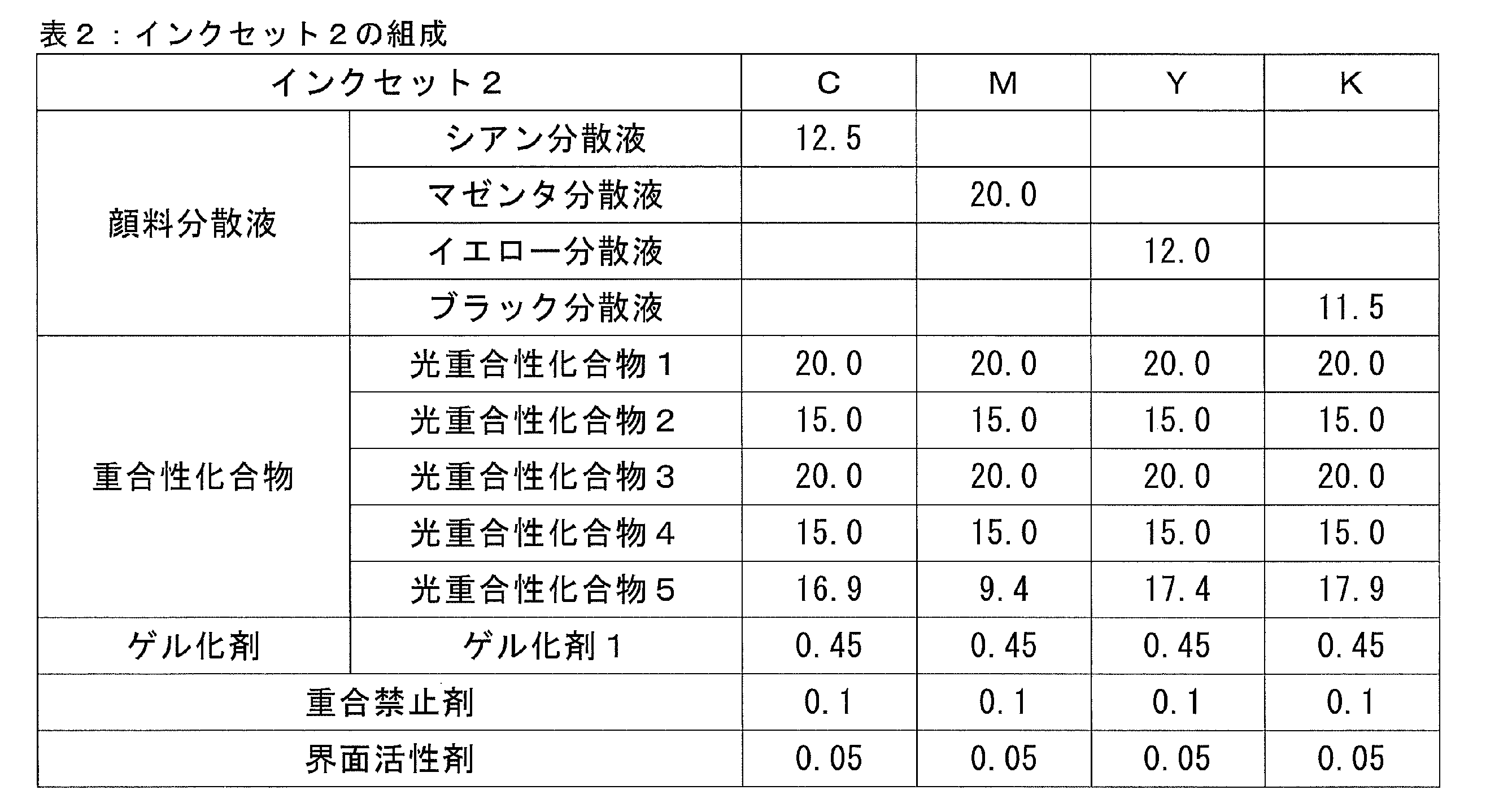

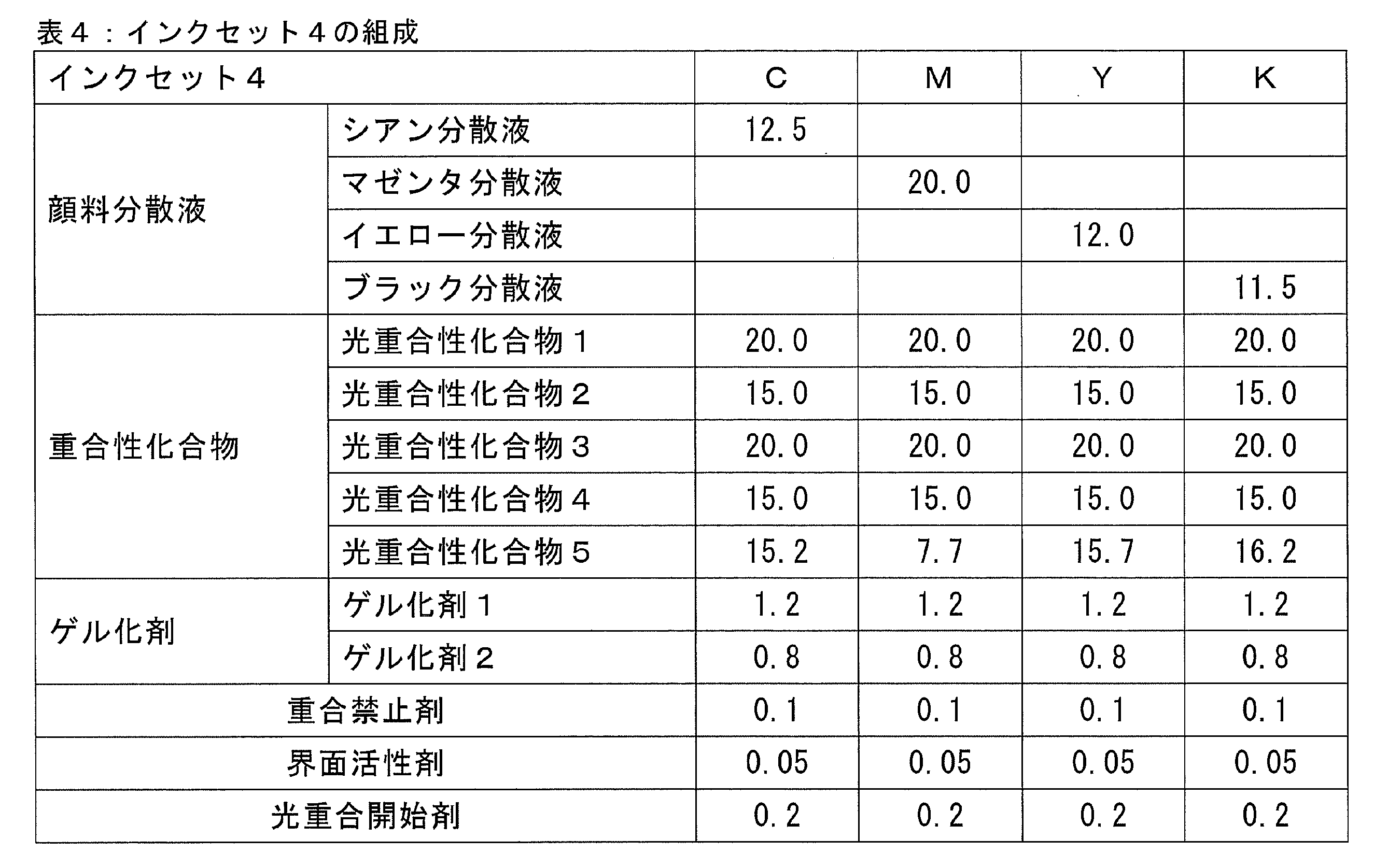
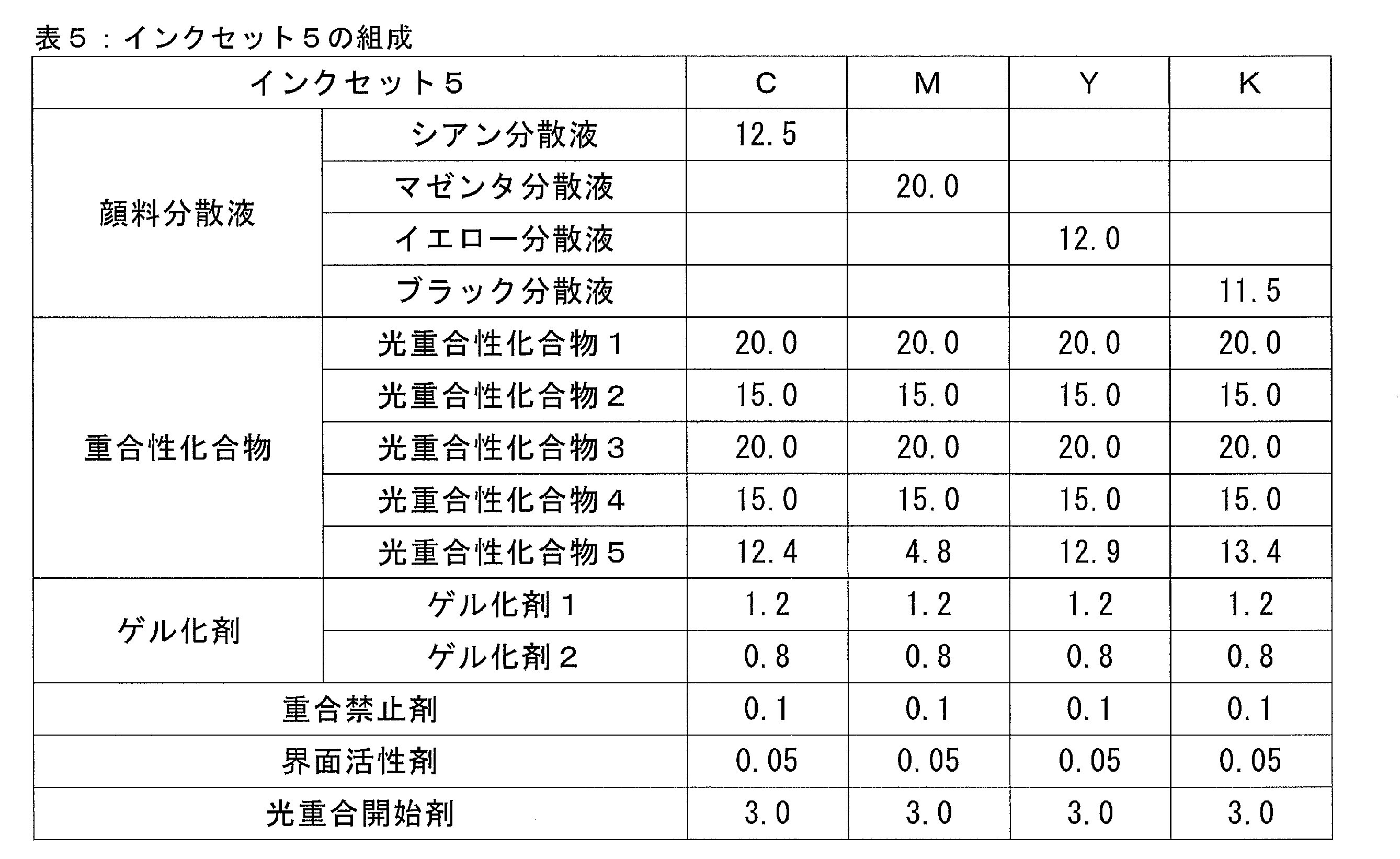
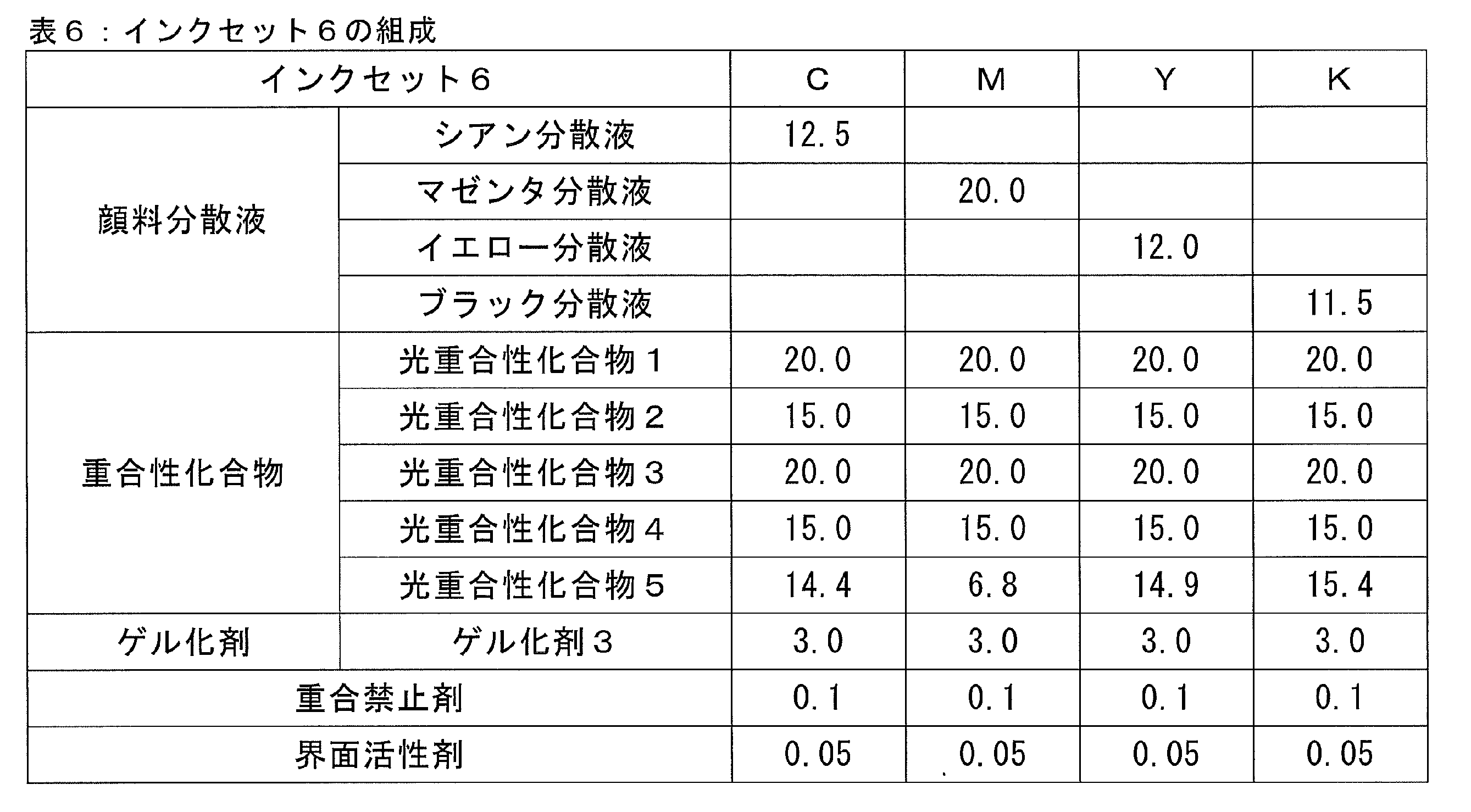
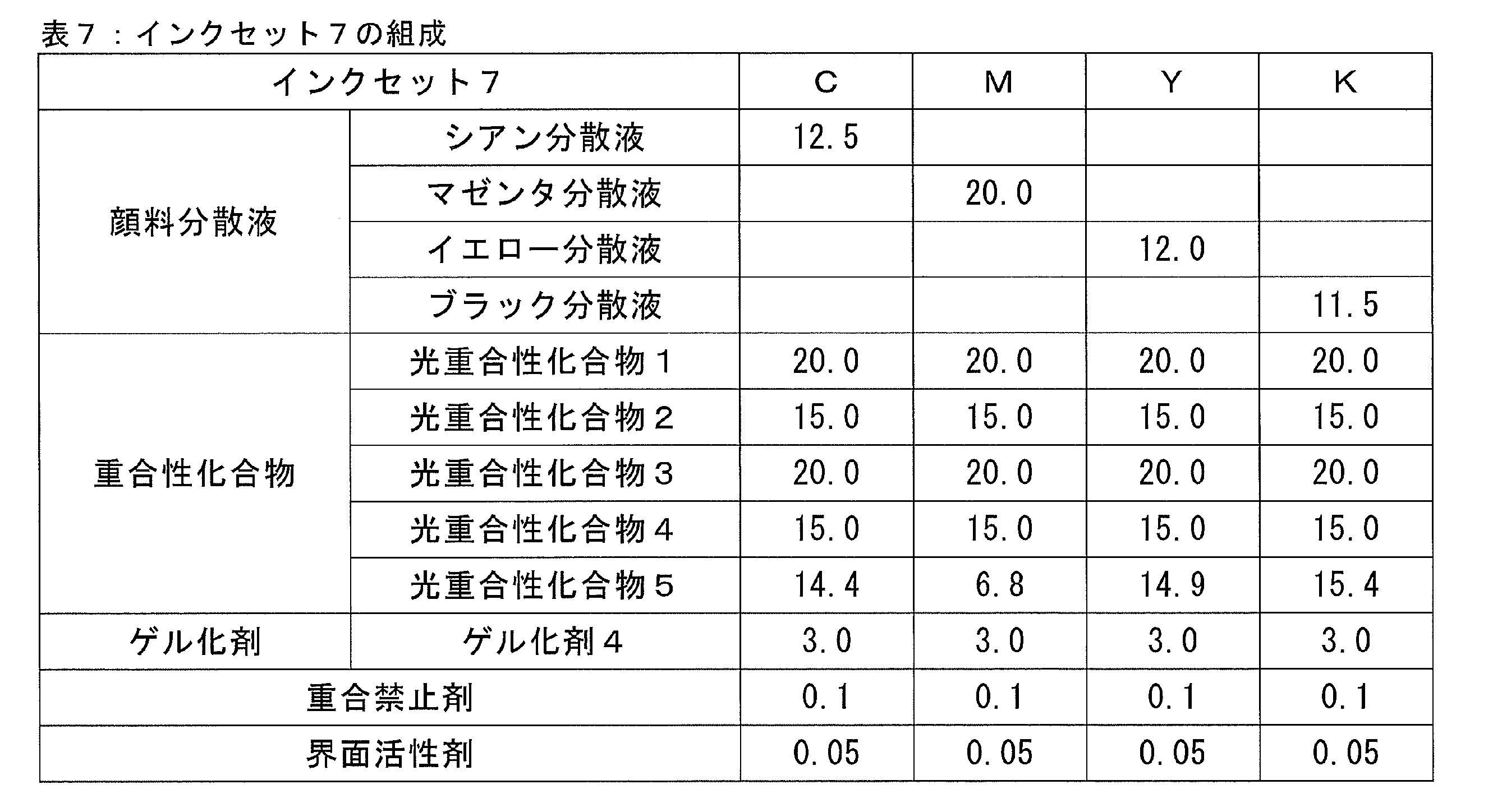
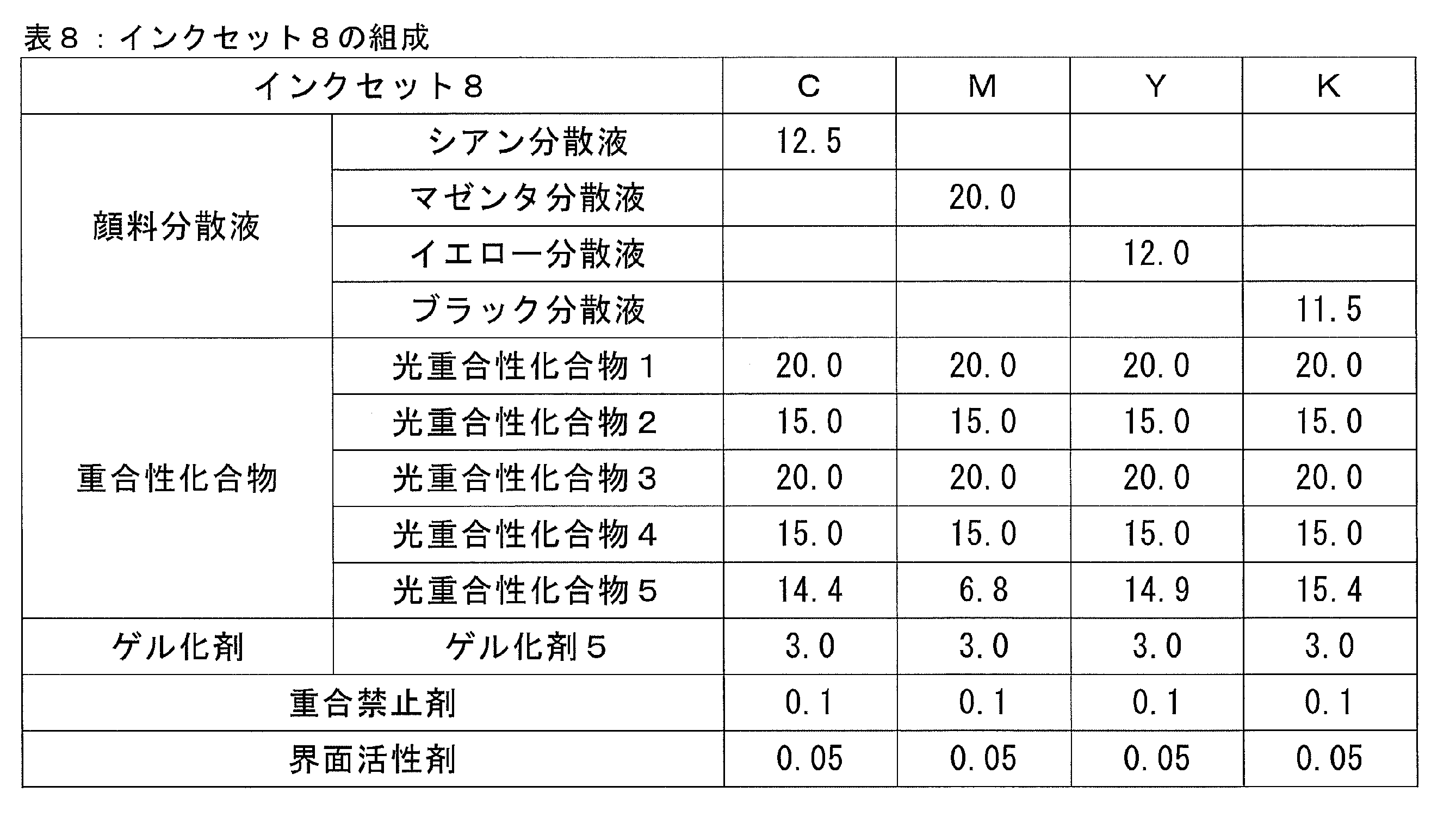

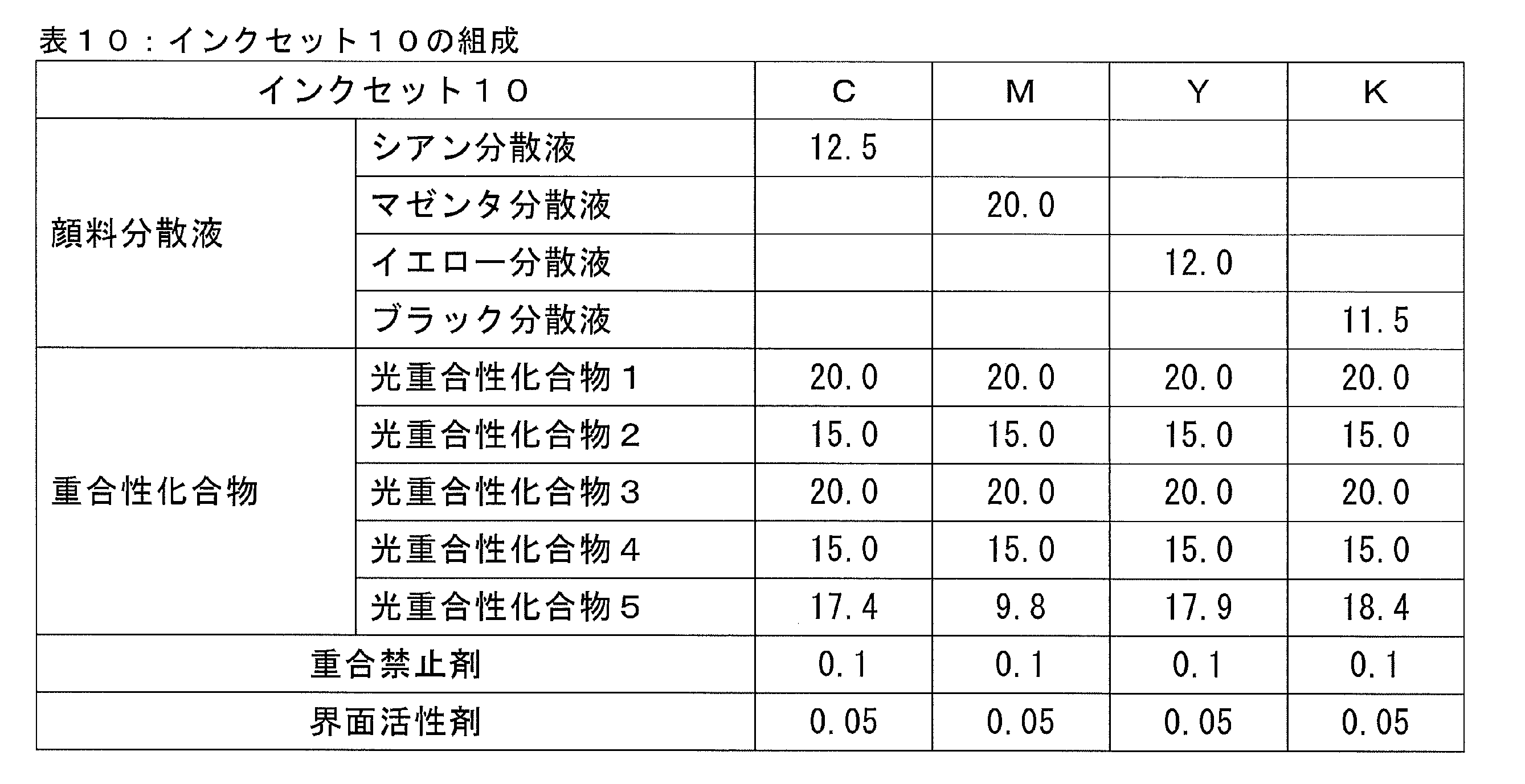
2.画像形成および評価
KM1800i、コニカミノルタ社製(ノズル数:1776個)を備えたインクジェット用の画像形成装置を用いて、23℃、55%RHの環境下で、インクセット1~10により画像を形成し、評価した。なお、1枚の画像を形成するための用いたインクの液滴は、すべての液滴の着弾後に、酸素濃度0.5%の雰囲気で、下記のいずれかの照射源から活性光線を照射して、全体を一括で硬化させた。搬送速度は、すべて200mm/sだった。記録媒体は、すべて35℃とした。
KM1800i、コニカミノルタ社製(ノズル数:1776個)を備えたインクジェット用の画像形成装置を用いて、23℃、55%RHの環境下で、インクセット1~10により画像を形成し、評価した。なお、1枚の画像を形成するための用いたインクの液滴は、すべての液滴の着弾後に、酸素濃度0.5%の雰囲気で、下記のいずれかの照射源から活性光線を照射して、全体を一括で硬化させた。搬送速度は、すべて200mm/sだった。記録媒体は、すべて35℃とした。
(記録媒体)
記録媒体A:PET(厚み:0.19mm(東レ株式会社製、ルミラーE22))
記録媒体B:コート紙(厚み:0.46mm、坪量:420g/m2(日本製紙株式会社製、アイベストW))
記録媒体C:段ボール(厚み:0.9mm(株式会社クラウン・パッケージ製、マイクロフルート、G段))
記録媒体A:PET(厚み:0.19mm(東レ株式会社製、ルミラーE22))
記録媒体B:コート紙(厚み:0.46mm、坪量:420g/m2(日本製紙株式会社製、アイベストW))
記録媒体C:段ボール(厚み:0.9mm(株式会社クラウン・パッケージ製、マイクロフルート、G段))
(照射源)
EB:以下の条件で電子線を照射した。
吸収線量 60kGy
管電圧 70kV
管電流 1.64mA
照射距離 10mm
EB:以下の条件で電子線を照射した。
吸収線量 60kGy
管電圧 70kV
管電流 1.64mA
照射距離 10mm
UV:以下の条件で紫外線を照射した。
波長 385nm
光量 500mJ/cm2
波長 385nm
光量 500mJ/cm2
2-1.光沢均質性
記録媒体Aの表面に自然画(JIS X 9201(2001年)、高精細カラーデジタル標準画像データの「フルーツバスケット」および「カフェテリア」)をA4サイズで形成した。
記録媒体Aの表面に自然画(JIS X 9201(2001年)、高精細カラーデジタル標準画像データの「フルーツバスケット」および「カフェテリア」)をA4サイズで形成した。
形成された画像を目視で観察し、以下の基準でインクセットを評価した。
◎ いずれの画像も光沢は均質である
○ 一方の画像において部分的に光沢が低下した領域が確認されたが、全体の光沢は均質である
△ 両方の画像において部分的に光沢が低下した領域が確認されたが、全体の光沢は均質である
× 両方の画像において光沢が低下した領域が多く確認され、全体の光沢は不均質である
◎ いずれの画像も光沢は均質である
○ 一方の画像において部分的に光沢が低下した領域が確認されたが、全体の光沢は均質である
△ 両方の画像において部分的に光沢が低下した領域が確認されたが、全体の光沢は均質である
× 両方の画像において光沢が低下した領域が多く確認され、全体の光沢は不均質である
2-2.臭気
記録媒体Aの表面に、付量が9g/m2である4cm×4cmのベタ画像をイエロー、ブラック、マゼンタ、シアンの順に連続で形成して得られる4cm×16cmのベタ画像を、10枚形成した。
記録媒体Aの表面に、付量が9g/m2である4cm×4cmのベタ画像をイエロー、ブラック、マゼンタ、シアンの順に連続で形成して得られる4cm×16cmのベタ画像を、10枚形成した。
それぞれの画像を個別にガラス瓶に封入し、24時間経過後に画像を取り出した後、瓶の内部に残留した臭気を20人のパネルが官能評価した結果をもとに、以下の基準でインクセットを評価した。
◎ 不快な臭気を感じるパネルはいなかった
○ 1人以上5人以下のパネルが、10枚の画像のいずれかに不快な臭気を感じた
△ 6人以上9人以下のパネルが、10枚の画像のいずれかに不快な臭気を感じた
× 10人以上のパネルが、10枚の画像のいずれかに不快な臭気を感じた
◎ 不快な臭気を感じるパネルはいなかった
○ 1人以上5人以下のパネルが、10枚の画像のいずれかに不快な臭気を感じた
△ 6人以上9人以下のパネルが、10枚の画像のいずれかに不快な臭気を感じた
× 10人以上のパネルが、10枚の画像のいずれかに不快な臭気を感じた
2-3.折り割れ耐性
記録媒体A~記録媒体Cの表面に、付量が9g/m2である4cm×4cmのベタ画像をイエロー、ブラック、マゼンタ、シアンの順に連続で形成して得られる4cm×16cmのベタ画像を形成した。
記録媒体A~記録媒体Cの表面に、付量が9g/m2である4cm×4cmのベタ画像をイエロー、ブラック、マゼンタ、シアンの順に連続で形成して得られる4cm×16cmのベタ画像を形成した。
得られた画像を25℃、60%RHの環境下に24時間放置した後、ベタ画像を形成した面が山となり、かつ、各色のベタ画像に折り目が形成されるように、画像を長手方向に2つ折りにした。その後、折り曲げ部にセロハンテープ(3M社製)を貼り、ゆっくりと剥した。剥した後の折り曲げ部をもとに、以下の基準でインクセットを評価した。
○ いずれの記録媒体においても、折り曲げ面からの硬化したインクの剥離は確認されなかった
△ いずれかの記録媒体においても、折り曲げ面からの硬化したインクのわずかな剥離が確認された
× いずれかの記録媒体においても、折り曲げ面からの硬化したインクの大きな剥離が確認された
○ いずれの記録媒体においても、折り曲げ面からの硬化したインクの剥離は確認されなかった
△ いずれかの記録媒体においても、折り曲げ面からの硬化したインクのわずかな剥離が確認された
× いずれかの記録媒体においても、折り曲げ面からの硬化したインクの大きな剥離が確認された
インクセット1~インクセット10の評価結果を表11に示す。
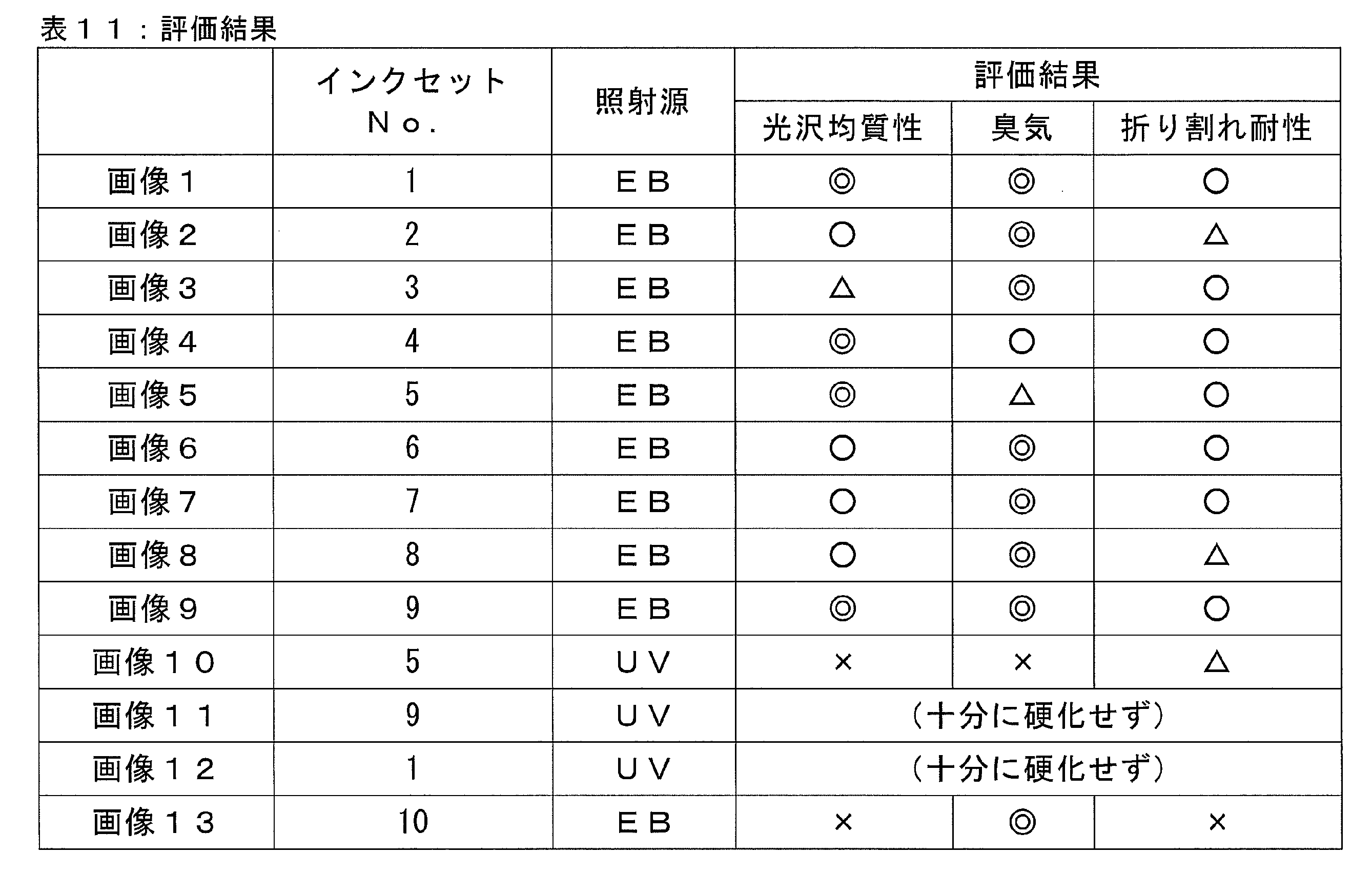
記録媒体に着弾したゲルインクの液滴に放射線を照射して上記液滴を硬化させて形成した画像1~画像9は、一括照射によって形成しても、画像中の領域間での光沢差が小さく、臭気も少なく、折り割れ耐性も高かった。
特に、光重合開始剤の含有量が0.1質量%未満であるインクセット1~インクセット3およびインクセット6~インクセット9を使用して形成した画像1~画像3および画像6~画像9は、臭気がより少なかった。光重合開始剤の含有量を多くすると臭気もより多く発生したことから、この臭気は、光重合開始剤の残渣に由来するものと考えられる(画像4および画像5)。
また、ゲル化剤の含有量が0.5質量%以上5.0質量%未満であるインクセット1を使用して形成した画像1は、ゲル化剤の含有量が0.5質量%未満であるインクセット2を用いて形成した画像2よりも画像中の領域間での光沢差が小さく、折り割れ耐性も高かった。これは、ゲル化剤がゲルインクの液滴のピニング性を高めたためドットの合一による液よりが生じにくく、かつ、ゲル化剤が硬化膜の柔軟性を高めたため、と考えられる。
また、ゲル化剤の含有量が0.5質量%以上5.0質量%未満であるインクセット1を使用して形成した画像1は、ゲル化剤の含有量が5.0質量%より多いインクセット3を用いて形成した画像3よりも画像中の領域間での光沢差が小さかった。これは、ゲル化剤による放射線の透過の阻害がさほど生じにくく、液滴の表面と内部との間での硬化速度の差がより小さかったためと考えられる。
また、ゲル化剤が、主鎖に12個以上の炭素原子を含む直鎖アルキル基を有する脂肪族エステルまたは脂肪族ケトンであるインクセット1を使用して形成した画像1は、それ以外のゲル化剤を含有するインクセット6を使用して形成した画像6よりも画像中の領域間での光沢差が小さかった。これは、ゲル化剤がより結晶化しやすく、かつ、より十分な空間を有するカードハウス構造が形成されて、放射線がゲル化剤を透過しやすくなったためと考えられる。
また、光重合性の官能基を有さないゲル化剤を含むインクセット7を用いて形成した画像7は、光重合性の官能基を有するゲル化剤を含むインクセット8を用いて形成した画像8よりも折り割れ耐性が高かった。これは、ゲル化剤が架橋構造の形成に寄与せず、硬化膜に柔軟性を付与する効果を十分に奏するためと考えられる。
特に、ブラックの顔料の含有量をより多くしたインクセット9でも、放射線の照射によって液滴を硬化させて画像9を形成することができた。
これに対し、光重合開始剤を十分に含有するインクセット5を用いてUVを一括照射して得た画像10は、画像中の領域間での光沢差があり、臭気も多く発生した。
また、ブラックの顔料の含有量をより多くしたインクセット9や、光重合開始剤を含有しないインクセット1を用いてUVを一括照射して画像を得ようとしても、インクの液滴が十分に硬化せず、評価できる画像を形成できなかった。
また、ゲル化剤を含有しないインクセット10を用いて放射線を一括照射して得た画像13は、画像中の領域間での光沢差があり、折り割れ耐性も低かった。
本出願は、2017年5月12日出願の日本国出願番号2017-095431号に基づく優先権を主張する出願であり、当該出願の特許請求の範囲、明細書および図面に記載された内容は本出願に援用される。
本発明の画像形成方法によれば、一括照射によって画像を形成できるためインクジェット画像形成装置の小型化および画像形成の低コスト化などに有用であり、同時に領域間の光沢がより均質な画像を形成することができる。そのため、本発明は、インクジェット法による画像形成の適用の幅を広げ、同分野の技術の進展および普及に貢献することが期待される。
100 画像形成装置
110 インクタンク
120 インク流路
130 インクジェットヘッド
132 ノズル
134 ノズル面
140 搬送部
142 駆動ローラ
144 従動ローラ
146 搬送ベルト
150 照射部
160 酸素濃度調整部
162 排気管
164 供給管
200 記録媒体
110 インクタンク
120 インク流路
130 インクジェットヘッド
132 ノズル
134 ノズル面
140 搬送部
142 駆動ローラ
144 従動ローラ
146 搬送ベルト
150 照射部
160 酸素濃度調整部
162 排気管
164 供給管
200 記録媒体
Claims (5)
- いずれも光重合性化合物およびゲル化剤を含有して温度変化により可逆的に相転移する、互いに組成が異なる複数種の活性光線硬化型のインクジェットインクの液滴を、吐出ヘッドのノズルから吐出して記録媒体の表面にそれぞれ着弾させ、前記複数種のインクジェットインクの液滴をいずれもゲル化させる工程と、
前記着弾した複数種のインクジェットインクの液滴に、放射線を同時に照射する工程と、
を含む、画像形成方法。 - 前記複数種のインクジェットインクは、光重合開始剤の含有量がインクジェットインクの全質量に対して0.1質量%未満であるインクジェットインクを含む、請求項1に記載の画像形成方法。
- 前記複数種のインクジェットインクは、前記ゲル化剤の含有量がインクジェットインクの全質量に対して0.5質量%以上5.0質量%未満であるインクジェットインクを含む、請求項1または2に記載の画像形成方法。
- 前記複数種のインクジェットインクは、主鎖に12個以上の炭素原子を含む直鎖アルキル基を有する脂肪族エステルまたは脂肪族ケトンを前記ゲル化剤として含有するインクジェットインクを含む、請求項1~3のいずれか1項に記載の画像形成方法。
- 前記放射線は、加速電圧が150kV未満の電子線である、請求項1~4のいずれか1項に記載の画像形成方法。
Priority Applications (3)
| Application Number | Priority Date | Filing Date | Title |
|---|---|---|---|
| US16/603,986 US20200148901A1 (en) | 2017-05-12 | 2018-03-28 | Image forming method |
| JP2019517491A JP7107306B2 (ja) | 2017-05-12 | 2018-03-28 | 画像形成方法 |
| EP18798609.6A EP3594007A4 (en) | 2017-05-12 | 2018-03-28 | IMAGE GENERATION PROCESS |
Applications Claiming Priority (2)
| Application Number | Priority Date | Filing Date | Title |
|---|---|---|---|
| JP2017095431 | 2017-05-12 | ||
| JP2017-095431 | 2017-05-12 |
Publications (1)
| Publication Number | Publication Date |
|---|---|
| WO2018207487A1 true WO2018207487A1 (ja) | 2018-11-15 |
Family
ID=64102769
Family Applications (1)
| Application Number | Title | Priority Date | Filing Date |
|---|---|---|---|
| PCT/JP2018/012681 Ceased WO2018207487A1 (ja) | 2017-05-12 | 2018-03-28 | 画像形成方法 |
Country Status (4)
| Country | Link |
|---|---|
| US (1) | US20200148901A1 (ja) |
| EP (1) | EP3594007A4 (ja) |
| JP (1) | JP7107306B2 (ja) |
| WO (1) | WO2018207487A1 (ja) |
Cited By (2)
| Publication number | Priority date | Publication date | Assignee | Title |
|---|---|---|---|---|
| JP7029014B1 (ja) | 2020-10-30 | 2022-03-02 | 株式会社Dnpファインケミカル | インク組成物 |
| JP7029015B1 (ja) | 2020-10-30 | 2022-03-02 | 株式会社Dnpファインケミカル | 非水性インク組成物 |
Families Citing this family (1)
| Publication number | Priority date | Publication date | Assignee | Title |
|---|---|---|---|---|
| JP7459657B2 (ja) * | 2020-05-26 | 2024-04-02 | セイコーエプソン株式会社 | インクジェット方法および記録物 |
Citations (7)
| Publication number | Priority date | Publication date | Assignee | Title |
|---|---|---|---|---|
| JP2005126509A (ja) * | 2003-10-22 | 2005-05-19 | Konica Minolta Holdings Inc | インクジェット用インク及びそれを用いたインクジェット記録方法 |
| JP2005255821A (ja) * | 2004-03-11 | 2005-09-22 | Konica Minolta Holdings Inc | 活性光線硬化型インクジェットインクとそれを用いたインクジェット記録方法 |
| JP2006193745A (ja) | 2005-01-14 | 2006-07-27 | Xerox Corp | 硬化性ゲル化剤添加剤を含む放射線硬化性インク |
| JP2014159114A (ja) | 2013-02-19 | 2014-09-04 | Fujifilm Corp | インクジェット記録方法及びインクジェット記録装置 |
| JP2016099391A (ja) * | 2014-11-18 | 2016-05-30 | 凸版印刷株式会社 | カラーフィルタ及びその製造方法 |
| WO2016158209A1 (ja) * | 2015-03-31 | 2016-10-06 | 富士フイルム株式会社 | 硬化膜形成方法、インクジェット画像記録方法、及び、印刷物 |
| JP2017095431A (ja) | 2015-11-18 | 2017-06-01 | 株式会社 Mbr | Bcg−cwsの油性懸濁液製剤の製造方法 |
Family Cites Families (4)
| Publication number | Priority date | Publication date | Assignee | Title |
|---|---|---|---|---|
| US9499703B2 (en) | 2009-11-30 | 2016-11-22 | Konica Minolta, Inc. | Ink-jet image forming method and ink-jet ink set |
| US9016846B2 (en) * | 2010-08-19 | 2015-04-28 | Konica Minolta Holdings, Inc. | Actinic energy radiation curable inkjet ink and actinic energy radiation curable inkjet recording method |
| WO2012132406A1 (ja) | 2011-03-28 | 2012-10-04 | コニカミノルタホールディングス株式会社 | 活性線硬化型インクジェット用インクおよびそれを用いた画像記録方法 |
| EP2842761B1 (en) * | 2012-04-27 | 2018-05-23 | Konica Minolta, Inc. | Image-forming method |
-
2018
- 2018-03-28 JP JP2019517491A patent/JP7107306B2/ja active Active
- 2018-03-28 US US16/603,986 patent/US20200148901A1/en not_active Abandoned
- 2018-03-28 WO PCT/JP2018/012681 patent/WO2018207487A1/ja not_active Ceased
- 2018-03-28 EP EP18798609.6A patent/EP3594007A4/en not_active Withdrawn
Patent Citations (7)
| Publication number | Priority date | Publication date | Assignee | Title |
|---|---|---|---|---|
| JP2005126509A (ja) * | 2003-10-22 | 2005-05-19 | Konica Minolta Holdings Inc | インクジェット用インク及びそれを用いたインクジェット記録方法 |
| JP2005255821A (ja) * | 2004-03-11 | 2005-09-22 | Konica Minolta Holdings Inc | 活性光線硬化型インクジェットインクとそれを用いたインクジェット記録方法 |
| JP2006193745A (ja) | 2005-01-14 | 2006-07-27 | Xerox Corp | 硬化性ゲル化剤添加剤を含む放射線硬化性インク |
| JP2014159114A (ja) | 2013-02-19 | 2014-09-04 | Fujifilm Corp | インクジェット記録方法及びインクジェット記録装置 |
| JP2016099391A (ja) * | 2014-11-18 | 2016-05-30 | 凸版印刷株式会社 | カラーフィルタ及びその製造方法 |
| WO2016158209A1 (ja) * | 2015-03-31 | 2016-10-06 | 富士フイルム株式会社 | 硬化膜形成方法、インクジェット画像記録方法、及び、印刷物 |
| JP2017095431A (ja) | 2015-11-18 | 2017-06-01 | 株式会社 Mbr | Bcg−cwsの油性懸濁液製剤の製造方法 |
Non-Patent Citations (1)
| Title |
|---|
| See also references of EP3594007A4 |
Cited By (4)
| Publication number | Priority date | Publication date | Assignee | Title |
|---|---|---|---|---|
| JP7029014B1 (ja) | 2020-10-30 | 2022-03-02 | 株式会社Dnpファインケミカル | インク組成物 |
| JP7029015B1 (ja) | 2020-10-30 | 2022-03-02 | 株式会社Dnpファインケミカル | 非水性インク組成物 |
| JP2022073898A (ja) * | 2020-10-30 | 2022-05-17 | 株式会社Dnpファインケミカル | 非水性インク組成物 |
| JP2022073897A (ja) * | 2020-10-30 | 2022-05-17 | 株式会社Dnpファインケミカル | インク組成物 |
Also Published As
| Publication number | Publication date |
|---|---|
| US20200148901A1 (en) | 2020-05-14 |
| JP7107306B2 (ja) | 2022-07-27 |
| EP3594007A4 (en) | 2020-04-15 |
| EP3594007A1 (en) | 2020-01-15 |
| JPWO2018207487A1 (ja) | 2020-05-21 |
Similar Documents
| Publication | Publication Date | Title |
|---|---|---|
| US9016847B1 (en) | Inkjet ink set, and method for forming image using same | |
| US9714354B2 (en) | Active ray-curable inkjet ink and image forming method using same | |
| JP7043822B2 (ja) | 活性光線硬化型インクジェットインク | |
| JP6819298B2 (ja) | インクジェットインクおよび画像形成方法 | |
| JP7006621B2 (ja) | インクジェットインク組成物及び画像形成方法 | |
| JP6414200B2 (ja) | 活性光線硬化型インクジェットマゼンタインクおよびインクジェット記録方法 | |
| JP7243166B2 (ja) | 画像形成方法 | |
| WO2013161298A1 (ja) | 活性光線硬化型インクジェットインク及びこれを用いた画像形成方法 | |
| JP6763395B2 (ja) | インクセット及び画像形成方法 | |
| JPWO2019123564A1 (ja) | 活性光線硬化型インクジェットインクセット及びインクジェット記録方法 | |
| US9889693B2 (en) | Inkjet recording method and inkjet recording apparatus | |
| JP7107306B2 (ja) | 画像形成方法 | |
| JP6740918B2 (ja) | 画像形成方法 | |
| EP3524439B1 (en) | Image forming method and image forming system | |
| WO2017164164A1 (ja) | 画像形成方法 | |
| WO2017163564A1 (ja) | 画像形成方法 | |
| JP7052329B2 (ja) | 電子線硬化型インクジェットインクおよび画像形成方法 | |
| JP6950683B2 (ja) | 画像形成方法および画像形成装置 | |
| JP2020011381A (ja) | インクジェット記録方法及び活性光線硬化型インクジェットインクセット | |
| JP2025150753A (ja) | インクジェットインクおよび画像形成方法 |
Legal Events
| Date | Code | Title | Description |
|---|---|---|---|
| 121 | Ep: the epo has been informed by wipo that ep was designated in this application |
Ref document number: 18798609 Country of ref document: EP Kind code of ref document: A1 |
|
| ENP | Entry into the national phase |
Ref document number: 2019517491 Country of ref document: JP Kind code of ref document: A |
|
| ENP | Entry into the national phase |
Ref document number: 2018798609 Country of ref document: EP Effective date: 20191011 |
|
| NENP | Non-entry into the national phase |
Ref country code: DE |