WO2018207790A1 - アミロイドβ分解排出促進剤 - Google Patents
アミロイドβ分解排出促進剤 Download PDFInfo
- Publication number
- WO2018207790A1 WO2018207790A1 PCT/JP2018/017829 JP2018017829W WO2018207790A1 WO 2018207790 A1 WO2018207790 A1 WO 2018207790A1 JP 2018017829 W JP2018017829 W JP 2018017829W WO 2018207790 A1 WO2018207790 A1 WO 2018207790A1
- Authority
- WO
- WIPO (PCT)
- Prior art keywords
- amyloid
- chlorogenic acids
- salts
- disease
- alzheimer
- Prior art date
- Legal status (The legal status is an assumption and is not a legal conclusion. Google has not performed a legal analysis and makes no representation as to the accuracy of the status listed.)
- Ceased
Links
Images




Classifications
-
- A—HUMAN NECESSITIES
- A61—MEDICAL OR VETERINARY SCIENCE; HYGIENE
- A61K—PREPARATIONS FOR MEDICAL, DENTAL OR TOILETRY PURPOSES
- A61K31/00—Medicinal preparations containing organic active ingredients
- A61K31/21—Esters, e.g. nitroglycerine, selenocyanates
- A61K31/215—Esters, e.g. nitroglycerine, selenocyanates of carboxylic acids
- A61K31/235—Esters, e.g. nitroglycerine, selenocyanates of carboxylic acids having an aromatic ring attached to a carboxyl group
-
- A—HUMAN NECESSITIES
- A23—FOODS OR FOODSTUFFS; TREATMENT THEREOF, NOT COVERED BY OTHER CLASSES
- A23L—FOODS, FOODSTUFFS OR NON-ALCOHOLIC BEVERAGES, NOT OTHERWISE PROVIDED FOR; PREPARATION OR TREATMENT THEREOF
- A23L33/00—Modifying nutritive qualities of foods; Dietetic products; Preparation or treatment thereof
- A23L33/10—Modifying nutritive qualities of foods; Dietetic products; Preparation or treatment thereof using additives
-
- A—HUMAN NECESSITIES
- A61—MEDICAL OR VETERINARY SCIENCE; HYGIENE
- A61K—PREPARATIONS FOR MEDICAL, DENTAL OR TOILETRY PURPOSES
- A61K31/00—Medicinal preparations containing organic active ingredients
- A61K31/21—Esters, e.g. nitroglycerine, selenocyanates
- A61K31/215—Esters, e.g. nitroglycerine, selenocyanates of carboxylic acids
- A61K31/216—Esters, e.g. nitroglycerine, selenocyanates of carboxylic acids of acids having aromatic rings, e.g. benactizyne, clofibrate
-
- A—HUMAN NECESSITIES
- A61—MEDICAL OR VETERINARY SCIENCE; HYGIENE
- A61K—PREPARATIONS FOR MEDICAL, DENTAL OR TOILETRY PURPOSES
- A61K9/00—Medicinal preparations characterised by special physical form
- A61K9/0012—Galenical forms characterised by the site of application
- A61K9/0053—Mouth and digestive tract, i.e. intraoral and peroral administration
-
- A—HUMAN NECESSITIES
- A61—MEDICAL OR VETERINARY SCIENCE; HYGIENE
- A61P—SPECIFIC THERAPEUTIC ACTIVITY OF CHEMICAL COMPOUNDS OR MEDICINAL PREPARATIONS
- A61P25/00—Drugs for disorders of the nervous system
- A61P25/28—Drugs for disorders of the nervous system for treating neurodegenerative disorders of the central nervous system, e.g. nootropic agents, cognition enhancers, drugs for treating Alzheimer's disease or other forms of dementia
-
- A—HUMAN NECESSITIES
- A61—MEDICAL OR VETERINARY SCIENCE; HYGIENE
- A61P—SPECIFIC THERAPEUTIC ACTIVITY OF CHEMICAL COMPOUNDS OR MEDICINAL PREPARATIONS
- A61P39/00—General protective or antinoxious agents
- A61P39/02—Antidotes
Definitions
- the present invention relates to an amyloid ⁇ degradation / excretion promoter that promotes degradation and excretion of amyloid ⁇ .
- Alzheimer's disease is a neurodegenerative disease whose main symptoms are impaired cognitive functions such as memory, learning, understanding and judgment. Dementia, which accounts for approximately 70% of Alzheimer's disease, has been reported to be the third most common factor behind cerebrovascular disease and fractures / falls among the major factors leading to the need for elderly care and support. (The Ministry of Health, Labor and Welfare National Life Basic Survey 2013), and the number of patients is expected to increase rapidly globally as the population ages. However, Alzheimer's disease currently has no effective prevention and treatment methods, and development of new compounds and prevention / treatment methods is required.
- Alzheimer's disease The pathological features of Alzheimer's disease are senile plaques and neurofibrillary tangles, and senile plaques have been found to have developed and pathologically since amyloid ⁇ protein has been aggregated and fibrotically accumulated extracellularly.
- the amyloid hypothesis is attracting attention as a mechanism that forms the core of progression.
- Amyloid precursor protein (APP) is cleaved stepwise by enzymatic reaction to produce amyloid ⁇ , which is insolubilized extracellularly and aggregates / accumulates to cause neurological functions such as neurotransmission, and symptoms progress Alzheimer's disease develops (Non-patent Document 1).
- amyloid ⁇ Although the detailed role of amyloid ⁇ has not been clarified, it is known that its production increases with age even in healthy individuals. Amyloid ⁇ is produced in the brain and peripheral tissues, but the concentration in the brain is suppressed to a low level by the homeostasis mechanism, particularly the clearance mechanism from the brain to the periphery. Various pathways exist for the clearance of amyloid ⁇ , and a representative one is known to be a mechanism of excretion through a transporter such as low-density lipo-protein receptor-relatedlprotein (LRP1) present in the cerebral blood vessels. Yes.
- LRP1 low-density lipo-protein receptor-relatedlprotein
- non-patent document 2 maintaining homeostasis that properly maintains the production and excretion of amyloid ⁇ in the brain is important for maintaining healthy brain function, and if this mechanism fails for any reason, it may lead to the development of Alzheimer's disease. It is considered (non-patent document 2).
- APP cleavage enzyme inhibition, amyloid ⁇ neutralization, amyloid ⁇ aggregation Substance search is being conducted focusing on inhibition and acceleration of decomposition.
- flavonoids quercetin and kaempferol which are components derived from natural products, have an amyloid ⁇ aggregation inhibitory effect (Patent Document 1), and a compound isolated from a plant extract of Uncaria has an action to decompose aggregated amyloid ⁇ . (Patent Document 2) and the like have been reported.
- Patent Document 3 chlorogenic acids have been found in coffee beans and potatoes in plants, and so far, antioxidant effects, blood pressure lowering effects, etc. have been reported (Patent Document 3).
- Patent Document 4 di-O-caffeoylquinic acid in which two caffeic acids are ester-bonded has a protective effect on nerve cells (Patent Document 4).
- chlorogenic acids have an action of promoting amyloid ⁇ degradation and excretion.
- Patent Document 1 Japanese Patent Application Laid-Open No. 2007-145839 (Patent Document 2) Japanese Patent Application Publication No. 2004-514679 (Patent Document 3) Japanese Patent Application Laid-Open No. 2002-53464 (Patent Document 4) International Publication No. 2007/091613 Patent Document 1) Hardy JA et al., Science. 1992; 256: 184 (Non-Patent Document 2) Zlokovic BV et al., Nature Review. 2011; 12: 723
- the present invention relates to the following 1) to 14).
- a preventive, therapeutic or ameliorating agent for Alzheimer's disease comprising chlorogenic acids or salts thereof as an active ingredient.
- a food for preventing or improving Alzheimer's disease comprising chlorogenic acids or salts thereof as an active ingredient.
- Use of chlorogenic acids or a salt thereof for producing an amyloid ⁇ degradation / excretion promoter Use of chlorogenic acids or salts thereof for producing a preventive, therapeutic or ameliorating agent for Alzheimer's disease.
- a method for promoting the degradation and elimination of amyloid ⁇ which comprises administering or ingesting chlorogenic acids or salts thereof in an effective amount to a subject in need thereof.
- a method for preventing, treating or ameliorating Alzheimer's disease wherein chlorogenic acids or salts thereof are administered or ingested in an effective amount to a subject in need thereof.
- the figure which shows the decomposition activity of the aggregation amyloid by chlorogenic acids The figure which shows the amyloid beta excretion transporter (LRP1, p-gp) increase effect by continuous intake of chlorogenic acids.
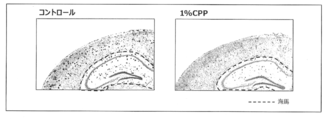
- action in the brain of amyloid (beta) by the continuous intake of chlorogenic acids observation image of amyloid (beta)).
- the figure which shows the memory learning ability improvement effect by continuous ingestion of chlorogenic acids (a novel object recognition test).
- the figure which shows the memory learning ability improvement effect by continuous ingestion of chlorogenic acids (Morris water maze test).
- the present invention relates to providing an amyloid ⁇ degradation / excretion promoter that is safe and can be ingested continuously.
- chlorogenic acids have both an excellent amyloid ⁇ degradation promoting action and an expelling promoting action, and Alzheimer's disease
- the present inventors have found that it is effective not only for preventing Alzheimer's disease state but also for improving it.
- compositions and foods that promote the degradation and excretion of amyloid ⁇ and are useful for the prevention, treatment or improvement of Alzheimer's disease.
- chlorogenic acids in the present invention are monocaffeoylquina of 3-caffeoylquinic acid (3-CQA), 4-caffeoylquinic acid (4-CQA) and 5-caffeoylquinic acid (5-CQA). It is a general term for monoferloyl quinic acid of acid and 3-feruloyl quinic acid (3-FQA), 4-feruloyl quinic acid (4-FQA) and 5-feruloyl quinic acid (5-FQA).
- the content of chlorogenic acids is defined based on the total amount of the above six types.
- the “chlorogenic acids” of the present invention may contain at least one of the above-mentioned six types of chlorogenic acids, but preferably contains monocaffeoylquinic acid from the viewpoint of promoting amyloid ⁇ degradation and elimination, More preferably, it contains 5-caffeoylquinic acid.
- the content of 5-caffeoylquinic acid is preferably 10% by mass or more in the chlorogenic acids, more preferably 20% by mass or more, more preferably 30% by mass or more, and still more preferably 40% by mass or more.
- the chlorogenic acids may be in the form of a salt, such as a pharmaceutically acceptable salt, for example, an alkali metal salt such as sodium or potassium, an alkaline earth metal salt such as magnesium or calcium, monoethanolamine, diethanolamine, or triethanol.
- a pharmaceutically acceptable salt for example, an alkali metal salt such as sodium or potassium, an alkaline earth metal salt such as magnesium or calcium, monoethanolamine, diethanolamine, or triethanol.
- organic amine salts such as amines
- basic amino acid salts such as arginine, lysine, histidine, ornithine and the like.
- plant extracts containing them, concentrates thereof, or purified products thereof can be used.
- plant extracts include sunflower seeds, apple immature fruits, coffee beans, Simon leaves, pine cones, pine seed shells, potatoes, sweet potatoes, sugar cane, wheat, southern leaves, Examples include those extracted from burdock, carrot, cabbage, lettuce, arch chalk, tomato, morroheiya, eggplant skin, pear, plum, peach, apricot, cherry, ume fruit, dandelion, grape plant and the like.
- coffee bean extract is preferable from the viewpoint of chlorogenic acid content and the like, and deep roasted coffee beans (L value: 16.8 or less) may be used, but medium roasted coffee beans (L value: more than 16.8). 24.2 or less), shallow roasted coffee beans (L value: more than 24.2 and less than 30.2), finely roasted coffee beans (L value: more than 30.2) or fresh coffee beans are more preferred. Coffee beans are more preferred.
- the “L value” is a value obtained by measuring the brightness of roasted coffee beans with a color difference meter, with black as L value 0 and white as L value 100.
- the type of coffee tree may be any of Arabica, Robusta, Revelica and Arabsta.
- the coffee bean extract is preferably obtained by removing caffeine, and the mass ratio of caffeine to chlorogenic acids (caffeine / chlorogenic acids) is preferably 0.05 or less, more preferably 0.03 or less from the viewpoint of flavor. Preferably, 0.02 or less is more preferable, 0.005 or less is more preferable, 0.003 or less is more preferable, and 0.001 or less is more preferable.
- the lower limit of the ratio of caffeine / chlorogenic acids is not particularly limited, and may be 0.
- the coffee bean extract has a mass ratio of the sum of potassium (K) and sodium (Na) to chlorogenic acids [(K + Na) / chlorogenic acids] of 0.18 or less, more preferably 0.14 or less. Further, 0.1 or less, particularly 0.06 or less is preferable.
- the lower limit of the mass ratio [(K + Na) / chlorogenic acids] is not particularly limited and may be 0, but from the viewpoint of production efficiency, 0.0001 and 0.001 are preferable.
- the mass ratio of caffeine to chlorogenic acids is 0.02 or less, and 5-caffeoylquinic acid in the total amount of chlorogenic acids.
- Methods and conditions for extraction, concentration and purification of the chlorogenic acids or salts thereof of the present invention are not particularly limited, and known methods and conditions can be employed. Of these, extraction with an ascorbic acid aqueous solution, a citric acid aqueous solution or hot water is preferred.
- Commercially available chlorogenic acid-containing preparations may be used as raw materials for chlorogenic acids or salts thereof, such as flavor holder RC (Hasegawa Fragrance Co., Ltd.), fresh coffee bean extract P (manufactured by Oriza Oil Chemical Co., Ltd.), Svetol. (Manufactured by Nulex Inc.) and OXCH100 (manufactured by Toyo Fermentation Co., Ltd.).
- chlorogenic acids have an action of degrading aggregated amyloid ⁇ , and also enhance the expression of amyloid ⁇ excretion transporter genes (LRP1 gene and p-gp gene) in the hippocampus. Suppresses the accumulation in the brain. Furthermore, it was confirmed that chlorogenic acids exert an effect of improving memory learning ability in Alzheimer's disease model animals. Therefore, chlorogenic acids or salts thereof can be an amyloid ⁇ degradation / excretion promoter, an Alzheimer's disease prevention, treatment or amelioration agent, in order to promote the degradation and excretion of amyloid ⁇ , in order to prevent, treat or ameliorate Alzheimer's disease.
- non-therapeutic means a concept that does not include medical practice, that is, a concept that does not include a method for operating, treating, or diagnosing a person, more specifically, a doctor or a person who has received instructions from a doctor It is a concept that does not include a method of performing surgery, treatment or diagnosis.
- “acceleration of amyloid ⁇ degradation / extraction” means that the degradation of aggregated amyloid ⁇ protein accumulated in the brain is promoted, and the secretion of amyloid ⁇ protein from the brain is promoted to suppress the accumulation in the brain.
- “Alzheimer's disease” means cognitive impairment (memory disorder, disorientation, learning disorder, attention disorder, spatial cognitive function, etc.) and personality change caused by increase / accumulation of amyloid ⁇ in the brain. Also, it means a dementia disease that presents symptoms such as being unable to adapt socially.
- prevention refers to preventing or delaying the onset of a disease or symptom in an individual, or reducing the risk of developing an individual's disease or symptom.
- Immprovement refers to improvement of a disease, symptom or condition, prevention or delay of deterioration of a disease, symptom or condition, or reversal, prevention or delay of progression of a disease or symptom.
- Treatment also includes amelioration of symptoms in addition to complete cure of the disease.
- amyloid ⁇ degradation / excretion promoter and Alzheimer's disease prevention, improvement or treatment agent of the present invention itself is a pharmaceutical, quasi-drug for promoting amyloid ⁇ degradation / excretion or preventing, ameliorating or treating Alzheimer's disease, It may be a supplement or food, or it may be a material or preparation used in combination with the drug, quasi drug, or food.
- These foods include foods, functional foods, foods for the sick, foods for specified health use, and supplements that have the concept of promoting the degradation and release of amyloid ⁇ and preventing or improving Alzheimer's disease as necessary. Is done. Since these foods are foods whose function is permitted, they can be distinguished from general foods.
- Examples of the administration form of the above-mentioned pharmaceuticals include oral administration by tablets, capsules, granules, powders, syrups, etc., or parenteral administration by injections, suppositories, inhalants and the like. It is done.
- the preparations of such various dosage forms include the chlorogenic acids or salts thereof of the present invention alone or other pharmaceutically acceptable excipients, binders, extenders, disintegrants, surfactants. , Lubricants, dispersants, buffers, preservatives, flavoring agents, fragrances, coating agents, carriers, diluents, medicinal components other than the chlorogenic acids of the present invention or salts thereof, and the like, can be prepared as appropriate. .
- the preferred form is oral administration.
- the form of the food in addition to various foods such as soft drinks, tea beverages, coffee beverages, fruit juice beverages, carbonated beverages, jelly, wafers, biscuits, bread, noodles, sausages and nutritional foods, Includes a nutritional supplement composition in the same form (tablet, capsule, syrup, etc.) as the above-mentioned oral preparation.
- chlorogenic acids or salts thereof of the present invention alone, or other food materials, solvents, softeners, oils, emulsifiers, preservatives, acidulants, sweeteners, bitterings, aromatics, It can be prepared by appropriately combining stabilizers, colorants, antioxidants, humectants, thickeners, active ingredients other than chlorogenic acids or salts thereof, and the like.
- the content of the chlorogenic acids or salts thereof of the present invention in the above-mentioned pharmaceuticals (including quasi-drugs) and foods varies depending on the form of use, but is usually preferably 0.001% by mass or more in the total amount as chlorogenic acids More preferably, it is 0.01 mass% or more, More preferably, it is 0.1 mass% or more, Preferably it is 90 mass% or less, More preferably, it is 60 mass% or less, More preferably, it is 30 mass% or less. Further, it is preferably 0.001 to 90% by mass, more preferably 0.01 to 60% by mass, and still more preferably 0.1 to 30% by mass.
- the dose or intake of the above-mentioned pharmaceuticals (including quasi-drugs) and foods can be determined as appropriate, but is usually preferably 100 mg or more, more preferably as chlorogenic acids per day for adults (60 kg). Is 300 mg or more, preferably 3000 mg or less, more preferably 1000 mg or less. In the present invention, such an amount is preferably administered or ingested once.
- the above-mentioned preparation is administered or ingested according to an arbitrary plan, and the administration or ingestion period is not particularly limited, but it is preferable to administer or ingest repeatedly, and more preferably to administer or ingest continuously for 7 days or more. More preferably, it is administered or ingested continuously for 28 days or more.
- the subject of administration or ingestion is not particularly limited as long as it is a human or non-human animal that needs or desires prevention or improvement of cognitive function, but administration or ingestion in humans is effective.
- the cognitive decline mentioned here is a symptom observed in cognitive dysfunction represented by Alzheimer's disease. For example, memory / learning disorder (disability of ability to acquire new information and keep in memory) And inferiority, complicated work handling, poor judgment, visuospatial cognitive impairment, language impairment, personality, changes in behavior or behavior, etc., impede work and daily activities, or reduce executive function Say the state.
- humans who need or desire to prevent such cognitive decline include, for example, 27-30 healthy individuals in the internationally most widely used mini-mental state test (MMSE) of the cognitive function test.
- MMSE mini-mental state test
- a person who needs or desires to improve cognitive decline is a person who is suspected of having a mild cognitive impairment of 22 to 26 points in the above examination, and a dementia of 21 points or less, etc. Includes people who are more likely to have cognitive impairment.
- a preventive, therapeutic or ameliorating agent for Alzheimer's disease comprising a chlorogenic acid or a salt thereof, or a plant extract containing the active ingredient as an active ingredient.
- ⁇ 5> Use of chlorogenic acids or a salt thereof, or a plant extract containing the same to produce an amyloid ⁇ decomposition / extraction promoter.
- ⁇ 6> Use of a chlorogenic acid or a salt thereof, or a plant extract containing the same for producing an agent for preventing, treating or improving Alzheimer's disease.
- ⁇ 7> Use of chlorogenic acids or a salt thereof, or a plant extract containing the same for producing a food for promoting amyloid ⁇ degradation and emission.
- ⁇ 8> Use of a chlorogenic acid or a salt thereof, or a plant extract containing the same for producing a food for preventing or improving Alzheimer's disease.
- ⁇ 9> Use of ⁇ 5> or ⁇ 6>, wherein the agent is a preparation for oral administration.
- ⁇ 10> A chlorogenic acid or a salt thereof, or a plant extract containing the chlorogenic acid for use in promoting the degradation and emission of amyloid ⁇ .
- ⁇ 11> A chlorogenic acid or a salt thereof, or a plant extract containing the same for use in prevention, treatment or amelioration of Alzheimer's disease.
- ⁇ 12> A chlorogenic acid or salt thereof according to ⁇ 10> or ⁇ 11>, or a plant extract containing the same, orally administered.
- ⁇ 16> A method for promoting the degradation and elimination of amyloid ⁇ , comprising administering or ingesting a chlorogenic acid or a salt thereof, or a plant extract containing the chlorogenic acid to a subject in need thereof in an effective amount.
- ⁇ 17> A method for preventing, treating or ameliorating Alzheimer's disease, comprising administering or ingesting an effective amount of a chlorogenic acid or a salt thereof, or a plant extract containing the chlorogenic acid to a subject in need thereof.
- ⁇ 18> The method according to ⁇ 16> or ⁇ 17>, wherein the administration is oral administration.
- the chlorogenic acids contain at least 5-caffeoylquinic acid.
- the plant extract containing chlorogenic acids or salts thereof is a coffee bean extract, preferably a green coffee bean extract.
- the raw coffee bean extract is preferably 5-caffeoyl in a mass ratio of caffeine to chlorogenic acids (caffeine / chlorogenic acids) of 0.02 or less and in the total amount of chlorogenic acids.
- the content of quinic acid (5-CQA / total chlorogenic acids) is 40% by mass or more, more preferably (caffeine / chlorogenic acids) is 0.001 or less, and (5-CQA / total chlorogenic acids) is 40%. It is at least mass%.
- the content of the active ingredient is preferably 0.001% by mass or more, more preferably 0.01% by mass in the total amount as chlorogenic acids. More preferably, it is 0.1% by mass or more, preferably 90% by mass or less, more preferably 60% by mass or less, and still more preferably 30% by mass or less. Further, it is preferably 0.001 to 90% by mass, more preferably 0.01 to 60% by mass, and still more preferably 0.1 to 30% by mass.
- the daily dose per adult is preferably 100 mg or more, more preferably 300 mg or more, and preferably 3000 mg or less, more preferably as chlorogenic acids. 1000 mg or less.
- the amount of ion exchange resin used was 0.74 (mL / g) based on the solid content in the crude chlorogenic acid-containing composition. 5) 1038 g of the column treatment solution was filtered through a 0.2 ⁇ m membrane filter, and then ethanol was distilled off by a rotary evaporator to obtain 225 g of a chlorogenic acid-containing solution.
- the composition of the chlorogenic acid-containing liquid is as follows: chlorogenic acids 22.6% by mass, caffeine 0.29% by mass, mass ratio (caffeine / chlorogenic acids) is 0.013, ethanol concentration is 0% by mass, and the pH is 3.1. 6)
- the chlorogenic acid-containing liquid was diluted with distilled water to adjust the concentration of chlorogenic acids to 3% by mass.
- CPP chlorogenic acid-containing purified coffee polyphenol
- Example 1 Degradation of Aggregated Amyloid ⁇ by Chlorogenic Acid Direct degradation activity of aggregated amyloid by chlorogenic acid (5-CQA) was examined using a thioflavin T (ThT) fluorescence measurement method.
- Amyloid ⁇ peptide Human, 1-42, Peptide Institute, Inc.
- DMSO dimethyl sulfoxide
- chlorogenic acid (5-CQA, Cayman Chemical) was added to aggregated amyloid ⁇ (10% by mass) at final concentrations of 1, 10, and 100 ⁇ M, and incubated at 37 ° C. for an additional 7 days.
- 0.5% DMSO used as a solvent for chlorogenic acid was added.
- ThT Sigma, final concentration 5 ⁇ M
- 50 mM glycine buffer pH 8.5
- FIG. 1 shows that chlorogenic acid has an activity of degrading aggregated amyloid in a dose-dependent manner.
- Example 2 Effect of increasing amyloid ⁇ excretion transporter by continuous ingestion of chlorogenic acids 12-week-old male C57BL / 6 mice were used, and 0.5 g of purified coffee polyphenol (CPP) containing chlorogenic acids prepared in Production Example 1 was used for the experimental group.
- CPP purified coffee polyphenol
- a standard diet containing 1% by mass and 1% by mass was ingested for 4 weeks, and only the standard diet was given to the control group (n 8 each).
- the standard food composition is 10% corn oil, 20% casein, 4% cellulose, 3.5% mixed mineral, 1% mixed vitamin, 61.5% potato starch, and CPP blend
- the food was prepared by replacing the potato starch equivalent to CPP to be mixed with CPP.
- RNA-to-cDNA kit (Thermo Fisher Scientific).
- Example 3 Inhibition of brain accumulation of amyloid ⁇ by continuous ingestion of chlorogenic acids
- APP / PS2WTg APP / PS2 double transgenic mice
- APP-Tg mice an Alzheimer's disease model mouse that highly expresses amyloid ⁇
- B6 APP-Tg mice
- K670N and M671L mutations Swedish type mutations
- PS2 human presenin 2
- C57BL / 6J mice as the background PS2-Tg mice (oriental yeast) having the N141 mutation throughout the body were used.
- CPP chlorogenic acid-containing purified coffee polyphenol
- CPP chlorogenic acid-containing purified coffee polyphenol
- mice were placed in a plastic cage (W: 220 ⁇ D: 320 ⁇ H: 130 mm) and habituated to the environment for 10 minutes (acclimation trial). . The next day, the mouse was placed in a cage in which objects (building blocks: A1 and A2) were placed, and 10 minutes of behavior was recorded on a video (training trial). Two hours after the training trial, only one object was replaced with a new object (Golf Ball: B), the mouse was again placed in the cage, and a 5-minute action was recorded on the video (holding trial). Using the recorded video, the number of contact with each object of the mouse during the training trial and holding trial was measured using a counter as the number of searches.
- the ratio (%) of the number of searches for each object to the total number of searches for the object was calculated.
- the search rate for novel objects during the retention trial was significantly lower in the Alzheimer's disease model APP / PS2WTg control group than in the healthy control group, and a decrease in memory and learning ability (visual cognitive function) was observed.
- the experimental group ingested 1% CPP significantly improved memory and learning ability (visual cognitive function) compared to the control group, and almost the same level of memory and learning as the healthy control group. It became clear that the ability (visual cognitive function) was retained (FIG. 5).
- a transparent platform (diameter 12 cm) that is visually indistinguishable is installed in a circular pool with a diameter of 148 cm, and water is used so that the platform is hidden by water.
- a pool with a water temperature (water temperature 18 ° C.) was used.
- the platform was installed in the center of one of the four divided pools (hereinafter “fourth quadrant”), and a light bulb was installed around the pool as a spatial clue.
- the mouse head was thrown toward the pool wall and allowed to swim for a maximum of 90 seconds until reaching the platform. If the platform could not be reached, it was placed on the platform for 30 seconds and then returned to the breeding cage.
Landscapes
- Health & Medical Sciences (AREA)
- Life Sciences & Earth Sciences (AREA)
- Chemical & Material Sciences (AREA)
- Public Health (AREA)
- Medicinal Chemistry (AREA)
- Pharmacology & Pharmacy (AREA)
- Veterinary Medicine (AREA)
- Animal Behavior & Ethology (AREA)
- General Health & Medical Sciences (AREA)
- Engineering & Computer Science (AREA)
- Bioinformatics & Cheminformatics (AREA)
- Biomedical Technology (AREA)
- Neurology (AREA)
- Neurosurgery (AREA)
- Epidemiology (AREA)
- Chemical Kinetics & Catalysis (AREA)
- Organic Chemistry (AREA)
- Nuclear Medicine, Radiotherapy & Molecular Imaging (AREA)
- General Chemical & Material Sciences (AREA)
- Hospice & Palliative Care (AREA)
- Psychiatry (AREA)
- Nutrition Science (AREA)
- Emergency Medicine (AREA)
- Physiology (AREA)
- Toxicology (AREA)
- Mycology (AREA)
- Food Science & Technology (AREA)
- Polymers & Plastics (AREA)
- Acyclic And Carbocyclic Compounds In Medicinal Compositions (AREA)
- Coloring Foods And Improving Nutritive Qualities (AREA)
- Tea And Coffee (AREA)
Abstract
安全性が高く持続的に摂取可能なアミロイドβ分解排出促進剤を提供する。 クロロゲン酸類又はその塩を有効成分とするアミロイドβ分解排出促進剤。
Description
本発明は、アミロイドβの分解及び排出を促進するアミロイドβ分解排出促進剤に関する。
アルツハイマー病は記憶・学習や理解・判断などの認知機能の障害を主な症状とする神経変性疾患である。アルツハイマー病がおよそ70%を占める認知症は、高齢者の要介護、要支援に至る主な要因のうち、脳血管疾患や骨折・転倒に次いで3番目に多い要因となっていることが報告されており(平成25年度厚生労働省国民生活基礎調査)、また、その患者数は高齢化に伴って今後も世界的に急速に増加すると予測されていることから早急な対策が求められている。しかしながら、現在のところアルツハイマー病には有効な予防、治療法がなく、新たな化合物や予防・治療方法の開発が求められている。
アルツハイマー病の病理学的特徴は老人斑及び神経原線維変化であり、老人班はアミロイドβタンパク質が凝集及び線維化して細胞外に蓄積したものであることが明らかにされて以来、その発症及び病態進行の中核をなす機構としてアミロイド仮説が注目されている。アミロイド前駆体タンパク質(APP)が酵素反応によって段階的に切断されてアミロイドβが産生され、それらが細胞外で不溶化、凝集・蓄積して神経伝達など、神経機能に障害をもたらすことで症状が進行しアルツハイマー病が発症する(非特許文献1)。
アミロイドβはその詳細な役割は明らかとなっていないものの、健常者でも加齢に伴ってその産生は増加することが知られている。アミロイドβは脳内及び末梢組織で産生されるが、脳内の濃度はホメオスタシス機構の働き、特に、脳から末梢へのクリアランス機構によって低く抑えられている。アミロイドβのクリアランスには様々な経路が存在するが、代表的なものとしては脳血管に存在する輸送体low-density lipo-protein receptor-related protein(LRP1)などを介した排出機構が知られている。すなわち脳内のアミロイドβの産生、排出を適切に保つホメオスタシスを維持することが健康な脳機能の維持には重要であり、何らかの原因によりこうした機構が破綻してしまうとアルツハイマー病の発症につながると考えられている(非特許文献2)。
従来、及び現在開発中のアミロイドβの産生に端を発するアルツハイマー病の予防及び治療方法は、そのほとんどがアミロイド仮説に基づいており、APPの切断酵素阻害、アミロイドβの中和、アミロイドβの凝集阻害、分解促進などを中心に物質探索が行われている。例えば、天然物由来成分である、フラボノイドのケルセチンやケンフェロールにアミロイドβの凝集阻害作用があること(特許文献1)、ウンカリア属植物エキスから単離された化合物に凝集アミロイドβの分解作用があること(特許文献2)等が報告されている。
しかしながら、アミロイドβの産生抑制や凝集抑制作用のみでは既に蓄積したアミロイドβを除去することが難しく、また、アミロイドβを分解してもそれらを排出することができなければ治療の効果を得ることは困難である。またアミロイドβの抗体療法も副作用の出現等もあり、これまでにこれらの手法によってアルツハイマー病に対して明確な有効性が認められるまでに至っていない。
しかしながら、アミロイドβの産生抑制や凝集抑制作用のみでは既に蓄積したアミロイドβを除去することが難しく、また、アミロイドβを分解してもそれらを排出することができなければ治療の効果を得ることは困難である。またアミロイドβの抗体療法も副作用の出現等もあり、これまでにこれらの手法によってアルツハイマー病に対して明確な有効性が認められるまでに至っていない。
一方、クロロゲン酸類は、植物においてはコーヒー豆やじゃがいも等に見出され、これまでに抗酸化作用、血圧降下作用等が報告されている(特許文献3)。また、2個のカフェ酸がエステル結合したジ-O-カフェオイルキナ酸に神経細胞保護作用があることが報告されている(特許文献4)。
しかしながら、クロロゲン酸類に、アミロイドβの分解及び排出促進作用があることは知られていない。
(特許文献1)特開2007-145839号公報
(特許文献2)特表2004-514679号公報
(特許文献3)特開2002-53464号公報
(特許文献4)国際公開第2007/091613号
(非特許文献1)Hardy JAら、Science. 1992;256:184
(非特許文献2)Zlokovic BVら、Nature Review. 2011;12:723
(特許文献2)特表2004-514679号公報
(特許文献3)特開2002-53464号公報
(特許文献4)国際公開第2007/091613号
(非特許文献1)Hardy JAら、Science. 1992;256:184
(非特許文献2)Zlokovic BVら、Nature Review. 2011;12:723
本発明は、以下の1)~14)に係るものである。
1)クロロゲン酸類又はその塩を有効成分とするアミロイドβ分解排出促進剤。
2)クロロゲン酸類又はその塩を有効成分とするアルツハイマー病の予防、治療又は改善剤。
3)クロロゲン酸類又はその塩を有効成分とするアミロイドβ分解排出促進用食品。
4)クロロゲン酸類又はその塩を有効成分とするアルツハイマー病の予防又は改善用食品。
5)アミロイドβ分解排出促進剤を製造するための、クロロゲン酸類又はその塩の使用。
6)アルツハイマー病の予防、治療又は改善剤を製造するための、クロロゲン酸類又はその塩の使用。
7)アミロイドβ分解排出促進用食品を製造するための、クロロゲン酸類又はその塩の使用。
8)アルツハイマー病の予防又は改善用食品を製造するための、クロロゲン酸類又はその塩の使用。
9)アミロイドβの分解排出促進に使用するための、クロロゲン酸類又はその塩。
10)アルツハイマー病の予防、治療又は改善に使用するための、クロロゲン酸類又はその塩。
11)アミロイドβを分解排出促進するための、クロロゲン酸類又はその塩の非治療的使用。
12)アルツハイマー病を予防又は改善するための、クロロゲン酸類又はその塩の非治療的使用。
13)クロロゲン酸類又はその塩を、それらを必要とする対象に有効量で投与又は摂取するアミロイドβの分解排出促進方法。
14)クロロゲン酸類又はその塩を、それらを必要とする対象に有効量で投与又は摂取するアルツハイマー病の予防、治療又は改善方法。
1)クロロゲン酸類又はその塩を有効成分とするアミロイドβ分解排出促進剤。
2)クロロゲン酸類又はその塩を有効成分とするアルツハイマー病の予防、治療又は改善剤。
3)クロロゲン酸類又はその塩を有効成分とするアミロイドβ分解排出促進用食品。
4)クロロゲン酸類又はその塩を有効成分とするアルツハイマー病の予防又は改善用食品。
5)アミロイドβ分解排出促進剤を製造するための、クロロゲン酸類又はその塩の使用。
6)アルツハイマー病の予防、治療又は改善剤を製造するための、クロロゲン酸類又はその塩の使用。
7)アミロイドβ分解排出促進用食品を製造するための、クロロゲン酸類又はその塩の使用。
8)アルツハイマー病の予防又は改善用食品を製造するための、クロロゲン酸類又はその塩の使用。
9)アミロイドβの分解排出促進に使用するための、クロロゲン酸類又はその塩。
10)アルツハイマー病の予防、治療又は改善に使用するための、クロロゲン酸類又はその塩。
11)アミロイドβを分解排出促進するための、クロロゲン酸類又はその塩の非治療的使用。
12)アルツハイマー病を予防又は改善するための、クロロゲン酸類又はその塩の非治療的使用。
13)クロロゲン酸類又はその塩を、それらを必要とする対象に有効量で投与又は摂取するアミロイドβの分解排出促進方法。
14)クロロゲン酸類又はその塩を、それらを必要とする対象に有効量で投与又は摂取するアルツハイマー病の予防、治療又は改善方法。
本発明は、安全性が高く持続的に摂取可能なアミロイドβ分解排出促進剤を提供することに関する。
本発明者らは、長期的に服用又は摂取することができる安全性の高い成分について、種々検討した結果、クロロゲン酸類が優れたアミロイドβの分解促進作用と排出促進作用を併せ持つこと、またアルツハイマー病モデル動物において、アルツハイマー病態の予防のみならず改善にも有効であることを見出した。
本発明によれば、アミロイドβの分解及び排出を促進し、アルツハイマー病の予防、治療又は改善に有用な、医薬品、食品が提供される。
本発明における「クロロゲン酸類」とは、3-カフェオイルキナ酸(3-CQA)、4-カフェオイルキナ酸(4-CQA)及び5-カフェオイルキナ酸(5-CQA)のモノカフェオイルキナ酸と、3-フェルロイルキナ酸(3-FQA)、4-フェルロイルキナ酸(4-FQA)及び5-フェルロイルキナ酸(5-FQA)のモノフェルロイルキナ酸の総称である。クロロゲン酸類の含有量は上記6種の合計量に基づいて定義される。
本発明の「クロロゲン酸類」は、上記6種のクロロゲン酸類のうち少なくとも1種を含有すればよいが、アミロイドβの分解排出促進作用の点から、モノカフェオイルキナ酸を含むのが好ましく、少なくとも5-カフェオイルキナ酸を含むのがより好ましい。5-カフェオイルキナ酸の含量は、クロロゲン酸類中10質量%以上が好ましく、20質量%以上がより好ましく、30質量%以上がより好ましく、40質量%以上が更に好ましい。
本発明の「クロロゲン酸類」は、上記6種のクロロゲン酸類のうち少なくとも1種を含有すればよいが、アミロイドβの分解排出促進作用の点から、モノカフェオイルキナ酸を含むのが好ましく、少なくとも5-カフェオイルキナ酸を含むのがより好ましい。5-カフェオイルキナ酸の含量は、クロロゲン酸類中10質量%以上が好ましく、20質量%以上がより好ましく、30質量%以上がより好ましく、40質量%以上が更に好ましい。
クロロゲン酸類は、塩の形態でもよく、塩としては薬学的に許容される塩、例えばナトリウム、カリウム等のアルカリ金属塩、マグネシウム、カルシウム等のアルカリ土類金属塩、モノエタノールアミン、ジエタノールアミン、トリエタノールアミン等の有機アミン塩、アルギニン、リジン、ヒスチジン、オルニチン等の塩基性アミノ酸塩等が挙げられる。
本発明のクロロゲン酸類又はその塩は、これを含む植物の抽出物、その濃縮物又はそれらの精製物等を使用することができる。このような植物抽出物としては、例えば、ヒマワリ種子、リンゴ未熟果、コーヒー豆、シモン葉、マツ科植物の球果、マツ科植物の種子殻、ジャガイモ、カンショ、サトウキビ、小麦、南天の葉、ゴボウ、ニンジン、キャベツ、レタス、アーチチョーク、トマト、モロヘイヤ、ナスの皮、ナシ、プラム、モモ、アプリコット、チェリー、ウメの果実、フキタンポポ、ブドウ科植物等から抽出されたものが挙げられる。なかでも、クロロゲン酸類含量等の点から、コーヒー豆抽出物が好ましく、深焙煎コーヒー豆(L値:16.8以下)でもよいが、中焙煎コーヒー豆(L値:16.8を超え24.2以下)、浅焙煎コーヒー豆(L値:24.2を超え30.2以下)、微焙煎コーヒー豆(L値:30.2を超える)又は生コーヒー豆がより好ましく、生コーヒー豆が更に好ましい。ここで、「L値」とは、黒をL値0とし、また白をL値100として、焙煎コーヒー豆の明度を色差計で測定したものである。コーヒーの木の種類としては、アラビカ種、ロブスタ種、リベリカ種及びアラブスタ種のいずれでもよい。
コーヒー豆抽出物は、カフェインを除去したものが好ましく、カフェインとクロロゲン酸類との質量比(カフェイン/クロロゲン酸類)が、風味の観点から0.05以下が好ましく、0.03以下がより好ましく、0.02以下が更に好ましく、0.005以下が更に好ましく、0.003以下が更に好ましく、0.001以下が更に好ましい。なお、カフェイン/クロロゲン酸類の比の下限は特に限定されず、0であってもよい。
コーヒー豆抽出物は、カリウム(K)とナトリウム(Na)の和とクロロゲン酸類との質量比〔(K+Na)/クロロゲン酸類〕が風味の観点から、0.18以下、更に0.14以下、更に0.1以下、殊更に0.06以下が好ましい。なお、質量比〔(K+Na)/クロロゲン酸類〕の下限は特に限定されず、0であってもよいが、生産効率の観点から、0.0001、更に0.001が好ましい。
コーヒー豆抽出物は、カリウム(K)とナトリウム(Na)の和とクロロゲン酸類との質量比〔(K+Na)/クロロゲン酸類〕が風味の観点から、0.18以下、更に0.14以下、更に0.1以下、殊更に0.06以下が好ましい。なお、質量比〔(K+Na)/クロロゲン酸類〕の下限は特に限定されず、0であってもよいが、生産効率の観点から、0.0001、更に0.001が好ましい。
本発明で用いられるコーヒー豆抽出物の好ましい例としては、カフェインとクロロゲン酸類との質量比(カフェイン/クロロゲン酸類)が、0.02以下、且つクロロゲン酸類全量中の5-カフェオイルキナ酸の含量(5-CQA/全クロロゲン酸類)が40質量%以上の生コーヒー豆抽出物が挙げられる。より好ましい例としては、(カフェイン/クロロゲン酸類)が0.001以下、且つ(5-CQA/全クロロゲン酸類)が40質量%以上の生コーヒー豆抽出物が挙げられる。
本発明のクロロゲン酸類又はその塩の抽出、濃縮、精製の方法・条件は特に限定されず、公知の方法及び条件を採用することができる。なかでも、アスコルビン酸水溶液、クエン酸水溶液又は熱水による抽出が好ましい。
また、クロロゲン酸類又はその塩の原料として市販のクロロゲン酸類含有製剤を使用してもよく、例えば、フレーバーホルダーRC(長谷川香料(株))、生コーヒー豆エキスP(オリザ油化社製)、スベトール(Nurex Inc.製)、OXCH100(東洋発酵社製)等が挙げられる。
また、クロロゲン酸類又はその塩の原料として市販のクロロゲン酸類含有製剤を使用してもよく、例えば、フレーバーホルダーRC(長谷川香料(株))、生コーヒー豆エキスP(オリザ油化社製)、スベトール(Nurex Inc.製)、OXCH100(東洋発酵社製)等が挙げられる。
後記実施例に示すように、クロロゲン酸類は、凝集アミロイドβの分解作用を有し、併せて、海馬においてアミロイドβ排出輸送体遺伝子(LRP1遺伝子及びp-gp遺伝子)の発現を増強し、アミロイドβの脳内蓄積を抑制する。さらに、クロロゲン酸類は、アルツハイマー病モデル動物において記憶学習能力改善効果を発揮することが確認された。
従って、クロロゲン酸類又はその塩は、アミロイドβ分解排出促進剤、アルツハイマー病の予防、治療又は改善剤となり得、アミロイドβの分解及び排出を促進するため、アルツハイマー病を予防、治療又は改善するために使用することができ、またアミロイドβ分解排出促進剤、アルツハイマー病の予防、治療又は改善剤を製造するために使用することができる。
ここで、「使用」は、ヒト若しくは非ヒト動物への投与又は摂取であり得、また治療的使用であっても非治療的使用であってもよい。尚、「非治療的」とは、医療行為を含まない概念、すなわち人間を手術、治療又は診断する方法を含まない概念、より具体的には医師又は医師の指示を受けた者が人間に対して手術、治療又は診断を実施する方法を含まない概念である。
従って、クロロゲン酸類又はその塩は、アミロイドβ分解排出促進剤、アルツハイマー病の予防、治療又は改善剤となり得、アミロイドβの分解及び排出を促進するため、アルツハイマー病を予防、治療又は改善するために使用することができ、またアミロイドβ分解排出促進剤、アルツハイマー病の予防、治療又は改善剤を製造するために使用することができる。
ここで、「使用」は、ヒト若しくは非ヒト動物への投与又は摂取であり得、また治療的使用であっても非治療的使用であってもよい。尚、「非治療的」とは、医療行為を含まない概念、すなわち人間を手術、治療又は診断する方法を含まない概念、より具体的には医師又は医師の指示を受けた者が人間に対して手術、治療又は診断を実施する方法を含まない概念である。
本発明において、「アミロイドβの分解排出促進」とは、脳内に蓄積した凝集アミロイドβタンパク質の分解を促進し、且つアミロイドβタンパク質の脳内からの排出を促進して脳内蓄積を抑制することを意味する。
また、本発明において「アルツハイマー病」とは、脳内でのアミロイドβの増加・蓄積に起因する認知障害(記憶障害、見当識障害、学習障害、注意障害、空間認知機能等)及び人格の変化、また、社会的に適応できなくなる等の症状を呈する痴呆性疾患を意味する。
また、本発明において「アルツハイマー病」とは、脳内でのアミロイドβの増加・蓄積に起因する認知障害(記憶障害、見当識障害、学習障害、注意障害、空間認知機能等)及び人格の変化、また、社会的に適応できなくなる等の症状を呈する痴呆性疾患を意味する。
本明細書において、「予防」とは、個体における疾患若しくは症状の発症の防止又は遅延、あるいは個体の疾患若しくは症状の発症の危険性を低下させることをいう。
また、「改善」とは、疾患、症状又は状態の好転、疾患、症状又は状態の悪化の防止又は遅延、あるいは疾患又は症状の進行の逆転、防止又は遅延をいう。
また、「治療」には、疾患の完全治癒に加えて、症状を改善することが包含される。
また、「改善」とは、疾患、症状又は状態の好転、疾患、症状又は状態の悪化の防止又は遅延、あるいは疾患又は症状の進行の逆転、防止又は遅延をいう。
また、「治療」には、疾患の完全治癒に加えて、症状を改善することが包含される。
本発明のアミロイドβ分解排出促進剤及びアルツハイマー病の予防、改善又は治療剤は、それ自体、アミロイドβの分解排出促進、又はアルツハイマー病を予防、改善又は治療するための医薬品、医薬部外品、サプリメント又は食品であってもよく、或いは当該医薬品、医薬部外品、又は食品に配合して使用される素材又は製剤であってもよい。
当該食品には、アミロイドβの分解排出促進やアルツハイマー病の予防又は改善をコンセプトとし、必要に応じてその旨を表示した食品、機能性食品、病者用食品、特定保健用食品、サプリメントが包含される。これらの食品は機能表示が許可された食品であるため、一般の食品と区別することができる。
当該食品には、アミロイドβの分解排出促進やアルツハイマー病の予防又は改善をコンセプトとし、必要に応じてその旨を表示した食品、機能性食品、病者用食品、特定保健用食品、サプリメントが包含される。これらの食品は機能表示が許可された食品であるため、一般の食品と区別することができる。
上記医薬品(医薬部外品も含む)の投与形態としては、例えば錠剤、カプセル剤、顆粒剤、散剤、シロップ剤等による経口投与、又は注射剤、坐剤、吸入薬等による非経口投与が挙げられる。また、このような種々の剤型の製剤は、本発明のクロロゲン酸類又はその塩を単独で、又は他の薬学的に許容される賦形剤、結合剤、増量剤、崩壊剤、界面活性剤、滑沢剤、分散剤、緩衝剤、保存剤、嬌味剤、香料、被膜剤、担体、希釈剤、本発明のクロロゲン酸類又はその塩以外の薬効成分等を適宜組み合わせて調製することができる。これらの投与形態のうち、好ましい形態は経口投与である。
上記食品の形態としては、清涼飲料水、茶系飲料、コーヒー飲料、果汁飲料、炭酸飲料、ゼリー、ウエハース、ビスケット、パン、麺、ソーセージ等の飲食品や栄養食等の各種食品の他、さらには、上述した経口投与製剤と同様の形態(錠剤、カプセル剤、シロップ等)の栄養補給用組成物が挙げられる。
種々の形態の食品は、本発明のクロロゲン酸類又はその塩を単独で、又は他の食品材料や、溶剤、軟化剤、油、乳化剤、防腐剤、酸味料、甘味料、苦味料、香科、安定剤、着色剤、酸化防止剤、保湿剤、増粘剤、クロロゲン酸類又はその塩以外の有効成分等を適宜組み合わせて調製することができる。
上記の医薬品(医薬部外品を含む)や食品中の本発明のクロロゲン酸類又はその塩の含有量は、その使用形態により異なるが、通常、クロロゲン酸類として総量中好ましくは0.001質量%以上、より好ましくは0.01質量%以上、更に好ましくは0.1質量%以上であり、また、好ましくは90質量%以下、より好ましくは60質量%以下、更に好ましくは30質量%以下である。また、好ましくは0.001~90質量%、より好ましくは0.01~60質量%、更に好ましくは0.1~30質量%である。
上記医薬品(医薬部外品も含む)及び食品の投与量又は摂取量は、適宜決定され得るが、通常、成人(60kg)に対して1日あたり、クロロゲン酸類として、好ましくは100mg以上、より好ましくは300mg以上であり、また、好ましくは3000mg以下、より好ましくは1000mg以下である。本発明では斯かる量を1回で投与又は摂取するのが好ましい。
上記製剤は、任意の計画に従って投与又は摂取され、投与又は摂取期間は特に限定されないが、反復・連続して投与又は摂取することが好ましく、7日間以上連続して投与又は摂取することがより好ましく、28日間以上連続して投与又は摂取することが更に好ましい。
投与又は摂取対象としては、認知機能低下の予防又は改善を必要とする若しくは希望するヒト又は非ヒト動物であれば特に限定されないが、ヒトにおける投与又は摂取が有効である。ここで言う認知機能の低下とは、アルツハイマー病に代表される認知機能障害に見られる症状のことであり、例えば、記憶・学習障害(新しい情報を獲得し、記憶にとどめておく能力の障害)や、推論、複雑な仕事の取り扱いの障害や乏しい判断力、視空間認知障害、言語障害、人格、行動あるいは振る舞いの変化などを伴い、仕事や日常活動に支障を来したり、遂行機能が低下した状態を言う。また、こうした認知機能の低下の予防を必要とする若しくは希望するヒトとは、例えば、国際的に最も広く用いられる認知機能テストのミニメンタルステート検査(MMSE)において27~30点の健常者のことを言い、また、認知機能の低下の改善を必要とする若しくは希望するヒトとは、上述の検査にて22~26点の軽度認知障害の疑いがあるヒト、及び21点以下の認知症などの認知障害がある可能性が高いヒトが含まれる。
上述した実施形態に関し、本発明においては以下の態様が開示される。
<1>クロロゲン酸類若しくはその塩、又はこれを含む植物抽出物を有効成分とするアミロイドβ分解排出促進剤。
<2>クロロゲン酸類若しくはその塩、又はこれを含む植物抽出物を有効成分とするアルツハイマー病の予防、治療又は改善剤。
<3>クロロゲン酸類若しくはその塩、又はこれを含む植物抽出物を有効成分とするアミロイドβ分解排出促進用食品。
<4>クロロゲン酸類若しくはその塩、又はこれを含む植物抽出物を有効成分とするアルツハイマー病の予防又は改善用食品。
<1>クロロゲン酸類若しくはその塩、又はこれを含む植物抽出物を有効成分とするアミロイドβ分解排出促進剤。
<2>クロロゲン酸類若しくはその塩、又はこれを含む植物抽出物を有効成分とするアルツハイマー病の予防、治療又は改善剤。
<3>クロロゲン酸類若しくはその塩、又はこれを含む植物抽出物を有効成分とするアミロイドβ分解排出促進用食品。
<4>クロロゲン酸類若しくはその塩、又はこれを含む植物抽出物を有効成分とするアルツハイマー病の予防又は改善用食品。
<5>アミロイドβ分解排出促進剤を製造するための、クロロゲン酸類若しくはその塩、又はこれを含む植物抽出物の使用。
<6>アルツハイマー病の予防、治療又は改善剤を製造するための、クロロゲン酸類若しくはその塩、又はこれを含む植物抽出物の使用。
<7>アミロイドβ分解排出促進用食品を製造するための、クロロゲン酸類若しくはその塩、又はこれを含む植物抽出物の使用。
<8>アルツハイマー病の予防又は改善用食品を製造するための、クロロゲン酸類若しくはその塩、又はこれを含む植物抽出物の使用。
<9>前記剤が経口投与製剤である、<5>又は<6>の使用。
<6>アルツハイマー病の予防、治療又は改善剤を製造するための、クロロゲン酸類若しくはその塩、又はこれを含む植物抽出物の使用。
<7>アミロイドβ分解排出促進用食品を製造するための、クロロゲン酸類若しくはその塩、又はこれを含む植物抽出物の使用。
<8>アルツハイマー病の予防又は改善用食品を製造するための、クロロゲン酸類若しくはその塩、又はこれを含む植物抽出物の使用。
<9>前記剤が経口投与製剤である、<5>又は<6>の使用。
<10>アミロイドβの分解排出促進に使用するための、クロロゲン酸類若しくはその塩、又はこれを含む植物抽出物。
<11>アルツハイマー病の予防、治療又は改善に使用するための、クロロゲン酸類若しくはその塩、又はこれを含む植物抽出物。
<12>経口投与される、<10>又は<11>のクロロゲン酸類若しくはその塩、又はこれを含む植物抽出物。
<11>アルツハイマー病の予防、治療又は改善に使用するための、クロロゲン酸類若しくはその塩、又はこれを含む植物抽出物。
<12>経口投与される、<10>又は<11>のクロロゲン酸類若しくはその塩、又はこれを含む植物抽出物。
<13>アミロイドβを分解排出促進するための、クロロゲン酸類若しくはその塩、又はこれを含む植物抽出物の非治療的使用。
<14>アルツハイマー病を予防又は改善するための、クロロゲン酸類若しくはその塩、又はこれを含む植物抽出物の非治療的使用。
<15>前記クロロゲン酸若しくはその塩、又はこれを含む植物抽出物が経口投与される、<13>又は<14>の非治療的使用。
<14>アルツハイマー病を予防又は改善するための、クロロゲン酸類若しくはその塩、又はこれを含む植物抽出物の非治療的使用。
<15>前記クロロゲン酸若しくはその塩、又はこれを含む植物抽出物が経口投与される、<13>又は<14>の非治療的使用。
<16>クロロゲン酸類若しくはその塩、又はこれを含む植物抽出物を、それらを必要とする対象に有効量で投与又は摂取するアミロイドβの分解排出促進方法。
<17>クロロゲン酸類若しくはその塩、又はこれを含む植物抽出物を、それらを必要とする対象に有効量で投与又は摂取するアルツハイマー病の予防、治療又は改善方法。
<18>前記投与が経口投与である、<16>又は<17>記載の方法。
<17>クロロゲン酸類若しくはその塩、又はこれを含む植物抽出物を、それらを必要とする対象に有効量で投与又は摂取するアルツハイマー病の予防、治療又は改善方法。
<18>前記投与が経口投与である、<16>又は<17>記載の方法。
<19><1>~<18>において、クロロゲン酸類は少なとも5-カフェオイルキナ酸を含むものである。
<20><1>~<19>において、クロロゲン酸類又はその塩を含む植物抽出物はコーヒー豆抽出物、好ましくは生コーヒー豆抽出物である。
<21><20>において生コーヒー豆抽出物は、好ましくは、カフェインとクロロゲン酸類との質量比(カフェイン/クロロゲン酸類)が、0.02以下、且つクロロゲン酸類全量中の5-カフェオイルキナ酸の含量(5-CQA/全クロロゲン酸類)が40質量%以上であり、より好ましくは、(カフェイン/クロロゲン酸類)が0.001以下、且つ(5-CQA/全クロロゲン酸類)が40質量%以上である。
<21><20>において生コーヒー豆抽出物は、好ましくは、カフェインとクロロゲン酸類との質量比(カフェイン/クロロゲン酸類)が、0.02以下、且つクロロゲン酸類全量中の5-カフェオイルキナ酸の含量(5-CQA/全クロロゲン酸類)が40質量%以上であり、より好ましくは、(カフェイン/クロロゲン酸類)が0.001以下、且つ(5-CQA/全クロロゲン酸類)が40質量%以上である。
<22><1>及び<5>のアミロイドβ分解排出促進剤、<2>及び<6>のアルツハイマー病の予防、治療又は改善剤、<3>及び<7>のアミロイドβ分解排出促進用食品、<4>及び<8>のアルツハイマー病の予防又は改善用食品における、前記有効成分の含有量は、クロロゲン酸類として総量中好ましくは0.001質量%以上、より好ましくは0.01質量%以上、更に好ましくは0.1質量%以上であり、また、好ましくは90質量%以下、より好ましくは60質量%以下、更に好ましくは質量30%以下である。また、好ましくは0.001~90質量%、より好ましくは0.01~60質量%、更に好ましくは0.1~30質量%である。
<23><10>~<18>において、成人1人当たりの1日の投与量は、クロロゲン酸類として、好ましくは100mg以上、より好ましくは300mg以上であり、また、好ましくは3000mg以下、より好ましくは1000mg以下である。
製造例1 クロロゲン酸類含有組成物の調製
1)ロブスタ種のコーヒー生豆を熱水にて抽出し、得られた抽出液をスプレードライにて乾燥し、粗クロロゲン酸類含有組成物を得た。該粗クロロゲン酸類含有組成物の組成は、クロロゲン酸類32.3質量%、カフェイン9.8質量%、質量比(カフェイン/クロロゲン類)が0.303、質量比((K+Na)/クロロゲン酸類)が0.24であった。
2)該粗クロロゲン酸類含有組成物189gを、エタノール濃度52.4質量%のエタノール水溶液756g、酸性白土(ミズカエース#600、水澤化学社製)94.5g、ろ過助剤(ソルカフロック、新日鉱プロキュアメント社製)10.7gと混合することによりクロロゲン酸類含有スラリー1051gを得た。該クロロゲン酸類含有スラリーのpHは5.7であった。
3)該クロロゲン酸類含有スラリー1051gをプレコート剤として珪藻土を堆積させた2号濾紙にてろ過し、続いてエタノール濃度52.4質量%のエタノール水溶液189gを通液して、ろ過液1054gを回収した。
1)ロブスタ種のコーヒー生豆を熱水にて抽出し、得られた抽出液をスプレードライにて乾燥し、粗クロロゲン酸類含有組成物を得た。該粗クロロゲン酸類含有組成物の組成は、クロロゲン酸類32.3質量%、カフェイン9.8質量%、質量比(カフェイン/クロロゲン類)が0.303、質量比((K+Na)/クロロゲン酸類)が0.24であった。
2)該粗クロロゲン酸類含有組成物189gを、エタノール濃度52.4質量%のエタノール水溶液756g、酸性白土(ミズカエース#600、水澤化学社製)94.5g、ろ過助剤(ソルカフロック、新日鉱プロキュアメント社製)10.7gと混合することによりクロロゲン酸類含有スラリー1051gを得た。該クロロゲン酸類含有スラリーのpHは5.7であった。
3)該クロロゲン酸類含有スラリー1051gをプレコート剤として珪藻土を堆積させた2号濾紙にてろ過し、続いてエタノール濃度52.4質量%のエタノール水溶液189gを通液して、ろ過液1054gを回収した。
4)次いで、活性炭(白鷺WH2C、日本エンバイロケミカルズ社製)を132mL充填したカラムと及びH形カチオン交換樹脂(SK1BH、三菱化学社製)を105mL充填したカラムとを連結し、これに、該ろ過液1019gを通液し、続いてエタノール濃度52.4質量%のエタノール水溶液231gを通液して、溶出したカラム処理液1072gを回収した。ろ過液中のクロロゲン酸類に対する活性炭の使用量は、0.81質量倍(g/g)であった。イオン交換樹脂の使用量は、粗クロロゲン酸類含有組成物中の固形分含量に対して0.74(mL/g)であった。
5)該カラム処理液1038gを0.2μmメンブランフィルターにてろ過した後、ロータリーエバポレーターにてエタノールを留去してクロロゲン酸類含有液を225g得た。該クロロゲン酸類含有液の組成は、クロロゲン酸類22.6質量%、カフェイン0.29質量%、質量比(カフェイン/クロロゲン酸類)が0.013、エタノール濃度0質量%で、かつそのpHは3.1であった。
6)該クロロゲン酸類含有液を蒸留水にて希釈し、クロロゲン酸類の濃度を3質量%に調整した。得られた希釈液10gを遠心管にサンプリングした後、3000rpm、15℃、60分の条件にて遠心分離し、上清を凍結乾燥処理して、クロロゲン酸類含有精製コーヒーポリフェノール(CPP)を得た。該CPP中、クロロゲン酸類全量中の5-CQAの含量は45.6%であった。CPP中のクロロゲン酸類の組成比を表1に示した。
5)該カラム処理液1038gを0.2μmメンブランフィルターにてろ過した後、ロータリーエバポレーターにてエタノールを留去してクロロゲン酸類含有液を225g得た。該クロロゲン酸類含有液の組成は、クロロゲン酸類22.6質量%、カフェイン0.29質量%、質量比(カフェイン/クロロゲン酸類)が0.013、エタノール濃度0質量%で、かつそのpHは3.1であった。
6)該クロロゲン酸類含有液を蒸留水にて希釈し、クロロゲン酸類の濃度を3質量%に調整した。得られた希釈液10gを遠心管にサンプリングした後、3000rpm、15℃、60分の条件にて遠心分離し、上清を凍結乾燥処理して、クロロゲン酸類含有精製コーヒーポリフェノール(CPP)を得た。該CPP中、クロロゲン酸類全量中の5-CQAの含量は45.6%であった。CPP中のクロロゲン酸類の組成比を表1に示した。

実施例1 クロロゲン酸による凝集アミロイドβの分解作用
クロロゲン酸(5-CQA)による直接的な凝集アミロイドの分解活性をチオフラビンT(ThT)蛍光測定法を用いて検討した。
アミロイドβペプチド(Human,1-42,(株)ペプチド研究所)をジメチルスルホキシド(DMSO)にて2.5mMとなるように溶解し、さらに滅菌水にて250μMに調整した後、37℃で7日間インキュベートして凝集反応を促進させた。反応後、凝集させたアミロイドβ(10質量%)にクロロゲン酸(5-CQA, Cayman Chemical)を終濃度1、10、100μMの各濃度で添加し、37℃でさらに7日間インキュベートした。尚、コントロールにはクロロゲン酸の溶媒として用いた0.5%DMSOを加えた。反応終了後、96well プレート(サーモフィッシャー サイエンティフィック)中で50 mM グリシンバッファー(pH8.5)に溶解したThT(シグマ、終濃度5μM)を加え、遮光下で軽く撹拌しながら室温で15分間反応した。反応終了後、蛍光プレートリーダー(Ensight3400,Perkin Elmer)を用いて450nm(励起)/480nm (発光)の蛍光を検出し、アミロイドβの凝集度を測定した。図1よりクロロゲン酸はその用量依存的に凝集アミロイドの分解活性を有することがわかる。
クロロゲン酸(5-CQA)による直接的な凝集アミロイドの分解活性をチオフラビンT(ThT)蛍光測定法を用いて検討した。
アミロイドβペプチド(Human,1-42,(株)ペプチド研究所)をジメチルスルホキシド(DMSO)にて2.5mMとなるように溶解し、さらに滅菌水にて250μMに調整した後、37℃で7日間インキュベートして凝集反応を促進させた。反応後、凝集させたアミロイドβ(10質量%)にクロロゲン酸(5-CQA, Cayman Chemical)を終濃度1、10、100μMの各濃度で添加し、37℃でさらに7日間インキュベートした。尚、コントロールにはクロロゲン酸の溶媒として用いた0.5%DMSOを加えた。反応終了後、96well プレート(サーモフィッシャー サイエンティフィック)中で50 mM グリシンバッファー(pH8.5)に溶解したThT(シグマ、終濃度5μM)を加え、遮光下で軽く撹拌しながら室温で15分間反応した。反応終了後、蛍光プレートリーダー(Ensight3400,Perkin Elmer)を用いて450nm(励起)/480nm (発光)の蛍光を検出し、アミロイドβの凝集度を測定した。図1よりクロロゲン酸はその用量依存的に凝集アミロイドの分解活性を有することがわかる。
実施例2 クロロゲン酸類継続摂取によるアミロイドβ排出輸送体増加作用
12週齢の雄性C57BL/6マウスを用い、実験群には製造例1で調製したクロロゲン酸類含有精製コーヒーポリフェノール(CPP)を0.5質量% 及び1質量% 配合した標準食を4週間摂取させ、コントロール群には標準食のみを与えた(各n=8)。尚、標準食の組成は、10質量%コーン油、20質量%カゼイン、4質量%セルロース、3.5質量%混合ミネラル、1質量%混合ビタミン、61.5質量%ポテトスターチであり、CPP配合食は、配合するCPP相当量のポテトスターチをCPPに置き換えることで作製した。摂取期間終了後、深麻酔下で海馬を摘出し、摘出した脳組織からRNeasy universal mini kit(QIAGEN)を用いてトータルRNAを抽出した。トータルRNAからHigh Capacity RNA-to-cDNA kit(サーモフィッシャー サイエンティフィック)を用いた逆転写反応(37℃、60分)によりcDNAを合成した。合成したcDNA(100ng)にTaqMan(登録商標)Fast Universal PCR Master Mix(サーモフィッシャー サイエンティフィック)、及びTaqMan(登録商標)Gene Expression Assay(サーモフィッシャー サイエンティフィック)を利用して購入した予めデザインされたプライマー及びプローブを混合し、リアルタイムPCR法によりアミロイドβの排出輸送体であるLow density lipoprotein receptor-related protein 1 (LRP1)、p-glycoprotein(p-gp) の遺伝子発現量を解析した。調べた2種類のアミロイドβ排出輸送体遺伝子の発現量はいずれも、海馬においてコントロール群と比較して、CPPを摂取した場合(実験群)において有意に増加した(図2)。
12週齢の雄性C57BL/6マウスを用い、実験群には製造例1で調製したクロロゲン酸類含有精製コーヒーポリフェノール(CPP)を0.5質量% 及び1質量% 配合した標準食を4週間摂取させ、コントロール群には標準食のみを与えた(各n=8)。尚、標準食の組成は、10質量%コーン油、20質量%カゼイン、4質量%セルロース、3.5質量%混合ミネラル、1質量%混合ビタミン、61.5質量%ポテトスターチであり、CPP配合食は、配合するCPP相当量のポテトスターチをCPPに置き換えることで作製した。摂取期間終了後、深麻酔下で海馬を摘出し、摘出した脳組織からRNeasy universal mini kit(QIAGEN)を用いてトータルRNAを抽出した。トータルRNAからHigh Capacity RNA-to-cDNA kit(サーモフィッシャー サイエンティフィック)を用いた逆転写反応(37℃、60分)によりcDNAを合成した。合成したcDNA(100ng)にTaqMan(登録商標)Fast Universal PCR Master Mix(サーモフィッシャー サイエンティフィック)、及びTaqMan(登録商標)Gene Expression Assay(サーモフィッシャー サイエンティフィック)を利用して購入した予めデザインされたプライマー及びプローブを混合し、リアルタイムPCR法によりアミロイドβの排出輸送体であるLow density lipoprotein receptor-related protein 1 (LRP1)、p-glycoprotein(p-gp) の遺伝子発現量を解析した。調べた2種類のアミロイドβ排出輸送体遺伝子の発現量はいずれも、海馬においてコントロール群と比較して、CPPを摂取した場合(実験群)において有意に増加した(図2)。
実施例3 クロロゲン酸類継続摂取によるアミロイドβの脳内蓄積抑制作用
アミロイドβを高発現するアルツハイマー病モデルマウスであるAPP/PS2ダブルトランスジェニックマウス(APP/PS2WTg)の作出には、B6;SJLをバックグランドとしたヒトアミロイド前駆体蛋白質(APP)のK670NとM671L変異(スェーデン型変異)を全身に有するAPP-Tgマウス(Taconic Biosciences)と、C57BL/6Jマウスをバックグラウンドとしたヒトプレセニン2(PS2)のN141変異を全身に有するPS2-Tgマウス(オリエンタル酵母)を使用した。雄性APP-Tgマウス(10週齢以上)より採取した精子と、雌性PS2-Tgマウス(4週齢以上)の卵母細胞を体外受精に供し、APP/PS2WTgマウスを作出した。試験には5週齢の雄性APP/PS2WTgを用い、実験群には製造例1で調製したクロロゲン酸類含有精製コーヒーポリフェノール(CPP)を1質量% 配合した実施例2記載と同様の標準食を20週間摂取させ、コントロール群には標準食のみを与えた(各n=6-8)。摂取期間終了後、深麻酔下で氷冷下の生理食塩水(20mL)、及び4%パラホルムアルデヒド・リン酸緩衝液(PFA、20mL)で灌流した後、全脳を摘出し、4%PFAに浸漬して4℃で固定した。次いでパラフィンブロックを作製し、背側海馬領域について4μm厚のパラフィン切片を作製した。脳切片は脱パラフィン化し、90%ギ酸に室温で5分間浸し、次にメタノールに0.1%過酸化水素水を加えた溶液に室温で30分間浸して内因性ペルオキシダーゼを不活化させた。PBS/Tween20(PBS-T)で洗浄した後、抗Humanアミロイドβ抗体(1:200、(株)免疫生物研究所)を用いて室温で60分間の一次抗体反応を行った。反応後PBS-で洗浄し、HRP標識ストレプトアビジンを滴下し、室温で5分間反応させた後、DABキット(DAKO)にて発色反応を行った。ヘマトキシリンで核染色を行った後、流水で洗浄し脱水、透徹、封入し、スライドサンプルを作製した。観察は蛍光顕微鏡(BZ-X710:(株)キーエンス)を用いて行い、付属の解析ソフト(BZ-IIアプリケーション)にて染色含有面積(アミロイド蓄積割合)を算出した。1個体につき4枚の切片を作成し、4切片の平均染色含有面積値をその個体の値とした。
観察像(図3)から脳内のアミロイドβ蓄積がコントロール群と比較してCPP摂取群(実験群)で明らかに減少している様子がわかり、また、アミロイド蓄積割合の算出から、特に記憶に重要な役割を果たす海馬において有意な蓄積の減少が認められた(図4)。
アミロイドβを高発現するアルツハイマー病モデルマウスであるAPP/PS2ダブルトランスジェニックマウス(APP/PS2WTg)の作出には、B6;SJLをバックグランドとしたヒトアミロイド前駆体蛋白質(APP)のK670NとM671L変異(スェーデン型変異)を全身に有するAPP-Tgマウス(Taconic Biosciences)と、C57BL/6Jマウスをバックグラウンドとしたヒトプレセニン2(PS2)のN141変異を全身に有するPS2-Tgマウス(オリエンタル酵母)を使用した。雄性APP-Tgマウス(10週齢以上)より採取した精子と、雌性PS2-Tgマウス(4週齢以上)の卵母細胞を体外受精に供し、APP/PS2WTgマウスを作出した。試験には5週齢の雄性APP/PS2WTgを用い、実験群には製造例1で調製したクロロゲン酸類含有精製コーヒーポリフェノール(CPP)を1質量% 配合した実施例2記載と同様の標準食を20週間摂取させ、コントロール群には標準食のみを与えた(各n=6-8)。摂取期間終了後、深麻酔下で氷冷下の生理食塩水(20mL)、及び4%パラホルムアルデヒド・リン酸緩衝液(PFA、20mL)で灌流した後、全脳を摘出し、4%PFAに浸漬して4℃で固定した。次いでパラフィンブロックを作製し、背側海馬領域について4μm厚のパラフィン切片を作製した。脳切片は脱パラフィン化し、90%ギ酸に室温で5分間浸し、次にメタノールに0.1%過酸化水素水を加えた溶液に室温で30分間浸して内因性ペルオキシダーゼを不活化させた。PBS/Tween20(PBS-T)で洗浄した後、抗Humanアミロイドβ抗体(1:200、(株)免疫生物研究所)を用いて室温で60分間の一次抗体反応を行った。反応後PBS-で洗浄し、HRP標識ストレプトアビジンを滴下し、室温で5分間反応させた後、DABキット(DAKO)にて発色反応を行った。ヘマトキシリンで核染色を行った後、流水で洗浄し脱水、透徹、封入し、スライドサンプルを作製した。観察は蛍光顕微鏡(BZ-X710:(株)キーエンス)を用いて行い、付属の解析ソフト(BZ-IIアプリケーション)にて染色含有面積(アミロイド蓄積割合)を算出した。1個体につき4枚の切片を作成し、4切片の平均染色含有面積値をその個体の値とした。
観察像(図3)から脳内のアミロイドβ蓄積がコントロール群と比較してCPP摂取群(実験群)で明らかに減少している様子がわかり、また、アミロイド蓄積割合の算出から、特に記憶に重要な役割を果たす海馬において有意な蓄積の減少が認められた(図4)。
実施例4 クロロゲン酸類継続摂取による記憶学習能力改善作用
実施例3と同様の5週齢の雄性APP/PS2WTg及び、そのバックグラウンド動物である同週齢のC57BL/6(健常対照群)を用い、実験群には製造例1で調製したクロロゲン酸類含有精製コーヒーポリフェノール(CPP)を1質量% 配合した標準食を摂取させ、コントロール群、及び健常対照群には標準食のみを与えた(各n=12-15)。試験食摂取開始18週目より新奇物体認識試験、およびモリス水迷路試験を実施して記憶、学習能力への影響を測定した。視覚的認知機能(長期記憶)を評価する新奇物体認識試験では、マウスをプラスチック製ケージ(W:220×D:320×H:130 mm)に入れ、10分間環境に馴化させた(馴化試行)。翌日、物体(積み木:A1及びA2)を設置したケージ内にマウスを入れ、10分間の行動をビデオに記録した(訓練試行)。訓練試行の2時間後に1つの物体のみ新しい物体(ゴルフボール:B)に換え、再度マウスをケージに入れ、5分間の行動をビデオに記録した(保持試行)。
記録した動画を使用し、訓練試行、保持試行中のマウスの各物体への接触回数を探索回数としてカウンターを用い計測した。物体への総探索回数に対する各物体への探索回数の割合(%)を算出した。
保持試行時の新奇物体への探索割合は健常対照群に比較して、アルツハイマー病モデルAPP/PS2WTgコントロール群では有意に低く、記憶、学習能(視覚的認知機能)の低下が認められた。それに対して1質量%CPPを摂取した実験群ではコントロール群と比較して有意に記憶、学習能(視覚的認知機能)が向上しており、また、健常対照群とほぼ同程度の記憶、学習能(視覚的認知機能)を保持していることが明らかとなった(図5)。
実施例3と同様の5週齢の雄性APP/PS2WTg及び、そのバックグラウンド動物である同週齢のC57BL/6(健常対照群)を用い、実験群には製造例1で調製したクロロゲン酸類含有精製コーヒーポリフェノール(CPP)を1質量% 配合した標準食を摂取させ、コントロール群、及び健常対照群には標準食のみを与えた(各n=12-15)。試験食摂取開始18週目より新奇物体認識試験、およびモリス水迷路試験を実施して記憶、学習能力への影響を測定した。視覚的認知機能(長期記憶)を評価する新奇物体認識試験では、マウスをプラスチック製ケージ(W:220×D:320×H:130 mm)に入れ、10分間環境に馴化させた(馴化試行)。翌日、物体(積み木:A1及びA2)を設置したケージ内にマウスを入れ、10分間の行動をビデオに記録した(訓練試行)。訓練試行の2時間後に1つの物体のみ新しい物体(ゴルフボール:B)に換え、再度マウスをケージに入れ、5分間の行動をビデオに記録した(保持試行)。
記録した動画を使用し、訓練試行、保持試行中のマウスの各物体への接触回数を探索回数としてカウンターを用い計測した。物体への総探索回数に対する各物体への探索回数の割合(%)を算出した。
保持試行時の新奇物体への探索割合は健常対照群に比較して、アルツハイマー病モデルAPP/PS2WTgコントロール群では有意に低く、記憶、学習能(視覚的認知機能)の低下が認められた。それに対して1質量%CPPを摂取した実験群ではコントロール群と比較して有意に記憶、学習能(視覚的認知機能)が向上しており、また、健常対照群とほぼ同程度の記憶、学習能(視覚的認知機能)を保持していることが明らかとなった(図5)。
続いて、長期記憶の空間認知機能を評価するモリス水迷路試験では、直径148cmの円形プールに、視覚では識別不可能な透明のプラットホーム(直径12cm)を設置し、プラットホームが水で隠れるように水を張ったプール(水温18℃)を使用した。プラットホームはプールを4分割したうちの1か所(以下、第4象限)の中央に設置し、プールの周囲には空間的手がかりとして電球を設置した。マウスの頭をプールの壁に向けて投入し、プラットホームに到達するまで最大で90秒間遊泳させた。プラットホームに辿り着けなかった場合は、プラットホーム上に30秒間乗せた後に飼育ケージに戻した。これを1日3回、4日間(計12回)行った(習得試行)。5日目にプラットホームを取り外したプールにマウスの頭をプールの壁に向けて投入し、90秒間内にマウスが第4象限(習得試行時にプラットホームが設置されていた象限)に滞在した時間(第4象限遊泳時間)をビデオに記録した(プローブ試行)。
記録した動画は、解析ソフト(EthoVisionXT:ノルダス)を使用し、プローブ試行での第4象限遊泳時間を算出した。
プローブ試行での第4象限遊泳時間は健常対照群に比較して、アルツハイマー病モデルAPP/PS2WTgコントロール群では有意に短く、記憶、学習能(長期記憶の空間認知機能)の低下が認められた。それに対して1質量%CPPを摂取した実験群ではコントロール群と比較して有意に記憶学習能(長期記憶の空間認知機能)が向上しており、また、健常対照群とほぼ同程度の記憶、学習能(長期記憶の空間認知機能)を保持していることが明らかとなった(図6)。
記録した動画は、解析ソフト(EthoVisionXT:ノルダス)を使用し、プローブ試行での第4象限遊泳時間を算出した。
プローブ試行での第4象限遊泳時間は健常対照群に比較して、アルツハイマー病モデルAPP/PS2WTgコントロール群では有意に短く、記憶、学習能(長期記憶の空間認知機能)の低下が認められた。それに対して1質量%CPPを摂取した実験群ではコントロール群と比較して有意に記憶学習能(長期記憶の空間認知機能)が向上しており、また、健常対照群とほぼ同程度の記憶、学習能(長期記憶の空間認知機能)を保持していることが明らかとなった(図6)。
Claims (19)
- クロロゲン酸類又はその塩を有効成分とするアミロイドβ分解排出促進剤。
- クロロゲン酸類又はその塩を有効成分とするアルツハイマー病の予防、治療又は改善剤。
- クロロゲン酸類又はその塩を有効成分とするアミロイドβ分解排出促進用食品。
- クロロゲン酸類又はその塩を有効成分とするアルツハイマー病の予防又は改善用食品。
- クロロゲン酸類が少なくとも5-カフェオイルキナ酸を含む、請求項1記載のアミロイドβの分解排出促進剤、請求項2記載のアルツハイマー病の予防、治療又は改善剤、請求項3記載のアミロイドβ分解排出促進用食品、請求項4記載のアルツハイマー病の予防又は改善用食品。
- アミロイドβ分解排出促進剤を製造するための、クロロゲン酸類又はその塩の使用。
- アルツハイマー病の予防、治療又は改善剤を製造するための、クロロゲン酸類又はその塩の使用。
- アミロイドβ分解排出促進用食品を製造するための、クロロゲン酸類又はその塩の使用。
- アルツハイマー病の予防又は改善用食品を製造するための、クロロゲン酸類又はその塩の使用。
- 前記剤が経口投与製剤である、請求項6又は7記載の使用。
- アミロイドβの分解排出促進に使用するための、クロロゲン酸類又はその塩。
- 病の予防、治療又は改善に使用するための、クロロゲン酸類又はその塩。
- 経口投与される、請求項11又は12記載のクロロゲン酸類又はその塩。
- アミロイドβを分解排出促進するための、クロロゲン酸類又はその塩の非治療的使用。
- アルツハイマー病を予防又は改善するための、クロロゲン酸類又はその塩の非治療的使用。
- 前記クロロゲン酸又はその塩が経口投与される、請求項14又は15記載の非治療的使用。
- クロロゲン酸類又はその塩を、それらを必要とする対象に有効量で投与又は摂取するアミロイドβの分解排出促進方法。
- クロロゲン酸類又はその塩を、それらを必要とする対象に有効量で投与又は摂取するアルツハイマー病の予防、治療又は改善方法。
- 前記投与が経口投与である、請求項17又は18記載の方法。
Priority Applications (3)
| Application Number | Priority Date | Filing Date | Title |
|---|---|---|---|
| CN201880031365.7A CN110621311A (zh) | 2017-05-12 | 2018-05-08 | 淀粉样蛋白β分解排出促进剂 |
| US16/610,335 US20200085778A1 (en) | 2017-05-12 | 2018-05-08 | Agent for Promoting Decomposition and Clearance of Amyloid-Beta |
| EP18798100.6A EP3622952A4 (en) | 2017-05-12 | 2018-05-08 | AGENT TO PROMOTE THE DECOMPOSITION AND EXCRETION OF AMYLOIDS- |
Applications Claiming Priority (4)
| Application Number | Priority Date | Filing Date | Title |
|---|---|---|---|
| JP2017-095635 | 2017-05-12 | ||
| JP2017095635 | 2017-05-12 | ||
| JP2018-073638 | 2018-04-06 | ||
| JP2018073638 | 2018-04-06 |
Publications (1)
| Publication Number | Publication Date |
|---|---|
| WO2018207790A1 true WO2018207790A1 (ja) | 2018-11-15 |
Family
ID=64105071
Family Applications (1)
| Application Number | Title | Priority Date | Filing Date |
|---|---|---|---|
| PCT/JP2018/017829 Ceased WO2018207790A1 (ja) | 2017-05-12 | 2018-05-08 | アミロイドβ分解排出促進剤 |
Country Status (5)
| Country | Link |
|---|---|
| US (1) | US20200085778A1 (ja) |
| EP (1) | EP3622952A4 (ja) |
| JP (1) | JP6529634B1 (ja) |
| CN (1) | CN110621311A (ja) |
| WO (1) | WO2018207790A1 (ja) |
Cited By (2)
| Publication number | Priority date | Publication date | Assignee | Title |
|---|---|---|---|---|
| JP2020169149A (ja) * | 2019-04-04 | 2020-10-15 | 花王株式会社 | 脳デトックス促進剤 |
| WO2021167012A1 (ja) * | 2020-02-18 | 2021-08-26 | 国立大学法人筑波大学 | 神経機能調節用組成物 |
Families Citing this family (3)
| Publication number | Priority date | Publication date | Assignee | Title |
|---|---|---|---|---|
| CA3078545A1 (en) | 2017-10-06 | 2019-04-11 | Cargill, Incorporated | Stabilized steviol glycoside compositions and uses thereof |
| EP3952667A1 (en) | 2019-04-06 | 2022-02-16 | Cargill, Incorporated | Sensory modifiers |
| CN113784629B (zh) | 2019-04-06 | 2024-12-27 | 嘉吉公司 | 用于制备植物提取物组合物的方法 |
Citations (6)
| Publication number | Priority date | Publication date | Assignee | Title |
|---|---|---|---|---|
| JP2002053464A (ja) | 2000-08-07 | 2002-02-19 | Kao Corp | 高血圧症予防・治療剤 |
| JP2004514679A (ja) | 2000-11-03 | 2004-05-20 | プロテオテック・インコーポレーテッド | ウンカリア・トメントーサおよび関連植物からアミロイド阻害化合物を単離する方法ならびに単離した化合物の使用 |
| JP2007145839A (ja) | 2005-11-24 | 2007-06-14 | Digital Biotech Co Ltd | フラボノイド系化合物を含有する認知機能障害の予防及び治療用組成物 |
| WO2007091613A1 (ja) | 2006-02-07 | 2007-08-16 | University Of Tsukuba | アルツハイマー病予防又は治療剤、並びに飲食物 |
| US20180028482A1 (en) * | 2016-07-12 | 2018-02-01 | Kodimule Shyam Prasad | Chlorogenic acid composition and method for its use in the treatment of alzheimer's disease |
| JP2018039797A (ja) * | 2016-09-02 | 2018-03-15 | 花王株式会社 | 脳機能改善剤 |
-
2018
- 2018-05-08 EP EP18798100.6A patent/EP3622952A4/en not_active Withdrawn
- 2018-05-08 JP JP2018090183A patent/JP6529634B1/ja active Active
- 2018-05-08 CN CN201880031365.7A patent/CN110621311A/zh active Pending
- 2018-05-08 WO PCT/JP2018/017829 patent/WO2018207790A1/ja not_active Ceased
- 2018-05-08 US US16/610,335 patent/US20200085778A1/en not_active Abandoned
Patent Citations (6)
| Publication number | Priority date | Publication date | Assignee | Title |
|---|---|---|---|---|
| JP2002053464A (ja) | 2000-08-07 | 2002-02-19 | Kao Corp | 高血圧症予防・治療剤 |
| JP2004514679A (ja) | 2000-11-03 | 2004-05-20 | プロテオテック・インコーポレーテッド | ウンカリア・トメントーサおよび関連植物からアミロイド阻害化合物を単離する方法ならびに単離した化合物の使用 |
| JP2007145839A (ja) | 2005-11-24 | 2007-06-14 | Digital Biotech Co Ltd | フラボノイド系化合物を含有する認知機能障害の予防及び治療用組成物 |
| WO2007091613A1 (ja) | 2006-02-07 | 2007-08-16 | University Of Tsukuba | アルツハイマー病予防又は治療剤、並びに飲食物 |
| US20180028482A1 (en) * | 2016-07-12 | 2018-02-01 | Kodimule Shyam Prasad | Chlorogenic acid composition and method for its use in the treatment of alzheimer's disease |
| JP2018039797A (ja) * | 2016-09-02 | 2018-03-15 | 花王株式会社 | 脳機能改善剤 |
Non-Patent Citations (7)
| Title |
|---|
| GRAY, N. E. ET AL.: "Caffeoylquinic Acids in Centella asiatica Protect against Amyloid-beta Toxicity", JOURNAL OF ALZHEIMER'S DISEASE, vol. 40, no. 2, 2014, pages 359 - 373, XP009517484, ISSN: 1387-2877, DOI: 10.3233/JAD-131913 * |
| HARDY JA ET AL., SCIENCE, vol. 256, 1992, pages 184 |
| LEE, C. W. ET AL.: "Protective Effect of Chlorogenic Acid against Abeta-Induced Neurotoxicity", BIOMOLECULES AND THERAPEUTICS, vol. 19, no. 2, 2011, pages 181 - 186, XP055563205, ISSN: 2005-4483 * |
| MIYAMAE, YUSAKU ET AL.: "Caffeoylquinic acids inhibit amyloid beta aggregation and cellular toxicity", SYMPOSIUM ON THE CHEMISTRY OF NATURAL PRODUCTS, SYMPOSIUM PAPERS, vol. 53, 2011, pages 67 - 72, XP009517649, ISSN: 2433-1856 * |
| OBOH, G. ET AL.: "Comparative Study on the Inhibitory Effect of Caffeic and Chlorogenic Acids on Key Enzymes Linked to Alzheimer's Disease and Some Pro-oxidant Induced Oxidative Stress in Rats' Brain-In Vitro", NEUROCHEM RES, vol. 38, 2013, pages 413 - 419, XP035164528, ISSN: 1573-6903 * |
| See also references of EP3622952A4 |
| ZLOKOVIC BV ET AL., NATURE REVIEW, vol. 12, 2011, pages 723 |
Cited By (6)
| Publication number | Priority date | Publication date | Assignee | Title |
|---|---|---|---|---|
| JP2020169149A (ja) * | 2019-04-04 | 2020-10-15 | 花王株式会社 | 脳デトックス促進剤 |
| JP2023174829A (ja) * | 2019-04-04 | 2023-12-08 | 花王株式会社 | 脳デトックス促進剤 |
| JP7595137B2 (ja) | 2019-04-04 | 2024-12-05 | 花王株式会社 | 脳デトックス促進剤 |
| WO2021167012A1 (ja) * | 2020-02-18 | 2021-08-26 | 国立大学法人筑波大学 | 神経機能調節用組成物 |
| JPWO2021167012A1 (ja) * | 2020-02-18 | 2021-08-26 | ||
| JP7642212B2 (ja) | 2020-02-18 | 2025-03-10 | 国立大学法人 筑波大学 | 神経機能調節用組成物 |
Also Published As
| Publication number | Publication date |
|---|---|
| EP3622952A1 (en) | 2020-03-18 |
| JP2019178130A (ja) | 2019-10-17 |
| CN110621311A (zh) | 2019-12-27 |
| US20200085778A1 (en) | 2020-03-19 |
| EP3622952A4 (en) | 2021-01-27 |
| JP6529634B1 (ja) | 2019-06-12 |
Similar Documents
| Publication | Publication Date | Title |
|---|---|---|
| JP6529634B1 (ja) | アミロイドβ分解排出促進剤 | |
| US20190099465A1 (en) | Composition for preventing, ameliorating, or treating hyperuricemia or metabolic disorders related with hyperuricemia comprising extract of alpinia oxyphylla as effective ingredient | |
| JP2007238441A (ja) | アスタキサンチンを有効成分とする体脂肪減少用組成物 | |
| JP2020502278A (ja) | 青黛抽出物又はその分画物を有効成分として含む炎症性腸疾患の予防又は治療のための医薬組成物 | |
| JP6735224B2 (ja) | アストロサイトのグルコース代謝活性化剤 | |
| JP7633238B2 (ja) | ニコチンアミドアデニンジヌクレオチド(nad)濃度上昇剤 | |
| KR20200060274A (ko) | 퇴행성 신경질환의 예방 또는 치료용 약학 조성물 | |
| KR101695848B1 (ko) | 진세노사이드 f2를 포함하는 비알코올성 간 질환 또는 인슐린 저항성의 예방 또는 치료용 조성물 | |
| US11382935B2 (en) | Composition for improving cognitive ability and preventing or treating dementia and attention deficit hyperactivity disorder, comprising Galla rhois extract and fraxin as active ingredients | |
| JP7106340B2 (ja) | 血液脳関門保護剤 | |
| JP2018108977A (ja) | 経口肌荒れ改善剤 | |
| JP7752340B2 (ja) | ストレス性認知機能障害改善組成物およびこれを含む医薬・飲食品、飼料 | |
| CN107614000A (zh) | 脑功能保护剂 | |
| JP5282202B2 (ja) | 抗ストレス剤または睡眠改善剤 | |
| JP6499787B1 (ja) | Arc発現促進剤 | |
| JP7088777B2 (ja) | Glut1発現亢進剤 | |
| JP7595137B2 (ja) | 脳デトックス促進剤 | |
| KR102323577B1 (ko) | 부채마와 백년초의 혼합추출물을 포함하는 우울증 예방 또는 치료용 조성물 | |
| JP7333626B2 (ja) | アルツハイマー型認知症予防・治療用組成物、アミロイドβオリゴマー神経毒性低減用組成物 | |
| US20190350224A1 (en) | Method for improving muscle force or physical function | |
| TWI671070B (zh) | 用於製造與人類凝乳酶的活性相關疾病之預防治療用藥劑之具有黃酮醇骨架之化合物或其藥學上容許之鹽的用途 | |
| KR20210135835A (ko) | 움벨리페론을 유효성분으로 함유하는 외상 후 스트레스장애 예방 또는 치료용 조성물 | |
| KR20160009345A (ko) | 데커신 및/또는 데커시놀 안젤레이트 또는 데커신 및/또는 데커시놀 안젤레이트를 유효성분으로 하는 당귀추출물, 쌀눈 추출물, 무말랭이 추출물을 유효성분으로 포함하는 알코올성 숙취 예방, 숙취 해소, 간장 보호 또는 피로 회복용 조성물 | |
| WO2017130638A1 (ja) | アストロサイトのグルコース代謝活性化剤 | |
| GB2596491A (en) | Composition for improving cognitive ability and preventing or treating dementia and attention deficit hyperactivity disorder, comprising galla rhois extract |
Legal Events
| Date | Code | Title | Description |
|---|---|---|---|
| 121 | Ep: the epo has been informed by wipo that ep was designated in this application |
Ref document number: 18798100 Country of ref document: EP Kind code of ref document: A1 |
|
| NENP | Non-entry into the national phase |
Ref country code: DE |
|
| WWE | Wipo information: entry into national phase |
Ref document number: 2018798100 Country of ref document: EP |
|
| ENP | Entry into the national phase |
Ref document number: 2018798100 Country of ref document: EP Effective date: 20191212 |