WO2018207807A1 - ポリウレタン樹脂、ポリウレタン樹脂の製造方法、および、成形品 - Google Patents
ポリウレタン樹脂、ポリウレタン樹脂の製造方法、および、成形品 Download PDFInfo
- Publication number
- WO2018207807A1 WO2018207807A1 PCT/JP2018/017877 JP2018017877W WO2018207807A1 WO 2018207807 A1 WO2018207807 A1 WO 2018207807A1 JP 2018017877 W JP2018017877 W JP 2018017877W WO 2018207807 A1 WO2018207807 A1 WO 2018207807A1
- Authority
- WO
- WIPO (PCT)
- Prior art keywords
- polyurethane resin
- component
- polyol
- macropolyol
- bis
- Prior art date
- Legal status (The legal status is an assumption and is not a legal conclusion. Google has not performed a legal analysis and makes no representation as to the accuracy of the status listed.)
- Ceased
Links
Classifications
-
- C—CHEMISTRY; METALLURGY
- C08—ORGANIC MACROMOLECULAR COMPOUNDS; THEIR PREPARATION OR CHEMICAL WORKING-UP; COMPOSITIONS BASED THEREON
- C08G—MACROMOLECULAR COMPOUNDS OBTAINED OTHERWISE THAN BY REACTIONS ONLY INVOLVING UNSATURATED CARBON-TO-CARBON BONDS
- C08G18/00—Polymeric products of isocyanates or isothiocyanates
- C08G18/06—Polymeric products of isocyanates or isothiocyanates with compounds having active hydrogen
- C08G18/70—Polymeric products of isocyanates or isothiocyanates with compounds having active hydrogen characterised by the isocyanates or isothiocyanates used
- C08G18/72—Polyisocyanates or polyisothiocyanates
- C08G18/74—Polyisocyanates or polyisothiocyanates cyclic
- C08G18/75—Polyisocyanates or polyisothiocyanates cyclic cycloaliphatic
- C08G18/751—Polyisocyanates or polyisothiocyanates cyclic cycloaliphatic containing only one cycloaliphatic ring
- C08G18/752—Polyisocyanates or polyisothiocyanates cyclic cycloaliphatic containing only one cycloaliphatic ring containing at least one isocyanate or isothiocyanate group linked to the cycloaliphatic ring by means of an aliphatic group
- C08G18/757—Polyisocyanates or polyisothiocyanates cyclic cycloaliphatic containing only one cycloaliphatic ring containing at least one isocyanate or isothiocyanate group linked to the cycloaliphatic ring by means of an aliphatic group containing at least two isocyanate or isothiocyanate groups linked to the cycloaliphatic ring by means of an aliphatic group
-
- C—CHEMISTRY; METALLURGY
- C08—ORGANIC MACROMOLECULAR COMPOUNDS; THEIR PREPARATION OR CHEMICAL WORKING-UP; COMPOSITIONS BASED THEREON
- C08G—MACROMOLECULAR COMPOUNDS OBTAINED OTHERWISE THAN BY REACTIONS ONLY INVOLVING UNSATURATED CARBON-TO-CARBON BONDS
- C08G18/00—Polymeric products of isocyanates or isothiocyanates
- C08G18/06—Polymeric products of isocyanates or isothiocyanates with compounds having active hydrogen
- C08G18/08—Processes
- C08G18/10—Prepolymer processes involving reaction of isocyanates or isothiocyanates with compounds having active hydrogen in a first reaction step
-
- C—CHEMISTRY; METALLURGY
- C08—ORGANIC MACROMOLECULAR COMPOUNDS; THEIR PREPARATION OR CHEMICAL WORKING-UP; COMPOSITIONS BASED THEREON
- C08G—MACROMOLECULAR COMPOUNDS OBTAINED OTHERWISE THAN BY REACTIONS ONLY INVOLVING UNSATURATED CARBON-TO-CARBON BONDS
- C08G18/00—Polymeric products of isocyanates or isothiocyanates
- C08G18/06—Polymeric products of isocyanates or isothiocyanates with compounds having active hydrogen
- C08G18/08—Processes
- C08G18/16—Catalysts
- C08G18/22—Catalysts containing metal compounds
- C08G18/24—Catalysts containing metal compounds of tin
- C08G18/244—Catalysts containing metal compounds of tin tin salts of carboxylic acids
-
- C—CHEMISTRY; METALLURGY
- C08—ORGANIC MACROMOLECULAR COMPOUNDS; THEIR PREPARATION OR CHEMICAL WORKING-UP; COMPOSITIONS BASED THEREON
- C08G—MACROMOLECULAR COMPOUNDS OBTAINED OTHERWISE THAN BY REACTIONS ONLY INVOLVING UNSATURATED CARBON-TO-CARBON BONDS
- C08G18/00—Polymeric products of isocyanates or isothiocyanates
- C08G18/06—Polymeric products of isocyanates or isothiocyanates with compounds having active hydrogen
- C08G18/28—Polymeric products of isocyanates or isothiocyanates with compounds having active hydrogen characterised by the compounds used containing active hydrogen
- C08G18/40—High-molecular-weight compounds
-
- C—CHEMISTRY; METALLURGY
- C08—ORGANIC MACROMOLECULAR COMPOUNDS; THEIR PREPARATION OR CHEMICAL WORKING-UP; COMPOSITIONS BASED THEREON
- C08G—MACROMOLECULAR COMPOUNDS OBTAINED OTHERWISE THAN BY REACTIONS ONLY INVOLVING UNSATURATED CARBON-TO-CARBON BONDS
- C08G18/00—Polymeric products of isocyanates or isothiocyanates
- C08G18/06—Polymeric products of isocyanates or isothiocyanates with compounds having active hydrogen
- C08G18/28—Polymeric products of isocyanates or isothiocyanates with compounds having active hydrogen characterised by the compounds used containing active hydrogen
- C08G18/40—High-molecular-weight compounds
- C08G18/42—Polycondensates having carboxylic or carbonic ester groups in the main chain
- C08G18/4236—Polycondensates having carboxylic or carbonic ester groups in the main chain containing only aliphatic groups
- C08G18/4238—Polycondensates having carboxylic or carbonic ester groups in the main chain containing only aliphatic groups derived from dicarboxylic acids and dialcohols
-
- C—CHEMISTRY; METALLURGY
- C08—ORGANIC MACROMOLECULAR COMPOUNDS; THEIR PREPARATION OR CHEMICAL WORKING-UP; COMPOSITIONS BASED THEREON
- C08G—MACROMOLECULAR COMPOUNDS OBTAINED OTHERWISE THAN BY REACTIONS ONLY INVOLVING UNSATURATED CARBON-TO-CARBON BONDS
- C08G18/00—Polymeric products of isocyanates or isothiocyanates
- C08G18/06—Polymeric products of isocyanates or isothiocyanates with compounds having active hydrogen
- C08G18/28—Polymeric products of isocyanates or isothiocyanates with compounds having active hydrogen characterised by the compounds used containing active hydrogen
- C08G18/40—High-molecular-weight compounds
- C08G18/42—Polycondensates having carboxylic or carbonic ester groups in the main chain
- C08G18/4266—Polycondensates having carboxylic or carbonic ester groups in the main chain prepared from hydroxycarboxylic acids and/or lactones
- C08G18/4269—Lactones
- C08G18/4277—Caprolactone and/or substituted caprolactone
-
- C—CHEMISTRY; METALLURGY
- C08—ORGANIC MACROMOLECULAR COMPOUNDS; THEIR PREPARATION OR CHEMICAL WORKING-UP; COMPOSITIONS BASED THEREON
- C08G—MACROMOLECULAR COMPOUNDS OBTAINED OTHERWISE THAN BY REACTIONS ONLY INVOLVING UNSATURATED CARBON-TO-CARBON BONDS
- C08G18/00—Polymeric products of isocyanates or isothiocyanates
- C08G18/06—Polymeric products of isocyanates or isothiocyanates with compounds having active hydrogen
- C08G18/28—Polymeric products of isocyanates or isothiocyanates with compounds having active hydrogen characterised by the compounds used containing active hydrogen
- C08G18/40—High-molecular-weight compounds
- C08G18/42—Polycondensates having carboxylic or carbonic ester groups in the main chain
- C08G18/44—Polycarbonates
-
- C—CHEMISTRY; METALLURGY
- C08—ORGANIC MACROMOLECULAR COMPOUNDS; THEIR PREPARATION OR CHEMICAL WORKING-UP; COMPOSITIONS BASED THEREON
- C08G—MACROMOLECULAR COMPOUNDS OBTAINED OTHERWISE THAN BY REACTIONS ONLY INVOLVING UNSATURATED CARBON-TO-CARBON BONDS
- C08G18/00—Polymeric products of isocyanates or isothiocyanates
- C08G18/06—Polymeric products of isocyanates or isothiocyanates with compounds having active hydrogen
- C08G18/28—Polymeric products of isocyanates or isothiocyanates with compounds having active hydrogen characterised by the compounds used containing active hydrogen
- C08G18/40—High-molecular-weight compounds
- C08G18/48—Polyethers
- C08G18/4833—Polyethers containing oxyethylene units
-
- C—CHEMISTRY; METALLURGY
- C08—ORGANIC MACROMOLECULAR COMPOUNDS; THEIR PREPARATION OR CHEMICAL WORKING-UP; COMPOSITIONS BASED THEREON
- C08G—MACROMOLECULAR COMPOUNDS OBTAINED OTHERWISE THAN BY REACTIONS ONLY INVOLVING UNSATURATED CARBON-TO-CARBON BONDS
- C08G18/00—Polymeric products of isocyanates or isothiocyanates
- C08G18/06—Polymeric products of isocyanates or isothiocyanates with compounds having active hydrogen
- C08G18/28—Polymeric products of isocyanates or isothiocyanates with compounds having active hydrogen characterised by the compounds used containing active hydrogen
- C08G18/40—High-molecular-weight compounds
- C08G18/48—Polyethers
- C08G18/4854—Polyethers containing oxyalkylene groups having four carbon atoms in the alkylene group
-
- C—CHEMISTRY; METALLURGY
- C08—ORGANIC MACROMOLECULAR COMPOUNDS; THEIR PREPARATION OR CHEMICAL WORKING-UP; COMPOSITIONS BASED THEREON
- C08G—MACROMOLECULAR COMPOUNDS OBTAINED OTHERWISE THAN BY REACTIONS ONLY INVOLVING UNSATURATED CARBON-TO-CARBON BONDS
- C08G18/00—Polymeric products of isocyanates or isothiocyanates
- C08G18/06—Polymeric products of isocyanates or isothiocyanates with compounds having active hydrogen
- C08G18/70—Polymeric products of isocyanates or isothiocyanates with compounds having active hydrogen characterised by the isocyanates or isothiocyanates used
- C08G18/72—Polyisocyanates or polyisothiocyanates
- C08G18/74—Polyisocyanates or polyisothiocyanates cyclic
- C08G18/75—Polyisocyanates or polyisothiocyanates cyclic cycloaliphatic
Definitions
- the present invention relates to a polyurethane resin, a method for producing a polyurethane resin, and a molded product.
- a polyurethane resin (polyurethane elastomer) is generally a rubber elastic body obtained by a reaction of a polyisocyanate, a high molecular weight polyol (macropolyol) and a low molecular weight polyol (short chain polyol). It comprises a hard segment to be formed and a soft segment formed by the reaction of polyisocyanate and high molecular weight polyol.
- a polyurethane resin 1,4-bis (isocyanatomethyl) cyclohexane having a trans / cis ratio of 86/14 and an adipate-based polyester polyol having a number average molecular weight of 2000 are reacted to produce an isocyanate group.
- a polyurethane resin (elastomer) obtained by synthesizing a terminal prepolymer and reacting the resulting isocyanate group terminal prepolymer with 1,4-butanediol in the presence of a catalyst has been proposed (for example, Patent Documents). 1 (see Synthesis Example 2, Example 2)).
- a polyurethane resin is required to have a relatively low hardness (for example, Shore A hardness of 80 or less) while maintaining mechanical properties (breaking strength, breaking elongation) depending on applications.
- Patent Document 1 since the polyurethane resin obtained in Patent Document 1 has a relatively high hardness (for example, exceeding Shore A hardness 80), it is not suitable for such use.
- a plasticizer may be added to the polyurethane resin.
- the plasticizer tends to cause bleed over time, and has the disadvantage of reducing the heat resistance of the polyurethane resin.
- the obtained polyurethane resin has a problem that the mechanical properties are lowered.
- the present invention is a polyurethane resin excellent in mechanical properties, heat resistance and low hardness, a method for producing the polyurethane resin, and a molded product obtained from the polyurethane resin.
- the present invention [1] is a polyurethane resin which is a reaction product of a polyisocyanate component containing bis (isocyanatomethyl) cyclohexane and a macropolyol component having a number average molecular weight of more than 400 and 5,000 or less,
- the temperature at which the hardness is 80 or less and the storage elastic modulus E ′ is 1 ⁇ 10 6 Pa is 200 ° C. or higher, and the storage elastic modulus E ′ 150 at 150 ° C. with respect to the storage elastic modulus E ′ 50 at 50 ° C.
- a polyurethane resin having a ratio (E ′ 150 / E ′ 50 ) of 0.1 or more and 1.4 or less is included.
- the present invention [2] includes the polyurethane resin according to the above [1], wherein the bis (isocyanatomethyl) cyclohexane is 1,4-bis (isocyanatomethyl) cyclohexane.
- the present invention [3] includes the polyurethane resin according to the above [2], wherein the 1,4-bis (isocyanatomethyl) cyclohexane contains a trans isomer at a ratio of 70 mol% to 99 mol%. Yes.
- the present invention [4] includes the polyurethane resin according to any one of the above [1] to [3], wherein the macro polyol component is composed of a bifunctional polyol.
- the present invention [5] includes the polyurethane resin according to any one of the above [1] to [4], wherein the macropolyol component contains a crystalline macropolyol that is solid at 15 ° C. .
- the present invention [6] provides a reaction mixture containing an isocyanate group-terminated prepolymer by reacting a polyisocyanate component containing bis (isocyanatomethyl) cyclohexane with a macropolyol component having a number average molecular weight of more than 400 and not more than 5000.
- the method includes a method for producing a polyurethane resin, wherein an equivalent ratio of an isocyanate group in the polyisocyanate component to a hydroxyl group in the macropolyol component is 2 or more and 5 or less.
- the present invention [7] includes a molded article including the polyurethane resin according to any one of [1] to [5] above.
- the polyisocyanate component contains bis (isocyanatomethyl) cyclohexane
- the bis (isocyanatomethyl) cyclohexane and the macropolyol component can be reacted without reacting with the short-chain polyol.
- the reaction product with the macropolyol component the urethane bond sites of bis (isocyanatomethyl) cyclohexane and the macropolyol component aggregate to form a physical cross-linked structure.
- the number average molecular weight of the macropolyol component is in a specific range, an appropriate urethane group concentration can be ensured in the reaction product, and a polyurethane resin having a good balance of mechanical properties, heat resistance and low tack is obtained. be able to.
- the equivalent ratio of the isocyanate group in the polyisocyanate component to the hydroxyl group in the macropolyol component is 2 or more and 5 or less, a good physical cross-linked structure can be formed. It is possible to further improve the mechanical properties and heat resistance.
- the polyurethane resin of the present invention is a reaction product of a polyisocyanate component and a macropolyol component.
- the polyisocyanate component contains bis (isocyanatomethyl) cyclohexane as an essential component.
- bis (isocyanatomethyl) cyclohexane examples include 1,3-bis (isocyanatomethyl) cyclohexane and 1,4-bis (isocyanatomethyl) cyclohexane. These bis (isocyanatomethyl) cyclohexanes can be used alone or in combination of two or more.
- bis (isocyanatomethyl) cyclohexane preferably, 1,3-bis (isocyanatomethyl) cyclohexane is used alone, or 1,4-bis (isocyanatomethyl) cyclohexane is used alone, more preferably 1 , 4-bis (isocyanatomethyl) cyclohexane alone.
- a physical cross-linked structure is formed by agglomeration of urethane bonding sites of bis (isocyanatomethyl) cyclohexane and the macropolyol component.
- Such an agglomerated structure of the urethane binding sites is preferably homogeneous.
- the mechanical properties of the polyurethane resin can be improved by using 1,3-bis (isocyanatomethyl) cyclohexane alone and using 1,4-bis (isocyanatomethyl) cyclohexane alone.
- 1,4-bis (isocyanatomethyl) cyclohexane has a homogenous aggregated structure more preferable than 1,3-bis (isocyanatomethyl) cyclohexane, which is an asymmetric structure, because its molecular skeleton is a symmetric structure. And a physical cross-linked structure can be efficiently formed.
- 1,4-bis (isocyanatomethyl) cyclohexane includes cis-1,4-bis (isocyanatomethyl) cyclohexane (hereinafter referred to as cis 1,4 form) and trans-, 4-bis (isocyanate).
- trans 1,4 isomer Natomethyl) cyclohexane (hereinafter referred to as trans 1,4 isomer), and in the present invention, 1,4-bis (isocyanatomethyl) cyclohexane represents trans 1,4 isomer, for example, 60 Mol% or more, preferably 70 mol% or more, more preferably 80 mol% or more, still more preferably 85 mol% or more, such as 99.8 mol% or less, preferably 99 mol% or less, more preferably 96 mol% or less, more preferably 90 mol% or less.
- cis 1,4 is converted to, for example, 0.2 mol. %, Preferably 1 mol% or more, more preferably 4 mol% or more, still more preferably 10 mol% or more, such as 40 mol% or less, preferably 30 mol% or less, more preferably 20 mol%. % Or less, more preferably 15 mol% or less.
- the content ratio of the transformers 1 and 4 is not less than the above lower limit, mechanical properties such as breaking strength, tear strength, compression set, and heat resistance can be improved. Further, if the content ratio of the transformers 1 and 4 is not more than the above upper limit, it is possible to improve mechanical properties such as elongation at break and compression set.
- Bis (isocyanatomethyl) cyclohexane is, for example, commercially available bis (aminomethyl) cyclohexane or bis (aminomethyl) cyclohexane obtained by the method described in JP2011-6382A. No. -309827 and Japanese Patent Application Laid-Open No. 2014-55229, a cold two-stage phosgenation method (direct method) and a salt formation method, or Japanese Patent Application Laid-Open No. 2004-244349 and Japanese Patent Application Laid-Open No. 2003-212835 The non-phosgene method can be used.
- bis (isocyanatomethyl) cyclohexane can be prepared as a modified product as long as the excellent effects of the present invention are not inhibited.
- modified bis (isocyanatomethyl) cyclohexane examples include, for example, multimers of bis (isocyanatomethyl) cyclohexane (eg, dimer (eg, uretdione-modified product), trimer (eg, isocyanurate-modified product, iminooxadiazinedione).
- dimer eg, uretdione-modified product
- trimer eg, isocyanurate-modified product, iminooxadiazinedione
- biuret modified products for example, biuret modified products produced by the reaction of bis (isocyanatomethyl) cyclohexane and water
- allophanate modified products for example, bis (isocyanatomethyl) cyclohexane and monovalent Allophanate modified products produced by reaction with alcohol or dihydric alcohol
- polyol modified products for example, polyol modified product produced by reaction of bis (isocyanatomethyl) cyclohexane and trihydric alcohol (adduct), etc.
- Oxadia Modified by tritonone for example, oxadiazinetrione produced by reaction of bis (isocyanatomethyl) cyclohexane and carbon dioxide
- carbodiimide for example, by decarboxylation condensation reaction of bis (isocyanatomethyl) cyclohexane Carbodiimide modified products, etc.
- polyisocyanate component contains other polyisocyanates such as aliphatic polyisocyanate, aromatic polyisocyanate, araliphatic polyisocyanate, etc. as optional components as long as the excellent effects of the present invention are not impaired. Can do.
- aliphatic polyisocyanate examples include ethylene diisocyanate, trimethylene diisocyanate, tetramethylene diisocyanate, pentamethylene diisocyanate (PDI), hexamethylene diisocyanate (HDI), octamethylene diisocyanate, nonamethylene diisocyanate, and 2,2′-dimethylpentane diisocyanate.
- 2,2,4-trimethylhexane diisocyanate decamethylene diisocyanate, butene diisocyanate, 1,3-butadiene-1,4-diisocyanate, 2,4,4-trimethylhexamethylene diisocyanate, 1,6,11-undecamethylene Triisocyanate, 1,3,6-hexamethylene triisocyanate, 1,8-diisocyanate-4-isocyanatomethi Octane, 2,5,7-trimethyl-1,8-diisocyanate-5-isocyanatomethyloctane, bis (isocyanatoethyl) carbonate, bis (isocyanatoethyl) ether, 1,4-butylene glycol dipropyl ether- ⁇ , ⁇ '-diisocyanate, lysine isocyanatomethyl ester, lysine triisocyanate, 2-isocyanatoethyl-2,6-diisocyanatohexanoate
- the aliphatic polyisocyanate includes alicyclic polyisocyanates (excluding bis (isocyanatomethyl) cyclohexane).
- Alicyclic polyisocyanates include, for example, isophorone diisocyanate (IPDI), trans, trans-, trans, cis-, and cis, cis-dicyclohexylmethane diisocyanate and mixtures thereof.
- aromatic polyisocyanates examples include 2,4-tolylene diisocyanate and 2,6-tolylene diisocyanate, and isomer mixtures of these tolylene diisocyanates (TDI), 4,4′-diphenylmethane diisocyanate, 2,4 Examples include '-diphenylmethane diisocyanate and 2,2'-diphenylmethane diisocyanate, and any isomer mixture of these diphenylmethane diisocyanates (MDI), toluidine diisocyanate (TODI), paraphenylene diisocyanate, naphthalene diisocyanate (NDI), and the like.
- MDI diphenylmethane diisocyanates
- TODI toluidine diisocyanate
- NDI naphthalene diisocyanate
- araliphatic polyisocyanate examples include 1,3- or 1,4-xylylene diisocyanate or a mixture thereof (XDI), 1,3- or 1,4-tetramethylxylylene diisocyanate or a mixture thereof (TMXDI), etc. Is mentioned.
- These other polyisocyanates can be used alone or in combination of two or more.
- polyisocyanates can be prepared as modified products within a range that does not impair the excellent effects of the present invention.
- polyisocyanate modified products examples include other polyisocyanate multimers (dimers, trimers, etc.), biuret modified products, allophanate modified products, polyol modified products, oxadiazine trione modified products, carbodiimide modified products, and the like. Can be mentioned.
- the content ratio when other polyisocyanate is contained is, for example, 50% by mass or less, preferably 30% by mass or less, more preferably 20% by mass or less, with respect to the total amount of the polyisocyanate component.
- polyisocyanate component can contain monoisocyanate as an optional component as long as the excellent effects of the present invention are not impaired.
- Examples of the monoisocyanate include methyl isocyanate, ethyl isocyanate, n-hexyl isocyanate, cyclohexyl isocyanate, 2-ethylhexyl isocyanate, phenyl isocyanate, and benzyl isocyanate.
- the content ratio is, for example, 20% by mass or less, preferably 10% by mass or less, based on the total amount of the polyisocyanate component.
- the polyisocyanate component preferably, bis (isocyanatomethyl) cyclohexane is used alone. That is, the polyisocyanate component is preferably made of bis (isocyanatomethyl) cyclohexane, more preferably 1,4-bis (isocyanatomethyl) cyclohexane.
- the macropolyol component is a polyol component having a number average molecular weight exceeding 400 and not more than 5000. More specifically, the macropolyol component does not contain a low molecular weight polyol (short chain polyol) having a molecular weight of 400 or less, and is composed of a high molecular weight polyol having a number average molecular weight of more than 400 and 5000 or less.
- the number average molecular weight of the macropolyol component (high molecular weight polyol) can be determined by measurement by the GPC method, the hydroxyl value of each component constituting the macropolyol component (high molecular weight polyol) and the formulation (the same applies hereinafter). .
- the high molecular weight polyol is a high molecular weight compound (preferably a polymer) having two or more hydroxyl groups in the molecule, and specifically, polyether polyol, polyester polyol, polycarbonate polyol, vegetable oil polyol, polyolefin polyol, acrylic A polyol etc. are mentioned.
- polyether polyol examples include polyoxyalkylene polyol, polytrimethylene ether glycol, and polytetramethylene ether polyol.
- polyether polyol examples include polyoxyalkylene polyol and polytetramethylene ether polyol.
- the polyoxyalkylene polyol is, for example, an addition polymer of alkylene oxide starting from a low molecular weight polyol or a known low molecular weight polyamine.
- Examples of the low molecular weight polyol include a compound (monomer) having two or more hydroxyl groups in the molecule and having a molecular weight of 50 or more and 400 or less.
- ethylene glycol, 1,3-propylene glycol, 1,2-propylene glycol, 1,4-butylene glycol (1,4-butanediol, 1,4-BD), 1,3-butylene C2-C4 alkanediols such as glycol, 1,2-butylene glycol, such as 1,5-pentanediol, 1,6-hexanediol, neopentyl glycol, 3-methyl-1,5-pentanediol, 2,2 , 2-trimethylpentanediol, 3,3-dimethylolheptane, other C7-C11 alkanediols, cyclohexanedimethanol (1,3- or 1,4-cyclohexanedimethanol and
- These low molecular weight polyols can be used alone or in combination of two or more.
- alkylene oxide examples include propylene oxide, ethylene oxide, and butylene oxide. These alkylene oxides can be used alone or in combination of two or more. Of these, propylene oxide and ethylene oxide are preferable.
- polyoxyalkylene polyol examples include polyethylene glycol, polypropylene glycol, and random and / or block copolymers of propylene oxide and ethylene oxide.
- polytrimethylene ether glycol examples include glycol obtained by a polycondensation reaction of 1,3-propanediol derived from plant components.
- polytetramethylene ether polyol examples include ring-opened polymers obtained by cationic polymerization of tetrahydrofuran (polytetramethylene ether glycol (crystalline)), polymerized units such as tetrahydrofuran, alkyl-substituted tetrahydrofuran, and the above-described divalent compounds. Examples thereof include amorphous (non-crystalline) polytetramethylene ether glycol copolymerized with alcohol.
- polyester polyol examples include polycondensates obtained by reacting the above-described low molecular weight polyol and polybasic acid under known conditions.
- polybasic acid examples include oxalic acid, malonic acid, succinic acid, methyl succinic acid, glutaric acid, adipic acid, 1,1-dimethyl-1,3-dicarboxypropane, 3-methyl-3-ethylglutaric acid
- Saturated aliphatic dicarboxylic acids (C11-13) such as azelaic acid and sebacic acid
- unsaturated aliphatic dicarboxylic acids such as maleic acid, fumaric acid and itaconic acid, such as orthophthalic acid, isophthalic acid, terephthalic acid, toluene
- Aromatic dicarboxylic acids such as dicarboxylic acid and naphthalenedicarboxylic acid, for example, alicyclic dicarboxylic acids such as hexahydrophthalic acid, for example, other carboxylic acids such as dimer acid, hydrogenated dimer acid, and het acid, and carboxylic acids thereof Acid anhydrides derived
- polyester polyol for example, a plant-derived polyester polyol, specifically, a hydroxyl group-containing vegetable oil fatty acid (for example, castor oil fatty acid containing ricinoleic acid, 12-hydroxystearic acid, using the above-described low molecular weight polyol as an initiator, And vegetable oil-based polyester polyols obtained by subjecting a hydroxycarboxylic acid such as hydrogenated castor oil fatty acid and the like to a condensation reaction under known conditions.
- a hydroxycarboxylic acid such as hydrogenated castor oil fatty acid and the like
- the polyester polyol for example, the above-described low molecular weight polyol (preferably dihydric alcohol) is used as an initiator, for example, lactones such as ⁇ -caprolactone and ⁇ -valerolactone, for example, L-lactide, D- Examples thereof include polycaprolactone polyol and polyvalerolactone polyol obtained by ring-opening polymerization of lactides such as lactide, and lactone-based polyester polyols such as those obtained by copolymerizing the above dihydric alcohol.
- lactones such as ⁇ -caprolactone and ⁇ -valerolactone
- L-lactide L-lactide
- D- Examples thereof include polycaprolactone polyol and polyvalerolactone polyol obtained by ring-opening polymerization of lactides such as lactide, and lactone-based polyester polyols such as those obtained by copolymerizing the above dihydric alcohol.
- polycarbonate polyol examples include, for example, a ring-opening polymer (crystalline) of ethylene carbonate using the above-described low molecular weight polyol (preferably, the above dihydric alcohol) as an initiator, for example, 1,4-butanediol, 1, Examples thereof include amorphous polycarbonate polyols obtained by copolymerizing a dihydric alcohol such as 5-pentanediol, 3-methyl-1,5-pentanediol and 1,6-hexanediol with a ring-opening polymer.
- a ring-opening polymer crystalline of ethylene carbonate using the above-described low molecular weight polyol (preferably, the above dihydric alcohol) as an initiator, for example, 1,4-butanediol, 1, Examples thereof include amorphous polycarbonate polyols obtained by copolymerizing a dihydric alcohol such as 5-pentanediol, 3-methyl-1,
- Examples of the vegetable oil polyol include hydroxyl group-containing vegetable oils such as castor oil and palm oil.
- castor oil polyol, or ester-modified castor oil polyol obtained by reaction of castor oil fatty acid and polypropylene polyol can be used.
- polystyrene resin examples include polybutadiene polyol, partially saponified ethylene-vinyl acetate copolymer, and the like.
- acrylic polyol examples include a copolymer obtained by copolymerizing a hydroxyl group-containing acrylate and a copolymerizable vinyl monomer copolymerizable with the hydroxyl group-containing acrylate.
- hydroxyl group-containing acrylates examples include 2-hydroxyethyl (meth) acrylate, hydroxypropyl (meth) acrylate, hydroxybutyl (meth) acrylate, 2,2-dihydroxymethylbutyl (meth) acrylate, polyhydroxyalkyl maleate, Examples thereof include polyhydroxyalkyl fumarate.
- Preferable examples include 2-hydroxyethyl (meth) acrylate.
- Examples of the copolymerizable vinyl monomer include methyl (meth) acrylate, ethyl (meth) acrylate, propyl (meth) acrylate, isopropyl (meth) acrylate, butyl (meth) acrylate, isobutyl (meth) acrylate, s-butyl ( Alkyl (meth) acrylate, t-butyl (meth) acrylate, pentyl (meth) acrylate, isopentyl (meth) acrylate, hexyl (meth) acrylate, isononyl (meth) acrylate, 2-ethylhexyl (meth) acrylate, cyclohexyl acrylate, etc.
- (Meth) acrylate (having 1 to 12 carbon atoms), for example, aromatic vinyl such as styrene, vinyltoluene and ⁇ -methylstyrene, vinyl cyanide such as (meth) acrylonitrile, Vinyl monomers containing carboxyl groups such as (meth) acrylic acid, fumaric acid, maleic acid, itaconic acid, or alkyl esters thereof such as ethylene glycol di (meth) acrylate, butylene glycol di (meth) acrylate, hexanediol di ( Alkane polyol poly (meth) acrylates such as (meth) acrylate and oligoethylene glycol di (meth) acrylate, for example, vinyl monomers containing isocyanate groups such as 3- (2-isocyanato-2-propyl) - ⁇ -methylstyrene Can be mentioned.
- aromatic vinyl such as styrene, vinyltoluene and ⁇ -methylsty
- the acrylic polyol can be obtained by copolymerizing these hydroxyl group-containing acrylate and copolymerizable vinyl monomer in the presence of a suitable solvent and a polymerization initiator.
- the acrylic polyol includes, for example, silicone polyol and fluorine polyol.
- silicone polyol examples include an acrylic polyol in which a silicone compound containing a vinyl group such as ⁇ -methacryloxypropyltrimethoxysilane is blended as the copolymerizable vinyl monomer in the copolymerization of the acrylic polyol described above. .
- the fluorine polyol for example, in the copolymerization of the acrylic polyol described above, as the copolymerizable vinyl monomer, for example, an acrylic polyol in which a fluorine compound containing a vinyl group such as tetrafluoroethylene or chlorotrifluoroethylene is blended may be mentioned. .
- These high molecular weight polyols can be used alone or in combination of two or more.
- High molecular weight polyols preferably include polyether polyols, polyester polyols, and polycarbonate polyols, more preferably include polyether polyols and polyester polyols, and more preferably include polyethylene glycol, polytetramethylene ether glycol, and polycaprolactone. A polyol is mentioned.
- the number average molecular weight of the high molecular weight polyol has a lower limit value exceeding 400, as described above, preferably 600 or more, more preferably 1000 or more, and further preferably 1200 or more.
- the upper limit value is It is 5000 or less, preferably 4000 or less, more preferably 3500 or less, and still more preferably 2800 or less.
- the number average molecular weight of the high molecular weight polyol is within the above range, formation of a physical cross-linked structure in the polyurethane resin is promoted, and as a result, low hardness, breaking strength, breaking elongation, tear strength, heat resistance, compression set In addition, a polyurethane resin having a good balance between low tack and low tack can be obtained.
- the urethane group concentration in the polyurethane resin can be suppressed from excessively decreasing, and the strength and heat resistance are reduced due to insufficient urethane groups.
- the average functional group number of the high molecular weight polyol is, for example, 1.5 or more, preferably 1.8 or more, more preferably 2 or more, for example, 6 or less, preferably 4 or less, more preferably, 3 or less, more preferably 2 or 3, and particularly preferably 2.
- the high molecular weight polyol is preferably a bifunctional polyol or a trifunctional polyol, and particularly preferably a bifunctional polyol.
- the macro polyol component preferably contains a bifunctional polyol and / or a trifunctional polyol, and more preferably contains a bifunctional polyol alone.
- the macropolyol component contains a bifunctional polyol, the intermolecular interaction of the soft segment phase derived from the macropolyol component can be improved, and a polyurethane resin excellent in breaking strength, breaking elongation and tear strength Can be obtained.
- bifunctional polyol examples include polyether diol, polyester diol, and polycarbonate diol.
- the high molecular weight polyol is classified into a crystalline macropolyol that is solid at 15 ° C. and an amorphous (noncrystalline) macropolyol that is liquid at 15 ° C.
- the high molecular weight polyol is preferably a crystalline macropolyol that is solid at 15 ° C.
- the macropolyol component preferably contains a crystalline macropolyol that is solid at 15 ° C., and more preferably contains a crystalline macropolyol that is solid at 15 ° C. alone.
- the intermolecular interaction of the soft segment phase derived from the macropolyol component can be improved, and mechanical properties, heat resistance, and low tack properties can be improved. Can do.
- the crystalline macropolyol include crystalline polyether diol, crystalline polyester diol, and crystalline polycarbonate diol.
- the crystalline polyether diol include polyethylene glycol, polytrimethylene ether glycol, polytetramethylene ether glycol, and the like.
- the crystalline polyester diol for example, a polyester diol obtained by the reaction of a dihydric alcohol and a linear aliphatic dicarboxylic acid, for example, a ring-opening polymer of ⁇ -caprolactone using a dihydric alcohol as an initiator.
- Etc examples of the crystalline polycarbonate diol include a ring-opening polymer of ethylene carbonate using a dihydric alcohol as an initiator.
- Such a polyurethane resin can be obtained, for example, by reacting a polyisocyanate component with a macropolyol component as shown below.
- a known method such as a one-shot method or a prepolymer method is employed.
- a prepolymer method is employed.
- an isocyanate group-terminated prepolymer is prepared by reacting a polyisocyanate component containing bis (isocyanatomethyl) cyclohexane with a macropolyol component having a number average molecular weight of more than 400 and 5,000 or less. (That is, a mixture (reaction liquid) of an isocyanate group-terminated prepolymer produced by the reaction of a polyisocyanate component and a macropolyol component and an excess polyisocyanate component (isocyanate monomer)) (first step) , Prepolymer synthesis step).
- the polyisocyanate component and the macropolyol component are reacted by a polymerization method such as bulk polymerization or solution polymerization.
- the polyisocyanate component and the macropolyol component are reacted at a reaction temperature of, for example, 50 ° C. or more, for example, 250 ° C. or less, preferably 200 ° C. or less, for example, 0.5 hours.
- the reaction is performed for 15 hours or less.
- a polyisocyanate component and a macropolyol component are added to an organic solvent, and the reaction temperature is, for example, 50 ° C. or higher, for example, 120 ° C. or lower, preferably 100 ° C. or lower, for example, 0.5 hour or longer.
- the reaction is performed for 15 hours or less.
- organic solvent examples include ketones such as acetone, methyl ethyl ketone, methyl isobutyl ketone, and cyclohexanone, nitriles such as acetonitrile, alkyl esters such as methyl acetate, ethyl acetate, butyl acetate, and isobutyl acetate, such as n- Aliphatic hydrocarbons such as hexane, n-heptane and octane, for example, alicyclic hydrocarbons such as cyclohexane and methylcyclohexane, for example, aromatic hydrocarbons such as toluene, xylene and ethylbenzene, such as methyl cellosolve acetate , Ethyl cellosolve acetate, methyl carbitol acetate, ethyl carbitol acetate, ethylene glycol ethyl ether acetate, propy
- a known urethanization catalyst such as amines and organometallic compounds can be added as necessary.
- amines include tertiary amines such as triethylamine, triethylenediamine, bis- (2-dimethylaminoethyl) ether, N-methylmorpholine, and quaternary ammonium salts such as tetraethylhydroxylammonium, such as imidazole, And imidazoles such as 2-ethyl-4-methylimidazole.
- tertiary amines such as triethylamine, triethylenediamine, bis- (2-dimethylaminoethyl) ether, N-methylmorpholine
- quaternary ammonium salts such as tetraethylhydroxylammonium, such as imidazole, And imidazoles such as 2-ethyl-4-methylimidazole.
- organometallic compounds include tin acetate, tin octylate (tin octylate), tin oleate, tin laurate, dibutyltin diacetate, dimethyltin dilaurate, dibutyltin dilaurate, dibutyltin dimercaptide, dibutyltin maleate, dibutyl Organic tin compounds such as tin dilaurate, dibutyltin dineodecanoate, dioctyltin dimercaptide, dioctyltin dilaurate, dibutyltin dichloride, for example, organic lead compounds such as lead octoate, lead naphthenate, for example, nickel naphthenate Organic nickel compounds, for example, organic cobalt compounds such as cobalt naphthenate, for example, organic copper compounds such as copper octenoate, for example, organic bismuth compounds such as bis
- examples of the urethanization catalyst include potassium salts such as potassium carbonate, potassium acetate, and potassium octylate.
- urethanization catalysts can be used alone or in combination of two or more.
- the addition ratio of the urethanization catalyst is, for example, 0.001 part by mass or more, preferably 0.01 part by mass with respect to a total amount of 10,000 parts by mass of the polyisocyanate component and the macropolyol component blended in the first step. For example, it is 1 part by mass or less, preferably 0.5 part by mass or less.
- the organic solvent when used, the organic solvent can be removed by a known removing means such as distillation or extraction.
- the mixing ratio of each component is, for example, 1.5 or more, preferably 1, as the equivalent ratio of the isocyanate group in the polyisocyanate component to the hydroxyl group in the macropolyol component (isocyanate group / hydroxyl group). It is 8 or more, more preferably 2 or more, further preferably 2.5 or more, for example, 10 or less, preferably 7 or less, more preferably 5 or less, and further preferably 4 or less.
- the equivalent ratio in the first step is not less than the above lower limit, the viscosity of the resulting reaction mixture (including the isocyanate group-terminated prepolymer) can be suppressed from excessively increasing, and the mixing property in the second step (described later) and Compatibility can be improved. As a result, the polyisocyanate component and the macropolyol component can be reacted uniformly, and as a result, a good physical cross-linked structure can be formed.
- the equivalent ratio in the first step is not more than the above upper limit, it is possible to suppress an excessive increase in the amount of isocyanate monomer in the reaction mixture (including the isocyanate group-terminated prepolymer) obtained in the first step. Therefore, during the reaction in the second step (described later), an excessive reaction between the isocyanate monomer in the reaction mixture obtained in the first step and the macropolyol component is suppressed, and the isocyanate monomer, the isocyanate group-terminated prepolymer, and the macropolyol are suppressed. The components can be reacted uniformly and a good physical cross-linked structure can be formed.
- the blending ratio of each component in the prepolymer synthesis step is such that the polyisocyanate component is, for example, 5 parts by mass or more, preferably 10 parts by mass or more, more preferably 100 parts by mass of the macropolyol component. Is 15 parts by mass or more, for example, 100 parts by mass or less, preferably 70 parts by mass or less, more preferably 50 parts by mass or less, and further preferably 30 parts by mass or less.
- the isocyanate group content is, for example, 1% by mass or more, preferably 3% by mass or more, more preferably 4% by mass or more, for example, 30% by mass or less, preferably 19% by mass or less. More preferably, the above components are reacted until reaching 16% by mass or less, more preferably 15% by mass or less, and further preferably 10% by mass or less. Thereby, the reaction mixture containing an isocyanate group terminal prepolymer (isocyanate group terminal polyurethane prepolymer) can be obtained.
- the isocyanate group content (isocyanate group content) can be determined by a known method such as titration with di-n-butylamine or FT-IR analysis.
- reaction mixture obtained by the above reaction usually contains an unreacted polyisocyanate component (isocyanate monomer) in addition to the isocyanate group-terminated prepolymer.
- the unreacted isocyanate monomer can be removed from the reaction mixture obtained by the above reaction by a known method by distillation or extraction, but preferably the unreacted isocyanate monomer is removed. do not do. That is, in this method, the reaction mixture obtained in the first step is used as it is in the second step described later.
- reaction mixture obtained above is reacted with a macropolyol component having a number average molecular weight of more than 400 and 5,000 or less to obtain a polyurethane resin (second step).
- a macro polyol component (high molecular weight polyol) is used in place of the chain extender (low molecular weight polyol) in the normal prepolymer method.
- a part of the macropolyol component is used in the first step and the remainder of the macropolyol component is used in the second step.
- the macro polyol component used in the first step (a part of the macro polyol component) and the macro polyol component used in the second step (the remainder of the macro polyol component) may contain the same kind of high molecular weight polyol. Further, they may contain different high molecular weight polyols.
- the macropolyol component used in the first step contains the same kind of high molecular weight polyol, and more preferably consists of the same kind of high molecular weight polyol.
- the reaction mixture obtained in the first step and the macropolyol component are reacted by a polymerization method such as the above-described bulk polymerization or the above-described solution polymerization.
- the reaction temperature is, for example, room temperature or more, preferably 50 ° C. or more, such as 200 ° C. or less, preferably 150 ° C. or less, and the reaction time is, for example, 5 minutes or more, preferably 1 hour or more, for example, 72 hours or less, preferably 48 hours or less.
- the blending ratio of each component is, for example, 0.75 or more, preferably as an equivalent ratio of the isocyanate group in the reaction mixture obtained in the first step (isocyanate group / hydroxyl group) to the hydroxyl group in the macropolyol component, 0.9 or more, for example, 1.3 or less, preferably 1.2 or less.
- the blending ratio of each component in the second step is such that the macropolyol component is, for example, 60 parts by mass or more, preferably 100 parts by mass with respect to 100 parts by mass of the reaction mixture obtained in the first step. Part or more, more preferably 120 parts by weight or more, for example, 170 parts by weight or less, preferably 160 parts by weight or less, more preferably 150 parts by weight or less.
- a urethanization catalyst can be added as necessary.
- a urethanization catalyst can be mix
- the equivalent ratio of the isocyanate group in the polyisocyanate component to the polyisocyanate component and the macropolyol component to the hydroxyl group in the macropolyol component is, for example, mixed at the same time in a ratio of 0.75 or more, preferably 0.9 or more, for example 1.3 or less, preferably 1.2 or less.
- the stirring and mixing is performed, for example, in an inert gas (for example, nitrogen) atmosphere at a reaction temperature of, for example, 40 ° C. or more, preferably 100 ° C. or more, for example, 280 ° C. or less, preferably 260 ° C. or less.
- the reaction time is, for example, 30 seconds or longer and 1 hour or shorter.
- the stirring and mixing method is not particularly limited.
- a method of stirring and mixing using a known mixing apparatus such as a rotary extruder and a belt conveyor type.
- the above-mentioned urethanization catalyst and organic solvent can be added at an appropriate ratio, if necessary.
- the polyurethane resin obtained above can be heat-treated (heat cured).
- the heat treatment temperature and the heat treatment period are not particularly limited, and are appropriately set according to the purpose and application.
- the polyurethane resin may contain known additives such as antioxidants, heat stabilizers, UV absorbers, light stabilizers, and antiblocking agents, mold release agents, pigments, dyes, if necessary.
- antioxidants heat stabilizers, UV absorbers, light stabilizers, and antiblocking agents, mold release agents, pigments, dyes, if necessary.
- Lubricants, fillers, hydrolysis inhibitors, rust inhibitors, fillers, bluing agents and the like can be added. These additives can be added at the time of mixing each component, at the time of synthesis, or after the synthesis.
- the heat stabilizer is not particularly limited, and may be a known heat stabilizer (for example, described in the catalog made by BASF Japan). More specifically, for example, phosphorus-based processing heat stabilizer, lactone-based processing heat stability. Agents, sulfur processing heat stabilizers and the like.
- the ultraviolet absorber is not particularly limited, and includes known ultraviolet absorbers (for example, described in the catalog made by BASF Japan). More specifically, for example, benzotriazole ultraviolet absorbers, triazine ultraviolet absorbers. And benzophenone ultraviolet absorbers.
- the light-resistant stabilizer is not particularly limited, and examples thereof include known light-resistant stabilizers (for example, described in the catalog made by ADEKA), and more specifically, for example, benzoate-based light stabilizers, hindered amine-based light stabilizers, and the like. Can be mentioned.
- Each of these additives is, for example, 0.01% by mass or more, preferably 0.1% by mass or more, for example, 3.0% by mass or less, preferably 2.0% by mass or less, with respect to the polyurethane resin. Is added at a rate of
- the polyisocyanate component contains bis (isocyanatomethyl) cyclohexane
- bis (isocyanatomethyl) can be obtained without reacting the short polyol with the macropolyol component.
- the urethane bonding sites of bis (isocyanatomethyl) cyclohexane and the macropolyol component can aggregate to form a physical cross-linked structure.
- the number average molecular weight of the macropolyol component is in a specific range, an appropriate urethane group concentration can be ensured in the reaction product, and a polyurethane resin having a good balance of mechanical properties, heat resistance and low tack is obtained. be able to.
- the polyurethane resin is obtained by reacting a polyisocyanate component containing bis (isocyanatomethyl) cyclohexane with a macropolyol component having a number average molecular weight of more than 400 and not more than 5000.
- an excessively high molecular weight polyol having a molecular weight exceeding 5000 is not used as the polyol component. Therefore, it can suppress that the urethane group density
- a short chain polyol (low molecular weight polyol having a molecular weight of 400 or less) is not used as a polyol component. Therefore, it is possible to suppress the urethane group concentration in the polyurethane resin from rising excessively, to suppress an increase in hardness derived from an excessive urethane group, to achieve a reduction in hardness, a decrease in elasticity, a decrease in elongation, It is possible to suppress deterioration in physical properties such as an increase in compression set.
- the polyisocyanate component contains bis (isocyanatomethyl) cyclohexane.
- bis (isocyanatomethyl) cyclohexane has a molecular structure that is relatively more easily aggregated than other isocyanates.
- 1,4-bis (isocyanatomethyl) cyclohexane is a symmetric molecule. Structure.
- the polyurethane resin of the present invention has a relatively low hardness, does not contain a plasticizer, is excellent in excellent mechanical properties (elasticity, mechanical strength), and is excellent in low tack.
- the equivalent ratio of the isocyanate group in the polyisocyanate component to the hydroxyl group in the macropolyol component is 2 or more and 5 or less, a good physical cross-linked structure can be formed. It is possible to further improve the mechanical properties and heat resistance.
- the equivalent ratio in the first step is 2 or more, the viscosity of the resulting reaction mixture can be suppressed from excessively increasing, and the mixing property in the second step and Compatibility can be improved.
- the polyisocyanate component and the macropolyol component can be reacted uniformly, and as a result, a good physical cross-linked structure can be formed.
- the equivalent ratio in the first step is 5 or less, it is possible to suppress an excessive increase of the isocyanate monomer in the reaction mixture containing the isocyanate group-terminated prepolymer. Therefore, during the reaction in the second step, the excessive reaction between the isocyanate monomer in the reaction mixture obtained in the first step and the macropolyol component is suppressed, and the isocyanate monomer, the isocyanate group-terminated prepolymer, and the macropolyol component are reduced. It can be made to react uniformly and a good physical cross-linking structure can be formed.
- the Shore A hardness (based on JIS K 7311 (1995)) of the polyurethane resin is 80 or less, preferably 79 or less, more preferably 75 or less, for example, 40 or more, preferably 45. As mentioned above, More preferably, it is 50 or more.
- the polyurethane resin has a physical cross-linked structure due to aggregation of urethane bonding sites even if a short-chain polyol is not used as the polyol component. Therefore, the polyurethane resin is also excellent in heat resistance, and its softening temperature is relatively high.
- the softening temperature of the polyurethane resin is, for example, a temperature at which the storage elastic modulus E ′ by dynamic viscoelasticity measurement in the tensile measurement mode of the polyurethane resin is 1 ⁇ 10 6 Pa (that is, a temperature higher than the glass transition temperature (Tg)). It is defined as the temperature at which the storage elastic modulus E ′ reaches 1 ⁇ 10 6 Pa in the dynamic viscoelastic spectrum of the region (rubber-like region).
- the temperature at which the storage elastic modulus E ′ exhibits 1 ⁇ 10 6 Pa (that is, the softening temperature of the polyurethane resin) is 200 ° C. or higher, preferably 205 ° C. or higher, more preferably 210 More preferably, it is 215 degreeC or more, Most preferably, it is 220 degreeC or more, for example, 300 degreeC or less.
- 150 storage modulus E at ° C.' storage modulus E at 50 ° C. of the polyurethane resin ratio of 150 is 0.1 or more, preferably, 0.5 or higher More preferably 0.8 or more, further preferably 0.85 or more, particularly preferably 0.9 or more, 1.4 or less, preferably 1.3 or less, more preferably 1.2. Hereinafter, it is more preferably 1.1 or less, and particularly preferably 1.05 or less.
- the above polyurethane resin has a physical cross-linked structure due to aggregation of urethane bonding sites even if no short-chain polyol is used as the polyol component, and the intermolecular interaction of the soft segment phase derived from the macro polyol component Also excellent.
- the above polyurethane resin has stability against temperature change, and particularly exhibits excellent stability in a temperature range of 50 ° C. to 150 ° C.
- the polyurethane resin described above can suppress the vertical change of the storage elastic modulus in the temperature range, and the ratio (E ′ 150 / E ′ 50 ) of the storage elastic modulus E ′ is not less than the above lower limit.
- the above-mentioned polyurethane resin it is possible to suppress the expression of entropic elasticity due to temperature changes, 'the ratio of the (E' storage modulus E 150 / E '50) is at the upper limit or less.
- Such polyurethane resins are produced as TPU (thermoplastic polyurethane resin), TSU (thermosetting polyurethane resin), etc., and in various industrial applications depending on molding methods such as melt molding and cast molding. Used in the manufacture of molded products.
- the present invention includes a molded product containing the above-described polyurethane resin of the present invention.
- the molded product is molded from a polyurethane resin.
- the molded product is, for example, the above-described polyurethane resin, a known molding method, for example, thermal compression molding and injection molding using a specific mold, extrusion molding using a sheet winding device, for example,
- a known molding method for example, thermal compression molding and injection molding using a specific mold, extrusion molding using a sheet winding device, for example,
- it is formed into various shapes such as pellet shape, plate shape, fiber shape, strand shape, film shape, sheet shape, pipe shape, hollow shape, box shape, button shape, etc. by a thermoforming method such as melt spinning. Can be obtained.
- the obtained molded article contains the above-mentioned polyurethane resin, it is excellent in heat resistance, low tackiness, elasticity and mechanical strength.
- the molded product can be widely used industrially.
- bands for example, bands such as watch bands, belts for automobiles, belts for various industrial conveyor belts (conveyor belts)
- tubes for example, medical tubes, parts such as catheters, air tubes, Hydraulic tube, tube such as electric wire tube (for example, hose such as fire hose), blade, speaker, sensors, LED sealant for high brightness, organic EL member, solar power generation member, robot member, android member, wearable member , Clothing, hygiene, cosmetics, food packaging, sports equipment, recreation Goods, medical supplies, nursing care products, housing components, acoustic components, lighting components, chandeliers, outdoor lights, sealing materials, sealing materials, corks, packing, anti-vibration / vibration control / isolation components, soundproof components, daily necessities, miscellaneous goods, Cushion, bedding, stress absorbing material, stress relieving material, interior
- bands for example, bands such as watch bands, belts for automobiles, belts for various industrial conveyor belts (conveyor belts)
- tubes
- the above-mentioned molded products include coating materials (films, sheets, belts, wires, electric wires, metal rotating devices, wheels, drills, etc.), yarns and fibers (tubes, tights, spats, sportswear, Threads and composite fibers used in swimwear, etc.), extrusion applications (extrusion applications such as tennis and badminton guts and their converging materials), slush molding products in powder form by micropelletization, artificial leather, skin, Sheet, packing, coating roll (coating roll such as steel), seal, sealant, roller, gear, tablet cover, ball cover or core material (cover or core material such as golf ball, basketball, tennis ball, volleyball, softball) ), Shoes (cover material, midsole, out Ski equipment, boots, tennis equipment, blips (grips for golf clubs, motorcycles, etc.), automotive interior and exterior members, rack boots, wipers, seat cushion members, robots, nursing care product films, 3D printer moldings, Fiber reinforced materials (carbon fiber, lignin, ken
- 1,4-BIC 1,4-bis (isocyanatomethyl) cyclohexane 1,3-BIC synthesized by the method described in Production Examples 1 to 5 below, 1,3-bis (isocyanatomethyl) cyclohexane, commercial product Name: Takenate 600, manufactured by Mitsui Chemicals Co., Ltd.
- PTMEG manufactured by INVISTA Number average molecular weight 650, crystalline macropolyol, bifunctional polyol
- PCL number average molecular weight 2000, crystalline macropolyol, bifunctional Polyol
- polycaprolactone polyol trade name: PLACEL220N
- hydroxyl value 56.4 mgKOH / g, manufactured by Daicel b-7
- polycarbonate diol number average molecular weight 2000, crystalline macropolyol, bifunctional polyol
- polybutylene adipate number average molecular weight 2000, crystalline macropolyol, bifunctional polyol
- Takelac U-2420 Adipate-based polyester polyol
- hydroxyl value 56.3 mgKOH / g, b-9, manufactured by Mitsui Chemicals, Inc.
- PEG number average molecular weight 4000, crystalline macropolyol, bifunctional polyol
- the product was prepared by blending at a weight ratio of 84:16.
- PEG number average molecular weight 6000, crystalline macropolyol, bifunctional polyol
- polyethylene glycol, trade name: PEG # 6000, hydroxyl value 12.8 mgKOH / g (number average molecular weight 8765), manufactured by NOF Corporation, blended at a weight ratio of 49:51.
- PTXG number average molecular weight 1800, non-crystalline macropolyol, bifunctional polyol
- EP-505S number average molecular weight 3000, non-crystalline macropolyol, trifunctional polyol
- the macropolyol component used in the first step is referred to as the macropolyol component (b 1 )
- macropolyol component used in the second step is Sometimes referred to as a macropolyol component (b 2 ).
- 1,4-BIC (1) The purity of 1,4-BIC (1) as determined by gas chromatography was 99.9%, the hue as measured by APHA was 5, and the trans / cis ratio as determined by 13 C-NMR was 99.5 / 0.5.
- the hydrolyzable chlorine concentration (hereinafter referred to as HC concentration) was 18 ppm.
- Production Example 2 (Production method of 1,4-bis (isocyanatomethyl) cyclohexane (2) (hereinafter referred to as 1,4-BIC (2)))
- 1,4-BIC (2) Production method of 1,4-bis (isocyanatomethyl) cyclohexane (2)
- 92% yield of 1,4-bis (aminomethyl) cyclohexane having a trans isomer / cis isomer ratio of 98/2 with a purity of 99.5% or more was obtained. Obtained at a rate.
- the purity of the obtained 1,4-BIC (2) as measured by gas chromatography was 99.9%, the hue as measured by APHA was 5, and the trans isomer / cis isomer ratio as determined by 13 C-NMR was 98/2. .
- the HC concentration was 18 ppm.
- Production Example 3 (Production method of 1,4-bis (isocyanatomethyl) cyclohexane (3) (hereinafter referred to as 1,4-BIC (3)))
- 1,4-BIC (3) Production method of 1,4-bis (isocyanatomethyl) cyclohexane (3)
- 1,4-BIC (3) was charged in 211 parts by mass and stirred at room temperature for 1 hour in a nitrogen atmosphere.
- the purity of the obtained 1,4-BIC (3) as measured by gas chromatography was 99.9%, the hue as measured by APHA was 5, and the trans / cis ratio as determined by 13 C-NMR was 86/14.
- the HC concentration was 19 ppm.
- Production Example 4 Metal for producing 1,4-bis (isocyanatomethyl) cyclohexane (4) (hereinafter referred to as 1,4-BIC (4))
- 1,4-BIC (4) Metal for producing 1,4-bis (isocyanatomethyl) cyclohexane (4)
- 1,4-BIC (4) a thermometer for producing 1,4-bis (isocyanatomethyl) cyclohexane (4)
- 1,4-BIC (4) Metal for producing 1,4-bis (isocyanatomethyl) cyclohexane (4)
- the purity of the obtained 1,4-BIC (4) as measured by gas chromatography was 99.9%, the hue as measured by APHA was 5, and the trans / cis ratio as determined by 13 C-NMR was 73/27.
- the HC concentration was 20 ppm.
- Production Example 5 (Production method of 1,4-bis (isocyanatomethyl) cyclohexane (5) (hereinafter referred to as 1,4-BIC (5)))
- 1,4-BIC (5) Production method of 1,4-bis (isocyanatomethyl) cyclohexane (5)
- 1,4-BIC (2) of Production Example 2 and 1,4-BIC of Production Example 6 described later are used.
- 526 parts by mass of (6) was charged and stirred at room temperature for 1 hour in a nitrogen atmosphere.
- the purity of the obtained 1,4-BIC (5) as measured by gas chromatography was 99.9%, the hue as measured by APHA was 5, and the trans / cis ratio as determined by 13 C-NMR was 68/32.
- the HC concentration was 21 ppm.
- the purity of the obtained 1,4-BIC (6) as measured by gas chromatography was 99.9%, the hue as measured by APHA was 5, and the trans isomer / cis isomer ratio as determined by 13 C-NMR was 41/59. .
- the HC concentration was 22 ppm.
- the polyisocyanate component (a) and the macropolyol component (b 1 ) were mixed at a mass ratio shown in Tables 1 and 2 with a four-neck equipped with a stirrer, a thermometer, a reflux pipe, and a nitrogen introduction pipe. The flask was charged and stirred at 80 ° C. for 1 hour in a nitrogen atmosphere.
- tin octylate (trade name: Stanocto, manufactured by API Corporation) is 5 ppm as a catalyst with respect to the total amount of the polyisocyanate component (a) and the macropolyol component (b 1 ).
- the reaction mixture is allowed to proceed until the isocyanate group content shown in Tables 1 and 2 is reached while stirring and mixing under a temperature of 80 ° C. under a nitrogen stream, and a reaction mixture containing an isocyanate group-terminated polyurethane prepolymer (a ) To (s) were obtained.
- reaction mixture including the isocyanate group-terminated prepolymer adjusted to 80 ° C. is weighed into another stainless steel cup, and the reaction mixture (including the isocyanate group-terminated prepolymer) and the macropolyol component (b 2 ) Irganox 245 (BASF heat resistance stabilizer) 0.3 parts by mass, Tinuvin 234 (BASF UV absorber) 0.3 parts by mass, ADK STAB LA-72 (ADEKA HALS) ) 0.3 parts by weight was added to the reaction mixture (including isocyanate group-terminated prepolymer).
- Irganox 245 BASF heat resistance stabilizer
- Tinuvin 234 BASF UV absorber
- ADK STAB LA-72 ADK STAB LA-72 (ADEKA HALS)
- tin octylate (trade name: Stanocto, manufactured by API Corporation) is 50 ppm as a catalyst with respect to the total amount of the polyisocyanate component (a) and the macropolyol component (b 2 ).
- tin octylate (trade name: Stanocto, manufactured by API Corporation) is 50 ppm as a catalyst with respect to the total amount of the polyisocyanate component (a) and the macropolyol component (b 2 ).
- reaction mixture including the isocyanate group-terminated prepolymer
- the macropolyol component (b 2 ) which has been pre-weighed and adjusted to 80 ° C., is added to the reaction mixture (including the isocyanate group-terminated prepolymer) and 500-1500 rpm using a high speed stirring disper. The mixture was stirred and mixed for 3 to 10 minutes.
- the mixed solution is poured into a mold (2 mm thick sheet shape, diameter 29 mm ⁇ thickness 12 mm button shape, 10 cm ⁇ 10 cm ⁇ thickness 12 mm block shape) preheated to 135 ° C., and reacted at 135 ° C. for 2 hours. Then, the temperature was lowered to 100 ° C. and the reaction was continued for 20 hours.
- polyurethane resins (A) to (L), polyurethane resins (N) to (P) and polyurethane resins (R) to (T) were obtained.
- the macropolyol component (b) temperature-controlled beforehand at 80 degreeC is measured to a stainless steel cup, Irganox 245 (made by BASF Corporation) with respect to 100 mass parts of the total amount of an isocyanate component (a) and a macropolyol component (b).
- Irganox 245 made by BASF Corporation
- 0.3 parts by weight of heat stabilizer 0.3 parts by weight, Tinuvin 234 (manufactured by BASF, UV absorber), 0.3 parts by weight of ADK STAB LA-72 (HALS, manufactured by ADEKA) are added to the macropolyol component (b). Added.
- tin octylate (trade name: Stanocto, manufactured by API Corporation) is 50 ppm as a catalyst with respect to the total amount of the isocyanate component (a) and the macropolyol component (b). Added to the macropolyol component (b).
- the macropolyol component (b) was preliminarily stirred and mixed for 3 minutes under stirring at 500 to 1500 rpm in an oil bath at 80 ° C. using a high-speed stirring disper.
- the isocyanate component (a) that has been pre-weighed and temperature-controlled at 80 ° C. is added to the macropolyol component (b), and the mixture is stirred for 3 to 10 minutes at 500 to 1500 rpm using a high-speed stirring disper. Stir and mix.
- the mixed solution is poured into a mold (2 mm thick sheet shape, diameter 29 mm ⁇ thickness 12 mm button shape, 10 cm ⁇ 10 cm ⁇ thickness 12 mm block shape) preheated to 135 ° C., and reacted at 135 ° C. for 2 hours. Then, the temperature was lowered to 100 ° C. and the reaction was continued for 20 hours.
- ⁇ Tear strength (unit: kN / m)> Using a right-angled tear test piece made from a 2 mm-thick polyurethane sheet according to JIS K7311 (1995), the tear strength was measured with a tensile tester (part number Model 205N, manufactured by Intesco) at a tear rate of 300 mm / min. did.
- ⁇ Softening temperature (unit: ° C)> A strip-shaped test piece having a width of 10 mm was cut out from a polyurethane sheet having a thickness of 2 mm, and using a dynamic viscoelasticity measuring apparatus (made by IT Measurement Control Co., Ltd., model: DVA-220), the measurement start temperature was ⁇ 100 ° C., The dynamic viscoelastic spectrum was measured under the conditions of a heating rate of 5 ° C./min, a tensile mode, a length between marked lines of 20 mm, a static / dynamic stress ratio of 1.8, and a measurement frequency of 10 Hz.
- the storage elastic modulus E ′ is 1 ⁇ 10 6 Pa (that is, higher than the glass transition temperature (Tg)).
- Tg glass transition temperature
- ⁇ Bleed resistance> A 2 mm thick polyurethane sheet was allowed to stand for 1 week at 23 ° C. and a relative humidity of 55%, and then the surface was visually observed.
- the polyurethane resin, the method for producing a polyurethane resin, and the molded product of the present invention are suitably used in various industrial fields.
Landscapes
- Chemical & Material Sciences (AREA)
- Health & Medical Sciences (AREA)
- Chemical Kinetics & Catalysis (AREA)
- Medicinal Chemistry (AREA)
- Polymers & Plastics (AREA)
- Organic Chemistry (AREA)
- Polyurethanes Or Polyureas (AREA)
- Organic Insulating Materials (AREA)
- Processes Of Treating Macromolecular Substances (AREA)
- Materials For Medical Uses (AREA)
Abstract
ポリウレタン樹脂は、ビス(イソシアナトメチル)シクロヘキサンを含むポリイソシアネート成分と、数平均分子量が400を超過し5000以下のマクロポリオール成分との反応生成物であるポリウレタン樹脂であって、ショアA硬度が80以下であり、貯蔵弾性率E'が1×10⁶Paを示す温度が、200℃以上であり、50℃における貯蔵弾性率E'50に対する、150℃における貯蔵弾性率E'150の比(E'150/E'50)が、0.1以上1.4以下である。
Description
本発明は、ポリウレタン樹脂、ポリウレタン樹脂の製造方法、および、成形品に関する。
ポリウレタン樹脂(ポリウレタンエラストマー)は、一般に、ポリイソシアネート、高分子量ポリオール(マクロポリオール)および低分子量ポリオール(短鎖ポリオール)の反応により得られるゴム弾性体であって、ポリイソシアネートおよび低分子量ポリオールの反応により形成されるハードセグメントと、ポリイソシアネートおよび高分子量ポリオールの反応により形成されるソフトセグメントとを備えている。
このようなポリウレタン樹脂として、具体的には、トランス/シス比が86/14の1,4-ビス(イソシアナトメチル)シクロヘキサンと、数平均分子量2000のアジペート系ポリエステルポリオールとを反応させ、イソシアネート基末端プレポリマーを合成し、得られたイソシアネート基末端プレポリマーと、1,4-ブタンジオールとを触媒存在下で反応させて得られるポリウレタン樹脂(エラストマー)が、提案されている(例えば、特許文献1(合成例2、実施例2)参照。)。
一方、ポリウレタン樹脂には、用途に応じて、機械物性(破断強度、破断伸度)を維持しつつ、比較的低い硬度(例えば、ショアA硬度80以下)が要求される。
しかし、特許文献1で得られるポリウレタン樹脂は、硬度が比較的高い(例えば、ショアA硬度80を超過)ため、そのような用途には不適である。
そこで、ポリウレタン樹脂の硬度を低下させるために、例えば、ポリウレタン樹脂に可塑剤が添加される場合がある。しかし、可塑剤は、経時によりブリードを生じやすく、ポリウレタン樹脂の耐熱性を低下させるという不具合がある。
また、ポリウレタン樹脂の硬度を低下させるために、例えば、トリメチロールプロパンなどの3官能以上の活性水素基含有化合物を短鎖ポリオールとすることが検討される。しかし、得られたポリウレタン樹脂は、機械物性が低くなるという不具合がある。
本発明は、機械物性、耐熱性および低硬度性に優れるポリウレタン樹脂、そのポリウレタン樹脂の製造方法、および、そのポリウレタン樹脂から得られる成形品である。
本発明[1]は、ビス(イソシアナトメチル)シクロヘキサンを含むポリイソシアネート成分と、数平均分子量が400を超過し5000以下のマクロポリオール成分との反応生成物であるポリウレタン樹脂であって、ショアA硬度が80以下であり、貯蔵弾性率E’が1×10⁶Paを示す温度が、200℃以上であり、50℃における貯蔵弾性率E’50に対する、150℃における貯蔵弾性率E’150の比(E’150/E’50)が、0.1以上1.4以下である、ポリウレタン樹脂を含んでいる。
本発明[2]は、前記ビス(イソシアナトメチル)シクロヘキサンが、1,4-ビス(イソシアナトメチル)シクロヘキサンである、上記[1]に記載のポリウレタン樹脂を含んでいる。
本発明[3]は、前記1,4-ビス(イソシアナトメチル)シクロヘキサンが、70モル%以上99モル%以下の割合でトランス体を含有する、上記[2]に記載のポリウレタン樹脂を含んでいる。
本発明[4]は、前記マクロポリオール成分が、2官能性ポリオールからなる、上記[1]~[3]のいずれか一項に記載のポリウレタン樹脂を含んでいる。
本発明[5]は、前記マクロポリオール成分が、15℃において固形状である結晶性マクロポリオールを含有する、上記[1]~[4]のいずれか一項に記載のポリウレタン樹脂を含んでいる。
本発明[6]は、ビス(イソシアナトメチル)シクロヘキサンを含むポリイソシアネート成分と、数平均分子量が400を超過し5000以下のマクロポリオール成分とを反応させてイソシアネート基末端プレポリマーを含む反応混合物を得る第1工程と、前記第1工程で得られた反応混合物と、数平均分子量が400を超過し5000以下のマクロポリオール成分とを反応させて、ポリウレタン樹脂を得る第2工程とを備え、前記第1工程において、前記マクロポリオール成分中の水酸基に対する、前記ポリイソシアネート成分中のイソシアネート基の当量比が、2以上5以下である、ポリウレタン樹脂の製造方法を含んでいる。
本発明[7]は、上記[1]~[5]のいずれか一項に記載のポリウレタン樹脂を含む、成形品を含んでいる。
本発明のポリウレタン樹脂およびその製造方法では、ポリイソシアネート成分がビス(イソシアナトメチル)シクロヘキサンを含んでいるため、マクロポリオール成分とともに短鎖ポリオールを反応させなくても、ビス(イソシアナトメチル)シクロヘキサンとマクロポリオール成分との反応生成物において、ビス(イソシアナトメチル)シクロヘキサンとマクロポリオール成分とのウレタン結合部位が凝集して、物理架橋構造を形成することができる。
そのため、短鎖ポリオールに起因する高硬度の発現を抑制して、比較的低硬度でありながら、優れた機械物性および耐熱性を得ることができる。
しかも、マクロポリオール成分の数平均分子量が特定範囲であるため、反応生成物において適度なウレタン基濃度を確保することができ、機械物性、耐熱性および低タック性をバランスよく備えたポリウレタン樹脂を得ることができる。
加えて、本発明のポリウレタン樹脂の製造方法では、マクロポリオール成分中の水酸基に対するポリイソシアネート成分中のイソシアネート基の当量比が、2以上5以下であるため、良好な物理架橋構造を形成することができ、さらなる機械物性および耐熱性の向上を図ることができる。
本発明のポリウレタン樹脂は、ポリイソシアネート成分と、マクロポリオール成分との反応生成物である。
ポリイソシアネート成分は、ビス(イソシアナトメチル)シクロヘキサンを、必須成分として含んでいる。
ビス(イソシアナトメチル)シクロヘキサンとしては、例えば、1,3-ビス(イソシアナトメチル)シクロヘキサン、1,4-ビス(イソシアナトメチル)シクロヘキサンなどが挙げられる。これらビス(イソシアナトメチル)シクロヘキサンは、単独使用または2種類以上併用することができる。
ビス(イソシアナトメチル)シクロヘキサンとして、1,4-ビス(イソシアナトメチル)シクロヘキサンと、1,3-ビス(イソシアナトメチル)シクロヘキサンとが併用される場合、それらの併用割合は、目的および用途に応じて、適宜設定される。
ビス(イソシアナトメチル)シクロヘキサンとして、好ましくは、1,3-ビス(イソシアナトメチル)シクロヘキサンの単独使用、1,4-ビス(イソシアナトメチル)シクロヘキサンの単独使用が挙げられ、さらに好ましくは、1,4-ビス(イソシアナトメチル)シクロヘキサンの単独使用が挙げられる。
すなわち、詳しくは後述するように、本発明のポリウレタン樹脂では、ビス(イソシアナトメチル)シクロヘキサンとマクロポリオール成分とのウレタン結合部位の凝集により、物理架橋構造が形成される。このようなウレタン結合部位の凝集構造は、均質であることが好ましい。
この点、1,3-ビス(イソシアナトメチル)シクロヘキサンと、1,4-ビス(イソシアナトメチル)シクロヘキサンとが併用される場合、それらビス(イソシアナトメチル)シクロヘキサンの分子骨格が互いに異なるため、凝集構造の不均質化を惹起する場合がある。
一方、1,3-ビス(イソシアナトメチル)シクロヘキサンの単独使用、および、1,4-ビス(イソシアナトメチル)シクロヘキサンの単独使用では、それらビス(イソシアナトメチル)シクロヘキサンの分子骨格が統一されるため、均質な凝集構造を得ることができ、効率よく物理架橋構造を形成することができる。
その結果、1,3-ビス(イソシアナトメチル)シクロヘキサンの単独使用、および、1,4-ビス(イソシアナトメチル)シクロヘキサンの単独使用により、ポリウレタン樹脂の機械物性の向上を図ることができる。
とりわけ、1,4-ビス(イソシアナトメチル)シクロヘキサンは、その分子骨格が対称構造であるため、非対称構造である1,3-ビス(イソシアナトメチル)シクロヘキサンよりも好適に、均質な凝集構造を得ることができ、効率よく物理架橋構造を形成することができる。
その結果、1,4-ビス(イソシアナトメチル)シクロヘキサンの単独使用により、ポリウレタン樹脂の機械物性を、とりわけ良好に向上させることができ、また、低タック性の向上も図ることができる。
1,4-ビス(イソシアナトメチル)シクロヘキサンには、シス-1,4-ビス(イソシアナトメチル)シクロヘキサン(以下、シス1,4体とする。)、および、トランス-,4-ビス(イソシアナトメチル)シクロヘキサン(以下、トランス1,4体とする。)の立体異性体があり、本発明では、1,4-ビス(イソシアナトメチル)シクロヘキサンは、トランス1,4体を、例えば、60モル%以上、好ましくは、70モル%以上、より好ましくは、80モル%以上、さらに好ましくは、85モル%以上、例えば、99.8モル%以下、好ましくは、99モル%以下、より好ましくは、96モル%以下、さらに好ましくは、90モル%以下の割合で、含有している。換言すると、1,4-ビス(イソシアナトメチル)シクロヘキサンは、トランス1,4体およびシス1,4体の総量が100モル%であるため、シス1,4体を、例えば、0.2モル%以上、好ましくは、1モル%以上、より好ましくは、4モル%以上、さらに好ましくは、10モル%以上、例えば、40モル%以下、好ましくは、30モル%以下、より好ましくは、20モル%以下、さらに好ましくは、15モル%以下の割合で、含有している。
トランス1,4体の含有割合が上記下限以上であれば、破断強度、引裂強度、圧縮永久歪などの機械物性、および、耐熱性の向上を図ることができる。また、トランス1,4体の含有割合が上記上限以下であれば、破断伸度、圧縮永久歪などの機械物性の向上を図ることができる。
ビス(イソシアナトメチル)シクロヘキサンは、例えば、市販のビス(アミノメチル)シクロヘキサンや、特開2011-6382号公報に記載の方法により得られたビス(アミノメチル)シクロヘキサンなどから、例えば、特開平7-309827号公報や特開2014-55229号公報に記載される冷熱2段ホスゲン化法(直接法)や造塩法、あるいは、特開2004-244349号公報や特開2003-212835号公報に記載されるノンホスゲン法などにより、製造することができる。
また、ビス(イソシアナトメチル)シクロヘキサンは、本発明の優れた効果を阻害しない範囲において、変性体として調製することもできる。
ビス(イソシアナトメチル)シクロヘキサンの変性体としては、例えば、ビス(イソシアナトメチル)シクロヘキサンの多量体(ダイマー(例えば、ウレトジオン変性体など)、トリマー(例えば、イソシアヌレート変性体、イミノオキサジアジンジオン変性体など)など)、ビウレット変性体(例えば、ビス(イソシアナトメチル)シクロヘキサンと水との反応により生成するビウレット変性体など)、アロファネート変性体(例えば、ビス(イソシアナトメチル)シクロヘキサンと1価アルコールまたは2価アルコールとの反応より生成するアロファネート変性体など)、ポリオール変性体(例えば、ビス(イソシアナトメチル)シクロヘキサンと3価アルコールとの反応より生成するポリオール変性体(付加体)など)、オキサジアジントリオン変性体(例えば、ビス(イソシアナトメチル)シクロヘキサンと炭酸ガスとの反応により生成するオキサジアジントリオンなど)、カルボジイミド変性体(例えば、ビス(イソシアナトメチル)シクロヘキサンの脱炭酸縮合反応により生成するカルボジイミド変性体など)などが挙げられる。
また、ポリイソシアネート成分は、本発明の優れた効果を阻害しない範囲で、その他のポリイソシアネート、例えば、脂肪族ポリイソシアネート、芳香族ポリイソシアネート、芳香脂肪族ポリイソシアネートなどを、任意成分として含有することができる。
脂肪族ポリイソシアネートとしては、例えば、エチレンジイソシアネート、トリメチレンジイソシアネート、テトラメチレンジイソシアネート、ペンタメチレンジイソシアネート(PDI)、ヘキサメチレンジイソシアネート(HDI)、オクタメチレンジイソシアネート、ノナメチレンジイソシアネート、2,2’-ジメチルペンタンジイソシアネート、2,2,4-トリメチルヘキサンジイソシアネート、デカメチレンジイソシアネート、ブテンジイソシアネート、1,3-ブタジエン-1,4-ジイソシアネート、2,4,4-トリメチルヘキサメチレンジイソシアネート、1,6,11-ウンデカメチレントリイソシアネート、1,3,6-ヘキサメチレントリイソシアネート、1,8-ジイソシアネート-4-イソシアナトメチルオクタン、2,5,7-トリメチル-1,8-ジイソシアネート-5-イソシアナトメチルオクタン、ビス(イソシアナトエチル)カーボネート、ビス(イソシアナトエチル)エーテル、1,4-ブチレングリコールジプロピルエーテル-ω、ω’-ジイソシアネート、リジンイソシアナトメチルエステル、リジントリイソシアネート、2-イソシアナトエチル-2,6-ジイソシアネートヘキサノエート、2-イソシアナトプロピル-2,6-ジイソシアネートヘキサノエート、ビス(4-イソシアネート-n-ブチリデン)ペンタエリスリトール、2,6-ジイソシアネートメチルカプロエートなどが挙げられる。
また、脂肪族ポリイソシアネートには、脂環族ポリイソシアネート(ビス(イソシアナトメチル)シクロヘキサンを除く。)が含まれる。
脂環族ポリイソシアネート(ビス(イソシアナトメチル)シクロヘキサンを除く。)としては、例えば、イソホロンジイソシアネート(IPDI)、トランス,トランス-、トランス,シス-、およびシス,シス-ジシクロヘキシルメタンジイソシアネートおよびこれらの混合物(水添MDI)、1,3-または1,4-シクロヘキサンジイソシアネートおよびこれらの混合物、1,3-または1,4-ビス(イソシアナトエチル)シクロヘキサン、メチルシクロヘキサンジイソシアネート、2,2’-ジメチルジシクロヘキシルメタンジイソシアネート、ダイマー酸ジイソシアネート、2,5-ジイソシアナトメチルビシクロ〔2,2,1〕-ヘプタン、その異性体である2,6-ジイソシアナトメチルビシクロ〔2,2,1〕-ヘプタン(NBDI)、2-イソシアナトメチル2-(3-イソシアナトプロピル)-5-イソシアナトメチルビシクロ-〔2,2,1〕-ヘプタン、2-イソシアナトメチル-2-(3-イソシアナトプロピル)-6-イソシアナトメチルビシクロ-〔2,2,1〕-ヘプタン、2-イソシアナトメチル3-(3-イソシアナトプロピル)-5-(2-イソシアナトエチル)-ビシクロ-〔2,2,1〕-ヘプタン、2-イソシアナトメチル3-(3-イソシアナトプロピル)-6-(2-イソシアナトエチル)-ビシクロ-〔2,2,1〕-ヘプタン、2-イソシアナトメチル2-(3-イソシアナトプロピル)-5-(2-イソシアナトエチル)-ビシクロ-〔2,2,1〕-ヘプタン、2-イソシアナトメチル2-(3-イソシアナトプロピル)-6-(2-イソシアナトエチル)-ビシクロ-〔2,2,1〕-ヘプタンなどが挙げられる。
芳香族ポリイソシアネートとしては、例えば、2,4-トリレンジイソシアネートおよび2,6-トリレンジイソシアネート、ならびに、これらトリレンジイソシアネートの異性体混合物(TDI)、4,4’-ジフェニルメタンジイソシアネート、2,4’-ジフェニルメタンジイソシアネートおよび2,2’-ジフェニルメタンジイソシアネート、ならびに、これらジフェニルメタンジイソシアネートの任意の異性体混合物(MDI)、トルイジンジイソシアネート(TODI)、パラフェニレンジイソシアネート、ナフタレンジイソシアネート(NDI)などが挙げられる。
芳香脂肪族ポリイソシアネートとしては、例えば、1,3-または1,4-キシリレンジイソシアネートもしくはその混合物(XDI)、1,3-または1,4-テトラメチルキシリレンジイソシアネートもしくはその混合物(TMXDI)などが挙げられる。
これらその他のポリイソシアネートは、単独使用または2種類以上併用することができる。
また、その他のポリイソシアネートは、本発明の優れた効果を阻害しない範囲において、変性体として調製することもできる。
その他のポリイソシアネートの変性体としては、例えば、その他のポリイソシアネートの多量体(ダイマー、トリマーなど)、ビウレット変性体、アロファネート変性体、ポリオール変性体、オキサジアジントリオン変性体、カルボジイミド変性体などが挙げられる。
その他のポリイソシアネートを含有する場合の含有割合は、ポリイソシアネート成分の総量に対して、例えば、50質量%以下、好ましくは、30質量%以下、より好ましくは、20質量%以下である。
また、ポリイソシアネート成分は、本発明の優れた効果を阻害しない範囲でモノイソシアネートを、任意成分として含有することができる。
モノイソシアネートとしては、例えば、メチルイソシアネート、エチルイソシアネート、n-ヘキシルイソシアネート、シクロヘキシルイソシアネート、2-エチルヘキシルイソシアネート、フェニルイソシアネート、ベンジルイソシアネートなどが挙げられる。
モノイソシアネートを含有する場合の含有割合は、ポリイソシアネート成分の総量に対して、例えば、20質量%以下、好ましくは、10質量%以下である。
ポリイソシアネート成分として、好ましくは、ビス(イソシアナトメチル)シクロヘキサンを単独で用いる。すなわち、ポリイソシアネート成分は、好ましくは、ビス(イソシアナトメチル)シクロヘキサンからなり、より好ましくは、1,4-ビス(イソシアナトメチル)シクロヘキサンからなる。
本発明において、マクロポリオール成分は、数平均分子量400を超過し5000以下のポリオール成分である。より具体的には、マクロポリオール成分は、分子量400以下の低分子量ポリオール(短鎖ポリオール)を含んでおらず、数平均分子量400を超過し5000以下の高分子量ポリオールからなる。
なお、マクロポリオール成分(高分子量ポリオール)の数平均分子量は、GPC法による測定や、マクロポリオール成分(高分子量ポリオール)を構成する各成分の水酸基価および処方により決定することができる(以下同様)。
高分子量ポリオールは、分子中に水酸基を2つ以上有する高分子量化合物(好ましくは、重合体)であって、具体的には、ポリエーテルポリオール、ポリエステルポリオール、ポリカーボネートポリオール、植物油ポリオール、ポリオレフィンポリオール、アクリルポリオールなどが挙げられる。
ポリエーテルポリオールとしては、例えば、ポリオキシアルキレンポリオール、ポリトリメチレンエーテルグリコール、ポリテトラメチレンエーテルポリオールなどが挙げられる。
ポリエーテルポリオールとしては、例えば、ポリオキシアルキレンポリオール、ポリテトラメチレンエーテルポリオールなどが挙げられる。
ポリオキシアルキレンポリオールは、例えば、低分子量ポリオールや、公知の低分子量ポリアミンなどを開始剤とする、アルキレンオキサイドの付加重合物である。
低分子量ポリオールとしては、例えば、分子中に水酸基を2つ以上有し、分子量50以上400以下の化合物(単量体)が挙げられる。具体的には、例えば、エチレングリコール、1,3-プロピレングリコール、1,2-プロピレングリコール、1,4-ブチレングリコール(1,4-ブタンジオール、1,4-BD)、1,3-ブチレングリコール、1,2-ブチレングリコールなどのC2~C4アルカンジオール、例えば、1,5-ペンタンジオール、1,6-ヘキサンジオール、ネオペンチルグリコール、3-メチル-1,5-ペンタンジオール、2,2,2-トリメチルペンタンジオール、3,3-ジメチロールヘプタン、その他、C7~C11アルカンジオール、シクロヘキサンジメタノール(1,3-または1,4-シクロヘキサンジメタノールおよびそれらの混合物)、シクロヘキサンジオール(1,3-または1,4-シクロヘキサンジオールおよびそれらの混合物)、1,4-ジヒドロキシ-2-ブテン、2,6-ジメチル-1-オクテン-3,8-ジオール、ジエチレングリコール、トリエチレングリコール、ジプロピレングリコール、1,2-ベンゼンジオール(別名カテコール)、1,3-ベンゼンジオール、1,4-ベンゼンジオール、ビスフェノールAおよびその水添物などの2価アルコール、例えば、グリセリン、トリメチロールプロパン、トリイソプロパノールアミンなどの3価アルコール、例えば、テトラメチロールメタン(ペンタエリスリトール)、ジグリセリンなどの4価アルコールなどの多価アルコールなどが挙げられる。
これら低分子量ポリオールは、単独使用または2種類以上併用することができる。
アルキレンオキサイドとしては、例えば、プロピレンオキサイド、エチレンオキサイド、ブチレンオキサイドなどが挙げられる。また、これらアルキレンオキサイドは、単独使用または2種類以上併用することができる。また、これらのうち、好ましくは、プロピレンオキサイド、エチレンオキサイドが挙げられる。また、ポリオキシアルキレンポリオールとして、例えば、ポリエチレングリコール、ポリプロピレングリコール、プロピレンオキサイドとエチレンオキサイドとのランダムおよび/またはブロック共重合体などが含まれる。
ポリトリメチレンエーテルグリコールとしては、例えば、植物成分由来の1,3-プロパンジオールの重縮合反応により得られるグリコールなどが挙げられる。
ポリテトラメチレンエーテルポリオールとしては、例えば、テトラヒドロフランのカチオン重合により得られる開環重合物(ポリテトラメチレンエーテルグリコール(結晶性))や、テトラヒドロフランなどの重合単位に、アルキル置換テトラヒドロフランや、上記した2価アルコールを共重合した非晶性(非結晶性)ポリテトラメチレンエーテルグリコールなどが挙げられる。
ポリエステルポリオールとしては、例えば、上記した低分子量ポリオールと多塩基酸とを、公知の条件下、反応させて得られる重縮合物が挙げられる。
多塩基酸としては、例えば、シュウ酸、マロン酸、コハク酸、メチルコハク酸、グルタール酸、アジピン酸、1,1-ジメチル-1,3-ジカルボキシプロパン、3-メチル-3-エチルグルタール酸、アゼライン酸、セバシン酸などの飽和脂肪族ジカルボン酸(C11~13)、例えば、マレイン酸、フマル酸、イタコン酸などの不飽和脂肪族ジカルボン酸、例えば、オルソフタル酸、イソフタル酸、テレフタル酸、トルエンジカルボン酸、ナフタレンジカルボン酸などの芳香族ジカルボン酸、例えば、ヘキサヒドロフタル酸などの脂環族ジカルボン酸、例えば、ダイマー酸、水添ダイマー酸、ヘット酸などのその他のカルボン酸、および、それらカルボン酸から誘導される酸無水物、例えば、無水シュウ酸、無水コハク酸、無水マレイン酸、無水フタル酸、無水2-アルキル(C12~C18)コハク酸、無水テトラヒドロフタル酸、無水トリメリット酸、さらには、これらのカルボン酸などから誘導される酸ハライド、例えば、シュウ酸ジクロライド、アジピン酸ジクロライド、セバシン酸ジクロライドなどが挙げられる。
また、ポリエステルポリオールとして、例えば、植物由来のポリエステルポリオール、具体的には、上記した低分子量ポリオールを開始剤として、ヒドロキシル基含有植物油脂肪酸(例えば、リシノレイン酸を含有するひまし油脂肪酸、12-ヒドロキシステアリン酸を含有する水添ひまし油脂肪酸など)などのヒドロキシカルボン酸を、公知の条件下、縮合反応させて得られる植物油系ポリエステルポリオールなどが挙げられる。
また、ポリエステルポリオールとして、例えば、上記した低分子量ポリオール(好ましくは、2価アルコール)を開始剤として、例えば、ε-カプロラクトン、γ-バレロラクトンなどのラクトン類や、例えば、L-ラクチド、D-ラクチドなどのラクチド類などを開環重合して得られる、ポリカプロラクトンポリオール、ポリバレロラクトンポリオール、さらには、それらに上記2価アルコールを共重合したものなどのラクトンベースポリエステルポリオールなどが挙げられる。
ポリカーボネートポリオールとしては、例えば、上記した低分子量ポリオール(好ましくは、上記2価アルコール)を開始剤とするエチレンカーボネートの開環重合物(結晶性)や、例えば、1,4-ブタンジオール、1,5-ペンタンジオール、3-メチル-1,5-ペンタンジオールや1,6-ヘキサンジオールなどの2価アルコールと、開環重合物とを共重合した非晶性ポリカーボネートポリオールなどが挙げられる。
植物油ポリオールとしては、例えば、ひまし油、やし油などのヒドロキシル基含有植物油などが挙げられる。例えば、ひまし油ポリオール、または、ひまし油脂肪酸とポリプロピレンポリオールとの反応により得られるエステル変性ひまし油ポリオールなどが挙げられる。
ポリオレフィンポリオールとしては、例えば、ポリブタジエンポリオール、部分ケン価エチレン-酢酸ビニル共重合体などが挙げられる。
アクリルポリオールとしては、例えば、ヒドロキシル基含有アクリレートと、ヒドロキシル基含有アクリレートと共重合可能な共重合性ビニルモノマーとを、共重合させることによって得られる共重合体が挙げられる。
ヒドロキシル基含有アクリレートとしては、例えば、2-ヒドロキシエチル(メタ)アクリレート、ヒドロキシプロピル(メタ)アクリレート、ヒドロキシブチル(メタ)アクリレート、2,2-ジヒドロキシメチルブチル(メタ)アクリレート、ポリヒドロキシアルキルマレエート、ポリヒドロキシアルキルフマレートなどが挙げられる。好ましくは、2-ヒドロキシエチル(メタ)アクリレートなどが挙げられる。
共重合性ビニルモノマーとしては、例えば、メチル(メタ)アクリレート、エチル(メタ)アクリレート、プロピル(メタ)アクリレート、イソプロピル(メタ)アクリレート、ブチル(メタ)アクリレート、イソブチル(メタ)アクリレート、s-ブチル(メタ)アクリレート、t-ブチル(メタ)アクリレート、ペンチル(メタ)アクリレート、イソペンチル(メタ)アクリレート、ヘキシル(メタ)アクリレート、イソノニル(メタ)アクリレート、2-エチルヘキシル(メタ)アクリレート、シクロヘキシルアクリレートなどのアルキル(メタ)アクリレート(炭素数1~12)、例えば、スチレン、ビニルトルエン、α-メチルスチレンなどの芳香族ビニル、例えば、(メタ)アクリロニトリルなどのシアン化ビニル、例えば、(メタ)アクリル酸、フマル酸、マレイン酸、イタコン酸などのカルボキシル基を含むビニルモノマー、または、そのアルキルエステル、例えば、エチレングリコールジ(メタ)アクリレート、ブチレングリコールジ(メタ)アクリレート、ヘキサンジオールジ(メタ)アクリレート、オリゴエチレングリコールジ(メタ)アクリレートなどのアルカンポリオールポリ(メタ)アクリレート、例えば、3-(2-イソシアネート-2-プロピル)-α-メチルスチレンなどのイソシアネート基を含むビニルモノマーなどが挙げられる。
そして、アクリルポリオールは、これらヒドロキシル基含有アクリレート、および、共重合性ビニルモノマーを、適当な溶剤および重合開始剤の存在下において共重合させることにより得ることができる。
また、アクリルポリオールには、例えば、シリコーンポリオールやフッ素ポリオールが含まれる。
シリコーンポリオールとしては、例えば、上記したアクリルポリオールの共重合において、共重合性ビニルモノマーとして、例えば、γ-メタクリロキシプロピルトリメトキシシランなどのビニル基を含むシリコーン化合物が配合されたアクリルポリオールが挙げられる。
フッ素ポリオールとしては、例えば、上記したアクリルポリオールの共重合において、共重合性ビニルモノマーとして、例えば、テトラフルオロエチレン、クロロトリフルオロエチレンなどのビニル基を含むフッ素化合物が配合されたアクリルポリオールが挙げられる。
これら高分子量ポリオールは、単独使用または2種類以上併用することができる。
高分子量ポリオールとして、好ましくは、ポリエーテルポリオール、ポリエステルポリオール、ポリカーボネートポリオールが挙げられ、より好ましくは、ポリエーテルポリオール、ポリエステルポリオールが挙げられ、さらに好ましくは、ポリエチレングリコール、ポリテトラメチレンエーテルグリコール、ポリカプロラクトンポリオールが挙げられる。
高分子量ポリオールが上記のものであれば、機械物性に優れた成形品(後述)を得ることができる。
高分子量ポリオールの数平均分子量は、上記した通り、下限値が400を超過し、好ましくは、600以上、より好ましくは、1000以上、さらに好ましくは、1200以上であり、上記した通り、上限値が5000以下、好ましくは、4000以下、より好ましくは、3500以下、さらに好ましくは、2800以下である。
高分子量ポリオールの数平均分子量が上記範囲であれば、ポリウレタン樹脂中の物理架橋構造の形成が促進され、その結果、低硬度性、破断強度、破断伸度、引裂強度、耐熱性、圧縮永久歪および低タック性をバランスよく兼ね備えるポリウレタン樹脂を得ることができる。
具体的には、高分子量ポリオールの数平均分子量が上記上限値以下であると、ポリウレタン樹脂中のウレタン基濃度が過度に低下することを抑制でき、ウレタン基不足に由来する強度低下および耐熱性低下や、タック上昇などの物性低下を抑えることができ、一方、上記下限値を超過する(または上記下限値以上である)と、ポリウレタン樹脂中のウレタン基濃度が過度に上昇することを抑制することができ、過剰なウレタン基に由来する硬度上昇を抑制でき、低硬度性の向上を図ることができるとともに、弾性低下、伸度低下、圧縮永久歪上昇などの物性低下を抑えることができる。
また、高分子量ポリオールの平均官能基数は、例えば、1.5以上、好ましくは、1.8以上、より好ましくは、2以上であり、例えば、6以下、好ましくは、4以下、より好ましくは、3以下であり、さらに好ましくは、2または3であり、とりわけ好ましくは、2である。
すなわち、高分子量ポリオールとして、好ましくは、2官能性ポリオール、3官能性ポリオールが挙げられ、とりわけ好ましくは、2官能性ポリオールが挙げられる。
換言すれば、マクロポリオール成分は、好ましくは、2官能性ポリオールおよび/または3官能性ポリオールを含有し、より好ましくは、2官能性ポリオールを単独で含有する。
マクロポリオール成分が2官能性ポリオールを含有していれば、マクロポリオール成分に由来するソフトセグメント相の分子間相互作用を向上させることができ、破断強度、破断伸度および引裂強度に優れたポリウレタン樹脂を得ることができる。
2官能性ポリオールとして、好ましくは、ポリエーテルジオール、ポリエステルジオール、ポリカーボネートジオールなどが挙げられる。
また、高分子量ポリオールは、15℃において固形状である結晶性マクロポリオールと、15℃において液体状である非晶性(非結晶性)マクロポリオールとに分類される。
高分子量ポリオールとして、好ましくは、15℃において固形状である結晶性マクロポリオールが挙げられる。
すなわち、マクロポリオール成分は、好ましくは、15℃において固形状である結晶性マクロポリオールを含有し、より好ましくは、15℃において固形状である結晶性マクロポリオールを単独で含有する。
マクロポリオール成分が結晶性マクロポリオールを含有していれば、マクロポリオール成分に由来するソフトセグメント相の分子間相互作用を向上させることができ、機械物性、耐熱性および低タック性の向上を図ることができる。
結晶性マクロポリオールとして、具体的には、結晶性ポリエーテルジオール、結晶性ポリエステルジオール、結晶性ポリカーボネートジオールなどが挙げられる。結晶性ポリエーテルジオールとしては、例えば、ポリエチレングリコール、ポリトリメチレンエーテルグリコール、ポリテトラメチレンエーテルグリコールなどが挙げられる。また、結晶性ポリエステルジオールとしては、例えば、2価アルコールと直鎖状の脂肪族ジカルボン酸との反応により得られるポリエステルジオール、例えば、2価アルコールを開始剤としたε-カプロラクトンの開環重合物などが挙げられる。また、結晶性ポリカーボネートジオールとしては、例えば、2価アルコールを開始剤としたエチレンカーボネートの開環重合物などが挙げられる。
そして、このようなポリウレタン樹脂は、例えば、以下に示すように、ポリイソシアネート成分と、マクロポリオール成分とを反応させることにより得られる。
ポリイソシアネート成分とマクロポリオール成分を反応させるには、例えば、ワンショット法やプレポリマー法などの公知の方法が採用される。好ましくは、プレポリマー法が採用される。
プレポリマー法により上記各成分を反応させれば、良好な物理架橋構造を形成することができ、優れた機械物性を有するポリウレタン樹脂を得ることができる。
具体的には、プレポリマー法では、まず、ビス(イソシアナトメチル)シクロヘキサンを含むポリイソシアネート成分と、数平均分子量が400を超過し5000以下のマクロポリオール成分とを反応させてイソシアネート基末端プレポリマーを含む反応混合物(すなわち、ポリイソシアネート成分とマクロポリオール成分との反応により生成するイソシアネート基末端プレポリマーと、過剰のポリイソシアネート成分(イソシアネートモノマー)との混合物(反応液))を得る(第1工程、プレポリマー合成工程)。
第1工程(プレポリマー合成工程)では、ポリイソシアネート成分と、マクロポリオール成分とを、例えば、バルク重合や溶液重合などの重合方法により反応させる。
バルク重合では、例えば、窒素気流下において、ポリイソシアネート成分およびマクロポリオール成分を、反応温度が、例えば、50℃以上、例えば、250℃以下、好ましくは、200℃以下で、例えば、0.5時間以上、例えば、15時間以下反応させる。
溶液重合では、有機溶剤に、ポリイソシアネート成分およびマクロポリオール成分を加えて、反応温度が、例えば、50℃以上、例えば、120℃以下、好ましくは、100℃以下で、例えば、0.5時間以上、例えば、15時間以下反応させる。
有機溶剤としては、例えば、アセトン、メチルエチルケトン、メチルイソブチルケトン、シクロヘキサノンなどのケトン類、例えば、アセトニトリルなどのニトリル類、酢酸メチル、酢酸エチル、酢酸ブチル、酢酸イソブチルなどのアルキルエステル類、例えば、n-ヘキサン、n-ヘプタン、オクタンなどの脂肪族炭化水素類、例えば、シクロヘキサン、メチルシクロヘキサンなどの脂環族炭化水素類、例えば、トルエン、キシレン、エチルベンゼンなどの芳香族炭化水素類、例えば、メチルセロソルブアセテート、エチルセロソルブアセテート、メチルカルビトールアセテート、エチルカルビトールアセテート、エチレングリコールエチルエーテルアセテート、プロピレングリコールメチルエーテルアセテート、3-メチル-3-メトキシブチルアセテート、エチル-3-エトキシプロピオネートなどのグリコールエーテルエステル類、例えば、ジエチルエーテル、テトラヒドロフラン、ジオキサンなどのエーテル類、例えば、塩化メチル、塩化メチレン、クロロホルム、四塩化炭素、臭化メチル、ヨウ化メチレン、ジクロロエタンなどのハロゲン化脂肪族炭化水素類、例えば、N-メチルピロリドン、ジメチルホルムアミド、N,N’-ジメチルアセトアミド、ジメチルスルホキシド、ヘキサメチルホスホニルアミドなどの極性非プロトン類などが挙げられる。
さらに、上記重合反応においては、必要に応じて、例えば、アミン類や有機金属化合物などの公知のウレタン化触媒を添加することができる。
アミン類としては、例えば、トリエチルアミン、トリエチレンジアミン、ビス-(2-ジメチルアミノエチル)エーテル、N-メチルモルホリンなどの3級アミン類、例えば、テトラエチルヒドロキシルアンモニウムなどの4級アンモニウム塩、例えば、イミダゾール、2-エチル-4-メチルイミダゾールなどのイミダゾール類などが挙げられる。
有機金属化合物としては、例えば、酢酸錫、オクチル酸錫(オクチル酸スズ)、オレイン酸錫、ラウリル酸錫、ジブチル錫ジアセテート、ジメチル錫ジラウレート、ジブチル錫ジラウレート、ジブチル錫ジメルカプチド、ジブチル錫マレエート、ジブチル錫ジラウレート、ジブチル錫ジネオデカノエート、ジオクチル錫ジメルカプチド、ジオクチル錫ジラウリレート、ジブチル錫ジクロリドなどの有機錫化合物、例えば、オクタン酸鉛、ナフテン酸鉛などの有機鉛化合物、例えば、ナフテン酸ニッケルなどの有機ニッケル化合物、例えば、ナフテン酸コバルトなどの有機コバルト化合物、例えば、オクテン酸銅などの有機銅化合物、例えば、オクタン酸ビスマス(オクチル酸ビスマス)、ネオデカン酸ビスマスなどの有機ビスマス化合物などが挙げられ、好ましくは、オクチル酸スズ、オクチル酸ビスマスが挙げられる。
さらに、ウレタン化触媒として、例えば、炭酸カリウム、酢酸カリウム、オクチル酸カリウムなどのカリウム塩が挙げられる。
これらウレタン化触媒は、単独使用または2種類以上併用することができる。
ウレタン化触媒の添加割合は、ポリイソシアネート成分と、第1工程で配合されるマクロポリオール成分との総量10000質量部に対して、例えば、0.001質量部以上、好ましくは、0.01質量部以上であり、例えば、1質量部以下、好ましくは、0.5質量部以下である。
また、上記重合反応において、有機溶剤を用いた場合には有機溶剤を、例えば、蒸留や抽出などの公知の除去手段により除去することができる。
第1工程において、各成分の配合割合は、マクロポリオール成分中の水酸基に対する、ポリイソシアネート成分中のイソシアネート基の当量比(イソシアネート基/水酸基)として、例えば、1.5以上、好ましくは、1.8以上、より好ましくは、2以上、さらに好ましくは、2.5以上であり、例えば、10以下、好ましくは、7以下、より好ましくは、5以下、さらに好ましくは、4以下である。
第1工程における当量比が上記下限以上であれば、得られる反応混合物(イソシアネート基末端プレポリマーを含む。)の粘度が過度に上昇することを抑制でき、第2工程(後述)における混合性および相溶性の向上を図ることができる。その結果、ポリイソシアネート成分とマクロポリオール成分とを、均一的に反応させることができ、その結果、良好な物理架橋構造を形成することができる。
また、第1工程における当量比が上記上限以下であれば、第1工程で得られる反応混合物(イソシアネート基末端プレポリマーを含む。)中のイソシアネートモノマーが過度に多くなることを抑制できる。そのため、第2工程(後述)における反応時に、第1工程で得られる反応混合物中のイソシアネートモノマーと、マクロポリオール成分との過剰な反応を抑制して、イソシアネートモノマーおよびイソシアネート基末端プレポリマーとマクロポリオール成分とを均一的に反応させることができ、良好な物理架橋構造を形成することができる。
より具体的には、プレポリマー合成工程における各成分の配合割合は、マクロポリオール成分100質量部に対して、ポリイソシアネート成分が、例えば、5質量部以上、好ましくは、10質量部以上、より好ましくは、15質量部以上であり、例えば、100質量部以下、好ましくは、70質量部以下、より好ましくは、50質量部以下、さらに好ましくは、30質量部以下である。
そして、この方法では、イソシアネート基含有率が、例えば、1質量%以上、好ましくは、3質量%以上、より好ましくは、4質量%以上、例えば、30質量%以下、好ましくは、19質量%以下、より好ましくは、16質量%以下、さらに好ましくは、15質量%以下、さらに好ましくは、10質量%以下に達するまで上記成分を反応させる。これにより、イソシアネート基末端プレポリマー(イソシアネート基末端ポリウレタンプレポリマー)を含む反応混合物を得ることができる。
なお、イソシアネート基含有量(イソシアネート基含有率)は、ジ-n-ブチルアミンによる滴定法や、FT-IR分析などの公知の方法によって求めることができる。
また、上記の反応で得られる反応混合物は、通常、イソシアネート基末端プレポリマーの他、未反応のポリイソシアネート成分(イソシアネートモノマー)を含有する。
第1工程では、上記の反応で得られる反応混合物から、蒸留法や抽出法などにより、未反応のイソシアネートモノマーを公知の方法で除去することもできるが、好ましくは、未反応のイソシアネートモノマーを除去しない。つまり、この方法では、第1工程で得られる反応混合物を、後述の第2工程において、そのまま用いる。
次いで、この方法では、上記により得られた反応混合物と、数平均分子量が400を超過し5000以下のマクロポリオール成分とを反応させて、ポリウレタン樹脂を得る(第2工程)。
すなわち、この方法では、通常のプレポリマー法における鎖伸長剤(低分子量ポリオール)に代えて、マクロポリオール成分(高分子量ポリオール)が用いられる。
換言すれば、マクロポリオール成分の一部が上記の第1工程で用いられ、マクロポリオール成分の残部が第2工程で用いられる。
第1工程で用いられるマクロポリオール成分(マクロポリオール成分の一部)と、第2工程で用いられるマクロポリオール成分(マクロポリオール成分の残部)とは、同種の高分子量ポリオールを含有していてもよく、また、互いに異なる高分子量ポリオールを含有していてもよい。
ポリウレタン樹脂の物理架橋構造の均質化を図る観点から、好ましくは、第1工程で用いられるマクロポリオール成分(マクロポリオール成分の一部)と、第2工程で用いられるマクロポリオール成分(マクロポリオール成分の残部)とは、同種の高分子量ポリオールを含有し、より好ましくは、同種の高分子量ポリオールからなる。
そして、第2工程では、第1工程で得られた反応混合物と、マクロポリオール成分とを、例えば、上記したバルク重合や上記した溶液重合などの重合方法により反応させる。
反応温度は、例えば、室温以上、好ましくは、50℃以上、例えば、200℃以下、好ましくは、150℃以下であり、反応時間が、例えば、5分以上、好ましくは、1時間以上、例えば、72時間以下、好ましくは、48時間以下である。
また、各成分の配合割合は、マクロポリオール成分中の水酸基に対する、第1工程で得られた反応混合物中のイソシアネート基の当量比(イソシアネート基/水酸基)として、例えば、0.75以上、好ましくは、0.9以上、例えば、1.3以下、好ましくは、1.2以下である。
より具体的には、第2工程における各成分の配合割合は、第1工程で得られた反応混合物100質量部に対して、マクロポリオール成分が、例えば、60質量部以上、好ましくは、100質量部以上、より好ましくは、120質量部以上であり、例えば、170質量部以下、好ましくは、160質量部以下、より好ましくは、150質量部以下である。
さらに、この反応においては、必要に応じて、上記したウレタン化触媒を添加することができる。ウレタン化触媒は、第1工程で得られた反応混合物および/またはマクロポリオール成分に配合することができ、また、それらの混合時に別途配合することもできる。
また、上記のポリウレタン樹脂を得る方法として、ワンショット法を採用する場合には、ポリイソシアネート成分と、マクロポリオール成分とを、マクロポリオール成分中の水酸基に対する、ポリイソシアネート成分中のイソシアネート基の当量比(イソシアネート基/水酸基)が、例えば、0.75以上、好ましくは、0.9以上、例えば、1.3以下、好ましくは、1.2以下となる割合で、同時に配合して撹拌混合する。
また、この撹拌混合は、例えば、不活性ガス(例えば、窒素)雰囲気下、反応温度が、例えば、40℃以上、好ましくは、100℃以上、例えば、280℃以下、好ましくは、260℃以下で、反応時間が、例えば、30秒以上1時間以下で実施する。
撹拌混合の方法としては、特に制限されないが、例えば、ディスパー、ディゾルバー、タービン翼を備えた混合槽、循環式の低圧または高圧衝突混合装置、高速撹拌ミキサー、スタティックミキサー、ニーダー、単軸または二軸回転式の押出機、ベルトコンベアー式など、公知の混合装置を用いて撹拌混合する方法が挙げられる。
また、撹拌混合時には、必要により、上記したウレタン化触媒や有機溶剤を、適宜の割合で添加することができる。
また、必要により、上記で得られたポリウレタン樹脂を熱処理(加熱養生)することもできる。
熱処理において、その熱処理温度および熱処理期間は、特に制限されず、目的および用途に応じて、適宜設定される。
なお、ポリウレタン樹脂には、必要に応じて、公知の添加剤、例えば、酸化防止剤、耐熱安定剤、紫外線吸収剤、耐光安定剤、さらには、ブロッキング防止剤、離型剤、顔料、染料、滑剤、フィラー、加水分解防止剤、防錆剤、充填剤、ブルーイング剤などを添加することができる。これら添加剤は、各成分の混合時、合成時または合成後に添加することができる。
耐熱安定剤としては、特に制限されず、公知の耐熱安定剤(例えば、BASFジャパン製カタログに記載)が挙げられ、より具体的には、例えば、リン系加工熱安定剤、ラクトン系加工熱安定剤、イオウ系加工熱安定剤などが挙げられる。
紫外線吸収剤としては、特に制限されず、公知の紫外線吸収剤(例えば、BASFジャパン製カタログに記載)が挙げられ、より具体的には、例えば、ベンゾトリアゾール系紫外線吸収剤、トリアジン系紫外線吸収剤、ベンゾフェノン系紫外線吸収剤などが挙げられる。
耐光安定剤としては、特に制限されず、公知の耐光安定剤(例えば、ADEKA製カタログに記載)が挙げられ、より具体的には、例えば、ベンゾエート系光安定剤、ヒンダードアミン系光安定剤などが挙げられる。
これら添加剤は、それぞれポリウレタン樹脂に対して、例えば、0.01質量%以上、好ましくは、0.1質量%以上、例えば、3.0質量%以下、好ましくは、2.0質量%以下となる割合で、添加される。
そして、このようなポリウレタン樹脂およびその製造方法では、ポリイソシアネート成分がビス(イソシアナトメチル)シクロヘキサンを含んでいるため、マクロポリオール成分とともに短鎖ポリオールを反応させなくても、ビス(イソシアナトメチル)シクロヘキサンとマクロポリオール成分との反応生成物において、ビス(イソシアナトメチル)シクロヘキサンとマクロポリオール成分とのウレタン結合部位が凝集して、物理架橋構造を形成することができる。
そのため、短鎖ポリオールに起因する高硬度の発現を抑制して、比較的低硬度でありながら、優れた機械物性および耐熱性を得ることができる。
しかも、マクロポリオール成分の数平均分子量が特定範囲であるため、反応生成物において適度なウレタン基濃度を確保することができ、機械物性、耐熱性および低タック性をバランスよく備えたポリウレタン樹脂を得ることができる。
より具体的には、上記のポリウレタン樹脂は、ビス(イソシアナトメチル)シクロヘキサンを含むポリイソシアネート成分と、数平均分子量が400を超過し5000以下のマクロポリオール成分とを反応させて得られる。
つまり、上記のポリウレタン樹脂では、ポリオール成分として、分子量5000を超過する過度に高分子量なポリオールが用いられていない。そのため、ポリウレタン樹脂中のウレタン基濃度が過度に低下することを抑制でき、ウレタン基不足に由来する強度低下、耐熱性低下、タック上昇などの物性低下を抑えることができる。
また、上記のポリウレタン樹脂では、ポリオール成分として、短鎖ポリオール(分子量400以下の低分子量ポリオール)が用いられていない。そのため、ポリウレタン樹脂中のウレタン基濃度が過度に上昇することを抑制することができ、過剰なウレタン基に由来する硬度上昇を抑制でき、低硬度化を実現できるとともに、弾性低下、伸度低下、圧縮永久歪上昇などの物性低下を抑えることができる。
一方、通常、短鎖ポリオールが用いられていない場合、短鎖ポリオールに基づくハードセグメントが形成されないため、ポリウレタン樹脂は、比較的低硬度であるものの、機械強度や耐熱性に劣る場合がある。
しかし、上記のポリウレタン樹脂では、ポリイソシアネート成分が、ビス(イソシアナトメチル)シクロヘキサンを含んでいる。
ポリイソシアネート成分において、ビス(イソシアナトメチル)シクロヘキサンは、他のイソシアネートに比べ、相対的に凝集しやすい分子構造であり、とりわけ、1,4-ビス(イソシアナトメチル)シクロヘキサンは、対称性の分子構造である。
そのため、ビス(イソシアナトメチル)シクロヘキサンとマクロポリオールとの反応で形成されるウレタン結合が凝集すると、その凝集部分において物理架橋構造が形成され、比較的低硬度でありながら、優れた機械強度および耐熱性を発現できる。
そのため、本発明のポリウレタン樹脂は、可塑剤を含有せずとも、比較的低硬度であり、かつ、優れた機械物性(弾性、機械強度)に優れ、さらには、低タック性にも優れる。
加えて、本発明のポリウレタン樹脂の製造方法において、マクロポリオール成分中の水酸基に対するポリイソシアネート成分中のイソシアネート基の当量比が、2以上5以下であれば、良好な物理架橋構造を形成することができ、さらなる機械物性および耐熱性の向上を図ることができる。
具体的には、上記のポリウレタン樹脂の製造方法において、第1工程における当量比が2以上であれば、得られる反応混合物の粘度が過度に上昇することを抑制でき、第2工程における混合性および相溶性の向上を図ることができる。その結果、ポリイソシアネート成分とマクロポリオール成分とを、均一的に反応させることができ、その結果、良好な物理架橋構造を形成することができる。
また、このようなポリウレタン樹脂の製造方法において、第1工程における当量比が5以下であれば、イソシアネート基末端プレポリマーを含む反応混合物中にイソシアネートモノマーが過度に多くなることを抑制できる。そのため、第2工程における反応時に、第1工程で得られる反応混合物中のイソシアネートモノマーと、マクロポリオール成分との過剰な反応を抑制して、イソシアネートモノマーおよびイソシアネート基末端プレポリマーとマクロポリオール成分とを均一的に反応させることができ、良好な物理架橋構造を形成することができる。
その結果、上記のポリウレタン樹脂の製造方法によれば、比較的低硬度でありながら、優れた機械物性および耐熱性を有し、さらに、高弾性および低タック性にも優れるポリウレタン樹脂を製造することができる。
そして、このようなポリウレタン樹脂は、上記した通り、ポリオール成分として短鎖ポリオールが用いられていないため、短鎖ポリオールに起因する高硬度の発現が抑制されており、比較的低硬度である。
具体的には、ポリウレタン樹脂のショアA硬度(JIS K 7311(1995)に準拠)は、80以下、好ましくは、79以下、より好ましくは、75以下であり、例えば、40以上、好ましくは、45以上、より好ましくは、50以上である。
また、上記のポリウレタン樹脂は、上記した通り、ポリオール成分として短鎖ポリオールが用いられていなくとも、ウレタン結合部位の凝集による物理架橋構造を有している。
そのため、ポリウレタン樹脂は、耐熱性にも優れており、その軟化温度は、比較的高温である。
そのため、ポリウレタン樹脂は、耐熱性にも優れており、その軟化温度は、比較的高温である。
ポリウレタン樹脂の軟化温度は、例えば、ポリウレタン樹脂の引張測定モードにおける動的粘弾性測定による貯蔵弾性率E’が、1×10⁶Paを示す温度(すなわち、ガラス転移温度(Tg)よりも高い温度領域(ゴム状領域)の動的粘弾性スペクトルにおいて、貯蔵弾性率E’が1×10⁶Paに到達する温度)として定義される。
そして、上記のポリウレタン樹脂において、貯蔵弾性率E’が、1×10⁶Paを示す温度(すなわち、ポリウレタン樹脂の軟化温度)は、200℃以上、好ましくは、205℃以上、より好ましくは、210℃以上、さらに好ましくは、215℃以上、とりわけ好ましくは、220℃以上であり、例えば、300℃以下である。
また、ポリウレタン樹脂の50℃における貯蔵弾性率E’50に対する、150℃における貯蔵弾性率E’150の比(E’150/E’50)が、0.1以上、好ましくは、0.5以上、より好ましくは、0.8以上、さらに好ましくは、0.85以上、とりわけ好ましくは、0.9以上であり、1.4以下、好ましくは、1.3以下、より好ましくは、1.2以下、さらに好ましくは、1.1以下、とりわけ好ましくは、1.05以下である。
すなわち、上記のポリウレタン樹脂は、ポリオール成分として短鎖ポリオールが用いられていなくとも、ウレタン結合部位の凝集による物理架橋構造を有しており、マクロポリオール成分に由来するソフトセグメント相の分子間相互作用にも優れる。
そのため、上記のポリウレタン樹脂は、温度変化に対する安定性を有しており、とりわけ、50℃から150℃の温度領域において、優れた安定性を示す。その結果、上記のポリウレタン樹脂は、上記温度領域における貯蔵弾性率の上下変化を抑制でき、貯蔵弾性率E’の比(E’150/E’50)が上記下限以上である。また、上記のポリウレタン樹脂は、温度変化によるエントロピー弾性の発現を抑制できるため、貯蔵弾性率E’の比(E’150/E’50)が、上記上限以下である。
そして、このようなポリウレタン樹脂は、TPU(熱可塑性ポリウレタン樹脂)、TSU(熱硬化性ポリウレタン樹脂)などとして製造され、そして、溶融成形、注型成形などの成形法に応じて、各種工業用途における成形品の製造に用いられる。
本発明は、上記した本発明のポリウレタン樹脂を含む成形品を含んでいる。成形品は、ポリウレタン樹脂から成形される。
具体的には、成形品は、例えば、上記のポリウレタン樹脂を、公知の成形方法、例えば、特定の金型を用いた熱圧縮成形および射出成形や、シート巻き取り装置を用いた押出成形、例えば、溶融紡糸成形などの熱成形加工方法により、例えば、ペレット状、板状、繊維状、ストランド状、フィルム状、シート状、パイプ状、中空状、箱状、ボタン状などの各種形状に成形することにより、得ることができる。
そして、得られた成形品は、上記のポリウレタン樹脂を含むため、耐熱性、低タック性、弾性および機械強度に優れる。
そのため、成形品は、工業的に広範に使用可能であり、具体的には、例えば、透明性硬質プラスチック、コーティング材料、粘着剤、接着剤、防水材、ポッティング剤、インク、バインダー、フィルム、シート、バンド(例えば、時計バンドなどのバンド、例えば、自動車用伝動ベルト、各種産業用搬送ベルト(コンベアベルト)などのベルト)、チューブ(例えば、医療用チューブ、カテーテルなどの部品の他、エアーチューブ、油圧チューブ、電線チューブなどのチューブ、例えば、消防ホースなどのホース)、ブレード、スピーカー、センサー類、高輝度用LED封止剤、有機EL部材、太陽光発電部材、ロボット部材、アンドロイド部材、ウェアラブル部材、衣料用品、衛生用品、化粧用品、食品包装部材、スポーツ用品、レジャー用品、医療用品、介護用品、住宅用部材、音響部材、照明部材、シャンデリア、外灯、シール材、封止材、コルク、パッキン、防振・制震・免震部材、防音部材、日用品、雑貨、クッション、寝具、応力吸収材、応力緩和材、自動車の内外装部品、鉄道部材、航空機部材、光学部材、OA機器用部材、雑貨表面保護部材、半導体封止材、自己修復材料、健康器具、メガネレンズ、玩具、パッキン、ケーブルシース、ワイヤーハーネス、電気通信ケーブル、自動車配線、コンピューター配線、カールコードなど工業用品、シート、フィルムなどの介護用品、スポーツ用品、レジャー用品、各種雑貨、防振・免振材料、衝撃吸収材、光学材料、導光フィルムなどのフィルム、自動車部品、表面保護シート、化粧シート、転写シート、半導体保護テープなどのテープ部材、アウトソール、ゴルフボール部材、テニスラケット用ストリング、農業用フィルム、壁紙、防曇付与剤、糸、繊維、不織布、マットレスやソファーなどの家具用品、ブラジャーや肩パッドなどの衣料用品、紙おむつ、ナプキン、メディカルテープの緩衝材などの医療用品、化粧品、洗顔パフや枕などのサニタリー用品、靴底(アウトソール)、ミッドソールなどの靴用品、さらには、車両用のパッドやクッションなどの体圧分散用品、ドアトリム、インスツルメントパネル、ギアノブなどの手で触れる部材、電気冷蔵庫や建築物の断熱材、ショックアブソーバーなどの衝撃吸収材、充填材、車両のハンドル、自動車内装部材、自動車外装部材などの車両用品、化学機械研磨(CMP)パッドなどの半導体製造用品などにおいて、好適に用いられる。
さらには、上記の成形品は、被覆材(フィルム、シート、ベルト、ワイヤー、電線、金属製の回転機器、ホイール、ドリルなどの被覆材)、糸や繊維(チューブ、タイツ、スパッツ、スポーツウエア、水着などに用いられる糸や複合繊維)、押出成形用途(テニス、バトミントンなどのガットおよびその収束材などの押出成形用途)、マイクロペレット化などによるパウダー形状でのスラッシュ成形品、人造皮革、表皮、シート、パッキン、被覆ロール(鉄鋼などの被覆ロール)、シール、シーラント、ローラー、ギアー、タブレットカバー、ボールのカバーあるいはコア材(ゴルフボール、バスケットボール、テニスボール、バレーボール、ソフトボールなどのカバーあるいはコア材)、シューズ部材(カバー材、ミッドソール、アウトソールなど)、スキー用品、ブーツ、テニス用品、ブリップ(ゴルフクラブや二輪車などのグリップ)、自動車内外装部材、ラックブーツ、ワイパー、シートクッション部材、ロボット、介護製品のフィルム、3Dプリンター成形品、繊維強化材料(炭素繊維、リグニン、ケナフ、ナノセルロースファイバー、ガラス繊維などの繊維の強化材料)、安全ゴーグル、サングラス、メガネフレーム、スキーゴーグル、水泳ゴーグル、コンタクトレンズ、ガスアシストの発泡成形品、ショックアブソーバー、CMP研磨パッド、ダンバー、ベアリング、ダストカバー、切削バルブ、チッピングロール、高速回転ローラー、タイヤ、センサー、時計、ウエアブルバンドなど、繰返し伸縮、圧縮変形などによる回復性や耐摩耗が要求される用途において、好適に使用される。
次に、本発明を、製造例、合成例、実施例および比較例に基づいて説明するが、本発明は、これらによって限定されるものではない。なお、「部」および「%」は、特に言及がない限り、質量基準である。また、以下の記載において用いられる配合割合(含有割合)、物性値、パラメータなどの具体的数値は、上記の「発明を実施するための形態」において記載されている、それらに対応する配合割合(含有割合)、物性値、パラメータなど該当記載の上限値(「以下」、「未満」として定義されている数値)または下限値(「以上」、「超過」として定義されている数値)に代替することができる。
1) 原料
<ポリイソシアネート成分(a)>
1,4-BIC:後述の製造例1~5に記載の方法で合成した1,4-ビス(イソシアナトメチル)シクロヘキサン
1,3-BIC:1,3-ビス(イソシアナトメチル)シクロヘキサン、商品名;タケネート600、三井化学社製
<マクロポリオール成分(b)>
b-1)PTMEG(数平均分子量250、非結晶性ポリオール、2官能性ポリオール):ポリテトラメチレンエーテルグリコール、商品名;TERATHANE250、水酸基価=448.5mgKOH/g、INVISTA社製
b-2)PTMEG(数平均分子量650、結晶性マクロポリオール、2官能性ポリオール):ポリテトラメチレンエーテルグリコール、商品名;PTG650SN、水酸基価=172.8mgKOH/g、保土ヶ谷化学工業社製
b-3)PTMEG(数平均分子量1000、結晶性マクロポリオール、2官能性ポリオール):ポリテトラメチレンエーテルグリコール、商品名;PTG1000、水酸基価=112.3mgKOH/g、保土ヶ谷化学工業社製
b-4)PTMEG(数平均分子量2000、結晶性マクロポリオール、2官能性ポリオール):ポリテトラメチレンエーテルグリコール、商品名;PTG2000SN、水酸基価=56.1mgKOH/g、保土ヶ谷化学工業社製
b-5)PTMEG(数平均分子量3000、結晶性マクロポリオール、2官能性ポリオール):ポリテトラメチレンエーテルグリコール、商品名;PTG2000SN、水酸基価=37.3mgKOH/g、保土ヶ谷化学工業社製
b-6)PCL(数平均分子量2000、結晶性マクロポリオール、2官能性ポリオール):ポリカプロラクトンポリオール、商品名;PLACCEL220N、水酸基価=56.4mgKOH/g、ダイセル社製
b-7)ポリカーボネートジオール(数平均分子量2000、結晶性マクロポリオール、2官能性ポリオール):商品名;UH-200、水酸基価=56.2mgKOH/g、宇部興産社製
b-8)ポリブチレンアジペート(数平均分子量2000、結晶性マクロポリオール、2官能性ポリオール):商品名;タケラックU-2420(アジペート系ポリエステルポリオール)、水酸基価=56.3mgKOH/g、三井化学社製
b-9)PEG(数平均分子量4000、結晶性マクロポリオール、2官能性ポリオール):ポリエチレングリコール、商品名;PEG#4000、水酸基価=36.4mgKOH/g(数平均分子量3082)、日油社製およびポリエチレングリコール、商品名;PEG#6000、水酸基価=12.8mgKOH/g(数平均分子量8765)、日油社製を、重量比84:16でブレンドして調製した。
b-10)PEG(数平均分子量6000、結晶性マクロポリオール、2官能性ポリオール):ポリエチレングリコール、商品名;PEG#4000、水酸基価=36.4mgKOH/g(数平均分子量3082)、日油社製およびポリエチレングリコール、商品名;PEG#6000、水酸基価=12.8mgKOH/g(数平均分子量8765)、日油社製を、重量比49:51でブレンドして調製した。
b-11)PTXG(数平均分子量1800、非結晶性マクロポリオール、2官能性ポリオール):共重合ポリテトラメチレンエーテルグリコール、商品名;PTXG1800、水酸基価=62.3mgKOH/g、旭化成社製
b-12)EP-505S(数平均分子量3000、非結晶性マクロポリオール、3官能性ポリオール):ポリエーテルトリオール、商品名;アクトコールEP-505S、水酸基価=56.2mgKOH/g、三井化学SKCポリウレタン社製
なお、以下において、プレポリマー法が採用される場合には、第1工程で用いられるマクロポリオール成分を、マクロポリオール成分(b1)と表記し、第2工程で用いられるマクロポリオール成分を、マクロポリオール成分(b2)と表記する場合がある。
<ポリイソシアネート成分(a)>
1,4-BIC:後述の製造例1~5に記載の方法で合成した1,4-ビス(イソシアナトメチル)シクロヘキサン
1,3-BIC:1,3-ビス(イソシアナトメチル)シクロヘキサン、商品名;タケネート600、三井化学社製
<マクロポリオール成分(b)>
b-1)PTMEG(数平均分子量250、非結晶性ポリオール、2官能性ポリオール):ポリテトラメチレンエーテルグリコール、商品名;TERATHANE250、水酸基価=448.5mgKOH/g、INVISTA社製
b-2)PTMEG(数平均分子量650、結晶性マクロポリオール、2官能性ポリオール):ポリテトラメチレンエーテルグリコール、商品名;PTG650SN、水酸基価=172.8mgKOH/g、保土ヶ谷化学工業社製
b-3)PTMEG(数平均分子量1000、結晶性マクロポリオール、2官能性ポリオール):ポリテトラメチレンエーテルグリコール、商品名;PTG1000、水酸基価=112.3mgKOH/g、保土ヶ谷化学工業社製
b-4)PTMEG(数平均分子量2000、結晶性マクロポリオール、2官能性ポリオール):ポリテトラメチレンエーテルグリコール、商品名;PTG2000SN、水酸基価=56.1mgKOH/g、保土ヶ谷化学工業社製
b-5)PTMEG(数平均分子量3000、結晶性マクロポリオール、2官能性ポリオール):ポリテトラメチレンエーテルグリコール、商品名;PTG2000SN、水酸基価=37.3mgKOH/g、保土ヶ谷化学工業社製
b-6)PCL(数平均分子量2000、結晶性マクロポリオール、2官能性ポリオール):ポリカプロラクトンポリオール、商品名;PLACCEL220N、水酸基価=56.4mgKOH/g、ダイセル社製
b-7)ポリカーボネートジオール(数平均分子量2000、結晶性マクロポリオール、2官能性ポリオール):商品名;UH-200、水酸基価=56.2mgKOH/g、宇部興産社製
b-8)ポリブチレンアジペート(数平均分子量2000、結晶性マクロポリオール、2官能性ポリオール):商品名;タケラックU-2420(アジペート系ポリエステルポリオール)、水酸基価=56.3mgKOH/g、三井化学社製
b-9)PEG(数平均分子量4000、結晶性マクロポリオール、2官能性ポリオール):ポリエチレングリコール、商品名;PEG#4000、水酸基価=36.4mgKOH/g(数平均分子量3082)、日油社製およびポリエチレングリコール、商品名;PEG#6000、水酸基価=12.8mgKOH/g(数平均分子量8765)、日油社製を、重量比84:16でブレンドして調製した。
b-10)PEG(数平均分子量6000、結晶性マクロポリオール、2官能性ポリオール):ポリエチレングリコール、商品名;PEG#4000、水酸基価=36.4mgKOH/g(数平均分子量3082)、日油社製およびポリエチレングリコール、商品名;PEG#6000、水酸基価=12.8mgKOH/g(数平均分子量8765)、日油社製を、重量比49:51でブレンドして調製した。
b-11)PTXG(数平均分子量1800、非結晶性マクロポリオール、2官能性ポリオール):共重合ポリテトラメチレンエーテルグリコール、商品名;PTXG1800、水酸基価=62.3mgKOH/g、旭化成社製
b-12)EP-505S(数平均分子量3000、非結晶性マクロポリオール、3官能性ポリオール):ポリエーテルトリオール、商品名;アクトコールEP-505S、水酸基価=56.2mgKOH/g、三井化学SKCポリウレタン社製
なお、以下において、プレポリマー法が採用される場合には、第1工程で用いられるマクロポリオール成分を、マクロポリオール成分(b1)と表記し、第2工程で用いられるマクロポリオール成分を、マクロポリオール成分(b2)と表記する場合がある。
<短鎖ジオール(c)>
1,4-BD:1,4-ブタンジオール、商品名;1,4-ブタンジオール、三菱化学社製
TMP:トリメチロールプロパン、商品名;トリメチロールプロパン、三菱化学社製
<触媒>
オクチル酸スズ(II)、商品名;スタノクト、エーピーアイコーポレーション社製
<可塑剤>
ジイソノニルアジペート:商品名:DINA、大八化学工業社製
<安定剤>
酸化防止剤:ヒンダードフェノール化合物、商品名;イルガノックス245、BASFジャパン社製
紫外線吸収剤:ベンゾトリアゾール化合物、商品名;チヌビン234、BASFジャパン社製
耐光安定剤:ヒンダードアミン化合物、商品名;LA-72、ADEKA社製
2)ポリウレタン樹脂の製造
<1,4-ビス(イソシアナトメチル)シクロヘキサン(1,4-H6XDI)の製造>
製造例1(1,4-ビス(イソシアナトメチル)シクロヘキサン(1)(以下、1,4-BIC(1)とする。)の製造方法)
後述の製造例2に記載の1,4-BIC(2)を窒素パージしながら、石油缶に充填した後、1℃のインキュベーター内で2週間静置させた。得られた凝固物を4μmメッシュのメンブレンフィルターを用いて、手早く減圧ろ過して、液相部を除去し、固相部を得た。その固相部に対して、上記した操作を繰り返して、1,4-BIC(1)を得た。1,4-BIC(1)のガスクロマトグラフィー測定による純度は99.9%、APHA測定による色相は5、13C-NMR測定によるトランス/シス比は99.5/0.5であった。加水分解性塩素濃度(以下、HC濃度とする。)は18ppmであった。
1,4-BD:1,4-ブタンジオール、商品名;1,4-ブタンジオール、三菱化学社製
TMP:トリメチロールプロパン、商品名;トリメチロールプロパン、三菱化学社製
<触媒>
オクチル酸スズ(II)、商品名;スタノクト、エーピーアイコーポレーション社製
<可塑剤>
ジイソノニルアジペート:商品名:DINA、大八化学工業社製
<安定剤>
酸化防止剤:ヒンダードフェノール化合物、商品名;イルガノックス245、BASFジャパン社製
紫外線吸収剤:ベンゾトリアゾール化合物、商品名;チヌビン234、BASFジャパン社製
耐光安定剤:ヒンダードアミン化合物、商品名;LA-72、ADEKA社製
2)ポリウレタン樹脂の製造
<1,4-ビス(イソシアナトメチル)シクロヘキサン(1,4-H6XDI)の製造>
製造例1(1,4-ビス(イソシアナトメチル)シクロヘキサン(1)(以下、1,4-BIC(1)とする。)の製造方法)
後述の製造例2に記載の1,4-BIC(2)を窒素パージしながら、石油缶に充填した後、1℃のインキュベーター内で2週間静置させた。得られた凝固物を4μmメッシュのメンブレンフィルターを用いて、手早く減圧ろ過して、液相部を除去し、固相部を得た。その固相部に対して、上記した操作を繰り返して、1,4-BIC(1)を得た。1,4-BIC(1)のガスクロマトグラフィー測定による純度は99.9%、APHA測定による色相は5、13C-NMR測定によるトランス/シス比は99.5/0.5であった。加水分解性塩素濃度(以下、HC濃度とする。)は18ppmであった。
製造例2(1,4-ビス(イソシアナトメチル)シクロヘキサン(2)(以下、1,4-BIC(2)とする。)の製造方法)
特開2014-55229号公報の製造例6の記載に準拠して、純度99.5%以上のトランス体/シス体比98/2の1,4-ビス(アミノメチル)シクロヘキサンを92%の収率で得た。
特開2014-55229号公報の製造例6の記載に準拠して、純度99.5%以上のトランス体/シス体比98/2の1,4-ビス(アミノメチル)シクロヘキサンを92%の収率で得た。
その後、特開2014-55229号公報の製造例1の記載に準拠して、この1,4-ビス(アミノメチル)シクロヘキサンを原料として、冷熱2段ホスゲン化法を加圧下で実施して、1,4-BIC(2)を382質量部得た。
得られた1,4-BIC(2)のガスクロマトグラフィー測定による純度は99.9%、APHA測定による色相は5、13C-NMR測定によるトランス体/シス体比は98/2であった。HC濃度は18ppmであった。
製造例3(1,4-ビス(イソシアナトメチル)シクロヘキサン(3)(以下、1,4-BIC(3)とする。)の製造方法)
攪拌機、温度計、還流管、および、窒素導入管を備えた4つ口フラスコに、製造例2の1,4-BIC(2)を789質量部、後述の製造例6の1,4-BIC(6)を211質量部装入し、窒素雰囲気下、室温にて1時間撹拌した。得られた1,4-BIC(3)のガスクロマトグラフィー測定による純度は99.9%、APHA測定による色相は5、13C-NMR測定によるトランス/シス比は86/14であった。HC濃度は19ppmであった。
攪拌機、温度計、還流管、および、窒素導入管を備えた4つ口フラスコに、製造例2の1,4-BIC(2)を789質量部、後述の製造例6の1,4-BIC(6)を211質量部装入し、窒素雰囲気下、室温にて1時間撹拌した。得られた1,4-BIC(3)のガスクロマトグラフィー測定による純度は99.9%、APHA測定による色相は5、13C-NMR測定によるトランス/シス比は86/14であった。HC濃度は19ppmであった。
製造例4(1,4-ビス(イソシアナトメチル)シクロヘキサン(4)(以下、1,4-BIC(4)とする。)の製造方法)
攪拌機、温度計、還流管、および、窒素導入管を備えた4つ口フラスコに、製造例2の1,4-BIC(2)を561質量部、後述の製造例6の1,4-BIC(6)を439質量部装入し、窒素雰囲気下、室温にて1時間撹拌した。得られた1,4-BIC(4)のガスクロマトグラフィー測定による純度は99.9%、APHA測定による色相は5、13C-NMR測定によるトランス/シス比は73/27であった。HC濃度は20ppmであった。
攪拌機、温度計、還流管、および、窒素導入管を備えた4つ口フラスコに、製造例2の1,4-BIC(2)を561質量部、後述の製造例6の1,4-BIC(6)を439質量部装入し、窒素雰囲気下、室温にて1時間撹拌した。得られた1,4-BIC(4)のガスクロマトグラフィー測定による純度は99.9%、APHA測定による色相は5、13C-NMR測定によるトランス/シス比は73/27であった。HC濃度は20ppmであった。
製造例5(1,4-ビス(イソシアナトメチル)シクロヘキサン(5)(以下、1,4-BIC(5)とする。)の製造方法)
攪拌機、温度計、還流管、および、窒素導入管を備えた4つ口フラスコに、製造例2の1,4-BIC(2)を474質量部、後述の製造例6の1,4-BIC(6)を526質量部装入し、窒素雰囲気下、室温にて1時間撹拌した。得られた1,4-BIC(5)のガスクロマトグラフィー測定による純度は99.9%、APHA測定による色相は5、13C-NMR測定によるトランス/シス比は68/32であった。HC濃度は21ppmであった。
攪拌機、温度計、還流管、および、窒素導入管を備えた4つ口フラスコに、製造例2の1,4-BIC(2)を474質量部、後述の製造例6の1,4-BIC(6)を526質量部装入し、窒素雰囲気下、室温にて1時間撹拌した。得られた1,4-BIC(5)のガスクロマトグラフィー測定による純度は99.9%、APHA測定による色相は5、13C-NMR測定によるトランス/シス比は68/32であった。HC濃度は21ppmであった。
製造例6(1,4-ビス(イソシアナトメチル)シクロヘキサン(6)(以下、1,4-BIC(6)とする。)の製造方法)
13C-NMR測定によるトランス体/シス体比が41/59の1,4-ビス(アミノメチル)シクロヘキサン(東京化成工業社製)を原料として、特開2014-55229号公報の製造例1の記載に準拠して、388質量部の1,4-BIC(6)を得た。
13C-NMR測定によるトランス体/シス体比が41/59の1,4-ビス(アミノメチル)シクロヘキサン(東京化成工業社製)を原料として、特開2014-55229号公報の製造例1の記載に準拠して、388質量部の1,4-BIC(6)を得た。
得られた1,4-BIC(6)のガスクロマトグラフィー測定による純度は99.9%、APHA測定による色相は5、13C-NMR測定によるトランス体/シス体比は41/59であった。HC濃度は22ppmであった。
<第1工程:イソシアネート基末端プレポリマーを含む反応混合物の調製>
合成例1~19
マクロポリオール成分(b1)中の水酸基に対するポリイソシアネート成分(a)中のイソシアネート基の当量比(イソシアネート基/水酸基)が表1~2に記載の値となる割合で、ポリイソシアネート成分(a)とマクロポリオール成分(b1)とを反応させた。
合成例1~19
マクロポリオール成分(b1)中の水酸基に対するポリイソシアネート成分(a)中のイソシアネート基の当量比(イソシアネート基/水酸基)が表1~2に記載の値となる割合で、ポリイソシアネート成分(a)とマクロポリオール成分(b1)とを反応させた。
具体的には、ポリイソシアネート成分(a)およびマクロポリオール成分(b1)を、表1~2に記載の質量比で、撹拌機、温度計、還流管および窒素導入管を備えた4つ口フラスコに仕込み、窒素雰囲気下、80℃にて1時間撹拌した。
その後、オクチル酸スズ(商品名:スタノクト、エーピーアイコーポレーション社製)の4質量%溶液を、ポリイソシアネート成分(a)およびマクロポリオール成分(b1)の総量に対して、触媒として5ppmとなるように添加し、80℃の温調下、窒素気流下で撹拌混合しながら、表1~2に記載のイソシアネート基含有量に達するまで反応を進め、イソシアネート基末端ポリウレタンプレポリマーを含む反応混合物(a)~(s)を得た。
<第2工程:ポリウレタン樹脂の合成>
実施例1~12、実施例14~16、実施例18および比較例1~2
80℃に温調したイソシアネート基末端プレポリマーを含む反応混合物のイソシアネート基濃度を測定した。
実施例1~12、実施例14~16、実施例18および比較例1~2
80℃に温調したイソシアネート基末端プレポリマーを含む反応混合物のイソシアネート基濃度を測定した。
そして、マクロポリオール成分(b2)中の水酸基に対する反応混合物中のイソシアネート基の当量比(イソシアネート基/水酸基)が、1.05となるように、マクロポリオール成分(b2)をステンレスカップに計量して、80℃に温調した。
次いで、80℃に温調した反応混合物(イソシアネート基末端プレポリマーを含む。)を別のステンレスカップに計量し、反応混合物(イソシアネート基末端プレポリマーを含む。)およびマクロポリオール成分(b2)の総量100質量部に対して、イルガノックス245(BASF社製 耐熱安定剤)0.3質量部、チヌビン234(BASF社製紫外線吸収剤)0.3質量部、アデカスタブLA-72(ADEKA社製 HALS)0.3質量部を、反応混合物(イソシアネート基末端プレポリマーを含む。)に添加した。
また、オクチル酸スズ(商品名:スタノクト、エーピーアイコーポレーション社製)の4質量%溶液を、ポリイソシアネート成分(a)およびマクロポリオール成分(b2)の総量に対して、触媒として50ppmとなるように、反応混合物(イソシアネート基末端プレポリマーを含む。)に添加した。
次いで、80℃の油浴中で、高速撹拌ディスパーを使用して、反応混合物(イソシアネート基末端プレポリマーを含む。)を500~1500rpmの撹拌下、3分間予備撹拌混合した。
次いで、予め計量して80℃に温調した、マクロポリオール成分(b2)を、反応混合物(イソシアネート基末端プレポリマーを含む。)に添加し、高速撹拌ディスパーを使用して、500~1500rpmの撹拌下、3~10分間撹拌混合した。
次いで、予め135℃に温調した金型(2mm厚みのシート形状、直径29mm×厚み12mmのボタン形状、10cm×10cm×厚み12mmのブロック形状)に混合液を流し込み、135℃にて2時間反応させた後、100℃に降温して20時間反応を継続した。
これにより、ポリウレタン樹脂(A)~(L)、ポリウレタン樹脂(N)~(P)およびポリウレタン樹脂(R)~(T)を得た。
<ワンショット法:ポリウレタン樹脂の合成>
実施例13および17
表3~5に記載されるように、マクロポリオール成分(b)中の水酸基に対するポリイソシアネート成分(a)中のイソシアネート基の当量比(イソシアネート基/水酸基)が1.05となるように、マクロポリオール成分(b)とポリイソシアネート成分(a)との質量比を求めた。
実施例13および17
表3~5に記載されるように、マクロポリオール成分(b)中の水酸基に対するポリイソシアネート成分(a)中のイソシアネート基の当量比(イソシアネート基/水酸基)が1.05となるように、マクロポリオール成分(b)とポリイソシアネート成分(a)との質量比を求めた。
そして、予め80℃に温調したマクロポリオール成分(b)をステンレスカップに計量し、イソシアネート成分(a)およびマクロポリオール成分(b)の総量100質量部に対して、イルガノックス245(BASF社製 耐熱安定剤)0.3質量部、チヌビン234(BASF社製 紫外線吸収剤)0.3質量部、アデカスタブLA-72(ADEKA社製 HALS)0.3質量部を、マクロポリオール成分(b)に添加した。
また、オクチル酸スズ(商品名:スタノクト、エーピーアイコーポレーション社製)の4質量%溶液を、イソシアネート成分(a)およびマクロポリオール成分(b)の総量に対して、触媒として50ppmとなるように、マクロポリオール成分(b)に添加した。
次いで、80℃の油浴中で、高速撹拌ディスパーを使用して、マクロポリオール成分(b)を500~1500rpmの撹拌下、3分間予備撹拌混合した。
次いで、予め計量して80℃に温調していたイソシアネート成分(a)を、マクロポリオール成分(b)に添加し、高速撹拌ディスパーを使用して、500~1500rpmの撹拌下、3~10分間撹拌混合した。
次いで、予め135℃に温調した金型(2mm厚みのシート形状、直径29mm×厚み12mmのボタン形状、10cm×10cm×厚み12mmのブロック形状)に混合液を流し込み、135℃にて2時間反応させた後、100℃に降温して20時間反応を継続した。
これにより、ポリウレタン樹脂(M)およびポリウレタン樹脂(Q)を得た。
<短鎖ポリオールを用いた第2工程:ポリウレタン樹脂の合成>
比較例3~5
表3~5に記載される処方に従い、マクロポリオール成分(b2)に代えて短鎖ジオール(c)を用い、また、触媒添加量を20ppmに変更した以外は、実施例1と同様の方法で、ポリウレタン樹脂(U)~(W)を得た。
比較例3~5
表3~5に記載される処方に従い、マクロポリオール成分(b2)に代えて短鎖ジオール(c)を用い、また、触媒添加量を20ppmに変更した以外は、実施例1と同様の方法で、ポリウレタン樹脂(U)~(W)を得た。
なお、比較例4では、触媒とともに、可塑剤として、DINA(大八化学社製、可塑剤)を、プレポリマー(s)および短鎖ジオール(c)の総量に対して、15質量%となるように添加した。
3)ポリウレタン樹脂の物性測定
<ショアA硬度>
JIS K7311(1995)に従って、10cm×10cm×厚み12mmのポリウレタンブロックに、ASKER A硬度計を水平に押し付け、15秒後の針の安定値を読み取った。
<ショアA硬度>
JIS K7311(1995)に従って、10cm×10cm×厚み12mmのポリウレタンブロックに、ASKER A硬度計を水平に押し付け、15秒後の針の安定値を読み取った。
<引裂強度(単位:kN/m)>
2mm厚みのポリウレタンシートから、JIS K7311(1995)に従って作製した直角型引裂試験片を用いて、引張試験機(品番Model205N、インテスコ社製)にて、引裂速度300mm/minの条件で、引裂強度測定した。
2mm厚みのポリウレタンシートから、JIS K7311(1995)に従って作製した直角型引裂試験片を用いて、引張試験機(品番Model205N、インテスコ社製)にて、引裂速度300mm/minの条件で、引裂強度測定した。
<破断強度(単位:MPa)および破断伸度(単位:%)>
2mm厚みのポリウレタンシートから、JIS K7311(1995)に従って作製したJIS-4号ダンベル型試験片を用いて、引張試験機(品番Model205N、インテスコ社製)にて、引張速度300mm/min、標線間距離20mmの条件で、破断強度および破断伸度を測定した。
2mm厚みのポリウレタンシートから、JIS K7311(1995)に従って作製したJIS-4号ダンベル型試験片を用いて、引張試験機(品番Model205N、インテスコ社製)にて、引張速度300mm/min、標線間距離20mmの条件で、破断強度および破断伸度を測定した。
<反発弾性(単位:%)>
直径29mm×厚み12mmのボタン形状のポリウレタン樹脂サンプルを用いて、JIS K7311(1995)に従って、反発弾性を測定した。
直径29mm×厚み12mmのボタン形状のポリウレタン樹脂サンプルを用いて、JIS K7311(1995)に従って、反発弾性を測定した。
<圧縮永久歪(単位:%)>
直径29mm×12mm厚みのポリウレタン樹脂サンプルを用いて、JIS K6262に従って、70℃、25%圧縮、22時間の条件で測定した。
直径29mm×12mm厚みのポリウレタン樹脂サンプルを用いて、JIS K6262に従って、70℃、25%圧縮、22時間の条件で測定した。
<軟化温度(単位:℃)>
2mm厚みのポリウレタンシートから、巾10mmの短冊状の試験片を切り出し、動的粘弾性測定装置(アイティー計測制御株式会社製、型式:DVA-220)を用いて、測定開始温度-100℃、昇温速度5℃/min、引張モード、標線間長20mm、静/動応力比1.8、測定周波数10Hzの条件で、動的粘弾性スペクトルを測定した。
2mm厚みのポリウレタンシートから、巾10mmの短冊状の試験片を切り出し、動的粘弾性測定装置(アイティー計測制御株式会社製、型式:DVA-220)を用いて、測定開始温度-100℃、昇温速度5℃/min、引張モード、標線間長20mm、静/動応力比1.8、測定周波数10Hzの条件で、動的粘弾性スペクトルを測定した。
そして、貯蔵弾性率E’が1×10⁶Paを示す温度(すなわち、ガラス転移温度(Tg)よりも高い温度領域(ゴム状領域)の動的粘弾性スペクトルにおいて、貯蔵弾性率E’が1×10⁶Paに到達する温度)を、軟化温度と定義した。
また、上記の動的粘弾性測定により、50℃における貯蔵弾性率E’50と、150℃における貯蔵弾性率E’150とを確認し、その比(E’150/E’50)を算出した。
<耐ブリード性>
2mm厚みのポリウレタンシートを、23℃、相対湿度55%の条件で、1週間静置した後、表面を目視で観察した。
2mm厚みのポリウレタンシートを、23℃、相対湿度55%の条件で、1週間静置した後、表面を目視で観察した。
液状のブリード物が確認された場合を×とし、ブリード物が確認されなかった場合を○として評価した。
<低タック性>
上記の軟化温度の測定における動的粘弾性測定にて、23℃での損失係数(tanδ)を算出し、タック性の指標として評価した。
上記の軟化温度の測定における動的粘弾性測定にて、23℃での損失係数(tanδ)を算出し、タック性の指標として評価した。
なお、損失係数(tanδ)の値が小さいほど低タック性に優れるとした。
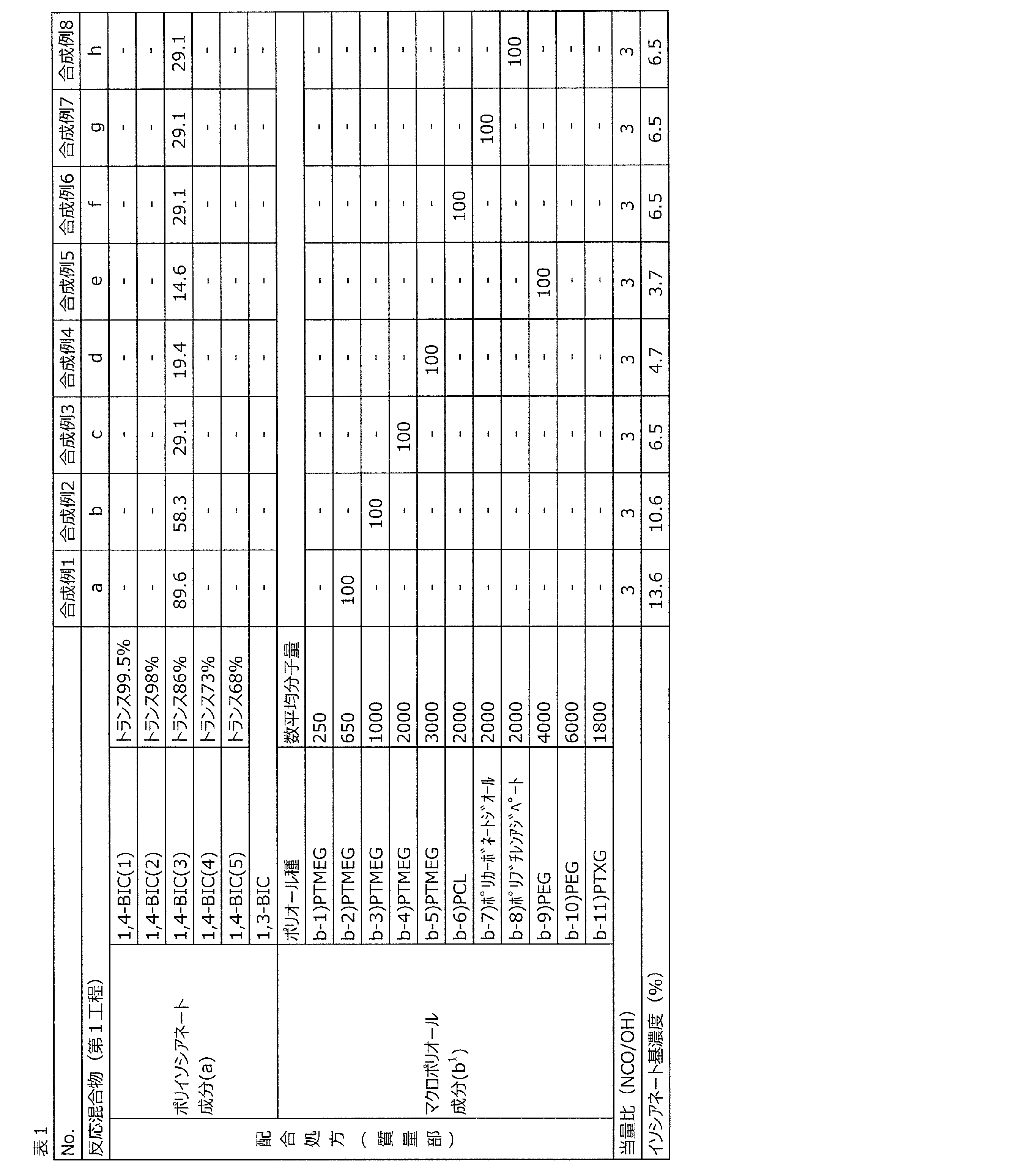


なお、上記発明は、本発明の例示の実施形態として提供したが、これは単なる例示に過ぎず、限定的に解釈してはならない。当該技術分野の当業者によって明らかな本発明の変形例は、後記特許請求の範囲に含まれる。
本発明のポリウレタン樹脂、ポリウレタン樹脂の製造方法、および、成形品は、各種産業分野において、好適に用いられる。
Claims (7)
- ビス(イソシアナトメチル)シクロヘキサンを含むポリイソシアネート成分と、
数平均分子量が400を超過し5000以下のマクロポリオール成分と
の反応生成物であるポリウレタン樹脂であって、
ショアA硬度が80以下であり、
貯蔵弾性率E’が1×10⁶Paを示す温度が、200℃以上であり、
50℃における貯蔵弾性率E’50に対する、150℃における貯蔵弾性率E’150の比(E’150/E’50)が、0.1以上1.4以下である
ことを特徴とする、ポリウレタン樹脂。 - 前記ビス(イソシアナトメチル)シクロヘキサンが、1,4-ビス(イソシアナトメチル)シクロヘキサンである
ことを特徴とする、請求項1に記載のポリウレタン樹脂。 - 前記1,4-ビス(イソシアナトメチル)シクロヘキサンが、70モル%以上99モル%以下の割合でトランス体を含有する
ことを特徴とする、請求項2に記載のポリウレタン樹脂。 - 前記マクロポリオール成分が、2官能性ポリオールからなる
ことを特徴とする、請求項1に記載のポリウレタン樹脂。 - 前記マクロポリオール成分が、15℃において固形状である結晶性マクロポリオールを含有する
ことを特徴とする、請求項1に記載のポリウレタン樹脂。 - ビス(イソシアナトメチル)シクロヘキサンを含むポリイソシアネート成分と、数平均分子量が400を超過し5000以下のマクロポリオール成分とを反応させてイソシアネート基末端プレポリマーを含む反応混合物を得る第1工程と、
前記第1工程で得られた反応混合物と、数平均分子量が400を超過し5000以下のマクロポリオール成分とを反応させて、ポリウレタン樹脂を得る第2工程と
を備え、
前記第1工程において、前記マクロポリオール成分中の水酸基に対する、前記ポリイソシアネート成分中のイソシアネート基の当量比が、2以上5以下である
ことを特徴とする、ポリウレタン樹脂の製造方法。 - 請求項1に記載のポリウレタン樹脂を含む
ことを特徴とする、成形品。
Priority Applications (4)
| Application Number | Priority Date | Filing Date | Title |
|---|---|---|---|
| US16/612,057 US11312815B2 (en) | 2017-05-11 | 2018-05-09 | Polyurethane resin, producing method of polyurethane resin, and molded article |
| CN201880027010.0A CN110582524B (zh) | 2017-05-11 | 2018-05-09 | 聚氨酯树脂、聚氨酯树脂的制造方法及成型品 |
| EP18797915.8A EP3623403A4 (en) | 2017-05-11 | 2018-05-09 | POLYURETHANE RESIN, PROCESS FOR PRODUCING A POLYURETHANE RESIN, AND MOLDED ARTICLE |
| JP2019517656A JP7184760B2 (ja) | 2017-05-11 | 2018-05-09 | ポリウレタンエラストマー、ポリウレタンエラストマーの製造方法、および、成形品 |
Applications Claiming Priority (2)
| Application Number | Priority Date | Filing Date | Title |
|---|---|---|---|
| JP2017094697 | 2017-05-11 | ||
| JP2017-094697 | 2017-05-11 |
Publications (1)
| Publication Number | Publication Date |
|---|---|
| WO2018207807A1 true WO2018207807A1 (ja) | 2018-11-15 |
Family
ID=64105085
Family Applications (1)
| Application Number | Title | Priority Date | Filing Date |
|---|---|---|---|
| PCT/JP2018/017877 Ceased WO2018207807A1 (ja) | 2017-05-11 | 2018-05-09 | ポリウレタン樹脂、ポリウレタン樹脂の製造方法、および、成形品 |
Country Status (6)
| Country | Link |
|---|---|
| US (1) | US11312815B2 (ja) |
| EP (1) | EP3623403A4 (ja) |
| JP (1) | JP7184760B2 (ja) |
| CN (1) | CN110582524B (ja) |
| TW (1) | TWI778062B (ja) |
| WO (1) | WO2018207807A1 (ja) |
Cited By (7)
| Publication number | Priority date | Publication date | Assignee | Title |
|---|---|---|---|---|
| JPWO2021177175A1 (ja) * | 2020-03-05 | 2021-09-10 | ||
| WO2022255184A1 (ja) * | 2021-06-04 | 2022-12-08 | キヤノン株式会社 | 清掃部材及び弾性部材 |
| JP2022185374A (ja) * | 2021-06-02 | 2022-12-14 | 住友ゴム工業株式会社 | ゴルフクラブ用グリップおよびゴルフクラブ |
| JP2022186608A (ja) * | 2021-06-04 | 2022-12-15 | キヤノン株式会社 | 清掃部材及び弾性部材 |
| WO2023140229A1 (ja) * | 2022-01-18 | 2023-07-27 | 三井化学株式会社 | プレポリマー組成物、ポリウレタン樹脂、弾性成形品、および、プレポリマー組成物の製造方法 |
| WO2023153398A1 (ja) * | 2022-02-09 | 2023-08-17 | 三井化学株式会社 | プレポリマー組成物、ポリウレタン樹脂、弾性成形品およびプレポリマー組成物の製造方法 |
| JPWO2023204126A1 (ja) * | 2022-04-19 | 2023-10-26 |
Families Citing this family (6)
| Publication number | Priority date | Publication date | Assignee | Title |
|---|---|---|---|---|
| TWI730443B (zh) * | 2019-10-09 | 2021-06-11 | 立大化工股份有限公司 | 聚氨基甲酸酯預聚物組合物、聚氨基甲酸酯彈性體及其製造方法 |
| TWI725785B (zh) * | 2020-03-19 | 2021-04-21 | 碩正科技股份有限公司 | 半導體晶圓保護片 |
| CN112795353B (zh) * | 2021-02-02 | 2022-06-28 | 上海路嘉胶粘剂有限公司 | 一种pet膜贴木板用反应型聚氨酯热熔胶及其制备工艺 |
| CN114478972B (zh) * | 2021-12-24 | 2023-09-05 | 山东一诺威聚氨酯股份有限公司 | 减震垫用高阻尼聚氨酯弹性体及其制备方法 |
| CN116789928B (zh) * | 2023-05-08 | 2025-08-29 | 北京大学 | 柔性-可逆形状记忆性的储热调温相变材料及其制备方法和应用 |
| CN120441804B (zh) * | 2025-07-10 | 2025-09-30 | 广州艾科新材料股份有限公司 | 一种固态电池封装用聚氨酯材料及其制备方法 |
Citations (10)
| Publication number | Priority date | Publication date | Assignee | Title |
|---|---|---|---|---|
| JPS58501123A (ja) * | 1981-07-22 | 1983-07-14 | イ−ストマン コダツク カンパニ− | 1,4−シクロヘキサンビス(メチルイソシアネ−ト)ベ−スの固形ブロックト架橋剤 |
| JPH024817A (ja) * | 1988-06-23 | 1990-01-09 | Idemitsu Petrochem Co Ltd | 液状ジエン系重合体組成物 |
| JPH07309827A (ja) | 1994-03-22 | 1995-11-28 | Mitsui Toatsu Chem Inc | 脂肪族ポリイソシアナートの製造方法 |
| JP2001151844A (ja) * | 1999-11-24 | 2001-06-05 | Asahi Denka Kogyo Kk | 硬化性組成物 |
| JP2003212835A (ja) | 2002-01-24 | 2003-07-30 | Mitsui Takeda Chemicals Inc | アルキルカルバメートの製造方法 |
| JP2004244349A (ja) | 2003-02-13 | 2004-09-02 | Mitsui Takeda Chemicals Inc | アルキルカルバメートの製造方法 |
| JP2007016188A (ja) * | 2005-07-11 | 2007-01-25 | Yokohama Rubber Co Ltd:The | 二液常温硬化型ウレタン組成物 |
| JP2011006382A (ja) | 2009-04-09 | 2011-01-13 | Mitsui Chemicals Inc | トランス−1,4−ビス(アミノメチル)シクロヘキサンの製造方法 |
| JP2014055229A (ja) | 2012-09-12 | 2014-03-27 | Mitsui Chemicals Inc | 硬質熱可塑性ポリウレタン樹脂、その製造方法および成形品 |
| WO2015046370A1 (ja) * | 2013-09-26 | 2015-04-02 | 三井化学株式会社 | アイウェア材料、アイウェアフレームおよびアイウェア |
Family Cites Families (18)
| Publication number | Priority date | Publication date | Assignee | Title |
|---|---|---|---|---|
| TW572925B (en) * | 2000-01-24 | 2004-01-21 | Mitsui Chemicals Inc | Urethane resin composition for sealing optoelectric conversion devices |
| KR101111990B1 (ko) * | 2002-10-31 | 2012-02-17 | 다우 글로벌 테크놀로지스 엘엘씨 | 폴리우레탄 분산액 및 이로부터 제조된 제품 |
| US20040087754A1 (en) * | 2002-10-31 | 2004-05-06 | Paul Foley | Polyurethane compounds and articles prepared therefrom |
| JP5379014B2 (ja) * | 2007-10-15 | 2013-12-25 | 三井化学株式会社 | 粒子状ポリウレタン樹脂組成物およびその成形品 |
| CN103641989B (zh) | 2007-10-15 | 2016-05-18 | 三井化学株式会社 | 聚氨酯树脂 |
| EP2265655A1 (en) * | 2008-04-09 | 2010-12-29 | Dow Global Technologies Inc. | Polyurethane elastomers |
| JP2011516692A (ja) * | 2008-04-09 | 2011-05-26 | ダウ グローバル テクノロジーズ リミティド ライアビリティ カンパニー | ポリウレタンエラストマー |
| EP2552985B1 (en) * | 2010-03-31 | 2014-04-30 | Dow Global Technologies LLC | Polyurethane compositions having improved impact resistance and optical properties |
| JP2012052036A (ja) * | 2010-09-01 | 2012-03-15 | Nitto Denko Corp | 仮固定シート |
| JP5566360B2 (ja) * | 2010-11-22 | 2014-08-06 | ローム アンド ハース カンパニー | ビス(イソシアナトメチル)シクロヘキサンからのイソシアヌラート組成物および第三級アミン触媒を含むポリウレタンコーティング組成物 |
| WO2014021317A1 (ja) * | 2012-07-31 | 2014-02-06 | 三井化学株式会社 | ポリイソシアネート組成物、太陽電池部材被覆材、被覆層付太陽電池部材、マイクロカプセルおよびインキ用バインダー |
| JP5832392B2 (ja) * | 2012-08-20 | 2015-12-16 | 三井化学株式会社 | ポリウレタンエラストマーの製造方法、ポリウレタンエラストマーおよび成形品 |
| KR20140039111A (ko) * | 2012-09-21 | 2014-04-01 | 주식회사 엔비스타 | 태양전지 모듈용 이액형 열경화성 폴리우레탄 수지 조성물 및 그것을 사용하여 얻어진 태양전지 모듈 |
| JP6078158B2 (ja) * | 2013-08-01 | 2017-02-08 | 三井化学株式会社 | トランス−ビス(アミノメチル)シクロヘキサンの製造方法、ビス(イソシアナトメチル)シクロヘキサンの製造方法、ビス(イソシアナトメチル)シクロヘキサン、ポリイソシアネート組成物およびポリウレタン樹脂 |
| CN107922560B (zh) * | 2015-08-18 | 2019-04-05 | 三井化学株式会社 | 发泡聚氨酯材料、成型品、及发泡聚氨酯材料的制造方法 |
| CN105949434B (zh) * | 2016-06-16 | 2018-12-11 | 旭川化学(昆山)有限公司 | 一种用于制备微孔聚氨酯弹性体的b组分异氰酸酯预聚体和聚氨酯双组份及应用 |
| WO2018092745A1 (ja) * | 2016-11-17 | 2018-05-24 | 三井化学株式会社 | ポリウレタン樹脂の製造方法、ポリウレタン樹脂および成形品 |
| CN109071766B (zh) * | 2016-11-17 | 2019-09-27 | 三井化学株式会社 | 发泡用热塑性聚氨酯树脂及其制造方法、以及成型品 |
-
2018
- 2018-05-09 JP JP2019517656A patent/JP7184760B2/ja active Active
- 2018-05-09 CN CN201880027010.0A patent/CN110582524B/zh active Active
- 2018-05-09 EP EP18797915.8A patent/EP3623403A4/en active Pending
- 2018-05-09 WO PCT/JP2018/017877 patent/WO2018207807A1/ja not_active Ceased
- 2018-05-09 US US16/612,057 patent/US11312815B2/en active Active
- 2018-05-11 TW TW107116154A patent/TWI778062B/zh active
Patent Citations (10)
| Publication number | Priority date | Publication date | Assignee | Title |
|---|---|---|---|---|
| JPS58501123A (ja) * | 1981-07-22 | 1983-07-14 | イ−ストマン コダツク カンパニ− | 1,4−シクロヘキサンビス(メチルイソシアネ−ト)ベ−スの固形ブロックト架橋剤 |
| JPH024817A (ja) * | 1988-06-23 | 1990-01-09 | Idemitsu Petrochem Co Ltd | 液状ジエン系重合体組成物 |
| JPH07309827A (ja) | 1994-03-22 | 1995-11-28 | Mitsui Toatsu Chem Inc | 脂肪族ポリイソシアナートの製造方法 |
| JP2001151844A (ja) * | 1999-11-24 | 2001-06-05 | Asahi Denka Kogyo Kk | 硬化性組成物 |
| JP2003212835A (ja) | 2002-01-24 | 2003-07-30 | Mitsui Takeda Chemicals Inc | アルキルカルバメートの製造方法 |
| JP2004244349A (ja) | 2003-02-13 | 2004-09-02 | Mitsui Takeda Chemicals Inc | アルキルカルバメートの製造方法 |
| JP2007016188A (ja) * | 2005-07-11 | 2007-01-25 | Yokohama Rubber Co Ltd:The | 二液常温硬化型ウレタン組成物 |
| JP2011006382A (ja) | 2009-04-09 | 2011-01-13 | Mitsui Chemicals Inc | トランス−1,4−ビス(アミノメチル)シクロヘキサンの製造方法 |
| JP2014055229A (ja) | 2012-09-12 | 2014-03-27 | Mitsui Chemicals Inc | 硬質熱可塑性ポリウレタン樹脂、その製造方法および成形品 |
| WO2015046370A1 (ja) * | 2013-09-26 | 2015-04-02 | 三井化学株式会社 | アイウェア材料、アイウェアフレームおよびアイウェア |
Non-Patent Citations (1)
| Title |
|---|
| See also references of EP3623403A4 |
Cited By (16)
| Publication number | Priority date | Publication date | Assignee | Title |
|---|---|---|---|---|
| JP7364780B2 (ja) | 2020-03-05 | 2023-10-18 | 三井化学株式会社 | 発泡ポリウレタン樹脂組成物および発泡ポリウレタンエラストマー |
| JPWO2021177175A1 (ja) * | 2020-03-05 | 2021-09-10 | ||
| JP2022185374A (ja) * | 2021-06-02 | 2022-12-14 | 住友ゴム工業株式会社 | ゴルフクラブ用グリップおよびゴルフクラブ |
| JP7697269B2 (ja) | 2021-06-02 | 2025-06-24 | 住友ゴム工業株式会社 | ゴルフクラブ用グリップおよびゴルフクラブ |
| WO2022255184A1 (ja) * | 2021-06-04 | 2022-12-08 | キヤノン株式会社 | 清掃部材及び弾性部材 |
| JP2022186608A (ja) * | 2021-06-04 | 2022-12-15 | キヤノン株式会社 | 清掃部材及び弾性部材 |
| JP7786825B2 (ja) | 2021-06-04 | 2025-12-16 | キヤノン株式会社 | 清掃部材及び弾性部材 |
| US12174576B2 (en) | 2021-06-04 | 2024-12-24 | Canon Kabushiki Kaisha | Cleaning member and elastic member |
| WO2023140229A1 (ja) * | 2022-01-18 | 2023-07-27 | 三井化学株式会社 | プレポリマー組成物、ポリウレタン樹脂、弾性成形品、および、プレポリマー組成物の製造方法 |
| JPWO2023140229A1 (ja) * | 2022-01-18 | 2023-07-27 | ||
| JP7904245B2 (ja) | 2022-01-18 | 2026-08-12 | 三井化学株式会社 | プレポリマー組成物、ポリウレタン樹脂、弾性成形品、および、プレポリマー組成物の製造方法 |
| JPWO2023153398A1 (ja) * | 2022-02-09 | 2023-08-17 | ||
| WO2023153398A1 (ja) * | 2022-02-09 | 2023-08-17 | 三井化学株式会社 | プレポリマー組成物、ポリウレタン樹脂、弾性成形品およびプレポリマー組成物の製造方法 |
| JP7778167B2 (ja) | 2022-02-09 | 2025-12-01 | 三井化学株式会社 | プレポリマー組成物、ポリウレタン樹脂、弾性成形品およびプレポリマー組成物の製造方法 |
| JPWO2023204126A1 (ja) * | 2022-04-19 | 2023-10-26 | ||
| JP7716583B2 (ja) | 2022-04-19 | 2025-07-31 | 三井化学株式会社 | ポリウレタン樹脂、弾性成形品、および、ポリウレタン樹脂の製造方法 |
Also Published As
| Publication number | Publication date |
|---|---|
| TWI778062B (zh) | 2022-09-21 |
| JP7184760B2 (ja) | 2022-12-06 |
| CN110582524A (zh) | 2019-12-17 |
| US11312815B2 (en) | 2022-04-26 |
| EP3623403A4 (en) | 2021-01-27 |
| EP3623403A1 (en) | 2020-03-18 |
| TW201900724A (zh) | 2019-01-01 |
| JPWO2018207807A1 (ja) | 2020-02-27 |
| US20200165377A1 (en) | 2020-05-28 |
| CN110582524B (zh) | 2022-03-29 |
Similar Documents
| Publication | Publication Date | Title |
|---|---|---|
| JP7184760B2 (ja) | ポリウレタンエラストマー、ポリウレタンエラストマーの製造方法、および、成形品 | |
| EP3805287B1 (en) | Thermoplastic polyurethane resin, optical polyurethane resin, cover plate for display panel, eyewear material, eyewear lens, eyewear frame, automotive interior and exterior components, and method for producing thermoplastic polyurethane resin | |
| JP6378852B1 (ja) | ポリウレタン樹脂の製造方法 | |
| KR102351760B1 (ko) | 폴리유레테인 수지, 성형품, 및 폴리유레테인 수지의 제조 방법 | |
| JP7257541B2 (ja) | 熱可塑性ポリウレタン樹脂およびフィルム | |
| JP5832392B2 (ja) | ポリウレタンエラストマーの製造方法、ポリウレタンエラストマーおよび成形品 | |
| JP7725314B2 (ja) | ポリウレタン樹脂、弾性成形品、ポリウレタン樹脂の製造方法、および、プレポリマー組成物 | |
| JP7296249B2 (ja) | 熱可塑性ポリウレタン樹脂 | |
| JP7246910B2 (ja) | 熱可塑性ポリウレタン樹脂、成形品、および、熱可塑性ポリウレタン樹脂の製造方法 |
Legal Events
| Date | Code | Title | Description |
|---|---|---|---|
| 121 | Ep: the epo has been informed by wipo that ep was designated in this application |
Ref document number: 18797915 Country of ref document: EP Kind code of ref document: A1 |
|
| ENP | Entry into the national phase |
Ref document number: 2019517656 Country of ref document: JP Kind code of ref document: A |
|
| NENP | Non-entry into the national phase |
Ref country code: DE |
|
| ENP | Entry into the national phase |
Ref document number: 2018797915 Country of ref document: EP Effective date: 20191211 |