WO2018216785A1 - Pcsk9を標的としたアンチセンス核酸 - Google Patents
Pcsk9を標的としたアンチセンス核酸 Download PDFInfo
- Publication number
- WO2018216785A1 WO2018216785A1 PCT/JP2018/020081 JP2018020081W WO2018216785A1 WO 2018216785 A1 WO2018216785 A1 WO 2018216785A1 JP 2018020081 W JP2018020081 W JP 2018020081W WO 2018216785 A1 WO2018216785 A1 WO 2018216785A1
- Authority
- WO
- WIPO (PCT)
- Prior art keywords
- group
- base sequence
- oligonucleotide
- carbon atoms
- seq
- Prior art date
- Legal status (The legal status is an assumption and is not a legal conclusion. Google has not performed a legal analysis and makes no representation as to the accuracy of the status listed.)
- Ceased
Links
Images







Classifications
-
- A—HUMAN NECESSITIES
- A61—MEDICAL OR VETERINARY SCIENCE; HYGIENE
- A61K—PREPARATIONS FOR MEDICAL, DENTAL OR TOILETRY PURPOSES
- A61K47/00—Medicinal preparations characterised by the non-active ingredients used, e.g. carriers or inert additives; Targeting or modifying agents chemically bound to the active ingredient
- A61K47/50—Medicinal preparations characterised by the non-active ingredients used, e.g. carriers or inert additives; Targeting or modifying agents chemically bound to the active ingredient the non-active ingredient being chemically bound to the active ingredient, e.g. polymer-drug conjugates
- A61K47/51—Medicinal preparations characterised by the non-active ingredients used, e.g. carriers or inert additives; Targeting or modifying agents chemically bound to the active ingredient the non-active ingredient being chemically bound to the active ingredient, e.g. polymer-drug conjugates the non-active ingredient being a modifying agent
- A61K47/54—Medicinal preparations characterised by the non-active ingredients used, e.g. carriers or inert additives; Targeting or modifying agents chemically bound to the active ingredient the non-active ingredient being chemically bound to the active ingredient, e.g. polymer-drug conjugates the non-active ingredient being a modifying agent the modifying agent being an organic compound
- A61K47/549—Sugars, nucleosides, nucleotides or nucleic acids
-
- A—HUMAN NECESSITIES
- A61—MEDICAL OR VETERINARY SCIENCE; HYGIENE
- A61K—PREPARATIONS FOR MEDICAL, DENTAL OR TOILETRY PURPOSES
- A61K47/00—Medicinal preparations characterised by the non-active ingredients used, e.g. carriers or inert additives; Targeting or modifying agents chemically bound to the active ingredient
- A61K47/50—Medicinal preparations characterised by the non-active ingredients used, e.g. carriers or inert additives; Targeting or modifying agents chemically bound to the active ingredient the non-active ingredient being chemically bound to the active ingredient, e.g. polymer-drug conjugates
- A61K47/51—Medicinal preparations characterised by the non-active ingredients used, e.g. carriers or inert additives; Targeting or modifying agents chemically bound to the active ingredient the non-active ingredient being chemically bound to the active ingredient, e.g. polymer-drug conjugates the non-active ingredient being a modifying agent
- A61K47/54—Medicinal preparations characterised by the non-active ingredients used, e.g. carriers or inert additives; Targeting or modifying agents chemically bound to the active ingredient the non-active ingredient being chemically bound to the active ingredient, e.g. polymer-drug conjugates the non-active ingredient being a modifying agent the modifying agent being an organic compound
-
- A—HUMAN NECESSITIES
- A61—MEDICAL OR VETERINARY SCIENCE; HYGIENE
- A61K—PREPARATIONS FOR MEDICAL, DENTAL OR TOILETRY PURPOSES
- A61K48/00—Medicinal preparations containing genetic material which is inserted into cells of the living body to treat genetic diseases; Gene therapy
-
- A—HUMAN NECESSITIES
- A61—MEDICAL OR VETERINARY SCIENCE; HYGIENE
- A61P—SPECIFIC THERAPEUTIC ACTIVITY OF CHEMICAL COMPOUNDS OR MEDICINAL PREPARATIONS
- A61P3/00—Drugs for disorders of the metabolism
- A61P3/06—Antihyperlipidemics
-
- C—CHEMISTRY; METALLURGY
- C12—BIOCHEMISTRY; BEER; SPIRITS; WINE; VINEGAR; MICROBIOLOGY; ENZYMOLOGY; MUTATION OR GENETIC ENGINEERING
- C12N—MICROORGANISMS OR ENZYMES; COMPOSITIONS THEREOF; PROPAGATING, PRESERVING, OR MAINTAINING MICROORGANISMS; MUTATION OR GENETIC ENGINEERING; CULTURE MEDIA
- C12N15/00—Mutation or genetic engineering; DNA or RNA concerning genetic engineering, vectors, e.g. plasmids, or their isolation, preparation or purification; Use of hosts therefor
- C12N15/09—Recombinant DNA-technology
- C12N15/11—DNA or RNA fragments; Modified forms thereof; Non-coding nucleic acids having a biological activity
- C12N15/113—Non-coding nucleic acids modulating the expression of genes, e.g. antisense oligonucleotides; Antisense DNA or RNA; Triplex- forming oligonucleotides; Catalytic nucleic acids, e.g. ribozymes; Nucleic acids used in co-suppression or gene silencing
- C12N15/1137—Non-coding nucleic acids modulating the expression of genes, e.g. antisense oligonucleotides; Antisense DNA or RNA; Triplex- forming oligonucleotides; Catalytic nucleic acids, e.g. ribozymes; Nucleic acids used in co-suppression or gene silencing against enzymes
-
- C—CHEMISTRY; METALLURGY
- C12—BIOCHEMISTRY; BEER; SPIRITS; WINE; VINEGAR; MICROBIOLOGY; ENZYMOLOGY; MUTATION OR GENETIC ENGINEERING
- C12Y—ENZYMES
- C12Y304/00—Hydrolases acting on peptide bonds, i.e. peptidases (3.4)
- C12Y304/21—Serine endopeptidases (3.4.21)
- C12Y304/21112—Site-1 protease (3.4.21.112), i.e. subtilisin kexin isozyme-1
-
- C—CHEMISTRY; METALLURGY
- C12—BIOCHEMISTRY; BEER; SPIRITS; WINE; VINEGAR; MICROBIOLOGY; ENZYMOLOGY; MUTATION OR GENETIC ENGINEERING
- C12N—MICROORGANISMS OR ENZYMES; COMPOSITIONS THEREOF; PROPAGATING, PRESERVING, OR MAINTAINING MICROORGANISMS; MUTATION OR GENETIC ENGINEERING; CULTURE MEDIA
- C12N2310/00—Structure or type of the nucleic acid
- C12N2310/10—Type of nucleic acid
- C12N2310/11—Antisense
-
- C—CHEMISTRY; METALLURGY
- C12—BIOCHEMISTRY; BEER; SPIRITS; WINE; VINEGAR; MICROBIOLOGY; ENZYMOLOGY; MUTATION OR GENETIC ENGINEERING
- C12N—MICROORGANISMS OR ENZYMES; COMPOSITIONS THEREOF; PROPAGATING, PRESERVING, OR MAINTAINING MICROORGANISMS; MUTATION OR GENETIC ENGINEERING; CULTURE MEDIA
- C12N2310/00—Structure or type of the nucleic acid
- C12N2310/30—Chemical structure
- C12N2310/31—Chemical structure of the backbone
- C12N2310/315—Phosphorothioates
-
- C—CHEMISTRY; METALLURGY
- C12—BIOCHEMISTRY; BEER; SPIRITS; WINE; VINEGAR; MICROBIOLOGY; ENZYMOLOGY; MUTATION OR GENETIC ENGINEERING
- C12N—MICROORGANISMS OR ENZYMES; COMPOSITIONS THEREOF; PROPAGATING, PRESERVING, OR MAINTAINING MICROORGANISMS; MUTATION OR GENETIC ENGINEERING; CULTURE MEDIA
- C12N2310/00—Structure or type of the nucleic acid
- C12N2310/30—Chemical structure
- C12N2310/32—Chemical structure of the sugar
- C12N2310/323—Chemical structure of the sugar modified ring structure
- C12N2310/3231—Chemical structure of the sugar modified ring structure having an additional ring, e.g. LNA, ENA
-
- C—CHEMISTRY; METALLURGY
- C12—BIOCHEMISTRY; BEER; SPIRITS; WINE; VINEGAR; MICROBIOLOGY; ENZYMOLOGY; MUTATION OR GENETIC ENGINEERING
- C12N—MICROORGANISMS OR ENZYMES; COMPOSITIONS THEREOF; PROPAGATING, PRESERVING, OR MAINTAINING MICROORGANISMS; MUTATION OR GENETIC ENGINEERING; CULTURE MEDIA
- C12N2310/00—Structure or type of the nucleic acid
- C12N2310/30—Chemical structure
- C12N2310/34—Spatial arrangement of the modifications
- C12N2310/341—Gapmers, i.e. of the type ===---===
-
- C—CHEMISTRY; METALLURGY
- C12—BIOCHEMISTRY; BEER; SPIRITS; WINE; VINEGAR; MICROBIOLOGY; ENZYMOLOGY; MUTATION OR GENETIC ENGINEERING
- C12N—MICROORGANISMS OR ENZYMES; COMPOSITIONS THEREOF; PROPAGATING, PRESERVING, OR MAINTAINING MICROORGANISMS; MUTATION OR GENETIC ENGINEERING; CULTURE MEDIA
- C12N2310/00—Structure or type of the nucleic acid
- C12N2310/30—Chemical structure
- C12N2310/34—Spatial arrangement of the modifications
- C12N2310/346—Spatial arrangement of the modifications having a combination of backbone and sugar modifications
-
- C—CHEMISTRY; METALLURGY
- C12—BIOCHEMISTRY; BEER; SPIRITS; WINE; VINEGAR; MICROBIOLOGY; ENZYMOLOGY; MUTATION OR GENETIC ENGINEERING
- C12N—MICROORGANISMS OR ENZYMES; COMPOSITIONS THEREOF; PROPAGATING, PRESERVING, OR MAINTAINING MICROORGANISMS; MUTATION OR GENETIC ENGINEERING; CULTURE MEDIA
- C12N2310/00—Structure or type of the nucleic acid
- C12N2310/30—Chemical structure
- C12N2310/35—Nature of the modification
- C12N2310/351—Conjugate
-
- C—CHEMISTRY; METALLURGY
- C12—BIOCHEMISTRY; BEER; SPIRITS; WINE; VINEGAR; MICROBIOLOGY; ENZYMOLOGY; MUTATION OR GENETIC ENGINEERING
- C12N—MICROORGANISMS OR ENZYMES; COMPOSITIONS THEREOF; PROPAGATING, PRESERVING, OR MAINTAINING MICROORGANISMS; MUTATION OR GENETIC ENGINEERING; CULTURE MEDIA
- C12N2310/00—Structure or type of the nucleic acid
- C12N2310/30—Chemical structure
- C12N2310/35—Nature of the modification
- C12N2310/351—Conjugate
- C12N2310/3515—Lipophilic moiety, e.g. cholesterol
Definitions
- the present invention relates to an antisense nucleic acid targeting PCSK9 and a pharmaceutical composition containing the same.
- FH familial hypercholesterolemia
- arteriosclerosis progresses from a young age due to hyper-LDL-C blood, and frequently develops arteriosclerotic diseases such as myocardial infarction.
- Treatment for FH includes treatment for controlling LDL-C using lipid lowering drugs such as statins.
- Statins inhibit cholesterol synthesis to increase LDL receptor activity and decrease LDL-C levels, but increase the expression of PCSK9, which has LDL receptor degradation activity. Therefore, for severe hypercholesterolemia such as FH, the use of statin and ezetimibe, which are standard treatments, is not effective enough to prevent the progression of arteriosclerosis and cause cardiovascular events many times There are many examples. For patients with FH and severe hypercholesterolemia that cannot be adequately treated with such drugs alone, treatment called LDL apheresis is being carried out, which is a physical, temporal and physical burden on the patient. Is very large.
- PCSK9 loss-of-function mutations
- LDL-C low LDL-C
- PCSK9 loss-of-function mutations
- PCSK9 is considered to be a suitable target molecule for dyslipidemia.
- PCSK9 does not have an active center, it is difficult to develop inhibitors using low molecular weight compounds. Accordingly, various studies have been conducted on antisense nucleic acids as new materials that inhibit the synthesis of PCSK9 rather than drugs that act on PCSK9 itself.
- Patent Document 1 discloses that a specific antisense oligonucleotide having a length of about 10 to 30 corresponding to the human PCSK9 gene suppresses the expression of PCSK9.
- the antisense oligonucleotide can be used as a conjugate by binding to drugs such as antibiotics in addition to proteins, fatty acid chains, sugar chains and the like.
- Patent Document 2 discloses that a specific antisense oligonucleotide having a length of 10 to 22 inhibits the activity of PCSK9 and has low nephrotoxicity.
- the antisense oligonucleotide an example in which a conjugate is formed with a sterol such as cholesterol or a carbohydrate such as N-acetylgalactosamine (GalNAc) has been disclosed. It is described that binding is preferable from the viewpoint of binding affinity to the liver.
- antisense nucleic acids may form higher-order structures and complexes depending on the sequence, which affects pharmacokinetics and drug efficacy. Therefore, to improve the in vivo activity of antisense nucleic acids, kinetic properties It is also necessary to consider.
- antisense nucleic acid is an effective material for pharmaceuticals, but unexpected side effects occur when the activity and target tissue specificity are low.
- the antisense nucleic acid SPC5001 which was being developed as a PCSK9 inhibitor, was discontinued due to damage to the kidney, which is not the target tissue, in a phase I study in healthy individuals (van Poelgeest E P, et al., Am J Kidney Dis 2013, 62, 796-800, van Poelgeest E P, et al., Br J Clin Pharmacol 2015, 80, 1350-1361). Therefore, for the clinical application of antisense nucleic acid targeting PCSK9, improvement in target tissue specificity is necessary.
- the present invention provides an antisense nucleic acid targeting PCSK9 that has low toxicity and is effective in vivo, and a pharmaceutical composition containing the same.
- Antisense nucleic acid is generally introduced into cells (lipofection) with a reagent based on cationic lipids such as lipofectamine, and its activity is evaluated from the mRNA reduction rate.
- a reagent based on cationic lipids such as lipofectamine
- the complex formation efficiency between the reagent and the antisense nucleic acid differs depending on the sequence, or the sequence-specific kinetic properties of the antisense nucleic acid are invalidated, so that the accurate activity of the antisense nucleic acid is improved. Cannot be evaluated.
- the inventors have determined that among nucleic acid sequences designed to have excellent in vivo stability, those having excellent binding affinity with the PCSK9 gene using the Ca 2+ enrichment of medium (CEM) method.
- CEM Ca 2+ enrichment of medium
- the present invention relates to the following [1] to [12].
- the phosphodiester bond is one or more bonds selected between molecules that can bind to an asialoglycoprotein receptor and between an oligonucleotide and a molecule that can bind to an asialoglycoprotein receptor.
- the molecules capable of binding to the asialoglycoprotein receptor are lactose, galactose, N-acetylgalactosamine (GalNAc), galactosamine, N-formylgalactosamine, N-propionylgalactosamine, Nn-butanoylgalactosamine, N-iso-buta
- a preventive or therapeutic agent for a disease associated with high LDL cholesterol comprising the oligonucleotide conjugate according to any one of [1] to [9] as an active ingredient.
- a preventive or therapeutic agent for a disease associated with high LDL cholesterol comprising the oligonucleotide conjugate according to any one of [1] to [9] as an active ingredient.
- the prophylactic or therapeutic agent according to the above [10] wherein the disease associated with high LDL cholesterol is selected from hypercholesterolemia and a disease having a high risk of lowering LDL cholesterol.
- the antisense nucleic acid of the present invention has an excellent effect of suppressing the expression of PCSK9 even in vivo and has a low toxic expression, and thus useful as a therapeutic agent for diseases associated with high LDL cholesterol levels. Can be provided.
- FIG. 1 is a diagram showing the results of primary screening for examining the antisense activity by the CEM method.
- FIG. 2 is a diagram showing the results of examining the concentration dependency of activity for antisense nucleic acids selected by primary screening.
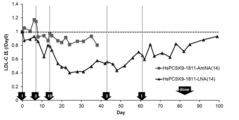
- FIG. 3 is a graph showing fluctuations in the blood LDL cholesterol level (relative ratio to the start of the test) of cynomolgus monkeys depending on the dose when the antisense nucleic acid was administered.
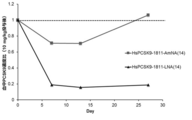
- FIG. 4 is a graph showing changes in PCSK9 concentration in blood (relative ratio to the time of administration of 10 mg / kg) in cynomolgus monkeys after administration of antisense nucleic acid at 10 mg / kg.
- FIG. 1 is a diagram showing the results of primary screening for examining the antisense activity by the CEM method.
- FIG. 2 is a diagram showing the results of examining the concentration dependency of activity for antisense nucleic acids selected by primary screening.
- FIG. 3 is a graph showing fluctuations in
- FIG. 5 is a diagram showing the kidney state of cynomolgus monkeys after intermittent administration of antisense nucleic acid at 10 mg / kg or 30 mg / kg.
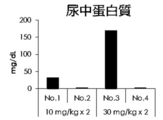
- FIG. 6 is a diagram showing the protein concentration in urine of cynomolgus monkeys after intermittent administration of antisense nucleic acid at 10 mg / kg or 30 mg / kg.
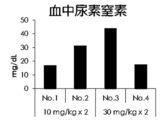
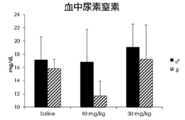
- FIG. 7 is a graph showing blood urea nitrogen concentration in cynomolgus monkeys after intermittent administration of antisense nucleic acid at 10 mg / kg or 30 mg / kg.
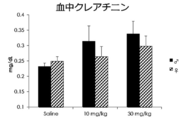
- FIG. 8 is a graph showing the blood creatinine concentration of cynomolgus monkeys after intermittent administration of antisense nucleic acid at 10 mg / kg or 30 mg / kg.
- FIG. 6 is a diagram showing the kidney state of cynomolgus monkeys after intermittent administration of antisense nucleic acid at 10 mg / kg or 30 mg / kg.
- FIG. 6 is a
- FIG. 9 is a graph showing blood urea nitrogen concentration in rats after intermittent administration of antisense nucleic acid at 10 mg / kg or 30 mg / kg.
- FIG. 10 is a graph showing the blood creatinine concentration in rats after intermittent administration of antisense nucleic acid at 10 mg / kg or 30 mg / kg.
- FIG. 11 is a diagram schematically showing the structure of an antisense nucleic acid GalNAc conjugate.
- FIG. 12 is a graph showing fluctuations in the blood LDL cholesterol level (relative ratio to the start of the test) of cynomolgus monkeys after single administration of 0.3 mg / kg or 1 mg / kg of antisense nucleic acid GalNAc conjugate.
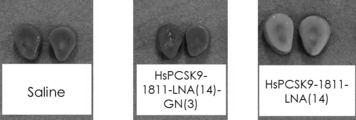
- FIG. 13 is a diagram showing the renal state of rats when an antisense nucleic acid or an antisense nucleic acid GalNAc conjugate is intermittently administered.
- FIG. 14 is a graph showing the urine volume of rats when an antisense nucleic acid or an antisense nucleic acid GalNAc conjugate is intermittently administered.
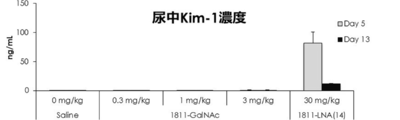
- FIG. 15 is a graph showing the urinary Kim-1 concentration in rats when an antisense nucleic acid or an antisense nucleic acid GalNAc conjugate is intermittently administered.
- FIG. 16 is a graph showing the blood creatinine concentration in rats when an antisense nucleic acid or an antisense nucleic acid GalNAc conjugate is intermittently administered.
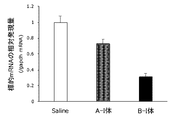
- FIG. 17 is a diagram showing the results of comparison of target gene expression levels in the liver when a single administration of an antisense nucleic acid GalNAc conjugate to which GalNAc is bound via different main chain linker structures to a mouse.
- the antisense nucleic acid of the present invention comprises a crosslinked artificial nucleoside having a crosslinked structure between the 4 ′ position and the 2 ′ position, is complementary to the human PCSK9 gene, and has an activity of suppressing the expression of the human PCSK9 gene
- the oligonucleotide is characterized in that two or more molecules that can bind to the asialoglycoprotein receptor are linked in a linear form.
- the antisense nucleic acid having the above characteristics may be referred to as the oligonucleotide conjugate or oligonucleotide conjugate of the present invention.
- the degree of freedom of the linker structure between the molecule capable of binding to the ASGP receptor and the oligonucleotide is increased by linking the molecules capable of binding to the ASGP receptor in a straight chain.
- a molecule capable of binding to each linked ASGP receptor can be flexibly accommodated in a spatially advantageous arrangement of the ASGP receptor and also has a metabolic mode advantageous for the expression of oligonucleotide activity. Presumed. As a result, the efficiency of uptake into target cells is improved and the stability in vivo is excellent, and therefore, it is considered that the expression of the human PCSK9 gene, which is the target gene, can be further suppressed.
- the estimation of the mechanism does not limit the present invention.
- linear alkyl group having 1 to 6 carbon atoms usually means any linear alkyl group having 1 to 6 carbon atoms, specifically, methyl group, ethyl group, n -Propyl group, n-butyl group, n-pentyl group, n-hexyl group and the like.
- linear alkylthio group having 1 to 6 carbon atoms usually includes an alkylthio group having any linear alkyl group having 1 to 6 carbon atoms. Examples thereof include a methylthio group, an ethylthio group, and an n-propylthio group.
- linear alkylamino group having 1 to 6 carbon atoms usually includes an alkylamino group having one or two arbitrary linear alkyl groups having 1 to 6 carbon atoms. Examples thereof include a methylamino group, a dimethylamino group, an ethylamino group, a methylethylamino group, and a diethylamino group.
- an alkyl group having 1 to 7 carbon atoms which may form a branch or a ring is usually an arbitrary straight-chain alkyl group having 1 to 7 carbon atoms, or an alkyl group having 3 to 7 carbon atoms. It includes any branched alkyl group and any cyclic alkyl group having 3 to 7 carbon atoms. These may be collectively referred to simply as a “lower alkyl group”.
- examples of the straight chain alkyl group having 1 to 7 carbon atoms include methyl group, ethyl group, n-propyl group, n-butyl group, n-pentyl group, n-hexyl group, and n-heptyl group.
- examples of the arbitrary branched alkyl group having 3 to 7 carbon atoms include isopropyl group, isobutyl group, tert-butyl group, isopentyl group and the like.
- examples of the cyclic alkyl group having 3 to 7 carbon atoms include a cyclobutyl group, a cyclopentyl group, and a cyclohexyl group.
- an alkenyl group having 2 to 7 carbon atoms that may form a branch or a ring is usually an arbitrary straight-chain alkenyl group having 2 to 7 carbon atoms, or a group having 3 to 7 carbon atoms. It includes any branched alkenyl group and any cyclic alkenyl group having 3 to 7 carbon atoms. These may be collectively referred to simply as a “lower alkenyl group”.
- an ethenyl group, a 1-propenyl group, a 2-propenyl group, a 1-butenyl group, a 2-butenyl group, a 1-pentenyl group, a 2-pentenyl group, 3-pentenyl group, 4-pentenyl group, 1-hexenyl group and the like can be mentioned.
- Examples of the arbitrary branched alkenyl group having 3 to 7 carbon atoms include isopropenyl group, 1-methyl-1-propenyl group, 1-methyl-2-propenyl group, 2-methyl-1-propenyl group, 2-methyl- Examples include 2-propenyl group and 1-methyl-2-butenyl group.
- Examples of the cyclic alkenyl group having 3 to 7 carbon atoms include a cyclobutenyl group, a cyclopentenyl group, a cyclohexenyl group, and the like.
- aryl group having 3 to 12 carbon atoms that may contain a heteroatom usually means any aromatic hydrocarbon having 6 to 12 carbon atoms and a ring composed of only hydrocarbons. Any heteroaromatic compound having 3 to 12 carbon atoms including a hetero atom (nitrogen atom, oxygen atom, sulfur atom) in the structure is included. Examples of the aromatic hydrocarbon having 6 to 12 carbon atoms composed of only hydrocarbons include a phenyl group, a naphthyl group, an indenyl group, and an azulenyl group.
- Examples of the arbitrary heteroaromatic compound having 3 to 12 carbon atoms containing a hetero atom in the ring structure include a pyridyl group, a pyrrolyl group, a quinolyl group, an indolyl group, an imidazolyl group, a furyl group, and a thienyl group.
- alkyl group having an aryl moiety having 3 to 12 carbon atoms which may contain a hetero atom examples include a benzyl group, a phenethyl group, a naphthylmethyl group, a 3-phenylpropyl group, 2 -Phenylpropyl group, 4-phenylbutyl group, 2-phenylbutyl group, pyridylmethyl group, indolylmethyl group, furylmethyl group, thienylmethyl group, pyrrolylmethyl group, 2-pyridylethyl group, 1-pyridylethyl group, 3 -Thienylpropyl group etc. are mentioned.
- the total number of carbon atoms of the functional group is not particularly limited, but may be in the range of 4 to 18.
- halogen atom examples include a fluorine atom, a chlorine atom, a bromine atom, and an iodine atom. Preferable is a fluorine atom or a chlorine atom.
- nucleoside usually refers to a glycosylamine containing a nucleobase and a sugar. Nucleosides include, but are not limited to, naturally occurring nucleosides, abasic nucleosides, modified nucleosides, and nucleosides having pseudobases and / or sugar groups.
- nucleotide usually refers to glycosmine containing a nucleobase and a sugar in which a phosphate group is covalently bonded to the sugar. Nucleotides can be modified with any of a variety of substituents.
- deoxyribonucleotide usually refers to a nucleotide having a hydrogen at the 2 ′ position of the sugar moiety of the nucleotide. Deoxyribonucleotides can be modified with any of a variety of substituents.
- deoxyribonucleic acid usually refers to a nucleic acid containing deoxyribonucleotides.
- ribonucleotide usually refers to a nucleotide having a hydroxy at the 2 ′ position of the sugar moiety of the nucleotide. Ribonucleotides can be modified with any of a variety of substituents.
- RNA ribonucleic acid
- modified nucleoside usually means an unnatural type of “nucleoside” in which a purine base or a pyrimidine base and a sugar are bonded, and an aromatic complex other than a purine base and a pyrimidine base.
- Preferable examples include sugar-modified nucleosides in which the sugar moiety is modified.
- oligonucleotide refers to an “oligonucleotide” in which 2 to 50 identical or different “nucleosides” are linked by a phosphodiester bond or other internucleoside bond. Non-naturally occurring derivatives of “oligonucleotides” are also included.
- Such a derivative is preferably a sugar derivative in which the sugar moiety is modified; a thioate derivative in which the phosphodiester moiety is thioated; an oxygen atom of the phosphate group in the phosphodiester bond is substituted with a sulfur atom Phosphorothioate derivatives; ester forms in which the terminal phosphoric acid moiety is esterified; and amide forms in which the amino group on the purine base is amidated.
- the term “oligonucleotide” includes single-stranded DNA or RNA and double-stranded DNA or RNA. A natural or non-natural single-stranded antisense oligonucleotide is preferred. Oligonucleotides also include those that are in the form of pharmaceutically acceptable salts, except as otherwise noted.
- the oligonucleotide constituting the oligonucleotide conjugate of the present invention contains a crosslinked artificial nucleoside having a crosslinked structure between the 4 'position and the 2' position.
- a cross-linked structure By having a cross-linked structure, it is difficult to be decomposed by various nucleic acid degrading enzymes (nucleases), and there is an effect that it can exist in the living body for a long time after administration to the living body.
- crosslinked structures As one of the crosslinked structures, a structure represented by —CH 2 —O— or — (CH 2 ) 2 —O— can be mentioned. Hereinafter, such a crosslinked structure may be referred to as a crosslinked structure (BNA) of embodiment 1.
- BNA crosslinked structure
- Examples of the crosslinked structure of Embodiment 1 include ⁇ -L-methyleneoxy (4′-CH 2 —O-2 ′, sometimes referred to as “LNA”), ⁇ -D-methyleneoxy (4′-CH 2- O-2 ′) and ethyleneoxy (4 ′-(CH 2 ) 2 —O-2 ′), but are not limited thereto.
- LNA low noise amplifier
- a BNA nucleoside (monomer) or an oligonucleotide containing the same can be synthesized by a method described in known literature, for example, WO2011 / 052436.
- Examples of the crosslinked structure other than the above include structures represented by —CH 2 —NR 1 —O— or — (CH 2 ) 2 —NR 1 —O—.
- R 1 is Hydrogen atom
- An aryl group having 3 to 12 carbon atoms which may have one or more arbitrary substituents selected from the ⁇ group consisting of an amino group and a halogen atom, and may contain a hetero atom; or the ⁇ group It represents an alkyl group having an aryl moiety having 3 to
- Examples of the crosslinked structure of Embodiment 2 include oxyamino (4′-CH 2 —NH—O-2 ′) and N-methyloxyamino (4′-CH 2 —NCH 3 —O-2 ′). However, it is not limited to these.
- a BNA NC nucleoside (monomer) or an oligonucleotide containing the same can be synthesized by a method described in a known document, for example, WO2011 / 052436.
- R 1 is Hydrogen atom; An alkyl group having 1 to 7 carbon atoms which may form a branch or a ring; An alkenyl group having 2 to 7 carbon atoms which may form a branch or a ring; Hydroxyl group, linear alkyl group having 1 to 6 carbon atoms, linear alkoxy group having 1 to 6 carbon atoms, mercapto group, linear alkylthio group having 1 to 6 carbon atoms, amino group, linear alkyl group having 1 to 6 carbon atoms An aryl group having 3 to 12 carbon atoms which may have one or more arbitrary substituents selected from the ⁇ group consisting of an amino group and a halogen atom, and may contain a hetero atom; or the ⁇ group Represents an alkyl group having an aryl moiety having 3 to 12 carbon atoms, which may have one or more arbitrary substituents selected from: and may contain a hetero atom; X represents an oxygen atom, a sulfur atom, an amino group or
- Examples of the crosslinked structure of Embodiment 3 include unsubstituted amide (4′-CO—NH-2 ′), N-methylamide (4′-CO—NCH 3 -2 ′), acetamide (4′-CH 2 —CO -NH-2 '), N-methylacetamide (4'-CH 2 -CO-NCH 3 -2'), N-oxyacetamide (4'-CH 2 -CO-NH-O-2 '), N- Examples include, but are not limited to, methyl-N-oxyacetamide (4′-CH 2 —CO—NCH 3 —O-2 ′).
- An AmNA nucleoside (monomer) or an oligonucleotide containing the AmNA nucleoside can be synthesized by a method described in a known document, for example, WO2012 / 029870.
- Another cross-linked structure includes a structure represented by —CH 2 —NR 1 — or — (CH 2 ) 2 —NR 1 —.
- R 1 is Hydrogen atom
- An aryl group having 3 to 12 carbon atoms which may have one or more arbitrary substituents selected from the ⁇ group consisting of an amino group and a halogen atom, and may contain a hetero atom; or the ⁇ group It represents an alkyl group having an aryl moiety having 3 to 12 carbon atoms which may
- Examples of the crosslinked structure of Embodiment 4 include, but are not limited to, amino (4′-CH 2 —NH-2 ′) and N-methylamino (4′-CH 2 —NCH 3 -2 ′).
- Nucleosides (monomers) having such a bridging structure or oligonucleotides containing the same are known in the literature, for example, Kumar R. et al., Bioorg. & Med. Chem. Lett., 1998, 8, 2219-2222; Singh SK et al., J. Org. Chem., 1998, 63, 10035-39.
- cross-linked structures are introduced into the nucleoside constituting the oligonucleotide to form a cross-linked artificial nucleoside.
- the cross-linked structures may all be the same or different, and there is no particular limitation. That is, two or more types of cross-linked structures in the same mode may be used in combination, or two or more types of cross-linked structures in different modes may be used in combination, and there is no particular limitation.
- the content ratio of the crosslinked artificial nucleoside in the oligonucleotide used in the present invention is not particularly limited.
- the lower limit may be 5%, 7%, 10%, 15%, 20%, or 25% by number.
- the upper limit is not particularly limited, and all the oligonucleotides used in the present invention may be crosslinked artificial nucleosides, that is, 100% by number, 90 %%, 80 %%, 70 %%, and 60 %%. Illustrated.
- the arrangement of the crosslinked artificial nucleoside in the oligonucleotide is not particularly limited. For example, it may be arranged only at one of the 5'-end and 3'-end of the oligonucleotide, or divided at both ends.
- a plurality of bridged artificial nucleotides may be arranged in a scattered manner, or may be arranged in a continuous manner.
- a bridged artificial nucleoside is arranged at two nucleosides from the 5'-end and at the second and third nucleosides from the 3'-end.
- the oligonucleotide used in the present invention is complementary to the human PCSK9 gene and can bind to the gene.
- “can bind” means that a plurality of different single-stranded oligonucleotides or nucleic acids can form a nucleic acid having two or more strands by complementation of nucleobases. Preferably, it means that a double-stranded nucleic acid can be formed.
- the melting temperature (T m ) of the nucleic acid having two or more strands is not particularly limited. For example, two different single-stranded oligonucleotides or nucleic acids forming a double-stranded nucleic acid do not have to be completely complementary in the base sequence of the region forming the double-stranded.
- the oligonucleotide used in the present invention has an activity of suppressing the expression of the human PCSK9 gene.
- the oligonucleotide used in the present invention forms a stable double strand with human PCSK9 mRNA, and has an activity of inhibiting the degradation of PCSK9 mRNA and / or biosynthesis of PCSK9 protein. Is. In the present invention, such activity can be measured by evaluation using a Ca 2+ enrichment of medium (CEM) method.
- CEM Ca 2+ enrichment of medium
- human hepatoma-derived cell line Huh-7 is cultured in a normal medium for 24 hours, and then the test substance oligonucleotide is 200 nM in CEM (CaCl 2 containing medium). 24 hours after replacing with the culture medium added as described above, total RNA is extracted and confirmed by quantifying the expression level of PCSK9 mRNA using a real-time PCR system. In the said evaluation, it can be judged that the activity which suppresses human PCSK9 gene expression of the added oligonucleotide is so high that the expression level of PCSK9 mRNA is small.
- the human PCSK9 gene contains the base sequence represented by SEQ ID NO: 1 (GenBank accession number: NM_174936; coding region, 2079 bases) and encodes the amino acid sequence represented by SEQ ID NO: 2.
- the PCSK9 gene is involved in the degradation of the LDL receptor.
- the human PCSK9 gene includes not only a gene consisting of the base sequence of SEQ ID NO: 1 but also a variant that can occur in a human individual.
- one or several in the gene consisting of the base sequence of SEQ ID NO: 1 Genes in which a single base has been deleted, substituted, and / or added include those that are caused by mutations based on polymorphisms or mutations.
- the human PCSK9 gene is 80% or more of the nucleotide sequence of SEQ ID NO: 1, for example, 85% or more, 90% or more, 95% or more, 97% or more, 98% or more, 99% or more, 99.5% or more. Or a variant consisting of a nucleotide sequence having 99.9% or more identity.
- the identity of the base sequence can be determined using a known algorithm such as BLAST or FASTA.
- the region of the human PCSK9 gene to which the oligonucleotide used in the present invention can bind is preferably the following base sequence: Base sequence represented by SEQ ID NO: 3; base sequence represented by SEQ ID NO: 4; base sequence represented by SEQ ID NO: 5; base sequence represented by SEQ ID NO: 6; base sequence represented by SEQ ID NO: 7; Base sequence shown by SEQ ID NO: 9; base sequence shown by SEQ ID NO: 10; base sequence shown by SEQ ID NO: 11; base sequence shown by SEQ ID NO: 12; base sequence shown by SEQ ID NO: 13; Examples thereof include a base sequence including either the base sequence indicated by No. 14 or a base sequence complementary thereto. More preferably, it is DNA or RNA consisting of these base sequences.
- Oligonucleotides used in the present invention can be synthesized by a conventional method, and can be easily synthesized by, for example, a commercially available DNA synthesizer (for example, manufactured by ThermoFisher Scientific).
- Examples of the synthesis method include a solid phase synthesis method using phosphoramidite and a solid phase synthesis method using hydrogen phosphonate.
- the length of the base sequence of the oligonucleotide used in the present invention is not particularly limited. For example, it is preferably 10 to 25 bases, more preferably 13 to 20 bases.
- Examples of the bond of each oligonucleoside include a phosphodiester bond or other internucleoside bond (for example, phosphorothioate bond), and a phosphorothioate bond is preferable from the viewpoint of suppressing the expression of PCSK9.
- two or more molecules that can bind to the ASGP receptor are linearly linked to and bound to such oligonucleotides at the 5′-end, 3′-end, or both ends. It is characterized by.
- being bound to both ends means that molecules capable of binding to two or more ASGP receptors are linked in a linear manner at any end. This enables specific delivery of the oligonucleotide conjugate of the present invention to hepatocytes.
- Examples of molecules that can bind to the ASGP receptor include asialoglycoproteins, specifically, lactose, galactose, N-acetylgalactosamine (GalNAc), galactosamine, N-formylgalactosamine, N-propionylgalactosamine, Nn -Butanoyl galactosamine, N-iso-butanoyl galactosamine and their derivatives.
- Derivatives are not particularly limited as long as they can bind to the ASGP receptor. Derivatives obtained by functional group conversion, etc., those in which asialoglycoproteins are substituted with saccharides, amino acids, vitamins, fatty acids, etc. Illustrated.
- low molecular weight compounds that do not have a sugar skeleton
- monoclonal antibodies to ASGP receptors including fragmented forms thereof and antibody-like molecules such as ankyrin
- nucleic acid aptamers are bound to the oligonucleotide alone or in combination of two or more.
- the number of molecules that can bind to the ASGP receptor with respect to the 5′-end or 3′-end or both ends of the oligonucleotide is not particularly limited as long as it is 2 or more, but preferably 3 or more, It is preferably 10 or less, more preferably 7 or less, and even more preferably 5 or less.
- the total number of linkages when bonded to both ends is not particularly limited, and examples thereof include 4 or more and 20 or less.
- the binding between molecules that can bind to the ASGP receptor is exemplified by a phosphodiester bond or a phosphorothioate bond. From the viewpoint that the oligonucleotide is appropriately metabolized in the cell and the oligonucleotide acts efficiently on the target mRNA. A diester bond is preferred.
- the molecule capable of binding to the ASGP receptor and the oligonucleotide can be bound via a linker.
- a linker for example, when a molecule capable of binding to two or more ASGP receptors binds to an oligonucleotide, two or more main chain linkers are linked to the oligonucleotide and bonded to each main chain linker.
- the main chain linker is not particularly limited, and examples thereof include linear or branched, saturated or unsaturated carbon chain spacers.
- the carbon chain may form a heterocycle together with the carbon atom of the main chain.
- the length of the carbon chain is not particularly limited, but from the viewpoint of the degree of freedom of binding of the molecule capable of binding to the ASGP receptor to the ASGP receptor, the lower limit of the carbon number is preferably 2 or more, and the upper limit is, for example, 18 or less, 16 Hereinafter, 12 or less, 10 or less, 8 or less, 6 or less, 5 or less, or 4 or less may be mentioned.
- Two or more main chain linkers in the conjugate may be the same or different.
- the side chain linker is not particularly limited, and examples thereof include linear or branched, saturated or unsaturated (which may include heteroatoms and heterocycles) carbon chain spacers.
- the length of the carbon chain is not particularly limited, and examples include about 5 to 50 carbon atoms. Those including these main chain linkers and side chain linkers may be simply referred to as linkers.
- the linker in the present invention is preferably a structure having a high degree of freedom from the viewpoint of promoting appropriate metabolism in the cell, and a molecule capable of binding to a linked ASGP receptor is flexibly accommodated in a spatially advantageous arrangement of the ASGP receptor. It is preferable to have a structure capable of binding, and by having such a linker structure, molecules that can bind to the ASGP receptor can be individually linked with a degree of freedom.
- the degree of freedom is higher than when the main chain linker has a cyclic structure.
- the bond between the molecule capable of binding to the ASGP receptor and the oligonucleotide that is, the bond between the linker and the oligonucleotide is exemplified by a phosphodiester bond or a phosphorothioate bond, but is appropriately metabolized in the cell to target the oligonucleotide. From the viewpoint of efficiently acting on mRNA, a phosphodiester bond is preferred.
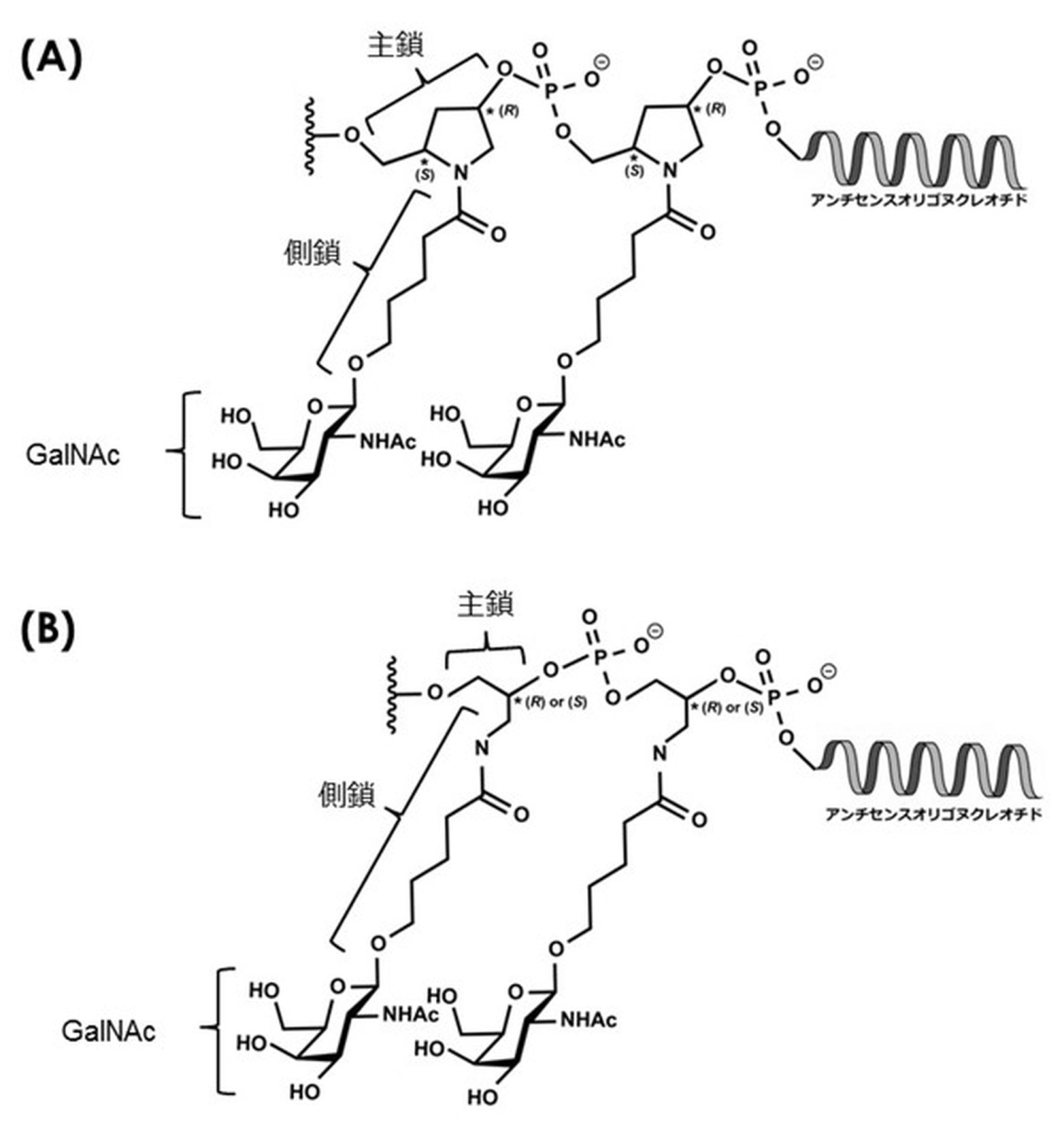
- the following is an example in which molecules capable of binding to the ASGP receptor are linked via a suitable linker.
- (A) is an example in which a molecule capable of binding to an ASGP receptor is bound to a main chain linker of a butylene chain via a side chain linker that forms a pyrrolidine ring with the main chain (hereinafter referred to as (A) structure)
- (B) is an example in which a molecule capable of binding to an ASGP receptor is bonded to the main chain linker of an ethylene chain via a side chain linker (hereinafter referred to as (B) structure).
- the present invention also includes those having a linker structure in which the (A) structure and the (B) structure are combined.
- a method for linking and binding two or more molecules capable of binding to the ASGP receptor to the oligonucleotide is described in known literature, for example, Yamamoto T et al., Bioorg Med Chem., 2016, 24, 26-32. Can be done according to the method.
- the oligonucleotide conjugate of the present invention may be subjected to known chemical modifications to the constituent nucleotides in addition to the above-described modification with a molecule capable of binding to the ASGP receptor.
- a molecule capable of binding to the ASGP receptor for example, a molecule that binds to a further ASGP receptor via a known linker as necessary, for example, to the 2′-position nitrogen atom of AmNA, the 2′-position nitrogen atom of BNA NC , and the 5′-position of uracil.
- modifications can alter the activity of the oligonucleotide, e.g.
- oligonucleotide Pharmacokinetics or tissue distribution can be altered.
- the position and number of these modifications are not particularly limited, and can be appropriately designed according to the purpose.
- the oligonucleotide conjugate of the present invention includes saccharides such as mannose, antibodies, aptamers, intercalators, reporters, in addition to modification with molecules that can bind to the 5'-terminal or 3'-terminal ASGP receptor.
- saccharides such as mannose, antibodies, aptamers, intercalators, reporters, in addition to modification with molecules that can bind to the 5'-terminal or 3'-terminal ASGP receptor.
- the above component may be further bound to the 5'-end or 3'-end of the oligonucleotide where a molecule capable of binding to the ASGP receptor is bound.
- the oligonucleotide conjugates of the invention can be any pharmaceutically acceptable salt, ester or salt of such ester, or a biologically active metabolite or residue thereof when administered to an animal, including humans ( It can be any other compound that can be provided (directly or indirectly).
- a pharmaceutically acceptable salt is a physiologically pharmaceutically acceptable salt of the oligonucleotide conjugates of the invention, i.e., retains the desired biological activity of the parent compound and imparts undesirable toxicological effects thereto. Says salt that is not applied.
- Preferred examples of pharmaceutically acceptable salts and their use for oligonucleotides are well known to those skilled in the art.
- Preferred specific examples of pharmaceutically acceptable salts for oligonucleotides include, but are not limited to, (a) salts formed with cations such as polyamines such as sodium, potassium, ammonium, magnesium, calcium, spermine and spermidine. (B) acid addition salts formed with inorganic acids such as hydrochloric acid, hydrobromic acid, sulfuric acid, phosphoric acid, nitric acid, etc.
- acetic acid oxalic acid, tartaric acid, succinic acid, maleic acid, fumaric acid, Organics such as gluconic acid, citric acid, malic acid, ascorbic acid, benzoic acid, tannic acid, palmitic acid, alginic acid, polyglutamic acid, naphthalenesulfonic acid, methanesulfonic acid, p-toluenesulfonic acid, naphthalenedisulfonic acid, polygalacturonic acid Salts formed with acids, and (d) negative effects of elements such as chlorine, bromine and iodine. Salts formed from the emissions and the like.
- the oligonucleotide conjugate of the present invention has the above-described configuration. Specifically, for example, it has a length of 14 bases, 2 nucleosides from the 5′-end and 2 from the 3′-end.
- the third and third nucleosides have a bridged artificial nucleoside having the cross-linked structure of Embodiment 1, and three N-terminal groups at the 5′-end with respect to an oligonucleotide having a phosphorothioate bond between each nucleoside.
- An embodiment in which acetylgalactosamine is linked and bonded in a straight chain is exemplified.
- bonds between the three N-acetylgalactosamines and between the oligonucleotide and N-acetylgalactosamine are phosphodiester bonds, and N-acetylgalactosamine may be phosphodiester-bonded via a linker.
- the oligonucleotide conjugate of the present invention is stably incorporated into target cells by having the above-described cross-linking structure and modification with a molecule capable of binding to the ASGP receptor, for example, mRNA and a stable double strand Can inhibit the biosynthesis of the pathogenic protein (antisense method), or can form a triple strand with the double-stranded DNA in the genome to inhibit transcription to mRNA. From these facts, the oligonucleotide conjugate of the present invention is expected to be useful as a pharmaceutical (antisense nucleic acid) for treating diseases by inhibiting the action of the PCSK9 gene.
- the oligonucleotide conjugate of the present invention has an effect as a therapeutic agent for dyslipidemia, for example.
- a drug containing the oligonucleotide conjugate of the present invention as an active ingredient is referred to as a pharmaceutical composition of the present invention.
- the pharmaceutical composition of the present invention can specifically inhibit PCSK9, and thus can be used as a prophylactic and therapeutic agent for diseases associated with high LDL cholesterol levels.
- diseases associated with high LDL cholesterol include hypercholesterolemia including familial hypercholesterolemia, which is included in dyslipidemia.
- diseases having a high risk for lowering LDL cholesterol such as a history of coronary artery disease, diabetes, chronic kidney disease, non-cardiogenic cerebral infarction, and peripheral artery disease can be mentioned.
- the pharmaceutical composition of the present invention is prepared by adding the pharmaceutical preparation of the oligonucleotide conjugate of the present invention to, for example, excipients, binders, preservatives, oxidation stabilizers, disintegrants, lubricants, and corrigents.
- Adjuvants commonly used in the technical field can be blended into a parenteral preparation or a liposome preparation.
- parenteral preparations include pulmonary dosage forms (for example, those using a nebulizer), nasal dosage forms, transdermal dosage forms (for example, ointments, creams), injection dosage forms, and the like.
- an injection dosage form it can be administered systemically or locally by intravenous injection such as infusion, intramuscular injection, intraperitoneal injection, subcutaneous injection or the like.
- intravenous injection such as infusion, intramuscular injection, intraperitoneal injection, subcutaneous injection or the like.
- injection dosage forms can be prepared as a liquid preparation or a lyophilized preparation dissolved at the time of use by blending a pharmaceutical carrier usually used in the art.
- the dosage of the pharmaceutical composition of the present invention varies depending on age, sex, symptoms, administration route, administration frequency, and dosage form.
- the administration method can be appropriately adjusted depending on the age and symptoms of the patient.
- the effective dose is exemplified by an amount such that the oligonucleotide conjugate of the present invention is 0.01 ⁇ g to 1000 mg, 0.1 ⁇ g to 100 ⁇ g, etc. per human per 50 kg body weight.
- the individual targeted by the pharmaceutical composition of the present invention is preferably a human in need of treatment for a disease associated with high LDL cholesterol, but may be a pet animal or the like.
- the diseases associated with high LDL cholesterol are as described above.
- this invention provides the following aspect as a further aspect.
- the specifications, preparation methods, etc. of the oligonucleotide conjugate of the present invention are as described in the section of the oligonucleotide conjugate of the present invention.
- a method for treating a disease associated with a high LDL cholesterol level comprising a step of administering the oligonucleotide conjugate of the present invention.
- II Use of the oligonucleotide conjugate of the present invention for the treatment of diseases associated with high LDL cholesterol levels
- III Use of the oligonucleotide conjugate of the present invention for use in the manufacture of a therapeutic agent for a disease associated with high LDL cholesterol
- Test example 1 Human hepatoma-derived cell line Huh-7 was seeded on a plate and cultured in DMEM (10% FBS, 1% penicillin, 1% streptomycin) for 24 hours, and the medium was CEM (DMEM-containing: 10% FBS, 1% Penicillin, 1% streptomycin, 9 mM CaCl 2 ) was replaced with a culture solution in which each antisense was added to 200 nM. After 24 hours, total RNA was extracted, cDNA was prepared, and the expression levels of PCSK9 mRNA and GAPDH mRNA were quantified using StepOnePlus (registered trademark) real-time PCR system (ABI) using the following probes. The relative expression level of was calculated.
- DMEM % FBS, 1% penicillin, 1% streptomycin
- FIG. 1 shows that the relative expression level of PCSK9 mRNA was less than 0.05, and it was found that those capable of suppressing PCSK9 gene expression by the CEM method can be efficiently selected.
- sequence where the effect was recognized is shown. It can be seen that those having an LNA cross-linked structure and those having an AmNA cross-linked structure have a small relative expression level of PCSK9 mRNA, and show similar activities with the same sequence regardless of the type of the cross-linked structure.
- Test example 2 Human hepatoma-derived cell line Huh-7 was seeded on a plate and cultured in DMEM (10% FBS, 1% penicillin, 1% streptomycin) for 24 hours, and the medium was CEM (DMEM-containing: 10% FBS, 1% Penicillin, 1% streptomycin, 9 mM CaCl 2 ) was replaced with a culture solution in which the antisense (having an AmNA cross-linked structure) selected by screening in Test Example 1 was added to a final concentration of 8 to 200 nM.
- DMEM fetal bovine serum
- CEM DMEM-containing: 10% FBS, 1% Penicillin, 1% streptomycin, 9 mM CaCl 2
- HsPCSK9-1811 (SEQ ID NO: 14) has high activity and is a sequence completely complementary to the rat and cynomolgus PCSK9 gene used in the drug efficacy and safety tests, and thus was used for the subsequent evaluation.
- Test example 3 Using hyperlipidemic cynomolgus monkeys, the efficacy of HsPCSK9-1811 (SEQ ID NO: 14) having an LNA cross-linked structure and an AmNA cross-linked structure was evaluated.
- the high level was maintained even 6 days before administration.
- the individuals that had been used were selected and used.
- Antisense nucleic acid was subcutaneously administered to these cynomolgus monkeys at 1 mg / kg at the start of the test (day 0), 3 mg / kg after 7 days, and 10 mg / kg after 14 days. Thereafter, when a large decrease in blood LDL cholesterol level was observed, the dose was reduced to 3 mg / kg after 42 days and 1 mg / kg after 61 days, followed by subsequent administration.
- the blood LDL cholesterol level is measured every 2 to 3 days with an automatic analyzer (JCA-BM6070, JEOL Ltd.) for up to 100 days, and the relative value to the value at the start of the test is calculated. Evaluation was performed.
- the PCSK9 concentration in the blood after administration of 10 mg / kg was measured using CircuitLex (registered trademark) Human PCSK9 ELISA Kit (Cyclex), and the evaluation was performed by calculating the relative value with the value at the time of administration of 10 mg / kg. went. The results are shown in FIGS.
- FIG. 3 when any antisense having a nucleic acid with a different cross-linked structure was administered, a decrease in blood LDL cholesterol level was observed, and when a substance having an LNA cross-linked structure was administered, 10 mg / kg was administered. A significant reduction in blood LDL cholesterol level for 28 days (about 60% reduction) was observed.
- FIG. 4 shows a decrease in PCSK9 concentration in blood, and is suggested to be due to the activity of the antisense nucleic acid.
- the recovery of blood LDL cholesterol level was observed by gradual administration, which demonstrates that the activity of antisense nucleic acid is demonstrated in hyperlipidemic cynomolgus monkeys, although the activity varies depending on the type of cross-linked structure. It was.
- Test example 4 Using cynomolgus monkeys, safety evaluation was carried out using HsPCSK9-1811 (SEQ ID NO: 14) having an LNA cross-linked structure.
- the general condition, body weight, food intake, water intake, urinalysis, hematology, blood biochemistry, autopsy, organ weight, and histopathological examination were observed and examined.
- the urinalysis was measured using an automatic analyzer (JCA-BM6070, JEOL Ltd.), and the blood biochemical test was measured using an automatic analyzer (JCA-BM6070, JEOL Ltd.). Representative results are shown in FIGS.
- the NOAEL of HsPCSK9-1811-LNA (14) is expected to be less than 10 mg / kg.
- the oligonucleotide alone showed side effects, particularly severe damage in the kidneys, and a safe remedy is necessary for safe treatment. It was considered.
- Test Example 5 A preliminary toxicity test was conducted using rats having an LNA cross-linked structure of HsPCSK9-1811 (SEQ ID NO: 14).
- rats (Crl: CD (SD), 6 weeks old, Japan Charles River, 5 males and 5 females / group), antisense nucleic acid at a dose of 10 mg / kg or 30 mg / kg per week.
- physiological saline was administered intermittently subcutaneously as in the antisense nucleic acid administration group.
- the general state, body weight, food intake, hematological examination, blood biochemical examination, autopsy, organ weight, and histopathological examination were observed and examined in the same manner as in Test Example 4. Representative results are shown in FIGS.
- the NOAEL of HsPCSK9-1811-LNA (14) is expected to be less than 10 mg / kg. Similar to the results of Test Example 4, the oligonucleotide alone showed side effects at a medicinal dose, particularly severe damage in the kidney, and it was considered that contrivance was necessary in terms of kinetics for safe treatment.
- Test Example 6 A monomeric GalNAc unit (GalNAc amidite) was nucleic acid by phosphoramidite method for HsPCSK9-1811 (SEQ ID NO: 14) having an LNA cross-linking structure in which renal damage was observed in Test Example 4 and Test Example 5. Three units were continuously introduced with an automatic synthesizer (OligoPilot10, GE Healthcare) to obtain an antisense nucleic acid GalNAc conjugate [HsPCSK9-1811-LNA (14) -GN (3)].
- FIG. 1 A schematic diagram of the antisense nucleic acid GalNAc conjugate in the case of 14 base length used here is shown in FIG.
- a hyperlipidemic cynomolgus monkey (purpose-bred, anti-B virus antibody negative, 3-4 years old, male) selected in the same manner as in Test Example 3 was added 0.3 mg / L of the antisense nucleic acid GalNAc conjugate.
- blood LDL cholesterol level is measured every 2 to 3 days with an automatic analyzer (JCA-BM6070, JEOL Ltd.) until 53 days, and the relative value to the value at the start of the test is calculated. Evaluation was performed. The results are shown in FIG.
- hyperlipidemic cynomolgus monkeys showed a significant decrease in blood LDL cholesterol levels at any dose, and the effective dose was 10-30 minutes compared to HsPCSK9-1811-LNA (14). It was shown that it became about 1 of.
- HsPCSK9-1811 (SEQ ID NO: 14) having an LNA cross-linked structure [HsPCSK9-1811-LNA (14)] and HsPCSK9-1811 (SEQ ID NO: 14) having an LNA cross-linked structure and having a GalNAc modification [HsPCSK9-
- 1811-LNA (14) -GN (3) 6 weeks old male Crl: CD (SD) rats (5 / group) were subcutaneously administered for 2 weeks.
- HsPCSK9-1811-LNA (14) -GN (3) has a dose of 0.3 mg / kg as the effective dose from Test Example 6, and 10 mg of that dose is 3 mg / kg as a high dose and an intermediate dose of 1 mg / kg.
- HsPCSK9-1811-LNA (14) was set at 30 mg / kg at which renal damage was observed in Test Examples 4 and 5, and was administered once a week for 2 weeks (2 times in total), respectively.
- physiological saline was administered subcutaneously in the same manner as the test substance.
- Blood biochemical tests were performed with an automatic analyzer (JCA-BM6070, JEOL Ltd.) and urinary renal injury molecule (Kim-1) was measured with Bio-Plex 200 (Bio-Rad). Representative results are shown in FIGS.
- HsPCSK9-1811-LNA 14
- enlargement of the kidney accompanying increase in kidney weight (FIG. 13), and increase in blood creatinine concentration (FIG. 16) were observed.
- an increase in urine volume FIG. 14
- an increase in the concentration of urinary kidneykidinjury molecule 1 Kim-1
- the above change and increase in value were not confirmed.
- HsPCSK9-1811-LNA (14) showed degeneration, necrosis and regeneration, tubule dilatation, and mononuclear cell infiltration into the glass column and stroma in the renal tubular epithelium. HsPCSK9-1811-LNA (14) -GN (3) did not show such changes in any dose group.
- Test Example 8 In order to verify the influence of the structure of the main-chain linker that binds GalNAc on the activity of the antisense nucleic acid in the liver, an antisense nucleic acid GalNAc conjugate having the above-mentioned linker (A) or (B) is prepared.
- the respective conjugates are referred to as AI form and BI form).
- Saline (saline) or antisense nucleic acid GalNAc conjugate was administered subcutaneously at a dose of 17.5 nmol / kg to 8-week-old male wild-type mice (Japan SLC). Three days after administration, the liver was excised and the target gene expression level was quantified by a real-time PCR system (ABI). The specific binding structure of GalNAc is shown below.
- the BI form having a high degree of freedom in the main chain structure showed a higher gene expression suppressing effect. This suggests that in order to maximize the activity of antisense nucleic acid in hepatocytes, it is important to design a linker with a high degree of structural freedom that is considered to be susceptible to metabolism in cells.
- HsPCSK9-1811-LNA (14) -GN (3) is effective at a low dose of 0.3-1 mg / kg once a few weeks and can be safely treated. Conceivable.
- kidney damage which is the main side effect of drugs based on antisense oligonucleotides, (1) selection of in ⁇ vivo highly active antisense oligonucleotides by CEM, and (2) antisense oligonucleotides. GalNAc conjugates to nucleotides have been shown to be effective.
- the present invention can be used in the field of pharmaceuticals, particularly in the field of development and manufacture of therapeutic agents for diseases associated with high LDL cholesterol levels.
Landscapes
- Health & Medical Sciences (AREA)
- Life Sciences & Earth Sciences (AREA)
- Engineering & Computer Science (AREA)
- Chemical & Material Sciences (AREA)
- Genetics & Genomics (AREA)
- Bioinformatics & Cheminformatics (AREA)
- Organic Chemistry (AREA)
- General Health & Medical Sciences (AREA)
- Molecular Biology (AREA)
- Biomedical Technology (AREA)
- Zoology (AREA)
- Veterinary Medicine (AREA)
- Public Health (AREA)
- Wood Science & Technology (AREA)
- General Engineering & Computer Science (AREA)
- Animal Behavior & Ethology (AREA)
- Pharmacology & Pharmacy (AREA)
- Biotechnology (AREA)
- Medicinal Chemistry (AREA)
- Biochemistry (AREA)
- Epidemiology (AREA)
- Obesity (AREA)
- Microbiology (AREA)
- Nuclear Medicine, Radiotherapy & Molecular Imaging (AREA)
- Physics & Mathematics (AREA)
- Biophysics (AREA)
- General Chemical & Material Sciences (AREA)
- Plant Pathology (AREA)
- Virology (AREA)
- Chemical Kinetics & Catalysis (AREA)
- Hematology (AREA)
- Diabetes (AREA)
- Pharmaceuticals Containing Other Organic And Inorganic Compounds (AREA)
- Medicinal Preparation (AREA)
- Medicines That Contain Protein Lipid Enzymes And Other Medicines (AREA)
- Saccharide Compounds (AREA)
Abstract
4'位と2'位との間に架橋構造を有する架橋型人工ヌクレオシドを含み、ヒトPCSK9遺伝子と相補的であり、該ヒトPCSK9遺伝子の発現を抑制する活性を有するオリゴヌクレオチドに、アシアロ糖蛋白質受容体に結合し得る分子が直鎖状に2個以上連結して結合してなる、オリゴヌクレオチドコンジュゲート体。本発明のオリゴヌクレオチドコンジュゲート体は、医薬品の分野、特にLDLコレステロールの高値が関連する疾患の治療剤の開発及び製造の分野において利用可能である。
Description
本発明は、PCSK9を標的としたアンチセンス核酸及びそれを含有する医薬組成物に関する。
家族性高コレステロール血症(FH)は、高LDL-C血症により若年齢より動脈硬化が進行し、高頻度に心筋梗塞などの動脈硬化性疾患を発症する。FHの治療としては、スタチン等の脂質低下薬を用いてLDL-Cをコントロールする治療が挙げられる。
スタチンは、コレステロール合成を阻害してLDL受容体の活性を上昇させ、LDL-C値を低下させるが、LDL受容体の分解活性を持つPCSK9の発現を上昇させる。そのため、FHなどの重症高コレステロール血症では、標準治療とされているスタチンやエゼチミブを用いても薬効が十分ではなく、動脈硬化の進行を抑えることができず、心血管イベントを何度も引き起こす例が少なくない。このような薬剤のみでは十分に治療できないFHや重症高コレステロール血症などの患者に対しては、LDLアフェレシスと呼ばれる治療が実施されているが、これは患者に対する身体的・時間的・肉体的負担が非常に大きいことが問題となっている。
一方、PCSK9機能喪失型変異を持つ患者においては、LDL-C値が低く、冠動脈疾患の罹患率が健常人に比べて88%低いことが知られている(非特許文献1参照)。よって、PCSK9が脂質異常症の好適な標的分子であると考えられる。しかしながら、PCSK9は活性中心を持たないため、低分子化合物による阻害薬の開発は困難である。従って、PCSK9自体に作用する薬剤よりも、PCSK9の合成を阻害する新たな素材としてアンチセンス核酸について各種検討が行われている。
例えば、特許文献1には、ヒトPCSK9遺伝子に対応する10~30個程度の長さを有する特定のアンチセンスオリゴヌクレオチドが、PCSK9の発現を抑制させることが開示されている。前記アンチセンスオリゴヌクレオチドは、蛋白質、脂肪酸鎖、糖鎖などの他に、抗生物質などの薬物とも結合させてコンジュゲートとして用いることができる。
また、特許文献2には、10~22個の長さを有する特定のアンチセンスオリゴヌクレオチドが、PCSK9の活性を阻害して、かつ、腎毒性も低いことが開示されている。また、前記アンチセンスオリゴヌクレオチドとしては、コレステロール等のステロール類やN-アセチルガラクトサミン(GalNAc)等の炭水化物とコンジュゲートを形成させた例が開示されているが、3個のGalNAcをそれぞれ独立させて結合させることが肝臓への結合親和性の観点から好ましいと記載されている。
Cohen J C, et al., N Engl J Med 2006, 354, 1264-1272.
しかしながら、アンチセンス核酸は配列によって高次構造や複合体を形成する可能性があり、それが体内動態や薬効にも影響を与えるため、アンチセンス核酸の生体内活性を向上させるためには動態特性も考慮する必要がある。
また、アンチセンス核酸は医薬品として有効な素材である一方、活性及び標的組織特異性が低い場合に予期せぬ副作用が生じることが判明した。実際に、PCSK9阻害薬として開発が進められていたアンチセンス核酸SPC5001は、健常人を対象とした第一相試験において、標的組織ではない腎臓への障害を理由に開発中止となっている(van Poelgeest E P, et al., Am J Kidney Dis 2013, 62, 796-800、van Poelgeest E P, et al., Br J Clin Pharmacol 2015, 80, 1350-1361参照)。よって、PCSK9を標的としたアンチセンス核酸の臨床応用化にあたり、標的組織特異性に関して改善が必要である。
本発明は、毒性が低く、in vivoで有効なPCSK9を標的としたアンチセンス核酸及びそれを含有する医薬組成物を提供するものである。
アンチセンス核酸は一般的に、リポフェクタミンをはじめとするカチオン性脂質をベースとする試薬により細胞へと導入(リポフェクション)され、mRNA減少率からその活性が評価される。しかしながら、この方法では、試薬とアンチセンス核酸との複合体形成効率が配列によって異なったり、アンチセンス核酸の配列固有の動態特性を無効化してしまったりすることで、アンチセンス核酸の正確な活性を評価できない。
そこで、発明者らは鋭意検討した結果、生体内安定性に優れるよう設計した核酸配列の中から、Ca2+ enrichment of medium(CEM)法を用いてPCSK9遺伝子との結合親和性に優れるものを選択し、それに特定の糖修飾を行って得られたPCSK9のアンチセンス核酸は、毒性が軽減され、かつ、in vivoでも有効なことを見出し、本発明を完成するに至った。
即ち、本発明は、下記〔1〕~〔12〕に関する。
〔1〕 4’位と2’位との間に架橋構造を有する架橋型人工ヌクレオシドを含み、ヒトPCSK9遺伝子と相補的であり、該ヒトPCSK9遺伝子の発現を抑制する活性を有するオリゴヌクレオチドに、アシアロ糖蛋白質受容体に結合し得る分子が直鎖状に2個以上連結して結合してなる、オリゴヌクレオチドコンジュゲート体。
〔2〕 架橋構造が下記(i)~(iv)から選ばれる、前記〔1〕記載のオリゴヌクレオチドコンジュゲート体。
(i) -CH2-O-又は-(CH2)2-O-で表される構造
(ii) -CH2-NR1-O-又は-(CH2)2-NR1-O-で表される構造
(iii) -CO-NR1-、-CH2-CO-NR1-、-(CH2)2-CO-NR1-、-CO-NR1-X-又は-CH2-CO-NR1-X-で表される構造
(iv) -CH2-NR1-又は-(CH2)2-NR1-で表される構造
(ここで、R1は、水素原子;
分岐又は環を形成していてもよい炭素数1から7のアルキル基;
分岐又は環を形成していてもよい炭素数2から7のアルケニル基;
水酸基、炭素数1から6の直鎖アルキル基、炭素数1から6の直鎖アルコキシ基、メルカプト基、炭素数1から6の直鎖アルキルチオ基、アミノ基、炭素数1から6の直鎖アルキルアミノ基及びハロゲン原子からなるα群から選択される任意の置換基を1以上有していてもよく、かつ、ヘテロ原子を含んでいてもよい炭素数3から12のアリール基;あるいは
該α群から選択される任意の置換基を1以上有していてもよく、かつ、ヘテロ原子を含んでいてもよい炭素数3から12のアリール部分を有するアルキル基を表し、
Xは、酸素原子、硫黄原子、アミノ基又はメチレン基を表す)
〔3〕 ヒトPCSK9遺伝子が、以下の塩基配列:
配列番号3で示される塩基配列;配列番号4で示される塩基配列;配列番号5で示される塩基配列;配列番号6で示される塩基配列;配列番号7で示される塩基配列;配列番号8で示される塩基配列;配列番号9で示される塩基配列;配列番号10で示される塩基配列;配列番号11で示される塩基配列;配列番号12で示される塩基配列;配列番号13で示される塩基配列;配列番号14で示される塩基配列
又はこれらに相補的な塩基配列のいずれかを含む塩基配列からなる領域である、前記〔1〕又は〔2〕記載のオリゴヌクレオチドコンジュゲート体。
〔4〕 ヌクレオシド間の1又は2以上の結合がホスホロチオエート結合である、前記〔1〕~〔3〕いずれか記載のオリゴヌクレオチドコンジュゲート体。
〔5〕 アシアロ糖蛋白質受容体に結合し得る分子同士の間及びオリゴヌクレオチドとアシアロ糖蛋白質受容体に結合し得る分子との間から選ばれる1又は2以上の結合がホスホジエステル結合である、前記〔1〕~〔4〕いずれか記載のオリゴヌクレオチドコンジュゲート体。
〔6〕 オリゴヌクレオチドとアシアロ糖蛋白質受容体に結合し得る分子との間の結合が下記から選ばれるリンカーを介した結合である、前記〔1〕~〔5〕いずれか記載のオリゴヌクレオチドコンジュゲート体。
〔1〕 4’位と2’位との間に架橋構造を有する架橋型人工ヌクレオシドを含み、ヒトPCSK9遺伝子と相補的であり、該ヒトPCSK9遺伝子の発現を抑制する活性を有するオリゴヌクレオチドに、アシアロ糖蛋白質受容体に結合し得る分子が直鎖状に2個以上連結して結合してなる、オリゴヌクレオチドコンジュゲート体。
〔2〕 架橋構造が下記(i)~(iv)から選ばれる、前記〔1〕記載のオリゴヌクレオチドコンジュゲート体。
(i) -CH2-O-又は-(CH2)2-O-で表される構造
(ii) -CH2-NR1-O-又は-(CH2)2-NR1-O-で表される構造
(iii) -CO-NR1-、-CH2-CO-NR1-、-(CH2)2-CO-NR1-、-CO-NR1-X-又は-CH2-CO-NR1-X-で表される構造
(iv) -CH2-NR1-又は-(CH2)2-NR1-で表される構造
(ここで、R1は、水素原子;
分岐又は環を形成していてもよい炭素数1から7のアルキル基;
分岐又は環を形成していてもよい炭素数2から7のアルケニル基;
水酸基、炭素数1から6の直鎖アルキル基、炭素数1から6の直鎖アルコキシ基、メルカプト基、炭素数1から6の直鎖アルキルチオ基、アミノ基、炭素数1から6の直鎖アルキルアミノ基及びハロゲン原子からなるα群から選択される任意の置換基を1以上有していてもよく、かつ、ヘテロ原子を含んでいてもよい炭素数3から12のアリール基;あるいは
該α群から選択される任意の置換基を1以上有していてもよく、かつ、ヘテロ原子を含んでいてもよい炭素数3から12のアリール部分を有するアルキル基を表し、
Xは、酸素原子、硫黄原子、アミノ基又はメチレン基を表す)
〔3〕 ヒトPCSK9遺伝子が、以下の塩基配列:
配列番号3で示される塩基配列;配列番号4で示される塩基配列;配列番号5で示される塩基配列;配列番号6で示される塩基配列;配列番号7で示される塩基配列;配列番号8で示される塩基配列;配列番号9で示される塩基配列;配列番号10で示される塩基配列;配列番号11で示される塩基配列;配列番号12で示される塩基配列;配列番号13で示される塩基配列;配列番号14で示される塩基配列
又はこれらに相補的な塩基配列のいずれかを含む塩基配列からなる領域である、前記〔1〕又は〔2〕記載のオリゴヌクレオチドコンジュゲート体。
〔4〕 ヌクレオシド間の1又は2以上の結合がホスホロチオエート結合である、前記〔1〕~〔3〕いずれか記載のオリゴヌクレオチドコンジュゲート体。
〔5〕 アシアロ糖蛋白質受容体に結合し得る分子同士の間及びオリゴヌクレオチドとアシアロ糖蛋白質受容体に結合し得る分子との間から選ばれる1又は2以上の結合がホスホジエステル結合である、前記〔1〕~〔4〕いずれか記載のオリゴヌクレオチドコンジュゲート体。
〔6〕 オリゴヌクレオチドとアシアロ糖蛋白質受容体に結合し得る分子との間の結合が下記から選ばれるリンカーを介した結合である、前記〔1〕~〔5〕いずれか記載のオリゴヌクレオチドコンジュゲート体。
〔7〕 アシアロ糖蛋白質受容体に結合し得る分子の連結個数が2~5である、前記〔1〕~〔6〕いずれか記載のオリゴヌクレオチドコンジュゲート体。
〔8〕 アシアロ糖蛋白質受容体に結合し得る分子が、ラクトース、ガラクトース、N-アセチルガラクトサミン(GalNAc)、ガラクトサミン、N-ホルミルガラクトサミン、N-プロピオニルガラクトサミン、N-n-ブタノイルガラクトサミン、N-イソ-ブタノイルガラクトサミン及びそれらの誘導体からなる群より選ばれる1種又は2種以上である、前記〔1〕~〔7〕いずれか記載のオリゴヌクレオチドコンジュゲート体。
〔9〕 オリゴヌクレオチドの塩基配列の長さが10~25塩基である、前記〔1〕~〔8〕いずれか記載のオリゴヌクレオチドコンジュゲート体。
〔10〕 前記〔1〕~〔9〕いずれか記載のオリゴヌクレオチドコンジュゲート体を有効成分として含有する、LDLコレステロールの高値が関連する疾患の予防又は治療剤。
〔11〕 LDLコレステロールの高値が関連する疾患が、高コレステロール血症及びLDLコレステロールの低下がより必要である高いリスクを有する疾患から選ばれる、前記〔10〕記載の予防又は治療剤。
〔12〕 注射剤である、前記〔10〕又は〔11〕記載の予防又は治療剤。
〔8〕 アシアロ糖蛋白質受容体に結合し得る分子が、ラクトース、ガラクトース、N-アセチルガラクトサミン(GalNAc)、ガラクトサミン、N-ホルミルガラクトサミン、N-プロピオニルガラクトサミン、N-n-ブタノイルガラクトサミン、N-イソ-ブタノイルガラクトサミン及びそれらの誘導体からなる群より選ばれる1種又は2種以上である、前記〔1〕~〔7〕いずれか記載のオリゴヌクレオチドコンジュゲート体。
〔9〕 オリゴヌクレオチドの塩基配列の長さが10~25塩基である、前記〔1〕~〔8〕いずれか記載のオリゴヌクレオチドコンジュゲート体。
〔10〕 前記〔1〕~〔9〕いずれか記載のオリゴヌクレオチドコンジュゲート体を有効成分として含有する、LDLコレステロールの高値が関連する疾患の予防又は治療剤。
〔11〕 LDLコレステロールの高値が関連する疾患が、高コレステロール血症及びLDLコレステロールの低下がより必要である高いリスクを有する疾患から選ばれる、前記〔10〕記載の予防又は治療剤。
〔12〕 注射剤である、前記〔10〕又は〔11〕記載の予防又は治療剤。
本発明のアンチセンス核酸は、in vivoでもPCSK9の発現抑制が認められ、かつ、毒性発現も少ないという優れた効果を奏するものであり、ひいては、LDLコレステロールの高値が関連する疾患の治療剤として有用なものを提供することができる。
本発明のアンチセンス核酸は、4’位と2’位との間に架橋構造を有する架橋型人工ヌクレオシドを含み、ヒトPCSK9遺伝子と相補的であり、該ヒトPCSK9遺伝子の発現を抑制する活性を有するオリゴヌクレオチドに、アシアロ糖蛋白質受容体に結合し得る分子が直鎖状に2個以上連結して結合していることに特徴を有する。以下、前記特徴を有するアンチセンス核酸のことを、本発明のオリゴヌクレオチドコンジュゲート体又はオリゴヌクレオチドコンジュゲートと記載することもある。
従来、核酸をアシアロ糖蛋白質(ASGP)受容体に結合し得る分子で修飾することにより肝臓への特異的送達が試みられているが、これは、例えば、N-アセチルガラクトサミン(GalNAc)の場合、3個のGalNAcが特定の空間位置関係を保ちながら肝実質細胞表面のASGP受容体に結合することを利用するものである。従って、核酸には各GalNAcが特定の空間を形成するよう独立して同じ位置に結合するものである。しかしながら、本願発明では、ASGP受容体に結合し得る分子が直鎖状に連結した状態で核酸に結合した場合でも、肝実質細胞への取り込みが十分に行われ、かつ、in vivoにおいても良好な作用を奏することが判明した。その詳細なメカニズムは不明なるも、ASGP受容体に結合し得る分子が直鎖状に連結することで、該ASGP受容体に結合し得る分子とオリゴヌクレオチドとの間のリンカー構造の自由度が高く、また、連結したそれぞれのASGP受容体に結合し得る分子がASGP受容体の空間的に有利な配置に柔軟に収まることができ、なおかつ、オリゴヌクレオチド活性の発現に有利な代謝様式を併せ持つためと推定される。これにより、標的細胞への取り込み効率が向上し、また、生体内での安定性にも優れることから、ひいては、標的遺伝子であるヒトPCSK9遺伝子の発現をより抑制することができると考えられる。ただし、前記メカニズムの推測は、本発明を限定するものではない。
まず、本明細書中で用いられる用語を定義する。
本明細書において、用語「炭素数1から6の直鎖アルキル基」は、通常は、炭素数1~6の任意の直鎖アルキル基をいい、具体的には、メチル基、エチル基、n-プロピル基、n-ブチル基、n-ペンチル基、n-ヘキシル基などが挙げられる。
本明細書において、用語「炭素数1から6の直鎖アルコキシ基」は、通常は、炭素数1~6の任意の直鎖アルキル基を有するアルコキシ基を包含する。例えば、メチルオキシ基、エチルオキシ基、n-プロピルオキシ基などが挙げられる。
本明細書において、用語「炭素数1から6の直鎖アルキルチオ基」は、通常は、炭素数1~6の任意の直鎖アルキル基を有するアルキルチオ基を包含する。例えば、メチルチオ基、エチルチオ基、n-プロピルチオ基などが挙げられる。
本明細書において、用語「炭素数1から6の直鎖アルキルアミノ基」は、通常は、炭素数1~6の任意の直鎖アルキル基を1つ又は2つ有するアルキルアミノ基を包含する。例えば、メチルアミノ基、ジメチルアミノ基、エチルアミノ基、メチルエチルアミノ基、ジエチルアミノ基などが挙げられる。
本明細書において、用語「分岐又は環を形成していてもよい炭素数1から7のアルキル基」は、通常は、炭素数1~7の任意の直鎖アルキル基、炭素数3~7の任意の分岐鎖アルキル基及び炭素数3~7の任意の環状アルキル基を包含する。これらをまとめて、単に「低級アルキル基」という場合もある。例えば、炭素数1~7の任意の直鎖アルキル基としては、メチル基、エチル基、n-プロピル基、n-ブチル基、n-ペンチル基、n-ヘキシル基、n-ヘプチル基が挙げられる。炭素数3~7の任意の分岐鎖アルキル基としては、イソプロピル基、イソブチル基、tert-ブチル基、イソペンチル基などが挙げられる。炭素数3~7の任意の環状アルキル基としては、シクロブチル基、シクロペンチル基、シクロヘキシル基などが挙げられる。
本明細書において、用語「分岐又は環を形成していてもよい炭素数2から7のアルケニル基」は、通常は、炭素数2~7の任意の直鎖アルケニル基、炭素数3~7の任意の分岐鎖アルケニル基及び炭素数3~7の任意の環状アルケニル基を包含する。これらをまとめて、単に「低級アルケニル基」という場合もある。例えば、炭素数2~7の任意の直鎖アルケニル基としては、エテニル基、1-プロペニル基、2-プロペニル基、1-ブテニル基、2-ブテニル基、1-ペンテニル基、2-ペンテニル基、3-ペンテニル基、4-ペンテニル基、1-ヘキセニル基などが挙げられる。炭素数3~7の任意の分岐鎖アルケニル基としては、イソプロペニル基、1-メチル-1-プロペニル基、1-メチル-2-プロペニル基、2-メチル-1-プロペニル基、2-メチル-2-プロペニル基、1-メチル-2-ブテニル基などが挙げられる。炭素数3~7の任意の環状アルケニル基としては、シクロブテニル基、シクロペンテニル基、シクロヘキセニル基などが挙げられる。
本明細書において、用語「ヘテロ原子を含んでいてもよい炭素数3から12のアリール基」は、通常は、炭化水素のみで構成された炭素数6~12の任意の芳香族炭化水素及び環構造にヘテロ原子(窒素原子、酸素原子、硫黄原子)を含む炭素数3~12の任意の複素芳香族化合物を包含する。炭化水素のみで構成された炭素数6~12の芳香族炭化水素としては、フェニル基、ナフチル基、インデニル基、アズレニル基などが挙げられる。環構造にヘテロ原子を含む炭素数3~12の任意の複素芳香族化合物としては、ピリジル基、ピロリル基、キノリル基、インドリル基、イミダゾリル基、フリル基、チエニル基などが挙げられる。
本明細書において、用語「ヘテロ原子を含んでいてもよい炭素数3から12のアリール部分を有するアルキル基」の例としては、ベンジル基、フェネチル基、ナフチルメチル基、3-フェニルプロピル基、2-フェニルプロピル基、4-フェニルブチル基、2-フェニルブチル基、ピリジルメチル基、インドリルメチル基、フリルメチル基、チエニルメチル基、ピロリルメチル基、2-ピリジルエチル基、1-ピリジルエチル基、3-チエニルプロピル基などが挙げられる。前記官能基の合計炭素数としては、特に限定はないが、4から18の範囲内であればよい。
本明細書において、用語「ハロゲン原子」としては、例えば、フッ素原子、塩素原子、臭素原子又はヨウ素原子が挙げられる。好適には、フッ素原子又は塩素原子である。
本明細書において、用語「ヌクレオシド」とは、通常は、核酸塩基及び糖を含むグリコシルアミンをいう。ヌクレオシドとしては、天然に存在するヌクレオシド、無塩基ヌクレオシド、修飾ヌクレオシド、ならびに、擬似塩基及び/又は糖基を有するヌクレオシドが挙げられるがこれらに限定されない。
本明細書において、用語「ヌクレオチド」とは、通常は、核酸塩基と、糖にリン酸基が共有結合された糖とを含むグリコソミン(glycosomine)をいう。ヌクレオチドは、任意の種々の置換基で修飾され得る。
本明細書において、用語「デオキシリボヌクレオチド」は、通常は、ヌクレオチドの糖部分の2’位に水素を有するヌクレオチドをいう。デオキシリボヌクレオチドは任意の種々の置換基で修飾され得る。
本明細書において、用語「デオキシリボ核酸(DNA)」は、通常は、デオキシリボヌクレオチドを含む核酸をいう。
本明細書において、用語「リボヌクレオチド」は、通常は、ヌクレオチドの糖部分の2’位にヒドロキシを有するヌクレオチドをいう。リボヌクレオチドは、任意の種々の置換基で修飾され得る。
本明細書において、用語「リボ核酸(RNA)」は、通常は、リボヌクレオチドを含む核酸をいう。
本明細書において、用語「修飾ヌクレオシド」とは、通常は、プリン塩基又はピリミジン塩基と糖とが結合した「ヌクレオシド」のうち非天然型のもの、ならびに、プリン塩基とピリミジン塩基以外の芳香族複素環及び芳香族炭化水素環でプリン塩基又はピリミジン塩基との代用が可能なものと糖が結合したものをいう。好適には、糖部分が修飾された糖修飾ヌクレオシドが挙げられる。
本明細書において、用語「オリゴヌクレオチド」とは、同一又は異なる「ヌクレオシド」がリン酸ジエステル結合又はそれ以外のヌクレオシド間結合で2~50個結合した「オリゴヌクレオチド」をいう。「オリゴヌクレオチド」の非天然型誘導体も含む。そのような誘導体としては、好適には、糖部分が修飾された糖誘導体;リン酸ジエステル部分がチオエート化されたチオエート誘導体;リン酸ジエステル結合中のリン酸基の酸素原子が硫黄原子で置換されたホスホロチオエート誘導体;末端のリン酸部分がエステル化されたエステル体;プリン塩基上のアミノ基がアミド化されたアミド体が挙げられる。オリゴヌクレオチドというとき、特に記載した場合を除き、一本鎖のDNA又はRNA、二本鎖のDNA又はRNAを含む。好適には、天然型又は非天然型の、一本鎖のアンチセンスオリゴヌクレオチドである。オリゴヌクレオチドはまた、特に記載した場合を除き、医薬として許容される塩の形態であるものを含む。
次に、本発明について詳述する。
本発明のオリゴヌクレオチドコンジュゲート体を構成するオリゴヌクレオチドは、4’位と2’位との間に架橋構造を有する架橋型人工ヌクレオシドを含む。架橋構造を有することにより、各種核酸分解酵素(ヌクレアーゼ)により分解されにくく、生体への投与後、長時間生体内に存在することができるという効果が奏される。
架橋構造の1つとしては、-CH2-O-又は-(CH2)2-O-で表される構造が挙げられる。このような架橋構造を以下、態様1の架橋構造(BNA)という場合がある。
態様1の架橋構造としては、例えば、α-L-メチレンオキシ(4’-CH2-O-2’、「LNA」と記載することもある)、β-D-メチレンオキシ(4’-CH2-O-2’)、エチレンオキシ(4’-(CH2)2-O-2’)が挙げられるが、これらに限定されない。BNAヌクレオシド(モノマー)又はこれを含むオリゴヌクレオチドは、公知文献、例えば、WO2011/052436号公報に記載の方法により合成することができる。
上記以外の架橋構造としては、-CH2-NR1-O-又は-(CH2)2-NR1-O-で表される構造が挙げられる。ここで、R1は、
水素原子;
分岐又は環を形成していてもよい炭素数1から7のアルキル基;
分岐又は環を形成していてもよい炭素数2から7のアルケニル基;
水酸基、炭素数1から6の直鎖アルキル基、炭素数1から6の直鎖アルコキシ基、メルカプト基、炭素数1から6の直鎖アルキルチオ基、アミノ基、炭素数1から6の直鎖アルキルアミノ基及びハロゲン原子からなるα群から選択される任意の置換基を1以上有していてもよく、かつ、ヘテロ原子を含んでいてもよい炭素数3から12のアリール基;あるいは
該α群から選択される任意の置換基を1以上有していてもよく、かつ、ヘテロ原子を含んでいてもよい炭素数3から12のアリール部分を有するアルキル基
を表す。このような架橋構造を以下、態様2の架橋構造(BNANC)という場合がある。
水素原子;
分岐又は環を形成していてもよい炭素数1から7のアルキル基;
分岐又は環を形成していてもよい炭素数2から7のアルケニル基;
水酸基、炭素数1から6の直鎖アルキル基、炭素数1から6の直鎖アルコキシ基、メルカプト基、炭素数1から6の直鎖アルキルチオ基、アミノ基、炭素数1から6の直鎖アルキルアミノ基及びハロゲン原子からなるα群から選択される任意の置換基を1以上有していてもよく、かつ、ヘテロ原子を含んでいてもよい炭素数3から12のアリール基;あるいは
該α群から選択される任意の置換基を1以上有していてもよく、かつ、ヘテロ原子を含んでいてもよい炭素数3から12のアリール部分を有するアルキル基
を表す。このような架橋構造を以下、態様2の架橋構造(BNANC)という場合がある。
態様2の架橋構造としては、例えば、オキシアミノ(4’-CH2-NH-O-2’)、N-メチルオキシアミノ(4’-CH2-NCH3-O-2’)が挙げられるが、これらに限定されない。BNANCヌクレオシド(モノマー)又はこれを含むオリゴヌクレオチドは、公知文献、例えば、WO2011/052436号公報に記載の方法により合成することができる。
また、別の架橋構造としては、-CO-NR1-、-CH2-CO-NR1-、-(CH2)2-CO-NR1-、-CO-NR1-X-又は-CH2-CO-NR1-X-で表される構造が挙げられる。ここで、R1は、
水素原子;
分岐又は環を形成していてもよい炭素数1から7のアルキル基;
分岐又は環を形成していてもよい炭素数2から7のアルケニル基;
水酸基、炭素数1から6の直鎖アルキル基、炭素数1から6の直鎖アルコキシ基、メルカプト基、炭素数1から6の直鎖アルキルチオ基、アミノ基、炭素数1から6の直鎖アルキルアミノ基及びハロゲン原子からなるα群から選択される任意の置換基を1以上有していてもよく、かつ、ヘテロ原子を含んでいてもよい炭素数3から12のアリール基;あるいは
該α群から選択される任意の置換基を1以上有していてもよく、かつ、ヘテロ原子を含んでいてもよい炭素数3から12のアリール部分を有するアルキル基を表し、
Xは、酸素原子、硫黄原子、アミノ基又はメチレン基
を表す。このような架橋構造を以下、態様3の架橋構造(AmNA)という場合がある。
水素原子;
分岐又は環を形成していてもよい炭素数1から7のアルキル基;
分岐又は環を形成していてもよい炭素数2から7のアルケニル基;
水酸基、炭素数1から6の直鎖アルキル基、炭素数1から6の直鎖アルコキシ基、メルカプト基、炭素数1から6の直鎖アルキルチオ基、アミノ基、炭素数1から6の直鎖アルキルアミノ基及びハロゲン原子からなるα群から選択される任意の置換基を1以上有していてもよく、かつ、ヘテロ原子を含んでいてもよい炭素数3から12のアリール基;あるいは
該α群から選択される任意の置換基を1以上有していてもよく、かつ、ヘテロ原子を含んでいてもよい炭素数3から12のアリール部分を有するアルキル基を表し、
Xは、酸素原子、硫黄原子、アミノ基又はメチレン基
を表す。このような架橋構造を以下、態様3の架橋構造(AmNA)という場合がある。
態様3の架橋構造としては、例えば、無置換アミド(4’-CO-NH-2’)、N-メチルアミド(4’-CO-NCH3-2’)、アセトアミド(4’-CH2-CO-NH-2’)、N-メチルアセトアミド(4’-CH2-CO-NCH3-2’)、N-オキシアセトアミド(4’-CH2-CO-NH-O-2’)、N-メチル-N-オキシアセトアミド(4’-CH2-CO-NCH3-O-2’)が挙げられるが、これらに限定されない。AmNAヌクレオシド(モノマー)又はこれを含むオリゴヌクレオチドは、公知文献、例えば、WO2012/029870号公報に記載の方法により合成することができる。
また、別の架橋構造としては、-CH2-NR1-又は-(CH2)2-NR1-で表される構造が挙げられる。ここで、R1は、
水素原子;
分岐又は環を形成していてもよい炭素数1から7のアルキル基;
分岐又は環を形成していてもよい炭素数2から7のアルケニル基;
水酸基、炭素数1から6の直鎖アルキル基、炭素数1から6の直鎖アルコキシ基、メルカプト基、炭素数1から6の直鎖アルキルチオ基、アミノ基、炭素数1から6の直鎖アルキルアミノ基及びハロゲン原子からなるα群から選択される任意の置換基を1以上有していてもよく、かつ、ヘテロ原子を含んでいてもよい炭素数3から12のアリール基;あるいは
該α群から選択される任意の置換基を1以上有していてもよく、かつ、ヘテロ原子を含んでいてもよい炭素数3から12のアリール部分を有するアルキル基
を表す。このような架橋構造を以下、態様4の架橋構造という場合がある。
水素原子;
分岐又は環を形成していてもよい炭素数1から7のアルキル基;
分岐又は環を形成していてもよい炭素数2から7のアルケニル基;
水酸基、炭素数1から6の直鎖アルキル基、炭素数1から6の直鎖アルコキシ基、メルカプト基、炭素数1から6の直鎖アルキルチオ基、アミノ基、炭素数1から6の直鎖アルキルアミノ基及びハロゲン原子からなるα群から選択される任意の置換基を1以上有していてもよく、かつ、ヘテロ原子を含んでいてもよい炭素数3から12のアリール基;あるいは
該α群から選択される任意の置換基を1以上有していてもよく、かつ、ヘテロ原子を含んでいてもよい炭素数3から12のアリール部分を有するアルキル基
を表す。このような架橋構造を以下、態様4の架橋構造という場合がある。
態様4の架橋構造としては、例えば、アミノ(4’-CH2-NH-2’)、N-メチルアミノ(4’-CH2-NCH3-2’)が挙げられるが、これらに限定されない。係る架橋構造を有するヌクレオシド(モノマー)又はこれを含むオリゴヌクレオチドは、公知文献、例えば、Kumar R. et al., Bioorg. & Med. Chem. Lett., 1998, 8, 2219-2222; Singh S. K. et al., J. Org. Chem., 1998, 63, 10035-39に記載の方法により合成することができる。
これらの架橋構造は、オリゴヌクレオチドを構成するヌクレオシドに導入されて架橋型人工ヌクレオシドを形成する。オリゴヌクレオチドにおける架橋型人工ヌクレオシドが複数存在する場合、架橋構造が全て同じであっても、それぞれ異なるものであってもよく特に限定されない。即ち、同じ態様の架橋構造のなかで2種以上組み合わせて用いてもよく、異なる態様の架橋構造を2種以上組み合わせて用いてもよく、特に限定はない。
本発明で用いられるオリゴヌクレオチド中の架橋型人工ヌクレオシドの含有割合は、特に限定はない。例えば、下限としては、5個数%、7個数%、10個数%、15個数%、20個数%、25個数%が例示される。また、上限も特に限定されず、本発明で用いられるオリゴヌクレオチドすべてが架橋型人工ヌクレオシド、即ち、100個数%であってもよく、90個数%、80個数%、70個数%、60個数%が例示される。
また、オリゴヌクレオチド中の架橋型人工ヌクレオシドの配置は、特に限定はない。例えば、オリゴヌクレオチドの5’-末端又は3’-末端の一方だけに、あるいは、両末端に分割して配置されていてもよい。また、複数の架橋型人工ヌクレオチドが点在するよう配置されてもよく、連続するよう配置されてもよい。例えば、5’-末端から2つ分のヌクレオシドと3’-末端から2番目と3番目のヌクレオシドに架橋型人工ヌクレオシドを配置したものが例示される。
本発明で用いられるオリゴヌクレオチドは、ヒトPCSK9遺伝子と相補的であり、該遺伝子と結合し得る。ここで、「結合し得る」とは、異なる複数の1本鎖のオリゴヌクレオチド又は核酸が、核酸塩基の相補性により2本鎖以上の鎖の核酸を形成し得ることをいう。好適には、2本鎖の核酸を形成し得ることをいう。2本鎖以上の鎖の核酸の融解温度(Tm)は特に限定されない。例えば、2本鎖核酸を形成する異なる2つの1本鎖のオリゴヌクレオチド又は核酸は、2本鎖を形成する領域の塩基配列が完全に相補性を有する必要はない。
また、本発明で用いられるオリゴヌクレオチドは、ヒトPCSK9遺伝子の発現を抑制する活性を有するものである。具体的には、例えば、本発明で用いられるオリゴヌクレオチドは、ヒトPCSK9のmRNAと安定な2本鎖を形成して、PCSK9のmRNAの分解及び/又はPCSK9蛋白質の生合成を阻害する活性を有するものである。本発明では、かかる活性を、Ca2+ enrichment of medium(CEM)法を用いた評価により測定することができる。
CEM法を用いた活性評価方法としては、例えば、ヒト肝がん由来細胞株Huh-7を通常培地で24時間培養し、その後、CEM(CaCl2含有培地)に被験物質のオリゴヌクレオチドを200nMとなるように添加した培養液に置換して24時間後、total RNAを抽出してリアルタイムPCRシステムにてPCSK9 mRNAの発現量を定量することで確認する方法が挙げられる。前記評価において、PCSK9 mRNAの発現量が少ないほど、添加したオリゴヌクレオチドのヒトPCSK9遺伝子発現を抑制する活性が高いと判断することができる。
ヒトPCSK9遺伝子は、配列番号1で示される塩基配列(GenBankアクセッション番号:NM_174936;コーディング領域、2079塩基)を含み、配列番号2で示されるアミノ酸配列をコードする。PCSK9遺伝子はLDL受容体の分解に関与する。なお、本明細書において、ヒトPCSK9遺伝子は、配列番号1の塩基配列からなる遺伝子のみならず、ヒト個体内で生じ得る変異体も含み、例えば配列番号1の塩基配列からなる遺伝子において1又は数個の塩基が欠失、置換及び/又は付加された遺伝子であって、多形性や突然変異に基づく変異により生じるものが含まれる。さらに、ヒトPCSK9遺伝子は、配列番号1の塩基配列に対して、80%以上、例えば、85%以上、90%以上、95%以上、97%以上、98%以上、99%以上、99.5%以上又は99.9%以上の同一性を有するヌクレオチド配列からなる変異体を含む。塩基配列の同一性は、BLAST、FASTAなどの公知のアルゴリズムを利用して決定できる。
本発明で用いられるオリゴヌクレオチドが結合し得るヒトPCSK9遺伝子の領域としては、好適には以下の塩基配列:
配列番号3で示される塩基配列;配列番号4で示される塩基配列;配列番号5で示される塩基配列;配列番号6で示される塩基配列;配列番号7で示される塩基配列;配列番号8で示される塩基配列;配列番号9で示される塩基配列;配列番号10で示される塩基配列;配列番号11で示される塩基配列;配列番号12で示される塩基配列;配列番号13で示される塩基配列;配列番号14で示される塩基配列
又はこれらに相補的な塩基配列のいずれかを含む塩基配列が挙げられる。より好適には、これらの塩基配列からなるDNA又はRNAである。
配列番号3で示される塩基配列;配列番号4で示される塩基配列;配列番号5で示される塩基配列;配列番号6で示される塩基配列;配列番号7で示される塩基配列;配列番号8で示される塩基配列;配列番号9で示される塩基配列;配列番号10で示される塩基配列;配列番号11で示される塩基配列;配列番号12で示される塩基配列;配列番号13で示される塩基配列;配列番号14で示される塩基配列
又はこれらに相補的な塩基配列のいずれかを含む塩基配列が挙げられる。より好適には、これらの塩基配列からなるDNA又はRNAである。
本発明で用いられるオリゴヌクレオチドは、常法によって合成することができ、例えば、市販のDNA合成装置(例えばThermoFisher Scientific社製など)によって容易に合成することができる。合成法はホスホロアミダイトを用いた固相合成法、ハイドロジェンホスホネートを用いた固相合成法などがある。
本発明で用いられるオリゴヌクレオチドは、塩基配列の長さは特に限定されない。例えば、好ましくは10~25塩基であり、より好ましくは13~20塩基である。各オリゴヌクレオシドの結合は、ホスホジエステル結合又はそれ以外のヌクレオシド間結合(例えば、ホスホロチオエート結合)が例示されるが、PCSK9の発現抑制の観点から、ホスホロチオエート結合が好ましい。
本発明では、かかるオリゴヌクレオチドに対して、その5’-末端又は3’-末端、あるいは両末端にASGP受容体に結合し得る分子が直鎖状に2個以上連結して結合していることを特徴とする。ここで、両末端に結合しているとは、いずれの末端においても2個以上のASGP受容体に結合し得る分子が直鎖状に連結して結合していることを意味する。これにより、本発明のオリゴヌクレオチドコンジュゲート体の肝実質細胞への特異的な送達が可能となる。
ASGP受容体に結合し得る分子としては、例えば、アシアロ糖蛋白質が挙げられ、具体的には、ラクトース、ガラクトース、N-アセチルガラクトサミン(GalNAc)、ガラクトサミン、N-ホルミルガラクトサミン、N-プロピオニルガラクトサミン、N-n-ブタノイルガラクトサミン、N-イソ-ブタノイルガラクトサミン及びそれらの誘導体が含まれる。誘導体としては、ASGP受容体に結合し得るのであれば特に限定はなく、官能基変換等により得られた誘導体、アシアロ糖蛋白質が糖類、アミノ酸類、ビタミン類、脂肪酸類などで置換されたものが例示される。また、糖骨格を有さない低分子化合物ならびにASGP受容体に対するモノクローナル抗体(そのフラグメント化体やアンキリンなどの抗体様分子も含む)や核酸アプタマーも含まれる。これらは、1種単独で又は2種以上組み合わせて、オリゴヌクレオチドに結合している。
オリゴヌクレオチドの5’-末端又は3’-末端あるいは両末端に対して、ASGP受容体に結合し得る分子の連結個数は2個以上であれば特に限定されないが、3個以上が好ましく、また、10個以下が好ましく、7個以下がより好ましく、5個以下が更に好ましい。両末端に結合している場合の連結個数の合計は特に限定されず、例えば、4個以上、20個以下が例示される。また、ASGP受容体に結合し得る分子同士の結合は、ホスホジエステル結合又はホスホロチオエート結合が例示されるが、細胞内で適切に代謝されてオリゴヌクレオチドが標的mRNAに効率的に作用する観点から、ホスホジエステル結合が好ましい。
また、ASGP受容体に結合し得る分子とオリゴヌクレオチドの結合はリンカーを介して行うことができる。具体的には、例えば、2個以上のASGP受容体に結合し得る分子がオリゴヌクレオチドに結合する場合、オリゴヌクレオチドに主鎖リンカーが2個以上連結して結合し、かつ、各主鎖リンカーにASGP受容体に結合し得る分子が該主鎖より分岐した側鎖リンカーを介して結合している態様が挙げられる。主鎖リンカーは特に限定されず、直鎖あるいは分岐鎖の、飽和あるいは不飽和の炭素鎖スペーサーを例示することができる。ここで、炭素鎖は側鎖リンカーが後述するようにヘテロ原子を含む場合、主鎖の炭素原子と共にヘテロ環を形成してもよい。炭素鎖の長さは特に限定されないが、ASGP受容体に結合し得る分子のASGP受容体への結合自由度の観点から、炭素数の下限は2以上が好ましく、上限は例えば、18以下、16以下、12以下、10以下、8以下、6以下、5以下、4以下が挙げられる。具体的には、例えば、エチレン鎖、プロピレン鎖、ブチレン鎖、イソプロピレン鎖、ペンチレン鎖、ヘキシレン鎖、ヘプチレン鎖、オクチレン鎖、ノニレン鎖、デシレン鎖、ドデシレン鎖、テトラデシレン鎖、ヘキサデシレン鎖、オクタデシレン鎖等が挙げられる。コンジュゲート体における2個以上の主鎖リンカーは、同一のものであっても異なるものであってもよい。側鎖リンカーについても特に限定されず、直鎖あるいは分岐鎖の、飽和あるいは不飽和(へテロ原子、ヘテロ環を含んでもよい)の炭素鎖スペーサーを例示することができる。炭素鎖の長さは特に限定されず、炭素数5~50程度が例示される。これらの主鎖リンカーと側鎖リンカーを含めたものを、単に、リンカーと記載することもある。本発明におけるリンカーは、細胞内で適切な代謝を促す観点から、自由度が高い構造が好ましく、連結したASGP受容体に結合し得る分子がASGP受容体の空間的に有利な配置に柔軟に収まることができる構造を有することが好ましく、かかるリンカー構造を有することにより、ASGP受容体に結合し得る分子が個々に自由度を持って連結することが可能になる。例えば、主鎖リンカーが、直鎖の飽和炭素鎖である場合、環状構造を有する場合に比べて自由度が高くなる。また、ASGP受容体に結合し得る分子とオリゴヌクレオチドの結合、即ち、リンカーとオリゴヌクレオチドの結合は、ホスホジエステル結合又はホスホロチオエート結合が例示されるが、細胞内で適切に代謝されてオリゴヌクレオチドが標的mRNAに効率的に作用する観点から、ホスホジエステル結合が好ましい。以下に、好適なリンカーを介してASGP受容体に結合し得る分子が連結した一例を挙げる。(A)がブチレン鎖の主鎖リンカーに該主鎖とともにピロリジン環を形成する側鎖リンカーを介してASGP受容体に結合し得る分子が結合した例〔以降、(A)構造と記載する〕、(B)がエチレン鎖の主鎖リンカーに側鎖リンカーを介してASGP受容体に結合し得る分子が結合した例〔以降、(B)構造と記載する〕である。また、本発明には、(A)構造と(B)構造が組み合わさったリンカー構造を有するものも含まれる。
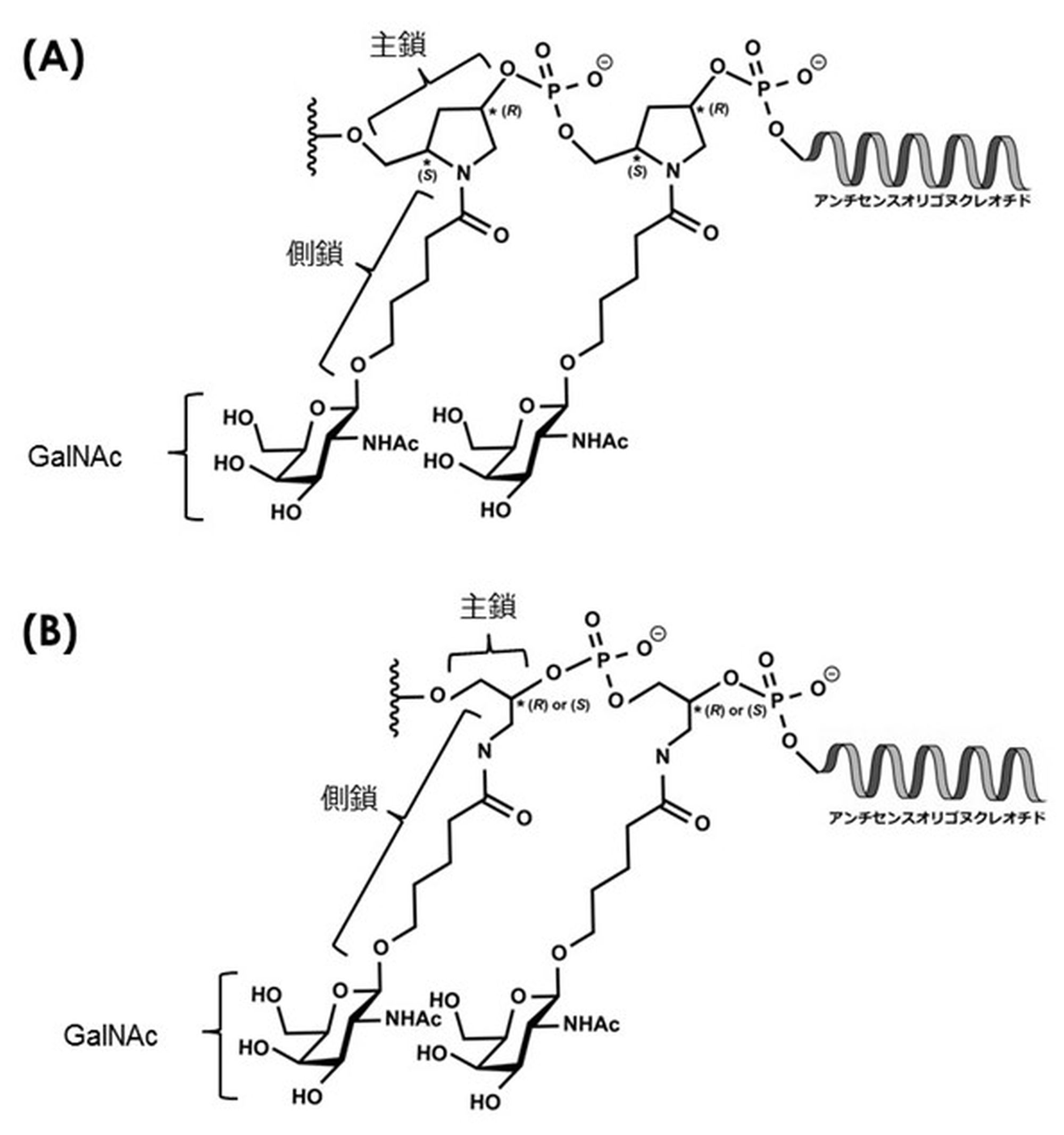
オリゴヌクレオチドへのASGP受容体に結合し得る分子を2個以上連結して結合させる方法は、公知文献、例えば、Yamamoto T et al., Bioorg Med Chem., 2016, 24, 26-32に記載の方法に従って行うことができる。
本発明のオリゴヌクレオチドコンジュゲート体は、前記した末端へのASGP受容体に結合し得る分子による修飾以外に、構成するヌクレオチドに対して公知の化学的修飾が行われていてもよい。具体的には、例えば、AmNAの2’位窒素原子やBNANCの2’位窒素原子ならびにウラシルの5’位などに、必要により公知のリンカーを介して、更なるASGP受容体に結合する分子やその他の機能性分子を導入することが可能である。このような修飾は、オリゴヌクレオチドの活性を変更することが可能であり、例えば、標的核酸に対する親和性を高め、核酸分解酵素(ヌクレアーゼ)に対する耐性を高め、オフターゲットの毒性を低下させ、オリゴヌクレオチドの薬物動態又は組織分布を変更することができる。これら修飾は、その位置及び数は特に限定されず、目的に応じて適宜設計され得る。
また、本発明のオリゴヌクレオチドコンジュゲート体は、その5’-末端又は3’-末端のASGP受容体に結合し得る分子による修飾以外に、マンノースなどの糖類、抗体類、アプタマー、インターカレーター、レポーター分子、ポリアミン、ポリアミド、ポリエチレングリコール、チオエーテル、ポリエーテル、コレステロール、チオコレステロール、コール酸部分、葉酸、脂質、リン脂質、ビオチン、フェナジン、フェナンスリジン、アントラキノン、アダマンタン、アクリジン、フルオレセイン、ローダミン、クマリン及び色素からなる群より選択される少なくとも1つが結合していてもよい。これらの結合は、公知の方法に従って行うことができる。オリゴヌクレオチドの5’-末端又は3’-末端にASGP受容体に結合し得る分子が結合したところに、更に前記成分が結合していてもよい。
本発明のオリゴヌクレオチドコンジュゲート体は、任意の医薬として許容される、塩、エステルもしくはかかるエステルの塩、又はヒトを含む動物に投与するとその生物学的に活性のある代謝産物もしくは残留物を(直接もしくは間接的に)提供し得る任意の他の化合物であり得る。
医薬として許容される塩は、本発明のオリゴヌクレオチドコンジュゲート体の生理学的に医薬として許容される塩、すなわち親化合物の所望の生物学的活性を保持し、望まれない毒物学的効果をそれに付与しない塩のことを言う。オリゴヌクレオチドについての、医薬として許容される塩及びその使用の好ましい例は、当業者にはよく知られている。
オリゴヌクレオチドに関して、医薬として許容される塩の好ましい具体例としては、限定されないが、(a)ナトリウム、カリウム、アンモニウム、マグネシウム、カルシウム、スペルミン及びスペルミジンなどのポリアミン、などの陽イオンで形成された塩、(b)無機酸、例えば塩酸、臭化水素酸、硫酸、リン酸、硝酸などで形成された酸付加塩、(c)例えば酢酸、シュウ酸、酒石酸、コハク酸、マレイン酸、フマル酸、グルコン酸、クエン酸、リンゴ酸、アスコルビン酸、安息香酸、タンニン酸、パルミチン酸、アルギン酸、ポリグルタミン酸、ナフタレンスルホン酸、メタンスルホン酸、p-トルエンスルホン酸、ナフタレンジスルホン酸、ポリガラクツロン酸などの有機酸で形成された塩、ならびに(d)塩素、臭素及びヨウ素などの元素の陰イオンから形成された塩が挙げられる。
本発明のオリゴヌクレオチドコンジュゲート体は、前記した構成を有するものであり、具体的には、例えば、14塩基長を有し、5’-末端から2つ分のヌクレオシドと3’-末端から2番目と3番目のヌクレオシドに態様1の架橋構造を有する架橋型人工ヌクレオシドが配置され、かつ、各ヌクレオシド間はホスホロチオエート結合で結合されたオリゴヌクレオチドに対して、5’-末端に3個のN-アセチルガラクトサミンが直鎖状に連結して結合している態様が例示される。その際に、3個のN-アセチルガラクトサミン同士及びオリゴヌクレオチドとN-アセチルガラクトサミン間の結合はホスホジエステル結合であり、N-アセチルガラクトサミンはリンカーを介してホスホジエステル結合していてもよい。
本発明のオリゴヌクレオチドコンジュゲート体は、前記した架橋構造とASGP受容体に結合し得る分子による修飾を有することで安定して標的細胞内に取り込まれることから、例えば、mRNAと安定な2本鎖を形成して病因となる蛋白質の生合成を阻害し(アンチセンス法)、あるいはゲノム中の2本鎖DNAとの間で3本鎖を形成してmRNAへの転写を阻害することができる。これらのことから、本発明のオリゴヌクレオチドコンジュゲート体は、PCSK9遺伝子の働きを阻害して疾病を治療する医薬品(アンチセンス核酸)としての有用性が期待される。具体的には、例えば、アンチセンス核酸として、ヒトPCSK9のmRNAと結合して、ヒトPCSK9の遺伝子発現を抑制し得る。ヒトPCSK9の遺伝子発現の抑制により、LDL受容体蛋白質の発現量が上昇し、LDLの細胞内への取り込みや代謝が促進することによって血中LDL濃度が低下し得る。このようにして、本発明のオリゴヌクレオチドコンジュゲート体は、例えば、脂質異常症治療剤としての効果を奏する。以降、本発明のオリゴヌクレオチドコンジュゲート体を有効成分として含む医薬品のことを、本発明の医薬組成物と記載する。
本発明の医薬組成物はPCSK9を特異的に抑制することができ、これによりLDLコレステロールの高値が関連する疾患の予防ならびに治療剤として用いることができる。LDLコレステロールの高値が関連する疾患としては、例えば、脂質異常症に含まれる、家族性高コレステロール血症を含む高コレステロール血症が挙げられる。また、LDLコレステロールの低下がより必要である高いリスクを有する疾患、例えば、冠動脈疾患の既往症、糖尿病、慢性腎疾患、非心原性脳梗塞、末梢動脈疾患が挙げられる。
また、本発明の医薬組成物は、本発明のオリゴヌクレオチドコンジュゲート体に、例えば、賦形剤、結合剤、防腐剤、酸化安定剤、崩壊剤、滑沢剤、矯味剤などの医薬の製剤技術分野において通常用いられる補助剤を配合して、非経口投与製剤又はリポソーム製剤とすることができる。非経口投与製剤としては、経肺剤形(例えばネブライザーなどを用いたもの)、経鼻投与剤形、経皮投与剤形(例えば軟膏、クリーム剤)、注射剤形等が挙げられる。注射剤形の場合は、例えば、点滴等の静脈内注射、筋肉内注射、腹腔内注射、皮下注射等により全身又は局所的に投与することができる。これらの注射剤形は、当該技術分野で通常用いられる医薬用担体を配合して、液剤としても、用時溶解型の凍結乾燥製剤として製造することができる。
本発明の医薬組成物の投与量は、年齢、性別、症状、投与経路、投与回数、剤形によって異なる。投与方法は、患者の年齢、症状により適宜調整することができる。有効投与量は、例えば、一回につき体重50kgあたりのヒトに対して、本発明のオリゴヌクレオチドコンジュゲート体が0.01μg~1000mg、0.1μg~100μg等となる量が例示される。
本発明の医薬組成物が対象とする個体は、好ましくはLDLコレステロールの高値が関連する疾患の治療を必要とするヒトであるが、ペット動物等であってもよい。ここで、LDLコレステロールの高値が関連する疾患とは、前述の通りである。
また、本発明は、さらなる態様として、下記の態様を提供する。なお、本発明のオリゴヌクレオチドコンジュゲート体の仕様、調製方法などは、本発明のオリゴヌクレオチドコンジュゲート体の項に記載の通りである。
(I)本発明のオリゴヌクレオチドコンジュゲート体を投与する工程を有する、LDLコレステロールの高値が関連する疾患を治療する方法
(II)LDLコレステロールの高値が関連する疾患の治療に用いられる、本発明のオリゴヌクレオチドコンジュゲート体の使用
(III)LDLコレステロールの高値が関連する疾患の治療剤の製造に用いられる、本発明のオリゴヌクレオチドコンジュゲート体の使用
(I)本発明のオリゴヌクレオチドコンジュゲート体を投与する工程を有する、LDLコレステロールの高値が関連する疾患を治療する方法
(II)LDLコレステロールの高値が関連する疾患の治療に用いられる、本発明のオリゴヌクレオチドコンジュゲート体の使用
(III)LDLコレステロールの高値が関連する疾患の治療剤の製造に用いられる、本発明のオリゴヌクレオチドコンジュゲート体の使用
以下、実施例によって本発明を詳述するが、これらの実施例は本発明の一例であり、本発明はこれらに限定されるものではない。
試験例1
ヒト肝がん由来細胞株Huh-7をプレートに播種し、DMEM(10%FBS、1%penicillin、1%streptomycin)にて24時間培養後、培地をCEM(DMEM含有:10%FBS、1%penicillin、1%streptomycin、9mM CaCl2)に各アンチセンスを200nMとなるように添加した培養液に置換した。その24時間後、total RNAを抽出し、cDNAを作成し、StepOnePlus(登録商標)リアルタイムPCRシステム(ABI社)にて以下のプローブを用いてPCSK9 mRNA及びGAPDH mRNAの発現量を定量し、PCSK9 mRNAの相対発現量を算出した。なお、各アンチセンスは、ヒトPCSK9遺伝子の塩基配列から選択したものに、架橋構造として「LNA(4’-CH2-O-2’)」又は「AmNA(4’-CO-NCH3-2’)」が導入されたものを公知の方法に従って作製して用いた。結果を図1に示す。
PCSK9 : Hs00545399_m1(ThermoFisher社 品番4331182)
GAPDH : Hs02786624_g1(ThermoFisher社 品番4331182)
ヒト肝がん由来細胞株Huh-7をプレートに播種し、DMEM(10%FBS、1%penicillin、1%streptomycin)にて24時間培養後、培地をCEM(DMEM含有:10%FBS、1%penicillin、1%streptomycin、9mM CaCl2)に各アンチセンスを200nMとなるように添加した培養液に置換した。その24時間後、total RNAを抽出し、cDNAを作成し、StepOnePlus(登録商標)リアルタイムPCRシステム(ABI社)にて以下のプローブを用いてPCSK9 mRNA及びGAPDH mRNAの発現量を定量し、PCSK9 mRNAの相対発現量を算出した。なお、各アンチセンスは、ヒトPCSK9遺伝子の塩基配列から選択したものに、架橋構造として「LNA(4’-CH2-O-2’)」又は「AmNA(4’-CO-NCH3-2’)」が導入されたものを公知の方法に従って作製して用いた。結果を図1に示す。
PCSK9 : Hs00545399_m1(ThermoFisher社 品番4331182)
GAPDH : Hs02786624_g1(ThermoFisher社 品番4331182)
図1より、PCSK9 mRNAの相対発現量が0.05より少ないものが認められ、CEM法によりPCSK9の遺伝子発現を抑制できるものを効率よく選択できることが分かった。以下に、効果が認められた具体的な配列を示す。これらは、LNA架橋構造を有するものとAmNA架橋構造を有するものがいずれもPCSK9 mRNAの相対発現量が少なく、架橋構造の種類に関わらず同様の配列では類似した活性を示すことが分かる。
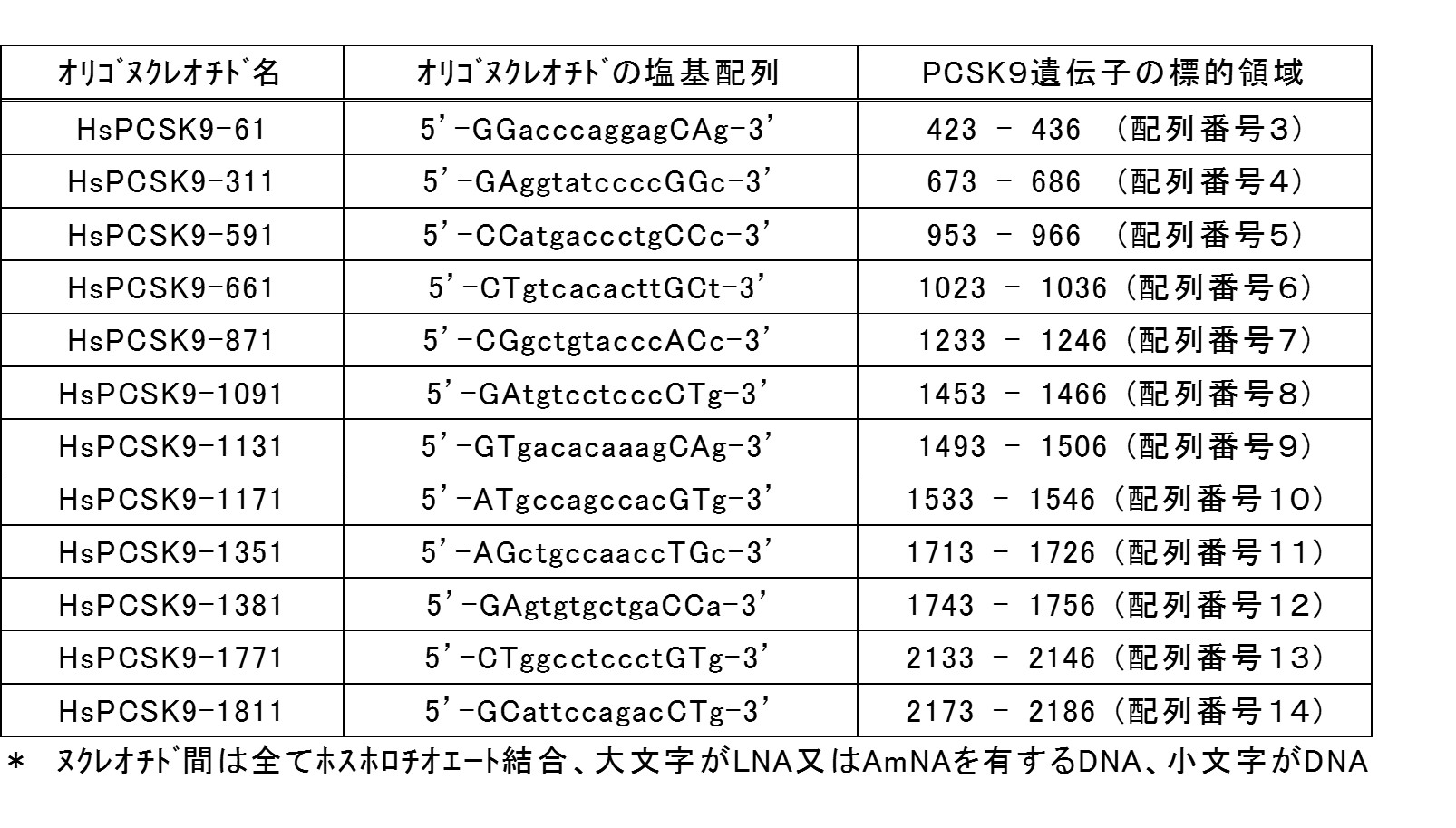
試験例2
ヒト肝がん由来細胞株Huh-7をプレートに播種し、DMEM(10%FBS、1%penicillin、1%streptomycin)にて24時間培養後、培地をCEM(DMEM含有:10%FBS、1%penicillin、1%streptomycin、9mM CaCl2)に試験例1のスクリーニングにより選んだアンチセンス(AmNA架橋構造を有するもの)を終濃度8~200nMとなるように添加した培養液に置換した。その24時間後、total RNAを抽出し、cDNAを作成し、StepOnePlus(登録商標)リアルタイムPCRシステム(ABI社)、SYBR Green(Fast SYBR(登録商標)Green Master Mix)を用いて試験例1と同じプローブを用いてPCSK9 mRNAの相対発現量を算出した。結果を図2に示す。
ヒト肝がん由来細胞株Huh-7をプレートに播種し、DMEM(10%FBS、1%penicillin、1%streptomycin)にて24時間培養後、培地をCEM(DMEM含有:10%FBS、1%penicillin、1%streptomycin、9mM CaCl2)に試験例1のスクリーニングにより選んだアンチセンス(AmNA架橋構造を有するもの)を終濃度8~200nMとなるように添加した培養液に置換した。その24時間後、total RNAを抽出し、cDNAを作成し、StepOnePlus(登録商標)リアルタイムPCRシステム(ABI社)、SYBR Green(Fast SYBR(登録商標)Green Master Mix)を用いて試験例1と同じプローブを用いてPCSK9 mRNAの相対発現量を算出した。結果を図2に示す。
図2より、いずれの配列においても濃度依存性が確認できた。なかでも、HsPCSK9-1811(配列番号14)は活性が高く、薬効ならびに安全性試験に用いるラット及びカニクイザルのPCSK9遺伝子と完全相補な配列であるため、以降の評価に用いた。
試験例3
高脂血症カニクイザルを用いて、HsPCSK9-1811(配列番号14)のLNA架橋構造を有するものとAmNA架橋構造を有するものについて、薬効を評価した。
高脂血症カニクイザルを用いて、HsPCSK9-1811(配列番号14)のLNA架橋構造を有するものとAmNA架橋構造を有するものについて、薬効を評価した。
具体的には、入手したカニクイザル(purpose-bred、抗Bウイルス抗体陰性、2~4歳、雄)のLDLコレステロール濃度を測定し高値を示した個体のうち、投与6日前においても高値を維持していた個体を選別して用いた。これらのカニクイザルの皮下に、アンチセンス核酸を試験開始時(0日目)に1mg/kg、7日後に3mg/kg、14日後に10mg/kgと漸増投与した。その後、血中LDLコレステロール値の減少が大きく認められた場合に、42日後に3mg/kg、61日後に1mg/kgと投与量を減らして引き続き投与した。試験開始時から、血中LDLコレステロール値を自動分析装置(JCA-BM6070、日本電子社)にて2~3日毎に100日まで、測定を行い試験開始時の値との相対値を算出して評価を行った。また、10mg/kg投与後の血中PCSK9濃度をCircuLex(登録商標)Human PCSK9 ELISA Kit(サイクレックス社)を用いて測定し、10mg/kg投与時の値との相対値を算出して評価を行った。結果を図3、図4に示す。
図3より、架橋構造が異なる核酸を持つアンチセンスのいずれを投与した場合も血中LDLコレステロール値の低下が認められ、LNA架橋構造を有するものを投与した場合には、10mg/kgの投与で28日間の持続的な血中LDLコレステロール値の顕著な低下作用(約60%の低下)が認められた。このことは、血中PCSK9濃度の低下を示す図4からも支持されるものであり、アンチセンス核酸の活性によるものであることが示唆される。また、漸減投与によって血中LDLコレステロール値の回復が認められることからも、架橋構造の種類により活性に強弱はあるものの、高脂血症のカニクイザルでアンチセンス核酸の活性が示されることが実証された。
試験例4
カニクイザルを用いて、HsPCSK9-1811(配列番号14)のLNA架橋構造を有するものを用いて安全性評価を実施した。
カニクイザルを用いて、HsPCSK9-1811(配列番号14)のLNA架橋構造を有するものを用いて安全性評価を実施した。
具体的には、カニクイザル(purpose-bred、抗Bウイルス抗体陰性、3~4歳、雄)に、アンチセンス核酸を10mg/kg又は30mg/kgの投与量で週1回、2週間(計2回)の間歇皮下投与を行った(10mg/kg投与群:No.1-No.2、30mg/kg投与群:No.3-No.4、各群n=2)。投与終了後に、一般状態、体重、摂餌量、摂水量、尿検査、血液学的検査、血液生化学的検査、剖検、器官重量、病理組織学的検査の観察及び検査を実施した。尿検査については自動分析装置(JCA-BM6070、日本電子社)を用いて、血液生化学的検査については自動分析装置(JCA-BM6070、日本電子社)により測定を行った。代表的な結果を図5~8に示す。
結果、10mg/kg、30mg/kgの両群において腎臓の肥大化とそれに伴う腎臓重量の増加(図5)、尿検査における尿中蛋白質濃度の上昇(図6)が認められた。また、血液生化学的検査では、両群で腎障害の指標となる血中尿素窒素濃度の上昇(図7)、30mg/kg投与群において血中クレアチニン濃度の上昇を認めた(図8)。
上記の結果から、HsPCSK9-1811-LNA(14)の無毒性量(NOAEL)は10mg/kg未満と予想される。試験例3の結果やSPC5001の健常人を対象とした第一相試験の結果から、オリゴヌクレチド単体では薬効用量で副作用、とくに腎臓において重度の障害を示し、安全な治療には動態面において工夫が必要と考えられた。
試験例5
ラットを用いて、HsPCSK9-1811(配列番号14)のLNA架橋構造を有するものを用いて予備毒性試験を実施した。
ラットを用いて、HsPCSK9-1811(配列番号14)のLNA架橋構造を有するものを用いて予備毒性試験を実施した。
具体的には、ラット(Crl:CD(SD)、6週齢、日本チャールス・リバー社、雌雄各5匹/群)に、アンチセンス核酸を10mg/kg又は30mg/kgの投与量で週1回、2週間(計2回)の間歇皮下投与を行った(n=5)。対照群には、生理食塩水をアンチセンス核酸投与群と同様に間歇皮下投与を行った。投与終了後に、一般状態、体重、摂餌量、血液学的検査、血液生化学的検査、剖検、器官重量、病理組織学的検査の観察及び検査を、試験例4と同様にして実施した。代表的な結果を図9及び図10に示す。
結果、試験例4と同様に、10mg/kg、30mg/kgの両群において腎臓の肥大化とそれに伴う腎臓重量の増加が確認され、血液生化学検査では、血中尿素窒素濃度(図9)や血中クレアチニン濃度(図10)の上昇が認められた。
上記の結果から、HsPCSK9-1811-LNA(14)の無毒性量(NOAEL)は10mg/kg未満と予想される。試験例4の結果と同様に、オリゴヌクレチド単体では薬効用量で副作用、とくに腎臓において重度の障害を示し、安全な治療には動態面において工夫が必要と考えられた。
試験例6
試験例4及び試験例5にて腎障害の認められたHsPCSK9-1811(配列番号14)のLNA架橋構造を有するものに対してホスホロアミダイト法により単量体GalNAcユニット(GalNAcアミダイト体)を核酸自動合成機(OligoPilot10、GEヘルスケア社)にて3ユニット連続導入し、アンチセンス核酸GalNAcコンジュゲート体[HsPCSK9-1811-LNA(14)-GN(3)]を得た。ここで用いた14塩基長の場合のアンチセンス核酸GalNAcコンジュゲート体の模式図を図11に示す。高脂血症カニクイザルを用いてHsPCSK9-1811-LNA(14)-GN(3)の薬効確認試験を実施した。なお、GalNAcの結合は、上記の(A)構造のリンカーを介したものであり、下記に示す構造を有する。
試験例4及び試験例5にて腎障害の認められたHsPCSK9-1811(配列番号14)のLNA架橋構造を有するものに対してホスホロアミダイト法により単量体GalNAcユニット(GalNAcアミダイト体)を核酸自動合成機(OligoPilot10、GEヘルスケア社)にて3ユニット連続導入し、アンチセンス核酸GalNAcコンジュゲート体[HsPCSK9-1811-LNA(14)-GN(3)]を得た。ここで用いた14塩基長の場合のアンチセンス核酸GalNAcコンジュゲート体の模式図を図11に示す。高脂血症カニクイザルを用いてHsPCSK9-1811-LNA(14)-GN(3)の薬効確認試験を実施した。なお、GalNAcの結合は、上記の(A)構造のリンカーを介したものであり、下記に示す構造を有する。
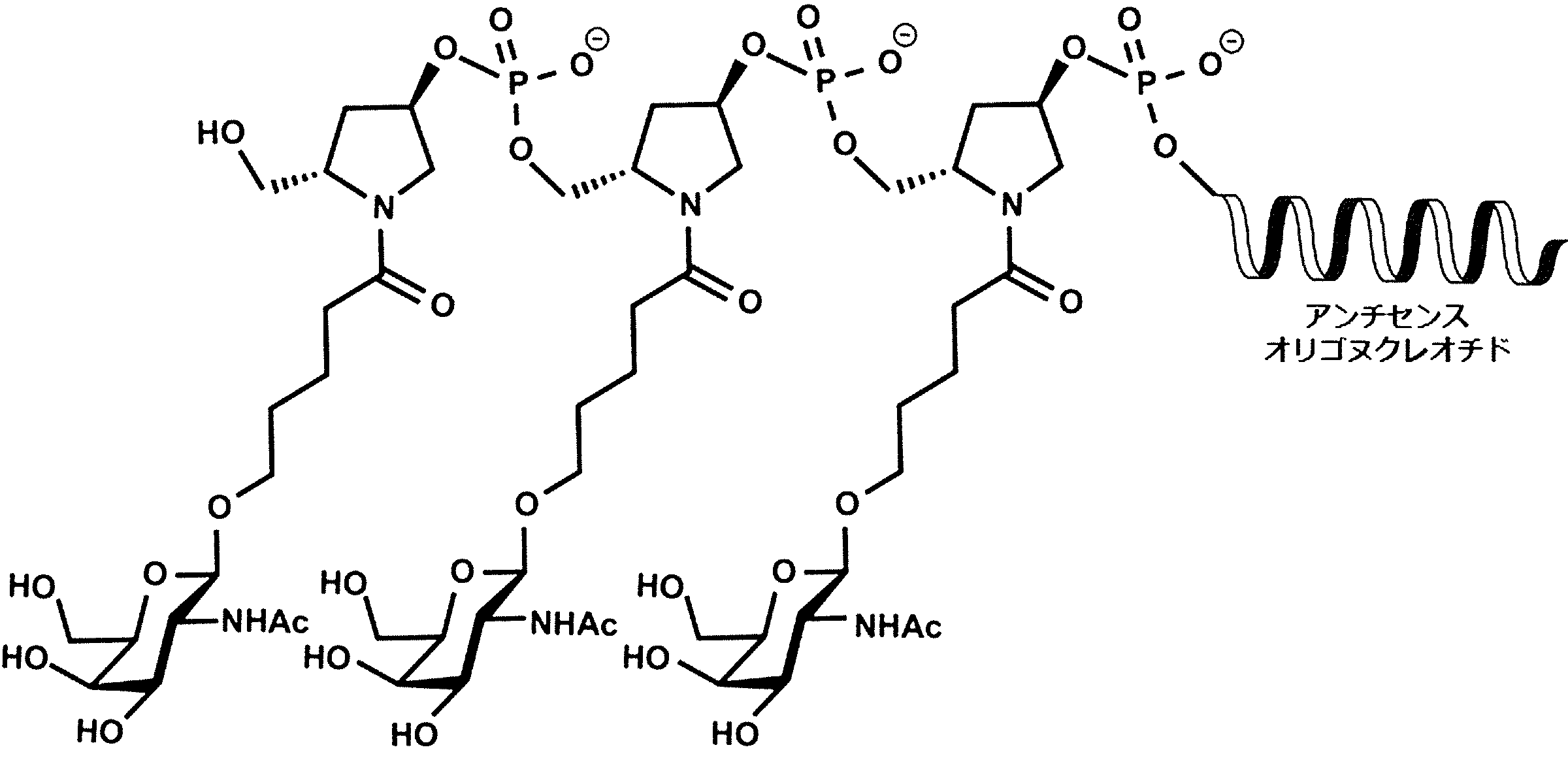
具体的には、試験例3と同様にして選別した高脂血症カニクイザル(purpose-bred、抗Bウイルス抗体陰性、3~4歳、雄)に、アンチセンス核酸GalNAcコンジュゲート体を0.3mg/kg又は1mg/kgの投与量で単回皮下投与を行った(n=1)。試験開始時から、血中LDLコレステロール値を自動分析装置(JCA-BM6070、日本電子社)にて2~3日毎に53日まで測定を行い、試験開始時の値との相対値を算出して評価を行った。結果を図12に示す。
結果、いずれの投与量においても、高脂血症のカニクイザルで血中LDLコレステロール値の顕著な低下作用が認められ、薬効用量としてはHsPCSK9-1811-LNA(14)と比較して10~30分の1程度になったことが示された。
試験例7
HsPCSK9-1811(配列番号14)のLNA架橋構造を有するもの[HsPCSK9-1811-LNA(14)]、及びHsPCSK9-1811(配列番号14)のLNA架橋構造を有しGalNAc修飾を有するもの[HsPCSK9-1811-LNA(14)-GN(3)]の毒性変化を調べるために、6週齢の雄のCrl:CD(SD)ラット(5匹/群)に2週間間歇皮下投与した。HsPCSK9-1811-LNA(14)-GN(3)は試験例6より薬効用量として投与量0.3mg/kgを設定し、その10倍量である3mg/kgを高用量、中間用量として1mg/kgを、またHsPCSK9-1811-LNA(14)は試験例4及び5において腎障害を認めた30mg/kgを設定し、それぞれ週1回、2週間(計2回)投与した。対照群には、生理食塩液を被験物質と同様の方法で皮下に投与した。血液生化学的検査については自動分析装置(JCA-BM6070、日本電子社)により、尿中腎障害分子(Kim-1)はBio-Plex 200(Bio-Rad社)により測定を行った。代表的な結果を図13~16に示す。
HsPCSK9-1811(配列番号14)のLNA架橋構造を有するもの[HsPCSK9-1811-LNA(14)]、及びHsPCSK9-1811(配列番号14)のLNA架橋構造を有しGalNAc修飾を有するもの[HsPCSK9-1811-LNA(14)-GN(3)]の毒性変化を調べるために、6週齢の雄のCrl:CD(SD)ラット(5匹/群)に2週間間歇皮下投与した。HsPCSK9-1811-LNA(14)-GN(3)は試験例6より薬効用量として投与量0.3mg/kgを設定し、その10倍量である3mg/kgを高用量、中間用量として1mg/kgを、またHsPCSK9-1811-LNA(14)は試験例4及び5において腎障害を認めた30mg/kgを設定し、それぞれ週1回、2週間(計2回)投与した。対照群には、生理食塩液を被験物質と同様の方法で皮下に投与した。血液生化学的検査については自動分析装置(JCA-BM6070、日本電子社)により、尿中腎障害分子(Kim-1)はBio-Plex 200(Bio-Rad社)により測定を行った。代表的な結果を図13~16に示す。
HsPCSK9-1811-LNA(14)については、試験例4及び5と同様に腎臓の肥大化とそれに伴う腎臓重量の増加(図13)、血中クレアチニン濃度の上昇(図16)が認められた。尿検査において、尿量の増加(図14)、急性腎障害の早期マーカーである尿中kidney injury molecule 1(Kim-1)の濃度上昇を認めた(図15)。一方、HsPCSK9-1811-LNA(14)-GN(3)については、上記のような変化や値の上昇は確認されなかった。また、病理組織学的解析においてもHsPCSK9-1811-LNA(14)は腎臓では尿細管上皮に変性、壊死及び再生、尿細管拡張、硝子円柱及び間質への単核細胞浸潤がみられたが、HsPCSK9-1811-LNA(14)-GN(3)では、どの用量の群においてもそのような変化は確認されなかった。
試験例8
GalNAcを結合する主鎖リンカーの構造がアンチセンス核酸の肝臓における活性に与える影響を検証するために、上記の(A)構造又は(B)構造のリンカーを有するアンチセンス核酸GalNAcコンジュゲート体を準備した(それぞれのコンジュゲート体を、A-I体、B-I体と記載する)。Saline(生理食塩水)もしくはアンチセンス核酸GalNAcコンジュゲート体を、8週齢の雄の野生型マウス(日本SLC社)に対して17.5nmol/kgの用量で単回皮下投与を行った。投与3日後に肝臓を摘出し、標的遺伝子発現量をリアルタイムPCRシステム(ABI社)により定量した。なお、GalNAcの具体的な結合構造を下記に示す。
GalNAcを結合する主鎖リンカーの構造がアンチセンス核酸の肝臓における活性に与える影響を検証するために、上記の(A)構造又は(B)構造のリンカーを有するアンチセンス核酸GalNAcコンジュゲート体を準備した(それぞれのコンジュゲート体を、A-I体、B-I体と記載する)。Saline(生理食塩水)もしくはアンチセンス核酸GalNAcコンジュゲート体を、8週齢の雄の野生型マウス(日本SLC社)に対して17.5nmol/kgの用量で単回皮下投与を行った。投与3日後に肝臓を摘出し、標的遺伝子発現量をリアルタイムPCRシステム(ABI社)により定量した。なお、GalNAcの具体的な結合構造を下記に示す。

結果、主鎖構造の自由度の低いA-I体と比較し、主鎖構造の自由度の高いB-I体の方が、高い遺伝子発現抑制効果を示した。これより、肝細胞内におけるアンチセンス核酸の活性を最大限に引き出すには、細胞内において代謝を受けやすいと考えられる構造的に自由度の高いリンカー設計が重要であることが示唆された。
以上より、HsPCSK9-1811-LNA(14)-GN(3)は0.3~1mg/kgの低用量で数週間に一度の投与頻度で十分な効果が得られ、安全な治療が可能になることが考えられる。また、アンチセンスオリゴヌクレオチドを基盤とする薬剤の主な副作用である腎障害を回避するためには、(1)CEM法によるin vivo高活性アンチセンスオリゴヌクレオチドの選出、及び(2)アンチセンスオリゴヌクレオチドに対するGalNAcのコンジュゲート体が有効であることが示された。
本発明は、医薬品の分野、特にLDLコレステロールの高値が関連する疾患の治療剤の開発及び製造の分野において利用可能である。
Claims (12)
- 4’位と2’位との間に架橋構造を有する架橋型人工ヌクレオシドを含み、ヒトPCSK9遺伝子と相補的であり、該ヒトPCSK9遺伝子の発現を抑制する活性を有するオリゴヌクレオチドに、アシアロ糖蛋白質受容体に結合し得る分子が直鎖状に2個以上連結して結合してなる、オリゴヌクレオチドコンジュゲート体。
- 架橋構造が下記(i)~(iv)から選ばれる、請求項1記載のオリゴヌクレオチドコンジュゲート体。
(i) -CH2-O-又は-(CH2)2-O-で表される構造
(ii) -CH2-NR1-O-又は-(CH2)2-NR1-O-で表される構造
(iii) -CO-NR1-、-CH2-CO-NR1-、-(CH2)2-CO-NR1-、-CO-NR1-X-又は-CH2-CO-NR1-X-で表される構造
(iv) -CH2-NR1-又は-(CH2)2-NR1-で表される構造
(ここで、R1は、水素原子;
分岐又は環を形成していてもよい炭素数1から7のアルキル基;
分岐又は環を形成していてもよい炭素数2から7のアルケニル基;
水酸基、炭素数1から6の直鎖アルキル基、炭素数1から6の直鎖アルコキシ基、メルカプト基、炭素数1から6の直鎖アルキルチオ基、アミノ基、炭素数1から6の直鎖アルキルアミノ基及びハロゲン原子からなるα群から選択される任意の置換基を1以上有していてもよく、かつ、ヘテロ原子を含んでいてもよい炭素数3から12のアリール基;あるいは
該α群から選択される任意の置換基を1以上有していてもよく、かつ、ヘテロ原子を含んでいてもよい炭素数3から12のアリール部分を有するアルキル基を表し、
Xは、酸素原子、硫黄原子、アミノ基又はメチレン基を表す) - ヒトPCSK9遺伝子が、以下の塩基配列:
配列番号3で示される塩基配列;配列番号4で示される塩基配列;配列番号5で示される塩基配列;配列番号6で示される塩基配列;配列番号7で示される塩基配列;配列番号8で示される塩基配列;配列番号9で示される塩基配列;配列番号10で示される塩基配列;配列番号11で示される塩基配列;配列番号12で示される塩基配列;配列番号13で示される塩基配列;配列番号14で示される塩基配列
又はこれらに相補的な塩基配列のいずれかを含む塩基配列からなる領域である、請求項1又は2記載のオリゴヌクレオチドコンジュゲート体。 - ヌクレオシド間の1又は2以上の結合がホスホロチオエート結合である、請求項1~3いずれか記載のオリゴヌクレオチドコンジュゲート体。
- アシアロ糖蛋白質受容体に結合し得る分子同士の間及びオリゴヌクレオチドとアシアロ糖蛋白質受容体に結合し得る分子との間から選ばれる1又は2以上の結合がホスホジエステル結合である、請求項1~4いずれか記載のオリゴヌクレオチドコンジュゲート体。
- オリゴヌクレオチドとアシアロ糖蛋白質受容体に結合し得る分子との間の結合が下記から選ばれるリンカーを介した結合である、請求項1~5いずれか記載のオリゴヌクレオチドコンジュゲート体。

- アシアロ糖蛋白質受容体に結合し得る分子の連結個数が2~5である、請求項1~6いずれか記載のオリゴヌクレオチドコンジュゲート体。
- アシアロ糖蛋白質受容体に結合し得る分子が、ラクトース、ガラクトース、N-アセチルガラクトサミン(GalNAc)、ガラクトサミン、N-ホルミルガラクトサミン、N-プロピオニルガラクトサミン、N-n-ブタノイルガラクトサミン、N-イソ-ブタノイルガラクトサミン及びそれらの誘導体からなる群より選ばれる1種又は2種以上である、請求項1~7いずれか記載のオリゴヌクレオチドコンジュゲート体。
- オリゴヌクレオチドの塩基配列の長さが10~25塩基である、請求項1~8いずれか記載のオリゴヌクレオチドコンジュゲート体。
- 請求項1~9いずれか記載のオリゴヌクレオチドコンジュゲート体を有効成分として含有する、LDLコレステロールの高値が関連する疾患の予防又は治療剤。
- LDLコレステロールの高値が関連する疾患が、高コレステロール血症及びLDLコレステロールの低下がより必要である高いリスクを有する疾患から選ばれる、請求項10記載の予防又は治療剤。
- 注射剤である、請求項10又は11記載の予防又は治療剤。
Priority Applications (5)
| Application Number | Priority Date | Filing Date | Title |
|---|---|---|---|
| JP2019520317A JP6952366B2 (ja) | 2017-05-26 | 2018-05-24 | Pcsk9を標的としたアンチセンス核酸 |
| US16/616,724 US11273222B2 (en) | 2017-05-26 | 2018-05-24 | Antisense nucleic acid targeting PCSK9 |
| EP18805466.2A EP3633036A4 (en) | 2017-05-26 | 2018-05-24 | ANTISENSE NUCLEIC ACID AGAINST PCSK9 |
| JP2021154910A JP7291418B2 (ja) | 2017-05-26 | 2021-09-22 | Pcsk9を標的としたアンチセンス核酸 |
| US17/649,895 US12544449B2 (en) | 2017-05-26 | 2022-02-03 | Antisense nucleic acid targeting PCSK9 |
Applications Claiming Priority (2)
| Application Number | Priority Date | Filing Date | Title |
|---|---|---|---|
| JP2017105121 | 2017-05-26 | ||
| JP2017-105121 | 2017-05-26 |
Related Child Applications (2)
| Application Number | Title | Priority Date | Filing Date |
|---|---|---|---|
| US16/616,724 A-371-Of-International US11273222B2 (en) | 2017-05-26 | 2018-05-24 | Antisense nucleic acid targeting PCSK9 |
| US17/649,895 Continuation US12544449B2 (en) | 2017-05-26 | 2022-02-03 | Antisense nucleic acid targeting PCSK9 |
Publications (1)
| Publication Number | Publication Date |
|---|---|
| WO2018216785A1 true WO2018216785A1 (ja) | 2018-11-29 |
Family
ID=64396462
Family Applications (1)
| Application Number | Title | Priority Date | Filing Date |
|---|---|---|---|
| PCT/JP2018/020081 Ceased WO2018216785A1 (ja) | 2017-05-26 | 2018-05-24 | Pcsk9を標的としたアンチセンス核酸 |
Country Status (4)
| Country | Link |
|---|---|
| US (2) | US11273222B2 (ja) |
| EP (1) | EP3633036A4 (ja) |
| JP (2) | JP6952366B2 (ja) |
| WO (1) | WO2018216785A1 (ja) |
Cited By (6)
| Publication number | Priority date | Publication date | Assignee | Title |
|---|---|---|---|---|
| JPWO2021039879A1 (ja) * | 2019-08-27 | 2021-03-04 | ||
| WO2021193965A1 (ja) | 2020-03-26 | 2021-09-30 | 国立研究開発法人国立循環器病研究センター | Apoc3を標的としたアンチセンス核酸 |
| JP2022017227A (ja) * | 2017-05-26 | 2022-01-25 | 国立研究開発法人国立循環器病研究センター | Pcsk9を標的としたアンチセンス核酸 |
| JP2023516759A (ja) * | 2020-03-04 | 2023-04-20 | ヴァーヴ・セラピューティクス,インコーポレーテッド | 標的rna送達のための組成物および方法 |
| US12269839B2 (en) | 2017-06-30 | 2025-04-08 | Sirius Therapeutics, Inc. | Chiral phosphoramidite auxiliaries and methods of their use |
| US12569570B2 (en) | 2021-08-03 | 2026-03-10 | Verve Therapeutics, Inc. | Compositions and methods for targeted RNA delivery |
Families Citing this family (1)
| Publication number | Priority date | Publication date | Assignee | Title |
|---|---|---|---|---|
| JOP20190215A1 (ar) | 2017-03-24 | 2019-09-19 | Ionis Pharmaceuticals Inc | مُعدّلات التعبير الوراثي عن pcsk9 |
Citations (8)
| Publication number | Priority date | Publication date | Assignee | Title |
|---|---|---|---|---|
| JP2009536037A (ja) * | 2006-05-05 | 2009-10-08 | アイシス ファーマシューティカルズ, インコーポレーテッド | 遺伝子発現を調節するための化合物および方法 |
| JP2010505432A (ja) * | 2006-10-09 | 2010-02-25 | サンタリス ファーマ アー/エス | Pcsk9を調節するためのrnaアンタゴニスト化合物 |
| WO2011052436A1 (ja) | 2009-10-29 | 2011-05-05 | 国立大学法人大阪大学 | 架橋型人工ヌクレオシドおよびヌクレオチド |
| WO2012029870A1 (ja) | 2010-08-31 | 2012-03-08 | 国立大学法人大阪大学 | オリゴヌクレオチド、およびオリゴヌクレオチドを有効成分として含有する脂質異常症治療剤 |
| US20120122954A1 (en) | 2009-07-21 | 2012-05-17 | Ellen Marie Straarup | Antisense Oligomers Targeting PCSK9 |
| WO2014207232A1 (en) | 2013-06-27 | 2014-12-31 | Santaris Pharma A/S | Antisense oligomers and conjugates targeting pcsk9 |
| WO2015179693A1 (en) * | 2014-05-22 | 2015-11-26 | Isis Pharmaceuticals, Inc. | Conjugated antisense compounds and their use |
| JP2016508367A (ja) * | 2013-01-30 | 2016-03-22 | エフ.ホフマン−ラ ロシュ アーゲーF. Hoffmann−La Roche Aktiengesellschaft | Lnaオリゴヌクレオチド糖質コンジュゲート |
Family Cites Families (5)
| Publication number | Priority date | Publication date | Assignee | Title |
|---|---|---|---|---|
| CN102006890A (zh) | 2007-12-04 | 2011-04-06 | 阿尔尼拉姆医药品有限公司 | 靶向脂质 |
| SG10201804331TA (en) | 2012-11-15 | 2018-07-30 | Roche Innovation Ct Copenhagen As | Oligonucleotide conjugates |
| CA2921162A1 (en) | 2013-05-01 | 2014-11-06 | Ionis Pharmaceuticals, Inc. | Conjugated antisense compounds and their use |
| JOP20190215A1 (ar) * | 2017-03-24 | 2019-09-19 | Ionis Pharmaceuticals Inc | مُعدّلات التعبير الوراثي عن pcsk9 |
| US11273222B2 (en) * | 2017-05-26 | 2022-03-15 | National Cerebral And Cardiovascular Center | Antisense nucleic acid targeting PCSK9 |
-
2018
- 2018-05-24 US US16/616,724 patent/US11273222B2/en active Active
- 2018-05-24 WO PCT/JP2018/020081 patent/WO2018216785A1/ja not_active Ceased
- 2018-05-24 EP EP18805466.2A patent/EP3633036A4/en active Pending
- 2018-05-24 JP JP2019520317A patent/JP6952366B2/ja active Active
-
2021
- 2021-09-22 JP JP2021154910A patent/JP7291418B2/ja active Active
-
2022
- 2022-02-03 US US17/649,895 patent/US12544449B2/en active Active
Patent Citations (9)
| Publication number | Priority date | Publication date | Assignee | Title |
|---|---|---|---|---|
| JP2009536037A (ja) * | 2006-05-05 | 2009-10-08 | アイシス ファーマシューティカルズ, インコーポレーテッド | 遺伝子発現を調節するための化合物および方法 |
| JP2010505432A (ja) * | 2006-10-09 | 2010-02-25 | サンタリス ファーマ アー/エス | Pcsk9を調節するためのrnaアンタゴニスト化合物 |
| US20120122954A1 (en) | 2009-07-21 | 2012-05-17 | Ellen Marie Straarup | Antisense Oligomers Targeting PCSK9 |
| WO2011052436A1 (ja) | 2009-10-29 | 2011-05-05 | 国立大学法人大阪大学 | 架橋型人工ヌクレオシドおよびヌクレオチド |
| WO2012029870A1 (ja) | 2010-08-31 | 2012-03-08 | 国立大学法人大阪大学 | オリゴヌクレオチド、およびオリゴヌクレオチドを有効成分として含有する脂質異常症治療剤 |
| JP2016508367A (ja) * | 2013-01-30 | 2016-03-22 | エフ.ホフマン−ラ ロシュ アーゲーF. Hoffmann−La Roche Aktiengesellschaft | Lnaオリゴヌクレオチド糖質コンジュゲート |
| WO2014207232A1 (en) | 2013-06-27 | 2014-12-31 | Santaris Pharma A/S | Antisense oligomers and conjugates targeting pcsk9 |
| JP2016523094A (ja) * | 2013-06-27 | 2016-08-08 | ロシュ イノベーション センター コペンハーゲン エーエス | Pcsk9を標的とするアンチセンスオリゴマーおよびコンジュゲート |
| WO2015179693A1 (en) * | 2014-05-22 | 2015-11-26 | Isis Pharmaceuticals, Inc. | Conjugated antisense compounds and their use |
Non-Patent Citations (13)
| Title |
|---|
| "GenBank", Database accession no. NM -174936 |
| COHEN J C ET AL., N ENGL J MED, vol. 354, 2006, pages 1264 - 1272 |
| KUMAR R. ET AL., BIOORG. & MED. CHEM. LETT., vol. 8, 1998, pages 2219 - 2222 |
| SHIBA, MARIKO: "Creation of antisense medicine to cope with familial hypercholesterolemia", ABSTRACTS OF THE 17TH SYMPOSIUM OF RESEARCH SOCIETY OF GENE DELIVERY; 27-05-2017, 27 May 2017 (2017-05-27), JAPAN, pages 13, XP009518047 * |
| SHIBA, MARIKO: "S4-2: Development of antisense medicine to cope with familial hypercholesterolemia for GalNAc- modified anti-human PCSK9 antisense medicine clinic", LECTURE ABSTRACTS OF THE 3RD ANNUAL CONFERENCE OF NUCLEIC ACIDS THERAPEUTICS SOCIETY OF JAPAN; 12-14/07/2017, 1 July 2017 (2017-07-01), JAPAN, pages 42, XP009518049 * |
| SINGH S. K. ET AL., J. ORG. CHEM., vol. 63, 1998, pages 10035 - 39 |
| VAN POELGEEST E P ET AL., AM J KIDNEY DIS, vol. 62, 2013, pages 796 - 800 |
| VAN POELGEEST E P ET AL., BR J CLIN PHARMACOL, vol. 80, 2015, pages 1350 - 1361 |
| WADA, FUMITO ET AL.: "O2-2: Evaluation of safety and medicinal effect by using rodents and non-human primates for GalNAc- modified anti-human PCSK9 antisense medicine clinic", LECTURE ABSTRACTS OF THE 3RD ANNUAL CONFERENCE OF NUCLEIC ACIDS THERAPEUTICS SOCIETY OF JAPAN; 12-14/07/2017, 1 July 2017 (2017-07-01), JAPAN, pages 33 - 2, XP009518048 * |
| WADA, FUMITO ET AL.: "P-16: Structure optimization for anti PCSK9 antisense clinic, and test for checking medicinal effect and examining safety by using non-human primate and rodents", ABSTRACTS OF THE 17TH SYMPOSIUM OF RESEARCH SOCIETY OF GENE DELIVERY; 27/05/2017, 27 May 2017 (2017-05-27), JAPAN, pages 32, XP009518046 * |
| WADA, FUMITO ET AL.: "P-44: Effective screening for clinical application of anti-human PCSK9 antisense, and test for evaluating medicinal effect by using non-human primates", LECTURE ABSTRACTS OF THE 2ND ANNUAL CONFERENCE OF NUCLEIC ACIDS THERAPEUTICS SOCIETY OF JAPAN; 15-17/11/2016, 2016, JAPAN, pages 102, XP009518045 * |
| YAMAMOTO T ET AL., BIOORG MED CHEM., vol. 24, 2016, pages 26 - 32 |
| YAMAMOTO, TSUYOSHI ET AL.: "Serial incorporation of a monovalent GalNAc phosphoramidite unit into hepatocyte-targeting anti sense oligonucleotides", BIOORG. MED. CHEM., vol. 24, no. 1, 27 November 2016 (2016-11-27), pages 26 - 32, XP029350658 * |
Cited By (10)
| Publication number | Priority date | Publication date | Assignee | Title |
|---|---|---|---|---|
| JP2022017227A (ja) * | 2017-05-26 | 2022-01-25 | 国立研究開発法人国立循環器病研究センター | Pcsk9を標的としたアンチセンス核酸 |
| JP7291418B2 (ja) | 2017-05-26 | 2023-06-15 | 国立研究開発法人国立循環器病研究センター | Pcsk9を標的としたアンチセンス核酸 |
| US12544449B2 (en) | 2017-05-26 | 2026-02-10 | National Cerebral And Cardiovascular Center | Antisense nucleic acid targeting PCSK9 |
| US12269839B2 (en) | 2017-06-30 | 2025-04-08 | Sirius Therapeutics, Inc. | Chiral phosphoramidite auxiliaries and methods of their use |
| JPWO2021039879A1 (ja) * | 2019-08-27 | 2021-03-04 | ||
| JP2025105923A (ja) * | 2019-08-27 | 2025-07-10 | 国立大学法人東海国立大学機構 | 胃癌分子標的核酸医薬 |
| JP7732637B2 (ja) | 2019-08-27 | 2025-09-02 | 国立大学法人東海国立大学機構 | 胃癌分子標的核酸医薬 |
| JP2023516759A (ja) * | 2020-03-04 | 2023-04-20 | ヴァーヴ・セラピューティクス,インコーポレーテッド | 標的rna送達のための組成物および方法 |
| WO2021193965A1 (ja) | 2020-03-26 | 2021-09-30 | 国立研究開発法人国立循環器病研究センター | Apoc3を標的としたアンチセンス核酸 |
| US12569570B2 (en) | 2021-08-03 | 2026-03-10 | Verve Therapeutics, Inc. | Compositions and methods for targeted RNA delivery |
Also Published As
| Publication number | Publication date |
|---|---|
| JPWO2018216785A1 (ja) | 2020-03-19 |
| JP2022017227A (ja) | 2022-01-25 |
| EP3633036A1 (en) | 2020-04-08 |
| US20210170032A1 (en) | 2021-06-10 |
| US20220160880A1 (en) | 2022-05-26 |
| JP6952366B2 (ja) | 2021-10-20 |
| JP7291418B2 (ja) | 2023-06-15 |
| US11273222B2 (en) | 2022-03-15 |
| EP3633036A4 (en) | 2021-03-17 |
| US12544449B2 (en) | 2026-02-10 |
Similar Documents
| Publication | Publication Date | Title |
|---|---|---|
| JP7291418B2 (ja) | Pcsk9を標的としたアンチセンス核酸 | |
| US20250064959A1 (en) | Exon skipping oligomer conjugates for muscular dystrophy | |
| TWI784934B (zh) | 抑制lpa之基因表現之組合物及方法 | |
| JP7258773B2 (ja) | α-1アンチトリプシン(AAT)RNAi剤、AAT RNAi剤を含む組成物、及び使用方法。 | |
| EP4406601A2 (en) | Exon skipping oligomer conjugates for muscular dystrophy | |
| AU2018336569A1 (en) | Exon skipping oligomer conjugates for muscular dystrophy | |
| US20250092393A1 (en) | Exon skipping oligomers and oligomer conjugates for muscular dystrophy | |
| JP2018530325A (ja) | アンジオテンシノーゲンの発現を調節するための化合物及び方法 | |
| WO2019231824A1 (en) | Exon skipping oligomer conjugates for muscular dystrophy | |
| CN110036019A (zh) | 用于治疗多囊肾病的修饰的低聚核苷酸 | |
| US20240401045A1 (en) | Angiotensinogen-modulating compositions and methods of use thereof | |
| CN120957731A (zh) | 用于治疗多囊肾病的修饰的寡核苷酸 | |
| CN117187242A (zh) | 一种siRNA及其缀合物 | |
| CN119137272A (zh) | 血管紧张素原调节组合物和其使用方法 | |
| CN110225747A (zh) | 用于治疗多囊肾病的方法 | |
| CN112996568A (zh) | 用于调节mir-10b活性的微小rna化合物和方法 | |
| WO2014007305A1 (ja) | オリゴヌクレオチド、およびオリゴヌクレオチドを有効成分として含有する脂質異常症治療剤 | |
| JP7579147B2 (ja) | 筋ジストロフィーに対するエクソンスキッピングオリゴマーおよびオリゴマーコンジュゲート | |
| Malinverni et al. | Precision medicine with pioneering RNAi therapeutics in ATTR amyloidosis: from bench to bedside | |
| US12042509B2 (en) | Prekallikrein-modulating compositions and methods of use thereof | |
| CN121695166A (zh) | 用于抑制APP基因表达的RNAi剂及其制备方法和用途 | |
| HK40115145A (zh) | 血管紧张素原调节组合物和其使用方法 | |
| BR112018006489B1 (pt) | Agente de interferência de rna (rnai) da lipoproteína a (lpa), seus usos e composição farmacêutica |
Legal Events
| Date | Code | Title | Description |
|---|---|---|---|
| 121 | Ep: the epo has been informed by wipo that ep was designated in this application |
Ref document number: 18805466 Country of ref document: EP Kind code of ref document: A1 |
|
| ENP | Entry into the national phase |
Ref document number: 2019520317 Country of ref document: JP Kind code of ref document: A |
|
| NENP | Non-entry into the national phase |
Ref country code: DE |
|
| ENP | Entry into the national phase |
Ref document number: 2018805466 Country of ref document: EP Effective date: 20200102 |