WO2018216789A1 - 撮像用の光学系および撮像装置 - Google Patents
撮像用の光学系および撮像装置 Download PDFInfo
- Publication number
- WO2018216789A1 WO2018216789A1 PCT/JP2018/020089 JP2018020089W WO2018216789A1 WO 2018216789 A1 WO2018216789 A1 WO 2018216789A1 JP 2018020089 W JP2018020089 W JP 2018020089W WO 2018216789 A1 WO2018216789 A1 WO 2018216789A1
- Authority
- WO
- WIPO (PCT)
- Prior art keywords
- lens
- lens group
- optical system
- refractive power
- positive
- Prior art date
- Legal status (The legal status is an assumption and is not a legal conclusion. Google has not performed a legal analysis and makes no representation as to the accuracy of the status listed.)
- Ceased
Links
Images



Classifications
-
- G—PHYSICS
- G02—OPTICS
- G02B—OPTICAL ELEMENTS, SYSTEMS OR APPARATUS
- G02B9/00—Optical objectives characterised both by the number of the components and their arrangements according to their sign, i.e. + or -
- G02B9/12—Optical objectives characterised both by the number of the components and their arrangements according to their sign, i.e. + or - having three components only
-
- G—PHYSICS
- G02—OPTICS
- G02B—OPTICAL ELEMENTS, SYSTEMS OR APPARATUS
- G02B15/00—Optical objectives with means for varying the magnification
- G02B15/14—Optical objectives with means for varying the magnification by axial movement of one or more lenses or groups of lenses relative to the image plane for continuously varying the equivalent focal length of the objective
- G02B15/146—Optical objectives with means for varying the magnification by axial movement of one or more lenses or groups of lenses relative to the image plane for continuously varying the equivalent focal length of the objective having more than five groups
- G02B15/1461—Optical objectives with means for varying the magnification by axial movement of one or more lenses or groups of lenses relative to the image plane for continuously varying the equivalent focal length of the objective having more than five groups the first group being positive
-
- G—PHYSICS
- G02—OPTICS
- G02B—OPTICAL ELEMENTS, SYSTEMS OR APPARATUS
- G02B13/00—Optical objectives specially designed for the purposes specified below
- G02B13/02—Telephoto objectives, i.e. systems of the type + - in which the distance from the front vertex to the image plane is less than the equivalent focal length
-
- G—PHYSICS
- G02—OPTICS
- G02B—OPTICAL ELEMENTS, SYSTEMS OR APPARATUS
- G02B13/00—Optical objectives specially designed for the purposes specified below
- G02B13/24—Optical objectives specially designed for the purposes specified below for reproducing or copying at short object distances
-
- H—ELECTRICITY
- H04—ELECTRIC COMMUNICATION TECHNIQUE
- H04N—PICTORIAL COMMUNICATION, e.g. TELEVISION
- H04N23/00—Cameras or camera modules comprising electronic image sensors; Control thereof
- H04N23/50—Constructional details
- H04N23/55—Optical parts specially adapted for electronic image sensors; Mounting thereof
Definitions
- the present invention relates to an imaging optical system suitable for an imaging apparatus such as a camera.
- Document 1 Japanese Laid-Open Patent Publication No. 2013-104994 discloses an inner focus type large-aperture telephoto macro lens having an anti-vibration function capable of obtaining good optical performance while suppressing an increase in product outer diameter. Is provided.
- the macro lens disclosed in this document 1 is an inner focus type large-aperture telephoto macro lens having an anti-vibration function, and a first lens group having a positive refractive power in order from the object side to the image plane side; A second lens group having a negative refractive power, a third lens group having a positive refractive power, a fourth lens group having a positive refractive power, a fifth lens group having a negative refractive power, and a positive lens And a sixth lens group having a refractive power, and the fifth lens group is configured to be able to move an image by moving the fifth lens group in a direction substantially perpendicular to the optical axis.
- the telephoto macro lens has a large number of lenses constituting the system.
- the macro lens disclosed in Document 1 has a 19-lens configuration, which is long and heavy, easily shakes, and can be handled by autofocus (AF). If the number of lenses to be moved for focus adjustment increases, the AF load increases, which causes a reduction in the focus adjustment speed.
- large-scale image sensors are being adopted in image pickup devices such as cameras. In an image pickup lens system (optical system) corresponding to the large image circle, the lens system becomes large in diameter and the lens size is large. Prone. For this reason, it is desired to realize a compact telescopic macro lens having a large image circle with a simple configuration.
- One aspect of the present invention is an imaging optical system including a first refractive optical system disposed on the object side with an aperture stop interposed therebetween and a second refractive optical system disposed on the image plane side. is there.
- the first refractive optical system includes a first lens group having a positive refractive power, a second lens group having a positive refractive power, and a third lens group having a negative refractive power.
- the second refractive optical system includes a fourth lens group having a positive refractive power, a fifth lens group having a positive refractive power, and a sixth lens group having a negative refractive power.
- the first lens group, the third lens group, and the sixth lens group do not move with respect to the aperture stop, and the second lens group and the fourth lens group do not move.
- the lens group moves to the object side.
- This optical system is an optical system in which a telephoto type (telephoto type, reverse retrofocus type) optical system with positive-positive-negative power arrangement on the object side and image plane side across the aperture stop is connected.
- Each telephoto type optical system is provided with a positive lens group that moves during focus adjustment.
- focus adjustment is mainly performed by one positive lens group, and one positive lens group is performed by the other positive lens group.
- Various aberrations due to the movement of can be corrected efficiently. For this reason, it is possible to provide an optical system in which focus adjustment is performed with a small number of lenses, and aberration can be corrected favorably with a small number of lens configurations from infinity to a short distance.
- the sixth lens group which is the final lens group on the image plane side has a negative power, an optical system having a large image circle can be obtained by disposing a negative lens on the image plane side to widen the light flux to the imaging surface. Can be realized.
- the first lens group includes one lens having a positive refractive power
- the second lens group includes a pair of cemented lenses arranged from the object side and one positive lens.
- the third lens group is composed of a pair of cemented lenses
- the fourth lens group is composed of one lens with a positive refractive power
- the fifth lens group is
- the sixth lens group is composed of one set of cemented lenses, and is composed of one group of cemented lenses or one lens having a negative refractive power, and is a six-group ten-element or eleven-element optical system. .
- Another aspect of the present invention is an image pickup apparatus having the above optical system and an image pickup element disposed on the image plane side of the optical system.
- the optical system may be an interchangeable lens
- the imaging device includes a digital camera, a video camera, a TV camera, and an action camera. Since a large-diameter and compact optical system can be provided, the imaging device can also be miniaturized.
- summary in each imaging distance of the imaging device containing the optical system for imaging The figure which shows the lens data of the optical system shown in FIG. The figure which shows the numerical values in each imaging distance of the optical system shown in FIG. The figure which shows the various aberrations in each imaging distance of the optical system shown in FIG. The figure which shows the outline
- the figure which shows the lens data of the optical system shown in FIG. The figure which shows the numerical values in each imaging distance of the optical system shown in FIG.
- the figure which shows the lens data of the optical system shown in FIG. The figure which shows the numerical values in each imaging distance of the optical system shown in FIG.
- the figure which shows the various aberrations in each imaging distance of the optical system shown in FIG. The figure which shows the outline
- the figure which shows the lens data of the optical system shown in FIG. The figure which shows the numerical values in each imaging distance of the optical system shown in FIG.
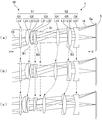
- FIG. 1 shows an example of an imaging apparatus provided with an optical system according to the present invention.
- This imaging device (camera, camera device) 1 includes an optical system (imaging optical system, imaging optical system, lens system) 10 and an image plane side (image side, imaging side, imaging side) 12 of the optical system 10. It has the arranged image sensor (imaging device) 5.
- the optical system 10 includes a first refractive optical system S1 disposed on the object side 11 with an aperture stop (stop) St interposed therebetween, and a second refractive optical system S2 disposed on the image plane side. This is an optical system for imaging.
- the first refractive optical system S1 is arranged in order from the object side 11, and includes a first lens group G1 having a positive refractive power, a second lens group G2 having a positive refractive power, and a negative refractive power. And a third lens group G3.
- the second refractive optical system S2 includes, in order from the object side 11, a fourth lens group G4 having a positive refractive power, a fifth lens group G5 having a positive refractive power, and a negative refractive power. And a sixth lens group G6.
- the optical system 10 is a telephoto type, for example, a macro lens having a focal length of about 120 mm, and the first lens group G1 and the third lens group G3 with respect to the aperture stop St during focusing from infinity to short distance.
- the sixth lens group G6 is an inner focus type optical system 10 in which the second lens group G2 and the fourth lens group G4 move to the object side 11 without moving.
- the first refractive optical system S1 includes positive-positive-negative power arrangements by lens groups G1, G2, and G3, and the second refractive optical system S2 includes lens groups G4, G5, and G6.
- a positive-positive-negative power arrangement Accordingly, a telephoto type (telephoto type, reverse retrofocus type) optical system S1 and S2 having a positive-positive-negative power arrangement is connected to the object side 11 and the image plane side 12 with the aperture stop St interposed therebetween. It is a system.
- positive lens groups G2 and G4 that move during focus adjustment are arranged in the telephoto type optical systems S1 and S2, respectively, and these positive lens groups G2 and G4 are adjusted during focus adjustment.
- the lens group G2 has a three-lens configuration and the lens group G4 has a single-lens configuration. Furthermore, with a small number of lens configurations from infinity to a short distance, for example, in the optical system 10 of this example, although it is a telephoto type macro lens, it can correct aberrations satisfactorily with a total of 10 lenses, and the total length can be increased.
- a light-weight optical system 10 with a compact size of around 120 mm can be provided.
- the auto-focus type macro lens can reduce the load on the auto-focus mechanism, and has a highly sensitive and accurate auto-focus function. Can be provided.
- the first lens group G1 and the sixth lens group G6 do not move during the focal length adjustment, and the total length AL of the optical system 10 is fixed. Therefore, it is possible to provide the optical system 10 that can easily adjust the shooting distance without changing the lens total length AL during macro shooting.
- the final sixth lens group G6 on the image plane side 12 by disposing the negative lens L61, it is possible to provide the optical system 10 with a large image circle by spreading the light flux 16 to the imaging plane 5a.
- the diameter of the image circle is 56 mm.
- the optical system 10 typically, focus adjustment is performed mainly by the positive power lens group G4 of the second refractive optical system S2, and the positive power lens group G2 of the first refractive optical system S1.
- the second lens group G2 includes the first cemented lens B1, and the movement amount PF1 when the second lens group G2 is focused and the fourth lens group G4 when the focusing is performed.
- the movement amount PB1 satisfies the following condition (1).
- the movement direction (movement distance) of the lens group is positive on the object side 11, and the second lens group G2 and the fourth lens group G4 are focused from an infinite shooting distance to a short distance.
- a positive direction of movement that is, movement from the image plane side 12 to the object side 11. 1 ⁇ PB1 / PF1 ⁇ 8 (1)
- the second lens group G2 moves mainly to correct chromatic aberration. If the lower limit of the condition (1) is not reached, aberration correction such as field curvature becomes excessive, and the second lens group G2 moves. It is difficult to make the optical system 10 compact because the amount is too large. If the upper limit of condition (1) is exceeded, the movement amount PF1 of the second lens group G2 becomes too small with respect to the movement amount PB1 of the fourth lens group G4 that moves during focus adjustment, making it difficult to correct aberrations. Become.
- the lower limit of condition (1) may be 2, and the upper limit may be 5.
- the movement amount PF1 of the second lens group G2 and the total length AL of the optical system 10 may satisfy the following condition (2). 0.05 ⁇ PF1 / AL ⁇ 0.15 (2) If the lower limit of the condition (2) is not reached, the movement amount PF1 of the second lens group G2 becomes too small to fully correct the variation in chromatic aberration with respect to the change in focal length. If the upper limit is exceeded, aberration correction such as field curvature is corrected. Becomes excessive, and it becomes difficult to realize a compact optical system 10.
- the upper limit of condition (2) may be 0.12 or 0.10.
- the first cemented lens B1 included in the second lens group G2 that mainly corrects fluctuations in chromatic aberration with respect to focal length fluctuations is a balsam lens, and has a positive refractive power lens L21 and a negative refractive power lens L22.
- the refractive index nd21 and Abbe number ⁇ d21 of the lens L21 and the refractive index nd22 and Abbe number ⁇ d22 of the lens L22 may satisfy the following condition (3).
- the surface on the image surface side 12 of the first cemented lens B1 is a concave surface on the image surface side 12
- the second lens group G2 is an image of the first cemented lens B1 and the first cemented lens B1.
- the lens L23 may be constituted by a lens L23 adjacent to the surface side with a minimum air gap, the surface of the object side 11 being a convex surface on the object side 11.
- the movement amount PB1 of the fourth lens group G4 that moves mainly for focal length adjustment (focusing) and the total length AL of the optical system 10 may satisfy the following condition (4). 0.15 ⁇ PB1 / AL ⁇ 0.40 (4) If the lower limit of condition (4) is not reached, the movement amount PB1 of the fourth lens group G4 becomes too small and the focal length adjustment range becomes too narrow. On the other hand, when the upper limit of the condition (4) is exceeded, it is difficult to provide the compact optical system 10.
- the lower limit of condition (3) may be 0.20, and the upper limit may be 0.35.
- the fourth lens group G4 can be configured as a single lens L41 having a positive refractive power.
- the fourth lens group G4 that moves for focal length adjustment into a single lens L41 that is the minimum configuration, the number of lenses constituting the optical system 10 can be reduced and the load on the autofocus mechanism can be reduced.
- the optical system 10 having high focus adjustment capability (sensitivity and accuracy) can be provided.
- the refractive index nd41 and the Abbe number ⁇ d41 of the lens L41 constituting the fourth lens group G4 may satisfy the following condition (5). 1.40 ⁇ nd41 ⁇ 1.60 70 ⁇ d41 ⁇ 90 (5)
- the ED lens special low dispersion lens, anomalous dispersion lens
- a cemented lens B3 may be disposed in the fifth lens group G5 and moved during focusing.
- the fifth lens group G5 By moving another positive fifth lens group G5 included in the second refractive optical system S2 when adjusting the focal length, the fifth lens group G5 contributes to correction of chromatic aberration at macro magnification. It is possible to suppress the increase in the movement amount PF1 of the second lens group G2, and it is possible to provide a more compact optical system 10.
- the fifth lens group G5 simply moves from the image plane side 12 to the object side 11 during focusing from infinity to short distance (at macro magnification). Alternatively, it may move in the reverse direction (minus direction, from the object side 11 to the image plane side 12), and the moving direction may change midway depending on the shooting distance.
- the third lens group G3 can be composed of a set of cemented lenses B2, and the fifth lens group G5 can be composed of a set of cemented lenses B3.
- the first lens group G1 can be composed of one lens having a positive refractive power
- the sixth lens group G6 is composed of one pair of cemented lenses or one lens having a negative refractive power. Is possible. Therefore, the optical system 10 includes one first lens group G1, three second lens groups G2, two third lens groups G3, one fourth lens group G4, and fifth lenses.
- the number of the lens group G5 is two and the number of the sixth lens group G6 is one or two, and the number of the lenses can be made as few as ten or eleven as a whole.
- the optical system 10 shown in FIG. 1 includes a first refractive optical system S1 disposed on the object side 11 with an aperture stop (stop) St interposed therebetween, and a second refractive optical system S disposed on the image plane side 12. It consists of a lens group G2.
- the first refractive optical system S1 includes a first lens group G1 having a positive power, a second lens group G2 having a positive power, and a negative lens group G1 arranged in order from the object side 11 along the optical axis 15. And a third lens group G3 having the same power.
- the first lens group G1 is composed of a single biconvex positive lens L11
- the second lens group G2 is a balsam lens (junction lens) composed of a biconvex positive lens L21 and a biconcave negative lens L22.
- B1 is a three-lens configuration including a positive meniscus lens L23 that is convex on the object side 11, and the object side 11 surface of the meniscus lens L2 is adjacent to the concave surface on the image side 12 of the cemented lens B1 with a minimum air gap.
- the third lens group G2 has a two-lens configuration including a balsam lens (junction lens) B2 including a positive meniscus lens L31 convex on the image plane side 12 and a negative biconcave lens L32.
- the second refractive optical system S2 includes a fourth lens group G4 having a positive power, a fifth lens group G5 having a positive power, and a negative lens group G5 arranged in order from the object side 11 along the optical axis 15. And a sixth lens group G6 having the same power.
- the fourth lens group G4 is composed of one biconvex positive lens L41
- the fifth lens group G5 is a balsam lens (junction lens) including a biconcave negative lens L51 and a biconvex positive lens L52. It is a two-sheet configuration of B3.
- the sixth lens group G6 has a single-piece configuration of a biconcave negative lens L61 in which the radius of curvature of the object side 11 surface is smaller than the radius of curvature of the image side 12 surface.
- FIG. 1A shows the lens arrangement when the shooting distance is infinite
- FIG. 1B shows the lens arrangement when the shooting distance from the image plane 5a is 2.0 m
- FIG. The lens arrangement is shown when the shooting distance is minimum (short distance, specifically, the shooting distance is 0.43 m from the image plane 5a).
- the lens arrangement shown in each of the following examples is the same.
- FIG. 2 shows the data of each lens constituting the optical system 10.
- the radius of curvature (Rdy) is the radius of curvature (mm) of each surface of each lens arranged in order from the object side 11, the distance Thi is the distance (mm) between the lens surfaces, and the effective diameter H * 2 is the effective of each lens surface.
- the diameter (diameter, mm), the refractive index nd is the refractive index of each lens (d line), the Abbe number ⁇ d is the Abbe number of each lens (d line), the lens name, and the focal length of each group (synthetic focal length mm).
- each lens which comprises this optical system 10 is a spherical lens as an example, an aspherical lens may be included. Further, the interval Thi between the surfaces indicates when the shooting distance is infinite.
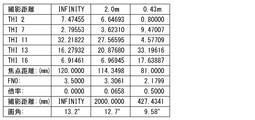
- FIG. 3 shows values of intervals Thi2, Thi7, Thi11, Thi13, and Thi16 that change when the shooting distance is infinite, 2.0 m and 0.43 m (near distance), and a combined focal length (mm) of the optical system 10. , FNo, magnification, shooting distance (mm), and angle of view. The same applies to the lens data shown below.
- 4A, 4B, and 4C show spherical aberration, astigmatism, and distortion of the optical system 10 at an infinite shooting distance, intermediate (2.0 m), and short distance (0.43 m).
- Spherical aberrations are as follows: wavelength 435.8340 nm (two-dot chain line), wavelength 486.1330 nm (long broken line), wavelength 546.0740 nm (solid line), wavelength 587.5620 nm (one-dot chain line), and 656.2730 nm (short dashed line). ).
- Astigmatism indicates a tangential ray T and a sagittal ray S. The same applies to the aberration diagrams shown below.
- Numerical values indicating the main performance of the optical system 10 are as follows. Image circle: ⁇ 56mm Overall lens length (LA): 119.07mm Focal length (infinity): 120mm Magnification (short distance): 0.5 Movement distance of second lens group G2 (PF1): 6.67 mm Movement distance (PB1) of fourth lens group G4: 27.64 mm Condition (1) (PB1 / PF1): 4.14 Condition (2) (PF1 / AL): 0.056 Condition (4) (PB1 / AL): 0.232
- the imaging optical system 10 has a focal length of 120 mm and a short-distance magnification of 0.5, and has performance as a telephoto type macro lens.
- This optical system 10 is a telephoto type in which positive-positive-negative power is arranged before and after the stop St.
- the total length LA is constant, and the positive power inside the optical system is adjusted for focal length adjustment.
- This is an inner focus type in which the second lens group G2, the fourth lens group G4, and the fifth lens group G5 move. Furthermore, the conditions (1), (2) and (4) described above are satisfied.
- the cemented lens B1 of the second lens group G2 satisfies the condition (3), and the lens L41 of the fourth lens group G4 satisfies the condition (5). Therefore, while having a simple configuration of 10 lenses constituting the whole, it has the performance as a telephoto type macro lens, and furthermore, each aberration is well corrected at each shooting distance as shown in FIG.
- An optical system 10 can be provided.
- the entire image circle is a compact optical system 10 having a large image circle of ⁇ 56 mm, a total length LA of 120 mm or less, and a maximum lens diameter of 42 mm or less.
- the fourth lens group G4 that moves greatly during macro photography has a single lens configuration
- the accompanying second lens group G2 has a three-lens configuration including a cemented lens B1 and a positive lens.
- the fifth lens group G5 that moves minutely in order to further improve the performance is a set of cemented lenses B3, that is, a two-lens configuration. Therefore, it is possible to provide the optical system 10 that can move the number of lenses at the time of macro photography, can easily adjust the focus, and can easily cope with fluctuations in the photographing distance, whether manually or using AF.
- FIG. 5 shows an example of a camera 1 having a different imaging optical system 10. Similar to the optical system (lens system) of the first embodiment, this optical system 10 also has performance as a telephoto type macro lens.
- the basic configuration of the optical system 10 is the same as that of the optical system of the first embodiment shown in FIG. 1, and a lens group having positive-positive-negative power on the object side 11 across the aperture stop (stop) St. G1 to G3 are disposed, and positive-positive-negative power lens groups G4 to G6 are disposed on the image plane side 12, and the internal positive lens groups G2, G4, and G5 are moved to adjust the focal length,
- the optical system 10 is a focus type and has a constant overall length LA. Also, the optical system 10 has a simple configuration of 10 lenses as a whole, and realizes a compact and lightweight telephoto macro lens.
- the fifth lens group G5 simply moved to the object side 11 in the optical system of Example 1 when moving the shooting distance from infinity to a short distance, whereas in the optical system 10, the fifth lens group G5 was moved to an intermediate distance ( The fifth lens group G5 moves to the image plane side 12 until the shooting distance is 2.0 m, then moves to the object side 11 to the short distance (shooting distance 0.43 m), and focuses from infinity to the short distance.
- the movement amount PB2 is ⁇ 1.01 mm, and the object moves from the object side 11 to the image plane side 12 in the opposite direction to the second lens group G2 and the fourth lens group G4.
- the movement amount PB2 of the fifth lens group G5 may satisfy the following condition (6). However, as described above, the amount of movement from the image plane side 12 to the object side 11 is positive. PB2 ⁇ 0 (6)
- FIG. 6 shows the data of each lens constituting the optical system 10.
- FIG. 7 shows the values of the intervals Thi2, Thi7, Thi11, Thi13, Thi16 and various values of the optical system 10 when the shooting distance is infinite, intermediate (2.0 m), and short distance (0.43 m).
- Show. 8A, 8B, and 8C show spherical aberration, astigmatism, and distortion of the optical system 10 at an infinite shooting distance, intermediate (2.0 m), and short distance (0.43 m). Show.
- Numerical values indicating the main performance of the optical system 10 are as follows. Image circle: ⁇ 56mm Overall lens length (LA): 120.84 mm Focal length (infinity): 120mm Magnification (short distance): 0.5 Movement distance of second lens group G2 (PF1): 8.24 mm Moving distance (PB1) of the fourth lens group G4: 40.39 mm Condition (1) (PB1 / PF1): 4.90 Condition (2) (PF1 / AL): 0.068 Condition (4) (PB1 / AL): 0.334
- this optical system 10 has a focal length of 120 mm and a short-distance magnification of 0.5, and has performance as a telephoto type macro lens.
- the above conditions (1) and (2) ) And (4) are satisfied.
- the cemented lens B1 of the second lens group G2 satisfies the condition (3), and the lens L41 of the fourth lens group G4 satisfies the condition (5).
- An optical system 10 can be provided.
- FIG. 9 shows an example of the camera 1 provided with a different imaging optical system 10. Similar to the optical system (lens system) of the first embodiment, this optical system 10 also has performance as a telephoto type macro lens.
- the basic configuration of the optical system 10 is the same as that of the optical system of the first embodiment shown in FIG. 1, and a lens group having positive-positive-negative power on the object side 11 across the aperture stop (stop) St. G1 to G3 are arranged, and lens groups G4 to G6 having positive-positive-negative power are arranged on the image plane side 12.
- the internal positive lens groups G2 and G4 move, and the fifth lens group G5 does not move, in order to adjust the focal length. Therefore, in this optical system 10, the fifth lens group G5, together with the sixth lens group G6, constitutes a non-moving lens group (fifth lens group) disposed on the most image surface side 12, and the lens.
- the combined focal length of the group is ⁇ 130.39 mm, which is a negative power lens group.
- this optical system can also be regarded as a positive-positive-negative-positive-negative five-group configuration, excluding the first lens group G1 having the positive power arranged closest to the object side 11.
- the two positive power lens groups G2 and G4 move in synchronism with the object side 11 during focusing.
- the optical system 10 is an inner focus type optical system 10 having a constant overall length LA, and has a simple configuration of 10 lenses as a whole. Further, the number of lens groups that move during focusing may be limited to two. it can. Therefore, it is possible to provide an optical system 10 which is a compact and lightweight telephoto macro lens, can be easily adjusted in focus, and can further reduce the load of AF.
- FIG. 10 shows the data of each lens constituting the optical system 10.
- FIG. 11 shows values of the intervals Thi2, Thi7, Thi11, Thi13 and various values of the optical system 10 when the shooting distance is infinite, intermediate (2.0 m), and short distance (0.43 m).
- Yes. 12A, 12B, and 12C show spherical aberration, astigmatism, and distortion of the optical system 10 at an infinite shooting distance, intermediate (2.0 m), and short distance (0.43 m). Show.
- Numerical values indicating the main performance of the optical system 10 are as follows. Image circle: ⁇ 56mm Overall lens length (LA): 114.14mm Focal length (infinity): 120mm Magnification (short distance): 0.5 Movement distance of second lens group G2 (PF1): 10.52 mm Movement distance (PB1) of fourth lens group G4: 29.32 mm Condition (1) (PB1 / PF1): 2.79 Condition (2) (PF1 / AL): 0.092 Condition (4) (PB1 / AL): 0.257
- this optical system 10 has a focal length of 120 mm and a short-distance magnification of 0.5, and has performance as a telephoto type macro lens.
- the above conditions (1) and (2) ) And (4) are satisfied.
- the cemented lens B1 of the second lens group G2 satisfies the condition (3), and the lens L41 of the fourth lens group G4 satisfies the condition (5).
- An optical system 10 can be provided.
- FIG. 13 shows an example of the camera 1 provided with a different imaging optical system 10. Similar to the optical system (lens system) of the first embodiment, this optical system 10 also has performance as a telephoto type macro lens.
- the basic configuration of the optical system 10 is the same as that of the optical system of the first embodiment shown in FIG. 1, and a lens group having positive-positive-negative power on the object side 11 across the aperture stop (stop) St. G1 to G3 are arranged, and lens groups G4 to G6 having positive-positive-negative power are arranged on the image plane side 12.
- the first lens group G1 has a single lens configuration of a positive meniscus lens L11 convex toward the object side 11, and the second lens group G2 is arranged in order from the object side 11, and is positive toward the object side 11.
- the image surface of the cemented lens B1 is composed of three lenses, a balsam lens (junction lens) B1 composed of a meniscus lens L21 and a negative meniscus lens L22 convex on the object side 11, and a positive meniscus lens L23 convex on the object side 11.
- the object side 11 surface of the meniscus lens L2 is adjacent to the concave surface on the side 12 with a minimum air spacing.
- the third lens group G2 includes two balsam lenses (junction lenses) B2 arranged in order from the object side 11 and including a positive meniscus lens L31 convex on the image side 12 and a negative lens L32 biconcave. It is.
- the fourth lens group G4 has a single lens configuration of a positive meniscus lens L41 convex toward the image plane side 12, and the fifth lens group G5 is arranged in order from the object side 11 and is convex positive toward the object side 11.
- the balsam lens (junction lens) B3 is composed of a meniscus lens L51 and a negative meniscus lens L52 convex toward the object side 11.
- the sixth lens group G6 has a two-lens configuration including a balsam lens (junction lens) B4 including a biconcave negative lens L61 and a biconvex positive lens L62, which are sequentially arranged from the object side 11. Therefore, the optical system 10 is composed of a total of eleven lenses arranged along the optical axis 15.
- the optical system 10 can also be regarded as a positive-positive-negative-positive-negative five-group configuration, and has a positive power disposed on the most object side 11.
- the two positive power lens groups G2 and G4 except the first lens group G1 move in synchronism with the object side 11 during focusing.
- the optical system 10 is an inner focus type optical system 10 having a constant overall length LA, and has a simple configuration of 11 lenses as a whole. Further, the number of lens groups that move during focusing may be limited to two. it can. Therefore, it is possible to provide an optical system 10 which is a compact and lightweight telephoto macro lens, can be easily adjusted in focus, and can further reduce the load of AF.
- FIG. 14 shows the data of each lens constituting the optical system 10.
- FIG. 15 shows values of the intervals Thi2, Thi7, Thi11, Thi13 and various values of the optical system 10 when the shooting distance is infinite, intermediate (2.0 m), and short distance (0.43 m).
- Yes. 16A, 16B, and 16C show spherical aberration, astigmatism, and distortion of the optical system 10 at an infinite shooting distance, intermediate (2.0 m), and short distance (0.43 m). Show.
- Numerical values indicating the main performance of the optical system 10 are as follows. Image circle: ⁇ 56mm Overall lens length (LA): 115.59 mm Focal length (infinity): 120mm Magnification (short distance): 0.5 Movement distance (PF1) of the second lens group G2: 13.65 mm Moving distance (PB1) of fourth lens group G4: 31.01 mm Condition (1) (PB1 / PF1): 2.41 Condition (2) (PF1 / AL): 0.118 Condition (4) (PB1 / AL): 0.268
- this optical system 10 has a focal length of 120 mm and a short-distance magnification of 0.5, and has performance as a telephoto type macro lens.
- the above conditions (1), (2 ) And (4) are satisfied.
- the cemented lens B1 of the second lens group G2 satisfies the condition (3), and the lens L41 of the fourth lens group G4 satisfies the condition (5).
- it has a simple configuration of 11 lenses constituting the whole, it has performance as a telephoto type macro lens, and further aberration can be obtained by arranging the cemented lens B4 in the sixth lens group G6.
- the optical system 10 in which each aberration is satisfactorily corrected at each shooting distance can be provided.
- the optical system (lens system) 10 disclosed above is related to the imaging optical device and the digital device, and the interchangeable lens digital camera, the video camera, the TV camera, and the action camera that captures the scenery and the subject into the imaging device.
- This is a large-diameter and compact optical system 10 suitable for the above.
- it is suitable as a lens system with a large image circle to be used for the large image sensor 5 and has a performance as a telephoto type macro lens with a simple configuration of 10 or 11 lenses, and has a short overall length LA.
Landscapes
- Physics & Mathematics (AREA)
- General Physics & Mathematics (AREA)
- Optics & Photonics (AREA)
- Lenses (AREA)
Abstract
Description
1<PB1/PF1<8・・・(1)
第2のレンズ群G2は、主に色収差を補正するために移動し、条件(1)の下限を下回ると像面湾曲などの収差補正が過剰になり、また、第2のレンズ群G2の移動量が多すぎて光学系10をコンパクトにすることが難しくなる。条件(1)の上限を上回ると、焦点調整の際に移動する第4のレンズ群G4の移動量PB1に対して第2のレンズ群G2の移動量PF1が小さくなりすぎて収差補正が困難になる。条件(1)の下限は、2であってもよく、上限は5であってもよい。
0.05<PF1/AL<0.15・・・(2)
条件(2)の下限を下回ると、第2のレンズ群G2の移動量PF1が小さくなりすぎて焦点距離変化に対する色収差の変動を補正しきれなくなり、上限を上回ると、像面湾曲などの収差補正が過剰になりすぎ、また、コンパクトな光学系10を実現することが難しくなる。条件(2)の上限は、0.12であってもよく、0.10であってもよい。
1.45<nd21<1.65
1.65<nd22<1.85
65<νd21<85
20<νd22<40 ・・・(3)
条件(3)を満たす色収差を効果的に補正可能なバルサムレンズB1を、焦点距離移動時に移動する第2のレンズ群G2に配置することにより、焦点距離変動に対する色収差の変動を効果的に補正できる。
0.15<PB1/AL<0.40・・・(4)
条件(4)の下限を下回ると、第4のレンズ群G4の移動量PB1が小さくなりすぎて焦点距離の調整範囲が狭くなりすぎる。一方、条件(4)の上限を上回ると、コンパクトな光学系10を提供することが難しくなる。条件(3)の下限は、0.20であってもよく、上限は0.35であってもよい。
1.40<nd41<1.60
70<νd41<90 ・・・(5)
EDレンズ(特殊低分散レンズ、異常分散レンズ)を焦点距離変更用に移動する第4のレンズ群G4に配置することで、焦点距離変動に対する色収差変動を、この第4のレンズ群G4においても効果的に補正できる。
図1に示した光学系10は、開口絞り(絞り)Stを挟んで物体側11に配置された第1の屈折光学系S1と、像面側12に配置された第2の屈折光学系Sレンズ群G2とから構成されている。第1の屈折光学系S1は、光軸15に沿って物体側11から順番に配置された、正のパワーの第1のレンズ群G1と、正のパワーの第2のレンズ群G2と、負のパワーの第3のレンズ群G3とから構成されている。第1のレンズ群G1は、両凸の正レンズL11の1枚構成で、第2のレンズ群G2は、両凸の正レンズL21と両凹の負レンズL22とからなるバルサムレンズ(接合レンズ)B1と、物体側11に凸の正のメニスカスレンズL23の3枚構成で、接合レンズB1の像面側12の凹面にメニスカスレンズL2の物体側11の面が最小空気間隔で隣接している。第3のレンズ群G2は、像面側12に凸の正のメニスカスレンズL31と両凹の負レンズL32とからなるバルサムレンズ(接合レンズ)B2の2枚構成である。
イメージサークル:φ56mm
全体のレンズ長(LA):119.07mm
焦点距離(無限大):120mm
倍率(近距離):0.5
第2のレンズ群G2の移動距離(PF1):6.67mm
第4のレンズ群G4の移動距離(PB1):27.64mm
条件(1)(PB1/PF1):4.14
条件(2)(PF1/AL):0.056
条件(4)(PB1/AL):0.232
図5に、異なる撮像用の光学系10を備えたカメラ1の例を示している。この光学系10も、実施例1の光学系(レンズシステム)と同様に望遠タイプのマクロレンズとしての性能を備えている。この光学系10の基本的な構成は、図1に示した実施例1の光学系と共通であり、開口絞り(絞り)Stを挟んで物体側11に正-正-負のパワーのレンズ群G1~G3が配置され、像面側12に正-正-負のパワーのレンズ群G4~G6が配置され、内部の正のレンズ群G2、G4およびG5が焦点距離調整のために動き、インナーフォーカスタイプで全長LAが一定の光学系10である。また、この光学系10も全体が10枚構成という簡易な構成であり、コンパクトで軽量の望遠マクロレンズを実現している。
PB2<0・・・(6)
イメージサークル:φ56mm
全体のレンズ長(LA):120.84mm
焦点距離(無限大):120mm
倍率(近距離):0.5
第2のレンズ群G2の移動距離(PF1):8.24mm
第4のレンズ群G4の移動距離(PB1):40.39mm
条件(1)(PB1/PF1):4.90
条件(2)(PF1/AL):0.068
条件(4)(PB1/AL):0.334
図9に、さらに異なる撮像用の光学系10を備えたカメラ1の例を示している。この光学系10も、実施例1の光学系(レンズシステム)と同様に望遠タイプのマクロレンズとしての性能を備えている。この光学系10の基本的な構成は、図1に示した実施例1の光学系と共通であり、開口絞り(絞り)Stを挟んで物体側11に正-正-負のパワーのレンズ群G1~G3が配置され、像面側12に正-正-負のパワーのレンズ群G4~G6が配置されている。
イメージサークル:φ56mm
全体のレンズ長(LA):114.14mm
焦点距離(無限大):120mm
倍率(近距離):0.5
第2のレンズ群G2の移動距離(PF1):10.52mm
第4のレンズ群G4の移動距離(PB1):29.32mm
条件(1)(PB1/PF1):2.79
条件(2)(PF1/AL):0.092
条件(4)(PB1/AL):0.257
図13に、さらに異なる撮像用の光学系10を備えたカメラ1の例を示している。この光学系10も、実施例1の光学系(レンズシステム)と同様に望遠タイプのマクロレンズとしての性能を備えている。この光学系10の基本的な構成は、図1に示した実施例1の光学系と共通であり、開口絞り(絞り)Stを挟んで物体側11に正-正-負のパワーのレンズ群G1~G3が配置され、像面側12に正-正-負のパワーのレンズ群G4~G6が配置されている。
イメージサークル:φ56mm
全体のレンズ長(LA):115.59mm
焦点距離(無限大):120mm
倍率(近距離):0.5
第2のレンズ群G2の移動距離(PF1):13.65mm
第4のレンズ群G4の移動距離(PB1):31.01mm
条件(1)(PB1/PF1):2.41
条件(2)(PF1/AL):0.118
条件(4)(PB1/AL):0.268
Claims (13)
- 開口絞りを挟んで物体側に配置された第1の屈折光学系と、像面側に配置された第2の屈折光学系とから構成された撮像用の光学系であって、
前記第1の屈折光学系は、物体側から順に配置された、正の屈折力の第1のレンズ群と、正の屈折力の第2のレンズ群と、負の屈折力の第3のレンズ群とを含み、
前記第2の屈折光学系は、物体側から順に配置された、正の屈折力の第4のレンズ群と、正の屈折力の第5のレンズ群と、負の屈折力の第6のレンズ群とを含み、
無限遠から近距離へのフォーカシングに際し、前記開口絞りに対して前記第1のレンズ群、前記第3のレンズ群および前記第6のレンズ群は動かず、前記第2のレンズ群および前記第4のレンズ群が物体側へ移動する、光学系。 - 請求項1において、
前記第2のレンズ群は第1の接合レンズを含み、前記第2のレンズ群の前記フォーカシングの際の移動量PF1と、前記第4のレンズ群の前記フォーカシングの際の移動量PB1とは以下の条件を満たす、光学系。
1<PB1/PF1<8 - 請求項2において、
前記移動量PF1と、当該光学系の全長ALとは以下の条件を満たす、光学系。
0.05<PF1/AL<0.15 - 請求項2または3において、
前記第1の接合レンズは正の屈折力のレンズL21と負の屈折力のレンズL22とを含み、
前記レンズL21の屈折率nd21およびアッベ数νd21と、前記レンズL22の屈折率nd22およびアッベ数νd22とが以下の条件を満たす、光学系。
1.45<nd21<1.65
1.65<nd22<1.85
65<νd21<85
20<νd22<40 - 請求項2ないし4のいずれかにおいて、
前記第1の接合レンズの像面側の面は像面側に凹の面であり、前記第2のレンズ群は、前記第1の接合レンズの像面側の面に最小空気間隔を設けて隣接し、物体側の面が物体側に凸の面であるレンズを含む、光学系。 - 請求項2ないし5のいずれかにおいて、
前記移動量PB1と、当該光学系の全長ALとは以下の条件を満たす、光学系。
0.15<PB1/AL<0.40 - 請求項1ないし6のいずれかにおいて、
前記第4のレンズ群は、正の屈折力のレンズL41の一枚構成である、光学系。 - 請求項7において、
前記レンズL41の屈折率nd41およびアッベ数νd41は以下の条件を満たす、光学系。
1.40<nd41<1.60
70<νd41<90 - 請求項1ないし8のいずれかにおいて、
前記第5のレンズ群は接合レンズを含み、前記フォーカシングの際に移動する、光学系。 - 請求項1ないし9のいずれかにおいて、
前記第3のレンズ群は、1組の接合レンズで構成され、前記第5のレンズ群は、1組の接合レンズで構成されている、光学系。 - 請求項10において、
前記第1のレンズ群は、正の屈折力のレンズの一枚構成であり、前記第6のレンズ群は、1組の接合レンズまたは負の屈折力のレンズの一枚構成である、光学系。 - 請求項1ないし10のいずれかにおいて、
前記第1のレンズ群は、1枚の正の屈折力のレンズで構成され、前記第2のレンズ群は、物体側から配置された1組の接合レンズと1枚の正の屈折力のレンズで構成され、前記第3のレンズ群は1組の接合レンズで構成され、前記第4のレンズ群は1枚の正の屈折力のレンズで構成され、前記第5のレンズ群は、1組の接合レンズで構成され、前記第6のレンズ群は、1組の接合レンズまたは1枚の負の屈折力のレンズで構成されている、光学系。 - 請求項1ないし12のいずれかに記載の光学系と、
前記光学系の像面側に配置された撮像素子とを有する撮像装置。
Priority Applications (4)
| Application Number | Priority Date | Filing Date | Title |
|---|---|---|---|
| US16/614,902 US11314042B2 (en) | 2017-05-26 | 2018-05-25 | Optical system for image pickup, and image pickup device |
| EP18806868.8A EP3633434B1 (en) | 2017-05-26 | 2018-05-25 | Optical system for image pickup, and image pickup device |
| JP2019520318A JP6635540B2 (ja) | 2017-05-26 | 2018-05-25 | 撮像用の光学系および撮像装置 |
| CN201880034672.0A CN110709747B (zh) | 2017-05-26 | 2018-05-25 | 摄像用的光学系统和摄像装置 |
Applications Claiming Priority (2)
| Application Number | Priority Date | Filing Date | Title |
|---|---|---|---|
| JP2017-104151 | 2017-05-26 | ||
| JP2017104151 | 2017-05-26 |
Publications (1)
| Publication Number | Publication Date |
|---|---|
| WO2018216789A1 true WO2018216789A1 (ja) | 2018-11-29 |
Family
ID=64396535
Family Applications (1)
| Application Number | Title | Priority Date | Filing Date |
|---|---|---|---|
| PCT/JP2018/020089 Ceased WO2018216789A1 (ja) | 2017-05-26 | 2018-05-25 | 撮像用の光学系および撮像装置 |
Country Status (5)
| Country | Link |
|---|---|
| US (1) | US11314042B2 (ja) |
| EP (1) | EP3633434B1 (ja) |
| JP (1) | JP6635540B2 (ja) |
| CN (1) | CN110709747B (ja) |
| WO (1) | WO2018216789A1 (ja) |
Cited By (5)
| Publication number | Priority date | Publication date | Assignee | Title |
|---|---|---|---|---|
| JP2019191502A (ja) * | 2018-04-27 | 2019-10-31 | 株式会社タムロン | インナーフォーカス式撮像レンズ及び撮像装置 |
| WO2021109042A1 (zh) * | 2019-12-04 | 2021-06-10 | 深圳市大疆创新科技有限公司 | 光学系统及拍摄装置 |
| JP2021152568A (ja) * | 2020-03-24 | 2021-09-30 | キヤノン株式会社 | 光学系および撮像装置 |
| JP2023120952A (ja) * | 2022-02-18 | 2023-08-30 | キヤノン株式会社 | 光学系および撮像装置 |
| WO2024219086A1 (ja) * | 2023-04-19 | 2024-10-24 | ソニーグループ株式会社 | 光学系、および撮像装置 |
Families Citing this family (2)
| Publication number | Priority date | Publication date | Assignee | Title |
|---|---|---|---|---|
| DE102016117547A1 (de) | 2016-09-18 | 2018-03-22 | Leica Camera Ag | Objektiv fester Brennweite und konstanter Baulänge für Autofokusanwendungen |
| WO2022259649A1 (ja) * | 2021-06-09 | 2022-12-15 | 株式会社ニコン | 変倍光学系、光学機器および変倍光学系の製造方法 |
Citations (3)
| Publication number | Priority date | Publication date | Assignee | Title |
|---|---|---|---|---|
| JP2011048232A (ja) * | 2009-08-28 | 2011-03-10 | Panasonic Corp | 近距離撮影可能な光学系およびそれを用いた光学装置 |
| JP2013104994A (ja) | 2011-11-14 | 2013-05-30 | Sigma Corp | 防振機能を有するインナーフォーカス式大口径望遠マクロレンズ |
| WO2016113921A1 (ja) * | 2015-01-14 | 2016-07-21 | オリンパス株式会社 | 複数の撮像光学系及びそれを有する撮像装置 |
Family Cites Families (22)
| Publication number | Priority date | Publication date | Assignee | Title |
|---|---|---|---|---|
| JP2000214380A (ja) | 1999-01-22 | 2000-08-04 | Canon Inc | 撮影レンズ |
| JP2006023680A (ja) * | 2004-07-09 | 2006-01-26 | Canon Inc | 撮影レンズ及びそれを有する撮像装置 |
| JP2009217167A (ja) * | 2008-03-12 | 2009-09-24 | Sony Corp | ズーム光学系及び撮像装置 |
| JP5168641B2 (ja) * | 2008-05-21 | 2013-03-21 | 株式会社ニコン | 変倍光学系、これを有する光学機器及び変倍方法 |
| US8503097B2 (en) * | 2009-05-27 | 2013-08-06 | Nikon Corporation | Lens system, optical apparatus and manufacturing method |
| US8339713B2 (en) * | 2009-11-04 | 2012-12-25 | Nikon Corporation | Zoom optical system, optical apparatus and method for manufacturing zoom optical system |
| CN103026281B (zh) * | 2010-08-24 | 2015-06-24 | 松下电器产业株式会社 | 变焦透镜系统、可更换镜头装置以及照相机系统 |
| JP5577309B2 (ja) * | 2010-09-17 | 2014-08-20 | パナソニック株式会社 | ズームレンズ系、レンズ鏡筒、交換レンズ装置及びカメラシステム |
| JP5730709B2 (ja) * | 2010-09-28 | 2015-06-10 | オリンパス株式会社 | ズームレンズおよびそれを有する電子撮像装置 |
| JP5771694B2 (ja) * | 2011-09-14 | 2015-09-02 | 富士フイルム株式会社 | 変倍光学系および撮像装置 |
| US8867143B2 (en) * | 2011-11-16 | 2014-10-21 | Canon Kabushiki Kaisha | Zoom lens and image pickup apparatus including the same |
| JP2013218290A (ja) * | 2012-03-14 | 2013-10-24 | Panasonic Corp | ズームレンズ系、交換レンズ装置及びカメラシステム |
| JP5984539B2 (ja) * | 2012-07-09 | 2016-09-06 | キヤノン株式会社 | ズームレンズ及びそれを有する撮像装置 |
| JP2014126851A (ja) * | 2012-12-27 | 2014-07-07 | Tamron Co Ltd | ズームレンズ及び撮像装置 |
| JP2014219601A (ja) | 2013-05-09 | 2014-11-20 | ソニー株式会社 | マクロレンズおよび撮像装置 |
| JP6440450B2 (ja) * | 2013-11-08 | 2018-12-19 | オリンパス株式会社 | 結像レンズ系及びそれを備えた撮像装置 |
| JP6230933B2 (ja) * | 2014-02-28 | 2017-11-15 | 富士フイルム株式会社 | マクロレンズおよび撮像装置 |
| JP6260003B2 (ja) * | 2014-12-22 | 2018-01-17 | パナソニックIpマネジメント株式会社 | レンズ系、交換レンズ装置及びカメラシステム |
| JP6404795B2 (ja) * | 2015-09-28 | 2018-10-17 | 富士フイルム株式会社 | ズームレンズおよび撮像装置 |
| JP6608259B2 (ja) * | 2015-12-03 | 2019-11-20 | キヤノン株式会社 | ズームレンズ及びそれを有する撮像装置 |
| JP6747458B2 (ja) * | 2016-02-01 | 2020-08-26 | ソニー株式会社 | ズームレンズおよび光学機器 |
| KR102596486B1 (ko) * | 2016-05-26 | 2023-11-01 | 한화비전 주식회사 | 줌 렌즈계 |
-
2018
- 2018-05-25 EP EP18806868.8A patent/EP3633434B1/en active Active
- 2018-05-25 WO PCT/JP2018/020089 patent/WO2018216789A1/ja not_active Ceased
- 2018-05-25 CN CN201880034672.0A patent/CN110709747B/zh active Active
- 2018-05-25 JP JP2019520318A patent/JP6635540B2/ja active Active
- 2018-05-25 US US16/614,902 patent/US11314042B2/en active Active
Patent Citations (3)
| Publication number | Priority date | Publication date | Assignee | Title |
|---|---|---|---|---|
| JP2011048232A (ja) * | 2009-08-28 | 2011-03-10 | Panasonic Corp | 近距離撮影可能な光学系およびそれを用いた光学装置 |
| JP2013104994A (ja) | 2011-11-14 | 2013-05-30 | Sigma Corp | 防振機能を有するインナーフォーカス式大口径望遠マクロレンズ |
| WO2016113921A1 (ja) * | 2015-01-14 | 2016-07-21 | オリンパス株式会社 | 複数の撮像光学系及びそれを有する撮像装置 |
Non-Patent Citations (1)
| Title |
|---|
| See also references of EP3633434A4 |
Cited By (8)
| Publication number | Priority date | Publication date | Assignee | Title |
|---|---|---|---|---|
| JP2019191502A (ja) * | 2018-04-27 | 2019-10-31 | 株式会社タムロン | インナーフォーカス式撮像レンズ及び撮像装置 |
| JP7178796B2 (ja) | 2018-04-27 | 2022-11-28 | 株式会社タムロン | インナーフォーカス式撮像レンズ及び撮像装置 |
| WO2021109042A1 (zh) * | 2019-12-04 | 2021-06-10 | 深圳市大疆创新科技有限公司 | 光学系统及拍摄装置 |
| JP2021152568A (ja) * | 2020-03-24 | 2021-09-30 | キヤノン株式会社 | 光学系および撮像装置 |
| JP7458844B2 (ja) | 2020-03-24 | 2024-04-01 | キヤノン株式会社 | 光学系および撮像装置 |
| JP2023120952A (ja) * | 2022-02-18 | 2023-08-30 | キヤノン株式会社 | 光学系および撮像装置 |
| JP7840720B2 (ja) | 2022-02-18 | 2026-04-06 | キヤノン株式会社 | 光学系および撮像装置 |
| WO2024219086A1 (ja) * | 2023-04-19 | 2024-10-24 | ソニーグループ株式会社 | 光学系、および撮像装置 |
Also Published As
| Publication number | Publication date |
|---|---|
| CN110709747A (zh) | 2020-01-17 |
| EP3633434A1 (en) | 2020-04-08 |
| US11314042B2 (en) | 2022-04-26 |
| EP3633434B1 (en) | 2022-07-13 |
| JPWO2018216789A1 (ja) | 2019-11-07 |
| JP6635540B2 (ja) | 2020-01-29 |
| CN110709747B (zh) | 2021-09-14 |
| US20200192060A1 (en) | 2020-06-18 |
| EP3633434A4 (en) | 2021-03-03 |
Similar Documents
| Publication | Publication Date | Title |
|---|---|---|
| US9684155B2 (en) | Optical system and image pickup apparatus including the same | |
| JP6635540B2 (ja) | 撮像用の光学系および撮像装置 | |
| US8953260B2 (en) | Telephoto lens system | |
| JP5616539B2 (ja) | 超広角レンズおよび撮像装置 | |
| CN111751965B (zh) | 变焦透镜和具有变焦透镜的成像装置 | |
| US11480774B2 (en) | Optical system and imaging apparatus having the same | |
| JP7423716B2 (ja) | 光学系およびそれを有する撮像装置 | |
| JP5136776B2 (ja) | 撮影レンズ、この撮影レンズを備えた光学機器、及び、結像方法 | |
| JP2019139238A (ja) | 撮像用の光学系および撮像装置 | |
| JP2019117422A (ja) | 撮像用の光学系および撮像装置 | |
| JP2019117423A (ja) | 撮像用の光学系および撮像装置 | |
| JP5151635B2 (ja) | 撮影レンズ、この撮影レンズを備えた光学機器、及び、結像方法 | |
| JP6707987B2 (ja) | 大口径防振付きズームレンズ | |
| JPWO2019235471A1 (ja) | ズームレンズシステムおよび撮像装置 | |
| JP5545531B2 (ja) | 撮影レンズ、この撮影レンズを有する光学機器、及び、撮影レンズの製造方法 | |
| JP5078498B2 (ja) | ズームレンズ及びそれを有する撮像装置 | |
| JP2018109711A (ja) | ズームレンズおよび撮像装置 | |
| JP2023099390A (ja) | 光学系及びそれを有する撮像装置 | |
| JP2017116646A (ja) | 広角ズームレンズ及び撮像装置 | |
| JP2017215356A (ja) | 光学系及びそれを有する撮像装置 |
Legal Events
| Date | Code | Title | Description |
|---|---|---|---|
| 121 | Ep: the epo has been informed by wipo that ep was designated in this application |
Ref document number: 18806868 Country of ref document: EP Kind code of ref document: A1 |
|
| ENP | Entry into the national phase |
Ref document number: 2019520318 Country of ref document: JP Kind code of ref document: A |
|
| NENP | Non-entry into the national phase |
Ref country code: DE |
|
| WWE | Wipo information: entry into national phase |
Ref document number: 2018806868 Country of ref document: EP |
|
| ENP | Entry into the national phase |
Ref document number: 2018806868 Country of ref document: EP Effective date: 20200102 |