WO2018217996A1 - Curable compositions - Google Patents
Curable compositions Download PDFInfo
- Publication number
- WO2018217996A1 WO2018217996A1 PCT/US2018/034350 US2018034350W WO2018217996A1 WO 2018217996 A1 WO2018217996 A1 WO 2018217996A1 US 2018034350 W US2018034350 W US 2018034350W WO 2018217996 A1 WO2018217996 A1 WO 2018217996A1
- Authority
- WO
- WIPO (PCT)
- Prior art keywords
- curable composition
- oil
- epoxy
- percent
- weight
- Prior art date
- Legal status (The legal status is an assumption and is not a legal conclusion. Google has not performed a legal analysis and makes no representation as to the accuracy of the status listed.)
- Ceased
Links
Classifications
-
- C—CHEMISTRY; METALLURGY
- C08—ORGANIC MACROMOLECULAR COMPOUNDS; THEIR PREPARATION OR CHEMICAL WORKING-UP; COMPOSITIONS BASED THEREON
- C08L—COMPOSITIONS OF MACROMOLECULAR COMPOUNDS
- C08L63/00—Compositions of epoxy resins; Compositions of derivatives of epoxy resins
-
- C—CHEMISTRY; METALLURGY
- C08—ORGANIC MACROMOLECULAR COMPOUNDS; THEIR PREPARATION OR CHEMICAL WORKING-UP; COMPOSITIONS BASED THEREON
- C08G—MACROMOLECULAR COMPOUNDS OBTAINED OTHERWISE THAN BY REACTIONS ONLY INVOLVING UNSATURATED CARBON-TO-CARBON BONDS
- C08G59/00—Polycondensates containing more than one epoxy group per molecule; Macromolecules obtained by polymerising compounds containing more than one epoxy group per molecule using curing agents or catalysts which react with the epoxy groups
- C08G59/02—Polycondensates containing more than one epoxy group per molecule
- C08G59/04—Polycondensates containing more than one epoxy group per molecule of polyhydroxy compounds with epihalohydrins or precursors thereof
- C08G59/06—Polycondensates containing more than one epoxy group per molecule of polyhydroxy compounds with epihalohydrins or precursors thereof of polyhydric phenols
- C08G59/063—Polycondensates containing more than one epoxy group per molecule of polyhydroxy compounds with epihalohydrins or precursors thereof of polyhydric phenols with epihalohydrins
-
- C—CHEMISTRY; METALLURGY
- C08—ORGANIC MACROMOLECULAR COMPOUNDS; THEIR PREPARATION OR CHEMICAL WORKING-UP; COMPOSITIONS BASED THEREON
- C08G—MACROMOLECULAR COMPOUNDS OBTAINED OTHERWISE THAN BY REACTIONS ONLY INVOLVING UNSATURATED CARBON-TO-CARBON BONDS
- C08G59/00—Polycondensates containing more than one epoxy group per molecule; Macromolecules obtained by polymerising compounds containing more than one epoxy group per molecule using curing agents or catalysts which react with the epoxy groups
- C08G59/18—Macromolecules obtained by polymerising compounds containing more than one epoxy group per molecule using curing agents or catalysts which react with the epoxy groups ; e.g. general methods of curing
- C08G59/182—Macromolecules obtained by polymerising compounds containing more than one epoxy group per molecule using curing agents or catalysts which react with the epoxy groups ; e.g. general methods of curing using pre-adducts of epoxy compounds with curing agents
-
- C—CHEMISTRY; METALLURGY
- C08—ORGANIC MACROMOLECULAR COMPOUNDS; THEIR PREPARATION OR CHEMICAL WORKING-UP; COMPOSITIONS BASED THEREON
- C08G—MACROMOLECULAR COMPOUNDS OBTAINED OTHERWISE THAN BY REACTIONS ONLY INVOLVING UNSATURATED CARBON-TO-CARBON BONDS
- C08G59/00—Polycondensates containing more than one epoxy group per molecule; Macromolecules obtained by polymerising compounds containing more than one epoxy group per molecule using curing agents or catalysts which react with the epoxy groups
- C08G59/18—Macromolecules obtained by polymerising compounds containing more than one epoxy group per molecule using curing agents or catalysts which react with the epoxy groups ; e.g. general methods of curing
- C08G59/20—Macromolecules obtained by polymerising compounds containing more than one epoxy group per molecule using curing agents or catalysts which react with the epoxy groups ; e.g. general methods of curing characterised by the epoxy compounds used
- C08G59/32—Epoxy compounds containing three or more epoxy groups
-
- C—CHEMISTRY; METALLURGY
- C08—ORGANIC MACROMOLECULAR COMPOUNDS; THEIR PREPARATION OR CHEMICAL WORKING-UP; COMPOSITIONS BASED THEREON
- C08G—MACROMOLECULAR COMPOUNDS OBTAINED OTHERWISE THAN BY REACTIONS ONLY INVOLVING UNSATURATED CARBON-TO-CARBON BONDS
- C08G59/00—Polycondensates containing more than one epoxy group per molecule; Macromolecules obtained by polymerising compounds containing more than one epoxy group per molecule using curing agents or catalysts which react with the epoxy groups
- C08G59/18—Macromolecules obtained by polymerising compounds containing more than one epoxy group per molecule using curing agents or catalysts which react with the epoxy groups ; e.g. general methods of curing
- C08G59/20—Macromolecules obtained by polymerising compounds containing more than one epoxy group per molecule using curing agents or catalysts which react with the epoxy groups ; e.g. general methods of curing characterised by the epoxy compounds used
- C08G59/32—Epoxy compounds containing three or more epoxy groups
- C08G59/3218—Carbocyclic compounds
-
- C—CHEMISTRY; METALLURGY
- C08—ORGANIC MACROMOLECULAR COMPOUNDS; THEIR PREPARATION OR CHEMICAL WORKING-UP; COMPOSITIONS BASED THEREON
- C08G—MACROMOLECULAR COMPOUNDS OBTAINED OTHERWISE THAN BY REACTIONS ONLY INVOLVING UNSATURATED CARBON-TO-CARBON BONDS
- C08G59/00—Polycondensates containing more than one epoxy group per molecule; Macromolecules obtained by polymerising compounds containing more than one epoxy group per molecule using curing agents or catalysts which react with the epoxy groups
- C08G59/18—Macromolecules obtained by polymerising compounds containing more than one epoxy group per molecule using curing agents or catalysts which react with the epoxy groups ; e.g. general methods of curing
- C08G59/20—Macromolecules obtained by polymerising compounds containing more than one epoxy group per molecule using curing agents or catalysts which react with the epoxy groups ; e.g. general methods of curing characterised by the epoxy compounds used
- C08G59/32—Epoxy compounds containing three or more epoxy groups
- C08G59/36—Epoxy compounds containing three or more epoxy groups together with mono-epoxy compounds
-
- C—CHEMISTRY; METALLURGY
- C08—ORGANIC MACROMOLECULAR COMPOUNDS; THEIR PREPARATION OR CHEMICAL WORKING-UP; COMPOSITIONS BASED THEREON
- C08G—MACROMOLECULAR COMPOUNDS OBTAINED OTHERWISE THAN BY REACTIONS ONLY INVOLVING UNSATURATED CARBON-TO-CARBON BONDS
- C08G59/00—Polycondensates containing more than one epoxy group per molecule; Macromolecules obtained by polymerising compounds containing more than one epoxy group per molecule using curing agents or catalysts which react with the epoxy groups
- C08G59/18—Macromolecules obtained by polymerising compounds containing more than one epoxy group per molecule using curing agents or catalysts which react with the epoxy groups ; e.g. general methods of curing
- C08G59/20—Macromolecules obtained by polymerising compounds containing more than one epoxy group per molecule using curing agents or catalysts which react with the epoxy groups ; e.g. general methods of curing characterised by the epoxy compounds used
- C08G59/32—Epoxy compounds containing three or more epoxy groups
- C08G59/38—Epoxy compounds containing three or more epoxy groups together with di-epoxy compounds
-
- C—CHEMISTRY; METALLURGY
- C08—ORGANIC MACROMOLECULAR COMPOUNDS; THEIR PREPARATION OR CHEMICAL WORKING-UP; COMPOSITIONS BASED THEREON
- C08G—MACROMOLECULAR COMPOUNDS OBTAINED OTHERWISE THAN BY REACTIONS ONLY INVOLVING UNSATURATED CARBON-TO-CARBON BONDS
- C08G59/00—Polycondensates containing more than one epoxy group per molecule; Macromolecules obtained by polymerising compounds containing more than one epoxy group per molecule using curing agents or catalysts which react with the epoxy groups
- C08G59/18—Macromolecules obtained by polymerising compounds containing more than one epoxy group per molecule using curing agents or catalysts which react with the epoxy groups ; e.g. general methods of curing
- C08G59/40—Macromolecules obtained by polymerising compounds containing more than one epoxy group per molecule using curing agents or catalysts which react with the epoxy groups ; e.g. general methods of curing characterised by the curing agents used
- C08G59/4007—Curing agents not provided for by the groups C08G59/42 - C08G59/66
- C08G59/4014—Nitrogen containing compounds
- C08G59/4035—Hydrazines; Hydrazides
-
- C—CHEMISTRY; METALLURGY
- C08—ORGANIC MACROMOLECULAR COMPOUNDS; THEIR PREPARATION OR CHEMICAL WORKING-UP; COMPOSITIONS BASED THEREON
- C08J—WORKING-UP; GENERAL PROCESSES OF COMPOUNDING; AFTER-TREATMENT NOT COVERED BY SUBCLASSES C08B, C08C, C08F, C08G or C08H
- C08J3/00—Processes of treating or compounding macromolecular substances
- C08J3/20—Compounding polymers with additives, e.g. colouring
- C08J3/205—Compounding polymers with additives, e.g. colouring in the presence of a continuous liquid phase
- C08J3/21—Compounding polymers with additives, e.g. colouring in the presence of a continuous liquid phase the polymer being premixed with a liquid phase
-
- C—CHEMISTRY; METALLURGY
- C08—ORGANIC MACROMOLECULAR COMPOUNDS; THEIR PREPARATION OR CHEMICAL WORKING-UP; COMPOSITIONS BASED THEREON
- C08K—Use of inorganic or non-macromolecular organic substances as compounding ingredients
- C08K3/00—Use of inorganic substances as compounding ingredients
- C08K3/34—Silicon-containing compounds
- C08K3/36—Silica
-
- C—CHEMISTRY; METALLURGY
- C08—ORGANIC MACROMOLECULAR COMPOUNDS; THEIR PREPARATION OR CHEMICAL WORKING-UP; COMPOSITIONS BASED THEREON
- C08K—Use of inorganic or non-macromolecular organic substances as compounding ingredients
- C08K5/00—Use of organic ingredients
- C08K5/16—Nitrogen-containing compounds
- C08K5/22—Compounds containing nitrogen bound to another nitrogen atom
- C08K5/24—Derivatives of hydrazine
- C08K5/25—Carboxylic acid hydrazides
-
- C—CHEMISTRY; METALLURGY
- C08—ORGANIC MACROMOLECULAR COMPOUNDS; THEIR PREPARATION OR CHEMICAL WORKING-UP; COMPOSITIONS BASED THEREON
- C08K—Use of inorganic or non-macromolecular organic substances as compounding ingredients
- C08K5/00—Use of organic ingredients
- C08K5/54—Silicon-containing compounds
- C08K5/541—Silicon-containing compounds containing oxygen
- C08K5/5435—Silicon-containing compounds containing oxygen containing oxygen in a ring
-
- C—CHEMISTRY; METALLURGY
- C08—ORGANIC MACROMOLECULAR COMPOUNDS; THEIR PREPARATION OR CHEMICAL WORKING-UP; COMPOSITIONS BASED THEREON
- C08L—COMPOSITIONS OF MACROMOLECULAR COMPOUNDS
- C08L9/00—Compositions of homopolymers or copolymers of conjugated diene hydrocarbons
- C08L9/02—Copolymers with acrylonitrile
-
- C—CHEMISTRY; METALLURGY
- C09—DYES; PAINTS; POLISHES; NATURAL RESINS; ADHESIVES; COMPOSITIONS NOT OTHERWISE PROVIDED FOR; APPLICATIONS OF MATERIALS NOT OTHERWISE PROVIDED FOR
- C09D—COATING COMPOSITIONS, e.g. PAINTS, VARNISHES OR LACQUERS; FILLING PASTES; CHEMICAL PAINT OR INK REMOVERS; INKS; CORRECTING FLUIDS; WOODSTAINS; PASTES OR SOLIDS FOR COLOURING OR PRINTING; USE OF MATERIALS THEREFOR
- C09D109/00—Coating compositions based on homopolymers or copolymers of conjugated diene hydrocarbons
- C09D109/02—Copolymers with acrylonitrile
-
- C—CHEMISTRY; METALLURGY
- C09—DYES; PAINTS; POLISHES; NATURAL RESINS; ADHESIVES; COMPOSITIONS NOT OTHERWISE PROVIDED FOR; APPLICATIONS OF MATERIALS NOT OTHERWISE PROVIDED FOR
- C09D—COATING COMPOSITIONS, e.g. PAINTS, VARNISHES OR LACQUERS; FILLING PASTES; CHEMICAL PAINT OR INK REMOVERS; INKS; CORRECTING FLUIDS; WOODSTAINS; PASTES OR SOLIDS FOR COLOURING OR PRINTING; USE OF MATERIALS THEREFOR
- C09D163/00—Coating compositions based on epoxy resins; Coating compositions based on derivatives of epoxy resins
-
- C—CHEMISTRY; METALLURGY
- C09—DYES; PAINTS; POLISHES; NATURAL RESINS; ADHESIVES; COMPOSITIONS NOT OTHERWISE PROVIDED FOR; APPLICATIONS OF MATERIALS NOT OTHERWISE PROVIDED FOR
- C09D—COATING COMPOSITIONS, e.g. PAINTS, VARNISHES OR LACQUERS; FILLING PASTES; CHEMICAL PAINT OR INK REMOVERS; INKS; CORRECTING FLUIDS; WOODSTAINS; PASTES OR SOLIDS FOR COLOURING OR PRINTING; USE OF MATERIALS THEREFOR
- C09D7/00—Features of coating compositions, not provided for in group C09D5/00; Processes for incorporating ingredients in coating compositions
- C09D7/20—Diluents or solvents
-
- C—CHEMISTRY; METALLURGY
- C09—DYES; PAINTS; POLISHES; NATURAL RESINS; ADHESIVES; COMPOSITIONS NOT OTHERWISE PROVIDED FOR; APPLICATIONS OF MATERIALS NOT OTHERWISE PROVIDED FOR
- C09D—COATING COMPOSITIONS, e.g. PAINTS, VARNISHES OR LACQUERS; FILLING PASTES; CHEMICAL PAINT OR INK REMOVERS; INKS; CORRECTING FLUIDS; WOODSTAINS; PASTES OR SOLIDS FOR COLOURING OR PRINTING; USE OF MATERIALS THEREFOR
- C09D7/00—Features of coating compositions, not provided for in group C09D5/00; Processes for incorporating ingredients in coating compositions
- C09D7/40—Additives
- C09D7/60—Additives non-macromolecular
- C09D7/61—Additives non-macromolecular inorganic
-
- C—CHEMISTRY; METALLURGY
- C09—DYES; PAINTS; POLISHES; NATURAL RESINS; ADHESIVES; COMPOSITIONS NOT OTHERWISE PROVIDED FOR; APPLICATIONS OF MATERIALS NOT OTHERWISE PROVIDED FOR
- C09D—COATING COMPOSITIONS, e.g. PAINTS, VARNISHES OR LACQUERS; FILLING PASTES; CHEMICAL PAINT OR INK REMOVERS; INKS; CORRECTING FLUIDS; WOODSTAINS; PASTES OR SOLIDS FOR COLOURING OR PRINTING; USE OF MATERIALS THEREFOR
- C09D7/00—Features of coating compositions, not provided for in group C09D5/00; Processes for incorporating ingredients in coating compositions
- C09D7/40—Additives
- C09D7/60—Additives non-macromolecular
- C09D7/63—Additives non-macromolecular organic
-
- C—CHEMISTRY; METALLURGY
- C09—DYES; PAINTS; POLISHES; NATURAL RESINS; ADHESIVES; COMPOSITIONS NOT OTHERWISE PROVIDED FOR; APPLICATIONS OF MATERIALS NOT OTHERWISE PROVIDED FOR
- C09J—ADHESIVES; NON-MECHANICAL ASPECTS OF ADHESIVE PROCESSES IN GENERAL; ADHESIVE PROCESSES NOT PROVIDED FOR ELSEWHERE; USE OF MATERIALS AS ADHESIVES
- C09J109/00—Adhesives based on homopolymers or copolymers of conjugated diene hydrocarbons
- C09J109/02—Copolymers with acrylonitrile
-
- C—CHEMISTRY; METALLURGY
- C09—DYES; PAINTS; POLISHES; NATURAL RESINS; ADHESIVES; COMPOSITIONS NOT OTHERWISE PROVIDED FOR; APPLICATIONS OF MATERIALS NOT OTHERWISE PROVIDED FOR
- C09J—ADHESIVES; NON-MECHANICAL ASPECTS OF ADHESIVE PROCESSES IN GENERAL; ADHESIVE PROCESSES NOT PROVIDED FOR ELSEWHERE; USE OF MATERIALS AS ADHESIVES
- C09J11/00—Features of adhesives not provided for in group C09J9/00, e.g. additives
- C09J11/02—Non-macromolecular additives
- C09J11/04—Non-macromolecular additives inorganic
-
- C—CHEMISTRY; METALLURGY
- C09—DYES; PAINTS; POLISHES; NATURAL RESINS; ADHESIVES; COMPOSITIONS NOT OTHERWISE PROVIDED FOR; APPLICATIONS OF MATERIALS NOT OTHERWISE PROVIDED FOR
- C09J—ADHESIVES; NON-MECHANICAL ASPECTS OF ADHESIVE PROCESSES IN GENERAL; ADHESIVE PROCESSES NOT PROVIDED FOR ELSEWHERE; USE OF MATERIALS AS ADHESIVES
- C09J11/00—Features of adhesives not provided for in group C09J9/00, e.g. additives
- C09J11/02—Non-macromolecular additives
- C09J11/06—Non-macromolecular additives organic
-
- C—CHEMISTRY; METALLURGY
- C09—DYES; PAINTS; POLISHES; NATURAL RESINS; ADHESIVES; COMPOSITIONS NOT OTHERWISE PROVIDED FOR; APPLICATIONS OF MATERIALS NOT OTHERWISE PROVIDED FOR
- C09J—ADHESIVES; NON-MECHANICAL ASPECTS OF ADHESIVE PROCESSES IN GENERAL; ADHESIVE PROCESSES NOT PROVIDED FOR ELSEWHERE; USE OF MATERIALS AS ADHESIVES
- C09J163/00—Adhesives based on epoxy resins; Adhesives based on derivatives of epoxy resins
-
- C—CHEMISTRY; METALLURGY
- C08—ORGANIC MACROMOLECULAR COMPOUNDS; THEIR PREPARATION OR CHEMICAL WORKING-UP; COMPOSITIONS BASED THEREON
- C08J—WORKING-UP; GENERAL PROCESSES OF COMPOUNDING; AFTER-TREATMENT NOT COVERED BY SUBCLASSES C08B, C08C, C08F, C08G or C08H
- C08J2309/00—Characterised by the use of homopolymers or copolymers of conjugated diene hydrocarbons
- C08J2309/02—Copolymers with acrylonitrile
-
- C—CHEMISTRY; METALLURGY
- C08—ORGANIC MACROMOLECULAR COMPOUNDS; THEIR PREPARATION OR CHEMICAL WORKING-UP; COMPOSITIONS BASED THEREON
- C08J—WORKING-UP; GENERAL PROCESSES OF COMPOUNDING; AFTER-TREATMENT NOT COVERED BY SUBCLASSES C08B, C08C, C08F, C08G or C08H
- C08J2363/00—Characterised by the use of epoxy resins; Derivatives of epoxy resins
-
- C—CHEMISTRY; METALLURGY
- C08—ORGANIC MACROMOLECULAR COMPOUNDS; THEIR PREPARATION OR CHEMICAL WORKING-UP; COMPOSITIONS BASED THEREON
- C08J—WORKING-UP; GENERAL PROCESSES OF COMPOUNDING; AFTER-TREATMENT NOT COVERED BY SUBCLASSES C08B, C08C, C08F, C08G or C08H
- C08J2409/00—Characterised by the use of homopolymers or copolymers of conjugated diene hydrocarbons
- C08J2409/02—Copolymers with acrylonitrile
-
- C—CHEMISTRY; METALLURGY
- C08—ORGANIC MACROMOLECULAR COMPOUNDS; THEIR PREPARATION OR CHEMICAL WORKING-UP; COMPOSITIONS BASED THEREON
- C08J—WORKING-UP; GENERAL PROCESSES OF COMPOUNDING; AFTER-TREATMENT NOT COVERED BY SUBCLASSES C08B, C08C, C08F, C08G or C08H
- C08J2463/00—Characterised by the use of epoxy resins; Derivatives of epoxy resins
Definitions
- the present disclosure relates generally to curable compositions
- Curable compositions undergo a transformation called curing upon heating or exposure to a variety of reagents, usually acids or bases.
- reagents usually acids or bases.
- the result is a reaction product, which ordinarily is an extremely hard solid.
- a curable composition comprises a diluent, an epoxy functionalized resin derived from a nutshell oil, an epoxy-rubber copolymer adduct and a curing agent.
- a method of imbuing improved flexibility to a curable composition comprises the steps of providing a curable composition comprising; an epoxy-rubber copolymer adduct, a curing agent, a hydrophobic fumed silica additive, and an adhesion promoter, adding thereto an epoxy functionalized resin derived from a nutshell oil and optionally a liquid modified hydrocarbon resin derived from a nutshell oil.
- a method for making a curable composition comprises the steps of mixing an epoxy-rubber copolymer adduct and a curing agent to obtain a mixture, and mixing therewith an epoxy functionalized resin derived from a nutshell oil and optionally a liquid modified hydrocarbon resin derived from a nutshell oil, thereby obtaining the curable composition,
- a method for improving oily metal adhesion of a curable composition comprises the steps of providing a curable composition comprising an epoxy-rubber copolymer adduct, a curing agent, a hydrophobic fumed silica additive, and an adhesion promoter, adding thereto an epoxy functionalized resin derived from a nutshell oil, and optionally a liquid modified hydrocarbon resin derived from a nutshell oil.
- a curable composition comprises a diluent, an epoxy functionalized resin derived from a nutshell oil, an epoxy-rubber copolymer adduct and a curing agent.
- the diluent or epoxy functionalized resin can be derived from a nutshell oil functionalized with at least one epoxy group.
- nutshell oils examples include almond oil, pine nut oil, walnut oil, Brazil nut oil, hazel nut oil, pistachio oil, peanut oil, cashew nut oil, coconut oil, chestnut oil, sunflower seed oil, macadamia nut oil, butternut oil, English walnut oil, and combinations thereof;
- Nutshell oils such as cashew nutshell oil, modified to contain an epoxy funrtional group are oftentimes referred to as epoxidized nut shell resins.
- Epoxidized plant oils are also commercially available and can be used- A few examples of the plant oils that can be epoxidized are palm oil, rapeseed oil, sunflower oil, soybean oil, linseed oil and castor oil.
- Epoxidized cashew nut shell resin can be a monofunctional epoxy diluent, a difunctional epoxy resin, or a multifunctional epoxy resin.
- An example of a monofunctional reactive epoxy diluent includes:
- An example of a difunctional reactive epoxy resin includes:
- Examples of a multifunctional epoxy resin is:
- epoxy functionalized resins and diluents are liquid modified hydrocarbon resins.
- a liquid modified hydrocarbon resin derived from art epoxidized cashew nutshell oil can also be referred to as an epoxidized cashew nutshell diluent.
- the epoxidized cashew nut shell diluent can be a monofunctional epoxy resin, a difunctional epoxy resin, or a multifunctional epoxy resin.
- the amount of epoxy functionalized resin is greater than the amount of diluent based on 100 percent by weight of the curable composition.
- the amount of diluent is within a range of approximately 50 to 70 percent of the amount of epoxy functionalized resin based on the weight of the curable composition. In some embodiments, the amount of diluent is within a range of 55 to 65 percent of the amount of epoxy functionalized resin based on the weight of the curable composition.
- epoxy resins include epoxy resins derived from epoxidized dimer fatty acids, which may also be included in the Inventive curable composition.
- the epoxy functionalized resin derived from the nutshell oil and the epoxy resin derived from the epoxidized dimer fatty acids are present in the curable composition, they make up between approximately 60 to approximately 80 percent by weight of the composition.
- the ratio is 0.5:1 to 0. ⁇ :1 epoxy functionalized resin derived from nut shell oil to epoxy resin derived from epoxidized dimer fatty acids.
- Copolymers for use in this regard include acrylonitrile butadiene
- styrene ⁇ ABS ⁇ styrene/butadiene copolymer
- SBR styrene/butadiene copolymer
- SIS styrene-isoprene-styrene
- the copolymers may be constructed as a block copolymer, a random copolymer, a graft copolymer oran alternating copolymer.
- Nitrite rubber is also known as acrylonitrite-butadiene rubber, Buna-N and Perbunan, or by the trade names ⁇ *, Krynac* and Europrerte*, among other designations.
- Acrylonitrile-butadiene rubbers are copolymers of acrylonitrite and butadiene, which ordinarily demonstrate resistance to non-polar solvents, fats, oils and motor fuel, among other desirable physical properties.
- the percentages of the acrylonitrite and butadiene residues in the nitrite rubber may be varied.
- the acrylonitrile-butadiene copolymer comprises 1 to 26 percent by weight of acrylonitrite and 74 to 99 percent by weight of butadiene;
- Carboxyl terminated acrylonitrile-butadiene copolymers such as those available under the tradename HyproTM Reactive Liquid Polymers 1300X8 CTBN and 1300X8F CTBN, are liquid polymers having a Brookfield viscosity in the range of 110,000 - 160,000 mPa.s or cP ( ⁇ 27°C.
- the acrylonitrite percent by weight is between slightly greater than zero to about 25, such as about 15.5 to about 19.5, and the butadiene percent by weight is between slightly less than 100 to about 75, such as about 80.5 to about 84.5.
- liquid polymers for use in the curable composition are also contemplated, such as the liquid polymers fisted in the table below:
- the carboxyl terminated acrylonitrile-butadiene copolymers are epoxy functionalized, oftentimes through a "prereact* methods
- the epoxy functiortaiization permits the copolymer to provide further or improved toughening to the compositions to which the copolymersare added.
- the prereact method includes the steps of providing a carboxyl-terminated acrylonitrile- butadiene copolymer, a liquid epoxy resin (such as DER 331), and a triphenylphosphtne (TPP) catalyst; providing a kettle; adding the iiquid epoxy resin (DER 331 ⁇ into the kettle; adding the carboxyl- terminated acrylonitrile-butadiene copolymer into the kettle; purging kettle containing the carboxyl- terminated acrylonttriie-butadtene copolymer and liquid epoxy resin ⁇ DER 331) with N2 gas; heating the kettle to at least 80*C while stirring the carboxyJ-terminated acrylonitrile-butadiene copolymer and Iiquid epoxy resin (DER 331); and adding the triphenyiphosphine (TPP) catalyst and continuing stirring,
- a liquid polymer such as HyproTM Reactive Uquid Polymer 1300X8 CTBN, may thus be reacted
- a typical prereact preparation generally employs 8-10 equivalents of epoxy per equivalent of HyproTM Reactive Liquid Polymer 1300X8 CTBN along with a catalyst, Under these conditions the HyproTM Reactive Liquid Polymer 1100X8 CTBN and catalyst react to produce a carboxylate salt whose subsequent reaction with an epoxy group is quite rapid.
- the HyproTM Reactive Liquid Polymer 1300X8 CTBN is converted to its epoxy-capped form, resulting in a prereact with substantial epoxide activity:
- the amount of epoxy-rubber copolymer adduct is greater than the combined amount of the epoxidized cashew nut shell diluent and the epoxidized cashew nutshell resin based on the weight of the curable composition. In some embodiments, the amount epoxy-rubber copolymer adduct is in the range of 50 to 90 percent by weight of the curable composition.
- One or more classes of curing agents for the curable composition can be selected from conventional and/or commercially available curing agents, including amines (aliphatic amines (e.g., tertiary amines), Jeffamines, cycioafipatic amines, aromatic amines; polyamides, amidoamines, amine adducts, Mannich bases), polymercaptans, latent curing agents (dicyandiamide, imidazoles, substituted ureas), anhydrides, and organic acids.
- amines aliphatic amines (e.g., tertiary amines), Jeffamines, cycioafipatic amines, aromatic amines; polyamides, amidoamines, amine adducts, Mannich bases), polymercaptans, latent curing agents (dicyandiamide, imidazoles, substituted ureas), anhydrides, and organic acids.
- Some additives include a hydrophobic fumed silica additive, an adhesion promoter, and a non- ionic silane dispersing agent.
- the amount of hydrophobic fumed silica is in the range of 0 to 10 percent by weight of the curable composition. In some embodiments, the amount of hydrophobic fumed silica is in the range of 1 to 5 percent by weight of the curable composition, in some
- the amount of hydrophobic fumed silica is 5 percent by weight of the curable
- the amount of adhesion promoter for example gamma- glycidoxypropyltrimethoxysilane, is in the range of 0 to 10 percent by weight of the curable composition. In some embodiments, the amount of adhesion promoter is in the range of 0.1 to 1 percent by weight of the curable composition. In some embodiments the amount of adhesion promoter is 0.5 percent by weight of the curable composition. [0045] In some embodiments the amount of non-tonic silane dispersing agent, for example carbon black, is in the range of p to 10 percent by weight of the curable composition.
- the amount of non-ionic silane dispersing agent is in the range of 0.1 to 1 percent by weight of the curable composition. In some embodiments the amount of non-ionic silane dispersing agent is 0.5 percent by weight of the curable composition.
- the curable composition is a heat curable composition.
- the curable composition is an adhesive composition
- the curable composition is a sealant composition.
- the curable composition is a curable composition comprising, 14 percent by weight of epoxidized cashew nut shelf diluent, 23 percent by weight of epoxidized cashew nut shell resin, 55 percent by weight of acrytonitrile-butadlene copolymer-epoxy adduct, 3 percent by weight of hydrophobic fumed silica, 0.5 percent by weight of gamma-glyeidoxypropyltrimethoxysilane, 0.5 percent by weight of silane dispersing agent, and 4 percent by weight of adipic acid dihydrazide, and exhibits the physical properties of a flexible sealant that can bond to oily metals and provide high temperature resistance.
- the curable composition is a curable composition comprising, 16 percent by weight of epoxidized cashew nut sheii diluent, 25 percent by weight of epoxidized cashew nut shell resin, SO percent by weight of acrytonitrile-butadiene copolymer-epoxy adduct, 3 percent by weight of hydrophobic fumed silica, 0.5 percent by weight of gamma-glycidoxypropyttrimethoxYsiiafle, 0.5 percent by weight of silane dispersing agent, and 5 percent by weight of adipic acid dihydrazide, and exhibits the physical properties of a flexible sealant that can bond to oily metals and provide high temperature resistance.
- the curable composition is a curable composition comprising, 16 percent by weight of epoxidized cashew nut shell diluent, 26 percent by weight of epoxidized cashew nut shell resin, 47 percent by weight acrylomtrile-butadiene copolymer-epoxy adduct, 5 percent by weight of hydrophobic fumed silica, 1 percent by weight of gamma-glyctdoxypropyftrimethoxysilane, and 5 percent by weight of adipic acid dihydrazide, and exhibits the physical properties of a flexible sealant that can bond to oily metals and provide high temperature resistance.
- Curable compositions were prepared by uniformly mixing the constituents according to the ratios shown in Table 1, and denoted with Sample Nos. as shown.
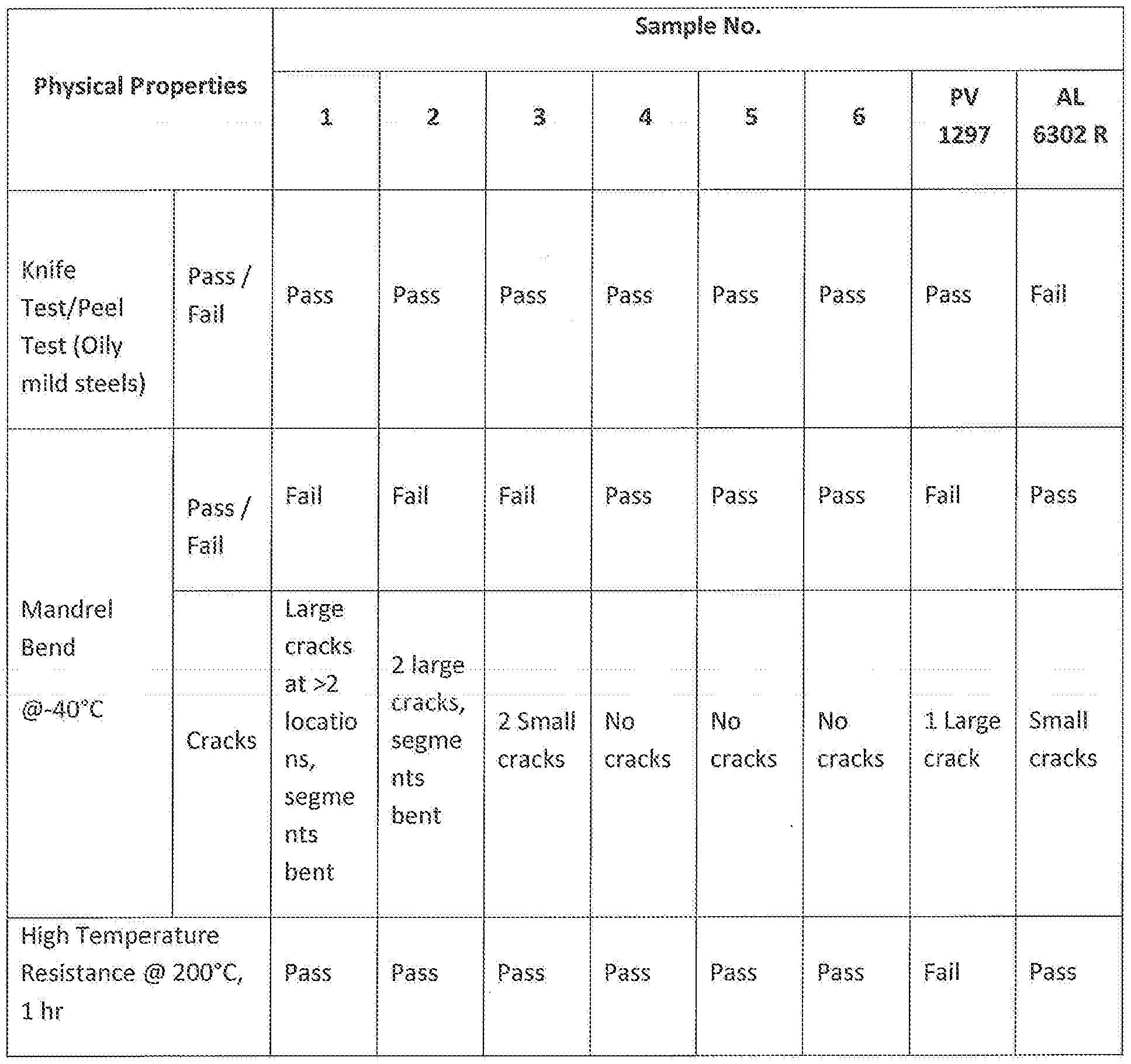
- each of the samples in Table 1 was evaluated by the knife test/peel test and high temperature resistance test. The tests are the same as discussed above. Additionally, the samples referred to as PV 1297 and AL 6302 R were also eva luated by the three tests, the results of which are shown in Table 3.
- the sample referred to as PV 1297 is an expandable, weld through semi-structural, wash-off resistant sealer known as Teroson* PV 1297 and Terostat* 1297.
- the sample referred to ⁇ & AL 6302 R is a pumpahle heat curing polyvinyl chloride (PVC)— polyacrylate plastisol based high temperature sealant known as Teroson* AL 6302 R and Terosol* 6302R.
- PVC polyvinyl chloride
- the knife test/peel test covers the determination of comparative adhesion of flexible adhesives and sealants to rigid and semi-rigid substrates.
- the knife test/peel test Involves dispensing a bead of the curable composition on an oily roiled steel surface, curing the bead to form a cured composition, cooling the cured composition to room temperature, scraping the cured composition from the oily rolled steel, and determining that the cured composition has adhered to the oily rolled steel.
- the bead of the curable composition was dispensed such that the final bead dimensions were 8 ⁇ 1 mm base and 5 ⁇ 1 mm in height. A minimum length of 50mm is usually required per test.
- the scraping step was performed by cutting a leading edge of the bead to form a loose tab with a length of approximately 25 ⁇ 5 mm to be secured in a gripping toot, such as a vice grip.
- the loose tab was then gripped by the gripping tool so that the bead is pulled back on itself. While pulling, at every 6 ⁇ 2 mm of the bead, a 45° angle relative to the oily rolled steel test panel was cut with a knife.
- An estimation of the amount of cohesion failure was reported as a percentage. In general, cohesion failure was categorized into four groups [0060] Cohesion Rating Scale:
- composition was deemed to pass the knife test/peel test if the cohesion failure was large, i.e., the cohesion failure was 75% or more and felt into one of the first two groups above.
- the mandrel bend test is set forth as SAE J243 ADS-2 Method B. This test was used to determine the adhesion properties of sealant compositions when bent around a mandrel.
- the mandrel bend test involves dispensing a bead of the curable composition on an oily rolled steel surface, curing the composition under elevated temperature conditions, cooling the cured composition to room temperature and then to -40°Cfor 30 minutes, cooling a 1 to 100 mm diameter mandrel to -40°C for 30 minutes, wrapping the cured composition around the mandrel, and examining the cured composition for cracks and loss of adhesion.
- the curable composition can be applied to an aluminum foil, cured by air drying, or baking for a specified time at a specified temperature, and then cooled after curing.
- the aluminum foil with the cured bead is wrapped around the mandrel and examined for cracks and loss of adhesion.
- the wrapping step may have the: aluminum foil is contact the mandrel or the cured bead contact the mandrel.
- suitable times and temperatures for curing the composition include a temperature between about 130 °C and about 180% for 30 minutes.
- the curable composition was deemed to pass the mandrel bend test if it did not exhibit cracks or loss of adhesion after wrapping around the mandrel.
- the high temperature resistance test involves dispensing a bead of the curable composition on a oily rolled steel surface, curing the bead to a cured composition, placing the cured composition in an oven set at 200°C for at least 1 hour, and examining the cured composition for cracks, swelling, shrinking, bubbling or decomposition. The composition was deemed to pass the high temperature resistance test if It did not exhibit cracks, swelling, shrinking, bubbling or decomposition.
- Example No.4 which uses epoxidized cashew nut shell diluent and resin with a combination of acrylonitrile-butadiene copotymer-epoxy adduct, provides excellent oiiy metal adhesion, flexibility and high temperature resistance.
- Sample Nos. 4-6 (having ratios between 0.7 and 0.9 of combined epoxidized cashew nut shell diluent and resin to butadiene-acrylonitrife copolymer-epoxy adduct), resulted in excellent oily metal adhesion, flexibility and high temperature resistance.
- the two commercial seam sealants i.e. Teroson* PV 1297, a polyvinyl chloride based seam sealant, and Teroson* AL 6302 R, a PVC/polyacrylate plastisol based seam sealant
- Teroson* PV 1297 a polyvinyl chloride based seam sealant
- Teroson* AL 6302 R a PVC/polyacrylate plastisol based seam sealant
- the inventive method includes sealing a seam on bare, oily metal prior to metal pretreatment.
- a cleaning process such as metal pretreatment, is ordinarily performed prior to a metal coating processes, such as powder coating or e-coating.
- the curable composition is used on metal seams between welded or bonded joints, overlap joints, butt Joints, and other visible seams which may benefit from sealing.
- the seams can include rounded or square seams from thin metal sheets or tubes.
- the curable composition can be applied directly to bare oily, primed or e-coated metal prior to receiving a curable top- or over-coat or powder paint, which may be cured or fixed thereto by exposure to elevated temperature conditions.
Landscapes
- Chemical & Material Sciences (AREA)
- Organic Chemistry (AREA)
- Health & Medical Sciences (AREA)
- Chemical Kinetics & Catalysis (AREA)
- Medicinal Chemistry (AREA)
- Polymers & Plastics (AREA)
- Life Sciences & Earth Sciences (AREA)
- Engineering & Computer Science (AREA)
- Materials Engineering (AREA)
- Wood Science & Technology (AREA)
- Inorganic Chemistry (AREA)
- Compositions Of Macromolecular Compounds (AREA)
- Epoxy Resins (AREA)
Abstract
Description


Claims


Priority Applications (5)
| Application Number | Priority Date | Filing Date | Title |
|---|---|---|---|
| EP18805770.7A EP3630883A4 (en) | 2017-05-25 | 2018-05-24 | CURING COMPOSITIONS |
| KR1020197036167A KR102554122B1 (en) | 2017-05-25 | 2018-05-24 | curable composition |
| JP2019564926A JP7762497B2 (en) | 2017-05-25 | 2018-05-24 | curable composition |
| CN201880050129.XA CN110997789B (en) | 2017-05-25 | 2018-05-24 | Curable composition |
| US16/694,143 US10995210B2 (en) | 2017-05-25 | 2019-11-25 | Curable compositions |
Applications Claiming Priority (2)
| Application Number | Priority Date | Filing Date | Title |
|---|---|---|---|
| US201762510934P | 2017-05-25 | 2017-05-25 | |
| US62/510,934 | 2017-05-25 |
Related Child Applications (1)
| Application Number | Title | Priority Date | Filing Date |
|---|---|---|---|
| US16/694,143 Continuation US10995210B2 (en) | 2017-05-25 | 2019-11-25 | Curable compositions |
Publications (1)
| Publication Number | Publication Date |
|---|---|
| WO2018217996A1 true WO2018217996A1 (en) | 2018-11-29 |
Family
ID=64397061
Family Applications (1)
| Application Number | Title | Priority Date | Filing Date |
|---|---|---|---|
| PCT/US2018/034350 Ceased WO2018217996A1 (en) | 2017-05-25 | 2018-05-24 | Curable compositions |
Country Status (6)
| Country | Link |
|---|---|
| US (1) | US10995210B2 (en) |
| EP (1) | EP3630883A4 (en) |
| JP (1) | JP7762497B2 (en) |
| KR (1) | KR102554122B1 (en) |
| CN (1) | CN110997789B (en) |
| WO (1) | WO2018217996A1 (en) |
Cited By (5)
| Publication number | Priority date | Publication date | Assignee | Title |
|---|---|---|---|---|
| US10882950B2 (en) | 2018-04-21 | 2021-01-05 | Natural Fiber Welding, Inc. | Curative |
| US10882951B2 (en) | 2018-04-21 | 2021-01-05 | Natural Fiber Welding, Inc. | Curative and method |
| US11396578B2 (en) | 2018-04-21 | 2022-07-26 | Natural Fiber Wielding, Inc. | Curative |
| US11760836B2 (en) | 2018-04-21 | 2023-09-19 | Natural Fiber Welding, Inc. | Curative |
| US12247098B2 (en) | 2018-04-21 | 2025-03-11 | Natural Fiber Welding, Inc. | Curative |
Families Citing this family (4)
| Publication number | Priority date | Publication date | Assignee | Title |
|---|---|---|---|---|
| GB2565826B (en) * | 2017-08-24 | 2020-05-27 | Henkel IP & Holding GmbH | Two-part curable (meth) acrylate compositions with phenolic lipids |
| JP7695217B2 (en) * | 2022-03-18 | 2025-06-18 | 大日精化工業株式会社 | Pigment dispersant, method for producing pigment dispersant, pigment dispersion, and ultraviolet curable ink |
| CN120035645A (en) | 2022-08-17 | 2025-05-23 | 泽费罗斯股份有限公司 | Pumpable one-component adhesive composition |
| EP4484461A1 (en) * | 2023-06-28 | 2025-01-01 | Sika Technology AG | Heat-curable sealing composition |
Citations (7)
| Publication number | Priority date | Publication date | Assignee | Title |
|---|---|---|---|---|
| US6998011B2 (en) * | 2002-03-15 | 2006-02-14 | Henkel Kommanditgesellschaft Auf Aktien | Epoxy adhesive having improved impact resistance |
| WO2016098130A1 (en) | 2014-12-16 | 2016-06-23 | Council Of Scientific & Industrial Research | Epoxy novolac composites |
| RU2592274C2 (en) * | 2011-11-09 | 2016-07-20 | Сайтек Текнолоджи Корп. | Structural adhesive and use thereof for gluing |
| RU2629934C2 (en) * | 2012-03-20 | 2017-09-05 | 3Б Фибрегласс СПРЛ | Two-component lubricate composition for coating of fiberglass and composite material reinforced with indicated fiberglass |
| RU2638973C2 (en) * | 2013-10-04 | 2017-12-19 | Сайтек Индастриз, Инк. | Water primer composition for improved film-formation and methods of its application |
| US20170369629A1 (en) * | 2016-06-28 | 2017-12-28 | Threebond Co., Ltd. | Epoxy resin composition |
| RU2665431C1 (en) * | 2013-12-03 | 2018-08-29 | Акцо Нобель Коатингс Интернэшнл Б.В. | Coating method for surfaces in chemical installations |
Family Cites Families (18)
| Publication number | Priority date | Publication date | Assignee | Title |
|---|---|---|---|---|
| EP0603131A1 (en) * | 1992-12-18 | 1994-06-22 | Ciba-Geigy Ag | Aromatic urea compound used as hardening accelerator for a composition of epoxy resin and dicyandiamide |
| EP1259373A4 (en) | 1999-05-26 | 2003-05-02 | Henkel Corp | Autodeposition coatings and process therefor |
| US6548189B1 (en) * | 2001-10-26 | 2003-04-15 | General Electric Company | Epoxy adhesive |
| US7649060B2 (en) * | 2005-12-02 | 2010-01-19 | Henkel Corporation | Curable compositions |
| GB0724378D0 (en) * | 2007-12-14 | 2008-01-23 | 3M Innovative Properties Co | Vibration dampening compositions |
| WO2010019539A2 (en) | 2008-08-11 | 2010-02-18 | Dow Global Technologies Inc. | One-part structural epoxy resin adhesives containing elastomeric tougheners capped with phenols and hydroxy-terminated acrylates or hydroxy-terminated methacrylates |
| EP2531543B1 (en) * | 2010-02-06 | 2019-04-10 | NDSU Research Foundation | Highly functional epoxidized resins and coatings |
| GB201007793D0 (en) * | 2010-05-10 | 2010-06-23 | Zephyros Inc | Improvements in or relating to structural adhesives |
| JP5784134B2 (en) | 2010-11-12 | 2015-09-24 | スリーエム イノベイティブ プロパティズ カンパニー | Curable composition |
| EP2655516B1 (en) * | 2010-12-26 | 2018-12-26 | Dow Global Technologies LLC | Structural epoxy resin adhesives containing chain-extended elastomeric tougheners capped with phenol, polyphenol or aminophenol compounds |
| GB201102672D0 (en) | 2011-02-15 | 2011-03-30 | Zephyros Inc | Improved structural adhesives |
| BR112014014480A2 (en) * | 2011-12-16 | 2017-06-13 | 3M Innovative Properties Co | bisirhydrohexitol derivatives containing oxirane and uses thereof |
| KR101885703B1 (en) * | 2013-05-14 | 2018-08-06 | 쓰리엠 이노베이티브 프로퍼티즈 컴파니 | Epoxy resins comprising a pyrazine-containing compound |
| CN105378019A (en) * | 2013-07-24 | 2016-03-02 | 陶氏环球技术有限责任公司 | Curable compositions |
| WO2015132372A1 (en) * | 2014-03-07 | 2015-09-11 | Henkel Ag & Co. Kgaa | Photocurable epoxy resin systems |
| JP2016138220A (en) * | 2015-01-29 | 2016-08-04 | Dic株式会社 | Resin composition and adhesive |
| JP6767758B2 (en) | 2015-04-10 | 2020-10-14 | 株式会社カネカ | Polymer fine particle-containing curable resin composition with improved storage stability and adhesiveness |
| BR112019008052B1 (en) * | 2016-10-24 | 2023-10-31 | Dow Global Technologies Llc | SINGLE COMPONENT THERMOCURABLE EPOXY ADHESIVE AND METHOD FOR FORMING AN ADHESIVE BOND BETWEEN TWO SUBSTRATES |
-
2018
- 2018-05-24 EP EP18805770.7A patent/EP3630883A4/en active Pending
- 2018-05-24 JP JP2019564926A patent/JP7762497B2/en active Active
- 2018-05-24 WO PCT/US2018/034350 patent/WO2018217996A1/en not_active Ceased
- 2018-05-24 KR KR1020197036167A patent/KR102554122B1/en active Active
- 2018-05-24 CN CN201880050129.XA patent/CN110997789B/en active Active
-
2019
- 2019-11-25 US US16/694,143 patent/US10995210B2/en active Active
Patent Citations (7)
| Publication number | Priority date | Publication date | Assignee | Title |
|---|---|---|---|---|
| US6998011B2 (en) * | 2002-03-15 | 2006-02-14 | Henkel Kommanditgesellschaft Auf Aktien | Epoxy adhesive having improved impact resistance |
| RU2592274C2 (en) * | 2011-11-09 | 2016-07-20 | Сайтек Текнолоджи Корп. | Structural adhesive and use thereof for gluing |
| RU2629934C2 (en) * | 2012-03-20 | 2017-09-05 | 3Б Фибрегласс СПРЛ | Two-component lubricate composition for coating of fiberglass and composite material reinforced with indicated fiberglass |
| RU2638973C2 (en) * | 2013-10-04 | 2017-12-19 | Сайтек Индастриз, Инк. | Water primer composition for improved film-formation and methods of its application |
| RU2665431C1 (en) * | 2013-12-03 | 2018-08-29 | Акцо Нобель Коатингс Интернэшнл Б.В. | Coating method for surfaces in chemical installations |
| WO2016098130A1 (en) | 2014-12-16 | 2016-06-23 | Council Of Scientific & Industrial Research | Epoxy novolac composites |
| US20170369629A1 (en) * | 2016-06-28 | 2017-12-28 | Threebond Co., Ltd. | Epoxy resin composition |
Non-Patent Citations (1)
| Title |
|---|
| See also references of EP3630883A4 |
Cited By (13)
| Publication number | Priority date | Publication date | Assignee | Title |
|---|---|---|---|---|
| US10882950B2 (en) | 2018-04-21 | 2021-01-05 | Natural Fiber Welding, Inc. | Curative |
| US10882951B2 (en) | 2018-04-21 | 2021-01-05 | Natural Fiber Welding, Inc. | Curative and method |
| US11396578B2 (en) | 2018-04-21 | 2022-07-26 | Natural Fiber Wielding, Inc. | Curative |
| US11407856B2 (en) | 2018-04-21 | 2022-08-09 | Natural Fiber Welding, Inc. | Curative |
| US11421075B2 (en) | 2018-04-21 | 2022-08-23 | Natural Fiber Welding, Inc. | Curative |
| US11542365B2 (en) | 2018-04-21 | 2023-01-03 | Natural Fiber Welding, Inc. | Curative |
| US11566101B2 (en) | 2018-04-21 | 2023-01-31 | Natural Fiber Welding, Inc. | Curative |
| US11760835B2 (en) | 2018-04-21 | 2023-09-19 | Natural Fiber Welding, Inc. | Curative and method |
| US11760836B2 (en) | 2018-04-21 | 2023-09-19 | Natural Fiber Welding, Inc. | Curative |
| US12157794B2 (en) | 2018-04-21 | 2024-12-03 | Natural Fiber Welding, Inc. | Curative |
| US12162981B2 (en) | 2018-04-21 | 2024-12-10 | Natural Fiber Welding, Inc. | Curative |
| US12247098B2 (en) | 2018-04-21 | 2025-03-11 | Natural Fiber Welding, Inc. | Curative |
| US12344706B2 (en) | 2018-04-21 | 2025-07-01 | Natural Fiber Welding, Inc. | Curative and method |
Also Published As
| Publication number | Publication date |
|---|---|
| KR20200014314A (en) | 2020-02-10 |
| EP3630883A4 (en) | 2020-12-09 |
| JP2020521839A (en) | 2020-07-27 |
| JP7762497B2 (en) | 2025-10-30 |
| CN110997789A (en) | 2020-04-10 |
| EP3630883A1 (en) | 2020-04-08 |
| US20200095418A1 (en) | 2020-03-26 |
| KR102554122B1 (en) | 2023-07-14 |
| CN110997789B (en) | 2022-10-04 |
| US10995210B2 (en) | 2021-05-04 |
Similar Documents
| Publication | Publication Date | Title |
|---|---|---|
| US10995210B2 (en) | Curable compositions | |
| US6015865A (en) | Hot melt adhesive from epoxy resin/amine-terminated polyalkylene glycol adduct | |
| US20040181013A1 (en) | Impact resistant epoxide resin compositions | |
| TWI267541B (en) | Two part epoxide adhesive with improved strength | |
| CN104205236B (en) | The epoxy adhesive composition and pregelatinization adhesive of resistant to wash-off | |
| AU6197299A (en) | Impact-resistant epoxide resin compositions | |
| JPH0834833A (en) | Elastic epoxy resin - curing agent system | |
| JP2014501303A (en) | Curable adhesive composition | |
| WO2006125148A1 (en) | Ambient curable protective sealant | |
| CN105102537A (en) | Epoxy resin compositions | |
| JP2013542307A (en) | Curable composition | |
| CN110892033A (en) | High Temperature Epoxy Adhesive Formulations | |
| JP5716780B2 (en) | Thermosetting resin composition | |
| TWI907563B (en) | Two-part epoxy-based structural adhesive composition | |
| MXPA97001950A (en) | Ep adhesive composition | |
| JPH11507683A (en) | Amine-curable epoxy coating composition with improved adhesion to substrate | |
| EP2986685A1 (en) | Adhesive compositions, manufacture and use thereof | |
| CA2138090A1 (en) | Elastic epoxy resin hardener system | |
| JP2021105091A (en) | Two-component solvent-free adhesive and main agent of two-component solvent-free adhesive | |
| JPH04227984A (en) | Thermosetting adhesive | |
| JPS63189488A (en) | Oil surface adhesive | |
| WO2020092360A1 (en) | Improved structural bonding adhesive | |
| JPH0726239A (en) | Adhesive composition for synthetic resin lining pipe | |
| JPH09208664A (en) | Epoxy resin modified with polymerized fatty acid, its preparation, and curable resin composition comprising the resin | |
| WO2021124051A1 (en) | Two-part curable adhesive |
Legal Events
| Date | Code | Title | Description |
|---|---|---|---|
| 121 | Ep: the epo has been informed by wipo that ep was designated in this application |
Ref document number: 18805770 Country of ref document: EP Kind code of ref document: A1 |
|
| ENP | Entry into the national phase |
Ref document number: 2019564926 Country of ref document: JP Kind code of ref document: A |
|
| NENP | Non-entry into the national phase |
Ref country code: DE |
|
| ENP | Entry into the national phase |
Ref document number: 20197036167 Country of ref document: KR Kind code of ref document: A |
|
| WWE | Wipo information: entry into national phase |
Ref document number: 2018805770 Country of ref document: EP |
|
| ENP | Entry into the national phase |
Ref document number: 2018805770 Country of ref document: EP Effective date: 20200102 |