WO2018225565A1 - ゴム組成物及びタイヤ - Google Patents
ゴム組成物及びタイヤ Download PDFInfo
- Publication number
- WO2018225565A1 WO2018225565A1 PCT/JP2018/020395 JP2018020395W WO2018225565A1 WO 2018225565 A1 WO2018225565 A1 WO 2018225565A1 JP 2018020395 W JP2018020395 W JP 2018020395W WO 2018225565 A1 WO2018225565 A1 WO 2018225565A1
- Authority
- WO
- WIPO (PCT)
- Prior art keywords
- rubber
- mass
- rubber composition
- parts
- polyhydric alcohol
- Prior art date
- Legal status (The legal status is an assumption and is not a legal conclusion. Google has not performed a legal analysis and makes no representation as to the accuracy of the status listed.)
- Ceased
Links
Classifications
-
- C—CHEMISTRY; METALLURGY
- C08—ORGANIC MACROMOLECULAR COMPOUNDS; THEIR PREPARATION OR CHEMICAL WORKING-UP; COMPOSITIONS BASED THEREON
- C08L—COMPOSITIONS OF MACROMOLECULAR COMPOUNDS
- C08L7/00—Compositions of natural rubber
-
- B—PERFORMING OPERATIONS; TRANSPORTING
- B60—VEHICLES IN GENERAL
- B60C—VEHICLE TYRES; TYRE INFLATION; TYRE CHANGING; CONNECTING VALVES TO INFLATABLE ELASTIC BODIES IN GENERAL; DEVICES OR ARRANGEMENTS RELATED TO TYRES
- B60C1/00—Tyres characterised by the chemical composition or the physical arrangement or mixture of the composition
- B60C1/0016—Compositions of the tread
-
- C—CHEMISTRY; METALLURGY
- C08—ORGANIC MACROMOLECULAR COMPOUNDS; THEIR PREPARATION OR CHEMICAL WORKING-UP; COMPOSITIONS BASED THEREON
- C08F—MACROMOLECULAR COMPOUNDS OBTAINED BY REACTIONS ONLY INVOLVING CARBON-TO-CARBON UNSATURATED BONDS
- C08F36/00—Homopolymers and copolymers of compounds having one or more unsaturated aliphatic radicals, at least one having two or more carbon-to-carbon double bonds
- C08F36/02—Homopolymers and copolymers of compounds having one or more unsaturated aliphatic radicals, at least one having two or more carbon-to-carbon double bonds the radical having only two carbon-to-carbon double bonds
- C08F36/04—Homopolymers and copolymers of compounds having one or more unsaturated aliphatic radicals, at least one having two or more carbon-to-carbon double bonds the radical having only two carbon-to-carbon double bonds conjugated
- C08F36/08—Isoprene
-
- C—CHEMISTRY; METALLURGY
- C08—ORGANIC MACROMOLECULAR COMPOUNDS; THEIR PREPARATION OR CHEMICAL WORKING-UP; COMPOSITIONS BASED THEREON
- C08K—Use of inorganic or non-macromolecular organic substances as compounding ingredients
- C08K3/00—Use of inorganic substances as compounding ingredients
- C08K3/01—Use of inorganic substances as compounding ingredients characterized by their specific function
- C08K3/013—Fillers, pigments or reinforcing additives
-
- C—CHEMISTRY; METALLURGY
- C08—ORGANIC MACROMOLECULAR COMPOUNDS; THEIR PREPARATION OR CHEMICAL WORKING-UP; COMPOSITIONS BASED THEREON
- C08K—Use of inorganic or non-macromolecular organic substances as compounding ingredients
- C08K3/00—Use of inorganic substances as compounding ingredients
- C08K3/02—Elements
- C08K3/04—Carbon
-
- C—CHEMISTRY; METALLURGY
- C08—ORGANIC MACROMOLECULAR COMPOUNDS; THEIR PREPARATION OR CHEMICAL WORKING-UP; COMPOSITIONS BASED THEREON
- C08K—Use of inorganic or non-macromolecular organic substances as compounding ingredients
- C08K3/00—Use of inorganic substances as compounding ingredients
- C08K3/34—Silicon-containing compounds
- C08K3/36—Silica
-
- C—CHEMISTRY; METALLURGY
- C08—ORGANIC MACROMOLECULAR COMPOUNDS; THEIR PREPARATION OR CHEMICAL WORKING-UP; COMPOSITIONS BASED THEREON
- C08K—Use of inorganic or non-macromolecular organic substances as compounding ingredients
- C08K5/00—Use of organic ingredients
- C08K5/04—Oxygen-containing compounds
- C08K5/05—Alcohols; Metal alcoholates
- C08K5/053—Polyhydroxylic alcohols
-
- C—CHEMISTRY; METALLURGY
- C08—ORGANIC MACROMOLECULAR COMPOUNDS; THEIR PREPARATION OR CHEMICAL WORKING-UP; COMPOSITIONS BASED THEREON
- C08K—Use of inorganic or non-macromolecular organic substances as compounding ingredients
- C08K5/00—Use of organic ingredients
- C08K5/54—Silicon-containing compounds
- C08K5/548—Silicon-containing compounds containing sulfur
-
- C—CHEMISTRY; METALLURGY
- C08—ORGANIC MACROMOLECULAR COMPOUNDS; THEIR PREPARATION OR CHEMICAL WORKING-UP; COMPOSITIONS BASED THEREON
- C08L—COMPOSITIONS OF MACROMOLECULAR COMPOUNDS
- C08L2205/00—Polymer mixtures characterised by other features
- C08L2205/02—Polymer mixtures characterised by other features containing two or more polymers of the same C08L -group
-
- C—CHEMISTRY; METALLURGY
- C08—ORGANIC MACROMOLECULAR COMPOUNDS; THEIR PREPARATION OR CHEMICAL WORKING-UP; COMPOSITIONS BASED THEREON
- C08L—COMPOSITIONS OF MACROMOLECULAR COMPOUNDS
- C08L2312/00—Crosslinking
Definitions
- the present invention relates to a rubber composition and a tire.
- Patent Document 1 silica is used with respect to 100 parts by mass of a rubber component for the purpose of providing a rubber composition for a base tread that improves fuel economy, fracture strength, flex crack resistance, and workability in a balanced manner.
- a rubber composition for a base tread is disclosed that contains 5 to 200 parts by mass of styrene, 0.1 to 40 parts by mass of cyclized rubber, and the content of butadiene rubber in 100% by mass of the rubber component is 10 to 80% by mass. ing.
- An object of the present invention is to provide a rubber composition from which a tire having high elasticity and excellent in fatigue resistance is obtained. Furthermore, it is providing the tire which uses the said rubber composition.
- the present invention relates to the following ⁇ 1> to ⁇ 12>.
- ⁇ 1> The rubber component (A) and the linear polyhydric alcohol (B) are contained, and the total content of the natural rubber and the synthetic polyisoprene rubber in the rubber component (A) is 30% by mass or more.
- ⁇ 2> The rubber composition according to ⁇ 1>, wherein the linear polyhydric alcohol (B) has more hydroxyl groups in one molecule than half the number of carbon atoms in one molecule.
- ⁇ 3> The rubber composition according to ⁇ 1> or ⁇ 2>, wherein the linear polyhydric alcohol (B) has a melting point of 170 ° C. or lower.
- ⁇ 4> The rubber composition according to any one of ⁇ 1> to ⁇ 3>, wherein the linear polyhydric alcohol (B) has a molecular weight of 200 or less.
- ⁇ 5> The rubber according to any one of ⁇ 1> to ⁇ 4>, wherein the content of the linear polyhydric alcohol (B) is 1 to 6 parts by mass with respect to 100 parts by mass of the rubber component (A). Composition.
- ⁇ 6> The rubber composition according to any one of ⁇ 1> to ⁇ 5>, wherein the content of the silica (C) is 1 to 5 parts by mass with respect to 100 parts by mass of the rubber component (A).
- carbon black (D) is contained, and the content of carbon black (D) is 10 to 80 parts by mass with respect to 100 parts by mass of rubber component (A).
- ⁇ 8> The rubber composition according to any one of ⁇ 1> to ⁇ 7>, wherein the content of the silane coupling agent is 1 part by mass or less with respect to 100 parts by mass of the rubber component (A).
- ⁇ 9> The rubber composition according to any one of ⁇ 1> to ⁇ 7>, which does not contain a silane coupling agent.
- ⁇ 10> The rubber composition according to any one of ⁇ 1> to ⁇ 9>, wherein the total content of the natural rubber and the synthetic polyisoprene rubber in the rubber component (A) is 50% by mass or more.
- ⁇ 11> The rubber composition according to any one of ⁇ 1> to ⁇ 10>, which is used for a tire tread.
- ⁇ 12> A tire using the rubber composition according to any one of ⁇ 1> to ⁇ 11>.
- the present invention it is possible to provide a rubber composition from which a tire having high elasticity and excellent in fatigue resistance can be obtained. Furthermore, according to this invention, it is providing the tire which uses the said rubber composition.
- a to B indicating a numerical range represents a numerical range including A and B as end points, and “A or more and B or less” (when A ⁇ B), or “A "B or more” (when A> B).
- a mass part and mass% are synonymous with a weight part and weight%, respectively.
- the rubber composition of the present invention contains a rubber component (A) (hereinafter also referred to as “component A”) and a linear polyhydric alcohol (B) (hereinafter also referred to as “component B”).
- component A a rubber component
- B linear polyhydric alcohol
- component C silica
- An object of the present invention is to provide a crosslinked rubber composition having both improved fatigue resistance and high elasticity.
- the present inventors have intensively studied, in a rubber composition containing a total of 30% by mass of natural rubber and synthetic polyisoprene rubber as the rubber component (A) and blended with a linear polyhydric alcohol (B). It has been found that by setting the content of silica (C) within a specific range, a crosslinked rubber composition having high elasticity and excellent tensile fatigue resistance can be obtained, and the present invention has been completed. Although the detailed mechanism is unknown, a part is estimated as follows. That is, although the reason is unknown, by blending the linear polyhydric alcohol (B) in the rubber composition, natural rubber and / or synthetic isoprene rubber in the rubber component (A) and the linear polyhydric alcohol.
- the rubber composition of the present invention contains a rubber component (A), and the total content of natural rubber and synthetic polyisoprene rubber in the rubber component (A) is 30% by mass or more.
- Preferred examples of the rubber component include natural rubber and synthetic diene rubber.
- Synthetic diene rubbers include polyisoprene rubber (synthetic polyisoprene rubber), polybutadiene rubber (BR), styrene-butadiene copolymer rubber (SBR), ethylene-propylene-diene terpolymer rubber, chloroprene rubber, butyl rubber Examples thereof include halogenated butyl rubber and acrylonitrile-butadiene rubber. These synthetic diene rubbers may be used alone or in combination of two or more.
- the rubber component (A) has a total content of natural rubber and synthetic polyisoprene rubber of 30% by mass or more. It is preferable for the total content of natural rubber and synthetic isoprene rubber to be in the above-mentioned range since the effect of improving the resistance to stretch fatigue is more excellent while maintaining high elasticity due to the addition of the linear polyhydric alcohol (B).
- the total content of the natural rubber and the synthetic polyisoprene rubber in the rubber component (A) is preferably 50% by mass, more preferably 70% by mass, and still more preferably 90% by mass from the viewpoint of further improving the stretch fatigue resistance. More preferably, it is 100 mass%.
- the rubber component may contain both natural rubber and synthetic polyisoprene rubber, may contain only one of them, and is not particularly limited, but preferably contains at least natural rubber, Of natural rubber and synthetic polyisoprene rubber, it is more preferable to contain only natural rubber.
- the rubber component may contain other rubbers other than natural rubber and synthetic polyisoprene rubber. Other rubbers may be used alone or in combination of two or more. As other rubbers, SBR and BR are preferable.
- the polybutadiene rubber As the polybutadiene rubber (BR), a high-cis polybutadiene rubber is preferable from the viewpoint of improving the wear resistance.
- the high cis polybutadiene rubber is a high cis polybutadiene rubber having a cis-1,4 bond content in a 1,3-butadiene unit of 90% or more and 99% or less as measured by FT-IR.
- the cis-1,4 bond content in the 1,3-butadiene unit of the high cis polybutadiene rubber is preferably 95% or more and 99% or less.
- the production method of the high cis polybutadiene rubber is not particularly limited, and may be produced by a known method.
- High-cis polybutadiene rubber is commercially available, and examples thereof include “BR01” and “T700” manufactured by JSR Corporation, “Ubepol BR150L” manufactured by Ube Industries, Ltd., and the like.
- the rubber composition of the present invention contains a polyhydric alcohol (B) containing a linear polyhydric alcohol (B) (also simply referred to as “polyhydric alcohol (B)”), thereby providing high elasticity. Stretch fatigue resistance is improved while maintaining.
- a linear polyhydric alcohol is a compound in which at least two of the hydrogen atoms of a linear alkane are substituted with a hydroxyl group. From the viewpoint of obtaining a crosslinked rubber composition having high elasticity and excellent elongation fatigue resistance, the polyhydric alcohol (B) preferably has a large number of hydroxyl groups in one molecule.
- the number of hydroxyl groups in one molecule is 2 or more, preferably 3 or more and 10 or less, more preferably 4 or more and 9 or less, and still more preferably 5 or more and 8 or less. Further, since the linear polyhydric alcohol (B) does not have a cyclic structure, it is possible to improve the stretch fatigue resistance while maintaining high elasticity.
- the melting point of the linear polyhydric alcohol (B) is preferably 170 ° C. or less, more preferably 160 from the viewpoint of uniformly dispersing the linear polyhydric alcohol (B) in the rubber component during kneading of the rubber composition. ° C or lower, more preferably 145 ° C or lower, still more preferably 130 ° C or lower.
- the number of hydroxyl groups in one molecule of the linear polyhydric alcohol (B) is preferably more than half of the number of carbon atoms in one molecule of the linear polyhydric alcohol (B). That is, when the number of hydroxyl groups in the molecule of the linear polyhydric alcohol (B) is N OH and the number of carbon atoms in one molecule is N C , the following formula (I) is preferably satisfied. N OH > N C / 2 (I) When the above formula (I) is established, a crosslinked rubber composition having higher elasticity and excellent fatigue resistance is obtained, and a desired melting point can be easily obtained, and the linear polyhydric alcohol (B) in the rubber composition can be easily obtained. It is preferable because of its excellent dispersibility. Note that N OH / N c is preferably more than 0.5, more preferably 0.65 or more, still more preferably 0.8 or more, and still more preferably 0.9 or more.
- the boiling point of the linear polyhydric alcohol (B) is preferably 160 ° C. or higher, more preferably 180 ° C. or higher, from the viewpoint of suppressing volatilization of the linear polyhydric alcohol (B) during kneading and crosslinking of the rubber composition. More preferably, it is 200 degreeC or more. Moreover, although an upper limit in particular is not prescribed
- the molecular weight of the linear polyhydric alcohol (B) is from the viewpoint of suppressing the volatilization of the linear polyhydric alcohol (B) during kneading and crosslinking of the rubber composition, and from the viewpoint of dispersibility in the rubber composition.
- D-form or L-form may be sufficient, and DL body which has D-form and L-form in arbitrary ratios may be sufficient.
- mannitol, galactitol, xylitol, and sorbitol are preferably exemplified, xylitol and sorbitol are more preferable, and sorbitol is more preferable.
- the content of the linear polyhydric alcohol (B) with respect to 100 parts by mass of the rubber component (A) is preferably 1 to 6 from the viewpoint of obtaining a crosslinked rubber composition having excellent resistance to elongation fatigue.
- the amount is more preferably 1.5 to 5.5 parts by mass, still more preferably 2 to 4.5 parts by mass, and still more preferably 2.5 to 4.0 parts by mass.
- the rubber composition of the present invention contains more than 0 parts by mass and less than 10 parts by mass of silica (C) with respect to 100 parts by mass of the rubber component (A).
- the content of silica (C) is preferably 0.5 parts by mass or more, more preferably 1 part by mass from the viewpoint of achieving both high elasticity and elongation fatigue resistance.
- it is 2 mass parts or more, Preferably it is 8 mass parts or less, More preferably, it is 6 mass parts or less, More preferably, it is 2.9 mass parts or less.
- silica There is no restriction
- wet silica (hydrous silicic acid), dry-type silica (anhydrous silicic acid), calcium silicate, aluminum silicate etc. are mentioned, Among these, wet silica is preferable. These may be used alone or in combination of two or more.
- the linear polyvalent alcohol when the content of the linear polyhydric alcohol (B) with respect to 100 parts by mass of the rubber component (A) is W B and the content of the silica (C) is W c , the linear polyvalent alcohol
- the content of silica (C) with respect to the content of alcohol (B) (W c / W B ) is preferably 0 to 3, more preferably 0.5 to 2, from the viewpoint of further improving stretch fatigue resistance. More preferably, it is 1 to 1.5.
- the rubber composition of the present invention preferably contains carbon black (D) as another component from the viewpoint of improving the reinforcing property.
- carbon black There is no restriction
- the specific surface area (measured in accordance with N 2 SA, JIS K 6217-2: 2001) of the nitrogen adsorption method of carbon black is preferably 70 to 180 m 2 / g, more preferably 80 to 180 m 2 / g.
- DBP oil absorption amount JIS K 6217-4: measured according to 2008
- improvement effects such as fracture resistance and wear resistance are increased.
- N339, IISAF, ISAF, and SAF, which are excellent in wear resistance, are particularly preferable.
- Carbon black may be used individually by 1 type, and may use 2 or more types together.
- the content of carbon black (D) with respect to 100 parts by mass of the rubber component (A) is preferably 10 to 80 parts by mass, more preferably 20 to 70 parts by mass, and further preferably 30 to 60 parts by mass. Part by mass. It is preferable for the content of carbon black (D) to be in the above range since a rubber composition and a crosslinked rubber composition having excellent wear resistance can be obtained.
- the rubber composition of the present invention may contain other components in addition to the components described above.
- Other components are not particularly limited, and additives usually used in the rubber industry, for example, fillers such as carbon black and aluminum hydroxide described above, softeners, anti-aging agents, vulcanization accelerators (for example, , Thiazole vulcanization accelerators, thiuram vulcanization accelerators, guanidine vulcanization accelerators, sulfenamide vulcanization accelerators, etc.), vulcanizers (for example, sulfur), vulcanization accelerators (for example, Zinc oxide, fatty acids such as stearic acid), vulcanization retarders, silane coupling agents, resins, oils, and the like may be appropriately selected and blended within a range that does not impair the object of the present invention.
- the rubber composition of the present invention may contain a silane coupling agent.
- silane coupling agents include bis (3-triethoxysilylpropyl) tetrasulfide, bis (3-triethoxysilylpropyl) trisulfide, bis (3-triethoxysilylpropyl) disulfide, and bis (2-triethoxysilyl).
- Ethyl) tetrasulfide bis (3-trimethoxysilylpropyl) tetrasulfide, bis (2-trimethoxysilylethyl) tetrasulfide, 3-mercaptopropyltrimethoxysilane, 3-mercaptopropyltriethoxysilane, 2-mercaptoethyltri Methoxysilane, 2-mercaptoethyltriethoxysilane, 3-trimethoxysilylpropyl-N, N-dimethylthiocarbamoyl tetrasulfide, 3-triethoxysilylpropyl-N, N-dimethylthiocarba Yl tetrasulfide, 2-triethoxysilylethyl-N, N-dimethylthiocarbamoyl tetrasulfide, 3-trimethoxysilylpropylbenzothiazolyl tetrasulfide,
- bis (3-triethoxysilylpropyl) polysulfide and 3-trimethoxysilylpropylbenzothiazyl tetrasulfide are preferable from the viewpoint of reinforcing effect and the like.
- One of these silane coupling agents may be used alone, or two or more thereof may be used in combination.
- the content of the silane coupling agent in the rubber composition is preferably 3 parts by mass or less, more preferably 1 part by mass or less, and still more preferably 0.8 parts by mass with respect to 100 parts by mass of the rubber component (A). It is 3 mass parts or less, More preferably, it is not containing a silane coupling agent.
- silica when silica is added to the rubber composition, crack resistance and high elasticity are brought about.
- a rubber composition having excellent tensile fatigue resistance can be obtained by using a linear polyhydric alcohol (B) and silica (C) in combination. Therefore, by using the linear polyhydric alcohol (B) and silica (C) in combination, it is highly elastic and has no stretch fatigue resistance without using a silane coupling agent or even in a small amount.
- an excellent crosslinked rubber composition can be obtained.
- the rubber composition of the present invention can be produced by blending the above-described components and kneading them using a kneader such as a Banbury mixer, a roll, or an internal mixer.
- a kneader such as a Banbury mixer, a roll, or an internal mixer.
- the compounding amounts of the rubber component (A), the linear polyhydric alcohol (B), the silica (C) and the like are the same as the amounts already described as the contents in the rubber component.
- the kneading of each component may be carried out in one step or in two or more steps.
- the rubber component (A), linear polyhydric alcohol (B), silica ( C) and other compounding components other than the vulcanizing agent and the vulcanization accelerator are kneaded, and the vulcanizing agent and the vulcanization accelerator are kneaded in the second stage.
- the maximum temperature of the first stage of kneading is preferably 140 to 170 ° C.
- the maximum temperature of the second stage is preferably 90 to 120 ° C.
- the crosslinked rubber composition of the present invention is formed by crosslinking the above-described rubber composition of the present invention.
- the crosslinking method of the rubber composition is not particularly limited, and a known crosslinking method can be applied.
- the unvulcanized rubber composition may be cross-linked after molding, and after undergoing a pre-crosslinking step, etc., after obtaining a semi-crosslinked rubber from the non-crosslinked rubber composition, after molding using this, You may obtain by carrying out this bridge
- the rubber composition and the crosslinked rubber composition of the present invention are used in various rubber products and are suitable as a tread member for a tire, and particularly suitable as a tread member for a pneumatic tire.
- the gas filled in the pneumatic tire include normal or adjusted oxygen partial pressure, and inert gases such as nitrogen, argon, and helium.
- the rubber composition or the crosslinked rubber composition of the present invention is used for a tire, it is not limited to a tire tread member, and may be used for a base tread, a sidewall, a side reinforcing rubber, a bead filler, and the like.
- the rubber composition of the present invention can be used for anti-vibration rubber, seismic isolation rubber, belts (conveyor belts), rubber crawlers, various hoses, Moran and the like.
- Vulcanization accelerator CZ N-cyclohexyl-2-benzothiazolylsulfenamide (Noxeller CZ, manufactured by Ouchi Shinsei Chemical Co., Ltd.)
- Examples 1 to 5 and Comparative Examples 1 to 6) The compounding composition shown in Table 1 was used to knead the compounding components of the rubber composition described above using a Banbury mixer to prepare a sample rubber composition. In the final stage of kneading, sulfur as a vulcanizing agent and a vulcanization accelerator were blended. The obtained rubber composition was vulcanized at 145 ° C. for 33 minutes to prepare a crosslinked (vulcanized) rubber composition, and the crosslinked fatigue composition was evaluated for tensile fatigue resistance. The evaluation of Comparative Example 1 was evaluated as 100.
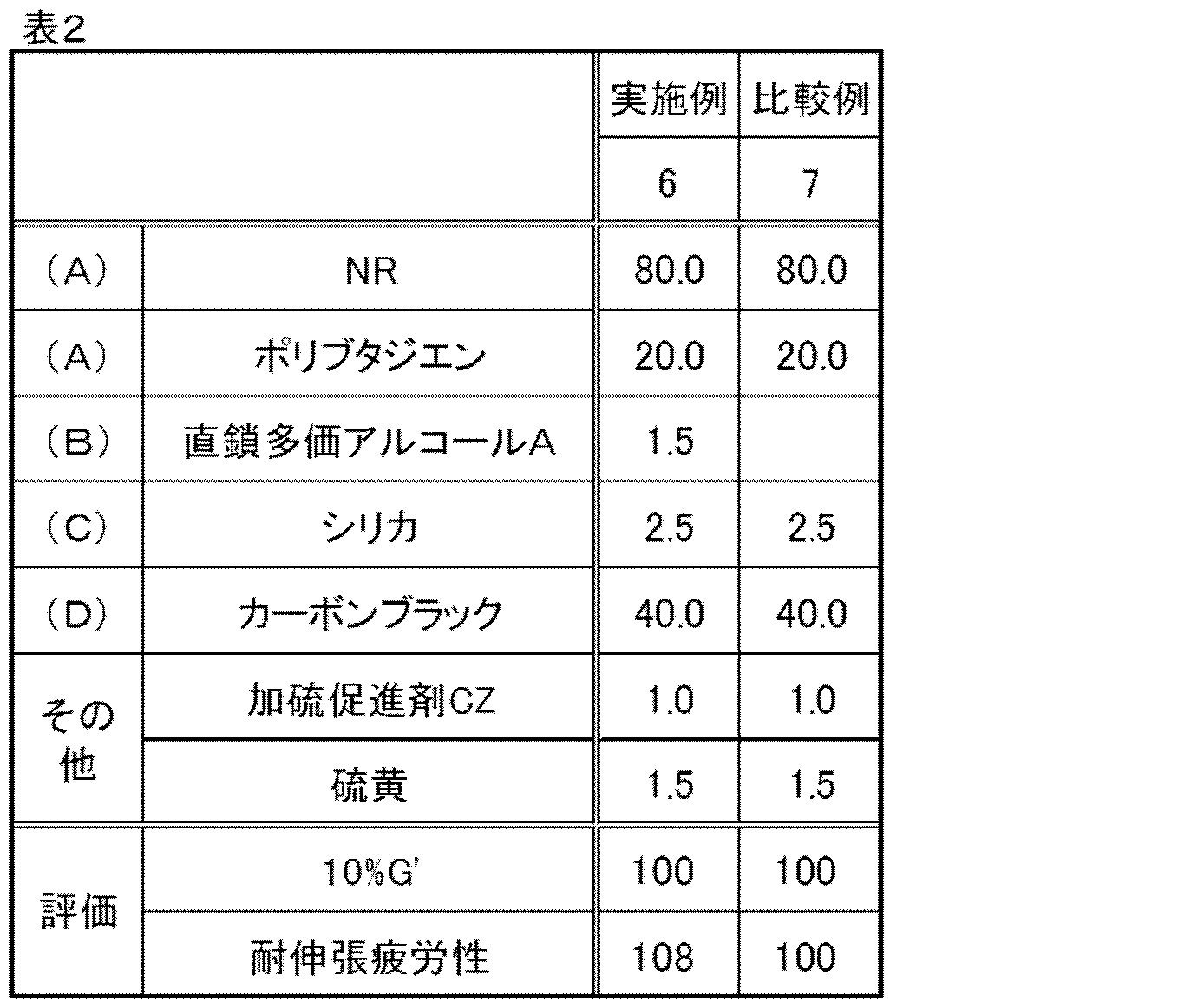
- Example 6 and Comparative Example 7 The compounding composition shown in Table 2 was used to knead the compounding components of the rubber composition described above using a Banbury mixer to prepare a sample rubber composition. In the final stage of kneading, sulfur as a vulcanizing agent and a vulcanization accelerator were blended. The obtained rubber composition was vulcanized at 145 ° C. for 33 minutes to prepare a crosslinked (vulcanized) rubber composition, and the crosslinked fatigue composition was evaluated for tensile fatigue resistance. The evaluation of Comparative Example 7 was evaluated as 100.
- ADVANTAGE OF THE INVENTION According to this invention, it can provide the rubber composition from which the crosslinked rubber composition which is highly elastic and excellent in the fatigue resistance is obtained. Furthermore, according to the present invention, it is possible to provide a rubber product such as a tire that has high elasticity and excellent tensile fatigue resistance.
Landscapes
- Chemical & Material Sciences (AREA)
- Health & Medical Sciences (AREA)
- Chemical Kinetics & Catalysis (AREA)
- Medicinal Chemistry (AREA)
- Polymers & Plastics (AREA)
- Organic Chemistry (AREA)
- Engineering & Computer Science (AREA)
- Mechanical Engineering (AREA)
- Compositions Of Macromolecular Compounds (AREA)
- Tires In General (AREA)
Abstract
Description
特許文献1には、低燃費性、破壊強度、耐屈曲亀裂性、及び加工性をバランスよく向上するベーストレッド用ゴム組成物を提供することを目的として、ゴム成分100質量部に対して、シリカを5~200質量部、環化ゴムを0.1~40質量部含み、前記ゴム成分100質量%中のブタジエンゴムの含有量が10~80質量%であるベーストレッド用ゴム組成物が開示されている。
<1> ゴム成分(A)及び直鎖多価アルコール(B)を含有し、ゴム成分(A)中の天然ゴム及び合成ポリイソプレンゴムの合計含有量が30質量%以上であり、ゴム成分(A)100質量部に対して、シリカ(C)を0質量部を超え10質量部未満含有することを特徴とするゴム組成物。
<2> 前記直鎖多価アルコール(B)が1分子中に有する水酸基の数が、1分子中の炭素原子の数の半分より多い、<1>に記載のゴム組成物。
<3> 前記直鎖多価アルコール(B)の融点が170℃以下である、<1>又は<2>に記載のゴム組成物。
<4> 前記直鎖多価アルコール(B)の分子量が、200以下である、<1>~<3>のいずれか1つに記載のゴム組成物。
<5> 前記ゴム成分(A)100質量部に対する前記直鎖多価アルコール(B)の含有量が1~6質量部である、<1>~<4>のいずれか1つに記載のゴム組成物。
<6> 前記ゴム成分(A)100質量部に対する前記シリカ(C)の含有量が1~5質量部である、<1>~<5>のいずれか1つに記載のゴム組成物。
<7> 更に、カーボンブラック(D)を含有し、ゴム成分(A)100質量部に対する該カーボンブラック(D)の含有量が10~80質量部である、<1>~<6>のいずれか1つに記載のゴム組成物。
<8> シランカップリング剤の含有量が、ゴム成分(A)100質量部に対して1質量部以下である、<1>~<7>のいずれか1つに記載のゴム組成物。
<9> シランカップリング剤を含有しない、<1>~<7>のいずれか1つに記載のゴム組成物。
<10> 前記ゴム成分(A)中の天然ゴム及び合成ポリイソプレンゴムの合計含有量が50質量%以上である、<1>~<9>のいずれか1つに記載のゴム組成物。
<11> タイヤトレッド用である、<1>~<10>のいずれか1つに記載のゴム組成物。
<12> <1>~<11>のいずれか1つに記載のゴム組成物を用いてなるタイヤ。
また、質量部及び質量%は、それぞれ、重量部及び重量%と同義である。
本発明のゴム組成物は、ゴム成分(A)(以下、「成分A」ともいう。)及び直鎖多価アルコール(B)(以下、「成分B」ともいう。)を含有し、ゴム成分(A)中の天然ゴム及び合成ポリイソプレンゴムの合計含有量が30質量%以上であり、ゴム成分(A)100質量部に対して、シリカ(C)(以下、「成分C」ともいう。)を0質量部を超え10質量部未満含有することを特徴とする。
運転時に変形を繰り返すタイヤ等において、耐伸張疲労性の改善が求められていた。本発明は、耐伸張疲労性の向上と、高弾性が両立した架橋ゴム組成物を提供することを目的とするものである。
本発明者は鋭意検討することによって、ゴム成分(A)として天然ゴム及び合成ポリイソプレンゴムを合計して30質量%以上含有し、直鎖多価アルコール(B)を配合したゴム組成物において、シリカ(C)の含有量を特定の範囲とすることによって、高弾性であり、かつ、耐伸張疲労性に優れる架橋ゴム組成物が得られることを見出し、本発明を完成するに至った。その詳細な機構は不明であるが、一部は以下のように推定される。
すなわち、その理由は不明であるものの、ゴム組成物中に直鎖多価アルコール(B)を配合することにより、ゴム成分(A)中の天然ゴム及び/又は合成イソプレンゴムと直鎖多価アルコールが相互作用し、その結果、高弾性でありながら、耐伸張疲労性の向上効果が得られると考えられる。一方で、シリカ(C)の含有量が一定の範囲を超えると、ゴム成分と直鎖多価アルコール(B)の相互作用が阻害され、耐伸張疲労性の改善効果が得られないと推定される。
以下、本発明について詳細に説明する。
本発明のゴム組成物は、ゴム成分(A)を含有し、ゴム成分(A)中の天然ゴム及び合成ポリイソプレンゴムの合計含有量が30質量%以上である。
ゴム成分としては、天然ゴム及び合成ジエン系ゴムが好ましく例示される。合成ジエン系ゴムとしては、ポリイソプレンゴム(合成ポリイソプレンゴム)、ポリブタジエンゴム(BR)、スチレン-ブタジエン共重合体ゴム(SBR)、エチレン-プロピレン-ジエン三元共重合体ゴム、クロロプレンゴム、ブチルゴム、ハロゲン化ブチルゴム、アクリロニトリル-ブタジエンゴム等が例示される。これらの合成ジエン系ゴムは、1種単独で使用してもよく、2種以上を併用してもよい。
ゴム成分(A)中の天然ゴム及び合成ポリイソプレンゴムの合計含有量は、耐伸張疲労性をより向上させる観点から、好ましくは50質量%、より好ましくは70質量%、更に好ましくは90質量%、より更に好ましくは100質量%である。
なお、ゴム成分として、天然ゴム及び合成ポリイソプレンゴムの両方を含有していてもよく、いずれか一方のみを含有していてもよく、特に限定されないが、少なくとも天然ゴムを含有することが好ましく、天然ゴム及び合成ポリイソプレンゴムのうち、天然ゴムのみを含有することがより好ましい。
その他のゴムとしては、SBR、BRが好ましい。
ハイシスポリブタジエンゴムの製造方法は特に限定されず、公知の方法により製造すればよい。例えば、ネオジム系触媒を用いてブタジエンを重合する方法が挙げられる。
ハイシスポリブタジエンゴムは市販されており、例えば、JSR(株)製の「BR01」、「T700」、宇部興産(株)製の「ウベポールBR150L」などが挙げられる。
本発明のゴム組成物は、直鎖多価アルコール(B)(単に、「多価アルコール(B)」ともいう。)を含有する、多価アルコール(B)を含有することにより、高弾性を維持しつつ、耐伸張疲労性が向上する。
直鎖多価アルコールは、直鎖アルカンの有する水素原子のうち、少なくとも2つの水素原子が水酸基に置換された化合物である。多価アルコール(B)が1分子中に有する水酸基の数は、高弾性かつ耐伸張疲労性に優れる架橋ゴム組成物を得る観点からは、1分子中に有する水酸基が多いことが好ましいが、所望の融点を得る観点から、1分子中に有する水酸基の数は、2以上であり、好ましくは3以上10以下、より好ましくは4以上9以下、更に好ましくは5以上8以下である。
また、直鎖多価アルコール(B)は環状構造を有しないため、高弾性を維持しつつ、耐伸張疲労性を向上させることができる。
NOH>NC/2 (I)
上記式(I)が成立すると、より高弾性かつ耐伸張疲労性に優れる架橋ゴム組成物が得られると共に、所望の融点を得やすく、ゴム組成物中での直鎖多価アルコール(B)の分散性に優れるので好ましい。
なお、NOH/Ncは、0.5を超えることが好ましく、より好ましくは0.65以上、更に好ましくは0.8以上、より更に好ましくは0.9以上である。
これらの糖アルコール類の立体配置には制限はなく、D体でもL体でもよく、D体とL体を任意の比率で有するDL体であってもよい。
これらの中でも、本発明において、マンニトール、ガラクチトール、キシリトール、ソルビトールが好ましく例示され、キシリトール、ソルビトールがより好ましく、ソルビトールが更に好ましい。
本発明のゴム組成物は、ゴム成分(A)100質量部に対して、シリカ(C)を0質量部を超え10質量部未満含有する。ゴム組成物中のゴム成分(A)100質量部に対するシリカ(C)の含有量を10質量部未満とすることにより、高弾性と耐疲労性とのバランスに優れた架橋ゴム組成物が得られる。
本発明において、ゴム成分(A)100質量部に対するシリカ(C)の含有量は、高弾性と耐伸張疲労性の両立の観点から、好ましくは0.5質量部以上、より好ましくは1質量部以上、更に好ましくは2質量部以上であり、好ましくは8質量部以下、より好ましくは6質量部以下、更に好ましくは2.9質量部以下である。
シリカ(C)としては、市販品を使用してもよく、例えば、東ソー・シリカ(株)製、商品名:ニプシルAQ(BET比表面積=205m2/g)、商品名:ニプシルKQ、デグッサ社製、商品名:ウルトラジルVN3(BET比表面積=175m2/g)が挙げられる。
本発明のゴム組成物は、補強性を向上させる観点から、その他の成分として、カーボンブラック(D)を含有することが好ましい。
カーボンブラックとしては特に制限はなく、例えば、HAF、IISAF、1SAF、SAFなどが用いられる。
カーボンブラックの窒素吸着法比表面積(N2SA、JIS K 6217-2:2001に準拠して測定する)は、好ましくは70~180m2/g、より好ましくは80~180m2/gである。また、DBP吸油量(JIS K 6217-4:2008に準拠して測定する)は、好ましくは70~160cm3/100g、より好ましくは90~160cm3/100gである。カーボンブラックを用いることにより、耐破壊特性、耐摩耗性等の改良効果は大きくなる。耐摩耗性に優れるN339、IISAF、ISAF、SAFが特に好ましい。
カーボンブラックは、1種単独で使用してもよく、2種以上を併用してもよい。
カーボンブラック(D)の含有量が上記範囲内であると、耐摩耗性に優れるゴム組成物及び架橋ゴム組成物が得られるので好ましい。
本発明のゴム組成物は、上述した成分に加え、他の成分を含有していてもよい。他の成分としては、特に限定されず、ゴム工業界で通常使用される添加剤、例えば、上述したカーボンブラック、水酸化アルミニウム等の充填剤、軟化剤、老化防止剤、加硫促進剤(例えば、チアゾール系加硫促進剤、チウラム系加硫促進剤、グアニジン系加硫促進剤、スルフェンアミド系加硫促進剤等)、加硫剤(例えば、硫黄)、加硫促進助剤(例えば、酸化亜鉛、ステアリン酸等の脂肪酸)、加硫遅延剤、シランカップリング剤、樹脂、オイル等を、本発明の目的を害しない範囲で適宜選択して配合してもよい。
本発明のゴム組成物は、シランカップリング剤を含有してもよい。
シランカップリング剤としては、例えばビス(3-トリエトキシシリルプロピル)テトラスルフィド、ビス(3-トリエトキシシリルプロピル)トリスルフィド、ビス(3-トリエトキシシリルプロピル)ジスルフィド、ビス(2-トリエトキシシリルエチル)テトラスルフィド、ビス(3-トリメトキシシリルプロピル)テトラスルフィド、ビス(2-トリメトキシシリルエチル)テトラスルフィド、3-メルカプトプロピルトリメトキシシラン、3-メルカプトプロピルトリエトキシシラン、2-メルカプトエチルトリメトキシシラン、2-メルカプトエチルトリエトキシシラン、3-トリメトキシシリルプロピル-N,N-ジメチルチオカルバモイルテトラスルフィド、3-トリエトキシシリルプロピル-N,N-ジメチルチオカルバモイルテトラスルフィド、2-トリエトキシシリルエチル-N,N-ジメチルチオカルバモイルテトラスルフィド、3-トリメトキシシリルプロピルベンゾチアゾリルテトラスルフィド、3-トリエトキシシリルプロピルベンゾリルテトラスルフィド、3-トリエトキシシリルプロピルメタクリレートモノスルフィド、3-トリメトキシシリルプロピルメタクリレートモノスルフィド、ビス(3-ジエトキシメチルシリルプロピル)テトラスルフィド、3-メルカプトプロピルジメトキシメチルシラン、ジメトキシメチルシリルプロピル-N,N-ジメチルチオカルバモイルテトラスルフィド、ジメトキシメチルシリルプロピルベンゾチアゾリルテトラスルフィドなどが挙げられる。これらの中でも、補強性改善効果などの観点から、ビス(3-トリエトキシシリルプロピル)ポリスルフィド及び3-トリメトキシシリルプロピルベンゾチアジルテトラスルフィドが好適である。
これらのシランカップリング剤は、1種を単独で用いてもよく、2種以上組み合わせて用いてもよい。
本発明において、ゴム組成物にシリカを添加すると、耐亀裂性や、高弾性化をもたらすが、一般に、シランカップリングを添加しない場合、伸張疲労性に問題が生じる。本発明において、直鎖多価アルコール(B)とシリカ(C)を併用することにより、耐伸張疲労性にも優れるゴム組成物が得られる。
従って、直鎖多価アルコール(B)とシリカ(C)との併用により、シランカップリング剤を使用することなく、又はその使用量が少なくても、高弾性であり、かつ耐伸張疲労性にも優れる架橋ゴム組成物が得られるものである。
本発明のゴム組成物は、上述した各成分を配合して、バンバリーミキサー、ロール、インターナルミキサー等の混練り機を使用して混練りすることによって製造することができる。
ここで、ゴム成分(A)、直鎖多価アルコール(B)、シリカ(C)等の配合量は、ゴム成分中の含有量として既述した量と同じである。
各成分の混練は、全一段階で行ってもよく、二段階以上に分けて行ってもよく、例えば、第一段階において、ゴム成分(A)、直鎖多価アルコール(B)、シリカ(C)並びに加硫剤及び加硫促進剤以外のその他の配合成分を混練し、第二段階において、加硫剤及び加硫促進剤を混練する方法が挙げられる。
混練の第一段階の最高温度は、140~170℃とすることが好ましく、第二段階の最高温度は、90~120℃とすることが好ましい。
本発明の架橋ゴム組成物は、上述した本発明のゴム組成物を架橋してなる。
ゴム組成物の架橋方法は特に限定されず、公知の架橋方法を適用することができる。なお、未加硫のゴム組成物を成形後に架橋してもよく、予備架橋工程等を経て、一旦未架橋のゴム組成物から半架橋のゴムを得た後、これを用いて成形後、更に本架橋して得てもよい。
なお、本発明のゴム組成物及び架橋ゴム組成物は、種々のゴム製品に使用され、タイヤのトレッド部材として好適であり、特に空気入りタイヤのトレッド部材として好適である。空気入りタイヤに充填する気体としては、通常の、又は酸素分圧を調整した空気の他、窒素、アルゴン、ヘリウム等の不活性ガスが例示される。
なお、本発明のゴム組成物又は架橋ゴム組成物をタイヤに使用する場合、タイヤのトレッド部材に限定されるものではなく、ベーストレッド、サイドウォール、サイド補強ゴム、ビードフィラー等に用いてもよい。
また、タイヤ用途以外にも、防振ゴム、免震ゴム、ベルト(コンベアベルト)、ゴムクローラ、各種ホース、モランなどに本発明のゴム組成物を使用することができる。
各実施例及び比較例のゴム組成物に配合される成分は、以下の通りである。
<ゴム成分(A)>
・NR:天然ゴム、TSR20
・ポリブタジエンゴム:JSR(株)製、商品名「BR01」
<直鎖多価アルコール(B)>
・直鎖多価アルコールA:ソルビトール(関東化学(株)製、水酸基数6、水酸基数/炭素数=1)
・直鎖多価アルコールB:キシリトール(和光純薬工業(株)製、水酸基数:5、水酸基数/炭素数=1)
・環状多価アルコールC:グルコース(和光純薬工業(株)製、水酸基数:5、酸基数/炭素数=0.83)
<シリカ(C)>
・シリカ:NIPSIL AQ、東ソー・シリカ(株)製
<カーボンブラック(D)>
・カーボンブラック:SAF(ASAHI#105、旭カーボン(株)製)
・加硫促進剤CZ:N-シクロヘキシル-2-ベンゾチアゾリルスルフェンアミド(ノクセラーCZ、大内新興化学工業(株)製)
以下の実施例及び比較例における評価は、以下のように行った。
(1)耐伸張疲労性試験
実施例及び比較例の各サンプルについて、JIS K 6270:2001に準拠し、ダンベル状試験片にて試験歪み:100%、試験周波数:5Hz、試験温度:80℃で試験を実施し、破断するまでの繰り返し回数を測定した。
評価については、比較例1における破断するまでの回数を100としたときの指数値として表示し、数値が大きいほど破断するまでの回数が多く、耐伸張疲労性が良好であることを示す。評価結果を表1に示す。
ARES(TA Instruments社製)を用いた動的粘弾性試験において、試験周波数:15Hz、試験温度:50℃で試験を実施し、動ひずみ10%の動的せん断貯蔵弾性率(10%G’)を測定し、比較例1の10%G’を100としたときの指数値として表示した。数値が大きい程、高弾性であることを示す。評価結果を表1に示す。
高弾性と耐伸長疲労性のバランスは、耐伸張疲労性と弾性(10%G’)の両方の指数の合計値により評価することができる。合計値の値が大きいほど、バランスが向上していることを示す。高弾性と耐伸長疲労性の両方の指数が100以上であることが好ましい。
表1に示す配合処方にて、バンバリーミキサーを用いて、上述したゴム組成物の配合成分を混練し、サンプルとなるゴム組成物を調製した。なお、混練の最終段階において、加硫剤である硫黄、及び加硫促進剤を配合した。
得られたゴム組成物を、145℃にて33分間加硫し、架橋(加硫)ゴム組成物を作製し、該架橋ゴム組成物を用いて、耐伸張疲労性を評価した。なお、比較例1の評価を100として評価した。

表2に示す配合処方にて、バンバリーミキサーを用いて、上述したゴム組成物の配合成分を混練し、サンプルとなるゴム組成物を調製した。なお、混練の最終段階において、加硫剤である硫黄、及び加硫促進剤を配合した。
得られたゴム組成物を、145℃にて33分間加硫し、架橋(加硫)ゴム組成物を作製し、該架橋ゴム組成物を用いて、耐伸張疲労性を評価した。なお、比較例7の評価を100として評価した。
Claims (12)
- ゴム成分(A)及び直鎖多価アルコール(B)を含有し、
ゴム成分(A)中の天然ゴム及び合成ポリイソプレンゴムの合計含有量が30質量%以上であり、
ゴム成分(A)100質量部に対して、シリカ(C)を0質量部を超え10質量部未満含有することを特徴とする
ゴム組成物。 - 前記直鎖多価アルコール(B)が1分子中に有する水酸基の数が、1分子中の炭素原子の数の半分より多い、請求項1に記載のゴム組成物。
- 前記直鎖多価アルコール(B)の融点が170℃以下である、請求項1又は2に記載のゴム組成物。
- 前記直鎖多価アルコール(B)の分子量が、200以下である、請求項1~3のいずれか1項に記載のゴム組成物。
- 前記ゴム成分(A)100質量部に対する前記直鎖多価アルコール(B)の含有量が1~6質量部である、請求項1~4のいずれか1項に記載のゴム組成物。
- 前記ゴム成分(A)100質量部に対する前記シリカ(C)の含有量が1~5質量部である、請求項1~5のいずれか1項に記載のゴム組成物。
- 更に、カーボンブラック(D)を含有し、ゴム成分(A)100質量部に対する該カーボンブラック(D)の含有量が10~80質量部である、請求項1~6のいずれか1項に記載のゴム組成物。
- シランカップリング剤の含有量が、ゴム成分(A)100質量部に対して1質量部以下である、請求項1~7のいずれか1項に記載のゴム組成物。
- シランカップリング剤を含有しない、請求項1~7のいずれか1項に記載のゴム組成物。
- 前記ゴム成分(A)中の天然ゴム及び合成ポリイソプレンゴムの合計含有量が50質量%以上である、請求項1~9のいずれか1項に記載のゴム組成物。
- タイヤトレッド用である、請求項1~10のいずれか1項に記載のゴム組成物。
- 請求項1~11のいずれか1項に記載のゴム組成物を用いてなるタイヤ。
Priority Applications (4)
| Application Number | Priority Date | Filing Date | Title |
|---|---|---|---|
| CN201880037712.7A CN110741037A (zh) | 2017-06-09 | 2018-05-28 | 橡胶组合物和轮胎 |
| EP18812821.9A EP3636708A4 (en) | 2017-06-09 | 2018-05-28 | RUBBER COMPOSITION AND TIRE |
| JP2019523464A JPWO2018225565A1 (ja) | 2017-06-09 | 2018-05-28 | ゴム組成物及びタイヤ |
| US16/705,891 US20200109267A1 (en) | 2017-06-09 | 2019-12-06 | Rubber composition and tire |
Applications Claiming Priority (2)
| Application Number | Priority Date | Filing Date | Title |
|---|---|---|---|
| JP2017-114427 | 2017-06-09 | ||
| JP2017114427 | 2017-06-09 |
Related Child Applications (1)
| Application Number | Title | Priority Date | Filing Date |
|---|---|---|---|
| US16/705,891 Continuation US20200109267A1 (en) | 2017-06-09 | 2019-12-06 | Rubber composition and tire |
Publications (1)
| Publication Number | Publication Date |
|---|---|
| WO2018225565A1 true WO2018225565A1 (ja) | 2018-12-13 |
Family
ID=64567116
Family Applications (1)
| Application Number | Title | Priority Date | Filing Date |
|---|---|---|---|
| PCT/JP2018/020395 Ceased WO2018225565A1 (ja) | 2017-06-09 | 2018-05-28 | ゴム組成物及びタイヤ |
Country Status (5)
| Country | Link |
|---|---|
| US (1) | US20200109267A1 (ja) |
| EP (1) | EP3636708A4 (ja) |
| JP (1) | JPWO2018225565A1 (ja) |
| CN (1) | CN110741037A (ja) |
| WO (1) | WO2018225565A1 (ja) |
Cited By (1)
| Publication number | Priority date | Publication date | Assignee | Title |
|---|---|---|---|---|
| JP2021193010A (ja) * | 2020-06-08 | 2021-12-23 | 株式会社ブリヂストン | 空気入りタイヤ |
Families Citing this family (2)
| Publication number | Priority date | Publication date | Assignee | Title |
|---|---|---|---|---|
| EP4349902A4 (en) * | 2021-05-31 | 2024-10-09 | Bridgestone Corporation | RUBBER COMPOSITION, AND PNEUMATICS |
| CN114235607B (zh) * | 2021-11-12 | 2023-06-23 | 中策橡胶集团股份有限公司 | 一种胎体帘布混炼胶预交联的评价方法、设备和计算机可读载体介质 |
Citations (4)
| Publication number | Priority date | Publication date | Assignee | Title |
|---|---|---|---|---|
| JP2006124602A (ja) * | 2004-11-01 | 2006-05-18 | Yokohama Rubber Co Ltd:The | ゴム組成物及びそれを使用するタイヤ |
| JP2013213129A (ja) * | 2012-04-02 | 2013-10-17 | Yokohama Rubber Co Ltd:The | タイヤ用ゴム組成物およびそれを用いた空気入りタイヤ |
| JP2013213125A (ja) * | 2012-04-02 | 2013-10-17 | Yokohama Rubber Co Ltd:The | タイヤ用ゴム組成物およびそれを用いた空気入りタイヤ |
| JP2016509614A (ja) * | 2012-12-19 | 2016-03-31 | 株式会社ブリヂストン | 酸素不透過性の高いタイヤ部分 |
Family Cites Families (6)
| Publication number | Priority date | Publication date | Assignee | Title |
|---|---|---|---|---|
| JP3865900B2 (ja) * | 1997-10-29 | 2007-01-10 | 住友ゴム工業株式会社 | ゴム組成物 |
| KR20040008589A (ko) * | 2002-07-19 | 2004-01-31 | 금호타이어 주식회사 | 저연비 특성 및 젖은 노면에서의 제동력이 개선된 타이어트레드용 고무 조성물 |
| JP4976665B2 (ja) * | 2005-07-25 | 2012-07-18 | 東洋ゴム工業株式会社 | トレッド用ゴム組成物及び空気入りタイヤ |
| JP2008127468A (ja) * | 2006-11-21 | 2008-06-05 | Bridgestone Corp | ゴム組成物及びそれを用いた空気入りタイヤ |
| CN104910448B (zh) * | 2015-06-03 | 2017-06-06 | 华南理工大学 | 一种医用套扎器环形弹性圈的制备方法 |
| CN105461980A (zh) * | 2015-12-17 | 2016-04-06 | 合肥杰明新材料科技有限公司 | 一种柔性弹性天然橡胶材料及其制备方法 |
-
2018
- 2018-05-28 WO PCT/JP2018/020395 patent/WO2018225565A1/ja not_active Ceased
- 2018-05-28 EP EP18812821.9A patent/EP3636708A4/en not_active Withdrawn
- 2018-05-28 JP JP2019523464A patent/JPWO2018225565A1/ja active Pending
- 2018-05-28 CN CN201880037712.7A patent/CN110741037A/zh active Pending
-
2019
- 2019-12-06 US US16/705,891 patent/US20200109267A1/en not_active Abandoned
Patent Citations (4)
| Publication number | Priority date | Publication date | Assignee | Title |
|---|---|---|---|---|
| JP2006124602A (ja) * | 2004-11-01 | 2006-05-18 | Yokohama Rubber Co Ltd:The | ゴム組成物及びそれを使用するタイヤ |
| JP2013213129A (ja) * | 2012-04-02 | 2013-10-17 | Yokohama Rubber Co Ltd:The | タイヤ用ゴム組成物およびそれを用いた空気入りタイヤ |
| JP2013213125A (ja) * | 2012-04-02 | 2013-10-17 | Yokohama Rubber Co Ltd:The | タイヤ用ゴム組成物およびそれを用いた空気入りタイヤ |
| JP2016509614A (ja) * | 2012-12-19 | 2016-03-31 | 株式会社ブリヂストン | 酸素不透過性の高いタイヤ部分 |
Non-Patent Citations (1)
| Title |
|---|
| See also references of EP3636708A4 * |
Cited By (2)
| Publication number | Priority date | Publication date | Assignee | Title |
|---|---|---|---|---|
| JP2021193010A (ja) * | 2020-06-08 | 2021-12-23 | 株式会社ブリヂストン | 空気入りタイヤ |
| JP7531315B2 (ja) | 2020-06-08 | 2024-08-09 | 株式会社ブリヂストン | 空気入りタイヤ |
Also Published As
| Publication number | Publication date |
|---|---|
| EP3636708A4 (en) | 2021-01-27 |
| JPWO2018225565A1 (ja) | 2020-04-09 |
| EP3636708A1 (en) | 2020-04-15 |
| US20200109267A1 (en) | 2020-04-09 |
| CN110741037A (zh) | 2020-01-31 |
Similar Documents
| Publication | Publication Date | Title |
|---|---|---|
| JP2010077257A (ja) | タイヤトレッド用ゴム組成物 | |
| EP1508590B1 (en) | Rubber composition and pneumatic tire using the same | |
| JP2011246563A (ja) | タイヤ用ゴム組成物およびそれを用いた空気入りタイヤ | |
| JP7287437B2 (ja) | ゴム組成物およびそれを用いたタイヤ | |
| JP4361407B2 (ja) | ビード用ゴム組成物および空気入りタイヤ | |
| US20200109267A1 (en) | Rubber composition and tire | |
| JP2014133843A (ja) | トレッド用ゴム組成物及び空気入りタイヤ | |
| JP2008222845A (ja) | タイヤ用ゴム組成物 | |
| JP2012180387A (ja) | ベーストレッド用ゴム組成物及び空気入りタイヤ | |
| JP2009084485A (ja) | タイヤトレッド用ゴム組成物 | |
| JP7620183B2 (ja) | タイヤ用ゴム組成物およびそれを用いたタイヤ | |
| JP2008156446A (ja) | 特定のタイヤ部材用ゴム組成物およびそれを用いたタイヤ | |
| JP5144137B2 (ja) | トレッド用ゴム組成物およびそれを用いたトレッドを有するタイヤ | |
| JP5998587B2 (ja) | タイヤ用ゴム組成物およびそれを用いた空気入りタイヤ | |
| EP4509557A1 (en) | Rubber composition for rim cushions | |
| JP2006169434A (ja) | ゴム組成物およびそれからなるタイヤ | |
| JP4316978B2 (ja) | ゴム組成物およびそれを用いた空気入りタイヤ | |
| JP5203636B2 (ja) | ランフラットタイヤのサイドウォール補強層用ゴム組成物 | |
| JP2004091716A (ja) | タイヤ | |
| JP2011252069A (ja) | ジエン系ゴム組成物 | |
| JP2012116909A (ja) | タイヤサイドウォール用ゴム組成物およびそれを用いた空気入りタイヤ | |
| EP4474420B1 (en) | Rubber composition for tires and pneumatic tire | |
| JP7195477B1 (ja) | タイヤ用ゴム組成物および空気入りタイヤ | |
| JP5480699B2 (ja) | サイドウォール用ゴム組成物及び空気入りタイヤ | |
| JP2020094149A (ja) | ゴム用添加剤、ゴム用添加剤組成物、タイヤ用ゴム組成物、タイヤ用架橋ゴム組成物、タイヤ用ゴム製品、及びタイヤ |
Legal Events
| Date | Code | Title | Description |
|---|---|---|---|
| 121 | Ep: the epo has been informed by wipo that ep was designated in this application |
Ref document number: 18812821 Country of ref document: EP Kind code of ref document: A1 |
|
| ENP | Entry into the national phase |
Ref document number: 2019523464 Country of ref document: JP Kind code of ref document: A |
|
| NENP | Non-entry into the national phase |
Ref country code: DE |
|
| WWE | Wipo information: entry into national phase |
Ref document number: 2018812821 Country of ref document: EP |
|
| ENP | Entry into the national phase |
Ref document number: 2018812821 Country of ref document: EP Effective date: 20200109 |