WO2018230334A1 - 感放射線性樹脂組成物及びレジストパターン形成方法 - Google Patents
感放射線性樹脂組成物及びレジストパターン形成方法 Download PDFInfo
- Publication number
- WO2018230334A1 WO2018230334A1 PCT/JP2018/020600 JP2018020600W WO2018230334A1 WO 2018230334 A1 WO2018230334 A1 WO 2018230334A1 JP 2018020600 W JP2018020600 W JP 2018020600W WO 2018230334 A1 WO2018230334 A1 WO 2018230334A1
- Authority
- WO
- WIPO (PCT)
- Prior art keywords
- group
- structural unit
- polymer
- acid
- radiation
- Prior art date
- Legal status (The legal status is an assumption and is not a legal conclusion. Google has not performed a legal analysis and makes no representation as to the accuracy of the status listed.)
- Ceased
Links
- 0 CCC(C*1)(CC1=O)O*(C1(C*(C)C)*(C)*1)=O Chemical compound CCC(C*1)(CC1=O)O*(C1(C*(C)C)*(C)*1)=O 0.000 description 7
- JJMQLQLMPJLIPZ-UHFFFAOYSA-N CC(C(OC(C1CC2C3C1)C3OC2=O)=O)=C Chemical compound CC(C(OC(C1CC2C3C1)C3OC2=O)=O)=C JJMQLQLMPJLIPZ-UHFFFAOYSA-N 0.000 description 1
- ATEFHDAOWUSFPK-UHFFFAOYSA-N CC(C(OC(CC1)CCC1C(C(F)(F)F)(C(F)(F)F)O)=O)=C Chemical compound CC(C(OC(CC1)CCC1C(C(F)(F)F)(C(F)(F)F)O)=O)=C ATEFHDAOWUSFPK-UHFFFAOYSA-N 0.000 description 1
- QSUJHKWXLIQKEY-UHFFFAOYSA-N CC(C(OC(CCO1)C1=O)=O)=C Chemical compound CC(C(OC(CCO1)C1=O)=O)=C QSUJHKWXLIQKEY-UHFFFAOYSA-N 0.000 description 1
- PJMXUSNWBKGQEZ-UHFFFAOYSA-N CC(C(Oc(cc1)ccc1O)=O)=C Chemical compound CC(C(Oc(cc1)ccc1O)=O)=C PJMXUSNWBKGQEZ-UHFFFAOYSA-N 0.000 description 1
- GZNVDSHKZWETDP-UHFFFAOYSA-N CC(C)(C)c1cc(OC(C(C)=C)=O)ccc1O Chemical compound CC(C)(C)c1cc(OC(C(C)=C)=O)ccc1O GZNVDSHKZWETDP-UHFFFAOYSA-N 0.000 description 1
- FDYDISGSYGFRJM-UHFFFAOYSA-N CC1(C2CC(C3)CC1CC3C2)OC(C(C)=C)=O Chemical compound CC1(C2CC(C3)CC1CC3C2)OC(C(C)=C)=O FDYDISGSYGFRJM-UHFFFAOYSA-N 0.000 description 1
- IBGDXBPGGZQSCX-UHFFFAOYSA-N CC1(CCCCC1)OC(COC(C(C)=C)=O)=O Chemical compound CC1(CCCCC1)OC(COC(C(C)=C)=O)=O IBGDXBPGGZQSCX-UHFFFAOYSA-N 0.000 description 1
Classifications
-
- G—PHYSICS
- G03—PHOTOGRAPHY; CINEMATOGRAPHY; ANALOGOUS TECHNIQUES USING WAVES OTHER THAN OPTICAL WAVES; ELECTROGRAPHY; HOLOGRAPHY
- G03F—PHOTOMECHANICAL PRODUCTION OF TEXTURED OR PATTERNED SURFACES, e.g. FOR PRINTING, FOR PROCESSING OF SEMICONDUCTOR DEVICES; MATERIALS THEREFOR; ORIGINALS THEREFOR; APPARATUS SPECIALLY ADAPTED THEREFOR
- G03F7/00—Photomechanical, e.g. photolithographic, production of textured or patterned surfaces, e.g. printing surfaces; Materials therefor, e.g. comprising photoresists; Apparatus specially adapted therefor
- G03F7/004—Photosensitive materials
- G03F7/0046—Photosensitive materials with perfluoro compounds, e.g. for dry lithography
-
- G—PHYSICS
- G03—PHOTOGRAPHY; CINEMATOGRAPHY; ANALOGOUS TECHNIQUES USING WAVES OTHER THAN OPTICAL WAVES; ELECTROGRAPHY; HOLOGRAPHY
- G03F—PHOTOMECHANICAL PRODUCTION OF TEXTURED OR PATTERNED SURFACES, e.g. FOR PRINTING, FOR PROCESSING OF SEMICONDUCTOR DEVICES; MATERIALS THEREFOR; ORIGINALS THEREFOR; APPARATUS SPECIALLY ADAPTED THEREFOR
- G03F7/00—Photomechanical, e.g. photolithographic, production of textured or patterned surfaces, e.g. printing surfaces; Materials therefor, e.g. comprising photoresists; Apparatus specially adapted therefor
- G03F7/004—Photosensitive materials
-
- C—CHEMISTRY; METALLURGY
- C08—ORGANIC MACROMOLECULAR COMPOUNDS; THEIR PREPARATION OR CHEMICAL WORKING-UP; COMPOSITIONS BASED THEREON
- C08F—MACROMOLECULAR COMPOUNDS OBTAINED BY REACTIONS ONLY INVOLVING CARBON-TO-CARBON UNSATURATED BONDS
- C08F12/00—Homopolymers and copolymers of compounds having one or more unsaturated aliphatic radicals, each having only one carbon-to-carbon double bond, and at least one being terminated by an aromatic carbocyclic ring
- C08F12/02—Monomers containing only one unsaturated aliphatic radical
- C08F12/04—Monomers containing only one unsaturated aliphatic radical containing one ring
- C08F12/14—Monomers containing only one unsaturated aliphatic radical containing one ring substituted by hetero atoms or groups containing heteroatoms
- C08F12/16—Halogens
- C08F12/20—Fluorine
-
- C—CHEMISTRY; METALLURGY
- C08—ORGANIC MACROMOLECULAR COMPOUNDS; THEIR PREPARATION OR CHEMICAL WORKING-UP; COMPOSITIONS BASED THEREON
- C08F—MACROMOLECULAR COMPOUNDS OBTAINED BY REACTIONS ONLY INVOLVING CARBON-TO-CARBON UNSATURATED BONDS
- C08F12/00—Homopolymers and copolymers of compounds having one or more unsaturated aliphatic radicals, each having only one carbon-to-carbon double bond, and at least one being terminated by an aromatic carbocyclic ring
- C08F12/02—Monomers containing only one unsaturated aliphatic radical
- C08F12/04—Monomers containing only one unsaturated aliphatic radical containing one ring
- C08F12/14—Monomers containing only one unsaturated aliphatic radical containing one ring substituted by hetero atoms or groups containing heteroatoms
- C08F12/22—Oxygen
-
- C—CHEMISTRY; METALLURGY
- C08—ORGANIC MACROMOLECULAR COMPOUNDS; THEIR PREPARATION OR CHEMICAL WORKING-UP; COMPOSITIONS BASED THEREON
- C08F—MACROMOLECULAR COMPOUNDS OBTAINED BY REACTIONS ONLY INVOLVING CARBON-TO-CARBON UNSATURATED BONDS
- C08F12/00—Homopolymers and copolymers of compounds having one or more unsaturated aliphatic radicals, each having only one carbon-to-carbon double bond, and at least one being terminated by an aromatic carbocyclic ring
- C08F12/02—Monomers containing only one unsaturated aliphatic radical
- C08F12/32—Monomers containing only one unsaturated aliphatic radical containing two or more rings
-
- C—CHEMISTRY; METALLURGY
- C08—ORGANIC MACROMOLECULAR COMPOUNDS; THEIR PREPARATION OR CHEMICAL WORKING-UP; COMPOSITIONS BASED THEREON
- C08F—MACROMOLECULAR COMPOUNDS OBTAINED BY REACTIONS ONLY INVOLVING CARBON-TO-CARBON UNSATURATED BONDS
- C08F212/00—Copolymers of compounds having one or more unsaturated aliphatic radicals, each having only one carbon-to-carbon double bond, and at least one being terminated by an aromatic carbocyclic ring
- C08F212/02—Monomers containing only one unsaturated aliphatic radical
- C08F212/04—Monomers containing only one unsaturated aliphatic radical containing one ring
- C08F212/14—Monomers containing only one unsaturated aliphatic radical containing one ring substituted by heteroatoms or groups containing heteroatoms
- C08F212/22—Oxygen
-
- C—CHEMISTRY; METALLURGY
- C08—ORGANIC MACROMOLECULAR COMPOUNDS; THEIR PREPARATION OR CHEMICAL WORKING-UP; COMPOSITIONS BASED THEREON
- C08F—MACROMOLECULAR COMPOUNDS OBTAINED BY REACTIONS ONLY INVOLVING CARBON-TO-CARBON UNSATURATED BONDS
- C08F220/00—Copolymers of compounds having one or more unsaturated aliphatic radicals, each having only one carbon-to-carbon double bond, and only one being terminated by only one carboxyl radical or a salt, anhydride ester, amide, imide or nitrile thereof
- C08F220/02—Monocarboxylic acids having less than ten carbon atoms; Derivatives thereof
- C08F220/10—Esters
-
- C—CHEMISTRY; METALLURGY
- C09—DYES; PAINTS; POLISHES; NATURAL RESINS; ADHESIVES; COMPOSITIONS NOT OTHERWISE PROVIDED FOR; APPLICATIONS OF MATERIALS NOT OTHERWISE PROVIDED FOR
- C09D—COATING COMPOSITIONS, e.g. PAINTS, VARNISHES OR LACQUERS; FILLING PASTES; CHEMICAL PAINT OR INK REMOVERS; INKS; CORRECTING FLUIDS; WOODSTAINS; PASTES OR SOLIDS FOR COLOURING OR PRINTING; USE OF MATERIALS THEREFOR
- C09D125/00—Coating compositions based on homopolymers or copolymers of compounds having one or more unsaturated aliphatic radicals, each having only one carbon-to-carbon double bond, and at least one being terminated by an aromatic carbocyclic ring; Coating compositions based on derivatives of such polymers
- C09D125/18—Homopolymers or copolymers of aromatic monomers containing elements other than carbon and hydrogen
-
- G—PHYSICS
- G03—PHOTOGRAPHY; CINEMATOGRAPHY; ANALOGOUS TECHNIQUES USING WAVES OTHER THAN OPTICAL WAVES; ELECTROGRAPHY; HOLOGRAPHY
- G03F—PHOTOMECHANICAL PRODUCTION OF TEXTURED OR PATTERNED SURFACES, e.g. FOR PRINTING, FOR PROCESSING OF SEMICONDUCTOR DEVICES; MATERIALS THEREFOR; ORIGINALS THEREFOR; APPARATUS SPECIALLY ADAPTED THEREFOR
- G03F7/00—Photomechanical, e.g. photolithographic, production of textured or patterned surfaces, e.g. printing surfaces; Materials therefor, e.g. comprising photoresists; Apparatus specially adapted therefor
- G03F7/004—Photosensitive materials
- G03F7/0045—Photosensitive materials with organic non-macromolecular light-sensitive compounds not otherwise provided for, e.g. dissolution inhibitors
-
- G—PHYSICS
- G03—PHOTOGRAPHY; CINEMATOGRAPHY; ANALOGOUS TECHNIQUES USING WAVES OTHER THAN OPTICAL WAVES; ELECTROGRAPHY; HOLOGRAPHY
- G03F—PHOTOMECHANICAL PRODUCTION OF TEXTURED OR PATTERNED SURFACES, e.g. FOR PRINTING, FOR PROCESSING OF SEMICONDUCTOR DEVICES; MATERIALS THEREFOR; ORIGINALS THEREFOR; APPARATUS SPECIALLY ADAPTED THEREFOR
- G03F7/00—Photomechanical, e.g. photolithographic, production of textured or patterned surfaces, e.g. printing surfaces; Materials therefor, e.g. comprising photoresists; Apparatus specially adapted therefor
- G03F7/004—Photosensitive materials
- G03F7/039—Macromolecular compounds which are photodegradable, e.g. positive electron resists
-
- G—PHYSICS
- G03—PHOTOGRAPHY; CINEMATOGRAPHY; ANALOGOUS TECHNIQUES USING WAVES OTHER THAN OPTICAL WAVES; ELECTROGRAPHY; HOLOGRAPHY
- G03F—PHOTOMECHANICAL PRODUCTION OF TEXTURED OR PATTERNED SURFACES, e.g. FOR PRINTING, FOR PROCESSING OF SEMICONDUCTOR DEVICES; MATERIALS THEREFOR; ORIGINALS THEREFOR; APPARATUS SPECIALLY ADAPTED THEREFOR
- G03F7/00—Photomechanical, e.g. photolithographic, production of textured or patterned surfaces, e.g. printing surfaces; Materials therefor, e.g. comprising photoresists; Apparatus specially adapted therefor
- G03F7/004—Photosensitive materials
- G03F7/039—Macromolecular compounds which are photodegradable, e.g. positive electron resists
- G03F7/0392—Macromolecular compounds which are photodegradable, e.g. positive electron resists the macromolecular compound being present in a chemically amplified positive photoresist composition
-
- G—PHYSICS
- G03—PHOTOGRAPHY; CINEMATOGRAPHY; ANALOGOUS TECHNIQUES USING WAVES OTHER THAN OPTICAL WAVES; ELECTROGRAPHY; HOLOGRAPHY
- G03F—PHOTOMECHANICAL PRODUCTION OF TEXTURED OR PATTERNED SURFACES, e.g. FOR PRINTING, FOR PROCESSING OF SEMICONDUCTOR DEVICES; MATERIALS THEREFOR; ORIGINALS THEREFOR; APPARATUS SPECIALLY ADAPTED THEREFOR
- G03F7/00—Photomechanical, e.g. photolithographic, production of textured or patterned surfaces, e.g. printing surfaces; Materials therefor, e.g. comprising photoresists; Apparatus specially adapted therefor
- G03F7/004—Photosensitive materials
- G03F7/039—Macromolecular compounds which are photodegradable, e.g. positive electron resists
- G03F7/0392—Macromolecular compounds which are photodegradable, e.g. positive electron resists the macromolecular compound being present in a chemically amplified positive photoresist composition
- G03F7/0397—Macromolecular compounds which are photodegradable, e.g. positive electron resists the macromolecular compound being present in a chemically amplified positive photoresist composition the macromolecular compound having an alicyclic moiety in a side chain
-
- G—PHYSICS
- G03—PHOTOGRAPHY; CINEMATOGRAPHY; ANALOGOUS TECHNIQUES USING WAVES OTHER THAN OPTICAL WAVES; ELECTROGRAPHY; HOLOGRAPHY
- G03F—PHOTOMECHANICAL PRODUCTION OF TEXTURED OR PATTERNED SURFACES, e.g. FOR PRINTING, FOR PROCESSING OF SEMICONDUCTOR DEVICES; MATERIALS THEREFOR; ORIGINALS THEREFOR; APPARATUS SPECIALLY ADAPTED THEREFOR
- G03F7/00—Photomechanical, e.g. photolithographic, production of textured or patterned surfaces, e.g. printing surfaces; Materials therefor, e.g. comprising photoresists; Apparatus specially adapted therefor
- G03F7/004—Photosensitive materials
- G03F7/075—Silicon-containing compounds
- G03F7/0757—Macromolecular compounds containing Si-O, Si-C or Si-N bonds
-
- G—PHYSICS
- G03—PHOTOGRAPHY; CINEMATOGRAPHY; ANALOGOUS TECHNIQUES USING WAVES OTHER THAN OPTICAL WAVES; ELECTROGRAPHY; HOLOGRAPHY
- G03F—PHOTOMECHANICAL PRODUCTION OF TEXTURED OR PATTERNED SURFACES, e.g. FOR PRINTING, FOR PROCESSING OF SEMICONDUCTOR DEVICES; MATERIALS THEREFOR; ORIGINALS THEREFOR; APPARATUS SPECIALLY ADAPTED THEREFOR
- G03F7/00—Photomechanical, e.g. photolithographic, production of textured or patterned surfaces, e.g. printing surfaces; Materials therefor, e.g. comprising photoresists; Apparatus specially adapted therefor
- G03F7/20—Exposure; Apparatus therefor
- G03F7/2002—Exposure; Apparatus therefor with visible light or UV light, through an original having an opaque pattern on a transparent support, e.g. film printing, projection printing; by reflection of visible or UV light from an original such as a printed image
- G03F7/2012—Exposure; Apparatus therefor with visible light or UV light, through an original having an opaque pattern on a transparent support, e.g. film printing, projection printing; by reflection of visible or UV light from an original such as a printed image using liquid photohardening compositions, e.g. for the production of reliefs such as flexographic plates or stamps
-
- G—PHYSICS
- G03—PHOTOGRAPHY; CINEMATOGRAPHY; ANALOGOUS TECHNIQUES USING WAVES OTHER THAN OPTICAL WAVES; ELECTROGRAPHY; HOLOGRAPHY
- G03F—PHOTOMECHANICAL PRODUCTION OF TEXTURED OR PATTERNED SURFACES, e.g. FOR PRINTING, FOR PROCESSING OF SEMICONDUCTOR DEVICES; MATERIALS THEREFOR; ORIGINALS THEREFOR; APPARATUS SPECIALLY ADAPTED THEREFOR
- G03F7/00—Photomechanical, e.g. photolithographic, production of textured or patterned surfaces, e.g. printing surfaces; Materials therefor, e.g. comprising photoresists; Apparatus specially adapted therefor
- G03F7/16—Coating processes; Apparatus therefor
- G03F7/162—Coating on a rotating support, e.g. using a whirler or a spinner
-
- G—PHYSICS
- G03—PHOTOGRAPHY; CINEMATOGRAPHY; ANALOGOUS TECHNIQUES USING WAVES OTHER THAN OPTICAL WAVES; ELECTROGRAPHY; HOLOGRAPHY
- G03F—PHOTOMECHANICAL PRODUCTION OF TEXTURED OR PATTERNED SURFACES, e.g. FOR PRINTING, FOR PROCESSING OF SEMICONDUCTOR DEVICES; MATERIALS THEREFOR; ORIGINALS THEREFOR; APPARATUS SPECIALLY ADAPTED THEREFOR
- G03F7/00—Photomechanical, e.g. photolithographic, production of textured or patterned surfaces, e.g. printing surfaces; Materials therefor, e.g. comprising photoresists; Apparatus specially adapted therefor
- G03F7/20—Exposure; Apparatus therefor
- G03F7/2002—Exposure; Apparatus therefor with visible light or UV light, through an original having an opaque pattern on a transparent support, e.g. film printing, projection printing; by reflection of visible or UV light from an original such as a printed image
- G03F7/2004—Exposure; Apparatus therefor with visible light or UV light, through an original having an opaque pattern on a transparent support, e.g. film printing, projection printing; by reflection of visible or UV light from an original such as a printed image characterised by the use of a particular light source, e.g. fluorescent lamps or deep UV light
-
- G—PHYSICS
- G03—PHOTOGRAPHY; CINEMATOGRAPHY; ANALOGOUS TECHNIQUES USING WAVES OTHER THAN OPTICAL WAVES; ELECTROGRAPHY; HOLOGRAPHY
- G03F—PHOTOMECHANICAL PRODUCTION OF TEXTURED OR PATTERNED SURFACES, e.g. FOR PRINTING, FOR PROCESSING OF SEMICONDUCTOR DEVICES; MATERIALS THEREFOR; ORIGINALS THEREFOR; APPARATUS SPECIALLY ADAPTED THEREFOR
- G03F7/00—Photomechanical, e.g. photolithographic, production of textured or patterned surfaces, e.g. printing surfaces; Materials therefor, e.g. comprising photoresists; Apparatus specially adapted therefor
- G03F7/26—Processing photosensitive materials; Apparatus therefor
- G03F7/30—Imagewise removal using liquid means
Definitions
- the present invention relates to a radiation-sensitive resin composition and a resist pattern forming method.
- Radiation-sensitive compositions used for microfabrication by lithography are irradiated with radiation such as deep ultraviolet rays such as ArF excimer laser light and KrF excimer laser light, electromagnetic waves such as extreme ultraviolet rays (EUV), and charged particle beams such as electron beams.
- radiation such as deep ultraviolet rays such as ArF excimer laser light and KrF excimer laser light, electromagnetic waves such as extreme ultraviolet rays (EUV), and charged particle beams such as electron beams.
- An acid is generated in the exposed portion, and a chemical reaction using this acid as a catalyst causes a difference in the dissolution rate in the developer between the exposed portion and the unexposed portion, thereby forming a resist pattern on the substrate.
- Such a radiation-sensitive composition not only has excellent resolution and rectangularity of the cross-sectional shape of the resist pattern, but also has excellent LWR (Line Width Roughness) performance, excellent depth of focus, and high precision pattern. It is required to be obtained with yield.
- LWR Line Width Roughness
- various structures of the polymer contained in the radiation-sensitive resin composition have been studied, and by having a lactone structure such as a butyrolactone structure or a norbornane lactone structure, the adhesion of the resist pattern to the substrate
- these performances can be improved (see JP-A-11-212265, JP-A-2003-5375, and JP-A-2008-83370).
- the miniaturization of the resist pattern has progressed to a level of 45 nm or less, the required level of the performance is further increased, and the conventional radiation-sensitive resin composition satisfies these requirements. I can't make it happen. Recently, with the miniaturization of the resist pattern, it is particularly required that the generation of defects in the resist pattern is suppressed.
- the present invention has been made based on the circumstances as described above, and its purpose is LWR performance, resolution, rectangularity of cross-sectional shape, exposure margin, defect suppression performance, and CDU (Critical Dimension Uniformity) performance.
- An object is to provide an excellent radiation-sensitive resin composition and a resist pattern forming method.
- the invention made in order to solve the above-mentioned problems includes a first structural unit containing a phenolic hydroxy group (hereinafter also referred to as “structural unit (I)”) and an acid dissociable group (hereinafter referred to as “acid dissociable group (a ) ”) And a first polymer (hereinafter also referred to as“ [A1] polymer ”) having a second structural unit (hereinafter also referred to as“ structural unit (II) ”), a fluorine atom and a silicon atom And a second structural unit having a third structural unit (hereinafter, also referred to as “structural unit (III)”) containing an alkali-dissociable group (hereinafter also referred to as “alkali-dissociable group (b)”).
- structural unit (I) a phenolic hydroxy group
- acid dissociable group (a ) an acid dissociable group
- a first polymer hereinafter also referred to as“ [
- the acid dissociable group (a) is dissociated with a polymer (hereinafter also referred to as “[A2] polymer”) at a temperature T X ° C. of 1 ° C. and a temperature of 80 ° C. to 130 ° C. by irradiation with radiation.
- a polymer hereinafter also referred to as “[A2] polymer”
- [B1] compound First compound that generates an acid
- the temperature T X ° C. and 1 minute conditions substantially dissociated so no carboxylic acid the acid-dissociable group (a) in the above acid under conditions of the temperature T X ° C. and 1 minute
- a radiation-sensitive resin composition containing a sulfonic acid that does not substantially dissociate the dissociable group (a) or a second compound that generates a combination thereof hereinafter also referred to as “[B2] compound”.
- Another invention made in order to solve the above-mentioned problems includes a step of coating the radiation-sensitive resin composition on at least one side of the substrate, and a resist film formed by the coating step using extreme ultraviolet light or A resist pattern forming method comprising a step of exposing with an electron beam and a step of developing the exposed resist film.
- the “acid-dissociable group” refers to a group that replaces a hydrogen atom such as a carboxy group or a phenolic hydroxy group and dissociates by the action of an acid.
- An “alkali dissociable group” is a group that replaces a hydrogen atom such as a carboxy group or an alcoholic hydroxy group, and dissociates in an aqueous 2.38 mass% tetramethylammonium hydroxide solution at 23 ° C. for 1 minute. Group.
- Numberer of ring members means the number of atoms constituting the ring of the alicyclic structure, aromatic ring structure, aliphatic heterocyclic structure and aromatic heterocyclic structure, and in the case of polycyclic, the number of atoms constituting this polycyclic ring Say.
- the radiation-sensitive resin composition and the resist pattern forming method of the present invention it is possible to form a resist pattern having a small LWR, a high resolution, excellent cross-sectional rectangularity, and few defects due to a wide exposure margin. it can. Therefore, these can be suitably used for manufacturing semiconductor devices that are expected to be further miniaturized in the future.
- the radiation-sensitive resin composition contains a [A1] polymer, a [A2] polymer, a [B1] compound, and a [B2] compound.
- the said radiation sensitive resin composition may contain the [C] solvent as a suitable component, and may contain the other arbitrary components in the range which does not impair the effect of this invention.
- the radiation-sensitive resin composition contains [A1], [A2], [B1] and [B2] components, so that LWR performance, resolution, rectangularity of cross-sectional shape, exposure margin, and defect suppression It is excellent in performance and CDU performance (hereinafter, these performances are collectively referred to as “lithographic characteristics”).
- the reason why the radiation-sensitive resin composition has the above-described configuration and thus exhibits the above-mentioned effect is not necessarily clear, but can be inferred as follows, for example. That is, the [A1] polymer forming the resist film has a structural unit (I) containing a phenolic hydroxy group in addition to the structural unit (II) containing an acid dissociable group, and is formed on the surface layer of the resist film.
- the unevenly distributed [A2] polymer has the structural unit (III) containing an alkali dissociable group, the surface layer of the resist film is hydrophilized, and as a result, the defect suppression performance is improved.
- the basicity of the [B2] compound below a certain level, it is considered that the LWR performance, the resolution and the CDU performance are excellent and the storage stability of the radiation sensitive resin composition is also improved.
- the polymer is a polymer having the structural unit (I) and the structural unit (II).
- the polymer is a fourth structural unit containing a lactone structure, a cyclic carbonate structure, a sultone structure, or a combination thereof in addition to the structural units (I) and (II) (hereinafter also referred to as “structural unit (IV)”).
- structural unit (IV) an alcoholic hydroxy group
- structural unit (V) an alcoholic hydroxy group
- the polymer may have one or more of each structural unit. Hereinafter, each structural unit will be described.
- the structural unit (I) is a structural unit containing a phenolic hydroxy group (hereinafter also referred to as “group (I)”).
- group (I) a phenolic hydroxy group
- the hydrophilicity of the resist film can be further increased.
- the solubility in the developer can be adjusted more appropriately, and the adhesion of the resist pattern to the substrate can be improved.
- the sensitivity of the radiation sensitive resin composition can be further increased.
- the phenolic hydroxy group is not limited to those directly connected to the benzene ring, but refers to all hydroxy groups directly connected to the aromatic ring.
- Examples of the group (I) include a group represented by the following formula (3).
- Ar 1 is a group obtained by removing a hydrogen atom on an (p + q + 1) aromatic ring from an arene having 6 to 20 carbon atoms.
- RP is a halogen atom or a monovalent organic group having 1 to 20 carbon atoms.
- p is an integer of 0 to 11.
- q is an integer of 1 to 11.
- p + q is 11 or less.
- plural R P may be the same or different from each other.
- * Represents a binding site with a moiety other than the group (I) in the structural unit (I).
- Examples of the C6-C20 arene that gives Ar 1 include benzene, naphthalene, anthracene, phenanthrene, tetracene, and pyrene. Of these, benzene or naphthalene is preferred.
- Organic group refers to a group containing at least one carbon atom.
- the monovalent organic group having 1 to 20 carbon atoms represented by R P for example, monovalent hydrocarbon group having 1 to 20 carbon atoms, the carbon of the hydrocarbon group - the terminal carbon-carbon or a bond side
- Examples include a group ( ⁇ ) containing a divalent heteroatom-containing group, a group obtained by substituting part or all of the hydrogen atoms of the hydrocarbon group and group ( ⁇ ) with a monovalent heteroatom-containing group.
- Examples of the monovalent hydrocarbon group having 1 to 20 carbon atoms include, for example, a monovalent chain hydrocarbon group having 1 to 20 carbon atoms, a monovalent alicyclic hydrocarbon group having 3 to 20 carbon atoms, Examples thereof include 6-20 monovalent aromatic hydrocarbon groups.
- the “hydrocarbon group” includes a chain hydrocarbon group, an alicyclic hydrocarbon group, and an aromatic hydrocarbon group.
- the “hydrocarbon group” may be a saturated hydrocarbon group or an unsaturated hydrocarbon group.
- the “chain hydrocarbon group” refers to a hydrocarbon group that does not include a cyclic structure but includes only a chain structure, and includes both a linear hydrocarbon group and a branched hydrocarbon group.
- alicyclic hydrocarbon group refers to a hydrocarbon group that includes only an alicyclic structure as a ring structure and does not include an aromatic ring structure, and includes a monocyclic alicyclic hydrocarbon group and a polycyclic alicyclic group. Includes both hydrocarbon groups.
- “Aromatic hydrocarbon group” refers to a hydrocarbon group containing an aromatic ring structure as a ring structure. However, it is not necessary to be composed only of an aromatic ring structure, and a part thereof may include a chain structure or an alicyclic structure.
- Examples of the monovalent chain hydrocarbon group having 1 to 20 carbon atoms include alkyl groups such as a methyl group, an ethyl group, an n-propyl group, and an i-propyl group; An alkenyl group such as an ethenyl group, a propenyl group, a butenyl group; Examples thereof include alkynyl groups such as ethynyl group, propynyl group and butynyl group.
- Examples of the monovalent alicyclic hydrocarbon group having 3 to 20 carbon atoms include monocyclic alicyclic saturated hydrocarbon groups such as a cyclopentyl group and a cyclohexyl group; Monocyclic alicyclic unsaturated hydrocarbon groups such as cyclopentenyl group and cyclohexenyl group; Polycyclic alicyclic saturated hydrocarbon groups such as norbornyl group, adamantyl group and tricyclodecyl group; Examples thereof include polycyclic alicyclic unsaturated hydrocarbon groups such as a norbornenyl group and a tricyclodecenyl group.
- Examples of the monovalent aromatic hydrocarbon group having 6 to 20 carbon atoms include aryl groups such as a phenyl group, a tolyl group, a xylyl group, a naphthyl group, and an anthryl group; Examples thereof include aralkyl groups such as benzyl group, phenethyl group, naphthylmethyl group and anthrylmethyl group.
- hetero atom constituting the monovalent or divalent heteroatom-containing group examples include an oxygen atom, a nitrogen atom, a sulfur atom, a phosphorus atom, a silicon atom, and a halogen atom.
- halogen atom examples include a fluorine atom, a chlorine atom, a bromine atom, and an iodine atom.
- Examples of the divalent heteroatom-containing group include —O—, —CO—, —S—, —CS—, —NR′—, a group in which two or more of these are combined, and the like.
- R ' is a hydrogen atom or a monovalent hydrocarbon group.
- Examples of the monovalent heteroatom-containing group include halogen atoms such as fluorine atom, chlorine atom, bromine atom and iodine atom, hydroxy group, carboxy group, cyano group, amino group and sulfanyl group.
- structural unit (I) examples include a structural unit represented by the following formula (3A) (hereinafter also referred to as “structural unit (I-1)”).
- Ar 1 , R P , p and q have the same meaning as in the above formula (3).
- L 1 is a single bond, an oxygen atom, or a divalent organic group having 1 to 20 carbon atoms.
- RQ is a hydrogen atom, a fluorine atom, a methyl group or a trifluoromethyl group.
- the R Q from the viewpoint of copolymerizability of the monomer giving the structural unit (I-1), a hydrogen atom or a methyl group is preferable.
- L 1 is preferably a single bond, an oxygen atom, —COO— or —CONH—, and more preferably a single bond or —COO—.
- structural unit (I-1) examples include structural units represented by the following formulas (3A-1) to (3A-8) (hereinafter referred to as “structural units (I-1-1) to (I-1-8)”. ) ”)) And the like.
- RQ has the same meaning as in the above formula (3A).
- the structural unit (I-1-1), (I-1-2), (I-1-5) or (A-1-6) is preferable.
- the lower limit of the content ratio of the structural unit (I) is preferably 10 mol%, more preferably 25 mol%, still more preferably 35 mol%, based on all structural units constituting the [A1] polymer.
- 80 mol% is preferable, 70 mol% is more preferable, and 60 mol% is further more preferable.
- the structural unit (II) is a structural unit containing an acid dissociable group (a). [A1] Since the polymer has the structural unit (II), the sensitivity of the radiation-sensitive resin composition can be increased.
- Examples of the acid dissociable group (a) include a group represented by the following formula (2-1) (hereinafter also referred to as “group (II-1)”), and a group represented by the following formula (2-2). (Hereinafter also referred to as “group (II-2)”) and the like.
- R X is a monovalent hydrocarbon group having 1 to 20 carbon atoms.
- R Y and R Z are each independently a monovalent chain hydrocarbon group having 1 to 6 carbon atoms or a monovalent alicyclic hydrocarbon group having 3 to 6 carbon atoms, or these groups Are part of a monocyclic alicyclic structure having 3 to 6 ring members composed of carbon atoms bonded to each other and bonded to each other.
- R U is a monovalent hydrocarbon group having a hydrogen atom or a carbon number of 1 to 20
- R V and R W are each independently 1 having 1 to 6 carbon atoms
- R Y, R Z examples of the monovalent alicyclic hydrocarbon group which R V and 3 to 6 carbon atoms represented by R W, for example, the equation (3) alicyclic hydrocarbon exemplified as R P of Among the groups, those having 3 to 6 carbon atoms can be mentioned.
- Examples of the monocyclic alicyclic structure having 3 to 6 ring members constituted by R Y and R Z include cycloalkane structures such as a cyclopropane structure, a cyclobutane structure, a cyclopentane structure, and a cyclohexane structure; And cycloalkene structures such as a cyclopropene structure, a cyclobutene structure, a cyclopentene structure, and a cyclohexene structure.
- Examples of the monocyclic ring structure having 4 to 6 ring members constituted by two or more of R U , R V and R W are exemplified as the monocyclic alicyclic structure constituted by the above R Y and R Z.
- the structures those having 4 to 6 ring members; oxacycloalkane structures such as oxacyclobutane structure, oxacyclopentane structure and oxacyclohexane structure; oxacycloalkene structures such as oxacyclobutene structure, oxacyclopentene structure and oxacyclohexene structure Is mentioned.
- structural unit (II) examples include a structural unit represented by the following formula (2-1A) (hereinafter also referred to as “structural unit (II-1-1)”), and a structural unit represented by the following formula (2-1B).
- R X , R Y and R Z have the same meaning as in the above formula (2-1).
- R U , R V and R W are as defined in the above formula (2-2).
- R W1 is independently a hydrogen atom, a fluorine atom, a methyl group or a trifluoromethyl group.
- R W1 is preferably a hydrogen atom or a methyl group from the viewpoint of the copolymerizability of the monomer that gives the structural unit (II).
- the content rate of structural unit (II) 10 mol% is preferable with respect to all the structural units which comprise a [A1] polymer, 25 mol% is more preferable, 40 mol% is further more preferable, 55 mol % Is particularly preferred.
- As an upper limit of the said content rate 90 mol% is preferable, 80 mol% is more preferable, 75 mol% is further more preferable, 70 mol% is especially preferable.
- the structural unit (IV) is a structural unit containing a lactone structure, a cyclic carbonate structure, a sultone structure, or a combination thereof (except for those corresponding to the structural unit (I) or the structural unit (II)).
- the polymer further has the structural unit (IV), so that the solubility in the developer can be further adjusted, and as a result, the lithography properties of the radiation-sensitive composition can be further improved. it can. In addition, the adhesion between the resist pattern and the substrate can be further improved.
- Examples of the structural unit (IV) include a structural unit represented by the following formula.
- R L1 represents a hydrogen atom, a fluorine atom, a methyl group or a trifluoromethyl group.
- the structural unit (IV) is preferably a structural unit containing a lactone structure, more preferably a structural unit containing a norbornane lactone structure or a structural unit containing a butyrolactone structure.
- the content of the structural unit (IV) is preferably less than 40 mol%, more preferably 30 mol% or less, still more preferably 10 mol% or less, 0 Mole% is particularly preferred.
- the content rate of structural unit (IV) exceeds the said upper limit, the lithography characteristic of the said radiation sensitive resin composition may fall.
- the structural unit (V) is a structural unit containing an alcoholic hydroxy group (except for those corresponding to the structural unit (I) or the structural unit (II)). [A1] By having the structural unit (V), the polymer can further adjust the solubility in the developer, and as a result, the lithography characteristics of the radiation-sensitive composition can be further improved. .
- Examples of the structural unit (V) include a structural unit derived from 3-hydroxyadamantan-1-yl (meth) acrylate, a structural unit derived from 2-hydroxyethyl (meth) acrylate, and the like.
- the upper limit of the content ratio of the structural unit (V) is preferably 30 mol%, more preferably 15 mol%. As a minimum of the above-mentioned content rate, it is 1 mol%, for example.
- the polymer may have other structural units in addition to the structural units (I), (II), (IV) and (V).
- the other structural unit include a structural unit containing a polar group and a structural unit containing a non-dissociable hydrocarbon group (however, even a structural unit containing a non-acid-dissociable hydrocarbon group). Those separately having an acid-dissociable group are classified as structural unit (II) in this specification).
- the polar group include a carboxy group, a cyano group, a nitro group, and a sulfonamide group.
- Monomers that give structural units containing non-dissociable hydrocarbon groups include, for example, styrene, vinyl naphthalene, phenyl (meth) acrylate, benzyl (meth) acrylate, n-pentyl (meth) acrylate, and cyclohexyl (meth) acrylate. Etc.
- the upper limit of the content ratio of the other structural units is preferably 30 mol%, and 15 mol% with respect to the total structural units constituting the [A1] polymer. Is more preferable. As a minimum of the above-mentioned content rate, it is 1 mol%, for example.
- the lower limit of the weight average molecular weight (Mw) in terms of polystyrene by gel permeation chromatography (GPC) of the polymer is preferably 2,000, more preferably 3,000, still more preferably 4,000, 000 is particularly preferred.
- the upper limit of Mw is preferably 50,000, more preferably 30,000, still more preferably 20,000, and particularly preferably 10,000.
- the upper limit of the ratio (Mw / Mn) of Mw to the number average molecular weight (Mn) in terms of polystyrene by GPC of the polymer is preferably 5, more preferably 3, and even more preferably 2.
- the lower limit of the ratio is usually 1, and 1.1 is preferable.
- Mw and Mn of the polymer in this specification are values measured using gel permeation chromatography (GPC) under the following conditions.
- GPC column 2 "G2000HXL” from Tosoh Corporation, 1 "G3000HXL", 1 "G4000HXL” Column temperature: 40 ° C
- Elution solvent Tetrahydrofuran (Wako Pure Chemical Industries)
- Flow rate 1.0 mL / min
- Sample concentration 1.0% by mass
- Sample injection volume 100 ⁇ L
- Detector Differential refractometer Standard material: Monodisperse polystyrene
- the lower limit of the content of the polymer is preferably 50% by mass, more preferably 60% by mass, and still more preferably 70% by mass with respect to the total solid content of the radiation-sensitive resin composition.
- the “total solid content” of the radiation-sensitive resin composition refers to all components other than the [C] solvent.
- the polymer can be synthesized, for example, by polymerizing monomers giving each structural unit by a known method.
- the structural unit (I) is a structural unit derived from hydroxystyrene, vinylnaphthalene or the like
- these structural units are obtained by using, for example, acetoxystyrene, acetoxyvinylnaphthalene or the like as a monomer, and this polymer Can be hydrolyzed in the presence of a base.
- the polymer is a polymer having at least one of a fluorine atom and a silicon atom and having the structural unit (III).
- the fluorine atom and silicon atom may be bonded to any of the main chain, side chain and terminal of the [A2] polymer, but are preferably bonded to the side chain.
- the polymer usually has a fluorine atom and a silicon atom in a structural unit or a structural unit (III) containing a fluorine atom and / or a silicon atom.
- the polymer preferably has a larger total atomic content of fluorine atoms and silicon atoms than the above [A1] polymer.
- the polymer tends to be unevenly distributed on the surface of the resist film due to the characteristics due to the hydrophobicity.
- the lower limit of the total atomic content of fluorine atoms and silicon atoms in the polymer is preferably 1 atomic%, and more preferably 3 atomic%. As an upper limit of the said total atomic content rate, 30 atomic% is preferable and 20 atomic% is more preferable.
- the total atomic content of fluorine atoms and silicon atoms can be calculated from the structure of the polymer identified by measuring the 13 C-NMR spectrum of the [A2] polymer.
- the polymer may have, in addition to the structural unit (III), a structural unit containing a group represented by the formula (A) described later (hereinafter also referred to as “structural unit (VI)”).
- structural unit (VI) a structural unit containing a group represented by the formula (A) described later
- the polymer may have structural units (I), (II), (IV), (V), etc. in the polymer, and other structural units other than these structural units. Also good.
- the polymer may have one or more of each structural unit. Hereinafter, each structural unit will be described.
- the structural unit (III) is a structural unit containing an alkali dissociable group (b).
- structural unit (III) examples include a structural unit containing a group represented by the following formula (1) (hereinafter also referred to as “group (III)”).
- R A is a single bond, a methanediyl group or a fluorinated methanediyl group
- R B is a single bond, a methanediyl group, a fluorinated methanediyl group, an ethanediyl group or a fluorinated ethanediyl group
- R A and R B are a part of an aliphatic heterocyclic structure having 4 to 20 ring members constituted with —COO— to which R A and R B are bonded together.
- at least one of R A and R B includes a fluorine atom.
- Examples of the fluorinated methanediyl group represented by R A or R B include a fluoromethanediyl group and a difluoromethanediyl group.
- Examples of the fluorinated ethanediyl group represented by R B include a fluoroethanediyl group, a difluoroethanediyl group, a trifluoroethanediyl group, and a tetrafluoroethanediyl group.
- R A is preferably a single bond, a methanediyl group or a difluoromethanediyl group.
- R B is preferably a single bond, a methanediyl group, an ethanediyl group, a difluoromethanediyl group or a trifluoroethanediyl group.
- the aliphatic heterocyclic structure ring members 4-20 that the R A and R B are configured, for example butyrolactone structure, lactone structure, such as valerolactone structure.
- structural unit (III) a structural unit represented by the following formula (1A) (hereinafter, also referred to as “structural unit (III-1)”), a structural unit represented by the following formula (1B) (hereinafter, “ Structural unit (III-2) ”).
- R A and R B have the same meaning as in the above formula (1).
- R E1 represents a hydrogen atom, a fluorine atom, a methyl group or a trifluoromethyl group.
- L 2A is a single bond, an oxygen atom, or a divalent organic group having 1 to 20 carbon atoms.
- R C1 is an (n1 + 1) -valent organic group having 1 to 20 carbon atoms.
- R D1 is a hydrogen atom, a fluorine atom, or a monovalent organic group having 1 to 20 carbon atoms containing a fluorine atom.
- n1 is an integer of 1 to 3.
- R E2 represents a hydrogen atom, a fluorine atom, a methyl group or a trifluoromethyl group.
- L 2B is a single bond, an oxygen atom, or a divalent organic group having 1 to 20 carbon atoms.
- R C2 is an (n2 + 1) -valent organic group having 1 to 20 carbon atoms.
- R D2 is a hydrogen atom, a fluorine atom or a monovalent organic group having 1 to 20 carbon atoms containing a fluorine atom.
- n2 is an integer of 1 to 3.
- n2 is 2 or more, the plurality of R A are the same or different from each other, the plurality of R B are the same or different from each other, and the plurality of R D2 are the same or different from each other.
- R E1 and R E2 are preferably a hydrogen atom or a methyl group, and more preferably a methyl group, from the viewpoint of copolymerization of the monomer that gives the structural unit (III).
- Examples of the divalent organic group L 2A or 1 to 20 carbon atoms represented by L 2B for example, by removing a monovalent one hydrogen atom from an organic group exemplified as R P of the formula (3) group Etc.
- L 2A and L 2B are preferably —COO— or a benzenediyl group.
- Examples of the (n1 + 1) -valent organic group having 1 to 20 carbon atoms represented by R C1 and the (n2 + 1) -valent organic group having 1 to 20 carbon atoms represented by R C2 include R P of the above formula (3). And groups obtained by removing n1 and n2 hydrogen atoms from the monovalent organic group exemplified above.
- R D1 is preferably a fluorine atom or a trifluoromethyl group.
- R D2 is preferably a hydrogen atom or a fluorine atom.
- the content ratio of the structural unit (III) is preferably more than 30 mol%, more preferably more than 55 mol%, still more preferably 70 mol% or more, based on all the structural units constituting the [A2] polymer. Mole% or more is particularly preferable.
- the structural unit (VI) is a structural unit containing a group represented by the following formula (A) (hereinafter also referred to as “group (VI)”) (excluding those corresponding to the structural unit (III)). .
- R F1 and R F2 are each independently a fluorinated alkyl group having 1 to 10 carbon atoms.
- R G is a hydrogen atom or a monovalent organic group having 1 to 20 carbon atoms.
- Examples of the fluorinated alkyl group having 1 to 10 carbon atoms represented by R F1 or R F2 include a fluoromethyl group, a difluoromethyl group, a trifluoromethyl group, a trifluoroethyl group, a pentafluoroethyl group, and a heptafluoropropyl group. And nonafluorobutyl group. Among these, a perfluoroalkyl group is preferable and a trifluoromethyl group is more preferable.
- the monovalent organic group having 1 to 20 carbon atoms represented by R G for example, like same groups as exemplified organic groups as R P of the formula (3) below.
- R G is preferably a hydrogen atom.
- Examples of the monomer that gives the structural unit (VI) include hydroxydi (trifluoromethyl) methylcyclohexyl (meth) acrylate, hydroxydi (trifluoromethyl) pentyl (meth) acrylate, and the like.
- the lower limit of the content ratio of the structural unit (VI) is preferably 1 mol% with respect to all the structural units constituting the [A2] polymer. Mole% is more preferable. As an upper limit of the said structural unit, 30 mol% is preferable and 10 mol% is more preferable. By making the content rate of structural unit (VI) into the said range, the lithography characteristic of the said radiation sensitive resin composition can further be improved.
- the lower limit of the content ratio of the structural unit is 1 for all structural units constituting the [A2] polymer. Mol% is preferable, and 5 mol% is more preferable. As an upper limit of the said content rate, 30 mol% is preferable and 15 mol% is more preferable.
- the lower limit of the content ratio of the structural unit is 10 for all structural units constituting the [A2] polymer. Mol% is preferable, 25 mol% is more preferable, and 40 mol% is more preferable. As an upper limit of the said content rate, 60 mol% is preferable and 50 mol% is more preferable.
- the polymer may have other structural units in addition to the structural units (I) to (VI).
- other structural units include structural units derived from fluorinated alkyl (meth) acrylates.
- fluorinated alkyl (meth) acrylate that gives this structural unit include trifluoroethyl (meth) acrylate, pentafluoro-n-propyl (meth) acrylate, hexafluoro-i-propyl (meth) acrylate, and the like.
- As an upper limit of the content rate of another structural unit 30 mol% is preferable and 10 mol% is more preferable. As a minimum of the above-mentioned content rate, it is 1 mol%, for example.
- the lower limit of the Mw of the polymer is preferably 2,000, more preferably 4,000, still more preferably 6,000, and particularly preferably 8,000.
- the upper limit of Mw is preferably 50,000, more preferably 30,000, still more preferably 20,000, and particularly preferably 15,000.
- the upper limit of the ratio (Mw / Mn) of Mw to the number average molecular weight (Mn) in terms of polystyrene by GPC of the polymer is preferably 5, more preferably 3, and even more preferably 2.
- the lower limit of the ratio is usually 1, and 1.1 is preferable.
- the lower limit of the content of the polymer is preferably 0.1 parts by weight, more preferably 1 part by weight, still more preferably 2 parts by weight, with respect to 100 parts by weight of the polymer [A1]. Is particularly preferred.
- As an upper limit of the said content 20 mass parts is preferable, 15 mass parts is more preferable, and 10 mass parts is further more preferable.
- the polymer can be synthesized by polymerizing, for example, a monomer giving each structural unit by a known method, like the above [A1] polymer.
- the compound [B1] is an acid (hereinafter referred to as “acid (I)”) that dissociates the acid-dissociable group (a) under irradiation with radiation at a temperature T X of 80 ° C. to 130 ° C. for 1 minute. Compound).
- acid (I) an acid
- T X temperature of 80 ° C. to 130 ° C. for 1 minute.
- the acid dissociable group (a) is dissociated by heating in post-exposure baking (PEB) or the like.
- the lower limit of the temperature T X is 80 ° C., preferably 85 ° C., more preferably from 95 ° C., more preferably 105 ° C..
- the upper limit of the temperature T X is 130 ° C., preferably 125 ° C., more preferably 120 ° C., more preferably 115 ° C..
- Examples of the acid (I) include sulfonic acid (hereinafter also referred to as “acid (I-1)”), disulfonylimide acid (hereinafter also referred to as “acid (I-2)”), sulfomalonic acid ester (hereinafter referred to as “acid (I-1)”).
- carboxylic acid having a fluorine atom bonded to the carbon atom adjacent to the carboxy group hereinafter also referred to as “acid (I-4)
- Examples of the acid (I-1) include perfluoroalkanesulfonic acid, alkanesulfonic acid, a compound represented by the following formula (4-1) (hereinafter also referred to as “compound (4-1)”), and the like. .
- R p1 is a monovalent group containing a ring structure having 5 or more ring members.
- R p2 is a divalent linking group.
- R p3 and R p4 are each independently a hydrogen atom, a fluorine atom, a monovalent hydrocarbon group having 1 to 20 carbon atoms or a monovalent fluorinated hydrocarbon group having 1 to 20 carbon atoms.
- R p5 and R p6 are each independently a fluorine atom or a monovalent fluorinated hydrocarbon group having 1 to 20 carbon atoms.
- n p1 is an integer of 0 to 10.
- n p2 is an integer of 0 to 10.
- n p3 is an integer of 1 to 10.
- n p1 + n p2 + n p3 is 0-30 .
- the plurality of R p2 are the same or different from each other.
- the plurality of R p3 are the same or different from each other, and the plurality of R p4 are the same or different from each other.
- the plurality of R p5 are the same or different from each other, and the plurality of R p6 are the same or different from each other.
- Examples of the monovalent group including a ring structure having 5 or more ring members represented by R p1 include a monovalent group including an alicyclic structure having 5 or more ring members and an aliphatic heterocyclic structure having 5 or more ring members.
- Examples of the alicyclic structure having 5 or more ring members include monocyclic saturated alicyclic structures such as a cyclopentane structure, a cyclohexane structure, a cycloheptane structure, a cyclooctane structure, a cyclononane structure, a cyclodecane structure, and a cyclododecane structure; Monocyclic unsaturated alicyclic structure such as cyclopentene structure, cyclohexene structure, cycloheptene structure, cyclooctene structure, cyclodecene structure; Polycyclic saturated alicyclic structures such as norbornane structure, adamantane structure, tricyclodecane structure and tetracyclododecane structure; Examples thereof include polycyclic unsaturated alicyclic structures such as a norbornene structure and a tricyclodecene structure.
- Examples of the aliphatic heterocyclic structure having 5 or more ring members include lactone structures such as a hexanolactone structure and a norbornane lactone structure; Sultone structures such as hexanosultone structure and norbornane sultone structure; An oxygen atom-containing heterocyclic structure such as an oxacycloheptane structure or an oxanorbornane structure; Nitrogen atom-containing heterocyclic structures such as azacyclohexane structure and diazabicyclooctane structure; Examples thereof include a sulfur atom-containing heterocyclic structure such as a thiacyclohexane structure and a thianorbornane structure.
- Examples of the aromatic ring structure having 5 or more ring members include a benzene structure, a naphthalene structure, a phenanthrene structure, and an anthracene structure.
- Examples of the aromatic heterocyclic structure having 5 or more ring members include oxygen atom-containing heterocyclic structures such as a furan structure, a pyran structure, a benzofuran structure, and a benzopyran structure; Examples thereof include a nitrogen atom-containing heterocyclic structure such as a pyridine structure, a pyrimidine structure and an indole structure.
- the lower limit of the number of ring members of the ring structure of R p1 is preferably 6, more preferably 8, more preferably 9, and particularly preferably 10.
- the upper limit of the number of ring members is preferably 15, more preferably 14, more preferably 13, and particularly preferably 12.
- a part or all of the hydrogen atoms contained in the ring structure of R p1 may be substituted with a substituent.
- substituents include halogen atoms such as fluorine atom, chlorine atom, bromine atom and iodine atom, hydroxy group, carboxy group, cyano group, nitro group, alkoxy group, alkoxycarbonyl group, alkoxycarbonyloxy group, acyl group, Examples include an acyloxy group. Of these, a hydroxy group is preferred.
- R p1 is preferably a monovalent group containing an alicyclic structure having 5 or more ring members or a monovalent group containing an aliphatic heterocyclic structure having 5 or more ring members, and 1 containing an alicyclic structure having 9 or more ring members. More preferred are monovalent groups or monovalent groups containing an aliphatic heterocyclic structure having 9 or more ring members, such as an adamantyl group, a hydroxyadamantyl group, a norbornane lactone-yl group, a norbornane sultone-yl group, or a 5-oxo-4-oxa group. A tricyclo [4.3.1.1 3,8 ] undecan-yl group is more preferred, and an adamantyl group is particularly preferred.
- Examples of the divalent linking group represented by R p2 include a carbonyl group, an ether group, a carbonyloxy group, a sulfide group, a thiocarbonyl group, a sulfonyl group, and a divalent hydrocarbon group.
- a carbonyloxy group, a sulfonyl group, an alkanediyl group or a divalent alicyclic saturated hydrocarbon group is preferable
- a carbonyloxy group or a divalent alicyclic saturated hydrocarbon group is more preferable
- a carbonyloxy group Or a norbornanediyl group is more preferable
- a carbonyloxy group is particularly preferable.
- Examples of the monovalent hydrocarbon group having 1 to 20 carbon atoms represented by R p3 or R p4 include an alkyl group having 1 to 20 carbon atoms.
- Examples of the monovalent fluorinated hydrocarbon group having 1 to 20 carbon atoms represented by R p3 or R p4 include a fluorinated alkyl group having 1 to 20 carbon atoms.
- R p3 and R p4 are preferably a hydrogen atom, a fluorine atom or a fluorinated alkyl group, more preferably a fluorine atom or a perfluoroalkyl group, and even more preferably a fluorine atom or a trifluoromethyl group.
- Examples of the monovalent fluorinated hydrocarbon group having 1 to 20 carbon atoms represented by R p5 or R p6 include a fluorinated alkyl group having 1 to 20 carbon atoms.
- R p5 or R p6 is preferably a fluorine atom or a fluorinated alkyl group, more preferably a fluorine atom or a perfluoroalkyl group, still more preferably a fluorine atom or a trifluoromethyl group, and particularly preferably a fluorine atom.
- n p1 is preferably an integer of 0 to 5, more preferably an integer of 0 to 3, further preferably an integer of 0 to 2, and particularly preferably 0 or 1.
- n p2 is preferably an integer of 0 to 5, more preferably an integer of 0 to 2, still more preferably 0 or 1, and particularly preferably 0.
- np3 1 is preferable and 2 is more preferable.
- the upper limit of n p3 is preferably 4, more preferably 3, and even more preferably 2.
- the lower limit of the n p1 + n p2 + n p3 , 1 is preferred, 4 is more preferable.
- the upper limit of n p1 + n p2 + n p3 is preferably 20, and more preferably 10.
- Examples of the acid (I-2) include compounds represented by the following formula (4-2).
- R H1 and R H2 are each independently a monovalent organic group having 1 to 20 carbon atoms, or these groups are combined with each other to form the formula (4-2) It is a part of a ring structure having 6 to 12 ring members, which is composed of a sulfur atom and a nitrogen atom.
- Examples of the acid (I-3) include compounds represented by the following formula (4-3).
- R J1 and R J2 are each independently a monovalent organic group having 1 to 20 carbon atoms, or these groups are combined with each other to form the formula (4-3) It is a part of a ring structure having 7 to 12 ring members that is formed together with —O—CO—CH—CO—O—.
- Examples of the acid (I-4) include compounds represented by the following formula (4-4).
- R K is hydrogen atom, a fluorine atom or a monovalent organic group having 1 to 30 carbon atoms.
- m is an integer of 1 to 3.
- R L1 and R L2 are each independently a fluorine atom or a monovalent fluorinated hydrocarbon group having 1 to 20 carbon atoms, or together with the carbon atom to which they are combined and bonded It is a part of a ring structure having 3 to 20 ring members.
- the plurality of R L1 are the same or different from each other, and are a fluorine atom or a monovalent fluorinated hydrocarbon group having 1 to 20 carbon atoms, and the plurality of R L2 are the same or different from each other,
- the number of ring members is a monovalent fluorinated hydrocarbon group having 1 to 20 carbon atoms or a carbon chain in which two or more of R L1 and R L2 are combined with each other and bonded to each other Part of the ring structure of ⁇ 20.
- the compound is usually a salt of a radiation-sensitive cation and an anion obtained by removing a proton from the acid group of the acid (I) (hereinafter also referred to as “anion (I)”).
- anion (I) obtained by removing a proton from the acid group of the acid (I)
- the [B1] compound gives acid (I) from protons and anions (I) generated by the decomposition of radiation-sensitive cations by the action of radiation.
- the acid dissociable group (a) of the [A1] polymer can be dissociated under the conditions of 80 ° C. for 1 minute. That is, the [B1] compound functions as an acid generator that dissociates the acid dissociable group of the [A1] polymer in the exposed area and changes the solubility in the developer.
- anion (I) examples include a sulfonate anion that gives an acid (I-1), a disulfonylimide anion that gives an acid (I-2), and a methylene carbon atom of a malonic ester group that gives an acid (I-3). And an anion having a fluorine atom bonded to the carbon atom adjacent to the carboxylate group that gives the acid (I-4).
- the radiation-sensitive cation is a cation that is decomposed by exposure light and / or electron beam irradiation.
- a compound composed of a sulfonate anion and a radiation-sensitive onium cation as an example, in the exposed area, a sulfonic acid is generated from the proton generated by the decomposition of the radiation-sensitive onium cation and the sulfonate anion.
- Examples of the radiation-sensitive cation include a cation represented by the following formula (r ⁇ a) (hereinafter also referred to as “cation (r ⁇ a)”), a cation represented by the following formula (rb) ( In the following, “cation (r ⁇ b)”), a cation represented by the following formula (rc) (hereinafter also referred to as “cation (rc)”), and the like can be given.
- R B3 and R B4 are each independently a monovalent organic group having 1 to 20 carbon atoms.
- b3 is an integer of 0 to 11.
- R B5 is a monovalent organic group having 1 to 20 carbon atoms, a hydroxy group, a nitro group, or a halogen atom.
- the plurality of R B5 are the same or different from each other and are each a monovalent organic group having 1 to 20 carbon atoms, a hydroxy group, a nitro group, or a halogen atom, or these groups are combined with each other Is a part of a ring structure having 4 to 20 ring members constituted with a carbon chain to which is bonded.
- n bb is an integer of 0 to 3.
- R B3 and R B4 are preferably a monovalent unsubstituted hydrocarbon group having 1 to 20 carbon atoms or a hydrocarbon group in which a hydrogen atom of these groups is substituted with a substituent, and has 6 to 18 carbon atoms.
- a monovalent unsubstituted aromatic hydrocarbon group or an aromatic hydrocarbon group in which the hydrogen atom of these groups is substituted with a substituent is more preferred, and a substituted or unsubstituted phenyl group is more preferred.
- Examples of the substituent which may be substituted for the hydrogen atom contained in the monovalent hydrocarbon group having 1 to 20 carbon atoms represented by R B3 or R B4 include substituted or unsubstituted 1 to 20 carbon atoms.
- Valent hydrocarbon group, —OSO 2 —R k , —SO 2 —R k , —OR k , —COOR k , —O—CO—R k , —O—R kk —COOR k , —R kk —CO -R k, or -S-R k are preferred.
- R k is a monovalent hydrocarbon group having 1 to 10 carbon atoms.
- R kk is a single bond or a divalent hydrocarbon group having 1 to 10 carbon atoms.
- R B5 includes a substituted or unsubstituted monovalent hydrocarbon group having 1 to 20 carbon atoms, —OSO 2 —R k , —SO 2 —R k , —OR k , —COOR k , —O—CO— R k , —O—R kk —COOR k , —R kk —CO—R k or —S—R k is preferred.
- R k is a monovalent hydrocarbon group having 1 to 10 carbon atoms.
- R kk is a single bond or a divalent hydrocarbon group having 1 to 10 carbon atoms.
- b4 is an integer of 0 to 9.
- R B6 is a monovalent organic group having 1 to 20 carbon atoms, a hydroxy group, a nitro group, or a halogen atom.
- the plurality of R B6 are the same or different from each other, and are each a monovalent organic group having 1 to 20 carbon atoms, a hydroxy group, a nitro group, or a halogen atom, or these groups are combined with each other Is a part of a ring structure having 4 to 20 ring members constituted with a carbon chain to which is bonded.
- b5 is an integer of 0 to 10.
- R B7 is a monovalent organic group having 1 to 20 carbon atoms, a hydroxy group, a nitro group, or a halogen atom.
- the plurality of R B7 are the same or different from each other and are each a monovalent organic group having 1 to 20 carbon atoms, a hydroxy group, a nitro group, or a halogen atom, or these groups are combined with each other Is a part of a ring structure having 3 to 20 ring members constituted with a carbon atom or a carbon chain to which is bonded.
- n b2 is an integer of 0 to 3.
- R B8 is a single bond or a divalent organic group having 1 to 20 carbon atoms.
- n b1 is an integer of 0-2.
- R B6 and R B7 include a substituted or unsubstituted monovalent hydrocarbon group having 1 to 20 carbon atoms, —OR k , —COOR k , —O—CO—R k , —O—R kk —COOR. k or —R kk —CO—R k is preferred.
- R k is a monovalent hydrocarbon group having 1 to 10 carbon atoms.
- R kk is a single bond or a divalent hydrocarbon group having 1 to 10 carbon atoms.
- R B8 examples include a group in which one hydrogen atom is removed from a monovalent organic group having 1 to 20 carbon atoms exemplified as R P in the above formula (3).
- b6 is an integer of 0 to 5.
- R B9 is a monovalent organic group having 1 to 20 carbon atoms, a hydroxy group, a nitro group, or a halogen atom.
- the plurality of R B9 are the same or different from each other, and are each a monovalent organic group having 1 to 20 carbon atoms, a hydroxy group, a nitro group, or a halogen atom, or these groups are combined with each other Is a part of a ring structure having 4 to 20 ring members constituted with a carbon chain to which is bonded.
- b7 is an integer of 0 to 5.
- R B10 is a monovalent organic group having 1 to 20 carbon atoms, a hydroxy group, a nitro group, or a halogen atom.
- the plurality of R B10 are the same or different from each other and are each a monovalent organic group having 1 to 20 carbon atoms, a hydroxy group, a nitro group, or a halogen atom, or these groups are combined with each other Is a part of a ring structure having 4 to 20 ring members constituted with a carbon chain to which is bonded.
- R B9 and R B10 include a substituted or unsubstituted monovalent hydrocarbon group having 1 to 20 carbon atoms, —OSO 2 —R k , —SO 2 —R k , —OR k , —COOR k , — A ring structure in which two or more of O—CO—R k , —O—R kk —COOR k , —R kk —CO—R k , —S—R k or these groups are combined with each other preferable.
- R k is a monovalent hydrocarbon group having 1 to 10 carbon atoms.
- R kk is a single bond or a divalent hydrocarbon group having 1 to 10 carbon atoms.
- Examples of the monovalent hydrocarbon group having 1 to 20 carbon atoms represented by R B5 , R B6 , R B7 , R B9 or R B10 include the groups exemplified as the hydrocarbon group of R P in the above formula (3). And the like groups.
- the divalent organic group represented by R B8, for example, include the type or the like groups obtained by removing monovalent one hydrogen atom from an organic group of the illustrated having 1 to 20 carbon atoms as R P (3) is It is done.
- Examples of the substituent that may substitute the hydrogen atom of the hydrocarbon group represented by R B5 , R B6 , R B7 , R B9, or R B10 include a fluorine atom, a chlorine atom, a bromine atom, and an iodine atom.
- a halogen atom such as hydroxy group, carboxy group, cyano group, nitro group, alkoxy group, alkoxycarbonyl group, alkoxycarbonyloxy group, acyl group, and acyloxy group.
- a halogen atom is preferable and a fluorine atom is more preferable.
- R B5 , R B6 , R B7 , R B9 and R B10 include an unsubstituted linear or branched monovalent alkyl group, a monovalent fluorinated alkyl group, and an unsubstituted monovalent aromatic carbonization.
- a hydrogen group, —OSO 2 —R k or —SO 2 —R k is preferred, a fluorinated alkyl group or an unsubstituted monovalent aromatic hydrocarbon group is more preferred, and a fluorinated alkyl group is more preferred.
- an integer of 0 to 2 is preferable, 0 or 1 is more preferable, and 0 is more preferable.
- n bb 0 or 1 is preferable, and 0 is more preferable.
- b4 is preferably an integer of 0 to 2, more preferably 0 or 1, and still more preferably 0.
- b5 is preferably an integer of 0 to 2, more preferably 0 or 1, and still more preferably 0.
- nb2 , 2 or 3 is preferable and 2 is more preferable.
- n b1 , 0 or 1 is preferable, and 0 is more preferable.
- b6 or b7 is preferably an integer of 0 to 2, more preferably 0 or 1, and still more preferably 0.
- the radiation-sensitive cation is preferably a cation (r ⁇ a) or a cation (r ⁇ b).
- Examples of the compound include compounds represented by the following formulas (i-1) to (i-14) (hereinafter also referred to as “compounds (i-1) to (i-14)”). .
- Z + is the radiation-sensitive cation.
- the lower limit of the content of the compound is preferably 0.1 part by mass, more preferably 1 part by mass, further preferably 5 parts by mass, and 10 parts by mass with respect to 100 parts by mass of the polymer [A1]. Particularly preferred is 15 parts by weight, still more preferred, and 20 parts by weight is most preferred. As an upper limit of the said content, 50 mass parts is preferable, 40 mass parts is more preferable, 35 mass parts is further more preferable, 30 mass parts is especially preferable.
- a compound can use 1 type (s) or 2 or more types.
- the compound is a carboxylic acid (hereinafter referred to as “acid (II-1)”) that does not substantially dissociate the acid dissociable group (a) under irradiation with radiation at the temperature T X ° C. and for 1 minute. Or a sulfonic acid that does not substantially dissociate the acid dissociable group (a) under the conditions of the temperature T X ° C and 1 minute (hereinafter also referred to as “acid (II-2)”. Acid (II-1) And acid (II-2) together, also referred to as “acid (II)”)) or a combination thereof.
- heating may be performed at a temperature of the above T X ° C. within a range of 80 ° C. to 130 ° C. for 1 minute, for example, post-exposure baking (PEB). Even if it carries out, the said acid dissociable group (a) does not dissociate substantially.
- PEB post-exposure baking
- Examples of the acid (II-1) include a compound represented by the following formula (5-1) in addition to a compound corresponding to the acid (II) represented by the above formula (4-4).
- R S1 , R S2 and R S3 are each independently a monovalent organic group having 1 to 30 carbon atoms which does not contain a hydrogen atom or a fluorine atom, or these Two or more of the groups are part of a ring structure having 3 to 20 ring members that is configured together with the carbon atoms to which they are attached.
- Examples of the acid (II-2) include compounds represented by the following formula (5-2).
- k is an integer of 0 to 10.
- R T1 and R T3 are each independently a hydrogen atom or a monovalent organic group having 1 to 30 carbon atoms that does not contain a fluorine atom, or a carbon atom to which they are combined and bonded to each other And part of a ring structure having 3 to 20 ring members.
- the plurality of R T1 are the same or different from each other and are hydrogen atoms or monovalent organic groups having 1 to 30 carbon atoms that do not contain a fluorine atom
- the plurality of R T3 are the same or different from each other
- It is a monovalent organic group having 1 to 30 carbon atoms that does not contain an atom or fluorine atom
- two or more of a plurality of R T1 and a plurality of R T2 are combined with each other and configured with a carbon chain to which they are bonded Part of the ring structure having 4 to 20 ring members.
- R T2 represents a substituted or unsubstituted monovalent chain hydrocarbon group having 1 to 10 carbon atoms, a substituted or unsubstituted monovalent alicyclic hydrocarbon group having 3 to 20 carbon atoms, or a substituted or unsubstituted group.
- R T2 is a chain hydrocarbon group or an alicyclic hydrocarbon group, a fluorine atom is not bonded to the carbon atom to which SO 3 H is bonded in R T2 .
- R T2 is an aromatic hydrocarbon group, the aromatic hydrocarbon group does not have a fluorine atom.
- R T1 and R T3 a hydrogen atom is preferable.
- Chain hydrocarbon group represented by R T2 alicyclic hydrocarbon groups and aromatic hydrocarbon groups include for example the type or the like same groups as each group exemplified as R P (3) is .
- Acid (II) is preferably acid (II-1).
- the compound is usually a salt of a radiation-sensitive cation and an anion obtained by removing a proton from the acid group of the acid (II) (hereinafter also referred to as “anion (II)”).
- anion (II) obtained by removing a proton from the acid group of the acid (hereinafter also referred to as “anion (II)”.
- the compound may have a betaine structure in which a group derived from an anion (II) such as a carboxylate group is bonded to a hydrocarbon group or the like of a radiation-sensitive cation.
- the [B2] compound gives acid (II) from protons and anions (II) generated by decomposition of radiation-sensitive cations by the action of radiation.
- the acid (II) is a carboxylic acid (acid (II-1)) that does not substantially dissociate the acid dissociable group (a) under the conditions of 130 ° C. for 1 minute, or the acid (II) at 90 ° C. for 1 minute.
- anion (II) examples include a carboxylate anion that gives an acid (II-1) and a sulfonate anion that gives an acid (II-2).
- Examples of the radiation sensitive cation of the [B2] compound include the same cations as those exemplified as the radiation sensitive cation of the above [B1] compound.
- Examples of the [B2] compound include compounds represented by the following formulas (ii-1) to (ii-6) (hereinafter also referred to as “compounds (ii-1) to (ii-6)”). .
- Z + is a monovalent radiation-sensitive cation.
- the lower limit of the content of the compound is preferably 0.1 parts by mass, more preferably 1 part by mass, further preferably 2 parts by mass, and 4 parts by mass with respect to 100 parts by mass of the polymer [A1]. Particularly preferred.
- As an upper limit of the said content 20 mass parts is preferable, 10 mass parts is more preferable, 8 mass parts is further more preferable, 6 mass parts is especially preferable.
- a compound can use 1 type (s) or 2 or more types.
- the radiation-sensitive resin composition usually contains a [C] solvent.
- the solvent is particularly limited as long as it can dissolve or disperse at least the [A1] polymer, the [A2] polymer, the [B1] compound, the [B2] compound, and other optional components that are optionally contained. Not.
- Examples of the solvent include alcohol solvents, ether solvents, ketone solvents, amide solvents, ester solvents, hydrocarbon solvents, and the like.
- alcohol solvents examples include aliphatic monoalcohol solvents having 1 to 18 carbon atoms such as 4-methyl-2-pentanol and n-hexanol; An alicyclic monoalcohol solvent having 3 to 18 carbon atoms such as cyclohexanol; A polyhydric alcohol solvent having 2 to 18 carbon atoms such as 1,2-propylene glycol; Examples thereof include polyhydric alcohol partial ether solvents having 3 to 19 carbon atoms such as propylene glycol monomethyl ether.
- ether solvents include dialkyl ether solvents such as diethyl ether, dipropyl ether, dibutyl ether, dipentyl ether, diisoamyl ether, dihexyl ether, and diheptyl ether; Cyclic ether solvents such as tetrahydrofuran and tetrahydropyran; And aromatic ring-containing ether solvents such as diphenyl ether and anisole.
- dialkyl ether solvents such as diethyl ether, dipropyl ether, dibutyl ether, dipentyl ether, diisoamyl ether, dihexyl ether, and diheptyl ether
- Cyclic ether solvents such as tetrahydrofuran and tetrahydropyran
- aromatic ring-containing ether solvents such as diphenyl ether and anisole.
- ketone solvent examples include acetone, methyl ethyl ketone, methyl-n-propyl ketone, methyl-n-butyl ketone, diethyl ketone, methyl-iso-butyl ketone, 2-heptanone, ethyl-n-butyl ketone, methyl-n-hexyl ketone, Chain ketone solvents such as di-iso-butyl ketone and trimethylnonanone: Cyclic ketone solvents such as cyclopentanone, cyclohexanone, cycloheptanone, cyclooctanone and methylcyclohexanone: Examples include 2,4-pentanedione, acetonylacetone, acetophenone, and the like.
- amide solvent examples include cyclic amide solvents such as N, N′-dimethylimidazolidinone and N-methylpyrrolidone; Examples thereof include chain amide solvents such as N-methylformamide, N, N-dimethylformamide, N, N-diethylformamide, acetamide, N-methylacetamide, N, N-dimethylacetamide, and N-methylpropionamide.
- cyclic amide solvents such as N, N′-dimethylimidazolidinone and N-methylpyrrolidone
- chain amide solvents such as N-methylformamide, N, N-dimethylformamide, N, N-diethylformamide, acetamide, N-methylacetamide, N, N-dimethylacetamide, and N-methylpropionamide.
- ester solvents include monocarboxylic acid ester solvents such as n-butyl acetate and ethyl lactate; Polyhydric alcohol carboxylate solvents such as propylene glycol acetate; Polyhydric alcohol partial ether carboxylate solvents such as propylene glycol monomethyl ether acetate; Polycarboxylic acid diester solvents such as diethyl oxalate; Examples thereof include carbonate solvents such as dimethyl carbonate and diethyl carbonate.
- monocarboxylic acid ester solvents such as n-butyl acetate and ethyl lactate
- Polyhydric alcohol carboxylate solvents such as propylene glycol acetate
- Polyhydric alcohol partial ether carboxylate solvents such as propylene glycol monomethyl ether acetate
- Polycarboxylic acid diester solvents such as diethyl oxalate
- Examples thereof include carbonate solvents such as dimethyl carbonate and diethyl carbonate.
- hydrocarbon solvent examples include aliphatic hydrocarbon solvents having 5 to 12 carbon atoms such as n-pentane and n-hexane; Examples thereof include aromatic hydrocarbon solvents having 6 to 16 carbon atoms such as toluene and xylene.
- a solvent can contain 1 sort (s) or 2 or more sorts.
- the radiation-sensitive resin composition may contain one or more other optional components.
- the basic compound controls the diffusion phenomenon in the resist film of the acid generated from the [B1] compound and the like by exposure, and has an effect of suppressing an undesirable chemical reaction in the non-exposed region.
- Examples of basic compounds include primary amines such as n-pentylamine; secondary amines such as di-n-pentylamine; tertiary amines such as tri-n-pentylamine; N, N-dimethylacetamide, Nt- Amide group-containing compounds such as amyloxycarbonyl-4-hydroxypiperidine; urea compounds such as 1,1-dimethylurea; nitrogen-containing compounds such as 2,6-di-propylaniline and N- (undecylcarbonyloxyethyl) morpholine And nitrogen-containing compounds such as heterocyclic compounds.
- primary amines such as n-pentylamine
- secondary amines such as di-n-pentylamine
- tertiary amines such as tri-n-pentylamine
- N, N-dimethylacetamide such as amyloxycarbonyl-4-hydroxypiperidine
- urea compounds such as 1,1-dimethylure
- the said radiation sensitive resin composition contains a basic compound
- a basic compound as an upper limit of content of a basic compound, 10 mass parts is preferable with respect to 100 mass parts of [A1] polymers, and 7 mass parts is more. preferable.
- it is 0.1 mass part, for example.
- Surfactants have the effect of improving coatability, striation, developability, and the like.
- the surfactant include polyoxyethylene lauryl ether, polyoxyethylene stearyl ether, polyoxyethylene oleyl ether, polyoxyethylene n-octylphenyl ether, polyoxyethylene n-nonylphenyl ether, polyethylene glycol dilaurate, polyethylene glycol diacrylate.
- Nonionic surfactants such as stearate; commercially available products include KP341 (Shin-Etsu Chemical Co., Ltd.), Polyflow No. 75, no.
- the upper limit of the content of the surfactant is preferably 2 parts by mass with respect to 100 parts by mass of the [A1] polymer. As a minimum of the above-mentioned content, it is 0.1 mass part, for example.
- the radiation-sensitive resin composition includes, for example, [A1] polymer, [A2] polymer, [B1] compound, [B2] compound, [C] solvent, and other optional components as necessary at a predetermined ratio. It can be prepared by mixing, and preferably filtering the obtained mixture with a membrane filter having a pore size of about 200 nm.
- a membrane filter having a pore size of about 200 nm.
- As a minimum of solid content concentration of the radiation sensitive resin composition 0.1 mass% is preferred, 0.5 mass% is more preferred, 1 mass% is still more preferred, and 1.5 mass% is especially preferred.
- the upper limit of the solid content concentration is preferably 50% by mass, more preferably 30% by mass, further preferably 10% by mass, and particularly preferably 5% by mass.
- the radiation-sensitive resin composition can be used both for forming a positive pattern using an alkali developer and for forming a negative pattern using an organic solvent-containing developer.
- the resist pattern forming method includes a step of coating the radiation-sensitive resin composition on at least one surface side of a substrate (hereinafter also referred to as “coating step”) and a resist film formed by the coating step. And a step of developing the exposed resist film (hereinafter also referred to as “developing step”).
- the resist pattern forming method since the radiation sensitive resin composition described above is used, a resist having a small LWR, a high resolution, a rectangular cross section, and few defects due to a wide exposure margin. A pattern can be formed. Hereinafter, each step will be described.
- the radiation sensitive resin composition is applied to at least one surface side of the substrate.
- a resist film is formed on at least one surface side of the substrate.
- the substrate include conventionally known ones such as a silicon wafer, silicon dioxide, and a wafer coated with aluminum.
- an organic or inorganic antireflection film disclosed in Japanese Patent Publication No. 6-12452 and Japanese Patent Application Laid-Open No. 59-93448 may be formed on the substrate.
- the coating method include spin coating, spin coating, and roll coating. After coating, pre-baking (PB) may be performed as needed to volatilize the solvent in the coating film.
- PB pre-baking
- the temperature of PB 60 degreeC is preferable and 80 degreeC is more preferable.
- 140 degreeC 140 degreeC is preferable and 120 degreeC is more preferable.
- the lower limit of the PB time is preferably 5 seconds, and more preferably 10 seconds.
- 600 seconds are preferred and 300 seconds are more preferred.
- As a minimum of the average thickness of the resist film formed 10 nm is preferable and 20 nm is more preferable.
- As an upper limit of the average thickness 1,000 nm is preferable, and 500 nm is more preferable.
- the resist film is exposed.
- This exposure is performed by irradiating exposure light through a photomask (in some cases through an immersion medium such as water).
- electromagnetic waves such as visible light, ultraviolet light, far ultraviolet light, extreme ultraviolet light (EUV), X-rays and ⁇ rays; charged particle beams such as electron beams and ⁇ rays, depending on the line width of the target pattern.
- EUV extreme ultraviolet light
- charged particle beams such as electron beams and ⁇ rays, depending on the line width of the target pattern.
- EUV or electron beams are preferable, ArF excimer laser light (wavelength 193 nm), KrF excimer laser light (wavelength 248 nm), EUV or electron beams are more preferable, ArF excimer laser light, EUV or electron beams are more preferable. More preferred is EUV or electron beam.
- PEB post exposure baking
- This PEB can increase the difference in solubility in the developer between the exposed portion and the unexposed portion.
- 50 ° C is preferred, 80 ° C is more preferred, and 100 ° C is still more preferred.
- 100 ° C is still more preferred.
- 180 degreeC is preferable and 130 degreeC is more preferable.
- the lower limit of the PEB time is preferably 5 seconds, more preferably 10 seconds, and even more preferably 30 seconds.
- the upper limit of the time is preferably 600 seconds, more preferably 300 seconds, and even more preferably 100 seconds.
- the exposed resist film is developed. Thereby, a predetermined resist pattern can be formed. After development, it is common to wash with water or a rinse solution such as alcohol and then dry.
- the development method in the development step may be alkali development or organic solvent development.
- examples of the developer used for development include sodium hydroxide, potassium hydroxide, sodium carbonate, sodium silicate, sodium metasilicate, aqueous ammonia, ethylamine, n-propylamine, diethylamine, and di-n-.
- TMAH tetramethylammonium hydroxide
- pyrrole pyrrole
- piperidine choline
- 1,8-diazabicyclo- [5.4.0] -7-undecene 1,8-diazabicyclo- [4.3.0] -5-nonene and the like
- an alkaline aqueous solution in which at least one kind of alkaline compound is dissolved.
- a TMAH aqueous solution is preferable, and a 2.38 mass% TMAH aqueous solution is more preferable.
- examples of the developer include hydrocarbon solvents, ether solvents, ester solvents, ketone solvents, alcohol solvents, and other organic solvents, and solvents containing the above organic solvents.
- organic solvent the 1 type (s) or 2 or more types of the solvent enumerated as the [E] solvent of the above-mentioned radiation sensitive resin composition are mentioned, for example.
- ester solvents and / or ketone solvents are preferable.
- the ester solvent an acetate solvent is preferable, and n-butyl acetate is more preferable.
- the ketone solvent is preferably a chain ketone, more preferably 2-heptanone.
- 80 mass% is preferred, 90 mass% is more preferred, 95 mass% is still more preferred, and 99 mass% is especially preferred.
- components other than the organic solvent in the developer include water and silicone oil.
- a developing method for example, a method in which a substrate is immersed in a tank filled with a developer for a certain period of time (dip method), a method in which the developer is raised on the surface of the substrate by surface tension and is left stationary for a certain time (paddle method) ), A method of spraying the developer on the substrate surface (spray method), a method of continuously applying the developer while scanning the developer coating nozzle on the substrate rotating at a constant speed (dynamic dispensing method) Etc.
- Examples of the pattern formed by the resist pattern forming method include a line and space pattern and a hole pattern.
- M-9, M-10, M-11 and M-12 are used as compounds having a large protective group containing a sterically bulky structure (ring structure having 7 or more ring members), and a sterically small structure (ring number) M-5, M-6, M-7, M-8 and M-13 are used as compounds having a small protecting group containing 6 or less ring structures), and M-14 and M-15 are used as compounds having a polar group.
- M-16, M-17 and M-18 were used.
- the polymerization solution was dropped into 1,000 parts by mass of n-hexane to solidify and purify the polymer.
- 150 parts by mass of propylene glycol monomethyl ether was added to the above polymer.
- 150 parts by mass of methanol, triethylamine (1.5 molar equivalents relative to the amount of compound (M-1) used) and water (1.5 molar equivalents relative to the amount of compound (M-1) used) were added, The hydrolysis reaction was carried out for 8 hours while refluxing at the boiling point. After completion of the reaction, the solvent and triethylamine were distilled off under reduced pressure, and the resulting polymer was dissolved in 150 parts by mass of acetone.
- the polymerization solution was dropped into 1,000 parts by mass of n-hexane to solidify and purify the polymer, and the white powder was separated by filtration. It was dried at 50 ° C. for 17 hours to obtain a white powdery polymer (Aa-5) in good yield.
- Mw of the polymer (Aa-5) was 6,800, and Mw / Mn was 1.69.
- the content of each structural unit derived from (M-4), (M-13) and (M-17) was 39.9 mol%, 50.2 mol% and 9 It was 9 mol%.
- Table 1 and Table 2 show the content ratio, yield, Mw, and Mw / Mn of each structural unit of the obtained polymer.
- “-” indicates that the corresponding component was not used.
- M-1 and M-2 give a structural unit derived from hydroxystyrene and a structural unit derived from hydroxyvinylnaphthalene, respectively, by deacetylation by hydrolysis treatment.
- Table 3 shows the content ratio, yield, Mw, and Mw / Mn of each structural unit of the obtained polymer.
- “-” indicates that the corresponding component was not used.
- Examples 2 to 32 and Comparative Examples 1 to 7 Except that the components of the types and contents shown in Table 4 and Table 5 below were used, the same operation as in Example 1 was carried out to prepare the radiation sensitive resin compositions (J-2) to (J-32) and ( CJ-1) to (CJ-7) were prepared. “-” In Table 4 and Table 5 indicates that the corresponding component was not used.
- ⁇ Formation of resist pattern (1) (electron beam exposure, alkali development)> Using a spin coater (“CLEAN TRACK ACT8” manufactured by Tokyo Electron Co., Ltd.) on the surface of an 8-inch silicon wafer, the prepared radiation sensitive resin composition was applied, PB was performed at 110 ° C. for 60 seconds, and 23 ° C. Was cooled for 30 seconds to form a resist film having an average thickness of 50 nm. Next, the resist film was irradiated with an electron beam by using a simple electron beam drawing apparatus (“HL800D” manufactured by Hitachi, Ltd., output: 50 KeV, current density: 5.0 A / cm 2 ). After the irradiation, PEB was performed at the PEB temperature shown in Table 6 for 60 seconds. Then, development was performed at 23 ° C. for 60 seconds using a 2.38 mass% TMAH aqueous solution as an alkaline developer, washed with water, and dried to form a positive resist pattern.
- a spin coater (“CLE
- the prepared radiation sensitive resin composition is applied on a substrate on which an antireflection film (Brewer Science's “DUV44”) having an average thickness of 60 nm is formed on an 8-inch silicon wafer, and PB is applied at 110 ° C. for 60 seconds. And cooled at 23 ° C. for 30 seconds to form a resist film having an average thickness of 50 nm.
- a KrF excimer laser scanner (Nikon's “NSR-S203B”, wavelength 248 nm) is used to alternately expose the exposed and unexposed portions of the open frame with an area of 15 mm square on the entire wafer surface.
- the number of development defects of the obtained patterned wafer was measured by a defect inspection apparatus (“KLA-2351” manufactured by KLA-Tencor Corporation).
- the inspection area was 162 cm 2 in total
- the pixel size was 0.25 ⁇ m
- the threshold was 30, and the inspection light was visible light.
- a value obtained by dividing the obtained numerical value by the inspection area was evaluated as the number of defects (pieces / cm 2 ). Defect suppression performance shows that it is so favorable that a value is small.
- Defect suppression performance the number of defects, in the case of less than 1.0 pieces / cm 2 as "A”, if it is less than 1.0 pieces / cm 2 or more and 3.0 pieces / cm 2 as "B”, 3 If it is less than 2.0 / cm 2 or more 10.0 pieces / cm 2 "C”, in the case of 10.0 / cm 2 or more it was evaluated as "D”.
- PEB was performed for 60 seconds at a temperature described in Table 7 on a hot plate, and development was performed with a 2.38 mass% TMAH aqueous solution for 30 seconds to obtain a hole pattern having a size of 23 nm.
- CDU performance Using a length measuring SEM (CG5000) manufactured by Hitachi High-Technologies Corporation, the exposure amount when the hole size is formed at 23 nm is determined as the sensitivity, and the size of 50 holes at this time is measured. CDU (dimensional variation 3 ⁇ ) (nm) was determined. The results are shown in Table 7. The smaller the value of the CDU performance, the better the variation in hole diameter over a long period. The CDU performance can be evaluated as “good” when it is 3.0 nm or less and “bad” when it exceeds 3.0 nm.
Landscapes
- Physics & Mathematics (AREA)
- Chemical & Material Sciences (AREA)
- General Physics & Mathematics (AREA)
- Spectroscopy & Molecular Physics (AREA)
- Health & Medical Sciences (AREA)
- Organic Chemistry (AREA)
- Medicinal Chemistry (AREA)
- Polymers & Plastics (AREA)
- Chemical Kinetics & Catalysis (AREA)
- Emergency Medicine (AREA)
- Life Sciences & Earth Sciences (AREA)
- Engineering & Computer Science (AREA)
- Materials Engineering (AREA)
- Wood Science & Technology (AREA)
- Materials For Photolithography (AREA)
- Exposure And Positioning Against Photoresist Photosensitive Materials (AREA)
- Addition Polymer Or Copolymer, Post-Treatments, Or Chemical Modifications (AREA)
Abstract
Description
当該感放射線性樹脂組成物は、[A1]重合体と、[A2]重合体と、[B1]化合物と、[B2]化合物とを含有する。当該感放射線性樹脂組成物は、好適成分として、[C]溶媒を含有していてもよく、本発明の効果を損なわない範囲において、その他の任意成分を含有していてもよい。
[A1]重合体は、構造単位(I)及び構造単位(II)を有する重合体である。[A1]重合体は、構造単位(I)及び(II)以外に、ラクトン構造、環状カーボネート構造、スルトン構造又はこれらの組み合わせを含む第4構造単位(以下、「構造単位(IV)」ともいう)及びアルコール性ヒドロキシ基を含む第5構造単位(以下、「構造単位(V)」ともいう)を有していてもよく、これらの構造単位以外のその他の構造単位を有していてもよい。[A1]重合体は各構造単位をそれぞれ1種又は2種以上有してもよい。以下、各構造単位について説明する。
構造単位(I)は、フェノール性ヒドロキシ基(以下、「基(I)」ともいう)を含む構造単位である。[A1]重合体が構造単位(I)を有することで、レジスト膜の親水性をより高めることができる。加えて、現像液に対する溶解性をより適度に調整することができ、また、レジストパターンの基板への密着性を向上させることができる。さらに、KrF露光、EUV露光又は電子線露光の場合、当該感放射線性樹脂組成物の感度をより高めることができる。なお、本明細書においてフェノール性ヒドロキシ基とはベンゼン環に直結したものに限らず、芳香環に直結したヒドロキシ基全般を指す。

メチル基、エチル基、n-プロピル基、i-プロピル基等のアルキル基;
エテニル基、プロペニル基、ブテニル基等のアルケニル基;
エチニル基、プロピニル基、ブチニル基等のアルキニル基などが挙げられる。
シクロペンチル基、シクロヘキシル基等の単環の脂環式飽和炭化水素基;
シクロペンテニル基、シクロヘキセニル基等の単環の脂環式不飽和炭化水素基;
ノルボルニル基、アダマンチル基、トリシクロデシル基等の多環の脂環式飽和炭化水素基;
ノルボルネニル基、トリシクロデセニル基等の多環の脂環式不飽和炭化水素基などが挙げられる。
フェニル基、トリル基、キシリル基、ナフチル基、アントリル基等のアリール基;
ベンジル基、フェネチル基、ナフチルメチル基、アントリルメチル基等のアラルキル基などが挙げられる。
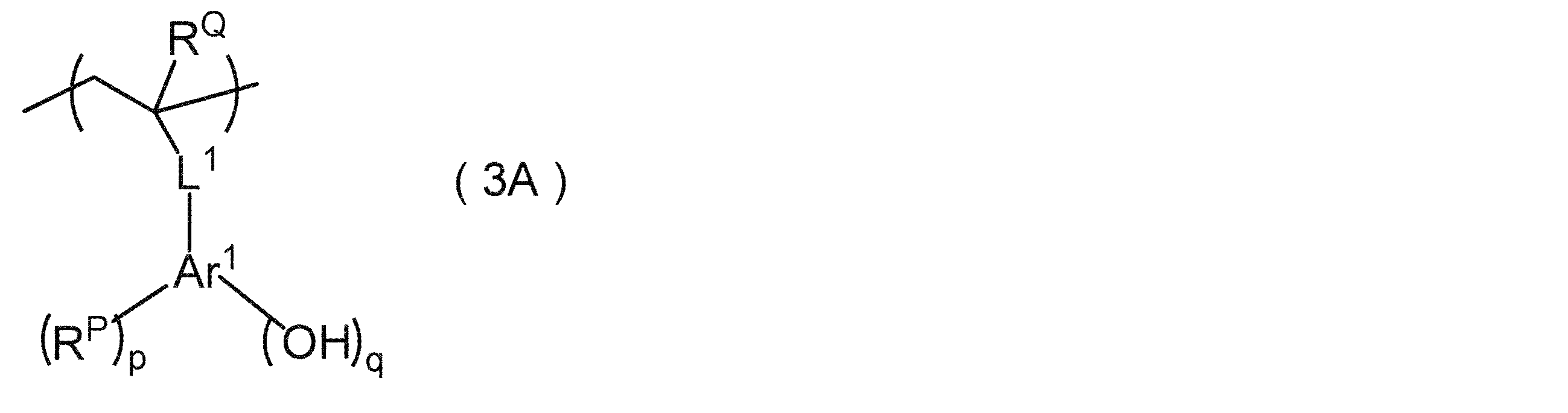

構造単位(II)は、酸解離性基(a)を含む構造単位である。[A1]重合体が構造単位(II)を有することで、当該感放射線性樹脂組成物の感度を高めることができる。

上記式(2-2)中、RUは、水素原子若しくは炭素数1~20の1価の炭化水素基であり、RV及びRWは、それぞれ独立して、炭素数1~6の1価の鎖状炭化水素基若しくは炭素数3~6の1価の脂環式炭化水素基であるか、又はRU、RV及びRWのうちの2つ以上が互いに合わせられこれらが結合する炭素原子又はC-Oと共に構成される環員数4~6の単環の環構造の一部である。
シクロプロパン構造、シクロブタン構造、シクロペンタン構造、シクロヘキサン構造等のシクロアルカン構造;
シクロプロペン構造、シクロブテン構造、シクロペンテン構造、シクロヘキセン構造等のシクロアルケン構造などが挙げられる。

構造単位(IV)は、ラクトン構造、環状カーボネート構造、スルトン構造又はこれらの組み合わせを含む構造単位である(但し、構造単位(I)又は構造単位(II)に該当するものを除く)。[A1]重合体は、構造単位(IV)をさらに有することで、現像液への溶解性をより調整することができ、その結果、当該感放射線性組成物のリソグラフィー特性をより向上させることができる。また、レジストパターンと基板との密着性をより向上させることができる。


構造単位(V)は、アルコール性ヒドロキシ基を含む構造単位である(但し、構造単位(I)又は構造単位(II)に該当するものを除く)。[A1]重合体は、構造単位(V)を有することで、現像液への溶解性をより調整することができ、その結果、当該感放射線性組成物のリソグラフィー特性をより向上させることができる。
[A1]重合体は、構造単位(I)、(II)、(IV)及び(V)以外にもその他の構造単位を有してもよい。その他の構造単位としては、例えば極性基を含む構造単位、非解離性の炭化水素基を含む構造単位等が挙げられる(但し、非酸解離性基の炭化水素基を含む構造単位であっても、別途酸解離性基を有するものは本明細書中では構造単位(II)に分類される)。極性基としては、例えばカルボキシ基、シアノ基、ニトロ基、スルホンアミド基等が挙げられる。非解離性の炭化水素基を含む構造単位を与える単量体としては、例えばスチレン、ビニルナフタレン、フェニル(メタ)アクリレート、ベンジル(メタ)アクリレート、n-ペンチル(メタ)アクリレート、シクロヘキシル(メタ)アクリレート等が挙げられる。
GPCカラム:東ソー社の「G2000HXL」2本、「G3000HXL」1本、「G4000HXL」1本
カラム温度:40℃
溶出溶媒:テトラヒドロフラン(和光純薬工業社)
流速:1.0mL/分
試料濃度:1.0質量%
試料注入量:100μL
検出器:示差屈折計
標準物質:単分散ポリスチレン
[A1]重合体は、例えば各構造単位を与える単量体を、公知の方法で重合することにより合成することができる。構造単位(I)がヒドロキシスチレン、ビニルナフタレン等に由来する構造単位である場合、これらの構造単位は、例えば単量体としてアセトキシスチレン、アセトキシビニルナフタレン等を用いて重合体を得、この重合体を塩基存在下で加水分解させることにより形成することができる。
[A2]重合体は、フッ素原子及びケイ素原子の少なくとも一方を有し、かつ構造単位(III)を有する重合体である。上記フッ素原子及びケイ素原子は[A2]重合体の主鎖、側鎖及び末端のいずれに結合していてもよいが、側鎖に結合していることが好ましい。[A2]重合体は、通常、フッ素原子及びケイ素原子を、フッ素原子及び/又はケイ素原子を含む構造単位中又は構造単位(III)中に有する。
構造単位(III)は、アルカリ解離性基(b)を含む構造単位である。

RBで表されるフッ素化エタンジイル基としては、フルオロエタンジイル基、ジフルオロエタンジイル基、トリフルオロエタンジイル基、テトラフルオロエタンジイル基等が挙げられる。
RBとしては、単結合、メタンジイル基、エタンジイル基、ジフルオロメタンジイル基又はトリフルオロエタンジイル基が好ましい。

上記式(1A)中、RE1は、水素原子、フッ素原子、メチル基又はトリフルオロメチル基である。L2Aは、単結合、酸素原子又は炭素数1~20の2価の有機基である。RC1は、炭素数1~20の(n1+1)価の有機基である。RD1は、水素原子、フッ素原子又はフッ素原子を含む炭素数1~20の1価の有機基である。n1は、1~3の整数である。n1が2以上の場合、複数のRAは互いに同一又は異なり、複数のRBは互いに同一又は異なり、複数のRD1は互いに同一又は異なる。
上記式(1B)中、RE2は、水素原子、フッ素原子、メチル基又はトリフルオロメチル基である。L2Bは、単結合、酸素原子又は炭素数1~20の2価の有機基である。RC2は、炭素数1~20の(n2+1)価の有機基である。RD2は、水素原子、フッ素原子又はフッ素原子を含む炭素数1~20の1価の有機基である。n2は、1~3の整数である。n2が2以上の場合、複数のRAは互いに同一又は異なり、複数のRBは互いに同一又は異なり、複数のRD2は互いに同一又は異なる。
構造単位(VI)は、下記式(A)で表される基(以下、「基(VI)」ともいう)を含む構造単位である(但し、構造単位(III)に該当するものを除く)。

[A2]重合体は、構造単位(I)~(VI)以外にもその他の構造単位を有していてもよい。その他の構造単位としては、例えばフッ素化アルキル(メタ)アクリレートに由来する構造単位等が挙げられる。この構造単位を与えるフッ素化アルキル(メタ)アクリレートとしては、例えばトリフルオロエチル(メタ)アクリレート、ペンタフルオロ-n-プロピル(メタ)アクリレート、ヘキサフルオロ-i-プロピル(メタ)アクリレート等が挙げられる。その他の構造単位の含有割合の上限としては、30モル%が好ましく、10モル%がより好ましい。上記含有割合の下限としては、例えば1モル%である。
[A2]重合体は、上記[A1]重合体と同様、例えば各構造単位を与える単量体を、公知の方法で重合することにより合成することができる。
[B1]化合物は、放射線の照射により、80℃以上130℃以下の温度TX℃及び1分の条件で上記酸解離性基(a)を解離させる酸(以下、「酸(I)」ともいう)を発生する化合物である。放射線の照射により[B1]化合物から発生する酸(I)の作用によって、80℃~130℃の範囲内のTX℃及びTX℃を超える温度で、1分間又は1分未満の時間、例えばポストエクスポージャーベーク(PEB)等において加熱を行うことにより、上記酸解離性基(a)が解離する。

シクロペンタン構造、シクロヘキサン構造、シクロヘプタン構造、シクロオクタン構造、シクロノナン構造、シクロデカン構造、シクロドデカン構造等の単環の飽和脂環構造;
シクロペンテン構造、シクロヘキセン構造、シクロヘプテン構造、シクロオクテン構造、シクロデセン構造等の単環の不飽和脂環構造;
ノルボルナン構造、アダマンタン構造、トリシクロデカン構造、テトラシクロドデカン構造等の多環の飽和脂環構造;
ノルボルネン構造、トリシクロデセン構造等の多環の不飽和脂環構造等が挙げられる。
ヘキサノラクトン構造、ノルボルナンラクトン構造等のラクトン構造;
ヘキサノスルトン構造、ノルボルナンスルトン構造等のスルトン構造;
オキサシクロヘプタン構造、オキサノルボルナン構造等の酸素原子含有複素環構造;
アザシクロヘキサン構造、ジアザビシクロオクタン構造等の窒素原子含有複素環構造;
チアシクロヘキサン構造、チアノルボルナン構造等のイオウ原子含有複素環構造などが挙げられる。
フラン構造、ピラン構造、ベンゾフラン構造、ベンゾピラン構造等の酸素原子含有複素環構造;
ピリジン構造、ピリミジン構造、インドール構造等の窒素原子含有複素環構造などが挙げられる。

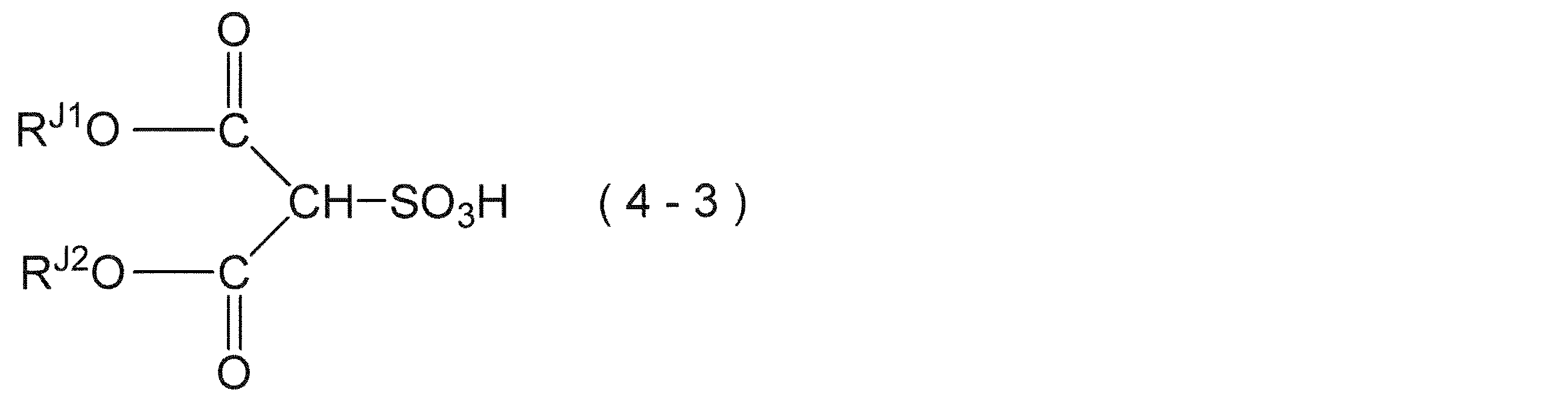
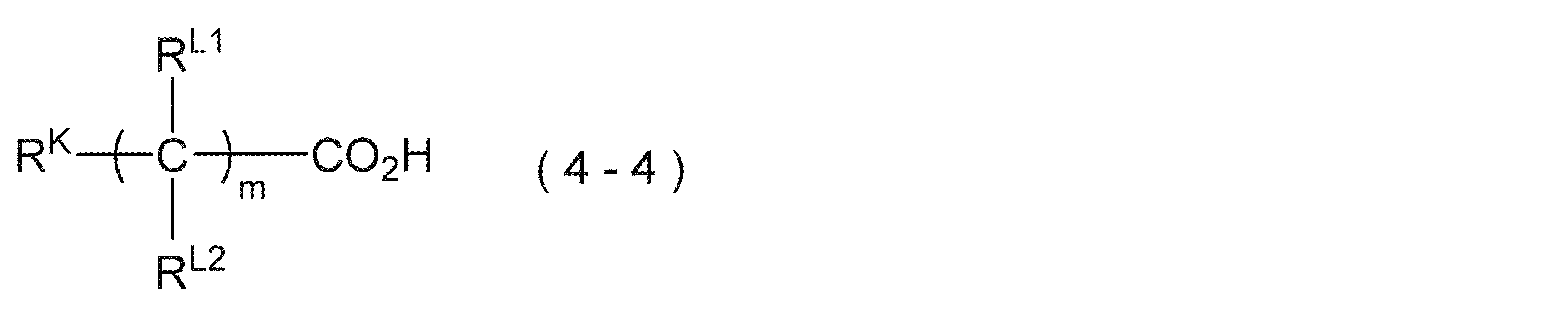
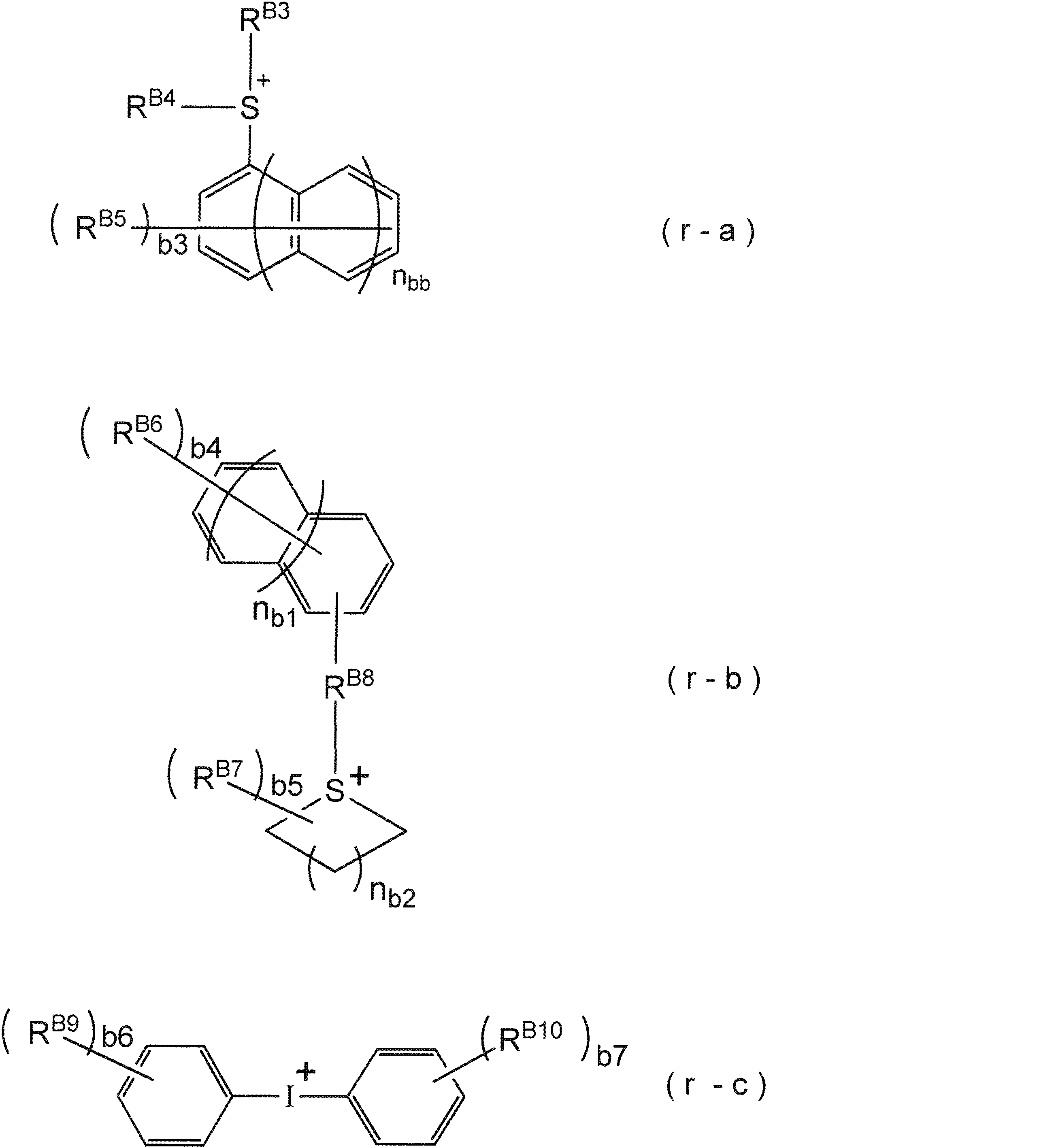
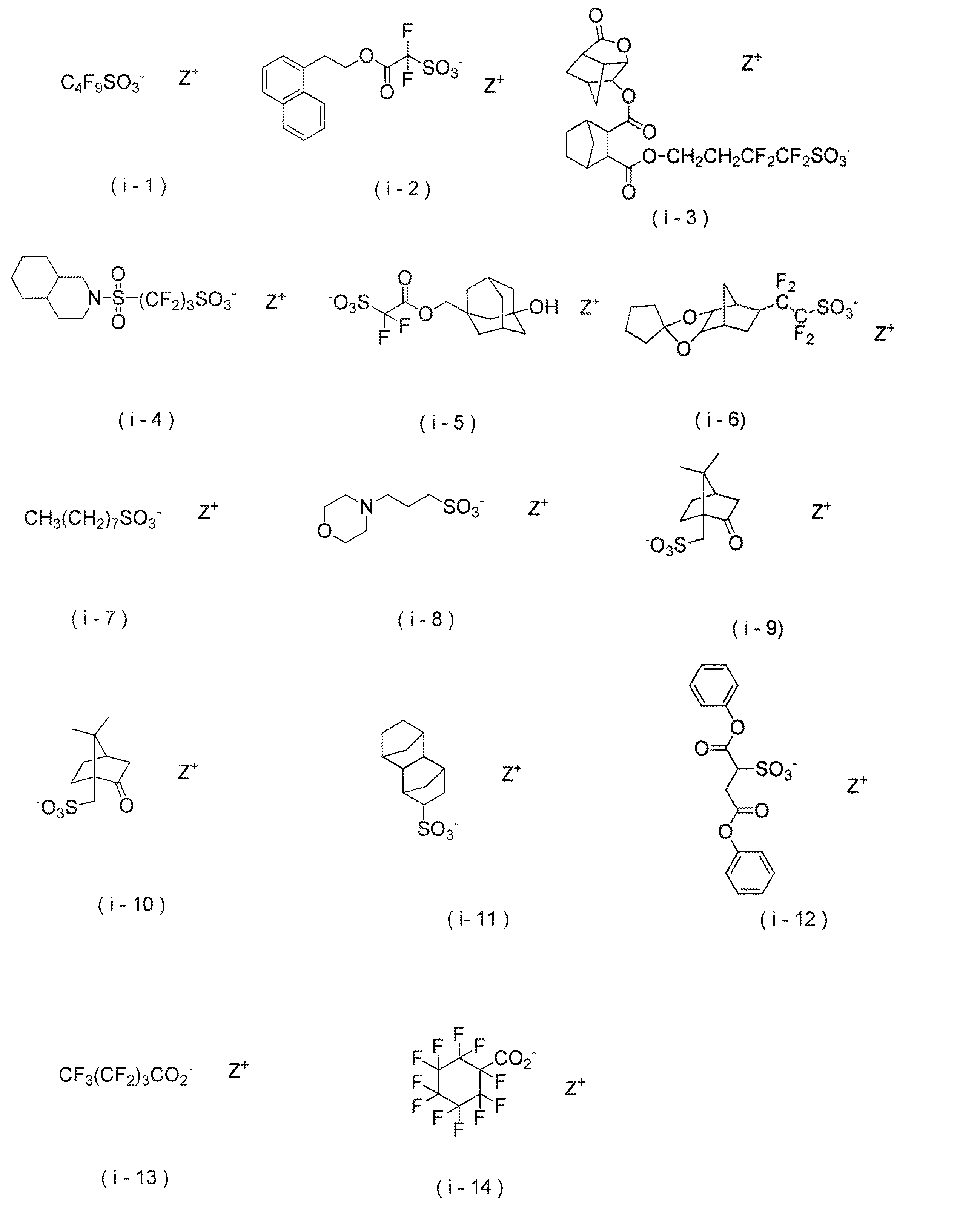
[B2]化合物は、放射線の照射により、上記温度TX℃及び1分の条件で上記酸解離性基(a)を実質的に解離させないカルボン酸(以下、「酸(II-1)」ともいう)又は上記温度TX℃及び1分の条件で上記酸解離性基(a)を実質的に解離させないスルホン酸(以下、「酸(II-2)」ともいう。酸(II-1)及び酸(II-2)をまとめて、「酸(II)」ともいう))又はこれらの組み合わせを発生する化合物である。放射線の照射により[B2]化合物から発生する酸(II)の作用によっては、80℃~130℃の範囲内の上記TX℃の温度で1分間、例えばポストエクスポージャーベーク(PEB)等において加熱を行なっても、上記酸解離性基(a)は実質的に解離しない。


当該感放射線性樹脂組成物は、通常、[C]溶媒を含有する。[C]溶媒は、少なくとも[A1]重合体、[A2]重合体、[B1]化合物、[B2]化合物及び所望により含有されるその他の任意成分を溶解又は分散可能な溶媒であれば特に限定されない。
4-メチル-2-ペンタノール、n-ヘキサノール等の炭素数1~18の脂肪族モノアルコール系溶媒;
シクロヘキサノール等の炭素数3~18の脂環式モノアルコール系溶媒;
1,2-プロピレングリコール等の炭素数2~18の多価アルコール系溶媒;
プロピレングリコールモノメチルエーテル等の炭素数3~19の多価アルコール部分エーテル系溶媒などが挙げられる。
ジエチルエーテル、ジプロピルエーテル、ジブチルエーテル、ジペンチルエーテル、ジイソアミルエーテル、ジヘキシルエーテル、ジヘプチルエーテル等のジアルキルエーテル系溶媒;
テトラヒドロフラン、テトラヒドロピラン等の環状エーテル系溶媒;
ジフェニルエーテル、アニソール等の芳香環含有エーテル系溶媒などが挙げられる。
アセトン、メチルエチルケトン、メチル-n-プロピルケトン、メチル-n-ブチルケトン、ジエチルケトン、メチル-iso-ブチルケトン、2-ヘプタノン、エチル-n-ブチルケトン、メチル-n-ヘキシルケトン、ジ-iso-ブチルケトン、トリメチルノナノン等の鎖状ケトン系溶媒:
シクロペンタノン、シクロヘキサノン、シクロヘプタノン、シクロオクタノン、メチルシクロヘキサノン等の環状ケトン系溶媒:
2,4-ペンタンジオン、アセトニルアセトン、アセトフェノン等が挙げられる。
N,N’-ジメチルイミダゾリジノン、N-メチルピロリドン等の環状アミド系溶媒;
N-メチルホルムアミド、N,N-ジメチルホルムアミド、N,N-ジエチルホルムアミド、アセトアミド、N-メチルアセトアミド、N,N-ジメチルアセトアミド、N-メチルプロピオンアミド等の鎖状アミド系溶媒などが挙げられる。
酢酸n-ブチル、乳酸エチル等のモノカルボン酸エステル系溶媒;
酢酸プロピレングリコール等の多価アルコールカルボキシレート系溶媒;
酢酸プロピレングリコールモノメチルエーテル等の多価アルコール部分エーテルカルボキシレート系溶媒;
シュウ酸ジエチル等の多価カルボン酸ジエステル系溶媒;
ジメチルカーボネート、ジエチルカーボネート等のカーボネート系溶媒などが挙げられる。
n-ペンタン、n-ヘキサン等の炭素数5~12の脂肪族炭化水素系溶媒;
トルエン、キシレン等の炭素数6~16の芳香族炭化水素系溶媒等が挙げられる。
その他の任意成分としては、例えば塩基性化合物、界面活性剤等が挙げられる。当該感放射線性樹脂組成物は、その他の任意成分をそれぞれ1種又は2種以上含有していてもよい。
塩基性化合物は、上記[B2]化合物と同様、露光により[B1]化合物等から生じる酸のレジスト膜中における拡散現象を制御し、非露光領域における好ましくない化学反応を抑制する効果を奏する。
界面活性剤は、塗布性、ストリエーション、現像性等を改良する効果を奏する。界面活性剤としては、例えばポリオキシエチレンラウリルエーテル、ポリオキシエチレンステアリルエーテル、ポリオキシエチレンオレイルエーテル、ポリオキシエチレンn-オクチルフェニルエーテル、ポリオキシエチレンn-ノニルフェニルエーテル、ポリエチレングリコールジラウレート、ポリエチレングリコールジステアレート等のノニオン系界面活性剤;市販品としては、KP341(信越化学工業社)、ポリフローNo.75、同No.95(以上、共栄社化学社)、エフトップEF301、同EF303、同EF352(以上、トーケムプロダクツ社)、メガファックF171、同F173(以上、DIC社)、フロラードFC430、同FC431(以上、住友スリーエム社)、アサヒガードAG710、サーフロンS-382、同SC-101、同SC-102、同SC-103、同SC-104、同SC-105、同SC-106(以上、旭硝子工業社)等が挙げられる。
当該感放射線性樹脂組成物は、例えば[A1]重合体、[A2]重合体、[B1]化合物、[B2]化合物、[C]溶媒及び必要に応じて他の任意成分を所定の割合で混合し、好ましくは、得られた混合物を孔径200nm程度のメンブランフィルターでろ過することにより調製することができる。当該感放射線性樹脂組成物の固形分濃度の下限としては、0.1質量%が好ましく、0.5質量%がより好ましく、1質量%がさらに好ましく、1.5質量%が特に好ましい。上記固形分濃度の上限としては、50質量%が好ましく、30質量%がより好ましく、10質量%がさらに好ましく、5質量%が特に好ましい。
当該レジストパターン形成方法は、当該感放射線性樹脂組成物を基板の少なくとも一方の面側に塗工する工程(以下、「塗工工程」ともいう)と、上記塗工工程により形成されたレジスト膜を露光する工程(以下、「露光工程」ともいう)と、上記露光されたレジスト膜を現像する工程(以下、「現像工程」ともいう)とを備える。
本工程では、当該感放射線性樹脂組成物を基板の少なくとも一方の面側に塗工する。これにより上記基板の少なくとも一方の面側にレジスト膜を形成する。基板としては、例えばシリコンウェハ、二酸化シリコン、アルミニウムで被覆されたウェハ等の従来公知のもの等が挙げられる。また、例えば特公平6-12452号公報や特開昭59-93448号公報等に開示されている有機系又は無機系の反射防止膜を基板上に形成してもよい。塗工方法としては、例えば回転塗工(スピンコーティング)、流延塗工、ロール塗工等が挙げられる。塗工した後に、必要に応じて、塗膜中の溶媒を揮発させるため、プレベーク(PB)を行ってもよい。PBの温度の下限としては、60℃が好ましく、80℃がより好ましい。上記温度の上限としては、140℃が好ましく、120℃がより好ましい。PBの時間の下限としては、5秒が好ましく、10秒がより好ましい。上記時間の下限としては、600秒が好ましく、300秒がより好ましい。形成されるレジスト膜の平均厚みの下限としては、10nmが好ましく、20nmがより好ましい。上記平均厚みの上限としては、1,000nmが好ましく、500nmがより好ましい。
本工程では、上記レジスト膜を露光する。この露光は、フォトマスクを介して(場合によっては、水等の液浸媒体を介して)露光光を照射することにより行う。露光光としては、目的とするパターンの線幅に応じて、例えば可視光線、紫外線、遠紫外線、極端紫外線(EUV)、X線、γ線等の電磁波;電子線、α線等の荷電粒子線などが挙げられる。これらの中でも、遠紫外線、EUV又は電子線が好ましく、ArFエキシマレーザー光(波長193nm)、KrFエキシマレーザー光(波長248nm)、EUV又は電子線がより好ましく、ArFエキシマレーザー光、EUV又は電子線がさらに好ましく、EUV又は電子線が特に好ましい。
本工程では、上記露光されたレジスト膜を現像する。これにより、所定のレジストパターンを形成することができる。現像後は、水又はアルコール等のリンス液で洗浄し、乾燥することが一般的である。現像工程における現像方法は、アルカリ現像であっても、有機溶媒現像であってもよい。
GPCカラム(東ソー社の「G2000HXL」2本、「G3000HXL」1本、「G4000HXL」1本)を用い、流量:1.0mL/分、溶出溶媒:テトラヒドロフラン、試料濃度:1.0質量%、試料注入量:100μL、カラム温度:40℃、検出器:示差屈折計の分析条件で、単分散ポリスチレンを標準とするゲルパーミエーションクロマトグラフィー(GPC)により測定した。分散度(Mw/Mn)は、Mw及びMnの測定結果より算出した。
核磁気共鳴装置(日本電子社の「JNM-ECX400」)を用い、測定溶媒として重ジメチルスルホキシドを使用して、各重合体における各構造単位の含有割合(モル%)を求める分析を行った。
重合体の合成に用いた単量体を以下に示す。なお、以下の合成例においては特に断りのない限り、質量部は使用した単量体の合計質量を100質量部として場合の値を意味し、モル%は使用した単量体の合計モル数を100モル%とした場合の値を意味する。


[合成例1](重合体(Aa-1)の合成)
単量体としての化合物(M-1)及び化合物(M-5)を、モル比率が50/50となるよう、プロピレングリコールモノメチルエーテル100質量部に溶解した。ここに、開始剤としてのアゾビスイソブチロニトリル(AIBN)6モル%、及び連鎖移動剤としてのt-ドデシルメルカプタン(開始剤100質量部に対して38質量部)を加えて単量体溶液を調製した。この単量体溶液を窒素雰囲気下、反応温度を70℃に保持して、16時間重合させた。重合反応終了後、重合溶液をn-ヘキサン1,000質量部中に滴下して、重合体を凝固精製した。上記重合体に、プロピレングリコールモノメチルエーテル150質量部を加えた。さらに、メタノール150質量部、トリエチルアミン(化合物(M-1)の使用量に対し1.5モル当量)及び水(化合物(M-1)の使用量に対し1.5モル当量)を加えて、沸点にて還流させながら、8時間加水分解反応を行った。反応終了後、溶媒及びトリエチルアミンを減圧留去し、得られた重合体をアセトン150質量部に溶解した。これを水2,000質量部中に滴下して凝固させ、生成した白色粉末を濾別した。50℃で17時間乾燥させて白色粉末状の重合体(Aa-1)を良好な収率で得た。重合体(Aa-1)のMwは6,500であり、Mw/Mnは1.71であった。13C-NMR分析の結果、(M-1)及び(M-5)に由来する各構造単位の含有割合は、それぞれ50.3モル%及び49.7モル%であった。
下記表1及び表2に示す種類及び使用量の単量体を用いた以外は、合成例1と同様の操作を行うことによって、重合体(Aa-2)~(Aa-4)、(Aa-6)~(Aa-12)及び(Aa-19)~(Aa-26)を合成した。
単量体としての化合物(M-4)、化合物(M-13)及び化合物(M-17)を、モル比率が40/50/10となるよう、プロピレングリコールモノメチルエーテル100質量部に溶解した。ここに開始剤としてのAIBN6モル%、及び連鎖移動剤としてのt-ドデシルメルカプタン(開始剤100質量部に対して38質量部)を加えて単量体溶液を調製した。この単量体溶液を窒素雰囲気下、反応温度を70℃に保持して、16時間重合させた。重合反応終了後、重合溶液をn-ヘキサン1,000質量部中に滴下して、重合体を凝固精製し、白色粉末を濾別した。50℃で17時間乾燥させて白色粉末状の重合体(Aa-5)を良好な収率で得た。重合体(Aa-5)のMwは6,800であり、Mw/Mnは1.69であった。13C-NMR分析の結果、(M-4)、(M-13)及び(M-17)に由来する各構造単位の含有割合は、それぞれ39.9モル%、50.2モル%及び9.9モル%であった。
下記表1に示す種類及び使用量の単量体を用いた以外は、合成例5と同様の操作を行うことによって、重合体(Aa-13)~(Aa-18)及び(Ac-1)を合成した。

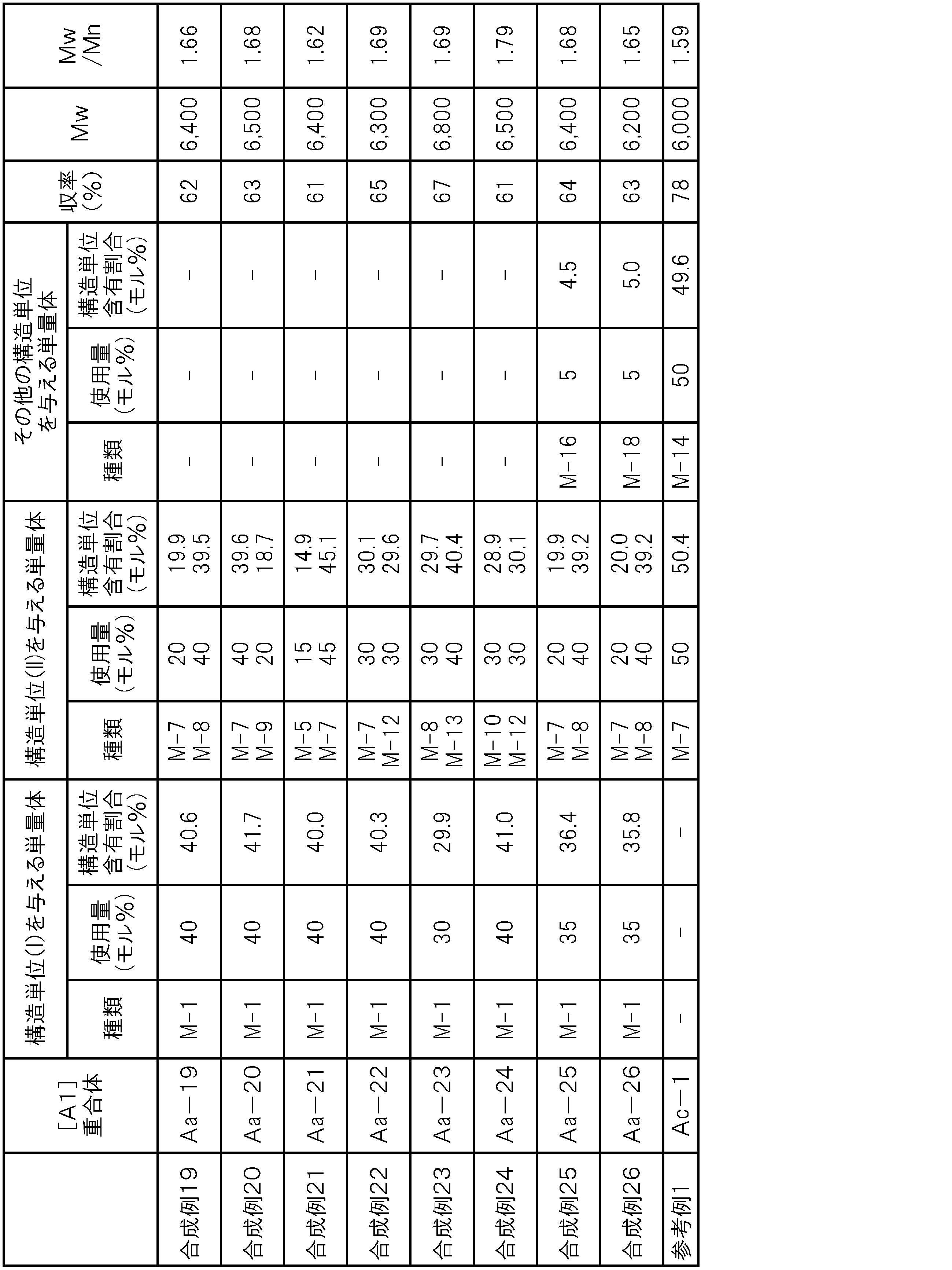
[合成例27](重合体(Ab-1)の合成)
単量体としての化合物(M-7)及び化合物(M-19)を、モル比率が50/50となるよう、シクロヘキサノン100質量部に溶解した。ここに開始剤としてAIBN3モル%を加えて単量体溶液を調製した。この単量体溶液を窒素雰囲気下、反応温度を85℃に保持して、6時間重合させた。重合反応終了後、重合溶液をヘプタン/酢酸エチル(質量比8/2)1,000質量部中に滴下して、重合体を凝固精製し、粉末を濾別した。次いで、ヘプタン/酢酸エチル(質量比8/2)300質量部を用いて、濾別した固体のかけ洗いを行った。その後、50℃で17時間乾燥させて白色粉末状の重合体(Ab-1)を良好な収率で得た。重合体(Ab-1)のMwは9,000であり、Mw/Mnは1.40であった。13C-NMR分析の結果、(M-7)及び(M-19)に由来する各構造単位の含有割合は、それぞれ49.7モル%及び50.3モル%であった。
下記表3に示す種類及び使用量の単量体を用いた以外は、合成例27と同様の操作を行うことによって、重合体(Ab-2)~(Ab-16)及び(Ac-2)を合成した。

感放射線性樹脂組成物の調製に用いた[A1]重合体及び[A2]重合体以外の成分について、以下に示す。
各構造式を以下に示す。
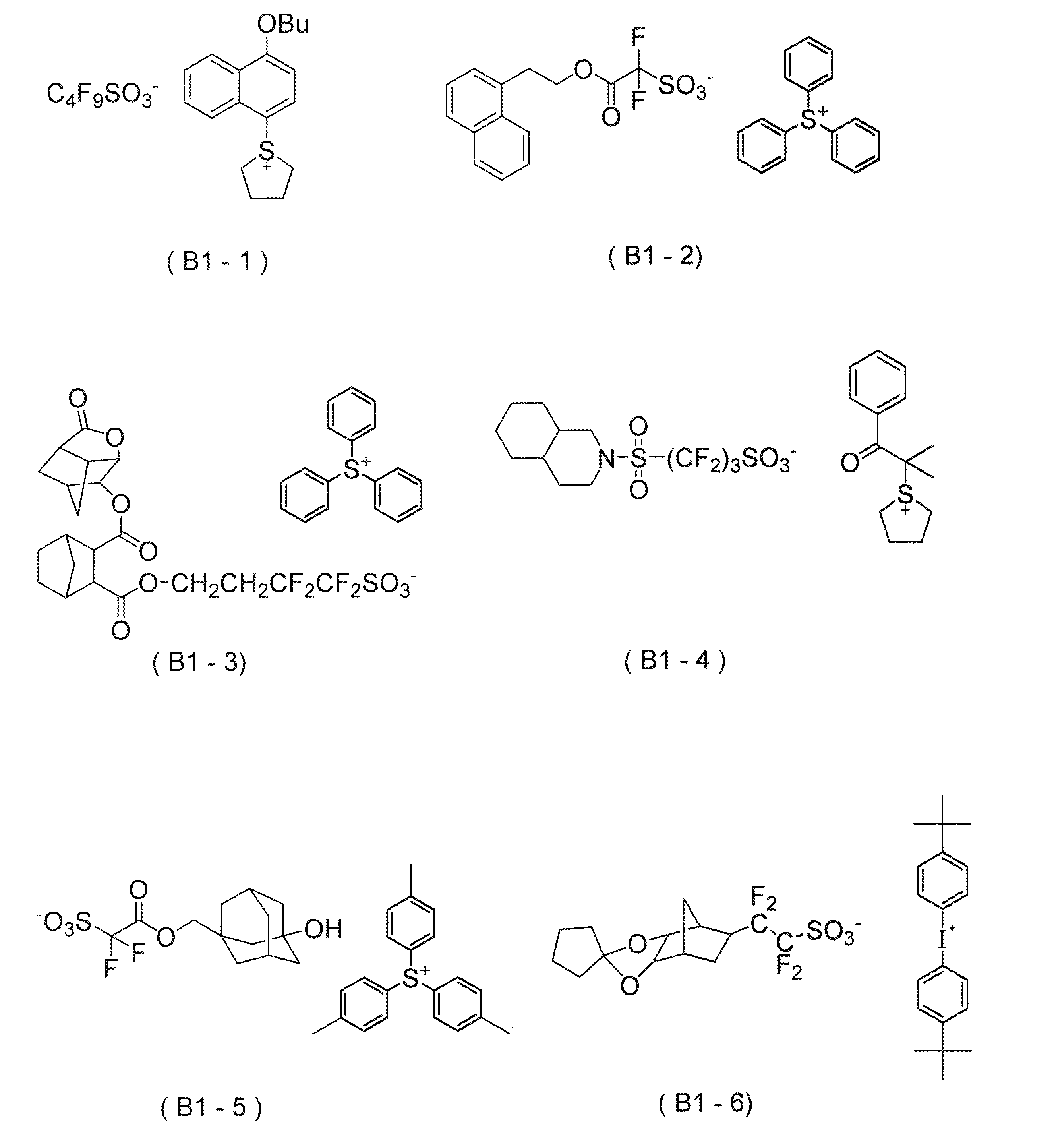

各構造式を以下に示す。

C-1:プロピレングリコールモノメチルエーテルアセテート
C-2:シクロヘキサノン
各構造式を以下に示す。
D-1:2,6-ジi-プロピルアニリン
D-2:トリn-ペンチルアミン
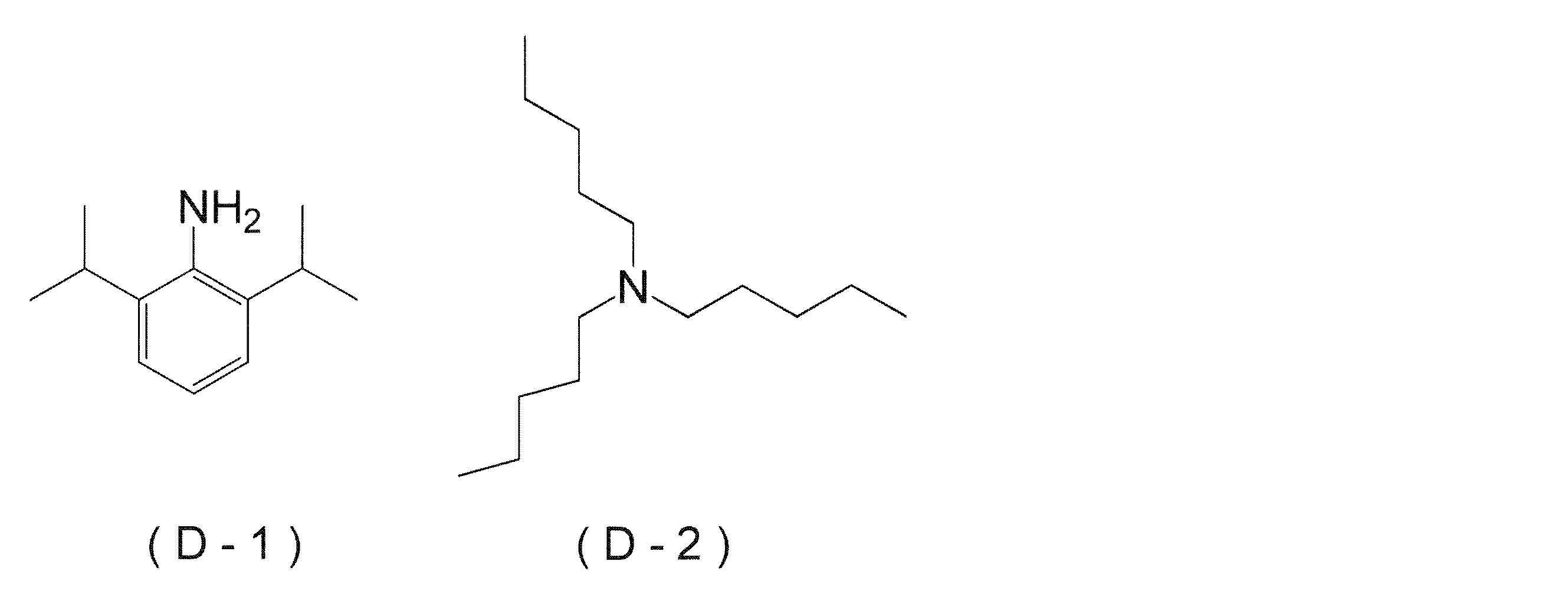
[A1]重合体としての(Aa-1)100質量部、[A2]重合体としての(Ab-1)5質量部、[B1]化合物としての(B1-1)10質量部、[B2]化合物としての(B2-1)5質量部、並びに[C]溶媒としての(C-1)3,510質量部及び(C-2)1,510質量部を混合し、得られた混合物を20nmのメンブランフィルターでろ過し、感放射線性樹脂組成物(J-1)を調製した。
下記表4及び表5に示す種類及び含有量の各成分を用いた以外は、実施例1と同様に操作して、感放射線性樹脂組成物(J-2)~(J-32)及び(CJ-1)~(CJ-7)を調製した。表4及び表5中の「-」は、該当する成分を用いなかったことを示す。


8インチのシリコンウェハ表面にスピンコーター(東京エレクトロン社の「CLEAN TRACK ACT8」)を使用して、上記調製した感放射線性樹脂組成物を塗工し、110℃で60秒間PBを行い、23℃で30秒間冷却して、平均厚み50nmのレジスト膜を形成した。次に、このレジスト膜に、簡易型の電子線描画装置(日立製作所社の「HL800D」、出力:50KeV、電流密度:5.0A/cm2)を用いて電子線を照射した。照射後、表6中に示すPEB温度で60秒間PEBを行った。それから、アルカリ現像液として2.38質量%のTMAH水溶液を用いて23℃で60秒間現像し、水で洗浄し、乾燥してポジ型のレジストパターンを形成した。
上記形成したレジストパターンについて、下記測定を行うことにより、当該感放射線性樹脂組成物のLWR性能、解像性、断面形状の矩形性、露光余裕度及び欠陥抑制性能を評価した。評価結果を表6に示す。上記レジストパターンの測長には、走査型電子顕微鏡(日立ハイテクノロジーズ社の「S-9380」)を用いた。なお、上記レジストパターンの形成において、形成される線幅が100nm(L/S=1/1)となる露光量を最適露光量とした。
上記形成した線幅が100nm(L/S=1/1)のレジストパターンを、上記走査型電子顕微鏡を用い、パターン上部から観察した。線幅を任意のポイントで計50点測定し、その測定値の分布から3シグマ値を求め、これをLWR性能(nm)とした。LWR性能は、その値が小さいほど、線幅のばらつきが小さく良いことを示す。LWR性能は、20nm以下の場合は良好と、20nmを超える場合は不良と評価できる。
上記最適露光量において解像される最小のレジストパターンの寸法を測定し、この測定値を解像性(nm)とした。解像性は、その値が小さいほど、より微細なパターンを形成でき良いことを示す。解像性は、60nm以下の場合は良好と、60nmを超える場合は不良と評価できる。
上記最適露光量において解像されるレジストパターンの断面形状を観察し、レジストパターンの高さ方向の中間における線幅Lb及びレジストパターン上部における線幅Laを測定し、La/Lbの値を算出し、この値を断面形状の矩形性の指標とした。断面形状の矩形性は、0.9≦(La/Lb)≦1.1の場合は良好と、(La/Lb)≦0.9又は1.1≦(La/Lb)の場合は不良と評価できる。
上記最適露光量を含む露光量の範囲において、露光量を1μC/cm2ごとに変えて、それぞれレジストパターンを形成し、上記走査型電子顕微鏡を用いて、それぞれの線幅を測定した。得られた線幅と露光量の関係から、線幅が110nmとなる露光量E(110)、及び線幅が90nmとなる露光量E(90)を求め、露光余裕度=(E(110)-E(90))×100/(最適露光量)の式から露光余裕度(%)を算出した。露光余裕度は、その値が大きいほど、露光量が変動した際に得られるパターンの寸法の変動が小さく、デバイス作製時の歩留まりを高くすることができる。露光余裕度は、20%以上の場合は良好と、20%未満の場合は不良と評価できる。
8インチのシリコンウェハ上に平均厚み60nmの反射防止膜(ブリューワーサイエンス社の「DUV44」)を形成した基板上に、上記調製した感放射線性樹脂組成物を塗布し、110℃で60秒間PBを行い、23℃で30秒間冷却して、平均厚み50nmのレジスト膜を形成した。このレジスト膜に対し、KrFエキシマレーザースキャナー(ニコン社の「NSR-S203B」、波長248nm)を用いて、ウェハ全面を15mm角の面積でオープンフレームの露光部と未露光部を交互に露光するチェッカーフラッグ露光(露光条件:NA=0.68、σ=0.75、25mJ)を行った。照射後に表6に示すPEB温度で60秒間ベークし、アルカリ現像液として2.38質量%のTMAH水溶液を用いて23℃で60秒間現像し、水で洗浄し、乾燥した。

上記表4及び表5に示す各感放射線性樹脂組成物を、ケイ素含有スピンオンハードマスクSHB-A940(ケイ素の含有量が43質量%)を平均厚み20nmで形成したSi基板上にスピンコートし、ホットプレートを用いて105℃で60秒間プレベークして平均厚み60nmのレジスト膜を作製した。これに、ASML社製EUVスキャナー「NXE3300」(NA0.33、σ0.9/0.6、クアドルポール照明、ウェハ上寸法がピッチ46nm、+20%バイアスのホールパターンのマスク)を用いて露光し、ホットプレート上で表7に記載した温度で60秒間PEBを行い、2.38質量%TMAH水溶液で30秒間現像を行って、寸法23nmのホールパターンを得た。
得られたレジストパターンについて次の評価を行った。
(株)日立ハイテクノロジーズ社製測長SEM(CG5000)を用いて、ホール寸法が23nmで形成されるときの露光量を求めてこれを感度とし、このときのホール50個の寸法を測定し、CDU(寸法バラツキ3σ)(nm)を求めた。結果を表7に示す。CDU性能は、その値が小さいほど、長周期でのホール径のばらつきが小さく良好である。CDU性能は、3.0nm以下の場合は「良好」と、3.0nmを超える場合は「不良」と評価できる。

Claims (9)
- フェノール性ヒドロキシ基を含む第1構造単位及び酸解離性基を含む第2構造単位を有する第1重合体と、
フッ素原子及びケイ素原子の少なくとも一方を有し、かつアルカリ解離性基を含む第3構造単位を有する第2重合体と、
放射線の照射により、80℃以上130℃以下の温度TX℃及び1分の条件で上記酸解離性基を解離させる酸を発生する第1化合物と、
放射線の照射により、上記温度TX℃及び1分の条件で上記酸解離性基を実質的に解離させないカルボン酸、上記温度TX℃及び1分の条件で上記酸解離性基を実質的に解離させないスルホン酸又はこれらの組み合わせを発生する第2化合物と
を含有する感放射線性樹脂組成物。 - 上記第2化合物が発生する酸がカルボン酸である請求項1に記載の感放射線性樹脂組成物。
- 上記第2重合体の第3構造単位が下記式(1)で表される基を含む請求項1又は請求項2に記載の感放射線性樹脂組成物。

- 上記第2重合体における第3構造単位の含有割合が55モル%を超える請求項1、請求項2又は請求項3に記載の感放射線性樹脂組成物。
- 上記第1重合体における第2構造単位の含有割合が55モル%以上である請求項1から請求項4のいずれか1項に記載の感放射線性樹脂組成物。
- 上記第1重合体の第2構造単位が含む酸解離性基が下記式(2-1)及び(2-2)の少なくともいずれかで表される請求項1から請求項5のいずれか1項に記載の感放射線性樹脂組成物。

式(2-2)中、RUは、水素原子若しくは炭素数1~20の1価の炭化水素基であり、RV及びRWは、それぞれ独立して、炭素数1~6の1価の鎖状炭化水素基若しくは炭素数3~6の1価の脂環式炭化水素基であるか、又はRU、RV及びRWのうちの2つ以上が互いに合わせられこれらが結合する炭素原子又はC-Oと共に構成される環員数4~6の単環の環構造の一部である。) - 上記第1重合体の第2構造単位が下記式(2-1A)、(2-1B)、(2-2A)及び(2-2B)の少なくともいずれかで表される請求項6に記載の感放射線性樹脂組成物。

- 上記第1重合体がラクトン構造、環状カーボネート構造、スルトン構造又はこれらの組み合わせを含む第4構造単位を有し、上記第1重合体におけるこの第4構造単位の含有割合が40モル%未満である請求項1から請求項7のいずれか1項に記載の感放射線性樹脂組成物。
- 請求項1から請求項8のいずれか1項に記載の感放射線性樹脂組成物を基板の少なくとも一方の面側に塗工する工程と、
上記塗工工程により形成されたレジスト膜を極端紫外線又は電子線により露光する工程と、
上記露光されたレジスト膜を現像する工程と
を備えるレジストパターン形成方法。
Priority Applications (3)
| Application Number | Priority Date | Filing Date | Title |
|---|---|---|---|
| JP2019525288A JP7127643B2 (ja) | 2017-06-15 | 2018-05-29 | 感放射線性樹脂組成物及びレジストパターン形成方法 |
| KR1020197032856A KR102590882B1 (ko) | 2017-06-15 | 2018-05-29 | 감방사선성 수지 조성물 및 레지스트 패턴 형성 방법 |
| US16/713,471 US20200117087A1 (en) | 2017-06-15 | 2019-12-13 | Radiation-sensitive resin composition and resist pattern-forming method |
Applications Claiming Priority (2)
| Application Number | Priority Date | Filing Date | Title |
|---|---|---|---|
| JP2017-118136 | 2017-06-15 | ||
| JP2017118136 | 2017-06-15 |
Related Child Applications (1)
| Application Number | Title | Priority Date | Filing Date |
|---|---|---|---|
| US16/713,471 Continuation US20200117087A1 (en) | 2017-06-15 | 2019-12-13 | Radiation-sensitive resin composition and resist pattern-forming method |
Publications (1)
| Publication Number | Publication Date |
|---|---|
| WO2018230334A1 true WO2018230334A1 (ja) | 2018-12-20 |
Family
ID=64659750
Family Applications (1)
| Application Number | Title | Priority Date | Filing Date |
|---|---|---|---|
| PCT/JP2018/020600 Ceased WO2018230334A1 (ja) | 2017-06-15 | 2018-05-29 | 感放射線性樹脂組成物及びレジストパターン形成方法 |
Country Status (5)
| Country | Link |
|---|---|
| US (1) | US20200117087A1 (ja) |
| JP (1) | JP7127643B2 (ja) |
| KR (1) | KR102590882B1 (ja) |
| TW (1) | TWI754756B (ja) |
| WO (1) | WO2018230334A1 (ja) |
Cited By (17)
| Publication number | Priority date | Publication date | Assignee | Title |
|---|---|---|---|---|
| JP2020042110A (ja) * | 2018-09-07 | 2020-03-19 | 東京応化工業株式会社 | レジスト組成物及びレジストパターン形成方法 |
| WO2020195428A1 (ja) * | 2019-03-28 | 2020-10-01 | Jsr株式会社 | 感放射線性樹脂組成物及びレジストパターンの形成方法 |
| KR20200143278A (ko) * | 2019-06-14 | 2020-12-23 | 제이에스알 가부시끼가이샤 | 감방사선성 수지 조성물 및 레지스트 패턴 형성 방법 |
| JP2021096464A (ja) * | 2019-12-12 | 2021-06-24 | 住友化学株式会社 | レジスト組成物及びレジストパターンの製造方法並びにカルボン酸塩及びカルボン酸発生剤 |
| WO2023085414A1 (ja) | 2021-11-15 | 2023-05-19 | 日産化学株式会社 | 多環芳香族炭化水素系光硬化性樹脂組成物 |
| WO2023204287A1 (ja) | 2022-04-22 | 2023-10-26 | 日産化学株式会社 | レジスト下層膜形成用組成物 |
| WO2024128190A1 (ja) | 2022-12-15 | 2024-06-20 | 日産化学株式会社 | レジスト下層膜形成用組成物 |
| WO2024128157A1 (ja) | 2022-12-15 | 2024-06-20 | 日産化学株式会社 | レジスト下層膜形成用組成物 |
| WO2024162459A1 (ja) | 2023-02-03 | 2024-08-08 | 日産化学株式会社 | 環境負荷を低減するためのレジスト下層膜形成用組成物 |
| WO2024166869A1 (ja) | 2023-02-09 | 2024-08-15 | 日産化学株式会社 | レジスト下層膜形成組成物 |
| WO2024203800A1 (ja) | 2023-03-24 | 2024-10-03 | 日産化学株式会社 | 光学回折体製造用レジスト下層膜形成用組成物 |
| WO2024204163A1 (ja) | 2023-03-31 | 2024-10-03 | 日産化学株式会社 | レジスト下層膜形成用組成物 |
| WO2024204764A1 (ja) | 2023-03-31 | 2024-10-03 | 日産化学株式会社 | レジスト下層膜形成用組成物 |
| WO2024204780A1 (ja) | 2023-03-30 | 2024-10-03 | 日産化学株式会社 | レジスト下層膜形成用組成物 |
| WO2024232380A1 (ja) | 2023-05-09 | 2024-11-14 | 日産化学株式会社 | レジスト下層膜形成用組成物 |
| WO2025243892A1 (ja) * | 2024-05-24 | 2025-11-27 | 東京応化工業株式会社 | レジスト組成物及びレジストパターン形成方法 |
| EP4657158A1 (en) | 2023-02-27 | 2025-12-03 | Nissan Chemical Corporation | Resist underlayer film formation composition |
Families Citing this family (3)
| Publication number | Priority date | Publication date | Assignee | Title |
|---|---|---|---|---|
| KR102776230B1 (ko) * | 2019-06-14 | 2025-03-07 | 제이에스알 가부시키가이샤 | 감방사선성 수지 조성물 및 레지스트 패턴 형성 방법 |
| JP7468537B2 (ja) * | 2019-10-08 | 2024-04-16 | Jsr株式会社 | 感放射線性樹脂組成物、レジストパターン形成方法、重合体及び化合物 |
| JP2023091749A (ja) * | 2021-12-20 | 2023-06-30 | 信越化学工業株式会社 | 化学増幅ポジ型レジスト組成物及びレジストパターン形成方法 |
Citations (4)
| Publication number | Priority date | Publication date | Assignee | Title |
|---|---|---|---|---|
| JP2015028576A (ja) * | 2013-07-01 | 2015-02-12 | 富士フイルム株式会社 | パターン形成方法 |
| JP2015214634A (ja) * | 2014-05-09 | 2015-12-03 | 信越化学工業株式会社 | 単量体、高分子化合物、レジスト材料及びパターン形成方法 |
| JP2016099535A (ja) * | 2014-11-25 | 2016-05-30 | 信越化学工業株式会社 | フォトマスクブランク、レジストパターンの形成方法、及びフォトマスクの製造方法 |
| WO2016181753A1 (ja) * | 2015-05-13 | 2016-11-17 | 富士フイルム株式会社 | プレリンス液、プレリンス処理方法、及び、パターン形成方法 |
Family Cites Families (3)
| Publication number | Priority date | Publication date | Assignee | Title |
|---|---|---|---|---|
| JP3972438B2 (ja) | 1998-01-26 | 2007-09-05 | 住友化学株式会社 | 化学増幅型のポジ型レジスト組成物 |
| JP2003005375A (ja) | 2001-06-21 | 2003-01-08 | Fuji Photo Film Co Ltd | ポジ型レジスト組成物 |
| JP4832237B2 (ja) | 2006-09-27 | 2011-12-07 | 富士フイルム株式会社 | ポジ型レジスト組成物およびそれを用いたパターン形成方法 |
-
2018
- 2018-05-29 JP JP2019525288A patent/JP7127643B2/ja active Active
- 2018-05-29 WO PCT/JP2018/020600 patent/WO2018230334A1/ja not_active Ceased
- 2018-05-29 KR KR1020197032856A patent/KR102590882B1/ko active Active
- 2018-06-05 TW TW107119315A patent/TWI754756B/zh active
-
2019
- 2019-12-13 US US16/713,471 patent/US20200117087A1/en not_active Abandoned
Patent Citations (4)
| Publication number | Priority date | Publication date | Assignee | Title |
|---|---|---|---|---|
| JP2015028576A (ja) * | 2013-07-01 | 2015-02-12 | 富士フイルム株式会社 | パターン形成方法 |
| JP2015214634A (ja) * | 2014-05-09 | 2015-12-03 | 信越化学工業株式会社 | 単量体、高分子化合物、レジスト材料及びパターン形成方法 |
| JP2016099535A (ja) * | 2014-11-25 | 2016-05-30 | 信越化学工業株式会社 | フォトマスクブランク、レジストパターンの形成方法、及びフォトマスクの製造方法 |
| WO2016181753A1 (ja) * | 2015-05-13 | 2016-11-17 | 富士フイルム株式会社 | プレリンス液、プレリンス処理方法、及び、パターン形成方法 |
Cited By (29)
| Publication number | Priority date | Publication date | Assignee | Title |
|---|---|---|---|---|
| JP7274839B2 (ja) | 2018-09-07 | 2023-05-17 | 東京応化工業株式会社 | レジスト組成物及びレジストパターン形成方法 |
| JP2020042110A (ja) * | 2018-09-07 | 2020-03-19 | 東京応化工業株式会社 | レジスト組成物及びレジストパターン形成方法 |
| JP7544200B2 (ja) | 2019-03-28 | 2024-09-03 | Jsr株式会社 | 感放射線性樹脂組成物及びレジストパターンの形成方法 |
| WO2020195428A1 (ja) * | 2019-03-28 | 2020-10-01 | Jsr株式会社 | 感放射線性樹脂組成物及びレジストパターンの形成方法 |
| JP2023145463A (ja) * | 2019-03-28 | 2023-10-11 | Jsr株式会社 | 感放射線性樹脂組成物及びレジストパターンの形成方法 |
| JP7459636B2 (ja) | 2019-06-14 | 2024-04-02 | Jsr株式会社 | 感放射線性樹脂組成物及びレジストパターン形成方法 |
| KR20200143278A (ko) * | 2019-06-14 | 2020-12-23 | 제이에스알 가부시끼가이샤 | 감방사선성 수지 조성물 및 레지스트 패턴 형성 방법 |
| KR102845772B1 (ko) * | 2019-06-14 | 2025-08-13 | 제이에스알 가부시키가이샤 | 감방사선성 수지 조성물 및 레지스트 패턴 형성 방법 |
| JP2020204765A (ja) * | 2019-06-14 | 2020-12-24 | Jsr株式会社 | 感放射線性樹脂組成物及びレジストパターン形成方法 |
| JP7737224B2 (ja) | 2019-12-12 | 2025-09-10 | 住友化学株式会社 | レジスト組成物及びレジストパターンの製造方法 |
| JP2021096464A (ja) * | 2019-12-12 | 2021-06-24 | 住友化学株式会社 | レジスト組成物及びレジストパターンの製造方法並びにカルボン酸塩及びカルボン酸発生剤 |
| WO2023085414A1 (ja) | 2021-11-15 | 2023-05-19 | 日産化学株式会社 | 多環芳香族炭化水素系光硬化性樹脂組成物 |
| WO2023204287A1 (ja) | 2022-04-22 | 2023-10-26 | 日産化学株式会社 | レジスト下層膜形成用組成物 |
| EP4636486A1 (en) | 2022-12-15 | 2025-10-22 | Nissan Chemical Corporation | Composition for forming resist underlayer film |
| WO2024128157A1 (ja) | 2022-12-15 | 2024-06-20 | 日産化学株式会社 | レジスト下層膜形成用組成物 |
| EP4636487A1 (en) | 2022-12-15 | 2025-10-22 | Nissan Chemical Corporation | Composition for forming resist underlayer film |
| WO2024128190A1 (ja) | 2022-12-15 | 2024-06-20 | 日産化学株式会社 | レジスト下層膜形成用組成物 |
| WO2024162459A1 (ja) | 2023-02-03 | 2024-08-08 | 日産化学株式会社 | 環境負荷を低減するためのレジスト下層膜形成用組成物 |
| EP4641300A1 (en) | 2023-02-03 | 2025-10-29 | Nissan Chemical Corporation | Composition for forming resist underlayer film to reduce environmental impact |
| WO2024166869A1 (ja) | 2023-02-09 | 2024-08-15 | 日産化学株式会社 | レジスト下層膜形成組成物 |
| EP4664199A1 (en) | 2023-02-09 | 2025-12-17 | Nissan Chemical Corporation | Resist underlayer film forming composition |
| EP4657158A1 (en) | 2023-02-27 | 2025-12-03 | Nissan Chemical Corporation | Resist underlayer film formation composition |
| WO2024203800A1 (ja) | 2023-03-24 | 2024-10-03 | 日産化学株式会社 | 光学回折体製造用レジスト下層膜形成用組成物 |
| WO2024204780A1 (ja) | 2023-03-30 | 2024-10-03 | 日産化学株式会社 | レジスト下層膜形成用組成物 |
| WO2024204163A1 (ja) | 2023-03-31 | 2024-10-03 | 日産化学株式会社 | レジスト下層膜形成用組成物 |
| WO2024204764A1 (ja) | 2023-03-31 | 2024-10-03 | 日産化学株式会社 | レジスト下層膜形成用組成物 |
| EP4692942A1 (en) | 2023-03-31 | 2026-02-11 | Nissan Chemical Corporation | Composition for forming resist underlayer film |
| WO2024232380A1 (ja) | 2023-05-09 | 2024-11-14 | 日産化学株式会社 | レジスト下層膜形成用組成物 |
| WO2025243892A1 (ja) * | 2024-05-24 | 2025-11-27 | 東京応化工業株式会社 | レジスト組成物及びレジストパターン形成方法 |
Also Published As
| Publication number | Publication date |
|---|---|
| KR20200019604A (ko) | 2020-02-24 |
| US20200117087A1 (en) | 2020-04-16 |
| JP7127643B2 (ja) | 2022-08-30 |
| JPWO2018230334A1 (ja) | 2020-05-21 |
| TW201905006A (zh) | 2019-02-01 |
| TWI754756B (zh) | 2022-02-11 |
| KR102590882B1 (ko) | 2023-10-19 |
Similar Documents
| Publication | Publication Date | Title |
|---|---|---|
| JP7127643B2 (ja) | 感放射線性樹脂組成物及びレジストパターン形成方法 | |
| JP7140100B2 (ja) | 感放射線性樹脂組成物、レジストパターン形成方法、及び酸拡散制御剤 | |
| JP7041359B2 (ja) | 感放射線性樹脂組成物及びレジストパターン形成方法 | |
| US9703195B2 (en) | Radiation-sensitive resin composition, resist pattern-forming method, polymer, and method for producing compound | |
| JP6648452B2 (ja) | 感放射線性樹脂組成物及びレジストパターン形成方法 | |
| JP6959538B2 (ja) | 感放射線性樹脂組成物及びレジストパターン形成方法 | |
| JP2020008842A (ja) | 感放射線性樹脂組成物、レジストパターン形成方法及び重合体組成物 | |
| JP2017181697A (ja) | 感放射線性樹脂組成物及びレジストパターン形成方法 | |
| JP6756120B2 (ja) | 感放射線性樹脂組成物、レジストパターン形成方法、感放射線性酸発生剤及び化合物 | |
| JP2017016068A (ja) | 感放射線性樹脂組成物及びレジストパターン形成方法 | |
| JP6555011B2 (ja) | 感放射線性樹脂組成物及びレジストパターン形成方法 | |
| JP2018013744A (ja) | 感放射線性樹脂組成物及びレジストパターン形成方法 | |
| JP7342941B2 (ja) | 感放射線性樹脂組成物及びレジストパターン形成方法 | |
| JP2016167050A (ja) | 感放射線性樹脂組成物、レジストパターン形成方法、重合体及び化合物 | |
| JP6794728B2 (ja) | 感放射線性樹脂組成物、レジストパターン形成方法、重合体及び化合物 | |
| JP7062874B2 (ja) | 感放射線性樹脂組成物及びレジストパターン形成方法 | |
| TWI869618B (zh) | 感放射線性樹脂組成物、圖案形成方法及鎓鹽化合物 | |
| JP7272198B2 (ja) | 感放射線性樹脂組成物、レジストパターン形成方法、重合体及びその製造方法並びに化合物 | |
| JP6825249B2 (ja) | 感放射線性樹脂組成物、レジストパターン形成方法、重合体及び化合物 | |
| JP2016224123A (ja) | 感放射線性樹脂組成物及びレジストパターン形成方法 | |
| JP2026067953A (ja) | スルホニウム塩化合物及びそれを含む感放射線性酸発生剤 | |
| WO2026088669A1 (ja) | 感放射線性組成物、レジストパターン形成方法、感放射線性酸発生剤及び化合物 | |
| JP6641759B2 (ja) | 感放射線性樹脂組成物及びレジストパターン形成方法 | |
| JP2024031820A (ja) | 感放射線性樹脂組成物及びレジストパターン形成方法 | |
| WO2023120200A1 (ja) | 感放射線性組成物及びパターン形成方法 |
Legal Events
| Date | Code | Title | Description |
|---|---|---|---|
| 121 | Ep: the epo has been informed by wipo that ep was designated in this application |
Ref document number: 18817420 Country of ref document: EP Kind code of ref document: A1 |
|
| ENP | Entry into the national phase |
Ref document number: 2019525288 Country of ref document: JP Kind code of ref document: A |
|
| ENP | Entry into the national phase |
Ref document number: 20197032856 Country of ref document: KR Kind code of ref document: A |
|
| NENP | Non-entry into the national phase |
Ref country code: DE |
|
| 122 | Ep: pct application non-entry in european phase |
Ref document number: 18817420 Country of ref document: EP Kind code of ref document: A1 |