WO2018233543A1 - 接入方法、网络设备及移动通信终端 - Google Patents
接入方法、网络设备及移动通信终端 Download PDFInfo
- Publication number
- WO2018233543A1 WO2018233543A1 PCT/CN2018/091260 CN2018091260W WO2018233543A1 WO 2018233543 A1 WO2018233543 A1 WO 2018233543A1 CN 2018091260 W CN2018091260 W CN 2018091260W WO 2018233543 A1 WO2018233543 A1 WO 2018233543A1
- Authority
- WO
- WIPO (PCT)
- Prior art keywords
- frequency range
- uplink frequency
- parameter
- random access
- access
- Prior art date
- Legal status (The legal status is an assumption and is not a legal conclusion. Google has not performed a legal analysis and makes no representation as to the accuracy of the status listed.)
- Ceased
Links
Images




Classifications
-
- H—ELECTRICITY
- H04—ELECTRIC COMMUNICATION TECHNIQUE
- H04W—WIRELESS COMMUNICATION NETWORKS
- H04W48/00—Access restriction; Network selection; Access point selection
- H04W48/16—Discovering, processing access restriction or access information
-
- H—ELECTRICITY
- H04—ELECTRIC COMMUNICATION TECHNIQUE
- H04W—WIRELESS COMMUNICATION NETWORKS
- H04W74/00—Wireless channel access
- H04W74/002—Transmission of channel access control information
- H04W74/006—Transmission of channel access control information in the downlink, i.e. towards the terminal
-
- H—ELECTRICITY
- H04—ELECTRIC COMMUNICATION TECHNIQUE
- H04W—WIRELESS COMMUNICATION NETWORKS
- H04W16/00—Network planning, e.g. coverage or traffic planning tools; Network deployment, e.g. resource partitioning or cells structures
- H04W16/18—Network planning tools
-
- H—ELECTRICITY
- H04—ELECTRIC COMMUNICATION TECHNIQUE
- H04W—WIRELESS COMMUNICATION NETWORKS
- H04W48/00—Access restriction; Network selection; Access point selection
- H04W48/08—Access restriction or access information delivery, e.g. discovery data delivery
- H04W48/12—Access restriction or access information delivery, e.g. discovery data delivery using downlink control channel
-
- H—ELECTRICITY
- H04—ELECTRIC COMMUNICATION TECHNIQUE
- H04W—WIRELESS COMMUNICATION NETWORKS
- H04W74/00—Wireless channel access
- H04W74/08—Non-scheduled access, e.g. ALOHA
-
- H—ELECTRICITY
- H04—ELECTRIC COMMUNICATION TECHNIQUE
- H04W—WIRELESS COMMUNICATION NETWORKS
- H04W74/00—Wireless channel access
- H04W74/08—Non-scheduled access, e.g. ALOHA
- H04W74/0833—Random access procedures, e.g. with 4-step access
Definitions
- the present disclosure relates to the field of communications technologies, and in particular, to an access method, a network device, and a mobile communication terminal.
- the uplink and downlink frequency bands of the TDD (Time Division Duplexing) technology have the same frequency range and the same frequency bandwidth; the uplink and downlink frequency bands of the FDD (Frequency Division Duplexing) technology
- the frequency bandwidth is equal, the frequency range is different, and the uplink and downlink pairing is used. Therefore, in the related art, the frequency ranges of the uplink and downlink frequency bands of one cell are correspondingly present, and the frequency bandwidths are all the same.
- the carrier aggregation is introduced.
- the uplink and downlink carrier aggregation can be used to configure the bandwidth of the uplink and downlink carriers.
- the cells that are involved in carrier aggregation still need to be aggregated.
- the uplink and downlink frequencies correspond to the same bandwidth, and the transmission modes in which the uplink and downlink frequency ranges do not correspond and the bandwidths are different are not supported.
- the new spectrum is dominated by high frequency and millimeter waves.
- the higher the frequency of the frequency band the worse the drop resistance is, resulting in poorer coverage performance.
- the coverage performance of 5G is poor.
- the coverage of the downlink frequency band of the network equipment has been enhanced, but the coverage of the uplink frequency band of the mobile communication terminal is weak, because one cell is not supported in the related art.
- the internal uplink and downlink frequency ranges do not correspond to different transmission modes. Therefore, an effective solution has not been proposed, and with the application of the downlink enhancement technology, the difference between the coverage of the uplink and downlink frequency bands is increasing.
- An object of the present disclosure is to provide an access method, a network device, and a mobile communication terminal, to enhance the coverage of the uplink frequency band of the mobile communication terminal, reduce the difference between the coverage of the uplink and downlink frequency bands, and improve the overall performance of the system.
- the present disclosure provides an access method for a network device, the access method comprising: transmitting a downlink frequency range and frequency information of at least two uplink frequency ranges and a physical random access channel parameter.
- the present disclosure further provides an access method, where the access method is used in a mobile communication terminal, where the access method includes: receiving a downlink frequency range and frequency information of at least two uplink frequency ranges sent by the network device. And a physical random access channel parameter; and in the target uplink frequency range of the at least two uplink frequency ranges, the random access is initiated by using the target physical random access channel parameter.
- the present disclosure further provides a network device supporting operation on a downlink frequency range and at least two uplink frequency ranges, and including: a transmitter for transmitting a downlink frequency range and at least two Frequency information of the uplink frequency range and physical random access channel parameters.
- the present disclosure further provides a mobile communication terminal supporting operation on a downlink frequency range and at least two uplink frequency ranges, and including: a receiver, configured to receive a downlink sent by the network device a frequency range and frequency information of at least two uplink frequency ranges and physical random access channel parameters; and a processor configured to utilize target physical random access on a target uplink frequency range of the at least two uplink frequency ranges The channel parameters initiate random access.
- the present disclosure also provides a network device including a memory and a processor, wherein the memory stores a computer program executable on the processor, the computer program being executed by the processor
- the processor implements the access method applied to the network device as described in the first aspect above.
- the present disclosure also provides a mobile communication terminal comprising a memory and a processor, wherein the computer program is stored by the computer program and can be executed on the processor
- the processor implements an access method applied to a mobile communication terminal as described above when executed.
- the present disclosure also provides a non-transitory computer readable storage medium comprising a computer program stored thereon, the computer program being executed by a processor
- the processor implements the access method applied to the network device as described in the first aspect above, or implements the access method applied to the mobile communication terminal as described in the second aspect above.
- both the network device and the mobile communication terminal support operation on a downlink frequency range and at least two uplink frequency ranges, and the network device transmits a downlink frequency range and at least two uplink frequency ranges to the mobile communication terminal.
- Frequency information and physical random access channel parameters so that the mobile communication terminal receives a downlink frequency range and frequency information of at least two uplink frequency ranges and physical random access channel parameters, in the at least two uplink frequency ranges
- a target uplink frequency range is used to initiate random access using the target physical random access channel parameters.
- the uplink frequency range of the low frequency band and the uplink frequency range of the high frequency band are paired, and the uplink coverage of the low frequency band and the uplink coverage of the high frequency band can be utilized. Insufficient compensation, thereby enhancing the coverage of the uplink frequency band of the mobile communication terminal, thereby reducing the difference between the coverage of the uplink and downlink frequency bands, and improving the overall performance of the system.
- FIG. 1 shows a flow chart of an access method provided by the present disclosure
- FIG. 2 is a schematic diagram showing a frequency range of a transmission direction provided by the related art
- FIG. 3 is a schematic diagram showing a frequency range of a transmission direction provided by the present disclosure.
- FIG. 4 is a schematic diagram showing an uplink frequency range provided by the present disclosure
- Figure 5 shows another flow chart of the access method provided by the present disclosure
- Figure 6 shows a schematic diagram of a network device provided by the present disclosure
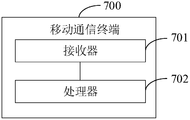
- FIG. 7 is a schematic diagram of a mobile communication terminal provided by the present disclosure.
- FIG. 8 is another schematic diagram of a network device provided by the present disclosure.
- FIG. 9 shows another schematic diagram of a mobile communication terminal provided by the present disclosure.
- the present disclosure provides an access method, where a network device sends a downlink frequency range and frequency information of at least two uplink frequency ranges and a physical random access channel parameter, and the mobile communication terminal receives a downlink frequency range and at least two sent by the network device.
- Frequency information of the uplink frequency range and physical random access channel parameters ; performing random access using the target physical random access channel parameter on one of the at least two uplink frequency ranges.
- the uplink frequency range of the low frequency band and the uplink frequency range of the high frequency band are paired, and the uplink coverage of the low frequency band and the uplink coverage of the high frequency band can be utilized. Insufficient compensation, thereby enhancing the uplink coverage of the mobile communication terminal, thereby reducing the difference between the coverage of the uplink and downlink spectrum, and improving the overall performance of the system.
- At least two uplink frequency ranges in the specific embodiments of the present disclosure are different from multiple subcarriers in the related art, and at least two uplink frequency ranges in the specific embodiments of the present disclosure correspond to uplink and downlink asymmetry.
- Transmission technology, and the uplink carrier or the uplink frequency band in the related art is paired with the downlink frequency band.
- FIG. 1 is a flowchart of an access method provided by the present disclosure.
- the access method in this embodiment is used in a network device, and the network device supports working in a downlink frequency range and at least two uplink frequency ranges. As shown in FIG. 1, the following step 101 is included.
- Step 101 Send a downlink frequency range and frequency information of at least two uplink frequency ranges and physical random access channel parameters.
- the network device may transmit information and/or parameters to the mobile communication terminal through a broadcast message of the cell, but the present disclosure does not thereby limit the manner in which the network device transmits information and/or parameters to the mobile communication terminal.
- any one of the at least two uplink frequency ranges in the step corresponds to one frequency band.
- the access method of the present disclosure is used for a network device that supports operation on a downlink frequency range and at least two uplink frequency ranges, the access method including: transmitting frequency indication information and physical random access Incoming channel parameters, the frequency indication information includes a downlink frequency range and frequency information of at least two uplink frequency ranges.
- the physical random access channel parameter is used by the terminal to select an access uplink frequency range from the at least two uplink frequency ranges, where the physical random access channel parameter includes a center frequency point of an uplink frequency range used for terminal access.
- the network device of the present disclosure may be a base station.
- the uplink transmission direction and the downlink transmission direction of any cell of the network device support only one frequency range, and the frequency range supported by the uplink transmission direction and the downlink transmission direction support.
- the frequency range corresponds to appear.
- the uplink transmission direction only supports the frequency range U
- the downlink transmission direction only supports the frequency range D
- the frequency range U and the frequency range D correspond to each other, wherein the frequency range U
- the center frequency may be 3.5 GHz
- the center frequency of the frequency range D may be 3.5 GHz, but is not limited thereto. Therefore, the cell only broadcasts the band number it supports, and the band number carries only one uplink frequency range and one downlink frequency range.
- the network device supports operation on a downlink frequency range and at least two uplink frequency ranges.
- the frequency of the frequency band is inversely proportional to the coverage performance of the frequency band, that is, the higher the frequency of the frequency band, the weaker the coverage performance of the frequency band. Therefore, it can be understood that at least one of the at least two uplink frequency ranges
- the frequency band is lower than the frequency band of the uplink frequency range in the 5G system, so that the uplink coverage of the low frequency band can be used to compensate for the shortage of the uplink coverage of the high frequency band, thereby enhancing the coverage of the uplink frequency band of the mobile communication terminal, thereby reducing the uplink and downlink.
- the uplink transmission direction supports two frequency ranges, respectively, a frequency range U1 and a frequency range U2, and the downlink transmission direction only supports the frequency range D, thereby implementing uplink and downlink asymmetric transmission.
- the center frequency of the frequency range U1 may be 3.5 GHz
- the center frequency of the frequency range U2 may be 900 MHz
- the center frequency of the frequency range D may be 3.5 GHz, but is not limited thereto, and it is to be noted that the uplink in FIG.
- the number of frequency ranges is only an indication, and thus does not limit the number of uplink frequency ranges supported by the uplink direction.
- the solution of the specific embodiment of the present disclosure may be applied to two or more uplink frequency ranges. Therefore, the broadcast message of the cell of the embodiment carries the frequency information of the at least two uplink frequency band ranges and one downlink frequency band range.
- the cell may broadcast a new frequency band number in the FBI (Frequency band indicator), where the new frequency band number carries the at least two uplink frequency band ranges and one downlink frequency band range, for example, a downlink frequency range.
- the center frequency is 3.5 GHz
- the center frequencies of the upstream frequency range are 3.5 GHz and 900 MHz, respectively.
- the cell can also broadcast a traditional frequency band number in the FBI, and broadcast its supported pure uplink (SUL) frequency range, wherein the traditional frequency band number carries an uplink frequency range and a downlink frequency range.
- the traditional frequency band carries an uplink frequency range with a center frequency of 3.5 GHz and a downlink frequency range with a center frequency of 3.5 GHz.
- the supported SUL is supported at a center frequency of 900 MHz in a Multi Band Info List. Frequency Range.
- the cell can also broadcast a traditional frequency band number in the FBI, and broadcast its supported pure uplink (SUL) frequency range, wherein the traditional frequency band number carries only one downlink frequency range.
- the downlink frequency range carried by the conventional frequency band number has a center frequency of 3.5 GHz
- the SUL frequency range whose center frequency is 900 MHz and the center frequency is 3.5 GHz is broadcasted in the multi-band Info List.
- the cell may also carry the frequency information of the at least two uplink frequency bands and one downlink frequency band in the broadcast information by other means, such as by using a reserved field in the broadcast information, which is not limited herein.
- the broadcast message of the cell further includes a physical random access channel parameter, so that the mobile communication terminal initiates random access to the network device by using the physical random access channel parameter.
- the physical random access channel parameter may be multiple sets of random access resources, but is not limited thereto.
- each group of random access resources corresponds to different uplink frequency ranges.
- the uplink frequency ranges with center frequencies of 900 MHz and 3.5 GHz are respectively allocated different random access resources.
- the network device can establish communication with the mobile communication terminal, and both the network device and the mobile communication terminal support working on one downlink frequency range and at least two uplink frequency ranges.
- the network device may be an eLTE network device or a 5G network device, but is not limited thereto.
- the mobile communication terminal can be a mobile phone, a tablet personal computer, a laptop computer, a personal digital assistant (PDA), a mobile internet device (MID), or a wearable device. Terminal side equipment such as a wearable device, but is not limited thereto.
- the network device sends a downlink frequency range and frequency information of the at least two uplink frequency ranges and physical random access channel parameters, so that the mobile communication terminal receives a downlink frequency range and the at least After the frequency information of the two uplink frequency ranges and the physical random access channel parameters, the random access may be initiated by using the target physical random access channel parameter on one of the at least two uplink frequency ranges.
- the uplink frequency range of the low frequency band and the uplink frequency range of the high frequency band are paired, and the uplink coverage of the low frequency band and the uplink coverage of the high frequency band can be utilized. Insufficient compensation, thereby enhancing the coverage of the uplink frequency band of the mobile communication terminal, thereby reducing the difference between the coverage of the uplink and downlink frequency bands, and improving the overall performance of the system.
- the access method further includes: transmitting at least one of a selection parameter, a first priority parameter, a second priority parameter, and an access probability parameter;
- the selection parameter is used by the mobile communication terminal from the at least one Determining an access uplink frequency range in the two uplink frequency ranges, or selecting an access physical random access channel parameter from the received physical random access channel parameters;
- the first priority parameter is used to indicate the at least a priority corresponding to the two uplink frequency ranges;
- the second priority parameter is used to indicate a priority corresponding to the physical random access channel parameter;
- the access probability parameter is used to indicate the at least two uplink frequencies The access probability corresponding to the range.
- the same cell corresponds to at least two uplink frequency ranges, and how the terminal determines the target uplink frequency range and the target physical random access channel parameters may be implemented in various manners.
- the network side may further send other parameters to control the terminal to determine the target uplink frequency range and the target physical random access channel parameter, which is further described below.
- the method may further include: transmitting at least one of a selection parameter, a first priority parameter, a second priority parameter, and an access probability parameter;
- the selection parameter is used by the mobile communication terminal from the Determining an access uplink frequency range in the at least two uplink frequency ranges, or selecting an access physical random access channel parameter from the received physical random access channel parameters;
- the first priority parameter is used to indicate the a priority corresponding to the at least two uplink frequency ranges;
- the second priority parameter is used to indicate a priority corresponding to the physical random access channel parameter;
- the access probability parameter is used to indicate the at least two uplink frequencies The access probability corresponding to the range.
- the broadcast message of the cell When the broadcast message is sent, that is, the broadcast message of the cell further carries at least one of a selection parameter, a first priority parameter, a second priority parameter, and an access probability parameter, so that the mobile communication terminal receives the network device.
- the foregoing parameters are sent, selecting an uplink frequency range from the at least two uplink frequency ranges based on the at least one parameter, and initiating random access to the network device on the uplink frequency range, thereby improving random connection of the mobile communication terminal. The chance of success.
- the selection parameter may be a frequency range selection parameter, and the mobile communication terminal selects an access uplink frequency range from the at least two uplink frequency ranges, that is, the mobile communication terminal may be in the access uplink frequency range. Initiating random access; the selection parameter may also be a physical random access channel selection parameter, where the mobile communication terminal selects to access the physical random access channel parameter from the received physical random access channel parameters, so that The mobile communication terminal initiates random access based on the uplink frequency range corresponding to the access physical random access channel parameter, thereby improving the probability of successful random access of the mobile communication terminal.
- the selection parameter is a minimum downlink signal threshold.
- the selection parameter is a minimum downlink signal threshold that allows the mobile communication terminal to access an uplink frequency range, so that the mobile communication terminal is based on the measured downlink signal quality, and the lowest downlink signal threshold of each received uplink frequency range. , to determine the coverage of the upstream frequency range in which it is located. Specifically, if the downlink signal quality measured by the mobile communication terminal is greater than the lowest downlink signal threshold of the uplink frequency range, the mobile communication terminal may be within the coverage of the uplink frequency range, and the mobile communication terminal may pass the uplink frequency range. Access.
- the minimum downlink signal threshold may be the RSRP (Reference Signal Receiving Power), the RSRQ (Reference Signal Receiving Quality), and the SINR (Signal to Interference plus Noise Ratio). One or more of the ratios.
- the mobile communication terminal can initiate random access to the network device on a target uplink frequency range in the uplink frequency range that it can access, thereby improving the probability of successful random access of the mobile communication terminal.
- each frequency range has a corresponding minimum downlink signal threshold for allowing access, and the smaller the coverage range is the lowest corresponding to the frequency range. The lower the downlink signal threshold.
- the uplink transmission direction supports three uplink frequency ranges, namely, an uplink frequency range U1, an uplink frequency range U2, and an uplink frequency range U3, wherein the uplink frequency range U1 The coverage is the smallest, the coverage of the uplink frequency range U2 is second, and the coverage of the uplink frequency range U3 is the largest.
- the minimum downlink signal threshold T1 is the lowest downlink signal threshold that allows the mobile communication terminal to access through the uplink frequency range U1
- the lowest downlink signal threshold T2 is the minimum downlink signal threshold that allows the mobile communication terminal to access through the uplink frequency range U2.
- the lowest downlink signal threshold is T1 greater than the lowest downlink signal threshold is T2.
- the measured downlink signal value is higher than the minimum downlink signal threshold T1, that is, the difference between the measured downlink signal value and the lowest downlink signal threshold T1 is greater than 0, and the lowest downlink signal threshold is T1 greater than the lowest downlink signal threshold is T2.
- the measured downlink signal value is higher than the lowest downlink signal threshold is T2, that is, the difference between the measured downlink signal value and the lowest downlink signal threshold T2 is greater than 0, indicating that the mobile communication terminal can access the uplink frequency range U1 and the uplink frequency range.
- U2 and the uplink frequency range U3 are within the coverage of the uplink frequency range U1, the uplink frequency range U2, and the uplink frequency range U3.
- the measured downlink signal value is lower than the lowest downlink signal threshold T1 but higher than the lowest downlink signal threshold T2, it indicates that the mobile communication terminal can access the uplink frequency range U2 and the uplink frequency range U3, which is in the uplink frequency range U2 and the uplink. Within the coverage of the frequency range U3.
- the measured downlink signal value is lower than the minimum downlink signal threshold T2, it indicates that the mobile communication terminal can access the uplink frequency range U3, which is within the coverage of the uplink frequency range U3.
- the first priority parameter is used to indicate a priority corresponding to the at least two uplink frequency ranges.
- the greater the center frequency of the uplink frequency range the higher the priority of the uplink frequency range.
- an uplink frequency range with a center frequency of 3.5 GHz has a higher priority
- an uplink frequency range with a center frequency of 900 MHz has a lower priority.
- the mobile terminal may preferentially select an uplink frequency range with a higher priority from the at least two uplink frequency ranges according to the priority of each uplink frequency range.
- random access is initiated to the network device, thereby increasing the probability of successful random access of the mobile communication terminal.
- the second priority parameter is used to indicate a priority corresponding to the physical random access channel parameter.
- the greater the center frequency of the uplink frequency range the higher the priority of the physical random access channel parameter corresponding to the uplink frequency range.
- the physical random access channel parameter with a center frequency of 3.5 GHz has a higher priority
- the physical random access channel parameter with a center frequency of 900 MHz has a lower priority.
- the mobile terminal may preferentially select from the at least two uplink frequency ranges according to the priority of the physical random access channel parameter corresponding to each uplink frequency range.
- the uplink frequency range with a higher priority of the physical random access channel parameter is entered, and random access is initiated to the network device in the uplink frequency range, thereby increasing the probability of successful random access of the mobile communication terminal.
- the access probability parameter is used to indicate a probability that the mobile communication terminal is allowed to access the network device corresponding to the at least two uplink frequency ranges, so that the mobile communication terminal is based on the detected access random number, and each Comparing the access probabilities corresponding to the uplink frequency range, determining that the mobile communication terminal initiates the access uplink frequency range of the random access to the network device, selecting a target uplink frequency range in the access uplink frequency range, and initiating random access to the network device Therefore, the probability of successful random access of the mobile communication terminal is improved, wherein the uplink frequency range access random number is between 0 and 1.
- the mobile communication terminal may initiate random access on the uplink frequency range; otherwise, continue to use the same method to determine whether it can be in other Random access is initiated on the uplink frequency range.
- the access probability parameter may be that each of the at least two uplink frequency ranges corresponds to one access probability P, or may be a different type of each uplink frequency range.
- the entry probability P, the mapping relationship between the different types of the uplink frequency range and the access probability P are shown in Table 1.
- Table 1 Mapping relationship between different types of uplink frequency ranges and access probability P
- the method further includes: transmitting a frequency range specifying parameter; the frequency range specifying parameter is used to specify at least one of the at least two uplink frequency ranges.
- the same cell corresponds to at least two uplink frequency ranges. Therefore, in this step, the broadcast message of the cell further carries a frequency range specifying parameter, so that the mobile communication terminal receives the frequency range specified by the network device. After the parameter, selecting, according to the frequency range specifying parameter, at least one uplink frequency range specified in the at least two uplink frequency ranges, selecting a target uplink frequency range as the access uplink frequency range, and going to the network on the target uplink frequency range The device initiates random access, thereby increasing the probability of successful random access of the mobile communication terminal.
- the cell broadcast allows the mobile communication terminal to initiate random access on the uplink frequency range with the center frequency of 900 MHz, that is, the center frequency of the uplink frequency range specified by the frequency range designation parameter is 900 MHz, and the mobile communication terminal can only be at the center frequency of 900 MHz.
- the random access is initiated on the uplink frequency range, and random access may not be initiated on other uplink frequency ranges, such as the uplink frequency range with the center frequency of 3.5 GHz, because the uplink frequency range with the center frequency of 900 MHz is the uplink specified by the network device.
- the frequency range therefore, when the random access is initiated on the uplink frequency range, the network device can randomly access after receiving the random access response, because the target uplink frequency range is one of the uplink frequency ranges specified by the network device. Success, which can increase the chances of random access success.
- FIG. 5 shows another flow chart of the access method provided by the present disclosure. As shown in FIG. 5, the access method includes the following steps 501-52.
- Step 501 Receive a downlink frequency range and at least two uplink frequency range frequency information and physical random access channel parameters sent by the network device.
- the frequency information and the physical random access channel parameter of the at least two uplink frequency ranges that are sent by the network device are used in this embodiment.
- the frequency information and the physical random access channel parameter of the at least two uplink frequency ranges that are sent by the network device are used in this embodiment.
- Step 502 Initiate random access by using a target physical random access channel parameter on one of the at least two uplink frequency ranges.
- the mobile communication terminal may randomly select an uplink frequency range as the target uplink frequency range in the at least two uplink frequency ranges, and initiate random access by using the target physical random access channel parameter corresponding to the target uplink frequency range.
- the mobile communication terminal may also select one uplink frequency range as the target uplink frequency range in the at least two uplink frequency ranges based on a preset rule, and utilize the target physical random access channel parameter corresponding to the target uplink frequency range. Random access is initiated and is not limited herein.
- the access method in this embodiment receives a downlink frequency range and a frequency information of the at least two uplink frequency ranges and a physical random access channel parameter sent by the network device, and a target in the at least two uplink frequency ranges. On the uplink frequency range, random access is initiated by using the target physical random access channel parameters.
- the uplink frequency range of the low frequency band and the uplink frequency range of the high frequency band are paired, and the uplink coverage of the low frequency band and the uplink coverage of the high frequency band can be utilized. Insufficient compensation, thereby enhancing the coverage of the uplink frequency band of the mobile communication terminal, thereby reducing the difference between the coverage of the uplink and downlink frequency bands, and improving the overall performance of the system.
- the method further includes: receiving at least one of a selection parameter, a first priority parameter, a second priority parameter, and an access probability parameter sent by the network device; the selection parameter is used by the mobile communication terminal Selecting an access uplink frequency range from the at least two uplink frequency ranges, or selecting an access physical random access channel parameter from the received physical random access channel parameters; the first priority parameter is used to indicate a priority corresponding to the at least two uplink frequency ranges; the second priority parameter is used to indicate a priority corresponding to the physical random access channel parameter; and the access probability parameter is used to indicate the at least two uplink frequencies The access probability corresponding to the range.
- the “selection parameter, the first priority parameter, the second priority parameter, and the access probability parameter sent by the network device are used in this embodiment.
- the “selection parameter, the first priority parameter, the second priority parameter, and the access probability parameter sent by the network device are used in this embodiment.
- the initiating the random access by using the target physical random access channel parameter on the target uplink frequency range of the at least two uplink frequency ranges specifically includes: selecting, according to the received selection parameter, the at least two Determining the access uplink frequency range in an uplink frequency range; determining a target uplink frequency range from the access uplink frequency range, and determining a target physical random access channel parameter; and utilizing the target uplink frequency range
- the target random access channel parameter initiates random access.
- the mobile communication terminal compares the received selection parameter with the signal value measured by itself, and determines the access uplink frequency range from the at least two uplink frequency ranges, where the selection parameter It may be the lowest downlink signal threshold, and correspondingly, the signal value may be a downlink signal value.
- this step is illustrated in conjunction with FIG. 4.
- the uplink transmission direction supports three uplink frequency ranges, namely, an uplink frequency range U1, an uplink frequency range U2, and an uplink frequency range U3, where The coverage of the frequency range U1 is the smallest, the coverage of the uplink frequency range U2 is second, and the coverage of the uplink frequency range U3 is the largest.
- the lowest downlink signal threshold T1 is the lowest downlink signal threshold that allows the mobile communication terminal to access through the uplink frequency range U1
- the lowest downlink signal threshold T2 is the lowest downlink signal threshold that allows the mobile communication terminal to access through the uplink frequency range U2, where the lowest downlink The signal threshold is T1 greater than the minimum downlink signal threshold is T2. If the measured downlink signal value is lower than the lowest downlink signal threshold T1 but higher than the lowest downlink signal threshold T2, it indicates that the mobile communication terminal is in the coverage range of the uplink frequency range U2 and the uplink frequency range U3, that is, accessing the uplink frequency range. It is the uplink frequency range U2 and the uplink frequency range U3.
- the mobile communication terminal may randomly select the access uplink frequency range.
- An uplink frequency range is used as the target uplink frequency range, and the target physical random access channel parameter corresponding to the target uplink frequency range is used to initiate random access; of course, the mobile communication terminal may also be in the access uplink frequency range based on a preset rule.
- the uplink frequency range is selected as the target uplink frequency range, and the random access is initiated by using the target physical random access channel parameter corresponding to the target uplink frequency range, which is not limited herein.
- the mobile communication terminal initiates access at a fixed uplink frequency according to the uplink coverage area in which it is located, as shown in FIG. 4, and is in the coverage of the uplink frequency range U1, the uplink frequency range U2, and the uplink frequency range U3.
- the communication terminal initiates random access on the uplink frequency range U1
- the mobile communication terminal in the coverage range of the uplink frequency range U2 and the uplink frequency range U3 initiates random access on the uplink frequency range U2, and is only in the uplink frequency range U3.
- the mobile communication terminal within the coverage initiates random access on the uplink frequency range U3.
- determining the target uplink frequency range from the access uplink frequency range specifically includes: randomly selecting an uplink frequency range from the access uplink frequency range as the target uplink frequency range.
- the mobile communication terminal can select the uplink frequency range U2 as the target uplink frequency range or the uplink frequency range U3 as the target uplink frequency range. It is not limited here.
- determining the target uplink frequency range from the access uplink frequency range, and determining the target physical random access channel parameter specifically includes: according to the received first priority parameter, the second priority parameter, and the received At least one of the ingress probability parameters determines a target uplink frequency range and/or a target physical random access channel parameter.
- the mobile communication terminal may further perform the first according to the received At least one of the priority parameter, the second priority parameter, and the access probability parameter determines a target uplink frequency range and/or a target physical random access channel parameter.
- the mobile communication terminal may further perform the first priority according to the received The level parameter determines the target uplink frequency range, and further determines the physical random access channel parameter corresponding to the target uplink frequency range as the target physical random access channel parameter. For example, if the uplink frequency range is selected, or the physical random access channel parameter is selected as the uplink frequency range U2 and the uplink frequency range U3 from the received physical random access channel parameters, the uplink frequency may be indicated according to the indication. The priority of the range U2 and the uplink frequency range U3 determines the target uplink frequency range.
- the mobile communication terminal may further determine the received second priority.
- the level parameter determines the target physical random access channel parameter, and further determines the uplink frequency range corresponding to the target physical random access channel parameter as the target uplink frequency range. For example, if the uplink frequency range is selected, or the physical random access channel parameter is selected as the uplink frequency range U2 and the uplink frequency range U3 from the received physical random access channel parameters, the uplink frequency may be indicated according to the indication.
- the priority of the physical random access channel parameter of the range U2 and the physical random access channel parameter of the uplink frequency range U3 determine the target uplink frequency range.
- the center frequency of the uplink frequency range is larger, and the uplink frequency range is The higher the priority of the physical random access channel parameter is, the lower the priority of the physical random access channel parameter of the uplink frequency range U3 is, if the center frequency of the uplink frequency range U2 is smaller than the center frequency of the uplink frequency range U3 High, so that the physical random access channel parameter of the uplink frequency range U3 can be selected as the target physical random access channel parameter.
- the mobile communication terminal may further depend on the received access probability.
- the parameter determines the target uplink frequency range, and further determines the physical random access channel parameter corresponding to the target uplink frequency range as the target physical random access channel parameter. For example, if the uplink frequency range is selected, or the physical random access channel parameter is selected as the uplink frequency range U2 and the uplink frequency range U3 from the received physical random access channel parameters, the indication may be as follows: The probability that the mobile communication terminal is allowed to access the network device corresponding to the at least two uplink frequency ranges determines the target uplink frequency range.
- the mobile communication terminal can initiate random access on the uplink frequency range; otherwise, it continues to use the same method to determine whether random access can be initiated on other uplink frequency ranges. Therefore, if the access probability of the uplink frequency range U2 is 0.5 and the access random number detected by the mobile terminal is 0.4, it indicates that the mobile communication terminal can initiate random access on the uplink frequency range U2.
- the mobile communication terminal may randomly select an uplink frequency range to initiate random access, or combine the first priority parameter and the second priority parameter to select A random frequency range is initiated in an uplink frequency range, which is not limited herein.
- the mobile communication terminal may further perform the first priority parameter according to the a combination of any two of the second priority parameter and the access probability parameter, or a combination of all three parameters, determining a target uplink frequency range from the access uplink frequency range, and determining a target physical random access channel parameter.
- the selection parameter is a minimum downlink signal threshold
- each of the at least two uplink frequency ranges has a minimum downlink signal threshold corresponding to the allowed access except for the frequency range with the largest coverage range.
- the present embodiment is an implementation manner of the mobile communication terminal corresponding to the foregoing embodiment.
- selection parameter refer to the related description of the foregoing embodiment, in order to avoid repeated description, No longer.
- the terminal needs to introduce a compensation value to represent the uplink gain corresponding to the different access uplink frequency range types.
- the downlink signal quality measured by the mobile communication terminal is greater than the sum of the lowest downlink signal threshold of the uplink frequency range and the mobile communication terminal compensation value, it may be stated that the mobile communication terminal can access the uplink frequency range, and the mobile communication terminal Within the coverage of the uplink frequency range, the uplink frequency range is an access uplink frequency range.
- the compensation value may be the maximum transmit power of the mobile communication terminal allowed by the network device, but is not limited thereto.
- the method further includes: receiving a frequency range specifying parameter sent by the network device, configured to specify at least one uplink frequency range of the at least two uplink frequency ranges; and the target uplink frequency range is the at least one uplink One of the frequency ranges.
- the present embodiment is the implementation of the mobile communication terminal corresponding to the foregoing embodiment.
- the “frequency range specification parameter” in this embodiment refer to the related description of the foregoing embodiment. No longer.
- the mobile communication terminal selects an access uplink frequency range based on the frequency range designation parameter, or selects an access physical random access channel parameter from the received physical random access channel parameter, if the uplink frequency range is accessed. If the number of the number is greater than 1, the uplink frequency range may be randomly selected as the target uplink frequency range in the access uplink frequency range, or further according to the selection parameter, the first priority parameter, the second priority parameter, and the access probability parameter. At least one of the uplink frequency ranges is randomly selected from the access uplink frequency range as the target uplink frequency range.
- the at least one frequency range is an uplink frequency range with the largest coverage range in the at least two uplink frequency ranges. But it is not limited to this.
- the network device can be randomly connected after receiving the random access response. Success is successful, which increases the chances of random access success.
- FIG. 6 is a schematic diagram of a network device provided by the present disclosure. As shown in FIG. 6, the network device 600 includes a transmitter 601, configured to send frequency information and physical random access channel parameters of the at least two uplink frequency ranges.
- the transmitter 601 is further configured to send at least one of a selection parameter, a first priority parameter, a second priority parameter, and an access probability parameter, where the selection parameter is used by the mobile communication terminal from the at least two Determining an access uplink frequency range in the uplink frequency range; the first priority parameter is used to indicate a priority corresponding to the at least two uplink frequency ranges; and the second priority parameter is used to indicate the physical random connection The priority of the incoming channel parameter is used; the access probability parameter is used to indicate an access probability corresponding to the at least two uplink frequency ranges.
- the selection parameter is a minimum downlink signal threshold.
- each frequency range has a corresponding minimum downlink signal threshold for allowing access, and a frequency range corresponding to a smaller coverage area corresponds to The lower the minimum downlink signal threshold.
- the transmitter 601 is further configured to send a frequency range specifying parameter, where the frequency range specifying parameter is used to specify at least one of the at least two uplink frequency ranges.
- the at least one frequency range is an uplink frequency range with the largest coverage range in the at least two uplink frequency ranges.
- the network device of the present disclosure sends a downlink frequency range and frequency information of at least two uplink frequency ranges and physical random access channel parameters through a transmitter, so that the mobile communication terminal receives a downlink frequency range and at least two uplink frequency ranges.
- the random access may be initiated by using the target physical random access channel parameter in one of the at least two uplink frequency ranges, where the network device and the mobile The communication terminals support working on one downlink frequency range and at least two uplink frequency ranges.
- the uplink frequency range of the low frequency band and the uplink frequency range of the high frequency band are paired, and the uplink coverage of the low frequency band and the uplink coverage of the high frequency band can be utilized. Insufficient compensation, thereby enhancing the coverage of the uplink frequency band of the mobile communication terminal, thereby reducing the difference between the coverage of the uplink and downlink frequency bands, and improving the overall performance of the system.
- FIG. 7 shows a schematic diagram of a mobile communication terminal provided by the present disclosure.
- the mobile communication terminal 700 includes a receiver 701 and a processor 702.
- the receiver 701 is configured to receive frequency information and physical random access channel parameters of the at least two uplink frequency ranges that are sent by the network device, where the processor 702 is configured to use one of the at least two uplink frequency ranges. On the target uplink frequency range, random access is initiated by using the target physical random access channel parameters.
- the receiver 701 is further configured to receive at least one of a selection parameter, a first priority parameter, a second priority parameter, and an access probability parameter sent by the network device, where the selection parameter is used for mobile communication.
- the terminal selects an access uplink frequency range from the at least two uplink frequency ranges, or selects an access physical random access channel parameter from the received physical random access channel parameters;
- the first priority parameter is used by And indicating a priority corresponding to the at least two uplink frequency ranges;
- the second priority parameter is used to indicate a priority corresponding to the physical random access channel parameter; and
- the access probability parameter is used to indicate the at least two The access probability corresponding to the uplink frequency range.
- the processor 702 is configured to: when the random access is initiated by using the target physical random access channel parameter, in the target uplink frequency range of the at least two uplink frequency ranges, specifically, according to the received selection parameter. Determining the access uplink frequency range from the at least two uplink frequency ranges; determining the target uplink frequency range from the access uplink frequency range, and determining the target physical random access channel parameter; In the target uplink frequency range, random access is initiated by using the target random access channel parameter.
- the processor 702 is configured to determine the target uplink frequency range from the access uplink frequency range, where the method is specifically configured to: randomly select an uplink frequency range from the access uplink frequency range as the target uplink. Frequency Range.
- the processor 702 is configured to determine the target uplink frequency range from the access uplink frequency range, and determine the target physical random access channel parameter, specifically, according to the received first priority At least one of the level parameter, the second priority parameter, and the access probability parameter determines the target uplink frequency range and/or the target physical random access channel parameter.
- the selection parameter is a minimum downlink signal threshold
- each of the at least two uplink frequency ranges has a minimum downlink signal threshold corresponding to the allowed access except for the frequency range with the largest coverage range. The lower the coverage range, the higher the minimum downlink signal threshold corresponding to the frequency range;
- the minimum downlink signal threshold corresponding to the access uplink frequency range; or the sum of the corresponding lowest downlink signal threshold and a compensation value is smaller than the downlink signal measurement value.
- the receiver 701 is further configured to receive a frequency range specifying parameter that is sent by the network device, and configured to specify at least one uplink frequency range of the at least two uplink frequency ranges, where the target uplink frequency range is the at least one One of the upstream frequency ranges.
- the at least one frequency range is an uplink frequency range with the largest coverage range in the at least two uplink frequency ranges.
- the mobile communication device of the present disclosure receives, by the receiver, a downlink frequency range and at least two uplink frequency range frequency information and physical random access channel parameters sent by the network device; the processor is in a downlink frequency range and at least two uplink frequencies On a target uplink frequency range in the range, random access is initiated by using the target physical random access channel parameters.
- the uplink frequency range of the low frequency band and the uplink frequency range of the high frequency band are paired, and the uplink coverage of the low frequency band and the uplink coverage of the high frequency band can be utilized. Insufficient compensation, thereby enhancing the coverage of the uplink frequency band of the mobile communication terminal, thereby reducing the difference between the coverage of the uplink and downlink frequency bands, and improving the overall performance of the system.
- the present disclosure also provides a network device that supports operation on a downlink frequency range and at least two uplink frequency ranges.
- 8 shows another schematic diagram of a network device provided by the present disclosure.
- the network device 800 includes a memory 801 and a processor 802, wherein the memory 801 stores a computer program 8011 executable on the processor 802.
- the processor 802 implements the steps of transmitting frequency information of the at least two uplink frequency ranges and physical random access channel parameters.
- the processor 802 may further implement the following steps: sending at least one of a selection parameter, a first priority parameter, a second priority parameter, and an access probability parameter; Selecting a parameter for the mobile communication terminal to determine an access uplink frequency range from the at least two uplink frequency ranges; the first priority parameter is used to indicate a priority corresponding to the at least two uplink frequency ranges; The second priority parameter is used to indicate a priority corresponding to the physical random access channel parameter, and the access probability parameter is used to indicate an access probability corresponding to the at least two uplink frequency ranges.
- the selection parameter is a minimum downlink signal threshold.
- each frequency range has a corresponding minimum downlink signal threshold for allowing access, and a frequency range corresponding to a smaller coverage area corresponds to The lower the minimum downlink signal threshold.
- the processor 802 may further implement the following steps: sending a frequency range specifying parameter; the frequency range specifying parameter is used to specify at least one of the at least two uplink frequency ranges Frequency Range.
- the at least one frequency range is an uplink frequency range with the largest coverage range in the at least two uplink frequency ranges.
- the network device of the present disclosure sends a downlink frequency range and frequency information of at least two uplink frequency ranges and physical random access channel parameters, so that the mobile communication terminal receives a downlink frequency range and frequency information of at least two uplink frequency ranges. And after the physical random access channel parameter, the random access may be initiated by using the target physical random access channel parameter in one of the at least two uplink frequency ranges, where the network device and the mobile communication terminal are both Supports operation on a downlink frequency range and at least two upstream frequency ranges.
- the uplink frequency range of the low frequency band and the uplink frequency range of the high frequency band are paired, and the uplink coverage of the low frequency band and the uplink coverage of the high frequency band can be utilized. Insufficient compensation, thereby enhancing the coverage of the uplink frequency band of the mobile communication terminal, thereby reducing the difference between the coverage of the uplink and downlink frequency bands, and improving the overall performance of the system.
- the present disclosure also provides a mobile communication terminal 900 including a memory 901 and a processor 902, wherein the memory 901 stores a computer program 9011 executable on the processor 902, the computer program 9011 being processed
- the processor 902 executes the following steps: receiving frequency information of the at least two uplink frequency ranges and physical random access channel parameters sent by the network device; and uplinking one target in the at least two uplink frequency ranges In the frequency range, random access is initiated by using the target physical random access channel parameters.
- the processor 902 may further implement the following steps: receiving, in the selection parameter, the first priority parameter, the second priority parameter, and the access probability parameter sent by the network device At least one; the selection parameter is used by the mobile communication terminal to select an access uplink frequency range from the at least two uplink frequency ranges, or select an access physical random access from the received physical random access channel parameters a channel parameter; the first priority parameter is used to indicate a priority corresponding to the at least two uplink frequency ranges; the second priority parameter is used to indicate a priority corresponding to a physical random access channel parameter; The access probability parameter is used to indicate an access probability corresponding to the at least two uplink frequency ranges.
- the computer program 9011 is executed by the processor 902 on the target uplink frequency range of the at least two uplink frequency ranges, and the processor 902 may also be configured when the random access is initiated by using the target physical random access channel parameter.
- the processor 902 may further implement the following steps: randomly selecting from the access uplink frequency range. An uplink frequency range is selected as the target uplink frequency range.
- the processor 902 may further implement the following: Step: Determine a target uplink frequency range and/or the target physical random access channel parameter according to the received at least one of the first priority parameter, the second priority parameter, and the access probability parameter.
- the selection parameter is a minimum downlink signal threshold
- each of the at least two uplink frequency ranges has a minimum downlink signal threshold corresponding to the allowed access except for the frequency range with the largest coverage range.
- the processor 902 may further implement the following steps: receiving a frequency range specifying parameter sent by the network device, and configured to specify at least one uplink frequency range of the at least two uplink frequency ranges.
- the target uplink frequency range is one of the at least one uplink frequency range.
- the at least one frequency range is an uplink frequency range with the largest coverage range in the at least two uplink frequency ranges.
- the mobile communication device of the present disclosure receives a downlink frequency range and at least two uplink frequency range frequency information and a physical random access channel parameter sent by the network device; and a target uplink frequency range in the at least two uplink frequency ranges. Initiating random access using the target physical random access channel parameters.
- the uplink frequency range of the low frequency band and the uplink frequency range of the high frequency band are paired, and the uplink coverage of the low frequency band and the uplink coverage of the high frequency band can be utilized. Insufficient compensation, thereby enhancing the coverage of the uplink frequency band of the mobile communication terminal, thereby reducing the difference between the coverage of the uplink and downlink frequency bands, and improving the overall performance of the system.
- the present disclosure also provides a computer readable storage medium comprising a computer program stored thereon, the program being executed by a processor to implement an access method of any of the method embodiments described above.
- the computer readable storage medium may be a volatile computer readable storage medium or a non-volatile computer readable storage medium such as Read-Only Memory (ROM), random access memory ( Random Access Memory (RAM), disk or CD.
- ROM Read-Only Memory
- RAM Random Access Memory
- CD Compact Disc
Landscapes
- Engineering & Computer Science (AREA)
- Computer Networks & Wireless Communication (AREA)
- Signal Processing (AREA)
- Computer Security & Cryptography (AREA)
- Mobile Radio Communication Systems (AREA)
Abstract
本公开提供一种接入方法、网络设备及移动通信终端。应用于网络设备的接入方法包括:发送一个下行频率范围和至少两个上行频率范围的频率信息和物理随机接入信道参数。
Description
相关申请的交叉引用
本申请主张在2017年6月19日在中国提交的中国专利申请号No.201710465288.3的优先权,其全部内容通过引用包含于此。
本公开涉及通信技术领域,特别涉及一种接入方法、网络设备及移动通信终端。
在相关的移动通信系统中,TDD(Time Division Duplexing,时分双工)技术的上下行频段的频率范围相同,且频率带宽相等;FDD(Frequency Division Duplexing,频分双工)技术的上下行频段的频率带宽相等,频率范围不同,上下行配对使用。因此,在相关技术中一个小区的上下行频段的频率范围都是对应出现的,且频率带宽都是相同的。在长期演进LTE-Advanced技术中,其引入了载波聚合,通过上行或者下行载波聚合,可以配置上下行载波的带宽不同,但是载波聚合应用于小区间聚合时,每个参与载波聚合的小区仍然需要上下行频率对应且带宽相同,不支持上下行频率范围不对应且带宽不同的传输方式。
第五代移动通信技术(5th-Generation,简称5G)系统中,新频谱以高频和毫米波为主。然而,频段的频率越高,其抗摔落性越差,导致其覆盖性能越差,由上可知,5G的覆盖性能较差。随着大规模天线和波束赋形技术的应用,网络设备的下行频段的覆盖范围得到了一定增强,但针对移动通信终端的上行频段的覆盖范围较弱的问题,由于相关技术中不支持一个小区内上下行频率范围不对应且带宽不同的传输方式,因此,尚未提出有效的解决方案,且随着下行增强技术的应用,上下行频段的覆盖范围之间的差异越来越大。
发明内容
本公开的目的在于提供一种接入方法、网络设备及移动通信终端,以增强移动通信终端的上行频段的覆盖范围,减小上下行频段的覆盖范围之间的差异,提高系统的整体性能。
在第一方面,本公开提供一种接入方法,该接入方法用于网络设备,该接入方法包括:发送一个下行频率范围和至少两个上行频率范围的频率信息和物理随机接入信道参数。
在第二方面,本公开还提供一种接入方法,该接入方法用于移动通信终端,该接入方法包括:接收网络设备发送的一个下行频率范围和至少两个上行频率范围的频率信息和物理随机接入信道参数;以及在所述至少两个上行频率范围中的一个目标上行频率范围上,利用目标物理随机接入信道参数发起随机接入。
在第三方面,本公开还提供一种网络设备,该网络设备支持在一个下行频率范围和至少两个上行频率范围上工作,并且包括:发送器,用于发送一个下行频率范围和至少两个上行频率范围的频率信息和物理随机接入信道参数。
在第四方面,本公开还提供一种移动通信终端,该移动通信终端支持在一个下行频率范围和至少两个上行频率范围上工作,并且包括:接收器,用于接收网络设备发送的一个下行频率范围和至少两个上行频率范围的频率信息和物理随机接入信道参数;和处理器,用于在所述至少两个上行频率范围中的一个目标上行频率范围上,利用目标物理随机接入信道参数发起随机接入。
在第五方面,本公开还提供一种网络设备,该网络设备包括存储器和处理器,其中所述存储器存储可在所述处理器上运行的计算机程序,所述计算机程序被所述处理器执行时所述处理器实现如上第一方面所述的应用于网络设备的接入方法。
在第六方面,本公开还提供一种移动通信终端,该移动通信终端包括存储器和处理器,其中所述存储器存储并可在所述处理器上运行的计算机程序所述计算机程序被所述处理器执行时所述处理器实现如上所述的应用于移动通信终端的接入方法。
在第七方面,本公开还提供一种非易失性计算机可读存储介质,该非易失性计算机可读存储介质包括其上存储的计算机程序,所述计算机程序被处理器执行时所述处理器实现如上第一方面所述的应用于网络设备的接入方法,或者实现如上第二方面所述的应用于移动通信终端的接入方法。
本公开中,网络设备和移动通信终端均支持在一个下行频率范围和至少两个上行频率范围上工作,所述网络设备向所述移动通信终端发送一个下行频率范围和至少两个上行频率范围的频率信息和物理随机接入信道参数,以使移动通信终端接收到一个下行频率范围和至少两个上行频率范围的频率信息和物理随机接入信道参数后,在所述至少两个上行频率范围中的一个目标上行频率范围上,利用目标物理随机接入信道参数发起随机接入。通过在现有频段的基础上增加至少一个低频段的上行频率范围,将低频段的上行频率范围和高频段的上行频率范围配对使用,可以利用低频段的上行覆盖范围对高频段上行覆盖范围的不足进行补偿,从而增强移动通信终端的上行频段的覆盖范围,进而减小上下行频段的覆盖范围之间的差异,提高系统的整体性能。
为了更清楚地说明本公开的技术方案,下面将对本公开描述中所需要使用的附图作简单地介绍,显而易见地,下面描述中的附图仅仅是本公开的一些实施例,对于本领域普通技术人员来讲,在不付出创造性劳动性的前提下,还可以根据这些附图获得其他的附图。
图1表示本公开提供的接入方法的流程图;
图2表示相关技术提供的传输方向的频率范围的示意图;
图3表示本公开提供的传输方向的频率范围的示意图;
图4表示本公开提供的上行频率范围的示意图;
图5表示本公开提供的接入方法的另一流程图;
图6表示本公开提供的网络设备的示意图;
图7表示本公开提供的移动通信终端的示意图;
图8表示本公开提供的网络设备的另一示意图;以及
图9表示本公开提供的移动通信终端的另一示意图。
下面将结合本公开中的附图,对本公开中的技术方案进行清楚、完整地描述,显然,所描述的实施例是本公开一部分实施例,而不是全部的实施例。基于本公开中的实施例,本领域普通技术人员在没有作出创造性劳动前提下所获得的所有其他实施例,都属于本公开保护的范围。
本公开提供了一种接入方法,网络设备发送一个下行频率范围和至少两个上行频率范围的频率信息和物理随机接入信道参数,移动通信终端接收网络设备发送的一个下行频率范围和至少两个上行频率范围的频率信息和物理随机接入信道参数;在所述至少两个上行频率范围中的一个目标上行频率范围上,利用目标物理随机接入信道参数发起随机接入。通过在现有频段的基础上增加至少一个低频段的上行频率范围,将低频段的上行频率范围和高频段的上行频率范围配对使用,可以利用低频段的上行覆盖范围对高频段上行覆盖范围的不足进行补偿,从而增强移动通信终端的上行覆盖范围,进而减小上下行频谱的覆盖范围之间的差异,提高系统的整体性能。
在此,应该说明的是,本公开具体实施例中的至少两个上行频率范围和相关技术的多个子载波等不同,本公开具体实施例中的至少两个上行频率范围对应于上下行非对称传输技术,而相关技术中的上行载波或者是上行频段都是与下行频段成对出现。
参见图1,图1表示本公开提供的接入方法的流程图,本实施例的接入方法用于网络设备,所述网络设备支持在一个下行频率范围和至少两个上行频率范围上工作,如图1所示,包括以下步骤101。
步骤101、发送一个下行频率范围和至少两个上行频率范围的频率信息和物理随机接入信道参数。
本公开中,以网络设备可以通过小区的广播消息向移动通信终端发送信息和/或参数进行举例说明,但本公开不因此限制网络设备向移动通信终端发送信息和/或参数的方式。另外,该步骤中的所述至少两个上行频率范围中的任一上行频率范围分别对应一个频段。
也就是说,本公开的接入方法用于网络设备,所述网络设备支持在一个下行频率范围和至少两个上行频率范围上工作,所述接入方法包括:发送频率指示信息和物理随机接入信道参数,所述频率指示信息包括一个下行频率范围和至少两个上行频率范围的频率信息。
所述物理随机接入信道参数用于终端从至少两个上行频率范围中选择接入上行频率范围,所述物理随机接入信道参数包括用于终端接入的上行频率范围的中心频点。
本公开的网络设备可以是基站。
在长期演进(Long Term Evolution,简称LTE)系统中,网络设备的任一小区的上行传输方向和下行传输方向,分别只支持一个频率范围,且上行传输方向支持的频率范围和下行传输方向支持的频率范围对应出现。为方便理解,参见图2,如图2所示,上行传输方向仅支持频率范围为U,下行传输方向仅支持频率范围为D,且频率范围U和频率范围D对应出现,其中,频率范围U的中心频率可以为3.5GHz,频率范围D的中心频率可以为3.5GHz,但不仅限于此。因此,小区仅广播其支持的频段编号,且该频段编号仅携带一个上行频率范围和一个下行频率范围。
但在本公开中,网络设备支持在一个下行频率范围和至少两个上行频率范围上工作。考虑到频段的频率与频段的覆盖性能成反比,即频段的频率越高,则频段的覆盖性能越弱,因此,可以理解的,所述至少两个上行频率范围中的至少一个上行频率范围的频段低于5G系统中的上行频率范围的频段,从而可以利用低频段的上行覆盖范围对高频段上行覆盖范围的不足进行补偿,从而增强移动通信终端的上行频段的覆盖范围,进而减小上下行频段的覆盖范围之间的差异,提高系统的整体性能。为方便理解,请参见图3,如图3所示,上行传输方向支持两个频率范围,分别为频率范围U1和频率范围U2,下行传输方向仅支持频率范围D,从而实现上下行非对称传输,其中,频率范围U1的中心频率可以为3.5GHz,频率范围U2的中心频率可以为900MHz,频率范围D的中心频率可以为3.5GHz,但不仅限于此,需要说明的是,图3中的上行频率范围的个数仅为示意,并不因此限制上行方向支持的上行频率范围个数,本公开具体实施例的方案可以应用于两个或两个以上的上行频率 范围。因此,本实施例的小区的广播消息中携带有所述至少两个上行频带范围和一个下行频带范围的频率信息。
具体地,小区可以在FBI(Frequency band indicator,频率波段指示器)中广播一个新的频段编号,该新频段编号携带有所述至少两个上行频带范围和一个下行频带范围,例如:下行频率范围的中心频率为3.5GHz,上行频率范围的中心频率分别为3.5GHz和900MHz。
小区也可以在FBI中广播一个传统频段编号,同时广播其支持的纯上行(Supplemental Uplink,简称SUL)频率范围,其中,该传统频段编号携带一个上行频率范围和一个下行频率范围。例如:该传统频段编号携带的上行频率范围的中心频率为3.5GHz,下行频率范围的中心频率为3.5GHz,在Multi Band Info List(多波段信息列表)中广播其支持的中心频率为900MHz的SUL频率范围。
小区也可以在FBI中广播一个传统频段编号,同时广播其支持的纯上行(Supplemental Uplink,简称SUL)频率范围,其中,该传统频段编号仅携带一个下行频率范围。例如:该传统频段编号携带的下行频率范围的中心频率为3.5GHz,在multi Band Info List(多波段信息列表)中广播其支持的中心频率为900MHz和中心频率为3.5GHz的SUL频率范围。
当然,小区也可以通过其他方式将所述至少两个上行频带范围和一个下行频带范围的频率信息携带在广播信息中,如通过广播信息中的保留字段,在此不做限定。
在本实施例中,小区的广播消息中还包括物理随机接入信道参数,以使移动通信终端利用该物理随机接入信道参数向网络设备发起随机接入。其中,物理随机接入信道参数可以是多组随机接入资源,但不仅限于此。针对多组随机接入资源,其每一组随机接入资源对应不同的上行频率范围,例如:中心频率为900MHz和3.5GHz的上行频率范围分别分配了不同的随机接入资源。
本公开中,网络设备可以与移动通信终端建立通信,且网络设备和移动通信终端均支持在一个下行频率范围和至少两个上行频率范围上工作。其中,网络设备可以是eLTE网络设备,也可以是5G网络设备,但不仅限于此。移动通信终端可以是手机、平板电脑(Tablet Personal Computer)、膝上型电脑 (Laptop Computer)、个人数字助理(personal digital assistant,简称PDA)、移动上网装置(Mobile Internet Device,MID)或可穿戴式设备(Wearable Device)等终端侧设备,但不仅限于此。
本公开提供的接入方法,网络设备发送一个下行频率范围和所述至少两个上行频率范围的频率信息和物理随机接入信道参数,以使移动通信终端接收到一个下行频率范围和所述至少两个上行频率范围的频率信息和物理随机接入信道参数后,可以在所述至少两个上行频率范围中的一个目标上行频率范围上,利用目标物理随机接入信道参数发起随机接入。通过在现有频段的基础上增加至少一个低频段的上行频率范围,将低频段的上行频率范围和高频段的上行频率范围配对使用,可以利用低频段的上行覆盖范围对高频段上行覆盖范围的不足进行补偿,从而增强移动通信终端的上行频段的覆盖范围,进而减小上下行频段的覆盖范围之间的差异,提高系统的整体性能。
可选的,所述接入方法还包括:发送选择参数、第一优先级参数、第二优先级参数和接入概率参数中的至少一个;所述选择参数用于移动通信终端从所述至少两个上行频率范围中确定接入上行频率范围,或从接收到的所述物理随机接入信道参数中选择接入物理随机接入信道参数;所述第一优先级参数用于指示所述至少两个上行频率范围对应的优先级;所述第二优先级参数用于指示所述物理随机接入信道参数对应的优先级;并且所述接入概率参数用于指示所述至少两个上行频率范围对应的接入概率。
在本公开中,同一个小区对应了至少两个上行频率范围,而至于终端如何确定目标上行频率范围和目标物理随机接入信道参数,则可以通过多种方式实现。
在一种方式下,可以由网络侧进一步发送其他的参数来控制终端确定目标上行频率范围和目标物理随机接入信道参数,对此进一步说明如下。
本公开具体实施例中,该方法还可以包括:发送选择参数、第一优先级参数、第二优先级参数和接入概率参数中的至少一个;所述选择参数用于移动通信终端从所述至少两个上行频率范围中确定接入上行频率范围,或从接收到的所述物理随机接入信道参数中选择接入物理随机接入信道参数;所述第一优先级参数用于指示所述至少两个上行频率范围对应的优先级;所述第 二优先级参数用于指示所述物理随机接入信道参数对应的优先级;所述接入概率参数用于指示所述至少两个上行频率范围对应的接入概率。
当通过广播消息发送时,即:小区的广播消息中进一步携带选择参数、第一优先级参数、第二优先级参数和接入概率参数中的至少一个,以使移动通信终端在接收到网络设备发送的上述参数后,基于上述至少一个参数,从所述至少两个上行频率范围中选择一个上行频率范围,并在该上行频率范围上向网络设备发起随机接入,从而提高移动通信终端随机接入成功的几率。
该步骤中,所述选择参数可以为频率范围选择参数,用于移动通信终端从所述至少两个上行频率范围中选择接入上行频率范围,即移动通信终端可以在该接入上行频率范围上发起随机接入;所述选择参数也可以是物理随机接入信道选择参数,用于移动通信终端从接收到的所述物理随机接入信道参数中选择接入物理随机接入信道参数,以使移动通信终端在基于该接入物理随机接入信道参数对应的上行频率范围上,发起随机接入,从而提高移动通信终端随机接入成功的几率。
可选的,所述选择参数为最低下行信号门限。具体地,所述选择参数为允许移动通信终端接入某上行频率范围的最低下行信号门限,以使移动通信终端基于测量到的下行信号质量,和接收到的各上行频率范围的最低下行信号门限,判断其所处的上行频率范围的覆盖范围。具体地,若移动通信终端测量到的下行信号质量大于某上行频率范围的最低下行信号门限,则可以说明移动通信终端在该上行频率范围的覆盖范围之内,移动通信终端可通过该上行频率范围接入。其中,最低下行信号门限可以是小区的RSRP(Reference Signal Receiving Power,参考信号接收功率)、RSRQ(Reference Signal Receiving Quality,参考信号接收质量)、SINR(Signal to Interference plus Noise Ratio,信号与干扰加噪声比)中的一种或者多种。这样,移动通信终端可以在其可以接入的上行频率范围中的一目标上行频率范围上,向网络设备发起随机接入,从而可以提高移动通信终端随机接入成功的几率。
进一步地,所述至少两个上行频率范围中,除覆盖范围最大的频率范围之外,每一个频率范围具有各自对应的允许接入的最低下行信号门限,覆盖范围越小的频率范围对应的最低下行信号门限越高。为方便理解,请参见图 4,如图4所示,该上行传输方向支持三个上行频率范围,分别为上行频率范围U1、上行频率范围U2和上行频率范围U3,其中,上行频率范围U1的覆盖范围最小,上行频率范围U2的覆盖范围次之,上行频率范围U3的覆盖范围最大。最低下行信号门限T1为允许移动通信终端通过上行频率范围U1接入的最低下行信号门限,最低下行信号门限T2为允许移动通信终端通过上行频率范围U2接入的最低下行信号门限,由上可知,最低下行信号门限为T1大于最低下行信号门限为T2。
若测量到的下行信号值高于最低下行信号门限T1,即测量到的下行信号值与最低下行信号门限T1的差值大于0,由最低下行信号门限为T1大于最低下行信号门限为T2可得测量到的下行信号值高于最低下行信号门限为T2,即测量到的下行信号值与最低下行信号门限T2的差值大于0,则表示移动通信终端可接入上行频率范围U1、上行频率范围U2和上行频率范围U3,其处在上行频率范围U1、上行频率范围U2和上行频率范围U3的覆盖范围内。
若测量到的下行信号值低于最低下行信号门限T1但高于最低下行信号门限T2,则表示移动通信终端可接入上行频率范围U2和上行频率范围U3,其处在上行频率范围U2和上行频率范围U3的覆盖范围内。
若测量到的下行信号值低于最低下行信号门限T2,则表示移动通信终端可接入上行频率范围U3,其处在上行频率范围U3的覆盖范围内。
该步骤中,所述第一优先级参数用于指示所述至少两个上行频率范围对应的优先级。进一步地,一种方式中,上行频率范围的中心频率越大,该上行频率范围的优先级越高。例如:中心频率为3.5GHz的上行频率范围的优先级较高,中心频率为900MHz的上行频率范围的优先级较低。这样,移动终端在接收到至少两个上行频率范围的频率信息后,可以根据每个上行频率范围的优先级,优先从所述至少两个上行频率范围中选择优先级别较高的上行频率范围,并在该上行频率范围上,向网络设备发起随机接入,从而提高移动通信终端随机接入成功的几率。
该步骤中,所述第二优先级参数用于指示所述物理随机接入信道参数对应的优先级。进一步地,一种方式中,上行频率范围的中心频率越大,该上行频率范围对应的物理随机接入信道参数的优先级越高。例如:中心频率为 3.5GHz的物理随机接入信道参数的优先级较高,中心频率为900MHz的物理随机接入信道参数的优先级较低。这样,移动终端在接收到至少两个上行频率范围的频率信息后,可以根据每个上行频率范围对应的物理随机接入信道参数的优先级,优先从所述至少两个上行频率范围中选择接入物理随机接入信道参数的优先级别较高的上行频率范围,并在该上行频率范围上,向网络设备发起随机接入,从而提高移动通信终端随机接入成功的几率。
该步骤中,所述接入概率参数用于指示所述至少两个上行频率范围对应的允许移动通信终端接入网络设备的概率,以使移动通信终端基于检测到的接入随机数,和各个上行频率范围对应的接入概率进行比较,判断移动通信终端向网络设备发起随机接入的接入上行频率范围,在接入上行频率范围中选择一目标上行频率范围,向网络设备发起随机接入,从而提高移动通信终端随机接入成功的几率,其中,上行频率范围接入随机数介于0和1之间。
具体地,若检测到的接入随机数小于某上行频率范围对应的接入概率,则移动通信终端可以在该上行频率范围上发起随机接入;反之则继续用相同的方法判断是否可以在其他上行频率范围上发起随机接入。进一步地,所述接入概率参数可以是所述至少两个上行频率范围中的每个上行频率范围对应一个接入概率P,进一步地,也可以是每个上行频率范围的不同类型对应一个接入概率P,上行频率范围的不同类型和接入概率P的映射关系如表1所示。
表1:上行频率范围的不同类型和接入概率P的映射关系表
| 业务类型一 | 业务类型二 | 业务类型三 | |
| 上行频率范围U1 | P1-1 | P1-2 | P1-3 |
| 上行频率范围U2 | P2-1 | P2-2 | P2-3 |
可选的,该方法还包括:发送频率范围指定参数;所述频率范围指定参数用于指定所述至少两个上行频率范围中的至少一个频率范围。
在本公开中,同一个小区对应了至少两个上行频率范围,因此,该步骤中,小区的广播消息中进一步携带频率范围指定参数,以使移动通信终端在接收到网络设备发送的频率范围指定参数后,基于频率范围指定参数在所述至少两个上行频率范围中指定的至少一个上行频率范围中,选择一个目标上行频率范围作为接入上行频率范围,并在该目标上行频率范围上向网络设备 发起随机接入,从而提高移动通信终端随机接入成功的几率。例如:小区广播允许移动通信终端在中心频率为900MHz的上行频率范围上发起随机接入,即频率范围指定参数指定的上行频率范围的中心频率为900MHz,则移动通信终端仅可以在中心频率为900MHz的上行频率范围上发起随机接入,不可以在其他上行频率范围上,如中心频率为3.5GHz的上行频率范围上发起随机接入,由于中心频率为900MHz的上行频率范围为网络设备指定的上行频率范围,因此,在该上行频率范围上发起随机接入时,由于该目标上行频率范围为网络设备指定的上行频率范围之一,因此网络设备在接收到随机接入响应之后即可随机接入成功,从而可以提高随机接入成功的几率。
本公开还提供一种接入方法,该接入方法用于移动通信终端。图5表示本公开提供的接入方法的另一流程图,如图5所示,该接入方法包括以下步骤501-502。
步骤501、接收网络设备发送的一个下行频率范围和至少两个上行频率范围的频率信息和物理随机接入信道参数。
需要说明的是,本实施例作为上述实施例对应的移动通信终端的实施方式,该实施例中关于“网络设备发送的所述至少两个上行频率范围的频率信息和物理随机接入信道参数”的描述可参见上述实施例的相关说明,为了避免重复说明,在此不再赘述。
步骤502、在所述至少两个上行频率范围中的一个目标上行频率范围上,利用目标物理随机接入信道参数发起随机接入。
该步骤中,移动通信终端可以随机在所述至少两个上行频率范围中选择一个上行频率范围作为目标上行频率范围,并利用该目标上行频率范围对应的目标物理随机接入信道参数发起随机接入;当然,移动通信终端也可以基于预设的规则在所述至少两个上行频率范围中选择一个上行频率范围作为目标上行频率范围,并利用该目标上行频率范围对应的目标物理随机接入信道参数发起随机接入,在此不作限定。
本实施例的接入方法,接收网络设备发送的一个下行频率范围和所述至少两个上行频率范围的频率信息和物理随机接入信道参数;在所述至少两个上行频率范围中的一个目标上行频率范围上,利用目标物理随机接入信道参 数发起随机接入。通过在现有频段的基础上增加至少一个低频段的上行频率范围,将低频段的上行频率范围和高频段的上行频率范围配对使用,可以利用低频段的上行覆盖范围对高频段上行覆盖范围的不足进行补偿,从而增强移动通信终端的上行频段的覆盖范围,进而减小上下行频段的覆盖范围之间的差异,提高系统的整体性能。
可选的,该方法还包括:接收所述网络设备发送的选择参数、第一优先级参数、第二优先级参数和接入概率参数中的至少一个;所述选择参数用于移动通信终端从所述至少两个上行频率范围中选择接入上行频率范围,或从接收到的所述物理随机接入信道参数中选择接入物理随机接入信道参数;所述第一优先级参数用于指示所述至少两个上行频率范围对应的优先级;所述第二优先级参数用于指示物理随机接入信道参数对应的优先级;所述接入概率参数用于指示所述至少两个上行频率范围对应的接入概率。
需要说明的是,本实施例作为上述实施例对应的移动通信终端的实施方式,该实施例中关于“网络设备发送的选择参数、第一优先级参数、第二优先级参数和接入概率参数中的至少一个”以及各参数的描述可参见上述实施例的相关说明,为了避免重复说明,在此不再赘述。
可选的,所述在所述至少两个上行频率范围中的一个目标上行频率范围上,利用目标物理随机接入信道参数发起随机接入具体包括:依据接收到的选择参数从所述至少两个上行频率范围中确定所述接入上行频率范围;从所述接入上行频率范围中确定目标上行频率范围,并确定目标物理随机接入信道参数;以及在所述目标上行频率范围上,利用所述目标随机接入信道参数发起随机接入。
该步骤中,移动通信终端依据接收到的选择参数,和其自身测量到的信号值进行比较,从所述至少两个上行频率范围中确定所述接入上行频率范围,其中,所述选择参数可以为最低下行信号门限,对应地,信号值可以为下行信号值。为方便理解,本步骤结合图4进行举例说明,如图4所示,该上行传输方向支持三个上行频率范围,分别为上行频率范围U1、上行频率范围U2和上行频率范围U3,其中,上行频率范围U1的覆盖范围最小,上行频率范围U2的覆盖范围次之,上行频率范围U3的覆盖范围最大。最低下行信号 门限T1为允许移动通信终端通过上行频率范围U1接入的最低下行信号门限,最低下行信号门限T2为允许移动通信终端通过上行频率范围U2接入的最低下行信号门限,其中,最低下行信号门限为T1大于最低下行信号门限为T2。若测量到的下行信号值低于最低下行信号门限T1但高于最低下行信号门限T2,则表示移动通信终端处在上行频率范围U2和上行频率范围U3的覆盖范围内,即接入上行频率范围为上行频率范围U2和上行频率范围U3。
该步骤中,在移动通信终端选择接入上行频率范围,或从接收到的所述物理随机接入信道参数中选择接入物理随机接入信道参数后,可以随机在接入上行频率范围中选择一个上行频率范围作为目标上行频率范围,并利用该目标上行频率范围对应的目标物理随机接入信道参数发起随机接入;当然,移动通信终端也可以基于预设的规则在接入上行频率范围中选择一个上行频率范围作为目标上行频率范围,并利用该目标上行频率范围对应的目标物理随机接入信道参数发起随机接入,在此不作限定。例如:移动通信终端根据其所处的上行覆盖范围区域在固定上行频率发起接入,如图4所示,同时处于上行频率范围U1、上行频率范围U2和上行频率范围U3的覆盖范围内的移动通信终端在上行频率范围U1上发起随机接入,同时处于上行频率范围U2和上行频率范围U3的覆盖范围内的移动通信终端在上行频率范围U2上发起随机接入,仅处于上行频率范围U3的覆盖范围内的移动通信终端在上行频率范围U3上发起随机接入。
可选的,从所述接入上行频率范围中确定目标上行频率范围具体包括:从所述接入上行频率范围中随机选择一个上行频率范围作为目标上行频率范围。
该步骤中,若接入上行频率范围为上行频率范围U2和上行频率范围U3,则移动通信终端既可以选择上行频率范围U2作为目标上行频率范围,也可以选择上行频率范围U3作为目标上行频率范围,在此不作限定。
可选的,从所述接入上行频率范围中确定目标上行频率范围,并确定目标物理随机接入信道参数具体包括:依据接收到的所述第一优先级参数、第二优先级参数和接入概率参数中的至少一个确定目标上行频率范围和/或目标物理随机接入信道参数。
该步骤中,在选择接入上行频率范围,或从接收到的所述物理随机接入信道参数中选择接入物理随机接入信道参数后,移动通信终端可进一步依据接收到的所述第一优先级参数、第二优先级参数和接入概率参数中的至少一个确定目标上行频率范围和/或目标物理随机接入信道参数。
具体地,在选择接入上行频率范围,或从接收到的所述物理随机接入信道参数中选择接入物理随机接入信道参数后,移动通信终端可进一步依据接收到的所述第一优先级参数确定目标上行频率范围,进而确定目标上行频率范围对应的物理随机接入信道参数作为目标物理随机接入信道参数。例如:若选择接入上行频率范围,或从接收到的所述物理随机接入信道参数中选择接入物理随机接入信道参数为上行频率范围U2和上行频率范围U3,则可依据指示上行频率范围U2和上行频率范围U3对应的优先级确定目标上行频率范围,由上述实施例可知,上行频率范围的中心频率越大,该上行频率范围的优先级越高,因此,若上行频率范围U2的中心频率大于上行频率范围U3的中心频率,则表示上行频率范围U2的优先级较高,从而可选择上行频率范围U2作为目标上行频率范围。
具体地,在选择接入上行频率范围,或从接收到的所述物理随机接入信道参数中选择接入物理随机接入信道参数后,移动通信终端可进一步依据接收到的所述第二优先级参数确定目标物理随机接入信道参数,进而确定目标物理随机接入信道参数对应的上行频率范围作为目标上行频率范围。例如:若选择接入上行频率范围,或从接收到的所述物理随机接入信道参数中选择接入物理随机接入信道参数为上行频率范围U2和上行频率范围U3,则可依据指示上行频率范围U2的物理随机接入信道参数和上行频率范围U3的物理随机接入信道参数对应的优先级确定目标上行频率范围,由上述实施例可知,上行频率范围的中心频率越大,该上行频率范围的物理随机接入信道参数的优先级越高,因此,若上行频率范围U2的中心频率小于上行频率范围U3的中心频率,则表示上行频率范围U3的物理随机接入信道参数对应的优先级较高,从而可选择上行频率范围U3的物理随机接入信道参数作为目标物理随机接入信道参数。
具体地,在选择接入上行频率范围,或从接收到的所述物理随机接入信 道参数中选择接入物理随机接入信道参数后,移动通信终端可进一步依据接收到的所述接入概率参数确定目标上行频率范围,进而确定目标上行频率范围对应的物理随机接入信道参数作为目标物理随机接入信道参数。例如:若选择接入上行频率范围,或从接收到的所述物理随机接入信道参数中选择接入物理随机接入信道参数为上行频率范围U2和上行频率范围U3,则可依据指示所述至少两个上行频率范围对应的允许移动通信终端接入网络设备的概率确定目标上行频率范围,由上述实施例可知,若检测到的接入随机数小于某上行频率范围对应的接入概率,则移动通信终端可以在该上行频率范围上发起随机接入;反之则继续用相同的方法判断是否可以在其他上行频率范围上发起随机接入。因此,若上行频率范围U2的接入概率为0.5,移动终端检测到的接入随机数为0.4,则表示移动通信终端可以在上行频率范围U2上发起随机接入。
进一步地,若符合接入概率要求的上行频率范围有多个,移动通信终端你可以随机选择一个上行频率范围发起随机接入,或者结合所述第一优先级参数、第二优先级参数,选择一个上行频率范围发起随机接入,在此不作限定。
可以理解的,在选择接入上行频率范围,或从接收到的所述物理随机接入信道参数中选择接入物理随机接入信道参数后,移动通信终端可进一步依据所述第一优先级参数、第二优先级参数和接入概率参数中的任意两个的组合,或者所有三个参数的组合,从所述接入上行频率范围中确定目标上行频率范围,并确定目标物理随机接入信道参数。
可选的,所述选择参数为最低下行信号门限,所述至少两个上行频率范围中,除覆盖范围最大的频率范围之外,每一个频率范围具有各自对应的允许接入的最低下行信号门限,覆盖范围越小的频率范围对应的最低下行信号门限越高;所述接入上行频率范围对应的最低下行信号门限;或对应的最低下行信号门限与一补偿值的和值小于下行信号测量值。
需要说明的是,本实施例作为上述实施例对应的移动通信终端的实施方式,该实施例中关于“所述选择参数”的描述可参见上述实施例的相关说明,为了避免重复说明,在此不再赘述。
该步骤中,考虑不同的移动通信终端的类型,例如不同功率等级的,不同发射功率等级的移动通信终端检测到的上行覆盖范围不同。因此终端在确定接入上行频率范围时,需要引入一个补偿值,以表征不同接入上行频率范围类型所对应的上行增益。具体地,若移动通信终端测量到的下行信号质量大于某上行频率范围的最低下行信号门限与移动通信终端补偿值的和值,则可以说明移动通信终端可接入该上行频率范围,移动通信终端在该上行频率范围的覆盖范围之内即该上行频率范围为接入上行频率范围。其中,补偿值可以为网络设备允许的移动通信终端最大发射功率,但不仅限于此。
可选的,该方法还包括:接收网络设备发送的频率范围指定参数,用于指定所述至少两个上行频率范围中的至少一个上行频率范围;所述目标上行频率范围为所述至少一个上行频率范围中的一个。
需要说明的是,本实施例作为上述实施例对应的移动通信终端的实施方式,该实施例中关于“频率范围指定参数”的描述可参见上述实施例的相关说明,为了避免重复说明,在此不再赘述。
该步骤中,移动通信终端基于频率范围指定参数,选择接入上行频率范围,或从接收到的所述物理随机接入信道参数中选择接入物理随机接入信道参数,若接入上行频率范围的个数大于1,则可在接入上行频率范围随机选择一个上行频率范围作为目标上行频率范围,或者进一步依据选择参数、第一优先级参数、第二优先级参数和接入概率参数中的至少一个从接入上行频率范围随机选择一个上行频率范围作为目标上行频率范围。可选的,所述至少一个频率范围为所述至少两个上行频率范围中覆盖范围最大的上行频率范围。但不仅限于此。这样,移动通信终端在该目标上行频率范围上发起随机接入时,由于该目标上行频率范围为网络设备指定的上行频率范围之一,因此网络设备在接收到随机接入响应之后即可随机接入成功,从而可以提高随机接入成功的几率。
本公开还提供一种网络设备,网络设备支持在一个下行频率范围和至少两个上行频率范围上工作。图6表示本公开提供的网络设备的示意图,如图6所示,网络设备600包括发送器601,用于发送所述至少两个上行频率范围的频率信息和物理随机接入信道参数。
可选的,发送器601,还用于发送选择参数、第一优先级参数、第二优先级参数和接入概率参数中的至少一个;所述选择参数用于移动通信终端从所述至少两个上行频率范围中确定接入上行频率范围;所述第一优先级参数用于指示所述至少两个上行频率范围对应的优先级;所述第二优先级参数用于指示所述物理随机接入信道参数对应的优先级;所述接入概率参数用于指示所述至少两个上行频率范围对应的接入概率。
可选的,所述选择参数为最低下行信号门限。
可选的,所述至少两个上行频率范围中,除覆盖范围最大的频率范围之外,每一个频率范围具有各自对应的允许接入的最低下行信号门限,覆盖范围越小的频率范围对应的最低下行信号门限越高。
可选的,发送器601,还用于发送频率范围指定参数;所述频率范围指定参数用于指定所述至少两个上行频率范围中的至少一个频率范围。
可选的,所述至少一个频率范围为所述至少两个上行频率范围中覆盖范围最大的上行频率范围。
本公开的网络设备,通过发送器发送一个下行频率范围和至少两个上行频率范围的频率信息和物理随机接入信道参数,以使移动通信终端接收到一个下行频率范围和至少两个上行频率范围的频率信息和物理随机接入信道参数后,可以在所述至少两个上行频率范围中的一个目标上行频率范围上,利用目标物理随机接入信道参数发起随机接入,其中,网络设备和移动通信终端均支持在一个下行频率范围和至少两个上行频率范围上工作。通过在现有频段的基础上增加至少一个低频段的上行频率范围,将低频段的上行频率范围和高频段的上行频率范围配对使用,可以利用低频段的上行覆盖范围对高频段上行覆盖范围的不足进行补偿,从而增强移动通信终端的上行频段的覆盖范围,进而减小上下行频段的覆盖范围之间的差异,提高系统的整体性能。
本公开还提供一种移动通信终端,移动通信终端支持在一个下行频率范围和至少两个上行频率范围上工作。图7表示本公开提供的移动通信终端的示意图,如图7所示,移动通信终端700包括接收器701和处理器702。
其中,接收器701,用于接收网络设备发送的所述至少两个上行频率范围的频率信息和物理随机接入信道参数;处理器702,用于在所述至少两个 上行频率范围中的一个目标上行频率范围上,利用目标物理随机接入信道参数发起随机接入。
可选的,接收器701,还用于接收所述网络设备发送的选择参数、第一优先级参数、第二优先级参数和接入概率参数中的至少一个;所述选择参数用于移动通信终端从所述至少两个上行频率范围中选择接入上行频率范围,或从接收到的所述物理随机接入信道参数中选择接入物理随机接入信道参数;所述第一优先级参数用于指示所述至少两个上行频率范围对应的优先级;所述第二优先级参数用于指示物理随机接入信道参数对应的优先级;所述接入概率参数用于指示所述至少两个上行频率范围对应的接入概率。
可选的,处理器702用于所述至少两个上行频率范围中的一个目标上行频率范围上,利用目标物理随机接入信道参数发起随机接入时,具体用于:依据接收到的选择参数从所述至少两个上行频率范围中确定所述接入上行频率范围;从所述接入上行频率范围中确定所述目标上行频率范围,并确定所述目标物理随机接入信道参数;在所述目标上行频率范围上,利用所述目标随机接入信道参数发起随机接入。
可选的,处理器702用于从所述接入上行频率范围中确定所述目标上行频率范围,具体用于:从所述接入上行频率范围中随机选择一个上行频率范围作为所述目标上行频率范围。
可选的,处理器702用于从所述接入上行频率范围中确定所述目标上行频率范围,并确定目标物理随机接入信道参数时,具体用于:依据接收到的所述第一优先级参数、第二优先级参数和接入概率参数中的至少一个确定所述目标上行频率范围和/或所述目标物理随机接入信道参数。
可选的,所述选择参数为最低下行信号门限,所述至少两个上行频率范围中,除覆盖范围最大的频率范围之外,每一个频率范围具有各自对应的允许接入的最低下行信号门限,覆盖范围越小的频率范围对应的最低下行信号门限越高;
所述接入上行频率范围对应的最低下行信号门限;或对应的最低下行信号门限与一补偿值的和值小于下行信号测量值。
可选的,接收器701,还用于接收网络设备发送的频率范围指定参数, 用于指定所述至少两个上行频率范围中的至少一个上行频率范围;所述目标上行频率范围为所述至少一个上行频率范围中的一个。
可选的,述至少一个频率范围为所述至少两个上行频率范围中覆盖范围最大的上行频率范围。
本公开的移动通信设备,通过接收器接收网络设备发送的一个下行频率范围和至少两个上行频率范围的频率信息和物理随机接入信道参数;处理器在一个下行频率范围和至少两个上行频率范围中的一个目标上行频率范围上,利用目标物理随机接入信道参数发起随机接入。通过在现有频段的基础上增加至少一个低频段的上行频率范围,将低频段的上行频率范围和高频段的上行频率范围配对使用,可以利用低频段的上行覆盖范围对高频段上行覆盖范围的不足进行补偿,从而增强移动通信终端的上行频段的覆盖范围,进而减小上下行频段的覆盖范围之间的差异,提高系统的整体性能。
本公开还提供一种网络设备,网络设备支持在一个下行频率范围和至少两个上行频率范围上工作。图8表示本公开提供的网络设备的另一示意图,如图8所示,该网络设备800包括存储器801和处理器802,其中所述存储器801存储可在处理器802上运行的计算机程序8011,计算机程序8011被处理器802执行时该处理器802实现如下步骤:发送所述至少两个上行频率范围的频率信息和物理随机接入信道参数。
可选的,计算机程序8011被处理器802执行时该处理器802还可以实现如下步骤:发送选择参数、第一优先级参数、第二优先级参数和接入概率参数中的至少一个;所述选择参数用于移动通信终端从所述至少两个上行频率范围中确定接入上行频率范围;所述第一优先级参数用于指示所述至少两个上行频率范围对应的优先级;所述第二优先级参数用于指示所述物理随机接入信道参数对应的优先级;所述接入概率参数用于指示所述至少两个上行频率范围对应的接入概率。
可选的,所述选择参数为最低下行信号门限。
可选的,所述至少两个上行频率范围中,除覆盖范围最大的频率范围之外,每一个频率范围具有各自对应的允许接入的最低下行信号门限,覆盖范围越小的频率范围对应的最低下行信号门限越高。
可选的,计算机程序8011被处理器802执行时该处理器802还可以实现如下步骤:发送频率范围指定参数;所述频率范围指定参数用于指定所述至少两个上行频率范围中的至少一个频率范围。
可选的,所述至少一个频率范围为所述至少两个上行频率范围中覆盖范围最大的上行频率范围。
本公开的网络设备,发送一个下行频率范围和至少两个上行频率范围的频率信息和物理随机接入信道参数,以使移动通信终端接收到一个下行频率范围和至少两个上行频率范围的频率信息和物理随机接入信道参数后,可以在所述至少两个上行频率范围中的一个目标上行频率范围上,利用目标物理随机接入信道参数发起随机接入,其中,网络设备和移动通信终端均支持在一个下行频率范围和至少两个上行频率范围上工作。通过在现有频段的基础上增加至少一个低频段的上行频率范围,将低频段的上行频率范围和高频段的上行频率范围配对使用,可以利用低频段的上行覆盖范围对高频段上行覆盖范围的不足进行补偿,从而增强移动通信终端的上行频段的覆盖范围,进而减小上下行频段的覆盖范围之间的差异,提高系统的整体性能。
参见图9,本公开还提供一种移动通信终端,该移动通信终端900包括存储器901和处理器902,其中所述存储器901存储可在处理器902上运行的计算机程序9011,计算机程序9011被处理器902执行时处理器902实现如下步骤:接收网络设备发送的所述至少两个上行频率范围的频率信息和物理随机接入信道参数;以及在所述至少两个上行频率范围中的一个目标上行频率范围上,利用目标物理随机接入信道参数发起随机接入。
可选的,计算机程序9011被处理器902执行时处理器902还可以实现如下步骤:接收所述网络设备发送的选择参数、第一优先级参数、第二优先级参数和接入概率参数中的至少一个;所述选择参数用于移动通信终端从所述至少两个上行频率范围中选择接入上行频率范围,或从接收到的所述物理随机接入信道参数中选择接入物理随机接入信道参数;所述第一优先级参数用于指示所述至少两个上行频率范围对应的优先级;所述第二优先级参数用于指示物理随机接入信道参数对应的优先级;以及所述接入概率参数用于指示所述至少两个上行频率范围对应的接入概率。
可选的,计算机程序9011被处理器902执行所述在所述至少两个上行频率范围中的一个目标上行频率范围上,利用目标物理随机接入信道参数发起随机接入时处理器902还可以实现如下步骤:依据接收到的选择参数从所述至少两个上行频率范围中确定所述接入上行频率范围;从所述接入上行频率范围中确定所述目标上行频率范围,并确定所述目标物理随机接入信道参数;以及在所述目标上行频率范围上,利用所述目标随机接入信道参数发起随机接入。
可选的,计算机程序9011被处理器902执行所述从所述接入上行频率范围中确定所述目标上行频率范围时处理器902还可以实现如下步骤:从所述接入上行频率范围中随机选择一个上行频率范围作为所述目标上行频率范围。
可选的,计算机程序9011被处理器902执行所述从所述接入上行频率范围中确定所述目标上行频率范围,并确定所述目标物理随机接入信道参数时处理器902还可以实现如下步骤:依据接收到的所述第一优先级参数、第二优先级参数和接入概率参数中的至少一个所述确定目标上行频率范围和/或所述目标物理随机接入信道参数。
可选的,所述选择参数为最低下行信号门限,所述至少两个上行频率范围中,除覆盖范围最大的频率范围之外,每一个频率范围具有各自对应的允许接入的最低下行信号门限,覆盖范围越小的频率范围对应的最低下行信号门限越高;所述接入上行频率范围对应的最低下行信号门限;或对应的最低下行信号门限与一补偿值的和值小于下行信号测量值。
可选的,计算机程序9011被处理器902执行时处理器902还可以实现如下步骤:接收网络设备发送的频率范围指定参数,用于指定所述至少两个上行频率范围中的至少一个上行频率范围;所述目标上行频率范围为所述至少一个上行频率范围中的一个。
可选的,所述至少一个频率范围为所述至少两个上行频率范围中覆盖范围最大的上行频率范围。
本公开的移动通信设备,接收网络设备发送的一个下行频率范围和至少两个上行频率范围的频率信息和物理随机接入信道参数;在所述至少两个上行频率范围中的一个目标上行频率范围上,利用目标物理随机接入信道参数 发起随机接入。通过在现有频段的基础上增加至少一个低频段的上行频率范围,将低频段的上行频率范围和高频段的上行频率范围配对使用,可以利用低频段的上行覆盖范围对高频段上行覆盖范围的不足进行补偿,从而增强移动通信终端的上行频段的覆盖范围,进而减小上下行频段的覆盖范围之间的差异,提高系统的整体性能。
本公开还提供一种计算机可读存储介质,该计算机可读存储介质包括其上存储的计算机程序,该程序被处理器执行时处理器实现上述任一方法实施例的接入方法。
本领域普通技术人员可以理解实现上述实施例方法的全部或者部分步骤是可以通过程序指令相关的硬件来完成,所述的程序可以存储于一计算机可读取介质中,该程序被处理器执行时,可实现上述任一方法实施例的接入方法,且能达到相同的技术效果,为避免重复,这里不再赘述。
所述的计算机可读存储介质可以是易失性的计算机可读存储介质或非易失性的计算机可读存储介质,如只读存储器(Read-Only Memory,简称ROM)、随机存取存储器(Random Access Memory,简称RAM)、磁碟或者光盘等。
以上所述是本公开的可选实施方式,应当指出,对于本技术领域的普通技术人员来说,在不脱离本公开所述原理的前提下,还可以作出若干改进和润饰,这些改进和润饰也应视为本公开的保护范围。
Claims (33)
- 一种接入方法,所述方法用于网络设备,所述接入方法包括:发送一个下行频率范围和至少两个上行频率范围的频率信息和物理随机接入信道参数。
- 根据权利要求1所述的接入方法,还包括:发送选择参数、第一优先级参数、第二优先级参数和接入概率参数中的至少一个;其中,所述选择参数用于移动通信终端从所述至少两个上行频率范围中选择接入上行频率范围,或从接收到的所述物理随机接入信道参数中选择接入物理随机接入信道参数;所述第一优先级参数用于指示所述至少两个上行频率范围对应的优先级;所述第二优先级参数用于指示所述物理随机接入信道参数对应的优先级;且所述接入概率参数用于指示所述至少两个上行频率范围对应的接入概率。
- 根据权利要求2所述的接入方法,其中,所述选择参数为最低下行信号门限。
- 根据权利要求3所述的接入方法,其中,所述至少两个上行频率范围中,除覆盖范围最大的频率范围之外,每一个频率范围具有各自对应的允许接入的最低下行信号门限,覆盖范围越小的频率范围对应的最低下行信号门限越高。
- 根据权利要求1所述的接入方法,还包括:发送频率范围指定参数;以及所述频率范围指定参数用于指定所述至少两个上行频率范围中的至少一个频率范围。
- 根据权利要求5所述的接入方法,其中,所述至少一个频率范围为所述至少两个上行频率范围中覆盖范围最大的上行频率范围。
- 一种接入方法,所述接入方法用于移动通信终端,所述接入方法包括:接收网络设备发送的一个下行频率范围和至少两个上行频率范围的频率 信息和物理随机接入信道参数;以及在所述至少两个上行频率范围中的一个目标上行频率范围上,利用目标物理随机接入信道参数发起随机接入。
- 根据权利要求7所述的接入方法,还包括:接收所述网络设备发送的选择参数、第一优先级参数、第二优先级参数和接入概率参数中的至少一个;其中,所述选择参数用于移动通信终端从所述至少两个上行频率范围中选择接入上行频率范围,或从接收到的所述物理随机接入信道参数中选择接入物理随机接入信道参数;所述第一优先级参数用于指示所述至少两个上行频率范围对应的优先级;所述第二优先级参数用于指示物理随机接入信道参数对应的优先级;且所述接入概率参数用于指示所述至少两个上行频率范围对应的接入概率。
- 根据权利要求8所述的接入方法,其中,所述在所述至少两个上行频率范围中的一个目标上行频率范围上,利用目标物理随机接入信道参数发起随机接入具体包括:依据接收到的选择参数从所述至少两个上行频率范围中选择所述接入上行频率范围;从所述接入上行频率范围中确定所述目标上行频率范围,并确定所述目标物理随机接入信道参数;以及在所述目标上行频率范围上,利用所述目标随机接入信道参数发起随机接入。
- 根据权利要求9所述的接入方法,其中,从所述接入上行频率范围中确定所述目标上行频率范围具体包括:从所述接入上行频率范围中随机选择一个上行频率范围作为所述目标上行频率范围。
- 根据权利要求9所述的接入方法,其中,从所述接入上行频率范围中确定所述目标上行频率范围,并确定所述目标物理随机接入信道参数具体包括:依据接收到的所述第一优先级参数、第二优先级参数和接入概率参数中 的至少一个确定所述目标上行频率范围和/或所述目标物理随机接入信道参数。
- 根据权利要求9至11中任一项所述的接入方法,其中,所述选择参数为最低下行信号门限。
- 根据权利要求12所述的接入方法,其中,至少两个上行频率范围中,除覆盖范围最大的频率范围之外,每一个频率范围具有各自对应的允许接入的最低下行信号门限,覆盖范围越小的频率范围对应的最低下行信号门限越高;所述接入上行频率范围对应的最低下行信号门限;或对应的最低下行信号门限与一补偿值的和值小于下行信号测量值。
- 根据权利要求7所述的接入方法,还包括:接收网络设备发送的频率范围指定参数,用于指定所述至少两个上行频率范围中的至少一个上行频率范围;和所述目标上行频率范围为所述至少一个上行频率范围中的一个。
- 根据权利要求14所述的接入方法,其中,所述至少一个频率范围为所述至少两个上行频率范围中覆盖范围最大的上行频率范围。
- 一种网络设备,包括:发送器,用于发送一个下行频率范围和至少两个上行频率范围的频率信息和物理随机接入信道参数。
- 根据权利要求16所述的网络设备,其中,所述发送器,还用于发送选择参数、第一优先级参数、第二优先级参数和接入概率参数中的至少一个;其中,所述选择参数用于移动通信终端从所述至少两个上行频率范围中确定接入上行频率范围,或者从接收到的所述物理随机接入信道参数中选择接入物理随机接入信道参数;所述第一优先级参数用于指示所述至少两个上行频率范围对应的优先级;所述第二优先级参数用于指示所述物理随机接入信道参数对应的优先级;所述接入概率参数用于指示所述至少两个上行频率范围对应的接入概率。
- 根据权利要求17所述的网络设备,其中,所述选择参数为最低下行信号门限。
- 根据权利要求18所述的网络设备,其中,所述至少两个上行频率范围中,除覆盖范围最大的频率范围之外,每一个频率范围具有各自对应的允许接入的最低下行信号门限,覆盖范围越小的频率范围对应的最低下行信号门限越高。
- 根据权利要求17所述的网络设备,其中,所述发送器还用于发送频率范围指定参数;所述频率范围指定参数用于指定所述至少两个上行频率范围中的至少一个频率范围。
- 根据权利要求20所述的网络设备,其中,所述至少一个频率范围为所述至少两个上行频率范围中覆盖范围最大的上行频率范围。
- 一种移动通信终端,包括:接收器,用于接收网络设备发送的一个下行频率范围和至少两个上行频率范围的频率信息和物理随机接入信道参数;以及处理器,用于在所述至少两个上行频率范围中的一个目标上行频率范围上,利用目标物理随机接入信道参数发起随机接入。
- 根据权利要求22所述的移动通信终端,其中,所述接收器,还用于接收所述网络设备发送的选择参数、第一优先级参数、第二优先级参数和接入概率参数中的至少一个;其中,所述选择参数用于移动通信终端从所述至少两个上行频率范围中选择接入上行频率范围,或从接收到的所述物理随机接入信道参数中选择接入物理随机接入信道参数;所述第一优先级参数用于指示所述至少两个上行频率范围对应的优先级;所述第二优先级参数用于指示物理随机接入信道参数对应的优先级;所述接入概率参数用于指示所述至少两个上行频率范围对应的接入概率。
- 根据权利要求23所述的移动通信终端,其中,所述处理器用于所述至少两个上行频率范围中的一个目标上行频率范围上,利用目标物理随机接入信道参数发起随机接入时,具体用于:依据接收到的选择参数从所述至少两个上行频率范围中确定所述接入上行频率范围;从所述接入上行频率范围中确定所述目标上行频率范围,并确定所述目标物理随机接入信道参数;以及在所述目标上行频率范围上,利用所述目标随机接入信道参数发起随机接入。
- 根据权利要求24所述的移动通信终端,其中,所述处理器用于从所述接入上行频率范围中确定所述目标上行频率范围,具体用于:从所述接入上行频率范围中随机选择一个上行频率范围作为所述目标上行频率范围。
- 根据权利要求24所述的移动通信终端,其中,所述处理器用于从所述接入上行频率范围中确定所述目标上行频率范围,并确定所述目标物理随机接入信道参数时,具体用于:依据接收到的所述第一优先级参数、第二优先级参数和接入概率参数中的至少一个确定所述目标上行频率范围和/或所述目标物理随机接入信道参数。
- 根据权利要求23至25中任一项所述的移动通信终端,其中,所述选择参数为最低下行信号门限。
- 根据权利要求27所述的移动通信终端,其中,所述至少两个上行频率范围中,除覆盖范围最大的频率范围之外,每一个频率范围具有各自对应的允许接入的最低下行信号门限,覆盖范围越小的频率范围对应的最低下行信号门限越高;所述接入上行频率范围对应的最低下行信号门限或对应的最低下行信号门限与一补偿值的和值小于下行信号测量值。
- 根据权利要求22所述的移动通信终端,其中,所述接收器,还用于接收网络设备发送的频率范围指定参数,用于指定所述至少两个上行频率范围中的至少一个上行频率范围;所述目标上行频率范围为所述至少一个上行频率范围中的一个。
- 根据权利要求29所述的移动通信终端,其中,所述至少一个频率范围为所述至少两个上行频率范围中覆盖范围最大的上行频率范围。
- 一种网络设备,包括:存储器和处理器,其中所述存储器存储可在所述处理器上运行的计算机程序,所述计算机程序被所述处理器执行时所述处理器实现如权利要求1至6中任一项所述的接入方法。
- 一种移动通信终端,包括:存储器和处理器,其中所述存储器存储可在所述处理器上运行的计算机程序,所述计算机程序被所述处理器执行时所述处理器实现如权利要求7至15中任一项所述的接入方法。
- 一种非易失性计算机可读存储介质,包括:其上存储的计算机程序,其中,所述计算机程序被处理器执行时所述处理器实现如权利要求1至6中任一项所述的接入方法,或者实现如权利要求7至15中任一项所述的接入方法。
Priority Applications (2)
| Application Number | Priority Date | Filing Date | Title |
|---|---|---|---|
| EP18821309.4A EP3644638A4 (en) | 2017-06-19 | 2018-06-14 | ACCESS PROCEDURE, NETWORK DEVICE AND MOBILE COMMUNICATION TERMINAL |
| US16/624,697 US11483868B2 (en) | 2017-06-19 | 2018-06-14 | Access method, network device, and mobile communication terminal |
Applications Claiming Priority (2)
| Application Number | Priority Date | Filing Date | Title |
|---|---|---|---|
| CN201710465288.3A CN109151836A (zh) | 2017-06-19 | 2017-06-19 | 一种接入方法、网络设备及移动通信终端 |
| CN201710465288.3 | 2017-06-19 |
Publications (1)
| Publication Number | Publication Date |
|---|---|
| WO2018233543A1 true WO2018233543A1 (zh) | 2018-12-27 |
Family
ID=64737401
Family Applications (1)
| Application Number | Title | Priority Date | Filing Date |
|---|---|---|---|
| PCT/CN2018/091260 Ceased WO2018233543A1 (zh) | 2017-06-19 | 2018-06-14 | 接入方法、网络设备及移动通信终端 |
Country Status (4)
| Country | Link |
|---|---|
| US (1) | US11483868B2 (zh) |
| EP (1) | EP3644638A4 (zh) |
| CN (1) | CN109151836A (zh) |
| WO (1) | WO2018233543A1 (zh) |
Families Citing this family (8)
| Publication number | Priority date | Publication date | Assignee | Title |
|---|---|---|---|---|
| CN109151836A (zh) * | 2017-06-19 | 2019-01-04 | 中国移动通信有限公司研究院 | 一种接入方法、网络设备及移动通信终端 |
| CN111066346B (zh) * | 2017-09-28 | 2022-03-29 | 华为技术有限公司 | 接入控制方法和装置 |
| EP3609277B1 (en) * | 2018-08-09 | 2022-12-28 | Comcast Cable Communications, LLC | Supplementary uplink for random access procedures |
| WO2020147049A1 (zh) * | 2019-01-16 | 2020-07-23 | Oppo广东移动通信有限公司 | 处理上行覆盖弱化的方法及装置、终端、网络设备 |
| CN112203288B (zh) * | 2019-07-08 | 2022-09-06 | 中国移动通信集团浙江有限公司 | Sul网络规划方法、装置、设备和存储介质 |
| CN113766608A (zh) * | 2020-06-03 | 2021-12-07 | 中国移动通信有限公司研究院 | 一种网络接入方法、装置和存储介质 |
| US11877300B2 (en) * | 2021-03-30 | 2024-01-16 | Qualcomm Incorporated | Low-frequency uplink signal based positioning |
| CN115701200A (zh) * | 2021-07-30 | 2023-02-07 | 北京紫光展锐通信技术有限公司 | 接入方法、接入控制方法及装置 |
Family Cites Families (9)
| Publication number | Priority date | Publication date | Assignee | Title |
|---|---|---|---|---|
| CN103037441B (zh) * | 2009-05-07 | 2016-07-20 | 电信科学技术研究院 | 一种确定上行载波资源的方法和系统 |
| US9699779B2 (en) * | 2012-08-23 | 2017-07-04 | Interdigital Patent Holdings, Inc. | Physical layer operation for multi-layer operation in a wireless system |
| EP2824971A1 (en) * | 2013-07-09 | 2015-01-14 | Fujitsu Limited | Scheduling requests in small cell networks |
| CN105103477B (zh) * | 2014-01-10 | 2018-08-21 | 华为技术有限公司 | 频谱检测方法、装置及基站 |
| WO2016141518A1 (zh) * | 2015-03-06 | 2016-09-15 | 华为技术有限公司 | 一种使用无线接口技术的方法以及装置和通信系统 |
| RU2711053C1 (ru) * | 2016-03-30 | 2020-01-14 | Идак Холдингз, Инк. | Обработка плоскости пользователя в беспроводных системах |
| JP6888115B2 (ja) * | 2017-04-01 | 2021-06-16 | 深▲セン▼前▲海▼▲達▼▲闥▼▲雲▼端智能科技有限公司Cloudminds (Shenzhen) Robotics Systems Co., Ltd. | ランダムアクセス方法および装置 |
| WO2018176502A1 (zh) * | 2017-04-01 | 2018-10-04 | 深圳前海达闼云端智能科技有限公司 | 频率选择方法、随机接入方法和装置 |
| CN109151836A (zh) * | 2017-06-19 | 2019-01-04 | 中国移动通信有限公司研究院 | 一种接入方法、网络设备及移动通信终端 |
-
2017
- 2017-06-19 CN CN201710465288.3A patent/CN109151836A/zh active Pending
-
2018
- 2018-06-14 WO PCT/CN2018/091260 patent/WO2018233543A1/zh not_active Ceased
- 2018-06-14 US US16/624,697 patent/US11483868B2/en active Active
- 2018-06-14 EP EP18821309.4A patent/EP3644638A4/en active Pending
Non-Patent Citations (4)
| Title |
|---|
| HUAWEI, HISILICON: "Overview of NR UL for LTE-NR coexistence", 3GPP DRAFT; R1-1709979, 3RD GENERATION PARTNERSHIP PROJECT (3GPP), MOBILE COMPETENCE CENTRE ; 650, ROUTE DES LUCIOLES ; F-06921 SOPHIA-ANTIPOLIS CEDEX ; FRANCE, vol. RAN WG1, 17 June 2017 (2017-06-17), Qingdao, China, XP051304719 * |
| NEC: "Discussion on UL sharing of NR and LTE", 3GPP DRAFT; R1-1710250 NR-LTE COEXISTENCE V5.2, 3RD GENERATION PARTNERSHIP PROJECT (3GPP), MOBILE COMPETENCE CENTRE ; 650, ROUTE DES LUCIOLES ; F-06921 SOPHIA-ANTIPOLIS CEDEX ; FRANCE, vol. RAN WG1, 17 June 2017 (2017-06-17), Qingdao, P.R. China, pages 1 - 3, XP051304889 * |
| See also references of EP3644638A4 * |
| VIVO: "Issues on UL transmission for LTE-NR co-existence", 3GPP DRAFT; R1-1710385_ISSUES ON UL TRANSMISSION FOR LTE-NR CO-EXISTENCE, 3RD GENERATION PARTNERSHIP PROJECT (3GPP), MOBILE COMPETENCE CENTRE ; 650, ROUTE DES LUCIOLES ; F-06921 SOPHIA-ANTIPOLIS CEDEX ; FRANCE, vol. RAN WG1, no. Qingdao, P.R. China; 20170627 - 20170630, 17 June 2017 (2017-06-17), Qingdao, P.R. China, pages 3, XP051304990 * |
Also Published As
| Publication number | Publication date |
|---|---|
| EP3644638A4 (en) | 2021-01-20 |
| US20200221500A1 (en) | 2020-07-09 |
| EP3644638A1 (en) | 2020-04-29 |
| US11483868B2 (en) | 2022-10-25 |
| CN109151836A (zh) | 2019-01-04 |
Similar Documents
| Publication | Publication Date | Title |
|---|---|---|
| JP7703457B2 (ja) | 情報処理方法、ネットワーク機器、ユーザ機器 | |
| US11483868B2 (en) | Access method, network device, and mobile communication terminal | |
| US10674558B2 (en) | Mesh topology radio | |
| US20200396627A1 (en) | Method and user equipment for performing measurement by using multiple reception beams | |
| WO2018141272A1 (zh) | 终端、网络设备和通信方法 | |
| WO2016062147A1 (zh) | 消息发送接收方法、发送接收装置、基站及终端 | |
| WO2019080119A1 (zh) | 一种广播波束域调整方法及装置 | |
| CN121887242A (zh) | 针对信道状态信息参考信号的中继器配置 | |
| US20220295305A1 (en) | Resource assignment method for sidelink | |
| WO2023023946A1 (zh) | 无线通信的方法和终端设备 | |
| WO2021228117A1 (zh) | 资源确定方法及装置 | |
| US20240056992A1 (en) | Signal forwarding method and communication apparatus | |
| WO2020210961A1 (zh) | 侧行数据传输方法、设备及存储介质 | |
| CN110087316A (zh) | 一种波束选择方法、用户设备和基站 | |
| CN119586049A (zh) | 无线通信方法及装置、终端设备、网络设备 | |
| EP3678418B1 (en) | A wireless device and method performed thereby for camping on a cell in a wireless communication network | |
| WO2023019463A1 (zh) | 无线通信的方法和设备 | |
| WO2022151494A1 (zh) | 一种传输参数确定方法及装置 | |
| WO2018191892A1 (zh) | 传输信号的方法、网络设备和终端设备 | |
| US20220337306A1 (en) | Method for beam selection, terminal device, and network device | |
| WO2023019464A1 (zh) | 无线通信方法、第一终端设备和第二终端设备 | |
| KR20230037471A (ko) | 통신 시스템에서 신호 송수신 방법 및 장치 | |
| WO2024002461A1 (en) | Network node and method in a communications network | |
| WO2023019465A1 (zh) | 无线通信的方法和终端设备 | |
| US9577777B2 (en) | Method and apparatus for controlling inter-cellular interference in HetNet system |
Legal Events
| Date | Code | Title | Description |
|---|---|---|---|
| 121 | Ep: the epo has been informed by wipo that ep was designated in this application |
Ref document number: 18821309 Country of ref document: EP Kind code of ref document: A1 |
|
| NENP | Non-entry into the national phase |
Ref country code: DE |
|
| ENP | Entry into the national phase |
Ref document number: 2018821309 Country of ref document: EP Effective date: 20200120 |