WO2019004777A1 - 하이드록시메틸푸르푸랄로부터 2,5-퓨란디메틸카르복실레이트의 제조방법 - Google Patents
하이드록시메틸푸르푸랄로부터 2,5-퓨란디메틸카르복실레이트의 제조방법 Download PDFInfo
- Publication number
- WO2019004777A1 WO2019004777A1 PCT/KR2018/007404 KR2018007404W WO2019004777A1 WO 2019004777 A1 WO2019004777 A1 WO 2019004777A1 KR 2018007404 W KR2018007404 W KR 2018007404W WO 2019004777 A1 WO2019004777 A1 WO 2019004777A1
- Authority
- WO
- WIPO (PCT)
- Prior art keywords
- fdmc
- hap
- catalyst
- hmf
- gold
- Prior art date
- Legal status (The legal status is an assumption and is not a legal conclusion. Google has not performed a legal analysis and makes no representation as to the accuracy of the status listed.)
- Ceased
Links
- 0 C*C(c1ccc(CO)[o]1)=O Chemical compound C*C(c1ccc(CO)[o]1)=O 0.000 description 1
Images





Classifications
-
- C—CHEMISTRY; METALLURGY
- C07—ORGANIC CHEMISTRY
- C07D—HETEROCYCLIC COMPOUNDS
- C07D307/00—Heterocyclic compounds containing five-membered rings having one oxygen atom as the only ring hetero atom
- C07D307/02—Heterocyclic compounds containing five-membered rings having one oxygen atom as the only ring hetero atom not condensed with other rings
- C07D307/34—Heterocyclic compounds containing five-membered rings having one oxygen atom as the only ring hetero atom not condensed with other rings having two or three double bonds between ring members or between ring members and non-ring members
- C07D307/56—Heterocyclic compounds containing five-membered rings having one oxygen atom as the only ring hetero atom not condensed with other rings having two or three double bonds between ring members or between ring members and non-ring members with hetero atoms or with carbon atoms having three bonds to hetero atoms with at the most one bond to halogen, e.g. ester or nitrile radicals, directly attached to ring carbon atoms
- C07D307/68—Carbon atoms having three bonds to hetero atoms with at the most one bond to halogen
-
- B—PERFORMING OPERATIONS; TRANSPORTING
- B01—PHYSICAL OR CHEMICAL PROCESSES OR APPARATUS IN GENERAL
- B01J—CHEMICAL OR PHYSICAL PROCESSES, e.g. CATALYSIS OR COLLOID CHEMISTRY; THEIR RELEVANT APPARATUS
- B01J23/00—Catalysts comprising metals or metal oxides or hydroxides, not provided for in group B01J21/00
- B01J23/38—Catalysts comprising metals or metal oxides or hydroxides, not provided for in group B01J21/00 of noble metals
- B01J23/48—Silver or gold
- B01J23/52—Gold
-
- B—PERFORMING OPERATIONS; TRANSPORTING
- B01—PHYSICAL OR CHEMICAL PROCESSES OR APPARATUS IN GENERAL
- B01J—CHEMICAL OR PHYSICAL PROCESSES, e.g. CATALYSIS OR COLLOID CHEMISTRY; THEIR RELEVANT APPARATUS
- B01J27/00—Catalysts comprising the elements or compounds of halogens, sulfur, selenium, tellurium, phosphorus or nitrogen; Catalysts comprising carbon compounds
- B01J27/14—Phosphorus; Compounds thereof
-
- B—PERFORMING OPERATIONS; TRANSPORTING
- B01—PHYSICAL OR CHEMICAL PROCESSES OR APPARATUS IN GENERAL
- B01J—CHEMICAL OR PHYSICAL PROCESSES, e.g. CATALYSIS OR COLLOID CHEMISTRY; THEIR RELEVANT APPARATUS
- B01J35/00—Catalysts, in general, characterised by their form or physical properties
- B01J35/40—Catalysts, in general, characterised by their form or physical properties characterised by dimensions, e.g. grain size
- B01J35/45—Nanoparticles
-
- B—PERFORMING OPERATIONS; TRANSPORTING
- B01—PHYSICAL OR CHEMICAL PROCESSES OR APPARATUS IN GENERAL
- B01J—CHEMICAL OR PHYSICAL PROCESSES, e.g. CATALYSIS OR COLLOID CHEMISTRY; THEIR RELEVANT APPARATUS
- B01J35/00—Catalysts, in general, characterised by their form or physical properties
- B01J35/70—Catalysts, in general, characterised by their form or physical properties characterised by their crystalline properties, e.g. semi-crystalline
-
- B—PERFORMING OPERATIONS; TRANSPORTING
- B01—PHYSICAL OR CHEMICAL PROCESSES OR APPARATUS IN GENERAL
- B01J—CHEMICAL OR PHYSICAL PROCESSES, e.g. CATALYSIS OR COLLOID CHEMISTRY; THEIR RELEVANT APPARATUS
- B01J37/00—Processes, in general, for preparing catalysts; Processes, in general, for activation of catalysts
- B01J37/02—Impregnation, coating or precipitation
- B01J37/03—Precipitation; Co-precipitation
- B01J37/031—Precipitation
- B01J37/035—Precipitation on carriers
-
- C—CHEMISTRY; METALLURGY
- C07—ORGANIC CHEMISTRY
- C07D—HETEROCYCLIC COMPOUNDS
- C07D307/00—Heterocyclic compounds containing five-membered rings having one oxygen atom as the only ring hetero atom
- C07D307/02—Heterocyclic compounds containing five-membered rings having one oxygen atom as the only ring hetero atom not condensed with other rings
- C07D307/34—Heterocyclic compounds containing five-membered rings having one oxygen atom as the only ring hetero atom not condensed with other rings having two or three double bonds between ring members or between ring members and non-ring members
- C07D307/38—Heterocyclic compounds containing five-membered rings having one oxygen atom as the only ring hetero atom not condensed with other rings having two or three double bonds between ring members or between ring members and non-ring members with substituted hydrocarbon radicals attached to ring carbon atoms
- C07D307/40—Radicals substituted by oxygen atoms
- C07D307/42—Singly bound oxygen atoms
- C07D307/44—Furfuryl alcohol
-
- C—CHEMISTRY; METALLURGY
- C07—ORGANIC CHEMISTRY
- C07D—HETEROCYCLIC COMPOUNDS
- C07D307/00—Heterocyclic compounds containing five-membered rings having one oxygen atom as the only ring hetero atom
- C07D307/02—Heterocyclic compounds containing five-membered rings having one oxygen atom as the only ring hetero atom not condensed with other rings
- C07D307/34—Heterocyclic compounds containing five-membered rings having one oxygen atom as the only ring hetero atom not condensed with other rings having two or three double bonds between ring members or between ring members and non-ring members
- C07D307/38—Heterocyclic compounds containing five-membered rings having one oxygen atom as the only ring hetero atom not condensed with other rings having two or three double bonds between ring members or between ring members and non-ring members with substituted hydrocarbon radicals attached to ring carbon atoms
- C07D307/40—Radicals substituted by oxygen atoms
- C07D307/46—Doubly bound oxygen atoms, or two oxygen atoms singly bound to the same carbon atom
- C07D307/48—Furfural
-
- B—PERFORMING OPERATIONS; TRANSPORTING
- B01—PHYSICAL OR CHEMICAL PROCESSES OR APPARATUS IN GENERAL
- B01J—CHEMICAL OR PHYSICAL PROCESSES, e.g. CATALYSIS OR COLLOID CHEMISTRY; THEIR RELEVANT APPARATUS
- B01J2235/00—Indexing scheme associated with group B01J35/00, related to the analysis techniques used to determine the catalysts form or properties
-
- B—PERFORMING OPERATIONS; TRANSPORTING
- B01—PHYSICAL OR CHEMICAL PROCESSES OR APPARATUS IN GENERAL
- B01J—CHEMICAL OR PHYSICAL PROCESSES, e.g. CATALYSIS OR COLLOID CHEMISTRY; THEIR RELEVANT APPARATUS
- B01J2235/00—Indexing scheme associated with group B01J35/00, related to the analysis techniques used to determine the catalysts form or properties
- B01J2235/05—Nuclear magnetic resonance [NMR]
-
- B—PERFORMING OPERATIONS; TRANSPORTING
- B01—PHYSICAL OR CHEMICAL PROCESSES OR APPARATUS IN GENERAL
- B01J—CHEMICAL OR PHYSICAL PROCESSES, e.g. CATALYSIS OR COLLOID CHEMISTRY; THEIR RELEVANT APPARATUS
- B01J2235/00—Indexing scheme associated with group B01J35/00, related to the analysis techniques used to determine the catalysts form or properties
- B01J2235/15—X-ray diffraction
-
- B—PERFORMING OPERATIONS; TRANSPORTING
- B01—PHYSICAL OR CHEMICAL PROCESSES OR APPARATUS IN GENERAL
- B01J—CHEMICAL OR PHYSICAL PROCESSES, e.g. CATALYSIS OR COLLOID CHEMISTRY; THEIR RELEVANT APPARATUS
- B01J2235/00—Indexing scheme associated with group B01J35/00, related to the analysis techniques used to determine the catalysts form or properties
- B01J2235/30—Scanning electron microscopy; Transmission electron microscopy
-
- Y—GENERAL TAGGING OF NEW TECHNOLOGICAL DEVELOPMENTS; GENERAL TAGGING OF CROSS-SECTIONAL TECHNOLOGIES SPANNING OVER SEVERAL SECTIONS OF THE IPC; TECHNICAL SUBJECTS COVERED BY FORMER USPC CROSS-REFERENCE ART COLLECTIONS [XRACs] AND DIGESTS
- Y02—TECHNOLOGIES OR APPLICATIONS FOR MITIGATION OR ADAPTATION AGAINST CLIMATE CHANGE
- Y02P—CLIMATE CHANGE MITIGATION TECHNOLOGIES IN THE PRODUCTION OR PROCESSING OF GOODS
- Y02P20/00—Technologies relating to chemical industry
- Y02P20/50—Improvements relating to the production of bulk chemicals
- Y02P20/584—Recycling of catalysts
Definitions
- the present invention relates to a process for producing 2,5-furan dimethyl carbonate (FDMC), and more particularly to a process for producing 2,5-furan dimethyl carbonate (FDMC) from hydroxy-5-hydroxymethyl furfural (HMF) 2,5-furandimethylcarboxylate (FDMC) in a single-vessel reaction through an oxidative esterification reaction using a gold (Au) catalyst.
- FDMC 2,5-furan dimethyl carbonate
- HMF hydroxy-5-hydroxymethyl furfural
- FDMC 2,5-furandimethylcarboxylate
- plastics based on various resins began to be mass-produced as consumer goods. More than 30 million tons of plastics have been produced and consumed worldwide, particularly since the late 1970s, exceeding steel production. However, since plastics are produced using naphtha from petroleum refining process, depletion of petroleum resources and emission of carbon dioxide are problematic, and they are used as a main material of disposable products and are discarded immediately after use. If landfill is difficult and incineration is not possible, dioxins and other carcinogens are released into the atmosphere, causing environmental problems.
- HMF 5-hydroxymethylfurfural
- an explosive oxidizing agent such as pure oxygen in the presence of a noble metal catalyst to be.
- HMF is difficult to mass-produce due to difficulty in supplying raw materials, and it is difficult to produce FDCA on a large scale because of high explosibility when oxygen is subjected to oxidation reaction with pure oxygen.
- FDCA has a low solubility in industrial solvents.
- the object of the present invention is to solve the problem of low solubility of 2,5-furandicarboxylic acid (FDCA) as a raw material of PEF which is a PET substitute polymer of plastic made of petroleum resources Furan dimethyl carbonate (FDMC) in an aqueous medium.
- FDCA 2,5-furandicarboxylic acid
- FDCA 2,5-furandicarboxylic acid
- an oxidative esterification reaction of a reaction product containing 5-hydroxymethyl furfural (HMF), air, and an alcohol solvent under a gold (Au) (Au) nanoparticle-supported catalyst comprises a support and gold (Au) nanoparticles carried on the support.
- HMF 5-hydroxymethyl furfural
- FDMC 5-furan dimethyl carbonate
- the carrier may include hydroxyapatite (HAP).
- HAP hydroxyapatite
- the content of gold (Au) nanoparticles may be 0.5 wt% to 10 wt% based on 100 wt% of the gold nanoparticle-supporting catalyst.
- the content of the gold nanoparticle-supporting catalyst may be 0.5 mol to 2 mol, more preferably 0.7 mol to 1.5 mol based on 100 mol of hydroxymethyl furfural (HMF).
- the alcohol solvent may include methanol.
- the oxidative esterification reaction is carried out at a temperature of 110 to 150 DEG C, preferably 125 to 135 DEG C for 3 to 12 hours, preferably 5 to 7 hours.
- FDMC 5-furan dimethyl carboxylate
- the oxidative esterification reaction is carried out under pressure conditions of an air pressure of 1.7 to 3.1 MPa, preferably 2.0 to 2.8 MPa.
- the 2,5-furan dimethylcarbonate (FDMC) May be a manufacturing method.
- FDMC 2,5-furandimethylcarboxylate
- an oxidizing agent proisonous oxygen
- Carboxylate FDMC
- the process of producing FDCA by FDC and the esterification reaction of alcohol with FDCA is a two-step process, whereas the present invention can directly produce FDMC by one step reaction through oxidative esterification reaction from HMF.
- FDCA 2,5-furandicarboxylic acid
- FDCA 2,5-furandicarboxylic acid acid
- FDMC 2,5-furandicarboxylic acid acid
- Furan dimethylketarylate can be produced at high selectivity and high yield by using a carrier of HAP over other carriers through a reaction in a single vessel at high pressure using Au / HAP as a catalyst. .
- FIG. 1 is a diagram for explaining a method for producing 2,5-furan dimethyl carboxylate (FDMC).
- Example 7 is a graph showing the results of oxidative esterification of FDMC in HMF of Example 1 over time of 1 to 6 hours.
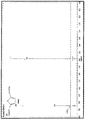
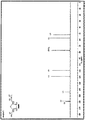
- 9 to 12 are the 1 H-NMR spectrum of FDMC, the 1 H-NMR spectrum of HMMF, the 13 C-NMR spectrum of FDMC, and the 13 C-NMR spectrum of HMMF, respectively.
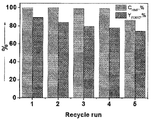
- FIG. 13 is a graph showing the relationship between the forward rate of HMF and the yield of FDMC according to the reuse of the Au / HAP nanocatalyst of Production Example 1.
- " comprises " or " having ", and the like, means that there is a feature, a number, a step, an operation, an element, a component, Does not imply that the presence of a feature, a number, a step, an operation, an element, a component, or a combination thereof is excluded.
- the catalyst used in the present invention is a substance that does not change the catalyst itself while accelerating a thermodynamically feasible chemical reaction in addition to a chemical reaction.
- the catalyst is a homogeneous catalyst, a heterogeneous catalyst, ) Catalysts and enzymatic catalysts, and the activity, selectivity and lifetime are critical factors affecting the catalytic properties.
- FDMC 2,5-furan dimethyl carbonate
- the process for producing 2,5-furan dimethyl carbonate (FDMC) includes 5-hydroxymethyl furfural (HMF), air and alcohol solvent under a gold (Au) (Au) nanoparticle-supported catalyst comprises a support and a gold (Au) supported on the support, wherein the gold (Au) nanoparticle- ) Nanoparticles.
- the gold (Au) nanoparticle-supporting catalyst includes a support and gold (Au) nanoparticles supported on the support.
- the carrier at this time is characterized by containing hydroxyapatite (HAP).
- HAP hydroxyapatite
- HAP hydroxyapatite
- Au gold
- the gold (Au) nanoparticle-supported catalyst may be prepared by mixing a carrier and urea to prepare a mixture, heating the mixture to produce a solid product, and heat treating the solid product to form gold (Au) To produce a supported catalyst.
- the content of gold (Au) nanoparticles is 0.5 wt% to 10 wt% based on 100 wt% of the supported catalyst.
- the amount of the gold (Au) nanoparticles is less than 0.5 wt% based on 100 wt% of the supported catalyst, the catalyst is difficult to exhibit its function, and conversion is almost impossible.
- the content of the gold (Au) nanoparticles is more than 10 wt% based on 100 wt% of the supported catalyst, the economical efficiency is lowered and the yield is lowered.
- the alcohol solvent may be methanol.
- the content of the gold nanoparticle-supporting catalyst may be 0.5 mol to 2 mol, more preferably 0.7 mol to 1.5 mol based on 100 mol of hydroxymethyl furfural (HMF). If the content of gold in the supported catalyst is less than 0.5 mol, the conversion of the catalyst is difficult and the conversion is remarkably low even if the catalyst is converted. When the amount exceeds 2 mol There is a problem that not only the economical efficiency is lowered but also the yield is lowered, which may be undesirable.
- the oxidative esterification reaction is performed at 110 to 150 ° C, preferably 125 to 135 ° C for 3 to 12 hours, preferably 5 to 7 hours.
- the oxidative esterification reaction at this time is characterized in that the air pressure is performed under a pressure condition of 1.7 to 3.1 MPa, preferably 2.0 to 2.8 MPa.
- the air pressure is less than 1.7 MPa, there is a problem that the number of collisions between the catalyst and the air is reduced and the mass transfer rate to reach the reaction active point is low. If the air pressure exceeds 3.1 MPa, It may be undesirable because the applied pressure may excessively cause stability problems.
- reaction temperature is excessively low or the reaction time is too short, the reaction activity is low and the reaction time or contact time is increased, so that the yield of the catalyst may be lowered.
- reaction temperature is excessively high or the reaction time is excessively long, the production of by-products may increase and the pressure inside the reactor may excessively increase, which may cause stability problems, which may be undesirable.
- a method for preparing 2,5-furan dimethyl carbonate (FDMC) is a method for producing gold nanoparticles (Au) supported on hydroxyapatite (HAP)
- FDMC 2,5-furandimethyl carboxylate
- HAP gold nanoparticles supported on hydroxyapatite
- FDMC 2,5-furandimethyl carboxylate
- the materials used in the present invention were synthesized or purchased as follows.
- Cerium (III) hexahydrate [Ce (NO 3 ) 3 .6H 2 O] and ammonia (NH 3 ) solution (28-30%) were purchased from Sigma-Aldrich and Samseon Genetics, respectively.
- HMF 5-Hydroxymethyl-2-furfural
- FDMC 2,5-furan dicarboxylate
- HMMF 5-hydroxymethyl methyl furoate
- Urea (NH 2 CONH 2 ) used as a needle sink was purchased from Daejung Chemical Metals. Solvents such as methanol, ethanol, and acetone were purchased from Samseon Genuine Chemical. Deionized water was used during the preparation of the catalyst.
- zirconium oxide (IV) ZrO 2 -powder, 5 ⁇ m, 99% metals basis
- titanium oxide (IV) TiO 2 - nanopowder, 21 nm particle size, based on 99.5% metal
- CeO 2 synthesis was initiated from a solution of 25.0 g of cerium (III) nitrate hexahydrate [Ce (NO 3 ) 3 .6H 2 O] in 200 mL of deionized water heated to 70 ° C, Was added dropwise to adjust the pH to 9 and the mixture was allowed to react for 1 hour. The solution was then filtered and the recovered solid was dried overnight at 100 ° C and calcined at 550 ° C for 6 hours.
- CeO 2 supported gold nanocatalysts were prepared according to the same standard homogeneous deposition-precipitation (HDP) method as described for Au / HAP and Au / CeO 2 (Au content: 1.0% by weight).
- HDP homogeneous deposition-precipitation
- the resulting pink precipitate was collected by filtration, washed with distilled water, anhydrous ethanol and washed with 60 o C for 12 hours.
- the resulting carbonate precursor was reacted with 425 o C (2 o C min - 1 ) for 8 hours, maintained for an additional 8 hours and then cooled naturally to room temperature.
- MnCo 2 O 4 The supported gold nanocatalyst was prepared by the same HDP method (Au / MnCo 2 O 4 ) (Au content: 2.1 wt%).
- HDP Homogeneous deposition-precipitation
- a standard method of urea was used to deposit gold nanoparticles on the support (s).
- the suspension was then heated to 90 < 0 > C and stirred for 4 hours.
- the suspension was then centrifuged at 3,000 rpm for 30 minutes and washed several times with deionized water.
- the recovered solid product was then dried in vacuo at 100 < 0 > C overnight.
- the fine powder of the recovered solid product was calcined at 300 DEG C for 4 hours. After the calcination, a purple Au / HAP (Au content: 1.0 wt%) was obtained.
- a TEM image of another supported gold catalyst (Au content: 1.0 wt%) is shown in Fig. Details of the oxidative esterification of HMF to FDMC are provided in text form in Supporting Information (SI).
- SI Supporting Information
- the gold nanoparticle precursor was used to deposit 1.5 wt% gold nanoparticles on the HAP carrier instead of using the gold nanoparticle precursor to deposit 1.0 wt% gold nanoparticles on the HAP carrier.
- Au nanoparticle-supported catalysts of 1.5% Au / HAP were prepared in the same manner.
- HAP (2.0 g) was stirred with an acetone aqueous solution of PdCl 2 (PhCN) 2 (0.1478 g, Pd content: 2.0 wt%, 0.385 mmol / g) at room temperature for 3 hours. The resulting slurry was then filtered, washed with acetone and dried under vacuum to give 2.0 wt% Pd / HAP.
- a 1.0% Au / ZrO 2 supported Au nanoparticle supported catalyst was prepared in the same manner as in Production Example 1, except that the ZrO 2 support was used instead of the HAP support.
- a 1.0% Au / TiO 2 supported Au nanoparticle supported catalyst was prepared in the same manner as in Preparation Example 1, except that the TiO 2 support was used instead of the HAP support.
- a 1.0% Au / CeO 2 supported Au nanoparticle supported catalyst was prepared in the same manner as in Preparation Example 1, except that CeO 2 support was used instead of HAP support.
- HAuCl 4 (0.064g, 0.161mmol) and urea HAuCl 4 (0.134g, 0.34mmol) in place of using the aqueous solution of (0.97g, 16.2mmol) (2.04 g, 34.02 mmol) was used in place of the aqueous solution of 2.0% Au / MgAl 2 O 4 .
- HAP carrier was used as it was.
- FDMC was prepared according to the experimental conditions of the example of the Table 1 or the comparative example, and the detailed manufacturing method is described below.
- the remaining filtrate was quantitatively analyzed for FDMC using high performance liquid chromatography (HPLC).
- HPLC high performance liquid chromatography
- H 2 SO 4 (0.0005 M) in water was used as mobile phase.
- the yields of FDMC and HMMF were calculated based on the conversion of HMF and confirmed by calibration of the product and reagent standard solutions.
- FDMC was prepared in the same manner as in Example 1, except that the reaction temperature was maintained at 110 ⁇ ⁇ instead of 130 ⁇ ⁇ .
- FDMC was prepared in the same manner as in Example 1, except that the reaction temperature was maintained at 150 ⁇ ⁇ instead of at 130 ⁇ ⁇ .
- FDMC was prepared in the same manner as in Example 1, except that the reaction air pressure was maintained at 1.7 MPa instead of 2.4 MPa.
- FDMC was prepared in the same manner as in Example 1, except that the reaction air pressure was maintained at 3.1 MPa instead of 2.4 MPa.
- FDMC was prepared in the same manner as in Example 1, except that the reaction temperature was maintained at 120 ⁇ instead of being maintained at 130 ⁇ .
- FDMC was prepared in the same manner as in Example 6, except that the 1.0% Au / HAP catalyst of Production Example 1 was charged so that the molar ratio of HMF / Au was 100 instead of 100.
- FDMC was prepared in the same manner as in Example 6, except that the 1.0% Au / HAP catalyst of Production Example 1 was charged so that the molar ratio of HMF / Au was 100 instead of 100.
- the 1.5% Au / HAP catalyst of Production Example 2 was charged so that the molar ratio of HMF / Au was 93.4 instead of charging the 1.0% Au / HAP catalyst of Production Example 1 so that the molar ratio of HMF / Au was 100, FDMC was prepared in the same manner as in Example 6 except that air was injected to maintain the air pressure (P air) at 2.4 MPa during the reaction and oxygen pressure (P O2 ) was maintained at 2.4 MPa during the reaction by injecting oxygen. .
- FDMC was prepared in the same manner as in Example 1, except that the carrier of the supported catalyst was replaced with the catalyst of Comparative Preparation Example 1 in place of the catalyst of Production Example 1.
- FDMC was prepared in the same manner as in Example 1, except that the carrier of the supported catalyst was replaced with the catalyst of Comparative Preparation Example 2 in place of the catalyst of Production Example 1.
- FDMC was prepared in the same manner as in Example 1, except that the carrier of the supported catalyst was replaced with the catalyst of Comparative Preparation Example 3, instead of the catalyst of Production Example 1.
- the support of the supported catalyst was prepared in the same manner as in Preparation Example 1 FDMC was prepared in the same manner as in Example 1, except that the supported catalyst of Comparative Production Example 4 was used instead of the supported catalyst.
- the support of the supported catalyst was prepared in the same manner as in Preparation Example 1 FDMC was prepared in the same manner as in Example 1, except that the supported catalyst of Comparative Preparation Example 5 was used instead of the supported catalyst.
- Comparative Preparation Example 6 instead of using the supported catalyst of Comparative Preparation Example 1 and charging the catalyst of Preparation Example 1 so that the molar ratio of HMF / Au was 100, Comparative Preparation Example 6 Of the catalyst was charged so that the molar ratio of HMF / Au was 93.4.
- Comparative Preparation Example 7 instead of using the supported catalyst of Comparative Preparation Example 1 instead of using the supported catalyst of Preparation Example 1, instead of charging the catalyst of Preparation Example 1 so that the molar ratio of HMF / Au was 100, Comparative Preparation Example 7 Of the catalyst was charged so that the molar ratio of HMF / Au was 93.4.
- the support of the supported catalyst was prepared in the same manner as in Preparation Example 1 FDMC was prepared in the same manner as in Example 1, except that the supported catalyst of Comparative Preparation Example 8 was used instead of the supported catalyst.
- Example 1 Au / HAP 0.2513 20 6 130 2.4 0 650 100
- Example 2 Au / HAP 0.2513 20 6 110 2.4 0 650 100
- Example 3 Au / HAP 0.2513 20 6 150 2.4 0 650 100
- Example 4 Au / HAP 0.2513 20 6 130 1.7 0 650 100
- Example 5 Au / HAP 0.2513 20 6 130 3.1 0 650 100
- Example 6 Au / HAP 0.2513 20 6 120 2.4 0 650 100
- Example 8 Au / HAP 0.2513 20 6 120 2.4 0 650 62.5
- Example 9 Au / HAP 0.2513 20 6 120 0 2.4 650 93.4 Comparative Example 1 Pd / HAP 0.2513 20 6
- the weight percent of the gold nanoparticles adsorbed on the carrier was measured by inductively coupled plasma atomic emission spectrometry (ICP-AES), and the surface area, pore volume and mean pore diameter were determined by N 2 -phosphation (adsorption-desorption) And the average particle size of gold nanoparticles was measured by TEM analysis.
- ICP-AES inductively coupled plasma atomic emission spectrometry
- the average pore diameter of Au / HAP was the highest at 46.1 nm.
- the increase in mean pore diameter can be interpreted as the result of the suitability of the smallest Au nanoparticles with a particle size (2.0-4.0 nm) deposited on the surface of HAP.
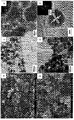
- FIG. 2 is an electron micrograph.
- a and b are respectively a scanning electron microscope (SEM) photograph of HAP, Au / HAP supported catalyst of Production Example 1 of the present invention
- c, d and e are transmission electron microscope (HRTEM) of Preparation Example 1
- the introduced photograph is a SAED pattern of gold nanoparticles (Fig. 1B) .
- FIGS. 2c, d, e, and f TEM and HR-TEM images of Au / HAP nanocatalysts demonstrated the presence of Au nanoparticles with a size of 1.0-4.0 nm.
- the distribution of the Au nanoparticle size was found to be 2.0-4.0 nm in the majority.
- the d-spacing 0.23 nm measured in the HR-TEM image corresponds to the [111] lattice plane of the Au nanoparticles and agrees well with the values reported in the literature.
- the upper right SAED pattern introduced in Figure 2f showed the presence of highly crystalline dots confirming the formation of the Au / HAP nanocatalyst.
- FIG. 3 is a TEM image of Au / ZrO 2
- (e) , (f) and (g) is a TEM image of the Au / CeO 2
- (h) , ( i) and (j) is Au / TiO 2 Of TEM.
- the gold nanoparticles supported on the carrier and the carrier were identified.
- FIG. 4 is an XRD diagram of HAP and Preparation Example 1; Referring to FIG. 4, the crystallinity of HAP and the Au / HAP nanocatalyst of Preparation Example 1A was confirmed by XRD. The XRD diffraction pattern of HAP is very similar to the Au / HAP nanocatalyst, indicating no change in the crystallinity of HAP after Au loading.
- FIG. 5 is an X-ray photoelectron spectroscopy spectrum of Production Example 1.
- Fig. Referring to FIG. 5, the valence state of Au in Au / HAP nanocatalysts was examined by X-ray photoelectron spectroscopy (XPS), and the spectrum of Au / HAP nanocatalyst (Au-4f region of 78-96 eV) is presented. In fact, the characteristic peak at (83.8 ⁇ 0.1) eV is due to the presence of gold nanoparticles. According to the results obtained, the typical binding energy values of the metallic Au nanoparticles were in good agreement with the Au-based catalyst reported in the literature.
- XPS X-ray photoelectron spectroscopy
- FIG. 6 is an XPS irradiation spectrum of Production Example 1. Fig. Referring to FIG. 6, the presence of all the elements (Ca, P, O) including the Au element is clearly shown. In the XPS survey spectrum analysis, an additional peak of C 1s at 284.6 eV was generated from the residual carbon used as a standard reference.
- Example 7 is a graph showing the results of oxidative esterification of FDMC in HMF of Example 1 over time of 1 to 6 hours.
- HMF can be rapidly converted to 5-hydroxymethyl methyl furoate (HMMF) in a short reaction time at the initial stage by monitoring the reaction progress over time. As the time further increased, it was observed that the intermediate HMMF was converted to methyl 5-formyl-2-furoate (MFF) at a gradual slow rate. The MMF formed from HMMF was also converted to FDMC at a higher rate as another intermediate. Therefore, as shown in FIG. 7, the esterification of HMF proceeds by a series of reactions in which the aldehyde group of HMF can be oxidized faster than the alcohol group.
- MFF 5-formyl-2-furoate
- 9 to 12 are respectively a 1 H-NMR spectrum of FDMC, a 1 H-NMR spectrum of HMMF, a 13 C-NMR spectrum of FDMC, and a 13 C-NMR spectrum of HMMF.
- FDMC was purified by a crystallization method. After the formation reaction, the methanol was evaporated from the product mixture using a rotary evaporator until it became a saturated solution. Hexane (3 times more than methanol) was then added and left to crystallize for 24 hours. The solid crystals were observed, separated by filtration, and dried under reduced pressure.
- FDMC (solid) and HMMF (yellow semi-liquid) were obtained, and it was confirmed that the substances obtained from FIGS. 10 to 13 were FDMC and HMMF. .
- the conversion (C), the yield Y (Y), and the selectivity (S) were calculated as follows using an HPLC (Agilent Technologies 1200 series, Bio-Rad Aminex HPX-87H pre-packed column, The conversion, yield and selectivity of the catalysts were compared according to the type of the support.
- HMF conversion rate means the percentage of the molar number of moles of HMF divided by the number of moles of HMF used.
- FDMC yield means the percentage of the actual moles of FDMC divided by the number of moles of the theoretical FDMC.
- FDMC selectivity means the percentage of the FDMC yield divided by the conversion rate of HMF.
- Example 1 130 / 2.4 99.9 89.3 10.0 0.7
- Example 3 150 / 2.4 100 20.9 15.9 0.9
- Example 4 130 / 1.7 99.0 61.0 38.1 0.9
- Example 5 130 / 3.1 100 89.6 9.6 0.8
- Table 4 is a comparison chart of conversion, yield and selectivity according to the carrier or metal of catalyst when FDMC is produced by oxidation reaction of HMF in the presence of air.
- HMMF 5-hydroxymethyl methyl furoate (monoester)
- the yield of FDMC was calculated based on the conversion of HMF and confirmed by calibration of the standard solutions of the products and reactants.
- Example 1 When the hydroxyapatite (HAP) used in Example 1 was used as the carrier in the gold nanoparticle-supported catalyst, the conversion of HMF and the yield of FDMC were 99.9% and 89.3%, respectively, which is the highest.
- HAP hydroxyapatite
- Comparative Example 3 which is known as a good oxidation catalyst, the oxidation esterification reaction of HMF to FDMC was performed under the same conditions of Au / ZrO 2 .
- the Au / ZrO 2 of Comparative Example 3 showed a good FDMC yield of 80.9% and a monoester yield of HMMF of 18.1% in addition to FDMC.
- Au / TiO 2 catalyst of Comparative Example 4 showed inferior activity in yield of 36.1% of FDMC
- Au / CeO 2 of Comparative Example 5 showed 28.6% of other byproduct yield, 29.5% of monoester HMMF yield FDMC yield was 21.9%.
- the gold catalyst Au / MgAl 2 O 4 supported on the MgAl 2 O 4 spinel of Comparative Example 6 showed 42.8% FDMC yield, HMMF yield of 14.6%, and yield of other by-products of 12.5%.
- Au / MnCo 2 O 4 as a gold catalyst supported on MnCo 2 O 4 of Comparative Example 7 was not described in Table 5, but DFF was obtained in a yield of 54.0% as a main product.
- the low activity of Au / MnCo 2 O 4 for FDMC can be attributed to the acidity of the Bronsted and Lewis acids of the support MnCo 2 O 4 .
- the HAP of Comparative Example 8 itself hardly progressed the oxidation of HMF.
- Table 5 is a comparison chart of yield and selectivity according to the carrier of catalyst when FDMC is produced by oxidation reaction of HMF without using a base additive in oxygen.
- Example 7 which uses the same carrier HAP and reacted under oxygen pressure, Comparing Example 9, which was reacted under air pressure, it can be seen that Example 7, which was reacted under air pressure, has higher conversion ratios of HMF, yield of FDMC and selectivities of FDMC of 99.9%, 88.7% and 88.8%. Therefore, it was confirmed that FDCA can be produced on a large scale through oxidation reaction in air having low explosibility.
- Table 6 is a comparison chart of yield and selectivity according to the ratio of gold (Au) nanoparticle catalyst and HMF in the production of FDMC by oxidative esterification of HMF in air.
- the yield and the selectivity according to the content of the gold (Au) nanoparticle catalyst and the HMF content can be confirmed that the yield of the FDMC increases as the content ratio of the gold nanoparticle catalyst increases.
- FIG. 13 is a graph showing the relationship between the forward rate of HMF and the yield of FDMC according to the reuse of the Au / HAP nanocatalyst of Production Example 1.
- FIG. 13 After each run, the catalyst was separated from the product mixture by centrifugation to avoid minimal loss of catalyst weight. The recovered catalyst was thoroughly rinsed with methanol and dried in a vacuum oven at 45 ° C. for 6 hours and then reused. The ratio of HMF / Au was always kept constant at 100.
- the Au / HAP nanocatalyst exhibited remarkable activity even after 5 consecutive recycles without loss of initial activity.
- the results obtained show that the Au / HAP nanocatalyst is fairly stable under the applied reaction conditions. It was found that Au / HAP is a very strong heterogeneous catalyst for the oxidation esterification of HMF to synthesize FDMC.
- FDMC 2,5-furan dimethylcarbonate
- an oxidizer having no risk of explosion is not used, and thus, 2,5-furan dimethylcarbonate FDMC).
- the process of FDMC obtained by FDCA production through esterification with alcohol is a two-step process, whereas the present invention can easily produce FDMC by a one-step reaction through oxidative esterification reaction from HMF.
- FDCA 2,5-furandicarboxylic acid
- FDCA 2,5-furandicarboxylic acid acid
- FDMC 2,5-furandicarboxylic acid acid
- Furan dimethylketarylate can be produced at high selectivity and high yield by using a carrier of HAP over other carriers through a reaction in a single vessel at high pressure using Au / HAP as a catalyst. .
- an oxidizing agent (poisonous oxygen) Carboxylate (FDMC) is simply produced.
- the process of FDMC obtained by FDCA production through esterification with alcohol is a two-step process, whereas the present invention can easily produce FDMC by a one-step reaction through oxidative esterification reaction from HMF.
- FDCA 2,5-furandicarboxylic acid
- FDCA 2,5-furandicarboxylic acid acid
- FDMC 2,5-furandicarboxylic acid acid
- Furan dimethylketarylate can be produced at high selectivity and high yield by using a carrier of HAP over other carriers through a reaction in a single vessel at high pressure using Au / HAP as a catalyst. .
Landscapes
- Chemical & Material Sciences (AREA)
- Organic Chemistry (AREA)
- Engineering & Computer Science (AREA)
- Materials Engineering (AREA)
- Chemical Kinetics & Catalysis (AREA)
- Catalysts (AREA)
- Low-Molecular Organic Synthesis Reactions Using Catalysts (AREA)
- Organic Low-Molecular-Weight Compounds And Preparation Thereof (AREA)
- Furan Compounds (AREA)
Abstract
본 발명의 일 실시예는 금(Au) 나노입자 담지 촉매 하에 5-하이드록시메틸푸르푸랄(HMF), 공기 및 알코올 용매를 포함하는 반응물을 산화성 에스테르화 반응시켜 2,5-퓨란디메틸카르복실레이트(FDMC)를 제조하는 단계를 포함하고, 상기 금(Au) 나노입자 담지 촉매는 담지체 및 상기 담지체에 담지되는 금(Au) 나노입자를 포함하는 것인 2,5-퓨란디메틸카르복실레이트(FDMC) 제조방법을 제공한다.
Description
본 발명은 2,5-퓨란디메틸카르복실레이트(FDMC)의 제조방법에 관한 것으로, 더욱 상세하게는 하이드록시메틸푸르푸랄(HMF: 5-Hydroxymethyl Furfural)로부터 하이드록시아파타이트(HAP: Hydroxyapatite)에 담지된 금(Au) 촉매를 이용한 산화성 에스테르화 반응을 통해 2,5-퓨란디메틸카르복실레이트(FDMC: 2,5-furandimethylcarboxylate)를 단일용기 내 반응으로 제조하는 것에 관한 것이다.
제2차 세계대전을 기점으로 공업적 생산 체계를 갖추게 되면서 다양한 수지를 기초로 하는 플라스틱들이 소비재로 대량 생산되기 시작하였다. 특히 1970년대 후반부터는 철강의 생산량을 넘어서서 최근에는 3억톤이 넘는 플라스틱이 전세계에서 생산되고 소비되고 있다. 그러나, 플라스틱은 석유 정제과정에서 나온 나프타를 이용하여 생산되는 것이므로 석유자원 고갈, 이산화탄소 배출이 문제되고 있으며, 일회용품의 주 재료로 사용되어 제품 사용 후 곧바로 폐기됨에 따라 다량의 플라스틱이 폐기되는데, 오랜 기간 썩지 않아 매립이 어렵고 소각하는 경우 다이옥신을 비롯한 발암물질이 대기 상에 배출되어 환경 문제를 초래하고 있어 이에 대한 대체 소재에 대한 연구가 지속적으로 진행되고 있다.
플라스틱의 대체제로서 과학자들은 식물 속 전분이나 셀룰로오스를 이용하는 바이오 플라스틱 소재 개발에 전력을 다하고 있다. 특히, 바이오 플라스틱 소재 중에서도 각광받는 소재 중 하나가 2,5-푸란디카르복실산(FDCA: 2,5-furandicarboxylic acid)을 기반으로 제조되는 플라스틱이다.
그러나, FDCA의 경우, 원료 확보에 제한이 있는 5-하이드록시메틸푸르푸랄(HMF: 5-hydroxymethylfurfural)을 귀금속 촉매 존재하에 순산소와 같이 폭발성이 있는 산화제를 사용하여 산화반응을 통하여 제조되는 것이 일반적이다. 그러나, HMF는 원료 공급에 어려움이 있어 대량생산이 어렵고, 순산소를 산화제로 산화반응을 거치게 되는 경우 폭발성이 높은 점에서 대규모로 FDCA를 제조하기는 어렵다는 문제점이 있다.
뿐만 아니라 FDCA는 산업 용매에서 용해도가 낮은 문제점도 있다.
이러한 문제는 FDCA에 상응하는 에스테르, 즉 가장 일반적인 용매에 쉽게 용해되는 FDMC로 대체함으로써 회피 될 수 있다. 따라서 HMF를 FDMC로 변환 할 수 있는 공정은 고분자 산업에 영향을 줄 수 있다.
다만, HMF를 촉매반응 하에 염기를 첨가하여 FDMC를 제조하는 연구과정에서 염기를 사용하면 FDMC의 수율을 높일 수 있지만 공정비용이 높아 지는 문제점이 발생했다.
본 발명이 이루고자 하는 기술적 과제는 석유자원으로 만들어지는 플라스틱의 PET 대체 폴리머인 PEF의 원료 2,5-푸란디카르복실산(FDCA: 2,5-Furandicarboxylic acid)의 낮은 용해도 문제점을 해결하기 위해 도출된 2,5-퓨란디메틸카르복실레이트(FDMC)를 효과적으로 제조하는 방법을 제공하는 것이다.
보다 구체적으로는 석유자원의 고갈과 오랜 기간 썩지 않아 매립이 어려워 소각을 해야 하는 플라스틱은 소각할 경우 다이옥신을 비롯한 발암물질과 지구 온난화를 유발하는 이산화탄소를 대기상에 배출시킴에 따라 환경문제를 초래한다. 이런 문제점을 막고자 친환경 바이오 소재 분야에 적용할 수 있고, PET 대체 폴리머인 PEF의 중요한 원료가 되는 2,5-푸란디카르복실산(FDCA: 2,5-Furandicarboxylic acid)를 생산하는 데 있어, FDCA의 산업용매에 대한 낮은 용해도를 해결할 수 있는 FDMC를 효과적으로 제조하는 방법을 제공하는 것이다.
본 발명이 이루고자 하는 기술적 과제는 이상에서 언급한 기술적 과제로 제한되지 않으며, 언급되지 않은 또 다른 기술적 과제들은 아래의 기재로부터 본 발명이 속하는 기술 분야에서 통상의 지식을 가진 자에게 명확하게 이해될 수 있을 것이다.
상기 기술적 과제를 달성하기 위하여, 본 발명의 일 실시예는 금(Au) 나노입자 담지 촉매 하에 5-하이드록시메틸푸르푸랄(HMF), 공기 및 알코올 용매를 포함하는 반응물을 산화성 에스테르화 반응시켜 2,5-퓨란디메틸카르복실레이트(FDMC)를 제조하는 단계를 포함하고, 상기 금(Au) 나노입자 담지 촉매는 담지체 및 상기 담지체에 담지되는 금(Au) 나노입자를 포함하는 것인 2,5-퓨란디메틸카르복실레이트(FDMC) 제조방법을 제공한다.
본 발명의 실시예에 있어서, 상기 담지체는 하이드록시아파타이트(Hydroxyapatite, HAP) 포함할 수 있다.
본 발명의 실시예에 있어서, 상기 금 나노입자 담지 촉매 100wt%를 기준으로 금(Au) 나노입자의 함량이 0.5wt% 내지 10wt%일 수 있다.
본 발명의 실시예에 있어서, 상기 하이드록시메틸푸르푸랄(HMF)의 100mol을 기준으로 상기 금 나노입자 담지 촉매의 함량이 0.5 mol 내지 2 mol, 보다 바람직하게는 0.7 mol 내지 1.5 mol 일 수 있다.
본 발명의 실시예에 있어서, 상기 알코올 용매는 메탄올을 포함할 수 있다.
본 발명의 실시예에 있어서, 상기 산화성 에스테르화 반응은 110 내지 150℃, 바람직하게는 125 내지 135℃ 온도조건에서 3시간 내지 12시간, 바람직하게는 5 내지 7시간 동안 수행되는 것을 특징으로 하는 2,5-퓨란디메틸카르복실레이트(FDMC)제조방법 일 수 있다.
본 발명의 실시예에 있어서, 상기 산화성 에스테르화 반응은 공기압이 1.7 내지 3.1MPa, 바람직하게는 2.0 내지 2.8 MPa의 압력 조건하에 수행되는 것을 특징으로 하는 2,5-퓨란디메틸카르복실레이트(FDMC) 제조방법 일 수 있다.
상기 기술적 과제를 달성하기 위하여, 본 발명의 다른 실시예는 상술한 FDMC 제조방법으로 제조된 2,5-퓨란디메틸카르복실레이트(FDMC) 화합물을 제공한다.
본 발명의 실시예에 따르면, 기존의 2,5-퓨란디메틸카르복실레이트(FDMC) 제조방법과 달리 폭발의 위험이 있는 산화제(순산소)를 사용하지 않아 안전한 공정을 통하여 2,5-퓨란디메틸카르복실레이트(FDMC)을 간단하게 제조한다.
또한 FDCA를 제조 후 이를 알코올과 에스테르화 반응을 통해 얻어지는 FDMC의 공정은 2단계 공정인 반면 본 발명은 HMF로부터 oxidative esterification 반응을 통해 1단계 반응으로 FDMC를 직접 제조할 수 있는 효과가 있다.
본 발명의 일 효과로서, 공기와 알코올을 반응물질 및 용매로 사용하여 종래의 다른 용매를 사용할 경우보다 안전하고 편리한 효과가 있다.
본 발명의 다른 일 효과로서, 종래에 2,5-푸란디카르복실산(FDCA: 2,5-Furandicarboxylic acid)을 제조하였을 때 2,5-푸란디카르복실산(FDCA: 2,5-Furandicarboxylic acid)는 산업용매에서의 낮은 용해도로 문제점이 있었는데 이를 2,5-퓨란디메틸카르복실레이트(FDMC)를 제조함으로 낮은 용해도를 해결하는 효과를 제공한다.
Au/HAP를 촉매로 사용하여 고압 조건에서 단일 용기 내 반응을 통해 다른 담지체 보다 HAP의 담지체를 사용함으로 고선택율 및 고수율로 2,5-퓨란디메틸카르복실레이트(FDMC)을 제조되는 효과가 있다.
본 발명의 효과는 상기한 효과로 한정되는 것은 아니며, 본 발명의 상세한 설명 또는 특허청구범위에 기재된 발명의 구성으로부터 추론 가능한 모든 효과를 포함하는 것으로 이해되어야 한다.
도 1은 2,5-퓨란디메틸카르복실레이트(FDMC)의 제조방법을 설명하기 위한 도면이다.
도 2의 a 및 b는 각각 HAP, 본 발명의 제조예 1의 Au/HAP 담지촉매의 주사전자현미경(SEM) 사진이고, c, d, 및 e는 각각 제조예 1의 투과전자현미경(TEM) 사진이고, e에 도입된 의 막대 그래프는 제조예 1의 크기 분포이고, f는 제조예 1의 고해상도 TEM(HR-TEM)의 사진이고, 도입된 사진은 금 나노입자의 SAED 패턴이다.
도 3의 (a), (b) 및 (c)는 비교제조예 3의 Au/ZrO2의 TEM 사진이고, (e), (f) 및 (g)는 비교제조예 5의 Au/CeO2 의 TEM 사진이고, (h), (i) 및 (j)는 비교제조예 4의 Au/TiO2 의 TEM 사진이다.
도 4는 HAP 및 제조예 1의 XRD 도면이다.
도 5는 제조예 1의 X 선 광전자 분광 스펙트럼이다.
도 6는 제조예 1의 XPS 조사 스펙트럼이다.
도 7은 실시예 1의 HMF에서 FDMC의 산화 에스테르화를 1 내지 6 시간동안 시간 경과에 따라 수행한 결과를 나타낸 그래프이다.
도 8 (a)는 실시예 1의 HMF의 산화 에스테르화 반응으로부터 수득된 미가공 생성 혼합물의 GC-MS 그래프이고, (b)는 실시예 1의 미가공 혼합 생성물로부터 얻어진 순수한 FDMC의 GC-MS 그래프이다.
도 9 내지 12는 각각 FDMC의 1H-NMR 스펙트럼, HMMF의 1H-NMR 스펙트럼, FDMC의 13C-NMR 스펙트럼, 및 HMMF의 13C-NMR 스펙트럼이다.
도 13은 제조예 1의 Au/HAP 나노 촉매의 재사용에 따른 HMF의 전완율과 FDMC의 수율의 관계를 표시한 그래프이다.
이하에서는 본 발명이 첨부한 도면이 참조되어 설명될 것이다. 그러나 본 발명은 여러 가지 상이한 형태로 구현될 수 있으며, 따라서 여기에서 설명되는 실시예로 한정되는 것은 아니다. 발명의 명확한 설명을 위해, 도면에서 설명과 관계없는 부분은 생략되었다. 그리고 명세서 전체에서 유사한 부분에는 유사한 도면 부호가 붙었다.
명세서 전체에서, 어떤 부분이 다른 부분과 "연결(접속, 접촉, 결합)"되어있다고 할 때, 이는 "직접적으로 연결"되어 있는 경우뿐 아니라, 그 중간에 다른 부재를 사이에 두고 "간접적으로 연결"되어 있는 경우도 포함한다. 또한 어떤 부분이 어떤 구성요소를 "포함"한다고 할 때, 이는 특별히 반대되는 기재가 없는 한 다른 구성요소를 제외하는 것이 아니라 다른 구성요소를 더 구비할 수 있다는 것을 의미한다.
본 명세서에서 사용된 용어는 단지 특정한 실시예를 설명하기 위해 사용된 것으로, 본 발명을 한정하려는 의도가 아니다. 단수의 표현은, 문맥상 명백하게 다르게 뜻하지 않는 한, 복수의 표현을 포함한다. 본 명세서에서, "포함하다" 또는 "가지다" 등의 용어는 명세서상에 기재된 특징, 숫자, 단계, 동작, 구성요소, 부품, 또는 이들을 조합한 것이 존재한다는 것을 의미하지, 하나 또는 그 이상의 다른, 특징, 숫자, 단계, 동작, 구성요소, 부품, 또는 이들을 조합한 것의 존재가 배제된다는 것을 의미하지 않는다.
본 발명에서 사용되는 촉매는 화학반응에 첨가하여 열역학적으로 가능한 화학반응을 가속시켜 주면서 촉매 자신은 변하지 않는 물질로서, 촉매는 반응계의 상(phase)에 따라 균일계(homogeneous) 촉매, 불균일계(heterogeneous) 촉매 및 생체계(enzymatic) 촉매로 분류되고 활성, 선택성 및 수명이 촉매 특성에 영향을 미치는 결정적인 요소이다.
본 발명의 일 실시예에 따른 2,5-퓨란디메틸카르복실레이트(FDMC)의 제조방법을 설명한다.
본 발명의 일 실시예에 따른 2,5-퓨란디메틸카르복실레이트(FDMC)의 제조방법은 금(Au) 나노입자 담지 촉매 하에 5-하이드록시메틸푸르푸랄(HMF), 공기 및 알코올 용매를 포함하는 반응물을 산화성 에스테르화 반응시켜 2,5-퓨란디메틸카르복실레이트(FDMC)를 제조하는 단계를 포함하고, 상기 금(Au) 나노입자 담지 촉매는 담지체 및 상기 담지체에 담지되는 금(Au) 나노입자를 포함할 수 있다.
상기 금(Au) 나노입자 담지 촉매는 담지체 및 상기 담지체에 담지되는 금(Au) 나노입자를 포함하는 것을 특징으로 한다.
예를 들어, 이때의 담지체는 하이드록시아파타이트(HAP)를 포함하는 것을 특징으로 한다.
FDMC를 제조함에 있어, 금(Au) 나노입자를 담지하는 담지체를 하이드록시아파타이트(HAP)로 사용하게 되면, 다른 담지체를 사용하는 경우에 비하여 보다 높은 FDMC의 수율 및 선택율을 증가시킬 수 있다.
예를 들어, 금(Au) 나노입자 담지 촉매는 담지체 및 우레아를 혼합하여 혼합물을 제조하는 단계, 상기 혼합물을 가열하여 고체 생성물을 제조하는 단계 및 상기 고체생성물을 열처리하여 금(Au) 나노 입자 담지 촉매를 제조하는 단계를 포함할 수 있다.
또한, 상기 담지 촉매의 100wt%를 기준으로 금(Au) 나노입자의 함량이 0.5wt% 내지 10wt%인 것을 특징으로 한다.
만일, 상기 담지 촉매 100wt%를 기준으로 금(Au) 나노입자의 함량이 0.5wt% 미만인 경우, 촉매가 기능을 발휘하기 어려워서 전환이 거의 불가능하며 전환 되더라도 그 전환율이 현저히 낮은 문제가 있다. 또한, 상기 담지 촉매 100wt%를 기준으로 금(Au) 나노입자의 함량이 10wt%를 초과하는 경우, 경제성이 떨어질 뿐만 아니라, 오히려 수율이 저하되는 문제가 있어 바람직하지 않을 수 있다.
상기 알코올 용매는 메탄올일 수 있다.
상기 하이드록시메틸푸르푸랄(HMF)의 100mol을 기준으로 상기 금 나노입자 담지 촉매의 함량이 0.5 mol 내지 2 mol, 보다 바람직하게는 0.7 mol 내지 1.5 mol 일 수 있다. 여기서 상기 하이드록시메틸푸르푸랄(HMF) 대비 담지 촉매의 금의 함량이 0.5 mol 미만이면 촉매가 기능을 발휘하기 어려워서 전환이 거의 불가능하며 전환되더라도 그 전환율이 현저히 낮은 문제가 있으며 2 mol을 초과하는 경우에는 경제성이 떨어질 뿐만 아니라, 오히려 수율이 저하되는 문제가 있어 바람직하지 않을 수 있다.
상기 금(Au) 나노입자 담지 촉매 하에 상기 반응물을 산화성 에스테르화 반응시키면, 최종적으로 FDMC를 제조할 수 있다.
이때의 상기 산화성 에스테르화 반응은 110 내지 150℃, 바람직하게는 125 내지 135℃ 온도조건에서 3시간 내지 12시간, 바람직하게는 5 내지 7시간 동안 수행되는 것을 특징으로 한다.
또한, 이때의 산화성 에스테르화 반응은 공기압이 1.7 내지 3.1MPa, 바람직하게는 2.0 내지 2.8 MPa의 압력 조건하에서 수행되는 것을 특징으로 한다.
만일, 상기 공기압이 1.7 MPa 미만일 경우에는 촉매와 공기의 충돌수가 저하되어 반응 활성점에 도달하는 물질 전달 속도가 낮은 문제가 있고, 공기압이 3.1MPa을 초과하는 경우에는 반응 속도가 증가하여 반응 용기 내에 가해지는 압력이 과도하여 안정상의 문제를 유발할 수 있어 바람직하지 않을 수 있다.
또한 반응 온도가 지나치게 낮거나 반응 시간이 지나치게 짧으면 반응 활성이 낮고 반응 시간 또는 접촉 시간이 증가하므로 촉매의 수율이 저하될 수 있다. 반면, 반응 온도가 지나치게 높거나 반응 시간이 지나치게 길면 부산물 생성이 증가하게 되어 반응기 내부 압력이 과도하게 높아질 수 있어 안정성의 문제를 야기시킬 수 있어 바람직하지 않을 수 있다.
이하, 본 발명의 일 실시예에 따른 2,5-퓨란디메틸카르복실레이트(FDMC)의 제조방법의 반응에 대하여 보다 구체적으로 설명한다.
도 1을 참조하면, 본 발명의 일 실시예에 따른 하기 화학식 1의 2,5-퓨란디메틸카르복실레이트(FDMC)의 제조방법은, 하이드록시아파타이트(HAP)에 담지된 금(Au)나노입자 촉매 하에, 하이드록시메틸푸르푸랄(HMF)과 알코올을 공기 중에서 산화성 에스테르화 반응시켜 HMMF제조되는 단계 및 MFF제조되는 단계를 지나 2,5-퓨란디메틸카르복실레이트(FDMC)가 제조된다.

이하, 본 발명의 제조예 및 실험예를 기재한다. 그러나, 이들 제조예 및 실험예는 본 발명의 구성 및 효과를 보다 구체적으로 설명하기 위한 것으로 본 발명의 범위가 이에 한정되는 것은 아님을 명시한다.
본 발명에서 사용한 물질은 아래와 같이 합성하거나 구입하여 사용하였다.
사염화금(III)산 3수화물 (HAuCl4·3H2O), 염화루테늄(III) 수화물 (RuCl3·xH2O), 및 다이클로로비스(벤조니트릴)팔라듐(II) [PdCl2(PhCN)2]도 Sigma-Aldrich에서 구입하였다.
MnCo2O4
스피넬 물질의 제조를 위해 시판중인 코발트(II) 아세테이트 테트라하이드레이트 (CH3COO)2Co·4H2O, 망간(II) 아세테이트 테트라하이드레이트 (CH3COO)2Mn·4H2O, 황산암모늄 (NH4)2SO4
및 암모늄 비카르보네이트(NH4HCO3)를 Sigma-Aldrich에서 구입하였다.
MgAl2O4 분말 제조를 위해, Alsfa Aesar에서 질산마그네슘 6수화물[Mg(NO3)2·6H2O]을, Sigma-Aldrich에서 질산알루미늄 9수화물 [Al(NO3)3·9H2O] 및 구연산 [HOC(COOH)(CH2COOH)2]을 구입하였다.
질산세륨(III) 6수화물 [Ce(NO3)3·6H2O] 및 암모니아 (NH3) 용액(28-30%)은 각각 Sigma-Aldrich 및 삼전순정화학에서 구입하였다.
5-하이드록시메틸-2-퍼퓨랄 (HMF) 및 2,5-퓨란디카르복실레이트(FDMC)는 Shanghai Research Institute of Chemical Industry Testing Centre에서 구입하여 표준 교정에 사용되었다. 5-hydroxymethyl methyl furoate (HMMF)는 합성하여 준비되었다.
침전체로 사용된 우레아(NH2CONH2)는 대정화학금속에서 구매하였다. 메탄올, 에탄올 및 아세톤과 같은 용매들은 삼전순정화학에서 구입하였다. 촉매를 제조하는 동안 탈이온수가 사용되었다.
HAP
,
ZrO2
, 및
TiO2
수산화인회석(hydroxyapatite, HAP-nanopowder, <200 nm 입자 크기, =97%, 합성), 산화 지르코늄(IV) (ZrO2-powder, 5μm, 99% 금속 기준) 및 산화 티타늄(IV) (TiO2-nanopowder, 21 nm 입자크기, =99.5% 금속 기준)을 Sigma-Aldrich에서 구입하여 진공 하에서 80oC로 밤새 건조시킨 후 사용하였다.
CeO2
일정한 크기의 CeO2 합성은 70oC로 가열된 200mL의 탈이온수 내의 질산세륨(III) 6수화물[Ce(NO3)3.6H2O] 25.0g의 용액으로부터 시작하여 25중량%의 암모니아 용액을 dropwise 방법으로 첨가해 pH를 9로 조정하고 혼합물을 1시간동안 반응시켰다. 그 후, 용액을 여과하고 회수된 고체를 100 oC에서 밤새 건조시키고 550 oC에서 6시간동안 하소하였다. CeO2 담지 금 나노 촉매는 Au/HAP에 대해 기술된 것과 동일한 표준 균질 증착-침전(HDP) 방법에 따라 제조되었으며 Au/CeO2
(Au 함량: 1.0중량%)로 표시하였다.
MgAl2O4
화학량론적인 양의 질산마그네슘 6수화물 및 질산알루미늄9수화물(1:2 몰비)을 증류수에 용해시킨 다음, 화학량론적 양의 구연산을 첨가하였다. 완전히 혼합한 후, 균질한 용액을 얻었다. 용액을 고점성 콜로이드가 형성될때까지 천천히 증발시킨 다음, 건조된 겔을 얻기 위해 120 내지 140°C에서 24시간동안 가열하였다. 마지막으로, 미세 분말로 분쇄한 후 건조된 젤 전구체를 600oC에서 소성하여 MgAl2O4
분말을 얻었다. MgAl2O4
담지 금 나노 촉매는 (Au/MgAl2O4) (Au 함량: 2.1중량%)로 표시된다.
MnCo2O4
미세 구형 MnCo2O4 스피넬의 전형적인 합성에서, (CH3COO)2Mn.4H2O (32.6 mmol) 및 (CH3COO)2Co.4H2O (65.3 mmol) (Mn: Co= 1:2)는 물에 용해되고 30분동안 격렬하게 교반함으로써 균질화시켰다. 별도로, 황산암모늄(50 g)을 물(400 mL)에 용해시켰다. 이들 용액을 천천히 혼합하고 4시간동안 교반하였다. 이어서, 암모늄 비카르보네이트 수용액(~50g)을 상기 혼합물에 천천히 첨가하고 6시간동안 교반하였다. 수득된 연분홍색 침전물을 여과하여 수집하고, 증류수, 무수 에탄올로 세척하고, 60
oC에서 12시간동안 건조시켰다. 얻어진 카르보네이트 전구체를 공기중 425
oC (2 oC min-
1)의 로에서 8시간동안 하소시키고 추가로 8시간동안 유지한 후 자연적으로 실온으로 냉각시켰다. MnCo2O4
담지 금 나노 촉매는 동일한 HDP 방법으로 제조하였으며 (Au/MnCo2O4) (Au 함량: 2.1중량%)로 표시하였다.
제조예 : 담지촉매의 제조
제조예 1: 1.0 중량% Au 나노입자/HAP 담지촉매
표준 방법인 우레아를 이용한 균일 증착-침전(homogeneous deposition-precipitation, HDP)을 금 나노입자를 지지체(s)에 증착시키는데 사용하였다. HAP 지지체 3.0g을 침전제로 사용된 HAuCl4(0.064g, 0.161mmol) 및 우레아(0.97g, 16.2mmol)의 수용액 20ml에 첨가하였다(요소/Au=100, 몰 비율). 그런 다음 현탁액을 90℃로 가열하고 4시간 동안 교반하였다. 그 후, 현탁액을 3,000rpm으로 30분간 원심 분리하고 탈이온수로 수회 세척하였다. 그런 다음, 회수된 고체 생성물을 진공 상태에서 100℃에서 밤새 건조시켰다. 회수된 고체 생성물의 미세 분말을 300℃에서 4시간 동안 하소하였다. 하소 후, 보라색의 Au/HAP(Au 함량: 1.0중량%) 이 얻어졌다. 다른 지지된 금 촉매(Au 함량: 1.0중량%)의 TEM 이미지가 도 S10에 제시된다. HMF의 FDMC로의 산화 에스테르화에 관한 세부 사항은 서포팅 인포메이션(SI)의 텍스트 형태로 제공된다.
제조예 2: 1.5중량% Au 나노입자/HAP 담지촉매
HAP 담지체에 1.0 중량% 금 나노 입자를 증착시키도록 금 나노 입자 전구체를 사용한 것 대신에 HAP 담지체에 1.5 중량% 금 나노 입자를 증착되도록 금 나노입자 전구체를 사용한 것을 제외하고는 제조예 1과 동일한 방법으로 1.5% Au/HAP인 Au 나노입자 담지촉매를 제조하였다.
비교제조예 1: 2.0 중량% Pd 나노입자/HAP 담지촉매
HAP(2.0g)를 PdCl2(PhCN)2 (0.1478 g, Pd 함량: 2.0 중량%, 0.385mmol/g)의 아세톤 수용액과 함께 실온에서 3시간동안 교반하였다. 그 다음, 수득된 슬러리를 여과하고, 아세톤으로 세척하고, 진공하에 건조시켜 2.0 중량% Pd/HAP를 수득하였다.
비교제조예 2: 2.0 중량% Ru 나노입자/HAP 담지촉매
1.0g의 HAP를 RuCl3.xH2O (0.046 g, Ru 함량: 2.0 중량%, 0.203 mmol/g) 수용액과 실온에서 24시간동안 교반하였다. 얻어진 슬러리를 여과하고, 탈 이온수로 세척하고, 100°C에서 밤새 건조시켜서 2.0 중량% Ru/HAP를 얻었다.
비교제조예 3: 1.0 중량% Au 나노입자/ZrO2 담지촉매
HAP 담지체를 사용한 것 대신에 ZrO2 담지체를 사용한 것을 제외하고는 제조예 1과 동일한 방법으로 1.0% Au/ZrO2인 Au 나노입자 담지촉매를 제조하였다.
비교제조예 4: 1.0 중량% Au 나노입자/TiO2 담지촉매
HAP 담지체를 사용한 것 대신에 TiO2 담지체를 사용한 것을 제외하고는 제조예 1과 동일한 방법으로 1.0% Au/TiO2인 Au 나노입자 담지촉매를 제조하였다.
비교제조예
5: 1.0
중량%
Au 나노입자/
CeO2
담지촉매
HAP 담지체를 사용한 것 대신에 CeO2 담지체를 사용한 것을 제외하고는 제조예 1과 동일한 방법으로 1.0% Au/CeO2인 Au 나노입자 담지촉매를 제조하였다.
비교제조예
6: 2.1
중량%
Au 나노입자/
MgAl2O4
담지촉매
HAP 담지체를 사용한 대신에 MgAl2O4 담지체를 사용하고, HAuCl4(0.064g, 0.161mmol) 및 우레아(0.97g, 16.2mmol)의 수용액을 사용한 대신에 HAuCl4(0.134g, 0.34mmol) 및 우레아(2.04g, 34.02mmol)의 수용액을 사용한 것을 제외하고는 제조예 1과 동일한 방법으로 2.1% Au/ MgAl2O4인 Au 나노입자 담지촉매를 제조하였다.
비교제조예
7: 2.1
중량%
Au나노입자
/
MnCO2O4
담지촉매
HAP 담지체를 사용한 대신에 MnCO2O4 담지체를 사용하고, HAuCl4(0.064g, 0.161mmol) 및 우레아(0.97g, 16.2mmol)의 수용액을 사용한 대신에 HAuCl4(0.134g, 0.34mmol) 및 우레아(2.04g, 34.02mmol)의 수용액을 사용한 것을 제외하고는 제조예 1과 동일한 방법으로 2.1% Au/MnCO2O4인 Au 나노입자 담지촉매를 제조하였다.
비교제조예 8: HAP 담체
HAP 담체를 그대로 사용하였다.
실시예: FDMC의 제조
표1의 실시예 또는 비교예의 실험조건에 따라 FDMC를 제조하였고 상세한 제조방법은 아래에 기재하였다.
실시예
1
표 1을 참고하여 설명하면, HMF로부터 FDMC제조 과정은 자기 교반기 및 전기 히터가 장착 된 고압의 스테인리스 스틸 반응기 100mL에서 수행되었다.
반응기에 HMF 0.2513g(2 mmol), CH3OH (20 mL), 및 제조예 1의 1.0% Au/HAP 촉매를 HMF/Au의 몰비가 100이 되도록 충전하였고, 그 후, 0.5MPa의 공기를 반응기로 퍼지하여 반응 혼합물로부터 대기를 3회 배기시켰다. 이어서, 반응기를 공기압을 2.4MPa까지 가압하고, 교반 속도 650rpm으로 하고, 130℃까지 가열하고, 반응 시간인 6시간 동안 반응 온도를 130℃로 유지하였고, 반응기로 들어가는 공기의 최종 압력(Pair)인 반응 공기압력을 배압 조정기 및 압력 변환기가 장착 된 가스 저장소를 사용하여 2.4MPa로 유지하면서 FDMC를 제조하였다. 반응 종결 시 생성 혼합물을 실온에서 냉각시키고 일정량의 CH3OH를 첨가하였다. 고체 촉매 및 생성물을 여과 방법으로 분리하였다.
남은 여액은 고성능액체크로마토그래피(HPLC)를 이용해 FDMC를 정량분석하였다. 고성능 액체 크로마토그래피(HPLC) 장비(Agilent Technologies 1200 series, Bio-Rad Aminex HPX-87 H pre-packed column, 및 UV-detector)를 사용하여 분석하였다. 물 중의 H2SO4 (0.0005 M)를 이동상으로 사용하였다. FDMC 및 HMMF의 수율은 HMF의 전환율에 기초하여 계산되었고, 생성물 및 반응물 표준 용액의 보정에 의해 확인되었다.
실시예 2
반응온도를 130℃로 유지한 것 대신에 110℃유지한 것을 제외하고, 실시예 1과 동일한 방법으로 FDMC를 제조하였다.
실시예 3
반응온도를 130℃로 유지한 것 대신에 150℃유지한 것을 제외하고, 실시예 1과 동일한 방법으로 FDMC를 제조하였다.
실시예 4
반응 공기압력을 2.4MPa로 유지한 것 대신에 1.7MPa 로 유지한 것을 제외하고, 실시예 1과 동일한 방법으로 FDMC를 제조하였다.
실시예 5
반응 공기압력을 2.4MPa로 유지한 것 대신에 3.1MPa 로 유지한 것을 제외하고, 실시예 1과 동일한 방법으로 FDMC를 제조하였다.
실시예 6
반응온도를 130℃로 유지한 것 대신에 120℃유지한 것을 제외하고, 실시예 1과 동일한 방법으로 FDMC를 제조하였다.
실시예 7
제조예 1의 1.0% Au/HAP 촉매를 HMF/Au의 몰비가 100가 되도록 충전하는 것 대신에 93.4가 되도록 충전한 것을 제외하고, 실시예 6과 동일함 방법으로 FDMC를 제조하였다.
실시예 8
제조예 1의 1.0% Au/HAP 촉매를 HMF/Au의 몰비가 100가 되도록 충전하는 것 대신에 62.5가 되도록 충전한 것을 제외하고, 실시예 6과 동일함 방법으로 FDMC를 제조하였다.
실시예 9
제조예 1의 1.0% Au/HAP 촉매를 HMF/Au의 몰비가 100가 되도록 충전한 것 대신에 제조예 2의 1.5% Au/HAP 촉매를 HMF/Au의 몰비가 93.4가 되도록 충전하였고, 반응기에 공기를 주입하여 반응 동안 공기압(Pair)을 2.4MPa로 유지한 것 대신에 산소를 주입하여 반응 동안 산소압(PO2)를 2.4MPa로 유지한 것을 제외하고 실시예 6과 동일한 방법으로 FDMC를 제조하였다.
비교예 1
담지 촉매의 담지체를 제조예 1의 촉매를 사용한 것 대신에 비교제조예 1의 촉매를 사용한 것을 제외하고, 실시예 1과 동일한 방법으로 FDMC를 제조하였다.
비교예 2
담지 촉매의 담지체를 제조예 1의 촉매를 사용한 것 대신에 비교제조예 2의 촉매를 사용한 것을 제외하고, 실시예 1과 동일한 방법으로 FDMC를 제조하였다.
비교예 3
담지 촉매의 담지체를 제조예 1의 촉매를 사용한 것 대신에 비교제조예 3의 촉매를 사용한 것을 제외하고, 실시예 1과 동일한 방법으로 FDMC를 제조하였다.
비교예 4
담지 촉매의 담지체를 제조예 1의 담지촉매를 사용한 대신에 비교제조예 4의 담지촉매를 사용한 것을 제외하고는 실시예 1과 동일한 방법으로 FDMC를 제조하였다.
비교예 5
담지 촉매의 담지체를 제조예 1의 담지촉매를 사용한 대신에 비교제조예 5의 담지촉매를 사용한 것을 제외하고는 실시예 1과 동일한 방법으로 FDMC를 제조하였다.
비교예 6
담지 촉매의 담지체를 제조예 1의 담지촉매를 사용한 대신에 비교제조예 6의 담지촉매를 사용하고 제조예 1의 촉매를 HMF/Au의 몰비가 100이 되도록 충전하는 것 대신에 비교제조예 6의 촉매를 HMF/Au의 몰비가 93.4가 되도록 충전한 것을 제외하고는 실시예 1과 동일한 방법으로 FDMC를 제조하였다.
비교예 7
담지 촉매의 담지체를 제조예 1의 담지촉매를 사용한 대신에 비교제조예 7의 담지촉매를 사용하고 제조예 1의 촉매를 HMF/Au의 몰비가 100이 되도록 충전하는 것 대신에 비교제조예 7의 촉매를 HMF/Au의 몰비가 93.4가 되도록 충전한 것을 제외하고는 실시예 1과 동일한 방법으로 FDMC를 제조하였다.
비교예 8
담지 촉매의 담지체를 제조예 1의 담지촉매를 사용한 대신에 비교제조예 8의 담지촉매를 사용한 것을 제외하고는 실시예 1과 동일한 방법으로 FDMC를 제조하였다.
| 촉매 | HMF(g) | CH3OH(mL) | 반응시간(hr) | 반응온도(℃) | 반응압력(MPa) | Stirring(rpm) | HMF/Metal(mol/mol) | ||
| Pair | PO2 | ||||||||
| 실시예 1 | Au/HAP | 0.2513 | 20 | 6 | 130 | 2.4 | 0 | 650 | 100 |
| 실시예 2 | Au/HAP | 0.2513 | 20 | 6 | 110 | 2.4 | 0 | 650 | 100 |
| 실시예 3 | Au/HAP | 0.2513 | 20 | 6 | 150 | 2.4 | 0 | 650 | 100 |
| 실시예 4 | Au/HAP | 0.2513 | 20 | 6 | 130 | 1.7 | 0 | 650 | 100 |
| 실시예 5 | Au/HAP | 0.2513 | 20 | 6 | 130 | 3.1 | 0 | 650 | 100 |
| 실시예 6 | Au/HAP | 0.2513 | 20 | 6 | 120 | 2.4 | 0 | 650 | 100 |
| 실시예 7 | Au/HAP | 0.2513 | 20 | 6 | 120 | 2.4 | 0 | 650 | 93.4 |
| 실시예 8 | Au/HAP | 0.2513 | 20 | 6 | 120 | 2.4 | 0 | 650 | 62.5 |
| 실시예 9 | Au/HAP | 0.2513 | 20 | 6 | 120 | 0 | 2.4 | 650 | 93.4 |
| 비교예 1 | Pd/HAP | 0.2513 | 20 | 6 | 130 | 2.4 | 0 | 650 | 100 |
| 비교예 2 | Ru/HAP | 0.2513 | 20 | 6 | 130 | 2.4 | 0 | 650 | 100 |
| 비교예 3 | Au/ZrO2 | 0.2513 | 20 | 6 | 130 | 2.4 | 0 | 650 | 100 |
| 비교예 4 | Au/ TiO2 | 0.2513 | 20 | 6 | 130 | 2.4 | 0 | 650 | 100 |
| 비교예 5 | Au/ CeO2 | 0.2513 | 20 | 6 | 130 | 2.4 | 0 | 650 | 100 |
| 비교예 6 | Au/ MgAl2O4 | 0.2513 | 20 | 6 | 130 | 2.4 | 0 | 650 | 93.4 |
| 비교예 7 | Au/ MnCO2O4 | 0.2513 | 20 | 6 | 130 | 2.4 | 0 | 650 | 93.4 |
| 비교예 8 | HAP | 0.2513 | 20 | 6 | 130 | 2.4 | 0 | 650 | - |
시험예
나노입자 담지촉매의 분석
제조예 1 및 비교제조예 3 내지 5의 담지촉매의 물리적 및 조직적 특성을 다양한 기술을 사용하여 조사하였고, 그 결과를 표 2에 요약 하였다.
담체에 흡착된 금 나노입자의 중량%는 inductively coupled plasma atomic emission spectrometry (ICP-AES)에 의해 측정되었고, 표면적, 공극(pore) 부피, 평균 공극 지름은 N2-physisorption (adsorption-desorption)에 의해 측정되었으며, 금 나노입자의 평균입자크기는 TEM analysis에 의해 측정되었다.
담지체의 표면적(Surface Area)과 그에 상응하는 금 나노 촉매의 표면적은 유의한 차이가 없으며, 이는 Au의 낮은 로딩율 (~ 1.0 중량 %) 때문인 것으로 예상된다. 다양한 Au 나노 촉매 중에서, 제조예 1의 Au/HAP 나노 촉매의 표면적은 실제로 비교제조예 4의 Au/TiO2 및 비교제조예 5의 Au/CeO2 나노 촉매의 표면적 보다 낮았다.
그러나, Au/HAP의 평균 공극 직경은 46.1 nm로 가장 높았다. 평균 기공 직경의 증가는 HAP의 표면에 증착된 입자 크기 (2.0-4.0nm)를 갖는 가장 작은 Au 나노 입자의 적합성 때문이라고 분석할 수 있었다.
| 담체 | 금 나노 입자 함량 (wt%) | 표면면적(m2/g) | 기공부피(cm3/g) | 평균기공직경 (nm) | 금 나노입자 크기 분포 (nm) | ||
| 사용양 | 담지양 | ||||||
| 제조예 1 | HAP | 1.0 | 0.95 | 21.3 | 0.245 | 46.1 | 2.0-4.0 |
| 비교제조예 3 | ZrO2 | 1.0 | 1.05 | 5.5 | 0.031 | 22.5 | 3.0-5.0 |
| 비교제조예 4 | TiO2 | 1.0 | 0.94 | 51.8 | 0.058 | 4.5 | 3.0-6.0 |
| 비교제조예 5 | CeO2 | 1.0 | 1.0 | 48.8 | 0.330 | 27.2 | 3.0-5.0 |
| HAP | - | - | >9.4 | - | - | - | |
| ZrO2 | - | - | 5.4 | 0.006 | 4.4 | - | |
| CeO2 | - | - | 49.1 | 0.320 | 26.4 | - | |
도 2는 전자현미경 사진이다. 도 2를 참고하면, a 및 b는 각각 HAP, 본 발명의 제조예 1의 Au/HAP 담지촉매의 주사전자현미경(SEM) 사진이고, c, d, 및 e는 각각 제조예 1의 투과전자현미경(TEM) 사진이고, e에 도입된 의 막대 그래프는 제조예 1의 크기 분포이고, f는 제조예 1의 고해상도 TEM(HR-TEM)의 사진이고, 도입된 사진은 금 나노입자의 SAED 패턴이다.
도 2의 a 및 b를 참고하면, Au의 로딩 후, Au의 증착 동안 HAP의 형태가 매우 견고하게 유지됨을 볼 수 있다. 또한, 도 2의 c, d, e 및 f를 참고하면, Au/HAP 나노 촉매의 TEM 및 HR-TEM 이미지는 주로 1.0-4.0 nm 크기를 갖는 Au 나노 입자의 존재를 증명했다. 도 2의 e의 막대그래프를 참고하면, Au 나노 입자 크기의 분포가 대다수 2.0-4.0 nm인 것을 보여 주었다. 도 2의 f를 참고하면, HR-TEM 이미지에서 측정한 d-spacing 0.23 nm는 Au 나노 입자의 [111] 격자면에 해당하며 기존 문헌에서 보고 된 값과 잘 일치했다. 도 2f에서 도입된 우측상단의 SAED 패턴은 Au/HAP 나노 촉매의 형성을 확인하는 고결정성 dot의 존재를 보여 주었다.
도 3의 (a), (b) 및 (c)는 Au/ZrO2의 TEM 사진이고, (e), (f) 및 (g)는 Au/CeO2 의 TEM 사진이고, (h), (i) 및 (j)는 Au/TiO2
의 TEM 사진이다. 도 3을 참고하면 담체와 담체에 담지된 금 나노입자를 확인할 수 있었다.
도 4는 HAP 및 제조예 1의 XRD 도면이다. 도 4를 참고하면, HAP 및 제조예 1A의 Au/HAP 나노 촉매의 결정성은 XRD에 의해 확인되었다. HAP의 XRD 회절 패턴은 Au/HAP 나노 촉매와 매우 유사하며, 이는 Au의 로딩 후에도 HAP의 결정성에 변화가 없음을 나타낸다.
도 5는 제조예 1의 X 선 광전자 분광 스펙트럼이다. 도 5를 참고하면, Au/HAP 나노 촉매의 Au의 원자가 상태는 X 선 광전자 분광법 (XPS)에 의해 조사되었고, Au/HAP 나노 촉매의 스펙트럼 (78-96eV의 Au4f 영역)이 제시되어 있다. 실제로 (83.8 ± 0.1) eV에서 나타나는 특징적인 피크는 금 나노 입자의 존재 때문이다. 수득된 결과에 따르면, 금속성 Au 나노 입자의 전형적인 결합 에너지 값은 문헌에 보고된 Au 계 촉매와 잘 일치했다.
도 6는 제조예 1의 XPS 조사 스펙트럼이다. 도 6을 참고하면, Au 원소를 포함한 모든 원소 (Ca, P, O)의 존재를 명확하게 보여 주었다. XPS 측량 스펙트럼 분석에서, 284.6 eV에서 C 1s의 추가적인 피크는 표준 참조로 사용된 잔류 탄소에서 발생한 것이었다.
반응메카니즘 분석
도 7은 실시예 1의 HMF에서 FDMC의 산화 에스테르화를 1 내지 6 시간동안 시간 경과에 따라 수행한 결과를 나타낸 그래프이다.
도 7을 참고하면 시간 경과에 따른 반응 진행을 모니터링함으로써, 초기 단계에서 HMF가 5-히드록시메틸메틸푸로에이트 (HMMF)로 짧은 반응 시간에 빠른 속도로 전환 될 수 있음을 관찰했다. 시간이 추가로 증가함에 따라, 중간체인 HMMF가 점진적으로 느린 속도로 메틸 5- 포르밀 -2- 푸로에이트 (MFF)로 전환되는 것을 관찰 할 수 있었다. 또한 HMMF로부터 형성된 MMF는 또 다른 중간체로서 더 빠른 속도로 FDMC 로 변환되었다. 따라서 도 7과 같이 HMF의 알데하이드 그룹이 알코올 그룹보다 빨리 산화될 수 있는 일련의 반응에 의해 HMF의 산화 에스테르 화가 진행됨을 알 수 있었다.
생성물 분석
도 8의 (a)는 실시예 1의 HMF의 산화 에스테르화 반응으로부터 수득된 미가공 생성 혼합물의 GC-MS 그래프이고, (b)는 실시예 1의 미가공 혼합 생성물로부터 얻어진 순수한 FDMC의 GC-MS 그래프이고 도 8을 참고하면 미가공 생성물의 혼합물은 중간체로 소량의 HMMF를 갖는 다량의 FDMC를 보여주었다.
도 9 내지 12는 각각 은 FDMC의 1H-NMR 스펙트럼, HMMF의 1H-NMR 스펙트럼, FDMC의 13C-NMR 스펙트럼, 및 HMMF의 13C-NMR 스펙트럼이다.
헥산:메탄올= 3:1의 혼합물에서 미가공 FDMC의 결정화 후 순수한 FDMC가 수득되었다. 결정화 방법으로 FDMC를 정제하였다. 생성 반응이 끝나면 포화 용액이 될 때까지 회전식 증발기를 사용하여 생성물 혼합물로부터 메탄올을 증발시켰다. 그런 다음, 헥산(메탄올보다 3배 이상)을 첨가하고 결정화되도록 24시간 동안 그대로 두었다. 고체 결정을 관찰하고, 여과에 의해 분리한 다음, 감압 하에 건조시켰다. FDMC(고체) 및 HMMF(황색 반액체)가 얻어졌고, 도 10 내지 13으로부터 얻어진 물질이 FDMC 및 HMMF임을 확인할 수있었다. .
전환율, 수율 및 선택율 분석: HPLC
HPLC(Agilent Technologies 1200 series, Bio-Rad Aminex HPX-87 H pre-packed column, and UV-detector) 분석을 통해 전환율(C), 생성수율(Y), 및 선택율(S)을 하기와 같이 산출하여 촉매의 담지체의 종류에 따른 전환율, 수율 및 선택율을 비교하였다.
"HMF 전환율"은 HMF의 반응된 몰수를 HMF의 사용 몰수로 나눈 값의 백분율을 의미한다. "FDMC 수율"은 FDMC의 실제 생성 몰수를 이론적 FDMC의 생성 몰수로 나눈 값의 백분율을 의미한다. "FDMC 선택율"은 FDMC의 수율을 HMF의 전환율로 나눈 값의 백분율을 의미한다.
하기 표 3, 4 및 5의 C는 전환율을 나타내고 Y는 수율, 그리고 S는 선택율을 나타낸다.
온도 영향
FDMC에 대한 HMF의 산화적 에스테르화에 대한 온도의 영향을 연구하였고 그 결과를 표 3에 나타내었다. 110 ℃에서 130 ℃로 온도를 상승시키면 HMF 전환율과 FDMC 수율에 긍정적인 영향을 미쳤다. 고온 150℃에서 HMF의 100% 전환율이 달성되었지만 FDMC의 수율은 이산화탄소 또는 methyl formate(MF)의 해당 생성물로의 메탄올 산화의 결과로 89.3%에서 20.9%로 감소하였다.
공기압의 영향
FDMC에 대한 HMF의 산화적 에스테르화에 대한 공기압의 영향을 연구하였고 그 결과를 표 3에 나타내었다. 공기압의 영향을 보기 위해 HMF 산화를 130 ℃의 일정 온도에서 공기압을 1.7MPa에서 3.1MPa로 변화시키면서 수행하였다. 1.7MPa의 공기압에서 HMF의 전환율은 99.0 % 이었으나, FDMC의 수율은 61.0 %로 낮았고, 반응 후 HMMF와 MFF 두 중간체가 발견되었다. 압력이 1.7에서 2.4 MPa (entry 4 및 5)로 증가 할 때, FDMC의 수율이 61.0 %에서 89.3 %에 도달하여 공기압의 강한 영향이 관찰되는 반면, 공기압이 더 증가해도 FDMC 수율에는 큰 영향을 미치지 않았다.
| 반응온도 (oC)/반응공기압 (MPa) | CHMF (%) | YFDMC (%) | YHMMF (%) | YMMF (%) | |
| 실시예 1 | 130/2.4 | 99.9 | 89.3 | 10.0 | 0.7 |
| 실시예 2 | 110/2.4 | 99.0 | 51.8 | 42.2 | 6.0 |
| 실시예 3 | 150/2.4 | 100 | 20.9 | 15.9 | 0.9 |
| 실시예 4 | 130/1.7 | 99.0 | 61.0 | 38.1 | 0.9 |
| 실시예 5 | 130/3.1 | 100 | 89.6 | 9.6 | 0.8 |
담체 및 금속의 영향
표 4는 공기 존재 하에서 HMF를 산화 반응하여 FDMC를 제조할 때 촉매의 담체 또는 금속에 따른 전환율, 수율 및 선택율 비교표이다.
| 촉매 | HMF/Metal (mol ratio) | CHMF,% | YFDMC,% | YHMMF,% | YNI,% | |
| 실시예 1 | Au/HAP | 100 | 99.9 | 89.3 | 10.0 | 0.6 |
| 비교예 1 | Pd/HAP | 100 | 26.6 | 0.0 | 9.0 | - |
| 비교예 2 | Ru/HAP | 100 | 68.2 | 0.0 | 0.0 | - |
| 비교예 3 | Au/ZrO2 | 100 | 99.3 | 80.9 | 18.1 | 0.0 |
| 비교예 4 | Au/TiO2 | 100 | 98.9 | 36.1 | 26.5 | 28.6 |
| 비교예 5 | Au/CeO2 | 100 | 80.9 | 21.9 | 29.5 | 32.2 |
| 비교예 6 | Au/MgAl2O4 | 93.4 | 78.2 | 42.8 | 14.6 | 12.5 |
| 비교예 7 | Au/MnCo2O4 | 93.4 | 74.3 | 0.0 | - | 20.0 |
| 비교예 8 | HAP | - | 9.5 | - | - | - |
HMMF=5-hydroxymethyl methyl furoate (monoester)
NI: Not identified
FDMC의 수율은 HMF의 전환율에 기초하여 계산되고, 생성물 및 반응물의 표준용액의 보정에 의해 확인되었다.
상기 표 4를 참고하면, 금 나노입자 담지 촉매에서 담지체를 비교예들의 담지체보다 실시예 1에서 사용한 하이드록시아파타이트(HAP)를 사용하였을 때 HMF의 전환율과 FDMC의 수율이 99.9%, 89.3%으로 가장 높은 것을 확인할 수 있다.
한편, 비교예 1에서 팔라듐과 비교예 2에서 루테늄과 같이 금과 다른 금속 기반 촉매는 0%의 FDMC 수율을 보여 매우 저조한 성능을 보였다. 표 4에 기재하지 않았으나 FDMC보다는 비교예 1의 Pd/HAP와 비교예 2의 Ru/HAP는 각각 16.7%와 66.7%의 DFF 수율을 보였다.
한편 좋은 산화 촉매로 알려진 비교예 3에서 Au/ZrO2는 동일한 조건에서 FDMC에 대한 HMF의 산화 에스테르화 반응을 수행하였다. 비교예 3의 Au/ZrO2는 80.9 %의 좋은 FDMC 수율을 보였으며, FDMC와는 별도로 18.1 %의 HMMF의 모노 에스터 수율을 보였다.
또한 비교예 4의 Au/TiO2 촉매는 FDMC를 36.1 %의 수율로 얻어 열등한 활성을 보였고, 비교예 5의 Au/CeO2는 28.6 %의 다른 부산물 수율을 보였고, 29.5 %의 모노 에스터 HMMF 수율과 21.9 %의 FDMC 수율을 보였다. 비교예 6의 MgAl2O4 스피넬에 담지된 금 촉매인 Au/MgAl2O4는 42.8 % 의 FDMC 수율, 14.6%의 모노 에스터인 HMMF 수율과 12.5%의 다른 부산물의 수율을 보였다. 비교예 7의 MnCo2O4에 지지된 금 촉매인 Au/MnCo2O4는 표 5에 기재되지 않았으나 주생성물로서 54.0%의 수율로 DFF를 얻었다. FDMC에 대한 Au/MnCo2O4의 낮은 활성은 지지체 즉 MnCo2O4의 브뢴스테드 및 루이스 산의 산성 특성 때문으로 볼 수 있다. 또한 비교예 8의 HAP 자체는 HMF 산화를 거의 진행시키지 못했다.
산소 분위기 압력의 영향
하기 표 5는 산소에서 염기 첨가제를 사용하지 않고 HMF를 산화 반응하여 FDMC를 제조할 때 촉매의 담지체에 따른 수율 및 선택율 비교표이다.
상기 표 6을 참조하면, 또한, 종래에 순산소 산화제로 산화반응을 거쳐 폭발성이 높다는 점에서 대규모로 FDMC를 제조하기 어려웠는데 같은 담지체 HAP를 사용하고, 산소 압력 하에서 반응시킨 실시예 7과, 공기 압력 하에서 반응시킨 실시예 9를 비교하면, 공기 압력 하에서 반응시킨 실시예 7이 오히려 HMF의 전환율, FDMC의 수율 및 FDMC의 선택율이 99.9%, 88.7% 및 88.8%로 보다 높은 것을 확인할 수 있다. 따라서, FDMC를 폭발성이 낮은 공기중에 산화반응을 거쳐 대규모로 FDCA를 제조할수 있다는 것을 확인할 수 있었다.
| HMF/Au(몰비) | CHMF (%) | YFDMC (%) | SFDMC (%) | |
| 실시예 7 | 93.4 | 99.9 | 88.7 | 88.8 |
| 실시예 9 | 93.4 | 99.9 | 86.3 | 86.4 |
HMMF: 5-hydroxymethyl methyl furoate
담지촉매의 금과 HMF의 몰비에 대한 영향
하기 표 6은 공기에서 HMF를 산화성 에스테르화 반응하여 FDMC를 제조할 때 금(Au) 나노입자촉매 및 HMF 함량비에 따른 수율, 선택율 비교표이다.
| HMF/Au(몰비) | CHMF (%) | YFDMC (%) | SFDMC (%) | YHMMF (%) | |
| 실시예 6 | 100 | 99.6 | 86.7 | 87.1 | 13.3 |
| 실시예 7 | 93.4 | 99.9 | 88.7 | 88.8 | 11.2 |
| 실시예 8 | 62.5 | 99.9 | 89.6 | 90.3 | 10.4 |
HMMF: 5-hydroxymethyl methyl furoate
상기 표 6을 참조하면, 촉매의 양이 증가 할 때 FDMC의 수율은 증가 하였다. 비율 (HMF / Au = 100)에서 FDMC의 수율은 최대 86.7 %로 나타났고 비율 (HMF/Au= 62.5)에서 FDMC의 수율은 최대 89.6 %로 나타났다.
따라서, 금(Au) 나노입자 촉매 및 HMF 함량비에 따른 수율 및 선택율은 금 나노입자 촉매의 함량비가 클수록 FDMC의 수율이 증가하는 것을 확인할 수 있다.
촉매 재사용 분석
도 13은 제조예 1의 Au/HAP 나노 촉매의 재사용에 따른 HMF의 전완율과 FDMC의 수율의 관계를 표시한 그래프이다. 각각 수행 후, 촉매 중량의 최소 손실을 피하기 위해 원심 분리에 의해 촉매를 생성 혼합물로부터 분리하였다. 회수된 촉매를 메탄올로 완전히 씻어서 45℃의 진공 오븐에서 6 시간 동안 건조시킨 다음 재사용하였다. HMF/Au의 비율은 항상 100으로 일정하게 유지되었다.
도 13을 참고하면, Au/HAP 나노 촉매는 초기 활성의 손실 없이 5회 연속 재활용 후에도 현저한 활성을 나타냈다. 얻어진 결과는 적용된 반응 조건 하에서 Au/HAP 나노 촉매가 상당히 안정함을 보였다. Au/HAP가 FDMC를 합성하기 위한 HMF의 산화 에스테르화에서 매우 강력한 이종 촉매임을 알 수 있었다.
본 발명의 실시예에 따르면, 기존의 2,5-퓨란디메틸카르복실레이트(FDMC) 제조방법과 달리 폭발의 위험이 있는 산화제를 사용하지 않아 안전한 공정을 통하여 2,5-퓨란디메틸카르복실레이트(FDMC)을 간단하게 제조한다. . 또한 FDCA를 제조 후 이를 알코올과 에스테르화 반응을 통해 얻어지는 FDMC의 공정은 2단계 공정인 반면 본 발명은 HMF로부터 oxidative esterification 반응을 통해 1단계 반응으로 FDMC를 직접 제조할 수 있어 용이하다.
본 발명의 일 효과로서, 공기와 알코올을 반응물질 및 용매로 사용하여 종래의 다른 용매를 사용할 경우보다 안전하고 편리한 효과가 있다.
본 발명의 다른 일 효과로서, 종래에 2,5-푸란디카르복실산(FDCA: 2,5-Furandicarboxylic acid)을 사용하였을 때 2,5-푸란디카르복실산(FDCA: 2,5-Furandicarboxylic acid)는 산업용매에서의 낮은 용해도로 문제점이 있었는데 이를 2,5-퓨란디메틸카르복실레이트(FDMC)를 사용함으로 낮은 용해도를 해결하는 효과를 제공한다.
Au/HAP를 촉매로 사용하여 고압조건에서 단일 용기 내 반응을 통해 다른 담지체 보다 HAP의 담지체를 사용함으로 고선택율 및 고수율로 2,5-퓨란디메틸카르복실레이트(FDMC)을 제조되는 효과가 있다.
전술한 본 발명의 설명은 예시를 위한 것이며, 본 발명이 속하는 기술분야의 통상의 지식을 가진 자는 본 발명의 기술적 사상이나 필수적인 특징을 변경하지 않고서 다른 구체적인 형태로 쉽게 변형이 가능하다는 것을 이해할 수 있을 것이다. 그러므로 이상에서 기술한 실시예들은 모든 면에서 예시적인 것이며 한정적이 아닌 것으로 이해해야만 한다. 예를 들어, 단일형으로 설명되어 있는 각 구성 요소는 분산되어 실시될 수도 있으며, 마찬가지로 분산된 것으로 설명되어 있는 구성 요소들도 결합된 형태로 실시될 수 있다.
본 발명의 범위는 후술하는 특허청구범위에 의하여 나타내어지며, 특허청구 범위의 의미 및 범위 그리고 그 균등 개념으로부터 도출되는 모든 변경 또는 변형된 형태가 본 발명의 범위에 포함되는 것으로 해석되어야 한다.
본 발명의 실시예에 따르면, 기존의 2,5-퓨란디메틸카르복실레이트(FDMC) 제조방법과 달리 폭발의 위험이 있는 산화제(순산소)를 사용하지 않아 안전한 공정을 통하여 2,5-퓨란디메틸카르복실레이트(FDMC)을 간단하게 제조한다. 또한 FDCA를 제조 후 이를 알코올과 에스테르화 반응을 통해 얻어지는 FDMC의 공정은 2단계 공정인 반면 본 발명은 HMF로부터 oxidative esterification 반응을 통해 1단계 반응으로 FDMC를 직접 제조할 수 있어 용이하다.
본 발명의 일 효과로서, 공기와 알코올을 반응물질 및 용매로 사용하여 종래의 다른 용매를 사용할 경우보다 안전하고 편리한 효과가 있다.
본 발명의 다른 일 효과로서, 종래에 2,5-푸란디카르복실산(FDCA: 2,5-Furandicarboxylic acid)을 사용하였을 때 2,5-푸란디카르복실산(FDCA: 2,5-Furandicarboxylic acid)는 산업용매에서의 낮은 용해도로 문제점이 있었는데 이를 2,5-퓨란디메틸카르복실레이트(FDMC)를 사용함으로 낮은 용해도를 해결하는 효과를 제공한다.
Au/HAP를 촉매로 사용하여 고압조건에서 단일 용기 내 반응을 통해 다른 담지체 보다 HAP의 담지체를 사용함으로 고선택율 및 고수율로 2,5-퓨란디메틸카르복실레이트(FDMC)을 제조되는 효과가 있다.
Claims (8)
- 금(Au) 나노입자 담지 촉매 하에서 5-하이드록시메틸푸르푸랄(HMF), 공기 및 알코올 용매를 포함하는 반응물을 산화성 에스테르화 반응시켜 2,5-퓨란디메틸카르복실레이트(FDMC)를 제조하는 단계를 포함하고,상기 금(Au) 나노입자 담지 촉매는 담지체 및 상기 담지체에 담지되는 금(Au) 나노입자를 포함하는 것인 2,5-퓨란디메틸카르복실레이트(FDMC) 제조방법.
- 제 1항에 있어서,상기 담지체는 하이드록시아파타이트(HAP)를 포함하는 것을 특징으로 하는 2,5-퓨란디메틸카르복실레이트(FDMC) 제조방법.
- 제 1항에 있어서,상기 금 나노입자 담지촉매 100wt%를 기준으로 금(Au) 나노입자의 함량이 0.5wt% 내지 10wt%인 것을 특징으로 하는 2,5-퓨란디메틸카르복실레이트(FDMC) 제조방법.
- 제 1항에 있어서,상기 하이드록시메틸푸르푸랄(HMF)의 100mol을 기준으로 상기 담지 촉매의 금의 함량이 0.5mol 내지 2.0mol인 것을 특징으로 하는 2,5-퓨란디메틸카르복실레이트(FDMC) 제조방법.
- 제 1항에 있어서,상기 알코올 용매는 메탄올을 포함하는 것을 특징으로 하는 2,5-퓨란디메틸카르복실레이트(FDMC) 제조방법.
- 제 1항에 있어서,상기 산화성 에스테르화 반응은 110℃ 내지 150℃ 온도조건에서 3시간 내지 12시간 동안 수행되는 것을 특징으로 하는 2,5-퓨란디메틸카르복실레이트(FDMC) 제조방법.
- 제 1항에 있어서,상기 산화성 에스테르화 반응은 공기압이 1.7 내지 3.1MPa 압력 조건 하에서 수행되는 것을 특징으로 하는 2,5-퓨란디메틸카르복실레이트(FDMC) 제조방법.
- 제 1항의 제조방법으로 제조된 2,5-퓨란디메틸카르복실레이트(FDMC) 화합물.
Priority Applications (4)
| Application Number | Priority Date | Filing Date | Title |
|---|---|---|---|
| JP2019572172A JP7203057B2 (ja) | 2017-06-30 | 2018-06-29 | ヒドロキシメチルフルフラールからの2,5-フランジメチルカルボキシレートの製造方法 |
| US16/627,685 US10947209B2 (en) | 2017-06-30 | 2018-06-29 | Method for preparing 2, 5-furandimethylcarboxylate from hydroxymethylfurfural |
| EP18825358.7A EP3647310B1 (en) | 2017-06-30 | 2018-06-29 | Method for preparing 2,5-furandimethylcarboxylate from hydroxymethylfurfural |
| CN201880043637.5A CN110799504B (zh) | 2017-06-30 | 2018-06-29 | 由羟甲基糠醛制备2,5-呋喃二甲酸二甲酯的方法 |
Applications Claiming Priority (2)
| Application Number | Priority Date | Filing Date | Title |
|---|---|---|---|
| KR20170083706 | 2017-06-30 | ||
| KR10-2017-0083706 | 2017-06-30 |
Publications (1)
| Publication Number | Publication Date |
|---|---|
| WO2019004777A1 true WO2019004777A1 (ko) | 2019-01-03 |
Family
ID=64742476
Family Applications (1)
| Application Number | Title | Priority Date | Filing Date |
|---|---|---|---|
| PCT/KR2018/007404 Ceased WO2019004777A1 (ko) | 2017-06-30 | 2018-06-29 | 하이드록시메틸푸르푸랄로부터 2,5-퓨란디메틸카르복실레이트의 제조방법 |
Country Status (6)
| Country | Link |
|---|---|
| US (1) | US10947209B2 (ko) |
| EP (1) | EP3647310B1 (ko) |
| JP (1) | JP7203057B2 (ko) |
| KR (1) | KR102016647B1 (ko) |
| CN (1) | CN110799504B (ko) |
| WO (1) | WO2019004777A1 (ko) |
Cited By (6)
| Publication number | Priority date | Publication date | Assignee | Title |
|---|---|---|---|---|
| CN110172049A (zh) * | 2019-06-28 | 2019-08-27 | 中国科学院大连化学物理研究所 | 5-羟甲基糠醛氧化酯化制备呋喃-2,5-二甲酸二甲酯的方法 |
| CN110180541A (zh) * | 2019-06-28 | 2019-08-30 | 中国科学院大连化学物理研究所 | 一种金基催化剂催化氧化醛生成酯的应用 |
| CN113117705A (zh) * | 2019-12-31 | 2021-07-16 | 中国石油化工股份有限公司 | 一种改性钌基催化剂及由其催化制备2,5-呋喃二羧酸的方法 |
| CN113275019A (zh) * | 2021-06-04 | 2021-08-20 | 云南大学 | 磁性镍钴氧化物负载金催化剂及其制备方法和应用、2,5-呋喃二甲酸的制备方法 |
| JP2023538248A (ja) * | 2020-08-12 | 2023-09-07 | アーチャー-ダニエルズ-ミッドランド カンパニー | 2,5-フランジカルボン酸ジメチルエステル、及びその他のエステル化生成物の精製 |
| CN117362252A (zh) * | 2023-10-08 | 2024-01-09 | 华东师范大学 | 一种从呋喃制备2,5-呋喃二甲酸二甲酯的方法 |
Families Citing this family (10)
| Publication number | Priority date | Publication date | Assignee | Title |
|---|---|---|---|---|
| EP4360755A4 (en) * | 2021-07-28 | 2025-05-07 | Kolon Industries, Inc. | Catalyst for producing an aromatic heterocyclic dicarboxylic acid compound and process for producing an aromatic heterocyclic dicarboxylic acid compound |
| JP2024528891A (ja) * | 2021-07-28 | 2024-08-01 | コーロン インダストリーズ インク | ジカルボン酸芳香族ヘテロ環化合物、およびその製造方法 |
| JP7707811B2 (ja) * | 2021-09-30 | 2025-07-15 | 三菱瓦斯化学株式会社 | アルキルフランカルボン酸エステルの製造方法 |
| JPWO2023054429A1 (ko) * | 2021-09-30 | 2023-04-06 | ||
| CN114380660B (zh) * | 2022-01-29 | 2023-08-11 | 中国科学院广州能源研究所 | 一种5-羟甲基糠醛开环氢解制备2-己醇的方法 |
| CN116139858B (zh) * | 2022-12-15 | 2025-07-25 | 中国科学院大连化学物理研究所 | 一种金基催化剂及其在制备呋喃二甲酸二甲酯反应中的应用 |
| CN116217528B (zh) * | 2023-03-08 | 2025-05-27 | 中科国生(杭州)科技有限公司 | 一种2,5呋喃二甲酸二甲酯的制备方法 |
| CN116621796B (zh) * | 2023-05-24 | 2025-01-14 | 中国科学院大连化学物理研究所 | 一种金基催化剂联合引发剂高效催化制备呋喃二甲酸二甲酯的方法 |
| CN116809077A (zh) * | 2023-06-28 | 2023-09-29 | 现代纺织技术创新中心(鉴湖实验室) | 一种制备2,5-呋喃二甲酸的复合光催化剂的制备方法和应用 |
| CN118237061A (zh) * | 2024-03-04 | 2024-06-25 | 昆明理工大学 | 一种碳氮材料负载非贵金属催化剂的制备方法及其应用 |
Family Cites Families (3)
| Publication number | Priority date | Publication date | Assignee | Title |
|---|---|---|---|---|
| CN103724303B (zh) * | 2012-10-15 | 2016-02-10 | 中国科学院大连化学物理研究所 | 一种催化氧化制备2,5-呋喃二甲酸的方法 |
| WO2015155784A1 (en) | 2014-04-09 | 2015-10-15 | Natco Pharma Limited | Process for the preparation of 2,5-furandicarboxylic acid and its ester derivative |
| CN106890659A (zh) * | 2017-01-10 | 2017-06-27 | 北京化工大学 | 一种高分散负载型纳米金钯双金属催化剂的制备及其催化5‑羟甲基糠醛氧化反应的应用 |
-
2018
- 2018-06-29 KR KR1020180075484A patent/KR102016647B1/ko active Active
- 2018-06-29 WO PCT/KR2018/007404 patent/WO2019004777A1/ko not_active Ceased
- 2018-06-29 US US16/627,685 patent/US10947209B2/en active Active
- 2018-06-29 CN CN201880043637.5A patent/CN110799504B/zh active Active
- 2018-06-29 JP JP2019572172A patent/JP7203057B2/ja active Active
- 2018-06-29 EP EP18825358.7A patent/EP3647310B1/en active Active
Non-Patent Citations (6)
| Title |
|---|
| GAO, J. ET AL.: "Oxidative Esterification of Methacrolein to Methyl Methacrylate over Gold Nanoparticles on Hydroxyapatite", CHEM CAT CHEM, vol. 9, no. 7, 10 January 2017 (2017-01-10), pages 1230 - 1241, XP055526348, DOI: 10.1002/cctc.201601560 * |
| GORBANEV, Y.Y. ET AL.: "Gold‐Catalyzed Aerobic Oxidation of 5‐Hydroxymethylfurfural in Water at Ambient Temperature", CHEMSUSCHEM, vol. 2, no. 7, 10 July 2009 (2009-07-10), pages 672 - 675, XP055277561, DOI: 10.1002/cssc.200900059 * |
| MENEGAZZO, F. ET AL.: "Structure–activity relationships of Au/ZrO2 catalysts for 5-hydroxymethylfurfural oxidative esterification: Effects of zirconia sulphation on gold dispersion, position and shape", JOURNAL OF CATALYSIS, vol. 326, 1 April 2015 (2015-04-01), pages 1 - 8, XP029221715, DOI: 10.1016/j.jcat.2015.03.006 * |
| See also references of EP3647310A4 * |
| TAARNING, E. ET AL.: "Zeolite‐Catalyzed Isomerization of Triose Sugars", CHEMSUSCHEM, vol. 1, no. 1-2, 10 July 2009 (2009-07-10), pages 75 - 78, XP055059828, DOI: 10.1002/cssc.200900099 * |
| ZHANG, Z. ET AL.: "Recent Advances in the Catalytic Synthesis of 2,5-Furandicarboxylic Acid and Its Derivatives", ACS CATALYSIS, vol. 5, no. 11, 16 September 2015 (2015-09-16), pages 6529 - 6544, XP055546012, DOI: 10.1021/acscatal.5b01491 * |
Cited By (8)
| Publication number | Priority date | Publication date | Assignee | Title |
|---|---|---|---|---|
| CN110172049A (zh) * | 2019-06-28 | 2019-08-27 | 中国科学院大连化学物理研究所 | 5-羟甲基糠醛氧化酯化制备呋喃-2,5-二甲酸二甲酯的方法 |
| CN110180541A (zh) * | 2019-06-28 | 2019-08-30 | 中国科学院大连化学物理研究所 | 一种金基催化剂催化氧化醛生成酯的应用 |
| CN113117705A (zh) * | 2019-12-31 | 2021-07-16 | 中国石油化工股份有限公司 | 一种改性钌基催化剂及由其催化制备2,5-呋喃二羧酸的方法 |
| CN113117705B (zh) * | 2019-12-31 | 2024-05-07 | 中国石油化工股份有限公司 | 一种改性钌基催化剂及由其催化制备2,5-呋喃二羧酸的方法 |
| JP2023538248A (ja) * | 2020-08-12 | 2023-09-07 | アーチャー-ダニエルズ-ミッドランド カンパニー | 2,5-フランジカルボン酸ジメチルエステル、及びその他のエステル化生成物の精製 |
| JP7741169B2 (ja) | 2020-08-12 | 2025-09-17 | アーチャー-ダニエルズ-ミッドランド カンパニー | 2,5-フランジカルボン酸ジメチルエステル、及びその他のエステル化生成物の精製 |
| CN113275019A (zh) * | 2021-06-04 | 2021-08-20 | 云南大学 | 磁性镍钴氧化物负载金催化剂及其制备方法和应用、2,5-呋喃二甲酸的制备方法 |
| CN117362252A (zh) * | 2023-10-08 | 2024-01-09 | 华东师范大学 | 一种从呋喃制备2,5-呋喃二甲酸二甲酯的方法 |
Also Published As
| Publication number | Publication date |
|---|---|
| CN110799504B (zh) | 2023-05-30 |
| JP7203057B2 (ja) | 2023-01-12 |
| KR20190003398A (ko) | 2019-01-09 |
| US20200148658A1 (en) | 2020-05-14 |
| KR102016647B1 (ko) | 2019-08-30 |
| JP2020525487A (ja) | 2020-08-27 |
| EP3647310A1 (en) | 2020-05-06 |
| CN110799504A (zh) | 2020-02-14 |
| EP3647310B1 (en) | 2022-08-31 |
| US10947209B2 (en) | 2021-03-16 |
| EP3647310A4 (en) | 2021-03-24 |
Similar Documents
| Publication | Publication Date | Title |
|---|---|---|
| WO2019004777A1 (ko) | 하이드록시메틸푸르푸랄로부터 2,5-퓨란디메틸카르복실레이트의 제조방법 | |
| WO2020101234A1 (ko) | 5-히드록시메틸퍼퓨랄로부터 2,5-퓨란디메탄올 및 2,5-테트라히드로퓨란 디메탄올의 제조방법 | |
| WO2013105779A1 (ko) | 카본나노튜브 및 그 제조방법 | |
| WO2011132957A9 (ko) | 나노미터 크기의 구리계 촉매, 그 제조 방법 및 이를 이용한 카르복시산의 직접수소화를 통한 알코올 제조방법 | |
| WO2018074652A1 (en) | Catalyst and continuous process for mass production of multi-walled carbon nanotube | |
| WO2021091182A1 (ko) | 합성가스를 이용한 포름산의 제조공정 및 제조장치 | |
| WO2016032284A1 (ko) | 봉형 산화 몰리브덴의 제조방법 및 산화 몰리브덴 복합체의 제조방법 | |
| WO2013015605A2 (en) | Method of producing aromatic hydrocarbons from byproducts of aromatic carboxylic acid and/or aromatic carboxylic acid alkylester preparation processes | |
| CN109776337A (zh) | 2-甲氧基-4-硝基苯胺的制备方法 | |
| WO2022220543A1 (ko) | 디메틸테레프탈레이트의 에스테르 교환 반응에 의한 테레프탈레이트 유도체 제조 방법 | |
| WO2016006883A1 (ko) | 고성능 폴리옥소메탈레이트 촉매 및 이의 제조 방법 | |
| WO2017010600A1 (ko) | 탄화수소의 탈수소화를 통해 올레핀을 제조하기 위한 촉매 및 그 제조방법 | |
| EP4253363A1 (en) | Method for producing heterogeneous linear carbonates using catalyst with excellent solubility | |
| WO2017026649A1 (ko) | 고성능 폴리옥소메탈레이트 촉매 및 이의 제조 방법 | |
| WO2016171516A1 (ko) | 촉매 활성화를 위해 별도의 환원 전처리를 수행하지 않는 피셔-트롭쉬 합성반응을 통해 합성가스로부터 액체 또는 고체 탄화수소를 제조하는 방법 | |
| WO2017179805A1 (ko) | 아크릴산의 제조방법 | |
| WO2017039218A1 (ko) | 아크릴산 제조용 불균일계 촉매 및 이를 이용한 아크릴산 제조방법 | |
| WO2016053004A1 (ko) | 산화 몰리브덴의 복합체 및 이의 제조방법 | |
| WO2023038406A1 (ko) | 이중 금속 시아나이드 촉매, 이의 제조방법 및 상기 촉매를 이용한 폴리알킬렌 카보네이트의 제조방법 | |
| WO2022119070A1 (ko) | 카보네이트 유도체 제조용 셀레늄계 촉매 시스템 및 그를 이용한 카보네이트 유도체의 제조방법 | |
| WO2018182102A1 (ko) | 담지된 금속셀레나이드 촉매, 이의 제조방법 및 이를 이용한 우레탄 제조방법 | |
| WO2025143562A1 (ko) | 목질계 바이오매스 유래 화합물의 혼합물을 이용하여 2-메틸테트라하이드로퓨란을 제조하는 방법, 이에 사용되는 촉매 및 상기 촉매의 제조방법 | |
| WO2023008610A1 (ko) | 디카르본산 방향족 헤테로환 화합물 제조용 촉매 및 디카르본산 방향족 헤테로환 화합물의 제조방법 | |
| WO2026049293A1 (ko) | 펠렛 형상의 암모니아 합성 촉매 제조용 전구체, 이로부터 제조된 암모니아 합성 촉매 및 이를 이용한 암모니아 합성 방법 | |
| GB1586671A (en) | Manufacture of esters |
Legal Events
| Date | Code | Title | Description |
|---|---|---|---|
| 121 | Ep: the epo has been informed by wipo that ep was designated in this application |
Ref document number: 18825358 Country of ref document: EP Kind code of ref document: A1 |
|
| ENP | Entry into the national phase |
Ref document number: 2019572172 Country of ref document: JP Kind code of ref document: A |
|
| NENP | Non-entry into the national phase |
Ref country code: DE |
|
| ENP | Entry into the national phase |
Ref document number: 2018825358 Country of ref document: EP Effective date: 20200130 |